Shared posts

07 Nov 21:03

How Spitball's Blockchain Student Economy Disrupts The Global E-Learning Market

John Welsh, Forbes, Nov 11, 2018


Icon

I think this project mistakes the reason why people share resources. Here it is: "Spitball 2.0, a new version of the platform, allows students to earn a cryptocurrency by sharing content or answering questions to buy study resources and possessions, as well as place advertisements for tutoring and student accommodation." If you have to be paid to share, you aren't really sharing. (Note that to bypass Forbe's spamwall I use Ublock Origin on Firefox).

Web: [Direct Link] [This Post]
07 Nov 21:03

Blockchain explained: What it is and isn’t, and why it matters

Brant Carson, Matt Higginson, Simon London, McKinsey, Nov 11, 2018


Icon

This podcast transcript provides a level-headed overview of blockchain technologies focusing especially on the trade-offs the use of blockchain entails (for example: less efficient databases in exchange for immutability). There's also a nice table depicting the major use cases for blockchain. And there's a nice look at the different motivations for employing blockchain: "it’s about disintermediation, but at the same time, those who are investing in the space think of it as a defensive play to strengthen their position in the center of an ecosystem."

Web: [Direct Link] [This Post]
07 Nov 21:03

Regarding The iPad Event

by Rui Carmo

I came down with my first cold of the season (likely aggravated by unwisely being too long out in the open in chilling, rainy weather), so I spent a while mulling last week’s Apple event and jotting down some notes over the weekend.

First Takes - the Mac

The new Air looks great, but I was kind of expecting the MacBook “One” or “Adorable” to take its place, so I guess that model is going to go away real soon. It is not, however, cheap, and there are some weird overlaps in the lineup now. My only real question is not whether the keyboard is finally fixed, but how to choose a Mac laptop these days, if at all (given the new iPad).

Also, I guess the TouchBar is a Pro feature now, if it survives 1). Having TouchID across the entire range makes a lot of sense (and I expect it to reach standalone keyboards some day), but I’ve been using Windows Hello for so long on the Surface that I have to wonder how long it will take for FaceID to make its way to laptops–and the next Pro form factor refresh might well be the right time for it.

The mini is back (I’m still sore about it having taken 1475 days), and it demonstrates an amazing amount of common sense (or acknowledgement of criticism) by still having upgradable RAM, USB-A ports, “enough” USB-C/Thunderbolt ports, and a 3.5mm headphone jack (now apparently relieved of its optical audio combo). Even if the recycling angle smelled of pure high-octane marketing, it looks like a really nice machine, and is sure to fuel expectations towards a future Mac Pro.

Were it not for Apple having bumped MacBook Pro chipsets under the radar this week, and I’d say the only real risk is having this new Mini grow stale for a year without any CPU bumps…

Second Take - The Cost

Everything is more expensive. Even though the new mini could theoretically be considered a “Pro” machine now (if only because of its Space Gray livery), Apple is hiking entry level prices by 20-50% (20% more on the MacBook Air, almost 25% on the iPad Pro and over 50% on the mini), which is… worrisome.

I get it that Apple’s market share can’t grow forever (and yet, they’re still relevant in that metric, for whatever reason). I also get it that they’ve inexorably moved upwards in the value chain across the line, and that they’re going to stop reporting unit sales because iPhones haven’t taken over the lower end of the market (and that doesn’t seem interesting nor feasible with current pricing, but that’s another story).

It does fall in line with the ludicrous price hikes on the phone range, but feels weird after all the talk of recycled aluminium enclosures. Even accounting for improved components and relatively small sales volumes forecasts for, say, the mini, their gross margin must be reaching well beyond 40% by now.

So yes, increasing prices is a surefire way to better results, but they’re taking the Air along for the ride now (never mind the mini), and being an Apple user is getting prohibitively expensive, so there’s plenty of opportunity for someone else to step up and deliver decent hardware at lower price points (mobile or not).

Third Take - The iPad

The iPad Pro was pretty much as expected (down to the USB-C connector, which I wish had become the norm on this year’s phones too), but still impressive from an iterative improvement standpoint. It was almost boring, were it not for the insane performance figures the thing seems to deliver.

It is the one portable computer to rival the Surface as far as I’m concerned, and I’m not too hung up on operating systems paradigms or having a filesystem (after all, I am drafting this on my iPad mini, which is still my “most personal computer” if you will), but I do expect it will take some time to become palatable to most other people.

I’ll take another look at it when the external keyboard gets an Esc key, but in truth for now I have no use (nor budget) for one.

What Was Missing

I suspect the iPad mini is the new torchbearer for neglect (coming on at 590-odd days between updates), and even though the glib cheerfuly point out that the iPhone XS Max is nearly as big, I am not alone in considering the current iPad range (and the phone range, too) to bee too big and unwieldy.

Holding out for a smaller iPad Pro doesn’t make much sense (and my mini 4 is fine for reading, personal correspondence, and drafts), but I would like to see that happen. Maybe the sales volume doesn’t justify another engineering cycle, but for me that is still the perfect iPad form factor—a notebook-sized machine that can access all my data, take notes (would be perfect for handwriting), and can still fit in a coat pocket.

I’m also increasingly partial to the notion that iOS (and the iPad in particular) needs to have some form of trackpad/mouse support, but I don’t really expect Apple to do something about that at this point, and the X1 still works fine for what I need it to do, so I’m going to let it rest for a while.


  1. Many people seem sure that the TouchBar isn’t enough of a flop yet, but I have hope that the physical Esc key will become a Pro feature again. ↩︎


Support this site
07 Nov 21:02

Apple’s Social Network

by Ben Thompson

While the saying goes that “No news is good news,” in the case of Apple it turns out that “News about no news is bad news.” From Bloomberg:

Apple Inc. shares had their worst day since 2014 amid concerns that growth in its powerhouse product, the iPhone, is slowing. In the fiscal fourth quarter, Apple said iPhone unit sales barely grew from a year earlier, even though new flagship devices came out in the period. At the same time, Apple said it would stop providing unit sales for iPhones, iPads, and Macs in fiscal 2019, a step toward becoming more of a services business. While some pundits praised the move as a way to highlight a potent new business model, many analysts complained it was an attempt to hide the pain of a stagnant smartphone market.

Apple has long been an exception in the smartphone space when it comes to reporting unit sales, so deciding not to is not that out of the ordinary; Apple, though, has always positioned itself as the extraordinary alternative — the best — and that approach paid off for years with sales numbers that were worth bragging about.

A History of iPhone Unit and Revenue Growth

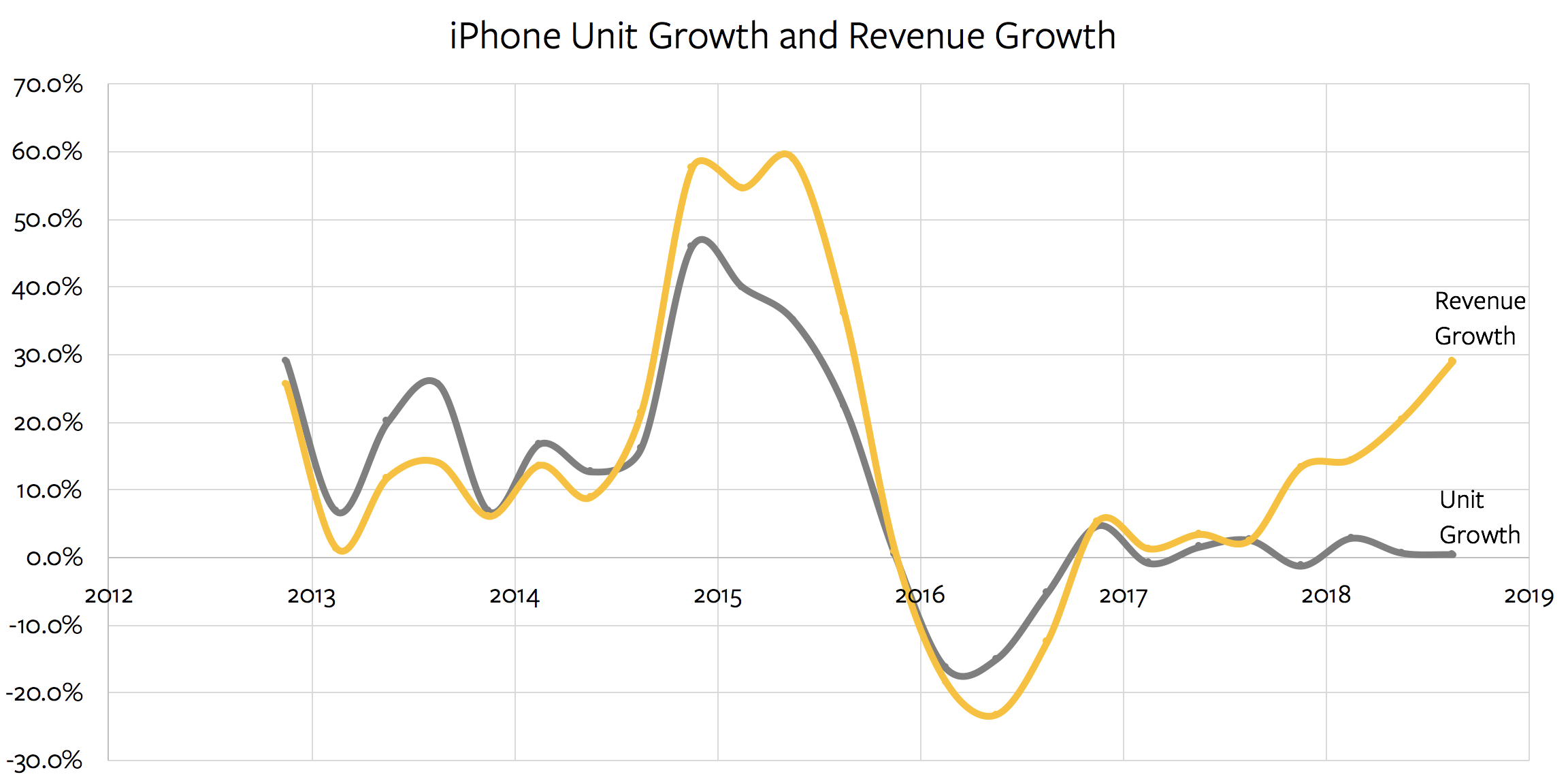
The reality, though, is that unit sales in isolation have indeed misrepresented Apple’s business for the last several years; specifically, they have underestimated it. Consider the last six years of iPhone revenue growth and unit growth:
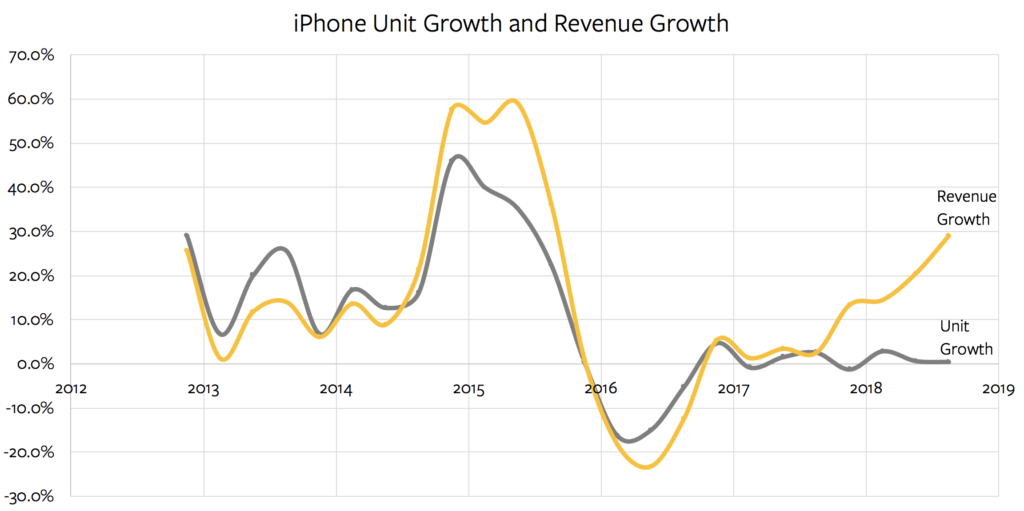
iPhone unit growth and revenue growth over time

iPhone unit growth and revenue were obviously highly correlated in the early years of the iPhone, when the only price difference in the line concerned the amount of storage on the flagship device. As Apple started keeping older models in the lineup, though, revenue growth was a bit slower than unit growth due to a slowly declining average selling price.

Then the iPhone 6 happened: not only was the “big-screen iPhone” stupendously popular — and, it should be noted, was the first phone sold at launch on all of China’s mobile carriers — it also, for the first time, included a configuration — the $749 iPhone 6 Plus — that had a higher base price than the iPhone’s traditional $649. The result was revenue growth that, for the first time, significantly outpaced unit growth.

The iPhone 6S was the opposite story: while Apple thought that iPhone 6 sales figures represented the new normal, in reality Apple had pulled forward a huge number of flagship phone buyers. Ultimately the company had to take a $2 billion inventory write-off on the iPhone 6S after over-forecasting sales; meanwhile, older model phones (including the iPhone 6) were still selling well, so again unit growth outpaced revenue growth.

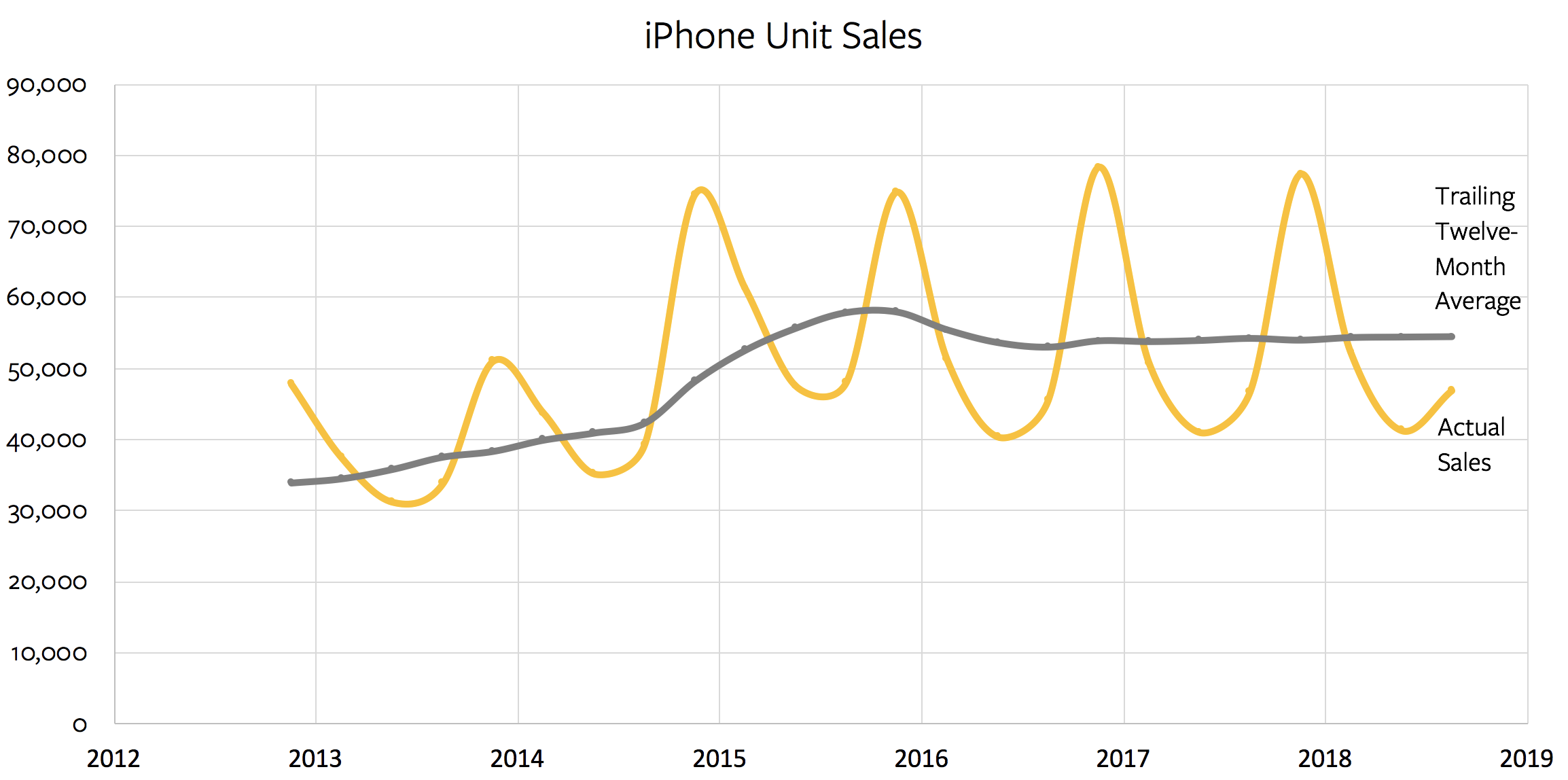
It turned out, though, that the 6S was the new normal: iPhone unit sales have been basically flat ever since:

iPhone unit sales over time

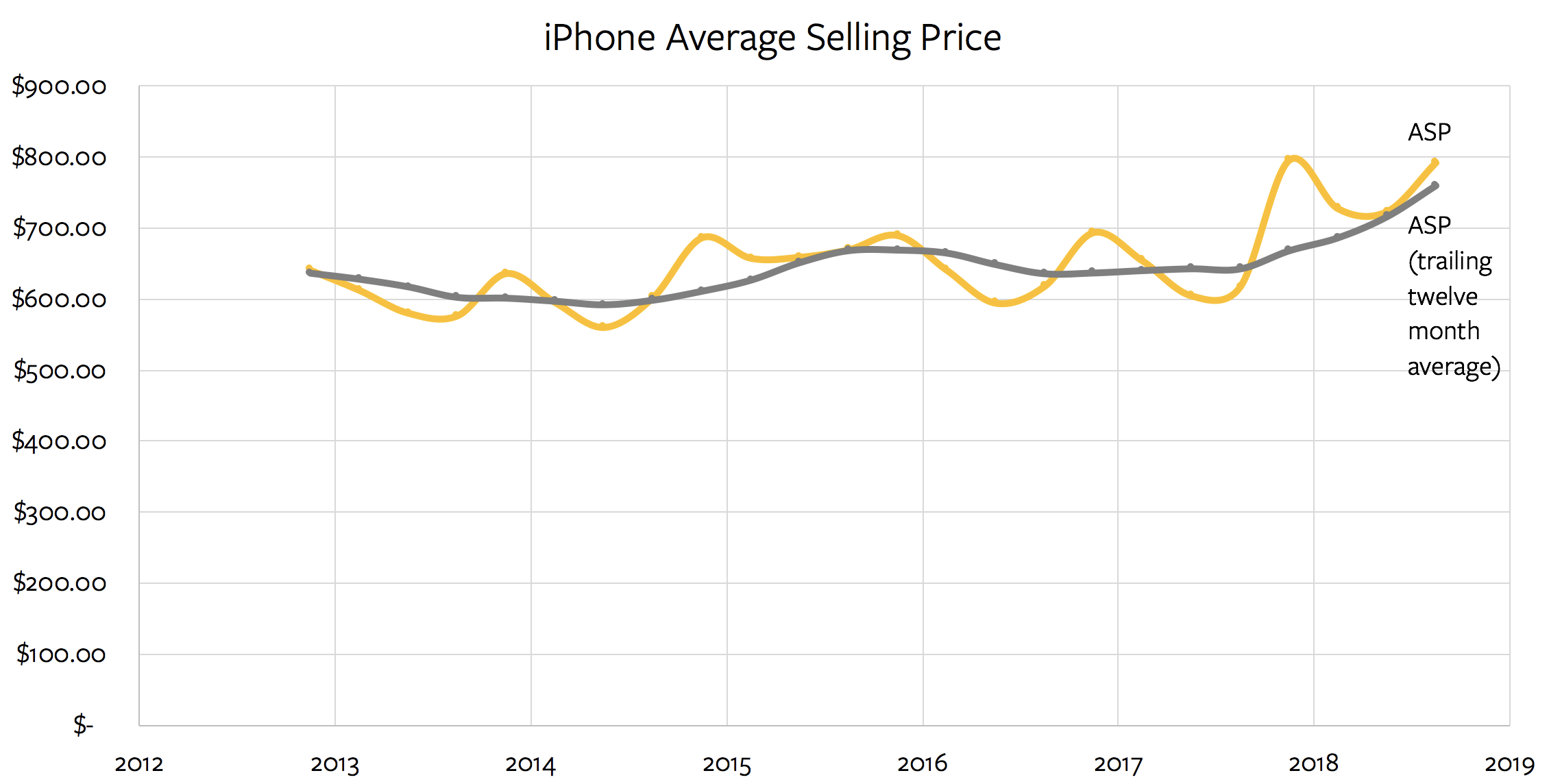
What has changed is Apple’s pricing: the iPhone 7 Plus cost $20 more than the iPhone 6S Plus. Then, last year, came the big jump: both the iPhones 8 and 8 Plus cost more than their predecessors ($50 and $30 respectively); more importantly, they were no longer the flagship. That appellation belonged to the $999 iPhone X, and given how many Apple fans will only buy the best, average selling price skyrocketed:
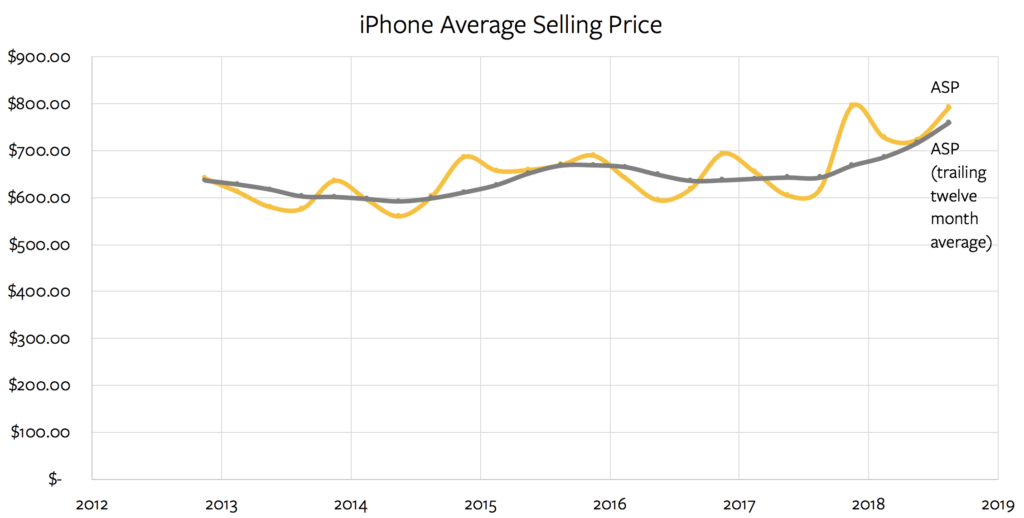
iPhone average selling price over time

Still, even though unit growth had been stagnant for a full three years (not just the last year, as many reports, including the one above, incorrectly stated), reporting those numbers helped Apple tell its story: after all, you needed unit numbers to calculate the average selling price.

What the reports are right about, though, is that unit sales going forward are absolutely a story Apple would prefer to avoid: it is very unlikely that units will grow, and while Apple pushed pricing even higher with the iPhone XS Max, it probably can’t go much further, which means it is likely that the average selling price-based revenue growth story is drawing to an end as well.

Today at Apple

To this point I have focused on the iPhone, and for good reason: last quarter it made up 59% of Apple’s revenue; for the company’s holiday quarter it will likely approach 70%. However, the company will also stop reporting unit sales for Macs and iPads. This came on the heels of a product announcement last week where Apple introduced a new MacBook Air, Mac Mini, and iPads Pro; all were priced significantly higher than their predecessors.

This isn’t a surprise: the Mac line has been increasing in price for years, while the iPads Pro are balanced by a strong entry-level product that starts at $329. The reality of both the Mac and iPads Pro is that they are niche products, and niche customers are willing to pay higher prices for products that better meet their needs.1

What was more interesting about last week’s event though, and which casts more light on Apple’s new growth story than the products announced, was the ten minutes in the middle devoted to Apple Retail.

This is how Apple CEO Tim Cook introduced the segment:

Now there are ways that Apple aims to inspire creativity in our users, including in our stores. The mission of our stores has always been to enrich the lives of our customers by educating and inspiring them to go even further. One of the new ways that we’re taking their creativity even further is through our Today at Apple sessions.

Today at Apple was announced with a press release in April, 2017, and received its first on-stage mention during the iPhone X keynote. Last week’s presentation, though, really highlighted how Today at Apple is perhaps the best way to understand the way Apple thinks about its growth opportunities going forward. Senior Vice President of Retail Angela Ahrendts explained:

We started with the things that are core to Apple’s DNA, things people most use their devices for and trust us to teach them, like photography, music, gaming, and app development. And as Apple continues to develop curriculum like Everyone Can Code and Everyone Can Create, we embed these lessons and techniques into our Today at Apple programming for all customers, including educators and entrepreneurs. And we hold all of our sessions in all 505 retail locations, like at Apple Cotai Central in Macau, which opened a few months ago. Here, customers are attending a session called Photo Walks, where they learn new features, like portrait lighting and depth control, while exploring the city together in a real social way…

And as we continue to push the design of our flagships to be even greater gathering places where everyone is welcome, we’re also creating global platforms for local talent. Photographers, musicians, developers, and artists share their creative gifts…

Since the launch of Today at Apple, only 18 months ago, we have held over 18,000 sessions a week, attended by millions of curious creatives around the world. And with the newest release of the Apple Store app, we’ve made it even easier for you to find out what’s happening near you. Just tap on the Sessions tab and you’ll see a spotlight of the newest Today at Apple sessions in your city. It will also recommend sessions based on the products that you own, and signature programs like Music Labs, Kids Hour, and Photo Walks.

What is striking about Today at Apple is the scale of its ambition combined with its price: free. Of course that is not true in practice, because one needs an Apple device to realistically participate (and an Apple ID to even sign up), but that raises the question as to what Apple customers are paying for when they buy an Apple product? Apple’s point in highlighting Today at Apple is that customers are not simply buying an iPhone or an iPad or a Mac, but rather buying into an ongoing relationship with Apple.

Apple’s Social Network

More broadly, this explains CFO Luca Maestri reasoning on the earnings call for no longer reporting unit sales:

Third, starting with the December quarter, we will no longer be providing unit sales data for iPhone, iPad and Mac. As we have stated many times, our objective is to make great products and services that enrich people’s lives, and to provide an unparalleled customer experience so that our users are highly satisfied, loyal and engaged.

“Engaged” is an interesting choice of words, as engagement is an objective normally associated with social networks like Facebook. The reasoning is obvious: the more engaged users are, the more they use a social network, which means the more ads they can be shown. Social networks accomplish this by aggregating content from suppliers as well as users themselves, and continually tweaking algorithms in an attempt to keep you swiping and tapping, and coming back to swipe and tap some more.

This is a world that has always been foreign to Apple: its past attempts at facilitating social interaction on its platforms are memorable only as the butt of jokes (iTunes Ping anyone?). This isn’t a surprise: Apple’s culture and approach to products are antithetical to the culture and approach necessary to create and grow a traditional social network. Apple wants total control and to release as perfect a product it can; a social network requires an iterative approach that is designed to deal with constant variability and edge cases.

This, though, is why Today at Apple is compelling, particular Ahrendts’ reference to bringing people together in a “real social way” — and she could not have emphasized the word “real” more strongly. Apple is in effect trying to build a social network in the real world, facilitated and controlled by Apple, and betting that customers will continue to pay to gain access.

Apple’s Average Revenue per User

To be perfectly clear, I am not arguing that Today at Apple is the answer to a saturated smartphone market or Apple reaching the limits of price increases. The company is clearly relying on “Services” revenue, which mostly means App Store revenue, a huge portion of which comes from in-app purchases for games, as well as a growing number of subscriptions, some provided by Apple (like Apple Music), but most by 3rd parties.

What this framing of a “real world social network” does provide, though, is insight into where it is Apple’s new reporting falls short. It is all well and good that Apple will now separate Services revenue and its associated cost-of-sales starting next quarter; more insight into Apple’s growth driver is clearly appropriate.

What is missing, though, is the equivalent of unit sales for Services, specifically, the number of active customers Apple has, and the associated revenue per user. This is the exact metric that matters to social media companies, and to the extent that Apple’s growth is derived from continually monetizing its existing user base over time, it makes sense here as well.

To be sure, an accurate number would very much include device revenue: I laid out in Apple’s Middle Age that the company’s growth was based on getting more money from its existing user base through higher average selling prices, selling more devices (i.e. Apple Watch, AirPods, HomePod, etc.), and increased services revenue; to the extent Apple is correct that focusing on only devices misses the story, it is also correct that focusing on only Services is misleading as well.

Apple’s Priorities

Unfortunately Cook already declared on another earnings call last February that this number isn’t coming:

We’re not releasing a user number, because we think that the proper way to look at it is to look at active devices. It’s also the one that is the most accurate for us to measure. And so that’s our thinking behind there.

There are two problems with this: first, while an active devices number is helpful, the 1.3 billion number that Apple announced on that February earnings call was the first in two years; it has not been updated since. Second, the number of active devices may be easier for Apple to measure, but it simply isn’t as valuable to investors as the number of active users for reasons Cook stated himself last week:

Our installed base is growing at double digits, and that’s probably a much more significant metric for us from an ecosystem point of view and customer loyalty, et cetera. The second thing is this is a little bit like if you go to the market and you push your cart up to the cashier and she says, or he says how many units you have in there? It doesn’t matter a lot how many units there are in there in terms of the overall value of what’s in the cart.

It’s not just “overall value”, though: it’s how many customers there are total, and the ways in which their cart is changing — i.e. what is the installed base, and what is the rate of growth that Cook is referring to?

Unfortunately Apple appears to be most concerned with the top and bottom line. Maestri said just before Cook’s comment:

At the end of the day, we make our decisions from a financial standpoint to try and optimize our revenue and our gross margin dollars, and that we think is the focus that is in the best interest of our investors.

It is certainly difficult for anyone, particularly Apple’s investors, to complain about Apple’s revenue and gross margin dollars, going on many years now. For all those years, though, said revenue and profit were based on unit sales.

Now Apple is arguing that unit sales is the wrong way to understand its business, but refuses to provide the numbers that underlie the story it wants to tell. It is very fair for investors to be skeptical: both as to whether Apple can ever really be valued independently from device sales, and also whether the company, for all its fine rhetoric and stage presentations, is truly prioritizing what drives the revenue and profit instead of revenue and profit themselves. I do think the answer is the former; I just wish Apple would show it with its reporting.

  1. Well, theoretically anyways, in the case of the MacBook Pro

07 Nov 21:01

iPad Pro Review Roundup: Impressive Hardware Held Back by iOS Limitations

by John Voorhees

The initial reviews of Apple’s new iPad Pros are out. There is a general consensus that the hardware is impressive, but many reviewers conclude that limitations of iOS are holding the device back. Here are highlights from some of the reviews:

Performance

Laptop Magazine sums up what many reviewers discovered about the iPad Pro’s hardware:

The iPad Pro is the quintessential tablet for power users and creative pros. It's so fast that I imagine the likes of Qualcomm and Intel are getting nervous. This tablet wiped the floor with premium Windows laptops and 2-in-1s, in both benchmarks and real-world tests. The iPad Pro's display, sound and battery life are also top-notch, and the improved Apple Pencil is more comfortable and easier to store.

John Gruber, writing for Daring Fireball says:

“No one buys an iPad because of CPU benchmarks”, I wrote last year. I don’t think that’s true any more. I think there are people who will and should buy the new iPad Pro because of its performance. At the hands-on area after last week’s event, Apple was showing Adobe Lightroom editing 50 megapixel RAW images from a Hasselblad camera. The photos were by Austin Mann, who was there, and helpfully demoed the software, showing what a real pro photographer would do in real life with real images. The experience was completely fluid and instantaneous.

USB-C Support

The new iPad Pro is the first iOS device to adopt USB-C, but notably, it does not work with external storage devices. The Verge’s Nilay Patel:

…one extremely important category of devices will definitely not work: iOS does not support external storage. You can plug as many flash drives or hard drives as you want into the iPad Pro’s USB-C port, and nothing will happen. Apple says third parties can write apps to talk to external storage, but out of the box, this $1899 tablet simply won’t talk to a flash drive.

The ability of third parties to write apps that allow USB storage to save to the Files app is not new, and it’s a far cry from the convenience that system-level support could provide.

Despite the lack of storage support, Patel found that a variety of other devices worked:

Keyboards worked. A USB microphone showed up in Garageband. You can plug a phone or Nintendo Switch into it and get up to 7.5 watts of power to charge them. (That’s not really enough for a Switch, by the way.) Apple supports both analog and digital audio out, so virtually all USB-C headphones and audio dongles work, a huge improvement over the Android ecosystem.

However, as Chris Velazco of Engadget points out:

That's the thing about using this connector sometimes, though: You'll never really know what to expect until you plug something into it. Aside from briefly outlining a few use cases for USB-C during its launch event last month, Apple hasn't really explained how else people can expect to use it, making my time with the Pro one long trial-and-error session. I've been pleasantly surprised with how I've been able to put that new connector to use, but I'm starting to get tired of this guessing game.

The Camera

Due to the thinness of the new iPad Pros, Apple has moved from a 6 lens rear-facing camera system to a 5 lens one. The camera, which protrudes from the rear of the device, also loses optical image stabilization.

Matthew Panzarino writing for TechCrunch:

The camera in the iPad Pro is a completely new thing. It uses a new sensor and a new 5 element lens. This new camera had to be built from the ground up because the iPad Pro is too thin to have used the camera from the iPhone XR or XS or even the previous iPads.

Interestingly, this new camera system does not deliver portrait mode from the rear camera, like the iPhone XR. It only gives you portrait from the True Depth camera on front.

Patel:

The significant camera bump on the back houses an f/1.8 lens and a 12-megapixel sensor — Apple says this is an all-new camera that matches the performance of the old iPad Pro in a much thinner package so it can fit behind the display. You do get the benefit of Apple’s Smart HDR processing, so you’ll see flatter images with more detail in the shadows than before, but the images are not quite as good as the iPhone XS wide-angle camera.

The New Apple Pencil

Regarding the redesigned Apple Pencil, Gruber says:

The new Apple Pencil is one of the best “2.0” products I’ve ever seen. The original Apple Pencil is a terrific product, but the new one nears perfection for the concept.

Panzarino has this interesting detail about the Pencil’s inductive charging:

The ‘top’ (for lack of a better term) edge of the iPad Pro in horizontal mode now features a small opaque window. Behind that window are the charging coils for the Pencil. Inside the Pencil itself is a complimentary coil, flanked by two arrays of ferrite magnets. These mate with magnetic Halbach arrays inside the chassis of the iPad. Through the use of shaped magnetic fields, Apple pulls a bit of alignment trickery here, forcing the pencil to snap precisely to the point where the charging coils are aligned perfectly. This enables you to slap the pencil on top quickly, not even thinking about alignment.

Another interesting tidbit from John Gruber:

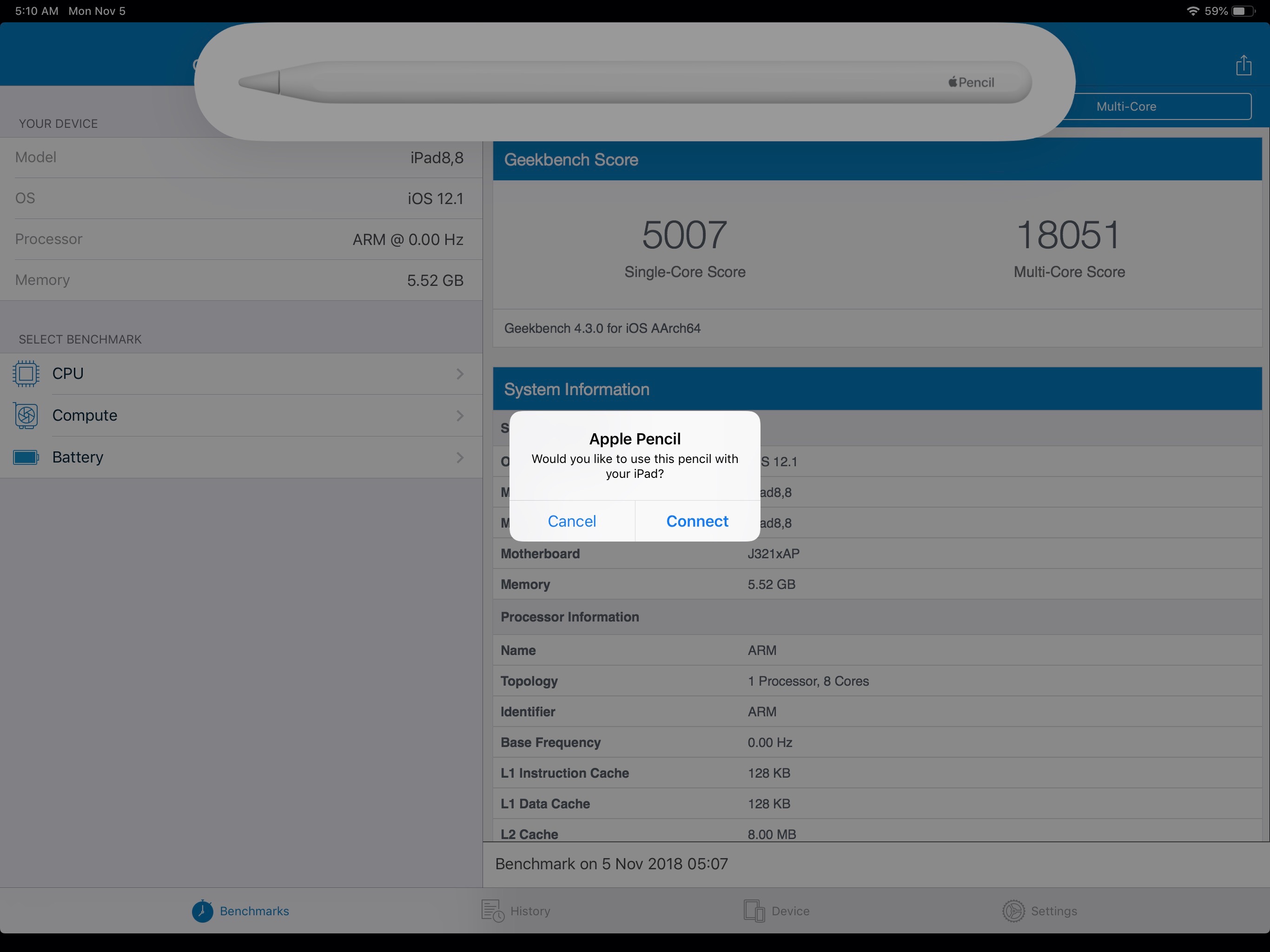
As a nice touch, when you first connect the Pencil to your iPad, iOS shows you a Pencil on screen and it’s the _exact_ size of the actual Pencil. It’s adorable. 

An upcoming version of Procreate sounds as though it makes good use of the new Apple Pencil, combining the double-tap gesture with contextual awareness. Panzarino:

In Procreate, for instance, you can choose a different double tap action for many different tools and needs. It’s malleable, depending on the situation. It’s linked to the context of what you’re working on, or it’s not, depending on your (and the developer’s) choices.

One minute you’re popping a radial menu that lets you manipulate whole layers, another you’re drawing and swapping to an eraser, and it still feels pretty easy to follow because it’s grounded in the kind of tool that you’re using at the moment.

The Smart Keyboard Folio

If you were wondering whether the new Smart Keyboard folio case is more stable than the previous model, Panzarino says it is:

The general effect here is that the Smart Keyboard is much much more stable than previous generations and, I’m happy to report, is approved for lap use. It’s still not going to be quite as stable as a laptop, but you can absolutely slap this on your knees on a train or plane and get work done. That was pretty much impossible with its floppier predecessor.

Battery Life

Battery life faired well in iMore’s tests. Rene Ritchie of iMore says:

…I took both last year's 10.5-inch and this year's 12.9-inch iPad Pros out for Pokémon Go's Gengar Raid Day. Because, of course, I did.

Four hours of non-stop screen-on, GPS pinging, data transmitting, and graphics rendering later, and the 10.5-inch was down to 37% while the 12.9-inch was still at 54%. (Simulator activity rendered my iPhone XS, XR, and Max down to the teens a couple weeks ago.)

Working on the iPad Pro

In terms of day-to-day work, some reviewers found that accomplishing particular tasks on an iPad Pro was more difficult than on a Mac:

Scott Stein, writing for Cnet:

For me, the whole experience and new ease of charging now makes the Pencil more likely for me to use, instead of ignore. It feels like a part of the iPad, now.

Editing, though? That's another story. I use a trackpad to edit. Apple allows a virtual trackpad in iOS 12 using the onscreen software keyboard, but there isn't an option for the physical keyboard.

Geoffrey Fowler, writing for the Washington Post:

While iOS 12 has a few keyboard shortcuts that help zip between apps, what I was missing was a degree of information density. Everyone has a different way of working, but sometimes on a Mac I’ll have five windows open at once, passively monitoring messages, email, Slack, Twitter and music. On the iPad, I had to keep flipping through apps in an attempt to stay tuned in. Some iPad apps don’t even show you the time and battery level along the top edge.

Reviewers’ Conclusions

Although reviewers were impressed with the new iPad Pro’s hardware, many were frustrated by iOS. Patel concludes that:

Apple’s approach to iOS is holding that hardware back in serious and meaningful ways, and while USB-C makes life with this new iPad Pro slightly easier, it still has the same basic capabilities and limitations of last year’s iPad Pro.

Cnet's Stein has a similar take:

But the iPad Pro just isn't flexible enough, yet. The browser is not the same as a desktop-level experience, which can make it hard to work with web tools. No trackpad on the optional keyboard and no support for mice makes text editing cumbersome. Furthermore, iOS hasn't changed enough. It's way too much like an evolution of the iPhone, instead of a fully evolved computer desktop. And the current crop of available apps don't yet exploit this awesome new hardware.

Although opinions differ on whether the iPad Pro can replace a Mac, it’s clear that the hardware has advanced to the point where it exceeds many of the laptops in Apple’s line. As Federico and I discuss on today’s episode of AppStories, the next year and iOS 13, in particular, will be critically important in justifying the ‘pro’ in the ‘iPad Pro.’ In the coming weeks, we'll have in-depth coverage of the new iPad Pro on MacStories, so stay tuned.


Support MacStories Directly

Club MacStories offers exclusive access to extra MacStories content, delivered every week; it's also a way to support us directly.

Club MacStories will help you discover the best apps for your devices and get the most out of your iPhone, iPad, and Mac. Plus, it's made in Italy.

Join Now
07 Nov 21:01

Personal Panopticons

by L. M. Sacasas

Every now and then, due to some egregious blunder or blatant overreach on the part of government agencies or tech companies, concerns about surveillance and technology break out beyond the confines of academic specialists and into the public consciousness: the Snowden leaks about the NSA in 2013, the Facebook emotional manipulation study in 2014, the Cambridge Analytica scandal in the wake of the 2016 election. These moments seem to elicit a vague anxiety that ultimately dissipates as quickly as it materialized. Concerns about the NSA are now rarely heard, and while Facebook has experienced notable turbulence, it is not at all clear that meaningful regulation will follow or that a significant number of users will abandon the platform. Indeed, the chief effect of these fleeting moments of surveillance anxiety may be a gradual inoculation to them. In my experience, most people are not only untroubled by journalistic critiques of exploitative surveillance practices; they may even be prepared to defend them: There are trade-offs, yes, but privacy appears to be a reasonable price to pay for convenience or security.

This attitude is not new. In the late 1960s, researcher Alan Weston divided the population into three groups according to their attitudes toward privacy: fundamentalists, who are generally reluctant to share personal information; the unconcerned, who are untroubled and unreflective about privacy; and pragmatists, who report some concern about privacy but are also willing to weigh the benefits they might receive in exchange for disclosing personal information. He found then that the majority of Americans were privacy pragmatists, and subsequent studies have tended to confirm those findings. When Westin updated his research in 2000, he concluded that privacy pragmatists amounted to 55 percent of the population, while 25 percent were fundamentalists and 20 percent were unconcerned.

The panoptic bubble overlaps with the private sphere of the body and the home. In this way, it reinforces the sense that privacy is a private rather than public concern

In a more recent study of attitudes toward privacy among older adults, Isioma Elueze and Anabel Quan-Haase expanded upon Westin’s taxonomy to include a category for what they termed the “cynical expert.” These individuals were better informed about privacy concerns than their peers but also tended to be more likely to share personal information. The findings corroborated a 2016 study of privacy attitudes and social media platforms by Eszter Hargittai and Alice Marwick that sought to better understand what they called the “privacy paradox”: the gap between reported privacy attitudes and actual privacy practices. Hargittai and Marwick suggested that the rise of privacy “cynicism” (or “apathy” or “fatigue”) was in part a function of the opacity of how social media platforms structure privacy settings and what users perceived to be the inevitable dynamics of what Marwick and danah boyd had, in a previous paper, termed “networked privacy.” In a network, they contended, the individual invariably cedes a measure of control over privacy to others within the network who have the power to share and publicize information about them without their consent.

That picture has been further complicated by the widespread adoption of the accouterments of the “smart home,” including internet-connected devices like Nest and AI assistants such as Amazon Echo or Google Home. Perhaps this development has been enough to push people from privacy cynicism toward what media scholar Ian Bogost, writing in the Atlantic, has described as full-blown “privacy nihilism,” which presumes an omnipresent regime of surveillance that we can no longer resist and may as well not bother to try. He points to experiences of what we might call the data uncanny — “someone shouts down the aisle to a companion to pick up some Red Bull; on the ride home, Instagram serves a sponsored post for the beverage” or “two friends are talking about recent trips to Japan, and soon after one gets hawked cheap flights there” — that have led users to erroneously conclude that their phones are listening in on their conversations.

As Bogost observes, this is not yet technically feasible, but the fact that this belief persists is itself revealing. Having surrounded ourselves with cameras, microphones, and a panoply of sensors, we now find ourselves enclosed in our own personal panopticon. It doesn’t matter whether anyone is actually watching or listening as long as we can’t be sure that they aren’t. Once the apparatus of surveillance is considered a fait accompli, then some measure of cynicism, apathy, or nihilism may present itself as the only reasonable response. It’s worth emphasizing, too, that this panopticon is experienced as personal: one whose boundaries are drawn close to the self and whose structures derive chiefly from consumer choices rather than government injunctions. The panoptic bubble we inhabit overlaps with what we have traditionally thought of as the private sphere, the sphere of the body and the home. In this way, it reinforces the sense that privacy is a private rather than public concern.

This all suggests the broader possibility that the pervasive presence of surveillance helps produce people who are more at ease with it — people who no longer know what privacy is for, or what socio-moral milieu could give it value. We may retain some memory of how the word is used, but we don’t know what it names. This development is, in part, an effect of habitually experiencing the self as mediated through the apparatus of surveillance. The subjective experience of operating within the field of surveillance has more bearing on our attitudes than detached theorizing about the capacities of the surveillance apparatus or the abstract ideal of privacy.

The older understanding of privacy that arose in conjunction with the material culture of early modernity is no longer adequate, in part, because it is no longer plausible or even altogether desirable. The techno-social order that was its habitat no longer exists. The degree to which we have preferred the more visible self mediated through social media, the quantified self mediated through personal tracking technologies, and the smarter household mediated through the internet of things, is the degree to which we have also, unwittingly perhaps, embraced the apparatus of surveillance. Older accounts of privacy, deriving their force from an ideal of the self whose appeal has faded, have lost their coherence and thus their usefulness.

The consumer surveillance business did not start with contemporary tech companies. “Google and Facebook,” as Bogost notes, “are just the tip of an old, hardened iceberg.” He traces the history of marketing data collection from its mid-19th century origins through the emergence of relational databases in the 1970s to the later rise of data brokers. This long history, as far as Bogost is concerned, suggests that it has become “the machinery of actual life” from which there is no escape, “no matter how many brows get furrowed over or tweets get sent about it.” He concludes that “your data is everywhere, and nowhere, and you cannot escape it, or what it might yet do to you.”

Pervasive surveillance leads to a paradox in which a deeper concern for privacy produces only more despair or indifference about it

In good dialectic fashion, then, the erosion of the earlier norms surrounding privacy facilitate the further encroachments of surveillance technology. But we will misunderstand our situation if we conceive of the resulting “privacy nihilism” as merely the unintended consequences of this history. From the perspective of what has helpfully been termed surveillance capitalism, such resignation is, to borrow a phrase, a feature not a bug. For the consumer surveillance industry, privacy expectations are obstacles, and one way to overcome them has been to gradually erode their plausibility.

Not everyone, of course, has the same privacy expectations. Privacy pragmatism, for instance, is plausible chiefly for those not already conditioned by the hard experience of discrimination and bias. But attitudes about privacy derive not only from experience of surveillance but perceptions of its potential and many social media platforms — along with the tools of personal tracking, personal AI assistants, and the data gathering nodes of the smart home — have, deliberately or not, made its potential seem limitless, generating the indifference that abets its further expansion.


The appropriate response to these shifts cannot simply be an effort to recover the older normative framework and its configuration of legal and social provisions. That specific array of values and risks is history. In the age of social media, many of us take a certain amount of visibility for granted while we work hard to exercise a measure of control over it. This is a marked change from earlier conditions, when invisibility was presumed and securing wider visibility, should it even be desired, required hard, deliberate work. Privacy, we might say, was the default setting of the experience of the self. Now, to the degree that social media is the dominant technology of the self, these older parameters of the private self are as likely to be experienced as privation and a failure to appear in social media feeds may be experienced as a social liability.

In this new context, privacy has become a matter of negotiating the terms of our heightened visibility to maintain a degree of autonomy over our self-presentation. It is no longer a matter of shielding wide swaths of our personal lives from view or assuring that one does not unfairly become a “person of interest” to the powers that be. We’re more open to sharing aspects of our lives that may have been previously considered as appropriate only for the self or a select set of intimate others. In no small measure, this derives from the widespread adoption of platforms engineered to reward self-disclosure with greater visibility, a system that depends on seeing the platforms as ubiquitous. The incentives work together with the inescapability they presuppose to produce subjects who more readily accept and participate in the broader surveillance regime, further entrenching the dynamics of networked privacy.

Under this regime, older conceptions of privacy — which construe privacy as a merely individual concern — may misread the threat pervasive surveillance poses, leading to a paradox in which a deeper concern for privacy produces only more despair or indifference about it. For example, when weighing the risks of invasive data gathering, privacy pragmatists may conclude that they have nothing to hide, or that the capture of their anonymized consumer data poses no particular risk to them. They may be right on both counts, but they are missing the collective privacy risks presented by a networked society.

Personal data, even when insignificant on its own, contributes to the massive data pools that fuel the emerging machinery of persuasion, prediction, and control that touch everyone’s lives. As Brett Frischmann and Evan Selinger point out in Reengineering Humanity, individualized concerns “fall woefully short of acknowledging the full power of techno-social engineering.” Personalized solutions, such as tweaks to disclosure agreements and a commitment to informed consent, are insufficient to address this.

Individualized understandings of privacy have proved inadequate both to both perceiving the risks and meeting them effectively

From Frischmann and Selinger’s perspective, the most serious threats digital technologies pose are not strictly personal concerns like identity theft or companies’ surreptitiously listening in on conversations but the emergence of a softly deterministic techno-social order designed chiefly to produce individuals that are its willing subjects. They note, for example, that when a school deploys fitness trackers as part of its physical education program, privacy concerns should extend not only to questions of students’ informed and meaningful consent. Even if consent is managed well, such a program, Frischmann and Selinger argue, “shapes the preferences of a generation of children to accept a 24/7 wearable surveillance device that collects and reports data.” This is to say that these programs contribute to “surveillance creep”: our gradual acquiescence to the expanding surveillance apparatus. Such an apparatus, in their view, appears pointed ultimately toward the goal of engineered determinism. Frischmann and Selinger conclude by advocating for legal, cultural, and design strategies that aim at securing our freedom from engineered determinism. And I would suggest that we would do well to reframe our understanding of privacy along similar lines.

A better understanding of privacy does not merely address the risk that someone will surreptitiously hear my conversations through my Apple Watch. Rather it confronts the risk of emerging webs of manipulation and control that exert a softy deterministic influence over society. The Apple Watch (or the phone or the AI assistant or the Fitbit) is just one of many points at which these webs converge on individuals. Tech companies, who have much to gain from the normalization of ubiquitous surveillance, have presented their devices and apps as sources of connection, optimization, convenience, and pleasure. Individualized understandings of privacy have proved inadequate to both perceiving the risks and meeting them effectively.


As it turns out, concerns about engineered determinism are no more novel than concerns about privacy. In Fyodor Dostoevsky’s Notes from the Underground, the unnamed narrator mocks proponents of a rational and utilitarian vision of the future, typified by 19th century Russian social critic and political activist Nikolay Chernyshevsky. For the Underground Man, these “gentlemen,” as he consistently calls them, believe “human action will automatically be computed according to these laws, mathematically, like a table of logarithms, reaching to 108,000 and compiled in a directory,” and that human beings will assent to this regime because it will be shown to be in their best interest. If humanity’s best interest can be rationally determined with mathematical precision, the laws governing human affairs, like those governing the rest of the natural order, can be discovered. He imagines one of these men sarcastically asking, “Well, gentlemen, why don’t we get rid of all this good sense once and for all, give it a kick, throw it to the wind, just in order to send all these logarithms to hell so that we can once again live according to our own foolish will?” Free will as an illusion best cast aside in favor of a regime of predictive manipulation for the sake of the greatest, scientifically determined good.

Against this understanding of human nature, the Underground Man asserts his foolish will as a defining quality. A person’s greatest advantage, he claims, is “one’s own, independent, and free desire, one’s own, albeit wild caprice, one’s fantasy, sometimes provoked to the point of madness.” He, too, longs for freedom from engineered determinism. This assertion of will doesn’t make him a unique hero though — it is part of what makes him, in Dostoyevsky’s view, a type that “is bound to exist in our society, taking account the circumstances that have shaped our society.” That is, his stubborn refusal to adapt to the prospect of predictive control is as much a product of that order as the acquiescence of those who willingly or thoughtlessly adapt. And this entrapment perhaps explains the Underground Man’s wild emotional swings, his self-loathing, his paralysis, his anxieties about self-consciousness, his theoretical embrace of violence as a way of asserting his individuality, his bitterness, and his spite.

The Underground Man’s chief problem may be his unquestioning acceptance of an individualist framing of identity. It sunders him from any human-scaled networks of interdependence — i.e., communities — within which his individuality might have flourished. Instead he accepts his isolation and doubles down on its terms.

It would similarly be a mistake for us to respond to the prospect of techno-social engineering by doubling down on the privatization of privacy that has been one of the conditions of its emergence. We need a new story to make the value of privacy seem compelling again. It may be that the best reason for me to guard my privacy is my desire to protect your freedom. But we’re a long way, it seems to me, from this being a universally plausible account of privacy, much less an account from which public action will spring. Instead, as they purveyors of surveillance capitalism would have it, we careen toward engineered determinism down a path greased by our indifference and despair.

07 Nov 21:01

Taipei Mayor Drops Trap Music Video

by Sandy James Planner


This week new mayors are being sworn in across Metro Vancouver and we can say with relative confidence that none of them have their own trap music video. But as CityLab reports Taipei’s  Mayor Ko Wen-je has separated from the Mayoral pack by teaming up with well-known Taiwanese rapper Chunyan and released his first music video.

Chanting “Do things right” the 59-year-old  mayor (who is also a surgeon) received 4,000 comments in the first day of the release on YouTube and in one week has over 1.7 million views.The timing of the video release was exquisite,  immediately after he had participated in a municipal restructuring  And this mayor gets around, having visited Amsterdam and declaring that dedicated cycling lanes like those used by the Dutch should be something that Taipei works toward. In the video below a transportation professor from a Taiwanese University suggests that since most people do not bike in Taipei, and since the street network was designed without thought to bike lanes, that the Dutch model was not a good example. We are waiting for the Mayor’s trap video response on this one.  https://www.youtube.com/watch?v=85Iu2XzV_mI


Image: CityLab


07 Nov 21:00

Will Richmond City Council Scale Back Mansion Cropping on Best Farmland In Canada?

by Sandy James Planner

farm-house-alr

farm-house-alr

Tuesday November 6 is a the mid-term election day in the USA but it is also a big day for the City of Richmond too, where the inaugural meeting of the new City Council will include looking at  residential development on agricultural land. 

And it’s not only Richmond under siege with mansion growing~it’s happening in California wine country too.

The last City of Richmond Council has been complicit in allowing the best agricultural lands in Canada supposedly protected under  the Agricultural Land Commission  to become private gated offshore owned estates.

The previous Council against the advice of their own staff endorsed the building of nearly 11,000 square foot mcmansions on farming lands.  That Council also allowed larger farm properties to not only have a huge house, but an additional 3,200 square foot house for the “help”.

The Province has capped housing at 5,382 square feet, and for a good reason, to ensure that land was kept for farming, and that farmers always had access to farmland. Using loopholes in existing legislation offshore buyers can escape paying the foreign buyers’ tax by purchasing agricultural lands, and developers get supernormal landlifts by turning farmland into private exclusive residential estates. The loser? Future food security close to metro markets, and the fact that farmers will never ever be able to own this farmland.

The Napa Register  outlines that in California’s Napa Valley mcmansions are also being built on prime farmland in five and ten-acre parcels. These “mansions” are half the size of the ones that Richmond City Council approved, being only 17 rooms and 6,700 square feet. But again these estates have the same impact, paving  over prime farmland for private residential pools and activities.

Price Tags Vancouver has previously reported that the exploitation of farmland for quick developer profit may be over. A majority of council (including returning Mayor Malcolm Brodie) are now working together to vote for   farmhouse size that is compliant with the Agricultural Land Commission’s guidelines.Scaling back to residential houses of 5,382 square feet gives agricultural land the chance to continue in farmland production as was intended. Price Tags will be watching on Tuesday to see Richmond City Council’s discussion and actions on keeping the best farmland in Canada in production for future generations.

Here’s a tweet from Councillor Harold Steves, a father of the Agricultural Land Reserve, farmer and environmentalist, as well as a long serving member of Richmond City Council on the impact of mansion cropping.


07 Nov 21:00

Our Favorite Gifts for 6- to 10-Year-Olds

by Wirecutter Staff
Our Favorite Gifts for 6- to 10-Year-Olds

Finding a memorable gift for an elementary schooler can be challenging. Toy fads are hard to keep up with, often inscrutable (what even is Beyblade?), and all too quickly relegated to the donation or junk pile. Our favorite gifts for this age group have long shelf lives; invite kids to build and play with siblings, friends, and the adults in their lives; or offer a gateway to the wonders of the wider world. If you have any go-to presents for this age, please share them in the comments.

07 Nov 21:00

Politics, privilege and invading holograms

by admin
photo of Darth Vader MaskPhoto by issac cortes on Unsplash


Oh dear, so much to write about and so little time. Or maybe things just moving so fast that the moment for blogging passes and another week goes by without me taking time to write. Anyway in an attempt to remedy that situation, this is just a very quick post based on a couple of things I saw last week.

On Friday I saw this tweet from Helen Crump.

Of course ed tech has politics, it’s steeped in them. Everything has a political context.  Education isn’t neutral, is highly political and contextual. The right to education maybe enshrined in the Universal Declaration of Rights , however that doesn’t actually set the context of how education is perceived, instantiated, supported and controlled at national and international levels.  To think that educational technology is neutral is naive. It too is developed, owned and sold by someone with an agenda, and there is a Political or political motive to that.

Despite the claims by most ed tech vendors, ed tech is not the solution to education. It is a solution but right now in the Global North it exists in a neoliberal context. The cost of education and personalisation is increasingly being driven by biased, highly political, data driven, developments.  AI and all those algorithms we are constantly hearing about, are not neutral or non political . They conform to the standards and privileges of those who develop them.

Then I read  Maha’s post on the privilege to choose global perspectives.   Once again Maha reminding us in the Global North of our assumptions around globalism, diversity, the acceptance of our ‘norms’ in academic writing, presenting and referencing.  The political context of academia.

Maha puts  the mirror up to our faces by pointing out:
if you are in the US, your career will survive completely even if you never read a single article by someone not from your culture, not in your language.
would a journal accept my article if it had ZERO references by Western canon?
Well would it? How would you react if you were peer reviewing a paper like that?
So Maha plays the game she understands the political context, she finds ways to get her voice heard.
I blog, I tweet, I publish, I f*%$ing invade conferences with Virtual keynotes and presentations and conversations and I join and initiate collaborations and I speak that language and I build those relationships. So you can all *see me* and you can all *hear me*.

That’s hard work. I have such huge respect for Maha and that f*%$ing invasion.   It is so needed and welcome (well from most people I know. And yes, that’s my politics coming through).  It can be uncomfortable,  but education should be uncomfortable at times. It shouldn’t just be about a “personalised journey”, where you are never challenged and you never question of challenge the context of that experience. Higher education shouldn’t just be judged on the kind of money you can earn, the perpetuating of an increasingly fractured and fragile political scenario.

Then I see the news about teaching holograms and I automatically think of Maha’s post.  How this the exact opposite of her invasion. This could be the starting of another f*%$ing huge cultural invasion. Yet again, we (in the Global North) are developing “new” ways to subjugate “global markets” with this great new (?) technology

 . . . members will also be offered the hologram system, which Imperial is adopting for its MBA classes, aimed at cutting the cost of sharing their academics while hopefully improving on videoconferencing.

Note the emphasis on improving videoconferencing – not improving/developing pedagogy. That doesn’t get mentioned until much further down in the article. But fear not the holographic teacher can take questions in real time. Which is great, because obviously a great big hologram (of a white, middle aged man- check the article’s lead picture) is much better than say synchronous chat session within a video conferencing session – or you know having live video q & a session, or using some twitter, what’s app or snapchat or any technology that might be actually used by students outside education.  And I bet all the planned classes will be in English. Once again we invade the rest of the world except this time we don’t have to face the natives in their own country. We can just beam in star Professors, Darth Vader stylee.

What politics are implicit in that ed tech?

07 Nov 21:00

State of the Social Reader

by Ton Zijlstra

Last weekend during the Berlin IndieWeb Camp, Aaron Parecki gave a brief overview of where he/we is/are concerning the ‘social reader’. This is of interest to me because since ever I have been reading RSS, I’m doing by hand what he described doing more automatically.

These are some notes I made watching the live stream of the event.

Compared to the algorithmic timelines of FB, Twitter and Instagram, that show you what they decide to show you, the Social Reader is about taking control: follow the things you want, in the order that you want.
RSS readers were and are like that. But RSS reading never went past linear reading of all the posts from all your feeds in reverse chronological order. No playing around with how these feeds are presented to you. And no possibility to from within the reader take actions based on the things you read (sharing, posting, bookmarking, flagging, storing etc.): there are not action buttons on your feedreader, other than mark as unread or archive.

In the IndieWeb world, publishing works well Aaron said, but reading has been an issue (at least if it goes beyond reading a blog and commenting).
That’s why he built Monocle, and Aperture. Aperture takes all kinds of feeds, RSS, JSON, Twitter, and even scripts pushing material to it. These are grouped in channels. Monocle is a reader on top of that, where he presents those channels in a nice way. Then he added action buttons to it. Like reply etc. Those actions you initiate directly in the reader, and always post to your own site. The other already existing IndieWeb building blocks then send it to the original source of the item you’re responding to. See Aaron’s posting from last March with screenshots “Building an IndieWeb Reader“, to get a feeling for how it all looks in practice.

The power of this set-up is that it separates the layers, of how you collect material, how work on that material, and how you present content. It looked great when Aaron demo’d it when I met him at IWC Nürnberg two weeks earlier.

For me, part of the actions I’d like to take are definitely outside the scope of my own website, or at the very least outside the public part of my website. See what I wrote about my ideal feed reader. Part of automation of actions I’d want to point to different workflows on my own laptop for instance. To feed into desk research, material for client updates, and things like that.

I’m interested in running things like Aperture and Monocle locally, but a first step is exploring them in the way Aaron provides them to test drive. Aperture works fine. But I can’t yet get Monocle to work for me. This is I guess the same issue I ran into two weeks ago with how my site doesn’t support sending authorisation headers.

07 Nov 20:59

How a meme grew into a campaign slogan

by Nathan Yau

A meme that cried “jobs not mobs” began modestly, but a couple of weeks later it found its way into a slogan used by the President of the United States. Keith Collins and Kevin Roose for The New York Times traced the spread of the meme through social media using a beeswarm chart. Blue represents activity on Twitter, yellow represents Facebook, and orange represents Reddit. Circles are sized by retweets, likes, and upvotes. The notes for key activities move the story forward.
Tags: election, meme, New York Times, Twitter

07 Nov 20:59

Coming To A Street Near You: Help Remix Create a New Tool for Street Designers

I’ve been writing at Medium.com for the past year. Read this full original post there.

Vibrant cities rely on the seamless connectivity of people and ideas. Streets enable these connections: your city’s community members need good streets to access jobs, move safely and sustainably, and live well.

Here at Remix, we’re excited to pilot a new product to design city streets.

We’re designing it on top of the new data standard called SharedStreets, which is being developed by the National Association of City Transportation Officials (NACTO) and the Open Transport Partnership. We need your input to help us build the right thing! 🎉

Read the rest of this post at blog.remix.com

Comments
07 Nov 20:59

Scoring Pennsylvania

I’ve been writing at Medium.com for the past year. Read this full original post there.

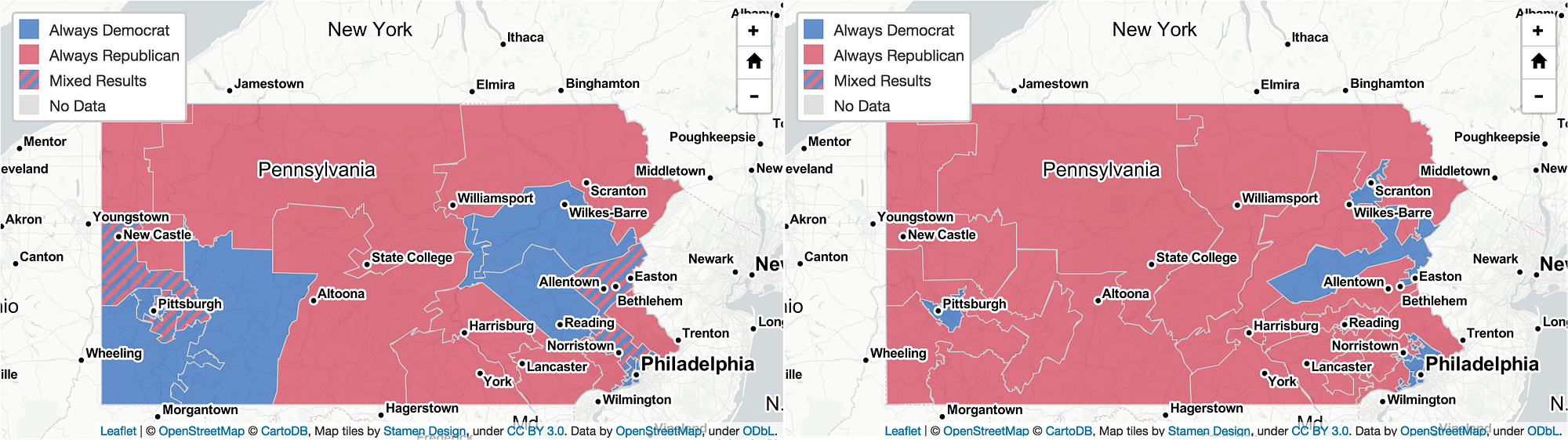
On February 13 we launched PlanScore.org into the whirlwind of Pennsylvania’s disputed congressional plan. Our mission is to help citizens evaluate new redistricting plans for partisan skew and to elevate the conversation on partisan gerrymandering with new historical data for state and U.S. congressional district plans. It’s been an exciting couple of weeks. What did we learn, and how are we doing at reaching our goals?

Every district plan is designed to do a job: apportioning voters into Congressional districts so they can elect members to the U.S. House, typically following traditional redistricting criteria like compactness, contiguity, and preservation of communities and incumbents. Since 2010, we’ve seen the emergence of detailed computer models that allow for the creation of unfair, skewed maps that still conform to traditional criteria.

Read the rest of this post at medium.com

Comments
07 Nov 20:59

Open Precinct Data

I’ve been writing at Medium.com for the past year. Read this full original post there.

Several weeks ago, I spent an extended weekend at the fifth (of five) Geometry in Redistricting conference. Apart from speaking and participating in a panel on law, tech, and gerrymandering, organizer Moon Duchin asked for my help organizing the conference hackathon. One theme I heard repeated throughout the event centered on the difficulty of finding reliable precinct geography and election results.

There’s an opportunity here for a new data project focused on connecting existing academic and independent efforts with durable, unique, permanent identifiers for nationwide voting precincts. Imagine if you could easily correlate detailed voting results from OpenElections.net (OE) or state boards of elections with mapped polygons and census geography over time. We already know how effective a GEOID-based approach can be thanks to data published by the U.S. Census, but precincts are a special challenge without a current champion.

Read the rest of this post at medium.com

Comments
07 Nov 20:59

The Autonomous Vehicle Nightmare

by Gordon Price


Beth Osborne, Director of Transportation for America, was asked: Can you paint a vivid picture of your nightmare scenario of what our cities look like when AVs are all over the roads?

“My nightmare scenario, which I can visualize perfectly,” she responded, “is sitting in the middle of stand-still traffic in which I am the only human being there.  And all the other cars are clogging up the roads but there are no people in any of them.”

The full response can be found here:

It’s a podcast with Slateand this episode is the best exploration I’ve heard of the context for autonomous vehicles (and what the history of Motordom can tell us).

07 Nov 20:59

Neues von AstroAlex

by Andrea

ESA weblog: Launch, and return, updates (1 November, 2018) (Link zum Eintrag auf deutsch)

“ESA astronaut Alexander Gerst, NASA astronaut Serena Auñón-Chancellor and Roscosmos cosmonaut Sergei Prokopyev will welcome new arrivals to the International Space Station on 3 December: Canadian Space Agency astronaut David Saint-Jacques, NASA astronaut Anne McClain and Roscosmos cosmonaut Oleg Kononenko will increase the population of humans in space to six. The newcomers will be part of Expedition 57 for a few days, and will continue their mission as Expeditions 58/59 members only when Alexander and his crewmates undock from the Space Station.”

Exerting the force, plumbing and melting in space. (Today)

“Gravity is constantly exerting its force on objects. When you lift a cup of coffee, you are moving it against gravity. Humans learn how to live with this force of nature from infancy – babies learn to adjust their grip to the weight of objects.

In the weightless environment of the International Space Station astronauts need to adjust to the new world in space much like infants need to learn to hold on to objects. How his brain adapts to an environment where objects have no weight and decides how much grip is needed to move things is at the core of the Grip experiment.”

07 Nov 20:59

Vote for Democrats Everywhere

The president recently called himself a nationalist — and it’s no stretch at all to call him a white nationalist.

From before his campaign, to his remarks after coming down that escalator in Trump Tower, to everything he’s said and done since — including his recent drumming up of fear about refugees planning to seek asylum in the United States — he’s led the effort to ensure that America respects only white power.

This is antithetical to Western democracy, which is built on individual liberty and equal protection, which says that all adult citizens have the right to vote.

If Republicans in Congress had acted as a check on his power, if they had exercised oversight, then I could plausibly suggest voting for the best candidate in each race.

But that didn’t happen. Not even close. It’s been quite the opposite — Republican politicians have aided him at every conscience-shocking turn, and the Republican party has become the party of white nationalism.

I don’t agree with every position of the Democratic Party, and I certainly don’t agree with every position of the candidates available to me. But that’s always true.

What I know, though, is that a Democratic majority in at least one Congressional chamber would finally allow for checks on the president’s power. There would be oversight, at long last.

And we’d have the chance to preserve Western democracy in the United States, and stop this acceleration toward something dark and old and corrupt and dangerous.

Please vote. Please vote for Democrats.

07 Nov 20:59

What It’s Like Knowing You’ll Die of Cancer at 35

by Mathew

This is heart-breaking to read, knowing the subject has since passed away, but it is also fascinating how she thinks about death:

I don’t quite know how to broach this, but in the days between when I spoke with Katia Bozhikova for this installment of the column and when we were ready to publish it, Katia died. She was 35. She knew the end was near. It was something she had grappled with for a while. Katia was first diagnosed with cancer almost a decade ago, and this past spring, doctors told her the disease had spread to her liver, ribs, lymph nodes, lungs, and brain. But her death shocked me nonetheless, probably because that’s what

Source: What It’s Like Knowing You’ll Die of Cancer at 35 – VICE

07 Nov 05:36

On urgency

by Jonathan Libov

One of the beauties of software products is how rapidly one can iterate. Ship, learn, ship, learn, ship, learn.

But if you’ve worked in software you’ve also experienced the cycle of shipping, not learning, shipping, not learning. You might have urgency to just ship stuff, but learning itself takes planning, and it’s too easy and often tempting to ship stuff you can’t learn much from. Because urgency.

You can surely look back at some juncture where you would have been better off dropping everything — maybe not even shipping — to get your ducks in a row. You didn’t, because urgency.

Likewise, it can be easy to project years or months ahead in the life of your software and imagine the feeling that you would have been better off, now, at the present time, dropping everything, not shipping until you had your ducks in a row. But you won't, because urgency.

Of course, if you’ve taken enough shots on goal you’ve also shipped and learned and succeeded without really knowing what you were doing. It happens; sometimes urgency is both wise and fortuitous even if unsustainable. In many cases that’s dangerous: Lottery winners may only learn how to be wasteful.

This is as true for one’s self as it is in work. We all feel the urgency to act and the urgency to succeed. Those feelings are at odds when you’re not learning enough, when you’re relying on luck instead of competing against it. Urgency can be its own worst enemy.

07 Nov 05:35

Understanding Longevity Of A Community Tactic

by Richard Millington

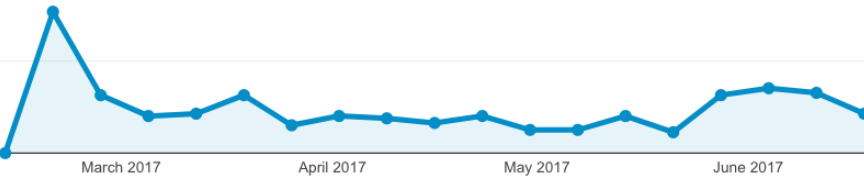
Whenever you try something new, especially something big that everybody in the community sees, you often get a spike in activity.

This happens when you add a new banner, host a new interview series, begin a ‘working out loud’ series, start regular off-topic discussions etc…

When this happens you often get a spike of activity followed by a decline. We’ve seen spikes can be bad. Much of the spike can be explained by curiosity, initial excitement, and a fear of not joining in with the group.

What really matters is what’s happening several weeks later. Don’t compare current data with the initial surge of interest, wait until the surge of interest has died down.

Above we wouldn’t compare late-June 2017 data with the beginning of March. We would compare it to April (post-surge) and see a generally positive, sustainable, trend.

Analyzing post-surge data reveals whether people are getting real value from participating in that tactic. Much of the time, perhaps most of the time, the answer is no. That’s useful to know. You can end tactics which aren’t working or have entered the decline phase and invest that time on new ideas.

Like TV shows, most tactics have a shelf-life. Find the ones which are sustainably growing in popularity and invest more time in them. Stop the ones which are in a decline (or have only a few participants).

07 Nov 05:35

Alibaba’s DingTalk to build voice-driven version for cars

by Emma Lee
Chinese internet giants have been expanding aggressively to car-related technologies.
07 Nov 05:35

Suggested Reading: GDPR, PSI Directive, Q and more

by Ton Zijlstra

Some links I thought worth reading the past few days

07 Nov 05:12

The iPad reviews are in :: And they all hit the wall at the exact same point

by Volker Weber

ZZ315B8532

The iPad Pro reviews praise the hardware and dismiss the software, basically for one reason: iOS does not expose a filesystem. Which makes it difficult to do PC things, i.e. managing files. And that is a view which all nerds share, and basically nobody that is 'just a user'.

I have been a happy Microsoft Surface user for two years, because it lets me do things the PC way. It is a PC, disguised as a tablet. When you run it in laptop configuration, with a keyboard and trackpad attached, it behaves exactly like a PC.

This time I want to go full iPad. That will require some learning. Or shall I say un-learning? My files live inside a service: OneDrive. I don't really need to manage files on external storage. At least not every single hour of the day. At first I will be handling some tasks on a Mac, but I want to center everything on the iPad. I am sure there will be some learnings along the way.

Here is what you can't do: compare a piano to a guitar and complain that the guitar does not handle really well, because it does not burn as long as a piano.

07 Nov 05:12

This should be interesting

by Volker Weber
07 Nov 05:11

Which USB-C hub do you recommend?

by Volker Weber

ZZ7E2F4744

If I want to make the iPad Pro an all-around tool, I am going to need a few dongles and I figure it might be a good idea to get just one that does it all: HDMI projector, SD card, USB-A, power, maybe audio out. What do you recommend?

07 Nov 04:54

Google Pixel 3 Review: a Pure Android Experience and Super Camera, but what a price!

by Steve Litchfield
The new Google Pixel 3 is, in theory, a well balanced phone that provides just about everything the discerning Android user needs, in a surprisingly small form factor. And it gets extra kudos for this, in today’s phablet-dominated world. However, despite the use of pure Android, Google-style, a great camera system, and blazing performance, it’s not easy to fall in love with. The blame for this? At least one unambitious component choice and a marketing-driven price that’s patently crazy. Continue reading →
07 Nov 04:53

Reddit users get Night Sight working on Nexus 6P using modded camera

by Jonathan Lamont
Nexus 6P

Google’s crazy Night Sight Pixel 3 feature works magic when taking photos in the dark. Now, some enterprising Reddit users have figured out a way to get the feature working on the Nexus 6P.

Redditor ‘nickritikos’ loaded a modded Pixel 3 camera APK onto his 6P running Android 8.1. Incredibly, the APK worked, and the Redditor was able to take some Night Sight photos.

However, it wasn’t a perfect experience, as nickritikos noted that the viewfinder didn’t work.

If you want to test out the Night Sight feature on an older device, you can grab the modded APK used by the Redditor from a Google Drive link shared on his post here. It should install alongside your device’s regular camera.

Along with the Nexus 6P, some users tested it on the first generation Pixel and on the Pixel 2 and 2 XL with success as well.

These devices join a growing list of phones with unofficial access to the Night Sight feature, including the Essential Phone and Xiaomi Mi 5.

Source: Reddit

The post Reddit users get Night Sight working on Nexus 6P using modded camera appeared first on MobileSyrup.

07 Nov 04:53

Lime electric scooters frequently outside of test zones in Waterloo, ON

by Brad Bennett

Waterloo, Ontario is a test bed for Lime electric scooters in Canada, but it seems like users aren’t following the city’s rules and are taking the scooters on joyrides.

Similar to various bike share programs, Lime allows individuals to borrow an electric scooter to get around. The scooters can travel up to 24kph. Lime is based in San Fransisco and has notable success in the region, but the city of Waterloo is still nervous regarding the safety of these high-speed scooters that anyone can use.

There’s a geofence designed contain the scooters, so they only work optimally on a five and a half kilometre stretch of the Laurel Trail area between the Waterloo Park Promenade and the David Johnston Research and Technology Park. Outside of the test zone, the scooters slow down to walking speeds.

Stopping the scooters outside of the fence isn’t on the city’s mind since its unsafe to halt them remotely while people are riding, says Ryan Mousey, a Waterloo economic development advisor. Instead of locking the scooters down, the town wants to fine users who take the scooters out of the test zone when the program resumes in the spring.

Waterloo residents are reporting to The Record that the scooters are making outside of the geofence and into other parts of town.

Even though this isn’t a specific part of the test, having scooters in inconvenient places as a side-effect does introduce residents to what life with a widespread scooter share service would be like.

In San Fransico, users often leave their scooters on the side of the road when they get to their destination. Other users, nicknamed ‘Juicers,’ can take them home and charge them for a small payment.

If Lime launches in full force in the city, Waterloo residents are likely going to have to get used to dealing with scooters all over town once the test moves past its 100-scooter limit.

The city wants to add more parking along the route so users don’t have to take the scooters off the path to get back to their vehicle. This would likely only solve the problem while the test is running and not once the scooters move past this beta phase.

Source: The Record 

The post Lime electric scooters frequently outside of test zones in Waterloo, ON appeared first on MobileSyrup.

07 Nov 04:51

Apple opening 60,000 square foot office in downtown Vancouver

by Jessica Galang
vancouver downtown

Apple has leased 60,000 square feet of office space in Vancouver’s 400 West Georgia Street office tower, according to a report from The Daily Hive.

A source familiar with the plans told BetaKit that the new Apple office could end up at over 109,000 square feet. The Daily Hive confirmed the lease from a third-quarter report by NAI Commercial on Metro Vancouver’s office market.

The office is currently under construction, and will be located across from Amazon’s future office in the city. Amazon announced plans to open a new office and add 3,000 jobs to the city in April.

The real estate market is also heating up for startups seeking space, and many global companies are taking advantage; coworking spaces like WeWork and Amsterdam-based Spaces are moving in to provide a hub for the city’s growing ecosystem.

This story was originally published by BetaKit.

The post Apple opening 60,000 square foot office in downtown Vancouver appeared first on MobileSyrup.