Shared posts

10 Nov 22:05

Captivating the Creative Community with ‘Today at Apple’

by Ryan Christoffel

Michael Steeber of 9to5Mac writes about the increasing importance of 'Today at Apple' as a unique competitive strength for the company:

Would you go to a Photo Walk at a Microsoft store? Do you trust a Google retail employee to teach you how to draw? Is there a group of passionate musicians dedicated to Samsung platforms?

Apple has captivated the creative community for over 40 years, and many people across the world have done their life’s work with Apple products. This year’s “Behind the Mac” ad campaign perfectly encapsulates why people are excited about Today at Apple.

In-store sessions aren’t totally new. Apple stores have held workshops in one form or another since their introduction in 2001. But until Today at Apple, sessions were more focused on technical training and lacked the same creative spark.

Steeber's point about other big tech companies is a great one. I wouldn't look to any other tech giant for creative lessons in areas of music, photography, or drawing, and I don't think any other average customer would either. But with Apple, the story's different. The company has always held a special level of credibility among creators, and that remains true today.

I've never attended a Today at Apple session, but over time I've grown more and more intrigued by Apple's major retail initiative. Unlike the intense scrutiny given to everything else Apple does, Today at Apple seems to receive very little attention from the world of tech journalism. Yet Apple clearly believes it's on to something with Today at Apple, and it shows every time Angela Ahrendts or Tim Cook spend time at an event lauding the program.

It's hard to care too much about Today at Apple when your closest Apple Store is far enough away to be an inconvenience, which is perhaps why I never seriously considered attending a session while living in the suburbs of Dallas. Now that I'm in the urban environment of New York City, however, with Apple Stores all around and in walking distance, the idea of popping in for a session to help sharpen my creative senses is really appealing. It doesn't hurt that Apple's latest retail store work is so visually stunning, making a great environment for learning.

Moving forward, I'm definitely eager to keep a close eye on Today at Apple.

→ Source: 9to5mac.com

10 Nov 22:04

A Knewton critique: Why computers shouldn’t teach calculus (or anything else)

by Josh Bernoff

Isi, my teenager, is a college student taking calculus. The teacher is assigning homework from Knewton, an online learning system. I’ve been helping with the homework. Now I can see why computers can’t teach college courses — and why tools like Knewton are not just destructive, they’re evil. The old way of teaching calculus worked … Continued

The post A Knewton critique: Why computers shouldn’t teach calculus (or anything else) appeared first on without bullshit.

10 Nov 22:04

✚ How to Make Frequency Trails in R

by Nathan Yau

Also known as ridgeline plots, the method overlaps time series for a 3-D-ish view of the data. While perhaps not the most visually efficient, the allure is undeniable. Read More

10 Nov 22:00

Small Improvements in October 2018

Welcome to our new monthly blog series in which we collect all the smaller improvements we made to Datawrapper in the previous month.

More responsive locator maps

The biggest update for locator maps is that markers can now be displayed on mobile or desktop only. This is useful for tweaking labels or showing only the most important information on phones, while showing more context on larger displays.

The inset maps also get smaller when the map is scaled down on mobile devices.

Column chart improvements

It was about time to take care of one of our most used chart types: the column chart.

The grid labels in column charts can now be longer without running into the chart, and we added a new option to place them inside or outside of the grid. They can even be moved to the right side of the chart. Another often requested feature were custom y ticks and the custom y range.

New and updated basemaps

As you can see in our changelog, October has also been another busy month for our basemap selection.

We added lots of new local administrative boundaries for 🇩🇪 Germany, 🇦🇹 Austria, 🇦🇺 Australia, 🇹🇷 Turkey, 🇬🇧 the United Kingdom, 🇳🇴 Norway, 🇵🇱 Poland, 🇫🇷 France, 🇸🇰 Slovakia, 🇹🇿 Tanzania and 🇦🇫 Afghanistan.

There’s also a new map of all countries that are connected to the Mediterranean Sea and newly added census tracts maps for each of the 🇺🇸 US states:

10 Nov 22:00

All the leaves are brown...

by peter@rukavina.net (Peter Rukavina)

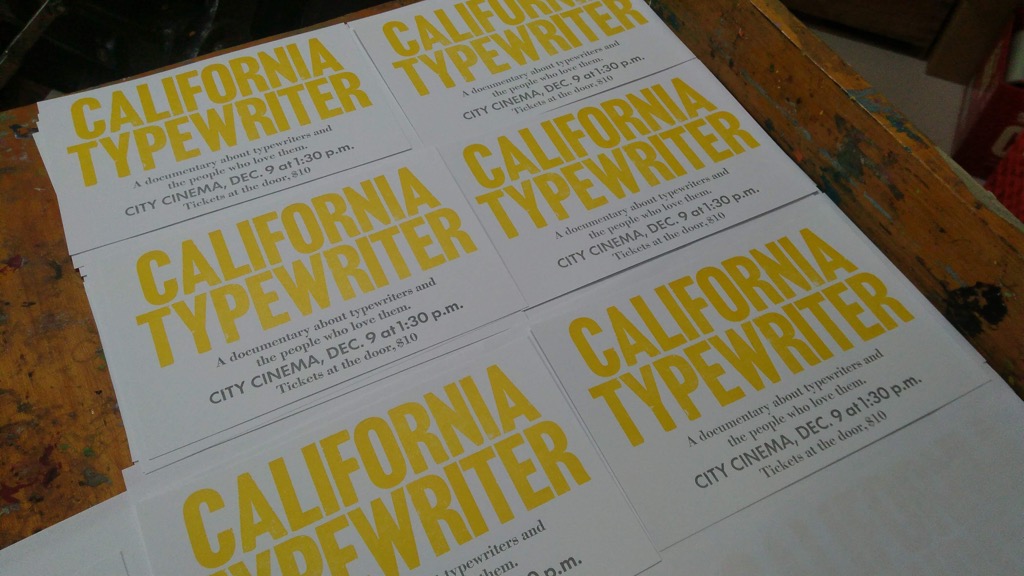
After printing the bold headline in yellow on Wednesday, today was the day to print the explanatory body copy on my California Typewriter poster.

I didn’t really want to print this in black, both because I wanted to avoid a honeybee colour scheme, and because I was afraid that the density of the black would detract from the sunshine of the yellow.

“How about grey?”, I asked myself.

I don’t have any grey ink, but I do have both black and white.

So I put a dollop of opaque white on the ink disk:

Photo of a dollop of white letterpress ink

And then I added a tiny, tiny, tiny amount of black. So tiny you wouldn’t believe how tiny it was. In this regard I had the helpful Making the color gray forum topic from Briar Press to guide me, especially:

Don’t forget adding your colour to white should be done in tiny amounts slowly building towards what you want. If you go to dark there’s no going back, by adding more white!

The result was a very pleasing, dare I say “smokey” grey:

Photo of mixture of black and white letterpress ink to make grey

Letting the rollers of the press have at it, a couple of minutes later I had a lovely grey ready for printing:

Letterpress ink disc covered in grey ink

The type for the body copy is relatively new foundry type, for both faces, and so there was very little need for makeready; here’s what one of the first prints looked like:

Photo of finished poster, showing grey print

It’s hard to get a sense, from that photo, of how not-intense-black the grey is.

Here are the final posters, drying stacked:

Photo of California Typewriter posters drying

You may have noticed, if you’re paying careful attention, that I’ve organized a screening of the documentary California Typewriter for Sunday, December 9 at 1:30 p.m. at City Cinema. Please spread the word. And watch for the posters around town.

10 Nov 22:00

When and why to clean up your code: now, later, never

You’ve got to meet your deadlines, you’ve got to fix the bug, you’ve got to ship the product.

But you’ve also got to think about the future: every bug you introduce now will have to be fixed later, using up even more time. And all those deprecated APIs, out-of-date dependencies, and old ways of doing things really shouldn’t be there.

So when do you clean up your code?

Do you do it now?

Later?

Never?

In this article I’ll go over a set of heuristics that will help you decide when to apply three kinds of fixes:

  1. Updating dependencies that are out-of-date and usages of deprecated APIs.
  2. Refactoring to fix bad abstractions.
  3. Miscellaneous Cleanups of anything else, from coding standard violations to awkward idioms.

Heuristics by situation

Prototyping

Before you start building something in earnest, you might start with a prototype (or what Extreme Programming calls a “spike”). You’re not going to keep this code, you’re just exploring the problem and solution space to see what you can learn.

Given you’re going to throw away this code, there’s not much point in Updating or Miscellaneous Cleanups. And if you’re just trying to understand an existing API or technical issue, you won’t be doing much Refactoring wither.

On the other hand, if your goal with prototyping is to find the right abstraction, you will be doing lots of Refactoring.

  1. Updating: never.
  2. Refactoring: now if you’re trying to prototype an API or abstraction, otherwise never.
  3. Miscellaneous Cleanups: never.

A new project

When you’re starting a completely new project, the decisions you make will have a strong impact on the maintenance code going forward.

This is a great opportunity to start with the latest (working) dependencies, situation-specific best practices and maintainable code, and the best abstractions you can come up with. You probably won’t get them completely right, but it’s usually worth spending the time to try to get it as close as possible.

  1. Updating: now.
  2. Refactoring: now.
  3. Miscellaneous Cleanups: now.

An emergency bugfix

You need to get a bug fix to users ASAP. While you might see problems along the way, but unless they’re relevant to this particular bug fix, it’s best to put them off until later.

Sometimes that might mean fixing the bug twice: once in a quick hacky way, and a second time after you’ve done the necessary cleanups.

  1. Updating: later.
  2. Refactoring: later.
  3. Miscellaneous Cleanups: later.

New feature or non-urgent bugfix

When you have a project in active development and you’re doing ongoing work, whether features or bug fixes, you have a great opportunity to incrementally clean up your code.

You don’t need to fix everything every time you touch the code. Instead, an ongoing cleanup of code you’re already touching will cumulatively keep your codebase in good shape. See Ron Jefferies’ excellent article for details.

  1. Updating: now, for code you’re touching.
  2. Refactoring: now, for code you’re touching.
  3. Miscellaneous Cleanups: now, for code you’re touching.

A project in maintenance mode

Eventually your project will be finished: not much new development is done, and mostly it just gets slightly tweaked every few months when something breaks or a drop-down menu needs an extra option.

Your goal at this point is to do the minimum work necessary to keep the project going. Refactoring and Miscellaneous Cleanups aren’t necessary, but Updates might be—dependencies can stop working, or need security updates. And jumping your dependencies 5 years ahead is often much harder than incrementally doing 5 dependency updates at yearly intervals.

So whenever you have to do fix a bug, you should update the dependencies—ideally to Long Term Support releases to reduce the need for API usage updates.

  1. Updating: now, ideally to Long Term Support releases.
  2. Refactoring: never.
  3. Miscellaneous Cleanups: never.

Balancing present and future

Software projects tend to ongoing processes, not one-off efforts. A cleanup now might save you time later—but if you have a deadline to meet now, it might be better to put it off even at the cost of slightly more work later on.

So takes this article only a starting point: as with any heuristic, there will be exceptions to the rule, and you need to be guided by your situation and your goals.


By the time you get home from work and finish your chores you’re too tired to do anything but watch TV and then collapse into bed. And weekends are just as bad.

But you could have a 3-day weekend not just on holidays, but every single week: learn how you can do it.

10 Nov 22:00

Data in Oppressive Regimes

by Bryan Mathers
Data in Oppressive Regimes - Mozfest18

At Mozfest, I participated in a discussion on the use (monitoring / controlling / blocking) of data in oppressive regimes. Hearing the issues first hand from those who live there was horrifying. I realised how much I was completely unaware of. One clear call was the need for financially supporting homegrown communication platforms, as opposed to projects by white guys from Stanford…

The post Data in Oppressive Regimes appeared first on Visual Thinkery.

10 Nov 22:00

Privacy in Sub-Saharan Africa

by Bryan Mathers
The state of privacy in sub-saharan africa - mozfest18

Business behaviour around use and exploitation of people’s data, is dictated by the local privacy law (or lack thereof). Julie Owono was speaking at Mozfest on research into sub-saharan subsidiaries of European telecoms companies. It’s no surprise really – capitalism is about capital, so everything is a possible resource waiting to be exploited.

The post Privacy in Sub-Saharan Africa appeared first on Visual Thinkery.

10 Nov 22:00

Demonising the binaries

by Bryan Mathers
Demonising the binaries - Greenpeace - Mozfest18

When I was growing up, eggs were good for you. Then they weren’t. Then they were good again. Then just the egg white was good. Binaries are so often unhelpful – especially when they are just a shortcut for not having to use your own brain.

This is also the case in environmental activism, as we discussed in a Mozfest session lead by Laura Hilliger and her colleagues from Greenpeace

The post Demonising the binaries appeared first on Visual Thinkery.

10 Nov 22:00

“It is now impossible to have intellectual integrity and a conscience while remaining a Republican in good standing.”

by Andrea

The New York Times Opinion: A Party Defined by Its Lies. “At this point, good people can’t be good Republicans.” By Paul Krugman.

“During my first year as an Op-Ed columnist for The New York Times, I wasn’t allowed to use the word “lie.”

That first year coincided with the 2000 election, and George W. Bush was, in fact, being systematically dishonest about his economic proposals — saying false things about who would benefit from his tax cut and the implications of Social Security privatization. But the notion that a major party’s presidential candidate would go beyond spin to outright lies still seemed outrageous, and saying it was considered beyond the pale.

Obviously that prohibition no longer holds on this opinion page, and major media organizations have become increasingly willing to point out raw falsehoods. But they’ve been chasing a moving target, because the lies just keep getting bigger and more pervasive. In fact, at this point the G.O.P.’s campaign message consists of nothing but lies; it’s hard to think of a single true thing Republicans are running on.

And yes, it’s a Republican problem (and it’s not just Donald Trump). Democrats aren’t saints, but they campaign mostly on real issues, and generally do, in fact, stand for more or less what they claim to stand for. Republicans don’t. And the total dishonesty of Republican electioneering should itself be a decisive political issue, because at this point it defines the party’s character.

What are Republicans lying about? As I said, almost everything. But there are two big themes. They lie about their agenda, pretending that their policies would help the middle and working classes when they would, in fact, do the opposite. And they lie about the problems America faces, hyping an imaginary threat from scary dark-skinned people and, increasingly, attributing that threat to Jewish conspirators.”

Link via MetaFilter.

10 Nov 21:59

Book Review: Walkable City Rules

by Stephen Rees

101 Steps to Making Better Places by Jeff Speck

Published by Island Press ISBN 978 1 61091 898 5 Paperback

Walkable City Rules

I was really delighted to get an actual book, as opposed to an ebook. And this one really ought to be on the desk of every city planner, urbanist and advocate. It was a genuine pleasure to open it, and get about halfway through and see so many things that this blog had been getting right for so long. Speck is writing for an American audience – and even cites Vancouver as a good example for transit provision. Which tells you much about how dreadful most US transit systems are, rather than how good ours is. As I am sure you are all tired of reading now, I do not think we ought to spend much time patting ourselves on the back, but rather taking a serious look at how other places – most of which are not on this continent – do things. And of course it is nice to see Rule 20 “Create a  twenty year land use and transportation plan …” illustrated with a graphic of the Translink 2040 Transit Network Vision for the North Shore. And of course Jarret Walker’s “Human Transit” gets much of the credit for best practices.

It was not until we got to the nitty gritty of street design and especially parking that I saw a parting of the ways, but that is, I think, because most of my experience of these issues was gained in London. And some time ago at that. So there are some departures here from what I have been writing about roundabouts, on street parking and four way stops  that need to be reconsidered. But that is because what Speck is writing about is how to make the urban areas of most of the USA better in the 21st century. Which is a different kettle of fish to what we did to improve parking enforcement in Central London in the 1980s.

What I did notice was that I kept looking up from what I was reading this afternoon and quoting it to my partner. Because a lot of it is highly quotable and some of it counterintuitive. Which is what you would expect.

I was also very impressed with the Press Release that accompanied the invitation to request a review copy. I went back to that to find out the price of the book as it is not on the cover: or on the release either! (Actually $30 cover $24 for a Kindle version and you could also pick up “Walkable City” if you haven’t got that – which you should – for $8.40 Kindle,  $16 cover for paperback. I got these prices from amazon.com – I probably should have used amazon.ca but in any event I would much rather you bought a hard copy from a real Book Shop. Because.) But all this quote is simply lifted from the PR blurb, which I heartily endorse.

I’m sure you know planner and designer Jeff Speck, who has become a go-to resource on making cities more livable, sustainable, and walkable since the publication of Walkable City, but if you don’t, I wanted to put his his follow-up book, Walkable City Rules: 101 Steps to Making Better Places, on your radar. It has just been published and answers the question: how do we actually make cities walkable?

With this book, Speck delivers an actionable guide on walkability that details the practical steps needed to usher in an era of renewed street life. Bolstered with examples from cities around the US, he lays out 101 rules for remaking cities. Some of his top ten rules include:

  1. Don’t Mistake Uber for Transit: Support public transportation in the face of ride-hailing.
  2. Cut the Extra Lanes: When lanes are not needed for traffic, all they do is cause speeding.
  3. Expand the Fire Chief ’s Mandate: Shift the focus from response time to public safety.
  4. Use Roundabouts with Discretion: They are extremely safe; they’re just not all that urban. — kind of feel like DC needs this one
  5. Remove Centerlines on Neighborhood Streets: When a street loses its centerline, speeds drop approximately 7 mph.
  6. Bag the Beg Buttons and Countdown Clocks: Pedestrians shouldn’t have to ask for a light.
  7. Don’t Let Terrorists Design Your City: The anti-terror landscape is a bad investment.
  8. Dream Big: Great cities still need great visions

Other rules relate to tactical urbanism, congestion pricing, parking, transit, street design, cycling, and others. Jeff has filled it with proven strategies for success and promises these rules can bring the most effective city-planning practices to bear in communities.

If that doesn’t pique your interest, nothing I can write will move you, so you go back to your Hummer and read the Sun instead.


09 Nov 23:54

How we deal with data is geopolitical. The USA ...

by Ton Zijlstra

How we deal with data is geopolitical. The USA has been successful in exporting their surveillance capitalism, and China has been quietly exporting their data driven authoritarianism in the past few years. The EU is (too) slowly positioning itself as a third proposition, one of enlightenment by design, and ethics by design.

09 Nov 23:54

Better Blending of Micro Formats with WordPress Themes

by Ton Zijlstra

Earlier this week I discussed microformats with Elmine. Microformats make your website machine readable, allowing other computers and applications to e.g. find out where my contact information is, and the metadata from my postings.

It was a discussion that branched off a conversation on online representation and marketing. I currently use the Sempress theme on this blog as it does microformats pretty well as far as I can tell, but it doesn’t look all that nice. Previously I had used the microformats plugin in a regular theme, but that didn’t work really well (the plugin is not at fault, it’s a best effort)

Ideally I’d like to add microformats to other sites I use, not just this blog. That means I’d like to add it to a generic theme like U-design. As I think it would be less effort to add microformats to U-design, than make Sempress look better and more generic for my sites. Elmine approached the creators of U-design, but microformats are not on their list of priorities. They do already support schema.org out of the box.

The steps I think I need to make:

  • Map-out visually where I want to use which microformats where and how. [UPDATE: done]
  • Then take a much closer look at the code of the existing Microformats plugin as well as the functions.php file of the Sempress theme
  • to see how the first hooks into existing themes, and how the second shapes the microformats to be added to the html of the page.
  • Determine if one or the other is usable with U-design as is, or alternatively which parts to re-use / adapt
07 Nov 22:14

Sixteen Years of Blogging

by Ton Zijlstra

Today at 14:07, sixteen years ago I published my first blogpost. The first few months I posted on Blogger, but after 6 months, deciding having a blog was no longer just an experiment, I moved to my own domain and where it has since resided. First it was hosted at a server I ran from my home, later I moved to a hosting package for more reliability.

Interestingly in that first blogpost only the links to personal domains still work, all the others have since become obsolete. Radio Userland no longer exists, nor does the Knowledge Board platform that I mention and even refer to as a place to find out more about me. In my first blogpost I also link to an image that was hosted on my server at home, using the subdomain name my internet provider gave me back then. That provider was sold in 2006 and that subdomain name no longer exists either. Blogger itself does still exist and even keeps my old Blogger.com blog alive. But Google has of course shown frequently they can and do kill services at short notice, or suspend your account.

The only original link in that first posting that still works is the one to David Gurteen’s blog hosted on his own domain gurteen.com, and his blogpost actually preserves some of the things I wrote at the now gone Knowledge Board. Although the original link to Lilia’s blogpost on Radio Userland no longer works, I could repair the link because she moved to her own domain in the same week I launched my blog. The link to Seb’s Radio Userland site has been preserved in archive.org. Which goes to say: if you care about your own data, your own writing, your own journal of thoughts, you need to be able to control the way your creative output can be accessed online. Otherwise it’s just a bit of content that serves as platform fodder.

So in a sense my very first blogpost in hindsight is a ringing endorsement for the IndieWeb principle of staying in control of your stuff. That goes further than having your own domain, but it’s a key building block.

Last year the anniversary of this blog coincided with leaving Facebook and returning to writing in this space more. That certainly worked out. Maybe I should use this date to yearly reflect on how my online behaviours do or don’t aid my networked agency.

07 Nov 21:39

A program that runs more than once

by Tom MacWright

A while ago, I didn’t know what to write next, so I just asked. My friend Walter had a pretty good idea: to talk about how writing applications differs from writing scripts and notebooks. I think I have a decent answer — perhaps not the answer, but at least a neat one.

The difference between writing one-off scripts and tinkering with data in notebooks is this: modeling, unknowns, and restrictions.

Take names for an example. Consider a 5th grade class. You want to calculate the average, minimum, and maximum length of the students names, given a list. With a notebook or a one-off script you could solve this problem pretty quickly, by checking the length of each name, storing an list of lengths, and doing a bit of math on that list of numbers.

07 Nov 21:39

Why crowdsourcing will die

by Joe Gregorio

Crowdsourcing, the idea of slapping together an algortihm that quietly works alone in the background on a large corpus of data to generate recommendations, most popular lists, etc. is slowly dying. I pointed this out in my 2018 Predictions post, but didn’t offer a concise explaination as to why that would occur, but as I’ve watched the year progress, and added more examples to that predicitions post, I’ve come up with a fairly simple model.

The Model 1.0

  • Computers always beat humans.

The first thing to understand is that on any constrained problem, a computer can be built that will eventually out perform any human. You can see this in constrained domains like playing chess and Go, where human capabilties are now totally surpassed by computer players. And this is where your recommendation algorithm author enters the scene and builds a recommendation engine that they know will be better than anything a human can do. And they may be right. Now just because a recommendation is done by an algorithm doesn’t necessarily mean that it’s better, but from our 1.0 model you can see that if you put enough time into building that algorithm that on that constrained problem space you will eventuallly be able to beat all humans at the task of generating recommendations. And that, unfortunately, is where most companies stopped years ago.

But our model is incomplete, first because it doesn’t recognize that the generated output of that algorithm has value, and I’m not even talking about monetary value, I’m speaking of power to influence people, i.e. the next news article to read or the next book to buy has a lot of power to bring fringe ideas into the mainstream. Let’s just think about the resurgence of flat earthers, or more sinisterly that of white nationalists. Being able to game the algorithm to get your fringe idea bumped up in the recommendation engine is a huge win for these groups. Gaming those algorithms is the sole focus of Russia’s Internet Research Agency.

But didn’t I just say that algorithms can always be built to beat the humans, so isn’t this a contradiction? Well, it is of our 1.0 model, but that’s because we’ve left something out.

The Model 2.0

  • Computers always beat humans.
  • Computers plus humans always beat computers.

You can see this in particular in the realm of chess, where a human and computer pair of players can beat a computer.

Now suddenly launching a recommendation algorithm to silently chug along and produce recommendations looks like a fools errand, as there will always be groups that have an incentive, either monetary or otherwise, to use humans and computers together to subvert your algorithm. See for example Russia’s Internet Research Agency and their computer generated troll army. This Reply All podcast has another great example of gaming rankings.

So every time you create a recommendation engine, you’ve basically signed up for a battle that requires you to continuously update your algorithm, continuously invest engineering resources to keep yourself ahead of the scammers, spammers, and computer generated troll armies. Suddenly it doesn’t seem like such a great idea, does it?

07 Nov 21:38

Why Women Leave

by Stowe Boyd

Natalie Portman on Why Women Leave, Undoing open offices, breaks increase productivity, a few apps and gizmos, Walmart tests Sam’s Club Now, A new tarot for our times

Beacon NY — 2018–10–31 — It’s Halloween, and I don’t have any plans for costumes.

If you’re getting this you probably signed up at workfutures.org (or one of its predecessors) or stoweboyd.com. If someone forwarded this to you, sign up here.

Consider making a donation. We appreciate your support.

Long Takes

Why Women Leave | Natalie Portman gave a speech at Variety’s Power of Women event recently, and raised a question first posed by Jodi Kantor

Weinstein’s abuse was so pervasive, that a whole generation of actresses had been pushed out of our industry and had been deprived of decades of work and the payment that accompanies it. What other women in our industry and in other industries had been silenced and shut out in this way?
[…]
The reason women in nearly every industry are not represented in powerful positions is because women are being discriminated against or retaliated against for hiring and promotion. When they do get jobs, they are often being harassed and assaulted, and they are being paid less than their male counterparts — all of which coerce self-preserving women into finding safer options for themselves and different ways to feel valued. Many women are further oppressed by intersections with other marginalized identities — whether by sexual orientation, race, age, class, religion, physical ability — and are subject to multiple avenues of discrimination and harassment at work at once. If they try to report it, there is often a second harassment — their reputations are smeared, their future hiring is jeopardized and they are further harassed.
So that’s part of why our first action at Time’s Up was to start the Time’s Up Legal Defense Fund with the National Women’s Law Center. Because women need to put food on the table. And in order to do so, they need to be able to do their work in a safe, equitable and dignified environment.

A must read.

Why open office design makes you less productive | Aytekin Tank cites research saying the open offices don’t create more collaboration. On the contrary:

Rather than increasing face-to-face collaborations, open architecture seemed to trigger a natural human response to socially withdraw from officemates and interact over email and instant messenger instead.
“If you’re sitting in a sea of people, for instance, you might not only work hard to avoid distraction (by, for example, putting on big headphones) but — because you have an audience at all times — also feel pressure to look really busy.” — Ethan Bernstein
Beyond interactions, the study found that workers became less productive in open offices. What’s more important from a managerial perspective, the quality of work decreased as well.

This surprises no one. We all know open offices are about real estate prices, not innovation or productivity. It’s smallminded short-termism.

Tank explains that at his company, Jotform, they dedicate a private shared space for each team (cross functional groups of 5–6). That works better.

Short Takes

How wasting time at work (properly) increases productivity | Aytekin Tank points out

Taking breaks can increase productivity.

Fellow — Your work copilot | An app designed for managers and their teams. Sounds smart. I’ll get a demo. …

Focals | New ‘goggles’ with display. I want.

Walmart’s test store for new technology, Sam’s Club Now, opens next week in Dallas | Mobile checkout, an Amazon Go-like camera system for inventory management, electronic shelf labels, wayfinding technology for in-store navigation, augmented reality, artificial intelligence-infused shopping, and 25% of the usual number of employees.

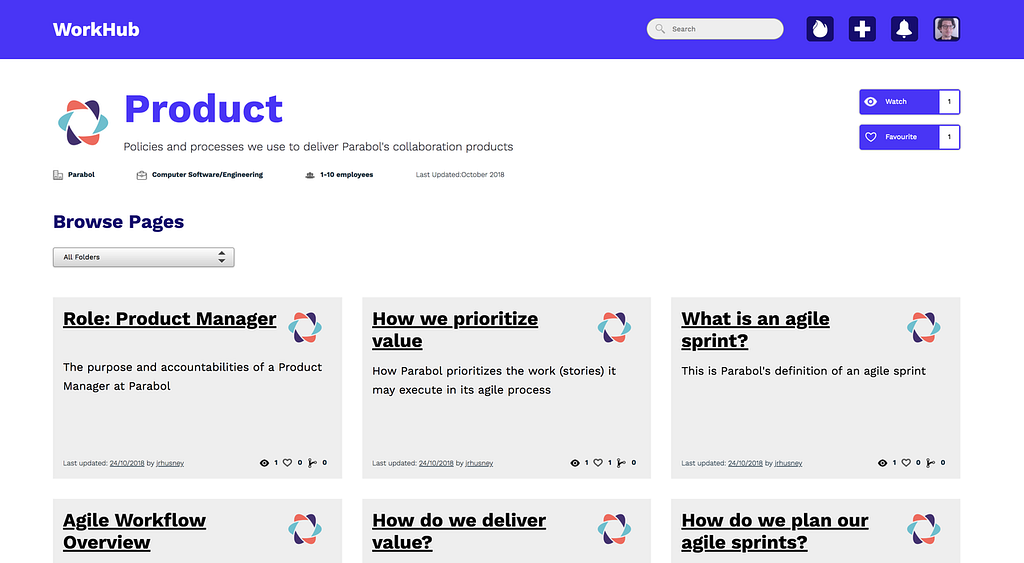
WorkHub | Bud Caddell of Nobl is building WorkHub, the GitHub for work.

Instant Archetypes: A New Tarot For The New Normal by Superflux | Superflux has created the tarot for our times:

Instant Archetypes is a toolkit to explore the never-ending narratives and multiple perspectives of our new normal: the world of tech-saturated late capitalism.

From the Archives

Why salaries shouldn’t be secret | Felix Salmon wrote this back in 2014:

One of the problems is that virtually everybody in corporate America — from senior management all the way down to entry-level employees — has internalized the primacy of capital over labor. There’s an unspoken assumption that any given person should be paid the minimum amount necessary to prevent that person from leaving. The simplest way to calculate that amount is to simply see what the employee could earn elsewhere, and pay ever so slightly more than that. If a company pays a lot more than the employee could earn elsewhere, then the excess is considered to be wasted, on the grounds that you could get the same employee, performing the same work, for less money.
How is it that most Americans still believe in this way of looking at pay, even as we reach the 100th anniversary of Henry Ford’s efficiency wages? Ford was the first — but by no means the last — businessman to notice that if you pay well above market rates, you get loyal, hard-working employees who rarely leave. Many contemporary companies have followed suit, from Goldman Sachs to Google to Bloomberg: a well-paid workforce is a happy workforce, which can build a truly world-beating company.
[…]
If you work for a company where everybody knows what everybody else is earning, then it’s going to be very easy to see what’s going on. You’ll see who the stars are, you’ll see what kind of skills and talent the company rewards, and you’ll see whether this is the kind of place where you fit in. You’ll also see whether men get paid more than women, whether managers are generally overpaid, and whether behavior like threatening to quit is rewarded with big raises. What’s more, because management knows that everybody else will see such things, they’ll be much less likely to do the kind of secret deals which are all too common in most companies today.
So let’s bring pay rates out into the open, where they belong. Doing so will create better companies, staffed with better-paid and more productive employees. Which is surely exactly what America needs, in a world where it can never compete by racing to the bottom.

Quote of the Day

Whenever the legislature attempts to regulate the differences between masters and their workmen, its counsellors are always the masters. When the regulation, therefore, is in favour of the workmen, it is always just and equitable; but it is sometimes otherwise when in favour of the masters.

| Adam Smith, The Wealth Of Nations

Originally published at workfutures.org.


Why Women Leave was originally published in Work Futures Institute on Medium, where people are continuing the conversation by highlighting and responding to this story.

07 Nov 21:37

Work Futures Daily — Intermittent Collaboration

by Stowe Boyd

Intermittent Collaboration

Intermittent, not always-on collaboration; Jim Meredith on open offices; Sarah Cooper on working for yourself v working for a boss; End of job titles?; Is the economy rigged for big companies, and against the little guy? Yes.; Debunking the gig economy

Beacon NY — 2018–11–01 — Woke up to November. Although I haven’t traveled recently, it seems like I’ve been hit by jetlag. Maybe it’s this head cold.

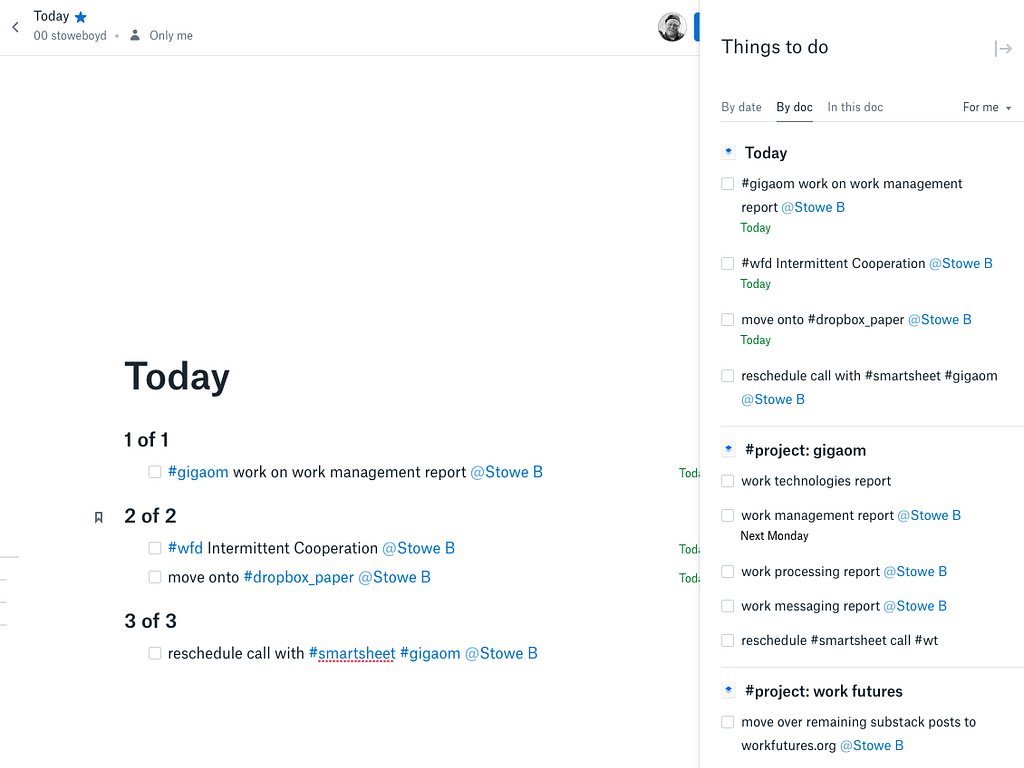
I’m a bit unsettled because I have decided to try using Dropbox Paper as my system of record on various projects. The task features have grown up a great deal, like the Things To Do tab:

Now I have to move all my dangling tasks over, project for project. It’s a good housecleaning. And I have a monster project looming.

If you’re getting this you probably signed up at workfutures.org (or one of its predecessors) or stoweboyd.com. If someone forwarded this to you, sign up here.

Consider making a donation. We appreciate your support.

Long Takes

Collaborate on complex problems, but only intermittently | Ethan Bernstein and colleagues present their findings about collaborating on solving complex problems, and it seems that ‘always on’ leads to worse results than ‘intermittently on’.

The researchers formed and studied a number of three-person groups working on a complex problem-solving task (not described by the author) [emphasis mine].

The members of one set of groups never interacted with each other, solving the problem in complete isolation; members of another set constantly interacted, as we do when equipped with always-on technologies; and members of the third set of groups interacted only intermittently.
From prior research, the researchers anticipated that the groups whose members never interacted would be the most creative, coming up with the largest number of unique solutions — including some of the best and some of the worst — and a high level of variation that sprang from their working alone. In short, they expected the isolated individuals to produce a few fantastic solutions but, as a group, a low average quality of solution due to the variation. That proved to be the case.
The researchers also anticipated that the groups whose members constantly interacted would produce a higher average quality of solution, but fail to find the very best solutions as often. In other words, they expected the constantly interacting groups’ solutions to be less variable but at the cost of being more mediocre. That proved to be the case as well.
But here’s where the researchers found something completely new: Groups whose members interacted only intermittently preserved the best of both worlds, rather than succumbing to the worst. These groups had an average quality of solution that was nearly identical to those groups that interacted constantly, yet they preserved enough variation to find some of the best solutions, too.

This runs counter to the modern assumption that ‘always on’ is the best modality in group performance. This is the principle that underlies our obsession with tools like work chat, and the application of ideas like ‘working out loud’.

And the effect of intermittent interaction changed the way both the lower and higher performers learned. In ‘always on’ mode, low performers simply copy from higher performers, and higher performer simply ignored lower performers. But in an intermittent set-up, the lower performers ideas actually helped the higher performers do even better.

The takeaway? Our mode of ‘always on’ communication and team interaction diminishes our capacity to solve complex problems well.

Jim Meredith sent email about the open offices piece by Aytekin Tank in Work Futures Daily — Why Women Leave, writing

Re: Open offices
I think the conversation about the workplace needs to be more nuanced. There is so much clutter in the open/closed debate. For example, the Bernstein study that he references has been widely criticized for being a very narrow study (2 companies, short time span, no description of the new office space other than “open,” etc.) yet widely echoed in the design/workplace press as finally justifying the “death of the open office.”
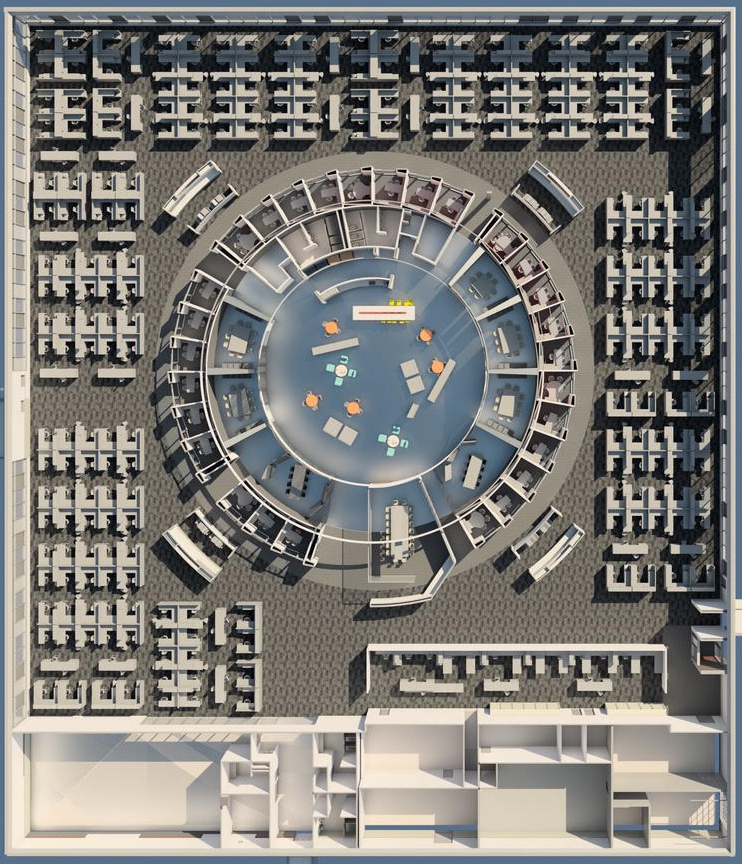
Jot’s use of private shared space for each team is the barest satisfaction in a (perhaps still faulted) concept known as the Activity Based Workplace, which provides a portfolio of spaces where people can go to do specific types of work.
One example is our design for Meritor, which looks like this:
It has a perimeter of open offices (light-filled, quiet), a central zone for open team work and conversation around products (exuberant, social), and an in-between zone of office-like spaces, project rooms, meeting spaces, etc.
I think what I mean is that the debate about the modern workplace shouldn’t constantly focus on the binary choice of open versus closed. Many organizations have rather satisfying workspaces by recognizing that open flows, or deep work, or project work or the many other forms of getting stuff done may each best be done in spaces designed for the unique characteristics of those work modes.

Yeah, ok, but employee surveys generally show dissatisfaction with open, and the Bernstein study is not the only source.

Short Takes

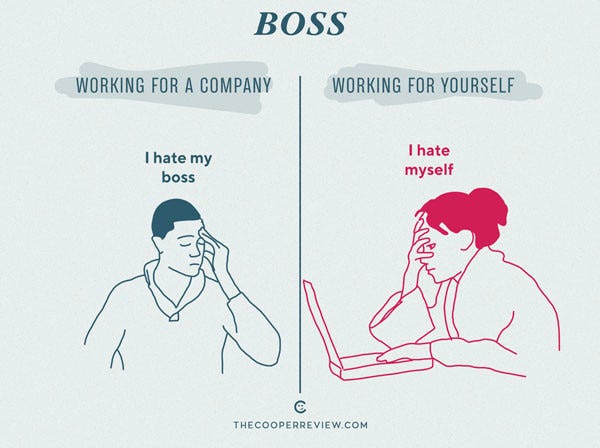
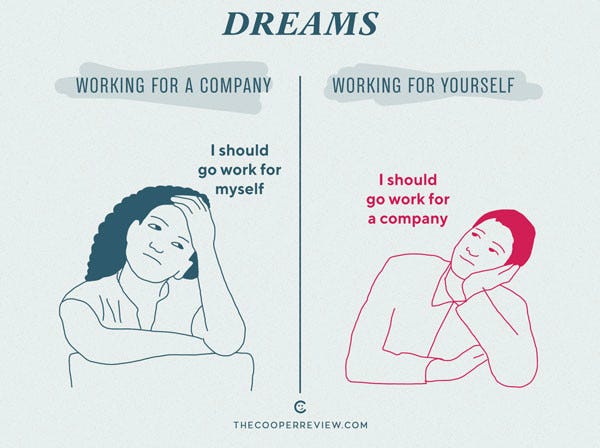
Working for a company vs. Working for yourself | Sarah Cooper is deeply funny. As in, deep and funny at the same time.

Tesla CEO Elon Musk is raising an important question about job titles | Are job titles obsolete? Roger Martin thinks we should replace jobs with a ‘portfolio of projects’.

Axios Future — October 31, 2018 | Steve LeVine collates a few recent bits about a small groups of ‘Superstar’ companies growing too large. A must read.

Also related: Phillip Longman in Washington Monthly | The Case For Small-Business Collusion reveals ‘how America’s anti-monopoly laws got turned against the little guy’ instead of large corporations:

American competition policy is, in short, upside down and inside out. Regulators and courts perversely foster ever-lower levels of competition among ever-larger corporations, allowing them to reap greater profits and share less of them with workers. At the same time, they outlaw forms of cooperation among workers, small business owners, and professionals that have historically served vital economic and social purposes. The effects of this imbalance will only get worse as more and more of us struggle in an increasingly deregulated, de-unionized, monopolized economy that forces contingent workers into tournaments of ruinous competition with one another.

A must read.

Myths of the Gig Economy, Corrected | David Jolley unpacks what’s really going on in the gig economy, including this:

Sixty percent of millennials — those born between 1981 and 1996 — were not involved in the gig economy at all, and only 24% report earning money from the gig economy.

From the Archives

Work Futures Weekender — Postnational in the Postnormal? | Stowe Boyd 2018–04–08 | The top 1% will hold 64% of the world’s wealth by 2030?

Quote of the Day

The scientist is not a person who gives the right answers, he is one who asks the right questions.

| Claude Lévi-Strauss

Originally published at workfutures.org.


Work Futures Daily — Intermittent Collaboration was originally published in Work Futures Institute on Medium, where people are continuing the conversation by highlighting and responding to this story.

07 Nov 21:37

Building tiny bridges

by Jim

Rope BridgeThe short version of the story I tell about why I decided to leave work to get a Ph.D. is that I needed to figure out why those stupid users weren’t taking advantage of the clever systems I was designing. That turns out to be a midpoint in a longer thread of trying to bridge two worlds that should be one.

The tagline for my blog is a quote from Dorothy Parker: “the cure for boredom is curiosity, there is no cure for curiosity.” In business, curiosity is acceptable only up to a point. You can be curious about the specific things you need to learn to tackle your next well-defined goal; free-floating curiosity is suspect.

Today, we are likely to label free-floating curiosity as attention deficit disorder and bring it under control. ADD is a problem of poor executive control, which implies that curiosity must be subordinate to focus.

I was fortunate to grow up in a time before we had ADD as an explanation for certain behaviors. I also had enough natural talent for school-like activities that my curiosity was nurtured and encouraged rather than constrained.

Sometime around the second grade I had my first collision between instinct and the conformity that most schools and teachers preferred. It was a Catholic school and I posed a problem for the nuns; I was clever but, as an eldest child, generally well-behaved. One morning, my teacher—a nun whose name is long lost to me—discovered that the workbook I was supposed to be maintaining for the last several weeks was empty. Who knows what I had been doing instead.

I was dispatched to the principal’s classroom with the empty workbook as evidence of my failure. The principal taught 8th grade students so my arrival provoked their amusement and my humiliation as intended. Knuckles rapped with the principal’s yardstick, I returned to my classroom. I was sent home at the end of the day with the empty workbook so that my mother would also know of my dissolute ways.

I don’t recall Mom being terribly upset. What I do recall is that I did the exercises I had neglected and completed the rest of the workbook that night as well. I returned the finished workbook the next morning.

Here’s where I got lucky. My teacher then and those who followed encouraged me to discover what else I could accomplish rather than force me to conform. None of them imposed their agenda or expectations. Once I got the work at hand done, I was free to explore whatever caught my attention. Their gift was to help me discover that learning was about questions not answers and, then, how to ask questions safely rather than ask safe questions.

In an alternate timeline, I might have gone strictly down the math and science path. I was certainly curious about things that were logical—puzzles that had answers, things that made sense. But, not only was I a Catholic in those days, I was catholic in my interests. I was equally interested in things that didn’t make sense to me. It turns out, of course, that many things don’t make sense in the way that mathematics and science make sense.

In my early years, I wasn’t well equipped to distinguish between what didn’t make sense because of my ignorance, what didn’t make sense because of its inherent complexity, and what didn’t make sense because of my limitations rather than my knowledge. I didn’t even have those buckets to work with.

Among the things that made less sense to me were people, especially in groups and organizations. I understood classrooms, I didn’t understand recess.

My intuitions about the logical, systemic, and structured world developed and improved pretty robustly. My intuitions about the human world were weaker and slower to develop.

One choice would have been to stay within the bounds of the logical. But my innate curiosity kept pushing me to make sense of all of my environment.

There’s a long-running split between the human and the systemic. C.P. Snow called it “The Two Cultures” back in 1959. Working that gap has been the place that suits me, although I prefer to work it at a more detailed level than Snow. Recognizing a big problem doesn’t yield a big solution. It calls for building bridges one piece at a time.

The post Building tiny bridges appeared first on McGee's Musings.

07 Nov 21:37

Car-Charge Economics

The Wikipedia article on Electric Car Use by Country is interesting. Below I excerpt a graph (misspellings: theirs) of the leading electric-car jurisdictions: As I write, Norway leads, at over 20%, while the US average is 1.5%. (Visit the Wikipedia link for the latest whenever you read this.) How are all these cars going to be fed? Let’s consider the future business of car-charging.

Top countries in adoption of battery electric vehicles

My own angle

Since I’m about to become an electric-car owner, I’ve been pre-planning trips, both for work (i.e. to Seattle) and to visit family elsewhere in Western Canada. And I’m having a feeling I last had in the Nineties, as a bleeding-edge traveling Internet user. Back then, when you picked your hotel, you really cared about whether your dial-up Internet would work — there were certain 20th-century “digital” hotel phone systems that got in the way, and then some places had proprietary plugs, and others blocked calls to the local PoP because they thought you were trying to dodge their larcenous long-distance charges, which you were.

As a side-effect of this, I’ve learned a lot about what kinds of chargers there are, and it raises questions in my mind of how we get the ones we need, and (chiefly) who’s going to pay for them.

Defining terms

  1. A BEV is a Battery Electric Vehicle. Also you sometimes hear PEV where P is for Plugin.

  2. There are a bunch of ways to talk about how fast a charger charges your BEV, but I don’t think there’s a standard acronym for my favorite, how many km of range you get per hour of charging. Let’s use kRh for “km of range per hour”. American and British readers can divide by 1.6 and call those mRh.

  3. A Level 1 (L1) charger means plugging straight into your home current, either 240 or 110 volts depending where you are in the world. This is an unsatisfactorily slow way to charge a BEV, a handful of kRh.

  4. An L2 charger is what many people install at home when they buy a BEV. Ways to measure it include kW (6 or 7), amps (30-ish), and you might get 30 or so kRh. The idea with an L2 is, you plug in your BEV while you sleep, and it’ll be charged when you want to head out in the morning.

  5. An L3 charger is what you find in Tesla’s Superchargers network, and recently other networks such as Ionity in Europe. Don’t know the Tesla details, but the majority of publicly accessible ones in late 2018 run at 50kw or so, which is to say probably better than 200 kRh.

    The Jaguar I’ve ordered is advertised as being able to charge 80% in 40 minutes on a 100kW charger (of which there are approximately zero as I write), which my arithmetic suggests is like 450 kRh. Now, it’s more complicated than that, because it’s actually amperes that charge your car, which is a function of the upstream source plus circuits both in your charger and in your car. And it’s more complicated than that because fast chargers charge cars fast, but only for the first 80% or so of capacity, then they slow down. So the polite thing to do at a fast highway charger is to charge up to only 80%. For what it’s worth, there’s excited talk about higher and higher charger ratings, Ionity claims they’ll be shipping 350KW chargers: “Stop,drink a coffee, and go.”

Costs

A lot of people put in L2 chargers at their residences. They cost under a thousand bucks, but you can’t install one yourself, so for most people, by the time you’ve paid the electrician and so on you’re probably in for over a grand. I suspect these costs will come down, but not hugely; volume will go up, which will help, but nobody’s predicting big technology breakthroughs. Having said that, a thousand bucks may be economically tolerable when you consider the trips to the fuel pump you’re avoiding.

An L3 charger is another story. This useful page at OhmHome suggests you’re looking at $50K and up, possibly way up. Among other things, you have to run three-phase power to the site, and you have pay a highly skilled professional to do the installation because at this power rating, mistakes are apt to be lethal. In conversations before I ran across the OhmHome site, I’d heard typical costs north of $100K, and some really extravagant numbers for the cost of the Supercharger stations.

So, given all that, who should build chargers, and where?

Hotel and residential

I think this one’s pretty easy. Hotels and residential developments should try to have a number of charge stations corresponding to the local proportion of electric cars. Except for, they should start with maybe twice the current value, because the proportion of electric cars being sold is way higher than that already out there. And I suspect that in places like hotel and condo garages, the cost of installing ten is way less than ten times the cost of installing one. These should be L2 for charging while sleeping; there’s no good reason to pay up for fast chargers.

A word of warning to hotel operators and residential developers: The time is very near where I won’t consider your hotel or your condo if I can’t be confident of charging while I sleep.

Employers

This is an interesting one. Lots of office buildings (including Amazon’s) have car chargers in the basement parking. But so far, near as I can tell, they all seem to be L2. I’m not sure I see the point; even if you could hog the charger all day while you work, you probably wouldn’t get a full charge. Maybe it’s useful for people who have a short commute and don’t have a charger at home? And in fact most of these things are un-used when I drive by them, in Vancouver and Seattle. There might be a case for L3 chargers at HQ for people like me who occasionally drive down to Seattle and back in a day (I’ve done it, it sucks) but the current L2 deployment seems wasted.

Roadside attractions

Now, here’s where it gets interesting. When you’re doing an extended long-distance drive, you really need fast chargers or you’e going to be ridiculously, laughably slower than with a fossil-fuel car. So the place for them is by the highway. Who’s going to pay for them? Especially given the high cost?

I originally thought that coffee shops would be the natural homes for these things, add a charger and attract the crowds, but at $100K I don’t think the economics work. But here are a few other interested parties who might have an interest in making the investment to put a fast charger near a big road:

  • Malls; the scale is presumably large enough that the investment looks more tractable, and they have an interest in keeping you parked for a while once you’ve arrived.

  • Chambers of commerce; put a charger near the middle of a small town’s roadside shopping street. This is a variation on the mall theme.

  • Car companies, emulating Tesla’s strategy of using a charging network to help sell a brand of car. I’ve heard rumbles that Volkswagen is thinking of this, and they certainly have the scale.

  • Governments, interested in trying to meet their carbon-load reduction targets.

  • Electric utilities, trying to convince lots of people to buy electric cars. Since the vast majority of electric cars spend their time shuttling people back and forth to their place of work, the utility probably doesn’t need to charge enough to recoup the investment. In other words, the chargers serve a psychological function, reassuring people that if they have the urge to drive across a couple of time zones to visit the family for Thanksgiving, that’ll be no problem.

The future

One way or another, I bet there are going to be plenty of chargers out there. Just like today I don’t have to worry much about whether the hotel I’m going to has Internet.

07 Nov 21:34

Distributed Digital Transformation

by Ton Zijlstra

This is a start to more fully describe and explore a distributed version of digitisation, digitalisation and specifically digital transformation, and state why I think bringing distributed / networked thinking into them matters.

Digitising stuff, digitalising routines, the regular way

Over the past decades much more of the things around us became digitised, and in recent years much of the things we do, our daily routines and work processes, have become digitalised. Many of those digitalised processes are merely digitised replicas of their paper predecessors. Asking for a government permit for instance, or online banking. There’s nothing there that wasn’t there in the paper version. Sometimes even small steps in those processes still force you to use paper. At the start of this year I had to apply for a declaration that my company had never been involved in procurement fraud. All the forms I needed for it (30 pages in total!), were digitised and I filled them out online, but when it came to sending it in, I had to print the PDF resulting from those 30 pages, and send it through snail mail. I have no doubt that the receiving government office’s first step was to scan it all before processing it. Online banking similarly is just a digitised paper process. Why don’t all online bank accounts provide nifty visualisation, filtering and financial planning tools (like alerts for dates due, saving towards a goal, maintaining a buffer etc.), now that everything is digital? The reason we laugh at Little Britains ‘computer says no’ sketches, is because we recognise all too well the frustration of organisations blindly trusting their digitalised processes, and never acknowledging or addressing their crappy implementation, or the extra work and route-arounds their indifference inflicts.

Digital transformation, digital societies

Digital transformation is the accumulated societal impact of all those digital artefacts and digitalised processes, even if they’re incomplete or half-baked. Digital transformation is why I have access to all those books in the long tail that never reached the shelves of any of the book shops I visited in decades part, yet now come to my e-reader instantly, resulting in me reading more and across a wider spectrum than ever before. Digital transformation is also the impact on elections that almost individually targeted data-driven Facebook advertising caused by minutely profiling undecided voters.

Digital transformation is often referred to these days, in my work often also in the context of development and the sustainable development goals.
Yet, it often feels to me that for most intents and purposes this digital transformation is done to us, about us but not of us. It’s a bit like the smart city visions corporations like Siemens and Samsung push(ed), that were basically devoid of life and humanity. Quality of life reduced and equated to security only, in sterilised cities, ignoring that people are the key actors, as critiqued by Adam Greenfield in 2013.

Human digital networks: distributed digital transformation

The Internet is a marvellous thing. At least it is when we use it actively, to assist us in our routines and in our efforts to change, learn and reach out. As social animals, our human interaction has always been networked where we fluently switch between contexts, degrees of trust and disclosure, and routing around undesired connections. In that sense human interaction and the internet’s original design principle closely match up, they’re both distributed. In contrast most digitalisation and digital transformation happens from the perspective of organisations and silos. Centralised things, where some decide for the many.

To escape that ‘done to us, about us, not of us’, I think we need to approach digitisation, digitalisation and digital transformation from a distributed perspective, matching up our own inherently networked humanity with our newly (since 30 yrs) networked global digital infrastructure. We need to think in terms of distributed digital transformation. Distributed digital transformation (making our own digital societal impact), building on distributed digitisation (making our things digital), and on distributed digitalisation (making our routines digital).

Signs of distributed digitisation and digitalisation

Distributed digitisation can already be seen in things like the quantified self movement, where individuals create data around themselves to use for themselves. Or in the sensors I have in the garden. Those garden measurements are part of something you can call distributed digitalisation, where a network of similar sensors create a map of our city that informs climate adaptation efforts by local government. My evolving information strategies, with a few automated parts, and the interplay of different protocols and self-proposed standards that make up the Indieweb also are examples of distributed digitalisation. My Networked Agency framework, where small groups of relationships fix something of value with low threshold digital technology, and network/digital based methods and processes, is distributed digitisation and distributed digitalisation combined into a design aid for group action.

Distributed digital transformation needs a macroscope for the new civil society

Distributed digital transformation, distributed societal impact seems a bit more elusive though.
Civil society is increasingly distributed too, that to me is clear. New coops, p2p groups, networks of individual actors emerge all over the world. However they are largely invisible to for instance the classic interaction between government and the incumbent civil society, and usually cut-off from the scaffolding and support structures that ‘classic’ activities can build on to get started. Because they’re not organised ‘the right way’, not clearly representative of a larger whole. Bootstrapping is their only path. As a result these initiatives are only perceived as single elements, and the scale they actually (can) achieve as a network remains invisible. Often even in the eyes of those single elements themselves.

Our societies, including the nodes that make up the network of this new type of civil society, lack the perception to recognise the ‘invisible hand of networks’. A few years ago already I discussed with a few people, directors of entities in that new civil society fabric, how it is that we can’t seem to make our newly arranged collective voices heard, our collective efforts and results seen, and our collective power of agency recognised and sought out for collaboration? We’re too used, it seems, to aggregating all those things, collapsing them into a single voice of a mouthpiece that has the weight of numbers behind it, in order to be heard. We need to learn to see the cumulative impact of a multitude of efforts, while simultaneously keeping all those efforts visible on their own. There exist so many initiatives I think that are great examples of how distributed digitalisation leads to transformation, but they are largely invisible outside their own context, and also not widely networked and connected enough to reach their own full potential. They are valuable on their own, but would be even more valuable to themselves and others when federated, but the federation part is mostly missing.
We need to find a better way to see the big picture, while also seeing all pixels it consists of. A macroscope, a distributed digital transformation macroscope.

07 Nov 21:34

Some thoughts on map, filter, and reduce

by Eric Normand

Are map, filter, and reduce popular for a reason? Do these things capture some essence of iteration? Are they just better for loops?

Transcript

Eric Normand: What’s the deal with map, filter, and reduce? Why do we use them so much in functional programming? Why do I call them the three basic functional tools?

Hi, my name is Eric Normand and these are my thoughts on functional programming. Map, filter, and reduce — most of us are familiar with them nowadays — because they are now in JavaScript, baked in. Which is a good thing. I love that.

I have mentored people over the years. I’m always surprised by how far people can get without them when they are using a functional language. They get stuff done. Then I’m surprised that people that I think are at a really high level of functional programming have not adopted these things.

I think that they are a gateway. They’re a milestone on the way to becoming a better functional programmer. I wanted to talk about them a little bit more deeply than what they do and stuff like that.

Functional programmers use map, filter, and reduce. One reason we do that is we have a lot of data. We have a lot of sequences of data that we are passing around and manipulating.

They do form a really nice way of doing pipelines, data transformation pipelines. You have data in one format coming into the pipeline, through a series of steps, it gets transformed one step at a time until it gets to the last step. Once it comes out the last step, it’s the data you need.

This is a standard functional programming pattern. Data transformation pipelines. Each of those pipelines, usually, is a map, a filter, or a reduce.

Map transforms one sequence into another sequence. Same number of elements, just each of the items from the first sequence has a function applied to it and it becomes an item in the output sequence.

Filter, depending on how you look at it, will keep or remove the items you want or don’t want. It does both. It’s keeping some and removing others. You could filter for evens — so you can have all these numbers coming in and then coming out — only even numbers are coming out. The odd ones are skipped.

Reduce is all about taking this sequence and reducing it down into some aggregate value. If you wanted to find the sum — the sum is an aggregate — the sum of some numbers, you can reduce plus over them.

You reduce the plus function over the sequence of numbers. You start at zero because that’s the identity for plus. We learned that in algebra class.

Zero’s where you start counting stuff. You reduce that down into an aggregate, which is the sum. You can do the same thing for the product. It’s also an aggregate.

You start with one. You reduce a bunch of numbers using times. Then you have the aggregate, which is the product.

You can reduce adding stuff to a different collection. You want to add stuff to a set. That’s your aggregate, the set. It starts empty and you just add one thing at a time until you’ve got the whole thing.

We use these because they allow us to talk about the operations on the items instead of operations over the whole thing. We’re separating out the fact that it’s working on a collection from how we’re operating on the items.

It’s a simple thing. Let’s just pipeline. We can say first, square all the numbers. We map the square function over the numbers.

Then we’re going to filter for evens. Now we only want the evens. We’re going to look up those numbers in a database. We’re getting new data back for each number as the ID. We’re going to map the age attribute over all those things because they were people and they have ages.

Now we have the list of ages. Now we’re going to reduce and average them. That’s our aggregate, the average. That’s a typical pipeline, data transformation pipeline.

Notice you probably could have done all that in a single for loop. You could have done each step as a single for loop as well. That’s the origin of map, filter, and reduce.

People noticed that, “Well, I could do this for loop where I have to manage an index variable and increment data and remember to exit the loop when I’m off the end of the list.”

You could do that, or you could say, “Hey. There’s this pattern I do all the time where I’m creating a new list that’s like the old list except each of the elements is modified.” That’s a map.

Before my for loop I’m initializing this empty list. In the for loop I’m adding a thing to the list each time and then I’m returning it or I’m using it in the next step.

What functional programmers have noticed is that there are only a handful of useful applications of for loops. Let me put that in another way. It’s not that there’s only a handful, it’s that this handful comes up almost all the time.

We’re talking about 80, 90 percent of the time. You still need a for loop for some weird cases but, it’s not clear that you’re not in one of those weird cases.

When you’re doing these for loops, there’s a danger with for loops that you can do anything with them, when there’s only one thing you really want to do. That’s, say map, or you want to filter, you want to eliminate some of the items from it.

That’s what happened. Overtime, people have realized it’s safer, easier, clearer, more convenient, to use these map, filter, and reduce than to use for loops.

There’s some conditions to using map, filter, and reduce. They are higher order functions. Meaning they take functions as arguments. Which means you need first-class functions. It’s a prerequisite for having map, filter, and reduce in your language.

Of course JavaScript has always had first-class functions but Java has them now, we’ve learned those. We’re seeing a lot more people being introduced to these ideas of map, filter, and reduce.

In my perspective, they’re just better for loops. They’re better applications of for loops. You still need a for loop for those other weird cases. In the cases where map, filter, and reduce are used, they’re superior in almost every way.

I would say that one thing to increase you skill with functional programming, the tactical skills of functional programming. How to actually take this problem and code it up in a functional way. Learning map, filter, and reduce, try to apply it in new ways.

I remember when I first started doing Clojure. Maybe in my first year or two doing Clojure. I didn’t use reduce so much. I was used to other languages. I did map and filter. Those I used quite a bit.

Because Clojure’s immutable data structures really encourage it, I started using reduce a lot more. I realized there were a million places where it could be used that I didn’t think of before. I would have used a for loop or I would have written it recursively. I would do my own recursion.

It’s so much better to use reduce than to do a for loop or a recursion. It just works better. You don’t have to worry about tail calls and all that stuff. It just works better.

You still need a general purpose recursion but when you can, use a reduce. That’s my recommendation. Go through your code and whenever you’re operating on a collection think, “Is this a reduce that I’m doing?”

Map and filter are pretty clear. Reduce is the one that I think takes a little more pause and thought. Once you make it into a reduce it’s so much easier, so much simpler.

My name is Eric Normand. I would love to hear your stories about applying that filter and reduce. Specifically reduce because that one always gets interesting. Do you like using reduce? Do you prefer something else? Do you like nested reduces? Please say no, please say no.

My name is Eric Normand. You can find me on Twitter @ericnormand. Please follow me. You will learn about all these thoughts that I have had on functional programming. I share them all over the place on Twitter.

You can ask me questions, tell me your opinions, get into a heated yet friendly debate over email at eric@lispcast.com. Please do. I love getting into discussions.

Finally, I’m starting to get onto LinkedIn. You can find me there. LinkedIn. I don’t know what the URL is. Just search for Eric Normand Clojure. You’ll find me. I’m on there.

Follow me. I’ll try to follow you back. I share the same kinds of ideas. More business centric. If you want your business to get into Clojure. If you think the company you work for needs to learn a little bit more about Clojure, hit like. Hit thumbs up. Share it with your team.

Awesome. See you later. Bye.

The post Some thoughts on map, filter, and reduce appeared first on LispCast.

07 Nov 21:03

The automation imperative

Alexander Edlich, McKinsey, Nov 11, 2018


Icon

I heard once again today at a conference how automation is going to impact education, and in particular, what we need to teach and how we need to teach it, But what of automation itself? This report from McKinsey has some interesting bits, including this: "The results favor decentralization... respondents at less successful organizations are more than twice as likely as those at successful ones to say a central team is solely responsible for automation delivery across the organization."

Web: [Direct Link] [This Post]
07 Nov 21:03

‘How Corporate Cash Bought American Higher Education’

Marjorie Valbrun, Inside Higher Ed, Nov 11, 2018


Icon

Coverage of a book by Joshua Hunt arguing against corporate influence in education.  “They have kowtowed to this donor because he’s far and away the largest donor we have,” he (Nathan Tublitz) said. And as a result, “he has forced the university to accept the strings attached to those donations and he has had a significant effect on the direction and the integrity of the university.” There's nothing especially new here, though it is helpful to remember that when for-profit corporations donate money, it is with a for-profit objective.

Web: [Direct Link] [This Post]
07 Nov 05:34

mapsbynik: France Edition: Nobody Lives Here This is not a “map...


mapsbynik:

France Edition: Nobody Lives Here

This is not a “map by nik”, but one by twitter user @matamix. And it is a fine companion piece to my United States version that I thought I’d share.

Based on population data from INSEE, it shows the parts of Metropolitan France where people don’t live. Like the U.S. map, terrain plays a big role in determining where people settle. For instance, the roughness of Alps (southeast) and the Pyrenees (southwest) Mountains, prevents habitation. On the southern Atlantic coast, forestation acts as an impediment to human living in Aquitaine.

The vast expanse of “uninhabited” land in the northeast (Burgundy, Champagne-Ardenne) is a bit of a mystery. Much of it is arable land and likely covered in agriculture, especially on the side near Paris. But Brittany and Pays-de-la-Loire are also prime agricultural land. So why do we see such different settlement patterns between the regions?

Perhaps someone more familiar with the geography of France can clue me in. I’d appreciate it.

Update: jedo52 explained to me that the regions did not share agricultural practices historically. Brittany and the northwest are traditionally covered in a bocage landscape where housing is dispersed in many hamlets. In the east however, farm fields are more open with housing more concentrated into villages.

Finally, the numbers. France checks in at about 32% unoccupied compared to 47% in the U.S. Considering the higher population density in France, it’s not surprising that the country is “less empty” of humanity.

In any event, @matamix’s map is a great contribution to the discussion of where people aren’t.

07 Nov 05:33

delair2: This is Ripley, last survivor of the Nostromo, signing...


delair2:

This is Ripley, last survivor of the Nostromo, signing off.

Alien (1979) dir. Ridley Scott

07 Nov 05:33

robertreich: TRUMP’S 30 BROKEN PROMISES Trump voters: Two...


robertreich:

TRUMP’S 30 BROKEN PROMISES

Trump voters: Two years in, here’s an updated list of Trump’s 30 biggest broken promises.

1. He told you he’d cut your taxes, and that the super-rich like him would pay more. You bought it. But his 2017 tax law has done the opposite. By 2027, according to the nonpartisan Tax Policy Center, the richest 1 percent will have received 83 percent of the tax cut and the richest 0.1 percent, 60 percent of it. But more than half of all Americans — 53 percent — will pay more in taxes. As Trump told his wealthy friends at Mar-a-Lago just days after the tax bill became law, “You all just got a lot richer.” 

2. He promised that the average family would see a $4,000 pay raise because of the tax law. You bought it. But real wages for most Americans are lower today than they were before the tax law went into effect.   

3. He promised to close special interest loopholes that have been so good for Wall Street investors but unfair to American workers, especially the notorious “carried interest” loophole for private-equity, hedge fund, and real estate partners. You bought it. But the new tax law kept the “carried interest” loophole.

4. He promised to bring an end to Kim Jong-Un’s nuclear program. You bought it. Kim Jong-Un hasn’t denuclearized. 

5. He told you he’d repeal Obamacare and replace it with something “beautiful,” including “insurance for everybody.” You bought it. But he didn’t repeal and he didn’t replace. (Just as well: His plan would have knocked at least 24 million Americans off health insurance, including many of you.) Instead, he’s doing what he can to cut it back and replace it with nothing. According to the Commonwealth Fund, about 4 million Americans have lost health insurance in the last two years.

6. He told you he wouldn’t “cut Social Security like every other Republican and I’m not going to cut Medicare or Medicaid.” You bought it. But now he’s planning such cuts in order to deal with the ballooning deficit created, in part, by the new tax law for corporations and the rich. 

7. He promised to protect anyone with pre-existing conditions. You bought it. But in June, his Justice Department told a federal court it would no longer defend provisions of Obamacare that protect patients with pre-existing conditions. Attorney General Jeff Sessions said the decision was made with Trump’s approval.

8. He said he’d build a “wall” across the southern border.You believed him. But there’s no wall.

9. He told you he’d invest $1 trillion in our nation’s crumbling infrastructure. You bought it. But after his giant tax cut for corporations and millionaires, there’s no money left for infrastructure. 

10. He said he’d drain the Washington swamp. You bought it. But he’s brought into his administration more billionaires, CEOs, and Wall Street moguls than in any administration in history, to make laws that will enrich their businesses, and he’s filled departments and agencies with former lobbyists, lawyers and consultants who are crafting new policies for the same industries they recently worked for.

11. He promised to re-institute a five-year ban on all executive branch officials lobbying the government for five years after they leave government.” You bought it. But the five-year ban he signed applies only to lobbying one’s former agency, not the government as a whole, and it doesn’t stop former officials from becoming lobbyists.

12. He said he’d use his business experience to whip the White House into shape. You bought it. But he has created the most dysfunctional, back-stabbing White House in modern history, and has already fired and replaced so many assistants that people there barely know who’s in charge of what. 

13. He told you he’d “bring down drug prices” by negotiating “like crazy” with drug companies. You bought it. But he hasn’t.

14. He told you he’d “stop foreign lobbyists from raising money for American elections.” You bought it. But foreign lobbyists are still raising money for American elections. 

15. He promised “six weeks of paid maternity leave to any mother with a newborn child whose employer does not provide the benefit.” You bought it. But the giant tax cut for corporations and the rich doesn’t leave any money for this. 

16. He said he’d create tax-free dependent care savings accounts for younger and elderly dependents, and have the government match contributions low-income families put into their savings accounts. You bought it. He’s done neither.

17. He said that on Day One he’d label China a “currency manipulator.” You bought it. But then he declared China is not a currency manipulator.

18. He said he “won’t bomb Syria.” You bought it. Then he bombed Syria.

19. After pulling out of the Paris accord, he said he’d negotiate a better deal on the environment. You bought it. There have been no negotiations.

20. He promised that the many women who accused him of sexual misconduct “will be sued after the election is over.” You bought it. He hasn’t sued them, presumably because he doesn’t want the truth to come out.

21. He said he would not be a president who took vacations, and criticized Barack Obama for taking too many vacations. You bought it. But since becoming President, he has spent a quarter of his days at one of his golf properties.

22. He vowed to “push colleges to cut the skyrocketing cost of tuition.” You believed him. But he hasn’t. Instead, he’s made it easier for for-profit college to defraud students. 

23. He said he’d force companies to keep jobs in America, and that there would be consequences for companies that shipped jobs abroad, especially government contractors. You believed him. Never before in U.S. history have federal contractors sent so many jobs overseas. There have been no consequences. 

24. He promised to end DACA. Then in January 2018 promised that “DACA recipients should not to be concerned… We’re going to solve the problem,” then he reversed himself again and vowed to end the program by March, 2018. Currently, the federal courts have stayed any action on it. 

25. He promised to revive the struggling coal industry and bring back lost coal mining jobs. You bought it. But coal is still losing customers as utilities turn to natural gas and renewable power. 

26. He promised to protect American steel jobs. You bought it. His tariffs on steel have protected some steel jobs. But industries that use steel – like automakers and construction – now have to pay more for the steel they use, with the result that their jobs are threatened. The Trade Partnership projects that 400,000 jobs will be lost among steel and aluminum users.

27. He said he’d make America safer. You believed him. But mass shootings keep rising, and Trump has failed to pass effective gun control legislation. After 17 died in Parkland, Florida, Trump promised “immediate action” on gun safety in schools, but has done nothing.

28. He promised to make two- and four-year colleges more affordable. You bought it. But Trump’s most recent budget contains deep cuts in aid for low-income and first-generation college students, reduces Federal Work Study, and eliminates the 50-year-old Federal Supplemental Educational Opportunity Grant program, which goes to more than a million poor college kids each year.

29. He promised to eliminate the federal deficit and bring down the debt. You bought it. Yet due to his massive tax cut mostly for corporations and the rich, and his military spending, the deficit is set to rise to $1 trillion, and the debt has ballooned to more than $21 trillion.

30. He said he’d release his taxes. “I’m under a routine audit and it’ll be released, and as soon as the audit is finished it will be released,” he promised during the campaign. You bought it. He still hasn’t released his taxes.

07 Nov 05:12

Why you should probably get the Xr

by Volker Weber

Let's get this out of the way first: the iPhone Xs is the best iPhone that Apple ever made. Whether you prefer the Xs or the Xs Max is your personal preference. If you have the money to spend, you should get an Xs.

However, if you want to play it smart, you should probably get the Xr. You won't get the telephoto lens, you won't get an OLED display, but my guess is that you will miss neither one. In return you get to save at least 250 and you will have better battery life. Don't trust the specs on paper. The LCD is fantastic, and whether it is full HD or almost full HD, let alone quad HD does not matter at all. Watch the video above for some folks choosing the Xr display over a pretty good 1080p display. And they really tried picking the best one. Caveat: they did not pick Xr over Xs. Side by side, the Xs wins. But if you just hold the Xr in your hand, it's fantastic.

And this is again a personal taste: I think the Xr looks way better than an Xs. Plus, it makes you look smarter.

07 Nov 05:02

Twitter Favorites: [phirephoenix] A thousand people showed up for #nobannoninTO ✊🏽 https://t.co/YrJadLgZrr

jenny/phire @phirephoenix
A thousand people showed up for #nobannoninTO ✊🏽 pic.twitter.com/YrJadLgZrr
07 Nov 05:01

Twitter Favorites: [CatherineOmega] To all my cishet friends: I may not agree with your weird lifestyle choices, I may have subtweeted your haircuts, e… https://t.co/D3PNKsL1lT

Catherine Winters @CatherineOmega
To all my cishet friends: I may not agree with your weird lifestyle choices, I may have subtweeted your haircuts, e… twitter.com/i/web/status/1…