Und alle warten gespannt auf Apple Pay. Gut, alle warten nicht auf Apple Pay. Alle leidenschaftlichen User aus dem Apfel-Kosmos sind jedoch in freudiger Erwartung, endlich ohne Umwege über Boon, ausländische Apple IDs oder andere [...]
Well Played is a monthly column exploring the social-reproductive role of video games in contemporary capitalism. Why are video games growing in value and popularity while earlier visual media forms are stagnating? How has the medium reflected and shaped the ways capitalism has developed? What role do video games play in reproducing society, transforming ideology, and sustaining capital’s pool of labor?
The answers proposed here are meant as openings for debate rather than comprehensive and conclusive statements. There will be obvious exceptions: Many games and much game writing will fall outside of or work against some of the claims made here. While such counter-hegemonic works are often to be celebrated, they do not in themselves overcome the general trendlines, which must be met with social resistance. This series is offered as a contribution to a map of the territory, to offer those who would struggle against the power described here some potential tools and routes to its destruction.
Video games, it is known, are an interactive medium. That is to say, they are praised for their ability to respond to the player’s touch, the player’s choices, even their desires and fantasies. Game descriptions often tout the extent of their interactivity, frequently appearing as the promise of players’ “having so much to do.” The critically acclaimed Super Mario Odyssey, released last fall, was celebrated widely for the fact that you could interact with everything you could see onscreen. Echoing the tone of many reviewers, Dave Their in Forbes magazine wrote, “There oftentimes feels like there’s no great way to describe Mario … This thing is Mario.” That’s because Mario Odyssey is a (charming, fun) series of environments whose pleasures come down to the fact you can manipulate and interact with them.
If you could see yourself as passively receiving rather than affirmatively watching and endorsing, you could absolve yourself of the consumerism you were participating in
Similar praise falls upon a game that on its face couldn’t be any more different: Red Dead Redemption 2. Seven years in the making, this fall’s megahit open-world cowboy game is so chock full of life, character, and individualized micro events as to be utterly awe-inspiring. Although much more story-filled, adult, and “prestigious” than MarioOdyssey, one of its biggest selling points remains its scope of interactivity: Look how much there is to do! And look how responsive the world is to you doing it!
At least this time, thanks to video-game-worker organizing and an increasingly large group of criticalgamesjournalists, this massive amount of stuff to do is being talked about for what it is: the composite result of hundreds of thousands of hours of often brutal, undercompensated, and unappreciated labor.
Nevertheless, the video games industry and many of the artists, writers, and academics who interact with it claim interactivity as a hallmark and laurel. Interactivity tends to be central to how games are studied, as if it exempted games from the ordinary rules of political economy. Game conferences with such names as the “International Conference on Interactive Digital Media” abound. In Australia, students that pursue courses in games studies will major in “Games and Interactivity.” The first sentence of the Wikipedia entry on video games defines them as “an electronic game that involves interaction with a user interface…” While debates around interactivity interior to game circles have gone much further and deeper than this simple gloss, any discussion of what defines video games must begin with or challenge their presumptive interactivity.
The idea that interactivity is a constitutive factor of video games has become so commonplace, in fact, it has even made it to the U.S. Supreme Court. As Timothy J. Welsh noted in reference to a 2010 case about restricting violent video game sales, “Justice John Roberts explained what he saw as the difference between games and books or movies by saying, ‘in these video games the child is not sitting there passively watching something; the child is doing the killing. The child is doing the maiming.’”
The child, of course, is cradling and stroking a piece of plastic in her hands. Here we see that the idea of video-game interactivity is typically opposed to the (false) idea of purely “passive” watching or, for that matter, reading. The contemplating, relating, laughing, crying, or screaming that brings us pleasure in watching movies or TV; the active daydreaming, imagining, and fantasizing that marks deep engagement with a novel — these are treated ideologically as passivity. Of course, the “active-passive” dichotomy is itself a commonsense notion, an almost purely ideological construction which works to downplay our experiences of sensations, desire, and pleasure: Our internal lives are “passive” compared with something which responds to our touch.
The idea that you watched television passively was crucial to its ideological work. If you could see yourself as merely passively receiving advertisements rather than affirmatively watching and endorsing them, you could absolve yourself of the consumerism you were participating in. This supposed passivity of consumption helps make sure you stay watching the ads — which work on all of us, after all — while helping create subjects who feel superior to the medium they’re consuming. The individual thinks everyone else watching is a dummy; advertising works on someone else, not on us.
TV’s association with feminine pleasures of domesticity and passivity allowed it to function as a reparative salve
Active/passive is also a deeply gendered construction: passivity is the expected behavior and role of women, it is a “female” affect. Feeling, caring, and reflecting are “passive,” creating (except for gestation), destroying, moving through the world is “active.” This gender myth was equally crucial for the functioning of TV, as it was women and children, isolated in suburban homes while the patriarch commuted into the city, who watched by far the most TV. And its association with feminine pleasures of domesticity and passivity allowed it to function as a reparative salve of comfort to the worker returning home at the end of the day.
Now the commonsense view of video games as particularly “active” has become equally crucial to the reproduction of contemporary precarious worker-entrepreneurs. “Interactivity” as it appears in video games is a form of pseudo-agency that mirrors the pseudo-empowerment of “flexible” gig-economy work. Having an effect on a (black box, mystified) system by following and participating in a series of prescribed gestures and rules is very often promised in job postings, training manuals and career guides these days (“Make more than money, make a difference!” What kind of difference? To whom?) This language quickly migrated from nonprofit sectors to describing all parts of the economy.
If visual pleasure, interpretation, and spectacle mark the experience of cinema; and emotional comfort, boredom, fantasy and deferred desire mark that of TV; what marks video games out from other cultural media is the focus on learning through play, repetition, and gesture. Puzzle solving, trial and error, and “grinding” for experience are common video-game activities that distinguish them from earlier forms of cultural consumption. But the idea that these processes are “more” interactive than others is a lie.
Of course, it is fun to encounter a toybox full of things to touch, prod, manipulate, destroy. And when mediated through the most powerful graphics, simulation, and networking technology on offer, the results can be more than fun; they can be awe-inspiring, stupefying — even sublime. But in that lies one of video games’ most important ideological powers: It is genuinely pleasurable for users to create reactions in a machine, to watch things change in response to our impetus. Such compensatory, mechanical, even solipsistic pleasures seem like creativity when put against the backgrounds of character, story, genre, competition and/or spectacle that makes most video games pleasurable.
While the best games offer space for improvisation and storytelling, the relation is usually one of disciplining the gamer to a set of systematized interactions
And sometimes the way we solve puzzles, find solutions or vanquish foes in games can be genuinely creative! Video games are fun! Just as finding solutions to problems at work, no matter what the work, can be truly gratifying, creatively satisfying. But in the end, all that creativity within games goes toward “completing” the game, often toward the goal of winning. Our creative solutions at work simply help make our bosses richer.
This supposed interactivity of games works to impoverish our concept of activity, of participation, of action. These kinds of limited and repetitive interactions within a rule set are thus easily translated to the more mundane world of computer work in general. Fiddling with a touchscreen register, filling in a spreadsheet, scanning a series of inventory bar codes — of course these are not nearly as fun as a game, but they echo the mechanical repetitions players find pleasurable in Mario. The “gamification” of work, exercise, and many other facets of alienated life shows that making something a “game” can make what would otherwise be a difficult, repetitive, miserable task into a voluntary source of pleasure and achievement.
Under other social regimes, games might offer a window onto liberated play, creativity, and pure joy. But video games under capital are instead used to degrade “creative agency” to rote, controlled manipulations, which allows managers to represent repetitive, deskilled work as a fun and fulfilling competition, while senseless, cutthroat entrepreneurial and corporate jockeying become playful maneuvers and displays of creativity.
It is ironic that video games, this most cybernetic and digital form of entertainment, is reified by a vulgar over-evaluation of its physical, manual attributes. Having a pre-designed material effect by pressing a button or pulling a lever is no more a form of creativity and interactivity than quiet internal contemplation: just ask any factory worker who presses a series of buttons over and over again whether they prefer to escape into their daydreams.
Video games are not more interactive or creative than previous medium; if anything, they are arguably less. Each video game involves a mastery of a series of digital gestures, controls, contextual clues, or modes of seeing and knowing. Playing a video game is largely about learning how to play by its systems and rules, how to get organized and efficient. And while the best games offer space for improvisation, reflection, storytelling, and of course fun, the relation between gamer and game is most commonly one of disciplining the gamer to a set of systematized interactions.
This disciplining, this rule following, as with all ideological inversions, is called interaction, even play.
Such interaction is crucial to our ability to work under the contradictory conditions of precarity: we spend our days in ever-shifting workplaces, where we must repetitively learn new skill sets, new technologies, new rules. Service workers in just-in-time stores must constantly adjust to new inventories, startup employees hop from tech to tech, health-care workers are constantly forced to adjust to shifts in insurance compensation and regulatory processes, educators to new testing paradigms and technological “disruptions.” The work itself is repetitive, its conditions constantly shifting, needing to be relearned, retrained.
We play the same way. We learn the modes, gestures, and rules of a new game — if we like it, we spend perhaps dozens of hours doing so, until we achieve mastery and beat the game. Then we move onto the next, hopefully finding its rules and gestures that much easier and faster to learn, to master, allowing us to play with and within even more intricate systems, gestures, abilities, complexities.
In an unstable, shifting workplace, we must be accustomed to learning arbitrary nonsense and finding it fun and interactive. Video games show us how.
I regularly receive questions from students in the field of computer science looking for career advice.
Here's an answer I wrote to one of them. It's not comprehensive or anything, but I thought people might find it interesting.
[A question about whether to choose a 9-5 job or be an entrepreneur]
The question about "9-5" vs. "entrepreneur" is a complex one -- not everybody can be a successful entrepreneur (who would do the work? :-) and not everybody has the temperament for it. For me personally it was never an option -- there are vast parts of management and entrepreneurship that I wouldn't enjoy doing, such as hiring (I hate interviewing and am bad at it) and firing (too emotionally draining -- even just giving negative feedback is hard for me). Pitching ideas to investors is another thing that I'd rather do without.
If any of that resonates with you, you may be better off not opting for entrepreneurship -- the kind of 9-5 software development jobs I have had are actually (mostly) very rewarding: I get to write software that gets used by hundreds or thousands of other developers (or millions in the case of Python), and those other developers in turn use my software to produce product that get uses by hundreds of thousands or, indeed hundreds of millions of users. Not every 9-5 job is the same! For me personally, I don't like the product stuff (since usually that means it's products I have no interest in using myself), but "your mileage may vary" (as they say in the US). Just try to do better than an entry-level web development job; that particular field (editing HTML and CSS) is likely to be automated away, and would feel repetitive to me.
[A question about whether AI would make human software developers redundant (not about what I think of the field of AI as a career choice)]
Regarding AI, I'm not worried at all. The field is focused on automating boring, repetitive tasks like driving a car or recognizing faces, which humans can learn to do easily but find boring if they have to do it all the time. The field of software engineering (which includes the field of AI) is never boring, since as soon as a task is repetitive, you automate it, and you start solving new problems.
Every year, we publish around 60 issues of MacStories Weekly and the Monthly Log for Club MacStories members. MacStories Weekly is packed with our favorite apps, app collections, workflows, answers to Club members’ questions, iPads Around the World, which features people who use the iPad in unique and interesting ways, interviews, home screens, tips, and more. You can read a free sample here.
The Extension is a column in MacStories Weekly that covers topics beyond our usual day-to-day coverage at MacStories.net. It's a chance for us to share long-form stories on whatever tech topics are currently on our minds. Because that’s a little hard to imagine in the abstract, we wanted to share the following story, which is adapted from issue 150 of MacStories Weekly as an example of the type of stories in The Extension.
If you enjoy MacStories.net but want even broader and deeper coverage from the MacStories team, please consider joining Club MacStories. As a new member you’ll receive the latest newsletters, have access to our full archive of nearly 200 back issues, and enjoy other perks throughout the year. We work hard to make each issue special for Club members and would love for you to be a part of it.
You can find out more about Club MacStories and subscribe here.
Forward-looking columns about Apple's business in the new year are usually saved for late December, but I wanted to get ahead of all those pieces because we now know what Apple's full 2018 product lineup looks like. While new AirPods and the AirPower charging mat are both suspiciously still absent, and one or both could in theory be launched via press release any time, most likely what we have now from Apple is what we'll be left with until after the new year begins. As such, today seems like a great time to start sharing hopes and expectations for the year ahead.
Hardware-wise, it seems like 2019 might end up a relatively boring year for Apple, which should be no surprise considering how impressive 2018 has been. You can't have radical redesigns of major products every year.
We know the new year will bring a new Mac Pro, but that product appeals to a very niche group of customers. Maybe there will be a new iMac form factor as well, but otherwise most Macs seem fit for minor speed bumps and little else. I doubt we'll see new iPad Pros, or if we do they'll surely be very minor updates that don't add much to Apple's just-debuted third-generation models. The Apple Watch is in a similar place, having just received a new form factor; one potentially big change though would be if Apple can finally add an always-on display mode in 2019.
When new iPhones launch next September, it's unlikely that we'll see big changes to the iPhone X design. I wouldn't rule it out entirely, but it feels like Apple will ride the same design for another year or two before another significant revamp. What I do expect from new iPhones is a heavy focus on photography improvements. Apple took a big step forward with Smart HDR this year, but it needs another big step to better compete with Google's Pixel phones, and knowing Apple's competitive drive, I'm sure the camera will be a major area of focus for the company this next year.
In regards to other hardware, hopefully AirPower and new AirPods finally do debut. But besides those more secondary products, it doesn't seem like there's much else on the horizon. Apple's reported work on AR glasses and car-related projects seem unlikely to debut before 2020, leaving 2019 mostly as an iterative update year.
Software and services, on the other hand, are the areas where I'm most excited about Apple's prospects in 2019. Regarding software, iOS is definitely my main area of interest. I'm interested to see what the mid-cycle iOS 12.3 brings to the table, especially since following 12.1's launch there are no longer any outstanding features announced at WWDC that haven't been released yet – Apple must have some surprises in store for us. The most exciting release will surely be iOS 13 though, with its rumored iPad focus serving as the perfect complement to Apple's new iPad Pros. I already love using an iPad as my primary computer every day, and I can't wait to see how the platform grows even more powerful next year.
In addition to whatever iOS 13 brings, I hope improvements to Shortcuts can help further enhance the iPad's capabilities as well. I'd love having the ability to schedule shortcuts to trigger automatically at certain times, and it'd also be great being able to program shortcut suggestions to show up on my lock screen, in Search, and on the Siri watch face during certain time periods on certain days. The more control that can be put in users' hands, the better.
In the area of services, I'm looking forward to Apple's upcoming slate of original TV content, and hope the company can strike deals with big players in the streaming market for more integrations with the TV app – Netflix is the lone big holdout now, but when Disney launches its streaming service next year they may be hard to get on board too. I'm also interested in how services like Apple Music and News continue to develop. There aren't any particular new features or big changes I'm hoping for, but I am curious to see if Apple continues offering iterative improvements to better compete with services like Spotify, for example. Or in the case of News, a potential subscription offering and continued expansion of human curation could make the service more formidable in the new year.
If I were to sum up my hopes and expectations for 2019, I'd say that, because I'm so satisfied with 2018's excellent hardware releases, software and services have become the most compelling areas I'm watching entering the new year. As someone who's always looking ahead to the latest and greatest hardware, it's a testament to Apple's great work in 2018 that I'm fine with 2019 being an "off" year.
Support MacStories Directly
Club MacStories offers exclusive access to extra MacStories content, delivered every week; it's also a way to support us directly.
Club MacStories will help you discover the best apps for your devices and get the most out of your iPhone, iPad, and Mac. Plus, it's made in Italy.
The company also introduced Swift Coding Club materials to help teach coding outside of the classroom with Swift, Apple’s easy-to-learn programming language used by professional developers to create world-class apps. And to help prepare and develop students for the workforce, the company unveiled new Advanced Placement curriculum and App Development with Swift certification.
This is the sixth year that Apple has participated in the Hour of Code. Participants from 6 - 12 years old will learn to code with robots, while kids 12 and up will use Swift Playgrounds and the iPad.
The Hour of Code is just a small part of Apple’s Everyone Can Code initiative, which has dramatically expanded in recent years. The program now reaches children from their earliest years in school through college graduates.
My kids have participated in past Hour of Code sessions and had a great experience. They are an excellent introduction to coding for any kid who is curious about programming. I suggest signing up soon if you’re interested though because in past years, the sessions, which should go live soon, have filled quickly.
Support MacStories Directly
Club MacStories offers exclusive access to extra MacStories content, delivered every week; it's also a way to support us directly.
Club MacStories will help you discover the best apps for your devices and get the most out of your iPhone, iPad, and Mac. Plus, it's made in Italy.
This is for Daily Scot, who, like others, comments on shiny, glassy Vancouver’s lack of grit. (Click ‘read more’ for full image.)
Does anyone have lanes like us? (This one is between Abbott and Cambie, north of Pender.) Sure, it’s a Vancouver cliche – but Hollywood loves us for them.
So you could buy an LG UltraFine 5K Display, but you might not want to. That’s because the availability of that monitor seems to be in decline, with AppleInsider reporting that Apple Stores say it hasn’t been restocked in a while and that it’s not available for in-store pickup when ordered online. With luck, its availability is dropping because LG is replacing it with a new model, but LG could just be running down stock before discontinuing it.
The Wikipedia page for 5K resolution lists a small number of other 5K displays, including screens from Dell, Philips, and HP, but as far as I can tell, none are currently for sale, apart from a handful of ultra-wide monitors with unusual aspect ratios like 64:27 and 32:9. Also on that list is the Iiyama ProLite XB2779QQS, but its page on Amazon says it ships directly from Japan and has absolutely no ratings or reviews, which is suspicious.
Good overview of the current state of 5K displays for Macs, which seemingly haven't taken off because the industry has settled on 4K for now and 8K for the next generation.
Toward the end of his post, Engst assumes that the Apple-branded display coming next year with the Mac Pro will likely rely on Thunderbolt 3. My hope, however, is that Apple can figure out a way to offer a 4K or 5K display that works via Thunderbolt 3 and USB-C with support for ProMotion refresh rates at 120Hz. The 2018 iPad Pros can only connect to USB-C displays (not Thunderbolt 3), which is why I ended up buying a 4K UltraFine display that works with both macOS and iOS via a single USB-C cable. I want to believe that Apple's external display comeback will support both pro Macs and pro iPads; as the owner of a new Mac mini and iPad Pro used with the same LG display, an integrated Apple solution would be the dream setup.
We’ve all been there. You’re signing up for a new service or creating an account for a new app, and you’re asked to pick a password. You know you should use a strong, random password, but in a rush to get started, you take the easy path and choose a weak, memorable password instead because it’s the path of least resistance.
Apple has been pushing back against those bad habits with new iOS features designed to combat password reuse by flipping the calculus on its head. In an excellent presentation given at PasswordsCon 2018 in Stockholm, Sweden last week, Apple engineer Ricky Mondello explains the iCloud Keychain features implemented in iOS since iOS 11 and the thinking behind them. He also provides tips and resources for web and app developers who want to integrate better with those features.
What I especially like about Mondello’s talk is the insight into the thought and effort that’s gone into making good passwords easy to create. It’s not something I’ve thought about much before, which I take as a sign that Apple’s Safari and iCloud Keychain engineers are succeeding.
The presentation is also fascinating from a design and user experience standpoint. As Mondello explains, people are ill-suited to create and remember random passwords. It’s a problem that’s right in a computer’s wheelhouse, but one that also requires users’ trust and an understanding of their habits to solve.
I recommend watching Mondello’s talk. There are a lot of interesting implementation details throughout the talk and insights into the thinking behind them, which are approachable whether you have a background in the topics covered or not.
In
yesterday's post,
I mentioned re-reading Richard Hamming's 1986 talk,
You and Your Research.
Hamming himself found it useful to manage his own behavior in
order to overcome his personal faults, in service of his goal
to do great work. I have faults, too, and need occasional
reminders to approach my work more intentionally.
I've been at low ebb recently with my own creative work, so
there is plenty of low-hanging fruit to be picked after this
read. In the short term, I plan to...
focus my reading and programming time on material that
contributes to specific research and teaching problems
I'm working on. In particular, as Hamming says, "you
need to keep up more to find out what the problems are
than ... to find the solutions" -- then get to work
actually solving problems.
attend seminars in other departments regularly next
semester, especially in our science departments. This
action works in the opposite direction as the first
bullet, as it broadens my vision beyond my own work.
Its benefit is in providing a cross-fertilization of
ideas and giving me more chances to converse with smart
people outside my area who are solving interesting
problems.
I'm also our department head, an administrative role that
diverts much of my attention and energy from doing computer
science. Hamming doesn't dismiss "management" outright,
as so many scientists do. That's heartening, because
organizations need good leaders to help create the
conditions in which scientists do great work. He even
explains why a capable scientist might reasonably choose to
become a manager: "The day your vision, what you think
needs to be done, is bigger than what you can do
single-handedly, then you have to move toward management."
When I became head, I had some ideas about our department
that I wanted to help implement from a leadership position.
Do I still such ideas that I need to drive forward? If so,
then I need to focus my administrative work on those goals.
If not, then I need to think about next steps.
Christopher Cheung (one of the new generation of urbanist writers) asked the question in The Tyee. The record says it’s in Edmonton:
… in Edmonton’s suburb of York, across from a Catholic elementary school, there is a cairn and a plaque at the Brentwood Village townhouses celebrating that project as the first condo built in Alberta and Canada in 1967.
In B.C., discovered Cheung, the first one is in Port Moody:
I turned to Douglas Harris, a professor who specializes in property law at the University of British Columbia. If anyone knew about B.C.’s first condo, it would be him.
Indeed, Harris showed me the registration for condo number one: Hi-View Estates in Port Moody. Like Alberta’s first, this was also a townhouse project. Dawson Developments, formed by the late Jack Poole and the late Graham Dawson, both well-known local builders, developed it in 1968, two years after B.C. legislated condos as a new kind of property ownership, changing the development game forever.
But Cheung, after a suggestion by Arthur Erickson’s nephew, thinks credit might perhaps go elsewhere, to a UBC architecture student in 1956, a pioneering woman who thought townhouses would be perfect for a spectacular lot on Point Grey Road, and who set out to make the impossible a reality.
And that was how I found myself in (Lois) Milsom’s living room, to see if she might’ve been the first condo developer in Canada.
She purchased the property with the yellow house for $80,000 in 1963, equivalent to about $660,000 today. It turned out it had already been subdivided into six lots, so Milsom kept one, sold the other five, and promised the clients that she would act as the developer and deliver the townhouses to them upon completion. To me, Milsom’s arrangement sounded much like today’s condo presales.
The whole story is fascinating, and an explanation of why it’s so hard to get a new idea accepted:
The next challenge: convincing city hall to let her develop the townhouses.
Staff were not pleased. This wasn’t a multi-family rental development with a single owner. Milsom wanted the townhouses to be separately owned. Again, this was 1963, and there was yet no such thing in Canada as condos.
Staff suggested that Milsom build separate houses with side yards, but she didn’t want to squander the square footage for “little places for garbage cans on the waterfront.” Staff didn’t like the idea of separate owners sharing a driveway, let alone a building.
And so, the process dragged on for over 2.5 years. …
When the townhouses were completed, (Arthur) Erickson told the press it was the most difficult project he had worked on to date, and by then that included Simon Fraser University. City staff gave him headaches throughout the design process, and in the end, he had to submit to the loathsome requirement of including a garage opening to the street for each home.
Whether or not we can call Milsom Canada’s first condo developer — or whether we can call the Point Grey project Canada’s first unofficial condos — she pulled off something Vancouverites are still struggling to figure out today.
Unfortunately we can’t. The main feature of strata title is the ability of multiple owners to own shared property in common. Milsom’s townhouses were separately owned, and probably the reason why staff wanted separate driveways: no property jointly shared.
Chris Martens@chrisamaphone
Even high-skill jobs (eg professoring) often fail to provide frequent feedback, measurable progress indicators, and… twitter.com/i/web/status/1…
The character that is not me lies in the sun on the warm tropical beach, listening to the roar of the surf. It has no choice in this — it is conditioned to prefer warmth and sun and surf over cold and wet and concrete, no matter how masterfully constructed and adorned the latter may be.
‘I’ of course presume these to be my choices and my preferences. ‘I’ have recently returned from a trip to console a loved one dealing with grief. There was no choice in this trip either, though it seems there was to ‘me’. It seems to be in the conditioned nature of this character (a character that is only an appearance, but nevertheless is ‘real’ in the sense that the illusory ‘I’ can never be) to want to help those I love. That seems to be a preference of human characters in general, which I suppose has helped the species survive and evolve. Humans seem inherently preconditioned to care for each other and for the place they live and its resident creatures (biophilia), and to act altruistically. Seems a sensible evolutionary trait.
Another quality that seems inherent in human characters is honesty. It makes sense for the members of a tribe to be straight with each other, and with themselves, rather than deceptive. Honesty with tribe-mates leads to trust, and vice versa, and without trust the tribe cannot thrive. Likewise, it seems to be human conditioning to distrust outsiders who might, until it is proven otherwise, threaten the peace and equilibrium of the tribe.
But the world in which almost all human characters now live is decidedly non-tribal and decidedly untrusting, and that situation is getting much worse very quickly. There is no point rehashing how humans got to this point, but the current apparent reality is that lying pays. In our modern global human culture there are huge rewards for dishonesty. You can get away with cheating, murder, theft (on a grand scale), desolating the planet, and the accumulation of massive and dangerous levels of wealth and power, as long as you know how to lie effectively and consistently (including to yourself).
And now, as ‘I’ sit on the beach staring at the horizon, I worry about what seems to be the death of truth. Leaders — corporate, political and other — lie blatantly, and deny that they are doing so. As the intermediaries (media etc) through which we now get almost all our information become further removed from direct experience and personal iterative conversation, they also become more suspect, and liars are doing their best to make every information source suspect so that they have cover (plausible deniability) for their lies. It is now possible to create a video that ‘proves’ anyone said or did anything, with careful photoshopping, digital manipulation, CGI, and editing things out of context. And we believe what we want to believe (as evidenced by the recent surge in conspiracy theories, cults and nutbar gurus). We are terribly gullible when it comes to accepting as true what we wish to be true. And we want things to be simple and straightforward, when nothing is.
As I watch the waves I think about the savage and ludicrous Rwandan civil genocide, and about the improbable ‘success’ of Hitler, Mao, Stalin, Cheney, Trump and other pathological liars and hate-mongers who have ‘persuaded‘ people to believe, and to do, monstrous, insane things. I think about the zealous apologists for, and deniers of, the accelerating ruination of our planet’s biodiversity, health, soils, water, air, the destabilization of our climate, and the massive suffering our unsustainable and inequitable industrial growth economy inflicts on almost all the planet’s inhabitants.
And I wonder if any of these things would have been possible without the emergence of our sense of being separate selves with self-control and choice and responsibility, and all the anxiety and fear and anger and sadness and desperation and disconnection, so easily exploited by tyrants and liars, that this illusory sense of separation provokes and sustains.
Of course, I know that since selves do not really exist, they cannot have changed or caused anything. But our brains are constantly looking for patterns and connections, and reasons, when there are none. There is no meaning or purpose to anything, no reason ‘why’, no causality, and no time in which things change or evolve, although we want and believe there to be. So the seeming recent perfection of the processes and technologies of lying are just what has apparently happened, for no reason. They may seem to lead to massive wars, global and civil. They may seem to lead to the end of large-scale human civilization, and to the sixth great extinction of life on earth. But it is all just what is apparently happening, outside of space and time, without direction, agency or import.
That’s a message that the self-afflicted individual cannot possibly accept. It is too dark, too hopeless, too out-of-control. Too outrageous a truth. We can’t just shrug and accept it. It has to be another lie, a self-deception to make us feel better about our apparent failure to make the world a better place.
But it is the truth, even in this terrible world in which the truth seems dead, and in which lying pays so handsomely.
I sit on the beach, watching the occasional beach-wanderer trudge by, watching the sun set and the moon rise. Full moon tonight, and clear skies. The warm breeze carries the fragrance of plumeria and jasmine. The mynas natter to each other. The feral beach cats, neutered early in their lives and released into the wild, await the kindly volunteers who bring them food twice daily. I will return to the water’s edge after nightfall. I will shrug, and sigh, still lost and scared, but each day, a little more accepting. This is what is apparently happening. This is all there is.
The homepage was filled with static content. Much of this content hadn’t been updated in weeks. Too much of it was targeted at newcomers.
For most communities, newcomers arrive via the back door. They search for something and find it in an article or discussion within your community. But they don’t find it on your homepage.
There’s a reason local news websites don’t have a big ‘welcome’ section above the headline for all the newcomers. The homepage is (usually) your returning visitors. This is a very different audience. They need to see something new and exciting every day or they stop visiting every day. So give them something every day. Or, if you can’t manage that, give them something every week.
Write about what’s happening in the community, write about something coming up, get the opinions of 10 top members on a big issue and publish them, announce a new event, review a recent event, set a quiz or challenge, celebrate member achievements and publish their news.
Almost every community has enough content to publish something new every day.
I blame this all on Magic Leap’s founder, Rony Abovitz.
He calls what his company is building “spatial computing,” and since the one with the most advanced technology gets to name what they are doing, I think this one will stick where others, like “mixed reality” or “immersive computing” have gotten muddied by marketing teams. They, Magic Leap, even further defined the term. Yes, Magic Leap is the most advanced at the moment.
Magic Leap is building a pair of glasses that put computing on not only every surface around you, but in the air, too. It isn’t alone, I have talked to people building the same at Microsoft, Google, Facebook, and other places.
Spatial is the umbrella term for virtual reality and augmented reality mixed together.
Or, as Victor Agulhon wrote: “it’s the use of space around us as a medium to interact with technology. It’s the purest form of “blending technology into the world”.”
It goes a lot further that just Magic Leap, though, and I am seeing work to hook IoT devices, cryptocurrencies, new identity systems, new cloud infrastructure, and more into spatial computing.
My own journey into spatial computing all started with a database.
My former boss Jim Fawcette taught me the power of making an industry database back in the early 1990s when he started Visual Basic Programmer’s Journal (I was a lowly associate editor there, fresh out of college). He had me, and a few others, make a database of the industry, which was an awesome way for me to learn. That turned into a variety of products, from conferences to catalogs.
Today our database is Twitter. I spent a lot of the last year working on a few lists, er, databases there. First, I collected 3,800 companies in the spatial computing space at https://twitter.com/Scobleizer/lists/brands-in-spatial
Doing these lists let me study the industry, and led me, and a group of friends to start a new stealth mode company. “Infinite Retina.” I’m taking on a new role, too, “Spatial Computing Catalyst.” Both will launch February 1, 2019.
Here’s some things I’ve seen lately…
Two Bit Circus has built a new amusement park with tons of new fangled games, many of which are in VR. I got a visit last week.
AR Cloud that 6D.AI is building. I visited them recently and the AR Cloud is the technical foundation of spatial computing. I learned so much from its CEO, Matt Miesnieks
That last conversation is what got me to see the importance of spatial computing.
Adams laid out a world where you will do literally everything in spatial computing glasses (and, later, with devices that can read your mind and integrate with your brain). He explained why it’s so important to make sure these systems get the best security. Because they will have access to literally everything about you. Things you build. Things you touch. People you interact with. Every transaction. Every piece of food you put in your mouth. The more he talked the more I saw the opportunities, but the more I saw how scary some of this stuff is. His company, Global e∙dentity, lays out how new computing devices and sensors can see who you are through even your bone structures.
It hit me that this goes a lot further than just gaming.
So, from now on, I’ll focus every minute of my life on spatial computing and getting to know the players in it. If you are one, please do drop me a line, particularly on LinkedIn or Twitter, which have gotten much more important lately due to this work.
What is spatial computing? It is the fourth paradigm of personal computing. One that will make computing far more personal than we ever imagined.
I hope to help entrepreneurs build companies, get funded, find customers, hire talent, so that this paradigm can arrive for my kids faster and better. It’s important, and, I can even see a way it can help us fix the problems with global warming. More on that soon.
The video here is of Chris Milk’s Wonderscope, which is giving us a little taste of the joy and storytelling pleasure that will come with spatial computing, too. Fast Company called it revolutionary. I call it just the beginning.
The smartest recent joke I’ve heard at the intersection of sex and politics does not seem at first to be particularly sexual or political. In her debut special, a half-hour on Comedy Central released last month, Emmy Blotnick, a 30-year-old rising star who writes for “The Late Show With Stephen Colbert,” describes the shock of realizing that many of her favorite songs, including ones from Britney Spears and Taylor Swift, were written by the Swedish producer Max Martin.
This one man, she concludes, taught her what “it means to be a sexy woman.” If not for him, she joked, she would never have tried on a halter top. How does this man know exactly what she wants to hear? She researches the question and says that she found an interview with one of his colleagues who said, to understand what women want, every month, “we read Cosmo.”
Blotnick appears stunned, calling Cosmopolitan magazine “the worst representation of women in the world,” adding: “For most of my life I’ve been doing a bad impression of a middle-aged Swedish guy doing a bad impression of an American garbage woman.” With the befuddlement of a narrator from a Philip K. Dick novel who just woke up to realize everything she thought was true was false, she says, “My life is a lie.”
Election outcomes in America have become increasingly correlated with population density, a pattern that also appears in other industrialized countries. Rural areas are now reliably Republican, urban areas overwhelmingly Democratic. The suburbs are lodged in between, with many economically conservative but socially liberal voters who have a foot in each party — or for whom neither party is a perfect fit.
The midterms were fought in large part in these suburbs. The chart above categorizes congressional districts by their density, using a classification created by CityLab (it’s much harder to measure the density of congressional districts than counties because of their shifting and quirky shapes).
After this election, there are no truly urban congressional districts represented by Republicans in Congress. The last and only one to flip was New York’s 11th, covering Staten Island and part of southern Brooklyn. Florida’s 25th, west of Miami, is the densest Republican district left.
Many of the districts that flipped Democratic this year, particularly in Sun Belt suburbs of Atlanta, Dallas, Houston and Orange County, have grown much more racially and economically diverse, defying conventional portraits of suburbia.
But remember, the subsurbs aren’t urban progressive: in many ways they seem conservative:
In a sense, suburbia has its own politics, too. Many voters there are motivated to keep taxes from rising and to protect the benefits — good schools, open spaces, stable property values — that attracted them to the suburbs in the first place.
“Moving into these environments, the political identities that move to the fore are not Republican or Democrat, or conservative or liberal,” Mr. Lassiter said. “They are homeowner, taxpayer and school parent.”
Some of the resulting impulses — opposing changes to neighborhoods, schools or taxes — are essentially conservative. Even liberal homeowners often behave this way.
The suburbs are deeply purple, spiritually, even when they flip blue in an election. They embody the conservative desire to hold onto the status quo that led residents to move there, to buy homes, raise families, and invest locally. Even when they vote out the Republicans for economic and political reasons, on the grassroots level the suburbanites are not really progressive. For example, will well-off suburbanites agree to higher taxes to support single payer healthcare, when many of them are receiving healthcare from their high-paying jobs?
Yesterday the Supreme Court held a hearing in the case Apple Inc. v. Pepper. “Pepper” is Robert Pepper, an Apple customer who, along with three other plaintiffs, filed a class action lawsuit alleging that App Store customers have been overcharged for iOS apps, thanks to Apple’s 30% commission that Pepper alleges derives from Apple’s monopolistic control of the App Store.
There are three points to make about this case, and they are captured in the title:
First, the specific antitrust doctrine at question
Second, the question of whether the App Store is a monopoly
Third, what the very existence of these questions says about Apple
In my estimation, these three points move from less certain to more certain, and from less important to more important. In other words, whatever the Supreme Court decides matters less than what the very existence of this case says about the state of Apple and its future.
Antitrust and Standing
The question before the Supreme Court is whether or not Pepper et al. have standing to sue Apple for antitrust violations at all; in other words, the case — which was launched in 2011 — hasn’t even started yet. The Clayton Antitrust Act of 1914 stated that “any person who shall be injured in his business or property by reasons of anything forbidden in the antitrust laws” can bring an antitrust action, but in the 1977 case Illinois Brick Co. v. Illinois, the Supreme Court held that only direct purchasers of illegally priced goods had standing to sue.
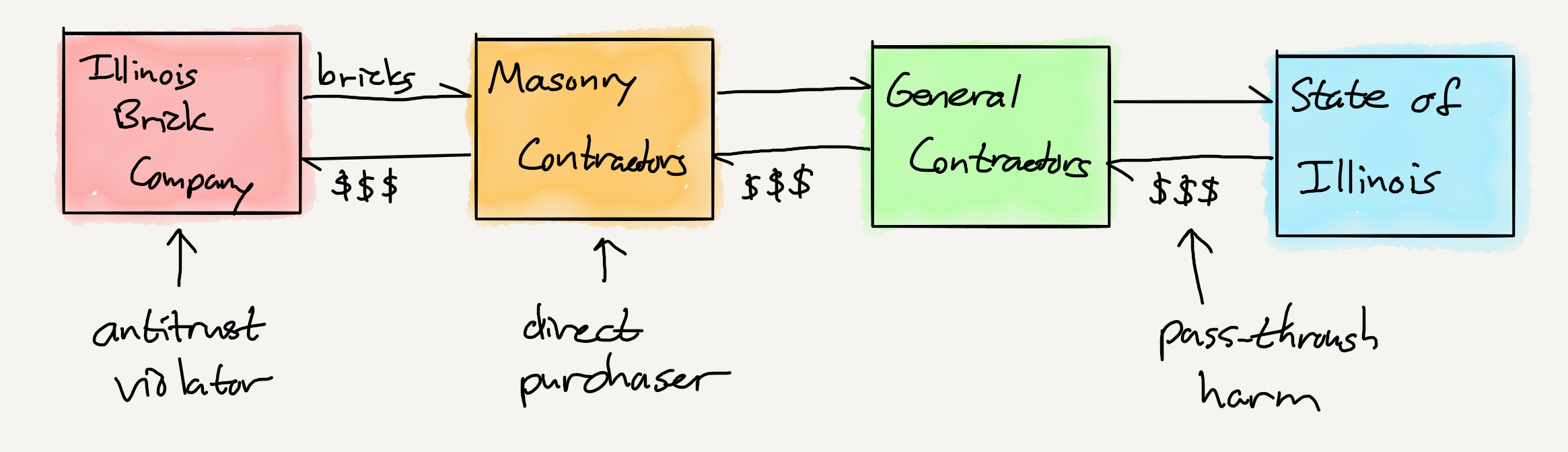
The specifics of the Illinois Brick case are helpful in parsing out what makes the Apple case complex; specifically, the Illinois Brick value chain was very straightforward: concrete block makers (including the eponymous Illinois Brick Company) were accused of colluding to fix prices for concrete blocks, which were bought by masonry contractors; masonry contractors in turn submitted bids to general contractors for construction projects, which were ultimately paid for by the State of Illinois. The State of Illinois sued for damages, alleging that the higher prices resulting from the price fixing had been passed through to the State of Illinois.
In this value chain it is obvious who the direct purchasers were: masonry contractors; to the extent the State of Illinois suffered harm it was indirect pass-through harm. Thus, the Supreme Court ruled that the State of Illinois did not have standing; if every party in the value chain were to sue, the infringing party could be subject to duplicative recovery for damages (and parsing out the share of damages would be extremely difficult).
Apple vs Pepper
The question in Apple vs. Pepper, then, is who is directly harmed by Apple’s alleged monopolistic practices. According to the plaintiffs, the value chain looks the same as the concrete block manufacturers:
In this case Apple is in between developers and customers; the plaintiffs explain in their petition:
Apple charges apps purchasers a 30% commission on each app sale (unless it is a free app). The price paid by purchasers for an app is the amount set by the apps developer, plus Apple’s own supra-competitive 30% markup, both of which are paid directly to Apple, the alleged monopolist, every time an app is purchased. Apple keeps the entire supra-competitive portion of the purchase price for itself and remits the balance to the apps developers. The apps developers do not sell their apps to iPhone customers or collect any payment from iPhone customers, and iPhone customers are the only purchasers in the entire chain of distribution.
The plaintiffs argue that this makes consumers “direct purchasers”, giving them standing to sue:
Since Illinois Brick was decided 40 years ago, courts throughout the nation have had no trouble applying its “direct purchaser” standing requirement to various factual settings, including cases in which some form of payment is made to an alleged monopolist prior to the monopolist’s sale of a product.
Apple’s argument is that this misrepresents the transaction; the company wrote in its petition:
There is no basis for Respondents’ argument that pass-through damages claims are permitted whenever there is direct interaction between the plaintiff and alleged antitrust violator. This argument openly exalts form over substance by turning entirely on the formal identification of a “direct purchaser” and prohibiting any “further inquiry into the specifics of a case.”
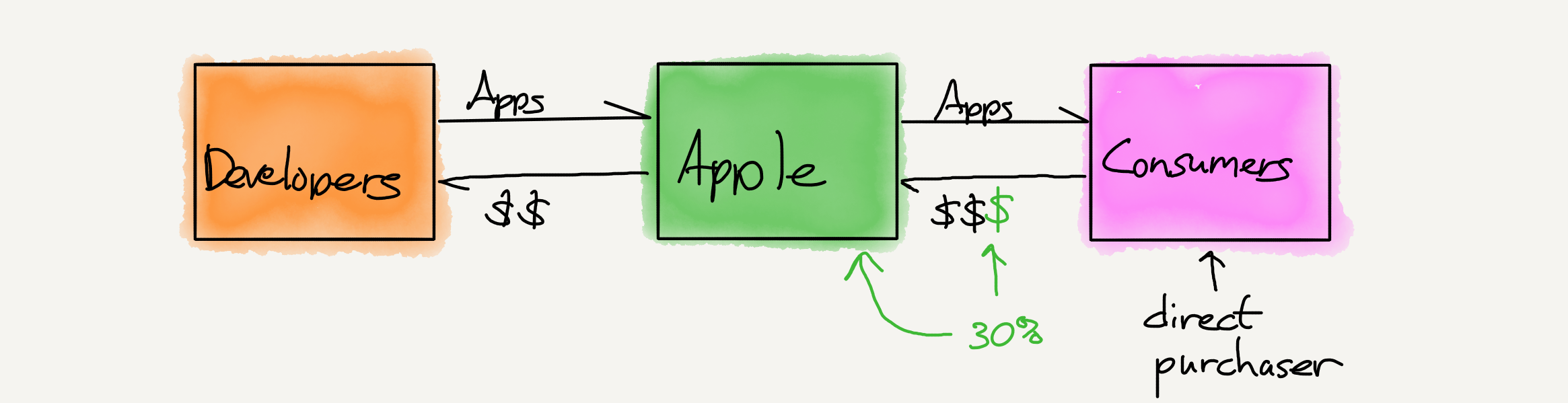
Rather, Apple argues that the value chain looks like this:
Specifically, the company argues that “Apple does not buy and resell apps”:
Respondents suggest for the first time that Apple “has adopted the role of a retailer functionally buying from developers as wholesalers and selling to iPhone owners as consumers.” But their complaint does not allege that. And Respondents have repeatedly acknowledged that only consumers buy apps; Apple does not. The Apple developer agreements cited by Respondents confirm this: developers “do[] not give Apple any ownership interest in [their] [a]pplications.” So Apple is fundamentally unlike a traditional retail store.
Rather, Apple acts as an “agent” for developers:
As Respondents note, [the Developer] Agreement confirms that “Apple acts as an agent for App Providers in providing the App Store and is not a party to the sales contract or user agreement between [the user] and the App Provider.” Thus, Respondents concede that the direct sale is actually between developers and consumers, facilitated by Apple as an agent and conduit.
Along those lines, Apple argues that developers set the price of their apps, which determines Apple’s 30% cut, and to the extent developers set prices higher to compensate for that cut they are passing on alleged harm to consumers — which means consumers don’t have standing to sue.
Why Apple is Right in his Case
With the caveat that I am not a lawyer, I believe that Apple has the stronger position in this case for two reasons: the first are the arguments laid out above. The second, though, come back to Aggregation Theory: I believe that Apple has power over developers (supply) precisely because it has all of the consumers (demand); it follows, then, that it is far more likely that developers are pricing according to what the consumer market will bear and internalizing the App Store fee, as opposed to pricing their products artificially high in order to pass the cost of that fee on to customers.
And, well, that goes back to the first point: even if they are pricing their products artificially high that is an ipso facto example of pass-through harm, which means consumers don’t have standing. The plaintiff’s case only makes sense in a world where there is a scarcity of apps with pricing power such that consumers are forced to bear 100% of Apple’s add-on; the reality is that apps are already as cheap as can be and it is developers that are being directly harmed by Apple’s policies (along those lines, the degree to which Apple owns the customer relationship — and associated data — does suggest something much more meaningful than an agent relationship with developers).
If I am right, and the case is dismissed because the plaintiffs do not have standing, that does not mean Apple and the App Store are out of the antitrust hot water: first, developers can sue for antitrust damages, and second, most states — including California — do not follow the Illinois Brick precedent (this dual antitrust regime was upheld by the Supreme Court in California v. ARC America Corp). There is a decent chance the question of whether or not the App Store and Apple’s associated policies are an antitrust violation will make its way to court sooner or later.
To that end, one of the more humorous aspect of yesterday’s oral arguments was the way discussion presumed that Apple was an abusive monopoly; this was a matter of convenience, as the question at hand was if Apple were an abusive monopoly, then who was harmed directly — which means it was easier to discuss the the latter question while assuming the former was true. To be frank, though, the language felt appropriate: Apple is an abusive monopoly in terms of iOS apps.
Let’s review the facts:
The only way to install apps on an iOS device is through the App Store
All apps must use Apple’s purchase APIs for all digital transactions, which include a 30% fee paid to Apple
Apps are expressly forbidden from linking to or suggesting that users visit a website to acquire any sort of digital good or subscription
This has been the state of affairs since 2011 when Amazon’s Kindle app gave in to Apple’s demand that it remove a link to Amazon’s online store. To be sure, Amazon is no shrinking violet in this fight, but Kindle is a useful example of just how absurd this policy is:
Apple is not responsible for any aspect of the Kindle ecosystem. Amazon hosts the books, runs the store, makes the readers, apps, etc.
Apple does make the device that ~45% of potential customers in Amazon’s largest market (the United States) carry with them every day.
Ergo, Apple demands that Amazon either give Apple 30% of all purchases on the Kindle app for iPhone or leave it to customers to figure out how to buy a new book.
Amazon, of course, has chosen the latter option: they can do that because they are a brand just as well-known as Apple, and even more beloved. That’s not really an option for a whole host of smaller developers, who have no choice but to give Apple 30% of their revenue if they even want to build a business.
That gets at the crux of the issue: Apple has every right to the outsized profits it makes on the iPhone. Consumers could buy cheaper Android devices but they don’t because they value Apple’s hardware, or iOS, or the integration between the two. I have a hard time believing, though, that anyone buys iOS because that makes it harder to buy ebooks!
To put it another way, Apple profits handsomely from having a monopoly on iOS: if you want the Apple software experience, you have no choice but to buy Apple hardware. That is perfectly legitimate. The company, though, is leveraging that monopoly into an adjacent market — the digital content market — and rent-seeking. Apple does nothing to increase the value of Netflix shows or Spotify music or Amazon books or any number of digital services from any number of app providers; they simply skim off 30% because they can.
To be clear, Apple absolutely did create the modern app marketplace, and, as the company loves to brag, an entire new economy full of new types of jobs. That, though, is precisely the problem: the App Store is not a fun side diversion; it is one of the largest platforms we have ever seen, on which hundreds of thousands of people are seeking to build real businesses, and that carries different types of responsibilities — and legal limitations — than an OS feature. It is bad for society generally and, I strongly believe, illegal for Apple to have crafted App Store rules such that it can leverage its smartphone share into monopoly profits on digital goods and services that are on iOS not because iOS is anything special, but because that is the only possible way to reach nearly 50% of the U.S. population.
Apple and the Services Narrative
Apple’s decision to embark on this strategy in 2011 was disappointing enough; the far more concerning development happened in January 2016. That was the first quarter when the iPhone basically stopped growing in terms of unit sales, and Apple’s response was the “Services Narrative”. CFO Luca Maestri opened his prepared remarks by covering a special supplemental document meant to emphasize that Apple had a thriving services business:
Each quarter, we report results for our Services category, which includes revenue from iTunes, the App Store, AppleCare, iCloud, Apple Pay, licensing, and some other items. Today, we would like to highlight the major drivers of growth in this category, which we have summarized on page three of our supplemental material. The vast majority of the services we provide to our customers, for instance, apps, movies and TV shows, are tied to our installed base of devices, rather than to current quarter sales.
For some of these services, such as content, we recognize revenue based on transaction value. For some of the services, such as the App Store, we share a portion of the value of each transaction with the app developer and only recognize revenue on the portion that we keep. To fully comprehend the scale of the services that we are delivering to our installed base and how fast this business is growing, we look at purchases in addition to revenue. When we aggregate the purchase value of services tied to our installed base during fiscal 2015, it adds up to more than $31 billion. That’s an increase of 23% over fiscal 2014.
First off, it is striking that when Apple was facing one of its most challenging years in the stock market, its first response was to basically make the plaintiff’s point in Apple v Pepper: suddenly the company wanted to recognize all of the App Revenue, “a portion” of which is shared with developers. That sounds like a company in the middle!
Secondly, though, the reason Apple wanted to include all app revenue is that the “Services Narrative” has always been first and foremost the App Store narrative. Apple makes a huge amount of money, with massive profit margins, by virtue of its monopolistic control of the App Store. It doesn’t make the games or the productivity applications or the digital content; it simply skims off 30%, and not because its purchasing experience is better,2 but because it is the only choice.
This is, to be sure, a narrative worth telling, at least when it comes to the stock market: Apple’s PE ratio, even with the recent slide in the stock price, is up 50% from that January 2016 call (two months ago it was up 100%). Investors believe — for good reason — that Apple can earn sustainable profits from something other than new devices (the company’s recent stock slide, interestingly, seems to have come from Apple’s insistence that its reporting emphasize revenue over unit sales).
At the same time, it seems incredibly worrisome to me anytime any company predicates its growth story on rent-seeking: it’s not that the growth isn’t real, but rather that the pursuit is corrosive on whatever it was that made the company great in the first place. That is a particularly large concern for Apple: the company has always succeeded by being the best; how does the company maintain that edge when its executives are more concerned with harvesting profits from other companies’ innovations?
To that end, perhaps it is not a surprise that the company’s other big growth driver has been rising prices across its product line: Apple deserves credit for building up the sort of customer loyalty that it can extract ever more revenue from its user base; more cynically, given the hassle of switching, where else are its customers going to go?
This is a view that is perhaps a tad pessimistic: Apple continues to show a lot of innovation in its wearables category, both Apple Watch and AirPods3, and the company is the best placed to make augmented reality a mainstream product. And, to be sure, the company has never been afraid of high prices.
Still, it always seemed that for Apple high profit margins were a by-product of the pursuit of great products, not the goal; it is much harder to make that case when it comes to the “Services Narrative” and App Store policies that seek to leverage genuine innovation in one market (smartphones) into rent-seeking in another (digital content). The latter may not be illegal, at least not yet, but the biggest potential victim is not consumers, nor app developers, but the product culture that gave Apple market power in the first place.
And, on the flipside, that the court granted certiorari at all suggests they may be looking to reverse the 9th Court of Appeals, which ruled in favor of the plaintiffs
In fact, its purchasing experience is better, particularly for free-to-play games; Apple should compete on the merits
Well, except for the mysterious disappearance of AirPods 2
Mark Zuckerberg is in a crisis of leadership. Will he grasp its opportunity?
Happier times.
It seems like an eternity, but about one year ago this Fall, Uber had kicked its iconic founding CEO to the curb, and he responded by attempting a board room coup. Meanwhile, Facebook was at least a year into crisis mode, clumsily dealing with a spreading contagion that culminated in a Yom Kippur apology from CEO Mark Zuckerberg. “For those I hurt this year, I ask forgiveness and I will try to be better,” he posted. “For the ways my work was used to divide people rather than bring us together, I ask for forgiveness and I will work to do better.”
More than one year after that work reputedly began, what lesson from Facebook’s still rolling catastrophe? I think it’s pretty clear: Mark Zuckerberg needs to do a lot more than publish blog posts someone else has written for him.
And while I’m not much of a fan of the company he’s built, I think Facebook’s CEO can change. But only if he’s willing to truly lead, and take the kind of action that today may seem insane, but ten years from now, just might look like genius. What actions might those be? Well, let’s review.
Admit you have a problem. Yes, over and over and over, Facebook executives have copped a plea. But they’ve never acknowledged the real problem is the company’s core DNA. More often than not, the company plays the pre-teen game of admitting a small sin so as to cover a larger one. The latest case in point is this post-modern gem: Elliot Schrage On Definers. The headline alone says all you need to know about Facebook’s latest disaster: Blame the guy who hired the firm, have him fall on a sword, add a bit of Sandbergian mea culpa, and move along. Nope, this time is different, Facebook. It’s time for fundamental change. And that means….
Submit to real governance. Like Google, Uber, Snap, and other controversial tech companies, Facebook implemented a two-class system of shares which canonizes their founder as an untouchable god, rendering the company board toothless in moments of true crisis (and in appeasement mode the rest of the time). Following Uber’s lead, it’s time for Mark to submit to the governance of the capital markets and abandon his super majority voting powers. He must stand before his board naked and afraid for his job. This and this alone will predicate the kind of change Facebook needs.
Bring in outsiders. Facebook’s core problem is expressed through its insular nature. This is also the technology industry’s problem – an engineer’s determination that every obstacle can be hacked to submission, and that non-engineers are mainly good for paint and powder afterward. This is simply not the case anymore, either at Facebook or in tech more broadly. Zuckerberg must demand his board commission a highly qualified panel to review his company’s management and product decisions, and he must commit to implementing that panel’s recommendations. Along those lines, here are a two major thought starters:
Embrace radical change. Remember “Bringing People Closer Together” and the wildly misappropriated “Time Well Spent“? This was supposedly a major new product initiative to change Facebook’s core mission, designed to shift our attention from what was wrong with the platform – data breaches, the newsfeed, false news and election meddling – to what could be right about it: Community pages and human connection. Has it worked? Let’s just be honest: No. Community doesn’t happen because a technology company writes a blog post or emphasizes a product suite it built for an entirely different purpose. Facebook can’t be fixed unless it changes its core business model. So just do it, already. Which leads to:
Free the data. Facebook has so far failed to enable a truly open society, despite its embrace of lofty mission statements. I’ve written about this at length, so I’ll just summarize: Embrace machine-readable data portability, and build a true, Gates-line compliant platform that is governed by the people, companies, and participants who benefit from it. Yes, actually governing is a messy pain in the ass, but failing to govern? That’s a company killer.
Many brilliant observers are calling for Mark’s head, and/or for the company to be broken up. I’m not sure either of these solutions will do much more than insure that the company fails. What tech needs now is proof that it can lead with bold, high-minded vision that gives back more than it takes. Mark Zuckerberg has the power to do just that. The only question now is whether he will use it.
“Getting lost was not a matter of geography so much as identity, a passionate desire, even an urgent need, to become no one and anyone, to shake off the shackles that remind you who you are, who others think you are.”
Edouard and Ryan wired up the Android Components reference browser to the new client instance metadata API. This will power device names, as well as the new, faster “send tab to device”. ✉️
Thom is continuing to improve our FFI layer, which lets our Android projects (and iOS, and, some day, Desktop!) consume our Rust syncing and storage libraries. 🛠
Thom and Nick have also been working on shipping composite builds, with all the Application Services Rust components in a single library. 📦
JR is sketching out an API for a Rust Push component, which we’ll use on mobile first, and eventually replace the push client on Desktop. 📣
Last week we released version 0.31.0 and this week 0.32.0 of Android Components. Some highlights of those releases:
NestedGeckoView / NestedWebView implementations to synchronize scrolling with a toolbar or other views (e.g. hiding the toolbar when the web content is scrolled).
A new component called concept-fetch defining an abstract definition of an HTTP client for fetching resources. In 0.32.0 we landed two implementations of this concept based on HttpURLConnection and okHttp (GeckoView/Necko implementation to follow soon). Eventually all HTTP client code in the components will be replaced with concept-fetch and consumers can decide what HTTP client implementation components should use in an app.
Permission requests of content (e.g. camera, location, protected media playback, ..) can now be observed and processed via the browser session component.
A rewritten, configurable session storage for persisting the session state to disk.
Integrated crash reporting using lib-crash component.
Added awesome bar using browser-awesomebar component.
Toolbar is hiding automatically now when scrolling web content.
Added browser-storage-sync component for saving and syncing browser history soon.
Performance
dthayer
Work on document splitting is ongoing. This will allow us to eventually output these to separate framebuffers which we can hand to the OS compositor, allowing us to not have to paint the whole window every time something in the chrome changes / animates.
Cleaning up patches to start feedback/early-review cycles
Florian
QA is testing the new about:performance features.
Fixing more bugs (rtl, minor layout issues, etc.)
Working on a tool to explore BHR (background hang reporter) data – feedback welcome!
Gijs
Continuing to experiment with lowering vsync frame rate on low-end devices to improve performance there.
Landed a fix to make the initial tab remote immediately, to avoid loading about:blank in the parent first. Continuing work on reducing about:blank-loading overhead.
Chasing a Linux-only leak regression in our printing tests that seems to have to do with the focus manager holding on to a content window indefinitely.
mconley
Changed how tabs-in-titlebar works under the hood, and still dealing with a bunch of follow-ups from that.
It’s been obvious that the constant increase in Vancouver real estate pricing did not appear to be a locally driven construct. Global Televison and Sam Cooper’s team have referenced a confidential report from Police that studied 1,200 luxury residence purchases in Metro Vancouver in 2016. The study found that while only ten per cent of the purchasers had criminal records, 95 per cent of those transactions were “believed by police intelligence to be linked to Chinese crime networks.” This means that home purchases could have laundered one billion dollars of black/gray cash in 2016.
The house purchases examined were in the 3 million to 35 million dollar range. The study did not include housing between 1 and 3 million dollars or condo flipping due to a lack of resources to scrutinize over 20,000 transactions. Researchers felt that significant suspicious activity would be found in these purchases as well.
Evidence is appearing that the funding for these real estate purchases is from the street proceeds of selling fentanyl, and laundering that cash. One unidentified expert stated “You know that Netflix show Ozark, about laundering drug cartel money? I always think that if those characters came up to Vancouver, they could launder all their cash in just one day.”
There are suggestions of a “fluid coalition of hundreds of wealthy criminals in Metro Vancouver, including gangsters, industrialists, financial fugitives and corrupt officials from China.” They are all linked together in an illicit banking scheme which transfers funding between China and Richmond B.C. to fund fentanyl importation and distribution.
But here’s the disturbing part~while B.C. Lottery casinos does launder some illegal money, this study suggests “it is miniscule compared to the sums flowing through real estate.”
Simon Fraser University’s Duke of Data Andy Yan views this new data as providing an explanation for the tremendous price increases in the real estate market that are totally out of keeping with local salaries. Calling it “financial fentanyl for our real estate” Andy observes “You have found $1 billion. But it is probably magnified in the banking system, with all of the black money, gray money, and legitimate money cascading through local institutions, to make a toxic sausage. So this is a national security issue. And also a national financial issue.”
You can take a look at Sam Cooper’s in-depth research on a few key housing transactions and who owns these houses here. There’s also a discussion on how lucrative fentanyl is and the value of fentanyl in transforming heroin into a counterfeit product, making millions of dollars. It is those millions that appear to have transformed the Vancouver housing market.
Apple has ordered a second iPhone production cut following continued weaker than expected demand for its trio of new smartphone models, according to Taiwan’s DigiTimes.
The move has negatively affected several of Apple’s suppliers in the East Asian state with one company, Career Technology — a supplier of flexible PCBs for the iPhone — reportedly laying off 110 of its employees.
Initial reports that Apple was scaling back iPhone XS, XS Max and XR production came out almost two weeks ago.
Apple, too, has been forced to take drastic measures. Earlier this week, the company indirectly lowered the price of the iPhone XR in Japan by increasing carrier subsidies for the new smartphone.
Between weak iPhone demand and the company’s decision’s to no longer share iPhone sales numbers moving forward, Apple’s stock has taken a major hit. On Monday, Microsoft briefly surpassed Apple as the most valuable company in the world.
One supplier that hasn’t been hit by the downturn in iPhone demand is Taiwan Semiconductor Manufacturing Company (TSMC). Apple’s main chip manufacturer is seeing high demand for its ability to produce 7-nanometre silicon, with companies like Qualcomm and Huawei lining up to use its foundries for their latest chipsets.
Chromebooks have come a long way in the last few years, with plenty of thanks to Google’s Pixel line of devices. The Pixelbook, for all its flaws, was a well designed and capable machine.
This year’s Pixel Slate continues to evolve that vision of capability and design. It’s also much more than a rebirth of the Pixel C tablet. Chrome OS has grown, becoming a competent tablet option thanks to a refreshed touch interface and support for Android apps.
Google’s hardware design has matured as well, and it shows. The Slate is arguably one of the nicest looking tablets I’ve ever seen, even if it seems like a big Pixel 2 phone. Holding it is a joy — it’s 7mm thin but doesn’t feel flimsy. It’s light, too, at 1.6lbs (.731g).
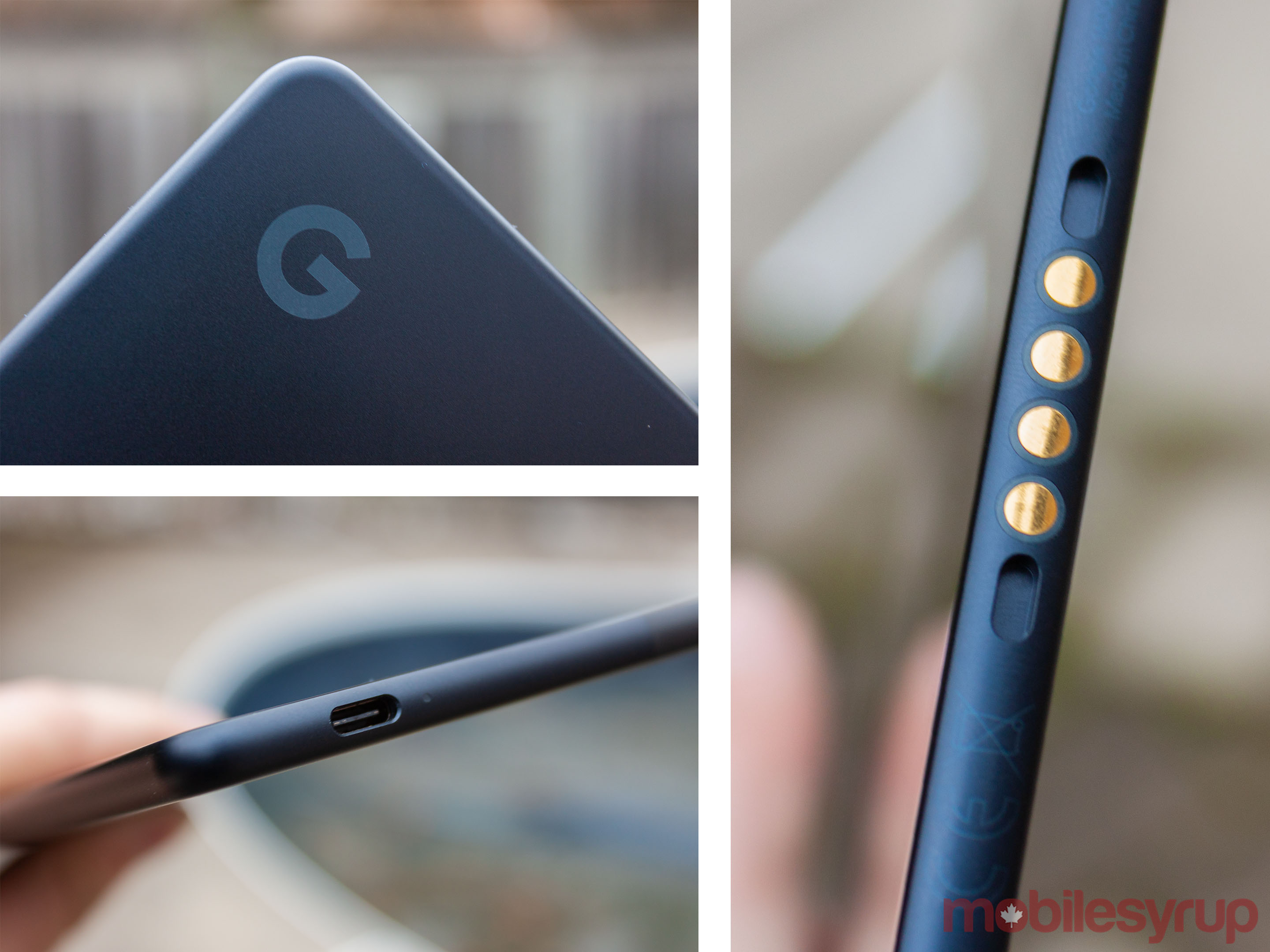
The Midnight Blue anodized aluminum body feels excellent as well — although I found it held onto fingerprints. I’m also a fan of the ‘G’ logo in the corner of the device.
For all the good though, some of the small things detract from the experience. Google’s inexperience in hardware comes through at some critical points. Worse, for all the Slate is, Chrome OS is still Chrome OS. Professionals, or anyone needing more than a web browser, will find the Slate lacking in some key areas.
All this is to say the Pixel Slate is the best Chromebook you can buy right now. That doesn’t mean you should. Competition in the 2-in-1 market is hotter than ever, which only serves to make the Slate’s shortcomings more apparent.
Almost perfect on the outside
Specs
Display: 12.3-inch Molecular LCD display, 3,000 x 2,000 pixels
Processor: 8th gen Intel Celeron, Core m3, Core i5 or Core i7 processor
Memory: 4GB, 8GB or 16GB RAM
Storage: 32GB, 64GB, 128GB or 256GB
Dimensions: 290.85mm x 202.04mm x 7mm
Weight: i5: 1.6lbs (0.731g)
Camera: 8-megapixel front, f/1.9 aperture, wide field of view, 1080p video at 30fps. 8-megapixel rear camera, f/1.8 aperture, Auto Focus 1080p video at 30fps
Operating System: Chrome OS
Battery: Up to 12 hours use, 48WHr battery with Fast Charging up to 2 hours of use in 15 minutes
Connectivity: Wi-Fi 802.11 a/b/g/n/ac compatible, 2×2 MIMO, dual-band 2.4GHz and 5.0GHz, Bluetooth 4.2
Ports: Two USB-C ports, accessory connector for Pixel Slate Keyboard
Audio: Dual front-facing speakers, two microphones
Sensors: 3-axis gyroscope and accelerometer, ambient light sensor, hall effect sensor
Security: Pixel Imprint fingerprint sensor, Titan C security chip
The Pixel Slate has a lot going for it. Aside from its gorgeous body, the Slate sports an excellent display. The ‘Molecular Display’ is excellent, easily rivaling the Surface Pro 6 and the Apple iPad Pro.
Having just finished a review of the Surface Pro 6, I found myself comparing the devices constantly. The display is one of the areas I kept comparing. I preferred the Slate’s Molecular Display to the PixelSense display in the Pro 6. Mostly, that came down to the higher resolution of the former.
I also found the Slate’s screen could get dimmer than the Pro 6, but it couldn’t get quite as bright. Ultimately, the devices were close enough in that regard. Colours were excellent on both, but again I liked the Slate just a bit more.
Ports is another area where I think the Slate steps ahead of both the Pro 6 and the iPad Pro. The Slate has two USB-C ports — one more than the iPad and two more than the Surface. This came in handy, allowing me to connect an external display while charging, as well as utilize several different adapters and dongles to connect things like SD cards and USB sticks.
While I never thought I’d praise the option to use dongles, I much prefer the flexibility of USB-C to the limitations of Pro 6’s IO options.
Google does a great job nailing some of the small things when it comes to hardware as well. Both USB-C ports have small LEDs to indicate charging status. Additionally, the Slate came with a USB-C to 3.5mm headphone adapter for using wired headphones. Dual front-facing speakers were loud and capable for consuming media. I also appreciated the lack of a camera bump.
Finally, the Pixel Imprint sensor was quite good. It was fast and accurate, and overall felt like an adequate solution. However, it pales in comparison to the facial recognition options on the Surface Pro 6 and the iPad Pro. There’s just something about turning on the screen and unlocking the device with a smile. Having to reach up and tap the fingerprint sensor felt dated in comparison.
The Slate’s accessories taint an otherwise excellent experience
While Google may have nailed the small things with the Slate itself, the search giant slipped when it came to the accessories.
First up, the Pixel Slate Keyboard: a resounding “meh.” The rounded key typing experience is fine. I didn’t find it any worse than rectangular keys, other than the spacing caused me to miss the odd key press when typing quickly. The keys themselves feel okay, although I found them mushy compared to the Type Cover on the Surface Pro 6. The Type Cover felt much snappier, but the Slate keyboard was quieter, to the benefit of those sitting near me.
If you’re concerned about the rounded keys making it harder to type, they don’t interfere after a short adjustment period. If you’re anxious, I’d advise looking at the Brydge G-Type Keyboard, which attaches with a magnetic hinge reminiscent of traditional clamshell laptops. It sports regular keys and still has some of the unique buttons like the Assistant key. It’s also cheaper than the Slate Keyboard, but at the time of writing, it wasn’t available from Google’s store.
The Slate Keyboard’s trackpad is excellent as well. It’s quite a bit bigger than the Pro 6 trackpad — thank goodness — and I found my finger slid over the material easier. Also, the trackpad has a satisfying click to it.
The hinge mechanism is honestly really good. It attaches to the tablet’s rear using magnets, allowing for easy adjustability by sliding the cover along the back of the device. About two-thirds of the way up the back, a set of stronger magnets lock the hinge in place. While you can fiddle with the mechanism to get the screen to lean back further, it’s difficult and not worth the effort.
One other drawback to the magnets is that it can be difficult to judge how much force is needed to separate the back of the tablet from the cover. On several occasions, I found myself overdoing it, causing the screen to slam closed when it suddenly popped free from the magnets.
The Slate Keyboard works reasonably well, but again, I preferred Microsoft’s solution. Also, I love that I can use the kickstand without the keyboard on the Pro 6, making it a great option if I want to draw at an angle or have the tablet stand on its own while watching a video. You can fold the Slate’s keyboard out of the way, but it’s still attached, and you can’t get rid of it if you want the tablet to stand.
Further, because the keyboard is directly connected to the hinge, I found it made the screen bounce when I typed on my lap. While the Pro 6 remained stable for lap use, the Slate rocked about, causing for a rather unpleasant experience.
Worse, the keyboard makes the Slate much thicker and heavier when attached. Alone, the Slate tablet is thinner than the Pro 6, but with the Keyboard connected, the Slate is thicker and heavier.
Another significant annoyance with the Slate Keyboard is that when closed, it hardly stays that way. The Type Cover locks in place with magnets when closed, but the Slate doesn’t seem to do that. The result is that the keyboard slides about loosely on the screen. While the four rubber feet on the keyboard will likely prevent scratches, its just not a great experience when you pick up the closed Slate and have the cover slide around in your hand.
The most egregious part of this is the price of the accessory. At $259, it’s frustrating that the Slate Keyboard can’t achieve some of the essentials like the $170 Type Cover.
Drawing conclusions
I’d also like to take a moment to address the digital inking experience, as both devices have pens — the Pixelbook Pen and the Surface Pen. Both cost $129, but the Pixelbook Pen is far inferior to the Surface Pen.
From a hardware perspective, the Pixelbook Pen’s lack of magnets to attach it to the tablet is infuriating. This is a simple thing that makes it incredibly easy to bring the pen with you on the go. Even Apple does this now with the refreshed Apple Pencil.
Further, the Surface Pen has a button on the top that doubles as an ‘eraser.’ It makes for an intuitive experience when I can spin the pen around and erase what I wrote.
As far as software goes, the writing experience was a little weird with the Pixelbook Pen. The writing felt delayed at times, and often I could see the digital line following a different trajectory on the screen then the tip of the pen, mainly when drawing a curve. It always corrected itself, but it was a bit disconcerting when writing.
The other big issue with the pen — and the Slate in general — was software.
You can almost do anything with Chrome OS
When using the pen to draw, or trying to do anything that needs more than just a web browser, the fissures in the Slate become apparent. The apps people need aren’t there.
This has been a long-running complaint with Chrome OS, but it continues to be a poignant one, more than ever now because Google markets the Slate as a laptop replacement.
The Slate does not have the app selection or software availability to replace a Windows or macOS system, plain as that. Chrome OS has gotten a lot better — the addition of Android apps and Linux apps to the ecosystem helps close the gap. But it’s unfortunately not enough yet.
As far as Android apps go, I found the experience lacklustre. The Slate takes apps designed for phone screens and stretches them across the display. Plus, interfaces designed for thumbs aren’t great with keyboards and mice.
I do about 90 percent of my work in a web browser. I’ve moved as much of my workflow online as possible to make things easy when switching between review devices. However, it’s that last 10 percent that makes Chrome OS infeasible for me. In my case, that’s Photoshop. I know there are alternatives out there, like Gimp, that will work on the Slate thanks to Linux app support. But in my case, I don’t have time to relearn my entire workflow in a different program on a different OS. Additionally, most consumers won’t have the time to learn how to use Linux.
I recognize that not everyone will have that same problem. Plenty of people out there don’t use or need Photoshop. But, I’d also argue that the vast majority of people rely on some app or program that isn’t available on Chrome OS.
For those of you who don’t, Chrome OS is an excellent choice. It’s incredibly snappy, it’s not taxing on the hardware, and it’s easy to use. But if you’re the type of person who only needs a web browser, you likely don’t need a powerful processor either, in which case I still can’t recommend the Slate.
The review unit provided to me was the second highest model, with the Intel i5, 8GB of RAM and 128GB of storage. It retails for $1299. That’s a hefty price tag for the power you don’t need. The lowest model is $849 with an Intel Celeron processor, 4GB of RAM and 32GB of storage. That’s a big ask for a Celeron processor, especially when similarly specced Chromebooks are available for as low as $249.99.
Do more, pay less
In a vacuum, the Slate is terrific. It is, without question, the best tablet device from Google yet. However, I think the company’s biggest misstep with this device is the price.
The i5 variant of the Slate costs $1299, about $120 more than Microsoft’s Surface Pro 6 base model at $1180. Both models have 8GB of RAM and 128GB of storage. Both have 12.3-inch displays, although the Slate’s is higher resolution. Both have i5 processors, but not all CPUs are equal.
The Slate sports an i5-8200Y processor, whereas the Pro 6 has an i5-8250U. The dual-core 8200Y is significantly slower than the quad-core 8250U, especially in the multicore segment of benchmarks.
Pixel Slate benchmarks (right) vs. Surface Pro 6 (left)
While benchmarks certainly aren’t the be all and end all of the CPU comparisons, it’s plain that Google chose longevity over performance. The Y series chips use less power, making them friendlier to batteries. On the performance front, Chrome OS doesn’t typically tax the hardware too much, so the 8200Y performed excellently.
However, I find it hard to accept that I could pay less money and get a faster processor along with full Windows in a package the same size as the Slate. With that in mind, I chose to put the batteries to the test to see if the low-power 8200Y was worth the extra cash.
I emulated my typical workload on both the Surface Pro 6 and the Slate — I had Slack, Trello, Grammarly and TweetDeck open along with a ten-hour YouTube video as I typically watch videos or stream music while working. I opened these in Edge on the Surface Pro 6 since Microsoft claims it provides the best battery life on Windows. Finally, I had both devices at the maximum brightness.
The Surface Pro 6 lasted five hours and 45 minutes and the Slate ran for an extra hour and a half after that. Ultimately, an extra hour and a half battery life doesn’t justify the higher cost of the Slate.
Lawmakers from nine countries weren’t impressed with Facebook’s CEO Mark Zuckerberg’s vacant seat at a hearing on fake news, saying it “speaks volumes” that he didn’t care to respect the 447 million people that were represented at the event.
On November 27th, 2018, 24 officials from Britain, Canada, France, Belgium, Brazil, Ireland, Latvia, Argentina and Singapore questioned Richard Allan, Facebook’s vice-president of policy solutions. The officials and Facebook representative were at a special hearing of the United Kingdom’s Digital, Culture, Media and Sport Committee on fake news and Facebook’s involvement in elections meddling.
“How deeply disappointed we are about Mark Zuckerberg’s decision to ignore the summon from so many different nations… I’d like to ask about the corporate decision to blow off this meeting. How was that arrived at? Who gave Mr. Zuckerberg the advice to ignore this committee?” NDP Member of Parliament Charlie Angus asked Allan, who responded by saying that he took it upon himself to come to the hearing. Allan went on to defend Zuckerberg for skipping the hearing.
“Mr. Zuckerberg’s decision to not come to Westminster speaks volumes, particularly since this has been a subject of investigation on if Facebook apps have upended one of the most important votes in British history,” Angus said. “Does Mr. Zuckerberg think parliamentarians are not willing to push back?”
Allan, who is also a member of the parliament’s upper chamber, the House of Lords, told the committee that it was “not great” that Zuckerberg wasn’t present at the hearing.
“I think it’s important we have this kind of engagement but I also have a role in supporting my company as it tries to grapple with the issues we’re talking about today,” he responded when asked if he thought it was okay that the CEO was not present.
Zuckerberg has appeared before politicians in the past. He testified before the U.S. Senate and House in April. He also appeared in front of European Union Parliament’s Council of Presidents in May.
9 countries. 24 official representatives. 447 million people represented.
— Digital, Culture, Media and Sport Committee (@CommonsCMS) November 27, 2018
Further adding to the frustration that Zuckerberg didn’t attend the meetings, officials felt that Allan wasn’t able to properly answer questions despite the fact Facebook was asked a similar set of questions in the past.
U.K. Labour Party MP Ian Lucas asked if Allan was able to confirm when Zuckerberg was made aware of the Cambridge Analytica scandal — the firm that helped U.S. President Donald Trump win the 2016 presidential election campaign by harvesting data from millions of Facebook users.
Lucas noted that he had asked the same question nearly eight months ago to another senior Facebook executive at a committee hearing and didn’t get an answer then.
Allan was not able to answer the question, adding that responses were given to the committee.
“I’m sorry, you haven’t given responses because I asked in April this question… I wanted Mr. Zuckerberg to answer this question. You’ve had six months notice of these questions,” said Lucas.
French Senator Catherine Morin-Desailly disappointedly asked if Facebook had warned users that their data would be harvested the way Cambridge Analytica did and if it was normal to target political accounts or users.
Allan did not answer the question directly. Instead, he said Facebook felt “the use of Cambridge Analytica was abusive,” but that the company had provided “sufficient” information to users and felt they were aware that an application can harvest data.
Canadian MPs don’t feel questions were properly answered
Conservative MP Bob Zimmer said he wished he had his gavel to try and control the amount of cross-talk and interruptions that occurred during the hearing.
Zimmer is the chair of the House of Commons Standing Committee on Access to Information, Privacy and Ethics (ETHI) and was at the hearing with his co-chairs Angus and Liberal MP Nathaniel Erskine-Smith.
“My main concern with this whole study is been the foreign influence in election campaigns and deeply troubled by Facebook’s response to that… Is our democracy at risk if we don’t change the laws in Canada to deal with surveillance capitalism? Is our democracy at risk…what do you think?” Zimmer asked.
“I’m not confident especially from previous statements from Mr. Zuckerberg, he seems to deflect that platforms are used in elections campaigns… do you agree with Mr. Zuckerberg?
Allan responded without providing a straight answer, to which Zimmer said, “I’m actually not sure what you just said.”
Zimmer felt that Allan was deflecting from properly answering the question, adding that it seemed to be the Facebook way to “delay, deny, and deflect” responses, referencing the New York Times article that recently exposed Facebook’s public relations tactics.
Erskine-Smith was also disappointed to see a “noticeably empty” seat but proceeded to ask Allan a slew of questions based on a statement that Zuckerberg said: “We didn’t take a broad enough view of our response. It was my mistake and I’m sorry.”
“If you were to take a broader view of responsibility on election interference, including in 2016, would it mean to take more steps to prevent election interference?” Erskine-Smith asked.
“Um, yes,” Allan hesitantly responded.
Erskine-Smith probed Allan further on app developer reciprocity, a common service where a developer will provide content or an application and will receive data in exchange, and asked if Facebook treated developers differently if they had purchased mobile ad product.
“I’m not aware of that. Again, that’s a very specific question that I would need to look into,” Allan said.
“Would Mark Zuckerberg have the answer to that question?… I think he would. You should probably answer that question to a future date. Perhaps Mark Zuckerberg could,” Erskine-Smith said, adding that it was “incredibly unfortunate” that the CEO was not present.
Allan felt many of the questions were coming from emails that were circulated from Facebook documents that committee chair and U.K. Conservative MP Damian Collins had obtained over the weekend.
Leaked Facebook documents not part of the discussion
Collins said over the weekend that the documents contained confidential emails that were related to Facebook’s data and privacy controls leading up to the Cambridge Analytica scandal that broke earlier this year.
Collins, however, made it clear that those documents were not revealed to anyone before the hearing and that he wasn’t planning on releasing it.
In Canada, the ETHI committee has been studying Cambridge Analytica and the influence of social media on elections campaigns and has met 23 times non-consecutively since April 2018.
On November 20, 2018, Angus told MobileSyrup that the committee met in-camera (closed to the public and media) to finalize its report and make recommendations. He said that report would be released shortly.
What is the network equivalent of an aircraft's black-box? Is there an argument for governments pushing for more regulation on telco-side data-retention?
As far as I know, telcos are not under any obligation to maintain full logs of the state/operation of their network elements, either hardware or software – or make them available for authorities to inspect. As networks become more virtualised and complex, with NFV, orchestration, AI-led automation of network policies, slicing and so on, what happens if something goes seriously wrong?
The industry is hoping that 5G and other networks will be used in safety-critical verticals, with "ultra-reliable" requirements, but that brings risks and responsibilities too. That could mean authorities may need to do a diagnostic “post-mortem” if a network fails - or perhaps as a way to spot if the network is doing something it shouldn’t, such as discrimination in wholesale, or net neutrality violations.
Aviation has rigorous rules about flight data recorders (“black boxes”), and has an admirable record of learning lessons from catastrophe, and changing inspection and certification regimes, if needed. Air travel is a one-way ratchet, becoming ever-safer, because of this.
So, if a commercial 5G or FTTX network is being used for ultra-reliable uses (such as managing a power grid’s control, or a telemedicine app, or perhaps connected vehicles), is there a basis for countries having a “Network Accident Investigation Board” and better international cooperation? And would this not also imply a better way to store crucial background data is required? If a plane crashes, investigators can examine the physical wreckage, but this problem is much harder for software-controlled networks with no moving parts.
This is also an issue if a network gets compromised by hacking or a bug - who is responsible, how can it be fixed, and what prevents re-occurrence? And something similar applies for keeping records that may prove/disprove competition problems, eg did a virtualised network resource do something illegal, perhaps on a temporary basis? How could a complaint be investigated, or a prosecution brought?
The problems get multiplied massively if AI is involved, as any issues with underlying machine-learning algorithms are potentially a single point of failure, if that system is used widely (eg for coordinating 100’s or 1000’s of network-slices in an automated fashion).
Do regulators have the legal rights, obligation or ability to forensically analyse what’s gone wrong in such situations? Or the various cybersecurity agencies, or police forces?
One option might be to encrypt network configuration and operational logs, and keep them “in escrow” using blockchain to ensure anti-tamper properties, so that they could only be examined after a warrant or other legal instrument ordered decryption. There are likely numerous other technical approaches to consider as well.
In either case, as public networks become part of critical systems, this topic will only rise in importance. Policymakers should start thinking about it now - and the telecoms industry should face up to its responsibilities here, rather than push back without thinking. Do Boeing or Airbus complain about the need for data recorders?
Google started work on a Play Store redesign as far back as May. The piecemeal rollout of the new Material Design theme — characterized by heavy use of white — received a lukewarm reception.
However, the most recent change refreshed the ratings and reviews section of the app and received some praise from users.
First and foremost, the visual refresh adds cards to the review section and rounds the buttons to fit with the new Material Design. Further, the graph breakdown that shows the number of reviews for each rating has a modern rounded look. Google removed several of the colours, opting instead to highlight essential areas with the familiar Google Play green.
I like the new look as it’s quite clean, but not all are fans.
Along with a visual refresh, the change makes it easier for users to filter reviews. For example, with a tap, users can sort reviews by star rating. There’s an option to filter by ‘key phrases’ as well, but at this time it appears to be an English-only feature.
Old reviews design (left) and new design (right)
The key phrases banner replaces the old circle system, which displayed three common topics mentioned in reviews, such as ‘Gameplay’ or ‘Controls.’
Overall, it seems like a relatively solid update. It appears it’s a server-side change, and may even be part of an A/B test. While that style of slow, piece-by-piece rollout with multiple rounds of testing can be frustrating, it’s ultimately for the best. Google Play is a vast platform used by almost every Android user. If Google broke something, it could be disastrous.
In this case, I’ll take the slow rollout over a catastrophic bug.
 Und alle warten gespannt auf Apple Pay. Gut, alle warten nicht auf Apple Pay. Alle leidenschaftlichen User aus dem Apfel-Kosmos sind jedoch in freudiger Erwartung, endlich ohne Umwege über Boon, ausländische Apple IDs oder andere [...]


Staff suggested that Milsom build separate houses with side yards, but she didn’t want to squander the square footage for “little places for garbage cans on the waterfront.” Staff didn’t like the idea of separate owners sharing a driveway, let alone a building.
 Chris Martens @chrisamaphone


 Ian Bogost @ibogost
 April Engelberg @AprilEngelberg