Shared posts

30 Nov 03:15

Werkzeug und mehr

by Volker Weber

9847d447fd056ddd88d378fa04239966

Heute gibt es Werkzeug der Extraklasse im Tagesangebot. Ich liebe zum Beispiel die WERA-Produkte aus dem Bergischen Land. Das sind Geschenke für Papas, die noch selbst werken.

More >

30 Nov 02:43

Twitter Favorites: [counti8] I’m officially adding pan-fried blanched whole garlic cloves to EVERYTHING from this moment forward. Also there is… https://t.co/ofj90VeZ1a

Karen Quinn Fung | 馮皓珍 @counti8
I’m officially adding pan-fried blanched whole garlic cloves to EVERYTHING from this moment forward. Also there is… twitter.com/i/web/status/1…
30 Nov 02:43

Autism Secretariat Act

by peter@rukavina.net (Peter Rukavina)

The Guardian published a guest opinion piece I wrote on The Autism Secretariat Act, which received first reading in the Legislative Assembly this week.

This bill is a reasonable and straightforward call for the establishment of cabinet-level responsibility for autism; I believe that it’s a small step in the right direction toward coordinating programs and services for autistic Islanders.

It’s been an odd experience to be invested in the passage of a bill to this extent, and I’ve spent a lot of my time this week reaching out to MLAs to try to explain why I feel this way, and to ask them to support the bill.

It’s also odd, of course, to be supporting a bill or forward by a Progressive Conservative member when I’ve no affiliation with the party; but politics, as they say, makes strange bedfellows, and I believe PC MLA Sidney MacEwen has put forward the bill for all the right reasons: he’s talked to constituents, distilled a problem from what they’ve told him, and is proposing a change to address the issue.

I think the plan is for the bill to receive second reading on Tuesday evening; I am hopeful that it will receive all-party support and move forward.

30 Nov 02:43

Initial Split payments financing options now available

by Jeff

It is no secret that our hardware products are not only high-quality but also involve a lot of R&D overhead to make the Librem laptops and phones possible: our software & firmware development and support (and any additional R&D to enable us to grow and better serve you) has to be paid out of the margins we make on each sale, whether from the base configurations or the accessories and upgrades. It’s the reality of our cost structure as a manufacturer involved in providing a turn-key, integrated hardware+software solution, so these are simply the economics we have to deal with. Our business model isn’t cheap to run.

Most people find our offering to be of great value and are willing to vote with their wallets without hesitation, but there are also those who, while they are supportive of our goals and hold our products in high respect, simply cannot financially (or emotionally!) afford to shell out the money “all at once” to make a purchase. Some people have tighter cash flows and need to manage their budgets over the long term, and that’s quite understandable.

So today, I’m happy to announce that we have made a leap forward in catering to those who need more flexibility, by using SplitIt to offer split payments as an option. We are hoping to also add other financing partners in the future if we see interest from our customers, so let us know if this is a positive change for you or the people you know.

What this system allows you to do is to get one of our products and pay it over time, interest-free (to the extent that you honor your credit card payments, otherwise your credit card company will charge interest to you, of course). We are not the ones handling the split payment, SplitIt and your bank or credit card company do.

So, as an example, if you buy a Librem 13 “base configuration” at the regular price of $1399 (remember, today is Black Friday and we have a sale going on, so it’s actually less than that), instead of paying the entire amount in a single transaction you can choose to pay the same amount divided by twelve months, that is 12 payments of roughly 117$ on your credit card. Of course, financial responsibility still applies and you need to make sure you can afford the monthly payments for the duration of your chosen term (6 or 12 months, depending on what you choose).

We hope many will find this new feature useful! Of course, if you choose to make use of this payment strategy, please make sure to read the “Customer’s Terms and Conditions” section of SplitIt’s Terms & Conditions page.

— Jeff, on behalf of the marketing and finance departments

The post Initial Split payments financing options now available appeared first on Purism.

30 Nov 02:41

NewsBlur Blurblog: BIXI Montréal

sillygwailo shared this story from A Bike Share Affair.

Well it took four months, but I’m finally getting around to my first bike share review.

I’m starting with BIXI Montréal, which is not the first bike share I used (that honour goes to Melbourne Bike Share), but is a pioneer in modern bike share – BIXI celebrated its tenth season this year. It was preceded in the technology-enabled bike share era by Vélib’, but was the first such bike share to operate on a large scale in North America. I think that makes it a pretty good baseline bike share for comparing other systems.

I’ve been using BIXI since around 2012, and it’s basically my main way of getting around Montréal on my annual or semi-annual visits. Over the years I’ve had casual, monthly, tri-monthly, and annual subscriptions depending on how much time I spent in the city, and I used the system most recently in September 2018.

The system is owned by the City of Montréal, which initially developed the technology itself (along with 8D Technologies, now owned by Motivate, formerly Alta Bike Share) – most of the intellectual property and service company were eventually spun off into what is now PBSC Urban Solutions, which still provides hardware, software, and implementation in many other cities around the world. The design has become so iconic that there’s even a BIXI in the Musée des beaux-arts.

BIXI’s pricing model is typical of bike shares of its generation: annual, 90-day, or monthly passes will get you an unlimited number of 45-minute trips, and you can also purchase a one day or casual pass which gives you unlimited 30-minute trips for 24 hours. They’ve recently added a “one way” option where you pay $2.95 for a single 30 minute trip, though I’ve never found that to be a particularly useful option. Special discounts are available for 3-day holiday weekends and for one-way trips tied to an Opus card. In all cases, it’s an extra $1.80 for the balance of the first hour if you go over the allotted time, and $3 for every 15 minutes beyond that. As with all such systems, you can always “time out” by ending your trip at a station and then taking out the same bike again two minutes later.

Cycling in Montréal is generally a pleasure and frequently the most efficient way to get anywhere. There are plenty of protected bikeways, and especially in the summer the volume of cyclists is such that most drivers are aware of sharing the road. That said, the general rule in Montréal is that all road users are predictably aggressive – you have to be assertive to get anywhere, and you can assume people walking or cycling will run red lights. The other general rule is that there will always be construction. Montréal does not have a mandatory helmet law, though in the past Westmount did and it was generally not enforced.

The BIXI network is huge. My rough estimate puts it over 125 km², with 6,200 bikes spread across 540 stations in Montréal, Longueuil, and Westmount. Needless to say, the network covers most places tourists would go, but also covers most places that are a reasonable biking distance from the city centre for commuters. Stations are well placed and well spaced, with higher density in the city centre and larger gaps between stations further out. The network is denser in the city centre, Vieux-Montréal, Mile-End, and Le Village Gai, and sprawls out mostly along corridors beyond that. The biggest downside is that the system shuts down entirely over the winter.

The technology is definitely getting old, but has (after a few bumps several years ago) been kept up to date where possible. The app shows you clearly where all the bikes are, including whether or not there is an electric bike at the station. The app functions well in every respect, though I’ve always preferred Spotcycle (also developed by 8D), personally.

Registering is relatively straightforward, though I did it so long ago that I don’t remember the details. If you want a membership you can sign up online and have a key sent to you, but if you want a casual use / day pass you can sign up directly at the station using your credit card. I found these charts showing the split between casual and member use on BIXI’s website which I thought were super interesting.

The unlock process for membership holders is simple – insert your key in the dock, the light turns green, and the bike comes out. There is no opportunity to reserve bikes like there is with some other systems. This is especially problematic since, as with all station-based systems, it is not uncommon to find full or empty stations.

If you don’t have a membership, before each trip you need to go to the machine at the station and follow several steps to provide your credit card and generate an unlock code. You then tap the number into a dock with a bike in it and the bike will be unlocked.

Ending the trip is easy for all users – simply insert the bike into an empty dock at any station, and wait for the light to turn green. It’s fast and efficient. 

  • Until recently, BIXI had bikes from other PBSC networks floating in its system

  • Until recently, BIXI had bikes from other PBSC networks floating in its system
  • Bikes are regularly redesigned by artists
  • Original livery, photo taken in 2010

The bikes themselves are generally well-maintained, though I regularly find ones with flat tires which at least is detectable by sight. The bikes fit me well and the handlebars are an appropriate height for sit-up cycling, though are a little more comfortable with a slight forward lean. BIXIs are solid and practically nothing could damage them, which is especially useful in pothole-heavy Montréal.

The seat posts are generously long except that the first generation of bikes (which are still found widely in the system) all have a slightly shorter seat post that is just a touch too short for me. Older seats are a little more padded, but newer seats have holes built into the middle which allows rain to run off them better.

  • Newer seat post with ample height adjustment
  • Newer seat with drainage
  • Older seat
  • Older seat post with not quite enough height adjustment

The vast majority of BIXIs have three gears using a simple shifter built into the handlebars. The latest generation have seven gears using a similar shifter. Montréal, despite its name, is mostly pretty flat so the three speed bikes are generally sufficient but the seven speed ones are definitely easier to use when encountering the few hills that do exist.

  • Old gear shifter used to pilot 7-speed bikes in 2015
  • Newest gear shifters
  • Newer gear shifter
  • Older gear shifter on most bikes in the network

The brakes are generally in good shape and I’ve never really had a BIXI with bad ones. The bells are usually disappointing – if they work at all, they are usually twisted around under the handlebars and difficult to switch back up to the top. Users often put them below to keep the rain out, but on average a BIXI bell is useless. The baskets are basically just straps with a shield at the front, so I advise against putting anything in them unless you’re certain it can be secured well.

And lastly, one bonus – BIXI recently introduced e-bikes! There were 20 of these placed into the network late in 2018 and I had the chance to ride one (after spending literally all day hunting for it) on my last visit. The e-bikes are heavier than the regular bikes of course, but they glide so smoothly and zoom along so satisfyingly. The bikes do not have user-changeable gears which makes it a different experience than with a regular bike, but they adjust well to pedalling. I hope they will add more to the network next year, though the strange rule where helmets are mandatory only for e-bikes will likely impede its success.

Overall, I would put BIXI at a 8.7/10 for having really good bikes, a great network, and good pricing, with the only negatives being poor bells and baskets, the limited season, and the perpetual full station / empty station problem.


30 Nov 02:38

Warcross is awesome!!!

by Liz

Warcross continues to deliver the goods! I love this book. The gamer/hacker heroine in her ripped up jeans and flannel shirt has now gone through the first draft for the Great Games or whatever they are called, and was picked first to be on the Phoenix Riders team even though she is a lowly level 28. The captain of her team, Asher Wing, is a wheelchair user, which made me instantly happy. I was trying to figure out from the description what kind of chair he had and I am thinking powerchair since his headrest was mentioned. Another named character on an opposing team was a former Paralympian.

Scenes of clever hacking… loving descriptions of leaping around and fighting in the Game . . . And she has moved from her first swanky hotel room to some sort of team training mansion where she has a suite with a rooftop patio with her own private infinity pool.

They have also been to a great party at a disco which was seamlessly wheelchair accessible with great augmented reality. There are so many adorable details like that there is a (female) character named Hamilton.

I also dig that we see more of Emika’s motivation and backstory for the high school hack that got her arrested.

This is like the perfect antidote for the boring sexist barfbag that was Ready Player One. It’s assuaging my soul!

30 Nov 02:38

Growing a Revolution

by alevin

Growing a Revolution was inspiring Thanksgiving holiday reading. Written by MacArthur Fellowship recipient David Montgomery of the University of Washington, the book reports on global examples of farmers adopting practices of “conservation agriculture” which restore soil as a renewable resource, instead of degrading soil over time.

By avoiding plowing, using cover crops, and employing crop rotation, farmers are able to use much lower levels of fertilizers, pesticides and fuel and make higher profits, with less vulnerability to drought and storms. These practices result in less polluting runoff, better habitat for biodiversity, and – not least – store increasing amounts of carbon in the soil.

The book explains how relatively recent scientific progress in soil ecology and microbiology has provided greater understanding of the systems that build up productive soil – plants have symbiotic relationships whereby they feed sugars to fungi that deliver nutrients to plants and emit proteins that hold soil together; the fungi have symbiotic relationships with bacteria that metabolize nitrogen, phosphorus, and other minerals. Earthworms, termites, ants, other invertebrates and their micro-symbionts help digest compost, recycle nutrients and structure soils to retain water.

This mutualistic ecosystem is much more complex than simplistic equations that calculate the amount of fertilizer and water inputs needed to grow plants for harvest. Input-based agriculture can deliver high crop yields in the short term, but degrades the soil leading to lower productivity over time.

The practice of plowing breaks the connections between plants and the fungi that feed them; plants well-fed with synthetic fertilizers don’t provide nutrition to symbionts; and pesticides also kill the beneficial organisms that enable soils to hold moisture. So dry soils and extra fertilizers are washed away by irrigation and rainstorms. Fields that are plowed and treated with fertilizers and pesticides gradually lose soil, require even more fertilizer, are more vulnerable to drought and storms, and shed carbon into the atmosphere.

Healthy soil practices are extremely promising for climate protection. Scientific estimates differ, but it is clear that the broad use of agricultural practices that restore soil carbon instead of mining it could go a long way toward pulling carbon out of the atmosphere.  And the book shows how farmers adopting healthy soil practices can start regenerating soil and improving farm economics within a few years – potentially leading to relatively rapid carbon drawdown.

The focus of “conservation agriculture” on building up soil health is different from the focus of “organic agriculture” on refraining from all synthetic fertilizers and pesticides.  Farms can practice conservation agriculture, use much lower levels of pesticides and fertilizers, and increase soil carbon, but still not qualify as organic. By contrast, a farm could be certified “organic”, but use frequent plowing that breaks up soil ecosystem, and use monoculture practices that depend on “organic fertilizers”, while still eroding soil and losing carbon over time.

But “healthy soil” practices aren’t yet visible to consumers. While “organic” has become a mainstream brand allowing consumers to choose foods produced without synthetic pesticides and fertilizers, there isn’t yet a certification system and brand allowing consumers to choose food that was grown with practices that maintain soil and climate health. The book identifies this as a potential opportunity to engage consumer power in promoting healthy soil practices.

The book identifies other institutional barriers hampering broad-scale adoption of conservation agriculture. In the US and many places around the world, agricultural education and farm support programs are largely geared toward promoting high-input monoculture. The major corporate purveyors of fertilizers and pesticides have lobbied for policies and incentives to keep the system of input-dependent monoculture well-entrenched. “Crop insurance” programs help insure farmers against drought and storms, but don’t support “preventive care” investments to help farmers get started with practices that make farms more resilient to drought and storms.

Most of the US-based farmers in the book were in red states, and had conservative, conservationist beliefs as well as economic self-interest motivating their soil health practices. Hopefully there is some combination of rural local politics and “green new deal” climate advocacy that can break the logjam and accelerate the spread of healthy soil practices.

The potential is great. “Growing a Revolution” makes a strong case that practices to reverse long-term soil damage are relatively simple, cost-effective, and transformative for farmers, ecosystems, and climate. With climate change evident in the fires burning California, the stakes couldn’t be higher.

30 Nov 02:21

Autonomous Warbots

by Stowe Boyd

Bots on defense now, and soon on offense?; watch out for those dark creatives; write the meeting agenda last; eat the biggest frog last; The free energy principle; Good at Slack; Esko Kilpi

Beacon NY — 2018–11–18 — I’m experimenting with a few changes to the Work Futures experience, both for me — as the author — and for you, dear readers.

One change is that the ‘long takes’ section will be refashioned. Instead of writing long takes in the newsletter, I will write them as independent posts, and then create links with short descriptions to them in the newsletter, like other links. So now short links and long links will just be links, with the topmost likely to be to posts on workfutures.org. This will make the newsletter shorter, I think.

I am contemplating a second innovation regarding long form, more investigative writing. Commentary about others’ posts or news — what has been the bulk of the ‘long takes’ I have been putting in the Daily — will be freely published on workfutures.org (and cross posted at stoweboyd.com, and medium.com/work-futures). However, I am thinking about launching a series or two in 2019 that will be place behind a paywall. (Revue now supports subscriptions). One series — tentatively called Work Talk — will consist of one or two interviews a month with leading thinkers and practitioners in the changing work of organizational change and the future of work. A second series — Work Walk — will be in depth reports, based on new research results, book releases, reviews of methods, and case studies of organizations attempting to adopt new ways of work. We’ll see how quickly I can roll these out, but I am certainly starting the interview series in January.

I’m planning $6.66/month for the subscription (which nets me around $5), and I will allow folks to get a 2 month 100% discount. (For those supporters that signed up for subscriptions in earlier incarnations of Work Futures, I will be sending a coupon for six or twelve months free access, when I launch.)

If you’re getting this you probably signed up at workfutures.org (or one of its predecessors) or stoweboyd.com. If someone forwarded this to you, sign up here.

Consider making a donation. We appreciate your support.

Links

Are Killer Robots the Future of War? Parsing the Facts on Autonomous Weapons | Kelsey Atherton points out that we already have autonomous weapons, but they are currently used for defense only, like Phalanx gun systems used as the last line of defense against antiship missiles. We will likely slip into offensive uses as soon as our capacity to operate in a world filled with AI and robots is overloaded. Personally, I like the idea of fewer human casualties in war, if in fact we can’t figure out how to avoid war in the first place.

Motivating Your Most Creative Employees | Tomas Chamorro-Premuzic and Reece Akhtar describe creatives as the source of innovation, and suggests that they need careful handling. But then they reveal a perspective that shows why creatives are so often trying to run away from organizations that don’t really get them:

Tolerate their dark side (but only up to a point): Everybody has a dark side, defined as his or her undesirable or toxic behavioral tendencies. Research has shown that creative individuals are naturally more irritable, moody, and hard to please. Furthermore, because of their imaginative disposition, creatives may come across as odd or eccentric, and they often specialize in making simple things complex, rather than the other way around. However, these non-conformist and individualistic tendencies also provide some of the raw ingredients for creativity: it is usually those who are likely to question the status quo and defy existing norms and traditions that push the most for innovations to happen. As the artist Banksy recently posted on Instagram when he made one of his art works self-destruct at a recent auction (just after the buyer spent over $1.3 million on it): “The urge to destroy is also a creative urge”. In contrast, if you only hire people who are well-behaved and do what you tell them, you can forget about innovation! However, it should be needless to say, no matter how creative employees are, there is no excuse for misbehaving or harming other employees and the organization.

Actually, there are many ‘excuses’ for misbehaving, considering who gets to define ‘behaving’.

Design your next meeting backwards — here’s how | Art Markman says you shouldn’t start by creating a meeting agenda, you should think about who you want to influence, how to accomplish that (time needed, etc.), and what the attendees need to see prior to the meeting so that the time is well spent, instead of a series of surprises. Then draw up the agenda.

This well-known productivity advice is actually pretty bad | Also from Art Markman, the notion that you should eat the biggest frog first is probably wrong. You’re better off doing something that energizes you, because mood is a more important aspect of being productive than generally acknowledged.

The Genius Neuroscientist Who Might Hold the Key to True AI | Shaun Raviv profiles Karl Friston, a genius polymath known for groundbreaking research in brain structure, but even more so for his theories around what he calls the free energy principle, which he think is the organizing principle of all life, and soon, all curious AI:

When the brain makes a prediction that isn’t immediately borne out by what the senses relay back, Friston believes, it can minimize free energy in one of two ways: It can revise its prediction — absorb the surprise, concede the error, update its model of the world — or it can act to make the prediction true. If I infer that I am touching my nose with my left index finger, but my proprioceptors tell me my arm is hanging at my side, I can minimize my brain’s raging prediction-error signals by raising that arm up and pressing a digit to the middle of my face.

Good At Slack | Choire Sicha can be very, very funny, and curates the Workfriend column at the NY Times well, pulling out the best Dear-Abby-for-work questions. Here he’s responding to someone who wants to ‘get good at Slack’:

Because people who run the tools at companies are not usually the same people who run the culture of companies, and because people who are more senior are generally also locked in senseless endless meetings all day, the adoption of Slack in offices is extremely haphazard and hazardous. Communities of people begin working in different ways in the same workplace. Messy! Some of us Gen Xers and many (most?) millennials grew up chatting online all day, every day, and we have taken to Slack perhaps too enthusiastically, we know. You email people will never be like us! (Though learn to adjust your notifications — make Slack work for you.)

From the Archives

Socialogy Interview: Esko Kilpi | Stowe Boyd | From 2015:

The factory logic of mass production forced people to come to where the machines were. In knowledge work, the machines are where the people are.

| Esko Kilpi

Quote of the Day

It is not the corporation that is in the center, but the intentions and choices of individuals.

| Esko Kilpi

Originally published at workfutures.org.


Autonomous Warbots was originally published in Work Futures Institute on Medium, where people are continuing the conversation by highlighting and responding to this story.

30 Nov 02:20

Skills Gap

by Stowe Boyd

Deloitte 2018 Manufacturing Skills Gap Study; AI Flowchart; Sharing salary info; Stack Overflow for Teams; We’re scared of algorithms; Joseph Campbell

Beacon NY — 2018–11–20 — I’m going to be on vacation the rest of the week, so this is the last Work Futures Daily until next Monday!

If you’re getting this you probably signed up at workfutures.org (or one of its predecessors) or stoweboyd.com. If someone forwarded this to you, sign up here.

Consider making a donation. We appreciate your support.

Links

2018 Manufacturing Skills Gap Study | Deloitte predicts a shortfall in skills in manufacturing based on interviewing manufacturing executives, and projected demographic changes, like retiring boomers. Higher pay is the obvious solution to a shortfall in workers, and training to get them skills:

Many manufacturers find themselves forced to take more aggressive measures to fill open jobs in the short term. The 2018 study identified a 15 percent increase in the number of companies offering higher pay to skilled workers compared with 2015. Today, 83 percent of executives offer higher pay to attract and/or retain skilled workers. But, on the flip side, while this gets skilled workers in the door, it does not guarantee they will stay. In fact, the study shows that 66 percent of executives see skilled workers leave to accept outside positions that offer higher pay. In addition to higher pay and signing bonuses, some manufacturers have also relaxed certain hiring requirements and moved production to domestic job shops to keep pace with the rising orders many are seeing. Unfortunately, none of these approaches will likely solve the industry’s skills shortage in the longer term.
As the industry considers a more deliberate path forward, Deloitte and the Manufacturing Institute have identified a number of strategic approaches that manufacturers could take to influence a more positive employment future. These considerations include:
  • Taking advantage of the emerging workforce ecosystem
  • Turning toward automation to supplement human jobs that are going unfilled
  • Tapping into the resources from the retiring generation of baby boomers
  • Developing in-house training that engages a multigeneration workforce
  • Creating public–private partnerships
  • Bolstering apprenticeship programs

Each of those are expanded in the full report. A good read for anyone interested in the manufacturing sector.

Is this AI? We drew you a flowchart to work it out| Karen Has drew this flowchart to help understand if some gizmo actually involves AI or not:

The Benefits of Sharing Your Salary | Tim Herrera argues for salary publicy (well, he argues against salary secrecy, but I’m promoting one of my own coinages, publicy as the opposite of privacy or secrecy):

Open discussion of salaries among peers and co-workers, experts say, is a powerful tool to fight pay inequity.

Stack Overflow for Teams | Stack Overflow has released a private team version of the popular Q&A platform. Could be a great adjunct to organizational knowledge.

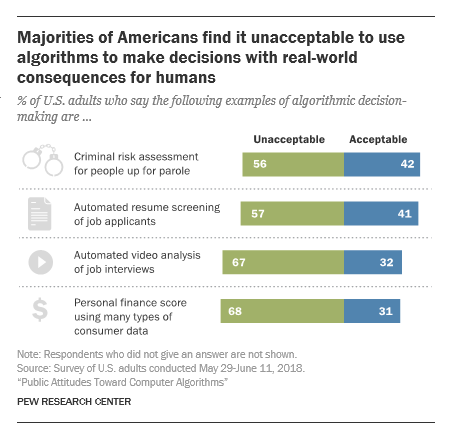
Public Attitudes Toward Computer Algorithms | The Pew Research Center’s Aaron Smith published research that shows

Majorities of Americans find it unacceptable to use algorithms to make decisions with real-world consequences for humans

They are going to have to get used to it, I think.

A must read.

From the Archives

Work Futures Daily — Smells Like Teen Spirit | April 2018 | Automation and teen jobs; US apprenticeships; advantage blindness; Gallup’s State of the American Workforce Report

Quote of the Day

You must have a room, or a certain hour or so a day, where you don’t know what was in the newspapers that morning, you don’t know who your friends are, you don’t know what you owe anybody, you don’t know what anybody owes to you. This is a place where you can simply experience and bring forth what you are and what you might be. This is the place of creative incubation. At first you may find that nothing happens there. But if you have a sacred place and use it, something eventually will happen.

| Joseph Campbell

Originally published at workfutures.org.


Skills Gap was originally published in Work Futures Institute on Medium, where people are continuing the conversation by highlighting and responding to this story.

30 Nov 02:19

Traveling with Me is a Nightmare

by rands

Check-in on my phone. Confirm airport, departure time, and gate. Count the number of days I’ll be gone. One outfit for each day. Always extra socks and extra underwear because the unexpected is amplified while traveling. If the trip requires more outfits than my overhead Tumi luggage will hold, remind myself there is dry cleaning in the faraway place and checking a bag is a travel crime.

Consider the weather in the faraway place and sweater appropriately. For business, bring as much Ted Baker button-up shirts as possible. Add the pre-packed international friendly accessory bag that always makes it through security… every single time.

Tom Bihn backpack. Presenting a deck? Grab the pre-packed presentation kit. International? Bring the pre-packed international kit. Confirm necessary essential power cords and ginormous backup battery because 30% of travel is power management. 50% traveling internationally. If faraway place weather is frigid, wool hat, gloves, and scarf all go in the Tom Bihn back-pack because I have thin California blood and cold is clever.

Tumi luggage and Tom Bihn back-pack are both placed near the front door as a visual cue I am ready to go. 15 minutes before departure, visually check everything. Phone – left back jean pocket. Every time. Wallet – right back jean pocket. Every time. Passport always goes in the inside left coat pocket. Helpfully remind myself that – worst case – all I need is the wallet, phone, and passport.

Home departure time is scheduled to allow me to arrive at the airport two hours before the departure: domestic or international. Leave five minutes before departure time after once again visually checking phone, wallet, and passport.

Arrive at the airport. AirPods in. Strive to achieve the goal of moving from car to plane without standing in a single line. Fail at this frequently. Security. TSA Pre. Always. Wallet, phone, AirPods, and passport all temporarily go in the right side Tom Bihn back-pack pocket. Watch as I perform this maneuver while moving. Always be kind to all security humans. Wait for permission to approach them and ask permission to walk-through metal detectors. Please and thank you. Items returned to their proper pockets.

No conversations with anyone else. No chit-chat. No eye contact. I am on a mission that I’ve been on before, and I am expecting something to go wrong. This requires all of my attention and a soundtrack.

Travel to the gate noting potential eating and drinking establishments. At the gate now. I’m early. I assess: Given my arrival time, is the gate in the state I expect? Specifically: 20% of the seats at the gate are filled, someone is staffing the desk, and the plane is parked at the gate. If the latter is not true, investigate on the internet regarding where the plane is coming from and when it will be there. Prepare for bad news.

If all is well, check digital boarding pass. Subtract five minutes from the boarding time. That is when I will return to the gate. Back-track to a desirable eating establishment. Sit at the bar and order a gin and tonic. Airports always ask if you want a double and I always do.

30 Nov 02:17

In the barrage of horrible events

by Liz

It keeps coming into my mind today how “we” are tear gassing asylum seeking families with children at the border today.

Ridiculous, and horrifying, as I picture the minds of the people who fired tear gas at the crowds today, at children. I don’t usually get all “think of the children” because violence is horrible for anyone. Here, I do feel some particular outrage. It is so terrible to think of disrespecting someone who walked across half a continent to get to the border. Instead of the respect and safety and asylum they could be offered, “we” met them with this brutal cruelty. It’s shameful.

The only comforting thing is hundreds of “us” on this side of the border marched in support and welcome.

I don’t know what to do in practical support myself, but am writing Feinstein, Harris, and Pelosi and will look for somewhere effective to donate. More to CARECEN seems good. Also thinking about Asylum Seeker Advocacy Project. Whoever seems like they know how to help the most effectively right now. And I will just keep on doing my part in the world I guess.

30 Nov 02:16

The Google Graveyard

by Volker Weber

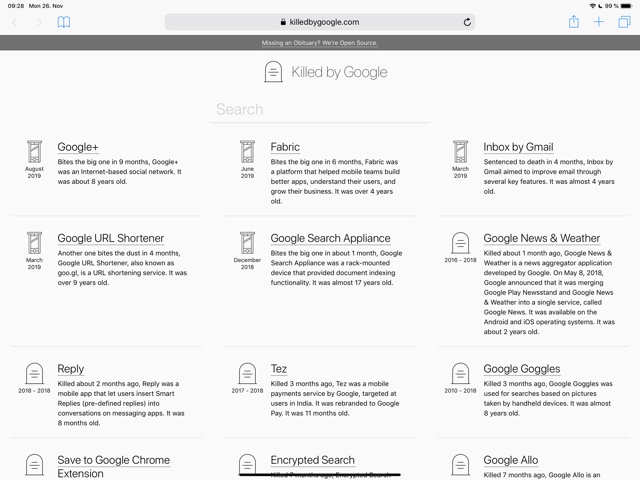
da358e780b9a38cfab32350d7666c0a0

Quite impressive collection.

More >

29 Nov 23:30

Writing a small module in 2018

by Tom MacWright

Rube Goldberg Machine

The controversy over ‘micro’ modules in the land of JavaScript has faded, arguably because they won. Heavily-used modules like npm itself use micro-dependencies like once, a 42-line module with over 8 million weekly downloads.

But simultaneously, the definition of a module has expanded, warped, and agglomerated complexity until it’s something quite different than it used to be - and arguably a lot harder to fulfill. When all we needed to support was Browserify and Node.js, a single CommonJS entry point would suffice. But now, module consumers now might expect TypeScript definitions, a UMD entry point, an ES6 module entry point, and possibly even Flow definitions.

I recently updated a number of my modules to a ‘modern’ setup, advised the Turf project on a large refactor, and via my work at Observable have had additional exposure to the module-packing ecosystem. Here’s what I’ve been doing, and some thoughts.


Cheatsheet / covering the basics: just in case you’re unfamiliar with what each style of module looks like:

// CommonJS
module.exports = …; 

// ES Module
export default …; 

// UMD
(function (root, factory) {
  if (typeof define === 'function' && define.amd) {
    define(['b'], factory);
  } else if (typeof module === 'object' && module.exports) {
    module.exports = factory(require('b'));
  } else {
    root.returnExports = factory(root.b);
  }
}(typeof self !== 'undefined' ? self : this, function (b) {
…

As a basic rule of thumb:

  • People usually write code with ES6 or CommonJS modules. Rarely do projects write code in UMD style.
  • ES6 can be compiled to CommonJS and vice-versa. ES6 and CommonJS can be compiled to UMD. UMD can’t be compiled to anything else.

The barest minimum: just CommonJS

The barest of the bare minimum of entry points, arguably, is still a CommonJS module. With a CommonJS module, you can support Rollup users who are using rollup-plugin-commonjs, and Parcel, Webpack, and Browserify users without any additional plugins or configuration.

CommonJS modules can’t be consumed by browsers, no matter what you do. So if you publish a module as only CommonJS, people who want to load it into a browser and who aren’t using a bundler will have to use a bundler-as-a-service, like bundle.run . That isn’t ideal: bundlers aren’t simple or reliable things to run as a service, and even the best bundler-as-a-service is going to be less reliable and slower than a service like unpkg that only has to serve files verbatim, and can aggressively cache them in a CDN.

CommonJS modules are also less than ideal for people who are writing applications using ES6 exports & imports. The ability of tools like Rollup and Webpack to turn CommonJS into ES6 is spotty at best, and advanced techniques like tree shaking are easily broken by common code patterns in CommonJS.

Too bleeding edge: just ES Modules

Writing the source of a module with ES import/export is arguably the way of the future.

Let’s say you write a module using ES6 export and only a module entry. Where will it work?

  • It’ll work in 80% of browsers without any transpilation step.
  • It’ll work with Rollup, Parcel, and Webpack without any additional configuration.

But it’ll fall short with Node.js. The Node project has progressed toward module support… slowly. There’s experimental support in Node v11, but you’ll need an experimental flag and a special file extension. There isn’t enough support in Node.js yet to say that you can just ship an ES6 module and be done.

You can, though, use the excellent esm module to import ES modules in Node.js today - that’s what we do with our backend services at Observable. But for a small module, I’d wager that’s too much to ask, and runtime compilation, even when done extremely well like in the esm project, is still icky.

ES Modules transpiled to UMD and CommonJS: Just right

The approach that I landed on is to write my tiny modules with ES Module syntax - import and export – and then to use microbundle to build CommonJS and UMD entry points for them.

microbundle is a ‘zero configuration’ bundler: it transforms ES Modules into CommonJS and UMD modules. Under the hood, it uses Rollup, another bundler, but it makes Rollup easier to use for this particular instance. Instead of configuring Rollup and installing Rollup plugins as you’d have to do usually, microbundle includes a reasonable basic configuration of Rollup and cleverly uses package.json, the module manifesto you already have to write, as its configuration.

So taking as an example my wcag-contrast module, here are the relevant parts of package.json:

  "source": "index.js",
  "main": "dist/index.js",
  "umd:main": "dist/index.umd.js",
  "unpkg": "dist/index.umd.js",
  "module": "dist/index.m.js",

That’s a dense five lines: here’s what each does:

  • source: this is the input, the raw code that’s maintained in the GitHub repository, what I write.
  • main: the CommonJS entry point. This is what you get if you use Node.js or Browserify to consume the module.
  • umd:main and unpkg point to the same thing. I specify umd:main because that’s how you configure microbundle to output a UMD bundle, and then alias it with unpkg, because that informs unpkg.com to serve that file by default. That means that people who include the module with a script tag get the right thing, and so do consumers who use a UMD-compatible module loader, like d3-require, which is what Observable uses.
  • module: the ES Module entry point. This is what people who use Rollup or Webpack will get, and what you can use with JavaScript’s dynamic import() and the static import syntax, if you use <script type=module.

I tell microbundle to run by calling it in the scripts and then running standard-version

"scripts": {
  "release": "microbundle && standard-version"
}

But if you don’t use standard-version (that’s a whole different blog post), you can run it with prepublish:

"scripts": {
  "prepublish": "microbundle"
}

Finally, I instruct npm or yarn to include the dist files in the npm module by configuring the files field:

"files": [
  "index.js",
  "dist"
]

Are JavaScript modules getting worse? Or better?

I wrote something similar to this in 2013, which sounds simpler.1. In 2018, we’ve added moving parts to small modules, which does detract from their minimalism.

The transition to ES Modules has been rocky and isn’t yet complete. The transition to ES6 syntax has also been a bit of a rollercoaster: some people want to ship modules that rely on bleeding-edge syntax, and other people expect all modules to be compatible with Internet Explorer.

That said, as an eternal optimist 😉, I do see a silver lining to this situation.

For the first time, thanks to ES Modules, browsers can load JavaScript modules, and even do it asynchronously. This means that, at some point in the near future, you may be able to develop web applications without a bundler whatsoever as you’re working, and then only introduce a tool like Rollup or microbundle once you want to ship it to users. I’ve already started doing this with a few of Observable’s modules — testing changes in a browser without running any bundler, just using the native ES Module support.

After years of relying on scripts to make modules browser-compatible, it’s a pretty exciting future.

An extra note: how to play nice with tree-shaking

One of the much-hyped related benefits of ES Modules is tree-shaking: a sort of dead code elimination that’s able to determine which exports your code uses, and only include related code. So if you have a big module and someone only imports a single function from it:

import {someFunction} from "big-module";

Then only the code related to someFunction will be included, not the whole thing. When it works, it’s a very nice performance perk.

But it often doesn’t work. Tree-shaking isn’t magic, and there are lots of ways to write code that breaks it. Rollup’s notes are pretty good, and Webpack’s are also worth a read. But to summarize what I found from a recent misadventure, here are some lessons.

The good news is that the things that break tree-shaking were already code smells that were already recommended against.

First: don’t mess with globals

For example, let’s say you rely on the Number.MAX_SAFE_INTEGER constant, a value that has been implemented in everything… except for IE. MDN recommends this polyfill:

if (!Number.MAX_SAFE_INTEGER) {
  Number.MAX_SAFE_INTEGER = Math.pow(2, 53) - 1;
}

Don’t put this in your small module, or anything like it. This polyfill and others like it modify global variables. Rollup and other bundlers have to look at this file and think “well, maybe some consumer of this module is relying on this side-effect,” and Rollup is obliged to include it, even if the functions and values you imported don’t rely on it.

Instead, do something like this:

const MAX_SAFE_INTEGER = Math.pow(2, 53) - 1;

And just use that local variable in your module.

Don’t put your module.exports in if

If you want to go the CommonJS route, it might be tempting to guard your module.exports statements so that you can test it in a browser:

if (typeof module !== 'undefined') {
  module.exports = something;
}

Unfortunately, this also breaks Rollup’s tree shaking, because it can’t statically figure out what’s exported, and remove the code that isn’t. Instead, rely on a CommonJS environment being present.

Truthfully, this is tricky territory: there currently isn’t any easy way to tell if you’ve broken tree-shaking. There should be - I welcome someone to implement that in microbundle or Rollup!2 So right now it’s essentially something is happening somewhere, that you can’t see.

Remaining points of controversy

I hope that I’ve made some of the fundamental mechanics of modern JavaScript modules clear. Assuming I have, let me muddy the waters a bit, again.

Should you bundle dependencies? I lied a bit, earlier - for wcag-contrast, I run

microbundle --external=none && standard-version

The external=none flag tells microbundle to bundle in wcag-contrast’s one dependency. This invokes a series of tradeoffs:

  • It makes it safer to use my micro-modules, because consumers will no longer suffer if one of their dependencies is unpublished or becomes malicious. Dependencies are frozen when I publish.
  • It makes my micro-modules shallower in people’s dependency trees. They don’t have dependencies of their own.
  • But in the case that people use multiple of my micro-modules - if someone relies on both wcag-contrast and its dependency, relative-luminance, then they get two copies of the relative-luminance code, instead of letting yarn or npm do its magic to deduplicate that dependency chain.

These tradeoffs make sense to me and my niches, and but whether the make sense for other people is an open question.

Should modules include TypeScript definitions? I don’t use TypeScript, and don’t write TS definitions for my modules. I think some users - TypeScript superfans - want definitions, and I accept their PRs to add those definitions, but I’m very divided about this addition. It’s very hard to tell if TypeScript definitions are correct, to test them, and to maintain them if I don’t, as well, use TypeScript.

So, for now, the answer is no: I don’t usually include TypeScript definitions, and really don’t think it’s a safe thing to expect from new modules.


Footnotes

2: Rich Harris’s agadoo project lets you know if tree shaking works for a specific module, but doesn’t yet say why.

29 Nov 23:30

Skewed mental map of the world’s geography

by Nathan Yau

The maps that we imagine as we think about locations around the world often don’t match up with reality. Betsy Mason for National Geographic explains the discrepancy. On the misalignment of Europe:

Europe is also often placed much farther south on mental maps than it really is, appearing directly across the Atlantic from the contiguous United States. But it actually lines up better with Canada: Paris is further north than Montreal, Barcelona is at a similar latitude as Chicago, and Venice lines up with Portland, Oregon.

…and the world as we knew it was never the same again.

Tags: cartography, mental

29 Nov 23:30

Names Matter

by Richard Millington

Lou reminded me recently that many people have a hard time connecting their idea of community with the objectives of their work.

It’s a lot easier sometimes to get support for a community by calling it something else.

Call it scaled customer support (or self-serve support).
Call it a customer experience.
Call it product feedback.
Call it member-driven innovation
Call it user-generated content.
Call it a chill out zone if you like.

If the idea of ‘community’ isn’t resonating strongly, use one that does.

(p.s. The same goes for community managers too).

29 Nov 23:30

Twitter Favorites: [shawnmicallef] I made a hockey joke and Jeanette of @WeKnowDetroit explained “The Maple Leafs are the Detroit Lions of hockey” so see: unity.

Ontario Businessman @shawnmicallef
I made a hockey joke and Jeanette of @WeKnowDetroit explained “The Maple Leafs are the Detroit Lions of hockey” so see: unity.
29 Nov 23:30

Twitter Favorites: [shawnmicallef] Edmonton’s physical setting is so fantastic. I didn’t appreciate the river valley until I visited for the first tim… https://t.co/qqOOxCb08O

Ontario Businessman @shawnmicallef
Edmonton’s physical setting is so fantastic. I didn’t appreciate the river valley until I visited for the first tim… twitter.com/i/web/status/1…
29 Nov 23:24

The Delivery Trike Is Coming | Davis Janowski The T3 is a...


The Delivery Trike Is Coming | Davis Janowski

The T3 is a tricycle built for grown-ups, and it is not for play.

Weighing 150 pounds, it has an aluminum frame and sits on three small but durable bicycle tires with a heavy-duty suspension system in front — one meant for all-terrain vehicles — which helps to navigate the city’s innumerable potholes. It can haul up to three times its weight, nearly a quarter-ton of cargo. To go uphill, a single click on the handlebar unleashes a power-boost from an electric-hub in the rear wheel.

The T3 — the “T” stands for “trike,” — is the latest prototype of an urban delivery vehicle from Upcycles, a Brooklyn start-up founded in 2017. Seeking to create a greener and more nimble alternative to trucks for delivering everything from groceries to office supplies, the company built two earlier prototypes. Its third incarnation, T3, which is considered a bicycle under city law, can travel on and fit within the city’s growing network of bike lanes and park on the sidewalk rather than -park in the street.

29 Nov 23:24

"I don’t know if there’s a real world in which Sheryl Sandberg is a feminist icon."

“I don’t know if there’s a real world in which Sheryl Sandberg is a feminist icon.”

- | Aminatou Sow, cited by Jennifer Senior in Sheryl Sandberg Can’t Have It All.
29 Nov 23:24

"The freedom to love is no less sacred than the freedom of thought."

“The freedom to love is no less sacred than the freedom of thought.”

- | Victor Hugo
29 Nov 23:23

"The trick of capitalism is that we simultaneously live for the immediate, destructive moment (These..."

The trick of capitalism is that we simultaneously live for the immediate, destructive moment (These trees, people, minerals, oceans only matter today, let’s burn them, drink them, use them up!) and for the long view (My grandchildren will be world-ruling plutocrats and my name will adorn a fleet of mansions). These two notions are in conflict, impossible to reconcile. This is why the young people today have such wrinkled brows and so many angry tweets. They know that the math of this reconciliation will be calculated in their lifetimes. They know that the last hundred years have been a trash bargain. We sold their safety and health and freedom so that we could all have bigger houses, more billionaires and more ads on Instagram celebrating teas that allegedly trigger human emaciation or erection.

For us older-than-millennial people, who are all likely to die before the Final Planetary Showdown, essentially every moment at work is a series of terrible choices between exploitation and vanity. We self-soothe with “The Chilling Adventures of Sabrina,” or meat, or Adderall — while, ironically, our workplaces find ever-more-impressive ways to also monetize our self-soothing.


-

| Choire Sicha, How to Deal With Nosy People at Work

A national treasure: Choire Sicha.

In the same Work Friend column he writes

Capitalism is like a vat of boiling oil. Sure, you’d rather not be in the vat at all. But there’s nothing worse than being halfway submerged.

29 Nov 23:23

Photo


29 Nov 23:23

@stoweboyd

@stoweboyd:
29 Nov 23:23

An Endless Black Friday of the Soul

Everything Is for Sale Now. Even Us. | Ruth Whippman chillingly profiles where the gig economy has taken us:

As a writer, I am part of the 35 percent of the American work force that now works freelance in some capacity, either as a main source of income or as some kind of side hustle. This number is growing constantly — 94 percent of the new jobs created in the last decade or so were freelance or contract-based.

When we think “gig economy,” we tend to picture an Uber driver or a TaskRabbit tasker rather than a lawyer or a doctor, but in reality, this scrappy economic model — grubbing around for work, all big dreams and bad health insurance — will soon catch up with the bulk of America’s middle class.

Major companies now outsource many of even their most skilled jobs, ditching their in-house lawyers and I.T. support teams in favor of on-demand contractors, paid by the hour. More than 18 million Americans are now involved in some kind of direct sales or multilevel marketing scheme, shelling out hundreds of dollars on vitamins or juicers or leggings, then frantically attempting to recoup the money by flogging them to friends and neighbors. Economists predict that by 2027, gig workers of varying descriptions will make up more than half of the work force. An estimated 47 percent of millennials already work in this way.
It certainly feels familiar. Almost everyone I know now has some kind of hustle, whether job, hobby, or side or vanity project. Share my blog post, buy my book, click on my link, follow me on Instagram, visit my Etsy shop, donate to my Kickstarter, crowdfund my heart surgery. It’s as though we are all working in Walmart on an endless Black Friday of the soul.

The social contract of work has been erased by an endless series of precarious work hook-ups, where jobs are increasingly just one-night stands, and the opportunity for work security and commitment recedes into a rapidly attenuating past. An endless Black Friday of the soul.

27 Nov 23:00

Web ADB: Simple Web-based Access to Devices

by Mark Finkle

I’ve had a number of occasions where I needed direct access to an Android device that wasn’t connected to the computer in front of me. I can usually SSH into the remote host machine and use ADB to try to debug the situation. If the simple stuff doesn’t work, I eventually start using ADB screencap to get a look at what’s on the device. If I’m lucky, I can remote desktop to the host. If not, I end up copying the images back to my machine to view them.

Remote Situation
Connecting to a remote host with some Android devices attached to it

Surely there is must be an easier way.

There is! I found the OpenSTF project which basically allows you to get web-based control of the Android and iOS devices. Just install the system on the host machine and install an agent on the Android devices. It looks pretty cool, but always seemed like overkill when I was in a remote debug situation.

So I decided I’d start hacking together a really simple system in Python. I started with the simplest Python API server I could find. Then I added a fairly basic webapp front-end. The result is Web ADB.

It’s a very minimal Python API server, which also serves up a basic single-page webapp. The approach is pretty simple: run ADB commands via Python, parse the output, send the results back through the API response.

The API supports getting attached devices, getting a screenshot of a device, sending key presses and screen taps, and even rebooting a device. The webapp just uses the API to make something useful. Maybe the only cool feature is clicking on a screenshot will send a tap to the device, then update the screenshot. I have some ideas for other features, as time permits.

23 Nov 21:16

Vehemently meaningless

by Josh Bernoff

Next time you hear that someone is “vehemently” denying that they did something, ask yourself — how is that different from a regular denial? Here’s a thought experiment. There are two politicians. Both are accused of taking bribes. Allan says he denies taking the bribes. Bertrand vehemently denies taking the bribes. Which one do you … Continued

The post Vehemently meaningless appeared first on without bullshit.

23 Nov 21:16

Daily Makeup

A quick game of “what is in Os’s bag?” while I unravel and unwind from CSCW:

23 Nov 21:13

SCP wiki

Fiction » Hey, did you know that for the past couple of years I've been writing fiction for the SCP wiki? Here's my author page. ...
23 Nov 21:13

Apple patent suggests upcoming iPhone could feature colour shifting

by Dean Daley
iPhone XR

An Apple patent indicates that the company might have plans to make its next smartphone look a little more modern.

The patent suggests that Apple is experimenting with micro and nano texturing methods that allow the devices to shift from a monochromatic finish to more rainbow-inspired colour effects, gradients and a variety of other hues.

Additionally, the patent indicates that Apple may be looking into sandblasting techniques to control the shift in colour tones as well as create a textured groove pattern.

All in, it looks like Apple’s next smartphone might have colour gradients and shifting similar to the OnePlus 6T’s Thunder Purple variant.

It’s unclear if Apple will apply this to a premium device, or if the colour technology will be featured in a more affordable smartphone like the successor to the iPhone XR.

The patent was first reported by MySmartPrice. It’s important to note that the publication doesn’t source where it found the patent. Further, MobileSyrup wasn’t able to independently locate the patent filing, though MySmartPrice is typically a reliable source.

Source: MySmartPrice

The post Apple patent suggests upcoming iPhone could feature colour shifting appeared first on MobileSyrup.

23 Nov 21:13

Canadian tweets are nicer compared to American tweets: study

by Shruti Shekar
Canadians are nicer tweeters

After analyzing 40 million tweets from Canada and the U.S., a new study says Canadians are more polite and positive tweeters than our neighbours from down south.

The study from McMaster University found that 99.66 percent of words, emojis, and emoticons used by both groups are similar, but when typed out the tone showed a stark difference.

The CBC reports the research indicated that national stereotypes were connected to the words and phrases used online. Researchers found that Canadians were nicer and Americans were more negative and assertive.

“What you get back out of that is a really, really accurate reaction of the national character stereotypes,” said Bryor Snefjella, one of the lead authors of the study and a PhD candidate at the university, to the CBC.

Snefjella says that Canadians say the words “great,” “amazing,” “good,” and there is a lot of talk about sports teams, the Maple Leafs and the “Habs” (Montreal Canadiens).

Tweeters from down south used words like “hate,” and had a lot of slang like “bro” and “brah.”

Americans use more emojis, especially the laughing face with tears, the skull, and the face with heart eyes. Canadians tend to type out their emojis using punctuations.

Emojis that Canadians use are also more positive and include the maple leaf, the party horn and the heart.

Source: CBC

The post Canadian tweets are nicer compared to American tweets: study appeared first on MobileSyrup.