Shared posts

11 Dec 05:21

Font name manipulation

by Julie Moronuki and Chris Martin

Font name manipulation

We recently bought an extremely fancy set of fonts from Sudtipos to use for a book cover. Sudtipos makes collections of fonts in various styles that are designed to pair well – So for instance the set that we’re using is Speakeasy, which includes among others Speakeasy Flare and Speakeasy Script.


Each font has some optional variations; the script font in particular has a huge number of embellishments that you can turn on.


I “installed” the font as I normally do by putting the files under ~/.local/share/fonts.


And then opened Inkscape to start using them.


You can see the problem above: Inkscape is only recognizing one of the Speakeasy fonts. For some reason it has determined that all of the fonts we installed are named “Speakeasy” and has resolved the conflict by picking one of them and ignoring the rest.

I don’t know a lot about font file formats, but the quick solution for this seemed to be to modify the files to ensure that each font has a different name. That way Inkscape should have no way to confuse them with each other.

FontForge

The first font editor I got working on Linux was FontForge. I installed it with Nix like this:

$ nix-env -f '<nixpkgs>' -iA fontforge-gtk


Then I used it to open the Speakeasy Flare OTF file:

$ fontforge ~/.local/share/fonts/speakeasy/Speakeasy-Flare.otf


Since ‘Speakeasy’ was the name under which Inkscape was mistakenly lumping all the fonts together into one, my aim (without really understanding what any of these metadata fields mean) was just to purge any field that only says ‘Speakeasy’.

In the “Font Info…” dialog under “TTF names,” we can find the culprit.


Each of these font files has a ‘Preferred Family’ name of ‘Speakeasy’. So I deleted both the ‘Preferred Family’ and ‘Preferred Styles’ fields using this dialog. I then use “Generate Fonts…” to save the result to a new OTF file.


Inkscape still might not notice the fixed fonts until you run fc-cache (or, slower but more forceful, fc-cache -f) to update the font cache. I don’t really know what this is, but apparently it is important.

$ fc-cache -f

Then restart Inkscape, and all the fonts should now appear.


Feature settings

The “Font Info…” dialog is also where we can go to figure out how to tell Inkscape which of the font “features” we want to enable.


For example,

  • To enable “Standard ligatures”, we need the setting called ‘liga’.
  • To enable “Style set 4”, we need the setting called ‘ss04’.

So to enable the full set of features I selected in the demo above, I need to enter “liga, swsh, ss04, ss12, ss16, ss09, ss14, ss18” into the “Feature Settings” field in Inkscape.


Font-related tips for Linux users seem pretty sparse out there, so I thought I should write this up in case it helps someone!

“Listen, kid, we’re all in it together.”
— Harry Tuttle, Brazil
11 Dec 05:21

Conversation and Silence, Part One

by Dave Pollard

This is the first part of a two-part article.
mindful wandering
photo by Maren Yumi on flickr CC BY-NC-SA 2.0

It’s been a few years since I last wrote about conversation. I don’t see nearly the value in conversation that I used to. I still talk too much, and seemingly converse a lot, still mostly about subjects that are unactionable and don’t really matter. Old habit I suppose; this is long-conditioned behaviour. Language ties up the brain in comprehension and conception when the brain could be used, silently, for perception, for sensing and intuition and letting things come, and for demonstration and attention, which, even before embracing radical non-duality, I’d come to believe are much better uses of our bewildered brains.

I have come to distinguish real conversation (which etymologically means “turning with”, almost like dance, and which is a collaborative, interactive, iterative activity), from non-collaborative, one-way forms of talking including performance (relating something), instruction, and inquiry (Q&A), whose purpose is to tell a story, entertain, or give or get clarity, and which has a clear “audience”. These might be serial, with one person at a time spouting forth, but they are not really conversations. And if the back-and-forth results from a need for clarity due to inarticulate or lazy exposition, or a craving for reassurance, that’s not really conversation either.

So why should we ever need to converse? If not to relate information, tell a story, get clarity (ie learn), reassure, show affection, or entertain, what purpose does real, collaborative, interactive, iterative conversation serve?

I think real conversation can serve four purposes: to surface insights, to see different perspectives, to achieve consensus on decisions, and to resolve conflicts. These purposes are related: Seeing different perspectives and surfacing insights can help resolve conflicts and achieve consensus. They are about using a deliberative process to move beyond the fixed thoughts and ideas in our own heads and to appreciate others’ ways of thinking and seeing, with the goal of achieving agreement and cohesion with others we live and work with.

Here are the most important prerequisites, in my experience, for an effective conversation to achieve one or more of the above purposes:

  1. Capacity to be open to other and difficult ideas and perspectives: There is no point trying to collaborate with someone who is either incapable of considering or unwilling to consider different possibilities. If someone is totally set in their beliefs, or utterly lacking in imagination, conversation is futile.
  2. A basic level of capacity to articulate, and of social fluency: Articulation is the ability to convey one’s thoughts, ideas, beliefs and perspectives clearly. Social fluency is the emotional engagement and sensitivity to appreciate (and show appreciation for) others’ thoughts, ideas, beliefs and perspectives and see how and why they might be different from one’s own.
  3. Critical thinking skills: The capacity to draw inferences, challenge assumptions, weigh evidence, and synthesize information is essential to the development of a rational and thoughtful worldview and belief system. If you, or those you are conversing with, lack these skills, you can’t possibly hope to reason with them.
  4. Curiosity and creative/imaginative skills: Some people, for various reasons, are just shut down and unwilling to consider anything that doesn’t jibe with their ideology or belief set; others, through lack of practice, have lost the capacity to imagine anything that isn’t simple and obvious, or to put themselves in another’s shoes. Conversations with such people are likely to be just frustrating and pointless.
  5. Attention skills: We live in a world of attention deficit, distraction and information overload. In such a world, listening and paying attention are challenging and take practice. If those you’re conversing with don’t have and use these skills, they won’t hear you, so you’re wasting your breath.

You’ve probably noticed that these five prerequisites to effective conversation are all capacities; the people in the supposed conversation either have them or they don’t.

What I’ve discovered of late is that in most of the discussions I have (a) people don’t have one or more of the four purposes (to surface insights, to see different perspectives, to achieve consensus on decisions, and to resolve conflicts) for which conversations are well-suited; and (b) few of the participants have the five prerequisite skills for effective conversation.

Small wonder, then, that I find most attempts at real conversation fail. In the rare cases that true conversation occurs (often with the help of a skilled facilitator, who might also be one of the participants) the result can be magic.

Alas, as the world becomes more stressful, less attentive, more polarized and less socially fluent, such conversations seem to be increasingly rare.

Perhaps that is why some of us have been shying away from social discourse and spending more of our time in silence. I’ll explore that more in Part Two of this article.

Thanks to John Kellden and Michael Dowd for inspiring this post

11 Dec 05:21

The Doug Engelbart Demo at 50

by Ton Zijlstra

Next week it is 50 years ago that Doug Engelbart (1925-2013) and his team demonstrated all that has come to define interactive computing. Five decades on we still don’t have turned everything in that live demo into routine daily things. From the mouse, video conferencing, word processing, outlining, drag and drop, digital mind mapping, to real time collaborative editing from multiple locations. In 1968 it is all already there. In 2018 we are still catching up with several aspects of that live demonstrated vision though. Doug Engelbart and team ushered in the interactive computing era to “augment human intellect”, and on the 50th anniversary of The Demo a symposium will ask the question what augmenting the human intellect can look like in the 21st century.


A screenshot of Doug Engelbart during the 1968 demo

The 1968 demo was later named ‘the Mother of all Demos‘. I first saw it in its entirety at the 2005 Reboot conference in Copenhagen. Doug Engelbart had a video conversation with us after the demo. To me it was a great example, not merely of prototyping new tech, but most of all of proposing a coherent and expansive vision of how different technological components and human networked interaction and routines can together be used to create new agency and new possibilities. To ‘augment human intellect’ indeed. That to me is the crux, to look at the entire constellation of humans, our connections, routines, methods and processes, our technological tools and achieving our desired impact. Likely others easily think I’m a techno-optimist, but I don’t think I am. I am generally an optimist yes, but to me what is key is our humanity, and to create tools and methods that enhance and support it. Tech as tools, in context, not tech as a solution, on its own. It’s what my networked agency framework is about, and what I try to express in its manifesto.

Paul Duplantis has blogged about where the planned symposium, and more importantly us in general, may take the internet and the web as our tools.

Doug Engelbart on video from Calif.
Doug Engelbart on screen in 2005, during a video chat after watching the 1968 Demo at Reboot 7

11 Dec 05:20

Cleanups

by Rui Carmo

Another weekend has come and gone, with a lot of paperwork and tyding up taking up all our time and the saving grace of watching Ralph Breaks the Internet in an actual theatre. Dubbed (which is sadly becoming the norm here unless you go after dinner, which is not always viable for kids), but still fun. But I digress…

Archive Follow-up

I cleaned up and streamlined the Archives, not only fixing an idiotic date-related bug but (most importantly) making smart cropping nearly ten times faster by doing some things through PIL image processing primitives. There are still a few things to figure out (the original smartcrop.py tried to do too much), but once I’m happy with the code I’ll put it up somewhere.

More importantly, site performance is great, and for good measure I cleaned up the Azure Application Insights dashboard I used while measuring the performance impact of my changes:

A slightly tidier Azure dashboard than last time.

I’ve also (re)built a little Python daemon for providing real-time data to Application Insights (I’ve started porting bits of the Azure SDKs across to Python until there is official support), and will write about that sometime soon, hopefully.

Other than back-end fixes and a number of cleanups to navigation and suchlike, I’ve yet to tackle cleaning up the CSS, but I suspect it will take a while to get round to that…

Interim Automation Update

On the HomeKit front, I finally managed to tame the Xiaomi Aqara DJT11LM motion sensors to a fair degree, thanks to a set of cascading updates on zigbee2mqtt and Node-RED.

The unvarnished truth is that I found out that there was a new, less crashy HomeKit plugin for it, and spent entirely too long upgrading everything and debugging the broken Node-RED flows. Upgrading the runtimes was trivial thanks to Docker, but the brittleness of Node-RED configurations is a constant challenge.

Still, it was easy enough to grab all the sensor data and send it to an Azure IoT Hub for later processing:

I'm not using MQTT wildcards yet, otherwise it would be a much simpler flow.

I’m still annoyed at the utter inability of the Mediaroom STB to report its power state correctly (or just go to sleep properly via HDMI-CEC), but that’s something to pursue later as well.

And now, to go off into the dark lands of PowerPoint to cobble together a deck for an unplanned session tomorrow…


Support this site
11 Dec 05:20

More “Scraping Ethics Gone Awry” and “Why Do This When There’s a Free API?”

by hrbrmstr

I can’t seem to free my infrequently-viewed email inbox from “you might like!” notices by the content-lock-in site Medium. This one made it to the iOS notification screen (otherwise I’d’ve been blissfully unaware of it and would have saved you the trouble of reading this).

Today, they sent me this gem by @JeromeDeveloper: Scrapy and Scrapyrt: how to create your own API from (almost) any website. Go ahead and click it. Give the Medium author the 👀 they so desperately crave (and to provide context for the rant below).

I have no issue with @JeromeDeveloper’s coding prowess, nor Scrapy/Scrapyrt. In fact, I’m a huge fan of the folks at ScrapingHub, so much so that I wrote splashr to enable use of their Splash server from R.

My issue is with the example the author chose to use.

CoinMarketCap provides cryptocurrency prices and other cryptocurrency info. I use it to track cryptocurrency prices to see which currency attackers who pwn devices to install illegal cryptocurrency rigs might be switching to next and to get a feel for when they’ll stop mining and go back to just stealing data and breaking things.

CoinMarketCap has an API with a generous free tier with the following text in their Terms & Conditions (which, in the U.S. [soon] may stupidly be explicitly repeated & required on each page that scraping is prohibited on vs a universal site link):

You may not, and shall not, copy, reproduce, download, “screen scrape”, store, transmit, broadcast, publish, modify, create a derivative work from, display, perform, distribute, redistribute, sell, license, rent, lease or otherwise use, transfer (either in printed, electronic or other format) or exploit any Content, in whole or in part, in any way that does not comply with these Terms without our prior written permission.

There is only one reason (apart from complete oblivion) to use CoinMarketCap as an example: to show folks how clever you are at bypassing site restrictions and eventually avoiding paying for an API to get data that you did absolutely nothing to help gather, curate and setup infrastructure for. There is no mention of “be sure what you are doing is legal/ethical”, just a casual caution to not abuse the Scrapyrt technology since it may get you banned.

Ethics matter across every area of “data science” (of which, scraping is one component). Just because you can do something doesn’t mean you should and just because you don’t like Terms & Conditions and want to grift the work of others for fun, profit & 👀 also doesn’t mean you should; and, it definitely doesn’t mean you should be advocating others do it as well.

Ironically, Medium itself places restrictions on what you can do:

Crawling the Services is allowed if done in accordance with the provisions of our robots.txt file, but scraping the Services is prohibited.

yet they advocated I read and heed a post which violates similar terms of another site. So I wonder how they’d feel if I did a riff of that post and showed how to setup a hackish-API to scrape all their content. O_o

11 Dec 05:20

Where’s my Net dashboard?

by Jon Udell

Yesterday Luann was reading a colleague’s blog and noticed a bug. When she clicked the Subscribe link, the browser loaded a page of what looked like computer code. She asked, quite reasonably: “What’s wrong? Who do I report this to?”

That page of code is an RSS feed. It works the same way as the one on her own blog. The behavior isn’t a bug, it’s a lost tradition. Luann has been an active blogger for many years, and once used an RSS reader, but for her and so many others, the idea of a common reader for the web has faded.

There was a time when most of the sources I cared about flowed into such a reader: mainstream news, a vibrant and growing blogosphere, podcasts, status updates, standing search queries, you name it. The unread item count could get daunting, but I was able to effectively follow a wide assortment of information flows in what I came to think of as my Net dashboard.

Where’s my next dashboard? I imagine a next-gen reader that brings me the open web and my social circles in a way that helps me attend to and manage all the flow. There are apps for that, a nice example being FlowReader, which has been around since 2013. I try these things hopefully but so far none has stuck.

Information overload, once called infoglut, remains a challenge. We’re all flooded with more channels than we can handle, more conversations happening in more places than we can keep track of.

Fear of missing out (FOMO) is the flip side of infoglut. We expect that we should be able to sanely monitor more than we actually can.

The first-gen reader didn’t solve infoglut/FOMO, nothing could, but for a while, for me, it was better than the alternative, which was (and now is again) email. Of course that was me, a tech journalist who participated in, researched, and wrote about topics in Net technology and culture — including RSS, which animated the dashboard I used to keep track of everything else. It was, however, a workflow that researchers and analysts in other fields will recognize.

Were I were doing the same kind of work today, I’d cobble together the same kind of dashboard, while grumbling about the poorer experience now available. Instead my professional information diet is narrower and deeper than when analytical writing for commercial audiences was my work. My personal information diet, meanwhile, remains as diverse as everyone’s.

So I’m not sure that a next-gen reader can solve the same problems that my first-gen reader did, in the same ways. Still, I can’t help but envision a dashboard that subscribes to, and manages notifications from, all my sources. It seems wrong that the closest thing to that, once more, is email. Plugging the social silos into a common reader seems like the obvious thing. But if that were effective, we’d all be using FlowReader or something like it.

Why don’t we? Obviously the silos can refuse to cooperate, as FlowReader noted when announcing the demise of its Facebook integration:

These changes were made [by Facebook] to give users more control over their own data, which we support. It’s a great thing for users! However, it also means that Facebook data is no longer going to be easy to share between applications.

You know what would be a really great thing for users, though? A common reader that makes it easy to keep track of friends and family and coworkers along with news and all kinds of personal and professional information sources.

“What’s wrong?”

It’s not just that the silos can shut down their feeds. It’s that we allowed ourselves to get herded into them in the first place. For a while, quite a few people got comfortable with the notion of publishing and subscribing to diverse feeds in a common way, using systems that put them in charge of outflow and inflow. In one form or another that’s still the right model. Sometimes we forget things and have to relearn them. This is one of those things.

“Who do I report this to?”

Everyone.

11 Dec 05:19

From the feed

by Chris Corrigan

Thinking of resuming a weekly round up of links that have come through my feed in one way or another. I haven’t gotten around to blogging about these links, but I’m sure my readers would be interested in some of them.  I’ll post a few each week, on Sunday evening, if that works for you all.  Let me know if you’d welcome this as a little repeated pattern.

Developing Human Capital: Moving from Extraction to Reciprocity in Our Organizational Relationships

Careful about the terms you use and the metaphors that drive our thinking about “resources.”

“Environmentalists and systems thinkers underscore the fundamental distinction between extractive and interdependent modes of interacting with one another and the natural world. They warn us that the extractive economy we are attempting to sustain now is, by very definition of its continuous mining of natural and human resources, unsustainable. As the writer and farmer Wendell Berry has written:

The expert assumption appears to be that the products of the soil are not included in the economy until after they have been taken at the lowest possible cost from those who did the actual work of production, at which time they enter the economy as raw materials for the food, fiber, timber, and lately the fuel industries. The result is inevitable: the industrial system is disconnected from, is unconcerned about, and takes no responsibility for, its natural and human sources. The further result is that these sources are not maintained but merely used and thus are made as exhaustible as the fossil fuels.

This ecological framework should give us pause as we consider notions of “human resource” and “human capital” in nonprofit organizations.”

A reflection on Zadie Smith’s “On Optimism and Despair.”

A beautifully annotated reflection on Zadie Smith’s 2016 speech:

Only the willfully blind can ignore that the history of human existence is simultaneously the history of pain: of brutality, murder, mass extinction, every form of venality and cyclical horror. No land is free of it; no people are without their bloodstain; no tribe entirely innocent. But there is still this redeeming matter of incremental progress. It might look small to those with apocalyptic perspectives, but to she who not so long ago could not vote, or drink from the same water fountain as her fellow citizens, or marry the person she chose, or live in a certain neighbourhood, such incremental change feels enormous.”

There is no middle ground for deep disagreements about facts

I think it’s high time to be clear that willful ignorance cannot be equated with subjective truth.  

“Examining how deep disagreements arise will demonstrate the gravity of the issue. Why do we disagree with valid, knowable facts when we all live in the same world, we have roughly the same cognitive abilities and, in the Western world at least, most people have fairly easy access to roughly the same information?

It is because we use our cognition to support factual beliefs or value commitments that are central to our identity, particularly in situations where we feel that our identity is threatened.”

What do we expect from Innovation? Mostly disappointment

Let’s get good at handling the emotional component of innovation and creativity:

“Much of the innovation discovery journey is a disappointing one. A hunch or insight becomes a dead end. A promising idea did not foresee a roadblock that cannot be resolved. Resources constantly “churn” and get depleted, waiting for others to be brought up to speed. Those not involved directly within the innovation project constantly remain skeptical or require more proof. The status quo of the existing places an increasing drag on the forces of change.”

Building an Innovation Strategy from Cultural Insights

“Ethnographic thinking is a powerful approach that organizations and innovation teams can use to strategically guide how they innovate. Ethnography has grown in popularity as a research method, but as I’ve argued, it is more than just a tool. Ethnographic thinking operates at a strategic level,”

A very detailed and interesting account of how ethnographic research helps organizations see the complexity they are immersed in, and make decisions about what to do next.

11 Dec 05:19

memo to self: learn CSS grid

I need to make a new chart of different kinds of third parties that we will need in the post-creepy ad world.

One area that tends to get overlooked in the data-driven marketing world is defense.

Just a few examples.

  • Amazon stopped sending email receipts, to keep email services from targeting people with ads based on their Amazon shopping habits.

  • Google's Ads Data Hub restricts how advertisers can combine Google and non-Google data.

  • Facebook announced it would eliminate all third-party data brokers.

What do these companies have in common? They're marketing's winners. Meanwhile, publishers festoon their sites with consent management platforms that capture consent for all surveillance marketing, everywhere. They'll even get consent for tracking by third parties that the publisher doesn't even use. Why play to lose? If you run a trusted site in a position to get consent and prove you got it, you want fewer other companies getting that user's data, not more.

So the obvious counterpart to the consent amplification carried out by CMPs is some kind of objection amplification.

If the user clicks something other than "OK" on the GDPR consent dialog, don't just set their consent to zero. That non-consenting user needs to have their voice heard, not just filed away. Ask: Do you want to deny tracking just by our site, or by all these third parties? Then show them a list of Lumascape firms, most of which look like they were named not by branding experts, but by some guy in Florida who mainly communicates by "finger guns". When the user says, hell yeah, I don't want to be tracked by all those companies either, then that's when the objection amplification starts. Generate a Article 21 objection for every company you can think of, get the user to sign off on them, and send them out. (This is why it has to be a platform. Could be quite a bit of verbiage here.)

Now the record of objections sent is a piece of data for ad sales. "Buy ads here because x% of our users can't even legally be targeted by those other companies."

Internet platform companies play defense all the time. Will publishers?

Bonus links

Capitalism, Competition And Microsoft Antitrust Action

We are Google employees. Google must drop Dragonfly.

Targeted Advertising Is Ruining the Internet and Breaking the World

Don’t work “remotely”

Is The IAB’s Consent Framework In Trouble?

Mark Ritson: Gary Vaynerchuk is wrong, wrong, wrong, wrong, wrong about media

How a small French privacy ruling could remake adtech for good

Further protections from harmful ad experiences on the web

11 Dec 05:18

From Elsewhere: Archiving Twitter

by Tony Hirst

Via an Inkdroid post on The Ferguson Principles, this handy suite of tools for archiving and normalising Twitter streams:

  • twarc – a command line tool for collecting tweets from Twitter’s search and streaming APIs, and can collect threaded conversations and user profile information. It also comes with a kitchen sink of utilities contributed by members of the community.
  • Catalog – a clearinghouse of Twitter identifier datasets that live in institutional repositories around the web. These have been collected by folks like the University of North Texas, George Washington University, UC Riverside, University of Maryland, York University, Society of Catalan Archivists, University of Virginia, tUniversity of Puerto Rico, North Carolina State University, University of Alberta, Library and Archives Canada, and more.
  • Hydrator – A desktop utility for turning tweet identifier datasets (from the Catalog) back into structured JSON and CSV for analysis. It was designed to be able to run for weeks on your laptop, to slowly reassemble a tweet dataset, while respecting Twitter’s Terms of Service, and users right to be forgotten.
  • unshrtn – A microservice that makes it possible to bulk normalize and extract metadata from a large number of URLs.
  • DiffEngine – a utility that tracks changes on a website using its RSS feed, and publishes these changes to Twitter and Mastodon. As an example see whitehouse_diffwhich announces changes to the Executive orders made on the White House blog.
  • DocNow – An application (still under development) that allows archivists to observe Twitter activity, do data collection, analyze referenced web content, and optionally send it off to the Internet Archive to be archivd.

The post further remarks:

These tools emerged as part of doing work with social media archives. Rather than building one tool that attempts to solve some of the many problems of archiving social media, we wanted to create small tools that fit particular problems, and could be composed into other people’s projects and workflows.

Handy…

And of the principles mentioned in the original post title?

  1. Archivists must engage and work with the communities they wish to document on the web. Archives are often powerful institutions. Attention to the positionality of the archive vis-à-vis content creators, particularly in the case of protest, is a primary consideration that can guide efforts at preservation and access.
  2. Documentation efforts must go beyond what can be collected without permission from the web and social media. Social media collected with the consent of content creators can form a part of richer documentation efforts that include the collection of oral histories, photographs, correspondence, and more. Simply telling the story of what happens in social media is not enough, but it can be a useful start.
  3. Archivists should follow social media platforms’ terms of service only where they are congruent with the values of the communities they are attempting to document. What is legal is not always ethical, and what is ethical is not always legal. Context, agency and (again) positionality matter.
  4. When possible, archivists should apply traditional archival practices such as appraisal, collection development, and donor relations to social media and web materials. It is hard work adapting these concepts to the collection of social media content, but they matter now, more than ever.

These arise from trying to address several challenges associated with [p]reserving web and social media content in ethical ways that protect already marginalized people (Documenting the Now Ethics White Paper):

  1. User awareness (or informed consent) of how social media platforms use their data or how it can be collected and accessed by third parties.
  2. Potential for fraudulent use and manipulation of social media content.
  3. Heightened potential of harm for members of marginalized communities when those individuals participate in activities such as protests and other forms of civil disobedience that are traditionally heavily monitored by law enforcement.
  4. Difficulty of applying traditional archival practices to social media content given the sheer volume of data and complicated logistics of interacting with content creators.

The white paper can be found here: Documenting The Now White Paper — Ethical Considerations for Archiving Social Media Content Generated by Contemporary Social Movements: Challenges, Opportunities, and Recommendations [PDF].

11 Dec 05:18

Insights from the letter that George H.W. Bush left for Bill Clinton — and other presidential letters

by Josh Bernoff

There was a time when the purpose of American politics was to get useful things done for the largest possible number of Americans. There was a shared understanding of the institutions of government and how it should work. President George H.W. Bush, who died on Friday, was the embodiment of that ideal, and his letter … Continued

The post Insights from the letter that George H.W. Bush left for Bill Clinton — and other presidential letters appeared first on without bullshit.

11 Dec 05:18

'Must be willing to work under pressure' is a warning sign

As a programmer looking for a job, you need to be on the lookout for badly managed companies. Whether it’s malicious exploitation or just plain incompetence, the less time you waste applying for these jobs, the better.

Some warning signs are subtle, but not all. One of the most blatant is a simple phrase: “must be willing to work under pressure.”

The distance between we and you

Let’s take a look at some quotes from real job postings. Can you spot the pattern?

  • “Ability to work under pressure to meet sometimes aggressive deadlines.”
  • “Thick skin, ability to overcome adversity, and keep a level head under pressure.”
  • “Ability to work under pressure and meet tight deadlines.”
  • “Willing to work under pressure” and “working extra hours if necessary.”

If you look at reviews for these companies, many of them mention long working hours, which is not surprising. But if you read carefully there’s more to it than that: it’s not just what they’re saying, it’s also how they’re saying it.

When it comes to talking about the company values, for example, it’s always in the first person: “we are risk-takers, we are thoughtful and careful, we turn lead into gold with a mere touch of our godlike fingers.” But when it comes to pressure it’s always in the second person or third person: it’s always something you need to deal with.

Who is responsible for the pressure? It’s a mysterious mystery of strange mystery.

But of course it’s not. Almost always it’s the employer who is creating the pressure. So let’s switch those job requirements to first person and see how it reads:

  • We set aggressive deadlines, and we will pressure you to meet them.”
  • We will say and do things you might find offensive, and we will pressure you.”
  • We set tight deadlines, and we will pressure you to meet them.”
  • We will pressure you, and we will make you work long hours.”

That sounds even worse, doesn’t it?

Dysfunctional organizations (that won’t admit it)

When phrased in the first person, all of these statements indicate a dysfunctional organization. They are doing things badly, and maybe also doing bad things.

But it’s not just that they’re dysfunctional: it’s also that they won’t admit it. Thus the use of the second or third person. It’s up to you to deal with this crap, cause they certainly aren’t going to try to fix things. Either:

  1. Whoever wrote the job posting doesn’t realize they’re working for a dysfunctional organization.
  2. Or, they don’t care.
  3. Or, they can’t do anything about it.

None of these are good things. Any of them would be sufficient reason to avoid working for this organization.

Pressure is a choice

Now, I am not saying you shouldn’t take a job involving pressure. Consider the United States Digital Service, for example, which tries to fix and improve critical government software systems.

I’ve heard stories from former USDS employees, and yes, sometimes they do work under a lot of pressure: a critical system affecting thousands or tens of thousands of people goes down, and it has to come back up or else. But when the USDS tries to hire you, they’re upfront about what you’re getting in to, and why you should do it anyway.

They explain that if you join them your job will be “untangling, rewiring and redesigning critical government services.”. Notice how “untangling” admits that some things are a mess, but also indicates that your job will be to make things better, not just to passively endure a messed-up situation.

Truth in advertising

There’s no reason why companies couldn’t advertise in the some way. I fondly imagine that someone somewhere has written a job posting that goes like this:

“Our project planning is a mess. We need you, a lead developer/project manager who can make things ship on time. We know you’ll have to say ‘no’ sometimes, and we’re willing to live with that.”

Sadly, I’ve never actually encountered such an ad in the real world.

Instead you’ll be told “you must be able to work under pressure.” Which is just another way of saying that you should find some other, better jobs to apply to.


Struggling with a 40-hour workweek? Too tired by the end of the day to do anything but collapse on the sofa and watch TV?

Learn how you can get a 3-day weekend, every single week.

11 Dec 05:18

Work Awesome: Interview with Sarah Kessler, Author of ‘Gigged’

by Stowe Boyd

Sarah Kessler is the deputy editor of Quartz At Work and author of Gigged, a deep dive into the gig economy. I had a chance to interview her last week about the panel she’s moderating this week at Work Awesome in New York.

Stowe Boyd: I read a number of reviews of your book, ‘Gigged’, on the gig economy, and it seems that your street-level approach — building the book’s narrative around the lives of people working in that world — has drawn a great deal of praise. What insights have you had since publishing the book? Have you revised any of the findings you offered the reader?

Sarah Kessler

Sarah Kessler: There are endless white papers and opinions about the gig economy. In Gigged, I wanted to show a picture of what the gig economy actually looked like in the context of people’s lives, and how that’s different for different people. I think that the narrative of one type of “gig worker” — say the software engineer who discovers a new independence and freedom through freelance work — often gets co-opted by companies offering work that is nothing like that, like low-paid service work. They’re not the same the thing. So part of what I wanted to do was show that there are different experiences that people use the same word to describe. I also wanted to show how this is the latest version of a long-time trend of risk shifting to workers, and that there’s nothing ‘new’ about that part. This extends way beyond Uber. Uber is just the thing people are talking about. I still believe all of that.

SB: Uber is the poster child of Silicon Valley start-up platform that acts in the economy like a bull in china shop, and they have, in many way, polarized the discussion about the gig economy, though. Thoughts?

SK: Uber accounts for a very small number of workers in the context of the workforce, but they’re workers who face issues similar to what a much larger percentage of workers experience. In this way, I think it’s become sort of an attention-grabbing shorthand for when politicians or the media want to discuss bigger issues like instability or our failing social safety net.

SB: The central tension of the cultural understanding of the gig economy is the disconnect between the idea of so-called ‘contractors’ opting to be ‘entrepreneurs’ behind the wheel of Uber or Lyft cars, and the nuts-and-bolts of freelancers being controlled by algorithms in those companies’ platforms. Where do you come down on that divide?

SK: One theme in Gigged is that the kind of work provided by Uber and Lyft is fundamentally different than entrepreneurship or starting a small business, which is how it was sold to workers. The work needs to be done when it’s available (or in the case of Uber and Lyft, is highly incentivized to be done during busy times), not whenever you want to do it; you have no opportunity to negotiate your fees; you do not own your reputation or brand; and though you are taking on a lot of risk by investing in equipment, giving up access to the social safety net, etc, there is no opportunity for you to benefit from the upside of that risk.

SB: So, at least for one tranche of gig workers, they have been sold a bill of goods, as many analyses of their pay have shown?

SK: Yes. If you look at early press releases from Uber, they talked about drivers making $90,000 a year and being entrepreneurs. They talked about the “jobs” they were adding to the economy. Later, internal documents leaked that showed internally Uber considered its bigger competitor as an employer to be McDonalds. Analysis of pay showed drivers make slightly more than the minimum wage.

SB: Can you tell me about the other panelists, and what their perspectives might be? And what you hope to accomplish with the panel?

SK: Arun Sundararajan is a professor at NYU Stern and the author of The Sharing Economy. Alex Rosenblat is an ethnographic researcher and the author of Uberland, which documents exactly how Uber manages its workers through algorithms. We’ve all looked at the gig economy from very different perspectives, and I hope that will make it an interesting discussion!

SB: I’m sure it will be, and I look forward to seeing you there.

crossposted from stoweboyd.com.


Work Awesome: Interview with Sarah Kessler, Author of ‘Gigged’ was originally published in Work Futures Institute on Medium, where people are continuing the conversation by highlighting and responding to this story.

11 Dec 05:18

I’m surrounded by old people

We have something new! Each week, Lisa will publish a new chart or map here and talk about her chart choices.

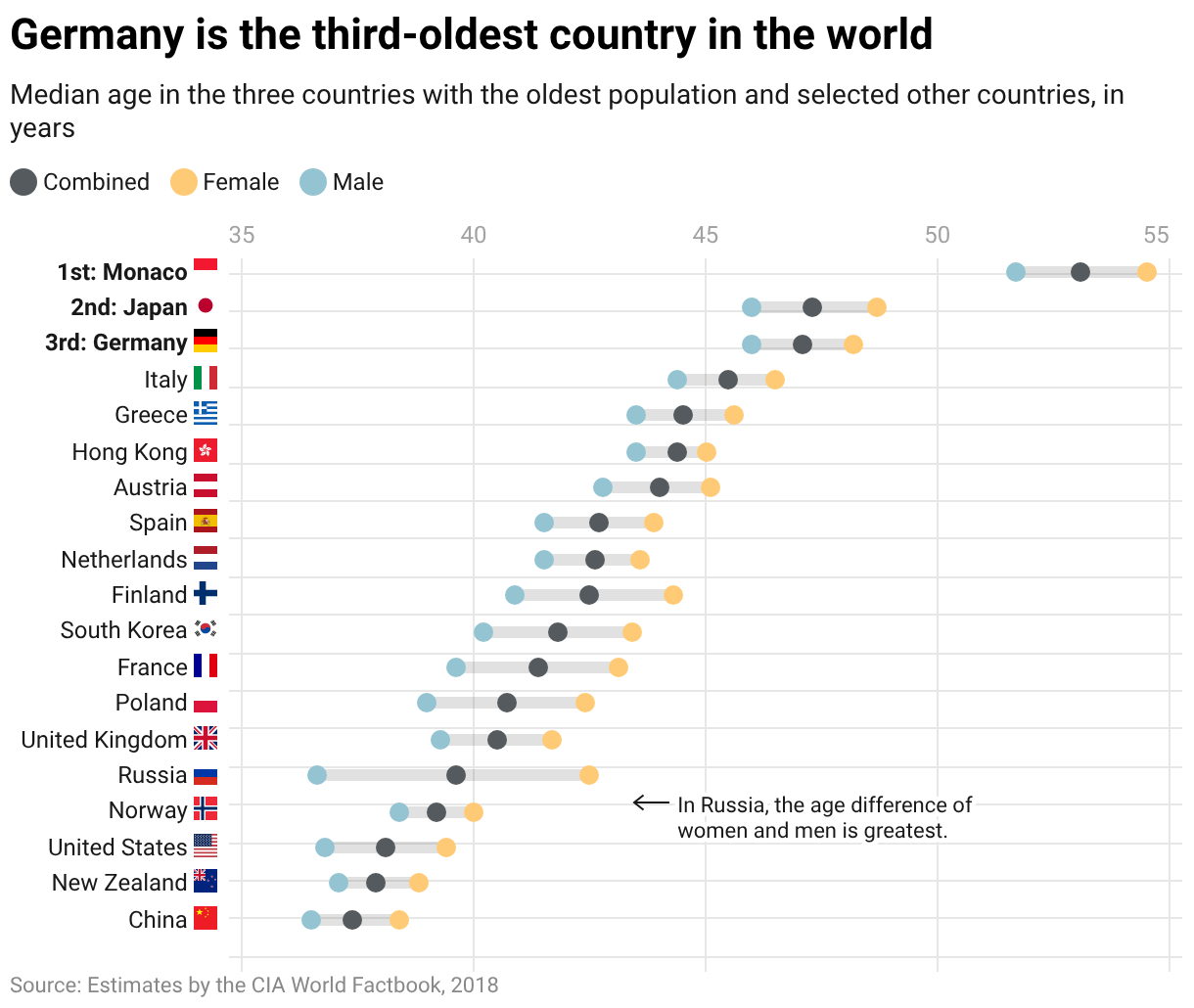
Let’s talk about age. Age demographics give me great joy (just look at population pyramids. They’re amazing!), so I wikiprocrastinate my way sometimes through articles and lists of life expectancy and other delicates. And there I was, this morning, looking at a list of countries ranked by their median age – and I couldn’t believe my eyes. I decided to make a chart out of it, so that my eyes can get used to that shocking fact:

Germany has a median age of 46.8 years, which means that half of the population is younger than 46.8 years, and half of the population is older than that. Germany! The country I live in! So old! I had no idea! I also had no idea that the citizens of the United States are almost ten years younger than the ones from Europe. The US really is a young country.

Chart choices

I decided to use a dot plot for this chart. I could have used a bar chart, but then my y-axis needed to start at zero and the differences were barely observable. I did make good experiences with using dot plots for visualizing age.

The most important choice in this chart: In addition to the three oldest countries, I showed further countries and regions to set the new knowledge in context. Because my chart is in English, it’s likely that people from the UK, the US, Australia or New Zealand will see it. I think it’s just nice to make sure they find themselves on the chart. And I included the median age of the World, to give a hint that the median age of all the shown countries is exceptionally high. There are tons of countries with a median age lower than 20 years (e.g., Zambia: 16.7 years).

I also chose to extend the information about the median age of the whole population with the median age of women and men separately. I did that for several reasons:

  • to introduce some differentiation. It’s unfair to put all people in the same box (“you’re 47 years old!” — “But I’m actually…” – “47 YEARS! ALL OF YOU!”).
  • to make the chart more interesting for people who want to know more. The gender gap is not the focus of the chart, but people who are interested in the topic will be thankful for the extra information. It makes the chart interesting for further exploration. Readers can find out, for example, that men in the UK have the same median age as women in the US.
  • because it looks better. Like little planets revolving around the sun; or planes from the front.

Next week, we’ll have a closer look at Germany. Have a good week!

11 Dec 05:18

Sins of the Mother

by Danya Glabau

At the Apple Special Event this September, CEO Tim Cook announced the company’s latest device, the Apple Watch 4, to a crowd of industry insiders and reporters. Hailing it as a way to “stay connected, be more active, and live a healthier day,” Cook characterized the Watch 4 as Apple’s latest attempt to create technologies that are “more personal.” With cell service, built in fitness trackers, and a newly added heart-rate monitor, the watch had become “an intelligent guardian for your health.” Its sensors can now follow your every move (at least, anywhere that matters, anywhere with cell service) at anytime (until the 18-hour battery fails) while doing any activity (except deep-sea diving).

Unlike most recent Apple device announcements, this one hooked me. Since August, I had already been tracking my every move, calorie, cramp, and sickness using another self-tracking app, under the vague impression that tracking myself would speed along the process of becoming that most overdetermined kind of cyborg, a pregnant woman. I even had a file on my cloud drive called “Notes on Pregnancy.” I intended to use it to capture the thoughts, sensations, and encounters with fertility-enhancing technologies that could not be easily tracked through the app. But my enthusiasm had already begun to wane by the time the Apple event came around.

Pregnancy intensifies already dense networks of surveillance

As I watched video of the event, I wondered if the Watch could salvage and redeem my self-tracking ambitions, somehow facilitate my admittance to the cult of motherhood. Could it help me better discipline my sex life in line with my fertility? Wrangle my BMI closer to an ideal level for a woman moving briskly toward the age threshold of geriatric pregnancy? Could a wise digital guardian help me and my potential children become stronger, prettier, and healthier? Could it help me transcend the unseemly limits of my earthly flesh, to pass through a trial-by-data and come out renewed and rejuvenated on the other side?

The temptation of transcendence through technology — the possibility to overcome weaknesses of body and willpower that seem to be part of the ordinary human experience — pervades digital life. Self-tracking speaks directly to this enculturated desire for transcendence. We hope to be able to change ourselves through knowing the numbers, so we seek out more and more information about ourselves to change our futures.

But there are risks that come with seeking to exceed the embodied self through data. It requires relinquishing a great degree of control over our private activities and motivations. Complex desires and activities get broken down into fragments as they are captured and stored as data. The pieces of us can be tracked in minute detail by whoever is granted access under terms-of-service contracts. The clouds of data gathered about us by our technological add-ons quickly escape our control. Instead, they become the means by which we can be controlled.

The potential risks are especially acute for people seeking to bear children and for their offspring. Pregnancy intensifies already dense networks of surveillance. Pregnant women and new mothers are expected to adhere to a strict regimen of doctor’s appointments, diet, and exercise. In the United States, they are seen as an especially prime target for advertising. As sociologist Janet Vertesi discovered in 2014, avoiding the gaze of marketers involves extensive planning for even mundane purchases and an evasiveness that can make one look like a criminal in the process. More frighteningly, the everyday surveillance of the internet has outed at least one woman’s pregnancy without her consent.

The imperative to do more and be better is not only a question of the well-being of the person carrying the child. At stake (so we are told!) are concerns that are bigger than us and yet seem to depend on us: the future of the national economy and the health of the species. When pregnant people fall short, they fail not only themselves but the imagined heirs, nations, and biological kin by whom they could have done better.

What is good for the disembodied cyborg may not be good for the fleshy person — especially the reproducing one

So while digital self-tracking might seem to be the answer to someone like me who seeks to become a parent, using it to record evidence of all the ways that the parent might set the child up for failure could make it easier to revisit the sins of the mother upon the child. To safeguard future generations, it may be more important to guard against self-tracking’s intrusion into our lives than to reap its benefits. Is the Apple Watch truly a guardian, caring for our well-being — or is it a warden, watching and waiting for us to make a misstep?


These reservations about self-tracking were on my mind as I walked into the Apple Store in downtown Brooklyn. The store juts out from one side of a new luxury high-rise, sharing the ground floor with a 365 Market, the new, budget-friendly version of Amazon–Whole Foods, and a simulation of a neighborhood food court populated by stores selling $5 loaves of bread and $10 cups of green juice. Glass walls rise to a height of several stories, bending gradually toward each other like the prow of a ship. This vessel for the future is aimed down Flatbush Avenue, the next step in central Brooklyn’s gentrified future.

The store is not just a place to buy Apple products. It is also where individuals are meant to come learn how to remake themselves — their bodies, their minds, their design portfolios — for a better future, powered by Apple technology. It is an outcropping of the Californian ideology that preaches liberation through technology, transcendence through market choice, and becoming cyborg mainly as a way of becoming a better consuming citizen. We are invited in to be seduced by promises of freedom from the everyday, the material, the now. We are invited to live in the future, closer to the world of our descendants.

But what is good for the disembodied, future-oriented cyborg may not be good for the fleshy person — especially the reproducing one. While it may seem necessary and prudent to track the self to ensure good outcomes in the future, the real risk may be in handing over extensive, real-time data about oneself to a third party. The promise of transcendence relies on the faith that the outside party truly has an individual’s best interests at heart. To be a responsible user of self-tracking technologies and to get the most out of them (as I have learned in my fits and starts at being a self-tracker), one must relinquish a great deal of privacy. To get the most accurate estimate of energy exerted during a run or a walk, for example, I need to allow the FitBit app on my iPhone to keep track of where I go. It knows where I live and work. I tell it how much I weigh and what I eat. I even tell it where I shop when I scan bar codes from store-brand foods to automatically look up nutritional content. While this is risky in the best of times, the potential effects of data misuse is even higher when the life of a future child is in the picture.

We are invited in by promises of freedom from the everyday, the now. We are invited to live in the future, closer to the world of our descendants

While Apple advertises the Watch as a caretaker, its effects are more likely in line with an overseer. Digital self-tracking tools are the latest wave of disciplinary technologies, imprisoning their users in a cage of data. This makes digital self-tracking consistent with modernity’s signature strategy of social control as theorized by Michel Foucault: discipline. Foucault famously argued that a fundamental break happened in how the state approached crimes and moral transgressions beginning in the 17th century. While earlier forms of punishment relied on spectacular episodes of violent force — up to and including public executions — dealt out in the name of the sovereign king, the modern “gentle way” in social control aligned individuals to social norms not by doling out painful or deadly bodily harm as deterrents but by monitoring them.

Modern disciplinary techniques urge penitence and reform. The disciplinary state collects data about its citizens to both identify mathematical norms for society and to improve those numbers within the population as a whole through education and enforced compliance. In Foucault’s reference point of mid-century France, this involved state institutions like the military, the school, the hospital, and the prison. When individuals fall short of the norms, these institutions delivered exhortations to shape up, receive more training, and work through one’s deficiencies toward a better, future self.

We face similar injunctions from the contemporary equivalents of these institutions — not only schools, hospitals, and prisons but increasingly from our health insurance companies, public service agencies, and workplaces as well. While Foucault’s 18th and 19th century disciplinary institutions were controlled by the state, the disciplinary apparatus has now extended into private industry and local government as well. Over time, we internalize the message of these institutions, and their demands for a better self morphs into a personal commitment to progress, a genuine desire to submit to a responsible overseer who can guide and train us.

Social scientists have imported this framework into conversations about digital self-tracking technologies. Rather than inducing submission to a nation-state, contemporary self-tracking technologies prompt compliance with the norms and assumptions built into them by medical and technical professionals: advice about how many steps to take per day, how many calories to eat, and when a person might be at the peak of fertility. The apps and devices themselves become the warden of an individual’s opt-in confinement, with the data stored and owned by the company that makes them. This data is largely exempt from oversight by elected officials, and can move quickly from device and app manufacturers through third parties to marketers and advertisers. Popular business models for self-tracking tools scratch the individual’s itch for self-knowledge while also providing useful data for future marketing campaigns, as digital sociologist Deborah Lupton explains.

More disturbingly, personal data is being centralized in the public sector to police, predict, and punish across generations. As Virginia Eubanks documents in Automating Inequality: How High-Tech Tools Profile, Police, and Punish the Poor, new technologies are being used to make predictions about the behavior of future generations based on the actions of current ones. Designers of such systems are thereby instantiating the most dystopian and literal version of social reproduction.

It seems only a matter of time before medical data from self-tracking tools becomes part of the determinative matrix in both the public and private sectors. Fitbit, for example, now has an entire division devoted to selling tracking-centric wellness programs to large employers as a way to find savings on “annual health care spend.” The expansion of digital surveillance combined with the expanded use of automated decision-making tools is creating new threats to privacy and liberty for everyone. If these two regimes become fully interdigitated, a wide array of behaviors, interactions, and motivations captured in data in the past will shape the futures of individuals and communities, leaving little room for self-determination in the future.

It seems only a matter of time before biological data is also enlisted into multigenerational systems of discipline

As digital surveillance becomes embedded in our lives, we come to identify the possibility of future well-being with tracking and tinkering with our measurable behavior in the present. But the effects and affects this monitoring produces are unevenly distributed. They reinforce medical discipline for those of us who are already disproportionately surveilled, like pregnant people, as well as people of color, immigrants, women, and disabled people. They reinscribe punishment before any harm has been done for the children of people who are disproportionately intervened upon by criminal justice institutions. It seems only a matter of time before self-tracking can be used to set up future people as consumers before they are even old enough to pay for their own lunch or sign up for a credit card. By reducing behavior to numerical data, the platforms and cloud technologies behind consumer self-tracking tools provide powerful ways to link the many domains in which minute-by-minute data about what we do can be turned into data, money, and control.


In the end, I did not buy the Apple Watch, despite the initial stirrings of desire. I remembered that tracking the self is still work — of attention, of caring about the metrics, the outcomes, the future risks one is creating in the present. Buying a Watch could get more expensive than it seems, as the first purchase opens the floodgates for more invitations to buy technological consumer goods. One device could spawn the need for more devices (connected thermometers, connected scales, connected water bottles). And the data collected would most likely be crunched into new appeals to buy more and be more both for me and for my potential future children.

Although the Watch could possibly help me bring my body in line as I prepare my womb, I would rather not intensify the inevitable onslaught of baby-related advertising through sharing daily data about my activity, diet, and health status with companies who seek to monetize it in creative ways. But most important, I cannot bear to think that what I give that device today would be held against me and my lineage in the future. If I don’t eat right, if I weigh too much, if I drank wine after conception, or if I don’t meet prescribed quotas of daily physical activity, could such data be used by a pediatrician to place the blame of perceived deficiencies in my child back on me? Would it be a reason for a company to withhold affordable health insurance from my family? Will schools crunch my prenatal health data to track my toddler into the appropriate pre-school classroom? If the social services benefits used by a parent can already determine the relationship between a child and local welfare agencies, it seems only a matter of time before biological data is also enlisted into multigenerational systems of discipline.

In a different arrangement of society, I would be comfortable, or even excited, about tracking and storing data about my health at this (so the world tells me) critical biological juncture. If I could be confident that the sins of the mother would not and could not be visited upon the child, then perhaps. If my possible missteps today meant extra care and regard for future generations, then gladly. In a world where children were not tracked into future careers from toddlerhood, where disability was not seen as an individual failing and blamed on the poor choices of mothers, where social benefits flowed freely to those who needed them, and where the slightest deviance from bodily or social norms did not result in swift and harsh financial retribution from employers, criminal justice systems, and public agencies, then the questions I find myself asking in this essay would be entirely moot. I wish I lived in that world. But for now, this earthbound cyborg’s wrist remains conspicuously bare.

11 Dec 05:17

I’m on the latest Micro Monday podcast with Jea...

I’m on the latest Micro Monday podcast with Jean MacDonald! It was so much fun to do.

We talk about podcasting and about the similar ideas behind The Omni Show and Micro Monday. And The Record.

We also talk about NetNewsWire and about Micro.blog.

Entirely coincidentally — Micro.blog has been open to the public for a year now. Congratulations to Manton and Jean on this big milestone!

11 Dec 05:17

Work Awesome: Interview with Erin Winick of MIT Tech Review

by Stowe Boyd

Erin Winick is the Associate Editor Future of Work at the MIT Tech Review, and I feel like I already know her because of her work there, but in actuality I will be meeting her for the first time at the upcoming Work Awesome conference on 6 December.

I had the chance to ask her a few questions about the panel she will be moderating at Work Awesome:

Stowe Boyd | In the past, I have characterized the split in the discourse about AI’s impact on the workforce as a face-off between the ‘Anotherists’, those who say ‘AI is just another wave of technological advance, like those in the past, and ultimately new jobs will be created to employ those initially displaced by AI’, and the ‘Otherists’, who say ‘AI is different from earlier waves of technological advance, since AI seeks to substitute for human reasoning, and so, it may not be the case that those displaced will find new work’. Where do you fall in this debate?

Erin Winick | I think it depends on the area of work we are talking about. AI is not a one size fits all technology. There are certain things it is much better at than others, meaning different categories of jobs will be affected at varying speeds and scales. Some people, like writers who wrote data based simple stories like sports or financial reports, have already been replaced by technology in many areas. Other like politicians or artists haven’t seen too much change to their work yet.

For me I think some people will definitely be out of work, while in other categories, people will migrate to new jobs. Companies often tout that they are excited these new technologies will allow people to move into new more creative roles. But the question is whether the companies will see economic benefit from that or if letting the workers go is the better option for them. We have yet to definitely see what their choice will be. In a tight labor market, they are more likely to try to hold onto them.

I think investing in training the workers that want to be trained for new roles now is the right choice. I’ve learned firsthand that not everyone will want it, but beginning to prepare now for increased technological change is the right move.

SB I’ve said that ‘we will have to learn to dance with the robots’. One trend is AI augmenting human work, as opposed to simply eliminating it, like a composer who might use AI to generate a few hundred musical themes, which are then explored and embellished in the more conventional way. Thoughts?

EW I definitely think humans will increasingly work alongside machines. It’s been really interesting to watch the increase in cobotics (“collaborative robots”) on the manufacturing floor. I think that trend will increase in other professions as well. New technologies have been creeping into the workplace for a long time. From computers to cell phones to various types of software, we’ve always had to learn to adapt throughout our careers. AI and new automated tools will definitely be popping up more in our lives, and learning to work with them can only be to your advantage.

SB | What — if any — regulation do you think we should be considering for AI in the workplace?

EW | As my colleague Karen Hao has written, I think establishing a AI code of ethics or regulations will be harder than people think. Before coming up with the laws, we need to figure out which bodies will be responsible for updating, maintaining, or enforcing regulations over AI at work.

I think we should consider auditing for things like hiring algorithms to take a look at whether they are biased or not. When a person’s livelihood is on the line, we should be checking if algorithms are biased or not. For example, Amazon had to get rid of an algorithm they were testing after it was found to prefer male candidates.

SB: Ah, Karen Hao of the famous AI Flowchart! Do you agree, though, that we have learned in the past few years, across a broad swath of technology players, that tech companies can’t be trusted to regulate themselves?

EW: I definitely think additional regulation is needed. The tech giants dominate so many important parts of our lives, especially those dealing with data. We need to closely look at the sources of the power and figure out ways to prevent damage being caused from them being the primary purveyors of our data.

SB | I see your panel includes Dennis Mortensen of x.ai, a company using AI bots to schedule meetings for people, Darja Gutnick of bunch.ai, a firm that uses AI in hiring, and Karl Alomar of Digital Ocean, a cloud computing infrastructure company with a number of machine learning and AI companies hosted there. Looks like a broad range of perspectives. What do you hope to accomplish with the panel?

EW: The panelists use AI to touch on many different parts of the workplace, so I’m interested to see how the problems they are working on tackling overlap. They all will need to contend with things like the elimination of bias and collection of data, so I’m interested to speak to them on those points. I’m also interested to talk to them about how their own businesses are embracing automation and how they have seen the AI industry chance in the past few years. I think the panelists will together provide an interesting perspective on the future of work.

Sign up for her newsletter, Clocking In.

crossposted from stoweboyd.com.


Work Awesome: Interview with Erin Winick of MIT Tech Review was originally published in Work Futures Institute on Medium, where people are continuing the conversation by highlighting and responding to this story.

11 Dec 05:17

Black Friday of the Soul

by Stowe Boyd

Everything Is for Sale Now. Even Us. | 996 | all routine labor will be automated | Robots on the farm | manager readmes | Managing rebels

Beacon NY — 2018–11–25 — It’s the dark time of the year. Short days, snow, a persistent chill in the air.

And last week we had Black Friday, the big shopping day as people stock up on gifts for their friends and families.

Ruth Whippman ties together the season, and Black Friday, to the changes in our increasingly gigged-up economy, from which I drew the title of this issue, and which reads more like poetry than cultural criticism:

It’s as though we are all working in Walmart on an endless Black Friday of the soul.

If you’re getting this you probably signed up at workfutures.org (or one of its predecessors) or stoweboyd.com. If someone forwarded this to you, sign up here.

Consider making a donation. We appreciate your support.

Links

Everything Is for Sale Now. Even Us. | Ruth Whippman chillingly profiles where the gig economy has taken us:

As a writer, I am part of the 35 percent of the American work force that now works freelance in some capacity, either as a main source of income or as some kind of side hustle. This number is growing constantly — 94 percent of the new jobs created in the last decade or so were freelance or contract-based.
When we think “gig economy,” we tend to picture an Uber driver or a TaskRabbit tasker rather than a lawyer or a doctor, but in reality, this scrappy economic model — grubbing around for work, all big dreams and bad health insurance — will soon catch up with the bulk of America’s middle class.
Major companies now outsource many of even their most skilled jobs, ditching their in-house lawyers and I.T. support teams in favor of on-demand contractors, paid by the hour. More than 18 million Americans are now involved in some kind of direct sales or multilevel marketing scheme, shelling out hundreds of dollars on vitamins or juicers or leggings, then frantically attempting to recoup the money by flogging them to friends and neighbors. Economists predict that by 2027, gig workers of varying descriptions will make up more than half of the work force. An estimated 47 percent of millennials already work in this way.
It certainly feels familiar. Almost everyone I know now has some kind of hustle, whether job, hobby, or side or vanity project. Share my blog post, buy my book, click on my link, follow me on Instagram, visit my Etsy shop, donate to my Kickstarter, crowdfund my heart surgery. It’s as though we are all working in Walmart on an endless Black Friday of the soul.

The social contract of work has been erased by an endless series of precarious work hook-ups, where jobs are increasingly just one-night stands, and the opportunity for work security and commitment recedes into a rapidly attenuating past. An endless Black Friday of the soul.

[crossposted from stoweboyd.com]

China’s Grueling Formula for Success: 9–9–6 | Li Yuan links the 996 trend in China — working 9am to 9pm six days a week — to a growing sense that the cultural commitment to overwork is leading to health and psychological issues, there:

One midlevel Huawei executive said he works at least 12 hours a day because he wants to be the best and because he gets compensated for good performance. But he said he will evaluate in three years, when he is 35, whether he can keep going at such a pace.
Alibaba Group Holding is also known for long hours — some say it pioneered the 996 work schedule. Alibaba declined to comment on that, and a spokesman said the company encourages a work-life balance. Founder Jack Ma has acknowledged the company demands more, but also pays more.
“We ask three people to accomplish a job of five people, and pay them for four,” Mr. Ma, Alibaba’s executive chairman, said at a meeting with investors last year.

I don’t think this pace is sustainable, but there is no doubt that entrepreneurial management (or startup culture) culture has a predilection to induce employees to subordinate their personal goals and needs to the company’s ends. Obviously that’s part of what’s going on here. We can expect CEOs and VCs to continue to wag their fingers and tell us we in the US will have to adopt these practices if we want to prevail in this economy, or else.

I found that story thanks to Christopher Mims, who reviews what he saw and heard at the Wall Street Journal’s Tech D.Live conference this week in What’s the Next Big Thing in Tech? It’s Up to Us. Here’s the mic drop of the conference [emphasis mine]:

In the future, the top jobs are robot engineer and elder caregiver. There’s strong evidence that all routine labor — both physical and mental — is headed toward automation, Mr. [Kai-Fu] Lee of Sinovation Ventures said. This will have profound effects on the nature of work.
While it will certainly take more than five years for the workforce of the future to take shape, it will require a lot of engineers and technicians, mainly for R&D.
But while some people will help automation along, others will resist it. Jobs requiring warmth and compassion will likely still be filled by humans, because the people being cared for don’t want robots in that role. Chief among these occupations will be looking after the world’s elderly.
Not incidentally, Mr. Lee believes that journalism will be among the fields that will be largely automated, so readers should enjoy this column while it lasts.

By the way, it is not at all clear that people don’t want robots to care for them, so don’t expect that job to be reserved for humankind. And that trend will principally be driven by cost decisions by insurers and health companies, not the whims of patients.

Apropos of Lee’s comments above, Miriam Jordan reports that As Immigrant Farmworkers Become More Scarce, Robots Replace Humans:

In a 2017 survey of farmers by the California Farm Bureau Federation, 55 percent reported labor shortages, and the figure was nearly 70 percent for those who depend on seasonal workers. Wage increases in recent years have not compensated for the shortfall, growers said.
Strawberry operations in California, apple orchards in Washington and dairy farms across the country are struggling with the consequences of a shrinking, aging, foreign-born work force; a crackdown at the border; and the failure of Congress to agree on an immigration overhaul that could provide a more steady source of immigrant labor.
Farmhands who benefited from the last immigration amnesty, in 1986, are now in their 50s and represent just a fraction of today’s field workers. As fewer new immigrants have arrived to work in agriculture, the average age of farmworkers has climbed — to 38 in 2016, according to government data, compared with 31 in 2000.

The result? Large-scale deployments of automation: lettuce cutting and weeding, strawberry harvesting, putting garlic into nets, and dozens of other activities are now being handled by robots. Only delicate fruit and vegetables will be harvested by hand in the near future, as the agricultural sector transitions into a high-robot-density era.

Camille Fournier started a fascinating thread about manager readmes or user guides, and then decided to pull it into a blog post (I hate manager READMEs). The basic idea is for managers to write a document that explains how others — particularly direct reports — should approach interactions with those managers. She’s not down with that approach.

If you want to build trust, you do that by showing up, talking to your team both individually and as a team, and behaving in an ethical, reliable manner. Over, and over, and over again. You don’t get it from writing a doc about how you deserve their trust.

A must read.

How to manage rebellious employees | Edward Mady is the general manager of The Beverly Hills Hotel and he shares some solid thinking on dealing with the rebels.

From the Archives

Different Kinds Of Workers Need Different Kinds Of Workspaces | Stowe Boyd from 2014. Canon Australia rejected Activity-Based Working and built a ‘palette’ of spaces keyed to show people actually use space:

Personally, I would be in the library for 5 hours a day, and the rest floating around.
The real takeaways:
  • Find out what sorts of work modes are present in your company before committing to any stem-to-stern remake of the office workscape.
  • The researchers determined that what they discovered ethnographically by direct observation of users correlated strongly with what worker surveys showed. So, a small company can probably rely on a simple survey that provides a range of working styles — maybe more than the three at Canon Australia — and then proceed to a hybrid of traditional and ABW workspace, if that is called for.

Quote of the Day

We must unlearn the constellations to see the stars.

| Jack Gilbert, Tear it Down

crossposted from workfutures.org.


Black Friday of the Soul was originally published in Work Futures Institute on Medium, where people are continuing the conversation by highlighting and responding to this story.

11 Dec 05:17

Life Itself

Roger Ebert was a great film critic and a newspaperman at the end of one of the great City Rooms. In his later years, cancer surgery deprived him of the ability either to eat or to talk. Ebert turned to blogging and became the greatest voice of the weblog era. This autobiography is his authentic Web voice.

From Mike Royko’s hat stand (a relic of the old Wacker Street Daily News newsroom) to John Wayne’s boat, Robert Mitchum’s wrong turn, or the meeting of Ingmar Bergman and David Lean, Royko has the story. The central chapters on drinking and not drinking are unmatched, the pinnacle of the confessional weblog, written with immediacy and yet avoiding convention and sermonizing.

11 Dec 05:13

Apple’s Machine Learning Journal Posts Paper on How Siri Works on the HomePod in Noisy Environments

by John Voorhees

Apple’s online Machine Learning Journal has published a paper on the methodologies the HomePod uses to implement Siri functionality in far-field settings. As Apple’s Audio Software Engineering and Siri Speech Teams explain:

Siri on HomePod is designed to work in challenging usage scenarios such as:

  • During loud music playback
  • When the talker is far away from HomePod
  • When other sound sources in a room, such as a TV or household appliances, are active

Each of those conditions requires a different approach to effectively separate a spoken Siri command from other household sounds and to do so efficiently. The report notes that the HomePod’s speech enhancement system uses less than 15% of one core of a 1.4 GHz A8 processor.

Apple engineers tested their speech enhancement system under a variety of conditions:

We evaluated the performance of the proposed speech processing system on a large speech test set recorded on HomePod in several acoustic conditions:

  • Music and podcast playback at different levels
  • Continuous background noise, including babble and rain noise
  • Directional noises generated by household appliances such as a vacuum cleaner, hairdryer, and microwave
  • Interference from external competing sources of speech

In these recordings, we varied the locations of HomePod and the test subjects to cover different use cases, for example, in living room or kitchen environments where HomePod was placed against the wall or in the middle of the room.

The paper concludes with examples of filtered and unfiltered audio from those HomePod tests. Regardless of whether you’re interested in the details of noise reduction technology, the sample audio clips are worth a listen. It’s impressive to hear barely audible commands emerge from background noises like a dishwasher and music playback.

→ Source: machinelearning.apple.com

11 Dec 03:56

GHG.EARTH

by peter@rukavina.net (Peter Rukavina)

GHG.EARTH from William Denton is…

a sonification of the most recent atmospheric CO₂ reading at Mauna Loa in Hawaii at the observatory run by the United States National Oceanic and Atmospheric Administration.

See also SoundCloud + Pachube + Energy, my own dalliance in similar terrain.

11 Dec 03:56

"I'm tired, and I'm cold, and I can't see the bus..."

by peter@rukavina.net (Peter Rukavina)

Eight years ago today we found ourselves on Via Ca’ di Marcello, a deserted side street in Mestre, the landward side of Venice, waiting for the bus to Bulgaria.

We were midway through a late fall European odyssey that had previously taken us to Munich and Basel; after 3 days in Venice, we were moving on to Ljubljana and Croatia. And the bus was the only way to get from Venice to Ljubljana. It was remarkably inexpensive: 55 Euro for all three of us for a 4 hour ride:

Our Venice to Ljubljana bus ticket

Upon arrival at the Mestre bus station in plenty of time, we were told, with vague gesticulation, that our bus did not, in fact, leave from the station, but from the aforementioned deserted side street. By some miracle we managed to find the tiny “no parking” sign on this street marked “bus interregionali ed internazionali.”

Where we waited. And waited. On a cold, dark, damp, Italian evening.

By way of memorializing the wait, and distracting our increasingly frustrated Oliver, I recorded a short video:

Eventually the bus did arrive. With little pomp or circumstance. We showed the tickets I’d booked online. All was in order. And so we boarded.

Photo of the bus that took us from Venice to Ljubljana

The bus turned out to be a run from Florence to Sofia that was popular with itinerant workers from Bulgaria returning home. You cannot imagine a nicer bunch of people to travel with: as the bus sped through the night from Venice to Trieste to Ljubljana we shared food and, as best we could, stories with our fellow passengers.

We arrived in Ljubljana before midnight and made our way to our hotel; the next morning we awoke to a blanket of snow, quite a novelty after the soggy environs of Venice:

Photo of Ljubljana

After 4 days in Croatia, we returned our rental car to Ljubljana and found all the snow gone, but the weather still mitten-worthy:

Photo of Oliver, in winter gear, in Ljubljana

Oliver was in grade 3 that year, and had one in a series of teachers whose attitude about leaving school for periods of travel was, in essence, “he’s going to learn a lot more out there in the world than he will here in the classroom.” That was certainly true. Even if it did mean a long cold wait for the bus to Bulgaria. Or perhaps because of that.

11 Dec 03:49

A visualization book using only hand-drawn illustrations

by Nathan Yau

RJ Andrews has a visualization design book coming out in January called Info We Trust. He hand-drew about 300 graphics for the book. One of the reasons:

I decided very early that Info We Trust would not use any existing images, mine or others. Found examples work fine for certain books. They are also convenient, the work is already done! But found images bring baggage too. You might choose an existing work to highlight one aspect of its design. But the reader will see other facets too.

I’m intrigued. On the upside, you get a consistent visual flow. A focused point of view. On the downside: the possibility of a view that is too focused. I have a feeling there will be more upside than downside. [Amazon pre-order]

Tags: book, hand-drawn, illustration

11 Dec 03:19

A Champion Ends His Ride

by Ken Ohrn
A friend who made a difference

Arno Schortinghuis has passed away, and many people feel deep sadness today. He’s gone now, but his kindness, even disposition, dedication, lack of pretention, twinkle-eyed sense of humour, his open nature and deep knowledge — all live on in us, our memories and the things we’ve learned.

He was a champion for expanding choices in transportation, and in particular the creation of safe and effective infrastructure for those who choose to travel by bicycle.  He could be found in boardrooms, meeting rooms, open house events and online — taking on the issues and providing cogent, well-thought-out opinion.

I remember Arno as a conciliator, who always looked for the common ground to try and secure agreement and move a group or an issue forward.  He also focused on the positive, the benefit, the happiness and pleasure.  His patience is legendary.

Colin Stein, Price Tags’ managing editor, has updated his lovely piece on Arno. A snippet here, with Arno’s thoughts on how to go about making change:

It’s two parts. It’s encouraging the decision-makers to do way more to make cycling an everyday, safe, convenient activity. Getting the decision-makers on board — that’s probably the most important.

The other is getting the public on-board — encouraging them to cycle more and accept cycling as a real mode of transportation. Some of the people who drive a lot and don’t cycle have a very negative opinion of cycling.

We have to get over that because the politicians aren’t going to act unless the public is on-side as well.

I can remember Arno as “Cycling Santa”, and as the person who delivered Translink’s training bus rack to various events. Every so often today, I hear his voice in my head, saying “Hello Ken”, with characteristic enthusiasm and a rising inflection. Always makes me feel good.

A few photos below, and yes, you can gaze upon a photo of Arno in a suit, with the then-mayor.

Click to view slideshow.


11 Dec 03:19

Cycling Santa – a Fond Memory

by Ken Ohrn

Vintage Arno Schortinghuis (with a little help from YouTube).

December 2009, Bike to Work Week.

02 Dec 01:14

RT @Birdyword: Whenever I think of George HW Bush I remember this article he wrote with Brent Scowcroft in 1998 on why he chose not to topp…

by Birdyword
mkalus shared this story from iandunt on Twitter.

Whenever I think of George HW Bush I remember this article he wrote with Brent Scowcroft in 1998 on why he chose not to topple Saddam after Desert Storm. It is haunting.
globalpolicy.org/component/cont… pic.twitter.com/lqdgrs1Q6D


Posted by Birdyword on Saturday, December 1st, 2018 6:10am
Retweeted by IanDunt on Saturday, December 1st, 2018 8:44am


420 likes, 260 retweets
01 Dec 20:55

RT @GuitarMoog: A friend just reminded me that it's worth looking at Ian Duncan Smith and Owen Paterson's plan for Brexit from 2 years ago…

by GuitarMoog
mkalus shared this story from mrjamesob on Twitter.

A friend just reminded me that it's worth looking at Ian Duncan Smith and Owen Paterson's plan for Brexit from 2 years ago if you want to understand how we've got to this appalling situation.

Seriously, do: pic.twitter.com/FNktxhJlAF


Posted by GuitarMoog on Friday, November 30th, 2018 9:05pm
Retweeted by mrjamesob on Saturday, December 1st, 2018 5:07pm


567 likes, 373 retweets
01 Dec 20:54

Galaxy A8s rumoured to be Samsung’s first phone without a headphone jack in Canada

by Brad Bennett
Samsung Galaxy A8s render

A recent report indicates that Samsung’s Galaxy A8s might be the first phone from the company to be released in Canada that doesn’t feature a headphone jack.

Samsung previously omitted the jack from its two high-end flip phones, the W2018 and the W2019, which launched in China and South Korea, according to SamMobile. 

The report is from The Indian Express and it’s based off a tweet from a Chinese Samsung leaker.

The report also backs up the rumours that suggest theA8s will be Samsung’s first phone with an all-screen ‘Infinity-O’ display with an aspect ratio of 19.5:9. The phone is also likely to avoid adding a notch all together and will instead have a small hole in the top left-hand corner of the screen for the front-facing camera.

The leaker also mentions the phone will have an LCD display and will likely be revealed in December.

While the loss of the 3.5mm jack on the A8s might mean that the South Korean electronics giant is moving away from the port, it could still be featured in other upcoming Samsung flagship smartphones.

Source: Twitter, The Indian Express

The post Galaxy A8s rumoured to be Samsung’s first phone without a headphone jack in Canada appeared first on MobileSyrup.

01 Dec 20:54

Thoughts on on the King St. Pilot after One Year

by Richard

I've lived in the same apartment in Toronto, near Queen & Spadina, for almost 3 years. Initially my commute to an office at Church and The Esplanade was taking the 510 streetcar from either Queen or King St. depending on where the winds took me. That seemed like the fastest way to go until it donned on me that I was essentially taking a detour south past Front to Queens Quay and then back north to Union Station, and then walking through the morning wave of people coming in from all directions via the GO trains. At some point I changed my commute to take the King St. streetcar, with the new Flexity cars just coming into service on the 504 route. (That might have been when I learned of the Secret Streetcar, the 503, with its semi-permanent short turn at Spadina Ave. and threading through Charlotte to head back east on King. It's the only time I can get a seat in the morning, and I'll let multiple packed streetcars pass knowing that soon, soon I will be the only one boarding an empty streetcar on my way to work.)

The year or so I spent on the King St., no matter which route, was a contract with congestion. Luckily then my pager duty shifts would start in the afternoons, because at least then I did not have to be in the office by a certain time in the mornings. It was not so much that travel times were long but how unpredictable they were. It wasn't even a joke that people could walk faster than the streetcar, it was a reality. If the choice was spending 45 minutes standing in a streetcar and a 45-minute walk to work, I would choose the latter.

As soon as I got wind that the City of Toronto, in conjunction with the TTC, would change the traffic pattern so that cars were required to exit King St. at each intersection (with exceptions), and not only be required to turn right but mandated to do so, meant that the streetcar would be the only vehicle on the road. The right lane on both sides is closed to traffic, and open only for art installations or loading zones or taxi bays. I called the pilot project a success at the outset, because it felt like a daring exercise the TTC is not exactly known for, and it prioritized transit riders which not only benefited me directly (I have never owned a car and don't want to), but it would benefit the tens of thousands of transit riders along the King St. corridor. After a year of the pilot, I was surprised how low the increase was in ridership at 11%, though it does seem to me and other riders of the streetcar that people are more packed in, and that Presto undercounts due to 'free rides' simply because people can't reach to tap in. (If I had any doubt that the TTC counts Bluetooth devices to determine the number of riders, the open data catalogue has put them to rest.) I remain of the opinion that no matter how many streetcars are on the route, they will fill up, because of how predictable the commute times are. That's a good thing! I'm just a little dismayed that overcrowding is presented as a problem, which it is, but unless they keep up with densification along the corridor, which they won't anytime soon, "overcrowding" will be present for a long while.

(Don't get me wrong: I'm in favour of more streetcars along King St., since it will mean even people on streetcars, which means fewer people driving cars. I just don't think getting a seat is something anybody should realistically count on.)

This evening I attended a roundtable discussion hosted by TTCRiders.ca. Attendees were split up into groups of 7 or 8 and led by a facilitator to discuss the pilot. To my pleasant surprise, a candidate for council in my ward, April Engleberg, led the discussion at my table. We had a sheet with 5 questions in front of us, and for each of the 5 questions, we had time to answer them on our own and then discuss them among the group. I represented the early-40s white male perspective as best I could, and found the complaints and concerns everybody brought to be eye-opening. Since my commute time is very predictable now (always under 17 minutes while in a streetcar, and traffic is only ever stuck behind one), I call the line a subway on the ground. My vision for the King St. has it extended to Roncesvalles Ave., if only to make it easier for me to move to Etobicoke, but that's another story.

Did some people think it was a session to complain to city staff despite being explicitly told it wasn't. Yes. Was it a shame that the groups stayed the same throughout the night? Possibly. Did I reframe some of my thoughts about the pilot based on other people's experiences of it? Absolutely.

At work, we had to stop calling a new service that we tried out with a select group of customer as a pilot because they associated that word with a temporary thing. The customers saw themselves as early adopters of something, so I worry too that the King St. Transit Pilot is seen by implementors and stakeholders and consumers as impermanent. I see everybody in the area as being not so much as early adopters, but as participants in a new way of thinking of city streets that was (and still is) disruptive, with some problems to iron out (and possibly people to compensate). I hope King St. becomes a transit-only part of town, and that we listen to people in the roundtables, who suggested that maybe public art in street lanes didn't work as well as it could, but can still reclaim that lane for people by making it a wider sidewalk (with public art!).

01 Dec 20:53

reconfiguring: if that night comes again

by alee9

Just published at otata #36, December 2018 (p. 55), like a sequel to the same theme I wrote this month also last year…(verses in parenthesis can be read as one poem, as well). I hope you like it 🙂

reconfiguring
if that night comes again

(will it be…)

on desert stillness
lamb eyes on a Child’s cheeks
a Star’s piercing shafts

(likely the same)

a gentled flock coating the ground
the shepherds’ mottled hands cupped for night dew
the mother’s breath a mist
(sense of truth)

a donkey braying from the myrrh-scented hay
gold glinting between sleep and dreams
the swaying wisps of frankincense

(or will it be…)
on sky cracks far off
hurtling open vowels spewing hurts
an ire-driven snapping king
(dripping vitriol)
fear-coated tongue brandishing
word-swords but where’s the manger
in baffling infinity?


in buff dunes burrows
and lopsided mountain hips
(perhaps)
swept in bursts of rancour
roaring off smeuse-d hedge-walls
(maybe)
buried with wounds
cankered from hollow praises
(probably)


still I was told
(that night will come again)
flailing wing tips
a wind-brushed sky flung open
humming in cotton-soft air
(a smile)
the sphere balanced as it rolls
on the Child’s upraised hand
darkness shorn of weight

draped with piercing shafts
(the Star’s)

01 Dec 20:52

Three Years In My Downtown Toronto Apartment

by Richard

I have reflected recently on my three years at Acquia and my three years living in Toronto, and today marks three years living in my downtown Toronto apartment. I got the keys to the place on December 1st, 2015, and spent the next two weeks slowly moving in, making multiple subway and streetcar trips from a friend's basement to Queen & Spadina to bring over the stuff I had bought over the course of a month, and waiting for my Ikea furniture to be delivered and then put together. I would go several months without a couch, its purchase being a story of its own. I still rent, having failed to convince the landlord to buy the place off him, and have done two rounds of looking for a similarly new (my building was built in 2013 or so) and similarly tiny apartment to buy, without any luck.

The location of my current place couldn't be more ideal. It's a 17-minute streetcar ride to work, and I'm located on one of Toronto's best shopping avenues (Queen St.) and its entertainment district (King St.), at the intersection of two streets with dedicated streetcar paths (both King and Spadina). Every music venue I end up attending seems to be half an hour away by transit for some reason, but at least it's only ever that.

My proudest moment, aside from the couch purchase, has been the addition of a Muskoka chair. The dream of owning a cottage in Ontario is the dream of owning a car, and I'd just rather not. So instead of bringing me to the cottage, I brought the cottage to me. Would you believe I'm the only one in my building with one? You wouldn't, and that's because I own two now.

In order for it to have a name in Foursquare's Swarm app, I gave my apartment the moniker Hvalhús, which translates into "Whale House" (because I love whales). The English translation of if gets a "The" and there's an infrequently updated Twitter account and Instagram account for it every time something significant gets added to it.

"Space is at a premium" every time someone suggests I buy something for it, so I always order the smallest version of that thing. Three years of stuff has accumulated, and hopefully the winter months of January and February will be boring enough for me to want to part with some things. Overall, though, I'm very happy with it, and do things (like cook and hang art on the walls) that I would never have considered doing when I lived alone in my twenties. Now that I'm in my forties and living alone again, my apartment feels like a place to live in.