Shared posts

11 Dec 05:17

Dublin

Dublin

I’m off to the International Conference on Interactive Digital Storytelling at Trinity College, Dublin, where I’m giving a paper (with Dr. Clare Hooper) titled “A Villain’s Guide To Social Media and Interactive Storytelling.”

This is adapted from our Hypertext ’18 paper on villainy and social media, but digital storytelling is even more vulnerable to villainy than the Web. Almost all the villainies that apply to Twitter and Facebook — trolling, de-anonymizing, recruitment of villains, stealing candy from babies — inhere just as much in multiplayer games, Facebook entertainments, and interactive fictions. In addition, we also have the tons of research exquisitely attuned to the cultivation of victims who suffer from mild mental derangement that leave them vulnerable to spending vast amounts of money on Candy Crush and to following charismatic crackpots.

Plato saw the problem with fiction as lies and fake news, and he was not wrong. But we also see the perils of projection and transference. Gamification in social media is the political repurposing of transference: if Milo can hand you rewards or quatloos or followers, Milo loves you and you (of course) love Milo. It doesn't matter that you know the object of desire isn't real, that she’s a computational construct in an imaginary world:

She was a tree elf named Riyah. He was a water elf, Tildor. They came from different realms, but for the past three nights they’d qwested, traded, and killed together. They had hunted basilisks, slain dragons, and retrieved two diamonds, which Riyah carried in the bag hanging at her waist. She was an amazing marksman and beautiful, even for an Elf, her eyes huge, her body supple. Her breasts swayed as she ran, her quiver bouncing behind her. — The Chalk Artist, p.24

Of course, Riyah isn’t precisely real: she’s an actor, employed to please game fanatics like Tildor. But she is also real, and the boy who is Tildor meets her in a stairwell at a conference. He’ll do anything for her. Of course he will.

We’re really quite good at finding weakness and depravity through new media, and at recruiting an audience vulnerable and eager to be deceived. The religious right and the extremist right have spent a decade reading our research and then deploying it to give us Trump and Brexit, the death penalty for seeking an abortion, Golden Dawn, UKIP, and Jobbik. If you know of any papers that help us find and retain an audience of the wise and virtuous, I’d like to know about them.

The dangers of fiction have always been tempered by the fact that the storyteller had to take the audience as she found it. In the market of ideas, anyone might wander by, and anyone can heckle. New media lets us tune the story to each reader, which means that new media, in villainous hands, can tune the story to each reader’s weakness while taking care that readers who are not weak (or who are Democrats) don’t even know there’s a story until it’s far, far too late.

11 Dec 05:17

I'm not selling my Apple stock

by Dries

Apple had a rough year; its stock price has fallen 25% since the beginning of the year. Apple also reported a weaker than expected outlook and shared that it will no longer report individual unit sales, which many consider a bearish signal within a saturated smartphone market.

It's no surprise that this has introduced some skepticism with current Apple shareholders. A friend recently asked me if she should hold or sell her Apple stock. Her financial advisor suggested she should consider selling. Knowing that Apple is the largest position in my own portfolio, she asked what I'm planning to do in light of the recent troubles.

Every time I make an investment decision, I construct a simple narrative based on my own analysis and research of the stock in question. I wrote down my narrative so I could share it with her. I decided to share it on my blog as well to give you a sense of how I develop these narratives. I've shared a few others in the past — documenting my "investment narratives" is useful as it helps me learn from my mistakes and institutes accountability.

As a brief disclaimer, this post should be considered general information, and not a formal investment recommendation. Before making any investment decisions, you should do your own proper due diligence.

Over the last five years, Apple grew earnings per share at 16% annually. This is a combination of about 10% growth in net profit, combined with almost 6% growth as the result of share buybacks.

Management has consistently used cash to buy back five to six percent of the company's outstanding shares every year. At the current valuation and with the current strength of Apple's balance sheet, buybacks are a good use of a portion of their cash. Apple will likely see similar levels of cash generation in the coming years so I expect Apple will continue to buy back five to six percent of its outstanding shares annually. By reducing the number of shares on the market, buybacks lift a company's earnings per share by the same amount.

Next, I predict that Apple will grow net profits by six to seven percent a year. Apple can achieve six to seven percent growth in profits by growing sales and improving its margins. Margins are likely to grow due to the shift in revenue from hardware to software services. This is a multi-year shift so I expect margins to slowly improve over time. I believe that six to seven percent growth in net profits is both reasonable and feasible. It's well below the average 10% growth in net profits that we've seen in recent years.

Add 5-6% growth as the result of share buybacks to 6-7% growth in profit as a result of sales growth and margin expansion, and you have a company growing earnings per share by 12% a year.

If Apple sustains that 12% percent earnings per share growth for five years, earnings per share will grow from $11.88 today to $20.94 by the end of 2023. At the current P/E ratio of 15, one share of Apple would be worth $314 by then. Add about $20 in dividends that you'd collect along the way, and you are likely looking at market beating returns.

The returns could be better as there is an opportunity for P/E expansion. I see at least two drivers for that; (a) the potential for margin improvement as a result of Apple shifting its revenue mix, and (b) Apple's growing cash position (e.g. if you subtract the cash per share from the share price, the P/E increases).

Let's assume that the P/E expands from the current 15 to 18. Now, all of a sudden, you're looking at a per share price of $397 by the end 2023, and an average annual return of 18%. If that plays out, every dollar invested in Apple today, would double in five years — and that excludes the dividend you'd collect along the way!

Needless to say, this isn't an advanced forecasting model. Regardless, my narrative shows that if we make a few very reasonable assumptions, Apple could have a great return the next five years.

While Apple's day of disruption might be behind it, it remains one of the greatest cash machines of all time. Modest growth combined with a large buyback program and a relatively low valuation, can make for a great investment.

I'm not selling my Apple stock and I'd be tempted to buy more if the share price were to drop below $155 a share.

Disclaimer: I'm long AAPL. Before making any investment decisions, you should do your own proper due diligence. Any material in this article should be considered general information, and not a formal investment recommendation.

11 Dec 05:17

Leveraging Apple's Share Buyback

by Neil Cybart

AAPL has had a rough two months. The shares are down nearly 20% from all-time highs, shedding $275 billion of market cap in eight weeks. Unprecedented does a good job of describing the fall’s magnitude and speed.

Apple’s dramatic stock price drop is now leading to a surge in pessimism towards the company. An increasing number of Apple management’s actions are being questioned while criticism is being thrown at various Apple products. In reality, most of this criticism is nothing more than a byproduct of a declining stock price. This has happened before, and a closer examination of previous stock price drops suggest Apple management will use the lower AAPL share price to its advantage by leveraging its share buyback program.

Why Is AAPL Down?

Surfing through Twitter over the long Thanksgiving weekend led to some Apple-related observations. There was no shortage of reasons being passed around for why the company’s stock price was in free fall:

  • Apparently, no one is buying the newest iPhones because they are too expensive.

  • Management must want to hide something really bad by no longer disclosing unit sales data.

  • Apple’s fortunes in China continue to sour.

In essence, there was a surge in fear, doubt, uncertainty, and overreaction.

People love to come up with reasons for why a particular stock or market index is up or down on any given day. Much of this is due to the human desire to add clarity to what is an inherently unknown process. Unfortunately, the only way to figure out why Apple’s stock price dropped more than 20% would be to poll every market participant as to why he or she sold or bought shares. Obviously, this isn’t feasible.

We know a few developments took place in recent weeks:

  1. Apple provided slightly weaker-than-expected 1Q19 revenue guidance and cautious commentary. Management cited uncertainty around supply for some of the new products, slowing demand in emerging markets (India, Turkey, Brazil, and Russia), and foreign currency headwinds.

  2. Apple announced it would no longer provide unit sales data, which came as a shock to Wall Street, who as a collective body relied on unit sales as a financial crutch. While consensus has been negative on the move, management’s decision makes sense given how unit sales have been telling us less about business fundamentals over time.

  3. Apple EPS estimates are being revised lower. While every analyst is guided by different motivations, many have cited Apple’s 1Q19 guidance and weaker demand for flagship iPhones as driving their lower estimates. Over the past month, FY2019 EPS estimates have been cut by 2% although many analysts have yet to update numbers. My FY2019 EPS estimate was cut by 7% due to a higher tax rate going forward and lower revenue attributed to a number of product categories. Above Avalon members have access to my current earnings model here.

  4. The broader stock market has been in disarray. The four largest companies saw nearly $800 billion of market cap wiped away in less than two months. On a combined basis, Apple and Amazon saw more than $500 billion in market cap evaporate.

While some market participants may have been swayed by one or more of the preceding developments, others may have been guided by unrelated matters. Accordingly, the most accurate explanation for why Apple shares lost $275 billion in market cap is because Apple shares were down. Selling pressure begets more selling pressure.

We’ve Heard This Song Before

Apple’s stock price has never been immune from rough patches. Prior to 2018, the most recent downturn occurred in 2015 and 2016. Over the course of a year, the stock traded down 30% from an adjusted $124 to $87. There was even a two-month span from November 2015 to January 2016 in which shares fell nearly 20%, reminiscent of AAPL’s recent downturn.

The 2015 and 2016 stock price decline was set within an environment of slowing iPhone sales. In November 2015, Apple provided weak 1Q16 revenue guidance. The implication was that iPhone unit sales growth would soon evaporate despite Apple having just reported 37% unit sales growth in FY2015. Wall Street quickly turned its attention to 2Q16 guidance to determine if iPhone sales weakness would be temporary or a longer-term trend.

Three months later, Apple’s 2Q16 guidance not only implied even weaker iPhone sales, but also an overall year-over-year decline in revenue. Many market observers became concerned about the long-term health of the iPhone business. Analysts fumbled over each other in a rush to cut estimates. AAPL shares ended up bottoming three months later and then went on to see two years of gains totaling 150%. Apple added $600 billion of market cap during this time period as its forward P/E multiple increased from less than 10x to 15x.

Apple went through an even steeper stock price decline in 2012 and 2013 when shares fell 37% from an adjusted $69 to $44. However, the circumstances around that decline were quite a bit different. Apple’s gross margins were evaporating due to the iPad mini launch. Apple’s revenue growth then began to slow as iPad sales imploded. There were also genuine fears in the marketplace that the iPhone would lose at the hands of Android smartphone manufacturers. In summary, the worry was that Apple’s long-term gross margin picture would deteriorate, resulting in less profits and cash flow.

Looking back at previous AAPL downturns, a few takeaways become apparent:

  1. Expectations reset. AAPL shares faced an earnings expectations reset. Either gross margin projections were dialed back or the company’s revenue growth projections were cut. Both changes had a negative impact on earnings expectations.

  2. Negative sentiment. The broader narrative around Apple had turned remarkably negative. In 2012 and 2013 it was about competition driving lower margins while in 2015 and 2016, it was based more on a slowing iPhone upgrade cycle.

  3. Bottoming process. AAPL shares put in a trough once market commenters and analysts stopped trying to call a bottom and instead assumed the stock would keep falling. In essence, once people stopping paying attention to AAPL and expectations had been reset, the shares were in a better position to begin outperforming.

It shouldn’t come as a surprise that the most recent AAPL stock price move is taking place during an earnings expectation reset. Analysts are cutting estimates due Apple’s 1Q19 revenue guidance and fears of slowing iPhone sales although it is debatable if overall iPhone demand is actually that much different from that of previous quarters. In my view, fears of an iPhone demand implosion are off-the-mark.

Similar to previous stock price downturns, AAPL stock weakness is also leading to a rise in criticism facing the company. Some people are convinced that Apple is getting greedy by charging higher prices for iPhones, iPads, and Apple Watches. Gross margin data, which Apple will break out between Services and hardware for the first time, will shine much light on the issue. My expectation is that margin data would show higher product prices are primarily to reflect the additional technology included in the latest flagships. Add in worries about slowing emerging markets growth and the U.S. / China trade tension boogeyman, and the result is a toxic brew of Apple revenue growth concerns.

The Buyback Wild Factor

Instead of going on the PR offense to calm fears about business and product demand, Apple management is in a prime position to stay quiet and take advantage of AAPL share weakness. Given the lower stock price, Apple can leverage its share buyback program to repurchase additional shares for the same amount of cash.

Apple began buying back shares at the end of 2012. Over the span of six years, Apple has spent $239 billion buying back 2.1 billion shares at an average price of $115 per share. As seen in Exhibit 1, Apple’s total number of shares outstanding has been on a steady decline and is now 25% below peak levels. This is another way of saying Apple has repurchased 25% of itself over the past six years.

Exhibit 1: Apple Shares Outstanding

Screen Shot 2018-12-03 at 2.03.12 PM.png

Breaking out Apple’s buyback by quarter, it’s easy to see management’s decision to ramp its buyback pace following U.S. tax reform. Apple no longer has an excess cash dilemma with cash “stuck” in foreign subsidiaries.

Exhibit 2: Apple Share Buyback ($)

Screen Shot 2018-12-03 at 2.30.08 PM.png

As Apple’s stock price increased, it took much more cash to repurchase the same number of shares. In essence, the share buyback became more expensive. For example, Apple repurchased 92 million shares via open market transactions last quarter to the tune of $19 billion. This total ended up being a little more than double the number of shares repurchased in 2Q16 (41M) via open market transactions, for which Apple spent just $4 billion on open market repurchases. Apple paid an average of $210 per share with its repurchase activity last quarter versus $98 in 2Q16.

Apple is currently spending $20B on buyback per quarter. As shown in Exhibit 3, assuming AAPL shares remain near $180, Apple will be able to buy back 330M additional shares over the next two years versus if Apple shares were trading at $230+. An additional 330M shares amounts to buying back seven percent of the company in just two years. This exercise assumes Apple spends the same $20B per quarter.

Exhibit 3: A Cheaper Apple Stock Buyback

Screen Shot 2018-12-03 at 3.26.11 PM.png

If Apple shares trade down to $160, management would be in a position to buy back nine percent of the company in two years. This amounts to 30% more than what can be repurchased at $180, assuming the same $20B is spent on buyback every quarter.

For every $10 price drop in AAPL shares, management can repurchase an additional one percent of the company over two years, assuming Apple spends the same $20B per quarter on buyback. This produces an interesting dynamic as it is in Apple management’s best interest, from the perspective of the share buyback, for AAPL shares to decline in price.

Valuing Apple

Share buyback is not created equal. For some companies, buying back shares is a mistake and nothing more than a ploy to distract shareholders from mismanagement. For other companies, share buyback is a very attractive way to return excess cash to shareholders.

From Apple management’s perspective, as long as AAPL shares trade at an appropriate valuation, the buyback is an attractive way to return excess cash to shareholders. Apple is generating more than $50 billion of free cash flow per year, all of which can be returned to shareholders. Free cash flow is the cash left over after investing in the business and organic growth opportunities. Given Apple’s balance sheet, the company has about $125 billion of excess cash that can be returned to shareholders. Combining the excess cash with free cash flow generation, Apple is in a position to continue the current $20B of buyback per quarter for the foreseeable future.

The key ingredient required for Apple to properly leverage its share buyback is maintaining the buyback pace even in the face of market volatility and dislocation. This is where Apple management has a significant advantage over the market.

Tim Cook and Jony Ive are overseeing a design company tasked with coming up with tools for people. Given how Apple is a toolmaker, the market has had a very difficult time valuing the company’s future cash flows. Revenue and profits are the result of a successful product strategy built on intense collaboration and focus. Once a product ships, the Apple machine keeps churning, pushing out iteration after iteration in a process that is hard for competitors to match.

A consequence of this product strategy is that at any given moment, by just looking at the products Apple is currently selling, one is seeing only a snapshot of the Apple machine. Most of Apple’s long-term value is found with the process used to come up with future products. The market is not in a good position to value this process.

During periods of severe market dislocation, Apple’s market value can swing by hundreds of billions of dollars. For example, Apple’s enterprise value is currently $750 billion, down from $975 billion at the beginning of October. Apple management has an advantage when it comes to determining whether Apple shares are under or overvalued given the unannounced product pipeline. In addition, management is in a good position to judge how effective the Apple machine is in coming up with new ideas for future growth.

By capitalizing on the market’s worry, anxiety, and unease, Apple management can leverage the share buyback program to buy additional shares when Apple shares come under pressure. Given the magnitude of the buyback program and Apple’s free cash flow generation, no other public company is in as good of a position as Apple to benefit from stock market turmoil.

Receive my analysis and perspective on Apple throughout the week via exclusive daily updates (2-3 stories per day, 10-12 stories per week). Available to Above Avalon members. To sign up and for more information on membership, visit the membership page.

11 Dec 05:16

Recognition Is Futile (and also dangerous)

by mikecaulfield

I often talk about the dangerous of teaching students to “recognize” fake news. Here’s a good example from today of why recognition is a lousy strategy that can lead to bad results, a tweet proposing that the President of Nigeria has been replaced with a clone.

Here is how Peter Adams’s excellent newsletter The Sift  describes the conspiracy theory:

Speaking on Sunday to Nigerians living in Poland, where he is attending a U.N. climate conference, Nigeria’s President Muhammadu Buhari denied viral rumors — amplified by his political opponents — that he had died and that a look-alike from Sudan had taken his place.

The rumors first emerged in 2017 amid Buhari’s lengthy, unexplained disappearances from public life. They have been strengthened by misinformation and conspiracy theories shared on social media — including by Mazi Nnamdi Kanu, a political activist and leader of a separatist group.

But wait, are those the same person? Look closely…

What do you think? 

See, here’s the thing, and I really wish we’d put this at the center of what we do. If I tell you these are the same person, you’ll say, “But of course, it’s so obvious!” and point to some details. On the other hand, if I say actually I played a trick on you and swapped a picture out for another one, you’ll say… “But of course, it’s so obvious!” and point to other details.

Why is that? Two reasons. First, the informational field here is dense. A photograph has literally hundreds of things I can drill down on, and given an initial orientation towards the photo I may often find whatever I need to bolster that initial orientation. Second, there’s no stopping rule for declaring whether these are the same person or not. There’s no point, for example, where you can have looked at three precise things and declare, with high certainty, that this is confirmed to be him. So instead of bringing you to more certainty, the longer you look at it the more likely you are to find some strange differences, and the more likely you are to become confused.

Most things aren’t quite as informationally dense as photographs, but the same problems come into play. The more features you have to look at, the more you start to be manipulated. Don’t believe me? Here’s a cruel trick you can play on your faculty. Show them this page:

Tell them — hey this is a suspicious medical site, how do we know? Unless they know the site is the site of one one of the most prestigious journals in medicine they’ll tell you all the reasons why it’s obvious this is a junk site:

  • It’s a .com, not a .org. Probably an imposter.
  • There’s literally an “Our Company” link at the top. Like, hello!?! This is not a journal!
  • “Beating sugar taxes” in that headline doesn’t sound very scholarly
  • And look at these pictures, they look like something from a clickbait site, stock photos, etc.
  • There’s a popup ad that looks like an ad for some sort of pharmaceutical promotion in the bottom, what a scam!

Start by telling them the opposite — that it’s one of the top five medical journals published in English, and again, they’ll come up with all the reasons why it was so so obvious from the start this was quality:

  • Good clean style
  • Lots of focus on medical practice
  • Scholarly titles on some articles
  • Mentions of the CDC
  • Research tab and Authors tab looks legit.

In a dense informational field you think you’re being Sherlock, and feel pretty smart. But the more data you look at the more you’ll get confused.

This is well known by people outside online media literacy of course. Ever go to buy a car? The psychology of dealerships is to put complex configurations of car options in front of you — this one is $1600 more but it has the power windows and the satellite radio is standard, it has seat warmers and leather interiors, this one is less but but doesn’t have ABS and doesn’t come in white, at least on the lot. All of this stuff is fed to you deliberately to overload your cognition so that by the time you sit down and hear about their special warranties you’re putty in their hands. 

If you want to survive on the internet or in a car dealership, you have to radically reduce what you look at. If seat warmers and satellite radio were not things you came in looking for — ignore them entirely. Their value to you is zero. Reduce the information you look at dramatically, and prefer things that are resolvable to comparable criteria (is this journal well cited compared to other journals) to things that aren’t comparable (which page looks more professional). Choose a couple crucial things, and stop there if those things suggest clear answer.

Our four moves approach, of course, deals with just this issue, and you can read about it here.

11 Dec 05:16

The Easy Way vs. The Hard Way (or how to build a huge community in days)

by Richard Millington

Start a Facebook group.
Pay a top expert to host an exclusive event.
Promote it via social ads (or pay other influencers to promote it).
Incentivize attendees to share it on their own social channels.
Invite your friends, get employees to invite people, and have your marketing team mass email your audience to invite them to join.

With a relatively small budget, you can easily gather of thousands of people together in a single group in weeks…perhaps just days.

But what do you have to show for it? A group of people who joined for the wrong reasons on a platform you don’t control.

You’ve sewn the seeds of all your community’s future problems in week one. You will forever be trying to match the heightened expectations, persuade members to be active, and drive more engagement.

You will always be constricted by a platform you don’t control, a platform you’re not paying for, and whose terms of service you probably haven’t read. Anything can change at any time.

As a rule of thumb, every easy hack to drive more engagement comes complete with a future problem it creates. This is the problem with taking the easy path to drive more engagement.

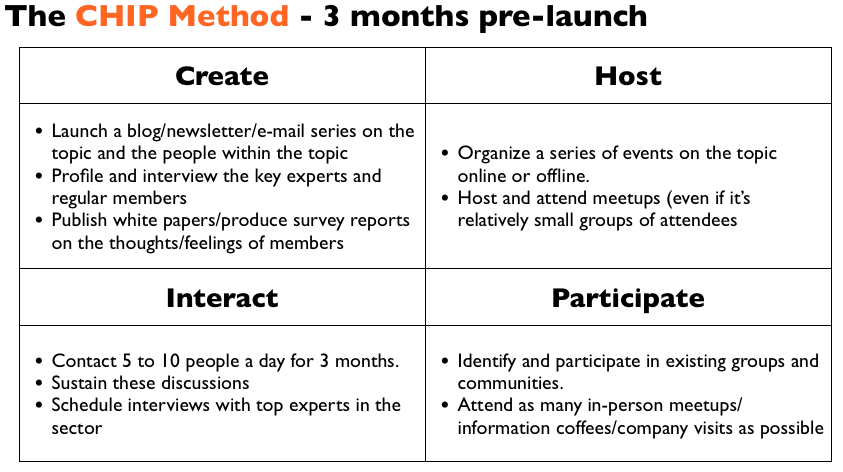
The harder path is to earn the trust of your members through the CHIP process long before you launch a community.

The harder path is to do the research to truly uncover what your audience really need (even the things they can’t articulate) and overdeliver on those needs.

The harder path is to stake out a bold new territory (a unique concept) for the community that is indispensable.

The harder path is to create a community platform designed and managed to achieve your goals, not to sell advertising.

All of this is much harder to do, it takes much longer, but like the albatross taking flight, once it’s in the air it can soar.

Don’t rush it, don’t take the easy path, do the hard work and get it right.

11 Dec 05:14

Winter garden

by Lilia

There is not much to expect in the garden in the winter, I thought. Everything is harvested by now and we have a few months ahead for most of the maintenance jobs (although I know that those months fly very fast).

So, this is what we found:

  • ripe raspberries to eat in beginning of December
  • a raspberry plant with roots going so deep that I stopped trying finding the end of it (raspberry roots usually stay on the surface)
  • a skull of a bird – no idea how did it get there and why we didn’t find any other bones
  • cabbage plant sprouts that look very similar to something that I saw in a supermarket as a “luxury sprouts package” (sometimes I plant things without having an idea what that is)

And all of that on the top of having the kids run around as pirates, having fun of measuring and charting their “treasure island” (those maintanance jobs need planning ;), and the pleasure of being in the sun when the days are becoming shorter and shorter.

The post Winter garden appeared first on Mathemagenic.

11 Dec 05:14

The Road to Racism is Paved with Good Intentions

by jennydavis

A series of studies was just published showing that White Liberals present themselves as less competent when interacting with Black people than when interacting with other White people. This pattern does not emerge among White Conservatives. The authors of the studies, Cynthia H. Dupree (Yale University) and Susan T.  Fiske (Princeton University), refer to this as the “competence downshift” and explain that reliance on racial stereotypes result in patronizing patterns of speech when Liberal Whites engage with a racial outgroup. The original article appears in the journal Personality and Social Psychology. I make the case that these human-based findings have something to tell us about AI and its continued struggle with bigotry. 

Since the article’s publication, the Conservative response has been swift and expected. Holding the report as evidence of White Liberal hypocrisy, a Washington Times story describes how the findings “fly in the face of a standard talking point of the political left,” and a Patriot Post story concludes that “Without even realizing it, ‘woke’ leftists are the ones most guilty of perpetrating the very racial stereotypes they so vehemently condemn.”

Conservative commentators aren’t wrong to call out the racism of White Liberals, nor would White Liberals be justified in coming to their own defense. The data do indeed tell a damning story. However, the data also reveal ingroup racial preference among White Conservatives and an actively unwelcoming interaction style when White Conservatives engage with people of color. In other words, White Conservatives aren’t wrong, they are just racist, too.

Overall, the studies show the insidiousness of racism across ideological bounds. Once racial status processes activate, they inform everyday encounters in ways that are often difficult to detect, and yet have lasting impacts. While White Liberals talk down to Black people in an effort to connect, White Conservatives look down on Black people and would prefer to remain within their own racial group. Neither of these outcomes are good for Black people, and that story is clear.

Racism is rampant across ideological lines. That is the story that the data tell. This story has implications beyond the laboratory settings in which the data were collected.  I think one of those implications has to do with AI. Namely, the findings tell us something insightful about how and why AI keeps being accidentally racist (and sexist/homophobic/classist/generally bigoted), despite continued efforts and promises to rectify such issues. .

The tales of problematic AI are regular and fast-coming. Facial recognition software that misidentifies people of color; job advertisements that show women lower paying gigs; welfare algorithms that punish poverty; and search platforms that rely on raced and gendered stereotypes. I could go on.

The AI bigotry problem is easy to identify and diagnose, but the findings of the above study show that it is especially tricky—though not impossible—to resolve. AI comes out prejudice because society is prejudice. AI is made by people who live in society, trained by data that comes from society, and deployed through culturally entrenched social systems. AI hardware and software are thus bound to pick up and enact the status structures that govern human social relations. The problem isn’t so much with faulty technology, but with historically ingrained “isms” that have become so normative they disappear from conscious thought until Surprise! Gmail autocomplete assumes investors are men.  These #AIFails are like an embarrassing super power which renders invisible inequalities hyper-visible and blatantly clear.

The oft proposed solution—besides technical fixes—has been a call for a more critical lens in the tech sector. This means collaboration between technologists and critical social thinkers such that technological design can better attend to and account for the complexities of social life, including issues of power, status, and intersecting oppressions.

The solution of a critical lens, however, is somewhat undermined by Dupree and Fiske’s findings. One of the main reasons the authors give for the competence downshift is White Liberals’ disproportionate desire to engage with racial minorities and their concern that racial minorities will find White Liberals racist. That is, Liberal Whites wanted to reach across race lines, and they were aware of how their Whiteness can trouble interracial interaction. This is a solid critical starting point, one I imagine most progressive thinkers would hope for among people who build AI. And yet, it was this exact critical position that created racist interaction patterns.

When White Liberals interacted with Black people in Dupree and Fiske’s studies, they activated stereotypes along with an understanding of their own positionality. This combination resulted in “talking down” to people in a racial outgroup. In short, White Liberals weren’t racist despite their best intentions and critical toolbox, but because of them. If racism is so insidious in humans, how can we expect machines, made by humans, to be better?

One pathway is simple: diversify the tech field and check all products rigorously and empirically against a critical standard. The standpoint of technologists matter. An overly White, male, hetero field promises a racist, sexist, heteronormative result. A race-gender diverse field is better. Social scientists can help, too. Social scientists are trained in detecting otherwise imperceptible patterns. We take a lot of methods classes just for this purpose, and pair those methods with years of theory training. A critical lens is not enough. It never will be. It can, however, be a tool that intersects with diverse standpoints and rigorous social science. AI will still surprise us in unflattering and perhaps devastating ways, but critical awareness and a firm directive to“stop being racist,” can’t be the simple solution.


Jenny Davis is on Twitter @Jenny_L_Davis

Headline pic via: Source

11 Dec 05:13

Apple Publishes ‘Best of 2018’ Lists for Apps, Music, Books, and More

by Ryan Christoffel

Apple today published its picks for the best media in 2018 across its various platforms and services. These include selections for best app on iPhone, iPad, Mac, and Apple TV, as well as top picks in categories of music, TV and movies, podcasts, and books. Alongside these editorial selections, Apple has published top charts for the year across the App Store, Apple Music, Apple Podcasts, and Apple Books.

Apple's pick for the iPhone's App of the Year is Procreate Pocket, the phone-sized version of the iPad's Procreate sketching app. The selection should come as no surprise because according to Apple's top apps charts, Procreate for iPad was the best selling iOS app of the year.

The winner of iPhone Game of the Year is Donut County, a story-driven physics and puzzle game where you play as an ever-growing hole in the ground, sucking in objects to solve each puzzle. The game features a fun combination of innovative play mechanics, beautiful visuals, and a zany world to play in. If you're interested in learning more, our John Voorhees reviewed the Mac version of the game earlier this year.

Perhaps unsurprisingly, the iPad selection for App of the Year is an AR-powered education app, Froggipedia; iPad Game of the Year honors went to Gorogoa, a puzzle game where you re-arrange beautifully illustrated panels to combine them in just the right way. On the Mac, Pixelmator Pro was named App of the Year, and the Game of the Year is The Gardens Between. The Apple TV's App and Game of the Year, respectively, are Sweat and Alto's Odyssey. Finally, signaling perhaps its status as the most destitute of app platforms, the Apple Watch didn't receive its own App and Game of the Year, but instead Apple's editorial team assembled a single list of their favorite Watch apps, which includes a mix of self-care and activity apps alongside excellent utilities like CARROT Weather, Overcast, and Just Press Record.

Rounding out the category of apps, Apple highlighted two major trends on the App Store in 2018. The App Trend of the Year was Self-Care, with Apple featuring apps focused on motivation, meditation, and self-coaching. The Game Trend of the Year was Battle Royale, driven by the popularity of Fortnite and PUBG.

The App Store is but one of many media sources on Apple platforms, so the company has also made editorial selections for things like best music, podcasts, books, TV, and movies of the year. Drake was named Apple Music's Artist of the Year, while Song of the Year and Album of the Year honors went to I Like It by Cardi B and Golden Hour by Kacey Musgraves, respectively. Book of the Year was awarded to Tayari Jones' An American Marriage. Rather than singling out individual winners, in the categories of podcasts, TV shows, and movies Apple simply highlighted a variety of its favorites. The full lists for all 2018 picks are available in Apple's press release, or they can be found by visiting the iOS Music, Podcasts, Books, TV, or iTunes Store apps.

If you'd like to browse the top charts for the year, you can find them at the links below:


Support MacStories Directly

Club MacStories offers exclusive access to extra MacStories content, delivered every week; it's also a way to support us directly.

Club MacStories will help you discover the best apps for your devices and get the most out of your iPhone, iPad, and Mac. Plus, it's made in Italy.

Join Now
11 Dec 05:13

Omni to Offer Optional Subscriptions to OmniFocus and Its Upcoming Web Service

by John Voorhees

Next month, OmniFocus for the Web will launch as a subscription service for $4.99/month or $49.99 annually. In a post on The Omni Group blog, Ken Case explains that the subscription is necessary to pay the ongoing costs of the web-based version of the popular task manager:

Running it on our computers means we have to maintain those computers, their network connections, power, and so on, as a constantly available online service, for as long as customers use the product. Running that service costs us money every month, so if we want the service to be sustainable we need an income stream which brings in money every month to cover those costs. In other words, this service model requires subscriptions—an arrangement where customers pay us money each month to keep the service going.

In addition to offering a subscription to the web version of OmniFocus, Omni will offer the Pro versions of OmniFocus for iOS and the Mac as a bundle with the web version for $9.99/month or $99.99 annually. As Case further explains, the subscription is entirely optional. The Omni Group will continue to offer its iOS and Mac apps as separate purchases as it does now.

When a historically paid-up-front app introduces subscription pricing, there’s usually an online dustup of unhappy customers who don’t want to subscribe to the apps they use. Although Omni’s announcement was met with a handful of angry tweets, the reaction has been notably muted, which makes sense because the subscription isn’t required. Users who have already purchased the apps can subscribe to just the web service or subscribe to the service plus the apps. The only combination that doesn’t appear to be possible is subscribing to just the iOS and Mac apps.

Adding subscriptions as an option adds complexity to OmniFocus’ business model, but the upside is choice. Instead of migrating its entire user-base to subscriptions, customers can keep using OmniFocus the way they already do. They also gain the option to subscribe to OmniFocus for the Web when it becomes available in January. The approach strikes me as the right balance for an app like OmniFocus, on which users have relied since the earliest days of the App Store.

→ Source: omnigroup.com

11 Dec 05:11

Is a family-friendly Tumblr possible?

by Josh Bernoff

Starting on December 17, the social media site Tumblr will implement new rules to block adult content. But defining obscenity hasn’t gotten any easier . . . and this was one of the most nudity- and pornography-tolerant social networks out there. This odd choice will spectacularly destroy Tumblr, and reveal once again how platforms always … Continued

The post Is a family-friendly Tumblr possible? appeared first on without bullshit.

11 Dec 05:11

Conversation and Silence, Part Two

by Dave Pollard

This is the second part of a two-part post; part one is here.

(photo of Killarney Lake by fellow Bowen Islander Jason Wilde)

If I stay here long enough
I will learn the art of silence.
When I have given up words
I will become what I have to say.

— Richard Shelton, Desert

Conversation, in the rare cases when it brings to the table the attributes I described in the first part of this article, can at least succeed at surfacing insights, helping us see different perspectives, attaining consensus on decisions, and helping to resolve conflicts. But when the necessary attributes for effective conversation are not present, or when the objective of talking is not one of these four purposes, I would argue that talking is pretty much a waste of time, and silence would be a better prescription.

But how, you might ask, can anyone advocate for silence when it is so often the handmaiden of abuse, oppression, patriarchy, enslavement, corpocracy, and desolation?

When these atrocities happen we must of course give voice to calling them out, stopping them, and condemning them. Although silence is not their cause, it is complicit in their continuation. Inequality of wealth and power, patriarchy, stress-induced psychopathy, and our obsession with ‘privacy’ and secrecy allow outrages to be perpetrated, shielded from our awareness, and covered up. These are the fall-out of our collapsing, exhausted, well-intentioned civilization, and I don’t believe we can ‘fix’ them until this terrible, unsustainable civilization has breathed its last — which won’t be long now.

Calling them out, naming them for what they are, and refusing to condone them, however, is done through exposition, not conversation. There is no decision, no consensus needed to make it clear that these outrages are not acceptable and must stop. Exposition — the stories of those who have suffered, the calling to account, the understanding of what has allowed this to occur and how to prevent its recurrence — these are not matters for deliberation, but for obvious action. In this, we may not always succeed, but we can never remain silent.

But only a tiny proportion of the massive firehose of talk that pervades our dying culture has anything to do with calling to account, or with real conversation as I defined it in part one of this article. Almost all of it, I’m coming to believe, is just noise, the wail of a species endlessly lamenting its unhappiness and its incapacity. What purpose does any of it serve? It fails to make us feel better, or even feel heard. It fails to bring about any real change, only hopelessness and helplessness and useless rage. It fails to inform, only to inflame, to deceive, to excuse.

I am lying on the beach, basking in the warmth, listening to the ocean, watching the birds, feeling the breeze, smelling the earth after a brief rain. Here, now, is a moment without the need for thought, for reactive emotions, for seeming actions. It is a time for love, for sensation, for joy, for paying attention, for play, for just being. Of course I could be doing something more ‘productive’, more directed at making something better. But I am no longer sure I believe that productivity and striving to make things better actually accomplishes anything, or at least nothing that lasts for long. Change happens when the generations attached to old ways of doing things die, and new generations, with somewhat different conditioning, take their place.

I listen to the supposed conversations of the other beach-goers. The conversations are vapid, meaningless, banal, unnecessary. They are about consumer decisions, unactionable news (political, economic, sports, weather), what someone supposedly did or said or should do or should have done or wants to do. They seek (with quiet or not-so-quiet desperation) reassurance, appreciation, attention, relief from the gnawing sense that something is not quite right, that they are somehow not quite right, not enough, missing something, all alone, owed something, needing something.

They — and all of us — are striving to heal ourselves from civilization disease. But words aren’t the path to healing; they just take us further inside our heads, inside ourselves where the disease lives. We find true healing in love, in laughter, in eating well, in exercise — and in silence, in paying attention without judgement, without evaluating, without expectation, without trying to ‘make sense’. Without thought, and its noisy partner, language, rehashing and second-guessing and re-living and lamenting a fictional past and dreading a fictional future. When it comes to our selves’ endless and incurable bent for suffering, words don’t help.

I don’t buy the hackneyed CBT/mindfulness/12-step orthodoxy that claims that by changing our thinking we can change ourselves, ‘re-program’ ourselves. There is no credible evidence that these acts of wishful thinking work. Wild creatures don’t need language to heal from their disturbing experiences, their tragic lives. Their therapy is wordless, silent, and it actually works.

I smile at those sitting or walking on the beach who have the good sense to just be silent, to just take in the mystery and wonder of everything just as it is. To notice, to pay attention, to stop thinking and reacting and judging and just open themselves to perceiving, sensing, being a part of all that is. And admittedly it is easier here on a quiet tropical beach with the surf pounding in than amidst the terrible knowledge of cities.

I smile at them. I salute them. If only for a moment they are, like me, beginning to begin to learn the humbling art of silence.

Of course silence is terrifying to those who have not learned the comfort and joy it offers. So many people have to fill the emptiness and pain inside with noise, with distraction, with entertainment, with anything that will help them even for a little while avoid the terrible feelings of hopelessness, of shame, of emptiness, of grief, of helpless rage, of terror and dread and regret that otherwise consume their waking hours. Silence is not for everyone, at least not until they have come to grips with the incurability of civilization disease.

And this is not to say there is no place for prose in our world. While it is should not presume to be conversation, thoughtful and well-crafted and non-manipulative writing, music, stories, poetry, films and videos, and other expository compositions (even blog articles) can, unlike twitter or facebook or texting or telephone blather, move us. Rather than taking us deeper into our heads and triggering our reactive emotions, such compositions can take us outside the suffocating default pathways of the brain and to other places, other ways of being.

So give me that rare creature, an excellent, purposeful conversation, or give me a composition that transports me, delights, fills me with possibility, or scream out your truth that shines a light on a terrible and outrageous reality. But if you have something else to say, fellow humans, please, for everyone’s benefit, just STFU, and give yourself, and all of us, the gift of silence.

11 Dec 05:11

Aggregators and Jobs-to-be-Done

by Ben Thompson

There were two developments in the scooter space over the last week. First, Bird announced the Bird Platform for entrepreneurs to start their own scooter services; from TechCrunch:

The company will provide the independent operators with scooters, which they are given free rein to brand as they please, as well as access to the company’s marketplace of chargers and mechanics, in exchange for 20 percent of the cost of each ride. Bird says fleet managers, which may be independent entrepreneurs or local mom and pop bike rental shops, for example, can also collect and charge the scooters themselves.

There is an optimistic view of Bird Platform: fleet operators on the Bird platform will allow the company to expand more rapidly than it would otherwise, even while Bird continues to (mostly) own the customer relationship (fleet operators will get their own app, but scooters will also appear in the Bird app). There is also a pessimistic view: Bird is offloading the risk involved in owning and managing scooters because their costs are unsustainably high, and moats unsustainably shallow.

Then, a few days later, The Information reported that Uber was exploring the possibility of buying either Bird or Lime, their primary competitor:

Uber, which already holds a minority stake in Lime, is evaluating both Bird and Lime as it looks to expand further into the fast-growing market for electric scooter services. A deal with either Bird or Lime could be reached before the end of the year, one of the people said, though there still is a possibility neither will happen. While financial terms of the talks couldn’t be learned, Bird was valued at $2 billion in its previous fundraising round, while Lime’s last valuation was $1.1 billion. Both have also been trying to raise more money at much higher valuations in recent months.

There are still big questions about the financial viability of scooter rental services. For ride-hailing companies, the hope is that they and bike-rental services can be used to handle shorter trips in dense cities, though it is possible they could eat into their core car-based businesses.

Once again, there are two ways to view this news; start with the pessimistic take in The Information (later reported by the Financial Times): dockless scooters are eating into traditional ride-sharing, which means Uber is interested in buying one of the leading scooter-sharing companies so that the company is at least cannibalizing itself. More optimistically, Uber is where scooter-sharing should have been all along.

Uber’s Job-to-be-Done

Theodore Levitt, the former Harvard Business School professor and editor of the Harvard Business Review, famously said “People don’t want to buy a quarter-inch drill. They want a quarter-inch hole.” The idea, which is at the core of well-known innovation frameworks like Outcome-Driven Innovation and Jobs-to-be-Done, is that effective customer segmentation relies not on easily measurable attributes like demographics or location — much less product features and prices — but rather on a deeper understanding of what the consumer is trying to accomplish.

With this approach it quickly becomes obvious that, for all of the differences in their underlying businesses, Uber and the scooter companies are doing the same “job”: transporting users to a desired destination. Sure, the means are different — human-driven cars versus dockless scooters — which trickles down into the core mechanics and defensibility of their business models, but customers don’t care about all that: they just want to get to where they want to be.

There was a time when the customer’s point of view might not have mattered quite so much; it used to be the case that success depended on controlling the supply of a good or service, or owning the distribution channels through which goods or services flow. The difference with the Internet — and it is a difference that, thanks to smartphones, very much affects real world goods like cars and scooters — is that goods and services can, at least in theory, reach anyone. Distribution is free, and in markets where supply is plentiful, value accrues to the companies that own demand — that is, those that have the most end users thanks to their superior user experience; I call them Aggregators.

Aggregators and the User Experience

I mentioned the importance of the user experience in my original formulation of Aggregation Theory:

The fundamental disruption of the Internet has been to turn this dynamic on its head. First, the Internet has made distribution (of digital goods) free, neutralizing the advantage that pre-Internet distributors leveraged to integrate with suppliers. Secondly, the Internet has made transaction costs zero, making it viable for a distributor to integrate forward with end users/consumers at scale.

This has fundamentally changed the plane of competition: no longer do distributors compete based upon exclusive supplier relationships, with consumers/users an afterthought. Instead, suppliers can be commoditized leaving consumers/users as a first order priority. By extension, this means that the most important factor determining success is the user experience: the best distributors/aggregators/market-makers win by providing the best experience, which earns them the most consumers/users, which attracts the most suppliers, which enhances the user experience in a virtuous cycle.

What, though, makes for a good user experience? I have always been careful to distinguish between user interface and user experience: for example, many people find Facebook’s user interface to be confusing, but that is only one aspect of the user experience; another aspect is whether or not your friends or family are on the service, and here Facebook’s overall user experience is very strong indeed.

This distinction underscores the importance of the virtuous cycle characteristic of all Aggregators: new suppliers — whether they be drivers on Uber, products on Amazon, content on Google or Facebook, shows on Netflix, apps on the App Store, etc. — attracted to the platform by the existing userbase enhance the user experience, even though have nothing to do with the user interface. Still, the user experience of what?

Here the question of Uber and scooters perhaps provides some insight: the “user experience” for Uber is just how well the service does at transporting people where they wish to go. Along those lines, think about the virtuous cycle I’ve described between supply and demand and its impact on the user experience: the more riders there are, the more drivers come onto the platform (both in the short-term through higher prices and the long-term through reliable demand); the more drivers there are, the more reliable Uber is as a transportation service, increasing demand, and so it goes.

Note, then, the similarities between my summary of the Uber user experience — how well the service does at transporting people where they wish to go — and my earlier description of the “job” that Uber does — transporting users to a desired destination. In short, the “user experience” that propels Aggregators is how well they do the “job” customers need in the space in which they compete. Or, to put it another way, if you want to know where in a value chain an Aggregator is likely to form, figure out what and where the “job” is.

Aggregators and Jobs-to-be-Done

Consider examples from Aggregators of all types:

  • Google is the best at doing the job of answering questions; that is how they gained their initial userbase, which attracted content suppliers of all types to formulate their content for Google, making Google even better at its job. Indeed, when it comes to answering questions, it is striking the degree to which Google has improved not simply in general queries but also in vertically-specific ones, thanks in large part to content suppliers willingly tuning their content to Google’s specifications.
  • Facebook started as the best place to find your friends and family, but, over time, evolved into being the best place to waste time. The former created an obvious virtuous cycle — more friends and family meant more users meant more friends and family — but so did the latter: more users meant more content suppliers eager for eyeballs, which made it that much more alluring a place to waste time, and for longer (some call this engagement).
  • Amazon is the best place to buy things; the company famously started by having more books than anyone, which attracted customers, which made it possible for the company to offer more products, and later merchants, which attracted more customers, eventually evolving into the hybrid store/merchant platform that Amazon.com is today.
  • Netflix is the best place to watch TV. The company gained its initial streaming userbase by licensing Starz’ 11,000 title movie library; while Starz’ effective library size was one (whatever was showing on the Starz channel), Netflix’s was 11,000. That attracted users, which gave Netflix the funding (and prospect for future funding, realized through debt) to buy more shows, attracting more users, providing funding to eventually make their own shows, attracting more users still.
  • YouTube is the best place to find video content about basically anything (for better or worse); the site started by being the only online video site willing to show copyrighted material, which attracted users, which attracted more video makers, and eventually, copyright owners themselves.

All of these jobs are quite straightforward and understandable: answer questions, waste time, buy things, watch TV, find videos; the Aggregators are the ones that do the job the best, both initially through some valuable insight, technical (Google) or otherwise (Facebook), and presently thanks to the virtuous cycle that followed. The user experience is the quality of the job done.

The Expansionary Nature of Aggregators

To return to Uber, this formulation argues strongly for the sort of acquisition under discussion: a car isn’t always the best means of transportation, which means that Uber is not doing the job customers ask it as well as it can. And, on the flipside, a scooter company on its own doesn’t exactly fit the bill either; add in the fundamental indefensibility of dockless scooters and Uber’s very large userbase looks like a truly differentiating asset.1

Another company worth considering is Airbnb: the home-sharing startup has resolutely stuck to, well, shared homes. One wonders, though, if “find a shared home” is the job customers are asking Airbnb to do; I suspect the better answer is “find a place to stay.” Doing that job well, though, means including hotels in Airbnb’s listings, a step the company has so far declined to make at scale.2 I can understand the reticence: shared homes are what the service is known for; then again, Uber was once thought of as being for black cars, and Amazon for books.

More generally, that virtuous cycle characteristic of Aggregators, where more users attract more suppliers which attract more users, is likely most important in terms of the breadth with which a job is done. By doing more of a job, an Aggregator attracts more marginal users, which attract more suppliers on the edges of a space, which expands what jobs can be done for what users. In concrete terms, Amazon started by selling things to book buyers, then expanded to selling things to CD buyers, until it now sells everything to everyone; the job-to-be-done, though, was only ever selling things.

This helps explain why it is there are a few large companies that dominate their space: Aggregators don’t simply get better at what they were already good at, they expand their purview into the broadest possible definition of their job. Google, for example, was once thought to be under threat by vertical search alternatives; it turns out vertical search alternatives were under threat by an expansionary Google. The only exception is shopping and Amazon, but frankly, that is a different job anyways; it seems job-to-be-done defines not only the aggregation opportunity, but its limit as well.

I wrote a follow-up to this article in this Daily Update.

  1. Of course, lots of deals that make sense don’t happen, and this one, thanks to the sky-high valuations of both Uber and the scooter companies, will be particularly challenging
  2. The company has added some boutique hotels
11 Dec 04:12

Enough of cars... Overuse of motorized transport is destroying everything.

by David Hembrow
Le Curé: "I don't like cars". Three months ago our car reached the end of its economical life and we took it to be scrapped. I'm not missing it. I never used it much anyway. When we first moved to the Netherlands we brought our car with us from the UK but after we arrived it didn't move a single centimetre until more than three years had passed and we finally got around to registering and
11 Dec 04:11

Heatmaps of Mortality Rates

by Kieran Healy

As part of the run-up to the release of Data Visualization (out in about ten days! Currently 30% off on Amazon!), I’ve been playing with graphing different kinds of data. One great source of rich time-series data is mortality.org, which hosts a collection of standardized demographic data for a large number of countries. Mortality rates are often interesting to look at as a heatmap, as we get data for a series of ages (e.g., mortality rates) over some time period. If we make a grid with time on the x-axis and age on the y-axis, we can fill in the boxes with a color representing the rate. A side-effect of that sort of representation is that the diagonals track age cohorts from the bottom left to the upper right of the graph, as people age at the rate of one year per year.

Available mortality data for England and Wales runs back to 1841. Here’s sample code for a plot of that for males:


p <- ggplot(subset(britain, age < 101), aes(x = year, y = age, fill = ntile(male, 100)))
p_out <- p + geom_raster() +
    scale_fill_viridis_c(option = "A", direction = -1) +
    scale_x_continuous(breaks = seq(1845, 2015, by = 15)) +
    ylim(c(0, 100)) +
    guides(fill = guide_legend(nrow = 1, title.position = "top", label.position = "bottom")) +
    labs(x = "Year", y = "Age", fill = "Male Death Rate Percentile",
         title = "Male Mortality Rates in England and Wales, 1841-2016",
         subtitle = "Binned by percentile",
         caption = "@kjhealy / http://socviz.co. Data: Human Mortality Database.") +
    theme(legend.position = "top",
          legend.title = element_text(size = 8))

p_out
ggsave("figures/britain_men.png", p_out, height = 9, width = 10)
ggsave("figures/britain_men.pdf", p_out, height = 9, width = 10)


You can look at the full code on GitHub.

Here’s the figure for both males and females:

Mortality rates in England and Wales, 1841-2016, binned by percentile.

Mortality rates in England and Wales, 1841-2016, binned by percentile.

A higher resolution PDF is also available.

The devastating impact of the First and Second World Wars is immediately evident in the graph for males. The Influenza epidemic of 1918 is also clearly visible (most obviously in the female graph). Meanwhile other patterns are also clear, most notably declining infant mortality and increasing life expectancy. The remarkable effect of improved health care after WWII is especially striking. It also brings out some residual differences for men as they enter adulthood and are more likely to die than women of the same age, mostly due to their higher rate of death from accidents of various kinds. We can also make out some apparent cohort effects along the diagonals, notably starting with those born in 1918. They remained at a higher risk of death for their whole lives. (At the same time, it’s also possible that some of these are due to recording errors—especially for earlier years, and in cases where they coincide with rounded decades.)

The data for France go back even further, and we have a full two centuries from 1816 to 2016. Here’s what that looks like.

Mortality rates in France, 1816-2016,

Mortality rates in France, 1816-2016,

Again, a higher resolution PDF is also available. As with the data for England and Wales, you can see the large effects of wars and epidemics, the decline in infant mortality, and the increase in life expectancy (especially after WWII). The French series also seems to show stronger cohort effects, especially in the 19th century. Notably, I think you can make out (slightly different) diagonals for both men and women that would, if we had the data, intersect the x-axis between around 1789 and 1800, suggesting there were cohort mortality effects for being born during the period of the Revolution and the Terror.

The graphs were made using R and ggplot, of course. I quickly stuck them together in Illustrator (which I wouldn’t do normally, but I was using it for other reasons). Note that there are a few decisions lurking in the background about how to represent the data. If you plot the raw mortality rates, what you’ll find is that the wars tend to drown out all the other data in the series, washing out the other trends. There are various ways to approach this, such as logging the rates. In the end I binned the death rates into percentiles as a compromise. But there are other choices one could make here. The palette is the “Magma” variant of the viridis scale—the latter now comes conveniently built-in to the most recent major version of ggplot.

11 Dec 04:10

Cycle 2: Nov blood test results – Cancer levels dropped again

by tyfn

I’m happy to announce that my Nov blood test results show my cancer levels (m protein) have decreased from 27 four weeks ago (Late Oct results) to 11 now (Nov results). This is pretty cool and means that my chemo is still effective in fighting my cancer.

I’m really excited to see what this month’s results will be like. Over the last week I’m also pleased to share that I haven’t felt as fatigued nor has my stomach felt bloated (caused by dexamethasone), which is a common issue.

My Port is working great with my IV chemo and I haven’t had any adversity. After a week off from chemo (Cycle 2 Week 4), I’ll start Cycle 3 later in the week.

M protein (g/L) (0 = no cancer detected)
Nov = 11
Late Oct = 27 (1st test after started Kyprolis IV chemo)
Early Oct = 48
Sept = 41
Aug = between 37 and 38
July = between 31 and 32
June = 25

Trending in the right direction!

Cycle 2: Nov blood test results - Cancer levels dropped again

Photo: My body temperature is lower due to long term chemo treatment, so I’m always feeling cold. Thankfully there is a heater in my room to keep me warm.

Weekly chemo-inspired self-portraits can be viewed in my flickr album.

I have multiple myeloma and anemia, a rare cancer of the immune system. Multiple myeloma affects the plasma cells, a type of immune cell that produces antibodies to fight infection. These plasma cells are found in the bone marrow. As a blood cancer, it is incurable, but treatable.

Since mid-October, I’m being treated with Kyprolis (carfilzomib), an IV chemo, Cyclophosphamide, and dexamethasone.

Vanier Park @ Kitsilano - Vancouver, BC

The post Cycle 2: Nov blood test results – Cancer levels dropped again appeared first on Fade to Play.

11 Dec 04:10

Lee at 2

Man, it’s been a year since I last wrote to you. It wasn’t a mistake, it was intentional. I don’t want to bore you with so much, my hope is that these letters will be meaningful to you in the years to come and they will provide a good backstory as to how we all got here.

First, I have to apologize, it 3:56AM PST, I should have taken my time to write you something worthwhile like the king that you are instead of hurriedly putting this together. My sincere apologies. This week has been interesting. I will explain to you when I think you’re old enough to understand.

So, what’s up? It’s been a year and a lot has happened. For starters, your footsteps are a lot stronger. Your gait is firm and steady. Last year this time, you could barely stand by yourself. Today, I have to chase you around the house and make you sit still. Boy, you run pretty fast and man, you’re a handful and I love it.

Your meals are different now. You demolish a plate of garri and okro. You still eat processed food though, but your garri expertise is second to none. You’re a true son of the soil, a true son of his father. Did I also mention your teeth are all coming together? This time last year you’d masticate your food with your gum. How time flies.

So now that you’re two, I have to tell you, you’re growing up quite quickly and I need to prepare your mind for what’s to come. Let’s begin with your sleeping habit, you will have to go to bed earlier now. Yes, you have to. Your 1AM - 10AM sleeping pattern has got to change. You will have to sleep by 8PM and wake by 7AM. You need to start acting responsibly now.

You will need to move into your own room, oh, this one has to happen. Enough of struggling our bed space. We are not done yet, you are going to school too. You know what this means? You will become busy; assignments, cultural day activities, studying and meeting new people. I love the last bit, the people you will meet in this phase of your life may end up becoming lifelong buddies. While I am super excited about this schooling bit, I am worried I may miss some of your school activities; sports day, PTA, etc. But as long as time and chance permits, I’ll attend every single one of them.

You will also begin a form of physical sports, we will begin with swimming. So, starting next year, we are going for swim lessons together. You see that car seat you very much hate? I have got news for you buddy, you’re so sitting on it all by yourself. No one is ever carrying you again. Don’t even argue or throw tantrums, you’re becoming an adult and adulthood comes with responsibilities. Chin up and deal with it.

We are going to start earnest potty training too. I take responsibility for this one. I should have started you a lot earlier, nonetheless, you are going to start pooing like the grown-up that you are. Welcome to adulthood, son.

We will have a more frequent father and son time now. The very moment you can string words together, bro, we are hitting the streets together. From movie dates to ice cream dates, you name it. We will do everything. Get ready.

I’m going to get you a lot of toys now, like a whole lot of them. My belief is that you’re very much self-aware now and you can appreciate these things. The essence here is to allow you to explore so many things and pretty much begin to form an interest. I am not sure how this is going to go, but fingers crossed.

The last 24 months has been amazing, your mum and I have made our fair share of mistake in trying to raise you, but as I promised you the last time, we always course-correct as fast as possible. It’s stressful and rewarding at the same time. I’ll never trade this experience for anything. If anything, it makes me appreciate your grandparents more. How in God’s name did they do all of this and still kept it together?

You have brought so much joy and happiness into our lives. Man, every day with you is a celebration, filled with so many surprises and we are grateful for this. A lot has happened in our own private lives; I changed jobs, I have grown older and I want to believe wiser too. Your mum quit the medical field to go pursue her passion in fashion. As you mumble your daily words, don’t forget to say a prayer for her. All around, there’s been a tremendous growth in every area of our lives.

It hasn’t been all rosy man, we have had our own fair share of struggle. I have made a lot of mistakes this year, like a lot. I have run out of cash many times, like so many times. Those times have been some of the scariest moments because I worry I may not be able to meet up with my responsibilities as a dad. But through it all, God’s been good. How we manage to make it past those moments has been a mystery.

I am so sorry I’m not around to celebrate this special day with you, I’ll definitely make it up to you.

As you go into this next phase of your life, I will repeat the exact same things I said last year;

  1. Work hard. There is absolutely no substitute for this. While there is such a thing as luck, but the harder you work, the luckier you will get. Put in the work.
  2. God. Keep God at the centre of all you do. It’s impossible to go through life without God.
  3. Relationship. This is one of life’s best gifts to us. Keep and maintain a healthy relationship with people. And when you get into one, don’t abuse it. Don’t take undue advantage of it. Seek to contribute more than you take. Don’t become a parasite.
  4. Fairness and Equity. Treat people first as humans, irrespective of their social standing. Be fair and just in all your dealings. Do unto them, what you will like to be done to you. I can’t stress this enough, respect everyone.
  5. Mistakes. There will always be mistakes. You will make them, consciously and unconsciously. But when you make them, learn from the experience and move on. Don’t dwell too much on it. Never accept a pity party. NEVER.
  6. Peer pressure. We will do our best to show you the right way, don’t deviate from it. Don’t let anyone make you do what you know doesn’t align with your values as a person. Be your own man.
  7. Finances. Keep an eye on your finances. Always SAVE. You will always need it.
  8. Emotions. Watch your temperament. I haven’t done much of a great job here myself, but thanks to your mum, I am learning a lot from her. When you get angry, watch what you say. Never let anger get the best of you. There are always consequences when you can’t put your emotions in check.
  9. Passion. Follow your passion, this will be your one true source of happiness.

This last 2 years with you have been super amazing. It still feels like a dream. As always, remember your maker and never forget where you come from. I love you son.

Happy birthday, King. Love, Dad.

11 Dec 04:09

Windows Subsystem For Linux – Part 1 – Remote Stuff

by Martin

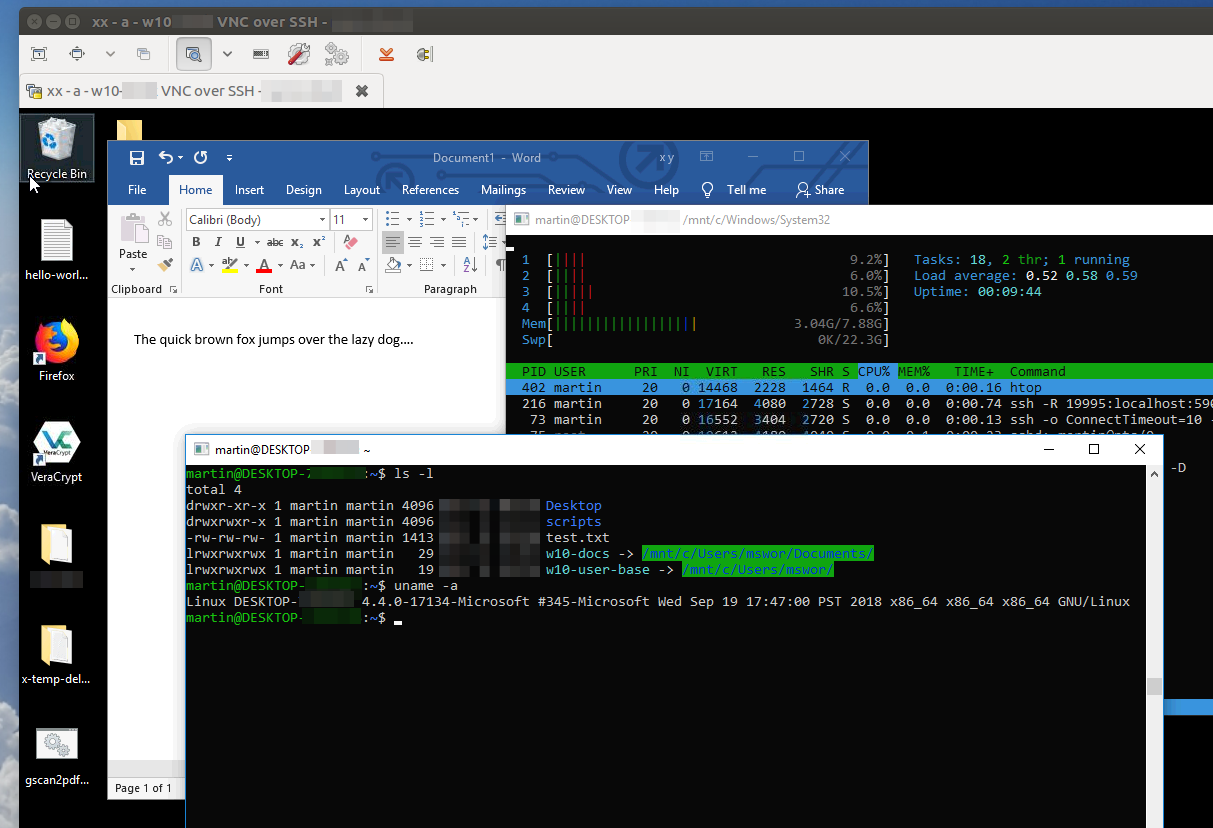
A wild mix of Ubuntu, Windows 10, WSL, TightVNC, Remina, Bash, htop and Word

While all PCs and notebooks I personally own run on Linux, I can still not totally escape Windows on other machines. Apart from not being FOSS, the other thing that bothers me when I have to use or support a Windows machine is that the tools and programs for local and remote maintenance and backup are entirely different. But perhaps there is hope now… In 2016, Microsoft announced what is now known as the ‘Windows Subsystem for Linux‘ or WSL for short, which emulates a Linux kernel API so Linux binaries can run on Windows as well. Kind of a reverse-Wine. So how well does this work and could I use this to remotely administer Windows boxes in the same way as Linux boxes?

I recently tried out WSL to see how far I would get in terms of using the same tools for remote administration as I would for a Linux box and if I could get some graphical Linux programs running on the Windows machine that have no adequate local equivalent. Here’s my result:

Installing the Windows Subsystem for Linux (WSL) is quite straight forward. After activation and reboot one can download an Ubuntu 16.04, 18.04 or other Linux distribution from the Microsoft store. It takes a few minutes to download and install and once done, one can open a bash shell on Windows and things are up and running. The first thing to do then is an ‘apt update && apt upgrade‘ to get the latest updates and to configure a few things that are not part of the Ubuntu image download.

The SSH Server

To securely administer things remotely, I used SSH as my swiss knife and secure transport channel. The first thing I need SSH for is to get a remote shell in which I can use well known Linux command line tools. Like on a real Linux system, the SSH server is installed with an ‘apt install‘ command. Configuration files are where they are supposed to be in ‘/etc/ssh‘. The only thing that has to be configured specifically on the Windows side is the Windows firewall, as by default, it blocks incoming connections to TCP ports. Once that is done, the SSH server is accessible from the outside.

Tunneling the SSH Server Port to Another Machine

In most cases the devices I administer are behind NATs and other nasty network equipment that prevent direct access to the machine. The solution is to use the SSH client software on the remote machine to export the TCP port used by the SSH server over the Internet to a machine in my network. On WSL this workes just as well as it does on a real Linux machine. Nice! In addition to this I use a script that is invoked via crontab every 5 minutes to check if the TCP port tunnel is still up and if not, tries to reestablish it. This requires the cron service which is not started by default in WSL. So I use a ‘sudo service cron start‘ command in .bashrc and a Windows batch file in the Windows autostart folder to open a bash shell when the user first logs in.  A crude hack but it works. I do the same for the ‘rsyslog’ daemon so it generates log files in /var/log/syslog in WSL. The ssh daemon is started in a similar way. Once the daemons are started, they keep working in the background even if the bash windows are closed.

Remote RSYNC

Another important thing I do over the Internet is to backup remote machines with ‘rsync‘. This requires rsync and sshd on the remote WSL machine and access to the files of the user(s) from the Linux environment. Again, this works nicely as well, as Windows volumes are reachable for Linux programs via ‘/mnt/…‘. A special WSL file system driver is used for this so Linux programs don’t see the partitions as NTFS drives. Very nice!

Remote Screen and Keyboard

Yes, there are services like Teamviewer for exporting the screen over the Internet but I rather like something more FOSS and private. In the past I used TightVNC on Windows for the purpose and it still works very nicely on Windows 10 as well. In the TightVNC Server settings I’ve allowed the use over ‘loopback’ and specifically limited access to TightVNC to the loopback device. I then use ssh to export port 5900 to a machine in my own network. This way I can securely access the screen of the remote machine over an encrypted SSH tunnel while the TCP port used for screen export is not even available in the local network of the device. Works as expected and the screenshot at the beginning of the post shows a wild mix of Ubuntu, Windows 10, WSL, TightVNC, Remina, Bash, htop and Word. You figure out what runs on what.

Summary

I’m impressed, Windows Subsystem For Linux allows me to remotely access, administer and support Windows machines in exactly the same way as I would a remote Linux box. Screen sharing works and even backing up the computer over rsync works out of the box.

So much for today. In a follow up post I will have a look at how to use graphical Linux programs on a Windows box for which there is no reasonable native alternative.

11 Dec 04:09

Read This

by Richard Millington

Trust me, you will learn more about communities this week reading this article than any other.

https://journals.sagepub.com/doi/pdf/10.1177/2056305118815908

It’s an academic article, but far more readable than most.

Don’t worry about the complicated methodology, just take 20 to 30 minutes to read the background, read the analysis, read the results.

I don’t think anything has so closely reflected our experiences in building communities for clients over the years.

Read it.

11 Dec 04:07

Custom Notebooks

by Thejesh GN

I love notebooks. Since school days I have been fan of pocket-able notebooks. The one’s that reporters use. When I was in school I used carry empty prescription pads of my dad 1. I loved them because they used to fit well in my pocket. When I started working I moved to bigger notebooks. But now I am moving back to small pocket-able notebooks again.

Examples of ISO/IEC 7810 Credit: Wikimedia

Examples of ISO/IEC 7810
Credit: Wikimedia


The biggest reason is the fear of losing them. Big books have a lot of stuff in them. When I lose them I lose a lot. Sometimes a year’s worth of work. Small notebooks makes that fear go away. Also small notebooks are easy to carry wherever I go. You don’t need a bag or purse to carry them. But this time I spent more time deciding on the size and format than last time. I figured “passport size” was the best size. It was the result of me cleaning my table drawer and finding passport holders. Size of passports are a standard across the world, its pocket-able and you get lots of accessories. I was kicked by this discovery but soon I figured others have done it too 2. Well I was still kicked, because this time I was going to make my own notebooks.

First I got one of the regular small books and cut it to the size of passport (brown one) and tried. It fits well and looked like what I wanted. Next step was to make my own. I used four sheets of A4. Folded them into half and cut them. So it gave 8 sheets. Folded 8 sheets into half. Put staple pins. For outer cover I used a white think paper sheet from some packaging. Then attached the cover using gum.

Size and format are standardized using ISO/IEC 7810. A physical passport booklet is of ID-3 standard. ID3 defines the size to be 125 mm × 88 mm. This is same as B7 format. I took the dimensions. Used a cutter and cut the booklet. Then I used a corner punch to get 4 mm rounded corner. Voila I have a new notebook.

I have attached the external wrapper and stuck it using gum. I used standard cutter and steel scale  to cut the notebook.

I have attached the external wrapper and stuck it using gum. I used standard cutter and steel scale to cut the notebook.

Two such books can also be added to the same same spine using elastic bands.

Two such books can also be added to the same same spine using elastic bands.

Made by me

Made by me

You can carry single booklets. They are good to go. But the best part is to carry multiple booklets together or making the booklet part of your passport holder. That way if you are working on multiple projects you can carry multiple notebooks or use the notebook as a travelers notebook attached to passport. For this I used a black hairband. Put the hairband at the center of passport holder or one of the notebook length wise. Then pass another notebook through it. Have a look at the pictures below. Make sure band is not very tight or it might hurt the notebook. This is some what similar to Midori notebook setup.

Passport and Notebook. They go well together.

Passport and Notebook. They go well together.

Attaching the notebook to passport holder is easy using an elastic band.

Attaching the notebook to passport holder is easy using an elastic band.

Your side covers are still usable. In fact you can buy a second passport holder just as a notebook holder.

Your side covers are still usable.

What else can I do? I am planning to make some covers/holders using tetra packs and rubber bands. I am still trying various designs. I will update once I am confident. Until then happy note-taking.

  1. They were plain ones without his name
  2. Midori Traveler’s Notebook Passport. I bought one as well.
11 Dec 04:05

November in review: transitions

by Lilia

November turned to be a strange month. I went to Moscow for a week, without the kids and, for a first time in many years, without a real to do list. It was good to recharge, reconnect and reconsider.

It was two years since my mother passed away. It is good to feel that transition period of mourning and sorting out all the practical implications is over. Next to all the obvious things this was also about reconsidering my connections with Russia, where she and the appartment where she lived provided a sort of embilical cord for being connected with the family, the country and the culture. It was also about reconsidering what “Russian” in a broad sense do we find important in upbringing and education of our kids and which shapes it should take now.

November was also a month to look deep into the social part of homeschooling and figuring out what do we find important there and what is realistic. As the kids of our homeschooling friends grow there are new priorities and a need to find a new balance between adults and kids in the group. In this respect it was very interesting to dive again into ideas and examples of “unschooling schools”, translating some of the materials of Sudburyschool Hardewijk into Russian, as well as lots of conversations in Russian around it and visiting U.Dacha, a self-directed learning space near Moscow. All of it brings a lot of thinking and has practical implications for shaping learning of our kids and educational initiatives that I want to contribute as a professional.

And, there was also a lot of work on “the professional” behind the scenes. Part of it is diving deep into myself to see what exactly from my past experiences I would like to bring into the world. One line of it is exploring my personal and professional histories from a perspective of 12 archetypes system of Carol S. Pearson. I followed a workshop in Moscow on it and continue to do it online. All of it is still very much “under construction” to write about, but I’m happy to have it as a way to digest the past and to help emergent things to find their place. And then there are more practical things, like getting more involved in a consulting work that Robert does and working on an article together with him.

With travel breaking the month into parts and all the things that bubble inside, it felt that there was hardly anything to write about the kids, which is not true. I’m behind on posting monthly learning highlights summaries, with October almost finished in drafts and September without photos. I don’t expect a full scale November summary to happen. I’ll be brave and write it up 🙂


The post November in review: transitions appeared first on Mathemagenic.

11 Dec 04:04

Drupal's commitment to accessibility

by Dries
A figure opening doors, lit from behind with a bright light.

Last week, WordPress Tavern picked up my blog post about Drupal 8's upcoming Layout Builder.

While I'm grateful that WordPress Tavern covered Drupal's Layout Builder, it is not surprising that the majority of WordPress Tavern's blog post alludes to the potential challenges with accessibility. After all, Gutenberg's lack of accessibility has been a big topic of debate, and a point of frustration in the WordPress community.

I understand why organizations might be tempted to de-prioritize accessibility. Making a complex web application accessible can be a lot of work, and the pressure to ship early can be high.

In the past, I've been tempted to skip accessibility features myself. I believed that because accessibility features benefited a small group of people only, they could come in a follow-up release.

Today, I've come to believe that accessibility is not something you do for a small group of people. Accessibility is about promoting inclusion. When the product you use daily is accessible, it means that we all get to work with a greater number and a greater variety of colleagues. Accessibility benefits everyone.

As you can see in Drupal's Values and Principles, we are committed to building software that everyone can use. Accessibility should always be a priority. Making capabilities like the Layout Builder accessible is core to Drupal's DNA.

Drupal's Values and Principles translate into our development process, as what we call an accessibility gate, where we set a clearly defined "must-have bar". Prioritizing accessibility also means that we commit to trying to iteratively improve accessibility beyond that minimum over time.

Together with the accessibility maintainers, we jointly agreed that:

  1. Our first priority is WCAG 2.0 AA conformance. This means that in order to be released as a stable system, the Layout Builder must reach Level AA conformance with WCAG. Without WCAG 2.0 AA conformance, we won't release a stable version of Layout Builder.
  2. Our next priority is WCAG 2.1 AA conformance. We're thrilled at the greater inclusion provided by these new guidelines, and will strive to achieve as much of it as we can before release. Because these guidelines are still new (formally approved in June 2018), we won't hold up releasing the stable version of Layout Builder on them, but are committed to implementing them as quickly as we're able to, even if some of the items are after initial release.
  3. While WCAG AAA conformance is not something currently being pursued, there are aspects of AAA that we are discussing adopting in the future. For example, the new 2.1 AAA "Animations from Interactions", which can be framed as an achievable design constraint: anywhere an animation is used, we must ensure designs are understandable/operable for those who cannot or choose not to use animations.

Drupal's commitment to accessibility is one of the things that makes Drupal's upcoming Layout Builder special: it will not only bring tremendous and new capabilities to Drupal, it will also do so without excluding a large portion of current and potential users. We all benefit from that!

11 Dec 04:03

Same Old Drupal

by Reverend

I was fielding a ticket today for someone who was having a couple of issues with Drupal 8 after install, namely they were getting a Trusted Host Settings errorHere is the full error that shows up in the admin area:

*Errors found*
Trusted Host Settings –  Not enabled
The trusted_host_patterns setting is not configured in settings.php. This
can lead to security vulnerabilities. It is highly recommended that you
configure this. See Protecting against HTTP HOST Header attacks for more
information.

Being the awesome web hosting support technician that I am, I Googled it for a solution. And after watching the following video from the DrupalTutor I learned a couple of things:

  • This happens in Drupal  8 on install
  • This issue has been happening as far back as 2016
  • The fix is to edit the settings.php file in sites/default after changing permissions and figuring out a pretty hacky solution

The fact that this was happening to folks as soon as they installed the application is insane to me. What could be a worse user experience? Add to that the caching error below, and you have a perfect storm of terrible:

*PHP *
OPcode caching – Not enabled
PHP OPcode caching can improve your site’s performance considerably. It is highly recommended to have OPcache installed on your server.

Fact is PHP OPcode caching is enabled on this server, so you have to once again search the error message and use the fix given in this forum post to get rid of the error. I did not even check to see if they have a visual text editor after resolving these issues because I just didn’t have strength. Really Drupal?

11 Dec 04:03

How to write a book chapter

by Josh Bernoff

I write business books. Every chapter is a 5,000-word package full of stories, detail, statistics, insights, and recommendations. You don’t just sit down and write one of those at random. Here’s what it takes to create one. In the last 10 years I’ve written, cowritten, or ghostwritten six books. Five of them were case-study powered business … Continued

The post How to write a book chapter appeared first on without bullshit.

11 Dec 03:55

2019 Charlottetown Levee Schedule

by peter@rukavina.net (Peter Rukavina)

This is the 2019 levee schedule for New Years Day, January 1, 2019 for Charlottetown and Prince Edward Island.

This is the 14th year I’ve been collating and confirming this information. If you’re new to all of this and want to give it a try, read How to Levee and The Rural Levee Loop Awards 2018. There are 42 levees being held this year, ranging geographically from Tignish to Souris and in scale from a rural community hall to the Confederation Centre of the Arts, with everything in between.

New this year is a column showing whether levees are “all ages” or not, in other words, whether they welcome people who are younger than 19 years old or not.

All levees listed below have been confirmed with organizers. If you have additional levees to add, or changes to the information below, please drop me a line.

Cancellations

The forecast inclement weather may cause some organizers to cancel their events; if you have a cancellation, please email me and I’ll update this list accordingly.

Cancellations received so far:

  • Canoe Cove (email from organizer)
  • PEI Women’s Institute (via CBC Storm Centre)
  • Premier Wade MacLauchlan; postponed until later in January (email from Ronnie McPhee)
  • Town of Cornwall (email from Lori Bingley)
  • Roman Catholic Diocese (via CBC Storm Centre)
  • Town of Stratford (via CBC Storm Centre)
  • St. John’s Lodge No. 1 and Victoria Lodge No. 2 (via CBC Storm Centre)
  • Andrews of Stratford (email from organizer)
  • Seniors Active Living Centre (CBC Storm Centre)
  • Benevolent Irish Society (email from organizer); rescheduled for Sunday, January 6, 2019 from 3:00 to 5:00 p.m.
  • Royal Canadian Legion — Ellerslie (CBC Storm Centre)
  • Copper Bottom (via CBC Storm Centre)
  • Charlottetown Curling Club opening starting at 3:00 p.m.

Show levees that are ages 19+ Show only Charlottetown-area levees

Organization Location Starts Ends ♿ Accessible All Ages
Timothy’s World Coffee/Anne & Gilbert, The Musical Timothy’s World Coffee
154 Great George Street, Charlottetown, PE
8:00 AM 10:00 AM Yes Yes
The Guild The Guild
111 Queen Street, Charlottetown, PE
9:00 AM 10:30 AM Yes Yes
Lieutenant Governor Government House
1 Terry Fox Drive, Charlottetown, PE
10:00 AM 11:30 AM Yes Yes
Silver Fox Curling and Yacht Club Silver Fox Curling and Yacht Club
110 Water Street, Summerside, PE
10:00 AM 12:00 PM Yes No
Upstreet Craft Brewing Upstreet Craft Brewing
41 Allen St, Charlottetown, PE
10:00 AM 10:00 PM Yes Yes
Mayor of Charlottetown Charlottetown City Hall
199 Queen St, Charlottetown, PE
10:30 AM 12:00 PM Yes Yes
PEI Women’s Institute Farm Centre
420 University Ave, Charlottetown
10:30 AM 12:00 PM Yes Yes
Canoe Cove Community Association Canoe Cove Schoolhouse
1066 Canoe Cove Road, Canoe Cove, PE
11:00 AM 1:00 PM Yes Yes
The Haviland Club The Haviland Club
2 Haviland St, Charlottetown, PE
11:00 AM 1:00 PM Yes Yes
HMCS Queen Charlotte HMCS Queen Charlotte
210 Water Street, Charlottetown, PE
11:30 AM 1:00 PM Yes Yes
University of PEI School of Sustainable Design Engineering
550 University Ave., Charlottetown, PE
11:30 AM 1:00 PM Yes Yes
Mayor of Kensington Broadway 45
45 Broadway St N, Kensington, PE
12:00 PM 1:30 PM Yes Yes
Prince Edward Island Regiment Queen Charlotte Armoury
3 Haviland Street, Charlottetown, PE
12:00 PM 1:30 PM Yes Yes
Town of Stratford Stratford Town Centre
234 Shakespeare Dr., Stratford, PE
12:00 PM 1:30 PM Yes Yes
PEI Brewing Company PEI Brewing Company
96 Kensington Road, Charlottetown, PE
12:00 PM 2:00 PM Yes Yes
Seniors Active Living Centre Bell Aliant Centre
550 University Avenue, Charlottetown, PE
12:30 PM 2:00 PM Yes Yes
St. John’s Lodge No. 1 and Victoria Lodge No. 2 Masonic Temple
204 Hillsborough St., Charlottetown, PE
1:00 PM 2:30 PM No Yes
Andrews of Stratford Andrews of Stratford
355 Shakespeare Drive, Stratford, PE
1:00 PM 3:00 PM Yes Yes
Town of O’Leary Maple Leaf Curling Club
426 Main Street, O’Leary, PE
1:00 PM 3:00 PM Yes Yes
Town of Souris Eastern Kings Sportsplex
203 Main Street, Souris, PE
1:00 PM 3:00 PM Yes Yes
Village of Morell, Morell Lions Club, Northside Communities Initiative Morell Community Rink
59 Queen Elizabeth, Morell, PE
1:00 PM 3:00 PM Yes Yes
Royal Canadian Legion — Tignish & Town of Tignish Tignish Legion
221 Phillip Street, Tignish, PE
1:00 PM 5:00 PM Yes No
Royal Canadian Legion — Wellington Wellington Legion
97 Sunset Dr, Wellington, PE
1:00 PM 5:00 PM Yes No
Roman Catholic Diocese of Charlottetown SDU Place – Old Bishop’s Palace
45 Great George Street, Charlottetown, PE
1:30 PM 2:30 PM Yes Yes
City of Summerside City Hall
275 Fitzroy Street, Summerside, PE
1:30 PM 3:00 PM Yes Yes
Town of Cornwall Cornwall Town Hall
39 Lowther Drive, Cornwall, PE
1:30 PM 3:00 PM Yes Yes
Royal Canadian Legion — Summerside Summerside Legion
340 Notre Dame St., Summerside, PE
1:30 PM 4:30 PM Yes No
Copper Bottom Brewing Copper Bottom Brewing
567 Main Street, Montague, PE
2:00 PM 3:00 PM Yes Yes
Garden Home Garden Home
310 North River Road, Charlottetown, PE
2:00 PM 3:00 PM Yes Yes
Royal Canadian Legion — Charlottetown Charlottetown Legion
99 Pownal Street, Charlottetown, PE
2:00 PM 3:00 PM Yes No
Town of Borden-Carleton Borden-Carleton Library
244 Borden Avenue, Borden-Carleton
2:00 PM 4:00 PM Yes Yes
Royal Canadian Legion — Miscouche Miscouche Legion
94 Main Drive, Miscouche, PE
2:00 PM 6:00 PM Yes No
The Kitchen Witch The Kitchen Witch
949 Long River Road, Long River, PE
2:30 PM 4:30 PM Yes Yes
Premier Wade MacLauchlan Confederation Centre of the Arts
145 Richmond St, Charlottetown, PE
3:00 PM 4:30 PM Yes Yes
Benevolent Irish Society Hon. Edward Whelan Irish Cultural Centre
582 North River Road, Charlottetown, PE
3:00 PM 5:00 PM Yes Yes
Royal Canadian Legion — Ellerslie Ellerslie Legion
1136 Ellerslie Road, Ellerslie, PE
3:00 PM 7:00 PM Yes No
200 Wing Royal Canadian Air Force Association The Wing
329 North Market Street, Summerside, PE
4:00 PM 6:00 PM Yes No
Charlottetown Curling Club Charlottetown Curling Complex
241 Euston St, Charlottetown, PE
3:00 PM 6:00 PM No No
Sport Page Club Sport Page Club
236 Kent St, Charlottetown, PE
4:00 PM 6:00 PM No No
The Alley Murphy’s Community Centre
200 Richmond Street, Charlottetown, PE
4:00 PM 6:00 PM Yes No
Olde Dublin Pub Olde Dublin Pub
131 Sydney St., Charlottetown, PE
5:00 PM 8:00 PM No Yes
Charlottetown Firefighters Club Charlottetown Fire Department
89 Kent Street, Charlottetown, PE
5:00 PM 12:00 AM Yes No

Other Formats

The code that generates all of the above is available on Github.

License

The levee schedule is covered under a Creative Commons Attribution, NonCommercial, ShareAlike License.

That means that you’re free to copy the data, publish the data, mash up the data, share the data, but that you must provide a credit to the source, like:

Schedule data from ruk.ca/levee-2019 under a Creative Commons Attribution, NonCommercial, ShareAlike License.

You’re encouraged to spread the information here as far and as wide as possible.

Scan this QR code to see the online version of this schedule.

Photo of Canoe Cove Levee in 2018
11 Dec 03:46

✚ How to Make an Interactive Map of Geographic Paths

by Peter Cook

With latitude and longitude coordinates, there are a number of ways to map geographic data using D3.js and Leaflet. Read More

11 Dec 03:45

Ifigenia in Aulide

by Liz

Last weekend I saw another opera production by Ars Minerva, Ifigenia in Aulide. I saw Circe a while back and it blew my mind! Ifigenia did not disappoint as with minimal staging and what must have been a tiny budget (for an opera) Ars Minerva was absolutely brilliant. It was like a mindfuck gem of genderbent baroque. If you know me you know those words are like catnip to a cat! Lots of operas have some sort of Furious Woman number (what my friend Lisa called a “rage aria”) but this was like one giant long rage aria. Like Hothead Paisan from 1738 came to visit. (You realize if we have any call to be Hothead nowadays, some chick from Italy in 1738, or Greece in 408 B.C., has several orders of magnitude more reason.) The music was composed by Giovanni Porta and the libretto by Apostolo Zeno. (Of course, I read about them on Wikipedia from the program notes before the show. Thank you Wikipedia!) I am not going to perfectly remember things, but here is a stab at a synopsis.

First of all there was an ominous “chorus” of people on stage a lot of the time in purple satin hooded robes and creepy tragedy masks. They also made me think of the kodama from Spirited Away. They were characters, chorus, props, and sort of the zeitgeist, very well done. I’ll say more about them in a moment!

We encounter Elisena who has been captured by Achille in battle (in either Lesbos or Thessaly, but I never got that quite straight.) She is now enslaved and worried about her fate. If she ever finds out her real identity she will DIE. Teucro loves her and she loves Achille.

I enjoyed the costumes and makeup very much by the way – each character was dressed in a distinctive color combo of velvet, some with a sort of tinfoil (but much classier) hats with very lovely styling — the warriors Achille and Agamennone with helmets and the Queen and Princess with more Lothlorien style elegant crowns. Ifigenia in particular had a cool Isis/Hathor crescent moon on top of her Galadriel headdress, kinda giving the impression of Cretan horns or a Minoan statue. Very beautiful! Ulysses and Teucro strode around in combat boots. Elisena had a super sexy red dress and no crown. They had unusual & gorgeous cyberpunk style makeup that matched their outfits – big asymmetrical swoops and hash marks accentuating cheekbones or facial lines – and Elisena’s face smudged in red like she was both enraged and had been running around like a maenid in the woods drinking blood. OK, now you have the fashion picture!

Achilles shows up and sings to Elisena about how he loves Ifigenia and is going to marry her. Omg, awkward. Elisena then gets a damn good rage aria! She was going full tilt about how she would sacrifice herself on the altar in a blaze of bloody glory rather than watch her beloved Achille marry stuck up Ifigenia! Foreshadowing much?!

Actually, I wish I had the libretto and translation. By the middle of the opera I was picking up the Italian a lot better and thinking of how I would translate it myself. (I love to do songs and, with this sort of opera, half the words are going to be glory, sigh, lament, beloved, and weep, so you’re basically half done from the get-go.) The translation grew on me towards Act 3 and I thought it had some amazing moments so I’d like to read through it with more time and a dictionary and grammar at hand.

Ulyses then struts around explaining to Agamennone that they had to sacrifice Ifigenia their beloved daughter. The sacrifice for fair winds must be a princess of the blood of Helen! (GEE I WONDER WHAT ELISENA’S SECRET IDENTITY IS.) He is challenging Agamennone’s masculinity and leadership and sense of duty to the Greeks and (male) honor as he tries to amp him up and fails.

Ifigenia dances around like a modern dance music box ballerina sweetly singing of her innocent love and how being a dutiful daughter means her loving parents picked a good husband for her who is a hero and who she luckily came to fall in love with. Yay she is going to be a happy bride etc.

I forgot in my comments on the fashion and headdresses to mention the subtle brilliance of how Achille had her hair (up in a top-and-back ponytail, like the decoration on a greek helmet in itself!) There were lots of little details like this in the production that made me so happy. (ACHILLE WAS SO BRILLIANT OMG and you could tell she was running everything and the genius behind it all – from her mastery of the entire thing)

I think at this point Ifigenia has heard a rumor that Achille is actually going to marry Elisena instead of her. She has a rage aria and goes off in a huff. (Or maybe this was later?)

Achille and Elisena have a scene. He beats her up and it is quite horrible. The production somehow makes it clear that the whole opera is about toxic masculinity! Achille somehow did the most Liquid Sky level authentically horrible lesbian rape scene I’ve ever seen while singing GLORIOUSLY at the top of her lungs, manhandling Elisena, throwing her around by the hair, and tracing down her body with swordpoint. (!!!!!!!!!!)

Containing myself with difficulty . . .

Elisena is now super, super pissed. Bloody rage is sung. Her face goes through another 50 levels of insane and vengeful. I have to suppress the urge to cheer for her beautiful rage. She orders Teucro to go disrupt the wedding. Teucro, throughout, gives the impression of a smirking, drippy, creepy harasser, basically in a virtual fedora, oozing “m’lady” at the Renaissance Festival right before he mansplains to you why you should totally enjoy him stalking you. It made Elisena’s rage even better.

Ulises comes back to infuse Agamennone with more toxic masculinity. He must show his wife and daughter what’s what! While singing, Ulises threatens the purple robed masked chorus, grabs one, and beats (her) up. Just to give Agamennone a little example of the proper manly warrior king way to behave.

Agamennone then abuses Klytemnestra, singing Obey me!

Klytemnestra then has like, infinite rage arias and reprises of her rage!!! Oh, she’s pissed!

Angstamennone has some more nail biting freakouts! I think he changes his mind like 3 times about whether to send his wife and daughter home, or what.

Ifigenia desperately hopes it is all a lie. SHe offers herself to Agamennone while Klytemnestra continues to rage and says in despair that only death is left to her. I can’t remember their exact works but the trio (what do you call it when it is a duet but 3 people singing at once in counterpoint?) was really beautiful and moving. Agamennon freaking out with guilt, Ifigenia saying she would kiss the beloved hand that killed her, Klytemnestra giving epic side eye to her abusive murderous husband who cares more for war and its honors and duties than for his family.

I kind of lose the thread here, but Elisena runs off to tell the troops in the camp about this horrible plan to sacrifice Ifigenia. Achille sits on a rock with Ifigenia for their romantic duet. Ulises and Achille face off with swords! “A armi!!!” Achille slayed me with her singing again.

At several points when there is tension – like with Ulises arguing with Agamennone – or Klytemnestra and Ifigenia singing about duty and love – The chorus in their fated robes grab onto someone in the throes of their dilemma & sway with them – making me think of all the forces of culture and custom and public opinion operating to fuel their moral decisions. It was done so perfectly! Holding them back, seemingly sympathetic or supportive at times, but then entangling them in terrible complexity!

Klytemnestra and Ifigenia get another amazing duet where as they reach towards each other singing of their mother and daughter love, they are torn apart by the chorus at this point!

Elisena sings of her sudden pity for Ifigenia who is actually very noble in her willingness to be sacrificed for the common good (well, for … for someone’s good)

I think Klytemnestra had like 5 more rage arias in here. I loved her singing so much. She could just keep going forever, a beautiful voice, and her acting was great, giving the impression of someone super delicate, fierce, and tough all at once.

Then something happens offstage. Ulises runs in reporting something about how fierce Death has arrived for Ifigenia. BUT as you may suspect Elisena’s secret identity is that she is Helen’s secret daughter from another marriage and was originally named Ifigenia too. And she has just bloodily driven a dagger into her heart on the altar as the sacrifice. We see her at center stage kneeling with her head swathed in red gauze by the purple-robed Fates. Ifigenia and Achille are happily married. Everyone (except Elisena) sings a happy love song but you can cherish the rage in your heart for all the despairing girls who cut themselves you have ever known, because you know Klytemnestra is going to stab SOMEONE whose name starts with an A some years later no matter what ironic syrup is pouring from her mouth.

I can’t really speak to the excellence of the singing or music but I loved it a lot. The musicians were fabulous, I loved the theorbo & cello, harpischord also, and several times (especially with Achille, Klytemnestra, and sometimes Agamennone — and with Ifigenia’s song to her mother — Madre delitta, abraccia mi!) I would get the head to toe shivers involuntarily from the beauty and inevitability of the singing, or how the music all came together.

I also don’t know how the opera was originally intended to be performed but figured some of the parts played by women were meant to be sung by castrati. It really came out well. I wish this opera were running much longer so I could persuade everyone I know in town to go see it! Or that there were a video of it! Also, I have a total crush on Céline Ricci now as I picture her poking around in dusty music library basements (or the equivalent — like i like to do with poetry anthologies) and finding this stuff, seeing the potential in it, and making it real!

11 Dec 03:18

Why Tim Davis ❤ Amsterdam

by Gordon Price

Occasional Price Tags contributor Tim Davis explains why he LOVES Amsterdam (and provides the photos).

A neighborhood in the far northwest section of Amsterdam’s core, where Amstertourists rarely venture.


It shows the incredible cycling and transit infrastructure found in a typical Amsterdam neighborhood. You get to see how people really live, away from the tourist shops.

I include three photos of the same intersection from the same spot, just to show (though admittedly not well at all in this case) how it functions with various forms of traffic from various directions. I even zoomed in on numerous bike-traffic-type signs for later study.


There are ZERO driveways; all of the housing is 4-5 stories, and it’s all attached between intersections. And the intersections themselves are *all* configured like no other city on Earth does it: creating physically separated areas for nearly all modes of transportation.


All of the rail lines in the neighborhood run on their OWN lanes; they do NOT have to share with cars–yay! Granted, so very few people drive in Amsterdam that “getting stuff in traffic” is rarely an issue, at least in the urban core (and you can’t drive in an increasing percentage of the core, anyway). Amsterdam has by FAR the lightest car traffic of big city I’ve ever driven in.


Parents bike with kids, and NO ONE wears a helmet or any ridiculous spandex/”bike racing” clothes while biking. And the male/female split in cyclists in Amsterdam is roughly 50/50. It’s super SAFE due to the protected/separated infrastructure, the very low number of cars on the street, the traffic calming measures found on literally every block, the super high-density and efficient land use. the high education of all users of the streets, the high education of the populace, great urban planning practices in general, etc…


As Mikael Colville-Andersen of Copenhagenize famously says all the time: “We don’t have a ‘biking culture.’ We have a vacuum cleaning culture.” What he means is that everyone has a vacuum cleaner, and it’s the best regular old reliable tool for the job–just like bikes are for the streets of Amsterdam and Copenhagen.

Biking is just a normal part of everyday life in Amsterdam and Copenhagen. And they do NOT bike far. In fact, the Dutch rarely ever bike if they have to go more than 3 miles each way. Fortunately for them, nearly everything they’ll ever need (including a produce market on every block) is found within 3 miles.


And people regularly bike into their 80s.


11 Dec 02:18

Qualcomm Announces Snapdragon 855 Processor

by Evan Selleck
During its annual Technology Summit in Hawaii, Qualcomm has officially announced its newest flagship mobile processor. Continue reading →
11 Dec 02:18

The “Facebook Nevers”

11 Dec 02:16

Recommended on Medium: We Look at Rap Wrong

What exactly did Will.I.Am say that was upsetting?

I try to keep my mouth shut.

I don’t mind running it when it comes to Arsenal, Atlanta United, or the ways that big business and their army of lobbies control government. But when it comes to music, I try to keep quiet.

Mostly because people ain’t really trying to hear it but also because I think I said it all. Scroll through my profile. Tons of stuff. Touched on everything music related. So I thought.

I haven’t.

So I’m on Twitter, I don’t scroll, the first three posts had something to do with Will. I. Am. Will. I. Am? He’s trending because why? Is it some Jill Scott type business? Is he still alive?

Then I read a headline:

“It Doesn’t Take Much Skill to Make Today’s Rap.”

I emoji shrugged. Then I read the pro arguments and the con arguments. I ain’t agree with neither. I think the reason that I disagreed with most people’s premise is because I don’t agree with how people view Rap. So I’m going to make it sweet and simple and be out.

I was never a fan of the Black Eyed Peas. Dancing Black Eyed Peas. Fergie Black Eyed Peas. No Black Eyed Peas. Their music never resonated with me. Neither did their image. Neither did their packaging. Nothing.

Let me get that out the way.

I know. They are talented. I’ve heard that Will. I. Am is a great producer. That’s what I heard. But hey, some people like Kuding. Some like Chai. Who am I to argue with a person’s taste?

But a large part of the cons were directed at Will. Now…don’t get me wrong, The Honorable Elijah Muhammad teaches us that it’s important to pay attention to the messenger. I get that. But he was talking about something different (because he also teaches us that even a child can teach us the truth).

Whether Will is qualified to speak on what is quality and what is not is neither here nor there. What he said was right and exact. I wrote about some of that on my Kanye piece. Ease is what produces growth. Ease produced punk. Ease is what produced house music. Ease isn’t bad. But let’s look at his full statement:

What’s the number-one sport on the planet? Soccer, because anyone can play it. The problem with hip-hop is everybody could do it. It doesn’t take much fucking skill right now to make hip-hop. It’s become the lowest-hanging fruit. It’s no longer about Rakim-level, Nas-level, not the deep, metaphorical simile shit. Out of respect for the Nases of the world, let’s not call it hip-hop. Let’s say that’s rap. Will. I. Am

First of all, everyone thinks they can play soccer…until they try to play it. So let’s get that out of the way first. Try running top speed kicking a ball in front of you without looking down while people are chasing you OR try curling a ball thirty yards to land at the foot of another person , do either of those and get back to me. If anyone could play the sport then soccer players wouldn’t be some of the best paid athletes in the world.

If your premise is incorrect, then your conclusion is incorrect.

But I digress.

We already talked about what can or can not be classified as Rap before, therefor, we ain’t barking up that tree. This ain’t the 1830s nor is it a Western. The tree we’re going to bark up is the one that encourages artists to have less talent.

This is not a pejorative. When I say ‘less talent’ I mean that it takes a great amount of skill, practice, and thought to come up with that “deep, metaphorical simile shit” that Will is talking about.

You would say y’all killed me
Sucker free, no shuckin’ me, I don’t jive turkey
Say “Happy Thanksgiving,” shit sound like a murder to me
Smoke free, all of y’all callin’ out toll free
Label rob you for millions yet you wanna put a hole in me
Sugar free, seasoned but I’m salt free Jay Z, What’s Free

There’s some thought put in that above. And, while I’m sure it takes thought to write “Drip Too Hard,” I doubt that Lil Baby had to take to Twitter to explain his lyrics. And, I don’t know my brother Lil Baby’s life but I doubt that he had to battle every rapper in his neighborhood, go on the road opening for people, etc, etc.

The reality is this — like the soccer explanation above, skills costs. And, while the point of technological advancements were not to cut jobs, that has been the reality — and it applies to all fields. Want to test it? Go on Instagram and put in a hashtag for DJ and watch how many people pop up. How many DJs do you think existed twenty years ago?

The less skills that it takes to carry out a function, the lower the pay can be. Where a DJ once had to carry crates, and crates of albums, turntables, which required one, sometimes two or three people, now a person just shows up with a laptop. Two jobs eliminated.

Rappers haven’t NEEDED DJ’s for eons and if they have one, they pay for them out of their pocket. In fact, any person that the said Rapper brings along, is the Rapper’s responsibility. No more Gangstarr. No more Jazzy Jeff & The Fresh Prince. Hell, no more Run DMC (even though Jam Master Jay’s name wasn’t in the group, he was the center piece). And the list goes on.

Rap hasn’t been about Hip-Hop for at least a generation now. If you need a quick refresher, Rappers were support for the DJ, the DJ was playing music for Dancers. Lyrics became more complex over time but the focus was still…the DJ. It hasn’t been like that for a LONG TIME.

What we’re talking about is the Music Industry. And when you talk about the Music Industry we have to talk about the bottom line. The same way that most places of employment are either going the contractor or part-time route, Record Labels are more profitable taking on artists with very little skills.

Recently there was an article in Billboard regarding acts who have emerged from Soundcloud and various online places but have never performed a day in their life. Said article goes on to say that record labels are sending these artists on college tours to develop their chops…what’s also important to mention is the same article made it a point to say that these artists were under 360 deals…that means the labels are getting paid for those performances (they tried to say that Motown also developed artists and all that but ah…that was on Motown’s payroll).

So I don’t have a problem with what Will. I. Am said in theory. He’s partially correct and he’s done well for himself branching out into all kinds of endeavors — all of which, have been afforded him because of his music career. But what he’s knows and ain’t saying and what continues to go unsaid is what Billy told “The Kid” in Purple Rain, “This is a bitness, and you ain’t too far gone to see that yet.”

Let’s stop conflating the argument into Hip-Hop versus Rap or ‘Real’ Rap vs ‘Mumble’ Rap and keep the finger pointed in the right direction — at the mothafuckas that benefit from us being divided and at each other’s throat — these damn Labels.

Remember, hit them clapping hands, share, and just as important…hyperlinks are your friends.


We Look at Rap Wrong was originally published in The Brothers on Medium, where people are continuing the conversation by highlighting and responding to this story.