Shared posts

21 Dec 04:46

A Guest Post by Professor Patrick Condon

by Stephen Rees

To appear in the Tyee

Dear Surrey Mayor McCallum.

Congratulations on your recent return to the mayor’s office in my favorite city, Surrey BC. I read where you are wasting no time to capitalize on the mandate granted you (by the 41 percent of the 33 percent of eligible voters that voted you in) to throw out 10 years of transit planning by former and current officials throughout the region. You have successfully trashed their plan for a 10 km surface light rail serving your Gildford and Newton Town Centers in favour of a 4 km Expo line extension to – Fleetwood?

I know you said during the election that you could build Skytrain all the way to Langley City Centre down the Fraser HIghway for the same money as the light rail plan, but sadly Translink and the Mayor’s Council dont agree. They say that since Skytrain costs twice as much per km as surface light rail, the 1.65 billion already allocated will only get you through Green Timbers Park (not a lot of riders there!) to Fleetwood (I bet the owners of the Fleetwood Park strip mall are overjoyed!).

Premier Horgan and PM Trudeau have already said they are still happy to fund the original plan but will not give you one dime extra for the switch to SKytrain. Worse still, the Mayors Council just voted to make you pay back the 56 million already spent on the light rail proposal, which ironically is about the same cost as the Grandview Heights Community Centre and Library, project you scrapped for lack of funds. Wow. That’s what i call a pretty bad day for sure.

But fear not, I can help. What if I told you that there is a way to serve Scot Road, West Surrey, North Delta, Newton Town Center, Cloverdale and Langley City Centre by rail for way less than the cost of the 4 km “FLeetwood Skytrain Express” (as some wags are calling it).

Wait, it gets better! What if I told you that you could also be a hero to the folks in Abbotsford and Chilliwack by extending the line all the way out to serve them too, still for the same money!

Wait! It gets better still! After all that there would still be enough to put a tram line down King George Highway to Newton Town Centre andover to Guildford so you won’t have to pay back that 65 million!

Interested? Here’s how.

For 75 years BC Electric served the locations listed above along a track that is still in use. It’s the old BC Electric Interurban Line. It turns out that the line was never sold, only leased, to CP rail. The conditions of the lease call for the return of the line to the Province if ever passenger rail service were to restart.

Better still, the lease also stipulates that if the frequency of rail service is such that the rail must be double tracked, CP must pay the costs! What can be better than a free double track ROW?

What about vehicles? Well you could run catenary lines on the route for an electric train, but they cost a ton.

Fortunately there is a simpler and far cheaper solution. Alstom Corporation , a global transit company that now supplies transit vehicles to Ottawa and Toronto, just launched a hydrogen powered transit vehicle that can be had for less than the cost of a handful of skytrain cars. And here is maybe the best part. Hydrogen fuel is manufactured right at the BC Hydro facility in Surrey . So the project supports the growth of local green jobs for Surrey too!

The concerns you have voiced about LRT vehicles getting slowed down in traffic and adding to congestion (which are misplaced I would argue, but admittedly strongly felt by some) go away with this plan since the track is in its own ROW for the whole distance with very few at grade crossings. And at grade crossings can be controlled by crossing gates (as is done for hundreds of commuter rail and tram/train systems in North America) or by simply slowing down the train to obey signals as they do in Portland OR. for the MAX Line tram/train.

More good news. This plan has already been studied. The engineering and business case was developed not too long ago in the “Proposal for Rail for the Valley” by Leewood Projects of Surrey UK (yet another Surrey tie in!). They estimated that it would cost around .6 billion for track, vehicles, stations and catenary for a commuter rail tram/train system of over 90 km! A tiny fraction of the cost per km of SKytrain and a 100 year transportation solution for the entire South of Fraser urban region.

That study was conducted in 2010 so it will cost more now. But the study assumed catenary infrastructure not needed if you use hydrogen power and track reconstruction which may not be a cost borne by you (as mentioned above) so who knows, costs could be less.

Worst case, let’s say the cost is a cool billion. You still have $600 million left to play with. And if you want to get the other mayors off your back you could strip the bells and whistles out of the light rail proposal you hate (but the Board of Trade desperately wants) and do a Portland Oregon style tram to Guildford and Newton for less than 60 million per km.

Or maybe you can mollify the other mayors, the board of trade, and your local environmentalists with a hydrogen powered bus rapid transit to Newton and Guildford for even less.

In short, you have many ways to make Surrey the centre of a thriving metropolitan “South of Fraser Kingdom” rather than the dead end of the Vancouver Skytrain line (and get yourself out of what looks like a tight spot politically). Now that you have successfully blown up the whole regional transit plan I am sure you can see the benefits of grabbing this fantastic life preserver, and give Surrey and the whole South of Fraser region the futuristic transit it deserves.

Your humble servant and Surrey booster
Professor Patrick M. Condon.Screen Shot 2018-12-16 at 11.30.47 AM

21 Dec 04:45

A State of Sin

by James Bridle

TL/DR: I made an installation about random numbers for an exhibition curated by Arts at CERN. The first stop for the exhibition is Broken Symmetries at FACT, Liverpool, and the project has its own website.

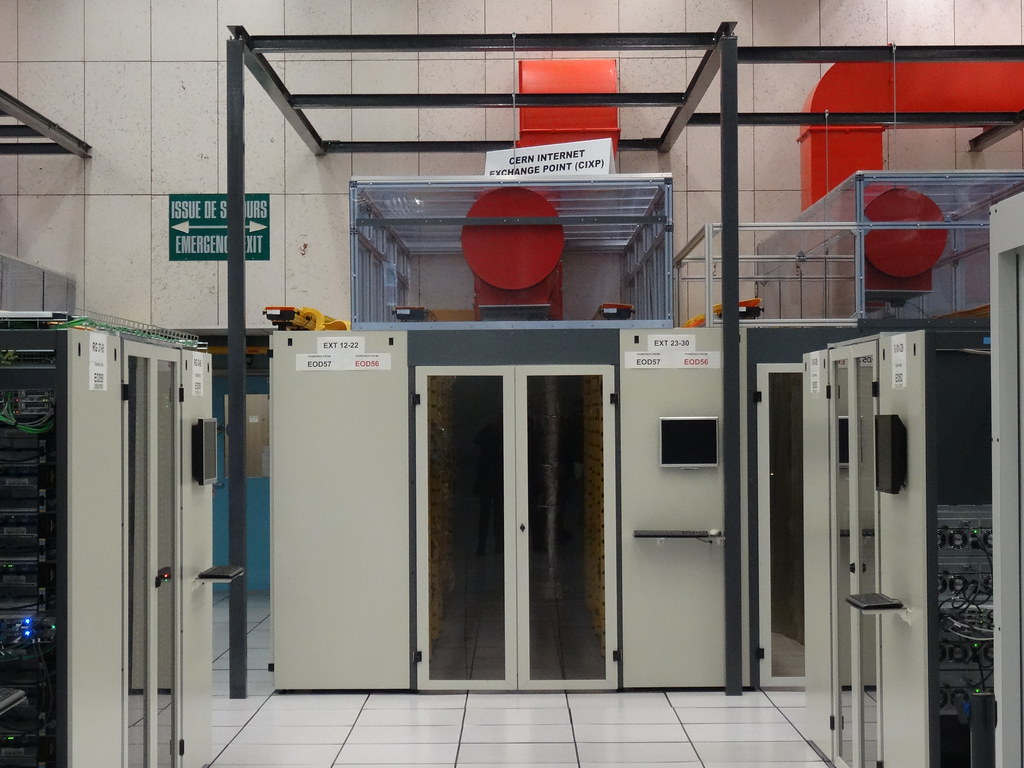
A couple of years ago I applied for the artist in residency programme at CERN, the research centre for supercolliders, bosons, dark matter and much else in Geneva, Switzerland (and France). I was lucky enough to receive an honorary mention, meaning I got to spend a couple of days there meeting physicists and exploring the facilities. I’d visited once back in 2012, which was very exciting, and it was even more extraordinary to go back a second time, to go down into the tunnels, and have actual discussions with people there. There are lots of photos from that second trip on Flickr: they’re mostly of very big machines, from the LHC instruments, ATLAS and the CMS, and of CERN’s datacenter, which is one of the most important scientific and network hubs in Europe, as well as being the home of the very first website.

Arts at CERN invites a number of people every year to visit, and different artists meet different people, but I was fortunate to spend a lot of time talking both to Mark Sutton, a physicist who works on the ATLAS trigger, and with several people from the Theory group. CERN is first and foremost an experimental research centre, and so its not uncommon to encounter people who work primarily on what are essentially computer science or mechanical engineering problems, but also have multiple top-level degrees in actual physics. The ATLAS trigger, for example, is an extremely complex system for determining which of the billion-odd proton collisions in the instrument are worth saving for later analysis – and as a computer scientist by training, understanding a little of how it works gives me a way in to understanding a little of what its investigating – but very few people would claim to have a full overview. And that’s OK.

CERN is primarily philosophical enquiry as heavy engineering: building some of the largest and most powerful machines in existence in order to investigate some of the smallest yet most fundamental interactions in the universe. As Karen Barad reminds us, quantum effects, often perceived as “small”, resonate everywhere. What happens at the quantum level defines everything. CERN is both vast research park and the (heavily contested) instantiation of a particular set of ideas about how the world is and should be, from a model of the universe to a model of collaboration to a model of thought, investigation, and invention.

I was particularly interested in what was happening within the Theory group at CERN – the collection of practitioners within the institution not focussed on constructing apparatuses to test existing suppositions, but to formulate new ones. My – limited and partial – understanding of what is occurring at present at CERN, and within particle physics research in general, is that the last decade or so of work has been incredibly productive, in that it has found and defined the Higg’s Boson and other particles expected by the Standard Model – but it has also not encountered many of the supposed particles which might allow us to consider the Standard Model definitive, or to map out reliable pathways beyond it. We have – as is often the case in scientific enquiry – learned more and opened up more questions at the same time. In particular, the events we might have expected to see if supersymmetry (SUSY) were a sure bet – a position many physicists have spent their entire careers working towards – have not materialised. And so we find ourselves in possession of vast amounts of fascinating and useful information, but no closer to that magical general theory of everything.

Which, to be clear, is great. There’s nothing that whets the appetite of humanities and science scholars alike more than unresolved questions, and this is, for those fascinated, the biggest one there is. All too often, such uncertainty is used as a stick to beat science and art: “but what’s really going on here?” “what does this really mean?” (“do you really need more money for this?”) – but it often feels – as became clear in a series of fascinating discussions at FACT a couple of weeks ago between artists and particle physicists – as if its only deeply involved artists and scientists who are capable of living productively with the deep uncertainties that are, ahem, the hallmarks of our age.

And so, to randomness. Or rather, to that which cannot be computed. Computational thought, as I attempt to outline in New Dark Age, is the kind of thinking which has settled, often unconsciously, into the belief that only that which is computable – which can be observed, recorded, modelled, and predicted – is true and immanent. And this is a useful way of thinking, but it is woefully insufficient for coming up with new ideas, for breaking with established paradigms – whether we’re talking about aesthetic representations, scientific modes, or social forms. Building only upon what our flawed and incomplete models tell us about what we already know about the world is what leads us, on the one hand, to theoretical dead-ends, and experimental failures, and on the other to biased systems that merely replicate the failures, power structures, and bigotries of the past in the present day, and cement them for the future.

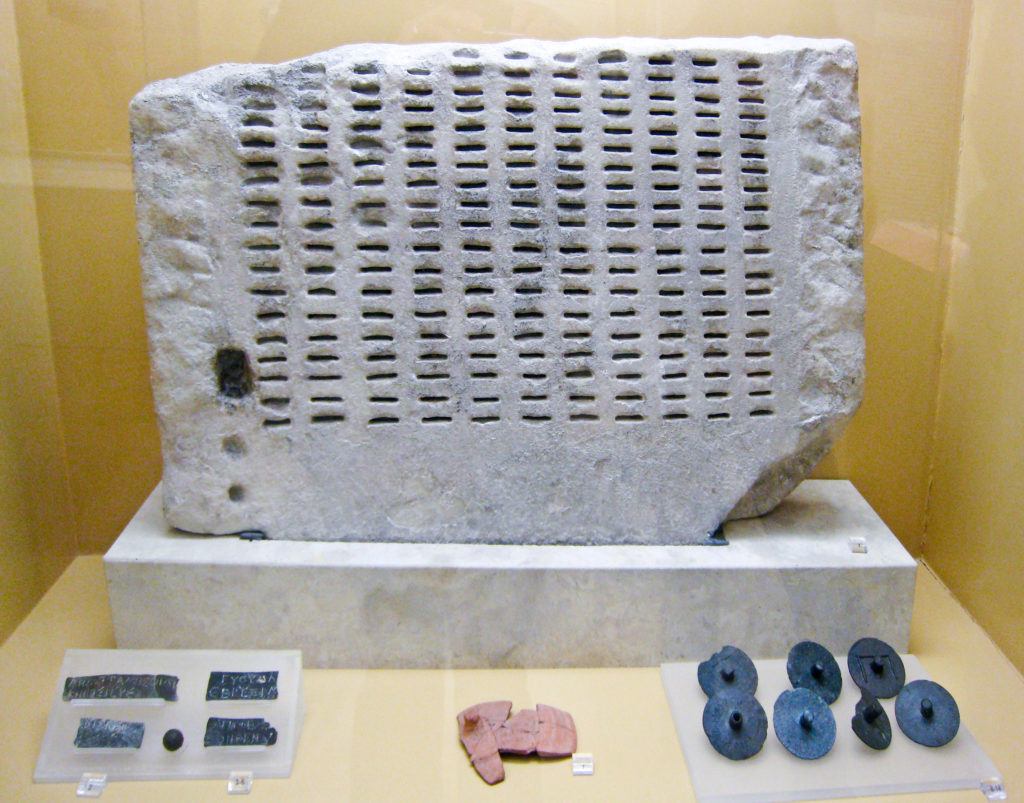
Allow me a digression. In the ancient agora of Athens, in the earliest days of democracy, there was set up a device called the kleroterion. This was a machine for producing randomness in the service of the operation of the state. Under the original democracy, most of the important posts – huries, magistrates, legislators, and citizens councils – were chosen not by election, but by sortition – selection by lot.

The kleroterion was the device designed to facilitate sortition: the random distribution of power throughout the populace (limited, it should be noted, by the gender and class politics of the time). Citizens placed their pinaka – a kind of ID token – into slots in the machine, and the order with which a series of dice fell through a channel in the stone determined who would be selected for each role. (For more on this, read Julian Dibbells’s excellent Info Tech of Ancient Democracy.)

Sortition represents an interesting road not taken, or abandoned, for present debates about democracy. Surviving only into the present in the form of jury service and a few political experiments, recent research suggests that selecting people at random from the widest possible group produces better general problem-solving teams than choosing from a narrow group of supposed experts – a finding often summed up in the phrase “diversity trumps ability” – a notion which deserves a separate essay, and we’ll just leave there for now.

In addition to its function for facilitating sortition, I feel that the kleroterion, by design, performed another crucial function. It made the machinery of state visible and legible to the population: instead of technology rendering power opaque and inscrutable, it reified it as a device which all could inspect and judge, which stood in the central marketplace of the city, and could be understood and held accountable. It is reported that Pericles said of the process that: “It is administered by the many instead of the few; that is why it is called a democracy.” Opacity and inscrutability are not natural forms of technology, or politics: they are imposed by power, and can be undone.

Anyway. In the modern world, we use randomness more and more, and need more of it. Randomness underpins everything from scientific research to cryptography, providing the basis for both the exabyte-scale data analysis performed at CERN and the algorithms which ensure your credit card details aren’t stolen online. Randomness has been used throughout history for divination and games of chance, as well, as we’ve seen, for ensuring equality. But getting randomness is hard – it’s a serious computational problem, which undermines computational thinking at its core, because that which can be computed is, by definition, not random. (Let’s not get into definitions of randomness here, but again if you want more, a bit of Donald Knuth is a good place to start.)

Back in 1949, the polymath John von Neumann, who was one of the key figures in the Manhattan Project and who first applied the Monte Carlo method for random sampling in computaters, famously stated that “Anyone who attempts to generate random numbers by deterministic means is, of course, living in a state of sin.” What he meant was randomness cannot be determined: it must be produced, found, sought out, discovered. Modern sources of random numbers include atmospheric noise, roulette wheels, and bouncing balls. In order to solve and safeguard some of the trickiest computational operations we perform, it’s necessary to go out into the world and sample true complexity from its chaos.

(Briefly, in reference to von Neumann, the endless, “peaceful” generation of random numbers staged in this work is also an attempt to overwrite the militaristic history of computation, from the Manhattan Project to the RAND Corporation’s Million Random Digits.)

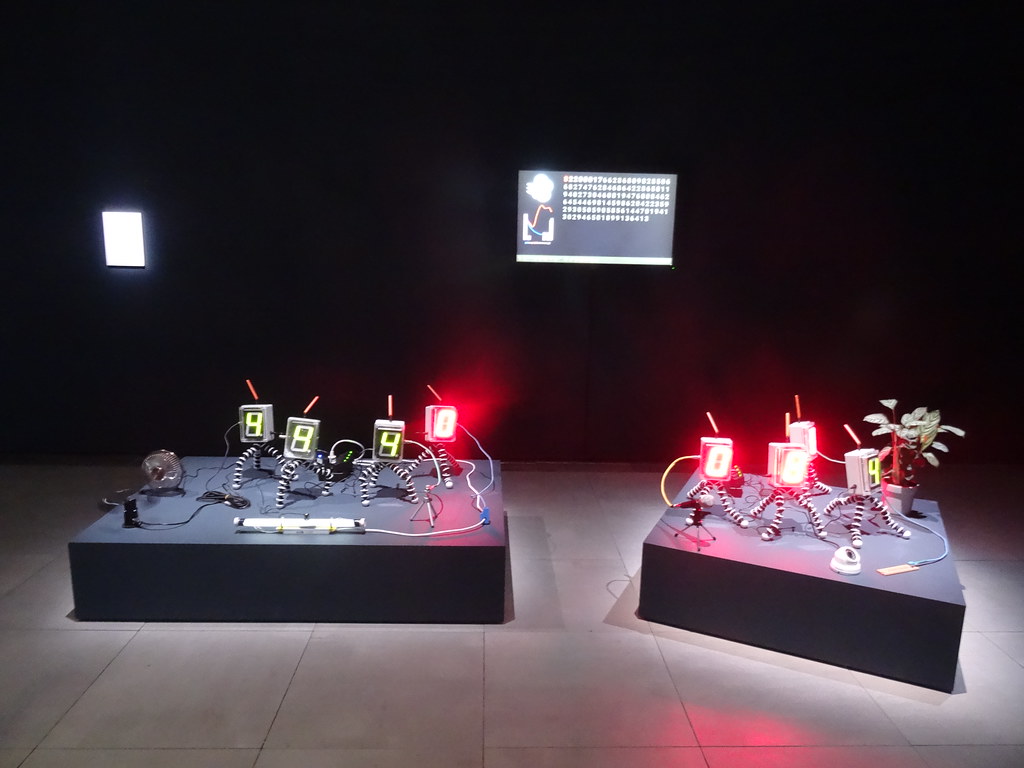
For the CERN commission, and the Broken Symmetries exhibition, I ended up building a series of random number generators – eight of them, in fact – each of which, embodied as a slightly shit robot, uses a different sensor to sample this randomness from the world. These robots were constructed over the summer in Istanbul – with the assistance of Mertcan Avci and the ATÖLYE prototyping lab – from essentially found materials in the city’s wonderful electrical, plumbing, tourist and everything-else-you-can-imagine bazaars.

Sound levels, lighting changes, gas concentrations, breezes, the buzzing of the power grid, heat, humidity and electromagnetic fluctuations – each of these provide the source – or seed – for generating an infinite sequence of new random numbers, a precious yet inexhaustible resource. These numbers are broadcast to, analysed, and made available on a dedicated website. (Where you can also read more about the process involved.)

Several of them are based on particular examples from history. Notably, I was inspired by Lavarand, a process for generating random numbers from the patterns in a lava lamp first implemented at Silicon Graphics and more recently deployed by Cloudflare to secure the modern internet. I’m also a big fan of ERNIE, which picked the numbers for the premium bonds, a UK lottery programme. ERNIE used the electromagnetic noise in fluorescent tubes to produce random numbers, just as one of my robots does – and was designed by Tommy Flowers and Harry Fensom at the Post Office Research Station, the same team that worked on the wartime Colossus code-breaking machines.

(Additional Art/Nerd aside: each robot contains an embedded SIM card – I used Hologram SIMs – designed for Internet of Things applications, making them totally autonomous and independent of gallery Wi-Fi etc. Like many of my works, they exist both inside the gallery and connected to a larger network, and I’d like to build them into a larger system of interacting, distributed artworks… one day.)

I describe this gang of machines as “hopeful robots”: simple autonomous machines venturing out into the world in order to learn something from it, and to use what they discover as fuel for new inventions. They stage the encounter between computation and the world as something chancey and contingent, but full of possibilities, as well as joy and humour. 

Computation alone is insufficient: to learn, to discover, and to create – to think meaningfully in an entangled, interconnected, and networked world -we must engage, and trust in the noise and messiness of the world itself to assist us in those processes. This is as true of our politics and our social relations as it is of science and art.

The robots will be on tour to a number of venues around Europe over the next couple of years. I hope you get to meet them.

21 Dec 04:45

Building an Alexa Skill using OpenWhisk and CouchDB

by Thejesh GN

Smart Speakers are becoming popular these days. I see Alexa or Google home everywhere, Voice is an interesting technology and I think it’s going to become very popular amongst younger and elderly community. This excites me about this technology.  Here in this tutorial we will create a simple Alexa Skill using OpenWhisk as our serverless platform and CouchDB as our database.

The flow is simple. We will create an Alexa Skill which will connect to our serverless web service on OpenWhisk.  This open OpenWhisk will talk the language of Alexa. The OpenWhisk will call our CouchDB database as and when required. It can be used retrieve the information the user requested or store user session values etc. In the present case we will use it to retrieve onion rates using our CouchDB based HOPCOMS API.

How the request flows from Alexa to OpenWhisk and back

Follow our previous tutorial to setup your own CouchDB HOPCOMS API. You can install your own CouchDB or use hosted provider like IBM.

I have already written a tutorial on how to get started with OpenWhisk on IBM. You can use the tutorial to get started. Here we will create a project called hopcoms_rate to implement the web service.

I am going to repeat a couple of steps for the ease of following this tutorial.  You can find the details in the previous post referred before.
Clone the project https://github.com/thejeshgn/openwhisk-fabfile-deploy and change action_name in fabfile. Next we will edit our __main__.py to get the data from the HOPCOMS and return the response in a way Alexa wants.

In the present case we are just responding to the call “HOPCOMS” with the rate of Onion. In future one can extend to include the fruit or  vegetable intent. Then one can ask “HOCPMS APPLE” and Alexa will speak out the price of Apple. Then we will have to process the parameters sent by Alexa, as of now we don’t.

import requests
import datetime

def main(params):
	now = datetime.datetime.now()
	key = now.strftime("%Y%m%d")
	couch_url =  params.get("couch_url")+key+key
	r = requests.get(couch_url)
	onion_rate = None
	onion_type = None
	if r.status_code == 200:
		data = r.json()
		if "163" in data:
			onion_rate = data["163"]
			onion_type = "Onion"
		elif "165" in data:
			onion_rate = data["165"]
			onion_type = "Small Econony Onion"

	resp = {}
	resp["version"] = "1.0"
	outputSpeech = {}
	outputSpeech["type"]="PlainText"
	if onion_rate:
		outputSpeech["text"]="Today's rate of "+onion_type+" is rupees "+str(onion_rate)
	else:
		outputSpeech["text"]="We have not received onion rate today. Check later."
	response_data = {"outputSpeech":outputSpeech, "shouldEndSession": True}
	resp["response"] = response_data
	return resp

Here the response is in JSON format.  You can look at the Alexa Speech Response to see how it should be formatted. It’s fairly straight forward. The code above is also quite straight forward if you know HOPCOMS API.  Once you are happy with the code, you can create the action by calling

#setup virtual env
fab setup
#package the code
fab package
#create the action
fab create

Whenever you update the code, you will have to create the package again and update again.

#package the code
fab package
#create the action
fab update

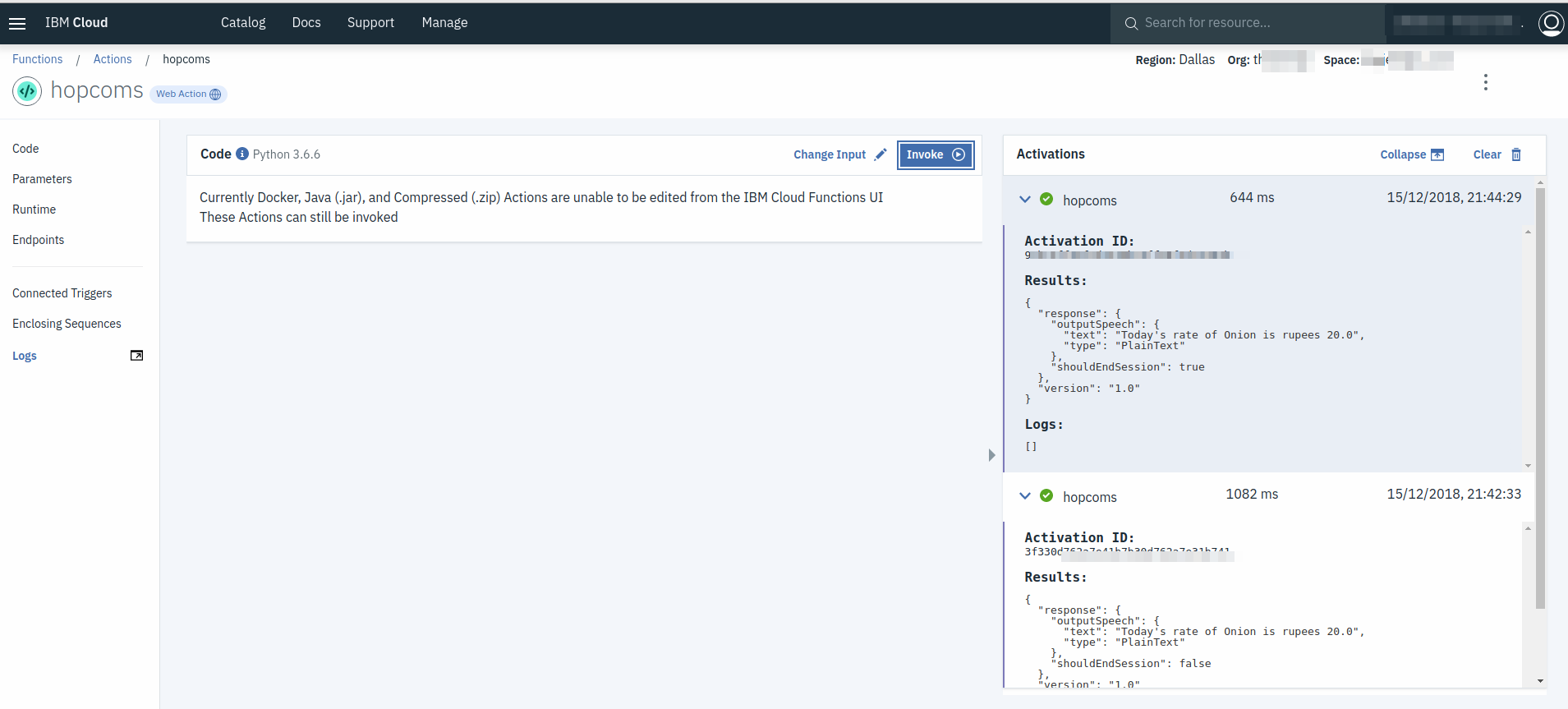
Now login to your IBM OpenWhisk console and try to run the code by invoking. You should get the response.

Please remember to set the couch_url parameter in the OpenWhisk dashboard. It will be of the format https://username:password@couch_url/hopcoms_daily/”

OpenWhisk Test Invocation

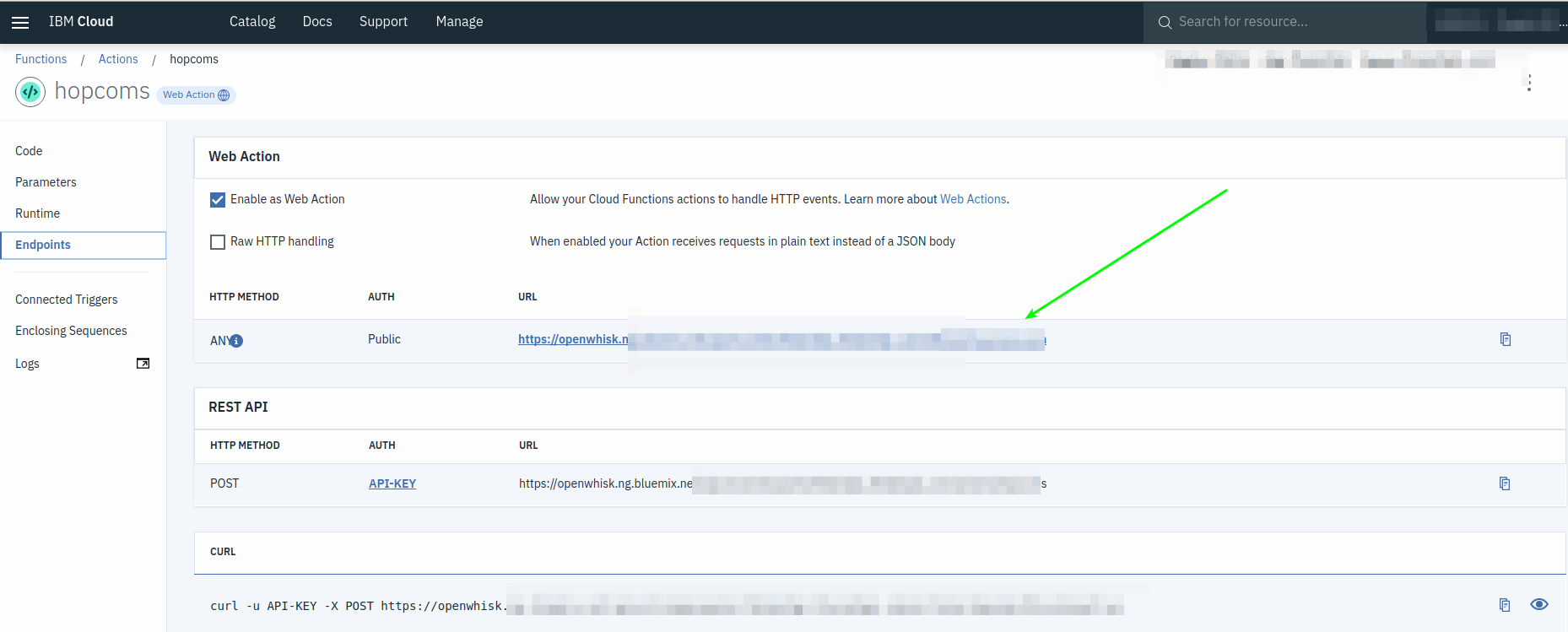
Once everything is working, let’s make this a web action and get the URL endpoint. Since this is not critical, I have made it a public web action endpoint. If you want you can enable a API Key based endpoint. This depends on how secure you want your endpoint.

OpenWhisk get web endpoint URL

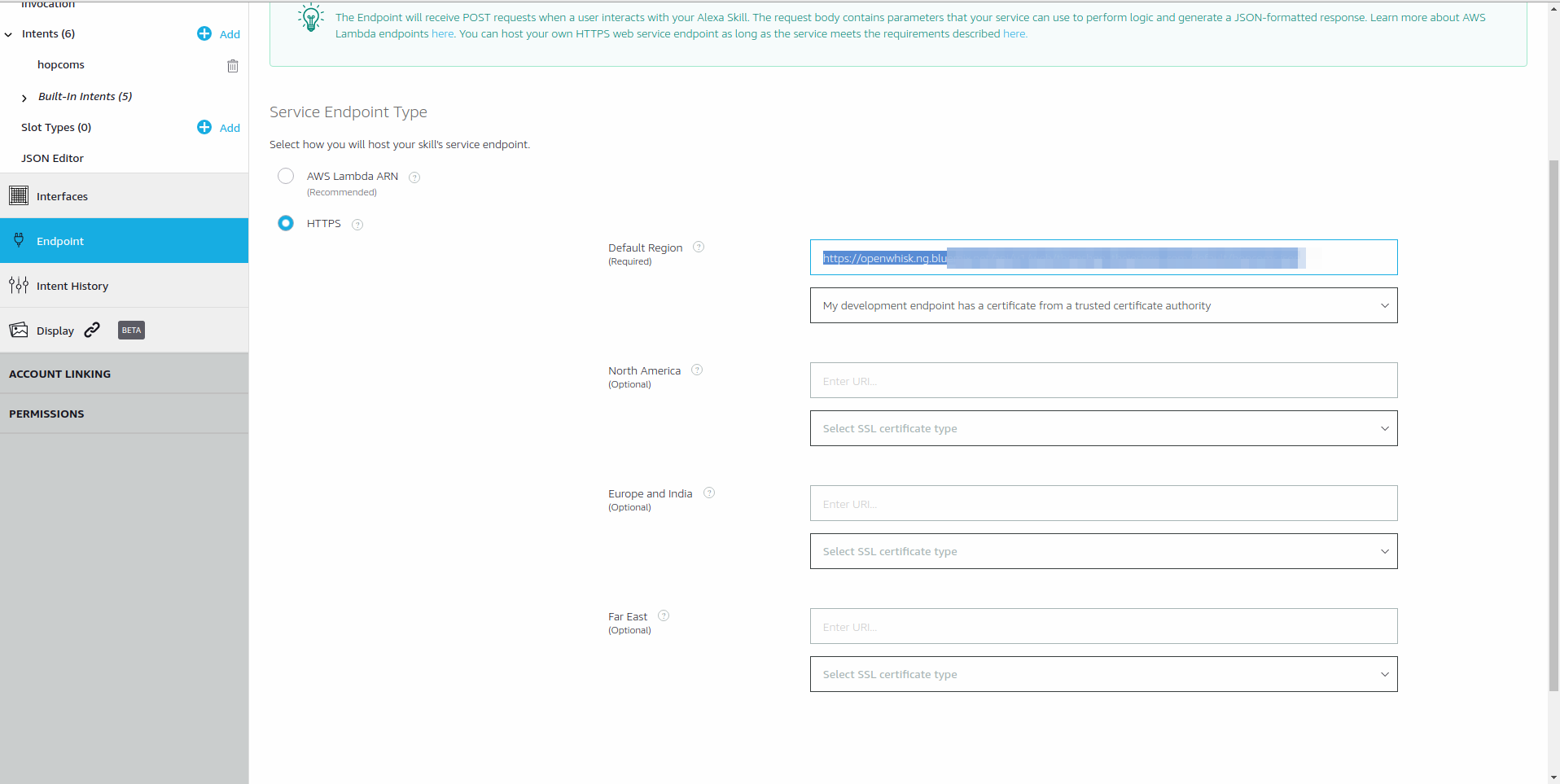
Next step we will create a skill on Amazon Alexa Choose a custom Skill,  set Skill Invocation name as HOPCOMS, intent as hopcoms and sample utterance as hopcoms. Then set the endpoint for the intent to your OpenWhisk JSON API endpoint.

Setup OpenWhisk endpoint in Alexa Skill

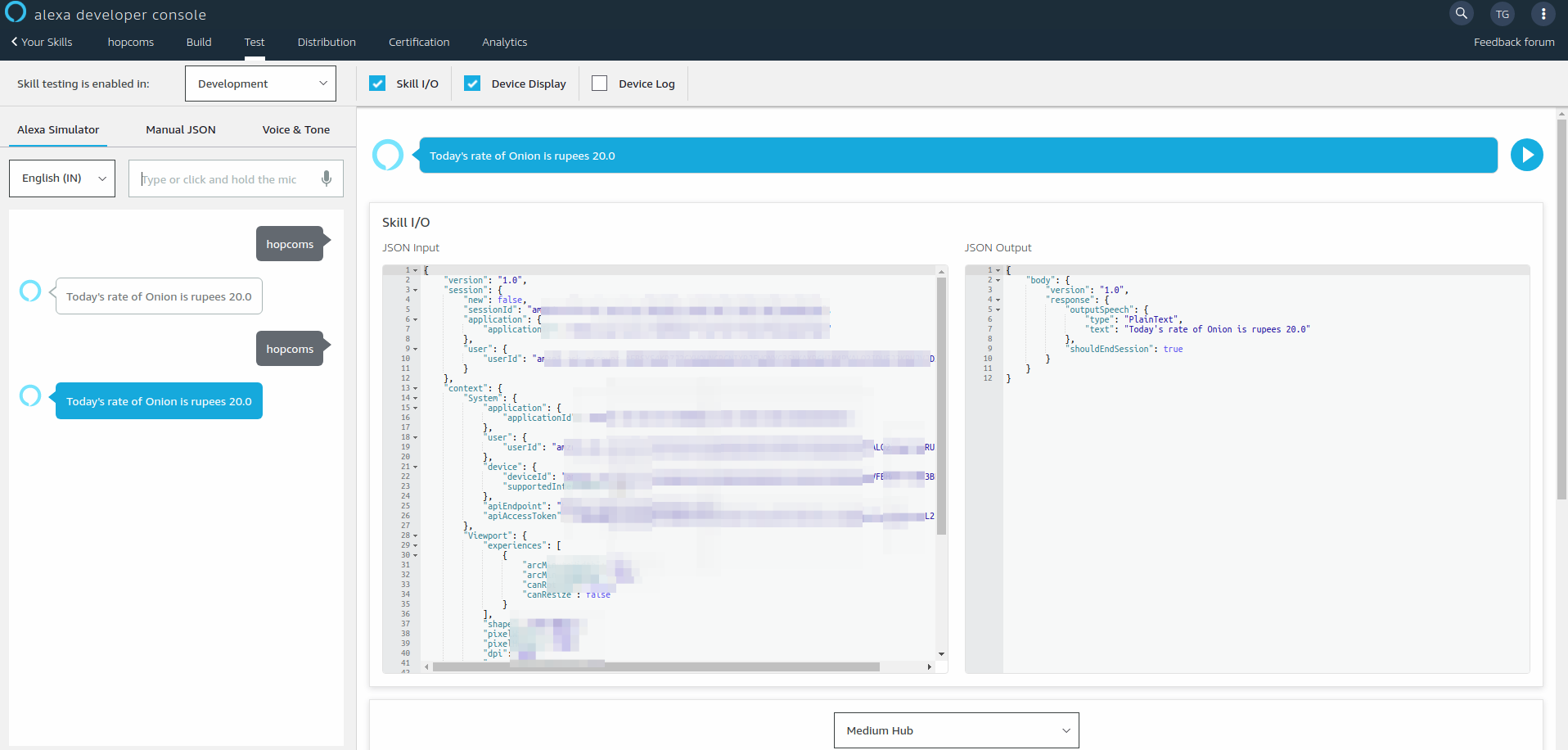
Once this is done. Build the model and test in dev mode.  You should be able to test it in the browser and also on any device you have logged in.

Alexa test call and response

There you have your simple Alexa Skill running with the backend at IBM OpenWhisk and CouchDB. You can keep improving the backend as you have all the power.

I am trying to make a full version of HOPCOMS Alexa API. Where you can ask for the rate of specific vegetable or fruit. I will keep blogging about the steps. This is just step one.

21 Dec 04:45

How Venn diagrams work, a tutorial for outgoing Wisconsin governor Scott Walker

by Josh Bernoff

Republican Scott Walker won’t be governor of Wisconsin for much longer; Democrat Tony Evers beat him in the recent election. But in the lame duck session of the Wisconsin legislature, Republicans passed bills that will limit the the powers of the incoming governor. Walker used the world’s dumbest Venn diagram to explain why the bills aren’t … Continued

The post How Venn diagrams work, a tutorial for outgoing Wisconsin governor Scott Walker appeared first on without bullshit.

21 Dec 04:45

Night Time

by Rui Carmo
A little outing with colleagues before dinner.

21 Dec 04:44

AudioKit Synth One

by Rui Carmo

I’ve been spending a little while looking at the iOS music creation landscape (because reasons I’ll get into later), and this struck me as a particularly notable app–not only does it have pretty amazing features (it’s pretty much a full-featured FM synth), but it’s also free and open sourced on GitHub, which means you have zero excuses not to try it out over the holiday season.

I only have two niggles: the developers went a little overboard with “do you like this app” prompts (which are annoying and prompted me to disable notifications, just in case) and it is a a bit crashy on my iPad mini 4 (I suspect it requires a bit more RAM than your ordinary app), but is absolutely delightful when paired with a MIDI keyboard.

Update: I read through the source code and found that it displays an annoying popup every 18 launches of the app to get you to turn on notifications, which I personally find a bit obnoxious. I get it that AudioKit might want to spread the word on updates and other apps, but not respecting user preferences is… well… debatable, especially considering that the app also prompts you for an e-mail address to unlock more presets.

The rest of the app is still great, and your mileage (and tolerance) may vary—I personally find this a bit off-putting, and if I had the time I’d submit a pull request to change that behavior.


21 Dec 04:44

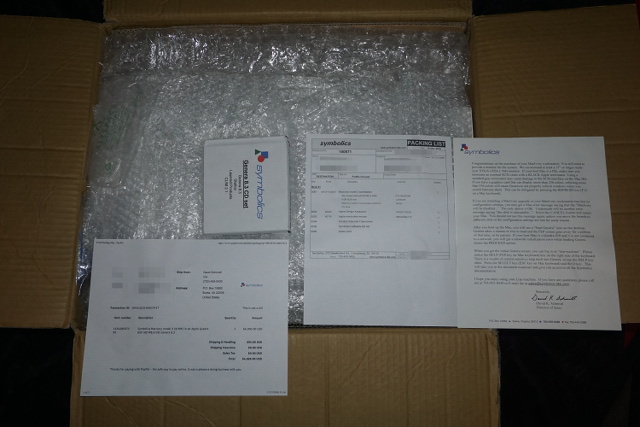
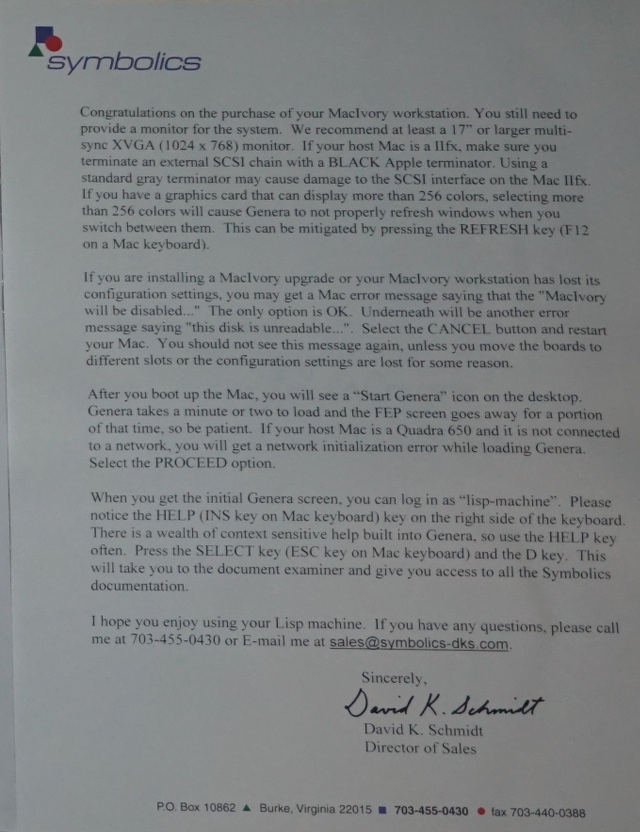
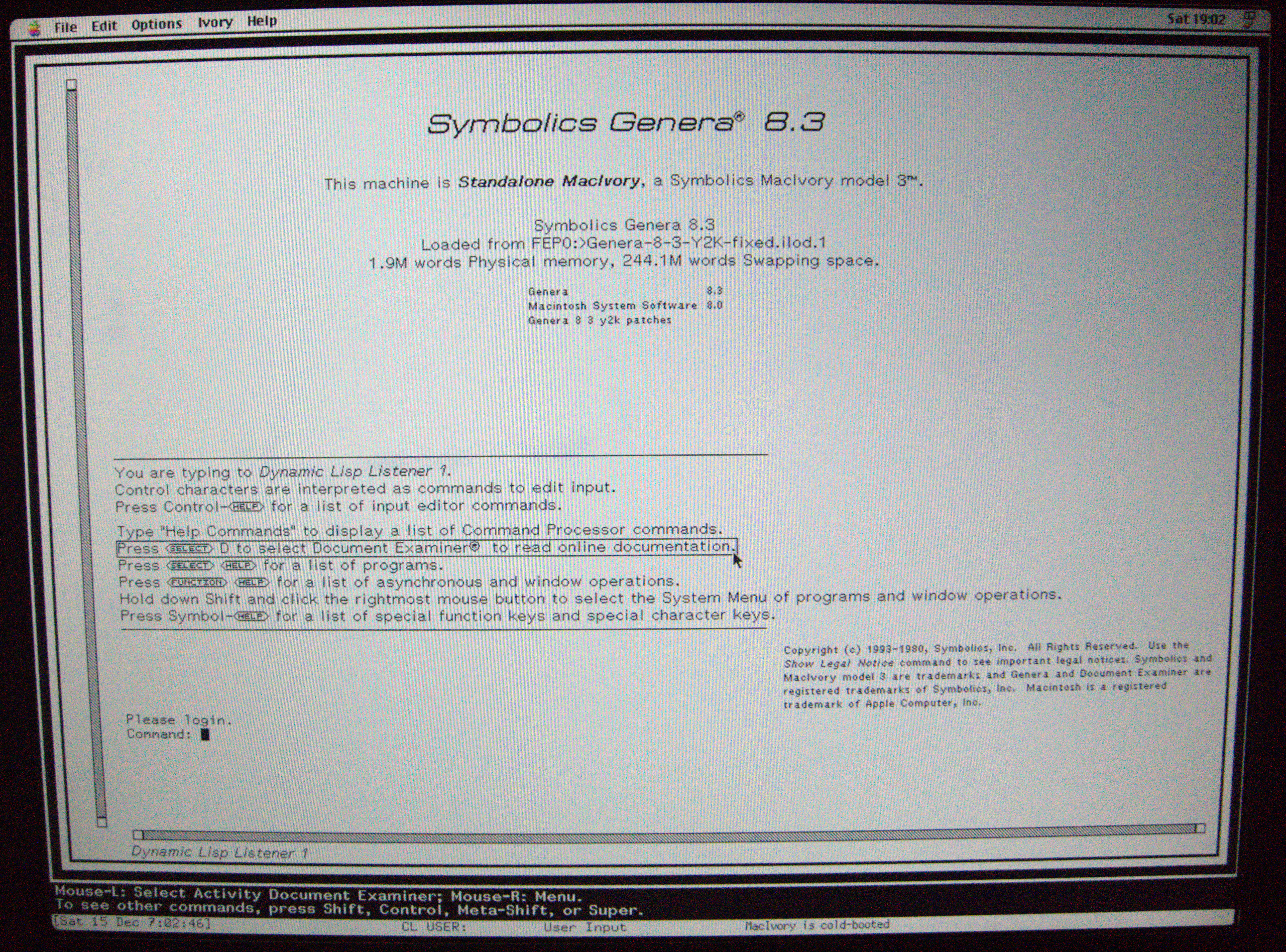
Uncrating of Symbolics “MacIvory” Machine

by Stanislav

At long last, got hold of one of these:

bolix1
bolix2
bolix3
bolix_man
bolix4
bolix5
bolix7
bolix9
bolix10
bolix11

bolix12

21 Dec 04:42

Firefox extensions list 2018

One of the great things about Firefox is the ability to customize with extensions.A MIG-15 can climb and turn faster than an F-86. A MIG-15 is more heavily armed. But in actual dogfights the F-86 won 9 out of 10 times. Part of that is training, but part is that the Soviets used data to build for the average pilot, while the USA did a bigger study of pilots' measurements and recognized that adjustable seats and controls were necessary. Even in a group of pilots of average overall size, nobody was in the average range on all their measurements. Here is what I'm running right now.

  • Awesome RSS. Get the RSS button back. Works great with RSS Preview.

  • blind-reviews. This is an experiment to help break your own habits of bias when reviewing code contributions. It hides the contributor name and email when you first see the code, and you can reveal it later.

  • Cookie AutoDelete. Similar to the old "Self-Destructing Cookies". Cleans up cookies after leaving a site. Useful but requires me to whitelist the sites where I want to stay logged in. More time-consuming than other privacy tools. This is a good safety measure that helps protect me while I'm trying out new the new privacy settings in Firefox Nightly as my main data protection tool.

  • Copy as Markdown. Not quite as full-featured as the old "Copy as HTML Link" but still a time-saver for blogging. Copy both the page title and URL, formatted as Markdown, for pasting into a blog.

  • Facebook Container because, well, Facebook.

  • Facebook Political Ad Collector, even though I don't visit Facebook very often. This one reports sneaky Facebook ads to ProPublica.

  • Global Consent Manager, which provides an improved consent experience for European sites. More info coming soon.

  • HTTPS Everywhere. This is pretty basic. Use the encrypted version of a site where available.

  • Link Cleaner. Get rid of crappy tracking parameters in URLs, and speed up some navigation by skipping data collection redirects.

  • NJS. Minimal JavaScript disable/enable button that remembers the setting by site and defaults to "on". Most sites that use JavaScript for real applications are fine, but this is for handling sites that cut and pasted a "Promote your newsletter to people who haven't even read your blog yet" script from some "growth hacking" article.

  • Personal Blocklist is surprisingly handy for removing domains that are heavy on SEO but weak on actual information from search results. (the Ministry of Central Planning at Google is building the perfectly-measured MIG cockpit, while extension developers make stuff adjustable.)

  • RSS Preview. The other missing piece of the RSS experience. The upside to the unpopularity of RSS is that so many sites just leave the full-text RSS feeds, that came with their CMS, turned on.

Bonus links

'Artifact' Isn't a Game on Steam, It's Steam in a Game - Waypoint

Does It Matter Where You Go to College?

The Golden Age of Rich People Not Paying Their Taxes

Liberating Birds For A Cheap Electric Scooter

America’s Power Grid Isn’t Ready for Electric Cars

21 Dec 04:42

Native Languages

by Jeffrey Friedl

One line through four generations:

  • My dad's mom's native language was Polish.
  • My dad's native language is German.
  • My native language is English.
  • My son's native language is Japanese.

All four of us were born in the United States of America.

父方の祖母の母語はポーランド語でした。父の母語はドイツ語です。僕の母語は英語。息子の母語は日本語。全て4人は米国の生まれ。

My four grandparents all had different native languages: one each with Polish, German, French, and English.

Three were born in the USA; only the native English speaker, my maternal grandmother, was not (she was born in Canada).

僕の祖父母、4人はそれぞれ違う母語があって:ポーランド語、ドイツ語、フランス語、英語。一人以外は米国の生まれ。母語が英語の母方の祖母だけは別の国の生まれ。

21 Dec 04:42

Ambient Cruelty

by Linda Besner

It is a truism, backed with some evidence, that negativity makes a person seem smarter. In the 1980s, Harvard researcher Teresa Amabile took two pieces of literary criticism from the New York Times’ book reviewing section — one positive, one negative — and showed them to 55 students. The students found the writer voicing negative opinions much more intelligent and persuasive than the one voicing praise. In fact, it was the same reviewer, and the two pieces of criticism were adapted versions of the same review. John Stuart Mill wrote, “I have observed that not the man who hopes when others despair, but the man who despairs when others hope, is admired by a large class of persons as a sage.”

In part, this is because blame is actually more rare than praise. In the past 50 years, cross-cultural studies have demonstrated a phenomenon referred to as linguistic positivity bias: human speech is studded with words like “great,” “adorable,” and “amazing,” while words like “dreadful,” “ugly,” or “terrible” show up less frequently. It may be that people use language primarily as a means of drawing closer together, which raises the frequency of words that create a feeling of community. Negative words stick out because they are not the norm, and this in turn signals to readers or listeners a person who is setting themselves apart from the group.

Ratings don’t just measure emotional responses: they create them

For this reason, negativity as a tonal choice not only lends an air of discernment, but brims with expressive opportunity: the diction of dissatisfaction offers its own satisfactions. On Twitter, a winning persona blends quotidian venting with cultural critique. Hating on things can scratch an individual itch or put a finger on shared experiences — there’s a bond in hating the same stuff, as evidenced by the popularity of the “Gopher Gripes” segment on the Gimlet podcast Reply All (the spiritual heir of a long succession of indie-media rant lines). Yelp offers a platform for individuals to denounce bad service, whether creatively or simply self-righteously. Of the services I use most frequently that are also the most universally hated, Greyhound buses seem to inspire some inventive criticism. In 2012, a user called Sonia B. typed the following ode:

Greyhound, Greyhound
You’re not that fast,
If you were in a race you’d probably finish last.

I use you sometimes when I’m going far,
Even though your service is kind of sub-par.

But when I consider gas prices these days,
You really often are the cheapest way.
(Especially the advance webfare).

I will hazard a guess and say Sonia B. probably doesn’t get a lot of opportunities to publish her verse in the traditional press. This is a major factor that motivates Yelp reviewers: not necessarily to express passionate opinions about products and services, but to express themselves period, and to make themselves visible to others. In a 2014 Fast Company interview, Yelp’s vice president said, “if you’re writing great things on Yelp, you know that a lot of people are going to read them. You’re going to have a voice. You’re going to have a megaphone. Yelp is that megaphone.”

More megaphones means more opportunities to emote. But amplifying negative expression has serious consequences in the contemporary gig economy. The freedom to vent feels empowering, but when unleashed on a reputation-based labor market, where a widespread reliance on reviews and ratings is the primary monitor of quality assurance, negative self-expression allows users of apps like Uber or TaskRabbit to enjoy the benefits of an arbitrary power of punishment free of guilt. By emphasizing the user’s “right” to have their opinions heard, and to dissatisfaction with any less-than-perfect “experience,” platforms encourage users to be cruel without feeling cruel. Normalizing negativity creates a slush fund of data that employers can use at their discretion against employees.


If Yelp offers an opportunity for a quasi-literary or artistic self-expression, apps like Uber or Ziosk (an app that encourages customers at chain restaurants to rate their service) ask users to express themselves primarily through numbers, sometimes accompanied by potted comments that can be selected from a list. Users don’t request an opportunity to fill out ratings; rather, the company prompts or requires user feedback, as if one’s satisfaction or dissatisfaction is the company’s top concern.

Under ordinary circumstances, it’s likely that most people getting a ride from A to B or ordering chili cheese fries wouldn’t be focused on how the interaction makes them feel at all. But ratings don’t just measure emotional responses: they create them. This is called the mere-measurement effect, a sociological quirk in which being asked for an opinion makes people drum one up on the spot. The effect is powerful enough to change behavior — in one study, simply being asked if they intended to vote made students more likely to do so. As users get used to being asked for their opinion on services, they are likely to develop stronger opinions. The market transaction itself — the exchange of french fries or a ride for money — fades into the background, while the affective experience of consuming the product or service looms larger.

Yelp differs from Uber and Ziosk, of course, in another significant way: The audience for these ratings is the company and the worker rather than the public at large, which makes the experience less like using a megaphone and more like using a mandatory snitch line. Yelp is a third-party platform, while Ziosk and Uber directly control whether workers keep their jobs. Yet the exercise of converting one’s feelings into commentary is basically the same — and without the textual element, these feelings are more quickly converted into hard data. In June, Buzzfeed reported that information gathered from Ziosk was being used to reduce shifts for poorly rated waitstaff. A few bad reviews on Uber can influence riders not to book a particular driver, and can get a driver kicked off the platform — even if the ratings are simply the result of mistaken judgment about whether riders are in the mood to chat.

In displaying the language patterns of victims, reviewers illustrate how access to this form of expression can feel good — even healing — while drastically mischaracterizing who is harming whom

As an expressive mode, feeling by numbers is highly idiosyncratic. To one person, a “three” might seem average; to another, a three is an insult. Personally, were I to rate all my day’s experiences, I’d always find a grain of discontent — that borscht recipe wasn’t quite sour enough, that text exchange could have been more satisfying, the view from my office window would be nicer with more trees. Five seems like a number for a perfect world, and I always feel that things could be better. I’m pretty sure this doesn’t even make me a pessimist — I expect my experiences to be about average, which should translate to a three.

And yet many platforms have established five — the highest number, from which no improvement is possible — as the standard workers should be maintaining. As a server commented in Buzzfeed’s article on Ziosk, “The company only counts fives as good scores … Everything else is basically a complaint.” For Uber and Lyft, the deactivation threshold can vary from district to district, but drivers often report a 4.6 or 4.7 as the minimum required to keep their jobs. New users don’t necessarily know this — it’s counterintuitive for perfection to be considered normal — so a driver’s ratings can paradoxically be more heavily influenced by inexperienced users. (Drivers also rate riders, but because stakes are so asymmetrical — drivers can arbitrarily lose their livelihood, while riders may simply lose out on a convenient ride — the semblance of parity is an illusion.)

Assessors aren’t there to interpret what users mean — the goal (unlike in, say, a psychology survey) isn’t really to understand the feelings of participants. I might think being solicited for my opinion means that I’m being invited to talk about myself — it feels personal, as if the company wants to get to know me. However, my answers to questions about how I feel aren’t being used to better understand me as a person; they’re being used to fire workers who make the company look bad. It’s an odd bait-and-switch: ratings assure me that my subjective experience is the most important thing, and yet, at the same time, their aggregation enables me to pretend my complaints don’t have serious consequences. I can tell myself that a driver will only get fired if enough other people also give them a low rating; at the same time, I’m being nudged into accepting the underlying premise that the power to destroy someone’s livelihood through ratings and reviews is a legitimate — even just — part of the consumer experience.

As the user, I come to believe that services should be tailored to me and my preferences — I can rate a driver down for playing music I don’t like. It allows me to see myself as the kind of quirky individual tech companies market themselves as serving, while also elevating my own opinions to the level of quality assurance benchmarks. In my starring role as customer and de facto manager, my power over the worker is complete: I am not so much expressing an opinion about the quality of a service but giving the worker permission to keep their job.


Last year the Guardian’s digital etiquette columnist, Emma Brockes, wrote about her experience as a customer looking to book someone to put up shelves over TaskRabbit: “I found myself rejecting handymen left, right and centre because I didn’t like the look of them. One was wearing a suit, which I thought protested too much; one looked a bit shifty; I didn’t like the goatee on another. This was clearly ridiculous, and extremely vulnerable to racial and other biases.” Users become accustomed to putting workers through an idiosyncratic filter — no goatees, no suits — as though every casual laborer were a song on a playlist or a book on a shelf. If my likes and dislikes are all indulged, everything can become a curated reflection of my tastes. Given sufficient control, perhaps I can scrub goatees from my world entirely. It’s a cruelty that doesn’t feel like cruelty; it just feels like a right to choice.

But as Brockes points out, feeling justified in rejecting workers based on superficialities skids quickly into serious harm. In the same way that teaching evaluations replicate racism, sexism, and other forms of discrimination in the way students rate their professors, platforms that give the customer power to select workers proffer the opportunity not only to indulge bias but to make their world into a gated community — to experience only that which is comfortable and friction-free. The ability to curate one’s experience to this degree comes to feel like a natural right.

A 2016 study out of Northeastern University in Boston found that Black and Asian workers offering their services on TaskRabbit and Fiverr received lower ratings than white workers; they also found racial bias in TaskRabbit’s recommendation algorithm. A New York Times article from earlier this year documents a Black female driver’s experience with a racist passenger who yelled epithets at her, and how complaining to Uber simply earned her a generic response (“We’re sorry to hear about this. We appreciate you taking the time to contact us and share details.”) On a platform like TaskRabbit, where customers scroll through photos of the many casual workers they might hire, users don’t have to consciously select workers on the basis of race — they are being given permission to make decisions with financial repercussions for others based on a split-second gut feeling. The mechanism allows customers to discriminate without seeming to themselves to be doing so, and to feel justified in indulging their own moods and prejudices.

There is a paradox inherent to expressions of negative emotion: it can feel good to say something mean, and yet for most people, it feels bad to hurt others. Being negative may make me seem smart, but it also makes me seem mean, and thus unlikeable. Some people are consciously and overtly racist and sexist, but many others wield these prejudices unconsciously; few people want to believe their selection or rating of workers is racist. Rating workers on subjective criteria, with only one’s feelings as a guide, means users don’t have to articulate, even to themselves, clear reasons why the worker didn’t meet their expectations in providing a comfortable and affirming experience. By giving users an outlet for negativity in prompting them to rate or review their experiences, these platforms disguise the consumer’s financial power over workers as simple self-expression, and solicit a kind of expression people may seldom be given social permission to exercise.


When people use online megaphones for their judgments, they are also engaged in constructing narratives as a form of self-creation. Since customers are the heroes of their own stories, the journey into the marketplace takes on a Manichean tint. A collaboration between researchers from Stanford and Carnegie Mellon universities resulted in a 2014 study of the type of narrativizing that occurs in online reviews of restaurants. Among other interesting findings (cheaper foods are described using the language of drug addiction, while people describe expensive foods in the language of sex), the study found that very negative reviews of restaurants shared significant linguistic markers with another type of self-expression: trauma narratives.

Ratings aren’t about creating information for users; they’re about creating paranoia for workers

“Shortly after a disaster or tragedy people experience emotional upheavals and obsessive thoughts and feelings,” the study’s authors wrote. “In this phase they share these thoughts and feelings with others, including strangers, and the phase is marked by expressions of collectively shared grief, in which people seem to emphasize their belonging to groups.” They use words like ‘we’ or ‘us’ more frequently, and past tense verbs like ‘told,’ ‘said,’ or ‘did.’ Where a simple comment on food might demand no more complicated narrative structure than “Great salmon,” the verbs in negative reviews indicate that the reader is being told a story. “One–star reviews are narratives of negative emotion, stories about something bad that happened involving what other people said and did,” the authors write. Restaurant reviews in which people sound traumatized by perceived injustice don’t tend to comment much on the food — it’s usually the perception of being treated rudely or uncaringly that seems to have pushed people into processing by writing out their feelings in a public forum.

How did consumers get the idea that pleasing service is a matter of justice? There is no fundamental human right to a short wait time, a smile, or a perfect evening out. “Good service” doesn’t have a universally agreed-upon definition, and yet customer service representatives are expected to meet every customer’s expectations as a matter of principle. Customers come to take any service that doesn’t give them the feelings they want as a personal insult. When the customer’s money doesn’t produce the hoped-for experience, this starts to provoke shock and moral outrage rather than simple disappointment. In displaying the language patterns of victims, reviewers illustrate how access to this form of expression can feel good — even healing — while drastically mischaracterizing who is harming whom.

Servers, of course, are already often working in an environment with little guarantee of fair labor practices or stable employment. It’s not enough to do the job well — restaurant servers don’t control how long it takes for the kitchen staff to prepare meals, or what those meals taste like, but customers rating their servers on Ziosk may give a low rating as a result of a long wait or a dish they didn’t enjoy. The customer is the expert on their own “experience,” and managing that experience becomes the server’s real job. When the weightiest measures of performance are not tied to the real value of a service or product, but are instead reflections of how an experience made a customer feel, workers with whom the public interacts gain an additional affective workload, and come in for the heaviest criticism. My power of self-expression becomes a power of punishment, and I am able to enjoy the privileges of both while acknowledging only the former.


As more users become aware of the consequences of bad reviews, an etiquette has evolved. In a 2018 study examining an (unnamed) online marketplace in which freelance laborers are matched with people looking to hire remote gigging workers, researchers from New York University’s Stern School of Business found a high rate of reputation inflation — in a period of six years, the percentage of laborers being rated five stars shot up from 33 to 85 percent. In another of her columns, Brockes responded to a Guardian reader’s question about whether they could give an Uber driver a bad review (the car smelled bad, the seat belt didn’t work, and the driver talked on their phone while driving). Brockes wrote: “to my mind this is relatively straightforward. You received bad service and you are a complete monster if you go ahead with a bad rating.” It has become widely known that a five-star rating is the equivalent of tipping: obligatory rather than optional.

Tipping can be embarrassing — it’s a moment when the customer demonstrates their power to withhold part of the worker’s wage arbitrarily. And yet, the server is obliged to say thank you, as if the customer were handing over something extra, a gift. Disguising the decision not to cause harm as a benevolent gesture normalizes an ambient cruelty while making the person wielding power seem generous. In the same way that the expectation of tipping means servers are (in some jurisdictions) paid less than minimum wage, the reputation layer of the gig economy builds the social exchange of ratings anxiety into our conception of work, just as “likes” and other attention metrics build it into our social lives. Work is subtly reframed as socializing, so that pleasing people is the job. Precarious laborers are further encouraged to see themselves as vulnerable — to feel lucky they are allowed to work at all. Ratings aren’t about creating information for users; they’re about creating paranoia for workers.

In the Victorian era, consumer power was posited as a way to align consumers with workers: Purchases could be mobilized for the good of society through boycotts aimed at commodities like cotton or sugar produced through the labor of enslaved people. Consumer leagues and cooperatives later sprang up to agitate for a minimum wage and safe working conditions. When channelled into collective dissent attacking prevailing systems of injustice, dissatisfaction and negative expression are powerful tools for good. Yet corporations have co-opted this potential, reducing consumer power to punitive capability. By offering widespread customer feedback opportunities, companies are able to visit the consequences of any consumer dissatisfaction onto workers.

The repercussions of using ratings as a widespread way to monitor workers go beyond specific apps or platforms; they chip away at our sense of responsibility towards one another. Through online ratings systems, consumers are being encouraged to see the cruelty of arbitrary punishment as a benefit they can enjoy. The consumer power they are encouraged to embrace asks them to review the worker rather than the company, and to focus on the minutiae of their own comfort and satisfaction rather than the labor conditions under which services are produced.

The roles of customer and worker are hardly fixed; most of us occupy both of these, and an economy in which more and more affective labor is required to stave off punishment is empowering only for companies managing through paranoia and fear. As customers are ever more closely aligned with bosses in everyday transactions, we work against our own collective interests.

21 Dec 04:42

Don’t Quit

by Stowe Boyd

Four Steps To Creativity | Mental Models | Gender Equality, at Work and Home | Minimum Wage For Ride-Hailing | It’s Harder to Get A Promotion | Wellness Trends | Kevin Aston

Beacon NY — 2018–12–09 — I continue the process of moving older issues of Work Futures Daily to workfutures.org, and that leads me to turn up old writings, like Cooperation, Collaboration, and the Diffusion of Affiliation, which I wrote in May 2013 and is in today’s From The Archives. I have dozens left to repost. Sigh.

Also, today — Sunday — is the day I post the week’s dailies over at the Work Futures Medium outpost. I don’t know if others have read it, but Nikitonsky’s critique of Medium as a blogging platform is compelling.

Because Medium doesn’t open up its API — at least to the average person — I have to use their ‘import by URL’ technique manually, and then correct the myriad flaws: no images carried over, no horizontal rules replicated, and three extra line breaks in every nested quotation. Thanks, Medium!

If you’re getting this you probably signed up at workfutures.org (or one of its predecessors) or stoweboyd.com. If someone forwarded this to you, sign up here.

Consider making a donation. We appreciate your support.

a sponsor message from BoundlessU

Work Futures reader and fellow writer on the future of work, Paul Millerd, has recently completed a course that pulls together all of the lessons, secrets and tools he learned while a strategy consultant at firms like McKinsey and Boston Consulting Group for almost ten years. He is offering the course on a gift basis where you can pay-what-feels-right. Check out a preview of some of the lectures here.

Links

Set the Conditions for Anyone on Your Team to Be Creative | Greg Satell tells us that first you need deep expertise in your domain, then deliberate practice, then time. Lots of time. And don’t quit.

Mental Models: The Best Way to Make Intelligent Decisions (109 Models Explained) | Farnham Street published a comprehensive catalogue of mental models. For example, Human Nature and Judgment includes 23 items alone.

16. Commitment & Consistency Bias
As psychologists have frequently and famously demonstrated, humans are subject to a bias towards keeping their prior commitments and staying consistent with our prior selves when possible. This trait is necessary for social cohesion: people who often change their conclusions and habits are often distrusted. Yet our bias towards staying consistent can become, as one wag put it, a “hobgoblin of foolish minds” — when it is combined with the first-conclusion bias, we end up landing on poor answers and standing pat in the face of great evidence.

(Btw, the full quote is ‘a foolish consistency is the hobgoblin of foolish minds, adored by little statesmen and philosophers and divines’, the most famous of Ralph Waldo Emerson’s sayings.)

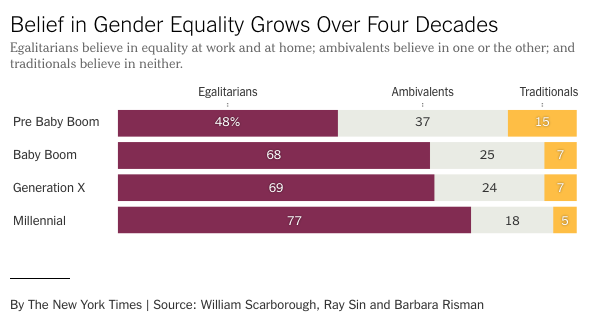
Americans Value Equality at Work More Than Equality at Home | Claire Cain Miller explores the implications of a major divide in people’s thinking about equality of the sexes, one that may ‘explain’ (if that is the right word) the continued skew in views of gender in the home:

Americans have grown increasingly likely to believe that women and men should have equal roles at work, in politics and at home. But a significant share still say that men’s and women’s roles should be different at home — even when they believe they should be equal at work.
A new study, based on national survey data from 1977 to 2016, helps explain why the path to equality seems in some ways to have stalled — despite the significant increases in women’s educational and professional opportunities during that period.
Two-thirds of Americans and three-quarters of millennials say they believe that men and women should be equal in both the public sphere of work and the private sphere of home. Only a small share of people, young or old, still say that men and women should be unequal in both spheres — 5 percent of millennials and 7 percent of those born from 1946 to 1980.
But the study revealed that roughly a quarter of people’s views about gender equality are more complicated, and differ regarding work and home. Most of them say that while women should have the same opportunities as men to work or participate in politics, they should do more homemaking and child-rearing, found the study, which is set to be published in the journal Gender and Society.

The trending across generations is clear, but ugh: will we never get there? Will it really take 3 or 4 more generations?

New York set the nation’s first minimum pay rate for Uber, Lyft drivers | Shirin Ghaffary reports that the tables have turned on the pay for ride-hailing drivers in NYC:

Drivers for ride-hailing apps like Uber and Lyft will be guaranteed a minimum pay rate of around $17 an hour in New York City thanks to a new set of rules aimed at securing workers’ right to a living wage.
The New York City Taxi and Limousine Commission voted this morning to mandate the wage floor of $17.22 per hour after expenses for drivers — or $26.51 per hour before expenses. This will raise the average pay for over 77,000 drivers by around $9,600 a year with “minimal disruption to passengers,” according to the commission’s analysis, although ride-sharing app companies say it could lead to an increase in rates for riders.
Currently, the commission estimates drivers for the major ride-hailing app companies in New York City are making $11.90 an hour after expenses. That’s below the city’s current minimum wage of $13 an hour, which is set to increase to $15 by the end of the year.

Note: aside from expenses now being reimbursed (at least to some extent) there is no mention of benefits for the drivers, so we have what may become the new normal: contractors — who are still liable for all other benefits, like health care, and both ‘halves’ of their social security taxes — will be guaranteed a baseline salary equivalent to that of hourly workers.

As Hiring Slows, Employers Say It’s Getting Harder to Find Workers | Patricia Cohen points out that even while it gets harder to find new workers, its getting harder to get a promotion.

“One of the things we’ve seen is that it’s harder for employees to get promoted nowadays,” said Brian Kropp, vice president for human resources at Gartner. In 2006, for example, it took an average of about two and a half years to get a promotion, compared with four and a half years now.
The result has been growing dissatisfaction and resentment. The share of employees who say they are willing to go above and beyond at work has dropped, Mr. Kropp said. One in four employees used to report giving work an extra oomph — something Gartner calls “discretionary effort.” Now, it’s closer to one in six.
The reason, Mr. Kropp said, is simple: Workers are not being rewarded for their efforts.

A must read.

Quiz: Are you ready for the latest corporate wellness trends? | Lila MacLellan and Amanda Shandruk are surveying what we think about corporate wellness trends. They plan to publish the findings.

Quote of the Day

Creation is a long journey, where most turns are wrong and most ends are dead. The most important thing creators do is work. The most important thing they don’t do is quit.

| Kevin Aston, mentioned by Greg Satell in Set the Conditions for Anyone on Your Team to Be Creative

Recent Issues

Work Futures Daily — Robots, AI, Everywhere | Electricity Grid Drones | Robot Janitors | Feeding AI Data | Agri-Bots | Avoid Women At All Costs | Perennials, Not Millennials | Juno Sells To Get | Helen Hester and Social Reproduction

Work Futures Daily — Many Shadows | The Long Shadow of ‘Help Wanted — Female’ | The Fragility Of Company Culture | Sharp Words, Blunt Words | How To Deal With Getting Interrupted | Carlotta Perez

Work Futures Daily — Is Work Good For Us? | Maybe Less Work Is The Answer | Napping > Willpower | Generational Differences? Folklore | Michelle Obama on Lean In | Fewer Connections Means Less Change

From the Archives

Work Futures Daily — New Thinking For New Times | Stowe Boyd February 2018

Since everything about work is changing, everything about the workplace should change, too.| Jim Meredith

Cooperation, Collaboration, and the Diffusion of Affiliation | Stowe Boyd May 2013

In the collaborative business, people affiliate with coworkers around shared business culture and an approved strategic plan to which they subordinate their personal aims. But in a cooperative business, people affiliate with coworkers around a shared business ethos, and each is pursuing their own personal aims to which they subordinate business strategy. So, cooperatives are first and foremost organized around cooperation as a set of principles that circumscribe the nature of loose connection, while collaboratives are organized around belonging to a collective, based on tight connection. Loose, laissez-faire rules like ‘First, do no harm’, ‘Do unto others’, and ‘Hear everyone’s opinion before making binding commitments’ are the sort of rules (unsurprisingly) that define the ethos of cooperative work, and which come before the needs and ends of any specific project.
The sense of self in those working in cooperative settings may be — but doesn’t need to be — more transient, although people in the emergent business setting are shifting contexts more frequently, working in different settings, and that may make it easier to express different aspects of self at the ‘same time’. Like working with one scene of people as a futurist, and as a chef in another. This is considered ‘moonlighting’ in a collaborative world, but merely two shades of working in the cooperative, emergent world. And the offset of the closeness that came from being part of a collaborative team is the breadth of experience that comes from participating in many cooperative teams (although team is the wrong word: maybe cooperative constellations).
Put another way, self may become more discontinuous in the emergent business, allowing us to express more of the whole person, instead of being expected to be the same at all times, to hold only one set of perspectives, ever. To the extent we are open to diversity in the workplace, we need to allow individuals to be diverse, in their selves, as well.

Originally published at workfutures.org.


Don’t Quit was originally published in Work Futures Institute on Medium, where people are continuing the conversation by highlighting and responding to this story.

21 Dec 04:42

A nice streak of activity and social stuff

by Liz

Continuing my trend of feeling frisky and getting out of the house – in the last few days I went to a party with friends I haven’t seen in a long time (a white elephant xmas party), another fairly mellow get together in some guy’s warehouse with people I don’t really know at all, which was interesting, and another (birthday) party right down the street where I got everyone to try my new powerchair in the bar.

And went to Ada’s choir concert on top of that. They sang a song by Pentatonix, and something Beatles-ish, and then a jazzed up Little Drummer Boy, which I correctly flagged as resulting from Ada’s evil influence, deliberately pranking us all to make us lose the Little Drummer Boy challenge. The high school mariachi bands (year one and year 2) were also excellent!

It’s so nice to have both kids here at once for a few days with Milo back from university – they are so lively – Our tiny house is just packed full right now – I’m enjoying this time with them. Today I’m hoping to geek out on Inform7 with Milo.

My knees and ankles are a little trashed probably from the party going (stairs!) But I am icing them and resting up today.

And then I have tickets to go see George Clinton & Parliament!!!!!! OMG!!!!!!

21 Dec 04:42

How It’s Worked So Far

by rands

First job. Scotts Valley, California. Zero clarity what a manager did, but Rick seemed like a nice guy and he pointed me in the right direction. Mostly. Rick was demoted after we didn’t ship for three years and Linda showed up and OH MY a solid opening lesson in credible and effective leadership. Thanks Linda. We shipped quickly. I received my first promotion, but Microsoft.

Left the first gig. Two bad career choices. Two horrible jobs in a row – bad judgment, but good people at the second gig. Let’s not talk about it, yet. Let’s move on.

Second high growth company. Inventing the Internet in Mountain View. These humans are fired up and people are randomly becoming millionaires. That’s a new thing. Tony walked in my cube and asked me to look after Harry, Bob, and… someone else. I asked for advice and he told me, “Schedule a team meeting. Do 1:1s.” Ok. Leadership?

Busy. Really busy. Microsoft again. I go to Tony and asked for help and he says, “Open a req.” Cool. Yeah. “What’s a req?” Walking around the hallway looking for examples of good leadership. Jon, Tom, and Toy. Smart humans who value the humans. Acronyms everywhere. Microsoft increasingly… hostile. I switch jobs internally. Bye Tony. Hello Java. Hello new manager who… didn’t really care? Bummer. Microsoft seriously now. We’re retreating now. Bad internal job transfer, but someone during that gig said, “Your superpower is reading the room and synthesis.” That stuck.

First start-up. Sunnyvale. You’ve never heard of it. First manager hired at the company. Employee #20. Promoted me to Director (Thanks Gary) which felt like an achievement at the time, but… what a joke. Took it to 250 humans and then back to 70. Most. Learning. Ever. Wish I could blame Microsoft, but going to blame myself. Really looking for leadership help now and finding nothing that speaks to me, so I start banging on the keyboard and documenting what I consider to be obvious things. You tended to agree, so I kept banging.

Start-up failing. The bubble burst. Drunk at Chevy’s with the CEO when the mothership called. I HAVE WANTED TO WORK AT THE MOTHERSHIP SINCE I WAS KID. Worried about being a little fish in a big pond, but Steve kept teams… hungry. Never felt little. No one asked if I used a Mac during the interview. Whoops. Eight and a half years there and title never changed but never stopped learning. Typography, operating systems, the power of having a defensible opinion, and the force multiplication of diverse teams. Take that Microsoft. Thanks, Laura.

I bore easily. Change of scenery. Left a sure thing for a Palo Alto thing no one understands, still. My first free electron gig with a relatively prompt promotion to Director. Real Director now. Good people. Looking at you Joshua. Wrong role, though. Whoops. Time to get back to building product.

San Francisco now. VP now. Head Of, actually. Achievement unlocked again but finally learning that with each significant advancement in leadership it will take three years to learn the new gig. Three years. Minimum. Advertising-based business now. Big time. Watch as the product design process is twisted and turned… by advertising. Responsible for all of engineering and learning my technical strengths and weaknesses at scale. Forgetting to ask for help. Whoops.

VP again. Closer to the Golden Gate Bridge. Pure product. Gosh, I love when the customer transaction is a simple, “If you like what we build, pay us. Otherwise, do not.” Not just amazing product-market fit, but best product-Rands fit. Talking to a talented group of humans. One asked, “What’s your leadership arc?” I told her, “That’s a fascinating question. I should write that piece.”

So I did. Learned two things.

  1. Remember the people that helped you along the way.
  2. There is always more to learn.
21 Dec 04:42

Pixelmator Photo now available for beta testing!

by admin

We have some really big news for you today. Pixelmator Photo, the app unveiled during this year’s special iPad Pro event in Brooklyn, is now available for beta testing! It brings a range of powerful photo editing tools in one beautiful app — a set of nondestructive color adjustments, our magical Repair tool, a collection of beautiful presets for a range of different photography styles, a Crop tool enhanced by machine learning, and more. We can’t wait to hear what you think about it and we also can’t wait until all of you can get your hands on it (once it’s completely ready, of course).

Join Beta

P.S. For now, we’ve limited the beta to 250 testers, but we’ll see how testing goes and might expand this later. If you’d like to stay updated about Pixelmator Photo, you can sign up to be notified on the Pixelmator Photo page.

21 Dec 04:42

From the feed: More complexity

by Chris Corrigan

I’m moving these posts to Monday morning and will try to provide a theme each week to connect the five links. Enjoy.

Dave Snowden’s 12 Shibboleth’s of Christmas

Back in 2015, Dave Snowden took on 12 aspects of organizational and corporate culture that were basically enemies of complexity thinking.  The list is still very valuable these days.  In each post Dave offers the problem and the way complexity theory helps you do better.

Evaluation and complexity – lesson from 5 big evaluations in the UK

I’ve recently found the blog of Marcus Jenal, who is yet another guy who is saying a bunch of stuff that I say too. Here’s a piece he wrote reviewing his work with complexity and evaluation, starting with the question: ““When is understanding complexity important for evaluation?” 

Defining complexity as a messy human

Another blog new to me is Human Current. They have a podcast which serves as a place for them to talk about and learn more about these ideas.  This post is an index to some of their episodes that have helped them understand and and explain complexity science and complexity thinking.   

Collective presencing applied

My friend Ria Baeck has been writing a book for years that combines her thinking about self, source, hosting and theory with harvests from the workshops and conversations she has hosted over the past decade.  The book is being released like expressions of fine whisky, one barrel at a time at her blog.  This chapter delves in complexity through Cynefin thusly: 

I have already talked about ‘sourcing’, and ‘collective sourcing’ as collective embodied revelation. It takes some courage to learn to voice our subtle sensing, because we have to overcome our conditioned assumption that this is not ‘real’ or ‘true’ or ‘useful’ information. At the present juncture, though, I wish to give some attention to a next step that follows on from the subtle sensing: the precision of language and making (subtle) distinctions. 

How chaos makes the multiverse unnecessary

Lastly, this wide ranging piece from the always interesting Nautilus takes my weekly reading on complexity back out to the cosmological level, through trying to understand why we see structure when we look at things in a fundamentally chaotic universe.

There is another, more interesting, explanation for the structure of the laws of nature. Rather than saying that the universe is very structured, say that the universe is mostly chaotic and for the most part lacks structure. The reason why we see the structure we do is that scientists act like a sieve and focus only on those phenomena that have structure and are predictable. They do not take into account all phenomena; rather, they select those phenomena they can deal with.

21 Dec 04:37

Massey Tunnel

by Stephen Rees

I think one of the biggest takeaways from this morning’s Government Announcement is that you should not summon the press to a briefing and stage an announcement when you have nothing to announce. The incoming NDP government was quick to announce the cancellation of the previous government’s massive new bridge proposal. They also appointed Stan Cowdell P Eng to conduct a review. He submitted a substantial report this summer and today there was a briefing for the press with a summary of that report. At the time of writing only the Province has anything of substance on that, though I expect more will be available once they all get back to their desks.

I wish that I had been wiser than to agree to go on the CBC call in program. At least there did seem to be more understanding of the need for transit. The point I was trying to get over was that after all this time just promising to have more consultations and a decision by the end of 2020 wasn’t enough. They could have had something to say if they had a greater commitment to transit. Claire Trevenna was able to talk about the immediate spending of $40m on the intersections at each end of the tunnel, improvements to lighting, signs and road surface. All things that highway engineers at MoTI care about. And there was a brief reference to Translink – but nothing of substance.

In the longer term the options are still more general purpose traffic lanes – instead of a 10 lane bridge, 6 or 8 lanes might be considered – or the same in new immersed tubes and possibly a different alignment. But consideration of transit was vague and ill defined – and according to The Province

The review also recommends that the province consider eliminating HOV or transit provisions at the bridge median in favour of lower-cost alternatives.

Which is not at all what I wanted to read!

There are double decker buses on order. Translink is increasing services in general. It has run into opposition in West Vancouver for a bus lane and cross municipal boundary B Line for the North Shore, and is scrambling to revise its work program to meet the changed priorities for Surrey – which also includes more rapid buses. It is a “feature” of our system that it is the region that will bear the brunt of increasing bus service – the MoTI has probably done most of what can be in the way of bus lanes along Highway #99. I will once again re-iterate that buses are now 1% of the vehicles but carry 26% of the people. It is a real shame that there wasn’t more said about what can be done to increase that market share in the very near future while we are waiting to find out how many more lanes MoTI engineers will get to build – which is all they care about!

(One thing that did occur to me was that no-one talked about the “need” to remove the tunnel identified by the Port!)

Here is the pdf of the complete review

George-Massey-Crossing_Independent-Technical-Review_FINAL

Or you could go to the MoTI web page if you prefer

21 Dec 04:37

Important service updates and dates to remember

by Andrew Stadlen

For the past few months, we’ve been talking about upcoming changes to both Flickr Pro and Flickr Free accounts. There are a couple very important dates approaching quickly that will affect the features of all Flickr accounts. If you want a quick refresher to know why we’re making changes to Flickr Free accounts and exactly what’s changing, check out this blog post.

Important dates

January 8, 2019: Free accounts will be limited to 1,000 photos and videos. Free accounts with more than 1,000 items will no longer be able to upload new photos or videos.

February 5, 2019: Any items over the 1,000-upload limit will be at risk of deletion, starting with the oldest of the items. Photos licensed through Creative Commons before November 1, 2018 will not be deleted, even for accounts over the 1,000 limit.

Upgrading to Flickr Pro

There’s no place like Flickr to share your photos and grow with other photographers. Upgrading to Flickr Pro gives you unlimited storage, exclusive partner discounts (Adobe Creative Cloud, Peak Design gear, and more), increased exposure on Flickr, ad-free browsing, advanced stats, and more.

Cheers to you

We’re extremely proud of what the Flickr community has become. It’s still the largest, most influential group of photographers in the world, and has contributed so much to how photography has grown and changed over the years. That’s one of the reasons we’re keeping a strong partnership with Creative Commons. Since we value accessibility to quality photos, we’ve given nonprofits free Pro accounts and encourage all eligible nonprofits to apply by filling out this form. We’ve also added the ability to gift a Pro account.

2018 has been a big year for Flickr. We’ve carefully listened to your feedback and we’ve already implemented some exciting changes that will make Flickr a better place to grow—like de-spamming and support improvements and plans to improve photo delivery and login experience. We can’t wait to share more updates and new features with you in the new year.

21 Dec 04:37

The Future Is Already A Disappointment

by Stowe Boyd

Paul Starr on a Disappointing Future | Decider Chatbot | Corporate Rebels on Smartlets | Tim Herrera on Starting What We Never Finish | NPR Temps | McKinsey on African-Americans and Automation

Beacon NY — 2018–12–12 — I’m inverting things by starting with the quote of the day and comments originally from 2014:

The future has already been a disappointment.

| Paul Starr, The Second Machine Age, Reviewed

Starr juxtaposes techno optimism and pessimism, spiraling about the core question: why doesn’t rapid innovation in technology and science lead to a/ higher productivity and b/ better economic outcomes for all?

Brynjolfsson and McAfee, the authors of The Second Machine Age, blame the former on organizational inertia, and the fact that value may not be falling, even when prices are (think about the music industry). Basically, they say our economics hasn’t caught up with the foundational changes in our economy.

Robert Gordon is a Northwestern economist who has long contended that technology’s benefits are largely overstated. His work suggests that growth might be less than 1% in the decades to come because of various ‘headwinds’ — like demographic change, declining educational quality, inequality, and economic adjustment (think music business).

Starr summarizes Gordon’s position on b/:

Unless we change our policies in such areas as education, health care, and taxation, the bottom 99 percent will not see much improvement in living standards. For the great majority of Americans, the problem is that productivity growth, whatever its real level, is not translating into higher incomes. The gains from growth are going to the top — and on this point Brynjolfsson and McAfee have no disagreement with Gordon.

Starr wants to end on a hopeful note, so he suggests that ‘we will find a way forward only when we can put growth and equality back together’.

But that is more of dream than a roadmap. Piketty’s Capital in the Twenty First Century suggests that we might be moving into an era — the postnormal — when income inequality and the oligarchic conservation of wealth will become the new steady state. And technological innovation may be an engine for that, rather than a force for equality and a better future for all.

If you’re getting this you probably signed up at workfutures.org (or one of its predecessors) or stoweboyd.com. If someone forwarded this to you, sign up here.

Consider making a donation. We appreciate your support.

a sponsor message from BoundlessU

Work Futures reader and fellow writer on the future of work, Paul Millerd, has recently completed a course that pulls together all of the lessons, secrets and tools he learned while a strategy consultant at firms like McKinsey and Boston Consulting Group for almost ten years. He is offering the course on a gift basis where you can pay-what-feels-right. Check out a preview of some of the lectures here.

Links

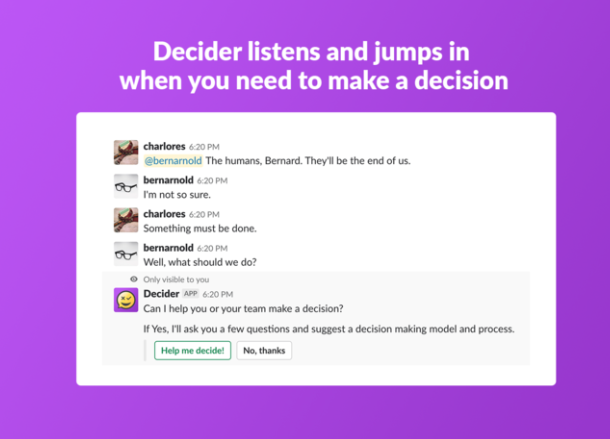
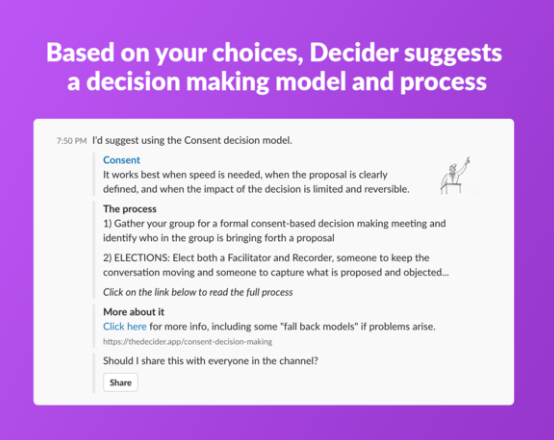
Decide Better Together | The nice folks at Nobl have developed a chatbot for Slack called Decider, designed to help groups decide how to make decisions.

As your team grows, making decisions together becomes harder. As you add more people, reaching consensus often becomes too slow, and/or the compromises you have to make become too painful. In response, some teams simply put all the decision-making responsibilities on the leader, which overloads them and demotivates everyone else. But there are so many ways to make a decision together, far more than either giving everyone a say or only giving one person the authority. Decider helps you explore more ways to make a decision together and helps you understand when one model might be better suited than another.

(Btw — the consent model of decision making is underused. I wrote about it here: Work Futures Daily — Teams, Rounds, and Consent.)

This Company Bets All On Employee Engagement | The Corporate Rebels report on the flexible management approach of Smarkets, a London-based betting exchange company.

Each team decides how it wants to work. Some teams select their team lead in a democratic way, others rotate the role, and others don’t even appoint a specific team lead and are therefore ‘leaderless’.
This might raise concerns about chaos, or lack of alignment with other teams. But this doesn’t have to be the case. At Smarkets, they organize weekly coordination meetings. Each team sends a representative to coordinate with the other teams. Once again, the teams decide who to send.
The Smarkets approach to self-management is continually evolving. Everyone is invited to challenge the model and suggest improvements. But that it already works is not in doubt amongst the employees.
An earlier quote by Software Engineer Annie Zhang is revealing: “It means being able to decide for yourself what to work on, and having the flexibility, as engineers, to decide the direction of the product. It also allows us to spend more time working independently and communicating with other team members however we see fit — instead of sitting through meetings that might not be relevant to what we’re actually working on.”

The firm also implemented salary transparency and self-set salaries. A hotbed of innovation. A must read, and on my list of companies to visit on my planned European trip in late Spring 2019 (Contact me if you want to connect when I am there: I will be planning get-togethers in various cities, like London).

Smarkets sounds like the sort of organization I meant when I coined the expression ‘fast and loose’ business.

Why You Start Things You’ll Never Finish | Tim Herrera says the answer is to start fewer things.

At NPR, an army of temps faces a workplace of anxiety and insecurity | Paul Farhi looks into the large proportion of temps keeping NPR going:

For decades, the public broadcaster has relied on a cadre of temporary journalists to produce its hourly newscasts and popular news programs. Without temporary workers — who are subject to termination without cause — NPR would probably be unable to be NPR. Temps do almost every important job in NPR’s newsroom: They pitch ideas, assign stories, edit them, report and produce them. Temps not only book the guests heard in interviews, they often write the questions the hosts ask the guests.
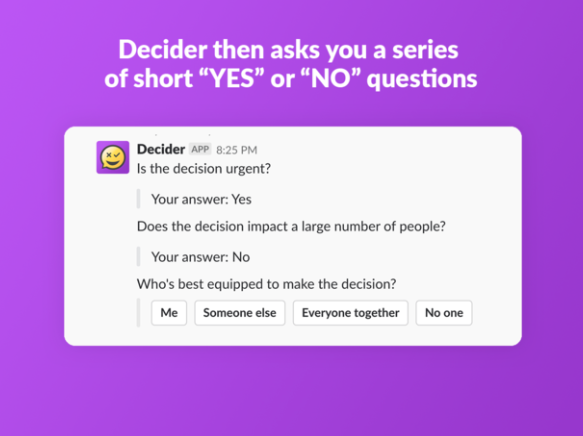
And there are a lot of them. According to union representatives, between 20 and 22 percent of NPR’s 483 union-covered newsroom workforce — or 1 in 5 people — are temp workers. The number varies week to week as temps come and go.
NPR’s management cites a somewhat lower figure, 16 percent, although its count reflects managers and interns and other employees in departments that aren’t represented by the union. NPR says the overall ratio of temporary workers to permanent employees has remained more or less stable for several years.

The size of the temp workforce is unusual in media circles. While the workers are making at least $21,63/hour and receive health insurance and other benefits if they work more than 30 hours in a given two-week pay period. But it’s all very precarious.

It just doesn’t gibe with what I would have been the ethics of NPR, but who knows what they are, really. NPR has been converting many temp jobs into permanent work, so this may be transitory.

Automation and the future of the African American workforce | McKinsey report suggests ‘without concerted effort, automation could heighten disparities that already harm minority workers’. This is due to the fact that African Americans are disproportionally employed in support roles, rather than ‘directive’ — management — roles. This means they are generally paid less, and support work has a slower growth rate than directive work.

A must read.

Recent Issues

Work Futures Daily — A Kick In The Head | 2018–12–11 | Priya Parker: Wow! | Rededicated | Diversity at Slack | Janelle Monáe loves Slack | AI as Talent Scout | Compliment Yourself | Tom Loosemore on New Ways of Work | Lee Bryant: Change the system, change the culture

Work Futures Daily — Don’t Quit | 2018–12–09 | Four Steps To Creativity | Mental Models | Gender Equality, at Work and Home | Minimum Wage For Ride-Hailing | It’s Harder to Get A Promotion | Wellness Trends | Kevin Aston

Work Futures Daily — Robots, AI, Everywhere | 2018–12–07 | Electricity Grid Drones | Robot Janitors | Feeding AI Data | Agri-Bots | Avoid Women At All Costs | Perennials, Not Millennials | Juno Sells To Get | Helen Hester and Social Reproduction

From the Archives

Citizenship, Communityship, Ownership & Leadership | Henry Mintzberg May 2016 | A brilliant exploration of how we downplay the layer of human society he calls communityship while obsessing about the collective and individual layers, and especially, the individuals called up into leadership.

I moved a month of Dailies — December 2017 — onto work futures.org from Substack. I thought these issues were still of value:

Work Futures Daily — High Sierra Upgrade | Kranzberg’s six laws; Group brainstorming is nuts; Sallie Krawcheck on the deep bias against women in business; The Brotherhood of the Future; Exoskeletons

Work Futures Daily — We Are All In The Gutter | But some of us are looking at the stars | Corporate Rebels on Meetings | Unanimous AI’s Swarm Intelligence | AI in Law | AR Goggles | TV Futures | Instapay

Is Amazon The New Uber? | Bryan Menegus looks into Amazon’s growing use of freelance drivers who ‘compete for shifts on the company’s own Uber-like platform’, called Amazon Flex. After screening and minimal training, Flex drivers use their own cars, bikes, or public transportation to deliver packages to Amazon customers. What could be wrong with that? Plenty.

Originally published at workfutures.org.


The Future Is Already A Disappointment was originally published in Work Futures Institute on Medium, where people are continuing the conversation by highlighting and responding to this story.

21 Dec 04:37

Six-Hour Workday, Please

by Stowe Boyd

Is ‘Six-Hour Workday’ a movement, now? | HR Based Against Longer Commutes? | Trump Interrupts Pelosi 15 Times: Just Another Day At Work | Pew on AI and the Future

Beacon NY — 2018–12–13 — I’m in that strange position of being my own boss, so I find it hard to limit my work to six hours a day, although I like the idea. I’m approaching things the opposite way, which is making the periods when I am not working longer. So I’ve adopted a ‘four walks a day’ model.

Whatever works.

If you’re getting this you probably signed up at workfutures.org (or one of its predecessors) or stoweboyd.com. If someone forwarded this to you, sign up here.

Consider making a donation. We appreciate your support.

a sponsor message from BoundlessU

Work Futures reader and fellow writer on the future of work, Paul Millerd, has recently completed a course that pulls together all of the lessons, secrets and tools he learned while a strategy consultant at firms like McKinsey and Boston Consulting Group for almost ten years. He is offering the course on a gift basis where you can pay-what-feels-right. Check out a preview of some of the lectures here.

Links

The Case For The Six-Hour Workday | Steve Glaveski joins the growing movement for the six-hour workday:

By cultivating a flow-friendly workplace and introducing a shorter workday, you’re setting the scene not only for higher productivity and better outcomes, but for more motivated and less-stressed employees, improved rates of employee acquisition and retention, and more time for all that fun stuff that goes on outside of office walls, otherwise known as life.

I wonder how many reading that say ‘It would never work in my organization’?

Research: Hiring Managers Are Biased Against People with Longer Commutes | I’m not surprised by the conclusions of David Phillips from recent research:

My results show that applicants living in distant neighborhoods received positive responses from employers less frequently than those living near the workplace. In fact, applicants who lived 5–6 miles farther from the job received about one-third fewer callbacks. The size of this penalty is similar to the penalty for signaling race with a black-indicating name. (For background: Other prominent studies compare employer responses to fictional applicants with names that signal different ethnicities. They provide some of the clearest evidence of significant discrimination in employment and rental housing. Comparing racial discrimination to a penalty for long commutes is complicated for many reasons, not the least of which is that race and place are related in DC. But the comparison at least provides a benchmark. In my study, an extra six miles of commuting lowers an applicant’s chances by as much as listing a black-indicating name like Jamal or Lakisha.)

There is a rationale for weighting candidates that live closer more highly: they’re more likely to stick with a job with a short commute. But the economics enforces inequality when workers are forced to live in distant suburbs because of high rents downtown. And of course this strikes minorities more than others. The tension between social inequity and corporate self-interest should be balanced, not remain one-sided.

Trump Interrupting Pelosi Shows How Men Often Treat Women | Amanda Mull noticed that Donald Trump interrupted Nancy Pelosi 15 times during a discussion in the White House with Chuck Schumer. This is par for the course with Trump who interrupted Hilary Clinton 51 times during a presidential debate. But what is at work here is deeper than Trump’s attitudes: it’s wired into our culture.

Researchers have been investigating who interrupts and who gets interrupted since at least 1975, when a landmark study at Stanford University found that, out of 31 conversations examined between partners of various gender pairings, men were responsible for all but one interruption. American notions of gender roles and interactions have changed a lot in the intervening 40 years, and a 2014 study from George Washington University suggests that’s brought a certain amount of parity to the act of interruption: Men and women in that study interrupted others at similar rates.
Where gender differences remained pronounced in the 2014 study was in who got interrupted: Speakers of all genders were far more likely to interrupt a female conversation partner. This dynamic is perhaps most visibly born out at the highest levels of government. In 2017, Senator Kamala Harris was cut off during her questioning of then-Attorney General Jeff Sessions by two male colleagues. During the 2016 presidential campaign, Trump interrupted Hillary Clinton 51 times during one debate; she interrupted him 17 times. Tuesday’s White House meeting was not the first situation in which Pelosi, a very powerful woman by all measures, has had to fight to get a word in edgewise with her colleagues.
Indeed, research has demonstrated that professional power alone isn’t enough to mitigate the disadvantage of being a woman in a conversation. According to a 2017 Northwestern University study, female Supreme Court Justices were more likely to be interrupted than their male colleagues, and it was usually their male colleagues doing the interrupting. The researchers found that in order to avoid being talked over, female justices usually adopted more aggressive questioning styles that mirrored their male counterparts over time. The data suggests that even though mirroring male conversational styles did help them, it wasn’t enough to pull female judges even with their male colleagues.

This is so deep it might take generations to change, and this pervades business.

Artificial Intelligence and the Future of Humans | The Pew Research Center has published a very broad analysis of AI’s impact on the future.

Digital life is augmenting human capacities and disrupting eons-old human activities. Code-driven systems have spread to more than half of the world’s inhabitants in ambient information and connectivity, offering previously unimagined opportunities and unprecedented threats. As emerging algorithm-driven artificial intelligence (AI) continues to spread, will people be better off than they are today?
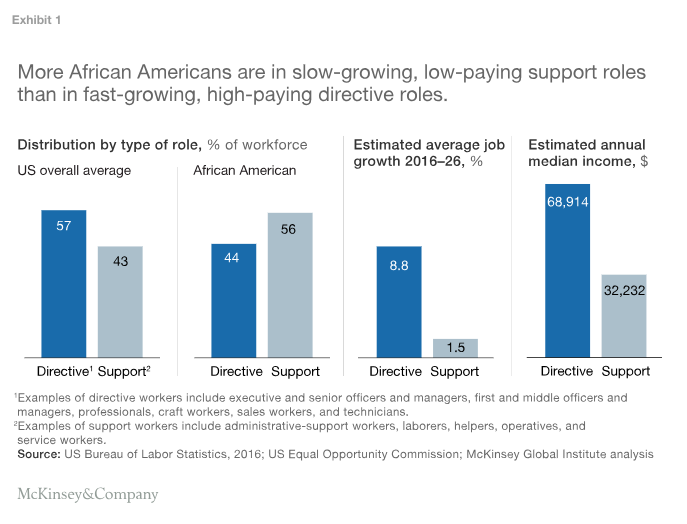
Some 979 technology pioneers, innovators, developers, business and policy leaders, researchers and activists answered this question in a canvassing of experts conducted in the summer of 2018.
The experts predicted networked artificial intelligence will amplify human effectiveness but also threaten human autonomy, agency and capabilities. They spoke of the wide-ranging possibilities; that computers might match or even exceed human intelligence and capabilities on tasks such as complex decision-making, reasoning and learning, sophisticated analytics and pattern recognition, visual acuity, speech recognition and language translation. They said “smart” systems in communities, in vehicles, in buildings and utilities, on farms and in business processes will save time, money and lives and offer opportunities for individuals to enjoy a more-customized future.

Many focused their optimistic remarks on health care and the many possible applications of AI in diagnosing and treating patients or helping senior citizens live fuller and healthier lives. They were also enthusiastic about AI’s role in contributing to broad public-health programs built around massive amounts of data that may be captured in the coming years about everything from personal genomes to nutrition. Additionally, a number of these experts predicted that AI would abet long-anticipated changes in formal and informal education systems.
Yet, most experts, regardless of whether they are optimistic or not, expressed concerns about the long-term impact of these new tools on the essential elements of being human. All respondents in this non-scientific canvassing were asked to elaborate on why they felt AI would leave people better off or not. Many shared deep worries, and many also suggested pathways toward solutions.

Go read it. It’s an amazingly broad spectrum blending of perspectives. (I’m in there somewhere, positioned as an optimist, strangely.)

Quote of the Day

Sometimes when I read the papers of my fellow urban planners, I get the sense that they think cities are Disneyland or Club Med. Cities are labor markets. People go to cities to find a good job. Firms move to cities, which are expensive, because they are more likely to find the staff and specialists that they need. If a city’s attractive, that’s a bonus. But basically, they come to get a job.

| Alain Bertaud in an interview with Nolan Gray in Urban Planner Alain Bertaud’s Case for Bottom-Up Design

Recent Issues

Work Futures Daily — The Future Is Already A Disappointment | 2018–12–12 | Paul Starr on a Disappointing Future | Decider Chatbot | Corporate Rebels on Smartlets | Tim Herrera on Starting What We Never Finish | NPR Temps | McKinsey on African-Americans and Automation

Work Futures Daily — A Kick In The Head | 2018–12–11 | Priya Parker: Wow! | Rededicated | Diversity at Slack | Janelle Monáe loves Slack | AI as Talent Scout | Compliment Yourself | Tom Loosemore on New Ways of Work | Lee Bryant: Change the system, change the culture

Work Futures Daily — Don’t Quit | 2018–12–09 | Four Steps To Creativity | Mental Models | Gender Equality, at Work and Home | Minimum Wage For Ride-Hailing | It’s Harder to Get A Promotion | Wellness Trends | Kevin Aston

From the Archives

The Architecture Of Cooperation | Stowe Boyd 2011

The now old architecture of work was based on process-centric, collaborative work: I mean that all the people involved in some business process — for example, new customer acquisition for a consumer products company — would work exclusively on that process, and everyone’s work was defined by the process. In principle, each member of the consumer acquisition team would spend 100% of their time on that process, and all the members would be co-located (in cubicles or offices) so that the process could be as efficient as possible. Considerations of what would be best for the individual would be deemed irrelevant. Collaboration was the byword, and web tools were designed around symmetrical projects, where members derive their rights by being ‘invited’ — assigned — to project-based work contexts.
The new architecture of work is now emerging, after decades of transition. White collar work became knowledge work which has now become creative work. The transition from process to networks is not just a recasting, not just a different style of communication. The work is styled as information sharing through social relationships, and where ‘following’ takes the place of ‘invitation’. People coordinate efforts, but work on a wide variety of activities, which are not necessarily co-aligned with others’ work, and which are not necessarily even known in a general way. A new degree of privacy and autonomy animates cooperative work, in comparison to collaborative work. Individuals cooperating hand off information or take on tasks in a fashion that is like businesses cooperating: they see the benefit in cooperating, and don’t have to share a common core set of strategic goals to do so: they don’t need the alignment of goals that defines old style business employment.

Originally published at workfutures.org.


Six-Hour Workday, Please was originally published in Work Futures Institute on Medium, where people are continuing the conversation by highlighting and responding to this story.

21 Dec 04:37

Wool dress shirts

by jnyyz

I’ve been a big fan of wool for cycling. Practically all my bike jerseys are wool as are most of my socks. Wool has many excellent properties, among which is the fact that it is odour resistant. In practice, I can wear a wool jersey for a week’s worth of commutes without having to wash it, whereas a plastic jersey can get pretty smelly after one ride.

I do have the advantage that I can change my clothes at work. However, it is handy to have clothes that are OK for both the bike commute and the workplace. There are many companies that have promoted clothes that are appropriate for both the work place and the bike commute.

I’ve written in the past about pants, and to make a long story short, for the 75% of the year when I bike in long pants, most of the time my go to pants are the Outlier Slim Dungarees.  I have two pair, one of which is from the original run (2012) with the rivets that were painted. They have held up very well, are comfortable, and are a little dressier than jeans. I also have a pair of Maker and Rider Aerodri wool pants, which I like very much. In the summer, when I switch to shorts, they are the MEC Mochilero’s.

However, I’ve had somewhat less success with shirts, particularly those than can pass for dress shirts. Here I’m going to comment on the various wool dress shirts that I’ve tried over the years.

The first dress shirt I bought that was 100% merino was from Wool&Prince. They attracted some press around the time they launched back in 2014, with the founder wearing the same shirt without washing it for an extended period of time. After reading reviews like this one, I decided to order both a check sports shirt and an oxford styled button down.

Here is the W&P check sports shirt.

IMG_0179

It has held up pretty well over the years. However, the dress shirt was a sad story. I sent it out to be dry cleaned, but I think that the cleaner put it through a regular laundry cycle, and it came back massively shrunk. You are get an idea from this picture.

IMG_0186

Since it was ruined anyway, I tried to wash it again, and then hang to dry, just as I did the check shirt, and it shrank even more. Therefore I’d say that you have to be very careful when sending out a wool shirt for cleaning, and make sure that they dry clean it. I asked the company about this, and they said that other customers had not had this issue.

The next shirt I’ll talk about is one from Icebreaker. This is one of their Departure shirts. They come in patterns that make them more of a sports shirt. The one pictured is a style from at least three years back when the chest pocket was rather unusual. The current models have a more normal chest pocket.

IMG_0177

The plus of this shirt is that it has a very fine weave, and drapes like a fine cotton shirt. There are two slight disadvantages: one is that for me the sizing is a bit off. I wear a 38″ jacket, and usually use a M sized shirt. but the sizing seems to run large in this shirt. I wear a small, and it fits a little narrow across the shoulders, but the M is way too large for me. Try before you buy. The other comment that I’d make is that the wool is marginally scratchier than some of the alternatives.

The next two shirts are from Outlier. I started buying from them back in 2010 because I believed in supporting North American manufacture. Back in the day, each shipment would also come with a little card signed by Tyler. Now the last two items that I bought from them were sewn in Portugal. Oh well…..

The first wool shirt I bought was their “merino/co” wool cotton blend.

IMG_0178

Of all the wool shirts that I have, this is the one that is the closest to an absolute straight swap with a regular cotton button down. The drape and texture of the fabric is the same, but it doesn’t have to be washed nearly as often.

The second one was their S140 Hidden Pocket Pivot. Here I’m picturing it over the Wool&Prince shirt to show that it is cut slimmer.

IMG_0180

It is a lovely shirt, but the drape is not very crisp. It is more like the ultimate flannel shirt if you can imagine it. The other comment is that I wish I hadn’t opted for the hidden pocket style. Part of the placket is doubled and is quite difficult to button.

IMG_0181

Finally, I bought a wool/cotton blend shirt from Rapha that doesn’t appear to be made anymore. There are lots of unusual features of this shirt, not the least of which are the snap closures under a hidden placket.

IMG_0183

IMG_0184

I like this shirt but I haven’t worn it enough to judge whether the snaps will hold up over the long run.

Here are the relative weights of the shirts (all size M except the icebreaker which is S)

Shirt Weight (g)
W&P 225
Icebreaker 251
Merino/Co 354
S140 347
Rapha 361
Cotton 281

“Cotton” is the weight of an Outlier cotton pivot shirt, which is similar to the Merino/Co in terms of cut.

Here are some close up pictures where you can see the weave of the fabrics.

IMG_0196

Three outlier shirts Left to right: s140, Cotton, Merino/Co. You can see that the weave on the cotton shirt is considerably coarser.

IMG_0198

Left to right: Merino/Co, W&P, Icebreaker. The W&P shirt has the coarsest weave.

Note that in all of the above pictures, the shirts were washed and then hung to dry without ironing, which is my usual care routine. They might look wrinkled, but upon wearing they will relax and look fine.

Summary: 

I’d say that for suit and tie occasions, none of the shirts would really compare with a permanent press high quality cotton dress shirt, especially one with a fused collar. However, all of them would be just fine for office casual. I work in a university environment so that works for me.

For me, I can’t really wear a cotton dress shirt more than two days at most as I start seeing “ring around the collar”, whereas for the wool shirts, I could conceivably wear any of them for a week before I’d feel the need to wash them. YMMV. The wool shirts are also more resistant to wrinkling. In practice, I keep two of them in the office so that I can switch back and forth, and bring them home once or twice a month.

In terms of personal preference, I like the Merino/Co for a solid colour shirt, and the icebreaker for a sports shirt.

If you want a button down shirt that has relatively high wool content, then go on over to the Outlier space on reddit, and bug them to make their merino/co pivot shirt again.

If you want more of a sports shirt, then Wool&Prince seems to be fine, but I had the aforementioned shrinkage problem with one of their shirts. Icebreaker is an alternative if you are happy with the fit. I’ll also note that the Icebreaker shirts often go on sale in the off season. I also have two of the short sleeve version of the Icebreaker shirt that I really like for summer.

The ideal application for all of these shirts is for travel, where just once of these shirts would be fine for up to a week long trip.

The other area where wool is an absolute slam dunk is for socks. My favourites are the argyle wooleators from Defeet. I get lots of compliments from them.

WATMCA_600x_crop_center

Here is a review from 2014 that covers some of the same brands that I’ve mentioned here.

21 Dec 04:37

Relentlessly eliminating barriers to growth

by Dries

In my last blog post, I shared that when Acquia was a small startup, we were simultaneously focused on finding product-market fit and eliminating barriers to future growth.

In that light, I loved reading Eugene Wie's blog post called, Invisible asymptotes. Wie was a product leader at Amazon. In his blog post he explains how Amazon looks far into the future, identifies blockers for long-term growth, and turns eliminating these growth barriers into multi-decade efforts. As Amazon shows, eliminating barriers to growth remains very important long after you have outgrown the startup phase.

For example, Amazon considered shipping costs to be a growth blocker, or as Wie describes it, an invisible asymptote for growth. People hate paying for shipping costs, so Amazon decided to get rid of them. At first, solving this looked prohibitively expensive. How can you offer free shipping to millions of customers? Solving for this limitation became a multi-year effort. First, Amazon tried to appease customers' distaste for shipping fees with "Super Saver Shipping". Amazon introduced Super Saver Shipping in January 2002 for orders over $99. If you placed an order of $99 or more, you received free shipping. In the span of a few months, that number dropped to $49 and then to $25. Eventually this led to the launch of Amazon Prime in 2005, making all shipping "free". Members pay $79 per year for free, unlimited two-day shipping on eligible purchases. While a program like Amazon Prime doesn't actually make shipping free, it feels free to the customer, which effectively eliminates the barrier for growth. The impact on Amazon's growth was tremendous. Today, Amazon Prime provides Amazon an economic moat, or a sustainable competitive advantage – it isn't easy for other retailers to compete from a sheer economic and logistical standpoint.

Another obstacle for Amazon's growth was shipping times. People don't like having to wait for days to receive their Amazon purchase. Several years ago, I was talking to Werner Vogels, Amazon's global CTO, and asked him where most commerce investments were going. He responded that reducing shipping times was more strategic than making improvements to the commerce backend or website. As Wie points out in his blog, Amazon has been working on reducing shipping times for over a decade. First by building a higher density network of distribution centers, and more recently through delivery from local Whole Foods stores, self-service lockers at Whole Foods, predictive or anticipatory shipping, drone delivery, and more. Slowly, but certainly, Amazon is building out its own end-to-end delivery network with one primary objective: reducing shipping times.

Every organization has limitations that stunt long-term growth so there are important lessons that can be learned from how Amazon approached its blockers or invisible asymptotes:

  1. Take the time to correctly identify your long-term blockers for growth.
  2. Removing these long-term blockers for growth may look impossible at first.
  3. Removing these long-term blockers requires creativity, innovation, patience, persistence and aggressive capital allocation. It can take many initiatives and many years to eliminate them.
  4. Overcoming these obstacles can be a powerful strategy that can unlock unbelievable growth.

I spend a lot of time and effort working on eliminating Drupal's and Acquia's growth barriers so I love these kind of lessons. In a future blog post, I'll share my thoughts about Drupal's growth blockers.

21 Dec 04:28

Huntress

by Volker Weber

21 Dec 04:28

Danke, danke, danke

by Volker Weber

Ich schrieb neulich:

Was ich mir noch verdienen muss, ist das Geld, das alles zu bezahlen.

Und das meinte ich wörtlich. Verdienen. Ich bin nicht arm und ich kann was. Ich kann besser erklären als viele andere, meine Vorträge sind kein "Death by PowerPoint". Ich habe Wirtschaftsprüfer, Ingenieure, Banker und Patentanwälte beraten. Und ich bin in diesem Geschäft schon länger als es das Internet gibt. Und obwohl ich schon sechzig bin, kann ich nach ganz gut mit den Kids auf Longboards mithalten. Also die Kids auf dem Board, nicht ich. :-)

Mit anderen Worten: Ich sitze hier nicht mit dem Hut in der Hand. Lieber verschenke ich als beschenkt zu werden. Und ich mache das hier auch täglich. Je öffentlicher meine Tätigkeit, desto schlechter bezahlt ist sie. vowe.net bringt gar kein Einkommen, weil ich Werbung und Sponsoren-Deals hasse. Was hier steht, ist echt. Journalistische Tätigkeit bringt nur wenig mehr als gar nichts ein. Vorträge sind dagegen brutal teuer, weil ich viel hinter den Kulissen vorbereite. Was so leicht aussieht, erfordert viel Vorbereitung. Der legendäre Rudi Carrell meinte dazu: "Wenn Du etwas aus dem Ärmel schütteln willst, dann musst Du es vorher reinstecken."

Ragnar kommentierte meine Bemerkung mit:

Wenn jemand unverschuldet in eine Lage kommt, in der er Hilfe braucht, ist Solidarität gefragt. Solidarität funktioniert innerhalb einer gefühlten Gemeinschaft. Man könnte jetzt ein GoFundMe aufmachen - aber vowe hat ja schon ...

Das ist ein Ding, das mich zu Tränen rührt. Wenn jemand das Gefühl hat, mir was zurückgeben zu wollen. Das BuyMeACoffee habe ich mal eingerichtet, weil z.B. Amerikaner es nicht ertragen, wenn sie eine "Schuld" anhäufen. Lunch is on me. Aber das hat viel Schlupf. Rein in den Dollar, raus aus dem Dollar, Verzögerungen, Gebühren, etc. Für größere Summen passt das nicht.

Der schlauere Weg ist N26 MoneyBeam oder PayPal, die einfach mit meiner Mail-Adresse funktionieren. Und da ging es gestern mit einem Gruß von jemandem los, dessen Namen ich nie vorher gelesen habe. Und hörte dann nicht mehr auf, mit kleinen Zahlen und mit großen.

fc045a976c51db64fddbe28d3cb244ab

Ich danke Euch von ganzem Herzen, aber ich sage nicht, wer Ihr seid. Niemand muss sich klein fühlen; jeder wie er kann! Danke, danke, danke!

Ich habe auch noch was anderes bemerkt: Viele haben ihre Weihnachtseinkäufe gemacht, in dem sie zunächst einmal auf einen meiner Amazon-Links geklickt haben, um dann den Warenkorb (mit anderen Sachen) zu füllen und zu kaufen. Auch das hilft immens.

21 Dec 04:28

Soyuz-Flug zur ISS und zurück

by Volker Weber

Die ESA hat zwei wunderbare Videos, die beschreiben, wie das Soyuz-Raumschiff zur ISS und wieder nach Hause kommt. Es gibt auch ein drittes Video, das den eigentlichen Start beschreibt, aber das ist weitgehend bekannt.

Ich wusste nicht, wie das Rendezvous funktioniert und welcher Aufwand getrieben wird, dass Soyuz und ISS keinesfalls kollidieren. Und ich hatte keine Ahnung, wie Soyuz selbst aufgebaut ist. Wir kennen halt Mercury, Gemini und Apollo, aber Soyuz ist komplett anders. Die eigentliche Kapsel ist in der Mitte des Raumschiffs.

Ganz spannende Videos. Nehmt Euch Zeit.


21 Dec 04:27

Words to live by

by Volker Weber
To share your weakness is to make yourself vulnerable; to make yourself vulnerable is to show your strength.
21 Dec 04:27

Walt Mosberg joins the club

by Volker Weber

Thread

21 Dec 04:20

Soup-Salad-Sandwich space

by Nathan Yau

The debate rages on about the categorization of food items as soup, salad, or sandwich. Is a hot dog a sandwich? It has meat in bread. At what ratio of solid to liquid does a stew become a soup? The Soup-Salad-Sandwich Space makes the classifications more explicit. You’re welcome.

Tags: food, humor, sandwich

21 Dec 04:13

The Need for Consultation: Before and After

by Colin Stein

The following video features new Vancouver city councillor Colleen Hardwick speaking to the amendment, drawn from the “Making Room” housing program — itself an outcome of the staff-driven 10-year Housing Vancouver Strategy — that would allow duplexes across the city.

It’s actually two parts, featuring…

  1. Candidate Hardwick at a public hearing in September, on concerns about the process used to approve the original “duplex motion”; and
  2. Councillor Hardwick addressing the council amendment about a process, proposed in November, to facilitate the rescinding of the motion.

(Hint: The first part is not like the second part.)

Gord’s take:

Political observers know there’s such a thing as a ‘consultation gap’ – the distance between the position a candidate has on consultation before and after an election.

Before: More consultation is better when properly and fairly conducted, open to all, and not pre-determined. After: the election is sufficient.

It’s unlikely there is a candidate who has so quickly made the leap as Colleen Hardwick.

21 Dec 04:01

NewsBlur Blurblog: Shawn Micallef: When it comes to winter salt use, a little goes a long way

sillygwailo shared this story from TORONTO STAR.


In some cases we’re using 100 times more rock salt than needed, says Toronto and Region Conservation Authority officials.
21 Dec 04:00

Google vs. Bing

by Doc Searls

google vs bing

In search, Google has a 90%+ share worldwide. But I’m not sure that makes it a monopoly, as long as it has real competition. With Bing is does.

For example, recently I wanted to find a post Andrew Orlowski wrote for The Register in the early 00s. I remembered that it was about The Cluetrain Manifesto (which he called “Candide without the irony”—a great one-liner I can’t forget), and also mentioned John C. Dvorak, another Cluetrain non-fan. So I did this search on Google:

https://www.google.com/search?q=doc+searls+orlowski+register+cluetrain+candide+dvorak

I got one page of useless results.

So I went to Bing and did the same:

https://www.bing.com/search?q=doc+searls+orlowski+register+cluetrain+candide+dvorak

Bulls eye.

Credit where also due: I can find it as well in The Register‘s own search function. Hats off to all publications that keep their archives intact and searchable.

The difference between Google and Bing in this case is consistent with something I’ve noticed lately, which is that Google seems to be forgetting a lot of old stuff. Maybe it’s because the company is deprecating http in deference to https. Maybe there’s some other reason. I don’t know.

I also prefer Bing’s image search as well. It’s much less complicated than Google’s, and much easier to step through with the > arrow when paging through results. (Google piles up the already-viewed images in row after row above the current image, leaving the current image “below the fold,” and requiring extra work to locate again.)

And I love Bing’s Birds Eye views in Bing Maps. For an example of the latter, look here. That’s the top of the “candelabra” tower in Needham, Mass. It’s the site from which nearly all of Boston’s TV stations radiate. (Over-the-air broadcasting is very old hat, but I still care about it.) The closest Google can comes to that is here, where the 3D view only shows the base of the tower.

I can give lots of other examples, but I think I’ve made my  point:  Google isn’t a monopoly as long as there is a worthy competitor. And in several important ways, Bing is that.