First, most people don’t delete their account when they stop participating. This means the older a community becomes, the worse this ratio becomes. It reflects community maturity as much as anything you can control.
Second, it’s too broad to give you any actionable insights. Let’s imagine your number is 20% and you hear the average is 30%. So what? What will you do differently? To get actionable insights you need to look at specific ratios.
Third, it varies tremendously by your community’s topic and type. A customer support community (where most people only visit to get an answer) is going to have a far lower percentage than a lifestyle community where people come to chat. Gaming communities, where new games are released frequently, have higher churn rates as people move on to the next game etc..Comparing yourselves to others on this benchmark is a bad idea.
Instead of wondering what percentage of your members should be active according to others, focus on what’s keeping people active today. I’d track:
Is traffic to your community going up or down?
What percentage of visitors register?
What percentage of registered members participate?
What percentage of those that participate are still active in 3 months time?
What is the average number of contributions per month your top 1%, 9%, and 90% of members make?
Each of these are metrics you directly influence, reveal how well you’re doing, and reveal exactly what you need to work on to make changes.
I too would be using Agenda if I wasn’t deep into the Microsoft ecosystem at this point–it’s that great–and the rest of the list is pretty good too, although I’m a bit sad that people are paying subscriptions for plaintext editors.
Your Best Shot 2018 is in full swing: we’ve already received thousands of stunning submissions—photos that made you smile, cry, and grow. Check them out here. Haven’t submitted yet? You still have plenty of time to join in on the celebration: submit your single best shot of 2018 by January 7, 2019. Five winners will each receive a Peak Design Everyday Backpack, a SmugMug Pro subscription, and lots of exposure on Flickr social media channels. Keep in mind, the sooner you submit to the Group, the more exposure your photos will get.
Have questions about how we’re celebrating with your photos? Visit our FAQs page in the Your Best Shot 2018 Group and read the contest rules before submitting.
We are highlighting some of our favorite shots from the group across various themes, and these are some of the best Wildlife and Portrait photos posted so far.
It’s been quite a year for education news, not that you’d know that by listening to much of the ed-tech industry (press). Subsidized by the Chan Zuckerberg Initiative, some publications have repeatedly run overtly and covertly sponsored articles that hawk the future of learning as “personalized,” as focused on “the whole child.” Some of these attempt to stretch a contemporary high-tech vision of social emotional surveillance so it can map onto a strange vision of progressive education, overlooking no doubt how the history of progressive education has so often been intertwined with race science and eugenics.
“Whole child” and cages – it’s hardly the only jarring juxtaposition I could point to.
2018 was another year of #MeToo, when revelations about sexual assault and sexual harassment shook almost every section of society – the media and the tech industries, unsurprisingly, but the education sector as well – higher ed, K–12, and non-profits alike, as well school sports all saw major and devastating reports about cultures and patterns of sexual violence. These behaviors were, once again, part of the hearings and debates about a Supreme Court Justice nominee – a sickening deja vu not only for those of us that remember Anita Hill ’s testimony decades ago but for those of us who have experienced something similar at the hands of powerful people. And on and on and on.
And yet the education/technology industry (press) kept up with its rosy repetition that social equality is surely its priority, a product feature even – that VR, for example, a technology it has for so long promised is “on the horizon,” is poised to help everyone, particularly teachers and students, become more empathetic. Meanwhile, the founder of Oculus Rift is now selling surveillance technology for a virtual border wall between the US and Mexico.
This is the ninth year that I’ve reviewed the stories we’re being told about education technology. Typically, this has been a ten (or more) part series. But I just can’t do it any more. Some people think it’s hilarious that I’m ed-tech’s Cassandra, but it’s not funny at all. It’s depressing, and it’s painful. And no one fucking listens.
And yet here we are, with Mark Zuckerberg – education philanthropist and investor – blinking before Congress, promising that AI will fix everything, while the biased algorithms keep churning out bias, while the education/technology industry (press) continues to be so blinded by “disruption” it doesn’t notice (or care) what’s happened to desegregation, and with somanydata breaches and privacygaffes that they barely make headlines anymore.
Folks. I’m done.
I’m also writing a book, and frankly that’s where my time and energy is going.
There is some delicious irony, I suppose, in the fact that there isn’t much that’s interesting or “innovative” to talk about in ed-tech, particularly since industry folks want to sell us on the story that tech is moving faster than it’s ever moved before, so fast in fact that the ol’ factory model school system simply cannot keep up.
Does this look familiar? Students lined up in rows. A teacher in front of a blackboard. Sit down; don’t talk; eyes up front. Wait for the bell. Walk to the next class. Everything about our lives has moved beyond the industrial era. But American education largely hasn’t. #SXSWEDUpic.twitter.com/kyy2r7bTud
I’ve always considered these year-in-review articles to be mini-histories of sorts – history of the very, very recent past. Now, instead, I plan to spend my time taking a longer, deeper look at the history of education technology, with particular attention for the next few months, as the title of my book suggests, to teaching machines – to the promises that machines will augment, automate, standardize, and individualize instruction. My focus is on the teaching machines of the mid-twentieth century, but clearly there are echoes – echoes of behaviorism and personalization, namely – still today.
In his 1954 book La Technique (published in English a decade later as The Technological Society), the sociologist Jacques Ellul observes how education had become oriented towards creating technicians, less interested in intellectual development than in personality development – a new “psychopedagogy” that he links to Maria Montessori. “The human brain must be made to conform to the much more advanced brain of the machine,” Ellul writes. “And education will no longer be an unpredictable and exciting adventure in human enlightenment , but an exercise in conformity and apprenticeship to whatever gadgetry is useful in a technical world.” I believe today we call this "social emotional learning" and once again (and so insistently by the ed-tech press and its billionaire backers), Montessori’s name is invoked as the key to preparing students for their place in the technological society.
If I were writing a lengthier series on the year in ed-tech, I’d spend much more time talking about the promises made about personalization and social emotional learning. I’ll just note here that the most important “innovator” in this area this year (other than Gritty) was surely the e-cigarette maker Juul, which offered a mindfulness curriculum to schools – offered them the curriculum and $20,000, that is – to talk about vaping. “‘The message: Our thoughts are powerful and can set action in motion,’ the lesson plan states.”
The most important event in ed-tech this year might have occurred on February 14, when a gunman opened fire on his former classmates at Marjory Stone Douglas High School in Parkland, Florida, killing 17 students and staff and injuring 17 others. (I chose this particular school shooting because of the student activism it unleashed.)
DOPERS – Diverse Organization Providing Education and Regional Services Christmas lunch in Langley, BC with community members, good food, gifts bags, clothing donations and laughter!
TL/DR: I made a film and exhibition about flamingos, migration, and the history of radar for Drugo more (Rijeka, Croatia), travelling to Ljubljana next February. More information on their site, and on mine.
At the end of last year, I spent a couple of weeks in Cyprus as a guest of NeMe in Limassol. The trip was part of the State Machines programme, an ongoing, two year collaboration of five independent institutions around Europe investigating “art, work, and identity in an age of planetary-scale computation” – or, in my shorthand, what digital tools enable individuals and groups to do which only states could do before. The programme has developed multiple travelling exhibitions, conferences, publications, and opportunities for artists, including Transnationalisms, an exhibition I curated in Rijeka and Ljubljana.
In Cyprus, I was supposed to be investigating the international trade in citizenship, and particularly the Golden Visa programme, which allows people with sufficient funds to buy their way into Europe. I did do that, and I wrote up a lot of that research in an essay for the Atlantic, and I met all kinds of interesting people along the way, including artists working across the complex border zone between the two halves of the island, Russian émigré’s setting up blockchain-based nations, and FOREX traders using machine learning to target clients around the world. But I also found myself in a strange territory which I was previously aware of, but had never really thought about, and which became the basis for a recent solo exhibition in Rijeka, Croatia (and which will travel to Ljubljana in February).
When Cyprus gained independence from Britain in 1960, it signed a treaty giving up control of some square 254 km of the island in perpetuity, which became the two Sovereign Base Areas – British Overseas Territories which remain under the control of the British military to this day. And – as in the British Indian Ocean Territory, another weird bit of geography I’ve written extensively about before – they are shared extensively with the United States as well, with a long history of surveillance and communication usage alongside their territorial advantages.
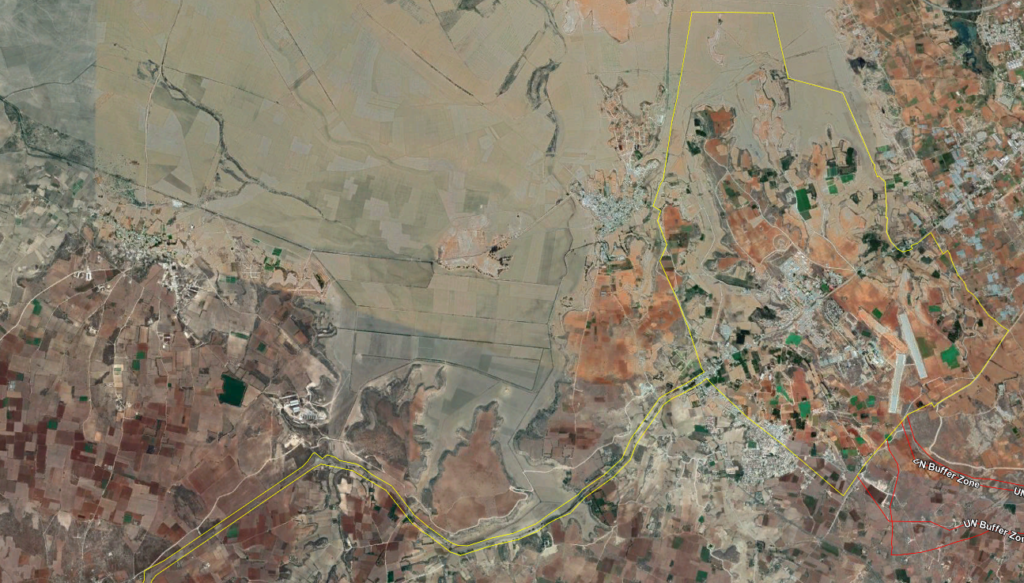
One of the Base Areas is called Dhekelia, and sits hard up against the border with Turkish-controlled northern Cyprus, along the line established following the invasion of 1974. If you drive this way from the Republic to the town of Famagusta in the North, you pass along a road which is Cypriot on the one side, Turkish on the other (nomenclature is hard here – don’t @ me), and British beneath your wheels – as well as being lined with the occasional UN guardpost. You can see the border – the yellow line – in the above image.
Inside the territory on the right of that image is Ayios Nikolaos Station, the largest GCHQ listening station outside the UK, which is part-run by the NSA. In the Snowden documents it’s referred to as SOUNDER, and is used for satellite and radio interception, as well as tapping the many fiber-optic cables that carry the internet across the Mediterranean. You can drive past the dishes and antennae on your way to Famagusta, and plenty of people live and work there, but there are huge no-photography signs and the British military police will take an interest if you linger.
At the other end of the island is the second Sovereign Base Area, RAF Akrotiri, which is separated from the city of Limassol (top right, above) by a huge salt lake. Again, the base is a joint UK/US operation, and in recent years has been a base for airstrikes on Libya and the Islamic State, as well as other operations. One early morning when I was out on the lake, a U-2 “Dragon Lady” of the 9th Reconnaissance Wing took off directly over my head, one of the loudest sounds I have ever heard.
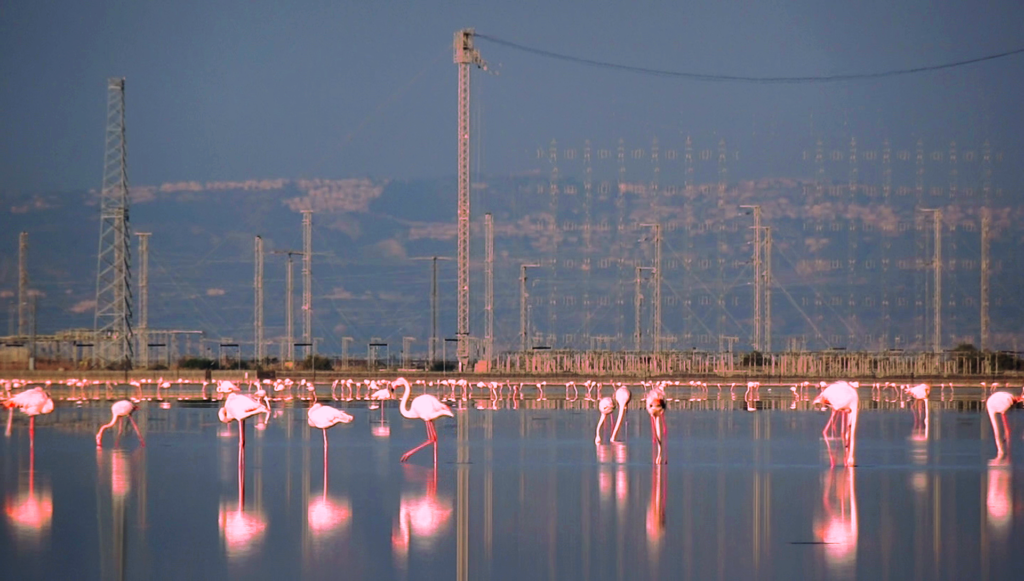
As well as the airfield, Akrotiri is home to another vast antenna and radar field. These antennae include, it is understood, more interception capabilities as well as over-the-horizon radar capable of watching distant airspace. Although the whole peninsula is British sovereign territory, only the air base is off limits to visitors, and the radar site is plastered with all the usual warnings against stopping your car or taking photographs. But the salt lake is also one of the most important wetland areas in the Mediterranean, home to tens of thousands of migrating birds every year, and as a result there are plenty of birdwatching spots.
The lake is home to up to 20,000 greater flamingos every winter: strange, beautiful birds which are deeply comical until you spend time with them, when they become deliberate, elegant, and fascinating. I was supposed, I thought, to be watching the radars, but I ended up watching the flamingos instead.
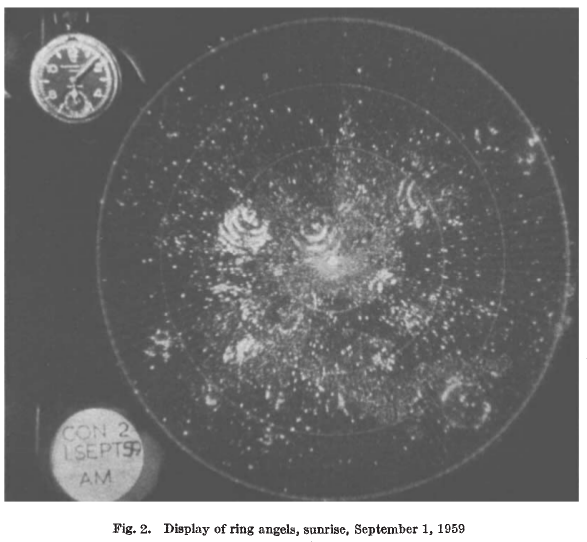
Back in the 1940s and 1950s, the first users of radar systems encountered various strange effects. RAF operators of the new technology would report shimmering lines moving across their screens, and scramble fighter jets to intercept what appeared to be vast waves of incoming bombers, only for the skies to be found empty and the signals to fade away. Over time, these ghostly signals came to be known as ‘angels’.
Figure from Radar ‘Ring Angels’ and the Roosting Movements of Starlings, Eastwood, Ister & Rider, Nature volume 186, pages 112–114 (09 April 1960)
The source of the angels remained disputed for some time, and was complicated by the appearance of further patterns, such as the ‘ring angels’ shown above, which resembled the ripples of stones dropped in water. The caption is a giveaway, but it was a couple of decades before it was generally agreed that these patterns were caused by birds.
It took some time for this idea to take hold, and was much resisted, because radar revealed a whole host of things about birds which had not been previously known. For example, the wartime RAF had a saying that “Only birds and men fly, and birds don’t fly at night” – as was widely believed at the time. But today we know, largely thanks to radar, that most bird migration takes place at night.
In one of those strange quirks of wartime employment, a number of leading ornithologists of the time ended up working within the radar group – notably David Lack, later director of ornithology at Oxford, who was assigned to the Army Operational Research Group in Orkney, and in 1945 co-published the first paper in the field of what would become known as Radar Ornithology. The sudden visibility of previously unknown phenomenon opened up whole new areas of research in the natural sciences. (There’s a great dramatisation by the BBC of Lack’s radar discoveries available online.)
Following my time with the flamingos in Cyprus, I started learning more about the birds, and migration in general. I got in contact with the Tour du Valat, a biological research station in the South of France, which has been monitoring flamingo populations around the Mediterranean for more than forty years. Tour du Valat was one of the very first research centres dedicated to wetland conservation, and the driving force behind the Ramsar Convention, one of the first international environmental treaties.
Flamingos, it turns out, are pretty interesting. They are extremophiles: they have special glands for excreting excess salt which allows them to live and feed in environments toxic to many – and which will become more widespread as climate change renders the oceans more salty, and sea level rise drives salinity inland. They can live for four decades or more, and are constantly on the move, capable of flying at up to 60 kph and have been known to travel over 500km in a single night between habitats. They form lasting pair bonds, but also swap partners in large colonies, and are well-known for same-sexpartnerships.
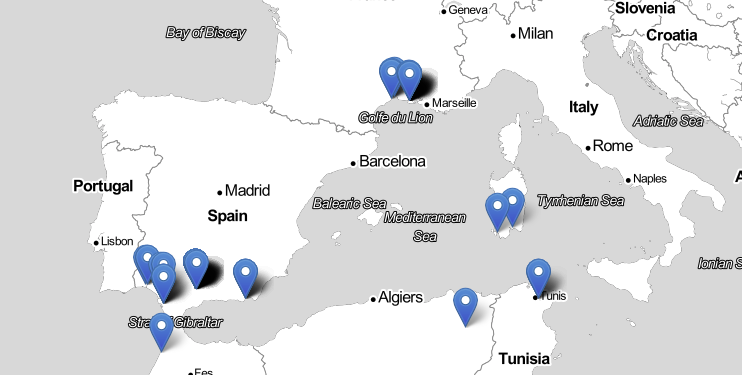
The researchers at Tour du Valat were kind enough to share some of their data with me – a vast database, in fact, containing some 600,000 sightings of more than 20,000 individual birds. It’s an extraordinary document, and I had to write my own tools to start to explore it, to pull out the histories of individuals from this array of information. Below, for example, is a simple and very far from exhaustive map of the sighting locations of a single bird, tagged in 1985 with the ring number ABDF, over thirty-seven years:
The researchers were also at pains to make me aware of one aspect of these data that is little acknowledged in the field – although it’s of much concern to critics of technology and others – which is that digital data of this kind is inherently reductive, and driving a trend within ecological studies which many are uncomfortable with.
In the early days of the natural sciences, specimens were captured in the wild and then brought back to sites of learning where they would be compared and classified, integrated into the systems of knowledge then under construction. The result was the grand edifice of twentieth century categorisation, which sought to place every organism within a tree of life, each distinct and fixed. Reacting to this, the ecological movement has sought, since the 1960s, to return life to the world: to emphasise the interaction between species and their environments, and the encounter of the observer with what they recorded. “Big data”, in the form of vast databases which attempt to synthesise all of these gathered records, has turned this idea on its head once again, and that which is outside the database – the name of the observer, the weather on that day, the lived experience, the undocumented and the ephemeral – vanishes once again from view.
I was recently invited to show work related to the State Machines project at Drugo more in Rijeka, Croatia, and all of these various influences ended up being part of the exhibition. Above is a snapshot of Catch and Release, a two-channel installation which explores the Tour du Valat database, transforming lines of anonymous data back into tiny stories of actual encounters – and erasing each line as it goes. The short stories are accompanied by “rorsched” satellite images of the actual locations – a technique I keep returning to as a way of communicating the beauty but essential unreality and inaccessibility of this kind of remote, mediated image-making.
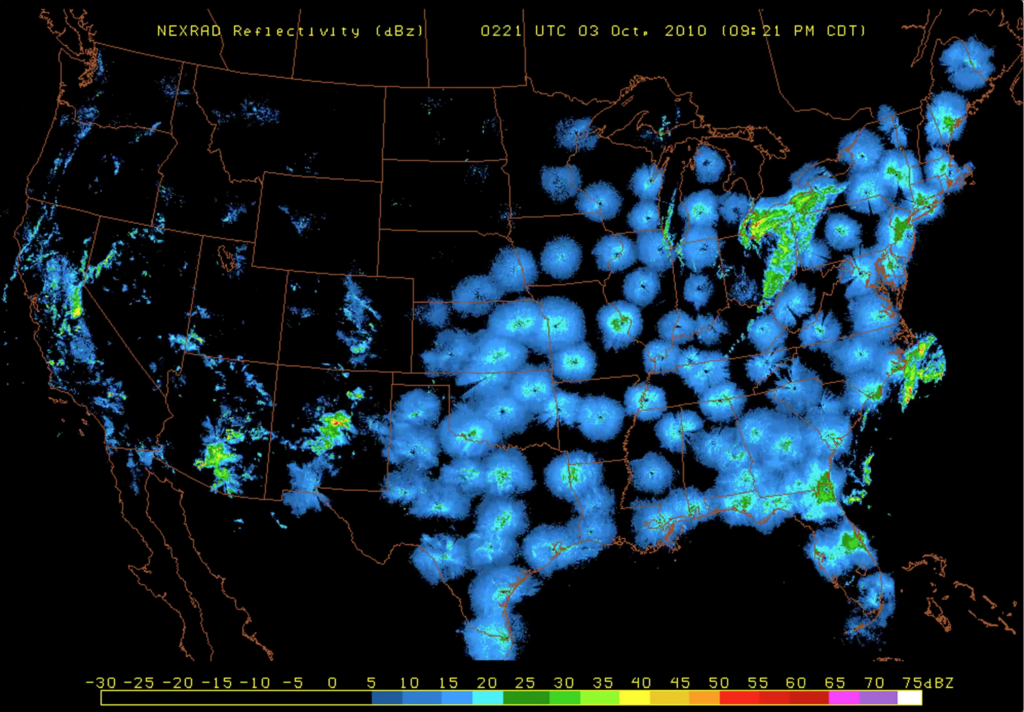
Alongside this work was exhibited live twelve-hour loops of radar data from US weather installations, in which, at dawn and dusk, crackly contemporary ring angels are visible (I did write to the base commander at Akrotiri and asked how often the flamingos appear on their radar, and whether I could see some data of this, but they told me that it was not possible for them to comment).
I also took ABDF, the flamingo mapped above, and wrote out a longer text for him, which engaged with his own travels to half a dozen countries around the Mediterranean, as well as the complex histories of colonial and industrial exploitation, climate change and population dynamics which are entangled with the region, and all its human and non-human inhabitants.
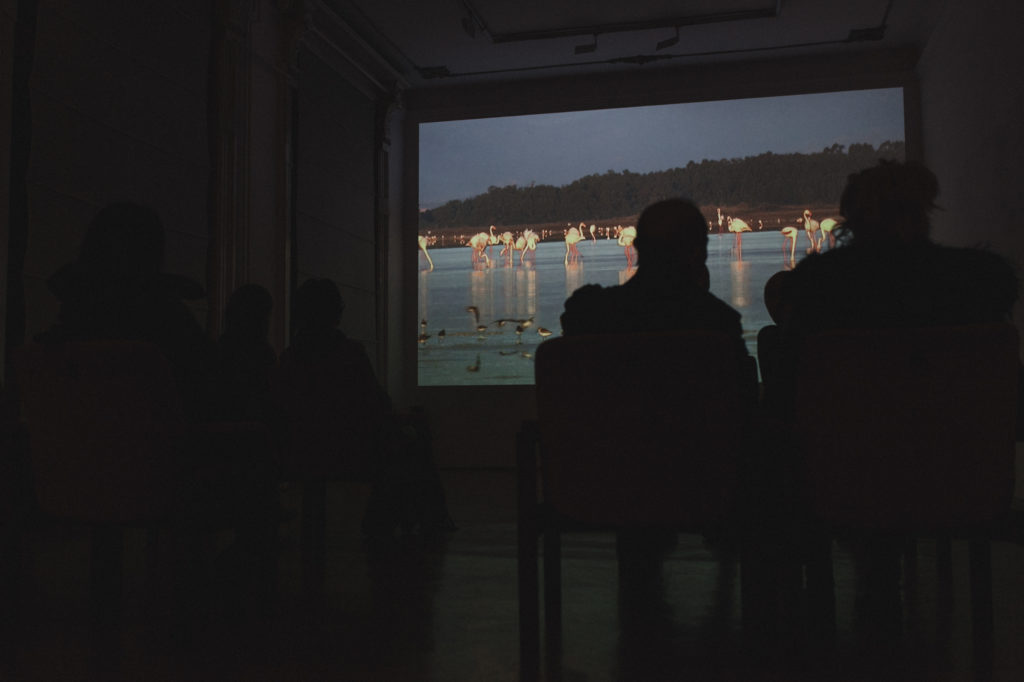
The final piece of the show gave it its name: My delight on a shining night, a thirty minute film documenting the flamingos of the Limassol salt lake, and their environment, which includes the antenna and radar arrays. (Contrary to my usual practice, I’m not posting it online, as it’s long, meditative, and unsuited to small screens.)
From the mid-1970s until 2008, Akrotiri was the broadcast site of a numbers station known as the Lincolnshire Poacher, for its use of the opening bars of the English folk song of that name as its callsign. Numbers stations are radio broadcasts which endlessly repeat number sequences, presumably as messages to spies and other covert units, which were widespread during the Cold War, and the Lincolnshire Poacher was among the best known (you can listen to an excerpt here).
The original song is an exuberant paean to the joys of stealing game from the properties of rich landowners, and getting away from the gamekeepers:
As me and my companions were setting up a snare, The gamekeeper was watching us – for him we did not care, For we can wrestle and fight, my boys, and jump o’er anywhere. Oh, ’tis my delight on a shining night, in the season of the year.
The film contains recordings of both the numbers stations and the original song – as well as footage of the flamingos themselves, these strange, beautiful, extremophile creatures living among the detritus of our power games and industrial waste. The ground shifts, as I watch it, between the shimmering infrastructure of control and surveillance and the exuberant life of the birds and ourselves, between information and ecology, between computational prediction and embodied observation.
I’ve spent so much time around these military technologies and surveillance strongholds, documenting abuses of power and systemic violence, and I find myself constantly drawn back to them – while glimpsing, every time, the wider ecological systems in which they exist. I’m reminded of those telescopes which the National Reconnaissance Office quietly turned over to NASA a few years ago: what would it mean, taking radar ornithology as a guide, to turn the extraordinary powers of our technology to the service of nature, rather than its destruction?
In talking to conservationists around the Mediterranean basin, one thing is obvious: they are more clear-eyed than any tech reckoner or political strategist about the future: a future of rising sea levels, hotter and wetter weather, and more extreme events, climatic and political, for all of us. And this narrative, whatever local effects it might entail, seems inevitably to involve the collapse of our technological infrastructures, created to give us protection from and mastery over the environment, back into the world which they so often attempt to deny or control. We are going to have to think carefully about what we choose to look at, and what we choose to see through these various, complex, and compelling lenses we have built ourselves.
This past weekend was a balmy 5 degrees Celsius which was lucky for me as I had to once again climb onto the roof of my house to deal with my Christmas lights. The middle two strings had failed bulbs somewhere along their length and I had a decent expectation that it was the Blue ones. Again.
Two years ago was our first autumn at our new house. The house needed Christmas lights so we bought four strings of them. Over the course of their December tour they suffered devastating bulb failures rendering alternating strings inoperable. (The bulbs are wired in a single parallel strand making a single bulb failure take down the whole string. However, connectivity is maintained so power flows through the circuit.)
Last year I tested the four strings and found them all faulty. We bought two replacement strings and I scavenged all the working bulbs from one of the strings to make three working strings out of the old four. All five (four in use, one in reserve) survived the season in working order.
This year in performing my sanity check before climbing the ladder I had to replace lamps in all three of the original strings to get them back to operating condition. Again.
The strings are penta-colour: Red, Orange, Yellow, Green, and Blue. Each string has about an equal number of each colour of bulb and an extra Red and Yellow replacement bulb. Each bulb is made up of an internal LED lamp and an external plastic globe.
The LED lamps are the things that fail either from corrosion on the contacts or from something internal to the diode.
So I started with 6N+12 lamps and 6N+12 globes in total: N of each colour with an extra 1 Red and 1 Yellow per string. Whenever a lamp died I kept its globe. So the losses over time should manifest themselves as a surplus of globes and a defecit of lamps.
If the losses were equal amongst the colours we’d see a equal surplus of Green, Orange, and Blue globes and a slightly lower surplus of Red and Yellow globes (because of the extras). This is not what I saw when I lined them all up, though:
Instead we find ourselves with no oranges (I fitted all the extra oranges into empty blue spots when consolidating), an equal number of lamps and globes of yellow (yellow being one of the colours adjacent to most broken bulbs and, thus, less likely to be chosen for replacement), a mild surplus of red (one red lamp had evidently failed at one point), a larger surplus of green globes (four failed green lamps isn’t great but isn’t bad)…
And 14 excess blue globes.
Now, my sampling frequency isn’t all that high. And my knowledge of confidence intervals is a little rusty. But that’s what I think I can safely call a statistical outlier. I’m pretty sure we can conclude that, on my original set of strings of Christmas lights, Blue LEDs are more likely to fail than any other colour. But why?
I know from my LED history that high-luminance blue LEDs took the longest to be invented (patents filed in 1993 over 30 years after the first red LED). I learned from my friend who works at a display company that blue LEDs are more expensive. If I take those together I can suppose that perhaps the manufacturers of my light strings cheaped out on their lot of blue LEDs one year and stuck me, the consumer, with substandard lamps.
Instead of bringing joy, it brought frustration. But also predictive power because, you know what? On those two broken strings I had to climb up to retrieve this past, unseasonably-warm Saturday two of the four failed bulbs were indeed, as I said at the top, the Blue ones. Again.
The consensus choice for crash reporters is PLCrashReporter. It’s solid work.
So I went to add it to NetNewsWire, and here’s what happened:
Because of Apple’s new app notarization service, I needed to have PLCrashReporter get built along with the rest of the app — this way I could turn on the required “hardened runtime” setting. (Correct me if I’m wrong about this! Update next day: I am wrong. See postscript.)
But when I tried to build it there were a bunch of deprecation warnings (OSSpinLock, for instance) — and, since I treat all warnings as errors, it wouldn’t build. (I could turn that off, but I won’t.)
So I forked PLCrashReporter with the idea of fixing those errors myself, but then ran into territory I’m not familiar with and not confident about, so I stopped and deleted my fork.
So…
I thought some more about it, and did some research, and I learned that crash logs are still written to disk. This means I could use the crash log catcher I used to use in NetNewsWire 3 and NetNewsWire Lite 4.
The way it works: at launch time it looks for a crash log in the appropriate folder, and if the most recent crash log has not been seen before, then it prompts the user to send it it in. (A window appears with the text of the crash log, a place to add more info, and some buttons — send or don’t-send.)
This isn’t as slick as an in-process crash catcher — but this system worked for me for years. And it means one less dependency, and it means code I fully understand and control.
It’s a few dozen lines of code compared to adding an entire framework. So that’s what I’m doing.
I think this is the first time that I’ve looked back to old NetNewsWire code. I’m rewriting it in Swift, but using the same logic.
Important note: this code will not be part of the Mac App Store build. For that build, for better or worse, I’ll rely on Apple collecting and reporting crash logs. This crash reporter is just for the non-MAS build.
PS The crash catcher that appeared in earlier versions of NetNewsWire itself had a crashing bug (briefly): it would crash if there were no crash logs found! Which was self-healing — because once there was a crash log it wouldn’t crash any more. This remains my favorite bug ever. :)
PPS Shoutout to Uli Kusterer — my code was originally based on his UKCrashReporter.
PPPS The next day… I was wrong about needing to build PLCrashReporter in order to use the hardened runtime. On the Apple dev forums, Quinn writes:
The hardened runtime is an attribute of the process. It’s not something that frameworks can opt it to or out of individually.
So… I could just add a pre-built PLCrashReporter binary. But I’m going to stick with my thing anyway, again because it means one less dependency, and it means simpler, smaller code that I understand and control.
(The only remaining dependency like this is for Sparkle. I don’t see any reasonable way of removing that.)
Not long after I posted my review of the Blackberry Key2, TCL (who now owns the Blackberry brand and produces their devices) announced the Key2 LE. The LE is a less expensive little brother to the Key2. But how does it compare? I’ve been using it for about two weeks now and have the goods.
The ‘full’ Key2 weighs 168g but the LE comes in at 156g and feels really good in comparison making it the perfect pocketable phone while still feeling solid like it’s heavier big brother. While they look similar, the weight difference seems to make it just feel better in the hand (to me)…it’s got the same curved ‘U’ shape (squared top and rounded bottom corners) and basically the same thickness but I just like holding it better than the Key2.
The drop in weight is likely due to the slightly smaller 3000mah battery (compared to the Key2’s 3500mah) but doesn’t seem to greatly decrease battery life…you should easily be able to go for a few days with moderate usage thanks in part to the smaller and less power hungry IPS LCD display. Blackberry claims 22.5 hours of usage per charge which actually seems fairly accurate.
The LE can quick charge up to 50% in 36 minutes with the right (Quick Charge 3.0) charging block.
The backlit keyboard is obviously back with the same fingerprint-reading space bar, SYM key, customizable shortcut keys and on-screen Android nav buttons.
The dual account mode (on dual sim card models) allows you to clone some of the most popular social media apps that are tied to a phone number allowing you to separate work and personal logins which is pretty great.
Interestingly, the LE’s dual rear cameras are 13 megapixels + 5 megapixels vs the Key2’s 12+12 megapixel cameras. The front facing camera on both models is 8mp. Still not mind blowing but a decent set up nonetheless. Here’s some photos taken with the LE to give you a feel for it’s abilities (click through for full resolution) – I chose some tricky lighting situations to see how it holds up:
I’m probably the last to discover that the LE (and the Key2) also has a FM radio built in…it uses the headphones as its antenna which is a nice bonus feature.
The onboard memory is also different on the LE which comes in 32 and 64gb flavors with 4gb of ram. The other main difference (albeit not terribly noticeable in my tests) between the LE and Key2 is the processor in the LE which sports the Qualcomm Snapdragon 636 vs the Key2’s 660. As I said in my Key2 review, these devices aren’t powerhouses in the processor department but good enough for the average user and their daily usage of surfing, email, social media and photography.
Other than the above, everything the Key2 has is there in the LE – super clean, stock Android 8.1 Oreo operating system, minimal bundled apps, USB C charge port, and a headphone jack.
At the end of the day, Blackberry has made a solid Android smartphone with a keyboard slightly less powerful than its other model to give consumers (and presumably business which is likely their main target) some price point choices with their various models. I will say that the LE surprised me in a number of ways and has become my ‘daily driver’ Android device.
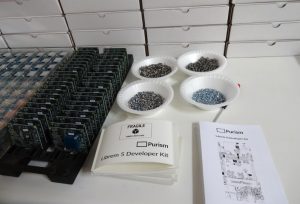
The Librem 5 dev kit’s hardware is done and shipping! We are beyond excited for our backers to receive their dev kits before year-end. Our entire PureOS Librem 5 development team will getting the same dev kits, upgrading the generic i.MX 6 boards (which most of the demos you have seen have been based on) to the Purism i.MX 8M based dev kit.
We aim from this point forward to have a community assisted development environment. There is still a lot of work required to make the dev kit truly functional for Librem 5 development, so we need your assistance. The frenetic pace of development continues and it’s astonishing how much we’ve accomplished in the two months since we’ve put the hardware together. But the path is still long and arduous.
Our backers who are receiving the dev kits will also have access to a Matrix channel for dev kit owners. This channel will be staffed by our engineering team who will be on hand to answer questions, work with the community on merge requests, and be available for those who are using the dev kits. But by no means is this an exclusive channel and all of you are welcome to join in as well! Please join our forum that was set up for questions and answers on the dev kit.
With about four months to go until we ship the phones, we are going to need the community to help in the final sprint to the finish line. So we look forward to your help with testing, feature requests, and of course code!
2019 is going to be an amazing year with the introduction of the first privacy and security focused mobile phone and we can’t wait to get it in your hands.
As always, we are incredibly grateful for all of the support you’ve shown us and we’re working hard to do right by your belief in us. We hope to see some of you in our Matrix channels going forward. Till then onward and upward!
Update: here’s a link to our bug tracker with the main issues we’re trying to resolve with the devkit right now” at the end of the blog post
P.s.: You will note that there is a promotion this holiday season. For those of you who are in the market for a phone and a laptop, check out our “Have A Secure Life” Laptop and Phone bundle read further about having a secure life.
Furthermore, the phone’s early-bird preorder pricing at $599 will end soon; after January 7th the preorder price will rise to $699 to cover our expenses for the phone. The money coming from this will be used to fund further engineering of the phone and to help people from the community to work on upstream projects.
Many times when clients contact me they ask if I can help them come to consensus or alignment on their shared purpose or desired outcomes. They expect facilitation will help them to do this.
Sometimes this is a good idea. If we are working in a highly constrained project, like building a new building, getting everyone on the same page is important. But it’s also easy. All you have to do is bring in the experts, design a good implementation plan for a good solution and have project managers keep everyone on track, step by step. Most organizations are good at that, and if they aren’t they can easily learn the skills to do it.
Its not the linear project managers that are the problem. Its the problem that is the problem.
Conditioned to planning and implementing in this linear fashion, many organizations get flummoxed when they confront a problem with no obvious solution and no clear pathway forward. There may be multiple ways to think about the issues, multiple experiences of what is happening, and divergent and even contradictory desires around where we should be going. These kinds of wicked, seemingly intractable problems breed conflict, and the only recourse for leaders is to tolerate it for a while and then impose a solution with no guarantee that folks will be happy, or even that the solution is the best one possible.
These kinds of problems are complex: wicked, sticky, intractable, Volitile Uncertain Ccomplex and Ambiguous. Tough nuts to crack. There are lots of ways to describe them and lots of ways they drive frustration and conflict.
The common reactive response to these situations seems to be to first gather more information and try harder to find the obvious answer and try to get everyone on the same page. When I’m first working with clients experiencing these kinds of issues, I try to steer them away from certainty and alignment. I point out that in complex environments you don;t get to predict outcomes and you need to look for emergent practices and emergent solutions. Innovation never looks like something you’ve ever done before. Studying the present for the answer will not turn up the gold lying just out of eyesight under a rock. Complex solutions are for all practical purposes, infinitely unpredictable.
So what is the answer? Throw a bunch of ideas at teh wall and see what sticks?
Well, sometimes that can work, especially if you are truly out of ideas. But generally you have something to go on: a sense of direction, a sense that HERE isn’t where we want to be and that there is probably a better THERE that we should get to.
The issues is that, if we truly knew how to get from the undesirable HERE to the much coveted THERE, we probably would have done it by now. In complexity work, the first step here is admitting that trying to achieve pre-planned outcomes simply won’t work. Instead we need to go in a direction of travel towards a better place.
There are a couple of key ways to get started here. First, I always have groups spend time describing their current situation. We are looking for the patterns and dynamics that keep the system stuck in a place that isn’t working. Sometimes this can involve sophisticated research and narrative capture and other times it’s a simpler process of observation and pattern detection. Understanding the state of play helps us to discover an important secret, and that is, the inclination of the system to change.
Imagine an organization whose culture is fragmented and siloed with petty conflicts and turf wars over resources. Politics is rampant and some people seem to be at work only to stir the pot and not actually do the work. If you are a leader you might want to try to ay down the law and tell everyone to smarten up and focus on the organization’s mission. That never works. You can’t simply command a culture to change.
Instead you might convene a group of people to talk about what would be better. And people may say that they want a place that is more collaborative, more connected, and more fun to be at. What you have there is a group of people describing a preferred direction. It’s different from an outcome. It is instead a starting place, a place to orient their inquiry and their work to change things.
One thing you can do is begin by looking for places of positive deviency in the system. Bad as it is, there may well be people that are nevertheless already working in the preferred way, even in small ways. Those stories give you something to experiment with, and they reveal an inclination in the system that might lead to change. Conversely you may find that literally no one is working in this way and that the organization is truly mired in a pattern of deep dysfunction. In this case, the way forward is a radical breaking of the patterns that keep it in place.
Doing both of these things is a wise way to get started. INstead of requiring everyone to work together towards a common goal, you give space to people to work in small and diverse ways to discover how they might nudge the system towards a better THERE.
If you watch a river for a while you will notice that the river flows in both directions at once. Little obstacles in the river, like logs and rocks, create eddies that cause the current to turn back on itself. A living river is full of these back eddies and contradictory currents. Small creatures take refuge there, food and nutrients get trapped there and don’t all wash away to the sea. At the finest granularity of scale, it may even seem that the river is flowing backwards.
And yet the direction of the water i undeniable. It flows down, towards the sea and will always find the low point in its terrain.
That’s how strategic direction looks in complexity. Choose a direction, try multiple things that might work or might not. Contradict each other. Find the places where someone is working against the current and thriving in that little back eddy. Commit to a direction and see what can get you to go that way.
Rivers sit in a topography and changing the landscape is very hard. But changing the culture of a team or and organization can be easier if you work at the level of patterns. Find the patterns that hold behaviours in place and try small things to shift them . See what happens. In organizations you do get the shift the river banks.
It’s more work than making everyone sign your pledge of values, but it’s more meaningful, because the change you get is creative, co-owned and sustainable.
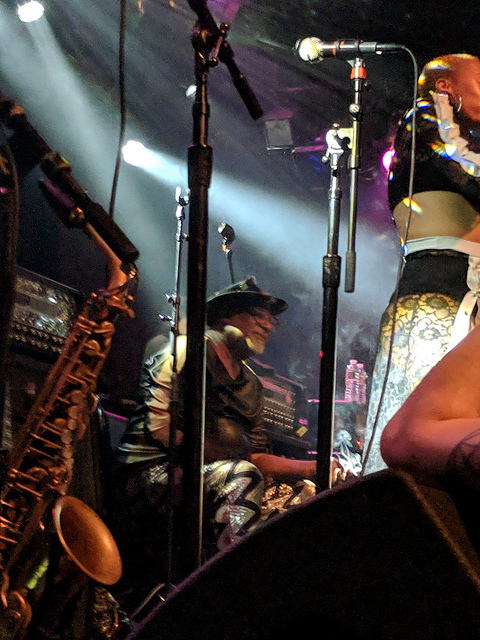
I had a fabulous time at the George Clinton/ Parliament Funkadelic show last night! The club had a wheelchair seating area right up at the front which made it easier for me to be there (and I could also get to the bathroom, which I really appreciated). FABULOUS show, as you would expect!
It was great hearing classics, where everyone would get very excited screaming Shit, Goddamn, get off your ass and jam, or One nation under a groove, but also was in the perfect frame of mind for Maggotbrain (a religious experience for your ears) and then lots of stuff from their most recent album. It is just great to see how they all jam together so well & in so many different styles highlighting the skills of different people. I wish I knew all their names but I don’t… the amazing singer and dancer who kept changing outfits (it was the pink fuzzy pajamas with silver stars, and a hood, and silver platform shoes that killed me finally, and then she took off the PJs and was dancing in striped knee high socks and sexy underwear.)
The incredible saxophone solos (he also did a scat performance that got more and more complicated and went on forever till he just sort of BECAME an instrument ! Trumpet player also great! At least two guitarists of truly amazing caliber, the shorter guy who was an absolute badass, and the tall guy with the long braids wearing a long silver coat which he finally removed to show his fishnets and thong and tshirt that said “God’s Weapon”. Both were fucking great! And, George Clinton himself who I was happy to see had the good sense to sit down now and then. The young (?) guy in the hat who was an excellent rapper! So many talented musicians. And when they would really go off it wasn’t for like 20 seconds, they weren’t fucking around, they were playing giant long extended riffs for like 10 minutes. Serious jazz! Also some extremely metal moments! Also psychedelic geologic eras laid down for future generations and time travelers!
Crowd fairly nice! We ran into Brian Zisk and I remember being high as hell while trying to explain to him (why? just enthusiasm i guess) that Venezuelan joropo is the best kind of music (because, counterpoint, great structure, complex & awesome) & he should give it a listen. He was telling me about the sort of cultural shift of deadheads to follow George Clinton & the P-funk collective in general, which maybe he had something to do with. That was very interesting and I’m still thinking about that.
Impact can take many forms, but there are generally three key rules:
Impact is very specific (vague ideas about increasing loyalty don’t cut it).
Impact is something someone is responsible for.
Impact is something someone(s) cares a lot about.
Impact isn’t what you think the value of the community is (or what you want it to be), it’s how the community directly helps colleagues achieve their goals.
Some examples of impact might include:
Bring 50 qualified sales leads sourced from the community to the sales team and you’re having an impact (Eventbrite)
Get your members to publish 100+ reviews on TrustRadius or G2Crowd for your product and you’re having an impact (Quickbase)
Provide your PR team or web team with 30+ case studies they can share and feature, and you’re having an impact.
Help engineers prioritize exactly what needs to be fixed and you’re having an impact.
Reducing the number of support tickets customer service reps answer or equipping them with the best knowledge from members to answer questions is a big impact.
Identifying some great recruits for future job roles is a big impact.
Having members co-create a comprehensive set of documentation and user guides is a big impact.
Helping newcomers create their first success in using your products and keeping them around is an impact.
This doesn’t mean impact excludes ROI metrics. It means that ROI is just one of many possible (and desirable) impacts of the community. Someone might care about it, but it’s comparatively rare. Worse yet, ROI metrics aren’t persuasive to colleagues.
The secret to having a big impact is two-fold.
1) Deeply understand what your colleagues want. What do they need this week? What about next week? More sales leads, feedback, expertise? Focus on the immediate pain point. What are they struggling with this week?
2) Align your community to that impact. If you want people to create reviews, provide feedback, or anything else you need to persuade them to do it. That works at the emotional level. Creating an identity or incentives around doing it and rewarding them when they do.
The communities which thrive today aren’t the ones which focus on engagement or exclusively on ROI, they’re the ones which drive the most impact for their colleagues.
And so dear reader, the Christmas holiday season is almost upon us and this may well be my last post of the year.
I have had on overwhelming sense that this year that I have really struggled to keep writing regular posts on this blog. It has been cathartic and reassuring this morning to look back and see that I actually haven’t done that badly – certainly up until around summer. However there was a change about half way through the year . Weekly posts (my sort of self imposed writing schedule) became a rarity, and I really struggled with what to write.
There are a number of reasons for the downturn in posts, not least the current completely mad political situation in the UK. But also a lot of my time has been taken up with writing a book with co-authors Bill and Keith. Looks like we have missed the Christmas list for this year, but hopefully it will be published in January.
Writing the book has allowed me to engage more critically with my own praxis and begin to really understand the importance of critical pedagogy. So whilst it was extremely cathartic to have a rant about the dangers neoliberal forces attacking our education systems, it is also quite depressing. I swing from feeling totally empowered and energised particularly from my peer group at events such as this year’s ALT conference (which was a real highlight of the year for me) to feeling utterly dismayed at the the current UK governments ominshambles over Brexit.
My last post from 2017 was based on one of those sort of annoying, but sometimes fun Facebook round robin things
Leave a positive word I can carry through 2018 that starts with the 1st letter of your name – it can only be one word
This is the word cloud I made from the responses. Looking back at it this morning, it did make me smile that mayhem and hope were so prominent. I hope that the latter can help alleviate the former in 2019.
In last year’s Stratechery Year in Review I noted that the predominant theme was the impact of tech on society; perhaps unsurprisingly, the dominant theme in 2018 was tech and regulation.
This year I wrote 139 Daily Updates (including tomorrow) and 40 Weekly Articles, and, as per tradition, today I summarize the most popular and most important posts of the year; the question of regulating tech generally and Facebook’s foibles specifically figure prominently. Frankly, I plan on making an effort to spend more time elsewhere next year.
In March I also launched Stratechery 4.0, with dramatically improved search; easier access to the archives via Concepts, Companies, and Topics; as well as a visual refresh and new logo.1
You can find previous Stratechery Years in Review here: 2017 | 2016 | 2015 | 2014 | 2013
Here is the 2018 list.
The Five Most-Viewed Articles
Stratechery once again had record traffic in 2018, and although none of the articles matched the juggernaut that was 2017’s Amazon’s New Customer, the first two articles on this list were the second and third-most popular articles all-time.
The End of Windows — The Windows division no longer exists at Microsoft, marking the end to a four-year process of changing Microsoft’s culture.
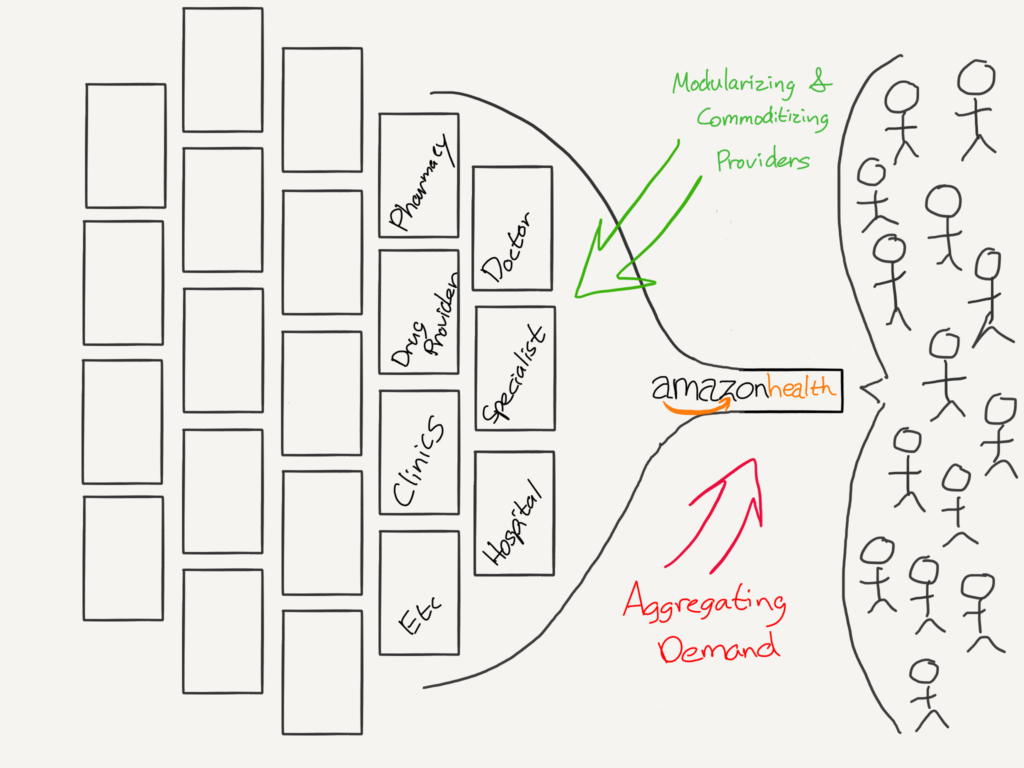
Amazon Health — Amazon Health doesn’t seem like much now, but there are hints it could be the ultimate application of Aggregation Theory.
Lessons From Spotify — Spotify has a marginal cost problem, but while the cause is unique to Spotify, the challenges are more applicable than it seems.
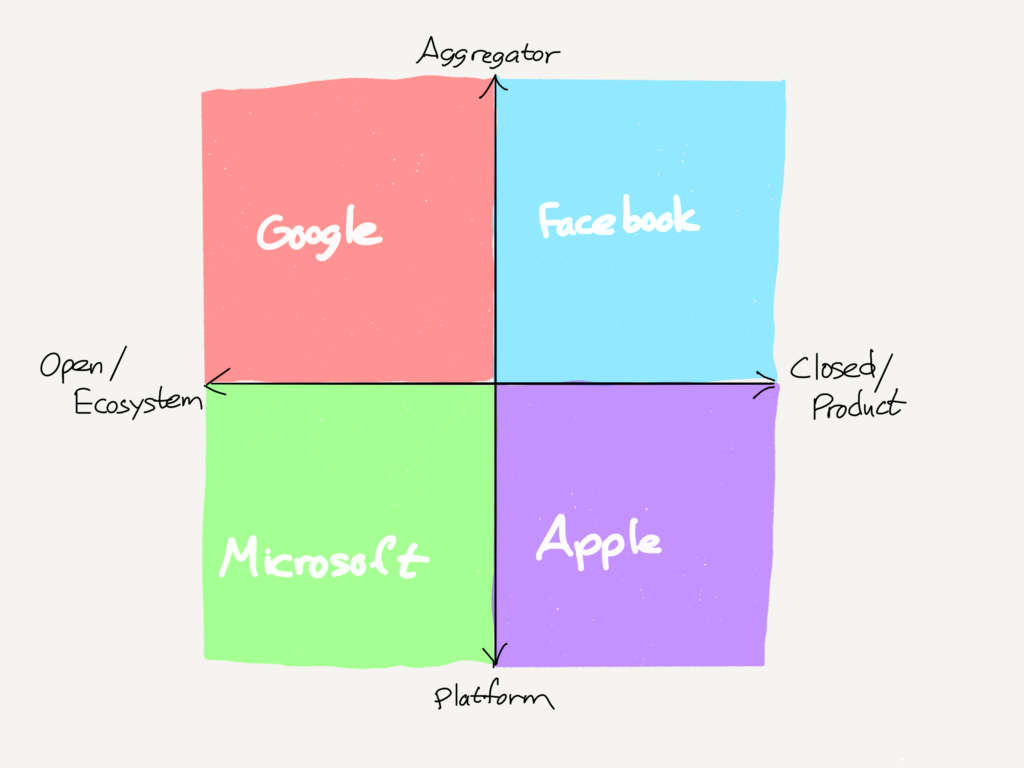
The Bill Gates Line — Understanding the differences between aggregators and platforms matters both for companies interacting with them and regulators considering antitrust.
Amazon Go and the Future — Amazon Go exemplifies how Amazon is building its monopoly in three ways: horizontally, vertically, and financially. Plus, why automation is worth being optimistic about.
The Evolution of Aggregation Theory
I am very pleased at the way I fleshed out Aggregation Theory this year, both in theoretical terms and also in its importance when it comes to thinking about regulation.
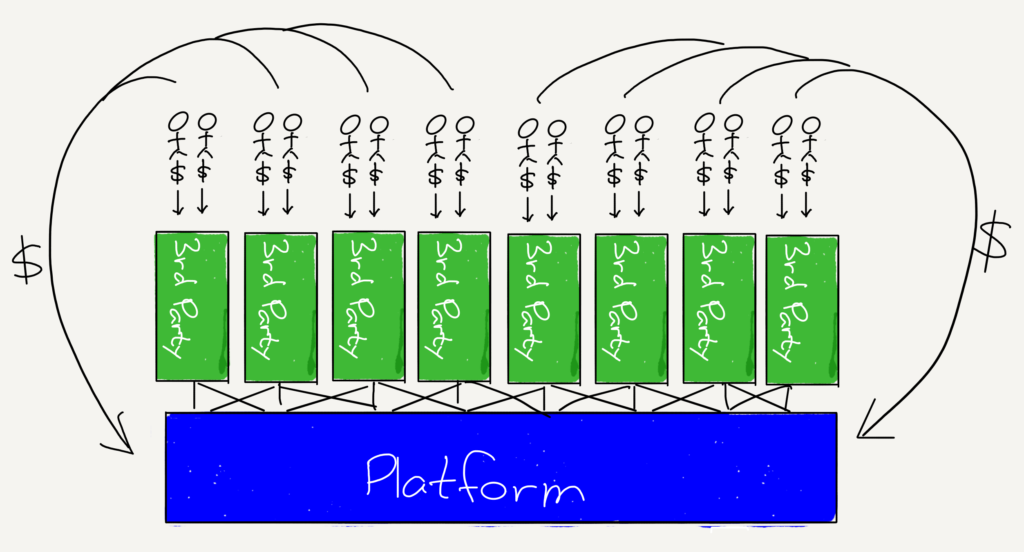
Tech’s Two Philosophies, The Moat Map, and the afore-linked The Bill Gates Line explore the differences between platforms and Aggregators: the former facilitates a connection between suppliers and users, while the latter intermediates it. This distinction is critical for regulators.
Aggregators and Jobs-to-be-Done filled in a missing piece of Aggregation Theory: when I say that Aggregators win by having the best user experience, that means they are the best and most all-encompassing option to get a job done.
Tech and Regulation
There were three broad subcategories when it came to tech and regulation: the tendency of regulation to entrench incumbents, antitrust, and Facebook. Lots and lots of Facebook.
Regulation:
Open, Closed, and Privacy — Just as encryption is only viable on closed systems, so it is that increased privacy regulations will only entrench walled gardens. That should affect thinking on regulation.
The European Union Versus the Internet — The EU is back to regulating tech companies, and getting the Internet wrong in the process. That, though, helps illuminate an approach that could work.
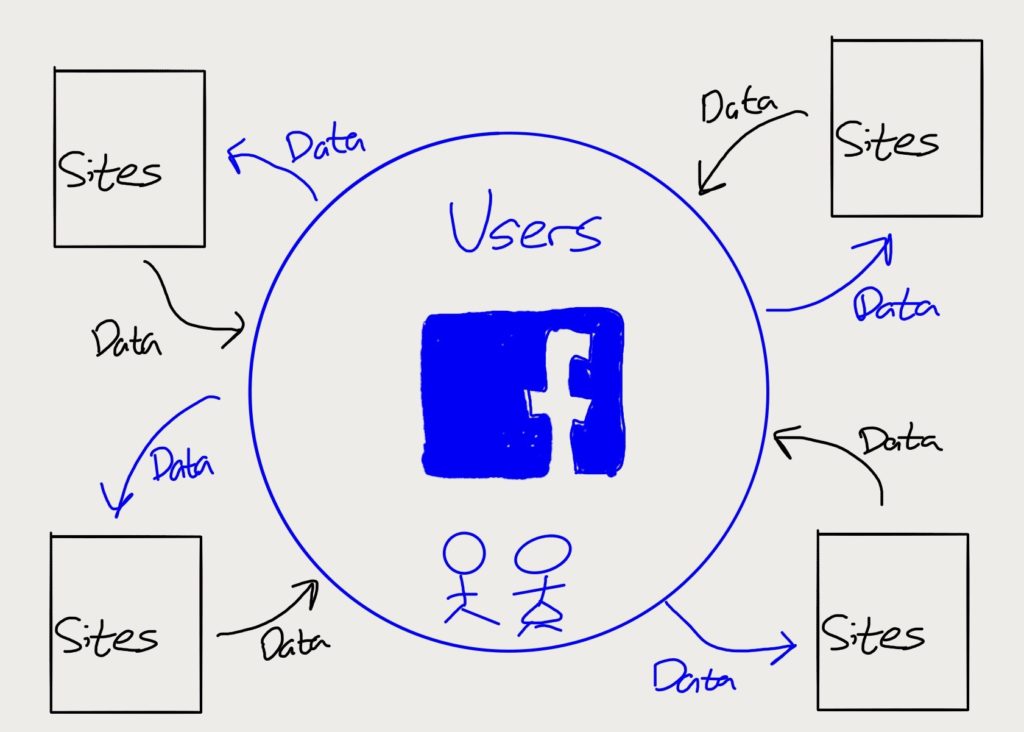
Data Factories — Facebook and Google and other advertising businesses are data factories, and regulation will be most effective if it lets users look inside.
Antitrust:
The European Commission Versus Android — Examining the history of Android explains why the European Commission may be right to fine Google for its actions around Android, even as the reasoning feels off.
Antitrust, the App Store, and Apple — Apple’s case before the Supreme Court is about standing; Apple has a strong case. That, though, doesn’t mean the App Store isn’t a monopoly — and that Apple isn’t increasingly predicated on rent-seeking.
The State of Technology at the End of 2018 — The State of Technology, at least in the enterprise space, is strong; consumer tech is another story, and it is time to question the dominance of big companies like Google.
Facebook:
Facebook’s Motivations — The impact of Facebook’s News Feed changes on the media is far less interesting than what the changes — and their stated purpose — say about Facebook itself.
The Facebook Brand — The Facebook brand is, due to Facebook’s strategic choices, about not respecting privacy. That is why the Cambridge Analytica story is such a problem for the company.
This year several companies from the first generation of tech had their day in the sun, in many cases because of acquisitions.
The Cost of Developers — Microsoft paid a lot for GitHub, because it had to pay directly for access to developers. It doesn’t have the leverage of users the way that Apple does on the App Store.
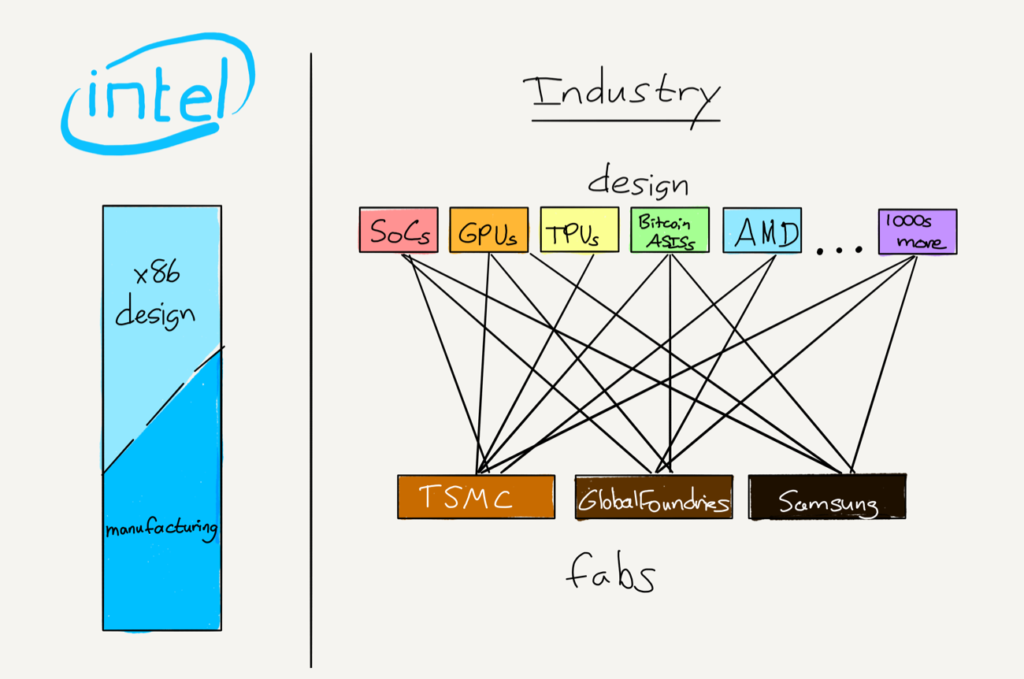
Intel and the Danger of Integration — Intel is in an increasingly bad position in part because it has been captive to its integrated model. Or, you could simply say they were disrupted.
IBM’s Old Playbook — IBM has bought Red Hat in an attempt to recreate its success in the 90s; it’s not clear, though, that the company or the market is the same.
The Experience Economy — SAP’s acquisition of Qualtrics shows how the shift in technology has changed business; it is a perfect example of using the Internet to one’s advantage.
There was still room for Stratechery staples: analysis of industries and companies in the context of the bigger picture.
Meltdown, Spectre, and the State of Technology — Meltdown and especially Spectre are vexing vulnerabilities, precisely because processors are working as designed. All we can do is muddle through.
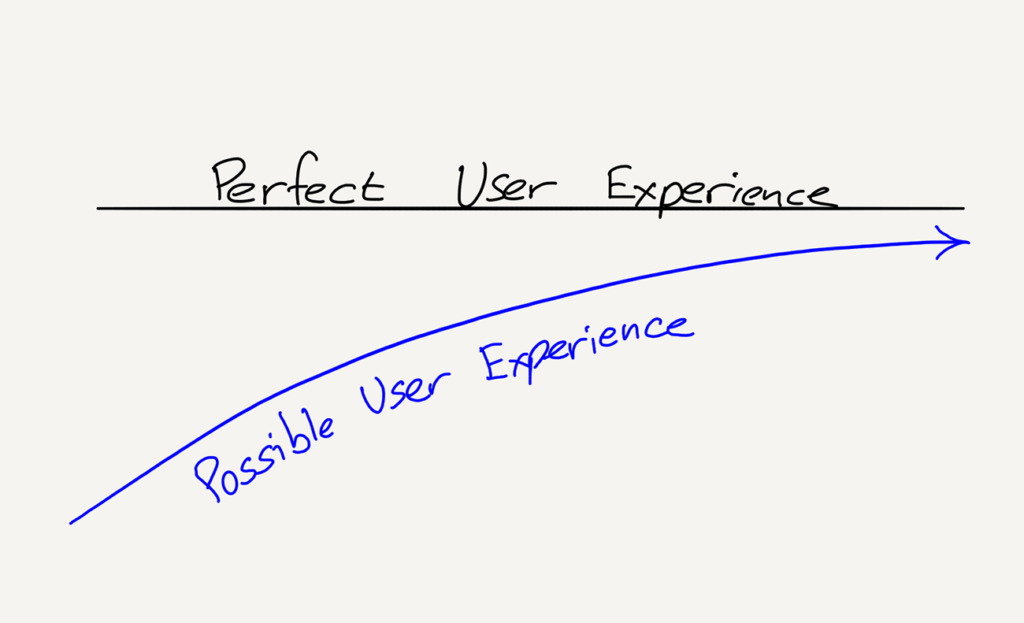
Divine Discontent: Disruption’s Antidote — Apple has long defeated disruption by focusing on the user experience; Jeff Bezos and Amazon, though, show that user expectations for their experience are ever-changing.
The Battle for the Home — Amazon, Google, Apple, and Facebook are battling for the home; what are their strengths, weaknesses, go-to-market strategies, and business models, and who is the favorite? Or does it matter? (See also, The Problem with Facebook and Virtual Reality)
This was another strong year for the Daily Update, which continued its trend towards being one fully-fledged topic with three areas of focus; the difference between Weekly Articles and Daily Updates is smaller than ever (you should subscribe!). Here are some of my favorites:
I can’t say it enough: I am so grateful to Stratechery’s readers and especially subscribers for making all of these posts possible. I wish all of you a Merry Christmas and Happy New Year, and I’m looking forward to a great 2019!
Verizon bought Yahoo to combine with AOL and build an online media empire from cast-off spare parts. But its new management can’t seem to write a press release that’s credible, let alone run a media company anyone would visit on purpose. Here’s the logo for the new brand: Because apparently Verizon Media Group, formerly known … Continued
When I asked Kelly O’Keefe, brand expert and partner of Brand Federation about LinkedIn (LI) becoming the new Facebook (FB), his concern was how will LI be able to control the quality of the content people are posting. A recent New York Times article notes that Sandburg and Zuckerburg were so hell bent on growth that they ignored signs in their product being infiltrated by Russians to effect the 2016 election. More professionals are moving away from FB to LI so now it is crucial for LI to control content so as not to fall in to the same predicament as FB.
I have noticed more articles and versions of e-promos being posted on LI since email promos are usually being deleted or unsubscribed. Facebook is full of either uplifting stories or political articles and concerns, so it seems as if LinkedIn is the place to show your professional talents. But to what extent should you continue promote your work without folks disconnecting from you? How do you strike the balance and how do you connect to your market in a professional way?
I did a survey to Art Producers and asked them if they thought a photographer using the LI platform to market. The majority said that is not how they use LI. It would be acceptable if they saw work from photographers they knew and had worked with but not random connection requests. And to be honest, I agree with them. If I have never worked with you and don’t know your work ethic, I am not going to connect with you in an effort to protect those who I have worked with in the past. My LI account is strictly for business. For assistance, I post the Art of the Personal Project on my LI account. I enjoy seeing my business connections showing great campaigns they have worked on but not work they shot to direct me to their website.
When I see recent portfolio shoots on LI, I noticed vague hash-tags so I reached out to Heather Lefort to explain how to use LinkedIn professionally. Heather owns iHeartmrktg to help photographers keep up with their marketing and the best ways to do it. “The LinkedIn algorithm is far more superior to FB or IG. When they launched in 2003 their purpose was to connect people professionally via resumes, networking and professional talents. Their growth rate (https://ourstory.linkedin.com/) has exceeded the levels of FB and IG and is expected to grow faster in 2019! Relevance, credibility, followers and connections play a huge part in the LI algorithm. So, it’s clear that you should be growing your personal or business audience (or both) on LI. The algorithm and tools allow you to tailor your feed accordingly. But be careful of spammy posts as the feed have precise rating tools based on the relevancy of your posts and other people’s preferences. In other words ask yourself these 3 check questions before posting:
Am I over-posting?
Will People in my network care about this post?
Is my post relevant to others’ professional lives?
All of the posts on LI pass through a computerized virality check and a human check which is part of the uniqueness. These parameters determine: how you engage others as a poster and the quality of your personal network. This is the stage where your posts can potentially rank into the “Top” posts. Understanding the content checklist that LI craves is a great start to make sure your posting quality, useful information! “
LinkedIn is a professional business platform and it should be used as such. The people I have surveyed all agreed-it should be used to showcase your work professionally, but personal posts should be posted on Facebook.
APE contributor Suzanne Sease currently works as a consultant for photographers and illustrators around the world. She has been involved in the photography and illustration industry since the mid 80s. After establishing the art buying department at The Martin Agency, then working for Kaplan-Thaler, Capital One, Best Buy and numerous smaller agencies and companies, she decided to be a consultant in 1999. She has a new Twitter feed with helpful marketing information because she believes that marketing should be driven by brand and not by specialty. Follow her at @SuzanneSease. Instagram
With over 18 years of expertise, a love of marketing, and compassion for businesses Heather Lefort opened iHeart Marketing. Her years of sales and marketing experience allowed her to bring her personal services to business owners with a one-on-one strategy. Leading iHeart Marketing with the highest level of integrity she assists businesses in achieving all of their marketing and sales goals with a planned effort. Whether you are brand building, looking for marketing guidance or need assistance measuring your strategies iHeart Marketing can help! We are a one-stop marketing solutions boutique.
iHeart Marketing, Inc., is the parent company of Social Sparkz, a visionary agency focused on marketing and advertising, events, PR and brand building. In short, we make sparkz happen when it comes to your business!
Visit our sponsor Photo Folio, providing websites to professional photographers for over 10 years. Featuring the only customizable template in the world.
In visual perception, a figure-ground grouping is where you recognize an object through the background. Think of the vase and two faces image. Hans Hack made a simple tool that lets you make such a diagram using OpenStreetMap data. Select a location in the world, adjust the radius of the circle, provide a label, and voilà, you have yourself a poster. Download it as an image or SVG file.
Interesting, yet basically boils down to actively exercising your ‘free will’. It assumes a blank slate for the hacking, where I haven’t deliberately set out for information/contacts on certain topics. And then it suggests doing precisely that as remedy. The key quote for me here is “Humans are hacked through pre-existing fears, hatreds, biases and cravings. Hackers cannot create fear or hatred out of nothing. But when they discover what people already fear and hate it is easy to push the relevant emotional buttons and provoke even greater fury. If people cannot get to know themselves by their own efforts, perhaps the same technology the hackers use can be turned around and serve to protect us. Just as your computer has an antivirus program that screens for malware, maybe we need an antivirus for the brain. Your AI sidekick will learn by experience that you have a particular weakness – whether for funny cat videos or for infuriating Trump stories – and would block them on your behalf.“: Yuval Noah Harari on the myth of freedom
This is an important issue, always. I recognise it from my work for the World Bank and UN agencies. Is what you’re doing actually helping, or is it shoring up authorities that don’t match with your values? And are you able to recognise it and withdraw when you cross the line from the former to the latter? I’ve known entrepreneurs who kept a client blacklist of sectors, governments and companies, but often it isn’t that clear cut. I’ve avoided engagements in various countries over the years, but every client engagement can be rationalised: How McKinsey Has Helped Raise the Stature of Authoritarian Governments, and when the consequences come back to bite, Malaysia files charges against Goldman-Sachs
Simon Fraser professor Anthony Perl was perfectly right when he called the proposed ten lane multi-billion dollar Massey Bridge a “loser” on CBC radio, noting that the existing Massey Tunnel could be upgraded for trucking traffic, rail cars, and of course public transport. But the report just released by the Provincial government written by Stanley Cowdell and associates is well worth having a read. It coherently lays out the issues, the misses, and the facts on creating more capacity crossing the Fraser River near the existing Massey Tunnel.
The report which can be read here fearlessly lays out the rationale for why the new crossing was being considered by the previous Liberal government, assessed the solutions, and provides independent findings and recommendation for going forward on the crossing.
It is a document that provides the history of the crossing and how an overbuilt ten lane bridge was planned for (the span was not to have any pilings in the water) and outlines that the various governments and councils may not have agreed upon the bridge concept, but that their interests align in providing safe, efficient movement.
While traffic has grown little in the tunnel over the past three decades, the decision not to toll the various bridges has meant that the Alex Fraser Bridge has borne more congestion. The report spearheaded by Mr. Cowdell observes that while the proposed Massey bridge was to reduce congestion until 2045, support increased transit and minimize the impact on the environment, there was no in-depth analysis comparing alternative solutions to the Liberals’ preferred bridge. Such a trade-off or cost benefit analysis is absolutely vital in ascertaining the best alternative for a crossing.
The report outlines that using bridge footings in the river for a smaller bridge and utilizing a road alignment off the existing highway could reduce crossing costs by 500 million dollars. Reducing bridge lanes from 10 to 6 or 8 lanes would mean a much more legible and less overwhelming interchange design for the Steveston exit. Rapid transit is nixed in this report as being too costly, with the concept of buses using bus lanes and queue jumping to provide efficient public transit movement.
As for all the chat about the existing tunnel not being sound, the report outlines that the existing tunnel still has decades of life and while a retrofit of the existing tunnel is possible, it may exceed the cost of a new submerged tunnel. The report notes that “It is the Review’s opinion that an ITT (immersed tube tunnel) crossing option is feasible and may result in increased benefits and cost savings in comparison to a new bridge when such options as staged development and utilizing existing infrastructure are considered.”
So there you have it~the recommendation is for a thoughtful review of the best option for the crossing, ensuring that the First Nations and the Mayors’ Council comply with the chosen alternative, and for safety upgrades in the tunnel and the Steveston interchange to proceed quickly. The Minister of Transportation Clare Trevena will meet with the various municipal councils in the New Year outlining potential solutions. While the provincial Liberals have already launched their predictable naysaying campaign, it was their lack of meaningful public process and consultation with the municipalities and their dogged determination to have an overbuilt bridge regardless of the environmental and economic cost that got us here in the first place. The Cowdell review provides some clear footing to proceed, carefully and prudently, to arrive at an agreed upon solution with accurate information that will truly serve all the region, not just certain industrial and port related interests.
The New York Timesnoticed that in some big cities, something radical is happening:
Oslo plans to ban all cars from its city center beginning next year. Madrid is banning cars owned by nonresidents, and is also redesigning 24 major downtown avenues to take them back for pedestrians. Paris has banned vehicles from a road along the Seine, and plans to rebuild it for bicycle and pedestrian use.
This opinion piece lays out the reasons for this move away from Motordom – or at least the reasons why it should. This is not news to Vancouver, but we’re just at the point where the new council has yet to indicate whether we’re going to renew our commitment, whether we’re going to speed up our progress, or settle for the current pace of change.
Indeed, some are speculating that many on council would, if they could, spend the money it will take to demolish the viaducts more on affordable housing rather than on more amenity for the already blessed.
Using human intelligence and machine learning, Google was able to heavily combat spam content and fake reviews on Google Play this year. The company says the effort led to removing millions of reviews and ratings being removed from the Play Store and thousands of malicious apps identified for suspicious reviews in just a week.
Continue reading →
With version 4.0 released today, Darkroom has emerged as a photo editing force to be reckoned with on iOS. The highlight of the release is a brand-new iPad app, which is the version I’ll focus on in this review. I ran into a couple of bugs and would like to see Darkroom push its photo management and a few other tools even further in the future. However, the app’s combination of thoughtful design and platform-aware functionality together enable Darkroom to scale its full suite of tools gracefully from iPhone to iPad, which makes it an excellent choice for mobile photo editing.
The Library
Darkroom's library view includes albums on the left and thumbnails of your photos on the right.
One of the things that sets Darkroom apart from a photo editor like Lightroom CC is its tight integration with iCloud Photo Library. Instead of requiring you to manually import images, Darkroom accesses your iCloud Photo Library directly. This approach eliminates the need to have two separate libraries of photos, which can lead to duplication and forgetting where a particular photo is stored.
Smart albums are listed at the top of the albums sidebar.
The main library view is divided into two parts. A strip along the left side of the screen displays a list of smart albums generated by Darkroom followed by thumbnails of albums in your iCloud Photo Library. The smart albums include Favorites, photos edited in Darkroom, Live Photos, Portrait Mode photos, selfies, screenshots, panoramas, and hidden photos. The albums in your iCloud Photo library follow in two columns of square thumbnails labeled with the name of the album and the number of photos it contains.
Thumbnails of your photos dominate most of the screen. On a 12.9-inch iPad Pro, the library view is divided into an 8x8 grid of thumbnails so you can see up to 64 images at one time. Image thumbnails include small icons in the corner to indicate things like whether the image is in the RAW format, has been edited, or is a portrait or panoramic shot. To make navigating a large collection easier, Darkroom also has a translucent button that appears at the bottom of the screen when you scroll back through older photos that automatically takes you back to your newest photos.
The easy album access, including the smart albums, is an excellent navigation aid, but I’d like more ways to traverse my photo collection. I’ve got about 40,000 photos in my iCloud Photo Library, and I’d like something similar to the Photos app that allows me to zoom in and out with pinch and zoom gestures to minimize scrolling. I’d also like the option to change the size of the thumbnails in the library.
If you have many albums, browsing them in the sidebar, which displays a dozen at one time on a 12.9-inch iPad Pro, requires lots of scrolling. I also found that if I scroll the album list fast and tap an album before its thumbnail loads, Darkroom’s UI would lock up and I had to quit the app before I could use it again. That’s not a bug most people would typically run into browsing albums in a leisurely way, but if you have a long list of albums to scroll through, it’s a problem and will hopefully be fixed in an update soon.
Depending on the state of the image, long-pressing a photo lets you view its metadata, copy and paste edits, reset its edits, export it, mark or unmark it as a favorite, hide or unhide it, or delete it. Darkroom also allows you to perform a subset of those actions on batches of images by tapping the ‘Batch’ button on the right side of the app’s toolbar. The only tools not available on a batch basis are displaying metadata and copying edits, neither of which make sense in the batch processing context.
Shooting Photos
Darkroom includes one-tap access to the Halide and Moment camera apps.
Darkroom doesn’t include a built-in camera app. Instead, it has teamed up with Halide and Moment to provide one-tap access to those camera apps. Halide was added in an earlier release of Darkroom, but the Moment integration is new to version 4.0.
I haven’t had a chance to experiment with the Moment integration yet because it requires an update to that app, which is slated to be released at the same time as Darkroom 4.0, but my understanding is that it will work like the Halide integration.
If you have Halide installed on your iOS device, its icon shows up on the left side of the toolbar in Darkroom. Tapping it opens Halide, from which you can take pictures that will be saved to your iCloud Photo Library and be available to Darkroom. If you have Moment installed too, you will be able to long-press on the icon to switch between apps. In both cases, the advantage of the integration is quick access to a manual camera app without having to return to the home screen to find it yourself.
Editing and Filters
Darkroom includes an extensive set of tools for managing, editing, and applying filters to your images. Tapping a photo opens it with narrow vertical toolbars on the left and right sides. Those toolbars disappear if you tap a photo so that you can get a distraction-free view at any time.
A vertical photo strip of the images in an album can be displayed along the left side of the editing view.
From the left toolbar, you can navigate back to your photo library or display a photo strip of thumbnails. This is a new feature that obviates the need to jump back and forth between the library and the photo you’re editing. Instead, you can scroll the photo strip to glance at the rest of the album quickly. The left-hand toolbar also provides access to the same photo actions that are available when long-pressing an image thumbnail in the library or photo strip as well as undo and redo buttons.
Darkroom's crop tool.
Editing tools and filters are available from the toolbar on the right side of the screen. The crop tool has the conventional crop, straighten, and rotation tools, but also includes dials for altering the horizontal and vertical perspectives of images, multiple grid overlays that can be used to help compose your cropped shot, and an extensive set of preset aspect ratios.
The crop tool is followed by Darkroom’s filters. Many apps get carried away with filters, but Darkroom doesn’t. There’s a nice set of choices available, yet even including the ones available as In-App Purchases, there aren’t so many that it’s too hard to pick one. It also helps that the filters are grouped into categories by style: Darkroom, XPRO, Instant, Duotone, Landscapes, Portraits, and B&W. Tap a filter to apply it, then tap it again to adjust its strength.
An example of one of Darkroom’s Duotone filters.
One of my favorite features of Darkroom is the ability to create custom filters, which appear at the top of the list of filters under ‘My Filters.’ If you’ve finely-tuned a look using a combination of filters and other edits that you want to save for future shots, head to the filter tool, scroll to the bottom of the list, tap ‘Create a new filter,’ and give it a name.
Filters are a fantastic way to dial in a certain look quickly, but you can also use Darkroom’s lengthy list of adjustment tools to edit your photos. Every adjustment has a slider that displays its numeric value, allowing you to set each of the following with precision:
Brightness
Contrast
Highlights
Shadows
Saturation
Vibrance
Temperature
Tint
Fade
Grain
Vignette
Sharpness
The color and degree of highlights and shadows have separate controls too.
Darkroom has a wide array of filters.
Darkroom’s next tool is a color curve that allows red, green, and blue to be independently adjusted or as an RGB group by dragging the points on the tool’s graph. A separate color tool to adjust the hue, saturation, and luminance of different parts of the color spectrum is available too. Your image’s color distribution is visualized using a histogram with buttons below it that allow you to pick which portion of the spectrum you want to adjust.
In my tests, the sliders of the color tool stuttered a little when editing RAW images. Also, adjusting an image’s color and then picking another photo in the photo strip caused the app to crash, but the developers are aware of the issue and looking into it.
Darkroom can also add frames to photos with varying dimensions, stroke widths, and colors, and can display a history of the changes made to a photo with the ability to reset the image to its original state, copy the edits for application elsewhere, and paste edits. There’s an info button for viewing a photo’s metadata too.
Darkroom’s editing tools are impressive for their depth. They are also simple and intuitive to use. The only thing I’d like to see added in the future is an ‘auto-enhance’ button. Even when I’m not completely happy with the results of auto-enhance in other apps, it can serve as a good starting point for making additional manual tweaks.
Exporting, Sharing, and All the Rest
Darkroom’s export options are hiding behind a share button that’s available from the batch action view and when editing an individual photo. Tap it to access not only the system share sheet but options to save images to iCloud Photo Library as copies or as replacements of the original photos. The popup that’s displayed when you tap the share button is also where you can set an inset for a framed image and copy customizable sets of hashtags to the clipboard, which is handy for Instagram users who tag their photos. Hashtag copying can also be accomplished with a Siri shortcut. A gear icon on the export popup takes you to export options where you can pick the file format and quality of the image exported, instruct Darkroom to remove location metadata from photos, and even add copyright information.
Darkroom supports a long list of keyboard shortcuts.
Another point worth noting is Darkroom’s extensive use of keyboard shortcuts. About the only things you can’t do is navigate the albums and photos in the library view, select photos in batch mode, or apply adjustments or filters in editing mode. While I’d like to see keyboard shortcuts for those aspects of Darkroom, Bergen Co.’s implementation is more extensive than most iPad apps and what they have makes moving among the app’s views and modes fast and fluid.
Despite a couple of rough patches, I’m impressed with what Darkroom has become. There's a lot more to this app than fun filters. With RAW support, a wide range of tools, and iPad support, Darkroom is a full-fledged photo editor. Darkroom also scales nicely from the smallest iPhone screen to the biggest iPad and takes advantage of the unique hardware each iOS device has to offer. Especially on an iPad, Darkroom does an excellent job of offering the tools you’ll want to edit your photos without getting in the way, allowing the photos room to breathe as you edit. I’m glad I have the ability to edit in Darkroom on my iPhone, but the iPad is where the experience is best, which is why it’s great to have that option with the release of Darkroom 4.0.
Darkroom is available on the App Store as a free download with some filters and tools like curves and color adjustments available as In-App Purchases.
Support MacStories Directly
Club MacStories offers exclusive access to extra MacStories content, delivered every week; it's also a way to support us directly.
Club MacStories will help you discover the best apps for your devices and get the most out of your iPhone, iPad, and Mac. Plus, it's made in Italy.






















#/media/File:Cup_or_faces_paradox.svg)


 ‘
‘


 Using human intelligence and machine learning, Google was able to heavily combat spam content and fake reviews on Google Play this year. The company says the effort led to removing millions of reviews and ratings being removed from the Play Store and thousands of malicious apps identified for suspicious reviews in just a week.
Continue reading →
Using human intelligence and machine learning, Google was able to heavily combat spam content and fake reviews on Google Play this year. The company says the effort led to removing millions of reviews and ratings being removed from the Play Store and thousands of malicious apps identified for suspicious reviews in just a week.
Continue reading →


