Shared posts

28 Dec 16:59

Some Notes On Installing Federated Wiki On Windows

Michael Caulfield, Hapgood, Dec 27, 2018
Icon

I'm going to try this. "I recently started looking at whether I could do federated wiki just on my laptop and not deal with a remote server. It doesn’t get me into the federation, per se, but it allows all the other benefits of federated wiki — drag-and-drop refactoring, quick idea linking, iterative note-taking, true hypertext thinking."

Web: [Direct Link] [This Post]
28 Dec 16:59

We Are Underinvesting in Human Capital

Michael Echols, Chief Learning Officer, Dec 27, 2018
Icon

One of the reasons why I could never be EdSurge's new business reporter is that I could never take the business-focused stance toward the 'education industry'. This article is a case in point. I do not use - and could not use the phrase "human capital". And sentences like this seem to me not just wrong but morally wrong: " Not only do we not have enough bodies to fill the open positions, we do not have enough experience and education to meet the implied knowledge and skills required by companies." The people here have been completely objectified to become "bodies" and :knowledge and skills". I can't live my life thinking of people that way, and articles that push that perspective are, to my mind, deeply suspect. (p.s. I think Audrey Watters would be perfect for the EdSurge beat, but doubt that EdSurge's political officers would ever allow her perspective to appear in their pages).

Web: [Direct Link] [This Post]
28 Dec 16:59

Recalibrating Our Approach to Misinformation

Michael Caulfield, EdSurge, Dec 27, 2018
Icon

I generally appreciate what Michael Caulfield has to say, but I haven't been in agreement with his approach to fake news. And I really dislike his characterization of critical thinking as "the thoughts and prayers of the educational industry." Now to be fair, he is talking about it being "wrongly applied". He writes, "Because the goal of disinformation is to capture attention, and critical thinking is deep attention.... whenever you give your attention to a bad actor, you allow them to steal your attention from better treatments of an issue." Well, true, but how are you supposed to know a priori who the bad actor is? Caulfield's approach to critical thinking is to identify (somehow) trustworthy sources. But real critical thinking involves looking at an issue from multiple perspectives, not a deep focus on a single source. So neither Caulfield's problem nor his solution applies here.

Web: [Direct Link] [This Post]
28 Dec 16:57

How Much of the Internet Is Fake? Turns Out, a Lot of It, Actually.

Max Read, New York, Dec 27, 2018
Icon

The story here is that  "year after year, less than 60 percent of web traffic is human; some years, according to some researchers, a healthy majority of it is bot." The question is, what (if anything) can we do about it? The author writes, "What’s gone from the internet, after all, isn’t 'truth,' but trust: the sense that the people and things we encounter are what they represent themselves to be." This suggests that a means of finding truth without trust will not solve the problem of the fake internet. I'm not sure about that. I think truth is more foundational than trust.

Web: [Direct Link] [This Post]
28 Dec 16:57

You can’t separate learning and doing

by Jim

If I’m not careful when I introduce myself, “Jim McGee” gets heard as “Jimmy.” Curious as that was what I was called growing up. Outside of family and a few cousins, there were only two people who regularly called me “Jimmy” One was the director of the college theater group I was in. The other is a friend and colleague I worked with during my doctoral studies.

Although it’s a pretty common name, I take a certain perverse pride in laying claim to “jimmcgee” or “jmcgee” as a user name in places like gmail and twitter. It’s a marker of being an early adopter on multiple technology platforms.

You learn stuff by playing with it. But learning and play are suspect activities in most organizations. Outside of schools, the presumption is that you’ve learned what you need to know on someone else’s dime. Even in schools, you pay for the privilege of not knowing and being a learner.

This model works in a stable or slowly-evolving environment. There are places where you learn and places where you do. If you are in a doing place and the learning places are lagging, you might find it a good idea to create a private learning place to bridge the gap. But the idea of doing and learning remain separate.

I could argue that this is fundamentally wrong for all organizations and all times; that the separation of learning and doing is an artificial distinction that only works with the right confluence of factors and only for limited periods. We’re no longer in one of those periods.

We’ve been living through an extended period of accelerating change; it’s become an empty cliche. This is a cliche that you ignore at your peril. The half-life of what we know continues to shrink.

Half-life is a notion borrowed from nuclear physics. Radioactive elements and isotopes transform at a predictable rate; the transformation of Carbon-14 into Carbon-12, for example, is one of the facts that tell us that the world is more than 6,000 years old. The time it takes for half of the Carbon-14 in a sample to decay into Carbon-12 is the half-life and is a fixed and measurable rate.

Shifting back to knowledge and knowledge work, much of what we knew from our school days has decayed in similar fashion. By some estimates an engineering degree has a half-life of less than 10 years.

If you maintain the fiction that learning is something that occurs in learning places and is separate from doing, then you hire young computer scientists, move a handful into management, and replace the rest on a regular basis. A stupid management strategy, even it is appears to be a common one.

In work with a university research lab that was dealing with growing pains, I found the phrase “smart people doing smarter work” a helpful entry point toward a more effective response. There’s been a trend in knowledge intensive organizations toward hiring more people with Ph.D.s. At first glance, this can be viewed simply as seeking out people with more recent expert knowledge. The deeper truth is that a Ph.D. is someone who lives at the boundary of learning and doing; someone who understands that it is not, in fact, a boundary.

When I was a student, teachers were the people who had answers. If you had questions, you found the expert who had answers. When I was a consultant, I was an expert. When I reached the edge of what I knew, I looked for the next expert. Eventually, I reached a point where I ran out experts who knew. Since I was still operating from a learning and doing are separate things perspective, I went back to a learning place.

What I discovered was a community of fellow explorers who introduced me to a new practice, which was to say “I don’t know, let’s find out.” I was at the place with the half-life of knowledge problem was being created and attacked in parallel.

It’s certainly possible to treat this spot as just another place for experts. You can choose to be an expert at the edge, asking questions and passing answers back the chain to others who desire answers. What’s more interesting is to ask how to respond in a world where all of us operate closer to the edge of “I don’t know, let’s find out.” What if we looked to those already operating at the boundary between learning and doing as guides for traveling in this strange territory? What tools, practices, and habits of mind can we adopt to travel more effectively and safely in an environment where change is a feature not a bug?

The post You can’t separate learning and doing appeared first on McGee's Musings.

28 Dec 16:57

A year of ghostwriting

by Josh Bernoff

I made a good living as a ghostwriter in 2018. Is that who I am now? When I stopped working for a company and became independent three years ago, a prominent ghostwriting agency reached out to me. I told the owner, “I do not ghostwrite books for others.” But to keep an open mind, I … Continued

The post A year of ghostwriting appeared first on without bullshit.

28 Dec 16:57

French Mortality Poster

by Kieran Healy

Based on the heatmaps I drew earlier this month, I made a poster of two centuries of data on mortality rates in France for males and females. It turned out reasonably well, I think. I will probably get it blown up to a nice large size and put it up on the wall. I’ve had very good results with PhD Posters for work like this over the years, by the way.

Poster of French mortality rates

Two centuries of French mortality rates

Here’s a PDF version if you have access to a color printer or plotter and would like a hard copy.

As before, the data are from mortality.org, and the plots were produced in R using ggplot. The code to make them is available on GitHub. The sidebar was added in Adobe Illustrator. And, of course, if you’d like to learn how to make, refine, and understand plots like this, consider buying my book, Data Visualization: A Practical Introduction.

28 Dec 16:57

Rhizomatic Learning – a somewhat curious introduction

by dave

What follows is an introduction I wrote for an upcoming edited book on Rhizomatic Learning. It’s not really an introduction, or a preface or a prologue. Frankly I’m not sure what it is. It is certainly a story I’ve been wanting to tell. It’s also too long for a blog post, for which I apologize.

Citation: Grandal Ayala, M. y Peña Acuña, B. (eds.) (2018) Rhizomatic Learning. Madrid: ACCI.

It’s a funny word, rhizome. It is a stem of a plant that sends out shoots and roots from its nodes. Many of the plants in our gardens that we call weeds actually spread by this method. You end up with a ball of roots, random shoots popping up out of the ground here and there, and a plant that you can’t really control. It’s this clever quality, one imagines, that led to it being used by two french philosophers, Gilles Deleuze and Felix Guattari in their somewhat peculiar book, A Thousand Plateaus.

I have developed courses, taught MOOCs and had many, many discussions teasing out the story of the rhizome for learning. I will avoid the temptation, however, to try and dive down the rabbit hole to explain the historical context of D&Gs philosophy, or the nuance of their somewhat curious masterpiece, A Thousand Plateaus. I am not the person to make this attempt. I came across the rhizome as its roots were spreading through my network; I came as an educator looking for answers to some of the questions that I had in the classroom. Many of you are likely coming to this book with a deeper understanding of the place of D&G in philosophy, and a more literal, perhaps, interpretation of the work of these too brave philosophers. This prologue may be frustrating for you, as my intention is not (nor has it ever been) to be true to the work that has gone before me. I have stolen from D&G, magpie-like, to help me build a story for my own learning.

I have also avoided defining rhizomatic learning. When we define something, particularly in writing, we necessarily exclude some of the nuance of the meaning. We leave out the chance that the definition can get better. We leave out another’s perspective. What I want to do is tell the story of rhizomatic learning from my perspective, my personal journey. To talk a little about what the concept has done for my teaching, my learning and my understanding of the world.

So I apologize for leaving you without a definition or a clear theory of rhizomatic learning, however useful these things could be. Theories, like definitions, help create a shared common language. As we reify language into chunks it creates a shorthand that allows us to communicate faster and more effectively. It also means that we are less likely to misunderstand each other as we have a shared ‘meaning’ for the words that we are using. I am not able to provide this certainty. But with this loss of certainty of meaning there is freedom. Feel free to take this into your own hands and draw the conclusions that work for you.

I was first introduced to the word ‘rhizome’ in 2004[note: by Bonnie Stewart]. I was approaching that 4-5 year mark as an educator and had been trying to understand why we shape the learning experience the way that we do. I was starting to accumulate a set of approaches that seemed to match my style. I had a reasonable expectation, walking into a class, that it probably wasn’t going to be a disaster. And I was reading. And that reading was starting to bother me. There was a discrepancy between some (many) of the things that I was reading and what seemed to be working in my class. I was clearly not doing what other people thought I was supposed to be doing.

Teaching in a graded environment is a true position of power. You get to decide, as a teacher, what someone needs to know and whether or not that person knows it. You get to set the measures of success. I had the same sense of imposter syndrome that many of us do in that situation. Who am I to be in a position to decide what someone else should know? What gave me the right to exercise the power that I had over my students? Sure, my grading matched my rubric, but I had just made up the rubric, how was that fair? Was I ready to accept the implications of failing a student?

All the questions I had, though, fell under the category of THE question of education. What does it mean to learn? I could see it in students in my classes, and had experienced it myself, but I was looking for a way to understand it… a definition of it that I could use. I was looking for a touchstone that I could use to justify the work I was doing.

I had just started experimenting with different technology supported learning methods at the same time. The use of those technologies seemed to have a fairly significant impact on what it was possible to do in my classrooms. The work that my students were doing suddenly became more diverse and more individualized, and, at the same time, I had lost some control over the teaching process. Had the learning changed? What impact does the technology that we use (think of technology broadly here, to include things like pens and books) have on what it means to learn? Was it better or worse that my students were handing me assignments that didn’t match what I had assigned? How could I assess them fairly?

The research I was reading indicated that students were ‘most successful’ when they had a clear expectation of what success could look like. Clear goals for each learning event combined with a perfectly structured class was a clear indication of someone who took the profession of education seriously. This is what it meant to be expert teacher. I struggled to match this perspective on expertise to the new experiences that were happening in my classroom. Telling someone what success looks like seemed like a poor way of empowering students to take control of their learning.

The textbooks that were a part of the day to day of my classroom supported this very structured, linear approach to what learning should be. It set out assignments that were connected to the content. There were answers to those assignments. Clear answers. Some of those answers were hidden in the back of the book and some were hidden in the magic book that was at my desk – The Teacher’s Copy. My job seemed to be to hide the answers to questions from my students and then work with students until they could guess them. The Internet was starting to make that a difficult game to win.

But all the time I was writing lesson plans (or feeling bad because I wasn’t writing them) I was thinking about the future students I would encounter. My own academic path and that of my peers had already shown me that learners are not an homogenous group; did the literature really expect me to accept that a one size fits all approach would be successful? How could I know what a student needed to know before I met them? Was there some canon of knowledge that I could simply go to and pick the right topics off a shelf that would be applicable to everyone? How could I decide, ahead of time, what success was going to look like for a student?

I was becoming more suspicious of that textbook. How much had the technology of print (that is, the ability to use a press to rapidly add words to a page) impacted what we thought learning could be? How much and how many of our practices were shaped because of the practical realities required for the writing, editing, printing, binding and shipping of books from one place to another? How many practices, by extension, were impacted by the process of knowledge access that happens in a typical school? In a print world, a classroom is limited by what I have in my head as a teacher, what are in the books I thought to order ahead of time, the books in my school and, if I’m teaching well, in the heads of my students.

This leaves you with little choice other than to plan ahead of time. If I need a book to be in my classroom on day 1, someone needs to chop down a tree, mash it into paper, throw a pile of ink on it and send it to me in a truck. All these things take time. I need to be completely prepared with ‘content’ before the classroom starts. I have to create the uncertainty in the classroom. I, as a teacher, control the uncertainty.

The Internet has changed that. Right here and now, with the ability to search I have access to an almost limitless amount of information. It may not be the best information, it may be controlled in ways that I don’t understand, but I can access it. And, furthermore, if the information is available everywhere, what does that mean to the content I use in my class?

This is when I came across the concept of the rhizome. It moved differently than the static models that I had been working with. It felt like a radical step away from the kinds of conversations I was having. It refused to be defined in any way that made sense to me. The thought suddenly occurred to me that the reason I’d been struggling to find a definition for learning was that it wasn’t the sort of thing that could be defined. I needed a story for what learning meant to me, and I had found it in a deeply troubling book. In the story of a plant that chooses its own paths, that is resilient and difficult to control. I have spent the last 13 years thinking about that story. How has technology impacted what we think learning can be? What is that learning?

The story starts in the law courts of the late Roman Republic. Two fantastically talented, obscenely vain men, who shared one talent that was vital for success in the last century BCE. They could talk. They could convince, cajole, overwhelm and persuade people through the power of their voices. They are Marcus Tullius Cicero and Gaius Julius Caesar.

Cicero was a ‘new man’ from a small town outside of the city of Rome. His family was comfortable but not connected. New men very rarely made a splash in the complex web of Roman Republic politics. This one did though. He made an entire career out of his ability to use his voice first in the law courts and eventually in the senate house. He wrote books about how to give a speech in public. They focused on one thing – being able to go to the hearts of people. To bring them on-side. Once you’d accomplished this, there was no fact or figure that could work against you.

Caesar on the other hand was a scion of one of the oldest families in Rome – the Julian clan. His ancestry was traced back all the way to the founding families of the city and, according to family lore, he was the descendant of the Goddess Venus herself. While privileged in a way that Cicero was certainly not, he had to navigate the waters of conflicting allegiances, family marriages and Roman political alliances to make his way to notoriety. His constant companion was the ability to convince powerful figures to trust him as a politician, convince his soldiers to follow him as a general, to inspire the people of Rome to love him as their leader.

Another thing both of them had in common is that they studied under the same teacher; Apollonius of Rhodes. He ran a school of rhetoric that was widely reputed to be the best available in the Mediterranean. Students came from all over to become the best public speaker they could be. It was no casual journey to get to see the famous rhetorician. Travel at the time period was difficult and dangerous. Caesar was captured and ransomed by pirates on his journey to the island. While I would argue that mentorship from a master is going to rival if not beat any kind of learning that you are going to attempt – that privilege, clearly, is not easily won.

In 70BC, if you wanted to learn at the feet of the masters you had to be committed.

The learning Caesar and Cicero were trying to acquire was complex. They wanted to sway, to galvanize the hearts and minds of their listeners, to make them see things through their eyes. There’s no record of what Caesar learned in his time on the island, but for Cicero it was patience. He would throw too much of himself into his oratory, tire himself out, use up his voice. Apollonius taught him to be patient, to work his way towards a conclusion. Could he have learned this from a book? Would he have had the self-reflection to see where his flaws as a rhetorician laid and found a path to expertise. It’s possible. But these learning journeys are individual, different for each of us and impossible to prescribe for all. Or even for two. Learning of this type cannot scale. It is the kind of learning that can be given from one (or many) to one.

The second part of this story takes place in the year 1270. We are at the University of Paris reading an advertisement for another university on the other side of France in Toulouse. The flyer reads,

“Those who wish to scrutinize the bosom of nature to the inmost can hear the books of Aristotle which were forbidden at Paris.”

You can see that the role of the student in the learning process at a university in 1270 is to ‘hear’ the words of Aristotle. We lost poor Aristotle about 1500 years before the University of Toulouse existed, so we’re not only listening as a learning process, we’re also listening to someone who is no longer with us. We are looking at a perspective of the world that was thought and worked through a long time ago. Content that, as Plato suggested in the Phaedrus, is dead. It cannot be interacted with.

The predominant teaching method at this time is catechetical. It’s call and repeat. I might read a passage of Aristotle and then have the students repeat it to commit it to memory. And this made sense, given what was available to them at the time. One single book of Aristotle’s Physics (the book that was banned at Paris for making a variety of suggestions about the natural world that didn’t agree with the church’s perspectives on science) might be made from the skins of 200 animals. In a world before the printing press – in a world before paper – where we rarely allow students to touch books.

This means that a university like Paris has control over access to knowledge in a way that far supersedes anything you could do today. Certainly the ability to write down and record what Aristotle said is powerful, but the limitations of the technology have a profound impact on what we can do from a learning perspective. Certainly there are more people involved in the learning than there were in our Roman example, the advent of universities certainly means that more people can ‘learn’, but it means that the experience of learning is profoundly different.

When we are dealing with a dead argument that is delivered in the catechetical approach the tendency is to work towards remembering the argument rather than learning from it. The Monastic approach is to ‘lectura’ literally “to read” and hence we have lecture, an elevated position at the front of a room from which the learners listen to the reading from the lecturer. This was a far cry from the relationship between the master and learner on the Isle of Rhodes. Success is to repeat. Not much sense arguing with Aristotle about it, as he is not able to reply. It also means that the person reading the book at the front of the class that you are ‘hearing’ might not understand Aristotle the same way that Aristotle did. They may not understand it at all. If someone’s job is to read any number of books to you there is a much, much better chance that that person is not an expert on the subject that you are listening to. Your questions as a student, then, are more likely to be of the ‘What did Aristotle say?’ rather than ‘What did Aristotle mean?’

[NOTE: There is a giant piece in here that i didn’t get finished for the release of the book about how the Scholastics and the Humanists interact in all of this. Broadly speaking, the scholastics were certainly more interactive in their teaching style, but their epistemic foundation was still iconic Christian texts. A scholastic found things that seemed to contradict in extant religious texts, and then argued until they figured out why they didn’t exactly contradict. I can’t help but see what i think of as ‘fake’ project based learning in this. We want you to collaboratively explore your way to the solution that we have already decided you will find.

The humanists were a whole other bag of potatoes. I’m hoping to write a piece on them eventually, suffice it to say that the black death (circa 1350) left some people believing that there were other sources of knowledge than the christian texts. Also, for instance, artists were dissecting human cadavers at this point and discovering that Galen was wrong as well. The first glimpses that ‘knowing’ might be more than ‘knowing what came before’. see n. renaissance. ENDNOTE]

Lets jump forward a little more than 400 years to the little country of Switzerland, nestled in the middle of early modern Europe. The year is 1800 and Johann Heinrich Pestalozzi, having just failed as headmaster of an innovative school in the capital city, has a new dream. He wants to train an entire country how to read. Think about that. This is before there is a public school system. There are no teacher education programs. He had to come up with an approach that would allow regular people, with limited literacy, to teach others how to read, write and do basic arithmetic.

His solution was the textbook. We have moved on from having to slay a field full of animals in order to create a single book. We are now making books out of paper. And, even better, it doesn’t require a monk to spend half a year painstakingly writing out the book one word at a time. We have a printing press. We can decide what to put in a book, set it up on the press, and make 10000 identical copies.

At the same time, we are moving our student another step away from the content. We’re also requiring even less from the person who is facilitating the learning process. In Pestalozzi’s own words from “How Gertrude Teaches Her Children,”

“I assert definitely that a school-book is only good when an uninstructed schoolmaster can use it at need, [almost as well as an instructed and talented one].”

We’re a long way from our trip to see Apollonius at Rhodes who was evaluating the needs of every student in the terms of their journey. When we standardize not only the content but also the teaching, we’re increasingly forcing each student down the same road. We’re trading freedom for scale. Certainly the kind of one on one learning that was happening in Rome is still happening at this time, but learning, the system of learning, has become something different.

Pestalozzi’s dream is the one that most of us share. We want to be able to have a literate population. We don’t, most of us, want to limit literacy to a select group of people who won the financial birth lottery that gave them the resources and the free time to go about finding a mentor who can teach them as an individual. And we’ve expanded what we want that literacy to be. We want students to understand the world around them. How then, can we achieve the kind of student directed learning that allows Cicero to be the best that he can be and still allow everyone to do it? The experience Cicero had on the island is important, yes, but not as important as the decision to go there in the first place. It is, in a sense, the decision to learn that we are trying to teach. We are trying to enforce independence.

The influence of text, then, is profound. It allows us to scale the learning process, to allow more people to participate. In order for this to happen, however, we need to standardize first the content (in the case of the book) and then the process, in the case of the textbook. We’re creating paths in the smooth space of possibility. Because you have to kill a pile of cows. Because you have to arrange a pile of metal letters on a press. Because you have to plan months or years in advance of the learning process to assure that the content arrives, it creates a pattern of what learning is going to look like.

Those paths were a necessity of the technology that we had. They allowed Pestalozzi to try to teach a whole country to read. They allowed a professor from to stand up in front of a number of students and read the words of someone long dead. I think that we started to believe that those paths in the sand WERE learning. The goal was not for a learner to become something that they might want to become. The goal of learning in a textbook world was for the learner to become a follower of paths.

I am not interested in training a world of path followers. I know that anyone who is only going to learn when I’m watching them is not learning very often. They are limited by what I know, yes, but they are also limited by their translation of what they think I want them to know. This is a poor preparation for a life of learning. Or, to put it in more D&G friendly terms, I am looking to equip a nomad who can wander across a smooth uncertain space. I am looking to help support path makers. I can see the need for striation, for tracks, given the earlier technologies from our story, but I think the internet changes that. For good and for ill.

I used to think that what it meant to learn actually changed along with the technology. It seemed a dramatic thing to claim, but I now see that it takes away from the story. The real story here is that as we’ve needed more and more people to be able to read and write, our conceptions of what it means to be educated have changed along with it. The journey, the coming to know of the learner, remains the same.

In a catechetical classroom, we reward obedience. Obedience to the process of call and repeat and a strict adherence to the word that has been said. In a textbook classroom, we reward getting through the process. Through the path. If you follow the trail that we have set for you, and acknowledge the sign posts, you have succeeded. The passivity of the learner in our education system can be seen, at least partially, as a result of the technologies we were forced to use to scale learning.

And yet, under all this, is the learner. The learner is still on their own journey, even if they are being forced onto a striated path. They are coming to the structured event with a different background, different habits, different aptitudes and desires. However much they’ve taken a copy of what you are trying to imprint, that copy is never going to be exact. They are still gravitating to the things that make sense to them, adding those things to what they know. They are still building their own map.

I try to keep this story in mind when I try to understand what the Internet can do to my learning journey. I use it to interrogate my actions. It is the first time where the learning event can regularly contain something not planned or prepared for by the teacher, and not brought in advance by the student. It could, possibly, allow the student to allow the underground journey, that self-directed journey, to be reflected in the actual classroom.

I’ve come to believe that under that layer of technology rhizomatic learning was always happening. We can see pieces of it in the structures of our own knowledge. Follow the citations in an academic article back to their ‘source’ and you’ll find a rhizomatic web of knowing. It is self-supporting and contradictory. Always uncertain. If learning is this personal map making journey, how can we use the technology we now have to support this in our classrooms?

My job as a teacher is to create smooth space. To create an uncertain space where students have a chance to be ready to create their own map. To build an ecology within which students can grow, wander, break off and reconnect. A place where they can access the voices of the past and present and use them to learn. If my students can learn when they are uncertain, they’ll be prepared to answer questions that I cannot. And, even better, ask questions that I might not think to ask.

One of the editors of this book calls A Thousand Plateaus a walking book. It’s a book that you carry around with you with the intention of reading it, but it tends to just come with you in your bag. It requires a certain frame of mind to dig into it, a frame of mind that doesn’t occur just every day. It surprises you. It comes upon you. You need to have the book ready for when those moments occur. It is, in a sense, a good story for learning itself.


28 Dec 16:56

Designing for least knowledge

by Jon Udell

In a post on the company blog I announced that it’s now possible to use the Hypothesis extension in the Brave browser. That’s great news for Hypothesis. It’s awkward, after all, to be an open-source non-profit software company whose product is “best viewed in” Chrome. A Firefox/Hypothesis extension has been in the works for quite a while, but the devil’s in the details. Although Firefox supports WebExtensions, our extension has to be ported to Firefox, it isn’t plug-and-play. Thanks to Brave’s new ability to install unmodified Chrome extensions directly from the Chrome web store, Hypothesis can now plug into a powerful alternative browser. That’s a huge win for Hypothesis, and also for me personally since I’m no longer tethered to Chrome in my daily work.

Another powerful alternative is forthcoming. Microsoft’s successor to Edge will (like Brave) be built on Chromium, the open-source engine of Google’s Chrome. The demise of EdgeHTML represents a loss of genetic diversity, and that’s unfortunate. Still, it’s a huge investment to maintain an independent implementation of a browser engine, and I think Microsoft made the right pragmatic call. I’m now hoping that the Chromium ecosystem will support speciation at a higher level in the stack. Ever since my first experiments with Greasemonkey I’ve been wowed by what browser extensions can do, and eager for standardization to unlock that potential. It feels like we may finally be getting there.

Brave’s support for Chrome extensions matters to me because I work on a Chrome extension. But Brave’s approach to privacy matters to me for deeper reasons. In a 2003 InfoWorld article I discussed Peter Wayner’s seminal book Translucent Databases, which explores ways to build information systems that work without requiring the operators to have full access to users’ data. The recipes in the book point to a design principle of least knowledge.

Surveillance capitalism knows way too much about us. Is that a necessary tradeoff for the powerful conveniences it delivers? It’s easy to assume so, but we haven’t really tried serious alternatives yet. That’s why this tweet made my day. “We ourselves do not know user identities or how donations might link via user,” wrote Brendan Eich, Brave’s founder. “We don’t want to know.”

We don’t want to know!

That’s the principle of least knowledge in action. Brave is deploying it in service of a mission to detoxify the relationship between web content and advertising. Will the proposed mechanisms work? We’ll see. If you’re curious, I recommend Brendan Eich’s interview with Eric Knorr. The first half of the interview is a deep dive into JavaScript, the second half unpacks Brave’s business model. However that model turns out, I’m grateful to see a real test of the principle. We need examples of publishing and social media services that succeed not as adversaries who monetize our data but rather as providers who deliver convenience at a reasonable price we’re happy to pay.

My hunch is that we’ll find ways to build profitable least-knowledge services once we start to really try. Successful examples will provide a carrot, but there’s also a stick. Surveillance data is toxic stuff, risky to monetize because it always spills. It’s a liability that regulators — and perhaps also insurers — will increasingly make explicit.

Don’t be evil? How about can’t be evil? That’s a design principle worth exploring.

28 Dec 16:55

Best Data Visualization Projects of 2018

by Nathan Yau

Visualization continues to mature and develop into a medium. There's less focus on visualization the tool and more focus on how to use the tools. That is a good thing. Read More

28 Dec 16:55

West Coast Ride: Slow Car Fast Home tests the Vika+

by Blix PR

This past November, Slow Car Fast Home took two Blix Vika+ electric bikes on an adventure from Portland, Oregon to Santa Cruz, California. Danielle and Tommy follow a "tiny-living" lifestyle meaning all their belongings fit inside their RV! As Danielle explained to us, "We knew we didn’t have space inside our tiny RV for full-size bicycles, and bike racks were out of the question for numerous reasons." Thus, when Slow Car Fast Home found out about the folding Vika+ they knew they had to test them out and see how they would fit into their lifestyle. 

Slow Car Fast Home found the compact size and ease of folding the Vika+ to be one of the biggest benefits of these electric bikes! The Blix bikes were the perfect size to fit in their "... super tiny RV shower. We stacked them one on top of each other and they didn’t budge while traveling!"

Tommy folding the Blix Vika+ in the redwoods

Similarly, to get the Blix Vika+ ready for riding, it only takes a few simple steps. Danielle and Tommy were thrilled as they "tend to sporadically take off on adventures," and "being able to pull the bikes out of the RV and quickly flip them to the riding position" was a huge plus for them. 

Speaking of adventures, without electric bikes, it was hard for Danielle and Tommy to sometimes escape their home as it is also their car. The Blix Vika+ electric bikes brought "a whole other side of ease to our travels." They "can park and not have to worry about running around with [their] home connected to us the entire time."  

Another perk discussed by Danielle and Tommy is the ability of one battery charge taking you a long way! With one charge, they "explored Astoria, OR, the Avenue of the Giants, and a day in San Francisco!" 

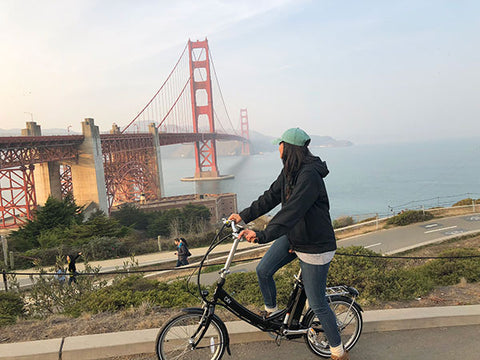
Danielle on a Vika+ at the Golden Gate Bridge

While the Vika+ did improve their travel and ability to explore, Danielle and Tommy were most impressed by how the Blix bikes reduced their carbon footprint. As they write, "While traveling with the Vika+ e-bikes we had an alternative option to explore that saved us money on gas, multiple parking lot fees, and even have days that we didn’t need to drive the RV at all." As an alternative means of transportation, the Vika+ reduced their gas use!


We would like to thank Slow Car Fast Home for taking the time to partner up with Blix Bikes and take the Blix Vika+ on a West Coast adventure! Follow them on Instagram for more updates on their tiny-lifestyle!


 Find more information on the tech specs of the Blix Vika+ here


28 Dec 16:54

The Parks Board Standard for Cycling

by Gordon Price
mkalus shared this story from Price Tags.

It’s going to be a banner year for new and upgraded parks in Vancouver, according to this Courier article:

Except for one thing.  See if you can find the word ‘cycling’ anywhere in there.  (Let’s save you the time: you won’t.)

Or check out the design for the new park at Smithe and Richards:

See the bikes: two on the City sidewalk, one on the adjacent City bikelane.  Given that this is a small park, that’s not too surprising – but it is indicative.  When looking at the failure of the Board of Parks and Recreation to actually incorporate, improve or even acknowledge the woeful condition or absence of safe and sufficient cycling facilities, the conclusion is reinforced by their capital plan: the “new era of park and facilities development” as described by Tina Mack, manager of park development, includes pretty much everything except cycling.  One gets the sense that the ‘Recreation’ in their name doesn’t involve anything with wheels (except the parking lots for the community centres).

This still stands as the Parks Board approach to cycling facilities:

28 Dec 16:54

On the Arbutus Greenway, December 25, 2018

by Ken Ohrn
mkalus shared this story from Price Tags.

The ancient CP railway track continues to change into one of Vancouver’s treasures.

While there a few days ago, I was reminded that the Arbutus Greenway became the subject of a classic battle between Vancouver’s citizens and a small band of preservationists, who wanted this 42-acre strip of Vancouver’s land to remain a private park for local able-bodied walkers — exclusivity defined.

That noisy clash of wills seems to me now like a preview in miniature of the upcoming one over the vast acreage of Vancouver’s land now exclusively zoned for low density. A.K.A. the “City Plan”. Blogger and pundit fodder for many years, I should think.

Lights and action.

This trip, I saw a series of light towers — sporting solar panels — located on a darkish part of the Greenway.

And, as usual, lots more people were on it than the last time I was there. I’m intrigued to see what will happen when we transition from temporary to permanent Greenway.

28 Dec 16:53

And these EU nationals, tech savvy as they are, are filled with joyous wonder at the ease with which they can apply online to stay in the UK. Their wonder is really quite similar to the wonder they showed when they applied for a sustainable technology grant in Canada. pic.twitter.com/lKW6580uzE

by BorderIrish
mkalus shared this story from BorderIrish on Twitter.

And these EU nationals, tech savvy as they are, are filled with joyous wonder at the ease with which they can apply online to stay in the UK. Their wonder is really quite similar to the wonder they showed when they applied for a sustainable technology grant in Canada. pic.twitter.com/lKW6580uzE


Posted by BorderIrish on Thursday, December 27th, 2018 6:16pm


390 likes, 169 retweets
28 Dec 16:53

Liberals think Russia flipped the election by buying $100k in Facebook ads, but the fact that Wall Street gives millions to their favorite candidate is just a normal functioning democracy.

by existentialcoms
mkalus shared this story from existentialcoms on Twitter.

Liberals think Russia flipped the election by buying $100k in Facebook ads, but the fact that Wall Street gives millions to their favorite candidate is just a normal functioning democracy.


Posted by existentialcoms on Thursday, December 27th, 2018 1:14am


5587 likes, 1615 retweets
28 Dec 16:52

How will we pay for Universal Healthcare? I don't know, maybe the same way as: Canada England Chile Sweden Cuba Portugal Italy Iceland Germany France Denmark Austria Australia Algeria New Zealand Taiwan Mexico Thailand India Brazil Switzerland Costa Rica Peru Egypt Spain & Rwanda

by existentialcoms
mkalus shared this story from existentialcoms on Twitter.

How will we pay for Universal Healthcare? I don't know, maybe the same way as:
Canada
England
Chile
Sweden
Cuba
Portugal
Italy
Iceland
Germany
France
Denmark
Austria
Australia
Algeria
New Zealand
Taiwan
Mexico
Thailand
India
Brazil
Switzerland
Costa Rica
Peru
Egypt
Spain
&
Rwanda


Posted by existentialcoms on Friday, December 28th, 2018 2:06am


3031 likes, 898 retweets
28 Dec 16:52

Afternoon in Golden Gate Park

by Liz

I zoomed all over a small section of Golden Gate Park today, the gardens near the De Young and Cal Academy, through some tunnels, down into a ravine full of redwoods near the Rose Garden, and on many winding unpaved paths in the Botanical Gardens. What a blast! I felt so free! Hills, deep gravel, deep wood chips, mud, wet soggy grass…. my giant tires got me through all of that.

Little winding paths are my favorite, where you have lots of choices and can’t tell where you’re going to end up!

I haven’t been in trees in a park for way too long, and have been imagining it for months – ever since the summer and my last trip to Golden Gate Park. So, this was very satisfying. A gorgeous winter afternoon, no fog, warm enough for no jacket when I was in the sun.

liz in bamboo grove

28 Dec 16:51

Noah - run Linux binaries on macOS

by Rui Carmo

This is very nice. Like WSL on Windows 10, it lets you run unmodified Linux binaries, and uses the built-in macOS hypervisor to do so.

It’s not as useful as WSL on Windows (given that most of what I run also has native macOS ports), but might be a good way to do cross-compilation for exotic stuff that require Linux-only tools.

Incidentally, the reverse (running Darwin binaries on Linux) is still a work in progress, but it can apparently run part of the Xcode toolchain already, which might be useful for automated CI/CD pipelines.


28 Dec 16:49

Apple will manufacture high-end iPhones in India in 2019: Reuters

by Sameer Chhabra
iPhone XS Max

Cupertino-based computing giant Apple will begin assembling high-end iPhone models — like the iPhone X — in India in 2019, according to a source who spoke with Reuters.

Apple currently relies on Foxconn, a Taiwanese electronics manufacturer with factories in China, Brazil, Malaysia and other countries around the world, to assemble its iPhone devices.

The majority of Apple’s iPhones are manufactured in Foxconn’s Longhua Science and Technology Park in Shenzhen, China.

According to an unidentified source who spoke with Reuters, however, Apple will soon use Foxconn’s factory in Sriperumbudur in Tamil Nadu to manufacture higher-end iPhones.

Reuters reported that Foxconn currently makes Xiaomi phones in India, while Apple already uses Taiwanese Wistron Corporation’s facilities in Bengaluru to manufacturer the company’s lower-end iPhone SE and iPhone 6S devices.

Apple’s decision to manufacture iPhones in India likely stems from the ramifications of the ongoing trade war between the U.S. and China, started by President Donald Trump earlier this year.

Foxconn has previously acknowledged that the dispute between the U.S. and China has hindered the company’s ability to affordably continue its operations.

Source: Reuters

The post Apple will manufacture high-end iPhones in India in 2019: Reuters appeared first on MobileSyrup.

28 Dec 16:49

Google might bring adoptable storage to Chrome OS, Chromebooks

by Sameer Chhabra

A Chrome OS bug tracker discovered by 9to5Google suggests that Mountain View search giant Google is interested in bringing adoptable storage to Chrome OS and Chromebooks.

Adoptable storage allows users to set up SD cards and other external storage sources as internal device storage options.

Rather than walling off users to simply allow the use of SD cards for photos, music and videos, adoptable storage allows users to install applications and other system files on an SD card for greater file storage.

According to the December 21st, 2018 bug tracker post, Google doesn’t currently “have a concrete plan for implementing this.”

The issue appears to be one of storage safety.

“Android’s recommendation … is to implement adoptable storage in a long-term stable location since accidentally disconnecting them can cause data loss/corruption, but the majority of Chromebooks don’t have such a location unfortunately,” reads an excerpt from the December 21st post written by project manager yusukes@chromium.org.

While many Chromebooks allow users to insert SD cards and microSD cards to expand onboard storage, not all Chromebooks have something like a flap to ensure that SD cards and external storage hardware aren’t dislodged during regular use.

Source: Chromium bug tracker Via: 9to5Google

The post Google might bring adoptable storage to Chrome OS, Chromebooks appeared first on MobileSyrup.

28 Dec 16:49

Samsung’s final Android 9 Pie build skips on adoptable storage

by Igor Bonifacic

While we here in Canada wait for Samsung’s Android 9 Pie build to roll out, details on what to expect from the software update are starting to filter out thanks to Galaxy S9 and Galaxy S9+ owners who already have the update installed on their devices.

According to SamMobile, the final build of Samsung’s 9.0 build doesn’t include Android’s adoptable storage feature.

It had appeared Samsung was preparing to finally add support for the feature, which allows Android users to use an SD card for the dedicated storage of smartphone apps, files and media, when it started beta testing Android 9 Pie.

While Samsung doesn’t appear to have included adoptable storage in its latest version of Android, that’s not to say the company won’t add the feature in later Android 9 Pie builds or even later versions of Android.

Google added adoptable storage to Android back in 6.0 Marshmallow.

Samsung started the rollout of its official Android 9 Pie build earlier this month. The update hasn’t made its way to Canada yet. In fact, neither Rogers nor Telus list the update as part of their software roadmaps.

Source: SamMobile

The post Samsung’s final Android 9 Pie build skips on adoptable storage appeared first on MobileSyrup.

28 Dec 16:48

Chrome OS gets option to request tablet sites in Dev channel version 72

by Jonathan Lamont
Pixel Slate header

In an admission that the internet isn’t always great on touch-based devices, Google is adding a ‘Request tablet site’ option to Chrome.

Google’s senior product manager for Chrome OS, Kan Liu, confirmed in an interview with Android Police that Google’s aware not all sites work well on touchscreens.

Further, Liu said an upcoming release of Chrome OS tablets and touch-enabled Chromebooks would allow users to force a ‘tablet mode’ rendering.

While Liu didn’t elaborate on which Chrome OS release would get the new feature, About Chromebooks found a flag to turn it on in the new Chrome OS Dev channel update.

In Chrome OS Dev version 72, you can navigate to ‘chrome://flags’ and search for the ‘#enable-request-tablet-site’ flag. Once you’ve enabled the flag and restarted your Chromebook, the three-dot overflow menu will contain the new ‘Request tablet site’ option.

It’s also worth noting that this Chrome OS flag isn’t exactly new, but may not have been widely available before now.

Regardless, Pixel Slate users — and other touchscreen Chromebook users — will likely welcome the new feature. If you’re using your device in tablet mode, desktop websites can be a common frustration. Having the option to force things to be touch-friendly should help in that regard.

Source: Android Police, About Chromebooks

The post Chrome OS gets option to request tablet sites in Dev channel version 72 appeared first on MobileSyrup.

27 Dec 15:34

A6

by peter@rukavina.net (Peter Rukavina)

Catherine generously gave me a copy of Making Books, from the London Centre for Book Arts, for Christmas. Many handmade books are sure to follow.

I love that they have a project called A6 that accepts submissions of self-published “artist books, zines and publications,” with the only constraint being they must be A6-sized.

A6 is my favourite of the ISO paper sizes: I love my A6 notebooks and the pouches I carry them about in; I went as far as equipping myself with an A6-sized water bottle this fall.

Photo of A6 water bottle on top of A6 notebook

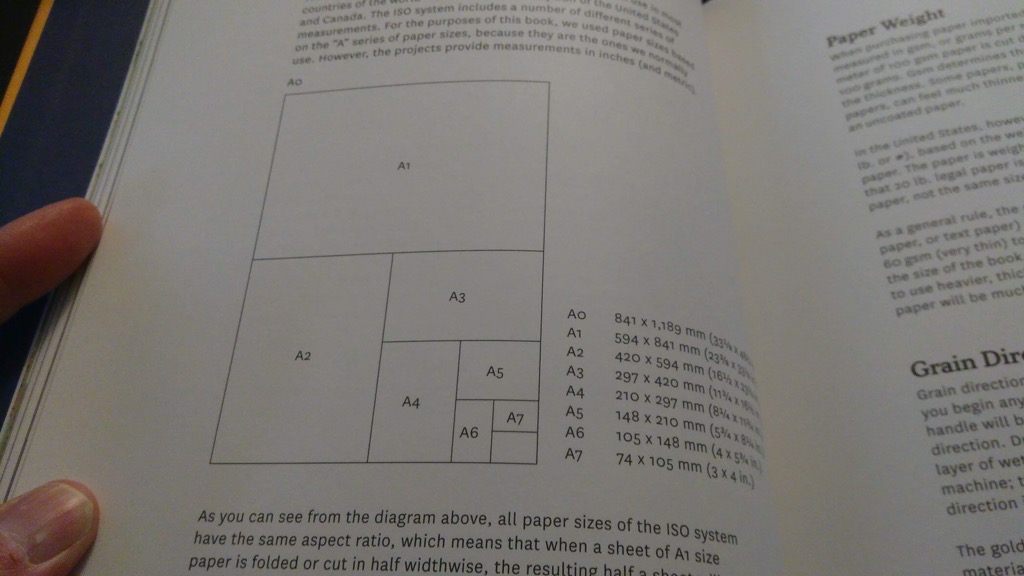
Making Books has a very clear diagram of how the ISO paper size system works:

Diagram of the ISO paper sizes from Making Books

Each size from A0 to A7, when folded in half, becomes the next size down: fold an A6 in half and you get an A7 signature. It’s brilliant, and it’s a shame that, when we converted to the metric system in Canada in the 1970s, we didn’t go all the way and adopt this sizing system as well (the province of Ontario tried, but ultimately gave in; when I was in grade 13 in high school the photocopiers were filled with A4 paper).

27 Dec 15:34

Christian Practice

I’m in Regina, Saskatchewan with family for the holidays. Someone said “Let’s go to a Christmas Eve carol service” and five of us did that. We went to Lakeview United, where “United” signifies the United Church of Canada, the biggest Protestant denomination up here. It was uplifting and pleasant and sort of sad. Disclosure: I’m not Christian at all; but still.

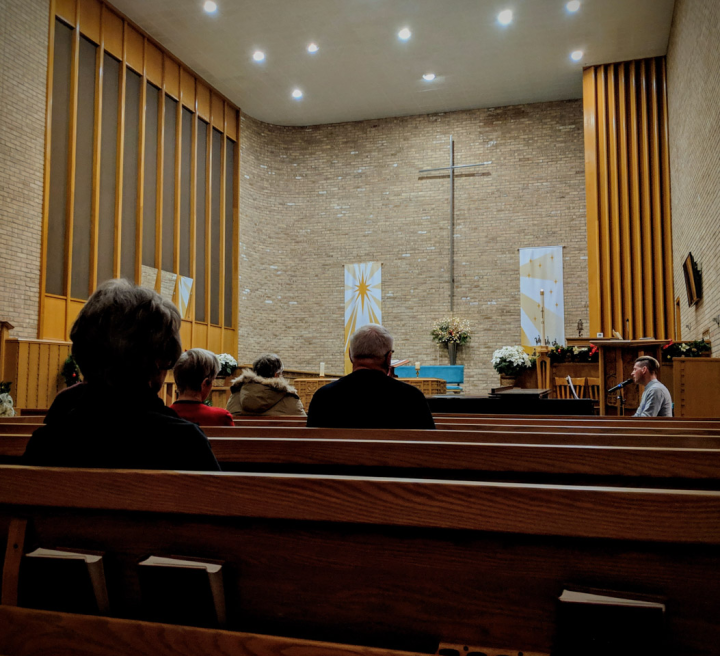
Carol Service at Lakeview United

As you can see, the congregation (for the 8PM December 24th service) was sparse and elderly. The statistics are remorseless: Christianity is in decline. The proportion of Canadians who attend church weekly is not far from 10%.

This surprises me, if only because the Church’s tools are still very strong. The voices raised in Christmas hymns were breathtaking (the crowd, while small, sang well), the Gospel’s words telling the Christmas story were beautiful, and Sue Breisch, the Minister, was eloquent and welcoming, broadcasting love and empathy. Here are some of her sermons.

The building is really fine in a Sixties kind of way, its main hall comfortable, with big comfy rocking chairs and coffee tables at the back.

Maybe it’s as simple as this: Even if you don’t actively disbelieve (as I do) the Christian narrative, religion has lost its urgency, and as lives are increasingly filled by the Net and the pressures of late capitalism, there are ways to fill Sunday mornings that feel more important.

Having said that, I enjoyed the words and music intensely — lack of faith didn’t get in the way — and recommend doing this sort of thing from time to time. I also think it might be good for you. And maybe I’m wrong, maybe Jesus is the Way, the Truth, and the Light, and you’ll end up saving your soul from eternal torment.

27 Dec 15:34

It's Okay To Say, "I Don't Know." Even Nobel Laureates Do It.

by Eugene Wallingford

I ran across two great examples of humility by Nobel Prize-winning economists in recent conversations with Tyler Cowen. When asked, "Should China and Japan move to romanized script?", Paul Romer said:

I basically don't know the answer to that question. But I'll use that as a way to talk about something else ...

Romer could have speculated or pontificated; instead, he acknowledged that he didn't know the answer and pivoted the conversation to a related topic he had thought about (reforming spelling in English, for which he offered an interesting computational solution). By shifting the topic, Romer added value to the conversation without pretending that any answer he could give to the original question would have more value than as speculation.

A couple of months ago, Cowen sat with Paul Krugman. When asked whether he would consider a "single land tax" as a way to encourage a more active and more equitable economy, Krugman responded:

I just haven't done my homework on that.

... and left it there. To his credit, Cowen did not press for an uninformed answer; he moved on to another question.

I love the attitude that Krugman and Romer adopt and really like Krugman's specific answer, which echoed his response to another question earlier in the conversation. We need more people answering questions this way, more often and in more circumstances.

Such restraint is probably even more important in the case of Nobel laureates. If Romer and Klugman choose to speculate on a topic, a lot of people will pay attention, even if it is a topic they know little about. We might learn something from their speculations, but we might also forget that they are only uninformed speculation.

I think what I like best about these answers is the example that Romer and Klugman set for the rest of us: It's okay to say, "I don't know." If you have not done the homework needed to offer an informed answer, it's often best to say so and move on to something you're better prepared to discuss.

27 Dec 15:33

It’s Where You Find It

by Ken Ohrn

The spirit of the season is where you find it.  And this Christmas Labyrinth was at Olympic Village, just north of the giant sparrows.

The creator called it his Christmas present — a memory for you to carry through the year ahead. (Pix below).

Click to view slideshow.
27 Dec 15:33

Rust 2019 and beyond: limits to (some) growth.

by graydon

Rust 2019 and beyond: limits to (some) growth.


This is a blog post (as solicited) about my suggestions for the Rust project in 2019 and beyond.

I should note that I am speaking only for myself, not anyone else, and not even as a very active participant in Rust anymore. Moreover these suggestions, to a large extent, apply to many projects. Rust is just one case, but one that is currently doing some conscious year-end reflection.

I should also note overall that I'm quite pleased by the trajectory of the Rust project and this suggestion is being made only in the spirit of keeping it healthy and on-track, avoiding some problems I observe developing in it, as a mostly-outsider these days.

TL;DR:


I'm writing to make a recommendation about paying attention to -- acknowledging, planning, making explicit mechanisms and policy around the limits of -- the growth of two things in the project:

  1. Necessarily-shared technical artifacts, specifically the language definition itself.

  2. The strains on people participating in conversations about those artifacts.


In particular, I want to draw attention (as others have done, with other words) to the fact that unlimited growth in both of these things is neither possible nor desirable, that there are natural limits, and that as with all natural systems reaching their growth limits, it will be better for everyone if the encounter with the limits is made in a controlled, planned fashion.

Note that I am not writing about limits to the growth of many other areas of the project. It may be possible to have (say) a package index that is too big, or a website that is too big, or maybe even a user community that is too big; but it's not clear that those are problems yet for Rust, and I'm presently only talking about the two specific areas above.

Limiting factors and overshoots.


Every natural system has factors that limit its growth. That is why the universe is not (for example) a single amoeba expanding outwards at the speed of light. A system grows (and often its rate of growth grows too!) until it starts to encounter limiting factors, and then one by one the rate-of-rate-of-change, and then the rate-of-change, and finally the overall size of the system eventually all plateau. Typical growth patterns thus look something like a sigmoid or "S-curve", gradually approaching some asymptote. At least when the limiting factors are encountered in a gradual or controlled fashion.


When a system encounters its limits in an uncontrolled or abrupt fashion, a phenomenon can occur that is more like an overshoot, or even oscillation: the limit still exists but its effect is felt more in the form of collapse or crisis. The S-curve goes up to a peak, followed by a crash on the other side. That is what you don't want.

Examples of control.


The Rust project has a few forms of process control -- that are, in essence, limits on rates of change and/or growth -- that I think are very judicious, and in part responsible for the success of the project so far. I'd like to couch the following recommendations by analogy to them. These process controls are:

  • The Bors queue, generally gating changes on program-wide correctness.

  • Crater runs, generally gating releases on ecosystem-wide correctness.

  • Time-based releases, generally avoiding having to consider whether to slip a schedule rather than cut a feature. The decision is made by the clock, and everything not-ready gets cut.


In addition, the project has grown some less-mechanized but nonetheless important social structures to manage the growth in people participating in the project.

  • The CoC. It's not always remembered, but the CoC does not just talk about social justice and harassment and so forth. It also lays out boundaries around the signal:noise ratio in conversation, the use of other people's attention and time, and the need to accept tradeoffs (I wish I'd had the foresight to use the term "zero-sum" here because I should have: not every decision is non-zero-sum).

  • The RFC process. This includes rules about the form, content, timing, set of participants and permitted and expected forms of discourse when discussing significant changes.

  • The governance model. This includes delineation of areas of responsibility, hierarchical delegation where necessary, roles and expectations of participants and so forth.


All these are essentially acknowledgements that -- absent control -- overshoots can happen and crises (or at least a degree of chaos and dysfunction) may ensue. When possible, process controls are automatic and completely impartial (to minimize ill-will and subjective judgement, the temptation to cut corners, etc.) Where necessarily subjective, the norms and processes are at least clearly articulated in writing, in well-documented, easy-to-find places.

Areas of concern.


Going back to the two areas of concern, then: I want to bring attention to these two areas where the project does not currently have adequate mechanisms or policies in place to control growth, that carry risks of eventual dysfunction or even crisis. In both, it is not clear to me how far from such crisis the project currently is; but either way I think it is worth acting sooner rather than later.

  1. The language itself. Its definition. This is (unlike many parts of the project) a necessarily shared technical artifact. Everyone has a stake in it, and every change potentially effects everyone. Moreover, everyone needs to learn and understand a substantial part of it: people do not have the option to ignore parts they are not interested in. Even parts one wants to ignore will occur in shared contexts: documentation and teaching material, testsuites and validation material, compiler internals, formal models, other people's codebases, overall maintenance burden, etc. etc.

    The limiting factors to the growth of the language as an artifact then, include at least the following:

    • The ability for a beginner to learn the language.

    • The ability for an intermediate user to feel confident, adapt to others' codebases.

    • The ability for an expert or maintainer to know all (or most) of it, evaluate changes.

    • The cost:benefit ratio of each new change, in terms of new and ongoing work that it incurs, vs. the number of people or use-cases that benefit from it. The costs are combinatorial with many dimensions of the project and language size, and almost always increase.


    The risks of overshooting these limits are potentially quite serious:

    • Unsound language changes. Say: failure to maintain a critical safety guarantee.

    • Reputation for overcomplexity, loss of users. Becoming the next C++ or Haskell.

    • Lower-quality features with incomplete definition, testing, documentation.

    • Under-used features that simply absorb effort needed elsewhere.

    • Fragmentation into dialects, unsharable codebases, lower value.


  2. The strains on the people working on the language. Some parts of the project can be delegated, de-synchronized, proceed in parallel with as many hands are available to work on them. Not so the shared technical artifacts. To some extent, many people (and an increasingly-many people) need to be involved in nearly all changes, and that means that there's a lot of pressure both for everyone in that group-of-many to "keep up" with all the discourse occurring, and for the standard of what it means to "keep up" to gradually creep upwards as both more changes are proposed, and more voices contribute to each discussion.

    The limiting factors to the growth of these strains on participating people include at least the following:

    • The number of hours in a day.

    • The number of paid hours in a day.

    • Responsibilities and interests in things outside the project.

    • Reservoirs of mental energy to understand what's being discussed.

    • Trust in the judgement of everyone participating in a conversation.

    • Reservoirs of psychological and emotional energy to read and discuss.

    • The presumption of good faith in everyone participating in a conversation.


    The risks of overshooting these limits are also potentially quite serious:

    • Poor decisions made through exhaustion or attrition.

    • Magnifying inequality: only the most-privileged, available, energetic, well-paid or otherwise well-situated participants can keep up.

    • Narrowing of discourse, from careful consideration to "winning arguments".

    • People acting out, burning out, behaving poorly, departing project.

    • Frustration, accusation of bad faith, grudges, conspiratorial thinking, forks.


I want to emphasize that the limits and risks I've outlined here are quite independent of people, topics, or even the Rust project generally. They will occur to varying degrees anywhere and with anyone. Simply swapping out the current maintainers (say) for your preferred people will not actually solve them: the limits will re-occur. The only solution is to manage the encounter with the limits. Put some controls in place.

Suggested controls.


This is the hard part and the part I'm going to leave least-definite. It's essential, after all, that the project adopt controls of its own volition rather than feeling that they're imposed from outside. I think the project needs to pause, reflect, consider collectively, and put some controls in place. I will therefore only offer a few possible suggestions here, not terribly structured but in the spirit of the holidays: as a bunch of possibly-interesting gifts to unwrap, look over, and decide whether to keep or swap for something more to your liking.

  1. Embrace negative space. Make a process for defining features and concepts out of the future trajectory of the language. Allow (or encourage) RFCs that say "Rust will never have X" for some value of X. While this sounds "negative" -- and it is, the word is written on the label -- it's a one-time thing where objections can be honestly considered with a long-term horizon ("never" is quite some time!) and given fair discussion, but then put to rest rather than being a perennial source of lingering conflict. A few examples where one might want to find and articulate negative spaces: paint certain categories of expressivity permanently out of the type system (eg. dependent types, HKTs, etc.), or out of the grammar (eg. parameter qualifiers, positional or keyword args), or out of the set of kinds of item (eg. anonymous record types), or out of the set of inference obligations in the middle-end (eg. constant value synthesis, implicit arguments). Put some hard limits in place, both to avoid those features themselves, and also to avoid people "putting pieces in place" that exist only to eventually-enable them.

  2. Front-load costs, make them explicit. Taking a page from webassembly's change process, make it clear that moving an RFC past a very early phase is going to require a commensurate investment in implementation, formalization, documentation revision, teaching-materials revision, test-writing, maintenance and so forth. Absent a way to cover the costs, defer changes "nobody has yet been found to pay for" at that stage.

  3. Set a learning-rate and book-length target. Try to work backwards from the amount of time and number of pages it "should take" to learn the language, or become expert in it, then cut things that go beyond that. If "teach yourself Rust in 21 days" isn't going to work, figure out what should. Three months? Six? A year? Think about languages that "definitely take too long", and pick a number that's less than that. Is a thousand page manual healthy? Five hundred? Three hundred?

  4. Set other mechanized limits: lines of code in the compiler, overall time to bootstrap, dollars spent per day on AWS instances, number of productions in the grammar, number of inference rules in the type system, percent test coverage, percent of documents allowed to be marked as "incomplete", etc. Get creative, figure out meaningful things you can measure and then put mechanisms in place to limit them.

  5. Rate-limit activity based on explicit personal-time-budgeting: ballpark-figure how many hours (or paid hours) per person are realistically available without exhaustion or burnout -- including the least-privileged but still necessary participants -- and work backwards to figure out how many hours of participation and review "should be" digested per team, per release cycle, thus how much work gets scheduled. Then cut or defer things that go beyond that.

  6. Allow the moderator team to apply rate limits or cooling-off periods to particular discussions as a whole. Sometimes an outside perspective that a discussion is just too heated overall is an easier way to de-escalate than shining a spotlight on a single person's behaviour.

  7. As with the moderator team: grow an additional cross-project team that does budgeting and auditing of load levels in other teams. This can be effective because the auditing/budgeting team sees their work as helping people to say no to the right things, rather than the default stance most people will have when participating in a team, to say yes to too many things.


These are just some ideas to outline the very general family of thing I am suggesting. I'm sure you can come up with more possible and more plausible ways of controlling the encounter with limits to the language's size and the personal strains of working on it. The Rust community has shown itself to be quite admirably creative, reflective and self-critical over the years. For this you should be commended. I hope this post is taken in the the same vein of constructive criticism.

Happy new year, and good luck!

This entry was originally posted at https://graydon2.dreamwidth.org/263429.html
27 Dec 15:33

Helping Students and Teachers Embrace Engineering

Reid Whitaker, Getting Smart, Dec 26, 2018
Icon

When I took a year of Computing Science in 1980 it was still considered engineering and so I got a year's worth of engineering education (and one computing science course). It was actually pretty interesting, and I appreciated the exposure to mechanical, electrical, and other forms on engineering, as well as the chemistry and physics that underlie them. The 'engineering' mentioned in this article is something very different. Yes, engineering presupposes an approach based on precision and design. But 'brainstorming' isn't inherent to engineering, nor are 'redesign' and 'critique'. This article is yet another one of those articles applying fancy words to teachers in an effort to help them feel good about the things they're already doing.

Web: [Direct Link] [This Post]
27 Dec 15:32

Some Notes On Installing Federated Wiki On Windows

by mikecaulfield

It’s 2018, and I’ve still not found anything that helps me think as clearly as federated wiki. At the same time, running a web server of your own is still, in 2018, a royal pain. Case in point: recently a series of credit card breaches forced a series of changes in my credit card number (two breaches in one year, hooray). And that ended up wiping out my Digital Ocean account as it silently failed the monthly renewals. Personal cyberinfrastructure is a drag, man.

But such is life. So I recently started looking at whether I could do federated wiki just on my laptop and not deal with a remote server. It doesn’t get me into the federation, per se, but it allows all the other benefits of federated wiki — drag-and-drop refactoring, quick idea linking, iterative note-taking, true hypertext thinking.

It turns out to be really easy (I mean as things go with this stuff). I’ll go into detail more below, but here are the steps:

  1. Download Node.js for Windows. Install.
  2. Open a command window and type: npm install -g wiki
  3. Launch via command window: wiki -p 80 –security_type friends –cookieSecret ‘REPLACE-THIS-SECRET’
  4. Navigate to localhost in a browser
  5. Click the lock to “claim” the wiki as owner
  6. Click the “wiki” link to take it out of read-only mode.
  7. Go forth and wiki…..

Installation

Step one: Download Node.js for Windows. Install.

Step two: Open a command window and type: npm install -g wiki

It’s installed!

Initial Startup

To start your wiki go to a command prompt and type:

wiki -p 80 --security_type friends --cookieSecret 'REPLACE-THIS-SECRET' 

You may need to give node some permissions. I won’t advise you on that. But you definitely don’t need to give public networks access to your server if you don’t want.

Go to your localhost. You’ll get the start page.

Claiming your wiki

When you first visit your wiki it will be in unclaimed, read-only mode, and the bottom of the interface will look like this (though probably not have 47 pages):

When you click that lock icon, it will create a random username and go to unlocked position.

Once you do that you can click on the word “wiki” and now it will move out of read-only into edit mode:

You’ll know it’s in edit mode because you’ll see the edit history icons (sometimes colloquially referred to as ‘chiclets’) at the bottom.

And — that’s it. You’re done. Wiki away.

You’ll need to launch the server from a command window each time you want to use it, but if you’re familiar with Windows you can write a bat file and put it in your startup folder.

(Incidentally, this isn’t a tutorial on how to use federated wiki. I’m tired, frankly, of trying to sell it to people who want to know why it takes more than fifteen minutes to learn. I don’t teach people it anymore because people have weird expectations and it wastes too much of my time trying to get past them. But if you’re one of the people who has made the jump, you know this — I just want to help you do it locally on your laptop.)

Optional stuff: Changing your name, importing or backing up files

You don’t need to know where files live on your computer, but sometimes it is useful. For instance, you might want to back up your pages, or reset a username. Here’s how you can do that.

In the single user mode we used above, wiki pages will be in a .wiki directory under your user directory. For instance, my directory is C:\Users\mcaulfield\.wiki\pages. They are simple json files, and can be backed up and zipped. You can also drop json files from other wiki instances here, though you’ll have to delete the sitemap.json file to reindex (more on that below).

For ownership and indexing issues there is a status directory under the .wiki directory (e.g. C:\Users\mcaulfield\.wiki\status). This has two important files in it. One is owner.json, which maintains login information (initially this will not be there — it’s written when you claim it). The other is your sitemap, which has a list of all pages and recent updates on them. Deleting the sitemap is useful when you want to regenerate it after manually uploading new files.

To change your username, you can edit the owner.json file. Change the name property.

If something goes wrong and you want to reinitiate the claim process, you can delete the owner.json file.

If you clear your cookies and hence loose your claim (i.e. are logged out), you can pull the secret from the json and enter it when prompted. It’s OK to change it to something simple and more password-like that you can remember.

The node files of your wiki installation will be in your AppData roaming directory under npm, e.g. C:\Users\mcaulfield\AppData\Roaming\npm\node_modules\wiki. There’s not an real reason to touch these files.

Running a personal desktop farm

This is only for federated wiki geeks, but it is completely possible to run a small personal desktop farm, where you can run multiple wiki sites in what are essentially separate notebooks. Just go into your hosts file (C:\Windows\System32\drivers\etc\hosts) and add localhost aliases:

# localhost name resolution is handled within DNS itself.
#	127.0.0.1       localhost
#	::1             localhost
	127.0.0.1       disinfo
	127.0.0.1       journal
	127.0.0.1       papersonwiki
	127.0.0.1	sandbox
	127.0.0.1	teachersguide
	127.0.0.1	wikipediawomen
	127.0.0.1	opioidcrisis
	127.0.0.1	raceinamerica

Launch in farm mode (-f) and type these words into your browser omnibar. Each will maintain a separate wiki instance. If you want to be able to search across all instances, use the –autoseed flag. Note that you’ll have to go through the minimal claim process with each one (two clicks, shown above).

Pushing to a larger federation

If you want to push to a remote server, you can. There’s a couple ways to do this.

First, there’s a flag in wiki that allows you to point to a different directory for pages. So you can point that to a mapped drive or Dropbox or whatever on your laptop, and then point a remote server to that same directory.

Alternatively you could do a periodic rsync to the server. Windows 10 has bash native to it, so you can install that, reach your files through Bash for Windows’s /mnt/c/ mapping, and push them up that way.

In each case, you probably want to delete the sitemap.json and sitemap.xml to trigger a regeneration.

Interestingly, you could also use this scheme (I think) for joint generation of a public wiki.

IIRC, there is also a way to drag and drop json export files into wiki instances.

Finally, you can share files with people by zipping them up and emailing them or providing them as a zipped download. They in turn can drop them into their own federated wiki instance to work with. I’ve been thinking a lot about this model, which is very memex like — I make a notebook of my notes on something, post it up, you pull it into your machine. The provenance gets messy at scale, but among a group of people in a subfield that are being more descriptive in their practice than rhetorical this might work out fine.

It’s Good To Be Back

Using federated wiki again reminds me once again of what wiki means, in an etymological sense. It means quick.

What all other non-federated wiki systems lack is not just federation. They lack quickness, largely because they are designed towards novices and trade away possibilities for fluid authorship in exchange for making the first 15 minutes of use easier.

So while it may seem weird to run a federated wiki server on a laptop in a way that makes federation less available, if you’ve learned the method of multi-pane wiki it’s not really weird at all, because every note taking system you’ve used besides federated wiki is unbearably slow, clunky, and burdensome. Federated wiki, in the hands of someone that has mastered it, works at the speed of thought. And it does that whether your in the federation or not. So here’s to a very wiki New Year.

27 Dec 15:29

Looking Back on 2018

by Ton Zijlstra

It’s the end of December, and we’re about to enjoy the company of dear friends to bring in the new year. This means it is time for my annual year in review posting, the ‘Tadaa!’ list.

Eight years ago I started writing end-of-year blogposts listing the things that happened that year that gave me a feeling of accomplishment, that make me say ‘Tadaa!’. (See the 2017, 2016, 2015, 2014, 2013, 2012, 2011 and 2010 editions). I am always moving forwards to the next thing as soon as something is finished, and that often means I forget to celebrate or even acknowledge things during the year. Sometimes I forget things completely. Although I have worked on improving that sense of awareness over the past few years, it remains a good way to reflect on the past 12 months. So, here’s this year’s Tadaa!-list:

  • The Smart Stuff That Matters unconference and bbq party in honour of Elmine’s 40th birthday was an awesome event bringing together so many great people from our various contexts. Thank you to all who were there, from right next door to halfway across the globe, and so many different places in between. It is a great privilege you came together in our home.
    STM18 STM18
    STM18 STM18
    STM18 STM18
    STM18 STM18
    STM18 STM18
    STM18
    So much fun having you all at STM18! Of course we had the mythical German sausages again….
    Through the Eyes of the Artist
    Peter made a sketch of our house, sitting in the garden
  • Being witness and officiating at our dear friends’ Klaas and Amarens wedding in Tuscany.


    Dinner al fresco / Thirty years of friendship (images by Elmine)
  • Presenting Networked Agency during a keynote at State of the Net in Trieste. A great opportunity to create a better narrative to explain Networked Agency, and present it to a much wider audience. Also great to see Paolo and Monica, as well as many others again.
    sotn2018 Sotn 18
    Our friend Paolo opening State of the Net, enjoying the beautiful city of Trieste
  • Working in Serbia, Italy, UK, Germany, Netherlands, Belgium.
  • Creating a measurement framework for open data impact, that allows for different levels of maturity, embraces complexity, and aims to prevent gaming of measurements.
  • Getting tremendous feedback by the funder of a client project last year, that it was the most exciting thing they funded.
  • Getting asked back by multiple clients
  • Joining the board of Open Nederland, the Dutch Creative Commons chapter as treasurer
  • Joining the board of Open State Foundation, the leading Dutch advocate for open government, as its chairman, after having been one of the initiators of the very first event in 2008, that later turned into this great organisation
  • Taking the time to just hang out with other geeks at IndieWebCamp in Nürnberg
  • I spent every Friday at home to be with our daughter. A joy to watch her develop.
    20181014_092552
  • Giving the opening key-note at FOSS4GNL. I especially enjoyed writing the narrative for it, which ties local data governance to geopolitics and ethics.

    the Dutch open source geo community, and during the keynote (images Steven Ottens)
  • Got to be there for friends, and friends got to be there for me. Thank you.
  • Sponsoring the Open Knowledge Belgium conference with my company The Green Land, and participating in the conference with our entire team, and providing two sessions.
  • Finding my voice back in blogging. I’ve written more blogposts this year than the preceding eleven combined, and as much as the first 5 years of busiest blogging combined. As a result I’ve also written much more in-depth material than any other year since I started in 2002. This has created more space for reflection and exploration, useful to shape my ideas and direction in my work. It was inspiring to renew the distributed conversations with other bloggers. As a result I am revisiting much of my writing about information strategies and the workings of human digital networks.
  • Working with a client to further detail and document both Networked Agency and the ‘impact through connection’ project we based on it.
  • Making day trips with Elmine and (not always) Y, e.g. to BredaPhoto, Eddo Hartmann and Fries Museum. Making good use of our more central location.
  • Started to make better use of the various spaces our house offers, like the garden, the attic studio, and my own room. Room for improvement in the next year though.
  • Avoiding feeling hurried, while keeping up the level of results.

All in all it was a rather unhurried year, with more time for reflection about next and future steps. I worked 1728 hours, which averages out to about 36,5 per week worked. This is not yet getting closer to the 4 day work weeks I actually have, compared to last year, but at least stable.
I’ve read 69 books, at a steady pace. All fiction, except for a handful. I’m looking to create the space to start reading more non-fiction. That likely requires a separate approach.

Elmine gave me an amazing sculpture for my birthday, called “Strange Bird Totem”. The artist Jacqueline Schäfer’s work is described as “showing a positive vibe for life in a complex modern society“. That sort of feels like a great motto for the next year. Ever onwards!