Rolandt
Shared posts
Smartphone manufacturer Oppo develops 10x zoom for smartphone cameras
A New Direction For Tumblr
"The free market doesn’t exist. Every market has some rules and boundaries that restrict freedom of..."
darktable 2.6

This is a massive update (and a fascinating, long read), with loads of new features.
I’m curious to see if they finally fixed the (also) massive performance issues in macOS, since the GTK wrapper for the light table viewer in 2.4 actually re-draws the entire thing every time you move the mouse, which makes it unusable in large retina displays.
Update: it’s still a problem, and one that makes it very hard to use unless you’re extremely patient. I’ve turned to Affinity Photo to deal with my RAW files instead, which is sad since I quite like Darktable’s non-destructive editing capabilities.
Permanent Partner
I had a nice chat with my friend Stephen and his mother Carol last night on the telephone. Carol was talking about her 6 children, and how 4 of them have “permanent partners,” which was her way of saying they were married.
Catherine and I have long sought a way of describing our unmarried union (we’ll have been dating for 28 years in 2019) and I think permanent partnership is the best term I’ve yet heard.
It’s Not Facebook’s Fault: Our Shadow Internet Constitution

Those of us fortunate enough to have lived through the birth of the web have a habit of stewing in our own nostalgia. We’ll recall some cool site from ten or more years back, then think to ourselves (or sometimes out loud on Twitter): “Well damn, things were way better back then.”
Then we shut up. After all, we’re likely out of touch, given most of us have never hung out on Twitch. But I’m seeing more and more of this kind of oldster wistfulness, what with Facebook’s current unraveling and the overall implosion of the tech-as-savior narrative in our society.
Hence the chuckle many of us had when we saw this trending piece suggesting that perhaps it was time for us to finally unhook from Facebook and – wait for it – get our own personal webpage, one we updated for any and all to peruse. You know, like a blog, only for now. I don’t know the author – the editor of the tech-site Motherboard – but it’s kind of fun to watch someone join the Old Timers Web Club in real time. Hey Facebook, get off my lawn!!!
That Golden Age
So as to not bury the lead, let me state something upfront: Of course the architecture of our current Internet is borked. It’s dumb. It’s a goddamn desert. It’s soil where seed don’t sprout. Innovation? On the web, that dog stopped hunting years ago.
And who or what’s to blame? No, no. It’s not Facebook. Facebook is merely a symptom. A convenient and easy stand in – an artifact of a larger failure of our cultural commons. Somewhere in the past decade we got something wrong, we lost our narrative – we allowed Facebook and its kin to run away with our culture.
Instead of focusing on Facebook, which is structurally borked and hurtling toward Yahoo-like irrelevance, it’s time to focus on that mistake we made, and how we might address it.
Just 10-15 years ago, things weren’t heading toward the our currently crippled version of the Internet. Back in the heady days of 2004 to 2010 – not very long ago – a riot of innovation had overtaken the technology and Internet world. We called this era “Web 2.0” – the Internet was becoming an open, distributed platform, in every meaning of the word. It was generative, it was Gates Line-compliant, and its increasingly muscular technical infrastructure promised wonder and magic and endless buckets of new. Bandwidth, responsive design, data storage, processing on demand, generously instrumented APIs; it was all coming together. Thousands of new projects and companies and ideas and hacks and services bloomed.
Sure, back then the giants were still giants – but they seemed genuinely friendly and aligned with an open, distributed philosophy. Google united the Internet, codifying (and sharing) a data structure that everyone could build upon. Amazon Web Services launched in 2006, and with the problem of storage and processing solved, tens of thousands of new services were launched in a matter of just a few years. Hell, even Facebook launched an open platform, though it quickly realized it had no business doing so. AJAX broke out, allowing for multi-state data-driven user interfaces, and just like that, the web broke out of flatland. Anyone with passable scripting skills could make interesting shit! The promise of Internet 1.0 – that open, connected, intelligence-at-the-node vision we all bought into back before any of it was really possible – by 2008 or so, that promise was damn near realized. Remember LivePlasma? Yeah, that was an amazing mashup. Too bad it’s been dormant for over a decade.
After 2010 or so, things went sideways. And then they got worse. I think in the end, our failure wasn’t that we let Facebook, Google, Apple and Amazon get too big, or too powerful. No, I think instead we failed to consider the impact of the technologies and the companies we were building. We failed to play our hand forward, we failed to realize that these nascent technologies were fragile and ungoverned and liable to be exploited by people less idealistic than we were.
Our Shadow Constitution
Our lack of consideration deliberately aided and abetted the creation of a unratified shadow Constitution for the Internet – a governance architecture built on assumptions we have accepted, but are actively ignoring. All those Terms of Service that we clicked past, the EULAs we mocked but failed to challenge, those policies have built walls around our data and how it may be used. Massive platform companies have used those walls to create impenetrable business models. Their IPO filings explain in full how the monopolization and exploitation of data were central to their success – but we bought the stock anyway.
We failed to imagine that these new companies – these Facebooks, Ubers, Amazons and Googles – might one day become exactly what they were destined to become, should we leave them ungoverned and in the thrall of unbridled capitalism. We never imagined that should they win, the vision we had of a democratic Internet would end up losing.
It’s not that, at the very start at least, that tech companies were run by evil people in any larger sense. These were smart kids, almost always male, testing the limits of adolescence in their first years after high school or college. Timing mattered most: In the mid to late oughts, with the winds of Web 2 at their back, these companies had the right ideas at the right time, with an eager nexus of opportunistic capital urging them forward.
They built extraordinary companies. But again, they built a new architecture of governance over our economy and our culture – a brutalist ecosystem that repels innovation. Not on purpose – not at first. But protected by the walls of the Internet’s newly established shadow constitution and in the thrall of a new kind of technology-fused capitalism, they certainly got good at exploiting their data-driven leverage.
So here we are, at the end of 2018, with all our darlings, the leaders not only of the tech sector, but of our entire economy, bloodied by doubt, staggering from the weight of unconsidered externalities. What comes next?
2019: The Year of Internet Policy
Whether we like it or not, Policy with a capital P is coming to the Internet world next year. Our newly emboldened Congress is scrambling to introduce multiple pieces of legislation, from an Internet Bill of Rights to a federal privacy law modeled on – shudder – the EU’s GDPR. In the past month, I’ve read draft policy papers suggesting we tax the Internet’s advertising model, that we break up Google, Facebook, and Amazon, or that we back off and just let the market “do its work.”
And that’s a good thing, to my mind – it seems we’re finally coming to terms with the power of the companies we’ve created, and we’re ready to have a national dialog about a path forward. To that end, a spot of personal news: I’ve joined the School of International and Public Affairs at Columbia University, and I’m working on a research project studying how data flows in US markets, with an emphasis on the major tech platforms. I’m also teaching a course on Internet business models and policy. In short, I’m leaning into this conversation, and you’ll likely be seeing a lot more writing on these topics here over the course of the next year or so.
Oh, and yeah, I’m also working on a new project, which remains in stealth for the time being. Yep, has to do with media and tech, but with a new focus: Our political dialog. More on that later in the year.
I know I’ve been a bit quiet this past month, but starting up new things requires a lot of work, and my writing has suffered as a result. But I’ve got quite a few pieces in the queue, starting with my annual roundup of how I did in my predictions for the year, and then of course my predictions for 2019. But I’ll spoil at least one of them now and just summarize the point of this post from the start: It’s time we figure out how to build a better Internet, and 2019 will be the year policymakers get deeply involved in this overdue and essential conversation.
Pogrom

One day in April 1903, a bunch of school kids in the small city of Kishinev started throwing rocks and slogans at some houses where Jews lived. That wasn’t unusual. But things got out of hand this time: three nights of rioting follower, 49 Jews were killed, hundreds were raped, and the whole world was watching. Correspondents poured into Kishinev from London and Dublin and New York. Hayyim Nahman Bialik composed an epic poem, In The City of Slaughter, that would become a staple of Hebrew studies for generations. At the same time, a far-right newspaper editor in Kishinev concocted an imaginative libel, the Protocols of the Elders of Zion, that captured a lot of attention as well. Zipperstein captures the time and place with care and intelligence.
Artificial Condition

The narrator, a synthetic cyborg developed to provide security for planetary explorers, thinks of himself as a murderbot. He exists to protect people, but he has no high opinion of people and he heartily disliked them. Really, he’d much rather be left alone to watch videos than have to risk his life for these unpleasant creatures. Still, he’s not happy about a job that requires him to kill so often, even if it’s necessary to save his clients.
Between The World And Me
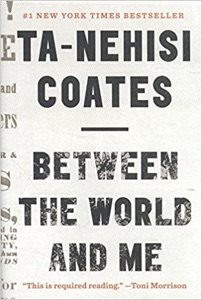
Brilliant, vivid, indispensable. This book is destined for the shelf which The Souls Of Black Folk has so long had to itself.
Finding all of the trees in the world with machine learning

Descartes Labs used machine learning to identify all of the trees in the world where at least one-meter resolution satellite imagery is available. Tim Wallace with the maps:
The ability to map tree canopy at a such a high resolution in areas that can’t be easily reached on foot would be helpful for utility companies to pinpoint encroachment issues—or for municipalities to find possible trouble spots beyond their official tree census (if they even have one). But by zooming out to a city level, patterns in the tree canopy show off urban greenspace quirks. For example, unexpected tree deserts can be identified and neighborhoods that would most benefit from a surge of saplings revealed.
Tags: Descartes Labs, Tim Wallace, trees
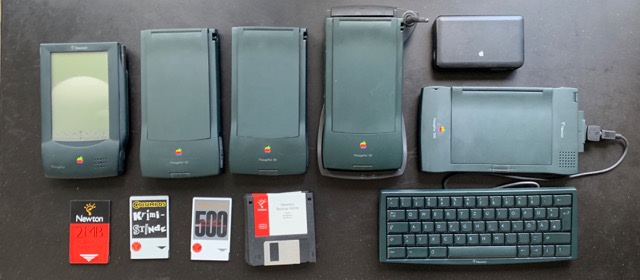
Mobile computing in the early 90s
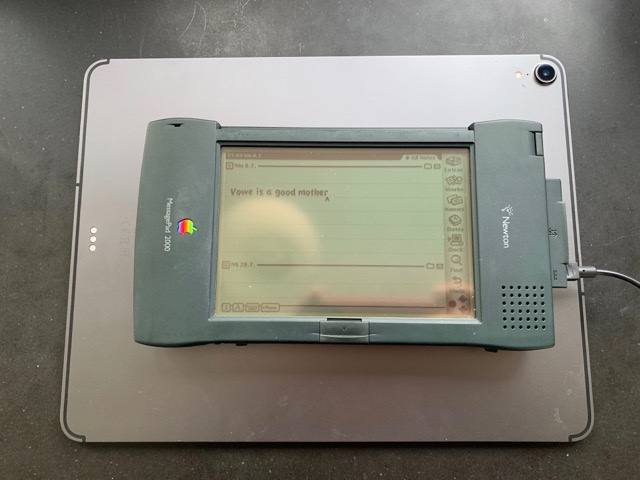
When 2 MB were a substantial mass storage upgrade.
iA Writer 5.2: Better Typography and External Library Locations

As I wrote in my roundup of must-have iOS apps, I've been using iA Writer as my text editor, primarily because of its integration with Working Copy, beautiful typography, and syntax highlighting mode. As a non-native English speaker, I find the latter particularly useful when editing articles. iA Writer was updated to version 5.2 last week, and I'd like to point out a few welcome enhancements in this release.
Once again, the folks at iA have focused on improving the app's typographic options in this version, and the results are fantastic. In addition to mono and duospaced fonts (iA Mono and Duo, which were based on IBM Plex), iA Writer now comes with Quattro, an iA-designed font that supports four widths for a cleaner presentation of text, especially on mobile devices. The developers have shared a lot of technical details about the new and redesigned fonts in a blog post (if you're a type nerd, I recommend going through their explanations), but what I can say is that I instantly fell in love with Quattro. To my eyes, it retains the legibility of a monospaced font but shares similarities with a proportional one, making everything a bit more compact on the iPhone and iPad. With Quattro, iA Writer saves space on smaller screens, which I appreciate when editing a story on the iPhone or iPad in Split View. I still alternate between Quattro and Duo, but I find Quattro to be an overall superior choice for my editing needs.

From left to right: iA Mono, Duo, and Quattro.
iA Writer 5.2 comes with a fully rebuilt export option for Microsoft Word (which is also compatible with Pages and Google Docs), but I haven't used it because, as I mentioned before, we share articles with the MacStories team using GitHub. Still, it's pretty remarkable that iA Writer can generate Word documents with support for local images, footnotes, tables, and more – so if you're into that sort of thing, I recommend checking out the new option under the app's 'Export' menu. I'd love to see EPUB support (with customizable templates) in a future update as well.
What I'm really happy to see in iA Writer 5.2 is the same kind of open-in-place integration for folders that Working Copy received last month. Called 'Library Locations', this feature allows iA Writer to open any directory from the Files app – including folders from compatible third-party storage providers – and keep them "synced" as external locations in the app's library. This means you can add any folder from iCloud Drive, repository from Working Copy, or directory from a third-party app that supports open-in-place and make changes to files contained in them directly from iA Writer, without importing or duplicating them.

TextEdit's iCloud Drive folder, opened-in-place with iA Writer 5.2.
iA Writer already was one of the few apps to support open-in-place for individual files, but extending this integration to entire folders from other apps is a major step forward that puts iA Writer on the same level of flexibility as Working Copy. Want to edit notes from Drafts' iCloud Drive folder in iA Writer? Just add it as an external location and, as you export notes from Drafts, they will appear in the bookmarked folder in iA Writer too. The same applies to any other folder from iCloud Drive: for example, I imported the Shortcuts and Scriptable folders from iCloud Drive as locations in iA Writer, so now I can edit text files used by those apps with the same text editor I use for everything else.

Adding a folder from iCloud Drive as a library location in iA Writer.
As you can imagine, I've also added various repos from Working Copy, which lets me edit articles from the MacStories team in a text editor that supports a custom template that looks just like the MacStories website. 1 If a folder contains image assets in addition to text files (as was the case for a recent story by Stephen that he shared via his repository in GitHub), you can tap the file in iA Writer's library to preview it in a popup.

A repository from Working Copy as viewed in iA Writer after it was added as an external library location.

This is not MacStories, but a custom, MacStories-like template in iA Writer.
The biggest downside of open-in-place for folders, as I mentioned last month, is that it's up to third-party developers to support the feature in their apps, and in my experience most of them don't. Dropbox, Google Drive, and OneDrive, for instance, won't let you open folders from other apps such as iA Writer or Working Copy. Furthermore, Apple's Files app doesn't offer any indication as to which third-party apps support open-in-place and which aren't compatible with it: I've often found myself selecting an external folder from a third-party app in Working Copy or iA Writer only to discover, via an error, that the app didn't support open-in-place at all.
Thankfully, good Files citizens such as iA Writer, Kodex, and Working Copy exist, so I'm able to accomplish the majority of my document-related tasks with these apps. However, I can't help but feel that this situation could be improved by Apple if they required third-party Files extensions to support open-in-place or if, at the very least, the Files app provided some kind of status indicator for external locations that are not compatible with open-in-place. There's nothing iA Writer can do to work around these limitations for now; the app tries to make the best out of a fragmented ecosystem of apps that integrate with Files on iOS.
I continue to be impressed by iA Writer's blend of an "opinionated" design with support for native platform features that are too often eschewed in favor of proprietary solutions by some third-party apps. Besides its beautiful typography and best-in-class syntax highlight for parts of speech, iA Writer is among the few apps that take advantage of the full spectrum of Files APIs in the modern iOS, which is something I've increasingly come to rely on for my work. The combination of iA Writer and Working Copy yields what is, quite possibly, the most useful, integrated, and versatile writing environment I've had on iOS in years.
iA Writer 5.2 is available on the App Store for Mac and iOS.
- iA has documented how you can create your own templates here. ↩︎
Support MacStories Directly
Club MacStories offers exclusive access to extra MacStories content, delivered every week; it's also a way to support us directly.
Club MacStories will help you discover the best apps for your devices and get the most out of your iPhone, iPad, and Mac. Plus, it's made in Italy.
Join NowTrump’s border wall as a platonic ideal
We’ve heard a lot about the border wall in the last week — especially since Donald Trump has shut down the government until he gets funding for it. The messaging around the wall reveals that to Trump and his administration and his followers, it is a philosophical worry-stone, not a physical construct. For Trump to … Continued
The post Trump’s border wall as a platonic ideal appeared first on without bullshit.
Son and Father in Repose
Ton kindly sent me some photos from our visit to their house in Amersfoort this summer, and this one is my favourite. If memory serves, we were listening to Frank talk about the IndieWeb (Oliver was watching the screen, I was watching Frank).

2018 review of online learning
I'll save a place in this post for the fift installment of this series, which is forthcoming, but here are the previous four:
- AI and synchronous online learning
- Open universities and open education
- Emerging technologies
- Weak leadership
For each of the different topics, Bates gives the following scores: "the hype factor (as the ‘media’ see it), what I think is the significance for online learning, (and) level of engagement about the topic on the part of readers of my blog." Even in retirement, Bates continues to be the most significant figure on online and distance learning in Canada, and his high-quality observations and reporting have yielded numerous nsights for all of us.
Web: [Direct Link] [This Post]Literally Just A Big List Of Facebook’s 2018 Scandals

Like the title says. It has been more than two years since I quit Facebook - the impact was that views on my website went up, but that I was less connected with people. But that's changing now as more people leave Facebook. Anyhow, while for me 2018 was pretty quiet, for Facebook "2018 turned into 12 months of mea culpas, self-inflicted scandals, and screwups."
Web: [Direct Link] [This Post]Twitter Favorites: [brownpau] Breaking Twitter silence briefly to say Merry Christmas! Also we have moved to Canada. https://t.co/5ogz66ooDI

Breaking Twitter silence briefly to say Merry Christmas! Also we have moved to Canada. hownow.brownpau.com/archives/2018/…
Finally, a legitimate reason for an internet connected vacuum twitter.com/pcgamer/status…
mkalus
shared this story
from  internetofshit on Twitter. internetofshit on Twitter.
|
Finally, a legitimate reason for an internet connected vacuum twitter.com/pcgamer/status…
Doomba turns your robotic vacuum cleaner into a Doom map-making machine buff.ly/2CxABbq pic.twitter.com/0B10PSoYSP

Posted bypcgamer on Monday, December 24th, 2018 6:27pm
623 likes, 281 retweets
 internetofshit
on Monday, December 24th, 2018 8:35pm
internetofshit
on Monday, December 24th, 2018 8:35pm1435 likes, 442 retweets
From the feed
I’ll be away for a couple of weeks, so here is the last set of links for the year. Happy New Year.
I am worried about democracy these days. Our electoral politics are ravaged by social media manipulation, an absence of policy discussion, and the influence of money. Governance affords very little opportunity for meaningful citizen participation. Harold Jarche is worried too, and in this pots he tackles the question of how to save democracy head on.
Our institutions are failing us. They were designed for the age of print, not an electrically connected one. We need new structures and the current wave of returns to tribalism manifested as populism will not save us. As the advent of the printing press helped usher in an age of inquiry, first in the Christian religion and later in the enlightenment and scientific revolutions, so we have to engage in creating new organizational and governance structures for a global network era.
If print enabled democracy, will the emerging electric/digital medium destroy it?
How Complex Whole Emerge From Simple Parts
Another stunner from Quanta Magazine. This is a great introductory video to emergence. I could listen to excellent basic introductions to complexity all day. Enjoy this one. This is the phenomenon that my life’s work is devoted to.
Maria Popova’s favourite books of 2018
Maria Popva runs Brain Pickings, which is an amazing blog. She shares some detailed reviews of a couple of dozen books that grabbed her attention this year from authors including Anne Lamott, Rebecca Solnit, Audré Lourde, Ursula K. Le Guin, and Zadie Smth among others, including some terrific children’s books. She calls this list “New Year’s Resolutions in Reverse.”
Advice for Emerging Evaluators
My colleague Carolyn Camman, a developmental evaluator has recently revamped her blog and there are some brilliant pieces on there, including this one which provides advice to her future colleagues from five things you should learn how to do, and one Max Ehermann Desiderata which begins
Go placidly amid the noise and haste,
and remember what peace there may be in silence.
As far as possible without surrender
be on good terms with all persons.
Speak your truth quietly and clearly;
and listen to others, even the dull and the ignorant;
they too have their story.
Onaubinisay at the World Parliament of Religions
Onaubinisay (Jim Dumont) is an important teacher of Anisinaabe governance and spirituality. I met him first in the 1980s when I was studying Native Studies at Trent University, where he visited as a guest during our annual Elders and Traditional People’s conference. He was an influential supporter of the effort to re-establish the Midewiwin religion in southern Ontario, an effort I got to be a small part of along with Paul Bourgeois and a little army of his students from Trent at the time.
Here is is speaking earlier this year at the World Parliament of Religions.
Sleigh Ride for Tap Dance & Piano ft. Demi Remick
mkalus
shared this story
from  ScottBradleeLovesYa's YouTube Videos. ScottBradleeLovesYa's YouTube Videos.
|
Get the song: http://smarturl.it/pmjsleighride | Subscribe: http://bit.ly/subPMJ || Live Show Tix: http://pmjtour.com
Up and coming tap dance superstar Demi Remick just got back from stunning audiences on #PMJtour with her creativity and technical ability - here she is tapping her way through a rendition of "Sleigh Ride" with PMJ founder Scott Bradlee on piano. Merry Christmas!
Follow Demi:
http://www.demiremick.com
http://www.instagram.com/demi_remi
http://www.facebook.com/demi.remick
Scott Bradlee (Piano):
YouTube: http://youtube.com/scottbradlee
Facebook: http://facebook.com/scottbradleemusic
Instagram: http://instagram.com/scottbradlee
Twitter: http://twitter.com/scottbradlee
Book: http://smarturl.it/outsidethejukebox
See Postmodern Jukebox LIVE! Tickets On Sale NOW for the US/Canada, UK, Europe, Australia/NZ, Asia — find over 100 dates on sale here: http://smarturl.it/tourpmjyt
Follow Postmodern Jukebox:
Facebook: https://facebook.com/postmodernjukebox
Instagram: https://instagram.com/pmjofficial/
Twitter: https://twitter.com/pmjofficial
Watch More Postmodern Jukebox:
Newest Videos: https://youtube.com/playlist?list=PL7A4D9C100657150E
Popular Videos: https://youtube.com/playlist?list=PLJZH8sevmMq5rnnzsmkbteoFOWCdBx24u
Watch by Genre: https://www.youtube.com/user/ScottBradleeLovesYa/playlists?shelf_id=217&sort=dd&view=50
Watch by Decade: https://www.youtube.com/user/ScottBradleeLovesYa/playlists?sort=dd&shelf_id=218&view=50
Watch by Mood: https://www.youtube.com/user/ScottBradleeLovesYa/playlists?sort=dd&shelf_id=219&view=50
Listen to Postmodern Jukebox on:
iTunes: http://bit.ly/itunesPMJ
Spotify: http://bit.ly/spotifyPMJ
Google Play: http://bit.ly/googlePMJ
More Links:
LIVE tickets to PMJ : http://smarturl.it/tourpmjyt
Official PMJ Website: http://smarturl.it/pmjwebyt
Join the PMJ Inner circle! New Videos, Tour Dates & More: http://smarturl.it/pmjsignupyt
Shop our Vintage Swag: http://smarturl.it/shoppmjyt
Postmodern Jukebox tap dance cover of "Sleigh Ride" ft. Demi Remick

Why I want to stay here
Merry Christmas.
On Christmas Eve it was not raining, the wind had also dropped and it was not really cold at all. So a really good day to go for a walk from Locarno to Spanish Bank and back.


This is an immature Horned Grebe that was fishing off Spanish Bank

And then this evening, as the sun went down, a last flash of sunlight bathed Grouse Mountain in pink light

Frohe Weihnachten

Ihr seid großartig, großherzig und großzügig. Auch dieses Jahr bin ich sehr dankbar dafür, dass Ihr so oft hier vorbeigeschaut und Euch beteiligt habt.
Heute denke ich aber vor allem an die Menschen, die heute nicht frei haben. Ich denke an Alex und Kira und die vielen anderen, die uns beschützen und versorgen.
Uns allen, frohe Weihnachten.
The first use of the term “conspiracy theory” is much earlier — and more interesting — than historians have thought.
Was reading the new Oxford collection on conspiracy theory (quite an impressive collection, can be bought here) and noted that one of the articles dated the term conspiracy theory back to the 1870s. It’s not central to the author’s argument, but it’s not trivial either. The author sees the term as coming out of crime, and then navigating to politics:
Such considerations encourage a more systematic approach. By consulting databases that have digitized American newspapers from the nineteenth century, it is possible to gain an appreciation of how theory as a term made inroads into the discourse of crime. Thus, a search of the database America’s Historical Newspapers identifies the following dates as the earliest mention for conspiracy theory and other terms built on the template (crime x + theory):
murder theory (1867)
suicide theory (1871)
conspiracy theory (1874)
blackmail theory (1874)
abduction theory (1875)
From Conspiracy Theory: The Nineteenth-Century Prehistory of a Twentieth-Century Concept from Conspiracy Theories and the People Who Believe Them (p. 62). Oxford University Press. Kindle Edition. .
This is fairly common dating — scholarly accounts I’ve read have had similar or even later dates for the occurrence [see Wikipedia, for example, for the OED date of 1909(!!) as well as some other potential dates.]
However, unless I’m missing something, most of this is wrong. The first mention found in newspapers is in 1863, not the 1870s, and it does not come out of court terminology, but rather politics. In fact it is used much as it would be today, to derisively refer to a set of allegedly less educated people who see a secret plot when a simple non-conspiratorial narrative has much more explanatory power.
One note here for people who haven’t delved much into the literature on this — conspiracy theory as a popular term doesn’t really take off until the late 1950s, and the scholarly concern about conspiracy theories (under a variety of names) gets its first significant lift in the 1930s and 40s in discussions about totalitarianism and populism. And of course conspiracy theories — under different names — have existed since the dawn of time. When we talk about early mentions we’re talking about the evolution of the term — the idea that you could have a theory that hinged on conspiracy, and how that would be regarded back then. This in turn plugs into a debate about how much our perception of such theories has shifted over time.
The Conspiracy of the British Elites Against the Union
So now we come to the first mention of “conspiracy theory” I’ve found, apparently missed by the OED and others. It will take a little explaining to set up. But it’s particularly surprising others have not found it since it’s from an exchange in the New York Times.
It’s from 1863, and it’s a response to a letter that had run the Sunday before. That letter had dealt with the question of why England — whose papers and elites had spent so much time attacking the United States over the institution of slavery in the 1850s — was now taking the side of the South in the Civil War.
The answer, the writer says, is obvious. America had been exerting influence on English institutions, and this had threatened the aristocracy, which feared loss of power. So they had embarked on a plan. They would support whatever side was weaker, in the hope that America would be destroyed. Once America was destroyed, then the governing classes could point to the failure of the U.S. as proof that democratic reforms don’t work, and reclaim power. In order to do this they would support the South verbally, but, importantly, not intervene on their behalf since the point is to avoid any decisive action that would hasten the conclusion of the war. Their best play was to draw out the conflict.
The ultimate endgame? Creating the “most terrible financial explosion ever seen in a civilized country” — all to benefit the small class of English aristocrats!

I am not a Civil War historian, so I can’t say if any of this was true. But in form it’s not terribly different from the conspiracy theories promoted by Sanders surrogates about the DNC, or theories tossed around the right wing blogosphere from time to time. Small set of elites that are afraid of the success of brilliant progressive/conservative ideas, and so what do they do — they sabotage them, just to say, hey I told you so.
Again — is it true? Who knows. But the form of the argument is very congruent with what we think of as conspiracy theorizing nowadays.
So the next week another person replies in the correspondence section of the NYT. And he says, look, you don’t need to invent this whole bizarre plot. England supported abolition when it was cheap for to them to do so. Now it’s looking like it might get expensive if their cotton is cut off, so they are muddling through this. Their lack of intervention is not due to a desire to let the war do maximum damage or cause financial collapse, but based on the fact that they have other foreign entanglements that are much more consequential at the moment and can’t afford a new one.

Here’s the text of the portion that mentions “conspiracy theory”:
Now, when we look for the cause of this, any man who has made European politics his study at home, or, being abroad has known mercily so much of them as one cannot help knowing, from dally perusal of the French and English papers, sees fast enough that since 1849 (to go no further back) England has had quite enough to do in Europe and Asia, without going out of her way to meddle with America. It was a physical and moral impossibility that she could be carrying on a gigantic conspiracy against us. But our masses, having only a rough general knowledge of foreign affairs, and not unnaturally somewhat exaggerating the space which we occupy in the world’s eye, do not appreciate the complications which rendered such a conspiracy impossible. They only look at the sudden right-about-face movement of the English Press and public, which is most readily accounted for on the conspiracy theory.
New York Times, January 11, 1863.
You’ll note here that conspiracy theory — almost ten years before the other examples historians often note — is used much how we would use it now. It’s a put down, an assertion that the complexity someone else sees is a result of ignorance or worse.
You’ll note too something that is almost too delicious: the first use of conspiracy theory is about a conspiracy said to involve the press . The first reference to conspiracy theory we have on record is, in part, a “The press is so unfair because they’re in the bag for the elite cabal” conspiracy. Fake news, man.
I can’t help but feel that this citation raises some questions — a few at least — around some of the cultural history I’ve read on the use of the term conspiracy theory. But it’s Christmas Eve, and I’m not really interested in those conversations right now — I just wanted to correct something I’ve been seeing people get wrong.
To my knowledge I’m the first to trace back the etymology this far, but if I’m not, you can let me know in the comments. If I’m not the the first, it’s worthwhile anyway to get this up so that people stop making this mistake.
The art of asking questions
The art and science of asking questions is the source of all knowledge. Source
Cover image from here.
Introduction
What makes us human, I think, is an ability to ask questions, a consequence of our sophisticated spoken language. Animals are such agreeable friends – they ask no questions; they pass no criticisms. Jane Goodall, George Eliot.
Background
Although I have always excelled at academics and extra curricular activities ever since my school days, one thing I have been shy or intimidated about is asking questions. It has happened n number of times to me in the past; my brain has always had a question, but I have always stopped myself from slipping this question out of my tongue thinking I would make a fool out of myself, and only to realise later that somebody else asked an almost similar question and got applauded for asking such a wonderful question!
Do you relate yourself to this situation?
It’s more than a year now, and I am getting better at asking questions, in-fact, sometimes I have way too many questions to ask. Thanks to the Outreachy internship, I have overcome my imposter syndrome! Also, these days, usually I am on the other side of the table while handling interviews or Pull Requests, and I have some advice on the importance of asking questions and how to ask them right.

Rule #1
When in doubt, ask questions
Don’t make assumptions.

I cannot stress enough on the importance of open communication, asking questions whenever relevant and avoiding any silent assumptions. This rule applies to your normal day to day work, talking to your colleagues or undergoing an interview process.
Scenario #1: When using an acronym
A common scenario is one person using an acronym. You can politely ask the person to abbreviate the acronym rather than making silent assumptions and thereby ending up with a different conclusion.
Scenario #2: Maintaining the homework log
Another scenario is to silently note down points when you are too shy to ask questions openly. You end up building a homework log for yourself, and spend double the time to get answers for the very questions which could have been answered instantly, should you have had the courage to ask in the first place.
Research shows this is a prevalent case with under-represented groups and people of colour. As a woman of colour, I myself, have done this n no. of times when I have been too scared to be framed of not knowing anything. This is a clear symptom of having an Imposter Syndrome.
Find the courage to ask questions and to express what you really want or need to know. Communicate with others as clearly as you can to avoid misunderstandings, sadness and drama. With just this one agreement, you can completely transform your life. Don Miguel Ruiz
Rule #2
Think deep
Life throws at us many options and it is very easy to get lost and lose focus in life. At times, it is also very important to ask relevant questions to oneself.

Before you start some work, always ask yourself three questions – Why am I doing it, What the results might be and Will I be successful. Only when you think deeply and find satisfactory answers to these questions, go ahead. Chanakya
Rule #3
No question is stupid

If you were like me, then I’d totally understand how hard it is to push oneself to ask a question.
No one is dumb who is curious. The people who don’t ask questions remain clueless throughout their lives. Neil deGrasse Tyson
Once you start asking questions, innocence is gone. Mary Astor
PS: This post was sitting in my drafts since October 2018 and today on 25.12.2018 I published it without making any changes. I hope to write a follow up to this post with more concrete real world examples.

Huawei outdoes itself, sells 200 million handsets in 2018

Despite a rocky year with its share of negative news, Huawei is ending 2018 on a positive note.
Engadget reports that the Chinese smartphone giant sold 200 million smartphones in 2018. By comparison, Huawei sold 153 million units last. It noted that the spike was mainly because of its latest releases, the P20 and Mate 20. Huawei sold 16 million P20 devices and 5 million Mate 20 devices.
Of course, Huawei has been making headlines more recently after its global chief financial officer Meng Wanzhou was arrested in Vancouver on December 1st. She was granted bail but faces extradition to the U.S.
Three members (Australia, New Zealand, the U.S.) of the Five Eyes intelligence sharing alliance have also banned the company from providing equipment for its 5G networks. The other members include Canada and the U.K.
The ban only includes network equipment and not handsets.
In Canada, all of the carriers except for Freedom Mobile sell Huawei phones, including the Nova, P10, P20 and Mate 20.
An unlocked version of the P20 Pro is currently on sale for the holidays on Amazon for Canadians. It is priced at $789 with free shipping.
Source: Engadget
The post Huawei outdoes itself, sells 200 million handsets in 2018 appeared first on MobileSyrup.
Apple filed Canadian trademark for ‘Apple Music for Business’

Cupertino computing giant Apple seems interested in entering the background music business.
The company filed a Canadian trademark for “APPLE MUSIC FOR BUSINESS” on November 20th, 2018, which was formalized on December 5th, 2018.
According to the trademark filing found on the Canadian Trademarks Database, the service would allow the “Broadcast and transmission of streamed music, audio, video, and multimedia content by means of radio, television, internet, and satellite for business use.”
Additionally, the trademark would give Apple to ability to provide “specially programmed background music for retail establishments, public areas, and commercial establishments.”
The company filed a similar application in the U.S. in late November 2018.
Apple first launched its music streaming platform in June 2015. The consumer app is available on macOS, iOS, watchOS, Windows and Android.
Source: Canadian Trademarks Database
The post Apple filed Canadian trademark for ‘Apple Music for Business’ appeared first on MobileSyrup.
Microsoft reportedly working on 4K webcams for Xbox One, Windows 10

Microsoft is planning to release two 4K-capable webcams intended for the Xbox One and Windows 10 PCs in 2019, according to a new report from Thurrott.
Specifically, the publication said that the Windows 10 webcam will bring Windows Hello facial recognition to PCs. This would be the first time that the tech giant has offered its Hello technology in a standalone camera.
The Xbox One webcam, meanwhile, will add Kinect-like functionality to let users automatically sign into their consoles by standing in front of the camera. This is also notable given that Microsoft discontinued the Kinect in October 2017 and the Kinect adapter — which is required to use the device on Xbox One S, Xbox One X and PC — in January 2018.
It’s worth noting that Microsoft head of devices Panos Panay has suggested that the company will release standalone webcams at some point.
“Look at the camera on Surface Hub 2, note it’s a USB-C-based camera, and the idea that we can bring a high fidelity camera to an experience, you can probably guess that’s going to happen,” Panay told The Verge in October.
“Is it completing an experience or bringing the next level of an experience to something that you wanted, even if it’s not Surface? I’ve been looking at all of that.”
Source: Thurrott
The post Microsoft reportedly working on 4K webcams for Xbox One, Windows 10 appeared first on MobileSyrup.
Check out these Netflix Originals coming to Canada in January

Each month, Netflix adds new original content to its platform.
This January, shows like A Series of Unfortunate Events: season 3, Sex Education and Friends from College: season 2 are set to arrive on the U.S.-based streaming platform.
This list is curated for Canadians that primarily use Netflix for its original content.
January 1st
-
- A Series of Unfortunate Events: season 3 [Netflix Original]
- Comedians of the world [Netflix Original]
- Pinky Malinky [Netflix Original]
- Tidying Up with Marie Kondo [Netflix Original[
January 4th
- And Breathe Normally [Netflix Film]
- Lionheart [Netflix Film]
January 9th
- GODZILLA The Plant Eater [Netflix Original]
January 10th
- When Heroes Fly [Netflix Original]
January 11th
- Friends from College: season 2 [Netflix Original]
- ReMastered: Massacre at the Stadium [Netflix Original]
- Sex Education [Netflix Original]
- Solo [Netflix Film]
- The Last Laugh [Netflix Film]
January 15th
- Revenger [Netflix Film]
- Sebastian Maniscalco: Stay Hungry [Netflix Original]
January 18th
- Carmen Sandiego [Netflix Original]
- Close [Netflix Film]
- FYRE: The Greatest Party That Never Happened [Netflix Original]
- GIRL [Netflix Film]
- Grace and Frankie: season 5 [Netflix Original]
- IO [Netflix Film]
- Soni [Netflix Film]
- Trigger Warning with Killer Mike [Netflix Original]
- Trolls: The Beat Goes On!: season 5 [Netflix Original]
January 21th
- Justice [Netflix Original]
January 24th
- Conversations with a Killer: The Ted Bundy Tapes [Netflix Original]
January 25th
- Animas [Netflix Film]
- Black Earth Rising [Netflix Original]
- Club de Cuervos: season 4 [Netflix Original]
- Kingdom [Netflix Original]
- Medici: The Magnificent [Netflix Original]
- Unbreakable Kimmy Schmidt: season 4 Part 2 [Netflix Original]
January 29th
- Gabriel “Fluffy” Iglesias: One Show Fits All [Netflix Original]
The post Check out these Netflix Originals coming to Canada in January appeared first on MobileSyrup.
iOS 12.1.2 reportedly blocking some iPhones from accessing wireless networks

Recent reports suggest that the latest iOS update is causing some users’ devices to drop their LTE or other wireless connections.
Users around the world are complaining online that once they updated to Apple’s latest version of iOS — 12.1.2 — they started experiencing issues connecting to LTE and Wi-Fi networks.
Thanks @Apple @AppleSupport for the Christmas present…since updating my iPhone to iOS 12.1.2 I can’t access cellular data. I reset my device and now I can’t activate it anymore. No Service. Your better fix this in an update soon!
— Alex (@realalex_6) December 22, 2018

Hello @apple @AppleSupport do you have a solution for ios 12.1.2? My wife’s iPhone is not a phone anymore since Friday. pic.twitter.com/DpQfmZ37OP
— Juan J. Garcia (@juanjolau) December 23, 2018
@AppleSupport iOS 12.1.2 update is a total BS. Cellular data is not working properly. Can’t access any app data. PATHETIC. Did you backtest before rolling out the update? pic.twitter.com/8d910KlFYF
— Bharath (@msg_rb) December 21, 2018
While there are several issues, Forbes reports that Apple is already beta testing iOS 12.1.3. Ideally the next stable update should be out shortly to solve these connection issues. iOS 12.1.2 was the update Apple rushed out to avoid an iPhone ban in China.
Source: Forbes
The post iOS 12.1.2 reportedly blocking some iPhones from accessing wireless networks appeared first on MobileSyrup.
‘Classic Netflix’ Chrome extension improves Netflix web experience

Using Netflix on a computer isn’t necessarily a bad experience, but if you hate auto-playing videos and choosing which account to watch from, this extension is for you.
‘Classic Netflix‘ is the extensions name, and while it doesn’t make Netflix’s web interface look like it did back in the day, it does remove some modern annoyances.
The extension can stop auto-playing trailers and videos, it keeps the main user signed into their profile at all times, and it gets rid of the hover state effect when you leave your mouse over a title card for too long.
Classic Netflix also removes the expandable card view whenever a user clicks on a show and replaces it with the same information at the top of the page instead.
Overall, this extension isn’t for everyone, but it might help some people find what they want to watch a bit faster by assisting them to get past the auto-playing distractions.
Source: Classic Netflix Via: Lifehacker
The post ‘Classic Netflix’ Chrome extension improves Netflix web experience appeared first on MobileSyrup.