Shared posts

09 Jan 19:00

Programming Never Feels Easier. You Just Solve Harder Problems.

by Eugene Wallingford

Alex Honnold is a rock climber who was the first person to "free solo" Yosemite's El Capitan rock wall. In an interview for a magazine, he was asked what it takes to reach ever higher goals. One bit of advice was to "aim for joy, not euphoria". When you prepare to achieve a goal, it may not feel like a big surprise when you achieve it because you prepared to succeed. Don't expect to be overwhelmed by powerful emotions when you accomplish something new; doing so sets too high a standard and can demotivate you.

This paragraph, though, is the one that spoke to me:

Someone recently said to me about running: "It never feels easier--you just go faster." A lot of sports always feel terrible. Climbing is always like that. You always feel weak and like you suck, but you can do harder and harder things.

As a one-time marathoner, never fast but always training to run a PR in my next race, I know what Honnold means. However, I also feel something similar as a programmer. Writing software often seems like a slog that I'm not very good at. I'm forever looking up language features in order to get my code to work, and then I end up with programs that are bulky and fight me at every turn. I refactor and rewrite and... find myself back in the slog. I don't feel terrible all that often, but I am usually a little on edge.

Yet if I compare the programs I write today with ones I wrote 5 or 10 or 30 years ago, I can see that I'm doing more interesting work. This is the natural order. Once I know how to do one thing, I seek tougher problems to solve.

In the article, the passage quoted above is labeled "Feeling awful is normal." I wonder if programming feels more accessible to people who are comfortable with a steady, low-grade intellectual discomfort punctuated by occasional bouts of head banging. Honnold's observation might reassure beginning programmers who don't already know that feeling uneasy is a natural part of pushing yourself to do more interesting work.

All that said, even when I was training for my next marathon, I was always able to run for fun. There was nothing quite like an easy run at sunrise to boost my mood. Fortunately, I am still able to program that way, too. Every once in a while, I like to write code to solve some simple problem I run across on Twitter or in a blog entry somewhere. I find that these interludes recharge me before I battling the next big problem I decide to tackle. I hope that my students can still programming in this way as they advance on to bigger challenges.

09 Jan 19:00

Edward Hasbrouck's Year in Travel

by peter@rukavina.net (Peter Rukavina)

Edward Hasbrouck took a New Year’s Eve opportunity to publish a summary of his European travels this year. He writes, in part, about a very bicycle-friendly Best Western hotel in Bremen:

A comfortable and well-managed but otherwise unremarkable hotel, the Best Western Hotel Bremen City earns my mention for being the most cyclist friendly hotel I have ever seen. Through a separate locked door next to the pedestrian entrance to the lobby are a self-service laundry room, a bicycle storage room with a work stand and tire pump, and a bicycle cleaning room with a large sink, faucet with sprayer, rags, bicycle cleaning detergent, and mechanics’ hand cleaner. Best Western is a marketing franchise for independently owned hotels, and there’s more than one Best Western hotel near the main train station in central Bremen. At one of the others, the staff at the front desk looked at our bicycles askance!

Edward is one of my favourite writers about travel, and it was a highlight of our 2014 trip to the Netherlands when we arranged to have supper with him and his partner when we converged on Utrecht.

09 Jan 19:00

Using Blogging to Update OpenStreetMap

by peter@rukavina.net (Peter Rukavina)

Sometime last year I resolved that if I was going to link to a business, institution, or anything else with a geographic location from one of my blog posts, I’d link to OpenStreetMap, and I’d use the opportunity either to create missing entities on the map, or to update those already there.

This approach has several benefits: it means I’m linking to real, useful information, as opposed to a business’ marketing websitem and it builds OpenStreetMap updating into a regular, natural habit.

Take this blog post about salted capers, for example, where I mentioned Riverview Country Market.

On my Mac I have an Alfred search set up that allows me to quickly get the URL on OpenStreetMap for something, just by pressing Control+Space and then typing map and then the name of the something, like this:

Screen shot of an Alfred-assisted OpenStreetMap search for Riverview Country Market

This search showed me that there was already an entity for Riverview Country Market on OpenStreetMap:

Screen shot of the original entity for Riverview Country Market on OpenStreetMap, before my edits.

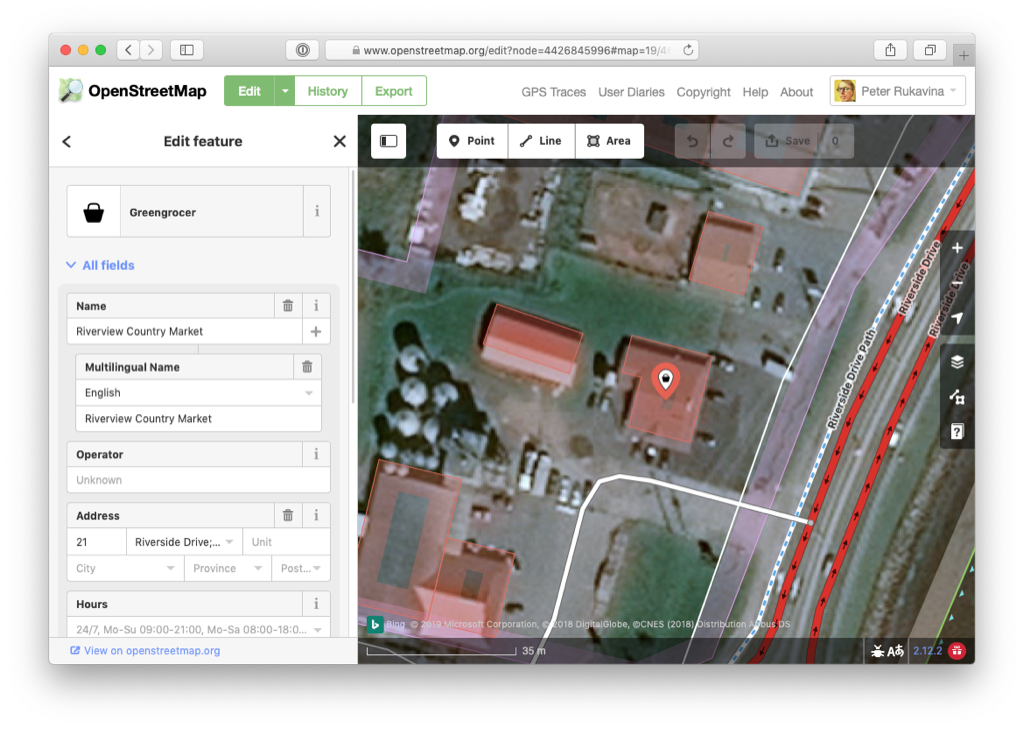
While Riverview was on the map (put there, as it turns out, by me, 2 years ago), the metadata about Riverview was incomplete, so I set out to enhance it by clicking Edit and logging in to OpenStreetMap (this is free, and anyone can do it).

Screen shot of Riverview Country Market in the OpenStreetMap editor.

Using the panel on the left, I did the following:

  • I corrected the address, from “Riverside Drive;Arterial Highway” to just Riverside Drive.
  • I added the missing city, province and postal code.
  • I added Riverview’s opening hours, website, email address and a brief description.
  • I moved the point for Riverview down slightly to allow me to also add a point for KJL Select Meats, which occupies the same building, and I added details for KJL as well.
  • I added the parking lot and driveway.

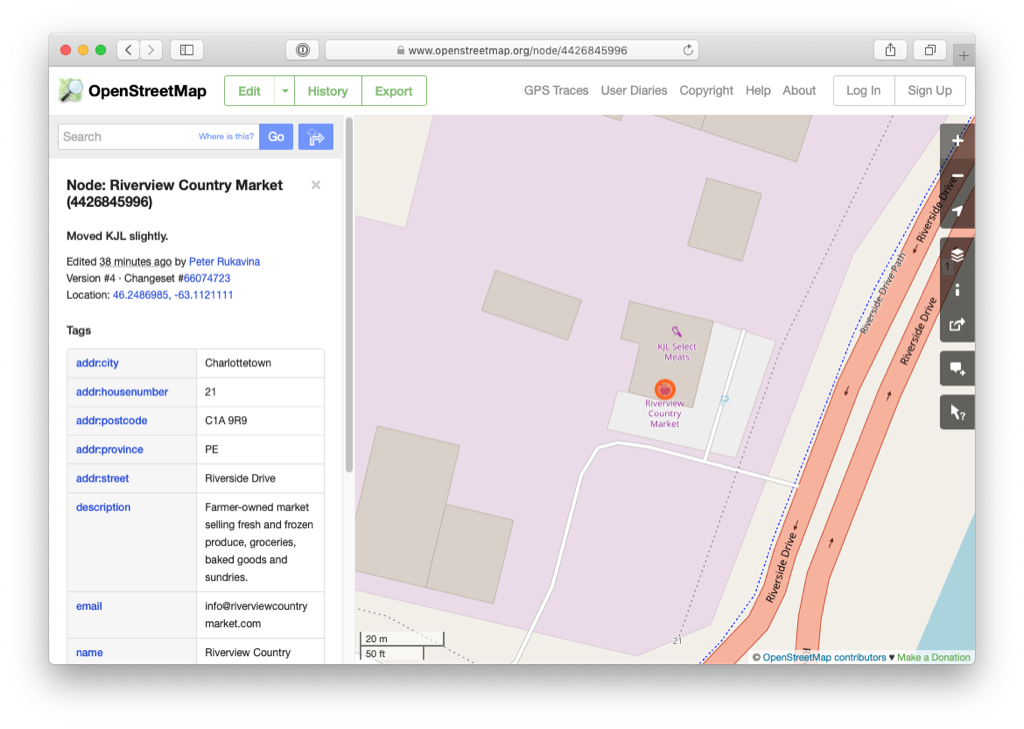
Once I saved my edits, and waited a few minutes for the map tiles to get re-rendered, here’s the result of my changes:

Screen shot of OpenStreetMap showing the newly-edited Riverview Country Market entity.

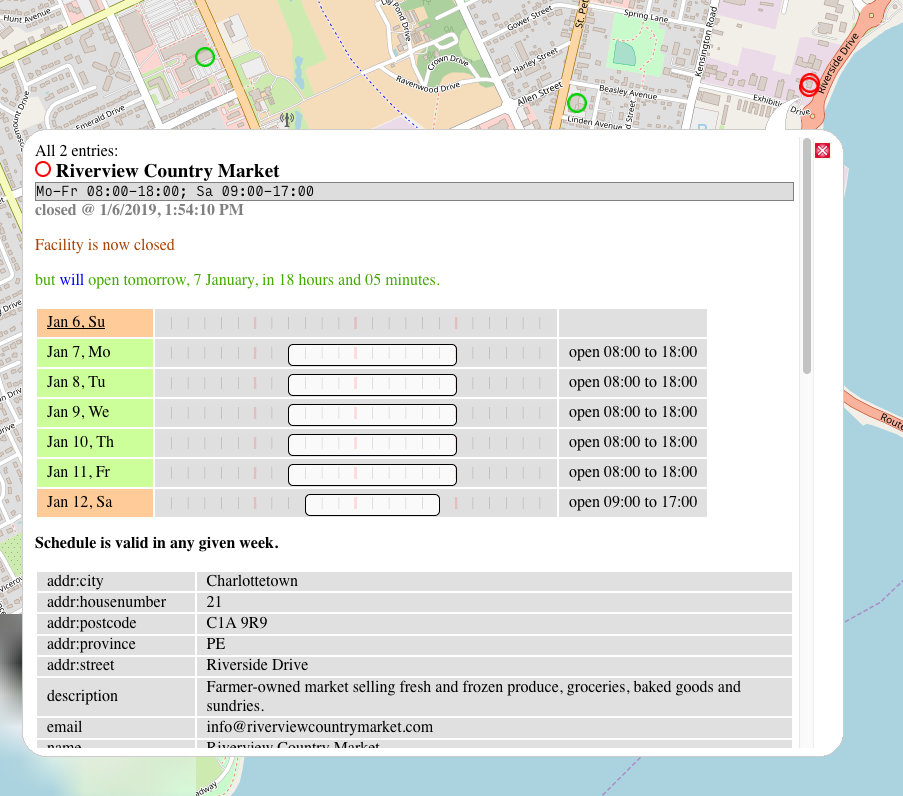
Now, granted, the rendering of the metadata for Riverview is more utilitarian than beautiful, but remember that I’ve just updated the the OpenStreetMap data from which all derivative products that use its data are drawn, from mobile apps to hiking maps to sites that show opening hours. So, for example, this website that draws an “open hours layer” on top of OpenStreetMap has already been updated:

Screen shot from https://openingh.ypid.de/ showing Riverview's opening hours

Will you join me in this blogging habit?

09 Jan 19:00

Apple is putting iTunes on Samsung TVs

by Rui Carmo

Cue the “hell freezing over” jokes.

This has obviously been in the making for a while, and I believe Apple now has substantial incentive to avoid Home Sharing-like degrees of frustration and get things to actually work.

But considering the competition (essentially Netflix on video and Spotify on music, against neither of which they have any relevant advantages), I have a feeling that this is too little, too late. They had their chance a few years back, bungled it, and these days they are left in the position of having to carve out a small share of an increasingly saturated market.


09 Jan 19:00

Samsung TVs to play Apple content

by Volker Weber

d535d91be904c0efba57e9275e972b4a

SEOUL, KOREA – JANUARY 6, 2019 – Samsung Electronics Co., Ltd.announced today it will offer iTunes Movies and TV Shows and Apple AirPlay 2 support on 2019 Samsung Smart TV models beginning this spring. Support on 2018 Samsung Smart TVs will be made available via firmware update. In an industry first, a new iTunes Movies and TV Shows app will debut only on Samsung Smart TVs in more than 100 countries. AirPlay 2 support will be available on Samsung Smart TVs in 190 countries worldwide.

That is a smart move. Work together for the benefit of the customer. I am afraid my TV is way too old, but this is a good move.

More >

09 Jan 19:00

Week Notes 19#1

by Ton Zijlstra

Having spent the weekend after Christmas in Freiburg, in southern Germany, we drove to Lake Zug in Switzerland on Monday. There we celebrated New Year’s Eve with dear friends. We stayed with P and B. P, like H and R who were also there for NYE as they also live in Switzerland, is an old room mate. This new year we’ll have known each other for 30 years. We stayed for a few days, with our little one enjoying jamming on P’s digital drums, and Elmine going to Milano in Italy for a day together with B and M. We drove back on Thursday, and spent the weekend at home.

The coming week is the first working week again. This week I did a few small things:

  • Made the Q1 planning
  • Did some preparatory work for doing the 2018 accounts
  • Made a mind map for January as a braindump of everything that needs attention and to specify what might hold me back
  • Worked on my first ‘weekly hack‘. I plan to do something small every week this quarter
  • Bought several books, after asking my twitter network for tips, on digital distribution. I have a personal perspective on digital transformation, but not much insight into how others see it. What does stand out to me is that many organisations claiming to be at its forefront to me seem rather lackluster in embracing the consequences of digitisation, and the results seem rather dull. To my mind mostly because the focus is on digital only, not first or even only also on networked structures and processes and how that mirrors human behaviour.
20190103_074747
After days of clouds, we only got to enjoy the full view and some snow the morning we left Switzerland
09 Jan 19:00

A Solid-State HDD for Symbolics “MacIvory” Lisp Machines.

by Stanislav

This post concerns the “MacIvory” Model 3 Lisp Machine. It is of interest strictly to bolixologists.


This is a recipe for a working replacement of an ancient SCSI HDD, such as found in the MacIvory, with an inexpensive solid-state disk.


You will need:


1. Download the softs, and verify the signature and hashes in MANIFEST.TXT.


2. Decompress the disk image, and copy it to a 16GB or larger SD card, via unix dd command, e.g.:

dd if=MacIvory_Virginal_9GB.img of=/dev/sdb

3. Insert the SD card into the SCSI2SD device, connect the latter to a PC via the USB jack, and run the configurator. Feed it the supplied config, and trigger the upload to the device.


Edit: if your MacIvory’s SCSI cable does not have an end terminator installed, you will need to re-enable the built-in termination in the SCSI2SD config.


4. Remove the original HDD assembly from the MacIvory:


bolix open small

bolix orig HDD

5. Remove the HDD from the plate.


6. Affix the SCSI2SD device to the new adapter, and then to the original steel plate, using the standoffs and nuts:

bolix ssd parts

bolix ssd bottom

bolix ssd top


Do not over-tension the nuts. (Use a tension wrench, if you have one, otherwise simply “know measure”.)


7. Affix the plate, now containing SCSI2SD device, into the original nest, and connect the cabling, via the 50-to-68-pin adapter (for SCSI) and the Molex-to-floppy (for +5v):

bolix ssd fin


8. Boot!


You can now back up and otherwise manipulate the contents of the MacIvory HDD by connecting the SCSI2SD device’s USB jack to a Linux PC, or by simply removing the SD card.

~Fin~

09 Jan 19:00

Ethical Government

by peter@rukavina.net (Peter Rukavina)

In Building Ethical Organisations, Cerys Hearsey writes, in part:

Here are some of the most important steps that leaders and employees can take to ensure that grass-roots ethics and organisation-wide actions meet in the middle:

  • Create psychological safety: if employees are safe to speak out, they will feel safe to stand by their principles. This is essential for creating an environment where questions can be asked about long term impact without the fear of long term consequences for careers.
  • Explore long-term impacts in a dedicated sprint: building in an ethics sprint (or at least an ethical element to user stories) can help teams new to the concept of voice these concerns focus on long-term, unforeseen impacts.
  • Gather signals from customers in real time: in the event of a breakdown inside the organisation, customers also act as an early-warning sensor network to issues and potential resolutions.
  • Multi-disciplinary, diverse agile teams: different mental models and ways of working help combat groupthink and echo chambers around developing products and services.
  • Transparent by default: challenging the need for closed communications, collaboration and co-operation communities is an excellent step towards ambient awareness across silos.

While not specifically written about government, these steps also seem like excellent ones to apply to public service culture.

I’ve been on the list of witnesses to speak to the Public Accounts Committee about open data for almost a year; when the committee finally meets to consider this issue, the core of my testimony will involve the suggestion that open data is not primarily a technical issue, but rather one of culture.

What Hearsey calls “psychological safety” is something largely missing from the public service, where the information one manages and controls is too often treated as trade secret; I’d like to see us move toward a culture where public servants are rewarded not for keeping the data safely hidden in the vaults, but rather for telling any and all, as often as possible, what they do, how they do it, the metrics they use to measure success and failure, and the data that describes their work product.

09 Jan 19:00

All Means All

by peter@rukavina.net (Peter Rukavina)

In a December blog posts where he discussed the 2019 quarter-millennial of St. Paul’s Anglican Church, Archdeacon John Clarke wrote about the parish’s tagline for the year, A Caring Community for All:

With it we haven’t given up anything and other ways that we might describe ourselves are not lost. This tag-line will serve us for the year to remind ourselves and tell the world what we are trying to be.

But here’s fair warning, “All” mean all. Make no mistake about it—everyone, no matter their circumstances or history will fine a caring community at St. Paul’s. People ridiculed, ignored, beaten, or lost in this world are welcomed here and will be cared for to the best of our abilities. Or we change “all” to “some” and that just doesn’t seem true to the Gospel.

While I rarely take the religious route into Archdeacon Clarke’s words, I almost always connect with them on other levels, and for this sentiment that is particularly true. I am proud to be a secular affiliate of an institution that shines light so universally.

09 Jan 19:00

Apple Updates AirPlay 2 Page with Upcoming TV Features Including Siri Control

by John Voorhees

On the heels of the announcement that Samsung Smart TVs are gaining an iTunes Movie and TV Shows app and AirPlay 2 support, Apple has updated its AirPlay 2 page to highlight additional features that are coming to AirPlay 2.

AirPlay 2-Enabled TVs: Samsung may have been the first to announce support for AirPlay 2, but Apple's webpage indicates that the feature is coming to 'leading manufacturers,' so expect more announcements at CES and beyond. In addition to using AirPlay 2 to send video from an iOS device or Mac to a compatible TV, consumers will be able to play music on their TVs and sync it with other AirPlay 2-compatible devices in their homes.

Control Your TV with Siri: Perhaps the most interesting feature is the ability to use Siri on your iPhone to send video to your TV. Because the new feature works in tandem with HomeKit, if you have multiple AirPlay 2 TVs, you'll be able to specify the room in which you want the video to play.

Remote Control: Apple also indicates that remote control features are coming soon:

Convenient built-in controls appear in apps, on the Lock screen, and in Control Center. So you can easily play, pause, fast-forward, rewind, and adjust the volume on your TV.

Controlling the volume of a TV via AirPlay 2 would be new, and perhaps there's something coming related to Apple's reference to "built-in controls... in apps,' but playback controls on the Lock screen and in Control Center already exist.

Apple is clearly using the days leading up to CES to implement the first moves in its video strategy. Observers have long wondered how Apple planned to extend the reach of a video service beyond the relatively small number of Apple TV owners. By cutting deals with TV manufacturers, Apple is moving down a path that is similar to the one Google has taken with the Chromecast and will be able to reach many more consumers. I wouldn't be surprised if we see these new AirPlay 2 features begin to appear when Apple ships its first iOS 12.2 betas.


Support MacStories Directly

Club MacStories offers exclusive access to extra MacStories content, delivered every week; it's also a way to support us directly.

Club MacStories will help you discover the best apps for your devices and get the most out of your iPhone, iPad, and Mac. Plus, it's made in Italy.

Join Now
09 Jan 19:00

The new together

by Doc Searls

I want to point to three great posts.

First is Larry Lessig‘s Podcasting and the Slow Democracy Movement. A pull quote:

The architecture of the podcast is the precise antidote for the flaws of the present. It is deep where now is shallow. It is insulated from ads where now is completely vulnerable. It is a chance for thinking and reflection; it has an attention span an order of magnitude greater than the Tweet. It is an opportunity for serious (and playful) engagement. It is healthy eating for a brain-scape that now gorges on fast food.

If 2016 was the Twitter election — fast food, empty calorie content driving blood pressure but little thinking — then 2020 must be the podcast election — nutrient-rich, from every political perspective. Not sound bites driven by algorithms, but reflective and engaged humans doing what humans still do best: thinking with empathy about ideals that could make us better — as humans, not ad-generating machines.

There is hope here. We need to feed it.

I found that through a Radio Open Source email pointing to the show’s latest podcast, The New Normal. I haven’t heard that one yet; but I am eager to, because I suspect the “new normal” may be neither. And, as I might not with Twitter, I am foregoing judgement until I do hear it. The host is also Chris Lydon, a friend whose podcast pionering owes to collaboration with Dave Winer, who invented the form of RSS used by nearly all the world’s podcasters, and who wrote my third recommended post, Working Together, in 2019. That one is addressed to Chris and everyone else bringing tools and material to the barns we’re raising together. The title says it all, but read it anyway.

Work is how we feed the hope Larry talks about.


09 Jan 19:00

Instapaper Liked: How Mark Burnett Resurrected Donald Trump as an Icon of American Success

“Expedition: Robinson,” a Swedish reality-television program, premièred in the summer of 1997, with a tantalizing premise: sixteen strangers are deposited on a…
09 Jan 19:00

Instapaper Liked: That Viral Video of Alexandria Ocasio-Cortez Dancing Is a Meta-Meme

Thursday marked one of the most important days in congressional history for diversity. A record 102 women took office, 35 whom were newly-elected. They include…
09 Jan 18:59

Twitter Favorites: [stateofthecity] My home island's favorite obscure issue: the much-storied Esquimalt & Nanaimo railroad, the result of "a solemn bar… https://t.co/V2kHB23gPI

Brian F. Kelcey @stateofthecity
My home island's favorite obscure issue: the much-storied Esquimalt & Nanaimo railroad, the result of "a solemn bar… twitter.com/i/web/status/1…
09 Jan 18:59

The 2018 Emoji Report

by rands

I do a lot of work in Slack. It’s been almost three years since I started working there and can’t remember a world where I needed to wait anywhere from two minutes to two days for someone to get through their inbox and respond to that urgent email. I take it for granted that everyone is there and they tend to respond quickly. Your Slack mileage will differ.

Emoji continues to be one of my favorite work habits. As I wrote earlier, I initially resisted emoji. But the efficiency of the lightweight communication that occurs via emoji and emoji reactions can’t be denied. It also happens to be fun.

In preparation for writing this piece, I went through all of the Slacks I am actively part of and unscientifically examined my most popular used emoji. The following are my go-to emojis. For each, I briefly explain when and why I use them.1

Let’s start with the workhorse emoji:

  • ✅ When applied, an action item captured in the prior message is complete. I have several 1:1 channels where all we’re doing is trading action items. Green check means done. Handy.
  • 👍 Message acknowledged. I got it.
  • 👀 Message received, and I’m looking into it. 🤔 means I’m thinking about it and will likely respond.
  • 🎉 Hooray! We did it.
  • 👆 I agree with the thing this person just said a lot. 💯 and 👏 are stronger versions of this.
  • 🙇‍♂️. Thank you for doing the thing you just did. I appreciate you.

The rest all ready slightly sillier, my question is: if you were attempting to replicate the feeling or emotion these emoji (hopefully) impart, how would you do it? In words? 🤔

  • We just dodged a bullet right there I am telling you.
  • You just blew my mind.
  • Something related to food just happened.
  • 🍜 I am sorry that you are sick.
  • Well, that’s settled.
  • That… just sucks.
  • This place is wonderfully chaotic. It’s just… great.
  • This… is awesome.

Emoji seem silly, but that is because they are often exaggerated human expressions. The picture tells a story, and those stories are a few simple keystrokes away. Each time that unicorn spins, I am a small part of a conversation where I’d otherwise be absent. When that penguin dances, I can instantly be a small part of a celebration.

Lastly, and most importantly, yes, I’m an adult, and I can use my words. But each emoji I use is an email not sent.


  1. The ones listed below that are not included as part of the default set-up are compressed and sitting right here. Install them! 🎉 
09 Jan 18:59

The Business of 'Ed-Tech Trends'

Audrey Watters, Hack Education, Jan 07, 2019
Icon

There are some good observations in what I think is the last (?) of Audrey Watters's ed tech trends posts. First is that "The most well-funded types of education company this year were those who offered tutoring. Tutoring, to be clear, here mostly means test prep." A lot of money went into tutoring companies. Additionally, "The growing reliance on OPMs is part of a larger trend of outsourcing and privatization." Quite true. Additionally, China is "hardly the only country willing to surveil, track, and punish students. The US excels at this too, no doubt. We have children in cages, and ICE monitoring schools." And finally, "philanthropists... fund education journalism to tell the stories they want folks to hear."

Web: [Direct Link] [This Post]
09 Jan 18:59

All media is propaganda and subject to bias

Leonox, Medium, Jan 07, 2019
Icon

"Almost everything is propaganda," says this article. I agree. And if you're with me on this, then most of what I've had to say about truth and media over the years follows from that. For example: finding a 'trusted' media source means essentially finding a source that confirms your existing world view. For example: the terms we use to describe people (for example, 'horde' or 'migrant') are deliberate and intentional. Understanding this is why we have to seek out diverse, and first-person, perspectives. Depending on media for truth - any media - leaves you open to error. Related: Deep fakes videos are being weaponized.

Web: [Direct Link] [This Post]
09 Jan 18:59

The Future of MOOCs Must Be Decolonized

Taskeen Adam, EdSurge, Jan 07, 2019

This article argues that MOOCs need to be "decolonized", based on three arguments (paraphrased):

  • ‘global education’ is shaped mainly by a handful of universities in a few countries, and assumes these other countries have nothing to contribute.
  • by offering courses in only a limited set of languages to a global audience, MOOC providers force learners to adapt.
  • epistemic injustice - they get to define what knowledge is and the processes by which that knowledge is deemed valid.

It's well and good to complain, but how do you decolonize MOOCs? Do you close Coursera and EdX? Of course not. You add to the 41 MOOC platforms existed in 2018. But the sort of public investment needed (as opposed to relying on the private sector) is just the sort of model publications like EdSurge favour least.

Web: [Direct Link] [This Post]
09 Jan 18:59

What Makes A Badge Work?

by Richard Millington

Can you imagine anyone walking around your local community wearing a badge saying “hey, I started a conversation”?

Hopefully not, but that’s what we seem to expect members to do.

Not a single member cares about getting a ‘conversation starter’ badge when they post their first question (tip: they care a lot more about getting an answer to their question).

Forcing people to receive (and display) an embarrassing badge undermines the entire purpose of badges.

Badges work in three ways:

1) They’re connected to dedicated efforts. Scouts know this well. You decide what badges you want and work towards obtaining them for dedicated effort (i.e. not something members would do anyway). This works for medals too.

2) They’re an acknowledgment of expertise/status/contributions. They recognise great people for their contributions. The more unique the contribution the better. It’s hard to automate these. Knighthoods, purple hearts, and lifetime achievement awards all fall into this category. They can be applied for or awarded.

3) They’re a (good) hidden surprise. No-one knew the badge existed until someone did something completely unique and gained a new badge.

You can create and award an infinite number of badges to members. Automating badges for minor behaviors isn’t just lazy, it’s counter-productive. Badges should be the community equivalents of setting and achieving our goals, winning trophies, being knighted, or a surprise reward.

If you want badges to motivate members to do something extraordinary, you have to give them to members when they do something extraordinary. If a member wouldn’t boast about the badge and proudly display the badge next to their name, don’t create the badge.

09 Jan 18:58

Why Online Ads Haven't Built Brands

by noreply@blogger.com (BOB HOFFMAN)

This post is adopted from a podcast I did last year.

One of the questions I’ve been wrestling with for years is why online advertising seems to be incapable of building major consumer-facing brands.

We’ve had 20 years of phenomenal growth of online advertising and yet I have trouble coming up with one example of a major consumer-facing physical brand that was built by online advertising. I can think of no examples of major brands of beer, soda, cars, toothpaste, paper towels, candy bars, soap, fast food, peanut butter — you get the picture — that were built by online advertising.

After 20 years of existence radio and TV had built hundreds - if not thousands - of consumer brands.

There are some who would argue that there are very big web-native brands that have been built by online advertising - e.g., Amazon, Google, and Facebook. I’m not so sure that advertising played a major role in the building of any of those brands, but let’s leave that argument for another day and just focus on brands that are physical and not web-native, which probably constitute somewhere around 95% of the products we buy every day.

What’s the issue with online advertising that has rendered it ineffective at advertising’s most important job — building a major brand?

For years I fumbled around trying to answer this question but I’ve never really understood it. I have blamed an absence of creativity. I have blamed the fact that it’s mostly direct response style advertising, but I’ve never really evolved a comprehensive theory of what the problem is.

But someone else has. A while back I received an email from Richard Shotton, a very smart guy and author of the wonderful book, The Choice Factory, directing me to a piece from 2014 called Ads Don’t Work That Wayby a guy named Kevin Simler on a blog called Melting Asphalt. I’m going to do my best to summarize Simler’s argument, but reading the original is highly recommended as my interpretation of his argument is likely to be flawed at best.

Simler starts by quoting some standard explanations of how advertising works at building brands. Let’s borrow some terminology from subatomic physics and call these “standard models.” Here are some examples from standard models:
“An ad succeeds at making us feel something and that emotional response can have a profound effect on how we think and the choices we make” 
Or
“By creating positive associations between the advertised products and feelings like love, happiness, safety, sexual confidence... these associations grow and deepen overtime making us feel favorably disposed toward the product and ultimately more likely to buy it“
Or
“advertising rarely succeeds through argument or calls to action instead it creates positive memories and feelings that influence our behavior over time to encourage us to buy something at a later date.” In other words, “if Coke shows us enough images of people beaming with joy after drinking that product we’ll come to associate Coke with happiness and then sometime later will be more likely to purchase coke"
Simler is not happy with these explanations. He says it portrays us as far less rational than we actually are. “While we may not conform to a model of perfect economic behavior, neither are we puppets at the mercy of every Tom Dick and Harry with a billboard. We aren’t that easily manipulated.”

Instead he offers an alternative to the standard models that he calls "cultural imprinting.” Don’t be turned off by the awkward terminology. The theory underpinning his cultural imprinting idea is that in some way we all want to be part of what is culturally acceptable.

As he says, brand images are "part of the cultural landscape we inhabit. They provide cultural information. When we ignore brand messages we’re missing out on valuable cultural information and alienating ourselves from the Zeitgeist." He says this puts us in danger of becoming outdated,  unfashionable, or otherwise socially hapless. We become like "the kid who wears his dad’s suit to his first middle school dance." In other words, in some way brand choices send messages to others about who we are. And no one wants to send the wrong messages.

This is not new thinking. When I first started working in the advertising business 1,000 years ago we used to call products that were most responsive to advertising “necktie products” -- products that are used or consumed in public and are plainly visible to others. Why are products like beer and soda and cars so responsive to advertising? Because these products are used in public and are highly visible. Whether we care to admit it or not, those of us who are not sociopaths prefer to be socially acceptable among our group.

So what does all this have to do with the online advertising problem? Here is the connection I’ve been missing. In Simler's words “cultural imprinting relies on the principle of common knowledge.  For a fact to be common knowledge among the group, it’s not enough for everyone to know it. Everyone must also know that everyone else knows it.” 

In other words, part of our purchasing calculation is not just our belief that X is an acceptable product, but our expectation that other people believe this brand is acceptable because they know what we know.

Here is an example he uses to describe purchasing behavior using the standard model…
We see a Nike ad that makes an association between Nike and athletic excellence. Over time we internalize this association and feel good about Nike, and when it comes time to buy some sneakers at some later date we are more likely to buy Nikes.
In the cultural imprinting model it starts the same…
We see a Nike ad that makes an association between Nike and athletic excellence. 
But here’s what’s different. Over time we understand that everyone else has seen Nike ads and they also associate Nike with athletic excellence. So at some later date when we buy a pair of Nikes we don't have to worry that our group will think we're idiots.
Of course, this does not guarantee we will buy Nikes, but it makes the likelihood greater. And as I have written ad nauseum, marketing is about one thing only -- likelihoods and probabilities.

For advertising to be effective in the "cultural imprinting" model, it’s not enough for it to be seen by a single person or even by many people. Someone has to know that everyone else has seen it, too.

This may very well be why online ads have been largely ineffective at brand building. In the online world, everyone lives in his or her own little digi-world. I have no idea what my friends are doing online and what ads they may be seeing. Even if they watch the same YouTube videos as me, I don't know what ads they are being served.

In mass media, I know what my friends are seeing. I know that if they’re watching football they’re seeing the same ads I am. Consequently I have reasonable confidence that my friends believe that Nike makes acceptable running shoes, Ford makes acceptable pick-up trucks, and Coors makes beer I don’t have to feel weird about.

But I have no idea what my friends are seeing online. Even if they go to the same sites I do, I have no idea what ads they are seeing. Consequently, I have no frame of reference for “cultural imprinting.” I don’t know if they will think me an idiot for buying these headphones I saw on Whatever-dot-com.

In a nutshell, this may very well be why thus far mass-market advertising is demonstrably more effective at brand building than precision targeted, highly individualized advertising.

Highly individualized, personalized advertising -- the obsession of online advertisers -- makes advertising a private, rather than public, experience. It keeps us from knowing what advertising our friends are seeing. Which in some way keeps us from knowing what brands may be culturally acceptable.

For years I’ve known that online advertising has been mysteriously ineffective at brand building and now I think I finally understand why. By the way, Kevin Simler, the person who connected the dots for me, isn’t a marketing or advertising person — he’s a tech guy. But I believe he understands marketing better than most of the so-called professionals.

If he's right, the current obsession of advertisers to make their advertising perfectly individualized and perfectly personalized may be perfectly wrong.

(There is probably not a singular reason for the phenomenon of online advertising not having built major consumer-facing brands. But if you combine Simler's "cultural imprinting" hypothesis with the "signaling" hypothesis, I think you have a pretty good explanation.)


09 Jan 18:58

Running OpenRefine On Digital Ocean Using Simple Auth

by Tony Hirst

As a cloud host, Digital Ocean provides a really easy way in to getting services up and running on the web.

Here’s a quick recipe for getting Open Refine up and running behind a simple authentication scheme.

Creating a Server With Digital Ocean

First up, create a Digital Ocean account if you don’t already have one (this link will get you started with $100 free credit).

Creating and launching a server is easy… Select Create then Droplet, choose the server type you want — let’s use a simple Ubuntu box — and choose the server size. For lots of quick tests, I use the smallest box, but from experience I think OpenRefine prefers 2GB or more…

The servers are charged at a metered rate, and you can stop them any time, so for a quick test, it’ll cost you pennies… (A $100 credit can go a long way…!)

Next, choose a data center region; I generally pick a local one…

You also have the option of adding an ssh key. This makes life much easier when trying to log in to the server from your own machine using ssh (you can just run ssh root@IP_ADDRESS and it’ll log you straight in; there’s a recipe for setting up an SSH key here).

If you don’t want to set up an SSH, a root password will be emailed to you. You can use this password to log in to your server via a web terminal, which means you can do everything via a web UI if you need to…

Create your server by clicking the big green button…

It should only take a few seconds to start up… And when it has, you’ll be presented with it’s public IP address.

If you need a web terminal, click through the on the server name, and you should see a link to launch a web console.

Installing  OpenRefine

From the console, we can install all we need to run OpenRefine. This is a minimum viable example — we should probably find a better place to install OpenRefine, and may want to run it as a particular user with limited permissions. Working as root with everything wide open makes life easier, though not necessarily safer…!

OpenRefine requires a Java environment, so we need to install that:

apt-get update && apt-get install -y openjdk-8-jre

We can download the OpenRefine application via the command-line using a command of the form wget -q -O DOWNLOADED_FILE_NAME URL; the download link for each release can be found on the OpenRefine releases page:

wget -q -O openrefine-2.8.tar.gz https://github.com/OpenRefine/OpenRefine/releases/download/2.8/openrefine-linux-2.8.tar.gz

The downloaded file is provided as a tar archive file, which we need to unpack:

tar xzf openrefine-2.8.tar.gz

This will unbundle the files into the directory ./openrefine-2.8.

Let’s create an alias for a working directory in which to place the OpenRefine project files:

OPENREFINE_DIR="$HOME/openrefine"

And create that directory:

mkdir -p $OPENREFINE_DIR

You should now be able to run OpenRefine in the background using the command:

nohup openrefine-2.8/refine -p 3333 -d OPENREFINE_DIR > /dev/null 2>&1 &

This will run OpenRefine on port 3333. If you copy the IP address of your Digital Ocean server, and go to http://IP.ADDRESS:3333, you should see OpenRefine running there. (Note that if you’re in Chrome, Google may well tell you that the address is dangerous…)

Adding Simple Authentication

The OpenRefine server is running as a public service on the public web. If you want to add a simple layer of authentication, you can add a web server proxy to the server that will prompt for a password when a new visit is made to the server.

One of the easiest proxies to get up and running is nginx. Let’s install it, along with a simple Apache toolkit that will help us create a simple password:

apt-get install -y nginx apache2-utils

Now create a simple user/password combination. Ever secure, I’ll go with user test and password letmein:

htpasswd -b -c /etc/nginx/.htpasswd test letmein

Now we need to define the proxy. A Digital Ocean tutorial (How To Install Nginx on Ubuntu 18.04) describes how to set up a firewall – I’m selecting the 'Nginx Full' option because I’m working via SSH, but if you’re working in the web terminal, the more restrictive 'Nginx HTTP' may be more appropriate:

sudo ufw allow 'Nginx Full'

If you try loading the OpenRefine server on port 3333, you should now find that it’s blocked: the firewall is only letting web traffic through on port 80.

We now need to open access back up to the OpenRefine server, albeit via a password challenge. The following will create a default nginx configuration file that will expose the OpenRefine service running on port 3333 via default http port 80, mediated by a simple authorisation challenge:

config='''
server {
  listen 80;
  auth_basic Protected...;
  auth_basic_user_file /etc/nginx/.htpasswd;
  location / {
    proxy_pass http://127.0.0.1:3333;
  }
}
'''

echo "$config" > /etc/nginx/sites-available/default

Restart the nginx proxy to put the new settings into effect:

nginx -s reload

If you now go to http://IPADDRESS you should be presented with a challenge. Enter the credentials you defined, and you should see your OpenRefine server:

Finishing Up

When you’ve finished your session, you can destroy the droplet. This will tear the server down and you won’t be billed for it anymore.

Alternatively, you can switch the droplet off, but keep it in a shutdown state that you can restart in the future.

However, as the above prompt suggests, you will continue to be billed, even if the service is not running, because it is still consuming Digital Ocean resources.

09 Jan 18:58

LumaFusion: Professional Mobile Video Editing [Sponsor]

by MacStories Team

The future of video production is available today with LumaFusion, the powerful multi-track video editor for iOS. Used by mobile filmmakers, journalists, YouTube creators, and aspiring content producers looking to create better video using mobile devices and gear, LumaFusion delivers affordable power and flexibility in an intuitive interface.

Every aspect of LumaFusion is designed to allow users to edit and deliver professional-quality video from the field. Editing 4K video is demanding work for even the most powerful desktop computer, but LumaFusion handles tasks like adding titles, color correction, and effects gracefully in real-time. The app also supports multiple landscape and portrait aspect ratios, a long list of frame rates, and integrates with Storyblocks, a stock media service.

LumaFusion works with Western Digital My Passport Wireless Drives and GNARBOX SSD drives, which lets users import media into LumaFusion directly from the drives and back up their projects and assets without a laptop or Internet connection. It's a fantastic feature that saves time and helps protect your creations.

LumaFusion brings the same class of sophisticated editing tools to multi-track audio editing too. The app can record voice-overs, mix tracks, and adjust levels on a per-track basis, all with simple gesture-based interactions.

As a video creator, you can count on LumaFusion to release regular updates with new functionality. Just this fall, Luma Touch, the maker of LumaFusion, introduced:

  • Sort and Search to the Library and Import popup
  • Multi-select and Select All functionality in the Library
  • Edge softness and corner radius controls for cropping
  • ‘Nudge’ buttons for sliders and rotation controls for super-precise adjustments
  • Three new effects
  • 20 new professional title templates
  • Full EXIF, TIFF, IPTC, and PNG metadata for Photos
  • ZIP file support
  • New Cleanup functions to help you manage storage

All of that functionality is available for a small fraction of the price of comparable desktop apps making LumaFusion a fantastic choice for professionals and beginners alike. So download LumaFusion today and experience the freedom and flexibility of mobile video editing on iOS.

Our thanks to LumaFusion for sponsoring MacStories this week.


Support MacStories Directly

Club MacStories offers exclusive access to extra MacStories content, delivered every week; it's also a way to support us directly.

Club MacStories will help you discover the best apps for your devices and get the most out of your iPhone, iPad, and Mac. Plus, it's made in Italy.

Join Now
09 Jan 18:58

Why Diversity Is Important to Etsy

by Mike Fisher

We recently published our company’s Guiding Principles. These are five common guideposts that apply to all organizations and departments within Etsy. We spent a great deal of time discussing, brainstorming, and editing these. By one estimate, over 30% of the company had some input at some phase of the process. This was a lot of effort by a lot of people but this was important work. These principles need to not only reflect how we currently act but at the same time they need to be aspirational for how we want to behave. These principles will be used in performance assessments, competency matrices, interview rubrics, career discussions, and in everyday meetings to refocus discussions.

One of the five principles is focused on diversity and inclusion. The principle states:

We embrace differences.

Diverse teams are stronger, and inclusive cultures are more resilient. When we seek out different perspectives, we make better decisions and build better products.

Why would we include diversity and inclusion as one of our top five guiding principles? One reason is that Etsy’s mission is to Keep Commerce Human. Etsy is a very mission-driven company. Many of our employees joined and remain with us because they feel so passionate about the mission. Every day, we keep commerce human by helping creative entrepreneurs find buyers who become committed fans of the seller’s art, crafts, and collections. The sellers themselves are a diverse group of individuals from almost every country in the world. We would have a hard time coming to work if the way we work, the way we develop products, the way we provide support, etc. isn’t done in a manner that supports this mission. Failing to be diverse and inclusive would fail that mission.

Besides aligning with our mission, there are other reasons that we want to have diverse teams. Complicated systems, which feature unpredictable, surprising, and unexpected behaviors have always existed. Complex systems, however, have gone from something found mainly in large systems, such as cities, to almost everything we interact with today. Complex systems are far more difficult to manage than merely complicated ones as subsystems interact in unexpected ways making it harder to predict what will happen. Our engineers deal with complex systems on a daily basis. Complexity is a bit of an overloaded term, but scholarly literature generally categorizes it into three major groups, determined according to the point of view of the observer: behavioral, structural, and constructive.1 Between the website, mobile apps, and systems that support development, our engineers interact with highly complex systems from all three perspectives every day. Research has consistently shown that diverse teams are better able to manage complex systems.2

We recently invited Chris Clearfield and András Tilcsik, the authors of Meltdown (Penguin Canada, 2018), to speak with our engineering teams. The book and their talk contained many interesting topics, most based on Charles Perrow’s book, Normal Accident Theory (Princeton University Press; revised ed. 1999). However, perhaps the most important topic was based on a series of studies performed by Evan Apfelbaum and his colleagues at MIT. This study revealed that as much as we’re predisposed to agree with a group, our willingness to disagree increases dramatically if the group is diverse.3 According to Clearfield and Tilcsik, homogeneity may facilitate “smooth, effortless interactions,” but diversity drives better decisions. Interestingly, it’s the diversity and not necessarily the specific contributions of the individuals themselves, that causes greater skepticism, more open and active dialogue, and less group-think. This healthy skepticism is incredibly useful in a myriad of situations. One such situation is during pre-mortems, where a project team imagines that a project has failed and works to identify what potentially could lead to such an outcome. This is very different from a postmortem where the failure has already occurred and the team is dissecting the failure. Often individuals who have been working on projects for weeks or more are biased with overconfidence and the planning fallacy. This exercise can help ameliorate these biases and especially when diverse team members participate. We firmly believe that when we seek out different perspectives, we make better decisions, build better products, and manage complex systems better.

Etsy Engineering is also incredibly innovative. One measure of that is the number of open source projects on our GitHub page and the continuing flow of contributions from our engineers in the open source community. We are of course big fans of open source as Etsy, like most modern platforms, wouldn’t exist in its current form without the myriad of people who have solved a problem and published their code under an open source license. But we also view this responsibility to give back as part of our culture. Part of everyone’s job at Etsy is making others better. It has at times been referred to as “generosity of spirit”, which to engineers means that we should be mentoring, teaching, contributing, speaking, writing, etc.  

Another measure of our innovation is our experiment velocity. We often run dozens of simultaneous experiments in order to improve the buyer and seller experiences. Under the mission of keeping commerce human, we strive every day to develop and improve products that enable 37M buyers to search and browse through 50M+ items to find just the right, special piece. As you can imagine, this takes some seriously advanced technologies to work effectively at this scale. And, to get that correct we need to experiment rapidly to see what works and what doesn’t. Fueling this innovation is the diversity of our workforce.

Companies with increased diversity unlock innovation by creating an environment where ideas are heard and employees can find senior-level sponsorship for compelling ideas. Leaders are twice as likely to unleash value-driving insights if they give diverse voices equal opportunity.4

So diversity fits our mission, helps manage complex systems, and drives greater innovation, but how is Etsy doing with respect to diversity? More than 50% of our Executive Team and half of our Board of Directors are women. More than 30% of Etsy Engineers identify as women/non-binary and more than 30% are people of color.5 These numbers are industry-leading, especially when compared to other tech companies who report “tech roles” and not the more narrow category, “engineering” roles. Even though we’re proud of our progress, we’re not fully satisfied. In October 2017, we announced a diversity impact goal to “meaningfully increase representation of underrepresented groups and ensure equity in Etsy’s workforce.” To advance our goal, we are focused on recruiting, hiring, retention, employee development, mentorship, sponsorship, and building an inclusive culture.

We have been working diligently on our recruiting and hiring processes. We’ve rewritten job descriptions, replaced some manual steps in the process with third-party vendors, and changed the order of steps in the interview process, all in an effort to recruit and hire the very best engineers without bias. We have also allocated funding and people in order to sponsor and attend conferences focused on underrepresented groups in tech. We’ll share our 2018 progress in Q1 2019.

Once engineers are onboard, we want them to bring their whole selves to work in an inclusive environment that allows them to thrive and be their best. One thing that we do to help with this is to promote and partner directly with employee resource groups (ERGs). Our ERGs include Asian Resource Community, Black Resource and Identity Group at Etsy, Jewish People at Etsy, Hispanic Latinx Network, Parents ERG, Queer@Etsy, and Women and NonBinary People in Tech. If you’re not familiar with ERGs, their mission and goals are to create a positive and inclusive workplace culture where employees from underrepresented backgrounds, lifestyles, and abilities have access to programs that foster a sense of community, contribute to professional development, and amplify diverse voices within our organization. Each of these ERGs has an executive sponsor. This ensures that there is a communication channel with upper management. It also highlights the value that we place upon the support that these groups provide.    

We are also focused on retaining our engineers. One of the things that we do to help in this area is to monitor for discrepancies that might indicate bias. During our compensation, assessment, and promotion cycles, we evaluate for inconsistencies. We perform this analysis both internally and through the use of third parties.  

Etsy Engineering has been a leader and innovator in the broader tech industry with regard to technology and process. We also want to be leaders in the industry with regards to diversity and inclusion. It is not only the right thing to do but it’s the right thing to do for our business. If this sounds exciting to you, we’d love to talk, just click here to learn more.


Endnotes:

1 Wade, J., & Heydari, B. (2014). Complexity: Definition and reduction techniques. In Proceedings of the Poster Workshop at the 2014 Complex Systems Design & Management International Conference.
2 Sargut, G., & McGrath, R. G. (2011). Learning to live with complexity. Harvard Business Review, 89(9), 68–76
3 Apfelbaum EP, Phillips KW, Richeson JA (2014) Rethinking the baseline in diversity research: Should we be explaining the effects of homogeneity? Perspect Psychol Sci 9(3):235–244.
4 Hewlett, S. A., Marshall, M., & Sherbin, L. (2013). How diversity can drive innovation. Harvard Business Review.
5 Etsy Impact Update (August 2018). https://extfiles.etsy.com/Impact/2017EtsyImpactUpdate.pdf

09 Jan 18:58

Robert Habeck: 'Bye bye, Twitter und Facebook'

by Volker Weber

Wer Robert Habeck nicht kennt, sollte mal unter seinem Stein hervorkrabbeln:

Ein Jahresanfang, der in digitaler Hinsicht doppelt daneben war: Erst der Angriff auf die privatesten Daten meiner Familien, die via Twitter veröffentlich wurden. Dann noch einmal über Twitter ein Fehler meinerseits – und zwar der gleiche zum zweiten Mal: Wie dumm muss man sein, einen Fehler zweimal zu begehen? Diese Frage hat mich die ganze letzte Nacht nicht losgelassen. ...

Einen Fehler kann man machen, den gleichen ein zweites Mal nicht. Das muss Konsequenzen haben. Und meine ist, dass ich meinen Account lösche. Und da der Datenklau, der die persönlichsten Gespräche zwischen mir und meiner Familie jetzt auf alle Rechner der deutschen Tageszeitungen und jede Menge rechter Medien gebracht hat, maßgeblich über Facebook erfolgte, lösche ich meinen bei Facebook auch. Beide werde ich abschalten.

Das ist ein Schritt in die richtige Richtung. Social Media ist der Ort, wo Trump und AfD gedeihen. Da muss man nicht sein.

Als kleines Licht bleibe ich bisher von Hass und Hässlichkeit verschont. Twitter ist für mich (noch) einladend, Facebook hat mich schon sehr lange angekotzt.

More >

09 Jan 18:58

Silent Shout

by Ava Kofman

Is the data that flows across the internet liquid, like a stream? Or is it more like a superhighway, but with surfers? The hackneyed similes we use to make sense of our lives online obscure as much as they reveal. This is partly a problem of form. The invisible networks that govern our digital “traffic” — a cross of fiber-optics, copper cables, and electromagnetic frequencies — do not lend themselves easily to the imagination.

Most of us are familiar with the extent to which we are tracked while browsing the web and using our phones — or, for that matter, whenever we walk past cameras in any major city. But the promiscuous design of the wi-fi networks has escaped the attention of all but the savviest privacy hounds. Rather than connecting directly to another machine, wi-fi devices continuously emit signals that include personally identifiable information in every direction, with few protections on offer for security or encryption.

Unlike, say, the confessional architecture of Facebook’s platform, the leakiness of wi-fi is not by design; it’s more a function of neglect

These perpetual and indiscriminate emissions are great if you’ve just entered your home and you want to connect to your personal network without having to think about it. But they’re unfortunate when you’re commuting, since it means that you’re essentially leaving a digital fingerprint of your location history wherever you go with anybody who has the cheap hardware and basic skills to grab it.

Unlike, say, the confessional architecture of Facebook’s platform, the leakiness of wi-fi is not by design; it’s more a function of neglect. Wi-fi has aged extremely poorly. The protocol was established in 1997, when no one could have anticipated that about a third of the world’s population would one day be walking around with at least one, if not several, prosthetic wireless devices attached to their bodies. The number of internet-connected devices is expected to reach 75 billion by 2025. That makes for a staggering number of people vulnerable to what mostly seems to be an imperceptible problem.

Perhaps that’s why some artists and educators have been drawn to trying to represent it. Three years ago, Brannon Dorsey and Nick Briz set out to illustrate all the data that anyone — marketers, governments, malefactors — can learn to pick up from the wi-fi radio ether. In their installation, the artists visualize the wi-fi landscape as a kind of habitat: Butterflies (representing unique phones, laptops, tablets, and smart speakers) hover around flowers, which stand for a unique wi-fi networks. “We were thinking of this metaphor of butterfly collection as a nice entry point that could show people what we had already been doing, which was collecting data that was out in the open, flying freely around in downtown Chicago,” Dorsey told me.

They’re far from the only ones searching for metaphors to make sense of this privacy nightmare. At Astro Noise, Laura Poitras’s 2016 show at the Whitney Museum, the artist and journalist Surya Mattu built a stark display to list when the unencrypted transmissions of visitors to the exhibition were “last seen.” With the artist Kyle McDonald, he developed the cheeky “Wi-fi Whisperer,” a text-to-speech robot that talks about all the wi-fi activity it’s listening into in a low whisper. “Snoopi” is a wi-fi sniffing dog, equipped with a vest that allows him to gather the wi-fi traffic of anyone he might walk up to and sniff. As its creator Jiashan Wu has explained, the goal of the canine installation to make people aware that “seemingly simple and harmless, maybe even cute, things” may be collecting our data on open wi-fi networks.

The privacy flaws of wi-fi are nearly universal — and yet most of us like to think of ourselves as exempt from its violations. Even when we’re made aware of the problem, we have trouble understanding that it’s actually happening to us. By implicating nearly every viewer who walks past them, these works are a clever attempt to challenge our delusional attitudes about being the exceptions to the rule of mass surveillance. They make it obvious that it’s now possible to paint the portrait of anyone who carries a wi-fi-enabled device — and that the better the advertising firm or surveillance agency is, the more detailed those portraits will be.


When I met Briz and Dorsey in July, they were about to lead what they call their Wi-fi Data Safari workshop at New York’s largest annual hacker conference, Hackers on Planet Earth, or HOPE. The workshop, which invites participants to capture data across any given city, extends the metaphor of their butterfly collection installations, the latest version of which fluttered on a large projection screen behind us. Dorsey was holding a Dell computer augmented by a monitor that allowed him to populate the animated habitat with the signals broadcast from nearby wi-fi-enabled devices.

“Every device has a MAC address,” Briz explained. “It’s kind of like your social security number for that device. It’s a unique number, a unique fingerprint.” Anytime we have wi-fi on but are not connected to the internet, our devices emit this fingerprint to look for any networks that we have previously linked up to. They do this by basically shouting out all the names of networks they have already seen. These are called probe requests.

“Our phone is going around the city asking, ‘Are you ‘Home Wi-fi’? Are you ‘Home Wi-fi’?’ Your phone does that one network at a time but it always sends out its MAC address and the name of the network,” Briz continued. “So then it might be like, ‘Hey, it’s me. Here’s my MAC address again. Now I’m looking for ‘Work Wi-fi’, now that cafe I connected to once, now ‘Mom’s House’, and so on.’” The protocol is structured like a Greek tragedy, with recurrent choral interjections and a relentless quest for home.

Probe requests are convenient. Sent out every couple of minutes, they’re what allows our devices to automatically connect to our home networks without re-entering our passwords. But they’re also incredibly inefficient, spewing out personally identifiable information into the wi-fi ether for anyone to capture and use. Dorsey and Briz’s visualization reveals how much can be gleaned. Every time they clicked on one of the hundreds of butterflies in their installation, a pop-up window used the information generated by these probe requests to reveal what kind of device it was, where it had previously been based on its other networks, and even some of its unencrypted internet traffic. With a little more elementary sleuthing, they explained, it would not be difficult to use these probe requests to determine a person’s travel history (“Paris Airport Wi-fi”), social network (a map that revealed overlap between devices that shouted out similar networks), and frequent hangout spots (Starbucks on Fourth, Russian Baths).

It’s hard enough trying to rally people into pressuring or boycotting giant tech companies. It’s even harder to imagine an uprising against wi-fi

This demographic information can be incredibly valuable to advertisers. Where we’ve been —as indicated by wi-fi networks named after the hotels we’ve stayed in, the universities we affiliate with, the conferences we’ve attended, the office buildings we visit — says a lot about who we are and what we might like. It can also be valuable to someone with even more unpleasant motives. As the European Union Agency for Network and Information Security warns, simply by collecting probe requests, “extensive networks of human relations can be compiled using mass surveillance in points where many people pass through, such as train stations or airports. This relation data can be very useful for phishing, targeted attacks, or even blackmail.” Targeted attacks might include man-in-the-middle techniques to gain access to the user’s private data if they’re browsing on public wi-fi. Or stalking. It’s not hard to write a script that will alert someone when a certain MAC address is spotted in a given area.

Even an amateur technologist can use probe requests and the known signal strength of a network to estimate the location of devices within a few feet. At a mall this would allow a person to track someone else’s movements more precisely than with GPS. You can see where and when someone exits or leaves, what shops they visit, the paths they take to get there, if they go to the bathroom, and even — by measuring point-to-point travel time — whether they walked or drove to get there. Many retailers, including Nordstrom, have already piloted programs to track their shoppers in a similar fashion. Some companies even sell wi-fi and Bluetooth scanners that can be snugly fit to street lamps and traffic signals, purportedly to collect transportation data.

“Because of this project we actually got reached out to by a government agency, a particular office,” Briz said during their presentation. “And they were like, ‘We’ve been using probe addresses to see if there’s somebody new in the building, someone we don’t recognize.’”

“Basically person detection,” Dorsey said. “And the software they were using stopped working, so they asked if our art could work.” The artists declined.


During the workshop, Briz and Dorsey led participants out into the streets to collect the migration patterns of butterflies in the wild. To passersby, we would have looked like just another group of tourists looking down at our phones in Midtown, but we were using software to register all the devices shouting at us from the gift shops, bodegas, banks, and chain cafes that line Seventh Avenue. We could see that many phones, for instance, were connected to LinkNYC sidewalk kiosks, first installed in 2015 to blanket the city with free wi-fi.

In London, Dorsey explained, a marketing agency had installed wi-fi tracking cards like the one he put into his computer in “smart” trashcans to track people’s movement throughout the city. When privacy advocates cried foul, the company argued that device IDs aren’t technically associated with people’s names, since they are simply random strings of numbers.

Yet all it would take to link a device ID (known as a MAC address) to a particular person’s identity, Dorsey pointed out, was to know that the person in question had been in several of the locations where that MAC address had popped up. Once a MAC address has been associated with a person’s name, any intelligence agency or advertiser can use it to track a person anywhere. (“I can cross-reference logs from many places and track you in any places that I can listen — and you will never know,” explains one blogger. “I can drive past your house, listen for any probe requests and log those. If I see your MAC address anywhere else, I know exactly where you live — as well as the data about what you do while in my buildings.”) Researchers have shown that where we move is so unique that it’s possible to identify 95 percent of individuals in a population of 1.5 million people with only four spatio-temporal points. As Mattu has emphasized, “Anonymous data is a myth.”

After an afternoon of butterfly collecting, it’s difficult not to conclude that the way wi-fi functions precludes privacy as it is traditionally conceived. The Supreme Court’s recent decision in Carpenter v. United States, for instance, was hailed as a win for civil liberties for stipulating that police obtain a warrant before obtaining someone’s cell-site records to track their location. That victory is severely diminished, however, when considered alongside all the information our phones already freely give up through the wi-fi ether.

Dorsey and Briz like to think of their workshop as an exercise in consciousness raising. “People just aren’t aware of how the technology works, so no one thinks to demand a better way of connecting,” Briz told me. Probe requests are in many ways emblematic of the broader compromise that underwrites digital life: namely, the endless forfeiture of privacy for a little bit of convenience. It’s not that Apple and Google, not to mention the modem makers and cable companies, need to keep this security vulnerability in place. Yet absent public pressure, there are few incentives to put in the effort to configure our networks otherwise.

But what would public pressure look like? It’s hard enough trying to rally people into boycotting giant tech companies. It’s even harder to imagine an uprising against wi-fi, which isn’t governed by a single profit-seeking company but by a set of protocols. Some tracking companies offer a way for users to opt-out of their capture systems — either through a formal process or through a notice that tells them not to enter the store if they don’t want to be tracked. But probe requests know no walls. Passerby are bound to get swept up into these systems. What’s more, it’s not possible to opt-out of necessary infrastructure. If privacy, as it’s often defined, is the ability to control the personal information we share with others, then the current set-up of wi-fi precludes this choice.

It’s clear that simply securing our own home networks is not a full solution. This has led to some experts to call for wi-fi to be redesigned by the principle of “privacy by design” — that is, a system where privacy is considered as a primary feature rather than as an afterthought. Among the most popular proposals is MAC address randomization, which, as it sounds, involves the frequent generation of new and random identifiers for a device. Device vendors have been working on this idea, but as the wi-fi expert Célestin Matte argues in a thesis on wi-fi tracking, current implementations of randomization are still subject to several security shortcomings. “Our results show that there still is a long way to go before MAC address randomization is correctly implemented in consumer devices,” he writes.

In the meantime, artists and technologists have devised tools to generate “privacy by obfuscation.” These include fake probe requests that would add noise into the ether. The artist David Rueter has created Shenanigans to add “information entropy” into the probe-request ecosystem—in part, by deploying a community-powered network of small battery-powered wireless routers that scatter a given MAC address to multiple locations around the world.

“We should be able to make privacy convenient rather than making it inconvenient, which has been the norm,” Briz said at the workshop. “So that’s kind of the long-term goal.” In the meantime, the short-term goal is simple: encouraging people to turn off their wi-fi when they’re not connected to a known network. At the workshop I dutifully took my device off of the conference’s open network. For a few more weeks, I remembered to switch my wi-fi off whenever I left the house. Then, like nearly everybody else, I forgot.


09 Jan 18:57

On the value of drafts

by Raul Pacheco-Vega

One of the things I have begun to appreciate with time is the value of drafts. I am pretty good at cranking out a first draft of a paper, and then I hate editing and revising it. The editorial process for me is way more painful than the writing process itself. But as I said on Twitter, I feel like we are afraid of drafts. We want things done well on the first round. I will admit that my first few years I got plenty of papers “Accepted with Minor Revisions” which might have hindered my ability to cope with rejection and the need to rewrite multiple drafts.

Drafting stuff gives you the mental space and permission to refine it. Knowing that stuff will always need to be polished also makes you resilient to R&Rs that are very demanding. And drafting goals and To Do lists helps you prioritize the most important ones. This is something I realized in 2018. This 2019, I made a promise to myself to be more willing to write drafts of things (weekly plans, to-do lists, papers, etc.) and then finalize once I’ve considered all the relevant factors. I hope to be able to stay with my resolution!

09 Jan 18:57

A Polyvalent Made for Two

by noreply@blogger.com (VeloOrange)
by Igor


Our recent New Year's Instagram post brought up several questions from readers regarding setup, fit, and handling using a stem-mounted kid's seat. We went back and forth about the pros and cons between a trailer and a seat for a long time. We finally decided on the seat for the ability to talk to him during the ride - which is an invaluable learning and bonding experience. After having gone on many, many short and long rides with him, I thought it would be a good time to talk bike setup and well as tips to keep both you and your kid happy.


A low trail front end design is a must. Kids are heavy and only get heavier. And while the weight isn't in the same position as a front basket full of groceries and a 6-pack, they still weigh quite a bit and you wouldn't want your wheel and handlebar flopping around. The handling of the Polyvalent is predictable and easy. It's such a fantastic ride, that it allows me to forget about the bike completely and really enjoy our shared flying-through-space experience (even if it's just down the multi-use path).


Upright, swoopy handlebars are your friend. Your arms need to clear the seat's sides and your chest needs to clear both the back of the seat and the kid's head + helmet, so the more upright you are, the better. I prefer the Curvy One Handlebars for their back sweep and width. An aluminum alloy stem would probably be ok (nothing specifically was stated in the instructions otherwise), but just to be safe, I paired those bars with our steel, 90mm Removable Faceplate Stem for an upright, visible, and safe position.


After the first spin around the block, I realized that my knees were touching the corners of the seat. I blame my long femurs. I'm probably not the first to find this out, but the solution is pretty simple. You can either go with a wider spindle (what I did), pedal extenders, or an MTB crankset. The important thing is that you need to get your Q-factor (tread) fairly wide.


Wide, cushy tires - I chose 650bx47mm WTB Horizons. They're not fancy, but they're not supposed to be. They are terrific work-horse tires. They're hearty, take lower pressure, and aren't terribly susceptible to punctures as very supple tires are. Please don't change your tube or re-fill your sealant with a toddler on the side of the road. Pro-tip: I use these tires tubed and add 3 oz of sealant to each tube. No worries about a blow-off and the puncture probability is down to nearly nil.


You won't be able to mount a front mounted basket or handlebar bag due to the leg extensions, so attach a saddle bag or pannier for snacks, change of clothes, diapers, and wipes - basically a mini baby bag. You're probably not going to be out long enough to necessitate a full sized bag, but bring the essentials just in case - you never know... Thank me later.


Of course, a positive attitude is a must! Sing silly songs, point out birds, go over some bumps, take breaks to look at horses, and go to the park. Have fun and happy riding!


09 Jan 18:57

Time to BAN The Street Clothing Donation Bins

by Sandy James Planner

image

image

Clothing street bins have flown below the radar, have proliferated, and have turned out to be deadly. This  Vancouver Sun editorial  notes that in the last four years five people in this province have died in this containers, seven across the country. Several municipalities including Vancouver have sealed these clothing bins up. University engineering students are working on better designs for the bins. But why do we have the bins in the first place? If we are able to have the clothes picked up by the charities or drop them off at a charity store, is that not a more prudent solution that also allows for better connectedness to the organizations and to their works? Why did we allow the public realm to be peppered with these clothing bins? And who is benefiting from clothing  bin profits?

In Metro Vancouver clothing bins are ubiquitous, in different shapes and colours, but all serving the same function~they are donation bins on public and private property with a mail box lid type for people to deposit of cast-off clothes. It is assumed that somehow the charities hosting the bins pick up the clothes, clean and sort them, and ensure that the needy get access to these  donations, or that they are sold so that the sponsoring organizations can benefit. However the needy still have to pay for the clothes, and the fact that people die in these containers suggest that the people we intend the clothes to go to can’t afford them  or don’t have access to them.

There is a dearth of information on what really happens to those clothes, and those donations become part of a more complex story.

You can take a look at this CBC report that points out that  some bins owned by groups like the Salvation Army take the clothes directly to their own stores. But in many cases “Value Village agrees to take the contents of the charities’ bins, sight unseen, and pay them a flat fee based on the weight of the load. That fee is negotiated on a case-by-case basis, and is not publicly available.Value Village then sorts the clothes, and — like the charities that do it themselves — only sells about a quarter of it.”

Some of the clothing in the bin never goes to thrift stores, but is sold to ‘for profit” brokers that sell the clothing to merchants in the third world. This is questionable too, as the availability of North American second-hand clothing may suppress textile industries in those countries.  Kenya imports 133 million dollars (USD) of worn clothing from China, Europe and Canada. In 2017 21 million dollars was spent by Kenya resellers buying these donated Canadian clothes for second hand stores. There is no tariff on these goods coming into the country, meaning that these goods directly compete with Kenyan produced clothing . Some of that clothing is also baled and sold by the ton for industrial use in third world countries. And lots of Canadian donated clothing just ends up as another country’s waste stream, needing to be disposed.

The fact that the process and the revenue in this donated clothing business appears private and not readily accessible suggests that there is a for profit business here that has reasons for not sharing its model. Regardless, it is  time to ditch these death trap bins and ban them from our city streets and spaces. Simply calling a charity of choice for clothing  pick up or donating clothes directly to a charity store are doable options. It should not have taken five deaths to ban these bins from our public and private realm.

Elizabeth Cline, the author of Overdressed: The Shockingly High Cost of Cheap Fashion says it pointedly: “The consumer is at fault here. We’re the ones that are buying too much stuff and then we want our unwanted things to somehow be good for the world. It’s really crazy. It doesn’t make any sense.”

image-1

image-1

Images: bc.ctvnews.ca

09 Jan 18:57

Apple’s Errors

by Ben Thompson

As rare as last week’s Apple revenue warning from CEO Tim Cook may have been — the company last issued a revenue warning in June 2002 — the company has had other bad quarters in the iPhone era. Look no further than the stock chart:

Apple's stock price in the iPhone era

Three troughs stand out:

  • In fiscal year 2013 (the iPhone 5 cycle),1 Apple’s year-over-year revenue growth slowed to 18%, then 11%, 1%, and 4%; this was a dramatic slowdown from 73%, 59%, 23%, and 27% the year before. Worse, net income growth actually went negative (0%, -18%, -22%, -9%) thanks to a significant drop in margin.
  • In fiscal year 2016 (the iPhone 6S cycle), Apple’s year-over-year revenue growth went negative (2%, -13%, -15%, -9%); again, net income was worse (2%, -22%, -27%, -19%), thanks in part to a $2 billion inventory write-off.
  • This year does project to be the worst first quarter of all three: a -5% revenue decline, and -1% net income decline; this decline comes after last quarter’s announcement that Apple would no longer disclose unit sales, which precipitated the current slide in the stock price.

What makes this quarter seem so much worse was both the already negative sentiment surrounding the shift in Apple’s reporting (the presumption being the company wanted to hide declining unit sales), and also the fact that Apple’s management forecast was so off: here is CFO Luca Maestri on last quarter’s earnings call:

As we move ahead into the December quarter, I’d like to review our outlook, which includes the types of forward-looking information that Nancy referred to at the beginning of the call. We have the strongest lineup ever as we enter the holiday season and we expect revenue to be between $89 billion and $93 billion, a new all-time record.

In fact, the only record, such that there was, was the size of the miss. So what went wrong?

On Confirmation Bias

If you will forgive a brief aside, this article requires a few very large caveats: first, Apple has not yet released its final quarter numbers, had its earnings call, or filed it’s 10-Q; there is a lot of information still to come.

Secondly, thanks in part to the lack of information, this miss is catnip for confirmation bias: everyone has their pet theory about what Apple is doing wrong or how they will ultimately fail, and it has been striking the degree to which this revenue warning has been breezily adapted to show that said critics were right all along (never mind that many of those critics trotted out the exact same explanations in 2013 and 2016).

Third, well, I happen to think that I am right as well: I believe that Apple’s management made three critical errors in their forecast for this last quarter that were predictable precisely because they had made the same errors before — errors that I wrote about at the time. In other words, I am very much susceptible to confirmation bias as well.

That noted, if indeed I am right, then that is good news for Apple: I suspect the company is in better shape than the last week of hysteria suggests.

Error 1: China and ‘S’ Cycles

The most important takeaway from the revenue warning is that the vast majority of the problem in Apple’s forecast comes from Greater China. From Cook’s letter:

While we anticipated some challenges in key emerging markets, we did not foresee the magnitude of the economic deceleration, particularly in Greater China. In fact, most of our revenue shortfall to our guidance, and over 100 percent of our year-over-year worldwide revenue decline, occurred in Greater China across iPhone, Mac and iPad…

The problem was specifically around the iPhone:

Lower than anticipated iPhone revenue, primarily in Greater China, accounts for all of our revenue shortfall to our guidance and for much more than our entire year-over-year revenue decline. In fact, categories outside of iPhone (Services, Mac, iPad, Wearables/Home/Accessories) combined to grow almost 19 percent year-over-year.

That this exact quarter would be challenging for Apple is exactly what I predicted in May 2017 in Apple’s China Problem; specifically:

  • In most of the world, Apple is differentiated first-and-foremost by its integration between hardware and software; the company has a “monopoly” on iOS, which allows it to sell its hardware at much higher prices than the competition.
  • However, in China iOS is much less of a lock-in, thanks to the dominance of cross-platform Chinese-specific services, particularly WeChat (WeChat, while the most important factor, is not the only one: indeed, given that Android in China is specifically tuned to the Chinese market by Chinese OEMs, iOS is if anything a hindrance).
  • The net result is that Apple in China competes not on the basis of integration, but rather on the attractiveness of its hardware; in other words, Apple is, to far greater degree in China than anywhere else, simply another OEM.

I wrote at the time:

For the day-to-day lives of Chinese there is no penalty to switching away from an iPhone. Unsurprisingly, in stark contrast to the rest of the world, according to a report earlier this year only 50% of iPhone users who bought another phone in 2016 stayed with Apple:

This is still better than the competition, but compared to the 80%+ retention rate Apple enjoys in the rest of the world, it is shockingly low, and the result is that the iPhone has slid down China’s sales rankings: iPhone sales were only 9.6% of the market last year, behind local Chinese brands like Oppo, Huawei and Vivo. All of those companies sold high-end phones of their own; the issue isn’t that Apple was too expensive, it’s that the iPhone 6S and 7 were simply too boring.

At the end I concluded that Apple’s next phone — what turned out to be the iPhone X — would return the company to growth in China, and so it did: Apple was up 11%, 21%, 19%, and 16% last fiscal year, after declining by double digits six of the previous eight quarters. The other half of that prediction, though, was that the next ‘S’ model, with only component upgrades in the same form factor, would struggle; that is exactly what appears to have happened.

To be sure, there are absolutely other issues in China, particularly the country’s significant economic slowdown as well as the possibility of anti-U.S. company sentiment thanks to the ongoing trade war and the arrest of Huawei’s CFO. I strongly suspect, though, that those macroeconomic factors made what would have been a tough quarter for Apple regardless that much worse; to put it another way, Apple is far more exposed to challenging macroeconomic conditions in China than they are elsewhere thanks to their relative lack of a moat.

There are two adjustments Apple needs to make to avoid this error in the future: first, and most obviously, the company needs to be far more pessimistic with regard to its China forecasts in ‘S’ model years. Second, management needs to appreciate that the plane of competition in China is different than the rest of the world: the company is a luxury brand, but only in terms of hardware. If anything, iOS in China needs to cater more to the local market; as far as hardware, perhaps it is time for the ‘S’ strategy to be retired.

Error 2: Non-Flagship iPhones

There is one complicating factor in the last piece of analysis: Apple’s provided their last forecast on November 1, a full month into the quarter; did they not see this massive China miss coming? Perhaps the economy simply crashed in the last two months?

That may be true, but I don’t think it is the entire explanation; Apple also tripped itself up with the staggered release of iPhones both this year and last:

  • In September 2017 (FY2017 Q4) Apple released the non-flagship iPhones 8 and 8 Plus
  • In November 2017 (FY2018 Q1) Apple released the flagship iPhone X
  • In September 2018 (FY2018 Q4) Apple released the flagship iPhones XS and XS Max
  • In (late) October 2018 (FY2019 Q1) Apple released the iPhone XR

This schedule resulted in two blind spots for Apple: first, the company’s FY2018 Q4 results in China were almost certainly artificially high, thanks to Error 1. Of course the iPhone XS should have a strong year-over-year comp to the iPhone 8, but that comp was likely particularly extreme in China.

Second, to the extent that iPhone XS sales slowed in October, Apple likely expected the iPhone XR to pick up the slack;2 I strongly suspect the XR failed to live up to expectations.

This too, though, should have been predictable: sure, from a feature perspective the XR seemed remarkably competitive with the XS, but we have ample evidence that iPhone buyers want the best possible iPhone. After this year’s iPhone keynote I wrote:

There is, of course, the question of cannibalism: if the XR is so great, why spend $250 more on an XS, or $350 more for the giant XS Max? This is where the iPhone X lesson matters. Last year’s iPhone 8 was a great phone too, with the same A11 processor as the iPhone X, a high quality LCD screen like the iPhone XR, and a premium aluminum-and-glass case (and 3D Touch!). It also had Touch ID and a more familiar interface, both arguably advantages in their own right, and the Plus size that so many people preferred.

It didn’t matter: Apple’s best customers, not just those who buy an iPhone every year, but also those whose only two alternatives are “my current once-flagship iPhone” or “the new flagship iPhone” are motivated first-and-foremost by having the best; price is a secondary concern. That is why the iPhone X was the best-selling smartphone, and the iPhone 8 — which launched two months before the iPhone X — a footnote.

It remains to be seen the extent to which this is the case globally, but the market where having the flagship matters most has always been China. iPhone XS sales slowing and not being picked up by the just-launched XR certainly explain the timing of the missed forecast.

Error 3: iPhone Destiny

This gets at the third error made by Apple management, and arguably the most concerning: the assumption that iPhone growth is inevitable.

This was seen most clearly during the iPhone 6 cycle, when Cook insisted on earnings call after earnings call — I documented his statements in this Daily Update — that Apple’s record-breaking sales were not an abnormally large number people buying new iPhones sooner than they would have thanks to the large screen. In fact, it turned out that is exactly what was happening, which is why 6S sales were such a disappointment. I concluded:3

I know I’m kind of harping on this point, but in fact I find any possible explanation for this inconsistency very troubling: either Cook was purposely overselling the upgrade narrative last year, which would not only be duplicitous but also dumb, given that he would only be setting up Apple for a fall this cycle; or even as late as last year Cook was out of touch with how the iPhone upgrade cycle actually works, or how it may have changed over time.

I strongly suspect it is the latter explanation, and while that is concerning, it’s also understandable; the implication of my ongoing contention that the iPhone has now picked all of the “low-hanging fruit” of growth is that iPhone growth had multiple causes: certainly the inherent quality and new features of each annual iPhone model played a role, but an arguably bigger factor was simply distribution — getting the iPhone onto more carriers in more countries. Indeed, I strongly suspect the predictable impact of increased distribution helps explain why Apple’s earnings forecasts were so eerily accurate for so many years.

Apple, though, has been a lot less accurate for the last five quarters: the iPhone 6 sold better than they expected in nearly every quarter, and now the iPhone 6S is selling worse (note the Maestri forecast errors I highlighted above); along similar lines, Apple seems to have underestimated iPhone SE demand to a significant degree. Ultimately, while I think Apple still has the advantage when it comes selling people their second (or third or nth) smartphones, what I think we are seeing is that it’s a lot more difficult to determine when exactly that sale will occur, and Apple itself is only now coming to grips with that.

This gets at the rest of the miss — the non-China parts, especially. Cook cited the end of carrier subsidies (largely an old story at this point, to be fair), a stronger U.S. dollar, and customers getting new batteries instead of new iPhones. It’s a bit of a hodgepodge with one primary takeaway: convincing customers to upgrade “good enough” phones is both challenging and unpredictable, and Apple can’t simply assume it will happen at the rate it has previously.

Reasons for Optimism

The good news for Apple is that, to the extent these errors really were predictable, there is nothing structurally different about the company’s competitive position today versus six months ago, when the current stock slide began.

  • The next iPhone hardware revision should sell better in China, simply by virtue of being new (and the implication of it being easy to switch away from iOS is that it’s easy to switch back).
  • Customers still prefer Apple’s flagship iPhones, no matter how expensive they are.
  • Headwinds like currency and battery replacement programs will go away, and phones, thanks to their centrality in people’s lives as well as the greater likelihood of harm, will always have a faster replacement cycle than PCs.

Meanwhile, the company’s Services business continues to grow, along with its installed base (including in China); the company is clearly putting more strategic emphasis in this area, effectively abandoning also-ran hardware products like HomePod and Apple TV to increase the reach of its services. I would expect significant announcements in this area through 2019.

That is not to say the company is finished with hardware: wearables are a huge area of growth, as both AirPods and Apple Watch are big successes, and it seems likely that an augmented reality product is coming in the next few years. Nothing will match the iPhone, but that’s ok; the sky is not falling, only the stock.

I wrote a follow-up to this article in this Daily Update.

  1. Keep in mind that Apple’s fiscal years start on October 1st
  2. The company had less than a week’s worth of data about how the XR was selling by the time management made its forecast
  3. I first made the case for abandoning the ‘S’ strategy in this Daily Update, writing:

    To that end, I do question how much longer Apple can afford to stick with the ‘S’ strategy. Again, big screens were such an important feature that it’s difficult to take away too much from the 6S’ poor year-over-year comparisons, but it seems reasonable to wonder if the structural expansions that increased the iPhone’s addressable market papered over the fundamentally weaker value proposition presented by the ‘S’ lines. To put it another way, one could argue the ‘S’ lines are introducing a holiday quarter-like dynamic into Apple’s earnings but on a two-year basis: we may not really tell know the iPhone is doing until a completely new model that will drive upgrades comes out.

    In fact, if you look at a two-year comparison, Apple’s revenue last quarter was up 7%, a perfectly acceptable result

09 Jan 18:56

My First Open Street Map Edit

by Ton Zijlstra

Today I made my first Open Street Map edit. Open Street Map is a global map, created by its users (which includes lots of open government geographic data). My first edit was triggered by Peter Rukavina’s call to action. He wrote how he wants to add or correct Open Street Map data for a location when he mentions that location or business in his blogposts. He also calls upon others to do the same thing.

I don’t think I mention locations such as restaurants often or even at all in my blog, so it’s an easy enough promise for me to make. However, I did read and copy the steps Peter describes. First installing Alfred on my laptop. Alfred is a workflow assistant basically. I know Peter uses it a lot, and I looked at it before, and until now concluded that the Mac’s standard Spotlight interface and Hazel work well enough for me. But the use case he describes for quickly searching in a map through Alfred made sense to me: it’s a good way to make Open Street Map my default search option, and foregoing Google Maps. So I installed Alfred, and made a custom search to use Open Street Map (OSM).

The next step was seeing if there was something small I could do in OSM. Taking a look on the map around our house, I checked the description of the nearest restaurant and realised most meta-data (such as opening hours, cuisine, etc) were missing. I registered my account on OSM, and proceeded to add the info. As Peter mentions, such edits immediately get passed on to applications making use of OSM. One of those applications is a map layer showing restaurants that are currently open, and my added opening hours show up immediately:

My first edit also resulted in being contacted by a OSM community member, as they usually review the early edits any new user makes. It seems I inadvertently did something wrong regarding the address (OSM in the Netherlands makes use of the government data on addresses, BAG, and I entered an address by hand. As it came from a pick-up list I assumed it was sourced from the BAG, but apparently not). So that’s something to correct, after I find out how to do that.

[UPDATE: The fix was simple to do. The issue was that in the Netherlands the convention is to add meta data about stores to its corresponding address node (not as a separate node, unless there are more businesses at the same address). So the restaurant node I amended should not have been there. I copied all the attributes (tags) over to the address node, and then deleted the original node I edited. The information about the restaurant is now available from the address node itself. If you follow the link to the earlier node, you will now see it says that I deleted it.

I think it’s also great that within minutes of my original edit I had a message from a long time community member, Eggie. He welcomed me, pointed me to some resources on good practice and conventions, before providing some constructive criticism and nudge me in the right direction. Not by fixing what I did wrong, but by explaining why something needed improvement, and linking to where I could find out how to fix it myself, and saying if I had any questions to message him. After my correction I messaged him to check if everything was up to standard now which he acknowledged, ending with ‘happy mapping’. This is the type of welcoming and guidance that healthy communities provide. My Wikipedia experiences have been different I must say.
/UPDATE]