Shared posts

18 Jan 23:55

It’s Not That

by Dave Pollard


image from pixabay/pexels CC0

it’s not that we’re ungrateful or unappreciative —
we’ve just forgotten;
the veil of our selves prevents us from ever seeing,
from remembering this.

it’s not that we’re hateful, wilfully destructive, violent or intentionally hurtful —
we can’t help our selves — we simply react, as a body reacts to a bee’s sting.
there is no self control, no agency, no causality or responsibility,
no reality to anything our selves believe, or believe they do.

it’s not that we’re weak, lazy or afraid, or don’t care —
we’re overwhelmed, haunted
by the ceaseless hallucination of being separate,
of being apart from this,
and our suffering is so deep and so endless
we cannot dare really feel.

it’s not that we’re depressed, despairing, or bereft of hope —
that’s just our way of coping, dealing with our incapacity,
the absurd hopelessness of the prison of the self,
this life without parole.

it’s not that we’re oblivious, inattentive or in denial —
we just can’t know where, or how, to look, to see, wondrously, this.

it’s not that we’re uninformed, or misinformed, or don’t yet know,
or that we haven’t yet ‘risen’ to our potential —
we are doing all we can, which is, alas, nothing.

it’s not even that we’re damaged, disconnected, traumatized,
(although we are, it seems, these things) —
we are not the cause of anything.
yet our selves suffer, without respite,
from the illusion that it’s our fault
that somehow, horribly and inexplicably, we are to blame.

it’s not that.

it’s this.

18 Jan 23:54

Back in the late 90s when the portal wars were ...

Back in the late 90s when the portal wars were going strong, it seemed apparent that syndication was going to be the future of the web and RSS was going to be key. It didn’t work out that way. Sinclair Target writes about the rise and fall of RSS on Motherboard:

Regular people never felt comfortable using RSS; it hadn’t really been designed as a consumer-facing technology and involved too many hurdles; people jumped ship as soon as something better came along.

That something, for better or worse, was Twitter and Facebook. Their advantage: ease of use for the end user. As we try to imagine a stronger independent web again, we need to keep that in mind.

18 Jan 23:48

Nothing beats experience

by Volker Weber

If you want to advise others about software, you need to be able to make software. You can't just sit there and look at it. Be very afraid of architects or consultants who don't code. If you want to be a swimming coach, you need to be able to swim.

One thing I would recommend, to anybody and everybody: start coding. Whether you are a tech reporter or a blogger, I recommend you write at least one piece of software. You will have a better understanding of what you are writing about. Did you know you can get all the tools to write an iPhone or an Android app for free?

It does not really matter what you develop. Maybe a script that deletes your old tweets every night. Or some code that assembles a newsletter or your website? A Windows program, an elaborate iOS shortcut? Do something, anything.

It's not hard. As everything in life, you have to learn it. Whatever you are able to do today, you have learned everything. Coding is just one more thing.

How do you learn to code? You copy others. Want to build an iOS shortcut? Look at other shortcuts, tweak one of them a little bit, write a new one from scratch. Fail, learn, get better, excel.

Being able to code is quickly becoming a required skill, much like basic math or being able to read and write.

Nothing beats experience. Chesley B. “Sully” Sullenberger had clocked more than 20000 hours flying when he became famous for landing a plane on the Hudson River. Just a few hundred hours makes you more experienced than a passenger.

Nobody will let you fly an aircraft without proper training. Coding however is more like playing an instrument. You might as well start practicing today. If you have a computer, the instrument is free.

18 Jan 23:48

diaspora* version 0.7.9.0 released!

by Diaspora* Foundation

As scheduled, a new minor release is now released. Over the past six weeks, we have managed to collect 11 commits made by 4 contributors for this minor release.

A huge thanks to all the contributors from diaspora*'s amazing community! If you want to help make diaspora* even better, please check out our getting started guide. Please see the changelog for a complete list of changes made in this release.

Notable Changes

  • The /public stream should be much faster now if you are using PostgreSQL. This is just the first step of many to come to improve the performance of all streams and tag pages.
  • The recent change to support full-resolution photos introduced issues with the thumbnails. This issue has been addressed.
  • The mobile-optimized interface now supports ignoring users.

Updating

For podmins, update instructions are available as usual in the wiki. For those of you who have been testing the release candidate, run git checkout master before the update to get back to the stable release branch.

18 Jan 23:48

iPhone Backup Extractor: Helping Users Recover and Access Their iOS Data [Sponsor]

by MacStories Team

iPhone Backup Extractor is a powerful macOS app for working with iOS data. The app was launched a decade ago by Reincubate founder Aidan Fitzpatrick from his apartment out of frustration at having lost contacts he'd painstakingly entered into his iPhone. Now, not only can iPhone Backup Extractor recover contacts, it can retrieve deleted conversations from apps like Messages and WhatsApp, edit and browse iTunes backups, and export iPhone or iPad data into formats such as PDF, VCard, and iCal. The app also helps users find lost photos and extract data from individual apps.

iPhone Backup Extractor got a lot of love in 2018 with major updates throughout the year including support Mojave and iOS 12. The app's UI was also overhauled, the restrictions passcode recovery feature was updated to support forgotten Screen Time passcodes, drag and drop support was added, and an all-new "Info" mode that provides a deep-dive into the various codes, serials, and IDs associated with an iOS device was launched.

iPhone Backup Extractor is available here. The free version of the app allows users to view their data and export four files at a time, which is a great way to give the app a test run. For a limited time, you can upgrade to the basic edition of iPhone Backup Extractor for just under $32 with this MacStories-exclusive 20%-off link. Help is always available too, whether you need assistance with your backups, recovering lost passcodes, or anything else.

Reincubate is always looking for ways to improve iPhone Backup Extractor too and would love to hear from MacStories readers about how it can do more to help people get deeper access to their own data. Feel free to get in touch with the Reincubate team at support@reincubate.com or on Twitter at @reincubate or @afit.

Our thanks to iPhone Backup Extractor for sponsoring MacStories this week.


Support MacStories Directly

Club MacStories offers exclusive access to extra MacStories content, delivered every week; it's also a way to support us directly.

Club MacStories will help you discover the best apps for your devices and get the most out of your iPhone, iPad, and Mac. Plus, it's made in Italy.

Join Now
18 Jan 23:48

Don’t use A. Briggs

by Ethan

If you’re a frequent traveler, you probably have needed a visa expediter at some point. Good expediters can get you out of a serious jam, helping you get a visa or even a new passport in a short time. For over a decade, I used A. Briggs, a long-established expediter used by many large firms and institutions. They once helped me get a Nigerian visa and a new passport in under a week, which was pretty amazing.

But they’ve gone downhill. Way down. I’m enroute to Nairobi today and from there to Sierra Leone, and given some tight timing, I sent my paperwork to A. Briggs to get the Sierra Leone visa. I should have backed off once I noticed some significant changes to their website. They have been acquired by another firm, CIBT, and their application process is now loaded with hidden fees. By default, you’re signed up for a number of expensive extras, including a $25 fee for keeping a digital copy of the visa they obtain and $25 for registering you with the US State Department, a service the US government provides for free. The online process heavily upsells their “concierge service”, which promises handholding through the visa process for a mere $300 extra – in retrospect, I wonder whether my dreadful experience would have been better or worse after paying that extortionate fee.

People use visa expediters because they need a visa in a narrow window of time – you’re basically paying someone to carry your paperwork to the consulate, wait for it to be completed and send it back to you. The most critical piece of the application is the time by which you need the visa, which in my case was Friday, as my flight to Kenya left Saturday at noon. I spoke to Briggs several times through the process, as they needed even more documents for Sierra Leone than expected, and they assured me they’d have the visa by Wednesday to send it to me on Thursday. When I didn’t get word from a courier that it was enroute on Thursday, I called. Turned out they had gotten the wrong visa – a tourist visa instead of the much more expensive, multiple entry business visa I’d asked for. Instead of calling me and giving mr the choice of traveling with the tourist visa – which I would have chosen – they sent the passport back to the embassy. This meant I wouldn’t have the visa until Friday, and there was no way to get it before getting on my plane.

I got on the phone and got to a manager at Briggs who offered me the solution of a same day courier to deliver me the visa… for a mere $729. When I explained that this was their mistake not mine, she offered to have a courier meet me at the airport just before my flight, for only $200, which she rapidly reduced to $80. (It’s not clear what I might have been able to bargain the $700+ courier down to, but it strongly suggests that A. Briggs is marking up the cost of courier services as another revenue stream.)

I scheduled delivery of my passport to JFK for 10am the day of my flight, which left at noon. Tight but doable. The person I worked with gave me several numbers to try if there were any problems. Predictably, there were. When no courier contacted me by 10am, I started calling numbers. All went to voicemail boxes which hadn’t been set up, except one the woman had given me as her business cellphone, which went to a very confused woman in DC who had nothing to do with the company. Even though no one at A. Briggs or their parent company answered their phones, fortunately their courier did… who explained that A. Briggs had requested delivery at 11am, the time the flight would be closing. I begged the courier to come as fast as he could, tipped him generously when he made it by 10:40 and made my flight with a few seconds to spare.

So yes, I got the visa. I also vomited twice from stress, first when I discovered they’d resubmitted the passport, creating the crisis, and again when I discovered the courier wasn’t coming. Oh, and for such thoughtful service, A. Briggs charged me over $400 in handling fees on top of the $160 visa fee.

Don’t use them, or any company that’s part of CIBT. They won’t give you direct phone numbers to talk with whoever is processing your visa unless you pay an absurd extra fee. Their phone system is misconfigured, so if you’re in a jam, trying to reach someone, you’ll be sent to a broken voicemail inbox. I have no way of knowing whether my miserable experience was incompetence, or a new business strategy – I suspect the former – but I am now trying to get MIT to stop using A. Briggs as their visa expediter, and I would urge anyone, an individual or a corporate travel department, to find someone else to work with.

(Fun postscript – once I finally got my visa, I expected to see a cancelled tourist visa as well as a business visa. I didn’t – just a clean business visa. Given that there’s no pages missing from my passport, and no alterations to that visa page, it looks like A. Briggs just… lied. Either they got the visa on time and failed to send it to me in time, or they didn’t get it until a day late… or maybe they simply didn’t send it on time so they could charge fees on top of what they paid a courier to deliver it. Please, please don’t use this company’s services.)

18 Jan 23:47

AWS, MongoDB, and the Economic Realities of Open Source

by Ben Thompson

In 1999, music industry revenue in the United States peaked at $14.6 billion (all numbers are from the RIAA). It is important to be precise, though, about what was being sold:

  • $12.8 billion was from the sale of CDs
  • $1.1 billion was from the sale of cassettes
  • $378 million was from the sale of music videos on physical media
  • $222.4 million was from the sale of CD singles

In short, the music industry was primarily selling plastic discs in jewel cases; the music encoded on those discs was a means of differentiating those pieces of plastic from other ones, but music itself was not being sold.

This may sounds like a stupid distinction, but it explains what happened after that peak:
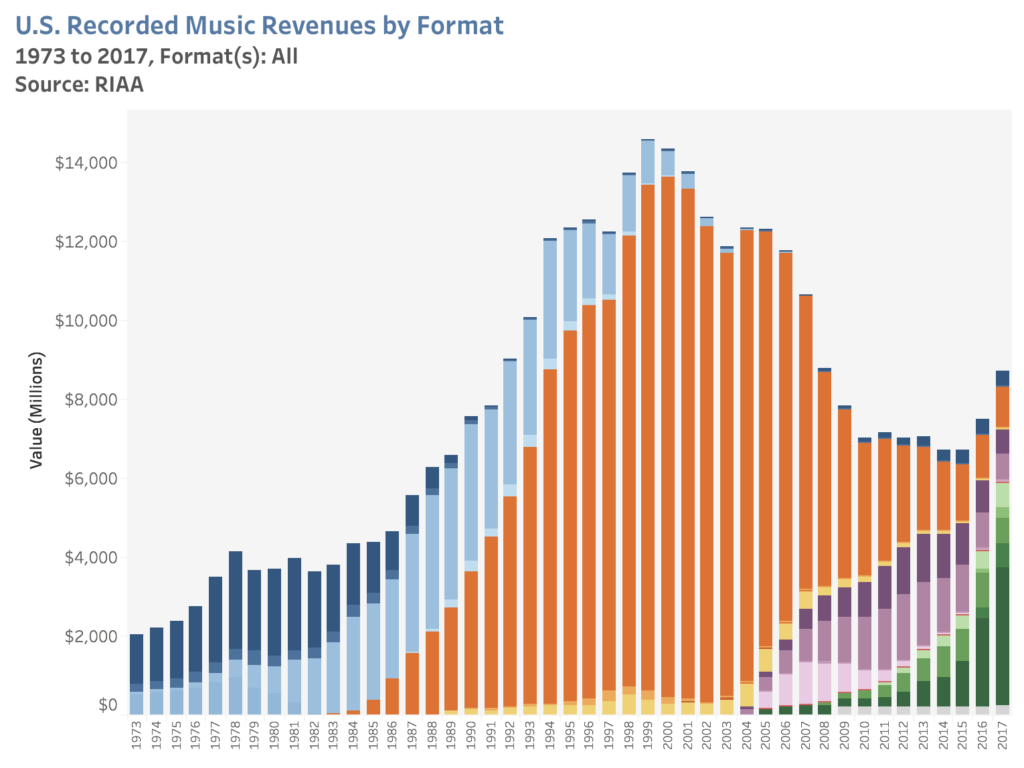
U.S. music industry sales over time

Music industry revenue plummeted, even as the distribution and availability of music skyrocketed: the issue is that people were no longer buying plastic discs, which is what the music industry was selling; they were simply downloading music directly.

Selling Convenience

The problem is that recorded music has always been worthless: once a recording is made, it can be copied endlessly, which means the supply is effectively infinite; it follows that to capture value from a recording depends on the imposition of scarcity. That is exactly what plastic discs were: a finite supply of a physical good differentiated by their being the most convenient way to get music. Pirating MP3s from sites like Napster or its descendants, though, was even more convenient — and cheaper.

As you can see from the chart, the industry started to stabilize in 2010, and in 2016 returned to growth; 2018 looks to be up around 10% from 2017’s $8.7 billion number, and it seems likely the industry will pass that 1999 peak in the not-too-distant future.

What happened is that the music industry — prodded in large part by Spotify, and then Apple — found something new to sell. No, they are still not selling music; in fact, they are beating piracy at its own game: the music industry is selling convenience. Get nearly any piece of recorded music ever made, for a mere $10/month.

DocumentDB (with MongoDB compatibility)

Last week, from the AWS blog:

Today we are launching Amazon DocumentDB (with MongoDB compatibility), a fast, scalable, and highly available document database that is designed to be compatible with your existing MongoDB applications and tools. Amazon DocumentDB uses a purpose-built SSD-based storage layer, with 6x replication across 3 separate Availability Zones. The storage layer is distributed, fault-tolerant, and self-healing, giving you the the performance, scalability, and availability needed to run production-scale MongoDB workloads.

The specifics of MongoDB and now DocumentDB are not particularly important to this article; basically, MongoDB created a type of database that is more flexible and better suited to large1 amounts of both structured and unstructured data, making it useful for large scale applications that traditional relational databases were never designed to accommodate.

And now you can run it on AWS. Kind of.

Open Source Licensing

Like an increasing number of such projects, MongoDB is open source…or it was anyways. MongoDB Inc., a venture-backed company that IPO’d in October, 2017, made its core database server product available under the GNU Affero General Public License (AGPL).2

AGPL is a close relative of the GPL, the copyleft license created by Richard Stallman. “Copyleft” means that the license allows for the free distribution, use, and modification of copyrighted material (in this case software), with the stipulation that those same rights extend to all derivative works; that means that any project built using GPL code must itself have a GPL license. This is in contrast to “permissive” open source licenses that allow others to use the copyrighted material however they wish, without a stipulation that derivative works also be open-sourced. AGPL extended the GPL to apply to software accessed over a network; since the software is only being used, not copied, the GPL would not triggered, but the end result is even more onerous than the GPL.

Both GPL and especially AGPL tend to be very problematic for companies: Apple, for example, does not allow software licensed with the GPL on the App Store, because the App Store requires that apps be licensed for a single user; apps with permissive licenses are fine — their license can be replaced — but the GPL, once applied, cannot be removed. AGPL is worse, because its provisions are triggered by users simply using the software; that’s why Google bans its use internally. The company notes in its open source documentation:

The license places restrictions on software used over a network which are extremely difficult for Google to comply with. Using AGPL software requires that anything it links to must also be licensed under the AGPL. Even if you think you aren’t linking to anything important, it still presents a huge risk to Google because of how integrated much of our code is. The risks heavily outweigh the benefits.

There is one addendum to the policy:

In some cases, we may have alternative licenses available for AGPL licensed code.

This is MongoDB’s business.3

MongoDB’s Business Model

MongoDB explained in their S-1:

We believe we have a highly differentiated business model that combines the developer mindshare and adoption benefits of open source with the economic benefits of a proprietary software subscription business model. To encourage developer usage, familiarity and adoption of our platform, we offer Community Server as an open source offering, analogous to a “freemium” offering. Community Server is a free-to-download version of our database that does not include all of the features of our commercial platform. This allows developers to evaluate our platform in a frictionless manner, which we believe has contributed to our platform’s popularity among developers and driven enterprise adoption of our subscription offering…

Unlike software companies built around third-party open source projects, we own the intellectual property of our offerings since we are the creators of the software, enabling our proprietary software subscription business model…Our primary subscription package is MongoDB Enterprise Advanced, our comprehensive offering for enterprise customers that can be run in the cloud, on-premise or in a hybrid environment. MongoDB Enterprise Advanced includes our proprietary database server, advanced security, enterprise management capabilities, our graphical user interface, analytics integrations, technical support and a commercial license to our platform. We also offer MongoDB Atlas, our cloud hosted database-as-a-service, or DBaaS, offering that includes comprehensive infrastructure and management of our Community Server offering.

Basically, MongoDB sells three things on top of its open source database server:

  • Additional tools for enterprise companies to implement MongoDB
  • A hosted service for smaller companies to use MongoDB
  • Legal certainty

The importance of this last one can not be overstated: MongoDB’s enterprise version and hosted service are not governed by the AGPL — or, as of late last year, a new MongoDB-created license called the Server Side Public License (SSPL). The SSPL is like the AGPL on steroids: it compels companies selling MongoDB-as-a-service to not only open-source their modifications, but also open-source their entire stack.4

What AWS Sells

The largest company selling software-as-a-service is, of course, Amazon. That, though, does not mean that Amazon is selling “software.” The reality is that software is no different than music: it is infinitely reproducible, and thus, in isolation, worth nothing.

Instead, the value of software is typically realized in three ways:

  • First is hardware. The most famous example is the iPhone, which is the only way to obtain iOS, but there are countless other examples.
  • Second is licenses. This was Microsoft’s core business for decades: licenses sold to OEMs (for the consumer market) or to companies directly (for the enterprise market). Indeed, there is a bit of irony in that both Microsoft and open source, for all their historical opposition to each other, both depended on copyright, strong legal regimes, and companies doing the right thing.
  • Third is software-as-a-service. This is Microsoft’s new model, as well as Amazon’s, and almost all new enterprise software companies.5 In this case what is being sold is not the software per se, but rather the utility of the software: the company doing the selling does everything else, including making the software available reliably.

With that in mind, read again what AWS announced last week:

The storage layer is distributed, fault-tolerant, and self-healing, giving you the the performance, scalability, and availability needed to run production-scale MongoDB workloads.

AWS is not selling MongoDB: what they are selling is “performance, scalability, and availability.” DocumentDB is just one particular area of many where those benefits are manifested on AWS.

Make no mistake: these benefits are valuable. There is a secular shift in enterprise computing moving to the cloud, not because it is necessarily cheaper (although costs are more closely aligned to usage), but because performance, scalability, and availability are hard problems that have little to do with the core competency and point of differentiation of most companies.

Those are, though, the core competency of AWS, which can bring unmatched scale to bear on solving them: by effectively operating the servers for millions of customers Amazon can apply more resources to all of those issues than any one company could on its own, as well as develop its own customer architecture, from datacenter software down to custom chips (and drive a hard bargain for hardware from suppliers like Intel).

The result is that “performance, scalability, and availability” is a tremendously attractive business: the more customers AWS has not only drive that much more recurring revenue, but also deepen AWS’ moat by allowing the company to bring that many more resources to bear on ever more obscure use cases, making AWS that much more attractive to new customers. Microsoft is competing but is a distant second; Google is even further behind. In fact, even MongoDB’s managed service runs on the three giants: it simply makes no sense to go it alone.

The Open Source Conundrum

Thus we have arrived at a conundrum for open source companies:

  • MongoDB leveraged open source to gain mindshare.
  • MongoDB Inc. built a successful company selling additional tools for enterprises to run MongoDB.
  • More and more enterprises don’t want to run their own software: they want to hire AWS (or Microsoft6 or Google) to run it for them, because they value performance, scalability, and availability.

This leaves MongoDB Inc. not unlike the record companies after the advent of downloads: what they sold was not software but rather the tools that made that software usable, but those tools are increasingly obsolete as computing moves to the cloud. And now AWS is selling what enterprises really want.

Worse, because AWS doesn’t have access to MongoDB (it is only matching the API) it only supports MongoDB 3.6; the current version is 4.0.5. It is possible that if AWS’ service becomes popular MongoDB will effectively stagnate: sure, you can get a better version from MongoDB Inc., but then you have to manage it yourself or go the effort to tie in all of your AWS services with MongoDB’s offering (then again, the potential for differentiation may be MongoDB’s salvation, and an important lesson for other companies).

Not that permissive licensing would necessarily help: Redis Labs offers its Redis database under a permissive license; that means that AWS’ offering is usually up-to-date, which is good for Redis development, but doesn’t help Redis Labs make any money. That compelled Redis Labs to change the licensing on its add-on modules to add the “Commons Clause”; this compels service providers to pay for their use, effectively making them proprietary software.

It’s hard to not be sympathetic to MongoDB Inc. and Redis Labs: both spent a lot of money and effort building their products, and now Amazon is making money off of them. But that’s the thing: Amazon isn’t making money by selling software, they are making money by providing a service that enterprises value, and both MongoDB and Redis are popular in large part because they were open source to begin with.

Economic Realities and the Future

Little of what I wrote is new to folks in the open source community: the debate over the impact of cloud services on open source has been a strident one for a while now. I think, though, that the debate gets sidetracked by (understandable) discussions about “fairness” and what AWS supposedly owes open source. Yes, companies like MongoDB Inc. and Redis Labs worked hard, and yes, AWS is largely built on open source, but the world is governed by economic realities, not subjective judgments of fairness.

And that is why I started with music: it wasn’t necessarily “fair” that music industry sales plummeted, and yes, companies like Apple with its iPod business made billions off of piracy. The only reality that mattered, though, was that music itself, thanks to its infinite reproducibility, was as pure a commodity as there could be.

It’s the same situation with software: bits on a disk are fundamentally free — just ask Richard Stallman. In his seminal essay Why Software Should Be Free Stallman wrote:7

A copy of a program has nearly zero marginal cost (and you can pay this cost by doing the work yourself), so in a free market, it would have nearly zero price. A license fee is a significant disincentive to use the program. If a widely useful program is proprietary, far fewer people will use it.

It is easy to show that the total contribution of a program to society is reduced by assigning an owner to it. Each potential user of the program, faced with the need to pay to use it, may choose to pay, or may forego use of the program. When a user chooses to pay, this is a zero-sum transfer of wealth between two parties. But each time someone chooses to forego use of the program, this harms that person without benefiting anyone. The sum of negative numbers and zeros must be negative.

But this does not reduce the amount of work it takes to develop the program. As a result, the efficiency of the whole process, in delivered user satisfaction per hour of work, is reduced.

This tradeoff is inescapable, and it is fair to wonder if the golden age of VC-funded open source companies will start to fade (although not open source generally). The monetization model depends on the friction of on-premise software; once cloud computing is dominant, the economic model is much more challenging.

That, though, should give pause to AWS, Microsoft, and Google. It is hard to imagine them ever paying for open source software, but at the same time, writing (public-facing) software isn’t necessarily the core competency of their cloud businesses. They too have benefited from open-source companies: they provide the means by which their performance, scalability, and availability are realized. Right now everyone is winning: simply following economic realities could, in the long run, mean everyone is worse off.

I wrote a follow-up to this article in this Daily Update.

  1. “Mongo” comes from the word humongous
  2. I’m sorry, but this next bit is going to be dry; bear with me please
  3. To be clear, I’m not saying that Google has a license; rather, that MongoDB offers alternative licenses
  4. I’m not going to get into the SSPL, but it is very controversial: many detractors argue it is not an open source license because it does not abide by the freedom to run a program for any purpose, and it may not not be enforceable
  5. I’m using software-as-a-service as an umbrella term for infrastructure-as-a-service and platform-as-a-service
  6. Which, by the way, has its own MongoDB compatible offering
  7. To be clear, I don’t agree with Stallman on a whole host of things; that doesn’t diminish his importance as a thinker or influence on the industry, though, or his insights on the nature of software

18 Jan 23:47

One-year time-lapse of the weather

by Nathan Yau

Along the same lines as last week’s one-year wind time-lapse, Weather Decoded provides this one-year time-lapse of the weather over the United States:

Fun. [via kottke]

Tags: time-lapse, weather

18 Jan 23:47

Airbnb and the joy of imperfect travel

by Josh Bernoff

I’m on a short vacation right now, visiting with family. I’m staying in an Airbnb and I just had one of Airbnb’s local “experiences.” Stuff has gone wrong. And it’s glorious. If business travel is about comfort and predictability, leisure travel is, at least for me, about having unique, memorable, highly local experiences. My wife … Continued

The post Airbnb and the joy of imperfect travel appeared first on without bullshit.

18 Jan 23:46

Building to Code

by David A. Banks

Building to Code is a monthly column about how we live among cities and each other. It regards cities as what they’ve always been: not systems of capitalist resource management, but the stages that society plays out on.


Patrick Geddes, in the first few pages of his 1915 book Cities in Evolution, warns the reader that “a new social science is forming” that will be as fundamental and indispensable to modern life as agriculture. He called it “civics” but today we might more readily recognize it as urban planning. A botanist by training, Geddes’s anarchist political convictions drove him to solve the problems of the Victorian city: overcrowding, sanitation, and the indignities of factory work.

Urban planning has quickly gone from radical to reformist: a new system of capitalist resource management

Cities have always been administered in some way — even the Epic of Gilgamesh has a few lines about how to plan out a city and what sorts of bricks are best used for buildings — but at the turn of the 20th century the art of the powerful had become infused with the analytic and rhetorical power of science. European and American cities up to this point were organized by liberal arts-educated elites who were expert in a region, not in cities generally. Baron Haussmann, who oversaw the rebuilding of Paris under Napoleon III, rose through the ranks of Paris’s public administration bureaucracy, but his formal training was in law and music. Peter Charles L’Enfant, the civil engineer who planned out Washington D.C. was an artist, having studied at the Louvre, and before he was asked to plan the new capital sketched and painted several portraits of George Washington. This new method would treat cities as an object of study rather than a subject of art. It would combine sociology, economics, and agricultural sciences into a single, rational system of development that would serve the masses.

In 1937, a student of Geddes and public intellectual in his own right, Lewis Mumford, addressed an audience of urban planners eager to relieve the suffering of a depressed nation. Mumford’s speech came at a formative moment for the profession. Geddes had ushered a quiet revolution, along with his fellow self-described anarchist Ebenezer Howard, whose To-Morrow: A Peaceful Path to Real Reform had outlined a plan for the working classes to secede from capitalist London and slowly build a network of interconnected and self-sufficient towns that he called garden cities. After a few false starts Howard pivoted his message, opting to call himself an inventor rather than a reformer, and re-published the book under the more futuristic-sounding Garden Cities of To-Morrow. His ideas were eventually put into practice and he founded the towns of Letchworth and Welwyn in 1903 and 1920, respectively.

In the United States a young journalist named Jacob Riis read about cutting-edge flash photography technology, and used it to literally illuminate the slums of New York in How the Other Half Lives, which set off a national debate about the health and safety of big cities. Meanwhile, railroads, streetcars, and then automobiles had transformed the landscape at a breakneck pace, and for the first time it seemed possible that a single society could inhabit vast swaths of the landscape. But urban planning, though still a nascent discipline, had quickly gone from radical to reformist: an elite profession with licenses, degrees, textbooks, and best practices, aimed less at delivering utopia than a new system of capitalist resource management expertly managed from above.

Cities are seen first and foremost as places for transportation technologies, data centers, and app-based services, with people a distant second

Mumford, always a proponent of both human dignity and the possibility of societal improvement, hoped that his teacher’s radical ideas could be resurrected. In his speech he urged his audience to think of “the city as theater, that man’s more purposive activities are focused, and work out, through conflicting and cooperating personalities, events, groups, into more significant culminations.” The design of the city could either “deflate” social drama or “make the drama more richly significant, as a stage-set, well-designed, intensifies and underlines the gestures of the actors and the action of the play.”

His solution mirrored Howard’s — a total rebrand of urban planning’s utopian qualities, complete with scientistic jargon. Instead of garden cities he implored the audience to build a “‘polynucleic city’ in which a cluster of communities, adequately spaced and bounded” would strike a balance between the rural and the urban. Instead of one gigantic metropolis, Mumford described a string of smaller towns that, while dense enough to be walkable, would have ample space in-between for nature and agriculture. The highly trained experts in his audience could transform society itself, not “merely through better technical organization but through acuter sociological understanding.”

Mumford’s wish has been granted a thousand times over, but it must have been granted by monkey’s paw. As of a decade ago, for the first time in recorded history, more than half of living humans live in a city. We live, however, in golem cities — superficial husks that mimic the look of the garden city with their sweeping roads connecting decentralized urban regions of moderate density but are better at facilitating the consumption of mass-produced goods than producing the food and resources necessary for local self-sufficiency. Most city dwellers spend hours in cars and transit that traverse our low-density metros at great personal and public cost. The average American spends nearly half an hour on their daily commute, the longest it’s ever been. Even though cities’ densities should bring work and home closer together we find the opposite: the shortest times are in Cheyenne, Wyoming and Grand Forks, North Dakota. In Los Angeles the poorly knit together six-hour commutes with cars, trains, and buses as the rich plan subterranean slingshots for their sports cars.

We are living in the polynucleic city vision stripped of its political critique: Instead of dozens of downtowns spread out across a county, each with their own government and self-sufficient economy, suburban townships are little more than lifestyle brands draped over identical consumption patterns. Meanwhile, in city centers large and small, the urban form that the journalist and activist Jane Jacobs saw as integral to neighborhoods’ self-regulating behavior — small-scale buildings that make it possible to watch the street and interact with your neighbors — is a luxury good for, ironically, the rich who can rent out all the help they need.

What both Mumford and Jacobs feared — that those in charge of cities would see them only as an agglomeration of utilities, balance sheets, and geographic features to be managed — has come to pass. From the Facebook Group New Urbanist Memes for Transit-Oriented Teens to the Atlantic‘s CityLab vertical co-founded by Richard Florida, cities are seen first and foremost as places for transportation technologies, data centers, and app-based services, with people a distant second. Even the most well-intended interventions — installing bike lanes, light rail, and public wi-fi —  either fall short of their promises or, worse, are caught up in the insidious real estate market which takes any land improvement as a reason to increase rents and cost of living.

What I want to do with this column is ask: How do we want to live among technology and each other? Why are cities treated like app platforms?

The planning profession has never exhibited all of the humanistic qualities it should, but we seem to be at a high-water mark of technical proficiency over holistic artistry. Urban planning departments teach young planners strategies for “dealing” with the public, not engaging them as thinking members of a community. Community members are subjected to a litany of fear and nostalgia in their media — from if-it-bleeds-it-leads local news to saccharine odes to family businesses such that they can only imagine being happy with buildings that can no longer be built: quaint relics of the past that look like they’re from a Dickensian novel or a Coen Brothers film.

Today, as corporate data monopolies and governments headed by strongmen remake society in their image, we find comfort in an idealized past. But in idealizing the brownstone or the industrial loft we lose sight of their embedded politics: the sorts of capitalist societies that these buildings were meant to house. In so doing we fail to do the hard work of re-imagining the city for a new society.

Charles-Édouard Jeanneret, better known as Le Corbusier, liked to call homes “machines to live in” and designed that way: highly engineered, purpose-built buildings that left little room for the messiness that we associate with urban life. Mumford, in his two-volume Myth of the Machine, called complex societies “megamachines,” comprising practices, inventions, and human organizations. Hidden within this metaphor is the implication that human habitats can be perfected and driven towards something. It is a profoundly ambitious idea full of both avarice and opportunity, fascism and communism.

The myth that we could build a machine worth living in — a perfectly efficient system that provided for every need without imposing a dehumanizing level of uniformity — doesn’t seem possible anymore. A modest two miles of track expansion to the New York City subway is hailed by the governor as something akin to a moon landing while the over 600 miles of existing track crumbles and burns. Fast-growing cities like Accra, Ghana and Lagos, Nigeria are facing the same problems of squalor, traffic and pollution that London and Chicago experienced a hundred years hence, with the added challenges of fine-grain control by American, European and Chinese technology firms seeking new “smart city” technology markets. Such systems do more to render the city more visible to administrators — simplifying complicated ideas like “happiness” into a series of numbers readable on a dashboard — than tangibly change the everyday lives of citizens. We’re getting further away from the original intentions of urban planning every day.

The fact that rapidly growing cities are experiencing a new spin on old problems, instead of leapfrogging American and European mistakes is unsettling. Are the growing pains of cities more intrinsic to urbanization than Howard believed, or have we yet to try something truly new in city-making? The only way to find out is to re-center the human in the city. What I want to do with this column is ask: How do we want to live among technology and each other? Why are cities treated like app platforms? What should you demand when the design consultants come to town talking about a “master” or “comprehensive” plan? What does a democratic society physically look like? How can a love of cars but a hatred of the suburbs be squared in a single design critique?

While it may be tempting to respond to emergencies like income inequality and climate catastrophe with hardnosed policy proposals, we would be skipping the crucial step of determining how it is that we want to ride out the coming storm. It is precisely at these moments of looming danger that we have to confront not only the threat itself but our judgements of what needs saving. There will be countless controversies and contests for power in the coming years over who will live where and what constitutes a dignified home. Mumford and his ilk saw the machine — whether literal technical devices or mechanistic human systems — as the most important thing to study. They wanted to understand how societies’ myths and values shaped technology. Perhaps a better way to approach this work is to seek out the myths embedded in our machines. How the values embedded in technology foreclose and open new opportunities. Most coverage of cities today treat them as sites of cultural consumption or technological experimentation but here I will regard cities as what they’ve always been: the stages that society plays out on.

18 Jan 23:46

Bookmarked On print styles and qr I full-hear...

by Ton Zijlstra
Bookmarked On print styles and qr
I full-heartedly agree with Jeremy: print stylesheets are one more feature of universal website design, and they go together rather well with QR codes …no matter how ugly, abused and underused they are. There luckily is an alternative to Google’s Chart API (whose shutdown had been announced for ...

Bookmarked for suggesting a good use of a QR code: put it on an artefact for people to get a printable version.

18 Jan 23:46

What's so bad about the pay to avoid ads model?

A lot of people have come up with the idea of a system that lets readers of a web site pay to avoid the advertising. This is obviously bad, wrong and dangerous, for several reasons.

  1. The model assumes that advertising is unredeemably awful, and walks away from future revenue that would be made possible from fixing advertising. (So far, Online Ads Haven't Built Brands, but what if they could?)

  2. The model creates incentives to make advertising worse. Ever since we started running the auto-playing video campaign for MIRACLE ASS FUNGUS CURE, our subscriptions are through the roof! Bonuses for all!

  3. Because the ads on news sites will keep getting worse and worse, non-subscribers will get more and more of their news from biased sources that re-report and spin it. (The most common sound effect on Rush Limbaugh's radio show, last I heard it, was him flipping the pages of the New York Times as he selectively quoted from news stories.)

  4. As soon as site owners realize that number 3 is growing, and won't go away, they'll start lobbying for extensive copyright expansion laws that limit fair use, or create new exclusive rights. Freedom-hostile companies will repurpose these laws for censorship.

Bonus links

‘A daily, hourly fight’: Digital ad fraud is worse than ever

NOT Predictions for Digital Ad Fraud in 2019

Advertising Activism Has Impact

Journalists are rightly suspicious of ad tech. They also depend on it.

18 Jan 23:46

When geolocation makes everyone think you stole their phone

by Nathan Yau

People show up unannounced at John and his mother Ann’s home in South Africa, looking for stolen property, but John and Ann didn’t steal anything. For Gizmodo, Kashmir Hill investigates another case of IP address and geolocation mistaken for exactness:

John and Ann’s problems weren’t necessarily caused by one bad actor, but by the interaction of a bunch of careless decisions that cascaded through a series of databases. The NGA provides a free database with no regulations on its use. MaxMind takes some coordinates from that database and slaps IP addresses on them. Then IP mapping sites, as well as phone carriers offering “find my phone” services, display those coordinates on maps as distinct and exact locations, ignoring the “accuracy radius” that is supposed to accompany them.

The victims of theft, police officers, private investigators, the Hawks (South Africa’s FBI), and even foreign government investigators showed up mistakenly at John and Ann’s door, and none of them ever tried to figure out why.

Remember when we thought Kansas had unusually high porn views per capita?

Tags: cartography, location

18 Jan 23:45

From the feed

by Chris Corrigan

Five links that caught my eye over the holiday.

New Power: How it’s Changing the 21st Century and Why you need to Know

A book review from Duncan Green, whose work on power, evaluation, and complexity in international development, I much admire. Seems this new book invites a shift in thinking about power from quantity to flows:

Old Power works like a currency. It is held by a few. It is closed, inaccessible and leader-driven. It downloads and it captures. New Power operates differently, like a current. It is made by many. It uploads, and it distributes. The goal with new power is not to hoard it, but to channel it.’

New Power is reflected in both models (crowd-sourced, open access, very different from the ‘consume and comply’ Old Power variety or the ‘participation farms’ of Uber and Facebook) and values (informal, collaborative, transparent, do it yourself, participatory but with short-term affiliations).

Understanding the Learner and the Learning Process

I am fascinated by the connection between how we learn in complex systems and how we strategize in complexity. I think they are the same thing.  And there is no better lab for understanding good complexity learning than complex sports like basketball and football.  Here is an annotated interview with Kobe Bryant, in which Richard Shuttleworth makes some notes about how learners learn in complexity from Mark O Sullivan’s excellent footblogball.

Knowledge and Certainty

Jacob Bronowski, a holocaust survivor, discusses the dehumanizing power of arrogance and certainty in a powerful clip from a video where he visits Auschwitz and reconnects with the violence of knowledge. 

This is the concentration camp and crematorium at Auschwitz. Thisis where people were turned into numbers. Into this pond were flushed the ashes of some four million people. And that was not done by gas — it was done by arrogance, it was done by dogma, it was done by ignorance. 

When people believe that they have absolute knowledge, with no test in reality, this is how they behave. This is what men do when they aspire to the knowledge of gods.

Science is a very human form of knowledge. We are always at the brink of the known; we always feel forward for what is to be hoped. Every judgment in science stands on the edge of error and is personal. Science is a tribute to what we can know although we are fallible…

We have to cure ourselves of the itch for absolute knowledge and power. We have to close the distance between the push-button order and the human act. We have to touch people.

Design Thinking Is Fundamentally Conservative and Preserves the Status Quo

A solid challenge to the ubiquitous application of design thinking to solve complex problems. 

The political dimensions of design thinking are problematic enough on their own, but the method is particularly ill-suited to problems in rapidly changing areas or with lots of uncertainty, since once a design is complete the space that the method  opens for ambiguity and new alternatives is shut down. Climate change is one such area. The natural environment is changing at an astonishing rate, in ways that are likely to be unprecedented in human history, and that we are unable to fully predict, with each new scientific discovery revealing that we have far underestimated the complexity of the systems that are at play and the shifts on the horizons may very well mean the end of our existence. Yet, design-thinking approaches, adopted with much fanfare to deal with the challenge, have offered formulaic and rigid solutions. Design thinking has allowed us to celebrate conventional solutions as breakthrough innovations and to continue with business as usual.

Intellectual humility: the importance of knowing you might be wrong

An antidote to the above challenges: admitting that you might be wrong as a disciplined act:

Intellectual humility is simply “the recognition that the things you believe in might in fact be wrong,” as Mark Leary, a social and personality psychologist at Duke University, tells me.

But don’t confuse it with overall humility or bashfulness. It’s not about being a pushover; it’s not about lacking confidence, or self-esteem. The intellectually humble don’t cave every time their thoughts are challenged.

Instead, it’s a method of thinking. It’s about entertaining the possibility that you may be wrong and being open to learning from the experience of others. Intellectual humility is about being actively curious about your blind spots. One illustration is in the ideal of the scientific method, where a scientist actively works against her own hypothesis, attempting to rule out any other alternative explanations for a phenomenon before settling on a conclusion. It’s about asking: What am I missing here?

18 Jan 23:45

Rice bowl Wow Bao [Flickr]

by vanderwal

vanderwal posted a photo:

Rice bowl Wow Bao

I'm at Wow Bao! 4sq.com/1R7KijC

18 Jan 23:45

The Wind Through the Keyhole and the future of APIs

by Bogomil Shopov

I was reading today the great article about the unknown aspects of REST and I thought that it's finally time to talk, or in my case write more about the future of the APIs, but first let me invite you to the magical world of Stephen King’s novel The Wind Through the Keyhole and in the precise moment when the Ka-tet are hiding from the Starkblast.

The post The Wind Through the Keyhole and the future of APIs appeared first on Bogomil Shopov.

18 Jan 23:45

NetNewsWire Privacy Policy

I’ve been working on the NetNewsWire privacy policy, which I realized I needed as I was working on crash log collecting.

If you have questions, feedback, or suggestions, please let me know.

The gist is pretty simple: I really, really, really do not want anybody’s information. It’s not interesting or useful to me, and managing it is a burden I don’t want. Most importantly: I believe strongly in not just a decentralized web but a web where privacy is respected.

That said, I do have webserver logs (which, frankly, I complete ignore — I don’t even look at the stats, though that could change), and I collect crash logs when the user opts in, because making sure that the app doesn’t crash is job one.

* * *

My favorite line of the privacy policy:

Neither ranchero.com nor inessential.com use any cookies or JavaScript, and they do not display any ads.

I wish there were a clever marketing name for no-cookies/no-JavaScript sites. It should be a trend.

While the industry is focused on SSL everywhere, we’re not looking at the other half of surveillance tech.

18 Jan 04:10

Just reading the headlines makes you sick to your stomach…

by Andrea

… and I’m not even a US citizen, just a concerned Eurpean who knows a thing or two about German history.

The Atlantic: Unthinkable – 50 Moments That Define an Improbable Presidency. Each line is the link to a corresponding article.

“Jeffrey Goldberg, Editor in chief of The Atlantic:

In an October 2016 editorial, The Atlantic wrote of Donald Trump: “He is a demagogue, a xenophobe, a sexist, a know-nothing, and a liar.” We argued that Trump “expresses admiration for authoritarian rulers, and evinces authoritarian tendencies himself.” Trump, we also noted, “is easily goaded, a poor quality for someone seeking control of America’s nuclear arsenal. He is an enemy of fact-based discourse; he is ignorant of, and indifferent to, the Constitution; he appears not to read.”

In retrospect, we may be guilty of understatement.

There was a hope, in the bewildering days following the 2016 election, that the office would temper the man—that Trump, in short, would change.

He has not changed.

This week marks the midway point of Trump’s term. Like many Americans, we sometimes find the velocity of chaos unmanageable. We find it hard to believe, for example, that we are engaged in a serious debate about whether the president of the United States is a Russian-intelligence asset. So we decided to pause for a moment and analyze 50 of the most improbable, norm-bending, and destructive incidents of this presidency to date.”

Link via MetaFilter.

17 Jan 04:33

Twitter Favorites: [CatherineOmega] @erinwert @creatrixtiara @courtneymilan @emilyjanehubb Nobody feels more strongly about konmari than someone who ha… https://t.co/bnHc0LmKgK

Catherine Winters @CatherineOmega
@erinwert @creatrixtiara @courtneymilan @emilyjanehubb Nobody feels more strongly about konmari than someone who ha… twitter.com/i/web/status/1…
17 Jan 04:33

Twitter Favorites: [ReneeStephen] When I hit the 1000th book (any day now) there's gonna be a big party and people will be asked to bring more books… https://t.co/SEI4VC72Hm

Renée Stephen @ReneeStephen
When I hit the 1000th book (any day now) there's gonna be a big party and people will be asked to bring more books… twitter.com/i/web/status/1…
17 Jan 04:24

Supersizing Automobile Dashboards with Screens

by Sandy James Planner

DwhMCRyX0AEK6sl

DwhMCRyX0AEK6sl

There are some pretty troublesome trends that are in a parallel universe to the direction that cities are heading. While towns and places are encouraging walking and cycling to enhance retail bottom line and to make citizens healthier and more connected, the automotive industry is involved in their last private ownership/carbon gasp. That involves trucks and SUV’s, colossal rolling living rooms insulating occupants from the surrounding landscape, and splashy new items just unveiled in Las Vegas.

Reuters.com reports on the trend of  vehicles becoming “a display centred world”. Part of that trend shows screens  expanding on car dashboards including one that is 48 inches (1.22m) long in the Byton M-Byte car.

“Besides the center console, instrument clusters, which house driving controls, and rear-seat entertainment displays are both growing in size. Automakers like Audi (VOWG_p.DE) that combine the center console and instrument cluster often refer to a “cockpit,” necessitating a wide, sweeping screen, like Byton’s, and more consolidated computing power.”

These new dashboard screens mimic the Apple experience, and have touch features like an Ipad. There’s some tension in installing these wide screens as automakers have to work with outside tech industries to provide what they believe the market wants. While the automobile makers say that bigger screens will simplify functions and mean that the driver does not need to go through different applications to get to a wanted item on a screen- this may simply be a trend with no benefit.

How do you design a screen interface that is comfortable for a consumer to use, but does not distract with too much available applications or data? The Globe and Mail  questioned the safety of these large screens, noting that if it is illegal  for a driver to hold an iPad because it is too distracting, a huge dash mounted screen would also provide challenges. There is also no regulation or safety standard for the size of these screens or their content. “A 2017 study by the University of Utah for the AAA Foundation for Traffic Safety found that “In-Vehicle Information Systems take drivers’ attention off the road for too long to be safe.”

But don’t worry~A representative of the Ford Company has indicated that some screens would lock out when people drive, encouraging voice commands. But without universal regulation in an increasing digital world, there is no established test of how much is too much media as vehicle dashboards  become more information and media focused.


Image: Younginfotech.com


17 Jan 04:14

Samsung Galaxy S10 X Will Feature 5G, 1TB of Storage, and Six Cameras

by Evan Selleck
The rumor mill is starting to pick up steam ahead of the February 20 unveiling of the Samsung Galaxy S10 (and all its variants). Continue reading →
14 Jan 18:20

You can no longer play Apple Music content on HomePod and iPhone simultaneously

by Patrick O'Rourke

Apple Music users now can’t play different music on a HomePod and an iPhone simultaneously unless they own a Family Account, according to various Reddit posts.

It was previously possible to play music on a HomePod while still listening to music on your iPhone.

Though probably uncommon for individual Apple Music users, if your HomePod is located in a shared environment, family members might want to listen to music while you pump tunes privately from your iPhone.

Parallel streaming on Homepod and iPhone from r/HomePod

Reports of the switch initially appeared on Reddit and then were then first reported by 9to5Mac.

It’s unclear if this is a bug or a shift in policy on Apple’s part, though the latter situation is more likely, given that playing music on two devices at once probably discouraged some people from subscribing to Apple Music Family Plans.

Card

It looks like if you want to continue using the same Apple Music account on multiple platforms simultaneously you’ll need to upgrade to a family account.

Spotify also has similar restrictions in place regarding how many users can listen to music on a single account at the same time.

Source: Reddit Via: 9to5Mac

The post You can no longer play Apple Music content on HomePod and iPhone simultaneously appeared first on MobileSyrup.

14 Jan 18:20

GM reveals upcoming Cadillac EV built on next-gen EV platform

by Brad Bennett

Cadillac has teased some of the features included in its upcoming all-electric crossover vehicle. 

The EV is still nameless though GM says it is the first vehicle with the automaker’s future EV platform.

GM says the new framework lets GM operate with a new level of flexibility, allowing the company to respond to customer needs and trends with minimal lead and development time.

The company promises that the car will feature advanced drive units and battery cells that work optimally in all of GM’s diverse markets. Additionally, GM says it is capable of configuring the EV vehicles to front, rear or all-wheel drive.

With such little information shared about the upcoming EV and GM’s platform, it’s hard not to take the automaker’s promises with a grain of salt. That said, GM has had the Volt on the roads for years, so ideally the company has been able to learn from that vehicle to make its next fleet of EVs even better.

GM has recently been working on a new way to integrate third-party charging stations into the MyChevrolet app.

Source: GM

The post GM reveals upcoming Cadillac EV built on next-gen EV platform appeared first on MobileSyrup.

14 Jan 18:20

Librem laptops now at Version 4

by Omar Aboulhosn

We are excited to announce Version 4 of our Librem laptops! Our Librem 13 and Librem 15 will now be upgraded with a 7th Gen Intel Core i7-7500U Processor with integrated HD Graphics that still works with coreboot. In addition, the Librem 15 display will be upgraded to 4K resolution. Upgraded models are available now for purchase whether you pick Librem 13: the road warrior or Librem 15: the desktop replacement.

7th Gen Intel Core CPU

More speed is always good. The base frequency will increase 200Mhz, jumping to 2.7 GHz and with Intel’s Turbo boost, this new CPU max speed will increase from 3.1 GHz to 3.5 GHz. Even with the speed increases, the Thermal Design Power (TDP) will still remain at 15 Watts allowing us to run cool and keep battery life optimal. All of this while still working with coreboot, the fast and secure open source BIOS.

HD Graphics 620 GPU

The new 7th Gen Intel Core Processor brings with it upgraded integrated graphics, the Intel HD Graphics 620. This has the same core clock speed as the previous 520, but with 8 more texture mapping units giving the 620 a faster texture fill rate. Shader performance is generally more relevant here and with 192 Shader processing units compared to the previous 24, the HD Graphics 620 will deliver a smoother and more efficient experience with up to 4K video playback.

4K video playback, 4K Display

The Librem 15 screen upgrades from HD to Ultra HD, with a 4K display! With the 15.6 inch screen now supporting a higher resolution (3840 x 2160), there will be more pixels per inch (PPI). More pixels per inch translate to a sharper display. Better for both work and play.

New Hardware, Same Price

These hardware updates, including the 4k display on the Librem 15 all come without increasing the base price. The Librem 13 still starts at $1399 and the Librem 15 at $1599. Don’t forget that we also offer interest-free financing so you can split that cost over six or twelve monthly payments.

The post Librem laptops now at Version 4 appeared first on Purism.

14 Jan 18:08

Doug's Sportif Pass Hunter with 105

by noreply@blogger.com (VeloOrange)
by Igor


Doug approached us with a vision of his Pass Hunter build: sporty, lightweight, wide 700c tires, fenders, and the perfect mix of modern and traditional. Of course that sort of build is right up our alley!

Starting with everything that rolls, we went with front and rear VO Touring Hubs laced to RAID Rims. Panaracer's 700x38mm Gravelkings present a confident and comfortable ride for the varied terrain Doug plans on riding through. They measure a bit narrow (36.5mm), but that was expected and leaves enough room for the 50mm Snakeskin Fenders we sneaked in.

We selected Shimano's 11 speed 105 component group. That level has been Shimano's workhorse for a very long time and has never let us down. This generation's shifter body is supremely comfortable and pairs exceptionally well with the 44cm Nouveau Randonneur Bars. Don't mind the uncut steerer tube. Doug requested it be left as is so he can do the final fit when the bike arrives. It's currently all done and capped with a VO Knurled Stem Cap.


I think every multi-purpose bike should have fenders. They don't weigh much and add a ton of value to the bike's function. In addition to keeping your backside and drivetrain significantly cleaner, it also makes a more "filled in" visual appearance. Form and function. Function and form.


The Pass Hunter was really intended for 45mm wide fenders, but with the added size of the tires, we needed to step up to the next fender width of 50mm. To make them fit accordingly, I dimpled the fender slightly to sit snuggly against the chainstay and within the fork crown.


An additional fender strut was mounted to the front fender as well. Notice how both fender stays are parallel. It's the little things that take a bike to the next level.


Matching Rustines Rubber Bar Plugs add a nice touch of color.


This turned out to be one terrifically versatile and fun ride. If you want your own VO build, simply shoot us an email and get the process started!

You can find the complete build list right here.

P.S.

You may be wondering what's up with the Pass Hunter. It isn't being discontinued. It's being shelved for now and is in the process of a total refresh. We'll provide more details as we have them. But for now, if you're interested in a Pass Hunter and are between 5'9" and 5'11", now is the time to get your 55cm Pass Hunter. They're on sale and we won't be getting more in.
14 Jan 18:07

Saturday Morning Breakfast Cereal - Stuck

by tech@thehiveworks.com
mkalus shared this story from Saturday Morning Breakfast Cereal.


Click here to go see the bonus panel!

Hovertext:
Unfortunately, the word "two-charist" just doesn't fit in the comic anywhere.


Today's News:
14 Jan 16:36

OPPO Rumored to Showcase 10x Optical Zoom in February

by Evan Selleck
Way back in 2017, OPPO showcased a 5x optical zoom prototype that actually worked, with plans to introduce it in a smartphone at some point after that. Continue reading →
14 Jan 16:28

Apple AirPower has entered production, may release soon: report

by Jonathan Lamont
AirPower

New rumours have surfaced around Apple’s AirPower charging mat, suggesting it will be released soon.

According to the Hong Kong website ChargerLab, a “credible source” within Apple’s supply chain claims Chinese manufacturer Luxshare Precision has started making the AirPower.

Further, the source revealed to ChargerLab in a conversation on Chinese messaging platform WeChat he’s heard the charging pad will release soon.


Luxshare, which makes Apple’s AirPods and USB-C cables, is also a part of the Wireless Charging Consortium behind the Qi wireless standard. Previous reports indicated Luxshare would be the primary AirPower supplier.

Additionally, developer Stephen Troughton-Smith revealed a few weeks ago that he’d heard Apple had fixed the issues with accessory’s charging, lending further credence to the rumour that production could have started.


Previously, reports suggested Apple had delayed the AirPower due to software and overheating issues.

If those issues are fixed, we could potentially see a launch of the device soon. Likely, Apple will announce it alongside its Smart Battery case for the XS.

Source: ChargerLab Via: MacRumors

The post Apple AirPower has entered production, may release soon: report appeared first on MobileSyrup.

14 Jan 16:27

It looks like Note 9 owners might not get Android Pie until February

by Brad Bennett
Note 9

A recent report from Samsung’s Turkish portal ‘Guncelmiyiz’ suggests that the Galaxy Note 9 won’t get the latest Android and One UI updates until February 1st at the earliest.

Users are already able to get on the latest Android Pie beta on their Note 9s, but it looks like the official update is still a ways away.

Samsung originally posted on Guncelmiyiz that the update is going live on January 15th, according to Android Authority.

Generally, Android updates roll out in a staggered manner, so it wouldn’t be unheard of if some parts of the world still received the update before February.

Check out MobileSyrup’s earlier post to find out when the rest of Samsung’s mobile lineup updates will roll out.

Source: Guncelmiyiz Via: Android Authority  

The post It looks like Note 9 owners might not get Android Pie until February appeared first on MobileSyrup.