On Exponent, the weekly podcast I host with James Allworth, we discuss Apple’s Errors.
Listen to it here.
On Exponent, the weekly podcast I host with James Allworth, we discuss Apple’s Errors.
Listen to it here.
Today’s Google Doodle honors legendary banjo player and stylist Earl Scruggs. Here’s a short essay I posted when Earl Scruggs died. It contains a re-post of an earlier post (15 years ago) about the chance my son had to meet and chat with Scruggs. (My son was 14 at the time — and a fiddle and mandolin player.) I appreciate Google recalling this great artist.

Es gibt jede Menge Headphones hier in vowe's magic flying circus. Aktuell benutze ich vor allem zwei: Beats Studio 3 und Plantronics Fit 3100. Die Beats habe ich auf, wenn ich nichts anderes hören will, die PLT 3100, wenn ich hören will, was um mich herum passiert. Sie ähneln in der Anwendung den Apple AirPods. Zwei unabhängige drahtlose Ohrstecker, die in einem Etui nachgeladen werden. Sie schalten sich automatisch an und aus, wenn man sie aus dem Etui nimmt oder wieder einsetzt.
Anders als die AirPods sitzen die PLT 3100 bombenfest im Ohr und sind wasserfest. Für meine Ohren sind sie saubequem. Ich habe durchschnittliche Ohren und bei Leuten mit sehr kleinen oder sehr großen Ohren muss das nicht zutreffen. Weil sie die den Gehöhrgang nicht verschließen, kann ich sie stundenlang tragen. Die Akkus halten bis 5 Stunden durch, das Etui lädt bis zu 10 Stunden nach.
Die PLT 3100 werden ganz normal über Bluetooth 5.0 verbunden, egal ob Android oder iPhone. Die beiden blauen Flächen auf den Ohrsteckern sind berührungsempfindlich. Links regele ich die Lautstärke (tippen: lauter, tippen und halten: leiser) und rechts die Wiedergabe. Das finde ich praktischer als mit iPhone oder Watch bei den Airpods. Siri oder Google Assistant erreicht man, in dem man rechts drückt und hält.
Anders als die AirPods sind die beiden Ohrstecker nicht gleichberechtigt. Links redet mit rechts, rechts redet mit dem Smartphone. Das merkt man, wenn sie ihren Zustand ansagen: "Headset connected" (links) oder "Phone connected" (rechts). Wie bei Plantronics üblich, piept das Headset nicht nur, sondern sagt seinen Zustand an. Die Sprache lässt sich über die Smartphone-App einstellen, auch die Bedieung lässt sich anpassen.
Das Etui wird über ein kurzes Kabel "Type A an MicroUSB" geladen, das in das Netz auf der Innenseite passt. Ein Druck auf die Taste zeigt den Ladezustand des Etuis an. Anders als bei den AirPods kann man nicht eine Seite tragen und die andere nachladen. Dafür lässt sich das Headset auch durch Tastendruck ein- und ausschalten.
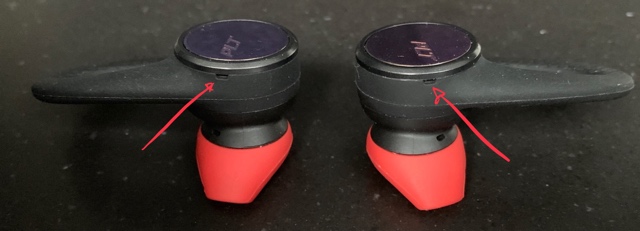
Update: Das sind Sportkopfhörer, die ich nicht regelmäßig zum Telefonieren benutzen würde. Dafür gibt es viele bessere Lösungen. Aber selbstverständlich kann man damit auch mal Anrufe entgegen nehmen, ohne auf eine andere Lösung umzustöpseln. Da es aber so viele Fragen dazu gibt, will ich gerne mal erklären, wie das funktioniert.
Jeder der beiden Ohrstöpsel hat ein Mikrofon an der Vorderseite. Da die Mikrofone vorne sind, ist der Pegel von allem, was von vorne kommt, automatisch höher. Mit ein bisschen Rechnerei findet man auch das Signal, das auf beiden Mikros gleichzeitig ankommt. Wollte Plantronics aber richtige Umgebungsgeräuschunterdrückung machen, wie die Voyagers das können, dann bräuchte das Headset noch zwei weitere Mikros weiter hinten oder weiter vorne. Das kann das FIT 3100 nicht leisten. Wenn ich mich recht erinnere, hatte das erste PLT FIT (ohne Nummer) nur ein Mikro. Zwei sind definitiv viel besser als eins.
Reicht das für Euch? Keine Ahnung. Definitiv ja in einem Büro, definitiv nicht neben einem Presslufthammer. Wer das braucht, nimmt ein Voyager. Da kann man in der Straßenbahn flüstern oder raunen und wird trotzdem verstanden, wobei der Gesprächspartner nicht mal weiß, dass man in einer Straßenbahn ist.
Last week was intense, I came off a week’s vacation and the spring semester was in full effect at Reclaim already. It was head’s down most of the week, but one small highlight for me was getting a ticket from a client that certain students were having problems getting email confirmations after registering, which in WordPress Multisite (WPMS) means the their user’s account sits in limbo. They can’t be seen by the site administrator, but when they try to sing-up again the email is noted as already part of the system. Frustrating. The only real way to find them is to dig into the database, which can be a non-starter for some.
Well, I remembered there was a plugin that helped with this, but I had forgotten it was written by the great Boone Gorges. It is a really useful plugin: it lists all unconfirmed users; allows you to re-send the email; and/or you can override the system and add an unconfirmed user so they can get going with a quick password reset. It’s a must have for a WPMS administrator managing a fair amount of users, and it seems odd this is not part of the core code for WPMS by now. What’s more, unlike the WPMU Dev creeps, it’s open and free! Thank you, Boone!
Photo Caption
Photo taken at: Sightglass Coffee
Instagram filter used: Clarendon
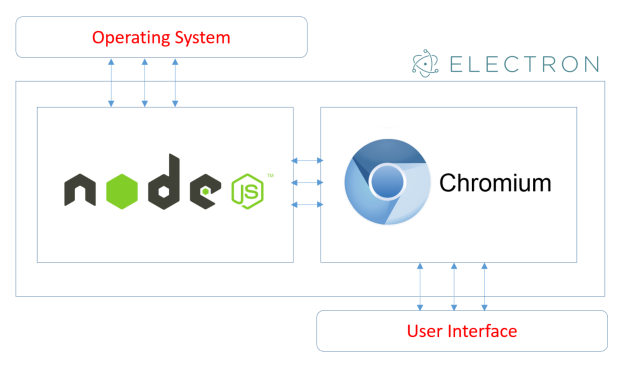
Here’s a plot from the Azure Application Insights dashboard that I’ve set up to monitor my website. It contains ping test results that are run every 5 minutes from 16 data centers around the world:

Since I’m currently using Netlify to serve this site, it’s is really a test of how far away servers on their content delivery network (CDN) are from Azure data centers. Some of the best times (sub 30ms) are from West US, Australia East, Brazil South, and Southeast Asia. The worst is from Japan East, grouped together in that top line.
The data from these ping tests correlate with a separate group of tests that I use updown.io, another monitoring service, to run:

Maybe Netlify’s CDN needs a presence in Japan to even things up? Even so, I can’t complain. It’s so very much better than serving this site off a single server somewhere in the world without a content delivery network.
Some startups are fed up with the growth at all costs mindset and are rejecting the model that’s been tech’s foundation. Essentially, they are telling venture capitalists to get lost, and are asking some profound questions along the way:
Would Facebook’s leadership have ignored warning signs of Russian election meddling or allowed its platform to incite racial violence if it hadn’t, in its early days, prized moving fast and breaking things? Would Uber have engaged in dubious regulatory and legal strategies if it hadn’t prioritized expansion over all else?
It’s hard to know for sure, but the culture a company starts with indeed continues to inform it for years and decades after.
The recommendations that matter to me — for books to read, movies to watch, products to buy, places to visit — almost never come from algorithms. Instead they come from friends, family, acquaintances, and now also, in the case of books, from fellow library patrons whom I’ve never met.
This last source is a recent discovery. Here’s how it works. When I enter the library, I walk past shelves of new books and staff picks. These are sometimes appealing, but there’s a much better source of recommendations to be found at the back of the library. There, on shelves and carts, are the recently-returned books ready to be reshelved. I always find interesting titles among them. Somehow I had never noticed that you can scan these titles, and check out the ones you want before they ever get reshelved. Did it always work this way at our library? At libraries in other places I’ve lived? If so I am woefully late to the party, but for me, at least, this has become a new superpower.
I reckon that most books in the library rarely if ever leave the shelves. The recently-returned section is a filter that selects for books that patrons found interesting enough to check out, read (or maybe not), and return. That filter has no bias with respect to newness or appeal to library staff. And it’s not being manipulated by any algorithm. It’s a pure representation of what our library’s patrons collectively find interesting.
The library’s obvious advantage over the bookstore is the zero price tag. But there’s a subtler advantage. In the bookstore, you can’t peruse an anonymized cache of recently-bought books. Online you can of course tap into the global zeitgeist but there you’re usually being manipulated by algorithms. LibraryThing doesn’t do that, and in principle it’s my kind of place online, but in practice I’ve never succeeded in making it a habit. I think that’s because I really like scanning titles that I can just take off a shelf and read for free. Not even drone delivery can shorten the distance between noticing and reading to seconds. Ebooks can, of course. But that means another screen, I already spend too much time looking at screens, the print medium provides a welcome alternative.
This method has been so effective that I’ve been (guiltily) a bit reluctant to describe it. After all, if everyone realized it’s better to bypass the new-book and staff-pick displays and head straight for the recently-returned area, the pickings would be slimmer there. But I’m nevertheless compelled to disclose the secret. Since few if any of my library’s patrons will ever read this post, I don’t think I’m diluting my new superpower by explaining it here. And who knows, maybe I’ll meet some interesting people as I exercise it.
This post started as a draft for Thought Shrapnel, but it turns out I had more to say than I first thought…
In 2008, Manchester City, a mid-table English Premier League football club, was acquired by an oil-rich consortium from the Middle East. A decade later, after levels of investment that contributed to FIFA’s introduction of financial fair play regulations, Manchester City won the Premier League with a record 100-point haul.
When it comes to sports, we talk about what’s ‘fair’ and ‘unfair’ all of the time, exclaiming “that’s offside!” or “it was never a penalty!”. Recent technological advances such as VAR aim to reduce perceived ‘unfairness’ in football, which is particularly important now that there’s a lot more money at stake. After all, we want the playing field to be level both literally and metaphorically-speaking.
This weekend, Samir Nasri, one of Manchester City’s former players, made his return to the Premier League with West Ham United. Nasri had spent a total of 18 months banned from football for contravening WADA regulations. The crime? Tweeting a selfie of his time spent in a Los Angeles clinic receiving a drip containing 500ml of nutrient-infused water.
Were the actions of the new owners of Manchester City ‘fair’? Were Samir Nasri’s? Whatever your thoughts, both examples show that, when it comes to sport, we take our games pretty seriously. We have regulations to ensure things don’t get out of control.
—
So let’s talk about private schools.
“My objection to private education is simply put. It is not fair… Those who provide it know it. Those who pay for it know it. Those who have to sacrifice in order to purchase it know it. And those who receive it know it, or should.” (Alan Bennett)
This weekend, The Observer published an article entitled Britain’s private school problem: it’s time to talk by David Kynaston and Francis Green. They have a new book out on the subject, which aims to rekindle the case that we need to do something about the private school system. I’m in broad agreement with their suggestions.
One way of looking at life is that, once you’ve taken care of the essentials, everything boils down to games and stories. There are games that we choose whether or not we want to play, and there are stories that we tell ourselves and others. Private education is a demonstration of both in action, as I hope these reflections on the article will show.
—
I suppose that I need to be a little careful about what I say here, having already compromised one friendship through a previous rant. I hope I’m more measured in this post, and can have a robust debate with my TIDE podcast co-host Dai Barnes, who has first-hand experience of the private school system.
—
First, let’s agree with something obvious that the Kynaston and Green state in their article: we can’t place inequality and unfair outcomes in society solely at the door of private education:
It would be manifestly absurd to pin the blame entirely on the existence over the past few centuries of a flourishing private-school sector. Even so, given that these schools have been and still are places that – when the feelgood verbiage is stripped away – ensure that their already advantaged pupils retain and extend their socio‑economic advantages in later life, common sense places them squarely in the centre of the frame.
However, the truth is that, if you’re from a well-off family, have no moral qualms, and want to do your best to ensure your offspring will be ‘alright’ when they’re older, you’d be mad not to send them to private schools. On a macro level, they may perpetuate inequality, but you’re only making the decision for yourself, and it’s very likely to end up going in your favour.
This kind of worldview sees the world as a giant series of competitions, as trials in which one side must vanquish another. Education is a game and, if you’ve got the resources to tip the scales in your direction, then why not? It’s not really any different to Manchester City’s new owners buying their way to Premier League success. If it’s people’s own money, and they’ve earned it legitimately, then why should we tell them how to spend it?
The answer, of course, that access to good schools, hospitals, and legal representation is not like buying material goods:
Education is different. Its effects are deep, long-term and run from one generation to the next. Those with enough money are free to purchase and enjoy expensive holidays, cars, houses and meals. But education is not just another material asset: it is fundamental to creating who we are.
Whether or not it’s intended, whether it’s in football or education, massive inequality results. Even fellow Premier League clubs can’t hope to compete with Manchester City, even after FIFA’s regulations. When it comes to English education, society hasn’t even got those basic kind of regulations:
The underlying reality of our private-school problem is stark. Through a highly resourced combination of social exclusiveness and academic excellence, the private-school system has in our lifetimes powered an enduring cycle of privilege. It is hard to imagine a notable improvement in our social mobility while private schooling continues to play such an important role. Allowing, as Britain still does, an unfettered expenditure on high-quality education for only a small minority of the population condemns our society in seeming perpetuity to a damaging degree of social segregation and inequality. This hands-off approach to private schools has come to matter ever more, given over the past half-century the vastly increased importance in our society of educational credentials. Perhaps once it might have been conceivable to argue that private education was a symptom rather than a cause of how privilege in Britain was transferred from one generation to the next, but that day is long gone: the centrality of schooling in both social and economic life – and the Noah’s flood of resources channelled into private schools for the few – are seemingly permanent features of the modern era. The reproduction of privilege is now tied in inextricably with the way we organise our formal education.
Football is a game. So is education. We should recognise that, and regulate it properly.
Now then, before someone who knows me well points our the obvious, I’m very happy to admit that my house, which is located a mere 300 metres from one of the ‘best’ schools in the north-east of England, is worth significantly more because of that fact. I’m well aware that there’s selection by ability to pay fees, but there’s also selection by academic ability, faith, and buying a house for over the odds to get your child into a decent state school.
This is why simply forcing private schools to shut down would not necessarily solve anything. Instead we need to look long and hard at what we want our society to be built upon. Do we want to have competition or collaboration as a cornerstone? If there are no quick fixes, then what do we want our direction of travel to be?
—
So much for games, let’s move on to stories. Given private schools make up only seven percent of the schools in England, yet make up a startling 71% of barristers and 50% of cabinet MPs, it’s beyond doubt that their alumni are disproportionately represented in positions of power.
I’m sure that with extra resources, and without decades of political interference, private schools may well give children a better experience, but that’s not the whole story. We may pretend that we live in a meritocracy, but the reality is nothing of the sort:
The term “the establishment” can be a tiresome one, too often loosely and inaccurately used, but in the sense of complementary networks of people at or close to the centres of power and wealth, it actually does mean something.
All of which leaves the private schools almost uniquely well placed to make their case and protect their corner. They have ready access to prominent public voices speaking on their behalf, especially in the House of Lords; they enjoy the passive support of the Church of England, which is distinctly reluctant to draw attention to the moral gulf between the aims of ancient founders and the socioeconomic realities of the present; and of course, they have no qualms about utilising all possible firepower, human as well as media and institutional, to block anything they find threatening.
The overwhelming reason parents send their children to to private schools is to get the examination results to get into elite universities. Those that are successful may get a good education, but they also get to tell a story. It’s a kind of shorthand to say you went to Oxford University. Privilege in schooling ends up with privilege in the job market.
—
So, what should we do? Well, as I mentioned earlier, there’s no quick fixes here, and abolition is likely to either further distort the housing market, or allow private education through the back door through intensive tutoring or parents setting up ‘free schools’ with exclusionary policies.
Instead, let’s look at Kynaston and Green’s suggestions. The first, to my mind, is a no-brainer: ensure that private schools are not allowed to claim charitable status, and have to pay business rates in full. It’s ludicrous that they can get away with this in the year 2019.
A related suggestion is to tax school fees to a level as high as 25%. That tax would have to perhaps even be higher: right now there are eye-watering taxes on on whisky and gas-guzzling vehicles such as Range Rovers, and they seem to remain popular.
After that, the authors point to various schemes from the Sutton Trust and in other countries where children from low-income families can attend private schools. I’m sure these are all well-intended, but to my mind end up both propping up the system.
My proposal, once we’ve got private schools recognised as the businesses (and not charities) they are, is to take control of state education away from politicians. Just as the Bank of England was given control of interest rates, so educators with the long-term interest of our country in mind, should have control of education policy. They should have the whole of education under their purview, including the private sector.
If we understand life through games and stories, we need to think about the story we’re telling ourselves and future generations. Is ours a country that is organised for the few instead of the many? And if we’re going to organise education as a series of games, then how could we change the rules to ensure that the same kids don’t always get picked?
Given our concerted focus on diversity in western democracies at the moment, it seems more than a little anachronistic to have an unreformed and unfettered private education system. Let’s do something about that.
Image by amanda used under a CC license
Not quite 9 km of new bike lanes installed in Toronto in 2018
About the same planned for 2019
by Robert Zaichkowski and Albert Koehl

This 750m bi-directional bike lane along Harbour-Lakeshore Blvd W. (between Bay and Rees Streets) was the only new downtown addition in 2018.
The final Bike Plan numbers are in for 2018 -- and they are not pretty.
It’s hard to call 8.7 km of new bike lanes “progress” given our road network measures over 5,600 km. Almost three years into the new plan, we’re not much closer to achieving the 335 km of new on-road infrastructure to be installed in the ten-year timeframe. Yes, it takes time to plan new bike lanes, but it only takes seconds for a cyclist’s life to be violently ended. Five of our fellow city residents were killed --- the worst toll since amalgamation (1998) --- and many others have been seriously injured while riding bikes in the city last year. We need infrastructure - in the form of protected bike lanes that connect to each other - now.
The new bike lanes installed in 2018 are mainly in three neighbourhoods, albeit without connections on nearby arterials where cyclists face greater danger. At York University, a cycle track was added to Shoreham Dr. but no improvements were made on nearby arterials Jane, Keele, or Sheppard.

Large gaps (this one near The Pond Rd) remain in the nearby Sentinel Rd. bike lane at York University.
In the Flemingdon and Thorncliffe Park neighbourhoods, the new bike lanes avoided Overlea Blvd. and Don Mills Rd., which could have helped residents on bikes get beyond their own neighbourhoods.

Bike lane along Thorncliffe Park Drive, the longest of the new bike lanes at 1.4 km being installed in Sept 2018.
The downtown core got a short, albeit well-constructed, bi-directional cycle track along Harbour St. and contiguous Lake Shore Blvd. W. (image at top). There was, however, no progress for the busiest cycling routes in the city along Bloor St. and Danforth Ave. despite the much-studied success of the Bloor bike lane pilot. Scarborough, despite its vast expanse and deadly roads, fared worse, getting nothing. North York remains a black hole for cycling infrastructure with an area the size of Guelph that has virtually no bike lanes. Ironically, Mayor John Tory opposes a bike lane on Yonge in North York as proposed in the REimagining Yonge initiative.
A formal Bike Plan update was to be given by City Hall by the end of last year, but like the rest of the plan, it didn’t go according to plan.
It would be good to know how much of (and how) the $16 million budgeted for the Bike Plan in 2018 was actually spent.
When we tabulated the 2017 bike lanes for our Tracking Table, we assumed that moving forward, 2017 would become the low point given the paltry 9 km of new bike lanes installed. We were wrong. At the current pace of implementation – a total of 25 km since June 2016 – we won’t reach the 335 km goal until climate change extremes are regularly laying waste to our city. By comparison, the smaller City of Montreal, despite its colder climate, installed 57 km of bike lanes, including protected ones, in 2016 and 2017 alone.
There were a few additions to recreational trails in 2018, including the Chorley Park switchback that gives cyclists access (shared with pedestrians) to existing ‘multi-use’ trails near the Brickworks and to the Don Trail. Work on filling the last (780 m) gap in the Martin Goodman Trail was also started, though not yet completed. This trail’s origins date back to the 1970s.
One of last year’s planned (but deferred to 2019) bike lanes was on Evelyn Wiggins Dr. – a 200-metre, residential roadway at York University. Cyclists, however, already have a superior option along the Finch Trail, which conveniently connects to Sentinel Rd. Indeed, cyclists would have benefited more if the major gaps in the Sentinel bike lane had been filled.

York University bike lane (curiously) planned for Evelyn Wiggins Dr. has been deferred to 2019.
The implementation pace of the current bike plan is disturbingly similar to that of the 2001 Bike Plan. That plan was preceded by intense study, then the announcement of big numbers, and followed by a lethargic pace of implementation that saw only 17% of planned bike lanes installed over ten years.
Without strong political direction, it’s no surprise that city staff in the Cycling Infrastructure Unit will be inclined toward the path of least resistance for bike lane installations, avoiding new lanes that provoke strong opposition. It’s troubling, however, that even a study (normally carried out by a consultant) for the Bloor bike lane extension from Shaw St. to High Park is stalled.
So, what do we do now?
First, the cycling community must be fully engaged in the process by which city staff set annual priorities. We need transparency. It’s clear that the existing process lacks any ambition consistent with Bike Plan targets. Cycle Toronto, which hosts annual advocacy forums and contributes to the bike plan consultation process, can engage the broader community in developing infrastructure priorities. We would likely have more success by identifying and rallying behind such priorities than making vague demands for Bike Plan implementation.
Second, we need articulated measures of success and interim goals for the Bike Plan. How, for instance, is the new Dovehouse Ave. bike lane being received by cyclists? It’s not enough to simply count kilometres of new bike lanes. It’s clear that not all bike lanes are equal. A bike lane in a remote part of the city with virtually no cyclists (the bike lane on Steeles near Pickering Town Line, for example) can’t have priority over popular cycling routes with growth potential. We certainly can’t wait for the end of the ten-year plan to see how it has fared. When interim goals are not met, a new approach must be taken.
Finally, we need a City Hall politician who is accountable for implementation of the Bike Plan. When the Bike Plan lags there has to be an elected public official who answers to the public. This responsibility and accountability should be extended to include the Vision Zero road safety plan, which, sadly, is similarly far off course.
This Google map below shows bike lanes installed since the new bike plan was adapted in 2016.
Albert Koehl is an environmental lawyer and founder of Bells on Bloor. Robert Zaichkowski is an accountant and a Board Member of Cycle Toronto.
Related on dandyhorsemagazine.com:
NEW:
What to expect in bike lanes for 2019 (hint: not much)
Bike Plan (bike lane) tracking table - revised January 2019
Taking a look at the slow pace of the bike plan implementation
Does City Council like bike plans more than it likes bike lanes? (from 2016)
TL;DR: Clarifying how you frame success will set you up to break through self-imposed barriers. I closed the door, sunk my face into the pillow, and sobbed. Our product was a flop and we were out of money. My toddler son and pregnant wife were in the adjacent room. There was no air left in […]
The post Success Is Not What You Think It Is appeared first on Eric Karjaluoto.
 |
sillygwailo
shared this story
from  iceland experiment. iceland experiment.
|
It is well-known that Icelandic surnames are special and unique in the world. The so-called patronyms are still in use here. Patronyms are “surnames” generated by the first name of your father adding an ending whether you are female (-dóttir for daughter) or male (-son), basically saying whose daughter or son you are. My name for example (if I would be Icelandic) would be Marie Údosdóttir, because my dad is called Udo. But I learned the other day that there are also other Icelandic name phenomena.
While I was chatting with my colleagues at the jólahlaðborð (Christmas buffet) the other day, which is a traditional way for companies celebrating the holiday season with loads of traditional Icelandic food, I found out that there are several ways of a first name to transform into a nickname. Of course, nicknames are generic and therefore you can not typically say “This first name ALWAYS transforms into this nickname”. It’s simply in the nature of nicknames and they come in as many variations as people and characters, I guess. Apparently I am by far not the only one who ever wondered about Icelandic nicknames – turns out there has been even a doctoral dissertation written on Icelandic nicknames (University of California by Kendra Wilson).
It seems they are most often sound similar to the formal name or its ground structure is still shining through. “What is also apparent in the formation of nicknames is that they are usually of a certain form, it is as if there was a certain ‘template’ that nicknames should fit into”, says Aðalsteinn Hákonarson from the Arnastofun. He goes on saying that they are usually dissyllabic even though the actual name may only have one syllable. For Example: Jón turns into Nonni or Björn into Bjössi.
Since Icelandic doesn’t really have any form of diminutive for personal names, like for example German (for example Lenchen) or Polish, nicknames or pet names are not based on any of that. “However there are some nicknames formed with the element –si, -sa which one can maybe consider a kind of diminutive suffix, e.g. Jónsi for Jón or Grímsi for Steingrímur”, says Aðalsteinn.
“A particularly interesting phenomenon is that nicknames seem often to be derived from the speech of small children”, Aðalsteinn Hákonarson
Icelandic names can be very long and truly difficult to pronounce – not only for foreigners, but presumbly also for kids. I think of names like Þjóðbjörn, Sigþrúður or Guðmundur. This Aðalsteinn connects also with the phenomenon that nicknames often sound like they were formed by child’s mouth: “A particularly interesting phenomenon is that nicknames seem often to be derived from speech of small children.
But nicknames aren’t the only name phenonemon I learned of recently and it is connected with surnames.

As I just mentioned patronyms are still in use in Iceland and are for most part of the population the applying surname system. What I didn’t know until recently was that there exist also Icelandic family last names. They usually appear to be Scandinavian, at least to my ears, which is why I haven’t figured out yet that they are meant to be Icelandic. There are some few in existence and how they came into being is rather amusing. Icelandic family names came into fashion rather late, probably in the 19th century. “The first surnames were adopted by Icelanders who were studying in Europe”, explains Kendra Wilson.
Back in those days everything foreign was en vogue, especially everything Danish due to the Danish occupation and influence. Therefore some rich families simply decided to give themselves Europeans sounding family names. “In the 19th century it became fashionable for the upwardly mobile to adopt surnames, often ‘Danishized’ versions of Icelandic place or personal names”, states Wilson. That is why some of them are retrieved from original place names, for example their home farm or place of activity. “Briem” for example originates from Brjánslækur, the place where the ferry from Stykkishólmur arrives in the wonderful Westfjords. “Hjaltalín” traces back from the farm Hjaltadalur in Skagafjörður, as well as “Blöndal” which comes from a family from Blöndudalshólar. However, family names were forbidden by law in 1925 and now the patronymic system is the only way to receive your “surname”.


Starting my BART station report series with my home station, 24th St Mission. Sometimes the St is spelled out so it’s 24th Street Mission, and sometimes it’s abbreviated in station signs. You can get some overview of the neighborhood on the Calle 24 Historic District site in English and Spanish. Get ready to ramble! I’m going to just write everything that comes into my mind from my notes, memories, and researches. I hope that you will enjoy reading it and then will see this (or some other train station or place in your city) with a new perspective.
Though I can go the half mile from my house to the station under my own power, this time I got there on the bus, debouching directly in front of a bench where a guy with a 49ers jacket was sitting holding a bug-eyed chihuahua on his lap, passing by him to scoot into Taqueria El Farolito since the line was very short.
El Farolito has a narrow corridor along the kitchen where you order and wait, and small picnic tables along the wall. I can make it in there in my powerchair to order, turn around by the jukebox after I order, and make it back out, but there is nowhere my wheelchair can fit for me to sit and eat inside. No big deal. As is usual in SF taquerias you get a number and lurk around the counter listening for your number. Bonus if you understand numbers in Spanish. I got a carnitas super burrito with everything and a mexican coke to go, which comes with a little bag of chips and some napkins, in a plastic bag with handles. The handles are so useful and important for hanging the bag on the arm of my wheelchair. Mexican coke is nicer and tastier than US coke because it uses cane syrup instead of corn syrup and it comes in a pretty glass bottle.
If you can see over the counter as you wait (I cannot in this particular location) then please admire the efficiency of the burrito-makers and study their workflow. It is instructive to compare the workflow of different taquerias, for stunning speed, La Taqueria; for complexity (sometimes as many as 14 people behind the narrow counter) Pancho Villa. Keep in mind that THESE BURRITOS ARE LOVE. You are going to be nurtured by your delicious and amazing burrito. Appreciate it properly.
At some point over the years I wondered what possible connection there was between burritos and lighthouses (Faro = lighthouse in Spanish and in many romance languages from the famous Lighthouse of Alexandria on the island of Pharos). I think it is from the “home of the Mission burrito” being Febronio Ontiveros‘ El Faro taqueria. So maybe El Farolito is an offshoot of the original El Faro at 20th and Folsom.
As I was waiting two mariachis came in, one with accordion, another with guitar and an amp on a hand truck. They set up and started playing in the back of the tiny narrow restaurant. I got my own salsa in containers and headed out to eat in the BART plaza. I shared one of the square cement bench blocks with a friendly tamale lady and a couple who were discussing their plans for the day in Spanish; staying in my comfy powerchair but using the bench corner for my coke bottle and bag of chips and also putting my feet up on there from time to time. One bench over, I noticed the Raccoon Guy (a white haired and bearded grizzled older man who has hung out in this plaza for years but recently achieved viral fame for bringing a dead raccoon into the nearby McDonald‘s.) From this we can deduce that 24th and Mission is a pretty good raccoon habitat, barring accidents.
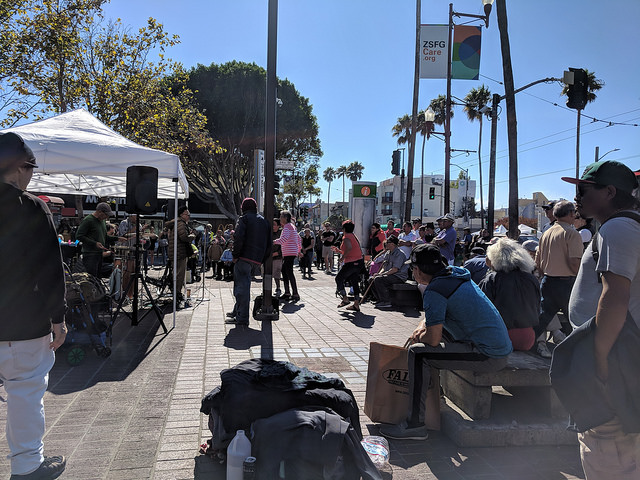
OK so this plaza, the one on the Northeast corner. I am pretty familiar with it and it is one of my favorite hangouts, sort of refreshing and beautiful to me in a special way. Yes I realize sometimes it smells like pee. Try to bear with me. When it doesn’t smell too much like pee, it’s so nice! Lively, full of action, so much to look at, excellent food for the flaneur’s soul! On weekends there are often loud preachers or a band of old dudes playing mostly Cuban music. If I get there for the music then I hang out for a few songs and put some money in their donation bin. It is a lovely scene on a sunny day with families stopping to watch, people dancing, the tall washingtonia palms far overhead against a blue sky. Even without those very organized musicians, there are frequently other musicians playing in the plaza or coming up from the BART stairwell, and music coming from someone’s portable speaker or cars or the market in the southwest plaza that’s catty-corner across the street. The buses fwoosh and beep, the distinctive train car sound swells up from underground, Norteño or salsa music comes and goes, lots of Spanish and Chinese spoken all around. It is a lively soundscape that I absolutely love.
Facing north from this plaza, you’ll see a mural on the wall of El Farolito. This is by Michael V. Rios and shows a geometric cityscape, and some determined, rather grim people shouldering train rails with a shining metal BART train riding on top. It has a nice socialist realist feel to it, as it honors the workers who built and maintain the city’s infrastructure. The gleaming futuristic train is carried on the backs of the people! Maybe the people who built it or the people who paid for it with their taxes!
Facing west, past the stairwell, there is a giant mural on the side of the Silverstone cafe in addition to the super funky and cool coffee and tea sign of Silverstone. Sorry I don’t know much about the mural and forgot to take pictures but it says something like “SOCKS” on it. More later if I go investigate, or find info about this mural online. The Silverstone Cafe itself is quite nice, and has wifi and – I didn’t know till this week’s exploration – A pretty nice patio in back! And good, low priced, (large) pastries and breakfast and sandwich type of food. The interior is beautiful with a giant wooden… bar back or mantelpiece sort of thing. Because of the TV I didn’t try to work from this cafe, though I might in future. (Instead I ended up a few blocks down 24th, at Haus, which also has a lovely patio and an accessible bathroom.) If you go that direction you could also stop by Precita Eyes and learn more about the neighborhood’s murals.
I didn’t hang out today at the southwest plaza but can say it has a pleasant street market with booth selling jewelry, souvenirs, shopping bags, belts, phone cases and chargers, headphones, shirts (often ones embroidered huipil style) and ponchos (wool). There are also sometimes flower sellers and a booth for vitamin type of things, phone plan sales. Sometimes events in the far corner under the Coffee & Mission mural like, breakdancers or rappers. This mural is on Osage St. and is by Mark Bode, Mel Waters, Dino, Nite Owl, Dagon, and Free. You may notice Mel Waters‘ distinctive style in like, a zillion other murals all over the Misson and the rest of the Bay Area. There is a big metal ventilation tower here that, in Ingress and Pokémon, is a portal named Lipstick Tube after the shape of the tower. The way the plaza is shaped in the back by the stairwell entrance makes a pretty good stage for any sort of street events. There is also a dark green kiosk-style public bathroom in this plaza. I have never used it, opting to buy a coffee or something instead to use a bathroom!
Did you ever notice the “two totemic posts” of this plaza? I hadn’t. Hang onto your hats as I want to paste in a hefty quote from the designers.
The two totemic posts in the foreground were placed to formalize a stage area already used as such by the community. Otherwise, most vertical elements were removed to open up the plaza.
The plaza was originally designed along with the underground station in 1970. The basic configuration is an open plaza paved in a concentric brick pattern that radiates out from a large circular opening in the center. The opening comprises the main station entrance, containing a stair and escalator column with recessed semicircular planters on either side.
The circular opening offered the design team a powerful theme. The circle form not only ties together design elements throughout the plaza but attempt to also communicate universal notions. The circle is an ancient form used by many civilizations. It was universal and almost always represented the sun and thence fecundity, society and important values.
Eliminating the security fencing revealed the existing great circle—being able to enter and emerge from such a shape is an unusual experience even in a famous city. The cylindrical tower (necessary to protect the existing spiral stair) acts as a beacon for the station and recalls an ancient Maya astronomical observatory. It has a south-facing skylight through which the sun illuminates colored portholes. Emerging from the circle passengers will catch a glimpse of colored sunlight—but the light will not again appear in the same spot for an entire year. Of identical shape to the tower are shiny bollards (necessary to prevent vehicle intrusion from the alley) that are positioned in various angles to reflect sunlight at different strengths when seen from a distance. Throughout the plaza can be found variations on the theme of circles, light and totems.
Nifty! (What spiral stair?! Is that what the Lipstick Tube is?! I assumed it was for ventilation!)
Back to our BART station. I did not get even halfway through the burrito. I can live off a burrito for like, three meals at LEAST. While I was sitting there a mad-eyed disheveled dude asked me and everyone nearby for change. He eventually settled down elsewhere in the plaza. Being accosted for money is likely but just take it in stride. If you like to help people you might keep some dollar bills in a pocket ready to dole out (that’s what I do) and know how to set limits on the interaction, and how to say no. It may make you uncomfortable though especially at night. Personally I feel perfectly comfortable here day and night as it is very public and well lit with tons of people around. Anyway, I sat through many buses pulling up, people walking by, tamale lady calling out her wares (tamales de pollo, de carne!) and selling some from her ice chest on wheels. She’s super nice, I see her there a lot.
I waited for the elevator with a sweet family who had been shopping (grandma, mom, and teenage daughter with her backpack worn frontways across her stomach). Three dudes were just nearby playing very loud Cuban music (excellent taste) and cat calling us (Ay mamacita!!! que estás bonitaaaaaaaa!!!!) But not like hostile cat calling, basically a . . . non-hostile routine social interaction. I looked over at them and nodded, breaking all the rules of such things, being a sucker for good music and since their piropos weren’t gross or anything. But me and the older women also side-eyed each other in mixed annoyance and amusement and then when we got in the elevator kind of burst out laughing.
The elevator had the horrible smell of pee and industrial cleaning fluid. I always kind of long to tackle the gross walls of this elevator where someone tried to write, or paint, and then it was ineptly and incompletely sprayed with cleaner, so there are horrible drips going down the wall and it looks filthier than if they had just left the graffiti alone. There are also times when there’s… food smeared on the wall? I dunno! The thing with the smell is, the pee must run down through the mechanism of the door to the elevator well below, and just fester there for years. There need to be more bathrooms, open all hours, though, I think the Pit Stop bathrooms do help and in recent years the stench has been ameliorated to some extent.
The elevator from the northeast plaza lets you out in a sketchy feeling nook in the north corner of the concourse. The stairwell there (and, same on the other side) has 2 stairways and an escalator, with abstract concrete bas reliefs by the English sculptor William George Mitchell. If you get up close to the walls you can feel the rough (even sharp) corrugations which are the background to the broad smooth planes of the cement geometric shapes. I wonder if they give the Mission stairwells some of their nice acoustic properties. There are often musicians in them, and while I explored on this day there was an excellent guitarist, Ángel Rodriguez from Banda Sin Nombre, in one stairwell and then later in the day, a saxophonist in the other.
The concourse has a beautiful arched design that makes me think of 70s futuristic things, or maybe particular airports, with the concrete arches overhead soaring like an airplane hangar, and more interesting corrugation in between creating a fairly beautiful line. If you don’t look up, or look at the shape of the buttresses of the arches, you are missing out. The lighting is also really not bad for an underground area. If you do have a look at the ceilings you may also notice a lot of anti-pigeon spikes. (Ow!) Speaking of ow, as a small accessibility note I would say there is an archway pillar between the north stairwell and the entry ticket points where, the slope of it as you might be coming out of the ticket area is such that for a blind cane user, it would be easy to run your head right into the underhang of the arch. Same goes for the pillar by the southwest stairwell as you come out of the ticket area there and turn right – headbonking opportunity. That could be prevented by a small guard rail in both areas.
There’s a ticket entrance by the elevator and the northeast stairwell, and another on the south side of the station, by the agent booth. This south entrance is where the wheelchair and stroller accessible entry and exit point is. In some other stations, the elevator to the platform is outside the pay entry cage so you have to specially remember to reach over the barrier to tag yourself out (even though you’re already out!) Once you’re in the paid area, there are 3 stairwells from south to north; the first is an escalator coming up from the platform, and some bike racks. At the far north end of the paid area you’ll find the elevator to the platform (call button on the left). Like most elevators in the system this one has buttons marked C for Concourse and P for platform.
Platform 1 has the northbound trains, Platform 2 has the southbound. If you traverse the length of the platform you will see the 3 stairwells; the furthest one from the elevator is the escalator going up. In between the escalator and the middle stairwell are some big block style cement benches, and between the second stairwell and the 3rd, there’s a big map and schedule. The median walls (on the stairwells) are tiled with brown, orange, gold, yellow tiles with an occasional black one, which I think of as a kind of nice Painted Desert effect or like the backgrounds for Wile E. Coyote and the Roadrunner. There are mysterious little rooms in these areas too with numbered doors (as there also are on the concourse). I expect these will factor into my BART text adventure game in some way. On the walls to either side of the platform tunnel you can see the same buttress looking cement things as you see above in the concourse. Between those, there’s plain beige tiles and a space for ads.
So, I’m going to return to my game-writing now! This isn’t an exhaustive Guide To Things To Do near 24th and Mission station, though, I do recommend you get a great burrito and admire the murals while you’re here. There is also excellent grocery shopping at many small latin american stores, a middle eastern grocery around 26th, bookstores nearby down 24th and on Valencia and 20th, and several import stores with a standard selection of things like cheap suitcases, backpacks, socks, SF souvenirs, jeans, trinkets, and I don’t know what all else as it’s been a while since I was able to fit through their aisles!
By the way…. tomorrow is the 18th Annual No-Pants Bart Ride Day! Are leggings cheating? I get cold!
Last night we watched the first two classes of Hal Abelson teaching Structure and Interpretation of Computer Programs in 1986 and they were sooooo amazing.
Danny remarked that this is a great example of teaching a beginning lesson in a language with math while most other intro-to-a-language-via-maths fall flat.
All the stuff about magic is just beautiful (and true).
So as opposed to other kinds of engineering, where the constraints on what you can build are the constraints of physical systems, the constraints of physics and noise and approximation, the constraints imposed in building large software systems are the limitations of our own minds.
So in that sense, computer science is like an abstract form of engineering. It’s the kind of engineering where you ignore the constraints that are imposed by reality.
Sweet that you can download text or PDF of the transcript of the lecture.
Meanwhile, in the night during some dark hour when my knees hurt and I couldn’t sleep I decided to change the scope of my mapping in this transit game, at least at first, and rather than make a perfect walkable (rollable) simulation of the geography of each station (or even this first one) I will abstract it a lot more. It could still be expanded later, but the hugeness of the map started to drag me down and I’d like to get the mechanisms working before that kind of precision. I have often felt that I have to throw out all the code at least 3 times before I know how I want to approach a project and I believe this makes 3. But, that means I’m not sticking it up on github yet until I have a clearer vision and a better prototype.
Back in the day when television was still television and we all gathered around the hearth to watch CBC (the only channel we picked up on the rabbit ears), CBC’s Land and Sea was a perennial favourite (longtime readers will recall this episode about the Charlottetown Farmer’s Market that captured wee Oliver and me).
For some reason–perhaps its website, not updated since 2014–I’d assumed that the program had long ceased production. And so I was surprised to hear a piece on Mainstreet this afternoon promoting an upcoming episode about Prince Edward Island.
It turns out that Land and Sea is still very much alive, and is in its 18th season. The website is, a friendly and helpful person at CBC Communications in Halifax tells me, a vestigial one that needs re-pointing: CBC Gem is the place to find Land and Sea now, I was told. And, indeed, there are 10 seasons of back-episodes ready there for the watching.
Welcome back, Land and Sea!

Euan Semple writes, in Fear, and loss of control, in part:
Life keeps on happening, without our control. We are out of control. We don’t even control our own thoughts never mind the world around us. Deep down we know this and numb ourselves to the fear it induces with mindless media, sugary food, or alcohol.
But something magical happens when we stop worrying about our lack of control. We can still take actions, we can still think thoughts, we can still affect the world around us, we just stop worrying about whether things turn out as we expect. We stop piling stress on top of the lack of knowledge of how things will end up.
Rather than inhibiting us, the acknowledgement of our total lack of control makes it easier for us to take action. We stop worrying and do stuff. We enjoy going along for the ride and worry less about where we are going. In doing so we might just get somewhere magical — again and again.
Having a partner with an incurable illness has taught me this empirically: I am someone who likes order, and predictability; snow days weird me out; I get discombobulated when my shaver gets moved to a different shelf or when I can’t find my phone charger where I left it.
Needless to say, introducing cancer into the mix rendered that way of thinking unworkable.
While I can’t make any great claims about calming down about snow days and shavers and phone chargers, I do believe I’ve gained some small amount of “grace to accept with serenity the things that cannot be changed,” and to, as Semple writes, “stop piling stress on top of the lack of knowledge of how things will end up.”

This is a fairly detailed report (20 page PDF) based on a survey conducted using Amazon's Mechanical Turk. The study notes that while "strong reasoning skills have become increasingly key to navigating everyday life," it remains true that "in too many schools, critical thinking is not taught to young people" and "at workplaces, employers don’t do enough to prioritize richer forms of reasoning." In particular, the report says the teaching of critical thinking should not be left to parents because they don't have the skills and they don't teach them to their children. That, I would say, is the legacy of the television generation.
Web: [Direct Link] [This Post]
HMD Global might announce the Nokia 9 PureView by the end of January 2019, according to 91Mobiles who sourced people within “Nokia’s distribution channel.”
91Mobiles‘ sources suggested that HMD will launch the phone at an event in Dubai, followed by a release in India in February 2019.
The Nokia 9 PureView previously leaked in a promotional video. The video revealed that the phone will carry a Snapdragon 845 processor, 6GB of RAM and 128GB of internal storage. Additionally, the phone will feature five cameras, with an almost-circular seven-sensor setup.
Furthermore, the phone is expected to sport a 5.99-inch display with a 2,048 x 1,080-pixel resolution.
Source: 91Mobiles
Image Credit: MySmartPrice
The post Nokia 9 PureView to launch in late January 2019: report appeared first on MobileSyrup.

Tesla has been promising drivers an advanced version of the ‘Summon’ feature for months and now, a new tweet from company CEO Elon Musk states that some users will get it in a few weeks.
The new feature allows drivers to call their vehicle and it will drive itself to where they are. The vehicle will then follow them around like a pet.
Musk originally tweeted that the feature was coming in early November, but there has since been little news regarding Summon.
Going through final validation & regulatory approval. Probably releases to early access program owners in a few weeks. It’s trippy!
— Elon Musk (@elonmusk) January 10, 2019
Musk’s tweet says that the new feature is “going through final validation & regulatory approval. Probably releases to early access program owners in a few weeks. It’s trippy!”
The main pain point with this tweet is that Musk mentions that Summon is in regulatory approval. He even goes as far as to respond to another user who asks, “Does that include remote control mode?” by saying “Getting some regulatory pushback. May not be available in all regions.”
So it looks like Tesla is trying to push out the feature, but some countries or states are blocking it.
When this update does roll out (assuming it’s available to Canadians), it will be compatible with any Tesla vehicle built within the last two years.
Source: Elon Musk
The post Tesla’s enhanced Summon feature is almost ready to roll out appeared first on MobileSyrup.

Tech21 has launched a Google Pixel 3 XL case as part of the company’s ‘Made for Google’ program.
Dubbed the ‘Evo Type,’ the case adds a full QWERTY keyboard to Google’s larger 2018 flagship smartphone.
The Evo Type looks like an average folio-style case, but can unfold to reveal its keyboard. The keyboard doesn’t have physical buttons but instead uses sensors to register user input.
The keyboard connects wirelessly through NFC, so it should consume a minimal amount of power. The Evo Type also features keyboard shortcut-support and can prevent the phone from falling over. Users can place the phone in a variety of positions so that it’s more comfortable to use.
According to Evo, the case sports a durable, soft-touch fabric that should provide protection while keeping the handset slim.
Tech21 is also launching the ‘Charge Pod,’ a small charging mat with a rubberized pad that can cling to table tops. The Charge Pod features a 5,000mAh battery that can extend the life of smartphones, tablets and smartwatches.
Finally, Tech21 is launching a sports armband called the ‘Fit Kit with Evo Check’ which can connect to the company’s ‘Evo Check’ smartphone case.
According to Tech21, the Fit Kit is secure, breathable and easy to keep clean.
Tech21 said it’s releasing these accessories in spring 2019.
Source: 9to5Google, Evo
The post Evo Type brings a full QWERTY keyboard to the Pixel 3 XL appeared first on MobileSyrup.

The next generation of Wi-Fi — Wi-Fi 6 — will reduce demand on batteries, pack more information into transmissions, and reach more devices at once. Most importantly, it’ll bring faster speeds… eventually.
If CES 2019 is anything to go by, there aren’t many Wi-Fi devices out there. Sure, plenty of companies showed off routers that supported the new generation. However, only a small number of laptops could take advantage of the benefits.
The Wi-Fi Alliance, the group that oversees Wi-Fi standards and their implementations, has worked on Wi-Fi 6 for several years. 2019 was supposed to be the kick-off point, but it looks like Wi-Fi won’t really ramp up until 2020.
For one, the Alliance won’t even start certifying devices until the fall. On top of that, Intel said its next generation of processors would support Wi-Fi — processors that won’t come until later this year.
Despite this, HP, Dell, MSI and Asus all announced laptops that would support Wi-Fi at CES.
As far as smartphones go, Qualcomm’s upcoming Snapdragon 855 CPU will support Wi-Fi 6, but it didn’t make an appearance in any devices at CES. However, the 855 is expected to be in several Android flagships this year, meaning most flagships will support the new Wi-Fi generation.
There’s no word yet if Apple’s next phone will support Wi-Fi. Some reports indicated the next iPhone would, but more likely we’ll see Wi-Fi 6 support along with the 5G iPhone in 2020.
Ultimately, if Wi-Fi support is important to you, you’ll have to do your research when buying devices this year. There’s no guarantee a device in 2019 will support it.
That said, you also likely won’t miss out on much if your new device doesn’t support it, because the era of Wi-Fi won’t truly start until next year.
Source: The Verge
The post 2019 should be the year of Wi-Fi 6, but it hardly appeared at CES appeared first on MobileSyrup.

From Samsung to Google, here’s a breakdown of almost every smartphone leak from the last few days.
The leaks below encompass news from January 5th, 2018 to January 10th, 2019.
First and foremost, Samsung will unveil the Galaxy S10 series on February 20th. This is not a rumour or a leak, the South Korean company itself announced the launch date of its new phone. Samsung might also reveal its foldable hybrid at the same event.
For more on the announcement, click here.
While Samsung will likely reveal its foldable smartphone on February 20th, a conflicting rumour indicates that the South Korean company will instead release the device sometime later in the first half of 2019.
For more on the foldable phone, click here.
Samsung might have accidentally leaked the design of its Galaxy S10 flagship. The following render was seen in a Samsung Newsroom post about One UI. The render in question showcased a phone with a punch-hole camera cutout on the top right corner of the handset, as well as very thin top and bottom bezels.
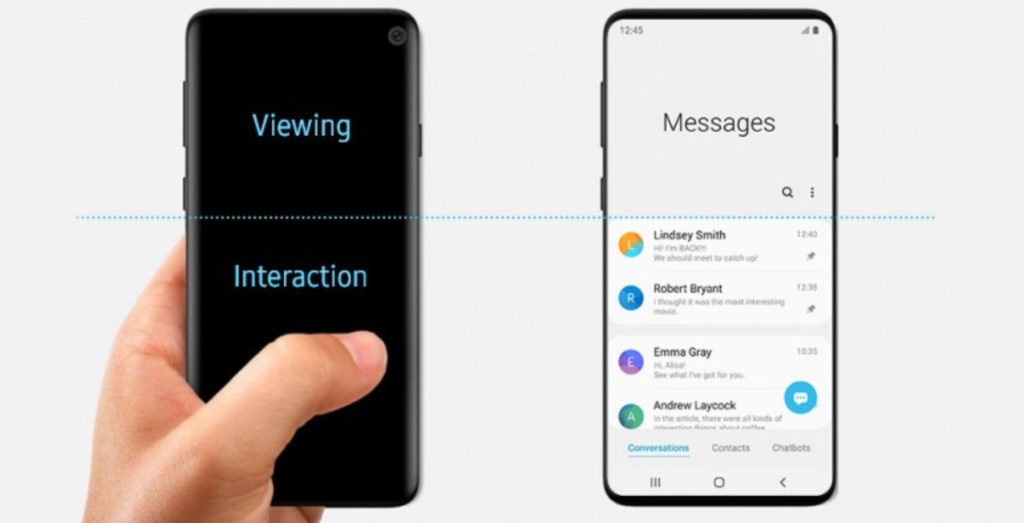
For more on the Galaxy S10 leak, click here.
Another Samsung Galaxy S10 leak shows three screen protectors, with the battery capacity of each phone written on the corresponding case. Rumours point to the affordable S10 featuring a 3,100mAh battery, the regular S10 sporting a 3,500mAh battery and the plus model including a 4,000mAh battery.
For more on the battery sizes, click here.
An Apple rumour indicates that the next iPhone will feature a triple rear-facing camera array that’s housed in a square unit that’ll make for a rather pronounced bump. Apple will reportedly align two cameras vertically and place another one between the two slightly off to the side. There’s also a LED flash above the side camera.

For more on the three-camera iPhone, click here.
A report from the Wall Street Journal says the Cupertino-based company will release three new iPhones in 2019. The company’s new lineup will include a successor to the XR and a triple-camera flagship. The list includes a phone with an LCD display and dual rear-facing cameras and two OLED display smartphones, one with dual rear-facing cameras and the other with the triple camera setup.
For more on the new iPhone leaks, click here.
LG is expected to launch its G8 flagship at Mobile World Congress, 2019 in Barcelona.
For more on the G8 leak, click here.
Cases for the Huawei P30 series have leaked online. The cases suggest that all of the phones feature a waterdrop-style notch. Additionally, the cases also show that each of the three phones has very thin bezels on all four sides. According to the leak, the P30 Lite will feature a 6-inch display, and so will the P30. The P30 Pro, on the other hand, is expected to feature a 6.4-inch curved display. The P30 Lite will sport a side-facing fingerprint scanner and the other two will use in-display fingerprint sensors.

For more on the Huawei P30 series, click here.
Two Moto smartphone case renders have surfaced online. The cases are allegedly for two unannounced Moto devices, the Moto P40 and the Moto Z4 Play. The P40 case showcases the phone will include a rear-facing fingerprint scanner with Moto’s batwings logo, as well as two vertically aligned rear-facing cameras in the right corner. The Z4 Play case features a round camera setup on the rear, with the left side of the device sporting volume rockers with a power button.

For more on the Moto case renders, click here.
A smartphone render codenamed ‘The Waterdrop’ has surfaced online. The leaker showed off the handset from two different positions but didn’t say very much else about the handset. The leaker, Ice Universe, says that this is an unannounced Vivo smartphone.
Crazy phone have begun to leak, it is said that this is vivo a mysterious smartphone code-named "The Waterdrop", this phone will subvert people's past perception of smartphones, this is the back of the phone design, play your imagination.
Coming soon! #CES2019 pic.twitter.com/TNN1ht5NVZ— Ice universe (@UniverseIce) January 10, 2019
For more on the Vivo smartphone, click here.
The post Here are the Samsung Galaxy S10, 2019 iPhone and Huawei P30 leaks from last week appeared first on MobileSyrup.

Digital cockpits are a staple of the automotive presence at CES, and QNX showed off both conceptual and existing integrations it says are ready to go.
Being a middleware provider, QNX likes to show what is possible at the show every year, but is beholden to what its automaker clients ultimately want. For that and other reasons, some unique and interesting tech never really sees the light of day in the way it’s presented.
That’s not entirely the case this time around. BlackBerry’s subsidiary had two vehicles in its booth — a Karma Revero and Audi Q8. The former showcased infotainment and telematics that are possible, while the latter had the latest version of Audi’s MMI system.
QNX’s Platform for Digital Cockpits is designed to significantly reduce the time it takes automakers to build an infotainment system for their vehicles. With a shorter timeline to research, production and market, the underlying point may be that this gives them more opportunity to maintain control of the dash inside.
The Revero, which is a luxury electric car, was equipped with what QNX believes is the safest digital cockpit to date because of its safety certification. Highlighting this claim is a more integrated and unfettered version of Android. It’s not Android Auto, but rather something else.
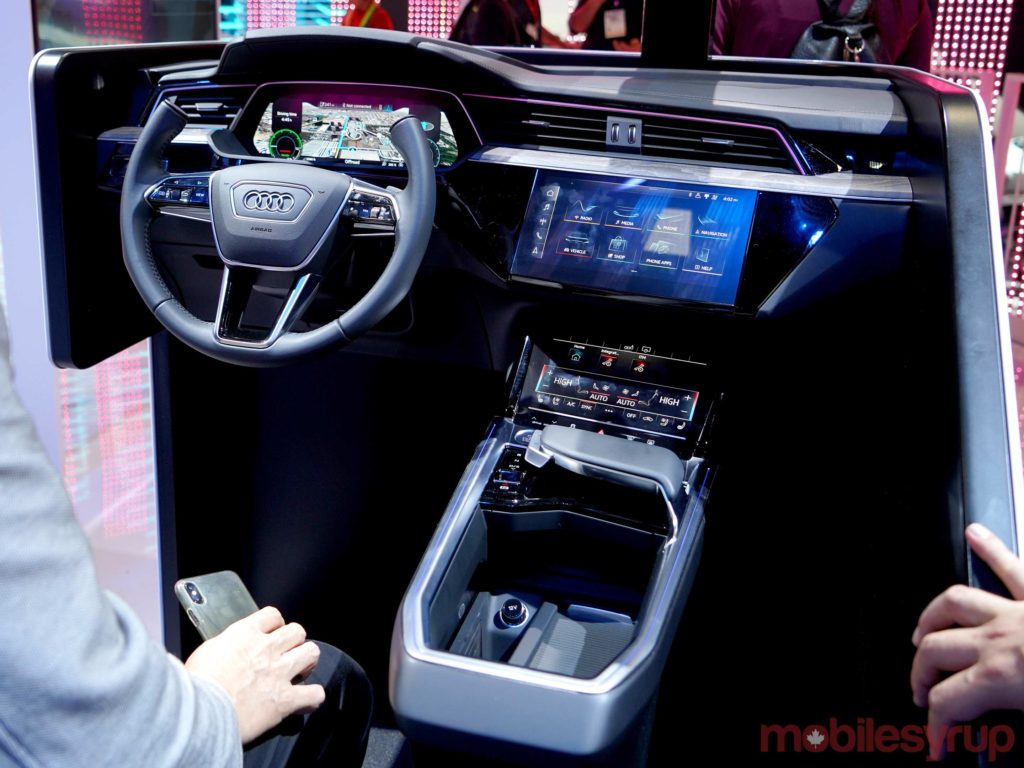
Powered by a single electronic control unit (ECU), the idea is to run Android apps from the car, not necessarily when projected onto a head unit through a phone, a la Android Auto. It’s a similar concept to what QNX unveiled last year, except much of it is ready for any automaker who wants it now. QNX reps say that consumer demand for greater integration fueled development, though it’s still a question of how it will play out with automakers.
The concept in the Revero was built on three in-car displays; one on the dash, one digital cluster and a third under the dash display. The idea is that Android apps can run more securely and that automakers can decide how and what apps to include in their own infotainment systems. For example, if they wanted to offer Google Maps or a modified Play Store, they could do so in a customized way.
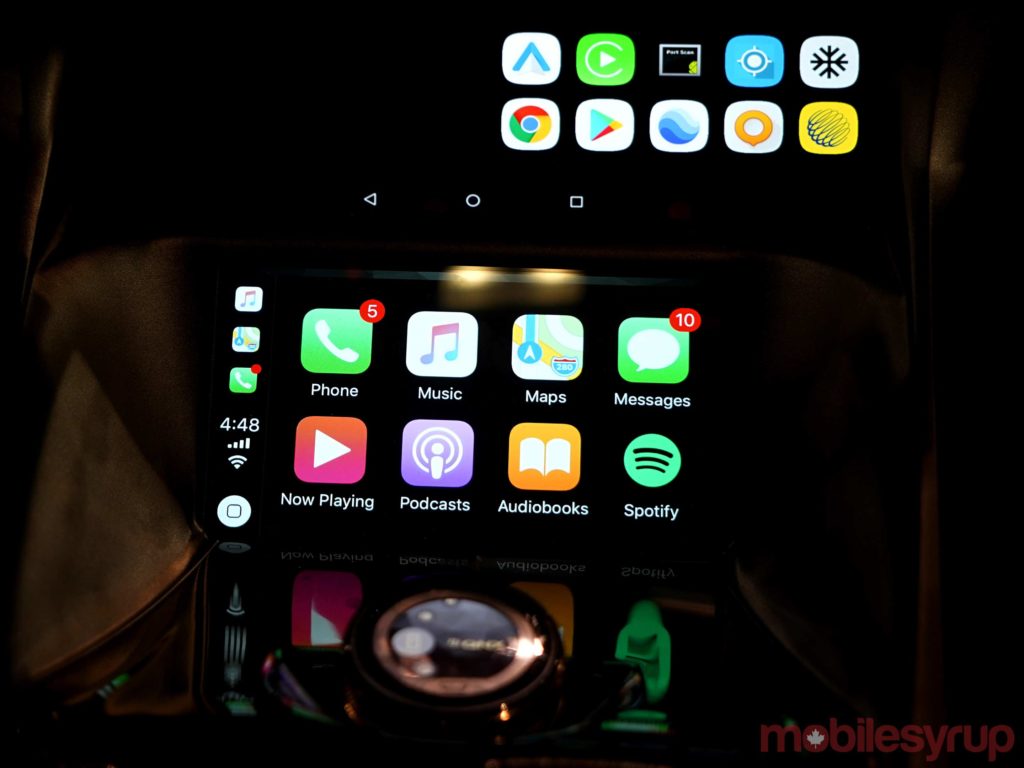
Another reason is to ensure security, given Android’s sometimes tenuous exposure to cyber attacks. QNX reps also said their partner in this endeavour, Tata Elxsi from India, was a key partner in getting this done.
Both Google Assistant and IBM Watson were integrated inside, so beyond apps, voice figured prominently here, too. It is conceptual, so again, it would be up to automakers to decide whether they want multiple third-party voice assistants inside or not.
Everything about the system, both functionally and visually, felt different than Android Auto, or even any OEM system.
QNX is already in 120 million vehicles, according to the company’s own stats. Audi’s MMI infotainment system showcased in the Q8 was an example of a vehicle that has something now.
For the first time, the German brand adopted the three-screen layout for certain 2019 and upcoming 2020 model vehicles. There’s no IBM Watson, nor the Android integration demoed in the Revero, but it looks pretty slick, as is. The touchpad next to the wireless charging pad is another input method where gestures can take over. For example, searching for a destination can be as simple as just writing out a few letters quickly with a finger instead of typing on a keyboard.
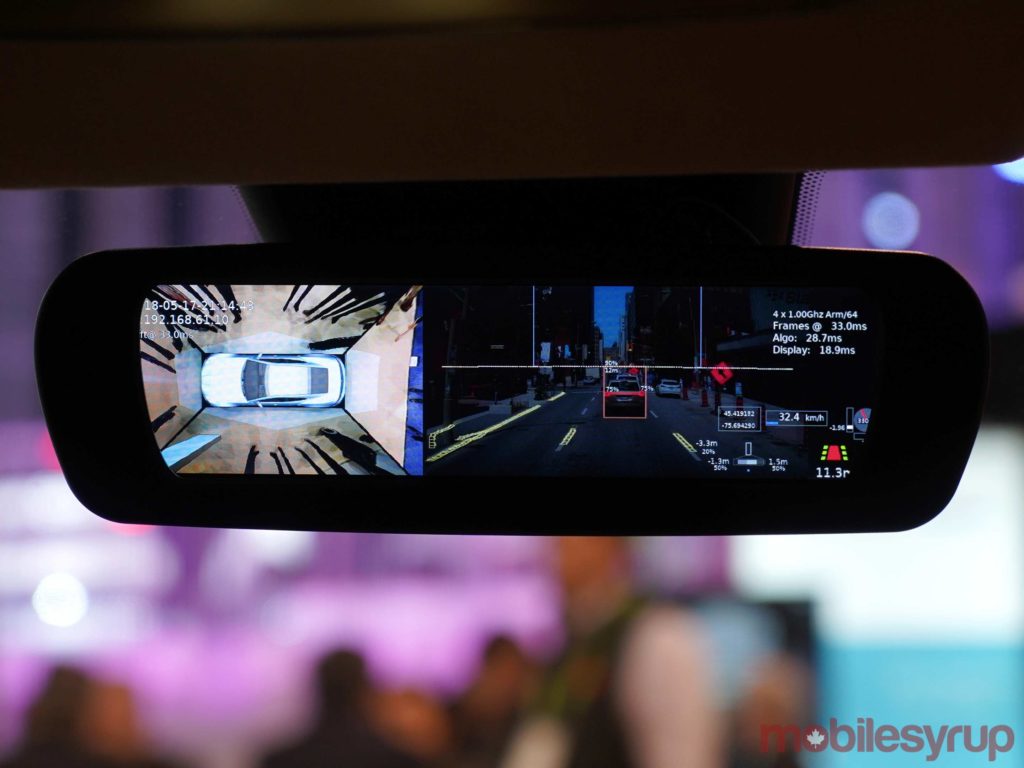
Drivers or passengers can add a detour to an existing route by touching a destination or dragging the route line over to it on the main dash screen. They can link any two points that way, too.
Unlike the Q8 in the QNX booth, the Audi booth had a number of different stations. Unfortunately, I didn’t get to try the Holoride demo that brings virtual reality (VR) into its vehicles, where passengers wearing VR headsets experienced space combat with the car’s movement. Audi showcased it with Marvel’s Guardians of the Galaxy ship
If the car veered or turned right or sped up, the ship would do the same in the virtual world. Audi thinks it will have this technology ready to go in the next three years, with infotainment integration still to be determined.
The post BlackBerry QNX Digital Cockpit Hands-on: Android apps running natively from the car appeared first on MobileSyrup.

Every week we bring you the latest in Canadian mobile news. Listed below is a quick overview of the top stories from the past seven days.
The post Top Canadian mobile stories from the past week appeared first on MobileSyrup.

