Facebook must be restructured. The FTC should take these nine steps now
This was published back in March of 2018, but it’s still a good list of things that should be done.
Facebook must be restructured. The FTC should take these nine steps now
This was published back in March of 2018, but it’s still a good list of things that should be done.
The headline is taken from a CBC News story and the motion will be debated tomorrow. It also provides a link to the motion as a pdf file. The motion asks Council to support the All on Board campaign. Apparently there is going to be a “research report containing evidence” – but that is not ready yet. You might think that it would be a Good Idea to have had that ready in time for the discussion. Because there is remarkably little evidence on offer so far either in the motion’s “Whereas” section or the campaign website. Other than some people think it might be a Good Idea and other places have already tried it.
What needs to be considered is how much revenue is going to be lost from this proposal and how it might be replaced. The motion suggests that the Provincial Government will be approached for more funding. Presumably, the Province will also have to consider if this is something that needs to be applied province wide. If not, then you can expect the attention to switch to property taxes as that is about the only source that the municipalities can access. I would certainly expect that someone will actually do the necessary policy analysis, which, of course, is entirely absent so far. This would include some assessment of the costs to increase transit supply at peak periods – and also at times when young people are not in school and can be expected to be enjoying their new found freedom to ride transit as often and as far as they can go. I would also expect questions to be asked like why does this demographic get pushed to the front of the line when others – the aged, the disabled, the desperately poor adult population – fail to get anything like such generous treatment?
I accept that for low income families even reduced fares for children can be inadequate to be affordable for many trips. At one time people who had transit passes could take their spouse and children with them at weekends for no extra charge. I forget now when that concession was withdrawn, but I would be willing to bet that cost was a concern.
It is true that giving children free rides will increase ridership – though the campaign has not made any forecast of that. Nor have they considered what other ways might also increase ridership and their comparative effectiveness. What we do know, and what is not mentioned anywhere in these materials, is how increasing service frequency and improving reliability (through traffic management measures) can offer much higher rates of return at lower levels of cost, and can be better targeted. For just as there are families that can’t afford transit, there are plenty for whom the fare is not the deterrent that inconvenience, unreliability and inadequate service undoubtedly are. Transit takes you from where you are not to a point at some distance from where you want to be. And for a lot of the trip will expect you to stand, or be crowded with others, or left at a bus stop wondering how long your wait will be. People who have invested heavily in a vehicle, and its insurance (which does not vary by distance driven) have a vested interest in getting as much use out of that expense as possible. And despite traffic congestion and the hassle of finding parking still get a better travel experience than transit riders for most trips. The car is at your convenience and takes you all the way without a transfer!
I do think that the province ought to be increasing what it spends on transit, I just think we need to be a bit more considered about how that money is spent. I also think that transit should not be considered as a social service or a redistributive device. If people are poor then giving them more money is far better than giving them scrip for approved expenditures. Free transit passes are as prescriptive as food stamps and both can be a stigma. Giving free rides to children whose parents are wealthy may not actually reduce car use all that much, if at all and is palpably wasteful.
And anyway, why are we focussed on transit and not asking why these kids are not walking more or using their bicycles? Might it be something to do with concerns about their safety?
With Firefox 67 you’ll be able to run different Firefox installs side by side by default.
Supporting profiles per installation is a feature that has been requested by pre-release users for a long time now and we’re pleased to announce that starting with Firefox 67 users will be able to run different installs of Firefox side by side without needing to manage profiles.
Firefox saves information such as bookmarks, passwords and user preferences in a set of files called your profile. This profile is stored in a location separate from the Firefox program files.
More details on profiles are can be found here.
Previously, all Firefox versions shared a single profile by default. With Firefox 67, Firefox will begin using a dedicated profile for each Firefox version (including Nightly, Beta, Developer Edition, and ESR). This will make Firefox more stable when switching between versions on the same computer and will also allow you to run different Firefox installations at the same time:
If you do nothing, your profile data will be different on each version of Firefox.
If you would like the information you save to Firefox to be the same on all versions, you can use a Firefox Account to keep them in sync.
Sync is the easiest way to make your profiles consistent on all of your versions of Firefox. You also get additional benefits like sending tabs and secure password storage. Get started with Sync here.
You will not lose any personal data or customizations. Any previous profile data is safe and attached to the first Firefox installation that was opened after this change.
Users of only one Firefox install or users of multiple Firefox installs who already had set different profiles for different installations will not notice the change
We really hope that this change will make it simpler for Firefox users to start running Nightly. If you come across a bug or have any suggestions we really welcome your input through our support channels.
Users who already have created manually separate profile for different installations will not notice the change (this has been the advised procedure on Nightly for a while).
A while ago Peter wrote about energy security and how having a less reliable grid may actually be useful to energy security.
This the difference between having tightly coupled systems and loosely coupled systems. Loosely coupled systems can show more robustness because having failing parts will not break the whole. It also allows for more resilience that way, you can locally fix things that fell apart.
It may clash however with our current expectations of having electricity 24/7. Because of that expectation we don’t spend much time about being clever in our timing and usage of energy. A long time ago I provided training to a group of some 20 Iraqi water provision managers, as part of the rebuilding efforts after the US invasion of Iraq. They had all kinds of issues obviously, and often issues arising in parallel. What I remember connected to Peter’s post is how they described Iraqi citizens had adapted to the intermittent availability of electricity and water. How they made things work, at some level, by incorporating the intermittent availability of things into their routines. When there was no electricity they used water for cooling, and vice versa for instance. A few years ago at a Border Sessions conference in The Hague, one speaker talked about resilience and intermittent energy sources too. He mentioned the example that historically Dutch millers had dispensation of visiting church on Sundays if it was windy enough to mill.
The past few days in Dutch newspapers a discussion is taking place that some local solar energy plans can’t be implemented because the grid maintainers can’t deal with the inputs. Now this isn’t necessarily true, but more the framing that comes with the current always on macro-grid. Tellingly any mention of micro grids, or local storage is absent from that framing.
In a different discussion with Peter Rukavina and with Peter Bihr, it was mentioned that resilience is, and needs to be, rising on the list of design principles. It’s also the reason why resilience is one of three elements of agency in my networked agency thinking.

Power lines in Canada, photo Ian Muttoo, license CC BY SA
The splashr package [srht|GL|GH] — an alternative to Selenium for javascript-enabled/browser-emulated web scraping — is now at version 0.6.0 (still in dev-mode but on its way to CRAN in the next 14 days).
The major change from version 0.5.x (which never made it to CRAN) is a swap out of the reticulated docker package with the pure-R stevedore package which will make it loads more compatible across the landscape of R installs as it removes a somewhat heavy dependency on a working Python environment (something quite challenging to consistently achieve in that fragmented language ecosystem).
Another addition is a set of new user agents for Android, Kindle, Apple TV & Chromecast as an increasing number of sites are changing what type of HTML (et. al.) they send to those and other alternative glowing rectangles. A more efficient/sane user agent system will also be introduced prior to the CRAN. Now’s the time to vote on existing issues or file new ones if there is a burning desire for new or modified functionality.
Since the Travis tests now work (they were failing miserably because of they Python dependency) I’ve integrated the changes from the 0.6.0 to the master branch but you can follow the machinations of the 0.6.0 branch up until CRAN release.
If you want me to ruin your day, ask me if you’re measuring the right things.
I’ll probably ask you what you will do differently if any of your metrics go up or down.
Then I’ll probably try to say something profound like: “If you don’t know what you will do differently because of the data, it really doesn’t matter what data you collect”
Data analysis should be the most powerful tool in your community professional toolkit.
It should tell you exactly what to stop doing, keep doing, and how to fix problems in your community.
But almost no-one is doing this today.
We spend a lot of time during our Strategic Community Management course changing how participants think about measurement.
Four Levels of Using Data
In our benchmarks, we rate data skills on a range of 1 to 4.
You can see a simple breakdown of these below:
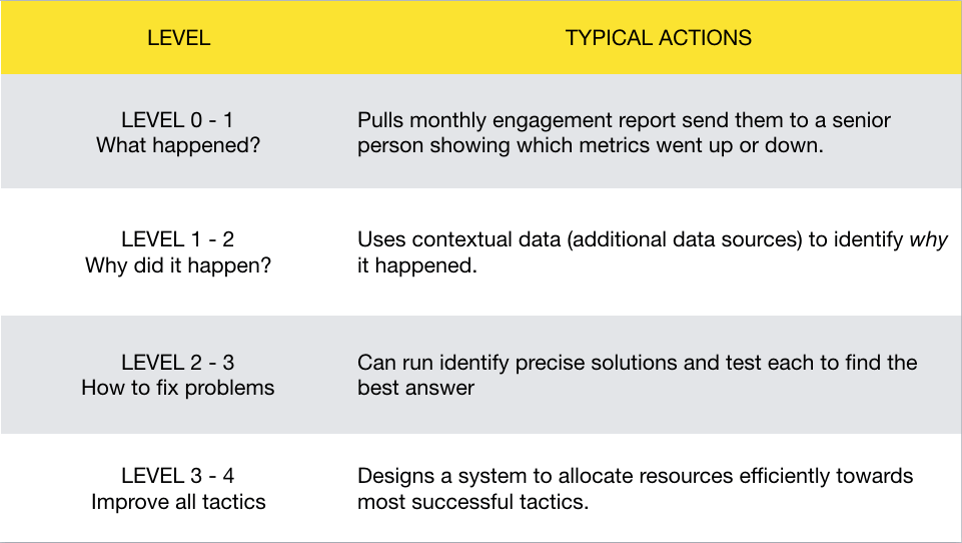
Almost everyone begins at a level 0 (not even measuring the right things). By the end of the course, we aim to get most people to level 3 or 4.
Here’s a breakdown of what each level looks like:
Level 0 – 1 – Measuring what happened
If you’re dropping monthly metrics into a big spreadsheet to send to your boss, you’re probably at level 0.
You’ve probably selected the metrics which are easiest to get instead of those which best reflect your work.
You’re also probably not presenting the data well or making any inferences about what the data is telling you.
Level 1 is usually the level of being able to pull data (automatically) from multiple sources into a single spreadsheet with simple to read dashboards. Here’s an example we put together for a client below:

(this goes on for another 20 columns or so)
This spreadsheet automatically pulls data from Google Analytics and runs SQL queries on the platform (along with some simple calculations) to complete a useful data set.
From this you can put together some simple dashboards to show what is and isn’t working like those below:
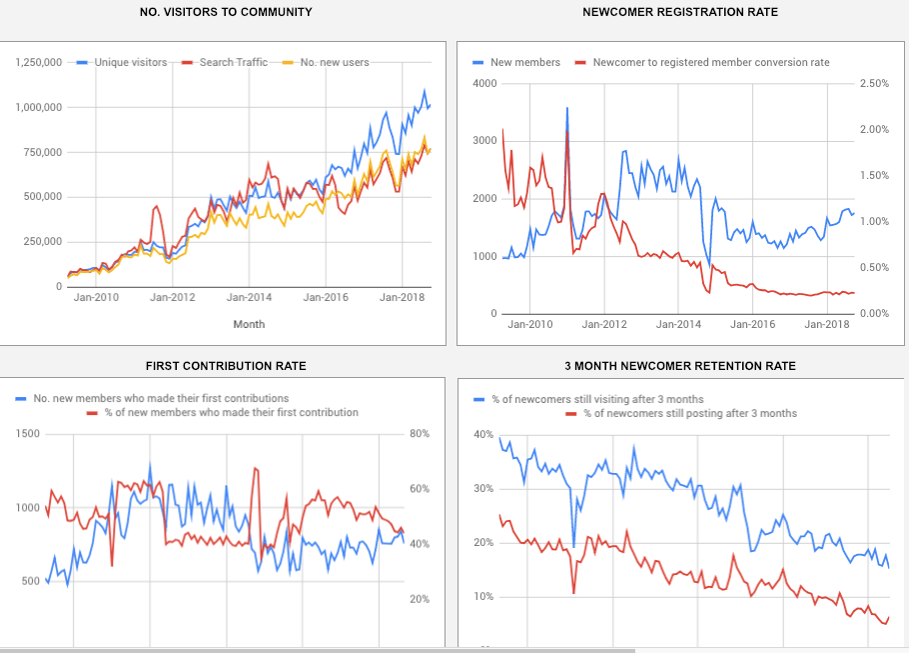
p.s. Just from these 4 (of 10) graphs, can you spot a few major problems already?
However, none of this data means anything if you have no idea what to do with it.
This means we need to understand why a metric we care about went up or down.
LEVEL 1 – 2 – Analyzing why it happened
Amazingly only a tiny fraction of people ever bothers to do this.
If growth is rising/falling or if activity is going up or down you need to know why.
Most people prefer to guess rather than analyze the problem in detail.
To analyze why a metric went up or down, you need a decision tree and additional data.
For example, imagine the number of posts in your community drops. There can be three possible reasons for this.
So you need to check the average number of posts per active member and number of members who made a post in the past month.
Let’s imagine members are posting less. This is still interesting, but it’s not useful.
To make it useful you need to know which type of members are posting less.
Hence (as you see in the table above) we like to know the average number of posts from the top 1%, top 10%, top 50% and bottom 50% of active members etc…
You can equally segment this by the average number of posts by newcomers, irregulars, veterans etc…
Is there a drop across all categories (which suggests a technology/level of interest problem) or is it focused on a single group (i.e. has the mean number of monthly posts from the top 1% dropped over time?)
Now you can look specifically at top members.
Was there a sudden drop in their level of participation or has there been a steady decline (usually speeding up until it becomes noticeable)?
This tells you if the problem is an external event (technology or product change) or if it’s a steadily declining loss of interest.
If it’s an external event you can pinpoint the date and see what else changed around that time to fix it.
If it’s a steadily declining loss of interest you need to figure out if they are losing interest in the topic altogether or just with your community?
If they participate in other communities, you can ask what they like better about that community and either incorporate features or develop new ones to bring them back.
By the end of this stage, you should be able to make really specific statements like:
The level of activity in our community has dropped in recent months because our top members are participating less. This is due to them preferring to answer questions on Quora, StackOverflow, and other online communities which are easier to use and gives them more visibility than they get from our community.
Notice how specific and concrete that is? It also rules out a lot of possible solutions which won’t work.
Most people if they see engagement dropping panic and try a bunch of silly tricks to get people to participate more (AMAs, photos, live chats, gamification etc…!).
These are wild guesses which have no chance of fixing the problem.
Now you know exactly what’s broken, but you still don’t know how to fix it.
LEVEL 2 – 3 – How To Improve It
This is the critical step.
It doesn’t matter how great you are at analyzing the problem if you don’t know how to fix it.
This means we need to put together a few ideas of how to fix the problem and test them until we get an answer.
From the above, we would probably test ways to improve the ease of community and the visibility members get from writing blog posts, asking questions, and answering questions.
First, we would look at who has solved this specific problem really well.
Asking peers helps (p.s. please stop asking for help until you’ve properly diagnosed the problem) so does your own research into existing brand communities which have managed to keep highly engaged experts.
Because every situation is different, you need to draw up a list of possible solutions to test. For example, this might include:
(aside, as a rule, don’t aim for equivalency with a competitor. Always do something a competitor can’t match).
If you’re pushed for time, you can try all of these at once. But you’re unlikely to have the resources to do it (and even if you did you wouldn’t know which was working). So try to test each individually.
Over time, you can rule out options until you find the ones that work.
Remember that any change might take 3 to 6 months to show up on the dashboard.
LEVEL 3 – 4 – Designing An Ongoing System For Improvement
But what if there isn’t an immediate problem?
This process doesn’t just explain a way to fix problems, it also shows a way to constantly improve your community.
You can inverse this process to identify what’s working well, analyze why it’s working, and then doubling down on the areas which work best.
At the very top level, you want to be dedicating more and more resources to the areas which produce the best results.
This first means identifying whether a tactic achieved its impact and deciding whether there is more potential in that impact (i.e. more people who can be reached, a bigger change in behavior etc..) if you invest more resources in the tactic.
This means you need to design a process where each month (or every 3 months) you measure which tactics are working well/not working well and then decide whether to repeat, kill, tweak, or invest more in the tactic.
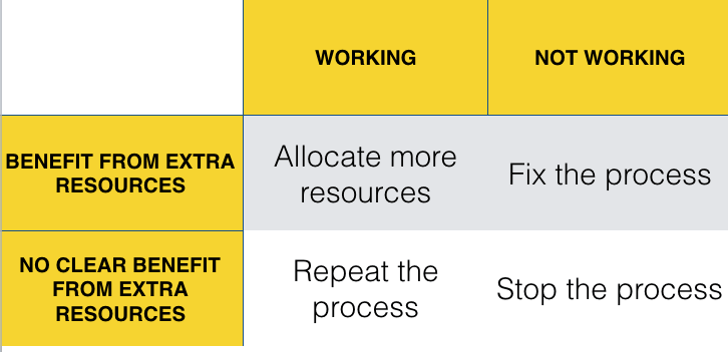
The purpose of this system is to gradually allocate more and more of your resources to the areas where they will have the biggest impact.
It doesn’t matter if you have 1 or 10 hours a day, you can still allocate your limited resources (and all resources are limited) to use them as effectively as possible.
Now you have a system in place which constantly improves your community as you collect more and more data.
Amateurs use intuition, professionals use data
I’ve seen organizations waste millions of dollars on migrating platforms and hiring new staff to fix problems which they haven’t properly analyzed.
I’ve seen community professionals waste months, even years, struggling to fix problems in their communities because they haven’t properly identified what’s going wrong or feasible solutions to fix this.
I’ve also seen far too many community professionals waste far too much time and energy on tactics which aren’t working.
These are all amateur level mistakes and we’re community professionals.
Amateurs use intuition and gut instinct, professionals use data and reason.
This is why data professionals are far more effective than amateurs.
This is how we get great results from our consultancy engagements, we turn this free asset into a powerful tool to diagnose and improve the community.
Beginning on January 28, we’re going to teach you how to do this.
I hope some of you will join us.
Click here to sign up for Strategic Community Management ($675 USD)
Click here to sign up for Psychology of Community ($675 USD)
Click here to sign up for both courses ($1100 USD)

Using color as the visual encoding, show changes over time in two dimensions. Read More

There's a space on the basketball court called "mid-range." It's actually not off-limits. In fact, people used to shoot these so-called "mid-range" shots. Read More
During the break between Christmas and New Year’s I migrated a server from Linode to Digital Ocean. We have just a handful left, and most of those should be gone this year. This migration was pretty straightforward, no WordPress portal or WHMCS instance, just a straight-up cPanel server. The plan was to run our handy dandy server deploy script which gets about 95% of a new cPanel server setup in about 30 minutes, which is amazing given this use to be a day-long process. Once that server is setup we need to copy all data between the two servers using IP addresses given we want to keep the same hostname, i.e., universityx.reclaimhosting.com. This is easily done with the the Transfer tool in cPanel, and migrating over 500 cPanel accounts took about an hour and a half.
Once all the accounts are migrated over cleanly, we need to point the DNS records in AWS’s Route 53 to the new IP address of the new server on Digital Ocean. If all went well that should be all set, the one mistake I made on this recent migration was not copying over the existing SSL certificate from the old server—it’s always something. So, after that’s done another trick Tim showed me that has come in useful was redirecting all traffic to the old IP to the new IP server-wide. This post spells it out very well, and it ensures that any lingering traffic that may be going to old server for all kinds of DNS reasons would be pushed to the new server right away.
https://www.debuntu.org/how-to-redirecting-network-traffic-to-a-new-ip-using-iptables/
Anyway, just putting this here in the event I need this again so I don’t have to dig through Slack again to find the link, not to mention to remind myself of the mistakes I made the last time so I can avoid them next time 
Yoku’s Island Express is weird. It’s a pinball platformer of short duration. Its segmented and straightforward play style is well-suited to 15-minute sessions making it a lovely fit for the Nintendo Switch’s portable nature. Its story is nothing special with a twist that I might not forgive you for not deducing a third of the way through the game. Its soundtrack is adorably dorky in the same way as Rayman Legends‘ or LocoRoco‘s or Katamari Damacy‘s.
(( You’re welcome, by the way. All of those are excellent. ))
There’s no high score system making it fiercely single-playthrough (which is good if you like games that actually end). Some of the pinball designs are just poorly-laid-out (one boss battle in particular can be a real trial). And traversing the world can be annoyingly convoluted and slow as you work your way through pinball traversals that were tricky the first time and now have lost all charm.
But it was fun. Altogether worth the about $25 it costs (and definitely worth the download and time to try out the demo if you’re still unsure if it’s for you).
I recommend it to anyone who isn’t afraid of weird things (say, if you’ve run out of things to roll up in Katamari and need something new) and games that are under 20 hours playtime. Fun for the whole family.
I’m going to be giving a talk, provisionally titled Counting the Countless: Data, Infrastructure, and Queer Pluralities, as part of Seattle University’s Trans* Visions Lecture Series. Anyone can come along! Details:

The German Reichstag with Tiergarten in the foreground.
The weather in Berlin isn’t typical for January. Instead, it rather feels like permanent November. The temperature has been between freezing and 5ºC, and the skies have been grey. While it’s easy to get around town, it’s my least favorite weather for January. I’d much rather have the bright blue sunny skies that come when the temperature goes below -10ºC.
(For my American friends, that’s 40ºF and 15ºF.)

We live in a dangerous world where privacy and security are more important than ever. In order for software to be trusted, the source code must be available to verify — a simple trust and verify model. Purism is proud to release all of our source code under Free Software licenses that not only empower users but are vital to protect their privacy and security. We favor licenses with strong copyleft like the GNU General Public License version 3, and will release software under the GPLv3 or an FSF-approved license we inherit. Our code can be studied, verified, and shared, whether you use our Librem line of products or not.
Software Freedom Conservancy is a vital and important part of the Free Software ecosystem that we at Purism and billions of people worldwide rely upon. Without organizations that protect and enforce the terms expressed in software licenses, our digital rights are at risk. Conservancy continues to play a central role in legal battles to safeguard these freedoms.
License enforcement is only part of the story, and Conservancy assists its member projects by handling all matters other than software development and documentation, so the developers can focus on what they do best: improving the software for the public good. Many of these member projects play a critical role in the advancement of privacy and security, such as the Reproducible Builds project and coreboot, one of the standout security features of Purism’s Librem laptops and upcoming smartphone.
Purism is delighted to contribute $1,000 USD to support Software Freedom Conservancy. Their funding drive ends today and we urge everyone who utilizes Free Software as part of their daily workflow or toolchain to donate to Conservancy and help them reach their fundraising goals.
The post Purism Supports Software Freedom Conservancy appeared first on Purism.
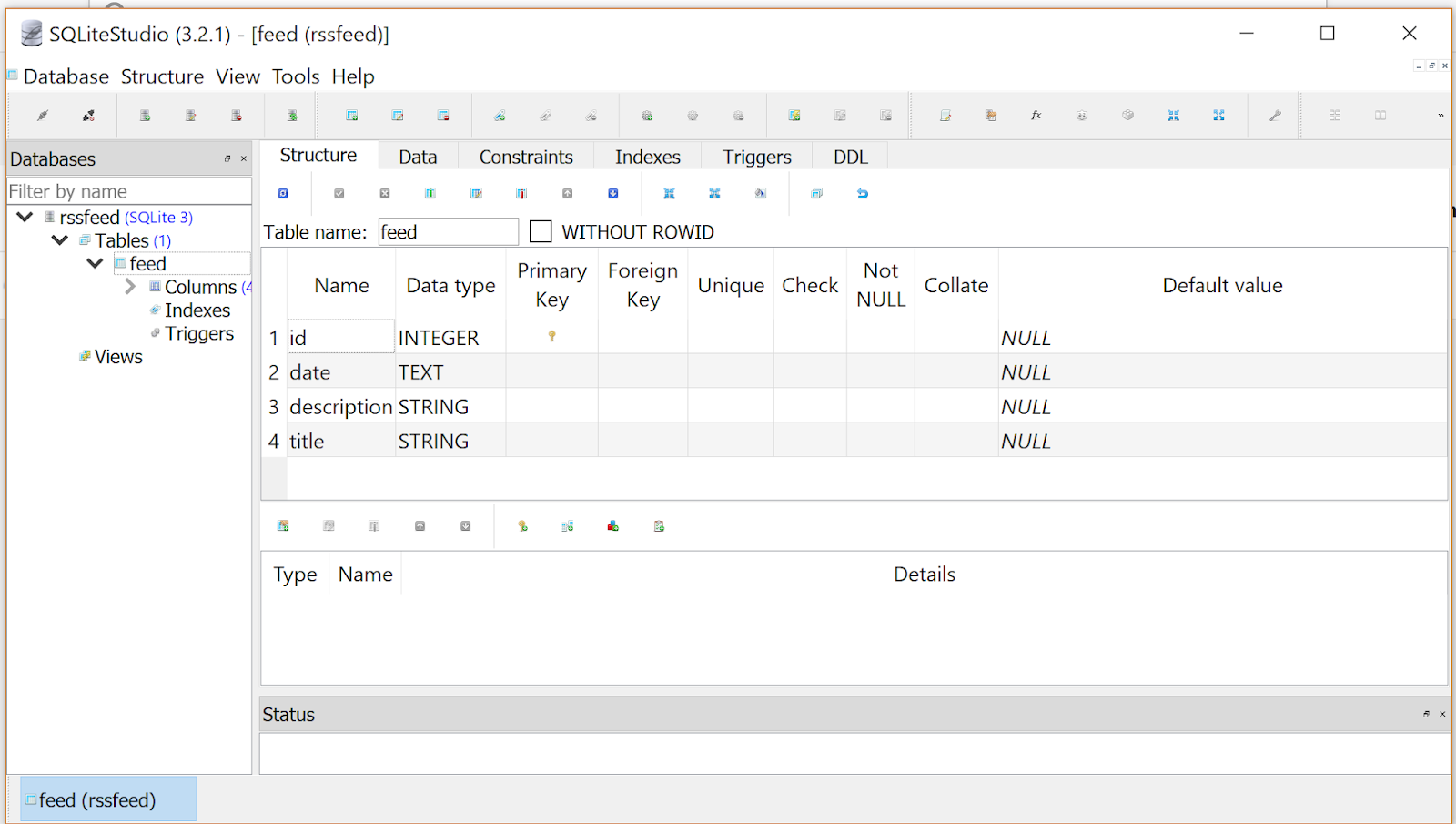 |
| SQLite Studio Interface |
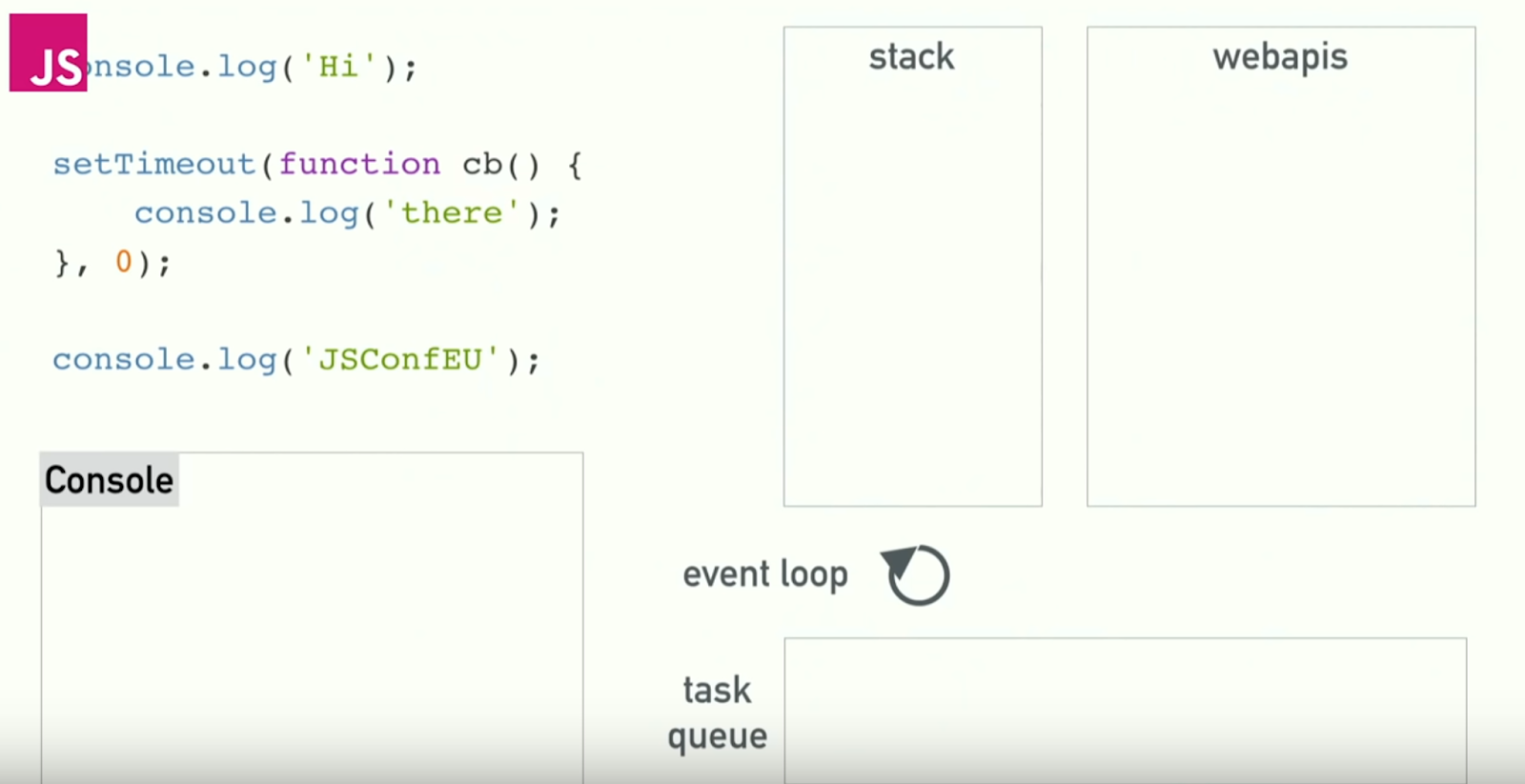 |
| Node stack and events |

Katerina and I were riding an elevator on our way home after spending the day at her co-working space.
“Hey, weren’t you the one wearing a Microsoft hoodie and using a Mac upstairs?“ asked a guy that was on the elevator with us.
“Yeah… I was.” I kind of knew what was coming and looking forward to it.
“Well, is that you know, allowed?”
“Sure! At least in some groups. More people than you might expect use Macs at Microsoft. A lot of people in my group have one.“
“But you have to have Windows on it, don’t you?”
“Nope.“ He was confused by that, so I continued. “I do have a Surface laptop which I use for all the things I need Windows for. But I’m in the Azure group, and most of what I do is work with Unix.”
“But,” he said, just not quite processing, “isn’t that kind of weird?”
Yeah, but in a good way. I didn’t have time; otherwise, I would have remembered to mention that some people in my group use straight up Linux, and others even use Chromebooks and have PlayStations hooked up to their televisions.
Words make pages, which make books. Behind that simple statement is the rich history of the mechanisms of printing. My personal history is a thread in the the broader history of the methods by which words reach the eyes of the reader — a narrative that came to life for me when I recently visited … Continued
The post Writing, printing, and permanence appeared first on without bullshit.
A very small hack, exporting the speaker’s notes from a slide deck, yet saving me some time and hassle every time I blog a presentation. All it took was one online search and adapting the applescript I found to my specific needs. Turns out, although Keynote doesn’t have an option to export notes, it does allow apple script direct access to those notes.
Back in December I announced my intention to take a sabbatical from Facebook and see what would happen. There were a number of factors in that decision, and I’ll share what I learned and what I’m doing now.
I had a few reasons for wanting to take a break:
These were the reasons I took a break and these are the reasons I am not coming back in a meaningful way.
When I started blogging in 2001, the promise of the Web 2.0 was that it would usher in the era of the creator. Any one could now create work on line. Recording studios, radio stations, television and film productions, newspaper, and magazines and book publishing all used to be inaccessible for the common person or the beginner artist. Now anyone could use whatever form of medium they wanted to say what is important to them. Before social media, Web 2.0 was about content creation media. It took time and effort to do it, but you could build a life, connect with others, find community in far flung corners of the globe, and make a contribution.
When social media came about into widespread use, around 2007 in my case with Facebook, the blogging world almost completely disappeared. People whose blogs I followed moved into facebook where I followed them for a while until their well crafted posts were lost in the endless stream of mindless diarizing, half-baked opinions and, later, the endless copypasta of shared memes and viral content. I had a hard time finding my people, but I was enjoying wishing friends a happy birthday and connecting with people from school, 30 years ago.
Over the past ten or so years what has happened is that my time has disappeared into the suck hole of scrolling through useless content instead of producing some of my own. Yesterday, talking with my friend Julien Thomas, I remembered that somewhere I said that democracy depends on us being active participants and not consumers.
Social media has made us consumers of other people’s content. In the 2001-2007 era of blogging, someone would write a post and if it was meaningful to you, you would quote it with an annotation about why it mattered and what your take was on it. Conversation was more considered and content was savoured and appreciated and hardly ever simply passed on. We were all content creators, hyperlinked to other content creators. When commenting began, discussion started to remain in a limited number of places but it was all open in the public and available to anyone. Comment spam really killed open discussion on blogs and maintaining spam-free comments sections became time-consuming. (Luckily there are better tools now, which is why you need to wait for me to approve comments on my blog).
With the dawn of Facebook however, content creation became highly concentrated in only a relatively and proportionally small number of places. Most people on Facebook simply pass it on other people’s stuff, often without any credit or link back to the original creator, and discussion happens behind closed doors and isn’t archived or very easy to access.
These days we are consumers of other people’s content, and we generally pass on what we like and agree with, amplifying it’s impact without adding to it. A few people have complained that they miss me on facebook, that they miss my voice and the things I say. But what I notice is that they like those things mostly because they can pass them on, or because what I have to say validates their views. It makes me I wonder where THEIR voice is, why they haven’t been thinking about things and sharing original opinions. And I wonder half-heartedly why I never get stuff from in my news feed that challenges my biases and my ideas anymore.
I have recently created a sock puppet twitter account to engage with conservatives in Canada, including those who are nationalist, populist and extreme right-wing. I am curious and concerned about the rise of populism and nationalism in Canada and the global connections between far right leaders who are promoting anti-immigrant, anti-globalist politics and messages. Through my “fake” twitter account, I am meeting conservatives that are also opposed to these far right echo chambers, and I am having my own ideas challenged. I am getting into debates and conversations with people I vehemently disagree with. I am posing on twitter as a real person, but not as “Chris Corrigan.”
I’m not going to reveal the identity of that twitter account. It says something to me about the nature of the social media landscape that I feel deeply uncomfortable showing up as my own self in those conversations. Debating with Nazis is not a safe thing to do, especially when one is debating with people hiding behind anonymous identities. And so I show up as a real person but with a fake name. Interesting.
Social media has become a place where relationships have become commercialized transactions and where democratic engagement has devolved into a fact free festival of insulting the other and patting your friends and allies on the back while being served highly specific advertising messages from corporations and political influencers. All the while, someone other than you is getting rich every time you connect to a friend. While it is nice to “stay in touch” I have to say that most of what passes across my screens on facebook is of very little value to me.
I would encourage people to go back to, or start blogging, and I’d encourage you to do it in the spirit of 2001 blogging, not in the spirit of “blog as PR tool” that we see today: share things, speculate, use it as a platform for what I call “Open Source Learning.” Use it as a gift exchange, not as a digital business card. Embed links to other people and add to the gifts of knowledge you receive before passing them on. You can start with WordPress as a powerful, free and easy-to-get-started-with tool.
For me I’ll be using facebook in these ways going forward:
I’ll be going off Instagram and What’s App entirely (both owned by Facebook) and continuing to use twitter (@chriscorrigan) as a place for spontaneous conversation and meeting new voices. You can find my photos on Flickr, which has recently become revitalized and awesome again. If you have a blog, let me know and I’ll add you to my RSS feed (I use Inoreader for that)
For open source projects it makes sense to have a public bug tracker. It would be hard to do the work without it.
But for commercial software? It’s not a good idea at all.
(I bring this up because I saw someone suggest this idea recently, and it stuck in my head.)
Decisions about what to work on — and when, and by whom — are complicated. From the outside it might look like it’s as simple as picking the next feature request with the most votes, but it’s not that simple.
A company might prioritize a crashing bug over that bug.
Or that feature might need x, y, z and done first, all of which require major work — maybe it needs some surprising amount of design or under-the-hood work, or both, that the requestors understandably don’t know about. Or it needs a bunch of localizations. Or lots of extra testing because the implementation is complex or wide-ranging — or it’s in an area where it could cause regressions.
Or the person who best knows that area of the code is temporarily on another team to help with another company priority. Or that person is going on vacation.
Or there are features nobody has asked for specifically, but that the company thinks would be awesome, and those get priority.
Or there are a half-dozen features that are low-hanging fruit, and for various reasons it’s a good idea to do a bunch of easy things for a while.
Or the feature doesn’t even really fit with the app: companies make that call all the time. (I never added Usenet support to NetNewsWire, despite getting requests for it.)
Or the feature is actually impossible. Or impossible without spending two years and a few million dollars on research and development first.
Or there’s a new OS feature that should be supported. Or an incompatibility with a new OS to fix.
And so on — the list goes on.
But if you have a public bug tracker, you’d likely find that you’re having to explain your decisions all the time. You’d be constantly defending your plans to people who remind you that Feature X has all these votes, so why hasn’t it shipped yet?
I’d argue that most companies aren’t open and accessible enough. Many companies don’t listen to their users very well. Many don’t even write honest and respectful release notes.
But opening up the bug tracker to the public is just a way to get bogged down: it’s a way to make worse decisions, and make them more slowly.
 Riding a bike is a great way to get fit. Just getting on a bike and riding it somewhere will give you exercise, and exercise is always good. So, if you want to get fitter and healthier, and fight aging, riding a bike will help. However, like everything, you can work hard, or you can work smart. And it turns out that interval training on a bike is the smart way to get fitter faster, burn more calories, fight stress and aging, and control blood sugar levels. Read our post to learn more about the exciting benefits of interval training on your bike. It includes the top 7 reasons to do interval training on your bike!
The post 7 Reasons to do Interval Training on Your Bike appeared first on Average Joe Cyclist.



So I was waiting for the 51A bus in the rain in the dark with some other folks and was super happy when the bus pulled up and it was near empty and the driver let down the ramp without any weirdness or fuss. There was another guy in the front of the bus sitting on the other side. The bus driver got out some big old straps. I thanked her and said I would rather not, and didn’t need them. She said she would have to call her supervisor because it was policy that she had to restrain my wheelchair, or I would have to get off the bus. She was nice about it and I just kind of nodded like, OK…. and said I had been riding buses in wheelchairs for many years and go ahead and call.
The guy across started yelling at me during this exchange, from almost the first moment, that I was a bitch, an asshole, a cocksucker, a goddamned bitch and he hopes I die young.
At that point I stared back at him and said it was too late for that since I’m already 50. (OK, well, 49 and a half.) The driver told him to shut up a few times and told him he should not call me out of my name. By that time we had driven off because her supervisor told her to tell me that, should I be injured because of not being restrained on the bus, they could not assume any liability. Thanks. OK. I agree! We drove down Broadway towards downtown.
Then the guy said someone should kill me. Staring right into my eyes he said “I’ll kill you myself you bitch!” Driver finally told him to shut up or she would make him get off but that just made him madder. At some point he started just mouthing or whispering his threats while flipping me off.
I felt very glad I was not strapped to the bus while I was a couple of feet away from this horrible man.
Was I married? He bet I was not. I’m too nasty! Too much of a bitch! He’s been married 4 times! He was in Vietnam! Also, he’ll kill me! I need to die! BITCH!!! You’re a BITCH!
It was amazing how much venom he got into the word “Bitch”!!!!
Let’s take a moment to quote the beautiful words of the immortal JOREEN,
Bitches must form together in a movement to deal with their problems in a political manner. They must organize for their own liberation as all women must organize for theirs. We must be strong, we must be militant, we must be dangerous. We must realize that Bitch is Beautiful and that we have nothing to lose. Nothing whatsoever.
Thank you Joreen!!! You give me strength!
At one point I said, You know what, we all have the right to ride this public bus, me, everyone, and you too even though you’re a sad and crazy old guy yelling at me, you get to ride the bus. That’s it. I was shaking with rage and fear but that’s what I said!
So that went on for a little while and I mostly didn’t say anything more, and I kept my camera on and pointed at him in case things heated up and my other hand on my folded up cane that I was half sitting on, which is quite sharp on the folded ends, carbon fiber edges, and which honestly I was ready to drive into a motherfucker’s throat if he came at me, and then he got off the bus while humbly thanking the bus driver and apologizing to her and everyone else on the bus FOR WHAT A BITCH I WAS SORRY TO EVERYONE EXCEPT HER THAT BITCH and now he was gonna go to Grocery Outlet. Bitch.
Wild!
Then, like, all the women on the bus came up to me and patted me and were sweet and concerned to check in that I was ok and say they were so sorry I had to go through that. And stuff. They were very nice but I was so mad I found it hard to talk any more. I actually thought then, Oh, they were more scared than I was. Until he got off. Huh.
My BART ride and extra bus ride home were peaceful. I then twittered cathartically about my experience all the way home, at some point realizing I should put on headphones and listen to the loudest possible riot grrrl and punk music. Thank you 7 Year Bitch, L7, Tribe 8, Crashprez, The Soviettes, MDC, Black Flag, and J Church. Very healing to the soul.
So, I am still super mad, and I so wished I could yell at that guy (more than the little bit of pissy backtalk that slipped out from me in the moment ) And also I had the thought that actually he did cross a line legally and it was all recorded on the bus camera which is easily obtainable through FOIA request. Like, he did threaten me and stuff but… Actually I just wanted to go home and recognized that my truly obscene amounts of privilege did not need to be whipped out just here. I disagreed with how the bus driver handled it but also figured that she probably saw this guy every day and she had a notion of whether he was really going to be violent or not. And I still had a part of me that didn’t want to agitate to kick an old guy out in the drizzling rain any more than I didn’t want to get off the bus myself and wait another 25 minutes for the next one. Anyway so I did not escalate and didn’t ask the bus driver to kick him off. She really was super calm and chill about the whole thing and I admire de-escalating in general. But, she could have – should have maybe – protected me a little more, I think. I’m going to be thinking about how I could have tried to set a boundary myself with the guy that I would have felt better with than what I went with which was “me shutting up while he yelled insults at me”.
I’m not so fragile! I’m mnot going to like, be fucked up that some asshole yelled at me! Assholes have been yelling at me on buses since I was 10 years old! They called me a faggot and a bitch and spit in my face and I cherish the memory of some guy who told me on Facebook 35 years later that he cherishes the memory of tiny 11 year old me double flipping off everyone on the bus clutching my bookbag to my chest and screaming shrilly, “FUCK YOUUUUUUUU!!!!!!!” I cherish my fierceness! I am a little badass inside! I don’t like being yelled at! It freaks me the fuck out! I would never tolerate it in my everyday life, not for a moment from anyone at all! Obviously, I’m fucking bothered or I wouldn’t be writing this hours later. But you know what….. WHATEVER. You know what is the best fierceness – it is maintaining your vulnerability. I don’t have to not be bothered, it is right to be upset, inside, it lets me defend my vulnerable self, which I assert to the world.
Anyway, I got off the bus pretty near my house and went across the street to see if this guy who lives on the corner was there because, he got all his stuff stolen again, and I got him some warm things but the shoes the VA gave him were two sizes too small, he took them because, half way on they kept his feet warmer and drier. He has a wheelchair but cannot push himself in it very well as his hands are also messed up but he gets along pretty ok. Whatever I asked him his shoe size the other day and realized it is the same size as my brother in law, and i was at him and my sister’s house all today, so I had these shoes to give him. He was happy about the shoes but he was also drinking and a bit messed up. I realized suddenly that between the bus stop and his niche on the corner I had seen a blanket and some bags and a backpack. Bob do you have your backpack. Was that your backpack over there on the other block? Oh no does it have an american flag on it? I went to see. Yes…. so… I brought him all his stuff. I think it just fell off the back of his chair as he was going along and he was too messed up to notice. No one had even gone through it. He kissed my hand drunkenly and invited me to sit with him. I went home but felt like so much more human because I took all the meanness and transmuted it into kindness and being decent to other people which is literally JUST WHAT HAS TO BE DONE. What is to be done? Do the work in front of you and be decent about it people. Like I said on the twitters Kindness is punk as fuck, and this bitch will bring you a boot party where it’s a present of boots that fit your feet and keep them warm and dry. Motherfucker, you will take these social services and this transformative justice and this example of nontoxic masculinity, OR ELSE. P.S. Fuck you, asshole!
How weird is it that I went from hating on one old guy to helping out another one. It is really true, that helping someone out is something to be grateful for, because they trusted you enough to let you do it.
I’d like to thank this cat, this nice loud riot grrrl music, this feminist manifesto from the year I was born, this soothing mint tea, and this excellent marijuana for the massive improvement of my evening.
Also my nice spouse who spent all weekend and all day since 5am trying to like save Europe from Article 13 and Article 11 and thus save the entire fucking Internet. And then who brought me the soothing mint tea.
The rest of the day was super nice, I spent it working while my sister worked on her stuff, and we showed each other physical therapy exercises and had tacos. When I stopped working I got to show my nephew how to write a little Inform7 and then I left him playing Zork.
Good night all.

This is a two-part post (Part 1, Part 2) I wrote describing my experiences taking a Udemy course on Electron, which is an application that enables you to create desktop software for Windows, Mac and Linux using only Javascript, CSS and HTML. I made the course my project over the recent holiday break (we all do different things for fun). In these posts I not only describe what I learned and how I leaned it, but also my (not so pleasant) experience taking a course on Udemy.
Web: [Direct Link] [This Post]
These are all pretty good guides and offer a fairly uniform view of what a good philosophy paper should look like. These are very different from what (say) a research paper in the field of education would look like. The latter are often structured to resemble empirical science (like you might find in engineering or physics) but are based on 'instruments' like surveys and polls. I personally think the philosophical approach is more suitable for education, given that there is little agreement on the goals, methods, instruments and outcomes of educational theory. At the very least, writers in education should (a) state a thesis, and (b) offer convincing evidence that the thesis is true.
Web: [Direct Link] [This Post]

