Shared posts

25 Jan 20:55

Vancouver Art Gallery’s Newest Design, Newest Donor

by Sandy James Planner

vancouver-art-gallery-new-museum-building-january-2019-design-8

vancouver-art-gallery-new-museum-building-january-2019-design-8

I have been writing about the new Vancouver Art Gallery (VAG) sporadically as new information comes up about the project. Everyone has an opinion on the design, the location, and how this building would connect with pedestrians at the ground level.

Five years ago Swiss architects Herzog & de Meuron were chosen to come up with a design for the new Vancouver Art Gallery to be located at 688 Cambie Street on land provided by the City on a 99 year lease.The original report to council in 2013 proposed a new art gallery that was double the size of the current gallery with 85,000 square feet of gallery space, with a cost of $350 million dollars in 2013. At that time the Federal and Provincial governments conditionally pledged 200 million dollars with the remaining 150 million dollars to be raised by private fundraising. That is a huge amount, and may be the largest sum raised privately in Canada.

The Chan family have graciously donated 40 million dollars to the project, and are the same family that provided 10 million dollars to the Chan Centre for the Performing Arts at the University of British Columbia.

As the Vancouver Sun’s Kevin Griffin notes “If everything goes according to plan and the VAG can raise another $165 million from private and public sources, the new gallery could be ready to show art by about 2023. That would mean being able to see art for free in two lower-level galleries, visit a dedicated area for the work of Emily Carr, and have a glass of wine in the restaurant overlooking the city.”

The new Art Gallery would create a new public space and gathering place in the downtown area. At the same time of the announcement a new design of the proposed gallery was also presented showing more glass on the exterior and less wood. You can see the new design below.

newvancouverartgallery_1

newvancouverartgallery_1

And you can compare that new rendering with the previous design given to the public here.

Vancouver-Art-Gallery-unveils-new-building-design-to-mixed-public-review

Vancouver-Art-Gallery-unveils-new-building-design-to-mixed-public-review

While the building is still boxy, the use of glass breaks up some of the monotony of the design, but a fence  still scaffolds the public from around the building.

vancouver-art-gallery-Herzog-de-Meuron-a3

vancouver-art-gallery-Herzog-de-Meuron-a3

Images:Vancitybuzz,DailyHive

Compare this design with that just released for the new Barbican Hall in London:

The new Barbican Hall is a 373 million pound (approx 649 million Canadian dollars) building which will include a concert hall, bars and restaurants. This design is by the American firm of Diller, Sofidio + Renfro.  But the geometry and Jumanji massing appears to be a trend in new public buildings that form the heart of cities.

You can watch  a short video from the Vancouver Sun of the Vancouver Art Gallery’s announcement of the Chan Family donation as well as some of the new  images of the proposed gallery design below.

.


25 Jan 20:54

The Turkey Mystery: Best Guesses

by Gordon Price

Why is there a carving of turkeys on the Hotel Vancouver?

I wasn’t the only one who was curious.  Glenda Bartosh too – only she knew someone to call: “I sent your turkey mystery to David Cook, a geologist/biologist who does a lot of work with Nature Vancouver, including excellent, informed tours of downtown buildings, inside and out, including the Hotel Vancouver. Here’s what he had to say.”

Glenda

Very interesting.

One thing I learned during my research for the tour is that masons tend to be very secretive and often do not explain the various motifs that they depict. They seem to like the observer to use their imagination. Some are quite whimsical,as I suspect is this case. For example the town Hall in Perth (where I grew up) was built by convicts and the windows are shaped like arrows which was the design on their prison garb.

In the quote from one of my references that I have posted below there is a mention of the nationalities of the carvers, with one country where the masons came from being Turkey. However it may also be a reference to Thanksgiving i.e. thanking the hotel for being a place of safety and refuge.

The turkey is also a symbol of abundance. Another possibility is that some North American native Indians consider the turkey a rain spirit which may be a reference to the high rainfall of our area. It is interesting that the carvers have recognized the indigenous peoples elsewhere on the building i.e. the depictions of the plains Indian chiefs on the east face of the hotel.

These are the explanations I can come up with at the moment.

David


25 Jan 20:54

Our Oil Consumption, 2014-2018

by peter@rukavina.net (Peter Rukavina)

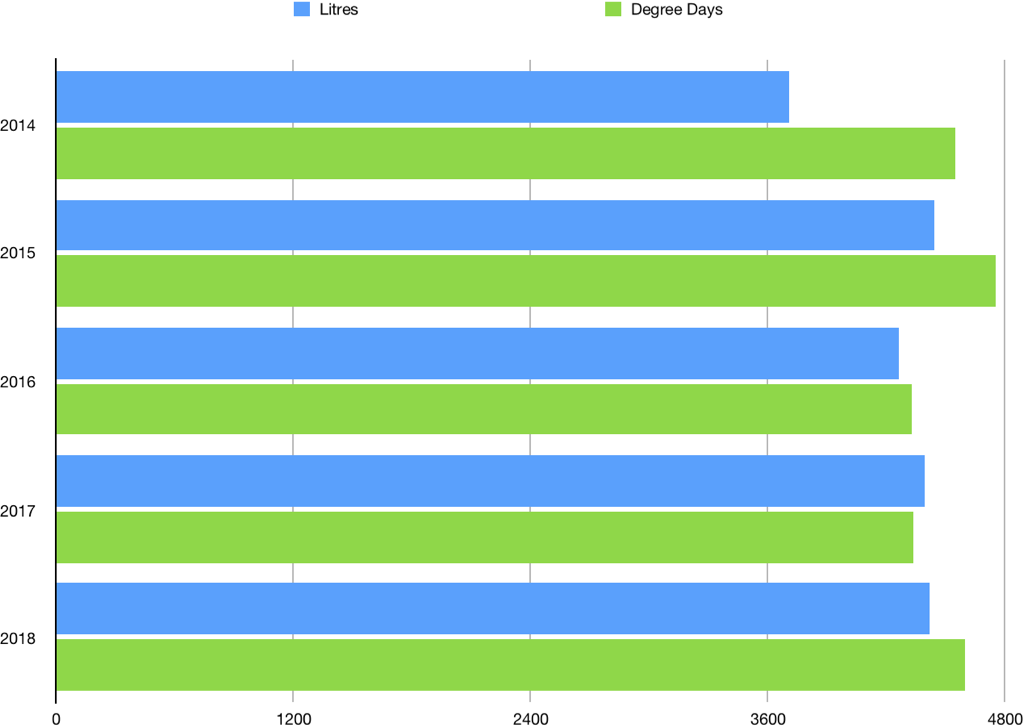
In 2014 I posted about our energy consumption at 100 Prince Street: that year we used 3,710 litres of home heating oil.

I asked Kenmac Energy for a statement of the three years we’ve been a customer (we switched from Coop Energy when it shut down) and they helpfully provided it. Combining that with data from Coop Energy, here’s what we consumed:

  • 2016: 3710 litres
  • 2015: 3920 litres
  • 2016: 4264 litres
  • 2017: 4391 litres
  • 2018: 4421 litres

Here’s a visualization of our usage, contrasted with the annual heating degree days for Charlottetown (from here: a measurement designed to quantify the demand for energy needed to heat a building. It is the number of degrees that a day’s average temperature is below 65o Fahrenheit):

Chart showing our oil consumption vs. heating degree days

Our consumption has gone up 711 litres/year from 2014 to 2018, but otherwise appears to be generally related to the number of heating degree days, which makes sense; given the number of degree days in 2014, though, I’m wonder if I under-reported the figure for that year.

I do all this calculating by way of trying to determine the way forward for how we heat our home.

We got a (very) ballpark estimate of $36,000, all-in, for replacing our oil-fired boiler with a high temperature vertical closed-loop geothermal system; while such a system wouldn’t take our energy costs to $0, as the system requires electricity, it would be dramatically less expensive.

We spent $4500 for our 4421 litres of home heating oil last year, so, very crudely, the geothermal system would have a payback period of 8 years. Which seems pretty amazing (assuming, of course, free and ready access to $36,000).

Our EnerGuide home energy audit last year estimated that we’d consume 4881 litres annually, which would emit 13.4 tonnes/year of greenhouse gas emissions; at that rate, we emitted 11.6 tonnes/year of greenhouse gases from home heating last year, and a geothermal system would take that down much closer to net-zero, which must be figured into any calculations we make.

25 Jan 20:54

How Can We Prepare For an Unknowable Future?

by Dave Pollard

Last Sunday, Bowen in Transition, the local chapter of the global Transition Network, held a meeting to discuss “our growing feelings of anxiety and insecurity as the news of climate collapse (and economic and social precarity) gets ever worse, how to deal with it all, and how to adapt to what is to come”. This was the first of several facilitated group discussions on this topic, and we started out with what the Transition Network calls the “inner transition” aspects: the internal work of understanding, coping and helping others cope emotionally with what we are now facing and expect to face in the future.

This idea of precarity (it’s the noun that relates to the adjective precarious) refers to uncertainty and the perception of possible risk or danger. It’s what I think underlies our anxiety, insecurity, and perhaps the grief, anger, fear and shame we feel about what we have done to this planet and what this bodes for the future of all life on earth, including ours and our descendants’.

We talked briefly about what we the members of Bowen in Transition can possibly do to help us prepare for a future we cannot possibly predict, and how that might lead to a kind of paralysis where we do nothing.

Brian Hoover and our brilliant facilitator Shasta Martinuk had raised the point about how, early in our civilization’s history, workers often spent their whole lives working on a single project like a cathedral, without any hope of ever seeing the culmination of their work, which might take decades if not centuries to complete. And how today, with the sense that we may not have decades or centuries left to do whatever work we now have to do, and with no real idea what we can or should do that will really make a positive difference, it’s easy to get overwhelmed.

Afterwards, I had a conversation with local activist, writer and artist Pauline Le Bel, who was part of our earnest group at the meeting, and I said to her:

What you said stood out for you (“the importance of deciding what to pay attention to; embracing insecurity; and letting go of outcomes”) also stood out for me. I think insecurity is the consequence of precarity — we can’t possibly be secure when we have no idea (but lots of fears about) what the future holds. That’s why for me Transition is all about those two elements of preparation for whatever might happen: re-skilling, and building community.

And why to me it’s so important to look past the grim decades to come and see how our work (both artistic and preparatory) might provide useful grounding for the human societies (plural — I think they will be amazingly diverse) that emerge in the millennia after collapse, even though we can’t possibly know or imagine how what we do will benefit them. We are cathedral-builders for the generations that will rise from the ashes of our unsustainable and crumbling industrial civilization. We are laying possible foundations. They may choose not to use them, and in that they may be wise. That is not our business.

So at this stage that would seem to be my answer: First, re-skill our community’s people (learn the essential skills that we will need if and when economic and ecological collapse leads to bankrupt governments and corporations and broken infrastructure). That doesn’t mean everyone needs to learn permaculture skills, for example, but those with the talent and passion for such work should, and we need to know who they are. Local communities left to manage by our own devices are going to have to be ready to be self-sufficient, and that means everyone needs to learn some relevant skills (both ‘hard’ and ‘soft’) that will be useful in collapse (and no, coding and financial arbitrage and marketing and accounting and litigation are not those skills). And we’ll have to be prepared to offer our skills to our community in return for others’ work in areas they have relevant skills in. Forget the use of currency, if there’s any left, or keeping score.

And second, build community. That means relearning how to relate to each other, to collaborate, coordinate, research needs, build local capacity, deal with conflicts, create local infrastructure and resources to replace the centralized ones that will no longer be available, and identify and overcome obstacles. It means that personal and family priorities (and possibly property) will have to give way to the priorities and needs of the whole community. It means dealing with dysfunctional, discordant and unpleasant community members, modelling needed behaviours, showing (not telling) people how to do things, learning to need and want less, learning greater self-awareness, and continuously adapting to ever-changing circumstances. It may mean migrating our whole community, if climate collapse makes ours practicably uninhabitable.

I have no idea how, even in our relatively small and self-contained community, we can go about doing these things. I guess we start by studying other cultures that do them well.

In past generations, much effort and pride went into creating a better world for following generations than the current one had. That’s no longer a reasonable hope. But if we look past the struggles of the coming decades, and learn from the ancient cathedral-builders, we might see that our work now will see its ultimate fruition not during collapse but in its aftermath, centuries and millennia in the future.

We have passed the point where sustainability and resilience are reasonable markers for what we should be doing. Nothing we do in our modern industrial civilization is sustainable, and resilience (“bouncing back” from hardship to some previous state of prosperity and growth) is a foolish ideal. The new markers for our actions are self-sufficiency (at the community, not the individual, level), adaptability, local knowledge (of the land, its life and its interdependencies), self-management, collective well-being, and equanimity — finding joy in spite of everything.

We have no way of knowing how our success (or failure) with these new markers will inspire (or incapacitate) the new human societies (probably much smaller and more local than anything humanity has witnessed in thirty millennia) that emerge from the ruins of our doomed civilization. But their affect will surely be substantial. Even if it’s 70 generations hence rather than 7, their astonishing societies will bear the hallmarks of what we do in the years and decades to come.

And the natural world, the more-than-human world, will recover in time no matter what we do, but the time it takes before it once again thrives will depend on our actions, or our inaction, today.

If we set aside blame and think of them and not ourselves — think of the cathedral whose walls and spires we will never see in our lifetimes as we struggle with its foundation — we can do right by these far-future generations, human and more-than-human. We owe them no less.

25 Jan 20:54

Faster and Lighter: Moving Ad Tech Server-Side

by The Times Open Team

By EDGAR VELEZ and PRANAY PRABHAT

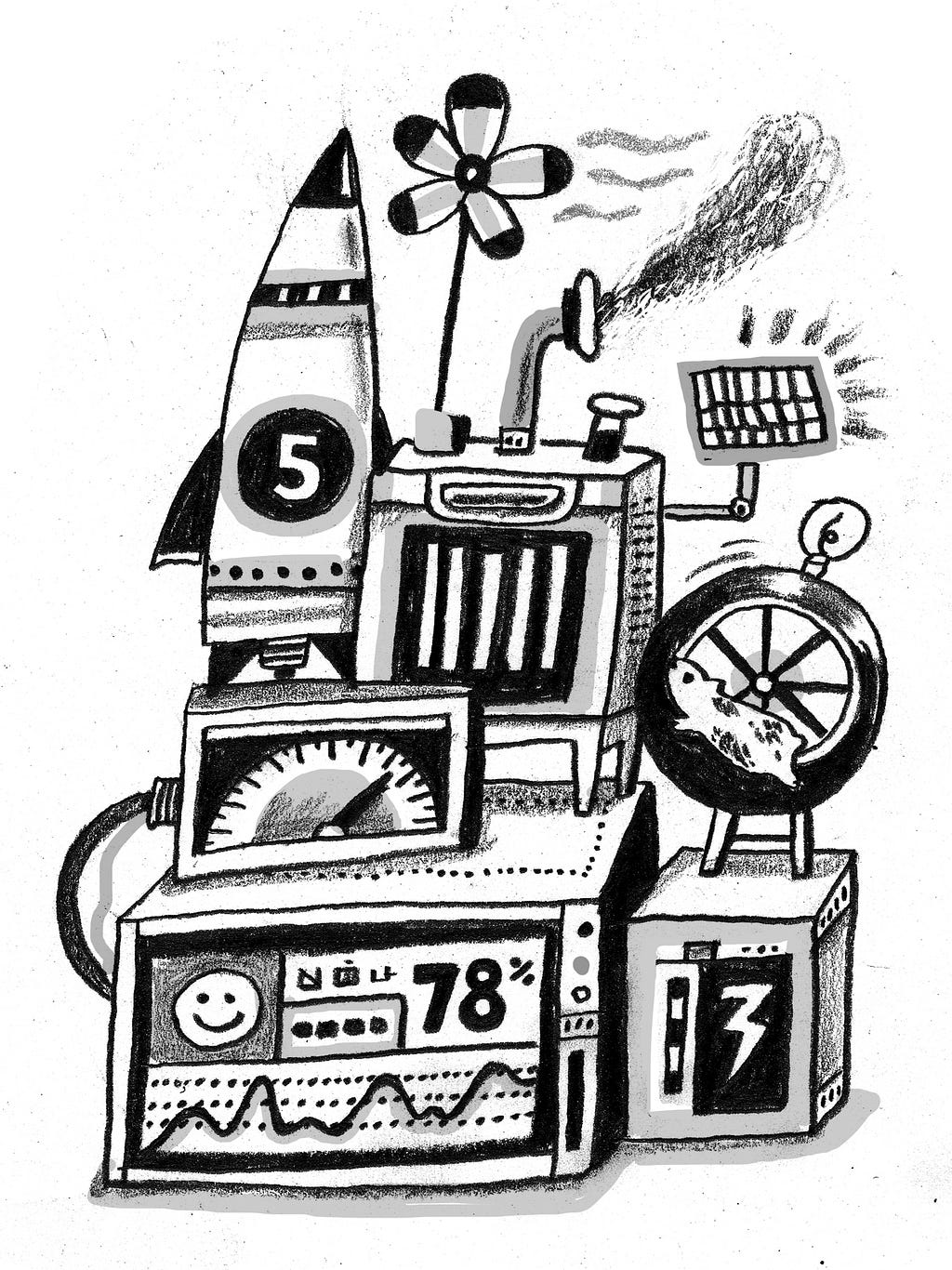
Illustration by David Huang

Rendering ads on web pages is a complex process. The process requires collecting the data needed to serve the most relevant ad, and configuring the code responsible for rendering that ad. Most of the heavy lifting to place an ad typically falls to the browser, with negative implications on page weight. Over the past year, the Digital Ad Systems team at The New York Times has transitioned some of our ad rendering logic to the server. We developed a framework that allows our team to configure rules that can be executed before an ad call is made.

For a media company like The Times, defining how ads are displayed requires extensive planning and engineering to make sure the right ads show up in the right places and to the right audience. Moving that logic to the server is no small feat, though it is worth it in the long run.

Server-side ad rendering not only lightened our page load, it allowed us to build a suite of ad products with more robust ad targeting. We now have more flexibility in defining the parameters that get passed to ad campaigns. Below is how we built our framework and how it works.

How we built it

We decided to use a microservices architecture to handle all of this in an efficient and scalable way. The first version of the project was built using Java 8 and the Spring Boot framework, and we deployed into Google Kubernetes Engine (GKE) and used Drone for deployment.

Later, our Data & Insights team built machine learning models that connected to new microservices we built. Our microservices use Google App Engine (GAE), Go and Marvin to enrich the ad targeting data by doing real-time lookup for specific data associated with Times articles.

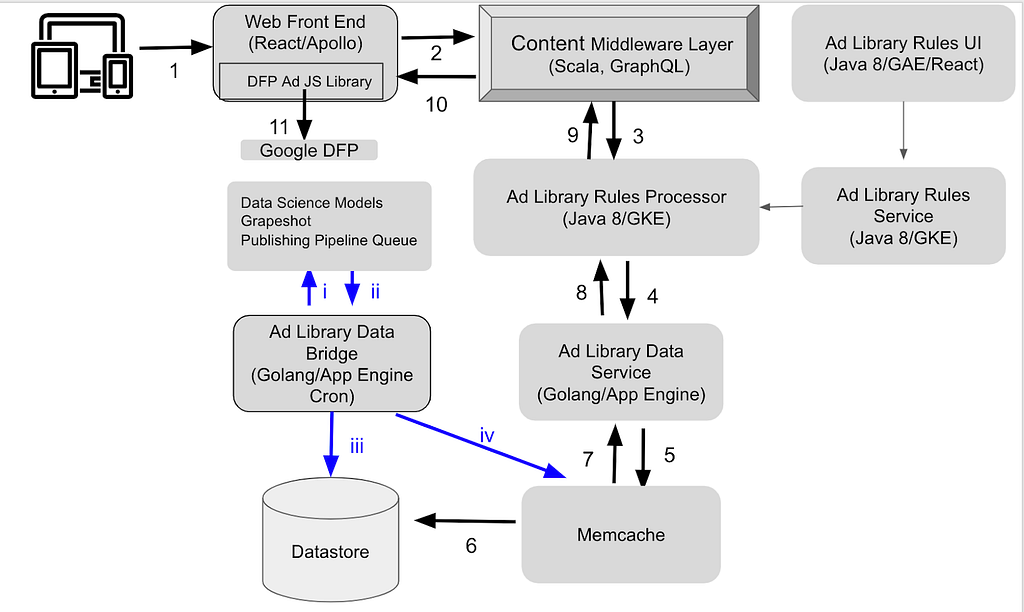
The component diagram below shows the entire flow of the systems involved, and how our framework supplies the ad targeting data back to the page for the ad server call.

Calls i, ii, iii and iv in blue happen in the background to sync data from multiple systems; Calls 1 to 11 in black happen realtime during page load. 11 Is the Ad request made from the page; All components named Ad Library were built as a part of this project

Web Front-End
The Times’s main app, which we call VI, is built using React.js and Apollo, and it is responsible for serving and rendering nytimes.com. Our ad library is embedded in the main app, and it is also built using React.js. It serves DFP, and handles the ad targeting parameters and ad rendering logic on the page.

Content Provider Service (Scala, GraphQL)
A highly scalable and resilient system built using Scala and GraphQL to serve content to all front-end applications. Our content provider service interacts with the service built as a part of this project to pull the ad targeting parameters and pass those back to VI.

Ad Library Rules Engine (Java 8, Spring Boot)
The rules processor we built for this project is extremely fast so it can handle all the rules set before the ad call is made on the page. Spring Boot is a lightweight framework well suited for this, especially when implemented alongside Java 8 and Kubernetes Engine with local caching. This turned out to be an ideal combination for processing the data and rules within few milliseconds.

Ad Library Rules Processor (Java 8, Kubernetes Engine)
The Rules Processor maps the ad targeting rules — such as the length of time pages associated with a major event get a special ad — into data structures that are understood by the rules engine above.

Ad Library Rules UI (React/Redux, GAE)
This is the client-facing GUI used by internal stakeholders to build rules for ad targeting. Access and CRUD support is provided by the Ad Library Rules Processor mentioned above.

Ad Library Data Service (Go, Marvin, Memcache, Datastore)
The data service’s primary function is to look up all the ad targeting data stored in the caching layer and pass it back to the rules engine. Given wide adoption of Go at The Times, and the availability of lots of shared components, we decided to leverage the speed of Go and the highly scalable GAE to build this service. The caching layer used was Memcache, which comes as a managed service if you use GAE.

Ad Library Data Bridge (Go, Marvin, Memcache, Datastore)
The bridge does the heavy lifting of pulling relevant information from external APIs, the data science model and publishing queues for new assets, and it stores the data in an App Engine-managed Memcache and Datastore. This component is built using Go and utilizes an easily configurable App Engine Cron scheduler and The Times’s Marvin Framework.

Illustration by David Huang

Three server-side successes

  • By moving our ad logic to the server and leveraging server-side caching, we lightened our page load time and reduced duplicative processing.
  • Consolidating our ad logic on the server means that the Ads Business team only has to go to one place when requesting changes to our ads logic. They can easily configure ad rules in the UI, which immediately triggers changes across our platforms including native apps.
  • Having a server-side solution provides the ability to integrate data science models and third-party APIs that enrich ad targeting parameters before the ad call is made from the page. Since all the heavy lifting is done server-side and cached, this introduces new and innovative targeting capabilities without any compromise on page load and ad call speed.

Next Steps

With much of nytimes.com powered by JavaScript, it’s becoming increasingly important to find ways to reduce page load. This is especially true in the ad tech space, where we are working to find advertising solutions on the server side.

At The Times, we see a huge potential to expand our server-side solution so we can better target ads without worrying about browser restrictions or relying on cookies. In the coming months, we plan to leverage more of GCP’s solutions for managing microservices. We see the Cloud Memory Store Redis caching service and Kubernetes as tools that will allow us to scale our framework and grow with The Times.

Edgar Velez is a Tech Lead with the Digital Ad Systems team at The New York Times. He is a Java to Go alchemist, and a burgeoning salsa dancer.

Pranay Prabhat is a Senior Director with the Digital Ad Systems team at The New York Times. He is an AdTech enthusiast.


Faster and Lighter: Moving Ad Tech Server-Side was originally published in Times Open on Medium, where people are continuing the conversation by highlighting and responding to this story.

25 Jan 20:54

Vaccinate!

by Andrea

BBC News: Parents’ vaccine side effects fear ‘fuelled by social media’.

“Fear of a vaccine’s side effects is the top reason for people refusing them, a report from the Royal Society for Public Health (RSPH) suggests.
Among parents, this was fuelled by social media, with up to half exposed to negative messages about vaccines.
The Society’s report called for social media platforms and the press to do more to combat “fake news”.
Millions of lives have been saved through vaccination, and side effects are rare, it said.
“The spread of misinformation – if it impacts uptake of vaccines – could severely damage the public’s health,” said Shirley Cramer, chief executive of the RSPH.
England’s chief medical officer Prof Dame Sally Davies recently said parents should ignore myths spread by anti-vaccine campaigners and get their children vaccinated.”

Sehe gerade, dass der Kinderdok mir zustimmt: Impfgegner sind eine Bedrohung für die Globale Gesundheit.

25 Jan 20:54

Dark UI patterns at Apple

by Volker Weber

2ff24546ffad4d0c639702f0e71518b6

iPads are wonderful devices for seniors. You can set them up and they get along just fine. But now Apple has decided to resort to dark UI patterns. Just hit the wrong option and you will find yourself paying for storage you never asked for.

And no, there is no option "No, I do not want this". There is just this tiny link "Not now" which means "I will come again until you give up or make a stupid mistake".

This is how Facebook operates. Shame on you.

Somehow Apple has decided that 5 GB of online storage is plenty for people who just bought a 512 GB iPhone or iPad. Over at Google you get unlimited full res photo and 4K video uploads until the end of January 2022 with each Pixel 3. Not 5 GB, not 500 GB. Unlimited. And you get to keep those uploads even after this 3 year period. No dark UI patterns needed.

What do you do about this with a senior's iPad? You install Google Photos and let it backup all photos in 16 MPixel quality. For free. For life. And you instruct the user to never ever trust one of those dialogs and look for the tiny "Not now" link.

25 Jan 20:54

Quick Hit: Automating Production Graphics Uploads in R Markdown Documents with googledrive

by hrbrmstr

As someone who measures all kinds of things on the internet as part of his $DAYJOB, I can say with some authority that huge swaths of organizations are using cloud-services such as Google Apps, Dropbox and Office 365 as part of their business process workflows. For me, one regular component that touches the “cloud” is when I have to share R-generated charts with our spiffy production team for use in reports, presentations and other general communications.

These are typically project-based tasks and data science team members typically use git- and AWS-based workflows for gathering data, performing analyses and generating output. While git is great at sharing code and ensuring the historical integrity of our analyses, we don’t expect the production team members to be or become experts in git to use our output. They live in Google Drive and thanks to the googledrive🔗 package we can bridge the gap between code and output with just a few lines of R code.

We use “R projects” to organize things and either use spinnable R scripts or R markdown documents inside those projects to gather, clean and analyze data.

For 2019, we’re using new, work-specific R markdown templates that have one new YAML header parameter:

params:
  gdrive_folder_url: "https://drive.google.com/drive/u/2/SOMEUSELESSHEXSTRING"

which just defines the Google Drive folder URL for the final output directory in the ☁.

Next is a new pre-configured knitr chunk call at the start of these production chart-generating documents:

knitr::opts_chunk$set(
  message = FALSE,
  warning = FALSE, dev = c("png", "cairo_pdf"),
  echo = FALSE,
  fig.retina = 2,
  fig.width = 10,
  fig.height = 6,
  fig.path = "prod/charts/"
)

since the production team wants PDF so they can work with it in their tools. Our testing showed that cairo_pdf produces the best/most consistent output, but PNGs show up better in the composite HTML documents so we use that order deliberately.

The real change is the consistent naming of the fig.path directory. By doing this, all we have to do is add a few lines (again, automatically generated) to the bottom of the document to have all the output automagically go to the proper Google Drive folder:

# Upload to production ----------------------------------------------------

googledrive::drive_auth()

# locate the folder
gdrive_prod_folder <- googledrive::as_id(params$gdrive_folder_url)

# clean it out
gdrls <- googledrive::drive_ls(gdrive_prod_folder)
if (nrow(gdrls) > 0) {
  dplyr::pull(gdrls, id) %>%
    purrr::walk(~googledrive::drive_rm(googledrive::as_id(.x)))
}

# upload new
list.files(here::here("prod/charts"), recursive = TRUE, full.names = TRUE) %>%
  purrr::walk(googledrive::drive_upload, path = gdrive_prod_folder)

Now, we never have to remember to drag documents into a browser and don’t have to load invasive Google applications onto our systems to ensure the right folks have the right files at the right time. We just have to use the new R markdown document type to generate a starter analysis document with all the necessary boilerplate baked in. Plus, .httr-oauth file is automatically ignored in .gitignore so there’s no information leakage to shared git repositories.

FIN

If you want to experiment with this, you can find a pre-configured template in the markdowntemplates package over at sr.ht, GitLab, or GitHub.

If you install the package you’ll be able to select this output type right from the new document dialog:

and new template will be ready to go with no copying, cutting or pasting.

Plus, since the Google Drive folder URL is an R markdown parameter, you can also use this in script automation (provided that you’ve wired up oauth correctly for those scripts).

25 Jan 20:53

[Important] Changes to the SUMO staff team

by pmcclard

TL;DR

  • Social Community Manager changes: Konstantina and Kiki will be taking over Social Community Management. As of today, Rachel has left Mozilla as an employee.
  • L10n/KB Community Manager changes: Ruben will be taking over Community Management for KB translations. As of today, Michal has left Mozilla as an employee.
  • SUMO community call to introduce Konstantina, Kiki and Ruben on the 24th of January at 9 am PST.
  • If you have questions or concerns please join the conversation on the SUMO forums or the SUMO discourse

Today we’d like to announce some changes to the SUMO staff team. Rachel McGuigan and Michał Dziewoński will be leaving Mozilla.

Rachel and Michal have been crucial to our efforts of creating and running SUMO for many years. Rachel first showed great talent with her work on FxOS support. Her drive with our social support team have been crucial to the support of Firefox releases. Michal’s drive and passion for languages have ensured SUMO KB has a fantastic coverage of languages and that support to use the free, open browser that is Firefox, is available for more people. We wish Rachel and Michal all the best on their next adventure and thank them for their contributions to Mozilla.

With these changes, we will be thinking about how best to organize the SUMO team. Rest assured, we will continue investing in community management and will be growing the overall size of the SUMO team throughout 2019.

In the meantime Konstantina, Kiki and Ruben will be stepping in temporarily while we seek to backfill these roles to help us ensure we still have full focus on our work and continue working on our projects with you all.

We are confident in the positive future of SUMO in Mozilla, and we remain excited about the many new products and platforms we will introduce support for.  We have an incredible opportunity in front of us to continue delivering huge impact for Mozilla in 2019 and are looking forward to making this real with all of you.

Keep rocking the helpful web!

25 Jan 20:53

My Emacs setup for Org mode, flyspell, and git

by Mark Watson, author and consultant
Originally posted June 2, 2018


I do much of my work in SSH shells to remote servers and while I have used Emacs for about 30 years I don’t usually take too much time and effort customizing it. I have recently started using Org mode at work (I am a Master Software Engineer at Capital One and manage a Deep Learning team) and at home. Today after enjoying a Saturday morning gym workout I decided to improve my Emacs setup and this blog article is documentation that I will use in the future for reference. If it saves you some time or gives you useful ideas, even better!
I wanted to enable flyspell (which is installed with any current Emacs distribution) for all text modes, and that includes Org mode files. I added the following to my .emacs file:
(add-hook 'text-mode-hook 'turn-on-visual-line-mode)

;; flyspell
(dolist (hook '(text-mode-hook))
(add-hook hook (lambda () (flyspell-mode 1))))
I like to augment the Aspell spelling dictionary with words I commonly use that are not in the default dictionary. As an example, I am going to configure Aspell with a custom dictionary and add the word “Keras” and “TensorFlow: by creating a file ~/.aspell.en.pws that contains:
personal_ws-1.1 en 0
Keras
TensorFlow
Now when your local Emacs runs Aspell, flyspell will pick up the words in your custom dictionary.
I love Org mode, especially with SrSpeedBar, to quickly navigate and use Org to organize my day, take project notes, etc.
I like to use SrSpeedbar when in window mode (i.e., when running Emacs locally in its own window) but not inside a terminal or SSH session. I add the following to my .emacs:
(load "~/.emacs.d/sr-speedbar.el")
(require 'sr-speedbar)
(setq
speedbar-use-images nil
speedbar-show-unknown-files t
sr-speedbar-right-side t)
(when window-system
(sr-speedbar-open))
(setq sr-speedbar-width 40) ;; doesn't work for me
(setq sr-speedbar-max-width 50) ;; doesn't work for me
I usually run package-list-package to find and install Emacs packages but I load sr-speedbar.el from a downloaded source file.
I sometimes use magit for using git inside my Emacs environent but I usually just run git on the command line.
Magit is probably already installed with your Emacs but if not you can use package-list-package (or however else you manage Emacs packages) to instal it.
So far I have not customized my magit setup at all, not even any key bindings. I use M-x magit- followed by the tab character to see possible completions. Usually I just use M-x magit-status to review version histories. Magit is a deep tool and I am getting used to it slowly, learnig features as I need them.
25 Jan 20:52

Twitter Favorites: [zoendOut] @instagram At least give us the option to see the timeline in chronological order. The algorithm you use sucks.

zoë @zoendOut
@instagram At least give us the option to see the timeline in chronological order. The algorithm you use sucks.
25 Jan 20:52

Twitter Favorites: [honest_update] Has anyone seen my YubiKey?

Honest Status Page @honest_update
Has anyone seen my YubiKey?
25 Jan 20:52

Twitter Favorites: [stephanie_ip] Whoa, did I hear that correctly? I wrote a commendation for a @TransLink driver who was kind, professional and pati… https://t.co/gshBFryw6p

Stephanie Ip @stephanie_ip
Whoa, did I hear that correctly? I wrote a commendation for a @TransLink driver who was kind, professional and pati… twitter.com/i/web/status/1…
25 Jan 20:52

Thingification

by Stowe Boyd

The Root Cause Of Pay Inequality | Glassdoor Smashed? | CEOs Freak Out | A Field Guide to the Future of Work | Euan Semple on Thingification

Beacon NY — 2018–10–17 — I’d naming this issue after my pal Euan’s post, Thingification, down below as the quote of the day.

:::

I don’t know what happened, but the flow has increased this week.

:::

If you’re getting this you probably signed up at workfutures.org (or one of its predecessors) or stoweboyd.com. If someone forwarded this to you, sign up here.

Consider becoming a paid sponsor to support our work, and to receive in-depth investigative reporting and discounts to other events, reports, and activities.

Links

Women won’t ask a man for more pay — but they will ask a woman | Iñigo Hernandez-Arenaz and Nagore Iriberri explore the odd terrain of pay inequality for women. A great deal of research has focused on the gender skew in negotiating salaries:

Linda Babcock and Sara Laschever […] show that among graduates of Carnegie Mellon University in Pennsylvania, 57 per cent of men negotiated their starting salary, while only 8 per cent of women did so.

But Hernandez-Arenaz and Iriberri looked into the genders of those involved in the negotiations [emphasis mine]:

We found that gender differences in negotiation are not so general but rather depend crucially on the gender composition of the bargaining table. Put simply, women negotiating their salaries ask for lower compensation when the firm’s representative is a man than when that representative is a woman. And, given that, most of the time, a firm’s bosses are men, this dynamic plays a role in salary outcomes.
[…]
The link between the labour market and the gender pay gap could go as follows: since managers and bosses are usually men (making them, by virtue of their position, the empowered party), female workers will be less likely than male workers to ask for raises and promotions. In addition, when they do, they will ask for less, which contributes to increasing the gender pay gap. So, our next step is clear: we must understand the roots of this gender-interaction effect on bargaining settings, and how to overcome it.

They soft-pedal it, but this could also be captured by a pointed question: Why are men unwilling to pay women as much as their male counterparts, and how do we get them to change their thinking?

:::

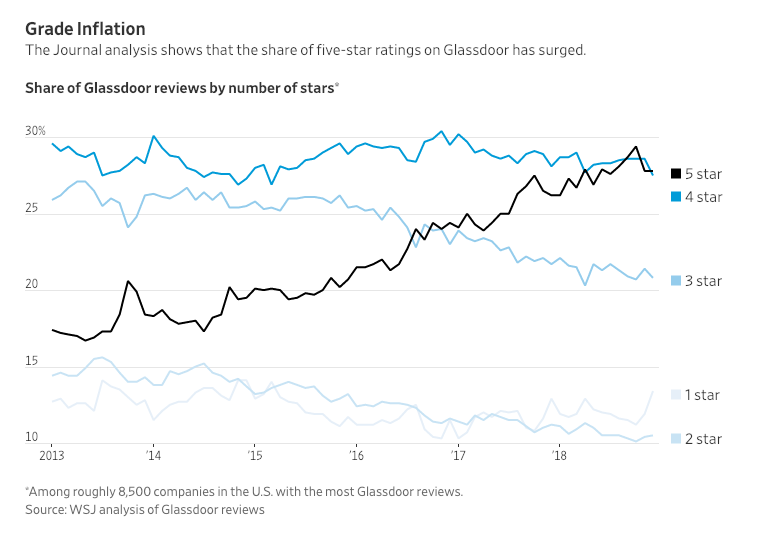
How Companies Secretly Boost Their Glassdoor Ratings | Rolfe Winkler and Andrea Fuller let us in on the Glassdoor secret: any game will be gamed, and Glassdoor has been played:

Glassdoor has become an important arbiter of employee sentiment in today’s highly competitive job market. A Wall Street Journal investigation shows it can be manipulated by employers trying to sway opinion in their favor.
[…]
In the summer of 2017, SpaceX recruiter Brittany Jacobson sent emails encouraging employees to post reviews in order to make Glassdoor’s “Best” list, said a person familiar with the effort. Workers were offered free SpaceX mugs for completing their review, said the person.
That followed a push in 2016, according to a second person, who said that SpaceX’s human-resources chief, Brian Bjelde, had taken notice of negative reviews that complained about SpaceX’s long hours and poor management.
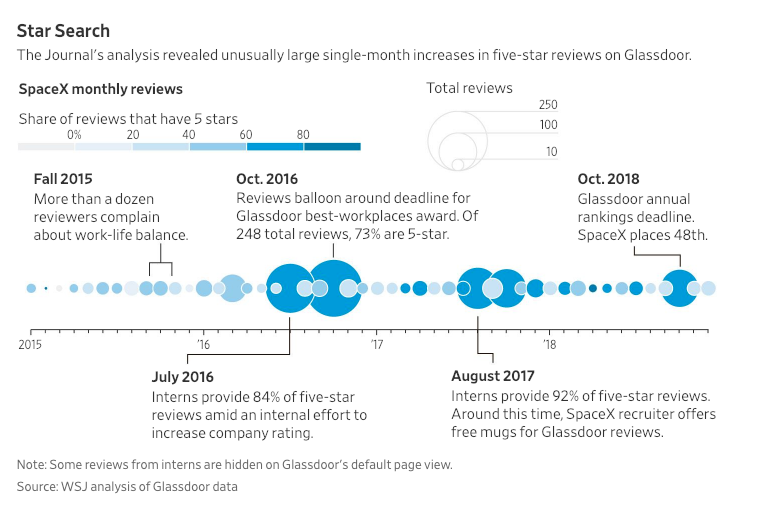
SpaceX employees flooded Glassdoor with 180 five-star reviews in October 2016. In most months that year, it earned less than a dozen five-star reviews. It had other spikes in 2017 and 2018.
Some months with high numbers of reviews came after interns were recruited, according to the first person familiar with the effort. They provided more than 84% of five-star reviews in July 2016 and in August 2017. Glassdoor allows users to filter out certain employee categories, such as interns and contractors.
Ms. Jacobson took credit for the campaigns on her LinkedIn profile, writing that she executed “company-wide employer branding campaigns” on Glassdoor, increasing the number of reviews by more than 1,000, raising the company’s overall rating to 4.4 stars from 3.8 and resulting in SpaceX landing on Glassdoor’s “Best” list two years in a row.

We see grade inflation over time:

And here’s an in detail look at SpaceX:

Basically, you should disregard the information on Glassdoor, just like Yelp. As with SpaceX, so too with SAP, Bain (see chart), etc.

:::

CEOs’ curbed confidence spells caution | PwC’s 22nd Annual Global CEO Survey shows that 2018’s confidence has run into headwinds [emphasis mine]

Reality check — Last year saw a record jump in optimism regarding global growth prospects in 2018, and this exuberance translated across regions. This year, by contrast, saw a record jump in pessimism, with nearly 30% of CEOs projecting a decline in global economic growth, up from a mere 5% last year. CEOs also reported a noteworthy dip in confidence in their own organisations’ revenue prospects over the short (12-month) and medium (three-year) term. If CEOs’ confidence continues to be a leading indicator, global economic growth will slow down in 2019.
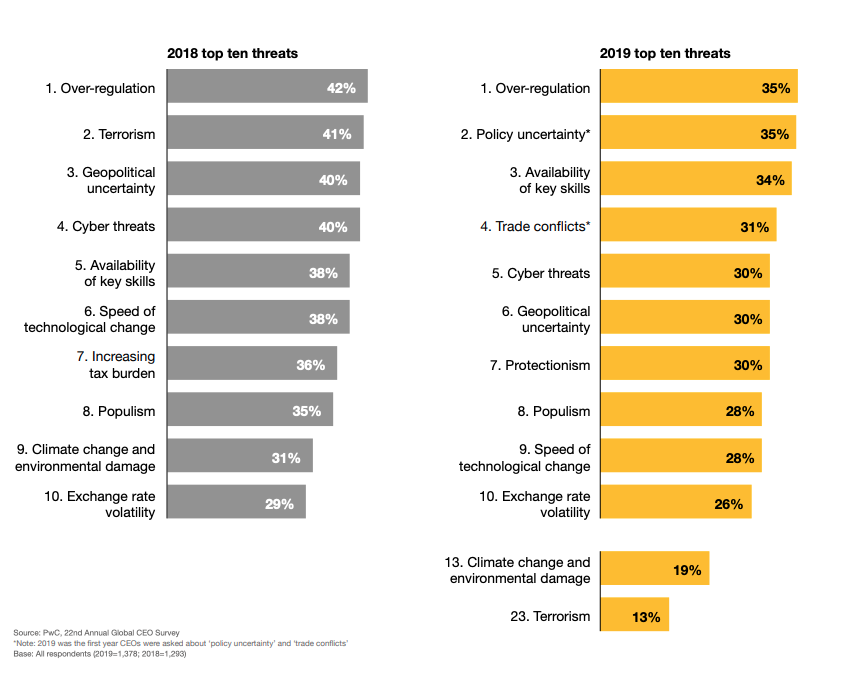
Look inside-out for growth — Across the survey rang a general theme of hunkering down as CEOs adapt to the strong nationalist and populist sentiment sweeping the globe. The threats they consider most pressing are less existential (e.g. terrorism, climate change) and more related to the ease of doing business in the markets where they operate (e.g. overregulation, policy uncertainty, availability of key skills, trade conflicts). When asked to identify the most attractive foreign markets for investment, CEOs are narrowing their choices and expressing more uncertainty.
Mind the information and skills gaps — In addition to the fault lines developing geopolitically, CEOs are working to bridge the gaps in their own capabilities. Organisations are struggling to translate a deluge of data into better decision making. There is a shortage of skilled talent to clean, integrate, and extract value from big data and move beyond baby steps toward artificial intelligence (AI). One of the more striking findings in this year’s survey was the fact that — despite billions of dollars of investment and priority positioning on the C-suite agenda — the gap between the information CEOs need and what they get has not closed in the past ten years.

Uh-oh. Here’s the global CEOs’ top ten threats:

If you need proof of short-termism at work, consider Climate change at 13, and over-regulation as #1. For a more detailed exploration of the report, see CEOs Freak Out. (Paid subscribers only. If you’d like a week-long trial for the paid subscription, fill in this form.)

:::

a field guide to the future of work | A compilation of essays by RSA Future Work Centre. I haven’t read it all, yet but plan to. Benedict Dellot writes, in the foreword [emphasis mine],

The quality of the conversation about technology matters greatly to our ability to prepare it. The civil servant in the Treasury dictating tax policy, the FE college leader rethinking their skills curricula, the corporate HR chief reconsidering their employee welfare programme — all are susceptible to making bad decisions with bad intelligence.
Which brings us to the purpose of this essay series: to break out of the same overworn questions, and give more airtime to alternative and thoughtful perspectives on how technology might shape the world of work.
A common theme in this series is the shifting sands of power. Nicolas Colin argues that the emergence of the digital economy has put consumers at the top of the food chain, and it is they who are now squeezing concessions out of workers rather than employers.
Other contributors turn to the familiar theme of automation, but with a fresh perspective. Calum Chace argues that automation will be a relentless job killer, but that it could also drastically reduce the cost of living for those on low incomes. Nick Srnicek similarly sees the brighter side of a new machine age, believing that it could usher in a 4-day working week. Astra Taylor, meanwhile, writes that automation is mostly a charade — a ploy by firms to look sophisticated while humans continue to do grunt work behind the scenes.
Several contributors predict that work will be bountiful in the years to come. But they also warn that such work will be highly scrutinised. Phoebe Moore contemplates a bleak future where workers find themselves at the tyranny of a pervasive surveillance system — one where monitoring tools not just assess worker performance but watch every aspect of their movement. Azeem Azhar echoes these warnings, suggesting that it may not be long before most of us have a rating attached to our name, which will determine eligibility for different job platforms and even goods and services like housing.
We are reminded, too, that the UK is not alone in feeling the effects of technology. Mark Graham writes about the emergence of a planetary labour market, where new technologies have allowed more jobs to be outsourced from developed to developing economies — including the grisly work of content moderation. Urvashi Aneja, our final contributor, ponders what a new machine age will mean for India’s 1.3 billion citizens. Will it fast track social mobility, or rather exacerbate the informal economy and lock in existing class and caste divides?
Some may feel the additional perspectives of these writers complicate rather than clarify the impact of technology on work. But that is precisely the point. Too often we yearn for neat forecasts that aim to tell us exactly how the future will play out (‘X million jobs to go by 2040’). In fact, we should be contemplating and preparing for multiple eventualities. The humility this requires may not come easily to those used to making confident predictions, but it is the only sensible way of readying ourselves for the future.
Our aim with this collection is to offer an eclectic, expansive, thought-provoking, though by no means exhaustive picture of the future of work. We hope readers will enjoy the plurality of perspectives presented, and we would encourage you to take a moment to think about how they might inform practices in your own workplace, profession or industry. Far from being a manifesto for fatalism, this pamphlet should rather be read as a call to action. After all, the point is not simply to sit passively and wait for the future to hit us, but to actively shape it in the way we see fit.

Maybe the PwC global CEOs should read this.

Quote of the Day

The process of thingification (turning a useful idea into the latest thing and thereby rendering it useless) appears unstoppable. In the context of work it happened with collaboration, innovation, and creativity. It is even happening with disruption! It happened with blogging, it happened with YouTube, it’s happening with podcasting.
All these potentially powerful attempts at building a new world using new tools being rendered safe by assimilation into the old.
Is this inevitable, or can we each do our bit to stop it happening? Being careful with our use of language, particularly jargon. Checking our intent and resisting bandwagons. Ignoring the most blatant attempts at cooption and manipulation.
Every time someone calls themselves a “social media influencer” an angel dies.

| Euan Semple, Thingification

Originally published at workfutures.org.


Thingification was originally published in Work Futures Institute on Medium, where people are continuing the conversation by highlighting and responding to this story.

25 Jan 19:16

Facebook to shut down Moments photo app in February

by Bradly Shankar
Facebook app on iPhone

Facebook has confirmed that it will shutter its Moments photo app on February 25th.

In a statement to CNET, Rushabh Doshi, director of product management for Moments, cited low usage of the app as a primary reason for shutting it down.

“We’re ending support for the Moments app, which we originally launched as a place for people to save their photos,” Rushabh Doshi, director of product management for Moments, said in a statement. “We know the photos people share are important to them so we will continue offering ways to save memories within the Facebook app.”

Moments launched in 2015 as a means for users to share pictures from their phone with their Facebook friends without uploading the photos to the social network.

Facebook is giving users until May to visit a special website and export their Moments photos and videos either as a private Facebook album or as a download.

Source: CNET

The post Facebook to shut down Moments photo app in February appeared first on MobileSyrup.

25 Jan 19:16

Lightning’s new Strike electric Motorcycle is up for pre-order

by Brad Bennett

On January 18th little known electric motorcycle company Lightning announced the Strike e-moto and now it’s up for pre-order.

The Strike starts at $12,998 USD (roughly, $17,232 CAD) and Lightning says that it has a top speed of 240km/h plus a maximum range of 240km.

There are two versions of the bike up for pre-order right now. A reservation for the standard version costs $500 USD (roughly, $668 CAD). There’s a more expensive carbon version that costs $10,000 USD (roughly, $1,336 CAD).

The carbon version of the bike is just the standard version of the bike with all of the potential add-ons and trim upgrades. But thankfully, both the $10,000 and the $500 deposits are fully refundable.

It seems odd that the company is asking for pre-orders before it’s shown off what the bike looks like, but its costcompared to Harley Davidson’s LiveWire might help it move some units.

Source: Lightning

The post Lightning’s new Strike electric Motorcycle is up for pre-order appeared first on MobileSyrup.

24 Jan 19:15

A modest proposal for nudging young people into finding a direction in life

by Doug Belshaw

If you go to the Mozilla home page, right click, and ‘view source’, you see something like this:

Mozilla source code

Underneath the ASCII art of a dragon breathing fire (and the Mozilla logo), the page reads:

Hi there, nice to meet you!

Interested in having a direct impact on hundreds of millions of users? Join
Mozilla, and become part of a global community that’s helping to build a
brighter future for the Web.

Visit https://careers.mozilla.org to learn about our current job openings.
Visit https://www.mozilla.org/contribute for more ways to get involved and
help support Mozilla.

I don’t know if they’ve got any stats on how many people respond to this call to action, but when I was at Mozilla, there were lots of people who I wouldn’t consider your ‘usual’ tech contributors. I’m guessing things like this make a practical difference.

Last night I had a dream. No, stay with me. In it, I was advising someone who was having a real problem with kids trying to get around filters and firewalls he’d put in place in a school. It’s probably because tomorrow I’ll be at BETT in London where all kinds of technologies will be on offer trying to ever more lock down the internet to children.

Before I continue, I’m not advocating a free-for-all. Goodness knows I have to lock things down a bit for my 12 year-old son at home. However, I do think there’s an opportunity here, and it’s related to what Mozilla do with their home page.


For better or worse, most educational institutions now do some kind of forensic tracking and analysis of searches made and websites visited across their network. Given the duty of care they have and the times we live in, I’d expect nothing different. However, I’m pretty sure we could leverage that to help young people make some choices in life.

It doesn’t have to be ASCII art and volunteering for a tech company! How about the following?

  • Repeated searches for food leads to an email invitiation to cookery club
  • Visiting a bunch of beauty and fashion sites leads to a prompt to ask if they’ve considered doing a qualification in design
  • Violations of school security and privacy policies lead to recruitment to being an ‘ethical hacker’ for the organisation

Schools and other educational institutions have so much data on young people these days. I just wonder whether, with a few little tweaks and some lateral thinking, we could make that useful to students, too?

I’d love to know if anywhere is already doing this! Have you seen any examples?

24 Jan 19:13

Unscaled businesses

by Paul Jarvis
It’s time to start challenging the old (and even current) mental models of business, as the time of monolithic companies could be coming to an end
24 Jan 19:12

Apple hires senior Samsung battery executive

by Igor Bonifacic

Apple has hired Soonho Ahn, a former senior Samsung executive, to head up development of its own battery technology.

According to an update on Ahn’s Linkedin profile, which Bloomberg‘s Mark Gurman was the first to spot, Ahn joined Apple as global head of battery developments this past December. Ahn had worked at Samsung SDI, Samsung’s battery making subsidiary, since 2015.

Ahn’s profile says he had worked on “next-generation” battery technologies while at Samsung SDI.

Apple has sourced batteries from Samsung SDI to power previous iPhone models.

Like the company’s investments into LG Display, Ahn’s hire represents a desire by Apple to lessen its dependence on Samsung and other companies for iPhone parts. Across the board, Apple has moved in recent months to become more self-sufficient.

Just last month, The Information published a report that said Apple had started development on its own modem technology to lessen its dependence on suppliers like Intel and Qualcomm.

Source: Bloomberg

The post Apple hires senior Samsung battery executive appeared first on MobileSyrup.

24 Jan 19:11

New Feelings: Ungoogleability

by Linda Besner

I was walking down the street when it crossed my mind to wonder if my grandmother had ever had a nose job, and I thought, I’ll google it when I get home. A nanosecond later, I felt a flicker of fear.

To say that I thought I would google it is slightly disingenuous — it wasn’t a thought so much as a reflex, like reaching for something in the kitchen that’s usually kept in the same place. It’s the way people talk about the death of a loved one — picking up the phone to call them before realizing the outside world can be bare of something that lives with intensity in the mind. Coming up on a limit to the internet’s knowledge was an almost physical shock — the bottom fell out of my sense of narrative continuity, of being in a recorded universe. In that moment I realized I’d been thinking of the internet as an omniscient narrator.

When I realize the internet doesn’t know her, I remember that the internet doesn’t know what’s important to me

On the Australian comedy Please Like Me, after the main character’s mother commits suicide, he tells his therapist, “I googled ‘why did mum kill herself?’ but it just told me why other mums killed themselves and now it keeps trying to sell me a new mum.” I came home and tried googling, “Did Grandma Judi get a nose job?” I got a Pinterest page of someone named Judy’s before and after photos, a Daily Mail article about how the demand for nose jobs in Iran is seven times higher than anywhere else, and an article about how to reduce snoring.

If my grandmother had lived long enough to have a Facebook account, the internet might be able to tell me whether she’d ever had cosmetic surgery. She might have posted photos from her youth in Montreal, and her later life in Rio de Janeiro. As it is, her life was far less documented than mine, even though she was a much more interesting person. When I realize the internet doesn’t know her, I remember that the internet doesn’t know what’s important to me.


Rationally, I know the internet isn’t, in fact, conscious; no one has misled me on this point. My sense of an omniscient watcher whose attention gives narrative meaning to my time on Earth predates the internet. Semiconsciously, I picture everything from this fleeting life being somehow preserved. In an urn in a white marble hall there are scrolls inscribed with the story of everything that’s ever happened in the world at large, but more specifically as it relates to me. In casual conversation, when I say, “Just for the record,” this is what I mean, and I’m saying it as a formality because everything is on the record: Transcripts of conversations between my third-grade teacher and the school janitor. A diagram showing how Stonehenge was built, with my parents’ visit in the 1970s marked on the timeline. In another urn, all the physical world as it was on every day since the universe began. The cardboard suitcase my mother brought to Canada, the handkerchief Socrates blew his nose on.

In casual conversation, when I say, “Just for the record,” this is what I mean, and I’m saying it as a formality because everything is on the record

In this fantasy, I don’t picture an archivist. but the archive itself seems semi-conscious — there’s a Magician’s Apprentice flair to the way the scrolls unfurl on the lectern. The seemingly vacant hall where the records are kept knows me and has predicted which questions I will need answered. The information there is not inert — it organizes itself around me so that I am elevated rather than dwarfed by the mass of all that is.

This sounds, of course, like a conception of God. My inherited cultural notion of a transcendent intelligence that sees and knows me — maybe even loves me — has merged with a technological reality that has come to assume many of the same powers. I’ve come to view the internet as the greater mind that watches me, watches with me and for me.


Platform and search-engine designers have done everything in their power to foster this illusion through personalization. My search results are shaped by algorithms that take my search history into account, forming a picture of what I want to know. My social media accounts invite me to upload my friendships and document my face over time. My phone knows which city I’m in and shows everything in relation to the pulsing blue dot of me. I can find out a shocking amount from Google — so shocking that I forget to be amazed. Of course Google can tell me how to make potato salad for 120 people. Of course I can find out who played Detective Sergeant Trotter in the first-ever stage production of The Mousetrap (it was Richard Attenborough). Over the years, this preternatural fluency with history, art, politics, culture, and science has come to seem natural. Everything is discoverable — assembled, in fact, for me to discover.

But the paradox of seeming omniscience is that it isn’t omniscience. Coming up against Google’s limits so easily — with a simple question about an event (or non-event) in living memory — I felt as if I’d stumbled off the edge of the map in Borges’ 1946 story, “On Exactitude in Science,” where in a quest for precision, the empire’s maps got larger and larger until, eventually, cartographers introduced a map with a 1:1 ratio — it covered the entire surface of the empire. In my day-to day life, I walk around mistaking the map for the world.

My shock was one of abandonment. I realized that though the internet possesses many facts about me, it doesn’t actually know who I am at all. I was brought up in a secular household, so I never thought I had a faith to lose. The fact that I have allowed the illusion of the internet’s regard for me to seep so deeply into my unconscious mind makes me nervous. Like any belief system, it only becomes visible when it breaks down.

24 Jan 19:11

Olympus Introduces Pro E-M1x Camera

bythom olympus em1x

Olympus today broadened their camera lineup with the introduction of the E-M1X, a pro-grade camera with a lot of technology features built into a weatherproof body rated at IPX1, and which has an integrated vertical grip.

24 Jan 19:11

Domains19: The Art of Accessibility

by Reverend

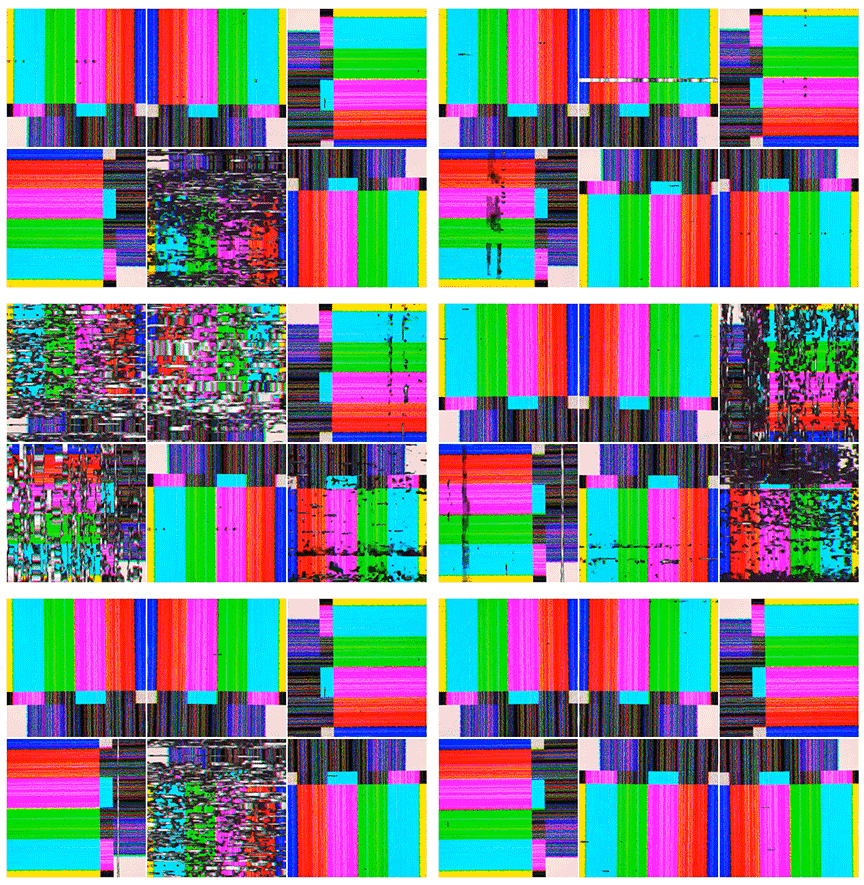
We are thrilled to announce a keynote installation for Domains19. When we announced Domains a few months back, we were serious about opening up the possibility of allowing folks to submit art pieces/installations as well as presentations and panels, and we have gotten a fair amount thus far. To reinforce this novel way of presenting at an edtech conference, we reach out to the inimitable Ryan Seslow to keynote Domains19 via his artwork. Ryan’s work with animated GIFs has been the stuff of legend for a while now, but his recent work exploring and “communicating his deaf and hard of hearing self” has been revelatory. Ryan articulates the idea behind these works in his blog on the series beautifully:

The works are visual representations for the regular distortions, missing of sounds, words and overall communication struggles that I experience daily. They represent how I feel, react, overcompensate and adjust to communication in various interactions. They are intended to be both subtle, confusing and difficult to follow. Communicating My Deaf & Hard of Hearing Self – Part 1”is the first installation in the series. It is first published here on my website and shared via my social media platforms. I am seeking to extend this body of work into a series of physical exhibitions, talks and a zine.

His installation at the Domains19 conference will very much be an extension of this body of work, and a focal point for a broader discussion around accessibility. You can read the abstract for the installation below, and this post provides just a small taste of the vaporizing visual extravaganza that awaits you this June at Domains19. 

“The Internal / External Narratives of the Fragmented Meta-Domain Self”
Via an energetic series of multi-disciplinary digital art, animation and video works, “The Internal / External Narratives of the Fragmented Meta-Domain Self” is an exhibition and installation that creates a harmonious environment for the Domains 2019 conference. Drawing from and applying the vapor wave aesthetic with rich glitch and textured visuals, the works come together as a series of experiences both site on scene and on the web. The viewer is confronted with how technology, communication, language and accessibility play a vital role both on and off the web. With some many frequent changes in technology, how will you instigate and re-question your position on such things?


You can read more about Ryan on the Domains site, and if you are interested in showing and/or at Domains19 the call for presentations is open until February 15th and you can register for the early bird discount through the end of February. We really hope to see you in June, and please be sure to spread the love.

24 Jan 19:11

PM Trudeau won’t fire Canada’s envoy in China after making comments on Huawei CFO case

by Shruti Shekar

Prime Minister Justin Trudeau said firing Canada’s envoy to China after making comments about Huawei’s global chief financial officer Meng Wanzhou’s extradition case is not a focus, adding it was detrimental to bring back the detained Canadians back to Canada.

Speaking to reporters in New Brunswick, Trudeau said that Meng will have a fair chance to fight her case against the United States’ request to extradite her. He ignored questions about Conservative Party leader Andrew Scheer’s comment suggesting he would have fired John McCallum, the current Canadian ambassador in China.

Meng was arrested in Vancouver while in transit to Mexico. She was granted bail but currently faces extradition to the U.S., where authorities reportedly said she deceived international banks to funnel transactions between Huawei and Iran. Meng has maintained that Huawei has no connection or involvement.

On January 21st, 2019, the U.S. has informed the Canadian government it will issue a formal extradition request, which could come anytime before January 30th, 2019.

It’s very important to note that Huawei has been in Canada since 2008 and has forged multiple partnerships with universities. It currently works with Bell and Telus to help deploy 5G network infrastructure.

McCallum, a former Liberal cabinet minister, told reporters on January 22nd, 2019 that Meng has “quite good arguments on her side” to fight her case against the U.S.

“One, political involvement by comments from Donald Trump in her case. Two, there’s an extraterritorial aspect to her case, and three, there’s the issue of Iran sanctions which are involved in her case, and Canada does not sign on to these Iran sanctions. So I think she has some strong arguments that she can make before a judge,” he said.

On January 23rd, 2019, Scheer said on CTV’s Power Play that he “would fire him.”

“The situation with China right now is at a very strained point. That goes without saying. We have to be very, very careful as a country and our government needs to be taking this very, very seriously,” he said.

But Trudeau maintained that it was the country’s utmost importance to bring back former Canadian diplomat Michael Kovrig and entrepreneur Michael Spavor. Both were detained last month and are currently held by Chinese authorities.

“Our focus is entirely on getting those Canadians home safe and making sure that all their rights are respected … making a change would not help release those Canadians a day sooner,” he said.

Image credit: YouTube (Screenshot)

Source: CBC, CTV

The post PM Trudeau won’t fire Canada’s envoy in China after making comments on Huawei CFO case appeared first on MobileSyrup.

24 Jan 19:11

Fido offering $48/3GB, $58/5GB plans with 1,000 minutes to China, Hong Kong, Macau, Taiwan

by Sameer Chhabra
Fido logo

Toronto-based Rogers flanker brand Fido Mobile has unveiled a collection of deals in honour of the upcoming Lunar New Year.

According to the carrier’s promotions website, new subscribers can activate a 24-month plan that provides 3GB of data and 1,000 minutes to China, Hong Kong, Macau and Taiwan for $48per month.

New subscribers who bring their own devices can take advantage of a 24-month, $58-per-month plan that provides 5GB of data and the aforementioned 1,000 minutes.

The carrier is also offering a Huawei P20 for $0 down on a two-year Medium plan, as well as a Samsung Galaxy S8 for $0 on a two-year large plan.

All of these promotions are subject to a one-time $35 transaction fee.

The year of the pig starts on February 5th, 2019.

Source: Fido

The post Fido offering $48/3GB, $58/5GB plans with 1,000 minutes to China, Hong Kong, Macau, Taiwan appeared first on MobileSyrup.

24 Jan 19:11

Apple’s over-ear headphones will launch in the second half of 2019: report

by Patrick O'Rourke
Apple Studio3 headphones

Apple’s often-rumoured over-ear headphones will reportedly launch in the second half of 2019, according to a report from Bloomberg’s frequently reliable Mark Gurman.

Information regarding the headphones’ release date was mentioned in Gurman’s recent report surrounding Sonos working on its own pair of headphones.

Gurman has stated in the past that Apple’s headphones could launch as early as 2019, though MacRumors’ Joe Rossignol says that the fact that the headphones might drop in the second half of 2019 is new information.

These headphones will reportedly be a higher-end alternative to Beats’ current offerings. Gurman has stated in the past that though Apple originally intended to drop its own headphones by the end of 2018, production issues caused their release to be pushed back.

Apple’s over-ear headphones will almost certainly feature the successor to company’s instant Bluetooth connecting W1 chip, similar to Beats more recently released offerings like the company’s Solo3 and Studio3 headphones. Further, Apple’s upcoming over-ear headphones are rumoured to feature noise cancellation.

Apple purchased Beats back in 2014 for $3 billion USD (roughly $4 billion CAD).

Source: Bloomberg Via: MacRumors

The post Apple’s over-ear headphones will launch in the second half of 2019: report appeared first on MobileSyrup.

24 Jan 19:11

Canada to forge up to $40 million research partnership with Nokia to deploy 5G

by Shruti Shekar

The Canadian federal government is expected to announce an up to $40 million research partnership with Finnish telecommunications giant Nokia to further develop 5G wireless technology.

A January 24th, 2019 Canadian Press article said that Innovation Science and Economic Minister Navdeep Bains is in the middle of “finalizing the deal” with Nokia today at the World Economic Forum in Davos, Switzerland.

The article said that the deal is a way “to support more than 2,000 of the firm’s jobs in Canada and to create 237 new positions.”

A media advisory said that Bains was meeting with the Nokia representatives at 9:30 am local time in Switzerland.

The announcement comes at a time as Ottawa finalizes its national-security review regarding its involvement with the next iteration of mobile technology that is said to be good for smart homes, autonomous vehicles, and even fixed wireless internet connections in rural parts of Canada.

It also comes at a time as Canada deals with a frosty relationship with China and its telecommunications giant Huawei.

Huawei is currently working with Bell and Telus to deploy the new network, while Rogers is working with Ericsson. The two companies and Nokia are among the top firms in the world researching 5G technology.

It’s also important to note that three of the countries part of the Five Eyes intelligence-sharing organization (U.S., Australia and New Zealand) have banned Huawei from supplying 5G equipment out of fear of potential cybersecurity threats.

Canada and the U.K., the other two members, are still working with Huawei.

Source: The Canadian Press

The post Canada to forge up to $40 million research partnership with Nokia to deploy 5G appeared first on MobileSyrup.

24 Jan 19:10

Suggesting a small fix to a Privacy Manifesto

London Trust Media has a Privacy Manifesto up.

Many good points, but there's one small fix that could make it more useful. From the original:

  1. It is now the norm—even in the presence of laws clearly forbidding it—for nearly every commercial website we visit to plant tracking beacons in our devices, so our lives can be examined and exploited by companies and governments that extract personal data and manipulate our lives for their purposes. This offends our privacy and diminishes our agency.

Here's a suggested new version edited to be clearer about how browsers work.

It is now the norm—even in the presence of laws clearly forbidding it—for nearly every commercial website we visit to include tracking beacons in their pages, and for our browsers to load and run those beacons, so our lives can be examined and exploited by companies and governments that extract personal data and manipulate our lives for their purposes. When our own browsers work against our interests, this offends our privacy and diminishes our agency.

Please don't assign all the work to the site.

It's counterproductive to ask the site to be the one to bear all the costs of privacy reform. The site is the player with the least economic power and the least freedom to change. Web publishers and brands failed to protect their audience and customer data and are now, unfortunately, kind of stuck. Because third parties control the audience information that's needed in order to make ads saleable, no one web site can unilaterally switch off the data flow that makes their business model work.

On the browser side, though, it's different. Browser developers know that they can get more user satisfaction, and get users to spend more time in the browser if those users have functionality that makes them feel safer.

This stuff needs to get fixed and browsers have the motivation and skills to do it. Let's focus on productive next steps by the parties that can afford to change. The result will be a new web advertising business that works better for sites and brands, too.

Sites can't take the big step to remove tracking scripts entirely, but there are a few things that sites can do to assist with ad reform.

  • Fix any "turn off your ad blocker" scripts to detect ad blockers only, and not falsely alert on privacy tools.

  • Fix up the privacy page to add links to appropriate privacy tools based on the user's browser. (Aloodo has JavaScript for this.)

  • If you maintain a privacy tool, offer to do a campaign with the site. Privacy tool users are high-quality human traffic. Free or discounted privacy tools might work as a subscription promotion. Where's the win-win?

Asking a site to walk away from money with no credible alternative is probably not going to work. Asking a site to consider next steps to get out of the current web advertising mess? That might.

More: What The Verge can do to help save web advertising

Bonus links

Disruption For Thee, But Not For Me, by Cory Doctorow, Locus

Vizio exec: we'd have to charge a premium on "dumb" TVs to make up for the money we'll lose by not spying on you

We Could Easily Stop Location Data Scandals, But We Cower to Lobbyists Instead

The unsustainable ad agency business model

Minneapolis Moves to Eliminate Mandatory Parking

The 7 greatest impediments to American entrepreneurs

Publishers Don’t Have An Ad Problem. They Have A Product Problem.

Rising Instagram Stars Are Posting Fake Sponsored Content

24 Jan 19:10

Whistler's affordable housing model is below-market and free of speculation. Why isn't it used elsewhere?

mkalus shared this story .

When Colin Pitt-Taylor bought his two-bedroom apartment in Whistler a year after the 2010 Olympics, he knew that it was never going to be an investment

"You have to buy into the idea you're not going to make a pile of money. That's fine," he said. 

Pitt-Taylor, like about half of Whistler's permanent population, lives in a property administered by the Whistler Housing Authority (WHA), and sits on its board as the representative for residents.

It's a model that hasn't been replicated anywhere else in British Columbia, but those in Whistler believe they have lessons worth heeding. 

"I think it would work in other municipalities for sure," said Pitt-Taylor. "People call this subsidized housing. It's not really subsidized housing. It's just built ... it's hard to get into the market, and this almost solves the problem." 

The properties are on land originally owned by the municipality, with covenants that restrict the maximum price for anything resold. Only people that work in Whistler and don't own any other property can apply, and rates for both buying and renting are about half of what market properties go for. 

"Local employees were having a very hard time being able to access housing in our community. The market housing prices were fast outpacing the escalations in local employees' income," said Marla Zucht, WHA's general manager.

The circumstances sound like those in dozens of B.C. communities — which is why others are now studying the WHA model. 

A new apartment complex in Whistler will be open in the summer of 2019 and go to people on the Whistler Housing Authority's waiting list. They'll pay hundreds of thousands less for the units than they would on the open market. (Tristan Le Rudulier/CBC)

Growing demand, and growing construction

Zucht says not a week goes by where another municipality reaches out to inquire about Whistler's model. She advises them that creating an expansive program doesn't come without pitfalls.

"It won't be without its challenges. We've experienced those, but now our program is so well entrenched within our community and it's so well understood ... the challenges are just meeting the demand."

And the demand is great — there are over 650 people on the WHA's wait-list, and the 28 properties resold in 2018 went to people who had been on that list between one and 14 years — byproducts, admits Zucht, of the WHA slowing down its expansion in the middle parts of this decade. 

But the principles of the program are well accepted, and Whistler is now planning 550 new rental units in Chekamus Crossing, and the company that owns Whistler Blackcomb is creating its own restricted, below-market housing.

In addition, while most Lower Mainland municipalities just held elections with mayoral candidates running on different housing platforms, new Mayor Jack Crompton ran unopposed. 

"Without the WHA, I think we would have had a ski town in the mountains with very few permanent residents and that would be sad," he said.

A chart by the Whistler Housing Authority that compares the prices of homes under its authority to those sold on the private market. (Whistler Housing Authority )

Conversation, but little action 

Jill Atkey, CEO of the B.C. Non-Profit Housing Association, says Vancouver is the only other municipality with a similar housing authority — and it was only created in 2014 and so far has only built modular units.

"It requires municipal councils to take bold initiatives," she said, adding other cities historically tended to dismiss the Whistler model because of its unique nature as a mountain resort, believing it wouldn't work in denser areas like Metro Vancouver or Greater Victoria, where multiple municipalities have different priorities. 

"And you know, we can all sort of sit back and say, well, wouldn't that have been nice if we'd done that 20 years ago and had the foresight to do that. But it's certainly not too late."

The Resort Municipality of Whistler is home to a wide range of vacation rentals, resorts, hotels and condos. But finding affordable housing for its workers has always been challenging. (CBC)

And things seem to be changing, albeit slowly.  

"Every time I'm with other mayors and councillors, the conversations are about the WHA, how it started and how it continues and how they can maybe bring some of the similar kind of ideas to their communities," said Crompton. 

Next month, the District of West Vancouver will begin public consultations over how to develop about 200 units on a block of public land just north of the waterfront. 

"We don't have to reinvent the wheel," said Coun. Craig Cameron.

"Whistler has 'trialed and errored' a lot of these things. I don't know we're going to create a housing authority per se ... but we need to do much of the same sort of management that Whistler does."

Two hundred units may not seem like much. But Cameron says he reminds other politicians the WHA wasn't built in a day either. 

"The biggest pitfall is the beginning of this whole thing," he said. "It just took a group of people in the 90s to say this is crucial for the success of our community." 

Metro Matters: On The Road is exploring how new city governments throughout B.C. are approaching age-old issues (some political, some not) in their communities.

24 Jan 19:10

Ford says no-deal Brexit would mean costs of $800m in 2019 alone | Business

mkalus shared this story from The Guardian.

Ford has predicted that a no-deal Brexit will result in costs of $800m (£612m) during 2019 alone, in the latest in a series of stark warnings over potential disruption to British manufacturing.

If the UK leaves the EU on 29 March without a deal the US carmaker said it could face trade delays at the border, a weaker economic outlook and tariffs on trade between the UK and EU, as well as a hit from the likely sharp fall in sterling.

The warning came as Jaguar Land Rover, the UK’s largest carmaker, informed employees on Thursday that it will shut down its four main factories for an extra week at the start of April on top of a previously planned maintenance pause because of “potential Brexit disruption”.

Ford’s European president, Steven Armstrong, this month said a no-deal Brexit could result in further job losses in the UK, and did not rule out the closure of British plants if there were no agreement.

Ford has major operations in the UK, including factories in Merseyside, Dagenham and Bridgend that employ more than 5,500 workers.

A no-deal Brexit “would severely impact Ford’s operations in the UK and across Europe”, Ford said in a statement on Thursday first reported by Sky News.

Brexit uncertainty has only added to the woes of carmakers across Europe, who also face regulatory changes that are depressing demand for diesel, falling demand from China and the threat of tariffs from the US.

Ford earlier this month announced thousands of cost cuts across Europe, which could lead to as many as 1,000 job losses at its Bridgend factory alone, before any no-deal Brexit effects are taken into account.

Ford’s spokesperson said: “Our planning assumptions for Brexit include a negotiated exit as the most likely outcome, with a transition period during 2019 and 2020 if the withdrawal package is approved by UK parliament. However, we recognise that the situation is highly uncertain and are monitoring events closely.”

24 Jan 19:09

Editing Text in the Browser

by Tony Hirst

Via the Guardian Developer blog, a post — Leaving Scribe — describing how the Guardian is moving away from its Scribe in-browser text editor to a new one based on ProseMirror, an open-source toolkit “for building rich-text editors on the web” that is also used by the New York Times.

In-browser editors are not something I know much (i.e. anything) about, but the Leaving Scribe post provides a handy review of what’s good to know (like how markup is handled). Go and read it now…

It seems like the Guardian folk have many of the same issues as we do in the OU. For example:

Another area where HTML as a model falls down is editor-only annotations (markup that helps the writer but is detrimental to the reader). Take for example the need to highlight a word in the text that meets some criteria (a suggested tag, or some legal issue around using this word). You may want to show an inline annotation to ask the editor whether they want to add this as a tag.

The problem here is that now we have data that is not part of the document, and yet it is modelled as part of our document. This is technically solvable but again, the DOM API is not well suited for handling this sort of data modelling, especially when the usage of these features becomes more complex. As you start to force more complex features through an HTML data model you have to do more and more work to get around HTML’s limitations around modelling a rich text document and you hit more and more of the browser inconsistencies.

Features of ProseMirror based editors apparently include collaborative editing and an extensible schema. This last one is interesting from an OU perspective, because we have a workflow in which content is published from an internal XML document feedstock.

The important difference between Scribe and ProseMirror is that ProseMirror implements its own model layer that has a one-to-one mapping from semantics to the model, and an API that is made with document transformation in mind – not least collaborative editing.

An image representation of ProseMirror's model

In ProseMirror, inline content is flat rather than a tree, which means operations like changing styles on text don’t require any tree manipulation. And while nodes (h1, p, blockquote etc.) are still modelled as a tree but again, this accurately models how users think about things like paragraphs and lists, and it’s almost always how they’re rendered when consuming an article.

I’m not sure if the halted OU Create project was using ProseMirror? (I never really found out any technical details and I was banned from posting screenshots or discussing [di(scu)ssing?!] it in public!;-)

We hope in time to be able to get our editor to a point that it is able to be open-sourced but we’ll only do this if we believe we have the documentation and resource in place for that to be useful to users outside the Guardian.

Ah ha… It’d be nice if an OU solution could work in an open-sourcey way, or perhaps join forces with others to get such code out there…

One of the things I’ve been pondering lately is how to generate OU XML from Jupyter notebooks, as well how to demonstrate rich text authoring in notebooks using things like the jupyter-wysiwyg editor (I wonder how easy it is to modify that extension to work with other rich editors?)

So I wonder a couple of things:

  • how easy would it be to extend ProseMirror to support the OU XML schema?
  • could this customised editor then be used as a rich editor inside a Jupyter notebook markdown cell? (Would it need tweaks to the markdown2html renderer, or an OU-XML2HTML previewer?)

I’m also thinking that OU-XML has a lot of metadata elements which could be embedded as notebook metadata, with just a subset of the OU-XML being supported within the markdown cells. (Markdown cells could also have metadata associated with them.)

I think we could probably get a clunky workflow going quite quickly for authoring OU-XML docs from within Jupyter notebooks if anyone else was interested in exploring it with me…