Toolkit for building rich-text editors on the web. Developed by [[The Guardian]] and others.
An ideal content editor produces structured, semantically meaningful documents, but does so in a way that is easy for users to understand. ProseMirror tries to bridge the gap between Markdown text editing and classical WYSIWYG editors.
Let us introduce you to our very first application: A Music Player
Last week, you might have noticed we announced the creation of an application ecosystem – a rich, secure and free ecosystem of desktop and mobile apps for our Librem products. More details will be revealed as soon as we come to some key decisions regarding how it should be built; but for now, everything will revolve around Flatpak, which we believe is the best technology for what we want to achieve today. We are eager to partner with the Flatpak community, and hope to rapidly build an app store centered around our core values – Free Software and Reproducible Builds.
This post is the first in a series which will announce applications that have either been ported to the Librem 5 at various stages or will work on the Librem 5. It’s also meant to inspire you to write applications for Librem devices on PureOS Store – and help us build great store apps for everyone to use.
And then there’s Lollypop – with the Lollypop music player, you can listen to music on your Librem 5 phone, on Librem laptops, or in any device running PureOS. You can enjoy your music, read the lyrics, trigger the party mode; connect to Last.fm, Libre.fm or ListenBrainz. You will, of course, find it in Purism’s PureOS Store – coming soon.
I want to share one final element we cover in our courses (which launch next week) which I think has a huge influence upon the success of a community.
Systems!
When we begin working with a new client, we assess how they are doing against a set of standards in multiple areas. These are our benchmarks. They cover best practices in:
Community Strategy.
Engagement Experience.
MVP/Superuser Programs.
Gamification.
Onboarding newcomers.
Community staff/team.
Overall levels/ratings.
Once we’ve benchmarked how a client is doing today, we can identify the next level they need to reach and begin training for that.
Most importantly, this gives us a set of standards for how the community is run.
If we’re hiring someone new, redesigning the website, managing a superuser campaign we can set a reasonable level (based upon skills/resources) and ensure nothing falls below that level.
Everyone can see what’s expected of them in every engagement.
This also serves as a useful tool for clearly summarizing to others internally (and sometimes externally) how well the community is managed, what we need to work on next, and what kind of resources/processes/training is required to reach to do it.
In short, it provides a set of standards for people to easily assess our work and a system for managing future community activities.
We recommend you have standards which clearly distinguish bad, ok, good and great in your community activities. You can develop your own, but ours are based on 10+ years of experience with hundreds of clients.
I must admit that before testing a Galaxy, I thought the unconventional location of the back button can't be good for users and was more likely motivated by Samsung wanting to leave their "fingerprint" on Android. But when I recently played with a Galaxy, I almost immediately realised that its irregular placement actually makes a ton of sense. At least based on where my thumb's resting position is, hovering on the right and slightly below the phone's center (I'm right-handed, and use the phone one-handed). Therefore, I'm at all times thumb flexion away from going back1, which I find a more comfortable action than moving my thumb diagonally to the bottom left (and then needing to return it to its previous position as it's inconvenient to keep my thumb there both in terms of general comfort and the practicality of scrolling). That said, it's correct that Samsung allows you to change the arrangement back to the standard for the benefit of Android users' muscle memory who have switched to a Galaxy.2
1. To be clear, I press back far more regularly than multi-tasking (and I assume I'm not unique in this regard), which is why this works for me. If this didn't apply, then this would be an altogether different post. ↵
2. I say that, but I've never owned a Galaxy and have been on Android user for ~3 years and it took me no time to pick it up. ↵
If I had another appendage I could manifest the significance of this date in person. As it is I have online sharing PTSD. Each thing I write online I question who am I serving? Am I violating someone else's privacy? Am I punching up or down? Am I going to be harassed by people with too much time feeding on my personal details? Would I rather be spending time with my kid or pleasuring myself elsewhere?
So I'm constipated for online sharing. Plenty of buildup - scores of photos I take each month. Gigabytes of unshared media. I check Instagram and I think oh man my friends are doing great things and taking wonderful trips and asking good questions. Shouldn't I demonstrate my standing as a photogenic human with the means to participate in mediated life demonstration? Ahhh it's just too much to think about. Only good girls keep diaries, the bad girls never have time - thank you Tallulah.
But I still serve my celebrity, such as it is. THIS MY SITE FIRST HAD EXTERNAL VISITORS 25 YEARS AGO TODAY. There, I'm marking the occasion. Not with a staggered poem about my desire meeting someone aligned with it, or a story about ingesting psychedelics just before an upright meeting. I now work in the legal cannabis business after my work in video games, so I've already passed through the ceiling of my teenage career fantasies. It was never my career fantasy to suffer in public. I love being of nearby service; now I make breakfast for my partner and child just about every day.
I agreed to show up to a few screenings of an old film in which I appeared. Doug Block made a documentary Home Page, which is personal media writ into a sort of permanence. Permanence served by re-mastering, re-screening. So I shall likely stand before small groups in New York and Los Angeles and San Francisco to say "yes I survived" and "now I sell cannabis" and "sharing on the internet is complicated"
I could write here on links.net all kinds of opinions on the web-that-was. But that would be like spraypainting dust and spider webs on this already-dilapidated art objet. Better to ramble on them in person at some venue, where I can grab free drink in a plastic cup bound for an ocean gyre, while I eye some attractive sort in the front row and imagine how old I must seem to them, and yet how immature. I like to imagine that if I offend with commentary on a revitalized 480p documentary, I am not famous enough for my remarks to be newsworthy.
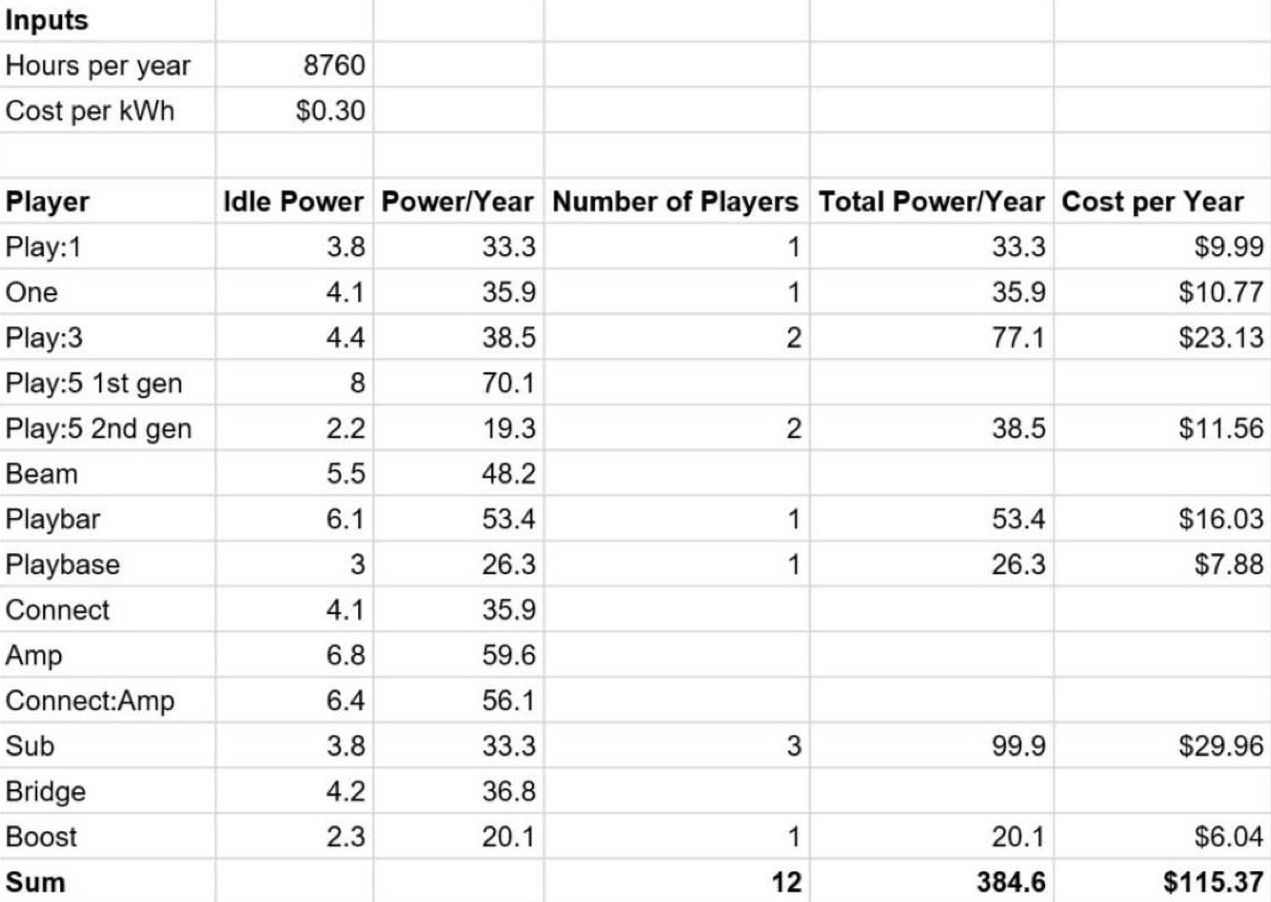
Sonos players are always on. And they draw considerable power. I have compiled a small spreadsheet that helps you calculate the yearly cost for your Sonos household. It works with the numbers Sonos published for 230V.
On your left, sitting idle, waiting to hear me say "Hey Siri" or "Alexa". On your right, playing "The Space in Between (Ben Böhmer Remix)" by Jan Blomqvist at 2:10 with max volume, at which point HomePod is considerably louder than Sonos One. It's the bass driver that draws that energy.
Edgy. ARTURIA #NAMM2019 / Ça me rappelle certains films français, un peu décalés du reste du monde. https://t.co/sVyJ2XBmDK
— Alexandre Enkerli (@enkerli)…
Prototyp-Enthüllung auf dem Automobilsalon 2019 Der Prototyp des neuen Elektrofahrzeugs von Honda wird auf dem Genfer Automobilsalon vom 7. bis 17. März 2019 erstmals der Öffentlichkeit vorgestellt. Honda setzt bei seinem neu konzipierten Elektrofahrzeug auf [...]
Developer Khaos Tian hacked the HomeKit protocol to simulate adding a smart TV accessory to the Home app. He shared some screenshots and videos of these features ‘in action’ …
By essentially faking the existence of a HomeKit-compatible Smart TV accessory on his network, he was able to add a television tile into his Home app.
This reveals new interfaces for controlling the TV. You can tap on the tile to turn it on or off and access the Details menu to change input.
Tian has posted a series of examples of this new HomeKit integration on his Twitter account, including one where he was able to control his LG TV running webOS from the iPhone's Home app.
Interestingly, Tian has already contributed an update to homebridge – the third-party plugin to add all kinds of different accessories and platforms to HomeKit – with support for HomeKit's new TV control APIs. Here's where this gets really interesting for me: despite the launch of an online petition, LG has only confirmed that their latest 2019 TV sets will receive official HomeKit support. Thanks to homebridge, however, it should be possible to add native HomeKit integration to older LG televisions (such as my 2017 model) with plugins that bridge the webOS API to HomeKit's new endpoints. This is precisely what Tian is doing for his demo.
Now, as someone who's been running homebridge and the homebridge-webos-tv plugin for the past few months (and I promise I will write about this eventually), I'm excited about the idea of having a native interface for controlling my TV from the Home app (and, ideally, Siri too). As you can see, the plugin I'm currently using can only "fake" controls in the Home app by adding switches. It can get...confusing:
Configuring homebridge plugins (left) requires working with a JSON document.
But it works. I've been running homebridge and this plugin without issues for months now, and I've gotten so used to asking Siri to change inputs on my TV, I can't imagine not having these integrations anymore. A recent update to homebridge-webos-tv even added support for individual channel input and more remote control buttons. For this reason, assuming that the folks at LG don't change their mind and ship a HomeKit software update for older TV sets, I think I'm going to experiment with a dual setup for webOS TV support in HomeKit: some controls based on the official HomeKit API, and others provided as custom switches – both based on homebridge plugins. But that's a story for another time.
Business books are made of stories. Where do they come from? Here’s today’s question: Dear Dr. Wobs I am writing a business book and want to supplement my own experiences with relevant business anecdotes. (Google is virtually useless, although maybe I’m just doing it wrong.) Any suggestions? — Jack Finding stories We’re hard-wired to remember … Continued
In 2016, Google hosted its developer conference at the Shoreline Amphitheatre in Mountain View, California, and has done so every year since.
Continue reading →
If you are in London you can take the tube station to Kentish Town and experience a unique bar that uses local ingredients~and is located in an old below grade bathroom, originally constructed in Victorian times.
The Ladies & Gentlemen underground bar has proven to be so popular that there are plans for six more bars, all in “upcycled underground toilets”.
The bar has advertised its location by the use of puns and sayings on a backlit advertising sign for years, which has provided local colour as well as directional signage. The bar makes its own Highway Gin and has an assortment of locally made products from the area.
You can sign up yourself and ten of your friends for a free drink at their local gin club and make a small bottle at their copper alembic to take back with you. It’s all legal at the Ladies & Gentlemen.
This is an edited version of a series of talks I first gave in New York over the past week, outlining my work at Columbia. Many thanks to Reinvent, Pete Leyden, Cap Gemini, Columbia University, Cossette/Vision7, and the New York Times for hosting and helping me.
Prelude.
I have spent 30-plus years in the tech and media industries, mainly as a journalist, observer, and founder of companies that either make or support journalism and storytelling. When it comes to many of the things I am going to talk about here, I am not an expert. If I am expert at anything at all, it’s asking questions of technology, and of the media and marketing platforms created by technology. In that spirit I offer the questions I am currently pursuing, in the hope of sparking a dialog with this esteemed audience to further better answers.
Some context: Since 1986, I’ve spent my life chasing one story: The impact of technology on society. For whatever reason, I did this by founding or co-founding companies. Wiredwas kind of a first album, as it were, and it focused on the story broadly told. The Industry Standardfocused on the business of the Internet, as did my conference Web 2. Federated Media was a tech and advertising platform for high quality “conversational” publishers, built with the idea that our social discourse was undergoing a fundamental shift, and that publishers and their audiences needed to be empowered to have a new kind of conversation. Sovrn, a company I still chair, has a similar mission, but with a serious data and tech focus. NewCo, my last company (well, I’ve got another one in the works, perhaps we can talk about that during Q&A) seeks to illuminate the impact of companies on society.
It’s Broke. Let’s Fix It.
And it is that impact that has led me to the work I am doing now,
here in New York. I moved here just last Fall, seeking a change in the
conversation. To be honest, the Valley was starting to feel a bit…cloistered.
A huge story – the very same story, just expanded – is once again rising. Only it’s just … more urgent. 25 years after the launch of Wired, the wildest dreams of its pages have come true. Back in 1992 we asked ourselves: What would happen to the world when technology becomes the most fundamental driver of our society? Today, we are living in the answer. Turns out, we don’t always like the result.
Most of my career has been spent evangelizing the power of technology to positively transform business, education, and politics. But five or so years ago, that job started to get harder. The externalities of technology’s grip on society were showing through the shiny optimism of the Wired era. Two years ago, in the aftermath of an election that I believe will prove to be the political equivalent of the Black Sox scandal, the world began to wake up to the same thing.
So it’s time to ask ourselves a simple question: What can we do to fix this?
Let’s start with some context. My current work is split between two projects: One has to do with data governance, the other political media. How might they be connected? I hope by the end of this talk, it’ll make sense.
So let’s go. In my work at Columbia, I’m currently obsessed with two things. First,
Data.
How much have you thought about that word in the past two years?
Given how much it’s been in the news lately, likely quite a lot. Big data, data breaches, data mining, data science…Today, we’re all about the data.
And second….
Governance.
When was the last time you thought about that word?
Government – well for sure, I’d wager that’s increased given who’s been
running the country these past two years. But Governance? Maybe not as much.
But how often have you put the two words together?
Data Governance.
Likely not quite as much.
It’s time to fix that.
Why?
Because we have slouched our way into an architecture of data governance that is broken, that severely retards economic and cultural innovation, and that harms society as a whole.
Let’s unpack that and define our terms. We’ll start with
Governance.
What is governance? It’s an …
Architecture of
control
A regulatory framework that manages how a system works. The word is most often used in relation to political governance – which we care about a lot for the purposes of this talk – but the word applies to all systems, and in particular to corporations, which is also a key point in the research we’re doing.
But in my work, when I refer to governance, I am referring to the “the system of rules, practices and processes by which a firm controls its relationshipto its community.” Who’s that community? You, me, developers and partners in the ecosystem, for the most part. More on that soon.
Now, what is data? I like to think of it as…
Unrefined
Information.
I’m not in love with this phrase, but again, this is a first draft of what I hope will grow to more refined (ha) work. Data is the core commodity from which information is created, or processed. Data has many attributes, not all of which are agreed upon. But I think it’s inarguable that the difference between data and information is …
Human meaning.
That’s Socrates, who thought about this shit, a lot. Information is data that means something to us (and possibly the entire universe, as it relates to the second law of thermodynamics. But physics is not the focus of this talk, nor is a possible fourth law of thermodynamics….).
As we’ve learned – the hard way – over the past decade, there are
a few very large companies which have purview over a massive catalog of
meaningful data, meaningful not only to us, but to society at large. And it’s
this societal aspect that, until recently, we’ve actively overlooked. We’re in the midst of a grand data
renaissance, which if history remotely echoes, I fervently hope will give rise
to …
A (Data) Enlightenment
That’s John Locke, an Enlightenment philosopher. Allow me to pull back for second and attempt to lay some context for the work I hope to advance in the next few years. It starts with the Enlightenment, a great leap forward in human history (and the subject of a robust defense by Steven Pinker last year).
Arguably the crowning document of the Enlightenment is…
The United States
Constitution
This declaration of the rights of humankind (well mankind for the first couple of centuries) itself took more than three centuries to emerge (and cribbed generously from the French and English, channeling Locke and Hume). Our current political and economic culture is, of course, a direct descendant of this living document. American democracy was founded upon Enlightenment principles. And the cornerstone of Enlightenment ideas is …
The Scientific Method
That’s Aristotle, often credited with originating the scientific method, which is based on considered thesis formation, rigorous observation, comprehensive data collection, healthy skepticism, and sharing/transparency. The scientific method is our best tool, so far, for advancing human progress and problem solving.
And the scientific method – the pursuit of truth and progress – all that turns on the data. Prompting the question….
Who Has the Most
(and Best) Data?
This is the question we are finally asking ourselves, the answer to which is sounding alarms. As we all know, we are in a renaissance, a deluge, an orgy of data creation. We have invented sophisticated new data sensing organs – digital technologies – that have delivered us superhuman powers for the discovery, classification, and sense-making of data.
Not surprisingly, it is technology companies, driven as they are
by the raw economics of profit-seeking capital and armed with these
self-fulfilling tools of digital exploration and capture – that have initially
taken ownership of this emerging resource. And that is a problem, one we’ve
only begun to understand and respond to as a society. Which leads to an
important question:
Who Is Governing
Data?
In the US, anyway, the truth is, we don’t have a clear answer to this question. Our light touch regulatory framework created a tech-driven frenzy of company building, but it failed to anticipate massive externalities, now that these companies have come to dominate our capital markets. Clearly, the Tech Platform Companies have the most valuable data – at least if the capital markets are to be believed. Companies like Google. Facebook. Amazon. Apple.
All of these companies have very strong governance structures in place for the data they control. These structures are set internally, and are not subject to much (if any) government regulation. And by extension, nearly all companies that manage data, no matter their size, have similar governance models because they are all drafting off those companies’ work (and success). This has created a phenomenon in our society, one I’ve recently come to call …
The Default
Internet Constitution
Without really thinking critically about it, the technology and finance industries have delivered us a new Constitution, a fundamental governance document controlling how information flows through the Internet. It was never ratified by anyone, never debated publicly, never published with a flourish of the pen, and it’s damn hard to read. But, it is based on a discoverable corpus. That corpus, at its core, is based on …
Terms of Service
and EULAs
Like it or not, there is a governance model for the US Internet and the data which flows across it: Terms of Service and End User Licensing Agreements. Of course, we actively ignore them – who on earth would ever read them? One researcher did the math, and figured it’d take 76 work days for the average American to read all of the policies she clicks past (and that was six years ago!).
Of course, ignoring begets ignorance, and we’ve ignored Terms of Service at our peril. No one understands them, but we certainly should – because if we’re going to make change, we’ll want to change these Terms of Service, dramatically. They create the architecture that determines how data, and therefore societal innovation and value, flow around the Internet.
And let’s be clear, these terms of service have hemmed data into silos. They’re built by lawyers, based on the desires of engineers who are – for the most part – far more interested in the product they are creating than any externalities those products might create.
And what are the lawyers concerned with? Well, they have one True
North: Protect the core business model of their companies.
And what is that business model? Engagement. Attention. And for most, data-driven personalized advertising. (Don’t get me started about Apple being different. The company is utterly dependent on those apps animating that otherwise black slate of glass they call an iPhone).
So what insures engagement and attention? Information refined from data.
So let’s take a look at a rough map of what this Terms of
Service-driven architecture looks like:
The Mainframe
Architecture
Does this look familiar? If you’re a student of technology industry history, it should, because this is how mainframes worked in the early days of computing. Data compute, data storage, and data transport is handled by the big processor in the sky. The “dumb terminal” lives at the edge of the system, a ‘thin client’ for data input and application output. Intelligence, control, and value exchange lives in the center. The center determines all that occurs at the edge.
Remind you of any apps you’ve used lately?
But it wasn’t always this way. The Internet used to look like
this:
The Internet 1.0
Architecture
I’m one of the early true believers in the open Internet. Do you remember that world? It’s mostly gone now, but there was a time, from about 1994 to 2012, when the Internet ran on a different architecture, one based on the idea that the intelligence should reside in the nodes – the site – not at the center. Data was shared laterally between sites. Of course, back then the tech was not that great, and there was a lot of work to be done. But we all knew we’d get there….
…Till the platforms got there first. And they got there very, very well – their stuff was both elegant and addictive.
But could we learn from Internet 1.0, and imagine a scenario inspired by its core lessons? Technologically, the answer is “of course.” This is why so many folks are excited by blockchain, after all (well that, and ICO ponzi schemes…).
But it might be too late, because we’ve already ceded massive
value to a broken model. The top five technology firms dominate our capital
markets. We’re seriously (over)invested in the current architecture of data
control. Changing it would be a massive disruption. But what if we can imagine
how such change might occur?
This is the question of my work.
So…what is my work?
A New Architecture
If we’re stuck in an architecture that limits the potential of
data in our society, we must envision a world under a different kind of
architecture, one that pushes control, agency, and value exchange back out to the node.
Those of us old enough to remember the heady days of Web 1.0 foolishly assumed such a world would emerge unimpeded. But as Tim Wu has pointed out, media and technology run in cycles, ultimately consolidating into a handful of companies with their hands on the Master Switch – we live in a system that rewards the Curse of Bigness. If we are going to change that system, we have to think hard about what we want in its place.
I’ve given this some thought, and I know what I want.
Let The Data Flow
Imagine a scenario where you can securely share your Amazon purchase data with Walmart, and receive significant economic value for doing so (I’ve written this idea up at length here). Of course, this idea is entirely impossible today. This represents a major economic innovation blocked.
Or imagine a free marketplace for data that allows a would-be restaurant owner to model her customer base’s preferences and unique taste? (I’ve written this idea up at length here). Of course, this is also impossible today, representing a major cultural and small business innovation is impeded.
Neither of these kinds of ideas are even remotely possible – nor are the products of thousands of similar questions entrepreneurs might ask of the data rotting in plain sight across our poorly architected data economy.
We all lose when the data can’t flow. We lose collectively, and we lose individually.
But imagine if it was possible?!
How might such scenarios become reality?
We’re at a key inflection point in answering that question.
2019 is the year of data regulation. I don’t believe any meaningful regulation will pass here in the US, but it’ll be the year everyone talks about it. It started with the CA/Facebook hearings, and now every self-respecting committee chair wants a tech CEO in their hot seat. Congress and the American people have woken up to the problem, and any number of regulatory fixes are being debated. Beyond the privacy shitstorm and its associated regulatory response, which I’d love to toss around during Q&A, the most discussed regulatory relief is anti-trust – the curse of bigness is best fixed by breaking up the big guys. I understand the goal, and might even support it, but I don’t think we need to even do that. Instead, I submit for your consideration one improbable, crazy, and possibly elegant solution.
The Token Act
I’m calling it the Token Act.
It requires one thing: Every data processing service at a certain scale must deliver back to its customers any co-created data in machine readable format, easily portable to any other data processing service.
Imagine the economic value unlocked, the exponential impact on
innovation such a simple rule would have. Of course we must acknowledge the
negative short term impact such a policy would have on the big guys. But it also creates an unparalleled opportunity for them – the
token of course can include a vig – a percentage of all future revenue
associated with that data, for the value the platform helped to create. This
model could drive a far bigger business in the long run, and a far healthier
one for all parties concerned.
I can’t prove it yet, but I sense this approach could 10 to 100X
our economy. We’ve got some work to do on proving that, but I think we can.
Imagine what would occur if the data was allowed to flow freely.
Imagine the upleveling of how firms would have to compete. They’d have to move
beyond mere data hoarding, beyond the tending of miniature walled gardens (most
app makers) and massive walled agribusinesses (in the case of the platforms –
and ADM and Monsanto, but that’s another chapter in the book, one of many).
Instead, firms would have to compete on creating more valuable tokens – more valuable units of human meaning. And they’d encourage sharing those tokens widely – with the fundamental check of user agency and control governing the entire system.
The bit has flipped, and the intelligence would once again be driven to the nodes.
To us!
But the Token Act is just an exercise in envisioning a society
governed by a different kind of data architecture. There are certainly better
or more refined ideas.
And to get to them, we really need to understand how we’re
governed today. And now that I’ve gotten nearly to the end of my prepared
remarks, I’ll tell you what I’m working on at Columbia with several super smart
grad students:
Mapping Data Flows
If we are going to understand how to change our broken architecture of data flows, we need to deeply understand where we are today. And that means visualizing a complex mess. I’m working with a small team of researchers at Columbia, and together we are turning the Terms of Service at Amazon, Apple, Facebook and Google into a database that will drive an interactive visualization – a blueprint of sorts for how data is governed across the US internet. We’re focusing on the advertising market, for obvious reasons, but it’s my hope we might create a model that can be applied to nearly any information rich market. It’s early stages, but our goal is to have something published by the end of May.
Finally,
Advertising
I’ve not spoken much about advertising during this talk, and that was purposeful. I’ve written at length about how we came to the place we now inhabit, and the role of programmatic advertising in getting us there.
Truth is, I don’t see advertising as the cause of this problem, but rather an outgrowth of it. If you offer any company a deal that puts new customers on a platter, as Google did with AdWords, or Facebook has with NewsFeed, well, there’s no way those companies will refuse. Every major advertiser has embraced search and social, as have millions of smaller ones.
Our problem is simply this: The people who run technology platforms don’t actually understand the power and limitations of their systems, and let’s be honest, nor do we. Renee Di Resta has pointed this out in recent work around Russian interference in our national dialog and elections: Any system that allows for automated processing of messages is subject to directed, sophisticated abuse. The place for regulation is not in advertising (even though that’s where it’s begun with the Honest Ads Act), it’s in how the system works architecturally.
But advertisers must be highly aware of this transitional phase in the architecture of a system that has been a major source of revenue and business results. We must imagine what comes next, we must prepare for it, and perhaps, just perhaps, we should invent it, or at the very least play a far more active role than we’re playing currently.
I believe that if together – industry, government, media and
consumers collectively – if we unite to address the core architectural issues
inherent to how we manage data, in the process giving consumers economic,
creative, and personal agency over the data they co create with platforms, the
question of toxic advertising will disappear faster than it arose.
But I’ve talked (or written) long enough. Thank you so much for coming (for reading), and for being part of this conversation. Now, let’s start it.
It’s Monday morning and my train pulls in to Barcelona Sants. I zip across the street to start work at my favourite home from home – the Zopa office.
A quick game of ping-pong, a hearty team breakfast and catching up on everyone’s weekend adventures is a great start to the day. With only 25 people in the office, the vibe is the same as a start-up.
We’ve been working hard together building the tech stack for our brand new bank. It’s been challenging but equally rewarding and I’ve learnt so much from my contribution.
I settle in at my desk with a hot coffee and Slack pings with the latest news from London: we’ve been awarded our banking licence! We all cheer, pause, then exchange serious faces. Now the hard work really begins.
One of my favourite things about working at Zopa is the innovative tech we use. There’s Java 8, Kotlin, Kafka, Docker, Kubernetes, PostgreSQL, Cucumber, Jenkins, Jira, GitHub and Slack. And probably plenty more since I wrote this blog!
I look at my planned work for the day, pop my headphones on, and get stuck in.
Flow achieved. Software successfully QA’d and returned to the team lead for sign off.
Now it’s time for the Skype daily stand up with London, where we discuss what we did the day before, any blockers we have and our plans for the day.
I share my feedback and almost gasp as fluent English comes streaming out of my mouth. When did I get so good? There are 11 different nationalities in our office, so we use English as our common language. Speaking it every day in the office has really made a huge difference for me.
I’m excited to visit the London office next week. I go every month and each time I discover a new favourite place to hang out, eat, drink and soak up the culture.
Last job of the day is a final round interview with a potential new recruit. They’ve been through a few stages in the process already, so if they’re a good cultural fit, I’ll give them the thumbs up.
And then the highlight of my day: I pick up my one year old from nursery and take him to the beach to watch the waves and bask in the remaining heat of the day.
Sound good? Thought so.
We’re growing the Barcelona team to help build our bank. See if there’s something you-shaped on our careers page.
The decision of his enemy “could not be reconciled with reason,” once mused a great statesman. “I felt sure she would be ruined for a generation by such a plunge, and this proved true. But governments and peoples do not always take rational decisions. Sometimes they take mad decisions. Or one set of people get control, who compel all others to obey and aid them in folly.”
Any takers, Balliol College, Oxford? No? It’s Winston Churchill, considering why Japan, already mired in an unwinnable campaign in China, would “court destruction” by going to war with Britain and the US in 1941. “I have not hesitated to record repeatedly my disbelief that Japan would go mad,” Boris Johnson’s idol wrote in his history of the second world war. “However sincerely we try to put ourselves in someone else’s position, we cannot allow for processes of the human mind and imagination to which reason offers no key.”
I came across this fun insight while trying to take my mind off Brexit, by doing a spot of ironing to Dan Carlin’s Hardcore History podcast about the Asia-Pacific war of 1937-1945. But Brexit has a habit of worming its way back into your brain: the Baby Shark song of constitutional crises. I’m not saying that the pickle Britain is in is comparable to the situation in Japan in 1941. I can’t quite see Jacob Rees-Mogg masterminding a scheme to catch the Belgian fleet at port, and the ensuing chain of events leading to a multiple-front war, ending with the nuclear annihilation of Sheffield and Bristol.
I’m merely saying that history provides many examples of countries taking irrational, destructive courses and getting punished for them. It is just about possible for us in 2019 to follow the symphony of emotion that has led to 28% of British voters believing an act of economic self-sabotage will prove some sort of point; to firms from BMW to Panasonic shifting investment out of the UK amid the uncertainty; to Boris Johnson responding to such concerns with “fuck business”; to an MP whose whole argument was about British sovereignty asking an authoritarian rightwing government in Poland to help him overturn sovereign decisions of the British parliament; to no one even pretending Brexit will be beneficial any more, merely character-building. But in the not too distant future, these themes will fade, the ins and outs will be forgotten and people will say: “The decision could not be reconciled with reason.” The urge to Brexit never could; that’s an important lesson.
Another is that a conviction that you will prevail because your country is uniquely amazing (quite strong in Japan in 1941, I understand) is no protection against catastrophe. Indeed, it is much more likely to lead you towards it. This is a point that seems lost on leavers – history fans though they profess to be. Many have invoked our great imperial past as something we were destined to return to post-Brexit. In the giddy aftermath of the vote, Andrew Roberts thought that “one of the many splendid opportunities” offered by Brexit was the resuscitation of Churchill’s dream of a CANZUK union, comprising Canada, Australia, New Zealand and us. There was talk of Empire 2.0.
These days, the vibe is more “let them eat turnips”; Britain as underdog as opposed to would-be oppressor. However, a nasty strain of exceptionalism remains the default mode of the Brexit elite, usually abetted by a woeful misunderstanding of the qualities that have actually helped the British people in the past.
Earlier this week, the pro-crashing-out economist Roger Bootle told the Bruges Group that the reason Britain could never make its peace with the EU was that we are one of only four European countries not to have endured occupation or dictatorship this last century. How conveniently he forgets that Ireland and Malta have indeed spent much of their history under occupation – British occupation. And how cleverly he reframes geography as a matter of virtue rather than luck. An old trick of the ruling classes, to confuse virtue and luck.
It is not healthy patriotism that underpins that leave project but its toxic inversion: a hatred of Britain as it actually is, a contempt for its young, a dismissal of its businesses and an eagerness to make the poorest pay. Brexit hardliners are invariably the ones with dubious links to overseas pressure groups, with asset funds in emerging markets, with schemes to move their HQs abroad. The British reputation for pragmatism, good business sense and moderation is not some God-given destiny; it required some active application of the same qualities. It required some sense of responsibility towards the next generation. These are supposedly conservative values, but they were sold off a long time ago, the proceeds half-forgotten in a vault in the Cayman Islands.
Sadly, collective insanity isn’t necessarily a vulnerability in one’s opponents. Churchill again: “Madness is, however, an affliction which in war carries with it the advantage of surprise.”
Private Eye is particularly excellent at the moment. Buy it. Here’s the latest on the tireless crusade against elites being so selflessly led by Rees Mogg & his horny-handed sons of the soil. pic.twitter.com/nQQCbkstmm
Posted by
mrjamesob
on Friday, January 25th, 2019 3:01pm
Waking up to news of the Air Traffic Control slowdown of traffic wasn’t pleasant this morning. While the rational thought is just a small bump, we’re in the kind of climate where it feels like anything is possible. This could be just the start of something bigger, and that would be just the kind of massive side effect you could expect from the insanity of the current government shutdown.
Compounding the feeling is that a big part of my team at work is traveling around the world right now. But really, we’ll be ok. The game plan if any of us gets stuck is to stay put in a nice warm hotel room until we can fly again. It’s an inconvenience, but we’ll get through it.
Still, I hate the feeling that anything could happen.
Google-owned YouTube will remove conspiracy videos from the recommended section on its website, due to the recent policy change announced on January 25th.
Videos that have “borderline content” or “misinform users in a harmful way” will no longer be suggested, as YouTube aims to stop the spread of misinformation. This policy still applies to videos that follow YouTube’s community guidelines.
YouTube provided some examples of the type of videos that will be hit, such as a miraculous cure for an illness, the earth being flat and reporting historically false assertions of events. However, there are no set guidelines on what determines a video to be borderline.
How YouTube plans to remove these videos from the recommended section hasn’t been fully explained either, except that these decisions will be made by its machine-learning algorithms.
To help evolve the algorithm to make these changes, the company will have human raters assess a variety of YouTube videos.
It’s important to note that YouTube will not completely remove the conspiracy videos and that the platform will still recommend these videos for subscribers who watch this sort of content.
These videos will also not be excluded from the search bar.
YouTube says these actions “strike a balance between maintaining a platform for free speech and living up to our responsibilities as users.”
It’s not the first time other platforms have taken actions to prevent misinformation from spreading. Earlier this week, WhatsApp limited the amount of message forwarding to stop fake news from massively branching out to users.
These changes will affect videos in the United States before being applied globally once the system has been improved.
While it sounds rather disconcerting, no one is sure exactly how Vancouver's Blood Alley got its name. With that being said, some of its origins may lie in blood; ...
NDP Member of Parliament (MP) Charlie Angus is calling for more transparency surrounding Sidewalk Labs and Waterfront Toronto’s contentious smart city project Quayside and urges the government to “push the pause button” on the project.
In a January 11th, 2019 letter to Infrastructure Minister François-Philippe Champagne, Angus addresses Ontario’s auditor general’s report which had concerns that the project coordinators and organizers didn’t consult anyone from different levels of the government and instead quietly discussed the project with senior political staff.
“Having a project of this scale pushed through by political staff behind the scenes would be wildly inappropriate,” Angus wrote.
“Your government needs to be clear about exactly how this deal was arrived at, particularly the role of several ministerial staffers who has gone on to work directly for Sidewalk Labs.”
Earlier this year, The Globe and Mail reported that John Broadhead joined Google’s sister company Sidewalk Labs. Broadhead was the chief of staff to former Infrastructure Minister Amarjeet Sohi. Before leaving the government in 2018, he worked for then-Indigenous Services Minister Jane Philpott.
It’s important also to note that Broadhead co-wrote a 2015 paper for left-leaning think-tank Canada 2020 suggesting an infrastructure plan for the country. He also was a key writer of infrastructure provisions during the Liberal campaign platform in 2015.
The Alphabet-owned Google affiliate began working with Waterfront Toronto after it was solidified in October 2017. The Waterfront Toronto board of directors later approved a Plan Development Agreement (PDA) with Sidewalk Labs in July 2018.
As a result of the 58-page PDA, Sidewalk Labs said that it would invest approximately $40 million USD (roughly $52.87 million CAD) to develop the Master Innovation and Development Plan (MIDP).
Of that total figure, Sidewalk Labs set aside $2.6 million USD (approximately $3.52 million CAD) to examine legal, regulatory and policy issues, including data privacy and digital governance.
In Ontario’s auditor general’s report, Bonnie Lysyk said Sidewalk Labs was given preferential treatment and warns Waterfront Toronto to take a step back on its partnership with the company.
Lysyk made it clear that it was important that all levels of government were involved in the process to develop this project.
A spokesperson from Sidewalk Labs said to MobileSyrup when the report came out that the company was “committed to working with all three levels of government to be responsive to any issues of concern.”
“We have consulted with over 14,000 Torontonians over the last year, and a plan is coming into focus that would create more than 9,000 jobs from construction alone — and many more than that from the economic activity the project will generate — along with large amounts of affordable housing and innovation that will meaningfully improve quality of life for Torontonians,” said the spokesperson.
Angus concerned about size of project and privacy
Angus noted that the lack of transparency surrounding the size of the project is “worrying.”
The suggested plan is to construct the smart city within a 12-acre plot of land on Waterfront in downtown Toronto.
But Angus said that images of what the site looks like make it seem as if designated project would take over the entire of Waterfront Toronto.
“I find it hard to believe that your government would be so vague as to the actual size of the project being offered to Google. If your government is indeed willing to cut a deal for the entire waterfront area, you need to explain why this is in the public interest,” Angus wrote.
In the past, Sidewalk labs said it plans to collect user data but have not explained in detail who would collect the data and own it, as well as how much data will be collected.
The company has noted that it would collect data from sensors while residents are in the community, and that could come from traffic signals or garbage bins.
In October 2018, Canada’s former privacy commissioner Ann Cavoukian resigned from Sidewalk Labs and said the privacy framework that she developed was being overlooked.
“I imagined us creating a Smart City of Privacy, as opposed to a Smart City of Surveillance,” she said in a letter at the time.
“For a project that claims to be committed to the principle of privacy by design, driving away the very person who articulated that concept in Canada is fairly stunning,” Angus wrote.
Sidewalk Labs continues to lobby key officials in the federal govt’
Angus, who is also the co-chair of the House of Commons Standing Committee on Access to Information, Privacy and Ethics, also noted that the Liberal government doesn’t make a clear distinction between Google and Sidewalk Labs, especially when it comes to the company lobbying.
“Sidewalk Labs has been actively lobbying the three levels of government while downplaying its connections to its sister company Google and parent company Alphabet. But I note that in the internal meetings with government officials, little distinction is being made between Google, Alphabet or Sidewalk Labs. Your officials see them as interchangeable,” he wrote.
According to the Federal Lobbyists’ Registry, Sidewalk Labs has registered itself to lobby the government as well as consulting firm StrategyCorp to lobby the government on its behalf.
In its monthly communications reports for December 2018, representatives from the company have lobbied Frank DesRosiers, assistant deputy minister at Natural Resources Canada, Glenn Campbell, assistant deputy minister at Infrastructure Canada, Kelly Gillis, deputy minister at Infrastructure Canada, Eric Flanagan, director of policy at Natural Resources Canada, Infrastructure Minister François-Philippe Champagne, Liberal MP Nathaniel Erskine-Smith, and Christina Rettig, policy adviser to Prime Minister Justin Trudeau.
“This ‘all hands on deck’ approach to stickhandle the growing criticism speaks to the fundamental problem — you are focused on helping Google, and not taking the time to alleviate the growing concerns of the public,” Angus wrote.
He said that the deal seems to look more like a “plan cooked up with American lobbyists to benefit Google,” adding that Champagne’s failed in his leadership to alleviate growing concerns towards the project.
“I urge you, to push the pause button and show respect for the legitimate and growing concerns of Toronto citizens, innovators, designers and privacy experts who have tried, without success, to be part of the planning of a truly smart city project,” he said.
Microsoft has rolled out a new Windows 10 preview build to Windows Insiders in the ‘Fast Ring’ with better support for RAW images and the Windows light theme.
The new preview bumps the Windows build from ‘18317,’ released on January 16th, to build ‘18323.’ Further, these builds are part of the 19H1 branch, which represents the Windows 10 update due out in the first half of 2019.
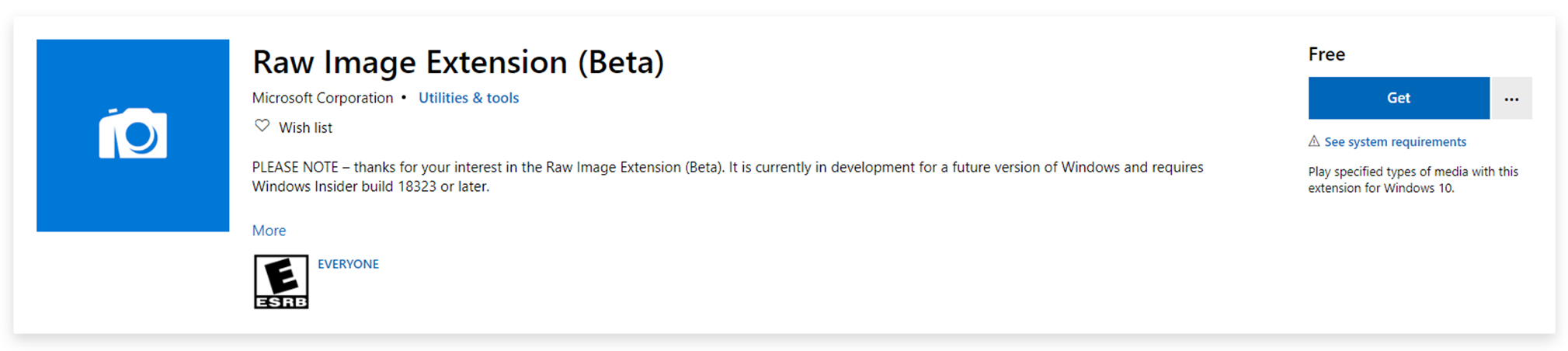
For any creatives out there — myself included — Microsoft’s move to introduce improved RAW support is more than welcome. The new support comes via an app in the Microsoft Store called ‘Raw Image Extension,’ which is currently only available to those on the preview build.
With it, you’ll be able to view image thumbnails, previews and camera metadata in Windows File Explorer. Additionally, RAW files will display at full resolution in any Windows app that uses Windows Imaging Component framework.
The 18323 build also brings fixes to the Windows light theme. Fixes include colours that wouldn’t change properly or some text, scrollbars and icons not being visible.
On top of this, Microsoft has rolled out an incredibly long list of bug fixes coming in the new preview build. This includes issues with night light not working correctly, a bug that caused File Explorer to hang sometimes when it interacted with MP4 files and even a misalignment with the grid in the Calculator app.
For a full rundown of all the fixes and changes, check out Microsoft’s blog post here.
However, we’re in 2019 now, and a recent code change submitted to the Android Open Source Project (AOSP) Gerrit mentions the codenames ‘salmon’ and ‘medaka.’
For the unfamiliar, the AOSP Gerrit is an online collaboration tool where developers can submit code changes to projects, have them reviewed and then merged into the project.
In this particular instance, the code change concerns an update for ‘chin devices,’ a phrase often used to reference circular watches with a bottom cutout, like the Moto 360.
Further, the vast majority of the participants in the code change — also known as a commit — are part of the Wear OS team, suggesting the two codenames are for Wear OS devices.
However, the commit mentions a third codename: ‘Walleye.’ You may have heard this one before as its the codename for the Pixel 2. Why the Pixel 2 was included in a code change for Wear OS devices isn’t clear. It could suggest the codenames aren’t for Pixel Watches, but for upcoming Pixel devices, like the rumoured Pixel 3 Lite or maybe even the Pixel 4.
Unfortunately, there just isn’t enough information to determine what the codenames are for, but we do know they’re for something and it might not be long before we find out what salmon and medaka are.
HMD Global, the Finnish company that currently holds the license to manufacture devices under the Nokia brand, has announced a partnership with three North American wireless service providers, including Toronto-based national carrier Rogers Communications.
According to a January 25th, 2019 media release, HMD’s partnerships — which include Verizon Wireless and AT&T-owned mobile virtual network operator (MVNO) Cricket Wireless — means that North American consumers will be able to purchase Nokia-branded smartphone directly from carriers, rather than needing to rely on retailers like Amazon or Canada Computers.
HMD used the same media release to announce that a Chatr-specific Nokia Android smartphone will come to Canada “very soon.”
“Our Nokia phone promise is distinct and built on consumer insight — European design and craftsmanship, excellent quality, latest Android and purposeful innovation that enhances your everyday user experience,” said Maurizio Angelone, vice president of HMD Global’s Americas division.
“We want consumers in North America to love and trust their Nokia phones.”
While HMD didn’t specify which smartphone would come to Chatr, the Finnish hardware manufacturer said Cricket is set to receive the Nokia 3.1 Plus, while the Nokia 2 V will be available for Verizon subscribers.
It’s worth noting that Nokia as a company still exists. However, the former Finnish hardware giant stepped out of the handset market by selling its mobile phone business to Microsoft in 2014.
Under the terms of its agreement with Microsoft, Nokia was restricted from selling Nokia-branded phone until December 21st, 2015.
Microsoft eventually sold the Nokia mobile phone brand to HMD Global back in 2016, which was founded and is still run by a team consisting mostly of former Nokia executives.
National carriers Bell and Telus confirmed that in recent years they have been using Huawei fibre-optic cables to build out fixed-line networks, despite growing cybersecurity concerns surrounding the company.
According to anonymous sources cited in a January 24th Globe and Mailarticle, both carriers have spent billions over the past years to replace legacy copper telephone wires with fibre-optic cables. The upgrade delivers faster internet speeds and services.
Both carriers used Huawei as an “additional vendor” to put pressure on its main supplier, Finland’s Nokia, for better prices and terms.
Canada is currently in the middle of a bilateral spat with China over telecommunications giant Huawei and the arrest of its global chief financial officer Meng Wanzhou.
Meng was arrested in Vancouver while in transit to Mexico. She was granted bail but currently faces extradition to the U.S., where authorities reportedly said she deceived international banks to funnel transactions between Huawei and Iran. Meng has maintained that Huawei has no connection or involvement.
In Canada, Huawei has partnered with Bell and Telus to provide equipment to deploy 5G mobile network infrastructure.
Currently, Canada is conducting two reviews, one on the future of 5G technology in Canada, and another on the cybersecurity concerns surrounding Huawei and whether the government should ban it.
The U.S. banned Huawei in August out of fear of cybersecurity concerns. Following the U.S., Australia and New Zealand also banned the company. The three nations are part of the Five Eyes intelligence sharing group that shares information and intelligence regarding terrorism, security and espionage. Canada and the U.K. are the other two members, and both have not banned Huawei.
The Globe and Mail reports that Bell and Telus used Huawei for its gigabit-capable passive optical network (GPON), which is generally used to fill in the last stretch of connection between a network provider and the customer.
According to the publication’s sources, to deploy this type of system, there is a terminal located somewhere in a neighbourhood that contains a large strand of fibre split into tiny strands. A second terminal, much smaller, is placed in a customer’s home and an optical signal is sent from the main terminal strands using light. It’s converted into ethernet signal and then connected to the user’s modem.
The equipment, however, is not part of the network core where sensitive data is stored, and the sources said that the carriers are working with the government to test the security of this equipment. This security test arrangement is similar to the agreement the federal government has with carriers that use Huawei for radios and antennas but not in their core network.
MobileSyrup has reached out to Bell and Telus for comment and will update the article with additional information.
In the Globe and Mail’s report, Bell Spokesperson Marc Choma said that the company works with several network equipment providers to supply equipment in deploying GPON. He added that suppliers go through a strict security screening.
Telus spokesman Richard Gilhooley said the carrier goes not rely on Huawei much to build out its fibre build and that the company mainly utilizes Nokia’s technology.
Changes are in the wind for Vancouver’s Granville Bridge, planned in the 1950’s as a downtown freeway component (like the viaducts) and now operating way under capacity, as motor vehicle volume continues to drop and other modes continue to grow.
With thanks to City of Vancouver and Engineering Services (report HERE).
What “way too big” looks like.
It’s time to rebuild it, and put that wasted capacity to use — in favour of those who travel by foot and by bike. Not to mention the opportunity for a major new component to the network of AAA cycling infrastructure, by connecting the Granville Bridge to the seawall and the Arbutus Greenway on the south, and to Drake and Richards on the north. The elevator to Granville Island is a terrific idea.
Today, the bridge is deadly for people on a bike, and contains tiny sidewalks and Vancouver’s nastiest crosswalks for people walking.
The idea has way more support than just Price Tags, despite the silly click-bait headlines pushing that tired and discredited trope “bike lanes = carmageddon”. We may not always agree on the exact design concept, but we do agree that improving life for people who walk or ride a bike for every-day transportation is a good idea.











 Prototyp-Enthüllung auf dem Automobilsalon 2019 Der Prototyp des neuen Elektrofahrzeugs von Honda wird auf dem Genfer Automobilsalon vom 7. bis 17. März 2019 erstmals der Öffentlichkeit vorgestellt. Honda setzt bei seinem neu konzipierten Elektrofahrzeug auf
 In 2016, Google hosted its developer conference at the Shoreline Amphitheatre in Mountain View, California, and has done so every year since.


 The Guardian.
 mrjamesob on Twitter.