Shared posts

29 Jan 13:42

Six Hour Workday, Please

by Stowe Boyd

Is ‘Six Hour Workday’ a movement, now? | HR Based Against Longer Commutes? | Trump Interrupts Pelosi 15 Times: Just Another Day At Work | Pew on AI and the Future

Beacon NY — 2018–10–17 — I’m in that strange position of being my own boss, so I find it hard to limit my work to six hours a day, although I like the idea. I’m approaching things the opposite way, which is making the periods when I am not working longer. So I’ve adopted a ‘four walks a day’ model.

Whatever works.

If you’re getting this you probably signed up at workfutures.org (or one of its predecessors) or stoweboyd.com. If someone forwarded this to you, sign up here.

Consider making a donation. We appreciate your support.

a sponsor message from BoundlessU

Work Futures reader and fellow writer on the future of work, Paul Millerd, has recently completed a course that pulls together all of the lessons, secrets and tools he learned while a strategy consultant at firms like McKinsey and Boston Consulting Group for almost ten years. He is offering the course on a gift basis where you can pay-what-feels-right. Check out a preview of some of the lectures here.

Links

The Case For The Six-Hour Workday | Steve Glaveski joins the growing movement for the six-hour workday:

“By cultivating a flow-friendly workplace and introducing a shorter workday, you’re setting the scene not only for higher productivity and better outcomes, but for more motivated and less-stressed employees, improved rates of employee acquisition and retention, and more time for all that fun stuff that goes on outside of office walls, otherwise known as life.”

I wonder how many reading that say ‘It would never work in my organization’?

Research: Hiring Managers Are Biased Against People with Longer Commutes | I’m not surprised by the conclusions of David Phillips from recent research:

“My results show that applicants living in distant neighborhoods received positive responses from employers less frequently than those living near the workplace. In fact, applicants who lived 5–6 miles farther from the job received about one-third fewer callbacks. The size of this penalty is similar to the penalty for signaling race with a black-indicating name. (For background: Other prominent studies compare employer responses to fictional applicants with names that signal different ethnicities. They provide some of the clearest evidence of significant discrimination in employment and rental housing. Comparing racial discrimination to a penalty for long commutes is complicated for many reasons, not the least of which is that race and place are related in DC. But the comparison at least provides a benchmark. In my study, an extra six miles of commuting lowers an applicant’s chances by as much as listing a black-indicating name like Jamal or Lakisha.)”

There is a rationale for weighting candidates that live closer more highly: they’re more likely to stick with a job with a short commute. But the economics enforces inequality when workers are forced to live in distant suburbs because of high rents downtown. And of course this strikes minorities more than others. The tension between social inequity and corporate self-interest should be balanced, not remain one-sided.

Trump Interrupting Pelosi Shows How Men Often Treat Women | Amanda Mull noticed that Donald Trump interrupted Nancy Pelosi 15 times during a discussion in the White House with Chuck Schumer. This is par for the course with Trump who interrupted Hilary Clinton 51 times during a presidential debate. But what is at work here is deeper than Trump’s attitudes: it’s wired into our culture.

“Researchers have been investigating who interrupts and who gets interrupted since at least 1975, when a landmark study at Stanford University found that, out of 31 conversations examined between partners of various gender pairings, men were responsible for all but one interruption. American notions of gender roles and interactions have changed a lot in the intervening 40 years, and a 2014 study from George Washington University suggests that’s brought a certain amount of parity to the act of interruption: Men and women in that study interrupted others at similar rates.
Where gender differences remained pronounced in the 2014 study was in who got interrupted: Speakers of all genders were far more likely to interrupt a female conversation partner. This dynamic is perhaps most visibly born out at the highest levels of government. In 2017, Senator Kamala Harris was cut off during her questioning of then-Attorney General Jeff Sessions by two male colleagues. During the 2016 presidential campaign, Trump interrupted Hillary Clinton 51 times during one debate; she interrupted him 17 times. Tuesday’s White House meeting was not the first situation in which Pelosi, a very powerful woman by all measures, has had to fight to get a word in edgewise with her colleagues.
Indeed, research has demonstrated that professional power alone isn’t enough to mitigate the disadvantage of being a woman in a conversation. According to a 2017 Northwestern University study, female Supreme Court Justices were more likely to be interrupted than their male colleagues, and it was usually their male colleagues doing the interrupting. The researchers found that in order to avoid being talked over, female justices usually adopted more aggressive questioning styles that mirrored their male counterparts over time. The data suggests that even though mirroring male conversational styles did help them, it wasn’t enough to pull female judges even with their male colleagues.”

This is so deep it might take generations to change, and this pervades business.

Artificial Intelligence and the Future of Humans | The Pew Research Center has published a very broad analysis of AI’s impact on the future.

“Digital life is augmenting human capacities and disrupting eons-old human activities. Code-driven systems have spread to more than half of the world’s inhabitants in ambient information and connectivity, offering previously unimagined opportunities and unprecedented threats. As emerging algorithm-driven artificial intelligence (AI) continues to spread, will people be better off than they are today?
Some 979 technology pioneers, innovators, developers, business and policy leaders, researchers and activists answered this question in a canvassing of experts conducted in the summer of 2018.
The experts predicted networked artificial intelligence will amplify human effectiveness but also threaten human autonomy, agency and capabilities. They spoke of the wide-ranging possibilities; that computers might match or even exceed human intelligence and capabilities on tasks such as complex decision-making, reasoning and learning, sophisticated analytics and pattern recognition, visual acuity, speech recognition and language translation. They said “smart” systems in communities, in vehicles, in buildings and utilities, on farms and in business processes will save time, money and lives and offer opportunities for individuals to enjoy a more-customized future.
Many focused their optimistic remarks on health care and the many possible applications of AI in diagnosing and treating patients or helping senior citizens live fuller and healthier lives. They were also enthusiastic about AI’s role in contributing to broad public-health programs built around massive amounts of data that may be captured in the coming years about everything from personal genomes to nutrition. Additionally, a number of these experts predicted that AI would abet long-anticipated changes in formal and informal education systems.
Yet, most experts, regardless of whether they are optimistic or not, expressed concerns about the long-term impact of these new tools on the essential elements of being human. All respondents in this non-scientific canvassing were asked to elaborate on why they felt AI would leave people better off or not. Many shared deep worries, and many also suggested pathways toward solutions.”

Go read it. It’s an amazingly broad spectrum blending of perspectives. (I’m in there somewhere, positioned as an optimist, strangely.)

Quote of the Day

“Sometimes when I read the papers of my fellow urban planners, I get the sense that they think cities are Disneyland or Club Med. Cities are labor markets. People go to cities to find a good job. Firms move to cities, which are expensive, because they are more likely to find the staff and specialists that they need. If a city’s attractive, that’s a bonus. But basically, they come to get a job.”

| Alain Bertaud in an interview with Nolan Gray in Urban Planner Alain Bertaud’s Case for Bottom-Up Design

Recent Issues

Work Futures Daily — The Future Is Already A Disappointment | 2018–12–12 | Paul Starr on a Disappointing Future | Decider Chatbot | Corporate Rebels on Smartlets | Tim Herrera on Starting What We Never Finish | NPR Temps | McKinsey on African-Americans and Automation

Work Futures Daily — A Kick In The Head | 2018–12–11 | Priya Parker: Wow! | Rededicated | Diversity at Slack | Janelle Monáe loves Slack | AI as Talent Scout | Compliment Yourself | Tom Loosemore on New Ways of Work | Lee Bryant: Change the system, change the culture

Work Futures Daily — Don’t Quit | 2018–12–09 | Four Steps To Creativity | Mental Models | Gender Equality, at Work and Home | Minimum Wage For Ride-Hailing | It’s Harder to Get A Promotion | Wellness Trends | Kevin Aston

From the Archives

The Architecture Of Cooperation | Stowe Boyd 2011

“The now old architecture of work was based on process-centric, collaborative work: I mean that all the people involved in some business process — for example, new customer acquisition for a consumer products company — would work exclusively on that process, and everyone’s work was defined by the process. In principle, each member of the consumer acquisition team would spend 100% of their time on that process, and all the members would be co-located (in cubicles or offices) so that the process could be as efficient as possible. Considerations of what would be best for the individual would be deemed irrelevant. Collaboration was the byword, and web tools were designed around symmetrical projects, where members derive their rights by being ‘invited’ — assigned — to project-based work contexts.
The new architecture of work is now emerging, after decades of transition. White collar work became knowledge work which has now become creative work. The transition from process to networks is not just a recasting, not just a different style of communication. The work is styled as information sharing through social relationships, and where ‘following’ takes the place of ‘invitation’. People coordinate efforts, but work on a wide variety of activities, which are not necessarily co-aligned with others’ work, and which are not necessarily even known in a general way. A new degree of privacy and autonomy animates cooperative work, in comparison to collaborative work. Individuals cooperating hand off information or take on tasks in a fashion that is like businesses cooperating: they see the benefit in cooperating, and don’t have to share a common core set of strategic goals to do so: they don’t need the alignment of goals that defines old style business employment.”

Originally published at workfutures.org.


Six Hour Workday, Please was originally published in Work Futures Institute on Medium, where people are continuing the conversation by highlighting and responding to this story.

29 Jan 13:42

The Peter and Oliver Podcast: Smart Car Video Edition

by peter@rukavina.net (Peter Rukavina)

In August of 2006 we made a quick 24 hour trip to Halifax for a medical appointment; Oliver and I took a spare hour and test drove a Smart Car. I recorded the “video podcast” we made in the car on my Nokia N70 mobile phone, but didn’t post it online at the time because, well, there wasn’t an easy way of doing that back then (Google didn’t buy YouTube until November of that year).

Fortunately, Catherine had the recording saved in her email, and so, now that posting video online is easy, we can present the review to the world:

The video quality is horrible–the N70 3GP files were very low resolution, and not intended for anything other than sending mobile-to-mobile–but you can make it out okay. I especially like the establishing shot, pointing up at the retracting Smart car roof.

Last year Oliver and I test drove a Smart car again, this time an electric model, but the video was wonky, and all that remains as evidence is this AI-generated version conjured up by Google Photos.

29 Jan 13:42

For AirPods Early Adopters, Apple’s Hit Wireless Earbuds Are Showing Their Age

by Federico Viticci

I found myself nodding in agreement with this post by Zac Hall about how AirPods purchased in December 2016 are starting to show their age in terms of battery life:

Apple rates AirPods for up to five hours usage at 50% volume, and early testing proved that rating was actually slightly conservative. In practice, brand new AirPods could last almost five and a half hours before their batteries depleted. The carrying case doubles as a charging case, too, providing over 24 hours of battery life without needing to recharge from the wall.

But batteries are consumable, we all know so well now, and that’s proven true for the tiny batteries inside AirPods after two years of daily use. Battery life that once exceeded five hours now struggles to power AirPods through three hours of continuous usage at the same volume. Battery life results can be cut in half if you need to play audio at a louder volume.

In practice, I used to never hear the low battery alert during usage. I rarely listened to audio with AirPods for five straight hours before charging in the carrying case without thought. More recently, I’ve heard the bloop sound much more regularly, frequently followed by AirPods dying before I’m ready to recharge.

I've been thinking about this a lot lately (in fact, I proposed it as a topic for this week's Connected) and I feel like Hall and I have gone through the same process. When my AirPods were new, I could listen to a full episode of Upgrade or Cortex at max volume and still have plenty of battery life left; now I cannot get to the end of an episode (roughly 90 minutes in length) without hearing the low-battery alert. My AirPods can't hold a charge like they used to and I'm not surprised.

I could buy a fresh pair of AirPods now, but that seems like a waste of money given the (possible?) upcoming release of a new model. I could buy a third-party wireless charging adapter to make charging the case more convenient, but I don't feel comfortable with an unofficial, bulky add-on case, which wouldn't fix the battery issue of the AirPods anyway. I love my AirPods – they're one of my favorite Apple products in recent years alongside the iPad Pro and Apple Watch – but I'm reaching the point where I'm always charging them, and I really want Apple to release whatever they've been working on.

→ Source: 9to5mac.com

29 Jan 13:38

Apple in 2018: The Six Colors Report Card

by Federico Viticci

Jason Snell:

It’s time for our annual look back on Apple’s performance during the past year, as seen through the eyes of writers, editors, developers, podcasters, and other people who spend an awful lot of time thinking about Apple.

This is the fourth year that I’ve presented this survey to a hand-selected group. They were prompted with 11 different Apple-related subjects, and asked to rate them on a scale from 1 to 5, as well as optionally provide text commentary on their vote. I received 55 replies, with the average results as shown below:

It was my pleasure to participate (again) in the latest edition of the Six Colors Apple report card, which features average scores and answers on a variety of Apple topics. As usual, it is a solid, balanced overview of where Apple stands today in different areas of its business. Personally, I was positive about iPad Pro hardware, iOS 12, and Apple Watch, but I noted I'd like to see Apple do more on iPad software, iPhone camera, and HomeKit in 2019.

→ Source: sixcolors.com

29 Jan 13:33

Patreon and Twitter are right about freedom of speech

Ben Werdmuller, Jan 28, 2019
Icon

I think this is a truism that people would do well to keep in mind: "The mechanisms and legal machinations of freedom of speech aside, any community that allows intolerance to flourish will in itself become intolerant." How this works in a completely decentralized system like Interplanetary File System (IPFS) is a good (and important) question.

Web: [Direct Link] [This Post]
29 Jan 13:33

well that was fun

by jnyyz

So today was the start of what is supposed to be the most significant snow fall of the season thus far. On the plus side, there was a nice tailwind, and the temperatures were much warmer than this morning.

Here the Bloor bike lane has not been plowed recently, but it was still pleasant riding on the comparatively untracked snow.

img_0511

On the eastbound sections with bollards, I was thankful for the separation from traffic. The windrow makes one long for a permanent concrete barrier.

img_0512

Please forgive the runny nose picture.

img_0513

Past the end of the bike lane at Shaw, I mixed it up with traffic as most of the curb lane was impassable. Fortunately, traffic was very slow, and there was no problem keeping up. On the downside, I was stuck in traffic like everyone else.

img_0514

Most of the unplowed side streets were impassable, with the many tire tracks making traction highly variable.

According to Strava, it took me over an hour and a quarter for me to get home, which was the longest ever.

screen shot 2019-01-28 at 8.24.50 pm

Still it was fun, and the car drivers were comparatively courteous tonight. We were all in the same boat, just trying to get home safe and sound. My favourite bit was passing an e-assist fat bike on Bloor.


29 Jan 13:30

Twitter Favorites: [stephbelding] It's surreal outside. Sideways snow, blinding white walls in minus stupid temperatures. Good luck and stay safe. #dlws

Stephanie Belding @stephbelding
It's surreal outside. Sideways snow, blinding white walls in minus stupid temperatures. Good luck and stay safe. #dlws
29 Jan 13:29

NewsBlur Blurblog: My Year in “Social Exile”

sillygwailo shared this story from Eric Karjaluoto.

TL;DR: Social media is hard to avoid, and leaving it won’t solve your problems. Stepping back might lend some perspective, though.

I left Facebook one year, two months, and some-odd days ago. (At the time, I wrote about my decision to do so.) Some say that quitting Facebook will wholly improve your life. I’m not sure that I agree with that. Still, I did notice some things. In this post, I’ll talk about my experience, what I observed, and what I’ll do next.

The experiment

I planned to never use Facebook again. This didn’t work out. I reactivated my account on three occasions. The first was to respond to a customer. The second was to access an app that required Facebook SSO. The third was to help a client reorganize their pages. Each session lasted ~10 minutes before I once again deactivated my account.

I set my personal Twitter feed to private and signed in to respond to some DMs. Around mid-summer, I posted links to blog articles. Doing so felt weird, given my stance against the platform. But, I caved because I felt like my articles might otherwise go unread.

I checked Linkedin notifications, but didn’t do much with it. I used Strava to track some workouts, but little else. I also posted some photos of a long drive, on Instagram, so family members could see our progress. After two weeks, I once again grew tired of it. Since then, I’ve only returned to post this photo of a (rather spectacular) golden telephone:

Personal findings

Although I did use social media last year, I dramatically reduced my usage (I estimate this reduction to be > 99%). For the most part, this is a positive change. I don’t miss Facebook. Meanwhile, I’m less reactive, more at ease, and better focused.

My brain fires in a lot of errant directions. This is hard to reign in. Not posting every idea that pops into my head helps with this. I also silenced most app/email notifications, which minimizes distraction. But, it’s not all about the technology.

Turns out, I crave distraction. I replaced passive Facebook scrolling with YouTube viewing and Reddit binging. I use DF Tube and StayFocusd to curb this. I also use Tomato One to focus my work, using the Pomodoro Technique.

Looking back, I regret how I behaved on social media. I promoted myself and our business too much. I got sucked into online arguments and took pleasure in those fights. I said foolish things in haste. A lot of times, I was a real dickhead.

General observations

I have two tricks for understanding something. The first is to get as deep into it as I can, and soaking in it. The second is to get far back from it, and try to achieve some new perspective. I’ve done both with social media. Here’s what I noticed:

Every big social network is like an all-ages dance. They contain many types of people with vastly different expectations. This means no one gets the experience they want. This leads to surface-level conversations that lack nuance. It also results in squabbles, because etiquette/conventions remain undefined.

Large social networks won’t go away, but I do expect usage will drop. Users will instead flock to smaller interest-based communities. Conversations there will be deeper, and etiquette clearer. Expect to see online forums flourish in the years ahead.

I also predict that something wholly new is coming. Companies are realizing that they’ve surrendered control of their marketing lists to social networks. They’ll soon start to take back ownership. This will result in the addition of social functionality right into their own websites. (I’m placing a personal bet on this, with Emetti Announce.)

Where do I go from here?

In leaving Facebook, I lost my connection to some acquaintances. I wish there were an online Rolodex of sorts that allowed me to stay in touch with these people. Facebook isn’t it, but I suspect someone’s building an app to do this better. For now, I’ll pick up the phone and send more 1:1 emails. This isn’t optimal, though.

I appreciate online community. Over the past year, I observed and participated in small communities like FounderCafe, Overland Bound, and even Tacoma World. These forums remind me of the web pre-Facebook. I’m discovering new things, and connecting with people based on interest—not past connection.

I intend to make note of blog articles I write, on Twitter and Linkedin. I still dislike both networks, but figure I’m only punishing myself by not using them for distribution. I won’t do much else on those networks. Meanwhile, I wrote a code of conduct for my use of these sites. I’ll continue to avoid Facebook and Instagram.

Most of my articles end with a tip, or recommendation on what to do next. I don’t have one of those, this time. I only share the above as notes of my experience. Perhaps some of this will ring familiar.

The post My Year in “Social Exile” appeared first on Eric Karjaluoto.

29 Jan 13:28

NewsBlur Blurblog: Goodbye to Metropass

sillygwailo shared this story from Steve Munro.

In May 1980, the TTC introduced the Metropass giving riders the option of paying a flat fare for one month of unlimited travel. Management had resisted the idea of a pass with the classic “it won’t work here” argument. Toronto was finally embarrassed into implementing a pass when Hamilton (a working-class burg at the west end of Lake Ontario always seen as inferior to Toronto) brought in a pass. The idea that passes were some sort of unintelligible, unenforceable foreign scheme collapsed under its own stupidity.

The TTC was really fighting the idea that riders should get a discount for using transit more. For decades afterward Metropasses became the workhorse of TTC fares, the idea persisted that passholders were freeloaders on the system. This attitude continues to infect debates over flat fares versus distance or zone-based ones when the real issue is to get more people out of cars and onto transit. “Paying your fair share” rarely includes the avoided cost of building and operating a road network, let alone the economic benefits of a mobile population.

It is ironic that GO Transit, founded in 1967, was established on the premise that carrying people on trains avoided massive expressway construction as well as the personal cost and time of driving into the city. This was a rare time when the cost of providing transit was seen as a way of avoiding the much higher cost (in dollars, physical upheaval and the inevitable future congestion) of continued road-building. Debates over transit funding, fares and service have rarely been this enlightened.

The Metropass now becomes part of TTC fare history with its replacement by Presto.

Metrolinx should have begun the migration years ago to “open payment” (accepting any media), but the government and management of the day preferred to hobble along with their existing structure and attempt to fit new functionalities into a “next generation” of Presto. They are now experimenting with a smart phone app providing equivalent functions to their card, and talk openly of a move away from a proprietary card to the use of any identification system such as a credit card or app. This will require a complete rethink of Presto’s “back office” functions, but will bring much more flexibility in fare plans and billing if the political will ever exists to implement this.

The problem of pricing and of fares generally is much more than a technology issue although both the limitations and potential of electronic fare collection have been used to argue for and against various schemes. Incentives and barriers to transit use exist in the tariff region-wide, but changes have much more to do with the eternal question “who pays” rather than the fare technology. Years ago, Toronto abolished its two-zone fare structure valuing the ability to travel anywhere for one price over the premise that riders between the suburbs and the core should pay more because they “used” more of the transit system. More recently, the move to the “two hour transfer” on Presto recognizes that a transit “trip” legitimately may be broken up in small segments and riders should not be penalized for hop-on, hop-off travel as they have been for over a century.

This post includes a selection of Metropasses over the years. Recently, the Star ran a piece on Nathan Ng who is working on a site to present all of the passes from May 1980 to December 2018 drawing on my own and others’ collections. (He is missing three years in the mid-90s when I was buying annual passes.) Ng’s other sites include Station Fixation which details every station on the TTC system, Historical Maps of Toronto and the invaluable Goad’s Atlas of Toronto — Online! in which one can quickly become lost for hours exploring the city as it once was.

At its debut, the monthly pass was priced at the equivalent of 52 token fares which gave us a $26 pass. This price quickly escalated as the TTC’s fares and finances faced the stresses of the early 1980s. This was a period which saw the first Gulf Oil crisis, and the economic downturn brought an end to a long period of effortless growth of ridership on the TTC. Management had never dealt with a system where riders stopped showing up, and this brought the onset of “adjusting service to meet demand”, a polite way of saying “cutting service to the level we can afford”.

Despite repeated fare freezes as well as shifts in the “multiple” for pass pricing (the number of token fares represented by a pass), the actual price has risen over four decades at a quite uniform rate as the chart below shows. Fast growth in pass prices in the first decade follow the same overall trend through pricing right up to 2018. Each freeze has been followed by a jump in pricing that returns the line to the same slope it has been on since 1980. The price today, at $146.25, is 5.63 times the 1980 price of $26.

Fares rose quickly as the samples of 1980 to 1984 show (the usual price change was in February following the adoption of a new budget and fare scheme in December of the previous year) with an increase of 40% in just four years.

The escalation continued and by 1989, the price was up to $49, almost double in the course of a decade.

In 1990, there was a change in the format of the pass. Previously passes had been slips of paper that a rider would insert into a plastic sleeve accompanied by photo id. The spaces where “ME7944” appears on most of the passes above holds the ID number from the photo portion of the pass.

In 1990, the format changed and the pass was made with the plastic sleeve integrated and this made for an oversized pass that only lasted a few years. The February 1990 pass (the first of its kind) was manufactured before the price was set, and this was added later. By April 1990, the preprinted media caught up with the tariff. The same sort of thing happened in 1991.

1992 brought a visual change while retaining the photo insert pocket, but the huge change was in the price when, in May 1992 the cost went from the 1991 price of $56.50 to $67. This was a triumph, albeit not a permanent one, of the idea that passholders were ripping off the system, and the fare multiple was pushed up to 56 (against a token fare of $1.20). From June 1992 onward, the price rarely appeared on the passes, and space for this vanished with the new format introduced in 1993.

1993 brought a shift to the credit card form factor used for Metropasses ever since. The pass was not transferable between riders and still required a photo id.

In 1994, the forerunner of the Monthly Discount Plan, or MDP, arrived with the availability of an annual pass. These were not popular as riders had to shell out for a full year’s travel up front, and there was no way to reclaim the value if the card was lost. A somewhat younger version of your intrepid correspondent appears on these passes.

The format stayed quite similar for several years except for a change in numbering in August 1999 to identify passes sold under the MDP.

July 2001 saw the motto “Service Courtesy Safety” replaced with “Ride the Rocket / The Better Way”, but otherwise nothing changed in the format.

The pass format changed again as an anti-counterfeiting measure in April 2004. In September 2005, the need for photo ID disappeared, and the Metropass became transferable between riders with the proviso that only one person should use it at the same time. The text explaining the rules changes from time to time over following years.

November 2011 brought the corner cut intended to give a tactile reading of the orientation for holding a pass to swipe in through a reader.

When the 2016 passes were designed, the TTC expected that this would be their final year. The layout was such that they formed a continuous image with a slight overlap from each pass to the following month. The Presto project didn’t quite hit its target, and the Metropass lived on to the end of 2018.

2017 passes included photos of sites around town, and 2018 brought a series of murals from different neighbourhoods, arguable the most visually interesting of all the passes back to their origin.


29 Jan 13:27

Twitter Favorites: [Sean_YYZ] That was a fun walk home. https://t.co/knF6edhtKr

Sean Marshall @Sean_YYZ
That was a fun walk home. pic.twitter.com/knF6edhtKr
29 Jan 13:27

Twitter Favorites: [shawnmicallef] It’s so muffled out. The sound. So soft. City at its most silent. Go out and listen. The city is like a recordin… https://t.co/lJsV98IAEC

Shawn Micallef @shawnmicallef
It’s so muffled out. The sound. So soft. City at its most silent. Go out and listen. The city is like a recordin… twitter.com/i/web/status/1…
29 Jan 13:27

Perfect timing

(I work for Mozilla. Not speaking for Mozilla here.)

January 28, 2019:

Male impotence, substance abuse, right-wing politics, left-wing politics, sexually transmitted diseases, cancer, mental health....Intimate and highly sensitive inferences such as these are then systematically broadcast and shared with what can be thousands of third party companies, via the real-time ad auction broadcast process which powers the modern programmatic online advertising system. So essentially you’re looking at the rear-end reality of how creepy ads work.

Natasha Lomas, on TechCrunch

Also January 28, 2019:

Simply put: users need more protection from tracking....In support of this effort, today we are releasing an anti-tracking policy that outlines the tracking practices that Firefox will block by default. At a high level, this new policy will curtail tracking techniques that are used to build profiles of users’ browsing activity. In the policy, we outline the types of tracking practices that users cannot meaningfully control.

Steven Englehardt and Marshall Erwin, on the Mozilla Security Blog

29 Jan 13:27

Major FaceTime Bug Allows Any Caller Access to Your iPhone’s Microphone Feed, Potentially Your Camera

by Ryan Christoffel

Benjamin Mayo of 9to5Mac, reporting on a serious iOS bug just discovered for FaceTime:

A significant bug has been discovered in FaceTime and is currently spreading virally over social media. The bug lets you call anyone with FaceTime, and immediately hear the audio coming from their phone — before the person on the other end has accepted or rejected the incoming call.

Naturally, this poses a pretty privacy problem as you can essentially listen in on any iOS user, although it still rings like normal, so you can’t be 100% covert about it. Nevertheless, there is no indication on the recipient’s side that you could hear any of their audio.

Mayo continues by listing the details of how to reproduce the bug yourself when calling someone else, which involves a few very simple steps that anyone can perform. The simplicity of reproduction makes this bug especially dangerous.

Following up on Mayo's report, Dieter Bohn of The Verge shared that things get even worse:

To recap: due to this FaceTime bug, which appears to affect all devices running iOS 12.1 or later, any caller can gain access to another user's microphone feed while the call is ringing. And if the person receiving the call in that scenario tries to dismiss the call, it may unintentionally be answered, activating the device's camera as well.

Apple gave the following statement to John Paczkowski of BuzzFeed:

Hopefully 'later this week' ends up translating to the next day or two, as some serious havoc could be wrought by this bug on unsuspecting users. Until that software update is released, we strongly recommend disabling FaceTime from Settings ⇾ FaceTime on your devices, or at the very least be aware that incoming calls you receive could be tapping into your microphone without your consent.

→ Source: 9to5mac.com

29 Jan 13:21

Antivaccine pseudoscience disguised as autism advocacy in the Minnesota legislature – Science-Based Medicine

mkalus shared this story from Science-Based Medicine.

Earlier this week, the World Health Organization included vaccine hesitancy on its list of top ten global health threats for 2019. In his discussion of the issue, Steve Novella recounted a depressing litany of outbreaks of vaccine-preventable diseases all over the world, particularly in Europe, to which vaccine hesitancy and the antivaccine movement have been major contributors. Thus far in the US, we’ve avoided the massive outbreaks of measles that are continuing in Europe and Israel, for instance. That’s not to say that we don’t have our own outbreaks. Currently, there are measles outbreaks in New York City in ultra-Orthodox Jewish populations and Clark County, Washington (just across the Columbia River from Portland). A couple of years ago, antivaxers contributed directly to a large measles outbreak among the Somali immigrant population in Minnesota. Basically, local antivaccine groups laying the groundwork by taking advantage of an observation that there appeared to be a higher prevalence of autism among the children of Somali immigrants by promoting Andrew Wakefield’s discredited and fraudulent research linking the MMR vaccine to autism. As a result, uptake of the measles-mumps-rubella (MMR) vaccine plummeted. Basically, antivaxers targeted a vulnerable community—repeatedly—with antivaccine propaganda. Indeed, Andrew Wakefield himself even paid Minnesota a visit in 2010. Even as the outbreak was raging, antivaxers doubled down, sending Mark Blaxill there to tell the Somalis, in essence, not to listen to the public health authorities desperately trying to contain the outbreak.

In light of that recent history, it was particularly disturbing to see what was reported in Minnesota last week:

Autism activists are concerned that the appointment of vaccine skeptics to a newly formed state council gives credibility to views the state has struggled to dispel.

The MN Autism Council was formed last fall by Sen. Jim Abeler, R-Anoka, to discuss autism and advise the Legislature on public policy.

Abeler said he wants the group to represent diverse viewpoints and said it will be focused on issues like housing, employment and education, not vaccines.

First of all, it is very common for antivaxers who believe against all evidence that vaccines cause autism to cloak their true nature in autism advocacy, at least for purposes of appearing “respectable” and insinuating themselves into advisory committees for government and nonprofits. In fairness, some of them actually do autism advocacy work because many of them became antivaxers after having a child diagnosed with autism. The problem is that these same antivaxers use their autism advocacy to promote their antivaccine views as well. Indeed, an unfortunate problem with autism advocacy in the age of Wakefield is that autism advocacy is all too often tainted with antivaccine views. Some autism advocacy groups, like Autism Speaks, have tried to have it both ways, doing a “nudge, nudge, wink, wink” in their stances on vaccines and autism.

So who is Sen. Abeler, and who are the antivaxers now serving on the Minnesota Autism Council? Well, surprise, surprise, Jim Abeler is a chiropractor, or, as I like to say, a substandard physical therapist with delusions of grandeur. His clinic website features the usual chiropractic quackery about subluxations and spinal manipulation, but also includes quackery for ADHD, colic, ear infections, pregnancy, and chiropractic care for children. It describes Abeler thusly:

His technique includes a gentle approach to spinal care utilizing the use of an Activator for adjusting, kinesiology, spinal and muscular balancing, nutritional advice and a strong emphasis on personal responsibility on the part of the patient. In addition, Dr. Abeler looks for underlying causes of any disturbance or disruption (which may or may not be causing symptoms at the time) and make whatever interventions and lifestyle adjustments that would optimize the conditions for normal function.

In other words, the usual “we treat the underlying causes” nonsense favored by alternative medicine practitioners everywhere.

Elsewhere on Abeler’s website, we find a blog post on how chiropractic can “boost your immunity”:

Chiropractic adjustments can remove misalignments, allowing the nerves in your spine to operate with less interference. When the brain and nervous system are able to communicate effectively your immune system is back running at full capacity. Anoka chiropractic doctors may also reduce your back pain, neck pain, jaw pain, headaches, and shoulder pain so you can function in your day-to-day life more efficiently. While chiropractic treatment can influence your immune system directly, it can also heal your body so you are in a position to be more active.

And for children:

Kids seem to be at the mercy of just about every type of virus and illness out there and childhood immunity is always a hot topic of conversation. Things like ear infections, colds, allergies, and tonsillitis can cause a lot of discomfort and become serious in some cases. Just as with adults, children can receive chiropractic treatment that will ease tension on nerves and improve their immune response.

Interestingly, even doing Google Advanced Searches, I was unable to find any posts on vaccines on Jim Abeler’s website. Ditto when I searched for the word “autism”. However, there are strong reasons to suspect nonetheless that Sen. Abeler is antivaccine. The first of these is that he’s a chiropractor, and chiropractic as a “profession” is rife with antivaccine views, with many, if not most, chiropractors discouraging vaccination in favor of their quackery. Chiropractic is like naturopathy in that respect, full of antivaccine pseudoscience. Second, he chose two prominent antivaxers to be on the panel, Wayne Rohde, co-founder of the Vaccine Safety Council of Minnesota, one of the groups involved in promoting antivaccine views among the Somali immigrants in its state, and Patti Carroll, who was involved with organizing antivaccine outreach in the Minnesota Somali community. Rohde is also an executive for Health Choice, a group that believes that most chronic health issues in children are due to “unhealthy choices,” including “industrial processed foods, side effects of vaccine choices, and other environmental and lifestyle factors.” If you check out the Vaccine Safety Council’s website, you’ll find it packed with the usual antivaccine talking points:

GUIDING PRINCIPLES

  • We demand full disclosure by government and health officials of both the risks and benefits of vaccines.
  • We support unbiased safety studies for every vaccine and every combination of vaccines the government recommends.
  • We provide education on dishonest representation, legal issues, parental choice, and true informed consent.
  • We advocate for complete transparency by state and federal officials in vaccine law and policy decisions.
  • We promote consumer safety by calling for vaccines free from mercury, aluminum and other dangerous ingredients.
  • We work to preserve individual freedoms by opposing mandatory vaccination.

Note the antivaccine dog whistles, such as “unbiased safety studies” (translation: any study not run by big pharma or the government or academic institutions), “full disclosure” of “risks and benefits” (in reality, vastly inflating the risks and downplaying the benefits of vaccination), the promotion of vaccines free from “mercury, aluminum, and other dangerous ingredients” (mercury isn’t in childhood vaccines anymore and haven’t been for over 16 years, and none of the other ingredients in vaccines are dangerous at the doses used), and, of course, the “vaccine freedom” gambit. Elsewhere on the website, you can find videos by antivaxers such as the producer of the antivaccine propaganda film disguised as a documentary VAXXED, Del Bigtree, along with links to VAXXED itself and a host of other antivaccine propaganda videos. The reading list on the website includes the usual list of antivaccine books, and the “research” section of the website includes Pubmed links to studies frequently misinterpreted as supporting antivaccine views or horrible studies by antivaxers themselves.

Amusingly, Kim Stagliano over at the antivaccine blog Age of Autism is crying “Help, help, I’m being repressed!” as antivaxers are wont to do whenever they are called out by the press:

Wayne Rohde has written a carefully researched book on The Vaccine Court that every American should read. He moved to Minnesota from Oklahoma to help his son. His son Nick was the namesake of “Nicki’s Law” which in 2008, fought for medical coverage for autism in Oklahoma. Monday (May 19), two newspapers – both in predominantly Republican communities – published editorials in support of “Nick’s Law,” a measure by Senator Jay Paul Gumm that would require health insurance policies cover diagnosis and treatment for autistic children. Patti Carroll has worked tooth and nail for ALL people with autism in Minnesota and also to protect those not “yet” touched. She was especially involved in helping the immigrant Somali population as they faced autism for the very first time, once here in America. To offend them by writing them off as mere “antivaxxers” is an insult in the extreme.

It is all very well and good that Rohde fought to pass Nick’s Law (which ultimately did not pass, from what I gather), but it is not well and good that he now fights in Minnesota to demonize vaccines. As for Patti Carroll, I can’t help but note that the link chosen by Stagliano to represent the “good” she did for the Somali immigrant community in Minnesota was to a post entitled “MN Department of Public Health Coerces Somali Families into MMR Vaccine“, with an image proclaiming “the bully vaccine.” Basically, it’s a blog post by Patti Carroll about how she was trying to counter the MN Department of Public Health’s efforts to persuade Somalis to vaccinate their children. If you want an example of how antivaxers equate autism advocacy with their antivaccine activism, I can’t think of a better example! Stagliano and Carroll actually thought Carroll was doing good by fueling a measles outbreak by persuading a vulnerable population that vaccines cause autism and that they should therefore not vaccinate their children against a highly contagious disease.

Which leads us to Stagliano’s usual drama:

We are the new N word. We are the new R word. I was supposed to speak at an autism school somewhere in the United States in 2 weeks. I was hired as keynote speaker for their annual fund raiser. Some parents at this fine private school caught wind that “KIM ROSSI OH YOU MEAN STAGLIANO THE ANTIVAXXER” is being hired and guess what? They got me FIRED from the job. They cancelled my signed contract. I was really looking forward to meeting a new group and sharing my experiences by using my humor to make them laugh.

To which I say: Good for those parents! Well done! As for Stagliano, her comparison of the criticism and deserved ostracism that antivaxers experience to the racism and persecution that black people have suffered over centuries in this country is so overwrought and off-base as to be deeply offensive. I suppose I should be grateful that she didn’t compare herself to Jews during the Holocaust as well, because other antivaxers have done just that.

Getting back to Wayne Rhode, we see in an article in The Daily Beast that he invokes exactly the same persecution complex, just without the offensive analogies:

Abeler, who believes doctors should tell parents the “pluses and minuses of vaccines,” appointed anti-vaxxer Wayne Rohde, co-founder of the Vaccine Safety Council of Minnesota, a group that is skeptical of vaccines, and Patti Carroll, who was involved with organizing anti-vaccine outreach in the Minnesota Somali community.

Rohde refutes the label of “anti-vaxxer.” “Those who question vaccine safety are quickly marginalized as saying ‘We’re anti-vax,’” Rohde told the Star Tribune.

No, Rohde is called an antivaxer because that’s what he has demonstrated himself to be, through a long history of words and actions. He’s even written an antivaccine book, The Vaccine Court: The Dark Truth of America’s Vaccine Injury Compensation Program, full of misinformation about and mischaracterizations of the National Vaccine Injury Compensation Program. I can tell just from the blurbs that it includes the same sorts of misinformation and half-truths that the Canary Party, an antivaccine group associated with Jennifer Larson of the Vaccine Safety Council of Minnesota, has been pushing for at least six or seven years now.

Now, let’s look a bit at Abeler’s history with Rhodes and Carroll:

You can read the whole post on Facebook if you like, but I’ll quote relevant passages:

In spring 2018, Senator Jim Abeler SD 35 proposed legislastion [sic] for a statewide autism registry in Minnesota.

Following public outcry, particularly from the #actuallyautistic and greater disability justice community, the proposed legislation was pulled. After a community meeting, Sen. Abeler appointed two parent advocates, Jean Bender and Wayne Rhode, to design a new task force-type group for the state of MN. Dr. Sheryl Grassie, executive director of the MN Consortium of Citizens with Disabilities, volunteered to contribute as well. The Autism Spectrum Planning Group was formed.

It is very telling that Abeler picked an antivaxer as one of three key people who set up this task force! As for the others, Dr. Grassie seems legit, and Jean Bender is a board member for the Autism Society of Minnesota. That they would work with an antivaccine activist like Wayne Rhode does not speak well of them, however. It’s a deal with the devil that demands too much.

Of course, Abeler denies that vaccines will be an issue:

Abeler told the Daily Beast that the goal of the council is “to address the present and future needs for education, employment, housing, transportation and independent living in the autism community.” He added, “There is no plan or intention of taking any positions about vaccines.”

Rohde told the Star Tribune that while he does support parents’ rights not to vaccinate, “we’re not about causation within the council. The council is all about how to deal and help those who are afflicted, and their families and those who provide services.” Rohde has a son on the autism spectrum.

Of course, I don’t believe this for one second. Here’s why. Note the part about how the council is allegedly “all about how to deal and help those who are afflicted.” That’s basically code for adding autism quackery to the mix of “how to help” autistic people, and most autism quackery is based on pseudoscience claiming that vaccines cause autism. Don’t believe me? Think I’m reading too much into this phrase because I’ve been too close to the issue for too long, rather than that I know antivaccine code phrases? Well consider this.

As mentioned above, the original idea for the panel was the Autism Spectrum Planning Group and was born in the wake of the outcry over legislation that Sen. Abeler had introduced, SD 35, which would have created a statewide autism registry in Minnesota. Thus, the autism task force ultimately formed was, in essence, Plan B. However, that didn’t stop Abeler from going to Plan C when he didn’t like how the task force was turning out. After months of planning by a group that included autistic people, Abeler did this:

Over approximately four months, The ASPG met and developed a mission statement, a purpose statement, a group structure [sic], representation priorities, and a proposed list of members for The Minnesota Autism Council. The first meeting of the council was scheduled for November 8th, 2018.

Recently, two members of the group—Wayne Rhode and Dr. Sheryl Grassie, both original members—met privately with Sen. Abeler. As a result of that meeting, Sen Abeler scrapped both The ASPG and our progress. He then created a new work group, appointed leadership that includes no autistic members, and instructed them to form a council that does not reflect the priorities the ASPG spent four months identifying. The ASPG was not consulted or informed prior to Sen. Abeler’s announcement of these changes during the commitee [sic] hearing on 10/17/2018.

It is vital to note two things:

  1. These changes remove all autistic voices from the leadership team that will design and implement The Minnesota Autism Council.
  2. These changes implicitly invite multiple specific organizations to the table that prioritize treating and/or curing autism. These organizations were not included in the proposed membership developed by The ASPG.

Sen. Abeler is a chiropractor. Although he doesn’t mention autism on his website, it would not surprise me in the least if he treats autistic children, trying to “cure” them with adjustments. He has an autistic child. He knows antivaxers and thinks enough of them to appoint two of them to an important state council to advise the government on priorities and policies to help autistic people. If Sen. Abeler is not antivaccine (which, the more I read about him, the more I doubt), he’s at the very least what I like to call antivaccine-adjacent.

The pro-vaccine members of the panel are also laboring under this delusion:

“If their total focus was to come up with a recommendation related to vaccination, yes, it might give me pause,” she said. “But on the other hand, it seems this group is focusing more on how they can support families.”

Sonya Emerick, who is involved with the MN Autism Council, said she is worried about having vaccine skeptics in the group. But she wants to focus on the work, rather than lingering on that. If a group with such a wide range of opinions can move forward with shared policy priorities, she said it could have major effects on Minnesotans.

Sure, it will likely be this way in the beginning. However, if there’s one thing I’ve learned about antivaxers, it’s that they can’t keep their antivaccine pseudoscience from infecting everything they do, particularly when it comes to autism advocacy. Minnesota autism advocates know this:

Idil Abdull, a longtime autism advocate at the Capitol, was part of the previous task force and clashed with some members of the group. She is not part of Abeler’s committee, but has aired concerns with it.

“The fact that he appointed so many people from the anti-vaccine community who will try to divide us is heartbreaking,” Abdull said.

And that is exactly what will happen. It might not happen right away. Antivaxers can “play nice” for a while. However, eventually, their pseudoscientific beliefs will infect the deliberations. For example, it would not in the least bit surprise me if the antivaxers on the panel start advocating that the state support “autism biomed” quackery for autistic children or promote funding for alternative medicine practitioners like naturopaths. Belief in such quackery often goes hand-in-hand with the belief that vaccines cause autism, and it’s quite possible to promote antivaccine beliefs without explicitly mentioning vaccines. Promoting autism biomed quackery is one way to do that. Antivaxers know this, which is why they lobby so hard to attach themselves to government autism advocacy and advisory panels, even when the mission of the panel does not include childhood vaccination.

This is why antivaxers should never be on government panels. Such panels should indeed include people with a diversity of backgrounds, beliefs, and opinions, but it is essential not to think that “diversity” must mean including people with dangerous pseudoscientific beliefs. That, unfortunately, is exactly what Sen. Abeler and Minnesota have done.

29 Jan 13:21

Der Autoverkehr braucht den Platz doch gar nicht

by noreply@blogger.com (Christine Lehmann)
mkalus shared this story from Radfahren in Stuttgart.

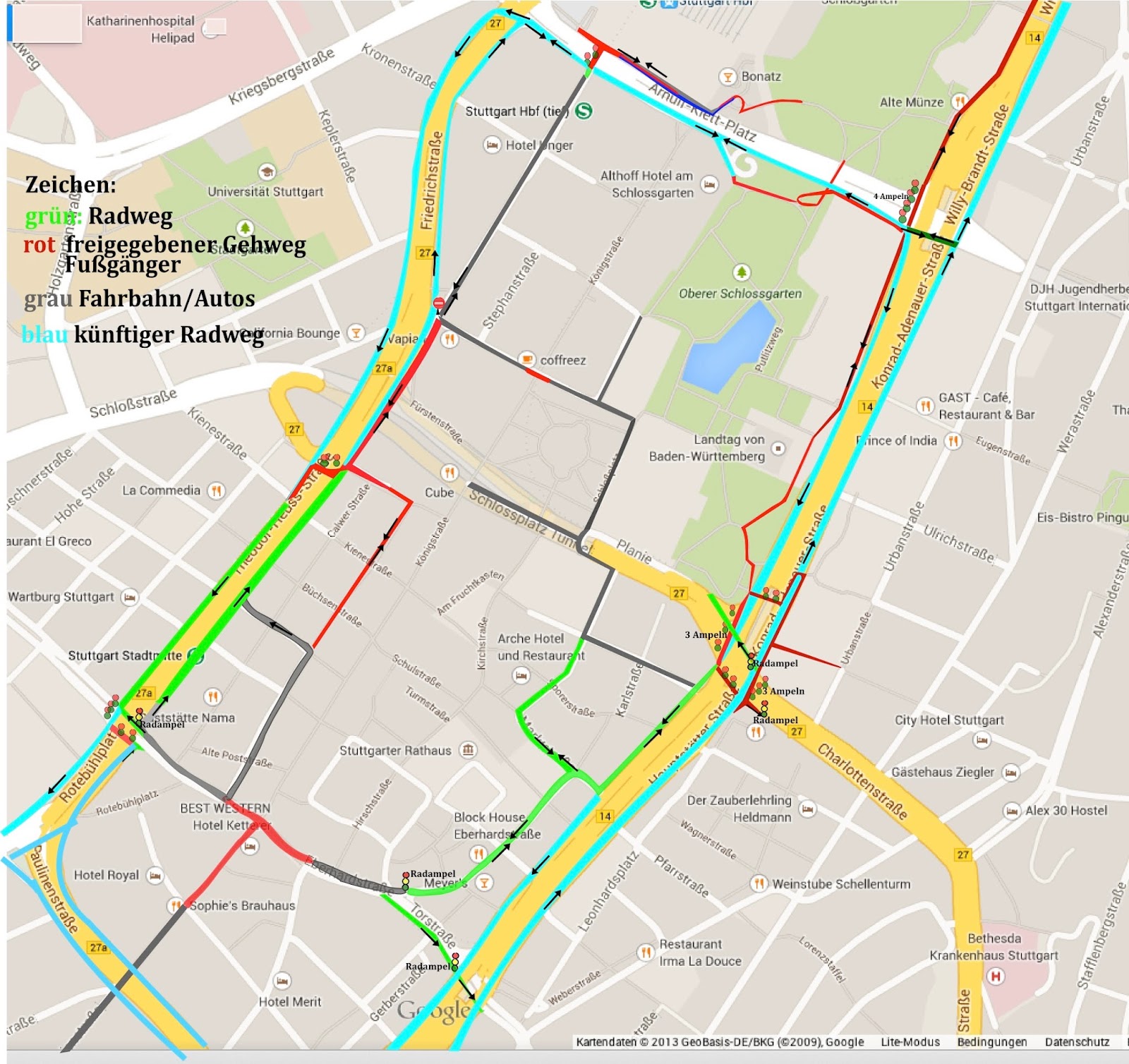
Es könnte um Stuttgart gehen. Auf dem Ring soll eine Fahrspur auf jeder Seite für den Radverkehr umgewidmet werden.

Die Höchstgeschwindigkeit wird auf 30 km/h reduziert. Grüne, CDU und Linke stimmen dafür. Denn nur im Berufsverkehr fahren da viele Autos, für den Rest des Tages ist die Strecke für den Autoverkehr überdimensioniert. Und die Nachfrage nach mehr Radwegen ist vorhanden.

Leider handelt es sich bei dieser Meldung nicht um unseren Cityring in Stuttgart, sondern um den so genannten Gürtel es Kölner Stadtteils Ehrenfeld. Und durch den Gemeinderat ist das auch noch nicht. Der überstimmt auch gern mal den Bezirk.

Auch in Stuttgart sind die Straßen für den Autoverkehr außerhalb der Hauptverkehrszeiten morgens und abends völlig überdimensioniert.

Auf unserem Cityring haben Autos teils bis zu zehn Spuren zur Verfügung, stets aber vier bis sechs. Gerade auf den Abbiegespuren der B14 ist jedoch wenig los, denn sie führen heute fast überall in verkehrsberuhigte Zonen oder sind gesperrt. Da ist reichlich Platz, dem Radverkehr die jeweils äußerste Randspur dem Radverkehr zuzuschlagen, übrigens jeweils als Zweirichtungsradweg, damit Radler nicht beim Abbiegen auf die Gegenseite mehrere Fußgängerampeln überqueren müssen.

Bisher ist es unmöglich für einen Radler, eng rund um die City herum zu fahren, es sei denn, er kennt sich sehr gut aus. Gute breite Radwege rund um die Innenstadt würden es uns erleichtern, überall hin zu gelangen, ohne uns immer wieder durch Fußgänger zu schlängeln.

Das fordere ich schon seit 2013. Und da habe ich mir auch gleich ausgedacht, wie es eines schönen Tages aussehen wird.


29 Jan 13:20

Raspberry Pi Compute Module 3B+

by Rui Carmo

The nicest thing about this is not the improved CPU, but the added eMMC storage. The worst, of course, is it still having only 1GB RAM, which is something I hope they improve in the next SOC.

If these had 2GB of RAM like the SOPINE A64, I’d reboot my cluster with them, although to be fair running Mathematica and Spark on it isn’t likely to be as much fun as playing with cloud clusters


29 Jan 13:20

Librem 5 Hardware Update

by Sriram Ramkrishna

The Librem 5 Developer Kit started arriving in the hands of developers, and focus was shifted towards supporting the growing number of developer requests – we want to make sure that shared advancements are truly shared across the developer community, it exciting to see the rapid progress being made. Much of the work being done aims at making the kit work as well as possible for all kinds of developers. And even those working on non-critical issues at the moment are busy enjoying the discovery of all the capabilities of the dev kits.

We are keeping track of issues by tagging them with the devkit tag in GitLab – a summary of which can be found at this overview.

The release of the dev kit has increased the (already profound) interest in the Librem 5 phone, giving rise to many new questions in the forums – many of which have been answered elsewhere. If you have a question about the dev kit or the phone, the FAQ is always a good place to start looking for answers; the recently-added What are the phone specs? should hopefully clear up the current state of specs and understand what we are going to ship later in the year.

Cortex_M4:

chatty:

developer.puri.sm:

haegtesse:

image-builder:

libhandy:

librem5-devkit-tools:

linux-emcraft:

phosh:

uboot-imx:

ModemManager:

The post Librem 5 Hardware Update appeared first on Purism.

29 Jan 13:20

Pacifica side trip

by Liz

After work I went off with seelight to have a sandwich and catch Pokémon at the beach. We looked for whales (none) and discussed geography, geology, clouds, games, and she told me there is a novel about magical BART. Or something. I only found this decolonized BART map so will ask her later about the book.

A woman standing by us at the cafe counter when “Funkytown” came on the radio sighed and said “You just want to put on those roller skates!” and I had just been thinking the same thing and remembering myself swinging about the roller rink with my feathered hair, my blue eyeshadow, my metallic weave buttondown shirt, white jeans with my name embroidered on the pocket, and a skinny stretchy gold metal belt (you know what I mean? sort of snake textured, like a cord where one side is flat). The belt buckle was a green roller skate. Probably, I was also drinking a “suicide” which was getting a soda with all the soda flavors mixed together. The junior high mocktail of my people. You felt badass skating up to the counter, like the fucking Continental Op but 3 feet high and on skates, leaning on one elbow to mutter to the bartender, “I’ll have a suicide“. I had mentally put the lady at the counter in a “older person” category as she had long grey hair and was leaning on a cane; go figure, we are likely less than 5 years age difference; my hair is half grey and I’m in my wheelchair. I enjoyed the moment of our gentle mutual reminiscing. The song is so perfectly evocative of a specific time.

A walk down the pier, where we watched fishermen, the sunset, the waves, the fog, the stripey layers of clouds that looked like both Jupiter and lasagna when photographed with my phone camera up to one lens of my binoculars.

sunset through a rounded lens

On the way back to land, Claire was like omg there is a … Grundleoot or …. I’ll be damned if I know what it was, but some powerful pokemon I had never even heard of, as the pier debouched into the street. We decided it was too tough for the two of us. But right around the corner a little knot of people were under the streetlights in a familiar configuration, a half circle, thumbing their phones with fervent concentration – they were catching the whatever it was, in a raid. We joined the stragglers and caught it too. The group then went off to reconvene at a church somewhere to the south to get a Kyogre, hitching rides with strangers and timidly Friending each other on the app. Tempting but…. I was tired. Yay now I have, well, one of those. Grundhorn? Groundlarg? I don’t want to get up and look at my phone.

29 Jan 13:20

Amazing First Impressions

by Richard Millington

Don’t ask newcomers to update their profiles, read guidelines, or tick some boxes to follow.

Can you think of anything more boring for newcomers to do?

You have a tiny window to convince members this is where they should spend their time. This is your one chance to make an amazing first impression. So give it everything you’ve got.

You want newcomers to think of the community as high-value, exciting, engaging.

You need to show the newcomers the best of your community. There will be plenty of time for updating profiles later.

You want newcomers to participate in the most exciting discussions today, follow the most interesting members, share challenges and problems to solve, talk about their goals/aspirations for the future etc…

Just because most communities are doing something doesn’t make it the ‘right’ thing to do. This is one of those times.

29 Jan 13:19

Briefing: US files charges against Huawei and CFO Meng Wanzhou

by Nicole Jao
The US claims the charges against Huawei are “wholly separate” from trade negotiations.
29 Jan 13:19

Arbeitet Apple an einem Game Streaming Dienst?

by Carsten Thomas
Arbeitet Apple an einem Game-Steaming Dienst?Apple soll an einem Service für Games arbeiten. Wie beim Netflix-Modell zahlt man dabei eine monatliche Gebühr und hat damit Zugriff auf bestimmte Spieletitel. Genauere Details zu den Kosten des Abonnements, wann es losgeht und [...]
29 Jan 13:19

Hyundai stellt weltweit ersten Multi-Kollisions-Airbag vor

by Carsten Thomas
Neues Airbagsystem bietet zusätzlichen Schutz bei zweitem Aufprall Modernste Airbag-Technologie für zukünftige Fahrzeuge von Hyundai Mehrfach-Kollisionen bei 30 Prozent aller Autobahnunfälle Hyundai Motor entwickelt derzeit das weltweit erste Multi-Kollisions-Airbagsystem. Bei Mehrfach-Kollisions-Unfällen handelt es sich um [...]
29 Jan 13:17

Canadian cities use live snow plow trackers to keep residents informed

by Brad Bennett

As winter starts to attack southern Canada, Canadians will now be able to use online tools to help track snow removal in their city.

Not every Canadian city and town has its own snow plow tracker per se, but a lot of them do have some form of letting its residents know the progress of snow removal in the area.

Toronto is one of the cities with a live tracker, that shows a map of the GTA, where the snow plows are and what streets have been plowed recently. To go along with this, Toronto has a Twitter account to share updates about snow removal and winter driving conditions.

You can check up on Toronto’s snow removal using the PlowTO online website. 

Montreal has a live tracker, but it’s in the form of an app instead of a website. The app is called ‘INFO-Neige MTL,’ and it’s available on Google Play and the iOS App Store.

Ontario, Alberta and Nova Scotia even have web tools for tracking snow plows on major highways. You can visit 511on.ca to see an overview of the active plows and some extra driving condition information like construction zones in Ontario.

But don’t worry, even if every town or city doesn’t have a tracker, there are examples of cities trying to let its residents check road conditions in other ways.

For example, Vancouver doesn’t have a snow plow tracker, but it does allow people to look at recent images taken from cameras around the city.

If you want to see if your town has a tracker try searching for the name of your town and the keywords snow removal or snow plow tracker.

Some notable tracker I was able to find in a few quick searches this afternoon is below:

Hamilton, ON 

Nova Scotia 

Alberta 

Surry, ON 

Guelph, ON  

Ontario

Toronto, ON 

Windsor, ON 

Barrie, ON 

The post Canadian cities use live snow plow trackers to keep residents informed appeared first on MobileSyrup.

29 Jan 13:17

Drone Delivery Canada seeks $12 million in funding for work on territorial infrastructure

by Bradly Shankar
DJI Phantom drone

Vaughan, Ontario-based Drone Delivery Canada has announced it has submitted an Expression of Interest to participate in Transport Canada’s National Trade Corridors Fund (NTCF) for a total request of $12 million CAD to deploy its drone delivery solution in two remote locations.

The $2 billion NTCF program regularly funds projects that aim to improve Canada’s infrastructure through trade, transportation and the like.

DDC is specifically calling for the NTCF to provide funding in the Territorial North (Yukon, Northwest Territories and Nunavut), an area in which the NTCF has already dedicated up to $400 million. DDC says it aims to address the transportation needs in the Territorial North, as well as “improve safety, foster economic and social development and build on existing investments.”

“The vision of the Canadian Federal Government to modernize and improve transportation across Canada’s north is consistent with DDC’s commercialization strategy of servicing Canada’s remote communities,” said DDC CEO Tony Di Benedetto in a January 28th press release.

“Various government funding solutions exist to allow Canadian enterprise to help transform Canada’s transportation systems. DDC looks to capitalize on this type of funding as we commercialize our Drone delivery solution in 2019.”

Source: Drone Delivery Canada

The post Drone Delivery Canada seeks $12 million in funding for work on territorial infrastructure appeared first on MobileSyrup.

29 Jan 13:17

Koodo might have increased ‘Visual Voicemail’ iPhone add-on price

by Shruti Shekar

It looks like Koodo may have increased its price for the Visual Voicemail add-on for the iPhone to $5 CAD.

According to iPhone in Canada, the service launched in 2008 when the original iPhone was debuted. In 2013, Koodo began offering the service to iPhone users, but at the time it only cost $2, which means the price has increased 150 percent over the past 11 years.

Users basically don’t have to call into their mailbox to be able to retrieve or delete their messages. Instead, voicemails get pushed to your phone and users can choose which messages to listen to without having to hear instructions.

MobileSyrup has reached out to Koodo for further details and will update the article with more information.

Source: iPhone in Canada

The post Koodo might have increased ‘Visual Voicemail’ iPhone add-on price appeared first on MobileSyrup.

29 Jan 13:16

Older Apple Watches eligible for replacement as Apple runs out of parts

by Brad Bennett

Apple is temporarily out of replacement parts for some older 42mm models of Apple Watch. As a result, the company is offering full watch replacements instead, according to MacRumors.

A repair part that the computing giant used in the original Apple Watch (sometimes called the Series 0) and Series 1 is out of stock so the company is offering replacement Series 2 watches.

An internal document from Apple’s Authorized Service Providers that MacRumors reported on confirms the new replacement plan.

There’s no other information shared about any other models of the watch or even the smaller size of the Series 0 and 1. There’s also no news regarding whether Apple will get the repair part back in stock.

To start a repair on your watch, you can visit Apple’s support page here.

Source: MacRumors

The post Older Apple Watches eligible for replacement as Apple runs out of parts appeared first on MobileSyrup.

29 Jan 13:16

Telus had the fastest mobile internet network in Q3-Q4 2018: Ookla

by Bradly Shankar

Internet performance analytics company Ookla has named Telus the fastest mobile internet network in Canada during the third and fourth quarters of 2018.

Ookla previously gave that crown to Telus for Q1 and Q2 of 2018, meaning that the Vancouver-based carrier was ranked the fastest mobile internet network by Ookla all-year-round.

The following is how Telus compared to the rest of the top five carriers, represented by Ookla’s ‘Speed Score’ metric:

  • Telus — 63.59
  • Bell — 61.91
  • Fido — 52.54
  • Rogers — 47.74
  • Videotron — 38.17

To determine the Speed Score, Ookla says it measures each provider’s download and upload speed to rank overall network speed performance. Ninety percent of the final score is attributed to download speed and the remaining 10 percent to upload speed. Ookla measures these speeds from the 10th, 50th and 90th percentiles before combining them for a weighted average using a 1:2:1 ratio.

Ookla also measured speeds in Toronto, Vancouver and Montreal, specifically, and found that Telus was similarly the fastest wireless network in these cities. Bell and Fido similarly placed second and third, respectively, in all three cities.

Ookla’s full report can be found here.

The post Telus had the fastest mobile internet network in Q3-Q4 2018: Ookla appeared first on MobileSyrup.

29 Jan 13:16

Waterloo-based drone manufacturer Aeryon Labs acquired by FLIR Systems

by Andrew Mohan

Aeryon Labs, a Waterloo-based drone producer, has been bought by FLIR Systems for $200 million USD (roughly $265 million CAD), according to a recent news release from the company.

Aeryon develops UAS (Unmanned Aerial Systems) for clients involved with public safety and the military. Its UAS has been deployed by 20 different militaries in over 30 countries.

“As drone technology and its markets evolve, customers are seeking UAS as just one component of a broader solution,” said Dave Kroetsch, Aeryon’s co-founder and CTO, in the news release.

“While Aeryon has been evolving in that direction for the past few years, being part of FLIR Systems brings a path to include our hardware and software technologies in much bigger solutions than would have ever been possible on our own.”

FLIR Systems, the American firm based in Oregon, is responsible for products serving clients involved with the military, industrial and commercial markets.

“The acquisition of Aeryon Labs reinforces our long-term strategy to move beyond providing sensors to the development of complete solutions that save lives and livelihoods,” says President and CEO of FLIR Systems Jim Cannon. “This acquisition, coupled with our acquisition of Prox Dynamics in 2016, greatly increases our unmanned systems solutions capabilities.”

Aeryon will be part of FLIR’s Government and Defence Business Unit’s Unmanned Systems and Integrated Solutions section.

Source: The Record Via: FLIR Systems

The post Waterloo-based drone manufacturer Aeryon Labs acquired by FLIR Systems appeared first on MobileSyrup.

29 Jan 13:16

Head of Uber Eats Canada says hiring grocery team is priority for 2019

by Sameer Chhabra

Uber Eats Canada’s biggest priority for 2019 is hiring a team capable of tackling the U.S.-based ride-sharing giant’s grocery delivery goals, according to the head of Uber Eats Canada Dan Park.

In a January 28th, 2019 interview with MobileSyrup, following a media roundtable with Uber Canada leaders, Park explained that the goal is to hire a head of grocery product and also a head of product grocery design to begin working on an eventual grocery delivery service.

According to Park, these two roles will be responsible for “building and thinking” about different grocery store partners, as well as an eventual launch date.

“All of those decisions will happen within that team because we don’t want to distract ourselves from the core business,” said Park.

Park explained that hiring the two product leads is “step one,” though he added that next steps are “not even on my radar because I believe that innovation is born through being autonomous and independent.”

In addition to sharing Uber’s perspective on a grocery delivery platform, Park also addressed questions about alcohol delivery in Canada, as well as the potential for eventual cannabis and general delivery services.

“I think we’ve seen great signals of people wanting food and wine — food and alcohol — paired together and so I think it’s a very natural pairing,” said Park.

Uber Eats drivers are currently allowed to deliver alcohol in parts of British Columbia — including Vancouver, Burnaby, and Victoria — despite the fact that the company’s ride-sharing platform is currently illegal in the province.

Park said that the Uber Eats alcohol delivery pilot has been successful, but that launching a similar service across Canada depends on the various provincial and territorial regulatory bodies in charge of legislating alcohol.

He also explained that Uber already has technology in place to make sure that only customers of legal age have access to alcohol purchases.

“We have the technology in place to make sure that we can do age-gating and verification and all that stuff, and then there’s obviously questions on courier-side and driver-side around who should be delivering and how to do that safely,” said Park.

“We need to make sure we get that right and make sure that the consumer is getting the product in a really safe way.”

As for substances like cannabis — which was legalized in Canada on October 17th, 2018 — Park said that “there certainly a case to be made for cannabis delivery.”

“It’s an opportunity, it’s legal in Canada, so we’re not going to opine on whether or not we should do it or not necessarily, it’s really about the business opportunity and whether or not we can actually make it really safe and we can do it right, because if we don’t then that’s obviously not a good thing,” said Park.

“Is there a time where that’s appropriate for us and it makes sense? Possibly. Is it tomorrow? Probably not.”

Park, however, did confirm that Uber has had conversations about cannabis delivery, though he specified that the company does have conversations “about all of these things.”

“Has there been a conversation about doing cannabis? Yes. Has there been a conversation about doing grocery? Obviously. Has there been a conversation about doing alcohol? Yes,” said Park.

“But again, it’s really about timing and prioritization.”

Park also addressed the fact that the core Uber ride-sharing product isn’t available in all of the cities where Uber Eats operates, suggesting that concerned users should lobby their local representatives for improved legislation.

“It’s a regulatory discussion that needs to be had,” said Park.

“If you want ride-sharing, continue to lobby your local government representative. That would be the message for those cities.”

The post Head of Uber Eats Canada says hiring grocery team is priority for 2019 appeared first on MobileSyrup.

29 Jan 13:16

Security flaw allows iPhone users to drop-in on contacts via FaceTime

by Patrick O'Rourke
iPhone XR

In what could go down as one of the most significant security flaws in Apple’s history, a new software bug has been uncovered allowing users to listen to contacts via Apple’s FaceTime video chat platform.

The glitch lets users contact someone via FaceTime and then automatically hear the other person before the call is picked up.

The issue, which has been reported by Bloomberg as well as 9to5Mac, seems to only occur with Group FaceTime calls and requires somewhat specific circumstances. MacRumors was also able to get the bug to work on a Mac, so it appears the glitch does not just affect Apple’s iPhone

Bloomberg reports that users need to launch a conference call, input someone’s phone number and then add the number of an additional person. While waiting for the first person to pick up, if the second participant answers, the audio feed from the first contact is automatically turned on, allowing you to hear what their mic is picking up even if they don’t answer.

As a result of the bug, it’s actually possible to listen to an ongoing FaceTime conversation without the person on the other end knowing you can hear them.

Taking the flaw a step further, The Verge is reporting that if the recipient of the conference call presses the power or volume button to ignore the call, video, as well as audio, is broadcasted without the recipient’s knowledge.

MobileSyrup was able to independently confirm and replicate the flaw with an iPhone 8 Plus running iOS 12.1.2 and an iPhone X on iOS 12.1.3.

As far as security flaws go, this one is particularly serious, especially given the emphasis has Apple placed on privacy recently when it comes to its devices and operating systems.

Examples of various people confirming the issue are widely available on social media, including tweets from notable tech reporters. The release of Apple’s Group FaceTime calling feature was delayed a number of months due to software bugs.

Tim Cook sent out the following tweet earlier today regarding data privacy:

In a statement to BuzzFeed News, a representative from Apple said that the company is “aware of this issue and we have identified a fix that will be released in a software update later this week.”

It’s likely that the update will be included in the public version of iOS 12.2, the same iteration of Apple’s operating system that is set to bring Apple News to Canadian iPhone users. It’s unclear how long Apple has been aware of the bug and if the company had plans to disclose it prior 9to5Mac posting about the flaw.

Given that the bug doesn’t seem to work with my iPhone XS Max running the iOS 12.2 beta, it’s likely that Apple was aware of the issue.

In order to deactivate FaceTime on your iOS device, navigate to ‘Settings,’ then tap on ‘FaceTime’ and select ‘Off.’

Source: Bloomberg, 9to5Mac, BuzzFeed News, The Verge

The post Security flaw allows iPhone users to drop-in on contacts via FaceTime appeared first on MobileSyrup.