Shared posts

19 Feb 17:11

219 and 221 Union Street

by ChangingCity

These two houses were built on Barnard Street, and demolished many years later on Union Street – (The street name was switched in 1911). The pink house on the left may be the older – there’s a house shown in the same position on an 1889 insurance map, and initially not numbered, although James Brooking was shown living here in 1890. A year later the compilers of the directory got thoroughly confused, listing the street as Bernard Street, and putting even numbered properties on the north side (which wasn’t generally the case). By 1894 they had that sorted out, and the numbering showed 213 Barnard on the left, vacant. and 215 Barnard on the right occupied by Sid and Levie Henry. A year later W T Farrall was in 213 and Amos Schorf in 215.

In 1896 John Rowell was at 213, and John Allen at 215. The regular occupancy changers suggests these were initially rented rather than owner occupied properties. For a number of years 213 disappeared completely, and the original house may have been demolished, or abandoned, but by 1901 that address was shown occupied by James Hogg, a teamster, then Robert Hogg, a laundryman a year later. The Hogg family are shown in the census; Robert was shown as a laundryman. The street directory said he worked for the Dominion Steam Laundry (which was on Powell Street). Before he moved to Barnard he was living on East Cordova. In 1901 he was shown aged 23 living with his wife Sarah, who was three years older. They were both from Ireland, and had arrived in Canada in 1899.

John Allen, now identified as a teamster, was still at 215. He was from Ontario, and was aged 50 in 1901. He had two daughters living at home with him, Bessie, who was 16, and Mary, 14. In 1903 number 213 became 219 with Robert Hogg still in residence, and John Allen still living next door, now numbered as 221. The Allens would stay at 215 for several more years, but the Hogg family moved out, replaced by Thomas Parry. The Parry family were from Wales, and all arrived in 1907, and this seems to have been their first home in Vancouver. Thomas was aged 45, and worked as a checker. His wife Alice was the same age, and their were four children at home aged between 15 and 21. Son Richard was a salesman, his sister, Mary, a bookkeeper, and the other two daughters, Dorothy and Gladys were all listed as ‘saleslady’. Gladys worked at David Spencer’s store – and it’s possible the other family members may have worked there too, as Spencer was also from Wales.

In 1911 John Allen was recorded by the census aged 55, and he now had a French born wife, Mary, 10 years younger. His daughters were no longer at home, but there were a lot of people sharing the house. Alex, James and Barney Paul, were roomers, and so too were Thomas Newland, James Watson and Alex Lambert. Lambert was the odd man out – he was English, and a prospector. The other lodgers were all Scottish, and all but one teamsters, like their host.

That year Barnard Street became Union Street, supposedly to avoid the potential confusion with Burrard Street. It nearly changed again seven years later when an Alderman proposed it should become Victory Street – but that change wasn’t supported. Why it got the name Union Street is unknown.

Over the years many other families occupied the houses, and the area changed character. Across the lane to the west a house that had been built in the early 1900s became a café – Vie’s Cafe, run by Vie Moore who was part of the city’s small black community, concentrated nearby including across the street to the south along Hogan’s Alley. The houses in our picture were however occupied in the mid 1950s by Chinese families; Lee Woo at 219 and Wong Hee Mun at 221. In fact, apart from a few commercial operations, this stretch of Union Street was predominantly Chinese.

Our before image dates from the 1970s, although it is wrongly identified as being Main Street in the Archives description. The site was cleared in the early 2000s, and in 2010 V6A was completed, a nine storey condo with retail along the street, including the Union Café that occupies the site of these houses.

Image source City of Vancouver Archives CVA 780-355

11 Feb 15:55

Open web, newcomers and community tools

by Lilia

Over last years I made many attempts to return to blogging, but couldn’t quite get the feeling of how it was before. That feeling of belonging. To the idea space. To the tribe of people connected by the intricate network of invisible stories and traces of digital artefacts. I guess it had to do not only with the state of things on the web but also with my own processes of learning in other spaces and building up enough energy to rejoin in the open.

Anyway, I am back and it feels like coming home. And there are more people who come back home to what they have known before “the silos Siren’s lured us in” as Ton Zijlstra eloquently writes:

Returning to the open web is in that sense not a difficult step to make. Yes, you need to overcome the FOMO induced by the silo’s endless scrolling timeline. But after that withdrawal it is a return to the things still retained in your muscle memory. Dusting off the domain name you never let lapse anyway. Repopulating the feed reader. Finding some old blogging contacts back, and like in the golden era of blogging, triangulate from their blog roll and published feeds to new voices, and subscribe to them. It’s a familiar rhythm that never was truly forgotten. It’s comforting to return, and in some ways privilege rather than a risky break from the mainstream.

I am still far from getting all the routines needed for connectivity in place, but it is a question of time. Tools change, but I know enough about them to figure out what is needed. The human network has evolved, but it is there, I am part of it and activating dormant connections is way easier than building up from scratch.

But a lot of my new connections, people I’ve met and did things in all those in-between years, are there, in silos like FB. As much as I would love to leave it, there are reasons not to, at least as long as there are no alternatives.

Which brings me to the same questions that Ton also asks:

It makes me wonder how we can bring others along with us. The people for whom it’s not a return, but striking out into the wilderness outside the walled garden they are familiar with. We say it’s easy to claim your own space, but is it really if you haven’t done it before? And beyond the tech basics of creating that space, what can we do to make the social aspects of that space, the network and communal aspects easier? When was the last time you helped someone get started on the open web? When was the last time I did? Where can we encounter those that want and need help getting started?

One of the things that FB does well is an easy way to switch between person-centric profiles that help networking to semi-closed and closed spaces for a community forming and even getting things done (despite all odds :)). A lot of people that I connected on FB are not technology geeks and for many FB (and similar platforms) is a place to get not only online networking experience, but aslo learn to “do things online in a group”. I see a growing frustration with the instruments that FB provides for that, so I think the readiness is there. The question is where else to look for the tools that support small-scale community and collaboration initiatives for the people who are ready to act on the ideas that are growing in their networks.

I’d be happy to start from my own network, oldtimers of the open web. Could you share which tools and practices do you use to grow trust, communicate and prepare for actions in small scale groups? What do you use when you need more focused and protected space for coalesing with others than a network of blogging nodes allows? What do you do when you don’t have an organisational infrastructure with clear rules of the game and choices for technology infrastucture?

The post Open web, newcomers and community tools appeared first on Mathemagenic.

11 Feb 15:55

Twitter Favorites: [gregeh] City Square Mall is underrated. This has been your Greg local reference take of the day.

GregEh @gregeh
City Square Mall is underrated. This has been your Greg local reference take of the day.
11 Feb 15:55

Free Child Care: The Fourth Plank For Progressives

In Day Care for All Katha Politt wonders why progressives don’t include free child care in...
11 Feb 15:55

Good Luck, GOP!

In Republicans Got Us Into This Mess, and They Have to Get Us Out of It Jonathan Rauch and Peter...
11 Feb 15:54

Word.


Word.

11 Feb 15:54

seldnei: So the National Enquirer tried to blackmail Jeff Bezos by threatening to publish his dick...

seldnei: So the National Enquirer tried to blackmail Jeff Bezos by threatening to publish his dick...
11 Feb 15:54

Full circle from one laptop to rule them all to specialized function specific devices

by Mark Watson, author and consultant
For about 25 years my digital life was wrapped tightly around whatever personal laptop I had. Since for most of that time I worked as a remote consultant (except for gigs at Singapore-based Ola Search, Google in Mountain View, and currently at Capital One in Urbana, Illinois) my personal laptop also covered work activities. There was something close and comforting about having one digital device that I relied on.

Digital life is very different now. Because of concerns about ‘always being online’ and not paying enough attention to the non-digital world, I favor just wearing an Apple Watch and leaving my iPhone at home. The Apple Watch is just adequate enough for phone calls, messaging, and on rare occasions email and is not anything I spend any real time paying attention to. I can spend the good part of a  day shopping, walking in a park, eating out, or perusing books in a library and just spend a few minutes paying attention to my watch. A huge improvement to cellphone addiction!

For work, I have dedicated secure devices for getting my work done - the definition of purpose-specific.

For home use, I have a powerful GPU laptop from System76 that I only use for machine learning and experiments I am doing fusing ‘classic’ symbolic AI with functional components that are just wrappers for deep learning models.

Also for home use I have a MacBook that is primarily used for long writing sessions when I am working on a book project. Example code for my books tends to be short and pendantic so that development lives on the MacBook also.

I depend on my iPhone when I travel to stay organized and to have local copies of required digital assets, including on-device cached Netflix movies, Audible audio books, and Kindle books.

Lastly, the device that I spend more time on than any other (except for work devices) is my iPad on which I do close to 100% of my web browsing, almost all of my reading, enjoying entertainment, and lots of light weight writing like this blog post and editing and small additions to my current book project.

If I count all cloud-based compute infrastructure for work as one huge virtual device, the count for the digital devices I use every week weighs in at eight devices. When I retire from my job at Capital One later this spring that device count falls to five devices - still really different than the old days of having one laptop for everything.

Looking ahead to the future, perhaps only 5 or 10 years from now, I expect device profiles used by typical consumers to change a lot - mostly being one personal device that is always with you and then many different peripheral and possibly compute devices in your living and working environments that are shared with other people. I think there are three possibilities for what the one personal device may be:

  1. A smartphone 
  2. Something like an Apple Watch
  3. Something like a one-ear only AirPod like device

Whatever the profile is for your personal digital device, it will securely be connected to all shared devices (e.g., smart TVs, shared keyboards and monitors, shared tablets of all sizes, smart cars, home entertainment centers, the cell phone network infrastructure, point of sale devices in stores, etc.).

11 Feb 15:54

Snowmageddon Aftermath

by Rui Carmo
A walk around Seattle after breakfast. It was actually pretty nice.

11 Feb 15:53

Frozen Bingo

by peter@rukavina.net (Peter Rukavina)

I was reading The New Yorker profile of Glenn Greenwald this morning, and read, just before I put it down to go across the street to the office, this characterization of the relationship between Greenwald and Edward Snowden:

On Instagram, Greenwald posted a photograph of Snowden eating an ice-cream cone. Snowden had told me, “We’re not like buddy-buddy. There’s a distance. We don’t talk about our personal lives. We don’t call every Wednesday and say, ‘Hey, you want to play bingo online?’ ”

Five minutes later I walked outside and, frozen in the ice between the sidewalk and the road, I spotted this cast-off bingo card (not a winner):

Photo of a BINGO card frozen in the ice in front of our house.

I have not said the word “bingo,” nor thought of bingo, in a long time; now it’s everywhere.

Also, how would you play bingo online with someone?

11 Feb 15:53

After hearing several good reviews, I’ve been p...

After hearing several good reviews, I’ve been playing with Timeshifter to help with jet lag. From their marketing material:

Generic jet lag advice is, well… generic. It won’t reduce your jet lag and can actually make it worse. Each traveler and trip is different and requires a personalized approach taking your sleep pattern, chronotype, itinerary, and a range of personal preferences into account.

After two trips, the advice the app generates has been working really well. It doesn’t eliminate all the symptoms of jet lag for me, but the fairly mild symptoms I do have on longer trips are compacted nicely into just a few days. The app isn’t cheap to use, but anything that helps beat jet lag is worth a lot.

I think I’m going to have to extensively update my own jet lag advice article.

11 Feb 15:53

What is the Value of OLDaily?

by Stephen Downes
OK, before you panic, I'm not thinking of quitting OLDaily. It's not that kind of post.

But still.

When I changed email providers a few months ago I lost a lot of readers and my totals never did recover. (*) Nor am I being invited to speak at conferences any more. I feel pretty good about what I've done over the years and so I'm not having a crisis of confidence or anything like that. But it does raise some questions in the back of my mind.

Partially, it's a generational thing. There are some fantastic new voices that have emerged over the last decade or so that need to be heard. Add to that the fact that more and more marginalized voices are being heard, which again is terrific. These voices are occupying center stage now, as they should.

But it's not just that. I wrote on Mastodon a few days ago, "I'm not sure anyone has any status in online learning any more. I'm wondering, maybe it's not even a discipline any more. There's learning analytics and open pedagogy and experience design, etc., but I'm not sure there's a cohesive community looking at what we used to call ed tech or e-learning."

And I think there's something to that. As I was preparing posts for OLDaily yesterday today I was thinking about the wide range of topics and issues covered:
Now none of these is a topic that is not a part of educational technology. When we go back (say) to the territory I mapped out in The Future of Online Learning (1998) and the original About OLDaily page (2001), all of these fit naturally into place. And another dozen, and another dozen.

But in 2019 there's no community that encompasses all of these things. Indeed, each one of these topics has not only blossomed its own community, but each one of these communities is at least as complex as the entire field of education technology was some twenty years ago. It's not simply that change is exponential or that change is moving more and more rapidly, it's that change is combinatorial - with each generation, the piece that was previously simple gets more and more complex.

In 1999 you could specialize in HTML, CSS and Javascript. In 2019, that's almost impossible. This simple set of three specifications has become a proliferation of standards and technologies, everything from CSS preprocessors (like LESS and SASS) to website package managers like Bower and Webpack to backend frameworks like Node.js to packages like Angular, Vue and React. No name only a few of the many pathways you can follow.

Each part of educational technology has become similarly complex. The humble LMS began as a content management system, then integrated into student information systems (SIS) and management information systems (MIS). Then the content was organized into simple sequencing and content packaging, before evolving into learning design. Meanwhile, to work with multiple technologies we needed learning tools interoperability (LTI), and this needed to work with learning analytics and learner record stores (LRS) using the experience API (xAPI), formerly called Tin Can.

Here's another example, that just popped up today. Solid, you may recall, is the project by Tim Berners-Lee and company to create a distributed social web. This page makes it clear just how difficult and complex that task is. It's a 'roadmap' to becoming a Solid developer - that is, it identifies and links to the different things you need to know. The 'basics' include identity, DOM manipulation, APIs and more, not to mention graph data and RDF. You'll also need package managers like Yarn or (Node.js) NPM. Then you can move on to React, a Javascript framework for dynamic web interfaces. After that, you can begin to learn Solid itself.

That's just the technology side. On the part of social, cultural and theoretical knowledge, we've had similar combinatorial explosions. We used to be able to speak of K12, post-secondary and corporate learning as distinct and well-defined categories, but with Ed Reform in the U.S. K-12 became mired in a host of issues, while post secondary education was dealing with everything from blended learning to e-learning consortia to stackable credentials.

I could go on - and, of course, the whole point of this post is that I could go on and on and on. The first was challenging enough in the 1990s, but today there is no field any more. People have specialized into their own discipline, their own subfield, each with its own community, its own professional network, and its own way of seeing the world.

Thus it has ever been - this is what Kuhn identified as 'normal science' and we've seen the practice repeat generation after generation after generation. The 'fifth generation' identified in one of the papers above, or the 'fourth industrial age' identified in another paper that isn't on the list yet are not counting Kuhnian revolutions (though I'm sure the proponents all see themselves as that), they are counting stages of progression within normal science.

And I've never been good at normal science. I don't burrow down into a specific discipline and look for problems within a standard framework. Look at AI today, and that's what defines the field - it's so normalized that there are standard problems, standard data sets, and competitions for the best algorithms (judged by standardized criteria) against these. From a certain perspective, these are no different from the learning technology competitions pioneered by people like Brandon Hall a decade or more ago.

I'm not sure we've had our Kuhnian moment in education yet. As Jenny Mackness pointed out in her post earlier today, we're still "tinkering with the system" in education. As she says, quoting McGilchrist,"we focus on practical issues and expect practical solutions, but I think nothing less than a change of the way we conceive what a human being is, what the planet earth is, and how we relate to that planet, is going to help us." I can't count how often I've been asked to write or talk about the "practical implications" of my work, as though you could take connectivism (say) and simply apply it to yet another midwesten college psychology class and get improved test scores.

And I think now that a couple of things are true. One thing is that people have a certain amount of tolerance for talk about epistemic revolutions, and at that point they declare that they've had enough. We're living in an age of Trump and Brexit and blockchain and global climate change and the ascendancy of China and the very real possibility to total economic collapse, and the patience of people tinkering with the foundations of society has run out.

And the other thing is, you only get to declare one epistemic revolution in your lifetime. Even if you see your view of things co-opted, or misinterpreted, or even if it's wrong and you need a few revisions (like Wittgenstein did, like Kuhn did), you don't get any do-overs. An epistemic revolution is a generational change thing, it's not a road-to-Damascus thing. People don't 'convert' to the new way of seeing the world (prophets (and there are many) notwithstanding).

I've used up both. People don't want to hear how the system should be saved any more; they're too concerned about preserving what they have. And I don't have a second message - I'm not going to become (say) a learning analytics guru, because I'm just too interested in all the other bits of our now-very-complex discipline, and I'm not going to let them go.

Which gets us back the the question of why I can count my appearances on one hand. The work I'm doing isn't serving anyone at the moment. It's like those early days, when I was learning to be a philosopher. I was too young to change then, and I'm too old to change now.

So what is the value of OLDaily? I don't know. In one sense, it's the same value it always had - it's a place for me to chronicle all those developments in my field, so I have a record of them, and am more likely to remember them. And I think it's a way - as it always has been - for people who do look at the larger picture to stay literate. Not literate in the sense of "I could build an educational system from scratch" but literate in the sense of "I've heard that term before, and I know it refers to this part of the field."

Am I OK with that? It doesn't matter. It's out of my hands. I'm just happy to be doing it, offering whatever service I can with a smile and a song in my heart, and I'm going to continue to work as hard at it as I ever have.


(*)
Email: 228 subscribers for OLWeekly and 454 for OLDaily.
Feedly: I have "2K followers" for the RSS 2.0 feed, and another 207 for the RSS 0.91 feed.
Website: January, 2019: 16K visitors, 46K visits, 425K page views. OLDaily.xml had 44K page views, 2019. OLDaily.htm had 1664 views. The home page got 21K page views.
Twitter: @Downes - 9349, @OLDaily: 5781
YouTube: 753 subscribers
LinkedIn: 2287 followers

11 Feb 15:52

Twitter Favorites: [corgzone] this piece from the thread is a very good breakdown of all the ways in which he is wrong https://t.co/kFAHGx73eC

sads mikkelsen @corgzone
this piece from the thread is a very good breakdown of all the ways in which he is wrong humantransit.org/2010/04/is-spe…
11 Feb 15:52

Twitter Favorites: [cselley] Justin Trudeau's government turned into Jean Chrétien's so rapidly that everybody noticed. https://t.co/3DR6dao3zW

Chris Selley @cselley
Justin Trudeau's government turned into Jean Chrétien's so rapidly that everybody noticed. twitter.com/TorontoStar/st…
11 Feb 15:51

Twitter Favorites: [counti8] “Does this private use of limited public land spark joy?” (...could not resist.) https://t.co/UirNiCmyxj

Karen Quinn Fung | 馮皓珍 @counti8
“Does this private use of limited public land spark joy?” (...could not resist.) twitter.com/ajlamesa/statu…
11 Feb 15:51

Twitter Favorites: [JohnBiehler] The 3d scan of @georgehtakei turned out amazing! #3dprinting him soon! #showofhearts @varietybc https://t.co/2q09LIYdI0

John Biehler @JohnBiehler
The 3d scan of @georgehtakei turned out amazing! #3dprinting him soon! #showofhearts @VarietyBC pic.twitter.com/2q09LIYdI0
11 Feb 15:51

Twitter Favorites: [yapstweet] I count 9 buses stopped westbound at Broadway and Alma. #snow #vancouver https://t.co/j2TIzPQIAV

Yvette Smith @yapstweet
I count 9 buses stopped westbound at Broadway and Alma. #snow #vancouver pic.twitter.com/j2TIzPQIAV
11 Feb 15:51

Road trip songs

by Liz

On the drive back Danny played me some of a new Pet Shop Boys album in which they sing about social media (rhymed with Wikipedia, and greedier). They were so bad that we started making up new lyrics like “Get off my lawn” and “I used to be in a disco, now I’m on the city council”, “It’s so irritating when people don’t use their turn signals on these horseless carriages” and “Just let me sing another didactic bad internet song”.

“I was hoping for something more dreamy and poetic,” I complained.

Danny explained that Britain is too upset for that right now. Makes sense I guess.

We then played “It’s a Sin” to get back into the proper Pet Shop Boys loving frame of mind.

11 Feb 15:50

We just made 2 incredible improvements to Picr! 🚀

by David Talley

Every week, we’re making Picr as smooth and efficient as possible. We just added some incredible improvements around image presentation on Picr websites and the creation of projects. Check them out below!


1. Image Presentation on Picr Websites

It’s now easier than EVER to customize image presentation on your Picr site. We added additional grids for your homepage images on the Minimalist template, and your homepage slideshow is now managed inside the Portfolio tab:

For your portfolio + client galleries, you can now configure the way the grid looks. You can also customize the text on your portfolio albums:


2. Project Creation Overhaul

We completely overhauled Project Creation! You can now add custom payment instructions, and have the ability to charge final payments automatically OR manually when the retainer is paid via credit card:


Other awesome improvements:

– If a message goes unread, a reminder email will be sent after 1 minute.

– Fixed bugs around messages not being sent for some users.

– Hotmail and Yahoo bugs fixed.

– We added PDF Invoice Download support (yay!)

– You can now export your contacts via CSV.

Ready to experience these amazing updates yourself? Log in to Picr and check out the updates!


The post We just made 2 incredible improvements to Picr! 🚀 appeared first on Picr.

11 Feb 15:50

3 NEW Picr features you can’t ignore 😯

by David Talley

We just released 3 NEW features that are going to make you really happy! Read below about our new website template, one-click Google Calendar integration, and… Facebook Pixel integration! (daaaaang!) 😮📈


1. New Template: “Nordic Air”

Imagine the scene: emerging from your cozy cabin nestled deep in the mountains of Norway… the sun is bright and shining, the air is crisp and clean, a warm cup of coffee in your hand.

 That’s exactly what the Nordic Air template feels like:

View a live sample here


2. One-Click Google Calendar Integration

Let’s be honest: we both know how much we rely on Google calendars to keep our insanely busy lives less cluttered. Now it’s easier than ever to integrate your Google Calendar with just a single click:


3. Facebook Pixel Code: Live

Facebook Pixel + Picr = 😍

 With our new Facebook Pixel Integration, anytime you run a Facebook Ad to your Picr website, you can easily track it’s progress and use the data to grow your business:


4. Other really neat updates that don’t like as good with gifs:

– All new projects automatically go into the active state and are assigned to a workflow

– You have the ability to change the Project Status from project details at any point

– Ability to set the Favicon for your website

– 4-5x speed improvements (woooosh!)

Ready to experience this magic yourself? Log in to Picr and check out the new features!

The post 3 NEW Picr features you can’t ignore 😯 appeared first on Picr.

11 Feb 15:50

What are pure functions?

by Eric Normand

What are pure functions? I explore the definition, the term itself, and why functional programmers like pure functions.

Transcript

Eric Normand: What is a pure function? Hello, my name is Eric Normand. These are my thoughts on functional programming. Please subscribe, and you’ll get all the new episodes when they come out.

Pure functions, this is a term that I think is a little unfortunate because the word pure implies virtue, cleanliness, and hygiene. It is not really about being hygienic. Pure functions originated, as far as I could research, with compiler design.

If you could identify a function, let’s say a C function, in your code, you’re the compiler, you’re identifying that this function only depends on the arguments, so the return value is just some combination of the arguments.

That would give you a lot of leverage for optimizing in a way. It’s a pure function. It doesn’t depend on any variable. C variables are mutable, so they could change at any moment.

If you could see that this function is always going to return the same value no matter when you run it, no matter what else is running because it’s just based on the arguments, so you call it with the same arguments, it’s going to give you the same value.

You could run that function at compile time and replace that call to it with its return value at compile time. Just like you could say, “Well, I know 1+1 is 3. I’m going to just replace this 1+1 with a 3 and save a little bit of computation,” you can do the same with a pure function.

This term stuck in programming it doesn’t mean quite that anymore. What it means is a function that does not have any side effects. That’s a whole other term that’s unfortunate.

What are side effects? Some side effects that you might find are modifying a mutable variable or sending an email, reading from the database, updating some key-value store somewhere, something like that.

Every time you run it, something is going to happen that can change the world and have some effect on the rest of the world, maybe just the rest of your program. A pure function it might not just be a combination of the arguments.

For instance, it might read a constant. It might have some other input but it’s an immutable input, so it’s always going to be the same. It also has this same property that in theory at compile time, you could replace a call to this with the return value.

That property is actually called referential transparency. You can take a call to the function and replace it with its return value. The compiler can do that if it’s a pure function that’s referentially transparent. They’re interchangeable. You could say it’s a pure function or it’s a referentially transparent function. They’re interchangeable.

Functional programmers also want to be able to do mathematical reasoning. They use the term pure function to reference mathematical functions, which are different from, say, a JavaScript function. In a JavaScript function, you can do any calculation you want, but you can also send off AJAX requests.

You can read input. You can do any kind of code you want, whereas a mathematical function is much more restricted. It defines a relation between the argument values and the return value. They don’t call it that. They call it the domain and the range. The domain is the arguments, and the range is the return value.

There’s a relationship between the arguments, relationship meaning a mathematical relationship. You might say, “Well, this adds the arguments and then multiples them by three.” That’s the return value. The relationship is some formula to add and multiply and then return it.

That mathematical function is also referentially transparent. Functional programmers use this term, pure function, to mean that it’s a function that doesn’t have any side effects, which implies that it’s referentially transparent. It means it’s timeless in the same way that mathematical function is timeless.

For instance, addition is timeless. It’s never going to change. You can run 3+7 as many times as you want, you’re always going to get 10. If you can write a pure function in your code, you’re going to have that similar property. This is important. It doesn’t matter when you run it or how many times you run it.

Every bit of code we have, in theory, we want to be able to test it. We want to be able to scale it out to multiple machines, at least multiple threads on our system. If you say, “It doesn’t matter when you run it or how many times you run it,” that means that I can run it in multiple threads.

It doesn’t matter when I run it or how many times. I can run it a hundred times and a hundred different threads I’ll always get the same answer.

I can run it on my test server. I can test it. When you test it, you need to run it a million times, a hundred times, a thousand times. It’s going to run a lot of times. Imagine if you had a function that sent an email every time it was run.

You couldn’t test it the same way. You couldn’t test it a million times. You wouldn’t want to run that in multiple threads at the same time. Possibly. It depends on how you implement it, but you’re going to have to think about it.

What’s going to happen if I try to send emails all at the same time in multiple threads on multiple boxes? How do they know that they’re not going to send the same email twice? There’s questions there that are brought up.

Functional programmers recommend using more pure functions because they’re way easier to think about. They’re easier to test because they don’t have any side effects that you don’t have to look there when you are trying to figure out why you’re sending too many emails. You don’t have to look there. That’s not where the problem is.

This has been my explanation of pure functions. I’m sorry. It’s a bad term. I don’t like the term for a couple of reasons. One is what I mentioned at the beginning that it has this implication of virtue that it just puts people off.

Once you understand the definition, you understand it’s not about that. It’s a pure function, meaning it’s just a function is really what they’re trying to say in a mathematical way. It’s just a mathematical function. It’s not a mathematical function and it sends an email.

I don’t like that word pure. It has too many connotations. Then function. The thing is not every language uses functions. For instance, Java until recently…Now they have lambdas. They call them lambdas. Before that, they just had methods. That’s the closest thing you have. Is it a pure method? It doesn’t make sense.

It excludes languages that don’t have functions, that have something that could work just as well. I think that you could do functional programming in any language, including assembly if you really wanted to. It’s not good to call them functions, because you don’t have functions in every language.

My name is Eric Normand. Please subscribe so that you can get every episode as it comes out. You can also get in touch with me if you have a question or you want to disagree with me, give me a better definition of functional programming. Maybe I got the history wrong.

My email is eric@lispcast.com. You can also find me on Twitter, @ericnormand. I do try to respond to people talking to me on Twitter. Also, on LinkedIn, you can find me just search Eric Normand and Clojure, and I should be right there up at the top. I’ll see you next time. Take care.

The post What are pure functions? appeared first on LispCast.

11 Feb 15:50

theycantalk: true love Happy Valentine’s Day!


theycantalk:

true love


Happy Valentine’s Day!

11 Feb 15:50

Leading The Leaders Of Community Groups

by Richard Millington

Trying to nurture dozens, even hundreds, of successful groups is clearly different from managing one. Many organizations make the same mistake. They create a platform which enables members (or others) to create their own groups.

They soon find their community is filled with dead and inactive groups which harm the community experience for everyone.

A few rules have helped us in the past.

1) Begin one major success story. Over-invest your resources in making one community a clear success. If you can’t make one community thrive, don’t try to nurture a dozen others. Until you can get one community right, you have no business trying to build any others. One big success both shows you how to do it, stops you passing on mistakes to others, and it proves to others it can (and should) be done.

2) Expand slowly and with fixed criteria. Jumping from one success to 100 won’t go well. Expand slowly based upon clear criteria. Let members propose groups they want and put themselves forward to lead them. Each group must have a named founder, who can prove they can attract the first 10 to 50 members and keep them engaged. This demonstrates the need for the group and proves it delivers value to members (see the StackExchange model).

3) Promote the successful groups. As groups reach the criteria above, you can help by promoting them to the rest of the community/mailing list/other channels. This ensures you’re not promoting struggling groups to community members.

4) Remove groups which don’t achieve much. Remove any groups which don’t quickly hit these criteria or linger without achieving much in the way of growth or activity. This ensures you’re focusing resources (including audience attention) on successful groups.

5) Set benchmarks. You can’t control how every leader engages their members, but you can set effective standards and check them quarterly (sample of recent posts from leaders in the community). If these aren’t adhered to, issue a warning and then consider replacing the leader of the group. This is the only form of control you should exercise over the community (and even these standards are usually very flexible).

6) Invest in training. If you’re encouraging others to build communities, especially those with limited experience, providing training is critical. Training has to be condensed into the simplest nuggets. Our training in the past falls under three categories. 1) Creating internal courses, 2) In-person workshops, and 3) Online courses. In my experience, the first two work better than the latter. Training has to be customized to an audience with limited time and attention.

7) Gradually increase resources as groups grow. As a community grows, it should naturally gain more resources (investment, time, manpower, and skills). The best performing groups should be better promoted, receive more support etc…

Good luck.

11 Feb 15:43

HP’s Ink Subscription Has DRM That Disables Your Printer Cartridges

Josh Hendrickson, How-To Geek, Feb 11, 2019
Icon

It turns out that the idea of putting digital rights management (DRM) into your printer ink is as bad as it sounds. "Here’s the kicker: if you cancel, your ink stops working. You read that right; as soon as your billing cycle ends the printer will not accept the ink anymore." You're also sending a whole lot of data to HP - page count, page type, and more. That's because there are limits on the number of pages you can print as well. "It’s easy to get trapped into overages... It’s a strange proposition that every time I go to print, I now feel the need first to check if I have enough pages left in my plan."

Web: [Direct Link] [This Post]
11 Feb 15:43

Developing an institutional approach to learning capture

by admin

Back in September last year I wrote a post called “to lecture capture or not to lecture capture? That’s not really the question.” Possibly because of the timing (not long after ALT-C, near the start of the new academic year) it got quite a positive response from my network. In fact it was my top viewed post last year.  

In the post I explained how I had been asked to prepare a discussion paper for our Senate around lecture capture and some of my thoughts going through that process. I wrote:

“whilst I see the benefits that lecture capture can bring – there are many –  I am also acutely aware of the costs (not just hardware/software) but the staff resources, and the wider CPD issues for both staff and students.  At at time when we are not awash with money for anything, I have to ask is it worth spending a substantial amount of money on lecture capture? Or should we not just do something because everyone else, but instead focus our resources and efforts around changing our expectations for both staff and students on the role of not lecture capture but learning capture – those key suggests/points of knowledge transfer that really make the difference to understanding. And in doing so, take another look at the tech we already have and see how we can extend its use.”

So I duly wrote the paper, and the notion of learning capture got a favourable response and my department were asked to lead an institution wide consultation exercise.  

We have just finished the first 2 meeings with staff and students.  Overall both groups seemed fairly positive about the idea of learning capture as opposed to lecture capture. Perhaps not unsurprisingly the default  position of many when asked about the challenges and opportunities did seem to instantly revert to thinking about issues around video recording.

In the student session, I did one of my favourite tricks using mentimeter to generate word clouds. I ask them to share the first 3 words that came to their minds when I said lecture capture and then learning capture – subtle but interesting differences.

The other really salient point brought up by the students was who decided what to capture?  A great question and one which we talked about for quite a while.  I can see significant opportunities for extending co-creation opportunities.

Our next meeting will be a joint one with students and staff where we can begin to develop a shared definition of learning capture. 

11 Feb 15:43

Open Letter: Facebook, Do Your Part Against Disinformation

by Mozilla

Mozilla, Access Now, Reporters Without Borders, and 35 other organizations have published an open letter to Facebook.

Our ask: make good on your promises to provide more transparency around political advertising ahead of the 2019 EU Parliamentary Elections


Is Facebook making a sincere effort to be transparent about the content on its platform? Or, is the social media platform neglecting its promises?

Facebook promised European lawmakers and users it would increase the transparency of political advertising on the platform to prevent abuse during the elections. But in the very same breath, they took measures to block access to transparency tools that let users see how they are being targeted.

With the 2019 EU Parliamentary Elections on the horizon, it is vital that Facebook take action to address this problem. So today, Mozilla and 37 other organizations — including Access Now and Reporters Without Borders — are publishing an open letter to Facebook.

“We are writing you today as a group of technologists, human rights defenders, academics, journalists and Facebook users who are deeply concerned about the validity of Facebook’s promises to protect European users from targeted disinformation campaigns during the European Parliamentary elections,” the letter reads.

“Promises and press statements aren’t enough; instead, we’ll be watching for real action over the coming months and will be exploring ways to hold Facebook accountable if that action isn’t sufficient,” the letter continues.

Individuals may sign their name to the letter, as well. Sign here.

Read the full letter, here or below. The letter will also appear in the Thursday print edition of POLITICO Europe.

Lire cette lettre en français    

Diesen Brief auf Deutsch lesen

The letter urges Facebook to make good on its promise to EU lawmakers. Last year, Facebook signed the EU’s Code of Practice on disinformation and pledged to increase transparency around political advertising. But since then, Facebook has made political advertising more opaque, not more transparent. The company recently blocked access to third-party transparency tools.

Specifically, our open letter urges Facebook to:

  • Roll out a functional, open Ad Archive API that enables advanced research and development of tools that analyse political ads served to Facebook users in the EU


  • Ensure that all political advertisements are clearly distinguished from other content and are accompanied by key targeting criteria such as sponsor identity and amount spent on the platform in all EU countries


  • Cease all harassment of good faith researchers who are building tools to provide greater transparency into the advertising on Facebook’s platform.

To safeguard the integrity of the EU Parliament elections, Facebook must be part of the solution. Users and voters across the EU have the right to know who is paying to promote the political ads they encounter online; if they are being targeted; and why they are being targeted.


The full letter

Dear Facebook:

We are writing you today as a group of technologists, human rights defenders, academics, journalists and Facebook users who are deeply concerned about the validity of Facebook’s promises to protect European users from targeted disinformation campaigns during the European Parliamentary elections. You have promised European lawmakers and users that you will increase the transparency of political advertising on the platform to prevent abuse during the elections. But in the very same breath, you took measures to block access to transparency tools that let your users see how they are being targeted.

In the company’s recent Wall Street Journal op-ed, Mark Zuckerberg wrote that the most important principles around data are transparency, choice and control. By restricting access to advertising transparency tools available to Facebook users, you are undermining transparency, eliminating the choice of your users to install tools that help them analyse political ads, and wielding control over good faith researchers who try to review data on the platform. Your alternative to these third party tools provides simple keyword search functionality and does not provide the level of data access necessary for meaningful transparency.

Actions speak louder than words. That’s why you must take action to meaningfully deliver on the commitments made to the EU institutions, notably the increased transparency that you’ve promised. Promises and press statements aren’t enough; instead, we need to see real action over the coming months, and we will be exploring ways to hold Facebook accountable if that action isn’t sufficient.

Specifically, we ask that you implement the following measures by 1 April 2019 to give developers sufficient lead time to create transparency tools in advance of the elections:

  • Roll out a functional, open Ad Archive API that enables advanced research and development of tools that analyse political ads served to Facebook users in the EU


  • Ensure that all political advertisements are clearly distinguished from other content and are accompanied by key targeting criteria such as sponsor identity and amount spent on the platform in all EU countries


  • Cease harassment of good faith researchers who are building tools to provide greater transparency into the advertising on your platform

We believe that Facebook and other platforms can be positive forces that enable democracy, but this vision can only be realized through true transparency and trust. Transparency cannot just be on the terms with which the world’s largest, most powerful tech companies are most comfortable.

We look forward to the swift and complete implementation of these transparency measures that you have promised to your users.

Sincerely,

Mozilla Foundation

and also signed by:

Access Now
AlgorithmWatch
All Out
Alto Data Analytics
ARTICLE 19
Aufstehn
Bits of Freedom
Bulgarian Helsinki Committee
BUND – Friends of the Earth Germany
Campact
Campax
Center for Democracy and Technology
CIPPIC
Civil Liberties Union for Europe
Civil Rights Defenders
Declic
doteveryone
Estonian Human Rights Center
Free Press Unlimited
GONG Croatia
Greenpeace
Italian Coalition for Civil Liberties and Rights (CILD)
Mobilisation Lab
Open Data Institute
Open Knowledge International
OpenMedia
Privacy International
PROVIDUS
Reporters Without Borders
Skiftet
SumOfUs
The Fourth Group
Transparent Referendum Initiative
Uplift
Urgent Action Fund for Women’s Human Rights
WhoTargetsMe
Wikimedia UK


Note: This blog post has been updated to reflect additional letter signers.

The post Open Letter: Facebook, Do Your Part Against Disinformation appeared first on The Mozilla Blog.

11 Feb 15:43

Quick Review – Jupyter Multi Outputs Notebook Extension

by Tony Hirst

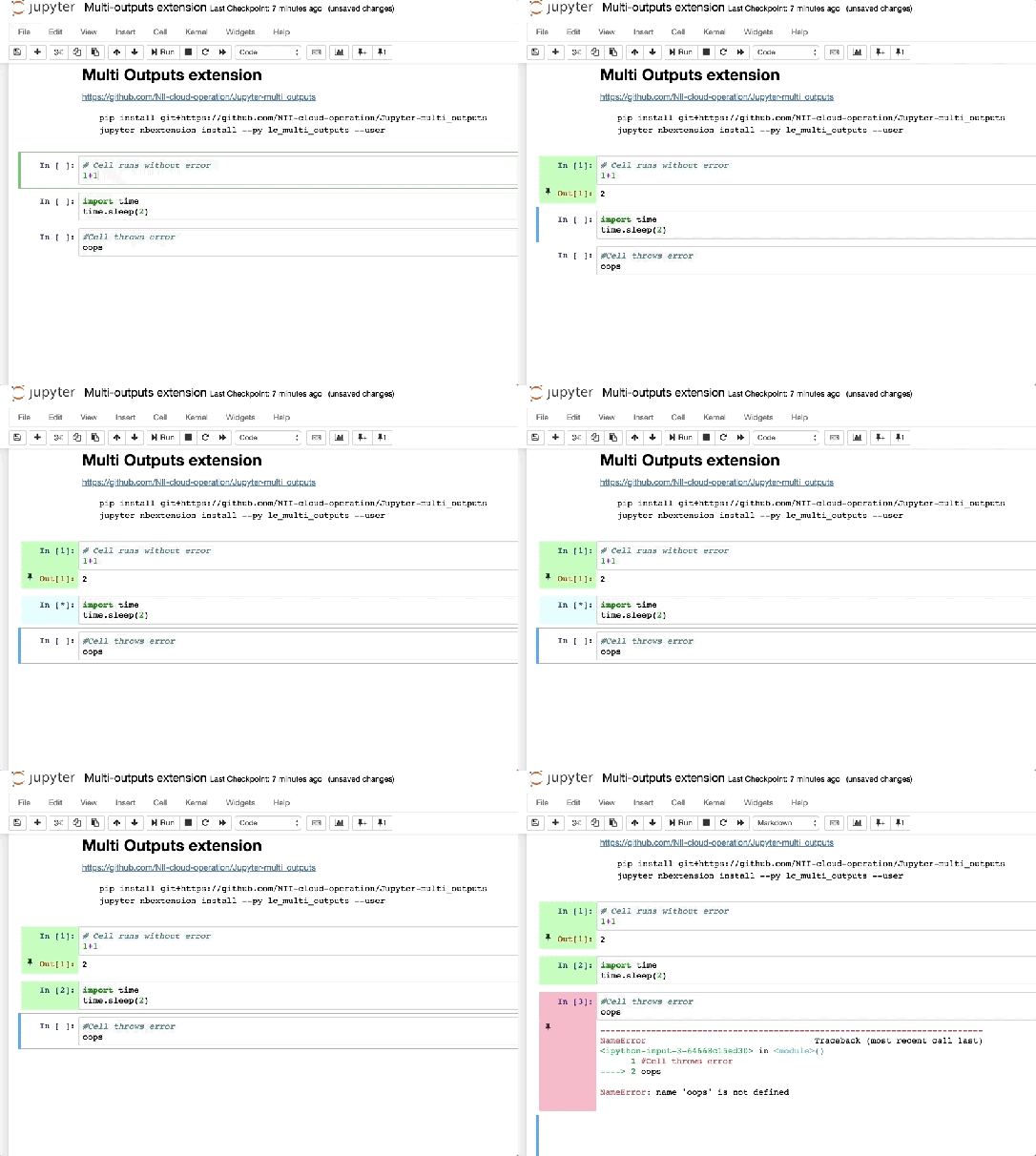
This post represents a quick review of the Jupyter multi-outputs Jupyter notebook extension.

The extension is one of a series of extensions developed by the Japanese National Institute of Informatics (NII) Literate Computing for Reproducible Infrastructure project.

My feeling is that some of these notebook extensions may also be useful in an educational context for supporting teaching and learning activities within Jupyter notebooks, and I’ll try to post additional reviews of some of the other extensions.

So what does the multi-outputs extension offer?

We can also save the output of a cell into a tab identified by the cell execution number. Once the cell is run, click on the pin item in the left hand margin to save that cell output:

The output is saved into a tab numbered according to the cell execution count number. You can now run the cell again:

and click on the previously saved output tab. You may notice that when you select a previous output tab that a left/right arrow “show differences” icon appears:

Click on that output to compare the current and previous outputs:

(I find the graphic display a little confusing, but’s typical for many differs! If you look closely, you may seen green (addition) and red (deletion) highlighting.)

The differ display also supports simple search (you need to hit Return to register the search term as such.)

The saved output is actually saved as notebook metadata associated with the cell, which means it will persist when the notebook is closed and restarted at a later date.

One of the hacky tools I’ve got in tm351_utils (which really needs some example notebooks…) is a simple differencing display. I’m not sure if any of the TM351 notebooks I suggested during the last round of revisions that used the differ made it into the finally released notebooks, but it might be worth comparing that approach, of diffing across the outputs of two cells, with this approach, of diffing between two outputs from the same cell run at different times/with different parameters/state.

Config settings appear to be limited to the maximum number of saved / historical tabs per cell:

So, useful? I’ll try to work up some education related examples. (If you have any ideas for some, or have already identified and/or demonstrated some, please let me know via the comments.)

11 Feb 15:43

This par in the May letter to Corbyn is quite remarkable. pic.twitter.com/LkzpQQ37J2

by IanDunt
mkalus shared this story from iandunt on Twitter.

This par in the May letter to Corbyn is quite remarkable. pic.twitter.com/LkzpQQ37J2


Posted by IanDunt on Monday, February 11th, 2019 8:11am


43 likes, 30 retweets
11 Feb 15:41

a (dog-eared) history of the world in 12 maps

a (dog-eared) history of the world in 12 maps

It's been a while since I've done this, publishing the passages underlined in a book I've read. One reason is that I've been reading books I've borrowed from friends or the library which is a pleasure I don't feel like abusing by interjecting myself, literally, on to the pages of shared book. The second reason is that the mechanics which make publishing dog-eared passages easy no longer seem worth it. I wish that weren't true.

I have a commute again and I make a point of using that time to read. A friend recently asked me whether, and where, I was broadcasting the books I was reading. The answer is nowhere, really. It's not because I don't want to. In 2013 I was able to print a 600-page book of all the interesting bits of books and articles I'd read that year. I enjoy sharing this stuff and the thing that made it possible was reading everything on a Kindle (and having enough technical know-how to extract the things I'd highlighted from Amazon's servers).

Somewhere between then and now I began to see reading on a networked e-book device not first as a private affair and only secondarily as something I chose to share with others, including Amazon. Perhaps it never was. It's easy to believe that Amazon has always been analyzing and leveraging and monetizing the reading habits of Kindle users. They are good capitalists that way and at least they don't make any pretenses about it.

Still, I keep coming back to something Karen Levy said at beginning of 2015:

...we act as though if we are able to develop a technical means around a user's consent then we have a right to do whatever we want.

I guess every new technology has its bait and switch period. The period before social norms catch up and adapt to change, where the initial promise starts to pale next to the abuse and malice that any new tool also makes possible. That's certainly what a lot of the internet has felt like for the past decade. It is as if a group of people sat around the table discussing Google's famous maxim to not be evil and then wondered: But wait... how much money could we make if we were evil?

I would genuinely enjoy reading books on an electronic device, like a Kindle. There is a lot to recommend them. I would gladly pay Amazon for their devices and the books to read on them but I would like the transaction to end there. I am not interested having any vendor, whether it's Amazon or a book publisher or an author, looking over my shoulder while I am reading, particularly not when the benefit of that activity seems to be in the service of everyone except me as a reader. This is not a critique limited to Amazon. For example, it could (should) be applied equally to the recent crop of newsletters-as-a-service providers.

I look forward to a time when we can establish, and honour, some boundaries around what the internet makes possible and for whom. But enough of all that.

A few years ago I was given a copy of Jerry Brotton's A History of the World in 12 Maps and I only recently got around to reading it. What follows are passages and quotes, grouped by chapter, that I highlighted along the way. In these choices it's easy to see a reflection of many of the interests and motivations and concerns in the on-going work with the Who's On First gazetteer project.

Introduction

It is a timeless act of personal reassurance, locating our selves as individuals in relation to a larger world that we suspect is supremely indifferent to our existence.

Science

The library was indeed a vast repository for the collective memory of a classical world contained within the books it catalogued. It was, to borrow a phrase from the history of science, a center of calculation, an institution with the resources to gather and process diverse information on a range of subjects, where charts, tables and trajectories are commonly at hand and combinable at will, and from which scholars could synthesize such information in search for more general universal truths.

Although Greek mapmaking remained based on mathematical and astronimical calculations, Herodotus raised the issue of how it gathered, assessed and incorporated the raw data gathered by travellers in the creation of a more comprehensive map of the world.

With this cooperative spirit came new ways of seeing maps as repositories of knowledge, encyclopedic compilations of information, or what one classical historian has called a great inventory of everything.

The map, as Christian Jacob has argued, becomes a device for archiving knowledge about the inhabited world.

In one of the earliest and more daring syntheses of geography and imperialism, the orbis terrarum came to define the world and Rome as one and the same thing.

The Geography was an immense data bank, compiled by the first acknowledged armchair geographer, a motionless mind operating from a fixed centre, processing diverse geographical data in to a vast archive of the fixed world.

We tend to think of mapmaking as a science of spatial representation, but Ptolemy was proposing a world measured not according to space, but by time.

These tables enabled mapmakers to plot the positions of every known location upon a map with utter simplicity, and by refusing to place explicit boundaries upon his oikoumene, Ptolemy encouraged future mapmakers to plot ever more locations upon the surface of their world maps.

Empire

Tu could be both word and image, and often combined graphic visual representations with written, textual descriptions (including poetry) which were seen as complementing each other. As one twelfth-century scholar put it images (tu) are the warp threads and the written words (shu) are the weft ... To see the writing without the images is like hearing a voice without seeing the form; to see the image without the writing is like seeing a person but not hearing the words.

Both the Chinese and Korean experiences created maps that were concerned with so much more than accurately mapping territory: they were also effectively plotting structured relationships.

Discovery

In the end, the name America endured, not because of any agreement as to who discovered it, but because it was the most politically acceptable term available.

By the late nineteenth century the provenance and originality of rare books and antique maps had become a lucrative busines, particularly in North America, where philanthropists began to endow museums and cultural institutions in an attempt to turn the study of American history into an internationally respected discipline.

Naming a new region America in 1507 was a highly provisional decision, and dependent on the ability of the printing press to circulate sensational but unverified news of the 'discoveries' of Columbus, Vespucci and others.

Toleration

If this fragmentation was seen by some as progress, it also reduced mapmaking's ability to transcend worldly conflict and intolerant attitudes in favour of a larger understanding of secular and scared space. As David Harley has ruefully pointed out, the Renaissance tradition of geography as everything understood in terms of space, of Cosmos, got squeezed out. As cosmography withered away, geography was forced to buckle down, administer empire, map and plan land uses and territorial rights, and gather and analyze useful data for purposes of business and state administation.

Money

On the new Dutch maps, far-flung territories no longer simply faded away on the margins, nor were the world's edges fearful, mythical places full of monstrous people to be avoided wherever possible. Instead, on maps like Petrus Plancius's map of the Moluccas (1592), the world's borders and margins were clearly defined and identified as places for financial exploitation, with its regions labelled according to their commerical interests. Every corner of the earth was being mapped and assessed for it commerical possibilities.

Up to four assistants were then employed to execute handdrawn charts on parchment - drawn by hand rather than printed to try and prevent their details being easily circulated on the open market, and on parchment because of its durability on the long sea voyage. Making charts in this way allowed for a quick and ingenious method of updating the original charts. These would be revised by pricking out new coastlines or islands with a needle and then placed on top of a blank sheet of parchment and dusted with soot. Once removed, the specks of soot left on the new sheet of parchment through the needle pricks could then be carefully joined up by Blaeu's assistants to form a new and more accurate representation of coastlines.

Having failed to complete his project, but tailoring so many copies of its first part for individual recipients, Blaeu inadvertently sparked an entirely new approach to atlas consumption: what became known as composite atlases.

Rather like Blaeu's own atlases, the customized examples were endlessly extensible and potentially infinite: only the collector's death signaled their completion.

The emergence of these composite atlases was a symptom of the dilemma experienced by mapmakers and printers and the end of the seventeenth century: the sheer amount of geopgraphical data they possessed had never been greater, and the print technology at their disposal had reached such a level of speed and precision that it could reproduce such information in the finest detail, but no one was clear how it sould all be organizaed and presented.

Nation

It was not in modern terms a national survey based on comprehensive topographical details, but a geodetic survey which produced a positional illustration of places significant to the requirements of state planning.

Under Cassini III's guidelines, geography would now become a routine and continuous activity sanctioned by the state, its practioners operating within the strict guidlines determined by the authorities. The age of the learned savants uniting the arcane wisdom of astronomy, astrology and cosmography in the creation of their maps was coming to an end. Geographers were slowly but surely turning in to civil servants.

Of equal importance to the work in the field was the paper trail it created; from the land to the study, Cassini's engineers were instructed to write up their observations and translate them into handdrawn sketch maps, correct them where necessary and then dispatch everything to Paris for another round of verification. Cassini III insisted that when the map was drafted, in was returned to the local diginitaries involved in initially checking the relevant topographical data. The geometrical part belongs to us, proclaimed Cassini; the expression of the terrain and spelling of the names are the work of the lords and priests; the engineers present the map to them, profit from the information they provide, working under their orders, making in their presence the corrections to the map, which we pubish only when it is accompanied by certificates confirming the veracity of the information recorded. It was an essential element in ensuring accuracy, but it had another consequence too: however reluctant the provincial nobility might have been to verify the observations made by the unwelcome engineers, they were now becoming part of the fabric of a national survey. Up to this point, local knowledge had been ignored in favour of the pure geometry of the triangulated framework of the survey; Cassini III now ensured that the visualization of the imagined community of France included the knowledge of those who lived and worked within it.

Mapmaking might have become a science, but Cassini was also anxious for the public to regard it as an art.

The message was unmistakable: whatever the terrain, every corner of the kingdom could now be mapped and represented according to the same principles. In a direct challenge to the country's defiant regionalism, the map established that nowhere was exceptional.

The reasons for this shift lay in the transformation of vernacular languages and apprehensions of time. In the West, the rise of what Anderson calls print-capitalism in the fifteenth century gradually signalled the ultimate decline of the sacred languages of imperial and ecclesiastical authority, Greek and Latin, in favour of the vernacular languages spoken by a vast, new potential readership. The subsequent rise of the novel, the newspaper and the railway in Europe created a new perception of simultaneous time, marked by temporal coincidence, and measaured by the introduction of clocks and calendars. People began to imagine the activities of their nation taking place simultaneously across time and space, even though they were unlikely ever visit or meet more than a tiny fraction of the places and people of which their nation is composed.

Geopolitics

In contrast to the Ordnance Survey's difficulty in providing standardized maps of England's complex and entrenched system of land ownership and management, the English East India Company assumed it would be much easier to survey overseas possessions like India by using new scientific methods and simply ignoring local methods of mapping and owning land, notwithstanding the country's size.

In the words of Matthew Edney, the survey's most distinguished historian, the surveyors did not map the "real" India. They mapped the India they perceived and that they governed, and as a consequence created a British India.

In attempting to unite physical geography with human (or what he called political) geography, Mackinder acknowledged the rival claims of history and the now wildly popular study of geology. Physical geography, he argued, has usually been undertaken by those already burdened with geology, political geography by those laden with history.

In pushing geography's case even further, Mackinder argued brusquely that the geologist looks at the present that he may interpret the past; the geographer looks at the past that he may interpret the present.

...the map is here thought of as a subtle instrument of expression applicable to many orders of facts, and not the mere depository of names...

Equality

The ease with which political power used cartographic expertise is a recurrent theme of twentieth-century history.

As one commentator wrote during the Second World War, in propaganda maps such as these, geography as a science and cartography as a technique become subservient to the demands of effective symbol manipulation.

...Harley voiced his frustration with many of the academic cartographers of today, who operate in a tunnel created by their own technologies with reference to the social world.

Harley's contention was not, as many of his critics claimed, that all maps like, but that they contained historical conventions and social pressures than produced what he called a subliminal geometry.

...Can there be a cartographical ethics? If maps can never be neutral, and are always subject to the power, political authority and ideology, then is it possible for academic and professional cartographers to develop and sustain an ethical position in relation to their work?

The broader problem that the controversy inspired was how to produce an ethical cartography once the profession accepted that all maps were partial and ideological representations of the space they purported to depict.

...a more attractive symbol of the political issues at stake for development agencies than any other cartographic projection currenty available.

...ever since Ptolemy, individuals and organizations have used world maps for their own symbolic and poltical ends, regardless of the cartographer's claims to comprehensiveness or objectivity.

The eighteenth-century belief in the ability of mapmaking to offer transparent, rational and scientifically objective images of the world exemplified by the Cassini surveys, had slowly unravelled from the late nineteenth-century onwards, as the political dictates of nationalism, imperialism and a range of ideologies appropriated cartography to produce persuasive but selective maps designed to legitimate their particular poltical versions of the world.

Conclusion

Maps offer a proposal about the world, rather than just a reflection of it...

The relationship between a map and these assumptions and preoccupations is always reciprocal, but not necessarily fixed or stable.

When the sheer scale of implementing such a project still requires some form of state of corporate funding, it is difficult to imagine it could escape the perennial political or commercial manipulation that has so often tried to impose a single image upon the sheer variety of the earth and its people. But to answer no appears to endorse a partial vision that turns its back on both the inevitability of globalization and the possibility of celebrating a common internation humanity through geography.

The book was published in 2012 and the final chapter (Information) is, for its time, an unsuprisingly enthusiastic embrace of all things Google and in particular Google Earth. It is also notable for the absence of any mention of OpenStreetMap (OSM) but as the title suggests the book's focus is twelve distinct maps, not a baker's dozen. Also, in 2012 you might have still been forgiven, but only just barely, for doubting OSM. I don't want to take away from Google Earth's achievements but a short seven years later the chapter reads like a cautionary tale about recording history too soon.

Finally, it is hard for not to see the present-day conversations and concerns around machine-learning in all of this. In many ways neural networks and training sets and biases are just surveys and map projections by another name.

11 Feb 15:40

Apple’s iPad Mini 5 expected to launch in the first half of 2019: report

by Patrick O'Rourke
iPad Mini 4

It looks like Apple plans to launch its upcoming, often-rumoured iPad Mini 5 in the first half of 2019, according to a new report from Taiwanese publication DigiTimes.

However, the new version of Apple’s smallest iPad will not be a full redesign of the tablet like some may have expected. Mac Otakara is reporting that the iPad Mini 5 will look nearly identical to the iPad Mini 4, citing conversations the blog has had with various accessory makers.

Mac Otakara goes on to say that the iPad Mini 5 will feature the same dimensions as the iPad Mini 4, including its 7.9-inch display, 6.1mm thickness and disappointingly, even its sizable bezels. The new version of the table is also expected to still include a Lightning connector, 3.5mm headphones jack and Touch ID rather than Face ID.

That said, the publication does say that its sources indicate the iPad Mini 5’s rear microphone will be repositioned to the center of the top of the tablet.

What remains unclear about the iPad Mini 5 is what processor the tablet will feature. It’s likely that the entry-level iPad will feature either the A10 Fusion chip included in the iPhone 7 and iPhone 7 Plus, or the A10X Fusion chip features in the 2017 iPad Pro and Apple TV 4K.

Though the iPad Mini 4 was released way back in 2015, the tablet remains one of my favourite versions of the iPad. It’s great for playing games, particularly those that feature motion controls, and is compact enough that you could throw it into a backpack and not notice it’s there.

Source: DigiTimes, Mac Otakara

The post Apple’s iPad Mini 5 expected to launch in the first half of 2019: report appeared first on MobileSyrup.