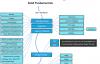
Solid, you may recall, is the project by Tim Berners-Lee and company to create a distributed social web. This page makes it clear just how difficult and complex that task is. It's a 'roadmap' to becoming a Solid developer - that is, it identifies and links to the different things you need to know. The 'basics' include identity, DOM manipulation, APIs and more, not to mention graph data and RDF. You'll also need package managers like Yarn or (Node.js) NPM. Then you can move on to React, a Javascript framework for dynamic web interfaces. After that, you can begin to learn Solid itself.
Web: [Direct Link] [This Post]Rolandt
Shared posts
Simone Cicero on Ecosystemic Organizations
The difficulties in expressing the nature of ecosystems in the work context.
I had read a few posts of Simone’s on Medium (such as The 7 Key Principles of Platform Design, so I was excited to see that he would be speaking at the Haier Innovation Conference in January. We got the chance to talk over several meals, and I suggested an interview might be rewarding, since we are both deep into the economics and practice of ecosystems in work.

Simone describes himself this way on his blog:
“I am a self-starter, strategist, product and service designer interested in co-design, design thinking and innovation.
I investigate the reasons behind change, correlate things and understand to design relevant and consistent strategies and products.
A few years ago I created the Platform Design Toolkit: to help organizations of all kinds create shaping strategies, leveraging ecosystems, transforming themselves and the world in the process.”
The Interview
Stowe Boyd: We talked a bit in Qingdao about the talk you gave there. One insight I had at the time was that the average western worker is unprepared to wrap their heads around the dynamics, politics, and metaphysics of ecosystemic organizations, and without that baseline understanding, adoption of the ecosystem approach to business operations is likely to be slow. Do you agree?
Simone Cicero: I definitely agree on acknowledging that the level of conversation one can have with Haier — and more specifically with Zhang Ruiming and his circle of reports — may be hard to imagine with European executives, I admit I speak more rarely with American ones. Western executives are definitely more concerned with numbers, shareholders’ expectations while when speaking with Zhang we always concentrated in exploring ways to unlock more potential from people and the whole ecosystem. I think Haier has this vision that to make a company successful in the future it needs to reinvent continuously and be able to let go the very idea of what it is now: the aim is always that of becoming interlaced and integrated with a much bigger economy of value, Zhang speaks about a federative organization — that’s why Haier also has this concept of ecosystem brand.
I think the question is twofold and it’s a bit contradictory. First, there’s a cultural gap: I’m not an expert of Chinese philosophy and neither culture, but my feeling is that a systemic and collective (ecosystemic) view of the world and the economy is more common in China than it is in Europe and the US. Secondly, Chinese business culture is definitely less concerned with protecting the status-quo and with granting everyone the acquired rights: it’s more likely to push everyone to perform at her best making the individual more responsible and independent in stretching the organizational reach. I think here lies the contradiction: we have a systemic business culture but not necessarily a mutualistic one. I may be wrong though.
Also, I think we need to acknowledge that Haier is likely one of a kind in the world and that not all Chinese companies are like that: indeed Alibaba is often used as a counterexample of not-ecosystemic thinking, also by Zhang.
SB: Yes, I agree that Zhang and Haier are one-offs.
Zhang Ruimin is the most persuasive advocate for his philosophy of business, and at the same time, he hasn’t provided us with a central set of writings that clearly lay out what his vision is. He’s more like Bob Dylan than Peter Drucker, in that regard. Dylan’s written dozens of songs about love and loss, but never an analysis of the human heart or the narrative arc of love. Meanwhile, Drucker laid out his ideas in practical management-speak in ways that made him accessible and transformative.
SC: My impression is that Zhang has been focused on his own, and his company’s, process instead of being focused on communication: maybe this is a parallel we can make with Bob Dylan, but it’s I think also an expression of the cultural differences between the west and China. I think many times western companies and executives focus too much on examples and stories, as if following practices, other’s paths or other’s stories could be a guarantee of success which — as we know — it definitely isn’t! Companies often lack focusing on experimentation and continuous learning, which is instead something that seems the real focus of Haier and Zhang for the last 30 years. Indeed he’s been working on this company for more than 30 years, making it hard to discern his own path of management transformation from the company’s transformation.
When speaking with Zhang he gave me the impression that the company itself can be — somehow — seen as a systemic extension of his self, similarly to how Micro-Enterprises can at the same time as an extension of the entrepreneurs. Somehow I think Zhang didn’t have time to really provide a formula, stories, and examples so far: now, by the way, with Haier’s cultural institute they’re looking to provide the world with more information, though I think this needs to be seen more as a space for conversation than a monolithic organizational story. This is also part of the work we are trying to do together with Haier, with Boundaryless (our company) and Platform Design Toolkit (our methodology).
SB: I think you are right. Zhang is constantly extending his thinking about Rendanheyi and what it represents. Perhaps working with westerners like you, me, Gary Hamel, and the Corporate Rebels will shed new light on what it might mean outside of Haier?
SC: Definitely, I think we’re now on a global conversation now, though this is not just about integrating Chinese and eastern thinking. I think is more about finding new ways to have a conversation on organizational development and transformation that is not colonialist, neither industrial. A conversation that happens in the XXIst century.
SB: Perhaps one of the difficulties is that an ecosystem is a self-regulated ‘assemblage’ — a term Anna Lowenhaupt Tsing offers from ecology in ‘The Mushroom At The End Of The World’ — an assortment of different species happening to each other at some physical location. Those species can be competitors or cooperating, or indifferent to each other. As she points out,
“Patterns of unintended coordination develop in assemblages. To notice such patterns means watching the interplay of temporal rhythms and scales in the divergent lifeways that gather. Surprisingly, this turns out to be a method that might revitalize political economy as well as ecological studies.”
I believe Zhang’s vision is to create a platform that acts to exert an economic gravity, an ecological pressure that leads to Tsing’s idea of ‘convergent lifeways’, so that systemically beneficial patterns become internalized by the participants and becomes self-sustaining without much management. Zhang uses the image of gardening as a metaphor for this.
I buy it, but I started with a degree in biology, and I’ve studied Taoism for forty years. I wonder what we would have to do if we wanted to really get a large number of folks to ‘get it’. Is your workshop part of that?
SC: I think it’s definitely important to understand that embracing ecosystem-organizations deals more with preparing, nurturing and respecting the “soil” than actually gardening the plants. A bit like with biodynamic agriculture the idea is to let different plants to grow, and even if you go and eradicate the ones that you don’t like, letting them stay there and fertilize the soil.
“Gardening” an ecosystem organization implies some degree of creative entropy, as this process that is inherent to self-organization: you may have unintended sprouts grow and find their way in the market and you need to deal with it, some of them may not make it, end up in dying but the experiences related to building that sprout-micro-enterprises will again fertilize the soul of knowledge and experiences. As a gardener, you’ll need to make it possible, and you’ll need to allow the members of the organization to explore edges you may not consider strategic from the top. So yes it’s about gardening, but it’s not about the perfect, 17th century’s Italian gardens, made of symmetry and perfection, it’s about the abundance of biodynamic gardens.
SB: Right, as with Zhang’s vision of making his ecosystem open to participants who aren’t employees, but who can play economic roles on the Haier platforms and in ecosystems?
SC: I think from what I’ve seen in few examples of micro-enterprises, they’re really targeting the whole society: I’ve been astounded by the prominent and central role that is played in some of their new micro-enterprises, especially those focused on services, by independent professionals. I think they really get that idea of leveraging on distributed potential, and this is going to be very relevant — also in China — because all trends point out to a rising freelancing and independent workers economy.
SB: Thanks, Simone. I look forward to seeing you again in New York in March. [Simone is leading [a two-day workshop in New York City in March 2019](Public Masterclass — Platform Design Toolkit).]
SC: I’m very much looking forward, will be great to compare notes and share insights with North American platform shapers!
Originally published at workfutures.org.
[ridgeline] The Cafe With a View of the Waterfall
Vision Zero & Surrey’s New Approach to Road Safety

The City of Surrey hosted the first Vision Zero summit in British Columbia at Surrey City Hall. Vision Zero refers to zero road deaths and no serious injuries on roads, with the philosophy that every life matters. Applied in Sweden since 1997 the core belief is that “Life and health can never be exchanged for other benefits within the society”. This approach differs from the standard cost benefit approach, where a dollar value is based upon life, and that value is used to decide the cost of road networks and calculate the cost of risk.
This Vision Zero summit brought together the Provincial Health Services Authority and the City of Surrey to lead a discussion on implementing Vision Zero to mitigate road fatalities and serious crash injuries in the Province. The conference also advocated for the adoption of the Safe Systems Approach to evaluate roads as safe for all road users. This is different to the “85th percentile” speed philosophy that bases road speeds on the speed 85 percent of vehicles travel past a certain fixed point on the road.


In the City of Surrey twenty people a year die from car crashes and there are over 12,000 traffic related injuries.
While aiming at no deaths on the road network, Surrey has adopted a target of achieving a 15 per cent reduction in road deaths and in road injuries within five years. Surrey has also adopted a Vision Zero Surrey Safe Mobility Plan and has an interdisciplinary Road Safety Team working towards creating the safest roads in Canada. Surrey has immediately targeted 35 locations for enhanced enforcement and will be using high friction road surface treatment at 14 high accident locations. Under the plan they will be focusing on a holistic approach focusing on road design, speed and driver behaviour ( including impairment and distraction).
It was Dr. Perry Kendall the former Medical Health Officer of British Columbia who released the report “Where the Rubber Hits the Road”. That report studied and outlined that vehicular crashes are a major cause of death and injury in this province. I have written about the importance of this document in directly addressing that nearly 300 people a year die on roads in this province, with vulnerable road users being the majority of road deaths and injuries.
Dr. Bonnie Henry the current Medical Health Officer for the province is also an author of the groundbreaking report on crashes. She noted that between 1996 and 2017 fatalities and injuries had increased and that the statistical curve is still going up. Dr. Henry is advocating for a collaborative approach between health authorities and municipalities to adopt viable alternatives like active transportation, and the Safe Systems Approach to lower death and injury.

This is a groundbreaking collaboration where the health authority is recognizing that to keep citizens healthy that road systems need to be redesigned and re-evaluated and the way forward is to prioritize road design for safety and health. One key component is the Provincial approval of 30 km/h speeds to be allowed within municipalities. At that speed 90 percent of pedestrians and cyclists can survive vehicular crashes.
Setting a target of zero road deaths in British Columbia is ambitious but necessary where road crashes are a major cause of death and serious injury. By ascertaining that fatalities and serious injuries are preventable, street design can mitigate deaths and serious injuries. It is a philosophy that can save lives. This new collaborative work and potential funding from the Province can make streets safer and more accessible to all users. We’ve talked about the Vision Zero approach for a while. It’s time to make the change.

Colonial Cartography
In 1929, Death Valley Exploration, a highly speculative company selling shares in gold mined in Death Valley, California, created an advertisement calling for investors to help fund a water mill they planned to construct. “Dame Nature,” a letter to shareholders said, “would make her gold deposits the object of an endless game of hide-and-seek between mankind and herself.” Death Valley was one of her “favorite hiding places.”
The advertisement was designed as a map of Death Valley, a “fearsome sand-pocket” and “waste of Inferno white” where “the bones of countless gold-seekers lie.” It pinpointed the exact location of the company’s property and the site of their mining, as well as the closest water source. “Mining wealth is the cleanest in the world,” they wrote. “It takes nothing from any man’s pocket; but out of the practically limitless resources of this planet.”
The image of a physical place, seen from above, gives a sense of wholeness, of truth. The bird’s eye view is not a natural way of looking at people or the world
There was no water where the map said there was; there was no ore there either. Two years later, the company was banned from selling shares. The use of the map was a wise business choice, though: maps, by design, look like reliable sources of information; they had long been used as arguments, propaganda, tools of persuasion. About 60 years earlier, a company called Jay Cooke & Co. sent a map to investors to try and sell bonds in the Northern Pacific Railroad. The map showed clear lines tracing the supposed route of the railroad, from Minneapolis and Duluth to Portland and Seattle — but none of the railroad had yet been constructed.
Maps have behaved throughout history as pieces of literature or devices of expression used to advance particular agendas. The image of a physical place, seen from above, gives a sense of wholeness, of truth. Maps have the power to give a physicality to places and things that do not exist, as with the maps of the Railroad and Death Valley: they made bad buys look solid and very real. The population of California at the turn of the century was less than two million, compared to the 40 million today; the development of the American West, a place that for most of the 19th century was not solid or real as far as most Americans could imagine or see, relied on maps that expressed aspirations, which included lies, in order to give Americans a picture of something that was being created, something that had to be willed into existence.
Maps are productive rather than simply informative creatures; they start dialogues and create identities. Historically, they have been used by centralized bodies, disseminating information to individuals — whether companies selling products or governments selling the idea of statehood. The internet takes maps and mapping practices from central bodies to individuals, but through this they remain totally detached from the geographical areas they supposedly represent, and invaluable tools for institutions to exercise power over people.
The map’s origins in the rise of the state are easily obscured. In his book Rethinking the Power of Maps, Denis Wood points out that for most of history, maps did not exist; but that from about the 17th century onwards, when they became common, they were defined as “a representation of a part of the earth’s surface.” This definition, he argues, naturalizes the map and its role in our society — it frames mapping ability as a natural or sometimes biological impulse. But, as he reminds us, “millions of Americans crossed the continent without maps, Genghis Khan and Charlemagne ruled without maps, Rome administered its empire without a map, pharaohs controlled Egypt without a map, the Bible was written without once referring to a map.” Landscapes were seen, observed, and talked about for the purpose of ruling and exploring: “Where talk serves, maps are rare,” he writes.
The map, then, does not fulfill an inherent need in us to orient ourselves with a bird’s eye view — and the bird’s eye view is not a natural way of looking at people or the world. Maps are used by the modern state to define and claim outside ownership of territories: the map came into existence out of a political agenda to root people to entities to which they would have to be loyal, but could not see. It narrativizes us and our surroundings, and makes them legible. “People create maps only when their social relations call for them,” Wood writes, “And the social relations that most insistently call for maps are those of the modern state.”
Benedict Anderson’s Imagined Communities identifies the map as one of three central “nation-building” artifacts, along with the census and the museum — institutions that enabled nationalist enthusiasm for a colonial state. In Southeast Asia, European countries used maps to legitimize otherwise illegitimate transfer of property and write inaccurate national histories of former colonies, like the “historical maps” in Siam which depicted the “geo-body” — unified, coherent nation-entities — as thousands of years older than the concept was in that region.
Boundary-stones and other physical ground markers that were understood only horizontally, as well as traditional maps that depicted and catered to the eye level and those who had an eye-level relationship with the space, slowly disappeared or were co-opted; traditional words krung and muang, which in Thai describe a collection of visible, disjointed population centers, were replaced with prathet, or “country” — a centralized entity with invisible boundaries. In this context, writes historian Thongchai Winichakul, “a map anticipated spacial reality,” rather than the other way around; the map “was a model for, rather than a model of, what it purported to represent…it had become a real instrument to concretize projections on the earth’s surface. A map was now necessary for the new administrative mechanisms and for the troops to back up their claims.”
Imperial states used maps as national logos that could be literally removed from the rest of the world and transplanted onto royal seals, letterheads, or decorations, without context. “Wholly detached from its geographic context … pure sign, no longer compass to the world,” Anderson writes. “Instantly recognizable, everywhere visible, the logo-map penetrated deep into the popular imagination.” This was the same imagery that the colonial state’s “local adversaries,” anticolonial nationalists, like the right-wing Hindu fundamentalist movement in India, responding to the British empire, also came to later use in its reactionary idea of nationhood — “as in an ominous prophetic dream,” Anderson writes.
Maps are very effective at manufacturing a sense of centralized identity where one otherwise does not exist: they link places to “things,” like citizenship and taxes. Arunachal Pradesh, for example, appears on Google Maps India as an Indian state, and on Google Maps China as Southern Tibet. With its Bangladesh border, India until recently shared about 160 enclaves, or territory within the other’s territory, whose residents have long had difficulty obtaining identity cards that they need in order to move through the arguably arbitrarily drawn concentric national borders. The most popular origin story for this incredibly complex enclave system is a drunken British colonial administrator who spilled ink on a map.
The “eye level” relationship between people and their immediate surroundings is at odds with the consumer identities that centralized entities are trying to create
Cartographer J. Brian Harley argued that the map was a fusion of the agency of the mapmaker and the mapmaker’s patron — there is a tension between the different interests of the craftsman and the statesman: one’s power is technical, while the other’s is political; one’s “distortion of map content” is unconscious, while the other is deliberate. These were both equally influential forces on the map, but because of their opposition, the authority of the map was diffused, “erasing authorship.” This ambiguity, this “modesty,” helped to give the map the appearance of a balanced, objective artifact. The map’s agency was made invisible — consequently, the map was naturalized as “a window on the world (instead of an argument about it),” as Denis Wood comments.“At the root of the map’s claim to objectivity lies its outrageous irresponsibility.”
Mapping as a colonial institution is one attempt to conjure a sense of collective identity — maps as advertisements are another version of the same project. Capitalism blurred the distinction between citizen, resident, and customer, giving very similar language to state and corporate agendas. Our value has historically been determined by how much we spend, whether on products or taxes or loyalty. The maps of Death Valley and the Northern Pacific Railroad were, among other examples from their time period, ways of making the virtues of products appear as clear and natural as the ideas of place they were attached to: California, New York City, America. P. J. Mode, a retired lawyer and map collector, called maps the most ostensibly credible of all mediums of communication. “Advertisers live and die for greater credibility,” he said in 2017, “and therefore they gravitate to the medium of cartography.”
In 1898 a map of Manhattan served as the backdrop for a totally unrelated advertisement for L. C. Bliss & Co.’s leather Regal Shoes, where one giant shoe was superimposed on the island. The recently completed Brooklyn Bridge is clearly visible, and was, according to Mode, the inspiration for several such advertisements during this time. A political advertisement from a few years earlier showed Richard Croker, leader of Tammany Hall, and Hugh McLaughlin, leader of the Democratic Party in Brooklyn, reaching across the East River to shake hands and forming a shape similar to the Brooklyn Bridge; the text compares them to two English monarchs and their “fixed system of despotic rule.” Such imagery would have been significant in the project of “branding” New York City, and the highly related project of establishing it as a politically legitimate and formidable city.
Mode remarked that the birds-eye view in general was a very popular aesthetic choice around this time: another advertisement, from 1897, employed this view of Manhattan to promote the “largest dealers in horses in the world.” The Fiss, Doerr, and Carroll Horse Company had been based in Kips Bay for the past 32 years. Until the rise of the automobile, they dominated the transportation market in New York City, and were careful to use the Manhattan skyline in their publicity to associate the commercial value of their product to the cultural value of the city. Carroll told a Printer’s Ink reporter that they planned to invest the contemporary equivalent of about $135,000 that year on “a map of Greater New York, together with pictures of the company’s buildings, and portraits of the firm’s members. This is said to be the most accurate map of Greater New York thus far published.”
Manhattan is, in many ways, an advertisement itself, its sexy hourglass figure the conduit to promote any number of products. Tobacco companies, for example, have used it extensively to equate the glamor of smoking with the glamor of New York. It is so all-pervasive, and removed from its geographical location, that in 2018 Chicago mayoral candidate Willie Wilson — possibly mistakenly — used it in a backdrop of one of his campaign ads. In their study of American symbols in Israeli advertising, scholars Anat First and Eli Avraham found that banks, retailers, and car companies, among others — all selling products that were specifically meant to be used in Israel — employed the Manhattan skyline far more frequently than that of other global cities, including Tel Aviv, “to create a sense of the vastness of monolithic America,” a unified and comprehensible whole.
From L. C. Bliss & Co to these contemporary tobacco or real estate or banking firms, New York’s history has been full of this entanglement of commodity and political entity. Maps created by colonial governments were in the business of creating political identities, while these advertisements reinforce them. But they are both the same kind of artifact, legitimizing the city by creating an omnipresent, memorable character; both coming from comparable, centralized entities in whose interest it is to alienate individuals from the physical relationship they have with their immediate surroundings — because this “eye level” relationship is at direct odds with the identities of consumer and national citizen that these entities are trying to create. The distinction between advertisement and product blur as does that between map and place.
In 2010, Facebook released a luminescent blue map that was generated by the connections made by the platform’s 500 million users. An intern at Facebook drew physical lines that corresponded to these coordinates; they created an image that looked startlingly like the world map. Mark Zuckerberg, by that point, had already described Facebook’s cartographic aspirations: “The idea isn’t that Facebook is one new community… it’s mapping out all the different communities that exist in the world already.” Our tendency to use our locations as a part of our practice of expressing ourselves online makes this ambitious project of Facebook’s entirely plausible.
The internet’s role in creating and disseminating maps has, to some extent, decentralized the nature of how they communicate. For the most part, maps are no longer overtly shared instruments assigned to us by a centralized authority, but rather individual instruments, seemingly springing up in moments of spontaneous creative expression. With apps like Google’s Tour Builder, we can create maps of our lives and travels, taking other people through our movement. We can pinpoint where specific events happened and integrate photos, videos, or text into sections of a story that are organized by location; everyone is the potential author of a Lonely Planet-like guide to a new city. On a smaller scale, Strava, a mapping app, allows us to track and map our daily life to create interactive “stories.” On Strava, every “walk” has a name, and a place on our personalized account. Apps like these make map a verb rather than a noun, in a new way; the map becomes a way of talking about a place, and by extension talking about ourselves. It is a way of narrativizing our lives, turning our daily life into stories about who we are by what we do.
We use maps to insert ourselves into spaces, and claim them
This kind of mapping is a sort of photographic negative of the mapping that Walter Benjamin did in his “Berlin Chronicle,” an autobiographical story using physical locations in his memory as the organizing principle for telling a story of his life. In both cases, the events of a life are plotted as points on a map. But where Benjamin uses detailed physical descriptions of these places in order to conjure up an image in his text, the mapping done through apps comes with readymade social-geographical context. A photo tagged “Central Park” or “Times Square” or “Brooklyn Bridge” — Instagram’s most popular locations in New York last year — communicate the idea of a place more than a physical location. The personalized ways in which locations are used on social media make a city both more disconnected and more legible to the outsider at the same time: less and less relevant as navigational information, but increasingly efficient at communicating personalities, lives, individual narrations, identities.
This practice of mapping assigns physical places with social capital and a social function. Place becomes absorbed into person; it is a function of person, rather than the other way around. Sixteenth-century rulers would hang maps in their palaces to represent the power of the cities they ruled; we, too, integrate our personae with the spaces we occupy, and in some ways own, because we have written these places onto maps. Knowing the actual place becomes irrelevant compared with knowing it in the context of a personal narrative, which requires knowing the place’s social value. We use maps to insert ourselves into spaces, and claim them.
It would seem as though we have co-opted the impulse to narrativize our existence from the very means that institutions of power have used on us for centuries. But these mapping technologies require the individual to first be packaged into a consumable product, which can be equally totalizing: we are living under pre-anticipated conditions of our cities, and embodying the self that is required for the products we make. We mirror our shadows.
In the year or so before I moved to New York, I suddenly found my Instagram feed crowded with people who had recently moved to Brooklyn, and were extremely aware of it and intentional about it. In the way that any voyeuristic social media platform allows you to live through other people, I developed, from a different country and very different context, a strange intimacy with the places that these almost-total Brooklyn strangers on my feed frequented. I learned immediately that one says one lives in Brooklyn and not in New York City even when talking to someone who does not live in New York City. I learned when something is a “Bushwick thing,” even though I had spent all of one hour in Bushwick in my life.
Baudrillard called this kind of process “a real without origin or reality: a hyperreal,” which is what Brooklyn was to me for many years, and sometimes still is, even though I live here now. I am as surrounded by Brooklyn’s online persona as I am by its fragmented, chaotic physicality. My view of graffiti artist Gadse’s omnipresent work from the J train is superimposed on the T-shirt I saw on an urban explorer Instagram star once, declaring, This way to Brooklyn #JtrainOnly. The Monday.com subway ad making fun of Bushwick lofts (where, among parks and subways, “pest control” is in progress), and the merchandise describing the #BrooklynHustle on the rapidly gentrifying sidewalks of Crown Heights, create a complicated personality for Brooklyn: one that both reflects the exclusivity and displacement that now characterizes much of Brooklyn’s new, largely white population, while being self-conscious, ironic, and often flippant about it.
This online persona does not, and is not trying to, correspond to the physical realities of Brooklyn, but it is made to stand in for it. This social media form of mapping, then, creates personality and imposes a reality onto spaces that are inherently consumerist, in the same way that authoritarian imposition, both state and corporate, once did for the same locations. As Thongchai Winichakul identified, this practice does not relay a physical reality; it precedes it. Personal mapping creates a model for Brooklyn, rather than a model of it.
In this way, consumerization becomes the new totalitarianism. Contemporary mapping introduces the project of individualism to what was earlier largely a project of nationalism or collectivism. Social media mapping practices diffuse some of the power held by corporate or political entities to the level of individuals — who carry out the same agenda by claiming and redefining space according to a personal sense of its meaning, using the same systems that corporate and national projects did for the same purpose. They wield influence over the people and landscapes around them; they create identities that can be sold, whether through merchandise or in conversation or by advertising agencies; they make money, take up space, dominate discourse.
They deal, essentially, in products — legible, lucrative products. In this way, people who update their Snap Map location or their Strava account or geotag their Instagram photos, because they feel obliged to be seen, are using the same modes of self-dissemination as Fiss, Doerr, and Carroll, or European empires: under the influence of corporate and national ideas of the self. National or corporate institutions instill monetary or political agendas in maps; the map-making ability of social media creates the social equivalent.
New York has a history of renaming unpopular neighborhoods to attract a more “refined” population (Harlem to Morningside Heights and now “SoHa,” Sunset Park to South Slope). At the other extreme, Summerhill Café in Crown Heights tried to attract customers last year with its “Instagrammable” wall riddled with fake bullet holes. Brooklyn’s gentrification is and encourages a progressive new kind of colonialism: the narrativizing of Brooklyn as a product to be consumed and incorporated into the way we talk about ourselves and move through the world.
That is why “Bushwick” is no longer just a neighborhood but also a movie about some sort of apocalypse, as well as an $81 candle scent — titled “McKibbin + Bogart 03” and replicating the “wood, oil, paint thinner, incense, ICR vs. Deth Killers of Bushwick.” More accurately, it replicates the blocks around the McKibbin and Bogart Lofts, a very specific area that began attracting new, young residents fairly early, marketing itself as East Williamsburg, because white people did not want to live in Bushwick.
To subsume this history into the word “Bushwick” as a descriptor of the scents surrounding artist lofts, and lump that together with a casual reference to the neighborhood’s history of violence and the commodities that have come out of it, is the sort of race and class appropriation that can only be said to succeed under the hegemonic influence of capitalism and the state — a kind of blackface that goes unquestioned on a daily basis in the media language we speak. This narrativization is part of the legacy of colonial projects imposing national identity through visual means to override the past character of a place.
Mark Fisher wrote in Capitalist Realism of a general public that has become simply “an aggregation of individuals and their interests.” This condition is the reason why there is a lack of public general will, which the state should ideally be subordinated to. Ours is the world Fisher was describing: a breakdown of the difference between “centralized” and “decentralized,” a world where decentralized practices can easily become co-opted into the same narrative methods as centralized ones, of inscription and appropriation of landscape and culture. Under capital, “all that is real is the individual,” but the individual can never escape the influence of capital, which is the driving force behind seemingly disconnected and independent symptoms in society. It was essential to Fisher to make this distinction in order to escape it.
In 1949, shortly after the publication of 1984, Aldous Huxley wrote a letter to George Orwell thanking him for a copy of the new book. It was a fine book, he said, but, “May I speak instead of the thing with which the book deals — the ultimate revolution?”
The totalitarianism at the end of the world, Huxley sensed, would not look like what one expected it to look like. It would be far too pleasant, far more insidious. “Within the next generation I believe that the world’s rulers will discover that infant conditioning and narco-hypnosis are more efficient, as instruments of government, than clubs and prisons, and that the lust for power can be just as completely satisfied by suggesting people into loving their servitude as by flogging and kicking them into obedience,” he wrote. “I feel that the nightmare of 1984 is destined to modulate into the nightmare of a world having more resemblance to that which I imagined in Brave New World.”
Huxley is perfectly describing capitalism here, and it is to his point — and to Fisher’s, about capitalist realism — that we don’t have a term for a “Huxleyan” world the way we have for an Orwellian one. The reality of the brave new world is too perfunctory to merit such a dramatic term, but this is exactly the kind of language that Fisher is trying to bring about. Without the denormalization of the influence of capital, there cannot wholly be an animosity between the “centralized” and the “decentralized.” With this animosity, though, there can emerge a public with a set of collective identities that escape the state. And perhaps the state can be defined by the individual; the individual defined by her landscape, not only mapping her world but being mapped by it, too.
The Headphones Hook
Oliver is forever misplacing his headphones. Generally they end up under the sofa, or inside the sofa, or on the side table, or under a pile of books. Sometimes space aliens take them for awhile. Headphones locating has been a substantial source of stress in our daily life.
So we installed a headphones hook.
Problem solved.
Seattle: At-large vs Districts; Downzoning vs Affordability
We really should pay more attention to local government in Seattle; they’re dealing with so many of the same issues. And they have a city council structure which many would advocate for us as a replacement for our ten-member council (plus mayor), all elected at large.
The Council consists of nine members serving four-year terms, seven of which are elected by electoral districts and two of which are elected in citywide at-large positions; all elections are non-partisan.
It will surprise you not at all that their major issue is housing affordability, and that they too are struggling with the question of how much of the city should be rezoned for higher density – and whether neighbourhoods should be treated differently with respect to density and affordability. Here’s the latest from the Seattle Times:
Some potential battle lines were drawn Friday as Seattle City Council members debated trimming a plan to allow denser construction in the hearts of 27 neighborhoods while imposing affordable-housing requirements on developers.
Councilmembers Teresa Mosqueda and M. Lorena González, who represent the city at large, spoke out against attempts by certain district-based council members to reduce upzones proposed for some blocks of single-family houses. …
The upzones plan would allow developers to build one or several stories higher in neighborhood nodes already zoned for apartments and along commercial corridors while also loosening restrictions on nearby blocks now reserved for single-family houses. As currently proposed, it would affect only about 6 percent of Seattle’s single-family lots, according to the city. ….
Friday was the first chance for Councilmembers Lisa Herbold, Rob Johnson and Mike O’Brien to pitch amendments that would scale back upzones proposed for certain areas in the districts they represent. They said converting a number of single-family blocks in West Seattle Junction, Wallingford and Crown Hill to residential small-lot zones rather than to low-rise zones would result in gentler changes that would be better received by existing homeowners.
Cliff Mass, Seattle’s favorite weather blogger,...
Cliff Mass, Seattle’s favorite weather blogger, writes that the end of all this snow mess is in sight.
Dining By The Lake
“New Pricing Page”

A new pricing page has been added to the website. A bit different than previous offerings, but sure to be of interest. And linked here.
My new frame building class have been getting a lot of views and have signed up a few people. I have tweaked the tool list a bit more and think that this is one of the best classes out there for the first time hobby builder
While it has not been a very cold winter in Boston we have not been riding much. Hiking in our local wooded reservations have been our main outdoor activity. However we are looking forward to warmer days and riding the great off road paths we have here in MASS!

Replied to I have been holding my breath for to...
I have been holding my breath for too long. I don’t write as much, share as much as I used to, and part of that is because I have been waiting to have something to say before sharing. After twenty years of always having something to say, I have recently forgotten the concept of blogging as exhale, the notion of using this space as a place to breathe ideas and thoughts into existence. I have been holding my breath for so long that I have forgotten how to exhale. The next few months will be an exercise in breathing, for me.
What a beautiful metaphor, Sameer Vasta. Blog to exhale. To think out loud, to learn out in the open. To just add some of my and your ramblings to the mix. Starting somewhere in the middle, following a few threads of thought and intuitions, adding a few links (as ambient humanity), and ending without conclusions. Open ended. Just leaving it here. (from this posting)
The Rise and Resurrection of the 2D Barcode – This Time For Real!
2D barcodes on mobile devices have been around even before the advent of 3G networks. The first time I mentioned the technology on my blog was in 2006 but for more than a decade, nothing much was done with the technology, at least not in Europe anyway. But now, 13 years later, I catch myself actually using them for a variety of things and I noticed how ideal they are to send digital information through space and time over quite unexpected channels.
In recent years, presenters at conferences have discovered the usefulness of 2D barcodes, especially for the final slide of their presentations. In addition to conventional contact information, a big 2D barcode is now also often shown that typically encodes the URL of their website. This way, people in the audience don’t have to remember a URL or take a picture of the slide but can just use the 2D barcode scanner on their smartphone to grab the URL for later use. What’s also interesting is that this also works when watching the video of a presentation later. With a reasonable resolution of the video, I had no problem to scan the barcode right from the screen while the video was running. If you will, this sends digital information in a video through space and time. An interesting transmission medium if you think about it. The opposite of steganography.
The History Perspective
And just to set this into a historic perspective: Back in 2006 I wrote about a 2D barcorde advertising campaign by Nokia in Paris. That was 13 years ago! At the time, mobile data was paid by the kilobyte so I was speculating at the time that 2D bar codes were nice but as long as users had to pay for the content that is downloaded when scanning the barcodes, this would probably not fly. So it’s good to see that times have changed. Change was slow, however, as 2D barcodes pretty much never really made it to the mainstream for another decade. While walls were plastered with 2D barcodes in Asia in that decade, the first time I really noticed a 2D barcode again in Europe was in 2011. But again nothing after that for a number of years.
From a recent history perspective, I have used 2D barcodes for a number of other things in the last two to three years now. Apart from the occasional web site URL I get via a barcode, they are very handy to use as an out of band method to confirm identities with secure messengers such as ‘Conversations’. Also, I found them quite useful to get the credentials for encrypted public Wifi hotspots instead of typing in the password by hand. So hey, 2D barcodes are finally here to stay!
How To Generate 2D Barcodes Yourself
In the meantime, there are also quite a lot of browser based 2D barcode generators available. Unfortunately, most of them are not very privacy respecting. That’s why I was very happy to learn about a privacy respecting barcode generator Firefox add-on in the Lightning talk of Rugk at day 2 of 35c3. And a final note for those looking for an open source barcode scanner: Have a look at this app in the F-Droid store.
AirPods Have Gone Viral
Apple has a hit on its hands, or maybe we should say in its ears. AirPods have become the second best-selling Apple product out of the gate of all time. More interestingly, there are signs of AirPods now becoming a cultural phenomenon. AirPods do a superb job of demonstrating Apple’s competitive advantages with wearables, a product category that will come to define Apple for decades.
Videos and Memes
A few weeks ago, a video from “Inside Edition,” a U.S. TV newsmagazine, jumped out at me. The video, shown below, had the attention-grabbing headline “Can Your iPhone Be Turned Into a Spyphone?” The video’s focus was on the iPhone’s “Live Listen” feature, which turns an iPhone into a microphone. While the feature, designed to work with hearing aids, has been around for some time, Inside Edition’s video was focused on how AirPods can now be used to “spy” on someone. After watching the video, most viewers likely came away thinking AirPods have a built-in spy feature that Apple had secretly launched.
The video’s most up-voted comment was a reference to one of the more popular AirPods memes:
The “Sorry, I can’t hear you over my AirPods” meme pokes fun at AirPods wearers for being oblivious to their surroundings. In some cases, a pair of AirPods are photoshopped on fictional characters right before something bad happens to them in a movie, as if wearing AirPods made them unaware of what was about to happen. There have been various spin-offs of the meme, with interpretations that are more subjective. Other memes have poked fun at people using AirPods as a social signal to flaunt wealth and status. These various AirPods memes took off at the end of December, just as millions of people received AirPods as presents.
Last week, another AirPods-related video caught my attention. This time, the video was posted on Twitter from Gabrielle Reilly. Her “AirPods earrings” clip is found below:
I made airpod earrings lmaoooo i didnt want to post this till i had better pics but whatever here it is pic.twitter.com/4pHnc8wvfv
— pop (@bloodorgy) January 26, 2019
Reilly told BuzzFeed: “I absolutely refuse to lose [my AirPods]. My cat ate through two pairs of Beats Bluetooth earphones, and all my other earphones. So I got the AirPods because there was no wire for her to chew but I still needed something to connect them.” She refined the design and is now selling “Airings” for $20.
In what has become a daily occurrence, various pop culture references that poke fun at AirPods, such as the following tweet, are going viral.
Measuring Interest
While it is easy to look at AirPods memes, videos, and tweets as harmless fun or jokes, such a view misses what’s really taking place. AirPods have become part of culture. A product which the tech press declared too awkward-looking to ever go mainstream has now made headphones with wires look out of style. The various AirPods memes, videos, and tweets are byproducts of AirPods becoming incredibly popular in a very short amount of time. In essence, AirPods have gone viral.
One way of measuring the viral nature of AirPods is to look at Google Trends, which is powered by Google search data. As a general rule, Google Trends is a useful tool for gauging consumer interest in a product, especially for a relatively new product like AirPods. Compared to some of the other methodologies out there for gauging interest, like consumer surveys, analyzing the degree to which people use Google to search for something is a more reliable source.
The one caveat that is important to keep in mind with Google Trends is that if searches aren't taking place through Google, but instead on Amazon for example, that interest won't be reflected in Google Trends. For AirPods, this factor isn’t much of a concern.
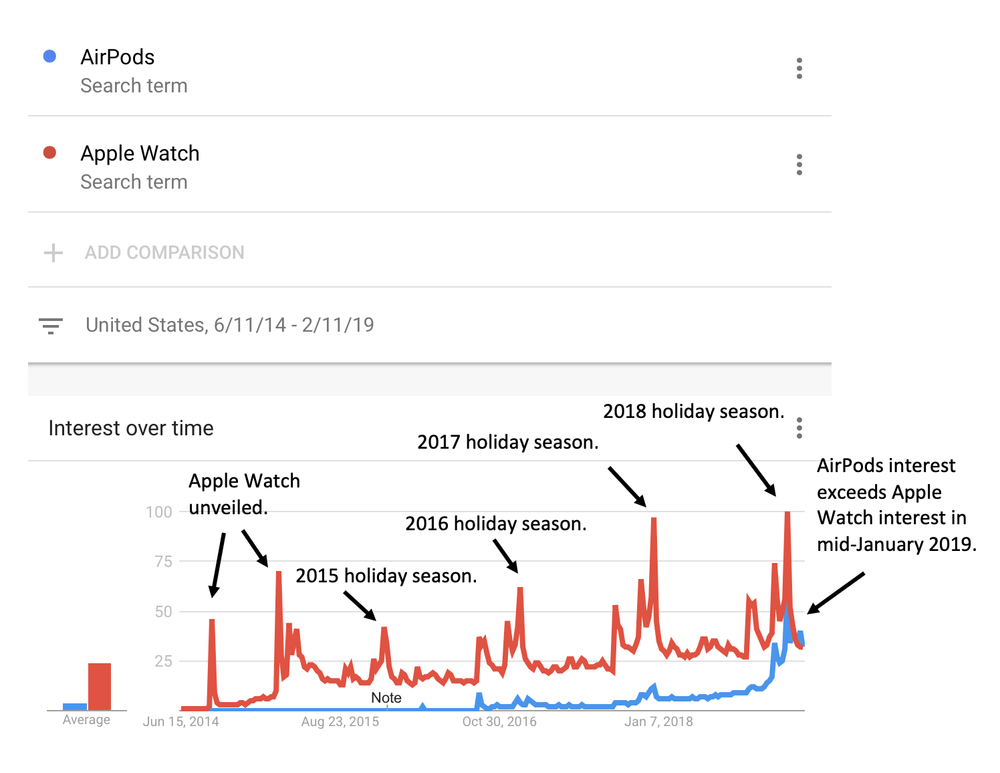
As shown below, search interest for “AirPods” in the U.S. began to shoot higher this past November, nearly two years after launch. Search interest then peaked between Christmas and New Year’s. The data is indexed to 100, which denotes the maximum amount of search interest for “AirPods” during the selected time range. Indexing allows us to see how search interest levels have changed over time.
Comparing peak AirPods search interest over the three most recent holiday seasons, the juxtaposition is startling. The following are Google search interest for “AirPods” in the U.S. indexed to 100 (represents maximum search interest):
2016 holiday season: 10 (AirPods search interest was 10% the volume of peak search interest).
2017 holiday season: 20 (100% year-over-year growth in search interest)
2018 holiday season: 100 (500% year-over-year growth in search interest)
Search volume for AirPods during the most recent holiday season was five times the search volume registered during the 2017 holiday season. Even more impressive, AirPods search interest this past December was ten times the volume registered during the December 2016 launch.
Two weeks ago, AirPods search interest (the blue line in the image below) exceeded Apple Watch search interest (the red line) for the first time.
No other Apple product has come close to this sudden surge in interest years after launch. For example, Google Trends for “iPad” in the U.S. from 2009 to 2019 is shown below. While the iPad saw a remarkable amount of interest at launch in 2010, interest levels ended up plateauing just two years later. The amount of iPad interest seen at launch was 30% the volume of peak search interest. This likely explains why iPad was like a rocket out of the gate when it came to sales, only for sales to plateau and eventually fall.
Measuring Sales
The surge in AirPods search interest isn’t just a reflection of people looking for AirPods memes and videos. The higher interest is reflective of stronger sales. According to my estimate, Apple is on track to sell approximately 40 million pairs of AirPods in 2019, representing close to 90% year-over-year growth. There are already at least 25 million people wearing AirPods. This total will likely exceed 50 million people later this year. These are massive sales and adoption figures for a two-year old product that has never received an update and rarely goes on sale for less than its $159 selling price.
The methodology and data behind my AirPods sales estimates are found in the following Above Avalon daily updates that are available for Above Avalon members here and here. (To become a member and access these daily updates, visit the membership page.)
As shown in Exhibit 1, AirPods are currently the second best-selling Apple product out of the gate in terms of unit sales, behind only iPad. An argument can be made that the iPad was an outlier and that no other Apple product will come to close to exceeding iPad unit sales.
Exhibit 1: Apple Product Unit Sales Out of the Gate
One issue found with Exhibit 1 is that quarterly unit sales are impacted by seasonality. In order to remove this seasonality, Exhibit 2 shows unit sales on a cumulative basis. While iPad’s clear sales lead is hard to miss, AirPods are the second-best selling product two years after launch, slightly ahead of iPhone at the same point after launch. On a cumulative sales basis, AirPods are outpacing Apple Watch by 40% at the same point after launch.
Exhibit 2: Apple Product Cumulative Unit Sales
Viral Factors
Despite Apple Watch selling well, there hasn’t been a similar kind of viral aspect to the product. There aren’t various Watch memes floating around Twitter. What is it about AirPods that turned the product into a pop culture viral sensation? There are likely a few factors.
High Visibility. AirPods are literally hanging out of people’s ears. They are nearly impossible to miss when worn. Since the lack of wires make AirPods useful for outdoors activities including walking and running, they are bound to be seen in people’s ears while out and about. AirPods sightings have seemingly grown exponentially in recent months. Meanwhile, an Apple Watch is easily covered by long sleeves or jackets. In cold weather climates, Apple Watch visibility is reduced to indoor settings for months at a time.
New and Different. AirPods, although a successor to wired headphones, look very different without the wire. The product also stands out from other wireless headphones. In some ways, Apple designers didn’t try to hide the fact that AirPods lack wires. The product is intriguing, sparking curiosity.
Social Signaling. Wearing white EarPods signaled to others that an iPod, or eventually an iPhone, was found in the wearer’s pocket. Similarly, wearing AirPods signal to others that the wearer likely has an iPhone and is able to pay $159 for a pair of wireless headphones despite a wired pair being included in the iPhone box.
Strategy
AirPods end up playing a more strategic role for Apple than just being a fun smartphone accessory. AirPods represent one half of Apple’s wearables strategy.
Success in wearables will require two ingredients:
Ecosystem. A selection of tools targeting different parts of the body.
Design / Fashion Expertise. Developing wearable devices that people want to wear and be seen wearing.
AirPods demonstrate Apple’s significant lead when it comes to developing a wearables ecosystem and possessing a design / fashion acumen that other companies lack.
It won’t be enough for a company to just sell a smartwatch or a pair of wireless headphones. Instead, the key to mastering wearables will be to offer an ecosystem of devices that work seamlessly together. This dynamic will require companies to have an expertise in combining hardware, software, and services, something Apple has been focused on for decades.
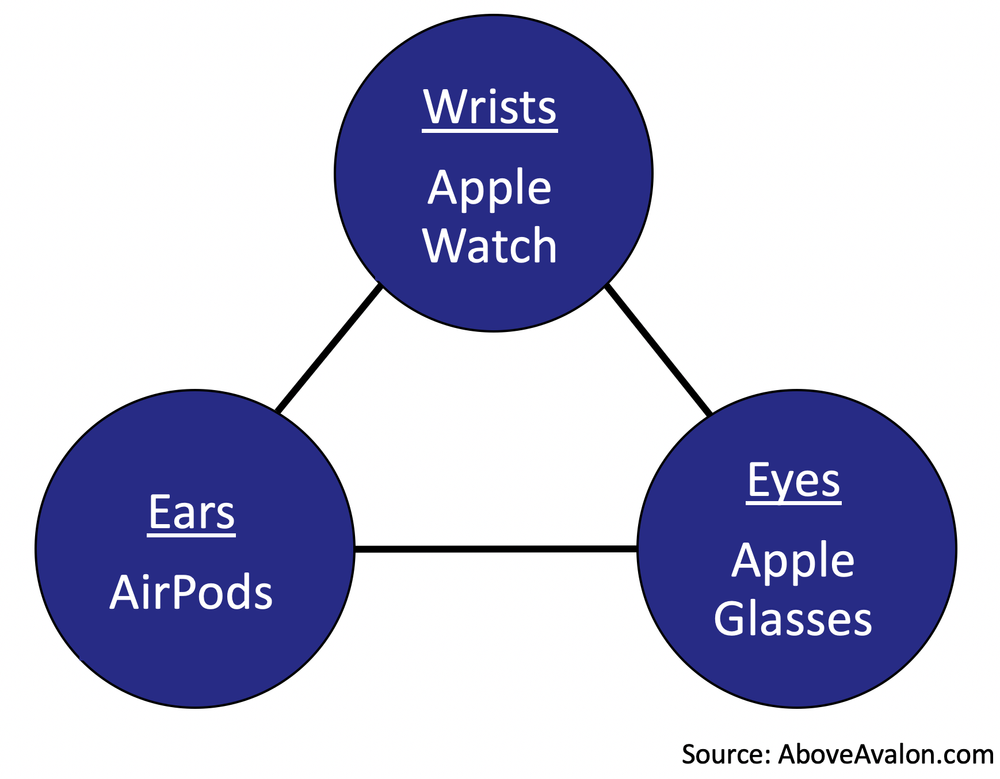
The winners in wearables will be companies successfully waging simultaneous battles for real estate on our wrists, ears, eyes, and body (i.e. smart clothing). As shown below, there are three key pieces of real estate that are currently up for grabs or will soon be available for grabs: wrists, ears, and eyes.
In 2015, Apple entered the wearables arena with Apple Watch. The product kicked off Apple’s attempt to grab wrist real estate. The wrist has proven incredibly useful given its line of sight for viewing information at a quick glance in addition to its ability to foster certain health monitoring capabilities. While Apple Watch is going up against traditional mechanical watches, competition ends up being much broader. Ultimately, Apple Watch is competing for a place on wrists. One of the Watch’s fiercest competitors is non-consumption, or empty wrists.
A similar dynamic is now unfolding with AirPods. The device is Apple’s attempt at grabbing ear real estate. Competitors for this real estate include both wired headphones, like EarPods, and non-consumption in the form of empty ears. Even though AirPods may be light on features today, having tens of millions of wearers today increases the probability of subsequent AirPods versions seeing strong adoption.
The battle for our eyes is on the horizon, not quite ready for prime time. A pair of smart glasses have the highest likelihood of being Apple’s next major product category.
The key to grabbing real estate on our wrists, in our ears, and in front of your eyes is selling tools that people want to wear and be seen wearing. A product’s design, defined as how we use that product, is crucial in this regard. With Apple Watch, interchangeable bands have played a crucial role in driving Watch adoption. AirPods’ elegant charging case has come to define the product’s experience.
Instead of positioning technology as a barometer for wearables success, the intersection between technology and fashion will determine which products people will want to wear throughout the day. Lessons learned from Apple Watch, and now AirPods, will give Apple an advantage when it comes to developing a pair of lightweight and unobtrusive smart glasses.
Vision
Unlike Amazon and Google, which are desperately trying to position voice as a way to leapfrog over the current smartphone/tablet paradigm, Apple is approaching things differently. Instead of betting on a voice interface that pushes some information to a stationary screen, Apple is betting on mobile screens that are home to a digital assistant. Apple is placing a bet that consumers will want the familiarity found with touch screens to transition to a future of greater AI and digital assistants. Apple Watch ends up serving as a bridge to the future. The most valuable mobile screens in our lives will increasingly be worn on the body. In addition, Apple thinks screen manipulation via fingers, hands, and eyes will remain a crucial part of the computing experience for the foreseeable future.
AirPods play a role in this vision by harnessing sound on the go. Wired headphones are an endangered species as there is no place for wires in a wearables world. While the viral nature of AirPods may subside over the coming months, especially as adoption continues to expand, the biggest takeaway from the various AirPods memes, tweets, and videos, is that wearables continue to infiltrate society. We are witnessing the early stages of the wearables era.
Receive my analysis and perspective on Apple throughout the week via exclusive daily updates (2-3 stories per day, 10-12 stories per week). Available to Above Avalon members. To sign up and for more information on membership, visit the membership page.
One highlighted passage from every book I read in 2017
Only twenty? I honestly thought I had read more than that.

Version Control by Dexter Palmer.
“He was all the possible fathers. He was a dragonslayer and a titan of industry; he was a cunning detective and a grizzled gunfighter; he was an astronaut and a priest and a jailer of thieves.”
Martian Time Slip by Philip K. Dick
“Who can say if perhaps the schizophrenics are not correct? Mister, they take a brave journey. They turn away from mere things, which one may handle and turn to practical use; they turn inward to meaning. There, the black-night-without-bottom lies, the pit.”
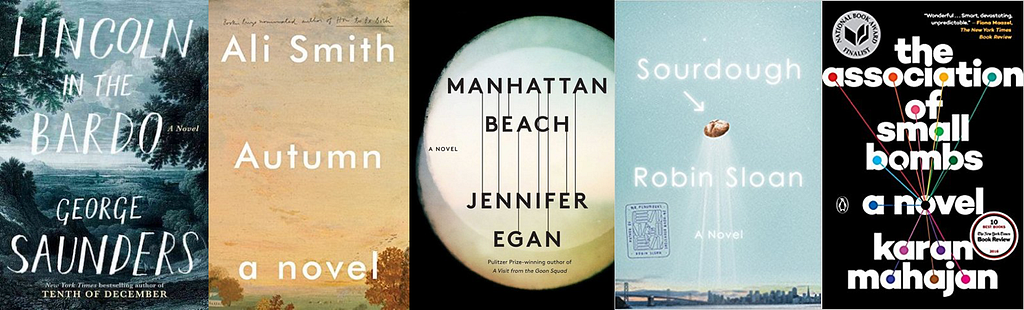
Lincoln in the Bardo by George Saunders
“Strange, isn’t it? To have dedicated one’s life to a certain venture, neglecting other aspects of one’s life, only to have that venture, in the end, amount to nothing at all, the products of one’s labors utterly forgotten?”
The Association of Small Bombs by Karan Mahajan
“The body itself was abhorrent. It could be made subservient to anything. It could work for despots, tyrants, fascists, terrorists — it could work for machines. He realized the pointlessness, at a time like this, of having a mind.”
Here I Am by Jonathan Safran Foer
“Judaism has a special relationship with words. Giving a word to a thing is to give it life. ‘Let there be light,’ God said, and there was light. No magic. No raised hands and thunder. The articulation made it possible. It is perhaps the most powerful of all Jewish ideas: expression is generative.”
American Kingpin: The Epic Hunt for the Criminal Mastermind Behind the Silk Road by Nick Bilton
“Facebook was now being valued at around $80 billion; Twitter was worth some $10 billion, and that place was run like a clown car.”
Ill Will by Dan Chaon
“No doubt this must happen to everyone at a certain age: You look up for a moment and you’re not sure which life is real. You’ve split yourself into so many honeycombed parts that they barely notice each other — all of them pacing, concurrently, parallel streams of thought, and each one thinks of its self as me.”
Change Agent by Daniel Suarez
“Every cluster of human cells was viewed as a baby in America. A quarter of the population wasn’t vaccinated. A majority of Americans didn’t believe in evolution. Social-media-powered opinions carried more influence than peer-reviewed scientific research. In this virulently anti-science atmosphere, synbio research was hounded offshore before it had really begun. Activists crowed over their victory.”
The Three-Body Problem by Liu Cixin
“Overly literal translations, far from being faithful, actually distort meaning by obscuring sense.”
Alice & Oliver by Charles Bock
“The oncoming evening, the glittering urban panorama, its chilled beauty, its hugeness, life unfolding and all that awaits, chokes me up. I remind myself to breathe, let myself exhale. I see her large hazel eyes. Her joyous face. I see her and at the same time cannot see her, cannot imagine how much she has grown, how her face has evolved. But I don’t need to, do I? I don’t need to know the answers. I don’t need to know more than the next breath. All of this is happening.”
Mrs. Fletcher by Tom Perrotta
“Where would she be now? It was nothing, really, just a passing shadow, and Eve had lived long enough to know that it was foolish to worry about a shadow. Everybody had one; it was just the shape your body made when the sun came out.”
Exit West by Mohsin Hamid
“To flee forever is beyond the capacity of most: at some point even a hunted animal will stop, exhausted, and await its fate, if only for a while.”
Sourdough by Robin Sloan
“It was just the two of us crossing the bay, and when the fat little boat puttered below the bulk of the Bay Bridge, I felt like we were astronauts in transit across the back side of the moon.”
Manhattan Beach by Jennifer Egan
“At the end of the street, under a gray expanse of sky, she sensed the ocean, like someone asleep.”
The Spy Who Came in from the Cold by John le Carré
“In the earlier days the city had been thronging with second-rate agents: intelligence was discredited and so much a part of the daily life of Berlin that you could recruit a man at a cocktail party, brief him over dinner, and he would be blown by breakfast.”
Born to Run by Bruce Springsteen
“Here we live in the shadow of the steeple, where the holy rubber meets the road, all crookedly blessed in God’s mercy, in the heart-stopping, pants-dropping, race-riot-creating, oddball-hating, soul-shaking, love-and-fear-making, heartbreaking town of Freehold, New Jersey. Let the service begin.”
Void Star by Zachary Mason
“She wonders if there are firms specializing in the sculpture of hubris, and do they ever build heroically scaled, improbably muscular statues of their older, more literal-minded clientele?”
Principles: Life and Work by Ray Dalio
“Think of yourself as a machine operating within a machine and know that you have the ability to alter your machines to produce better outcomes.”
All the Birds in the Sky by Charlie Jane Anders
“A pitch pipe sounding a single note was your only warning that your heart was about to be wrecked.”
Autumn by Ali Smith
“We have to hope, Daniel was saying, that the people who love us and who know us a little bit will in the end have seen us truly. In the end, not much else matters.”
One highlighted passage from every book I read in 2017 was originally published in Stating the Obvious on Medium, where people are continuing the conversation by highlighting and responding to this story.
How not to plagiarize like Jill Abramson in “Merchants of Truth”
Jill Abramson, former executive editor of the New York Times, published a book on media called Merchants of Truth. Many passages appear to be plagiarized. I’ll explain why authors do this and how you can make sure you never do. I can already feel your outrage. Plagiarize? I would never do that! No respectable author … Continued
The post How not to plagiarize like Jill Abramson in “Merchants of Truth” appeared first on without bullshit.
Review: The Globotics Upheaval: Globalization, Robotics and the Future of Work by Richard Baldwin
There are two major points being made hewre. The first is the oft-heard observation that "a new form of globalization will combine with software robots to disrupt service-sector and professional jobs." Second, and more significantly, "the current backlash against our global commitments to one another, particularly across western society, has very much to do with the failure of public policy to adequately address the negative impact that post-industrialization and globalisation have had on the working and middle classes."
Web: [Direct Link] [This Post]Setting up your first assignment face-to-face in class using Peergrade
As the caption to this 7 minute video says, this is "a quick overview of how I use Peergrade as an activity in class to work through the process and expectations of peer evaluation and assessment." He outlines an exercise using a video on digital literacy; after watching the video, they use the application in class, and tghen use PeerGrade to write some quick responses. This allows him to introduce tome of the mechanisms of the tool, which allows them to set up rubrics for the evaluation of the responses.
Web: [Direct Link] [This Post]Rethinking evening events
I didn’t use to understand why some people would never be able to come to evening events. And even if I had understood, I didn’t have the empathy for what they were going through, usually as parents, but sometimes as caretakers of others, such as elderly parents. That’s changed for me big time .
Now that Maryam Ghaemmaghami Scoble and I have flipped roles (she works at VMware and I stay home with the kids, while trying to build a business that fits around them) I’ve had to turn down dozens of events, because I have kids to drop off in the morning, pick up in the afternoon, and do stuff with other times.
Oh, and it isn’t lost on me that most of the people who are dropping kids off, or picking them up, are either women or are grandparents, filling in for two-working-parent families, or single parent homes.
I never thought about it before, but now I’m thinking about our gender roles in a whole new way.
My partners and I are setting up our company around our lives, not the other way around. More about our new company March 1.
One of the things we want to do is put together industry events. Luckily VR most people can afford and use without having a room or a PC is coming so that we can jump into events virtually soon, no matter where or when they are (I often do phone calls in the evening, while the kids are goofing off or doing homework, or even after they go to sleep. Turns out my Tesla is noise proof, so I can use it as an office for doing such calls late into the night).
That said, I am soon going to do some mentoring meetings for spatial computing industry in San Francisco, and I’m thinking of making them late in the morning instead of at night for just these reasons.
Now, excuse me, gotta go wash the dishes and do the laundry before Maryam Ghaemmaghami Scoble notices I haven’t kept up on my side of the bargain.
Oh, some other learning? I need to focus more on my health. Sugar has turned into a poison in my life. It kicks my ass. I gave it up for more than a week, then had some today and boom, I was out for a nap and not a good one (my doctor is working with me on changing my diet). So far lost 10 lbs in less than two weeks just by changing diet. More to come on that front.
Change might have been forced on me, but it does give me so many gifts. Sorry to those I didn’t empathize with over the years.
"Joe Schlesinger, CBC News, where the fuck am I?"
Joe Schlesinger on life as a patient:
But I refuse to let all that affect my taste for life: I still have so much to engross the heart and engage the brain.
Schlesinger died today; he may have been Canada’s most thoughtful journalist.
So long Digitalme, and thanks for all the fish
Note: City & Guilds have asked me to clarify that Digitalme still exists and continues to offer badging services.
This announcement from Digitalme is a real shame:
Since we joined the City and Guilds Group in June 2016, we have continued to help all kinds of teams recognise learning with the Open Badge Standard.
At this point in our journey, it is time to say goodbye to the Open Badge Academy in order for us to focus on supporting the design, development, and implementation of quality programmes that leverage the Open Badge Standard powered by leading technology — Credly.
After leaving Mozilla in 2015, I consulted with City & Guilds up to the point at which they acquired Digitalme. I’d known the guys at Digitalme since before I started at Mozilla and was impressed with their dedication and effort. They’d built something people and organisations really wanted, so taking it to the next level with City & Guilds seemed to be their opportunity to scale-up.
The trouble was that City & Guilds didn’t really have much in-house technical capacity. They’re a 140 year-old credentialing organisation, who took a punt on a young start-up with the hopes that they could create a whole new business unit out of it. At the same time, to hedge their bets, they invested in Credly. Now, it seems, they’re scuttling Open Badge Academy (OBA) in favour of becoming a Credly reseller.
These things happen, especially as the Open Badges ecosystem matures. It’s been a few years since the demise of Achievery, which was a really forward-looking platform, but unfortunately a too early for the market. What I think is a particular shame with the way City & Guilds are handling the Digitalme situation is the way they are presenting existing customers with a lack of options:
We’re working on a simple way for existing users to download their information, including any badges they have earned so they can continue to share verifiable recognition of their skills.
[…]
To download your badge, go to your profile page and click on the Push icon under your awarded badge. Select the Download option to download this badge to your computer. This download will include data such as the issuer information stored within the image. We would recommend downloading the 2.0 version as this will still be verifiable after OBA closes.
One of the great things about Open Badges, of course, is that you can store them anywhere. Still, you would hope that existing users would, at the very least, be presented with a migration path from OBA to Credly. I would have thought that, given OBA isn’t closing until the end of August, City & Guilds could implement the upcoming Badge Connect API to allow users to make the migration.
The announcement focuses on the sunsetting of OBA, but in effect this is the end of Digitalme. My understanding is that there are very few of the original team left at City & Guilds, and the focus now is on reselling Credly’s products. (I’m happy to be corrected if I’m mistaken.)
A few people have been in touch with me since the announcement asking what they should do. There’s plenty of Open Badges-compliant issuers out there, but I usually recommend Badgr or Open Badge Factory to clients.
Full disclosure: these two platforms sponsor Badge News The Learning Fractal. We approached them for this sponsorship due to their long-term support of the Open Badges standard. Credly made the decision to end their sponsorship of the newsletter at the beginning of this year, and we would thank them for their initial support.
Image: Left high and dry (Explored) by hehaden used under a CC BY-ND license
The BIG announcement: Picr is now Bloom.io
Photographers, videographers, creatives from all disciplines, and our fellow citizens of the blue planet, we are pleased to announce today, on the twelfth of February, that from this day hence, Picr shall be known by, and branded as Bloom!
Enter trumpets, drums and champagne 🎺🥁🍾🎉🎊
Several years ago, when Picr was first conceived, we had envisioned a marketplace-first approach to the product. But as we learned more about the needs of freelancers and creatives the focus shifted towards creating the ultimate all-in-one CRM.
We do not take our brand identity lightly and after contemplating for a year about changing the name, we decided that now is the time to do so. Here’s why:
Why Bloom?
Our mission is to empower talented creatives to run a blooming independent business; to help artists focus on their craft instead of spending all of their time on admin.
Most independent artists struggle to make a living because business and admin tasks are overwhelming, complicated, and simply boring. The unfortunate irony, is that the artistic skills required for being a creative are completely different from the skills required to make money with a creative skills.
Bloom exists to help creatives run an efficient and profitable online business. To accomplish this, we have built a powerful business management and growth toolset, giving creatives access to modern and robust technology, all in one place.
Bloom is all about enabling creatives focus on their craft and putting freedom back into freelancing.

Why is this important?
The online revolution has put millions of talented artists at a massive disadvantage. Consumers expect to interact with and make buying decisions online but creatives are not equipped to meet them on the web.
Unfortunately, most online services are built for small and medium-size businesses, not solopreneurs. Independent creatives are forced to juggle online services which are expensive, difficult to manage, and oftentimes don’t work.
This struggle results in burnout and exhaustion. For example, an average full-time photographer subscribes to at least 10 disjointed services, such as a website builder, lead capture tools, lead management and sales, contract signing, scheduling, invoicing, task management, image delivery, and communication.
Bloom is re-envisioning what it looks like for creatives and artists to run a business in a digital world.

Why now?
For the past several years our focus has been completely on developing the product. We conducted an extensive beta during which we closely listened to our users and continued to tweak the product.
Now we are transitioning to growth and scale. While our brand is still relatively new, we decided that now was the time to change the name and advance into 2019 with vigor and excitement.
What makes Bloom different?
While there are many different CRM systems on the market, Bloom is the only all-in-one CRM that combines customer management with robust marketing tools. Bloom is focused on your online client journey from the first contact on your website, all the way through email capture, lead management, invoicing, communication, and even digital asset delivery—all in one beautiful place.
No one else does it like Bloom.

Who is Bloom for?
The online business cycle, outlined in an earlier blog post, is the same for nearly all freelancers. While we started by focusing on the photography industry, in 2019 we will gradually expand to many other industries.
Starting with videography, event planners, florists, and musicians, and even expanding to consultants, lawyers, and small agencies. The fundamental business cycle is the same for all and Bloom is best all-in-one CRM available today.
Join us for our webinar announcement of bloom on February 12th where we will outline recent developments and show you what to expect in 2019!
If you have not already signed up. Click here to start your free 14-day trial.
Yours truly,
-Bloom Co-founders.
The post The BIG announcement: Picr is now Bloom.io appeared first on Picr.
14 Questions About that Terrible Joni Mitchell Quote
Yesterday, a graphic with a Joni Mitchell Quote went massively viral on my Facebook and Instagram feeds. Lots of my most brilliant and usually quite observant and clued in music friends were sharing it unquestioningly as a useful comment about the state of music now. The quote itself is apparently from 2004, and is as follows:
“I heard someone from the music business saying they are no longer looking for talent, they want people with a certain look at a willingness to cooperate. I thought, that’s interesting, because I believe a total unwillingness to co-operate is what is necessary to be an artist – not for perverse reasons, but to protect your vision. The considerations of a corportation, especially now, have nothing to do with art or music, that’s why I spend my time now painting”
Joni Mitchell, quoted in the LA Times, Sept 5th 2004
So, perhaps not surprisingly, I take some issue with this. So here are 14 questions/comments you may want to ask yourself or reflect on about this before going ‘yeah, Joni! I’m taking up painting too!’ (though obviously, painting is a really really awesome way to spend your life, and in no way an inferior choice to making music…!)
1) who was this ‘someone from the music business’ and which bit of the music business were they in? Why is this one unnamed person’s pretty gruesomely commercial focus being held up as a template for understanding the motivations and behaviour of everyone in ‘the music business’?
2) what the hell is ‘the music business’. I’m in the music business, clearly this person’s thoughts don’t reflect on me… were they in publishing? Sync? A&R? Running a label? A sub-label? The ‘music business’ is gargantuan – finding a person with really terrible opinions within its bounds has never been hard.
3) For every renegade artist through the history of music, I’ll show you a thousand successful and often brilliant artists how had a certain look and were willing to co-operate. Frank Zappa was a total one off. Find me the label that launched 500 Frank Zappas and we can have a talk about Zappaism as a business model.
4) I adore Joni’s music – Hejira is my favourite record of all time, and she’s easily in the top 10 or so most significant musicians of the last 100 years, but when she was signed, she was a beautiful young acoustic guitar playing singer-songwriter in the golden age of acoustic singer/songwriters. She didn’t need to co-operate, she was exactly what they were looking for. Don Juan’s Reckless Daughter was what she could do after a decade as a global icon, not the demo that got her signed in the first place.
5) Why are co-operation and artistic vision contradictory? Why do we view wilful obscurantism as a virtue? How many artists are doing exactly what they want to do AND making commercially viable music? James Taylor wrote some of the most beautiful, singable, hummable music of all time. I don’t see that as a flaw in his creative plan.
6) The 70-80 year history of the recording industry is LITTERED with stories of records being rejected because of a lack of singles. Some dickhead sent back Three Feet High And Rising for not having a single on it. Listen to Wasted Years by Iron Maiden and tell me that’s not an obvious attempt to write a hit. Big Yellow Taxi is arguably Joni’s most famous song, and by far the most poppy thing she ever did. And it’s great! It’s not worse art because people loved it! You can’t rate art on its complexity, less still argue about the ethics of a multi-national business based on how insane their commercial choices are.
7) The Major labels were once the only game in town, at least if you had any concern for global success. That’s not the case now. Joni said this, apparently, in 2004. Even then, that was not the case. Marillion had already gone it alone and crowd-funded a record by then, Joni could’ve done literally anything to make a record, and the more outside the mainstream she did it, the more coverage she’d have got (x-ref Radiohead and In Rainbows)
8) Joni’s reasons for quitting music are, by her own extensive admission in many many interviews, WAY more complex than this. All of them are valid – her life and work are her own. The validity of her choices is not really up for discussion.
9) Looks and commercial success have always gone hand in hand. The idea that ‘a certain look’ is a new idea is specious revisionism.
10) There has never EVER been a better time in human history to make recorded work as a musician, protect your vision AND negotiate a deal after the fact. Making records is orders of magnitude cheaper, labels do A&R via metrics now – look at Stormzy’s deal with Atlantic/Warner. He owns his entire operation, they just do the donkey work that he doesn’t need to do. But ‘recorded music’ is a tiny blip in the human timeline. Even if the model goes away, that’s not the end of anything. The end of the world as we know it is not the end of the world.
11) If this is about there being an absence of successful ‘risky’ pop music out there, please explain Janelle Monae, the last ATCQ album, most Grime, Bjork, Kate Tempest, DJ Shadow, etc. etc. etc. Some are on subsidiaries of majors, some are completely independent and wouldn’t accept a deal if they were offered it. That’s a GREAT thing. A wonderful situation.
12) On a daily basis I come across incredible music, so much I can’t keep track of it. The world is laden down with people making extraordinary art. There are people making incredible art who I saw sharing this insane meme, in seeming ignorance of their own careers being the evidence that this is nonsense. Commercial success has been the death of many, many people. Riches are rarely ultimately a blessing. Sustainability of artistic practice is the only concern I have here, so a reduced capacity for stardom and supreme wealth is not going to make me sad…
13) being an artist is hard. It’s always been hard, that’s what makes the art so special. A handful of people who remember selectively isn’t the story we need to be hearing or re-telling. Sure, there’s less money in A&R and artist development from majors now. The whole landscape has changed. But more people are making more music in more places, and that’s a fundamentally good thing, unless you assume that by the divine right of kings you should have their audience as well. There’s also a lot less record label money being spent on coke, turning every charlied pop star into an insufferable self absorbed bankrupt arsehole. Every cloud has a dusty, silver lining…
14) go make some art. If that’s painting instead of music, that’s not a step down. Joni’s music is unassailably amazing. Her painting is also exquisite. I’m glad that she’s had the economic latitude in her life to pursue both of those dreams in such extraordinary ways. But please don’t take a dump in our paddling pool because things aren’t they way there were in the 70s…
Adding Zip Files to Github Gists
Over the years, I’ve regularly used Github gists as a convenient place to post code fragments. Using the web UI, it’s easy enough to create new text files. But how do you add images, or zip files to a gist..?
…because there’s no way I can see of doing it using the web UI?
But a gist is just a git repo, so we should be able to commit binary files to it.
Ish via this gist — How to add an image to a gist — this simple recipe. It requires that you have git installed on your computer…
#YOURGISTID is in the gist URL: https://gist.github.com/USERNAME/GISTID GIST=GISTID git clone https://gist.github.com/$GIST.git #MYBINARYFILENAME is something like mydata.zip or myimage.zip cp MYBINARYPATH/MYBINARYFILENAME $GIST/ cd $GIST git add MYBINARYFILENAME git commit -m MYCOMMITMESSAGE git push origin master #If prompted, provide your Github credentials associated with the gist
Handy…
Twitter Favorites: [JohnBiehler] So that just happened - I got to 3D scan @georgehtakei @varietybc #showofhearts https://t.co/UlnCCewTH4
So that just happened - I got to 3D scan @georgehtakei @VarietyBC #showofhearts pic.twitter.com/UlnCCewTH4
Twitter Favorites: [trapunski] After a few years as The Move, @FLOW935TO is back. I spoke to program director Josie Fenech about why they went bac… https://t.co/itVHOTmGBC
After a few years as The Move, @FLOW935TO is back. I spoke to program director Josie Fenech about why they went bac… twitter.com/i/web/status/1…
Twitter Favorites: [frankshyong] Good piece about what LA has in place of traditional diners - quick service burger/burrito/taco stands with regiona… https://t.co/AzXDX3ec3L
Good piece about what LA has in place of traditional diners - quick service burger/burrito/taco stands with regiona… twitter.com/i/web/status/1…
Apple’s Health Records on iPhone Coming to Veterans
Apple today announced that its Health Records feature is coming soon to all U.S. veterans thanks to a partnership with the US Department of Veterans Affairs (VA). The announcement includes key quotes from Apple executives that highlight the growing importance of health to Apple as a company.
“When patients have better access to their health information, they have more productive conversations with their physicians,” said Jeff Williams, Apple’s COO. “By bringing Health Records on iPhone to VA patients, we hope veterans will experience improved healthcare that will enhance their lives.”
“Our goal is to empower people to better understand and improve their health, enabling them to view their medical information from multiple providers in one place easily and securely,” said Kevin Lynch, Apple’s vice president of Technology. “We’re excited to bring this feature to veterans across the US.”

First introduced as part of iOS 11.3, Health Records is an iPhone feature whereby users' patient records from participating hospitals and clinics can be stored in the Health app for easy access. Today's news is significant largely for the expanded scope it brings to the feature. From the press release:
Health Records on iPhone will be the first record-sharing platform of its kind available to the VA, which is the largest medical system in the United States providing service to more than 9 million veterans across 1,243 facilities.
It's a smart partnership for Apple, and one that could make a meaningful difference in the lives of U.S. veterans.
→ Source: apple.com
The Sweet Spot Scenario
There's still a lot of discussion about sensor size going on, and with it, body size. That's because of the E-M1X and S1/S1R announcements. In both cases, we have Olympus and Panasonic going up-size and up-weight in bodies, and that's being met with varying degrees of push back.
…