Shared posts

18 Feb 18:55

The Heroes of the Thai Cave Rescue

by Andrea

Maclean’s: Into the dark – The inside story of an improbable team of divers, a near-impossible plan and the rescue of 12 boys from a Thai cave.

“We were foreigners and we weren’t going somewhere foreigners often go, so when I saw the blond man across the Bangkok airport shuttle bus on our way to the remote mountains of Chiang Rai, a one-hour flight away, I asked whether he was about to do the one thing or the other: “Are you rescuing the boys or covering the rescue?”

“Well, we’re hoping we can help rescue them,” he said. He didn’t seem hopeful. He seemed grim. We stepped off the bus onto the hot tarmac and walked toward the plane.

“You never know,” I said. “It could happen.” Save 12 children and their soccer coach who got stranded three kilometres inside a flooded cave in northern Thailand at the start of the rainy season with no known food, water or swimming skills: It could never happen.

He nodded. “You never know.””

Link via MetaFilter.

18 Feb 18:55

A touching concern

by Liz

It is very sweet when MUNI bus drivers express their worry about my keeping warm on a cold day when I get off the bus. Clerk in the Walgreens, too.

But it always makes me a little sad that people assume wheelchair users are likely to be homeless. It’s not like they’re wrong, in this town.

18 Feb 18:51

A Funny Thing Happened on the Way to the JavaScript

Jason Rodriguez, CSS-Tricks, Feb 13, 2019
Icon

This post talks about one developer's journey to learn - or in this case, not learn - Javascript. This is not an easy journey in 2019, as the reference to these developer roadmaps makes clear. These roadmaps are similar to the roadmap to learning Solid I pointed to yesterday (it's interesting to see the developer community independently discover something like the mechanism of learning design for developer roadmaps, albeit without all the overhead (such as roles) that educational institutions introduce).

Web: [Direct Link] [This Post]
18 Feb 18:50

Daniel Jalkut has bad news for Blogger users — ...

Daniel Jalkut has bad news for Blogger users — Google is shutting down an images API.

Colin Devroe reminds us not to rely on mega-corporations keeping our beloved services alive. They won’t.

18 Feb 18:50

Brett Terpstra writes about blogging, ethics, a...

Brett Terpstra writes about blogging, ethics, and thin skin.

I’ve been reading Brett’s blog for years — I trust him, and he’s a good writer. I also use his app Marked pretty much every day.

18 Feb 18:50

Data-driven porn

by Nathan Yau

Gustavo Turner for Logic on his experiences covering the porn industry and the introduction of data into the stream:

Over the course of these experiences, I learned about a major new force reshaping the industry: data. That day on set, the director’s instructions came directly from the production company, which decided on the topic and vetted the script. And the company based its creative direction on specific fantasies proposed by paying customers on an online forum that it owned. […]

In the pre-internet days, a producer might notice that a particular kind of porn movie sold well, and then try to make more like it. Today, a corporate porn conglomerate can analyze a continuous stream of information from online viewers, who supply feedback in the form of comments, and leave behind a data trail as they travel around porn sites.

What a time to be alive.

Tags: porn

18 Feb 18:50

Game Notes

Alexis Kennedy provides a remarkably complete and transparent view into the first year of his new game studio.

At this point half the audience are saying ‘112K? How did you spend that much? It’s only a 2D text game’ and the other half are saying ‘only 112K? How did you spend that little?’ The numbers above are how.

Eastgate’s not a game studio, but we’re not bigger than Kennedy’s Weather Factory. A few things leap out at me.

  • Their producer costs about £17.50/hr. I assume that includes health insurance, payroll taxes, and such — yes, I know about NHS. I’ve always been very sad that we don’t pay people more at Eastgate, but this is in line with our reality, too.
  • There’s no line for office rent or equipment. Be careful on this if you’re starting up. At minimum, get yourself a very good office chair. I’ve known people in their twenties who did themselves lasting harm by spending a startup year perched on an inadequate chair. Be good to your back.
  • There’s no line for accounting time or help, unless this is folded into the principal’s 170 days.

Ex-Eastgater Stacey Mason tweets:

Game Notes

I think Stacey may be too kind to academics in writing about the “the gap between the kinds of research academics are interested in & the stuff companies will fund.” My experience makes me wonder whether academics who study computer games are, on the whole, deeply interested in computer games.

Imagine a university film society in the 1950s, at a place where there was lots of interest in Cinema. Those people would be delighted to talk about Bergman or Goddard or Kurosawa. They’d have read last month’s Cahiers du Cinéma and would have strong opinions about it. Some of them would have read next month’s Cahiers, too. They would travel and wait in long lines for a chance to see The Bicycle Thief or The Philadelphia Story, because you couldn't stream and and you couldn’t rent.

This isn't my experience of academic game studies.

18 Feb 18:50

Farewell, Oppy

by Andrea

The Washington Post: Opportunity, NASA’s record-setting Mars rover, is declared dead after 15 years. “A eulogy for the spacecraft that transformed our understanding of the Red Planet.” By Sarah Kaplan.

Opportunity’s historic mission, which uncovered signs of Mars’s watery past and transformed our understanding of the Red Planet, has finally come to an end after 15 years, NASA declared Wednesday.

The cause was system failure precipitated by power loss during a catastrophic, planetwide dust storm that engulfed the Mars rover last summer.

“It’s going to be very sad to say goodbye,” said John Callas, the mission’s project manager. “But at the same time, we’ve got to remember this has been 15 years of incredible adventure.”

Opportunity’s mission was planned to last just 90 days, but it worked for 5,000 Martian “sols” (which are about 39 minutes longer than an Earth day) and traversed more than 28 treacherous miles — two records for NASA.”

Link via MetaFilter.

18 Feb 18:50

Invoxia Pet Tracker :: Ein kleiner Zwischenstand

by Volker Weber

418d732e646f5675eaac5eaa73726518

Mein erster Tracker war schlicht kaputt. Ich habe ihn wahrscheinlich bei einem Software-Update gebrickt. Dann musste ich über die Agentur einen technischen Kontakt zum Hersteller aufbauen. Und den habe ich jetzt, sogar einen ganz wunderbaren Kontakt. Ich werde den ersten Tracker zurückschicken, damit sie ein post-mortem machen können. Der neue ist in Betrieb und funktioniert.

Ich habe um unser Zuhause einen virtuelle Zaun errichtet. Wenn Frau Brandlinger da raus läuft, dann will ich eine Benachrichtigung. Die kommt als Push-Nachricht auf Handy und Apple Watch. Allerdings passiert das nicht sofort, genau wie auch mein Arlo nicht sofort anschlägt, wenn ich das Haus verlasse.

Der Tracker hat einen Bewegungssensor, Wifi, Bluetooth und GPS. Theoretisch sollte jetzt folgendes passieren, was in der Praxis noch auf einige Widerstände stößt.

  • Wenn sich das Tier nicht bewegt oder wenn der Tracker das gleiche Wifi sieht, dann schickt er nur alle vier Stunden einen Ort.
  • Sonst schickt er im Abstand von etwa fünf Minuten einen Ort. Das könnte man auch auf 10 Minuten verlangsamen. Grund: Strom sparen.

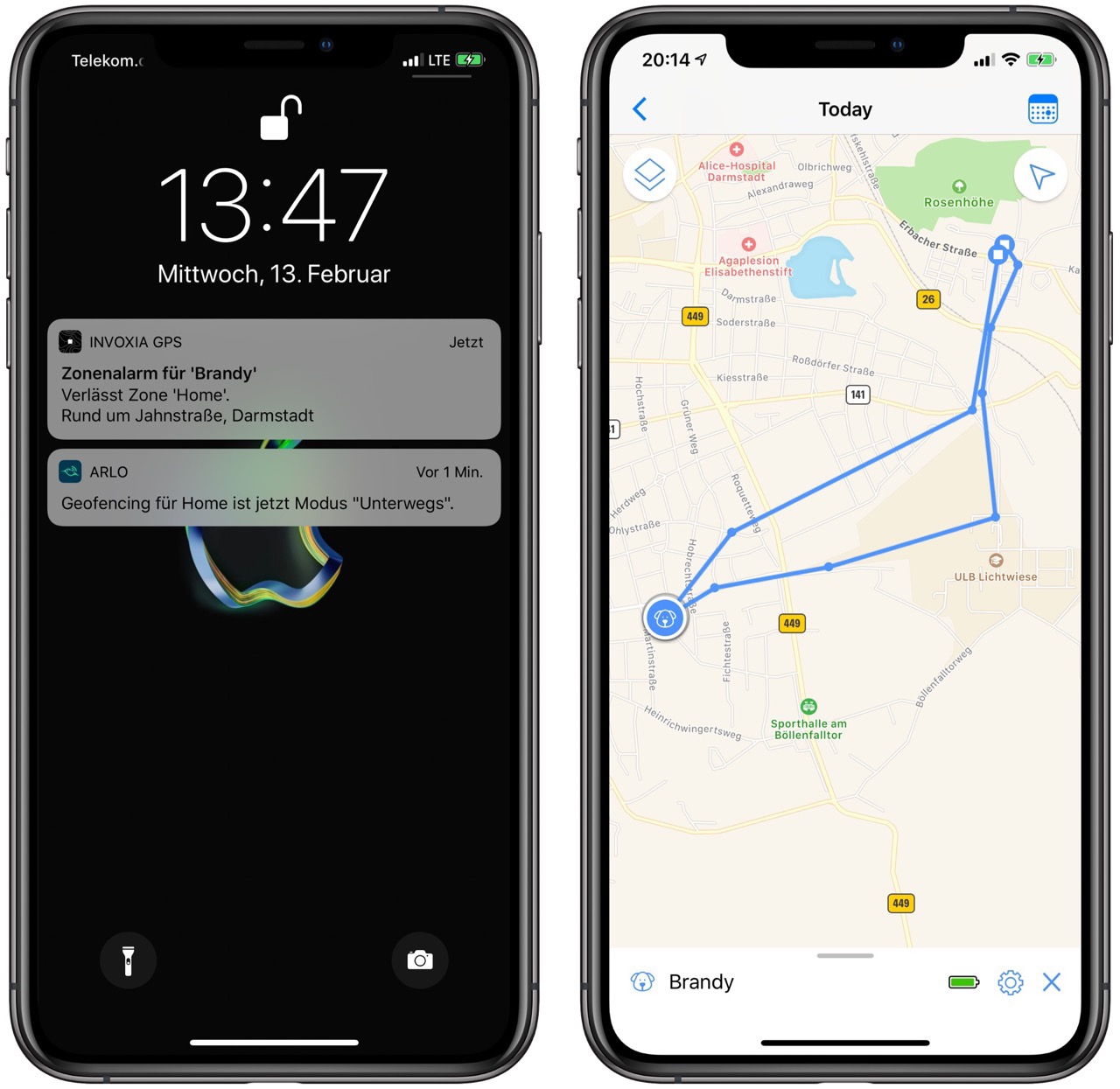
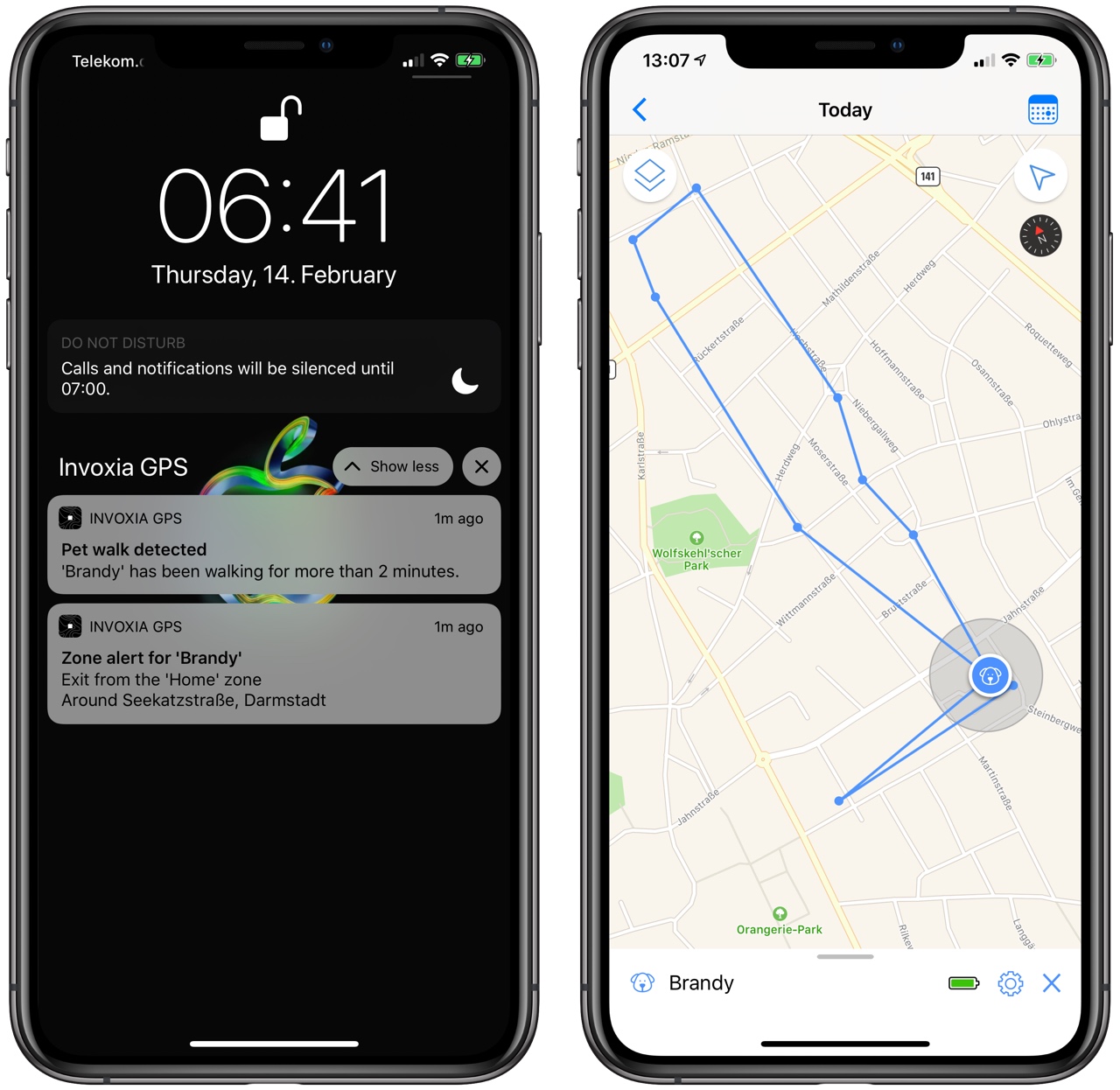
In dem zweiten Bild sieht man meinen heutigen Track. Links unten wohne ich. Nach rechts oben bin ich gelaufen, dort ein wenig geblieben, dann wieder zurückgelaufen, auf ähnlichen, aber nicht genau den gleichen Wegen, damit mir nicht langweilig wird. Am Anfang und Ende des Tracks ist jeweils ein Quadrat, das Ruhe anzeigt. Hier waren wir nicht in Bewegung.

ab98b8eeb0ac1a6fb6d61b0af4cf003b

Man erkennt, dass das keine GPS-Verfolgung wie von einem Handy ist. Wenige Wegpunkte werden durch Geraden verbunden. Mehr brauche ich eigentlich auch nicht. Sollte ich den Hund verlieren, dann ist er (oder der Tracker) am Ende des Tracks, oder wenigstens im fünf Minuten-Umkreis.

Invoxia verwendet im Herkunftsland Frankreich ein LoRa-Netz, hier in Deutschland Sigfox. Der Tracker kann beides. Drei Jahre bekommt man das Sigfox-Netz als Bestandteil des Produktes, danach kann man es für 10 Euro pro Jahr verlängern.

Und jetzt kommt die praktischen Schwierigkeiten: Das Sigfox-Netz ist noch im Aufbau. Die unterschiedlichen Abstände zwischen den Wegpunkten interpretiere ich als Sendeprobleme. Der Tracker will sagen, wo er ist, kann es aber nicht. Da bin ich jetzt mit dem Hersteller ganz dicht dran. Logs hinschicken etc.

Morgen laufe ich mal einen anderen Weg, direkt in den Großstadt-Dschungel. Mal sehen, ob das besser oder schlechter funktioniert.

25ee7b1a29961835ca34a12c5941d0d9

Update: Das hat besser funktioniert.

More >

18 Feb 18:50

Complexity as Theory of Change

by Ton Zijlstra

Chris Corrigan last November wrote a posting “Towards the idea that complexity is a theory of change“. Questions about the ‘theory of change’ you intend to use are regular parts of project funding requests for NGO’s, the international development sector and the humanitarian aid sector.

Chris’ posting kept popping up in my mind, “I really should blog about this”. But I didn’t. So for now I just link to it here. Because I think Chris is right, complexity is a theory of change. And in projects I do that concern community stewarding, networked agency and what I call distributed digital transformation, basically anything where people are the main players, it is for me in practice. Articulating it that way is helpful.

Cutting Through Complexity
How not to deal with complexity… Overly reductionist KPMG adverts on Thames river boats

18 Feb 18:50

Two-Factor Authentication and Developer Accounts

I just got an email from Apple that two-factor authentication will be required for my Apple Developer account.

I have two accounts — one for personal use, one for development use — and so do lots of developers.

I don’t know how to make this work. None of my devices are ever signed in to my developer account. That account exists purely for building and distributing apps.

18 Feb 18:50

The groundhog lied

by jnyyz

Well it’s been almost two weeks since Groundhog Day, and it looks like there’s going to be a lot more winter than predicted. This past two weeks have been particularly interesting, with various predictions of horrible weather that have not always been on the mark. Yesterday, TDSB closed all their schools and yet it was a pretty peaceful ride in. Certainly less traffic than usual.

I have to admit I’m getting a little soft, and I’m wearing the balaclava a lot more this winter than in the past. The googles were on account of the high winds.

Yesterday’s prediction of freezing rain in the evening never really materialized, and it was a sloppy, slushy ride home.

As you can see, the city was a bit behind on plowing, and since the curb lane on Bloor was impassable, I took the lane. With the strong tailwind, it was no problem keeping up with traffic.

This morning, all the stuff from last night was frozen on the bike.

It was snowy going in.

A lot of slush carried into the building. Our poor custodian….

I’m going to try to see if I can beat last year’s record of 120 consecutive days of cycling. Doing well so far:

Here’s hoping that we don’t get too much more snow this winter.

18 Feb 18:49

Jonathan T explains how to activate Apple ID 2f...

Jonathan T explains how to activate Apple ID 2fa when you have two accounts.

Short version: temp user on your Mac, SMS as backup, delete temp user, SMS keeps working.

18 Feb 18:49

Bad Invention: Menstrual Sneezing Powder

by Liz

There is nothing like a hearty chain sneezing bout to bring on a flood. And there is nothing more annoying than days and days of bleeding all over the place. OPPORTUNITY!

Why not help your Aunt Flo leave town faster by administering my latest and best invention, MENSTRUAL SNEEZING POWDER. Just snort it copiously on day 1 of your period and maybe the blood will fall the hell out of you, all at once.

It can be a cute little kit with the powder and a pair of maroon underwear and hipster packaging. I can see the cartoon art now as the adorable mascot sneezes herself all the way into space on a big flaming red rocketship. & an old-timey, scrolly font on it kind of like you’d imagine would be on a Victorian era box of snuff.

Also great during labor!

We shall make ONE MILLION DOLLARS with this genius invention. (I have to split it with Beth.)

Coughing works for this too, I bet! So get those sheep-sized tampons ready and smoke a bowl, remembering to inhale mightily.

You’re welcome!!!

18 Feb 18:49

What are race conditions?

by Eric Normand

What is a race condition? We look at what causes race conditions and some ways you can avoid them.

Transcript

Eric Normand: What is a race condition? Hi, my name is Eric Normand. These are my thoughts on Functional Programming. You should subscribe so you can get every episode as it comes out.

Race conditions are very interesting and fun phenomena that happened when we have multiple threads, or even multiple machines communicating with each other, and coordinating to get a job done. Let’s talk about the multiple thread situation at first to make it simpler.

Let’s say, I have a system that counts tomatoes. There are two cameras taking pictures of my tomato farm. I have a thread for each camera that is running some computer vision system to count the tomatoes. Every time the thread finds a tomato, it will execute the ++ operator.

If you’re not familiar with the ++ operator, it increments a variable. These two threads are sharing the same global variable. Let’s call it, tomato count. They’re both executing the same code. They’re executing tomato count ++. ++, the increment operator does three separate operations. It reads in the value from the global variable.

It adds one to it. It stores that value back in the variable. Because there’s three different operations, and this thread is doing three different operations, they can interleave in different ways. The easy case is when, say, thread A does the whole thing before thread B into the thread A reads, adds and stores, and then thread B reads, adds, and stores.

Let’s say, the variable is at 17 right now. Thread A counts one, so then at 18, and then thread B counts one, it’s 19. That’s the correct answer. Each thread counts a new one and we have two more than we had before. If thread B goes first, and then thread A, we get the same answer.

That’s not a race condition because they get the same answers, so it’s fine. The race condition comes in when the things run matters. When I say matters, it means you get a different answer. How is that possible? Because there are three different operations, they could happen at the same time. They could interleave.

Here’s an example of a different answer you could get by running these things into different threads. Thread A could read the number 17, and then thread B could read the number 17, then both of them add one. Now they both have 18. They both write an 18 to that variable. The answer after both of them counting is only one more.

We’ve lost a tomato. That’s a race condition because it’s like a race, who gets there first, what order these things happen in. It all just depends on luck. If you’re counting a lot of tomatoes, it’s probably going to happen, that the two threads are going to hit at the same time.

If you’ve got multiple threads, if you’ve got 10 threads counting, it’s even more likely that they’re going to occur at the same time. What’s unfortunate is that, very often, when you’re testing, you’re testing fewer threads and not as many iterations. You might not even see this happens in your tests or maybe you see it very occasionally.

It’s so uncommon that you just rerun the tests and they pass now, and you ignore it. It is one of the unfortunate things about moving from a sequential execution model to a parallel execution model. A single sequential program can do this, can do that ++ operator with no problem.

There was no problem at all, but once you move into a parallel world with multiple threads sharing resources, you start to get race conditions. There’s something you have to think about and avoid. I said before that this can also happen if you have multiple machines communicating. Very likely, you do already have multiple machines.

You have probably a web browser pointed at your web server, multiple web browsers at the same time, all sending you web requests. That’s already multiple machines. How could this cause a race condition? You could have the same thing.

If you have a button on your site or, let’s say, an old school hit counter, visit counter, it’s a little image, that every time someone requests that image from your server, it increments it by one, and then serves you the new image of…it’s just little number.

If you have two people make a request at the same time in your parallelized web server, then there could be a race condition between them if you’re not careful. Meaning, two requests come in at the same time and you only count it as one. You lose one. What should happen is one person gets one more and the next person gets two more.

That’s one and one makes two. This can happen not only in a…Wait, let me talk about how this happens on the back end. Let’s say, you’re storing the number of hits in the database. When a web request comes in for that image, you read in. You do a sequel query on the database.

Tell me how many hits we’ve had, then you add one to that, and then you update the field with that new number. Then serve the image out. If both threads or two machines or what have you, two processes, it doesn’t really matter how architecturally it works as long as two things are happening at the same time.

They’re both reading from the database at the same time. They get the same answer. They add one, and then they write it back. One of them is going to override the other, but they’re the same number. You’ve lost the count. Race conditions happen because, in a sequential program, the model of time is very easy.

It’s one thing happens at a time, one after the other. Once you have multiple timelines with things happening at the same time, now you’ve got race conditions. Those timelines can be because you have multiple threads, you’ve got multiple machines communicating, each one is a sequential thread and execution.

Even in JavaScript, you’ve got asynchronous callback chains. You have a callback for a web request, and then that does another web request and it has a callback for another web…That becomes a chain, a timeline. That chain becomes a timeline. One thing’s happening after the other.

You could easily find race conditions in those if you have shared resources. That’s another thing. You need shared resources to have a race condition. The two timelines need to be accessing something in common. In the first example counting tomatoes, the shared resource was that global variable.

The hit counter example, the shared resource was that value stored in the database. Those are the two conditions. Two things, two sequential timelines running simultaneously and they’re sharing resources, then you have a race condition. How do you avoid race conditions?

That is a much more complicated answer, than I’m prepared to give right now because I’m already going over. I’m going to leave that for another episode of thoughts on Functional Programming. Please subscribe and you’ll hear that answer when it publishes.

Also, if you have any questions, you want to get into a discussion, you want an episode about something that you’re interested in, just let me know. You can reach me at eric@lispcast.com, that’s my email. On Twitter, I’m @ericnormand with a D. You can also find me on LinkedIn. I’m Eric Normand.

You can search for me if you can’t find my URL, Eric Normand Clojure. I should be up at the top. I’ll see you next time. Bye.

The post What are race conditions? appeared first on LispCast.

18 Feb 18:49

How Vancouver is leading the way with Indigenous reconciliation

In the lead up to Park People’s national conference, Heart of the City, taking place in Montreal, June 12-14, 2019 , I wrote a piece interviewing their keynote speaker, Rena Soutar, to learn more about how Vancouver is leading the way in reconciliation with local Indigenous peoples. Rena Soutar is the first Reconciliation Planner at Vancouver Board of Parks and Recreation:

For 3,000 years, Indigenous peoples lived on a densely forested peninsula overlooking the Salish Sea in what is now called Stanley Park. It was home to the Tsleil-Waututh, Squamish and Musqueam peoples, and there was a village onsite called Xwayxway, where potlatches were held as late as 1875. Today, Vancouver’s largest iconic park holds little trace of its Indigenous ancestry.

Following the land’s official designation as Stanley Park in 1886, most Indigenous inhabitants were removed without remuneration. This displacement took place in parks across the city. According to the Vancouver Park Board:

“One of the core acts of colonialism is the removal of entire communities from their ancestral homes. This has been undertaken by the Park Board since its inception—beginning with the declaration of jurisdiction over ‘Stanley Park’, as well as beach areas around the City.”

The Vancouver Park Board is trying to address these past wrongs. Reconciliation is the goal. It means something unique to everyone, but ultimately it involves building a new relationship between Canadian society and Indigenous peoples.

You can read the rest of the article here.

18 Feb 18:48

True Detective: How Bullshit Becomes A Fact

by noreply@blogger.com (BOB HOFFMAN)

There is so much bullshit in our business that sometimes you have to wonder where it all comes from. Yesterday I decided to "peel back the bullshit" and see if I could reconstruct how something that was completely wrong wound up being represented as a fact in reputable publications like Forbes and The Drum. Here's the story.

Yesterday Samuel Scott tweeted out a quote from an opinion piece in The Drum.

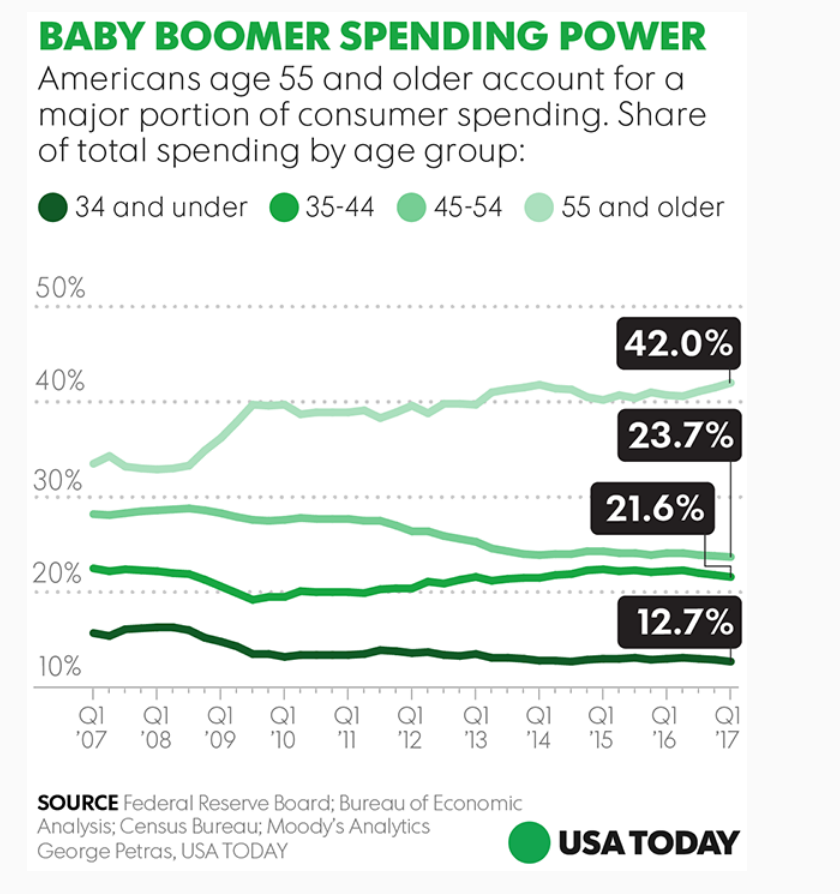
Anyone with half a brain knows that millennials are nowhere near having the most spending power. In fact, on a per capita basis they have the lowest spending power of any adult group. People over 50 control 70% of the wealth in the US, and are responsible for about half of all consumer spending.

So I decided to do a little detective work and try to figure out where this bullshit "fact" came from. In doing so, I got a nice close-up look at the astounding ignorance that is embedded in our industry and how bullshit, repeated with enough frequency, becomes a fact.

I started with the piece in The Drum. It was called "Why direct-to-consumer companies are using Influencer generated content to win over the market." It was a thinly disguised self-promotion piece full of the usual data hysteria. As noted above, the piece claimed that millennials "have the most spending power of any generation."

As justification for this claim, the article linked to this article in Forbes entitled "How To Tap Into The Millennial $200 Billion Buying Power With Social Media" which asserted that "By 2018, they will have the most spending power of any generation." 

The article offered no back-up for this claim other than a link to this thing called "41 Revealing Statistics About Millennials Every Marketer Should Know." This piece lived on an agency website, was written by someone who was two years out of college who called herself a "Marketing Strategist." The marketing strategist had this to say...
Once again, there was no back-up for this claim other than a reference to something called "Bazaar." Searching for this source lead me to a pdf from 2012 entitled "Talking To Strangers: Millennials Trust People Over Brands" by a company called Bazaarvoice that sells some kind of software for harnessing the power of "user generated content." (Remember that?)

Once again, there was no detail or proof, just this assertion...

The attribution for this claim was a footnote about a book...
1. Kit, Yarrow and O'Donnell, Jayne. Gen BuY: How Teens and Twenty-Somethings Are Revolutionizing Retail, 2009.
The book in question was published in 2009 and was one of those "millennials are a new species" things that were all the rage until it turned out that millennials were pretty much just like everyone else. I couldn't find a direct claim in the book (frankly, I didn't look very hard) that "millennials have the most spending power of any generation." The closest thing I found was this:
"Generation Y, those born between 1978 and 2000 has overtaken baby boomers in sheer numbers and is poised to do the same with its incomes by 2017..." 
Of course, this turned out to be completely wrong. Millennial income did not overtake baby boomers in 2017. According to Business Insider, in 2018 in the US baby boomers out-earned millennials in every state in the union. "In all 50 states and Washington, DC, the median millennial made less money than the median Gen Xer or baby boomer...The gap in median income between millennials and baby boomers ranged from the older generation making about 25% more than millennials in Iowa to 65% more than millennials in Alaska."

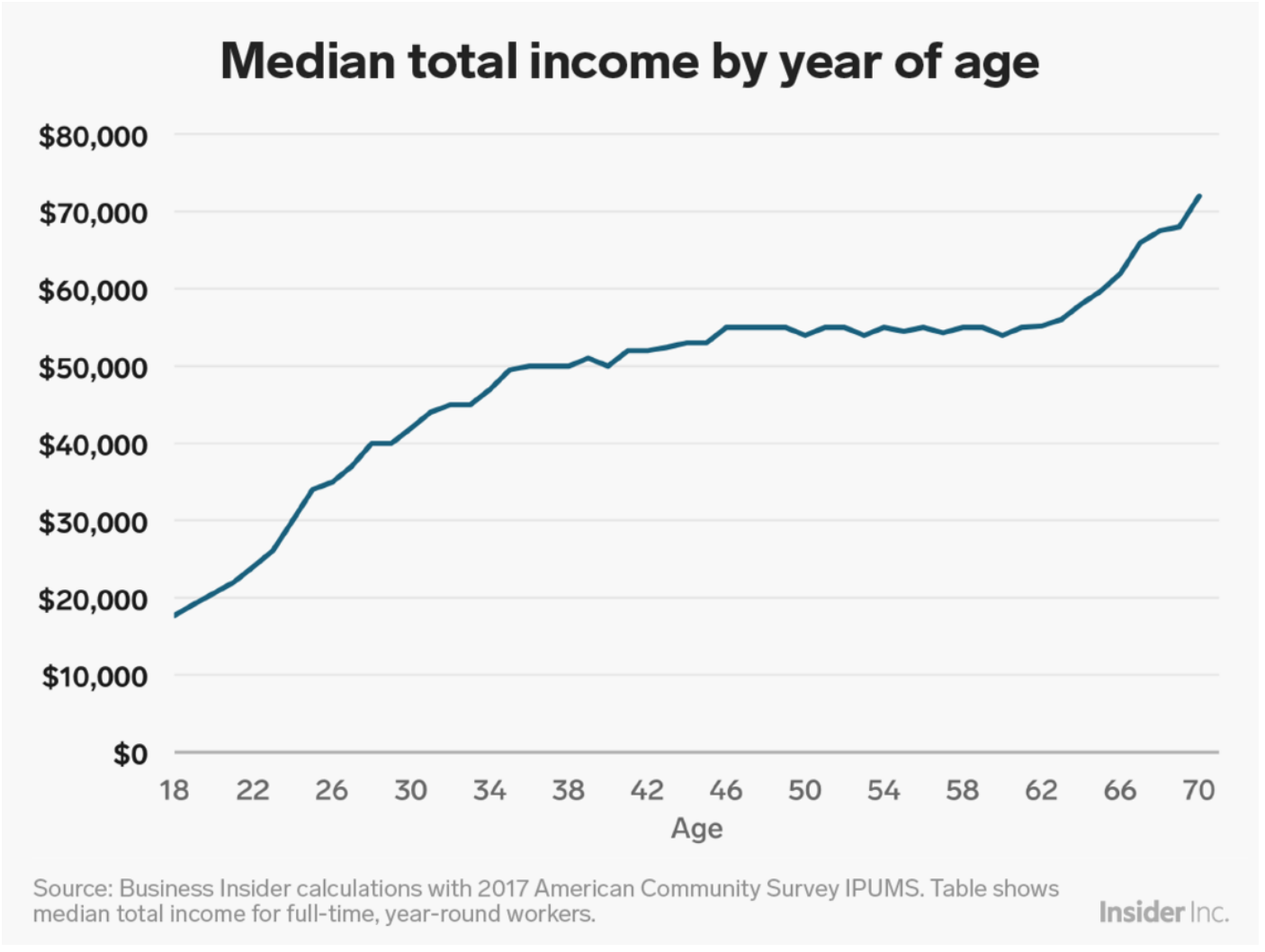
The average millennial income is about $35,000. The average baby boomer income is about $46,000. There are about 9% more millennials than baby boomers, but their income is about 24% less. So even though there are substantially more of them, in aggregate their income is way behind baby boomers.

Here's a graph that demonstrates that income per capita among baby boomers is far higher than millennials.

One more thing. Even if millennials had higher income than baby boomers, that still doesn't mean they would have "the most spending power." Spending power is not a function of income. It is a function of income plus accumulated wealth plus access to credit. According to the Federal Reserve, baby boomer wealth is more than 15 times greater than that of millennials (which means they also have way more access to credit.)

So let's recap the timeline.
- In 2009, a book incorrectly predicted that millennial income would surpass baby boomer income by 2017.

- In 2012, in a self-promotional pdf by a software company, this false prediction was misinterpreted to mean that millennials would have "more spending power than any other generation" by 2017.

- In 2017, a piece of "content" on an agency website, written by a "marketing strategist" two years out of college, used this quote from the software company to assert that millennials "will have the most spending power of any generation by 2018."

- Later that year, an article in Forbes used the assertion on that agency website to justify a claim that, "By 2018, they (millennials) will have the most spending power of any generation."

- And yesterday, in 2019, an article in The Drum leaning on the piece in Forbes, proclaimed that millennials "have the most spending power of any generation."
And that, my friend, is how in the slovenly and slipshod world of marketing, bullshit becomes a fact.
18 Feb 18:48

Educating the Influencers: The “Check, Please!” Prototype

by mikecaulfield

OK, maybe you’re just here for the video. I would be. Watch the demo of Check Please, and then continue downpage for the theory of change behind it.

Watched it? OK, here’s the backstory.

Last November we won an award from RTI International and the Rita Allen Foundation to work on a “fact-checking tutorial generator” that would generate hyper-specific tutorials that could be shared with “friends, family, and the occasional celebrity.” The idea was this — we talk a lot about media literacy, but the people spreading the most misinformation (and the people reaching the most people with that misinformation) are some of the least likely people to currently be in school. How do we reach them?

I proposed a model: we teach the students that we have, and then give them web tools to teach the influencers. As an example, we have a technique we show students called “Just add Wikipedia”: when confronted with a site of unknown provenance, go up to the omnibar, add “wikipedia” after the domain to trigger a Google search that floats relevant Wikipedia pages to the top, select the most relevant Wikipedia page, and get a bit of background on the site before sharing.

When teaching students how to do this, I record little demos using Camtasia on a wide variety of examples. Students have to see the steps and, as importantly, see how easy the steps really are, on a variety of examples. And in particular, they have to see the steps on the particular problem they just tried to solve: even though the steps are very standard, general instruction videos don’t have half the impact of specific ones. When you see the exact problem you just struggled with solved in a couple clicks, it sinks in in a way that no generic video ever will.

Unfortunately , this leaves us in a bit of a quandary relative to our “have students teach the influencers” plan. I have a $200 dollar copy of Camtasia, a decades worth of experience creating screencasts, and still, for me to demo a move — from firing up the screen recorder to uploading to YouTube or exporting a GIF — is a half-hour process. I doubt we’re going to change the world on that ROI. As someone once said, a lie can make it halfway around the world while the truth is still lacing up its Camtasia dependencies.

But what if we could give our students a website that took some basic information about decisions they made in their own fact-checking process and that website would generate the custom, shareable tutorial for them to share, as long as they were following one of our standard techniques?

I came up with this idea last year — using selenium, a invisible Chrome browser you can run on the server — to walk through the steps of a claim or reputation check while taking screen shots that formed the basis of an automatic tutorial on fact-checking a claim. And I ran it by TS Waterman and after walking through it a bit we decided that — maybe to our surprise (!!) — it seemed rather straightforward. We proposed it to the forum, won the runner-up prize in November, and on January 15 I began work on it. (TS is still involved and will help optimize the program and advise direction as we move forward, as soon as I clean up my embarrassing prototype spaghetti code).

But here’s the thing — it works! The prototype is so so far from finished, and the plan is to launch a public site in April after adding a couple more types of checks and massively refactoring code. But it works. And it may provide a new way to think about stopping the spread of misinformation, not by by generic tools for readers, but by empowering those that enforce social norms with better, more educational tools.

The result.
18 Feb 18:48

Brooklyn [Flickr]

by vanderwal

vanderwal posted a video:

Brooklyn

18 Feb 17:57

Twitter Favorites: [Sean_YYZ] This lake is right behind City Hall https://t.co/1hII9jH1PX

Sean Marshall @Sean_YYZ
This lake is right behind City Hall pic.twitter.com/1hII9jH1PX
18 Feb 17:56

Vimeo Likes: Rearchitecting GitHub Pages with Fastly and Let's Encrypt

Sam Kottler, SRE Engineering Manager at GitHub will dig into how they rearchitected Pages, so that custom domains now support HTTPS, meaning over a million GitHub Pages sites will be served over HTTPS.

Cast: Fastly

Tags: http, github, technology, let's encrypt, https, tls, security and software

18 Feb 17:56

Recommended on Medium: Block party

Meet Block Kit, an easier way to build powerful apps

There’s now a simpler, more flexible way for you to build engaging apps in Slack. Two releases make this possible: Block Kit, a UI framework made up of stackable “blocks,” and the Block Kit Builder, a prototyping tool that enables you to quickly design and code interactive Slack apps.

Defining your app’s TL;DR

Check out the sample app below. Isn’t it formatted nicely? The call to action to approve an expense report is clear and accessible at the top of the message with supporting, contextual information that follows. For the user, it is easy to parse. And fortunately, for the developer, it was simpler to build.

That’s because you now have more control over the hierarchy of an app message. Blocks enable you to define both order and appearance of information delivered by your Slack app.

Here’s a sample expense approval app using blocks. Orange represents priority content, and green represents supporting context.

Meet the new blocks

Let’s take a tour of the five new blocks you can build with today.

  • Section: Simply a container for text. A section block can be coupled with an inline action or image.
  • Context: A space to add helpful metadata or a description.
  • Image: An image container, including a caption.
  • Divider: A simple separator that makes messages more readable.
  • Actions: Interactive components for your app’s call to action; includes buttons, six drop-down menu types, and a datepicker.

Here are some examples of what’s possible with apps that launched today.

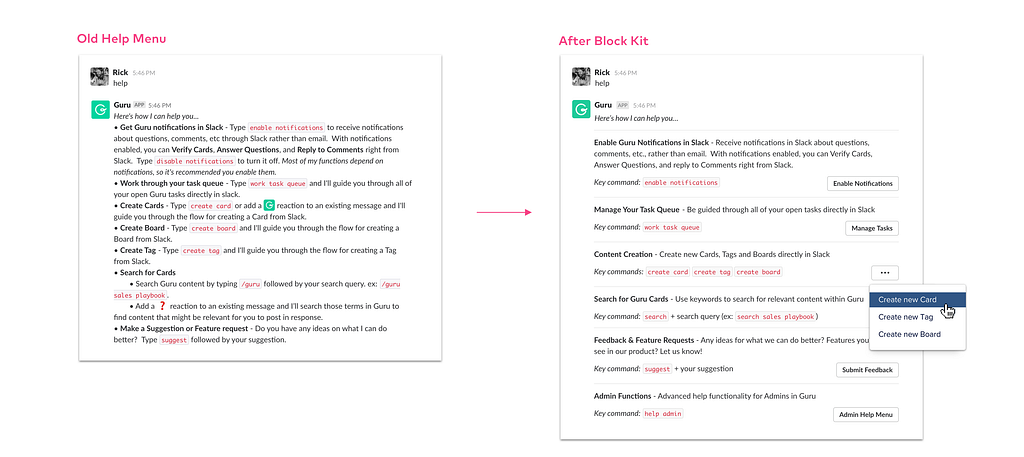
Guru, a knowledge management platform, helps people capture information as it’s shared with them in Slack. Using dividers, Guru’s “help” message now contains clearer calls to action, including an overflow menu that enables users to access advanced app functionality without cluttering their screen.

Guru’s Slack app before and after Block Kit, highlighting an inline message menu.

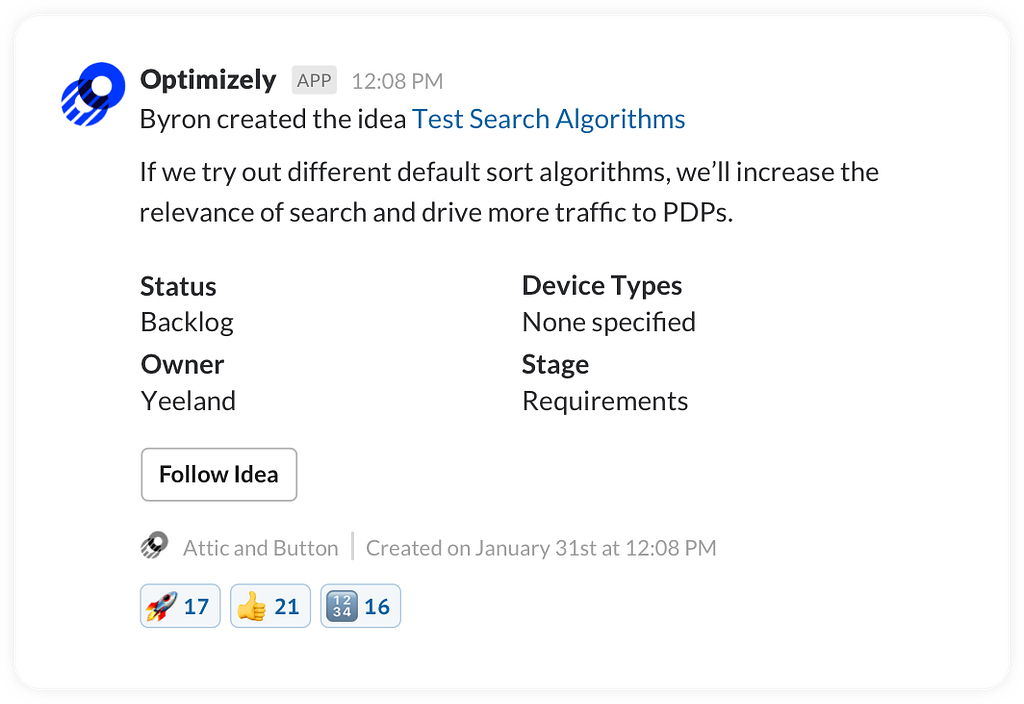
Optimizely’s Slack app enables product and marketing teams to brainstorm, test and track digital campaigns. The context block clarifies which marketing campaign a particular message is referencing — in this case, “Attic and Button.”

The context block helps Optimizely users understand which idea the Slack notification is referencing.

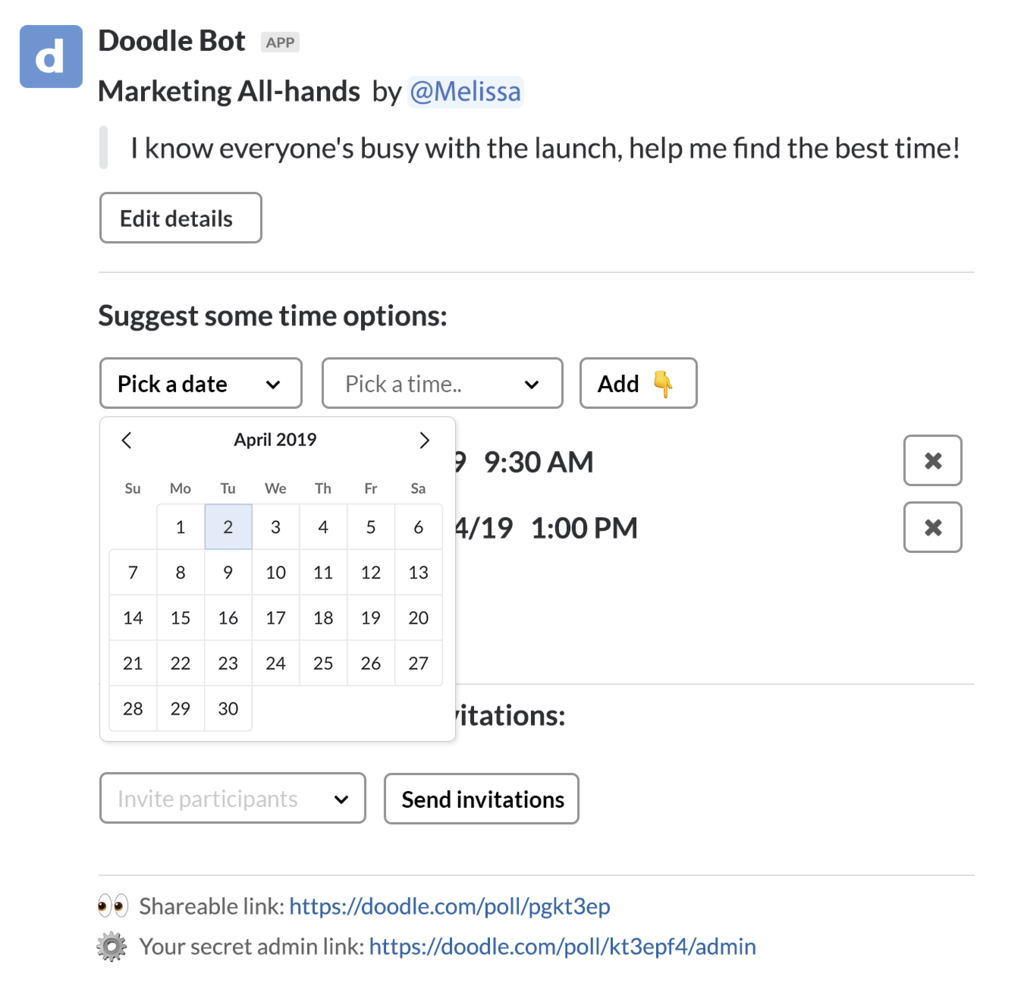
Doodle, a scheduling tool, built an app that enables people to indicate their meeting availability. Rather than jumping back and forth between calendars, the datepicker enables quick polling without leaving Slack.

A datepicker, menu, and buttons help Doodle Bot’s users design a poll to decide on meeting times, without leaving Slack.

The combined power of these blocks gives you the ability to deliver information in a clear, actionable way, enabling users to get more work done faster.

Prototype your app UX in the Block Kit Builder

The Block Kit Builder enables you to quickly prototype app interactions, selecting blocks and editing the code as you go.

The Block Kit Builder also houses customizable templates — pre-built common use cases for apps in Slack, such as approvals or notifications — so you not only have a foundational example of how to use blocks, but a head start with a majority of the code populated for you.

A preview of the notifications template in the Block Kit Builder.

For instance, imagine you’re building a sales lead tracking app that shares updates between your company’s CRM and Slack. In the Block Kit Builder, select `Notifications` from the list of available templates.

You’ll see a pre-built notification message in the builder, including the corresponding JSON. Edit, add or even delete blocks that aren’t a good fit for your app. You might want to add a message menu or button to allow users to update a lead status from Slack. When you’re satisfied with the final output, copy and paste the JSON into your own app’s code.

How to get started

Whether you’re new to building apps in Slack or upgrading an existing app, the Block Kit hub is your place to get started. We can’t wait to see the beautiful apps you’ll build next.

Questions or feedback? Email devsupport@slack.com or tweet @SlackAPI.


Block party was originally published in Slack Platform Blog on Medium, where people are continuing the conversation by highlighting and responding to this story.

18 Feb 17:49

Connected, Episode 230: Here’s the Thing about Code Names

by Federico Viticci

Stephen solves a problem that has been plaguing the podcast, Federico has concerns about Apple's rumored news service and Myke is fighting a losing battle with AirPlay 2.

On this week's episode of Connected, I reveal something from my youth and we consider the potential of future Apple services. You can listen here.

Sponsored by:

  • TextExpander, from Smile: Recall your best words. Instantly, repeatedly. Get 20% off your first year.
  • Luna Display: The only hardware solution that turns your iPad into a wireless display for your Mac. Use promo code CONNECTED at checkout for 10% off.
  • Squarespace: Make your next move. Enter offer code CONNECTED at checkout to get 10% off your first purchase.

→ Source: relay.fm

15 Feb 07:17

Apple plans to reveal its streaming video service at March 25th keynote: report

by Patrick O'Rourke

Although news broke yesterday regarding Apple’s upcoming March 25th event and the launch of the tech giant’s news subscription platform, it was unclear at the time if its video streaming service would be unveiled at the keynote as well.

Now, it looks like Apple will show off its video subscription platform for the first time at the event, according to a report from Bloomberg.

The company will reportedly invite Hollywood actors like Jennifer Aniston, Reese Witherspoon and Jennifer Garner, as well as notable director JJ Abrams, to help reveal the service at its keynote. The platform will be home to Apple’s original television shows and movies, as well as, reportedly, other subscription services like HBO and Starz that will be added in the future.

Given content licensing agreements, particularly in Canada, it’s likely that add-on services will be offered through Apple’s platform on a regional basis. For example, Bell’s Crave streaming platform holds the streaming rights to HBO and Starz content in Canada.

Bloomberg states that the video platform will launch at some point in the summer. It remains unclear if the service will release in Canada on the same date as the United States.

Similar to reported frustrations regarding Apple’s news app, where the company is rumoured to be pushing for a 50 percent revenue cut for each subscription, incumbent movie and television platforms are also unhappy with the split Apple is offering.

Bloomberg also states that the video service will be accessed through Apple’s TV and Movies app that comes preinstalled on the company’s various devices, including the iPhone, iPad, MacBook and 4th generation Apple TV. During CES 2019, Apple confirmed plans to bring its Movies and TV app to Samsung televisions. The company also announced that AirPlay 2 is coming to Vizio, Sony, LG and Samsung televisions.

This shift in Apple’s typical closed-garden approach to software is likely an effort by the company to maximize its new streaming platform’s potential viewership.

Source: Bloomberg, BuzzFeed News 

The post Apple plans to reveal its streaming video service at March 25th keynote: report appeared first on MobileSyrup.

15 Feb 07:17

Amazon Fire TV Stick 4K now 20 percent off at Canadian retailers

by Bradly Shankar

Amazon has discounted its Fire TV Stick 4K by 20 percent at various Canadian retailers.

Now, Canadians can snag the 4K-capable streaming player for $54.99, down from its regular $69.99 price.

The device features full content control via the included Alexa Voice Remote.

The Fire TV Stick 4K can be purchased at Amazon, Best Buy, Staples and The Source.

Via: RedFlagDeals


The post Amazon Fire TV Stick 4K now 20 percent off at Canadian retailers appeared first on MobileSyrup.

13 Feb 22:13

Samsung to release Galaxy S10 series on March 8 in U.S.

by Dean Daley

Samsung has opened Galaxy S10 pre-orders in the U.S. and other markets around the world, and while Samsung Canada has yet to jump in on the action, the U.S. website does reveal a March 8th shipping date.

In December, a leak from Gizmodo surfaced online that revealed March 8th as the Galaxy S10’s release date, as well as February 20th as its launch date.

With a March 8th release, there is a little more than two weeks between the launch day and the release date. While we can’t confirm that the phone will also release on March 8th in Canada, typically Samsung S series devices come out in U.S. and Canada on the same day.

MobileSyrup has reached out to Samsung Canada for Canadian specific pre-order and release date information. We’ll update this article with a response.

Samsung’s upcoming S10+ will sport an in-display fingerprint scanner, triple rear-facing camera setup and up to an astonishing 12GB of RAM, according to an official spec sheet.

The post Samsung to release Galaxy S10 series on March 8 in U.S. appeared first on MobileSyrup.

13 Feb 22:13

Expect budget, premium Pixels, new smartwatch and more from Google in 2019: report

by Igor Bonifacic

Google’s 2019 hardware lineup will include a new premium Pixel 4 smartphone, new entry-level Pixel smartphone, as well as new Google Home and Nest devices, and a new smartwatch, according to Japan’s Nikkei.

Citing “industry sources,” Nikkei reports Google will price the budget Pixel under the iPhone XR. In Canada, Apple’s ‘entry-level’ iPhone starts at $1,029 — though through a limited-time trade-in promotion, it’s possible to purchase the smartphone for $649. When not on sale, the Pixel 3 starts at $999 CAD.

In writing about a budget Pixel smartphone, it’s likely Nikkei is referring to the Pixel 3 Lite and Pixel 3 XL Lite smartphones we’ve seen leak multiple times over the last couple of months.

In a report published last December, Android Police‘s David Ruddock wrote that Google would launch the two phones via U.S. carrier Verizon in the spring of 2019.

Most recent rumours suggest the Pixel 3 Lite lineup will feature a Snapdragon 670 or 710 chipset, 4GB of RAM, a single 12-megapixel rear-facing camera, a headphone jack and a modest 32GB of internal storage.

Additionally, Nikkei says Google plans to release an “updated” Google Home. It’s unclear if the publication means an update to one of Google’s existing smart home speakers or an entirely new device. Consumers should also expect a new security camera from Nest, according to Nikkei.

Last but not least, Google will release its first smartwatch. Other than the fact that the wearable is designed to compete with the Apple Watch, Nikkei doesn’t say much about the upcoming device.

Rumours of a Pixel Watch have circulated for several years now, but with Google’s recent acquisition of Fossil’s smartwatch tech and talent, it seems like the imminent launch of a first-party Android Wear smartwatch is a sure bet.

Source: Nikkei Via: 9to5Google

The post Expect budget, premium Pixels, new smartwatch and more from Google in 2019: report appeared first on MobileSyrup.

13 Feb 22:12

Petro-Canada to build coast-to-coast electric vehicle charging network [Update]

by Brad Bennett

Suncor-owned gas company Petro-Canada announced plans to build 50 EV charging stations across Canada.

A new section ofthe company’s website shows off a map of a nationwide charger network that will run alongside the Trans-Canada highway from what looks like Vancouver to the east coast of Nova Scotia. Unfortunately, it doesn’t look like the network will extend to Newfoundland and Labrador or anywhere north.

“Keeping Canadians moving is what we do. We know the needs of our customers are evolving as we transition to a low-carbon future which is why we are excited to expand our current offering to support this growing customer segment,” said Kris Smith, the executive vice president of Downstream and Suncor.

“We’re also investing in the fastest charging EV technology available today, which will be able to upgrade as technology advances easily,” adds Smith.

Petro-Canada’s EV stations will support CHAdeMO and CCS/SAE ports that can provide up to a 200kw charge. They’ll also be upgradeable so they can support 350kw charging with future upgrades, according to the company’s press release.

Petro-Canada is testing out an EV charger at a station in Milton, Ontario that EV owners can try for free until it’s no longer in beta.

Other Petro-Canada stations have EV chargers located at them, but it’s unclear if they’re Petro-Canada branded or third-party branded chargers.

MobileSyrup has reached out to Petro-Canada and Suncor for any information related to when the project will begin, how much it might cost and if that means Petro-Canada is no longer going to use third-party chargers at its stations.

Update 13/02/2019 2pm ET: Petro-Canada has clarified the over 50 new stations will all be Petro-Canada branded chargers.

Additionally, the company plans to begin construction on the EV charger corridor in the spring of 2019. It says it will add the new locations to its station finder as they are built.

Source: Petro-Canada

The post Petro-Canada to build coast-to-coast electric vehicle charging network [Update] appeared first on MobileSyrup.

13 Feb 22:12

Vidéotron now offers unlimited internet at 400Mbps for $65

by Brad Bennett

A Vidéotron customer posted on RedFlagDeals stating that the carrier has increased the internet speeds associated with some of its plans.

The user reports that Vidéotron plans used to be as follows: 120Mbps download/20Mbps upload speed and 200Mbps download/30Mbps upload speeds for a price similar to the new offer.

The deal is only for new Vidéotron customers, but it feature a fibre connection with 500Mbps download and 50Mbps upload speeds for $64.95 dollars per pay period for the first year. After the 12-months, the price increases to $84.95 per month.

The original RedFlagDeals poster does mention that one of their friend who is already a Vidéotron subscriber was able to get the same internet package for $70, which is $5 more than new clients.

Source: RedFlagDeals, Vidéotron

The post Vidéotron now offers unlimited internet at 400Mbps for $65 appeared first on MobileSyrup.

13 Feb 22:12

Homeless in the snow: Tent community growing in Vancouver park amid cold snap

mkalus shared this story .

The Shanahan family came to Vancouver last month on a promise of work, but a long train ride and $10,000 later, they're living in a tent in the midst of an extended blast of winter weather.

The jobs the Shanahans expected to find in B.C. turned out to be a scam, so they've spent two weeks camping out in Oppenheimer Park while they try to find work and housing.

"[It's been] humbling, but very difficult too, at that. The weather, we're used to it being from Ontario, but just watching the other people, it's starting to break my heart," Andrew Shanahan said.

The Shanahans are part of a growing homeless community camping out in the Downtown Eastside park as the city is blanketed in snow and temperatures remain below freezing through the night.

According to the Carnegie Community Action Project (CCAP), the number of people camping in the park has jumped from about 30 to 50 since the snow started falling. The group has been tracking the numbers on a daily basis since the end of January.

About 50 people are now spending the night in tents at Oppenheimer Park. (CBC)

Fiona York, a CCAP co-ordinator, would like to see the municipal government government provide more support for people sleeping outside, including an on-site warming tent.

"We're concerned with what people were experiencing and what we might see coming with the colder weather," she said.

In a written statement, the city said it has outreach teams working every day to try to move people indoors. Vancouver also offers temporary shelters with about 300 beds, but those have been full every night since November.