Shared posts

24 Oct 16:07

Status as a Service (StaaS)

by Eugene Wei

Editor's Note 1: I have no editor.

Editor’s Note 2: I would like to assure new subscribers to this blog that most my posts are not as long as this one. Or as long as my previous one. My long break from posting here means that this piece is a collection of what would’ve normally been a series of shorter posts. I put section titles below, so skip any that don’t interest you. My short takes are on Twitter. All that said, I apologize for nothing.

Editor's Note 3: I lied, I apologize for one thing, and that is my long writing hiatus. Without a work computer, I had to resort to using my 7 year old 13" Macbook Pro as my main computer, and sometime last year my carpal tunnel syndrome returned with a vengeance and left my wrists debilitated with pain. I believe all of you who say your main computer is a laptop or, shudder, an iPad, but goodness gracious I cannot type on a compact keyboard for long periods of time without having my hands turn into useless stumps. It was only the return to typing almost exclusively on my old friend the Kinesis Advantage 2 ergo keyboard that put me back in the game.

Editor’s Note 4: I was recently on Patrick O'Shaughnessy's podcast Invest Like the Best, and near the end of that discussion, I mentioned a new essay I'd been working on about the similarities between social networks and ICO's. This is that piece.

Status-Seeking Monkeys

"It is a truth universally acknowledged, that a person in possession of little fortune, must be in want of more social capital."

So wrote Jane Austen, or she would have, I think, if she were chronicling our current age (instead we have Taylor Lorenz, and thank goodness for that).

Let's begin with two principles:

  • People are status-seeking monkeys*

  • People seek out the most efficient path to maximizing social capital

* Status-Seeking Monkeys will also be the name of my indie band, if I ever learn to play the guitar and start a band

I begin with these two observations of human nature because few would dispute them, yet I seldom see social networks, some of the largest and fastest-growing companies in the history of the world, analyzed on the dimension of status or social capital.

It’s in part a measurement issue. Numbers lend an air of legitimacy and credibility. We have longstanding ways to denominate and measure financial capital and its flows. Entire websites, sections of newspapers, and a ton of institutions report with precision on the prices and movements of money.

We have no such methods for measuring the values and movement of social capital, at least not with anywhere near the accuracy or precision. The body of research feels both broad and yet meager. If we had better measures besides user counts, this piece and many others would be full of charts and graphs that added a sense of intellectual heft to the analysis. There would be some annual presentation called the State of Social akin to Meeker's Internet Trends Report, or perhaps it would be a fifty page sub-section of her annual report.

Despite this, most of the social media networks we study generate much more social capital than actual financial capital, especially in their early stages; almost all such companies have internalized one of the popular truisms of Silicon Valley, that in the early days, companies should postpone revenue generation in favor of rapid network scaling. Social capital has much to say about why social networks lose heat, stall out, and sometimes disappear altogether. And, while we may not be able to quantify social capital, as highly attuned social creatures, we can feel it.

Social capital is, in many ways, a leading indicator of financial capital, and so its nature bears greater scrutiny. Not only is it good investment or business practice, but analyzing social capital dynamics can help to explain all sorts of online behavior that would otherwise seem irrational.

In the past few years, much progress has been made analyzing Software as a Service (SaaS) businesses. Not as much has been made on social networks. Analysis of social networks still strikes me as being like economic growth theory long before Paul Romer's paper on endogenous technological change. However, we can start to demystify social networks if we also think of them as SaaS businesses, but instead of software, they provide status. This post is a deep dive into what I refer to as Status as a Service (StaaS) businesses.

Think of this essay as a series of strongly held hypotheses; without access to the types of data which i’m not even sure exists, it’s difficult to be definitive. As ever, my wise readers will add or push back as they always do.

Traditional Network Effects Model of Social Networks

One of the fundamental lessons of successful social networks is that they must first appeal to people when they have few users. Typically this is done through some form of single-user utility.

This is the classic cold start problem of social. The answer to the traditional chicken-and-egg question is actually answerable: what comes first is a single chicken, and then another chicken, and then another chicken, and so on. The harder version of the question is why the first chicken came and stayed when no other chickens were around, and why the others followed.

The second fundamental lessons is that social networks must have strong network effects so that as more and more users come aboard, the network enters a positive flywheel of growth, a compounding value from positive network effects that leads to hockey stick growth that puts dollar signs in the eyes of investors and employees alike. "Come for the tool, stay for the network" wrote Chris Dixon, in perhaps the most memorable maxim for how this works.

Even before social networks, we had Metcalfe's Law on telecommunications networks:

The value of a telecommunications network is proportional to the square of the number of connected users of the system (n^2)

This ported over to social networks cleanly. It is intuitive, and it includes that tantalizing math formula that explains why growth curves for social networks bends up sharply at the ankle of the classic growth S-curve.

But dig deeper and many many questions remain. Why do some large social networks suddenly fade away, or lose out to new tiny networks? Why do some new social networks with great single-player tools fail to transform into networks, while others with seemingly frivolous purposes make the leap? Why do some networks sometimes lose value when they add more users? What determines why different networks stall out at different user base sizes? Why do some networks cross international borders easily while others stay locked within specific countries? Why, if Metcalfe's Law holds, do many of Facebook's clones of other social network features fail, while some succeed, like Instagram Stories?

What ties many of these explanations together is social capital theory, and how we analyze social networks should include a study of a social network's accumulation of social capital assets and the nature and structure of its status games. In other words, how do such companies capitalize, either consciously or not, on the fact that people are status-seeking monkeys, always trying to seek more of it in the most efficient way possible?

To paraphrase Nicki Minaj, “If I'm fake I ain't notice cause my followers ain't.”

[Editor’s note: sometimes the followers actually are fake.]

Utility vs. Social Capital Framework

Classic network effects theory still holds, I’m not discarding it. Instead, let's append some social capital theory. Together, those form the two axes on which I like to analyze social network health.

Actually, I tend to use three axes to dissect social networks.
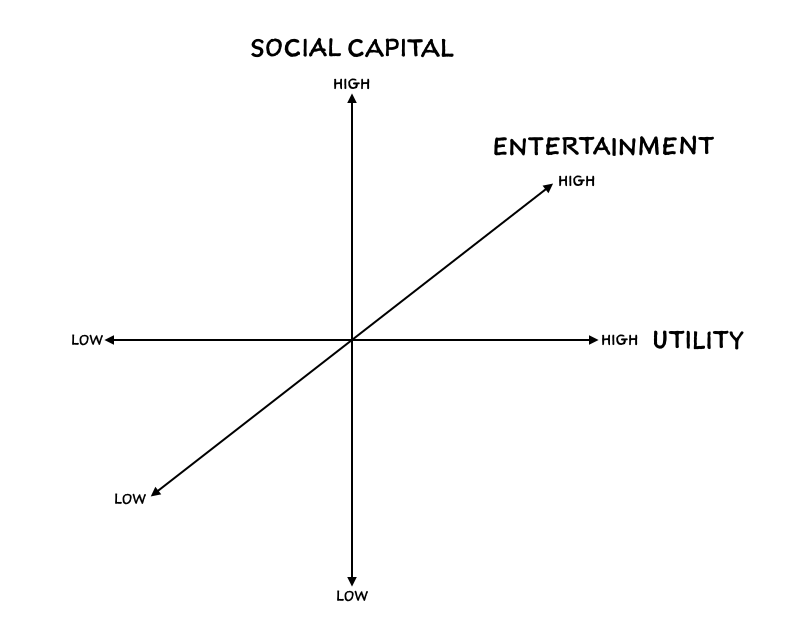
The three axes on which I evaluate social network strength

For this post, though, I'm only going to look at two of them, utility and social capital, as the entertainment axis adds a whole lot of complexity which I'll perhaps explain another time.

The basic two axis framework guiding much of the social network analysis in this piece

Utility doesn't require much explanation, though we often use the term very loosely and categorize too many things as utility when they aren't that useful (we generally confuse circuses for bread and not the reverse; Fox News, for example, is more entertainment than utility, as is common of many news outlets). A social network like Facebook allows me to reach lots of people I would otherwise have a harder time tracking down, and that is useful. A messaging app like WhatsApp allows me to communicate with people all over the world without paying texting or incremental data fees, which is useful. Quora and Reddit and Discord and most every social network offer some forms of utility.

The other axis is, for a lack of a more precise term, the social capital axis, or the status axis. Can I use the social network to accumulate social capital? What forms? How is it measured? And how do I earn that status?

There are several different paths to success for social networks, but those which compete on the social capital axis are often more mysterious than pure utilities. Competition on raw utility tends to be Darwinian, ruthless, and highly legible. This is the world, for example, of communication services like messaging and video conferencing. Investing in this space also tends to be a bit more straightforward: how useful is your app or service, can you get distribution, etc. When investors send me decks on things in this category, I am happy to offer an opinion, but I enjoy puzzling over the world of artificial prestige even more.

The creation of a successful status game is so mysterious that it often smacks of alchemy. For that reason, entrepreneurs who succeed in this space are thought of us a sort of shaman, perhaps because most investors are middle-aged white men who are already so high status they haven't the first idea why people would seek virtual status (more on that later).

With the rise of Instagram, with its focus on photos and filters, and Snapchat, with its ephemeral messaging, and Vine, with its 6-second video limit, for a while there was a thought that new social networks would be built on some new modality of communications. That's a piece of it, but it's not the complete picture, and not for the reasons many people think, which is why we have seen a whole bunch of strange failed experiments in just about every odd combinations of features and filters and artificial constraints in how we communicate with each other through our phones. Remember Facebook's Snapchat competitor Slingshot, in which you had to unlock any messages you received by responding with a message? It felt like product design by mad libs.

When modeling how successful social networks create a status game worth playing, a useful metaphor is one of the trendiest technologies: cryptocurrency.

Social Networks as ICO's

How is a new social network analogous to an ICO?

  1. Each new social network issues a new form of social capital, a token.

  2. You must show proof of work to earn the token.

  3. Over time it becomes harder and harder to mine new tokens on each social network, creating built-in scarcity.

  4. Many people, especially older folks, scoff at both social networks and cryptocurrencies.

["Why does anyone care what you ate for lunch?" is the canonical retort about any social network, though it’s fading with time. Both social networks and ICO's tend to drive skeptics crazy because they seem to manufacture value out of nothing. The shifting nature of scarcity will always leave a wake of skepticism and disbelief.]

Years ago, I stayed at the house of a friend whose high school daughter was home upstairs with a classmates. As we adults drank wine in the kitchen downstairs while waiting for dinner to finish in the oven, we heard lots of music and stomping and giggling coming from upstairs.

When we finally called them down for dinner, I asked them what all the ruckus had been. My friend's daughter proudly held up her phone to show me a recording they'd posted to an app called Musical.ly. It was a lip synch and dance routine replete with their own choreography. They'd rehearsed the piece more times than they could count. It showed. Their faces were shiny with sweat, and they were still breathing hard from the exertion. Proof of work indeed.

I spent the rest of the dinner scrolling through the app, fascinated, interviewing the girls about what they liked about the app, why they were on it, what share of their free time it had captured. I can't tell if parents are offended or glad when I spend much of the time visiting them interviewing their sons and daughters instead, but in the absence of good enough metrics with which to analyze this space, I subscribe to the Jane Goodall theory of how to study your subject. Besides, status games of adults are already well covered by the existing media, from literature to film. Children's status games, once familiar to us, begin to fade from our memory as time passes, and its modern forms have been drastically altered by social media.

Other examples abound. Perhaps you've read a long and thoughtful response by a random person on Quora or Reddit, or watched YouTube vloggers publishing night after night, or heard about popular Vine stars living in houses together, helping each other shoot and edit 6-second videos. While you can outsource Bitcoin mining to a computer, people still mine for social capital on social networks largely through their own blood, sweat, and tears.

[Aside: if you yourself are not an aspiring social network star, living with one is...not recommended.]

Perhaps, if you've spent time around today's youth, you've watched with a mixture of horror and fascination as a teen snaps dozens of selfies before publishing the most flattering one to Instagram, only to pull it down if it doesn't accumulate enough likes within the first hour. It’s another example of proof of work, or at least vigorous market research.

Almost every social network of note had an early signature proof of work hurdle. For Facebook it was posting some witty text-based status update. For Instagram, it was posting an interesting square photo. For Vine, an entertaining 6-second video. For Twitter, it was writing an amusing bit of text of 140 characters or fewer. Pinterest? Pinning a compelling photo. You can likely derive the proof of work for other networks like Quora and Reddit and Twitch and so on. Successful social networks don't pose trick questions at the start, it’s usually clear what they want from you.

[An aside about exogenous social capital: you might complain that your tweets are more interesting and grammatical than those of, say, Donald Trump (you're probably right!). Or that your photos are better composed and more interesting at a deep level of photographic craft than those of Kim Kardashian. The difference is, they bring a massive supply of exogenous pre-existing social capital from another status game, the fame game, to every table, and some forms of social capital transfer quite well across platforms. Generalized fame is one of them. More specific forms of fame or talent might not retain their value as easily: you might follow Paul Krugman on Twitter, for example, but not have any interest in his Instagram account. I don't know if he has one, but I probably wouldn't follow it if he did, sorry Paul, it’s nothing personal.]

If you've ever joined one of these social networks early enough, you know that, on a relative basis, getting ahead of others in terms of social capital (followers, likes, etc.) is easier in the early days. Some people who were featured on recommended follower lists in the early days of Twitter have follower counts in the 7-figures, just as early masters of Musical.ly and Vine were accumulated massive and compounding follower counts. The more people who follow you, the more followers you gain because of leaderboards and recommended follower algorithms and other such common discovery mechanisms.

It's true that as more people join a network, more social capital is up for grabs in the aggregate. However, in general, if you come to a social network later, unless you bring incredible exogenous social capital (Taylor Swift can join any social network on the planet and collect a massive following immediately), the competition for attention is going to be more intense than it was in the beginning. Everyone has more of an understanding of how the game works so the competition is stiffer.

Why Proof of Work Matters

Why does proof of work matter for a social network? If people want to maximize social capital, why not make that as easy as possible?

As with cryptocurrency, if it were so easy, it wouldn't be worth anything. Value is tied to scarcity, and scarcity on social networks derives from proof of work. Status isn't worth much if there's no skill and effort required to mine it. It's not that a social network that makes it easy for lots of users to perform well can't be a useful one, but competition for relative status still motivates humans. Recall our first tenet: humans are status-seeking monkeys. Status is a relative ladder. By definition, if everyone can achieve a certain type of status, it’s no status at all, it’s a participation trophy.

Musical.ly created a hurdle for gaining followers and status that wasn't easily cleared by many people. However, for some, especially teens, and especially girls, it was a status game at which they were particularly suited to win. And so they flocked there, because, according to my second tenet, people look for the most efficient ways to accumulate the most social capital.

Recall Twitter in the early days, when it was somewhat of a harmless but somewhat inert status update service. I went back to look at my first few tweets on the service from some 12 years ago and my first two, spaced about a year apart, were both about doing my taxes. Looking back at them, I bore even myself. Early Twitter consisted mostly of harmless but dull life status updates, a lot of “is this thing on?” tapping on the virtual microphone. I guess I am in the camp of not caring about what you had for lunch after all. Get off my lawn, err, phone screen!

What changed Twitter, for me, was the launch of Favstar and Favrd (both now defunct, ruthlessly murdered by Twitter), these global leaderboards that suddenly turned the service into a competition to compose the most globally popular tweets. Recall, the Twitter graph was not as dense then as it was now, nor did distribution accelerants like one-click retweeting and Moments exist yet.

What Favstar and Favrd did was surface really great tweets and rank them on a scoreboard, and that, to me, launched the performative revolution in Twitter. It added needed feedback to the feedback loop, birthing a new type of comedian, the master of the 140 character or less punchline (the internet has killed the joke, humor is all punchline now that the setup of the joke is assumed to be common knowledge thanks to Google).

The launch of these global tweet scoreboards reminds me of the moment in the now classic film** Battle Royale when Beat Takeshi Kitano informs a bunch of troublemaking school kids that they’ve been deported to an island are to fight to the death, last student standing wins, and that those who try to sneak out of designated battle zones will be killed by explosive collars. I'm not saying that Twitter is a life-or-death struggle, but you need only time travel back to pre-product-market-fit Twitter to see the vast difference in tone.

**Now classic because Battle Royale has subsequently been ripped off, err, paid tribute to by The Hunger Games, Fortnite, Maze Runner, and just about every YA franchise out there because who understands barbarous status games better than teenagers?

Favstar.fm screenshot. Just seeing some of those old but familiar avatars makes me sentimental, perhaps like how early Burning Man devotees think back on its early years, before the moneyed class came in and ruined that utopia of drugs, nudity, and art.

Chasing down old Favrd screenshots, I still laugh at the tweets surfaced.

One more Favrd screenshot just for old time’s sake

It's critical that not everyone can quip with such skill. This gave Twitter its own proof of work, and over time the overall quality of tweets improved as that feedback loop spun and tightened. The strategies that gained the most likes were fed in increasing volume into people's timelines as everyone learned from and competed with each other.

Read Twitter today and hardly any of the tweets are the mundane life updates of its awkward pre-puberty years. We are now in late-stage performative Twitter, where nearly every tweet is hungry as hell for favorites and retweets, and everyone is a trained pundit or comedian. It's hot takes and cool proverbs all the way down. The harmless status update Twitter was a less thirsty scene but also not much of a business. Still, sometimes I miss the halcyon days when not every tweet was a thirst trap. I hate the new Kanye, the bad mood Kanye, the always rude Kanye, spaz in the news Kanye, I miss the sweet Kanye, chop up the beats Kanye.

Thirst for status is potential energy. It is the lifeblood of a Status as a Service business. To succeed at carving out unique space in the market, social networks offer their own unique form of status token, earned through some distinctive proof of work.

Conversely, let's look at something like Prisma, a photo filter app which tried to pivot to become a social network. Prisma surged in popularity upon launch by making it trivial to turn one of your photos into a fine art painting with one of its many neural-network-powered filters.

It worked well. Too well.

Since almost any photo could, with one-click, be turned into a gorgeous painting, no single photo really stands out. The star is the filter, not the user, and so it didn't really make sense to follow any one person over any other person. Without that element of skill, no framework for a status game or skill-based network existed. It was a utility that failed at becoming a Status as a Service business.

In contrast, while Instagram filters, in its earliest days, improved upon the somewhat limited quality of smartphone photos at the time, the quality of those photos still depended for the most part on the photographer. The composition, the selection of subject matter, these still derived from the photographer’s craft, and no filter could elevate a poor photo into a masterpiece.

So, to answer an earlier question about how a new social network takes hold, let’s add this: a new Status as a Service business must devise some proof of work that depends on some actual skill to differentiate among users. If it does, then it creates, like an ICO, some new form of social capital currency of value to those users.

This is not the only way a social network can achieve success. As noted before, you can build a network based around utility or entertainment. However, the addition of status helps us to explain why some networks which seemingly offer little in the way of meaningful utility (is a service that forces you to make only a six second video useful?) still achieve traction.

Facebook's Original Proof of Work

You might wonder, how did Facebook differentiate itself from MySpace? It started out as mostly a bunch of text status updates, nothing necessarily that innovative.

In fact, Facebook launched with one of the most famous proof of work hurdles in the world: you had to be a student at Harvard. By requiring a harvard.edu email address, Facebook drafted off of one of the most elite cultural filters in the world. It's hard to think of many more powerful slingshots of elitism.

By rolling out, first to Ivy League schools, then to colleges in general, Facebook scaled while maintaining a narrow age dispersion and exclusivity based around educational credentials.

Layer that on top of the broader social status game of stalking attractive members of the other sex that animates much of college life and Facebook was a service that tapped into reserves of some of the most heated social capital competitions in the world.

Social Capital ROI

If a person posts something interesting to a platform, how quickly do they gain likes and comments and reactions and followers? The second tenet is that people seek out the most efficient path to maximize their social capital. To do so, they must have a sense for how different strategies vary in effectiveness. Most humans seem to excel at this.

Young people, with their much higher usage rate on social media, are the most sensitive and attuned demographic to the payback period and ROI on their social media labor. So, for example, young people tend not to like Twitter but do enjoy Instagram.

It's not that Twitter doesn't dole out the occasional viral supernova; every so often someone composes a tweet that goes over 1K and then 10K likes or retweets (Twitter should allow people to buy a framed print of said tweet with a silver or gold 1K club or 10K club designation to supplement its monetization). But it’s not common, and most tweets are barely seen by anyone at all. Pair that with the fact that young people's bias towards and skill advantage in visual mediums over textual ones and it's not surprising Instagram is their social battleground of preference (video games might be the most lucrative battleground for the young if you broaden your definition of social networks, and that's entirely reasonable, though that arena skews male).

Instagram, despite not having any official reshare option, allows near unlimited hashtag spamming, and that allows for more deterministic, self-generated distribution. Twitter also isn't as great for spreading visual memes because of its stubborn attachment to cropping photos to maintain a certain level of tweet density per phone screen.

The gradient of your network's social capital ROI can often govern your market share among different demographics. Young girls flocked to Musical.ly in its early days because they were uniquely good at the lip synch dance routine videos that were its bread and butter. In this age of neverending notifications, heavy social media users are hyper aware of differing status ROI among the apps they use.

I can still remember posting the same photos to Flickr and Instagram for a while and seeing how quickly the latter passed the former in feedback. If I were an investor or even an employee, I might have something like a representative basket of content that I'd post from various test accounts on different social media networks just to track social capital interest rates and liquidity among the various services.

Some features can increase the reach of content on any network. A reshare option like the retweet button is a massive accelerant of virality on apps where the social graph determines what makes it into the feed. In an effort to increase engagement, Twitter has, over the years, become more and more aggressive to increase the liquidity of tweets. It now displays tweets that were liked by people you follow, even if they didn't retweet them, and it has populated its search tab with Moments, which, like Instagram's Discover Tab, guesses at other content you might like and provides an endless scroll filled with it.

TikTok is an interesting new player in social media because its default feed, For You, relies on a machine learning algorithm to determine what each user sees; the feed of content from by creators you follow, in contrast, is hidden one pane over. If you are new to TikTok and have just uploaded a great video, the selection algorithm promises to distribute your post much more quickly than if you were on sharing it on a network that relies on the size of your following, which most people have to build up over a long period of time. Conversely, if you come up with one great video but the rest of your work is mediocre, you can't count on continued distribution on TikTok since your followers live mostly in a feed driven by the TikTok algorithm, not their follow graph.

The result is a feedback loop that is much more tightly wound that that of other social networks, both in the positive and negative direction. Theoretically, if the algorithm is accurate, the content in your feed should correlate most closely to quality of the work and its alignment with your personal interests rather than the drawing from the work of accounts you follow. At a time when Bytedance is spending tens (hundreds?) of millions of marketing dollars in a bid to acquire users in international markets, the rapid ROI on new creators' work is a helpful quality in ensuring they stick around.

This development is interesting for another reason: graph-based social capital allocation mechanisms can suffer from runaway winner-take-all effects. In essence, some networks reward those who gain a lot of followers early on with so much added exposure that they continue to gain more followers than other users, regardless of whether they've earned it through the quality of their posts. One hypothesis on why social networks tend to lose heat at scale is that this type of old money can't be cleared out, and new money loses the incentive to play the game.

One of the striking things about Silicon Valley as a region versus East Coast power corridors like Manhattan is its dearth of old money. There are exceptions, but most of the fortunes in the Bay Area are not just new money but freshly minted new money from this current generation of tech. You have some old VC or semiconductor industry fortunes, but most of those people are still alive.

It's in NYC that you run into multi-generational old money hanging around on the Upper East or West sides of Manhattan, or encounter old wealth being showered around town by young socialites whose source of wealth is simply a fortuitous last name. Trickle down economics works, but often just down the veins of family trees.

It's not that the existence of old money or old social capital dooms a social network to inevitable stagnation, but a social network should continue to prioritize distribution for the best content, whatever the definition of quality, regardless of the vintage of user producing it. Otherwise a form of social capital inequality sets in, and in the virtual world, where exit costs are much lower than in the real world, new users can easily leave for a new network where their work is more properly rewarded and where status mobility is higher.

It may be that Silicon Valley never comes to be dominated by old money, and I'd consider that a net positive for the region. I'd rather the most productive new work be rewarded consistently by the marketplace than a bunch of stagnant quasi-monopolies hang on to wealth as they reach bloated scales that aren't conducive to innovation. The same applies to social networks and multi-player video games. As a newbie, how quickly, if you put in the work, are you "in the game"? Proof of work should define its own meritocracy.

The same way many social networks track keystone metrics like time to X followers, they should track the ROI on posts for new users. It's likely a leading metric that governs retention or churn. It’s useful as an investor, or even as a curious onlooker to test a social networks by posting varied content from test accounts to gauge the efficiency and fairness of the distribution algorithm.

Whatever the mechanisms, social networks must devote a lot of resources to market making between content and the right audience for that content so that users feel sufficient return on their work. Distribution is king, even when, or especially when it allocates social capital.

Why copying proof of work is lousy strategy for status-driven networks

We often see a new social network copy a successful incumbent but with a minor twist thrown in. In the wake of Facebook’s recent issues, we may see some privacy-first social networks, but we have an endless supply of actual knockoffs to study. App.net and then Mastodon were two prominent Twitter clones that promised some differentiation but which built themselves on the same general open messaging framework.

Most of these near clones have and will fail. The reason that matching the basic proof of work hurdle of an Status as a Service incumbent fails is that it generally duplicates the status game that already exists. By definition, if the proof of work is the same, you're not really creating a new status ladder game, and so there isn't a real compelling reason to switch when the new network really has no one in it.

This isn't to say you can't copy an existing proof of work and succeed. After all, Facebook replaced social networks like MySpace and Friendster that came before it, and in the real world, new money sometimes becomes the new old money. You can build a better status game or create a more valuable form of status. Usually when such displacement occurs, though, it does so along the other dimension of pure utility.

For example, we have multiple messaging apps that became viable companies just by capturing a particular geographic market through localized network effects. We don't have one messaging app to rule them all in the world, but instead a bunch that have won in particular geographies. After all, the best messaging app in most countries or continents is the one most other people are already using there.

But in the same market? Copying a proof of work there is a tough road. The first mover advantage is also such that the leader with the dominant graph and the social capital of most value can look at any new features that fast followers launch and pull a reverse copy, grafting them into their more extensive and dominant incumbent graph.

In China, Tencent is desperate to cool off Bytedance's momentum in the short video space; Douyin is enemy number one. Tencent launched a clone but added a feature which allowed viewers to record a side-by-side video reaction in response to any video. It took about half a second for Bytedance to incorporate that into Douyin, and now it's a popular feature in TikTok the world over. If you can't change the proof of work competition as a challenger, copy and throttle is an effective strategy for the incumbent.

Not to mention that a wholesale ripoff of another app tends to be frowned upon as poor form. Even in China, with its reputation as the land of loose IP protection, users will tend to post dismissive reviews of blatant copycat apps in app stores. Chinese users may not be as aware of American apps that are knocked off in China, but within China, users don't just jump ship to out-and-out copycat apps. There has to be an incentive to overcome the switching costs, and that applies in China as it does elsewhere.

A few specifics of note here. I once wrote about social networks that the network's the thing; that is, the composition of the graph once a social network reaches scale is its most unique quality. I would update that today to say that it’s the unique combination of a feature and a specific graph that is any network’s most critical competitive advantage. Copying some network's feature often isn’t sufficient if you can’t also copy its graph, but if you can apply the feature to some unique graph that you earned some other way, it can be a defensible advantage.

Nothing illustrates this better than Facebook's attempts to win back the young from Snapchat by copying some of the network's ephemeral messaging features, or Facebook's attempt to copy TikTok with Lasso, or, well Facebook's attempt to duplicate just about every social app with any traction anywhere. The problem with copying Snapchat is that, well, the reason young people left Facebook for Snapchat was in large part because their parents had invaded Facebook. You don't leave a party with your classmates to go back to one your parents are throwing just because your dad brings in a keg and offer to play beer pong.

The pairing of Facebook's gigantic graph with just about almost any proof of work from another app changes the very nature of that status game, sometimes in undesirable ways. Do you really want your coworkers and business colleagues and family and friends watching you lip synch to "It's Getting Hot in Here" by Nelly on Lasso? Facebook was rumored to be contemplating a special memes tab to try to woo back the young, which, again, completely misunderstands how the young play the meme status game. At last check that plan had been shelved.

Of course, the canonical Facebook feature grab that pundits often cite as having worked is Instagram's copy of Snapchat's Stories format. As I've written before, I think the Stories format is a genuine innovation on the social modesty problem of social networks. That is, all but the most egregious showoffs feel squeamish about publishing too much to their followers. Stories, by putting the onus on the viewer to pull that content, allows everyone to publish away guilt-free, without regard for the craft that regular posts demand in the ever escalating game that is life publishing. In a world where algorithmic feeds break up your sequence of posts, Stories also allow gifted creators to create sequential narratives.

Thus Stories is inherently about lowering the publishing hurdle for users and about a new method of storytelling, and any multi-sided network seeing declining growth will try grafting it on their own network at some point just to see if it solves supply-side social modesty.

Ironically, as services add more and more filters and capabilities into their story functionality, we see the proof of work game in Stories escalating. Many of the Instagram Stories today are more elaborate and time-consuming to publish than regular posts; the variety of filters and stickers and GIFs and other tools in the Stories composer dwarfs the limited filters available for regular Instagram posts. What began as a lighter weight posting format is now a more sophisticated and complex one.

You can take the monkey out of the status-seeking game, but you can't take the status-seeking out of the monkey.

The Greatest Social Capital Creation Event in Tech History

In the annals of tech, and perhaps the world, the event that created the greatest social capital boom in history was the launch of Facebook's News Feed.

Before News Feed, if you were on, say MySpace, or even on a Facebook before News Feed launched, you had to browse around to find all the activity in your network. Only a demographic of a particular age will recall having to click from one profile to another on MySpace while stalking one’s friends. It almost seems comical in hindsight, that we'd impose such a heavy UI burden on social media users. Can you imagine if, to see all the new photos posted in your Instagram network, you had to click through each profile one by one to see if they’d posted any new photos? I feel like my parents talking about how they had to walk miles to grade school through winter snow wearing moccasins of tree bark when I complain about the undue burden of social media browsing before the News Feed, but it truly was a monumental pain in the ass.

By merging all updates from all the accounts you followed into a single continuous surface and having that serve as the default screen, Facebook News Feed simultaneously increased the efficiency of distribution of new posts and pitted all such posts against each other in what was effectively a single giant attention arena, complete with live updating scoreboards on each post. It was as if the panopticon inverted itself overnight, as if a giant spotlight turned on and suddenly all of us performing on Facebook for approval realized we were all in the same auditorium, on one large, connected infinite stage, singing karaoke to the same audience at the same time.

It's difficult to overstate what a momentous sea change it was for hundreds of millions, and eventually billions, of humans who had grown up competing for status in small tribes, to suddenly be dropped into a talent show competing against EVERY PERSON THEY HAD EVER MET.

Predictably, everything exploded. The number of posts increased. The engagement with said posts increased. This is the scene in a movie in which, having launched something, a bunch of people stand in a large open war room waiting, and suddenly a geek staring at a computer goes wide-eyed, exclaiming, "Oh my god." And then the senior ranking officer in the room (probably played by a scowling Ed Harris or Kyle Chandler) walks over to look at the screen, where some visible counter is incrementing so rapidly that the absolute number of digits starts is incrementing in real time as you look at it, because films have to make a plot development like this brain dead obvious to the audience. And then the room erupts in cheers while different people hug and clap each others on the back, and one random extra sprints across the screen in the background, shaking a bottle of champagne that explodes and ejaculates a stream of frothy bubbly through the air like some capitalist money shot that inspires, later, a 2,000 word essay from Žižek.

Of course, users complained about News Feed at first, but their behavior belied their words, something that would come to haunt Facebook later when it took it as proof that users would always just cry wolf and that similar changes in the future would be the right move regardless of public objections.

Back in those more halcyon times, though, News Feed unleashed a gold rush for social capital accumulation. Wow, that post over there has ten times the likes that my latest does! Okay, what can I learn from it to use in my next post? Which of my content is driving the most likes? We talk about the miracles of machine learning in the modern age, but as social creatures, humans are no less remarkable in their ability to decipher and internalize what plays well to the peanut gallery.

Stories of teens A/B testing Instagram posts, yanking those which don't earn enough likes in the first hour, are almost beyond satire; a show like Black Mirror often just resorts to episodes that show things that have already happened in reality. The key component of the 10,000 hour rule of expertise is the idea of deliberate practice, the type that provides immediate feedback. Social media may not be literally real-time in its feedback, but it's close enough, and the scope of reach is magnitudes of order beyond that of any social performance arena in history. We have a generation now that has been trained through hundreds of thousands, perhaps millions of social media reps on what engages people on which platforms. In our own way, we are all Buzzfeed. We are all Kardashians.

The tighter the feedback loop, the quicker the adaptation. Compare early Twitter to modern Twitter; it's like going from listening to your coworkers at a karaoke bar to watching Beyonce play Coachella. I wrote once that any Twitter account that gained enough followers would end up sounding like a fortune cookie, but I underestimated how quickly everyone would arrive at that end state.

As people start following more and more accounts on a social network, they reach a point where the number of candidate stories exceeds their capacity to see them all. Even before that point, the sheer signal-to-noise ratio may decline to the point that it affects engagement. Almost any network that hits this inflection point turns to the same solution: an algorithmic feed.

Remember, status derives value from some type of scarcity. What is the one fundamental scarcity in the age of abundance? User attention. The launch of an algorithmic feed raises the stakes of the social media game. Even if someone follows you, they might no longer see every one of your posts. As DiCaprio said in Django Unchained, “You had my curiosity, but now, under the algorithmic feed, you have to earn my attention.”

As humans, we intuitively understand that some galling percentage of our happiness with our own status is relative. What matters is less our absolute status than how are we doing compared to those around us. By taking the scope of our status competitions virtual, we scaled them up in a way that we weren't entirely prepared for. Is it any surprise that seeing other people signaling so hard about how wonderful their lives are decreases our happiness?

As evidence of how anomalous a change this has been for humanity, witness how many celebrities continue to be caught with a history of offensive social media posts that should obviously have been taken down long ago given shifting sensibilities? Kevin Hart, baseball players like Josh Hader, Trea Turner, and Sean Newcomb, and a litany of other public figures and their management teams didn't think to go back and scrub some of their earlier social media posts despite nothing but downside optionality.

Could social networks have chosen to keep likes and other such metrics about posts private, visible only to the recipient? Could we have kept this social capital arms race from escalating? Some tech CEO's now look back and, like Alan Greenspan, bemoan the irrational exuberance that led us to where we are now, but let's be honest, the incentives to lower interest rates on social capital in all these networks, given their goals and those of their investors, were just too great. If one company hadn’t flooded the market with status, others would have filled the void many times over.

A social network like Path attempted to limit your social graph size to the Dunbar number, capping your social capital accumulation potential and capping the distribution of your posts. The exchange, they hoped, was some greater transparency, more genuine self-expression. The anti-Facebook. Unfortunately, as social capital theory might predict, Path did indeed succeed in becoming the anti-Facebook: a network without enough users. Some businesses work best at scale, and if you believe that people want to accumulate social capital as efficiently as possible, putting a bound on how much they can earn is a challenging business model, as dark as that may be.

Why Social Capital Accumulation Skews Young

I'd love to see a graph of social capital assets under management by user demographic. I'd wager that we'd see that young people, especially those from their teens, when kids seem to be given their first cell phones, through early 20's, are those who dominate the game. My nephew can post a photo of his elbow on Instagram and accumulate a couple hundred likes; I could share a photo of myself in a conga line with Barack Obama and Beyonce while Jennifer Lawrence sits on my shoulders pouring Cristal over my head and still only muster a fraction of the likes my nephew does posting a photo of his elbow. It's a young person's game, and the Livejournal/Blogger/Flickr/Friendster/MySpace era in which I came of age feels like the precambrian era of social in comparison.

While we're all status-seeking monkeys, young people tend to be the tip of the spear when it comes to catapulting new Status as a Service businesses, and may always will be. A brief aside here on why this tends to hold.

One is that older people tend to have built up more stores of social capital. A job title, a spouse, maybe children, often a house or some piece of real estate, maybe a car, furniture that doesn't require you to assemble it on your own, a curriculum vitae, one or more college degrees, and so on.

[This differs by culture, of course. In the U.S., where I grew up, one’s job is the single most important status carrier which is why so many conversations there begin with “What do you do?”]

Young people are generally social capital poor unless they've lucked into a fat inheritance. They have no job title, they may not have finished college, they own few assets like homes and cars, and often if they've finished college they're saddled with substantial school debt. For them, the fastest and most efficient path to gaining social capital, while they wait to level up enough to win at more grown-up games like office politics, is to ply their trade on social media (or video games, but that’s a topic for another day).

Secondly, because of their previously accumulated social capital, adults tend to have more efficient means of accumulating even more status than playing around online. Maintenance of existing social capital stores is often a more efficient use of time than fighting to earn more on a new social network given the ease of just earning interest on your sizeable status reserves. That's just math, especially once you factor in loss aversion.

Young people look at so many of the status games of older folks—what brand of car is parked in your garage, what neighborhood can you afford to live in, how many levels below CEO are you in your org—and then look at apps like Vine and Musical.ly, and they choose the only real viable and thus optimal path before them. Remember the second tenet: people maximize their social capital the most efficient way possible. Both the young and old pursue optimal strategies.

That so much social capital for the young comes in the form of followers, likes, and comments from peers and strangers shouldn't lessen its value. Think back to your teen years and try to recall any real social capital that you could accumulate on such a scale. In your youth, the approval of peers and others in your demographic tend to matter more than just about anything, and social media has extended the reach of the youth status game in just about every direction possible.

Furthermore, old people tend to be hesitant about mastering new skills in general, including new status games, especially if they involve bewildering new technology. There are many reasons, including having to worry about raising children and other such adult responsibilities and just plain old decay in neural malleability. Perhaps old dogs don't learn new tricks because they are closer to death, and the period to earn a positive return on that investment is shorter. At some point, it's not worth learning any new tricks at all, and we all turn into the brusque old lady in every TV show, e.g. Maggie Smith in Downton Abbey, dropping withering quips about the follies of humanity all about us. I look forward to this period of my life when, through the unavoidable spectre of mortality, I will naturally settle into my DGAF phase of courageous truth-telling.

Lastly, young people have a surplus of something which most adults always complain they have too little of: time. The hurdle rate on the time of the young is low, and so they can afford to spend some of that surplus exploring new social networks, mining them to see if the social capital returns are attractive, whereas most adults can afford to wait until a network has runaway product-market fit to jump in. The young respond to all the status games of the world with a consistent refrain: "If you are looking for ransom I can tell you I don't have money, but what I do have are a very particular set of skills. Among those are the dexterity and coordination to lip synch to songs while dancing Blocboy JB's Shoot in my bedroom, and the time to do it over and over again until I nail it" (I wrote this long before recent events in which Liam Neeson lit much of his social capital on fire, vacating the “wronged and vengeful father with incredible combat and firearms skills” role to the next aging male star).

These modern forms of social capital are like new money. Not surprisingly, then, older folks, who are worse at accumulating these new badges than the young, often scoff at those kids wasting time on those apps, just as old money from the Upper West and Upper East Sides of New York look down their noses at those hoodie-wearing new money billionaire philistines of Silicon Valley.

The exception might be those who grew up in this first golden age of social media. For some of this generation’s younger NBA players, who were on Instagram from the time they got their first phone, posting may be second nature, a force of habit they bring with them into the league. Witness how many young NBA stars track their own appearances on House of Highlights the way stars of old hoped looked for themselves on Sportscenter.

If this generational divide on social media between the old and the young was simply a one-time anomaly given the recent birth of social networks, and if future generations will be virtual status-seeking experts for womb to tomb, then capturing users in their formative social media years becomes even more critical for social networks.

“I contain multitudes” (said the youngblood)

Incidentally, teens and twenty-somethings, more so than the middle-aged and elderly, tend to juggle more identities. In middle and high school, kids have to maintain an identity among classmates at school, then another identity at home with family. Twenty-somethings craft one identity among coworkers during the day, then another among their friends outside of work. Often those spheres have differing status games, and there is some penalty to merging those identities. Anyone who has ever sent a text meant for their schoolmates to their parents, or emailed a boss or coworker something meant for their happy hour crew knows the treacherous nature of context collapse.

Add to that this younger generation's preference for and facility with visual communication and it's clearly why the preferred social network of the young is Instagram and the preferred messenger Snapchat, both preferable to Facebook. Instagram because of the ease of creating multiple accounts to match one's portfolio of identities, Snapchat for its best in class ease of visual messaging privately to particular recipients. The expiration of content, whether explicitly executed on Instagram (you can easily kill off a meme account after you've outgrown it, for example), or automatically handled on a service like Snapchat, is a must-have feature for those for whom multiple identity management is a fact of life.

Facebook, with its explicit attachment to the real world graph and its enforcement of a single public identity, is just a poor structural fit for the more complex social capital requirements of the young.

Common Social Network Arcs

It's useful to look at some of the common paths that social networks traverse over time using our two axis model. Not all of them took the same paths to prominence. Doing so also helps illuminate the most productive strategies for each to pursue future growth.

First utility, then social capital

Come for the tool, stay for the network

This is the well-known “come for the tool, stay for the network” path. Instagram is a good example here given its growth from filter-driven utility to social photo sharing behemoth. Today, I can't remember the last time I used an Instagram filter.

In the end, I think most social networks, if they've made this journey, need to make a return to utility to be truly durable. Commerce is just one area where Instagram can add more utility for its users.

First social capital, then utility

Lots of the internet’s great resources were built off people seeking a hit of fame and recognition

Come for the fame, stay for the tool?

Foursquare was this for me. In the beginning, I checked in to try to win mayorships at random places. These days, Foursquare is trying to become more of a utility, with information on places around you, rather than just a quirky distributed social capital game. Heavier users may have thoughts on how successful that has been, but in just compiling a database of locations that other apps can build off of, they have built up a store of utility.

IMDb, Wikipedia, Reddit, and Quora are more prominent examples here. Users come for the status, and help to build a tool for the commons.

Utility, but no social capital
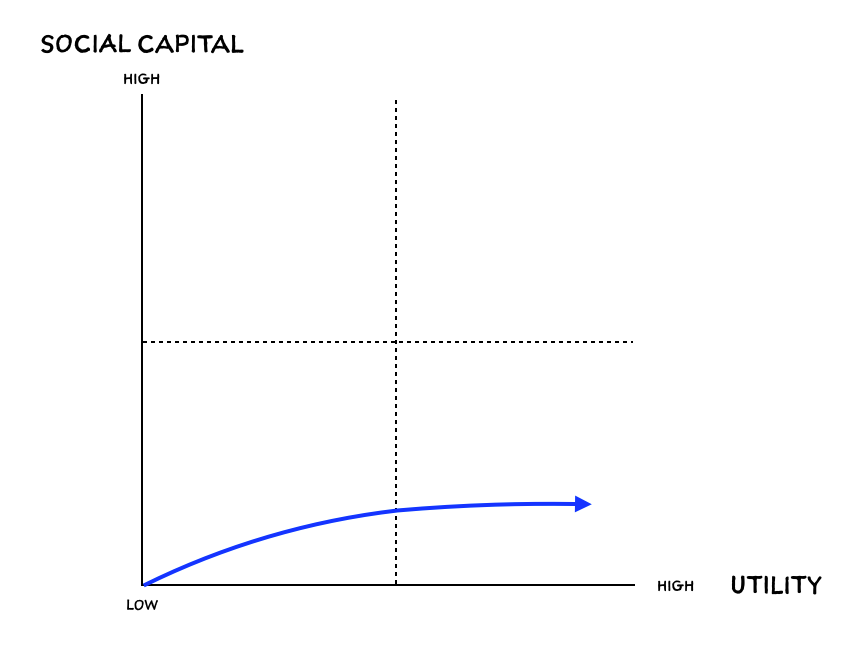
Plenty of huge social apps are almost entirely utilitarian, but it’s a brutally competitive quadrant

Some companies manage to create utility for a network but never succeed at building any real social capital of note (or don’t even bother to try).

Most messaging apps fall into this category. They help me to reach people I already know, but they don't introduce me to too many new people, and they aren't really status games with likes and follows. Skype, Zoom, FaceTime, Google Hangouts, Viber, and Marco Polo are examples of video chat apps that fit this category as well. While some messaging apps are trying to add features like Stories that start to veer into the more performative realm of traditional social media, I’m skeptical they’ll ever see traction doing so when compared to apps that are more pure Status as a Service apps like Instagram.

This bottom right quadrant is home to some businesses with over a billion users, but in minimizing social capital and competing purely on utility-derived network effects, this tends to be a brutally competitive battleground where even the slimmest moat is fought for with blood and sweat, especially in the digital world where useful features are trivial to copy.

Social capital, but little utility

When a social network loses heat before it has built utility, the fall can come as quickly as the rise

One could argue Foursquare actually lands here, but the most interesting company to debate in this quadrant is clearly Facebook. I'm not arguing that Facebook doesn't have utility, because clearly it does in some obvious ways. In some markets, it is the internet. Messenger is clearly a useful messaging utility for a over a billion people.

However, the U.S. is a critical market for Facebook, especially when it comes to monetization, and so it's worth wondering how things might differ for Facebook today if it had succeeded in pushing further out on the utility axis. Many people I know have just dropped Facebook from their lives this past year with little impact on their day-to-day lives. Among the obvious and largest utility categories, like commerce or payments, Facebook isn't a top tier player in any except advertising.

This comparison is especially stark if we compare it to the social network to which it's most often contrasted.

Both social capital and utility simultaneously

The holy grail for social networks is to generate so much social capital and utility that it ends up in that desirable upper right quadrant of the 2x2 matrix. Most social networks will offer some mix of both, but none more so than WeChat.

While I hear of people abandoning Facebook and never looking back, I can't think of anyone in China who has just gone cold turkey on WeChat. It's testament to how much of an embedded utility WeChat has become that to delete it would be a massive inconvenience for most citizens.

Just look at the list of services in the WeChat or WePay or AliPay menu for the typical Chinese user and consider that Facebook isn’t a payment option for any of them.
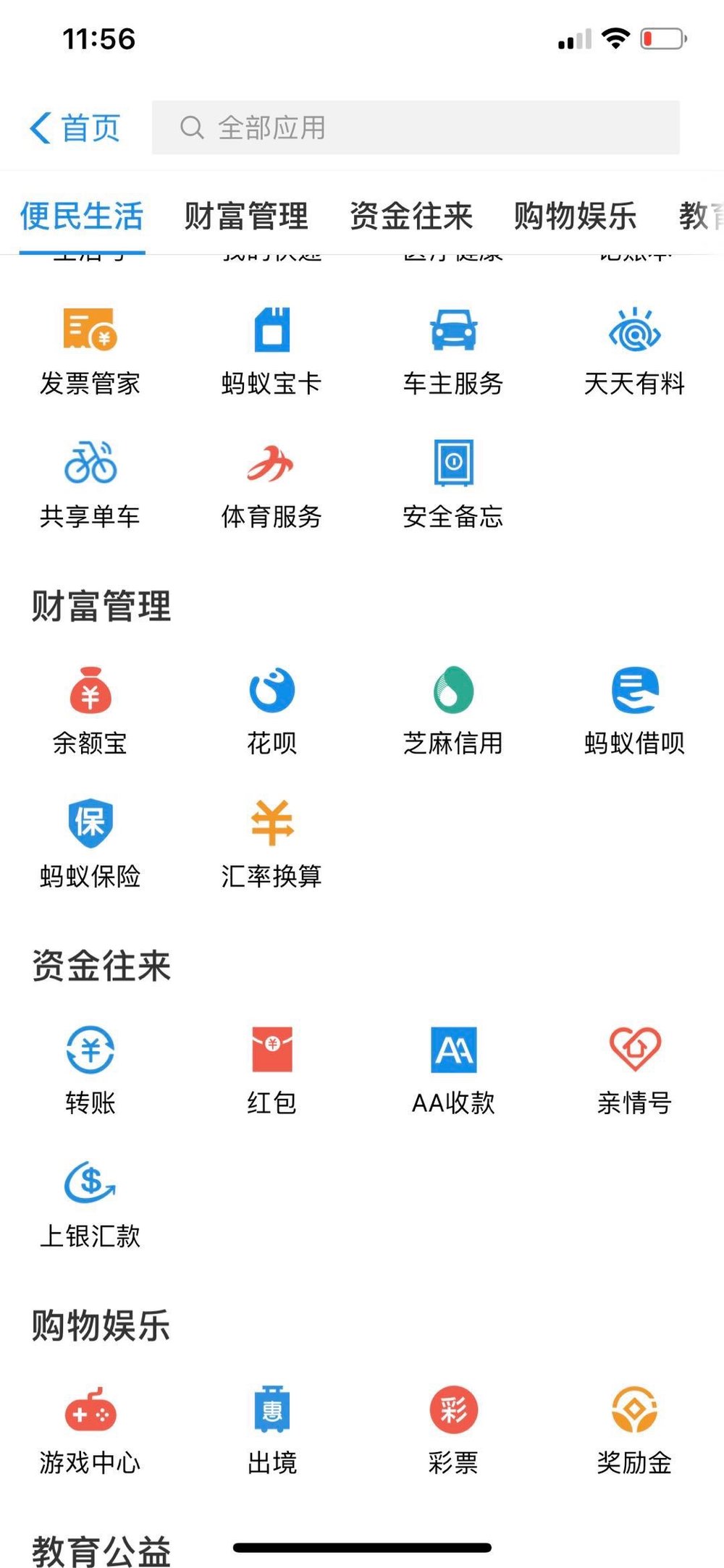
alipay1.JPG
alipay2.JPG
wepay1.JPG
wepay2.JPG

Of course, the competitive context matters. Facebook faced much stiffer competition in these categories than WeChat did; for Facebook to build a better mousetrap in any of these, the requirements were much higher than for WeChat.

Take payments for example. The Chinese largely skipped credit cards, for a whole host of reasons. In part it was due to a cultural aversion to debt, in part because Visa, Mastercard, and American Express weren’t allowed into China where they would certainly have marketed their cards as aggressively as they always do. That meant Alipay and WePay launched competing primarily with cash and all its familiar inconveniences. Compare that to, say, Apple Pay trying to displace the habit of pulling out a credit card in the U.S., especially given how so many people are addicted to credit card points and miles (airline frequent flier programs being another testament to the power of status to influence people’s decision-making).

Making a real dent in new categories like commerce and payments will require a long-term mindset and a ton of resources on the part of Facebook and its subsidiaries like WhatsApp and Instagram. Past efforts to, for example, improve Facebook search, position Facebook as payment option, and introduce virtual assistants on Messenger seem to have been abandoned. Will new efforts like Facebook's cryptocurrency effort or Instagram's push into commerce be given a sufficiently long leash?

Social Network Asymptote 1: Proof of Work

How do you tell when a Status as a Service business will stop growing? What causes networks to suddenly hit that dreaded upper shoulder in the S-curve if, according to Metcalfe's Law, the value of a network grows in proportion to the square of its users? What are the missing variables that explain why networks don’t keep growing until they’ve captured everyone?

The reasons are numerous, let’s focus on social capital theory. To return to our cryptocurrency analogy, the choice of your proof of work is by definition an asymptote because the skills it selects for are not evenly distributed.

To take a specific example, since it's the app du jour, let's look at the app formerly known as Musical.ly, TikTok.

You've probably watched a TikTok video, but have you tried to make one? My guess is that many of you have not and never will (but if you have, please send me a link). This is no judgment, I haven’t either.

You may possess, in your estimation, too much self-dignity to wallow in cringe. Your arthritic joints may not be capable of executing Orange Justice. Whatever the reason, TikTok's creator community is ultimately capped by the nature of its proof of work, no matter how ingenious its creative tools. The same is true of Twitter: the number of people who enjoy crafting witty 140 and now 280-character info nuggets is finite. Every network has some ceiling on its ultimate number of contributors, and it is often a direct function of its proof of work.

Of course, the value and total user size of a network is not just a direct function of its contributor count. Whether you believe in the 1/9/90 rule of social networks or not, it’s directionally true that any network has value to people besides its creators. In fact, for almost every network, the number of lurkers far exceeds the number of active participants. Life may not be a spectator sport, but a lot of social media is.

This isn’t to say that proof of work is bad. In fact, coming up with a constraint that unlocks the creativity of so many people is exactly how Status as a Service businesses achieve product-market fit. Constraints force the type of compression that often begets artistic elegance, and forcing creatives to grapple with a constraint can foster the type of focused exertion that totally unconstrained exploration fails to inspire.

Still, a ceiling is a ceiling. If you want to know the terminal value of a network, the type of proof of work is a key variable to consider. If you want to know why Musical.ly stopped growing and sold to Bytedance, why Douyin will hit a ceiling of users in China (if it hasn’t already), or what the cap of active users is for any social network, first ask yourself how many people have the skill and interest to compete in that arena.

Social Network Asymptote 2: Social Capital Inflation and Devaluation

More terrifying to investors and employees than an asymptote is collapse. Recall the cautionary myth of the fall of Myspace, named after the little known Greek god of vanity Myspakos (Editor’s note: I made that up, it’s actually Narcissus). Why do some social networks, given Metcalfe's Law and its related network effects theories, not only stop growing but even worse, contract and wither away?

To understand the inherent fragility in Status as a Service businesses, we need to understand the volatility of status.

Social Capital Interest Rate Hikes

One of the common traps is the winner's curse for social media. If a social network achieves enough success, it grows to a size that requires the imposition of an algorithmic feed in order to maintain high signal-to-noise for most of its users. It's akin to the Fed trying to manage inflation by raising interest rates.

The problem, of course, is that this now diminishes the distribution of any single post from any single user. One of the most controversial of such decisions was Facebook's change to dampen how much content from Pages would be distributed into the News Feed.

Many institutions, especially news outlets, had turned to Facebook to access some sweet sweet eyeball inventory in News Feeds. They devised all sorts of giveaways and promotions to entice people to follow their Facebook Pages. After gaining followers, a media company had a free license to publish and publish often into their News Feeds, an attractive proposition considering users were opening Facebook multiples times per day. For media companies, who were already struggling to grapple with all the chaos the internet had unleashed on their business models, this felt like upgrading from waving stories at passersby on the street to stapling stories to the inside of eyelids the world over, several times a day. Deterministic, guaranteed eyeballs.

Then, one day, Facebook snapped its fingers like Thanos and much of that dependable reach evaporated into ash. No longer would every one of your Page followers see every one of your posts. Facebook did what central banks do to combat inflation and raised interest rates on borrowing attention from the News Feed.

Was such a move inevitable? Not necessarily, but it was always likely. That’s because there is one scarce resource which is a natural limit on every social network and media company today, and that is user attention. That a social network shares some of that attention with its partners will always be secondary to accumulating and retaining that attention in the first place. Facebook, for example, must always guard against the tragedy of the commons when it comes to News Feed. Saving media institutions is a secondary consideration, if that.

Social Capital Deflation: Scarcity Precarity or the Groucho Marx Conundrum

Another existential risk that is somewhat unique to social networks is this: network effects are powerful, but ones which are social in nature have the unfortunate quality of being just as ferocious in reverse.

In High Growth Handbook by Elad Gil, Marc Andreessen notes:

I think network effects are great, but in a sense they’re a little overrated. The problem with network effects is they unwind just as fast. And so they’re great while they last, but when they reverse, they reverse viciously. Go ask the MySpace guys how their network effect is going. Network effects can create a very strong position, for obvious reasons. But in another sense, it’s a very weak position to be in. Because if it cracks, you just unravel. I always worry when a company thinks the answer is just network effects. How durable are they?

Why do social network effects reverse? Utility, the other axis by which I judge social networks, tends to be uncapped in value. It's rare to describe a product or service as having become too useful. That is, it's hard to over-serve on utility. The more people that accept a form of payment, the more useful it is, like Visa or Mastercard or Alipay. People don’t stop using a service because it’s too useful.

Social network effects are different. If you've lived in New York City, you've likely seen, over and over, night clubs which are so hot for months suddenly go out of business just a short while later. Many types of social capital have qualities which render them fragile. Status relies on coordinated consensus to define the scarcity that determines its value. Consensus can shift in an instant. Recall the friend in Swingers, who, at every crowded LA party, quips, "This place is dead anyway." Or recall the wise words of noted sociologist Groucho Marx: "I don't care to belong to any club that will have me as a member."

The Groucho Marx effect doesn't take effect immediately. In the beginning, a status hierarchy requires lower status people to join so that the higher status people have a sense of just how far above the masses they reside. It's silly to order bottle service at Hakkasan in Las Vegas if no one is sitting on the opposite side of the velvet ropes; a leaderboard with just a single high score is meaningless.

However, there is some tipping point of popularity beyond which a restaurant, club, or social network can lose its cool. When Malcolm Gladwell inserted the term "tipping point" into popular vernacular, he didn't specify which way things were tipping. We tend to glamorize the tipping into rapid diffusion, the toe of the S-curve, but in status games like fashion the arc of popularity traces not an S-curve but a bell curve. At the top of that bell curve, you reach the less glamorous tipping point, the one before the plummet.

When the definition of status is distributed, often one minority has disproportionate sway. If that group, the cool kids, pulls the ripcord, everyone tends to follow them to the exits. In fact, it’s usually the most high status or desirable people who leave first, the evaporative cooling effect of social networks. At that point, that product or service better have moved as far out as possible on the utility axis or the velocity of churn can cause a nose bleed.

[Mimetic desire is a cruel mistress. Girard would've had a field day with the Fyre Festival. Congratulations Billy McFarland, you are the ritual sacrifice with which we cleanse ourselves of the sin of coveting thy influencer’s bounty.]

Fashion is one of the most interesting industries for having understood this recurring boom and bust pattern in network effects and taken ownership of its own status devaluation cycles. Some strange cabal of magazine editors and fashion designers decide each season to declare arbitrarily new styles the fashion of the moment, retiring previous recommendations before they grow stale. There is usually no real utility change at all; functionally, the shirt you buy this season doesn’t do anything the shirt you bought last season still can’t do equally well. The industry as a whole is simply pulling the frontier of scarcity forward like a wave we're all trying to surf.

This season, the color of the moment might be saffron. Why? Because someone cooler than me said so. Tech tends to prioritize growth at all costs given the non-rival, zero marginal cost qualities of digital information. In a world of abundance, that makes sense. However, technology still has much to learn from industries like fashion about how to proactively manage scarcity, which is important when goods are rivalrous. Since many types of status are relative, it is, by definition, rivalrous. There is some equivalent of crop rotation theory which applies to social networks, but it's not part of the standard tech playbook yet.

A variant of this type of statu...

08 Mar 01:55

It ceased to hurt me, though so slow

by Caterina Fake
I was quite moved by this post from a friend of mine on Twitter, because the same thing  has happened to me several times in my life, and its uneventfulness is striking:
Screen Shot 2019-02-25 at 4.16.01 PM
There is, of course, a wonderful poem on this subject, which I happened upon this weekend in the Complete Poems of Emily Dickinson again:

It ceased to hurt me, though so slow
I could not feel the Anguish go—
But only knew by looking back—
That something—had benumbed the Track—

Nor when it altered, I could say,
For I had worn it, every day,
As constant as the Childish frock—
I hung upon the Peg, at night.

But not the Grief—that nestled close
As needles—ladies softly press
To Cushions Cheeks—
To keep their place—

Nor what consoled it, I could trace—
Except, whereas ’twas Wilderness—
It’s better—almost Peace—


08 Mar 01:55

It’s about Trust, Stupid! Why Blockchain-based BlockCerts are the wrong solution to a false problem (2/3)

by Serge Ravet
Are blockchains to credentials what the embalming fluids are to thanatopraxie, a means to keep the appearance of life to the dead?

In the previous post, we examined some of the blockchains shortcomings: over-hype being second to their defective and noxious relationship to trust—and the human race in general. In this post we are looking at one particular application of the blockchain technology in the field of education: Blockcerts1. While an interesting piece of engineering (with still a number of serious issues to be solved) my contention is that it is the wrong solution to a false problem, or to be more specific, it is the exploitation of an immature technology in a attempt to solve a problem with a vision anchored in the past: the [antediluvian] credentialing system, when a credential was for life.

Thanks to the blockchain priests, credentials are not just for life anymore, but eternal life! We will die, for sure, but if we believe in the Blockspell our credentials will survive us, eternally!

Blockchains in education: a “solution” in search of a problem…

The proverbial “tail wagging the dog” is fully appropriate to describe the current level of reflection in blockchains in education, where the main concern is about credentials and their verification — well, a certificate is the tail, not the dog! And as some people understand that talking about the tail might not be enough, attempts at looking for a problem other than credentials to be solved has lead to the production of the most bizarre ideas. Here is one of them:

“From the perspective of teachers, the instruction is sophisticated and artistic so that it is difficult to evaluate. The traditional method based on students’ feedback tends to be one-sidedness, lacking subjectivity and is hardly helpful for teachers’ improvement. A new assessment system can be constructed based on blockchain network and smart contract. First, teachers need to submit pre-planned instructional activities as a smart contract to the schools. During the teaching process, all teaching activities will be recorded in the blockchain network. The smart contract will verify the consistency of the teaching design and practice, which is going to be an important instruction evaluation indicator. What’s more, a smart contract between teachers and schools, as well as the one between teachers and students can be verified and supplemented with each other. Teachers who meet the standards will get digital currency as a reward. It serves as both an appreciation and encouragement for teachers’ teaching skills.

Exploring blockchain technology and its potential applications for education (my highlights).

The authors want to use blockchains to reinvent the teaching machine that B. F. Skinner imagined for humans out of his extensive study of pigeons. But with an interesting twist this time: the positive reinforcement is not for the students, but the teachers; and it is financial! Obviously the authors of this beyond bizarre “idea” have not the slightest understanding of what learning and teaching are about, nor human resource management for that matter. I just hope for them that Springer will not put their article on a blockchain, so that they will have the opportunity in the future to deny ever having written this nonsensical article…

Blockchain based credentials: what for?

So, once blockheadish ideas discarded, what is the problem credentials have that blockchains could solve? Certainly not double spending as you can produce many authentic copies of a credential without diminishing its value. A credential is not fungible, i.e. its ownership can’t be transferred to someone else or transformed into something different, like exchanging a credential for a bowl of lentil stew.

If it’s not to avoid double spending, what else?

David McArthur wrote a well informed article Will Blockchains Revolutionize Education? where he clearly states the limits of public blockchains to advocate “letting communities inexpensively establish their own distributed ledgers with varied membership and consensus policies.”

He also writes: “[ledgers] offer several advantages over the traditional distributed database management systems (DDBMSs).” If the main argument in favour of Blockchains is that they provide “advantages over the traditional distributed database management systems”, then why would we need a distributed database management system in the first place? The need for a database, is something anyone can understand, but why does it need to be distributed? What kind of information is worth being distributed? To do what? Is it to solve an actual problem or to be aligned with blockchain requirements (the tail wagging the dog syndrome)? For example, it makes sense to have multiple copies of DNS data over the world as a single DNS would create not just a single failing point but slow down the transactions to such a level that it would make the Internet useless.

The way blockchains have been used so far in relation to credentials is not to store the credential itself, but an encoded representation, called a hash which is a short string computed from the actual data: different contents lead to different hashes and it is not possible to recreate the original content from its hash value. If the digital credential has been tampered with, the hash will not be the same as the one recorded on the blockchain and should therefore be rejected as a fake.

What is the need for and the advantage of having the hash of a credential (not the credential itself) stored in a distributed database? Does it improve resilience and performances, like in the DNS case?

If we think in terms of database replication, then issuing a credential could be interpreted as creating a shared record between the issuer and the recipient, a ledger distributed between two entities. Then when the credential is endorsed, the ledger could be shared between the issuer, the recipient and the endorsers. And the way to revoke a credential or an endorsement, could be to remove the record from the ledger—although not conform to the canons of the Blockspell. We would then have an ecosystem of interconnected micro-ledgers, something discussed in previous posts (The Advent of the Personal Ledger — #ePortfolios and #OpenBadges Unite!, From #blockchain to #BadgeChain (2) – the chained badge where I wrote “To paraphrase George Bernard Shaw, one could say: Open Badges and blockchains are two technologies separated by a common idea [trust].”

If we think in terms of verification, checking that a credential is valid can be done without having to use a ledger containing its hash. In the (simplified) diagram below, a credential is encrypted using the private key of the issuer to create the signature of the document, i.e. a computed value that is unique and can be deciphered using the matching public key. To verify that the credential is authentic, the signature is deciphered using the public key of the issuer. If the deciphered signature is identical to the content of the original credential, then we can be certain that it is the entity owning the matching private key that has issued the credential.

Simplified diagram about claim issuing and verification (Pr & Pu are public and private keys)

Once the verification has been performed, all we can say is that the credential is valid, i.e. it has not been modified since it was issued. The next step is to authenticate the signature, i.e. verify who the owner of the public key is (and consequently, of the private key used to sign the credential). Where could we find a link between a real entity, e.g. the Open Recognition Alliance and the public key associated to its signature?

—–BEGIN PUBLIC KEY—–
MIGfMA0GCSqGSIb3DQEBAQUAA4GNADCBiQKBgQCqGKukO1De7zhZj6+H0qtjTkVxwTCpvKe4eCZ0
FPqri0cb2JZfXJ/[…]dbNf0Tp0GbMJDyR4e9T04ZZwIDAQAB
—–END PUBLIC KEY—–

We could establish that, by convention, public keys are systematically published at a defined address like https://publickey.institution.xyz, therefore https://publickey.openrecognition.org for the Open Recognition Alliance.

An alternative solution would be to use, at no additional cost, a very effective and inexpensive technology, the one that makes the Internet a World Wide Web: Domain Name Servers (DNS): institutions could publish their public keys in the DNS zone records they control and 24h after publication, at the latest, all the DNS across the world would have their records updated with the public keys associated to their domain names. What would be the advantage of blockchains over DNS? Speed, probably, but as public keys don’t change every day, that would be an extremely high price to pay for not much of a gain.

Then, once the credential has been verified and authenticated, we need to check that it is still current: someone might have got a credential 5 years ago and not practised since. Blockchain-based credentials won’t help with that either.

In summary, the state of a credential can be described as:

  • Valid: a credential is declared valid when the content of the credential is consistent with its signature. There is no need for a distributed database management system to do that. A digital token contains the credential and the signature used to verify the validity of the credential.
  • Authentic: a credential is authentic when it is valid and the signatories are who they claim they are. A distributed database management system “might” be useful to share public keys, and the DNS infrastructure would be perfect for that—all institutions have their own domain names, and if individuals had their own domain, a domain of one’s own, everyone would have a place to publish their public keys.
  • Current: a credential is current if the original issuer of the credential would reissue the same credential at the time it is being verified. A distributed database of old credentials would be of no help.

If there is no real need for a distributed database management system to validate credentials then, to use David McArthur’s words, there is even less of a need for something providing “advantages over the traditional distributed database management systems.” Why improve something you don’t need in the first place?

Moreover, the insistence placed on the validity of credentials to justify the use of Blockchains, distracts us from addressing the issues of authenticity and currency, something that has totally escaped the designers of Blockcerts: “Wouldn’t it be nice to have your alma mater reach out to you because they want to officially issue your achievements from a decade ago (or three decades ago!) in a form that can be immediately used in the world?” a Blockerts advocate writes (link).

Louis Armand, a French industry leader and visionary once expressed a diametrically opposite view:

“if after the age of 30 you still feel the urge to mention your diplomas, it probably means that you have not achieved much in life” .

quoted from memory from Louis Armand, le Savoyard du siècle. Un humaniste en action

We will explore later the benefits of starting from the currency of a claim to address both authenticity and validity, i.e. how to infer that a claim is valid from its currency without being distracted by verifying whether a 30 years old credential is still valid.

Blockcerts, the Botox of credentialing innovation?

Blockcerts are presented as:

“an open standard for creating, issuing, viewing, and verifying blockchain-based certificates. These digital records are registered on a blockchain, cryptographically signed, tamper-proof, and shareable. The goal is to enable a wave of innovation that gives individuals the capacity to possess and share their own official records. We invite feedback, contributions, and general discussion.”

link

If the goal is to “enable a wave of innovation” what kind of innovation could emerge from making credentials “cryptographically signed, tamper-proof, and shareable”? The only innovation here is in using a new technology to improve paper-based credentials. We had a piece of paper, a static piece of information that is now a digital record, just as well a static piece of information, but easier to share and more difficult to tamper with.

There are of course some advantages in digital records and cryptographic signatures but taking something old and trying to make it look young is not exactly a transformative innovation. That’s what in another domain Botox is supposed to do, with disputable achievements…

What are the possible advantages of Blockcerts in relation to validity, authenticity and currency:

  • Validity: Blockcerts are at best redundant with existing technology, and a high price to pay for not much gain2, if any.
  • Authenticity: Blockcerts do not solve the problem of authenticity.
  • Currency: Blockcerts do not solve the problem of currency.

Using blockchains for credentials, is at best limited to the assimilation of a new technology to support old processes, trying to make them more effective. It is far from accommodation (to use Jean Piaget’s vocabulary), i.e. transforming representations on the basis of what is new and consequently the associated actions, processes and tools.

Blockchains, the instrument for a counter-revolution in education?

When combining the old (ledgers) with the old (diplomas) one should not expect a revolution but rather fear a counter-revolution. And it is what might be happening right now: a crypto-counter-revolution.

By focusing on credentials and the insistence on making them more secure and verifiable, something that works already quite well with Open Badges (although that could be improved) and Verifiable Claims (they work perfectly well), an emerging standard designed by the W3C, as written earlier, the focus is on the tail, not the dog that would need to be fed and loved—to trigger a wagging tail!

Let’s start with two questions:

  • Would you trust a doctor who has not practiced during the last 4 to 8 years?
  • Would you reject the application of a software programmer if she is not able to show a diploma?

Would a blockchain-based certificate help with those questions? In the case of the doctor who hasn’t practiced for 8 years, checking the validity of a diploma delivered 20 years ago won’t tell anything in relation to the lack of practice — she might have attended seminars and conferences counting for the mandatory professional development required to keep a licence to practice. But is that enough to trust her?

Conversely, the lack of a blockchain-based certificate from the candidate to the job of software programmer shouldn’t lead to rejection. Looking at recent realisations done for clients, the endorsements received by peers, looking at her presence of Stackoverflow and Github are more valuable indicators —a good reason for Stakeoverflow to grow its own recruitment business!

The validity of a credential is very short lived if the holder is not actively involved in applying what was learned to get it in the first place. Was it 30 years or 30 days ago? Who cares? By asking the question, we have moved the centre of our reflection from verification of a credential to the trust in the individual. And it is where the main flaw in the reasoning of the blockchain-based credentials is: our primary need is to trust a person, not a credential whether it is 30 years or 30 days old. A credential is rarely more than an indicator that needs to be interpreted within an ecosystem of other indicators to make sense. On its own, its value can be close to zero.

So why bother making sure that something, when isolated on its own, could have a value close to zero, is as secure as the anonymous transaction of a human trafficker using Bitcoins? Shouldn’t the effort be placed on increasing its value by taking into account historical and contextual data? A social validation rather than a mathematical validation performed by an automaton?

There are statistics related to doctored CVs and bogus diplomas presented by candidates applying to a job. While it is certainly an issue that could be addressed by technologies like Open Badges and Verifiable Claims, the problem is not just with false claims, but with the recruitment process itself which tends to address individuals as atomic entities rather than nodes within a lively community of peers, customers, colleagues, educators, etc. Superseding ego-recognition with eco-recognition is a direction that will be explored in the next post.

Blockcerts: cui bono?

Who is pushing for blockchain-based Blockcerts? Who has anything to gain? Qui bono? As blockcerts are presented as “the open standard for issuing and verifying student-controlled official records” (link) one might think that it is the student who is the main concern. It is true that getting a certified copy of a diploma yields costs (Yale $30, Harvard $150, Université Paris Descartes €20). But digital certificates are no more “student controlled” than their paper counterpart. They are a more convenient means to share information (email vs. snail mail), and could be used to inform various applications and services, e.g. alumni services, but the locus of control remains the institution—and it should be so, as it has the power to revoke credentials.

But to create innovative services based on digital credentials, all we need is… verifiable digital credentials, something that is possible without any Blockchain (e.g. Open Badges and Verifiable Claims). What kind of services? Precisely those contributing to the emergence of an ecosystem relative to authenticity and currency. It is from the information available in the ecosystem that we could infer the currency of a credential and ultimately its validity. Verifiable credentials could shift the locus of the recognition power from institutions to communities, move a narrative made of a series of discrete snapshots collected in tattered (digital) photo albums to something more akin to 3D movies and virtual reality (metaphorically speaking).

And if the objective of Blockcerts was really “student-control”, how much “control” would students have when a university decides to use a Bitcoin-based blockchain to “secure” (LOL) its credentials? Will the student with high ethical values refusing any association with a global warming technology used by weapon smugglers and enemies of democracy be heard? Using crypto-currency-based blockchains adds insult to injury making students the unwitting accomplices to the hiding in plain sight of criminal activities. Pretending that it is to the benefit of the students is closer to gaslighting than enlightenment.

Moving to blockchains not tainted by criminal activities would be the minimum, minimorum one would expect from educational institutions. But there would still be much thinking to be done on the nature, value and [programmed] obsolescence of traditional credentials whether or not digital. Notwithstanding that blockchains, like any other technology are hackable… Only crooks and blockheads continue pretending otherwise.

A few years ago a professor at a German university was allowed to use Badges as a means to discriminate between successful students: only those who passed a degree with high marks were entitled to receive a badge, not those who got the very same diploma, but with lower marks. Despite being challenged, nobody seemed to mind. Open Badges used to introduce discrimination and now criminals’ cryptocurrency of choice used for “securing” credentials. Where will that stop? Are they isolated incidents or indicators of a more sinister trend, that we are moving into era where trust and ethical values are not just becoming superfluous, but obstacles to “progress”?

The main problem we have to solve is not about trusting credentials, It’s about trusting people. And a technology based on distrust is probably not the best way to address that issue. Said otherwise, the main problem is not about the lack of secured records, it’s about trust, stupid!

08 Mar 01:54

The Value Chain Constraint

by Ben Thompson

On June 16, 2017, minutes after Amazon announced it was buying Whole Foods Market Inc. for $13.7 billion, grocery store stocks fell through the floor; from MarketWatch (emphasis mine):

Shares of grocery stores took an unexpected hit Friday as investors reeled from the news that Amazon.com Inc. was moving into their space by acquiring Whole Foods Market Inc. After Amazon announced that it was buying Whole Foods in a $13.7 all-cash deal, shares of grocery store chain Kroger Co. slid to close down 9.2%, shares of Costco Wholesale Corp closed down 7.2%, Target Corp.’s stock closed down 5.2% and shares of Wal-Mart Stores Inc. closed down 4.6%…

The stock prices of grocers when Amazon bought Whole Foods

Mark Hamrick, a senior economic analyst at Bankrate.com, said Amazon’s technological innovation in traditional retail is a “earthquake” for the sector, which it may have hinted at with its recent launches of brick-and-mortar Amazon bookstores. “We can only imagine the technological innovation that Amazon will bring to the purchasing experience for the consumer,” Hamrick said.

This is why I found Walmart’s recent earnings so interesting: the company cited groceries as the biggest drivers of its ecommerce business, both last year and going forward — the company plans to expand grocery pickup to an additional 1,000 stores — because, as Walmart CEO Doug McMillon put it on the company’s earnings call:

We strive to make every day easier for busy families as we increase convenience and save them money and time. Part of our strategy is to build on our existing strengths, such as having a broad assortment including fresh and perishable foods within 10 miles of 90% of the U.S. population.

Amazon, meanwhile, appears to be struggling; from Bloomberg:

The number of Amazon Prime members who shop for groceries at least once a month declined in 2018 compared with 2017, according to the results of an annual consumer survey released Wednesday by UBS analysts. The drop was surprising given the company’s Whole Foods investment and expansion of two hour delivery service Prime Now, the analysts wrote in a note to investors.

A separate study by research firm Brick Meets Click found that households using grocery delivery and pickup services from physical retailers spend about $200 per month and place orders more frequently than Amazon grocery shoppers, who spend $74 a month.

So where is the promised technological innovation?

The Conservation of Groceries

I have written several times about the Conservation of Attractive Profits, most notably with regards to Netflix, Facebook and BuzzFeed, and Zillow. To put it in generic terms, profit in a value chain flows to whatever company is able to successfully integrate different component pieces of that value chain; the other parts of the value chain then modularize and are driven into commodity competition.

For example, this is what Walmart’s traditional value chain looked like:

Walmart's value chain

Walmart was able to integrate wholesale purchasing with an expansive network of stores; this provided a moat of sustainably lower prices for customer driven by purchasing power over suppliers.

Amazon, though, thanks to technological innovation — specifically, the Internet — was able to build a different integration in the value chain:

Amazon's value chain

Amazon integrated wholesale purchasing and fulfillment centers with Amazon.com, relying on modularized delivery services for distribution; this provided a moat of superior selection and, at least at the beginning, lower prices, and with Prime, superior convenience, at least for non-perishable goods.

Walmart has worked for years to respond to Amazon’s threat; the problem, though, as I explained in 2016’s Walmart and the Multichannel Trap, is that an integration built around stores was fundamentally unsuited to offering the sort of selection and convenience that Amazon does. The company needed to build up an entirely new set of capabilities and integrations, even as Amazon was leveraging theirs to integrate forward into logistics, adding on a 3rd-party marketplace to expand selection even more, and integrating backwards into their own brands. The result is that Amazon has around 50% share in e-commerce while Walmart has less than 5%.

That, though, is precisely why groceries is worth examining: as I explained when Amazon bought Whole Foods, perishable goods are not well-suited to Amazon’s value chain. Superior selection has diminishing returns, quality varies on an item-by-item basis within a single SKU, and, most importantly, the quality of items degrades with time and transport. In other words, they are a great fit for stores, not distribution centers.

In this view, Amazon’s purchase of Whole Foods was an attempt to acquire a first best customer for its grocery delivery operation, one that would efficiently store and sell perishable goods that weren’t suitable for Amazon’s traditional e-commerce model. And, to be clear, this strategy may yet succeed, but only to the extent Amazon builds a completely new set of capabilities and integrations that will probably end up looking a lot like Walmart, which has a massive head start it is clearly taking advantage of.

In other words, what matters is not “technological innovation”; what matters is value chains and the point of integration on which a company’s sustainable differentiation is built; stray too far and even the most fearsome companies become also-rans.

Google Cloud Struggles

Consider Google, a company that, more than any other, has been predicated on “technological innovation”. This was possible because the company’s core product — Internet search — entered a value chain with no integrations whatsoever. On the supply side there were countless websites and even more individual web pages, increasing exponentially, and on the demand side were a similarly increasing number of Internet users looking for specific content.

Crucially, all of the supply was easily accessible — just link to it — and all of the demand was capturable — they only needed to type in google.com. This meant that the best search engine — and by best, I mean the purest form of the word, i.e. best performing — could win, and so it did. Google was leaps and bounds better than the competition, thanks to its focus on understanding links — the fabric of the web — instead of simply pages, and consumers flocked to it.

This set off the positive cycle I have described in Aggregation Theory: owning demand gave Google increasing power over supply, which came onto Google’s platform on the search engine’s terms, first by optimizing their web pages and later by delivery content directly to Google’s answer boxes, AMP program, etc., all of which increased demand, resulting in a virtuous cycle.

At the same time Google was building out two critical pieces of the value chain in integration with Search: the first was infrastructure — supporting that much demand required huge investments in servers, fiber optic cables, etc. — and the second was advertising. Ultimately the company’s model looked like this:

Google's value chain

Note how Google is so dramatically optimized on all three sides of this integration: users, suppliers, and advertisers interact with Google through their own volition, thanks to the infrastructure Google has built to facilitate that interaction, with almost no person-to-person contact with anyone from Google. It is a model that works very, very well — for search and digital advertising, anyways.

Things have not gone so well for Google Cloud. At first glance, selling infrastructure seems like an obvious opportunity for Google, and much ink has been spilled about how the company — any day now! — will threaten Amazon or Microsoft. After all, Google was building out worldwide infrastructure before anyone else, and the company remains at the forefront of technological innovation.

The problem, though, is that the company’s value chain is completely wrong. The world of enterprise software is not a self-serve world (and to the extent it is, AWS dominates the space); what is necessary is an intermediary layer to interact with relatively centralized buyers with completely different expectations from consumers when it comes to product roadmap visibility, customer support, and pricing.

It has taken Google many years to learn this lesson: Google Cloud remains a distant third to AWS and Microsoft with a strategy that simply wasn’t working. I wrote in a November Daily Update upon the occasion of Google Cloud changing CEOs:

A strategy predicated on being “better” on specific product attributes, though, may fit the culture of Google, but it doesn’t necessarily lead to a winning enterprise strategy. To that end, Google Cloud faces three major problems:

  • First, Google has not made an effective case about how specifically machine learning can benefit business that is appreciably different than traditional business analytics. That is not to say it can’t, just that the company hasn’t really made the case.
  • Second, Google isn’t competing with Lycos and Yahoo: AWS and Microsoft have machine learning offerings of their own, and Microsoft in particular is much more accomplished at productizing offerings in a way that are understandable and approachable to CIOs.
  • Third, and most importantly, the technical attributes of a product are only one piece of what matters to success in the enterprise. Just as important are customization, support, and the ability to sell. Google is widely regarded as being the worst in all three areas.

In short, what Google Cloud needs is not a CEO that fits the culture, because the culture of Google is about making the best product technologically and waiting for customers to line-up. That may have worked for Search and for VMWare, but it’s not going to work for Google Cloud. Instead the company needs to actually get out there and actually sell, develop the capability and willingness to tailor their offering to customers’ needs, be willing to build features simply because they move the needle with CIOs, and actually offer real support.

In short, Google Cloud is competing in a different value chain than is Google search, and it needs to build new integrations accordingly. To that end, note the strategy chosen by Thomas Kurian, Google Cloud’s new CEO; from the Wall Street Journal:

The new leader of Google’s cloud-computing business plans to dramatically expand its sales team, addressing one of the biggest challenges he faces as rivals Amazon.com Inc. and Microsoft Corp. race ahead in the market…While Google has long offered cloud technology, it has seen Amazon and Microsoft surge ahead to become the leaders in providing computing power and storage services for rent over the web. Those companies have robust sales and service staffs that large corporate customers demand to support their technology needs, an area where Google has trailed, analysts have said.

In other words, Google Cloud needs to look a lot more like Microsoft.

Microsoft’s Enterprise Value Chain

Microsoft, unlike Google, has always been first-and-foremost an enterprise company. That means its integration was between its operating system and the associated APIs on which enterprise apps were built:

Microsoft's value chain

Note, though, that unlike Google’s value chain, Microsoft is much further from the end-user: devices were built and sold by OEMs, sometimes to end users, but especially to enterprise IT departments by dedicated sales forces. Similarly, Microsoft developers were by-and-large enterprise software developers, working not for end users but for management.

This had obvious downsides in the consumer market: products in the Microsoft value chain were typically feature rich and user experience poor, exactly what you would expect from a world run by top-down purchase order, not individual consumer choice. To the extent Microsoft did succeed in the consumer space, the reason was a spillover from their dominance in enterprise; by the time pure consumer markets like the web or mobile came along, Microsoft was woefully unprepared to compete. They were basically the opposite of Google.

That, though, is also why Microsoft is succeeding with Azure even as Google struggles with Google Cloud: the company is used to value chains that include sales forces and top-down decision-making, and has the right business model and integrations to take advantage.

The Netflix Exception

Perhaps the most famous example of a prominent company “pivoting” and succeeding is Netflix, but that is very much the proverbial exception that proves the rule. Netflix built its initial customer base and IPO’d through a business model predicated on renting DVDs via mail. The value chain looked like this:

Netflix's value chain

What was critical to making this value chain work was the first-sale doctrine: when a DVD was sold the rights of the copyright holder were exhausted; that means that Netflix could buy all of the DVDs it wanted and rent them to customers without copyright owners restricting them in any way. Critically, this meant that Netflix could integrate the customer relationship with content ownership.

Notice that that is the exact same integration that Netflix enjoys today: more and more of the company’s content catalog — particularly the portions that attract new customers — is original content owned by Netflix. In other words, the point of integration — the customer relationship and content ownership — is the same as in the DVD days.

To be sure, it took time for Netflix to transition to this model, and the company was absolutely helped along by hapless studio executives more interested in bumping up their annual profit than in considering their long-term position in the content value chain. There are any number of points in the early days of streaming when Netflix — because it was, if only temporarily, in a vulnerable non-integrated position in its value-chain — could have been stopped. I suspect, though, those days have past, which is why Netflix Flexes.

More generally, from a value chain perspective, Netflix’s transformation was less of a pivot than it might have first appeared: sure, the technology of DVDs by mail and streaming video are fundamentally different, but the value chain is the same. That is a far more viable transition than trying to leverage broadly similar technology into completely new markets and value chains.

The Solipsism Trap

It is understandable why the Internet giants in particular move into seemingly adjacent territories: the growth imperative is strong, both for financial and strategic reasons, and the technology seems easy enough, particularly given the resources these companies bring to bear. And yet, the truth is that those massive resources do not stem, at least in the long run, from technical excellence, but rather integration in specific value chains that produces positive feedback loops and outsize profits.

It follows, then, that without that integration, the positive feedback loops quickly disappear, along with the profits, which is the exact pattern we see again and again. Microsoft spent billions on phones and consumer Internet services, Amazon spent billions on Whole Foods, Google has spent billions on not just Google Cloud but a whole host of initiatives that have nothing to do with Search, Facebook has spent billions on Watch and VR, and now Apple is getting in the game with billions spent on Video, and the expected outcome of all these should be that they will fail.

To be sure, failure takes time: these companies do have nearly unlimited resources thanks to their core business models, and the reckless optimism bred by structural success. And, I suppose, sometimes they can actually push products across the line to profitability, kind of. Bing, for example is profitable — if you exclude traffic acquisition costs, which makes my point.

The reality is that technology has an amplification effect on business models: it has raised the Internet giants to unprecedented heights, and their positions in their relevant markets — or, more accurately, value chains — are nearly impregnable. At the same time, I suspect their ability to extend out horizontally into entirely different ways of doing business — new value chains — even if those businesses rely on similar technology, are more limited than they appear.

What does work are (1) forward and backwards integrations into the value chain and (2) acquisitions. This makes sense: further integrations simply absorb more of the value chain, while acquisitions acquire not simply technology but businesses that are built from the ground-up for different value chains. And, by extension, if society at large wants to limit just how large these companies can be, limiting these two strategies is the obvious place to start.

I wrote a follow-up to this article in this Daily Update.

08 Mar 01:54

Steeped Tea—An update on the Federation of Black Canadians

by Desmond Cole

Screen Shot 2019-02-25 at 11.46.57 AM

Three weeks ago, dozens of Black folks visited Parliament Hill in Ottawa for “Voices on the Hill”, an event hosted by the Federation of Black Canadians (FBC) and the Michaëlle Jean Foundation (MJF). After a well-publicized incident in which security at Parliament Hill made racist comments about the Black visitors, FBC and MJF moved quickly to mobilize a national response. According to members of a delegation from Halifax, Nova Scotia, FBC founder and steering committee member Justice Donald McLeod, a sitting Ontario judge, told them not to speak out about their experiences of racism at Parliament Hill.

This revelation comes one year after I published “Black Tea—the truth about the Federation of Black Canadians”, in which I outlined several ethical concerns about FBC’s leadership and activities. Three individuals from Halifax, including two who were on the call with McLeod, reached out to me through 902 Man Up, a local organization that supported youth who attended Voices on the Hill as part of the 2019 National Black Summit in Ottawa.

These individuals were concerned that a sitting judge had unexpectedly called them and, in their view, attempted to silence them regarding the discrimination they faced. I am sharing the experiences of these three Halifax residents with their blessing; the following also includes a broader update on the troubling issues that have long been brewing at FBC.

—————————————

On February 4 2019, on the final day of the 2019 National Black Canadian Summit in Ottawa, FBC and MJF lead a delegation of about 150 people to Parliament Hill. The summit program described the event as a chance to “ignite much needed conversation between community and political leaders.” During the gathering, parliamentary staff took photos of a group of Black visitors gathered in a fourth floor cafeteria. According to security on-site, staff sent those photos to security officials and complained that the Black visitors were being too loud.

According to several witnesses, a security guard approached some Black visitors and declared that, while he did not want to appear racist, he was receiving complaints about the “dark-skinned” people in the cafeteria, and was requesting that they leave the area. Shortly after the incident, Trayvone Clayton and Kate Macdonald, two youth attendees from Halifax, conducted an interview with the national political affairs network CPAC, and spoke about the racist treatment they’d just experienced.

FBC and MJF reached out to attendees who were present during the incident and began to organize a response. On February 5, Peter Flegel, director of programming and development at MJF, started a Facebook group of selected attendees, including Macdonald and Clayton, as well as Marcus James, the father of Clayton. MJF and FBC began to plan a press release and a series of national press conferences in response to the racist incident.

FBC staffer and steering committee member Dahabo Ahmed Omer facilitated a national call to discuss the group’s media strategy on the late evening of February 6. Flegel was present on the call, as were members of the Facebook group he had created. During the call Omer excused herself briefly, then returned to inform the group that she had just been contacted by an official at the Prime Minister’s Office. Omer claimed the official had informed her that the PMO had received a “leaked” copy of the group’s press release.

According to Macdonald, many participants on the national call were shocked, confused, and upset by Omer’s news. When James asked Omer how such a leak could have occurred, she reportedly replied that the group shouldn’t “waste time” looking into it. Another individual from western Canada who was also on the call verified Omer’s comments to me during a phone interview. The call ended after 10 p.m. in Ottawa, or 11 p.m. in Halifax.

Following the national call, Omer sent a Facebook message visible to the entire group to request that Macdonald and Clayton speak with her privately (a screenshot of that message appears below). Macdonald and Clayton appear to have telephoned Omer between 11 p.m. and midnight, and when they engaged in the call, they say another person whose presence Omer had not mentioned was on the line: Justice Donald McLeod.

XYveSGll

Clayton and Macdonald say McLeod told them that, in his opinion as a judge and as a lawyer, they should not be sharing their experiences of racial profiling at Parliament Hill. When the youth informed McLeod that they had already been doing so, through interviews with CPAC and other local media, they say McLeod reminded them that parliament was still investigating the incident, and that if the youth “misspoke”, that they too might be investigated by parliament.

Geoff Regan, the Speaker of the House of Commons, did receive a formal complaint and a request to investigate the racist incident on February 6. However, Macdonald, Clayton, and James all say security officials from the Parliamentary Protective Service never contacted them regarding the internal investigation.

Clayton and Macdonald say that McLeod counselled them not to speak at the upcoming press conference scheduled in Halifax on February 8, and suggested that they should seek someone “as charming and charismatic” as themselves in replacement. Clayton suggested to McLeod that his father James might be willing to speak on their behalf. McLeod also reportedly told the youth that the present moment was an “important moment for race relations” in Canada, and that they could jeopardize progress for the Black community by speaking out.

The Halifax attendees say McLeod also referenced a legal battle involving the late Rocky Jones, a prominent African Nova Scotian activist. McLeod reportedly said Jones had gotten sued by the police for misspeaking about racism, and that the judge didn’t want the youth to meet a similar fate. After the call, Clayton shared the contents of the call with his father, who contacted me the following evening on February 7 to express his concerns.

“At first we believed McLeod had called to share his expertise to help us,” Macdonald told me. “But as the call went on, we felt he was trying to silence us.” James shared similar sentiments, and all three Halifax residents told me they were particularly insulted by the invocation of Jones’ activism to justify what they perceived as an attempt to silence them. “We all understand that the judge’s phone call wasn’t appropriate,” said James.

On February 8, James led a press conference featuring his son and Macdonald,with the  support of several local community members, at George Dixon Community Centre in Uniacke Square, Halifax. Omer forwarded the Halifax contingent a copy of prepared statements for James and all other national  press conference participants to read. James and the Halifax speakers declined to read the prepared statement. Instead, James stated that he was simply there to support the youth. “They wanna tell their story, their way,” said James. “It needs to be heard from them.”

Macdonald began her remarks by saying, “I was on Parliament Hill so I’m gonna be real right now and go out on a limb here: we were told, or advised, what to say. I can’t do that. I don’t wanna do that. I wanna say the things that I actually feel, and I wanna speak for generations to come.”

—————————————

The latest disclosures about the activities of McLeod and FBC raise larger questions about why the Ontario judge continues to serve on the steering committee of an organization that seemingly continues to lobby the federal government. McLeod, who founded the group that would eventually become FBC in the summer of 2016, confirmed his resignation as chair of the group’s steering committee in June of 2018. McLeod’s resignation was in response to a request to from the Ontario Judicial Council, an entity whose mandate is to “investigate complaints made by the members of the public about conduct of provincially-appointed judges.”

It was the judicial council’s understanding at that time that McLeod had not only resigned, but had also “disengaged from any activities on behalf of the FBC.” It is unclear if the Council is aware that McLeod has resumed his role as a member of the steering committee, as indicated on the group’s website as of  February 2019.

Screen Shot 2019-02-13 at 12.54.53 PM

A complaint regarding McLeod’s conduct was filed on February 23, 2018 by Faith Finnestad, an Associate Chief Justice of the Ontario Court. Beginning in September of 2017—more than two months before FBC announced its existence to the public—Finnestad repeatedly told McLeod in person and in writing that she feared his role with FBC was incompatible with his position as a judge. On December 21, two weeks after FBC made its public debut, Finnestad sent an e-mail to McLeod that included the following remarks:

“You’ve indicated that you feel that somewhere down the road as the federation develops, your role with it may become inconsistent with the judicial role and you have cautioned people that at that point you will give up those responsibilities. I am cautioning you as I did a few months ago, that I believe you are already at that point and that you should leave this Influential [sic] position…”

At a judicial hearing in December The Council scrutinized McLeod for private meetings he held with several powerful government officials in the summer of 2017, including meetings with Prime Minister Justin Trudeau and his former chief of staff Gerald Butts, former Ontario Premier Kathleen Wynne, and several federal Liberal government ministers and cabinet members.

The Council ultimately found in its December 2018 decision that “The activities of Justice McLeod and the FBC thus amount to lobbying.” However, the Council dismissed the complaint under the rationale that McLeod’s lobbying “was not so seriously contrary to the impartiality, integrity and independence of the judiciary that it rose to the level of undermining the public’s confidence in his ability to perform the duties of office or the public’s confidence in the judiciary generally.”

In its decision, the Council repeatedly cited McLeod’s good intentions in fighting for the Black community, but also warned that its decision was not an invitation for judges to engage in lobbying. “We emphasize that it does not follow from our decision that judges who engage in lobbying will not be guilty of misconduct merely because of their good intentions,” the decision states. “In the future, if a judge crosses the line that we have delineated, a Hearing Panel may indeed find that public confidence has been undermined and that the judge has engaged in judicial misconduct.”

—————————————————————-

Voices on the Hill appears to be a continuation of an event the FBC has previously referred to as “Lobby Day.” The program note from the 2019 Black Summit described the event, “in its third edition,” as a “unique opportunity for federal lawmakers to meet with African Canadian community leaders representing a variety of key sectors.” McLeod was present at Parliament Hill during the 2019 event. In preparation for meetings with various government ministers, including cabinet ministers, Omer provided event participants with a series of documents entitled “Black Voices on the Hill – Issues and Asks.” These documents appears to outline FBC requests for government funding and programming.

The documents line up with specific federal government portfolios, including Justice; Canadian Heritage; Immigration, Citizenship and Refugees; and Social Services. Similar FBC requests for funding and government action during government meetings in 2017 led the Judicial Council to conclude that McLeod and FBC were indeed engaged in lobbying. As noted in a February 3 news story for the Ottawa Citizen, Omer instructed summit attendees who were planning to meet with federal politicians, “Don’t walk out of those meetings without making your ‘ask.’”

Despite the warnings about lobbying by the Ontario Judicial Council, McLeod is once again a member of FBC’s steering committee. FBC continues to organize and coordinate government meetings that include “asks” circulated to participants in advance; such meetings could be interpreted as ongoing lobbying by FBC. Of greater concern, McLeod’s late-night call to young people who experienced racism demonstrates how his role at FBC may again conflict with his position as a sitting judge.

McLeod has previously involved himself in matters that may not be appropriate for someone in his position. Last year McLeod engaged in private conversations and a private meeting regarding Abdoul Abdi, a refugee from Somalia who was facing deportation in the weeks after FBC made its public debut.

I have obtained e-mails that appear to document McLeod’s efforts to coordinate a meeting with Ahmed Hussen, the minister of Citizenship, Immigration, and Refugees, to discuss Abdoul Abdi’s case. Below are screenshots of messages McLeod sent to coordinate the Hussen meeting. McLeod sent these communications from the government of ontario e-mail address he has been assigned as a judge:

hG2p4U4v

On January 13 McLeod met with Hussen, two of his staffers, and the community member at Hussen’s constituency office on Ingram Drive in Toronto.

On the afternoon of February 19 2018, McLeod contacted a member of the community coalition supporting Abdoul Abdi. I have obtained and reviewed a recording of McLeod’s phone call to the coalition member. During the call McLeod indicated that he had reached out to this particular coalition member “because you and my sister are friends.”

Minutes into the call, McLeod told the coalition member, “I wanted to talk to you because, um, so the person with the Abdoul case, so, I think speaking to his lawyers wouldn’t help because what’s been happening since January is I’ve been trying to set a meeting with the, um, with Ahmed Hussen.” McLeod had already met with Hussen on January 13 when he made this comment to the coalition member.

These interactions seem to directly contradict statements McLeod and his lawyer Mark Sandler made regarding the Abdi case at his hearing. McLeod and Sandler both stated that the judge had no personal involvement with the Abdi case. I cite below a relevant portion of McLeod’s exchange with Sandler from the hearing:


Sandler: Did you have any involvement at all in any representations that were made by the FBC about that specific case?

McLeod: No.

Sandler: And why not?

McLeod: I felt that because it was a matter that was still before the courts—even if it’s a court that’s not my court—I shouldn’t be commenting on it.


Mcleod ultimately saw his complaint dismissed, and the public reimbursed him for $81,265.96 in legal fees.


CORRECTION: An earlier version of this story indicated that Omer called Macdonald and Clayton. It appears Macdonald and Clayton called Omer.

08 Mar 01:54

A Man Watching the Sunset with Two Dogs

by Ms. Jen
A man watching the sunset with two dogs

02.26.19 – Testing posting to this blog from my phone’s browser, as the official Android WordPress app will not save a post, it just throws error messages. Also, I am testing out an Android app, Photo Exif Editor Pro, that allows one to add exif artist/author data to a photo. How are we at 2019... Read more »

08 Mar 01:54

Firmware Announcements Versus Shipments

You may have noticed that I have not commented on "future firmware updates." Not from Fujifilm, not from Nikon, not from Olympus, not from Panasonic, and not from Sony, all of which have put out press releases or held conferences on future firmware.

08 Mar 01:54

The mixed messages of Microsoft’s Hololens2: very few corporate use cases and lots of limitations

by Robert Scoble

I’m a bit bothered by the overselling of mixed reality, or spatial computing, at least short term (long term my kids’ lives will be dramatically improved by them, we all can see that, but that might not happen for quite a few years). Notice that Microsoft says its Hololens2 is for enterprise uses only, yet to demonstrate it they had a piano on stage. And that’s just the start of the mixed messages I saw.

Microsoft is still overselling the technology. Why? Well, it demos amazingly well and positions Microsoft as being an amazingly cool, futuristic, company. Even though I bet it’ll only sell a few tens of thousands of these, just like the original Hololens.

Most of that oversell, or mixed message, is due to the “God view” in its on-stage presentations. You get to see every virtual object on stage. But when you actually get one on you realize you were sold a bill of goods: that you can’t see that view in the Hololens, but a small little view port.

Even that is oversold. “Greatly Increased Field of View” the Hololens website promises. That’s like saying having two pennys today is greatly increased wealth when you only had one yesterday.

Thanks to my lot in life I’ve gotten to travel to see a lot of jobs. Just last summer I visited the factories of Boeing, Tesla, Ford, and Louisville Slugger.

Where will we see Hololens2 being used? Not in many places. Where will it be used?

The corporate customer experience centers (every company has them, these are multi-million-dollar efforts to look impressive). Why? Because, like it’s doing for Microsoft, it could be used to make a company look cool. That’s the magic of augmented reality. Also, because they hide Hololens’ weakness: that you can’t really wear it for hours. Or, if you try, you really don’t want to.

But will the line worker at Ford wear them? Hell no. Too heavy. The optics will cause eye strain and block too much of the real world. They are too bulky. Some worker who is putting your dash in place inside a Tesla or a Ford would constantly be hitting his or her head and the device. And even if it was being used for, say, training, or tracking of parts, that use case requires millions of dollars of custom software to be written. Software that the current development team building flat, 2D UIs in, say, Visual Studio and C#, simply doesn’t have the skills to build (you need people who have experience with video game engines to do that).

To see what I’m saying, look at all the videos up on the Hololens YouTube site, or on the main site. They look impressive until you look closer. They are all visualization scenarios that only show things that are appropriate for looking at for a few minutes, at most. Even the surgery video is oversold. Let’s say you are a surgeon doing open-heart surgery and you’ll be working on a patient for more than an hour. Do you really want a device on your head that weighs more than a pound? No, and if you get itchy, or want to move it to adjust it, surgeons tell me that doing something like that will cost $1,500 because you’ll need to rescrub your hands and that’s what it costs to do that when you touch something that’s not sterile (due to the costs of everyone else waiting the few minutes for you to go through your scrub proceedure).

But it gets worse. If we are going to really do real work, rather than just amazing visualizations, we need real tools. Note what they demonstrated in the user experience demos: a few sliders and a few buttons. There wasn’t any real work being done. Like what you and I do on our computers a lot, like in, say, a CAD tool (note that Autodesk wasn’t included in any of these demos, Autocad’s leaders told me they were burned by the Hololens team before and are skeptical of Microsoft’s efforts) or even video editing, which would be a great thing to do in spatial computing. Why not? Because finger controls, even though they are much better in Hololens2 than in the original version, aren’t precise enough to be productive. You are better off using a pen on a Wacom tablet or on an iPad screen or a mouse.

Spatial computing glasses do have some major promise. Because you can see through them they could be used in customer service, for instance, or nursing but Hololens2 simply can’t deliver on those use cases, because of the social problems of wearing a big, ugly, black thing on your face, and because they are so heavy that wearing them for hours will end up hurting your neck.

Let’s talk about optics. Note what Microsoft didn’t talk about: multi-focal-point optics. Why not? My friends say these optics don’t do that. And the operating system for Hololens doesn’t yet have support for such a thing. Magic Leap does, and that was the core reason investors gave Magic Leap $2 billion. Why is this important? If you want to really work on virtual items you must be able to get close. My Hololens only lets me get a foot or so away from items and even then if I try looking at items that close for long my eyes get tired because the images aren’t refocused like a real item in your hand. And I’m told by optics experts that the accomodation and vergence handling isn’t nearly as good as in Magic Leap. (Accomodation is the technical term for how your eye changes shape and refocuses on things close to it, and vergence is the term for how your eyes get crosseyed when looking at something close to them).

Think about curling up in bed with your phone or tablet and how close that gets to your eyes. Hololens2 can’t do anything like that. Now, think about a worker who is putting in electrical systems into, say, a Ford truck. I’ve watched them work. They often are within six inches of their work to make sure that things get snapped in properly and, even, they are working in such tight quarters, like underneath a dash, that they don’t have much choice to be far away anyway.

And the optics still aren’t bright enough, nor sharp enough, to be comfortable reading, say, Tweetdeck or the New York Times in bright sunlight. It might be good enough to see CAD files laid over a building site, but, again, that doesn’t require much hard focusing on text or doing much real manipulation. In the video demos they are pretty careful to stay away from that kind of work and more on the “look at the cool visuals” kind of demo.

After the demos were done on Sunday I started hearing that Microsoft is going to be careful about who they sell these to, making sure that buyers actually have a real use case and they won’t try using them to do something outside of a small set of use cases. I don’t yet know if that’s true, but note that they aren’t setting expectations on shipping dates on the website yet.

At least Microsoft has been pretty consistent at saying these aren’t for consumers, although I wish it had been consistent and tried demonstrating on some enterprise machines, or designs, instead of having a little virtual angel flying around stage and a piano. That sends mixed messages to the market that Hololens simply can’t meet yet.

That said, the real battle over the future of computing has barely even begun, which is what I said in an analysis of what it means for Apple and Magic Leap, on Sunday.

Already, since then, Rony, the founder of Magic Leap, has been promising a new pair of glasses with mind-blowing optics and much better use cases next year.

Until then expect the Hololens to be used on limited corporate projects: things that are fun for the CEO or CTO to demo, but aren’t really used much to do real work. Hopefully that changes with future versions, but we need much better optics, much lighter weight, and much more software to do a wider range of use cases and make it easier for 2D software teams to move their old apps into the spatial computing world. I don’t expect all these problems to be solved for many years, do you?

Until then, I wish Microsoft would be more realistic in demos and stop using the “God view” so much in its demos so people get a real feel for what it is like to use these. It oversells the technology and that’ll hurt its credibility with the people it needs most: the evangelists who will need to help companies put them into use and the CTOs and developers who will be asked to build projects with them.

And start giving us a road map for how much effort Microsoft is going to put into Hololens in the future. We need a lot more tools to help turning our factories into spatial computing-ready workplaces. We need global mesh abilities that Microsoft hinted at, but really doesn’t have a strong vision like what Magic Leap lays out whenever it talks. No discussion of privacy, for instance. That punt is acceptable due to saying “these are enterprise only” (we all know we don’t have privacy at work) but real workloads require much more than what we’ve been told here.

One real positive step Microsoft made for workers: the flip-up screen. That shows that Microsoft understands that these devices are only useable for short periods of time and then you want to flip the screen up to go back to other computing devices, or to talk with other people, or use other tools.

Can MagicLeap, or others, take advantage of any of these mixed messages? Possibly, but Microsoft has such a strong lock over most of the computing used in enterprises that I’m skeptical. But Magic Leap, by having a more consistent vision, and one that’s free of having to cowtow to 2D customers, can really set itself apart for consumers and creators. Microsoft has left that door open so far. Will it shut it next year and stop sending mixed messages?

08 Mar 01:54

The Underlying Desire

by Richard Millington

If you’re launching a new community, spend a lot of time validating the underlying desire for people to visit and join.

You need to address the underlying desire early in the community process.

Are you alleviating fear and frustration?
Are you providing respect and belonging?
Are you creating a feeling of accomplishment, hope, and success?

Yes, obviously you want all of them. But imagine you can only pick one.

Choose carefully. Each desire takes you down a totally different path.

For example, it’s easier to start a community around alleviating a strong fear or frustration.

People have a pain they want to alleviate (product questions, personal challenges) and are naturally drawn to places which provide answers.

But your work then becomes about getting people the best answer in the shortest amount of time. Most people only want 1 response to a question (the right response – all the others add to confusion). Most members visit once, ask a question, and leave. You need to make it easier to find or get the right answers in the shortest amount of time.

Communities about positive desires are far harder to get started. Members don’t have the urgency to visit and participate. You need to work far harder to attract and keep members. You need to cultivate the right founding members to get started. You need to start slower and accept you won’t have the same level of participation. You need to build a stronger sense of community and cultivate the best expertise etc…

If you’re finding you’re not reaching a critical mass of activity, or you’re struggling to keep members, it’s probably because you’re either unclear about the underlying desire of your members or you’re not organizing your work around satiating that desire.

p.s. This process is still largely accurate.

08 Mar 01:54

Supply Chain Security Talk

by bunnie

I recently gave an invited talk about supply chain security at BlueHat IL 2019. I was a bit surprised at the level of interest it received, so I thought I’d share it here for people who might have missed it.

In the talk, I relay some of my personal trials authenticating my supply chains, then I go into the why of the supply chain attacks to establish some scenarios for evaluating different approaches. The talk attempts to broadly categorize the space of possible attacks, ranging from attacks that cost a penny and a few seconds to pull off to hundreds of thousands of dollars and months. Finally, I try to outline the depth of the supply chain attack surface, highlighting the overall TOCTOU (time of check, time of use) problem that is the supply chain.

The main insight is that transparency or openness of design by itself does little to secure a supply chain, because the entire situation is one huge TOCTOU problem. Checking hardware design files, locking down the assembly line, and Fedexing the product to your office is like hashing and signing your source code, running it through a trusted compiler, and then sending the binary unencrypted over the Internet and trusting it because it was “thoroughly checked”.

The inverse analysis is equally daunting: in software, one may copy each binary into RAM, hash and check its cryptographic signature, and run it only if it checks out. For hardware, there is no equivalent of “hash this instance of hardware and check its cryptographic signature” before use: “hashing” hardware involves taking it apart and inspecting every transistor and wire, which is both impractical and likely to render the hardware non-functional.

Thus while open source hardware does engender some benefits for security (such as disclosing μ-state for Spectre side-channel analysis and ensuring no backdoors due to design oversight), it addresses a separate problem domain from supply chain attacks. While an open source hardware phone is arguably more trustable than a closed source one, open source is necessary but not sufficient for it to be trusted.

I do have some ideas on the practical mitigation of supply chain attacks, but they are still a bit too green to blog about. Stay tuned…

08 Mar 01:54

NYT Review of “Mama’s Last Hug”

by Caterina Fake

Mama, the long-time matriarch of the Burgers Zoo chimpanzee colony, with her daughter Moniek. At the time of this photo Mama was at the height of her power. She did not physically dominate any fully grown males, but nevertheless wielded immense political influence.” Credit: Frans de Waal

Just pre-ordered Mama’s Last Hug by Frans de Waal, based on this review, which starts, as the book does, with this anecdote:

The two old friends hadn’t seen each other lately. Now one of them was on her deathbed, crippled with arthritis, refusing food and drink, dying of old age. Her friend had come to say goodbye. At first she didn’t seem to notice him. But when she realized he was there, her reaction was unmistakable: Her face broke into an ecstatic grin. She cried out in delight. She reached for her visitor’s head and stroked his hair. As he caressed her face, she draped her arm around his neck and pulled him closer.

The mutual emotion so evident in this deathbed reunion was especially moving and remarkable because the visitor, Dr. Jan Van Hooff, was a Dutch biologist, and his friend, Mama, was a chimpanzee. The event — recorded on a cellphone, shown on TV and widely shared on the internet — provides the opening story and title for the ethologist Frans de Waal’s game-changing new book, “Mama’s Last Hug: Animal Emotions and What They Tell Us About Ourselves.”

Science has historically ignored emotions, dismissed them as irrelevant, as impossible to study, as beneath our regard. The technology we’ve built is unable to detect it, and so emotion has been invisible to us as we communicate through our machines, using clumsy signals such as emoticons, and agreeing to be misunderstood, misinterpreted and reduced to a smaller and smaller version of ourselves, even eliminating nuance and expression to use technology.

Emotions, de Waal writes, “are our body’s way of ensuring we do what is best for us.” Unlike instinct — which leads to preprogrammed, rigid responses — emotions “focus the mind and prepare the body while leaving room for experience and judgment.” Emotions “may be slippery,” he writes, “but they are also by far the most salient aspect of our lives. They give meaning to everything.”

The world we live in–the Technic–denigrates and disparages our emotions, and this is damaging and deadly to our humanity.  Looking forward to getting my copy!


From the Amazon review: “De Waal discusses facial expressions, the emotions behind human politics, the illusion of free will, animal sentience, and, of course, Mama’s life and death. “

08 Mar 01:54

Should This Exist? Woebot

by Caterina Fake

ste_woebot_square_website.png

We can summon cars at the push of a button, we can video chat with our grandparents, and we can listen to any song, from any era, at any time.  Yet the same devices that enable those miracles have ushered in an epidemic of anxiety and depression, which has hit our kids particularly hard. Studies show a clear connection between technology use and feelings of loneliness and depression. We’re more powerful than ever, and our needs are instantly satisfied, but we are dying inside.

My guest on this episode of Should This Exist? Is Alison Darcy, PhD, clinical therapist and creator of Woebot, a friendly AI-powered chatbot that aims to change this by being there for you 24/7, and delivering Cognitive Behavioral Therapy–or CBT– whenever depression descends and a black cloud of negative thoughts hovers over you. In its first day of operation it treated more people than a therapist could in a year.

For most people in the world, seeing a therapist isn’t practical or affordable, and having one just a tap away in your pocket can change your life. Because Woebot has had millions of chat sessions, it has also generated more data than a therapist will in a lifetime, and its algorithms can optimize its responses better.

But what if Woebot drives us even farther apart? We asked Esther Perel, renowned couples therapist, best-selling author, and host of her own hit podcast. She said:

“AI stands for artificial intelligence, but it also stands for artificial intimacy, the idea that a bot, app or machine will answer you the way you want to be answered, and suspend your awareness that it has actually been programmed.”

Perfectly human-like AI could lead to mass emotional dependency on technology, similar to how movies like Her and Blade Runner 2049 show dependency on virtual girlfriends. And there’s an entire industry growing around providing children with robot friends. 

Screen Shot 2019-03-05 at 11.29.14 AM

Pilvi Takala, a Finnish artist, recently had an exhibition at Kiasma called Second Shift showing her work around emotional labor. Emotional labor is the often unseen and unappreciated work required of employees, group members or family members beyond manual or mental labor, and the work that needs to be done to care for others. It’s responsible for a lot of female exhaustion. One of Pilvi’s works was Invisible Friend, which came from her experience working as a paid “girlfriend” over the internet. One thing that occurred to me was that women might be liberated from more emotional labor by apps like Woebot, and wouldn’t that be an amazing outcome. Watch the video here: Pilvi Takala: Workers Forum.

But in the end, it seems like a bad idea to use technology to solve a problem that technology has itself created. Shouldn’t we put down our phones and join the conversations around us? Shouldn’t people, not AI, bring us back to ourselves? Shouldn’t women be relieved of emotional labor by, say, men? But then again, is this the way out of the sorrows of the world? Join us on Should This Exist? to discuss this issue, and send us your feedback by posting a review! We read each one, and it really matters for the following episodes.

08 Mar 01:54

Famous or useful?

by Josh Bernoff

If you’re famous you don’t have to be useful. A while ago, I had an assignment to present to a small group: the CMOs of a massive media company. Since this company had a dozen major media brands, there were about twelve people in the room. They had tapped me after having me speak to … Continued

The post Famous or useful? appeared first on without bullshit.

08 Mar 01:53

Wired Wednesday: MicroSD Express, High Tech Curtains & Foldable phones

by John

This week on News 1130 radio in Vancouver, I spoke about these tech topics for Wired Wednesday with Ben Wilson:

  • microSD Express unlocks hyper-fast data speeds for mobile devices (source)
  • IKEA has created a special curtain that can purify the air in your home (source)
  • Foldable smartphones take the stage at Mobile World Congress and it’s not all good (source | source)

Listen here

The post Wired Wednesday: MicroSD Express, High Tech Curtains & Foldable phones appeared first on johnbiehler.com.

08 Mar 01:53

The Spinner’s hack on journalism

by Doc Searls

The Spinner* (with the asterisk) is “a service that enables you to subconsciously influence a specific person, by controlling the content on the websites he or she usually visits.” Meaning you can hire The Spinner* to hack another person.

It works like this:

  1. You pay The Spinner* $29. For example, to urge a friend to stop smoking. (That’s the most positive and innocent example the company gives.)
  2. The Spinner* provides you with an ordinary link you then text to your friend. When that friend clicks on the link, they get a tracking cookie that works as a bulls-eye for The Spinner* to hit with 10 different articles written specifically to influence that friend. He or she “will be strategically bombarded with articles and media tailored to him or her.” Specifically, 180 of these things. Some go in social networks (notably Facebook) while most go into “content discovery platforms” such as Outbrain and Revcontent (best known for those clickbait collections you see appended to publishers’ websites).

The Spinner* is also a hack on journalism, designed like a magic trick to misdirect moral outrage toward The Spinner’s obviously shitty business, and away from the shitty business called adtech, which not only makes The Spinner possible, but pays for most of online journalism as well.

The magician behind The Spinner* is “Elliot Shefler.” Look that name up and you’ll find hundreds of stories. Here are a top few, to which I’ve added some excerpts and notes:

  • For $29, This Man Will Help Manipulate Your Loved Ones With Targeted Facebook And Browser Links, by Parmy Olson @parmy in Forbes. Excerpt: He does say that much of his career has been in online ads and online gambling. At its essence, The Spinner’s software lets people conduct a targeted phishing attack, a common approach by spammers who want to secretly grab your financial details or passwords. Only in this case, the “attacker” is someone you know. Shefler says his algorithms were developed by an agency with links to the Israeli military.
  • For $29, This Company Swears It Will ‘Brainwash’ Someone on Facebook, by Kevin Poulson (@kpoulson) in The Daily Beast. A subhead adds, A shadowy startup claims it can target an individual Facebook user to bend him or her to a client’s will. Experts are… not entirely convinced.
  • Facebook is helping husbands ‘brainwash’ their wives with targeted ads, by Simon Chandler (@_simonchandler_) in The Daily Dot. Excerpt: Most critics assume that Facebook’s misadventures relate only to its posting of ads paid for by corporations and agencies, organizations that aim to puppeteer the “average” individual. It turns out, however, that the social network also now lets this same average individual place ads that aim to manipulate other such individuals, all thanks to the mediation of a relatively new and little-known company…
  • Brainwashing your wife to want sex? Here is adtech at its worst., by Samuel Scott (@samueljscott) in The Drum. Alas, the piece is behind a registration wall that I can’t climb without fucking myself (or so I fear, since the terms and privacy policy total 32 pages and 10,688 words I’m not going to read), so I can’t quote from it.
  • Creepy company hopes ‘Inception’ method will get your wife in the mood, by Saqib Shah (@eightiethmnt) in The Sun, via The New York Post. Excerpt: “It’s unethical in many ways,” admitted Shefler, adding “But it’s the business model of all media. If you’re against it, you’re against all media.” He picked out Nike as an example, explaining that if you visit the brand’s website it serves you a cookie, which then tailors the browsing experience to you every time you come back. A shopping website would also use cookies to remember the items you’re storing in a virtual basket before checkout. And a social network might use cookies to track the links you click and then use that information to show you more relevant or interesting links in the future…The Spinner started life in January of this year. Shefler claims the company is owned by a larger, London-based “agency” that provides it with “big data” and “AI” tools.
  • Adtech-for-sex biz tells blockchain consent app firm, ‘hold my beer’, by Rebecca Hill (@beckyhill) in The Register. The subhead says, Hey love, just click on this link… what do you mean, you’re seeing loads of creepy articles?
  • New Service Promises to Manipulate Your Wife Into Having Sex With You, by Fiona Tapp (@fionatappdotcom) in Rolling Stone. Excerpt: The Spinner team suggests that there isn’t any difference, in terms of morality, from a big company using these means to influence a consumer to book a flight or buy a pair of shoes and a husband doing the same to his wife. Exactly.
  • The Spinner And The Faustian Bargain Of Anonymized Data, by Lauren Arevalo-Downes (whose Twitter link by the piece goes to a 404) in A List Daily. On that site, the consent wall that creeps up from the bottom almost completely blanks out the actual piece, and I’m not going to “consent,” so no excertoing here either.
  • Can you brainwash one specific person with targeted Facebook ads? in TripleJ Hack, by ABC.net.au. Excerpt: Whether or not the Spinner has very many users, whether or not someone is going to stop drinking or propose marriage simply because they saw a sponsored post in their feed, it seems feasible that someone can try to target and brainwash a single person through Facebook.
  • More sex, no smoking – even a pet dog – service promises to make you a master of manipulation, by Chris Keall (@ChrisKeall) in The New Zealand Herald. Excerpt: On one level, The Spinner is a jape, rolled out as a colour story by various publications. But on another level it’s a lot more sinister: apparently yet another example of Facebook’s platform being abused to invade privacy and manipulate thought.
  • The Cambridge Analytica of Sex: Online service to manipulate your wife to have sex with you, by Ishani Ghose in meaww. Excerpt: The articles are all real but the headlines and the descriptions have been changed by the Spinner team. The team manipulating the headlines of these articles include a group of psychologists from an unnamed university. As the prepaid ads run, the partner will see headlines such as “3 Reasons Why YOU Should Initiate Sex With Your Husband” or “10 Marriage Tips Every Woman Needs to Hear”.

Is Spinner for real?

“Elliot Shefler” is human for sure. But his footprint online is all PR. He’s not on Facebook, Twitter or Instagram. The word “Press” (as in coverage) at the top of the Spinner website is just a link to a Google search for Elliot Shefler, not to curated list such as a real PR person or agency might compile.

Fortunately, a real PR person, Rich Leigh (@RichLeighPR) did some serious digging (you know, like a real reporter) and presented his findings in his blog, PR Examples, in a post titled Frustrated husbands can ‘use micro-targeted native ads to influence their wives to initiate sex’ – surely a PR stunt? Please, a PR stunt? It ran last July 10th, the day after Rich saw this tweet by Maya Kosoff (@mekosoff):

this is by far the creepiest and worst pitch i’ve ever gotten. what about the stories i write or who i am as a human being would make u think i wanna write about this??? pic.twitter.com/PKuMctXw5M

— maya kosoff (@mekosoff) July 9, 2018

—and this one:

it just keeps going! (i wrote back and told elliot i hope their company fails) pic.twitter.com/bK9xAxRVsY

— maya kosoff (@mekosoff) July 9, 2018

The links to (and in) those tweets no longer work, but the YouTube video behind one of the links is still up. The Spinner itself produced the video, which is tricked to look like a real news story. (Rich does some nice detective work, figuring that out.) The image above is a montage I put together from screenshots of the video.

Here’s some more of what Rich found out:

  • Elliot – not his real name, incidentally, his real name is Halib, a Turkish name (he told me) – lives, or told me he lives, in Germany

  • When I asked him directly, he assured me that it was ‘real’, and when I asked him why it didn’t work when I tried to pay them money, told me that it would be a technical issue that would take around half an hour to fix, likely as a result of ‘high traffic. I said I’d try again later. I did – keep reading

  • It is emphatically ‘not’ PR or marketing for anything

  • He told me that he has 5-6,000 paying users – that’s $145,000 – $174,000, if he’s telling the truth

  • Halib said that Google Ads were so cheap as nobody was bidding on them for the terms he was going for, and they were picking up traffic for ‘one or two cents’

  • He banked on people hate-tweeting it. “I don’t mind what they feel, as long as they think something”, Halib said – which is scarily like something I’ve said in talks I’ve given about coming up with PR ideas that bang

  • The service ‘works’ by dropping a cookie, which enables it to track the person you’re trying to influence in order to serve specific content. I know we had that from the site, but it’s worth reiterating

Long post short, Rich says Habib and/or Elliot is real, and so is The Spinner.

But what matters isn’t whether or not The Spinner is real. It’s that The Spinner misdirects reporters’ attention away from what adtech is and does, which is spy on people for the purpose of aiming stuff at them. And that adtech isn’t just what funds all of Facebook and much of Google (both giant and obvious targets of journalistic scrutiny), but what funds nearly all of publishing online, including most reporters’ salaries.

So let’s look deeper, starting here: There is no moral difference between planting an unseen tracking beacon on a person’s digital self and doing the same on a person’s physical self.

The operational difference is that in the online world it’s a helluva lot easier to misdirect people into thinking they’re not being spied on. Also a helluva lot easier for spies and intermediaries (such as publishers) to plausibly deny that spying is what they’re doing. And to excuse it, saying for example “It’s what pays for the Free Internet!” Which is bullshit, because the Internet, including the commercial Web, got along fine for many years before adtech turned the whole thing into Mos Eisley. And it will get along fine without adtech after we kill it, or it dies of its own corruption.

Meanwhile the misdirection continues, and it’s away from a third rail that honest and brave journalists† need to grab: that adtech is also what feeds most of them.

______________

† I’m being honest here, but not brave. Because I’m safe. I don’t work for a publication that’s paid by adtech. At Linux Journal, we’re doing the opposite, by being the first publication ready to accept terms that our readers proffer, starting with Customer CommonsP2B1(beta), which says “Just show me ads not based on tracking me.”

08 Mar 01:53

The impact of conformity in education

by dave

In 2009 I was fortunate enough to be part of a conversation that led to “preparing for the post-digital era”. This week we all got asked to do a ten years later reflection, and, as I’m at an NSF funded retreat (at Biosphere 2!) talking about equity in STEM education, i thought it made sense to try and use the postdigital as a tool to interrogate equity and education.

Let’s start here. Social media isn’t a jerk.

I wish I could send a smack-upside-the-head to ten-years-ago-dave. When things like Twitter were still places of positive connection and occasional porn sites jumping your hashtag, we had this idea that the connection between people was somehow going to be different. We told everyone to join twitter if they wanted to be smarter, better, taller! 10-years-ago-dave didn’t understand that it was inevitable that the rest of the human experience was going to impact those spaces. Twitter was full of people in 2009 and full of more people now in 2019.

Here’s the thing… it’s not like we didn’t know the world was full of jerks. If you’d asked 2009-dave if there were jerks everywhere, he would have nodded sagely. This is why I can’t believe that he didn’t see 2014-twitter as an inevitable outcome. In 2014 the jerks found twitter. Or, at least, they found out how to use twitter in a way that allowed them to show they were jerks. They yelled at people. They abused people. People were harmed. It is still happening. They have made the internet very unsafe for many people. They were mean to people because they were different. They attacked people who weren’t totally dedicated to the privilege of the jerks. People seem to do that from a desire for power and attention. They also do it to find a sense of belonging with others who share a desire for power and attention. That desire didn’t materialize in 2014.

In my work I always say that technology reinforces pedagogy. The technology here amplifies the jerk… it doesn’t make the jerk. More importantly, the technology ISN’T the jerk. And when we see ‘social media’ as a thing, in and of itself, rather than a just a way people platform themselves – no different than the speaker platform at hide park – we miss the solutions. Our technologies are good ways to find a jerk, but the solution to that is to deal with the jerk, not the technology.

So. Social media is not a thing that needs to be fixed. People connecting with people is a thing. Jerks are a thing. Jerks are not a digital problem. Jerks are a real-world problem that has been around for a long time. We need to get past the digital and fix our real-world jerk problem. And, as we go along, we have to think about how our systems help create those jerks.

Part two – we actually can negotiate a new social contract

A thousand years ago, steel encased thugs with sharpened crowbars (swords) were wandering around the countryside in Europe punching cows. I’m not joking. They were jerks. They were literally punching cows, as well as stealing people’s stuff and, all too often, killing random, innocent people. The church, not usually the benevolent actor in medieval history tales, had an idea. They created the Peace and Truce of God movement. Local clergy would make a pile of all the saints relics they could find and try and get knights together to swear to this new social contract. Saints relics were the brand that enforced that change. The peace of god was an attempt to try and protect people (clergy were particularly singled out as people who needed protection) but it extended to property and livestock. The truce of god was an attempt to have days that violence was off limits. Sundays. Holidays.

Technology (horse + sword + armor + castle) had create a societal problem that needed to be addressed. A thousand years later you can see the impact of the PTG in our culture. They actually looked at something that was a side effect of a technology and went out and renegotiated a social contract to get it done. It actually worked. It took 2 or 3 hundred years… but it you look at what words like polite, or proper actually came to mean in that society, lots of it can be traced back to that original (admittedly self-interested) work by the church.

The church is no longer the societal institution threatened by free-roving jerks who’ve slipped the bonds of the old social contract. Democracy is, to what extent we have it.

And we need a pro-social web dammit. And we need to make it.

I honestly think that our education system can be that brand that allows us to make this change. Our education system, however, is often kind of a jerk. That education system is a systemic structure that teaches us to believe in power over people.

Deciding what knowledge someone needs is an exercise is having power over someone. Assessment, particularly, is grounded in power structures. Learning as its been traditionally perceived by our culture is a sorting process. Whether it is the way in which we separate the ‘expert’ and the novice through degree granting methods or the bell curve which either secretly of overtly lives under our % system, it is the way by which we apply different class markers to people. It is a ‘we-making’ process and it is, like all we-making processes, a ‘them-making’ process. We are literate. We have a PhD. We are the teacher. We are an A student. All of these things exclude the people who are not part of the ‘we’ belonging.

Those expectation are… not equitable. They privilege a certain background. They privilege a certain kind of thinking… or knowing. In a sense, our education system is a training ground for the privileges of conformity. A conformity that is certainly easier for many, and a conformity that is totally inaccessible to many. It teaches people that conformity to power is what belonging looks like.

So lets go back to our social media jerk. Jerks go online to exercise their power by attacking people for not conforming to their sense of belonging. The louder they yell… the more they run in a pack… the more they attract people to their conformity group and the more firmly they exclude the them that don’t conform. This is the system of power that our schools represent.

I’m not saying that our schools necessarily make jerks… what I’m saying is that the ways on which knowing is negotiated in our schools supports this way of negotiating truth. If you have power, you can be right. If you have power, you can decide who’s right. Also… there are things that are RIGHT and learning things about the world is about trying to find the right answer.

We need our schools to replicate models of inclusivity and equity that are not about the imposition of conformity. That means that we accept people the way they come in the door, and we help them come up with answers that belong to them.

Do different technologies have different affordances that allow jerks to be more jerk-like? Sure. But that post-digital lens asks us to look beyond the “twitter is a cesspool” argument. When we identify the technology and not the people beyond we missed the systemic cultural practices that are helping to shape the people who are the bad actors on those platforms.

08 Mar 01:53

Cheap or free functional programming for your team

by Eric Normand

Hiring an on-site trainer can be expensive. But training itself doesn’t have to be expensive. In this episode, we go over 7 ways you can start training right away without breaking your budget.

Transcript

Eric Normand: “How Can You Train Your Team in Functional Programming, on the Cheap.”

By the end of this video, you’ll have a list of ways that you can go find resources for teaching, without paying a trainer a huge amount of money.

My name is Eric Normand. I help people and companies thrive with functional programming.

I want to tell a little story just to motivate this. I was contacted by someone who wanted their team…He was a manager of a programming team. He wanted to bring Clojure into the enterprise. This was not a plan from higher up, it was his plan. He thought a good way would be to bring in a trainer.

He thought of me because I do training, I’ll do remote, on-site training. This was not a local company. This was a company kind of far from where I live. Same continent but different country.

Anyway, he contacted me and we started talking about it. We eventually brought in the manager, who is the one to make the decision whether to spend the money. We talked, I figured out as best I could his needs. It was kind of clear that the manager did not have a pressing need to learn Clojure.

They didn’t have some kind of plan to move to Clojure. It was much more like “Oh, Clojure might help us make better software.” It’s kind of a risk because they’re not sure if it will, and they were doing fine already, they already had programmers proficient in other languages.

Not the clearest need. That was a bad sign. Because it was such a nebulous need, I was not very hopeful for it.

I sent them a proposal anyway, and my price…I’ll just lay out the price that I sent them. It’s $25,000 for five days of training. They came back and said “No, it’s too much.” I was not surprised.

Usually when someone has a business need, like say “We’re going to make $10 million if we just learn Clojure, so let’s just spend money to learn Clojure, and then we can use it to make this other money.”

If they’re going to make $10 million, a $25,000 fee to speed up the process does not seem too expensive. But, if you’re just like, “Oh, maybe Clojure will help us,” or, “My senior programmer really likes Clojure and he’s convincing me, but I’m not $25,000 convinced.”

Anyway, they did not wind up using my services, but I had a bunch of recommendations for them which I am going to share with you today. Not everybody is ready. Not every company is ready to jump in and start spending money on functional programming. That doesn’t mean that functional programming can’t work for you, it just means you can’t go for the premium options.

I’ve got a list of actually six things that we can do for helping you cheaply learn functional programming, teach functional programming to your team. They’re the most expensive to the least expensive.

The first thing is, hire local people. When you do a search, you’re going to get people like me who are out there, talking, blogging, podcasting and all those things. I am very vocal, because of that, I am the most Internet famous, I come up at the top, etc. I am not the most, but you know what I am saying, I’m up there.

People hear me talk, they’re like, “I could imagine that guy coming and teaching us some Clojure.” I come from far away. It’s much cheaper to hire a local person. Look at all these costs that I built into that $25,000.

When I do a training, I try to build in all the costs. A lot of people will say, “It’s this much money plus expenses.” I don’t put the expenses separate. I put it all in the one number. It should be an easy calculation. Is that too much or too little, or enough? Is that just right or is it too much?

I had to pay for a plane, hotel or Airbnb maybe, a car sometimes. Even if there’s no car, there’s often travel to and from the airport. It’s not free.

Then food while you’re traveling is way more expensive. If I were to do a local gig, I wouldn’t even think of food as an expense. Maybe I would spend $10 for lunch. I wouldn’t even include that.

When I have to go to either the supermarket because I’m trying to be thrifty, or I go to a restaurant to feed myself while I’m away from home, it’s a different story. It starts to add up. If I’m there for five days, that’s 15 meals. It’s a lot.

Then there’s some other things like I’d be away from work. I’ll be away from my office, my studio. Even if I’m not working 24 hours a day, there’s some things I can’t do. There’s an opportunity cost there. I have to build that in.

Then also time away from family. I know professionally, I shouldn’t bring that up. I shouldn’t say, “Well, I’m going to miss my daughter’s birthday,” or whatever. It’s going to be more expensive. That’s in there.

When I think about the price, if I have to fly away for a week and be away from my family, I am going to increase the price compared to being local where I can drive home at the end of the day.

I do not talk about that when I put that in the price, but it’s real. I have to make it worth my time. When I’m away for five days, I usually have to get there the Sunday before. I leave early Saturday morning or late Friday night. I’m gone for approximately 6 times 24 hours. It’s a whole range of time where I’m not seeing my family.

It’s harder on my family because they have to pick up the slack of taking kids to school, doing the housework, all that stuff. It’s all opportunity cost that I have to factor in. I’m not going to talk about how I do it. It’s too much to tell.

That was my price, $25,000 for five days of training. If you look at it as a day-rate, $5,000 a day. I could easily see someone saying, “No, that’s too much.” I think there is still a bargain. If you’re teaching 10 people, $500 a day per person, it’s not that much.

Anyway, I wanted to talk about all the fees, the expenses that have to be built into those fees. Hire local people. They are going to be much more willing. They’re not going to pad their prices with plane, food, travel. It’s going to be much easier.

They might not be as famous because they’re not working on that part of it, but they could be really good. They might make the difference in price. Well, he’s one-tenth the price. If he’s half as good, we’ve already saved a lot.

Number two, host a free Clojure workshop. Free, meaning you invite people from the community to learn at your offices. You also invite your employees. Maybe they even get priority. Let’s say you have 10 employees. You make the space available for 30 people. You have 20 people from the community, 10 of your employees, and you get trainers who are also from the local community.

Now, because it’s free, the people who are volunteering to teach, they’re volunteering. You don’t have to pay them in the same way. You might want to provide lunch, and breakfast, and coffee and stuff like that, but that’s going to be way cheaper than paying the individuals.

It becomes a community thing, so that people will want to participate for free. I think that this would be a great way to get Clojure into your team. The thing is it’s probably going to do you on the weekend. You don’t want to block the normal day of work. Most people aren’t available except on the weekend, so there’s constraints to it. You probably can’t do a whole week of that.

You could do a weekend every month for three or four months. You get a lot of the benefit from it. You make it part of the community. That’s another thing. It’s like a community service, so you’re killing two birds with one stone.

Number three, you might want to host the Clojure meetup. Let’s say it starts at six o’clock, maybe seven o’clock. It’s better. Work lets out at 5:00, starts at 7:00. You encourage the people in your company to stick around. You give them dinner, maybe some drinks, “Stick around tonight. Stay for the Clojure meetup. There’s going to be a presentation. Learn some Clojure.”

You could have a partnership with the meetup. There could be multiple venues for the meetup, and you’re just one. If it’s a monthly meetup and you have two companies that are going to trade off, that reduces the burden on you. The people who are in your company will be able to go to the other one and benefit that way. They might make friendships, so they’re going to want to go to the other one.

Next, number four, pay for a lunch and learn. This goes hand in hand with creating a culture of learning in general, which is a good thing. I would think it’s a good thing at your company, that learning is valued. As the person controlling money, you could say, “Hey, once a week, Friday lunch, we are going to discuss a Clojure, or a Haskell, or a functional JavaScript topic.”

You assign someone that topic to research. They’re going to present it. Guess what. We’re going to pay for lunch, so you don’t have to go out on Friday. You don’t have to go find your lunch. We’re going to pay for it. Make it a nice healthy, nutritious lunch — not pizza, please — and just pay for the lunch.

They’re going to stick around. They’re going to talk. They’re going to learn something new. Over time, you’ll find that they learn a ton of stuff. One person is going to become a little bit more expert, the one who’s teaching, but they are there at the company.

They still work there, so that knowledge will be at the company. They’ll be able to share it over time. People will know they have it, so they’ll know who to ask. It’s a good thing.

I guess what I’m trying to say is it doesn’t have to be something like, “Boom, five days, totally inject Clojure or Haskell into my team and make them experts all at once.” It’s something that should grow over time.

Let’s just talk about the next one. This one is the first one that I’m talking about that’s making it an environment for learning. Learning happens over time. It happens because of choices we make. The choices we make are often determined, or at least influenced, by our environment.

If we make the environment richer with functional programming materials and ideas, then we will learn more, naturally. Get some books. Put some functional programming books up around the place. Figure out the good ones for the language that you’re interested in.

If it’s functional JavaScript, there are some really good books. Have a couple of copies of each. Make sure that they’re visible so that people look at them and think, “Maybe I should pull that book down and read a chapter.”

Encourage people to read at work. I know what it looks like when you’re in a book at work. It looks like you’re not working, but if I’m reading a blog post, it looks like I’m working. The thing is the book is probably a much better resource than the blog post.

That’s another thing about environment. In culture, make sure people know that it’s OK to read a technical book at work and increase their knowledge.

All right. Besides books, I have skin in the game of producing materials. I make Clojure videos. I have a membership where you pay monthly or yearly and you get access to over 80 hours of Clojure videos. It’s at PurelyFunctional.tv.

There’s a real benefit for getting something like a team plan where everyone on the team has access to the same materials. You’re going to find that people can start referring to them. They’re going to have a common vocabulary.

They are going to be able to link to them in the Slack and know that the other people have access, and can read it. They can just share those ideas a lot better than if everyone is just reading random stuff online. They’re going to start to diverge in their opinions.

Blog posts are good. There’s plenty of good, free resources. I’m just of the opinion as why I do it the way I do. I am of the opinion that when someone can focus on it and get paid to do it, it’s going to be better quality. Check out PurelyFunctional.tv if you’re interested in Clojure training.

One last thing, this would be number seven. There’s a lot of community-run, Wiki-style documentation sites for tutorials and functional programming stuff. Encourage your team to contribute to those. It’s free to do. It helps the community. It helps you learn.

You might say, “Well, I don’t know how to do this thing. How can I write about it?” Well, you’re the perfect person, because you can learn now and then, boom, encode it into a document that now people can use for a long time. Even your team can reuse it. I think those community efforts can pay back instantly when you work it the right way.

That was seven different things. I’m going to recap, now, the top three tips that go over all seven.

Use local resources. They’re cheaper. They’re just cheaper. You can probably barter a little bit, too. Tie it to the community that encourages people to be more generous.

If you’re running a free workshop, the volunteers will be free. They’ll give you a Saturday to help out the community, to help people out. Probably, when they were learning, they learn from free resources, so they’re paying it forward. Encourage them. Help them out. They’re doing this for free. Give them coffee. Give them food, etc.

Finally, set up the environment. That doesn’t have to be expensive. For a few hundred dollars, you can have, let’s say, $30 a book. For $300, you can have 10 awesome, functional programming books on your shelf. If you got Amazon Prime, in like two days. There’s no reason that you couldn’t get something like that approved. $300, the best books on the topic. Why not?

I’ll just go over the seven real quick. Hire local trainers, host a free Clojure workshop, host Clojure meetup, pay for a Lunch and Learn — that’s a regular thing, once a week — get some books, then look into other training material, then encourage your team to learn and share back to the community with their blog or other community documentation sites.

Here’s a challenge. This is a challenge that will help you. Find a meetup in your area and ask them for help. Ask them, “Hey, who can we hire for training?” Pick one of these seven things. “Hey, do you need a place to host a Clojure workshop?”

Go there, ask the people. Even if you don’t go, you can contact the organizer on meetup.com. Check it out.

Now, do me a favor please. If you like this, if you appreciated this content, if you found it valuable, I always appreciate likes, plus ones, thumbs ups, hearts, favorites, retweets, reshares, upvotes. Whatever is in your social media app of choice, please comment and please subscribe, so you can get all of these nice episodes.

If you want to get in touch with me, if you have a question, if you have a suggestion, I love to get discussions. If you email me, I’ll often incorporate it into the next episode. Then I record, because I love answering questions like that, sharing good questions. Email me at eric@lispcast.com. I’m @ericnormand on twitter. Don’t forget the D.

Search for me on LinkedIn. That’s Eric Normand. Thank you so much. I’ll see you next time.

The post Cheap or free functional programming for your team appeared first on LispCast.

08 Mar 01:53

Fragments App for the Librem 5

by Sriram Ramkrishna

Fragments app, the BitTorrent client

In continuing our series of applications that are ready to work with the Librem 5, we would like to announce that Fragments is now fully working! With Fragments, you get to have the ability to use BitTorrent to download large files. At Purism, we like using torrent to efficiently download PureOS or Debian operating systems, because what’s more fun than torrenting on the go?


Got an app you’re interested in porting? Find out more at our developer page. Hang out at our Librem 5 community channel and tell us what you’re working on.

The post Fragments App for the Librem 5 appeared first on Purism.

08 Mar 01:53

Truth Drop: Out of Your Comfort Zone

by Charlene Li

It’s Dangerous in Your Comfort Zone Why is it important to move out of your comfort zone? Because if you stay there, it’s dangerous. The comfort zone’s a wonderful place to be. It’s a place where you can go to recover. You’re going on journeys and adventures to move your business forward, and you need […]

The post Truth Drop: Out of Your Comfort Zone appeared first on Charlene Li.

08 Mar 01:52

Getting Started as a Board Director

by add1sun

A few months ago I ran for, and won, a seat on the Drupal Association (DA) Board as an At-Large Director. I’d like to share my journey with everyone, both to provide another look into the work that the board does, and to understand what it’s like to be a new board member. I’ve now attended two board meetings (April and May) and taken part in my first board retreat, the weekend before DrupalCon LA. There’s a lot going on, so I’ll break this up into several posts.

On-boarding

Once I was elected, and the board confirmed the election results, Holly contacted me to let me know just before announcing it to the entire community. Shortly after that we scheduled a time to get on the phone, and I started getting access to a bunch of documents. I mean a whole bunch!

That first call with Holly was great for getting me oriented. She walked me through logistical things like board meetings, communication, necessary paperwork, and pointing me in the right direction with the documents to look at for various topics and back story. She also asked if I’d ever served on a board before, which I had not, and took time to explain what that means in terms of expectations for board members (things like publicly representing the board and identifying conflicts of interest). She also gave me a summary of the major topics from the last board retreat, which had occurred in January. She continued from there to summarize the big issues that the board was in the middle of discussing and working on, with an idea of what topics we were looking to tackle during the LA retreat in May. This was incredibly useful to prepare me for my first board meeting. I caught up on details by reading the minutes from the January retreat and this year’s monthly board meetings. I didn’t have many questions after my on-boarding and I felt prepared to dive into the conversations that were already ongoing.

One thing that I did right after that call was to set up times to chat one-on-one with the DA staff leadership team. I wanted to hear from each of them what they were working on, and understand what they needed to get from the board (and therefore me) to do their jobs better. It was a great introduction to the work that the staff takes on every day, and helped me clarify what I need to keep focused on to help them. It was also just awesome to get to know them a little more as people, which can be hard to do in our crazy, busy schedules.

Board Email

In addition to documents and phone calls, I was also added to the board email list. It is a pretty low traffic list, but I got to see a few conversations run through there prior to my first meeting. We had a thread to help clarify what info we needed to have for the meeting, and that board members should read reports ahead of time so we could get straight to things in the meeting itself. In addition to internal process things like that, this is also a place where members can raise issues they think we need to discuss or vote on in a meeting.

First Board Meeting

I was elected just a few weeks before the April board meeting, and I wasn’t required to attend that meeting since I was still getting up and running, but I wanted to dive in. Board members are expected to make all monthly board meetings, with at least 10 a year being the minimum to attend. The time is a set time, and so one thing I knew before I even nominated myself was that I would need to make space for this 2-hour call every month on a Wednesday night from 9pm–11pm (since I live in Denmark).

A few days before each board meeting we all receive a meeting packet which has the agenda, phone connection info, links to any presentations or documents we should review, and a list of the DA key performance indicators (KPIs). This board packet is publicly available as well, and you can check them out yourself and even listen in on the board meeting. I spent some time to read everything over and think about what I might want to bring up in the conversation during the meeting.

I didn’t have a whole lot to say as I was just trying to absorb as much as I could. We did however discuss releasing the election results, which I obviously had some thoughts about, having just come through the election process. This issue was a good example of how the DA works with community feedback. We have never released election data in the past, and we hadn’t made that an expectation for candidates, so when people asked for the data, we couldn’t just hand it out with considering a few things. I think we came up with a good solution to be able to release the data for this election, and we now have a plan in place to incorporate this in future elections. You can read more about this decision in Holly’s post 2015 At-Large Election Data Released.

The first part of every board meeting is public (as mentioned above). After the public section, we drop off the phone and meet on another phone line with just the board, Holly, and needed staff. This is a place for us to discuss things that are still in progress, or to handle internal board matters. On this particular call we discussed things like reviewing the Q1 financials and and giving updates on board members’ efforts to help raise funds for D8 Accelerate.

In my next post I’ll give a rundown of the board retreat and my board experience at DrupalCon LA. A lot of people have asked me how I feel about being on the board after the retreat, and I have to say that I’m very happy. I felt the level and direction of conversation was great. I’ll talk more about what that was, and why I’m so pleased, especially compared to my previous DA experience from many years ago.

08 Mar 01:52

Catching Up

by add1sun

Wow, it’s been almost 4 years since I’ve blogged. Certainly not the first break I’ve had in many years of having a blog, but this was a good long one. Since I last blogged I’ve been pretty busy and haven’t really felt like trying to articulate the normalcy of my life.

For a quick catch-up, in 2016 I was very focused mostly on my company. For many years I worked at Lullabot, first as a consultant and eventually becoming the Director of Education, running Drupalize.Me, our online Drupal training site. In 2016 we split that site off into its own new company called Lullabot Education, sibling to Lullabot (we’ve recently changed the name to Osio Labs though). I became the CEO. Needless to say it was an eventful year with a lot of hard work from the whole team. While we had been operating as a department in Lullabot for years, that is a far cry from having to stand fully on our own two feet as a business. There were a lot of lessons, some happy and some hard. It was an intense year, and I think I can be forgiven for being mostly distracted by the business.

After getting a feel for the new business and having things settle, 2017 became a year of focusing on some non-work-related priorities that I really needed to address. I spent half of this year in classrooms and taking tests related to living in Denmark. I had been putting off continuing my Danish language skills and, more importantly, passing my language test that will make me eligible for permanent residency and, eventually, citizenship. Denmark is pretty awesome with supporting residents (not just citizens) with free education possibilities. I took free Danish courses (FVU for those who care) from the spring into the fall and finally passed my important test in October. That was 7 hours a week of class, plus homework and assignments. Shortly after I started FVU I also started with driving school. I’ve been driving for 30 years, but my U.S. license is not valid in Denmark and I had to actually go to driving school from the very start as if I’d never driven before. (It’s a long story as to why this was true for me and not others. Other people can now, as of a couple of years ago, trade their U.S. license with only a continuation test, but this did not apply to me.) So in addition to Danish class, I ended up in driving classes. Denmark’s driving school regulations are intense and expensive (I spent ~$2400 total before it was all said and done). I had to attend 12 hours of classroom and 12 hours of practical driving, plus two special 3-hour practical driving courses and an all-day first aid course. I’m happy to say that I passed my final driving test in December 2017, and I’ve accomplished both of those important goals. I had to get all of my Danish and driving classwork in around running a business and my not infrequent travel. It was a grueling 7 months. Much respect to people who are in school and working full-time jobs. I have no desire to do that again any time soon. Also in 2017, Camilla and I started spending our winters in Oaxaca, Mexico, which is an amazing place and has now become our home away from home from January through March. I’ve just started a new site all about Oaxaca as well.

2018 was a pretty fun year with the company since we have been working on expanding our market outside of Drupal. We learned a lot about market research, went to a lot of JavaScript events, and eventually decided to head into the Node.js world (with a little side of Gatsby.js). We’re still working on the new Node site (look for something this spring) and it occupied most of the end of last year for me, along with some other new markets we’re looking into. We also decided to make the big turn of changing the company name from Lullabot Education to Osio Labs. On the personal front, Camilla and I started doing a lot more hiking and backpacking, in Denmark, Sweden, and the U.S. (we had an amazing trip to the Sawtooths in Idaho). From all of that fun outdoor adventures, Camilla has decided to hike the Appalachian Trail this year. It’s about a 6-month trip and she’s starting in March. I’ll be writing more about that (hopefully) in future blog posts.

This year is shaping up to be a pretty exciting and challenging year for me—launching a new product, growing the company, lots of travel, and missing Camilla while she’s hiking—and I may just do some blogging to share the journey a bit.

08 Mar 01:51

X-Ray Spectrography Kindergarten.

by Stanislav

This article is a continuation of “X-Ray Microscopy Kindergarten.”.


Preliminary experiment with multi-energy x-ray (colour channel combination), distinguishing materials by absorption at different wavelengths.

FG CPLD MultiEnergy Xray

The tube appears to exhibit some “heel effect” at the longer wavelengths.

Exposure: 75 sec. @ 35kV, 21kV, 20kV (R, G, B) film: “Eco-30″.


08 Mar 01:49

✚ How to Make Dot Timelines in R

by Nathan Yau

For when you want to show the occurrence of events over time. Read More

08 Mar 01:43

Part of Crapaud is not in Crapaud

by peter@rukavina.net (Peter Rukavina)

Given the atypical amount of time that I spend in Crapaud (for a non-resident), I have a particular interest in its geography–see Why is Crapaud Round? and the follow-up Did Crapaud incorporate “in order to purchase a short piece of fire hose?” (Or, How Crapaud came to be Round).

My study of Crapaud’s geography today led me to the issue of the village’s bisection by the Prince-Queens county line (the dashed red line on the map below). This means that part of Crapaud is in Prince County and part of it is in Queens County.

But it’s even more interesting than that, as in additional the boundary of the Rural Municipality of Crapaud–the circle with a radius of one-half mile from the “Crapaud corner,” shown as the brown circle on the map–there’s also the civic address community of Crapaud, a kind of parallel universe that is used by the civic addressing system (shown on the map with a black dashed line).

Oddly–though perhaps understandably given the clash of the round boundary with the non-round boundary–there’s a part of Crapaud (the municipality) that is not in Crapaud (the civic address community), but rather in Tryon, to the west.

I’ve circled this area in yellow on the map below: it’s about 11 acres in size, and this geographic dual nationality is not, I imagine, a day-to-day practical calamity as the area in question is part of one property (PID 456244) that fronts onto the Victoria Road and the Foy Road in Tryon, but has no civic addresses associated with it, as it’s not an improved property.

One wonders, however, whether the Rural Municipality of Crapaud levies taxes on its share of the property. More investigation needed.

Map showing Crapaud and various GIS layers

08 Mar 01:43

Postcard from Montreal

by peter@rukavina.net (Peter Rukavina)

The greatest thing about mailing things to my young nephew is that he mails me back.

08 Mar 01:43

Using QGIS to find the Smallest Civic Address Community on Prince Edward Island

by peter@rukavina.net (Peter Rukavina)

The Province of PEI has a Civic Address Communities data layer in its GIS Data Layers offering. Civic Address Communities are used solely as the basis for civic addressing: they aren’t real communities, neither in the sense of community identity nor incorporation; they are simply polygons on a map offering 100% coverage of the Island, something that the civic addressing system requires.

As I showed yesterday, it’s possible to “live in Crapaud,” for example, but to have a civic address in Tryon.

Here’s a quick walk-thru showing how you can use the province’s Civic Address Community GIS layer, along with the open source QGIS software, to find the smallest (and the largest) civic address community, by area.

First, download the Civic Address Communities shapefile and unzip it.

Start QGIS, and open the shapefile with Layer > Add Layer > Add Vector Layer. It will look like this:

PEI Civic Address Communities in QGIS

Next, install the Group Stats pluginPlugins > Manage and Install Plugins from the menu–and then select Vector > Group Stats > GroupStats and set it up like this:

QGIS Group Stats plugin window

Drag COMM_NM into the Rows box, and then both sum and Area into the Value box and click Calculate and you’ll see the list of communities and the total area of each community’s polygons (in square meters).

Click on the column header for the total area to sort in ascending order of area; click again for descending order of area.

What you’ll find is that:

  • The smallest Civic Address Community is Pinette, at 70,216 square meters (17 acres).
  • The largest Civic Address Community is Charlottetown, 44,437,948 square meters (10,980 acres).

The case of Pinette is an interesting one: not only is it the smallest civic address community, but it also only has two civic addresses in it, the first for a house that, although its road entrance is in the Civic Address Community of Pinette, is actually physically in the Civic Address Community of Belfast, the second for Pinette Provincial Park

Civic Address Community of Pinette

To the north of Pinette is the Civic Address Community of Mount Buchanan, to the east is Belfast and to the south is South Pinette.

South Pinette, by comparison to Pinette, is, at 2,771 acres, absolutely massive; why what is carved out as Pinette isn’t simply a part of South Pinette is a mystery apparently lost to time.

08 Mar 01:39

5G Beyond Option 3 – Pt. 1

by Martin

At the moment, most network operators scrambling to deploy 5G are doing so based on EN-DC (EUTRAN-New Radio – Dual Connectivity) which is also referred to as ‘Option 3’. As the longer abbreviation suggests, this way of deploying 5G uses the ‘legacy’ LTE radio network as a base and connects a 5G radio network alongside it. In fact, with Option 3, the ‘legacy’ LTE radio is in charge and the 5G radio network is merely used as a sort of side-kick to increase data rates. In the core network the LTE EPC, the LTE Evolved Packet Core, continues to be used with only minor changes that focus on controlling the higher data rates and which subscribers are allowed to use the 5G radio network side-kick. This is a nice setup to start with as it is backwards compatible and does not require any handovers between 4G and 5G when running out of 5G coverage. But it’s far from an ideal and pure 5G network that is envisaged in the future with a service oriented core network and a 5G radio network that stands on its own.

So how do we get to a pure 5G network in an orderly fashion that doesn’t break backwards compatibility for LTE-only devices and without unduly limiting the air interface capacity for LTE devices in the process? There is unfortunately not a single answer and not a single solution for all circumstances. In this and the following post I’ll have a look at what I think are the most likely migration scenarios over the coming decade and why.

The 5G Core Network as the Basis for Everything

Let’s start with one thing that will be common in all migration strategies, a 5G core network, also referred to as the 5GC. And here’s the first catch already. Mobile devices do not only communicate with the radio network, or the Access Stratum as it is also called, but also with the core network, or the Non-Access Stratum (NAS). As a consequence, 5GC capable devices need to implement a new NAS protocol. Without that, a mobile device will be limited to Option 3, i.e. it can only communicate over an LTE eNB to an LTE EPC and hope that the network is kind enough to add a 5G cell to the connection. For mobile broadband connections, the 5GC works quite similar as the EPC but its structure is significantly different from its 4G predecessor. Have a look at my multi-part 5GC introduction post for details.

Options, Options, Options…. Option 2

A few years ago, the 3GPP representatives of Deutsche Telekom put together all potential 5G options in a slide set and assigned a number to each of them. Have a look here for the slides, I’ll stick with a textual description here. In theory, the ideal end state for 5G is Option 2 in which a 5G access network is connected to a 5G core network. When running out of 5G coverage, a mobile device would have to make a handover to a 4G network with a 4G core network in a similar way as there is a handover from LTE to UMTS today.

So far so good but there is one major disadvantage: Most spectrum below 6 GHz that is available today and also in the future is already used by LTE networks for LTE devices. Going directly from an Option 3 deployment to an Option 2 deployment would mean to also transition a large part of the spectrum from LTE to 5G NR at the same time to keep data rates for 5G devices at the same level as in an Option 3 dual connectivity scenario. This would not be a good idea for many years to come as the majority of devices will be LTE-only(*) devices or EN-DC Option3 capable devices(*) at most which would be cut-off from spectrum in pure 5G Option 2 areas.

So let’s have option 2 and option 3 run in parallel at the same time, would this fix the problem? This would work from a technical point of view but would have a similar disadvantage as a pure Option 2 network in an area. While devices going for Option 3 connectivity would have the combined spectrum of 4G and 5G of a location available, devices attaching to the 5GC with Option 2 would only be able to access the 5G spectrum. As an evolution that hardly works as it would be a step back. So until the day that the majority of spectrum has been re-farmed from 4G to 5G, Option 2 is not much of an option at all.

Going directly from Option 3 to Option 2 also wouldn’t work from other angels either: From a core network point of view it would not be possible to deploy a 5G core network for many years until a critical mass of 5GC capable mobile devices are available in practice which would have never connected to a 5GC before. And from a mobile device point of view, nobody would bother to implement the protocol stacks required to communicate with the 5G core. And even if somebody would bother, protocol stacks would be largely untested, inviting massive interoperability issues once Option 2 is switched on. In other words, it would never happen.

Transition Options

So there must be other ways to slowly transition from Option 3 in the short term to Option 2 as the long term ideal target architecture. There are three ways to do this, Option 4, Option 7 and spectrum sharing. More about those options in the next parts on this topic to follow soon.

(*) Note for completeness’ sake: Obviously devices still support 2G and 3G as well but that’s not relevant in this context

08 Mar 01:30

Being on a remote first team means that instead...

Being on a remote first team means that instead of having to miss your group’s all-hands meeting scheduled for 00:30 your local time, you can wake up the next morning and instantly watch a recording of the meeting and be up-to-date on the conversation happening in Slack (or Teams). I’m glad to be on such a team.

08 Mar 01:30

Pitching is broken, argues my colleague Ian McD...

Pitching is broken, argues my colleague Ian McDonald. In the London office, Microsoft for Startups no longer requires a pitch. Instead, they use an intake form and then interview.

Isn’t it much better to explicitly ask people for information, rather than hoping that they’ll give you the information in a short pitch? How are people who haven’t seen a pitch deck or worked with VCs before meant to know what they are being judged on? The tech industry is (unconsciously) excluding people who don’t have an understanding of, and connections into, the startup ecosystem.

The only counterpoint I can make is that a good pitch shows that a company knows how to communicate what they’re selling. A company that can’t pitch their product is going to have a hard time with marketing. But, for what we do, that shouldn’t be a barrier to filter on. It should instead be something we work with companies to do better.

08 Mar 01:23

Why the Siri Face Is All I Need from My Apple Watch

by Ryan Christoffel

What should a wrist computer ideally do for you?

Telling the time is a given, and activity tracking has become another default inclusion for that category of gadget. But we're talking about a computer here, not a simple watch with built-in pedometer. The device should present the information you need, exactly when you need it. This would include notifications to be sure, but also basic data like the weather forecast and current date. It should integrate with the various cloud services you depend on to keep your life and work running – calendars, task managers, and the like. It doesn't have to be all business though – throwing in a little surprise and delight would be nice too, because we can all use some added sparks of joy throughout our days.

Each of these different data sources streaming through such a device presents a dilemma: how do you fit so much data on such a tiny screen? By necessity a wrist computer's display is small, limiting how much information it can offer at once. This challenge makes it extremely important for the device to offer data that's contextual – fit for the occasion – and dynamic – constantly changing.

Serving a constant flow of relevant data is great, but a computer that's tied to your wrist, always close at hand, could do even more. It could serve as a control center of sorts, providing a quick and easy way to perform common actions – setting a timer or alarm, toggling smart home devices on and off, adjusting audio playback, and so on. Each of these controls must be presented at just the right time, custom-tailored for your normal daily needs.

If all of this sounds familiar, it's because this product already exists: the Apple Watch. However, most of the functionality I described doesn't apply to the average Watch owner's experience, because most people use a watch face that doesn't offer these capabilities – at least not many of them. The Watch experience closest to that of the ideal wrist computer I've envisioned is only possible with a single watch face: the Siri face.

The Power of Data Sources

I've used the Siri face nearly every day since it first became available in watchOS 4. Though I like how several other watch faces look, none can compare with the sheer utility of the Siri face; the Infograph face is the only one that comes anywhere close, thanks to its whopping eight complication slots. Yet even with Infograph, you're limited to the same eight things at all times.

The Siri face currently includes 20 first-party data sources built in – a number that keeps growing – ranging from Activity to Calendar, News, Now Playing, Photos, Wallet, and more. Though you can toggle off any sources you don't care for, there's ultimately no limit to how many are turned on – if you choose, all 20 sources can be enabled at once, feeding data to the face at times the system believes are most relevant.

These 20 data sources are only the built-in options, but as of last fall third-party developers have been able to integrate their apps with the Siri face as well. CARROT Weather does this to present the day's weather conditions, including special precipitation notices; AutoSleep shares data about your previous night's sleep, as well as a suggestion for activating Lights Off mode; Things and GoodTask both display tasks that are coming due soon; Fantastical ensures you stay on top of your scheduled events.

The Siri face can also host two dedicated complications; add those to the wide array of first- and third-party data sources, and no other watch face comes anywhere close to competing. The only drawback compared to other faces involves information density. The Siri face may not fit as much data on-screen at once as a face like Infograph, but it has the potential to be much more diverse both in the app sources it features, and the types of data it presents.

To help illustrate my point, and highlight the Siri face's practical usefulness, I want to walk through my average day with the Apple Watch.

A Typical Day with the Siri Face

Each morning I wake up, put my Watch on, and – particularly during these winter months – immediately check my wrist to see the forecast from CARROT Weather. I use one of the Siri face's complication slots for CARROT Weather, but often I'll see a card from CARROT on my wrist first thing in the morning as well, so one way or the other, I know right off the bat what the weather looks like.

For the next part of my morning routine, I make my way to the kitchen to start a kettle of water to boil for coffee. After putting my contacts in I then look down at my wrist and tap the card that always displays atop the Siri face upon waking up: a Home card that activates my 'Good Morning' scene. 'Good Morning' turns off my white noise machine and turns on all the lights in the apartment. Usually at this point my electric kettle comes to a boil, and I scoop ground coffee into the French press before pouring the boiling water in. I then turn to my Watch again, scrolling down a couple cards if necessary to find what I'm looking for: a Timer card that kicks off a 4-minute timer. Four minutes is exactly how long I let coffee steep in my French press before depressing the plunger and enjoying a delicious caffeinated brew. A nice bonus is that once the timer's started, I can see its progress instantly via the live-updating Timer card on the Siri face.

After passing the early morning, my use of the Watch and Siri face is far less regimented. Two very important throughout-the-day functions it serves is keeping me on top of my to-dos and calendar events. I use Reminders as my primary task manager, not because I love it, but because my current task needs are simpler than they have been in years, and I appreciate Reminders' deep system integrations. I also use the first-party Calendar app across all my devices, and like everything about it except the lack of natural language event input. Both Reminders and Calendar populate the Siri face with upcoming tasks and events in chronological order, so you can glance at your wrist to see what's coming up soon, and scroll with the Digital Crown for a quick overview of your day. It takes the spirit behind the Watch's once-touted Time Travel feature and makes something that's far more useful, offering time-relevant information to keep your day on track. You'll see everything on your agenda for today, plus a preview of the next day by scrolling to the bottom to see the Tomorrow section.

The Reminders and Calendar integrations are great examples of the Siri face's core strength: its ability to provide helpful context to what's most important in the moment, and what will be important soon. With soon-due tasks and upcoming events the practical benefits are obvious, but this focus on highlighting what's most important is also evident when considering apps like Wallet, which offers quick access to your relevant passes at the right time. My wife and I go to the movies often, and I always purchase our tickets through Fandango then save them to Wallet – once saved, Wallet will display those tickets on the Siri face for later in the day, and move them front and center at the exact time I need them.

Another time-specific Siri face source is CARROT Weather, which populates the face with relevant information about precipitation events, so you'll know before going out whether to grab an umbrella or not. The other CARROT data point I check often is sunset time, which is available right on my wrist when I go looking for it.

Lastly in the area of time-relevant cards, before I moved to an urban area, sold my car, and made walking my primary means of transportation, I depended on the gym as an important exercise source. Each day I'd go to the gym around the same time, so the Workout app learned my routine and began surfacing a card on the Siri face to start a workout with one tap.

There are a few other Siri face sources I benefit from daily: Activity, News, and Photos. Activity shows my ring progress for the day, a data point I care about enough to want to see it, but am not so strict about that I need my rings visible constantly via a complication. News is an app I initially shrugged at in disinterest when it debuted with watchOS 4, but now I actually check it at least once a day – often more – to glance over the most important headlines around the world. I probably wouldn't think to open News without the app's card becoming visible on my wrist, but I'm glad that it is.

Speaking of gladness, the Photos card on the Siri face falls promptly into the "surprise and delight" category. Featuring a rotating selection of your different Memories from the Photos app, I'm always delighted to look at my wrist and see a photo of my wife, or our previous foster children, or beautiful Central Park, or one of dozens of other captured memories that add a spark of joy to my day. The Photos card only shows a snippet of one image on the Siri face, but when you tap it you're taken into the full view and the option to swipe over to view the rest of the collection, similar to how News works on the Watch. Almost every time a new Memory pops up on my wrist, I take a second to pause and enjoy it; Memories offer a pleasant respite from an otherwise utility-geared Watch experience.

In addition to all the Siri face-exclusive features I've covered, I use my Watch daily for all the basics that other faces can handle too: notifications, adjusting my AirPods' volume in Now Playing, checking the date via a complication, and asking Siri to do things like create a reminder. And of course, my most common Watch use is simply checking the time, and the Siri face's digital readout is exactly what I want for that.

Everything above reflects my daily use of the Siri face and Apple Watch. There are other things I use the Siri face for that are less regular though. During football season, I loved seeing details about my Dallas Cowboys' upcoming game each week on the Siri face, a data point made possible by the TV app's 'Favorite Teams' feature. Additionally, any time I was unable to watch a live game, I could simply check my wrist to get frequent updates on the score. For sports fans, a favorite team's schedules and live scores are fantastic additions to the Siri face.

Another non-daily, but still useful data source for the Siri face is Music. One thing Music does is populate the face with cards on the days your weekly personalized playlists are updated – the New Music Mix, Favorites Mix, Friends Mix, and Chill Mix. I almost never listen to those playlists though, so those cards aren't meaningful to me, but I can see why other users would appreciate them. What I do like is when the Music app suggests albums or playlists I may want to listen to. Every now and then I'll see the cover art for an album I've been enjoying pop up as a card on the Siri face; I don't always want to listen to that album, in which case I just ignore the card, but many times I've been grateful for the suggestion and tapped the card to kick off playback. Similar to the Memories feature of Photos, suggestions for music have a kind of surprise and delight element to them, prompting me to enjoy something that I otherwise wouldn't have thought of.

The Siri face's intelligence relies a lot on patterns in your life, so if your schedule isn't very routine-driven, you likely won't find the face's cards as useful. However, if your average day is fairly predictable, given some time it will learn that and present cards that are relevant to your daily needs. Another disclaimer is that the best Siri face experience depends on deactivating data sources you don't care about. Unfortunately there's no way to manually train the face's intelligence by marking a card as relevant or irrelevant,1 so if there are cards clogging up your Siri face that you never want to see, you'll need to open the iPhone's Watch app, navigate to the Siri face, and toggle off the appropriate data sources. Personally, I've deactivated Breathe, Stocks, and Weather (because I use CARROT Weather).


At a March 2015 event, one month before the Apple Watch's launch, Apple's VP of Technology Kevin Lynch demoed the device in what he called "a day in the life of Apple Watch." Lynch walked through a full day of heavy Watch use – he demonstrated using the device to view stock prices and sports scores, message in WeChat, pay for groceries, like photos on Instagram, check Twitter, board an American Airlines flight, hail an Uber, unlock a hotel room door, identify a song with Shazam, open a garage door, and more. The Apple Watch was presented as a sort of Swiss Army knife of smart watches, capable of doing anything and everything. When the first Watches made it to users, however, reality was markedly different: underpowered hardware combined with slow, iPhone-dependent apps and a clunky watchOS UI to make that original Watch good for little but telling the time, getting notifications, and tracking activity.

The hardware has improved by leaps and bounds since then, and apps are now more capable than ever, but even with several revisions over the years, watchOS still fails in many of its basic UI paradigms.

The iOS-like model of opening apps via a home screen – whether the Watch's list view or honeycomb grid view – remains impractical and inefficient for the wrist. The Watch's dock works better, but only because it's a stripped down selection of your installed apps; it gains functionality by sacrificing scale. Complications are another decent alternative for surfacing app data and quickly launching apps, but they too are limited in number. Once you have more than a handful of watchOS apps you care about, you're forced to use the home screen – and regular use of the home screen is a terrible experience.

Fortunately, watchOS's continued shortcomings are handily mitigated by the Siri face. It almost entirely eliminates the need to visit the home screen, makes trips to the dock similarly rare, and includes a potentially limitless array of data sources that serve largely the same purpose as complications, but with added flexibility – providing the data you want, when you want it, plus one-tap access to the full app.

If all you need from your wrist computer is a timepiece that provides notifications and tracks physical activity, any other watch face will do. If you want the kind of extensive, powerful Watch experience Apple promised back in 2015, the Siri face represents the best realization of that vision to date.


  1. An addition I hope comes with watchOS 6. ↩︎

Support MacStories Directly

Club MacStories offers exclusive access to extra MacStories content, delivered every week; it's also a way to support us directly.

Club MacStories will help you discover the best apps for your devices and get the most out of your iPhone, iPad, and Mac. Plus, it's made in Italy.

Join Now