Shared posts

08 Mar 00:57

Losing Them Downstream

by Richard Millington

There are plenty of gimmicks to get a visitor to register to join a community.

You can make them register to see answers to questions, get access to content, attend events, or make bigger promises if members register.

As a client discovered recently, you can double, even quadruple, your registration rate doing this.

But you can hopefully see the problem above. While the first conversion rate goes up, the next conversion rate plummets. These members joined to get immediate benefit. This hasn’t made them more likely to participate or do any of the things that add value to a community. You’re just getting less interested people to sign up for the community.

There’s no prize for this.

If your conversion rates aren’t great (i.e. you’re getting a lot of visitors but few ever become regular members), you need to work on the core fundamentals.

This means taking the time to deeper align the community concept with their immediate hopes, fears, and problems.

It might mean targeting a smaller target audience, ensuring discussions, content, and activities are targeted towards more immediate challenges. Rewriting your community copy to communicate this better.

Let the model be your guide and avoid conversion gimmicks.

08 Mar 00:57

What Really Extends Lifespan?

by Duncan Geere

What’s the best method of life extension? Diet and exercise? Or polygamy and pets? The latest data visualized.

» How to extend your lifespan
» See the data and studies

08 Mar 00:57

The Retreating Public Realm

by Tony Hirst

Staying with a conveyancer friend over the weekend, conversation got on to the topic (as it does…) of whether I could poison pill the bottom half of our garden by selling patches of the land to other people that would make it difficult for a future owner of the house to sell the land for development. It seems it’d be easy enough to write an agreement sell small parcels of land, but with it would come a right of access for the new owner, which would create a right of way through the rest of the garden to that piece of land.

Discussion then moved to the practices of developers of new builds. The house we were staying in was on a development with off-road parking for one (at a push, two) cars, plus a garage. In the centre of the development were additional, numbered parking areas allocated to certain houses, for a fee. Signs loudly declared the private land nature of these spaces with warnings about fines for unauthorised use.

In many cases, it seems that developers are also creating developments where the road access remains a private road, unadopted by the local authority. According to Private, or ‘unadopted’ roads in England and Wales,  House of Commons Library Briefing Paper SN00402:

There are two main types of private or unadopted road: those on new developments such as housing estates and those which, usually by historic accident, have existed for a long time, often since the nineteenth century.

The law on the maintenance and adoption of private roads in England and Wales is highly complex. It is largely contained in Part XI of the Highways Act 1980. Briefly, a private or unadopted road is by definition a highway not maintainable at public expense. The local highway authority is therefore under no obligation to pay for its maintenance. Responsibility for the cost of maintaining a private road rests with the frontagers (the owners of properties which front onto such roads).

[The Act] further requires every local highway authority (unitary and county councils) “cause to be made, and shall keep corrected up to date, a list of the streets within their area which are highways maintainable at the public expense”.

But presumably there is no list of unadopted roads.

I don’t recall offhand what, if anything, the Isle of Wight’s recent planning consultation had to say about the desirability, or otherwise, of adoption of roads on any new builds applied for in allocated planning areas. But this retention of the private ownership of roads by developers rather than their admittance into the public realm, is another example of the erosion of ownership rights in favour of negotiated rights of way or management fees and rental agreements associated with communal areas in the “wider estate” of the development on which you live. You did read all the terms of the license agreement before you clicked “yes”, didn’t you?

The briefing also notes on the subject of parking:

Generally, there is no general right to park in a private or unadopted road except for the owner of the road. In practice parking may be permitted or tolerated by the owner (in which case there is a licence to park) and in some cases a legal right may have been granted by the owner. As Barsby [Private Roads: The Legal Framework (5th ed.), 2013] explains, parking in a private or unadopted road without permission or a legal right to do so is trespassing, and is a civil wrong for which redress can be obtained. The wrong is done to the owner of the road or, if different, the person in possession of it[.]

So if you try to park on the (private) road outside your house…

As described in Homeowners trapped by ‘fleecehold’ – the new cash cow for developers, The Guardian, 2 Dec 2017:

Thousands of homeowners on private estates are facing unregulated and uncapped maintenance fees, amid allegations that developers have created a cash cow from charging for communal areas not maintained by the council. Management contracts for “unadopted” private estates are frequently sold off to speculators and property management companies in the same way as freeholds and ground rents – leaving homeowners with spiralling fees and nowhere to turn. If a new-build estate is “unadopted” it means communal areas such as roads, grass verges, pavements and playgrounds are retained by the developer. The developer then usually sub-contracts day-to-day management.

Which makes absolute sense for the developers. In the first case, it is likely to be cheaper for developers not to take the road fully up to the standard required for adoption. If such costs are typically passed on to original buyers, this should have the effect of reducing the first sale price of each dwelling. Which is good for consumers, right? Good for affordability? Only, it isn’t, because in perpetuity you may well have to pay a drip-drip amount that will make the total cost of ownership more expensive.

Developments that do not end with adoption of roads may also be attractive to councils because it means they aren’t directly tasked with maintenance of the new roads. (I wonder: could planning applications actually be refused by the local authority if they don’t want to enter into “Section 38 ” agreements to adopt roads submitted as part of the planning application?)

A post on the New Home BlogWhy are private roads so common on new housing developments?, May 4th, 2016— identifies several other possible disadvantages, including: maintenance costs for shared driveways and sewer drainage; clearing up contaminated land if the home was built on a brownfield site; serious disrepair, [in which case] local authorities have discretionary powers to improve the standard of any privately-owned street at any time and [require] contribut[ions] to the cost.

Private roads may also be narrower than publicly adopted roads and with lower specification street lighting.

The post also suggests that “[t]he Local Authority will probably not: grit the roads in icy conditions or clear heavy snowfall; carry out road sweeping or drain gully clearance. Refuse collections may not even enter the private road.

There may be a way for home-owners on a development to extend the public realm though. As the HoCL briefing describes, home owners are in a position to request adoption of the road, if enough of them agree:

Section 228(7) states that, where all street works in a private street have been executed to the satisfaction of the street authority, the street authority shall declare adoption of the street if so requested by the owners of properties which together account for more than half the rateable value of the street: If all street works (whether or not including lighting) have been executed in a private street to the satisfaction of the street works authority, then, on the application of the majority in rateable value of the owners of premises in the street, the street works authority shall, within the period of 3 months from the date of the application, by notice displayed in a prominent position in the street, declare the street to be a highway which for the purposes of this Act is a highway maintainable at the public expense and thereupon the street shall become such a highway.

However, even there the developers may try to stymie that. As the New Home Blog post warns:

Buyers should also be aware of housebuilders adding a clause like this: “17. Not to make support or procure any application to secure the adoption of the Estate Roads as publicly maintained highways pursuant to Section 228 of the Highways Act 1980 or any statutory re-enactment thereof or any other similar statutory provisions and if required by the Landlord to object to any such application.”

You did read the terms and conditions, right? And think the consequences of them through? (That must surely be an unfair contract term, mustn’t it?)

PS one for me to go back to check on the Isle of Wight Planning consultation: was there any mention of section 38 adoption in the document? Are there any metrics regarding tracking of section 38 adoption on developments pursued on allocated areas? Is the council interested in the extent to which home owners on new developments are likely to be tied into maintenance agreements arising from builds on private roads owned by the developers or thence sold on to management companies, particularly for “affordable” developments? Would the council seek to protect the rights of home owners by rejecting applications for developments that included clauses like a possible “clause 17” as identified above?

08 Mar 00:57

"As Americans, we have been trained up to believe that grief is a process, something linear we are..."

“As Americans, we have been trained up to believe that grief is a process, something linear we...
08 Mar 00:57

Charting cholera, beyond John Snow

by Nathan Yau

John Snow, who often gets the credit for showing the geographical patterns of a cholera outbreak in London in 1854, wasn’t the only one visualizing data at the time. James Cheshire put together a collection of other charts made at the time.

[I]t wasn’t just Snow producing innovative maps and charts to support his cause. Snow was part of an arms race to get the best data communicated by the most compelling maps/ charts, to evidence his side of the debate against his contemporaries – people like William Farr who was also a master data visualiser.

Tags: cholera, John Snow, vintage

08 Mar 00:57

In an op-ed published in major European newspap...

In an op-ed published in major European newspapers, Emmanuel Marcon argues for a renewal of the European project in the face of challenges from nationalism and Brexit.

Never since the second world war has Europe been so essential. Yet never has Europe been in such danger. Brexit stands as the symbol of that. It symbolises the crisis of a Europe that has failed to respond to its peoples’ need for protection from the major shocks of the modern world.

With Brexit due this month and the European elections in May, this seems to be make or break time for Europe as we know it. I hope that Marcon’s arguments help steer the discussion in the right direction.

08 Mar 00:56

The way Stephen Wolfram organizes his life is n...

The way Stephen Wolfram organizes his life is next level. Especially interesting to me is how he runs his company as a remote CEO.

08 Mar 00:36

simplifying income

by Joe Gregorio

Bill Gates

In terms of revenue collection, you wouldn’t want to just focus on the ordinary income rate, because people who are wealthy have a rounding error of ordinary income.

I would love to see the U.S. do away with categories of income (income, earned interest, capital gains, etc) and make it all just one bucket and tax that at a progressive rate.

08 Mar 00:36

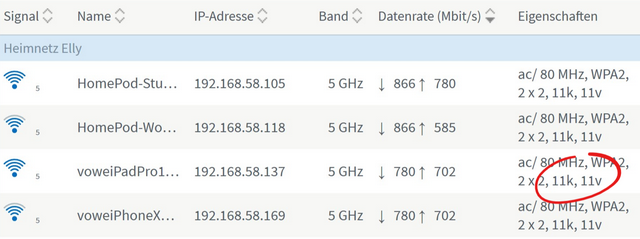
AP-Steering :: Ausblick auf FritzOS 7.1

by Volker Weber

SharedScreensho 4

Die nächste Software-Version der Fritzboxen unterstützt das aktive Roaming von WLAN-Geräten. Die wechseln dann den Access Point nicht erst dann, wenn der alte zu schwach wird, sondern sobald es einen besseren gibt. Das ist für mich sehr nützlich, weil ich in jedem Stockwerk einen eigenen Access Point habe und ich so vermeide, dass ich mit dem falschen verbunden bin. Ob ein Endgerät das AP-Steering beherrscht, sieht man in der Netzwerkübersicht, wenn man heute das Labor von FritzOS einsetzt.

08 Mar 00:24

The last chapter of your business book

by Josh Bernoff

How do you end your business book? Many just fizzle. Here’s how to leave your readers on a high note. I already wrote about how the first chapter is the scare-the-crap-out-of-you chapter. And I explained how to write all the other chapters. But once you’ve said all you need to say, what’s left to say? … Continued

The post The last chapter of your business book appeared first on without bullshit.

08 Mar 00:24

The Coolblue One Day Delivery By Bike in The Netherlands & Belgium

by Sandy James Planner

Chris and Melissa Bruntlett the fine people of Modacity Life passed on this fascinating article by Tom Parron on the marketing of Coolblue‘s new bike service. Coolblue is an electronics company that has been in business since 1999 in the Netherlands and Belgium. Their creed is to provide excellent response with a good slice of humour interspersed in their customer service. And if you order an item online, you are guaranteed delivery of that item the following day.

With online and 9 traditional retail locations this business delivers bought goods by “CoolblueFietst” which translates as Coolblue bikes.  With service commencing in two Dutch cities last year  Coolblue has expanded to have bicycle delivery of their products in major Dutch and Belgian cities with a fleet of 250 delivery riders. And get this~those delivery bike riders will  “all be employed with contracts and receive fixed salaries.”

The concept of “cycle logistics”have been used by courier companies in urban areas, but this innovative “quirky, approachable brand” is maintaining their own bike courier service for efficiency and for promoting the sustainable aspect of their brand. Deliveries will be from the  brick and mortar stores in the Netherlands and in Belgium so it will be the last part of the delivery that will be emission free. But as the CEO Pieter Zwart stresses for Coolblue stresses “Perhaps the best thing about CoolblueFietst: it’s green. And blue of course. Very blue.”

Here is a YouTube video of Coolblue’s announcement of bike driven deliveries to cities in Belgium from November 2018.

08 Mar 00:24

Spark Adds Rich Text Formatting for Email: Lists, Text Colors, and Highlighting

by Ryan Christoffel

Today in an update to its iOS and Mac apps, the email client Spark has introduced new rich text formatting options to enable greater flexibility in styling your messages.

Spark already included the expected bold, italics, and underline options, and its macOS version previously allowed creating bulleted or numbered lists, but those list options have now come to iOS as well. Additionally, both Mac and iOS users can now change the color of text in their emails, as well as add highlighting to text.

Rich text support is a particularly important feature for an email app, so I'm glad to see it come to Spark. While I likely won't start sending messages with different colored fonts, it's nice having the variety of options Spark provides here. Lists in particular were something I've missed having in the past, and I like the idea of employing highlights to call out anything of special importance in an email. I've historically used bold for that purpose, but highlighting definitely does an even better job of standing out.

Spark's latest update is available now as a free download for iOS, and the Mac update is coming soon.


Support MacStories Directly

Club MacStories offers exclusive access to extra MacStories content, delivered every week; it's also a way to support us directly.

Club MacStories will help you discover the best apps for your devices and get the most out of your iPhone, iPad, and Mac. Plus, it's made in Italy.

Join Now
08 Mar 00:24

What am I giving up for Lent? Access to my data

by admin
photo of a pancake
Image: Sheila MacNeill (yes they are homemade, but not necessarily by me)

I’m writing this on Shrove Tuesday, the traditional glut of sugar, spice and all things nice like pancakes before the start of Lent. I’m not a particularly religious person, but I respect those who are. However as religious festivals such as Lent are increasingly becoming consumer fests it’s hard to be immune from some diluted aspects Lent. For me, and I suspect most people in my locale, that equates to giving something up. Generally giving up something pretty superficial like chocolate. Lent is really a time for reflection, penance and sacrifice . Giving up my almost daily twix for six weeks I feel doesn’t really quite cut it in that respect, which is why I don’t bother. But, this year I’m going to take a different tack.

Anne-Marie Scott (as ever) has written a really thought provoking post about surveillance in the context of education and educational data, and how students are ‘seen’ by institutions through data. That made me think about how I as a staff member could be ‘seen’ too. I’m still working through some of the research papers highlighted and there is another more serious post that is forming in my head around those issues.

At the end of the post Anne-Marie links to The Glass Room exhibition. I’d never heard of this but on looking – what a fabulous thing that is – and I do hope it does come to Scotland at some point. Following the links in it I came across the data detox site. Again something I hadn’t come across before, but I wish I had. It would have been so useful to share with students the other week when I was doing some sessions around online identity – c’est la vie. Anyway as I was munching through a pancake, I thought that what I would do this year is kind of a reverse type of Lent. I’m going to give up giving away my all my data.

Thanks to the data detox site I’ve installed privacy badger and HTTPS Everywhere to stop my complacency around allow browsers to collect and use my data to drive assumptions about me to advertisers. I’ve updated all my google settings and now need to move on to apps on my phone, and social media. The later will be difficult. I’m not having a total digital detox and I don’t want to not be on social media but I need to just double check all my settings.

Now, I doubt that this is going to have any impact on Google ads revenue, but it is certainly giving me a well need impetus to get my act together on where, what and how I share my data. On my own devices I feel a bit more in control, and hopefully for longer than the six weeks of Lent.

08 Mar 00:24

Prescriptive Analytics – Let Me See You Work, Work, Work

by MikeW

After a deep dive into the inner workings of one class of prescriptive analytics—recommender system (personalization engines), it’s time to step back and explore how we can leverage prescriptive analytics in general. Today, I am going to outline 3 relevant use cases:

  1. In business, prescriptive analytics can help you optimize business processes and operation
  2. In social business, it can help your social media team focus on what drives the biggest business impact
  3. In social media, it can even help you optimize your engagement time

These are very distinctive use cases, where the objectives being optimized are drastically different. I hope these examples will not only demonstrate the power and versatility of prescriptive analytics, but also give you a better understanding of how they work. (If they don’t please feel free to let me know!)


Optimization of Business Process and Operation

process optimization 360px.png

I’ve discussed before that the simplest example of prescriptive analytics is a GPS, which operates in the geospatial domain. In general, prescriptive analytics are not limited to geospatial optimization. We can optimize processes and other parts of business operations. One of the most common use cases of prescriptive analytics is business optimization. Since the underlying computation of prescriptive analytics is already an optimization of some objective, this application is very natural. In this case, the objective we optimize is typically the efficiency or throughput of the process.


Whether you are optimizing a business process in marketing, sales, or customer service, you must tell the prescriptive analytics system what you are trying to achieve. This is like telling the GPS where you are going. For example, increase conversion by 10%, increase sales by 20%, or increase your net promoter score (NPS) by 5 points. These are the goals, or “destinations” you are trying to reach in a non-geospatial domain.


Subsequently, the prescriptive analytics system would prescribe a sequence of actions that lead to the corresponding business outcomes you want (i.e. increase conversion by 10%, sales by 20%, or NPS by 5 points). For example, to achieve 10% conversion lift, the system may prescribe reducing the frequency of your email marketing by 35%; simultaneously increase your real-time social media engagement by 30%; and when your real-time engagement reaches 15%, start directing people to your customer community for peer-to-peer engagement and recommendation. These are like the turns that your GPS system advises you during the journey, except these directions are not in the geospatial domain.


Optimizing Business Impact of Your Social Media Engagement

Now you know what prescriptive analytics can do for your business, let’s dive deeper on how it prescribes actions. The key lies in the objective that’s being optimized. Let’s examine a couple of examples from social media.


These days, social media is not new to business, but many enterprises still struggle to figure out how best to leverage it. Because there are so many different things you can do on social media, it’s hard to determine where to best allocate your limited resources (e.g. time, money, energy, etc.). Should you create more YouTube videos or should you use Snapchat? Should you publish more blogs, or participate more in the Q&A section of your community? The social media landscape is complex with thousands of social channels. Even within a single social channels, there are probably a handful of actions you can take. Take Twitter for example. It’s probably one of the simplest social channels out there, but you can already engage in many different ways: tweet a message, reply to one, retweet it, favorite it, follow someone, or simply read the tweets coming out of the firehose. This gives rise to many different social metrics that quantify how you engaged on social media.


social impact optimization 360px.png

Prescriptive analytics can help you focus on what you should do to achieve the biggest impact, but you must tell it what kind of impact you are looking for. Whether it’s increasing marketing conversion, sales, or customer satisfaction (CSAT), you should be able to measure the impact you want to drive. This is typically a key performance indicator (KPI) for your business. Once you have the KPI that you are trying to drive, and the social media metrics that describe how you engage, it’s relatively trivial to perform a time-lagged cross correlation analysis to see which social metrics have the strongest correlation with your KPI. Although correlation is better than flying blind, it would be better if we could establish causation as well. But this would require less trivial methods in statistics or econometrics (e.g. instrumental variables). If you are comfortable with these advanced techniques, you can even establish causal relationship and identify the strongest causal predictors for your KPI.


The correlation strength (causal or not) between the social metrics and KPI is the objective. Upon maximizing this objective, the prescriptive analytics system would be able to prescribe the actions that are most effective at driving your KPI. This helps you focus your effort on a few actions that will give you greatest impact (as measured by the KPI). And if you choose a different KPI, the system will prescribe a different set of predictors that maximize this objective.


When to Post on Social Media—Engagement Time Optimization

Because social media engagement is voluntary, people can participate anytime they want. But when is the best time to participate? The answer really depends on what you are trying to achieve. The goal of most social media participation is usually to reach the widest audience (whether that’s for a brand or for us personally). Even when you are posting a question and want the fastest answer or the most accurate answer, these goals can often be achieved indirectly by maximizing your reach. By reaching the widest audience, you increase your odds of reaching someone who can respond immediately; and by reaching the widest audience, you also increase your odds of finding someone who has the expertise to address your question accurately.


There have been numerous studies on when is the optimal time to post on social media, and many infographics provide general guidance on when to post on various social channels. In general, these studies are rather limited because the data is highly aggregated, the sample size small, and the methodology not rigorous enough. We recognized that there really isn’t a universal best time to post on social media, because the best time to post is ultimately specific and unique to the individual.


Our brilliant data science team (humble brag!) have analyzed over a billion posted messages and observed reactions and found that the best time to post depends strongly on your specific audience’s engagement profile. Meaning when your specific audience is most actively participating on a particular social channel. Keep in mind that it is your audience’s behavior (i.e. how they choose to use social media) that determines the optimal time to post for you. Since we all have different audience on social media (e.g. different followers, friends, connections, etc.), the best-time-to-post for you may be totally different from the best-time-to-post for me. This is precisely how Lithium Reach is able to recommend the best-time-to-post that is hyper-personalized to a person or a brand.


engagement time optimization 360px.pngNow, I could certainly tell you more about the product, but that’s not my style. However, if you have specific product related questions, I’d be happy to discuss, or invite more qualified product management staff to chime in.


We further validated the optimality of our hyper-personalized recommendation on a sample of half million active users and more than 25 million messages observed over a 56-days period. We found that our individually optimized post-time leads to an average of +17% engagement lift on Facebook and +4% on Twitter. This is a VERY conservative average. In practice, we have seen more than +50% engagement lift at times from brands using Lithium Reach’s recommended time-to-post feature.


Conclusion

We discussed 3 business use cases of prescriptive analytics. In each case some objectives are optimized, so the system can prescribe a few actions (or sequence of actions) out of infinite number of possible action you can take.

  1. By maximizing the efficiency or throughput of some business processes under appropriate resource constraint, we get a prescribed sequence of steps to help us optimize the process.
  2. By maximizing the causal correlation strength between social metrics and your desired KPI, we get a prescribed set of social metrics we should focus on driving. Although there are hundreds and possibly thousands of social metrics, this set of metrics is most effective at moving the needles for your KPI.
  3. By maximizes the engagement profile of your specific audience (e.g. follower, friends, connections, etc.), we get a set of personalized recommendations on when to post on social media. Although you can post social media content at any time you like, posting at the recommended times will maximize the reach of your messages.


While optimization is something that computers can do very efficiently, doing this at the individual level is still a challenging big data problem. Because people’s social interactions change continuously, we must constantly re-optimize as the new data arrive from the respective social streams. Fortunately, our data scientists have done all the heavy lifting and built this hyper-personalized post time recommendation algorithm into Lithium Reach. Now, you can get the benefit of personalized recommendation on when to post without needing to routinely analyze billions of message and their reactions.


As you can see, prescriptive analytics is versatile and powerful. It has just as many applications in science and engineering as in business and social media. Next time I’ll share a somewhat esoteric use case of prescriptive analytics in data science. Yes, data scientists like me also use prescriptive analytics. Come back next time to find out more!


Image Credit: geralt, geralt, and valentinsimon0.


Michael Wu, Ph.D.mwu_whiteKangolHat_blog.jpg is CRM2010MKTAWRD_influentials.pngLithium's Chief Scientist. His research includes: deriving insights from big data, understanding the behavioral economics of gamification, engaging + finding true social media influencers, developing predictive + actionable social analytics algorithms, social CRM, and using cyber anthropology + social network analysis to unravel the collective dynamics of communities + social networks.


Michael was voted a 2010 Influential Leader by CRM Magazine for his work on predictive social analytics + its application to Social CRM. He's a blogger on Lithosphere, and you can follow him @mich8elwu or Google+.

07 Mar 21:52

The Best USB Audio Interface

by Daniel Varghese
The Best USB Audio Interface

If you’re a musician who’s starting to get serious about recording your work yourself, you need a USB audio interface that lets you connect any microphone to a computer or iPad and record multiple tracks at once. We tested nine audio interfaces and found that they all record clear audio, but the Focusrite Scarlett 2i2 offers the best combination of features, portability, and ease of use.

07 Mar 21:52

Ask Wirecutter: How Do I Keep the Gutters Clear of Ice and Leaves?

by Wirecutter Staff
Ask Wirecutter: How Do I Keep the Gutters Clear of Ice and Leaves?

We live in Chicago and just went through some snow and the polar vortex. After the snow we discovered that we may not have enough insulation in our attic because our roof warmed and melted snow, which hit our frozen gutters and caused an ice dam. One roofer suggested we get a gutter heater, which I never knew existed until that day. I said yes out of fear of any damage ahead of the polar vortex. However, I have no idea if I made the right decision. Are gutter heaters even necessary? Should I have just waited for it to warm up and melt off? Should I add more insulation in my attic? Would love to hear some viewpoints on this. I know ultimately each homeowner situation is unique, but I’d love to have a little more clarity on this. —Albert H., Chicago

My gutters were knocked around by the heavy snow we’ve had. Should I get snow guards for the roof? Or something like gutter heat by Frost King? Or just repair the gutters when the snow weighs them down? What is the most cost efficient for the long term? —Maya W., Washington, DC

Hello Albert and Maya,

Okay, I have a long history of living in ancient, poorly insulated homes so I have a long and storied history with ice dams. I get ice dams almost immediately after a snowfall. It’s bananas. I have no insulation in my walls. It’s almost like my house was built in Revolutionary times or something. (It was.)

They happen due to poor attic insulation or inadequate ventilation. In most cases, you want the underside of your roof to be the same temperature as the outside air. If it’s not, the heat from your home melts the snow on your roof (while it’s still below 32 degrees outside) and the water runs down to your eave, which is not warm in any way, and freezes. Little by little this frozen mass builds up until it makes a bowl that traps water against the roof. Depending on how your roof is constructed this can back water up under your shingles and into your home. Once that happens you can be looking at some seriously expensive repairs. Once it gets into your walls and gets your insulation wet, it lowers the R value of your insulation and you can get mold.

There are a few ways to stop these from happening. The least expensive way, which takes a little effort, is to use a roof rake to clear snow from your roof after each snow. Our recommended roof rake extends to 17 feet, so you can use that as a guideline. Ideally you want to get all of the snow off, but if you can’t do that, at least remove it from the eaves (and go as far back as you can) and the valleys, if you have any and you can reach them. With this limited approach there is still snow up there that can melt and run down, but at least this is a start. I roof rake after every snowstorm. It’s a hassle, but worth it.

Heat cables, like the Frost King, 60-foot Electric Cable Kit, have good reviews at Home Depot, although many are from people who have installed them and not used them long-term. On the good side, they melt snow and create channels for water to escape the roof, but on the bad side, they use a decent amount of electricity and they can fail (I’ve seen them completely encased in ice). Also, if you lose power during the snowstorm, you’re out of luck. Just putting them in your gutter probably won’t help much, because, if you recall, the water is freezing at the eave too, so you’ll likely need them on the roof as well.

If you have a house prone to ice dams, I’ve also found it very helpful to have some calcium chloride on hand, both loose and in puck format. You can toss the pucks up on the roof and they melt, presumably dissolving into the water, running down to the ice dam and melting that. I’ve found that it’s not that simple and they work best when placed directly on the ice dam. Calcium chloride is corrosive (and there are reports of it staining roofs), so I don’t like just tossing them up there wherever. I prefer to be a little more specific in my placement with them directly on, or right behind, the ice dam. It’s something to have on hand in case things get out of control (or if your heat cable malfunctions mid-storm). I don’t recommend it as your primary defense against ice dams.

Likely the most expensive and invasive (yet comprehensive) solution is to redo the insulation in your attic or add some ventilation. There are so many variables here that it’s difficult to make any strong recommendations.

As for snow guards, I’ve only seen them on slate roofs, where when the snow slides off, it all slides off at once. (I have a slate roof and when snow lets go, it sounds like a freight train and is pretty dangerous to anyone below.) To have guards you really need to have some bulletproof attic insulation or trust in your roof construction, because the guards just hold all of that meltable snow up there on your roof. My general opinion is to just get the snow off the roof as fast as possible (if your house is prone to ice dams), whether it’s done via roof raking or letting it slide off on its own.

But if the snow is tearing your gutters off, snow guards may be worth considering. You should also look at how high your gutters are hung. Some roofing contractors hang gutters lower on slate and metal roofs so the sliding snow (theoretically) goes over the gutter as it heads to the ground (as shown in this image from Inspectapedia). I’d recommend talking to a couple roofing contractors to get some options for your specific scenario.

For more reading on the topic, Fine Homebuilding has a detailed explanation of how ice dams form and what to do to prevent them. A similar story from This Old House echoes the Fine Homebuilding advice on long-term fixes for ice dams.

—Doug Mahoney, senior staff writer

My house has standard rain gutters. The house needs repainting so this would be a good time to replace the gutters, which are 46 years old. My biggest problem is pine needles falling through the mesh on the gutters. Would LeafGuard rain gutters alleviate this situation? Thanks. —H., Houston

LeafGuard and its various similar competitors claim that surface tension gutters cause water to flow over the curved surface into the gutter while keeping leaves out. These things are very expensive. Do they actually work?
Richard B., Cleveland

We polled our homeowners’ Slack channel to see if anyone had experience with covered gutters. One of our editors in Portland, Oregon, bought a house with multiple 100-foot-tall leafy trees on the property about three years ago. It came with covered gutters, and he is happy with them, having never had to clean them.

However, reviews from experts seem to be less enthusiastic. Though we haven’t tested LeafGuard ourselves, we looked at some of the testing done by other people (testing from Family Handyman, videos from EnduringCharm and Roofing Insights, and an even-handed overview from Inspectapedia, a site for home inspectors). We agree with Inspectapedia’s basic conclusion: Gutter screens and covers can be good for “high, hard to access roofs with nearby trees.” It seems that otherwise it may make more sense to skip them and just deal with frequent cleaning. (Regarding pine needles in particular, EnduringCharm’s video says at 0:40, “If there’s big trees nearby, or certain types of trees, like pine needles and things like that can get jammed in here, especially when there’s small holes and things like that …”)

One thing that comes up a lot in the criticisms is that the screens themselves need maintenance and cleaning—just not as often. So you’re still either getting on a ladder or paying someone else to do it (and this is after you’ve shelled out the money to install the gutter covers). For someone cleaning their own gutters, leaf blowers work great. Downspout screens are an inexpensive way to deal with things as well if you want something quick and easy.

—Harry Sawyers, senior editor

Questions have been lightly edited for clarity. If you have a question, send it to notes@wirecutter.com with the subject line Ask Wirecutter.

07 Mar 21:51

Head’s Up! Roll Your Own HTTP Headers Investigations with the ‘hdrs’ Package

by hrbrmstr

I blathered alot about HTTP headers in the last post.

In the event you wanted to dig deeper I threw together a small package that will let you grab HTTP headers from a given URL and take a look at them. The README has examples for most things but we’ll go through a bit of them here as well.

For those that just want to play, you can do:

install.packages("hdrs", repos = "https://cinc.rud.is/")

hdrs::explore_app()

and use the diminutive Shiny app to explore a site’s security headers or look at all the headers they return. (Oh, yeah…if you read the previous post then looked at the above screenshot you’ll notice how completely useless IP blocking is to determined attackers individuals.)

NOTE: There are binaries for macOS and Windows at my CINC repo for hdrs so you’ll be getting those if you use the above method. Use type='source' on that call or use various remotes package functions to install the source package (after reading it b/c you really shouldn’t trust any package, ever) from:

Moving Ahead

Let’s use the command-line to poke at my newfound most favorite site to use in security-related examples:

library(hdrs)

assess_security_headers("https://cran.r-project.org/") %>% 
  dplyr::select(-url)
## # A tibble: 13 x 4
##    header                            value                  status_code message            
##  * <chr>                             <chr>                  <chr>       <chr>              
##  1 access-control-allow-origin       NA                     WARN        Header not set     
##  2 content-security-policy           NA                     WARN        Header not set     
##  3 expect-ct                         NA                     WARN        Header not set     
##  4 feature-policy                    NA                     WARN        Header not set     
##  5 public-key-pins                   NA                     WARN        Header not set     
##  6 referrer-policy                   NA                     WARN        Header not set     
##  7 server                            Apache/2.4.10 (Debian) NOTE        Server header found
##  8 strict-transport-security         NA                     WARN        Header not set     
##  9 x-content-type-options            NA                     WARN        Header not set     
## 10 x-frame-options                   NA                     WARN        Header not set     
## 11 x-permitted-cross-domain-policies NA                     WARN        Header not set     
## 12 x-powered-by                      NA                     WARN        Header not set     
## 13 x-xss-protection                  NA                     WARN        Header not set     

Ouch. Not exactly a great result (so, perhaps it matters little how poorly maintained the downstream mirrors are after all, or maybe it’s perfectly fine to run a five year old web server with some fun vulns).

Anyway…

The assess_security_headers() function looks at 13 modern “security-oriented” HTTP headers, performs a very light efficacy assessment and returns the results.

  • access-control-allow-origin
  • content-security-policy
  • expect-ct
  • feature-policy
  • server
  • public-key-pins
  • referrer-policy
  • strict-transport-security
  • x-content-type-options
  • x-frame-options
  • x-permitted-cross-domain-policies
  • x-powered-by
  • x-xss-protection

Since you likely do not have every HTTP header’s name, potential values, suggested values, and overall purpose memorized, you can also pass in include_ref = TRUE to the function to get more information with decent textual descriptions like you saw in the screenshot (the Shiny app omits many fields).

The full reference is available in a data element:

data("http_headers")

dplyr::glimpse(http_headers)
## Observations: 184
## Variables: 14
## $ header_field_name    <chr> "A-IM", "Accept", "Accept-Additions", "Accept-Charset", "Accept-Datetime", "Accept-Encoding…
## $ type_1               <chr> "Permanent", "Permanent", "Permanent", "Permanent", "Permanent", "Permanent", "Permanent", …
## $ protocol             <chr> "http", "http", "http", "http", "http", "http", "http", "http", "http", "http", "http", "ht…
## $ status               <chr> "", "standard", "", "standard", "informational", "standard", "", "standard", "", "standard"…
## $ reference            <chr> "https://tools.ietf.org/html/rfc3229#section-10.5.3", "https://tools.ietf.org/html/rfc7231#…
## $ type_2               <chr> "Request", "Request", "Request", "Request", "Request", "Request", "Request", "Request", "Re…
## $ enable               <lgl> FALSE, FALSE, FALSE, FALSE, FALSE, FALSE, FALSE, FALSE, TRUE, TRUE, FALSE, TRUE, FALSE, FAL…
## $ required             <lgl> NA, NA, NA, NA, NA, NA, NA, NA, TRUE, TRUE, NA, TRUE, NA, NA, NA, TRUE, NA, NA, NA, NA, NA,…
## $ https                <lgl> NA, NA, NA, NA, NA, NA, NA, NA, TRUE, TRUE, NA, TRUE, NA, NA, NA, TRUE, NA, NA, NA, NA, NA,…
## $ security_description <chr> "", "", "", "", "", "", "", "", "Sometimes an HTTP intermediary might try to detect viruses…
## $ security_reference   <chr> "", "", "", "", "", "", "", "", "https://tools.ietf.org/html/rfc5789#section-5", "https://t…
## $ recommendations      <chr> "", "", "", "", "", "", "", "", "Antivirus software scans for viruses or worms.", "Servers …
## $ cwe                  <chr> "", "", "", "", "", "", "", "", "CWE-509: Replicating Malicious Code (Virus or Worm)", "CWE…
## $ cwe_url              <chr> "\r", "\r", "\r", "\r", "\r", "\r", "\r", "\r", "https://cwe.mitre.org/data/definitions/509…

There will eventually be a lovely vignette with well-formatted sections that include the above information so you can reference it at your leisure (it’s great bedtime reading).

The http_headers object is fully documented but here’s what those fields mean:

  • header_field_name: header field
  • type_1: Permanent (in a standard); Provisional (experimental); Personal (unofficial)
  • protocol: should always be http for now but may be different (e.g. quic)
  • status: blank == unknown; otherwise the value describes the status well
  • reference: where to look for more info
  • type_2: Request (should only be found in requests); Response (should only be found in responses); Request/Response found in either; Reserved (not in use yet)
  • enable: should you have this enabled
  • required: Is this header required
  • https: HTTPS-specific header?
  • security_description: Information on the header
  • security_reference: Extra external reference information on the header
  • recommendations: Recommended setting(s)
  • cwe: Associated Common Weakness Enumeration (CWE) identifier
  • cwe_url: Associated CWE URL

Even Moar Headers

HTTP servers can spit out tons of headers and we can catch’em all with hdrs::explain_headers(). That function grabs the headers, merges in the full metadata from http_headers and returns a big ol’ data frame. We’ll only pull out the security reference URL for this last example:

explain_headers("https://community.rstudio.com/") %>% 
  dplyr::select(header, value, security_reference)
## # A tibble: 18 x 3
##    header               value                                                         security_reference                   
##    <chr>                <chr>                                                         <chr>                                
##  1 cache-control        no-cache, no-store                                            https://tools.ietf.org/html/rfc7234#…
##  2 connection           keep-alive                                                    ""                                   
##  3 content-encoding     gzip                                                          https://en.wikipedia.org/wiki/BREACH…
##  4 content-security-po… base-uri 'none'; object-src 'none'; script-src 'unsafe-eval'… https://www.owasp.org/index.php/List…
##  5 content-type         text/html; charset=utf-8                                      https://tools.ietf.org/html/rfc7231#…
##  6 date                 Tue, 05 Mar 2019 20:40:31 GMT                                 ""                                   
##  7 referrer-policy      strict-origin-when-cross-origin                               NA                                   
##  8 server               nginx                                                         https://tools.ietf.org/html/rfc7231#…
##  9 strict-transport-se… max-age=31536000                                              https://tools.ietf.org/html/rfc6797  
## 10 vary                 Accept-Encoding                                               ""                                   
## 11 x-content-type-opti… nosniff                                                       https://www.owasp.org/index.php/List…
## 12 x-discourse-route    list/latest                                                   NA                                   
## 13 x-download-options   noopen                                                        NA                                   
## 14 x-frame-options      SAMEORIGIN                                                    https://tools.ietf.org/html/rfc7034  
## 15 x-permitted-cross-d… none                                                          NA                                   
## 16 x-request-id         12322c6e-b47e-4960-b384-32138097886c                          NA                                   
## 17 x-runtime            0.106664                                                      NA                                   
## 18 x-xss-protection     1; mode=block                                                 https://www.owasp.org/index.php/List…

FIN

Have some fun and poke at some headers. Perhaps even use this to do a survey of key web sites in your field of work/study and see how well they rate. As usual, post PRs & issues at your fav social coding site.

07 Mar 21:51

These Weeks in Firefox: Issue 54

by mconley

Highlights

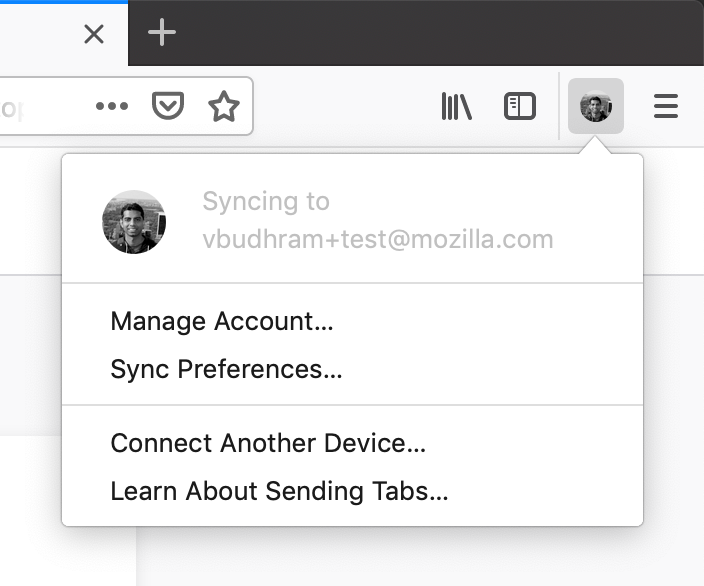
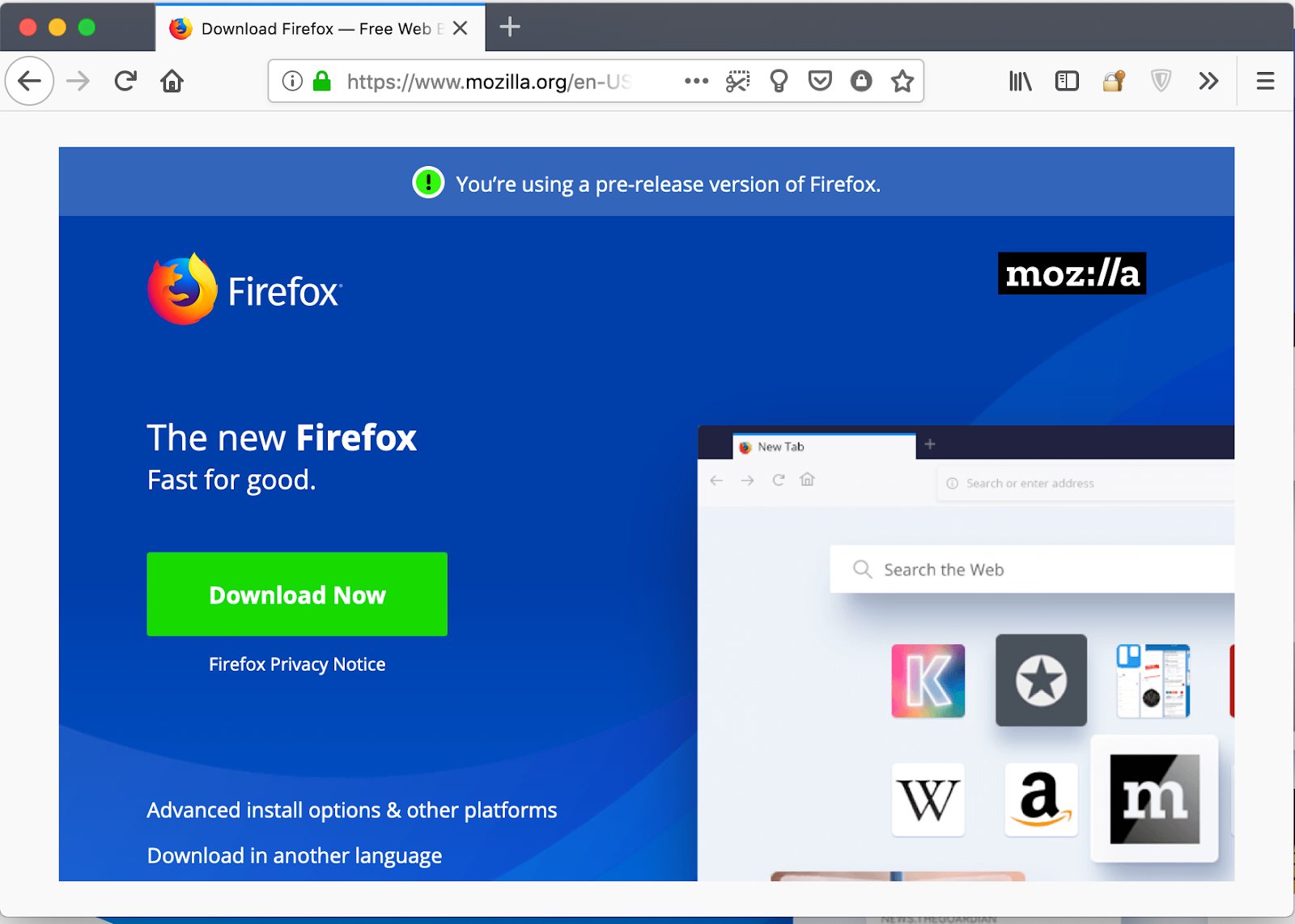
  • Firefox Account is experimenting with putting an avatar next to the hamburger menu. It will give users visibility on their account, sync status as well as links to manage the account. Targeting landing soon!
    • A default toolbar button in the Firefox UI displays a panel to turn on syncing.

      Take Firefox with you!

    • A default toolbar button in the Firefox UI offers some Firefox Account options now that the user is logged in.
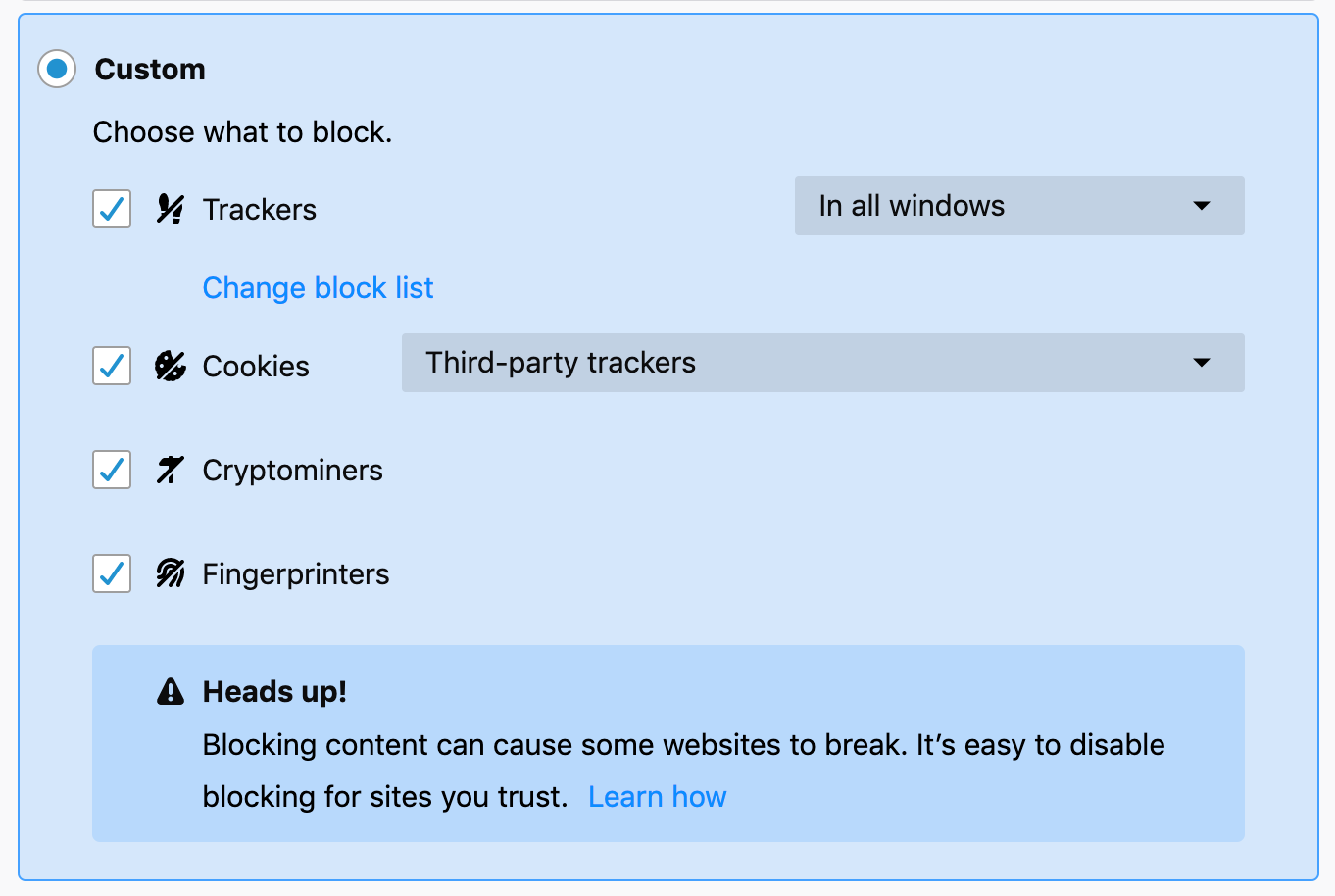
  • We have added support for blocking known fingerprinters and cryptominers with content blocking! This is currently enabled in Nightly.
    • This is currently enabled in Nightly, and is still experimental. It might break some sites.

  • Lots of DevTools goodies this week!
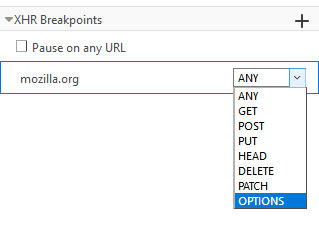
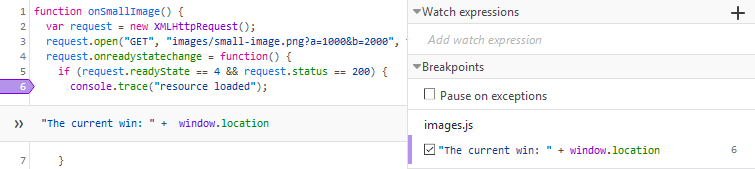
    • In the DevTools Debugger, the XHR breakpoint type (ANY, GET, PUT, POST, etc.)  can be now specified through new UI. This was done by a volunteer contributor, Jaril!
      • A dropdown in the DevTools debugger allows developers to break on different types of XHR requests, like GET, POST, PUT, HEAD, and DELETE.
  • Log points UX has been improved (including syntax highlighting, context menu and markers), thanks to contributors Bomsy and Florens
    • Log points are different from breakpoints – they don’t break JS execution, they just create a log when hit.
    • The DevTools debugger now allows developers to set "log points" that log some value when reaching a section of code.
  • It is now possible to copy all collected CSS changes done through DevTools UI. Thanks to Razvan Caliman!
    • A "Copy all changes" button has been added to the "Changes" panel in the DevTools Inspector.
  • Auto discovery of layout CSS properties (done by Micah Tigley). Hold shift and mouse over any defined property in the box-model widget (in the Layout sidebar). This will highlight the corresponding CSS property in the rule-view.
    • The DevTools Inspector now sends you to the rules that defined the various dimensions of the box when clicking on those dimensions in the Layout panel.
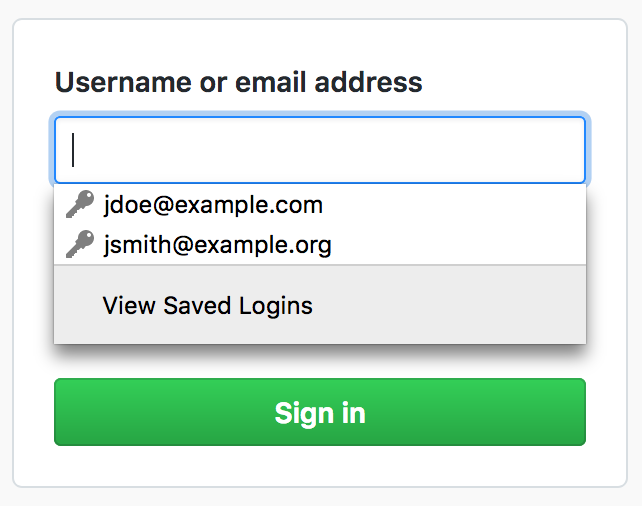
  • The Password Manager team has added a “View Saved Logins” footer to the password manager autocomplete popup  (disabled until the follow-up is resolved)
    • A "View Saved Logins" option now appears at the bottom of the login autocomplete list.
  • Tim Huang and Tom Ritter added letterboxing (an anti-fingerprinting technique) to Firefox
    • An anti-fingerprinting technique now adds additional padding around the content area.

      Note the gray margin in the content area.

Friends of the Firefox team

Resolved bugs (excluding employees)

Fixed more than one bug

  • Hemakshi Sachdev [:hemakshis]
  • Manish [:manishkk]
  • Oriol Brufau [:Oriol]
  • Rainier Go [:rfgo]
  • Tim Nguyen :ntim
  • Trishul

New contributors (🌟 = first patch)

Project Updates

Activity Stream

  • Landed and uplifted MVP for experiments, Beta smoke test started Monday.
  • Preparing to run 16 layout experiments in Release 66 cycle for better engagement, e.g., large Hero articles vs List of articles
  • The team is helping Pocket engineers transition to increase ownership of new tab
  • CFR for Pinned Tabs will be our next recommendation experiment!
    • First experiment recommends add-ons, e.g., Facebook Container, Google Translate
    • Current experiment will suggest pinning tabs, e.g., Gmail, productivity / messaging sites

Add-ons / Web Extensions

Applications

Screenshots
  • Latest server release is on stage environment for testing prior to release (Changelog)
    • We have now exposed server shutdown strings to web localizers. In case anyone asks, Screenshots is not being removed from Firefox, just the ability to upload shots.
    • This upcoming server release will include tools to help users download their saved shots
Lockbox
  • This past sprint continued the focus on foundational work:
    • [lorchard] “Reveal Password” functionality (#84)
    • [loines] Define & document telemetry metrics (#82)
    • [lorchard] Expect a complete Login when updating in addon Logins API (#80)
    • [6a68] Re-style the list view on the management page (#76)
  • Our work is tracked as the ‘desktop’ repository within the Lockbox waffle board
  • We don’t yet have any good-first-bugs filed, but swing by #lockbox if you want to contribute ^_^
Services (Firefox Accounts / Sync / Push)
  • New FxA device pairing flow landed in Nightly, but pref’d off for now. You’ll soon be able to sign in to FxA on Android and iOS by scanning a QR code, instead of typing your password!
    • Check out this Lucidchart sketch to see the flow if you’re curious to learn more!

Developer Tools

Network
  • Resizeable Columns – Our Outreachy #17 intern Lenka Pelechova is finishing support for resizeable Columns in the Network panel. Currently focusing on Performance (bug)
Layout Tools
  • Our UX Designer Victoria Wang published survey for CSS Layout Debugging. You can help us build better CSS debugging tools (quick single-page survey)
Technical debt
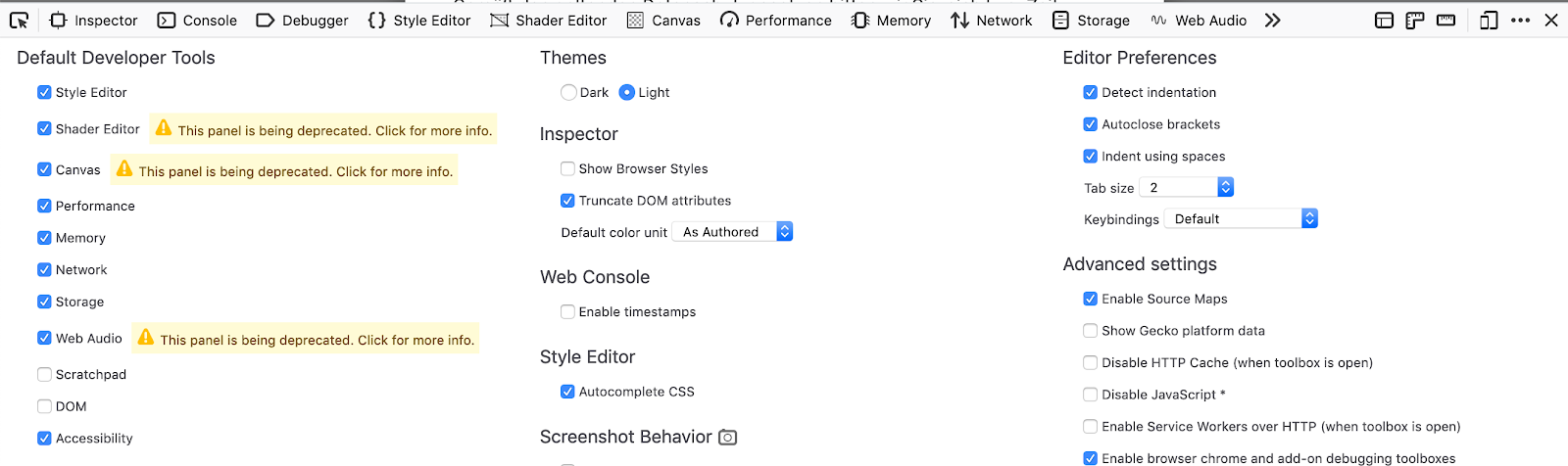
  • Firefox 67 will soon display a removal notice (in the Options panel) about the Shader Editor, Canvas and Web Audio panels, which are going to be removed in 68. Work done by Yulia Startsev. Until the MDN page is up, you can look at the intent to unship post in the mailing list.
    • Warnings being displayed next to various panel toggles in the DevTools Settings panel, letting users know that these panels are deprecated.
Remote Debugging
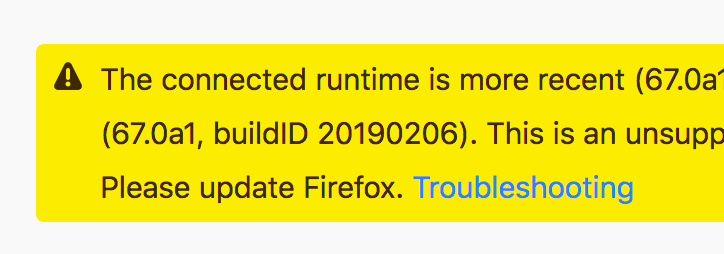
  • Showing backward compatibility warnings in about:debugging (bug)
    • A warning is now displayed when DevTools is remotely connected to a Firefox that has a different version number.
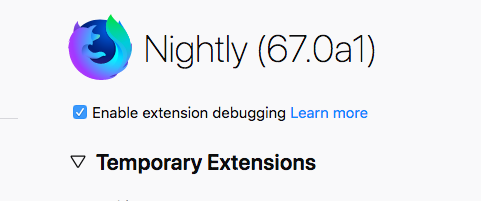
  • Added a checkbox to enable local addon debugging (bug)
    • A checkbox has been added to about:debugging to enable extension debugging.
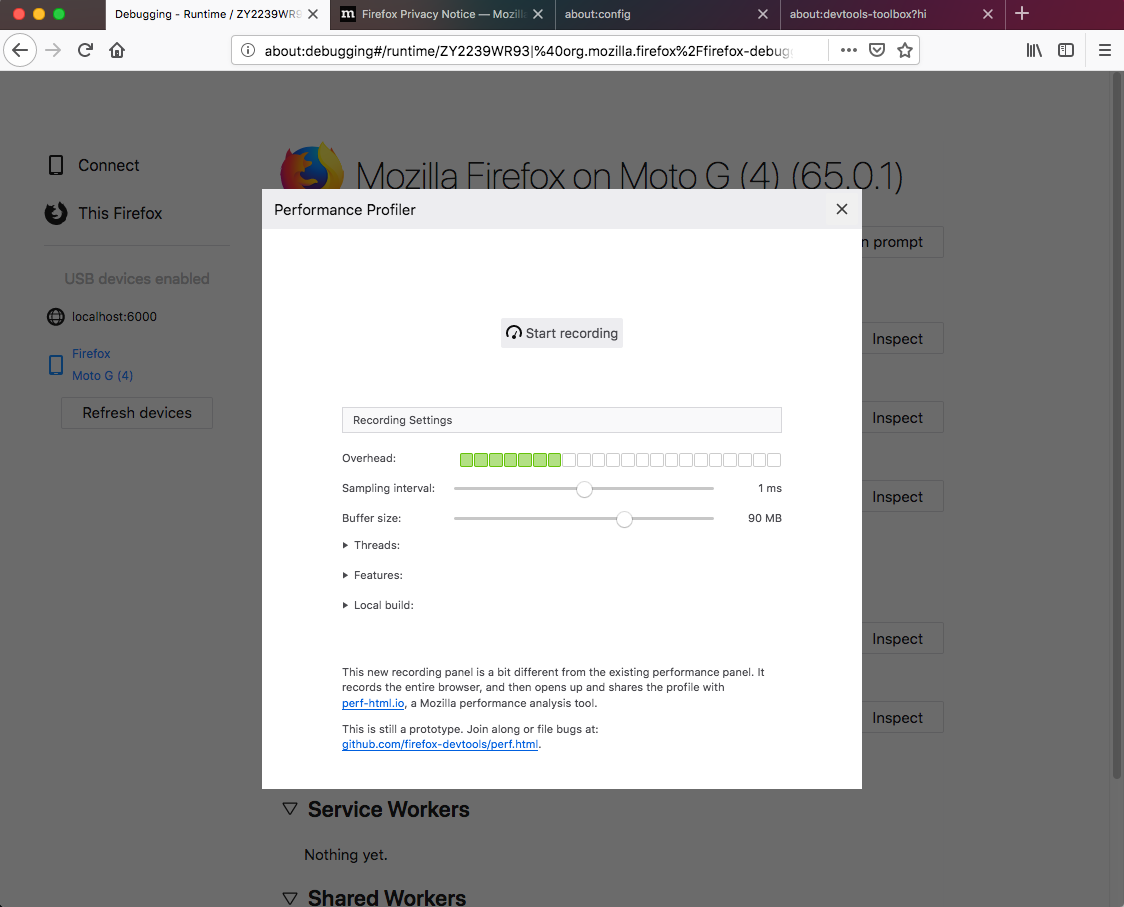
  • Open the Profiler for remote runtimes in about:debugging (bug)
    • A dialog from about:debugging now allows you to gather a performance profile from the connected instance of Firefox.

Fission

Performance

Performance tools

  • Perf-html.io moved to profiler.firefox.com and perf.html is now called “Firefox Profiler”.
  • I/O markers are now visible in the timeline. I/O marker stacks are visible when hovering them, and in lots of cases the path of the file that was touched is shown.
    • When capturing a profile, to have I/O markers, you need to check the “Main Thread IO” checkbox in the Gecko profiler add-on, or enable the “mainthreadio” feature using the MOZ_PROFILER_STARTUP_FEATURES environment variable when profiling startup.
    • We are investigating optionally collecting markers for off-main thread I/O, and enabling main thread I/O markers by default.
      • A FileIO marker with operation, source, filename and stack information

        A FileIO marker with operation, source, filename and stack information

  • We improved shutdown profiling: it’s now compatible with mainthreadio markers, and shows content process shutdowns. Here’s a profile with startup + shutdown, on a fresh profile, with I/O markers.
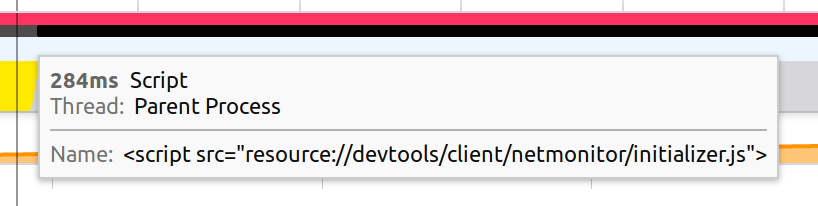
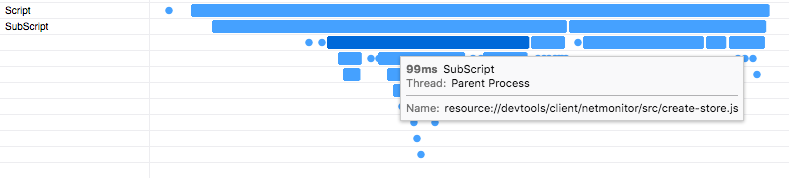
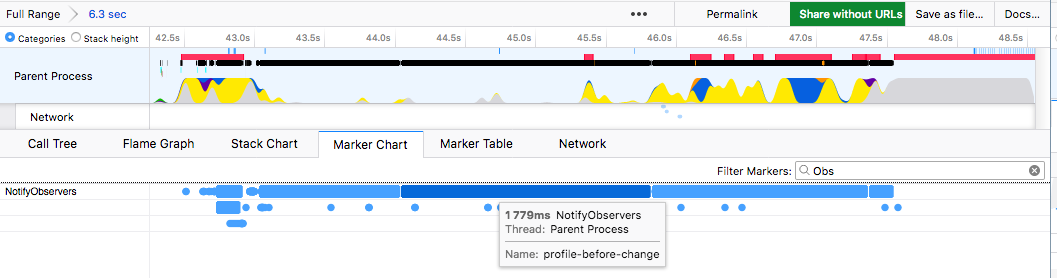
  • We have markers for <script>s, privileged js files, and nsObserverService::NotifyObservers now in the Firefox Profiler.
      • A Script marker with name information

        A Script marker with name information


      • A script marker and other SubScript markers that it triggers

        A script marker and other SubScript markers that it triggers


      • A “NotifyObservers” marker with “profile-before-change” name

        A “NotifyObservers” marker with “profile-before-change” name


Policy Engine

Privacy/Security

Search and Navigation

Search
Quantum Bar
07 Mar 21:51

Thwarting the Supermajority

by Caterina Fake

Tim Wu points out in his article The Oppression of the Supermajority that the much-vaunted political divides in this country are fictitious and that the country is largely unified. In fact what is happening is that the Supermajority of voters who agree on a large slate of issues are being thwarted by their own government. He writes:

The defining political fact of our time is not polarization. It’s the inability of even large bipartisan majorities to get what they want on issues like these. Call it the oppression of the supermajority.

He puts together a short list of some of the issues we agree upon, which

“About 75 percent of Americans favor higher taxes for the ultrawealthy. The idea of a federal law that would guarantee paid maternity leave attracts 67 percent support. Eighty-three percent favor strong net neutrality rules for broadband, and more than 60 percent want stronger privacy laws. Seventy-one percent think we should be able to buy drugs imported from Canada, and 92 percent want Medicare to negotiate for lower drug prices. The list goes on.”

What’s causing this? Wu believes it is legislative stagnation, the gridlock created by industry groups, donor interests and the commitment of our elected leaders to preserving this gridlock.


Read some of Tim’s Books:

The Attention Merchants:

“From Tim Wu, author of the award-winning The Master Switch ( a New Yorker and Fortune Book of the Year) and who coined the term “net neutrality”—a revelatory, ambitious and urgent account of how the capture and re-sale of human attention became the defining industry of our time. 


The Curse of Bigness

From the man who coined the term “net neutrality,” author of The Master Switch and The Attention Merchants, comes a warning about the dangers of excessive corporate and industrial concentration for our economic and political future.”

07 Mar 21:51

DNV Withdraws Core Funding for Affordable Housing Committee

by Colin Stein

As a follow-up to yesterday’s post on the subject, last night the District of North Vancouver council did what it was expected to with the affordable housing file — continue to sit on it.

Councillors voted along ideological lines, with five votes against two, declining to provide $11,512 in ongoing core funding to CHAC, the housing action arm of North Shore Community Resources.

The non-profit must now pursue alternate funding from the municipality by way of smaller grants, or discontinue plans to tackle affordable housing in 2019.

The qualities of the debate around housing in DNV have become simultaneously evidence-based, emotional, and partisan. This was on full display yesterday, demonstrated by some of the combative words from Mayor Little and other council members in their fight for or against the motion. Here are some highlights/lowlights from a watcher of the broadcast:

  • Mayor Little led with a motion to go against the staff recommendation and de-fund CHAC, and encouraged CHAC to apply for a different grant. He suggested that CHAC was too effective in the community, and suggested that, without their influence at the Mosaic Public Hearing, the project would not have been approved. He repeated the talking point that affordable housing is best achieved through preservation of existing stock. He said that CHAC’s actions had irreparably damaged DNV’s reputation.
  • Lisa Muri gave a weird alternate history of development and its impacts, casting herself as the saviour of the community. The longest-standing Council member, she said she isn’t really a politician, and that she is truly an activist, then bad-mouthed CHAC for daring to apply for alternative funding after they were threatened to have their core funding revoked. She believes CHAC is trying to pull a fast one by applying for a different pool of funding. Then she repeated the assertion that CHAC was damaging the DNV’s reputation. Then she complained that CHAC was making things so uncomfortable for Council, who have to make such difficult choices.
  • Matthew Bond and Jordan Back were both patient, and reasonably made the case for CHAC and affordable housing. Matthew Bond was particularly good when he ridiculed Mayor Little’s statements about CHAC, and Megan Curran, who was paranoid that affordable housing forums were sponsored by developers. Bond asked her why she would de-fund CHAC, an NGO, when her issue was corporate influence in affordable housing — developers don’t do affordable housing projects to enrich themselves.
  • Megan Curran was clearly upset at being cast as evil by de-funding an NGO, and that her outrage was insufficient to be in any way convincing beyond her base. She resented Back and Bond for making her look stupid, and often made petty, gossipy remarks at them, rather than making a cogent argument herself. She also gave the NS Winter Club a hard time for sending a delegation to Council.
  • Betty Forbes phoned in her vote. There was a moment of comedy when it was clear she misunderstood the motion.
  • Jim Hanson repeated his standard assertion that he supports affordable housing, then voted to de-fund CHAC. I’ve heard the speech a few times now, and while he’s getting good at it, there comes a point where his words ring hollow and his actions speak much more loudly than words.

Do you live in the District of No Vancouver? What do you think of council so far, and the prospect for dialogue about affordable housing without CHAC?

07 Mar 21:42

What’s Satirical in Singapore: The BenZi Project

by Gordon Price

A brilliant piece of performance comedy from two guys – Benjamin Kheng and Hirzi Zulkiflie – who together as the BenZi Progect satirize their home city, Singapore, and its people and culture.  Here are fresh eyes on the multicultural, global world we share, with a startling similarity in character but enough local references (peranakans!) to go beyond cliche.  The writing is, from the opening line, gently absurd.

Kheng and Zulkiflie play two execs at the Singapore Tourism Commission, interviewing a third, Andrew Marko, for a job.  Give it a couple of views, and then check out other skits here.

07 Mar 21:42

Not really a review but I loved Captain Marvel!

by Liz

Definitely see it if you love watching women be all super badass and determined and blow stuff up and also if you love cats. It was adorable! It was fun! Stuff blew up! There were more than 2 women who talked to each other about, well, about blowing stuff up I guess but also how amazingly they love each other and how they’re like family. Starry eyed children – a perfect set up for that future Captain Marvel.

I did find it very satisfying when the one dude was negging her (near the end) and she’s just like…. Nuh-uh. (Ka-POW!)

I liked the Supreme Intelligence scenes – the montages of Carol falling over and grimly getting up again as a child and young woman – and all the 90s nostalgia stuff was very well done & more fun than I realized it would be.

Of course, I especially enjoyed the scene on public transit.

The computer scene! OMG! “It’s loading.” Entire theater busted out laughing.

It just felt so good to get this kind of superhero movie and this level of superhero, well done & with fairly minimal bullshit. I cried during some of the final battle scenes when she was blowing even more shit up even more competently. Did I mention that I really like explosions…. Well…. I just do.

If you’d like a little background before watching the movie I recommend reading up on Captain Marvel’s history and various incarnations and plotlines in Wikipedia. Here’s an actual review, too.

07 Mar 21:31

The Daily Edit – Ethan Pines: Forbes Magazine

by Heidi Volpe

Ethan Pines talks about photographing Elizabeth Holmes for Forbes

In late 2014 I photographed Elizabeth Holmes, the founder and CEO of the now notoriously fraudulent blood-testing company and Silicon Valley darling Theranos. When I shot her for the Forbes 400 issue, she was the youngest self-made female billionaire in the world. By 2016 The Wall Street Journal, Vanity Fair and others had published excoriating investigative pieces, and Forbes estimated her net worth at zero.

Suddenly her story is everywhere again: John Carreyrou’s Bad Blood is a hit, HBO’s documentary The Inventor just premiered at Sundance, the ABC News podcast The Drop Out is streaming, and a seemingly endless number of articles on Holmes’s massive fraud have come out. In addition to appearing editorially here and there, my portraits have been licensed as key art for the HBO documentary and the ABC podcast.

And friends keep asking me, What was it like at the company? What did you see around their offices? How was it spending a few hours with the woman who appears to be a narcissistic, delusional fraud, maybe even a sociopath? The short answer is, I now see clearly how her starry-eyed investors were taken in. 

The company came across as fairly standard Silicon Valley. A campus in Palo Alto, a P.R. person coordinating and vetting everything beforehand, modern open-office architecture, lots of young people from an array of countries walking around doing their jobs. On the walls were large prints from a Martin Schoeller shoot commissioned by the company — including a portrait of Holmes herself — and a giant mural with Yoda’s famous DO OR DO NOT. THERE IS NO TRY. The company was accommodating and welcoming, which is usually the case when you’re coming in to shoot a potential Forbes cover.

As a biotech company, they also had a ton of lab equipment, machinery and accessories around. In hindsight, I keep wondering, if Theranos’s core technology and promises couldn’t deliver, what was all this for? I suppose they were trying to make good on Holmes’s unproven, likely impossible promise of conducting dozens of tests from a single drop of blood, i.e., they were following tech’s ubiquitous fake-it-till-you-make-it approach. Some areas were a jam-packed, disorganized mess. (See next image.)

As for Holmes herself, photographing her was entirely different from what you might think. While she apparently sought to emulate Steve Jobs — his mythically genius status, his black minimalist wardrobe, his change-the-world ambitions, his megalomania — she did not adopt his difficult demeanor, at least on the day we spent with her. Jobs was reputed to be an awful jerk. Holmes was polite, genuine, easygoing, friendly, accessible and an engaged conversationist. She asked about me and my crew, never dominating the conversation. She did her own hair and makeup (quite well). She spent much of her time on set without her her P.R. person around. 

I’ve photographed a lot of tech CEOs — Sundar Pichai at Google, Elon Musk at Spacex, Kevin Systrom at Instagram, Jen-Hsun Huang at Nvidia, Tom Siebel at C3 IoT, Patrick Soon-Shiong at Nantworks, Travis Kalanick at Uber, etc. — and they all either have very little time, a specific way they want to be portrayed, or both. Some have that CEO swagger, some are immersed in their own deep thoughts. Yet Elizabeth Holmes was surprisingly malleable, seemingly a blank slate. 

She ceded control, trusted us with the shoot and took direction well. She didn’t come out of the gate with fake investor-friendly smiles and body language, nothing smug, no crossed-arm power poses like subjects tend to do for Forbes. I asked her to relax her face completely and just look into the camera, and we got those doe-eyed blank expressions you see in the posters. Between her black turtleneck, shaped black jacket and asymmetrical hair, she had a bit of a sci-fi look, and I told her so. She appreciated the compliment. She was a bit of a dream subject, and I think I was developing a crush on her.

She gave us a lot of time, which is unusual. After setting up for about three hours beforehand, we shot her in three different locations for at least a couple of hours. In two of the setups I asked if we could have some blood samples in the shots, and I found it a bit weird that they had these tiny, fake blood containers just sitting around, at the ready … for what? Publicity? Internal presentations? Employee morale? There was also a metal cart labeled Ebola in the lab where we shot, which freaked us out a bit.

If you’ve seen footage of her talking, you’ve probably noticed her unusually low voice. There are rumors that she deliberately lowered her voice to compete in the male-dominated tech field, but I don’t recall it being that low, and I think I would have remembered something so odd. What I do remember is being charmed by this young, attractive, billionaire visionary who spent time with me and my crew and made us feel important. 

And now I realize: This is part of what lured investors. Sincerity. Relatability. Accessibility. Simplicity. The facade of quiet wisdom. Eye contact from huge blue eyes that made you feel you were hearing the unvarnished truth. How could there be anything sinister or deceitful behind those giant, pure glacial pools? In a promotional video commissioned by the company, a compilation of female employees dreamily laud Holmes as “inspiring,” ”intelligent,” “strong,” “nurturing” and full of “big ideas.” Holmes appears at the end the video. At first she looks down humbly, speaks thoughtfully. Finally she looks up at the lens to deliver the final line: “Next to every glass ceiling there’s an iron lady.”

You couldn’t help liking her, wanting to believe her, itching to embrace the dreamy future she promised. I could see how investors and the media were taken in, just as I was. How bizarre to look back and realize that we were in the belly of a massive fraud machine, the deception happening all around us.  It’s hard to know what was real and what was fake, both in the company and in Holmes herself. By the end, perhaps not even she knew. 

The post The Daily Edit – Ethan Pines: Forbes Magazine appeared first on A Photo Editor.

------------------------

Visit our sponsor Photo Folio, providing websites to professional photographers for over 10 years. Featuring the only customizable template in the world.

------------------------

07 Mar 21:30

A Quick Look at the Future of OER

This talk looks at the impact of new technologies – specifically, open data, cloud technologies, AI and distributed ledgers (blockchain) – on the future shape of OER – what they will look like, how they will be used, and what skills and knowledge will be needed to develop and use them. Open Education Week: 24-Hour Global CC Network Web-a-thon, Online, via Uberconference (Seminar) Mar 05, 2019 [Link] [Slides] [Video]
07 Mar 21:23

Recommended on Medium: Leaving San Francisco

#MessinaOdyssey, Part 1

Yesterday I took my leave of San Francisco. I no longer have a permanent address and I don’t know how long I’ll be nomadic.

But here I am.

Psyche! Just kidding. I’m not a 🐫😂

It’s not that I’m sick of the city, but rather that I don’t recognize myself in it anymore. I’m not at all bitter about it — the citizenry of San Francisco always seems to ebb in accordance with the latest boom and bust cycle, and this time is unlikely any different.

My kind just isn’t as useful as it was before. Or rather, it’s not that we’re not useful, but that more professionalized, narrow, and focussed individuals are more useful for this phase of minting coin from all the bullion that’s been mined from our minds. It’ll pass, like it always does, but in the meantime I feel a bit bored and superfluous. If I can now do what I do anywhere in the world — why don’t I?

Thus my decision to leave is less a retreat from San Francisco and instead a deepening of my journey into myself.

Everything fit into an 8'x10' storage unit!

As of February 10, I moved out of my Dogpatch apartment where my rent was going up 20% and proceeded to purge and then move my remaining possessions into storage. I’m currently living out of two suitcases and a backpack — and will be for at least six months. This is the longest stretch I’ll be away from the city since I moved in to a shared apartment in the Inner Richmond in 2004.

I’m optimistic, anxious, and ready.

The next six months I’ll be speaking, consulting, visiting with friends, exploring and enjoying parts unknown; I hope to unset whatever stale or limiting ideas I may have developed or absorbed over the 15 years I spent living in the Willy Wonka bubble of Silicon Valley.

I have a rough sketch of this odyssey I’m embarking on — and arrived at my first destination today, on March 4, in Lisbon. I’ll be spending several weeks here ahead of speaking at Pixels Camp (a three day, non-stop developer event), after which I’ll fly to Bend, Oregon to give a speculative TEDx talk on the cultural infrastructure necessary to develop more humane artificially intelligent products (hint: it starts with better humans!).

The rest of my journey isn’t yet fixed, but I have several destinations mapped out:

March 3–25: Lisbon, Portugal

Speaking at Pixels Camp on March 22

March 26–31: Bend, OR

Speaking at TEDxBend on March 30

April 1–3: Portland, OR

Seeking housing

April 4–12: Puerto Rico

Seeking housing

April 13-May [?]: Bay Area

Seeking housing

Early May: Amsterdam

Speaking at TNW on May 9–10

May 12–14: New York

Attending Genius Gala at Liberty Science Center on May 13

May 15–21: San Francisco

Seeking housing

May 21–27 (?): Austin, TX

Seeking housing

Early June: New England (Cape Cod)

Late June-Early July: Berlin

Seeking housing

So — that’s my current itinerary.

https://medium.com/media/78856dfac6395b554d1f6c4bdec97978/href

Here’s how you can help me

N.B. This asking for help thing is edgy for me!

Help me find places to stay!

I’m looking for friends of friends’ couches, guest rooms, or other in-network spots to crash throughout my journey (see above)! If you have ideas or local contact that I should reach out to, drop me a line.

Seeking consulting or a speaker?

I’m available for short term consulting and speaking gigs.

Opening Web Directions Summit 2017

My talks run the gamut from product design, UX, startups, technology & society, culture, media, “the future”, user behavior, conversational computing/commerce/marketing, and more. I’ve given talks for small, intimate audiences in large conference rooms as well as to 5000-person developer events. Lessons from the Death of the PC at Web Summit is an example of the kind of talk I’ve given.

In terms of consulting, I’m happy to advise on product strategy, design, launching and making the most of getting featured on Product Hunt. I can provide guidance on social media strategy, user experience, or review applications to accelerators like Y Combinator. In the past I’ve put on workshops and other consulting programs for startups, small companies, and enterprises (including the Federal Reserve and American Express).

Get in front of my audience!

I’ve spent more than a decade building up audiences across social media channels — primarily Twitter and Instagram (100k and 120K followers respectively). I’ve worked with brands on paid social media sponsorships in the past and would like to work with individuals, companies, and brands that are interested in tastefully connecting with a sophisticated, technologically literate and savvy audience. Got something to share?

What should I do? Who should I meet?

I intend this nomadic period to provoke and provide inspiration, direction, and stimulation — by reconnecting me to the wide world outside of the Bay Area and its inhabitants. Most of my best contacts and connections have come to me serendipitously and I intend to lean into that abundance.

Thus, I’ve I’d love your hints, tips, and hidden spots that I shouldn’t miss when visiting these places! Ideally these might come in the form of Foursquare lists or Google My Maps, but hey — whatever you’ve got I want’em! And if there are other places that you recommend I make time for visit — and better yet—you have ideas on how I can work out the logistics in a cost effective manner—💯!

Coming soon: Part 2

I realize that this all may seem surprising and sudden — but it’s really been a plan that’s been materializing over the last several months. In Part 2 I’ll give you a bit more background on how this all came to be.

Chris eventually reads every response on Medium or you can chat him up on Twitter, send him an email, or subscribe to his seldom email newsletter. Do let him know what you think .


Leaving San Francisco was originally published in Chris Messina on Medium, where people are continuing the conversation by highlighting and responding to this story.

07 Mar 21:23

Twitter Favorites: [skinnylatte] I had an hour of advanced business Mandarin class and now I’m craving Sichuan food

Adrianna Tan @skinnylatte
I had an hour of advanced business Mandarin class and now I’m craving Sichuan food
07 Mar 21:23

Twitter Favorites: [dblohm7] I'm glad StandWithTrudeau isn't trending anymore, at least in my neck of the woods. IMHO it's not okay to let him g… https://t.co/C8CGY3jEdJ

Aaron Klotz @dblohm7
I'm glad StandWithTrudeau isn't trending anymore, at least in my neck of the woods. IMHO it's not okay to let him g… twitter.com/i/web/status/1…
07 Mar 21:17

Instapaper Liked: How did home cooking become a moral issue?

There is a crisis in American kitchens. But what exactly that crisis is depends on who you ask. If you turn to food media, the problem is: We aren’t cooking…
07 Mar 21:11

9th: [PETER GABRIEL AND THE NEW BLOOD ORCHESTRA - MERCY STREET...


9th:

[PETER GABRIEL AND THE NEW BLOOD ORCHESTRA - MERCY STREET (LIVE IN LONDON)]

07 Mar 21:02

Huawei P30 Pro Will Have a ‘Super-Zoom’ Camera

by Evan Selleck
Cameras in smartphones are expected to be great, especially in 2019. Features aside, they should be able to take great photos. Continue reading →