Shared posts

07 Mar 21:29

Find A Game Worth Playing And Play It

by Stowe Boyd

Beacon NY — 2019–03–04 — I fell into the Way-Back Machine working on this issue, digging out some posts I wrote in years gone by. I am always surprised how many threads and topics remain sharply important despite the hypothetical erosion that could arise due to changing times and fading memory.

:::

Apropos of this issue’s title, I watched Free Solo this weekend, which is a terrifying and magisterial documentary about Alex Honnold’s free solo ascent of the face of El Capitan. Free solo means no ropes, and all alone. A 3000 foot mountain. Yikes.

:::

If you’re getting this you probably signed up at workfutures.org (or one of its predecessors) or stoweboyd.com. If someone forwarded this to you, sign up here.

Consider becoming a paid sponsor to support our work, and to receive in-depth investigative reporting and discounts to other events, reports, and activities.

sponsor message from Boundaryless SRL

Platform Design 2-Day Masterclass New York City 18–19 March led by Simone Cicero

Look to the bottom of the newsletter for more information.

Links

Want to love your job? Read this article | Ephrat Livni suggests that to find meaning and purpose in work we need to consider it a form of play:

“It’s not the job itself that gives us a sense of purpose, but the pleasure of work. Yes, that’s right. Pleasure. Because work at its best — whether it’s pouring coffee or defending the indigent accused in a county jail — is a kind of play. In the moment of doing, meaning doesn’t matter, just the task. That’s a relief from spending time dwelling on the big picture: who you’re meant to be and what you should try to achieve in your life.
When we’re working, we’re doing what’s needed, which in some jobs, some of the time — like clerking at any empty hotel — is just being there. When we perform our task well, we’re successful in ways big and small. That feels momentarily great. Your work may not change the world. But your approach to it makes a meaningful difference in how you and those you work with, and serve, feel.”

I am reminded of John Kay’s notion of Obliquity that I wrote about a few years agowhen his book of the same name was published:

“Obliquity, as Kay defines it, ‘describes the process of achieving complex objectives indirectly’. The idea is derived from the philosophic principal that trying to find happiness directly seems to fail, but those that work toward that end obliquely — like finding something worth doing with your life, and doing it — arrive at happiness without striving for it.”

A Taoist approach, like the concept of wu wei, spontaneous and natural action without intention.

Kay turned me on to a great Victor Frankl quote:

“Happiness cannot be pursued; it must ensue, and it only does so as the unintended side effect of one’s personal dedication to a cause greater than oneself or as the by-product of one’s surrender to a person other than oneself.
The more a man tries to demonstrate his sexual potency or a woman her ability to experience orgasm, the less they are able to succeed. Pleasure is, and must remain, a side-effect or by-product, and is destroyed and spoiled to the degree to which it is made a goal in itself.”

So I can condense Livni and Frankl into one line to spell out how to find happiness:

“Find a game worth playing, and play it.”

:::

Dear Beloved Clients, Please Start By Doing | Kathryn Maloney unpacks a powerful jeremiad against being overly cerebral in organizational and operational change, and then unleashes a psychological argument about readying for change:

“We can teach people new meeting structures, decision tools, communication technology, teaming structures, etc. all day long, but if you aren’t prepared to give up what you know to make room for what you don’t yet know — and feel slightly off balance in the process — much less new and different will occur.”

Just go read the whole thing.

:::

A radically different approach to clarifying roles in a matrix setup | Gerald Mitterer get way down in the weeds with this piece, but it’s good to go there and hear what’s happening at the ragged edge:

“Matrix structures did one thing well. They delegated complexity into individuals. Individuals became the intersections where conflicts of interest crystallized. And individuals were the ones that needed to learn to handle this challenge. Learn to accept that successfully acting in a matrix structure needs to build on the assumption that there is not one reality. Rather, there are as many realities as people in the room and thus a joint reality only emerges from dialogue. Many organizations missed out on that competence building. The structural setup was introduced, but the skills to navigate in this new context were most often not trained. But is that surprising? I guess it’s not. Since many organizations follow(ed) the paradigm of organizations as machines, it’s just a logical consequence to think of implementing new structures as a linear process. You analyze, you make a plan, you roll it out. It’s just a matter of communicating well and executing with discipline. Well, is it really?
Meanwhile, the stories of painful experiences with matrix structures have spread and organizations have been searching for ways to handle this issue. Manifold versions of responsibility assignment matrices have been developed to deal with that lack of clarity on who does what, who needs to be involved, informed or consulted; among others the RACI(Q)-Matrices, or the RAPID-framework. All of them are aimed at clarifying roles and key responsibilities in cross-functional/departmental projects and processes. Yet, they don’t seem to do a great job in capturing organizational reality in a proper manner.”

So Mitterer and his colleagues at Dwarfs and Giants (should be Dwarves and Giants, right?) adopted a slenderized version of the Holacracy role description model, with purpose/domain/accountability attributes, as an attempt to do better. They asked those with the greatest ‘tension’ surrounding their roles to rework the role descriptions, and used a consent-based resolution approach in a workshop with all involved.

Mitterer relates what they’ve learned so far:

  1. These roles are relational, and form a consistent set of expectations. ‘Accountabilities make explicit what can be expected on an ongoing basis from a person that fills that role. Thereby they structure the interactions between people filling different roles: the role-ations.’
  2. They are fluid, and allow adaptation and responsiveness.
  3. They are closer to reality than the results of other approaches, and allow the organization to learn instead of avoiding risk. ‘We often tend to design tension-prevention systems. In rapidly changing environments it seems much smarter to build organizational capacities (e.g. skills, structures and processes) that support rapid learning and processing tensions when they occur. Let reality guide your way: tension processing over tension prevention.’

All very smart, and part of their thinking about next:land organizations which seems to be a synonym for revolutionary and postnormal organizations that I’ve been harping on. See their manifesto, for more. I am going to start watching their work.

:::

Dissensus, not consensus, is the shorter but steeper path | I wrote this in 2015, but recent discussions about consent- versus consensus-based decision making led me back to it:

“Ulrich Klocke researched causes of poor group decision making in How to Improve Decision Making in Small Groups: Effects of Dissent and Training Interventions. First, groups may fail to process information effectively: for example, not sharing information that may be relevant for various reasons, or giving some information only a cursory examination. Secondly, certain well-known cognitive biases can lead groups to poor results, particularly bias in favor of shared information (information known to many in the group), and a bias in favor of initial preferences (people get stuck on what initially occurs to them, and are hard to unstick).”

Perhaps the worst news is that simply letting people know about these biases is not enough to counter their impact on group behavior. One thing, however, can positively change decision making: dissent.

You might want to read the whole thing, although it is a few years old. The ideas are still fresh, though.

Quote of the Day

“Frequently, group discussions are superfluous, and groups would be better off using a decision shortcut like an immediate vote or an averaging procedure. | Ulrich Klocke”

Or institute consent-based decision making across the board.

sponsor message from Boundaryless SRL

Platform Design 2-Day Masterclass New York City 18–19 March led by Simone Cicero

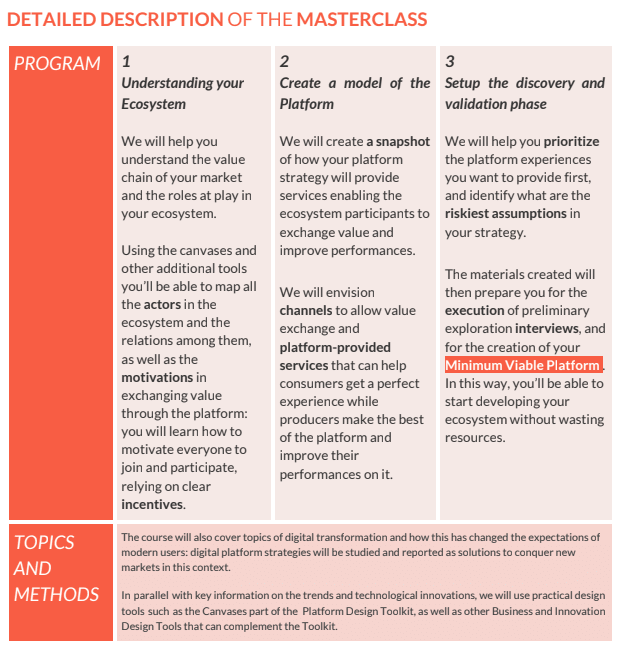
A moment of training and strategic thinking at the same time: two days in which you will learn — either independently or in a team — to use the Platform Design Toolkit, the most comprehensive set of tools for the design and prototyping platform strategies, used by thousands of practitioners around the world.

You’ll be able to apply it directly to your product, a process, or to the whole organization, a new service, a startup idea or to explore a market that you care about.

After building your strategic vision, we will help you prepare an implementation plan to validate your platform idea and test it through a lean prototyping approach that will avoid mistakes and waste of energy and money.

We will help you to get straight to a Minimum Viable Platform that will validate the appeal for your reference ecosystem, and we will prepare you to grow after. These two days will:

  • save you from bad investments and wasted expenses
  • take you from zero to a clear execution plan for the coming months.

Click to register, or for more information.

Stowe’s endorsement:

“I recently experienced a presentation by Simone Cicero about the strategy and economics of platform organizations, and he is the real deal. If you or your organization is interested in getting up to speed on the economics of platform ecosystems, this is an essential investment.”
Originally published at workfutures.org.


Find A Game Worth Playing And Play It was originally published in Work Futures Institute on Medium, where people are continuing the conversation by highlighting and responding to this story.

07 Mar 21:29

Work Futures Daily-Workism

by Stowe Boyd

Katniss won’t save us

Beacon NY — 2019–03–06 — Very short Daily today, principally because of spending way too much time yesterday trying to get a new printer working, only to learn via customer support that the printer in question is not sharable. Shipping back today. Thanks a lot, Wirecutter!

Grrrr.

If you’re getting this you probably signed up at workfutures.org (or one of its predecessors) or stoweboyd.com. If someone forwarded this to you, sign up here.

Consider becoming a paid sponsor to support our work, and to receive in-depth investigative reporting and discounts to other events, reports, and activities.

Derek Thompson’s recent essay, Workism Is Making Americans Miserable has caused a justified buzz in recent weeks. I wrote about the piece, here. Thompson writes:

“The economists of the early 20th century did not foresee that work might evolve from a means of material production to a means of identity production. They failed to anticipate that, for the poor and middle class, work would remain a necessity; but for the college-educated elite, it would morph into a kind of religion, promising identity, transcendence, and community. Call it workism.”

I wondered about the provenance of the term, workism, since I have been using it at least since 2016.

In Post-work: the radical idea of a world without jobs, published on The Guardian in January 2018, Andy Beckett attributes the word workism to one or several of a group of thinkers:

“Since the early 2010s, as the crisis of work has become increasingly unavoidable in the US and the UK, these heretical ideas have been rediscovered and developed further. Brief polemics such as [David] Graeber’s “bullshit jobs” have been followed by more nuanced books, creating a rapidly growing literature that critiques work as an ideology — sometimes labelling it “workism” — and explores what could take its place. A new anti-work movement has taken shape.
[David] Graeber, [Helen] Hester, [Nick] Srnicek, [Benjamin Kline] Hunnicutt, [Peter] Fleming and others are members of a loose, transatlantic network of thinkers who advocate a profoundly different future for western economies and societies, and also for poorer countries, where the crises of work and the threat to it from robots and climate change are, they argue, even greater. They call this future “post-work”.”

However, I can’t find a reference to workism associated with these folks. Many refer to workerism, which was an Italian Marxist set of ideas that ‘glorified the working class’, one approach to the notion of work as an ideology.

The concept of a society freed from workism — the post-work society — sees to have been the focus of these thinkers, as opposed to what precedes post-work. But one of them is the likely source of the term. I’ll try to send an email to Beckett to see what he knows.

I gave a talk in 2017 at the Business Innovation Factory’s Summit called Isms, as in Ferris Bueller’s ‘Isms are bad’. There’s a video (see How ‘Isms’ Keep Us From Transforming How We Work).

One of the Isms was workism:

“Workism
A great deal of the discourse about work can devolve quickly into rah rah boosterish motivation-speak, and accepts — without little questioning — the unexamined premises of entrepreneurial capitalism.
These range from extremely ancient and slow-to-change principles (like ‘management versus labor’) to modern innovations (like on-demand, uberish business models). But the possible negatives latent — or front-and-center, in many cases — in these practices and premises are avoided, or not even considered. Disruption is embraced, at least as long as someone else is being disrupted.
Workism is linked to an obsession with the superficial discussion of leadership, creativity, innovation, and decision-making, while avoiding the deeper human science about sociology, cognitive science, social network theory, anthropology, and economics.
In essence, workism is a body of ideas that relies mostly on folklore and suspect cultural norms, rather than science.
The roots of the cult of leadership, for example, reach back to the Bronze Age, which predates democracy, and even predates Aesop.
However, there are many deeper discussions going on where practitioners and researchers are attempting to bring new science into the workplace — which will, I believe, lead paradoxically to a much more human-centered world of work.”

This is clearly related to the notion of ‘work as an ideology’. However, I certainly could have picked up the term in passing, since I have read many things written by that group of thinkers. I’ll try to email Beckett for any leads he has.

And, in passing, here’s another piece I wrote in 2016: The Cult of Leadership and the Downfall of Workism. And an issue of Work Futures Daily from 2018: Work Futures Daily — Wait! It’s May?

Since workism is a likely candidate for the word of the year, I want to help the lexicographers. I’ve been down this road before, for the provenance of hashtag, which, yes, I did coin back in 2007.

Update: 2019–03–06 7:53am — I found that UK political blogger Nick Barlow has been using the term workism since 2014 (see this 2015 interview). However, his blog is offline, and even by the Wayback Machine I can’t get access to the 14 September 2014 article where he first used it: How did workism conquer the world?.

Quote of the Day

“Perhaps, today, in the twenty-first century, we can evolve into new patterns of organization — in work and society — where the talents, purpose, and long-term needs of all participants can be channeled to be sustainable, productive, and mutually-beneficial, and without the heavy hand of a class of leaders calling the shots. And of course, the cult of leadership couldn’t continue to flourish without the support of a class of leadership-obsessed followers spouting workist dogma, and dreaming of becoming leaders themselves one day.”

| Stowe Boyd, [The Cult of Leadership and the Downfall of Workism](

Originally published at workfutures.org.


Work Futures Daily-Workism was originally published in Work Futures Institute on Medium, where people are continuing the conversation by highlighting and responding to this story.

07 Mar 21:29

The MacStories Shortcut Repository

by Volker Weber
Welcome to the MacStories Shortcuts Archive, the official repository for shortcuts created by Federico Viticci and the MacStories team.

Use it as a repository of ideas to make your own shortcuts. This app makes me productive, just to borrow a term from the Microsoft vocabulary.

More <

07 Mar 21:28

What is associativity and why is it useful in parallel programming?

by Eric Normand

Associativity is an algebraic property that enables us to easily break up a job into smaller jobs, do the jobs, then recombine the results. Associativity is the essence of composition. In this video, we go over what associativity is, why we want to use it, when to use it, and 3 keys for making an operation associative.

Transcript

Eric Normand: What is associativity? Why is it so useful in parallel systems? By the end of this video, you should have three keys to make an operation associative. My name is Eric Normand. I help people thrive with functional programming.

Associativity is an important idea. It lets you easily break up a job, do the work separately in different threads, and then recombine the answers without any trouble. I like to think of associativity as the essence of composition.

Let’s get into it. What is associativity? It’s an algebraic property, meaning it’s a characteristic of certain operations or functions. What it means is grouping doesn’t matter. Grouping, you can imagine as the parentheses in your mathematical expression. I could have something like a + b + c with no parentheses. It’s ambiguous what the grouping is.

If I put parentheses, I could put parentheses around a + b or I could put parentheses around b + c. We know with plus it doesn’t matter how a group it, which is why we leave out the parentheses because it doesn’t matter. That doesn’t matter is what associativity is. That’s what the property that that is naming.

Another operation that programmers use all the time is string concatenation. Take two strings. Join them together into one big string. This is an associative operation. Imagine you had three strings. Just to make it easy to explain, let’s say you have the string with the letter a, a string with the letter b, and a string with the letter c.

I’m going to concatenate them all together. If I put parentheses around a concatenated with b, and then I concatenate c onto that, versus taking and putting parentheses around b concatenated with c, and concatenate a on the front of that, you see I’m always going to get the same string at the end of the day. The string that I’m going to get is a, b, c. That’s why it’s associative.

Why am I even talking about this? It’s a good question. Isn’t associativity one of those math teacher things? I’m being a math teacher and teaching this thing that’s unimportant in everyday life.

Well, it turns out that associativity is something we use all the time. We just take advantage of it, and we don’t even think about it. It’s something we learned as kids, as babies, operating in the real-world. It’s just everywhere.

We learned it. It’s become second nature. We don’t think about it, we just take it for granted.

Associativity, why it lets you break it up, break up a problem? Let’s say the problem is too big. You want to break it down into smaller jobs that you can get help with. You call some friends over, and you’re all working on the same subproblems or different subproblems. It lets you recombine them later.

Let’s say you had a long document that you needed to proofread. Let’s say you needed to read the document and cross out any words that you don’t want to be in there. It’s a simple operation, but it’s 2,000 pages long. It’s due in two days. You just don’t have time to do it.

You get some friends, and you take the stack of papers. You divide them roughly — let’s say you got three friends. Now you divide it in four. It’s three friends plus you. You divide it into four roughly. It doesn’t matter.

You just remember what order. You had the first stack. You had the second stack. You had the third stack. I’ll take the last stack. Now you just work independently, crossing out those words. Then you put them back together in the same order. The work is done.

It’s associativity that lets you put the things back together, just like a string. I have a string with 1,000 characters in it. I could break it up into multiple strings. Then later, put them back together. That’s what allows us to do that.

The order might still matter. In the case of this 1,000 page document, yes, the order still matters. You don’t want the pages out of order, but we can all work independently. When we put the answers back together, we should have the correct result.

It doesn’t matter how I break it up. I could give the first person…We said it’s 1,000 pages among four people. I can break it up into exactly 250 pages each, four people 1,000 pages total so that’s 250 each. I could be rough and give the first person 245 and the next person 255. It’s not worth counting them. It takes just as long to count them as it does to do the work.

Because it’s arbitrary, I can break it up anywhere. I know I can recombine it. I know this seems like a silly property to go on and on about. Imagine if you had this property in some work that you had to do. Imagine you had some big task to do. It might be too big to do on one machine or too slow to do on one machine so you want to break it up.

You want to use all your cores. You don’t want to do it the naive way of just starting on page one, and going to page two, and then page three, and just one at a time. You want to break it up. Not all things can be broken up and put back together.

Having an associate of operation that lets you recombine the answers together is a requirement. It’s not guaranteed that you have that. You have to make it that way. I like to think of associativity as the essential idea behind composition where you take two things and you put them together, and you make a new thing of the same type.

This is composition at its most primitive essential form. Just like you have two stacks of paper; you just put one on top of the other. You still have a stack of paper, but now it’s combined. It’s the same with two strings. Take two strings and combine them together, new string. It’s the essence of composition. I promised I’d give you three keys for making an operation associative.

I hope I’ve made the case for why associative operations are really interesting. The “why” I gave is for parallel work. It also turns out that because they’re the essence of composition, they’re really nice for design. It means you can mentally, not just on your threads, but mentally break up the problem. That means you can work on it recursively.

It means you can encapsulate and say, “I’m just going to focus on this part because it’s actually hard to think of how to solve the whole problem. I can break it down into something small enough to reason about in my head.” It’s nice for design. It turns out that a lot of things are much nicer if you have an associate of operation.

How do you do it? The three keys, really. The first thing you have to remember is that it is a binary operation. An associative operation is necessarily binary. If you have one that takes multiple arguments like in Clojure and most Lisps, a plus will take zero, one, two, three, four, etc. an infinite number of arguments, and plus is associative. Why is that? It’s because the grouping doesn’t matter.

You could write out the grouping tree, the parenthesis tree and nest them and stuff. It doesn’t matter so we just put them all in one level. That’s a syntactic shortcut. Plus is a binary operation. Addition takes two numbers and returns a number.

When it’s binary, the two arguments have to be of the same type. Like I said, plus takes two numbers. String concatenation takes two strings. Another one is merging hash maps takes two hash maps. These are all associative. They take to arguments of the same type, and then they also return the same type.

That’s what lets you nest them arbitrarily. That’s what lets you group them arbitrarily. That a + b is going to give you the same kind of argument as c, so that you can combine it again using the same plus operation. That’s the first key. Two arguments, same type, and the return type is the same type.

Number two, one way you could do it easily to make an operation associative is to use an existing associative operation on a data structure. You use the data structure that already has an associative operation. I’ve talked about, for instance, hash map merge. That’s an associative operation. Try it yourself. You’ll see that you can merge three things and group them arbitrarily.

If you build your data structure out of hash maps and you use merge when you’re defining your function, your operation, it will be naturally associative. Number three, this is a big one and I hope I don’t get too abstract with it. When you’re giving work to your friends, let me give a little preface.

When you’re giving work to your friends or I wanted to say someone that who’s working under you, so you’re delegating work. What you want, the ideal is to give them the entire job so that they can do it totally independently and not have to come ask you a million questions. That is, “Oh, do you have this thing? Do you have that thing?”

You want to be able to give them the work so that you can go do something else at the same time. You don’t want to have to sit around and answer the questions. That same concept applies when you’re dealing with associative operations. You want the string, so you break the string up into two so that you can work on it separately.

Each string, both of them, they contain everything that you need for that work. If you’re counting the letter a in this string and it’s too big to do in one pass, you break it up into two, and now one thread is doing counting a’s in the first string and one is counting a’s in the second string. That string has everything it needs. It knows its own link. It knows all the characters in it.

It’s silly to think about like of course it has everything it needs, but do your data structures, do your things have everything they need. Here’s an example of a time when you don’t have everything you need. If you’re a calculating an average, often what people do is they have a sum. Average is a sum over the count.

They have a sum and they loop through the array and add numbers into that sum, and then they get the count from the array and then then they divide it. Notice, you are doing these two things separately. You are summing separately from counting. What you want to do is have each value, each number in that array be a self-contained value, self-contained average.

This array of numbers, think about it this way. If you took that array of numbers and you broke it up arbitrarily and said, “OK, you average this part, I’ll average this part, and then we’ll combine them together.” How can you do that? Because if the answer you get is an average of seven numbers in the operation and the average I get is an average of eight numbers, it’s not apparent how to combine those.

If you know that it’s seven and eight, then you can. If you don’t know, if you just know the number, you cannot safely combine those two averages. What you need to do is instead of dividing it out and getting the average, you bundle the sum and the count into say, a new data structure. Let’s call it just a tuple, because it’s just a pair of numbers. It’s a quotient.

Eventually, you’re going to divide them, but before you do that you’re going to leave it like this, as two separate numbers. How do you do this? Instead of having an array of numbers, you map over that array and turn each one into an average. It’s an average of one number, so it’s the number and a one. It is a tuple of the number and one of all of those numbers in that array.

Now you can safely split up that array, hand one half over to your friend, you do the other half. What do you do? You take two of these averages and you add that, you add the sum part, and you add the count part. Now you have a new tuple. It’s a combining operation. It takes two tuples and returns a tuple. That’s done. Now it’s an associative operation.

That means you can split it up over multiple threads safely, recombine them arbitrarily. There you go. That’s something that I like doing a lot. It’s like you squinting and thinking hard, like, what are all the pieces of information I need in this value so that I can do this without having a variable over here that’s got some magic or some partially completed calculation that I’m going to use during the calculation?

It’s how we usually do it, but it’s much better to move to the associative side. Those are our three keys. I’m just going to recap the whole thing. Associativity is an algebraic property where grouping doesn’t matter. It lets you break up work, solve, get an answer, and then recombine the answers. I like to think of it as the essential nature of composition because of that idea. It’s combining two things into a bigger thing.

The three keys of how to do this. Know that it’s a binary operation, the two arguments are the same type and the return is the same type as the arguments.

You can use existing data structures with associative operations to build a new associative operation and bundle the values together, to make the work complete by itself. I want you to do yourself a favor to learn this idea. Go find existing associative operations and the data structures they belong to. I’ll give you some examples. Just play with them in your own code to test whether they are associative.

It’s very easy to test if they’re associative. If you can’t do (a + b) + c = a + (b + c), then it’s not associative. You got to find some way of making it not associative. String, array or a list concatenation. These are all associative.

Addition and multiplication are associative, but subtraction and division are not. Map merge, merging two maps together. Function composition, if you’ve got that in your language, give it a try. Function composition, if you compose three functions, it doesn’t matter how you group them. AND and OR with on Boolean, those are associative.

Set union is associative and set intersection is associative. Give that a try. Test those out in your languages. If you liked this video, if you liked what you’ve learned, if you found it useful, I would very much appreciate if other people could find this information useful, too.

Like, Share, Comment and certainly subscribe because then you’ll get the next one which I guarantee will be close in usefulness to this video or this episode, so you’ll get that one too.

If you have any questions, if you want to discuss anything with me, if you want to suggest a topic for the next episode, please email me, eric@lispcast.com. You can also find me on Twitter. I love getting in discussions on Twitter, @EricNormand, with a D.

Look me up on LinkedIn, and we’ll connect up. Awesome. See you later.

The post What is associativity and why is it useful in parallel programming? appeared first on LispCast.

07 Mar 21:27

Two hours in Chutchui

by Liz

Though I’ve been here on and off since 1991 I have never been to the actual Mission building in the Mission. I set out in the late afternoon to visit, feeling sad and solemn. I wanted to see the grave markers for Jocbocme and Poylemja aka Obulinda and Faustino. I hadn’t realized they are thin slabs of redwood and not gravestones from 200 years ago. The building, well, it was an old adobe church, I’ve seen a few and it was just like the rest of them. The big church, I couldn’t get into. There was a tiny kind of sad museum with minimal signage and a diorama uneasily juxtaposed with gilded religious things – in separate glass cabinets. The cemetery was a moody place with an untended air; the Ohlone tule house replica and “indian memorial” was full of water and trash inside. I read the gravestones, and a long list of all the people with grave markers there. Some were marked as killed by vigilantes. There were some french names, italian, lots of irish, many spanish including De Haro, José de Jesús Noé, the Bernal family, Captain Arguello. I was wondering if there would be a grave for Francisca, one of the first to die at the Mission (no.) Of course, the entire Dolores Park was a giant graveyard as well. I wandered around and thought of the unmarked graves of the thousands of Ohlone, Miwok, and other indigenous people who died at the Mission. The little statue of Kateri Tekakwitha, engraved “In Prayerful Memory of the Faithful Indians.” (WTF?!!??!!) Moss and grime on all the names in stone. As I went around the streets outside, I tried to see the landscape without rows of houses and pavement and see the landforms, creeks, arroyos, dunes, reed beds, and oaks that were there and the villages or camps of the Ramaytush people moving around the peninsula, including Chutchui. The banks of the creek were familiar to people, particular trees, good places to sit and look out from the hills, all familiar and homelike. As I went past the Maxfields cafe I was debating going in to write up some of my notes and also do some more work for the day. Ada and her friends were inside & ran out to fetch me! A nice surprise. They continued working on their D & D game prep while I got some work done. It was just nice to be around them. Waiting for the J, I was still looking around trying to see into the past several layers deep, my mood quite strange as well from having been reading the book “Ishi’s Brain” on top of the creepy Mission visit, when I realized the next train wasn’t going to come for 40 minutes (weird) so we trudged up to Castro to get the 24 home. The kids got on the back of the bus but the front was too crowded for me to get on. I tried to yell to them to just go without me but they hadn’t noticed so all was well – I would just get the next bus and use the interval to keep thinking my thoughts and take more notes. On the ride over the steep hills of Castro I was trying to re-think Chutchui into an alternate modern existence. The creeks open to the sky and rather than parks, camping sites as part of the infrastructure of the city, interspersed with buildings, the transport mostly underground, marshes and cultivated reedbeds and dunes still there, and people magically inoculated from disease, coexisting messily, much like now but with some different foci, different languages, power centered differently. As we turned onto 30th I got a phone alert on the Citizen app that a man had been stabbed in the back at the bus stop that I was about to get off at (30th and Mission) and traffic was stopped and would be rerouted. People were streaming live video of a woman in a red hat screaming at the police. Two men had run away from the scene, leaving in a white car. As my bus neared the scene we could all see that the block was swarming with cops. At least, I knew the kids were ok. It was their bus empty and parked a few blocks ahead at the corner of Mission and 30th. I got off the bus (explaining to the driver and the people at the front what was going on) and went home, skirting the cordoned off block and feeling so glad for my leather jacket covering the itchy places between my shoulderblades and more moodiness underneath as I thought of my girlfriend who was stabbed there in the 80s. Violence & ghosts are built into our landscapes as familiarly as anything else.

07 Mar 21:27

Planning For What Happens When It Doesn’t Catch On

by Richard Millington

There’s a dangerous myth that a community either catches on or it doesn’t.

Almost every prospect we’ve spoken with has treated their community as a ‘one-shot’ deal.

They will develop the platform, launch it, and hope people get engaged. If they don’t, they close up shop and leave. Some prospects even ask for an exit plan.

The odds of success are low if you plan on hitting a home-run on your first swing compared with taking multiple swings.

Like most things, it’s a process. We use audience research (often overlooked entirely), experience, and data to come up with the community program that’s most likely to work and begin testing it with the audience.

If it doesn’t catch on, we see what is and isn’t working and adapt accordingly. For example, if we can get a lot of people to visit but not stick around, that’s a relevancy problem. However, if we can’t get many people to visit in the first place, that’s an outreach and promotion problem. Both are fixable.

The more swings you take, the more you learn about what members want and what works. If you’re going to invest $500k (or even $50k) in a community, you want more than one swing at this. Don’t hype up launch day and treat the community as a one-shot deal. Treat it as the beginning of a process in researching what your members want and need.

Prepare for the game, not the home-run.

07 Mar 21:25

Replied to If you were going to design th...

by Ton Zijlstra
Replied to

@davewiner A bit of both, twitter when getting a feel for what’s going, Greader when seeking input smth specific. And not just RSS, but ‘anything’, & interactive like @aaronpk’s Monocle.

07 Mar 21:24

What MVC framework for web development?

by tychay

Answered in Quora:

Q: Why should I learn the combination of Python/Django rather than PHP, JS/Node? I am a web designer moving to web development. What is the scope of Python/Django?

Python/Django is like learning Ruby/Ruby on Rails. The equivalent in the PHP world would be PHP/Drupal or PHP/Laravel. Equivalents in NodeJS is not Node/JS but NodeJS/Meteor or NodeJS/Sails. In all those examples above the first part would be the underlying web language, and the second would be a MVC framework on top of the language.

(There exist web frameworks that do not provide MVC but just the web server and HTTP request-response plumbing. This isn’t common in PHP since it is embedded in a web server such as Apache or nginx, but in Python it would be flask and in NodeJS it would be Express or Koa— these are sometimes referred to as “microframeworks.”)

However, unlike on the front-end with things like Vue.js, React/Redux and AngularJS, full-service MVC web frameworks have increasingly less utility on the back-end. This is because most the the advantage a framework provides is to do heavy-lifting of tedious but repeatable tasks that require a lot of code (very common when building a user interface) the bulk of which has been moved onto the client in web development. What value is a MVC’s templating system and router when both have moved into javascript on the client-side and all interactions are through an API? This becomes more extreme with standardization of the data interface (a la GraphQL) and the prevalence of more service-oriented architecture popularized by microservices or serverless FaaS architectures.

MVC web-frameworks still provide things such as a configuration management, a data object model and abstraction, but even those can get in the way as a website becomes more mature and this pre-fab approach becomes a hinderance to future scalability and optimization.

Also, when not building to scale or building proof-of-concept, a full MVC architecture will help you starting out on server-side web development because it does all the heavy lifting for you. So it might be good to start out with one, though YMMV (your mileage my vary).

Why Django?

As for why you should learn Python/Django over other language/framework combinations, assuming you want to pick your poison by adopting a back-end MVC framework to do back-end development…

Vs. NodeJS/insert mvc framework. NodeJS, in general, is a little difficult to pick up on the server-side because it has a peculiar architecture even though it is written in JavaScript. If you haven’t already bitten the NodeJS bullet in order to get a React or Angular2+ application running, then avoiding that may be a plus for your first introduction to server-side web development. I think the most popular MVC framework in NodeJS is Meteor and it has low adoption. (It is also a bit of overkill unless you plan on deploying a mobile app at the same time.) Remember, while you will need to use JavaScript on the front-end, MVC frameworks provide so much abstraction there is little advantage in being proficient in the underlying language.

Vs. PHP/insert mvc framework. Python as a base language has more overall utility than PHP. DevOps (the third missing coding component in your arsenal) uses either Python or Ruby as the base language so it is useful to have one or the other under your belt. Also Drupal and Laravel adoption is unusually low footprint in the PHP web development space because PHP is a web-development-only language and because applications such as WordPress, MediaWiki, and the like, written in PHP, are their own frameworks for the app markets they serve. Also, PHP’s development philosophy of being “shared-none” and “web glue” is antithetical to a MVC framework—which is kind of like a pre-fabricated house.

Vs. any others? If I’m being 100% honest, if you were to learn a web language/MVC framework combination as your introduction to server-side web development, I recommend Ruby on Rails over all of combinations you mention. It’s very mature, it has a massive saturation in its community (Ruby), and there are far more sites/job opportunities using this platform than any other web framework. Finally you can learn Ruby on Rails first and then Ruby “as you go” whereas other frameworks are heavily weighted to learning the language before the framework.

Having said that, I think Python/Django is a close-second and has the advantages of being in Python, a better learning/teaching language and being more powerful if you are doing data work down the road.

Response to the Django dickhead who called my answer “startlingly ignorant.”

Yes, I’m so “startlingly ignorant” that I’ve been a professional web engineer/architect/manager for almost 20 years on some of the largest projects on the internet, including two of the top 10 largest web properties.

I’ve also coded commercially in Ruby on Rails, Python/Django, as well as in NodeJS and GoLang. However, unlike you, I didn’t recommend against Python/Django, nor did I promote my preferred (web) language. I don’t proselytize a particular language or framework religion, but consider them architectural design choices and work within them.

MVC is an architectural design pattern. When coupled with front-end development some of that architecture is going to be in JavaScript on the front end—maybe they want to put the “V” there as much as possible, so even if they are using MVC, they might not want to quickly adopt something that things the “V” is a HTML template in Jinja2 and a “M” is a built-in ORM which is what you laughably suggest. A framework like MeteorJS spans both the front-end and back-end and throws in mobile app development for good measure. Others move toward micro-frameworks like Flask or Express to defer that decision until the architecture is more fleshed out.

I obviously wasn’t advocating against using MVC as a pattern, I was against blindly advocating using an MVC embedded in a framework at scale or with a site built with an API-first approach, which is increasingly more common. Even those two top 10 websites I worked at, old as they are, don’t use any of the frameworks mentioned, but they do use MVC in their own framework (WordPress for WordPress.com and MediaWiki for Wikipedia).

In fact, at scale, for every example of a successful use of a MVC monolithic framework (like Instagram using Django), I can come up with a similarly-sized one not doing so (Instagram’s owner, Facebook itself) AND one using a non-MVC micro-framework (like Pinterest which uses Python/flask).

BTW, even today, PHP outnumbers Python and Ruby combined in usage on the web at both scale (top 100 or top 10 sites by traffic) and overall (27% of all domains on the internet are powered by a single PHP application, WordPress), so it is hardly “dead.”

As for Python, I code in it, I think it’s a great language. I’ve actually been advocating it as the best teaching language for over a decade. If someone is coming from an ops background or a data science background I’d recommend they continue to use it when migrating to the web. In many cases, I’d even point them to Django over Flask. Yes, Python’s star is rising, but that has been because of data science and cloud computing and not because of Django.

Fuck you and your Python-uber-Alles religion. (And yes, when someone is PHP-uber-Alles, I shit on them too. I’m not going to hold take a bullet to my head to build a similarity score model in a language that doesn’t have anything like NumPy just because I happen to prefer PHP to connect a database to the web.)

07 Mar 21:23

2019-01-26 January 26

by tychay

AUNT GIA:
Tomorrow is the 117th birthday of Aboji and the 20th anniversary of our dear sister Apchang’s passing. Love you both and you are alive in our hearts.

UNCLE FRANCIS:
Thanks for reminding me.

AUNT TAMAYE:
This was how Apjang looked like at Kenny’s birth.

Dad, Ken, & Mom

KEN (Brother):

Thank you Gia & Francis! I actually have the photo framed and on the wall next to the computer I’m typing from in my home office. Not to see what I looked like, but to see what mom (and dad) looked like back then. Hard to believe that they were roughly 15 years younger than I am now! I’m spending today working on research. I’m sure mom would approve.

AUNT GIA:
You still look the same, a bit older now.

COUSIN ALEX:
Yep Ken, exactly the same.

07 Mar 21:16

Twitter Favorites: [jllord] 📣 It’s my first week @Glitch!!!! 🎏 I’m *so* excited to get back into JS/Node and developer tools and to help build… https://t.co/sFpElrl8lP

Jessica Lord @jllord
📣 It’s my first week @glitch!!!! 🎏 I’m *so* excited to get back into JS/Node and developer tools and to help build… twitter.com/i/web/status/1…
07 Mar 21:16

Twitter Favorites: [TorontoArchives] Ontario Place construction, 1970. Photos: City of Toronto Planning, Urban Design Unit: https://t.co/D1KQWdUNUw… https://t.co/g1HhC7ICqV

Toronto Archives @TorontoArchives
Ontario Place construction, 1970. Photos: City of Toronto Planning, Urban Design Unit: ow.ly/kmFy309d5xbtwitter.com/i/web/status/1…
07 Mar 21:16

Twitter Favorites: [enkerli] #Montreal as “the Berlin of North America”. Quite different from its past reputation as the “Amsterdam of North Ame… https://t.co/fPn0ekrVh1

Alexandre Enkerli @enkerli
#Montreal as “the Berlin of North America”. Quite different from its past reputation as the “Amsterdam of North Ame… twitter.com/i/web/status/1…
07 Mar 21:15

Twitter Favorites: [itscmwong] 'A race against time': urban explorers record vanishing Hong Kong https://t.co/zoDNWaOvFI

Christina Wong @itscmwong
'A race against time': urban explorers record vanishing Hong Kong theguardian.com/cities/2019/ma…
07 Mar 21:13

Twitter Favorites: [skinnylatte] A tiny thread about Mandarin. As a student in Singapore, I had to do 1h of Mandarin lessons daily. I have a convo… https://t.co/QmPIMe1DMf

Adrianna Tan @skinnylatte
A tiny thread about Mandarin. As a student in Singapore, I had to do 1h of Mandarin lessons daily. I have a convo… twitter.com/i/web/status/1…
07 Mar 21:12

Twitter Favorites: [rtanglao] it would be YES to river for some news sources AND YES to mailbox reader style for the remainder #scriptingnews https://t.co/qNFZvIz76F

Roland Tanglao 猪肉面 @rtanglao
it would be YES to river for some news sources AND YES to mailbox reader style for the remainder #scriptingnews scripting.com/2019/03/06.htm…
07 Mar 21:12

Facebook’s Privacy Cake

by Ben Thompson

What was striking about the reaction to Mark Zuckerberg’s latest missive about the future of Facebook, A Privacy-Focused Vision for Social Networking, were the two very distinct reactions that, in my estimation, made the same mistake, but in opposite directions; one set of folks didn’t take Zuckerberg seriously at all:

Another set took Zuckerberg entirely too seriously:

In fact, what Zuckerberg announced is quite believable, precisely because it makes perfect sense for Facebook: this is a privacy cake that Facebook can have — and eat it too.

The Social-Communications Map

Zuckerberg began by describing two distinct kinds of social networks:

Over the last 15 years, Facebook and Instagram have helped people connect with friends, communities, and interests in the digital equivalent of a town square. But people increasingly also want to connect privately in the digital equivalent of the living room. As I think about the future of the internet, I believe a privacy-focused communications platform will become even more important than today’s open platforms. Privacy gives people the freedom to be themselves and connect more naturally, which is why we build social networks.

Today we already see that private messaging, ephemeral stories, and small groups are by far the fastest growing areas of online communication. There are a number of reasons for this. Many people prefer the intimacy of communicating one-on-one or with just a few friends. People are more cautious of having a permanent record of what they’ve shared. And we all expect to be able to do things like payments privately and securely.

Public social networks will continue to be very important in people’s lives — for connecting with everyone you know, discovering new people, ideas and content, and giving people a voice more broadly. People find these valuable every day, and there are still a lot of useful services to build on top of them. But now, with all the ways people also want to interact privately, there’s also an opportunity to build a simpler platform that’s focused on privacy first.

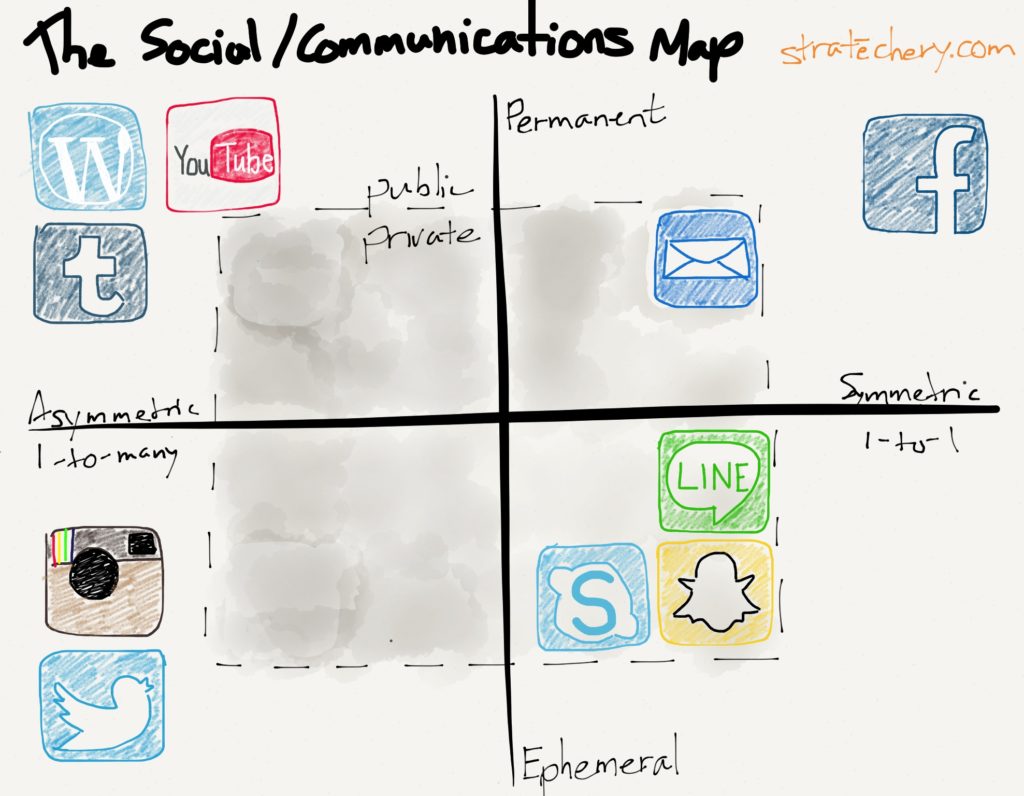
I first explored the idea of there being different types of social networks in 2013 when I created The Social/Communications Map:

A drawing of the Social/Communications Map

Keep in mind, this image is from 2013, but there are still some important points worth calling out:

  • First, the axes are about user perception, not technical implementations; back then tweets were very much experienced as being ephemeral; now they have more permanence, leading to people both being called-out for old tweets and/or deleting their archives.
  • That Twitter and Instagram should have perhaps been on the “permanent” side of the axis is further emphasized by the success of Instagram Stories, which is much more ephemeral than Instagram posts, along with the rise of tweet threads replacing blogging.
  • I noted in the post that LINE was representative of multiple chat networks, including WeChat and WhatsApp; obviously I should have illustrated both instead.

The most important thing to note, though, are the relative positions of Facebook and Snapchat (it was Facebook’s attempted acquisition of Snapchat that inspired the map in the first place).

Facebook Versus Snapchat

Perhaps the most important moment in Facebook’s history was its shift from the private to public space on the Social/Communications Map with the introduction of the News Feed. Again, to be clear, this map is about public perception, not technical reality, and this is a perfect example: data on Facebook was public to everyone in your network from day one. What the News Feed did, though, was change Facebook data from a pull to a push model: instead of needing to seek out your friends’ profiles Facebook would push their updates to you directly.

This inspired a strong backlash amongst users, who not only complained online but actually organized rallies in person; ultimately, though, it turned out that people loved the News Feed, and once Facebook embraced mobile, it turned out the News Feed was perfect for advertising.

Still, that transition exposed a soft underbelly in Facebook’s product: private ephemeral communication that allowed users to be their true selves. This was the premise undergirding Snapchat, which I described in Facebook, Phones, and Phonebooks:

It is increasingly clear that there are two types of social apps: one is the phone book, and one is the phone. The phone book is incredibly valuable: it connects you to anyone, whether they be a personal friend, an acquaintance, or a business. The social phone book, though, goes much further: it allows the creation of ad hoc groups for an event or network, it is continually updated with the status of anyone you may know or wish to know, and it even provides an unlimited supply of entertaining professionally produced content whenever you feel the slightest bit bored.

The phone, on the other hand, is personal: it is about communication between you and someone you purposely reach out to. True, telemarketing calls can happen, but they are annoying and often dismissed. The phone is simply about the conversation that is happening right now, one that will be gone the moment you hang up.

In the U.S. the phone book is Facebook and the phone is Snapchat; in Taiwan, where I live, the phone book is Facebook and the phone is LINE. Japan and Thailand are the same, with a dash of Twitter in the former. In China WeChat handles it all, while Kakao is the phone in South Korea. For much of the rest of the world the phone is WhatsApp, but for everywhere but China the phone book is Facebook.

Make no mistake, the phonebook has been more valuable: it lends itself better to both data collection and advertising. Snapchat, though, threatened to break out of the phone space into the phonebook space with Stories — a product that shifted Snapchat out of the private space into the public one.

To that end, it is instructive that it is Stories where Facebook finally mounted its Snapchat defense: I wrote in The Audacity of Copying Well:

Instagram and Facebook are smart enough to know that Instagram Stories are not going to displace Snapchat’s place in its users lives. What Instagram Stories can do, though, is remove the motivation for the hundreds of millions of users on Instagram to even give Snapchat a shot.

That is exactly what happened: Snap retained its place as the core of 1×1 communication for young people, but the segments more removed from Snapchat’s core use case of chat were suddenly far less likely to even give the service a try, thanks to Instagram’s intelligent leveraging of its network.

By the same token, though, just because Facebook capped Snapchat’s growth doesn’t mean that Snapchat’s core insight about the desire for private, ephemeral communication was wrong: what Zuckerberg wrote yesterday is basically Snapchat’s reason-for-existing. In other words, while Instagram Stories built a wall around Snapchat by copying Snapchat’s secondary feature, this “Privacy-Focused Vision for Social Networking” is a clear attempt to build the core of Snapchat for everyone else.

Zuckerberg’s Vision

Look again at what Zuckerberg outlined:

  • Private interactions
  • Encryption
  • Reducing Permanence
  • Safety
  • Interoperability
  • Secure data storage

The first three are all about owning the 1×1 private ephemeral space; critically, none of them have anything to do with Facebook’s core feed-based products. Facebook is going to continue to exist as it has to date, as will Instagram, including all of the data collection and ad targeting that currently exist. The “Privacy-Focused Vision for Social Networking” is in addition to Facebook’s current products, not in place of. This is the mistake made by those that took Zuckerberg too seriously.

As for those who didn’t take Zuckerberg seriously enough, why wouldn’t Facebook want to move in this direction? There are multiple benefits:

  • First, this is a valuable space to own for all of the reasons that Snapchat succeeded in the first place. People want a place to communicate freely without fear of snooping or a historical record.
  • Second, to the extent the rise of 1×1 networking is inexorable, it is better for Facebook that it happen on their properties. Not only does Facebook preserve the ability to advertise on privacy-focused platforms — the company can leverage data from Facebook to advertise in its messaging products (although I am skeptical that messaging products are well-suited to advertising) — it also prevents would-be competitors from capturing leverageable attention.
  • Third, as we have seen over the last 24 hours, there are tremendous PR benefits from a privacy-focused service. Facebook has changed nothing about its core service or data collection policies, yet the assumption is that the company is pivoting and the only debate is whether to believe them or not.

Perhaps most compelling, though, is the degree to which this move locks in Facebook’s competitive position. As I noted above, Snapchat already showed that Facebook is vulnerable in the realm of private ephemeral communications, but soon that will no longer be the case. Moreover, given Facebook’s focus on end-to-end encryption, the company has made it that much harder to even get off the ground: not even Snapchat is fully end-to-end encrypted (pictures are, but not text messages).

There is an even more important benefit to Facebook voluntarily forgoing the data within messages and limiting the time it keeps surrounding metadata (make no mistake, end-to-end encryption is a real thing — Facebook will not be able to see encrypted messages); as Zuckerberg told Wired:

Certainly, ad targeting can benefit from having access to as much content or signal as possible. You know, I’m more optimistic about this for a few reasons. One is that we aren’t really using the content of messages to target ads today anyway. So we weren’t planning on doing that. So it’s not like building a system and making it end-to-end encrypted and now we can’t see the messages is really going to hurt ads that much because of the way we were already thinking about that. Keeping metadata around for less time will have some impact, although I’m optimistic that we’ll build systems that can basically deliver most of the value with a fraction of the amount of data.

Why can Facebook deliver most of the value? Because they are still Facebook! They still have the core Facebook app, Instagram, ‘Like’-buttons scattered across the web — none of that is going away with this announcement. They can very much afford a privacy-centric messaging offering in a way that any would-be challenger could not. Privacy, it turns out, is a competitive advantage for Facebook, not the cudgel the company’s critics hoped it might be.

Safety, Interoperability, and Strategy Credits

The last three items in Zuckerberg’s list are interesting in their own right; to take them one-by-one:

Safety: This is about the very real trade-offs that come with end-to-end encryption. One obvious issue is law-enforcement: Apple has already been down this road with the FBI when it comes to phone security; end-to-end encryption is both more challenging and yet simpler, simply because it is, properly implemented, truly unbreakable.

Another issue is misinformation: for all of the issues surrounding misinformation on Facebook, at least misinformation is traceable; that is not the case if messages are encrypted, which has already been an issue with WhatsApp in India. One could certainly make the cynical argument that, in the process of cloaking itself in privacy, Facebook is washing its hands of misinformation.

To be sure, Facebook is confident it can leverage its ability to analyze metadata to stop bad actors; that the exact same sort of audience analysis is perfectly portable to advertising is a rather happy benefit as far as Facebook is concerned.

Interoperability: This is perhaps the feature that is easiest to be cynical about; while it can certainly be frustrating to have to balance multiple messaging apps, for much of the world consolidating Facebook-owned messaging will not fully address the problem, thanks to alternatives like Messages, LINE, Kakao, etc. Moreover, even in areas where Facebook owns both the Phone (via WhatsApp) and the phonebook (via Facebook and Instagram), exactly how much consumer demand is there for integration?

There is, to be sure, a business argument: Facebook has already unified much of the ad infrastructure underlying its services, and unifying messaging is, to the extent Facebook wants to build a business platform on messaging, a natural next step. There is also a regulatory argument: while it is difficult to make the argument that Facebook has broken antitrust laws, the remedy, should that be accomplished, is obvious — split off Instagram and WhatsApp. That will be harder to do if they are fully integrated with Facebook, not simply on the advertising side but also the user side.

Secure Data Storage: This is an interesting addition to this piece, as it has little to do with messaging in the communications sense, but a lot to do with messaging in the political sense. This is what Zuckerberg wrote:

There’s an important difference between providing a service in a country and storing people’s data there. As we build our infrastructure around the world, we’ve chosen not to build data centers in countries that have a track record of violating human rights like privacy or freedom of expression. If we build data centers and store sensitive data in these countries, rather than just caching non-sensitive data, it could make it easier for those governments to take people’s information.

Upholding this principle may mean that our services will get blocked in some countries, or that we won’t be able to enter others anytime soon. That’s a tradeoff we’re willing to make. We do not believe storing people’s data in some countries is a secure enough foundation to build such important internet infrastructure on.

The most obvious country worth avoiding is China, which means this is clearly a Strategy Credit:

A strategy credit is an uncomplicated decision that makes a company look good relative to other companies who face much more significant trade-offs.

Facebook is already banned in China, so not putting data centers in China costs the company nothing (it may soon cost the company in Russia; one imagines Facebook will not mind being banned there of all places). This is in sharp contrast to Facebook’s most vociferous critic in tech, Tim Cook and Apple; the latter absolutely stores customer data in China along with encryption keys, because that is the law for companies that wish to operate in the country.

To be clear, this is understandable, but that is what makes that Strategy Credit article rather ironic; I coined the term in response to Apple’s posturing about user data in the wake of the Snowden revelations, noting that forgoing data wasn’t really a tradeoff given Apple’s business model. Now Apple is on the other side of the coin.

Privacy Moats

Ultimately there are three broad takeaways from Zuckerberg’s article:

  • Stop expecting companies to act against their interests. Facebook isn’t killing their core business anymore than Apple, to take a pertinent example, is willing to go to the mat to protect user data in China.
  • Facebook doing something that benefits itself is not inherently bad for end users. It is perfectly reasonable that the company can be instituting genuinely user-friendly changes like end-to-end encryption even as it furthers its own self-interests.
  • Relatedly, and most importantly, there needs to be much more appreciation for the anti-competitive trade-offs inherent in an absolutist approach to privacy. Facebook is doing what its fiercest critics supposedly want, and enhancing its competitive position as a result.

This was a point I made last year in Open, Closed, and Privacy:

If an emphasis on privacy and the non-leakage of data is a priority, it follows that the platforms that already exist will be increasingly entrenched. And, if those platforms will be increasingly entrenched, then the more valuable might regulation be that ensures an equal playing field on top of those platforms. The reality is that an emphasis on privacy will only increase the walls on those gardens; it may be fruitful to rule out the possibility of unfair expansion.

This is a debate that is woefully lacking. The reality is that the only user-friendly way to enforce privacy — which is another way of saying the only scalable way in a demand-driven world — is to severely limit inter-operability and over-burden would-be challengers. Regulators need to be far more aware of this and either choose another approach to privacy — i.e. entrust it to individuals — or regulate data-platforms, at least in terms of competition on top of their platforms, even more severely.

07 Mar 21:12

IBM-Studie: Förderung von Frauen hat für 79 Prozent der globalen Unternehmen keine Priorität

by Externer Autor
Eine neue Studie von IBM, Women, Leadership, and the Priority Paradox, befragte weltweit 2.300 Führungskräfte und Fachleute und erhielt als Ergebnis, dass am Arbeitsplatz weiterhin eine geschlechtsspezifischer Unterschied vorherrscht, weil Unternehmen die Förderung von Frauen [...]
07 Mar 21:11

vian-cloe:  Lithuanian artist Daiva Kaireviciute, 2016. Mėnulis...


vian-cloe:

 Lithuanian artist Daiva Kaireviciute, 2016. Mėnulis pilnėja. (Moon gets full).

07 Mar 21:11

nobrashfestivity: Jacqueline Nonkels, René Magritte painting...


nobrashfestivity:

Jacqueline NonkelsRené Magritte painting ‘Clairvoyance’, Brussels, October 1936

René MagritteClairvoyance, 1936
Oil on canvas 

Latrobe Regional Gallery  

07 Mar 21:11

the-real-numbers: the-real-numbers: the-real-numbers: mapsont...


the-real-numbers:

the-real-numbers:

the-real-numbers:

mapsontheweb:

The US states if the land was given to the closest top 50 city by population.

Voronoi?

The following image was made using Wolfram Mathematica’s Voronoi mesh, city data, and some fancy graphics. I was so curious I had to see for myself.

I forgot that this map only shows 48 states so I took the top 48. It looks slightly different near Kansas City.

07 Mar 21:11

"It is good to have an end to journey toward; but it is the journey that matters, in the end."

“It is good to have an end to journey toward; but it is the journey that matters, in the...
07 Mar 21:11

Hands On with Sony’s PS4 Remote Play App for iOS

by John Voorhees

In a bit of unexpected gaming news, Sony has released PS4 Remote Play, an iOS app that allows PS4 owners to play the console’s games on an iPhone or iPad over WiFi. Although it’s a surprising development this late in the lifecycle of the PS4, it’s great to see Sony continuing to expand the ways its customers can enjoy the console.

Logging in for remote play.

Logging in for remote play.

PS4 Remote Play takes just a few minutes to set up. On your PS4, Remote Play needs to be enabled by going to Settings → Remote Play Connection Settings to make sure the Enable Remote Play checkbox is checked. In the PS4 Remote Play app, tap the ‘Start’ button and sign into your PlayStation Network account. The app will then search for your PS4, which can take a few minutes. If PS4 Remote Play fails to find your PS4, you can manually enter a code displayed on your TV to connect using the ‘Add Device’ option under Remote Play Connection Settings.

PS4 Remote Play's controller layout.

PS4 Remote Play's controller layout.

Once your iOS device is connected and registered with Sony’s remote play system, you’re ready to go. When you first connect you’ll see a short tutorial showing you how to control the PS4. In landscape mode, the buttons of a PS4 controller appear onscreen with a tap, but otherwise, fade out. The primary on-screen buttons are laid out on the left and right sides of the screen just as you find them on a PS4 controller. The shoulder and trigger buttons appear just above the PS4’s primary buttons. In portrait orientation, the controller buttons are positioned below the gameplay area.

Virtual thumbstick controls.

Virtual thumbstick controls.

Analog sticks are controlled using virtual thumbsticks that appear when you place your fingers on the left and right sides of the screen. The L3 and R3 buttons that are available when you press down on the analog sticks on a PS4 controller are mapped to double taps on the thumbsticks.

Playing PS4 games with virtual controls is doable, but difficult, which is why I’m glad to see that the app also supports MFi controllers like the SteelSeries Nimbus. Based on my brief testing, an MFi controller is the way to go for anything but the most basic casual game. You won’t have access to the L3 and R3 buttons on a controller like the Nimbus, but it’s a far better experience overall.

Sony’s DualShock controllers aren’t supported for remote play, but as noted by Killercow on Twitter if you’re within range of your PS4, you can connect to your PS4 as one user and then connect via the PS4 Remote Play app as another user, which allows you to use a DualShock controller as the first user while still viewing the game on your iOS device:

This trick won’t work when you’re away from home, but if you’re within range of your PS4, the DualShock controller is an even better solution because there’s less lag and you have the benefit of rumble feedback.

Remote Play also supports the iOS keyboard for text entry and the microphone for chatting while you play. Another nice touch on the iPhone is that the on-screen controls provide haptic feedback, which brings the experience closer to what it’s like to use physical buttons than is possible on the iPad.

Resolution takes a noticeable hit when playing remotely, but games are still surprisingly playable with a controller.

Resolution takes a noticeable hit when playing remotely, but games are still surprisingly playable with a controller.

Before you get started, it’s important to keep the limitations of PS4 Remote Play in mind. By default, the app sets the resolution at 540p. On the PS4, that can be increased to 720p, but only the PS4 Pro supports 1080p resolution. There’s also an option for 360p resolution, though I wouldn’t suggest using that setting unless you’re desperate for a PS4 gaming fix. The frame rate can also be adjusted between Standard and High.

I’ve only had a short time to use PS4 Remote Play, but I’ve been impressed with the experience when using a controller over my home WiFi, which consistently delivers over 300 Mbps downstream. Despite dropped frames and periodic resolution degradation, the convenience of playing somewhere other than in front of my TV is fantastic, especially on the large screen of the 12.9-inch iPad Pro. I expect to be experimenting with this app a lot in the coming weeks to see how well it works on slower connections and with a wider variety of games.

Remote Play requires iOS 12.1 or later and an iPhone 7 or 6th generation iPad or later, plus a PlayStation Network account and fast WiFi.

PS4 Remote Play is available on the App Store as a free download.


Support MacStories Directly

Club MacStories offers exclusive access to extra MacStories content, delivered every week; it's also a way to support us directly.

Club MacStories will help you discover the best apps for your devices and get the most out of your iPhone, iPad, and Mac. Plus, it's made in Italy.

Join Now
07 Mar 21:11

Light installation shows future water lines against existing structures

by Nathan Yau

Timo Aho and Pekka Niittyvirta used sensors, LED lights, and timers to display future water lines:

By use of sensors, the installation interacts with the rising tidal changes; activating on high tide. The work provides a visual reference of future sea level rise.

The installation explores the catastrophic impact of our relationship with nature and its long term effects. The work provokes a dialogue on how the rising sea levels will affect coastal areas, its inhabitants and land usage in the future.

Love that a single line of light can represent so much.

Tags: climate change, water

07 Mar 21:10

On the Facebook Like button, and why it’s awful.

by Paul Jarvis
It was a hackathon that led to the creation of Facebook’s “Like” button, which arguably gives us more anxiety than we need and drives detrimentally compulsive behaviour, exploiting our freedom.
07 Mar 21:10

What if Child Care Were as Standard as Coffee at Tech Conferences?

by Natalya
Illustration by Molly Snee

I almost gave a conference talk while holding my baby. It was a moment so absurd that if it were a plot point in a movie, I would have called it sloppy writing. “This is just too obvious,” I would have laughed. “That kind of bad timing would never happen in real life.” But, I guess that’s the thing about real life: even the best-laid plans can fall apart.

I had been invited to speak at ScotlandCSS about the technical details of implementing CSS Grid on The New York Times’s Watching app. This wouldn’t be my first time traveling to a tech conference as a speaker, but it would be the first time as a primary caregiver. I felt confident traveling alone, but completely overwhelmed by the extra logistics of bringing an 8-month-old along. I couldn’t leave her at home, but even though the conference had child care, I had no idea how to manage bringing her and still do my job as a speaker.

It felt like my only option was to stay home and decline the invitation, but when my husband heard this, he said he’d rearrange his schedule so he could come with me. If I were a single parent or did not have a supportive partner who could work remotely, this story would have already ended, as it does for so many primary caregivers in tech. Instead, we bought an extra plane ticket and figured we would tackle this conference the same way we tackle co-parenting: like a team.

The conference was wonderful. There was a particularly pleasant moment during a break: attendees were drinking coffee or tea and talking in a lounge area. I had just returned from breastfeeding, so I grabbed myself a cup of coffee and joined a conversation. In that moment, I still couldn’t believe that I was getting to talk tech and participate fully while holding my daughter, who was playing with my conference badge.

I thought about how much planning and coordination it took for my husband and me to make that perfect moment happen. I was taking an extra minute to enjoy it.

Natalya Shelburne and her daughter at Scotland CSS. Photo: Julie Broadfoot for The New York Times

With the break nearing its end, it was time for me to clip the mic to my blouse and head to the stage to present my talk. All I had to do was walk over to my husband, who was working on his computer, and hand him our happy wide-eyed little baby.

At the precise moment I approached him, he got a call from work about a critical issue that needed his attention and he had to deal with it immediately. Like I said, it felt like sloppy writing in a bad movie. With my husband unable to watch our daughter, I didn’t know what to do.

Instead of panicking, I took a breath and remembered that Peter Aitken, who runs ScotlandCSS, worked with a corporate sponsor to provide child care at the venue. I am embarrassed to admit that although I had signed up, I hadn’t taken advantage of it that morning because I still couldn’t believe it: quality child care for all attendees? I felt like there had to be a catch.

But there wasn’t, and what happened next still feels like magic. My husband took our daughter downstairs to a room full of toys and was able to keep working while professional caretakers watched her. Meanwhile, I was able to head straight to the stage and deliver my talk.

Simply put, because of the on-site child care, I could do my job and my husband could do his. We didn’t have to play career roulette.

After giving my talk, I began to process what happened. I was grateful that my husband could join me for the conference, but disappointed that despite our best efforts, our plan didn’t quite work out. I joked to the other attendees that if the conference hadn’t offered child care, I would have had to present my talk while holding my baby. But the truth is that I simply would not have attended in the first place.

Recently, I posted a poll on Twitter, asking the tech community what they would do if they were a primary caregiver and wanted to attend a conference that didn’t offer child care. The poll got over two thousand responses.

The overwhelming response was galvanizing. I received messages of support, solidarity and shared frustration. There were photos of women giving tech talks while holding infants, and stories of children sitting in the audience as their parents spoke. Many more parents, especially single parents, replied that they were simply unable to participate without child care support, and they had no choice but to stay home. There were a couple of people who responded negatively, questioning why parents should want to participate in conferences, but they were in the minority. People started connecting and sharing experiences with each other, and conference organizers connected with sponsors and brainstormed solutions.

While there are tech conferences that do provide child care, the majority still do not. The reality is that it is currently not feasible to participate in most conferences without bringing a trusted caregiver along — and even then, full participation is a challenge.

If a primary caregiver decides to attend a conference with their child, as many people who responded to my Twitter poll said they would, there is a lot of planning ahead of them. Here are some logistics a parent might have to tackle:

  • Secure and pay for a trusted caregiver to accompany them to the conference.
  • If breastfeeding, confirm that the conference will provide a private room. If pumping, ask for a private room with a lock and an outlet, and access to a refrigerator to store pumped milk.
  • Call the hotel to request a crib or child-safe bed and a refrigerator, at minimum.
  • Make sure the location is accessible with a stroller, and bring a car seat if traveling by car.
  • Accept that there will be no sleep during travels and add extra days to the itinerary to recover sleep.

This is a lot, and the complexity only increases depending on the age, needs and number of children. For every person who has the resources to attend, there are countless people who have no alternative but to stay home. Their voices are missing from these events.

I’ve seen conferences go above and beyond to provide perks for their attendees and speakers, but so rarely is child care on that list. In the United States, cost and liability hurdles often stand in the way of willing conference organizers. But in an industry that prides itself on its ability to innovate, surely we can come up with a solution. While some conferences are finding ways to add child care, it will probably be a while before child care is as standard as coffee stations and branded T-shirts.

In the Twitter thread following my poll, people who have shaped this industry reported having to opt out of conferences and events for years at a time while their children were young. Can you imagine if they had the support to attend?

The need for child care access extends beyond conferences, but the tech industry is missing a massive opportunity for improvement. Conference organizers wondering why their demographics skew a certain way should re-evaluate their perks. Companies sending employees to conferences should reimburse for child care. Corporate sponsors should specifically earmark funds to assist conference organizers with providing child care — this is what enabled ScotlandCSS to offer the service.

One day, I would like to share a different story about attending tech events as a primary caregiver. Instead of listing the obstacles, I want to list the many ways that parents are supported. I want conference goers to tell me that their attendance is no longer at the substantial personal expense of securing extra child care. I want to tell a story about how I was able to meet an engineer from another part of the world, and how our children got to play together while we talked.

Most of all, I want to be able to say that I love going to conferences with my daughter, not despite her.


What if Child Care Were as Standard as Coffee at Tech Conferences? was originally published in Times Open on Medium, where people are continuing the conversation by highlighting and responding to this story.

07 Mar 21:10

What the West Van B-line debate is really about

by Gordon Price

To appreciate West Vancouver, it helps to understand this map:

This is the region’s streetcar and interurban system at its peak around 1940.


Take a closer look at the North Shore portion:


Notice where the No 3 streetcar stops: at the Capilano River, the border with West Vancouver.  At that point, if you were heading further west, you’d switch to a Blue Bus, separately owned and operated by the district municipality since 1912 – reputed to be the first bus-only transit system in North America.  And though contracted with TransLink today, it still maintains a distinct identity.

Why isn’t it fully part of TransLink, you ask, given that routes and fares are otherwise integrated?  Frances Bula speculates: “I’d suggest that it’s attractive politically, as it reinforces the image of West Van as a place that’s a little special, set apart, and with superior municipal services.”  Frances is right: Blue Buses for blue bloods.

It also helps to appreciate that until relatively recently, West Van was a cul-de-sac – literally the end of the Trans-Canada Highway at Horseshoe Bay.  It remained so until Highway 99 was extended to Squamish in 1959.  Even the rail line through the municipality (the PGE) was unused until extended to Squamish in the mid-50s, much to the surprise of residents who thought the right-of-way had been abandoned.

Yes, there was the Lions Gate Bridge, opening in 1939; but because there was little through traffic, the bridge served as a gateway to the luxury real-estate being developed by the owners of the British Properties, the Guinness family.

West Vancouver, in other words, has seen itself as a separate place, and that separateness has always been associated with the disconnect, whether physically, operationally or psychologically, from the rest of the region.  That, I think, is what the B-Line threatens.

For some who are protesting, I expect they’d willingly separate from the rest of Metro – a Wexit, if you wish. They maintain there isn’t sufficient demand to justify these lumbering buses that threaten their quality of life, their children and, above all, their parking and road space.

By demand they mean, of course, themselves, and people like them.  Not those who must come from outside to access a super-affluent municipality with a dropping population.  Not the service workers, the nannies, the housekeepers, the students, the commuters who have to come from elsewhere.  Not even the potential customers for Ambleside and Dundarave.

Not the other beyond the river.


07 Mar 21:09

Open Banking a year (or so) on

by Zopa Blogger

There’s a problem in Britain’s banking market. Fintech businesses and the new ‘challenger banks’ hold many of the ideas, but the long-established major banks hold the power. Because of this, improvements in the way that we can access and manage our finances have been slower than many experts predicted.

The UK’s Open Banking initiative is designed to correct this. It’s the brainchild of the Competition and Markets Authority, which wants to make the sector more competitive. The idea is to pass power to innovative tech businesses to create a new wave of customer-centric banking services.

Open Banking launched in January 13 2018, when nine major banks in the UK were mandated to provide application programming interfaces (APIs) for current accounts to any third-party providers that request them. Using these APIs, third-party companies can retrieve a customer’s financial information directly from their bank (if given consent to do so). According to Didier Baclin, Zopa’s Head of Bank Build, “the initiative is about opening up competition in the banking sector, but it’s also about giving people better control over their financial data, and in turn over their money.”  

Coming soon at Zopa

New services are emerging that help you to keep tabs on your spending habits by looking at your current account, and every few days, sets aside an amount of money that the service thinks you can spare and save. The hope is that services like these can positively change people’s experiences with their financial data, helping them to be more pro-active with their finances and feel better about money management.

For investors, there is also great potential. Imagine being able to aggregate and manage a diverse investment portfolio in one portal, with all the information at your fingertips. This could include real time updates on stock prices or financial news, allowing you to react quickly to events if necessary.

Zopa is already taking advantage of the new environment. Instead of our customers having to upload bank statements to manually verify their income as part of the loan application process, they can now save time by allowing us to access their transaction information straight from their bank. We’re keen to experiment with other Open Banking services too. We’ve built a feature allowing users to connect multiple different accounts in our mobile app, and are going to test it with a group of our loans customers in the next few weeks. We’re very excited to see what the response will be, and how users understand this new technology. Inside Zopa, we’re also testing different ideas and prototypes to see how we can use Open Banking to make debt management easier for our borrowers, and to improve the experience for investors.

Open banking will soon mean you can access all of your accounts instantly, anywhere

Lift-off in 2019

Open Banking is still in the early stages, but 2019 should be a transformative year. In September it will be given a boost by the EU’s Second Payment Services Directive, usually known as PSD2. Although the UK will probably have left the EU by then, it will abide by these rules, which are very much in the spirit of the UK government’s own Open Banking initiative. Under PSD2, Open Banking will extend to every bank and cover credit cards, charge cards and some deposit accounts.

Some people in the industry are also talking about eventually extending Open Banking to include other financial information not covered by PSD2, such as pension details. The more information that can be put together, the more useful Open Banking will be.

Another important element of Open Banking will also come into play this year. Banks will have to allow third parties to initiate payments. This will make things more convenient and flexible for customers, who will be able to use just one app to make payments or transfers from multiple accounts.

Having an overview of your finances in one place – and the ability to make transactions will help consumers better manage their money. For example, if you find yourself overdrawn on one account, for example, at the touch of a button you will be able to send funds from another account and avoid a fee. To make it even easier, in 2019, there will also be a focus on helping customers to access Open Banking from their smartphones, using biometrics to verify their identity, such as scanning a unique identifier like a fingerprint.

“Of course there’s still work to be done, but we expect 2019 to be a significant year,” says Baclin, “upcoming initiatives such as app-to-app authentication and the ability to initiate payments will improve the connecting experience and further accelerate consumer adoption.” 

Are security concerns unfounded?

One reason why many people haven’t embraced Open Banking so far is because of concerns about security. The public is becoming more conscious about the need for cyber security, which is positive. But the Competition and Markets Authority has put measures in place to protect users. Firstly, third-party providers will only be able to access your financial information if you give them permission. Secondly, Open Banking should be safe as long as you stick with firms regulated by the Financial Conduct Authority (FCA). If there’s a security problem with a third-party provider supervised by the FCA and you end up losing money, the bank has to reimburse you.

At Zopa, cybersecurity is something that is very close to our heart, given that customers trust us with very important personal and financial data. We invest heavily in this area and have our own information security team working hand in hand with our software developers to constantly improve our systems and practices as technology moves on. We also work with a range of third party firms to continuously test our infrastructure and applications and make sure they are resilient.

Making Open Banking as frictionless and user-friendly as possible is the key to making it a success. Although the banks haven’t yet perfected the design of their API systems, or the way they authenticate requests to access customer information, a lot of positive progress is being made. It will be exciting to see the innovation that emerges in 2019. There are already 80 third-party providers registered with the FCA, with another 100 being processed.

Although Open Banking has been a little slow in its first year, we think much more will happen this year. We like to think of it as a powerful jet plane: slow to get off the ground, but sooner or later it will be flying high. With Open Banking, the sky’s the limit.

The post Open Banking a year (or so) on appeared first on Zopa Blog.

07 Mar 21:09

Connecting the dots encourages bad thinking

by Jim

Connecting the dots is one of those common metaphors that we don’t think about very much. When we do invoke it, however, it leads us astray more often than it helps.

The premise is that the elementary school activity of revealing a hidden picture by drawing lines from one numbered dot to the next teaches us something transferable about problem solving. The pleasure of reading mysteries and detective stories flows reinforces the same message. There are a series of clues lying about waiting to be found; rearrange and connect them in the right order to reveal the culprit or foil the terrorist.

When the bad guys succeed, we criticize the good guys because they failed to arrange the obvious dots into the now obvious order. Hindsight is 20/20, of course, but that obscures a more important critique of the method and its premises.

Connecting the dots makes one of two assumptions about the end of the process. Either, there is a picture to be perceived when the dots are connected in the right sequence. Or, there is an answer to the story or riddle when the facts are arranged in order. Both of these assumptions lead us wrong in the real world. First, they presume a single, correct, answer; this works for puzzles and simple problems in math, nowhere else. Second, they presume a single, correct, ordering of the dots.

At best, which isn’t very good, connecting the dots is a label for retrospective sense-making masquerading as a problem-solving strategy. Possibly useful if your goal is to divert blame. Useless as a thinking strategy.

The post Connecting the dots encourages bad thinking appeared first on McGee's Musings.

07 Mar 21:09

Sam Sullivan: Was the defeat of the Four Seasons project a victory?

by Gordon Price


Worth bringing forward: Sam Sullivan took the opportunity to comment on the upcoming ‘Tales from the West End’ talk on the People’s Park fight at Coal Harbour in the early 1970s.  (Click on headline for all illustrations and text.)

The 1971 model. Much more on the project by the invaluable John Mackie at The Sun

Sam Sulllivan:

Actually the original proposal (1964) was 15 towers of guaranteed rental for 3,200 residents. Towers from 15 to 30 stories. There would have also been a 13 story hotel near the entrance to the park. Critics didn’t mention the apartment rental and focussed on the smaller so-called ‘luxury’ hotel.

Instead Council spent $30 million in today’s money to turn this into a park. This depleted five years of park aquisition money which would have been used for park deficient east side neighbourhoods instead creating an additional park beside the 100,000 acre Stanley Park.

Gerald Sutton-Brown believed we could convert waterfront industrial land into high density towers to provide quality homes and keep down the price of housing. This would have been years ahead of the rest of the world. TEAM opposed this and fired him. They implemented their vision in South False Creek which had lower densities than a typical single detached house neighbourhood. It would be almost two decades before Coal Harbour, Concord Pacific and City Gate would revive Sutton-Brown’s vision.

TEAM went on to oppose townhouses in single house neighbourhoods(Shannon Mews), tried to end the Vancouver Special by removing the basement exemption, end any approval of residential towers for over a decade and introduce processes that have succeeded in preventing the densification of RS neighbourhoods

When I was in elementary school our teacher took us on a tour of Peoples’ Park and met the protesters. It all seemed quite wonderful. But in light of what has happened to the price of housing since we lost Sutton-Brown, I think of the apt symbolism of what happened to the city vision, looking in our purse for what was on our head.

Bayshore Gardens and Harbour Park today.

07 Mar 21:01

Samsung Galaxy S10: How to Record Calls

by Rajesh Pandey
Being Samsung’s flagship smartphone for 2019, the Galaxy S10 series offers all the features that you’d expect from a phone in this day and age. However, it is usually the little features that consumers look for the most — like the ability to record calls natively. And that’s something Samsung has included on the Galaxy S10 series. Continue reading →