The extension only works with three email platforms in Chrome: Gmail, Outlook and Outlook for Office 365.
When the user types something that is gender-biased like ‘bossy,’ ‘moody’ and ‘girl,’ it adds a squiggly blue line under the word and suchest a replacement word like, ‘assertive,’ ‘unpredictable’ and ‘woman.’
If you write something that’s purposefully derogatory the extension says, “whoa, that’s not appropriate.”
The Agency hopes to expand support to more websites and services in the future if the initial extension catches on.
The extension doesn’t work on mobile, and it might function incorrectly if you’re using an ad blocker.
I had a brilliant idea! How do I get stakeholders to understand whether the market sees it in the same way?
People in startups have tried so hard to avoid spending time and money on building a product that doesn’t achieve the product/ market fit, so do tech companies. Resources are always limited. Making right decisions on where to put their resources are serious in organizations, and sometimes, it’s even harder to make one than in a startup.
ChecknShare, an experimental product idea from Mozilla Taipei for improving Taiwanese seniors’ online sharing experience, has learned a lot after doing several rounds of validations. In our retrospective meeting, we found the process can be polished to be more efficient when we both validate our ideas and communicate with our stakeholders at the same time.
Here are 3 steps that I suggest for validating your idea:
Step 1: Define hypotheses with stakeholders
Having hypotheses in the planning stage is essential, but never forget to include stakeholders when making your beautiful list of hypotheses. Share your product ideas with stakeholders, and ask them if they have any questions. Take their questions into consideration to plan for a method which can cover them all.
Your stakeholders might be too busy to participate in the process of defining the hypotheses. It’s understandable, you just need to be sure they all agree on the hypotheses before you start validating.
Step 2: Identify the purpose of validating your idea
Are you just trying to get some feedback for further iteration? Or do you need to show some results to your stakeholders in order to get some engagement/ resources from them? The purpose might influence how you select the validation methods.
There are two types of validation methods, qualitative and quantitative. Quantitative methods focus on finding “what the results look like”, while qualitative methods focus on “why/ how these results came about”. If you’re trying to get some insights for design iteration, knowing “why users have trouble falling in love with your idea” could be your first priority in the validation stage. Nevertheless, things might be different when you’re trying to get your stakeholders to agree.
From the path that ChecknShare has gone through, quantitative results were much easier to influence stakeholders as concrete numbers were interpreted as a representation of a real world situation. I’m not saying quantitative methods are “must-dos” during the validation stage, but be sure to select a method that speaks your stakeholders’ language.
Step 3: Select validation methods that validate the hypotheses precisely
With the hypotheses that were acknowledged by your stakeholders and the purpose behind the validation, you can select methods wisely without wasting time on inconsequential work.
In the following, I’m going to introduce the 5 validation methods that we conducted for ChecknShare and the lessons we’ve learned from each of them. I hope these shared lessons can help you find your perfect one. Starting with the qualitative methods:
Qualitative Validation Methods
1. Participatory Workshop
The participatory workshop was an approach for us to validate the initial ideas generated from the design sprint. During the co-design process, we had 6 participants who matched with our target user criteria. We prioritized the scenario, got first-hand feedback for the ideas, and did quick iterations with our participants. (For more details on how we hosted the workshop, please look at the blog I wrote previously.)
Although hosting a workshop externally can be challenging due to some logistic works like recruiting relevant participants and finding a large space for accommodating people, we see participatory workshop as a fast and effective approach for having early interactions with our target users.
2. Physical pitching survey
The pitching session in a local learning center
In order to see how our target market reacts to the idea in the early stage, we hosted a pitching session in a local learning center that offered free courses for seniors to learn how to use smartphones. During the pitching session, we handed out paper questionnaires to investigate their smartphone behaviors, interests of the idea, and their willingness to participate in our future user testings.
It was our first time experimenting with a physical survey instead of sitting in the office and deploying surveys through virtual platforms. A physical survey isn’t the best approach to get a massive number of responses in a short time. However, we got a chance to talk to real people, saw their emotional expressions when pitching an idea, recruited user testing participants, and pilot tested a potential channel for our future go-to-market strategy.
Moreover, we invited our stakeholders to attend the pitching session. It provided a chance for them to be immersed in the environment and feel more empathy around our target users. The priceless experience made our post conversations with stakeholders more realistic when we were evaluating the risk and potential of our target users who the team wasn’t quite familiar with.
Our stakeholders were chatting with seniors during the pitching session
3. User Testing
During user testing, we were focusing on the satisfaction level of the product features and the usability of the UI flow. For the usability testing, we provided several pairs of paper prototypes for A/B testing participants’ understanding of the copy and UI design, and an interactive prototype to see if they could accomplish the tasks we assigned. The feedback indicated the areas that needed to be tweaked in the following iteration.
A/B Testing the product feature by using paper prototypes
User testing can get various results as it depends on how you design it. From our experience of conducting a user testing that combined concept testing and usability testing, we learned that the usability testing could be postponed to the production stage since the detailed design polishment was too early before the production stage was officially kicked off by stakeholders.
Quantitative Validation Methods
When we realized that qualitative results didn’t speak our stakeholders’ language, we started to recollect our stakeholders’ questions holistically and applied quantitative methods to answer them. Here are the following 2 methods we applied:
4. Online Survey
To understand the potential market size and the product value proposition which our stakeholders consider of great importance, we designed an online survey that investigated the current sharing behavior and the preference of the features among different ages. It helped us to see if there were any other user segments that were similar with seniors and the priority of the features.
The pie chart and bar chart reveal the portion of our target users.The EDM we sent out for spreading the online survey
The challenge of conducting an online survey is to find an efficient deployment channel with less bias. Since the age range of our target responses were quite wide (from age 21 to 65, 9 segments), conducting an online survey became time-consuming and was beyond our expectations. To get at least 50 responses from each age bracket, we delivered survey invitations through Mozilla Taiwan’s social account, sent out EDM by collaborating with our media partner, and also bought responses from Survey Monkey.
When we reviewed the entire survey results with our stakeholders, we had a constructive discussion and progressed on defining our target audience and the value proposition based on solid numbers. An online survey can be an easier approach if the survey scope uses a narrower age range. For making constructive discussions happen earlier, we’d suggest running a quick survey once the product concept is settled.
5. Landing Page Test
We couldn’t just use a survey to investigate a participant’s app download willingness since it’s very hard to avoid leading questions. Therefore, the team decided to run a landing page test and see how the real market reacted to the product concept. We designed a landing page which contained a key message, product introduction of the top 3 features, several CTA buttons for email signup, and a hidden email collecting section that only showed when a participant clicked on the CTA button. We intentionally kept the page structure similar to a common landing page. (Have no idea what a landing page test is? Scott McLeod published a thorough landing page test guide which might be very helpful for you :)) Along with the landing page, we had an Ad banner which is consistent with our landing page design.
We ran our ad on Google Display Network for 5 days and got 10x more visitors than the previous online survey responses, which is the largest number of participants compared to the other validations we conducted. The CTR and conversion rate was quite persuasive, so ChecknShare finally got support from our stakeholders and the team was able to start thinking about more details around design implementation.
Landing page test is uncommon in Taiwan’s software industry, not to mention testing product concepts for seniors. We weren’t quite confident with getting reliable results at the beginning, but it ended up reaching out to the most seniors we’ve never had in our long validation journey. Here I summarized some suggestions for running a landing page test:
Set success criteria with stakeholders before running the test. Finding a reasonable benchmark target is essential. There’s no such thing as an absolute number for setting a KPI because it can vary depending on the region, acquiring channels, and the product category.
Make sure your copy can deliver the key product values in 5–10 secs read. The copy on both ad and landing page should be simple, clear, and touching. Simply pilot testing the copy with fresh eyes can be very insightful for copy iterations.
Reduce any factors that might influence the reading experience. Don’t let the website design ruin your test results. Remember to check the accessibility of your website (especially text size and contrast ratio). Pairing comprehensible illustrations, UI screens or even some animation of the UI flow with your copy can be very helpful in making it easier to understand.
The endless quantitative-qualitative dilemma
“What if I don’t have sufficient time to do both qualitative and quantitative testing?” you might ask.
We believe that having both qualitative and quantitative results are important. One supports each other. If you don’t have time to do both, take a step back, talk with your stakeholders, and think about what are the most important criteria that have to be true for becoming a successful product.
There’s no perfect method to validate all types of hypotheses precisely. Keep asking yourself why you need to do this validation, and be creative.
Der Weltfrauentag am 8. März ist in Deutschland als gesetzlicher Feiertag angekommen. Zumindest in Berlin. Ob dieser arbeitsfreie Feiertag auch in anderen Bundesländern in Zukunft Schule machen wird, bleibt offen. Doch zeigt die Diskussion, dass [...]
Blackboard is divesting its Transact business line, which includes the Cashnet suite, in order to, it says, focus on "a pure SaaS business model... allowing us to increase capacity for innovation and accelerate bringing new capabilities to market." As CEO Bill Ballhaus writes, "For us at Blackboard, this means a shift from a product mindset where we think about building individual products like a Learning Management System to a cloud-based platform approach, where we bring together a wide range of educational capabilities, and make them available across multiple modalities."
During the last month we attended two events: FOSDEM, Europe’s premier free software event, and a meetup with the folks behind DeltaChat. At both events we met great people, had interesting conversations, and talked through potential future collaboration with Thunderbird. This post details some of our conversations and insights gather from those events.
FOSDEM 2019
Magnus (Thunderbird Technical Manager), Kai (Thunderbird Security Engineer), and I (Ryan, Community Manager) arrived in Brussels for Europe’s premier free software event (free as in freedom, not beer): FOSDEM. I was excited to meet many of our contributors in-person who I’d only met online. It’s exhilarating to be looking someone in the eye and having a truly human interaction around something that you’re passionate about – this is what makes FOSDEM a blast.
There are too many conversations that we had to detail in their entirety in this blog post, but below are some highlights.
Chat over IMAP/Email
One thing we discussed at FOSDEM was Chat over IMAP with the people from Open-Xchange. Robert even gave a talk called “Break the Messaging Silos with COI”. They made a compelling case as to why email is a great medium for chat, and the idea of using a chat that lets you select the provider that stores your data – genius! We followed on FOSDEM with a meetup with the DeltaChat folks in Freiburg, Germany where we discussed encryption and Chat over Email.
Encryption, Encryption, Encryption
We discussed encryption a lot, primarily because we have been thinking about it a lot as a project. With the rising awareness of users about privacy concerns in tech, services like Protonmail getting a lot of attention, and in acknowledgement that many Thunderbird users rely on encrypted Email for their security – it was important that we use this opportunity to talk with our sister projects, contributors, and users about how we can do better.
We were very grateful that the Sequoia-PGP team took the time to sit down with us and listen to our ideas and concerns surrounding improving encrypted Email support in Thunderbird. Sequoia-PGP is an OpenPGP library, written in Rust that appears to be pretty solid. There is a potential barrier to incorporating their work into Thunderbird, in license compatibility (we use MPL and they use GPL). But we discussed a wide range of topics and have continued talking through what is possible following the event, it is my hope that we will find some way to collaborate going forward.
One thing that stood out to me about the Sequoia team was their true interest in seeing Thunderbird be the best that it can be, and they seemed to genuinely want to help us. I’m grateful to them for the time that they spent and look forward to getting another opportunity to sit with them and chat.
Following our discussion with the Sequoia team, we spoke to Volker of the pEp Foundation. Over dinner we discussed Volker’s vision of privacy by default and lowering the barrier of using encryption for all communication. We had spoken to Volker in the past, but it was great to sit around a table, enjoy a meal, and talk about the ways in which we could collaborate. pEp’s approach centers around key management and improved user experience to make encryption more understandable and easier to manage for all users (this is a simplified explanation, see pEp’s website for more information). I very much appreciated Volker taking the time to walk us through their approach, and sharing ideas as to how Thunderbird might move forward. Volker’s passion is infectious and I was happy to get to spend time with him discussing the pEp project.
People close to me know that I have a strong desire to see encrypted calendar and contact sync become a standard (I’ve even grabbed the domains cryptdav.com and cryptdav.org). So when I heard that Tom of EteSync was at FOSDEM, I emailed him to set up a time to talk. EteSync is secure, end-to-end encrypted and privacy respecting sync for your contacts, calendars and tasks. That hit the mark!
In our conversation we discussed potential ways to work together, and I encouraged him to try and make this into a standard. He was quite interested and we talked through who we should pull into the conversation to move this forward. I’m happy to say that we’ve managed to get Thunderbird Council Chairman and Lightning Calendar author Philipp Kewisch in on the conversation – so I hope to see us move this along. I’m so glad that Tom created an implementation that will help people maintain their privacy online. We so often focus on securing our communication, but what about the data that is produced from those conversations? He’s doing important work and I’m glad that I was able to find ways to support his vision. Tom also gave a talk at FOSDEM this year, called “Challenges With Building End-to-End Encrypted Applications – Learnings From Etesync”.
During FOSDEM we attended a talk about Autocrypt by Vincent Breitmoser. As we headed to the city Freiburg, for our meetup with the people behind DeltaChat, we realized Vincent was on our train and managed to sit with him on the ride over. Vincent was going to the same meetup that we were so it shouldn’t have been surprising, but it was great to get an opportunity to sit down with him and discuss how the Autocrypt project was doing and the state of email encryption, in general.
Vincent reiterated Autocrypt’s focus on raising the floor on encryption, getting as many people using encryption keys as possible and handling some of the complexity around the exchange of keys. We had concerns around the potential for man-in-the-middle attacks when using Autocrypt and Vincent was upfront about that and we had a useful discussion about balancing the risks and ease of use of email security. Vincent’s sincerity and humble nature made the conversation an enjoyable one, and I came away having made a new friend. Vincent is a good guy, and following our meetup in Freiburg we have discussed other ways in which we could collaborate.
Other FOSDEM Conversations
Of course, I will inevitably leave out someone in recounting who we talked to as FOSDEM. I had many conversations with old friends, met new people, and shared ideas. I got to meet Elio Qoshi of Ura Design face-to-face for the first time, which was really awesome (they did a style guide and usability study for Thunderbird, and have contributed in a number of other ways). I spoke to the creators of Mailfence, a privacy-focused email provider.
I attended a lot of talks and had my head filled with new perspectives, had preconceived notions challenged, and learned a lot. I hope that we’ll get to return next year and share some of the work that we’re doing now!
A while before finishing our FOSDEM planning, we were invited by Holger Krekel to come to Freiburg, Germany following FOSDEM and learn more about Chat over Email (as their group calls it), and their implementation – DeltaChat. They use Autocrypt in DeltaChat, so there were conversations about that as well. Patrick Brunschwig, the author of the Enigmail add-on was also present, and had interesting insights to add to the encryption conversation.
Hanging at a flat in Freiburg we spent two days talking through Chat over Email support in Thunderbird, how we might improve encryption in Thunderbird core, and thought through how Thunderbird can enhance its user experience around chat and encryption. Friedel, the author of rpgp, a rust implementation of OpenPGP, showed up at the event and shared his insights – which we appreciated.
I also got an opportunity to talk with the core maintainer of DeltaChat, Björn Petersen, about the state of chat generally. He started DeltaChat in order to offer an alternative to these chat silos, with a focus on an experience that would be on par with the likes of Telegram, Signal, and WhatsApp.
Following more general conversations, I spoke with Björn, Janka, and Xenia about the chat experience in DeltaChat. We discussed what a Chat over Email implementation in Thunderbird might look like, and more broadly talked through other potential UX improvements in the app. Xenia described the process their team went through when polling DeltaChat users about potential improvements and what insights they gained in doing that. We chatted about how what they have learned might apply to Thunderbird and it was very enlightening.
At one point Holger took us to Freiburg’s Chaos Computer Club, and there we got to hang out and talk about a wide range of topics – mostly centered around open source software and privacy. I thought it was fascinating and I got to learn about new projects that are up and coming. I hope to be able to collaborate with some of them to improve Thunderbird. In the end I was grateful that Holger and the rest of the DeltaChat contributors encouraged us to join them for their meetup, and opened up their space for us so that we could spend time with them and learn from them.
Thanks for reading this post! I know it was long, but I hope you found it interesting and learned something from it.
It won’t remove the bad stuff and promote the good stuff by itself (not usually).
It can’t resolve disputes by itself.
It won’t stimulate new discussions by itself when things get quiet.
It won’t make sure most members get a good, quick, response by itself.
etc…
Last year, a former client decided not to replace a departing community manager and rely on volunteers. The rules of this are pretty clear:
If you want to throw hundreds of thousands of dollars down the drain, destroy your community, and lose the trust of your best customers, then don’t replace a departing community manager.
Conversely, if you want to grow your community, gain more support from your best customers, and get the best results from your community, replace the departing community manager with the best person you can get.
Right in my wheelhouse, Russell Goldenberg and Amber Thomas for The Pudding looked at where top high school basketball recruits end up in the NBA (if they’re drafted at all). I like how you get the distributions at each level and the path of each player. The distributions build using animation, which is something I’ve been interested in as of late.
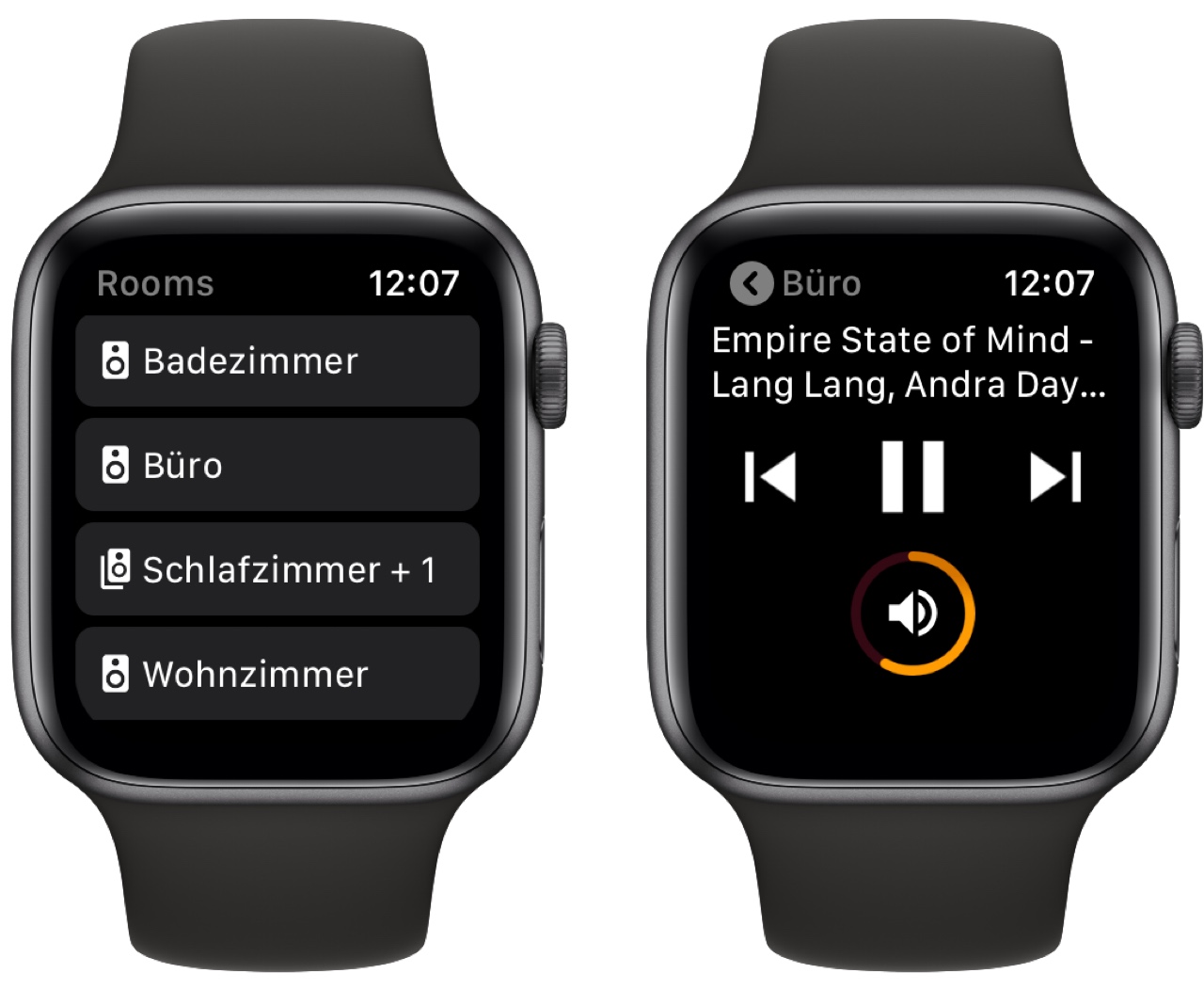
More than three years ago I talked to Sonos about controlling music from the Apple Watch. They could not quite figure out how to put a controller on the tiny screen. I told them to only do track control and volume, but that did not resonate.
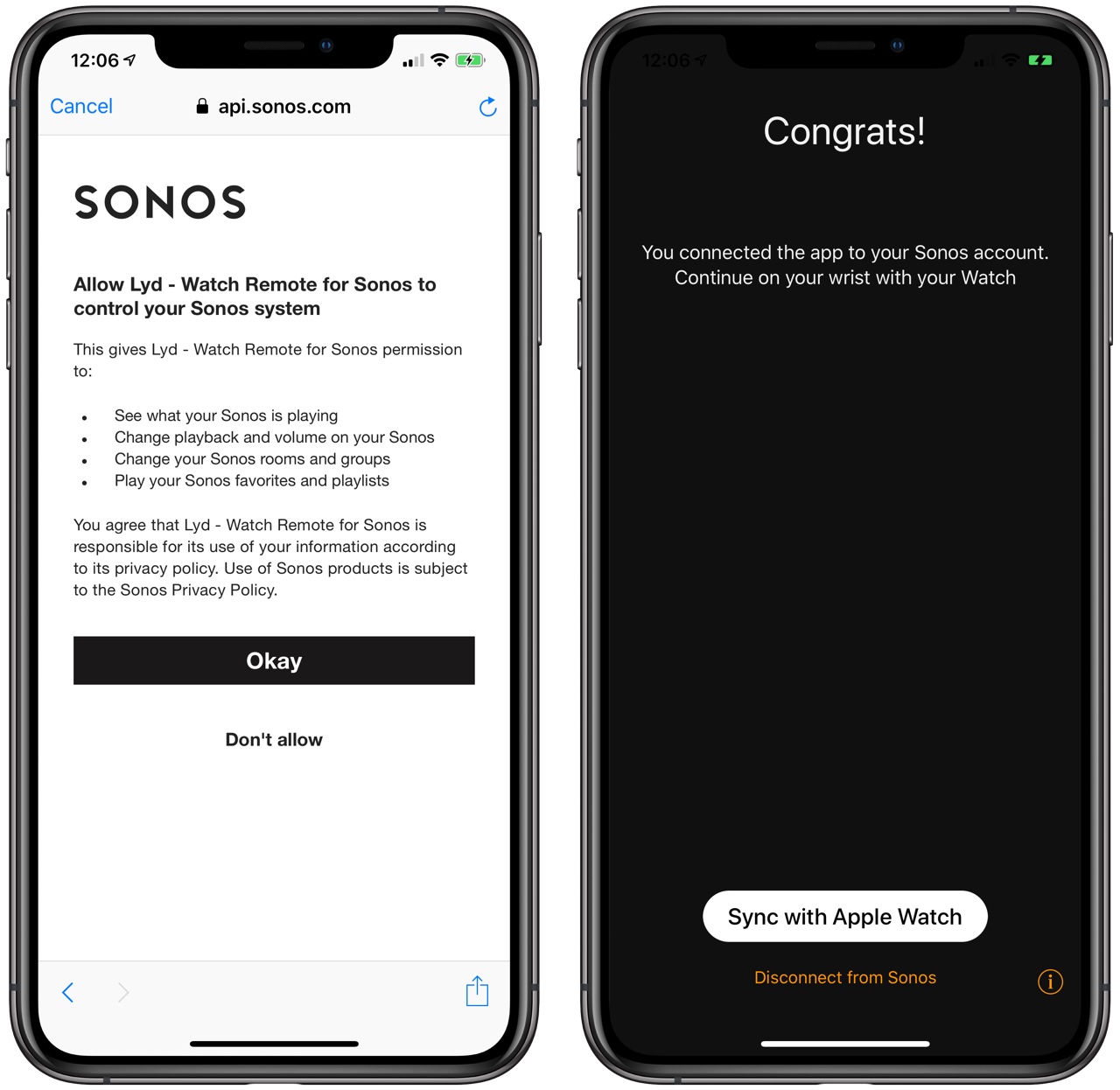
Now LYD is filling that gap. First you install the app on your iPhone and from there on Apple Watch. Then you open the app on iPhone and log into your Sonos account. This is the proper way to use the Sonos API and not a hack.
Once you went through that step, you can tuck away LYD on the iPhone. On Apple Watch you select one of your rooms (or preset group of rooms) and control your music. That is exactly what I proposed in 2015.
This little app has only one problem: the developer is wasting money since it is way too cheap. Go get it.
While we’re on the subject of distributions, Fathom used a collection of beeswarm charts to show documents about the Mueller investigation over time and connections between individuals. It’s called Porfiry. Filled circles represent documents that represent connections, and circle size represents the number of documents.
Ian Williams@ianwillwrite
A morning dose of Zadie Smith, FEEL FREE: "Back then, we were all still willing to take the 'risk,' if 'risk' is th… twitter.com/i/web/status/1…
#Montreal as “the Berlin of North America”. Quite different from its past reputation as the “Amsterdam of North America”. https://t.co/1Mi91zAVuW
— Alexandre…
Richard MacManus, an OG blogger himself, interviewed me for @readcreators about why I'm sticking with an unfashionable media format. I enjoyed working in a…
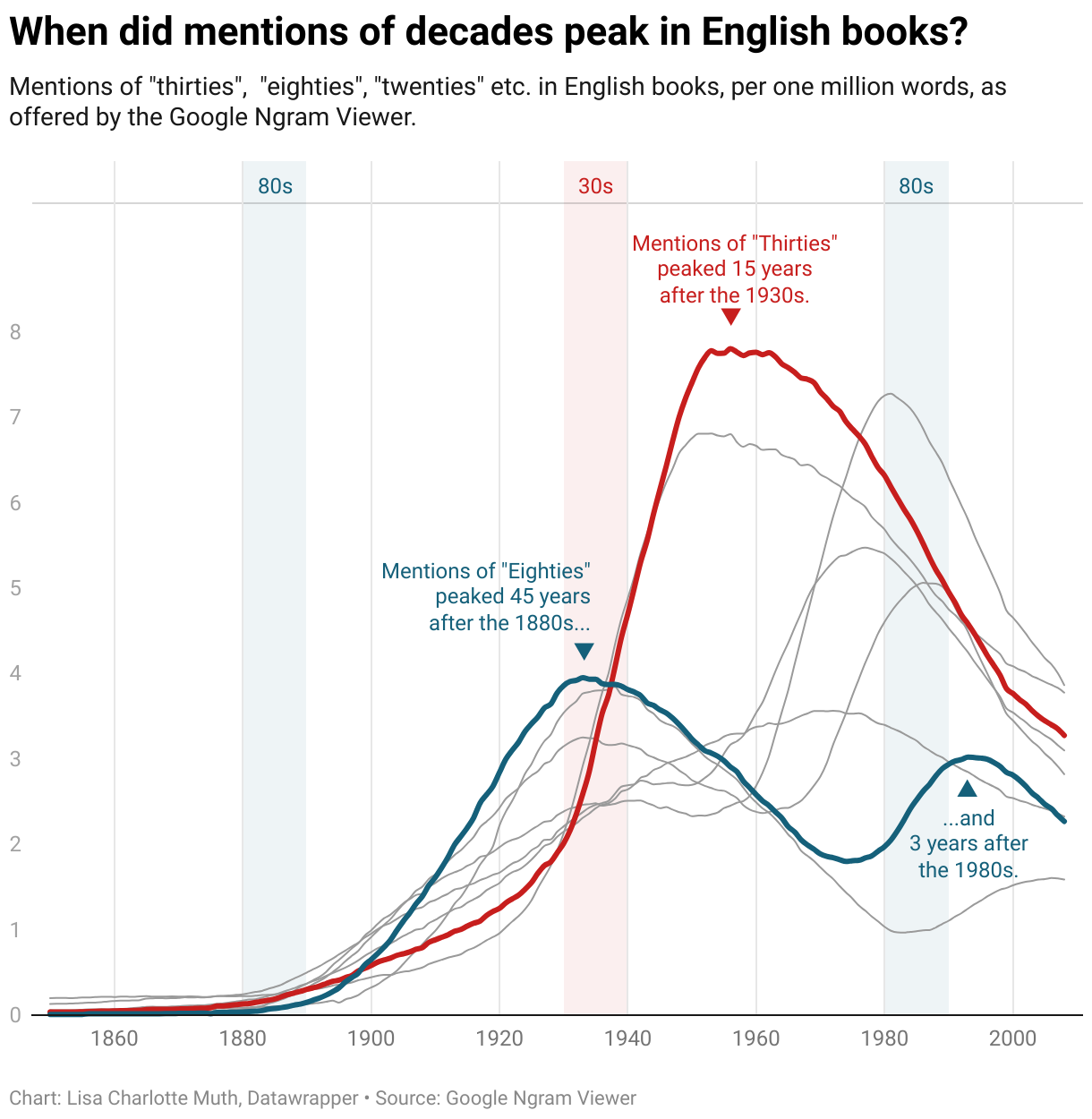
This week’s Weekly Chart started with a lunch conversation between Anna, Elana, Ivan (who you know from last week’s Weekly Chart – thanks Ivan!) and me. “So we had the eighties and nineties”, I mumbled over some Ethiopian food. “But how do we call the decade between 2000 and 2010?”
“They’re called the noughties,” said Ivan. I was pleased with this new piece of information. It sounded strange enough. “And how do we call the current decade?” I asked.
None of us had a clue. “But we’ve been there before”, we concluded. We don’t live in the first century with a second decade. But did people between 1910 and 1920 have a name for their decade? Or is calling decades names like “twenties” a new phenomenon?
So what can we see on the chart? Naming decades seems to be indeed a relatively new phenomenon. There probably wasn’t a widespread name for the time between 1910 and 1920. Which means that this chart isn’t an answer to my original question.
But sometimes, while searching for an answer, we stumble over interesting bits of information that had little to do with our original question: How long it took for certain decades to be written about in books, in our case. It took the sixties 10 years, the seventies 8 years and the eighties just 3 years to reach their peaks in getting mentioned. One could say: Past decades become less interesting for the present, quicker. One could also say: We take less time to reflect on decades before writing about them.
In case you’re wondering: I got the data from the Google Books Ngram Viewer, which gives us data about how often people used certain terms when writing books. I searched for terms like “twenties”, “forties”, etc. in the English corpus, meaning in all English written books. Next week, we’ll have another look at Ngram-data – this time across different corpora (yes, this is the plural of “corpus”). See you then!
Airbnb has announced that it is acquiring HotelTonight to offer its customers traditional hotel bookings in addition to its regular hostel home renting services.
With HotelTonight integration, Airbnb customers will be able to make last-minute bookings at boutique hotels, especially when they only have an Airbnb reserved for a portion of their trip.
Airbnb also aims to remove some of the competition for hosts by putting home and hotel rentals together.
“Together with HotelTonight, we can offer places to stay for every type of traveler on all kinds of trips and make it easier for small businesses and hoteliers who take pride in providing authentic, unique experiences to tap into Airbnb’s truly global network of hosts and guests,” Airbnb said in a press release.
It’s unclear exactly when the changes will take effect, although renters will be able to use HotelTonight’s services right from the Airbnb app.
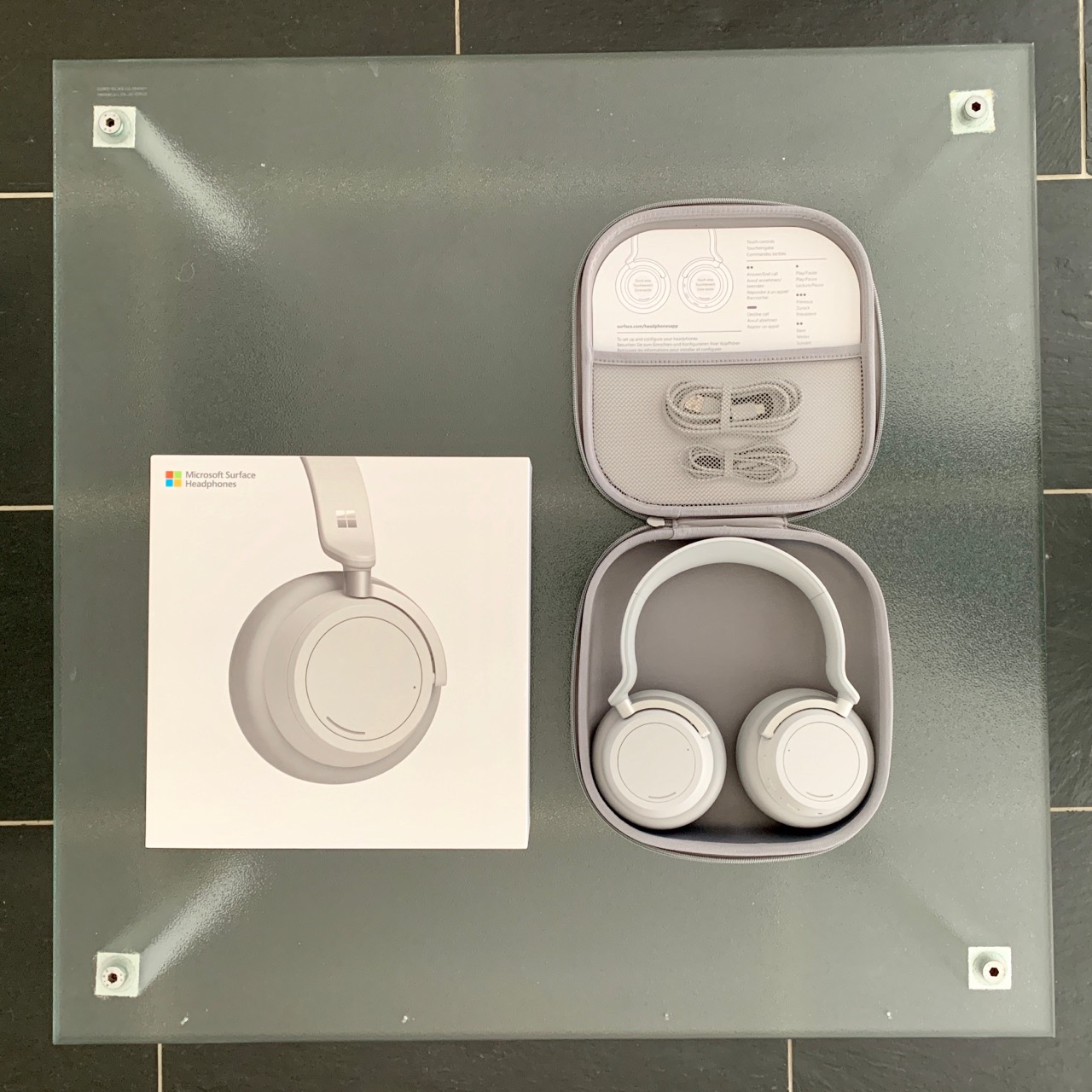
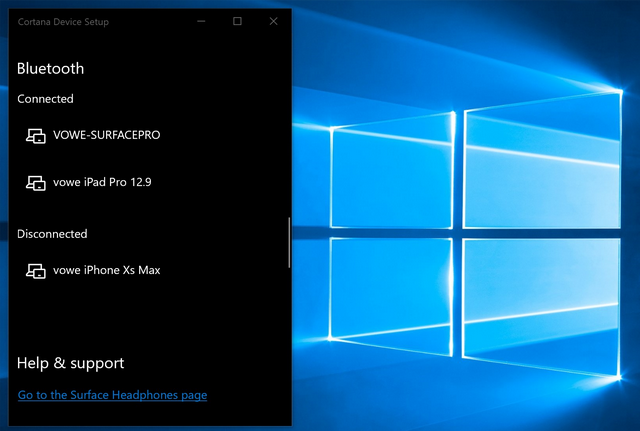
This headset is one of only three Cortana enabled products, the other two being the Harman Kardon Cortana Speaker and the GLAS themostat by Johnson Controls. What does Cortana-enabled mean? You can say "Hey Cortana" and it will answer. In the case of the Surface Headphones, they will connect back to your computer or smartphone and look for Cortana there. So it's just constantly listening for the magic "Hey Cortana" wakeword. If you want to talk to Siri (or Google Assistant on Android) you just tap and hold one of the ear cups.
Cortana failed to get any traction outside of Windows 10, where it is being de-coupled from search in the spring 2019 update. Microsoft seems to be putting it on the backburner for the time being. It no longer competes with other voice assistant.
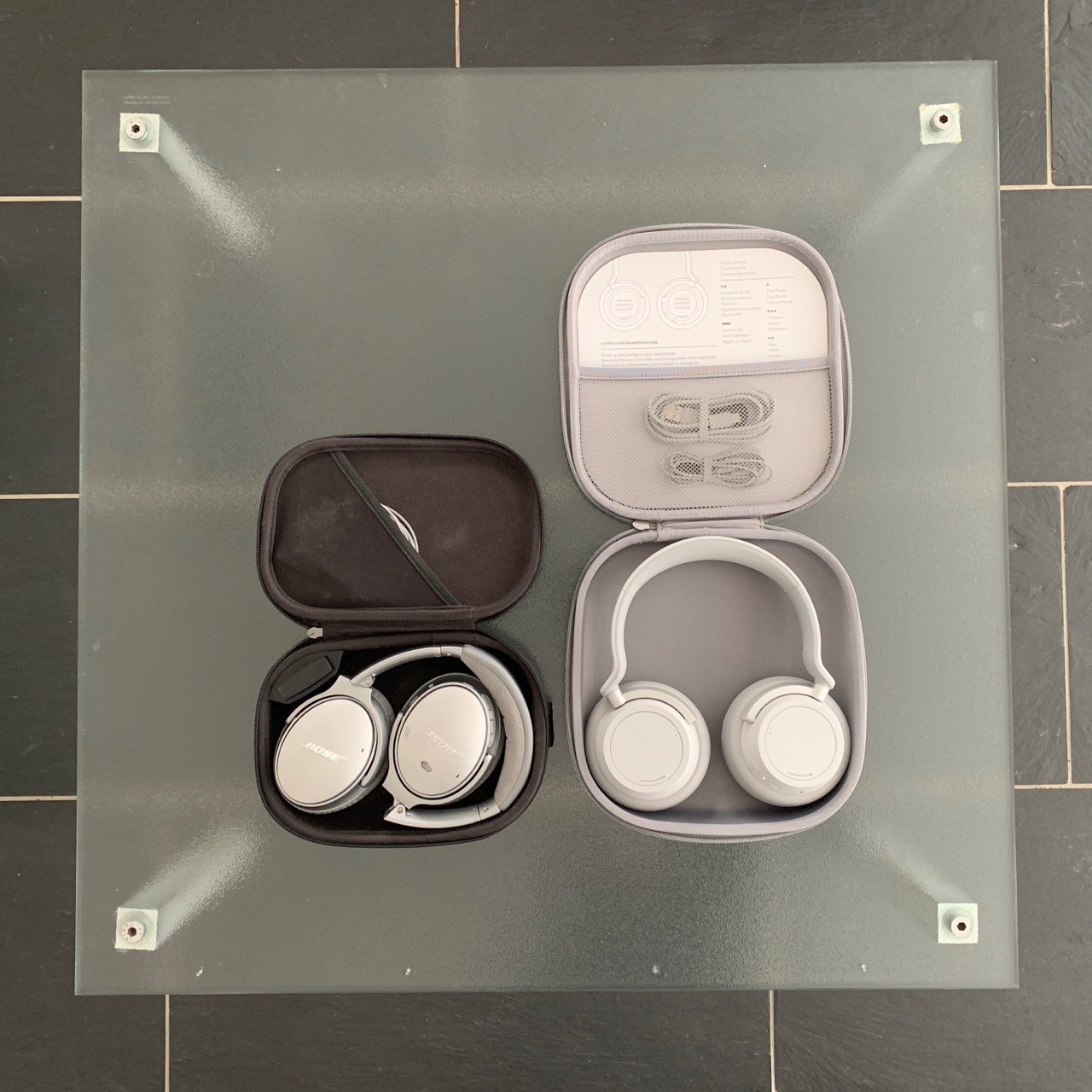
Here is what I like about the headset: the design and the rotating volume button. I find everything else inferior to products in the same price bracket. They are comically huge, they don't sound particularly well, and the touch interface is hit-and-mostly-miss for me. You need to install and enable Cortana to get to basic settings, which seems a weird bundle.
The headset connects to two hosts at the same time. If you have three (iPhone, iPad, Mac) you will need to manually disconnect one and connect to the third one. That is business as usual for most business headsets, but not as easy as Apple headsets like the ubiquitous AirPods and the Beats Studio³ which I prefer. It also does not support codecs better than SBC, which is the least common denominator of Bluetooth audio codecs.
The huge size makes them an unlikely companion outside of the house or office. What worked quite well in my tests was telephony. Surface Headphones have four microphones, two on each earcup which let them focus on your voice while not picking up too much sound from your surroundings. However, I felt too isolated from my own voice.
I can't really say much about comfort. Despite being huge they put too much clamping force on my head. People with smaller heads describe them as being very comfy because they have very soft cushions.
Bottom line: if you are a Cortana user who works in an open plan office workspace and needs to do serious conference calls, you may like the Surface headphones. It also helps if you have just two devices: a convertible like the Surface Pro and a smartphone. Incidentally that fits people working at Microsoft.
No editor-refuses-to-give-it-back award. After just two days I am putting them back in the box and returning them on the next DHL truck.
After scrapping an 80-unit rental apartment building, with rents offered 20 per cent below market, along with a seniors’ respite centre, and after rejecting funding for the Community Housing Action Committee. (CHAC), the Council of the District of North Vancouver is now undermining an extensive consultative process for the Delbrook site.
Indeed, it has scheduled a special council workshop with only the community association that was opposed to the project.
It’s a one-item agenda with no report or guidance for the workshop. It effectively de-legitimizes the extensive public process that involved more than just the immediate neighbours, according to Robin Prest, program director at the SFU centre for Dialogue that facilitated the process.
“The 2015 Delbrook Lands community dialogue put the district on the map as a leader in inclusive, participatory democracy. Any future engagement process that intentionally privileges the loudest voices over the silent majority is not only undemocratic, it risks breaching the trust of those who participated in good faith in the 2015 engagement process, including many residents living immediately adjacent to the Delbrook Lands,” he said.
Tesla has finally announced its V3 Superchargers that are capable of powering its vehicles 50 percent faster on average than its V2 Superchargers.
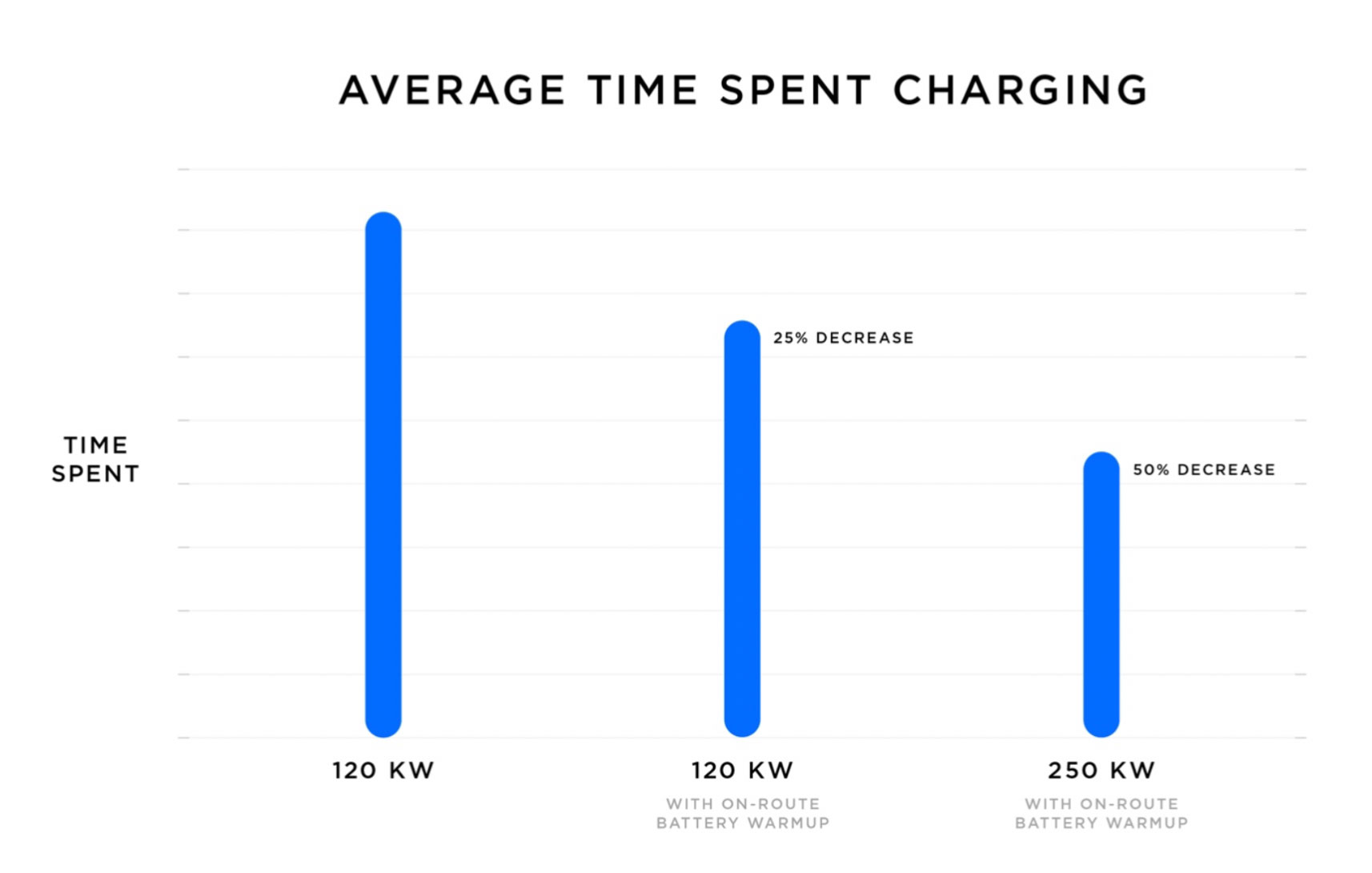
V3 Superchargers use a new charging architecture with a 1MW power cabinet that allows for peak charging rates of 250kW per vehicle. V2 chargers capped out at 120kW per vehicle and would sometimes be slower since they split the power output if two cars were charging simultaneously.
V3 chargers overcome a lot of the V2’s shortcomings by not splitting the charger’s output between two vehicles and supplying more power.
Overall, it means Long Range Model 3s operating at peak charging efficiency can regain 120kms of range in five minutes, according to Tesla.
Alongside V3 Superchargers, Tesla also showed off an update for its vehicles called ‘On-Route Battery Warmup.’ This heats the vehicle’s battery when it’s on route to a Supercharger, preparing it for peak charging while the vehicle is on the way to the charger.
This system helps Tesla achieve 50 percent faster charging times with V3 chargers and 25 percent faster times for charging a vehicle on an older V2 Supercharger on average. On-Route Battery Warmup is coming to all Teslas including the original 2012 Model S.
Since Tesla can charge its vehicles much quicker than before, it hopes that more cars will charge per day, resulting in additional income for the company from its chargers.
The first V3 charger is in beta in the Bay Area of California. More chargers should roll out in the coming year, but Tesla has no specifics as to when V3 chargers will come to Canada. Only Tesla owners who are part of the Tesla Early Access program can use the charger for now.
The beta program is expected to end within the next three to six months according to Elon Musk, and Tesla says that support for Model S and X will roll out at some point during Tesla’s second quarter.
MobileSyrup has reached out to Tesla to see if there’s any word on when a V3 charger might come here.
Google has trademarked the name ‘Google Stream’ in Canada.
Google submitted to the trademark to the Canadian government with the application number ‘1948433.’ The trademark was officially formalized on March 4th, and Google filed it on February 26th of this year.
The trademark, unfortunately, doesn’t feature a logo of any kind.
Within the ‘services’ section of the filing, the trademark includes the following statement:
“Providing temporary use of online non-downloadable software for gaming; application service provider (ASP), namely, hosting computer software applications of others; platform-as-a-service (PAAS) services featuring computer software platforms for creating and collaborating with others to create games and gaming applications and for uploading, posting, showing, displaying, sharing or otherwise providing electronic media or information regarding the fields of electronic gaming, entertainment and general interest via the internet; computer services, namely, creating website-based indexes of information; providing non-downloadable computer software, namely, computer software for implementing a computer programming language, computer software development tools, and computer software libraries; electronic data storage, namely, storage and archival of data, electronic media, and digital content.”
It’s unclear if this description is an indication of what the trademark represents, though it’s likely that Google Stream is video game related in some way.
Rumours suggest Google will show off a subscription-based game streaming service at this year’s Game Developers Conference (GDC). Though little is known about the still unannounced platform, speculation hints that it’ll likely be similar to Sony’s PlayStation Now streaming service. It’s possible that the search company will call this still unannounced platform ‘Google Stream,’ with the streaming platform running on Google’s Chromecast, or possibly a new video game console of some sort.
GDC starts March 18th and continues until the 22nd. We’ll likely have to wait until then to find out more about ‘Google Stream’ and the company’s streaming platform.
One of our favorite third-party podcast clients, Castro, was updated today with improvements aimed at offering a better discovery experience. Through curated podcast collections, new buttons to add podcasts to your library, and instant search, Castro's development team has brought positive change in several connected areas.
Castro's Discover tab previously played host to a simple list of podcast categories you could browse to find new shows in your areas of interest. Visually, the old Discover screen was bland and uncompelling, a poor indicator of the myriads of interesting and diverse podcasts hidden behind those text categories. Castro's new Discover screen has an entirely different feel. It combines charming illustrations, curated collections, and featured podcasts to create an inviting discovery experience. The previous categories are still here, but each now highlights a different podcast per category, aided by show artwork. The biggest addition though is the curated collections, which Castro's team will be adding to each week. Right now there's a collection of Apple-related podcasts and one highlighting a handful of newly published shows. As you browse a collection, podcast category, or even search results, you can now add a show to your library with a simple tap of a plus button; any shows you've already added display a checkmark.
Discover tab: new (left) and old (right).
Discovery upgrades are just one way Castro has made it easier to find new podcasts. The other way is through improved search. Castro's search function now works instantly as you type, so with each keystroke you're provided a new, more relevant list of results. Combining instant search with the new plus buttons for quickly adding a show to your library, it's never been easier to find and save the shows you're looking for.
Besides functional improvements to discovery and search, Castro's latest update also brings a few changes in terminology to make the app more accessible to new users. The Inbox tab is now simply called New, and Archive is now Library. There are new icons for the Library and Discover tabs as well. Everything works the same as before, but these tweaks help make the app easier to understand for those unfamiliar with GTD-style terminology like 'Inbox' and 'Archive.'
Castro is available on the App Store as a free download, with an optional subscription service that unlocks advanced features.
Support MacStories Directly
Club MacStories offers exclusive access to extra MacStories content, delivered every week; it's also a way to support us directly.
Club MacStories will help you discover the best apps for your devices and get the most out of your iPhone, iPad, and Mac. Plus, it's made in Italy.
#PythonIsSexyAgain #NowPictureGuidoVanRossumNaked #SEXY? #NowTryGettingThatPictureOutOfYourMind #GlobalInterpreterLockAmIRight?

#<HTML>IsAProgrammingLanguage</HTML>

#EverythingIsAwesome #JavaCanDoEverything #JavaIsAwesome #NoWaitMaybeNot

#AtLeastPHPIsNumberOneAtSomething

#YouCodeForTheLOLsICodeForTheLULZ

#EveryTimeATabIndentsOneThreeOrSevenSpacesGetTheirWings

#OneTypingToRuleThemAll
(There are many other gems in there, like any good tragicomedy.)
mkalus
shared this story
from Comments on: Hard Brexit Means Hard Times on the Toilet.
The Brexit secretary has warned of food shortages. The defense secretary has warned of soldiers on the streets. The Bank of England has warned of a financial crisis. The Taoiseach of Ireland has warned of violence at the border. And the queen, it has been reported, will be evacuated. With Britain inching ever closer to the edge of a no-deal Brexit, however, these dire warnings are increasingly falling short. In a January column in the Telegraph, Boris Johnson observed of his fellow Brexiteers: “[T]he grimmer the warnings, and the more systematic the efforts to make their flesh creep, the greater has been their indifference and their resolve.”
But new rumblings from Britain’s beleaguered paper importers may finally make clear what’s at stake. In conversations with industry experts, Foreign Policy has learned, a no-deal Brexit may leave Britain without an adequate supply of toilet paper.
It would be yet another addition of insult to injury—and one that is all too reflective of the practical difficulties and uncertainties posed by leaving the European Union. For now, barring an extension to the withdrawal deadline set by Article 50 of the Treaty on European Union, Britain’s scheduled departure is March 29. On that day, if Parliament has not accepted the terms of the EU and Prime Minister Theresa May’s withdrawal agreement, the drawbridge will go up: Free and frictionless trade will be supplanted by tariffs and customs checks; hefty delays at ports will be matched by heftier delays at airports where planes will be grounded due to a breakdown in oversight and certification. The scope and scale of all the consequences, at present, are incalculable.
Easier to calculate, however, is one minor humiliation in the grand scheme of societal complications. This is Britain’s looming twofold toilet paper problem, which will be driven by difficulties with stockpiling and importing.
While Brexit preppers have stirred headlines in recent months with their preemptive purchases of essential items, the stockpiling of large manufacturers—and the lack thereof—matters most. For goods with short shelf lives, such as medicine and fresh produce, the limitation is quality: Store an apple or an antibiotic for too long and it will go bad. For goods that are large and bulky, such as toilet paper, the problem is quantity. And in the case of the United Kingdom, where the average resident uses an unrivaled 110 rolls of toilet paper per year, the highest figure in Europe, any meaningful measure of forward planning would require more real estate than is currently available. This is just one of the terrible challenges that the paper industry—and the public—may face in the coming months, said Andrew Large, the director general of the Confederation of Paper Industries, the leading trade association for the U.K.’s paper-based industries.
“It’s very bulky and light in weight for its volume, which means you need an awful lot of warehousing space in order to be able to put down meaningful stocks of the material,” he said. While there has been some stockpiling—several weeks of finished rolls and perhaps months of unfinished pulp, according to Large—the practical limitations to stockpiling leave a great deal of uncertainty. This uncertainty, more than anything, is most worrying for the industry. “The thing that will cause a crisis,” Large said, “is if people do panic and they empty the shelves preemptively, whereas if normal buying patterns are continued, there would have been enough supply in the system for everybody to be fine.”
In the event of no deal, it is difficult to imagine that this sort of self-perpetuating panic will not get produced. The campaign to drive up this panic to avert a no-deal Brexit or force a second referendum has been underway for the better part of the past three years. It will undoubtedly continue. And on the toilet paper front, “Project Fear” has already found a vociferous champion in the former Labour Party MP Denis MacShane, who has claimed, wrongly, that Britain has a toilet paper supply of just one day. False though MacShane’s headline triggering warning may be, and erroneous though his claim is that “British bottoms will have to be wiped with torn-up newspapers as in bygone days,” such panic pandering is indeed effective. Its effect, to deplete stockpiles in the event of no deal, will likely pour attention to the nation’s ports, where, unfortunately, the situation will give no more room for optimism.
The British paper industry is an import business. Of the 1.3 million tons of paper on the British market, 1.1 million tons—85 percent—have been imported from overseas producers, with 60 percent coming from the EU. It is an exceptionally precarious position for an economy that may suddenly remove itself from a long-standing trade agreement, and the situation will leave the entire market exposed to Brexit’s many compounding and cascading disruptions.
If a no-deal Brexit strikes, the free and frictionless trade with the EU to which Britain has grown accustomed will grind to a halt. New tariffs, new certifications, new standards, new paperwork, and more will drive up costs and delays for suppliers and consumers alike. The British government, which did not begin taking the possibility of no deal seriously until very recently, has conceded that the situation will significantly undermine the British economy in both the short and long term. Most immediately, the problem will be the sudden disruption to the flow of imports.
For the paper market, fortunately, trade will still be free as tariffs on paper products were previously eliminated under the Uruguay Round of the World Trade Organization, which will provisionally govern U.K.-EU trade in the event of no deal. The problem for paper will instead be the sudden lack of frictionless trade, the emergence of checks on all goods entering the country. While there have been efforts to mitigate these new barriers, such as the government’s recent announcement of transitional simplified procedures that aim to reduce import documentation and postpone duty payments, the essential issue of hard checks cannot be circumvented. A clear delineation between the EU and the U.K. is precisely what Brexit is about, and the need for borders—as demonstrated by the enduring drama over the Irish backstop—is an essential condition.
A representative from the Port of Dover, the port physically closest to Europe and one of the largest in the United Kingdom, expressed a measure of confidence in the government’s transitional procedures and in the private contingency planning underway but conceded that delays, and the costs they drive up, will not be avoided. At best, the representative said, the flow of trade may not be disrupted, but the new arrangements “will of course impose a significant new cost on the overall supply chain, as businesses up and downstream from the port incur significant cost in generating customs declarations and fulfilling other procedural obligations.”
This assessment, grim though it may be, is likely not grim enough. In a forward planning notice recently released by the Cabinet Office, the verdict was that “there will be significantly reduced access across the shorts straits, for up to six months,” a period that stretches beyond Large’s stockpiling estimates, beyond the Port of Dover’s provisional flow of trade estimates, which threatens a significant disruption of daily affairs for a remarkably extensive period of time. To be sure, as Large noted, there is something of a “sliding scale between how big the disruption is and how long it lasts.” That is, if a no-deal Brexit causes the scale of disruption at Britain’s borders that has been suggested, there is little doubting that a withdrawal agreement would be supported by Parliament, and the crisis would be averted, immediately. If, on the other hand, the disruption introduces observable but still manageable inconveniences—costs and delays without panic and poverty—it may, Large said, “become the new normal,” an outcome that would still be disastrous though not theatrically so.
What will this new normal look like? How long will it last? Will it unleash a frenzy of shelf emptying? Or will the British simply keep calm and carry on? The answers, like much of Brexit, are uncertain, and they reflect the uncertainty that portends problems well beyond the scope of toilet troubles—the supply of fresh food, the status of foreigners, the operability of flights, and more.
Drumming up fears about Brexit is a tired task. It failed three years ago, and three years later it is not doing much better. It is also, often, a dishonest task. Potential job loss figures, for example, have been revised down from numbers as high as 75,000 and 200,000 to 5,000 and 13,000. Splashy headlines about insulin shortages, paired with jabs at the diabetic prime minister, have obscured comments from the public and private sectors that insulin will remain in good supply. Strained parallels between Brexit and the policy of appeasement have passed even less muster.
Nevertheless, the consequences of Brexit are real. Job loss figures will still likely end up in the double digits; domestic insulin manufacturing—which currently provides for less than 1 percent of British consumption—will have to be rethought; and the populist politics that permitted Brexit will have to be put in historical perspective. Just as well, the minor inconveniences, the trifling things that demonstrate just how much of Britain Brexit infects, are real, too. An emergency meeting that drew high-level parliamentary attention last month concerned wooden shipping pallets, which Britain will apparently desperately require after Brexit. Another intransigent issue has been fishing. Even the most substantial dispute in the Brexit saga, the Irish border, at the end of the day, is more syntax than substance: Everyone agrees that there should neither be a hard border nor a lack of demarcation—the question is how that might be arranged. The toilet paper problem, including the difficulties with stockpiling and the uncertainties with importing, is another item on this list. Logistically boring but societally substantial, it may just be the humiliation to rule them all.
Lange Mixe werden eher selten mitgeschnitten, auch wenn es sie womöglich häufiger gibt, als man sich das gemeinhin vorstellen mag. Ich selber habe selten mal länger als sechs Stunden gespielt, was ich schon lang finde, auf 12 kam ich bisher noch nicht.
Delta Notch hat die neulich mal live auf YouTube gestreamt, weshalb es davon eben auch einen Mitschnitt gibt. Dabei kam ein 12-stündiges Set raus, das sich am ehesten unter Deep House einsortieren lässt und doch durchweg hörbar ist. Wenn es also mal etwas Längeres sein darf; bitte schön. Drei Pinkelpausen und eine meterlange Tracklist inklusive.
Tracklist:
1:08 Aphex Twin – #20
4:07 Acronym – Rails
6:57 Delta Notch – Before We Ate the Beating Heart
9:40 Basti Grub & Mike Trend – Afrika Am Strand
13:44 Worakls – When the Birds Go in the Wrong Way
19:59 Under & Fideles – Blade
24:50 Woo York – Come Closer
28:37 Rob Roar – Backtrackin (Rob’s 3AM Dub)
34:50 Etapp Kyle – Sakura
38:34 Rhythmic Theory – Shores of Caladan
43:08 Aera – You Know Juno (The Drifter Remix)
49:19 Recondite – Abscondence
53:26 Dizharmonia – Noesis (BAAL Remix)
59:50 Animal Picnic – Kraftika
1:04:06 Vessels – Echo In (Ripperton Remix)
1:11:18 Vessels – Echo In (Antenna Happy Remix)
1:15:52 Study Break #1 – Go do a lap and grab some coffee
1:20:57 Herr Johann – It’s Going Better (Ghostek Remix)
1:24:36 Peter Van Hoesen – Attribute 39 (Donato Dozzy Remix)
1:30:09 Christian Loffler – Roman
1:36:21 North Lake – Coda
1:38:08 I Have a Tribe – Yellow Raincoats (Frank Wiedeman Instrumental)
1:43:51 Midas 104 – Horus
1:48:13 Durante – Split Wick
1:52:17 Cornucopia – Letter for Poly
1:59:52 Phase – Perplexed (Rodhad Remix)
2:06:34 Maceo Plex & Gabriel Ananda – Solitary Daze
2:12:50 Jobe & Soul Button – Umar
2:17:19 Stefano Moretti – Out of Earth (PHON_O Remix)
2:24:00 Causa – Lo Sar
2:30:32 Pedro Aguiar – Snobiety
2:33:34 Midas 104 – Traute
2:39:04 Viken Arman – On a Blue Road
2:43:35 Trentemoller – Miss You (ZooL Unofficial Remix)
2:50:49 Simon Baker – Plastik (Todd Terje Mix)
2:59:19 Blu Mar Ten – Hunter (Delta Notch Remix)
3:05:12 Paleman – Bezzle Dub (Skream Edit)
3:12:39 Bedrock – Heaven Scent (Matt Lange Secret Booty)
3:16:46 Spartaque – Eleven
3:20:40 Love Over Entropy – Tucaroya pt2
3:25:58 Margari’s Kid – Hollow
3:28:14 Trifonic – Parks on Fire
3:35:25 Ghost Engineer – Termination Shock
3:39:46 Nue – Transit
3:42:53 Denis Horvat – Ambre
3:48:25 Petrichor – On Tides
3:55:01 Maurizio Leonardi – Limestone Cave
4:00:21 Maurizio Leonardi – Deep Dream
4:08:37 Clawz SG – Laetitia
4:14:37 Alan Fitzpatrick – Prometheus
4:22:20 Kas:st – Pathos
4:27:18 WHYT NOYZ – Solitary
4:33:05 Slacker – Hymn to Her (Lank Bootleg)
4:39:38 Luciano – Rise of Angel
4:52:40 Delta Notch – Rancho II
5:00:30 Study Break #2 – Go get some chips. You need the calories.
5:02:55 Rival Consoles – Looming
5:09:07 Axel Boman – 1979
5:16:23 Norken & Deer – Remember That Feeling
5:22:58 Einerlei – Berg (Kesper Remix)
5:30:25 Guy J – Azimuth (Kastis Torrau & Arnas D Remix)
5:36:10 Not Usual – Nutballs
5:44:44 Bendejo – Unravel
5:55:44 Radio Slave – Screaming Hands (Wink Interpretation)
6:04:10 Plastikman – Koma
6:07:22 Delta Notch – The Rooster (My Friend)
6:15:46 Mind Against & Locked Groove – Pulsar
6:23:10 Locked Groove – Thesseus
6:31:28 Shlomo – In Absentia
6:34:53 AntiAlias – Seas of Thought
6:40:07 Peak Obello – Unitas Imperii
6:47:59 Mahfoud – The Giant (Francois Rengere Remix)
6:52:31 Delta Notch – Bevel Up
6:58:53 Anton Kubikov – Auka
7:05:45 Atish – Twiddles
7:11:48 Auk – Tomorrow Morning
7:16:48 Riktam & Bansi – Frings (Visual Therapy Remix)
7:24:19 Cari Lekebusch & Joel Mull – Loose Scale
7:30:04 Aaron Static – Kuiper Belt
7:37:41 Maurizio Leonardi – Aeon
7:45:30 Study Break #3 – Get a refill, hit the bathroom, and get ready for the home stretch
7:52:01 Four Tet – I’m on Fire
7:57:00 Woo York – Atlantis
8:00:59 SevenDoors – Megaptera
8:09:42 Hunter/Game – Paradigm
8:14:13 Thor & Friends – Crusades
8:19:52 Sebastian Mullaert – In the Blurry Mist of Yourself (Wa Wu We Remix)
8:26:31 Christian Loffler – Signals
8:31:46 Norma Jean – Falling from the Sky: Day Seven (Delta Notch Dub Mix)
8:35:31Wood – Sternensee
8:40:14 W & W – Based on a True Story
8:45:17 Baldur – Hidden Empire
8:53:24 Chaim – Blue Shadow (Tennis Remix)
8:58:08 Worakls – Toi
9:04:25 Aaryon – Hex (Soul Button Remix)
9:11:31 Julian Jeweil – Air Conditionne (Sebastian Leger Long Mix)
9:19:12 Paul Kalkbrenner – Aaron
9:24:41 NickBee – Kloe
9:30:06 Powder – Light Dance
9:35:30 Primal Code – Junkan
9:41:36 Guy J – Lamur
9:47:39 Paul Kalkbrenner – Absynth
9:52:51 Sasha – Coma (Slam Soma Coma Mix)
9:57:23 Hybrid – Just for Today (Jerome Sydenham Dub Mix)
10:02:23 Dubspeeka – Lyssa
10:08:08 Bongbeck – Winter Sleep
10:14:48 SAINT WKND – Lost
10:19:53 Dominik Eulberg & Gabriel Ananda – The Space Between Us
10:27:13 Canvas – The Cat
10:33:40 Plastikman – Plasticity
10:39:44 Booka Shade pres. Yaruba – Black Cow
10:45:12 Delta Notch – The Galley
10:51:10 Vijay & Sofia Zlatko – Hymn (20Years After Moby)
10:58:03 Mr. Tea – Circles in the Sky (Jamie Stevens Dub)
11:03:33 Butch – The Spirit
11:10:10 Clawz SG – Gwendoline
11:17:13 Marconi Union – Weightless
11:22:07 Vangelis – Abraham’s Theme
11:24:46 Enrico Sangiuliano – Dutch Kiss (Inner Mix)
11:29:51 Agatha Pher – Skinthings
11:34:40 Tim Engelhardt – Sawtooth Orchestra
11:39:59 Kincaid and Sinal – Maritza
11:43:46 Agents of Time – Dream Vision
11:49:36 ARTBAT – Papillon
11:53:22 Lost Desert – Fall of Innocence (Tankwai Mix)
Elon Musk may lose his U.S. federal security clearance as a result of him consuming marijuana on the Joe Rogan podcast, reports Bloomberg.
Musk took a toke of a cigar filled with marijuana,also known as a blunt, on the 1169th episode of the Joe Rogan Podcast during September of 2018 which broke U.S. federal security clearance rules.
Now, the Pentagon is reviewing Musk’s clearance, according to a U.S. official who spoke to Bloomberg.
It’s legal to consume Cannabis Californa, where Musk was at the time. Although, “drug involvement and substance misuse” are against the U.S. Department of State’s security clearance rules. Further, Marijuana remains illegal federally in the United States.




 Der Weltfrauentag am 8. März ist in Deutschland als gesetzlicher Feiertag angekommen. Zumindest in Berlin. Ob dieser arbeitsfreie Feiertag auch in anderen Bundesländern in Zukunft Schule machen wird, bleibt offen. Doch zeigt die Diskussion, dass











 Comments on: Hard Brexit Means Hard Times on the Toilet.
 Das Kraftfuttermischwerk.
