Shared posts

23 Mar 07:41

Cancellation Vertigo

by peter@rukavina.net (Peter Rukavina)

Sometimes when I make an appointment for something I’m told that there’s no availability, but I’m offered the option of going on a list “in case there are any cancellations.”

I’ve always treated this option as tantamount to being told “there is no hope for you here; you might as well look elsewhere.”

But in the past month I’ve benefited twice from a real life cancellation situation, most recently just this morning.

I woke up today determined that this would be the week I took action on the vague-vertigo-like-senstation that’s afflicted me for two years, so I called Sports Centre Physiotherapy, hoping to book an appointment with the excellent Nathan, whose interventions a year ago achieved some success.

Nathan, alas, has left the building, and I was offered an appointment with Ellen instead. Except that Ellen had no appointments this week. Which would render my determination moot.

But I agreed to go on the waiting list “in case there’s a cancellation.”

And then, at 1:15 p.m., I got a call: “can you come in for 2:00 p.m.?”

You bet I can.

The excellent Ellen ushered me into the room-formerly-known-as-Nathan’s-room and led me through a familiar set of Q&A and diagnostic tests. BPPV was ruled out quickly. And “gaze stability” zeroed in on as a possibility.

I was given three exercises as homework (which I document here in part because here is the closest thing to “where I will always be able to refer to them” as I have in my life). The names are ones I made up, not official physiotherapeutic ones:

  1. The Static Dot. Put a sticky note with a big dot on it about 10 feet away on the wall, about 20º below eye-line while sitting. While focusing on the dot, and looking straight ahead, move my head up and down. Vary the speed and the amplitude. Stop when it gets to be too much. Three repetitions.
  2. Fingers Still, Gaze Up Down. Stretch my arms out in front of me, one on top of the other, forefingers extended, about 18 inches apart. Without moving my head, switch focus back and forth between the top and bottom finger, back and forth, back and forth, at a good clip.
  3. Stare at Numbers. On the grid of numbers that I was given as a takeaway, while focusing on one number, soften my gaze to drink in the numbers around it.

I’m off traveling starting a week from today for two weeks, so I have a follow-up appointment in three weeks where I’ll get a chance to check-in and see how things are going.

Although this wasn’t a resource that Ellen gave me, I found the brief Two Modes of Visual Processing to be helpful for understanding the concepts she outlined, the working theory being, in part, that I need to offload some of the responsibility that my focal system is taking on to my ambient system. We’ll see.

23 Mar 07:41

Firefox Student Projects in 2018: A Recap

by Johann Hofmann

Firefox is an open-source project, created by a vibrant community of paid and volunteer contributors from all over the world. Did you know that some of those contributors are students, who are sponsored or given course credit to make improvements to Firefox?

In this blog post, we want to talk about some student projects that have wrapped up recently, and also offer the students themselves an opportunity to reflect on their experience working on them.

If you or someone you know might be interested in developing Firefox as a student, there are some handy links at the bottom of this article to help get you started with some student programs. Not a student? No problem – come hack with us anyways!

Now let’s take a look at some interesting things that have happened in Firefox recently, thanks to some hard-working students.


Multi-select Tabs by Abdoulaye O. Ly

In the summer of 2018, Abdoulaye O. Ly worked on Firefox Desktop for Google Summer of Code. His project was to work on adding multi-select functionality to the tab bar in Firefox Desktop, and then adding context menu items to work on sets of tabs rather than individual ones. This meant Abdoulaye would be making changes in the heart of one of the most complicated and most important parts of Firefox’s user interface.

Abdoulaye’s project was a smash success! After a few months of baking and polish in Nightly, multi-select tabs shipped enabled by default to the general Firefox audience in Firefox 64. It was one of the top-line features for that release!

You can try it right now by holding down Ctrl/Cmd and clicking on individual tabs in the tab bar. You can also hold down Shift and select a range of tabs. Then, try right-clicking on the range to perform some operations. This way, you can bookmark a whole set of tabs, send them to another device, or close them all at once!

Here’s what Abdoulaye had to say about working on the project:

Being part of the multi-select project was one of my best experiences so far. Indeed, I had the opportunity to implement features that are being used by millions of Firefox users. In addition, it gave me the privilege of receiving a bunch of constructive reviews from my mentor and other Mozilla engineers, which has greatly boosted my software development skills. Now, I feel less intimidated when skimming through large code bases. Another aspect on which I have also made significant progress is on team collaboration, which was the most challenging part of my GSoC internship.

We want to thank Abdoulaye for collaborating with us on this long sought-after feature! He will continue his involvement at Mozilla with a summer internship in our Toronto office. Congratulations on shipping, and great work!


Better Certificate Error Pages by Trisha Gupta

University student Trisha Gupta contributed to Firefox as part of an Outreachy open source internship.

Her project was to make improvements to the certificate error pages that Firefox users see when a website presents a (seemingly) invalid security certificate. These sorts of errors can show up for a variety of reasons, only some of which are the fault of the websites themselves.

The Firefox user experience and security engineering teams collaborated on finding ways to convey these types of errors to users in a better, more understandable way. They produced a set of designs, fine-tuned them in user testing, and handed them off to Trisha so she could start implementing them in Firefox.

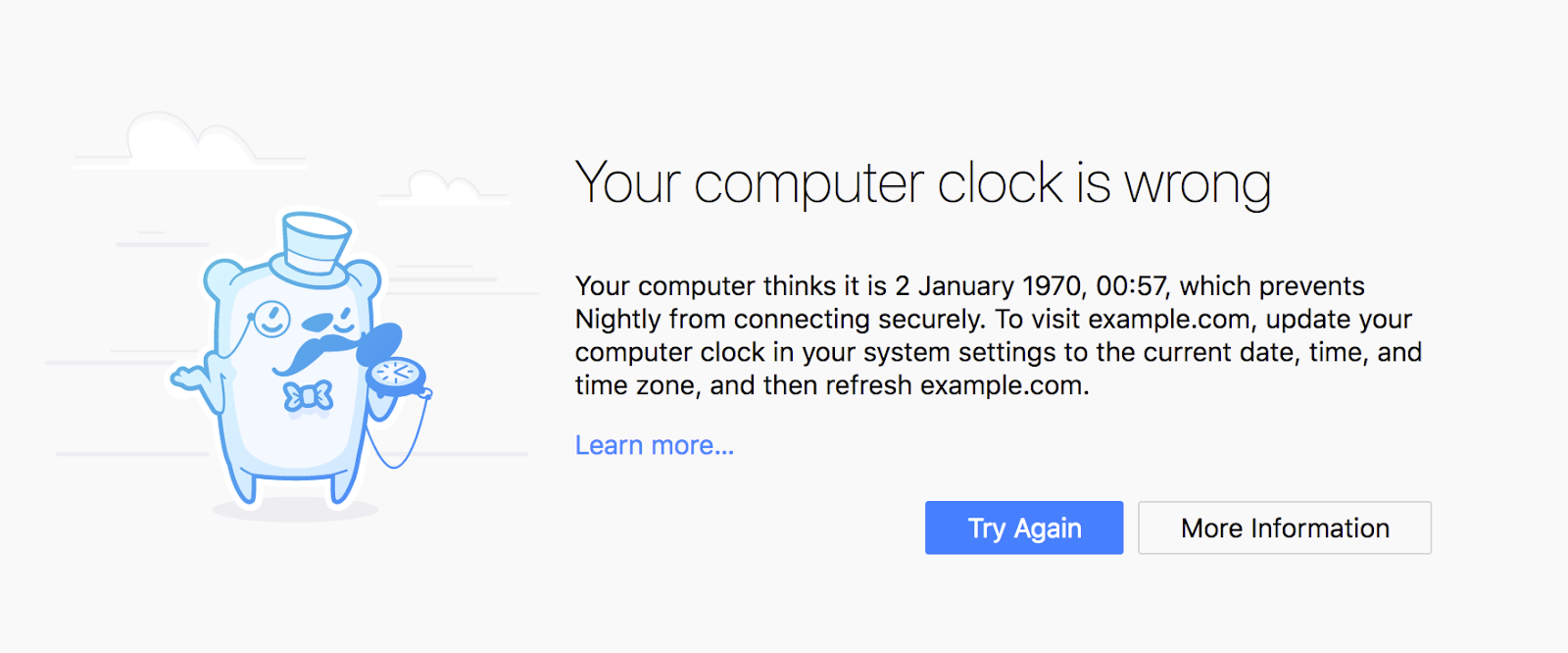
In some cases, this meant adding entirely new pages, such as the “clock skew” error page. That page tells users that the certificate error is caused by their system clocks being off by a few years, which happens a lot more often than one might think.

The new certificate error page displayed when the computer clock is set incorrectly.

What year is it?

We are really grateful for Trisha’s fantastic work on this important project, and for the Outreachy program that enabled her to find this opportunity. Here is what Trisha says about her internship:

The whole experience working with the Mozillians was beyond fruitful. Everyone on my team, especially my mentor were very helpful and welcoming. It was my first time working with such a huge company and such an important team. Hence, the biggest challenge for me was to practically not let anybody down. I was very pleasantly surprised when at All Hands, all my team members were coding in homerooms together, and each one of us had something to learn from the other, regardless of the hierarchy or position or experience! It was overwhelming yet motivating to see the quality of code, the cohesion in teamwork and the common goal to make the web safer.

Right from filing bugs, to writing patches, to seeing them pass the tests and not breaking the tree, the whole process of code correction, review, testing and submission was a great learning experience. Of course, seeing the error pages live in Nightly was the most satisfying feeling ever, and I am super grateful to Mozilla for the best summer of my life!”

Trisha’s project is currently enabled in Firefox Nightly and Beta and scheduled to be released to the general user population in Firefox 66.


Dark Theme Darkening by Dylan Stokes, Vivek Dhingra, Lian Zhengyi, Connor Masini, and Bogdan Pozderca

Michigan State University students Dylan Stokes, Vivek Dhingra, Lian Zhengyi, Connor Masini, and Bogdan Pozderca extended Firefox’s Theming API to allow for theme authors to style more parts of the browser UI as well as increase cross-browser compatibility with Google Chrome themes.

The students worked as part of their CSE498: Collaborative Design course, often called their “Capstone.” Students enroll in this course during their last year of an undergraduate degree in computer science and are assigned a company in the industry to work with for a semester project.

With the work contributed by this team, themes can now customize the Firefox menu, findbar, location bar and search box dropdown, icon colors and more. These new features are also used by the “Dark” theme that ships by default with Firefox. Dylan Stokes published an end-of-semester blog post on the Mozilla Hacks blog that goes into further details of the technical work that the team did. The following video was created by the team to recap their work: Customizable theme development in Firefox 61

Here’s what Vivek had to say about the project:

Working on ‘Dark Theme Darkening’ was one of the most rewarding experiences of my student life. It was extremely motivating to code something and see that deployed on different Firefox branches in weeks. Emphasis on thorough testing, rigorous code reviews, efficient communication with Mozilla contributors across the globe and working in a fast pace team environment are just some of the many useful experiences I had as part of this project.

Mike [Conley] and Jared [Wein] were also kind enough to spend a weekend with us in East Lansing, MI. None of us expected that as we got started on the project so we were very thankful for their time and effort for having a coding marathon with us, and answering all our questions.

Mike and Jared also had a very thorough project plan for us which made it easier to work in an organized manner. We also had the opportunity to interact with Mozilla contributors and employees across the world as we worked on different tasks. I love working in diverse teams and as part of this project, I had the opportunity to do that a lot.

Dylan also had some comments about the project:

Working on the Dark Theme Darkening project was an amazing opportunity. It was the first time I got a sense of developing for a large application. It was a bit overwhelming at first, but our mentors: Jared, Mike, and Tim [Nguyen] were extremely helpful in guiding us to get started crushing our first bugs.

The code review process really helped me grow as a developer. Not only was I writing working code; I was writing efficient, production level code. It still amazes me that code that I was able to write is currently being used by millions of users.

One thing that surprised me the most was the community. Anyone I interacted with wanted to help in anyway they could. We were all part of a team and everyone’s end goal was to create a web browser that is fast for good.

The students’ work for the Dark Theme Darkening project shipped in Firefox 61. See their work by going to the Firefox menu, choosing Customize, then enabling the Dark theme. You can also create your own theme with the colors of your choice.


Other projects

We’ve just shown you 3 projects, but a whole bunch of other amazing students have been working on improving Firefox in 2018. A few more examples:

And that’s just the projects that focused on Firefox development itself! The Mozilla community mentored so many projects that it would be too much for us to list them all here, so please check them out on the project pages for GSoC and Outreachy.


Get Involved

The projects described above are just a small sampling of the type of work that students have contributed to the Mozilla project. If you’re interested in getting involved, consider signing up to Mozilla’s Open Source Student Network and keep checking for opportunities at Google Summer of Code, Outreachy, codetribute. Finally, you should consider applying for an internship with Mozilla. Applications for the next recruiting cycle (Summer 2020) open in September/October 2019.

Feel free to connect with any of us through Mozilla’s IRC servers if you have any questions related to becoming a new contributor to Firefox. Thanks, and happy hacking!

Thanks

We are really grateful for all Mozilla contributors who invested countless hours mentoring a student in the last year and for all the great people driving our student programs behind the scenes.

A special thank you to Mike Conley and Jared Wein for authoring this blog post with me.

23 Mar 07:41

De-Nerding Programming

by Jonathan Edwards

Steve Krouse interviewed me on his podcast: De-Nerding Programming. There are some other interesting interviews, and he also hosts a Slack discussion.

23 Mar 07:41

MMP Killed my Sheep and It's Coming for Yours

by peter@rukavina.net (Peter Rukavina)

The first of the publicly-funded mixed-member proportional representation referendum advertising hit PEI mailboxes today, from the No side.

MMP… Confusing, Complicated and Dangerous screams the headline, hyperbolic enough to make me wonder if it’s a parody.

The silver lining here might be that, many Islanders—most, perhaps—will see through the fearmongering and consider the referendum question in a more thoughtful manner.

23 Mar 07:40

Newhart

by peter@rukavina.net (Peter Rukavina)

Bob Newhart was 53 years old when Newhart premiered in 1982.

I turn 53 next month.

I noticed this coincidence because, watching the pilot tonight, I thought there was something strangely familiar about how he carried himself; a check on Wikipedia confirmed it.

Also, I laughed out loud more times than I can count.

23 Mar 07:40

No-one Joins For The Sense of Community

by Richard Millington

It turns out, people don’t join health and support groups for the sense of community.

They join to get useful information.

This broadly applies to all communities. Very few people join a community to experience a strong sense of community. They join for immediate gratification.

A sense of community is something that sneaks up on you when you weren’t expecting it.

You might join to ask a question, get advice, not miss out on useful tips. But over time, through these interactions and what you read, you begin to feel a commonality with others. You participate in rituals and traditions. You get to know other members and feel you’re a part of something together.

This can happen purely by chance, but it’s also something you can directly facilitate.

The sense of community isn’t something you promote to visitors and newcomers, it’s something you promote to (and facilitate between) existing members.

23 Mar 07:40

Simon, Stolen, Shame – Postcard #84

by gravellybeach@gmail.com (Dave Thorvald Olson)

A heart-wrenching poem about an abducted boy called Simon – who lived nearby, was my age and sorta looked like me – in Surrey, BC 1982 – by the “Beast of BC” Clifford Robert Olson (NO relation). Recorded and contributed to Dark Poutine Canadian True Crime podcast – shared here for posterity etc.

RIP Simon and the others.

Be wary for: Simon, Stolen, Shame – Postcard #84
(10MB, 5:27, mp3, stereo)

Subscribe

Auto-magically receive Postcard from Gravelly Beach podcast, via: 

Reviews rewarded with actual postal postcards #bribe

Follow along via Twitter @uncleweed & @DaveOstories & UncleWeed Storytime (FB)

23 Mar 07:40

Where Warren’s Wrong

by Ben Thompson

Senator Elizabeth Warren deserves credit: I have been writing about antitrust, particularly in the context of Aggregation Theory, for years, but the most concrete proposal I have put forward is that social networks should not be allowed to acquire other social networks. Senator Warren, on the other hand, last week presented a far more wide-reaching proposal that specifically targeted Facebook, Google, and Amazon:

Today’s big tech companies have too much power — too much power over our economy, our society, and our democracy. They’ve bulldozed competition, used our private information for profit, and tilted the playing field against everyone else. And in the process, they have hurt small businesses and stifled innovation.

I want a government that makes sure everybody  — even the biggest and most powerful companies in America — plays by the rules. And I want to make sure that the next generation of great American tech companies can flourish. To do that, we need to stop this generation of big tech companies from throwing around their political power to shape the rules in their favor and throwing around their economic power to snuff out or buy up every potential competitor.

That’s why my administration will make big, structural changes to the tech sector to promote more competition — including breaking up Amazon, Facebook, and Google.

Senator Warren added Apple in an interview at SXSW with The Verge:

There was one company that fits that description that you did not mention.

Apple. They’re in.

You want to break up Apple as well.

Yep.

You were very specific about how you’d break up Google and the rest. How would you break up Apple?

Apple, you’ve got to break it apart from their App Store. It’s got to be one or the other. Either they run the platform or they play in the store. They don’t get to do both at the same time. So it’s the same notion.

Unfortunately, Senator Warren’s proposal helps highlight why I have not gone further with my own: hers would create massive new problems, have significant unintended consequences, and worst of all, not even address the issues Senator Warren is concerned about (with one possible exception I will get to in a moment). Worst, it would do so by running roughshod over the idea of judicial independence, invite endless lawsuits and bureaucratic meddling around subjective definitions, and effectively punish consumers for choosing the best option for them. Mike Masnick at TechDirt gets into many of these problems, and concludes:

This entire plan gets headlines (duh) because so many people are (perhaps reasonably!) angry at the power of big tech companies. But, very little in the actual plan makes much sense. The “platform utility” idea will lead to massive, wasteful, stupid lawsuits. The unwinding of old mergers will involve interfering with an independent agency, and seem unlikely to do much to change the main “concerns” that Senator Warren raises in the first place.

And, again, none of this is to say we shouldn’t be concerned about big internet companies with too much power. It’s a perfectly reasonable concern, but just because you want to “do something” and “this is something,” doesn’t mean that it’s the something we should do.

I do know what is the first thing Senator Warren should do: rectify three clear areas where I believe she is mistaken about technology. Her proposal is wrong about tech’s history, the source of the tech giants’ power, and the fundamental nature of technology itself. All three are, unsurprisingly, interrelated, and it is impossible to craft a cogent antitrust policy without getting all of them right.

History: Microsoft and Google

Senator Warren opens the article by crediting the Microsoft antitrust case for the emergence of Google and Facebook:

Twenty-five years ago, Facebook, Google, and Amazon didn’t exist. Now they are among the most valuable and well-known companies in the world. It’s a great story  —  but also one that highlights why the government must break up monopolies and promote competitive markets.

In the 1990s, Microsoft  —  the tech giant of its time  — was trying to parlay its dominance in computer operating systems into dominance in the new area of web browsing. The federal government sued Microsoft for violating anti-monopoly laws and eventually reached a settlement. The government’s antitrust case against Microsoft helped clear a path for Internet companies like Google and Facebook to emerge.

The story demonstrates why promoting competition is so important: it allows new, groundbreaking companies to grow and thrive — which pushes everyone in the marketplace to offer better products and services. Aren’t we all glad that now we have the option of using Google instead of being stuck with Bing?

Start with the most obvious error: Bing was not even launched until 2009, eight years after the Microsoft case was settled. MSN Search, its predecessor, did launch in 1998, but with licensed search results from Inktomi and AltaVista; Microsoft didn’t launch its own web crawler until 2005 (these details will matter in a moment).

What is more striking is that, in retrospect, the core piece of the government’s case doesn’t make any sense: of course a browser should be bundled with an operating system; a new computer without a browser would be practically useless (for one, how do you install a browser?). Moreover, Apple, not without merit, argues that restricting rendering engines to the one that ships with the OS (all browsers on iOS have no choice but to use the built-in rendering engine) has significant security benefits; this is debatable, but ultimately, most don’t care, simply because browsers are means to information, not ends.

This, crucially, is something Microsoft did not understand in the 1990s; Microsoft’s operating system monopoly was predicated on owning the APIs with which applications were built, creating both lock-in and an ever expanding network effect. Unsurprisingly, Microsoft viewed the web through this exact same lens; that meant that Netscape was a threat because it was “middleware”, a potential means to run applications that were not locked into Windows. This is true, by the way — web apps work across operating systems and browsers — but this fact has absolutely nothing to do with the rise of Google. After all, when Google IPO’d in 2004, Internet Explorer had 95% market share; a browser was a means, not an end.

The reality is that Google is an operating system of sorts, but the system is not a PC but rather the entire web; what ties things together are not APIs, but links. And, crucially, the business model that makes sense is not licensing, but advertising. This is a value chain that never even occurred to Microsoft, and why would it? The entire company was predicated on controlling operating systems for physical computers, controlling the APIs on top, and earning revenue through licensing; it was fabulously profitable, and as history shows again and again, being fabulously profitable with an existing value chain is the best way to not only fail to recognize a new market opportunity (Microsoft didn’t even have a web crawler until after Google’s IPO!), but to in fact be at a massive disadvantage when you finally do so.

Look no further than mobile: Microsoft was not encumbered by antitrust when it came to their mobile ambitions, and yet they failed even more spectacularly there than they did online. In this case the company didn’t “miss” the opportunity — Windows Mobile came out back in 2000 — it was just stuck in a PC mindset when it came to product development, attached to its Windows licensing model when it came to monetization, and institutionally incapable of producing superior end user experiences thanks to the company’s traditional focus on platforms and compatibility.

In short, to cite Microsoft as a reason for antitrust action against Google in particular is to get history completely wrong: Google would have emerged with or without antitrust action against Microsoft; if anything the real question is whether or not Google’s emergence shows that the Microsoft lawsuit was a waste of time and money.1

Power: Google and Aggregation Theory

Senator Warren’s second mistake is a misstating of why large tech companies are dominant. She writes:

America’s big tech companies have achieved their level of dominance in part based on two strategies:

Using Mergers to Limit Competition. Facebook has purchased potential competitors Instagram and WhatsApp. Amazon has used its immense market power to force smaller competitors like Diapers.com to sell at a discounted rate. Google has snapped up the mapping company Waze and the ad company DoubleClick. Rather than blocking these transactions for their negative long-term effects on competition and innovation, government regulators have waved them through.

Using Proprietary Marketplaces to Limit Competition. Many big tech companies own a marketplace — where buyers and sellers transact — while also participating on the marketplace. This can create a conflict of interest that undermines competition. Amazon crushes small companies by copying the goods they sell on the Amazon Marketplace and then selling its own branded version. Google allegedly snuffed out a competing small search engine by demoting its content on its search algorithm, and it has favored its own restaurant ratings over those of Yelp.

The merger issue is a real one, but only when it comes to propagating power; Facebook was dominant before it bought Instagram and WhatsApp, Google before it bought DoubleClick or YouTube, and Amazon before it bought Diapers.com or Whole Foods (I do share Senator Warren’s concern about acquisitions; I will return to this point). Notably, Apple has not made any major acquisitions other than Beats headphones, and that too came well after the company had created the iPhone.

Similarly, the conflict of interest Senator Warren worries about is also post-dominance; none of Google, Facebook, Amazon, nor Apple achieved their power by “using proprietary marketplaces to limit competition”. That is not to say this, like acquisitions, isn’t a worthwhile issue, but it is flat out wrong to say that these are the reasons “big tech companies achieved their level of dominance.”

Then again, perhaps it is best for Senator Warren’s argument that her article never does explain how these companies became so big, because the reason cuts at the core of her argument: Google, Facebook, Amazon, and Apple dominate because consumers like them. Each of them leveraged technology to solve a unique user needs, acquired users, then leveraged those users to attract suppliers onto their platforms by choice, which attracted more users, creating a virtuous cycle that I have christened Aggregation Theory. Specifically:

  • Google solved search, which attracted users; Google’s supply (web pages), thanks to the fundamental nature of the web, were already effectively “on Google”, but even then web pages have worked diligently to deliver content in a way that Google expects. Why? Because users start at Google — demand is what matters.
  • Facebook digitized offline relationships, which attracted users, which were both consumers and suppliers of content; professional content creators followed, not only linking to their content on Facebook but creating content specifically tailored for Facebook’s audience, making Facebook that much more attractive for users. Again, what mattered was demand, not supply.
  • Amazon leveraged the Internet to achieve a dominant strategy of offering superior selection and the lowest price, starting with books. This gained Amazon customers, which gave the company leverage to bring on first other media like CDs and DVDs, which gained them more users, and later goods of all types; Amazon then launched the Amazon Marketplace, through which suppliers could come onto Amazon directly. Why? Because that is where demand was.
  • Apple defined the modern smartphone, gaining users who were blown away by Apple’s first-party apps; that attracted app developers, who were soon clamoring for access to iPhone users. Apple closed that loop by creating the App Store, which attracted more users, which attracted more developers, etc. Critically, though, the users came first; one of Microsoft’s many mobile mistakes was believing it could effectively “buy” a supply of apps and thus earn users, but that doesn’t work in a world where owning demand matters most.

Aggregation Theory is the reason why all of these companies have escaped antitrust scrutiny to date in the U.S.: here antitrust law rests on the consumer welfare standard, and the entire reason why these companies succeed is because they deliver consumer benefit.

The European Union does have a different standard, rooted in a drive to preserve competition; given that the virtuous cycle described by Aggregation Theory does tend towards winner-take-all effects, it is not a surprise that Google in particular has faced multiple antitrust actions from the European Commission. Even the EU standard, though, struggles with the real consumer benefits delivered by Aggregators.

Consider the Google Shopping case: Google was found guilty of antitrust violations in a case brought by a shopping comparison site called Foundem, which complained about their site being buried when consumers were searching for items to buy. This complaint made no sense, as I explained in Ends, Means, and Antitrust:

If I search for a specific product, why would I not want to be shown that specific product? It frankly seems bizarre to argue that I would prefer to see links to shopping comparison sites; if that is what I wanted I would search for “Shopping Comparison Sites”, a request that Google is more than happy to fulfill:

Screen Shot 2017-06-28 at 6.40.22 PM

The European Commission is effectively arguing that Google is wrong by virtue of fulfilling my search request explicitly; apparently they should read my mind and serve up an answer (a shopping comparison site) that is in fact different from what I am requesting (a product)?

There is certainly an argument to be made that Google, not only in Shopping but also in verticals like local search, is choking off the websites on which Search relies by increasingly offering its own results. At the same time, there is absolutely nothing stopping customers from visiting those websites directly, or downloading their apps, bypassing Google completely. That consumers choose not to is not because Google is somehow restricting them — that is impossible! — but because they don’t want to. Is it really the purview of regulators to correct consumer choices willingly made?

As I noted above, there are some important points made here by Senator Warren; at a fundamental level, though, any sort of antitrust proposal that does not seriously grapple with the reality that the power of these companies flows from controlling demand — that is, consumer choice, willingly made — not from controlling supply, like monopolies of old, is going to be fundamentally flawed.

Nature: What is Tech?

This mistake by Senator Warren only came into focus with that interview where she included Apple as a target for her proposal. Here’s more from that interview:

Pulling that apart, the App Store is the method by which Apple keeps the iPhone secure. It’s integrated into the platform. How would you propose that Apple and Google distribute apps if they don’t run the store?

Well, are they in competition with others who are developing the products? That’s the problem all the way through this, and it’s what you have to keep looking for. If you run a platform where others come to sell, then you don’t get to sell your own items on the platform because you have two comparative advantages. One, you’ve sucked up information about every buyer and every seller before you’ve made a decision about what you’re going to sell. And second, you have the capacity — because you run the platform — to prefer your product over anyone else’s product. It gives an enormous comparative advantage to the platform.

This would not be the first time in US history that this kind of arrangement had to be broken up. Back when the railroads were dominant, and you had to get steel or wheat onto the railroad, there was a period of time when the railroads figured out that they could make money not only by selling tickets on the railroad, but also by buying the steel company and then cutting the price of transporting steel for their own company and raising the price of transporting steel for any competitors. And that’s how the giant grows.

The problem is that’s not competition. That’s just using market dominance, not because they had a better product or because they were somehow more customer-friendly or in a better place. It’s just using market dominance. So my principle is exactly the same: what was applied to railroad companies more than a hundred years ago, we need to now look at those tech platforms the same way.

This is pretty explicitly taking Senator Warren’s critique of Amazon in particular and applying it to Apple, and to be fair, it is not completely without merit: Apple has quite clearly leveraged the fact it owns the platform to compete with Spotify, for example, and has definitely suppressed competition when it comes to built-in apps like Mail and the aforementioned Safari.

At the same time, do consumers not matter at all here? Is Senator Warren seriously proposing that smartphone be sold with no apps at all? Was Apple breaking the law when they shipped the first iPhone with only first-party apps? At what point did delivering an acceptable consumer experience out-of-the-box cross the line into abusing a dominant position? This argument may make sense in theory but it makes zero sense in reality.

What is even more striking, though, is that the App Store does have a massive antitrust problem: it is not Apple unfairly competing with app developers, it is Apple unfairly imposing massive complexity and extracting 30% of revenue with its contractual requirement, enforced by App Review, that developers use Apple’s payment mechanism. I wrote about this extensively last year in Antitrust, the App Store, and Apple (also see this follow-up); I think there is a case Apple’s policies would be found anticompetitive under a Quick Look review, and may even be a per se antitrust tying violation.

The important takeaway for this Article, though, is the degree to which Senator Warren missed the point: there is significant consumer benefit both to having preinstalled apps and also to Apple controlling the installation of apps. There is a big benefit to suppliers (app developers) as well: the app market on PCs died in large part due to security concerns, which Apple obviated with the App Store to the tremendous benefit of every participant in the ecosystem. Senator Warren’s proposal would make the App Store worse for everyone.

That leads to a broader point: “tech” is not simply another category, like railroads or telecom. Tech is a means, not an end, but Senator Warren’s approach presumes the latter. That is why she proposes the same set of rules for the sale of toasters and the sale of apps, and everything in between. The truth is that Amazon is a retailer; Apple a combination of hardware maker and platform makers. Google is a search and advertising company, and Facebook a publishing and advertising company. They all have different value chains and different ways of impacting competition, both fairly and unfairly, and to fail to appreciate just how different they are is a great way to make bad laws that not only fail to fix problems but also create entirely new ones.


That is not to say there aren’t genuine concerns about the biggest tech companies; I was absolutely genuine when I stated at the beginning that Senator Warren deserves credit for bringing these issues to the forefront. To my mind there are three major issues that deserve antitrust attention:

Issue 1: Digital Advertising

Senator Warren expresses concern in her article about kill zones when it comes to new startups:

Weak antitrust enforcement has led to a dramatic reduction in competition and innovation in the tech sector. Venture capitalists are now hesitant to fund new startups to compete with these big tech companies because it’s so easy for the big companies to either snap up growing competitors or drive them out of business. The number of tech startups has slumped, there are fewer high-growth young firms typical of the tech industry, and first financing rounds for tech startups have declined 22% since 2012.

This is decidedly not the case when it comes to enterprise-focused startups: that sector is thriving with all kinds of new businesses being created, acquired, and going public. The problem is the consumer Internet, which is to say that the problem is digital advertising. As I explained last year, both Google and Facebook are Data Factories; writing about Facebook specifically:

Facebook quite clearly isn’t an industrial site (although it operates multiple data centers with lots of buildings and machinery), but it most certainly processes data from its raw form to something uniquely valuable both to Facebook’s products (and by extension its users and content suppliers) and also advertisers (and again, all of this analysis applies to Google as well):

  • Users are better able to connect with others, find content they are interested in, form groups and manage events, etc., thanks to Facebook’s data.
  • Content providers are able to reach far more readers than they would on their own, most of whom would not even be aware those content providers exist, much less visit of their own volition.
  • Advertisers are able to maximize the return on their advertising dollar by only showing ads to individuals they believe are predisposed to like their product, making it more viable than ever before to target niches (to the benefit of their customers as well).

And then, in exchange for these benefits that derive from data, Facebook sucks in data from all three entities:

  • Users provide Facebook with data directly, both through information and media they upload, and also through their actions on Facebook properties.
  • Content is not simply data in its own right, but also a catalyst for generating user action data.
  • Advertisers, like content providers, not only provide data in its own right, which acts as a catalyst for generating user action data, but also upload huge amounts of data directly in order to better target prospective customers.

The end result is that Facebook and Google are far more valuable to advertisers than anyone else: they offer the most efficient spend when it comes to a return on advertising, and thanks to their ability to reach practically everyone, combined with the infinite nature of digital content, require the lowest investment. Put plainly, the ROI on Google and Facebook digital advertising is unmatched, and the chasm is only growing.

This is a tremendous problem for any would-be consumer Internet company, particular any product that depends on a network effect. The single most important feature when it comes to building a large user base and a leverage-able network effect is that the product be free-to-use, which means the only viable business model is advertising. As I just noted, though, the only place that advertisers want to be — for good reason! — is Google or Facebook. Ergo, consumer Internet companies are increasingly difficult to get started.

Snap is an unfortunate example of this reality: Snapchat is a clear demonstration that it is possible to build a competing social network in a world dominated by Facebook; unfortunately, it also appears to be an example of how is is even more difficult to build a profitable advertising business.

I don’t have a clear solution to this problem; if anything, privacy-focused regulation like GDPR are only exacerbating the issue, given that Google and Facebook acquire most user data on their platforms. Any solution that seeks to actually make a positive impact on competition, though, has to start with advertising.

Issue 2: Acquisitions

As I’ve hinted at a couple of times in this article, this is where I do mostly agree with Senator Warren. The truth is that Snapchat would have been a far greater threat to Facebook had the latter not been allowed to acquire Instagram. In a Daily Update last year I explored an alternate history where Instagram stayed independent:

This is where it is critical to consider the entire ecosystem. Had Instagram continued as a standalone company I do believe it would have been successful in building out an advertising business; it just would have taken a lot more time and effort…What is more important, though, is that an independent Instagram would have been the best possible thing that could have happened to Snapchat. The fundamental problem facing Snapchat is that it wasn’t enough for the company to have higher usage or deeper engagement with teens and young adults, demographic groups advertisers are desperate to reach. As long as Instagram was using Facebook’s ad infrastructure, it would always be more cost effective to reach those groups using Facebook’s ad engine.

This is why I have called Facebook’s acquisition of Instagram The Greatest Regulatory Failure of the Past Decade, and called for an end to social networks being allowed to buy other social networks. I do have qualms about the idea of retroactively undoing deals, but I do think Senator Warren is directionally correct in this case.

More broadly, as I explained in The Value Chain Constraint, the price of being an Aggregator is tuning your company to the value chain within which you compete; it follows that all of these companies will face significant challenges moving into new spaces with new value chains. To that end, what makes the most sense from a management perspective is leveraging the tremendous amounts of cash thrown off by their core businesses to acquire and invest in companies competing in different value chains.

On the flipside, to the extent regulators wish to constrain Aggregators, the single most effective lever is limiting acquisitions. There are significant problems with this, to be sure, particularly when it comes to the incentives for new company creation (most successful exits are acquisitions, not IPOs), but at least this is a remedy that is somewhat approaching the problem.

Issue 3: Contracts

As I have detailed, Aggregators already have massive structural advantages in their value chains; to that end, there should be significantly more attention paid to market restrictions that are enforced by contracts.

Go back to Microsoft: in my estimation the most egregious antitrust violations committed by Microsoft were the restrictions placed on OEMs, both to ensure the installation of Internet Explorer as well as to suppress alternative operating systems. These were not violations rooted in market dominance, at least not directly, but rather contracts that OEMs could not afford to say ‘No’ to.

This is an area where the European Commission has gotten it right with regard to Google: as a condition of access to Google apps, most critically the Play Store, OEMs were prohibited from selling any phones with Android forks. This is a restriction on competition produced not by market dominance, at least not directly, but rather contracts that OEMs could not afford to say ‘No’ to.

This is also the issue with Apple’s App Store: the restriction on linking to a website for purchasing an ebook or subscribing to a streaming service is not rooted in any sort of technical limitation; rather, it is an arbitrary rule in the App Developer Agreement enforced by Apple’s App Review team. It has nothing to do with consumer security, and everything to do with Apple’s bottom line.

This is an area ripe for enhanced antitrust enforcement: these large tech companies have enough advantages, most of them earned through delivering what customers want, and abetted by the fundamental nature of zero marginal costs. Seeking to augment those advantages through contracts that suppliers can’t say ‘No’ to should be viewed with extreme skepticism.


Let me reiterate a point I have made twice now: I appreciate Senator Warren raising these issues; they are indeed critical not only for the world today, but also the world we wish to create in the future. That, though, only increases the importance of getting things right: the history, the fundamental problem, and the nature of tech. Only then can we start to grope for solutions that actually make the situation better rather than worse.

I wrote a follow-up to this article in this Daily Update.

  1. It appears that Senator Warren’s argument is based on a New York Times Magazine piece entitled The Case Against Google; I refuted the article directly in this Daily Update. It’s worth repeating a few additional points:
    • First, Microsoft executives blaming antitrust oversight for their failure to compete with Google is self-serving of the highest order. It is a ready-made excuse for the company missing out on search — but as I noted, it doesn’t explain mobile. The reality is far more prosaic: Microsoft didn’t have the structure or culture to compete in either; to CEO Satya Nadella’s credit the company has realized this and is now focused on being an enterprise platform.
    • Second, as I noted above, Microsoft’s Google competitor was woefully inadequate; Google was so much better — and only a click away — that setting the default to MSN Search made no difference.
    • Third, there are far-fetched arguments that Microsoft could have somehow made Google inaccessible on Internet Explorer. Beyond the fact that this would only work with a transparent black list (unlike applications, Microsoft couldn’t play any tricks with APIs), such a block would be easily circumvented by…downloading another browser! Indeed, this would have been the surest route for Netscape to survive.

    In short, while there are arguments to be made about the impact of the antitrust decision on the emergence of web apps — which again, was Microsoft’s core concern — it has nothing to do with the emergence of Google, which was not only not competitive with Microsoft but not even on the company’s radar at the time of the antitrust case.

23 Mar 07:40

Apply for a Mozilla Fellowship

by Mozilla

We’re seeking technologists, activists, policy experts, and scientists devoted to a healthy internet. Apply to be a 2019-2020 Mozilla Fellow


Today, we’re opening applications for Mozilla Fellowships. Mozilla is seeking technologists, activists, policy experts, and scientists who are building a more humane digital world:

http://mozilla.fluxx.io/apply/fellowship

Mozilla Fellows work on the front lines of internet health, at a time when the internet is entwined with everything from elections and free expression to justice and personal safety. Fellows ensure the internet remains a force for good — empowerment, equality, access — and also combat online ills, like abuse, exclusion, and closed systems.

Mozilla is particularly interested in individuals whose expertise aligns with our 2019 impact goal: “better machine decision making,” or ensuring the artificial intelligence in our lives is designed with responsibility and ethics top of mind. For example: Fellows might research how disinformation spreads on Facebook. Or, build a tool that identifies the blind spots in algorithms that detect cancer. Or, advocate for a “digital bill of rights” that protects individuals from invasive facial recognition technology.

During a 10-month tenure, Mozilla Fellows may run campaigns, build products, and influence policy. Along the way, Fellows receive competitive funding and benefits; mentorship and trainings; access to the Mozilla network and megaphone; and more. Mozilla Fellows hail from a range of disciplines and geographies: They are scientists in the UK, human rights researchers in Germany, tech policy experts in Nigeria, and open-source advocates in New Zealand. The Mozilla Fellowship runs from October 2019 through July 2020.

Specifically, we’re seeking Fellows who identify with one of three profiles:

  • Open web activists: Individuals addressing issues like privacy, security, and inclusion online. These Fellows will embed at leading human rights and civil society organizations from around the world, working alongside the organizations and also exchanging advocacy and technical insights among each other.


  • Tech policy professionals: Individuals who examine the interplay of technology and public policy — and craft legal, academic, and governmental solutions.


  • Scientists and researchers: Individuals who infuse open-source practices and principles into scientific research. These Fellows are based at the research institution with which they are currently affiliated.

Learn more about Mozilla Fellowships, and then apply. Part 1 of the applications closes on Monday April 8, 2019 at 5:00pm ET. Below, meet a handful of current Mozilla Fellows:


Valentina Pavel

Valentina is a digital rights advocate working on privacy, freedom of speech, and open culture. Valentina is currently investigating the implications of digital feudalism, and exploring different visions for shared data ownership. Read her latest writing.


Selina Musuta

Selina is a web developer and infosec expert. Selina is currently embedded at Consumer Reports, and supporting the organization’s privacy and security work.


Julia Lowndes | @juliesquid

Julia is a environmental scientist and open-source advocate. Julia is currently evangelizing openness in the scientific community, and training fellow researchers how to leverage open data and processes. Learn about her latest project.


Richard Whitt | @richardswhitt

Richard is a tech policy expert and industry veteran. Richard is currently exploring how to re-balance the user-platform dynamic online, by putting powerful AI and other emerging tech in the hands of users. Read his recent essay in Fast Company.

The post Apply for a Mozilla Fellowship appeared first on The Mozilla Blog.

23 Mar 07:40

Introducing Firefox Send, Providing Free File Transfers while Keeping your Personal Information Private

by Nick Nguyen

At Mozilla, we are always committed to people’s security and privacy. It’s part of our long-standing Mozilla Manifesto. We are continually looking for new ways to fulfill that promise, whether it’s through the browser, apps or services. So, it felt natural to graduate one of our popular Test Pilot experiments, Firefox Send, send.firefox.com. Send is a free encrypted file transfer service that allows users to safely and simply share files from any browser. Additionally, Send will also be available as an Android app in beta later this week. Now that it’s a keeper, we’ve made it even better, offering higher upload limits and greater control over the files you share.

Here’s how Firefox Send works:

Encryption & Controls at your fingertips

Imagine the last time you moved into a new apartment or purchased a home and had to share financial information like your credit report over the web. In situations like this, you may want to offer the recipient one-time or limited access to those files. With Send, you can feel safe that your personal information does not live somewhere in the cloud indefinitely.

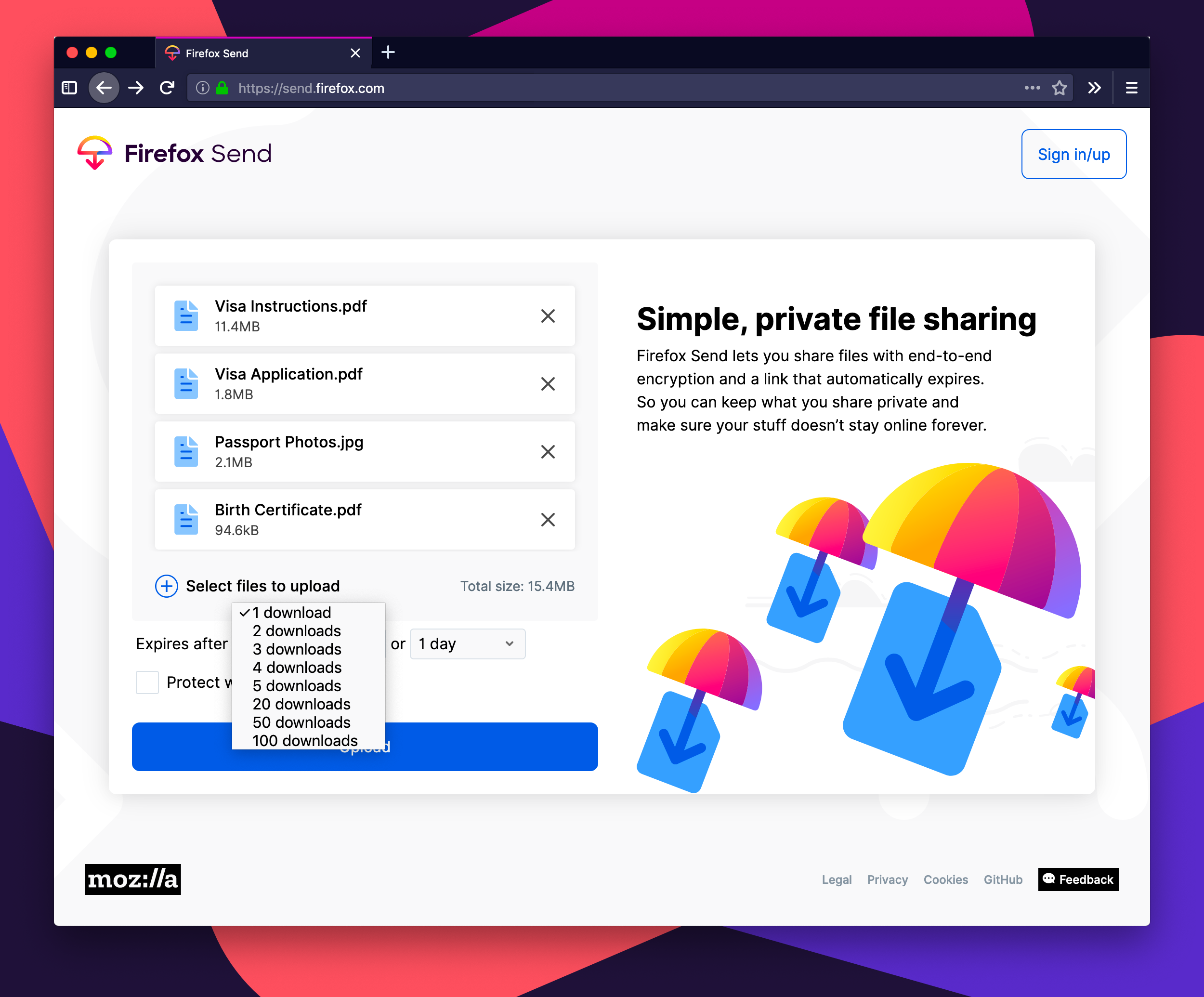
Send uses end-to-end encryption to keep your data secure from the moment you share to the moment your file is opened. It also offers security controls that you can set. You can choose when your file link expires, the number of downloads, and whether to add an optional password for an extra layer of security.

Choose when your file link expires, the number of downloads and add an optional password

Share large files & navigate with ease

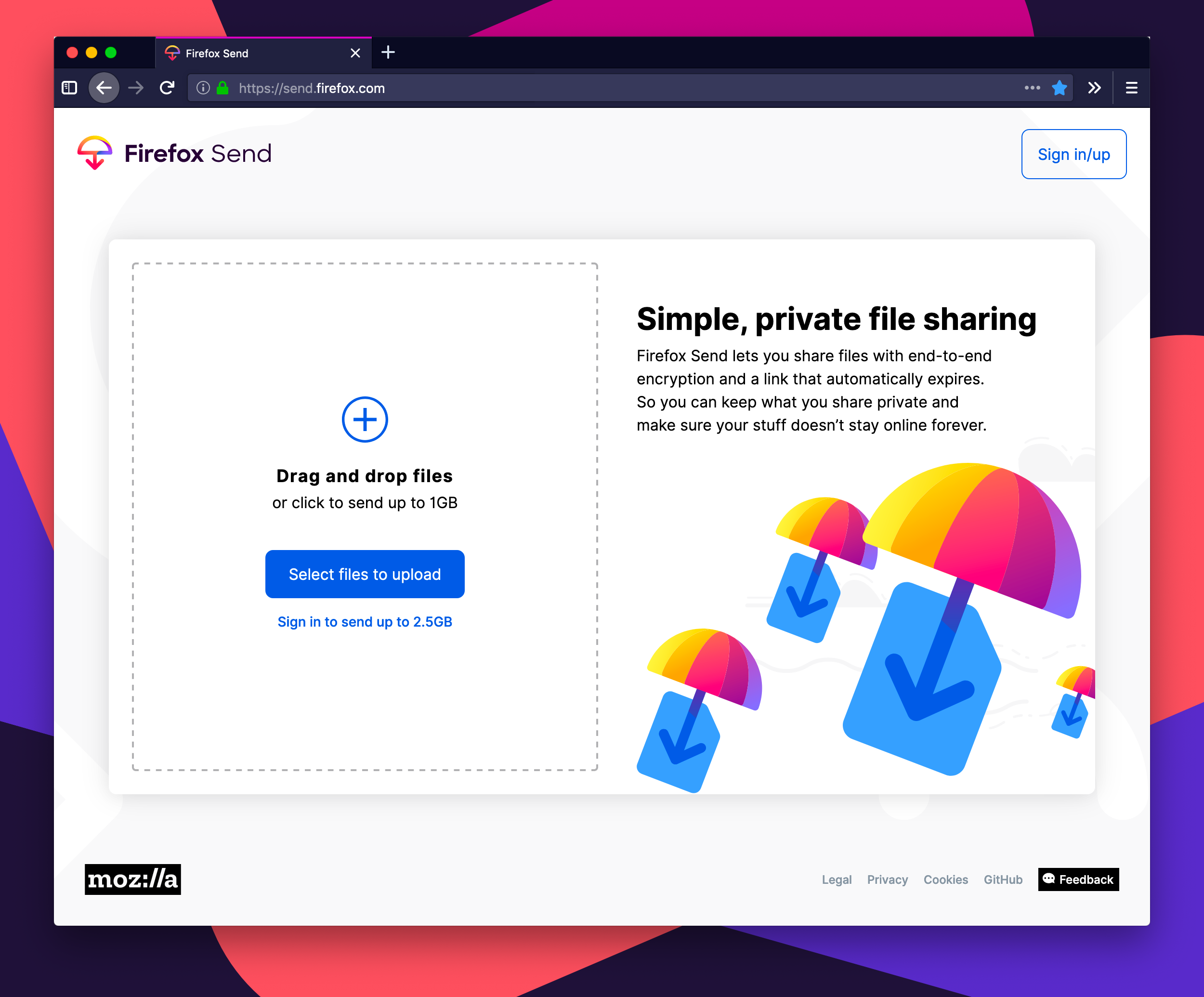
Send also makes it simple to share large file sizes – perfect for sharing professional design files  or collaborating on a presentation with co-workers. With Send you can share file sizes up to 1GB quickly. To send files up to 2.5GB, sign up for a free Firefox account.

Send makes it easy for your recipient, too. No hoops to jump through. They simply receive a link to click and download the file. They don’t need to have a Firefox account to access your file. Overall, this makes the sharing experience seamless for both parties, and as quick as sending an email.

Sharing large file sizes is simple and quick

We know there are several cloud sharing solutions out there, but as a continuation of our mission to bring you more private and safer choices, you can trust that your information is safe with Send. As with all Firefox apps and services, Send is Private By Design, meaning all of your files are protected and we stand by our mission to handle your data privately and securely.

Whether you’re sharing important personal information, private documents or confidential work files you can start sending your files for free with Firefox Send.

The post Introducing Firefox Send, Providing Free File Transfers while Keeping your Personal Information Private appeared first on The Mozilla Blog.

23 Mar 07:40

Joust: Thy Game has Just Begun!

by Reverend

Joust is a comin'

While I was back in the States Tim surprised me with a recent purchase for Reclaim Video’s growing arcade. One of my very favorite stand-up arcade games of the early 80s: Joust (1982). It’s SO BEAUTIFUL!!! And despite what Downes says, video arcade games are closer to God than pinball—and always will be! Pinball did not influence the future of gaming as we know it, 80s arcade video games, on the other hand, are ground zero for our current cultural moment of virtual entertainment. Gauntlet thrown, Stephen 🙂  I would prefer Atari 2600’s Video Pinball to the real thing any day of the week.

I have yet to play Joust, but the fact we now have Joust and Galaxian means we’ve reproduced the video game setup in the back corner of The Incredible Pulp during the mid-80s. The Incredible Pulp was a comic book store in Baldwin, NY around the block from where I grew up in Baldwin, Long Island. It was filled with Frank Franzetta posters, Dungeons and Dragons figurines, boxes of comics, AD&D dungeon guides, adventure modules and much more. I want to believe they had models there too of the classic horror scenes with characters such as Dracula, the Wolfman, the Creature from the Black Lagoon, etc., but I may be letting my imagination take over at this point.

Anyway, it was a powerful environment for the imagination of a 12 or 13 year old, and it has stuck with me. I want to think Reclaim Video is morphing into not only a VHS and Laserdisc store/archive of ever growing import, but also an 80s video game arcade to boot—and who knows, there may be room for some toys 🙂

But the arrival of Joust has also fast forwarded another amazing development neither Tim or I really anticipated, the fact that Tim would get deep into actually tinkering with these machines (although i am surprised we didn’t see this coming 🙂 ). He wrote a post yesterday about the repair work he has done on them so far, and it is really cool to think of these machines as kinda like old cars that you could actually work on—unlike the more complex systems that would follow. What’s more, there’s a thriving community of folks doing it, and we may be able to move from buying refurbished machines to piece-meal fixer-uppers for a fraction of the cost. All this to say, as Tim noted in his post, the video game machines have provided a welcome frame and focus for the vision of the maker space we’ve be creating in the backroom of Reclaim Video, while also fueling some extravagant nostalgia! But we are not simply looking backward at Reclaim, we are having some fun making sure what was is not entirely lost in the promise of what could be.

23 Mar 07:39

Le Web a 30 ans

by Tristan

Il y a 30 ans aujourd’hui, naissait le Web. Je ne l’ai découvert que quelques années plus tard, et j’ai été ébahi par son potentiel. Soudain, l’Internet devenait utilisable par beaucoup plus de gens : il suffisait d’avoir un navigateur et de cliquer sur les liens bleus soulignés. C’était à la portée de tous !

Fin 1996, je postule chez Netscape, pour faire partie de l’aventure. Rapidement, j’ai vu une entreprise essayer de prendre le contrôle du Web en diffusant un navigateur avec son système d’exploitation, dont elle avait le monopole. C’était illégal, un abus de position dominante. C’était aussi toxique pour le Web, et cela m’a mis en colère. Coup de bol, au même moment (début 1998), mes collègues californiens lançaient le projet Mozilla, que j’ai rejoint. Vous connaissez peut-être la suite : AOL/Netscape essaye longuement de faire marcher le projet Mozilla jusqu’en 2003 avant de l’abandonner. Mozilla Foundation est créée, je monte Mozilla Europe avec Peter, Pascal,Axel et d’autres. Nous savions que Firefox était dans les tuyaux, et qu’il pouvait jouer un rôle décisif. Son succès a dépassé toutes nos attentes : il est massivement adopté en Europe et dans une moindre mesure aux USA et au Japon. Exit Internet Explorer, le monopole est renversé, la diversité des navigateurs est rétablie.

Février 2015 : je quitte Mozilla après 17 ans d’implication dans le projet. Pour moi, il est toujours très important de proposer un navigateur au service des utilisateurs. Le problème s’est même étendu aux téléphones mobiles, depuis l’avènement des smartphones en 2007. Mais le faire n’est pas suffisant si cela revient à pousser les utilisateurs dans les bras des géants de l’Internet qui collectent les données personnelles de chacun pour mieux servir leurs vrais clients : les annonceurs, à qui est vendue de la publicité ciblée. L’une de ces plateformes est sur le point d’obtenir le monopole des navigateurs… L’histoire est un éternel recommencement !

Juin 2018 : j’arrive chez Qwant. Mon objectif : aider le projet Qwant dans son adoption par les utilisateurs et aussi l’accompagner dans l’open-source / logiciel libre. Qwant a deux particularités :

  1. c’est un projet français et donc européen.
  2. c’est un moteur de recherche qui ne piste pas ses utilisateurs.

C’est la combinaison de ces deux qualités qui m’a séduit, en plus de la volonté d’aller vers plus de Libre.

Car en fait, je pense que le modèle des Google et de Facebook est toxique pour la démocratie. Tout savoir sur tout le monde, c’est une responsabilité que personne ne devrait avoir à porter, pas même un État. Car inévitablement, ça attise les convoitise, ça pousse à la manipulation. Les révélations Snowden (surveiller tous les internautes pour assoir l’hégémonie d’un pays) ou plus récemment Cambridge Analytica (utiliser les données d’un réseau social pour faire basculer des élections démocratiques) démontrent que ces dangers sont réels.

Évidemment, vouloir changer le Web, ça peut sembler naïf. Effectivement, il serait bien prétentieux d’affirmer qu’on est sûrs d’y arriver. Mais faut-il être certain du succès pour s’engager dans un projet ?

Heureusement, Tim Berners-Lee nous le rappelle :

Le Web est fait pour tous, et nous avons collectivement la capacité de le changer. Ça ne sera pas facile. Mais si nous rêvons un peu et travaillons beaucoup, nous pouvons obtenir le Web que nous voulons.

Le rêve, nous l’avons, chez Qwant. Et mon expérience avec Mozilla me laisse croire qu’effectivement, avec beaucoup de travail, c’est possible de changer le Web pour le meilleur. Je sais : j’ai déjà eu la chance de participer à un tel effort chez Mozilla. Vingt et un ans après, je continue de croire qu’il est possible de remporter cette bataille. Et je sais de façon certaine que la cause est juste : le monde a besoin d’un Web où nous, utilisateurs, ne sommes pas considérés comme du bétail. Alors au boulot !

23 Mar 07:39

Excluding files from a Zip Archive

by Reverend

I am in catch-up mode on some blog posts, and this one belongs to what D’Arcy Norman termed the outboard brain genre of post. I was migrating a WordPress site from another hosting service a couple of weeks back, and it was a beefy 10 GBS (which was more storage then the new account on Reclaim even had). The fact it was so big raised a flag for me, so I looked around in wp-content, and it turns out the backup plugin Updraft had stored a couple of years worth of regular backup files. If the hosting service had anything resembling File Manager in cPanel I could have moved them out temporarily, and then zipped up the files and moved it over, but turns out I was doing this via command line so I need to exclude the Updraft directory from a zip archive. 

A quick search brought me to this post on OSXDaily and I was able to exclude the backups directory and transfer a 350MB file versus wrestling with a 10GB monster , which saved me a tremendous amount of time and frustration, as well as back and forth tickets with the lient:

zip -r wpsite2bemoved.com.zip wpsite2bemoved.com.com -x *updraft*

Now that I had a manageable zip archive, I was able to use the scp command, which is very useful, to transfer the zip archive between servers almost instantly:

scp wpsite2bemoved.com.zip root@punkbandname.reclaimhosting.com:/home/wpsitebe/public_html

So, now I have the process more formally documented then an open tab in a browser I would eventually lose to time and memory.  I could have just deleted the backups folder, I guess, but when you have gotten called on the carpet for deleting anything as much as we have, that become the absolute last resort.

23 Mar 07:39

Playing Hookey

by Rex Hammock

I have lots of half finished blog posts that may never be posted. One day, this will be called the gap in blogging at Rexblog.com.

Anyway, I could not let the 30th anniversary of the WWW go by without saying something. Or re-posting something, at leaste.


Happy Birthday to the World Wide Web

Sidebar: There was something about the SNL PowerPoint skit last Saturday that made me think about the early days of the web — or, in general, the early days of the graphical interface. Here it is.


23 Mar 07:39

Best Waterproof Bike Panniers for Touring and Commuting: Ortlieb Bike Panniers

by Average Joe Cyclist

Best Waterproof Bike Panniers for Touring and Commuting - Ortlieb Bike PanniersAre you looking for waterproof panniers for your bike commute or your bike tours? Ortlieb panniers might be right for you. They are loved by millions of bike commuters and bike tourers because they are completely waterproof and very spacious. In this post we feature and compare three of the best in Ortlieb's line-up of premium waterproof bike panniers.
The post Best Waterproof Bike Panniers for Touring and Commuting: Ortlieb Bike Panniers appeared first on Average Joe Cyclist.

23 Mar 07:39

Back in the old days, when I would hear that so...

Back in the old days, when I would hear that someone was writing an RSS reader, I’d worry that it was more competition.

These days when I hear that same news, I get excited. Sure, I want lots of people to use NetNewsWire — but, way more than that, I want lots of people to use RSS readers.

The more the better, since no one app is going to be the right thing for everybody.

And here’s Rob Fahrni working on a river-of-news type RSS reader for Mac and iOS. Cool!

Writing an open source app, and not having to think about making money with it, is utterly thrilling. I love this.

Among other things, it means I get to be a cheerleader for other people’s work, which is totally fun for me. Makes me happy.

23 Mar 07:38

Roadmap to the Renaissance

by Jonathan Edwards

How will we escape the current Dark Age of Programming? What will trigger a Software Renaissance? History tells us that major intellectual shifts usually arise not from lone geniuses but from subcultures that suddenly coalesce in a burst of invention and discovery. I have found an interesting book that looks at the group dynamics of such subcultures:  Collaborative Circles: Friendship Dynamics & Creative Work by Michael P. Farrell (suggested by Patrick Collison). From the blurb:

Many artists, writers, and other creative people do their best work when collaborating within a circle of like-minded friends. In a unique study, Michael P. Farrell looks at the group dynamics in six collaborative circles, and gives vivid narrative accounts of each: the French Impressionists; Sigmund Freud and his friends; C. S. Lewis, J. R. R. Tolkien, and the Inklings; social reformers Elizabeth Cady Stanton and Susan B. Anthony; the Fugitive poets; and the writers Joseph Conrad and Ford Maddox Ford.

Farrell presents a systematic description of how such collaborative circles arise and develop. I’ve been trying for years to organize various sorts of groups to advance progress in programming, following the established topography of academic organizations like workshops and working groups. Farrell’s book presents a roadmap to an entirely different terrain: the informal underground rebellions where breaking changes actually happen. Much to consider…

Here are some excerpts from Chapter 7: Toward a Theory of Collaborative Circles.

… collaborative circles are likely to form in a magnet place where the high-status masters are gathered, but on the periphery of that network. Highly ambitious, talented novices who are attracted to a magnet place but find themselves cut off from prestigious mentors are more likely to turn to their peers for support and guidance. – p. 267

Ambition, coupled with their marginalization, may be what fuels the resentment and rebellious tone characteristic of their early interaction with their peers – p. 268

Collaborative circles that develop innovative visions flourish in turbulent cultural environments, where two or more vision of a discipline … view for centrality in a single place. … The dialogue at the center empowers those on the periphery to synthesize elements of the old perspectives and to conceived an alternative vision of their own. – p. 268

Once formed, a circle constructs its own subculture. At the heart of the subculture is the shared vision of the members — a new theory and methodology that they introduce into their discipline. … Whatever the content, a new vision is often viewed with suspicion by authorities in a field. A new vision not only raises questions about the value of existing visions, it also can have political and economic consequences for those who have built their careers on existing visions. Not surprisingly, those who advocate the new vision are often viewed as threats by the established authorities at the center of a discipline network. These deviant innovators often become targets of formal and informal sanctions.
In the early stages of circle development, the supportive friendships within a circle enable the members to resist pressures to conform to the dominant vision of their field. … During the quest stage of circle development, the group provides a supportive context where the members are free to explore new, “deviant” ideas. During the collective action stage, when the members take the new vision into the community, the circle provides the support they need to cope with rejection, ridicule, and sometimes even legal sanctions. – p. 270-271

The dynamics of the circle thus not only buffer the pressures to conform, but encourage experimentation. The charismatic leader’s sense of mission, self-confidence, and daring are contagious. Under the spell of the charismatic leader, the members are willing to try many things they would never have done alone. … Those who resist the momentum of the circle — the conservative boundary markers who cling to conventional visions as well as the radicals who go too far in rebelling — stimulate discussion and clarification of the circle’s emerging vision. – p. 271

Collaborative circles form among highly ambitious members of a discipline network who share a common set of attitudes and values and who speak the same language. … Because of their commonalities, members of successful circles share many assumptions about what is important and unimportant, they can laugh at one another’s, and they do not have to justify every opinion or explain every detail of their thinking. In short they feel almost a familial sense of being at home with one another. – p. 273

Because the magnet place has a reputation and sends out similar signals to a wide network, those who go there are likely to have much in common. Second, within the social network at the magnet place, circles often form when one or two people — the gatekeepers or matchmakers — bring the members together. The gatekeeper’s criteria for friendship filter potential members so that those chosen have many attitudes and values in common. … Without the common language and values that enable members to validate one another’s basic assumptions and argue with one another persuasively, a circle is likely to disintegrate during the quest stage, if not sooner. – p. 273

It is in the quest stage that the members move beyond criticizing authority and attempt to forge a shared vision; and it is during this stage that the members pair off into dyadic working friendships characterized by trust and instrumental intimacy. Within the pairs, they open their private thoughts to one another, rely on one another as sympathetic critics, and expose to one another their most outrageous ideas. When they are engaged in this kind of dialogue, they are most vulnerable to one another. Without the commonalities of background, values, and styles of discourse, they may react to one another in destructive ways. – p.273

No member is overly dependent upon any other. The members can disagree with one another openly, even insult one another with humor, as friends can, without fear of retaliation. … Although the members might tease or mock one another, group meetings are relatively safe spaces to speak their minds. … In the quest stage, the sense of equity in the distribution of rewards contributes to the trust and intimacy necessary for instrumental intimacy and creative work in pairs. – p. 275

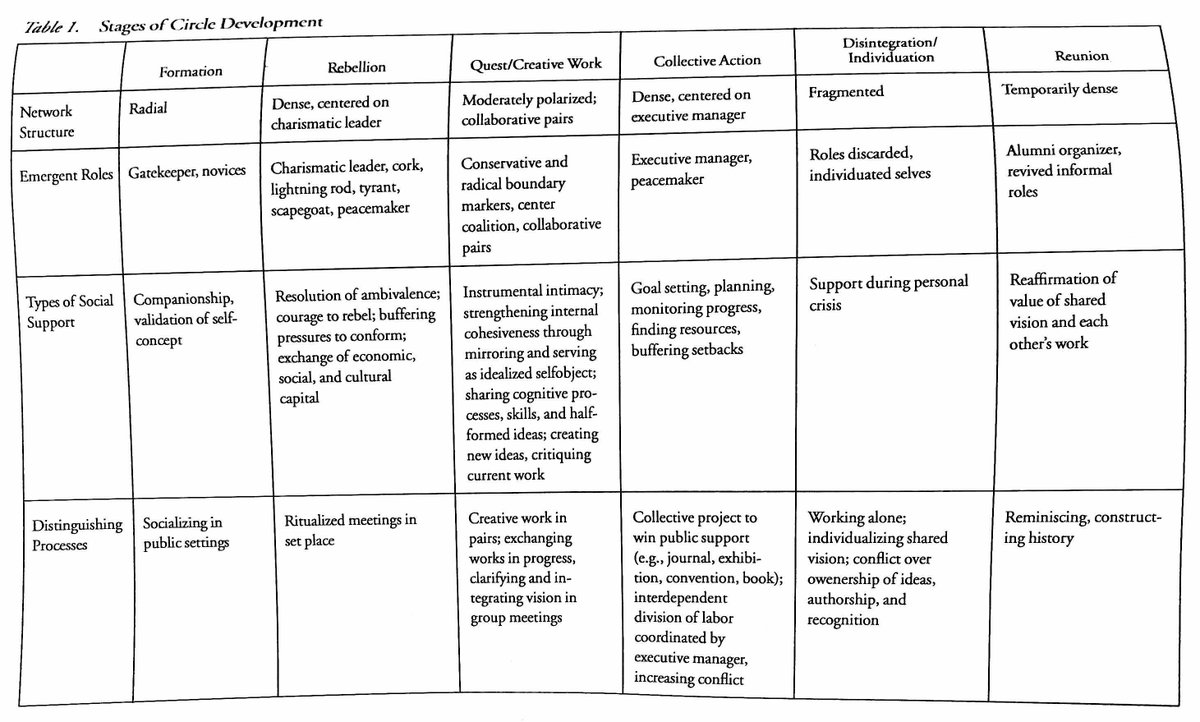
Stages of Circle Development

Stages of circle development

Formation Stage

In most cases, the activities of colleagues and friends in a discipline are like parallel play among children in a sandbox. They may be aware of one another’s work, but they do discuss it, influence one another, or carry out cooperative projects that draw out creativity in one another. … What is necessary to move a group of homogeneous equals towards becoming a collaborative circle? … Successful circles usually form as radial networks. At the center of the network is the gatekeeper, a person who is instrumental in drawing the members together and introducing them to one another. … The gatekeeper selects friends who are highly ambitious and committed to the same line of work — people who aspire to make a mark and gain recognition in their field. Some if not all the members selected by the gatekeeper may have an inflated sense of their own destinies … They see something lacking in the mainstream vision of their discipline, and they want to do something about it …. They may have high aspirations, but they feel far from being masters of their chosen disciplines. … At first they may share only opinions, ideas, and works that they are confident will impress their new friends. – p. 276-278


Rebellion Stage

In the rebellion stage, the structure of the group changes. The initial radial network centered on the gatekeeper evolves into a dense network centered on a charismatic leader. The charismatic leader is a narcissistic member who is most vocal and dramatic in rejecting the established visions of the discipline. … the charismatic leader urges the group to try something daring, sometimes even forbidden in the discipline. – p.279

The members may identify a tyrant on the edge of their network — an authority associated with a vision they reject. One ritual in group meetings may be relating stories that deflate this tyrant. – p.279

When the members are sizing one another up, the exchanges may stabilize at a relatively superficial or guarded level. But eventually, for reasons that vary for each group, trust reaches a critical point, and one member takes a risk and opens the door to more intimate disclosures. … If the recipient of the “gift” follows the lead and reciprocates, the process can quickly intensify until all members are sharing their most secret, undeveloped ideas. – p.280

Quest Stage

Ultimately, circles with a high tolerance for irritant boundary markers in their midst may be more likely to develop new visions in their fields. Such groups are less prone to conformist “groupthink” dynamics – p.282

Beginning in the quest stage and continuing into the creative work stage … interactions include a pattern of working in pairs. … A respected peer who serves as an admiring but demanding audience can be a powerful stimulus to creative work. … Circle members develop the highest degree of trust, take the greatest risks, and demonstrate the most interdependence in thinking when they work in pairs. … Because each can count on the other to do the work of critical evaluation, each is more free to follow through on creative ideas without inhibition. p. 284-285

When a group ritualizes occasions where all members meet together, a center coalition of members often develops the final synthesis of the circle’s vision. … The center coalition consists of the members who consolidate the insights that emerge within collaborative pairs, integrate them into a coherent theory, and convey the vision to newcomers into the circle. – p. 285

Collective Action Stage

The collective action stage of a circle begins when the members decide to carry out a group project aimed at winning support for their vision outside their own network. The project could be a journal, an art exhibition, a grant proposal, or some other task that requires interdependent work. Whereas in previous stages, the objective was to create a new vision, in this stage the objective becomes to win support for the vision from authorities and from the public. Up to this point, the journey has been inward to mine the creative process; now it turns outward. … To succeed at the new tasks, a new type of leader is required — one who can balance budgets, make contacts with influential people, talk to the media, orchestrate the group members for organized events, and in other ways act as an executive manager. … A formal normative code may replace the authority of the charismatic leader. – p. 286

Variations in circle development

The disciplines in which collaborative circles form are not only becoming more inclusive of women, they are also becoming more diverse ethnically and racially. It will be interesting to examine how gender and ethnic diversity affect the formation and development of circles. My findings suggest that homogeneous circles are more likely to speak the same language, feel at home together, and build the degree of trust characteristic of collaborative pairs. However, I have also found that some degree of diversity within the circle, exemplified by the circle boundary markers, contributes to creativity and to the clarification of the circle’s new vision. It may be that there is a range of diversity that is most conducive to successful circles. – p. 291

In this research, I have found that circles are usually formed by people in their twenties and early thirties, when they are likely to be in the early stages of their careers. However, as societies deindustrialize and the population ages, the relationship between age and circle formation may change. – p. 292

Disciplines vary in how much they rely on magnet places as training grounds for new members. Those that do not form in magnet places are more dependent on informal networking to locate potential members. As Internet communication becomes more common, it may be that circles will form among widely scattered, like-minded people who discover one another through electronic communication. In addition, Internet communication may make it easier for marginalized people in a discipline to discover one another.

When a person sits alone in a study and communicates with another person by computer, there often is a sense of immediate intimacy. Because they give off minimal personality clues and nonverbal feedback, they can play parts for one another like that of a therapist who maintains the optimal, empathic distance and permits her image to be filled in with projections and transference. … Future collaborators may discover that Internet communication provides that right mix of intimacy and distance to nurture collaborative pairing, egalitarian openness, and instrumental intimacy. However, without the depth and breadth of communication that occurs in a face-to-face meeting, I doubt that a group can have the kind of profound influence on its members that we have seen in the case studies presented here. Internet communications may facilitate the formation of circles, and, like the letters between Freud and Fleiss, it may enable them to maintain contact between meetings, but I do not think it allows for the kind of in-depth dialogue that leads to meaningful personal development and creative work. For this kind of interaction, there is no substitute for ritualized meetings and working side by side. – p. 293

23 Mar 07:38

Bookmarked Right to Know: A Beginner’s Guide to...

by Ton Zijlstra
Bookmarked Right to Know: A Beginner’s Guide to State Secrecy / Balkan Insight by Dusica Pavlovic (Balkan Insight)
Governments in the Balkans are chipping away at transparency laws to make it harder for journalists and activists to hold power to account.

This article is a good description of the Freedom of Information (#foia #opengov #opendata) situation in the Balkans. Due to my work in the region, I recognise lots of what is described here. My work in the region, such as in Serbia, has let me encounter various institutions willing to use evasive action to prevent the release of information.

In essence this is not all that different from what (decentral) government entities in other European countries do as well. Many of them still see increased transparency and access as a distraction absorbing work and time they’d rather spend elsewhere. Yet, there’s a qualitative difference in the level of obstruction. It’s the difference between acknowledging there is a duty to be transparant but being hesitant, and not believing that there’s such a duty in governance at all.

Secrecy, sometimes in combination with corruption, has a long and deep history. In Central Asia for instance I encountered an example that the number of agricultural machines wasn’t released, as a 1950’s Soviet law still on the books marked it as a state secret (because tractors could be mobilised in case of war). More disturbingly such state secrecy laws are abused to tackle political opponents in Central Asia as well. When a government official releases information based on a transparency regulation, or as part of policy implementation, political opponents might denounce them for giving away state secrets and take them to court risking jail time even.

There is a strong effort to increase transparency visible in the Balkan region as well. Both inside government, as well as in civil society. Excellent examples exist. But it’s an ongoing struggle between those seeing power as its own purpose and those seeking high quality governance. We’ll see steps forward, backwards, rear guard skirmishes and a mixed bag of results for a long time. Especially there where there are high levels of distrust amongst the wider population, not just towards government but towards each other.

One such excellent example is the work of the Serbian information commissioner Sabic. Clearly seeing his role as an ombudsman for the general population, he and his office led by example during the open data work I contributed to in the past years. By publishing statistics on information requests, complaints and answer times, and by publishing a full list of all Serbian institutions that fall under the remit of the Commission for Information of Public Importance and Personal Data Protection. This last thing is key, as some institutions will simply stall requests by stating transparency rules do not apply to them. Mr. Sabic’s term ended at the end of last year. A replacement for his position hasn’t been announced yet, which is both a testament to Mr Sabic’s independent role as information commissioner, and to the risk of less transparency inclined forces trying to get a much less independent successor.

23 Mar 07:38

What’s a product roadmap and how do you build o...

What’s a product roadmap and how do you build one in the early days of a startup? James Turnbull writes about one way to do it on the Microsoft for Startups blog.

23 Mar 07:37

What we need is an Open Badges community renaissance, free of IMS involvement

by Doug Belshaw

TL;DR: the Open Badges Google Group contains many members but has been moribund under the stewardship of IMS Global Learning Consortium. Time for something different?

Background

Yesterday, EdSurge published an article about Open Badges which included a quotation from me. It was the first I’d heard of it as the reporter didn’t reach out to me. My words were taken from the etherpad minutes audio recording of a meeting held towards the end of last year about Credly’s ownership of patents relating to badges.

It’s important to note that, while EdSurge mentions the fact that I work for Moodle in the article, my opinions on the subject have nothing to do with my (part-time) employer, and everything to do with my involvement in the Open Badges ecosystem since 2012. I have some things to say about IMS Global Learning Consortium, and I’m afraid I can’t be very complimentary.

Introduction

To my mind, three things led to the exponential growth of badges between 2012 and 2015:

  1. Mozilla’s technical expertise and reputation
  2. The MacArthur Foundation’s money and influence
  3. The Open Badges community’s evangelism and organisation

MacArthur’s money dried up after 2015, and while Mozilla’s involvement declined more slowly, they have been essentially non-existent in the ecosystem since they handed over stewardship of the Open Badges standard to IMS Global Learning consortium at the start of 2017. So what kept the Open Badges movement going between 2015 and 2017?

Community!

The thing I really want to focus here is the third thing: community. I may be biased given that I worked for the Mozilla Foundation at the time, but they did a fantastic job at attracting, feeding, and listening to a community around Open Badges. Since the transfer to IMS that community has withered. IMS doesn’t care; as a membership organisation they exist for the benefit of their members.

Right now the Open Badges Google Group, now controlled by IMS, has 2,603 members. It was a hive of activity five years ago, but now it’s moribund. This is a direct effect of IMS working in a way diametrically opposed to the conditions under which the community prospered: they are closed, secretive and unforthcoming. As the EdSurge article points out, IMS have even allowed one of its members to get away with patenting elements of the very standard it has been charged with stewarding.

With such dereliction of duty something has to be done. In similar circumstances, other open source projects have been ‘forked’. In other words, unhappy with the way a project is being managed, community members can take the underlying idea in a different direction. From my understanding having talked to some influential figures in the community, there’s a very real possibility that could happen in the next 18 months unless IMS ups their game.

Next steps?

What we need here is a a renaissance in the Open Badges community. The existing Google Group is administered by IMS and may no longer be fit for purpose. So, I’m wondering out loud whether the co-op of which I’m part should step up and host a new place for people who want to discuss Open Badges and digital credentials?

We’ve got a history of working with the community through projects such as Badge Wiki and Badge News (now The Learning Fractal). Most of us also worked for Mozilla during the glory days.

What do you think? Would you like to see an Open Badges community renaissance? How do you see that happening?


Photo by Marc Biarnès used under a Creative Commons license

23 Mar 07:37

Fresh Container: Major Re-Stock and Lots o' New Stuff!

by noreply@blogger.com (VeloOrange)
by Igor

We were greeted this morning with the most beautiful container brimming with equipment you all have been waiting so patiently for. In addition to the restock, we are introducing several new products!

Noir, 700c 63mm Fluted Fenders


Our 63mm Fluted Fenders are the perfect fit for 700c Road+ tires. Think gravel, all-road, and other buzz-worthy words. They'll swallow up tires up to 53mm to keep your backside and drivetrain clean.

Noir Fender Reflectors

Following up on more Noir offerings, we're now offering Noir Fender Reflectors!
Grand Cru Quick Release Levers
These QRs are very reminiscent of my favorite downtube shifter: the Simplex SLJ (I even have one on my keys). They feature an external cam with a lovely brass insert for durability. The opposite side has a neat, knurled barrel for easy adjustment. Did we have to make a Quick Release Set this fancy? Absolutely.


Captain Dashboard Handlebar Mount
Between strap-on handlebar bags, lights, cue-sheets, and GPS units, you might find yourself running out of room on your handlebars for gizmos and gadgets. These Handlebar Mounts are super versatile and can help position things to better serve you during rides. Each kit comes with two removable barrels, so you can utilize one or both on the bars, or detach one to use elsewhere. The barrel could then be mounted on another threaded point, for example as a light mount on your Rando Rack. Here is another idea: flip it under the bars and use it as a stand-off for a strap-on handlebar bag. The beauty is that you can get two sets and use them for vastly different applications. What will you come up with?


Course Water Bottle Cage
The keenest VO followers will note that we actually used to offer these in the past. The story is that the factory made a few hundred more than the last order cycle, and these were aged (read: sat around) waiting for the perfect opportunity to make their re-debut. Like our other cages, they're made from stainless steel and have an exceptional polish. We aren't making them again, so get them while you can. Once they're gone, they're gone (unless they find another box kicking round in 10 years).

In addition to the cool, new stuff, we had a nice restock of popular products! If you signed up for back-in-stock alerts, you should be getting an email any minute now. Here's a fairly comprehensive list of everything that is now back in stock:
23 Mar 07:37

Notes On "Global Guidelines: Ethics in Learning Analytics"

by Stephen Downes
In my post referencing the ICDE's Global Guidelines: Ethics in Learning Analytics yesterday I said:

This document summarizes the considerations of an ICDE working group on learning analytics. For the most part it is a clearly-written and even-handed treatment of a number of difficult subjects, though it would appear to be relentlessly focused on the institutional perspective (not surprising given its intended audience of educational policy makers and regulators as well as middle and senior management in higher education institutions. The presumption throughout is that a global ethic in learning analytics is needed, can be known, and comprehends the issues in this document. I'm not so sure, but that's a discussion that cannot be attempted in this short post.

In this article I expand on and substantiate the comments made in my short post.

A note on quotation: these are notes. I draw liberally from the text of the ICDE document. Only the content in the sections titled 'Comment' is my own. All other content in this article is either directly quoted from, or paraphrased from, the original, and only reorganized for clarity and exposition.


Definition and purpose of the use of Learning Analytics


Where is data drawn from? 

All from (Sharples et al,. 2014):
  • behavioural data from online learning systems (discussion forums, activity completion, assessments)
  • functional data extracted from registration systems and progress reports
  • data shared by students as part of their daily social and study lives


How is Data Analyzed?
  • "predictive models (which suggest potential completion rates, for example)
  • social network analyses (which examine possible relationships between networks of individuals and groups)
  • relationship mining (which analyses links between sets of data patterns such as student success rates), 
  • dashboards(data visualisation which provides a mean of delivering feedback to educators and learners). 
The range of analytic practices along the axes of Value and difficulty has been set out helpfully in graphic form  (Davis2013)."


What is it Used For?
  • to build better pedagogies, empower students to take an active part in their learning, target at-risk student populations, and assess factors affecting completion and student success.’ (NMC 2011)


Comment

Some key questions are elided in this initial summary:
  • What counts as an acceptable source of data? What data must be included in learning analytics?
  • What data must be excluded?  This is mentioned briefly in section 6.1 (local data protection legislation, plus "the institution may also want to give consideration to whether any data categories are irrelevant, or sufficiently sensitive to warrant exclusion") but not discussed from an ethical perspective.
  • As an example of the latter question, we might well question whether it is ethical to question students about their race, require genetic samples, collect rumour and innuendo, collect data obtained by force or by torture, etc. 
  • What counts as an acceptable method of analyzing the data? Are some methods of analysis (regression toward the mean, for example) unethical? Or is the method used to analyze the data beyond the scope of ethics in learning analytics?
  • Are some uses to which the data are put unethical. For example, if learning analytics data is used to support differential pricing (for example, charge students more likely to fail more money for supplemental tutoring)? 

Data ownership and control

Is Data Property?
  • "The emphasis on ‘data as property’ overestimates individuals as autonomous and rational agents (e.g., Lazaro & Le Métayer2015)."
  • “student data is not something separate from students’ identities, their histories, their beings. ... data is an integral,albeit informational part of students’ being. Data is therefore not something a student owns but rather is. Students do not own their data but are constituted by their data” (Prinsloo2017).
  • "GDPR sets out principles establishing ways in which data may be accessed, stored and used, and defines as special categories personal and sensitive data."
 Ownership of Data

Institutional Ownership Model
  • In a learning analytics context, the presumption is often that data collected is owned by the institution
  • students themselves might be expected to take another view.
Institutional Stewardship Model (and Exploitation)
  • the institution does not own the student data that it holds, but has temporary stewardship. 
  • the institution may store datasets under certain conditions and for specified periods, but within a higher education context the issue of ownership could remain open.
  • In this situation, the institution would be able to collect, analyse and apply from the learning analytics outputs, are theirs to exploit for unrelated gain. 

Student Rights that "Might be Argued"

  • institutions should grant students some input to determine which data can be collected, how that data can be used, who is able to access it,and for what purposes (Prinsloo, 2017)
  • institutions should grant students the ability to correct and/or add context to their raw data,
  • institutions should grant students the ability to review and make a case for choices which appear to be limited as a result of a learning analytics application

Issues Around Third Party Sharing

  • "might typically include sharing student data which service providers for marketing purposes,for example"
  • "the third party would typically be bound by the data protection rules which apply to the institution" (no reference provided)


Comment

Some key observations here:
  • At what point does data come into existence, and at what point does it become property? For example - a student clicks on a link, and then this activity is logged, and then the activity record is stored in an LRS. What is the 'property' here - the action, the log, or the activity record? This question is not examined at all.
  • This section at no point takes seriously the idea that the student might be the owner of the data. At best, students are offered limited rights, and the question of ownership might "remain open". This is especially astonishing given some of the data being considered (eg. "data shared by students as part of their daily social and study lives").
  • The case for the student is made in a similarly weak fashion with respect to what are arguably fundamental rights: to correct data, to limit the impact of incorrectly analyzed data, etc.
  • Third party sharing (or, more accurately, sales of data to third parties) is assumed as acceptable by default, with discussion only concerning limitations on the rights of third parties. 
This is a significantly flawed section that basically assumes, and then rationalizes, a maximalist set of right for the institution, with few and limited rights for all other parties.


Transparency

What is Transparency?
  • making clear to students and to other stakeholders the purpose of learning analytics
  • relates primarily to how student data is collected, analysed and used to shape students’ potential learning journeys
  • also includes making clear what data is collected (and what is not) and any assumptions made about that data

Arguments for Transparency
  • brings with it an opportunity to engage with stakeholders to gain greater insight and involvement
  • facilitates both an opportunity to amend or correct the dataset (or the interpretations gained from it) and to add to institutional understanding of relevant factors which impact on student success
  • moral duty of the institution to act in a student’s best interests and perhaps advising alternative study paths

Arguments Against
  • Making students and stakeholders more aware of the uses of data may pose additional challenges
  • it is not always possible to be completely transparent
  • models built around regression approaches for example can be difficult to understand and interrogate
  • not always clear why one student may be identified as being potentially more vulnerable than another
  • not always in the best interests of students to communicate a predicted poor outcome

Comment
  • The term 'transparency' is very narrowly defined here and discussed only with respect to how data is used "to shape students’ potential learning journeys", and not with respect to the many other potential uses of student data, including some discussed above.
  • There is no discussion of whether an institution has an ethical obligation to transparency generally, and in particular, whether an institution has an obligation to reveal its collection methods, analytical processes and tools, models, and interpretation.
  • Arguments in favour of transparency generally centre only around the idea that they might enable students to contribute more data,
  • Arguments against transparency are all expressed as modalities, ie., that there is some sort of risk, without considering the extent or impact of the modality.
In general, this section operates from the presumption that non-transparency is the ethical choice, and that openness needs to be specially justified in all cases. I would contend that the opposite is true, that the institution has an ethical obligation at the outset to be transparency, and that non-transparency would be justified only in certain circumstances.

Accessibility of data


Overview

  • the determination of who has access to raw and analysed data
  • the ability of students to access and correct their own data
  • making clear which data might typically be included within a learning analytics application, and which might always be assumed to be out of scope
  • various categories of staff will have sight of some categories of raw student data as a normal aspect of the staff role, depending on their permissions. Where data categories are not required as part of that role, however, data would typically not be made available

Comment

  • The passive phrasing of this section ('typically' this, 'typically' that) is problematic and reads like a rationalization of existing practice.
  • There is no consideration is given to whether access may be granted or withheld to people based on the type of data, while in fact some data may be much more sensitive than other data
  • There is no consideration of whether access should be granted or restricted based on the possibility of harm being caused or prevented
  • Additionally, there is no discussion in this section of the responsibilities created by access to data, for example, the responsibility to access data securely
The section reads as though it is the right and purview of the institution to grant access as it wishes, with no real constraints on this right, and no instance in which anyone else (such as students) may have equally weighted rights to access to the data.


Validity and reliability of data

Datasets
  • ensure that data collected and analysed is both accurate and representative of the issue being measured
  • Datasets should be kept current as far as is possible, with opportunities for students and other stakeholders to refresh and replace existing data

Proxy Measures
  • Proxy measures should be used with caution
  • consider what the institution is trying to measure and to investigate how it might best be represented (rather than looking at available data first and figuring how it might be applied).

Statistical Analysis
  • ensure that data sets are complete and sufficient to enable robust calculations to be made
  • models used to analyse, interpret and communicate learning analytics to stakeholders (support staff, advisers,faculties, students) should be sound, free from algorithmic bias; transparent where possible and clearly understood by the end users

Comment

This section could be significantly deeper.
  • There are no 'proxy measures'. There is data plus a model. If it is not what was measured, it is not data, it is an analysis of the data.
  • A broader and more comprehensive approach to ethics in statistical analysis should be considered, for example as described here.

Given the broad-based concerns about the use of poorly-sourced data in an unclear or even unethical fashion, especially given the slim discussion of transparency above, this section poses significant cause for concern.

Ultimately, the question has to be asked, is there an ethical obligation to perform learning analytics in a rigorous and scientifically valid manner, or can institutions and their contractors use whatever mechanism they feel is appropriate?

This question is of additional approach in the domain of education, training and development because these are not optional or recreational uses of data. It's not Netflix nor even the Facebook algorithm. Getting analytics right or wrong will impact on a person's future. Hence, professional practice ought to be at the forefront of ethics in this discipline.


Institutional responsibility and obligation to act


Arguments for an obligation to act
  • Example: having observed students not submitting summative assignments or having calculated the probabilities of module completion, is the institution obliged to act on what it has identified?


Arguments against an obligation
  • Often resources are constrained,and in distance learning institutions in particular where one-to-one conversations are less easy, it is not easy to reach all students who may have been identified as likely to benefit from a support intervention of some type


Institutional Policies
  • policy for identifying where support resource is focused, for example:
    • on the group identified as most potentially vulnerable; 
    • toward students on high population core modules; 
    • at students with particular characteristics (for example, those with known disabilities, etc.).
  • decision-making process should be transparent and clearly understood by all stakeholders

Comment
  • There is a longstanding principle in ethics of 'ought implies can' which forms the basis of the commentary in this section
    • the authors are clearly making the point that institutional obligation only exists insofar as it is within the institution's means
  • The question remains, however, as to whether the institution should offer services where it would, as a matter of (say) 'duty of care', incur obligations it knows it cannot satisfy
    • for example, would a doctor start an operation without knowing it could be completed safely?
    • Should a university offer a course knowing that it cannot sufficiently support all the students in the course
  • There is moreover the question of whether institutions have certain obligations only toward some of its students (those identified in the discussion of policies) or whether these extend to all, and if not to all, then on what basis these distinctions are made
  • Although not stated here, presumably the recommendation here is that transparency is subject to the same caveats as those cases in the 'Transparency' section above.
Overall, the discussion of institutional obligations as a matter only of institutional capacity is demonstrably insufficient. The offering of certain services creates obligations such that, if the obligations cannot be met, the service should not be offered. This section should consider such cases.


Communications


Communications to Students
  • Contact based on basic tracking of students is potentially less contentious
  • that triggered by predictive analytics needs a great deal more consideration (because) predictions are only a probability generated by a computer
  • communications with students are perhaps most effective if couched in general support terms rather than in probabilistic terms

Communications to Staff
  • whilst predictive analytics are useful in proactively alerting tutors or support staff to issues before they may arise, it is also important to seek additional context.
  • Regular communications to staff should help ensure that they understand the approach: 
    • the underlying values linked to the institution’s mission and strategy; 
    • the anticipated benefits for students;
    • the limitations of data and its interpretation; 
    • guidelines for ethical practice.

Comment

The discussion in this section appears to be focused on rationalizing why communications might be abridged, or need explaining.

Unfortunately some significant issues with respect to the ethics of communication related to learning analytics are missing from this discussion:
  • Is there a general obligation to communicate the results of learning analytics to students and staff? 
  • Should communications be complete and truthful? 
    • There seems to be a suggestion in the discussion that untruthful, or less than fully truthful, communications should be the norm (presumably because the feeling is students would not understand truthful communications)?
  • Should communications of results include interpretations of those results, and on what basis?
  • Should the need for, and the nature of, communications be informed by external factors (such as the institution's interests, its mission and goals, or its legal liability)?

Cultural values


Multicultural contexts

  • understanding and interpreting data are necessarily more complex
    • (For example) A measure of participation or engagement may differ in different contexts
    • (For example) measures established as being correlated with successful or unsuccessful outcomes are likely to differ in different geographies and cultures.

Considerations Required
  • not all institutions will have the capacity or resource to develop in-house analytics tools developed on knowledge of its own students,
  • care should be taken if purchasing analytics packages from developers to ensure that the approach is:
    • fit for purpose 
    • can be adapted if appropriate with local data and with local constraints in mind.
Comment

  • Is there a default culture from which accommodations for others are made in the form of 'adapting' analytics? Or should ethics begin with he presumption that there is no default culture.
  • There is a distinction to be drawn between 'data' (which would presumably be the same across cultures) and 'model' (ie., interpretations of data from particular cultural perspectives)
  • Therefore: what culturally-sensitive elements is it ethical to include in a model, and what culturally-sensitive elements (if any) are unethical for inclusion?
    • for example, elements that reference language spoken may be ethical
    • for example, elements that reference skin colour may be unethical
  • Cultural and local considerations extend beyond understanding and interpreting data
    • for example, in some cultures, collecting certain data may be unethical
    • for example, in some cultures, allowing some people to see certain data may be unethical
Ultimately, for each of the sections discussed in this report, cultural considerations may come into play. It seems wrong, therefore, to place 'culture' in a small and separate section


Consent


Presumption of the Requirement for Consent
  • this principle should be built around a minimum of informed consent (that is,transparency before registration).
  • (From above) the lack of clarity around who owns the data muddies principles of meaningful consent

Factors impacting Consent
  • Ideally, consent should not be considered in simple binary terms, but presented to students as a menu of options which depend on:
    • the purpose of the collection analysis and use of their data, 
    • the disciplinary module or context, 
    • the variety of possible data that can be collected, analysed and used, 
    • and an understanding of the risks of opting in/out

Timing of Consent

  • Consent sought at the point of registration
    • for uses beyond those required for institutional reporting and basic student support 
    • students will be largely unaware of learning analytics and how it may be used
    • most convenient for the institution, but arguable less meaningful for the student.
    • If consent is to be sought at this stage, it should be coupled with transparency (of purpose, of data collected, etc.) and potentially with a later option to withdraw consent
    • an expectation that users should consent to uses of personal data unknown at the point of registration seems to be an unreasonable and unethical one
  • Consent sought later
    • differentiate between initial consent for the collection of data and specific consent when data are used to intervene in the choices students have or/and in adapting their learning experience or access to resources is preferred.
    • opportunities to provide or withdraw consent where an intervention might significantly alter their experience.

Nature of the Data
  • Non-Sensitive Data
    • Sclater (2017): consent is not required (since this may be considered as of legitimate interest)
    • Prinsloo and Slade (2018) question that consent is not required
      • data is not a neutral construct, but is shaped by the ideas and contexts used to generate it
      • what may constitute non-sensitive data in one context may be considered sensitive in another
  • Sensitive Data (under the GDPR, will be labelled ‘special category data’)
    • Sclater (2017): consent is required for use of sensitive data
    • consent required for interventions directly with students on the basis of the analytics.

Comment

Though the discussion on consent covers a lot of ground, it lacks a basis in ethics, and should reference wider literature .

  • The requirement for consent may be based (for example) on a principle of 'Respect for Persons', as expressed by the Government of Canada panel on research ethics. This principle implies:
    • individuals who participate in research should do so voluntarily, 
    • understanding the purpose of the research,
    • and its risks and potential benefits, as fully as reasonably possible.
  • The discussion should consider the information generally required for informed consent. This is described in detail in the panel on research ethics document.
  • Under no circumstances may researchers proceed to conduct research with anyone who has refused to participate.:
    • Consent shall be given voluntarily.
    • Consent can be withdrawn at any time.
    • If a participant withdraws consent, the participant can also request the withdrawal of their data or human biological materials.
    • These considerations would make moot distinctions on the basis the type of data, the timing of consent, or the ownership of the data (these are discussions of mechanisms rather than of ethics)
    • Coercion and incentives are significant factors in education, especially where a decision not to participate may harm a students educational outcome, either by refusal of admission, or dependence of the support on research data, or influence on grades or outcomes
    It should be emphasized at this juncture that (a) ethics is wider than law - what may be legal may also be unethical, and (b) any use of data beyond direct provision of benefit to the student is a form of research, and ought properly be considered under the provisions of research ethics.


    Student agency and responsibility

    Power
    • there is an asymmetrical power-relationship between institutions and students
    • proactive engagement at least seeks to treat students as equal participants in the uses of their data.

    Why engage students?
    • ensure that students understand their responsibility for keeping personal information up to date (and can give informed/meaningful consent)
    • achieve a more accurate interpretation of data relating to student behaviours 
    • improve understanding of what forms of intervention and support are most appropriate
    • understand how to tailor a student’s learning journey to meet their needs, potentially as a personalised learning path
    • produce outcomes that students will find useful and be able to respond positively to, which might include a decision to continue or discontinue with their studies

    Comment
    • Legally and ethically, with respect to learning analytics, it should be understood that students are equal participants with institutions, and not merely 'treated' as such
    • Moreover, while the decision to participate in analytics may create obligations on the part of the students, no such obligations exist a priori, and would need to be set out as part of informed consent
    • Similarly, knowledge of the risks and benefits of participation are part of the process of consent, not an optional and sometimes ad hoc engagement process.


    From Alberta: The purpose of this Act is to govern the collection, use and disclosure of personal information by organizations in a manner that recognizes both the right of an individual to have his or her personal information protected and the need of organizations to collect, use or disclose personal information for purposes that are reasonable.


    23 Mar 07:37

    I’ll Tell Me Ma

    Every year, the Malden Democrats have a St. Patrick’s Day Breakfast. It’s one of the two annual parties that, along with an annual caucus, are the only official activities of the Malden Democratic City Committee. The program isn’t very political and hasn’t changed in eons.

    Every year, some sequined young women dance a pair of Irish dances. I finally looked up the lyrics to the second. They’re interesting. (As I understand it, this is a children’s game song; Americans might think of “All around the mulberry bush” or “Frere Jacque”.)

    I’ll tell my ma, when I get home,

    The boys won’t leave the girls alone,

    They pulled my hair and stole my comb,

    But that’s alright ’til I get home.

    This is nicely observed and it’s not the usual topic for a song! I wonder, though, in precisely what sense it’s all right. My interpretation was that we’re saying, the boys will get away with this now but there will be hell to pay when I get home. Linda suggests a slightly different interpretation: when we go home and are discovered to be combless, we ourselves are going to be in big trouble, which we can only hope to evade by citing force majeure. Either way, it’s an interesting dynamic in the year of #MeToo.

    She is handsome, she is pretty,

    She’s the belle of Belfast City.

    She is courting — one two three!

    Pray, can you tell me who is she?

    I love those twin bells. Again, there’s a little bit of ambiguity about the time progression. My first take was, this is dawning realization of an onlooker, and the last line is a request that he be properly introduced. My second view is less cheerful: it’s a progression: handsome kid, pretty nymphet, belle of the city who needs no introduction, and then — one two three! — an obscure married lady.

    Later, we have

    When she gets a lad of her own,

    She won’t tell her ma when she gets home.

    This is cute, but what is it? In suburban America, she might not tell her ma because they can quietly sneak up to her bedroom for some canoodling. I’m not seeing that for 19th century Ireland, not because they didn't canoodle, but because cottages and flats were too small. Perhaps what she’s not telling is that she’s got a lad; that’s certainly possible, but is it song worthy?

    I bet there are a bunch of verses that people don’t put on their records but everyone knows....

    22 Mar 17:58

    Could Facebook read encrypted messages? Would it?

    by Josh Bernoff

    A week ago, Facebook announced a shift to focus more on messaging (or as Mark Zuckerberg designated it, Facebook’s “privacy-focused” vision). I suggested that this would allow the company to personalized its ads even more. Would this even be possible if, as the company promised, the messages would be encrypted? A guy I respect on … Continued

    The post Could Facebook read encrypted messages? Would it? appeared first on without bullshit.

    21 Mar 22:16

    Should Universities and Colleges be in the Web Hosting Business?

    Mark Bradley, Show Me the Data - A Blog About Higher Education Websites, Mar 12, 2019
    Icon

    If you've been wondering why I'm studying cloud hosting, this is why. The answer this article suggests to the question in its title is "no" as it offers up statistics on which major cloud hosting services are supporting how many institutional websites across six nations. Amazon Web Services is the clear leader with Google and Rackspace coming second and third (I', wondering which Canadian institution has GoDaddy's only contract). Note that this entire article is 'below the fold' on this website; you have to scroll past the self-promotion in order to actually find the article (I'm sure data drove them to do that, but they need to remember, there's no data about the readers who don't read your website).

    Web: [Direct Link] [This Post]
    21 Mar 22:16

    Introducing Firefox Send, Providing Free File Transfers while Keeping your Personal Information Private

    Nick Nguyen, The Mozilla Blog, Mar 12, 2019
    Icon

    Firefox Send is a simple file-sharing application that mostly it just works. It uses the Web Cryptography JavaScript API with the AES-GCM algorithm for encryption; this is supported by most browsers (Firefox, Chrome, Edge) but not older and less secure browsers (Internet Explorer 11). Navigate to the Send web page, log in with a Firefox UserID, and upload a file. You'll be given a download link to share. The link expires after a preset number of downloads (up to 100)  or after after a certain time has elapsed (up to one week). You do not have to have a Firefox UserID to access the file with the download link, but the sender can protect it with a password.

    Web: [Direct Link] [This Post]
    21 Mar 22:15

    The HyperSpace Blog Is Live on… HyperSpace

    HyperSpace, Mar 12, 2019
    Icon

    I've been keeping an eye on the HyperSpace project with some interest. In a nutshell, HyperSpace is a distributed publishing platform that uses it's own digital currency to promote and reward participation. The longer term roadmap, though, envisions a fully decentralized publishing economy. Today it took a major step in that direction. Here's the HyperSpace Blog on HyperSpace. You can join Hyperspace, create a post, and in addition to publishing on Hyperspace, the post will be published on the Inter-Planetary File System. In the interests of full recursion, I've published this post to IPFS on Hyperspace; here it is.

    Web: [Direct Link] [This Post]
    19 Mar 18:23

    Ban impolite people on Twitter with blocktogether.org

    by Volker Weber
    Block Together is designed to reduce the burden of blocking when many accounts are attacking you, or when a few accounts are attacking many people in your community. It uses the Twitter API. If you choose to share your list of blocks, your friends can subscribe to your list so that when you block an account, they block that account automatically. You can also use Block Together without sharing your blocks with anyone.

    Collaboration is my game. Together we can achieve more. When Daniel wrote about blocktogether.org I quickly signed up. Comment with your list, if you want.

    19 Mar 18:23

    You have to learn to live with Apple bugs

    by Volker Weber

    When you run into a bug on an Apple product, you turn to Apple Support. It's your only resolve. And Support will try to fix your mistake. I recently gave up explaining to support that in fact their backend wasn't working. For the life of it, they would not log a bug. Not even after more than 1000 people had the same issue.

    Even if I got Support to acknowledge there was indeed a bug in the backend, it would have ended up here. I often wondered why Apple was unable to fix security holes reported to them by the Google Project Zero team.

    It's not that nobody cares. But they can't do anything about it. The buck stops on Craig Federighi's desk.

    More >

    14 Mar 21:36

    Graying Out

    For many years I’ve interacted with my fellow humans, I think perhaps more than any other way, via the medium of Internet chat. But in my chat window, they’re fading, one by one. This problem is technical and personal and I felt it ought not to go unrecognized.

    Adiumy

    Since forever I’ve used a chat client called Adium; it’s open-source, has a good, polished, flexible UX, and is self-updating. The people I talked to, some of them were on AIM, ICQ, on various flavors of Jabber and XMPP and then, in latter years, Google+. What’s happening is, they’re going away. The chat connections I mean, although many of those underlying services are winking out too, one by one.

    (That’s the Adium mascot, “Adiumy”, on the right.)

    For those to whom those terms “Jabber” and “XMPP” are new, they represented the idea that any chat service should be able to talk to any other chat service, so you could use whichever you liked best, and hang with your friends wherever on the Net they hung their chatty hats.

    There was a time when commercial chat services supported XMPP because it was felt to be the right thing to do. But that was old-school hippie thinking, because if chatterers can just go ahead and talk to anyone anywhere, then your service probably won’t go viral and how are you going to monetize? You can simultaneously think markets are a useful civic tool and recognize obvious, egregious failures. So the links were severed and a whole lot of services just died.

    At one point, my Adium typically listed literally hundreds of people I might choose to talk with, with a red or green “available” glyph; they were grayed-out of they weren’t signed in.

    These days, more and more are always grayed out, because they were on some other service that’s no longer connected. It makes me sad, because I can no longer say “Hey, qq?” when I want to. So I thought I’d cut and paste some of those people. The world being what it is, chances are there are lots that I’ll never chat with again.

    So I’m going to tour through maybe 1% of the names in my chat window, for its own sake and to say I haven’t forgotten.

    The top of the Adium window just now, only two people currently showing logged-in and available.

    Phipps and Sharpe

    Simon, long time open-source maven, is an important figure in my life. In 2004, when I ejected from a failing startup and was wondering what to do, Simon reached out and said “How about coming to work for Sun? You’re interesting because you’re a blogger.” I haven’t the vaguest how my life would have turned out if he hadn’t. Bruce’s life and mine have run roughly parallel since 1973 or so; we were students at the University of Guelph; I was a little ahead and marked his papers. Then he got mixed up in technology and markup and eventually XML and hired my wife, and now we hang out together a bit in the Vancouver Electric Vehicle Association. Life is weird.

    Let’s move into the territory of people who are still signed on, but not in chat mode. On current trends, they’ll be graying out soon.

    Nottingham, O’Grady, Yugui

    Mark is a pillar of the net, has done as much as any other human to keep HTTP’s design and specification coherent over the last couple of decades. Steve is an analyst with a baseball cap, and knows really a lot about the Internet biz. Yugui I hardly know —  for a long time she was the Ruby release manager, and has her fingerprints all over the language’s ecosystem.

    Gregorio, Hardt, Rohit, Markes, Meier, Mueller

    Now there’s a list. Joe is a technologist and evangelist. Dick was a long-time pillar of the Vancouver tech scene, I worked for him as a consultant once and dueled with him over hiring talent on others, now he’s a fellow Amazonian. Rohit is one of the most social humans on the planet and at one point the FoRK (Friends of) list was a force to be reckoned with in the Valley. I went to his wedding. Kevin has fought many standards crusades, most notably microformats; a person who cares deeply about keeping the Net working. Reto preceded me on the Android DevRel team at Google, and taught me a whole lot about advocacy, how to do it with integrity and sanity. Diane, whom I’ve known along multiple axes, lives in a nice part of the world and wears a red hat these days.

    Cooper, Enebo

    Ahh, Danese, she was doing Internet advocacy almost before there was an Internet. As a Microsoftie, she had to file a special ticket to get a specialized team to get her set up so she could get real Internet Mail, and nobody else there could understand why anybody would want such a thing.

    Tom is a Rubyist, we hired him and Charles Nutter at Sun in the mid-two-thousands. He takes good pictures too.

    Now we’re moving into the grayed-out territory, and I’ll take a quick tour through the alphabet; I manage to hit almost every letter. You might recognize some of the names.

    Aitken

    She was close to my ex-wife decades ago, then a development manager at the University of Waterloo; I liked her a lot but we’ve kind of lost touch.

    Berners-Lee

    You might have heard of this guy. Back in my W3C days, we drank like Churchill; not heavily but steadily. Tim’s always been on the right side of the important issues. He and I (and Jobs and Gates) were all born in the same year.

    Cantrill

    Taught me a whole lot about how the people who build kernels and filesystems think about them. He’s exhibited a regrettable tendency to JavaScript at certain times, but builds wonderful things. I think we’re competitors now.

    DiBona

    Chris sat for many years at the heart of Google’s culture and was a voice for sanity in a place that needed a whole lot more of it. Maybe he still is.

    Enns-Bray

    My nephew! Got his Ph.D. at ETH in Zürich in some scary combination of medicine and technology and is now making a living with it, still in Switzerland.

    Faulkner, Ferraioli

    Sally’s a dear friend, does hospitality in Melbourne, we see her every other year, more or less. Julia’s been in Google DevRel, exhibiting courage and grace while she’s fought an endless struggle with the kind of health issue that renders the medical profession alternately helpless and counterproductive; I admire her immensely.

    Gilbane

    There was a time when Frank was maybe the single most influential person in the world of publishing technology. I think he’s still working on it. I was briefly editor of The Gilbane Report; I still remember a huge lifesaving lunch he bought me when a series of travel/schedule breakages meant that I’d not managed a square meal in two successive days.

    Hackborn, Hanley

    Dianne is maybe the most accomplished software engineer the world has never heard of, buried in the bowels of Google. She was super helpful when I was trying to figure out how to be a voice for Android at Google. Dervala is a lovely person whose writing I worship, even though she only blogs annually these days. Stop what you’re doing and go read The Wishing Chair, 2018; you’ll thank me.

    Hoffman

    This one frosts my socks; I’ve worked with Paul quite a bit and like him a lot and our chat linkage is irremediably broken behind some fucking XMPP SNAFU that I’m not smart enough to figure out and fix. He helps build the Internet.

    Janssen

    Stephen invented the various Devoxx-related conferences and has done a fine job, contributing to the structure of the software commmunity.

    Kilmer, Kimber

    Rich is yet another Rubyist, lots of them in this episode; I miss being part of the Ruby family, it’s a fine place. Eliot was one of the original XML posse; we disagreed about almost every issue in the design of XML, but I never doubted his integrity or intelligence.

    Leung

    We hired Ted at Sun as another smart tech blogger; we also have photography in common. I got to know him and his family pretty well in the first blog-centric social-media surge, and thought a lot of them; I hope that family is still intact and hanging in.

    Mansfield

    Here’s another long parallel path. Phil was one of the inventors of SVG so I first met him in a standards context. Then our sons were on the same soccer teams (they still hang out sometimes) and our families became friends. But geography has intervened and we hardly see them any more.

    Nicol

    Gavin was doing magic with XML before there was XML. An eclectic and determined guy, I miss him. LinkedIn suggests he’s still in tech.

    O’Reilly

    Another name you might recognize; deserves credit for some of the nicer flavors you find in geek culture. The second O in “FOO” stands for O’Reilly.

    Pilgrim

    There was a time when Mark was maybe the most interesting person on the Internet. He disconnected with a bang, which decreased the value of the Net but may have saved his life.

    Qhin

    “The Barefoot Programmer” and that’s not just figurative, I’ve seen him shoeless in situations that most reasonable people would consider unreasonable. Always on the right side of the issues.

    Ridley

    I hardly know Michael but we hung out a bit when he was head librarian at the University of Guelph and I was re-acquainting myself with the place; he never failed to charm me.

    Schonbrun, Schwartz, Scoble

    Bill and I gave it our best shot at a startup but didn’t quite make it. I went to his wedding and miss him, although last time we spoke, he had the misfortune of being an Oracle employee. Randal Schwartz is a geek’s geek, just type his name into any search engine and prepare to be entertained. We’ve been on a cruise ship together, twice! And then there’s the Scobleizer, perhaps the canonical example of a life lived online. You can’t imagine what it was like in 2004-2005 when he was Microsoft’s Blogger and I was Sun’s and every word we wrote mattered. And did we ever write a lot.

    Thomas

    This is of course PragDave; I don’t know anybody in the world more accomplished at writing about software.

    Udell

    Jon, another master of the life online, has spotted a whole lot of technology trends before anyone; it’s never wrong to read what he writes.

    Waite, Wardley, Weinberger

    Mandy is special to me because she represents the first time, as a member of a Google hiring committee, that I got to be part of hiring a Googler. Great fun online, and you just can’t get any more eclectic. Simon’s presence online is massive and he seems to be right about everything even if I never quite grasped his mapping method. David and I go back to 1990 or so, and he taught me how best to use stories in a business context; this blog certainly wouldn’t exist without his influence.

    Yamazaki

    Fumi is a delightful person, the very model of a modern advocate, bridging the Pacific between Tokyo and Mountain View without apparent effort. Never boring.

    Zawodny, Zeldman

    Another couple of pioneers of the medium which you are now consuming; Jeremy was blogging way before blogging was cool. Jeffrey was designing websites before almost anyone knew what they were; he and I had way too much fun back in the days of the Web Standards Project, saying unspeakable things in public, but they were necessary things too.

    Not blaming the Net

    The fact that I’ve lost touch with so many of these people isn’t a technology problem, it’s me, me and the times we live in. Among the clear and present dangers to our way of life, once you get past Global Warming and deranged chiefs of state, the atomization of the social fabric is high, high on the list. I haven’t fought hard enough to stay connected (not alone in that). And time grows short.