Shared posts

16 Apr 17:29

Client-side instrumentation for under $1 per month. No servers necessary.

Client-side instrumentation for under $1 per month. No servers necessary.

Rolling your own analytics used to be too complex and expensive to be worth the effort. Thanks to cloud technologies like Cloudfront, Athena, S3 and Lambda you can now inexpensively implement client-side analytics (via requests to a tracking pixel) that stores detailed logs on S3, then use Amazon Athena to run queries against those logs ($5/TB scanned) to get detailed reporting. This post also introduced me to Snowplow, an open source JavaScript analytics script (released by a commercial analytics platform) which looks very neat - it's based on piwik.js, the tracker from the open-source Piwik analytics tool.

Via Hacker News

23 Mar 07:27

Learning to solve for pattern

by Jim

Photo by rawpixel.com from Pexels“We need you back in the office now, Anthony’s team just got fired.”

I was at lunch. Back in the office, we were running a training simulation where a team of consultants was engaged in an assessment project for a hypothetical client. Over the course of a week, the consulting team interacted with the client by way of email, phone calls, and a handful of face-to-face meetings with client executives. The client executive roles were filled by retired executives who we paid to play the parts of CEO, CFO, and CIO.

Somehow, Anthony’s team of consultants had provoked the client CEO to fire the team on day 2 and demand that they vacate the premises. This was not a scenario we had built into the design of the simulation. How do you get fired from a  simulation? It was one of the more memorable “teachable moments” I had encountered.

We broke character and I facilitated a debrief of the “firing” that offered the junior members of the team a peek into the dynamics of managing client relationships they wouldn’t otherwise see and gave us a path back into the simulation for the remainder of the week.

It also started a deeper train of thought about how to get better at working in dynamic, high-stakes, settings. That proved important beyond the bounds of training as the environment continued to become more dynamic and the stakes continued to rise.

We designed this training simulation with help from a group at Northwestern University called the Institute for Learning Sciences. It was a group accustomed to building carefully scripted and automated training simulations for organizations such as Accenture and Verizon. They were  also accustomed to project budgets that looked more like our annual revenues than our budget.

Our resource limitations forced us to focus on design principles and forgo sophisticated technology features. We shifted the balance toward something that was more structural outline and less line by line script. We used a mix of technology and experienced support staff behind the scenes to shape and go with the flow as the simulation played out. Our goal was to create a learning environment that prepared people for the real consulting environments they would soon have. When our new consultants went out into the field for their first real assignments, we got the feedback that mattered. Our consultants were ready for what projects and clients threw at them.

The environment our consultants encountered was also changing. All organizations were dealing with accelerating innovation in strategy, technology, and organization. We had created our company on the belief that this acceleration would continue and would demand more responsive approaches to cope with and take advantage of that acceleration. The idea that the half-life of knowledge and expertise was shrinking was no longer an issue on the horizon. It was becoming a central feature of our day-to-day work.

Our training design was born of resource limitations. As much by luck as by design we had stumbled on deeper lessons for our work. We were learning how to navigate environments without a script and without rehearsal time. We were developing perspectives and practices oriented to an improv logic as the world demanded more responsiveness and adaptability.

I’ve come to believe that navigating this environment requires a shift in perspective and a set of operating practices and techniques that can be most easily described as improv adapted to organizational settings.

The shift in perspective moves from a world of connecting the dots to a world of “solving for pattern”. I borrowed the phrase from essayist Wendell Berry. It asks us to step back from the immediate details and view problems from a higher, systemic, vantage point.

Connecting the dots thinking is simplistic; find the picture hiding in the data and the details and select the appropriate script to respond. Google the term “bedbug letter” to see a classic, although possibly apocryphal, example.of connecting the dots.

Solving for pattern seeks to understand the driving forces that can explain the situation at hand as one instance of a class of similar situations. Instead of selecting a script that matches the immediate problem, solving for pattern looks for leverage points within the structure of forces where smaller nudges can trigger disproportionate responses.

As you make the shift to solving for pattern, you find yourself in a much more dynamic and collaborative environment than your likely comfortable with. If you’ve given up on the idea of a pre-existing script to work from, you must now learn how to create an actual conversation in the moment. This is the essence of improv practice in the world of theater.

Improv is something that can be learned and finding an improv class to participate in wouldn’t be a bad idea. For our purposes, it’s more useful to explore how we might adapt improv practices and mindsets to ordinary organizational settings.

Good improv practice is anchored in presence and focused attention. The fundamental rule is to agree to interact and agree to keep moving forward. In improv parlance, that agreement is referred to as “yes, and…” Adapting that mindset in an organizational setting calls for accepting that all players in a conversation have something to add.

What that also implies is a responsibility to bring as much as you can to add to the conversation and  commit to learning all that you can to better understand what everyone else in the conversation is bringing with them. This advice may seem contradictory; you must be prepared to both teach and learn at the same time. In a script world, you can simply accept the answers of specialists or insist that your specialized answers be accepted without modification.

In an improv world you must be prepared to “show your work.” Not to force your conclusions onto the conversation, but to enrich the conversation in search of a better collaborative answer. There are practices and techniques that can make the learning and the sharing easier to manage. But becoming comfortable in the mindset is essential.

The post Learning to solve for pattern appeared first on McGee's Musings.

23 Mar 07:27

Learn Audio Hijack with Chris Enns

by Paul Kafasis

A few months back, I did an interview with podcaster (and podcast editor-for-hire) Chris Enns. Chris uses several of our products on a daily basis, and it was great to chat with him.

Even better, however, are the videos he’s posted to YouTube about using Audio Hijack. His overview of the app provides a broad look, but it’s the tutorials for specific tasks like setting up an audio livestream or recording Skype calls that we really love to see.

If you’re looking to get even more out of our audio recording tool Audio Hijack, Chris has a whole playlist of videos to help you!

23 Mar 07:27

Postbox 6.1.12 is Now Available!

Postbox 6.1.12 is now available. Here's what's new in this release:

  • Added more debug info within the filter logs
  • Images shared from Cloud File Sharing will no longer be added to message body
  • Improved the rendering performance of the International Character Panel
  • Reverted change that removed default send server setting in 6.1.11
  • Windows Dark Mode styling improvements for stand-alone windows
  • Reduced the size of text in the Quick Bar
  • Removed deprecated thread commands from the Message menu
  • Removed mbox troubleshooting option that is no longer needed
  • Things.app to-dos added via the contextual menu now include message links
  • Removed due date from Things notes so that new to-dos appear in the Things Inbox
  • Fixed a bug that prevented Things.app on macOS from appearing in the context menu
  • Fixed a Quick Bar bug that prevented the first auto-completed response from being inserted properly
  • Fixed a bug that prevented the OneDrive Cloud File Sharing service from authenticating
23 Mar 07:26

Why it’s hard to talk about dialogic containers in English

by Chris Corrigan

On the Art of Hosting list today there has been a very interesting conversation about some of the Japanese words that are used to describe space and container. As I will be working this spring in Japan with these very concepts, I thought it would be interesting to hear from my colleagues Yurie Makihara and Kazuhiko Nakamura about these ideas of “wa,” “ma,” “ba,” and “tokoro.” Yurie shared her thoughts, on some of these words, including noting that the word “ba” is often cited by foreigners as an example of a word describing the quality of dialogic container that exists in Japanese and not English. I learned today that all of these words are similar, and include not just ideas about the quality of space but time as well. Anyone who engages in dialogue will know that there is a time and a place for everything.

Over my career I’ve had the gift of working extensively in indigenous communities in North America and one of the features of many (but not all) indigenous languages is the fact that they are verb-based as opposed to English which is very noun-based. Indigenous languages here contain many words and ideas that are similar to the ones Yurie described, and I have experienced language speaking Elders and others cautioning me that “this time isn’t right” or “the space is wrong” in a way that is hard to put into English. When they say those things, the English ear hears the word “time” or “space” (the nouns in the sentence), but the words the Elders use are pointing to the qualities of the relationships between things in the container of time or space.

In English we lack relational language. We have to use metaphors like “safe space” or “brave space” or “juicy” or “a ripe time” that point a bit at the feel, but use words as metaphors and not direct. Over the years, teaching about containers to people who speak these languages I have begun to learn a few concepts. In Diné there is a word – “k’e” – which describes the quality of connection between an individual and their clan and family that is critical for survival and sustainability. In Nuu-Chah-Nulth, the word “tsawalk” meaning “oneness” really is a word that points to the presence of a texture in a container that helps us see the connection between things (people, animals, land…) and the relationship between the spiritual and physical world. Without tsawalk we are not doing good work, because we are not doing work that attends to the many relational fields that are necessary to create space that is fully alive. More of my reflections here.

Ove the years I’ve learned of similar words and ideas in other languages an cultures: in fact this seems to be a feature of human language in a way that isn’t quite available to unilingual English speakers like myself. Its the reason we find these other languages and concepts attractive. They fill a need we have.

In some ways it’s too bad that we use English in the Art of Hosting community as our global language! The most important thing for us as a community – the quality of a container – is the one thing that is difficult to explain properly in English. The word itself is actually a metaphor and used in indigenous-settler contexts, as my friend Jerry Nagel pointed out in an email this morning, it can be taken to mean the very core act of colonization: to contain a group of people. So be careful!

Perhaps this is why for the most part, people I work with in English are interested in tools and processes, and why we have a hard time explaining the “art” of the Art of Hosting. It’s easier to talk about the nouns we use because we have language for them. It’s hard to talk about what happens when we approach space and container as artists, with an eye to hosting the quality of relationships and interactions that create generative action. In English there is no satisfying way to talk about this, at least not that I’ve found. We have to default to poetry, which isn’t necessarily a bad thing.

Or, we default to using words from other languages, but we use these too as metaphors: “we don’t have a word in English, but the Nuu-Cha-Nulth word is…” as if these give the ideas some weight. My learning over the years is to be very careful when using words and concepts from other languages, because as an English speaker I can only use them as metaphors and not with the realness with which a fluent speaker of a language uses their own words. Helpful, but never the whole story…

23 Mar 07:26

Thank you, Denelle Dixon

by Chris Beard

I want to take this opportunity to thank Denelle Dixon for her partnership, leadership and significant contributions to Mozilla over the last six years.

Denelle joined Mozilla Corporation in September 2012 as an Associate General Counsel and rose through the ranks to lead our global business and operations as our Chief Operating Officer. Next month, after an incredible tour of duty at Mozilla, she will step down as a full-time Mozillian to join the Stellar Development Foundation as their Executive Director and CEO.

As a key part of our senior leadership team, Denelle helped to build a stronger more resilient Mozilla, including leading the acquisition of Pocket, orchestrating our major partnerships, and helping refocus us to unlock the growth opportunities ahead. Denelle has had a huge impact here — on our strategy, execution, technology, partners, brand, culture, people, the list goes on. Although I will miss her partnership deeply, I will be cheering her on in her new role as she embarks on the next chapter of her career.

As we conduct a search for our next COO, I will be working more closely with our business and operations leaders and teams as we execute on our strategy that will give people more control over their connected lives and help build an Internet that’s healthier for everyone.

Thank you, Denelle for everything, and all the best on your next adventure!

The post Thank you, Denelle Dixon appeared first on The Mozilla Blog.

23 Mar 07:26

The Next Full Frame Cameras

Oh, the headline got your attention, did it? 

There's only one "known" full frame mirrorless camera coming that we can talk about: the Sigma L. That's going to be a 20.3mp full frame, L-mount camera that arrives some time in 2020. 

23 Mar 07:26

A colorful π chart

It’s the 14th day of the 3rd month of the year. Which means it’s pi day today! Pi, that really long number with the weird symbol π that you learned about in school because it had something to do with circles. To remind ourselves: The circumference of a circle is π times bigger than its diameter – or, to give the first hundred numbers of pi some space,

3.1415926535897932384626433832795028841971693993751058209749445923078164062862089986280348253421170679...

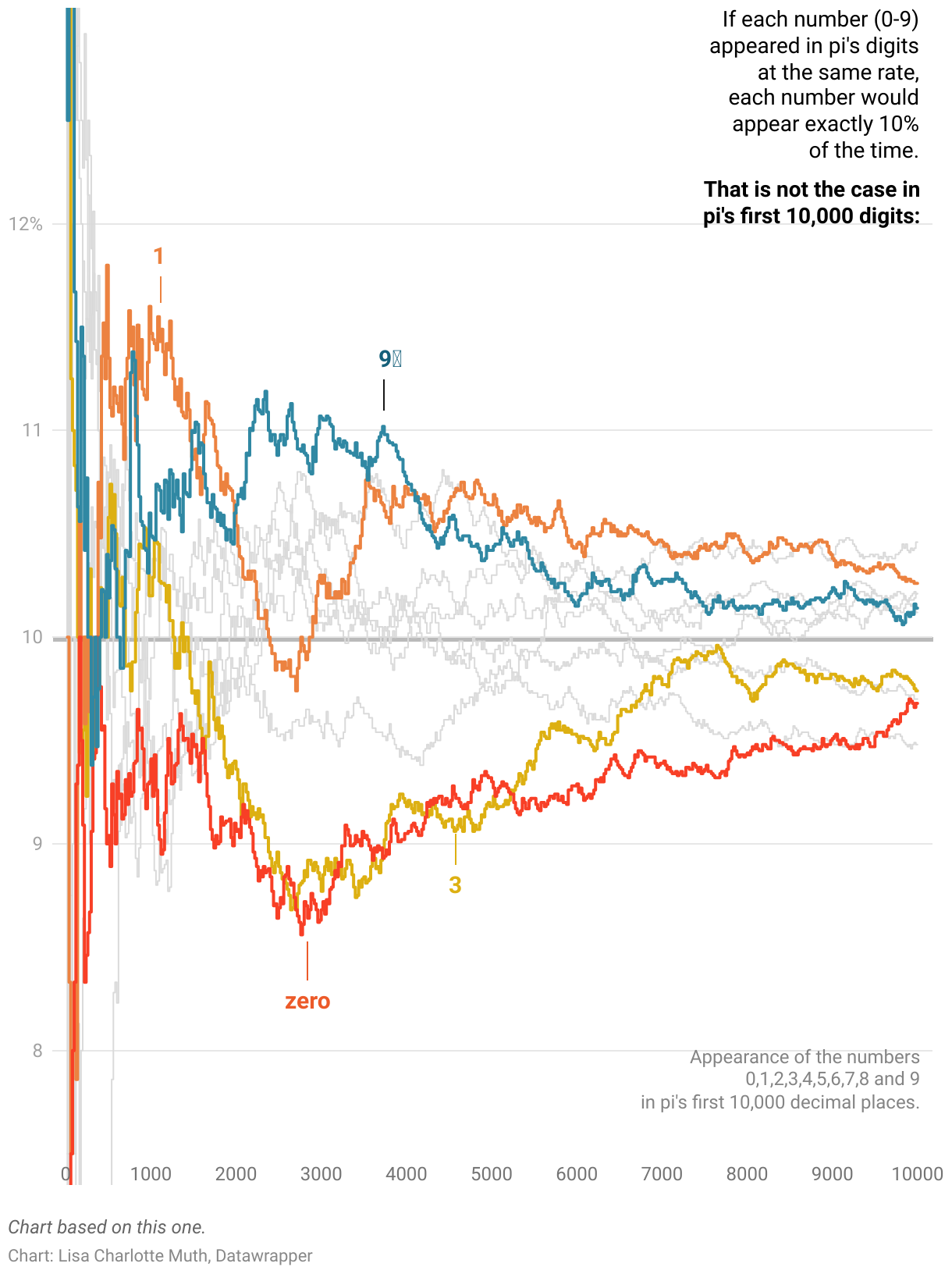
times bigger. By now, 31 trillion decimal places of pi are known (not that we’d need that many, but you know, it’s nice to break records). The chart above shows the first 10,000.

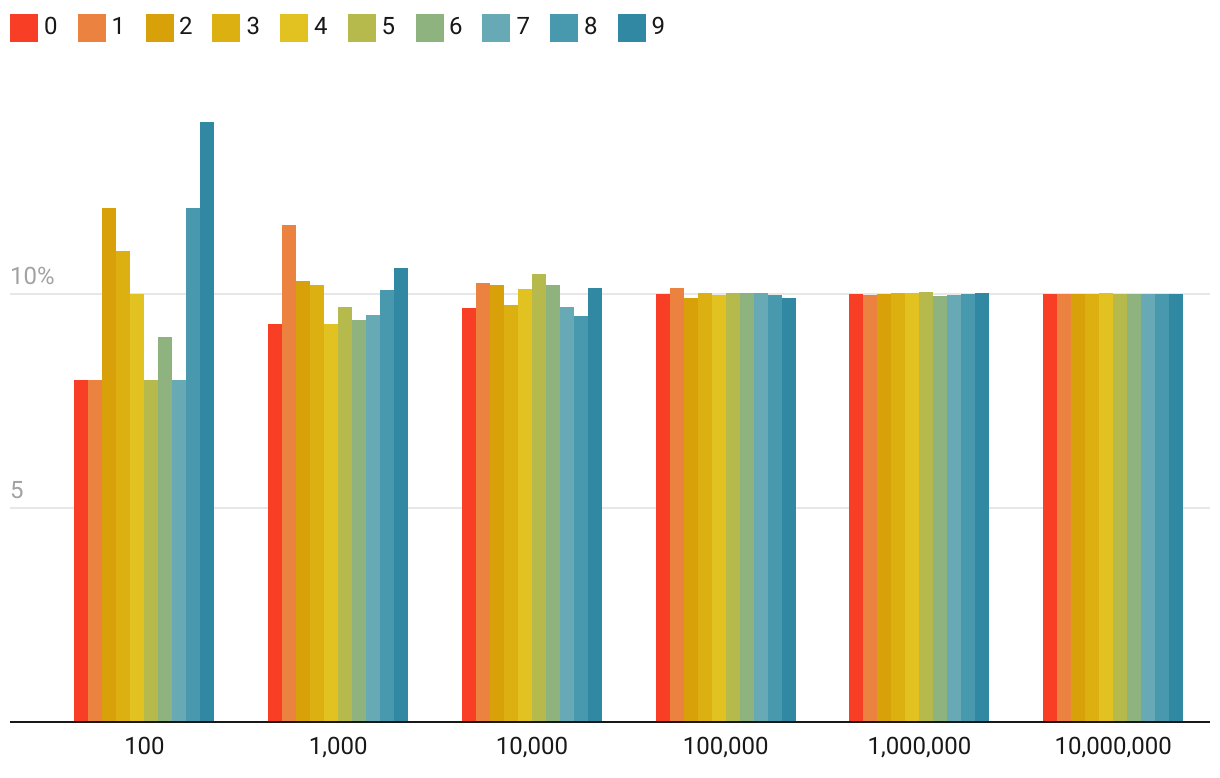
It shows how often each number between 0 and 9 appears. As we can see, they don’t reach an equal share yet in these first 10,000 digits. In fact, that happens surprisingly late: Of an astonishing 10 million pi digits, the number 4 makes up 10.011% of them and the number 1 “only” 9.993%. Here we can see how the shares become more equal with every magnitude:

Getting the numbers

Maybe you wonder how I got the numbers for the first chart. The pi digits are known (e.g. here), but how did I find out the distribution of numbers for the first 1000 digits, the first 1001 digits, the first 1002 digits, etc.?

It’s a simple Excel formula! (I was really happy when I realized it’s possible to do this with Excel; I wouldn’t have wanted to unpack R for this…) Here it is:=100/1002*((LEN(LEFT(A1,1002)))-LEN(SUBSTITUTE(LEFT(A1,1002),"0","")))

This formula tells us the share of zeros in the first 1002 digits of pi, assuming that we put our pi digits in cell A1. Try it yourself, or copy my spreadsheet with numbers between 100 and 10,000 digits.


If you don’t have enough of pi charts yet, visit data visualization designer Nadieh Bremer’s wonderful 2015 project “Exploring the art hidden in π” (and an animation of it here) or this Guardian article published on pi day 2014. Next week, I’ll finally tell you about these ngram numbers I promised you for this week. See you then!

23 Mar 07:25

Warning — May Contain Traces of AI

by Tony Hirst

A recent flurry of announcements by Google demonstrate how tensorflow co-processors and statistical models, rather than rule based ones, may soon be coming to a device near you.

Getting on for three years ago, Google announced they had developed a Tensorflow Processing Unit, a co-processor designed to speed up the training of deep-learning models. A year later — so two years ago — they announced cloud availability of TPUs, along with an “in-depth look at Google’s first Tensor Processing Unit (TPU)”.

You can check out TPU availability on Google Cloud services here. Since September 2018 (?), access to limited free TPU support has been available via Google Colab. A minimal ‘get started’ notebook can be found here.

The next step, recently announced among a flurry of announcements at the Tensorflow Developer Summit, 2019 (review), is to provide TPUs you can run at home: Coral Edge TPU Devices. These come in a couple of flavours:

  • Coral Dev-Board, a wireless development board with 1GB of RAM and 8GB of Flash memory, micro-SD slot, gigabit Ethernet, audio jack, and HDMI connectors, dual microphone, and onboard CPU, GPU  and “ML [machine learning] accelerator” Google Edge TPU coprocessor; (seems like a Raspberry Pi on steroids?)
  • USB accelerator, a TPU on a stick that you can plug into your Linux laptop or Raspberry Pi to give it a bit of extra oomph…

Some other things to watch out for…

Pete Warden reports how tensorflow models may soo be coming to a micro-controller near you: Launching TensorFlow Lite for Microcontrollers (repo); ported versions for several microcontrollers are already availaible. It seems he gave a demo of a microcontroller responding to a particular voice activation command:

So why is this useful? First, this is running entirely locally on the embedded chip, with no need to have any internet connectivity, so it’s good to have as part of a voice interface system. The model itself takes up less than 20KB of Flash storage space, the footprint of the TensorFlow Lite code is only another 25KB of Flash, and it only needs 30KB of RAM to operate.

Lest you think this is just in the realm of demoware, Google are also releasing an all-neural on-device speech recognizer:

… a model trained using RNN [recurrent neural network] transducer (RNN-T) technology that is compact enough to reside on a phone. This means no more network latency or spottiness — the new recognizer is always available, even when you are offline. The model works at the character level, so that as you speak, it outputs words character-by-character, just as if someone was typing out what you say in real-time, and exactly as you’d expect from a keyboard dictation system.

Just reflect on that naming for a moment: Recurrent Neural Network Transducer. I normally thing of transducers as physical sensors (eg things that continuously convert sound, or light, or pressure, or temperature to an electrical signal). Here, we have the notion of a software transducer that turns a signal into a set of meaningful symbols in a real-time conversion stream:

RNN-Ts are a form of sequence-to-sequence models that do not employ attention mechanisms. Unlike most sequence-to-sequence models, which typically need to process the entire input sequence (the waveform in our case) to produce an output (the sentence), the RNN-T continuously processes input samples and streams output symbols, a property that is welcome for speech dictation. In our implementation, the output symbols are the characters of the alphabet. The RNN-T recognizer outputs characters one-by-one, as you speak, with white spaces where appropriate. It does this with a feedback loop that feeds symbols predicted by the model back into it to predict the next symbols…

We can haz all ur devices R listen 4 uz…

By the by, I note that the Tensorflow Hub (about) provides a range of (partial) models to build from / retrain in your own solution. Amazon Sagemaker also offers pretrained ML models in their AWS Sagemaker Marketplace. At the moment, I don’t think any of these come with health warnings along the lines of may contain bias or bias inside… Which they should…

However, tools for helping probe the various levels of feature detection embedded within a network are starting to appear. For example, Google announced a technique they’re calling activation atlases:

Activation atlases provide a new way to peer into convolutional vision networks, giving a global, hierarchical, and human-interpretable overview of concepts within the hidden layers of a network. We think of activation atlases as revealing a machine-learned alphabet for images — an array of simple, atomic concepts that are combined and recombined to form much more complex visual ideas.

An example is given of activation atlases for a convolutional image classification network:

In general, classification networks are shown an image and then asked to give that image a label from one of 1,000 predetermined classes — such as “carbonara“, “snorkel” or “frying pan“. … One neuron at one layer might respond positively to a dog’s ear, another at an earlier layer might respond to a high-contrast vertical line.

An activation atlas is built by collecting the internal activations from each of these layers of our neural network from one million images. These activations, represented by a complex set of high-dimensional vectors, is projected into useful 2D layouts …

[A]ll the activations are too many to consume at a glance [so] we draw a grid over the 2D layout we created. For each cell in our grid, we average all the activations that lie within the boundaries of that cell, and use feature visualization to create an iconic representation.

In certain respects, this reminds me a little bit of Andy Wuensche’s basins of attractions in discrete dynamical networks from way back when…

In that case, the idea was to try to represent how all possible states of a network were connected to see where any given initial state might lead a network to and then find a way to meaningfully visualise that. In this case, it seems that the idea is to to try to identify what features and given node might be sensitive to (i.e. plot all the grandmother cells (lite background)).

23 Mar 07:25

Wi-Fi dominates in the home, but the industry cannot be complacent about the challenges of 5G

by Dean Bubley
I recently gave a keynote speech at the Wi-Fi Now conference in Shanghai (link), which was co-located with the Wi-Fi Alliance's Asia regional members' meeting. My presentation (link) covered the forthcoming opportunities and challenges for Wi-Fi technology and solutions.


My key points were that of a mixed, nuanced, good/bad story:
  • The position of Wi-Fi in the home is extremely strong. The growth of whole-home Wi-Fi using extenders and mesh-network technology, cloud management platforms and the imminent arrival of Wi-Fi6 (formerly 802.11ax) for more capacity and performance, gives it an unassailable lead for most domestic applications and devices.
  • 4G and 5G pose almost no threat to Wi-Fi dominance in the home. While smartphone users may spend slightly more time on cellular if they have large/unlimited data plans, this is more than offset by greater use of Wi-Fi-only devices (TVs, PCs, smart speakers & other IoT products). Few homes or people will go smartphone-only, especially in developed economies. Furthermore, cellular networks lack the in-home positioning and intelligence layer of newer Wi-Fi solutions. Fixed-wireless 5G will almost always need Wi-Fi inside, connected to an external/window antenna. Even in the (few) places 5G FWA can substitute for fixed/cable broadband, it will still mostly deliver last-metre connections via Wi-Fi.
  • A small number of future consumer IoT devices may have "direct to cellular" connections, but these will be the minority, typically restricted to out-of-home products like pet trackers or smart watches. 5G/eSIM-based PCs, wearables & tablets will remain a tiny % of the total device universe. Don't expect 5G-enabled TVs or 4G/NB-IoT washing machines. For low-power smart home products, alternative connections like Bluetooth and ZigBee will remain important - not everything can use Wi-Fi. There might be some LPWAN devices using SigFox, LoRa or perhap Wi-Fi's own HaLow technology, although that is still moving only slowly.
  • In "carpeted enterprise" offices, Wi-Fi will remain critical for many users, alongside wired ethernet for desktops, servers and other non-moving equipment. While there will be a growing need for better indoor 4G/5G coverage (especially in higher frequencies), that cannot replace normal LAN technology. Users will expect both Wi-Fi and cellular to have reliable indoor coverage, capacity and security. The Venn diagram of use-cases only has a narrow overlap. That said, delivering good Wi-Fi indoors is not easy - and like cellular, it will need more "deep fibre", especially for higher frequency bands in future, like 6GHz or 60GHz.
  • Industrial Wi-Fi faces more challenges. While for many applications, industrial-grade Wi-Fi and meshes is widely used, the growth of IoT, robotics and realtime automation/cloud will start to make wireless connectivity more business-critical, and in some cases safety-critical. Unlicensed spectrum, and limited coverage/mobility support may make Wi-Fi's role prone to substitution by public and private 4G/5G networks in some cases. There appears to be more work being done to make spectrum available, as well as integrate with manufacturing / process machinery on the cellular side. There doesn't appear to be as much of a cohesive ecosystem - I don't see a Wi-Fi equivalent of the 5G Alliance for Connected Industries and Automation, for instance. 
  • Limited focus on verticals and testbeds. While I'm skeptical of mobile operators' roles in pushing 5G solutions on various sectors, there is no doubt that the cellular industry is working hard. There are countless "5G for Sector X" associations and collaborations, multiple university and government 5G research institutes, and promotional efforts galore. Why is there no equivalent "University of ABC Wi-Fi Innovation Lab", of "Wi-Fi Healthcare Alliance", where vendors and developers can experiment with new use-cases and create more public "buzz"? The industry - and its major vendors - need to step up and increase funding for this sort of thing. Broadcom, Qualcomm, Cisco, Google, Intel, HPE, Amazon, Arris etc - I'm looking at you.
  • Public Wi-Fi faces growing risks. While I'm writing this article on my laptop in a cafe, most of my fellow coffee-drinkers are using smartphones. This location has a simple one-click access to Wi-Fi, but other places often have crass and privacy-invasive attempts to "monetise" Wi-Fi, with extra login personal data demanded, or attempts to get users to connect with FB or Twitter accounts. The growing number of large/unlimited data-plans, coupled to reduced roaming fees for travellers, and even tethering for PCs, makes the relative pain of accessing 4G vs. public Wi-Fi very different to a few years ago. Venues wouldn't force people to give email addresses or social logins to use amenities like elevators or bathroooms; they shouldn't for Wi-Fi either. The industry should campaign against cumbersome logins. It doesn't need full automation like PassPoint or HotSpot 2.0 - just "frictionless" access. One click on a splash-screen is fine.
  • The Wi-Fi brand is over-protected. Technically, Wi-Fi is a brand that can only be used by products or SPs that get certification from Wi-Fi Alliance. The technology is based on IEEE 802.11 standards. While the guarantee of interoperabilty and "it works anywhere" is great, this poses a problem. There's a lot of cool stuff being done with 802.11 that isn't standardised and fully certified. I've seen licensed-spectrum versions (potentially more suitable for industrial markets). There's some great innovation with 60GHz 802.11, formerly called WiGig. Some vendors have proprietary tweaks, like Blu Wireless allowing gigabit transmission to fast-moving vehicles with handoffs in the UK AutoAir testbed (link). These innovators can't use the term "Wi-Fi", so instead they call their products "5G", adding to the noise and hype - and its impact on regulators and policymakers who then think that 5G deserves special treatment (and spectrum). In my view, the Wi-Fi industry is undermining its own importance, especially if they want to create a case for 6GHz, or other future bands. Most people in politics don't grasp Wi-Fi's level of economic and societal contributions, so to me this seems to be an own-goal. Maybe WFA should create a new category called something like Wi-FiX for "experimental" technologies to capture this extra goodwill.
  • Wi-Fi combines well with other technologies. I'm seeing a growing amount of important intersections between Wi-Fi and other domains. AI, for instance, is being used to manage Wi-Fi fleets by major service providers, as well as cloud companies. Juniper just acquired Mist Systems for its AI-enhanced Wi-Fi solution (link). It's being integrated with both consumer and enterprise IoT. Amazon just acquired eero, a home mesh-Wi-Fi specialist. I'd be unsurprised to see some sort of Alexa-eero hybrids in future (link). And I've written before about the Wi-Fi + blockchain opportunities, including those of my friends at AmmbrTech (link) and assorted others. There's some cool stuff using Wi-Fi for motion-detection as well.
  • The Wi-Fi industry needs to be emphatic - and fast - about creating versions designed to work in all spectrum bands, licensed, unlicensed and shared. There are use-cases for all of these, especially with moves to opening up CBRS and c-Band for more innovative use-cases. We see cellular technologies adopting unlicensed variants like 4G-LAA and MulteFire. Wi-Fi should make the opposite & equivalent move.
  • Yes, 5G and Wi-Fi will work together. Absoutely, I see many reasons to integrate 4G, 5G and Wi-Fi in various guises, both at a network level and service level. We will see MNOs that have big Wi-Fi footprints. We'll see 5G FWA with Wi-Fi indoors. We see dual-connected home broadband gateways with both fibre and cellular modems. We have offload, onload, Wi-Fi first MVNOs, Wi-Fi calling and and non-3GPP access to 4G and 5G core networks. This trend will continue. Yet I still see ignorant references to Wi-Fi being "part of 5G", or "killed by 5G". It is neither; sometimes the technologies will be complementary, and sometimes competitive or substitutive. But in all cases, they compete for the oxygen of publicity, attention and policymaker focus. The Wi-Fi industry needs to shout louder to the media and governments.
  • This is Wi-Fi's 20th Anniversary year as a consumer brand, notably. Maybe Apple (which launched its original AirPort in 1999) might pull a "One more thing..." surprise this year...
In summary: I'm very positive about Wi-Fi, especially with the capabilities of mesh, cloud and Wi-Fi6 for the home. But I'm also concerned that the industry isn't being sufficiently ambitious. Yes, in the US there are a lot of positive signs from the FCC about 6GHz The recent European emphasis on Wi-Fi derived DSRC for vehicles is another win. But while those could be big successes, and keep the industry busy for a long time, it's not enough. 


In industrial use-cases, Wi-Fi faces significant challenges. For public hotspots, some venues' ludicrous sign-up demands are self-defeating and harm overall public perception of the technology. HaLow isn't getting enough attention in the LPWA space. The industry needs to market itself more loudly, more globally, and to a wider audience. It needs to create more space for innovators and developers, with collaboration forums and easier access to documents - and a willingness to extend the brand's goodwill, even to those that aren't doing something fully-standardised.

The Wi-Fi industry deserves congratulations on 20 years and $2trillion of economic value. But it needs to double-down on its scope and ambitions, to make sure it will be in strong position at its 40th as well.


Watch out soon for a podcast covering this article - my SoundCloud account is here (link)

And if this is an area where you'd be interested in my input for advisory work, speaking/presentations, or other engagements, please contact me via information AT disruptive-analysis dot com

I will also shortly be publishing a long-form research report on the Consumer Wi-Fi sector, as part of my Network Futures subscription stream with STL Partners (link). It looks at some of the issues raised here in more detail, and focuses in particular on the implications and role of telecom operators and other broadband providers. I'll update this blog post, and also put out details on my Twitter account (link) when it's available.
23 Mar 07:25

Steven Sinofsky’s tweet thread about going thro...

Steven Sinofsky’s tweet thread about going through the Microsoft security crisis is related to Facebook starting its own pivot, but is useful thinking for taking any kind of organization through a significant shift of strategy:

All you can do as an organization executing on this sort of pivot is to do the work. Keep people informed. Build incremental trust across all stakeholders by actions.

Nobody knows if Facebook can pull off what Mark Zuckerberg says that he wants to do, but for sure it’s going to be messy, take a lot of time, and it will be a hard time for all involved to build up trust.

23 Mar 07:25

Reeder 4 Beta for Mac

by Rui Carmo

I’ve been playing with this for a bit, and will definitely upgrade when it’s done–RSS is still the way I read 80% of my news (nearly 100% if you discount the marketing drivel that is spewed all over Twitter and LinkedIn these days), and Reeder is still the best way to go through my 200+ feeds efficiently and without fuss.


23 Mar 07:25

The Best On-Ear Headphones

by Lauren Dragan
The Best On-Ear Headphones

After putting in dozens of hours of research on hundreds of models, and spending 45 hours testing 53 finalists with a panel of four audio professionals, we found that the KEF M500 is the best pair of on-ear headphones for music lovers who hate earbuds but want more portability than an over-ear set offers. These headphones are comfortable and solidly built, and they sound great.

21 Mar 23:07

Calle 24 Cultural Crime #9823468

by Liz

Really hating how the McDonald’s at 24th and Mission blasts classical music all hours of the day. It ruins the beautiful soundscape of both BART plazas which normally have several flavors of latin music going at once.

They’re doing it to discourage “loitering” but this is a public space specifically designed for people to enjoy being in! It’s extremely obnoxious – offensive!

I kind of get doing it at midnight but…. just no!

21 Mar 23:02

Case of the 500-mile email

by Nathan Yau

Trey Harris, a previous tech administrator for a university, tells the story of a statistics department that couldn’t send email farther than 500 miles away. The story is more about the peculiarities of server admin in 2002, but I’m more interested in those statisticians:

“We could send email. Just not more than–“

“–500 miles, yes,” I finished for him, “I got that. But why didn’t you call earlier?”

“Well, we hadn’t collected enough data to be sure of what was going on until just now.” Right. This is the chairman of *statistics*. “Anyway, I asked one of the geostatisticians to look into it–“

“Geostatisticians…”

“–yes, and she’s produced a map showing the radius within which we can send email to be slightly more than 500 miles. There are a number of destinations within that radius that we can’t reach, either, or reach sporadically, but we can never email farther than this radius.”

Honestly, I’m not sure what’s more surprising: the 500-mile physical limitation on email or the statisticians troubleshooting for a few days before contacting the tech. [via kottke]

Tags: email, humor

21 Mar 22:40

Augmented Reality makes Google Wayfinding a Walk in the Park

by Sandy James Planner

google-maps-developers-conference-fox-augmented-reality-designboom-1200

google-maps-developers-conference-fox-augmented-reality-designboom-1200


For anyone that likes to explore cities and spaces on their own, Google Maps has developed an augmented reality mode  that makes it easy to ascertain what direction a pedestrian should be headed in~there is a large animated type of arrow to guide your direction.

You know those moments where there are no references to help you figure out which direction north is, and no way to determine exactly where you are. Using global localization which brings together Visual Positioning Services (VPS) and Street View, the smartphone camera becomes a “sensor” making wayfinding so much easier.

With a limited release in February for people who will augment the app with new locations and take photos, it is in the feedback stage. And here is the best part~the new feature is solely for walking directions, not for vehicular drivers.

In those pesky locations where GPS does not work because it is bouncing off buildings and cell towers, the Augmented Reality (AR) application uses the camera to suss surrounding buildings and street grids to pinpoint a walker’s location.

This application is not meant to be used consistently and as Sasha Lekach in Mashable.com observes “It’s meant for moments of usefulness” and the phone does have a warning message if it perceives you have held the phone up too long,  asking for the phone to be put down as you walk for safety reasons.

Here is a YouTube video showing the use of the Augmented Reality application in San Francisco as well as the wayfinding guiding fox which is still in the prototype stage.

21 Mar 22:37

Exclusive—Trump: Paul Ryan Blocked Subpoenas of Democrats: So here’s the thing—it’s so terrible...

Exclusive—Trump: Paul Ryan Blocked Subpoenas of Democrats: So here’s the thing—it’s so terrible...
19 Mar 18:24

Apple Illustrates iPhone Privacy with Real-World Analogs

by John Voorhees

Finding a way to convey the benefits of privacy isn’t easy, which is why I like Apple’s ‘Privacy on iPhone – Private Side’ video so much.

The video, which runs under a minute, opens with images of several ‘No Trespassing,’ ‘Keep Out,’ ‘Beware of Dog,’ and other signs. In a series of quick cuts, the video shows two people who pause an intense conversation when interrupted by a waiter as well as people locking file cabinets, closing blinds, locking doors, shredding documents, and more. Near the end, a woman rolls up the window of a car when she sees someone nearby watching her put on makeup.

As Apple’s description of the YouTube video says:

Your privacy matters. From encrypting your iMessage conversations, or not keeping a history of your routes in Maps, to limiting tracking across sites with Safari. iPhone is designed to protect your information.

Every clip of the video, which adds a bit of levity to an otherwise serious topic, reinforces the closing message that ‘If privacy matters in your life, it should matter to the phone your life is on.’

The video is an effective rebuttal of the ‘I have nothing to hide’ argument against privacy. Even the mundane aspects of day-to-day life aren’t something that you necessarily want to broadcast to the world, which this video is very effective in conveying.

→ Source: youtu.be

19 Mar 18:24

Apple Responds to Spotify’s Claims of Anticompetitive Behavior

by John Voorhees

In a lengthy response, Apple has addressed many of the allegations leveled against it by Spotify earlier this week. As we reported, Spotify has filed a complaint with the European Commission alleging that Apple’s treatment of the music streaming service is unfair and anti-competitive. Today, Apple fired back with a response to many of Spotify’s contentions.

Apple denies it has blocked access to its products and updates. To the contrary, the company says it has approved over 200 updates to Spotify’s app and reached out to inquire about the adoption of features like Siri and AirPlay 2. Apple says the only time it has requested changes to Spotify’s apps is when the company ‘has tried to sidestep the same rules that every other app follows.’

Apple also takes issue with what it characterizes as Spotify’s desire for the benefits of a free app without being free. Long gone are the days when apps were either free or paid. Spotify, like many other apps, offers a free music streaming tier. Spotify doesn’t pay Apple anything for those free users or users that sign up for streaming through other channels like mobile carriers. For Spotify’s paid subscribers, Apple receives 30% in year one and 15% after that for access to its platform and payment system, which the company says Spotify is unfairly trying to sidestep.

Finally, Apple claims that Spotify’s complaints against it are just one facet of a pattern of actions that are in Spotify’s economic interests but are damaging to musicians and the music industry. As evidence of this, Apple raises recent moves by Spotify against songwriters after the US Copyright Royalty Board required Spotify to increase royalty payments.

I don’t know whether Apple’s actions constitute unfair and anti-competitive behavior under EU law. Separate and apart from the legalities of the situation though, Spotify’s complaints have struck a chord because they come at a time when new online app stores are taking a significantly smaller cut of revenue. Spotify has other legitimate complaints, like its frustrations with App Review, but what seems to really be driving the dispute is how much Apple charges for access to the App Store and its payment system. Now more than ever, Apple’s 30% cut looks like a bad deal even when that cut is reduced to 15% for the second year of subscriptions.

What makes this dispute unique is that Spotify competes with Apple Music and is big enough to grab public attention and raise the stakes for Apple by getting European regulators involved. Usually, this sort of fight would play out privately, but by making their disagreement very public and involving regulators, Spotify may have taken the outcome out of its and Apple’s control.


Support MacStories Directly

Club MacStories offers exclusive access to extra MacStories content, delivered every week; it's also a way to support us directly.

Club MacStories will help you discover the best apps for your devices and get the most out of your iPhone, iPad, and Mac. Plus, it's made in Italy.

Join Now
19 Mar 18:23

The Hottest Chat App for Teens Is ... Google Docs :: The Atlantic

by Volker Weber
As more and more laptops find their way into middle and high schools, educators are using Google Docs to do collaborative exercises and help students follow along with the lesson plan. The students, however, are using it to organize running conversations behind teachers’ backs.

Brilliant. Read the whole thing.

More >

14 Mar 22:05

RT @ProfChalmers: I see the Telegraph remains calm and measured in its analysis. pic.twitter.com/7Eg5PgMc4t

by ProfChalmers
mkalus shared this story from iandunt on Twitter.

I see the Telegraph remains calm and measured in its analysis. pic.twitter.com/7Eg5PgMc4t


Posted by ProfChalmers on Thursday, March 14th, 2019 6:48pm
Retweeted by IanDunt on Thursday, March 14th, 2019 7:07pm


162 likes, 34 retweets
14 Mar 21:39

What are critical thinking skills?

Steven Forth, TeamFit, Mar 14, 2019
Icon

What caught my attention first was Steven Forth's skills profile. It's a very detailed listing of skills, 324 in all, with expertise in them ranging from newbie to guru. Presenting them as a graph makes more sense than using that many badges, and the categorization of the skills helps a lot. But it stuck me that the identification and naming of the skills is very important. Which takes us to the article. Here we have an account of what constitutes 'critical thinking' as a skill. And, frankly, it's a mess. Properly speaking, critical thinking is really a collection of skills. But not the skills identified here, but a completely different set of skills. That takes me back to Steven Forth's skills, which lists many business skills, and had me wondering how many ways there were to say 'management' or 'analysis'. And I also wondered whether I should trust SkillRank to assess those skills.

Web: [Direct Link] [This Post]
14 Mar 21:39

Big story on RSS readers in the iOS App Store t...

Big story on RSS readers in the iOS App Store today:

Really simple syndication — better known as RSS — is an enduringly useful technology that collects online articles from various sources in one convenient place.

The bummer about these articles is that the full thing can only be read in the iOS App Store. It would be nice if they actually appeared on the web, too.

The articles are often very well done and beautifully illustrated — and it would be to the benefit of Apple, and app developers, if these articles were findable and readable by people sitting in front of a computer.

14 Mar 21:39

In case relations with U.S. sour Huawei has made backup operating systems

by Dean Daley

Huawei CEO Richard Yu has confirmed to German publication Die Welt that the company has made its own operating systems for smartphones and computers in case the U.S. prevents it from using the country’s provided technologies.

“We have prepared our own operating system, if it turns out we can no longer use these systems, we will be ready and have our plan B,” Yu said in his interview with the German publication.

With Huawei suing the U.S., it makes sense that the company has created its own plan B.

This isn’t the first time we’ve heard of the company’s backup OS for Android. Huawei reportedly started working on the operating system when the U.S. began investigations into Huawei and ZTE back in 2012, according to South China Morning Post.

Additionally, the U.S. banned ZTE from receiving exports last year for three months after it caught the company shipping its goods to Iran, making the possibility of the ban even more likely.

Yu said that Huawei would “prefer to work with the ecosystems of Google and Microsoft.” However, it’s ready for the worst.

Huawei creates its own Kirin processor for handsets, so phone-wise the company is set to launch its own smartphones without any help from U.S.-based companies.

However, Huawei uses Intel processors in its Windows laptops, so the company would have to find another chip maker to power its PCs

Source: South China Morning Post, Die Welt

The post In case relations with U.S. sour Huawei has made backup operating systems appeared first on MobileSyrup.

14 Mar 21:39

This is one of our darkest hours

mkalus shared this story .

The swirling hysteria of the Commons is quite distracting, but put it to one side. There is a stark reality to what happened today. Britain accepted, formally, that it could not leave the EU on March 29th. But making that decision does not secure it. We are no longer in control of our own destiny. Only the EU can decide whether to accept the request. We are now at the mercy of others. This is what Brexit has done to what was, just a few years ago, one of the most powerful countries in the world.

Anyone who understood Article 50 saw this coming years ago. They were not quiet about it. Countless experts, lawyers and commentators warned this would happen. No.10 was told, over and over again, not to trigger Article 50. It made no-deal the default and set a punishing two-year timetable on the exit mechanism. That put all the strength in the hands of the EU. But this was ignored. Britain held all the cards, we were told. No-deal would be fine. To claim otherwise was to undermine the country and the will of the people.

Theresa May announced when she would trigger Article 50 on TV, almost as an afterthought. She did it so she would have something to say at the 2016 Tory conference. And just like that, she gave away her one bit of negotiating leverage. She barely even seemed aware it was leverage.

Shortly after triggering Article 50, she called a snap general election. And then, with the snap of a finger, two months were lost campaigning. These are now exactly the same two months she is desperate to get back as a technical extension if she can somehow get her deal through.

For months afterwards, the British government still talked in terms of impossible negotiating objectives which paid no recognition to the trade offs you have to make in balancing regulatory control with frictionless trade arrangements. It wasn't until July 2018 - 16 months after triggering the 24-month Article 50 countdown - that May finally outlined her Chequers plan. It was the first time a glimmer of reality entered the debate. Instantly, the Brexit hardliners withdraw their support.

All of which brought us to today. May had nothing left. She tried to get her deal through twice. It was defeated twice. She attempted, in a spectacle of the most insane confusion, to whip MPs against a motion opposing no-deal yesterday, but lost that too. And now today she was finally forced to confront the inevitable. Brexit had to be delayed.

First she intends to try and get her deal through again next week, probably with some made-up play-dough nonsense about the Vienna convention to placate the lunatic wing of her party Even if she succeeds in this, which she's unlikely to, she'll need to extend Article 50, just in order to pass the legislation putting it on the statute book. In reality, Westminster watchers have known she would need to extend for months, but she only bothered to stop lying about it two weeks ago.

If she fails to get her deal through, it is likely the extension will need to be much longer. That means Britain would need to participate in the European elections and provide some sort of concrete plan to the Europeans about precisely what it intends to do with the time. Her motion basically laid out these two pathways alongside the need for an extension.

The debate in the Commons was typically contradictory, scheming and chaotic. Remainers collapsed into an internecine battle over when to table an amendment on a People's Vote. That was embarrassing and self-harming, with no-one coming out of it looking good. Hilary Benn and others tried to table an amendment wrestling back control of Brexit from the government, but it fell by just two votes. Chris Bryant toyed with an amendment blocking the prime minister from bringing her deal back, but didn't put it forward to a vote.

When all was said and done, it was a straight vote on the government's motion saying it would ask for an extension of Article 50. It passed easily, by 412 votes to 202.

Immediately afterwards, many commentators insisted that that was it: Britain was now officially not leaving the EU on March 29th. But they were wrong. They were living in another world, an old world in which Britain is still in control of its destiny. That world ended two years ago, when May triggered Article 50. From that day on, we were no longer in control. 

Part Three of Article 50 reads:

"The treaties shall cease to apply to the state in question from the date of entry into force of the withdrawal agreement or, failing that, two years after the notification referred to in paragraph two, unless the European Council, in agreement with the member state concerned, unanimously decides to extend this period."

A leaving country has to ask for an extension and it is up to the EU whether to grant it. That decision is not made in the backrooms of Brussels, by solitary actors. It is made by discussion with the remaining 27 heads of state at the EU Council. The democracy Brexiters always insisted the EU did not possess is precisely the reason that our situation is now so fraught.

There is nothing to stop a member state vetoing this decision, even if the others all want to extend. Earlier this week, Nigel Farage was urging his far-right allies in Italy, Hungary and Poland to veto it. By doing so he was conspiring with foreign powers to undermine the stated will of a sovereign British parliament, but there is no point dwelling on that. If there was any trace of honour or consistency in him, this would be a counter argument to it. But there is not, so to even point it out is to give him too much credit.

Farage's gambit is unlikely to succeed. His fellow nativists are probably unwilling to lose political capital just to do him a favour. But they are volatile and unpredictable individuals. You can't rule it out.

Other voices in Europe are strongly opposed to an extension - some in all circumstances, others only in certain circumstances. With no deal in place, they might view an extension as an ability to allow Britain to prepare for the aftermath, which they feel they are better protected against. That would open up the possibility of further extensions and erode the EU's strength in talks.

There are even some figures in Europe, including in France, who quite welcome no-deal from a self-interested medium-term strategic perspective. Others are simply fed-up with Brexit and believe it's time to cut the UK off.

This is not the most likely outcome. Chances are, they'll offer a extension on the condition that it is quite long and contains a set idea of what will take place to change the situation. But let's be clear what this means. We are no longer the ones who decide what happens to our country.

In just over two weeks we face the most severe economic and political event of our post-war history. And our ability to prevent it is not up to us. It is up to foreign leaders, from other countries, with their own domestic agendas.

Not so long ago, we would have thought this was impossible. But after just three years of nationalist political leadership, that is the status of Great Britain. It is a stark moment of humiliation. There are many more to come, unless we pry the wheel from them.

Ian Dunt is editor of Politics.co.uk and the author of Brexit: What The Hell Happens Now?

The opinions in politics.co.uk's Comment and Analysis section are those of the author and are no reflection of the views of the website or its owners.

14 Mar 21:38

The Web Turns 30

by Matt

“Vague, but exciting.” Thirty years ago yesterday, Sir Tim Berners-Lee submitted his original proposal for an information management system to his boss at CERN — what would later become the World Wide Web (and, it turns out, a huge influence on my life and career).

To help celebrate, I tweeted WordPress’s contribution to the web’s grand timeline (above), and I got to participate in The Economist’s Babbage podcast looking back at the pioneers of the early web. Listen to the whole episode below:

14 Mar 21:38

Ikea and Sonos say they’ll reveal their first SYMFONISK speaker next month

by Igor Bonifacic

Ikea and Sonos will reveal their first co-designed speaker next month.

The two firms plan to showcase the device, which will be part of Ikea’s new SYMFONISK lineup, in April at the annual Salone Internazionale del Mobile exhibit in Milan, Italy.

In its press release, Ikea describes the upcoming device as a “book-shelf speaker.” The teaser the furniture-maker released to promote the showcase suggests the companies plan to release a wall-mounted speaker, as well.

Ikea and Sonos first announced their partnership back in December. One month later, they started teasing the SYMFONISK line. The first device from the collaboration is supposed to hit Ikea stores in the U.S. and Europe in August.

No word yet if Ikea plans to release SYMFONISK devices in Canada.

Source: Ikea

The post Ikea and Sonos say they’ll reveal their first SYMFONISK speaker next month appeared first on MobileSyrup.

14 Mar 20:18

Android Q features a hidden DeX-like desktop mode

by Dean Daley

Android Q features a secret desktop mode spotted within Google’s Android Open Source Project.

Twitter user ‘@Shad0wKn1ght93′ discovered the feature and tweeted out screenshots of their findings. The functionality lets users connect their device to an external display in order to create a desktop-like experience.

With Android Q, the interface is similar to the Android home screen but in the landscape orientation. Further, the app drawer defaults to the bottom right, just like the location of the Windows button. On the left is the settings menu that currently only lets users set a wallpaper and add app shortcuts.

XDA also reports that users can enable desktop mode within Android Q’s ‘Developer Options’ but says that this feature only works when you cast to an external display.

In its current state Android Q’s desktop mode leaves a lot to be desired. However, it’s important to keep in mind that this isn’t the final version of the feature. Currently, when using Huawei’s Easy Projection or Samsung’s DeX, Google apps aren’t properly scaled to the size of the external display.

With Google creating this operating system level desktop mode, the company will almost certainly ensure its internal developers scale their apps properly. It’s likely that we’ll learn more about the feature at Google I/O in May. 

Google reportedly recently shifted a number of its employees to its Google Create division, the team responsible for the development of the Pixelbook and Pixel Slate.

It’s possible Google intends to replace its Pixelbook and Slate hardware with this new Android Q desktop feature.

Activating the Android Q’s desktop mode requires the Android Studio emulator and the above ADB command, according to @Shad0wkn1ght93.

Source: @Shad0wkn1ght93, Via: XDA Developers

The post Android Q features a hidden DeX-like desktop mode appeared first on MobileSyrup.

14 Mar 20:18

Electric scooter company JUMP coming to Montreal at the end of May

by Shruti Shekar

Uber-owned Bike-sharing service JUMP is entering the Montreal market in May, knocking down BIXI as the only bike-sharing company in the city.

Global News reported users will able to book a bike through the app and pay by the minute to rent. Customers can leave the bike at any city-installed bike rack. The case isn’t the same for BIXI, which requires customers to park the bike at special docking stations.

JUMP said electric scooters will also be coming to the city in June or July and will be allowed to be parked on streets and bike paths and at designated areas located near intersections.

“Quebec will be allowing on our streets dock-less bikes and scooters. We decided in Montreal to pass a bylaw so we can control that phenomenon,” said Eric Alan Caldwell, a member of the Montreal Executive Committee that’s in charge of transport.

He said that Montreal has been reviewing these regulations and added that the city wants to make sure these vehicles aren’t parked at random spots and have a designated area.

“We want our sidewalks to be clear and free. We’re open to that new mobility, but we want to have a clear control for the way they are deployed,” he said.

Bird, one of the biggest electric scooter companies based in California, told the Toronto Star in January that it had plans to bring its scooters to Toronto. Bird said it was deploying a lobbyist in Toronto to talk to as many city councillors as possible.

Source: Global News

The post Electric scooter company JUMP coming to Montreal at the end of May appeared first on MobileSyrup.

14 Mar 20:18

Google may market mid-range Pixels as ‘Pixel 3a’ and ‘Pixel 3a XL’: report

by Igor Bonifacic

Google could market its upcoming pair of often-leaked mid-range Pixel smartphones, as the ‘Pixel 3a’ and ‘Pixel 3a XL,’ according to new Android Q code snippets uncovered by XDA Developers.

Digging through the code of the first Android Q Developer Preview, which Google released on Wednesday, XDA Developers found multiple references to ‘bonito’ and ‘sargo.’

If you haven’t been following along with the ‘Pixel 3 Lite’ saga, Bonito and Sargo are the codenames of two new Pixel devices Google reportedly plans to launch sometime in the first half of 2019. According to most reports, Bonito and Sargo will adopt a similar form factor to the Pixel 3 and Pixel 3 XL but will feature more modest specs. For instance, Bonito will reportedly include a Snapdragon 670 chipset instead of a Snapdragon 845.

To date, most pre-release leaks and reports had suggested the search giant had planned to market the two devices as the Pixel 3 Lite and Pixel 3 XL Lite, respectively.

In the code unearthed by XDA, Google references existing Pixel devices using both their marketing name and pre-release codename. So, for example, in the instance of the Pixel 3, multiple code strings associate Pixel 3 with ‘blueline.’

Not only are there multiple references to Sargo and Bonito throughout Android Q, there’s at least one line of code that directly associates ‘Sargo’ with ‘Pixel 3a XL.’ Perhaps more notably, however, there’s not a single mention of the names Pixel 3 Lite or Pixel 3 XL Lite in the code XDA examined.

It’s very possible that Pixel 3a XL is a placeholder name. It’s also possible the name represents a deliberate misdirection on Google’s part. The company is likely acutely aware enterprising individuals like XDA‘s Mishaal Rahman would go digging through the code of Android Q to find interesting tidbits about its plans.

Whatever the case, it doesn’t seem such a sure bet that Google will market its new phones as the Pixel 3 Lite and Pixel 3 XL Lite.

Source: XDA Developers

The post Google may market mid-range Pixels as ‘Pixel 3a’ and ‘Pixel 3a XL’: report appeared first on MobileSyrup.