Shared posts

12 Apr 00:33

Near, Far, Wherever You Are

by Will Partin

Last year, while swiping through Tinder, I matched with a young lady whom I’ll call Emily. After a polite exchange, we made plans to meet up and swapped phone numbers, intending to plan a date over text. If you’ve never used Tinder, the app, in a welcome gesture towards privacy, will never reveal its users’ last names. So you can imagine my surprise when, later that evening, I logged onto Facebook and saw that Emily was the first suggestion in my list of “People You May Know,” her last name and job title — both hidden on Tinder, the former by design the latter by choice — plainly visible.

Emily and I never ended up meeting. But I thought of how brazenly Facebook outed information she’d elsewhere chosen to withhold when, months later, Instagram served me a very different kind of friend suggestion. A decade ago, when I was a senior in high school, “Jimmy,” a jilted ex-patient of my dad’s, began stalking our family. Over a period of months, verbal harassment escalated to threats of violence and we soon found ourselves accompanied by police escorts for the better part of a week. Jimmy was later incarcerated for related crimes and spent much of the next decade in prison. During this time, I largely forgot about him, much less interacted with him on a digital device. But where organic memory fails, data persists, even insists. And so, an old foe who, I soon discovered, continued to loudly nurse old wounds, resurfaced in the guise of an account Instagram was gleefully suggesting to “relevant” audiences — which, in its estimation, was me.

Quotidian though they are, People You May Know and its peers are some of the stranger spaces on social media

In a way, Instagram was right, though probably not in a way the service intended. Social networks are built on the idea that “connecting” is necessarily a social good, but it takes only one look at human life to know this is often false and that it is context, above all, that matters. Reconnecting with an old friend is serendipitous; being shown an old stalker can be a nightmare. For every joyful reunion PYMK facilitates, there’s also a case where the service plays a less welcome role: it routinely outs sex workers, for example, and suggests that psychiatrists’ patients friend each other, violating cherished medical norms. Data doesn’t — and, indeed, can’t — account for this kind of context, and so there’s little reason to think that tweaking the relevant algorithm will solve any of these problems.

These encounters with the arcane logic of recommendation were unnerving enough that I adjusted my privacy settings, delinked accounts, cleared cookies, and removed Facebook from my phone entirely, even as I knew full well that hiding my data trail would be functionally impossible. Given that actually taking control of my data double was a losing proposition, I resolved to spend some time thinking about the next best thing: who, exactly, is a Person We May Know — not as an individual, but a classification? And what does this classification, as both a social and a technical production, reveal about what it is to be “connected” (or not) in the age of social media?


If you’ve spent any time on social media, you’ve encountered some iteration of People You May Know. (Gizmodo’s Kashmir Hill wrote a comprehensive history of the tool on its 10 year anniversary last year.) I suspect that everyone has a story similar to mine. Quotidian though they are, People You May Know and its peers are some of the stranger spaces on social media, automatically populated by names familiar and not — in my case, a lineup of friends of friends, local bartenders, business acquaintances, graduate students from seminars past, names I recognize from media Twitter, and plenty of folks I’ve never met or heard of at all.

There are two explanations for why PYMK served up Emily and Jimmy to me, one computational and one sociological. The computational one is right, but unfulfilling. In the case of Emily, it’s not especially hard to reconstruct how Facebook arrived at the assumption that she and I had “met”: an algorithm checked my iPhone for new contacts and cross-referenced her number against its own database. When it found a match, the algorithm identified Emily as Someone Will Probably Knows. In Jimmy’s case, though, I simply cannot fathom how Instagram made this connection, despite quite a bit of legwork on my part to do so. He is not (and has never been) in my contacts, nor, after searching my email accounts, have I ever typed his name or even been forwarded an email about him. The more elaborate explanations I’ve entertained are nakedly conspiratorial, and so I’ve written Jimmy’s case off as a mystery that will remain unsolved, like a ship sunk in deepest waters.

A computational perspective on PYMK opens onto essential questions about context collapse, the fleeting nature of networked privacy, and the limits of data and algorithmic logic for ordering our social lives. But we might also think about PYMK from a sociological perspective, one attuned to the contingency of social life, past and present. Encountering “strangers” is, of course, as old as civilization itself. But the problem of stranger sociality was felt with particular acuity at the turn of the 20th century. For much of the preceding 150 years, peasants had been systematically dispossessed of their land and forced to take up wage labor in urban factories. In the process, North Atlantic society was re-centered on crowded urban spaces. No longer could one expect to recognize most of the people in one’s daily life or expect them to share the same values. In response, Émile Durkheim, a founder of what we now know as sociology, theorized anomie, the supposed degradation of norms that had once held societies together. The consequence of anomie, Durkheim reasoned, was widespread alienation and lack of a sense of purpose, a shift captured perfectly in the painter Fernand Léger’s La Ville (1918), in which a pair of downcast, faceless figures are swallowed up by cacophonies of cosmopolitan color.

These days, one hears echoes of Durkheim in the cottage industry of articles and books, popular and academic, that blame social media for our ills. We’re told that Facebook (etc.) is “disconnecting” us from one another or undermining our democracy. No doubt there’s some truth to the first point (as for the second, the erosion of democratic norms predates social media though Facebook’s disinformation problem surely doesn’t help). But to say that we’re being disconnected assumes from the outset that we know what it is to be “connected” at all, and that “connection,” whatever it may be, never changes. Connection, like all things, is subject to the ebbs and flows of history. The more interesting question involves asking what forms connection may take as times and technologies change, and how this in turn changes what it means to be connected (or not).

Meeting strangers once meant being one yourself — to acknowledge another human seeing you seeing them. Today, though, we do not know for whom we are the “People You May Know”

We might turn to a contemporary of Durkheim, Georg Simmel, for a somewhat more subtle perspective on the philosophical and social problems that People You May Know poses. For much of his career, Simmel was interested in understanding the complex relationships between individuals and their groups as part of a larger inquiry into how society “works.” Modernity was a mess, and yet life, however improbably, seemed to simply go on. How could that be? For Simmel, the answer lay in how social groups serve specific purposes that, in concert, add up to a functional society. And just as the actual individuals that PYMK recommends me are incidental to PYMK as a category, the names, personalities, and life histories of Strangers (and those to whom they were strange) weren’t of much interest to Simmel. Rather, it was what these groups did – and what that did for everyone – that mattered.

The inevitability of interacting with people you don’t know (and vice versa) in European modernity led Simmel to start thinking about what function strangers serve in a society. No doubt this was in part personal: as an assimilated Jew writing in fin-de-siècle Europe, Simmel was keenly aware of how it felt to simultaneously be an insider and an outsider. But defining what it felt like to be a stranger required defining what a stranger is in the first place. He most famously lays it out in a 1908 essay:

The Stranger is close to us, insofar as we feel between him and ourselves common features of a national, social, or occupational, or generally human nature. He is far from us, insofar as these common features extended beyond him or us and connect us only because they connect a great many people.

The ambivalence in this definition is crucial. For Simmel, the Stranger is not the “Other” — some external and oppositional identity against which you define yourself — nor is the Stranger simply one of the vast number of people in the world we do not know at all and will likely never meet. Rather, the Stranger is physically near but socially distant. The Stranger does not appear randomly, but has a reason for their proximity to a group, even as they are not strictly of that group. For Simmel, the quintessential Stranger was the trader, especially a travelling one. Though potential buyers likely do not know them personally, social necessity has brought them together based on roles (i.e. buyer and seller) that are, to some degree, pre-determined.

At the moment Simmel was writing, mass consumption was supplanting artisan production as a mark of status, and more and more people were increasingly dependent upon the open market. Underlying this shift were the vast transportation and communication networks (trains, telegraphs, etc.) that appeared in the 19th century, which made both markets and people more mobile than ever before. Strangers weren’t just a matter of urbanism, but mobility. Or, stated in somewhat different terms, Strangers are as much a technological production as they are a social one.


You don’t have to believe that social media is the root of all modern ills to acknowledge that constant connectivity is as disorienting a shift to contemporary social life as urbanization was to the long 19th century. But if electronic media represents the annihilation of space by time, then Simmel’s most basic formulation of the Stranger — “physically near, socially distant” — needs an addendum to bring the concept into the present world. To the common features that Simmel says make us feel near — “a national, social, or occupational” nature — we may add another: data. Simply put, the Stranger is now computationally near, but socially distant.

People We May Know, and really do know, can be categorized in one of two ways: those for whom the data trail is obvious (think Emily) and those for whom it isn’t (Jimmy). Those are easy enough. But we can also categorize people we don’t know along these lines: those strangers for whom the logic of recommendation is clear — for years, Facebook has been showing me a profile that happens to have the same name of someone I know offline — and those for whom it’s simply a mystery.

The latter category could go by another name: Strangers, in Simmel’s sense of the term. The appearance of “random strangers” in our Facebook feeds may feel like pure coincidence. Yet randomness is not a quality of things, but a relation between them. When we call something “random,” it’s another way of saying that there’s a logic of causality that we simply do not see: the so-called “black box” of Facebook algorithms. But there is a reason — however arcane, tortured, and obscure — that a handful of Facebook profiles out of billions are selected for your consideration. “People You May Know looks at, among other things, your current friend list and their friends, your education info and your work info,” wrote Facebook in its introduction of the tool in 2008. “Among other things” is a permissive category, and anecdotal evidence suggests it includes everything from location, old emails, phone numbers, text message histories, and off-platform data that Facebook purchased from third-party brokers. But no matter what kind of apologia Mark Zuckerberg peddles to horrifyingly uninformed congresspeople, Facebook is not a community: it’s a database.

Facebook has every reason to tell you (or, really, create) Who You May Know – to commit this small investment of data and screen space in hopes that a new connection, a new data point, will be made

That data is the foundation of what it is to be computationally near, and it exists regardless of physical proximity (or, more accurately, physical proximity is subsumed as one data point among many). And while I don’t think that changes what a Stranger is, it does point to a shift in how Strangers are made, just as urbanization did more than a century ago. What’s more, if we take “socially distant, computationally near” seriously, it changes just who gets to be a stranger at all. When we ask ourselves “why am I being recommended this person I’ve never met?” we implicitly acknowledge that the recommendation is rooted in some unseen commonality between “us” — or, really, our respective data doppelgängers. That is an invitation to reflection, a chance to imagine how we are positioned in the data flows we call cyberspace. What is revealed when we seek this cause — about our Stranger, about us, and the ways we may be bound? What does that say about our world?

Unlike Stranger sociality of yesteryear, though, encountering strangers no longer carries the symmetry it once did. Just as it is impossible to touch without being touched in return, meeting strangers once meant being one yourself — to acknowledge another human seeing you seeing them. Today, though, we do not know for whom we are the “People You May Know.” Despite our best efforts, the flotsam of our personal data are mere whitecaps floating atop oceans of data, currents for which only Facebook has the charts and going to places no map but theirs can ever truly see. When I look through my “People You May Know,” I can do a surprisingly decent job of piecing together why these are my Strangers and what, in turn, that says about what Facebook thinks about me. (Namely, that I spend a lot of time on the edges of media Twitter.) Asked to imagine to whom I am a Stranger, though — to define where, and on what winds, my data persona is carried — I am lost at sea.


The common cause between urbanism and the worst, most invasive practices of social media is (what else) the demands placed upon individuals and organizations by the capitalist system. Urbanism followed certain economic imperatives — dispossess the rural poor and make them take up wage labor in cities — and so do social media companies. “Friends” create content, content creates engagement, engagement creates data, and data creates value, sold back to you by the alchemical process of ad targeting. Accumulation by dispossession, as it turns out, works just as well when attention, not land, is its currency. What’s more, as social media scholar danah boyd pointed out in an extraordinarily prescient blog post days after Facebook introduced News Feed in 2006, it’s not just you who will expose your data — it’s also your friends. Facebook has every reason to tell you (or, really, create) Who You May Know – to commit this small investment of data and screen space in hopes that a new connection, a new data point, will be made.

This is not a conspiracy, but a set of tendencies that come as a result of Facebook pursuing its fiduciary obligations to shareholders. Like all platforms, Facebook has never been content to merely be a product in the world, nor, based on its revenue model, can it even afford to. Rather, platforms have omnibus ambitions: they aspire to organize life itself – the good, the bad; the simple and the strange – in their own image and according to their own logic. “Give people the power to build community and bring the world closer together,” Facebook’s most recent mission statement reads, positioning itself as a silent, even benevolent actor as it pursues what very nearly amounts to world domination.

Put differently, there can always be more Facebook. Every sentence, every identity, every transaction, every event that is not facilitated through Facebook’s own services is, strictly speaking, value lost for the lords of Menlo Park. It was only a matter of time before Facebook shifted from letting you categorize who you “know” through Friending to defining who you could know through its ever-expanding map of all that is social. Just as our friends became Friends™, our strangers became Strangers™ – just one more emergent aspect of social life now subsumed by and articulated through social media services. Strangers were once bonds waiting to mature. And they still are, in a sense; the question is for whom.


12 Apr 00:33

Restore dead websites that don't exist anymore: Archivarix

Luigi Canali De Rossi, Robin Good, Apr 11, 2019
Icon

While the Internet Archive (IA) is a great service, it's not really meant for day-to-day use. It's an archive, not a production website. If you want to restore a site from the archived copy, that can be a lot of work, since IA changes all the links and adds a header. Archivarix acts like a reverse archiver - it extracts the site from IA, cleans it up, and presents it to you in a zip file ready for mounting on a web server where it can resume its former life as a real web site. It won't be perfect - things IA couldn't harvest, like CGI scripts and some background files, will not work. But in many cases, the results will be quite acceptable. Robin Good reviews the site and shows some videos of it in action.

Web: [Direct Link] [This Post]
12 Apr 00:32

When Leaving Academe, Which Research Projects Do You Leave Unfinished?

Erin Bartram, Chronicle of Higher Education, Apr 11, 2019
Icon

The question being considered by the author is one best considered while still working in a college or university environment, I would say. And it should be thought of in this sense: if I left academe today, would I still be working on this work? If the answer is 'no', stop doing the work and start working on something you're actually interested in. For me - and I suspect for most real academics (whether in academe or not) - the work is work we would be doing anyway.

Web: [Direct Link] [This Post]
12 Apr 00:32

Five Principles for Thinking Like a Futurist

Marina Gorbis, EDUCAUSE Review, Apr 11, 2019
Icon

Half of my work involves thinking like a futurist. But my approach to being a futurist is, I think, quite different from what's described in the article. For example, the first recommendation is to "forget about predictions." Why? "Nobody can predict large socio-technical transformations and what exactly these are going to look like." By analogy, "One way to think about this is to look at the difference between waves and tides. Waves are what we see on the surface... Underneath the waves is the tide, causing all kinds of disturbances of which waves are just one sign." But if you can't predict the tides, you're not much of a futurist. Being a futurist is predicting the future. Otherwise, you're an economist.

The article discusses some other facets of being a futurist. One focuses on readiness, another on finding patterns, another on signals, and another on community. All of these have to do not so much with being a futurist but rather with speaking to a particular audience. That is a core skill, but has nothing to do with futurism. Take any proposition P - some people will care about P, others won't. I can make all kinds of predictions about tomorrow, but the odds are you will not care about them. Patterns, signals, readiness, community - all these depend on salience and relevance.

But futurism is the opposite of that. Futurism is about identifying things that don't interest people before they land as unexpected surprises in their laps. A big part of it is pattern recognition - but from your own perspective, not your audiences. You need to see what they don't already see. You need to see what happens when emerging trends collide - do they cancel each other out, or do they amplify an effect? You have to have a sense of scale, seeing waves, tides, and sea-level rise. You have to have a sense of what could happen, and then scale back with evidence and probabilities about whether it will. You have to understand that your looking at data, not signs, signals and portends. And then - yes - present it with the interests of the audience in mind, but without them defining what your message will be.

Web: [Direct Link] [This Post]
12 Apr 00:32

Your book is not a book

by Josh Bernoff

With a nod to René Magritte, the book you write is not a book. Magritte’s painting is actually called La Trahison des images (“The Treachery of images”) and includes the words Ceci n’est pas une pipe (“This is not a pipe”). Because, of course, it’s not a pipe. It’s a painting. But enough about Magritte. … Continued

The post Your book is not a book appeared first on without bullshit.

12 Apr 00:31

how I think about how the New York Times thinks about privacy

A. G. Sulzberger, publisher of The New York Times, writes,

If you’re reading this essay on an internet browser, it offers a useful example of what tracking looks like at a practical level. Before you had time to read a single word, a number of different companies had already placed a “cookie” or other tracking mechanism on your browser to study your internet use. The Times hosts these trackers for three purposes: to learn about how people use our website and apps so we can improve their experience; to reach readers we hope will subscribe; and to sell targeted advertising.

Read the whole thing. But my inner tech editor could not be silenced, and had a small suggestion. How about...

If you’re reading this essay on an internet browser, it offers a useful example of what tracking looks like at a practical level. Before you had time to read a single word, your web browser had already accepted a “cookie” or other tracking mechanism from a number of different companies to study your internet use. The Times hosts these trackers for five purposes: to learn about how people use our website and apps so we can improve their experience; to reach readers we hope will subscribe; to sell targeted advertising; to leak our readers' personal information to help our competitors sell ads targeting our audience; and to enable fraudulent bot traffic to impersonate human visitors.

As soon as I make the web browser, and not the tracking company, into the subject of the sentence, it helps explain some of the business reasons for news sites to focus on privacy. For a site, examining your own privacy practices is fine, but it's not where the big wins are. The important part, for the New York Times and other sites that need to protect their ad revenue, is to work along with in-browser tracking protection technology. Protecting reader data for the readers is mostly the same as protecting audience data for the ad business.

It's kind of like the situation with email. Email is a viable marketing medium today not just because legit email marketers don't spam, but because email users have good spam filters. Spam filter technology kept low-value email lists from devaluing email marketing. In-browser privacy technology is starting to reverse the process by which low-value cross-site tracking has been devaluing web advertising.

The Times is already doing some good service journalism on web privacy. Next step: set up the paywall to give extra free articles per month for anyone running Apple Safari ITP Apple Safari ITP or Firefox ETP? The more reader eyeballs a a site can remove from the race-to-the-bottom eyeball market, the more market power it has.

Spam filters and legit email marketers saved email as a marketing tool. Can privacy-protecting browsers and legit ad-supported sites do the same for the web?

Bonus links

In Charleston, local ownership means fewer layoffs

Two in Three Hotel Websites Leak Guest Booking Details and Allow Access to Personal Data

WTF is differential privacy?

Opinion | Why the Cool Kids Are Playing Dungeons & Dragons - The New York Times

A Look at Who Is and Isn’t Ready for the End of the Programmatic ID Era

12 Apr 00:31

Lowering Road Speed in Portland – Part of Creating A Safer, More Equitable City

by Sandy James Planner

17990785_779584228855941_7865693021274513804_n_1493168724582_9302242_ver1.0

17990785_779584228855941_7865693021274513804_n_1493168724582_9302242_ver1.0

Speed kills in cities, and in Great Britain many cities are considering lowering speed limits within their jurisdictions to save lives and reduce injuries under the banner “20 (miles per hour) is plenty”. Portland Oregon as part of its commitment to eliminate all road deaths by 2025 has adopted the Vision Zero approach, accepting no road deaths as acceptable on their street networks.

Last year the city of Portland Oregon lowered the speed limits on their municipal road system from a default speed of 25 miles per hour to 20 miles per hour, or 32 kilometers per hour. In one year, the results are starting to come in, with a death toll on the roads of 34 people in 2018, a reduction from the 45 lives lost in 2017 before the reduced speeds.

There is sea change in the United States regarding road safety. A University of Chicago  poll of 2,000 U.S. residents  showed that 60 percent were “were supportive of using speed and red-light cameras as an automated enforcement tool. Sixty-nine percent of those polled said they would support lowering a speed limit by 5 miles per hour if it was justified with crash data.”

Lowering road speeds in cities has a remarkable impact on crash survival rates for vulnerable road users~a pedestrian has a 20 percent survival rate being crashed into at 30 miles per hour. That increases to 70 percent at 25 miles per hour and to 90 percent at 20 miles per hour. In the United States municipal speed limits are set by each state or territory, with the default speed being 25 miles per hour or 40 kilometers per hour.

The cities of Portland and Eugene have been looking at the safety system and Vision Zero approach embraced by European countries like the Netherlands and Sweden in making their cities safer. A “context-sensitive approach that emphasizes safety for vulnerable road users will lead to safer outcomes on streets in urban areas” 

As Oregon Live reports  Portland’s “triaged” enforcement of the lower speed limit has been concentrated on residential streets near schools and in  corridors with a high incidence of accidents. Portland now has authority from the State to install speed cameras. Police are clear that speed enforcement is key in saving lives and identifying “whether a crash occurs and how severe the outcomes of a crash are.”

Bloomberg.com observes that traffic fatalities have increased 14 per cent in the United States in just four years, with an estimated 40,000 a year dying in vehicular crashes. The World Resources Institute dispels myths about drivers and lower speeds. Lower speeds allow drivers to stop within a shorter distance, don’t make a trip longer (that’s a function of  intersection frequency) and foster safer communities that allow for vulnerable road user safety. Slower speeds also boosted retail areas. Slower streets with narrower lanes in San Francisco’s Mission District resulted in a 60 percent increase of local retail spending, with an overall 40 percent increase in sales.

“The research is now abundantly clear: Getting drivers to slow down can improve the quality of life for all city dwellers.”

122dd0c85f6d281f193f4a66cbecc948

122dd0c85f6d281f193f4a66cbecc948


12 Apr 00:31

SFU Lecture: Home or Commodity? The Transformation of Housing and its Discontents – Apr 23

by Gordon Price

In cities across the world, housing systems are undergoing immense change. Homes are being transformed into liquid commodities, and as such, are increasingly unable to meet the social need for residential space. This has painful consequences for households and urban life, in the form of residential alienation, precarity and displacement. But in many places, resistance movements are growing.

Join us April 23 to hear sociologist David Madden explore the causes and consequences of the commodification of housing, drawing lessons from London and New York City

David Madden is associate professor in sociology and co-director of the Cities Programme at the London School of Economics. He works on urban studies, political sociology and social theory. His research interests include housing, urban restructuring, public space and critical urban theory. He has conducted qualitative, ethnographic and archival research in New York City and London. He is co-author, with Peter Marcuse, of In Defense of Housing: The politics of crisis. His writing has appeared in leading academic journals as well as the Guardian, the Washington Post and Jacobin.

David Madden’s talk will be followed by a panel of local respondents to give the themes of his talk a Canadian context on a local, provincial and national scale:

  • David Hulchanski, University of Toronto
  • Penny Gurstein, University of British Columbia
  • Selina Robinson, Minister of Municipal Affairs and Housing
  • Question period hosted by Jen St. Denis, Star Vancouver


Tuesday, April 23

7 PM to 9 PM (doors open at 6:30 PM)

Room 1200-1500, SFU Segal Building, 500 Granville Street, Vancouver

Admission: $5. Free for students with valid student ID.

Reserve your seat!


12 Apr 00:31

Unchanging Vancouver: Mysterious empty lots

by Gordon Price

Occasionally ‘Changing Vancouver‘ will post an example of a Vancouver that hasn’t changed in decades.  Like this lot in the 600-block Nelson (click post headline for images):

This 1981 image shows that not everything has changed Downtown – yet. If heritage status could be conferred on surface parking lots, this one might qualify, as it has been a vacant site for at least 40 years, with no sign yet of a development proposal.

Here’s another at Richards and Pender:


These downtown sites at least generate parking revenue.  The really mysterious lots are those that have been grassed-over and empty for decades on high-value sites in the West End, like this one at Robson and Gilford:


Most surprising of all, this Robson-and-Broughton lot, with what might be truly considered a heritage tree:


Other nominations welcome.

12 Apr 00:31

Humans in the loop

by Benedict Evans

One of the paradoxes of today's internet platforms is they are vastly automated, and have no human control or interaction over what any given person sees, and yet they are also totally dependent on human behavior, because what they’re really doing is observing, extracting and inferring things from what hundreds of millions or billions of people do.

The genesis of this was PageRank. Instead of relying on hand-crafted rules to understand what each page might be about, or indexing the raw text, PageRank looks at what people have done or have said about that page. Who linked to it, what text did they use, and who linked to the people who linked to it? And at the other end of the pipe, Google gets every user to curate every set of search results by hand: it gives you 10 blue links and you tell Google which one was right. The same thing for Facebook: Facebook doesn't know really know who you are, or what you're interested in, or what that piece of content is. It knows who you follow, what you press ‘like’ on, who else liked that and what else they liked and followed. Facebook is PageRank for people. The same applies, by extension, to YouTube: it never knew what the video was, only what people typed next to it and what else they watched and liked.

In effect, these systems are vast mechanical Turks. They don't know what anything is of itself - rather, they try to create, capture and channel human annotation around those things. They’re vast distributed computing systems in which the CPUs are people and the platform is the router and the interconnections. (This reminds me a little of the idea in the Hitchhiker’s Guide to the Galaxy that the whole Earth is actually a vast purpose-built computer and our daily lives are part of the calculations.)

This means that a lot of the system design is around finding the right points of leverage to apply people to an automated system. Do you capture activity that’s already happening? Google began by using the links that already existed. Do you have to stimulate activity in order to capture the value within it? Facebook had to create behaviors before it could use them. Can you apply your own people to some point of extreme leverage? This is Apple Music’s approach, with manually curated playlists matched automatically to tens of millions of users. Or do you have to pay people to do ‘all’ of it?

The original Yahoo internet directory was an attempt at the ‘pay people to do all of it’ approach - Yahoo paid people to catalogue the whole of the web. To begin with this looked feasible, but as the web took off it quickly became an impossibly large problem, and when Yahoo gave up the directory had passed 3m pages. The answer was PageRank. Conversely, Google Maps has humans (for now) driving cars with cameras along almost every street on earth and other humans looking at the pictures, and this is not an impossibly large problem - it’s just an expensive one. Google Maps is a private mechanical Turk. We’re exploring the same question now with human moderation of social content - how many tens of thousands of people do you need to look at every post, and how much can you automate that? Is this an impossibly large problem or just an expensive one?

If you look at these platforms as using billions of human beings to do the actual computation, this prompts two interesting questions: what does this tell us about abuse of the platforms, and how much might machine learning change all of this?

In the past, when we thought about abuse of computer systems, we thought about technical exploits of various kinds - stolen or weak passwords, unpatched systems, bugs, buffer overruns and SQL injection. We thought about ‘hackers’ finding gaps in the software engineering. But if YouTube or Facebook are distributed computer systems where the routers are old-fashioned software but the CPUs are people, then a bad actor thinks of finding exploits in the the people as well as the software. Common cognitive biases become as important as common programming errors. 

That is, there are two ways to rob a bank - you can bypass the alarm and pick the lock on the safe, or you can con the manager. These are both ways that your processing systems are failing, but now one of the processing systems is us. Hence, as I wrote here looking at Facebook’s recent strategic pivot to privacy and security, human moderation of the data on these platforms is conceptually very similar to the software virus scanners that boomed in response to malware on Windows two decades ago. One part of the computer watches another part to see if it’s doing something it shouldn’t.

Even without thinking about deliberate abuse there are other problems inherent in using human activity to analyse human activity. Once you start using the computer to analyse the computer, you risk creating feedback cycles. You can see this in the idea of filter bubbles, or ‘YouTube radicalisation’, or even SEO spam. Meanwhile, one of the problems that Facebook has faced is that sometimes having or generating more data degrades the value of the data. This is the newsfeed overload problem: you add 50 or 150 friends, and you share 5 or 10 things every day or so, but so do all of them, and so you have 1,500 items in your feed every day. Dunbar’s number + Zuckerberg’s law = overload ... which gets us to Goodhart’s Law.

“Any observed statistical regularity will tend to collapse once pressure is placed upon it for control purposes.” - Charles Goodhart

Then, how might machine learning change this? I said earlier that the challenge is to work out how to add people to the right point of leverage in the computer, but there is of course another option - get the computer do all of it. Until very recently, the challenge, and the reason these systems existed in the first place, was that there were large classes of problem that computers couldn’t solve but that any human could do very easily. We used to call this ‘things that are easy for people but hard for computers’, but really, it was things that are easy for people to do but hard for people to describe to computers. The breakthrough of machine learning is that it gives us a way for the computer to work out the description.

The cartoon below (from 2014, just after machine learning computer vision systems started taking off), is a good illustration of this change. The first problem is easy but the second was not - until machine learning.

Screen Shot 2019-04-09 at 11.16.09 PM.png

The old way to solve this problem would have been to find a way to get people label the picture - to crowdsource this in some way. In other words, a mechanical Turk. But now, we might not need anyone to look at that picture - with machine learning we can very often automate exactly this request. 

So: how many problems could you previously only solve if you applied the aggregate behavior of millions or hundreds of millions of people, which you now could solve with machine learning, without having any users of your own? 

The contradiction in this, of course, is that machine learning is all about having lots of data. Clearly, one could suggest that having a big platform means you have lots of data and so your machine learning will be better as well. That's certainly true, at least to begin with, but I think it's interesting to wonder how many things could only be done with all those users. In the past, if you had a photo of a cat, it would only be labeled ‘cat’ if you had enough users that someone would look at and label that particular image. Today, you don’t need any users to see that particular cat picture - you just need some other users, somewhere else, at some point in the past, to have labeled enough other cat pictures to generate a decent recognition model.

This is just another form of leveraging people: you need people to do the labelling (and to write the rules for how the people do the labelling). But we move the point of leverage, and change, perhaps radically, how many people we need, and so we change some of the ‘winner takes all’ effects. After all, these giant social platforms are vast collections of manually labeled data, so is the glass half empty or half full? Glass half full: they have the world's largest collection of manually label data (in their chosen domain). Glass half empty: it’s manually labeled.

Even where that data might be concentrated in a big platform (and very often it won’t - not at all - as I wrote here), this becomes, well, a platform. Just as AWS became an enabler for startups, who no longer needed millions of users to get economies of scale in infrastructure, a lot of equivalent tools will mean you no longer need millions or billions of users to recognise a cat. You can automate the Turk.

12 Apr 00:30

Comp Bureau probing Bell, requests CCTS docs via Federal Court

by Shruti Shekar

The Competition Bureau is conducting a probe to determine if Montreal-based national carrier Bell sold television, internet and home phone services using false and misleading methods.

The bureau launched its investigation last August and more recently filed an application to the Federal Court of Canada, The Globe and Mail reported. This all comes to light less than a couple of months that the CRTC released its report on unsavoury and misleading telecom sales practices.

The Canadian Radio-television and Telecommunications Commission (CRTC) held its hearing regarding the issue in October 2018. The federal government directed the CRTC to investigate these high-pressure sales tactics after the CBC released an investigative report in January 2018.

“The bureau is examining potentially false and misleading representations made in connection with the promotion of Bell’s residential services, including home phone, internet and television sold separately or in bundles,” Jayme Albert, a spokesman for the bureau, said to the Globe and Mail on Wednesday, April 10th. “The bureau’s investigation is ongoing and there is no conclusion of wrongdoing at this time.”

With this particular case, the bureau is trying to get an order so Bell discloses records relating to sales practices that have been filed with the Commissioner for Complaints for Telecom-television Services (CCTS). The CCTS is an independent body that is in charge of handling consumer complaints about the industry.

Bell said in a statement to The Globe and Mail that it will “work with” the bureau.

The bureau has asked the CCTS for documents and went to court because the CCTS did not provide the documents voluntarily; the court filings were initially reported by Blacklock’s Reporter and The Wire Report.

The hearing is scheduled for Thursday, April 11th.

Source: The Globe and Mail

The post Comp Bureau probing Bell, requests CCTS docs via Federal Court appeared first on MobileSyrup.

12 Apr 00:30

B.C. judge says wearing two earbuds counts as distracted driving, even with dead phone

by Bradly Shankar
Galaxy S8 akg headphones

A British Columbia judge has found a man who was wearing in-ear headphones while behind the wheel guilty of distracted driving, even though the buds were plugged into a dead iPhone.

On October 12th, 2018, Surrey resident Patrick Henry Grzelak was driving home when police officers spotted him using in-ear headphones, according to a court document.

When they pulled him over, the officers found that the connected iPhone was in a dashboard cubby hole and its battery had been depleted.

Despite the fact that the phone wasn’t powered on, Judicial Justice Brent Adair found that Grzelak was still legally “using” the phone.

“In my view, by plugging the earbud wire into the iPhone, the defendant had enlarged the device, such that it included not only the iPhone (proper) but also attached speaker or earbuds,” Adair wrote in an April 8th, 2019 judgment.

“Since the earbuds were part of the electronic device and since the earbuds were in the defendant’s ears, it necessarily follows that the defendant was holding the device (or part of the device) in a position in which it could be used, i.e. his ears.”

The RCMP added that the mere act of having two earbuds in at once will constitute distracted driving and can result in a $368 fine. However, one earbud is permitted.

Via: CBC

The post B.C. judge says wearing two earbuds counts as distracted driving, even with dead phone appeared first on MobileSyrup.

12 Apr 00:29

Report claims Tesla and Panasonic are lowering battery expectations

by Brad Bennett

Tesla and Panasonic are halting their plans to expand Gigafactory 1, which is the worlds largest producer of electric vehicle batteries.

The information comes out of a report from Japanese publication Nikkei, which claims there is concern regarding less demand for Tesla’s vehicles and rising competition from legacy automakers.

Originally, Panasonic and Tesla aimed to increase the capacity of the factory by 50 percent by 2020, but now those plans are up in the air, claims the report. Further, the two companies worry about the scale Tesla is expanding at, and feel that a significant investment at this stage is too risky.

Therefore it seems like the Californian automaker is pushing back its goal of making a million cars a year for the time being, as per the report.

The consensus is that the Gigafactory in Nevada is capable of producing 500,000 batteries per year. To put that number in perspective, Elon Musk has stated that the company is aiming to deliver between 360,00 and 400,000 vehicles in 2019, as reported by Bloomberg.

With Tesla ramping up for the release of the Model Y crossover in the fall of 2020, the companies are banking on the success of that vehicle. According to he Nikkei report, the two companies will reevaluate the deal depending on how successful the small SUV is.

While Panasonic is hesitant to fund the Gigafactory, Tesla told Nikkei that it’s still planning to invest in the factory as needed.

This isn’t the best news for Tesla since it needs to fend off even more competitors in the space with the Volkswagen Automotive group’s massive push into the EV space and Ford’s highly anticipated Mustang inspired EV. 

Update 11/04/2019 5:48 PM EST: The New York Post is reporting that Tesla is denying the report that both it and Panasonic have stopped funding the Gigafactory in Nevada. “Both Tesla and Panasonic continue to invest substantial funds into Gigafactory,” said a Tesla spokesperson to The Post. 

The Spokesperson further justified the comment by saying, “we believe there is far more output to be gained from improving existing production equipment than there was previously estimated.”

Source: Nikkei, Bloomberg, New York Post 

The post Report claims Tesla and Panasonic are lowering battery expectations appeared first on MobileSyrup.

12 Apr 00:29

Acer unveils new notebooks, Chromebooks and gaming laptops

by Jonathan Lamont

Acer unveiled several new notebooks, Chromebooks and gaming laptops at its ‘Next@Acer’ event in Brooklyn, New York.

The company refreshed some of its existing products, like the Aspire line, with faster processors and more. Along with the refreshed Aspire 7, 5 and 3, Acer introduced a new TravelMate P6 notebook, the ultimate in ‘rugged’ thin and lights.

Measuring in at just 0.6-inches (15.24mm) thick and 2.4 pounds (1.09kg), the P6 is impressively thin. Acer says the laptop is exceptionally durable, boasting MIL-SPEC compliance. Additionally, the P6 features 20-hour battery life and fast charging.

Acer Chromebook 715

Acer also unveiled new Chromebook 714 and 715 devices. The company is capitalizing on its Chromebook success — Acer says its the number one Chromebook seller worldwide and has shipped over 13 million units.

The 715 is aimed at enterprise with its 100 percent aluminum design, fingerprint sensor and Citrix certification. Acer also says the 715 is the first Chromebook with a dedicated numeric keyboard.

Acer unveiled a refresh to its popular Nitro 5 gaming laptop, as well as introduced a new Nitro 7 laptop. Both laptops have 9th Gen Intel Core processors, the latest Nvidia graphics and displays with 144hz refresh rates.

On top of that, Acer revealed its new Predator Helios 700 laptop. The laptop sports a unique ‘HyperDrift’ keyboard that can slide forward, exposing the laptops cooling fans for improved thermal performance.

Acer Predator Helios 700

Additionally, the Helios 700 features Wi-Fi 6 compatibility, overclocking capability, and an Nvidia GeForce RTX 2080 GPU. Impressively, the GPU isn’t Nvidia’s Max-Q spec, which focusses on efficiency over performance.

Acer unveiled lots of new PCs at the event, and this is just a taste of some of the more exciting things. You can learn more, or watch the unveiling yourself, over here.

The post Acer unveils new notebooks, Chromebooks and gaming laptops appeared first on MobileSyrup.

12 Apr 00:29

Huawei P30 Pro review: Photography first, everything else second

by Dean Daley

Huawei is becoming the talk of the town and not only because of its issues with the Canadian government.

More and more, I’m starting to hear people talk about and use Huawei smartphones, despite the U.S. government’s overall negativity towards the Chinese company.

I was at the barbershop the other day when I overheard someone excitedly talking about Huawei’s foldable handset, the Mate X. While this isn’t a review for that device, it shows that Huawei is beginning to become a household name in Canada.

Whenever I show someone the P30 Pro or even the older P20 Pro, the first thing they typically say is “I heard that this is good for taking pictures,” and they’re exactly right.

When Huawei tweaks its P-series, the company focuses on two things: photography and design. The P30 Pro is a step above its predecessor, the P20 Pro, in both categories. That said, the phone feels less like a completely new device and more like a bigger, photography-enhanced Mate 20 Pro.

Eloquent design

As I mentioned, one area of focus for Huawei with the P30 Pro is design. The company used similar elements with the Mate 20 Pro, adding a slightly curved OLED screen. The display doesn’t curve as dramatically as Samsung’s recent S10+, but it’s still quite evident.

The P30 Pro’s screen measures in at 6.47-inches with a 19:5:9 aspect ratio and features dimensions of 158mm x 73.4 x 8.4mm. In terms of resolution, the P30 Pro features a 1080 x 2340-pixel screen, with a 398 pixel-per-inch (ppi) density. Purely based on specifications, the screen is not as good as the display featured in the Mate 20 Pro. However, it’s difficult, but not impossible, to spot the differences.

The handset includes HDR10 support but lacks Dolby Vision. You can subtlety notice differences when it comes to things like sunsets and explosions with the Mate 20 Pro, which offers a wider range of colours, while the P30 Pro is a little washed out in comparison.

This isn’t very noticeable unless you place both phones next to one another and you’re comparing specific scenes. Similar to the Mate 20 Pro, the P30 Pro offers the ability to control the colour and temperature of the display and features an easily accessible eye comfort mode that instantly makes the colours on the screen warmer. Further, the P30 Pro does get brighter than the Mate 20 Pro.

What’s also noteworthy is that the screen on the Mate 20 Pro produced a blue colour variation around the edges of its display. While that type artifact is still present with the P30 Pro, it’s less noticeable and purer white than blue.

Huawei reportedly sourced the panels for the Mate 20 Pro from LG Display. New reports suggest that the company changed display suppliers for the P30 Pro. When I asked Huawei what company makes the P30 Pro’s display, it declined to answer.

Overall, while the screen isn’t perfect, it still looks good.

The phone features an optical in-display fingerprint scanner that works so quickly that it’s even a bit faster than the S10+. However, due to its optical nature, the sensor is not as secure as the ultrasonic scanner within the Samsung Galaxy S10+.

At the top of its display, the phone also features a waterdrop notch rather than an iPhone X-style notch. It would have been nice to see a hole punch display like on the S10 series or Honor View 20 (which Huawei also makes).

On its bottom, the handset features a single USB Type-C port and a downward facing speaker. On the right of the phone, there’s a volume rocker, as well as a power button.

At the top, the P30 Pro has a good ol’ infrared blaster, which turns the phone into a remote control for your TV. Oddly the phone has an oval shaped flat top that allows users to stand the P30 Pro on its head on a table or other flat surfaces.

I wouldn’t suggest doing this as it’s still a phone and can easily topple over.

The P30 Pro sports rounded corners and with the above-mentioned curved display I feel that it fits easily in my hand, but it’s a bit top heavy. The P30 Pro weighs 192g, with a lot of the weight in the top half of the device because of its protruding rear-facing camera setup on its back.

The handset comes in ‘Breathing Crystal’ and ‘Black’ in Canada. The Breathing Crystal colour looks fantastic and changes depending on the angle you hold the phone.

Night is no problem

What might be the only thing that’s more important than the P30’s design is the smartphone’s stellar camera array.

Huawei stacked its P30 Pro with a quad camera setup featuring a 40-megapixel Super Spectrum sensor, a 20-megapixel sensor with an ultra wide angle lens, like on the Mate 20 Pro, an 8-megapixel periscope zoom lens and a time of flight sensor.

What’s special about Huawei’s camera array this time around is its ability to capture more light. Instead of a typical RGB Bayer filter, Huawei replaced the sensor’s green colour receptors with ones that capture the yellow light spectrum, creating an atypical RYYB Bayer filter. According to Huawei, the yellow light receptors can capture 40 percent more light than their green counterparts, which lets the phone take brighter pictures than the typical smartphone camera.

The phone is far superior to the P20 Pro and Mate 20 Pro at taking pictures at night. However, don’t expect the handset to be able to take great pictures in complete darkness. In absolute darkness, users can bump up ISO sensitivity to an astounding 409,600, allowing them in turn to raise shutter speed, but photos turn out grainy, lack detail and are still very dark.

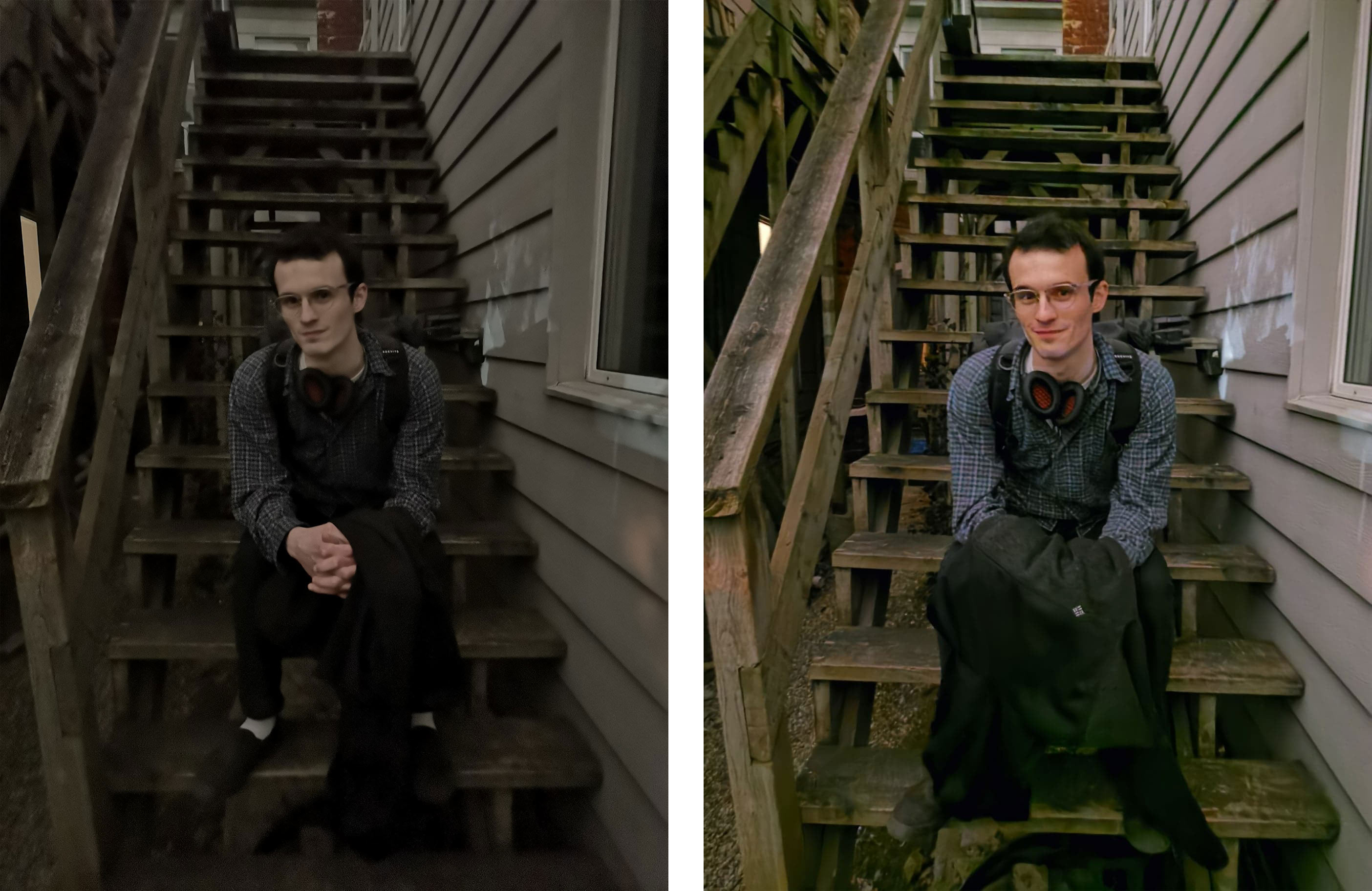
When there is a minimal amount of light, the phone performs much better. Don’t get me wrong, the pictures aren’t amazing, and you still lose some detail. In the below image, my co-worker’s hair isn’t detailed and there is some distortion in his shirt as the device found it difficult to make out the pattern.

The P20 Pro is on the left and the P30 Pro is on the right. 

While this isn’t exactly the best picture, it’s far superior to what I was able to capture with the P20 Pro. The same picture taken with the P20 Pro was a lot darker with less detail and more grain. This is also quite impressive considering it was outside at 11pm at night and we were in between two houses with only the moon to light the scene.

In contrast, when there is more light, the P30 Pro’s night mode works best. This likely how most people will take pictures with the smartphone. That said, without actually changing the mode to black and white, I did find that the phone greys out the night sky. In my testing, it seems this happened more often during cloudy nights. I found when I turned off night mode pictures still looked pretty great, though they were darker in comparison.

In the dark, the P30 Pro tends to overexpose the light areas of an image, which isn’t always necessary. As a result, if you’re finding the P30 Pro creates a lot of light halos around street lamps, you have full control of ISO and shutter speed.

This means you can choose to bump down the ISO or shutter speed to avoid that.

Look Closer

While the phone can take great pictures in the dark, my favourite thing about is its zooming prowess. The P30 Pro features 5x optical zoom, in addition to 10x hybrid zoom and 50x digital zoom. When using the optical lens at 5x zoom, pictures were just as sharp, clear and full of detail as the basic 1x zoom. I once used the phone to look at a sign that looked at least 10 feet away, and I was able to use the 5x zoom to read the sign, as pictures are still crisp and detailed.

Even at 10x zoom, images are still clear and detailed. Depending on what exactly you’re taking a picture of, such as intricate patterns or a lot of people, you can easily tell that the image has been digitally enhanced. What Huawei does to achieve 10x hybrid is it has the handset take a picture with its 5x optical lens, crops the image and fills in some of the details with artificial intelligence. The whole process is impressive and works well.

Probably my best example of this was looking down at on the streets of New York and being able to read the words on the New York Public Library from the Library Hotel 190m away.

With the 50x digital zoom pictures are very digitally enhanced, featuring little detail and any sense of sharpness. However, the phone really feels like it turns into a telescope, allowing you to see objects at a ridiculous distance. With 50x zoom, I was able to read the small fifth avenue sign from the Library Hotel and could look at a weather vane a couple of hundred feet away.

Click to view slideshow.

The handset also features an aperture mode that allows users to control how much depth of field you want in an image. The device uses its time of flight sensor combined with artificial intelligence, depending on how much bokeh you want in the picture. You can easily use the portrait mode if your subject is a person.

The phone will immediately recognize the user’s face and preset the amount of bokeh. However, if you want more control, you can use the ‘Aperture Mode.’ If you’re really close to the subject you can set a higher aperture and still obtain a very detailed and crisp picture. With an obvious separation from the foreground and the background of the image. If you’re using the aperture mode to take a picture of another person, you can still achieve a good bokeh-style photo. Depending on how low the aperture is set, the more the picture begins to lose details around the edges of the subject.

In the below images, you can see the loss in detail in MobileSyrup staff writer Brad Bennett’s hair at the lower aperture. At f/4.0 I can still get the details of his hair, whereas at f/1.6 I start to lose a little more detail. Not that it’s bad, taking aperture shots the purpose of the picture is to blur out the area surrounding the subject.

(Portrait L)

The P30 Pro also has the same ultra-wide-angle camera as the Mate 20 Pro and it works well. It allows for pictures with a larger field of view as well as a Super Macro mode letting users take pictures 2.5cm away from the subject.

Instagram ready

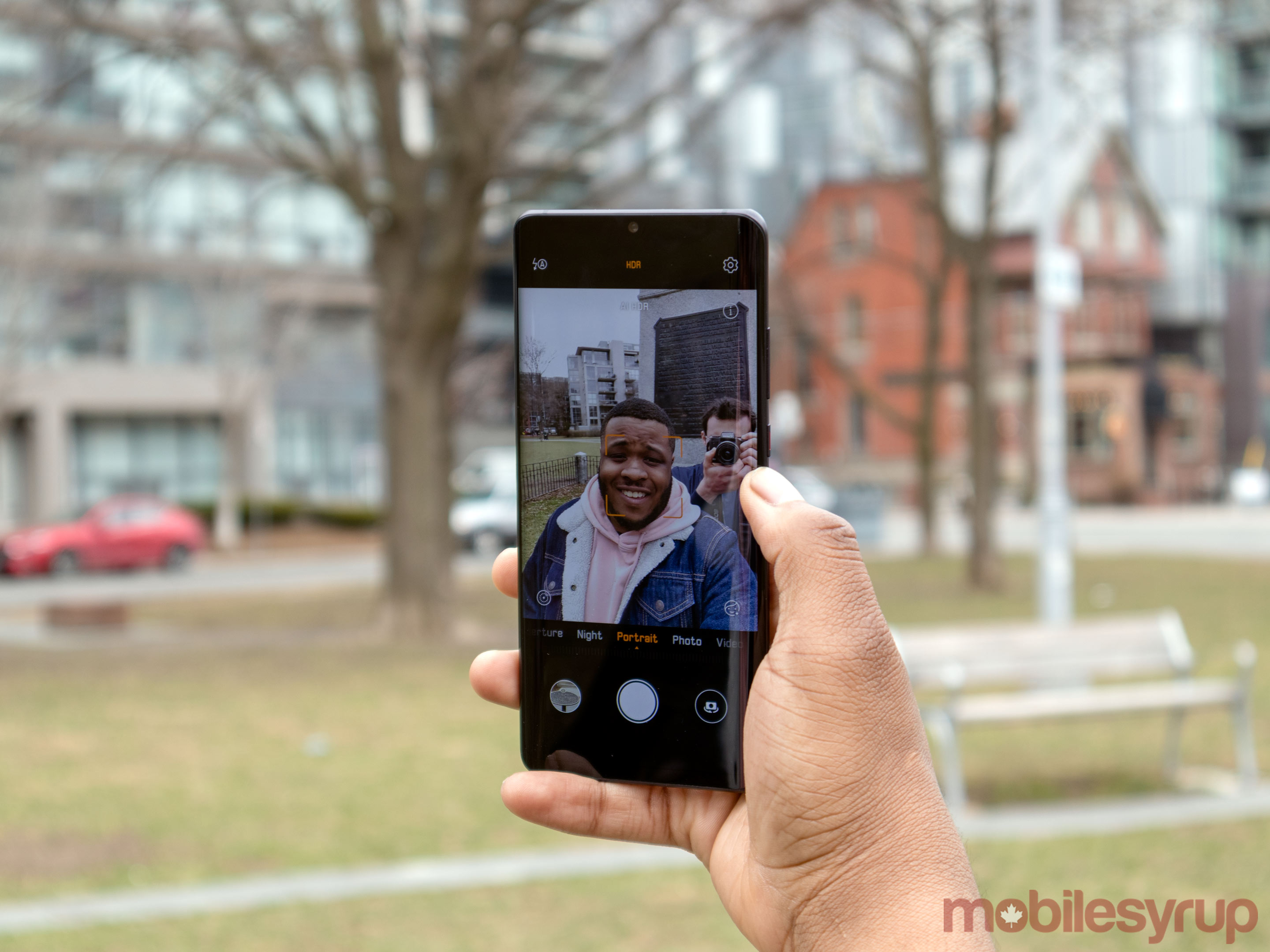
On the front, the phone has a 32-megapixel camera that is probably the best selfie shooter I’ve used so far on a Huawei smartphone.

As a black person, I typically find that Huawei’s phones overexpose my face far too much for my liking, but the P30 handles people with darker complexions pretty well.

Using the portrait mode the subject will again lose detail, but this time there isn’t much you can do about it except turn off portrait mode. The handset lacks a front-facing time of flight sensor like the LG G8 ThinQ.

Personally, I prefer the selfie camera featured on the Pixel 3 XL. That said, Huawei’s camera technology definitely has come a long way in the last few years.

“Huawei’s latest handset is a battery machine”

Huawei’s latest handset is a battery powerhouse. The device is capable of pumping out over a day of usage easily. In one particularly impressive charge cycle, the P30 Pro lasted me from 6pm in the evening to 1:30pm the next day. On that occasion, I had a little under 10 hours of screen on time and spent a lot of time testing out the camera.

In another situation, I even had 16 hours and 57 minutes of screen on time. On that day, I mostly spent time scrolling through Instagram and less than 30 minutes watching videos on YouTube. I also used the eye comfort mode, which changes the colour temperature of the display and I dimmed the screen to about 50 percent brightness.

The P30 Pro currently only features a 4G model as it lacks the company Balong 5000 modem. The company provided me with the 8GB of RAM and 256GB of storage variant. There is also another P30 variant that features 6GB of RAM and 128GB of internal storage

I found it offered a smooth experience and I was able to play Asphalt Xtreme with absolutely no issues. The game ran smoothly and even after 10 minutes, the device maintained a cool 27.5 Celsius.

Also, rapidly switching between multiple apps offers a smooth experience with the P30 Pro.

Regarding benchmarks, the phone hits a single-core score of 3,276 and a multi-core score of 9,799 on Geekbench. While this isn’t the best score out there when compared to other Android devices it’s still very respectable.

The post Huawei P30 Pro review: Photography first, everything else second appeared first on MobileSyrup.

12 Apr 00:29

Exploring the Future of 5G and Journalism

by The Times Open Team
Illustration by André Wee

The New York Times has launched a 5G Journalism Lab to see what’s possible with 5G technology.

By Aharon Wasserman, Serena Parr and Joseph Kenol

This month, the fifth generation of wireless data networks made its debut in Chicago and Minneapolis, marking a big shift in wireless technology. Over the next few years, the transition to 5G will provide Internet speeds at least 20 times faster than 4G networks, enabling smartphones to download entire movies in seconds or stream massive multiplayer games without latency. (You can read more about the new network and its expected impact here.)

At The New York Times, we’re interested in how higher and faster bandwidth can unlock new ways for us to tell stories, and for our readers to experience them.

Storytelling with 5G

To explore what kind of storytelling opportunities 5G might enable, this year we’ve launched a 5G Journalism Lab. We’ve partnered with Verizon, which is providing us with early access to 5G networking and equipment for us to experiment with.

We believe 5G’s speed and lack of latency could spark a revolution in digital journalism in two key areas: how we gather the news and how we deliver it. In the short term, having access to 5G will help The Times enhance our ability to capture and produce rich media in breaking news situations. Over time, as our readers start to use 5G devices, we will be able to further optimize the way our journalism is delivered and experienced.

Using 5G in our Newsroom

Even before 5G devices are used widely, we see high potential for leveraging 5G to enhance our ability to gather the news, so we’re experimenting with how 5G in the hands of our journalists might enable new workflows and capabilities not possible with today’s 4G technology.

The Times has journalists reporting on stories from over 160 countries. Getting their content online often requires high bandwidth and reliable internet connections. At home, too, covering live events means photographers might take thousands of photos without access to a reliable connection to send data back to our media servers. We’re exploring how 5G can help our journalists automatically stream media — HD photos, videos and audio, and even 3D models — back to the Newsroom in real-time, as they are captured.

5G for our readers

We’re also experimenting with how we can deliver more dynamic storytelling formats to our readers as 5G devices become used more widely.

Over the past year The Times has honed its ability to tell immersive stories, allowing readers to experience Times journalism in new ways. As 5G devices become more widely adopted, we’ll be able to deliver those experiences in much higher quality — allowing readers to not only view more detailed, lifelike versions of David Bowie’s classic costumes in augmented reality, but also to explore new environments that are captured in 3D.

More to come

The promise of 5G is huge, and we’re eager to experiment with the technology to understand what possibilities it might unlock for The Times and our readers. Along the way, we hope to share our successes and roadblocks — and engage with a larger community of technologists, designers, storytellers and readers. To start, we’ll be publishing our findings here every few weeks. Looking forward.

Aharon Wasserman is the Technical Lead of the 5G Lab and a Lead on the Research & Development team at The New York Times. Follow him on Twitter.

Serena Parr is the Partnerships Lead of the 5G Lab at The New York Times.

Joseph Kenol is the Newsroom Lead for the 5G Lab and Visual Strategy Director at The New York Times.


Exploring the Future of 5G and Journalism was originally published in Times Open on Medium, where people are continuing the conversation by highlighting and responding to this story.

12 Apr 00:28

Coreboot News: New Script, Pre-built Binaries and PureBoot on Non-TPM Laptops

by Kyle Rankin

Things have been busy in the coreboot department, lately, and we are excited to announce a number of new improvements:

  • Pre-built binaries of our default coreboot BIOS firmware
  • Pre-built binaries of our tamper-evident PureBoot firmware
  • Improved script to automate coreboot builds and flashing from pre-built binaries
  • PureBoot tamper-evident support for non-TPM Librem 13 version 2 and Librem 15 version 3 systems

Pre-built Binaries

In the past, updating to our latest coreboot BIOS images required you to go through an automated, yet time-consuming process, of downloading and compiling coreboot from scratch. While we know that many people prefer building the firmware from source–after all that’s one of the big advantages to using free software –some would rather have the convenience of pre-built binaries, for the same reason they like pre-built binaries for regular OS packages.

This is a way of getting convenience while also knowing the ROM you are loading has already been tested for your particular laptop version. Just like with our regular coreboot BIOS, trying out our beta PureBoot firmware images–that use Heads instead of SeaBIOS–required users to go through a somewhat complicated process of building from source. While we hope to soon offer PureBoot as a pre-install option when you buy a laptop, in the mean time we will be providing pre-built PureBoot firmware binary images.

Starting today, you can get binary ROM images both for our traditional coreboot and PureBoot in the https://source.puri.sm/coreboot/releases repository. We’ve already disabled and neutralized the Intel Management Engine in these pre-built images as well. As we update and make improvements to coreboot, we will keep these images up-to-date—a great reference point if you want to make sure you are running firmware with the latest updates and security improvements.

Improved Flashing Script

Providing pre-built images is a good start to making our coreboot images easier to install and update, but we do realize most people don’t want to figure out how to use flashrom on the command line, and we are releasing a new and improved flashing script at https://source.puri.sm/coreboot/utility so it’s easier to either pull down the latest pre-built coreboot binary, or build it yourself. If you are using the traditional coreboot BIOS, it will even flash the update for you, whether you want to update the traditional SeaBIOS coreboot image or transition over to PureBoot. Current PureBoot users should flash from within the trusted Heads environment itself: the script detects it and provides users with instructions on which ROM file they should copy to a USB disk and flash.

To use the improved script, copy https://source.puri.sm/coreboot/utility/raw/master/coreboot_util.sh and run it as root. The README for the script lists what dependencies you need, and the script itself will also detect and alert you if you are missing packages it needs:

mkdir ~/updates
cd ~/updates
wget https://source.puri.sm/coreboot/utility/raw/master/coreboot_util.sh -O coreboot_util.sh
sudo bash ./coreboot_util.sh

PureBoot Tamper-evident Support for Legacy non-TPM Laptops

We make sure our own security, and our improvements aren’t limited to those who buy our latest hardware. This is why we ported coreboot to the Librem 13 version 1 and continue to provide coreboot updates to it and other early Librem laptops. One of the things I’m most excited to announce is that we have ported PureBoot tamper-evident support into Skylake-based Librem laptops without TPM chips! This means that if you have a Librem 13 version 2 or Librem 15 version 3 without a TPM, you can now use a Librem Key in place of your TPM chip and get similar protection against tampering!

Heads Using a Librem Key

How Does This Work Without A TPM?

When we first announced our partnership with Trammell Hudson to port Heads to our laptops, we also started offering TPM chips, first as an optional upgrade for an extra cost and ultimately installed by default for no extra charge. Until now, the TPM chip was needed to store all of the pre-approved firmware measurements securely, as that was the only method Heads supported; once we announced the addition of the Librem Key to our product line, we realized that there might be a way for the Librem Key to take the place of the TPM for older Librem laptops.

Traditionally, Heads will send measurements of itself to the TPM, and if it matches the pre-approved measurements you originally set up the TPM will unlock a secret that gets converted into a 6-digit HOTP code and sent to the Librem Key, which has its own copy of the secret and generates its own 6-digit HOTP code. If the code it receives over USB matches the code it generates, it flashes a green LED; otherwise it flashes a red LED to alert you of tampering.

When configured for a system without a TPM, and instead of using a random secret that’s unlocked with the correct firmware measurement, our PureBoot Heads ROM uses the firmware measurement itself—converted to a hash—as the secret. When originally setting it up, the Librem Key is to be configured to store a copy of that secret. Upon boot, Heads uses its own local flashrom to pull down a full copy of the running firmware, hashes it, and converts it into a 6-digit HOTP code. Like before, it sends that HOTP code to the Librem Key and the Librem Key compares it with the code it generates. If they match, green LED, if they don’t, red LED.

This method turns the Librem Key into a kind of external TPM—at least in the sense that the device itself is being sent firmware measurements instead of the TPM, in the form of a hash converted into a 6-digit code. The main practical difference you’ll notice is that the no-TPM solution takes an additional number of seconds at boot, before you will get to the first boot prompt—as it takes time to copy down the full firmware image.

What’s Next for Coreboot

We are working on a number of additional improvements to make coreboot, PureBoot and our coreboot update process even better. Among them is a migration to coreboot 4.9, compiling the PureBoot firmware from source and from within our firmware update script; more automation around the initial PureBoot and Librem Key setup process, and maybe—if there’s sufficient interest—backporting PureBoot to Broadwell-based Librem laptops (13 version 1 and 15 version 2).

The post Coreboot News: New Script, Pre-built Binaries and PureBoot on Non-TPM Laptops appeared first on Purism.

12 Apr 00:27

✚ Shifting to Responsive Charts, Tools for Mobile (The Process #35)

by Nathan Yau

In this issue I go over my somewhat delayed shift towards making charts that work in different screen sizes and the tools that work for me. Read More

12 Apr 00:26

A-Team: Tracking our Projects

Keeping wiki pages up to date is a hard problem, but recently we found out that people were having trouble finding out what projects we were working on. Obviously we can’t help people with their problems if they can’t figure out what we do, so I spent some time today updating the A-Team’s Project Central. All the projects we are working on are there, along with owners’ IRC nicks and links to project pages and/or docs.
12 Apr 00:26

The Blix Packa is Parent Approved!

by Blix PR

This past Sunday, we teamed up with Mid-Peninsula Mom Blog to hold a Blix Packa test ride event; perfect for families. After an afternoon filled with bike riding, yummy snacks, and great company, the Packa is officially parent approved! Learn what parents love about the Blix Packa, watch the video recap, and find out how you can save on Blix bikes through the Mid-Peninsula Mom Blog organization.


The event was held at Nealon Park in Menlo Park, California, in a very bike friendly neighborhood. Since the Packa has recently launched, this event gave parents an opportunity to ask Blix personnel questions, see the new cargo bike firsthand, and test ride with their children on the back. 

Packa is Parent Approved:

While the video shows just a few rider testimonies, the final verdict from the Mid-Peninsula Mom Blog and riders is: the Packa is definitely parent approved! One of the most discussed features of the Packa was the pedal assist and throttle options. Many of the riders were impressed with the "smooth ride" and said "it felt easy even with the weight in the back," especially when carrying more than one child. Most importantly, as the riders finished their test ride, their first words were "that was fun!"

Additionally, riders were impressed with how the Packa "feels sturdy" and "feels safe to ride." Safety is vital when carrying children on the back and having the ability to easily maneuver the Packa was one of Blix's goals when choosing an ultra-low, step-through frame. 

Watch as parents and children share what they like the most about their experience on the Blix Packa!

By test riding the Packa, parents were able to see how adding an electric cargo bike to their lifestyle could benefit their daily routine and bring back the fun! As one parent said, "I can definitely see myself using this bike [the Packa] to get groceries." Similarly, another parent stated, "my kids hate the car so being able to take them places on the weekend would be great."

We would like to thank the Mid-Peninsula Mom Blog for helping us with this event!
If you would like more information on our collaboration as well as how you can save on the Packa or other Blix Bikes, learn more here!


More information about the Packa can be found here

Follow us for more great events!

Instagram 

Facebook


12 Apr 00:25

Google and Huawei to pay up to $400 to U.S. owners of faulty Nexus 6P handsets

by Dean Daley
Nexus 6P smartphone

Google and Huawei have agreed to a settlement regarding a class action lawsuit involving owners of the Nexus 6P. Some users experienced a boot looping issue that caused the phone to shut down seemingly for no reason.

The companies settled the suit for $9.75 million USD ($13 million CAD), which amounts to $400 ($535 CAD) for the participating device owners. If the courts do approve the settlement on May 9th, the day of the next hearing, any Nexus 6P user in the U.S. that received their device on September 25th, 2015 or after is eligible to get a reimbursement.

If a user replaced their 6P in 2017 under warranty, they are only eligible for up to $10. For 6P owners who submit the correct documents, they are eligible to receive the full $400. For those who didn’t, they are only eligible for up to $75, according to the documents.

This all started when Google, which enlisted Huawei to manufacture the 6P, breached the warranty of the handsets when the China-based company knowingly sold the smartphone with the bug and failed to do anything about the issue.

Unfortunately, this settlement only applies to users in the United States as the class action was dealt with in the U.S. court systems. In Canada last year, Huawei was providing some users replacement devices, but that was on a case-by-case basis. And in 2017, Google provided some users with replacement handsets as well.

The full settlement can be found here.

Source: The Verge 

The post Google and Huawei to pay up to $400 to U.S. owners of faulty Nexus 6P handsets appeared first on MobileSyrup.

12 Apr 00:25

Gave Red, Got Green

by peter@rukavina.net (Peter Rukavina)

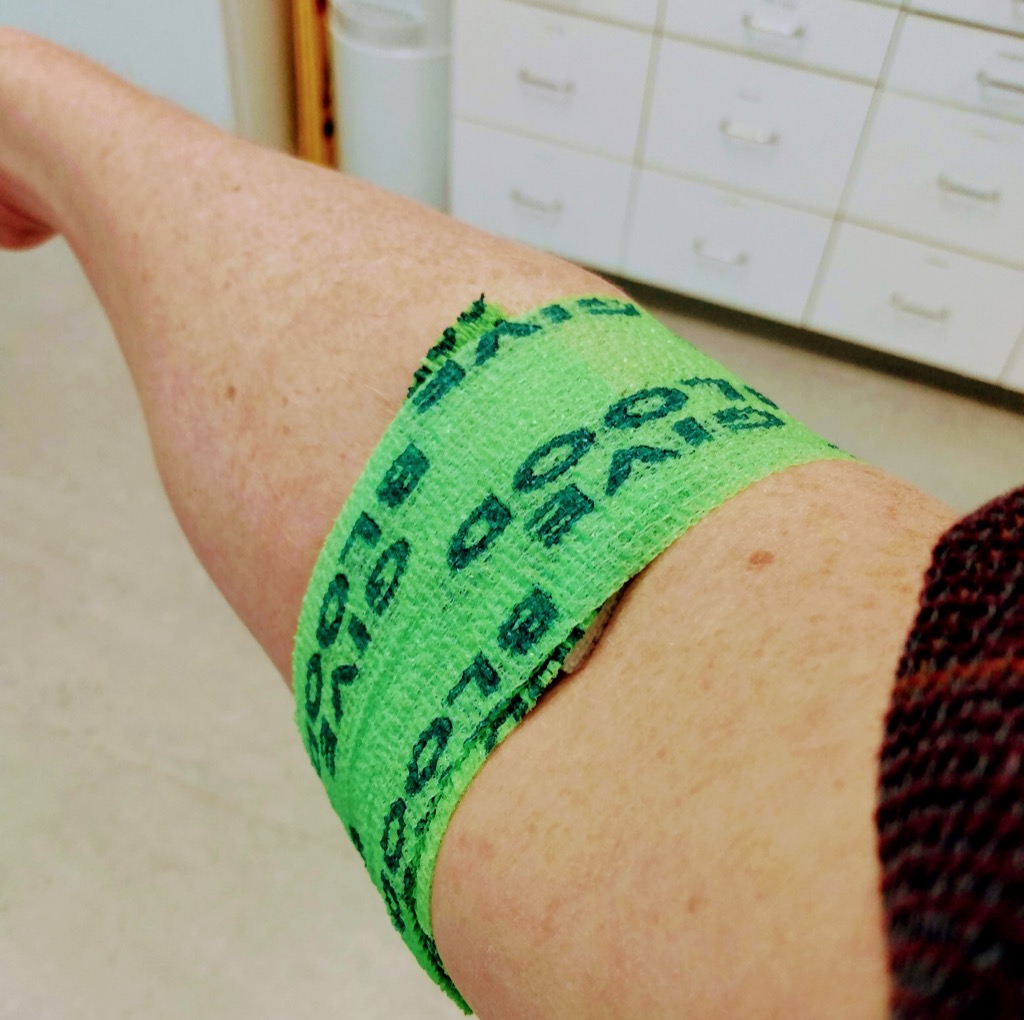
At my monthly plasma donation this afternoon they went to put blue wrap around my arm just before I was done.

“You don’t have any green wrap do you?”, I asked.

They did. So that’s what I got.

It was a very Green donation otherwise: the man at the bed next to me was sporting a Peter Bevan-Baker button, and my nurse mentioned that he sister lives on the same street as Karla Bernard and has a Green sign-making operation in her garage.

Green wrap on my right arm.

12 Apr 00:25

Sharp unveils its foldable smartphone prototype

by Dean Daley
Sharp HQ

Earlier this week a patent was published giving us insights into Sharp’s future foldable gaming smartphone. Now the company has given an official hands-on of its foldable phone prototype to Engadget Japan.  

The prototype sports a 6.18-inch OLED display with a 1,440 x 3,040-pixel resolution and a Sony Xperia 10-like 21:9 aspect ratio. However, this handset can fold in a clamshell, similar to the flip phones of yesteryear. But oddly enough the phone still features a notch.

Sharp told EngadgetJP that the phone can survive for more than 300,000 bends before any wear and tear to the OLED display. The company also claimed that, even though they were only showing off the inward folding motion, the handset can also fold outwards.

This handset looks similar to the rumoured upcoming foldable Motorola Razr handset. However, this smartphone lacks the secondary screen on the outside of the phone.

Sharp didn’t say if it will bring this technology to its Aquos lineup of handsets. Additionally, the Japan-based company says that it will look to bring an official product to market within the next few years.

Source: Engadget Japan

The post Sharp unveils its foldable smartphone prototype appeared first on MobileSyrup.

12 Apr 00:25

5 Questions Every Cat or Dog Owner Should Ask Their Vet

by Kaitlyn Wells
5 Questions Every Cat or Dog Owner Should Ask Their Vet

No matter if you’re a lifelong pet owner or a first-time adopter, a trip to a rowdy and crowded vet’s office can be a frazzling experience. I was once so distracted by my dog Sutton’s incessant licking of her lips, an indicator of stress, that I forgot all about my mental checklist of questions until after the appointment ended.

If your attention is easily diverted by your pet’s antics or you get nervous around doctors, make a plan. To ensure history doesn’t repeat itself, I now save my questions, along with my pet’s medical history and dietary notes or troubling symptoms, to my phone ahead of every visit.

Dr. Leni Kaplan, a clinician and lecturer with Cornell’s Small Animal Community Practice, said in an email interview that owners shouldn’t feel embarrassed by coming in with a list of questions. “Veterinarians have pets, too, and have often faced the exact challenges our clients face,” she said. “The more questions we can answer, the more successful owners and veterinarians will be in delivering the best care possible.” Here’s what both novice and experienced pet owners should always ask their vet at their next wellness exam.

“What should I be feeding my pet?”

Browsing the scores of pet food options on a store’s shelves—each one enticing you with images of real ingredients and happy-go-lucky pets, and labeled with marketing buzzwords such as “handcrafted” or “grain-free”—can be overwhelming. Your vet can steer you toward the food that’s ideal for your pet’s age, breed, size, and activity level.

“Veterinarians can and should offer advice on feeding, not the high school kid at the food store,” said Dr. Karen Louis, a veterinarian and owner of Metro East Vet in Belleville, Illinois. “Some pet food companies have hired marketing teams that are positively brilliant at confusing pet owners.”

“How’s my pet’s weight?”

My dog Sutton’s four-legged sister is a fluffy Maine-coon mix named Tanzie. For a time I attributed Tanzie’s robust appearance to her thick coat—until the day a friend called her “fat.” Even though I couldn’t see the chonk, my vet later confirmed my cat was indeed overweight.

“It can be difficult to assess a pet’s weight if they are fluffy and even harder to notice changes in weight when we see our pets every day,” said Dr. Karen Fine, a veterinarian with Central Animal Hospital in Leominster, Massachusetts.

No kidding. A 2018 clinical survey by the Association for Pet Obesity Prevention reported that 55.8 percent of dogs and 59.5 percent of cats are overweight or obese. Among all pet owners surveyed, 68 percent said they wanted their vet to recommend a routine or maintenance diet for their pet.

Fine added that weight gain can put pets at risk for diabetes and heart disease (not to mention shorten their lifespans, according to a study in the Journal of Veterinary Internal Medicine). Being underweight, in contrast, may point to a parasitic infection or chronic illness. So ask your vet about what the changes in your pet’s weight mean and, if necessary, the best way to get things back on track.

“How much exercise do they need?”

Exercise helps people bond with their pets, aids in the pets’ weight loss, and curbs behavioral issues such as furniture scratching or trash rummaging. Although all pets need daily exercise, professionals agree the amount varies by a pet’s age, breed, and medical history.

Puppies that get short bursts of energy throughout the day, known as “the zoomies,” need several daily play sessions or short walks to tucker them out, which is safer than one long session on their growing bodies. Samantha Aline Pierre, a licensed veterinary technician with Blue Pearl Veterinary Partners, said that “large-breed dogs, living in the city, should be walked two to three times a day” in addition to engaging in regular play. But sedentary adult dogs such as Chihuahuas and Great Danes may need less physical and mental stimulation. And short-nosed dogs such as bulldogs have respiratory issues that make exercise difficult.

Most indoor cats need about 30 minutes of play a day, divided into two sessions. Pierre favors cat-sized hamster wheels, although any exercise tool will do. Fishing-pole toys with feathers, crinkle balls, and puzzle feeders should do the trick if your cat isn’t trained to leash-walk. (Wirecutter, the product review website owned by The New York Times, has recommendations for dog-walking harnesses, leashes, and cat-enrichment toys.)

A veterinarian can offer an exercise regime appropriate for your pet, as well as warning signs of overexertion so you know when it’s time for a cooldown. They may also refer you to an accredited animal behaviorist or trainer for further insights into your pet’s ideal activity level and how to manage behavioral issues.

“How do their teeth and gums look?”

Pets are adept at hiding their pain, so some owners may overlook dental care until symptoms become unavoidable. Stinky breath, rotting teeth, or loss of appetite can mean periodontal disease, or worse, an infection in the heart, known as endocarditis. Your pet’s doctor will check for early signs of infection at an annual wellness exam and propose a revised treatment plan.

“Similar to people, dogs and cats develop periodontal disease if their teeth are not brushed daily and oral health is not maintained,” said Kaplan.

“Can you explain my bill?”

Pet owners trust professionals to guide them on what’s needed to keep pets happy and healthy. Yet the recommendations aren’t always affordable. Last year the American Pet Products Association reported that the average routine vet visit cost $182 for cats and $257 for dogs—and that surgical visits cost almost double.

The best veterinary clinics are up front about the costs of treatments they recommend, as well as the associated benefits and risks. If the quoted fees turn your face pale, tell your vet about your budget so you can agree on a cost-effective treatment plan that won’t compromise your pet’s well-being. If you have pet insurance that you’d like to use to offset some of the costs, keep in mind you’ll need a detailed receipt to submit to your plan for reimbursement—only a few insurers link up with clinics directly to share billing and payment info. (Wirecutter recommends Trupanion’s plan for most cats and dogs.)

“Veterinarians are trained to offer the best, but not every owner can afford the ‘Cadillac treatment,’” said Louis. “If something doesn’t make sense on the estimate, ask. Many times the ‘Honda Civic treatment’ works fine.”

Questions go both ways

Before you get to your questions, expect your vet to ask about your pet’s diet, behavioral changes, and prescriptions, such as anxiety meds or pest preventives. To ensure you don’t forget anything, jot down the food and medication names, feeding frequencies, and dosages.

Documenting your pet’s routine and any questions you have ahead of time ensures that you won’t get rattled by your pet’s nervous behavior at the clinic. “Since our pets can’t talk, it’s up to us to give the vet as much information as possible,” said Kim Crawford, the president of Friends with Four Paws, an Oklahoma-based animal rescue group. “You are the voice for your pet; don’t settle. Your pet’s health and well-being are in your hands.”

12 Apr 00:25

Ignore firebrand backbenchers such as Jacob Rees-Mogg, May tells EU | Politics

mkalus shared this story from The Guardian:
That’s a bit rich, considering that Cameron’s fear of them started the whole mess. And it’s not as if she has stood up to them in any way.

Theresa May advised the EU’s leaders to ignore the threats of Conservative MPs such as Jacob Rees-Mogg during her appeal for a further Brexit delay at the Brussels summit, senior EU officials have revealed.

The prime minister reassured the EU27 that Britain could be relied upon as a member state and turned fire on her backbenchers, referring to a tweet from Rees-Mogg in which he said the UK should be as “difficult as possible” from inside.

“She made the point that the UK was a serious country and we should not get distracted by some non-members of the government that seemed to be trying to create the opposite impression,” a senior official said.

During an hour-long address, May also indicated she was open to a long extension, warning leaders that some Conservative MPs would see a looming cliff-edge as an opportunity to crash Britain out of the EU.

In comments that highlighted how far the prime minister has travelled from her position that a “no deal is a better than a bad deal”, May told the 27 heads of state and government that “cliff edges by some are not seen as pressure but as an opportunity”. “That point was made during the discussion,” senior EU source said.

After seven hours of talks at the special Brexit summit on Wednesday evening, the EU and the prime minster agreed that the UK would be offered an extension until 31 October, with the option to leave earlier if the withdrawal agreement is approved by the Commons.

The Guardian can reveal:

  • Each additional week as a member state will now eat into the transition period in which the UK wants to negotiate the future economic relationship, and avoid having to trigger the Irish backstop to avoid a hard border on the island of Ireland. The 31 December 2020 end date of the transition period, extendable by up to two years, will not be “revised”, an official said.

  • Nineteen leaders backed a long extension to 31 December or 31 March, seven were flexible either way – and France stood alone demanding a short extension, potentially ending 22 May before being talked round.

  • The prime minister has agreed she will not attend a 9 May leaders’ summit in the Romanian city of Sibiu on the future of Europe.

  • May told leaders that the last time there was real cross-party cooperation in the UK was during the second world war, and that while customs arrangements were being discussed with Jeremy Corbyn most of the talks with Labour were about internally locking in any future government into pursuing a softer Brexit.

  • The EU’s lawyers warned France that its proposal to throw the UK out if it failed to live up to a promise of “sincere cooperation” as a member state would be illegal.

  • Belgium held up the seven-hour discussion by asking for tougher language on the UK’s responsibilities as a member state during the extra time in the EU but was bought off with two extra words to the summit communique.

  • May haggled in the early hours of the morning over the June review point included in the summit communique to reflect that it was not a health check on the UK’s record as a member state but a stock check on progress in the Brexit process. “There was a requirement from the UK to be a little more precise so to avoid any confusion,” an EU official said. “That’s why we ended up with the word progress [in paragraph nine of the text].”

The terms of the new Halloween cliff-edge in 29 weeksdo not rule out a further extension , although a senior EU official said the threshold for a further Brexit delay would be higher.

“Everybody understands that, as they say in the UK, a week is a long time in politics – and we gave 29 weeks”, the official added.

“There have to be very good reasons to extend for another time,” source said. “Therefore there is this expectation that something should happen before. And again, in the [leaders’] discussions some are more keen to bring this process to an end than others.”

Because of the 31 October date, the day before Jean-Claude Juncker’s tenure as European commission president ends, the UK will have to nominate a commissioner for the EU’s executive branch despite the concerns of some in the EU27. “It is one of the inconveniences of this particular date”, an official said.

On Thursday, Arlene Foster, leader of the Democratic Unionist party, and the former cabinet minister Iain Duncan Smith, met the EU’s chief negotiator, Michel Barnier, to lobby for alternative arrangements to the Irish backstop that would keep the UK in a shared customs territory, and Northern Ireland in effect in the single market.

Duncan Smith told reporters: ‘The reason for these discussions is that quite recently a number of EU politicians, not least Mr Varadkar [the taoiseach] and Mr Barnier have all said that in the event of No Deal there would be no hard border between Northern Ireland and the Republic of Ireland which is a significant change so we’re here to discuss both sides of that coin.”

... The Guardian is here to help guide you through whatever lies ahead. More people are reading and supporting our independent, investigative reporting than ever before. And unlike many news organisations, we have chosen an approach that allows us to keep our journalism accessible to all, regardless of where they live or what they can afford.

The Guardian is editorially independent, meaning we set our own agenda. Our journalism is free from commercial bias and not influenced by billionaire owners, politicians or shareholders. No one edits our editor. No one steers our opinion. This is important as it enables us to give a voice to those less heard, challenge the powerful and hold them to account. It’s what makes us different to so many others in the media, at a time when factual, honest reporting is critical.

Every contribution we receive from readers like you, big or small, goes directly into funding our journalism. This support enables us to keep working as we do – but we must maintain and build on it for every year to come. Support The Guardian from as little as CA$1 – and it only takes a minute. Thank you.

Paypal and credit card
12 Apr 00:25

Court overturns referendum as voters were poorly informed ... in Switzerland | World news

mkalus shared this story from The Guardian.

Switzerland’s supreme court has overturned a nationwide referendum for the first time in the country’s modern history, on the grounds that the information given to voters was insufficient.

In a ruling that may resonate in Britain, where remain campaigners have long argued that voters in the 2016 Brexit referendum were not adequately informed, the court said incomplete detail and a lack of transparency had violated the freedom of the vote, which could now be re-run.

“Given the tight outcome of the vote and the seriousness of the irregularities, it is possible that the result of the ballot would have been different,” the federal court said. It was the first time a result had been annulled in Switzerland, where voters have been called to vote more than 300 times on over 600 federal-level referndum proposals since 1848.

The Christian Democratic party, which had proposed the February 2016 vote on whether Switzerland’s tax regime unfairly penalised married couples, lodged an appeal against the result last year, saying voters had been misled.

Married couples in Switzerland are taxed jointly on their combined incomes, meaning they can often pay more tax than cohabiting partners who are taxed separately so each benefit from a tax-free allowance.

The proposal, “For the couple and the family – no to the penalisation of marriage”, was narrowly rejected by 50.8% to 49.2%. But the party argued the result should not stand because the scale of the problem had been seriously misrepresented.

In information provided to voters before the referendum, the federal government said 80,000 married couples were penalised by the tax regime. It subsequently revised the figure, saying 454,000 couples were affected.

The court said voters had been “informed erroneously and in an incomplete way. They could not imagine that the number of couples affected by the married couples’ tax penalty was more than five times higher than the figure announced.”

The federal government said it would “draw the necessary consequences” from the ruling and had already set up a study group to “propose additional measures to ensure the quality of preparation for decisions to be made by citizens”.

The Christian Democrats welcomed the court’s decision, saying it was a boost for the political rights of Swiss voters. Critics said the decision could open the floodgates to a stream of complaints about past and future referendums.

Switzerland’s system of direct democracy allows any group of voters to force a nationwide plebiscite on any proposal for which they can gather more than 100,000 signatures.

12 Apr 00:25

‘We have not managed to land successfully’: Israel's moonshot fails | Science

mkalus shared this story from The Guardian.

An Israeli spacecraft has crashed into the lunar surface, ending the first privately funded attempt to land on the moon.

About the size of a washing machine, the 585kg (1,290lb) robotic lander experienced an engine and communication failure in the last seconds of touchdown.

The mission ended Israel’s hopes of joining the ranks of Russia, the US and China as the only countries to have made controlled landings on Earth’s nearest neighbour.

“We had a failure in the spacecraft. We unfortunately have not managed to land successfully,” said Opher Doron, the general manager of Israel Aerospace Industries’ space division.

“It’s a tremendous achievement up to now,” he added, saying the probe had already made Israel the seventh country to orbit the moon and the fourth to reach the lunar surface.

Named Beresheet, the Hebrew word for genesis, the four-legged craft had intended to measure magnetic fields from its landing site on a lunar plain called Mare Serenitatis, the Sea of Serenity.

Its frame held a time capsule of digital files the size of coins containing the Bible, children’s drawings, dictionaries in 27 languages, Israeli songs, as well as memories of a Holocaust survivor.

Beresheet was launched in February aboard a Falcon 9 rocket, one of SpaceX’s private fleets run by the billionaire entrepreneur Elon Musk.

While crewed lunar trips have taken around three days, the probe took a much more circuitous route for its four million-mile (6.5m km) journey. It has spent 47 days, gradually making ever-widening elliptical orbits around the Earth until it was “captured” by the moon’s gravitational pull and looped closer to its surface.

On Wednesday, the lander made a manoeuvre to lower its altitude for a lunar orbit of between nine and 124 miles while preparing for the landing. It managed to take a photo of the moon minutes before communication was lost.

Funded almost entirely by donations, Beresheet was built by SpaceIL, an Israeli non-profit set up for the mission, in partnership with the state-owned Israel Aerospace Industries. It cost about £70m, a fraction of the cost of previous state-led missions.

Morris Kahn, a South African-born Israeli billionaire, is the main backer but the US Republican party and pro-Israel funder Miriam Adelson and her casino-owning husband, Sheldon, also gave $24m.

Israel’s prime minister, Benjamin Netanyahu, who was at mission control, said: “If at first you don’t succeed, try again.”

US and European space agencies intend to use an expanding commercial space industry to send people back to the moon. A Nasa-led plan is already underway to build a small crewed space station orbiting the moon, and the private sector has been tasked with helping to build it.

Russia was the first country to make a soft landing, rather than a plummeting crash, on the surface of the moon in 1966. Following the end of the space race in the 1970s, there was no return until China sent a lander in 2013. In January this year, Beijing made history by landing a spacecraft on the far side of the moon.

12 Apr 00:25

The rise and fall of British democracy

mkalus shared this story .

If walls could talk, the structures that house our democracy would teach a desperate lesson. Beneath the gold and gilt and glamour, parliament is a ruin. Its walls are riddled with asbestos; its cracked pipes tip dirty water into the chamber; and fires break out with alarming regularity. A cross-party inquiry in 2016 found steam lines, gas pipes and water pipes piled haphazardly on top of one another, in a “potentially catastrophic mix”. Without urgent renovation, the whole edifice faced “sudden, catastrophic failure”.

It is not just the building that is in trouble. Trust in parliament has never been lower. According to the Hansard Society, barely a third of voters trust MPs “to act in the interests of the public”. Forty two per cent would prefer it if governments did not “have to worry so much about parliamentary votes”, while more than half want “a strong leader who is willing to break the rules”. An unwritten constitution, once prized for its flexibility, has created a chaotic patchwork of competing authorities – including the referendum, an uneven devolution settlement and member-led parties – with little consideration of how they fit together. In short, Britain’s parliamentary democracy has rarely felt more under siege.

Since the EU referendum of 2016, parliament has been cowering under the instruction of a higher democratic authority. MPs sit sullenly behind leaders imposed on them against their will, disciplined by manifestos on which they were not consulted and by activists who plot their deselection. Journalists, protestors and even the prime minister stoke popular hostility to parliament, casting it as a Westminster cabal bent on obstructing the will of the people.

Democracy is a cruel mistress and parliament has no monopoly on its affections. Yet our parliamentary constitution is a cause worth fighting for. Saving it will require a frank recognition of its failures, and a willingness to do more than dial the clock back to 2015. During an earlier political crisis, in the 1830s, the Whig constitutionalist Thomas Macaulay adjured his fellow members to “reform, that you may preserve”. In that spirit, let us rebuild our parliamentary democracy.

****

Democracy is the civic religion of modern British politics, but its roots do not run deep. Until the 20th century, the experimental record of democracy was notoriously poor. The democracies of the ancient world collapsed into anarchy and dictatorship; in the 1790s, a revolutionary democracy in France expired in a pool of civic blood; and the United States was engulfed in civil war in the 1860s. Democracies, it appeared, were violent, despotic and unstable. “If there were a people of gods,” wrote Rousseau, “they would govern themselves democratically. So perfect a government is not for men.”

Even the reformers who flung open Britain’s electoral system were seldom believers in democracy. Lord John Russell, who devised the Great Reform Act of 1832, thought universal suffrage “the grave of all temperate liberty and the parent of tyranny and licence”. Benjamin Disraeli, who carried its successor in 1867, told MPs it must “never be the fate of this country to live under a democracy”. By the time of the third reform act, in 1884-85, the direction of travel was clear, but not necessarily welcome. The bill, wrote one minister, was “a frightfully democratic measure, which I confess appals me”.

Against this background, the triumph of democracy marked an intellectual revolution, akin to the rise of the great religions. It brought with it two features common to mass conversions. The first was an apocalyptic tendency: prophets of doom, announcing the end times of democracy, have made a healthy living since at least the 1900s. The Labour Party, the Conservative Party, the European Union, immigration, inflation and anything of which Rupert Murdoch disapproves have all been identified as existential threats to popular government. Democracy, it appears, is both so mighty that it cannot be resisted, and so frail as to be ever at risk of extinction.

Like so many great religions, democracy birthed an array of warring sects. Democracy is a principle, not a set of institutions. It declares that the people (or the “demos”) should “rule”, but says nothing about how they should govern, what they should govern or even who “the people” are. (Women, slaves, immigrants and the young have all, at one time or another, been excluded in the name of democracy.) Enthusiasts for liberal democracy, industrial democracy, direct democracy and social democracy disagree on everything from the reach of democracy to the mechanism for establishing its will. Legitimacy, in democratic thought, comes only from the people; but the very act of decision-making disrupts its unity, dividing one group against another.

The model that emerged in Britain – more by chance than design – was a distinctly conservative idea of democracy. Power remained in the hands of Britain’s medieval parliament, operating at arm’s length from the public. Pre-democratic elements, such as the monarchy and the House of Lords, both survived and thrived, while governments successfully fought off demands for direct democracy or industrial democracy. This was not the self-governing democracy of the ancient world, in which citizens made their laws in the public square. It was government by a select few, accountable at periodic intervals to the electorate.

****

The supremacy of parliament was never uncontested. The programme of the Independent Labour Party, published by Keir Hardie and Ramsay MacDonald in 1899, left open the question of “whether the representative chamber is to remain the chosen method of expressing the democratic will”. The Social Democratic Federation went further, telling supporters in 1893 that “we do not believe in the parliamentary system”. It preferred “a system of pure democracy”, expressed through the “Initiative” and “Referendum”.

In the 1930s, mass unemployment fed growing hostility to parliament, and to what Oswald Mosley, the fascist leader, called “the false liberty of a few old men to talk forever”. Parliament, thought Mosley, should hand over its powers to a government based not “on the intrigues and manoeuvres of conflicting parties, but on the will of the nation, directly expressed”. A future Labour chancellor, Stafford Cripps, argued in 1933 that a socialist parliament should immediately pass an emergency powers bill allowing ministers to implement their programme through direct orders.

The Second World War had a paradoxical effect on parliament, circumscribing its powers but enhancing its prestige. General elections were suspended, secret sessions held and emergency powers vested in the government; even the chamber of the House of Commons was destroyed by bombing in 1941. Yet the imaginative hold of parliament was never stronger, as the arena of Churchill’s great speeches and a symbol of national defiance. Churchill called it “the citadel of British liberty” and the rock on which dictators would be broken. “I do not know how else this country can be governed,” he said in 1943, “other than by the House of Commons.”

By the 1960s, however, the chorus of criticism was swelling once more. Tony Benn, soon to emerge as the doyen of the Labour left, railed against the “obsolete philosophy of parliamentary government”, which limited voters to the occasional cross on a ballot paper. It was Benn, more than any other politician, who secured Britain’s first national referendum in 1975, on membership of the European Economic Community. Soon, he predicted, there would be an electronic button in every household, making possible “a new popular democracy” in place of “parliamentary democracy as we know it”.

By the 1980s, Benn was calling for a “national liberation struggle” to tear down “the lace curtains hung by the Mother of Parliaments”. Britain’s parliamentary democracy, he concluded, was “a decorous façade, behind which those who have power exercise it for their own advantage”.

It was not only the left who looked to democracies outside parliament. “The democracy of the ballot box,” said Margaret Thatcher in 1978, was “only one form of democracy”. In “a truly free society”, it needed to be “reinforced by the democracy of the market, in which people cast their vote, not once every four years or so, but every day as they go about their daily business”. For Thatcher, the democratic control of industry would be achieved by the market, not the state, allowing each consumer to “have what he or she wants most”.

Such claims were polemical, rather than analytical. In the struggle for political power, democracy was the elder wand: a weapon that could win all battles for its rightful master. It cast its protective spell over the most improbable causes. GK Chesterton, in 1908, defined tradition as “the democracy of the dead”; an “extension of the franchise” to those “disqualified by the accident of death”. Winston Churchill made a democratic case for the British empire, which he credited with “spreading democracy more widely than any other system of government since the beginning of time”. Margaret Thatcher deployed democracy as a weapon against socialism, promising in 1981 to uphold democracy “in the dictionary sense, not the Bennite sense”. During the miners’ strike in 1984-85, she rallied her supporters with a speech on “Why Democracy Will Last”. Arthur Scargill, of the National Union of Mineworkers, retaliated with a promise to win back “for the British people the democracy… they have been denied over the past 40 years”.

So the idea of “democracy in crisis” – or the conviction that Remainers, judges or Theresa May pose a threat to the survival of democracy – is far from new. Nor is a suspicion of parliament as an obstacle to democratic politics. What has changed is the direction of fire, for the challenge to parliament has moved from the fringes into the mainstream. Tackling that requires us to understand why that change matters, and how it came to pass.

****

At its best, parliamentary democracy embodies three core principles. The first is that democracy is a conversation, conjured from a glorious cacophony of voices and interests. Human beings are not, like the Borg in Star Trek, mere extensions of a single mind. They are farmers and factory workers; shopkeepers and office clerks; teachers, writers and musicians. They are “hangers-and-floggers”, “bleeding-heart liberals”, socialists, anarchists and none of the above. They follow different religions, read different newspapers and have different visions of the good society.

The role of parliament is to bring those voices into dialogue. The very name comes from the French word “to speak”: parliament is where the people come together to parley. For that reason, a parliamentary system does not entrust a single figure with the full powers of government; instead, it returns 650 different voices, ranging from Diane Abbott and Caroline Lucas to Arlene Foster and Jacob Rees-Mogg. From the lowliest backbencher to the prime minister, each has the same popular mandate; each is a representative of the people. The symbol and arena of our democracy is an argument between competing voices.

A second principle follows logically. Parliamentarism not only legitimises dissent; it institutionalises it, in the role of Her Majesty’s Loyal Opposition. The archaic title expresses an important principle: that even those who have been defeated at a general election remain central to the democratic process. Minorities are outvoted, but not silenced. They can test and challenge the majority, asking difficult questions and trying to peel off support. Dissent is not treason or an offence against the people. It is a service to them, including those – perhaps temporarily – in a minority.

Third, no parliament can bind the hands of its successor. A democracy can change its mind; the process of argument, debate and persuasion is punctuated by the electoral system, not terminated by it. As soon as one election is over, preparations for the next begin, with the promise of new alignments of opinion and the conversion of minorities into majorities.

All three of these principles are currently under attack. For our latter-day populists, the will of the people is a single, unitary intelligence, issuing instructions to its delegates in parliament. It is an authoritarian fantasy, made possible only by the ruthless suppression of dissenting voices. When Nigel Farage hailed the referendum result as a triumph for “real people”, he meant precisely that: Remain voters were recast as elites whose resistance to “the people” must be crushed. That fuels an intolerance of dissent, in which minorities must be silenced, not simply outvoted; and it freezes the democratic process at a single moment in June 2016. The people, we are told, have spoken; and like a naughty child at a dinner party, they are not to speak again until the feast is over.

On this model, “the will of the people” is no longer a negotiation within parliament. It is a weapon to be held over it. MPs are instructed to deliver “what the people voted for”; but since none of the options before parliament was on the ballot in 2016, clairvoyance becomes a necessary art of government. Like a theocracy without a priesthood, the will of the people is endowed with the force of holy law; yet no one can agree on what it is. The test of a policy is no longer the strength of its arguments or its support in the House, but its mystical connection with an imagined people.


Speaker’s corner: John Bercow holds forth during a Brexit debate on 3 April

****

How did these ideas gain traction? Parliament itself has much to answer for. Under the inflated majorities of Thatcher and Blair, MPs too often served as cheerleaders, rather than critical friends. On the Iraq War, in particular, too few asked searching questions of the case for invasion. The 2009 expenses scandal did lasting damage, as did the parachuting of party apparatchiks into safe seats with which they had little connection.

Above all, parliament failed in its core mission: to bring different opinions into dialogue. Too often, what passes for our national conversation is closer to a mass brawl at a football stadium, with MPs yelling and jeering across the field of play. Great swathes of opinion are locked out altogether, by an antiquated and indefensible electoral system. When four million people vote Ukip, as in 2015, and are rewarded with a solitary MP, we should not be surprised if they view parliament as something done to them by an external elite.

It is not only radical voices that are excluded. In the 2015 general election, unionist voices in Scotland were washed away by the Scottish National Party, which won 95 per cent of Scottish seats on 50 per cent of the vote. The SNP had earned the right to the biggest voice in Scottish politics – and unlike Labour or the Conservatives, it did not choose the system that gave it power. But less than a year after a referendum on Scottish independence, the result made a mockery of the most important fault-line in Scottish opinion.

The problem was exacerbated by constitutional jerry-rigging. David Cameron seemed to approach the constitution like the dodgy builder from Fawlty Towers: knocking through a wall here, putting in a door there, until the building nearly collapsed around him. His Fixed-Term Parliaments Act, passed for the convenience of the coalition in 2011, wrought havoc with parliamentary accountability, severing the connection between “confidence” and the ability of a government to pass its legislation. His casual use of the referendum broke the core principle of responsible government: that those who advocate a policy take responsibility for its results. The vote to leave the EU, with no indication of its terms or conditions, hit the parliamentary system like a blast from the Death Star – and as so often, it was left to a woman to clean up the mess.

That referendum was followed by a series of further shocks, of which the most important was the Labour leadership contest in the summer of 2016. When MPs overwhelmingly passed a vote of no confidence in Jeremy Corbyn, they pitted their authority as parliamentarians against the will of the party membership. Their defeat marked an epoch in parliamentary history. For the first time, a candidate for prime minister drew his mandate exclusively from outside the parliamentary party. The shadow chancellor, John McDonnell, told a demonstration before the confidence vote that “we will not allow the democracy of our movement to be subverted by a handful of MPs”. In a different context, it was a form of words that could have been spoken by Nigel Farage, pitting a democracy outside the House against its elected representatives.

A similar model is at work in the Conservative Party. If Theresa May stands down before the next election, Britain will acquire its first directly elected prime minister: placed in No 10 not by parliament, nor by the electorate, but by 124,000 Tory party members. (It avoided a similar fate in 2016, when Andrea Leadsom withdrew before the members’ ballot.) The radicalising effects of that change are already apparent. As the end of May’s premiership draws near, so her prospective successors move closer to a hard Brexit, drawn by the tractor beam of the party membership. Not since the days of the rotten boroughs, before the Reform Act of 1832, have a few hundred thousand people exerted such disproportionate, unaccountable power.

Party democracy has obvious attractions, at least for those inside the gates. The chance to set policy, dismiss MPs and choose a prime minister restores to members a sense of empowerment that can be lost in a sprawling, parliamentary system. But it comes at a price. In bolting on to a parliamentary system elements of a presidential and plebiscitary regime, we have cut the central artery of the British constitution: that a government must command the confidence of the House of Commons. The result is gridlock, tempered by intimidation. Labour MPs cannot force a change; Tory MPs dare not, for fear of worse to come. A solution may be found in the constituencies, as activists turf out dissenting MPs. But if pro-European Conservatives, Labour Corbynsceptics and left-wing Brexiteers are purged from the Commons, parliament will become less representative of national opinion, not more.

****

Like the buildings it inhabits, parliament needs urgent renovation. The first priority is a new voting system that more accurately represents the spectrum of national opinion. The second is to replace the Fixed-Term Parliaments Act, which allows zombie governments to linger on when they can no longer pass their major legislation. Third, parliament should radically reduce its workload, distributing more of its powers to local and devolved government. Party members are right to prize the immediacy of a smaller, more responsive democracy; but that should be open to all, and not just to a fee-paying minority.

Just as importantly, we need a radical shift in the culture of parliament. The closure of the Palace of Westminster for repairs offers a once-in-a-generation chance to shake the culture of the existing chamber, through a more civilised, less confrontational set-up. With the spell of the existing House broken, we could even build a new parliament, fit for the 21st century. With apologies to Birmingham and Manchester, MPs must stay close to the government they hold to account; but a new home could be a symbol of a regenerated democracy.

Rummaging around in the ashes of British politics, there are still some sparks of hope. With the majority of parliamentary talent banished from the front benches, we have the seen the return of the independent backbencher. Committee chairs have become increasingly powerful figures, while MPs such as Hilary Benn, Yvette Cooper and Dominic Grieve have made much of the running in the Brexit process. They have found a valuable ally in the Speaker, John Bercow, who has persistently championed parliament against the executive. It is a shift that must continue under his successor.

Our fractured politics has never been more in need of a place where competing ideas and interests can come together, in order to argue, to educate and to inform. But if we believe in our parliamentary system, we will need to fight for it. The pipes are leaking and the foundations crumbling, but the structure is as precious as ever. It is time to rebuild our parliamentary democracy. 

Robert Saunders teaches history at Queen Mary University of London. His most recent book is Yes to Europe! The 1975 Referendum and Seventies Britain

12 Apr 00:24

A Graphic Graphic in Kitsilano

by Gordon Price

By way of Aaron Licker @LGeospatial:

12 Apr 00:24

It turns out Amazon is using humans to help teach Alexa to be better

by Brad Bennett

It’s come to light that Amazon employs thousands of workers around the globe who listen to conversations between Alexa and its users.

The teams transcribe recordings of user conversations with Alexa and then annotate them and load them back into the database to make sure the next time a similar conversation occurs the assistant gets it right, according to a Bloomberg report.

These people are a mix of full-time and contract employees who work for nine hours each day. On average they transcribe 1,000 audio clips during a typical shift, states the report. One of the workers who spoke with Bloomberg said that the work is “mostly Mundane,” yet every once and a while someone hears something more private like a “child screaming for help” or someone singing in the shower.

Those are some of the less tricky situations for the workers to cover. Two workers told Bloomberg that they encountered a recording surface that sounded like a sexual assault.

When Bloomberg asked Amazon to comment, the company said that “we take the security and privacy of our customers’ personal information seriously.” Further, the company clarified that its employees don’t have access to any information that identifies the person they’re listening to.

This isn’t the first time smart home product owners have found out their products are listening to or watching them. Earlier this year Amazon-owned smart doorbell company Ring was under scrutiny for letting its employees access footage its smart doorbells were recording.

Source: Bloomberg

The post It turns out Amazon is using humans to help teach Alexa to be better appeared first on MobileSyrup.