
Which one of you pulled the Vancouver lever in Toronto? pic.twitter.com/HYYLOL1UzX


 |
sillygwailo
shared this story
from  Spacing TorontoSpacing Toronto. Spacing TorontoSpacing Toronto.
|


Okay: credit where credit’s due.
First, “Ontario Line,” as a brand, works just fine for me — even, as is likely, if we won’t have termini at either the Ontario Science Centre or Ontario Place within our lifetimes. Relief is about indigestion, not transit. It was time to move on.
Second, Doug Ford’s Tories deserve a measure of praise for formally stating that the Ontario line needs to open before the Yonge Street extension — a somewhat surprising declaration, and one that the Liberal government, it’s worth pointing out, never made. The political hedging about the staging of these competing projects endured right until the end of Kathleen Wynne’s time in office, and now, thankfully, it appears to be over.
Beyond these two points, however, yesterday’s big bang announcement created far more questions than answers – about funding, technology, stations, and planning in general. In many ways, it reminded of the time when Ford and an old pal of his, then working for the Toronto Port Lands Corporation, hired a two bit freelance planner to concoct an entirely fictional port lands redevelopment plan, which was never more than a set of jazzy renderings with an impressive price tag.
I’ll defer to other commentators to ponder the murkiness around the $28.5 billion (but probably way more) required to finance Ford’s latest subway fantasy, as well as the province’s thinking about how to bring the city to heel (i.e., how we lose ownership of the asset but are forced to pony up billions to pay for it).
Rather, I’d like to focus on the planning aspects for the Ontario Line.
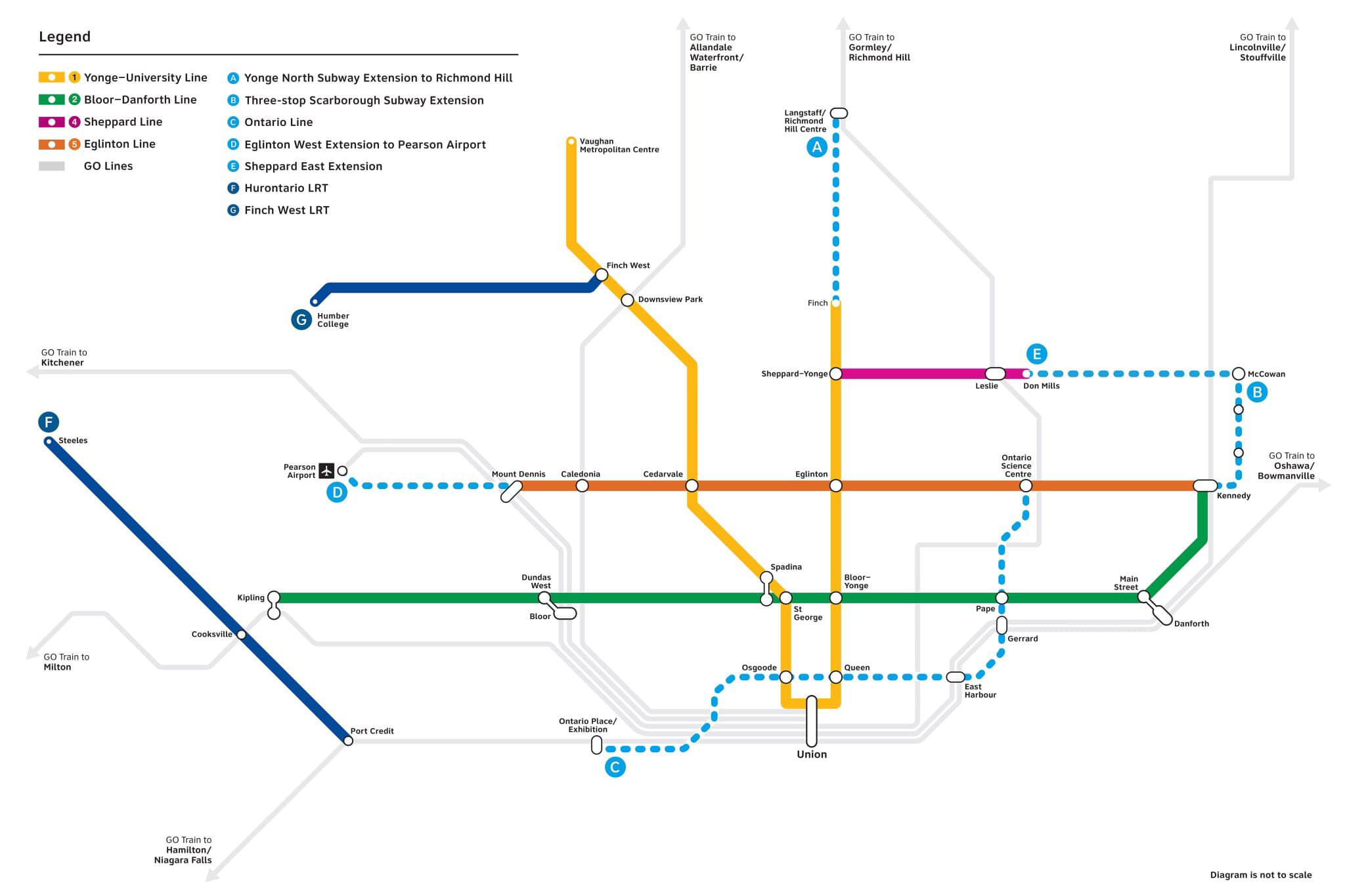
Certainly, if we could somehow fast forward past an immense amount of process and conflict, to a moment when some revamped version of Ontario Place — or the acres of adjacent parking lot — sports some kind of major destination (arena, casino, convention centre, etc.), rapid transit access won’t seem like a daft idea. I’d invite the skeptics to re-visit those long-ago debates about the proposed locations for the SkyDome and the Air Canada Centre. We got those decisions right.
That said, the elephant in this room is that the western leg of the Ontario line obviously doesn’t address the problem it was originally intended to solve, which is providing an alternative route into the core from points west. The St. George interchange will soon become as dangerously over-crowded as Bloor/Yonge (thanks to increased volume along the Spadina extension as well as transfers from the Eglinton Crosstown). Ford’s plan does exactly nothing to address that problem.
The segment of UP Express that runs between Bloor West and Union will become a more fully realized short-cut in a few years when a tunnel extending between the Dundas West and Bloor GO stations opens, although this alternative route is destined to remain a premium service with a measure of inconvenience.
A few years ago, Metrolinx bruited the notion of terminating the western tail of the Relief line at a proposed commuter hub to be located near the south-west corner of Front and Spadina. That hub, with connections to GO trains coming from Kitchener, Milton and Barrie, would take some of the pressure off Union Station and also provide a link to the subway system. The important planning detail, however, is that that version of the Relief line didn’t just stop; it connected to other parts of the network. The Exhibition end of the Ontario Line, by contrast, seems to exist entirely to deliver warm bodies to whatever that destination becomes.
The back-of-the-envelope quality of Ford’s plan is even most apparent along the eastern leg of the Ontario Line, and specifically the area where it will curve north from the Queen corridor and head up towards Pape Station and beyond.
In his announcement, Ford claimed the new light-rail technology he wants to use can go over the Don River instead of tunneling underneath – a configuration he contends will save megabucks.
Whoever conceived of this hare-brained idea evidently didn’t spend any time looking at the Google maps of the area where Queen and the Don River intersect. According to the latest Relief Line alignment plans (which have been subjected to a substantial amount of regulatory due diligence), the route will dip south of Queen Street as it heads towards the Don River. On the east side, it will head towards a new station serving the giant East Harbour redevelopment site, at Broadview and Eastern Avenue, just steps from the proposed SmartTrack/GO station within the Unilever/Great Gulf precinct. The line then proceeds east under Eastern Avenue before turning northwards at Logan.
What’s anything but clear is how, under Ford’s plan, this light-rail line will get out of the tunnel west of the Don; where it will cross the river; and how it will re-enter a tunnel heading east. One need only look at the streetcar tunnels at St. Clair West or along Queen’s Quay to realize that the entrances and exits gobble up an enormous amount of space, simply because the grades can’t be too steep.
Moreover, the city blocks on either side of the Don in that vicinity are packed with condos, construction sites, valuable historic buildings, narrow streets and public spaces, like Corktown Common. It’s by no means obvious where those lengthy tunnel entrance/exit ramps will fit. And even if the engineers tasked with finding a solution can figure out how to thread the needle, the daylighted portion of the Ontario Line will need to be shoe-horned between apartment blocks and parks, etc. Either that, or the Ford government’s got to get to work expropriating and demolishing property.
All the looming complexity raises difficult questions about the extent to which the city will be permitted to plan this line. Doug Ford’s subway bridge over the River Don introduces a deeply challenging planning dilemma in a congested space with little fallow land, a gnarly road network, lots of new residential development, and a relocated highway (i.e., the relocated Gardiner/DVP interchange). Left to its own devices, the city might opt to find ways to mitigate all the expense and disruption to local residents. The question is, will Queen’s Park allow the city to plan, or will it play the ever-present constitutional trump card and impose its own approach, local concerns be damned.
Versions of this conflict will likely play out in many other parts of the city should the three orders of government come to terms on the financial contributions and actually begin planning these lines (low odds). Indeed, this process, whenever it happens, will vividly illustrate just how much local authority, if any, the city actually retains in the era of Fordian transit planning.
Addendum: Federal finance minister Bill Morneau’s notably lukewarm response to Ford’s plan potentially opens up a political space for new funding for the waterfront transit network. “We have already put significant funding (in place) and we have found it difficult to actually get these projects going because the Ontario government is not at the table trying to get those projects [to] happen,” he told Global News in Ottawa yesterday. “And frankly, jobs are on the line.”
As reported here yesterday, the $621 million needed to build and connect a Queen’s Quay East LRT to Union Station is nowhere to be seen, even though the city submitted a funding request to the fed’s transit infrastructure program last year.
The question I’d pose now is whether the Liberals are prepared to push the Ford government to green light funding for the Queen’s Quay line in exchange for a federal contribution to the expanded Ontario Line.
The post LORINC: Doug Ford draws a subway map appeared first on Spacing Toronto.
Pyodide: Bringing the scientific Python stack to the browser
More fun with WebAssembly: Pyodide attempts (and mostly succeeds) to bring the full Python data stack to the browser: CPython, NumPy, Pandas, Scipy, and Matplotlib. Also includes interesting bridge tools for e.g. driving a canvas element from Python. Really interesting project from the Firefox Data Platform team.
Via Hacker News
Joining a community dedicated to quitting smoking will make you slightly more likely to quit smoking than not.
But connecting with a small group of peers within that community will make you much more likely to quit smoking.
This shows up in many studies. People who join the community are already more likely to join the behavior.
The real power of an online community is to help members establish a peer group who they want to impress and emulate.
Most online communities are meant to change some sort of behavior, but few are properly designed to do it. A dozen or more sub-groups and buddy lists don’t cut it. You need to design the social structure, supported by technology, to make that happen.
When people join, they need to be guided into a small, close, group of peers (not have 30 possible groups they could join).
They need to have a private place (on your community or off it) to engage with their peers, share advice and have a mentor who can support them.
They need to make real, strong, relationships by being encouraged to speak openly about their thoughts and feelings.
They need to have a high level of optimism driven by the group leader.
Whether you’re managing a community for personal or professional goals, if you want members to make a major change in behavior you need to help them build small groups of peers.
Scandals. Backstabbing. Resignations. Record profits. Time Bombs. In early 2018, Mark Zuckerberg set out to fix Facebook. Here's how that turned out.
Terrific work. Wired talked to 65 former and current staff.

Ich habe mir vor ein paar Monaten ein Apple-Kabel USB-C auf Lightning gekauft. Damit lassen sich iPhone und Smart Battery Case am schnellsten laden. Außerdem verbindet es iPhone und iPad Pro zum Laden oder Übertragen von Fotos. Auch als Verbindung zwischen MacBook und iPhone taugt es. Das Apple-Kabel kostet 21 Euro (1 m) oder 34 Euro (2 m).
Das war eine sehr lohnende Anschaffung. Allerdings sind Apple-Kabel nicht sehr langlebig. Mittlerweile gibt es mindestens vier MFI-zertifizierte Alternativen:
Ich warte noch auf das tizi-Kabel.
Tonight was Westward Ho!, a community meeting organized for the Bloordale neighbourhood to educate people about the issues surrounding a possible westward extension of the Bloor bike lane as far as High Park. It was organized by frequent Dandyhorse contributors Albert Koehl of Bells on Bloor and Rob Zaichkowski from Cycle Toronto. The meeting was held at Bloor Collegiate Institute, just a bit west of the Bloor and Dufferin intersection.
Story and photos by Jun Nogami

Albert kicked things off with a short historical presentation of bike lanes on Bloor.

Next up: Nancy Lea Smith from TCAT, who talked about several studies they had done over the years to measure the economic impact of bike lane installation.

The next speaker was local merchant Jennifer Klein of "Secrets From Your Sister". She has been supportive of the bike lanes, but understood the apprehension of some of her fellow merchants, as well as her own customers. She said that adjustments made during the pilot phase of the Bloor bike lanes was helpful: in particular the addition of dedicated loading zones on side streets.

Sharon Zikman (Doctors for Safe Cycling) talked about the health aspects of cycling. She is a psychiatrist, and made an analogy between anti-depressants and commuting by bike. She said that when she prescibed anti-depressants, she knew upfront that the they would be 35% effective on average, with some small probability of serious side effects. On the other hand, she cited studies from the UK that benefits from commuting by bike could have a larger impact, such as a 50% decrease in cardiac disease. She noted the hazards of cycling as a side effect, but this was a side effect that could be avoided by prescribing safer cycling infrastructure.

Next up: Nahum Mann from the Bloordale Community Improvement Association (CIA). He said that they were supportive of the westward extension of the bike lanes. On a personal note, he said that he both he and his fiancée had been doored recently.

At this point, Councillors Layton and Bailao joined in, just having rushed over from City Council after having voted to make the King Street transit pilot permanent.
Mike was somewhat circumspect about the prospects of the westward extension in the near term. He spoke from his experience in the long process of getting the Bloor bike lanes installed up to Shaw. He said that it took a big tent to get it through. At the same time, one can't wait for the community building to be perfect before moving forward.

Ana Bailao sounded generally supportive. She acknowledged that a network of bike lanes will be one piece of the solution to moving goods and people across an increasingly crowded city. She said that there will be a need for difficult conversations, and that support comes from packing rooms with people, not just dedicated cycles.

Next, Gideon Forman from the David Suzuki Foundation presented some data from an EKOS poll that showed surprisingly broad support across the city for bike lanes.

Finally, Jared Kolb from Cycle Toronto said that City Council will have a key decision to make in May to consider accelerating the extension of the Bloor bike lanes. If they turn it down, there is little prospect of anything happening until at least 2023. He reiterated the success of the Richmond/Adelaide bike lanes, and stated that their polls consistently show that people want to ride, and they want to ride more often.

The speakers then took a series of questions from the audience.

There were a few people who were brave enough to speak up strongly against the bike lanes, and against the behaviour of cyclists in general. This lead to one of the difficult conversations that was alluded to earlier in the evening.
One of the last questions was from the head of the local BIA who said that her members were undecided about the bike lanes, and that they were not aware of the information that had been presented at this meeting. I saw both Jared and Ana huddled with her as the meeting adjourned.
Out in the lobby, there were a few researchers from the University of Copenhagen who were running a survey on bike infrastructure. They are been here for a while. One of them said he was impressed with all of the bike advocacy that was going on, but couldn't understand the glacial pace of getting new things built. Why indeed....
With files from Rob Zaichowski.
One of our longer running courses (TM129 — Technologies in practice) distributes a Windows desktop application (RobotLab) developed internally 15+ years ago that implements a simple 2D robot simulator.
For the last few years, we’ve been supposed to make software available on a cross platform basis. For Windows users, I think the application is recompiled every so often to cope with Windows OS upgrades, for Linux it’s distributed using Wine (I think?) and for Macs it’s bundled under PlayOnMac.
A recent issue with the Mac version prompted me to revisit my earlier attempt at producing a DIT4C Inspired RobotLab Container with a simple RDP container that a student could connect to via the Microsoft RDP (remote desktop protocol) client. (One advantage of RDP is that sound sort of works and the RobotLab activities includes one that involves sound…)
Here’s a minimal Dockerfile, derived from danielguerra69/ubuntu-xrdp:
FROM danielguerra/ubuntu-xrdp

#Required to add repo
RUN apt-get update && apt-get install -y software-properties-common

RUN dpkg --add-architecture i386

RUN wget -nc https://dl.winehq.org/wine-builds/winehq.key<

RUN apt-key add winehq.key

RUN apt-add-repository 'deb https://dl.winehq.org/wine-builds/ubuntu/ xenial main'

RUN apt update && apt-get install -y --install-recommends winehq-stable

COPY Apps/  /opt/
To build the Docker image, I put original Apps/ folder containing RobotLab and Neural folders in the same directory as the Dockerfile and then run:
docker build -t myimagetagname .
The container then be run from that as:
docker run --name mycontainername --shm-size 1g -p MYMAPPEDPORT:3389 -d myimagetagname
For reference, a version of the container can be found here — ousefulcoursecontainers/tm129rdp — and if you need an RDP client they can be found here. There's a repo here, but there are various experiments scattered across various branches and it's not very well documented / clear what's where and what's working yet and how…
If you have docker locally or remotely, the demo container can be run using:
docker run --name tm129 --hostname tm129demo --shm-size 1g -p 3391:3389 -d ousefulcoursecontainers/tm129rdp
(You should be able to run the container remotely on Digital Ocean. See here for a crib.)
In the RDP client application, create a new connection on port 3391 (or whatever you mapped in the docker run command) as per:

Login with user: ubuntu
The password seems optional but is also: ubuntu
If you need to sudo using the terminal on the remote desktop, the password is: ubuntu
The RobotLab and Neural apps are in the /opt directory (a more recent build uses /opt/Apps, I think?).

When you first run the applications, wine wants to install several packages (gecko twice (?), mono once). (I made a start on trying to run the associated installers in the Dockerfile, but the approach I’be been taking so far doesn’t seem to work…)
#Use a base XRDP container
FROM danielguerra/ubuntu-xrdp

#Required to add a repo
RUN apt-get update && apt-get install -y software-properties-common

#Add additional repo required for wine install
RUN dpkg --add-architecture i386
RUN wget -nc https://dl.winehq.org/wine-builds/winehq.key
RUN apt-key add winehq.key
RUN apt-add-repository 'deb https://dl.winehq.org/wine-builds/ubuntu/ xenial main'
RUN apt update && apt-get install -y --install-recommends winehq-stable

#The first time wine is used it wants to download some bits...
#I've tried to to add via the Dockerfile but can't get it to work (yet?!)
#Not sure these are the correct versions, either?
#RUN wget http://dl.winehq.org/wine/wine-mono/4.8.1/wine-mono-4.8.1.msi
#RUN wget http://dl.winehq.org/wine/wine-gecko/2.47/wine_gecko-2.47-x86.msi
#RUN wget http://dl.winehq.org/wine/wine-gecko/2.47/wine_gecko-2.47-x86_64.msi
#RUN wine msiexec /i wine_gecko-2.47-x86_64.msi
#RUN wine msiexec /i wine_gecko-2.47-x86.msi
#RUN wine msiexec /i wine-mono-4.8.1.msi

#Copy over the Windows applications we want to run under wine
COPY Apps/  /opt

#I can't seem to create a user or copy the files to that user home directory?
#If I do, I just get a black screen when I try to connect using RDP client on a Mac.
Files can be saved in RobotLab but you need to select My Documents within the wine context, the files ending up down a path:

I don’t know if there’s a way of configuring this so we can save files more directly into the host filesystem rather than down the wine path? Would a symlink work?
If the container is halted and then restarted, any updates made to it will be immortalised in the container. So you don’t need to keep installing wine updates each time you want to use the container.
docker stop  --name tm129
docker start  --name tm129
I tried to make a cleaner build with tm129 user and the apps in a more convenient location, and then used a docker commit to make a new image, but the containers don’t seem to start up correctly from the new image. I also tried tidying where the Apps folder was copied to, creating a tm129 user etc in the Dockerfile, but RDP didn’t seem to work thereafter (black screen on connect).
As far as to do items go, it would be nice to:
tm129 user via the Dockerfile and install the applications to that user’s home directory;If we can’t do the above as part of the build using the Dockerfile, find a way to update a container manually and then export a customised Docker image from it.
Nice to haves would be desktop icons pointing to the course applications. A demo of how to start a container that launches the RobotLab application on start (or an image that launches the remote desktop into one of the applications) could also be handy as a reference.
 Wie viele andere auch zeigt auch Renault in Shanghai ein vollelektrisches Stadtauto, das für den asiatischen Markt optimiert ist. Wer jetzt in Elektroautos macht, scheint mit China den besten Markt gefunden zu haben. Es ist [...]
For The New York Times, Sahil Chinoy on privacy and how easy it is now to automate surveillance through public video feeds:
To demonstrate how easy it is to track people without their knowledge, we collected public images of people who worked near Bryant Park (available on their employers’ websites, for the most part) and ran one day of footage through Amazon’s commercial facial recognition service. Our system detected 2,750 faces from a nine-hour period (not necessarily unique people, since a person could be captured in multiple frames). It returned several possible identifications, including one frame matched to a head shot of Richard Madonna, a professor at the SUNY College of Optometry, with an 89 percent similarity score. The total cost: about $60.
A part of me finds this creepy. The other part wants to try out the system.
Tags: face detection, New York Times, privacy
“We will rebuild… altogether… it is part of our French destiny… because that is what our history deserves.”
And in that somber moment, Macron reminded the world that hope always trumps despair, that the future can be bright, and that when we pull together, we can achieve monumental things. In this moment of crisis, he channeled the thinking of other leaders in times of crisis. Let’s take Lincoln, in his second state of the Union address:
“Fellow-citizens, we cannot escape history… The fiery trial through which we pass, will light us down, in honor or dishonor, to the latest generation… We shall nobly save, or meanly lose, the last best hope of earth.”
… and, faced with crisis, he channeled JFK’s call for optimism:
.The times are too grave, the challenge too urgent, and the stakes too high to permit the customary passions of political debate. We are not here to curse the darkness, but to light the candle that can guide us through that darkness to a safe and sane future.
 It was surprising to see the leader of a country that has often been seen as a country of nay-sayers, channel the optimistic and future-focused approach of American leaders of yesterday. Because we are talking about a significantly important catholic church, it is possible to think of this as a moment of rebirth, during a week when rebirth weights on the mind of many believers. But this moment, which was mistakenly algorithmically attached to 9/11 on YouTube, may also be seen as a bookend to an international time of fear and despair.
Let’s look at what that algorithm told us. Looking at the smoke and flames engulfing Notre Dame’s spire yesterday, it was hard not to be reminded of the putrid smoke coming out of the twin towers almost 2 decades ago. As a Frenchman living in New York, the parallels were striking, presenting two symbols on fire in different times: while the 9/11 attacks were set against a background of peace and prosperity, the Notre Dame fires come at a time of war and uncertainty.
While the twin towers attack represented a time of hatred and destruction which only led to fear and retribution, the instant reaction around Notre Dame seems to drive to something different, to a time of global unity and rebuilding.
If the 9/11 attack marks a sudden change in the trajectory of American hope (briefly punctuated by a return to older values under Barack Obama), the fire at Notre Dame may present a similar change in the French trajectory of despair, creating the kind of national unity not seen since the end of World War II.
The response by the international community to this tragedy also presents a window of hope for the world. In a time of despair of global warming, Brexit, and deep political divisions in America, the challenge president Macron has set for his country illustrates that there are still people who believe we can rebuild and make the world a better place. It creates a moment, not just for France, for all of us to re-evaluate the trajectory our leadership is taking us on and decide whether we are interested in succumbing to the weakness of fear or the values of hope.
Let us hope that leaders around the world take a time to pause, think about the events of the recent 24 hours and decide to take a course to will douse the fires that already exists in our world. Let us hope that this fire can be seen as a time for renewal, an that our children and generations to come can look at it not as a disaster born out of accident but as the time when the world decide to recommit to international partnership and solving big problems together.

Roughly once a year, I read John Tukey’s paper “The Future of Data Analysis”, originally published in 1962 in the Annals of Mathematical Statistics. I’ve been doing this for the past 17 years, each time hoping to really understand what it was he was talking about. Thankfully, each time I read it I seem to get something new out of it. For example, in 2017 I wrote a whole talk around some of the basic ideas.
Well, it’s that time of year again, and I’ve been doing some reading.
Probably the most famous line from this paper is
Far better an approximate answer to the right question, which is often vague, than an exact answer to the wrong question, which can always be made precise.
The underlying idea in this sentence arises in at least two ways in Tukey’s paper. First is his warning that statisticians should not be called upon to produce the “right” answers. He argues that the idea that statistics is a “monolithic, authoritarian structure designed to produce the ‘official’ results” presents a “real danger to data analysis”. Second, Tukey criticizes the idea that much of statistical practice centers around optimizing statistical methods around precise (and inadequate) criteria. One can feel free to identify a method that minimizes mean squared error, but that should not be viewed as the goal of data analysis.
But that got me thinking—what is the ultimate goal of data analysis? In 64 pages of writing, I’ve found it difficult to identify a sentence or two where Tukey describes the ultimate goal, why it is we’re bothering to analyze all this data. It occurred to me in this year’s reading of the paper, that maybe the reason Tukey’s writing about data analysis is often so confusing to me is because his goal is actually quite different from that of the rest of us.
Most of the time in data analysis, we are trying to answer a question with data. I don’t think it’s controversial to say that, but maybe that’s the wrong approach? Or maybe, that’s what we’re not trying to do at first. Maybe what we spend most of our time doing is figuring out a better question.
Hilary Parker and I have discussed at length the idea of design thinking on our podcast. One of the fundamental ideas from design thinking involves identifying the problem. It’s the first “diamond” in the “double diamond” approach to design.
Tukey describes the first three steps in a data analysis as:
In other words, try one approach, then try a bunch of other approaches! You might be thinking, why not just try the best approach (or perhaps the right approach) and save yourself all that work? Well, that’s the kind of path you go down when you’re trying to answer the question. Stop doing that! There are two reasons why you should stop thinking about answering the question:
After thinking about all this I was inspired to draw the following diagram.

Strength of Evidence vs. Quality of Question
The goal in this picture is to get to the upper right corner, where you have a high quality question and very strong evidence. In my experience, most people assume that they are starting in the bottom right corner, where the quality of the question is at its highest. In that case, the only thing left to do is to choose the optimal procedure so that you can squeeze as much information out of your data. The reality is that we almost always start in the bottom left corner, with a vague and poorly defined question and a similarly vague sense of what procedure to use. In that case, what’s a data scientist to do?
In my view, the most useful thing a data scientist can do is to devote serious effort towards improving the quality and sharpness of the question being asked. On the diagram, the goal is to move us as much as possible to the right hand side. Along the way, we will look at data, we will consider things outside the data like context, resources and subject matter expertise, and we will try a bunch of different procedures (some optimal, some less so).
Ultimately, we will develop some of idea of what the data tell us, but more importantly we will have a better sense of what kinds of questions we can ask of the data and what kinds of questions we actually want to have answered. In other words, we can learn more about ourselves by looking at the data.
It would seem that the message here is that the goal of data analysis is to explore the data. In other words, data analysis is exploratory data analysis. Maybe this shouldn’t be so surprising given that Tukey wrote the book on exploratory data analysis. In this paper, at least, he essentially dismisses other goals as overly optimistic or not really meaningful.
For the most part I agree with that sentiment, in the sense that looking for “the answer” in a single set of data is going to result in disappointment. At best, you will accumulate evidence that will point you in a new and promising direction. Then you can iterate, perhaps by collecting new data, or by asking different questions. At worst, you will conclude that you’ve “figured it out” and then be shocked when someone else, looking at another dataset, concludes something completely different. In light of this, discussions about p-values and statistical significance are very much beside the point.
The following is from the very opening of Tukey’s book *Exploratory Data Analysis:
It is important to understand what you CAN DO before you learn to measure how WELL you seem to have DONE it
(Note that the all caps are originally his!) Given this, it’s not too surprising that Tukey seems to equate exploratory data analysis with essentially all of data analysis.
There’s one story that, for me, totally captures the spirit of exploratory data analysis. Legend has it that Tukey once asked a student what were the benefits of the median polish technique, a technique he invented to analyze two-way tabular data. The student dutifully answered that the benefit of the technique is that it provided summaries of the rows and columns via the row- and column-medians. In other words, like any good statistical technique, it summarized the data by reducing it in some way. Tukey fired back, saying that this was incorrect—the benefit was that the technique created more data. That “more data” was the residuals that are leftover in the table itself after running the median polish. It is the residuals that really let you learn about the data, discover whether there is anything unusual, whether your question is well-formulated, and how you might move on to the next step. So in the end, you got row medians, column medians, and residuals, i.e. more data.
If a good exploratory technique gives you more data, then maybe good exploratory data analysis gives you more questions, or better questions. More refined, more focused, and with a sharper point. The benefit of developing a sharper question is that it has a greater potential to provide discriminating information. With a vague question, the best you can hope for is a vague answer that may not lead to any useful decisions. Exploratory data analysis (or maybe just data analysis) gives you the tools that let the data guide you towards a better question.

This is a pretty neat idea and a nice evolution of the use of interactive Jupyter Notebooks (discussed previously) in online courses. "Jupyter Graffiti are recorded, interactive demonstrations that live inside your Notebooks... Since a Graffiti “video” is a live replay of the instructor’s interactions, you can pause it any time — and when it’s paused you can dive in to play with the instructor’s work right in the Notebook (execute it, copy it, change it, execute it again)— and then resume playback when you’re ready." This is a nice blending of the instructor role, which is to model and demonstrate, and the learner role, which is to practice and reflect.
Web: [Direct Link] [This Post]
I think this article does a good job of laying out the problem even if it only hints at possible solutions. Here's a clip: " Buying something you can’t afford, and borrowing from organizations that don’t have your (or your customers’) best interest at heart, is the business plan of most internet startups. It’s why our digital services and social networks in 2019 are a garbage fire." Quite so. But if the VC model isn't working, what will? Self-payment? The IndieWeb, or "products of IndieWeb thinking" like Micro.blog? Or "are these approaches mere whistling against a hurricane?"
Web: [Direct Link] [This Post]
This is a really good introductory-level article about the design patterns behind the changing web and how we migrated from simple pages anyone could learn how to create to complex server- and API-supported web applications. The article trails off a bit in the last few paragraphs, as though Tony Hirst ran out of time, but no matter, it's still worth reading and passing along. And it points to the mechanics behind some of the new things people will be able to do with the new web.
Web: [Direct Link] [This Post]
Every fall, Federico and I put our heads together to come up with new and exciting perks for Club MacStories members to mark the Club’s anniversary. In 2017 we were less than six months into AppStories, and although we love talking about apps every week, we were frustrated that the show’s topic and length precluded us from covering a lot of what goes on at MacStories. I suggested doing a free-form, casual show as an exclusive Club members-only version of AppStories. Federico agreed and in the middle of a chaotic September, we recorded the first episode of AppStories Unplugged.
We decided to dispense with the episode length guidelines that constrain AppStories and expand coverage to include a behind-the-scenes look at what goes on at MacStories. Because listeners already knew Federico and me as a pair from AppStories, we stuck with that as part of the show’s name. We added ‘Unplugged’ because we’re big fans of acoustic music and MTV’s Unplugged series, and it felt right for a more casual, less structured version of AppStories.
To date, we’ve done four episodes of AppStories Unplugged for Club members, and they’re some of my favorite episodes Federico and I have recorded because they’re so much like the conversations (and arguments) we have when we get together. As we talked about the future of Unplugged earlier this year, both Federico and I felt it was time to expand the show and do more for Club members. So, for the 10th anniversary of MacStories, we’ve decided to relaunch AppStories Unplugged as MacStories Unplugged. The idea behind the show is the same, with a few exciting additions – a remix, to stretch the music metaphor further than I probably should.
The first difference is reflected in the new name. MacStories Unplugged will draw on the entire MacStories team. You probably won’t hear all of us on every episode, but with so many interesting and talented people at MacStories, we want Club members to have the chance to get to know everyone.
We’ve also decided to make MacStories Unplugged a monthly show. At the time Federico and I launched AppStories Unplugged, neither of us was interested in adding another commitment to our schedules, but that has changed with the entire team involved in the show and other adjustments we’ve made.
Finally, we’ve rebranded Unplugged with all-new artwork by MacStories’ own Silvia Gatta who has done an amazing job. Silvia’s rough-sketch version of the MacStories logo and typography is the perfect complement to the style of the show.
What hasn’t changed is that MacStories Unplugged remains a Club MacStories exclusive. You won’t find it in iTunes or any other podcast directory. Members will receive details about how to access Unplugged in this week’s issue of MacStories Weekly, the newsletter we send them every Friday.
If you haven’t considered joining the Club before, now is a great time to take a look. Each year, the MacStories team delivers roughly 60 weekly and monthly newsletters to members that are packed with app coverage, editorial content, shortcuts, tips, interviews, and a whole lot more. Members also enjoy perks throughout the year like app discounts, giveaways, a complimentary ebook version of Federico’s iOS review, and a lot more.
We have another big Club announcement coming later this week and more planned throughout 2019, so check out the details and please consider joining. We’d love to have you.
With a Club MacStories subscription, you'll gain access to weekly iOS shortcuts, app recommendations, and other exclusive extras.
Starting at $5/month, Club MacStories includes MacStories Weekly – a newsletter delivered every Friday with a focus on iOS productivity and showcasing new and interesting iOS apps. One of MacStories Weekly's regular sections is the Workflow Corner – a weekly assortment of iPad shortcuts, iOS automation tips, and tutorials curated by Federico and the MacStories team.
As a new member, you'll also receive complete access to our back catalogue of over 180 newsletters starting from September 2015.
You can find out more about Club MacStories here, or subscribe directly below.
Club MacStories offers exclusive access to extra MacStories content, delivered every week; it's also a way to support us directly.
Club MacStories will help you discover the best apps for your devices and get the most out of your iPhone, iPad, and Mac. Plus, it's made in Italy.
Join Now
Almost as soon as The New York Times debuted our first website in 1996, we started experimenting with different digital product strategies. At first, we just put our articles and photos on the web, but as digital trends evolved, so did our site. To connect with new audiences and take advantage of emerging technology, we built new features to augment our core news report.
As you might imagine, over 20 years of digital product development had given us a portfolio that included a hodgepodge of features that reflected several different strategies. But like many things on the internet, not everything we’ve built has landed well or withstood the test of time. Over the years, our digital portfolio became cluttered with many features that didn’t make sense for us to maintain as a news organization.
So in the summer of 2017, we embarked on a nearly year-long project to identify which products and features to keep and what to scrap. At this same time, we were in the process of migrating our tech infrastructure to the cloud, so we thought it made sense to use the migration as an opportunity to get our digital portfolio in order. And because we were sifting through over 20 years of accumulated tech debt, we decided to apply a few of Marie Kondo’s home organization principles to our digital portfolio. We even dubbed the effort “Project Kondo” as a reminder for us to let go of clutter and accept a organized approach to product development.
But before we could dive into cleaning up our digital house, we first had to take a look at the stuff we had accumulated.
Throughout the years, we’ve tried on several different digital product models in addition to our daily news report. These efforts often reflected the prevailing internet trends of the time instead of highlighting our strengths as a journalism company. For instance, in the mid-2000s, we launched a feature called TimesPeople that tried to piggyback off of the social networking trend exemplified by MySpace and a new start-up at the time called Facebook.
TimesPeople was basically a social network for Times users. The feature allowed users to add others as friends to see what Times stories they were reading and recommending. While it was an admirable effort to engage our large audience of commenters, the feature didn’t get much traction and after a handful of years we stopped investing engineering and product resources into expanding it.
TimesPeople was an attempt to help facilitate connection between our users, but we weren’t able to effectively monetize it. However, other features we developed in the 2000s were tied more clearly to business goals. As it became clear that the future of media would be online rather than in print, we tried to transfer over some of our print money-makers to the digital world.
We developed a digital classifieds product that — you guessed it — allowed users to post classified ads online for whatever stuff they were selling or for things they needed. Print classifieds had been a big source of revenue for newspapers like ourselves for a long time and we hoped to continue making money from digital classifieds. However, that model quickly unraveled as free classified sites like Craigslist made it easier, cheaper and more effective to post classified listings online. Needless to say, by the time we started Project Kondo, our classifieds section resembled a ghost town.
While these features reflected valiant efforts to grow our business as the internet evolved, over the years, our priorities changed and we shifted our focus away from things like TimesPeople and classifieds. Yet, while we knew that our users and business had moved on from these features, we didn’t put in the effort to properly shut them down.
Instead, we built new features without doing the hard work of re-evaluating the old ones. To make matters worse, the underlying servers, infrastructure and code continued to run for the old features. Our product portfolio started to look like a hoarder’s closet, but instead of piles of stuff, we had acquired a ton of technical debt and zombie products.
Little by little, this accumulation of digital clutter weighed us down and made it harder to iterate quickly on the product experiences we actually did want to maintain. However, with Project Kondo we finally had an opportunity to take everything out of our digital closet, hold it with both hands and ask whether it sparked joy before deciding to discard it or put it in its proper place.

Choosing which products and features to keep and which to toss proved difficult; it turns out that deciding what sparks joy can be just as hard for a large company as it can be for someone going through their own closet. Some didn’t fit cleanly into our portfolio but offered side benefits like a dedicated audience or a stream of revenue. Others served as technical dependencies for yet even more features or had dedicated stakeholders with ingrained workflows or processes, so untangling this knot of technical and human processes proved difficult.
Ultimately, we decided to use these guiding principles to help us decide what to keep and what to toss.
After we evaluated each feature in our digital portfolio against these guidelines, we developed a project plan that laid out the steps necessary to shut down or migrate them. The individual steps for shutting down a feature weren’t complicated — adding user messages or redirecting traffic —but what proved most difficult was the coordination around what to shut down and when, given how tangled the technology underlying these features had become.
Ultimately, we shut down poor performing features that didn’t align with our core journalism mission. Other features that still had a strong user base or aligned with our news site, such as sections like Today’s Paper, were upgraded and migrated to a more modern platform.
We were able to successfully shut down or migrate all of the features on our list before our data center migration deadline. However, if we had been more diligent about keeping our digital house in order over the past two decades and periodically clearing out the clutter, Project Kondo may not have been necessary in the first place.

If you work at a company that does business online, it’s a worthwhile exercise to evaluate your digital portfolio periodically to see what products and features continue to make sense and what should be shut down. But keeping it tidy and organized is hard.
Once something has been launched and has acquired users, it’s easier to just keep it going. This is often at the expense of maintenance and technical cost, and it can lead to drift in both your tech stack and product direction. We certainly learned that the hard way throughout Project Kondo.
Here are some tips on how to keep your product portfolio lean and focused so you don’t need to go on a year-long, cleaning binge just to keep your digital house in good shape.
Shutting down non-performing features can be demoralizing, but it’s important product portfolio hygiene. But if you regularly audit your portfolio for non-performing features, you’ll be better positioned to identify where to invest resources, leading to a more focused portfolio and fewer distractions for your product team.
Just like how user onboarding is critical to convert new users into happy and active customers, off-boarding users is important as well. When you shut down a feature, you should have a plan of what to you’d like those users to do. Show them the value of other features that you’re still actively supporting. But be warned: users probably won’t be happy that you’re shutting down a feature; even if the feature is neglected, habituated users generally don’t like their habits being disturbed.
Bonus: document your off-boarding plan so it can be replicated for future non-performing features that have outlived their usefulness.
Most old features, even under-performing ones, will have stakeholders who are involved in keeping them alive and running. In our experience, stakeholders were amenable to the idea of shutting down products if they understood that the products were no longer relevant or fit into the overall business strategy. Rather than acting as roadblocks, stakeholders can shed light on the history that lead to the development of the products, and they can help strategize anything that could help make the off-boarding process smoother.
After identifying the features that should be shut down, you’ll need to determine which to shut down first. It’s important to prioritize the features that are making it more difficult to build the product experience you ultimately want, since it’s likely that there is a web of dependencies that emanate from your oldest products and features. Identifying roadblocks and prioritizing their shut down will help your organization iterate on more important things.
Shutting down old systems, products and features can be a thankless, difficult job. However, decluttering your product portfolio can be immensely beneficial in terms of lower maintenance costs, faster team velocity and improved business efficiency. And similar to the benefits of the actual KonMari methods, you’ll likely find yourself less stressed and better able to identify what parts of your digital house actually spark joy in your users.
Does This Product Spark Joy? was originally published in Times Open on Medium, where people are continuing the conversation by highlighting and responding to this story.

Intel announced late Tuesday it’s pulling out of designing its own 5G modems and is also planning a reassessment of the market for 5G and 4G equipment in PCs and IoT devices.
The modems weren’t expected until 2020.
“5G continues to be a strategic priority across Intel, and our team has developed a valuable portfolio of wireless products and intellectual property,” said Intel CEO Bob Swan in a Tuesday release. “We are assessing our options to realize the value we have created, including the opportunities in a wide variety of data-centric platforms and devices in a 5G world.”
The release said that Intel is still investing in 5G network infrastructure, as well as keeping its current commitments to 4G equipment manufacturers. Intel plans to make more details known during its Q1 earnings call scheduled for April 25.
One thing was made obvious by the silicon giant: “[I]n the smartphone modem business it has become apparent that there is no clear path to profitability and positive returns,” read Swan’s statement.
This move was likely a result of the recent unexpected truce between Apple and chip-maker Qualcomm. The two companies were in the midst of multiple legal battles about smartphone modem patents and royalties. It was announced earlier on Tuesday that the tech companies settled all their ongoing legal matters. The Cupertino tech giant also signed a six-year licensing deal and a multi-year chipset supply agreement with the chip-maker. There is also a two-year option to extend this deal, according to Qualcomm.
Until the end of the litigation, it was anticipated that Intel would supply Apple with components for its 5G iPhone slated for 2021.
Source: Intel
The post Intel abruptly exits 5G modem business appeared first on MobileSyrup.

Following the abrupt end of their two-year-long legal spat and Intel’s sudden exit from the smartphone modem business, Japan’s Nikkei reports Apple will start integrating Qualcomm 5G modems into the iPhone starting in 2020.
“It is too late for Apple to use Qualcomm’s chip this year, but for 2020 it will purchase modem chips, including 5G modem chips, from the chipmaker for iPhone after finalizing the deal,” says Nikkei, quoting a “source with direct knowledge of the settlement plan.”
Echoing a variety of other past reports, the publication adds Apple had started to lose confidence as to whether Intel could deliver a working 5G modem in time for the launch of the 2020 iPhones.
Quoting a “person familiar with the matter,” Nikkei writes: “Apple had been a little concerned whether a sole supplier for modems could affect the company’s plans to introduce its first 5G smartphone new year.”
As part of its settlement with Qualcomm, Apple agreed to pay an undisclosed amount to the chipmaker. It also signed a six-year licensing agreement, with the option to extend the deal a further two years, with Qualcomm.
In the short-term, even if Canadian carriers don’t launch their 5G networks in 2020, the fact the new iPhones will feature Qualcomm modems again is a positive for Canadian consumers. In test after test, Qualcomm’s LTE modems lapped whatever Intel could muster. At the moment, the Qualcomm modem Apple is most likely to integrate into the 2020 iPhone is the X55. The X55 is multi-mode modem that is capable of both LTE and 5G connectivity simultaneously.
In the long-term, it’s unlikely this the last we’ll hear of any animosity between Apple and Qualcomm. The potential eight-year time frame of the licensing agreement Apple signed on Tuesday gives the company more than enough time to develop its own modems, which it was already doing ahead of Tuesday’s announcement.
Source: Nikkei
The post 2020 iPhones to feature Qualcomm 5G modems: report appeared first on MobileSyrup.

A new electric vehicle purchasing incentive from the government of Canada allows Canadians to receive $5,000 CAD off of select zero-emissions vehicles.
To be eligible for the incentive you’ll need to purchase an electric vehicle on or after May 1st, 2019 with a “suggested retail price” of less than $45,000 if it has six seats or less, like the Nissan Leaf, Chevy Bolt and the Kia Soul EV. Higher tier trims for these types of vehicles are also included in the rebate, but the final price can’t be more than $55,000.
For EVs with seven seats, the government is offering the same $5,000 incentive, and those vehicles can have a base cost of $55,000 to be eligible. These vehicle trim packages can range up to $60,000 to remain eligible.
Buying or leasing a plug-in hybrid also nets Canadians $2,500 in rebates.
You’re still eligible for the incentive if delivery, freight and other fees, like paint colour and add-on accessories, push the actual purchase price over these set limits.
The government has a list of vehicles that are eligible for the incentive here.
Notably, this new incentive won’t include the lower-cost Tesla Model 3 or the upcoming Model Y since both those vehicles are too expensive.
The government has decided to help push the sales of EVs since transportation accounts for a quarter of Canada’s greenhouse gas emissions, and half of that comes from cars and light trucks.
“Zero-emission vehicles are the future of transportation. Our automotive industry and its workers are world class and uniquely positioned to design, develop and build the cars of today and tomorrow. We are working to advance Canada’s leadership position, promote investment and create an economy founded on highly skilled jobs for the middle class,” stated Canada’s Innovation, Science and Economic Development Minister Navdeep Bain, in a recent statement.
The government announced the incentive in the 2019 federal budget, but it’s still subject to parliamentary approval.
In the budget, the Trudeau’s government proposed a $300 million investment over three years to help make it easier for Canadians to buy the typically higher priced EVs.
This section of the budget is in a portion of a total $435 million investment from the government to help make Canada ready for an electric vehicle-based future. The government is investing $130 million over five years to pad out electric vehicle charging across the country among other things.
The Government has set up a website for Canadians to learn more about the new incentive and the country’s new zero-emissions plan.
One of the other highlights in the plan are proposed tax-related measures to help Canadian businesses convert their fleets to zero emissions vehicles.
The biggest highlight comes if you live in British Columbia or Quebec. Since both of those provinces have provincial EV rebates, that means incentives can be stacked to get even more off of a vehicle compared to other provinces. In Quebec, for example, you can get $8,000 off of eligible vehicles and B.C. offers $5,000 rebates.
The post Canadian federal government launches new $5,000 electric vehicle purchase incentive appeared first on MobileSyrup.
mkalus
shared this story
from  jwz. jwz.
|
In the interest of retrocomputing, can someone please point me at simple instructions to do any or all of the following:
If you are about to google it right now and say "some guy says this should work", please rest assured that I have already googled it, and am asking for a better answer than that.
| mkalus shared this story . |
The New Democrats' defeat in last night's Alberta provincial election marked the end of a remarkable chapter in the province's politics — Alberta's first-ever NDP government.
The arrival of a new provincial conservative government, meanwhile, could mark the start of a new chapter in federal politics.
Premier-designate Jason Kenney left behind a decade-long stint in federal politics to help create the United Conservative Party and bring it to power. Veteran politics-watchers say his high national profile, and strong ties to provincial and federal conservatives, will ensure he remains an influential player on the national political scene.
Mount Royal University political science professor Duane Bratt said Albertans saw plentiful signs during the campaign of close family ties between the UCP and the federal party — Kenney sharing a campaign stage in a snowstorm with federal Conservative Leader Andrew Scheer, Kenney campaigning in Calgary with Laureen Harper, wife of former prime minister Stephen Harper, and the former PM himself pitching his weight behind his former minister on social media.
It all points to the considerable clout Kenney wields in the wider conservative family, Bratt said. The intense national media interest in Alberta's election (certainly more intense than it was in 2015) foreshadows the "huge implications for the rest of the country" of the UCP's win, he added.
So what will the blue team's return to power in Alberta mean to the exercise of power in Ottawa? Here are five ways last night's election could help shape federal politics.
Kenney says Alberta is 'open for business' after UCP win:


CBC News
Jason Kenney says 'Alberta is open for business'
    Playback Status: ready

Assigned test group: None

Identifier: mediaId 1496480835907

Asset: Undetermined

Bitrate: Undetermined

Streaming URL:

Events Log:
Kenney has said the first bill his new government will introduce will be the "carbon tax repeal act." Once Premier Kenney moves to eliminate the province's $30/tonne carbon levy, Ottawa will have to respond by imposing a federal "backstop" carbon tax in Alberta, as it has done with Saskatchewan, Manitoba, Ontario and New Brunswick
In an email to CBC News, Environment and Climate Change Canada said that if a province changes its carbon pricing system, the federal government's first response would be to review the changes before deciding whether to impose its own federal price.
Marilyne Lavoie, spokesperson for Environment and Climate Change Canada, did not say how quickly the federal government would move to make changes. "The government of Canada will move as quickly as possible in order to minimize a gap in coverage," she said.
Actually, Alberta motorists would still enjoy a bit of a break on the carbon tax following the elimination of the provincial levy. If Alberta's carbon levy is cancelled outright, residents will end up paying the federal backstop levy — $20 per tonne until 2020, $10 less than the current rate.
Kenney has pitched a number of ideas that could affect how money flows between Ottawa and Alberta.
In the UCP campaign platform, the party promises to advocate for a cut in federal income taxes on Albertans equal to the amount the federal government transfers to Alberta through the Canada Health Transfer and the Canada Social Transfer. The province would raise its tax rates by the same amount; the party vows Albertans wouldn't pay more, but the provincial government would have more control over how income tax revenue collected in Alberta is spent.
In his victory speech, Kenney promised to fight "foreign-funded special interests" like the David Suzuki Foundation, which he accused of leading "a campaign of economic sabotage" against Alberta.
"Your days of pushing around Albertans with impunity just ended. We Albertans are patient and we're fair-minded, but we've had enough of your campaign of defamation and double standards," he told the crowd.
"With this election, we begin to stand up for ourselves, for our jobs and for our future. Today, we Albertans begin to fight back. From this day forward, whenever you lie about how we produce energy, we will tell the truth assertively and we will use every means at our disposal to hold you to account."
Kenney slams Ottawa's handling of pipelines:


CBC News
'Build that pipe!': Jason Kenney slams Ottawa's handling of pipelines
    Playback Status: ready

Assigned test group: None

Identifier: mediaId 1496481859921

Asset: Undetermined

Bitrate: Undetermined

Streaming URL:

Events Log:
Kenney has promised to pressure Ottawa for reforms to the Employment Insurance program to better assist Albertans who have lost work during the province's energy sector slump.
Finally, there's the UCP's most provocative fiscal promise: a referendum on equalization payments — federal money redistributed to provinces to help even out the quality of government services nationwide — to give the province a bargaining chip when pressing Ottawa to approve more pipelines.

Alberta and Ottawa could soon be spending a lot of time talking through their lawyers.
Kenney has pledged a constitutional challenge of Bill C-69, federal legislation that would change how energy projects are reviewed and approved.
He also has said he'll instruct his new attorney general to launch a formal court challenge to the federal carbon tax if it's imposed in Alberta.
As part of the UCP's pushback against environmental groups putting pressure on Alberta's energy sector, its election platform said it will challenge the charitable status of these organizations before the Canada Revenue Agency and appeal to the Federal Court to have their charitable status ended, if necessary.


CBC News Calgary
Jason Kenney's victory speech
    Playback Status: ready

Assigned test group: None

Identifier: mediaId 1496304195992

Asset: Undetermined

Bitrate: Undetermined

Streaming URL:

Events Log:
Kenney also promised a $10-million litigation fund "to support pro-development First Nations in defending their right to be consulted on major energy projects."
The policies are one thing, but the tone a new government sets can go a long way in determining how it gets along with its neighbours and other levels of government. With Kenney in office, said McGill University political scientist Daniel Béland, expect more confrontation and discord on the federal-provincial scene.
"Jason Kenney has a much more controversial relationship to intergovernmental relations," said Béland, who heads the McGill Institute for the Study of Canada. "He's very forceful and adversarial to the Trudeau government."
Watch Kenney's full victory speech:


CBC News Calgary
'Your days of pushing around Albertans with impunity just ended.'
    Playback Status: ready

Assigned test group: None

Identifier: mediaId 1496214083995

Asset: Undetermined

Bitrate: Undetermined

Streaming URL:

Events Log:
Prime Minister Justin Trudeau released a statement in the immediate aftermath of the election, congratulating Kenney.
"Albertans have chosen to elect a majority government led by the United Conservative Party," it read. "I look forward to working with the provincial government to create good, middle class jobs, build infrastructure, and grow the businesses and industries at the heart of Alberta's prosperity so the province can remain competitive in our changing economy."
"Together, we will address issues of importance to Albertans and all Canadians, including supporting canola producers, and taking decisive action on climate change while getting our natural resources to market."
Béland said he expects more heated rhetoric out of Edmonton, anchored in Western alienation, regionalism and nationalism.
And while no one could describe Kenney as an ideological cousin to Quebec sovereigntists, Béland said, he borrowed some tactics from Quebec's secessionist and nationalist movements.
"It's a conflict-based approach to politics where you frame the issue as a strong conflict between your province and the federal government," he said. "You have to defend the people of your province against the central government, against other provinces and the rest of the country."

It seems counterintuitive, but Béland said he thinks Kenney's win — and Alberta NDP Leader Rachel Notley's loss — will actually help the federal NDP."For some NDPers outside Alberta, this might be a source of relief," he said.
Notley and federal NDP Leader Jagmeet Singh don't see eye to eye on the controversial issue of pipelines — particularly the expansion of the Trans Mountain pipeline, which Notley staked her government on and Singh opposes. Notley's defeat might eliminate that ideological rift within the NDP movement, said Béland.
Bratt disagrees: He said he believes Notley isn't going anywhere and will still be a lingering pain in the side for the federal NDP.
"There's huge frictions between the Alberta NDP and the federal NDP," Bratt said. "Having Notley gone isn't going to really happen to them."
The CBC's David Thurton can be reached on Facebook, Twitter or email him at david.thurton@cbc.ca.

Google hosted its 2019 ‘AMP Conf’ in Tokyo, where it announced several new changes and features coming to its Accelerated Mobile Pages project.
Arguably the most important of those announcements was that AMP pages will now show the original website URL in Chrome’s address bar instead of the weird AMP URL.
While Google positioned this as a solution to one of AMP’s most significant confusions, it’s really a user-hostile addition that changes a fundamental aspect of the web.
To understand why, you need to know how AMP works. For the unfamiliar, Google’s AMP project caches mobile-optimized web pages on its servers. When you click on an AMP link in Google search, it takes you to Google’s servers, not the website you’re visiting. AMP does this to improve performance for mobile users.
However, there’s also a bar that lets you navigate to the original URL should you want to see the official web page. Considering the optimized pages often abandon features, like comments sections, to help with performance, this is something users want to do.
AMP pages are beautiful, but links to AMP pages? Not so much …
Until today! Signed exchanges are here: now you can get instant loading for AMP on your own domain!
#AMPConf pic.twitter.com/OSEcKDc3A5
— AMP Project (@AMPhtml) April 17, 2019
Because Google stores AMP pages on its servers, when you click on an AMP link, the URL in the address bar is a Google URL. This is understandably confusing for end users, so Google began developing a potential solution called ‘Web Packaging.’
Web Packaging allows sites to display content on behalf of other websites and uses TLS to ensure nothing changes content along the way. Google enabled the feature in Chrome 73.
While Web Packaging isn’t inherently bad, part of Google’s AMP announcement is that the project can now use the new feature. In other words, when a user clicks on an AMP link in Google search, the address bar will show the website’s URL, despite the fact the content comes from Google’s servers. To make things worse, the search giant also abandoned the information bar, essentially making it impossible to tell that you’re on the AMP version of a site and erasing the option to navigate to the original page.
So, in one swoop, Google eliminated the URL as a reliable way for users to determine where they are on the internet and created a system that traps users on webpages stored on Google servers.

Further, considering that AMP pages tend to have limitations compared to official websites, mobile users could find themselves missing out on valuable content.
CloudFlare is already rolling out support for the feature, called AMP Real URL, which means some of your favourite websites may start using it soon. If you don’t want to use AMP, it may be a good time to check out another search engine or browser, like Firefox, Opera or Edge.
Source: Google Webmasters Blog, CloudFlare Via: Android Police
The post Google breaks fundamental internet rule, lets AMP display original site URLs appeared first on MobileSyrup.
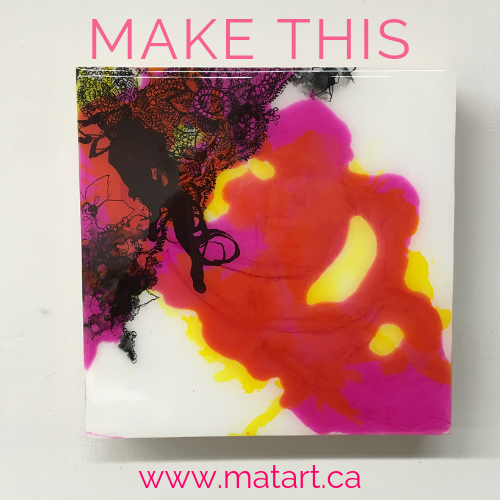
I’m frequently asked if I teach classes. People come into my cheery studio full of shiny, colourful paintings and feel a creative spark. Although I have taught children’s classes, I’ve never taught adults and I don’t think I’d been good. I’m from the “Do 100 more paintings and see if that helps” school of art.
So this tutorial is the closest I’ll ever come to teaching. I was contacted by the lovely—and very patient—Rebecca Zak about getting some Art Resin in exchange for posting a project. Since I already use Art Resin, I quickly agreed—then took months to post this tutorial. Sorry, Rebecca!
I’m a huge proponent of mistakes in art. While I will show you the steps I took, the best art occur when you mess up or things don’t turn out as planned. Feel free to do things differently or make substitutions. Art is improvisational—at least that’s what I tell myself when I screw up yet again.
Here are the materials I used:
8” x 8” wood panels
white gesso
black acrylic ink
alcohol inks: pink & yellow
Art Resin
resin dyes: pink, yellow, red
Additional supplies: rubbing alcohol, drinking straw, protective gloves, stir sticks, blow torch, mask, plastic containers.
Step One: Prep your surface

My weapons of choice: a plaster spreader and white gesso
Take a wood panel and tape the sides to protect them. Then trowel on gesso as smoothly as possible. I let it dry, sand the surface, and then reapply gesso. And I repeat about six times to achieve a beautiful soft surface. I’m sure that some of you are ready to bail already. Six times, Mary Anne? That’s going to take a week! Do whatever works for you, two coats may be enough. I like drawing on a glossy surface so this is what I do.
Step Two: Create your drawing
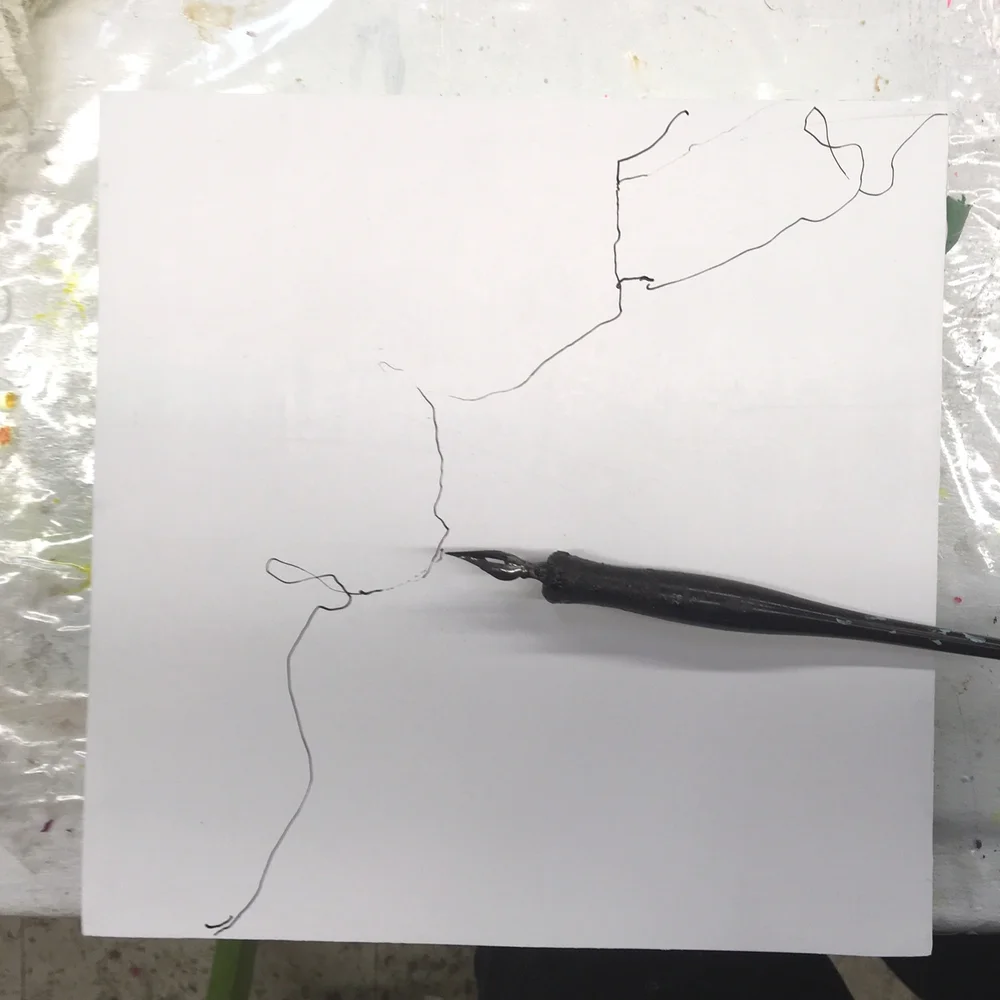
My rough outline looks more like an electrocuted worm.
I was originally thinking about a Valentines project (which shows how long I’ve been working on this!) so I chose lace as my motif. I took a piece of lace and painstakingly drew all the twisty thready details in black ink. And then, guess what happened? I accidentally smeared the ink over my delicate drawing! Ack. But you know what? That mistake animated the drawing. It brought contrast and form to my rendering. So I deliberately smeared the next one too. That’s exactly what I mean about the best art coming from errors!

The finished drawing complete with accidental inkblots.
Step Three: Add alcohol ink.
Okay, once your black ink drawing has dried, it’s time to add some alcohol ink. In this case, I’m using a limited palette of pink and yellow, so I chose pink ink. I sprayed rubbing alcohol on the surface of the painting and then added drops of ink. I used a straw to blow the ink around the surface. What you’re trying to achieve is a very loose, fluid form. Keep in mind that you want to leave some white space on your painting. To achieve colour depth, let the ink dry and then apply another layer. This is a good place to fool around and have some fun.

Loose, organic ink shapes AKA mistakes.
Step Four: Apply coloured resin.
Once the ink has dried completely, it’s resin fun time! Rest the panel on a container so excess resin can drip off the sides. Use a level to make sure your panel is even, otherwise gravity will pull the resin to one side. Since I use different types of resin, I wear a respirator and gloves each time I use resin. A well-ventilated room is important too. For further resin tips, check out the Art Resin website.
Mix up your resin (the quantity depends on the size of your panel, but estimate about half of what you would need to cover the whole panel.) Mix the resin well, and then add yellow colourant.

Better product placement than a K-drama!
To colour my resin. I use a transparent tint which I get from my industrial resin supplier Fibertek. Unfortunately, it’s not yet available for online purchase. An alternative is a very small quantity of Art Resin Neon Yellow resin dye. Don’t use too much or it becomes opaque. Add a few drops at a time and mix well. Another suggestion is a very small amount of acrylic paint. I tried alcohol ink, but the colour is too pale.
Mix the colour in well, and then pour resin on your panel in a loose composition. Go slowly because it’s harder to remove than add. (Although, you can scrape off excess resin with a spatula. I know, because I’ve made ever possible mistake with resin.) What you’re aiming to see at the end is some original pink, some yellow, and best of all a gorgeous orange where they overlap. One caution, Art Resin is very liquid, so it continues to spread while it sets. Many times, I’ve left resin shaped like a donut only to find the donut hole gone when it’s set. Donut becomes cookie!
Once you’re happy with your composition, use a blow torch or heat gun to get rid of the bubbles in the resin. This is also the time to closely examine your resin surface for errant specks or fibres which you can easily remove. I use an old X-ACTO knife.

Sorry this photo is crooked. I must have been high on resin fumes.
After allowing your resin to set, you have to decide if you’re happy with the composition. Since my personal art philosophy is More is Better, I thought this painting needed more layers. This time, I mixed up pink transparent resin and applied it on top of the dried yellow layer.

Juicy, candy layers! Working with resin always makes me hungry.
Step Five: Final resin coat.
Once I’m happy with coloured resin layers and they have set, I add a top coat of clear resin. This step is optional, because some prefer the look of multilayered paintings. However I have found that white gesso marks easily, so for smaller works like this that can get handled, I put a clear coat on top.

The finished painting!
More Ideas
Of course, coming from the More is More school of art, I would never make only one painting at a time. In this case, I made six paintings in the lace theme. If you’re going to all the work of mixing resin, it only makes sense to resin more than one work at a time. I used yellow alcohol ink on half, and pink on the other half. You can see that they’re elevated to allow for resin drips.

As well as drawings, I used relief prints of lacy objects and a silver doily for background images. I used pink ink and yellow ink for the second layer, and then the opposite colour for the resin layer. I also added glitter to one.

The lace gang hanging out.
This project isn’t too complicated, but it requires you to loosen up and develop a critical eye. Does the painting look good now or does it need more? (My answer: more.) Think about negative spaces, those places you’re leaving white. Enjoy the new colours created when you layer one transparent colour over another. Most of all, relax and make mistakes because that’s when the best art happens!

