Shared posts

12 May 05:37

Redline, the Verge’s new feature about the 737 ...

Redline, the Verge’s new feature about the 737 Max, is a good read covering of the issues that brought two jetliners down.

It’s not a story about a software bug—as so much of the coverage about the problems with the jet seems to be—but about the cascade of human error during the airplane’s design and certification.

The story of the Max is ultimately the story of the Darwinian business cycle where mature companies like Boeing face constant threats from new products, new competitors, and the search for new growth. Sometimes this motivates them to new heights of innovation and progress. Other times, it prompts them to pull everything back in the name of cost-cutting.

It’s that combined with regulatory capture that’s the real story. It won’t be enough to punish Boeing for this, but the FAA itself will need to address what it did wrong as well.

12 May 05:37

Connecting the Dots for Journalism

In Down and Out in the Gig Economy, Jacob Silverman lays out part memoir, part economic analysis of...
12 May 05:37

Download all public GIS layers for Prince Edward Island and use them in QGIS

by peter@rukavina.net (Peter Rukavina)

Back in 2011 I wrote a script to automate the scraping of the public GIS layers that the Province of Prince Edward Island makes available.

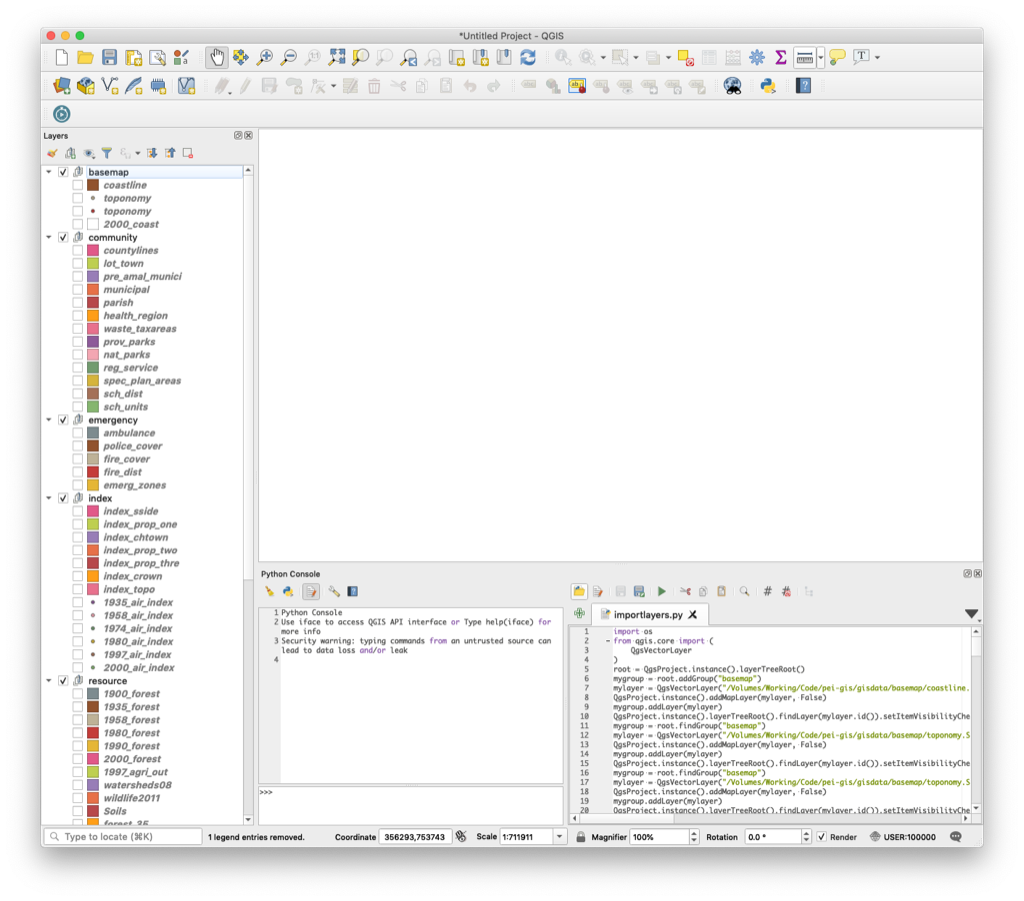
I’ve updated this script now–download it here–to handle the now blessedly simpler way the downloads work now (you don’t need to register to download any longer), and I’ve added the generation of a PyQGIS script that will automatically load all the downloaded layers into a QGIS project, ready for entertainment and delight.

Screen shot of all of PEI's public GIS data layers in QGIS

12 May 05:37

The Firefox EU Elections Toolkit helps you to prevent pre-vote online manipulation

by Mozilla

What comes to your mind when you hear the term ‘online manipulation’? In the run-up to the EU parliamentary elections at the end of May, you probably think first and foremost of disinformation. But what about technical ways to manipulate voters on the internet? Although they are becoming more and more popular because they are so difficult to recognize and therefore particularly successful, they probably don’t come to mind first. Quite simply because they have not received much public attention so far. Firefox tackles this issue today: The ‘Firefox EU Election Toolkit’ not only provides important background knowledge and tips – designed to be easily understood by non-techies – but also tools to enable independent online research and decision-making.

Manipulation on the web: ‘fake news’ isn’t the main issue (anymore)

Few other topics have been so present in public perception in recent years, so comprehensively discussed in everyday life, news and science, and yet have been demystified as little as disinformation. Also commonly referred to as ‘fake news’, it’s defined as “deliberate disinformation or hoaxes spread via traditional print and broadcast news media or online social media.” Right now, so shortly before the next big elections at the end of May, the topic seems to be bubbling up once more: According to the European Commission’s Eurobarometer, 73 percent of Internet users in Europe are concerned about disinformation in the run-up to the EU parliamentary elections.

However, research also proves: The public debate about disinformation takes place in great detail, which significantly increases awareness of the ‘threat’. The fact that more and more initiatives against disinformation and fact-checking actors have been sprouting up for some time now – and that governments are getting involved, too – may be related to the zeitgeist or connected to individuals’ impression that they are constantly confronted with ‘fake news’ and cannot protect themselves on their own.

It’s important to take action against disinformation. Also, users who research the elections and potential candidates on the Internet, for example, should definitely stay critical and cautious. After all, clumsy disinformation campaigns are still taking place, revealing some of the downsides of a global, always available Internet; and they even come with a wide reach and rapid dissemination. Countless actors, including journalists, scientists and other experts now agree that the impact of disinformation is extremely limited and traditional news is still the primary and reliable source of information. This does not, however, mean that the risk of manipulation has gone away; in fact, we must make sure to stay alert and not close our eyes to new, equally problematic forms of manipulation, which have just been less present in the media and science so far. At Firefox we understand that this may require some support – and we’re happy to provide it today.

A toolkit for well-informed voters

Tracking has recently been a topic of discussion in the context of intrusive advertising, big data and GDPR. To refresh your memory: When browsing from site to site, users’ personal information may be collected through scripts or widgets on the websites. They’re called trackers. Many people don’t like that user information collected through trackers is used for advertising, often times without people’s knowledge (find more info here). But there’s another issue a lot less people are aware of and which hasn’t been widely discussed so far: User data can also be used for manipulation attempts, micro-targeted at specific groups or individuals. We believe that this needs to change – and in order to make that happen, more people need to hear about it.

Firefox is committed to an open and free Internet that provides access to independent information to everyone. That’s why we’ve created the ‘Firefox EU Elections Toolkit’: a website where users can find out how tracking and opaque online advertising influence their voting behavior and how they can easily protect themselves – through browser add-ons and other tools. Additionally, disinformation and the voting process are well represented on the site. The toolkit is now available online in English, German and French. No previous technical or policy-related knowledge is required. Among other things, the toolkit contains:

  • background information on how tracking, opaque election advertising and other questionable online activities affect people on the web, including a short, easy-to-digest video.
  • selected information about the EU elections as well as the EU as an institution – only using trustworthy sources.
  • browser extensions, checked on and recommended by Firefox, that support independent research and opinion making.

Make an independent choice when it matters the most

Of course, manipulation on the web is not only relevant in times of major political votes. With the forthcoming parliamentary elections, however, we find ourselves in an exceptional situation that calls for practical measures – also because there might be greater interest in the election, the programmes, parties and candidates than in recent years: More and more EU citizens are realizing how important the five-yearly parliamentary election is; the demands on parliamentarians are rising; and last but not least, there are numerous new voters again this May for whom Internet issues play an important role, but who need to find out about the election, its background and consequences.

Firefox wants to make sure that everyone has the chance to make informed choices. That detailed technical knowledge is not mandatory for getting independent information. And that the internet with all of its many advantages and (almost) unlimited possibilities is open and available to everyone, independent from demographics. Firefox fights for you.

The post The Firefox EU Elections Toolkit helps you to prevent pre-vote online manipulation appeared first on The Mozilla Blog.

12 May 05:37

MozillaPH-Northern Mindanao Awards its First Localization Challenge Winner

by Romar Micabalo
Mozilla Philippines – Northern Mindanao held an in-community localization challenge (L10n Rush) recently. The volunteer who gets to submit the most suggestions and translation proposals to the Tagalog localization for Firefox will receive a prize. Nik Cyrell Yabo emerged as the top contributor to the month-long localization challenge which ran from March until April 2019. Nik is a new volunteer for Northern Mindanao. He was a graduate of BS Computer Engineering at the University of Science and Technology (USTP), and… Read the rest
12 May 05:37

The Gardener’s Vision of Data

by Os Keyes

A few weeks ago, Nikki StevensJacqueline Wernimont, and I published an exposé on the use of non-consensually gathered, highly sensitive facial-recognition datasets by the National Institute of Standards and Technology, a part of the U.S. Department of Commerce. To test and refine facial-recognition systems, NIST is using immigrant visa photos, photos of abused children, and myriad other troubling datasets, without the consent of those within them.

One particular set of files stands out, innocuously named: the Multiple Encounter Dataset, or MEDS, contains multiple mugshots of 380 people, all now deceased, during their multiple arrests over their lifetimes by the police; the dataset is meant to “assist the FBI and partner organizations refine tools, techniques, and procedures for face recognition,” NIST offers. In the manner of the U.S. carceral system, this dataset, like those drawn from photos of immigrants, is incredibly biased. Though black people make up just shy of 13 percent of the U.S. population, they make up nearly 50 percent of the MEDS photographs. What is unique about this among the datasets NIST uses is that it is publicly available, uploaded to the institute’s website for retrieval by all and sundry. It also meant that I could download it and look at precisely what photographs NIST are using.

Without communication, connection, and empathy, it becomes easy for actors to take on the “gardener’s vision”

So I did. I downloaded the zip file and I looked through it, with every photo hitting me like a fist. Some crying, some with bloodstained faces, tired faces with gazes that could be read as boredom at a process that was familiar or as communicating nothing, volunteering nothing. Roughly bandaged wounds from their arrests. Tears streaked through stubble (which could be mine) around lip-glossed mouths (which could be mine). Some old and collecting social security, some so young they couldn’t even vote.

The photo that hit me the hardest was highlighted in the “description document” accompanying the dataset. It was a photo of a black man in his 50s, looking away from the camera and mouth agape, in distress. The documentation presented it as a specimen example — what the researchers who assembled the dataset, and who were testing a tool called Stasm, called an “Example of Stasm Output Requiring Manual Editing.”

That’s it. That was the only note. Where I saw a screaming middle-aged man, Andrew P. Founds, Nick Orlans, Genevieve Whiddon (of the Mitre Corporation), and Craig Watson (of NIST) saw an example of the sort of image that requires manual editing to be useful in facial-recognition testing. And edit it they subsequently did, overlaying the “source material” with linked red dots to tell the algorithm how to adjust it to fit its expectations of facial structure.

And I can’t get it out of my head, and I can’t stop asking how exactly it is that these people got to the point where they saw a person in anguish as an “example output.” What is it that let researchers get to this mind-set?


Writing about drone warfare, political scientist Neil C. Renic describes what he calls the “gardener’s vision” of warfare, in which the stronger party loses “the basic recognition that those we fight are fellow moral agents”:

When this bond of shared humanity, victimhood and moral equality is sundered, an erosion of behavioral restraint often follows … what remains is a gardener’s vision of war; a war of pest control.

Renic’s point is applicable not only to war but to any situation where those subject to an action are separated from the actor. Without communication, connection, and empathy, it becomes easy for actors to take on the “gardener’s vision”: to treat those they are acting upon as less human or not human at all and to see the process of interacting with them as one of grooming, of control, of organization. This organization, far from being a laudable form of efficiency, is inseparable from dehumanization.

This kind of dehumanization is not a new problem: large aspects of the state feature it — as when a judiciary is unrepresentative, or a lawmaking process is isolated from its consequences through geography and gerrymandering — and even more are oriented around maintaining it. Activists argue for a more diverse judiciary in part because concerns around racism, sexism, ableism, and other forms of discrimination can seem distant and irrelevant to those not subject to it. But the civil service’s one-size-fits all, standardized approaches to what constitutes “poverty” or “acceptable forms of identification” are ultimately about organization and abstraction, and consequently treat expediency and efficiency as their own ethical virtues.

As a state action, the existence of the MEDS dataset could be explained by that administrative orientation toward separation — treating those the state interacts with as less than and distinct from the processes of the state itself. But the MEDS dataset stemmed not from a monolithic, bureaucratic but from the efforts of a small team of named individuals. Even if its existence could be blamed on state bureaucracy (who obviously hold some of the responsibility, here), it would do nothing to explain who so many scientists in public and private institutions have been comfortable reusing this data.

This organization, far from being a laudable form of efficiency, is inseparable from dehumanization

To explain that, one might look at science’s long history of dehumanizing subjects in the name of “objectivity.” Consider what it means that research participants are frequently referred to as “subjects”: On countless occasions over the past few centuries, positivist views of science have assisted scientists in dehumanizing the subjects of their research. This has been assisted by larger-scale societal biases that already treat certain populations as less human. The case of Henrietta Lacks or of the victims at Tuskegee shows how structural and individual racism play a role in dehumanization, but the case of Dan Markingson, a white man who died in 2004 during a psychiatric research study while institutionalized, shows that scientists are perfectly capable of justifying inhumanity without the pretense of race.

The problem has stemmed from the positivist treatment of people as a means to a particular end: “data.” That this data stems from human bodies, lives, and traces is (to too many scientists) an unfortunate corollary, a distraction from science’s purity. As feminist epistemologists have long noted (and Rosi Braidotti details here), those bodies and people are treated as consumable and disposable, a source of data that can often then be discarded, particularly under a capitalist regime.

The scientists preparing and reusing NIST’s data to train facial recognition models may simply be subject to these tendencies and these philosophies — comfortable with screaming, bloodied, and non-consenting research subjects because they are not people to them but abstract sources of abstract data.

But there are signs that this isn’t the only thing that is going on. It appears that data science — of which facial recognition is a part — is altering the “objective” positivist research methodology, and not in ways that produce more humane outcomes.


Science and Technology Studies have talked a lot about the implications of data science for how science is done and technology is developed, both skeptically (rejecting the idea it fundamentally changes science, as Martin Frické does here) and forebodingly (pointing to, among other things, how “the datalogical turn” affects disciplines such as sociology as well the traditional sciences). In a particularly evocative paper, Dan McQuillan argues that algorithmic, AI-based approaches to science embody what he calls machinic neoplatonism, descended from the “Renaissance Platonism” practiced by such scientists as Copernicus and Galileo.

A machine-learning system that assesses facial matches tells you what faces match but not why

Neoplatonism as a philosophical approach to science, McQuillan argues, was premised on a belief in “a hidden mathematical order that is ontologically superior to the one available to our day-to-day senses.” It presumed that there is one grand unified reality that could be approached without considering the “instruments” that collected our data about it, be they telescopes or bodies. It has no need for causal explanations, no need to consider how the nature of the scientist or their perspective might alter the results – indeed, it has only incidental need for a scientist at all.

For McQuillan, this philosophy is made manifest in machine learning, which is premised on the idea that algorithms, when fed the right data, spit out the singular hidden truth of how the universe functions in a particular domain, generating not theory (because you can’t necessarily see what the algorithms are doing, or why) but the guidance we need to structure society and reality. A machine-learning system that folds proteins tells you which proteins fit, which should be further explored, but it does not tell you why — you don’t need it to. A machine-learning system that assesses facial matches tells you what faces match but not why. In other words: there’s no theory. Really, there’s no need for a human scientist at all. You just get decisions, outcomes, things you can use.

To me, this machinic neoplatonism is the central difference between traditional scientific approaches and those of data science. While the issues with traditional science remain — among them the idea of a single, objective Truth and the abstraction of data from the people who participate, voluntarily or not — and are magnified, data science puts forward the idea that this “truth” does not have to be known by the scientist and may not even be knowable to us.

This shift renders the consequences of that truth and our experiences of them irrelevant. That an algorithm “works” for any post-hoc purpose becomes a justification for that algorithm, its efficacy and its deployment, and the rationale for collecting even more data to feed it. In pursuit of the one big truth — the truth that only an algorithm can determine — anything is permissible. That “truth” is simply superior; qualitative concerns, subjective concerns such as human cost, bias, or base morality, do not even register as legitimate.

Data science represents yet another degree of abstraction away from the bodies and minds that data comes from, making those bodies and minds even more disposable and interchangeable. The abstraction and dehumanization is not just through a one-way mirror or epidemiological records, as in conventional scientific experiments, but separated by time, distance, anonymity, and scale so that it is even harder for human scientists (if they are involved at all) to see people rather than data sources.

This is especially true when “big data” is premised on getting as many data points (or photos) as possible, fading any individual into just … numbers. A gardener’s view, again, but to a far worse degree because of the myriad additional layers of abstraction — because there may not be a scientist in the loop at all, just an algorithm that demands to be fed.


If machinic neoplatonism — this degree of abstraction and reliance on the model to reveal a singular truth — is a source of data science’s inhumane outcomes, then we should be particularly concerned by projects for “better” AI that ultimately adopt the same techniques, even or especially when they are billed as more ethical and humane. These projects often attempt to engineer ethics — to make algorithms for gauging the ethics of other algorithms.

AI ethicists themselves must be willing to decenter their own perspectives

Such projects abound. The conference on Fairness, Accountability and Transparency (FAT*) often features this kind of work, from modifications to common machine learning algorithms that produce more equitable outcomes to “meta-algorithms” for assessing fairness (computationally proven meta-algorithms, at that!).

It’s safe to say I am generally skeptical about such approaches and have not so gently skewered them in the past, due to the way that they (as Greene, Hoffmann, and Stark put it in their evaluation of the wider movement for ethical AI) “frame ethical design as a project of expert oversight, wherein primarily technical, and secondarily legal, experts come together to articulate concerns and implement primarily technical, and secondarily legal solutions.”

But the problem of the gardener’s vision — the risks that come with abstraction — pose additional reasons to worry. As a prominent case study, take Aequitas. Developed at the University of Chicago, Aequitas is “an open source bias audit toolkit for machine learning developers, analysts, and policymakers to audit machine learning models for discrimination and bias, and make informed and equitable decisions around developing and deploying predictive risk-assessment tools.” Essentially, it’s a machine-learning system for identifying biases in machine-learning systems. After uploading a dataset and selecting “protected groups” (and a mathematical measure of fairness), the system spits out a friendly, human-readable report on the fairness of the dataset and the likely biases of any models trained on it. The example report Aequtias provides, for instance, uses race as a protected variable.

On the face of it, this tool is useful, providing a quick and easy way of evaluating (un)fairness as a red flag for possible injustices. But crucially, it does not do so through direct mechanisms — engaging with the populations impacted or interrogating how the data was gathered. It does so through a model; it reduces fairness itself to a matter of abstract mathematics, to a Truth, replicating precisely the “gardener’s vision” that makes machine-learning systems so risky in the first place.

While Aequitas and tools like it endeavor to reduce injustices, they do so by introducing an additional level of abstraction: Users and developers are now not only expected to take the attitude that the model they are developing has primacy, but also that any issues with it can be clarified and resolved by shifting giving primacy to Aequitas, further foregrounding algorithmic systems and separating the developers and users from those subject to the algorithm’s outcomes. Aequitas does not alter the balance of power to favor algorithmic subjects but simply redistributes power between different groups of developers further and further away from the consequences of their actions.

This is not to say that the tool cannot be useful; it is fundamentally useful to highlight early warning signs. But there is no reason an algorithmic system should be seen as a better way of doing that than talking to one’s users or seeing what the algorithm’s consequences are in the social context you intend to deploy it in. Along with the overall attitude of “leave it to the experts” that Greene et al. found, and the gardener’s vision these projects implicitly depend on, algorithmic approaches to ethics and equity risk enabling further inequity, detaching developers from their victims and further centering machine learning as a singular source of a singular truth.

In exploring ways around machinic neoplatonism within data science, McQuillan has some great suggestions: adapting feminist and postcolonial critiques and methods, and explicitly building “antifascist AI,” an approach I empathize with. But for this project to be successful, it must be critical and critique-able; it must be accompanied by ethical forms and monitoring that do not themselves replicate and depend on the same systems of abstraction, power, and inhumanity that feminist and postcolonial methods seek to unravel. AI ethicists themselves must be willing to decenter their own perspectives, decenter computational approaches, and adopt the same interrogations of power and contextuality McQuillan exhorts for AI itself. Only then can we avoid being both source of, and ultimately victim to, the gardener’s vision.
12 May 05:36

Parking and Privilege

by Gordon Price

From Dianna: “I didn’t shoot this. I picked it off Twitter from a guy who ran today’s marathon and saw this in Point Grey, where else?”

12 May 05:35

E-Bike Financing with Klarna

by Blix PR

Here at Blix eBikes, we strive to make sure that our bikes are competitively priced and available to as many people as possible. Using Klarna, we have found a way to offer finance plans that help more people get back on a bike, use an alternative method of transportation, and regain a love for the outdoors. Learn more about Klarna and how to finance a Blix bike below!


 What is Klarna?

Klarna is an affordable and flexible financing plan aiming to help make online shopping easier and reduce the financial pressure of larger purchases. It offers payment options which allow customers to split up their bike payments.

What type of payment plans are available?

Klarna offers a "Slice it. Pay over time" option which calculates the monthly payment for the bike and includes a reduced APR. Some payments are as low as $91/ month! Plus, you can also choose an option to pay the full amount within 12 months and not be charged interest. Klarna also emails you when payments are due to ensure you are not charged a late fee.

How can I use Klarna to purchase my Blix Bike?

Purchasing a Blix e-bike through Klarna financing is super simple and only requires 10 easy steps to adding an electric bike to your lifestyle at a great price.

  1. Choose the Blix Bike you want
  2. Head to checkout
  3. Fill out the contact information
  4. Add your shipping address
  5. Choose free shipping
  6. Once you reach the payment stage, click "Slice it. Pay over time with Klarna"
  7. After you choose "complete order," you will be redirected to a screen with your Klarna payment options
  8. Choose the payment plan that best suits you
  9. Create an account and fill-in basic info which will determine in seconds if you are approved
  10. Confirm your order and you are all set!

Best Perks of Choosing Klarna:

Choosing Klarna is a great option for purchasing your Blix ebike because it doesn't delay shipping or the date you receive the bike! Once your order is placed and approved by Klarna, Blix will ship the bike (assuming it is not backordered!). Additionally, it allows you to add an electric bike without having to wait until pay day. Rather than worrying about a large credit card bill, you will be able to enjoy your exercise, sustainable choice, and adventures even more. Klarna makes treating yourself just that much more doable.


Learn more about Blix Electric Bike models here

Learn more about Klarna here

Follow us:

Instagram

Facebook

12 May 05:35

Warum ich Lightning gegenüber USB-C vorziehe

by Volker Weber

eb1967878dbfd385a40988e49bf8d21a

USB-C ist eine wunderbare Sache, allein schon wegen USB PD. Aber der Stecker bleibt verglichen mit Lightning eine Katastrophe. Ja, man kann ihn endlich wenden. Aber man schaue sich nur mal die Ports von iPhone XS Max und iPad Pro an. Lightning zentriert den Stecker automatisch und er rastet sauber ein. USB-C ist verglichen damit ein einziges Gefummel, wie man um den USB-Port herum sehen kann.

Mir hält das Aussehen nicht so genau. Ein Gerät darf Kratzer haben und kriegt sie bei mir auch ab, wenn es was taugt. Dann nutze ich es tagein, tagaus, und das sieht man dann auch. Wenn Du von mir ein Gerät ohne Abnutzung zurückbekommst, dann taugt es nichts. Wenn ich Supportleute zu einem VIP geschickt habe, dann war meine erste Frage "staubig oder fettig?". Staubig wie nicht benutzt oder fettig wie dauernd rumgeschleppt.

iPhone und iPad Pro mag ich beide sehr. Und beide werden richtig rangenommen. Ja, das iPhone hat Wireless Charging, aber es landet wie das iPad Pro häufig auf dem udoq. Das geht zackig mit dem iPhone und nur mühselig mit dem iPad Pro. Wegen des Steckers.

11 May 06:39

Lucy and I visit the park

by jnyyz

The weather was glorious today, so Lucy and I decided to visit High Park, regardless of the fact that the sakura were not yet in bloom.

Car traffic blocked at the park entrance.

The long line up for the trolley.

Lots of people out and enjoying the weather.

Why is it that we can’t close the park to car traffic every summer Sunday?

Lucy does not look impressed.

Not too crowded yet.

The High Park Nature Centre folks used a cargo bike to haul their gear to this spot.

Lots of people taking close ups of buds not quite in bloom.

Never seen the Grenadier parking lot so empty on a weekend.

Multitudes still arriving as we left the park.

Peak bloom is predicted for later this week, but I’d keep an eye on the weather as well, since rain is in the forecast for overnight Monday and all day Thursday.

Robarts update: The city has been publicizing the other places where you can see sakura. The blooms at Robarts are coming along.

In fact, about 15% of the trees are in bloom.

So if you pick the right spot, you can pretend they are all in bloom.

09 May 17:55

Apple planning updates to macOS, iOS and watchOS for WWDC

by Patrick O'Rourke

With Apple’s Worldwide Developers Conference (WWDC) just around the corner, Bloomberg’s almost always reliable Mark Gurman is back at it again with a number of notable rumours that give us a glimpse of what to expect from the tech giant’s annual developer conference.

As expected, Gurman says that macOS, iOS and watchOS are set to be updated with new features. There will also be attention paid to third-party iOS apps, similar to last year.

Major new features include an operating system-wide dark mode for iOS 13, an updated version of Maps and new Health and Reminders apps. Regarding macOS, we’ll likely get our first look at third-party iOS apps running on the Mac, according to Gurman.

There’s also a possibility that Apple’s updating the HomePod with multi-user support, a feature that has been available in the Google Home and Amazon Alexa for several months now.

For all of Guman’s WWDC rumours and predictions, follow this link.

Below is a quick list of some of the highlights from Bloomberg’s story:

iOS 13

  • Dark Mode is coming to the next version of Apple’s mobile operating system.
  • Various performance improvements and bug fixes.
  • A system-wide Sleep Mode that can be turned on and off in the control centre.
  • Messages app revamp that brings WhatsApp-like features to Apple’s platform, including setting display names and profile pictures.
  • A revamped Maps app that aims to compete better with Google Maps and Waze.
  • A new Reminders app with a UI that’s laid out like a grid, including tasks to be done today, all tasks, scheduled tasks and flagged tasks.
  • New Books app with a progress tracker.
  • Health app design changed with new daily activity view, menstrual cycle tracking and more.
  • Swipe-based keyboard option similar to Swiftkey.
  • New mail app with thread muting, blocking incoming email and revamped folder management.
  • Ability to use an iPad as an external display for Mac, including with support for Apple Pencil.
  • Find My iPhone and Find My Friends being revamped along with a Tile-like tracking device.
  • New multi-tasking interface and revamped home screen for iPad.
  • New animation when launching multitasking feature as well as when closing apps.
  • watchOS 6

  • watchOS version of the App Store, allowing you to install apps without using the iPhone companion app.
  • Voice Memos, Apple Books and Calculator app coming from iOS
  • ‘Dose’ app for pill reminders and Cycles for tracking menstrual cycles
  • Complications that display battery life of hearing aids, rainfall, external noise and new watch faces

macOS 10.15

  • Marzipan’s launch, allowing iPhone and iPad apps to be easily ported to the Mac through Apple’s new development SDK
  • New Apple Music, Podcasts and combined Find My iPhone and Find My Friends apps.
  • Mac Screen Time app
  • New Apple Music app
  • Siri Shortcuts integration
  • iMessage stickers and effects

Source: Bloomberg 

The post Apple planning updates to macOS, iOS and watchOS for WWDC appeared first on MobileSyrup.

09 May 17:55

If you work for Tesla and leak information the company will fire you, then sue you

by Brad Bennett

Tesla sent an email to all of its employees reminding them that if they leak any sensitive company information, they’ll be fired and sued or charged.

Tesla’s security team sent a mass email to the company’s employees this week to discourage staff from leaking the company’s secret information, according to CNBC.

The email warns employees of outsiders “who will do anything to see us fail” that are trying to coerce employees to share privileged information on social networks, claims the report.

The email goes on to remind employees that they all signed non-disclosure agreements when they started working at Tesla.

“Tesla will take action against those who improperly leak proprietary business information or violate the non-disclosure obligations to which we all agreed. This includes termination of employment, claims for damages, and even criminal charges,” reads the email according to CNBC. 

Tesla is continuously under the media’s microscope due to its futuristic promises, including ‘robo-taxis’ and the fact that it ranges from profitable to non-profitable frequently. As a result, it isn’t surprising that the company is trying hard to avoid negative press.

An example of this includes a few weeks ago when a Tesla combusted in Shanghai for seemingly no reason. Other automakers also have also experienced issues with their vehicles, but the media rarely covers them as closely as Tesla.

Either way, Tesla is a wildly successful electric vehicle manufacturer that is suffering the growing pains that come along with still being a relatively new company — especially one that is operating in such a relatively new industry.

The full employee email is available on CNBC.

Source: CNBC

The post If you work for Tesla and leak information the company will fire you, then sue you appeared first on MobileSyrup.

09 May 17:55

Apple could finally reveal Mac Pro redesign at WWDC

by Patrick O'Rourke
Mac Pro

Along with a barrage of other WWDC related rumours, Bloomberg’s Mark Gurman thinks Apple could have plans to finally show off its long-in-development Mac Pro at the tech giant’s developer conference this June.

While Apple’s Worldwide Developers Conference is usually software-focused, a new Mac Pro reveal makes sense in the context of the developer show given its focus on creators.

Gurman also says that Apple’s often-rumoured external monitor could be revealed at WWDC this year. The monitor is expected to measure in at 31.6-inches with a 6K screen and support for HDR. Further, the monitor is rumoured to feature mini-LED technology that will improve its contrast ratio and bring it more in line with OLED regarding display quality.

Finally, Apple also might show off a 16-inch version of the MacBook Pro, along with a refreshed 13-inch MacBook Pro that supports 32GB of RAM, according to Bloomberg.

For more WWDC related rumours, including a possible iOS dark mode, iOS apps on Mac and revamped iPad multitasking, check out our round-up of Bloomberg’s report.

WWDC is set to start on June 3rd. MobileSyrup will be on the ground at the developer conference bringing you all the news directly from the show floor.

Source: Bloomberg Via: The Verge 

The post Apple could finally reveal Mac Pro redesign at WWDC appeared first on MobileSyrup.

09 May 17:55

Microsoft is bringing Grammarly-like AI features to Word

by Aisha Malik

Microsoft will soon release an ‘Ideas’ feature that utilizes AI to recommend grammar changes and other edits in the online version of Word.

The functionality aims to take on similar platforms like Grammarly and Google Docs.

The Ideas feature outlines simple errors, and highlights sentences that can be rephrased to improve clarity.

Ideas will also be beneficial when reading, according to Microsoft. The feature can explain acronyms, outline the main points of what you’re reading and also estimate reading time.

These features will give readers the ability to effectively skim through pieces of text.

Although Grammarly users may not be that interested in this functionality, Ideas could potentially increase productivity for Word users.

Microsoft also announced a Word Designer feature that will allow users to style their documents and tables.

Microsoft said Ideas will be available to preview in June, and that it will release to all users in the fall.

Source: Microsoft Via: Engadget 

The post Microsoft is bringing Grammarly-like AI features to Word appeared first on MobileSyrup.

09 May 17:55

Microsoft brings actionable emails to Outlook, shares vision to kill the password

by Jonathan Lamont
Microsoft executive vice president Rajesh Jha

In a technical keynote at Build 2019 lead by executive vice president Rajesh Jha, Microsoft unveiled its plans to make its apps more intelligent and actionable. Further, the company outlined its plans to kill the password.

To start, Microsoft is powering up Outlook on mobile through its Microsoft 365 platform to make basic tasks easy. One example the company demoed was responding to a meeting request. Right from the compose screen, users can tap a calendar icon to see a snapshot of their availability and send a few options so the recipient can pick a time to meet.

Additionally, Microsoft is adding actionable messages to Outlook. These are similar to Google’s recently released AMP for Gmail platform.

Actionable messages are all about making it easy for users to get things done. For example, if someone sends you a survey from Survey Monkey, you can quickly fill it out without leaving your email.

Further, actionable messages work well alongside the company’s MyAnalytics service, which can pull data to help users manage their time better. Microsoft demoed an example where a user sent an email committing to spend time working on a specific project.

Outlook then offered proactive suggestions for available times that user could use to work on the project. Thanks to actionable emails, the user could set aside time to focus on the project in their calendar based on the proactive suggestion — all with the click of a button.

The company also showed off its new AI features in Word, which you can learn more about here.

Microsoft Identity, and the passwordless future

Security is incredibly important. Unfortunately, current digital security is somewhat lacking. According to Microsoft, weak passwords cause 81 percent of security breaches. As such, the company wants to move towards a passwordless experience.

Microsoft wants to use its Windows Hello and Microsoft Authenticator platforms to help kill the password by enabling single sign-on (SSO) experiences.

SSO is the idea that users sign-on once, and the service remembers them. However, Microsoft wants to take it a step forward. With Windows Hello, your initial laptop sign-on is your SSO. When you open your laptop, Surface or another computer, Hello logs you in and unlocks all your Microsoft accounts. It’s easy for users — no fiddling with passwords, pins or 2FA systems. One biometric authentication for everything. It’s also easy for developers — Microsoft says there’s virtually no additional code to make this work, thanks to the new tools the company introduced at Build.

As for Authenticator, the smartphone app can act as more than just a code generator. In a demo during the keynote, Microsoft showed an example of a user trying to sign into their corporate Microsoft 365 account. Instead of asking for a password, the sign-in page directs the user to open Authenticator on their phone. There, they verify themselves with biometric security, confirm they’re trying to sign in, and go back to their computer to get to work — no passwords required.

If that sounds familiar, it works like Google’s ‘Prompt’ service that lets you easily verify your sign-ins by clicking a button on a verified smartphone.

The post Microsoft brings actionable emails to Outlook, shares vision to kill the password appeared first on MobileSyrup.

05 May 00:21

One Goose Down, 79.999 Geese To Go

by Ton Zijlstra

The Netherlands has the lushest and tastiest grass in the world according to discerning geese, and millions flock to Dutch fields because of it. Farmers rather use the grass for their dairy cows, and don’t like the damage the geese cause to their fields. To reduce damage geese are scared away, their nests spiked, and hunted. Each year some 80.000 geese are shot in the Province South-Holland alone. The issue is that the Dutch don’t eat much wild goose, and hunters don’t like to hunt if they know the game won’t be eaten. The role of the provincial government in the case of these geese is that they compensate farmers for damage to their fields.

20190414 005 Cadzand, Grote Canadese gans
“All your base belong to us…”, Canada geese in a Dutch field (photo Jac Janssen, CC-BY)

In our open data work with the Province South-Holland we’re looking for opportunities where data can be used to increase the agency of both the province itself and external stakeholders. Part of that is talking to those stakeholders to better understand their work, the things they struggle with, and how that relates to the policy aims of the province.

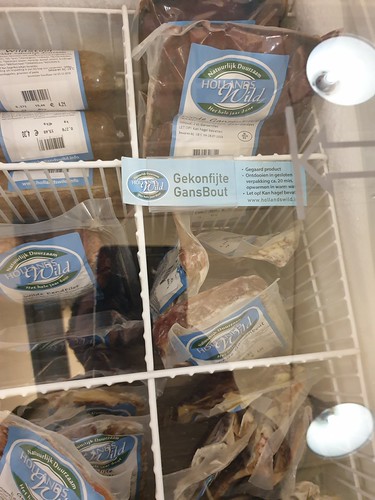
So a few days ago, my colleague Rik and I met up on a farm outside Leiden, in the midst of those grass fields that the geese love, with several hunters, a civil servant, and the CEO of Hollands Wild that sells game meat to both restaurants and retail. We discussed the particular issues of hunting geese (and inspected some recently shot ones), the effort of dressing game, and the difficulties of cultivating demand for geese. Although a goose fetches a hunter just 25 cents, butchering geese is very intensive and not automated, which means that consumable meat is very expensive. Too expensive for low end use (e.g. in pet food), and even for high end use where it needs to compete with much more popular types of game, such as hare, venison and wild duck. We tasted some marinated raw goose meat and goose carpaccio. Data isn’t needed to improve communication between stakeholders on the production side (unless there emerges a market for fresh game, in contrast to the current distribution of only frozen products), but might play a role in the distribution part of the supply chain.

Today with the little one I sought out a local shop that carries Hollands Wild’s products. I bought some goose meat, and tonight we enjoyed some cold smoked goose. One goose down, 79.999 to go.

20190503_104336

20190503_104402

05 May 00:21

"Another WestJet YYG to Calgary"

by peter@rukavina.net (Peter Rukavina)

Two Weeks, from The East Pointers, is one of those songs that instantly and naturally finds its place in the canon, filling a void we didn’t know existed.

It also happens to include what I believe to be the first reference to Charlottetown Airport’s IATA code, YYG, in a song lyric:

Monday morning, minus eighteen
Another WestJet, YYG to Calgary
I’d always knew she’d get used to me leaving someday

This solves the perplexing problem of Charlottetown not rhyming with anything.

The song was awarded Song of the Year at the East Coast Music Awards last night, well-deserved recognition.

05 May 00:21

Introducing The New Librem Mail

by David Seaward

Here you are. You take social good, freedom, and your personal privacy and security seriously. You know Librem Mail is part of Librem One, a suite of privacy-protecting, no-tracking apps and services – a network system that we, at Purism, believe is already starting to change the world for the better.

So why, and how, can it change your world for the better? How will it help and protect you, and why is it better than the rest?

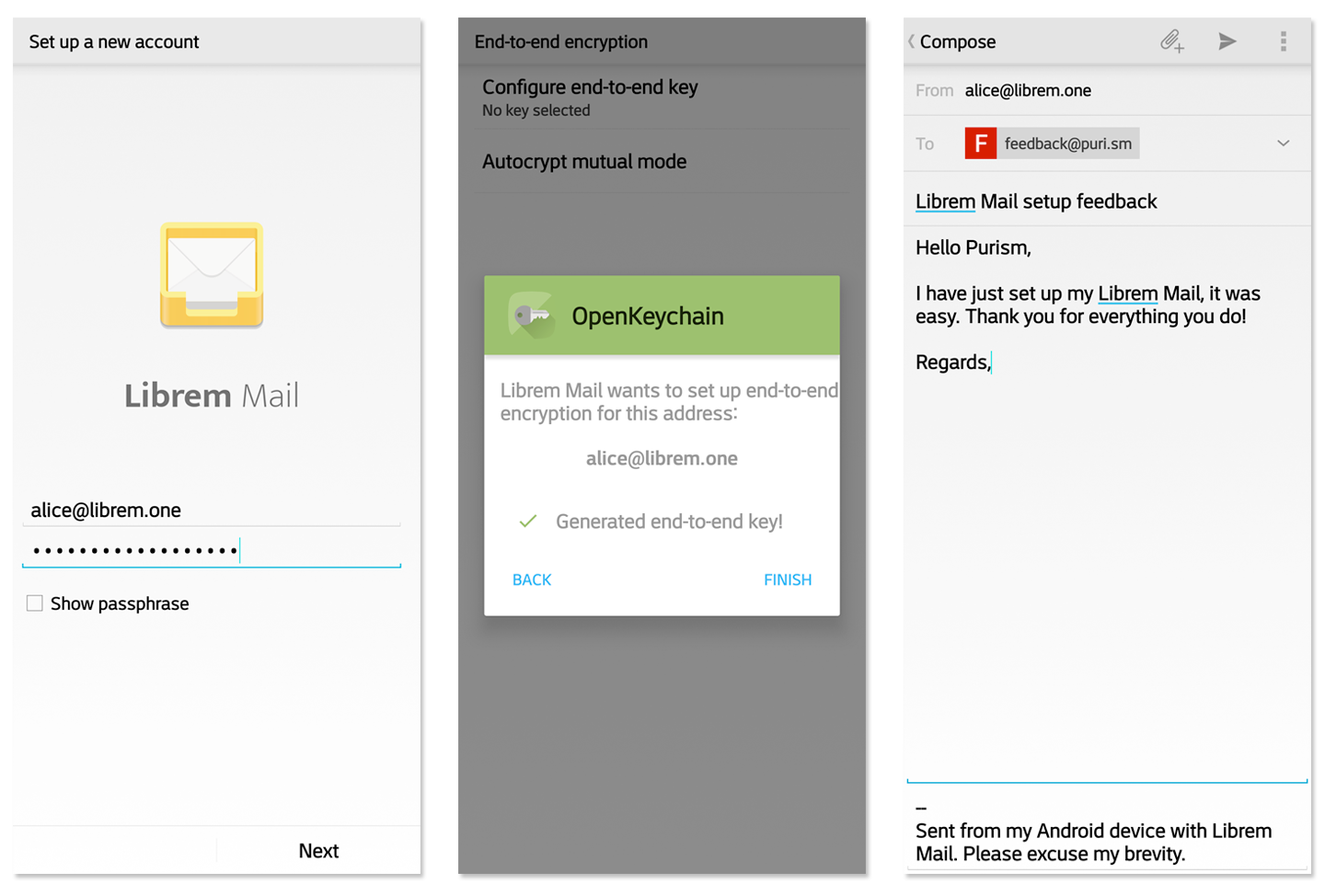
Well, let’s start from the very beginning (always a good place to start): Librem Mail offers you an end-to-end encrypted email account, making sure that all end-to-end encrypted communication is kept private.

How is it kept private?

By using OpenPGP, the best-in-class cryptography. And just like every other client Purism offers as part of Librem One, Librem Mail uses free software-based clients (such as Librem Mail on Android, based on K-9 Mail), across all platforms. This ensures that rights (and freedom) of people using it are protected when third party verification of privacy and security protections is confirmed.

Will it make communicating with your friends more difficult?

Maybe you’re worried that such a degree of safety will isolate you. But no, it won’t, we’d never do that: like all other services offered in the Librem One bundle, Librem Mail allows you to communicate with anybody, inside or outside the librem.one domain. Each server-side service that Purism provides as part of Librem One encompasses a philosophy of decentralization, so you can communicate to other people on other systems. We do not lock you in to one (our) technology company.

Why is it safer than most email offers?

It’s safer because we don’t keep your data. Email that isn’t encrypted isn’t safe, so we made it temporary. Temporary emails expire after 30 days. If you want to keep a temporary email, just send yourself an encrypted copy. We are aware this is a new approach to email safety, that you may need some time to get used to the idea. So we’ll only start the timer once the campaign ends (temporary emails sent on the day the campaign ends, or before, will be deleted 30 days after the campaign ends).

As the Mail service evolves, we’ll add the following features:

  • Discoverable keys: sending email to someone else @librem.one but don’t have their encryption key? The Librem Mail client will pull it in automatically.
    This is called “Blind Trust Before Verification”.
  • Encrypt-on-receipt: If you share your public key, we can encrypt your mail on receipt. Or, no more temporary mail.

Both of these convenience options put more trust on the service, so they will be on by default, but you can opt-out. We will elaborate when these features are released.

One other reason Librem Mail is safer it that we use free software, so you can know – and verify – you are not being tracked; and also because we utilize standard protocols and self-hosting options (for your business, your friends, even for yourself). Our services are powered by our own PureOS, Purism’s rights respecting operating system. Librem Mail uses Standard SMTP/IMAP/POP MTA, with OpenPGP, which may sound terribly technical if you are not an advanced user… but don’t worry, you don’t really need a lot experience to use Librem Mail.

Here’s a quick and simple setup on how to configure advanced options (if you are an advanced user, feel free to connect with other applications native to your system).


Purism offers high-quality privacy, security, and freedom-focused computers, phones, and software. Our platform is meant to empower everyone – including privacy-conscious users, entrepreneurs, business people, developers, writers, digital artists, activists, geeks and defenders of freedom all around the world. We believe people should have secure devices an services that protect them rather than exploit them, and we provide everything you need in a convenient product bundle.

The post Introducing The New Librem Mail appeared first on Purism.

05 May 00:20

The Believer Festival

by Caterina Fake

Screen Shot 2019-05-03 at 10.46.50 AM

Last week, for a second time I headed to The Believer Festival in Las Vegas, a literary festival spun out from the Believer Magazine, founded by Vendela Vida and Heidi Julavits. One of the best parts of being on the McSweeneys board is going to this festival with them. It redeems Las Vegas for me.

I’ve always avoided Las Vegas–the smoke, the vice, the disorienting carpets, the sad compulsion, the flashing lights and ringing bells–but through the festival I’ve learned to see Las Vegas as a vast, still disorienting carpet woven of a million stories. Everything in Las Vegas is a story. For the four days of the festival we floated in an oasis of stories, a glory, an orgy, a jackpot of stories.

Look at the author list at the link above to find new writers to adore. I loved Valeria Luiselli, Leslie Nneka Arimah, Rita Bullwinkel, Tommy Orange.

05 May 00:17

3rd May, 10:22 am

by nobody@domain.com (Cal Henderson)
05 May 00:16

Inconceivable Complexity

by peter@rukavina.net (Peter Rukavina)

We are watching a livestream of the ECMA folk stage at St. Paul’s Anglican Church across the street.

Our bandwidth at home is beamed across Prince Street from the Reinventorium (in the basement of the Parish Hall of the selfsame church) into an Apple Airport Extreme upstairs, which has an Apple Airport Express extender downstairs that Oliver’s MacBook Air in using for his wifi.

Oliver’s got the livestream playing on his laptop, and is streaming it to our Apple TV.

The Apple TV is connected to our 20 year old analog Sony Trinitron using an HDMI to RCA converter.

Where we’re watching music being performed in the church. Across the street. As it’s happening.

05 May 00:12

Is Vancouver a family-friendly city?

image

Vancouver attracts young people from all over the world. They are drawn to the beaches, the mountains, and ..other young people. But, what happens when two Vancouverites get together and have a child? Is the city still welcoming for families?

A few months ago, I put this question out to my Twitter followers and was overwhelmed by the volume of thoughtful responses. While many Vancouver parents embrace the city’s abundance of parks, nature, public transit and bike infrastructure, Vancouver lacks available childcare and kids programs, affordable housing, and safe streets.

Based on the feedback received, here are some of my recommendations on how to make Vancouver more supportive to families and children:

image

Childcare, Childcare, Childcare: When you decide to have children in Vancouver, you realize that unless you ditch your career (which is necessary to afford to live here), you face an enormous struggle to find licensed childcare. There are not nearly enough childcare facilities to support the demand, and it feels like we are losing spaces, not gaining them. My son’s affordable, licensed daycare, which provides loving care to over 33 kids, must close because the building is being redeveloped as rental housing. He starts kindergarten next year and the three available out-of-school care programs have two-year wait lists. We found one after-school program (which was full right after they launched registration), but they can’t offer before-school care because…..you guessed it: no available facilities. Vancouver is undergoing a facilities plan to find more childcare spaces. It can’t come soon enough.

Cars. Slow the !%^# Down: As Vancouver has grown in the last 5 years, so has the traffic, and worsening behaviour toward pedestrians. I see it daily in my community of Commercial Drive, which is intersected by First Avenue, a major arterial into the downtown core. As a result, drivers bomb through the adjacent residential streets to avoid traffic, with little regard for pedestrians or unpredictable children. This means that parents can’t feel safe allowing their kids to walk or bike to school - an essential freedom of childhood.

It was reassuring to see Vancouver City Councillor Pete Fry put forward a motion for a pilot project of 30km speed limits in certain residential areas. The move is gaining momentum and support from local residents in Vancouver and other municipalities.

image

More Play Outside The Playgrounds: Vancouver is blessed with an abundance of parks and spiffy playgrounds, but outside of sanctioned play areas, it lacks play elements incorporated into the rest of the city. This is especially true for the downtown core, which offers nothing whimsical or fun for children. I wrote about how Vancouver missed a huge opportunity to make downtown child-friendly when it revitalized its public square. Even small public space interventions at transit stops, parklets, public squares could be child-friendly and fun. For example, this pilot bus stop in Singapore that features a swing and a rack of books.

image

Available School and Community Programs: Much like childcare, getting your kid into one of Vancouver’s choice education or community programs is a lottery….literally. Like my son actually won the lottery to get into French immersion kindergarten and there are 80 children on a wait list who won’t get in. We also got him into a popular soccer program, but had to register first thing in the morning and were 5th on a wait list before finding out a month later that we made it in. The demand for children’s programs is there, and needs to be addressed by the Vancouver School and Parks Boards.

Housing (obviously), but mostly, Co-ops!!! To cool the housing market, the Province of BC and City of Vancouver have taken strides to address housing affordability with taxes aimed at vacant homes, AirBNBs, and foreign buyers. We are also seeing more purpose-built rentals and modular housing developments.

What we are not seeing is more co-op housing. Co-op housing is THE most family-friendly affordable housing you can conceptualize. I know a lot of great parents - artists, teachers, social workers, innovators - who could not live and raise kids in Vancouver if there was no co-op housing (which offers stable, affordable large units with a sense of community). And the demand is there, because co-op housing wait lists are obscenely long. We need more of these if we really want to support a local workforce to stay and raise children in the city.

You can read more responses to my Twitter post here: Is Vancouver a Family Friendly City?

05 May 00:12

Twitter Favorites: [adamrg] @sillygwailo There seems to be a Chrome extension for forcing webpages to dark mode. Developer designed dark modes… https://t.co/ZGjt5C3RHu

Adam Gessaman @adamrg
@sillygwailo There seems to be a Chrome extension for forcing webpages to dark mode. Developer designed dark modes… twitter.com/i/web/status/1…
05 May 00:12

OnePlus 7 Pro India Pricing to Start from Rs 49,999

by Rajesh Pandey
In less than two weeks from now, OnePlus will be officially unveiling the OnePlus 7 and OnePlus 7 Pro. Leaks have already revealed most of the key features of the device and now the Indian pricing of the handset has also leaked. Continue reading →
05 May 00:12

Note Taking–by hand or by keyboard?

by Jim

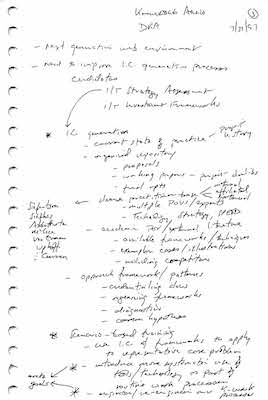
handwritten notesI’ve been thinking a lot about notes lately.

That led me into a stream of research and editorializing about the tradeoffs between taking notes on paper vs. at a keyboard.

The academic research seems to have started with:

Which generated various editorializing in the general press:

Predictably, the consensus appears to be a definite “it depends.”  This debate presumes that there is a correct technology choice independent of any other consideration. As soon as you phrase it that way, the question reveals itself to be nonsensical. You have to have the “it depends” conversation.

The technology choice–pen in hand or fingers poised over keyboard–has to flow from an understanding of goals and objectives  and of  context.

The research speculates that the difference in performance between pen and keyboard is a function of speed. Handwriting is slower than typing and that forces those taking notes to summarize and distill what they are hearing. Those choosing to type are presumed to be striving to create a verbatim transcript. So, the researchers are confusing a technology choice with a strategy choice. What kind of notes you choose to take dominates the choice of recording method. Unless you control for the strategy choice, your research design tells you nothing.

The second driver of technology choice here is context. What environment are you collecting notes in and how does your technology choice influence the context?

When I was writing cases, I would often be working with a professor and we would both be taking notes. Similarly, in many consulting settings, there would be more than one person conducting an interview. In those situations, we would divide responsibilities with one person primarily managing the interaction and conversation and another primarily capturing notes.

As another contextual example, consider the increasing use of electronic medical records in health care. Doctors I’ve spoken with lament that keyboards reduce the quality of doctor/patient interaction. One response has been the use of medical scribes (Scribes Are Back, Helping Doctors Tackle Electronic Medical Records : Shots – Health News : NPR) to redistribute responsibilities.

All of this simply reinforces that “it depends” is always an appropriate response when considering technology options. Few choices are binary. Even for something as simple as capturing notes.

The post Note Taking–by hand or by keyboard? appeared first on McGee's Musings.

05 May 00:10

Remote Python Development in Visual Studio Code

by Rui Carmo

I’ve been waiting for this ever since WSL came out (and then some). The SSH support is broken for me, but it seems fixable (hopefully soon), and even though I’m a bit sad that a) these things still come later in the game than “mainstream” features and b) that they appear to be tested in isolation, I’m glad that there are people working on it at all.


05 May 00:09

RT @StevePeers: "Luke...I sense that your vote was due to frustration at my lack of progress in crushing the rebellion" https://t.co/iiUMqc…

by StevePeers
mkalus shared this story from ottocrat on Twitter.

"Luke...I sense that your vote was due to frustration at my lack of progress in crushing the rebellion" pic.twitter.com/iiUMqcBKff


Posted by StevePeers on Friday, May 3rd, 2019 6:51pm
Retweeted by ottocrat on Saturday, May 4th, 2019 12:58pm


2832 likes, 1146 retweets
05 May 00:08

May 4th, Remembrance Day

by Ton Zijlstra

May 5th 1945 is the day that the second world war formally ended in the Netherlands with the capitulation of German troops. Since then the evening of May 4th is Remembrance Day, and the entire country observes two minutes of silence at 20:00, with flags flying half mast everywhere. May 5th is Liberation Day celebrated with festivals around the country.

The war didn’t end on May 5th 1945 for the entire country. The southern part had been liberated in the fall of 1944, and our former home town Enschede in the east had been liberated a month earlier on April 1st by British forces. The central and western parts remained occupied by 120.000 German troops until the surrender. Our current home town Amersfoort therefore wasn’t liberated through fighting but through the signing of the capitulation. The first allied forces reached Amersfoort on May 7th.

2019-05-04_08-04-54
Hanging the flag at halfmast at home. The little one insisted on helping me.

05 May 00:08

Five-word movie review: “Aquaman”

by sheppy

DC finally got another right!

05 May 00:05

Most Firefox extensions disabled by certificate issue, Mozilla working on fix

by Jonathan Lamont
Firefox iOS app

If you’re a Firefox user, you may have noticed things weren’t quite working right when you booted up your browser this morning.

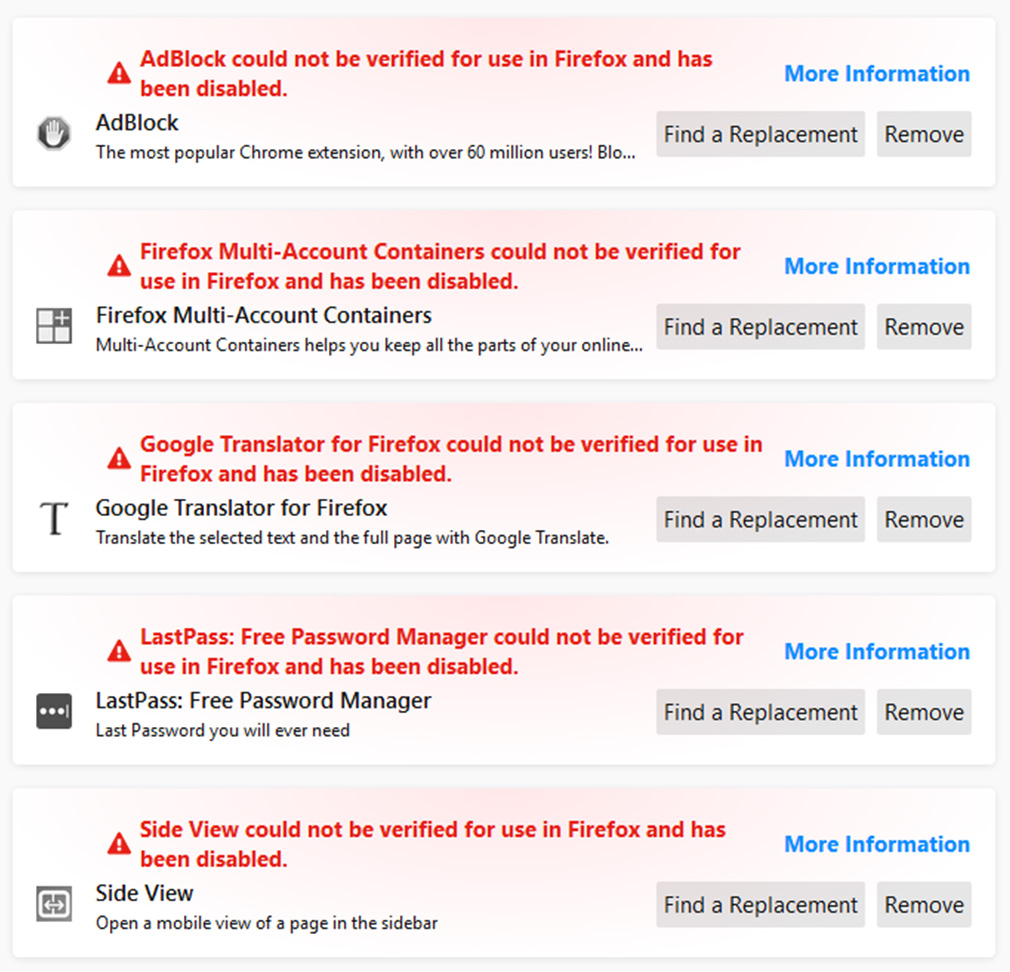
It appears that Firefox-maker Mozilla allowed an intermediate signing certificate to expire. Since Firefox is strict about signed certificates for extensions — the browser doesn’t allow unsigned extensions at all — almost every browser extension was disabled because of the expired certificate.

Further, the issue blocks the installation of new extensions as they also don’t have the required certificate.

When I started up Firefox, a yellow banner appeared under the bookmarks bar noting that “one or more installed add-ons cannot be verified and have been disabled.”

Additionally, when I went into the extension menu, I found that the issue disabled all my extensions — including ones from Mozilla.

Mozilla is working on a fix

Thankfully, Mozilla is aware of the problem and working on a fix. According to a Mozilla forum post, there’s a solution already available, but only through Firefox’s ‘Studies’ system, which allows Mozilla to push change directly to your browser without an update. Typically Mozilla uses this to test new features on users who opt in. In this case, it provided an avenue to quickly apply the fix.

To enable Studies, go into Firefox Preferences, click Privacy & Security, then scroll to the bottom. Under the ‘Firefox Data Collections and Use’ section should be a checkbox for ‘Allow Firefox to install and run studies.’ Enable it, and Firefox should install two studies that fix the certificate issue. You can disable Studies again after.

Alternatively, if you use Firefox Nightly, you can disable the browser’s requirement for signed extensions by typing ‘about:config’ in the address bar, then searching for the ‘xpinstall.signatures.required’ preference and changing it to false. Your extensions should work again after restarting the browser.

Finally, Mozilla says it’s working on a general fix for the certificate issue that doesn’t require Studies to work. Keep an eye on the forum for updates about the problem.

Source: Mozilla Via: TechDows

The post Most Firefox extensions disabled by certificate issue, Mozilla working on fix appeared first on MobileSyrup.