Shared posts

05 May 00:22

Here’s The First Real Discount on the Latest Apple Watch

by Alex Roth
Here’s The First Real Discount on the Latest Apple Watch

Seven months after the release of the latest Apple Watch, the Apple Watch Series 4, we’re finally seeing some decent discounts. The Series 4 is our top pick for the best smartwatch for iPhone owners, and several colors and band styles are on sale in both the 40 mm and 44 mm sizes. Or, if you don’t mind a slightly slower watch with less robust health-tracking features, our budget pick, the Apple Watch Series 3, is also on sale.

The 40 mm Apple Watch Series 4 with the Sport Band (the synthetic-rubber band) or Sport Loop (the fabric hook-and-loop band) is typically $390, but Amazon has the space gray aluminum case with a black Sport Loop, the space gray aluminum case with a black Sport Band, and the silver aluminum case with a seashell Sport Loop for $350. If you have a larger wrist or just want a bigger watch display, the 44 mm model is on sale in two colors as well: the space gray aluminum case with a black Sport Band or with a black Sport Loop is $380, down $50 from the normal $430 price.

All Series 4 Apple Watches are water resistant up to 50 meters, get a full day of use out of a single charge, and can pair with different bands, including those from Apple or licensed third parties. Additionally, although these models are reliant on pairing with your iPhone for calls, texts, and other data features, they can track your running with internal GPS circuitry if you leave your phone at home. For full independence from your iPhone, you’d need to opt for our upgrade pick, the Apple Watch Series 4 (with cellular), which isn’t on sale.

We still consider the 2017 Apple Watch Series 3 a good value, and Walmart has both the 38 mm and 42 mm models at healthy discounts. The Apple Watch Series 3 38 mm version is $50 off, currently selling for $200, and the Apple Watch Series 3 42 mm version is $40 off, selling for $230.

Compared with the Series 4, “the Series 3 models have smaller screens—the biggest obvious difference—aren’t as speedy, don’t do automatic workout detection, and won’t support the Series 4’s ECG feature or fall detection,” our review notes. “Even so, the Series 3 is still fast, designed with the same GPS features and swim-friendly waterproofing, and equipped with a bright screen that’s easy to see outside.”

05 May 00:21

Verizon to Dump Tumblr

Verizon Looks to Unload Tumblr Blogging Site | Benjamin Mullin and Sarah Krouse report that Verizon...
05 May 00:21

Why it matters that high-profile bigots no longer have a safe harbor on Facebook

by Josh Bernoff

Facebook and Instagram have banned these hateful people as “dangerous” individuals: Milo Yiannopoulos, Alex Jones, Louis Farrakhan, Laura Loomer, Paul Nehlen, and Paul Joseph Watson. Opponents of bigotry are cheering. But it’s time to look deeper into what this ban means for the platform. I will not shed a tear for any of these people. … Continued

The post Why it matters that high-profile bigots no longer have a safe harbor on Facebook appeared first on without bullshit.

05 May 00:21

New Other Discounts

The disastrous first quarter coupled with the usual desire to push gear during the second busiest time of the year for camera sales—Mother's Day through Graduation—has everyone introducing discounts. I've already outlined the

05 May 00:21

The OnePlus 7 Will be Water Resistant, but Won’t Have an IP Rating

by Evan Selleck
IP ratings are here to tell us just how water resistant a device is. But getting that rating isn’t necessarily cheap, even if it can get an obvious point across. And serve as a solid bullet point on the specs sheet. But OnePlus doesn’t think paying for that IP rating is worth it, so it’s skipping it. Continue reading →
05 May 00:07

Public Mobile subscribers outraged over lack of official response to service issue [Update]

by Igor Bonifacic
Public Mobile

Some Public Mobile customers have been without service for the past week.

According to MobileSyrup reader Jon, who alerted us of the situation, hasn’t been able to use one of his Public Mobile accounts for the past 36 hours and counting.

At the moment, it appears the outage is currently only affecting customers on Public Mobile’s $15 30-day calling plan.

The plan includes 100 outgoing Canada-wide talk minutes, unlimited incoming calls, unlimited SMS and MMS messages, as well as voicemail and call display. Customers who sign up for Public Mobile’s AutoPay service, get a bonus 250MB of data per month, as well as a $2 discount on the plan. Public Mobile recently updated the plan to add unlimited incoming calls.

Some Public Mobile customers report they’ve been unable to use their line for the past week. Adding further frustration to the situation is the fact that neither Public Mobile nor its owner Telus has yet to address the situation in any official capacity.

MobileSyrup has reached out to Telus for an update and comment on the situation. We’ll update this article with a response.

One particularly eloquent customer, EnglishChips, captures the situation concisely:

“If you choose to forgo live personnel in addressing critical issues, it is [incumbent] on you to have a system in place that immediately communicates with your customers the problem, and delivers an expected timeline for a resolution,” they write. “We are not frustrated because we’ve been without service for a few hours, it has literally been days now. This is unacceptable.”

In a separate post, EnglishChips encourages other customers to file a complaint with the Commission for Complaints for Telecom-Television Services (CCTS).

Thanks for the tip, Jon!

Update 03/05/19: In a statement issued to MobileSyrup, a Telus spokesperson says the carrier resolved the earlier today.

“Public Mobile identified a service issue that was affecting select customers on our $15 calling plan at 12:15am ET this morning. The issue was escalated and resolved at 1pm ET this afternoon. We apologize for any inconvenience this may have caused our customers and encourage them to reach out to a moderator in our Community if they have any outstanding questions.”

If you were unable to text or call using your $15 plan, it would be best to attempt to get some type of credit by submitting a ticket with Public Mobile.

The post Public Mobile subscribers outraged over lack of official response to service issue [Update] appeared first on MobileSyrup.

05 May 00:07

Verizon reportedly plans to sell Tumblr to Montreal-based Pornhub

by Patrick O'Rourke
pornhub

U.S. telecom and media giant Verizon plans to sell Tumblr to Montreal-based MindGeek, the parent company of Pornhub that owns pretty much every pornography streaming website on the internet, according to a new report from The Wall Street Journal.

Though the still somewhat relevant micro-blogging platform rose to popularity in the early aughts as a relatively open refuge for a variety of sub-cultures and marginalized communities, it was arguably more known for the ridiculous amount of pornographic GIFs present on the platform.

Though following Verizon’s acquisition of Tumblr it was certain to happen at some point, the controversial decision to drop all adult content from Tumblr didn’t actually happen until December of 2018. As expected, Tumblr users were not pleased that the porn party was over, with the platform losing nearly 100 million monthly pageviews in the month following the ban.

It’s unclear how much Verizon plans to sell Tumblr for, but given Yahoo purchased the micro-blogging platform for $1.1 billion USD (roughly $1.4 Billion CAD) back in 2013, before writing down its value to $230 million USD (roughly $308 million CAD) only three years later, it’s likely the sum will fall somewhere between those two numbers.

Although The Wall Street Journal’s report doesn’t mention Pornhub as a potential Tumblr suitor, a recent comment given to Forbes by Pornhub vice president Corey Price indicates that a deal is in the process of being made.

Price’s full statement can be read below:

Tumblr was a safe haven for those who wanted to explore and express their sexuality, adult entertainment aficionados included. We’ve long been dismayed that such measures were taken to eradicate erotic communities on the platform, leaving many individuals without an asylum through which they could comfortably peruse adult content. There are obvious synergies between the two brands and value Pornhub could derive from Tumblr. We’re extremely interested in acquiring the platform and are very much looking forward to one day restoring it to its former glory with NSFW content.

While nothing has been confirmed yet, it seems like if this deal goes through pornography could be returning to Tumblr in a huge way. It remains unclear if Pornhub also has other fundamental changes in mind for the platform if this rumoured deal does come to fruition.

That said, given MindGeek’s reputation for exploiting adult performers and upending the adult entertainment industry, this could be overall bad news for Tumblr as a platform and its users.

Source: The Wall Street Journal, Forbes 

The post Verizon reportedly plans to sell Tumblr to Montreal-based Pornhub appeared first on MobileSyrup.

03 May 14:52

Annotate the World

by Alexandra Molotkow

I don’t know when I started writing in my books, but I know when I started to notice. I was in my mid-20s, recently graduated and relearning the pleasures of reading for myself, which was part of learning how to be in my own company. I’d moved to a closet-sized studio apartment crammed with stuff I loved, and I was building my nest in the world with the standard invigorating arrogance. Writing in books felt like coating the text in my enzymes, assimilating it into whatever I thought I was becoming.

It was around this time I read Marginalia by H.J. Jackson, the first formal, book-length study of the practice. Jackson is a former professor of mine, and a scholar of Samuel Taylor Coleridge, who was known for his voluminous margin notes — friends would often ask him to mark up their books as a favor — as well as for popularizing the term “marginalia.” Jackson’s book, for which she examined over 2,000 manuscripts, is a general history of marginalia as a social and personal practice, as well as a study of its uses and motivations. Annotation is, Jackson writes, a process of identity formation: “A marked or annotated book traces the development of the reader’s self-definition in and by relation to the text. Perhaps all readers experience this process; annotators keep a log.”

Forming identities in public is one thing, shedding them is another

“Writing in books is the closest I come to regular meditation,” the critic Sam Anderson wrote in a New York Times Magazine essay I remember clipping when it first appeared. (Anderson has published his own marginalia, in the Times Magazine and the Millions.) Marking up white space, he said, is “a way to not just passively read but to fully enter a text, to collaborate with it, to mingle with the author on some kind of primary textual plane.” It was 2011, a year after the iPad was introduced; e-readers were still relatively novel, and Kindle had just rolled out a new feature that would allow readers to mark up their e-books and share the results — “Coleridgean fantasy software,” Anderson called it.

Any new format requires you to examine familiar customs, and many writers at the time were set on defending their attachment to paper books: partly haptic, partly aesthetic, partly the resistance that comes from having invested a lot of money in objects that risk becoming worthless (this is why I carried around a Discman, along with about 10 pounds of CDs, well into the decade). But Anderson was excited about digital possibilities for annotation. “Marginalia — with its thrill of shared immersion — is what the culture is moving toward, not away from,” he wrote. “We are living increasingly in a culture of response. Twitter is basically electronic marginalia on everything in the world.”

Back then, Twitter was still sometimes referred to as “micro-blogging,” blogs themselves having descended from private journals. In the years since, marginalia has come to seem like a much more appropriate analogue, and Twitter something like an evolutionary step for annotation itself: a dedicated venue for readers responding to text and to each other’s responses, so intricately that the text becomes secondary, valued primarily for what can be said about it. The interface between reader and text — that “primary textual plane” — is more tangible and, of course, public.

Margin notes are a little like journals, but somehow both more social and more compromising. Journals, I’d argue, are relatively considered, declarative, and generally addressed to a reader with more knowledge and better sense than you had at the time of writing — either yourself at a later age, or a future human presumed to be interested in the minutiae of your life. Margin notes, on the other hand, are one side of a dialogue, which any reader would only be listening in on. When I think of a stranger reading my margin notes, it calls to mind the feeling of sheepishness I get on a quiet streetcar after a friend with whom I’ve been chatting has reached their stop.

Twitter was once a smaller, more insular space, and tweeting in 2011 felt more like scribbling unselfconsciously in a book. I was discovering things about the world and myself, excited by what I found, and it was affirming to be able to publish something and discover that three or four people found interesting what I found interesting, or funny what I found funny, or galling what I found galling. My closest friends were in the same stage of life, and social media were venues for our hope and excitement — which seems viscerally out of pitch with the people we are now, the worlds we’re engaged in, our horizons of concerned. Forming identities in public is one thing, shedding them is another.

Those anxieties had to do with the sense that with every post, every click, I’m shedding a doppelgänger

Half a decade later, already a different era, I packed up my tiny apartment in the process of moving to a bigger city. I piled up all the books I had no intentions of rereading and thought with some initial excitement about who I might pass them along to — who might pick them up from the curb — and how their impressions might align or collide, at least in the abstract, with mine. Then I opened one, and saw my own strident observations shrieking up at me in bleeding ink. The notes seemed foul, the waste products of a self I’d repudiated; there are few people more objectionable than the person you were until recently. As objects, the books seemed cursed in reverse: To most readers the notes would be nothing more than an eyesore, but to put them in circulation would somehow manifest versions of myself that no longer felt familiar, and seemed to risk preceding me.

The fear wasn’t rational, of course — it was an incarnation of certain anxieties I’d developed over years of living online, transposed to objects. Those anxieties had to do with the sense that with every post, every click, I’m shedding a doppelgänger. We have so little control over the fate of our communications, or the way we’re profiled by third parties who assemble versions of us out of decisions we barely remember having made. These doppelgängers are strangers, with lives of their own over which we have no control. It feels uncanny in the mode of decomposition, the question of what becomes of the body after you’ve ceased to occupy it.

When I was 25 and cocky, I thought my margin notes might have some inherent value, at least to the future me — that my thoughts and opinions were valuable, that I needed to set out pots and pans to collect them all. Rereading them now is, when not mortifying, dull. From a distance, though, this general attitude seems like a healthy delusion for a young person trying to slough off the sense of inadequacy and assert themselves in the world. If the notes have any value, it’s impersonal — they’re in some way documents of a joyful, vivid stage of life, where one is excited not only by ideas but the idea of ideas, and discovering the kind of life they’d like to lead.

What I loved about Jackson’s book is how it spoke to a humane theory of reading, one that focused on the relationships we forge with our favorite (and least favorite) texts, as well as other readers, over the sanctity of great literary genius — how it seemed to consecrate marginalia as both phenomenon and metaphor. “Somebody introducing me once said the book was about the marginalia of famous people, whereas in my view it was exactly the opposite,” Jackson told me when I interviewed her a few years ago. “It was really a way of exploring the marginalia of anonymous people, or complete unknowns, people with no names at all and of no importance.”

Marginalia felt to me like a hybrid of scholarship and self-help: in the end it recommends marginalia as a shared personal practice, one that feels even more useful against the pressures of living in public. Books might incarnate that doppelgänger fear, but they soothe it, too — a book can be opened and closed, and kept on hand.

03 May 14:52

QR Codes Have Jumped the Shark

by peter@rukavina.net (Peter Rukavina)

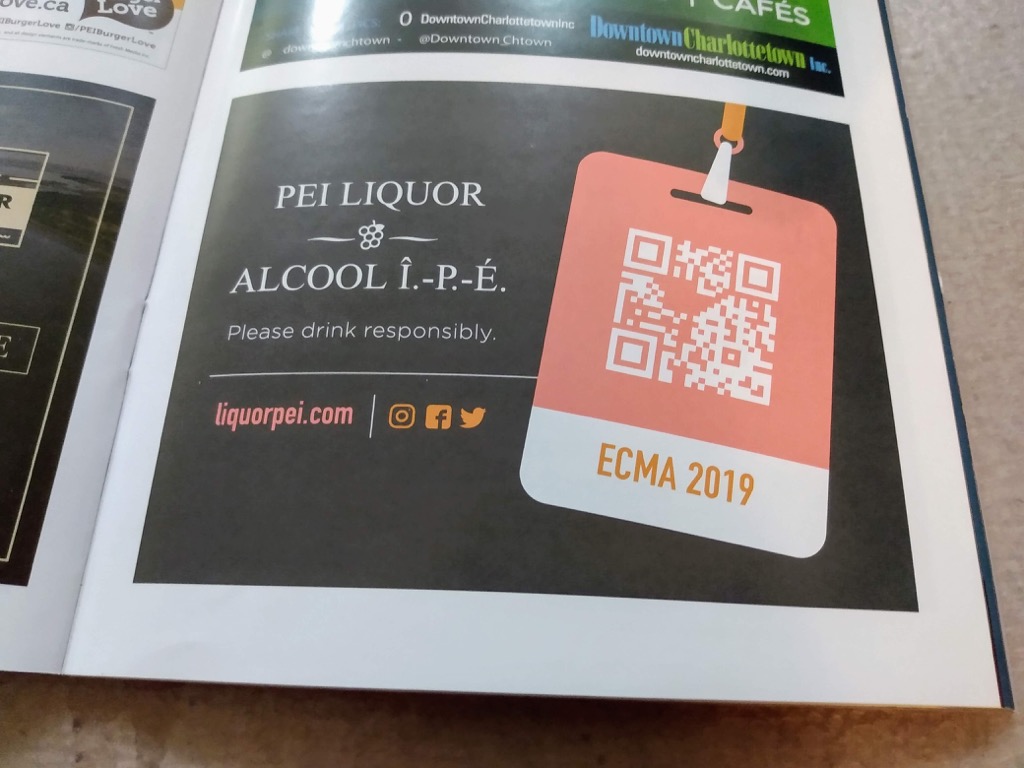
On page 73 of the 2019 East Coast Music Awards program there’s a half page advertisement for the PEI Liquor Control Commission:

ECMA program at for PEI Liquor

You will note that a QR Code figures prominently in the design of the ad; while leafing through the program this morning I noticed this, and I pulled out my phone to see what was encoded therein.

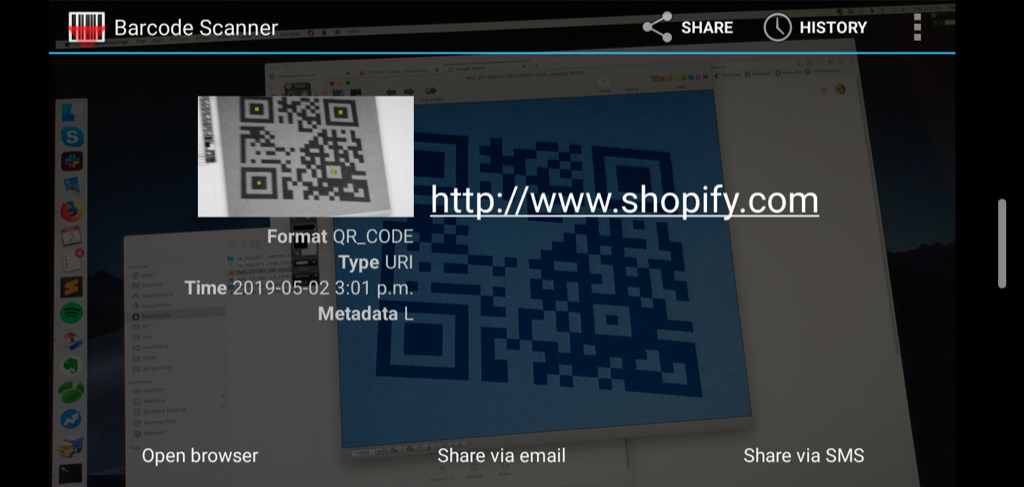
For reasons perhaps having to do with the QR Code’s non-standard white-on-salmon presentation, I couldn’t get it to scan; to do anything with it I needed to take a photo of the ad and then doctor the photo on my Mac, inverting the colours to be dark-on-light. Once I did that I could scan the code from my phone, where it unfurled into a link for Shopify’s website:

Scanning QR Code to decode shopify.com

I alerted the marketing department at the PEI Liquor Control Commission, and their response was that it was “a stock image that was used to create the ad for the ECMA program, and was not intended to be used as a functional QR code.”

While we all share a laugh about the folly of our government’s liquor regulator accidentally advertising for Shopify, there’s a more profound revelation to be gleaned here, and that is that QR Codes, always questionable to begin with, and of so limited a practical utility as to approach none, have now become digital tchotchkes so meaningless that there is apparently very little risk in dropping random ones here and there, safe in the knowledge that nobody’s ever going to scan them.

03 May 14:52

The Cycle of Spring

by Gordon Price

Bad pun by me, great shot by Michael Alexander:


03 May 14:52

Three jobs of a callout line

After Defne’s awesome monster Weekly Charts in the last 14 days (here’s number 1, here’s number 2), this weeks’ Weekly Chart keeps it small. Today we launched callout lines for our locator maps (they are lines connecting marker and label), and I wrote a few words about how to create them and when – so I will simply refer you to this announcement blog post and explain the importance of our new feature with this map:

There’s a lot going on in this map. Our new callout lines have three jobs here:

  • The one at the top (“Perleberger Brücke”) separates the signal from the noise. All subway stations on this map are labeled directly. But we don’t have a lot of space to label “Perleberger Brücke” directly, especially if we want to give extra information. Separating the label from the labeled element gives us more space for the label.
  • The one in the middle (“Brandenburg Gate”) doesn’t use a taken design element (the circle) while still pointing to a location precisely. Circles have one job on this map: They communicate “I am a subway station”. So we can’t use a simple circle marker to show a tourism trap one of the most impressive sights of Berlin, the Brandenburg Gate. A callout line solves that problem.
  • The one at the bottom (“This map only shows…”) does the job of a tooltip, while not being hidden. I like tooltips – but they have a hard time getting read. Bringing the information directly on the map increases its chances.

You can find a similar description of use cases for callout lines on our announcement blog post. Let us know what you think! And I’ll see you next week.

03 May 14:51

New in locator maps: Point to locations & markers with callout lines

Our locator maps just turned half a year old. Lots of you gave us really positive feedback in the last months. Thank you so much! Today, we made our locator maps a little bit better again. We’re happy to introduce lines that connect your markers and texts – also called callout lines, swoopy arrows, annotation lines, leader lines or connector lines. You know, these ones:

Up until today, you had to place your marker text close to a marker or location to make clear that they belong together. With callout lines, you can give them some space. Your label doesn’t need to be glued to the marker anymore.

How to create callout lines

How can you add callout lines to your Datawrapper locator maps? Simple: Click on a marker, then “more options” and enable “Draw line between marker and marker text”:

gif showing the process of how to create connector lines

You can then drag the text around (no need to hold Shift anymore while doing so!) and play with the line settings until you’re happy with the result.

When to use callout lines

You will find our new callout lines useful to help lead your readers’ eyes to important locations and make your map more easy to understand. Let’s take a look at some some specific use cases from some great newspapers and our own locator maps:

Label important markers on a crammed map

Sometimes there’s a lot going on on your maps. Callout lines come in handy when there’s not enough space to label markers or locations directly. But you can also think of callout lines as a tool to go big: Point the arrow to the most important location in a crammed space, then label it a bit outside of the mess with a bigger font, a highlight color and some whitespace. Your reader’s eye will be drawn to that label and will follow the line to the marked element.

Annotate with extra information

If you position the label in a calmer area of your map, you can make use of the whitespace there to add helpful information. Often, a map becomes easier to understand if you explain locations and their importance in detail. As a side effect, annotations will signal to your readers that these are points they should pay attention to.

Ensure the points you label stay visible

Sometimes, adding a big marker would cover the very thing you want to show. If that’s the case, you can instead choose the big circle ◯ to frame your locations, or skip the marker altogether by selecting the dashed circle ◌ from the symbol selector. To then ensure that users get what you’re talking about, use a callout line.

Clearly label areas or lines

It’s easy to to be clear about what a point marker is showing. It’s harder to do the same for areas and lines: Are they streets? Parks? Or something else entirely? Use callout lines to create a direct connection between the area/line and your marker text, to make it as clear as possible what you’re talking about: “This is the S-Bahn Ring. Not the line next to it. This line.”

What we paid attention to when building callout lines

Like with all of our features, we put a lot of thought into our locator maps. You can picture our locator map expert Hans and our CTO Gregor in front of whiteboards, discussing for hours: How swoopy should the lines be? What should the default distance to the symbols be? What should the default behaviors be?

A result of this thought process is our straight callout lines: They have the built-in tendency to be in 90° or 45° angle.

This way, your lines will always be in a 90° angle if you want them to – not 91° or 89°, but exactly 90°. Especially if you have a lot of callout lines, consistent use of 45° and 90° looks tidier. Harry Beck knew that, too. He was the designer of the schematic subway maps that show only 45° & 90° angles we’re used to these days. But we don’t want to be quite as limiting as Beck: It’s still possible to create straight callout lines in our locator maps with different angles.


We hope you like our new callout lines – but as always, do let us know if you have feedback, suggestions or questions. We’re looking forward to hearing from you at support@datawrapper.de.

03 May 14:46

7 of the Best Short Sleeved Cycling Jerseys for Spring and Summer

by Average Joe Cyclist

7 of the best short sleeved cycling jerseys for spring and summer7 of the Best Short Sleeved Cycling Jerseys for Spring and Summer explains all about how technical cycling jerseys work, and offers you a comparative choice of 7 of the very best. Cycling jerseys are technical garments that use lightweight, sweat-wicking fabrics to keep you cool, dry, and comfortable while cycling. This post has a chart comparing 7 of the best short sleeved cycling jerseys for spring and summer, plus reviews to help you choose the best cycling jersey for your needs.

The post 7 of the Best Short Sleeved Cycling Jerseys for Spring and Summer appeared first on Average Joe Cyclist.

03 May 14:46

A Mac Automation Schism

by Federico Viticci

Thoughtful take by Jason Snell on the recent discussion around the idea that Shortcuts may be coming to the Mac and what that could mean for macOS automation. Snell imagines a scenario where Quick Actions, introduced last year with Mojave, could act as a bridge between old-school Mac apps and a new breed of Marzipan apps compatible (in theory) with Shortcuts only:

Something funny happened in macOS Mojave. Apple actually brushed off some very old Mac OS X technology, Services, and gave it a rebrand as Quick Actions. Quick Actions are commands you can find in Quick Look previews, the Finder’s new Gallery view, and on the Touch Bar. Some are pre-built by Apple, but users can add their own by saving Automator actions as Quick Actions.

I have no idea what prompted Apple to bubble up Automator actions into more places in the macOS interface with Mojave, but Quick Actions strikes me as a pretty good companion to Siri Shortcuts. Imagine a scenario where apps originating on iOS can support Siri Shortcuts via the same methods they use on iOS. Now imagine that Siri Shortcuts can also use Quick Actions as a source for potential commands. Quick Actions are contextual, those old-school Mac apps can bring their own Quick Actions to the party, and users can build their own Quick Actions to do whatever they want. It would be a simple way to bridge the gap between the two different app types that Mac users will be using together, at least for a while.

As I argued on Connected a couple of weeks ago, I'm intrigued by the idea that a Mac version of Shortcuts could have built-in bridges for old automation tools (shell, AppleScript, Automator, etc.) to at least trigger those scripts from the new app. Quick Actions would be a great fit for this; in fact, I find the whole idea of Quick Actions is well suited the Files app on iOS as well.

→ Source: sixcolors.com

03 May 14:46

Tidbits for a Thursday, Pre-Weekend Reading

by Ms. Jen
Spring Hillside

May 2, 2019 – Here are some links for your pre & weekend reading. Enjoy. Photo above taken by Ms. Jen in early april while on a walk through Irvine Regional Park in California What’s the Opposite of a Cellphone Photo? Fintan O’Toole: Are the English ready for self-government? Westminster chaos affords preview of Britain... Read more »

03 May 14:46

Google Maps rolling out new ‘Popular dishes’ feature

by Jonathan Lamont
Google Maps iOS

Google Maps is rolling out a new ‘Popular dishes’ feature to some users.

The feature relies on user-uploaded pictures of food and drinks from restaurants they go to. Google began collecting these photos months ago and is now putting them to good use.

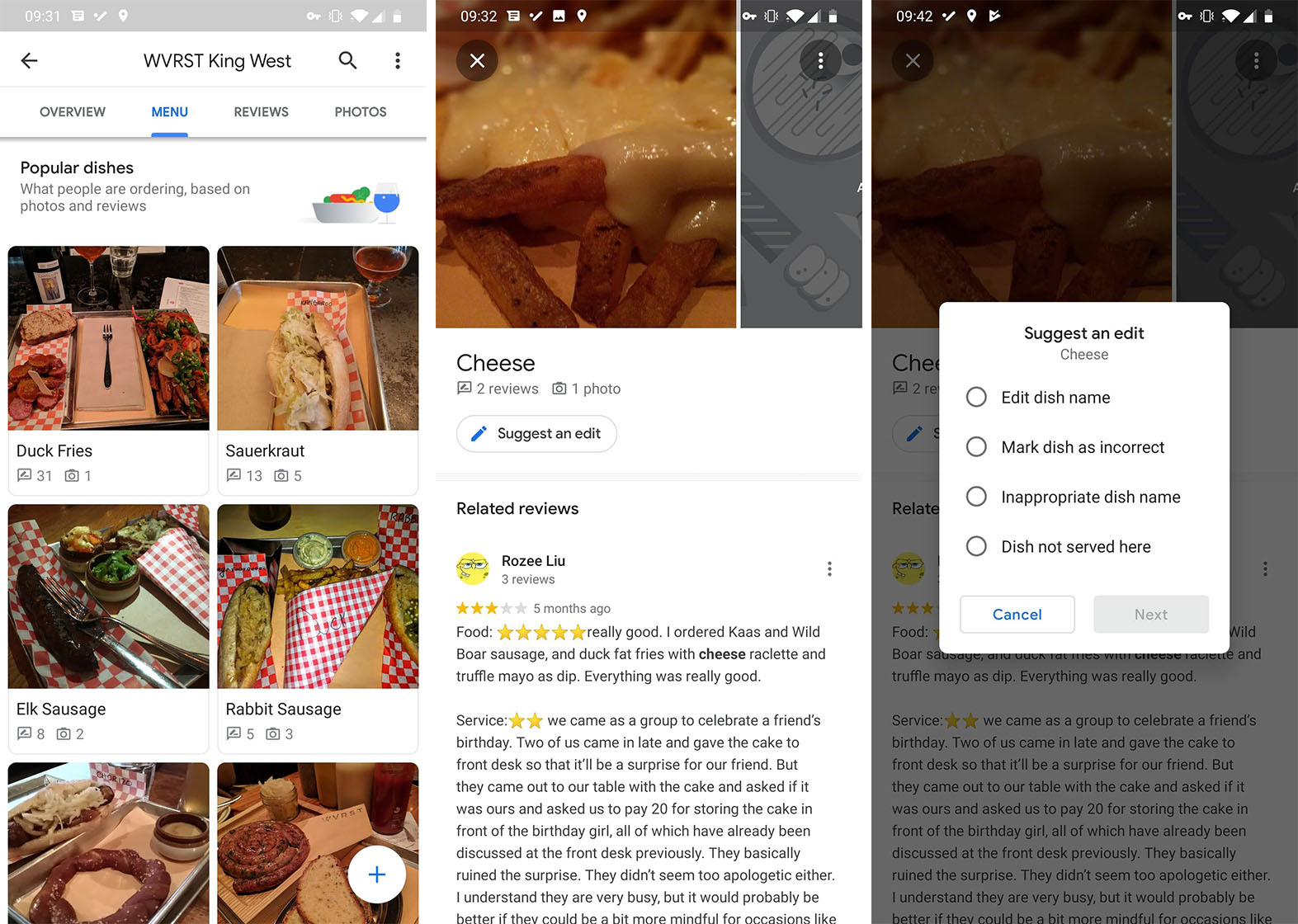
When searching for restaurants in Google Maps, you can click into a restaurant, and there should be a tab labelled ‘Menu.’ Tapping on that tab should surface the new Popular dishes page unless the restaurant uploaded its own menu to Maps.

Popular dishes is a scrolling list of large thumbnails showing foods from a given restaurant. Beneath each photo is the number of total photos and reviews for each item.

Further, clicking into a dish provides a carousel of user-submitted images and a list of reviews that mention the food by name.

Google Maps Popular dishes

Additionally, there’s a button to suggest edits if you spot a mistake, like a wrong dish, or an inappropriate comment.

Finally, there’s a floating action button (FAB) that lets you upload more photos of food.

It’s worth noting some users have had access to Popular dishes for a while, but it appears it’s rolling out to more people now. The feature is available on my OnePlus 6T, but an iPhone XS didn’t have it. Further, Popular dishes wasn’t available on the web version of Google Maps.

As with most Google features like this, it’s likely part of a server-side update, so you’ll have to be patient and wait for it to come to you.

Source: Android Police

The post Google Maps rolling out new ‘Popular dishes’ feature appeared first on MobileSyrup.

03 May 14:46

Dust may not be the real issue behind butterfly keyboards failing

by Volker Weber
Today we will be tearing down a MacBook Pro keyboard to try and see if we can rule out dust as a possible cause. Settle down, because this will be a bit of a long post. Hopefully you'll at least learn something from this.

Disclaimer: This post is not meant to answer why keyboards fail. That is beyond me and I can only offer theories. My goal is only to disprove the idea that dust causes no-input and multi-input style failures.

This is a very long post. Spoiler: If you type a lot on your butterfly keyboard, it is very likely to fail eventually. And that explains why so many writers have issues. They just use it more than the average person.

More >

03 May 14:40

Twitter Favorites: [knguyen] dang, this nails it https://t.co/PI51UJU6Rw

Kevin Nguyen @knguyen
dang, this nails it pic.twitter.com/PI51UJU6Rw
03 May 14:38

NewsBlur Blurblog: Pho: the story of a Toronto favourite explained

sillygwailo shared this story from TORONTO STAR.


To understand the complexities of this dish, it’s important to look at how it’s made, its relatively short but storied history and how its global popularity was inadvertently boosted by the end of the Vietnam War 44 years ago this week.


03 May 14:38

1960s Hamburg, Traffic, Skyline, Germany in HD from 35mm

by thekinolibrary
mkalus shared this story from thekinolibrary's YouTube Videos.

From: thekinolibrary
Duration: 03:28

1960s Hamburg, Traffic, Skyline, Germany in HD from 35mm from the Kinolibrary Archive Film Collections. To order the clip clean and high res for your commercial project or to find out more visit http://www.kinolibrary.com. Available in 4K. Clip ref CHX1371 CUT.
Subscribe for more high quality, rare and inspiring clips from our extensive archive of footage.

DAY EXT Panning top shot across Hamburg. 2 takes. Pan down from German skyscraper block showing name 'Deutsch Bank" ending on passing traffic R-L. 3 takes. Grey weather. Winter. Static shot over Hamburg. Pan from passing traffic to upper windows of hotel showing name "Reichshof". Hamburg traffic. DAY top shot Hamburg street corner beside river, traffic and trams passing. DAY EXT traffic down nice Hamburg street, affluent area.

Kinolibrary is a commercial archive film agency supplying high quality, rare and inspiring footage to media professionals. Our collections cover a wealth of eclectic and intriguing themes, locations and eras. Visit http://www.kinolibrary.com for more info.

WEBSITE: http://kinolibrary.com/
TWITTER: https://twitter.com/thekinolibrary
FACEBOOK: https://www.facebook.com/Kinolibrary/
INSTAGRAM: https://www.instagram.com/kinolibrary/

03 May 14:38

Ford government to review Ontario's cycling policy amid surge in e-bikes, scooters

mkalus shared this story .

The Progressive Conservative government plans to review the rules of the road for cyclists and a host of electric vehicles in Ontario, but the transportation minister says he "doesn't see a reason" to re-instate bicycle licences. 

With more riders hitting the streets, the province intends to examine Ontario's cycling policy as part of its subway upload legislation, Transportation Minister Jeff Yurek said Thursday.

"A review would ensure that we have the proper safety, roads, Highway Traffic Act, and other acts that we have to ensure that there's rules to follow for cyclists and there's rules to follow for vehicles," he told CBC Radio's Metro Morning.

The bill, introduced Thursday at Queen's Park, will tackle a range of transportation-related issues.

As part of this legislation, the province will get the wheels turning on the need to regulate electric bikes, scooters and skateboards, all of which are new to Ontario's transportation network, Yurek said. 

Electric skateboards are controlled by a handheld remote and have a range of about 12 kilometres. (David Horemans/CBC)

These power-assisted modes of travel have all gained popularity in recent years. 

But they require cities to amend bylaws and the Ontario Traffic Safety Act. Current laws prohibit the use of off-road vehicles on municipal roads unless the community passes a bylaw to allow for it.

Ontario is not the only province in Canada, however, that currently prevents the use of e-scooters, e-skateboards and e-bikes on its streets. Alberta and B.C. have similar laws on the books. 

The main goal of the government review, Yurek explained, is to improve conditions and ensure safe and accessible ways for Ontarians to get around. 

Aims to improve road safety for cyclists

Road safety for cyclists in Toronto has been a hot-button topic for years.

Canada's most populous city has been criticized by urban planners and cycling advocates for a piecemeal approach to cycling infrastructure, with many saying it lags behind other urban centres across the country.

In 2016, the city of Toronto announced its Vision Zero plan to eliminate road deaths. That same year, city council approved a 10-year cycling network plan aimed at expanding cycling infrastructure through a 525-kilometre bike lane network. 

Various bike lane pilot projects have popped up in recent years, from the Adelaide-Richmond cycle tracks to the now-permanent Bloor Street bike lanes, but advocates say other areas are lagging behind.

So far, Vision Zero hasn't made a significant difference. Toronto police statistics show 40 pedestrians and cyclists were killed in 2017, while 44 died the year before that.

While Toronto has committed to curbing road deaths, the city does not have an overarching rubric governing all aspects of transportation. 

A recent explosion in transportation innovations, including electronic vehicles and ride-hailing services like Uber and Lyft, have created need for a defined set of goals and principles across Canada and the U.S.  

Toronto, like other municipalities, has been playing a game of regulatory catch-up when new transportation services are introduced — such as when Uber arrived back in 2012. It took the city another four years before it formally regulated the ride-hailing industry.

Bicycle licences first considered over 80 years ago

Toronto abolished bicycle licences in the late 1950s. The move repealed a bylaw passed by city council two decades earlier that focused on riding on sidewalks, traffic law compliance and bike use by couriers.

But the PCs say they don't see the need to register and license cyclists to enforce the rules of the road.

"I don't see what the reasoning would be to license cyclists," Yurek said.

"It's something that we do as we're three, four, five, six years old, depending on your ability to ride a bike." 

A bylaw to license Toronto residents owning and using bicycles was first passed in 1935 but repealed in 1957 under then-mayor Nathan Phillips. (Nathan Denette/Canadian Press)

According to the city's website, staff have examined, studied and rejected bicycle licensing three times in recent history — most recently in 1996. 

Among the reasons the city says it's rejected the idea in the past:

  • The difficulty of keeping databases complete and current.
  • Challenges licensing children who ride bikes.
  • That licensing alone doesn't result in any meaningful change in the behaviour of those cyclists who disobey traffic laws.
03 May 14:37

Don’t Ask For More Resources, Ask To Raise The Bar

by Richard Millington

Asking for more resources is a fool’s errand.

You’re asking to increase the costs of the community without a clear benefit.

Why would anyone agree to that? They don’t see a crisis that needs to be fixed.

Instead, ask to raise the bar on the community’s potential.

“At the moment we’re achieving [x], but with another community manager and a better platform we can achieve [y]”

In many of our strategy projects, we present options based upon resources. i.e.

‘Here is what you can achieve at current resource levels … ’
‘Here is what you can achieve with an extra $80k investment …’
‘And here is what you can achieve with an extra $250k investment …’

Asking for more resources without showing the impact of those resources is a clear downside.

p.s. Learning strategic thinking skills is useful here.

03 May 14:37

If you’re interested in speaking at Velocity in...

If you’re interested in speaking at Velocity in Berlin this November, proposals are due on Wednesday, May 8th.

I’m on the program committee this year and am looking forward to seeing a bunch of great talks!

03 May 14:37

couldn’t be happier and grateful to be back in our second home

by Emily Chang

Photo Caption: couldn’t be happier and grateful to be back in our second home

Photo taken at: Waikiki, Hawaii

Instagram filter used: Normal

View in Instagram ⇒

03 May 14:37

A conversation with Rachel Liu

by Marek Pawlowski
Rachel Liu, Lead Service Designer, Pearson Education

Rachel Liu traces her path as a service designer to an early interest in making and a degree in computer science. She talks to MEX founder Marek Pawlowski about the evolution of her career, including the nuances of conducting complex user research in countries like China. The conversation touches on the way education in China has changed since Rachel’s earlier talk at the MEX/16 conference and goes on to explore skills Rachel is honing in herself and others to progress the practice of service design.

From episode 54 of the MEX podcast, first published on 14th February 2019. The transcript has been lightly edited for clarity, with an emphasis on preserving the character of the original recording.

Marek Pawlowski (MP): Rachel, welcome to the show. Thank you very much for taking the time to join me. Where are you dialling in from today?

Rachel Liu (RL): I’m based in the London office and yeah, it’s great to be here. Thank you.

MP: Well I was thinking probably the last time we caught up was when you spoke at MEX, which would have been a couple of years ago now. I always do a little bit of digging before I sit down to record a podcast with a guest. I’ve got to ask you something because in doing some research for this one, I discovered something that I didn’t know about you. I was looking down your LinkedIn profile and, according to that, you actually started out in the world of mobile with some time at Symbian back in 2006 and 2007. Is that right?

RL: Yeah, that was actually my first industrial placement as part of my course, which was doing computer science and business.

MP: Amazing. So this would have been just before the arrival of the iPhone and arguably the peak of Symbian’s arc as a platform for smartphones. I’m sure a lot of people who have come through the MEX community will have had experience in that world themselves. That was the starting point for many who have been involved with our conferences and podcasts over the years. But can you remember what it was like to be there at that time as a student?

RL: It was actually my first city experience, so that in itself was really exciting. I chose Symbian over Oracle at the time. I had another offer.

Symbian interested me because it was mobile and it was something that we weren’t taught at university. Knowing that it was an emerging technology at the time and exploring the potential of mobile and what it can do. It just felt like an exciting time, that I would not have been able to learn with Oracle databases, which I’d covered during university. It was an opportunity to think about it before the explosion of apps. What could it do? How could it help you?

I was just generally quite interested in that field, but also more from a maker perspective. One of the reasons why I did computer science was trying to think of myself as a maker, where I can create things. I used to love Lego – the creation and building of things. Computer science was kind of another tool. And that’s why I chose Symbian at the time. Being there, it was just great. Learning from so many people and extending the skills that you learn beyond the university into the real world. It’s just more exciting to see the possibilities.

MP: I didn’t realise that your degree was in computer science. I think you’re right: at that time, Symbian was probably one of the most interesting places to put those skills into practice. I mean for those listeners who aren’t familiar with the history of Symbian, I guess it was being looked upon as the smartphone platform of the future. It certainly had the largest market share around the world. Until, of course, the arrival of the iPhone, iOS and then Android. Symbian’s trajectory took a rather different turn and eventually fell into obscurity, but at that point, if you were using a smart mobile device, you were more likely than anything else to be using one which was powered by Symbian’s operating system. So quite an interesting place to be trying out those skills.

RL: Yeah. Also Symbian code is a very difficult language to learn, I have to say. So I think even learning it as a niche, it just makes you grow a lot. To be able to kind of go, well, I can write a mobile app. It is obviously so much easier these days but back then writing anything that’s an interface, even the smallest things, you were just like, “Wow, I can do this icon!” We’ve come a long way.

MP: Therein lies a bit of a clue, perhaps, as to why Symbian didn’t become the dominant platform. I think that’s a pretty familiar story for anyone who was in that world. Some of the challenges around coping with all of the different screen ratios, all of the different specifications, you know, coding these things using some pretty complex languages. It’s a world away from the speed with which we can deploy stuff these days.

Thinking to your presentation at MEX a couple of years ago, you were talking about some of the nuances that you’ve observed in China, particularly in relation to education, which is the area where you work now. But I remember distinctly when you were talking about that you were also sort of picking out some of the pitfalls that you saw in the first generation of ed-tech. You were talking about some of the things around cognitive overload, just too much information being supplied. This idea that more features are better rather than having a clear path for students. And also this age-old problem, which I guess was familiar back in the Symbian days, of trying to take an existing experience either from the world of print or desktop computers and channel that down into mobile without really thinking about what that makes. That was a couple of years ago that you were talking about that at MEX, but I’m wondering, having been two years in the role that you are now with Pearson Education, what do you feel the situation is today? What’s changed since you gave that presentation?

RL: Well, I think one of the interesting thing that has changed in terms of China is the speed that they’re innovating and that we really have to be quicker.

On my trip last year, I was just so surprised how mobile native they are. Not just digital native, but mobile native. In terms of payment, it is now so cashless that even trying to flag down a taxi, I couldn’t flag one down. You have to use the app and I couldn’t use the app because I don’t read Chinese. So I can’t pay, I can’t connect it to a local payment. It made me feel quite disabled. It was really weird to find that in few years it had become so cashless. That was one thing that I observed in particular for China as a whole.

For education, it’s still buoyant, it’s still in demand. They are really thinking about AI a lot and Pearson is kind of going through a transformation itself from print to digital.

I see different levels of maturity within Pearson. I’ve been in a project where they innovate like anything and they really understood how to provide the service. Thinking about the online and offline experience for learning and really combining that mix, it was brilliant. It was more greenfield. Again, the demand was coming from China, not in the rest of the world.

MP: What does the Pearson name mean in China? When you turn up as a representative of Pearson, what sort of connotations does it have in the world of education in China?

RL: Funnily enough, the project I was working on, they weren’t known as Pearson. It was a different brand. It was ‘Wall Street English’. Branding is really important. They don’t really hear much about Pearson. They hear about the Longman Dictionary. That’s something that they’re quite familiar with.

MP: So these are individual properties that Pearson owns and then uses that local brand in China?

RL: Yeah, because they don’t have the understanding of Pearson as much, but they do understand Pearson in terms of tests and assessment, which was quite interesting to know that hey, it might not be for the learning aspects, but maybe more the assessment aspects of the education system. That was kind of, yeah, new to me.

MP: One of the things I remember from your presentation at MEX was that you were talking about some of the fundamentals that you’d observed in earlier trips to China about the difference in the way education is seen there. I came away, and correct me if I’m wrong, because this was a couple of years ago, I remember having this impression that it was a real case of laws of supply and demand giving a bit of a different situation. There was greater demand than there was supply of good quality education in China. Therefore it made it this really competitive place for Chinese students and that you didn’t get second chances, that you had to be succeeding at all levels of education to progress to the next step. Is that something which continues to inform the sort of appetite there is for these digital education experiences?

RL: Well I found that really interesting. At the time I was looking at the teenager group and the parents. And we’ve also looked at the slightly younger ones I think over the last two years: from five to about ten years old and their parents.

What was interesting was that there is that generational shift where parents actually really care about the kids enjoying the learning process. Now that is something that was quite different to what I had seen. Parents who obviously had some sort of education and can still afford to, they want their kids to enjoy and have a good study habit at the beginning rather than going, “Oh I have to memorise, I have to cram.” Because that was their experience and their pain point and they don’t want that anymore for their kids. But at the same time it’s still competitive because they’re starting earlier.

They are trying to learn English and get ahead. Not just the teenagers anymore, but at three or five years old, which was really interesting. So the demand has shifted younger. That was for us just, yeah, it was a very different take on things. It’s again knowing that, hey, it changes a lot of the time so you have to still go out there to do research. I mean that is one key thing, knowing to be aware of the assumptions that you are making and that just because something was that way a few years ago, things are changing, you know, throughout time. It means that you do need to check-in as well and make a conscious choice of who you’re looking at. Who are you talking to? And that might change that sort of dynamic. So it’s ever evolving.

MP: As a service designer it’s hard to think of a meatier sort of challenge to get stuck into because, as you say, you’ve got multiple different stakeholders there. You’ve then got, within that, multiple generations of different stakeholders who might have different attitudes, whether those are the students or parents – who are at different stages themselves – or the teachers and the different attitudes there. I mean that’s a pretty complex set of stakeholder requirements to get your head around.

Do you think that working for an organisation like Pearson, or in general with what you’re seeing in ed-tech, people higher up the organisation are now starting to understand the value of really digging in to the research nuances of those user behaviors and then rolling that into the way the product is developed? Is there an understanding of just how important it is to get deep into the lives of those different stakeholders?

RL: Because we started as a new team – there were three of us when we joined – and it was part of global products, but working more like an agency, we didn’t get siloed. We look at different problems and I think that’s very helpful actually to know that hey, there are different levels of maturity. Within our stakeholders there are different levels of understanding. So how do we even bring value within UX when they don’t understand it either? So there’s that challenge in itself of showing evidence in really in a compelling way and having the sort of narrative and how you present back the insights is actually quite critical.

Also, getting them involved in the process. I think before I looked at stakeholders like a barrier. There was a lot frustration. But now I’ve changed the way of thinking where actually we need to have empathy for our stakeholders and how can we work together better? It’s a complex problem, as you said. It’s a system level problem, which means you need to have different perspectives and actually they can also bring in certain value too. You can use that to kind of go, okay, well these are assumptions here, this is what we are thinking and then go out and validate those. Having that sort of methodology and that kind of thorough process and guiding them through that has been super helpful for them to understand. For them to really see the value as well.

MP: Here, I guess we are thinking about stakeholders in the internal sense as opposed to external? When you’ve experienced those barriers in the past, and I guess everyone in a role like yours experiences this to some degree, there’s always that sense of balancing the sort of time commitment that people have to make to understand the kind of research that’s flowing from your work and presenting that in an effective way away that actually makes a difference. What have you found to be most effective? Have you found there are any real transition moments where people start to get the importance of what you do and it starts to have an effect on their own work?

RL: I actually found the first part is really starting small. Don’t underestimate the power of small. Before, I took things for granted, thinking we have to prove things by doing some usability tests or we have to prove by starting to show some of the interaction design level. You know, a bit more solution focused. But actually, it is just about showing things in a tangible way and it’s kind of useful to almost bridge the gap and build the trust. I found that’s kind of key.

MP: Another thing I wanted to ask you about is, if you look at where you’ve got to, the kind of work that you do, which would be defined I guess as service design or experience design and then you think back to where you started with computer science and that time somewhere like Symbian, was there a moment when you started to think of what you did more in terms of design rather than computer science? Do you see a differentiation between those two things? Or is it all part of that maker spirit that you alluded to, of just wanting to make change happen in some way?

RL: I’ve always really loved art and design from a young age. I even got disqualified from an art competition. They didn’t believe that my parents didn’t help me with the competition. So that was quite interesting. I’ve always had it in me. That’s kind of like my inner child.

MP: What was the piece of artwork which earned you this disqualification?

RL: Okay, we were living close to a Homebase store at the time and it was a Christmas card competition. They didn’t believe that I could make a pop-up card at the age that I was. I think I was 10 or something at the time. So I got disqualified and I didn’t win my 20 pounds. My classmate won and we made their card in class! Funnily enough, a lot of my school friends still remember that.

I’ve always enjoyed the creativity part, I guess. And I wanted to combine the two. Knowing that technology is almost a vehicle and it’s exciting in that space. I mean the reason I took computer science with business is also thinking about the business aspect too. I’ve kept it quite broad for a reason. The challenging part was combining it, but the emergence of UX kind of came about at the right time. At the time it was disguised as more human-centred design or computer design, so it almost evolved as I evolved with the role. It was kind of good timing in a way.

MP: It’s really interesting hearing the different paths that people who started around the same time that you did have taken. When you think back, the definitions were very fluid and a lot of what is now seen as being user experience work – as a kind of broad, umbrella term – was being made up as people went along. Yes, there were some educational backgrounds which perhaps were more inclined towards leading that way than others, but all the stuff that was being done was so new that it was requiring that those educational definitions be changed. I’ve had people on this podcast who got into this world through theatre design or anthropology. It really seems that, if anything, the more diverse the background, the more likely it was to lead to doing interesting and useful work as your career progressed. That would certainly seem to bear out with the path that you’ve taken as well.

RL: Well, I think that’s what I really love about being in UX, right? It’s the fact that it is so multidisciplinary. You can learn so much from other people because they bring in a new perspective. It’s making sure that you have that life-long learning spirit. It enables you to do that because you problem solve in different ways. You don’t want to use the same methodology. You want to push yourself a little bit.

That’s probably why I enjoy being in UX compared to being in software development where they think of things very logically and black and white in some aspects. It’s difficult to look at things in a new perspective because they want to be proven right or wrong. UX allows a kind of evolution and fluidness, which I really like.

Being in the education sector is another area where people do generally want to grow in some ways. A lot of the backgrounds are from teaching and they generally make great facilitators. They can often actually transition to UX if they want to. I have actually mentored someone through that within Education First, at my last job, and I see that it is possible. It’s really important. It’s useful to have people from different disciplines.

MP: Looking across the whole of your career, this strand around education seems to have been a recurring one. You spent that time with Education First and now you’re working with Pearson Education. I guess it begs the question in my mind, do you see yourself as being a teacher first and foremost? In the roles that you now do, as well as obviously having deliverables that you’ve got to produce for your stakeholders, does that interest in education come from a desire to in some way teach and coach and pass on what you know?

RL: Yeah, I think it became quite natural. People in my team have actually pointed that out. Even in one of the workshops I had to facilitate, where we had people that I’ve never met before, it was one of the key things they mentioned. They were like, “Were you a teacher in your past life? Because the way that you share the stories, the insights and everything, you just bring them to life like as you would do as a teacher.” But then a lot of the skills are quite transferable, in a way. Everyone could be a teacher in some ways. Everyone!

You’re both a teacher and a learner. I think if you have that kind of mindset, then you can be more curious and you want to learn more and you question things more. I think that’s fundamentally how you grow. I’ve seen how people think about motivation, how people think about building habits. You know, these are kind of applicable for everyone, not just within education itself. It’s just part of growth.

MP: I’d agree with that. I mean I’ve always had this working theory that the key thing in motivating someone to be an effective teacher is whether or not they are passionate enough about the particular subject area to be excited about passing it on to someone else. And it doesn’t matter whether you’re talking about woodwork or whether you’re talking about digital design or whatever it is. If someone is genuinely enthused about what it is they’re trying to share, then they find effective ways to share it. Of course there are some skills that you can learn to improve that – some techniques – but I think it’s got to start with that, that passion and enthusiasm.

RL: Definitely! The best teachers I’ve seen are the ones that just keep you engaged. They keep you engaged not just by sharing what they know and presenting stuff, they actually find really creative ways for you to learn and immerse yourself in that learning process. It’s not just like a lecture delivering things to you, instructing you what you need to learn. That’s why I find different ways of learning valuable, like peer mentoring.

You can also have different kinds of delivery format. Some people prefer just to have it kind of bite size and listen to certain podcasts. It’s kind of making and creating that environment for you to grow. Finding one that works for you is important and that’s been quite key for my different career transitions.

I know I learn by doing, I learn by immersing myself, I learn through other people, I learn by shared experiences. It’s kind of informal learning, in a way. Education makes it very formal with assessments, but it doesn’t have to be that way.

MP: Do you think that gets harder as you get further on in your career? To strike that balance between the demands on you as someone who has now had a certain number of years of experience to share, to teach others, versus keeping that desire for ongoing learning fresh in yourself? Do you think about that balance and how you strike that for yourself?

RL: I think you have an awareness once things start to get a bit mundane or you perceive them to be a little bit boring. It is almost a signal and you kind of go, right, I’m probably in my comfort zone. I’m not being stretched enough.

MP: Ah, that dreaded comfort zone.

RL: Yes. I think that’s almost a trigger to think, well, okay, how else can I grow? And actually if we want to break silos, if we want to really have good user experience, then you have to have uncomfortable conversations. Like, with marketing departments. They might not naturally want, or have the same values or care about the same sort of things that we do. But if we want a better experience, we have to find ways to work with them. So you can already say that’s maybe a bit of a stretch. Then you’re like, “Well how can I kind of facilitate a healthy conversation with them to start a moving vehicle for change?”

I think that looking at very different disciplines to your own actually really helps. So, yes, I look within education, but I’ve also started to look a lot within health because that’s something that’s very important to me. You see what are the constraints within the systems that we have in place.

Taking a step back helps you to look at things differently, so I purposely sometimes immerse myself in uncomfortable situations. So say I know personally that I don’t like talking to people or I don’t feel comfortable talking to people who are more senior than me because somehow I feel that I maybe don’t have the authority or don’t have the knowledge or don’t have that wisdom. So it puts me off and then I’m not myself. Now I purposely use that as a challenge to try and break that and actually accumulate those little small wins. That is growth, when you’re learning new tools and techniques on the way.

MP: Absolutely. While ‘seniority’ can sometimes be a reliable guide to the level of wisdom someone is able to share about a particular situation, something I’ve found over all the years of doing MEX is that it’s often not the most reliable guide. In the moment, I’ve seen – particularly at our MEX events – outstanding contributions from people in the room who have probably got the least ‘seniority’, so to speak, in terms of being at the very earliest stages of their careers – having just come out of, say, a university course or being in their first role. But by virtue of enthusiasm or by virtue of, as you alluded to, that desire to dip into diverse different industries and diverse different experiences, they’re able to bring something to a conversation that someone who has been in a role for 20 plus years just doesn’t have access to.

It’s so important to have all of that coming together at different places. I mean, I often think about it in the context of events, because that’s what we do, and the need to have that diversity of people involved with events. But I think it’s true, whether that’s in your day-to-day work or whether that’s in the conversations that you’re having. It’s amazing, and perhaps this is something that you are now starting to get a sense of as you spend more time in this career, how much you yourself value speaking to people who, say, have just come out of university because they have a different set of wisdom to the one that you have access to. And it’s no less valid simply because they haven’t been in their career as long as you have.

RL: Exactly! And I think sometimes that even comes down to the way that we introduce ourselves, right? We start to say job titles rather than really uniting in a way that is about a topic or an area that we’re really passionate for. Starting from there really helps because it kind of removes all of those invisible boundaries that we put in place.

An example is that recently one colleague within Pearson, they decided to launch a book club, a virtual book club. It was about women playing big. Because we tend to play quite small, so how do we play bigger and make bigger impact with what we want in the world? It was really interesting. The people that came together, and it was a huge variety coming together, to discuss topics like, “What does it mean to me to play big?”. That is applicable to anyone.

It was just really interesting. The different phases of their lives. The ones who are returning back to work after being a mother kind of going, well I don’t have that confidence anymore to make that career change, I don’t know how to fit it in and stuff. That itself is a much more deep and meaningful conversation because we don’t judge, we don’t make that judgment and we don’t associate with job titles anymore. It’s really about that kind of topic or a problem – that we have a shared common thing – that gets us together and connected.

MP: It’s that thing of multiple perspectives and the value that they deliver. I mean it’s fundamental to user research. This is why we go out and try to speak to such a range of people. When you’re thinking about how that might then go on to inform a product or a service or a long term strategy. You often see things from a different perspective and you get your insight from having those different lenses to look at a situation. If there is an inherent value to being in this sort of world of UX, it is that it gives you that understanding of its value because that’s what you’re doing day to day when you’re going out and talking to people as part of your research process.

RL: Definitely, but there’s also something to keep in mind that certain cultures are not naturally as open or are more reserved. I think that’s something that’s really important. How do you bring in those people that probably don’t have a voice? How would you create that safe environment and that space that they can feel comfortable to share? Because it’s not within their norm. Say, like for Japan, I know that the whole hierarchy – that invisible part – there is a lot of respect for elders and so forth. Even within Chinese cultures – I see that as almost a constraint for myself sometimes.

MP: What’s been your hardest experience of that? Because I guess in the work that you’ve done, you’ve had particular exposure to this. You’ve spent time doing this kind of work in places like China. There’s always been that sort of sense of going out and being a bit of an explorer into other markets and other cultures. In the work that you’ve done, what was the hardest one that you had to overcome to get people to open up a little bit more to get the kind of insight that you needed?

RL: Interestingly enough, a lot of it is not particularly from the users when it’s a one-to-one. It is definitely when we’re doing ideation or sharing things with internal stakeholders and there’s the hierarchy level. I actually find that is the harder one to really get their voices heard, to get their ideas and their input. So the ones who are actually on the ground running the surveys, running the processes, versus the ones that are their managers that are overseeing it. That’s the challenge I found time and time again. They’re being a bit cautious and they’re not familiar or, find it very unusual almost to kind of have this open, collaborative way of working and recognising that. It’s almost like, well, how do I create that first safe space for them?

MP: Have you had any examples where you feel like you have been able to cross that chasm and get people to open up? Any techniques which you feel are particularly effective at getting to that point? It’s a tough thing, I guess, and it probably differs from market to market, from situation to situation?

RL: There’s this book called Culture Map that I read and it’s a really good framework to think about. They really mapped out all the different ways. Whether it’s communication or whether it is autonomy. You know, the full range. And seeing where vaguely they are at. So you’ve got to be aware whether it’s within their personality or whether it’s a cultural thing. Even distinguishing that first.

And building relationships remotely I think is quite tricky. But I do find having a conversation with that person on the one-to-one first always makes a difference. Sometimes they feel comfortable thinking through certain things, so they’re a bit more reflective and giving certain things up front for them to think about. That helps them out to kind of navigate through this uncertainty thing. Yeah, I do feel every single time that slight one-to-one before a workshop, before anything, getting to know them a little bit – on the personal level that makes a huge difference in some form – whether it’s virtual or whether it’s face-to-face.

MP: It reminds me of a story actually. A friend of mine, going back a few years now, ended up being the sort of ‘go between’ for an American organisation which was acquiring a Finnish organisation. I remember him talking about one of the things you just alluded to: that need to recognise that different cultures have different cadences of thinking and sharing those thoughts back to a group.

The particular challenge he had to try and help, I guess both sides of that equation to overcome, was this: the American company was used to situations where if there was a silence in a meeting, it was generally a bad sign. The fact that the conversation had ground to a halt. Whereas for the people working in the Finnish organisation, that was very much part and parcel of the culture. It’s an expectation that if a question was asked, time would be given to sit and contemplate and come back with a meaningful answer.

He ended up being in the role of cultural facilitator between those two things – to help each side understand that no, this wasn’t actually grinding to a halt – that in fact this was just part of it and they were going to get to where they needed to, but there just needed to be that understanding and that respect of the different cadences of thought between different cultures.

RL: Definitely. I mean that book explains it really well with some of the things I observed. I had to learn through the mistakes that I’ve made too. One key one is when at the end of a meeting, someone asks: “Any questions?” Well, not everyone is comfortable with that. Maybe if there’s a channel and a way that they can just follow up a bit more privately, they might be more comfortable. I know that for Asian cultures in particular that seems to be a recurring theme to be able to do that a bit more.

MP: I’ll put a link in the show notes to the book so that people can check it out and hopefully find some useful tips in there.

Do you ever think about the role of fun in that? It makes me think of some of the sessions which Patrizia Bertini, who’s been involved with the MEX initiative in different ways, has run for us over the years. She uses the Lego Serious Play facilitation method, which has a natural element of playfulness and fun to it that tends to get people to open up. One of the particular techniques I remember her explaining was this way in which you have to try and get people to leave their previous baggage at the door of a facilitated creative session, particularly when you’re trying to do co-creative activities. To try and find some way for people to tangibly express that they’re no longer so and so, X-Y-Z job title, representing X-Y-Z company. Actually they are someone who just has a certain set of characteristics or a certain approach to creativity that they can bring with them without that kind of baggage. Is that something you’ve ever come across in the work you’ve done?

RL: That’s actually a really good point. We did some co-creation with kids and naturally you have to make it fun for them to engage. We’re quite lucky that we have an experience lab in London where we have bean bags, that is quite modular in terms of design, and we can make it into a meeting room, we can make it into a brainstorm room, we can make it quite lively. Even the colors. We can chose to make it a bit more colorful, put a bit of music on in the background so it’s not silent when they’re drawing away, creating stories for us. It’s finding the medium that resonates with them, that people universally understand. That was quite key.

Observing teachers, how they add the element of fun to their warm-up, how they loosen people up. That is quite a good way to see it. I probably, without even knowing it, incorporated elements of that and brought that into my sessions. But you’re absolutely right. I mean getting them to just be a bit looser and not think about it as, like, we need to get to your ‘correct’ answer, we need to be quite rigid about this and being quite serious about it. Loosening up is probably quite key.

That kind of icebreaker needs to be done a little bit differently too. Not relying on the generic ones that you have, but within the problem that you’re solving, asking is there a different way to kind of get people together?

Show that bit of vulnerability as well. Sometimes I’ve found that was quite helpful for me as a facilitator to add that bit. By being a little bit vulnerable it shows that, you know, I’m open, I’m honest and it kind of has that welcoming aspect to it. But if you think about how would I make it fun for kids and would they join in, I find that it’s a good way to almost naturally bring in elements of fun.

MP: It also gets to this idea about what it really means to be in the world of experience design and in some sort of role which is tied to user research going forward because these are not necessarily the traditional skills that have been associated with this area. Yet they are so vital to the future of it now that almost every organisation is putting in place some kind of user experience function, with more or less degrees of effectiveness. But now that’s become kind of table stakes, the question then becomes, well, how do you ensure it remains a competitive differentiator? What are the skills of the people who you’re putting into those roles, that are going to help you to drive it to the next level?

Is this something that you are thinking about in relation to your team at Pearson? It sounds like you’re in a phase where that team is going to grow over the next little while. Are you starting to think about the kind of people that you want to bring into those roles? Who might have that additional level of skill to be able to facilitate in more creative ways to be able to draw out more insight than perhaps the traditional methods?

RL: We’ve started to do some of that internally, but it is reaching the point where I’m like, “I need different ways.” What you mentioned about the person who is in that kind of theatre design background, I mean that’s brilliant. Acting – that is a really good way to loosen up and prototype.

We’re at that stage where we’ve grown quite steadily I would say, in a good way. I didn’t realise that actually I was thinking about culture within the team, that each individual plays a role in shaping that. Before I was just like, oh well I need to try and push that, or trying to create that space. But everything that I do and even small things and actions accumulate and add to that culture.

It’s almost facilitating and giving them the freedom to make things happen as well. It’s less about telling people what to do or how to do it. It’s giving them the space and the permission to actually explore and experiment a bit. That’s something that is still hard to convey within Pearson, in the sense that we talk a lot about experimenting and we talk a lot about ‘you can fail’, but I still don’t see those kind of risks taken. It’s almost like, “Oh well you kind of failed, but hey…we haven’t.” It’s still within that little bit of comfort zone, so how do we push that a bit more? The ones who are a bit more risk taking, a bit more of a change agent sort of mentality and quite adaptable.

It’s probably quite important. Building that resilience within our team is quite important to navigate through some of the challenges that we have as we grow out. That’s something that I haven’t thought too much about but because we are just about to hire our first service designer, yes, I am starting to think about what form that might take. I mean, from your experience, what did you find that has been useful?

MP: As you say, often one of the biggest challenges can be that trade off between the sort of security of the well trodden path and one which stays within acceptable parameters for success without taking too much risk. If we recognise that there is a value to taking what could be perceived by some as being a risk of bringing on people with, say, a more diverse background, bringing on people with experience which seems tangential rather than directly related to an area, but that you feel may expand the overall team’s capability by bringing in those different viewpoints. Then it seems to me that really evidence speaks.

So the more people, not just within your organisation but across this whole community, can do to document how those kinds of experiments went and what were the hard parts, what were the parts which work better than expected. To sort of provide the community of practice with the body of evidence, which allows people to justify that more easily. Then maybe it becomes a simpler thing to be able to go to budget holders or people who may be not as familiar with the day-to-day of the area and say, “This is what we need to do,” and to take what can be perceived as a risk because you know that it’s going to lead to a greater reward in the future. That’s easier said than done. Often teams have got enough on their plate just fighting for day-to-day things and trying to keep the team growing and delivering to the deadlines that it needs to deliver to. But I’ve had the chance on this show to speak to a few different people who are trying different ways.

One which springs to mind is the stuff going on at Lowe’s. They’re the equivalent of B&Q – a big DIY chain in the US – and they were able to get a mandate, I guess from higher up within the organisation where there was a real belief that you need to try some different things. They were trying all sorts of different experiments. Everything from producing a comic book, which illustrated some of the things that the organisation might aspire to do differently in the future, to building these big immersive environments to test out some of the new technologies. And because they were able to tell a story around it, because they’re able to document where that succeeded and how it related back to the business, I think there was an awareness from the senior members of the team that storytelling had to be compelling to take people along on that journey with them. They were able to build that step-by-step and have some success with it. So I guess there’s probably always going to be that element of understanding that if you want to push things forward, then you’ve got be conscious that you have to tell a story which allows others who don’t understand the nuance and the detail of what you’re doing, because it’s not necessarily their day job to come along on that journey with you.

RL: I’ve actually found that even storytelling through talks and I think, in everything that I do, it’s something that people can use to relate to me more easily. But it’s also a bit of aspiration and inspiration. Sometimes I feel that the story can be told a bit more visually. That’s quite compelling, I think, for them. It draws their attention.

MP: So I guess we get back to that power and value of teaching again. And I’m curious, if you weren’t working in this area of digital experience design, what would you choose to teach?

RL: That’s a really difficult question because I have so many interests!

MP: Well, I guess you didn’t come on the podcast just to do the easy questions?

RL: I guess one part is that I’ve been on a journey of wellbeing and holistic health and lifestyle. The eastern world has taught me about ying and yang, the balance. Things in harmony. That has been eye opening. I think about wellbeing because a lot of times we think about being prescribed things by doctors. People fix us instead of looking at solving these problems for ourselves. That has been a big limitation for me previously. I never thought about it in that way. How having and cultivating certain good lifestyle habits makes a huge difference.

Also being able to live quite mindfully. Mindfulness plays a big role. I think in everything that we do we can be better by being mindful, as designers, as human beings. Technology and everything moves so fast. We forget to be present and to be whole and to take space. I found that’s really important and that’s a message I would like to share from my own personal experience.

MP: It’s one of those really important balances in all walks of life. I do feel there’s a particular urgency to it for people who work in roles which naturally are at the cutting edge and at the very fastest pace of technological development. Also with that added responsibility of being in a role where you need to have an ongoing empathy and a really deep empathy for the people that you’re trying to understand in your role as an experience designer. That requires a lot of mental bandwidth. I think it is probably very important that people take the time to remember there needs to be a balance and there needs to be a mindful approach to that. Otherwise the sort of pressures that you put on yourself to remain at the top of your game in both of those areas can be pretty demanding.

RL: Exactly. I think that is something that I had to try and work to overcome. That kind of resilience is probably a good way to put it.

MP: It’s been such a pleasure catching up Rachel. It’s great to hear what’s been happening since you last spoke at MEX. Do you stay in touch and it would be great to hear what else comes out of your work at Pearson and what else comes next in your career.

RL: Wonderful. Thank you so much for having me. It’s been great.

For further reference, the show notes for episode 54 contain links to many of the things Rachel and Marek discussed. Hear future conversations first on the MEX podcast. Subcribe on Apple PodcastsSoundcloudStitcherTuneIn or by searching ‘MEX Design Talk’ in your favourite podcast player.

03 May 14:31

Ericsson opens AI hub in Montreal to focus on research and development

by Shruti Shekar

Swedish telecommunications equipment provider Ericsson has opened the doors to its new artificial intelligence (AI) accelerator hub in Montreal and intends to create more than 30 new jobs.

The global hub will primarily focus on research and development in AI and automation and will leverage “cutting-edge technologies to create data-driven, intelligent and robust systems for automation, evolution and growth.”

The new hub will create more than 30 new jobs for data scientists, engineers, AI/machine learning architects and software developers this year, Ericsson said in a release on May 2nd. The company says there could be more job creation in the future.

Ericsson’s current Montreal office houses 1,000 employees and the location is one of the main partners of ENCQOR (Evolution of Networked Services through a Corridor in Québec and Ontario for Research and Innovation). ENCQOR is a partnership with other tech companies and the government that is focused on research and innovation in 5G technologies.

The company has other hubs located in the U.S., Sweden and India.

Innovation, Science and Economic Development Minister Navdeep Bains was at the unveiling and gave MobileSyrup the following statement: “Ericsson selected Montreal as the location for their new AI Accelerator, which is a testament to the thriving AI ecosystem that is here. We are pleased to see another industry leader expand their operations here, and we look forward to collaborating to further position Canada’s position as a responsible AI leader.”

Image credit: Wikimedia Commons

The post Ericsson opens AI hub in Montreal to focus on research and development appeared first on MobileSyrup.

03 May 14:31

Razer confirms it’s actually making a toaster

by Patrick O'Rourke
Razer Toaster

Yes, you read that headline correctly — and no, it’s not April 1st.

What started as a joke by gaming computer and accessory company Razer back in 2013, eventually evolved into the ‘Give Us the Razer Toaster Please Facebook‘ page.

Now, the company’s CEO Min-Liang Tan says that the PC gaming hardware company will actually create a Razer-branded toaster, formerly known as ‘Project Breaderwinner.’

“I’m going to put together my team of designers and engineers. It will take a few years, but I’ll be sure to share the progress,” said Razer’s CEO in the Facebook post. Tan’s full Facebook post regarding the announcement can be seen above.

Razer fans are reportedly so passionate about a toaster with ‘gam3r’ green lights that some have gone so far as to get tattoos of the eagerly anticipated device. The Razer Toaster fan page hasn’t hit 1 million ‘Likes’ yet, with it only netting roughly 45,000 so far. It seems that as far as Tan is concerned, twelve Razer Toaster tattoos was enough to make the joke into a reality.

I’m hoping the toaster features programmable RGB lighting.

Source: Facebook, PC Gamer

The post Razer confirms it’s actually making a toaster appeared first on MobileSyrup.

03 May 14:30

Samsung expands artificial intelligence lab in Montreal

by Bradly Shankar

Samsung is expanding its Samsung Advanced Institute of Technology (SAIT) artificial intelligence (AI) Lab Montreal to deepen its focus on research and drive competitiveness in system semiconductors.

Located at the Montreal Institute for Learning Algorithms (MILA), the AI lab will work on research to “develop disruptive innovation and breakthrough technologies, including new deep learning algorithms and next generation of on-device AI,” according to Samsung.

In addition to recruiting more AI experts, Samsung is planning to dispatch R&D personnel in its Device Solutions Business to Montreal over time to train researchers and collaborate with other institutes. Some of the lab’s partners include the University of Montreal and McGill University.

“SAIT focuses on research and development – not only in next-generation semiconductor but also innovative AI as a seed technology in system semiconductors. SAIT AI Lab Montreal will play a key role within Samsung to redefine AI theory and deep learning algorithm for the next 10 years,” said Sungwoo Hwang, Executive Vice President and Deputy Head of SAIT,” in a press statement.

Source: Samsung

The post Samsung expands artificial intelligence lab in Montreal appeared first on MobileSyrup.

03 May 14:30

What to expect from Google I/O 2019

by Igor Bonifacic
Google I/O 2018

Google’s annual I/O developer conference is mere days away. Scheduled to start on May 7th and run through until May 9th, the event is one of the highlights of the year in the tech world.

In the past, I/O had meant few, if any, hardware announcements. Instead, Google almost exclusively focused its efforts on detailing its software ambitions for the coming year.

However, in a break with tradition, Google will announce new hardware this year (more on that in a moment). From a consumer perspective, the announcement of new devices is likely to make I/O 2019 one of the most exciting I/Os in recent memory.

Without further preamble, here’s what you can expect from Google when the company’s executives and employees take to the stage of the Shoreline Amphitheatre in Mountain View, California on May 7th.

Pixel 3a and Pixel 3a XL

With Google proclaiming in a recent teaser that “something big” is coming to the Pixel family on May 7th, there’s little doubt we’ll see the company announce the oft-leaked Pixel 3a and Pixel 3a XL next week.

What’s more, thanks to all the pre-release leaks over the last several weeks and months, we know a fair amount about the two upcoming phones.

To start, minus one less front-facing camera, the new Pixels will feature nearly the same camera hardware and software as Google’s flagship Pixel 3 smartphones. Moreover, based on leaked renders (seen below), we know they’ll look almost identical to their more expensive siblings, with the same two-tone case design and accented colour button as past Pixel phones. Surprisingly, reports also suggest the two phones will feature analog headphone jacks.

Internally, the two phones will feature 4GB of RAM and 64GB of internal storage. A recent report from 9to5Google‘s Stephen Hall suggests the Pixel 3a will include a Qualcomm 670 chipset, as well as the Pixel 2 and 3’s Active Edge tech. Less clear is the chipset the Pixel 3a XL will feature. Some leaks have suggested the 3a XL will include a Snapdragon 710 chipset. If accurate, it will mark the first time the 710 has shipped in a phone available outside of China.

What we don’t know definitively is how much the Pixel 3a and Pixel 3a XL will cost in Canada. One recent leak, courtesy of a retail employee at a Canadian carrier, suggests the Pixel 3a XL could cost as much $800.

Android Q

It wouldn’t be I/O without an extended presentation on the next major release of Google’s Android mobile operating system. Without a doubt, we’ll once again see Android chief Dave Burke take the stage to share all the newest enhancements Google is integrating into Android.

Thanks to the first two Android Q developer previews, we already have a good idea of what features Google will highlight at I/O. The company is likely to focus on new, more granular app privacy, as well as a new system-wide chat heads feature called ‘Bubbles.’ Official support for foldable display smartphones is expected to be another one of Burke’s major talking points. It will be a shame if Burke doesn’t also mention Android’s new, faster Share sheet.

Code snippets discovered within the two Android Q developer previews also suggest Google is at least considering whether to add a system-wide dark mode to Android, as well as a DeX-like desktop mode. We’re not 100 percent certain Google will announce these features at I/O; they could represent long-term projects for the company.

Whatever Android-related announcements the company makes on May 7th, the keynote will likely end with the release of the first Android Q public beta.

Nest Home Hub

Less likely, though still possible is a new Nest product called the ‘Nest Hub Max.’ Before Google pulled it from its website, Android Police spotted a reference to the Next Hub Max. The new smart display reportedly features a 10-inch screen and camera.

Typically, Google hasn’t focused on Nest products at I/O, which is why, while we’re sure the Next Hub Max is a product Google plans to release, we’re not certain whether I/O is the venue the company plans to reveal the device at.

As with the Pixel 3a and 3a XL, we don’t have a clear indication of how much the Nest Hub Max will cost. For that matter, we also don’t know whether Google plans to release it outside of the U.S.

Everything Else

As much as we can try to predict what Google will announce at I/O, the reality is the company will always find ways to surprise (and horrify). Last year, for example, Google did a good job of keeping Duplex a surprise, which it showcased with a demo that was memorable both for its technical achievement and dystopian undercurrent.

However, we can be certain any surprises will likely involve the company’s ongoing investments in machine learning and artificial intelligence. After all, AI has been a significant component of almost every Google product announcement in the past few years.

Elsewhere, it’s possible Google may share an exact release date and price for its upcoming Stadia gaming service.

Source: 9to5Google, Reddit

The post What to expect from Google I/O 2019 appeared first on MobileSyrup.

03 May 14:30

The danger of claiming that relationships can’t scale

Julia Freeland Fisher, Christensen Institute, The 74, May 03, 2019
Icon

The point of departure for this article is New York Times columnist David Brooks's assertion, “Relationships do not scale.” I think most of recognie that there is an upper limit, designated by Dunbar's number, on the number of relationships a person can sustain. But what, then, can the idea that 'relationships scale' actually mean? Julia Freeland Fisher has some uggestions. For example, "scaling our relationship reservoirs," that is, allowing us to keep trak of old relationships. Also, "scaling support and trust online." Or, "scaling public investment," for example, "increasing public investment in relationships and the infrastructure required to nurture social capital development." I'm not sure any of these count as 'relationships' in the way the term is usually used. And I am wary of combining the idea of relationships with business and investment (though, I guess, there's obviously a link). Also here.

Web: [Direct Link] [This Post]