For me it's not so much about the principle of whether it's a subscription or a one-off payment but whether it's cross-platform with automatic sync (usually a web app with Android/iOS companions), which I prefer, or Windows only, which I don't want to invest into any more.
As the cross-platform ones tend to be subscription-based services, those are the only ones I seem to be buying these days.
As there is a limit to how many subscriptions I'm willing to pay for, this means my CRIMPing has pretty much come to an end.
Instead, it's more about replacing one subscription with another.
A certain synchronicity: Just as Vancouver House on one side of the peninsula is being completed, the Landmark on the other side is finishing demolition.
One day an infrequent visitor to the city will be driving down Robson, looking for the eponymous Landmark tower to find a destination. And it will be gone. Truly, WTF.
Lost a couple of pounds but keep going up and down. Still struggling with this. My diet is still not good.
Diet has fallen completely and this is where I need to get back on track.
Running was amazing in April. We continually did longer and longer runs 14km, 16km, 18km, 19km, 21km runs. Only once when I decided to run the last 3km at 5:30 min/km pace did I feel totally exhausted after.
Seriously most of the half marathon was actually quite fun. It started out in Queen Elizabeth park and headed downtown, around Stanley Park and into downtown.
Until about 17km I was doing great with a sub 6 min/km pace, but I hit the proverbial wall in the last few km. The run uphill towards the finish (at 5:27 min/km pace I'll add) was brutal. I ended up starting off with friends, but then running the whole thing by myself, which was probably the best thing.
Pretty proud of that one and I'll have to beat my 2 h 8 min time next year.
I needed to find a better way to keep track of my to-do lists. I've tried a few tools, but after a while always forget about them and don't keep them up to date. A to-do list is only any good if you add stuff to it and look at it.
I spend 95% my time in about 5 places these days: Google Calendar, Google Docs, Gmail, Slack and Github. I spend a lot of time on the latter, GitHub. So, of course, to super charge my to-do list I went for a quick browser extension - cue colleagues who laugh and say "of course you did" when I mention this.
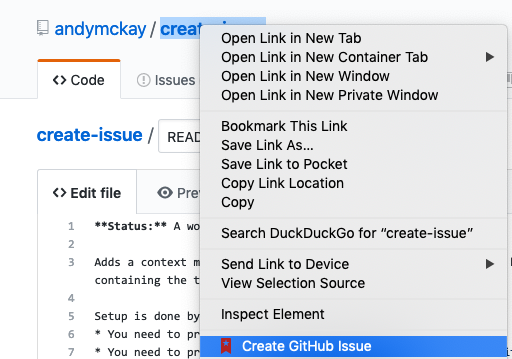
Create issue on GitHub is a stupid simple Firefox Extension that lets you highlight a peice of text on a page, then right click to create an issue. It creates the issue in a repository defined on the config page using a personal access token. That's it.
The beauty of this is that everything is a web page. Emails. Slack messages. Docs. All you do is highlight some text then right click and it creates an issue with the selected text and a URL to the item. Key to this is that's it fast to create a simple issue.
For this I've setup a private repo (those are free now). Thanks to all the integrations with GitHub issues, I get a bunch of stuff for free:
automatic links on other issues and PRs across GitHub back to my to-do item
The best answer to a member’s problem might not be in response to a question posted in your community. It might be in documentation your company has created already but never duplicated in the community. It might be published in the help centre. It might even be shared in another social network/community (reddit/StackOverflow/GitHub/YouTube etc..)
If your search bar only retrieves information from your community, you’re limiting the ability of your members to find the information they need.
The community managers at the biggest communities have long realized that native search (the search function that comes with the platform by default) doesn’t quite cut it. Native search doesn’t typically let you:
Query multiple databases and retrieve the answers which best match the query.
Let you boost the best/most updated answers above others or older content.
Create keyword synonyms showing relevant results even if members don’t quite know the answer.
Identify and close content gaps (queries which don’t retrieve a satisfactory result).
Use AI/machine learning to display the answers which best solve a member question.
Show relevant content/queries alongside existing content/questions.
Track call deflection using queries which prevent members opening a ticket.
Analyze what members need in depth, and feed that information back to product, support and marketing teams.
Upgrading your search bar doesn’t come cheap (a license with Coveo/SearchUnify/others costs $20k to $50k per year), but it could also be a bargain.
It’s a bargain if it helps thousands of extra members a year find the answer to their question.
It’s a bargain if it also shows community solutions alongside others in the help centre.
It’s a bargain if it encourages hundreds of members to collaborate together to close the content gaps the tool has identified.
It’s a bargain if it accelerates how you develop products and gives you insights into exactly what your community needs.
It’s a bargain if it helps you to prove the incredible value of your community.
Your native search is fine when you’re just getting started, but if you’ve got a lot of documentation sitting outside of the community, have 50k+ members, and want to provide members with the best search experience, you might need to upgrade.
Im Jahr 2016 wurde das KerVelo das erste Mal der Öffentlichkeit vorgestellt, ein Liegerad, das die Kette durch ein in das Vorderrad eingebautes Zahnradgetriebe ersetzt. Das Low Racer-Modell bestehend aus Kohlefaser wurde nun auf der [...]
When it comes to monitoring and pruning subs, I've found the subscription list maintained by Apple in my macOS App Store account useful, plus one of the simple iOS subscription-list apps for software that falls beyond the app stores. The one I use is, ironically perhaps, called Outflow.
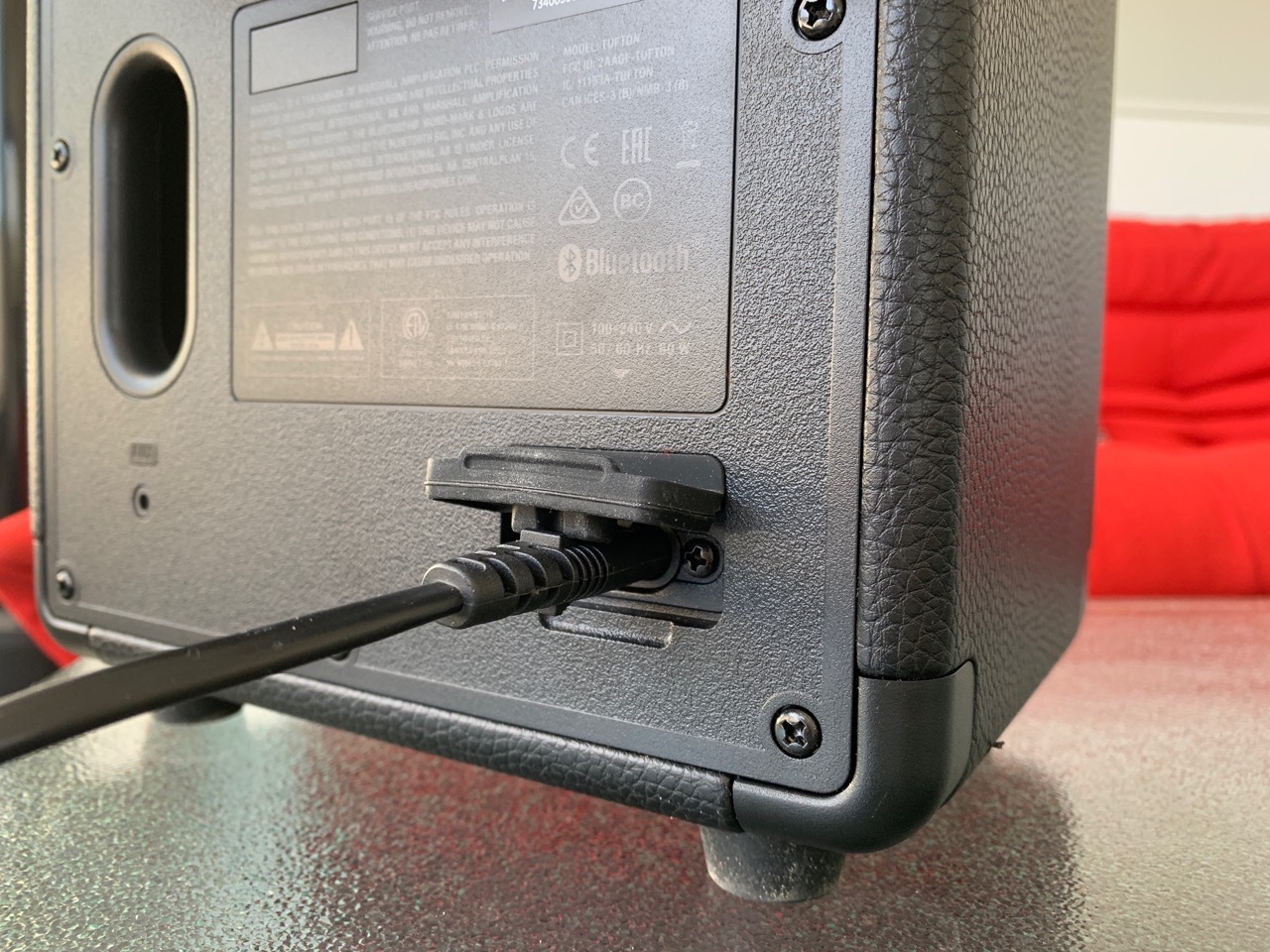
The Marshall Tufton is quite big for a portable battery-operated Bluetooth speaker. Both Tufton and the Marshall Monitor headphones are very loud and run for up to 20 hours on a single charge. More than you ears can take, in any case.
One of my favorites: power supply is built-in. You just need a simple cable to recharge. I am having big fun.
At an event called the ‘Christchurch Call to Action,’ Amazon, Google, Facebook, Microsoft and Twitter pledged to help fight against online violent extremism.
The companies outlined a nine-point plan to help fight hate and extremism online.
The nine points are broken up into two sections. Five points each company must do on its own and the other four points companies can do by working together.
The five individual points:
The companies will update their terms of use and other policies and guidelines to expressly prohibit the distribution of terrorist and violent extremist content.
Make it easier for people to report terrorist and violent extremist content.
Develop technologies that can detect hate and other inappropriate content online automatically.
Create a better system to determine if live-streamed content is appropriate and isn’t disseminating terrorist-related content.
Working on ways to make reports more transparent.
The four collaborative points include:
The technology companies have agreed to work together to develop a shared understanding of what consists of terrorist and violent extremist content and how to improve the technology that detects and removes terrorist and violent extremist content more efficiently.
Implement crisis protocols so that relevant information can be shared quickly and then acted on by all the companies with minimal delay.
The companies are also going to work to educate the public about extremist and terrorist content online, and what to do if they come across some.
Finally, the companies are pledging to fight against hate and bigotry by supporting research and supporting non-government organizations who are also fighting against this.
These points are meant to prevent the live streaming of extremist events, such as what happened with the terror attack on two mosques in Christchurch, New Zealand.
The Public Library of Science (PLOS) publishes open access scientific articles. These articles allow commenting, but very few people actually comment, a fact that caught the authors' eye given the nascent popularity of the concept of post-publication review. If people don't comment, how can we depend on them to review publications? It's a valid question. Different explanations offered - perhaps academics prefer traditional venues, like staff rooms and conferences. Perhaps what's missing (especially for mega-journals) is community. Perhaps it's just taking new models of review to be accepted. Or maybe (and this is my own speculation now) academics don't comment because there's no reward for commenting, and they do what they've always done for reward: cite and comment in a publication of their own. And that's not so bad - and what would be especially useful would be were there to be a way to view these follow-up publications linked from the relevant paragraph in the original publication, the way WebMentions works.
I've thought a lot about comments. I've never had many comments - so few, in fact, that I no longer make the effort to support comments on my website. The same with distributed comments - I don't see many responses on Twitter or elsewhere. Even in the days of mailing lists, I wouldn't get many responses to my emails - I always just figured I had closed the discussion with the correct answer, so there was nothing else to say. Someone once said to me that everyone knows everyone else has read it, so there isn't much to add. I used to comment more than I do today, but my tolerance for logins, passwords and capchas is almost zero. Anyhow, this article talks about the flavours of comments. I don't know - I see websites with long comment threads and I'm still not sure what makes people comment on one website and not another.
For the first time, researchers have mapped the range of wild pigs across Canada and found the invasive swine are expanding at a rapid rate.
Wild pigs are now Canada's most prolific invasive mammal, according to what the University of Saskatchewan calls the first-ever published survey of their distribution in Canada — and they're causing an "ecological disaster."
"They'll root up the vegetation like a rototiller," said researcher Ruth Aschim. "They're rolling around in the water, defecating in it."
"There is crop damage, disease transmission, even automobile crashes with these pigs."
The wild pigs are the legacy of a failed attempt to diversify meat production with wild boars.
The porcine pests were imported from Europe in the 1980s and 1990s for livestock or "penned game" for hunters.
Many boars escaped their pens and mated with pigs, said Aschim, and they're now causing damage wherever they go.
Researchers in a helicopter use a net gun to capture and put GPS collars on wild pigs. (Ryan Brook)
The wild pigs are rooting and wallowing from B.C. to Quebec.
While most are in the Prairies, there are pockets in Ontario, Quebec, northeastern B.C., the B.C. Interior, and possibly even the Vancouver suburb of Langley.
Only Atlantic Canada and the territories lack populations.
They currently range over more than 750,000 square kilometres — an area larger than Chile — and their territory has increased by 88,000 square kilometres per year, on average, over the past decade, researchers found.
"The public is not overly aware of the wild pig problem, because they are elusive and nocturnal," Aschim said.
Researchers say wild pigs are very hard to eradicate.
They grow as big as 115 kilograms (250 pounds), can eat almost anything, become sexually mature in four to eight months and have about six piglets in a litter.
Researchers add they're hardy in the winter as well, burrowing into "pigloos" in the snow.
The survey, published last week in Nature Scientific Reports, warns that wild pig populations and range will "continue to expand exponentially" over the next decade at least, if aggressive management policies are not implemented soon.
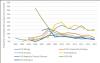
How the range of wild pigs in Canada has grown over the past three decades. (Ruth A. Aschim and Ryan K. Brook/University of Saskatchewan)
Kevin Simler uses interactive simulations to explain how things — ideas, disease, memes — spread through a network. It always looks like concentrated chaos to begin, but then the things infect quickly. Adjust variables, press play, and watch them go.
I gave this a 4 on aggregate even though I think it goes between a 2 and a 5 somewhat. The 5 for the initial analysis and for his proposed solution we’re somewhere between 2 and 4 depending on what he’s proposing. My problem with Taleb, as well as some other writers is, that often I do agree with their analysis, at least up to a point, but often disagree on the suggested “solutions”. Same in this case. I often agree with him describing what is happening and to a large degree why, but I find that the solutions often being proposed are very much limited by the authors own experience / outlook on the world. This holds true with Taleb as well. The book is still worth a read if you can overlook that he has a tendency to latch onto certain other writers / authors / public figures which he uses as stand-ins for all that he thinks is wrong or act as a “living example”. It would probably make his books a bit more interesting if he could show the same “mistakes” and “attitudes” in more than one person and often he does not. Like with all books like this the best advice is to read it, think about it and then draw your own conclusions. Anybody who sees this as a somewhat “self-help” type of book may find that for them it isn’t working.
Imagine if you were really into the group Swervedriver in the mid-’90s but by 2019 someone was on CNBC telling you that Swervedriver represented, I don’t know, 10 percent of global economic growth, outpacing returns in oil and lumber. That’s the tech industry.
If you only read one longform piece this week, make it this one. Utterly delightful prose and a bunch of different messages that resonated with me deeply.
The OnePlus 7 Pro and the OnePlus 7 were finally launched yesterday. Compared to previous OnePlus offerings, the OnePlus 7 Pro is a major step up in every aspect. While the specs of the handset are pretty clear, there’s a lot of confusion on whether the OnePlus 7 Pro is water-resistant or not.
Continue reading →
Motorola is officially announcing a brand new, big smartphone today. The One Vision is a decidedly mid-range piece of kit, with the specs to prove it. But the display might be a solid choice for folks who watch movies on their phones.
Continue reading →
Like some unprecedented mass shooting, it’s the kind of record-breaking news one tends to think twice about discussing at the breakfast table.
As reported by Popular Science, among many other media outlets, late last week the Mauna Loa Observatory in Hawaii measured carbon levels in the atmosphere at 415 parts per million. That’s more than 100 ppm higher than any point in almost 1 million years’ worth of atmospheric data available.
For nearly a million years, carbon dioxide levels in the atmosphere have maintained an average of about 280 ppm, not going above 300 ppm or below 160 ppm…the latest human-caused warming event is occurring over just a couple of centuries, which is so quick in comparison that the trend line appears vertical as it approaches today.
Do we actually still need to wonder why this is happening?
“Not only does the upward trend directly correlate with the start of the Industrial Revolution, but based on tracked data on human emissions and our understanding of the rate at which nature absorbs some of those emissions…, there’s an increasing amount of leftover carbon dioxide in the air that only our activities can account for.”
And much of that experienced in cities, limiting human connection to the natural environment which gave us the very resources on which we so depend, and which is now poisoned, sick, and beginning to reject our continued advances.
Then, there’s the natural follow-up question — could we not have allowed it to get this far along?
Perhaps at this point it could be helpful to dwell just a bit on the shortsightedness, even willful blindness, of the Cold War-era global leaders who received and read the warnings of pioneers of the environmental science movement (like Syukuro Manabe, Paul Ehrlich, John Sawyer, and countless others), but failed to act in any meaningful way for two subsequent generations.
“…when the Mauna Loa Observatory began observing greenhouse gas levels directly from the atmosphere 60 years ago, the concentration was already at 315 ppm. In 2013, these levels exceeded 400 ppm for the first time in human history.”
That from yesterday’s Washington Post, which, in addition to showing a slightly different (but somehow more alarming) visualization of the CO2 rise, also reported on the climate change canaries dropping off their spring-time perches across the planet’s northern regions:
84-87 degrees Fahrenheit (29-31 Celsius) recorded in northern Russia
77 degrees Fahrenheit (25 Celsius) recorded in Finland
A 1-month early ice sheet melt in Greenland
Unseasonably early winter ice break-up in several Alaskan rivers
So then, what about today? Are we moving on this as fast as we possibly can?
A cursory Google News search shows many cities and nations are indeed taking it seriously. (If you want action, look no further than Vancouver’s approved “Big Moves” response to the climate emergency, and tell me if you’ve seen a more aggressive plan in North America.)
Others…not so much. Using the federal carbon tax as a straw man for political posturing and a blatantly populist appeal to the nearsighted concerns of their base, Doug Ford’s PC government in Ontario is trying to focus voters’ attention on a different number — 648.
The PCs’ new ad claims that the carbon tax will cost the average Ontario family some $648 per year by 2022.
They say that their own plan — which includes a fund of public money to help incentivize big polluters to reduce emissions and a focus on decreasing waste and litter — will fight climate change without costing taxpayers.
That’s a great idea. Solve one of the planet’s — and our species’ — greatest challenge by promising people they won’t have to change any of the behaviours that exacerbated our problems in the first place.
Or, as George W. Bush once famously put it, in the face of an epic clash of cultures and global terror, let’s all go shopping.
In a densifying city that is serious about being sustainable lowering vehicular speed limits within neighbourhoods is a good way to enhance livability for local residents, decrease automobile emissions, plus lower the likelihood of serious injury or death. You would think that in a country with universal health care that lowering vehicular speeds within neighbourhoods would be the right thing to do to foster walking, cycling and interaction among residents.
But we forget that the street fabric and the way that our communities are designed and indeed funded have been for vehicular movement, and that mode of transportation has (pardon the pun) had a free ride. Auto infrastructure has been funded by the general tax base and not by the user. Cars have gobbled up the majority of shared road space, and our 20th century mindset does not know how to slow them down.
Until now.
As Dan Fumano in the Vancouver Sun reports “Vancouver city council voted unanimously Tuesday to move ahead with a pilot project to reduce the speed limit on certain side streets to 30 km/h, down from 50 km/h. Council directed city staff to identify a local street or area in Vancouver for the pilot, and report back with an implementation strategy and proposed road design by later this year.
The motion, entitled “Safer Slower Streets” and initially introduced in April by Green Coun. Pete Fry, also seeks to lobby the provincial government, through the Union of B.C. Municipalities, to change the Motor Vehicle Act to allow municipalities to implement blanket speed zones in residential areas. Fry’s original motion defined “local streets” as those with no centre line.”
At the City Council meeting where the motion was approved residents came forward hoping that their neighbourhood could be considered for the pilot. I have written extensively on the benefits of slower speeds in communities from a safety viewpoint~but there is a livability issue as well. Slower neighbourhood streets make places where seniors can comfortably stroll and talk, and kids can have stick hockey games. A pilot project will give an idea at how slower vehicular speeds are an amenity that can be offered in a densifying city, allowing for public interaction and active discourse on the street.
We already know how to make the 30 km/h speeds stick too. Streets that are bikeways are already signed for 30 km/h, and so are areas around schools. Those work with moral persuasion and judicious enforcement. And a survey conducted by pollster Mario Canseco found that 71 percent of respondents “approve of using fixed speed cameras — cameras that stay in one location and measure speed as a vehicle passes. “
In Canada one-quarter of all Canadians will be seniors by 2030, and keeping seniors fit, engaged and active fits into slower streets that encourage walkability. In a place like Vancouver where there is pressure to create more rental housing and forgo some of the amenities that developers are normally asked for, slowing neighbourhood streets provides a low-cost way to enhance public environments. It is simply the right thing to do, and adds an element of safety on dark wintry rainy months.
Adrienne Tanner in the Globe and Mail went farther. She wants to know why the Government of British Columbia is not being proactive on Councillor Fry’s motion. in her analysis of slower more comfortable residential streets, Ms. Tanner bluntly states
“Vancouver should follow the lead of other cities and embrace the slow-driving movement.Let’s dispense with the pilot project and drop the speeds on all residential streets… Even better, the province could take the initiative and save everyone the trouble of pushing for something that so obviously should be done.”
Creating slower, safer, more sustainable cities is simply the right thing to do.
Graduating from college means moving on to the next phase of life. Whether that involves setting up a dorm room or moving into an apartment, any new grad will appreciate the basics they need to set up a home. We’ve rounded up more than 20 Wirecutter picks that are both fun to receive and useful for the recent graduate.
The USB cable and 5-watt charger that came with your iPhone are fine for plugging in overnight, but upgrading to a USB-C–to–Lightning cable and an 18-watt charger will more than double your charging speed. Any iPhone 8 or later version, as well as the iPad Pro, supports fast charging, and switching to USB-C will mean less time spent sitting by the phone and more power in your device when you run out the door.
U.S. President Donald Trump might sign his executive order this week that would bar U.S. companies from using telecommunications equipment that could pose a national security risk.
The executive order would essentially ban any business with Huawei, the Shenzhen-based company that has been under scrutiny by the country for using backdoor tactics in its technology to spy on citizens.
Citing three U.S. officials familiar with the matter, Reuters reported this order isn’t going to name specific companies and that it has been under consideration for over a year and has repeatedly been delayed.
The last time mention of this executive order was in December, around the same time Huawei’s global CFO Meng Wanzhou was arrested in Vancouver.
The order would invoke the International Emergency Economic Powers Act, a law that grants the president the authority to regulate any commerce that could pose a national security threat to the U.S.
If the executive order is signed, it would come at a time when China and the U.S. face tense trade relations.
China’s Foreign Ministry spokesman Geng Shuang said the U.S. had been “abusing its national power” to push away and stifle certain Chinese companies.
“This is not honourable, nor is it just,” he said.
“We urge the United States to stop using the excuse of security issues to unreasonably suppress Chinese companies, and provide a fair, just, non-discriminatory environment for Chinese companies carrying out normal investments and operations in the United States.”
Trump signed a bill that barred the U.S. government from using equipment from Huawei in August, and since then has been lobbying other countries from doing the same.
A review of Huawei and 5G in Canada is currently being conducted and Public Safety Minister Ralph Goodale said a decision may come before the federal election. However, a government source told Bloomberg that a decision may now happen after the election.
In any case, it’s important to note that Goodale was specifically speaking about the ongoing review of 5G technology and not on specific companies.
Uber is testing a Bike Lane Alert feature in Toronto and parts of the U.S., which aims to create safer road conditions for bikers.
The alert will use mapping data to pinpoint bike lanes and shared roads within the city.
The Uber passenger will receive a push notification that will notify them that their drop-off location is near a bike lane. It will tell the passenger to look for bikers before they open their door.
Uber is also reminding its drivers that it is illegal to park or stop in a bike lane. It is encouraging drivers to arrange pick-up and drop-off locations that are away from bike lanes.
The company has tried to further its bike safety efforts by launching an educational video for its riders in Canada and the U.S. The video depicts the Dutch Reach, which encourages riders to look over their shoulder before opening their door.
According to Uber, increased awareness of safe behaviour leads to safety.
Streaming audio giant Spotify is offering new subscribers three months of Spotify Premium for 99-cents CAD in a new sale.
Alternatively, if you’ve subscribed to premium before you can get three months of premium service for $9.99 CAD with Spotify’s Re-Engagement offer.
Both of the deals end on June 30th, 2019 and are not available to residents of Quebec. You can’t sign up for either offer with a pre-paid credit card or a Spotify gift card either. If you stopped your subscription to Spotify Premium after April 15th, 2019 you’re also not eligible for the re-engagement offer.
If you’ve ever subscribed to Spotify Premium in the past, or taken either a 30-day or 60-day free trial of the service you’re also ineligible for the 99-cent offer.
The company often holds this sale. Engadget reports that it happened twice last year so it might pop up again later if you miss it this time around.
Google is finally adding a much-needed feature to its Podcasts app, the ability to auto-download new episodes. Users can now set their preferences so that the app will automatically download new episodes.
Users who have this feature can disable auto-download, or set it so that it only downloads either over Wi-Fi or using data. There will also be the ability to choose which podcasts download automatically.
Android Police who reported about the update, notes that there is no way to set a schedule for when app auto downloads, specifically when a user is charing their phone. That means that it can download whenever it wants.
Reportedly, this is a server-side update and only some users currently have it. To find out, check out the settings menu within the Google Podcasts app.




 Im Jahr 2016 wurde das KerVelo das erste Mal der Öffentlichkeit vorgestellt, ein Liegerad, das die Kette durch ein in das Vorderrad eingebautes Zahnradgetriebe ersetzt. Das Low Racer-Modell bestehend aus Kohlefaser wurde nun auf der [...]





 Researchers in a helicopter use a net gun to capture and put GPS collars on wild pigs. (Ryan Brook)
 How the range of wild pigs in Canada has grown over the past three decades. (Ruth A. Aschim and Ryan K. Brook/University of Saskatchewan)
 Kevin Simler uses interactive simulations to explain how things — ideas, disease, memes — spread through a network. It always looks like concentrated chaos to begin, but then the things infect quickly. Adjust variables, press play, and watch them go.
 The OnePlus 7 Pro and the OnePlus 7 were finally launched yesterday. Compared to previous OnePlus offerings, the OnePlus 7 Pro is a major step up in every aspect. While the specs of the handset are pretty clear, there’s a lot of confusion on whether the OnePlus 7 Pro is water-resistant or not.
Continue reading →
The OnePlus 7 Pro and the OnePlus 7 were finally launched yesterday. Compared to previous OnePlus offerings, the OnePlus 7 Pro is a major step up in every aspect. While the specs of the handset are pretty clear, there’s a lot of confusion on whether the OnePlus 7 Pro is water-resistant or not.
Continue reading →
 Motorola is officially announcing a brand new, big smartphone today. The One Vision is a decidedly mid-range piece of kit, with the specs to prove it. But the display might be a solid choice for folks who watch movies on their phones.
Continue reading →
Motorola is officially announcing a brand new, big smartphone today. The One Vision is a decidedly mid-range piece of kit, with the specs to prove it. But the display might be a solid choice for folks who watch movies on their phones.
Continue reading →


 Photo by julie aagaard on Pexels.com