Shared posts

17 May 02:18

I.M. Pei, architect of Louvre Pyramid, Rock and Roll Hall of Fame, dead at 102

mkalus shared this story .

I.M. Pei, whose modern designs and high-profile projects made him one of the best-known and most prolific architects of the 20th century, has died. He was 102.

Pei, whose portfolio included a controversial renovation of Paris' Louvre Museum and the Rock and Roll Hall of Fame in Cleveland, died overnight. His death was confirmed Thursday by a spokesperson at his New York architecture firm.

Ieoh Ming Pei, the son of a prominent banker in China, left his homeland in 1935, moving to the United States and studying architecture at the Massachusetts Institute of Technology and Harvard University. After teaching and working for the U.S. government, he went to work for a New York developer in 1948 and started his own firm in 1955.

The museums, municipal buildings, hotels, schools and other structures that Pei built around the world showed precision geometry and an abstract quality with a reverence for light. They were composed of tone, steel and glass and, as with the Louvre, he often worked glass pyramids into his projects.

The Louvre, parts of which date to the 12th century, proved to be Pei's most controversial work, starting with the fact that he was not French. After being chosen for the job by President François Mitterrand amid much secrecy, Pei began by making a four-month study of the museum and French history.

He created a futuristic 21-metre steel-framed, glass-walled pyramid as a grand entrance for the museum with three smaller pyramids nearby. It was a striking contrast to the existing Louvre structures in classic French style and was reviled by many French.

A French newspaper described Pei's pyramids as "an annex to Disneyland" while an environmental group said they belonged in a desert.

Pei said the Louvre was undoubtedly the most difficult job of his career. When it opened in 1993 he said he had wanted to create a modern space that did not detract from the traditional part of the museum.

"Contemporary architects tend to impose modernity on something," he said in a New York Times interview in 2008. "There is a certain concern for history but it's not very deep. I understand that time has changed, we have evolved. But I don't want to forget the beginning. A lasting architecture has to have roots."

His buildings added elegance to landscapes worldwide with their powerful geometric shapes and grand spaces, among them, the striking steel and glass Bank of China skyscraper in Hong Kong.

Other notable Pei projects include the John F. Kennedy Library in Dorchester, Massachusetts, the National Center for Atmospheric Research in Boulder, Colo., the East Wing of the National Gallery of Art in Washington and the Dallas City Hall.

His Canadian designs include the CIBC Commerce Court West building in Toronto and Montreal's Place Ville Marie. 

Pei won the international Pritzker Architecture Prize in 1983. He used the $100,000 US award to start a program for aspiring Chinese architects to study in the United States.

Even though he formally retired from his firm in 1990, Pei was still taking on projects in his late 80s, such as museums in Luxembourg, Qatar and his ancestral home of Suzhou.

Pei, a slight man who wore round, owl-ish glasses, became a U.S. citizen in 1955. He was married to Eileen Loo from 1942 until her death in 2014. They had four children, two of whom became architects.

17 May 02:18

We may not be big, but we're small

by peter@rukavina.net (Peter Rukavina)

Earlier this morning Terry Howatt thoughtfully left a comment here about a meeting tonight of the PEI Electric Vehicle Association in South Melville.

As I’m curious about such things, and eager to learn more from people who aren’t try to sell me something, I dropped a line to my new friend Trudy (who also came to me by way of this blog) to see if she wanted to go to the meeting with me. Trudy is almost two months into her own experience as an electric vehicle owner: she purchased a Chevy Bolt at the end of May.

Trudy quickly wrote back, said she was game, and offered me a drive. When she showed up at my place at 5:45, she hopped out of the driver’s seat and offered me the opportunity to drive the Bolt, which I eagerly accepted.

When we arrived at Harry Smith’s house in South Melville we were greeted by three Nissan Leafs, a Tesla Model S, a Tesla Model 3, a homebrew SUV conversion, and another Bolt. And an enthusiastic group of EV owners and owners-to-be.

The proceedings were informal, the refreshments were well-turned-out, and the group proved generous and willing to answer my endless stream of questions.

Driving Trudy’s Bolt was a joy: it’s fun to drive, comfortable and roomy; after 20 minutes I forgot that I was driving an electric car.

If you’re interested in attending the next monthly meeting, or if you simply have questions about electric vehicles, you can contact the group by email at peieva2019@gmail.com.

16 May 20:34

Microsoft announces seven new projects aimed to help people with disabilities

by Aisha Malik

Microsoft’s AI for Accessibility has released seven new grantees that will create technology focused on employment, daily life, and communication and connection.

The seven new projects are located across the world and have their own focus. Each institution will have a 12-month funding period.

  • Developers at Our Ability, located in New York, are creating an instinctive AI chatbot that will help people with cognitive disabilities prepare for job interviews.
  • Researchers at University of Sydney are creating a tool that will help people predict and manage seizures. The tool is a wearable warning system that aims to help the individuals become more independent.
  • Pison Technology, located in Boston, is creating a tool for people with neuromuscular disabilities, such as ALS and MS. The tool is a wrist-wearable system that will allow its users to control digital devices using small gestures.
  • Voiceitt, located in Israel, is developing an app that will be able to understand non-standard forms of speech. The app will give individuals with speech disabilities access to a manageable communication system.
  • Researchers at Birmingham City University, located in the U.K. are developing a system to help individuals with limited mobility. The system will allow users to control their digital devices with their voice or by their eye movement.
  • Massachusetts Eye and Ear, located in Boston, is developing a vision assistance app to aid individuals who are blind or have decreased vision. The app will provide the users with heightened location and navigation assistance.
  • Researchers at University of California Berkley are also creating an app for the visually impaired. The app will provide users with audio descriptions regarding their surroundings.

Microsoft’s aim with these projects is to provide workable devices and systems for people with disabilities.

Source: Forbes

The post Microsoft announces seven new projects aimed to help people with disabilities appeared first on MobileSyrup.

16 May 20:34

Just Ride

by David A. Banks

Building to Code is a monthly column about how we live among cities and each other. It regards cities as what they’ve always been: not systems of capitalist resource management, but the stages that society plays out on.


If you were a young person in Amsterdam in 1965 you may have called yourself a “Provo.” Coined by the Dutch criminologist Wouter Buikhuisen to describe dropouts, beatniks, and other countercultural figures of 1960s Amsterdam, the word Provo was embraced by the very people it was meant to pathologize. Just like their Situationist comrades in Paris and the hippies in San Francisco, they held happenings, made public art, and shouted at cops; unlike their Parisian counterparts, some Provos sought power, and in 1965 ran for public office.

The next year the Provos circulated a pamphlet titled “What the Provos Want” which included several “white plans” — equal parts art projects and policy proposals. The “White Chimney Plan” called for industrial polluters to be taxed and publicly shamed by having their smoke stacks painted stark white, and the “White Chickens Plan” proposed turning police officers into social workers, carrying first aid kits and buckets of fried chicken. Their best known and perhaps most successful was the White Bicycle Plan (Witte Fietsenplan), which consisted of painting old but useable bikes white every night at midnight and leaving them around Amsterdam for anyone to ride.

The humanistic view of the city from the scooter survives commodification

Provo, as both an artistic and political movement, self-destructed in 1967 after winning a seat on the Amsterdam city council and successfully removing both the mayor and police chief from power after an investigation into the suppression of anti-war demonstrations. They had gone from surrealist fringe to the mainstream, and so they deliberately announced the end of their movement and marked it with a bonfire. They were no longer cool — they were just politicians.

“White bicycles,” once an anarchist intervention in Amsterdam, evolved into docked bicycle systems like New York City’s Citi Bike; and now e-scooters, a billion-dollar industry in the United States. Found with a phone app, and rented for just a few dollars, e-scooters blossomed across the country last year. When put side-by-side in a list, e-scooter rental companies are only a preposition or two away from a Lewis Carroll poem: Gotcha, Yellow, Lime, Bird, Skip, Scoot, Spin, Grin, and Jump. Their bright colors and joyful brand names suggest they’re only good for carefree weekend romps, and their Silicon Valley origins make them an easy target for derision as harbingers of gentrification.

Scratch the surface and familiar enemies of public transit reveal themselves: Lyft now operates e-scooters in 15 cities (and in 2018 bought the company that operates Citi Bike and other bike sharing programs from DC to Portland, Oregon). Uber owns Jump and is invested heavily in Lime, as well as another bike sharing company with folksy-sounding operations from Charleston, South Carolina (Holy Spokes!) to Toledo, Ohio (ToleGo). However, the humanistic view of the city from the scooter survives commodification. The act of renting scooters contains within it a bit of the radical tradition of democratic city governance — and if a city were built to more fully accommodate e-scooters it would be a serious, even radical, intervention in urban infrastructure. A city of scooters could show us what we’ve collectively ignored in our landscapes for the past century.


Communal bikes and scooters are not the first counterculture idea that Silicon Valley has appropriated for profit. Everything from communes to carpooling have been reimagined as capitalist ventures in the guise of WeLive and Uber. These companies tend to strip out the social and ecological benefits and retain only a handful of conveniences that may eventually become profitable. Instead of bringing friends closer and using less resources by collectivizing shelter and food, WeLive’s corporate communes sell you on a pre-selected and vetted roommate, furnished bedrooms, and stocked kitchens. Uber strips out the fuel savings of sharing a car trip and instead competes with public transit by running a cheap taxi service thinly veiled as “ride sharing.” Both are clearly destined to be services that cater to the rich as they raise their prices and innovate exclusively at the top of the market.

No one should ever underestimate the ability of the tech sector to squelch the humanity from a product. But for now there is reason to be hopeful. The economics of scooters seem much more straightforward than the business models of ride sharing. In their first year, Bird made more revenue than Lyft made after five years in operation. And while there’s always a way to take something that should be affordable and bill it as a luxury good — think Fiji water or designer flip flops — more durable scooters and efficient batteries seem to be where the industry is headed. This is markedly different from co-working, ride-sharing, and food delivery systems that rely on poverty wages, data extraction and high rents to make a profit.

Unlike these projects, the introduction of e-scooters has been welcomed by those with relatively little money. “Among income brackets,” reports Wired, “those making between $25,000 to $50,000 a year are the most into the idea, and those making above $200,000 are the least.” The reasons for renting a scooter or bike over owning are plentiful: While a bike is much cheaper than a car, it is also easy to steal; no one can steal your subscription to a rental service. Renting also means you don’t have to take your bike or scooter on to the bus or train. Lime reports that, “in U.S. cities, a rider using Lime products in conjunction with public transit would pay, on average, 80 percent less than the cost of owning and operating a personal vehicle.” And unlike a pedal-powered bike, an e-scooter doesn’t leave you sweaty when you get to work. Standing on a scooter is easier than pedaling in tight-fitting clothing and heels, which may help overcome the gender gap that has been recorded in some bike sharing programs. Scooters are the closest thing to moving while standing still.

Ride hailing companies had always claimed they would reduce the amount of cars in the city by having them constantly recirculating and picking up multiple riders like a bus; but in their recent IPO they finally came clean that they are competing with “public transportation, which typically provides the lowest-cost transportation option in many cities.” E-scooters, at least in Portland, Oregon and San Francisco, appear to be replacing car trips between 30 and 50 percent of the time depending on whether you’re a local or a tourist. For most people bicycles and scooters are a good solution to the so-called “last mile” problem of transportation: Mass transit might get you to the right neighborhood, but to get to your final destination requires a bit more legwork.

Scooter and bike rentals don’t create a new traffic problem, they force the question of car supremacy

That last mile can be treacherous. The car has made an indelible mark on all cities, but newer American cities are built exclusively for them. The area where I grew up in Florida, despite the year-round sunshine, was not conducive to bicycling. The danger of cars zipping down the gridiron block pattern of our working class (signs there now call it historic) Florida suburbs was enough to dissuade me from riding my bike, but I may have been more willing to take the risk if I had somewhere to go. When you build for cars you build at their scale, with miles of houses followed by miles of shopping plazas with nothing but parking lots and highways connecting them. Riding a bike or walking is possible, but by no means pleasant.

According to the Miami Herald, over 5,000 pedestrians were killed by cars in the last decade in Florida. The reason has less to do with the pedestrians, cyclists, and drivers themselves and more to do with the environment they must navigate. Designed for speed, blocks are long and the lanes are wide, making for rare crosswalks that you have to sprint across if you want to beat the light. Bike lanes are often nothing more than a couple feet of asphalt next to a fifty-mile-an-hour highway with a solid white line separating the two. Disinvestment in public infrastructure and lower car ownership rates mean that the elderly and anyone in a poor neighborhood is more likely to get hit by a car.

According to Streetsblog, e-scooter deaths are about as frequent as bicycling deaths when accounting for average trip length and usage rates, so scooters don’t seem to present much danger in and of themselves. It is the surrounding streetscape that is dangerous. The e-scooter company Bird defended itself against mayors’ calls to ban their products for safety reasons with a message that would be familiar to most urbanists: “Class action attorneys with a real interest in improving transportation safety should be focused on reducing the 40,000 deaths caused by cars every year in the U.S.”

Rather than see scooter and bike rentals as creating a new traffic problem, we should see them as forcing the question of a much older issue of car supremacy. A city built for cars is only good for cars, whereas “a city made for scooters” writes Alex Davies in Wired, “is a city ready to embrace a cornucopia of mobility options that don’t require sitting in a car, clogging the streets, and choking the planet. A city made for freedom.”


In a widely and deservedly panned article in the Atlantic, Peter Wayner suggested that the New York City subway be replaced by smooth asphalt upon which “an open marketplace for autonomous fleets would encourage innovation and evolution.” The R-160a train car would be replaced by hoverboards, scooters, full cars, and whatever else gets invented: “Perhaps the public would like fat, overstuffed chairs on wheels in some years and tiny hoverboards in other years. Who knows?” Replacing trains with roads shared by cars and scooters is a profoundly bad idea, but replacing cars with trains and scooters is a great idea.

Thanks in part to their respective decisions to go public, Uber and Lyft have finally revealed their monopolistic strategies: their road to profitability rests on, as Jalopnik reports, selling rides at a loss “until we reach sufficient scale to reduce incentives.” Left unabated, it is all but guaranteed that anything Uber and Lyft owns will suddenly rise in price as soon as all other viable alternatives have faded away. So perhaps the real question, if we take a lesson from urban and inter-city railroad history, is what sort of transportation network do we want to nationalize when the Uber-Lyft monopoly has gone too far? Do we want to seize scooters, or the sub-prime lease contracts on a million Toyota Camrys?

A city — a society? — built for scooters would be both a technical and humanistic achievement. Replacing surface parking and car travel lanes with bikes, scooters, and whatever else would be a great start, as would increasing the availability of public transit for longer hauls. Creating hard barriers between what few cars are allowed to remain and human-powered transportation is even better. As less space is given over to the storage and spatial reasoning of cars, human settlement patterns may get denser as businesses and homes huddle close the convenience of transportation hubs. But what might constitute the biggest transformation would be in how the city is experienced: the way access is opened up, and the parts of the landscape we start to notice.

When it comes to democratizing the street for all sorts of transportation, the hardcore cyclist and the e-scooter commuter will have very similar demands

The work of the urbanist Kevin Lynch is receiving a well-deserved revival 30 years after his death. His work melded social psychology and urban design in a way that was both intuitive to the average person and useful to the practitioner. His “cognitive mapping” exercises, where he asked a wide range of people to sketch their home towns, found that children and adults map very differently. Children pay attention to the different textures of surfaces — their landmarks are as diverse as trees, lighthouses, and painted doorways, and they are keen to pick up on pieces of forgettable infrastructure: telephone switch boxes and fire hydrants. But as car-driving adults, the world turns into a series of highways and roads. Lynch describes the maps drawn by adult Los Angeles residents as highly detailed around home or work, but outside of these familiar places city maps were of mountain ranges or the ocean. The middle range, outside of work and home where the rest of society exists, “structure and identity seemed to be quite difficult.”

Driving a car is a singular experience; it provokes both a confrontational and simplistic view of the world around you. Other people become idiot drivers in your way, and the cityscape’s landmarks — the parts you remember on your morning commute — are the grey slopes of the exit ramp, not the green of street trees. Without romanticizing too much, it is easy to imagine that the view over the handlebars going five miles an hour on an urban road has more detail, texture, and exposure to the elements than the panoramic view framed by the car’s windshield barreling down the highway. Even in the depths of a subway there are other people and a good book.

In 1981, at the height of car-oriented urban design — where the overarching logic of planning was efficiency, speed, and specialized uses — Lynch wrote, “To have everything instantly available is no more desirable than it would be to live in an infinitely adaptable world.” Lynch is pointing to an essential fact about urban design’s relationship to humans. When everything is available, nothing is special; standardization and monotony prevails over the unique and diverse. Buildings become hazy and boring, either because they really do look the same, or because they’re blurred by speed.

The instant availability of everything, brought initially by the car, becomes an impenetrable cage if you cannot use a car — being too young, too old, or otherwise incompatible with the physical and mental demands of the automobile makes you a second-class citizen. The car also becomes a point of control, so that the drivers’ license suddenly becomes a de facto license to participate in society. The struggle over issuing drivers’ licenses for women in Saudi Arabia and undocumented immigrants in the United States are two clear examples of this. When transportation itself is diverse, the rest of the society follows.


The Provos were leaving bikes around Amsterdam, a city that was slowly bending itself to the will of the car but was, and still, is a densely populated environment where the bike is wholly welcomed with dedicated lanes and a popular culture that supports it. In America, where bike advocates have had to fight tooth and spoke for every inch of lane, a particular kind of rider has emerged: One that is passionate about the bike itself and places it at the center of a counter-culture, rather than treating it as a piece of boring mainstream infrastructure. Laura Portwood-Stacer, in her ethnography of lifestyle anarchists, notes that the bicycle is part of a “consumption-based resistance against the automobile-centric transportation industry and its influence on mainstream social norms around personal physical mobility.” To care for the bicycle and power it with your own body is an act of defiance, albeit one that both assumes a fairly healthy body and a life that lets you be sweaty and dirty.

The distinctly normie feel of standing on an electric scooter may be the keystone that unites the American mainstream with the activists struggling for a less car-centric city. The anarcho-cyclist, the Provo, wants to remake the city in the image of the bike, sweat and all. The resulting society, they imagine, is more just, more ecologically sustainable, but less comfortable. It’s a particular kind of leftist asceticism that has little chance of becoming a mass movement, but can be a valuable ally in a burgeoning coalition against the car. When it comes to democratizing the street for all sorts of transportation, the hardcore cyclist and the e-scooter commuter will have very similar demands.

When the United States Congress passed the Americans with Disabilities Act in 1972 it gave people who use wheelchairs much more opportunities to participate in public life. Suddenly public and many privately-owned buildings were navigable. One seemingly unexpected additional benefit was the ability of parents with strollers to also go up ramps and through wide doorways. Something similar could be expected from a city made for scooters: where people like me feel a bit more comfortable trying a bicycle again, children and the elderly can live with more independence, and the city air is cleaner. What may be more rewarding than the view from atop a scooter is the view from your apartment, looking at the city the scooter made possible.

16 May 20:32

The art of noticing: five ways to experience a city differently

Rob Walker, The Guardian, May 16, 2019
Icon

I have often compared the learning of a new discipline to the exploration of a new city, and made the point that while you could take a guided tour (either in a class or in a tour bus) there are other, more independent, ways to explore that are of equal or greater value - on foot, via metro, with a friend, with a map. Your choice. This article makes some suggestions for alternative ways to explore a city, and it seems to me they are equally valuable as ways to explore a discipline: look for ghosts and ruins, get there the hard way, eat somewhere dubious, read the plaque, and follow the quiet. I do all of these things both when exploring a city and when studying something new, and yes, it's worth the effort.

Web: [Direct Link] [This Post]
16 May 20:32

Huawei erneut im Fokus: USA geht gegen Smartphone-Riesen vor

by Carsten Thomas
US-Präsident Trump hat per Dekret dem US-Handelsministerium freie Hand gegeben, ausländische Telekom-Anbieter anzugreifen. Das Ziel scheint dabei klar zu sein: Huawei.US-Präsident Trump hat per Dekret dem US-Handelsministerium freie Hand gegeben, ausländische Telekom-Anbieter anzugreifen. Das Ziel scheint dabei klar zu sein: Huawei. Zwar sei die Maßnahme nicht gegen ein bestimmtes Land oder Unternehmen gerichtet, doch wird [...]
16 May 20:31

More candidates and earlier

by Nathan Yau

For Bloomberg, Lauren Leatherby and Paul Murray describe the heightened eagerness to enter the race for United States president. The stacked timelines, looking like squished bunches of Twizzlers, show when people entered and withdrew during past election seasons.

We’re 536 days out and 23 Democrats are in. In contrast, there were 8 around this time in 2008.

Tags: Bloomberg, election

16 May 20:31

✚ Making Comparisons Easier When Presenting Data (The Process #40)

by Nathan Yau

Visualization is all about making comparisons. If you have nothing to compare to, then the chart fails. In this issue I describe some of the ways you can make your charts more comparable. Read More

16 May 20:31

How Pedal Assist Works

by Blix PR

Often when researching electric bikes, we are informed that ebikes offer pedal assist to riders which is one technological aspect separating them from regular bikes. However, it can be confusing and difficult to understand what is pedal assist, how does it work, and why is it beneficial. Below, we breakdown the basics of pedal assist, explain how it works specifically on Blix Electric Bike models, and reasons why pedal assist is great! 


What is pedal assist?

Pedal assist is a mode on your electric bike that provides power from the motor to help you pedal easier and move faster. When you turn on pedal assist and choose your level of assist, the motor will provide a certain level of power output as you pedal. This may feel like a slight push as you ride. Pedal assist is different from throttle mode because it requires riders to pedal, along with receiving power from the motor. The throttle mode does not require pedaling and solely uses the motor to make the bike move forward. 

 How does Blix pedal assist work?

Blix electric bikes are equipped with levels 0-4 or 0-5 of pedal assist.  Level 0 provides no assist, level 1 is the lowest level of assist and level 4 (or 5 if you are riding the Packa) is the highest. If a rider just wants a little push or is looking to extend their battery range, level 1 and 2 of pedal assist are recommended. These levels will provide a motor output that allows riders to easily reach 8-13mph. Level 3 is great for powering up hills or helping riders reach upwards of 15mph on flat ground. Level 4 (or 5) provides the max power of motor output and riders can reach 20 mph on their Blix bikes. These varying levels of pedal assist determine how much power the rider is relying on from the motor compared to their pedaling. Higher levels of assist will use more of the battery charge and may reduce the distance between charge cycles. 

Why is pedal assist beneficial?

Pedal assist is beneficial to all riders because it allows them to ride farther, faster, conquer hills, and overcome physical limitations. With a freedom to change the level of pedal assist, riders can decide how much exercise they want, when they want to push themselves, and they will no longer be afraid of steep hills. While some riders say pedal assist is cheating, we disagree because we find that pedal assist helps riders extend their distance and time on a bike as well as ride tougher terrain which they may have previously avoided. No matter a riders' starting physical level, pedal assist can encourage riders to spend more time being active and find an exercise routine that works for them. Over time, the level of pedal assist chosen may drop from level 4 to level 2 and riders will feel more confident riding at their own assist level. 

Additionally, pedal assist helps commuters beat traffic and arrive to work faster while still feeling fresh and ready for work. With pedal assist, commuters can step off the bike with little sweat and higher levels of energy to take on the work day! Overall, pedal assist makes biking accessible to the majority and adds some fun, especially when riding at 20mph or flying up the hill you always avoided!


Learn how to finance your Blix here!

Follow us:

Instagram

Facebook

16 May 20:30

Revealed: the fringe rightwing group changing the UN agenda on abortion rights | Global development

mkalus shared this story from The Guardian.

Last spring, Laurie Shestack Phipps, a diplomat at the US mission to the UN, received a set of talking points from the state department before an international women’s conference, setting out clear red lines against mention of “sexual and reproductive health” care.

This had become the norm in the Trump administration, where the once uncontroversial phrase was seen as code for abortion. Use of the word “gender” was also strongly discouraged, as it was viewed as a stalking horse for LGBT rights.

It was no surprise that Phipps’ colleague, Bethany Kozma, a political appointee at the US agency for international development, had the same text. What was shocking was that she heard exactly the same words coming from the Yemeni spokesman for the Arab Group.

Most striking of all – the shared script was already familiar. It had been circulated before the conference by an anti-abortion lobbying group called the Center for Family and Human Rights, or C-Fam.

C-Fam has emerged from the extreme right fringe on abortion, sexual orientation and gender identity to become a powerful player behind the scenes at the UN. With a modest budget and a six-strong staff led by the president Austin Ruse, it has leveraged connections inside the Trump administration to enforce a rigid orthodoxy on social issues, and helped build a new US coalition with mostly autocratic regimes that share a similar outlook.

And that coalition has already significantly shifted the terms of the UN debate on women’s and LGBT rights.

“When we got into negotiations, my instructions from Washington were verbatim taken from C-Fam, and Kozma had the same talking points,” said Phipps, now an adjunct professor of global issues at Fairleigh Dickinson University. “Then the Arab group spoke … and they read their statement and it was exactly the same. I turned to Bethany and said: ‘How did they get your talking points?’ I was winding her up. She looked pretty chagrined. We both knew they were from C-Fam.”

C-Fam’s channel into the state department and into the US mission to the UN under the then ambassador Nikki Haley, had made itself increasingly apparent in the run up to the 2018 Commission on the Status of Women at the UN’s New York headquarters.

“Nikki Haley’s staffers were in very close touch with C-Fam. C-Fam were continually phoning and emailing Nikki Haley’s staff talking about the language, giving line-by-line instructions,” Phipps said. “It was highly inappropriate for a non-government organisation to be giving line-by-line instructions. C-Fam would be sending emails which would be regurgitated in US cables.”

During the 2018 women’s conference, Kozma and other Trump political appointees attended a “listening session” at C-Fam offices without informing the rest of the US delegation, in a breach of normal practice.

Before the Trump administration C-Fam had been a fringe operator at the UN. Founded in 1997 as the Catholic Family and Human Rights Institute, to “monitor and affect the social policy debate at the UN”, it changed its name to avoid confusion with official organs of the Holy See.

In 2012 Ruse, C-Fam’s president, complained about a decision by the human rights council to look into the summary executions by authoritarian regimes of people based on their sexual orientation and gender identity, on the grounds that the decision was “introducing language that is just the nose of the camel under the tent”.

In 2015, a Catholic priest on the organization’s board resigned in protest at Ruse’s comment that “the hard-left, human-hating people that run modern universities should be taken out and shot”.

Although Ruse horrified Catholic liberals, he denied that the organisation’s name change was at the request of the church hierarchy.

He said in an email: “The name was long and unwieldy and not even my mom could remember it.” He added: “Because Catholic was in our title, we were often confused with the institutional church and determined this was not fair for the Holy See, and … we wanted to broaden our appeal with regard to our scholarship and our fundraising.”

Once Trump took office, however, Ruse became an insider, able to command attention from top state department officials. In March 2017, he wrote to the head of the state department’s powerful policy planning unit, Brian Hook, and other senior political appointees at the agency, complaining that only one anti-abortion group was part of the US delegation to the Commission on the Status of Women (CSW) that year.

Ruse wrote. “We believe the problem here is that Laurie Shestack Phipps is in charge of this, and, while she is a career person, it is our belief, even under the Bush administration, that she is not with the administration on these important issues.”

Pam Pryor, a former aide to Sarah Palin, who had been given a senior adviser job in the state department office of civilian security, democracy and human rights, wrote back to Ruse a little over an hour later, saying: “I share your concern about the folks in charge. I can check out Ms Shestack Phipps, though, and get back to you. Thank you for caring about this with us!”

C-Fam was subsequently made part of the official US delegation to the 2017 CSW conference, and sent a delegate who sat at Phipps’ side throughout the event, taking notes.

Phipps was not aware of any effort to push her out of her position, but she found it increasingly hard to represent an increasingly rigid US position on healthcare for women.

The breaking point came in April 2018 at the UN Commission on Population and Development, where member states tried to hammer out consensus positions. For most of the week of the conference, the US delegation helped draft a joint statement that included references to reproductive and sexual health (RSH), that had been the result of past compromises during the George W Bush and Barack Obama administrations.

“On the last day, I got new instructions,” Phipps recalled. “I was told to go into the room and say we can’t agree with RSH language, only references to ‘maternal health’. I had to go into the room and say: ‘The US government cannot agree to what I have just spent a week negotiating.’ The next day, I put in my retirement papers.”

Phipps left the state department in December.

Her experience is a reflection of the power of lobbying organizations like C-Fam when it comes to instilling a resolutely anti-abortion stance in the state department and US missions abroad.

The small but vocal organization plays a watchdog and coalition-building role at the UN, where the US increasingly finds common cause with Russia, the Gulf Arab monarchies and the Holy See.

In 2015 it helped create a coalition at the UN called Group of Friends of the Family (Goff), which brought together countries like Saudi Arabia, Sudan, Russia, Turkmenistan, Tajikistan, Malaysia, Egypt and Iraq. Once scorned by western delegates as the “Axis of Medievals”, it is becoming, with US support, a powerful voice at the UN on social issues. On Wednesday, C-Fam and Goff convened a high level meeting at the UN, as a show of strength of the anti-abortion, anti-LGBT lobby.

Ruse has helped forge a partnership between US social conservative groups and Orthodox “pro-family” church organisations in Russia with close ties to Vladimir Putin. He met and praised Konstantin Malofeev, a Russian oligarch with extensive ties to the European far-right, for “working to bring Russian Orthodox and US Christians closer together.

Ruse wrote: “Malofeev and many other Russians see themselves as a Christian nation sent to help other Christians around the world. For them, at least, that’s why they support the Assad regime. He’s better for Syria’s Orthodox Christians.”

In 2017, Ruse also forged a bond with Trump’s then chief strategist, Steve Bannon. In February that year, he wrote a magazine article hailing Bannon as “brilliant, salty, visionary, and driven”.

The next month, Ruse wrote to Brian Hook congratulating the administration on its adoption of the Mexico City policy, also known as the global gag rule, which cuts off US aid to any non-governmental organisations (NGOs) even indirectly involved with clinics providing or promoting abortion.

“Our team at C-Fam is preparing a brief for you on how to make sure it is implemented such that it has the effect the president intended,” Ruse wrote.

Hook replied later in the day promising to follow up and noting: “Steve Bannon and I spent time together today and talked about you. He’s a big fan.”

The outsize influence of C-Fam, and the increasing importance of evangelical Christians – like the secretary of state, Mike Pompeo – in the top reaches of the Trump administration, has helped turn the tide on the world stage on issues involving women’s reproductive rights and access to family planning clinics.

Serra Sippel, the president of the Center for Health and Gender Equity, said: “I think now what we have here is an administration that has individuals appointed on the inside who follow this really rightwing ideology that is anti-women. This is not coming from outside, it’s coming from inside.”

The global gag rule has led to the closure of family planning and women’s health clinics around the world, despite studies which suggest that diminished access to contraception and counseling increases the rate of unplanned pregnancies, and backstreet abortions.

It has driven a wedge between the US and its traditional allies, illustrated vividly last month when the German UN mission sought to focus its month-long presidency of the security council on a resolution bolstering accountability and victim support in case of sexual violence in conflict.

The US stunned the Germans by threatening to veto the resolution over a single mention of reproductive and sexual health for victims of rape.

A clear message was sent from the state department, through the US embassy in Berlin, and the mission to the UN, that Washington would not compromise.

“We were taken aback by how ferocious they were on this point,” a European diplomat said. Rather than sacrifice the entire resolution addressing the use of mass rape as a weapon of war, the Germans stripped out the entire paragraph on healthcare for victims, so that – in theory - the language of a previous resolution six years ago, remained current.

“They totally gutted the resolution and perhaps it’s a wake up call for those countries who assume that at the end of the day that perhaps the US will do the right thing. I don’t think it will. They made clear they won’t,” said Rebecca Brown, the director of global advocacy at the Center for Reproductive Rights.

C-Fam did not respond to emailed questions about its influence and finances. Its tax return shows annual revenue from gifts and grants of about $ 1.6m but gives no details of where it comes from. As a non-profit, it does not have to identify its supporters.

16 May 20:30

The Vancouver dilemma: How to build new apartments without displacing tenants.

by Frances Bula

I had a story in Tuesday’s Globe about a couple of old and very inexpensive apartment buildings on Oak Street in the heart of Marpole, which are up for redevelopment. (Full text of story after the break.)

The owner wants to build 91 new units to replace the 1959 and 1964 buildings on site with 43 units between them. The problem: Even though the owner is offering 30 per cent off of whatever the new rents will be to existing tenants (which is more than the 20 per cent the city requires), it’s unlikely that any of them will be able to afford such a jump. So many will be forced out of the area and possibly even Vancouver.

That’s the Sophie’s choice that Vancouver is going to be facing multiple times in coming years, as apartment owners holding 50- and 60-year-old buildings decide whether to redevelop, upgrade, or simply let things deteriorate.

The applicant pulled this project from the public-hearing line-up Tuesday, after a suggestion from the city that it might be better to wait until after June 11, when council will be hearing a report on even more protections for “vulnerable tenants” in these kinds of buildings.

Unknown whether this project will go ahead if council asks for a lot more compensation or guarantees. It’s a case many are watching closely to understand where this council will land on projects like this.

Of course, some might say that the real problem here is that so much (needed) new rental is forced into a limited number of areas, most of which are the sites of old and cheap rental. If some single-family (really, triplex) zones could be switched over to apartments, that could alleviate some of these awful choices, they’d argue.

But there’s also the issue that many of these older apartments need loads of maintenance. Even if they aren’t redeveloped, any number of landlords are looking at significant upgrades which, guess what, frequently entail kicking out all the tenants, doing the renos, and then renting at higher prices.

I await the sophisticated solutions to this, but don’t see any in sight yet.

By FRANCES BULA

The two well-worn low-rise apartments on Oak Street in Vancouver’s Marpole neighbourhood have become a kind of ground zero in this city’s dilemma over how to solve its rental-housing shortage.

A new owner has applied to demolish the existing buildings – with their 43 units renting for as little as $1,000 a month for a one-bedroom – and build 91 new rentals.

But there is no way that the new apartments will rent for anything near what the old ones did.

The owners, APCanada Investment Corporation, are offering compensation to tenants, including as much as four months of the rent they are currently paying for those who have been there for more than a decade, reimbursement of moving expenses for everyone and a right of first refusal on the new units, with 30 per cent off the new rents.

But the demolition likely means that many or all the existing tenants will be pushed out of the area and possibly Vancouver.

On the other hand, the redevelopment will double the number of rentals on the two lots.

That’s the challenging decision Vancouver’s new councillors face as they confront the first major rental project that involves so much demolition. The project is the subject of a public hearing this week.

It’s one that’s seen as key by B.C.’s landlords’ association and housing advocates, because it will send a signal about how Vancouver is likely to deal with many other similar sites with aging apartments. That will be especially important as the city figures out what to do along the Broadway corridor, where there are thousands of such buildings.

“This is the first project like this of consequence, with so many tenants,” said LandlordBC chief executive David Hutniak. “It was a good project, with old buildings that were beyond repair and a good application and good tenant-relocation package. But there’s a concern that it will be just turfed and that will put a freeze on everything.”

There has already been resistance from some councillors in recent months about any affordable units being demolished, even for new rentals. As a result, staff are coming forward with a new report on June 11 on how to provide even more protections for what are being called “vulnerable tenants” who may be displaced, which may lead some to say the project decision should wait until after new options are presented.

If the public hearing goes ahead, councillors will be faced with heartfelt pleas to stop the demolition and, even from the most pragmatic of the tenants, an acknowledgment that the redevelopment will mean leaving Vancouver.

“There’s no way I could afford anything more here,” said Don Krossa, a 13-year resident in one of the buildings who does credit adjudication for a major bank. He will be moving to Chilliwack, thanks to his employer’s willingness to let him work from home.

He said he doesn’t see how anyone with only a single income is going to be able to stay on in the city. He was already displaced once, from the West End 13 years ago when rents went up there, and landed in Marpole, where one-bedrooms were then going for $500 or $600 a month. Because of rent control, the cost of those one-bedrooms for continuous tenants is now much lower than what the market can get as rents have escalated.

But he’s resigned to it, saying the building needs so much maintenance that he likely would have been evicted anyway so that an owner could do major renovations, if it weren’t being redeveloped.

And he gave the City of Vancouver some credit, saying that at least the city’s policy means that it will be new rentals built and not luxury condos.

Other tenants who have been there less time than Mr. Krossa will get lower compensation and, like him, they appear to be unlikely to find anything nearby.

One tenant, Patricia Gravidez, wrote in saying that the apartment on Oak has been the only home for her family – husband and two children – since they arrived from the Philippines in 2016. She’s done the research and local rents are double what they are currently paying.

“Relocating will take a definite financial toll … because it’s quite impossible to find an apartment that’s as affordable as the one we have now.”

16 May 20:29

Adapt, Episode 1: Custom Keyboards and the iPad Multitasking System

by Federico Viticci

Introducing Adapt, a show where Federico Viticci and Ryan Christoffel challenge each other to do new things on the iPad. On this debut episode, Federico investigates being productive using third-party software keyboards, then he and Ryan discuss ways they use the iPad’s multitasking system in everyday life.

In the first episode of our new iPad-focused podcast Adapt – which we launched yesterday - Ryan challenged me to get work done on my iPad Pro using custom software keyboards. No spoilers, but I found the experience surprisingly fun and useful. We also talked about the current state of iPad multitasking and the changes we'd like to see in iOS 13.

You can listen below (and find the show notes here), and don't forget to send us questions using #AskAdapt and by tagging our Twitter account.

0:00 01:03:18

Adapt, Episode 1.

→ Source: relay.fm

16 May 20:29

Virtual Private Social Network: Tales of a BBM Exodus

by chuttenc

bbmTimeToSayGoodbye

On Thursday April 18, my primary mechanism for talking to friends notified me that it was going away. I’d been using BlackBerry Messenger (BBM) since I started work at Research in Motion in 2008 and had found it to be tolerably built. It messaged people instantly over any data connection I had access to, what more could I ask for?

The most important BBM feature in my circle of contacts was its Groups feature. A bunch of people with BBM could form a Group and then messages, video, pictures, lists were all shared amongst the people in the group.

Essentially it acted as a virtual private social network. I could talk to a broad group of friends about the next time were getting together or about some cute thing my daughter did. I could talk to the subset who lived in Waterloo about Waterloo activities, and whose turn it was for Sunday Dinner. The Beers group kept track of whose turn it was to pay, and it combined nicely with the chat for random nerdy tidbits and coordinating when each of us arrived at the pub. Even my in-laws had a group to coordinate visits, brag about child developmental milestones, and manage Christmas.

And then BBM announced it was going away, giving users six weeks to find a replacement… or, as seemed more likely to me, replacements.

First thing I did, since the notice came during working hours, was mutter angrily that Mozilla didn’t have an Instant Messaging product that I could, by default, trust. (We do have a messaging product, but it’s only for Desktop and has an email focus.)

The second thing I did was survey the available IM apps, cross-correlating them with whether or not various of my BBM contacts already had it installed… the existing landscape seemed to be a mess. I found that WhatsApp was by far the most popular but was bought by Facebook in 2014 and required a real phone number for your account. Signal’s the only one with a privacy/security story that I and others could trust (Telegram has some weight here, but not much) but it, too, required a phone number in order to sign up. Slack’s something only my tech friends used, and their privacy policy was a shambles. Discord’s something only my gaming friends used, and was basically Slack with push-to-talk.

So we fragmented. My extended friend network went to Google Hangouts, since just about everyone already had a Google Account anyway (even if they didn’t use it for anything). The Beers group went to Discord because a plurality of the group already had it installed.

And my in-laws’ family group… well, we still have two weeks left to figure that one out. Last I heard someone was stumping for Facebook Messenger, to which I replied “Could we not?”

The lack of reasonable options and the (sad, understandable) willingness of my relatives to trade privacy for convenience is bothering me so much that I’ve started thinking about writing my own IM/virtual private social network.

You’d think I’d know better than to even think about architecting anything even close to either of those topics… but the more I think about it the more webtech seems like an ideal fit for this. Notifications, Push, ServiceWorkers, WebRTC peer connections, TLS, WebSockets, OAuth: stir lightly et voila.

But even ignoring the massive mistake diving into either of those ponds full of crazy would be, the time was too short for that four weeks ago, and is trebly so now. I might as well make my peace that Facebook will learn my mobile phone number and connect it indelibly with its picture of what advertisements it thinks I would be most receptive to.

Yay.

:chutten

16 May 14:15

Just sent out the final info for #indiewebcamp ...

by Ton Zijlstra

Just sent out the final info for #indiewebcamp Utrecht May 18th/19th to all participants. There is still space to join us. Take the web into your own hands! https://indiewebcamp.nl #indieweb

16 May 14:15

CIBC mobile banking app named best in Canada for 2019: report

by Aisha Malik
CIBC building

CIBC has been named the best mobile banking app in Canada in 2019, according to a report curated by Forrester, a market research company.

The report examined the mobile apps for BMO, CIBC, RBC, Scotiabank, and TD Canada Trust.

Forester examined the apps for functionally and user experience. The report found that for the most part, all five of the apps were able to implement improvements. It found that the banking apps have high functionality and are easy to use.

The top two ranked apps, CIBC and RBC, made significant improvements to their apps. They focused on restructuring navigation and workflows.

Forester suggested that all five of the apps still have room for improvement. For instance, the apps could show customers that their money and information are safe.

Since 36 percent of Canadians don’t use mobile banking because they believe it is not secure, the apps could reassure customers that their bank is using security measures to ensure their privacy.

The full report can be found here.

Source: Forrester 

The post CIBC mobile banking app named best in Canada for 2019: report appeared first on MobileSyrup.

16 May 14:15

"The price of not being supportive is too much"

by peter@rukavina.net (Peter Rukavina)

Archdeacon John Clarke, Rector of St. Paul’s Anglican Church, in a blog post today:

That’s why it is important for the Church (our Church) to remain cautious about how we behave in the world, by what we buy, believe, support and protest. That’s why it is important for us to continue to do things like participating in the Pride Parade, either as participants or spectators, to show our support of several groups of people who are persecuted, in one way or another for no good reason.

It’s a little disconcerting, I must say, to see the crowds lining the streets of Charlottetown do a double-take when they see St. Paul’s Church in the Pride Parade. It is sad that only two churches participate in the Parade, because as along as people are persecuted, imprisoned and even sentenced to death due to their sexuality we have a responsibility to stand with, march with and celebrate with them until they enjoy freedom. The price of a guilty conscience is too much.

Pride PEI marks 25 years on PEI and this years Festival begins on July 20, and the Pride Parade is scheduled for July 27. The price of not being supportive is too much.

I’m proud to be the Church’s neighbour.

16 May 14:14

Say Hello to our new Tables – responsive, with sparklines, bar charts and fixed rows

Datawrapper’s goal is to let you communicate data beautifully – responsive, well-designed, interactive where it makes sense, in your brand design, without the need to code and printable thanks to our PDF export.

So what’s the most straightforward way to communicate data?

Arguably, it’s a table. Tables have had a place in Datawrapper since we launched seven years ago, and have been consistently among the top 5 visualizations our users use (while not even being a visualization, strictly speaking).

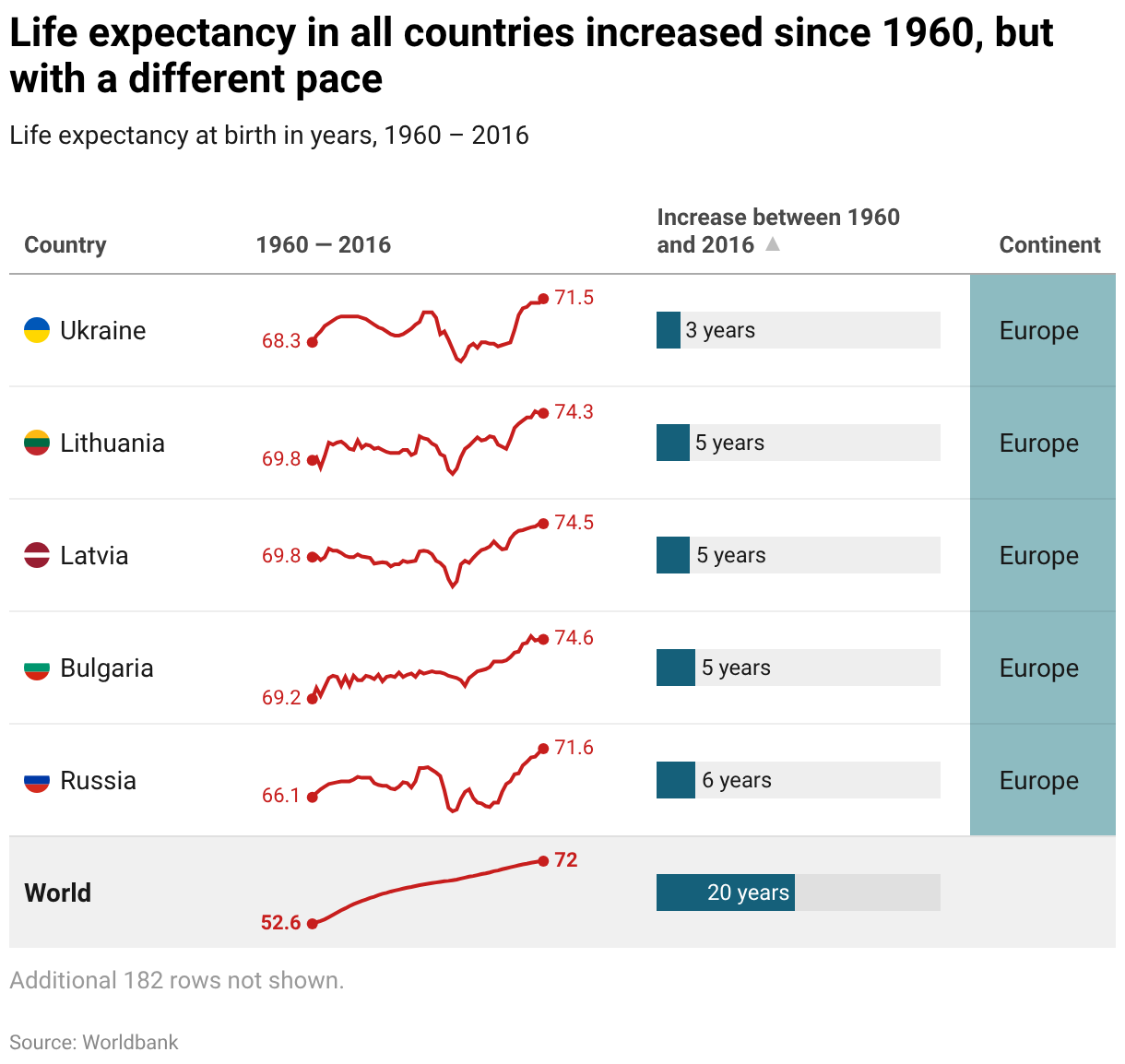
It’s about time that our tables get a proper update. Starting today, you can create tables like this one with Datawrapper:


More options than before: What you can do with our new tables

We’re happy to introduce the following features in our new tables:

  1. Add sparklines (tiny line charts!) & bar charts to visualize your data within table rows
  2. Style individual rows & columns to highlight important data points
  3. Style cells based on data, e.g. on categories
  4. Add images to your table with markdown
  5. Create sticky rows (rows that are always visible) to let readers compare your data better
  6. Let your readers search & sort your table as they like; and add pagination.
  7. For mobile screens: decide if you want to show your table vertically scrollable or as cards, and decide which columns you want to display
  8. Use a custom theme to display tables in your brand design

That’s not all: You can choose between a compact & cozy layout, parse markdown to format text and add links, stripe your table, show ranks, show tiny flag icons 🇫🇷 with one click, style or hide the table header and use double-row headers with merged cells. Yes, we built a powerful table tool, for all the use cases you might have.

Let’s talk about the most exciting new features in detail:


1. Show numeric columns as sparklines (tiny line charts!) & bar charts

When creating a table, select several number columns with Shift and turn them into tiny line charts called “sparklines”. They’re great to bring some nuance into your table: Instead of just showing the first date and last date (e.g. 1960 and 2016), you can now show how the variable developed in the meantime.

We also kept the bar charts from our old tables. Select a number column, click “Show as bar chart” and voilà: Your data becomes better comparable.


2. Style rows and columns

You can now style each row and column individually. Highlight the most important rows or tone down columns that add only background information. Change the font style, color, background color, column width, add border lines, customize number and date formatting – or select multiple columns and style them all at once.


3. Style individual cells based on data

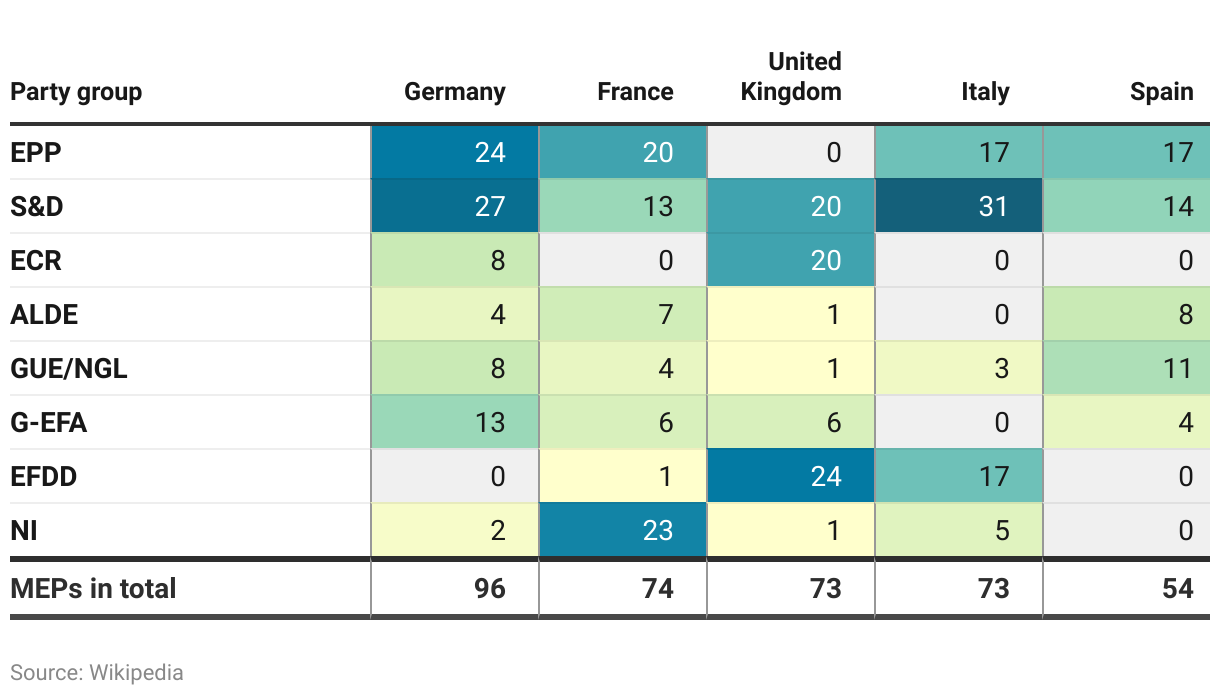
With our new tables, you can style individual cells based on categories defined in your dataset. Maybe you want to color negative numbers in red. Or you want to color the background of states with the color of the party that won the election. Or you want to create heatmap-like cell backgrounds (that’s possible, although a bit tricky):


4. Add images

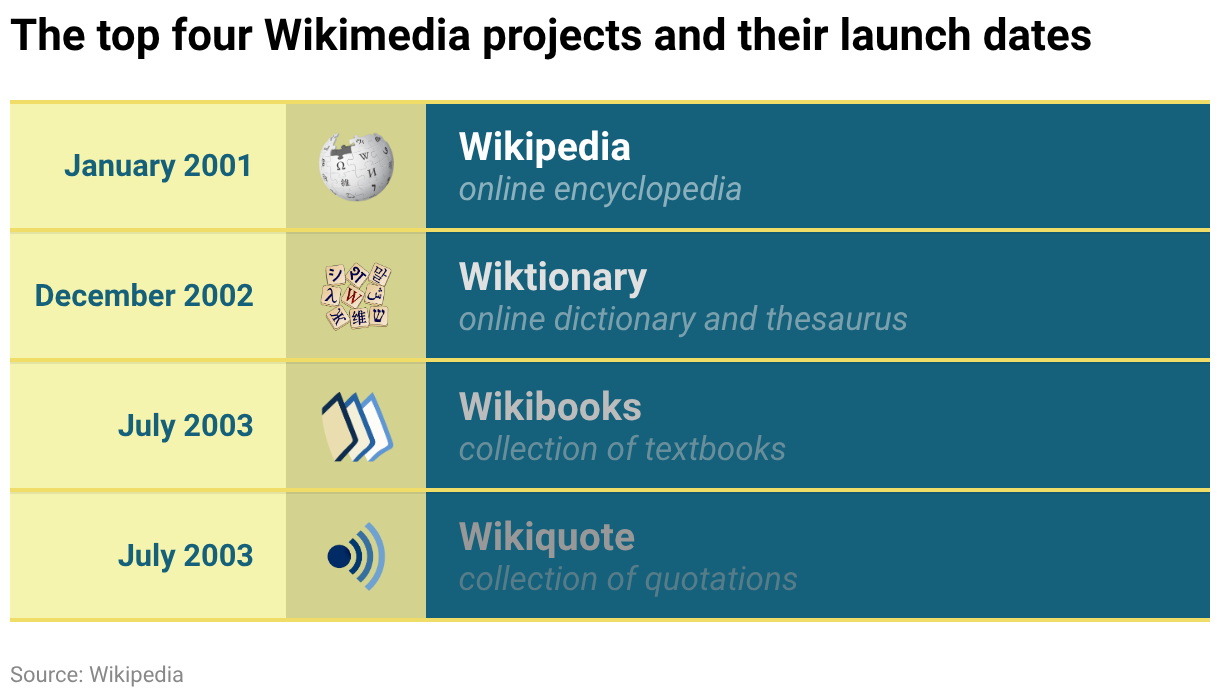
Yes, that’s a Datawrapper table, too. You can add images with markdown – simply write ![image alternative text](link to image) in your data and then enable Parse markdown in step 3: Visualize. Play around with the scale of your column or row until your’re happy with the size of the images. And make sure to check how they look on mobile devices!


5. Create sticky rows: Rows that are always visible

As with many visualization types, the most interesting question is often “Compared to what?”. In a table, you might want to compare each state with the national average. Or you want to compare each soccer team to the one the story is focussing on. You can highlight rows using custom styling, but there’s a problem with longer tables: the highlighted row might not be on the current page.

That’s where sticky rows come in handy: a sticky row will show up in the table no matter what you do. Even when you use the search input to filter the table, the sticky rows will be there:


6. Paginate, sort and search

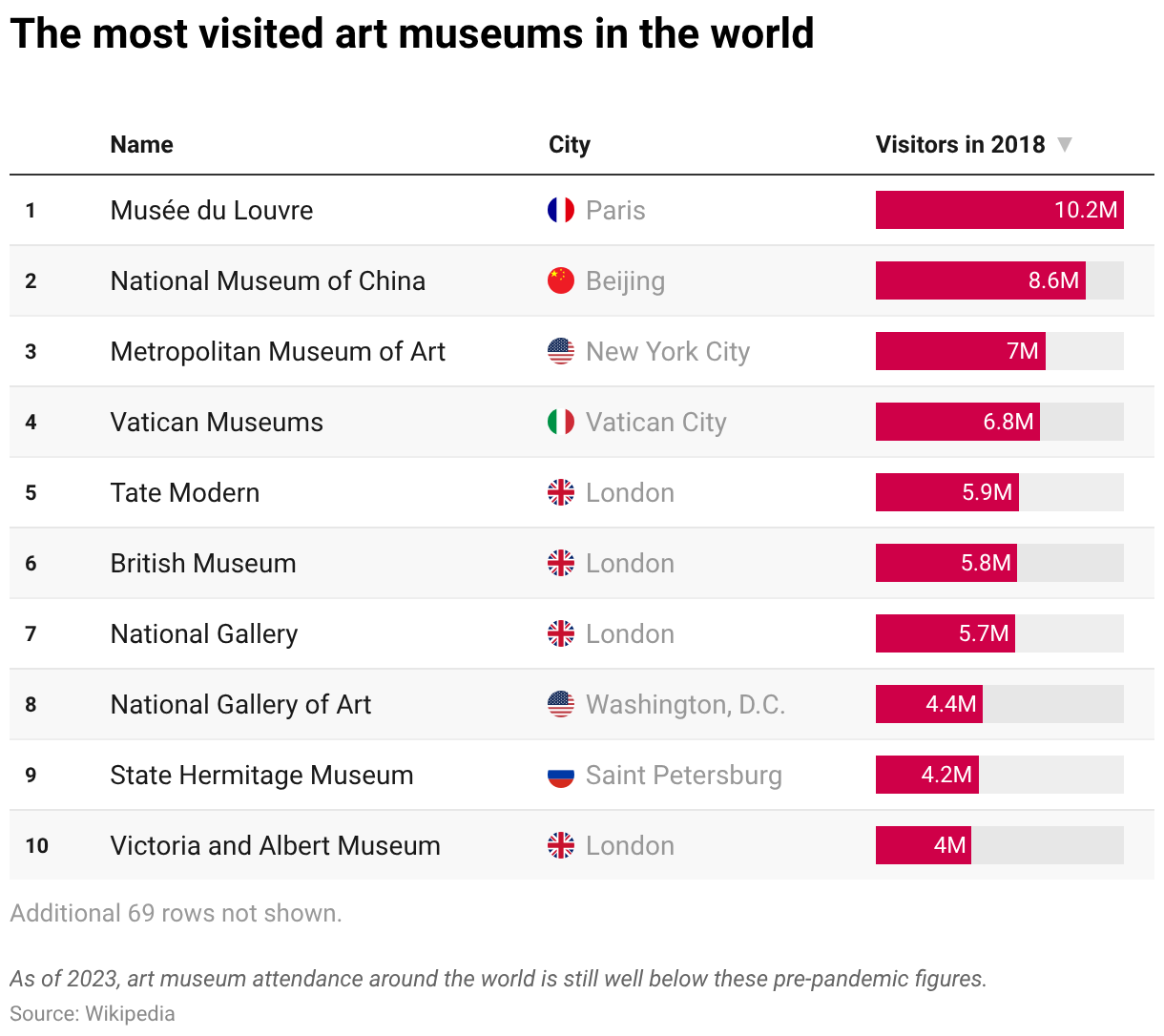
You might create tables to let readers look up the information that are of most interest to them – about the city they live in, the party they voted for, or the income they have. Our tables offer custom column sorting and a search functionality to help your readers achieve that goal. Together with pagination, they’ll make for a great explore tool. In the following table, try to search e.g. for “London”, “Paris” or “Tokyo”:


7. Optimize for mobile screens with two display modes and column selection

Making tables work on mobile is no easy task. We offer two solutions: You can decide if your table should be horizontally scrollable on mobile (that’s the default) or displayed as cards (select “mobile fallback” to make that happen).

But often, the main factor in making tables work on both desktop and mobile is the number of columns. On a big screen, more columns will fit (and look beautiful!) than on a small screen. That’s why you can now hide less important columns on mobile, while still showing the full table on larger devices:


9. Add a second row to the header

Sometimes, one header line is not enough. Sometimes, you need two: To structure the many columns you have in two or three categories; or because you don’t want to repeat yourself in the column headers. Datawrapper lets you add two header rows: Enable Merge with empty cells and Add first row to header to make that happen and wrap your header text in little ~~~'s to create a line left and right of the text:

8. Show tables in your brand design

As part of our Custom plan, we offer to build a design theme for you, so that you can create charts and maps in your company style. If you’re part of an organization with such an own design theme, we migrated your styles. You can start using the new tables in your design right away. Do get in touch with us if you wish any changes: support@datawrapper.de.

Examples for our new tables in design themes by our users


…plus everything you’re used to from us

We are little perfectionists. Like with all our chart & map types, we want to enable you to make create great-looking tables with Datawrapper, even if you’re not a designer or data vis pro.

  • That’s why we discuss for hours about design defaults and automatically enable & disable features where it makes sense.
  • That’s why we added lots of little helpers that explain our features directly where you can use them.
  • That’s why our tables come with a colorblind check that warns you if you’re using colors that are hard to distinguish by colorblind people.
  • And it’s also the reason why we translate in-table elements (“Next”, “Source”, etc.) in your language.

Let us know if you have ideas how we can help you. We’re always eager to make our tool even easier to use.


What happened to the old table editor(s)?

If you’ve been using Datawrapper tables before, you might wonder what happened to our old tables. We used to have two: The “long table” provided pagination and a search input for filtering rows. The “short table” let you use a lighter style and allowed custom styling of rows and displaying columns as bar charts. With this update we have merged both types into one. But don’t worry: The new table have all options from the old tables, so you won’t miss anything you’re used to.


We hope you’re as excited as we are about the new tables. As always, do let us know if you have feedback, suggestions or questions. We’re looking forward to hearing from you at support@datawrapper.de.

16 May 14:13

Toronto Ride of Silence 2019

by jnyyz

Today’s Ride of Silence took place under highly variable weather conditions. Riding to the start point, it was sunny and warm to begin with, but in the next half hour, I experienced thunder and lightning, rain, and hail. A bit like this strip:

At the starting point, there were a few hardy souls gathered, shown here taking some shelter in an alcove. Look closely: those white streaks are hail stones!

What a day to be without rain gear, and wearing a T shirt.

As the appointed time approached, the rain let up a bit, and a few more people rode up. Here is Ben with his highly modified Brompton.

Fork and rear triangle made of Russian titanium, a Rohloff hub, and Hope disc brakes.

Joey lines us up to go.

Riding by the Dalia Chako ghost bike.

Approaching Bay, it is raining in earnest again. Hamish has joined us.

Surprise: Bill has appeared with our ASME winning bike.

What a day to be caught without my usual rain cape.

At Dundas and Yonge.

Getting ready to turn onto Queen.

Arriving at the peace garden. You can tell there’s water on my lens by now.

A few more people rode up at the Peace Garden, just as the sun came out again.

Here I’m reading out the names of the deceased. (Photo: Hamish Wilson)

Every year, the list of names of cyclists killed in the past ten years gets longer. This was the 17th annual Ride of Silence internationally. I’m not sure when these rides started in Toronto, but the first one I attend was 2010, so this was at least the 19th local ride.

Today was also the one year anniversary of the when Jonas Mitchell was struck and thrown ten meters through the air at Lakeshore and Colborne lodge. We heard about it the day before last year’s ride.

Thanks to everyone who helped us remember all the cyclists whose lives were tragically cut short while riding bikes on the mean streets of our fair city.

Update: Joey Schwartz’s video of the ride.

16 May 14:12

Jane Fonda’s “feel the burn” workout video turns 32 - CBS News

Jane Fonda’s “feel the burn” workout video turns 32  CBS News

Video featured Fonda performing an exercise routine that coined some popular workout phrases.

16 May 14:12

Learning negotiation from Jane Austen

Looking for a job as a software developer can be scary, exhausting, or overwhelming. Where you apply and how you interview impacts whether you’ll get a job offer, and how good it will be, so in some sense the whole job search is a form of negotiation.

So how do you learn to make a good impression, to convince people of your worth, to get picked by the job you want? There are many skills to learn, and in this article I’d like to cover one particular subset.

Let us travel to England, some 200 years in the past, and see what we can learn.

Jane Austen, Game Theorist

What does a novelist writing in the early 19th century have to do with getting a programming job?

In his book Jane Austen, Game Theorist, Michael Suk-Young Chwe argues quite convincingly that Austen’s goal in writing her books is to teach strategic thinking: understanding what and why people do what they do, and how to interact with them accordingly, in order to achieve the outcomes you want.

Strategic thinking is a core skill in negotiation: you’re trying to understand what the other side wants (even if they don’t explicitly say it), and to find a way to use that to get what you want. The hiring manager might want someone who both understands their particular technical domain and can help a team grow, whereas you might want a higher salary, or a shorter workweek. Strategic thinking can help you use the one to achieve the other.

Strategic thinking is of course a useful skill for anyone, but why would Jane Austen in particular care about strategic thinking? To answer that we need a little historical context.

The worst job search ever

Imagine you could only get one job your whole life, that leaving your job was impossible, and that you’d be married to your boss. This is the “job search” that Austen faced in her own life, and is one the main topics covered in her books.

Austen’s own family, and the people she writes about, were part of a very small and elite minority. Even the poorest of the families Austen writes about have at least one servant, for example.

While the men of the English upper classes, if they were not sufficiently wealthy, could and did work—as lawyers, doctors, officers—their wives and daughters for the most part could not. So if they weren’t married and didn’t have sufficient wealth of their own, upper-class women had very few choices—they could live off money from relations, or take on the social status loss of becoming a governess.

Marriage was therefore the presumed path to social status, economic security, and of course it determined who they would live with for the rest of their lives (divorce was basically impossible).

Finding the right husband was very important. And getting that husband—who had all the legal and social authority—to respect their wishes after marriage was just as important. And of course the women who didn’t marry lived at the mercy of the family members who supported them.

And that’s where strategic thinking comes in: it was a critical skill for women in Austen’s class and circumstances.

Learning from Austen

If, as Michael Chwe argues, Austin’s goal with her books is to teach strategic thinking, how can you use them to improve your negotiation skills?

All of Austen’s books are worth reading—excepting the unfortunate Mansfield Park—but for educational purposes Northanger Abbey is a good starting point. Northanger Abbey is the story of Catherine, a naive young woman, and how she becomes less naive and more strategic.

Instead of just reading it as an entertaining novel, you can use it to actively practice your own strategic understanding:

  1. In every social interaction, Catherine has a theory about other people’s motivations, why they’re doing or saying certain things.
  2. Notice the assumptions underlying her theory, and then come up with your alternative theory or explanation for other characters’ actions.
  3. Then, compare both theories as the plot unfolds and you learn more.

Other characters also offer a variety of opportunities to see strategic thinking—or lack of it—in action. Once you’ve gone through the book and experienced the growth of Catherine’s strategic thinking, start practicing those skills in your life.

Why are your coworkers, family, and friends doing what they’re doing? Do they have the same motivations, goals, and expectations that you do? The more you pay attention and compare your assumptions to reality, the more you’ll learn—and the better you’ll do at your next job interview.

Ready to get started? You can get a paper copy from the library, or download a free ebook from Project Gutenberg.


Tired of scrambling to get your job done?

If you were productive enough, you could take the afternoon off, confident you’d produced high value work. Not to mention having an easier time finding a new job when you need one.

Learn the secret skills of productive programmers.

16 May 14:12

Keychain Access - bellybeeping

I am still using 1Password with Dropbox, and not having too many issues. If I try to generate a password on my phone, I'll have to wait a bit for it to sync over sometimes, but otherwise it's okay.

The old non-1password sync version on Windows is another story -- It doesn't even support Chrome anymore without hacks to trick it.
16 May 14:12

Reaching Almost 600 Mbit/s with 802.11ac

by Martin

Back in October 2016, I ran my first Wifi 802.11ac speed measurement at home. At my desk with one wall between me and the Wifi Access point plus a nasty corner, I could get up to 368 Mbit/s versus a ‘measly’ 70 Mbit/s with my 802.11n based Lenovo X230 notebook I had at the time. What I didn’t do back then was to note the top speed I could get when I was closer to the Wifi access point. Now that I’ve upgraded to a Lenovo X250 with an 802.11ac Wifi card built-in and supporting access points popping-up in many places, it was time to see what the practical maximum could be.

Again I was quite surprised to see the result. This time around I was using a Linksys 1200AC running Lede/OpenWRT and my place of work is around 4 meters away from the Access Point with line of sight. In this configuration, my maximum download speed I could achieve with my Lenovo X250 and the built-in Intel 7265 Wifi card was 600 Mbit/s. Not bad for an 80 MHz channel! In the uplink direction I could reach around 400 Mbit/s. Quite phenomenal values, even more so as the Internet connection behind it is ‘just’ 100 Mbit/s downlink and 40 Mbit/s in the uplink direction. Far from what is possible over the Wifi air interface. Time for an upgrade…

And here’s the iperf3 output with the iperf3 server having been run directly on the Linksys access point:

$ iperf3 -c 192.168.1.1 -R -p 5201

Connecting to host 192.168.1.1, port 5201
Reverse mode, remote host 192.168.1.1 is sending
[ 4] local 192.168.1.248 port 37772 connected to 192.168.1.1 port 5201
[ ID] Interval Transfer Bandwidth
[ 4] 0.00-1.00 sec 65.9 MBytes 552 Mbits/sec 
[ 4] 1.00-2.00 sec 71.7 MBytes 602 Mbits/sec 
[ 4] 2.00-3.00 sec 71.2 MBytes 597 Mbits/sec 
[ 4] 3.00-4.00 sec 71.9 MBytes 603 Mbits/sec 
[ 4] 4.00-5.00 sec 71.6 MBytes 601 Mbits/sec 
[ 4] 5.00-6.00 sec 71.7 MBytes 602 Mbits/sec 
[ 4] 6.00-7.00 sec 72.4 MBytes 607 Mbits/sec 
[ 4] 7.00-8.00 sec 71.8 MBytes 602 Mbits/sec 
[ 4] 8.00-9.00 sec 71.5 MBytes 600 Mbits/sec 
[ 4] 9.00-10.00 sec 70.3 MBytes 589 Mbits/sec


$ iperf3 -c 192.168.1.1 -p 5206

Connecting to host 192.168.1.1, port 5206
[  4] local 192.168.1.248 port 32780 connected to 192.168.1.1 port 5206
[ ID] Interval           Transfer     Bandwidth       Retr  Cwnd
[  4]   0.00-1.00   sec  40.6 MBytes   340 Mbits/sec    0    512 KBytes       
[  4]   1.00-2.00   sec  47.2 MBytes   396 Mbits/sec    0    512 KBytes       
[  4]   2.00-3.00   sec  48.8 MBytes   409 Mbits/sec    0    512 KBytes       
[  4]   3.00-4.00   sec  49.7 MBytes   417 Mbits/sec    0    512 KBytes       
[  4]   4.00-5.00   sec  49.5 MBytes   415 Mbits/sec    0    512 KBytes       
[  4]   5.00-6.00   sec  49.5 MBytes   415 Mbits/sec    0    512 KBytes       
[  4]   6.00-7.00   sec  51.5 MBytes   432 Mbits/sec    0    512 KBytes       
[  4]   7.00-8.00   sec  53.4 MBytes   448 Mbits/sec    0    512 KBytes       
[  4]   8.00-9.00   sec  51.0 MBytes   428 Mbits/sec    0    512 KBytes       
[  4]   9.00-10.00  sec  50.8 MBytes   426 Mbits/sec    0    512 KBytes


16 May 14:11

There is no power on this Earth that can resist an idea whose time has come

by Volker Weber
We should be raising climate change as a topic of conversation with everyone we can. Just say a little something to promote empathy and compassion and to get rid of this mentality of ‘I’m alright Jack, bugger the rest of you’. We can hope they’ll then say a little something to someone else and the residual dinosaurs will eventually realise they’re out of step and it’s not socially acceptable to behave that way anymore.

Good reading.

More >

16 May 14:11

I did not invent #dontbreakthechain

by Volker Weber

SharedScreenshot

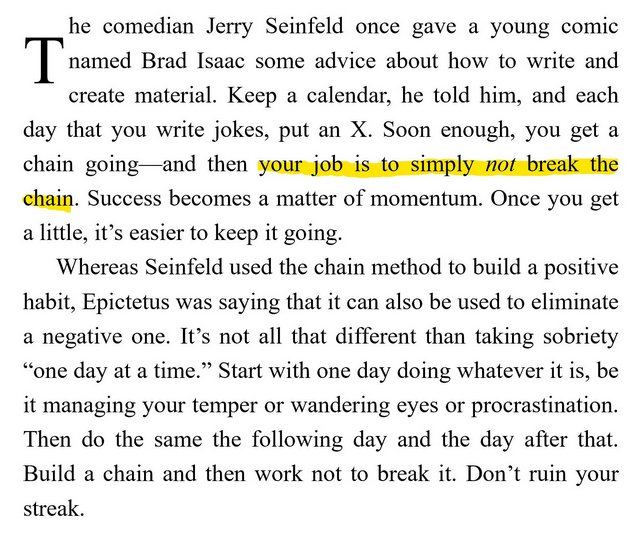
I did not invent the method, but I used it to my advantage. Excerpt from "The Daily Stoic: 366 Meditations on Wisdom, Perseverance, and the Art of Living: Featuring new translations of Seneca, Epictetus, and Marcus Aurelius" by Ryan Holiday and Stephen Hanselman.

More >

[Thanks, Ben]

16 May 14:11

We had a great time at Create Startups in Paris...


We had a great time at Create Startups in Paris this last Tuesday at Numa. At this stop, we changed our format to a half-day single track in the afternoon with four presentations plus a keynote. Even though it’s a challenge to get in all the information we want in just a half-day, it felt like the right length for an audience of this size and what we’re trying to do.

Next stop, Mumbai. I won’t be able to be there, but Chad Fowler will be giving the keynote, so I know it’s going to go well!

16 May 14:11

Shopify opens new office, intends to hire 750 by 2022

by Shruti Shekar

Ottawa-based e-commerce company Shopify is expanding with a new office space in Toronto and plans to double its workforce.

The company said that it has reached $1 billion CAD in revenue and intends to hire 750 “talented people to build products” that help its customers by 2022. This will then double the number of employees it currently has.

New jobs that Shopify is trying to fill will focus on research and development. Shopify intends to also hire developers, data analysts, designers, researchers, and product managers.

Shopify’s new office will be located on King and Portland Centre in downtown Toronto and will be “dedicated” to hosting customers and clients. The company said employees will be “encouraged to connect with one another” on the new terrance and garden, or at the cafe or seating areas. The new space will also include meeting rooms, pods for “introspection in quiet spaces” and will be accommodating for those working remotely.

Further, the new space will also have a stage, video wall and bleacher seating areas that will “accommodate hundreds.”

“This lounge will be open to the local community to host events onsite free of charge,” Shopify said.

Image credit: Shopify

The post Shopify opens new office, intends to hire 750 by 2022 appeared first on MobileSyrup.

16 May 14:11

Researchers claim they’ve created an app that can detect ear infections

by Aisha Malik

Researchers at the University of Washington claim they have created an app, called EarHealth, that is able to detect ear infections by listening to fluid in the ear.

Users would just need their smartphone and a folded up piece of paper. The app will listen to the ear and be able to determine if there is fluid present, which is the case when someone has an infection.

The researchers say the app will be able to detect an ear infection with the same, perhaps even more, accuracy as a doctor.

The app will play chirping sounds, which are channeled through the paper taped to the phone. The sound waves bounce from the ear back to the phone and interact with the chirping sounds from the phone. The noise is picked up by the microphone, and is then analyzed within the app. The app examines the fluctuations in sound, and proceeds to predict the probability of fluid present.

Although accurate ear infection tests already exist, they are done at a doctor’s office and are conducted with medical equipment. This app aims to create an accessible and inexpensive test that could challenge the accuracy of traditional tests.

The app has been tested on children between 18 months and 17 years at Seattle Children’s Hospital. In the initial tests, the app was able to determine if someone had ear fluid with 85 percent accuracy.

The developers hope to have the app cleared by the Food and Drug Administration by the end of the year. They are also looking to partner with doctors in developing nations to bring the app to more countries.

Image credit: University of Washington

Source: Science Mag Via: Gizmodo 

The post Researchers claim they’ve created an app that can detect ear infections appeared first on MobileSyrup.

16 May 14:10

‘A propaganda machine’: How Ford government skirts media with Ontario News Now - The Globe and Mail

mkalus shared this story .

When Ontario Premier Doug Ford travelled to New York late last month to meet with U.S. business leaders, Canadian media were given less than a day’s notice about the trip. Mr. Ford brought his own TV crew: Ontario News Now.

The communications service, run by Progressive Conservative staffers, is fronted by Lyndsey Vanstone, a former broadcaster. ONN travels regularly with the Premier, posting exclusive footage and interviews on social media, mimicking a mainstream news outlet.

At first glance, ONN looks like news content, raising concerns about whether the government is purposefully trying to blur the lines between partisan messaging and journalism.

It’s all paid for by taxpayers, but the costs are unknown. Because ONN operates out of PC caucus services, a fund that every caucus of eight or more receives for administration and research, it is not subject to disclosure or freedom of information requests. The overall budget for the PCs is around $6.7-million.

The Globe and Mail has learned the top two staffers at PC caucus services – Ms. Vanstone, as director of communications, and executive director Jeff Silverstein – earn six-figure salaries, with Ms. Vanstone making at least $100,000 and Mr. Silverstein close to $150,000, according to multiple sources who spoke on condition of anonymity as they were not authorized to discuss the matter publicly.

ONN content is widely shared on social media by Mr. Ford and his cabinet, who are told by the Premier’s Office they have to participate, multiple sources said. (When asked if he is forced to do ONN videos, Economic Development Minister Todd Smith said “God no. … It’s a way to get our message out.")

Mr. Silverstein did not answer questions about salaries, but said any employee who makes more than $100,000 will be found on next year’s sunshine list. He did not answer questions about ONN’s total budget or travel costs. He said all PC MPPs and cabinet members "are encouraged ... to participate in and share Ontario News Now content.”

“Ontario News Now is a creative way to communicate the government’s message in the modern, digital world – no different than a video press release,” Mr. Silverstein said in a statement.

“In total, Ontario News Now content has been viewed more than 10 million times across social media platforms – not to mention the amount of earned media that has been generated as a result of the Queen’s Park Press Gallery’s fascination with the platform.”

The medium has been criticized by opposition leaders and political watchers who say it undermines democracy by allowing the government to get around traditional media and evade critical questions.

Story continues below advertisement

“The problem is it blurs the partisan with the public," said Jonathan Rose, associate professor of political studies at Queen’s University. "Governments are entitled to send a partisan message, but it has to be done clearly under the party banner, and not under guise of some neutral name like Ontario News Now.”

NDP leader Andrea Horwath said salaries for PC staff working on ONN are further proof of Mr. Ford’s patronage.

“What the government is trying to do is make it look as though this is a legitimate outlet, and it’s not. It is a propaganda machine being paid for by public dollars," she said.

The idea was conceived on the campaign trail by Kory Teneycke, the former vice-president of Sun News who served as Mr. Ford’s campaign manager.

Mr. Teneycke said he viewed the format, which was then dubbed Ford Nation Live, as a way to use social media to stream content from events and announcements in a more appealing way.

“It’s just the reality of modern campaigning. You could get more coverage by providing your own. But it’s not really a competition with traditional news,” Mr. Teneycke said.

“The reality is that the internet has fundamentally changed the media business, and people in journalism live that every day."

He calls the idea, “One of the better things that we did during the last campaign."

While opposition parties have labelled the content as government-funded propaganda, the PCs argue it’s an innovative way to promote their policies.

Stephen Harper’s former Conservative government had a weekly video series, called 24 Seven. Former news anchor Ben Chin, now a senior adviser to Prime Minister Justin Trudeau, made YouTube videos called Liberal TV for the Ontario Liberal party in 2007.

Mr. Silverstein said every party uses caucus budgets to their advantage. “In opposition, the NDP use their caucus budget to create partisan attack videos. While in government, the Liberals used their caucus budget to sign lucrative polling contracts with Liberal insiders," he said.

Interim Liberal leader John Fraser said there needs to be more transparency about ONN’s cost.

“It’s essentially being used as a vanity project,” he said. “It’s a public expenditure. And it should be disclosed as such.”

16 May 14:10

ChromeOS hat offenbar Hyperthreading deaktiviert. Aus ...

mkalus shared this story from Fefes Blog.

ChromeOS hat offenbar Hyperthreading deaktiviert. Aus Sicherheitsgründen. Microsoft und Apple empfehlen wohl auch in die Richtung.

Das killt mal eben 30-40% der (bezahlten) Performance. Und wegen der armen notleidenden Intel-Aktionäre verlang jetzt niemand von denen, dass sie ihre kaputte Hardware tauschen. Das muss daran liegen, dass Intel eine US-Company ist. Bei VW sah das noch ganz anders aus. Und bei Monsanto. Jedenfalls solange die nicht von Bayer gekauft wurden.

Der Effekt wird wahrscheinlich sein, dass die Leute jetzt neue Prozessoren mit mehr echten Cores kaufen. Win-Win-Win-Win für Intel!

Ich schalte Hyperthreading jedenfalls nicht ab bei mir. Und mein nächster Prozessor wird ein Ryzen.

16 May 14:10

In this he was no different to other ministers. Since 1979, this country has been obsessed with the idea that the profit motive is a magic wand you can wave at any problem to make it disappear. It is not.

by IanDunt
mkalus shared this story from iandunt on Twitter.

In this he was no different to other ministers. Since 1979, this country has been obsessed with the idea that the profit motive is a magic wand you can wave at any problem to make it disappear. It is not.


Posted by IanDunt on Thursday, May 16th, 2019 9:35am


66 likes, 14 retweets