Shared posts

21 May 18:26

Before You Allow Members To Create Groups

by Richard Millington

…you might want to consider the risk factors.

When you enable members to create groups on your community you’re essentially renting them your brand name (and a small portion of the audience) to pursue their own goals.

A few things to consider:

1) Which members will you allow to create groups? Can anyone do it or only a select few who have demonstrated the ability to manage a group (hint, choose the latter)?

2) Do you have a training program for members to create groups?

3) What happens if group leaders don’t crack down on minor abuse?

4) What happens if group leaders don’t crack down on serious issue?

5) Will you allow multiple groups on the same topic or only one group per topic?

6) What happens if a group leader becomes inactive (who can replace her and what does this process look like?)

7) What happens if a group leader is active but the group isn’t? What level of activity does a group need to continue as a group?

8) How will you remove groups which don’t take off without upsetting group leaders or members (and what will you do with the content in that group?)

9) Who gets to name the group? What are the restrictions on group names?

10) What happens if groups are local and want to meet in person? What is your legal liability for what happens? To what extent can you support groups?

11) What happens if group leaders get together to demand changes you are unable or unwilling to make?

When groups work well, everyone wins. When it doesn’t, you can upset your best members, building hundreds of ghost-villages, and see your brand name tarnished.

21 May 18:25

My two a day fruit/green smoothie habit started a while ago in San Francisco and continues here in Waikiki with a homemade, pre-surf, all-fruit smoothie and then usually another from somewhere after surfing! This one’s papaya, strawberry, mango

by Emily Chang

Photo Caption: My two a day fruit/green smoothie habit started a while ago in San Francisco and continues here in Waikiki with a homemade, pre-surf, all-fruit smoothie and then usually another from somewhere after surfing! This one’s papaya, strawberry, mango

Photo taken at: Tucker & Bevvy Hyatt

Instagram filter used: Clarendon

View in Instagram ⇒

21 May 18:25

Google Pixel ‘Now Playing’ feature may get location, activity tracking

by Jonathan Lamont
Google Pixel Now Playing

The Google Pixel 2 and 2 XL brought one of my favourite Pixel features, the Now Playing function on the Ambient Display, which can recognize songs and display their name. Google improved Now Playing on the Pixel 3 and 3 XL by letting it store a history of songs it recognized, and the feature may be set to get more improvements soon.

According to an APK teardown performed by XDA Developers, Google is working on adding location history and activity history to Now Playing.

It’s important to remember that APK teardowns serve as useful indicators of future features, but don’t guarantee anything. Further, it’s possible to misinterpret code discovered in teardowns, so predictions might be inaccurate.

In this case, however, it seems pretty straightforward. Code extracted from the system app that controls features like Now Playing, Pixel Ambient Services, suggests history will include details such as whether you were driving when you heard a song, or where you listened to a song, such as at a restaurant.

<string name="history_context_activation_dialog">" Your Now Playing history can include location and activities, like driving. To include this information, allow "<b>Pixel Ambient Services</b> to access your location on the next screen.</string>

<string name="history_context_activation_dialog_button_negative">Cancel</string>

<string name="history_context_activation_dialog_button_positive">Continue</string>

<string name="history_context_switch">history_context_switch</string>

<string name="history_context_switch_subtitle">Now Playing history will show location and activities, like driving</string>

<string name="history_context_switch_title">Include location and activities</string>


The feature isn’t currently live in Pixel Ambient Services, and the code was only present in beta version 1.0.229715350. Considering Google tends to announce Now Playing features alongside hardware releases, and the company didn’t do so when it launched the Pixel 3a, it’s likely we’ll see it come alongside the Pixel 4.

However, Google may surprise us and start rolling it out sooner as well.

Source: XDA Developers

The post Google Pixel ‘Now Playing’ feature may get location, activity tracking appeared first on MobileSyrup.

21 May 18:25

Google uses Gmail to track what you buy, online or off

by Jonathan Lamont
Gmail app on iOS

As more big tech companies begin to talk about the importance of privacy, it will become increasingly important to hold them accountable. Following a New York Times op-ed from Google CEO Sundar Pichai about how “privacy cannot be a luxury good,” CNBC uncovered that the search giant uses Gmail to track users’ purchases and keeps them in a semi-hidden ‘Purchases’ page inside their Google Account.

You can access it for yourself by navigating to your Google Account — simply click on your profile picture in the top-right corner of nearly every Google app and tap the corresponding account button. Then, go to ‘Payments & subscriptions’ to see your Purchases. Alternatively, go to “https://myaccount.google.com/purchases.”

The tool has existed for some time — although we’re not sure when Google first bundled it into the Account page — and I’ve certainly seen it before. However, I didn’t realize the scope of it at the time.

I’m an avid user of Google Pay and knowing the search giant’s penchant for data collection, I figured the company was tracking things I purchased with Pay. I assumed the Purchases page in my Google Account was simply a list of purchases made through Pay. It isn’t. Actually, Pay appears to be a separate collection of my purchases entirely, with the only overlapping items being things I purchased through Google — such as apps or movies — or things I bought with Pay that received an email receipt.

And that, really, is the crux of the problem. The purchase history Google created leverages email receipts to track what you buy, sometimes with startling detail. In my case, I could find purchases as far back as 2010. I also found purchases through online retailers, such as Amazon, where the details stored by Google included the shipping address I used, the order ID and even whether the package was delivered. I also found some purchases I made in stores, such as items I bought at Best Buy and received an email receipt for.

You can remove the Purchases data, but it isn’t easy

Google told The Verge in a statement that it created the Purchases section to “help [users] easily view and keep track of [their] purchases, bookings and subscriptions in on place.” It also touts that the Purchases menu is private, only accessible to the account holder. The company also maintained that you could delete that data and that it doesn’t use it to serve you ads.

However, the data isn’t easy to delete — you have to remove every single purchase stored by Google individually. Further, some users suggest that Google didn’t create it as a place to help users track spending, as the tool does little beyond providing a long list of all your purchases. It also isn’t readily available — instead, it’s hidden inside your Account settings.

Ultimately, the feature isn’t necessarily nefarious, but nonetheless, it’s uncomfortable to know Google is keeping an eye on my spending. It also makes it harder for people to get on board with Pichai’s privacy push.

That’s not to say Google hasn’t improved. The company recently introduced a new privacy policy for its smart home devices and better tools for controlling ad tracking in Chrome. It’s also bringing better privacy and data deletion tools to Android Q.

However, more needs to be done. Op-eds and promises from executives will only go so far in improving privacy for users.

Source: CNBC Via: The Verge

The post Google uses Gmail to track what you buy, online or off appeared first on MobileSyrup.

21 May 18:25

Facebook, AI, evil, and human creativity

by Josh Bernoff

The intersection of human evil and Facebook algorithms has created the evil-amplifying social networks we now share. Facebook says AI can solve the problem. So far, it can’t. If it ever does, heaven help us. The New York Times published a revealing profile of Mike Schroepfer, Facebook’s CTO. He’s the man whom Mark Zuckerberg has … Continued

The post Facebook, AI, evil, and human creativity appeared first on without bullshit.

21 May 18:25

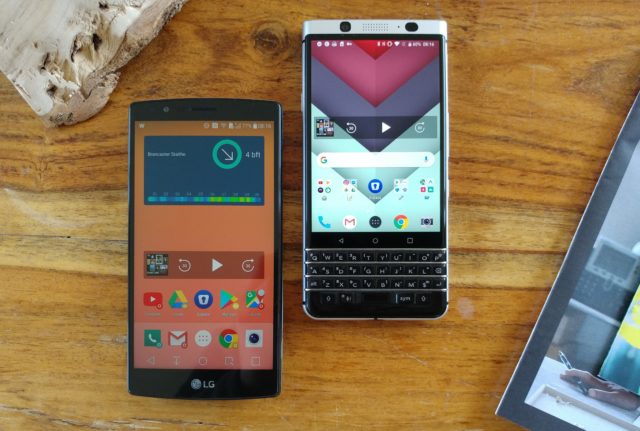
Trusty tools: 3 days, 750 photos and 10,000 words on a Blackberry KeyONE and LG G4

by Marek Pawlowski
Blackberry Keyone and LG G4

10,000 words in 3 days on a Blackberry KEYone, most of them written while walking or standing. I didn’t realise my thumbs had been so busy until I looked at the word count a couple of days after I returned from Mobile World Congress, where I’d been doing a little research. Perhaps that tells its own story? It hadn’t felt onerous. Indeed, there is a strangely immersive flow to writing on such a small keyboard which I often find eludes me on my desktop, despite it being objectively more comfortable.

Mobile keyboards require some adjustments. You need to trust yourself. If you’re constantly checking and manually correcting you’ll never get anywhere. You must also be willing to tolerate approximations. At an event like Mobile World Congress my goal in the moment is to record the broad shape of about 20 relatively short interactions a day, usually meetings or product demonstrations lasting 15 to 30 minutes each. Detail and proofreading can come later, but there needs to be sufficient clues to develop rough notes into more fully formed thoughts.

I don’t subscribe to the notion physical keyboards are inherently faster than their more popular on-screen counterparts. However, they are the only way I can type while walking. There’s something about the tactility of real keys versus an on-screen keyboard which reserves just enough brain space to avoid bumping into things while typing on the go. While I’d usually advocate a ‘slow down to do more’ approach when it comes to writing, the reality of trying to cover a vast exhibition like MWC necessitates certain compromises.

Close-up of the physical keyboard on the Blackberry KEYone

My note taker of choice was Evernote. It’s reliable – I can’t remember the last time it lost anything I’d written on the move – and it syncs to any platform. I use some of its more complex tagging and sharing features for other purposes, but at MWC it simply needed to be a basic text editor. It did the job.

Words are only half the story though. I also needed to take about 250 photos each day and for this I chose the LG G4. It may be nearly 4 years old but it has a crucial advantage over newer phones: a replaceable battery. This meant I could shoot without even thinking about running out of power, knowing that the spare cell in my pocket would restore me to a fully charged device within a minute. Theoretically I could have done it all on the KEYone, but there’s a reassuring ‘belt and braces’ feeling to having two phones with you at a trade show, in case one were to fail.

Quite apart from the fast laser autofocus, which makes for good quality shots without needing to pay much attention, the G4 also has a removable SD card. This made it simple and efficient to transfer multiple gigabytes of photos and video to my laptop on the flight home, without worrying about cables or having a Wifi connection. Not all phones from this era would be up to the job, but the G4 had a particularly good camera for its day.

LG G4 with custom blue leather back cover, concealing a replaceable 3000 mAh battery

I’d set the G4 to quietly backup up all the images and video to Google Photos whenever it found a Wifi connection on the show floor. These could then be easily shared as an album to colleagues without needing an additional chunk of bandwidth at the airport to transfer all those big media files in one go.

This combination of removable physical media and background upload resulted in a head-start on editing during the flight home and allowing others involved with the project to stay up-to-date.

There were some snags. The Blackberry KEYone is beginning to lag with age. There were moments when I had to wait for it to catch-up. These rarely occurred when taking notes but rather in using it as a smartphone to support several days of travel. Switching back and forth to Google Maps for directions seemed particularly sluggish. Ironically, Alcatel TCL used Mobile World Congress to announce a refresh of its newer Blackberry Key Two with 6 Gb of RAM. Quite apart from the delightfully cheerful red colour scheme, I suspect this doubling of the RAM present on my ageing KEYone would make it a worthwhile upgrade.

The backup to Google Photos was reliable when Wifi signal was strong, but most days I found there were still images waiting to upload when I got back to my hotel. This seemed to be less a failing of Google Photos and the LG G4 as it was a reflection of 100,000 people trying to connect to the venue’s overloaded network.

On balance, however, I came away delighted by how this specialised, albeit somewhat dated, setup served its purpose. It was not lost on me that a show such as MWC, with its inherent focus on showcasing new flagship smartphones costing £1000, could be covered so effectively using two mobile devices which could now be purchased second-hand for about £200 in total.

While the state of the art is being pushed in truly impressive ways by the latest handsets from Huawei, Samsung, Sony and others, the greatest value in smartphones is to be found buying flagship products from a couple of years ago. Intense competition between Android manufacturers seeking to challenge Apple and fight among themselves has made for a relentless pace of new product releases which is causing depreciation to accelerate. Each new iteration of the latest Huawei or Samsung usually does about 10 percent more than the last, but by the time is is released, the price of that previous generation will often have fallen over 50 percent.

Evidence is emerging that consumers are struggling to accept the price tags of the most expensive flagship smartphones. CCS Insight predicts smartphone sales will actually decline to 1.4 billion this year, down 2% from 2018, after years of seemingly unstoppable sales growth. People are choosing to either stick with what they have or, increasingly, tapping the second hand market for older flagship smartphones which are still extremely capable.

The advent of new form factors, such as folding phones, may spark some growth at the high end, but this is unlikely to happen any time soon. Samsung, the first mainstream manufacturer to bring a folding product to market, has since postponed its introduction after early reviewers discovered weaknesses in its most important feature: the folding screen itself.

The situation today is a buyer’s market for those who need mobile creative tools that go a little beyond a standard rectangular slab of a smartphone. There’s far greater choice than consumers have had for years. Crowdfunding is allowing niche producers like Planet Computers and F(x)tec to offer specialised form factors like clamshells, while larger manufacturers such as Samsung and Huawei work on perfecting foldables. Alcatel TCL, with its model of applying large scale manufacturing capability to niche, licensed brands like Blackberry, is continuing to serve the needs of those profitable few who, like me, are willing to pay a premium for tactile keys.

21 May 18:24

How To Cut Carbon Emissions to Zero by 2050

by Duncan Geere

To prevent climate change climate breakdown and keep global warming global heating below 3–4 degrees celsius, we have to reduce greenhouse gas emissions and transition to renewable energy – globally.

Here’s a graphical blueprint on how we might get to net zero carbon emissions by 2050.

Created in association with New Internationalist Magazine.

» How to cut carbon emissions to zero
» See the data

21 May 18:24

EU to investigate Nigel Farage over expenses funded by Arron Banks | Politics

mkalus shared this story from The Guardian:
Cue the outcry on how the evil EU is trying to squash the people’s freedom fighter.

The European parliament will investigate Nigel Farage for failing to declare lavish expenses funded by Arron Banks.

The European parliament president, Antonio Tajani, “today refers the Farage issue to an advisory committee”, a source told the Guardian.

The advisory committee is a group of five MEPs who act as watchdogs over the parliament’s code of conduct. It stipulates that all members must declare expensive gifts and report whether third parties fund attendances at events.

Last week Channel 4 revealed Farage was generously funded by Arron Banks in the year of the Brexit referendum. Invoices, emails and documents showed Farage benefited from a £13,000-a-month Chelsea home, a car with a driver, and promotional visits to the US in 2016.

After the documentary, the Liberal Democrat MEP Catherine Bearder called on parliament authorities to carry out an urgent investigation into Farage’s “apparent contraventions” of the rules. The South East of England MEP is one of five of the parliament’s “quaestors”, meaning she scrutinises funding and administration.

Under the parliament’s code of conduct, MEPs are required to declare whether they receive travel, accommodation or subsistence expenses from external sources to attend events. The declaration should reveal the name and address of the funder, details about the expenses and the type of event.

Farage, who gets a €102,000-a year MEP salary, earned up to €700,000 from media appearances in 2014-18, putting him in sixth place on a European parliament “rich list” of MEPs’ outside earnings. The precise sum of his extra earnings is not known because MEPs only have to declare other earnings in broad bands.

The advisory committee will not meet until 4 June at the earliest, after this week’s European elections. It will appoint one of its members to lead the examination and write a report with a recommendation for a possible sanction. Any punishment, which could range from a reprimand to withholding salary, will be decided by the European parliament’s president.

The Brexit party leader, an MEP for 20 years, was last year docked half his MEP pay, after parliament administrators concluded he had misspent EU funds intended to staff his office. A political group dominated by Ukip – Farage’s former party – was asked to repay €173,000, after an official report said EU funds had been misspent on national campaigns.

Spokespeople for Farage in the Brexit party and his group in the European parliament have been approached for comment. His spokespeople have described previous investigations by the parliament as “politically motivated assaults” and “a vindictive campaign” targeting Eurosceptic MEPs.

21 May 18:23

Latest Firefox Release is Faster than Ever

by Marissa Wood

With the introduction of the new Firefox Quantum browser in 2017 we changed the look, feel, and performance of our core product. Since then we have launched new products to complement your experience when you’re using Firefox and serve you beyond the browser. This includes Facebook Container, Firefox Monitor and Firefox Send. Collectively, they work to protect your privacy and keep you safe so you can do the things you love online with ease and peace of mind. We’ve been delivering on that promise to you for more than twenty years by putting your security and privacy first in the building of products that are open and accessible to all.

Today’s new Firefox release continues to bring fast and private together right at the crossroads of performance and security. It includes improvements that continue to keep Firefox fast while giving you more control and assurance through new features that your personal information is safe while you’re online with us.

Download Firefox

To see how much faster Firefox is today take a look:

How did we make Firefox faster?

To make Firefox faster, we simply prioritized our performance management “to-do” list. We applied many of the same principles of time management just like you might prioritize your own urgent needs. For example, before you go on a road trip, you check for a full tank of gas, make sure you have enough oil, or have the right air pressure in your tires.

For this latest Firefox release, we adopted the well-known time management strategy of “procrastinate on purpose.” The result is that Firefox is better at performing tasks at the optimal time. Here’s how we reorganized our to-do list to make Firefox faster:

    • Deprioritize least commonly used features: We reviewed areas that we felt could be delayed and delivered on “painting” the page faster so you can browse quicker. This includes delaying set Timeout in order to prioritize scripts for things you need first while delaying others to help make the main scripts for Instagram, Amazon and Google searches execute 40-80% faster; scanning for alternative style sheets after page load; and not loading the auto-fill module unless there is an actual form to complete.
    • Suspend Idle Tabs: You shouldn’t feel guilty about opening a zillion tabs, but keeping all those tabs open uses your computer’s memory and slows down its performance. Firefox will now detect if your computer’s memory is running low, which we define as lower than 400MB, and suspend unused tabs that you haven’t used or looked at in a while. Rest assured if you decide you want to review that webpage, simply click on the tab, and it will reload where you left off.
    • Faster startup after customization: For users who have customized their browser with an add-on like a favorite theme, for example changing it to the seasons of the year, or utilizing one of the popular ad-blockers, we’ve made it so that the browser skips a bunch of unnecessary work during subsequent start-ups.

New Privacy Protections

Privacy has always been core to Mozilla’s mission, and the recent news and events have given people more reason to care about their privacy while online. In 2018, we launched privacy-focused features like opt-in Tracking Protection on the desktop, Tracking protection by default on iOS, and our popular Facebook Container Extension.

For today’s release we continue to bring you privacy features and set protections to help you feel safe online when you are with Firefox. Today’s privacy features include:

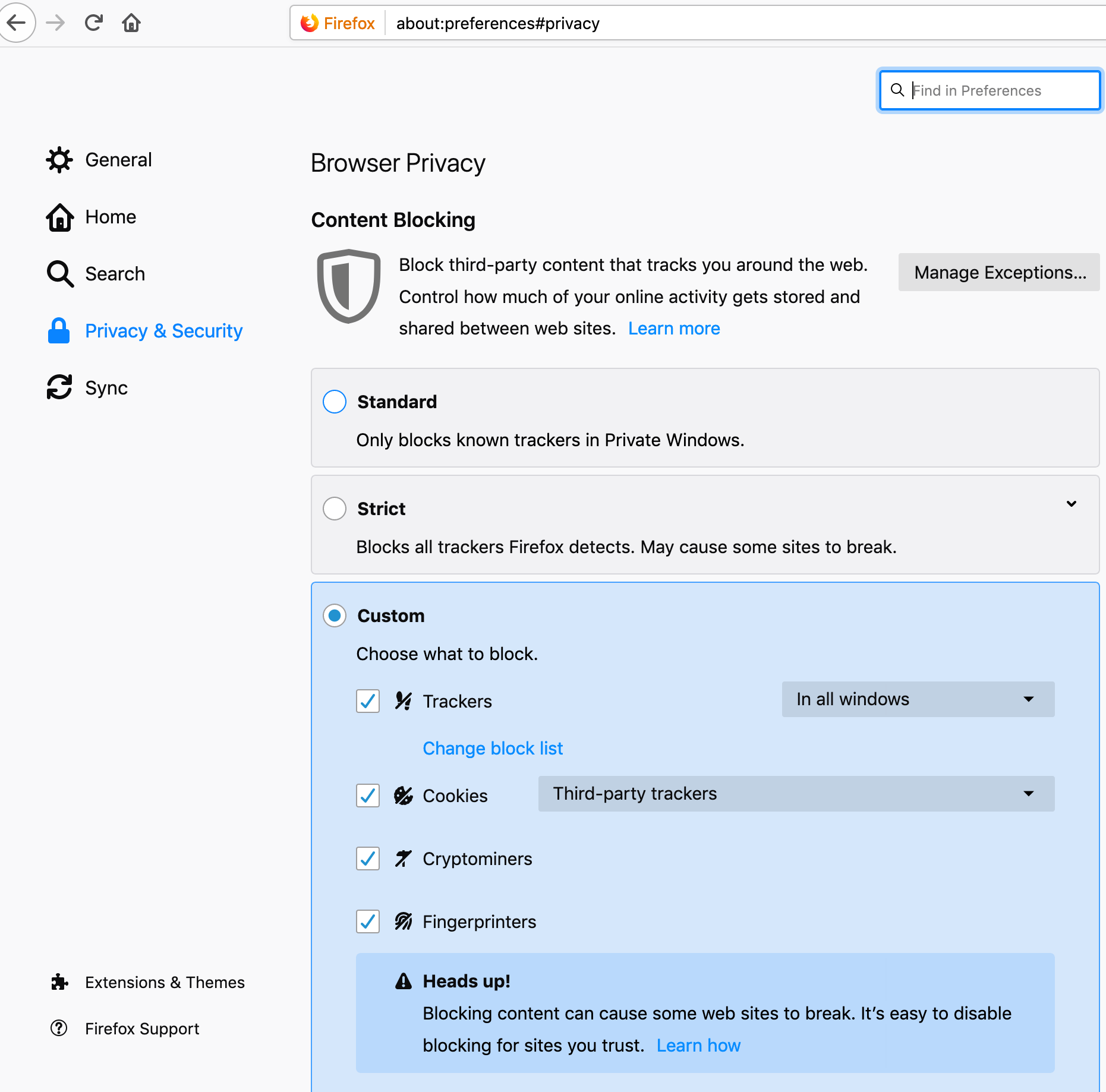
  • Blocking fingerprinting and cryptomining: In August 2018, we shared our adapted approach to anti-tracking to address growing consumer demand for features and services that respect online privacy. One of the three key areas we said we’d tackle was mitigating harmful practices like fingerprinting which builds a digital fingerprint that tracks you across the web, and cryptomining which uses the power of your computer’s CPU to generate cryptocurrency for someone else’s benefit. Based on recent testing of this feature in our pre-release channels last month, today’s Firefox release gives you the option to “flip a switch” in the browser and protect yourself from these nefarious practices.
          • To turn this feature on click on the small “i” icon in the address bar and under Content Blocking, click on the Custom gear on the right side. The other option is to go to your Preferences. Click on Privacy & Security on the left hand side. From there, users will see Content Blocking listed at the top. Select Custom and check “Cryptominers” and “Fingerprinters” so that they are both blocked.

Block cryptominers and fingerprinters

  • Personalize your Private Browsing Experience: Of the many types of privacy protections that Firefox offers, Private Browsing continues to be one of our most popular features. Private Browsing deletes cookies when you close the browser window and doesn’t track history. Plus, Private Browsing also blocks tracking cookies by default. Based on user feedback, we’re giving more controls for you to get the most out of their Private Browsing experience.
          • Saving Passwords –  Although you may enjoy what Private Browsing has to offer, you may still want some of the convenience from a typical Firefox experience. This included not having to type in passwords each time you visit a site. In today’s release, you can visit a site in Private Browsing without the hassle of typing in your password each time. Registering and saving passwords for a website in Private Browsing will work just as it does in normal mode.
          • Enable or Disable add-ons/web extensions – Starting with today’s release, you can now decide which extensions you want to enable or disable in Private Browsing. As part of installing an extension, Firefox will ask if it should be allowed to run in Private Browsing, with a default of Don’t Allow. For extensions you’ve installed before today’s release, you can go to your Add-Ons menu and enable or disable for Private Browsing by simply clicking on the extension you’d like to manage.

Manage existing add-ons

Additional features in today’s release:

        • Online accessibility for all – Mozilla has always strived to make the web easier to access for everyone. We’re excited to roll out a fully keyboard accessible browser toolbar in today’s release. To use this feature, simply press the “tab” or “arrow” keys to reach the buttons on the right end of the toolbar including their extension buttons, the toolbar button overflow panel and the main Firefox menu. This is just one more step forward in making access to the web easier for everyone, no matter what your abilities are. To learn about our work on accessibility, you can read more on our Internet Citizen blog.
        • WebRender Update – We will be shipping WebRender to a small group of users, specifically Windows 10 desktop users with NVIDIA graphics cards. Last year we talked about integrating WebRender, our next-generation GPU-based 2D rendering engine. WebRender will help make browsing the web feel faster, efficient, and smoother by moving core graphics rendering processes to the Graphics Processing Unit. We are starting with this group of users and plan to roll out this feature throughout the year. To learn more visit here.
        • Smoother video playback with today’s AV1 Update – AV1 is the new royalty-free video format jointly developed by Mozilla, Google, Microsoft, Amazon and others as part of the Alliance for Open Media (AOMedia). We first provided AV1 support by shipping the reference decoder in January’s Firefox release. Today’s Firefox release is updated to use the newer, higher-performance AV1 decoder known as dav1d. We have seen great growth in the use of AV1 even in just a few months, with our latest figures showing that 11.8% of video playback in Firefox Beta used AV1, up from 0.85% in February and 3% in March.

To see what else is new or what we’ve changed in today’s release, you can check out our release notes.

Check out and download the latest version of Firefox Quantum, available here.


The post Latest Firefox Release is Faster than Ever appeared first on The Mozilla Blog.

21 May 18:22

'There will be conflict': US has underestimated Huawei, says founder | Technology

mkalus shared this story from The Guardian.

The founder of Huawei has said the US “underestimates” the Chinese telecom makers’s strength and that conflict with the US is inevitable in the quest to “stand on top of the world”.

Ren Zhengfei said his company was fully prepared to face US bans on key components following new trade restrictions caused by Donald Trump’s declaration of a national economic emergency last week

“The current practice of US politicians underestimates our strength,” Ren told Chinese media on Tuesday. “Huawei’s 5G will absolutely not be affected. In terms of 5G technologies, others won’t be able to catch up with Huawei in two or three years. We have sacrificed ourselves and our families for our ideal, to stand on top of the world. To reach this ideal, sooner or later there will be conflict with the US.”

Huawei, the world’s largest telecommunications equipment maker, has become a focal point in a protracted trade war with the US. The US has been working to thwart the company’s global 5G ambitions, which it sees as a national security threat to other nations.

US officials added the company to a trade blacklist on Thursday, after Trump issued an executive order to ban the technology and services of “foreign adversaries”.

It has resulted in new restrictions that will make it extremely difficult for the company to do business with US companies. Google confirmed on Monday it was restricting Huawei’s access to the Android operating system on which the Chinese company’s mobile devices depend.

Reuters reported on Sunday that Google had suspended all business with Huawei that required the transfer of hardware, software and technical services, except those publicly available.

Ren’s defiant tone was in contrast to his company’s restrained statement on Monday following reports that Google had pulled the company’s access to Android updates for its phones and tablets. It promised to continue providing security updates and other after-sales services for Huawei devices using Android.

On Monday, the US temporarily eased some of the restrictions, a sign of how the prohibitions on Huawei may have far-reaching and unintended consequences for the telecommunications sector at large.

For the next 90 days, the US Department of Commerce will allow Huawei to purchase US-made goods in order to maintain existing networks and provide software updates to existing Huawei handsets.

“It appears the intention is to limit unintended impacts on third parties who use Huawei equipment or systems,” said the Washington lawyer Kevin Wolf, a former commerce department official. “It seems they’re trying to prevent network blackouts.”

Ren dismissed the gesture from the department, saying on Tuesday: “The US 90-day temporary licence does not have much impact on us. We are ready.”

Half of chips used in Huawei equipment come from the US and the other half are made by the Chinese company, according to Ren. “We cannot be isolated from the world,” he said. “We can also make the same chips as the US chips, but it doesn’t mean we won’t buy them.”

The Chinese company’s top executive in the UK, Jeremy Thompson, said the US move against Huawei was a “cynically timed” blow in the escalating trade war. “The timing of this is to inflict maximum hurt on our organisation. We’re a football in between this trade war,” he told the BBC.

The Huawei confrontation has been building for years, as the company has raced to establish an advantage over rivals in next-generation 5G mobile technology.

The US intelligence services believe Huawei is backed by the Chinese military and that its equipment could provide Beijing with a backdoor into the communications networks of rival countries. Chinese law requires companies to cooperate with the government on national security issues. As a result, Washington has pushed its closest allies to reject Huawei technology.

The battle over Huawei has added to tensions in a trade war that has escalated between the world’s top two economies, with both sides exchanging steep increases in tariffs as negotiations have faltered.

Asked how long Huawei might face difficulties, Ren said: “You may need to ask Trump about this question, not me.”

Agence France-Presse contributed to this report

21 May 18:22

Inside Huawei – a photo essay | Art and design

mkalus shared this story from The Guardian.

With annual revenue topping $100bn, and headquartered in the southern city of Shenzhen, considered China’s Silicon Valley, Huawei has more than 180,000 employees worldwide, with nearly half of them engaged in research and development. In 2018, the company overtook Apple as the second largest manufacturer of smartphones in the world behind Samsung Electronics, a milestone that has made Huawei a source of national pride in China.

While commercially successful and a dominant player in 5G, or fifth-generation networking technology, Huawei has faced political headwinds and allegations that its equipment includes so-called “back doors” that the US government perceives as a national security threat.

On Sunday, Google suspended Huawei’s access to updates of its Android operating system and chipmakers cut off supplies to the company, after the US government added it to a trade blacklist last week. US authorities are also seeking the extradition of Huawei’s chief financial officer, Meng Wanzhou, to stand trial in the US on fraud charges. Meng is currently under house arrest in Canada, though Huawei maintains the US case against her is purely political.

Despite the current controversies, Huawei says it is determined to lead the global charge towards adopting 5G wireless networks. It has hired experts from foreign rivals, and invested heavily in R&D to patent key technologies to boost Chinese influence.

The photographer Kevin Frayer visited Huawei’s Bantian campus. Below he describes what it is like to work for a company that is never far from the headlines:

Known as China’s Silicon Valley, Shenzhen is a sprawling collection of the country’s most influential technology brands. At the heart of it is Huawei, an industry behemoth that is deeply revered in China and widely scrutinised in the west.

  • A garden with ‘Welcome to Huawei’ spelled out in flowers outside at the company’s Bantian campus

The company’s facilities in Shenzhen and nearby Dongguan are massive, even by Chinese standards. Tens of thousands of Huawei employees work between three bases, including a new research and development campus with European-styled buildings designed as a nod to the company founder’s training as an architect.

  • Huawei security guards line up at the end of their work day

It is easy to be overwhelmed by the size of it but I was more interested in getting a small glimpse of the real culture of the company. We all have an idea of what we expect a tech giant to look like on the inside, but Huawei was a mystery to me as it was only recently that the company began to invite western journalists to visit.

  • A display for facial recognition and artificial intelligence is seen on monitors at the Bantian campus

It is no secret that Huawei is facing big political challenges. Without naming it officially, the US government has issued an effective ban on the company’s telecommunications equipment, despite Huawei being the world’s largest provider of gear at a time when countries across Europe are building 5G, or fifth generation, networks.

  • A worker packs new smartphone devices on the production line at Huawei’s campus in Dongguan

  • A worker at Huawei’s cybersecurity lab, and a thermal engineer at work

  • Employees sleep in their cubicles in the research and development area after lunch at the Bantian campus

My goal was to get a sense of Huawei’s culture to try to show what it is like to work for the company. Jobs at Huawei are coveted. It is among China’s highest-paying companies for highly skilled workers and many of its employees have been educated overseas and at China’s top schools. The campus boasts fancy dining rooms and villas reserved for courting important clients, and there are subsidised full-course meals at a cathedral-like cafeteria. The campuses are subdivided into blocks, and each of them appears to operate with the sort of efficiency and loyalty that is part of its corporate DNA. Huawei’s founder, Ren Zhengfei, is a former People’s Liberation Army engineer who started the company in 1987 with three staff and the equivalent of £4,000. Last year it posted revenue of $100bn.

  • Workers eat subsidised lunch in one of many cafeterias at the Bantian campus

  • A team-building exercise during a lunch break

  • A game of pool after work at a recreation area in staff housing at the Bantian campus. Right, Treadmills in a company gym at Ox Horn campus

  • An after-work art class in staff housing

  • A worker moves boxes on a train used by employees, clients and visitors at Ox Horn. Right, basketball at a recreation area in staff housing

For Huawei employees, there is low-cost housing, cafes, a library, sports facilities, hotels, shuttle buses, and trams imported from Switzerland. Perks for some include evening activities such as art classes. The lights are dimmed after lunch so office workers can take a nap, a common practice in China. There is even a gardener to feed the roaming Australian black swans, a reminder to employees to look out for economic “black swans”, meaning unforeseen events with major consequences, and avoid corporate complacency.

  • A worker cleans a waterway by office buildings at Ox Horn

  • A groundskeeper feeds black swans. Right, a replica of Versailles in the Paris area of Ox Horn

In China, Huawei was a source of national pride even before it challenged Apple and Samsung for smartphone supremacy. It is easily the country’s most international company with 180,000 employees worldwide, and celebrity brand ambassadors including the actors Scarlett Johansson and Gal Gadot, and the footballer Lionel Messi.

The Shenzhen and Dongguan hubs deal mostly with R&D and initial production of phones and equipment. Huawei has hired experts from foreign rivals and invested heavily to patent technologies to boost Chinese influence in the industry.

  • A training session at Huawei University

Like any tech company, Huawei is protective of its intellectual property, so most of the development facilities were off-limits to me, and I could photograph only so much on the production line. They are also sensitive to customer confidentiality, so while the campuses appeared constantly busy with clients, I was asked not to photograph anything that might show them. My visit spanned several days, and overall it was pretty casual and did not appear to be scripted.

One engineer, who went to school in the US, talked a bit about how Huawei is viewed in much of the west. He told me the company is no different to other big tech firms trying to innovate to make life easier.

21 May 18:22

Trudeau talks immigration, digital charter in opening interview at Collision

by Jonathan Lamont
Justin Trudeau head

Prime Minister Justin Trudeau opened the Collision technology conference with a keynote address and interview where he attributed Canada’s growing tech sector to immigration.

Organizers have called Collision the fastest-growing technology conference in North America. Further, this marks the first time the four-day conference is happening outside the U.S. Collision runs until May 23rd at the Enercare Centre in Toronto.

Shahrzad Rafati, founder and CEO of Canadian entertainment company Broadband TV, interviewed Trudeau, where he emphasized that Canada is now a significant source of talent for global tech. Additionally, the Prime Minister said that Canada attracts entrepreneurs.

Trudeau also talked up the government’s education and research investments as other reasons for success in Canadian companies and startups.

“Access to talent obviously comes from immigration and it comes from training young and educating Canadians right,” said Trudeau.

As such, the Prime Minister said that Canada would remain open while other countries “are closing themselves off more to immigration.”

Rafati also asked Trudeau about plans for the creation of a digital charter to combat hate speech, misinformation and election interference.

At the recent VivaTech conference in Paris, Trudeau announced plans to create the digital charter. He expressed confidence that the charter would restore the faith of citizens and hold online platforms accountable.

Trudeau didn’t go into further detail at Collision but did say the charter would focus on the government working collaboratively with tech companies to ensure citizen’s personal information was safe. Additionally, he said it would bring solutions regarding online harassment.

We’ll likely learn more about the digital charter from Innovation Minister Navdeep Bains at a summit on digital governance in Ottawa later this month.

Source: CTV News

The post Trudeau talks immigration, digital charter in opening interview at Collision appeared first on MobileSyrup.

21 May 18:19

Nokia CEO explains why its 5G equipment is delayed

by Brad Bennett

In the race for 5G dominance, Nokia has told investors that its acquisition of Alcatel-Lucent is the main reason it has yet to deploy its 5G infrastructure on time.

“We are late in 5G by a few weeks to a couple of months,” said Nokia chief executive Rajeev Suri, as reported by Reuters.

Nokia, the one-time market leader in mobile phones, faced a loss last quarter of €59 million (roughly $88.5 million CAD) for the first three months of 2019, mainly from its inability to ship its 5G equipment.

Suri attempted to soothe investors at its shareholder meeting by stating he is confident the company will reach its annual financial guidance, noting it has 37 5G commercial contracts for 5G technology.

Even as one of Nokia’s main rivals Huawei faces increased scrutiny around the world. The Finnish telecommunications company remains uncertain if this will give it an advantage, according to Suri.

“Perhaps there is a long term opportunity but more than that, it’s hard to say at this point,” said Suri.

Nokia and the Government of Canada recently announced a $40 million partnership that will help develop “cybersecurity tools to protect telecommunications networks and establish a new Nokia Bell Labs presence in Canada to conduct research to help telecommunications networks meet the needs of 5G technology.”

Source: Reuters

Image credit: Pixabay

The post Nokia CEO explains why its 5G equipment is delayed appeared first on MobileSyrup.

21 May 18:19

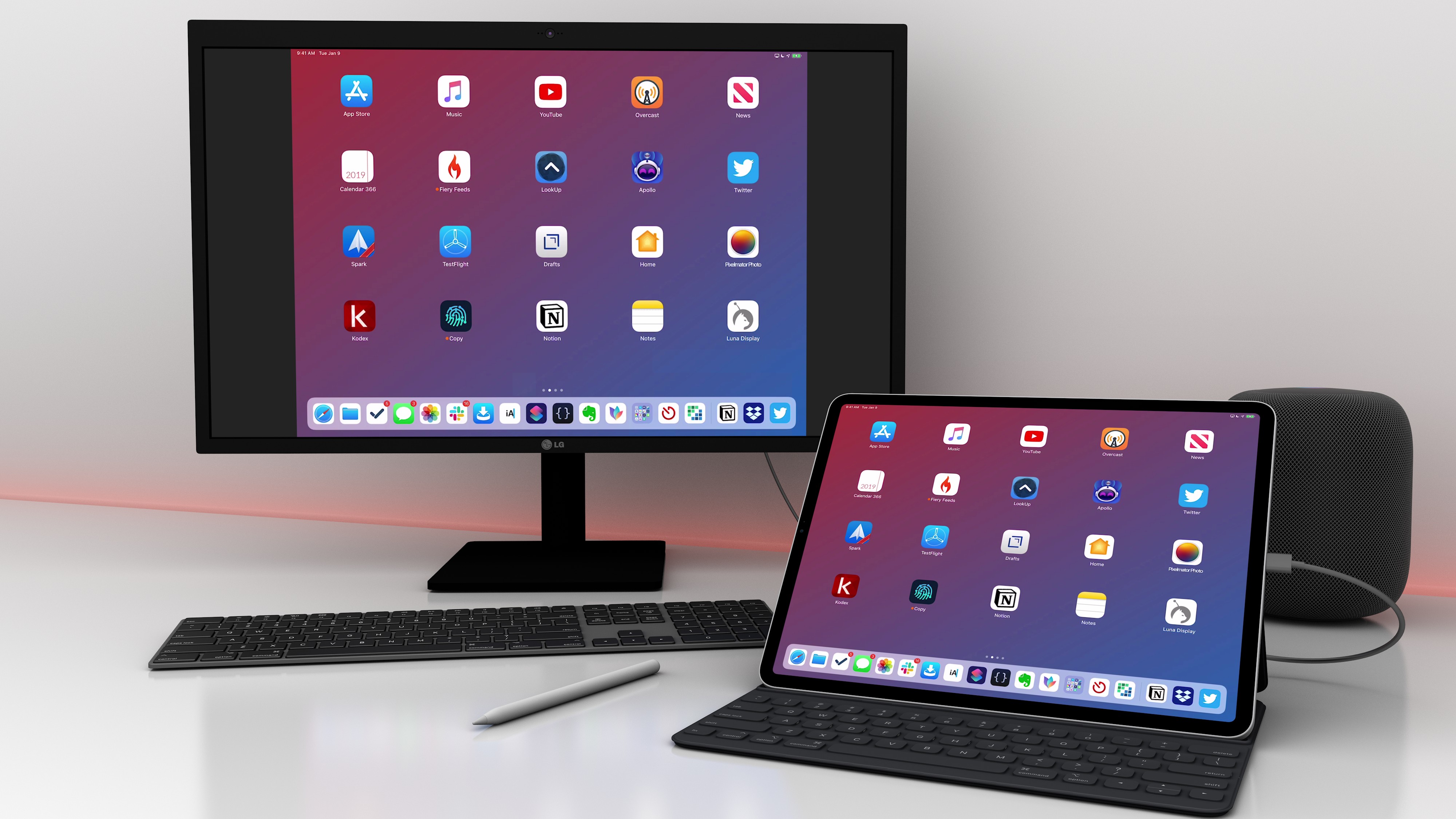
Beyond the Tablet: Seven Years of iPad as My Main Computer

by Federico Viticci
For the past seven years, I've considered the iPad my main computer. Not my only one, and not the most powerful one I own, but the computer which I use and enjoy using the most.
21 May 18:19

Beyond the Tablet Extras: eBook, Special Episode of AppStories, and Making Of Essays

by John Voorhees

Today, Federico published Beyond the Tablet: Seven Years of iPad as My Main Computer, a comprehensive evaluation of the advantages and shortcomings he’s experienced using an iPad as his primary computer. Weighing in at around 50,000 words, Beyond the Tablet rivals Federico’s annual iOS reviews in scope and depth of coverage. As a result, it felt appropriate to release the same sort of extras for this story that we’ve provided for iOS reviews.

eBook

You won’t want to miss the opening animation of the web version of Federico’s story, but if you’re a Club MacStories member and want to read his story at your leisure in Apple’s Books app, you can do that too. As with past iOS reviews, we have produced an eBook version of Beyond the Tablet. The eBook has been carefully created from all the same content you’ll find in the MacStories.net version, including every image and video, with the bonus that you can take advantage of Books’ table of contents, bookmarking, highlighting, annotating, and other features too.

The eBook version of Beyond the Tablet is available exclusively as a free download for Club MacStories members from the member Downloads page.

If you haven’t considered becoming a Club MacStories member before, now is a great time to do so to take advantage of the exclusive Beyond the Tablet perks. In addition, Club MacStories offers exclusive content delivered every week including:

  • MacStories Weekly, a newsletter that is sent every Friday and is packed full of our favorite apps, themed collections, tips, automation, answers to reader questions, featured Home screens, interviews, and much more.
  • The Monthly Log, a monthly newsletter that includes long-form and behind-the-scenes stories.
  • Access to giveaways, discounts, and other treats like a special members-only podcast called MacStories Unplugged and ebook versions of Federico’s annual iOS review.
  • The full archive of over 200 issues of MacStories Weekly and the Monthly Log.


AppStories

For episode 112 of AppStories, Federico and I look back at Federico’s process for writing Beyond the Tablet, including the apps and workflows that helped him write an iOS review-length story in a fraction of the time past reviews have taken. We also explore some of the topics covered by the story and the big-picture lessons that can be drawn from the current state of the iPad as a computing device. We also interviewed Brian King, who created the opening animation for Beyond the Tablet as well as the 3D-rendered images you’ll find at the beginning of each section of the story.

You can listen to the episode here and subscribe using the links below:


Making Of Essays

Finally, Club MacStories members are in for a treat this Friday. The next issue of MacStories Weekly will include not one but two ‘making of’ essays about Beyond the Tablet. The first will be from Federico, who will go in-depth on his ever-evolving workflows for producing long-form stories. The second story will be from Brian King and go in-depth on how he used Cinema 4D to produce the opening animation for Beyond the Tablet, along with the 3D-rendered images for each section of the story. As usual, MacStories Weekly will arrive in Club MacStories members’ email inboxes this Friday.

It’s been a busy spring for the MacStories team, especially Federico, and it’s always fun and exciting to share that hard work with MacStories readers and Club members. We hope you enjoy Beyond the Tablet and the extras we’ve created. In addition to thought-provoking analysis of the iPad’s place in computing, Federico’s story and the extras are full of ideas, strategies, and tips for working on the iPad, which we hope will inspire your own use of the iPad.


Support MacStories Directly

Club MacStories offers exclusive access to extra MacStories content, delivered every week; it's also a way to support us directly.

Club MacStories will help you discover the best apps for your devices and get the most out of your iPhone, iPad, and Mac. Plus, it's made in Italy.

Join Now
21 May 18:18

Huawei’s phone business would be decimated without Google’s Android

by Rui Carmo

This has a lot of potential to: a) escalate quickly and b) break a lot of things in the cellphone industry.

Having been keeping track of the core network equipment controversy, there are a lot of people with vested interests on both sides of the fence, and politics is only going to make things uglier.


21 May 18:17

China, Leverage, and Values

by Ben Thompson

Tim Culpan declared at Bloomberg that The Tech Cold War Has Begun after the Trump administration barred companies viewed as national security threats from selling to the U.S., and blocked U.S. companies from selling to Huawei specifically without explicit permission. Culpan writes:

The prospect that the U.S. government would cut off the supply of components to Huawei was precisely what management had been anticipating for close to a year, Bloomberg News reported Friday. Huawei has at least three months of supplies stockpiled. That’s not a lot, but it speaks to the seriousness with which the Shenzhen-based company took the threat.

There’s hope that this latest escalation is just part of the U.S.’s trade-war posturing and will be resolved as part of broader negotiations. Huawei, or Chinese leaders, are unlikely to be so naive as to share that. Even the briefest of bans will be proof to them that China can no long rely on outsiders.

We can now expect China to redouble efforts to roll out a homegrown smartphone operating system, design its own chips, develop its own semiconductor technology (including design tools and manufacturing equipment), and implement its own technology standards. This can only accelerate the process of creating a digital iron curtain that separates the world into two distinct, mutually exclusive technological spheres.

I agree with Culpan’s overall conclusions, and dived into some of the short and medium-term implications of the Trump administration’s action in yesterday’s Daily Update. However, to the extent that a “tech Cold War has begun”, that is only because a war takes two.

The ZTE Ban

Huawei’s preparation for this moment likely started last year when a similar ban was placed on the sale of American components to ZTE; as I explained at the time:

Obviously the United States government cannot tell a Chinese company what to do. However, the U.S. government can tell American companies what to do, and that includes determining what technology can be exported, and to whom. To that end, countries like Iran and North Korea have long been subject to U.S. sanctions, which means that it is illegal for U.S. companies in many sectors, particularly technology-related ones, to export products to those countries (including digital products like licensed software). And, by extension, U.S. companies cannot knowingly export embargoed products to companies that then sell those products to countries covered by those sanctions.

That ZTE was flouting those sanctions was well-known, and the company settled with the U.S. government in 2017. The action last year, then, was in response to ZTE allegedly violating that settlement; at the same time, it was hard not to wonder if there was any relation to the ongoing trade dispute with China?

Similar questions surround this Huawei action: the Trump administration ultimately made a deal to spare ZTE, and a waiver has already been granted allowing Huawei to service existing networks and phones in the U.S.

Still, if you’re looking for the start of this “tech cold war”, the move against ZTE was arguably the bigger deal: for the first time the extreme vulnerability China’s tech giants have to U.S. action was laid bare.

The U.S. Advantage

While tech devices like iPhones are “Made in China”, it is important to note that little of the technology originates there — less than $10 worth, in fact. Much more goes to component suppliers in the United States, South Korea, Taiwan, and Japan1 (and obviously, even more goes to Apple itself).

The reality is that China is still relatively far behind when it comes to the manufacture of most advanced components, and very far behind when it comes to both advanced processing chips and also the equipment that goes into designing and fabricating them. Yes, Huawei has its own system-on-a-chip, but it is a relatively bog-standard ARM design that even then relies heavily on U.S. software. China may very well be committed to becoming technologically independent, but that is an effort that will take years.

That is why the best that Huawei could do over the last year was stockpile supplies: the U.S. retains a significant upper-hand in this “war”. At the same time, cutting off Chinese customers like Huawei will cost U.S. suppliers dearly: high-value components by definition entail very large research and development costs and significant capital outlays for their manufacture; that means that profit comes from volume, and losing a massive customer like Huawei would be costly.

China has one other card to play: rare earth elements. These 17 elements2 are essential for electronic components, and China dominates their production, accounting for over 90% of the world’s supply. The country flexed its power in 2010, imposing export quotas (which were later ruled illegal by the WTO) that caused prices to skyrocket, at least for non-Chinese companies, giving Chinese companies an advantage. To that end, it is certainly not a coincidence that Chinese President Xi Jinping toured a rare earth mining and processing center yesterday, accompanied by China’s top trade negotiator.

China’s Protectionism

China’s 2010 rare earth export reduction wasn’t the only shot the country has taken: in January of that year Google announced that its network had been hacked by China, resulting in the theft of intellectual property, and that the company was reevaluating its approach to the Chinese market. Soon after Google closed down its China operations and directed users to its Hong Kong site, which was summarily blocked by the Great Firewall.

Google was hardly alone in this regard: YouTube, Twitter, and Facebook were all blocked in 2009, and since Google’s block sites like Instagram, Dropbox, Pinterest, Reddit, and Discord have been as well, along with a whole host of media sites like the Wall Street Journal, New York Times, and Wikipedia.

Indeed, this is where I take the biggest issue with Culpan labeling this past week’s actions as the start of a tech cold war: China took the first shots, and they took them a long time ago. For over a decade U.S. services companies have been unilaterally shut out of the China market, even as Chinese alternatives had full reign, running on servers built with U.S. components (and likely using U.S. intellectual property).3

To be sure, China’s motivation was not necessarily protectionism, at least in the economic sense: what mattered most to the country’s ruling Communist Party was control of the flow of information. At the same time, from a narrow economic perspective, the truth is that China has been limiting the economic upside of U.S. companies far longer than the U.S. has tried to limit China’s.

Not that the U.S. investor class cared: for U.S. component suppliers China provided not only revenue but scale; for hardware manufacturers like Apple China provided low labor costs and an increasingly sophisticated base of manufacturing expertise, and full-on design services for more commoditized OEM’s like PC makers. And while U.S. services may not have been allowed in China, U.S. venture capital money was certainly allowed to invest in Chinese startups.

The truth is that the U.S. China relationship has been extremely one-sided for a very long time now: China buys the hardware it needs, and keeps all of the software opportunities for itself — and, of course, pursues software opportunities abroad. At the same time, U.S. acquiescence to this state of affairs has denied China the necessary motivation to actually make the investments necessary to replace U.S. hardware completely, leading to this specific moment in time.

A Question of Leverage

To that end, and leaving aside broader questions about the Trump administration’s approach to trade with China, when it comes to a “tech cold war” I think the U.S. has the most leverage it ever will have: the U.S. advantage in advanced components, particularly processors and their fabrication, is massive, and will only grow if the U.S. is able to gain the support of countries like South Korea, Japan, and Taiwan. Yes, China will spend whatever is necessary to catch up, but it will take a lot of time.

The primary potential pain points for the U.S., meanwhile, are those same component manufacturers that China needs, whose revenue and profits will be hurt, rare earths, and Apple. The latter is more exposed to China than anyone, on two fronts: first, the company’s massive manufacturing facilities in China, and second, the importance of the Chinese consumer market to the iPhone in particular.

This does not guarantee that Apple will be retaliated against: Apple employs millions of Chinese, both directly in manufacturing and also component suppliers, and the Chinese leadership will be loath to leave any of them unemployed. And, on the flipside, Chinese consumers, particularly those in influential first-tier cities, like Apple products. I do think the latter is more likely to be impacted than the former: China can do a lot to disrupt Apple’s consumer-facing operations in China, as they already have in both services and iPhone sales.

The other big question is if the Trump administration will levy tariffs on iPhones for U.S. consumers: to date Apple has been largely spared, but the U.S. is running out of goods to slap tariffs on; again the company benefits from its popularity with end users, who would be much more sensitive to a rise in iPhone prices than just about anything else.

A Question of Values

For obvious reasons, I think most people in tech are opposed to the Trump administration’s approach: not only is Trump unpopular in Silicon Valley generally (which means his policies are), but the near-term damage to U.S. tech companies could be significant.

At the same time, as someone who has argued that technology is an amoral force, China gives me significant pause. On one hand, while the shift of manufacturing to China has hurt the industrial heartlands of both the U.S. and Europe, nothing in history has had a greater impact on the alleviation of poverty and suffering of humanity generally than China’s embrace of capitalism and globalization, protectionist though it may have been. Technology, particularly improvements in global communication and transportation capabilities, played a major role in that.

On the other hand, for all of the praise that is heaped on Chinese service companies like Tencent for their innovation, the fact that everything on Tencent is monitored and censored is chilling, particularly when people disappear. The possibilities of a central government creating the conditions for, say, self-driving cars or some other top-down application of technology is appealing, but turning a city into a prison through surveillance is terrifying. And while it is tempting to fantasize about removing “fake news” and hateful content with an iron fist, it is a step down the road to removing everything that is objectionable to an unaccountable authority with little more than an adjustment to a configuration file.

This is the true war when it comes to technology: censorship versus openness, control versus creativity, and centralization versus competition. These are, of course, connected: China’s censorship is about control facilitated by centralization. That, though, should not only give Western tech companies and investors pause about China generally, but should also lead to serious introspection about the appropriate policies towards our own tech industry. Openness, creativity, and competition are just as related as their counterparts, and infringement on any one of them should be taken as a threat to all three.

I wrote a follow-up to this article in this Daily Update.

  1. The relative order varies based on the iPhone model; the iPhones XS, for example, gets its very expensive OLED screen from Samsung in South Korea, and its processor from TSMC in Taiwan. Previous iPhone models sources screens from Japan and processors from Samsung.
  2. The elements are cerium (Ce), dysprosium (Dy), erbium (Er), europium (Eu), gadolinium (Gd), holmium (Ho), lanthanum (La), lutetium (Lu), neodymium (Nd), praseodymium (Pr), promethium (Pm), samarium (Sm), scandium (Sc), terbium (Tb), thulium (Tm), ytterbium (Yb), and yttrium (Y)
  3. This doesn’t even address rampant piracy in China: the country was one of Microsoft’s largest markets by usage, but drove revenue equivalent to the Netherlands.
21 May 18:17

Telus invests $53 million in Montreal to facilitate growth and prepare for 5G technology

by Aisha Malik

Telus has invested $53 million CAD into its wireless and wireline networks in Montreal as part of a five-year billion-dollar commitment to Quebec.

The goal of the investments is to help Montreal prepare for the arrival of 5G technology, while helping the city continue to grow as one of the smartest cities in the country.

“For us, a network is more than just a technological infrastructure. It allows us to support Montreal’s knowledge economy and contributes to economic growth,” said François Gratton, the group president at Telus and chair of Telus Québec, in a press release.

These investments are part of a 20-year partnership between Telus and the Old Port of Montréal Corporation first launched in 2017. The partnership aims to equip the site with enhanced technologies and a free high-speed Wi-Fi zone.

The investment will promote the emergence of newer entertainment experiences in the Old Port. PY1, Lune Rouge Entertainment’s newest venture chose the location as its home base. PY1 will use Telus’ network to power the premiere of its show, Through the Echoes. Further, PY1’s venue uses technology to promote human creativity and also functions as a lab.

Telus has invested more than $175 billion CAD nationwide in its operations since 2000, and plans to add around $40 billion CAD in the next three years.

Source: Telus 

The post Telus invests $53 million in Montreal to facilitate growth and prepare for 5G technology appeared first on MobileSyrup.

21 May 18:16

The Surprisingly Low Burden of Subscriptions at Institutions

Kent Anderson, The Scholarly Kitchen, May 21, 2019
Icon

Kent Anderson spent a number of years with th Scholarly Kitchen agitating in favour of subscription-based publication models and defending the journal publishers generally. He has since left in order to publish his own subscription-based newsletter. So I consider it ironic that he has to return to publicly accessible media to make the case for subscription journals, as he does in this colum. He argue that the overall cost is very low for institutions. No mention of the cost for people outside institutions. Anyhow, this was only a guest post, so I guess he'll return to his subscription-based newsletter where he will not reach the wider public he seeks to convince.

Web: [Direct Link] [This Post]
21 May 18:16

Android Q Beta now available on OnePlus 7 and 7 Pro

by Aisha Malik

OnePlus has released the developer preview of the Android Q Beta version for the OnePlus 7 and 7 Pro.

Users can expect to encounter some issues with the update, as OnePlus is already aware of a number of problems. For instance, the ‘Ambient Display’ and navigation gestures are not working, and there are issues with system stability.

The company has also said that some apps are not working as expected with this update and that the ‘recovery mode’ does not work.

The upgrade is currently available to download on the OnePlus site. However, the company has stated that users should be cautious before installing the update.

“As the name suggests, this build of Android Q is best suited for developers and early adopters. As it is still in an early stage of development, we do not recommend flashing this ROM if you have little or no experience in software development or flashing custom ROMs. Proceed at your own risk,” the download description reads.

OnePlus has also advised that potential users should back up their phones before installing the update because it will erase all of the contents of the phone.

Source: OnePlus Via: 9to5Google

The post Android Q Beta now available on OnePlus 7 and 7 Pro appeared first on MobileSyrup.

21 May 18:16

Microsoft wants to apply AI ‘to the entire application developer lifecycle’

Emil Protalinski, Venture Beat, May 21, 2019
Icon

I'm quite sure that it's more than just Microsoft working toward this - in today's newsletter there are examples of the use of OpenAI in design tasks. The implications are far-reaching. Recall that 20 years ago the idea was that a learning object would be a part of a computer program or web application (not a chapter in a book). Now imagine AI-designed learning objects. Far-fetched? Not really.

Web: [Direct Link] [This Post]
21 May 18:16

AI Generated Patent Claims

Tony Hirst, OUseful Info, May 21, 2019
Icon

Another iteration of the use of Jupyter Notebooks as learning resources: "With the book bundled as an electron app, you could download the app and run it, standalone, to view the book, with no web server required. (The web server used to serve the book is bundled inside the electron app.) " See also: OpenLearn Jupyter Books Remix, TM351 Notebooks in VM and Electron.

Web: [Direct Link] [This Post]
21 May 18:12

Apple claims faster, refreshed MacBook fixes keyboard issues

by Patrick O'Rourke
MacBook Pro 2019

Apple has announced a refresh to its top-tier MacBook Pro across both the 15-inch and 13-inch version, bringing faster Intel processors and changes to Pro’s keyboard design.

The 15-inch MacBook Pro is getting an Intel 9th-generation ‘Coffee Lake’ processor. Further, the base level version of the laptop now starts at a 6-core 2.6Ghz i7 processor, with turbo boost up to 4.5GHz. The next 15-inch Pro comes in at an 8-core 2.3GHz i9 processor, with turbo boost up to 4.8GHz — a first for Apple’s MacBook line.

The top level 15-inch MacBook Pro features an 8-core i9 2.4GHz processor, with turbo boost up to 5.0GHz. Apple claims that this is the fastest MacBook the tech giant has ever released, according to a recent press release.

Apple’s 13-inch MacBook Pro with Touch Bar is also getting an update, with the base model now featuring a 2.4Ghz 8th-generation quad-core i5 processor with turbo boost up to 4.1GHz. There is also an additional configuration that equips the laptop with a quad-core i7 processor, with turbo boost up to 4.7GHz.

The tech giant isn’t upgrading any other MacBook Pro models, including the popular 13-inch MacBook Pro that doesn’t feature a Touch Bar — sometimes called the ‘MacBook Escape’) — just like the MacBook Pro (2018) refresh from last year.

This means that the MacBook Pro without a Touchbar is unfortunately still equipped with a rapidly ageing dual-core 7th-generation Intel processor. Apple has also confirmed that it hasn’t changed how the company’s laptops handle thermals, which proved to be at least initially be an issue last year with the highest-end, i9 15-inch MacBook Pro (2018).

Regarding design, the biggest change to these upgraded laptops is that Apple claims to have updated the Pro’s keyboard components to solve reliable issues many users have experienced with the first, second and even third-generation Butterfly keyboards. Apple says that part of the Butterfly mechanism is now manufactured with a new material that should solve this problem.

That said, the company also states that beyond than this subtle design shift, the keyboard features the same as the third-generation Butterfly keyboard included in the 2018 MacBook Pro. As it stands right now it remains unclear if this new Butterfly mechanism design actually solves the Pro’s keyboard reliability issues.

Further, The Wall Street Journal reports that Apple has expanded its keyboard repair program to include the MacBook Pro (2018) and MacBook Air (2018).

While this is a good move on the tech giant’s part, TechCrunch editor-in-chief Matthew Panzarino (@panzer) recently tweeted that all first and second-generation keyboard repairs are replaced with third-generation keyboards. This means that the keyboard reliability problem won’t actually be completely solved following the repair.

The new 13-inch MacBook Pro starts at $2,399 CAD, with the 15-inch version coming in at $3,199.

Source: The Wall Street Journal, TechCrunch 

The post Apple claims faster, refreshed MacBook fixes keyboard issues appeared first on MobileSyrup.

21 May 06:17

Is Dentistry Science Based? – Science-Based Medicine

mkalus shared this story from Science-Based Medicine.

In today’s social media laden climate, it is de rigueur for people to instantaneously react and become simultaneously defensive and offended when any of our sacred cows are challenged.  It’s part of the human condition and we can’t help ourselves.  We dentists had the opportunity to feel assaulted a couple of weeks ago when an article in The Atlantic by Ferris Jabr entitled “The Truth About Dentistry:  It’s much less scientific—and more prone to gratuitous procedures—than you may think” was published.  Dentists worldwide were summarily outraged, and vast hordes of people who for some reason aren’t fond of dentists collectively pointed their virtual fingers at us and virtually screamed “AHA!  WE KNEW IT!!”

So I suppose the purpose of this post is to “unpack” the article and attempt to objectively assess the claims put forth therein. Moreover, I would like to give a superficial overview of what science based dentistry is, with some excellent links and other resources should you want to dive in further.   I will try my best to not be too defensive and to lay out my case objectively.  We’ll see how well I do.

 The Atlantic Article

I don’t want to spend a whole lot of time criticizing the parts of the article with which I disagreed; not only will that appear to be very defensive on my part (which, if you recall, I promised I’d try not to be), but primarily because it was covered really well in other posts by my friends and colleagues Dr. Alan Mean (link) and Dr. Chip Payet (link).  If you read their pieces, you’ll get a sense of how Mr. Jabr perhaps misrepresented the issue a bit in some areas.  Dr. Payet really picks apart the positives and negatives about the article, and deftly explains why certain areas of dental research can be so difficult to undertake.  Dr. Mead’s article addresses Mr. Jabr’s piece from a journalistic perspective- that it perhaps is a bit sensationalistic and hyperbolic, and framed in such a way to get a lot of ‘clicks’ which is the goal of many publications these days, even if accuracy and fairness are sacrificed in the process.  As for me, I feel that it was a bit heavy handed and focused too much on the evil doings of one derelict unethical dentist who did horrible things to his patients- causing pain, costing them significant and unnecessary costs, and violating the sacred trust that all health care professionals strive to maintain with the people in their care.  What that rogue criminal dentist did was tangential to the real question “How scientific is dentistry?”

Because I don’t want to leave all of the heavy lifting to Al and Chip, I’ll give a couple of examples of where Mr. Jabr went a bit overboard, resorting to a bit of fear mongering as well as simply getting a few things wrong.  When he discussed one of “Dr. Evil’s” patients, he said that “she was born with one tooth trapped inside another…”  which isn’t really a thing in dentistry.  I suspect that perhaps a tooth was congenitally missing in this case, or perhaps didn’t erupt properly and remained impacted.  When a procedure was described thus:  “He also chiseled out her bridge…”  I have to smile a bit because most dentists I know rarely, if ever, use a chisel when doing fillings, crowns, and bridges.  This, in my opinion, was simply the author’s way of casting an evil and greedy light on the procedures done by that evil and greedy dentist.  To generalize from the one to the all is a bit disingenuous, and I say this with no offense taken and not being defensive.

I also bristled when the article stated:  “A multitude of factors has conspired to create both the opportunity and the motive for widespread overtreatment in dentistry. In addition to dentistry’s seclusion from the greater medical community, its traditional emphasis on procedure rather than prevention, and its lack of rigorous self-evaluation, there are economic explanations.”  This accusation paints all dentists as greedy and uncaring, who only want to do expensive treatment on their hapless, powerless victims.  Contrary to his erroneous assertion, the emphasis in modern dentistry is on prevention, but keep in mind that we are not in control of our patients’ risk factors and lifestyle choices.  To accuse us thus is akin to accusing cardiac surgeons of only being procedure oriented and not preventive.  Primary care physicians from cradle to grave, as well as specialists, ceaselessly attempt to educate their patients on preventive care- good diet, adequate sleep, exercise, not smoking, etc.- but what their patients choose to do with that information is up to them.  Those of us in the “body repair” business are simply there to try to pick up the pieces once the damage has been done.  To paint us all as money grubbers who only do procedures if they’re profitable is a bit disingenuous and unfair.

That being said, Mr. Jabr does rightfully mention the science (or lack thereof) of the six month recall that is standard in dentistry.  I wrote about that very subject last year, and while not scientifically rigorous, that doesn’t mean it’s wrong or that we are trying to mislead our patients.  I wish he would have been “fair and balanced” in this area but again, his angle was to portray dentists as non-scientific greedy predators.

 Dentistry and Science

Is dentistry scientific?  That’s the crux of this blog post and I hope I can lay out a solid case for the affirmative.  I do believe that dentists are more than tooth carpenters and gum gardeners, and while Mr. Jabr points out that dentists only have four years of post-graduate education and training (unless one pursues a specialty), he failed to inform his readers about what our education entails.  I won’t bore you with the details, but please indulge me while I bore you with the details.

  • To be accepted to an accredited dental school in the United States (standards are similar in other countries), one must pass the Dental Admissions Test (DAT), which tests the applicant’s knowledge in such topics as Biology, General Chemistry, Organic Chemistry, Reading Comprehension, Perceptual Ability, and Quantitative Reasoning.
  • While a Bachelor’s degree is not required, most dental students do have a Bachelor’s degree, usually in a science field such as Biology or Biochemistry.
  • Once in dental school, our basic science education mirrors the training found in medical schools, encompassing anatomy, physiology, immunology, embryology, histology, pathology, pathophysiology, microbiology, biochemistry, neuroanatomy, and so on. In fact, when I was in dental school (University of Oklahoma), we took our basic science courses with the medical students.  So I do think it’s fair to say that we have a decent scientific and medical foundation.
  • In order to practice dentistry, we must pass a comprehensive board exam which reviews our knowledge in the basic sciences and dental topics, followed by completing work on live patients.  To maintain our licenses, we must complete significant numbers of hours of continuing education each year.

Dental research in the 21st century is vast and varied, from improving the materials we use for fillings and crowns, to advances in technology, to Buck Rogers type stuff such as creating new teeth from stem cells, genetic testing and therapies, and other amazing biotechnologies.  Yegane Guven wrote an excellent review on the scientific basis of dentistry, areas of current and future research, and how this is translated into dental education and practice.

Evidence Based Dentistry (EBD)

On this blog and elsewhere, distinctions have been made between the terms “Evidence Based Medicine (EBM)” vs. “Science Based Medicine (SBM).”  The same differences and debates could be made in the realm of dentistry, but for us the term “Evidence Based Dentistry (EBD)” is more widely utilized, therefore I will be using EBD in this post with the understanding that I am applying the concepts and philosophies of SBM to the topic.  The American Dental Association itself has an arm called The Center for Evidence Based Dentistry, which is an excellent resource for dentists and non-dentists alike.  They host workshops and training for dentists and others in the dental field, helping us to apply the best scientific evidence into our clinical practices for the benefit of the patients we serve as well as the public at large.

According to the website, EBD can be defined as:

“an approach to oral healthcare that requires the judicious integration of systematic assessments of clinically relevant scientific evidence, relating to the patient’s oral and medical condition and history, with the dentist’s clinical expertise and the patient’s treatment needs and preferences.”

One of the best in depth discussions I have read on EBD is an article by Afrashtehfar and Assery (link), and for those of you who want to do a deeper dive on the subject, I highly recommend reading it.

This EBD triad of care encompasses the necessary components of what constitutes the standard of care for dentistry:  best scientific evidence, the needs and preferences of the patient, and the clinical expertise of the practitioner.  If any aspect of this approach is violated (as it most certainly was in the Atlantic article), then the entire system of quality ethical care breaks down.  An important point to make is that in medicine, dentistry, and every other area of health care, we rely on the “best available scientific evidence.”  Science (including medicine and dentistry) progresses sequentially, in fits and starts, building upon previous knowledge.  Therapies and procedures that are in use today may be overturned tomorrow if sufficient evidence dictates it. This is the strength, not a weakness, of the scientific process.

Conclusion

How did I do?  Did I come across as offended or defensive?  I really tried not to, but if I did, I apologize.  What I do hope is that you, dear reader, have come away with a better understanding about the practice of dentistry as it takes its rightful place under the larger umbrella of Science Based Medicine.

What can you as a dental consumer do to ensure that you are receiving appropriate dental advice and treatment so that you don’t become a victim of an unethical practitioner like the dentist in the Atlantic article?  The good news is that if you are a frequent reader of this blog, you are probably 99% of the way there.  You have learned the tools of science and critical thinking and are able to apply them in your daily life.  That being said, here are some other steps you can take:

  • “Patient friendly” websites such as the Center for EBD (discussed above), the Cochrane Library, and PubMed are excellent places to research current evidence and guidelines in dentistry and other fields.
  • Never hesitate to ask your dentist or hygienist to explain all of your options (including the option of no treatment at all), what the risks and benefits of a procedure are, all costs, and the experience and expertise of the provider. If you don’t understand the treatment, ask questions until you do.  If you feel that you are being “sold” on any treatment, it is advisable to get a second (and maybe even third) opinion.
  • Seek advice from objective science based dentists on social media, dental schools, or other platforms. We are always willing to help demystify dentistry and give general advice to people who contact us.
  • Keep reading Science Based Medicine and other blogs who promote a science based worldview and foster critical thinking.

It was a tragedy that the dentist in The Atlantic article took such wanton advantage of his patients.  Fortunately, situations like this don’t happen very often, but there are charlatans out there in all walks of life, so to arm oneself with the tools of critical thinking is one of the best defenses against such mistreatment in the dental office and elsewhere.

21 May 06:14

Redmi Note 7S with 48MP Rear Camera Launched in India

by Rajesh Pandey
After launching the Redmi Note 7 series in India in March, Xiaomi has now launched the Redmi Note 7S in India. It is the second handset from Xiaomi to launch in India with a 48MP rear camera. Continue reading →
21 May 04:16

NewsBlur Blurblog: Buying a digital camera: Part 4, micro 4/3

sillygwailo shared this story from Flickr Blog:
I wonder what an updated article for 2019 looks like.

Olympus Micro 4/3

Announced in 2008, Micro 4/3 systems have found a niche in the space for photographers looking for more versatility and quality than a point-and-shoot and less expense than a full DSLR system. These systems come in two parts: a camera body that houses the electronics and the sensor, and a lens, which contains the optics. Different lenses can be used for different photographic scenarios.

Cost

Complete starter Micro 4/3 systems sell for US$250-300; extra lenses (of which there are many) can be bought from anywhere between US$100 to over US$1000+

Versatility & Performance

These systems are ideal for enthusiastic amateurs who are looking for a versatile camera that isn’t expensive, but produces high-quality images. The larger sensor permits better performance in low-light, along with better color reproduction.

Panasonic Lumix GM1

Compared to other systems

Micro 4/3 cameras are great in terms of offering both good value for money and versatility for the amateur photographer who would like room to grow toward semi-pro. The big steps-up they offer from compact cameras is in the sensor and in interchangeable lenses.

The larger sensor offers even better low-light performance than compacts, and allows for much shallower depth-of-field. Using the right lens, it’s possible to achieve blurred-out backgrounds for portrait shots. Note that the extent of the blur is still limited. Aside from all but the most luxuriously expensive prime lenses, you’re looking at a full-frame equivalent focal-length of around f/4.4 and above.

The biggest difference comes from being able to swap out lenses, and Micro 4/3 permits using a lens from one manufacturer on another Micro 4/3 camera body. The physical design of the optics also means that cheap adapters are available to use lenses from larger systems – such as DSLR’s – on the Micro 4/3 body, with a few caveats.

Lumix G1 with Nikon 24mm

Most Micro 4/3 systems come in a package with a zoom lens with similar characteristics to a compact camera zoom. Long focal length telephoto lenses can be bought for photographers wanting to get closer to their subjects for sports & wildlife photography. Where Micro 4/3 really stands out from compacts is the easy availability of excellent prime lenses. These prime lenses are usually a fixed focal length but have high-quality, ‘fast’ optics, which are great for specialist applications like portrait, fashion, and wildlife photography. Additionally, there are other primes that are good for macro photography for those who like to get in super close.

An affordable way for an amateur to work out what lenses they need is to rent the lenses they would like to try out instead of purchasing them.

Olympus Micro 4/3

Focal magic

A recent development in consumer optics has been the advent of relatively cheap focal reducers – notably the Metabones ‘speed booster.’ This adapter allows the usage of DSLR lenses on a Micro 4/3 body, but the intermediate optics focusing the image on the smaller sensor increases the effective aperture of the lens by one stop (so an f/2.2 lens goes to f/1.2, for example). It also reduces the crop factor of the sensor, so a full-frame 35mm lens is 50mm mounted with a focal reducer, or a relatively long 70mm without.

How to buy

The typical starter lens in a Micro 4/3 package tends to be a zoom lens that offers a similar zoom range than compact cameras. While these tend to produce good images in everyday scenarios, there are Micro 4/3 lenses for more specialist applications – macro lenses for close-up, telephoto lenses for distant subjects and sports, and a full range of prime lenses for portraiture and fashion photography. These lenses start as low as $US100, but typically range from US$200-300, with some specialist lenses running north of $US1500.

Olympus has a venerable series of Micro 4/3 cameras in the classically styled E-P series and the semi-pro OM-D series, and Panasonic has the DMC-GF series as well offerings from Kodak and others. There are a wide variety of different cameras here, so how do you choose between them? Here are a few features to look out for:

  • Size: most Micro 4/3 cameras are pretty small and light. If you’re after something a bit more rugged and possibly weather sealed, it’s worth looking at the semi-pro offerings from Olympus and Panasonic – though this does come at the cost of a much heavier camera body.
  • Controls: these cameras go all the way from touchscreens to a full range of manual controls. For the amateur who wants to grow, it’s worth considering a camera with more manual controls available as separate dials – these are important when out in the field.
  • Viewfinder: aside from supporting a local business, it’s worth visiting a local camera store to try out the cameras, and especially to see if you need a separate small electronic viewfinder. You compose the shot by looking through the viewfinder, and many will find this is a more natural way of shooting as you can more directly ‘see’ what the camera does and stabilize the camera with your own head.
  • Lenses: if a system comes with a good prime lens as part of the package, consider it, especially if you are an amateur looking to move to the next level.

A great collection of Micro 4/3 images can be found at the ‘Micro 4/3’ group on Flickr.

(Be sure to read Part 1, Part 2, and Part 3 of this series. The last part will be published tomorrow)


21 May 04:16

NewsBlur Blurblog: Buying a digital camera: Part 5, DSLR/MILC cameras

sillygwailo shared this story from Flickr Blog:
I wonder what an updated article for 2019 looks like.

Mirrorless Fuji X-E2 with 35mm f/1.4

DSLR (Digital Single Lens Reflex) cameras and MILC (Mirrorless Interchangeable Lens Cameras) are a natural step-up from Micro 4/3 systems. Like Micro 4/3, they consist of a camera body with sensor and electronics, and a wide variety of different lenses. DSLR’s are different from a MILC in that they have a mirror behind the lens and in front of the sensor that allows the photographer to see directly out of the lens, producing a bright, sharp preview of the shot, whereas MILC systems preview the image electronically.

Cost

DLSR/MILC starter sytems typically come in around US$500-600, usually with a ‘kit’ zoom lens offering a similar zoom range to compact cameras.

Versatility & Performance

These systems are suited for amateur photographers looking to move towards semi-pro or pro. Larger sensors permit even higher image quality and low-light performance, good a huge range of different shots. Good quality lenses range from US$300-1000, but like Micro 4/3, these can be rented so a photographer an easily ‘try before you buy.’

40D

Compared to other systems

Where DSLRS/MILC’s significantly diverge from Micro 4/3 is in low-light performance and in portrait/macro scenarios where the photographer seeks to ‘blur out’ the background. They also tend to allow for finer manual control of camera settings and typically have faster autofocus and faster maximum shutter speed, all of which are important for scenarios like sports and action photography.

They also tend to have more and better quality settings for video recording; many come with microphone inputs and standard equipment mounts so they can easily be the center of a semi-pro or pro video setup.

The larger sensors – mostly APS-C and actual ‘full-frame’ – perform the best in low-light. High-end full frame DSLR’s (notably the Sony A7s) have extraordinary performance in low light, allowing for scenarios such as recording video lit only by moonlight.

These systems also tend to have more complex controls and the vast majority come with viewfinders. While the MILC’s have electronic viewfinders, the DSLR’s have optical viewfinders, meaning what you see is actually what the camera sees through the lens. This comes into its own in low-light, where electronic viewfinders do a poor job of showing the scene; the human eye is excellent in low light, and the camera can be much better-focused manually using an optical viewfinder than electronically.

The biggest advantage of DSLR/MILC systems is the staggering variety of lenses that are available for purchase and rent. There are adapters to permit usage of most major lens manufacturers on most other major systems (you can even attach your camera body to a telescope!).

The Magic Lantern

If you’re not afraid of voiding your warranty, special firmware is available for quite a few of the Canon DSLR’s called Magic Lantern – see the compatibility list at the bottom of the page here. This firmware unlocks a wide variety of pro and experimental features for these cameras, notably for high-end video recording and cinematography.

Mirrorless Fuji X-E2 with 35mm f/1.4

How to buy

To start, see if you have any friends or family who already have a DSLR or MILC system and would they be willing to lend you lenses. By choosing the same manufacturer as them, you can rely on them to help you get started, which is a great way of keeping the cost down.

If you’re starting out new, consider whether you need a DSLR or a MILC. The major difference between these two systems – especially at the starter level – is in the viewfinder. The optical viewfinder is conventionally considered to be a more natural shooting experience, though fast-response electronic viewfinders are coming close.

Aside from a few notable exceptions, DSLR’s also have a wider range of options and accessories for photographers at the pro level, though this is becoming less true over time. MILC systems tend to be smaller, and DSLR’s tend to be larger and heavier.

MILC systems: there are a range of affordable MILC camera packages, and like Micro 4/3, these starter kits tend to come with a good zoom lens. Major manufacturers include Sony, Fuji, Panasonic, Samsung, and relatively late to the game a few offerings from Canon and Nikon.

As one of the earliest, the Sony NEX system offers extremely compact cameras with a good quality APS-C sensor. Fuji is also another strong contender; the Fuji X-series in particular has different sensor hardware as well as a small but very good series of lenses.

D810 and 50mm f/1.8D

DSLR systems: there are a large number of manufacturers for DSLR’s, though it is dominated by offerings from Canon, Nikon and Sony. For the amateur to semi-pro, there are two main choices: going with a starter package, or selecting a camera body and lens separately.

Common to both is picking the camera body. A few major things to consider:

  • Sensor size – APS-C is great, but full-frame (while expensive) has better low-light performance and permits a much shallower-depth-of-field when taking a shot at the same distance.
  • Camera size and weight - semi-pro or pro camera DSLR camera bodies often have a solid magnesium frame. While tough, these are much, much heavier then their cheaper plastic cousins. Remember, a camera that is too heavy to use regularly isn’t worth much to you.
  • Controls – some cameras will have easier-to-access manual controls. Consider this if you’re moving towards more professional shooting assignments
  • Autofocus speeds – if you are shooting sports or fast-moving subjects, consider the autofocus speed – it’s often the difference between getting the shot or not
  • Video – though less of a factor now, if you’re interested in shooting high quality video check that the camera shoots at least 1080p video

For the enthusiastic amateur or semi-pro, we’d highly recommend getting a starter kit and a cheap prime lens. The prime lens is a step into the world of shallow depth-of-field and focusing with your feet, and is a great entry point into much more serious photography. Both Canon and Nikon offer a very affordable 50mm f/1.8 prime lens for US$110, and it’s well worth factoring the cost of this when making your purchase.


21 May 04:12

CMAP #16: Book Title Blues

by Charlie Stross
mkalus shared this story from Charlie's Diary.

So a couple of months ago I handed in a new novel (it won't be out until the second half of 2020--these things have a long lead time). And it occurs to me that it's probably worth discussing book titles at some point, because I haven't really done so before.

As I noted in CMAP 6: Why is your book cover so awful? the only thing an author is expected to provide to a publisher is a finished manuscript containing the text of a novel (which they will then colaborate with the publisher on editing and proofread and, these days, marketing). The cover is not within the author's remit, and indeed the author may not see it before the general public. Nor is the cover marketing copy the author's job (writing cover copy that sells books, and writing books, are very different tasks, and many authors are utterly dire at writing their own marketing copy).

But something that also escapes many readers is that book titles are (a) fraught, and (b) not necessarily the author's job either. Which prompts me to write another entry in my ancient and haphazard series of essays about Common Misconceptions about Publishing (CMAP).

When I sold my first novel to Ace in 2001, it was not titled "Singularity Sky": it was called "Festival of Fools". But Ace already had a book on inventory with a very similar title--"Ship of Fools" by Richard Paul Russo--and my editor wanted to avoid any confusion in the minds of bookstore clerks (16-17 years ago Amazon was much less significant to book sales than they are today: the action was all Barnes and Noble/Borders). Also, my novelette "Lobsters" was on the Hugo shortlist and the big buzzing thing in hard SF was the Singularity. "Can you come up with a new title? And it needs to have the singularity word in it--the singularity is hot," she told me, then gave me a number of suggestions that made me want to stick my fingers down my throat. In the end we agreed to disagree on Singularity Sky", which (being followed 2 books later by "Accelerando") resulted in me being labelled the "Singularity Dude" for the first decade of my bookselling career, much as a different unfortunate trope choice can lead to you being called the Talking Cat Guy if you're unwary enough to put talking cats in two or more works of fiction the same decade.

(I am so over the singularity, okay? It's just dead to me. HAND.)

Now, I mentioned Amazon. During the first decade of the noughties, Amazon was gathering momentum as a sales channel to rival (later eclipse) the big bookstore chains. And the internet as a thing was gradually coming to the attention of elderly publishers who still expected to receive manuscripts typed double-spaced in 10 point Courier, the way Mark Twain used to send 'em in, dammit, even though we were all using word processors and submitting electronically by then.

The first rumble of thunder from the approaching stormfront was a diktat from management level at my US publisher: "all series of three or more books must now have a series title--no exceptions". I got this memo by way of my editor at Ace around 2007 or 2008, in the shape of an email telling me I was now the author of the Laundry Files. Why the Laundry Files? Well, in the first two books Bob called his employer, SOE X-Division, "the Laundry", as a joking nickname (I will note that in real life GCHQ, the Government Communications HQ agency, the British version of the NSA, is known as "the donut", due to the shape of its eponymous headquarters building in Cheltenham). And Ginjer's imprint also published Jim Butcher, whose bestselling series was the Dresden Files. So I spent the next decade cringing slightly and feeling like I was being marketed on Jim's coat-tails to readers of urban fantasy, and as some kind of detergent directory to everybody else.

(My other big series at Tor got named "the Merchant Princes" for similar reasons, but that title at least bears some resemblance to the subject matter.)

So, lesson 1: they're gonna want a series title, because it makes google and Amazon searches easier for your reader. Be prepared to cough one up even if you've only written one book, because if you don't, the marketing department are going to play "pin the tail on the donkey" and you're going to be stuck with a thumb-tack in your arse for the next decade if they choose badly.

Lesson 2 was a bit more obvious: if writing a series, it should be clear that you want to pick book titles that are roughly similar in form and tie into a common theme, so as not to confuse your readers.

The Laundry Files' book title structure is fairly simple and consistent: it's a definite article ("the", or maybe "a"), followed by an intriguing noun ("Jennifer", "Atrocity", "Labyrinth") that ties into something in the story, and then a noun describing a type of document or corpus of texts ("archive", "index", "codex", "morgue"--as in, a newspaper morgue). If you look at one of my book titles you can probably spot a Laundry Files book just by its name, right?

But I got hit by lightning in 2013, when I handed in the sixth Laundry Files installment. That one was titled "The Armageddon Score", because it's the Mo novel, and she's playing her violin, and it's going to bring about the end of the world if she's not careful. Obvious, see?

However, my UK editor nixed it on sight. "Charlie, have you googled this?" she asked. (Said British editor is of a different generation: under 40 with blue hair, goes LARPing, understands these new-fangled Babbage engines. See, not all editors are old school!)

And I googled "The Armageddon Score" and fuck me if she wasn't right: anyone typing the title of my novel into Google would come up with the sound track to a Bruce Willis movie instead.

Which leads to Lesson 3: google your proposed titles (and check them on Amazon), or you'll be sorry.

I note that title conflicts are a movable feast. That book I handed in is titled "Lost Boys", because it riffs off Peter and Wendy (the original of Disney's Peter Pan, and can I just say that if you ditch Disney's pernicious twee santised version and to back to basics it's really horrifyingly grim?). Now, if you feed "Lost Boys" to Amazon you will of course get the cult 90s movie. But you'll also get about a dozen novels containing revisionist or fan-fic takes on Peter Pan, because obviously.

Was it rash of me to try to recycle the same resonant title as a bunch of other books?

If I was just starting out, it would be foolhardy. But I'm nearly 30 books into a career and these days my publishers print my name on the book cover in a larger typesize than the book title itself--this is the definition of a "big name" author: it simply means that the author's name sells books on their own merit, rather than the book standing unsupported in the marketplace. So one may hope that readers might search for "Stross Lost Boys" rather than just "Lost Boys."

But this isn't under my control: and it's quite possible the title will be swapped out from under me before the book is officially announced, just to reduce the risk of search engine mis-hits.

As a complicating factor, "Lost Boys" is hopefully the start of a new series spinning off from "The Laundry Files" much as "Deep Space Nine" was a by-blow of "Star Trek"; different focus, different characters, zero relationship with the Laundry itself--but sharing the same setting. Marketing will thus get a say. On the one hand: pitching it as book 10 of the Laundry Files guarantees a certain level of sales. On the other hand: it also guarantees not selling to people who don't want to jump in on book 10 of a series, or who don't want to read about the Laundry. And it would also annoy some readers, who expect Bob and the gang and are instead going to be confronted with SPOILER instead. So I don't even know what series title is going to go on this one, let alone whether the title will survive to publication.

We're now well established in the age of Amazon, Google, Facebook, eBay, Apple, and Microsoft--the big platforms. The title structure of novels has been changing increasingly fast over the past decade, so that now you'll often see the series title and book title concatenated, then followed by a brief descriptive gloss, simply because we locate books by searching. Back in 1988, noted SF satirist (and multiple Hugo winner) Dave Langford published a book titled "Dragonhiker's Guide to Battlefield Covenant at Dune's Edge, Odyssey Two". I'd like to note that this is pitch-perfect for a self-published Kindle Unlimited title, even though Dave was taking the piss at the time. If I followed the self-pub title playbook, this one would be called something like "Laundry Universe book 10: the Lost Boys Files, a humerous horror novel about Peter Pan in the age of the New Management". Which is kind of a pantomime horse of a title (or maybe a dromedary) but contains all the keywords and even approximates the title structure of a Laundry Files novel (that "The Lost Boys Files" in the middle).

Anyway, here are the rules for book titles these days:

  1. Make it memorable and pronouncable for a not-too-lexicographically-aware English speaker. (Avoid creative misspellings, homophones like their/there, anything else that could confuse a reader typing a badly-memorized title into amazon.)

  2. Make it unique. XKCD 936 applies for book titles as well as passwords! Don't violate rule 2 unless you're a big name, i.e. enough people will buy anything you write to keep you from starving. Or you're feeling vindictive. (You may want to look up the other book titled "Saturn's Children" ... but please don't buy it new, I don't want to encourage John Redwood, okay?)

  3. Have a series title waiting in the wings, even if you're not writing a series. ("The Atrocity Archive" was a short stand-alone. Then "The Jennifer Morgue" was the middle volume of a trilogy. Approximately a million words later, I wised up.)

  4. While your snappy, unique title is the lede, feel free to add a colon or semi-colon separated list of potential series titles and cover blurbs, so that folks searching Amazon for Regency-setting dragon shifter hentai romance with talking starships will still be able to find your novel even if they've never heard of you. In an ideal world the searchable title on Amazon should contain the entire text of the book: failing that, we can but include a tantalizing taster.

  5. No title is guaranteed to survive contact with the realities of corporate marketing policy.

Final footnote: "Lost Boys", or whatever it's ultimately titled, is not really the tenth Laundry Files novel, even if it's marketed as such. Current plans call for it to be followed by two final Laundry novels (the Senior Auditor's workplace journal, and then a final Bob story), with a second Lost Boys novel sandwiched between them. If it all goes according to plan (spoiler: it won't, this is me speculating about what I'll be doing five years hence), there'll a third one after that. Set during CASE NIGHTMARE GREEN under the rule of the New Management, but having nothing to do with the Laundry, "Lost Boys" is free to get away from the pervasive, claustrophobic assumption that of course the civil service spooks are trying to do the right thing, which has become an increasingly onerous constraint on the series in recent years. I started writing the Laundry Files prior to 9/11, extraordinary rendition, the war on terror, and the Manning and Snowden revelations: we're now living in a very different (and much darker) world than the one I started out in, and if the Laundry Files has an overarching theme, it would be about the loss of innocence that comes with age and experience.

21 May 04:12

As a Service?

The trend towards hosted services and the return of the intelligent network create risks of dependency even if well-intentioned.
20 May 22:35

I co-founded a company! Meet Problem Forward Data Science

I have some exciting news about something I’ve been working on for the last year or so. I started a company! It’s called Problem Forward data science. I’m pumped about this new startup for a lot of reasons.

  • My co-founder is one of my families closest friends, Jamie McGovern, who has more than 2 decades of experience in the consulting world and who I’ve known for 15 years.
  • We are creating a cool new model of “data scientist as a service” (more on that below)
  • We have a problem forward, not solution backward approach to data science that grew out of the Hopkins philosophy of data science.
  • We are headquartered in East Baltimore and are creating awesome new tech jobs in a place where they haven’t been historically.

Problem Forward, Not Solution Backward

We have always had a “problem forward, not solution backward” approach to statistics, machine learning and data here at Simply Stats. This has grown out of the Johns Hopkins Biostatistics philosophy of starting with the public health or medical problem you care about and working back to the statistical models, software, and tools you need to solve it.

This idea is so important to us, it is in the name of the company. When we work with people our first goal is to find out the problems and questions that they genuinely care about, then work backward to figure out how to solve them. We don’t come in with a particular predetermined algorithm or strategy. One of the first questions we ask people isn’t about data at all, it is:

What question do you wish you could answer about your business (ignoring if you have the data or not to answer it yet)?

My favorite example of this is Moneyball. This is one of the classic stories about how the Oakland A’s used data to gain a unique advantage. But one of the key messages about this story that often gets missed is that the data weren’t unique to the A’s! Everyone had the same data, the A’s just started with a problem that they needed to solve. They needed to find a unique way to win games that wasn’t as expensive. Then they moved forward to looking at the data and realized that on base percentage was cheaper than home runs. So the A’s used a “problem forward, not solution backward” approach to data analysis.

Using this approach we have worked with companies with a wide variety of needs. Our main capabilities are in data strategy, data cleaning and research quality database generation, modeling and machine learning, and data views through dashboards, reports, and presentations.

Data Scientist as a Service

There are a huge number of data science platform companies out there. Some of them are producing awesome tools, but as any serious data analyst will tell you we are years from automating real data science. We are only very recently seeing formal definitions of what success of a data analysis even means! So it isn’t surprising when general purpose platforms like IBM Watson struggle with specific problems - the problem isn’t specified clearly enough for a platform to solve it yet..

The reason there are so many platforms is that its easy to sell the “cool” part of the problem - say building an AI to classify images or drive a car. But often the deeper problem is (a) figuring out what you even want to or can say with a set of data set, (b) collecting a set of disorganized data, © getting buy in from groups with different motivations and data sets, (d) organizing ugly data from different sources or finding new data you might need, and (e) putting your answers in context. These problems are more like “glue” that comes between each of the platforms. We have a phrase we like to use:

To solve your data problem you need a person, not a platform

So we have set up a “platform” that lets you scale up and down the number team members you have to solve data problems, just like you would scale up and down the number of servers or tools that you use on AWS.

This means if you are an early stage startup we can help you scale data science before you can afford to hire a whole team. Even if you are a non-profit or a small academic group we can scale up or down to suit your needs. And if you are a big company we can provide utility data science for projects with tight deadlines.

Working with friends and building East Baltimore

The thing that gets me most excited about this new adventure is working with my really close friend Jamie. It’s been huge for me to learn about the ins and outs of starting and running a business with someone who has decades of experience in the consulting industry.

It’s also exciting to be able to headquarter the company right in East Baltimore and to work to upskill and develop talent here in a neighborhood I care about.

Like what you hear? Get in touch

If you are looking for data science work we’d love to hear from you! Whether you are an academic, a non-profit, a small startup, or a big business our utility model means we can work with you.

If you are interested in working with us contact us here:

https://problemforward.typeform.com/to/L4h89P