Shared posts

24 May 15:01

The Dark Forest Theory of the Internet

Jason Kottke, May 22, 2019
Icon

According to Jason Kottke, "Kickstarter co-founder Yancey Strickler writes that netizens are retreating from the public square of the internet, resulting in many private & isolated worlds that don’t communicate with each other, a la the dark forest." I think it's not so much that they're private & isolated as they are not distributed to the entire world. "These are all spaces where depressurized conversation is possible because of their non-indexed, non-optimized, and non-gamified environments.

Web: [Direct Link] [This Post]
24 May 15:01

Eco-Terrorist: Battle for Our Planet

by Stephen Rees

The stuff that comes into my inbox these days usually gets a quick once over. Not in this case.

Filmmaker and longest-serving Sea Shepherd Conservation Society (SSCS) crewmember, first mate to Captain Paul Watson and a captain in his own right, Peter Jay Brown reunites his ruthless cast in this Post Whale-Wars feature documentary that captures all sides of the SSCS from its inception to this very day. Included is even more never-before-seen footage of the Sea Shepherd Conservation Society Campaigns featuring Renegade Environmentalists and their Guerilla Tactics.

This is a sneak peak of an upcoming release due in the fall this year.

I will admit that I have not seen any of the Whale Wars tv shows. But I have followed the adventures of Paul Watson over the years. And, like many people, I have been appalled by the behaviour of the Japanese and their determination to continue commercial whaling. I am glad Sea Shepherd is doing so well, but I also hope that there will come a day when they are no longer needed, because their mission will have been accomplished.

Image: Director Peter Jay Brown at the help of a Sea Shepherd vessel on campaign

Peter J Brown

24 May 15:01

The Futility of Software

by Eugene Wallingford

A thought from <antirez> in an essay on the struggles of an open source maintainer (paraphrased a bit):

Sometimes I believe that writing software, while great, will never be huge like writing a book that will survive for centuries. Not because software is not as great per se, but because as a side effect it is also useful... and will be replaced when something more useful is around.

We write most software with a particular use in mind, so it is really only fair to compare it to non-fiction books, which also have a relatively short shelf life. To be fair, though, not many fiction books survive for centuries, either. Language and fashion doom them almost as much as evolving technology destines most software to fade away within a generation, and a short generation at that.

Still, I won't be surprised if the DNA of Smalltalk-80 or some early Lisp implementation lives on deep in a system that developers use in the 22nd century.

24 May 15:00

Cost of College

by Nathan Yau

We know that more education usually equals more income, but as the cost of education continues to rise, the challenge to earn a college degree also increases. Read More

24 May 15:00

Panic Reveals Plans to Sell a Handheld Gaming System Called Playdate in 2020

by John Voorhees

Panic, well-known for its thoughtfully-designed Mac and iOS apps, has announced that it's entering the hardware market with a portable gaming system called Playdate, which will ship in early 2020 and cost $149. This isn't Panic's first foray into the game industry. With the release of the hit indie game Firewatch in 2016, the company became a game publisher. Later this year, Panic will publish the highly-anticipated Untitled Goose Game on the Nintendo Switch. Still, creating hardware is something altogether different for Panic.

Playdate is a diminutive handheld device with hardware and software features that distinguish it from any other handheld on the market. The bright yellow handheld system is just 74mm  ×  76mm  ×  9mm, which is roughly three inches square and a little thicker than an iPhone XS.

One of the most notable aspects of Playdate's design is a crank that tucks neatly into one side of the device, an idea conceived of by Teenage Engineering, a Swedish company that worked with Panic on Playdate's design and engineering. The crank isn't for charging Playdate. The crank is a controller – an input device like the system's buttons and D-pad that game developers can take advantage of as part of their games. A good example is Crankin’s Time Travel Adventure, a game by Keita Takahashi that is featured on Playdate's website with a video demonstrating the use of the crank to move a character forward and backward through time.

Another distinctive feature is Playdate's screen, which Panic describes as a premium black and white display. The screen is a highly-reflective 2.7-inch black and white display from Sharp with a resolution of 400 x 240. Playdate's screen is not backlit, which presumably will help extend its battery life. Playdate also features a D-pad, A and B buttons, a pause button, a speaker, WiFi and Bluetooth connectivity, a USB-C port, and a headphone jack. Other specs like CPU, RAM, and storage will be discussed at launch.

Playdate's hardware is not like anything currently available on the market, and Panic says the device isn't meant to compete with other handheld systems either. Instead, the goal is to complement existing systems for those times in between using other devices when you want to play a game.

That message seems to have resonated with independent game developers because Panic has announced an impressive lineup of game developers who are making games exclusively for Playdate. Those developers include Keita Takahashi, Zach Gage, Bennett Foddy, and Shaun Inman.

As part of today's announcement, Panic has revealed one of the first dozen of Playdate games: Crankin’s Time Travel Adventure, by Keita Takahashi, the creator of Namco’s Katamari Damacy. The game, which you can see in action on Playdate's website, demonstrates the use of the crank in gameplay to move the game's protagonist forward and back through time.

A total of 12 games, which Panic is calling a season, will be released with Playdate for no extra charge. The games will be delivered weekly to the device over WiFi and announced with the flash of the light on the top of Playdate. Other than Crankin’s Time Travel Adventure, each game will be a surprise. If you purchase Playdate mid-season, the full season's games will be available to you too. Panic says it will have more to say about future seasons at launch.

Games run on Playdate OS, a custom operating system created by Panic for the device. The company also built an SDK for developers that supports C and Lua as well as a Mac-based simulator and debugger. Developers interested in making games for Playdate are encouraged to contact Panic at developer@play.date.

Issue 333 of Edge magazine will have more details about Playdate, including interviews with its creators.

Issue 333 of Edge magazine will have more details about Playdate, including interviews with its creators.

Playdate is a dramatically different direction for Panic to take. It's surprising, but also exciting. Although I haven't had a chance to try Playdate, it's clear that a lot of thought and care has gone into its design. Moreover, it's not hardware that's being built in the hope that it will be adopted by developers. Panic has lined up big names from the world of independent games, who have made some of my favorite mobile games. I don't jump on board with pre-release hardware projects lightly, but for something like Playdate from a company with Panic's stellar reputation and buy-in from established indie game developers, you can count me in. I can't wait to get my hands on Playdate.

The $149 Playdate is scheduled to ship in early 2020 in limited supplies, which will be fulfilled on a first-come-first-serve basis from those who sign up for its email list at play.date.


Support MacStories Directly

Club MacStories offers exclusive access to extra MacStories content, delivered every week; it's also a way to support us directly.

Club MacStories will help you discover the best apps for your devices and get the most out of your iPhone, iPad, and Mac. Plus, it's made in Italy.

Join Now
24 May 15:00

My First Business Cards

by peter@rukavina.net (Peter Rukavina)

I often trace my interest in letterpress back to my 2010 visit to Berlin with Oliver and the numerous printing exhibits we found in the museums of the city. But, in truth, my first taste of letterpress came much earlier, when, in the late 1990s, I had business cards made for Digital Island, the name of my company at the time.

I’d somehow made contact with Fred Louder, who’d recently relocated from Montreal to O’Leary, with his press in tow; I was so inspired by what he showed me that I asked Fred if he would create business cards for me, and he generously agreed.

The resulting cards, printed on a rainbow of lovely, toothy paper, are works of art.

Photo of four business cards, in four different colours, for Digital Island, with my name and telephone number.

Digital Island is, of course, no longer Digital Island. And we no longer live in the New Haven 675 exchange. So the cards have receded out of utility and into examples of the craft and memories of the way things used to me.

24 May 15:00

WebAssembly at eBay: A Real-World Use Case

WebAssembly at eBay: A Real-World Use Case

eBay used WebAssembly to run a C++ barcode reading library inside a web worker, passing images from the camera in order to provide a barcode scanning interface as part of their mobile web "add listing" page (a feature that had already proved successful in their native mobile apps). This is a great write-up, with lots of detail about how they compiled the library. They ended up running three barcode solutions in parallel web workers - two using WebAssembly, one in pure JavaScript - because their testing showed that racing between three implementations greatly increased the chance of a match due to how the different libraries handled poor quality or out-of-focus images.

Via @senthil_hi

24 May 15:00

Still Fearing the Reaper

Steve Troughton-Smith writes a lovely article (Don’t Fear) The Reaper — but I still fear the reaper. I do.

Steve’s point is that the Mac has been through transitions before. A transition takes time, and we don’t necessarily know exactly how it will end up, but it ends up marvelously.

I completely agree about the past: Mac OS X was a thrilling fusion of the classic Mac experience and NEXTSTEP, with a whole bunch of new stuff added.

I loved it.

I started writing NetNewsWire, a Cocoa app, during the 10.1 days, even though I had been a classic Mac developer. I had no interest in Carbon — because Cocoa was an amazing framework, so far ahead of what we had on the Mac before.

With OS X we had the power and ease-of-use of the Mac — including Apple events — and we had Unix under the hood and a Terminal app. This brought so much power and freedom to the Mac.

It was incredible. It‘s still incredible.

So, knowing how this has worked out in the past, why do I fear the reaper?

Because bringing UIKit brings no new power. If anything, it subtracts power. UIKit apps — at least so far — are all sandboxed and available only via the App Store. They don’t offer everything AppKit offers.

And, to make things worse, it’s reasonable to be somewhat skeptical of Apple leadership’s understanding of the platform. Daring Fireball quotes a source at Apple as saying they had “taken their eye off the ball on Mac.”

Getting the Mac OS X transition right was a priority for the company: if it failed, the company would fail. But with this? Not the same story at all.

* * *

I will be delighted — and relieved, and singing hosannas — when it turns out I was wrong to fear the reaper. I hope so very badly that I’m wasting my time with my worries. I know what Apple is capable of — I just need to see it.

24 May 14:18

Telus discounts third-gen Google Pixel by up to $300, includes free Home Mini

by Dean Daley
Pixel 3a

Vancouver-based carrier Telus is offering a promotion where the purchase of a third-generation Pixel smartphone will also get you a free Google Home Mini.

Alongside the promotion, Telus is offering the Pixel handsets at a discounted rate.

64GB Pixel 3  XL

  • Platinum: $0, was $230
  • Premium+: $130, was $430
  • Premium: $330, was $630
  • Standard: $530, was $830

128GB Pixel 3 XL

  • Platinum: $60, was $360
  • Premium+: $260, was $560
  • Premium: $460, was $760
  • Standard: $660, was $960

64GB Pixel 3

  • Platinum: $0, was $100
  • Premium+: $0, was $300
  • Premium: $200, was $500
  • Standard: $400, was $700

Pixel 3a XL

  • Premium: $0, was $200
  • Standard: $100, was $400

Pixel 3a

  • Standard: $0, was $300

‘Was’ pricing is how much the devices cost at launch.

It’s important to note the above pricing is for two-year terms. Further, the customer will need to purchase a two-year accompanying plan. Depending on which pricing tier, plans start at $95 per month.

To get the Pixel phones with the Google Home Mini, customers have until May 30th. It also appears the pricing on the Pixel plans are only available until May 28th. These deals are available for new activations and those eligible to renew their plan.

If you’re interested in buying any of these devices outright, it’s best to check out Google’s website, as the flagship Pixel handsets are currently available at a discount.

The post Telus discounts third-gen Google Pixel by up to $300, includes free Home Mini appeared first on MobileSyrup.

24 May 14:18

Huawei exec accused of stealing chip startup trade secrets

by Bradly Shankar

A Huawei executive has been accused of stealing trade secrets from Silicon Valley-based smartphone chip startup Cnex, according to The Wall Street Journal.

In its filing, Cnex alleges that Huawei Deputy Chairman Eric Xu spent years trying to steal its data storage secrets. Cnex doesn’t specify exactly how much data may have been taken, but it says Xu was part of a multi-year conspiracy to steal trade secrets.

In a countersuit, Huawei argues that Cnex is guilty of engaging in trade secret theft. Both companies deny the respective allegations.

Cnex’s suit is set to go to trial on June 3rd.

This is the latest in a long line of legal disputes that Huawei is facing.

Huawei global CFO Meng Wanzhou is currently awaiting extradition in Vancouver due to allegations of fraud. Meanwhile, Huawei is subject to a blacklisting ban from the U.S. government, which has resulted in Google suspending business with the company.

Source: The Wall Street Journal 

The post Huawei exec accused of stealing chip startup trade secrets appeared first on MobileSyrup.

22 May 19:16

Apple tweaks its troubled MacBook keyboard design yet again

by Rui Carmo

I wish they’d stop futzing about and just redesigned the damn thing from the ground up. Everyone I know (except MacBook 12” owners) couldn’t care less about thinness, and most hate the TouchBar.

I’m also quite amused at the breadth of the keyboard replacement program. Living in a country that, to this day, still lacks an official Apple Store and where support centers (even if competent) don’t provide anywhere near the same turnaround times as in first world countries, I don’t find it the least bit reassuring.

More to the point, every MacBook I’ve touched since 2016 (including my own from that year, which I won’t consider replacing until the keyboards are fundamentally redesigned) has an absolutely lousy feel and is noisy, which is weird considering the Bluetooth Magic Keyboard is actually pretty good.

And since I use Surface devices every day, I have ample proof that you can, in fact, build much more reliable, thin and quiet keyboards. With an Esc key.


22 May 17:32

Vignette: Easily Update Your Contact Photos Without Sacrificing Privacy

by Ryan Christoffel

I’m the type of person who tries to add a photo to each of my iPhone’s contact listings. I can’t stand having grey, initial-laden photo bubbles in Messages; while contact photos can be disabled in Messages’ settings, I’ve never done that because once photos are added, it gives the app so much extra beauty and utility. For years I’ve done the manual work of choosing contact photos from my own photo library or, more often, finding images for contacts online via social media, then adding them to my contacts from there.

Based on the times I’ve peeked at someone else’s Messages app, most people never bother to go through the trouble of manually configuring contact photos; I don’t blame them, because it’s a nuisance. However, a new app called Vignette, from developer Casey Liss, aims to eliminate the pain of adding contact images by sourcing the web and social media for you, and updating your contacts’ photos accordingly – all in a privacy-conscious way.

Unlike many other apps that aim to streamline the act of adding contact photos, Vignette doesn’t require access to any of your personal social media accounts. Commonly, apps will ask you to log in to Facebook, for example, so they can crawl your friends list to extract profile images and other data for your contacts. While this is an effective method, it also requires giving a third-party app special access to your social media accounts. Vignette takes a different approach.

When you open Vignette and hit ‘Find Contact Images,’ there’s no logging into other accounts required. The app needs access to your contacts, for obvious reasons, but besides that Vignette does all the work for you without needing additional permissions.

Vignette currently sources contact photos from four databases: Gravatar, Twitter, Facebook, and Instagram. Since the app doesn’t require logging into any of these accounts, it instead looks at the data stored in each of your contacts and tries to match that data with available profile pictures from each service. Email addresses pull photos from Gravatar, and entries in the ‘Social Profiles’ section of your contacts will pull from each respective service – for Twitter and Instagram, a username is expected,1 and for Facebook Vignette uses the link that iOS populated back in the day when it offered a built-in sync feature for Facebook contacts.

Once Vignette finishes pulling in images, you’ll see a list of all contacts that a profile photo was found for. By default every contact is pre-selected to adopt the new photo, but you can pick and choose which you want to update and which you don’t, so if you already have great photos for certain contacts, you don’t have to overwrite those but can keep them as-is. When Vignette finds photos for a contact from multiple sources, you can browse all the available options and go with whichever one you prefer.


Historically, if you’ve wanted an easy method for populating your contacts with photos, your best option has been apps that trade your privacy for the convenience they offer. In a day where data breaches are constantly in the news, Vignette stands as a strong alternative. The app takes your privacy seriously while still providing a valuable utility that can spruce up your contacts, and the Messages app, with just the push of a few buttons.

Vignette is available as a free download on the App Store; a one-time $4.99 In-App Purchase will unlock saving images to your contacts.


  1. While Instagram doesn’t exist as a dedicated ‘social profile’ parameter in Contacts, if you select ‘Add Custom Service’ when adding a social profile, and name that service Instagram, Vignette will find it. ↩︎

Support MacStories Directly

Club MacStories offers exclusive access to extra MacStories content, delivered every week; it's also a way to support us directly.

Club MacStories will help you discover the best apps for your devices and get the most out of your iPhone, iPad, and Mac. Plus, it's made in Italy.

Join Now
22 May 17:32

Apple Sends Press Invitations and Confirms June 3rd WWDC Keynote

by John Voorhees

In mid-March Apple announced that WWDC 2019 would take place the first week in June, and today the company confirmed that, following past tradition, the keynote for that conference will take place on June 3 at 10:00 am Pacific.

Apple is expected to unveil the latest versions of its major operating systems at WWDC, including iOS 13, watchOS 6, and macOS 10.15. We may also see hardware products announced too, like the long-anticipated modular Mac Pro. A live stream for the keynote has not yet been confirmed, but it remains likely since WWDC is one of the prime Apple events of the year.


Support MacStories Directly

Club MacStories offers exclusive access to extra MacStories content, delivered every week; it's also a way to support us directly.

Club MacStories will help you discover the best apps for your devices and get the most out of your iPhone, iPad, and Mac. Plus, it's made in Italy.

Join Now
22 May 17:31

‘That’s what you get for being a fascist.’ — People are throwing milkshakes at far-right figures in the UK pic.twitter.com/bmJIC9VKtT

by nowthisnews
mkalus shared this story from nowthisnews on Twitter.

‘That’s what you get for being a fascist.’ — People are throwing milkshakes at far-right figures in the UK pic.twitter.com/bmJIC9VKtT


Posted by nowthisnews on Wednesday, May 22nd, 2019 4:03pm


462 likes, 152 retweets
22 May 17:30

Flex PCB Fabrication

by bunnie

I’ve gotten a few people asking me where I get my flex PCBs fabricated, so I figured I’d make a note here. I get my flex PCBs (and actually most of my PCBs, except laser-drilled microvia) done at a medium-sized shop in China called King Credie. Previously it was a bit hard to talk about them because they only took orders via e-mail and in Chinese, but they recently opened an English-friendly online website for quotation and order placement. There’s still a few wrinkles in the website, but for a company whose specialty is decidedly not “web services” and with English as a second language, it’s usable.

Knowing your PCB vendor is advantageous for a boutique hardware system integrators like me. It’s a bit like the whole farm-to-table movement — you get better results when you know where your materials are coming from. I’ve probably been working with King Credie for almost a decade now, and I try to visit their facility and have drinks with the owner on a regular basis. I really like their CEO, he’s been a circuit board fabrication nerd since college, and he’s living his dream of building his own factory and learning all he can about interesting and boutique PCB processes.

I like to say the shop is “just the right size” for someone like me — not so big I get lost in the system, not so small that it lacks capability. Their process offering is pretty diverse for a shop their size. In addition to flex PCB, they can do multi-layer flex, rigi-flex, metal cores (for applications that require built-in heatsinking like high power LEDs), RF laminates, and laminated EMI shielding films. They can also do a variety of post-processing, such as edge plating, depth-routing, press-fit holes, screen-printed carbon and custom soldermask and silkscreen colors.

If you’re new to flexible PCBs, check out their FPC stackup page for how to set up your design tool. Flexible and rigi-flex PCBs literally open a new dimension over traditional flat PCB designs — it’s a lot of fun to design in flex!

P.S. I was not paid to write this blog. It’s just that now that King Credie has an English website, I can finally answer the question of “where do you get your PCBs fabricated” with a better answer than “there’s this factory in China … but it’s all in Chinese, so never mind”.

22 May 17:20

Twitter Favorites: [MrGrillet] @pjrvs One of the main reasons, in my opinion is, you can’t know how and when things might change. E.g: You might b… https://t.co/E13gVh214n

Peter Grillet 👨🏽‍💻🍰 @MrGrillet
@pjrvs One of the main reasons, in my opinion is, you can’t know how and when things might change. E.g: You might b… twitter.com/i/web/status/1…
22 May 17:20

Das sind die 5 Grundsätze sicherer Open Source Software

by Externer Autor
5 Grundsätze sicherer Open Source Software Kaum ein Software-Projekt beginnt heute noch auf der grünen Wiese. Das können sich Entwickler und Unternehmen in Zeiten immer schnellerer Release-Zyklen nicht leisten. Um Zeit und Kosten zu sparen, [...]
22 May 17:19

Twitter Favorites: [vaswani_] Toronto sports team in 7.

Navin Vaswani @vaswani_
Toronto sports team in 7.
22 May 17:18

Learn the Art of Data Visualization in NYC

by Duncan Geere

Tickets are selling fast for our NYC workshop on 18 June.

David McCandless, founder of Information is Beautiful, offers you training on his process and method for creating successful dataviz and infographics.

Participants have described it as “awesome”, “amazing” and “one of the best I’ve attended” (check out more workshop feedback).

» Get your ticket now
» Other upcoming workshops


22 May 17:18

How Aldi, a brutally efficient grocery chain, is beating Walmart on low prices

mkalus shared this story .

Running a supermarket in America has never been harder.

Profits are razor thin. Online shopping and home delivery are changing the way people buy their food. Dollar stores and drugstores are selling more groceries. Pressures are so intense that regional chains like Southeastern Grocers, the owner of Winn-Dixie and Bi-Lo, filed for bankruptcy. Large companies increasingly control the industry, which had long operated as a dispersed network of smaller, local grocers. And even Walmart — the largest player of all — faces new competition from Amazon, which bought Whole Foods in 2017 for almost $14 billion.

But when Walmart’s US CEO Greg Foran invokes words like “fierce,” “good” and “clever” in speaking almost admiringly about one of his competitors, he’s not referring to Amazon. He isn’t pointing to large chains like Kroger or Albertsons, dollar stores like Dollar General or online entrants like FreshDirect and Instacart.

Foran is describing Aldi, the no-frills German discount grocery chain that’s growing aggressively in the United States and reshaping the industry along the way.

New customers may be jolted at first by the experience of shopping at an Aldi, which expects its customers to endure a number of minor inconveniences not typical at other American grocery stores. Shoppers need a quarter to rent a shopping cart. Plastic and paper bags are available only for a fee. And at checkout, cashiers hurry shoppers away, expecting them to bag their own groceries in a separate location away from the cash register.

But Aldi has built a cult-like following. When it enters a new town, it’s not uncommon for hundreds of people to turn out for the grand opening. The allure is all in the rock-bottom prices, which are so cheap that Aldi often beats Walmart at its own low-price game.

"I am willing to do the extra work because the prices are amazing,” said Diane Youngpeter, who runs a fan blog about the grocer called the Aldi Nerd and an Aldi Facebook group with 50,000 members. “There’s a lot of Aldi nerds out there,” she said. “I didn’t realize that there were so many of us.”

Aldi has more than 1,800 stores in 35 states and is focused on growing in the Midwest, the Mid-Atlantic, Florida and California. It’s on track to become America’s third largest supermarket chain behind Walmart and Kroger, with 2,500 stores by the end of 2022. Its close competitor Lidl, another German grocer with a similar low-cost business model, is racing to grow in the United States, too.

Amid their aggressive growth push, the two discount chains have forced the rest of the grocery industry to make big changes to hold onto their customers. Aldi has even encroached on Walmart’s turf— literally. As if throwing down a gauntlet, in October Aldi opened a store in Bentonville, Arkansas, just a mile from Walmart’s corporate headquarters.

"I never underestimate them," Foran said at an industry conference in March. “I've been competing against Aldi for 20-plus years. They are fierce and they are good.”

But as competitors fight back, can the company hold on to its low-cost advantage? Can it stick to what it calls the “Aldi way?”

The Aldi way: How the chain beats Walmart on price

There’s no secret to how Aldi keeps its prices so low: The company strips down the shopping experience in an unapologetically and brutally efficient way.

“They are able to drive out every fractional cent of cost without compromising on quality,” said Katrijn Gielens, professor of marketing at UNC's Kenan-Flagler Business School.

Aldi is privately held, and through a spokesperson, the company declined to make its executives available for interviews. But Gielens estimates that its operating costs are about half those of mainstream retailers. The company also operates at a lower profit margin than competitors, she said.

From a customer’s point of view, the distinct experience starts at the shopping carts, which Aldi keeps locked up.

Rather than employ a team of runners to retrieve carts from the parking lot all day, Aldi expects its customers to return carts to the store after each shopping trip. It forces that behavior by charging customers a quarter deposit that they get back when they return their carts.

This is not a novel idea. Several American grocers tried it in the 1980s and 1990s, but abandoned the practice after it annoyed customers who had come to expect more services at  their grocery stores. Aldi, which opened its first US store in Iowa in 1976, has stuck with the model, insisting the deposit system is key to its low-price strategy. The store’s most die-hard fans even celebrate it, heralding when Aldi offers “quarter keeper” keychains from time to time. Some fans even knit their own versions. A search on Etsy for “Aldi quarter keeper” turns up more than 500 results.

The quirks don’t stop there.

When customers enter stores, they’ll notice they look almost nothing like traditional supermarkets in the United States. With five or six super-wide aisles, Aldi only stocks around 1,400 items — compared to around 40,000 at traditional supermarkets and more than 100,000 at Walmart supercenters.

For time-strapped shoppers like Youngpeter, Aldi’s simple layouts and limited selection save her time. “I’m a busy mom. I don’t have time to navigate a huge grocery store with kids begging to get out and go home,” she said. “I can get in and out of an Aldi in no time. I’m not sifting through 50 different varieties of salsa.”

And good luck trying to find major name brands. More than 90% of the brands Aldi sells are its own private labels like Simply Nature organic products, Millville cereals, Burman’s ketchup and Specially Selected bread. (If this sounds like Trader Joe’s, that’s not a coincidence. The two companies share a common history.)

The packaging on these items sometimes looks so similar to  brand-name alternatives that customers find themselves doing a double-take. Aldi's Honey Nut Crispy Oats, for example, come in a box nearly the same shades of orange, yellow and brown as General Mills’ Honey Nut Cheerios, and with a similar font, too. Aldi sells its Tandil laundry detergent in an orange plastic jug with blue and yellow graphics reminiscent of Tide. The Millville Toaster Tarts, an Aldi house brand, look strikingly similar to Pop-Tarts — but a 12-pack of the Millville version is $1.85 while a 12-pack of Pop-Tarts costs $2.75.

“I’m like, ‘these corn flakes are just as good, if not better, than the ones that have a chicken on the box! They’re the same exact ones,’” said Allison Robicelli, a food writer in Baltimore who describes herself as an Aldi loyalist.

Although it may not be obvious at first glance, Aldi employs several key design details that maximize efficiency at checkout, too. On many of its products, barcodes are either supersized or printed on multiple sides to speed up the scanning process. After groceries are rung up, there’s nowhere for them to linger. The cashier drops them directly into a shopping cart below. Aldi doesn’t waste time bagging groceries. Customers must wheel away their shopping carts to bag their own groceries in a separate section at the front. Since stores don’t offer free bags, customers often scour the store for empty cardboard boxes to use instead.

“Those lines fly. You’re not waiting for people to bag. They’re not messing around there,” said Robicelli. “Once you see that kind of efficiency, it makes going to other supermarkets really annoying and really tedious.”

Aldi has other tactics to keep real estate and labor costs down. Size is one factor. A Walmart supercenter averages around 178,000 square feet. Costco warehouses average around 145,000 square feet. Aldi’s small box stores, however, take up just a fraction of that space, at 12,000 square feet on average.

1,400 VS 40,000

Aldi only stocks about 1,400 items compared to 40,000 at traditional supermarkets.

And unlike other stores, where there’s a clear division of labor — runners retrieve carts, cashiers ring up customers and clerks stock shelves — Aldi employees are cross-trained to perform every function. Their duties are also streamlined. Aldi displays products in their original cardboard shipping boxes, rather than stacking them individually, to save employees time stocking shelves. Most stores don’t list their phone numbers publicly because Aldi doesn’t want its workers to spend time answering calls.

The result: A single Aldi might have only three to five employees in the store at any given time, and only 15 to 20 on the entire payroll. The company claims to pay its workers above the industry average, but still saves on overall labor costs simply by having fewer people.

All of these cost savings add up and are passed on to customers. Aldi claims its prices are up to 50% cheaper than traditional supermarkets, and independent analysis by Wolfe Research shows its prices are around 15% cheaper than Walmart in markets like Houston and Chicago.

"They've driven prices down, cleverly," Walmart's Foran said. Last year, he noted that when he visited Aldi, a gallon of milk and a dozen eggs each cost 99 cents. Foran said he and his team could not risk losing on those popular items.

Despite the stripped-down store experience, Aldi scores higher on customer satisfaction surveys and benefits far more from word-of-mouth marketing than Walmart and other supermarkets. It has one of the highest Net Promoter Scores — a key measure of how likely customers are to recommend the brand to their friends and family — in the grocery industry, according to Bain & Company.

Cheap kombucha on the shelves, BMWs in the parking lots

After Aldi first entered the United States, it took two decades for the company to expand to 500 stores.

Now, in its rapid growth phase, Aldi is on track to open more than 130 new stores just this year alone.

The Great Recession and its slow recovery helped the discount grocer gain popularity among budget-conscious shoppers in the United States. Aldi’s latest expansion builds on that momentum. "Over the last 10 years, they’ve really flourished in the US,” said Mikey Vu, partner at Bain. “There’s instability in the economy. People are worried. They’re paying much closer attention to pennies on their grocery purchases than ever before.”

85%85% of US shoppers say they're open to trying store brands.

Source: Bain & Company survey

Of course, Aldi is not the only discount store growing in retail. TJMaxx, Ross and Burlington are all opening new doors, and their cheap prices have put pressure on department stores. Ollie’s Bargain Outlet and Five Below are growing rapidly. Dollar General has opened up thousands of stores in recent years.

For Aldi, part of its success lies in appealing not only to low or mid-income shoppers, but to wealthier ones as well. Aldi’s core shopper tends to make more money and have a slightly higher education level than the overall grocery shopper, according to Bain. On a recent trip to an Aldi in Hackensack, New Jersey, luxury vehicles, including a $50,000 Jaguar and an $80,000 Tesla Model X, dotted the small parking lot alongside Toyotas, Fords and Hondas. Walmart’s Foran has marveled that when he visited an Aldi in Australia, BMWs and Mercedes were in the parking lot there, too.

“People love saving money on staples. And it would apply to every single person in this room,” he said to an audience of investors and retail executives at a Four Seasons Hotel in Boston. “You feel pretty good if you can save $10 on your grocery bill because it makes you feel better when you go out for dinner on Saturday night and spend $200 at a restaurant.”

In recent years, Aldi has ramped up its efforts to appeal to high-income shoppers by offering more fresh, organic produce as well as imported items like Irish cheese, brioche from France and pastas from Italy. The stores now offer private-label versions of kombucha, cold-pressed juices, an array of gluten-free products and peanut butter powder.

Aldi is investing $1.9 billion to remodel 1,300 stores with natural lighting and refreshed produce, dairy and meat sections. Since 2017, its new stores have been concentrated in more populous, upper middle-class suburbs, according to Bain. Aldi’s new stores are in zip codes with a $65,822 household income on average — about $4,500 above the national average. “They’re clearly trying to go after a more upmarket customer,” Vu said.

Part of Aldi’s appeal is not in a lower grocery bill alone, but in the way Aldi cleverly markets its discounts, UNC’s Gielens said. Bargain hunters across the income ladder end up feeling like they’re outsmarting other, higher-priced supermarkets and big brands when they see their grocery receipts. Aiming to be the "smart shopping alternative,” Aldi wants to "spread the message that traditional grocers and brands simply rip off consumers,” she said.

Aldi hammers home that message on its signs in stores. “The same is always better when it costs less.” “New deals every week. Find them here. Brag like crazy.” Aldi encourages customers to ditch their grocery stores: “Switch and save.”

Americans are listening. Last year, 19% of shoppers who switched retailers started buying at Aldi, according to a Morgan Stanley survey. That was second only to Walmart.

Aldi’s reliance on private-label brands is also helping it win Millennials, who are increasingly brand-agnostic and are instead drawn to lower prices and convenience, according to Bain data. Private-label products have undergone a renaissance in recent years and are now growing faster at supermarkets than the top 20 national brands, Nielsen data shows.

Stores like Trader Joe’s and Costco have built empires selling their own brands. Costco’s Kirkland Signature, for example, raked in nearly $40 billion last year, an 11% increase from 2017. Kirkland’s sales last year beat out Campbell Soup, Kellogg and Hershey put together. Retailers’ brands challenge these consumer goods heavyweights, which spend billions marketing their products.

“It used to be the white label knock-off stuff that you were a little bit embarrassed to buy, but it was cheap,” Vu said of store brands. Now, Bain customer surveys show that 85% of US shoppers say they’re open to trying private label products. “People don't care anymore about the big brands the way they used to," he said. "That plays right into the Aldi playbook."

It all began with a thrifty family

Aldi’s obsession with frugality comes from its early owners: brothers Theo and Karl Albrecht, who took over the family grocery business in Essen, Germany after World War II. Out of necessity, early stores initially stocked only a handful of items, but the brothers planned to expand the selection as the business grew. Over time, however, they recognized that they could be successful selling a narrow range of basics. “If we did not want to offer customers a wide range of products, then we had at least to offer them some other advantage. From that point on, we sold our products for decisively less,” Karl said in 1953, according to a book by former Aldi manager Dieter Brandes.

Theo was so insistent on keeping costs low that he was known to take notes on both sides of a piece of paper and to turn off the lights at stores during the daytime. The brothers purposefully kept store aesthetics to a Spartan minimum. “There are no decorations in stores,” Karl said in 1953. “All of our promotional efforts are put into discount prices.”

In 1961, the brothers split the business in two, reportedly over a dispute over whether to sell cigarettes in stores. Karl took southern Germany, and Theo ran the North. To this day, Aldi Süd and Aldi Nord remain separate companies, with the dividing line between the two in Germany known as the “Aldi Equator.”

Aldi Süd is the company that’s expanding rapidly now in the United States, as well as throughout Europe. Aldi Nord also has an American presence through Trader Joe’s, which it acquired in 1979 — but its growth is less ambitious than that of its cousin company. Trader Joe’s had 484 stores in United States at the end of 2018.

The Albrecht brothers both passed away within the last decade. Now, the two chains operate in 18 countries, bringing in an estimated $98 billion in combined sales last year, according to Deloitte. That revenue makes the Aldi companies not only one of the largest grocers, but also the eighth biggest retailer in the world. The two Aldis combined are now larger than CVS or Tesco, and just a few rungs down from Amazon, Home Depot and Walgreens Boots Alliance.

Competitors react

Aldi Süd’s rapid growth in the United States mimics its broader international expansion in places like Ireland, Hungary, Switzerland, Australia and even China. The company has also grown quickly in the United Kingdom, where many local grocers ignored Aldi until it was too late.

But as Aldi scales in the United States, there are real concerns about whether it can maintain its low-cost advantage. American competitors have learned to respond faster when Aldi lowers prices, which could blunt its impact.

“They’ve taken Aldi as a much more credible threat,” Vu said.

Walmart has narrowed its price gap with Aldi since July 2017, according to a study conducted by Wolfe Research analyst Scott Mushkin, who recorded prices of 40 top-selling items at a Houston Walmart and an Aldi across the street from one another. Walmart also narrowed that gap with Aldi in Chicago-area stores, he found.

To counter Walmart and other grocers’ moves, Aldi has started compromising its bare-bones approach. In September, it launched a national advertising campaign, including television commercials, to drive the message that it sells high-quality products. Aldi also recently pledged to cut plastic and transition to 100% sustainable packaging by 2025 — not a cheap endeavor. Aldi increased its fresh food offerings by 40% in 2018 by expanding its produce selection and adding new vegan and vegetarian options. And it started offering more alternative milks, including soy and almond.

Those changes are expensive and could eat away at Aldi’s margins. “The model only works if they are the actual cheapest,” said Simon Johnstone, analyst at Kantar.

Customers also say they’re starting to notice a few more brand-name goods on the shelves, such as Coca-Cola, Tide and Old Spice deodorant. “I honestly don’t like it when they bring in national brands. I like the sanctity of Aldi,” Robicelli said, adding that she worries prices might go up.

At the same time, Aldi faces heightened competition from its closest rival, Lidl. Lidl cut the ribbon on its first US stores in Virginia, North Carolina and South Carolina in 2017 and recently opened three stores outside of Atlanta. It’s expanding in upper income communities, too. Now, Lidl operates more than 60 stores in the country.

Aldi is closely monitoring Lidl’s growth. In a federal lawsuit filed in March, Aldi alleged that two of its former US employees illegally shared confidential information about its sales, future store locations and real estate strategy with Lidl.

A spokesperson for Lidl said the company "believes in fair competition and the allegations in the lawsuit are not consistent with our business practices and values. We are looking into the claims, which we take seriously."

Aldi’s lasting impact: Lower prices and fewer grocers

Although huge competitors can reduce prices to compete with Aldi, regional supermarkets are getting squeezed by the grocery price war.

Tops Markets and Southeastern Grocers, the owner of Winn-Dixie and Bi-Lo, have recently filed for bankruptcy. Save-A-Lot, the second-largest discount grocery chain in the United States after Aldi, is deep in debt and can’t afford to continue lowering prices without sacrificing profit.

“Aldi and Lidl will be a significant disrupting force in the US, threatening smaller regional supermarket chains and forcing larger players to cut prices,” Fitch Solutions said in a research report in March.

More bankruptcies are on the way for America’s grocery stores, analysts predict. "The US has a much bigger tranche of second and third tier grocery retailers,” said Vu from Bain. “Those are the ones that are dying off.”

With smaller grocers disappearing, there’s probably room for both Walmart and Aldi to pick up the pieces, Vu added. In the meantime, Aldi will keep leading the price wars, putting pressure on the bigger players, too.

"They're incredibly successful," he said. "We haven't seen a disrupter in the grocery space like this in a long time."

22 May 17:18

"The Uber of Live Music"

by jwz
mkalus shared this story from jwz.

Sofar Sounds house concerts raises $25M, but bands get just $100:

Tired of noisy music venues where you can hardly see the stage? Sofar Sounds puts on concerts in people's living rooms where fans pay $15 to $30 to sit silently on the floor and truly listen.

I mean... nooooo? That sounds dreadful. But go on...

Nearly 1 million guests have attended Sofar's more than 20,000 gigs. Having attended a half dozen of the shows, I can say they're blissful...unless you're a musician to pay a living. In some cases, Sofar pays just $100 per band for a 25 minute set, which can work out to just $8 per musician per hour or less. Hosts get nothing, and Sofar keeps the rest, which can range from $1100 to $1600 or more per gig -- many times what each performer takes home. The argument was that bands got exposure, and it was a tiny startup far from profitability.

Today, Sofar Sounds announced it's raised a $25 million round led by Battery Ventures and Union Square Ventures, building on the previous $6 million it'd scored from Octopus Ventures and Virgin Group. The goal is expansion -- to become the de facto way emerging artists play outside of traditional venues. [...]

The startup has enriched culture by offering an alternative to late night, dark and dirty club shows that don't appeal to hard-working professionals or older listeners.

How shall I put this...

You and me, we are never going to be friends.

By comparison, Sofar makes Uber look downright generous. A source who's worked with Sofar tells me the company keeps a lean team of full-time employees who focus on reserving venues, booking artists, and promotion. All the volunteers who actually put on the shows aren't paid, and neither are the venue hosts.

Ok, first of all... The author trying really hard to compute the "hourly rate" of the tambourine player* in an 8-person band playing in someone's living room is, let's say, off the mark.

If you're in a nobody band, and you get a slot as first of 3 on a bill, $100 is actually generous. That's the sort of guarantee an opener is only likely to get at a show that is already predicted to go pretty well.

There are several common ways that live show contracts work. Sometimes it's just a flat fee. But for small shows with up-and-coming acts, a typical structure would be: $X guarantee (the bands get that no matter what), then if the door takes in more than $X, the house gets the rest up to $Y (to cover costs: rent, insurance, sound tech, light tech, security, cashier, manager, and oh yeah promoting the show) and anything above $Y, the bands and the house split 80/20. For a really small show, $X is probably 0. For a big show, it might be $20k. Then the bands split their take probably 60/30/10. So for the opener to have a guarantee of $100, that means X=1000, which suggests a high degree of confidence of 100+ paid on a $10 ticket. Now it's not so small a show any more.

HOWEVER!

This company is doing the typical "gig economy" trick of externalizing all of their costs onto the contractors volunteers rubes. They have some small administration costs (shared across multiple cities and probably highly automated), but no room costs, no staff costs.

If I didn't have to pay the 5 to 30 people it takes to put on a show each night (not counting the artists!), and the room itself was free, those shows would be a lot more profitable. Oh yeah, and all of my friends would be unemployed.

Previously, previously, previously, previously, previously, previously, previously.

22 May 17:18

ARM Stops Business with Huawei, Future of All HiSilicon Chips Uncertain

by Rajesh Pandey
Things only seem to be going from bad to worse for Huawei. After the ban from the U.S. government, the BBC reports that UK-based chip designer ARM has told its staff in an internal memo that it must suspend its business with Huawei. If true, it would be a significant blow to Huawei’s chip business as the company licenses the underlying architecture of its chip from ARM. Continue reading →
22 May 17:17

Park Board Cycling Policy: To, Not Through – and not even that

by Gordon Price

Let’s just say it (because the Park Board doesn’t want to have to): Its de facto policy towards cycling is ‘To, Not Through’.  ‘We’ll accommodate bikes going to our facilities, but we don’t want to build cycling routes to enable them to cycle through our parks on the way to somewhere else or to reach key destinations in our parks.”

Hence: no separate cycling paths through Kits or Jericho parks.  Let the City build bikeways around them.

They don’t even want to accommodate cyclists going to their facilities if they can avoid it.

Like this one:

This is Kitsilano Pool.  It has about a half dozen asphalt paths leading to its entrance.  This is what they look like if you’re on a bike:

Or counting the little no-bike logos from space:

The paths all lead here:

Just don’t cycle there.

It would be understandable that cycling might be prohibited on some paths – if there were other designated routes, clearly marked, and safely designed.  But there aren’t.

Here’s the southern path parallel to Cornwall, presumably meant to handle cycling on the Seaside route without sending the eight- to eighty-year-olds on the busy lanes next to tight parking adjacent to the park.

No logos, no signs, no separation.  ‘No, we don’t want you in our park.’

I keep wondering how the Board of Parks and Recreation gets away with this, especially when their VanPlay and capital plans have no priorities for cycling of any significance.

It could get worse.  NPA commissioner John Coupar quickly jumped on the release of a call for interest in revitalizing the stretch of waterfront from Stanley Park to the Burrard Bridge, with what could be another little dog whistle.

From Global:

(Coupar) said revitalizing the entire waterfront stretch has not been considered by the board, which has jurisdiction over the area.

“It’s definitely a shift,” he said. “On a lot of levels, it’s concerning, and I hope my fellow commissioners feel the same way and join me in hitting pause.” …

“We need to make sure projects are reflective of the priorities of the new park board and the new council,” he said.

Like, say, removing Seaside from the park itself and replacing it with grass.  Let the City try to figure out a replacement on Beach and Pacific.  Parks mean grass; they don’t mean bike paths.

A tad paranoid?  Nothing that the inactions and delays of the board itself haven’t demonstrated, a board for whom ‘recreation’ doesn’t really include cycling.


22 May 17:16

I Go To Conferenceland

by noreply@blogger.com (BOB HOFFMAN)

One of the downsides of making your living as a loudmouth is that you have to do it in public. This means participating in conferences. As everyone knows, there's nothing in the world as dreary as a marketing conference, with the possible exception of a State of the Union address or lunch with a CMO.

It is my good fortune that when I speak at conferences I am usually billed as the keynote, which often means I get to speak first. Speaking first has one great advantage. After I speak I can wait until no one's looking then sneak out the back door and find a nice quiet bar.

I was at a conference a few months ago and I decided to be mature and hang around and listen to some speakers. I'll never make that mistake again. Here's what I learned:
    • The future is going to be amazing. No one's going to have to do anything. Everything will be done for us by AI, or robots, or Jeff Bezos. We won't have to work, rotate our tires, or chew our food.
    • Robots, by the way, will be stealing our jobs, our airline miles, and our children
    • Women will also be amazing. When they run everything there will be no poverty, or inequality, or wait times at the Genius Bar. Except that one from Theranos.
    • Advertising, on the other hand, is not amazing. In fact, it's dead. It's going to be replaced by Google glasses or flying cars or moving sidewalks or something.
    • Better expect the unexpected because if you expect the expected than your expectations will be unexpectedly... I don't know...something very scary.
    • China and India are going to have their own internets which will be better than ours because your password will be embedded in your brain or your kidneys and you won't have to update Flash every half hour.
    • Data is not only the secret to marketing success, it also makes your car's engine run smoother and -- something you probably didn't know -- it makes a great Father's Day gift!
    • Facebook is changing. No, really, they mean it this time! They're going to be double-extra careful with our data, our bank account numbers, and our drug bust records by taking all our files and putting them in Ziploc bags. And if anyone tries to break into them they will suspend them and not let them open another Facebook account for almost twenty minutes. Unless they use another name.
    • Consumers love your brand and want a relationship with it and want to join the conversation about it and share it with their tribe... or, wait a minute... (DISSOLVE TO 30 MINUTES LATER)... brands mean nothing to consumers. The internet has disintermediated everything and the whole idea of brands is totally stupid... (CUT TO PANEL DISCUSSION)
    • Gen Z is a whole new species of human that is even cooler than millennials. You have to get rid of all those clueless millennials you just hired because they are stupid dinosaurs. If you don't have a Gen Z strategy in place by tomorrow 9am you are already too late and you are dead. By the way, we are holding a 3-day Gen Z Insider Summit in Orlando next month...
    • Consumers will love your brand of orthotic shoe inserts even more if your brand purpose aligns with their values and they know you are committed to world peace and colonic cleansing.
    • And, by the way, everything is changing and if you don't change you will be left behind and die. It doesn't matter what you are, you have to change into something else. It doesn't matter what you change into as long as you stop doing whatever it is you are doing and start doing something else that requires AI, robots, or Jeff Bezos.
    Bottom line: The only sensible reason for attending a marketing conference is to get as far away as possible from the dreary reality of marketing. Like Disneyland, marketing's conferenceland is so much cleaner, prettier, and safer than actual marketing.

    My advice is stay the hell away from marketing conferences unless, of course, I'm speaking. In which case, bring the whole family.
      22 May 17:16

      Emblematic Group and Mozilla Team Up to Showcase Next Generation of Storytelling on the Web

      by Mozilla

      Everything you share on the internet is a story. You read blog posts and watch videos that make you feel connected to people across the world. Virtual Reality has made these experiences even stronger, but it wasn’t available to most people as a storytelling tool, until now.

      This breakthrough in accessibility comes from VR pioneer and award winning journalist, Nonny de la Peña, who is founder & CEO of the immersive technology company Emblematic Group. Their newest initiative was to launch a browser based platform that allows anyone to tap into the immersive power of virtual reality, regardless of their technical background. That is exactly what they did with REACH. With support from like minded partners such as Mozilla and the John S. and James L. Knight Foundation, de la Peña launched the platform at the 2019 Sundance Film Festival. REACH completely simplifies authorship and distribution of virtual reality experiences using a simple drag and drop interface which anyone can access from any device, including a laptop, tablet, or smartphone.

      VR for Storytelling

      De la Peña was one of the first to recognize that VR is a powerful way to tell stories. As an international journalist, she knew what it took to write stories that touch people on a deep level. Putting people inside those stories made sense to her, and as supporters of a free and open web, Mozilla wanted to support her mission.

      The stories de la Peña tells in virtual reality are beautiful and sometimes, gut-wrenching. You feel the raw emotion of a protect at an abortion clinic and experience the loneliness of a solitary confinement cell.

      The team at Emblematic wanted to do more than create, they wanted to make it easy for people without coding experience to tell their own stories in VR. REACH gives all VR storytellers a voice, something that Mozilla knows is crucial for the future of the internet.

      VR for Creation


      “What if VR took you somewhere you didn’t necessarily know you wanted to go, but needed to see to fully comprehend? That’s the goal of REACH.”
      – Nonny de la Peña


      REACH uses WebVR and other web technologies to allow anyone to create their own virtual reality experiences. It has a simple drag-and-drop interface that lets users place real people into high-res 3D environments and then share the results across multiple platforms.

      With the REACH platform, you can host and distribute 3D models. These can be used by first-time content makers, veteran creators and news organizations to create innovative and inexpensive “walk around” VR content.

      “I wanted people to feel the whole story with their bodies, not just with their minds.”
      – Nonny de la Peña.”


      VR for Journalism

      Mozilla hosts Developer Roadshows to help people learn the skills to build the web. That’s why we partnered with Emblematic for a recent event. There, Rick Adams–a news correspondent for Los Angeles–who has been using an early version of REACH in news reporting said that it’s perfect for journalists with average technical skills.

      “You can place yourself or any of your interviewees into the environment, create, and then open on the web with a link, which is revolutionary. You create a complex and rich story, allowing people to really feel like they are involved in the story themselves.”


      VR for the Web

      REACH is revolutionary for a number of reasons but especially because it is \ built in WebVR. WebVR was created by Mozilla to make immersive content accessible on the web. This means that anyone with a computer, tablet or smartphone can use REACH. If you don’t have a pricey headset, you can still enjoy WebVR experiences like REACH through your browser. All it takes is a link.

      This is critical if we want this new medium to grow and it’s why De La Peña chose to create a WebVR platform like REACH that lowers the barrier to entry and puts VR in the hands of the people.

      Innovators like Nonny de la Peña have the vision, drive, and stubborn optimism to create positive change in the world. By supporting efforts like REACH, you can empower creators to build experiences that speak to you and tell stories that help break down the walls that divide us.

      REACH is currently in beta. You can sign up to be a beta tester at beta.reach.love

      To learn more about Mixed Reality at Mozilla, visit labs.mozilla.org/learn/mixed-reality

      The post Emblematic Group and Mozilla Team Up to Showcase Next Generation of Storytelling on the Web appeared first on The Mozilla Blog.

      22 May 17:16

      Ein Kilogramm ist ein Kilogramm

      by Andrea

      Physikalisch-Technische Bundesanstalt: Alle Macht den Konstanten.

      “Wenn Sie jemandem begegnen, der fehlerfrei und ohne Spickzettel sagen kann, was ein Kilogramm ist, dann seien Sie auf der Hut. Es muss sich um einen speziellen Wissenschaftler, einen Metrologen, handeln, der noch ganz begeistert ist von dem fundamentalen Wandel im Internationalen System der Einheiten (SI). Denn ab dem 20. Mai 2019, dem Weltmetrologietag des Jahres, sind so abstrakte Dinge wie Naturkonstanten dafür verantwortlich, was unter einem Kilogramm und einem Ampere, einem Kelvin und einem Mol zu verstehen ist. Nach jahrelanger Forschung in den großen Metrologieinstituten und im Besonderen in der Physikalisch-Technischen Bundesanstalt (PTB) hatte sich die Weltgemeinschaft auf diese Revision des Einheitensystems verständigt – eine Revision, die mit dem Weltmetrologietag 2019 in Kraft tritt.”

      NPR: Scientists Introduce New Kilogram On World Metrology Day. “After 130 years, the kilogram has been redefined. The new standard is based on the fundamental laws of physics and is much more accurate.”

      22 May 17:15

      A look at Apple’s 27-inch 5K iMac (2019)

      by Patrick O'Rourke

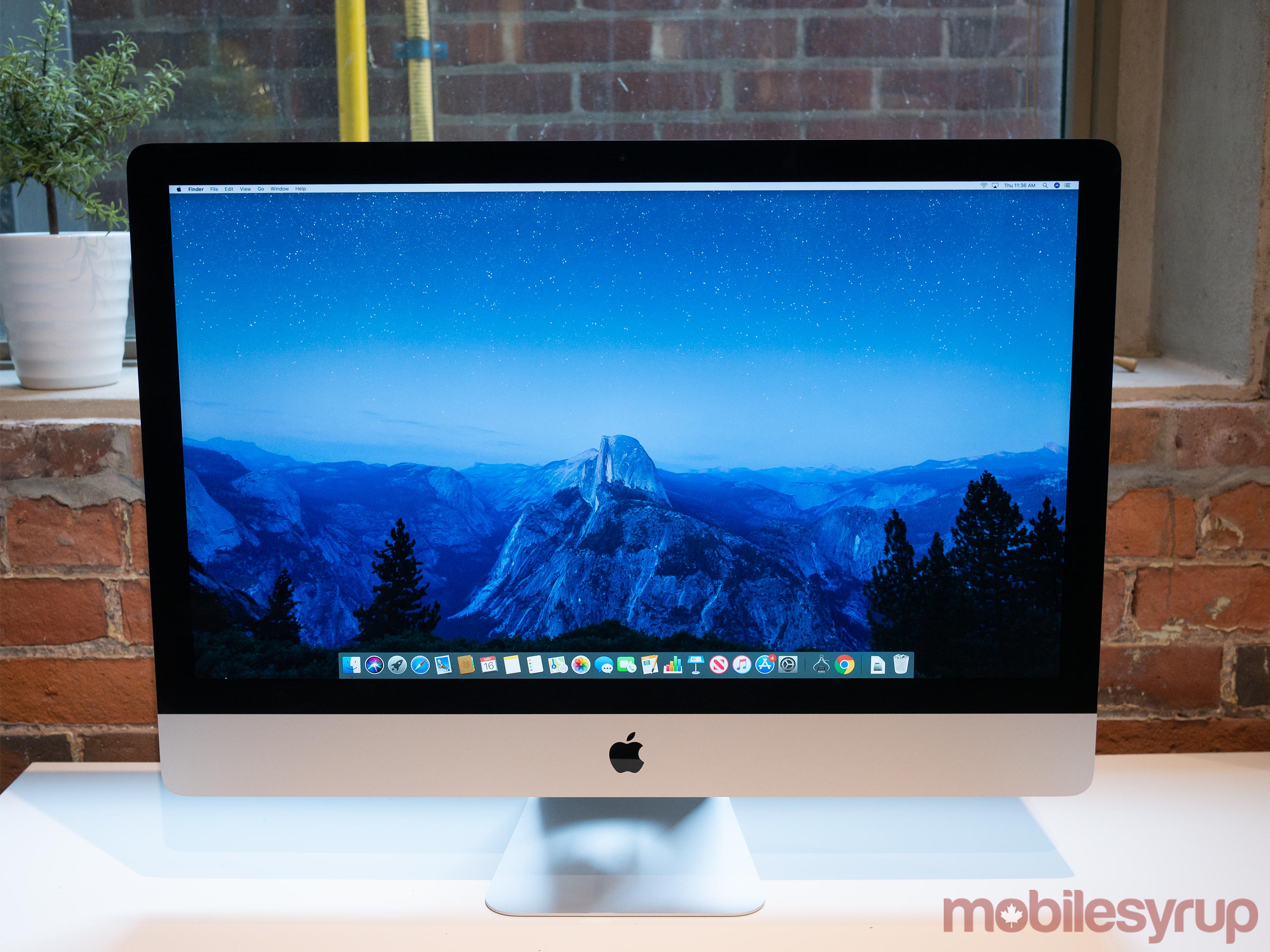
      The 2019 27-inch 5K iMac is an interesting beast.

      While Apple skipped the iMac’s 20th birthday back in 2019 and didn’t offer a hardware update to its still-popular all-in-one desktop, the tech giant has finally opted to give it a much-needed spec boost in 2019.

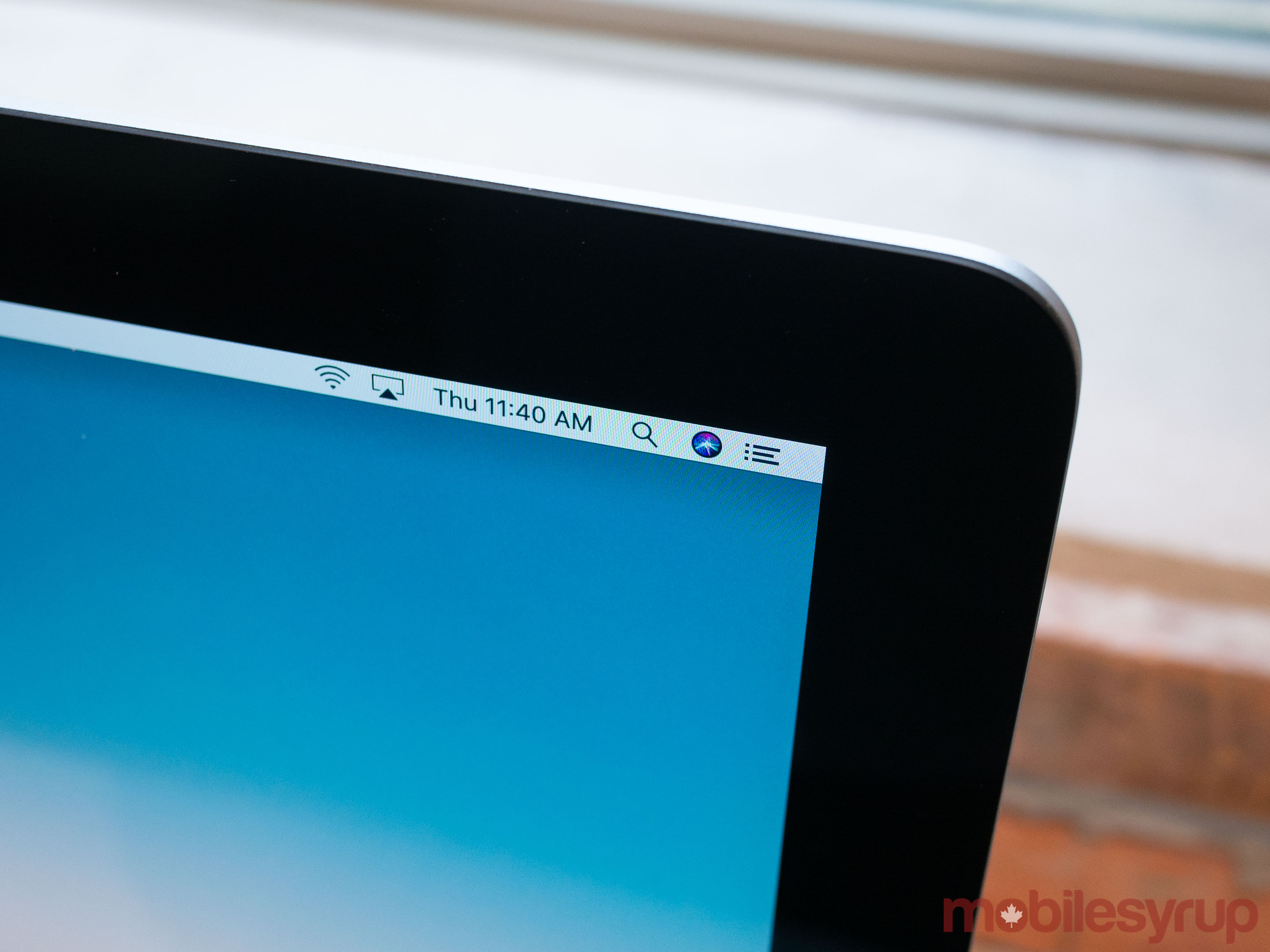
      To be clear, this update is all about hardware and other technical specs. If you were hoping Apple would finally change the iMac’s design, you’re unfortunately out of luck. The all-in-one desktop still features the same substantial bezels that are beginning to look rather dated. To put this in perspective, this is the longest Apple has ever stuck with the same design for any of its products.

      That said, it’s not as if the desktop’s design hasn’t aged gracefully. The curved-filled aesthetic still looks great on a desk, and the all-in-one’s overall low-profile helps it blend in with its surroundings. The iMac still remains a great choice for minimalists. Still, it’s impossible to deny that those bezels don’t look huge, especially when compared to even Apple’s own MacBook Pro.

      Sticking with this trend, love it or hate it, the same wireless keyboard and mouse makes a return with the 2019 iMac, complete with the strangely placed Lightning charging port on the base of the mouse.

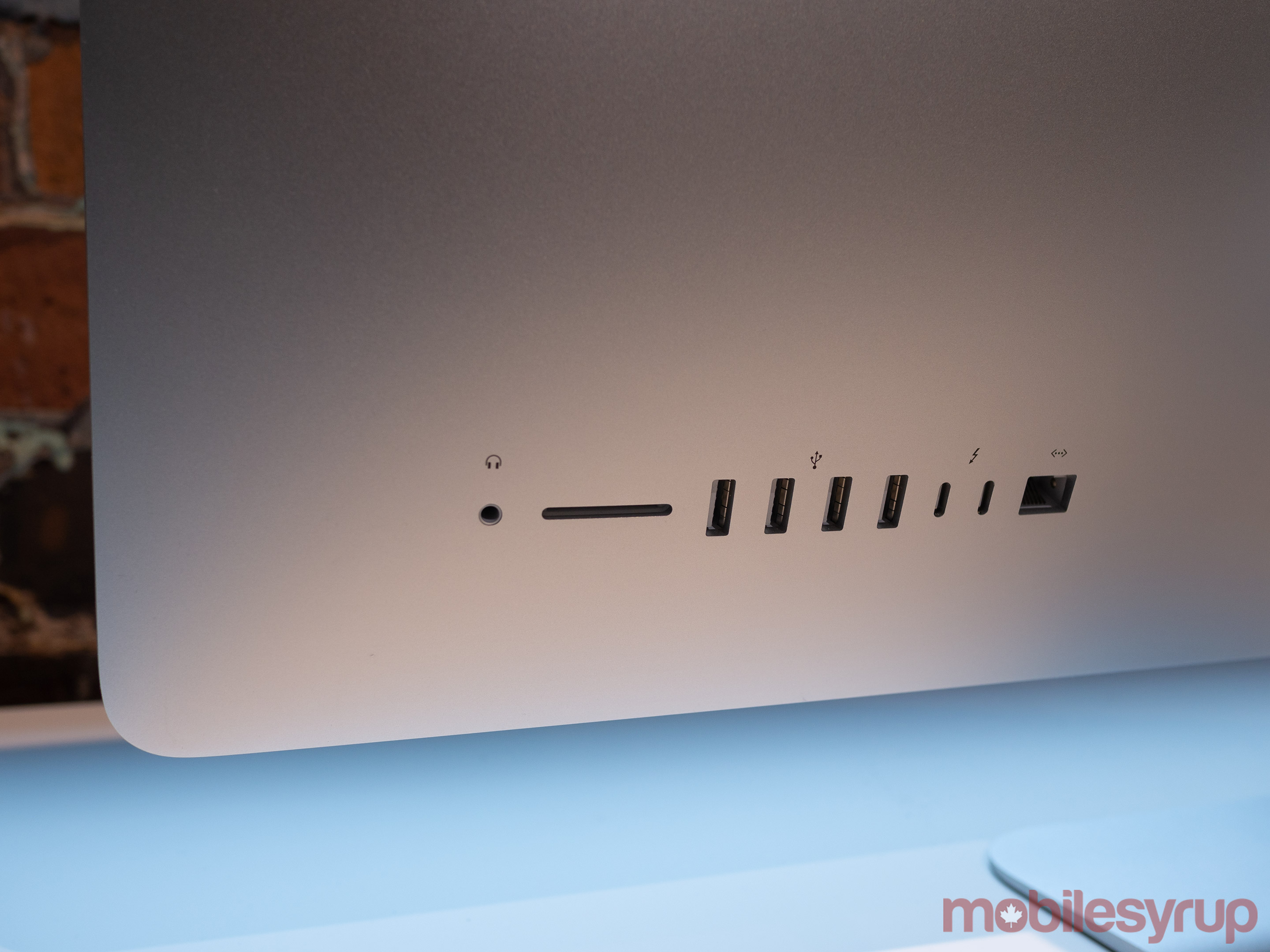
      27-inch iMac back

      Regarding hardware, the new iMac features a 9th-generation Intel Coffee Lake processor, up to an AMD Radeon Pro Vega 48 graphics card and a faster 512GB SSD instead of the hybrid hard drives featured in previous versions of the desktop.

      The ports offered in the 2019 iMac also remain the same as its 2017 counterpart. This means the desktop features two Thunderbolt 3 USB-C ports, four USB-A ports, an SD card slot, a headphone jack (praise be), an Ethernet port and support for one external 5K display or two 4K screens. This time around it’s also worth noting that RAM is upgradable in the 27-inch version of the iMac, which is a welcome change from previous versions of the all-in-one.

      The particular iMac Apple sent over to the MobileSyrup office is the iMac Retina 5K 27-inch, 3.6Ghz Intel Core i9, 16GB 2667MHz DDR5, Radeon Pro Vega 48 8GB configuration of the pricey computer.

      For me, as has been the case with nearly every iMac I’ve used, it’s really the desktop’s display that truly shines. Despite its chunky frame, the display is by far one of the best I’ve encountered. With an aspect ratio of 16:10 and a 5K resolution of 5,120 x 2,880, the screen is so sharp that I can’t even see a pixel when I’m sitting close to the display. To be clear, Apple isn’t alone in this space anymore, with the Surface Studio 2 being equally sharp, coming in at a 4,500 x 3,000 pixel resolution with a 3:2 aspect ratio, along with the fact that its a touchscreen.

      27-inch iMac bezels

      That said, though I haven’t spent much time with the Surface Studio 2, the 5K iMac edges out the competition in the colour vibrancy space thanks to its impressive colour gamut. You’re basically getting one of the best-looking displays out there, with the bonus of reasonably powerful hardware inside.

      It’s likely that Apple has plans for a more radical iMac redesign when the tech giant moves the Mac to ARM-based processors, a shift that has been rumoured for a number of years now. However, it’s unclear when that will actually happen.

      The 27-inch iMac starts at $2,399 CAD for the 3.0GHz 8th-generation Intel Core i5, 8GB DDR4 RAM, Radeon Pro 570x with 4GB of GDDR5 memory and a 1TB Fusion hard drive.

      The post A look at Apple’s 27-inch 5K iMac (2019) appeared first on MobileSyrup.

      22 May 17:14

      Former Facebook security chief says Zuckerberg should step down as CEO

      by Aisha Malik
      Mark Zuckerberg headshot

      At the Collision Conference in Toronto, Alex Stamos, former Facebook security chief, said Mark Zuckerberg has accumulated too much power and should hire a new CEO.

      “He needs to give up some of that power. If I was him, I would go hire a new CEO for the company,” Stamos said at the conference.

      Stamos says Zuckerberg should make building products his priority, especially since that is where his passion lies. He even suggested Microsoft’s current CEO Brad Smith as a replacement for Zuckerberg.

      Zuckerberg has been acting as Facebook’s product head since Chris Cox’s departure in March. Stamos believes that Zuckerberg should focus on product building and give up the lead role.

      “He should hire a CEO that can help signal both internally and externally that the culture has to change,” Stamos said at the conference.

      Stamos also shared his arguments for breaking up Facebook and separating YouTube from Google because both platforms have decreased competition.

      This is not the first time Facebook and Zuckerberg have been criticized by former employees. Facebook’s co-founder, Chris Hughes, wrote an opinion piece for The New York Times earlier this month stating his belief that Facebook should break up.

      Source: CNBC Via: 9to5Mac

      The post Former Facebook security chief says Zuckerberg should step down as CEO appeared first on MobileSyrup.

      22 May 17:14

      Chip designer ARM pulls business from Huawei following U.S. ban

      by Shruti Shekar

      ARM, a chip designer, has announced it is suspending business with Huawei, according to an internal memo.

      The May 18th memo to all ARM employees read that “all active contracts, support entitlements, and any pending engagements,” must be put to a halt after U.S. President Donald Trump signed an executive order that bans the company from working with any U.S. companies.

      According to a BBC report, the memo said many of the chips contain “U.S. origin technology,” and as a result is affected by the ban. It’s important to note that ARM is based out of the U.K. but has eight offices in the U.S.

      ARM said in a statement to the BBC that it was “complying with all of the latest regulations set forth by the U.S. government.”

      Chris Pereira, director of public affairs at Huawei Canada, said in a statement to MobileSyrup that the company valued its relationships with all of its partners “but recognize the pressure some of them are under, as a result of politically motivated decisions.”

      “We are confident this regrettable situation can be resolved and our priority remains to continue to deliver world-class technology and products to our customers around the world,” Pereira said.

      It’s important to note that ARM doesn’t manufacture chips or computer processors, but instead it licences its semiconductor technologies to other companies.

      At times, ARM will licence out the architecture, or what is also known as an “instruction set,” which is like the foundation and handles some commands but gives chipmakers to customize and design their own chip version.

      A good example of this is that Qualcomm’s Snapdragon processor featured in most major Android smartphones, including the Galaxy S10 and LG G8, uses ARM technology.

      Source: BBC

      The post Chip designer ARM pulls business from Huawei following U.S. ban appeared first on MobileSyrup.

      22 May 17:13

      Koodo offering $250 off just-released Google Pixel 3a and 3a XL

      by Bradly Shankar

      Koodo is offering $250 CAD off the Google Pixel 3a and 3a XL, which just released earlier this month.

      For a limited time, customers can get Google’s newest smartphones at a discounted price on various Tabs.

      The phones are notable for being a more affordable alternative from Google while still offering several key features and specifications, including ‘Night Sight’ photography, Qualcomm’s solid, mid-range Snapdragon 670 chipset and the Pixel 3’s Titan M security chip and back-facing fingerprint scanner.

      Here are Koodo’s Google Pixel 3a and 3a XL prices:

      Pixel 3a

      With the Pixel 3a on a Tab Small, you’ll pay $120 upfront (down from $370) and divide the remaining cost of the phone ($360) across $10/month tab charges for 24 months. Tab Small plans for the Pixel 3a start at $45/month and include $265 in activation credits.

      Meanwhile, the Pixel 3a on the Tab Medium will cost you $0 upfront (as opposed to $250) and $15/month in tab charges for 24 months. Tab Medium plans for the Pixel 3a start at $55/month and include $265 in activation credits.

      Koodo has the Pixel 3a in black and white. The phone $625 outright.

      More information on Koodo’s Pixel 3a can be found here.

      Pixel 3a XL

      The Pixel 3a XL costs $220 upfront (down from $470) on a Tab Small and you’ll have to pay $10/month in tab charges for 24 months. Tab Small plans for the Pixel 3a XL start at $45/month and include $290 in activation credits.

      On the Tab Medium, you’ll pay $100 upfront (down from $350) and a $15 monthly tab charge for 24 months. Tab Medium plans start at $55/month and include $290 in activation credits.

      Finally, the Tab Large lets you get the phone for $0 upfront (regularly $250) and pay a $20 monthly tab charge for 24 months. On the Tab Large, plans start at $80/month and include $270 in activation credits.

      Koodo carries the Pixel 3a XL in black. The phone costs $750 outright.

      More information on Koodo’s Pixel 3a XL plans can be found here.

      If you’re looking for a more premium Google smartphone experience, the Pixel 3 and Pixel 3 XL are also currently discounted in Canada.

      The post Koodo offering $250 off just-released Google Pixel 3a and 3a XL appeared first on MobileSyrup.