Rolandt
Shared posts
This Week in 1992. A thirty year old time capsule demonstrates both the problems due to cars and the lack of progress that we've made in addressing them.
The Failure of Reason
 During yesterday's Future Trends Forum conversation featuring Kathleen Fitzpatrick - the author of Generous Thinking and proponent of reasoned debate between opposing parties - I asked a question that went roughly along the following lines:
What if reason is what's at fault here? We don't use reason to arrive at our core beliefs or to tell us how to live our lives - we use experiences, upbringing and the rest. We very rarely change our minds because of an argument; we need something a lot more direct. So why should we make reason the basis for democracy?
Fitzpatrick didn't have an answer, partially (I think) because the question challenges one of the core assumptions of our society, and partially because there might not be an answer.
And the challenge to the rule of reason challenges the nature and role of the power structures in society. The argument from reason often concludes "the people are wrong". The problem of democracy is addressed by either educating the people, or reserving decision-making for a more educated set of people (both were discussed during the webcast).
But as I asserted in my comment, "the people aren't wrong." Sure, they may be voting for someone I don't even remotely support, but if we get past that a bit and ask why they are voting this way, the people seem eminently (if I dare say) reasonable.
They are seeing their society disappear from under them. They are seeing jobs disappear, losing the prospect of owning their own home, watching as their pensions are being stolen, and find themselves falling further and further behind.
Social mobility is essentially nonexistent. So are social supports - health care is costing more and more, education is becoming less accessible, and all the promises of technology have been replaced by gadgets and insecurity. Toys cost less, but the essentials of life cost more.
Anyone can see this - and yet people who use reason acts as though it doesn't exist. They're on a completely different agenda. The left talks about different kinds of morality, focuses on identity issues, and talks about correct speech and behaviour, while the right focuses on helping business become bigger through trade networks and deregulation.
And the media, who should know better, focus on triviality. The MIT Press Reader, for example, raises the problem of information pollution as follows: "President Donald Trump’s official spokesperson asserted that the crowds for his inauguration were the biggest had by any president ever. The claim was false, and hilariously so."
Well maybe it was. But who cares, really? Is this what reason has brought is to?
Fitzpatrick represented it as a problem of post-modernism, where there is no truth and there are no facts. So does the Press Reader: "Facts — indeed, the values of truth and rationality — seemed not to matter."
The person losing his home looks at this and asks, "who makes the facts?" And "who makes the facts that matter?"
Listening to This Week in Google today I heard about the Symantec Report discussing disinformation campaigns on Twitter. One thing that caught my eye was that "the campaign directed propaganda at both sides of the liberal/conservative political divide in the U.S., in particular the more disaffected elements of both camps." Trump on the right, Bernie on the left, someone commented.
Quite so. As though the centre is the only reasonable place to be. But it occurred to me that these campaigns are effective because there are disaffected groups. And it's not so much the left against the right as it is the disaffected groups against the middle.
Consider the argument made in Against the Dead Consensus, just recently profiled in the NY Times. "The consensus that the manifesto came to bury belonged to conservatism as it existed between the time of William F. Buckley Jr. and the rise of Donald Trump: An ideology that packaged limited government, free markets, a hawkish foreign policy and cultural conservatism together, and that assumed that business interests and religious conservatives and ambitious American-empire builders belonged naturally to the same coalition."
In my comment I mentioned the argument against reason and rationalism by John Ralston Saul. Consider, for example, Voltaire's Bastards. Summarized here: "our 'rational elites' have gradually instituted reforms in every phase of social life. But Saul shows that they have also been responsible for most of the difficulties and violence of the same period (and) helped to turn the modern West into a vast, incomprehensible, direction less machine, run by process-minded experts – Voltaire’s bastards – whose cult of scientific management is bereft of both sense and morality."
On both the left and the right - and in the great suffering middle - there is a recognition that reason and rationality have left society aimless and purposeless, and worse, have abandoned the idea that there is anything of value.
And what we value isn't something that can be measured and counted, it isn't something that than be argued about and debated rationally. This is sometimes thought of as data feminism, but I think it has its origins in the idea of theory-laden data and offers a wider ranging critique of reason in general. It has its origins in our physical core, in what makes the difference between a sense of well-being and a sense of helplessness, a sense of justice and that cold anger rising against the manifestly unjust (no matter how well it is justified).
After reading Robert Nozick's Philosophical Explanations many years ago I stopped arguing for my own thoughts and ideas, and instead started explaining them. As summarized, "Nozick presents a new mode of philosophizing. In place of the usual semi-coercive philosophical goals of proof, of forcing people to accept conclusions, this book seeks philosophical explanations and understanding, and thereby stays truer to the original motivations for being interested in philosophy."
I think that things like logic, reason, mathematics and inference are wonderful tools. As Descartes so helpfully explains four centuries ago, they helps us make clear what is inherent in the ideas and options we already have. But we cannot base a society, a democracy, on them. We cannot count our way to justice, we cannot infer our way to decency.
We are not going to be able to address the problems of disinformation and of extremism through rationality and reason. People don't think that way, and they are persuaded that way. If it were up to me, I would focus on two major things: first of all, actually addressing the problems and issues of the disaffected, and second, setting higher standards for our own behaviour - because, after all, when the leaders are all crooks, why should we expect the population to be any different?
WWDC 2019 First Words, Which I May End Up Eating Later, but Hopefully Not
SwiftUI is the future of app-making for our community.
UIKit for Mac (Catalyst) is a lateral move. I’m sure this will be super useful for a lot of developers, though not for me personally (since I don’t have an iOS app to move to the Mac).
But AppKit and UIKit both look like old news compared to SwiftUI and the Combine framework.
* * *
I’m not going to start using SwiftUI right away in NetNewsWire for Mac — NetNewsWire 5.0 is too close to shipping. We’re fixing bugs, and that’s it.
But we do plan to use it in NetNewsWire for iOS, since it’s not as far along as the Mac version. Obviously I’ll have more to say about SwiftUI as we learn more about it.
Could we eventually get to that place where the Mac and iOS version share UI code via SwiftUI? It looks promising! I would love that.
* * *
The future of app-making looks more and more like web development. Declarative. Semantic. Dynamic — adapting to context (interaction styles, accessibility settings, screen size, etc.). Runtime-editable.
SwiftUI and Combine can also be seen as an answer to Electron and React Native. The right answer for Apple, I think.
* * *
I’m way behind on videos. I’ve seen just a little bit so far. So much to learn! This was a big WWDC.
Apple’s WWDC mojo shows back up
Apple’s Worldwide Developer Conference (WWDC) used to be the highlight of my yearly conference schedule. The announcements about what was coming next from Apple were central to both my work with the Apple Developer Connection and the books I worked on. And, it was always a fun time to reconnect with friends. Even when it was no longer about my work, it’s been one of the events I really looked forward to for the betters part of two decades.
The last couple of years, however, Apple has felt distracted and maybe a bit like they’d lost the plot. Once a company that reliably shipped the products they announced, they had slipped into a cycle of announcing cool-sounding stuff way before they’d actually done the work to see if it was viable. The HomePod and AirPower are two good examples. The first made it out as a decent product. The second, well, it finally got unceremoniously canceled recently.
And, don’t get me started on the damn butterfly keyboard fiasco.
It happens. Companies go through cycles. In Apple’s case, maybe they’ve been distracted by completing Apple Park. It wouldn’t be the first time in Silicon Valley that a company’s slide into mediocrity or beyond coincided with their building of a fancy new campus.
Regardless, any interest I had in WWDC this year was mostly centered on seeing where Apple is going and if it was going to continue drifting away from what I find interesting. In conversations with friends, I boiled down what I was looking for to: 1) An answer to the Mac Pro question; 2) A path forward for the iPad to grow up; 3) Something that indicated that Apple was thinking more holistically about their platforms as a group rather than point devices.
I was pessimistic enough to give the chances of good answers to those questions about 25%.
I’m so happy my pessimism was misplaced.
Yes, the Mac Pro is out of most people’s league, but we were asking for a no-holds-barred pro machine, and we got one. I can’t justify buying one right now. Hell, my four-year-old iMac is still running great. But damn… If I ever need that much power on my desktop, I’m glad the option is there.
The big announcement for me, however, and the one that has brought back a lot of interest for me in Apple’s platforms is SwiftUI. Holy smokes. It looks really, really, really good. Between that and Project Catalyst (formerly known as Marzipan) which allows building iOS apps for the Mac, the development story across the Mac, iPhone, and iPad is now heading in a much better direction.
To be sure, there’s still some tone-deafness in the air. The pricing reveal on the $999 monitor stand, for example, was this year’s equivalent of showing off a 24K gold Apple watch. And the shock of it would have been totally avoidable if they’d priced the monitor with the stand, then offered a discount for all those pros buying the monitor without it.
Regardless, however, it’s good to see Apple get some of their mojo back. Now, if you’ll excuse me, I’m going to go read up more about SwiftUI.
Best Father's Day Gifts!
June is dad's month! Celebrate him and every significant man in your life this Father's Day. Lucky for dad, summer is here and the outdoors are calling his name. Help him adventure, find a new way to commute, add a little fun to his day, and even increase exercise with an electric bike. Here at Blix, we created a gift guide with the best gifts for dad this Father's Day and it doesn't include watches, wallets or beer. Plus, check out how one Blix dad conquered the steepest hill in Santa Cruz with pedal assist!
Gift Dad a Blix Bike!
Gift dad the freedom to replace the car and take the Packa instead! With a 400lb payload, he can grab the cooler, the beach chairs, the fishing equipment and even the kids. Dad will be riding in style with the choice of electric blue or bright white, a throttle, pedal assist, and a range of up to 70 miles per charge! With a Packa, dad will be thrilled to spend the summer outdoors
2. Vika Travel: $200 Off!
This folding ebike is perfect for the adventurer, roadie, and boater. Dad can pack the Vika Travel in the trunk, unfold at his destination, and go! Reaching 17 mph and a range of 30 miles per charge, dad can take his road trip to the next level.
The Vika Travel has also been ranked by Bicycling.com as one of the top 10 best folding ebikes for the everyday rider!
3. Aveny High Step:
Commuting to the office can be an absolute drag, especially during the summer when the sun is shining and it stays light long after work is over. With an Aveny, dad can switch up his daily routine, beat traffic, and reduce the stress of finding limited parking. With pedal assist and a throttle, he can ride up to 20mph with a range of up to 40 miles per charge. Breaking a sweat is optional!

When dad deserves a little extra...
Whether he has a Blix Bike or is about to receive one, the full utility of any Blix is truly met with the addition of accessories! Here our some of our favorite gift bundles.
For the Packa:
- Large basket, front rack, platform
- Two large baskets and a front basket
- The VIP section, cushions, front rack
For all other bikes:
- Small front basket, Blix tumbler
- Small front basket, extra charger
- Extra charger, Vika Carrying bag (for the Vika Travel or Vika+
Dad will be sure to feel the love and appreciation with any of these perfect Father's Day gifts! Watch as one Blix dad found a new passion for riding an electric bike after conquering the steepest Santa Cruz hill.
More information about the Packa here
More information about the accessories here
Check out the entire Blix dad story here
Follow us for more great gift ideas!
SUMO Platform Roadmap
Our support platform went through numerous changes and transitions during the last couple of years. With the SUMO team joining efforts with the Open Innovation group last year, we have started thinking about different approaches to our support platform strategy. Our support platform is complex and there are a lot of legacy items that need to be taken care of. Besides this we need to get ready for all the new things that are coming our way.
We want to ensure we’re providing a stable platform that will support Mozilla in the years to come as well as manage all the new products and changes expected in the following years.
During this first half of the year we have worked on setting up a roadmap that prioritizes the work and helps us be more intentional about the changes we want to make in order to provide the best support platform for our users. With this we have also worked on new processes that will hopefully simplify the way we work with the platform as well as the overall development process.
What’s new
Our current efforts are focused almost 100% on the integration of Firefox Accounts. In parallel we’ve also been working with the IT team to complete a migration of the infrastructure to a new instance of AWS (this has been completed on June 5th). Firefox Accounts implementation will follow shortly. After these major pieces of work are done our next big priorities are: Elastic search upgrades, ongoing UX experiments and a Responsive Design implementation that has become even more important as Google now indexes our site as mobile-first..
There will be more discussions about H2 and how we’re going to manage platform priorities in the second half of the year in July.
You can consult the current platform roadmap here.
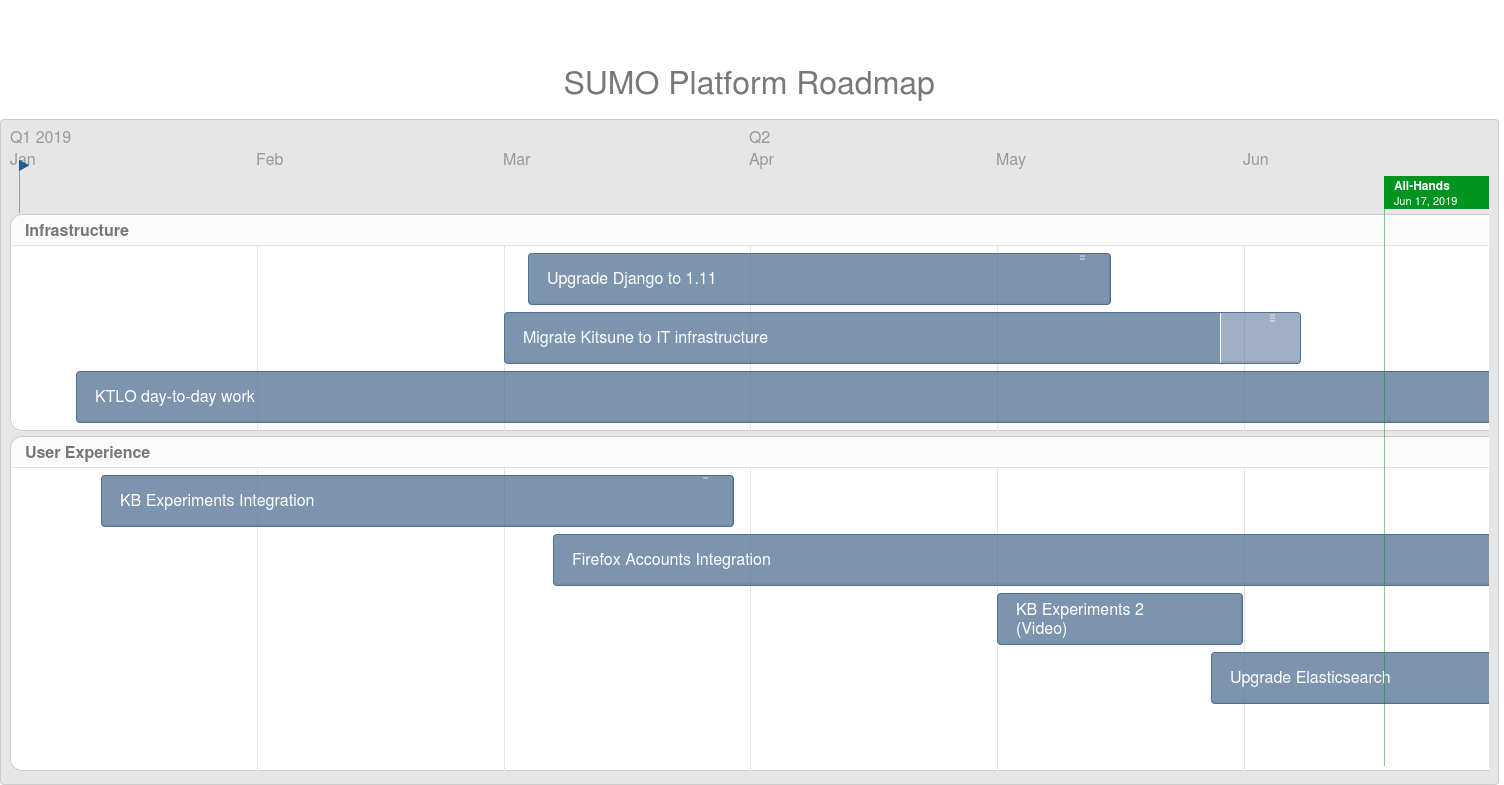
This is a high-level overview on each project we’re working on and the expected timeline for completion. We’re going to review the roadmap items at the beginning of each month.
All the development work is being tracked in sprints and you can follow our current sprint here.
As mentioned before, the SUMO platform is a large complex platform with a lot of legacy issues that need to be dealt with. Currently we have around 700 bugs filed, many of them being more than 5 years old. As we don’t have enough resources to deal with this huge backlog we’ll need to change a few processes. We have designed a new triage and roadmap review process that you can read about here . Bugs that are not critical to the stability of the platform and are older than 6 months will be closed – this is a one time only event and we expect this to take care of most outdated bugs that will never be fixed. Feel free to open a new bug if you feel the issue is urgent or should be prioritized nonetheless.
Please note
We’re currently focusing on: Firefox Accounts implementation, the IT migration as well as any critical issues that break the site or block releases. Any other items are currently on hold. We can prioritize other issues as needed as per the process described in the document shared above.
SUMO staff team
Why Syrian Refugees Matter to You
‘Find My’ locates your iPhone, doesn’t tell Apple where you’ve been

Apple announced a lot of new features for its suite of devices and software platforms at WWDC 2019, but one of the more interesting was its fresh take on Find My iPhone, now simply called ‘Find My.’
Oddities in the name aside, the new Find My service promises to use Bluetooth signals from Apple devices like iPhones, iPads and MacBooks to help users locate their missing electronics.
If you’re familiar with products like Tile or TrackR, the premise is the same. Find My broadcasts Bluetooth signals — even if the device is offline — that can be picked up by nearby Apple devices and relayed to the cloud. In other words, you should be able to use Find My to locate a stolen MacBook sleeping in a thief’s bag.
Handy as that is, the feature rightly has the privacy-conscious concerned. But unlike past Apple features that let the company track your location, like Find My iPhone, the new Find My accomplishes its task without compromising your privacy.
How Find My works without compromising your location
Apple described the Find My process to Wired, outlining how it does what it does without sharing your location.
First up, you’ll need two Apple devices to take advantage of Find My. When you first set it up on your devices, it generates an unguessable private key and shares it across all your Apple devices in end-to-end encrypted communications. In other words, only those devices have the key.
Then, each device also generates a public key, which can encrypt data so it can’t be decrypted without the private key. This public key becomes the ‘beacon’ your devices broadcast via Bluetooth.
To ensure that public key can’t be used to track you, Apple says it frequently changes — although the company didn’t say how often it does so. Further, Apple says each new public key won’t correlate to previous keys, but can still be decrypted by the private key. This makes it incredibly difficult for anyone to track you using the Bluetooth beacons.
If a device goes missing — say someone stole your iPad — it will emit its rotating public key via Bluetooth, even if it’s off and disconnected from the internet. Then, a nearby stranger’s iPhone, with no interaction from its owner, will pick up the signal, check its location, encrypt it with the public key from your iPad. Again, this key doesn’t have any identifying information and, since it rotates frequently, the stranger’s iPhone can’t link the iPad to its prior locations.
Then the iPhone uploads the encrypted location and a hash of the laptop’s public key, which serves as an identifier. Apple doesn’t have the private key, so it can’t decrypt the location.
How Find My finds your device
Now, when you want to find your missing iPad, you turn to Find My on a different Apple device, like your MacBook. It contains both the private and rotating public keys. When you open Find My to search for your missing iPad, your MacBook uploads a hash of the public key, which Apple uses to search through its stored, encrypted locations.
It’s worth noting that, since the public key regularly rotates, it’s possible that Apple’s record from the stranger’s iPhone is an older version of the key. While Apple didn’t explain how it gets around this, Matthew Green, a cryptographer from John Hopkins University, told Wired that one solution could be the MacBook uploads hashes of previous public keys so Apple can find the missing device.
Once Apple finds the matching hash, it sends the encrypted location of your iPad to your MacBook, which can use the private key to decrypt the location — data Apple has never seen. Moreover, hashing functions are designed to be irreversible, so the company can’t use the hashed public keys to collect information about a device’s location.
That all sounds really complex; how do I know it works?
Well, it is rather complicated. And Apple says the explanation is a simplified one as well. Plus, the system is subject to change before it rolls out as part of iOS 13 and macOS Catalina later this year.
According to Green, the actual security of the system will depend on its final implementation. However, he also said if the system works as Apple explained it, it could offer all the privacy guarantees Apple promised.
It’s worth noting that no one has really deployed a system like this on the scale that Apple will. Green says these techniques scientifically are sound but implementing them practically in this way would be impressive.
Source: Wired
The post ‘Find My’ locates your iPhone, doesn’t tell Apple where you’ve been appeared first on MobileSyrup.
Leipzig and Tønsberg - Avengers in Europe
Hi everyone! Lisa is still on her well deserved vacation. I’m Fabian and this Weekly Chart is not a table.
I’m quite the comic book fan now, but wasn’t that much into them in my childhood. I really liked Tabaluga but didn’t get into comic books and movies until the Raimi Spider-Man movies. The Avengers was the movie that really got me hooked and made me start exploring the Marvel Cinematic Universe (MCU) and Marvel comics. Today I can say that I watched all 22 MCU movies (some of them multiple times). Most movies take place in the United States or in space, like the Guardians of the Galaxy.
I wanted to explore if any of the action occurs in Europe. Immediately the airport fight from Captain America: Civil War came to mind. Spider-Man was introduced to the MCU in that very fight as well, and fans loved it!

The map shows 12 locations from various MCU movies. I did not consider the TV shows and if you are an Agents of S.H.I.E.L.D fan, there are quite a few locations missing.
One interesting point: a lot of MCU movies talk about Sokovia, which is located in Eastern Europe. Sokovia is the main location in Avengers: Age of Ultron and supposed to be between Slovakia and the Czech Republic. In Captain America: Civil War it appears again - a screen shows that Sokovia is located at the northwest coast of the Black Sea. Since it doesn’t exist in our universe, it doesn’t show up on this map.
To visualize these places I chose a locator map, since it’s so easy to point to, well locations (it’s right there in the name). I always had a hunch that only a few stories in MCU movies take place in Europe. It turns out that there are actually quite a lot of places in Europe featured in MCU movies, which I did not expect to see. This locator map shows very well that a lot of Captain America: Civil War happened in Europe. The protagonists travelled quite a bit. Maybe Black Widow took the train from Vienna to Leipzig instead of the Quinjet.
If you want to learn more about locator maps, check out the following links:
Please let me know if I missed something or you want to talk about why “Thor: The Dark World” is a masterpiece.
Telus invests $150 million in fibre optic network in Prince George, B.C.

Telus is investing $150 million to connect over 90 percent of the homes and businesses in Prince George B.C with fibre optic internet.
This investment includes the North Side of Lheidli T’enneh First Nation’s Fort George 2 reserve.
The Canadian telecom hopes to build out this ‘PureFibre’ network expansion over the next three years to offer residents faster home internet and to get the area ready for 5G connectivity.
The company has already begun construction on the network and hopes to connect around 90 percent of homes and businesses by 2022.
PureFibre is Telus’ fibre internet brand and is the only fibre offering in Western Canada, according to the company’s website.
This brings Telus’s total investment in Northern B.C. up to $350 million since 2013. Throughout the next three years, the telecom plans to invest $8 billion more in the western-most province to connect and support communities in the region.
Prince George “residents can expect to see TELUS trucks throughout the community as construction begins, and TELUS representatives out knocking on their door to receive permission to connect their home to the network. Once homes are connected, residents can immediately begin taking advantage of dramatically faster and symmetrical Internet speeds,” reads the company’s press release.
Source: Telus
The post Telus invests $150 million in fibre optic network in Prince George, B.C. appeared first on MobileSyrup.
Your System is not a Sports Team
It’s the responsibility of an engineering team to do what’s right for the company, not to advocate for the system they own. Engineering teams need to be oriented around a mission not a system to avoid narrow-minded decision-making.
Do you have a team at your company called the Kafka Team, or the HBase Team, or the Docker Team? Hmm, you may have screwed up. Don’t worry, there’s time to fix this.
Years ago at Dropbox we started the Magic Pocket team to design and build the block storage system of the same name. It was a silly internal codename that somehow ended up sticking. The Magic Pocket team had a lot of successes but as soon as the system was stable and launched in production I had the team go through all the effort of rebranding to the Storage Infrastructure Team. This was a huge pain and prompted a lot of eye-rolling from folks who saw this as a meaningless management gesture. At least in this one occasion there was some method to this madness.
The method here is that this is the team of block storage domain experts at the company. If the system ever ceases to meet our needs and we need to pursue an alternative, this is the team that needs to advocate for that strategy. Magic Pocket is not a sport team and and our people not a bunch of zealous fans. They’re highly skilled engineers with a responsibility to design, build, and operate the best storage system in the world. If we can’t trust that team to drive this strategy who can we trust?
Orienting a team around a mission and not a specific system is critical to ensure that their priorities are aligned with what’s best for the company.
The Storage Infrastructure team mission was brought into sharp focus when our lead engineer proactively killed a cold-storage project that he was in charge of. The system was “his baby,” but he felt like it turned out being excessively complex and not in the long-term interest of the company. People who make these kinds of decisions are the ones you want to celebrate.
As a fortunate twist he came up with a far simpler and better design a few days later. We end up launching it ahead of schedule. It’s nice when things work out like that.
System Bias
It’s natural to be biased towards a system you’ve spent countless hours building or operating. We’ve all seen examples of “system bias” gone wrong. This can sometimes be painfully obvious: the team spending six months to improve performance by 10% when it was completely fine to begin with; the team trying to desperately force their tooling on clients who are better off without it; the team riding their outdated system to the grave like the captain going down with the Titanic.
System bias can also show up in far more insidious ways. If a team views their responsibility as owning and advocating for a system then they’ll find creative ways to fill up sprint plans with work on that system, whether or not that actually matters. The same problem happens within a team when an engineer is a DRI (Directly Responsible Individual) for a specific system or sub-component. You’ll start seeing features get developed that are good in theory, but which we’d be fine without.
There’s always something to work on on a given system, you can always polish that gemstone a little more, but that doesn’t mean it’s worthwhile doing so. Many engineers have a tendency to focus inwardly on improving their pet system, unless encouraged to have a broader outlook by virtue of a mission that’s aligned with company value.
One question I like to ask engineers is:
If we could be spending these resources working on any project at the company right now, would this still be the best use of our time?
If the answer to this question is “no” then you might have scoped your mission too tightly. Either that or you’re over-staffed! (You’re probably not over-staffed.)
Defining a Mission
If system bias is a natural consequence of a sense of ownership, we’re certainly not doing the team any favors by burdening them further with a job description that codifies this bias.
Orient your team around the problem you solve, not the tools you use to do it.
Someone else can probably give you better advice on how to define a mission than me. It should be focused enough to give a sense of team identity but broad enough so as to not codify any implementation decisions. It should also be short — one or two sentences. Start by asking yourself “what problem do we solve?” That’s probably your mission.
Avoiding silos
Organizational structures can lead to excessive constraints on the mission of a team. Sometimes this is just an inevitable consequence of a large company. The more lightweight these structures are the more engineers will be empowered to focus on broad company impact in their decision-making, rather than staring at their shoes and only thinking about their own system.
For a tech lead it’s usually easier to reason about system bias within a team. If a team is split up into too many small silos the engineers within a silo will be forced to prioritize their tiny domain. Formal structures like tech leads can serve to make this even worse if the domains are particularly small. I tend to prefer establishing DRIs for sub-priorities with a team. The DRI is responsible for a sub-priority or sub-component but it’s not their identity; they’re still expected to work on other stuff on the team and to focus their energies on whatever matters most to the team as a whole.
Summary
You want your engineers to focus on solving problems that matter, not on advocating for systems they own. Establish a mission for the team and make that mission your team identity.
View original post on Medium.

Humanities Commons

I watched Bryan Alexander's Future Trends Forum today where the guest was Kathleen Fitzpatrick and the topic was the Humanities Commons, which according to its website is "the network for people working in the humanities. Discover the latest open-access scholarship and teaching materials, make interdisciplinary connections, build a WordPress Web site, and increase the impact of your work by sharing it in the repository." There's a lot to like about the site; maybe start by looking at the most downloaded resources for a sense of the range and quality. See also: Scholars, It's Time to Take Control of Your Online Communities.
Web: [Direct Link] [This Post]Hands-On with iPadOS and iOS 13: Changes Big and Small

iPad and iPhone users are in for a big treat this fall when iPadOS and iOS 13 launch. Each update is a major release that pushes Apple’s mobile platforms forward in big and small ways, making them more powerful for consumers and professionals alike.
If you haven’t read my iPadOS and iOS 13 overviews yet, the majority of details about each release are documented there. But I’ve been using the beta versions of both systems for a few days now, and while these are just an early look at what the finished releases will be, there are a lot of changes – some very significant, while others are relatively minor – that I’ve been excited to see.
Multitasking
Windows where you don’t expect them. As was anticipated leading up to WWDC, the iPad has gained the ability to display multiple instances of an app at once. What’s surprised me about the way Apple has implemented this change, however, is just how many things can become their own window in iPadOS. It’s unsurprising that a document-based app like Notes supports loading different notes as their own windows, but Apple has extended the same functionality to loading separate conversations in Messages, separate folders or tags in Files, email threads in Mail, and lists in Reminders. The only app I’m disappointed doesn’t have multi-window support is Photos, but perhaps that will change in future betas.
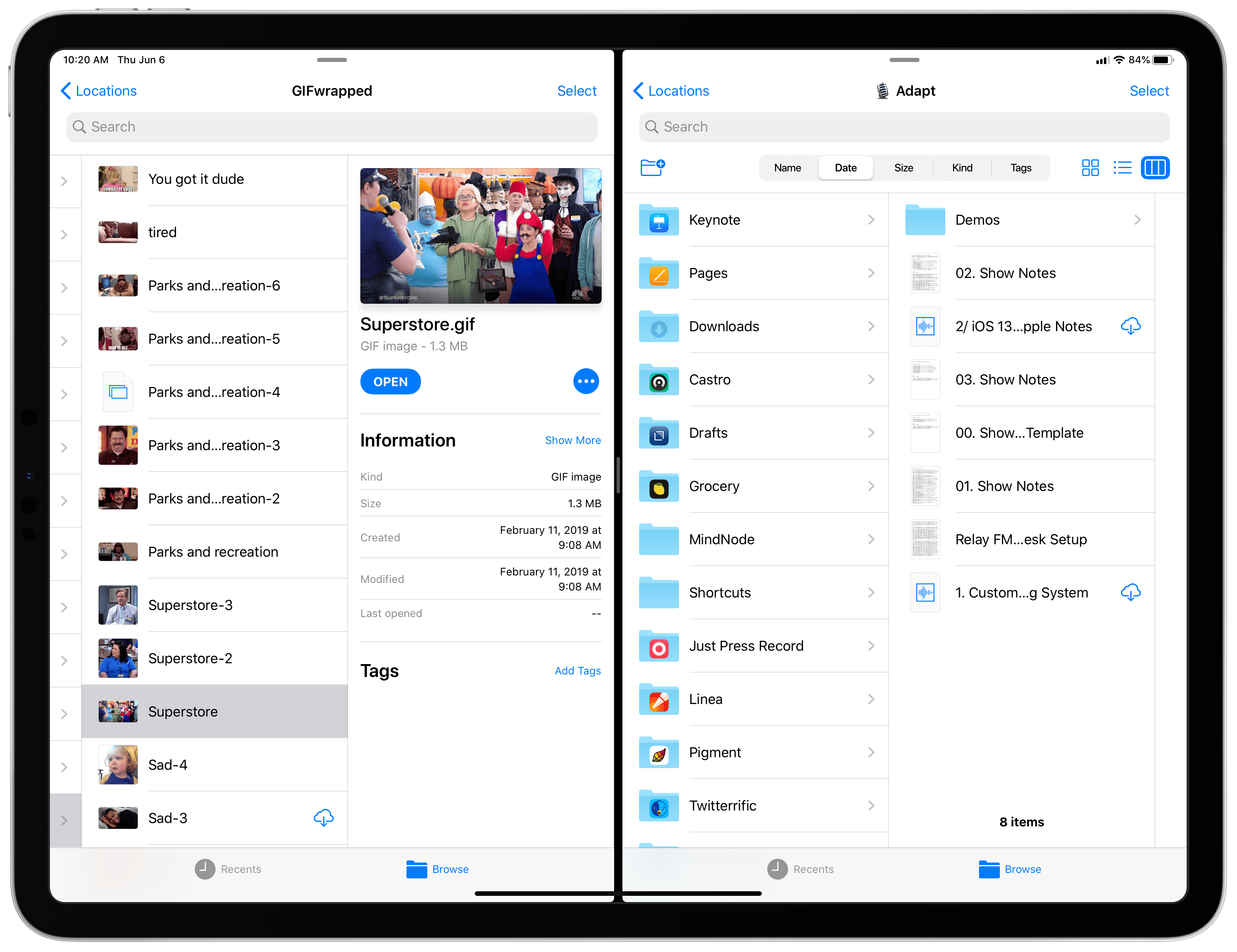
Rich previews of everything. Apple has redesigned the iOS peek and pop feature, which was formerly exclusive to 3D Touch iPhones, to now work on all iOS and even iPadOS devices, and it’s been tweaked in substantial ways. On an iPad, you can long-press on most types of content – including links, images, emails, and more – to see a pop-up that includes a Quick Look preview of that content (the new version of ‘peek’), as well as a contextual menu containing several quick actions. As an example, with links in Safari you get a visual preview of the website, along with options to Open in New Tab, or New Window, Download Linked File, Add to Reading List, Copy, and Share.

Split View is 50/50 by default. In iOS 12, when opening a second app on-screen in a Split View, that app would by default always open as the smaller app in a 66/33 split. iPadOS 13 changes that behavior such that all Split View apps default to opening in a 50/50 split, which can then be adjusted per your needs.
Shortcuts
Shortcuts as standalone action extensions. Ever since its days as Workflow, the Shortcuts app has included an action extension for easily running shortcuts from inside other apps. In iOS 13, the action extension section of the share sheet has been redesigned, and along with that change you’ll now see standalone shortcuts listed right in the share sheet – for some this may not make much of a difference, but I use Shortcuts’ action extension multiple times every day, and now I can access all the shortcuts I need with one less tap every time.

Files
Rename documents in Files extension. Renaming documents when saving them to Files via its action extension was formerly impossible. This painful omission has at last been remedied in iOS 13.

Create new folders in Files extension. In the same category of things that should have been possible since Files’ birth, but weren’t, iOS 13 enables creating new folders directly from the Save to Files extension, so you can properly sort your files at the time of saving them.
Reminders
iOS 13 brings a top-to-bottom redesign of Reminders, which the app has long needed. Besides a brand new look for the app that feels modern and fresh, there’s a host of new functionality now available in Reminders.
Nested tasks and lists. Every task in Reminders can now have subtasks attached to it, and lists can be condensed into groups that can be collapsed or expanded in the My Lists section of the app.

Adding due dates without times. Reminders has historically required adding not just a due date, but also a due time for tasks you want to be reminded of. In iOS 13 that restriction is gone: now tasks can be due on a particular day without having a due time set as well. I love this change, and it’s especially nice when paired with a new Today Notification feature: in Settings you can configure a set time of day whereby you’ll receive a notification listing your tasks due that day.
Quick toolbar. Although it’s easier than ever now to add due dates to tasks when creating them, thanks to a natural language parser tool, you can also easily set and reschedule due dates from Reminders’ quick toolbar in the keyboard row. From the quick toolbar you’ll see options to not only adjust a task’s due date, but also set a location-based alert, flag the task, or attach a photo or scan to it. The only thing I’d like added is a quick way to assign tasks to a particular list.

Remind me when messaging. One new parameter that’s available to set for tasks is that you can have the app remind you of a task the next time you’re messaging a certain contact.
Search
‘Ask Siri’ option. Siri on iOS mostly exists as a voice assistant, but something most users don’t know is that there’s an accessibility feature called Type to Siri whereby you can type Siri commands rather than speak them. In iOS 13, the spirit behind Type to Siri is being brought to Search. Whenever you enter a search query, you’ll see an option at the very bottom of your results list labeled ‘Ask Siri.’ Hit this button, and whatever words you typed will be used as input for Siri – essentially, Type to Siri is being built right into Search. While it’d be great to have the ‘Ask Siri’ button at the top of search results rather than the bottom, this addition brings a lot of new power to the Search screen.

No delay. Search on the iPad, particularly when engaged via the Command-Space keyboard shortcut, has long included a delay whereby you can’t hit the shortcut then immediately start typing, because the search field won’t load fast enough to log your initial keystrokes. As someone who uses Command-Space on the iPad countless times per day, I’ve grown accustomed to this slight delay and it hasn’t bothered me, but if you’re used to how responsive Spotlight on the Mac is, the iPad’s delay can be a big annoyance. In iPadOS 13 Apple has fixed this issue: you can now hit Command-Space and immediately start typing, and Search will register every keystroke.
Miscellany
Folder improvements in Notes. One nice change for Notes mentioned in my iOS 13 overview is the ability to share folders. There are two folders updates that have me more excited, though: you can now rearrange folders manually, rather than having them sorted only by title, and you can finally nest folders on iOS. The former option means I’ll no longer need to ‘cheat’ the system by adding dashes to the front of folder titles I want displayed up top, and the latter means I won’t need to use a Mac every time I want to create or modify a sub-folder in Notes. Related to nested folder support, just like on the Mac you can now collapse or expand a list of nested folders.
More prominent Saved Stories screen in News. One of the design decisions in past versions of iOS that most baffled me is that the place where articles you save are stored for later was buried all the way at the bottom of the Following tab – which, if you follow many channels or topics, could take some scrolling to get to. In iOS 13, the Saved Stories screen can be accessed from the top of Following, or the top of the sidebar on an iPad.
The coming weeks and months will no doubt reveal a lot more details of the iPad and iPhone’s newest operating systems. For now though, everything I’ve seen shows Apple at the top of their game, shaping iOS and the new iPadOS in all the right ways.
You can also follow all of our WWDC coverage through our WWDC 2019 hub, or subscribe to the dedicated WWDC 2019 RSS feed.
Support MacStories Directly
Club MacStories offers exclusive access to extra MacStories content, delivered every week; it's also a way to support us directly.
Club MacStories will help you discover the best apps for your devices and get the most out of your iPhone, iPad, and Mac. Plus, it's made in Italy.
Join NowSafari on iPadOS is Living Up to the Hype
Dieter Bohn at The Verge spent some time with the new and improved Safari on iPadOS:
Google Docs has long been a huge problem on the iPad, for two reasons. First, Google’s own iPad app is god-awful and the company seems hell-bent on not updating it to work better. Second, Google Docs in Safari on the iPad right now redirects you to that app even if you “Request Desktop Site.”
On iPadOS, however, Google Docs in Safari seems great.
Admittedly, I only spent about five minutes poking around, but I went straight for the stuff I didn’t expect to work at all — and it worked. Keyboard shortcuts for formatting and header styling, comments, cursor placement, and even watching real-time edits from another person in the doc all worked.
In iPadOS, Apple is setting the Safari user agent to the desktop version (previously, Safari on iPad has used a mobile user agent), but that's only the tip of the iceberg. Setting the user agent will cause websites to display their desktop varieties, but those were built with the expectation of mouse interactions rather than touch. There's a lot more details to uncover here, but it looks like Apple has done a huge amount of work under the hood to make touch interactions work intuitively in the desktop browser paradigm.
We'll have many more details on the new Safari changes over the coming weeks and months, but at first glance it's great to see that Apple wasn't kidding about iPadOS Safari being truly desktop-class.
You can also follow all of our WWDC coverage through our WWDC 2019 hub, or subscribe to the dedicated WWDC 2019 RSS feed
→ Source: theverge.com
Toyota and Subaru joining forces to make electric SUVs

Japanese automakers Subaru and Toyota are collaborating to build all-electric SUVs.
Both companies have previously announced that they plan to release their first electric vehicle in 2021, according to Electrek.
Since there’s no timeline for when the automakers plan to release an electric SUV, it seems unlikely we’ll see them by 2021.
Both of the companies are lagging in the EV industry since they have yet to release an electric car. Toyota and Subaru have focused their efforts on hybrid vehicles instead of electric like Volkswagen.
We’ve seen many of the big automakers’ partner with each other as the threat of an electric vehicle takeover gets nearer. GM and Honda are working together on EV tech, and Ford has recently invested $500 million (roughly, $674 million CAD) into the electric truck maker Rivian.
Source: Electrek
The post Toyota and Subaru joining forces to make electric SUVs appeared first on MobileSyrup.
Huawei’s Meng Wanzhou’s extradition case likely to end October 2020 with ruling shortly after

Huawei CFO Meng Wanzhou’s extradition case will likely run until October 2020, based on plans set forth by both the defence and prosecution during a court hearing on June 6th.
The South China Morning Post reported that one of Meng’s lawyers said that it would be “a record” if the court made a decision within two years.
“We expect to be comprehensive, complete and as fulsome as you will expect of us,” David Martin told the court on Thursday.
“These are our best estimates at this time,” he said, noting that this will be the most “tightest, most aggressive” scheduling of proceedings.
The prosecution agreed with the terms as well on Thursday.
The case would determine whether or not Meng would be extradited to the U.S. to proceed with a case involving 13 counts of bank and wire fraud charges that were laid on her, Huawei and subsidiary Skycom. Huawei denies all allegations, which have yet to be proven in court. Meng was arrested in December in Vancouver.
Both defence and prosecuting lawyers “broadly agreed on a January 2020 start to the committal hearings,” the South China Morning Post reported, but the associate chief justice has yet to agree to this date.
The associate chief justice did note that based on the scheduling of both sides “the extradition hearings would finish in October 2020, with a ruling afterward.”
Source: South China Morning Post
The post Huawei’s Meng Wanzhou’s extradition case likely to end October 2020 with ruling shortly after appeared first on MobileSyrup.
Black Mirror: Season 5, Episode 2 Review: The dark side of social media

This review includes spoilers for Black Mirror Season 5, Episode 2
Going into episode 2 of this season, I hoped “Smithereens” would surpass the quality of the previous episode.
It did, but just slightly. Episode 2 gave me that slight feeling of dread I expect after an episode of Black Mirror, but just barely. In traditional Black Mirror fashion, it ended on a cliffhanger that leaves the episode open to interpretation.
This episode had the signature narrative twist that Black Mirror fans are used to, but I don’t think it took it far enough. Something else that I thought was missing from this episode was some form of advanced technology. Since the episode mainly focused on technology that we currently have, it was based more on reality. Since it’s more realistic, perhaps the writers aimed for a different kind of dread, one that makes you realize this could happen in our current world.
The episode starts with Chris (Andrew Scott), who is a driver for a ridesharing app, sitting in his car outside a building called Smithereens, which we learn is a social network. Here we learn the type of technology that this episode will deal with: social media. This isn’t the first time that Black Mirror has dealt with social media, but in this episode, it is a tame and realistic version, which adds a realistic edge to the episode.

Chris ends up kidnaping Jaden (Damson Idris), an intern from Smithereens. Chris struggles to go through with the kidnapping, which is when I realized the type of protagonist that we are dealing with – a guy struggling to find closure but is unable to.
We learn that he kidnaps Jaden to talk to the head of Smithereens and confront him. The twist in the story comes when we find out that Chris’ fiancée was killed in a car accident because Chris looked away from the road to check Smithereens on his phone.
This is not quite as dark as other Black Mirror twists, but is interesting because it echoes something that happens in real life. He wants to confront the head of Smithereens because he claims the social network ruined his life, but fails to realize that he is also at fault for his fiancée’s death.
I found that the episode echoes our reality in another way regarding social media data privacy. While Chris holds Jaden hostage in her car in a face-off with the police, employees at Smithereens are able to uncover more about Chris in minutes than the police are able to do during the whole episode.
Smithereens, which is essentially a stand-in for Facebook, has access to an extreme level of data and private information that makes it highly powerful. This is quite timely, especially since social media and its role in democracy has been making headlines. However, the episode does not delve any deeper into the privacy concerns, which is something I was hoping for.
It’s interesting that although the technology in this episode is not as extreme or as advanced as it is in other episodes, it still manages to deal with it in Black Mirror fashion. I was left questioning how much social networks impact us, and how much more powerful the platforms can get in the next few years.
The fact that Smithereens was able to obtain more information than the police was an interesting concept that the writers could have explored more, and could have perhaps lead to a more intriguing episode.

The episode ends with the police firing at Chris and Jaden as they sit in Chris’ car. The viewer is left wondering if Chris and Jaden survived, which isn’t unusual for Black Mirror. The open ending can be frustrating if you don’t like forming your own interpretation.
I interpreted it to signal that Chris’ life was already over in some ways; he got what he wanted, which was to confront Smithereens. Jaden’s fate is concerning because we don’t know what happens to him, which is exactly what the writers wanted. He’s the innocent bystander caught in a distraught man’s quest for closure.
Although this episode did feel more like a Black Mirror episode, it still played it quite safe with the technology and cliffhanger ending. We don’t get to see the impact of Smithereens all the way through, and are left to make our own assumptions.
I found myself creating a number of different outcomes in my head. Perhaps Chris’ life actually ends, and Jaden is spared. Maybe they both die and Jaden’s life is tragically ended by a man looking for vengeance as he deals with the consequences of social media.
Or, maybe both of them survive and have to live the rest of their lives living with the problems they face that stemmed from social media.
The episode is a sad reminder to look away from your phone and to look ahead.
The post Black Mirror: Season 5, Episode 2 Review: The dark side of social media appeared first on MobileSyrup.
With Purism Products, You Are in Control
From its beginning, Purism’s focus has been on building products that respect and protect your privacy, security and freedom. I’ve written about how these three concepts are interdependent before. While Purism is somewhat unique in focusing on all three of these concepts at once, it isn’t the only company that builds products aimed at protecting privacy, security or even freedom. In fact, each of these areas are multibillion-dollar industries.
Security is a huge industry today, and it continues to grow, with companies releasing new products all the time–products they claim will protect you. Privacy is also hot topic right now, with many companies making sure they include “privacy” in their marketing. There is also an entire industry around products built on free software–even Microsoft recently pivoted over to supporting software freedom in its products.
Even with all these companies focusing on the same topics, Purism stands apart from the crowd. How? In our approach. Most other companies build products that coincidentally put them, the vendor, in control. From the beginning, Purism has designed all its products to empower the user, not the vendor. All of our products show this approach–and this post will highlight some of our user-empowerment design decisions.
Control Your Hardware
It is more and more difficult to find laptops that are easy to upgrade and repair. Some cases even demand for experts with special tools and quite a bit of effort to do something as simple as a RAM upgrade (if it’s not soldered on), to replace a hard drive, or to replace a battery. Some vendors justify this by pointing at design sensibilities, but it coincidentally also means you are more likely to buy the more expensive versions of their laptops even if you don’t need the extra resources. Some vendors go even further to control who can upgrade or repair the hardware, and use DRM and security chips to make it difficult to use third-party hardware.
Our laptops have visible Philips screws on the bottom. You can remove the bottom case yourself, without any special tools and without Purism’s permission, and get access to the RAM, drive bays and the battery–and replace them yourself. We added simple hardware kill switches so you can control the webcam, microphone and WiFi hardware–no need for special software.
Control Your Software
Vendors love using software to lock customers into their ecosystem. Proprietary software and proprietary operating systems have been doing this for decades and in that world if you want new features and in some cases even security updates, you have to pay the vendor for the privilege. If the vendor removes a feature, changes a default, or even completely changes the program, you don’t have much recourse. As long as you use that vendor for everything, things might work OK, but the moment someone else offers a better alternative, you discover just how little power you have to switch.
Purism ships its hardware with free software, starting with coreboot boot firmware all the way to the 100% free software PureOS operating system. By using free software, we put you in full control over all of the software on your system. You have the freedom to change any piece of software you like, you can install any OS you wish–and upgrades are free. By controlling the software, you also control the hardware. If you have to root software, you don’t really own it; with Purism hardware you don’t have to root anything.
Control Your Security
When you ask vendors to build a secure system, they end up designing something that keeps full trust and control in their hands, or else has no security at all. Vendors hold the keys to your security, not only because they don’t trust you to manage it, but also because it conveniently locks you into them. If you ask a vendor to secure the boot process, they design a system where every OS must get their approval (signature) before it can boot. If you ask them to secure your communications, their solution is to replace your current system with proprietary software and protocols they control.
We believe you should hold the keys to your security. We have designed each of our security measures so that you are in control, not us. This is why we chose our PureBoot solution over existing signature-based approaches that might lock you into us. With PureBoot you control all of the keys that protect your boot process and can easily change them at any time. You can boot any OS you wish without having to get Purism’s approval or disable boot security. This is also why our Librem Key uses open hardware, firmware and an industry-standard OpenPGP smart card to store your keys securely without any proprietary software. When we secure communications with Librem Chat and Librem Mail, we do it with end-to-end encryption. You hold all of the keys–so no one else, Purism included, can snoop on your communication.
Control Your Phone
The phone ecosystem takes even more control away from the user. Phones are harder to repair and upgrade than laptop hardware, and some require a hardware signature handshake so the vendor must approve any hardware peripherals (like headphones) you might attach. You can only install software the vendor has approved of ahead of time, and upgrade the OS if the vendor says you are allowed, unless you are willing to disable all security protections in the OS and root your phone.
Apple recently demonstrated the level of control it has over phone software when it removed Facebook’s internal iPhone apps; Google demonstrated the control it holds over its own ecosystem when it revoked Huawei’s access to OS updates as part of a larger trade war. With these controls in place, how much of your phone do you actually own?
The Librem 5 phone has been designed to put you back in control. By running free software, starting at the boot firmware and ending with PureOS, there’s nothing to root–you control the full stack. You also can remove the back and have access to the battery, a removable OpenPGP smart card, a removable cellular modem, and a microSD card so you can expand your storage later on. It also includes three hardware kill switches to give you control over the cameras and microphone, WiFi/Bluetooth and cellular modem–and you can combine all of them to disable the rest of the sensors, in what we are calling “Lockdown Mode” for even more control.
Control Your Services
Internet services are a major area where tech companies take control from their users. Ask any of these companies to create a network service, and they’ll invent one where all traffic coincidentally flows through them only, with proprietary clients, servers and protocols they control. You have multiple messaging apps on your phone not because of technical limitations, but because each of the big tech companies wants to lock you into their own proprietary network, and leverage network effects to keep you there. After locking you in to the platform, these companies then capture as much data as they can about you so they can sell access to it (and to you) to third parties. You end up with no control over your own data–or to how it is being used.
We designed Librem One to put you back in control of both your privacy, and your data. By creating a suite of decentralized and open-protocol services using free software servers and clients, and hosting it all under a central brand with a single username, you get all of the convenience of big tech services, but you actually control your data and the service itself. Since we fund Librem One on a standard subscription model, we don’t collect your data, track you, or show you ads.
Each Librem One service lets you communicate with any of the other networks on the Internet that speak the same open protocols (it’s just like being able to email friends regardless of what email provider they use). You can pick our branded Librem One apps for ease-of-use, or any of the excellent free software projects we based them on. If you don’t need the convenience of Purism managing your services, you can even host your own versions of every service we run—we even plan on sharing how we set each of these services up, just to make it easier for you to host them yourself in the future.
Control Social Media
Social media is another area where tech companies have exercised control–not just over its users, but ultimately over speech on the Internet as a whole. Since they fund social media from ads (therefore, from your data and preferences), social media applications are focused on taking control over what information you see. That is why it is so difficult to get a social media application to sort by date–it’s more important for them to train their relevance algorithms, so they know which promoted posts to put in your feed. Everyone has become so used to giving up control over the rest of their lives, they are now asking those same companies to decide not just what they see in their feeds, but what speech is allowed on the Internet at all.
It turns out that, while Big Tech companies are good at building technology, they are not human rights or censorship policy experts, and putting them in control of speech on the Internet has led to a lot of problems–including the silencing of disaffected groups–while not making anyone happy with their centralized moderation decisions. Centralized moderation also has a heavy human cost: it outsources the ugly task of sifting through the worst that the Internet has to offer to low-wage workers, often resulting in emotional and mental trauma.
Some have advocated moving to a decentralized network like Mastodon in response. While the network is decentralized, the way the technology is built still puts control over what you see into the hands of the sysadmin who happens to be moderating your instance. Like in Big Tech companies, sysadmin are not human rights, or censorship, experts; since they are often doing this as a side hobby, their approach to moderation (however sincere their efforts) tends to err on the side of whatever is easiest, which tends to be censoring a post, or blocking a user or a network. This has led to a chilling effect on political speech in certain instances, harming some of the same minority groups the moderation policies aim to protect. If a moderator happens to share your values, you’re in luck; if not, your only recourse is looking for another instance.
At Purism, we have taken a completely different approach, with Librem Social aimed at putting you back into control of your social media. We recognize that we aren’t human rights or censorship policy experts, so we’ve deferred to the real experts in the space to help us define an approach to moderation; one that expands the anti-discrimination clause in our Social Purpose charter:
The Corporation will not discriminate against individuals, groups or fields of endeavor.
The Corporation will allow any person, or any group of persons, in any field of endeavor to use its systems for whatever purpose.
You shouldn’t have to outsource your trust to a vendor to be secure, you shouldn’t have to outsource your control to see only the content you want to see. We have added a policy against harassment and illegal activities so you can stay safe, while modifying the existing Mastodon software Librem Social uses so you only see content you opt into.
This is a (great) start, and immediately solves a lot of problems for Librem Social users–but it still leaves some issues for the rest of the Mastodon instances without our opt-in approach. We have big plans to add features to Mastodon at large, features that give moderation control back to the users, not only of Librem Social, but the entire Mastodon network. You should be in full control of the content you see, never having to rely on a central authority (even one you might trust, like Purism) to curate it for you. Whether you want to filter out adult content or politics, or to opt in to them, we aim to build tools that give you, not us, that power.
User Empowerment
All of Purism’s products are aimed at removing control from tech vendors (including ourselves) and giving freedom back to users. This is true in the free software we use throughout our hardware, the open standards (again, and free software) we use for our services, and in our approach to moderation for Mail, Chat and Social. You shouldn’t have to outsource all of your trust to a vendor to be secure, have privacy, or only see the content you want to see in social media. With Purism products, you are in control.
The post With Purism Products, You Are in Control appeared first on Purism.
Russia’s manipulation of Twitter much larger than believed previously
Gillian Cleary, Senior Software Engineer, Symantec: Twitterbots: Anatomy of a Propaganda Campaign. “Internet Research Agency archive reveals a vast, coordinated campaign that was incredibly successful at pushing out and amplifying its messages.”
“While this propaganda campaign has often been referred to as the work of trolls, the release of the dataset makes it obvious that it was far more than that. It was planned months in advance and the operators had the resources to create and manage a vast disinformation network.
It was a highly professional campaign. Aside from the sheer volume of tweets generated over a period of years, its orchestrators developed a streamlined operation that automated the publication of new content and leveraged a network of auxiliary accounts to amplify its impact.
The sheer scale and impact of this propaganda campaign is obviously of deep concern to voters in all countries, who may fear a repeat of what happened in the lead-up to the U.S. presidential election in 2016.
A growing awareness of the disinformation campaigns may help blunt their impact in future.”
Link via MetaFilter.
Next steps in privacy-preserving Telemetry with Prio
In late 2018 Mozilla conducted an experiment to collect browser Telemetry data with Prio, a privacy-preserving data collection system developed by Stanford Professor Dan Boneh and PhD candidate Henry Corrigan-Gibbs. That experiment was a success: it allowed us to validate that our Prio data collections were correct, efficient, and integrated well with our analysis pipeline. Today, we want to let you know about our next steps in testing data collection with Prio.
As part of Content Blocking, Firefox will soon include default protections against tracking. Our protections are built on top of a blocklist of known trackers. We expect trackers to react to our protections, and in some cases attempt to work around them. We can monitor how our blocklists are applied in Firefox to detect these workarounds.
However, directly monitoring how our blocklists are applied would require data that we feel is too sensitive to collect from release versions of Firefox. That’s why Prio is so important: it allows us to understand how our blocklists are applied across a large number of users, without giving us the ability to determine how they are applied in any individual user’s browser or on any individual page visit.
To support this we’ve developed Firefox Origin Telemetry, which is built on top of Prio. We will use Firefox Origin Telemetry to collect counts of the number of sites on which each blocklist rule was active, as well as counts of the number of sites on which the rules were inactive due to one of our compatibility exemptions. By monitoring these statistics over time, we can determine how trackers react to our new protections and discover abuse.
In the next phase of testing we need validate that Firefox Origin Telemetry works at scale. To provide effective privacy, Prio requires that two independent parties each process a separate portion of the data — a requirement that we will not satisfy during this test. As in our initial test, we will run both data collection servers ourselves to complete end-to-end testing prior to involving a second party. That’s why we are running this test only in our pre-release channels, which we know are used by a smaller audience that has chosen to help us test development versions of Firefox. We’ve ensured that the data we’re collecting falls within our data collection policies for pre-release versions of Firefox, and we’ve chosen to limit the collection to 1% of Firefox Nightly users, as this is all that’s necessary to validate the API.
We expect to start this test during our Nightly 69 development cycle. Collecting this data in a production environment will require an independent third party to run one of the servers. We will provide further updates once we have such a partner in place.
The post Next steps in privacy-preserving Telemetry with Prio appeared first on Mozilla Security Blog.
Removing Downtown Parking Spaces
Amsterdam’s Removing 10,000 Parking Spaces is a short film about the Dutch city’s plan to do just that (link from Peter Bihr’s Connection Problem newsletter).
One of the things that we miss when we talk about the migration from internal combustion vehicles to electric vehicles is that, especially as long as we retain the private-ownership model, the need for parking remains.
It would be political suicide for a city councillor in Charlottetown to even hint at the notion of reducing parking; I’m not sure what the bridge to such thinking is.
But what a wonderful world it would be.
Bring back working papers
 Back in April I started to play with the idea of intermediate knowledge work products. I want to push that a bit farther and argue that we ought to bring back and expand on the idea of working papers.
The Limits of Deliverables
Deliverables are a powerful idea for managing knowledge work. What artifacts—report, specification. contract, presentation, analysis, application—mark the end point of a chain of work? What can you create to demonstrate to your client or manager that you’ve completed the work you promised to do?
The problem with deliverables is that they discourage the process of discovery and innovation. You deliver when you are done and the only response to receiving a deliverable is to accept it—either graciously or reluctantly, but accept it either way. This problem is aggravated by our ability to turn out work products that look like finished deliverables regardless of their actual state.
Reclaiming Working Papers
“Working papers” is a concept I first encountered in my early years as a consultant working within an audit firm. An audit is a odd process; your job is to check someone else’s work and render an opinion about whether they followed the rules. The deliverable that justifies the auditor’s bill is an opinion letter stating your conclusion. What you most desire as a client is a very short letter that boils down to “yes, you followed the rules.”
Working papers are all the analyses and evidence prepared to support that final deliverable. In a paper-centric world, this creates a problem of organizing and cataloging all of the intermediate pieces of paper so that you can trace and recreate the analysis later if circumstances warrant.
On the other hand, there was also an advantage in having everything on paper. Add a date and your signature in the top corner of a memo or analysis, stick it in the files, add a new line to the index page, and your working papers were up to date. The old joke was that the files weren’t complete until there was a least one paper placemat covered with lunch notes in them.
It’s the notion of “working” that is important here; the medium is not. Thinking and managing in terms of working papers highlights the importance of process and dialog. Working papers only exist in the context of how they support the process of interaction, whether it is the interaction between data and analyst or the interaction between stakeholders seeking to understand a problem.
Digital Limits of Working Papers
The shift to digital work makes just about every aspect of knowledge work better. Preparing a spreadsheet by hand on actual 28-column paper is not an experience I wish to revisit. But we also produce digital work products in ways that obscure and interfere with the evolutionary nature of effective thinking and analysis.
One limitation of digital work products is that you must deal with version elaboration and control intentionally. All interesting work products go through an evolutionary process. Preliminary hypotheses need elaboration. The structure of an outline morphs with feedback from potential readers. Drafts beget revised drafts. Analog products reveal this evolution in the proliferation of copies and marked up drafts.
Our digital tools obscure this evolution. The spreadsheet or report file contains only the most current version. Previous versions that were naturally preserved in an analog world disappear; it takes a conscious effort to preserve an intermediate digital version. Think of the crude control efforts revealed in file names with random dates, initials, and version numbers littering the drives of the average knowledge worker.
Software developers have built sophisticated tools to support their work of evolving a code base from idea to working application. I am hard pressed to identify other knowledge workers taking advantage of those tools or practices as they develop equally complex final deliverables.
The reason that version control matters is that final deliverables grow out of interaction and dialog. That dialog is rarely linear. Future iterations grow out of the process of building analyses and testing alternative hypotheses.
This iterative development process is an essential element of doing meaningful analysis and getting all of the participants to agree with the results. Treating analysis as a process is the first step. Deliverable centric thinking obscures this. A working paper approach puts process where it belongs.
One additional step with knowledge work artifacts adds significant value at minimal cost. Our digital tools produce outputs that resemble finished product regardless of their actual state. It can be difficult to distinguish a back of the envelope calculation from an SEC-ready filing when both are printed in 11-point Arial. Adding a “DRAFT – FOR DISCUSSION PURPOSES ONLY” watermark is a small step in the right direction. What I’ve had more success with is to use fonts in working papers that drive home their intermediate status. This is a time when a font such as Charette or Papyrus sends a useful reinforcing message about the state of a knowledge work artifact.
Using Tools to Reinforce Your Intentions
We’ve been creative and adept at creating multiple digital tools to make knowledge work easier and more effective. We’ve been less thoughtful about how to deploy and use those tools to support all the relevant dimensions of our knowledge work processes. If we want to be more effective at knowledge work, then we need to be more intentional about how we fit our tools and processes to the tasks we undertake.
The post Bring back working papers appeared first on McGee's Musings.
Ready for Crafting {:} a Life
For years I’ve been suggesting people or chairs in a circle, but they always end up in neat rows, like a school classroom. It seems like overkill to organize an event just to realize this dream, but you do what you gotta do. Crafting {:} a Life starts in an hour.

The Statue of Liberty in Paris 1886, before it was disassembled and crated for its voyage to New York. pic.twitter.com/Jzokew9e1g
mkalus
shared this story
from  moodvintage on Twitter. moodvintage on Twitter.
|
The Statue of Liberty in Paris 1886, before it was disassembled and crated for its voyage to New York. pic.twitter.com/Jzokew9e1g

 moodvintage
on Thursday, June 6th, 2019 9:15pm
moodvintage
on Thursday, June 6th, 2019 9:15pm270 likes, 68 retweets
New York, 1931 pic.twitter.com/pNzi1rQlFZ
|
mkalus
shared this story
from moodvintage on Twitter.
|
New York, 1931 pic.twitter.com/pNzi1rQlFZ
 moodvintage
on Friday, June 7th, 2019 1:13am
moodvintage
on Friday, June 7th, 2019 1:13am219 likes, 38 retweets
More change at ICBC: Driving convictions will now increase optional premiums
| mkalus shared this story : | |
| Or how about being serious and getting serial offenders of the road by taking their license? |
The Insurance Corporation of British Columbia (ICBC) has announced another phase of their new rate model which will see customers with frequent or serious driving convictions paying more for their optional insurance coverage starting Sept. 1.
After June 10, driving convictions will have the potential to affect premiums. The premiums will escalate in line with the frequency and seriousness of those convictions.
Serious driving convictions such as Criminal Code offences, impaired driving, excessive speeding and distracted driving, will result in increased premiums after the first conviction.
Minor offences such as failing to stop, failing to yield, speeding and not wearing a seatbelt will only result in increased premiums if there are two or more convictions.
ICBC has not said how much premiums will increase.
In a written statement, ICBC said 10 per cent of their customers have either two or more minor driving convictions or have been convicted of a serious driving offence over the past three years, yet they pay the same for optional coverage as a customer with no convictions.
ICBC said it's anticipated that three quarters of their customers will see a decrease in their premiums.
The change is part of a wider set of reforms to ICBC's insurance model.
Also starting in September, ICBC is moving to a basic insurance model that is driver-based, meaning that crashes follow the driver, not the vehicle, to help make sure drivers are more accountable for their behaviour on the road.
In January 2018, B.C. Attorney General David Eby called the state of ICBC's finances a "dumpster fire"and vowed to make drastic changes to the province's automobile insurance industry.
Are rising wages really bad news?
There’s no shortage of news these days that will make your blood boil. But what really got me going was an article in USA Today about the next big threat to the economy: rising wages. I am no economist, but I’ve been reading business and economic news and analyzing the future of whole industries for … Continued
The post Are rising wages really bad news? appeared first on without bullshit.
Meat and gratitude
There's a bunch of fuss about Beyond Burger rn regarding
- ingredients - I'd mentally filed Beyond as "healthy plant-based" whereas it's a ton of bad-for-you vegetable oil and really should be sceptically thought of as "heavily processed"
- carbon footprint - beef is bad
I'm excited about these new vegan burgers because
- "artificial" does not necessarily equal "bad" so I'm in principle ok with the heavily-processed thing (though I'm concerned in how this is being obfuscated)
- the meat and dairy industry sucks
- yes, carbon footprint: as a society, we need to wean ourselves off things that are killing our planet
- new flavours, good stuff
BUT: thought experiment:
- Would I prefer not to eat heavily processed foods? Yes
- If the carbon footprint of meat could be reduced to something closer to plant-based burgers, using a combination of reduced frequency of consumption and hand-wavey magic, would that reduce my discomfort? Yes
- In that situation, would I still eat meat, assuming it came from a source that wasn't unnecessarily cruel? Yes.
- The big question: would I still feel uncomfortable about it? Yes.
Why my remaining discomfort? Because animals are, well, animals. They're people too. I've known a bunch of animals, and we're all people in different ways. That fact is hard to reconcile with eating them.
For me, I do continue to eat meat (although less than I used). But I think a lot of my discomfort around it - environmentally, the agro-industry, health - is displacement from the hard-to-digest fact that, when I've met a cow, they're super nice to hang out with, and I could see us being friends. And that feeling isn't going to go away.
I have a hunch that our inability to deal with the immensity of this gift - this animal-person who has been killed so I can have my dinner - means that, either deep down or out loud, we end up denying there's a gift or any kind of trade-off at all, hence the tribalism, and lack of sensible discussion, around the adjacent topics of health, carbon, and so on.
Or, to put it another way
The slip-sliding and dissembling around health benefits/carbon/etc makes me think that a bigger issue is being psychologically avoided. And for me, maybe that issue is "meat tastes great" vs "holy shit animals are people too" which is so hard to reconcile that it gets repressed, and repressed feelings come out in weird ways.
So here's my solution, because without addressing the core matter of co-personhood, nothing else will work
I like that being vegan is a movement, in a way that being vegetarian was a movement in the 1980s, or Atkins in the early 2000s. These are lifestyle choices that bring alignment with the body and the planet by promoting practice changes and introducing a new kind of mindfulness.
Could there be a similar movement that embraces some of the logic behind the Beyond Burger, but also includes meat?
Here's my suggestion:
- a selective diet that is vegetarian except it allows meat when that meat is from a known local source, farmed with care, and not consumed with great frequency
- when such meat is eaten, a prayer of gratitude is said to the animal
I am a big believer in vocalised gratitude as a means towards mindfulness, but mainly towards being able to accept the weight, meaning, obligation, and reciprocity of a gift.
Once gratitude is internalised and the gift of sacrifice is accepted, I've a feeling that the rest will fall into place. In short: a more balanced relationship between the food we need to live as individuals, and the planet we need to live together.
Ok so this is just saying grace. But oriented towards the animal.
I wonder if there could be a single phrase which expresses gratitude for the gift?
And something, unlike the traditional and passive For what we are about to receive...
, that acknowledges my actions and choices that have brought about this meal of meat and all that it required? Said out loud, it would promote discussion and maybe even spread...
Grativore!
Arrived in Charlottetown PEI with Elmine for Cr...
Arrived in Charlottetown PEI with Elmine for Crafting {:} a Life.
In true islander fashion we were met at the airport by Peter, just like Rob did when we first visited 11 years ago.


Return on warmth
This post is about solo practitioners, loneliness, generosity, warmth, and what you should say to the people you work with. I worked in organizations for 40 years. I was always surrounded by people. We shared so much time together that we got to know and care about each other. I spent half of that at … Continued
The post Return on warmth appeared first on without bullshit.