Shared posts

25 Jun 07:03

Updated GPG key for signing Firefox Releases

by Chris AtLee

The GPG key used to sign the Firefox release manifests is expiring soon, and so we’re going to be switching over to new key shortly.

The new GPG subkey’s fingerprint is 097B 3130 77AE 62A0 2F84 DA4D F1A6 668F BB7D 572E, and it expires 2021-05-29.

The public key can be fetched from KEY files from Firefox 68 beta releases, or from below. This can be used to validate existing releases signed with the current key, or future releases signed with the new key.

-----BEGIN PGP PUBLIC KEY BLOCK-----

mQINBFWpQAQBEAC+9wVlwGLy8ILCybLesuB3KkHHK+Yt1F1PJaI30X448ttGzxCz
PQpH6BoA73uzcTReVjfCFGvM4ij6qVV2SNaTxmNBrL1uVeEUsCuGduDUQMQYRGxR
tWq5rCH48LnltKPamPiEBzrgFL3i5bYEUHO7M0lATEknG7Iaz697K/ssHREZfuuc
B4GNxXMgswZ7GTZO3VBDVEw5GwU3sUvww93TwMC29lIPCux445AxZPKr5sOVEsEn
dUB2oDMsSAoS/dZcl8F4otqfR1pXg618cU06omvq5yguWLDRV327BLmezYK0prD3
P+7qwEp8MTVmxlbkrClS5j5pR47FrJGdyupNKqLzK+7hok5kBxhsdMsdTZLd4tVR
jXf04isVO3iFFf/GKuwscOi1+ZYeB3l3sAqgFUWnjbpbHxfslTmo7BgvmjZvAH5Z
asaewF3wA06biCDJdcSkC9GmFPmN5DS5/Dkjwfj8+dZAttuSKfmQQnypUPaJ2sBu
blnJ6INpvYgsEZjV6CFG1EiDJDPu2Zxap8ep0iRMbBBZnpfZTn7SKAcurDJptxin
CRclTcdOdi1iSZ35LZW0R2FKNnGL33u1IhxU9HRLw3XuljXCOZ84RLn6M+PBc1eZ
suv1TA+Mn111yD3uDv/u/edZ/xeJccF6bYcMvUgRRZh0sgZ0ZT4b0Q6YcQARAQAB
tC9Nb3ppbGxhIFNvZnR3YXJlIFJlbGVhc2VzIDxyZWxlYXNlQG1vemlsbGEuY29t
PohGBBARAgAGBQJVrP9LAAoJEHYlQD1/DRWxU2QAoOOFRbkbIU1zKP2i3jy/6VKH
kYEgAJ9N6f9Gmjm1/vtSrvjjlxWzzQQrkIhGBBARAgAGBQJVrTrjAAoJEMNOV0fi
PdZ3BbkAoJUNHEqNv9dioaGMEIpiFtDjEm44AJ9UinMTfAYsL9yb15SdJWe/56VC
coheBBARCAAGBQJWBldjAAoJEAJasBBrF+oerNYA/13MQehk3AfkljGi252/cU6i
1VOFpCuOeT7lK2c5unGcAP0WZjIDJgaHijtrF4MKCZbUnz37Vxm0OcU8qcGkYUwH
i4heBBARCgAGBQJVrSz+AAoJEPCp59zTnkUulAYA/31nYhIpb7sVigone8OvFO19
xtkR9/vy5+iKeYCVlvZtAP9rZ85ymuNYNqX06t+ruDqG2RfdUhJ6aD5IND+KD5ve
7IkBHAQQAQIABgUCVaz9fgAKCRCzxalYUIpD8muMB/sH58bMSzzF9zTXRropldw7
Vbj9VrRD7NyoX4OlDArtvdLqgPm0JUoP2gXINeSuVPpOfC676yVnBEMjIfqEjq09
vcbwayS+Ncx4vQh2BmzDUNLE3SlnRn2bEWr9SQL/pOYUDUgmY5a0UIf/WKtBapsP
E+Zan51ezYSEfxDNfUpA4T2/9iWwJ2ZOy0yIfLdHyvumuyiekJrfrMaF4L9Q0OnJ
wp1PwkvN4IVwhZeYDtIJN4nRcJK5LrwU7B97uef2hqBBll7/qCHl5y4Khb0csFan
Ig+pQLPUJdIiYtzoFtlgykB61pxqtU9rqGKW02JzEUT8DdPUXxmMBy6A8oGeBRH/
iQEcBBABAgAGBQJVrRdcAAoJEGVzgtv/JREKQJgH/3nD/3/SumL7nG2g7Y1HQqWp
hUbn40XWvjZcHq3uBUn1QYXeZ5X56SANLM2t+uirGnNaZXW3cxEl5IyZVLbmcLWE
BlVAcp2Bf3FXFbdJK59f+M+y2+jZT9feTyrw+EtLoiGTxgkLdJyMyI0xGmQhMx5V
1ex1CxhZK2JPjzCVYriBI0wIbmKi90YNMQoSsdMhYmX9bHl6XWS9TCDWsqj25FLY
JL+WeVXpjO0NjRwEE6pc/qldeJYG5Vbf0snGxIerXe+l5D8Yd4PEAnpj58+5pXeo
GYZn3WjX8eTFMAEU+QhLKWQ+j/Y8Kijge7fUxnSNBZ2KEnuDN/4Hv/DrCFLv14CJ
ARwEEAECAAYFAlWtZVoACgkQ5DJ8bD4CmcBzsAf/RMqDdVHggQHc0/YLt1f/vY9Y
7QQ6HwnDrtcNxxErSVcMguD8K6Oxir0TMSh+/YuZAW8K4KSgEURwZqz4na8/eOxj
8bluNmlcAseQDHswqU6CyB95Woy3BocihH7L0eDXZOMzsa33vRQHBMioLxIbpnVt
VbFR1z7tmyfjcOrzP32xo5QoPoczKX26luMBjAvbw1FC0is2INnmUSYM4uH7iFZu
XGPFYxcAqODqy5ys3MoPa4oZ71d0HoiRil1+s0Y+2ByddZ19pE2TXp4ZXNYNUj/2
aRj8b4sTjR4rqhHIx/vfoK+VCNy/skFUZOyPdbbymE0stTRSJ1gr9CZLcBWYF4kB
HAQQAQIABgUCVcFZcAAKCRCJFz+VfFX5XqApB/938p+CJiDRnh2o7eDWnjSyAu7F
WmWGkOQnjI/kraKx1vojsYnKRXD6mjq1QJ8Hsp4taJnLQjcokNTUiST4m/e4ZJEx
PWuJKkwlralWGH6NpqYcgWPajSYb0eYQC4YqS0kfyzolrHdKI8Y4NGEU7yy5zsHw
WkHt/mpNQMrYnXwyWdIrc03X/OXo51dJyshJDRw3InREyBblFJcLvArNHz219wMr
XAicPytw4wfPpVrmDx6GrZcI8q8ECWCjwSXXv7hRpEuFLSy5XPhMc+wYBJjNlUoi
FBAF/7zENd3rMn9SCQLiIFYe0ubmO+bpeGy7TizbxOaCIfgUouyy0BQXNuJBiQEc
BBABAgAGBQJV0hrqAAoJEK18uZ+CSLoPzEIH/1D6sJMNAJtZCRGhJXvv6SYhv4pU
VNyDF9FnUvRsovliojoe4IkuBTWKhPGrxbiD5IO/izr38shqNhhm9JE2/SQZHObY
Pi+lyfDKbJgImTNxmS4F7JHnRLr37VxK1sVvuNkynJnqvCcp1g5xwNIx1rKcka3i
uqJj6toM8XQfgsTHH1rUkWHbUV3QwNzXm+yhFm2s6QzxBooPzmFn8AY7CXD4pvcM
R+M0Zy+e42nngd8lzRnmTBVig4pRq0GCMulFG+XjeVQZFpoIIxo2k1lczbRmGttO
NdGWSjxBUxReoTbSwM3C/50NrobycGQgY0gd6LGtWtU8/uEfklEy2NluxYWJARwE
EAEIAAYFAlWtAUYACgkQVu5xjc4OFUs0OAf+LM0dyyvUFGdXfJDpP2xMknXzsHAX
WFEtH5jein58mv6dD3fTVcCouo1vMQH3WFFSLYZvwtNnHGrSBqFbNKqZ0ATQ5tcY
aWsSZ+MVJJMXJDXFG/Oihg1nNOM33VdfV0RGPKP1I4cEROxms3TUFkHW3cSCgMzs
8I1OxfSoLrm6da8EN+2ct2InqzdQL2yisyTyrdmXoNpwXDxApKYkvVHQ4+9eJI5m
0ZAr0mBjIeJdATcw4/lIVKTrV7UhrChxiffYJcz4SSC1crmr+2Fzw53CyAsAmYal
UHep3Yr05oQ4oJRX9X3VrY/yELHwwxXaxCAdwwHbbXAMhZsPk9Mc20J6BokBHAQQ
AQgABgUCVa0isQAKCRCj1lIXO3Y+j6ZeB/91Q9/qr5oMWgOMsix8kflBLw2f/t+t
RR0SWDw90bG1npJB6nq5Hl+Bz4/A4SWFTFrrrlZi1Enjn1FYBiZuHaSQ/+loYF/2
dbQDbBKShfIk3J0lxqfKPAfKopRsEuxckC8YW1thGxt5eQQ8zkJoqBFTBzwiXOj3
/ncJkX9q9krgUlfTSVmrT9nx0hjyNQQXrghsmBtpR7WCS7G7vNRGCNUorhtviUvL
+ze1F7TTSGspVsVxo2ghmz5WT/cD9MV1gcVjojYmksh5JIl39jCHr9hl8aRId/Of
zsN+TKuBcpAxDkm9BCAps7oY8FlLKDFZTtHa000AkodKHT88nwnvKuqPiQEcBBAB
CAAGBQJVrTkDAAoJEPbQ92HczOykK9YH/0MARo3HlYXeS2bDqM/lwK/rQcPCCyYk
e6wbICjncbCOjgXHqG/lBhClNs7hp/7gqkUaR7H5tmeI4lalP40mSHHnnFvMD3Tc
yhn350igK0bgrjWQDaYxhKlHT3vIXd/C24/vRSAxmqIKbP+IoXOyt2GMTQq8GOm2
dgYRaTkwyHnGWnMaibctX8D4oCYR0/D4YJqPkfqobf8+1ZfP5GaMbSxE/Jwdo0kJ
a4vPjEzFXbygAbncapzdwN6zgel2zh885rz7B7vIpMr/Y7eV85Q68qdyyhLe8cL8
Y18YPzpFf+/PZNbgYxouafvnFwBhPQwg0gUF/+1eM3UE2ua+saSTGduJARwEEAEK
AAYFAlWtCVsACgkQM0LhtmejiGMovwf8CfYJHNbwiwSMUoP4n7FrmElhBtxvlbnC
MZKz08v+lFsfS3wU1LUN69GqirfF0vkQRSlSBp7niCLHQCfSoqHMLgxF0P2xgXLj
aYM/t/rxXDawJmW18G04dqFrtCPZTbwMT2PsPHTiWQdaN0e50lXk9Vo+l6VbwQMg
4zH7icZadeJgQooxFalHYFVXUVeex9t8/YdanFVrHFa3tao6azBTSUkJvZtIu14S
fxigDWIIwsx0xpVfJf3a/xC6HY3Q1a3NeBz3i6DwaK5wYqijZKl0WVdULKyqU98o
F6y0mUv3d2o/p07Cqgeo6xxMkHqu83OLa2a0C7tYPLgL4EFc2FtikYkCHAQQAQIA
BgUCVaz7KAAKCRCWO3gxCjexfKxrD/4npm1rB7+pPlotbqK37Mur7egPbVSAzVNU
/zUKPAuGUeP3C64YN77ETx1kDuS+meAqMDHFc9Bf8HivPbtj6QcK96U5KstbmSh1
Ow9YiQtxJgxGjg/CzREgZAFcjy0MhoklyPsFhv07s6MLOJMSM/krEN5nqjifQ0Wd
mTk02FLoHVWcLdjfgMiPiSjGbU3k7luvjPyRNzk831szE5mfa74rEYh4TBklse+2
uB4DFQ/3oHZ1Sj6OBK6ujmNKQjIP7Cl+jmjr7+QK0OJcRaj/8AckDA5qXTZACh1S
2syCDDMnX0V+dTxGCIoWOK+tt9mLohMzpEeD4NIX4qdpbbCRzeYZMHSomyBIsbA6
B+/ftDE7W1N0/FtJ9adkkCynKULvh2CH5c5hgOOL22M+2spnywRoeJRUWU7hBM5O
UH3JjA4Tu4j/cwp7dD7QzZrzmC9f5LQJ3OelejvVowWPQd3/tky4o1q6wlmFqAcA
gtu97UwgBOSR9sJPGDlt1iC91UYAiBQQAA7ya8uXUS84mCQwTlr8j+YrowvEHK4I
xpPREytT1LzzV/4Am4ndDFtujy83QjL0qaIIim1xIwoEosd4yidhpczw7f3b9dQp
uBIFeQuhM7JsxP4tmE7S6k6GlEmqa3INPVaPGnsUGS7+xSMlcJXLtimPCSQvFma9
YiGV5vtLy4kCHAQQAQIABgUCVaz8uAAKCRASy06X4H5n0dg0D/9QoxIh9LRt1jor
7OHG4xKUjKiXxn/KeQNlJnxI55dlWIvJEJGheFjaDomzKBYuxmm2Ejx+eV5CHDLU
YsLFYwWf8+JGOP75Ueglgr8A0/bdsL63KX6NP2DCg8XR4Z1aeei3WMY7p/qMWpqb
QoAv9c3p49Ss2jSNuthWsRR6vbQ9iwze2oaUaA44WKQyhhbCwBU4SHYjlKCLqIBh
/HXZFhZ4rDfuWgPBKvYU1nnOPF0jJRCco3Vgx3T9F+LZ3zo5UPt1Xapr3hMVS9ia
Jyl1w4z2miApUaZuHPuWKuO4CJ1GF1mS5T6vG8gB3Ts5zdtBF2xQIkCz+SM7vW/2
i/82oq6P8EuLHEhrQPR4oTjXIvXdEJ9kgbjqcj8Xk+8teEOnuwh6iEhay9i/bf0D
3Jd+roFN5dnWPxhOVjzrI3fwlK1/ylsZYqUYBEzt7Wj0MdhjeKssI5YICcqYXXjB
ttMw4B7DZXPFXzz3kHB56jZ/II4YUjpLO85Jo5A9SV+aIqa0mvCt6DvVWy/rhfxf
oUdqNlhX11gkVLaA7xxgn/NqPOf+h5hVO2mwWkmart9YHKMZ3ukCdke65ITL/nsY
Sm2ZhG7OYjaCfu9jPWtkBstOEWyT9q4JTdViR7wN3eMefEG6rb49rxOYvGJu+cTV
kp3SCpl0w1j+tPj4tkj7ENzPMXdnuYkCHAQQAQIABgUCVa0s4gAKCRCKsTKWOgZT
euMyEACKOySKAd/xDcPcHg7Prvdws04Z8DIR0dY2qUlbRVx2jTmIXyry63CqbOJF
bDg9uk5x0+lSotvrWtZ+NKSrg9VM6vyV4cc2P9rhqIBi3wO2elzAmpOaS2KKOjQ+
2fS/xqh91ElJUu09xXQXJ0vMrqgui+zN1YBDiJV0WOmm90Mm2NPiihcWZmBmDorO
qMQabwbjBLi0yUVHgAlkilY3mAB4tmEKDeN+4pYSAAhXAll9U+nyoVMgwMJscZya
zOp4MqMbmFjyr4p5AGzv+OOJtjtCNKT6oW9Y+URLY0YKeOsPk0v5PlbQCVBlLeSB
sNZudKav/Gvo7Mvz5uLTcneBFb+haYIiXO/FQm4uBHkzdNFLgaph81Wzh62AhbtB
lfBOj/lbzN3k/xRwo64QU+2Z9GOhFlhjfROquY70FCQcspwNuqCdZybnkdpF2Qrr
6Pi0qKR/Xb9Vd7PW0/gKQdwwlYTiDemgA21mYeJrYw873/7U/+kLFRvmPAEX4IOI
OEN6XVjxvu78REi6CmXxOoYnH4aRSXDRyi1nsGjB43AtfAMMNCUigDgFP4sUsZAG
1RAoxBhOsO/g9S5wx8H3rKITCXDjQh2SYeBwHFcU03EMcyzEQhbZNighN+aRKGIi
bteRxISiKU+kcWaHolemeo6wGF87QXEpJaQ2OwIoIxQYvDDmQokCHAQQAQgABgUC
Vaz/8QAKCRA/8xuvEEv54t06D/9n1Nyn2QSUN1mXd7pomoaka+I2ogDbQpu9iuFq
bkqfcH3UuG8yTKlPp9lYDBs0IEfG85Js6iVxJIultocrcDmOyDkyEsnYbdel/tn3
X4yqD8eI6ImRoCE+gnQ3LoEIHuODfJoosM/jAHANs4fsla4/u5CZDXaaq7pYXGiT
t7ndsfmLiCa7dAg7bVFfJagsnL/VjlfeWM9nW01rDL9LPxSN4tq7ZKXWZDonFZYJ
4unsK/Cn6Pqco4Wb+FUOWCcWt8in1pgeNHZ9WnAgXG999/3iCbbQTLB6uVwY4Ax5
P7VApnLVXV6QFVf7bN1DxE8kZk+pfLGcuD1LJSF0skE80M17kAt+iV+fam8EYzeG
dG6cY6w+srndaMaq9ddiHIiQkR35SjJAGnrNRj8ooUr/vKOBnFfuwJLA2MOUVPZ8
HWB+WXW8qhihw9CXa38Hdt4o5knMGRIyTWEF0TQDtRGQ6hisVBN3OxJRXBj7/QgC
G/GoYpweGKcsMU43p57TzbnXVVUytJsLFyexOGNzrUIxgDVPEvTUnNvdAihNZPdb
W3YdFkP9pdwOyDpQwebXELUx1kp4ql0laueex4L1v+0a6rDYQeK1gOq5UGY+THRS
gB2xsHl5zeryfgnjlUkUlxKuumz+9FI2fRtSpxmWllJkRF2oFMGRuLPGAWe8nHvf
gkuGVokCHAQQAQgABgUCVa0bowAKCRCVY0f2+/OkFWKREACZ9TOmzvY6mrfWVEdl
dcYPj8cU/1LJhGdbNo5YYMx+A72nchxGXepHA65OEK+f6rFMeZFPwpQPy6Sj3MhT
623H/PECfeG87WcLOyJbfc3i9T5jvxS+ztG6abYI2J/50oMvjUWdWkDX3VvdPc0Z
Z+KC+oHvx9a/9Yki48m4CEKglgVsrRW/b9AXZQCj07bB0GjQQtkqY/m1Z8m4ttzx
fO7OBo/jHNF2An4/4gUDirXNDj0UdB5FYFJaTEUCneIj2x0fk1r4u6na8tINhiZ0
M7IgjnDlBD5jwzvwG+3kYE6TnYp9Mfeg2MPC13tp7jrJatLLutrOzvmSVLGLXbkh
9w+v+vx7qO3TxZUNlFqTmYs+vI2V/9j7KYV7Ttoind6Io7X9ImnYrvd8JOyVcO38
67MplKnrnqHJvFStE+JcHEcw5aRw+WVmoFd/obGc34V3K62T977QQGOkrTYDEdje
KADfjXXZkZMZc0IvzLBOJ1XB45+PKqJYCcJJS8Xr55+NGCDaaUPWDpkNGIqmX2n9
kYROMKG6uWkZIqG0JlZkga3THSJIvLiy6uoOvDC4GoQ9JnTwpGv6r1Hwcg+4DCOr
YKOoPKMMU24vHx2FtRRUgCXtr2cmi2ymHlUrtz8EXS4tblic8lixcbvPUqLEvbJ2
gfWQvjXNd1whYE/wfvI9WBTEIokCHAQQAQgABgUCVa0b3wAKCRC8FzAbSRs/IQhX
EADiKbCnsN/+Plllxn6SQHACEU75ackx+Q02XiD/u+wUptYUGmJi4aaW9f6mgzed
OxYK4S+/dCiFtkcYlL+FjaR0C7G6tMjrDgW+8nQCTPUNQA0gX2B8n06a7Zmdv3Eb
V/PIJJwTNSBp/dqKbvPKnRquOOpH+ayZ3awKOq/LlWBErbW1gB+FabN0lCe0iUIQ
TF9OH3GC4QsMtIrePueBmVrVPcHATV2Vw9UPqX1uX/tlXm5eai06oVT7V0FwUbg0
o1eacblNXvHciHpe33zZIKkGBWwSjDVcU9/SN+U8GfoMYmyCma4iN3KaCklpzBkJ
iQZtNKPAB5KJti8LDUxFi2sJd3sqWaZDGFhO+/PKhBKpqIhAzx1ppd11zLgh0eg6
gQlXN8D8ELISRvQqGGNNZdChEFdzGElg5SMfmeEd37OaX4wceLLV0v7EA0doHMVo
0enFhSwU3YwtwxbiukKc7H/ylG7+jvntjY+z7KktRsY/FkklrbrNhddMBQMMSAQU
Uz1GJ+6NUKmzXjqxFuuh3OAhqNzhJyABZWQcNMph+rogEslkenwoHV9gWRWtS3CM
ybJkKkbsWpYhMZNY6hFtgCwida7NPs8369v+yTTE6TU/NIlXUKYIf2LMqtOpEBTj
aN3jKpUi5DeE3zBeh6iVKUrfCXbt8O0rYQPNWGSW+MZ2t4kCHAQQAQgABgUCVvA4
GwAKCRBE9G4UbQI5XfS9D/9XPK7jg0lmsNZ2sDIyeAw5n6ohSR5F20ocTMAVeXqN
7VkvJdNpIqHJa13EP408DgTy9BsSptym/OQGE6B82BU7FZTEL6eMHnGGDg+5ktx9
+b73xLedzK75ti6ED+QuA4kDYcvW8hASht0zRcmFUzwbtuEopJ1Lk1R3oFLwCAov
lhduC45nANWrTK5U+D1U2obl5PAvx+9mEfgvojlGH/C/WD74W+cQZFH7t4+muRza
mckLyPftnTxjNF/lpYIm7z0QOwvzBYj+PJ09wYueK00RE5+i9Ff8DrjtVSXsziQv
SjJuUlv0kVvM8r3th4zBBNRhA4cinwqxhgqO4G+r2r9Gv0M2nKKOnWmyF+MSIRnh
gONOQZe5a7kQxKVWkLicS2IGUpPeQyTWaqZzYXsD+Dm6DXD57vYTURtUkwO0CDON
zT5XiS1HG1MZrw+V/Jai4HAvpF5WkTJXPc1Lv75BxJj3wOAw4MzEWCCdr/N/dt5/
+ULpEaSQfIg4L4iEj6rvabQyN0KbOxIDx+pPQ81izfj36wIrDqhyCNIdmVH/yARl
tkL4XDEl/pt7Y3t6jqFhy057lektowClWcPeq3DoL0LFYnjNPpYvIjRIAXdhaYiA
u2ViF8WdGzQ5tFeI7u3PQUG5NcPe+WOPOru3wMMrUhLgLHkCdNkjivP79qIPSTkC
GYkCHAQQAQgABgUCVvA48gAKCRC3hu8lqKOJoLRMEACmlyePsyE5CH7JALOWPDjT
f+ERbn+JUTKF+QS0XyWclA/BIK8qmGWfgH38T9nocFnkw17D3GP8msv8ll+T4TzW
9Kz9+GCUJcHzdsWj99npyeqG5tw+VfJctIBjsnX3mf4N0idvNrkAG5olbpR5UdsY
Yz62HstLqxibOg4zWhTyYvO6CjnszZrRJk0TYZON4cXN14WYq2OTrMaElx0My8o1
qVBnK58pIRzv72PmvQqUk5ZjhUyp9gxjqqCJDz0hVK61ZuGP6iKK8KCLTfSxeat0
5LAbz8aC58qlg5DVktevHOjBgnTa8B7BgJ7bQ9PLMa3lF4H1eSiR9+8ecpzEfGHI
LoeIDIYH7z7J/S0mTgV3u5brOMYO+mE9CEfps85tVVoyJrIR8mGEdtE2YmdQpdFz
YIYvRfq9tnXZjVsAAsC20Smw0LnjhYzAt9QJwZ9pFMXUTg6lC5xT+6LNrEY+JR3w
C16q36bcbCNj0cBv1A3x6OI5OQfpexhLPDgoDiI+qozJIdj8MzJ8W6KU1Z3yb3dq
ACk77yv37rGO6uduSHnSti26c/cUIy6XZBbXBdobE9O3tr8hwvTQ1FXBmYnBrdiz
U6tgxEA5czRC9HOkdk6y6ocbjmONpF6MxkpJAvTMk7IqC2/hisbV9x4utla+7tmN
ZU137QGcaK2AGQablVAy4YkCHAQQAQgABgUCVvCMigAKCRCkhaDtUbi3xAU7D/9g
UPZSJ8pbZV9TLaKD57Bc7B78HNV/B438ib4dI33iihMTBHnCB1giPE9X54QoV8AS
xrO/xveS1kkj78jERqUcED6ZHhMLb9SWs6CxUKdMdgovnIlFUc+t05D5mb6STi+z
NihwO0JI+n79qhETy73WLpC7RR0aMx7zYcbqp3NWPptcf1kVGJZGx+QbEHfVye98
T5pkH5Wp+7LSlup6AldQT/oifxdGxLXbECTnwozRvyMpAaphoEHrET1YOmKnmw/J
yi6DLpTb3XvSf5Tntzr7HklCEcL9FvYCoHxiXWawLhuPhSyrFYeYtF1ypmzTgaJW
yuTZ8sN9J+y7Tbchk/I6FpX+3YoTgPCcC7hv1Krs803N/3KuyBEvhzg7NYRikzO3
fxXlBG0RMm+662E7KlERU24izbWhGiYwl34+MaxrIO4oDvF79LEN7y0+SjL4V0B9
689d+HI1ZfS9O1xkOlW6y0QyagOzsTOUF12s2mWydFmipbYnIwsSsu6Nzk3yO4M+
qYABJXJ3tIFQPTd7xqmPNlJ8mFtmzHDhb3Pv6sRNFLLujYM9cJpuNMbAHWdohz1b
jBT9pZQ3zWpll5wotUvGmJd6hTAXdUgmZ7lh7Uq6axClMmiLe1WYntcNpb04PyyE
m2+GU5x123UTiSX2LGKa4t+HNSM8nJL8BJiGk80xVIkCHAQQAQoABgUCVa0OAwAK
CRDDvTXkbdRdpVR+D/4/37e8WqKOHNPteQu42sj0ZOfcqyVMA9TQ578F0s9MwoQu
qfVhXGSWevOctuMv2qTBjBfFjkdPrKR5L4LNAgMsu1epHU0DPcRZUCbh1P7Gpolm
Z8KgnjT5Wpl1AcuOCaP08VMrt/e/JndTHp6btn6HsLVtryNhlL7oaeYbDr6/ovHN
GHVIVSZgGP9f4Y8FiDpyfKav71vYLBMxtzM7lc3eFT1S10XhSW6k+8S5XldYWkLD
riRXDE85C+9QndpOoQaIICp3ye3JVnUxa1qhvsYj9uPt1M6hKiBSoXdplrB+hQc+
nqLNN3jxpGdmGmwrjtjqMhocMIguEqgARJOek3XKOppEhu+IcnJgU4edARJNLsBa
uiVBWY/6mZOFlZq6H48tVyziS2n/oIpi+aCc/fQeGs9zMTtFUohPfYtTcy9PecXM
OYpSu4p4tQ07oucnxfBkRUgTdM5VwX7YwTcRwp9XhHACUEGBhrwMH8Iz+sK2jLF3
FhJGkef1vFs0vqSf4I8DBFkYAKF848YyEcGHeINQloi3v0Kr2PpBxlRh+GPWwi++
QPKXQFzlTiyVtMzoo/lpmAWUJwj0dbAbH/mohtvWtA1WPHC2JRZ52JLThhpDrK3t
//Jdt2WHE91cMx7/2B0PK4O8/j7UVlsOJXpVPsGX5SFCeTB/iS4JtIwWN275zIkC
MwQQAQgAHRYhBFnKni0qMx3iUaokJ18Dx2fCR6TVBQJZDvZCAAoJEF8Dx2fCR6TV
oGkQAIjqaQ7tpdhDJ6ORNtLIt0TsWg0jg2rpoq+9Au36+UYBMuBJ3Py/tAsZ3cqQ
lig7lJiQqOuQZkbg1vcY4Kdad7AGa8Kq3sLn8h2XUlNU90X0KAwdCTA/YXxODlfU
CD2hl4vJEoH/FZtfUsaLNHLmz0brKGrWvChq00j5bPfp90KYKqamGb3a4/LG4DHL
4lmEBtP++YA0YqUQ3laOvKune2YwSGe4nKRarZnFiIn2OnH9w0vKN/x9IMGEtc5M
bQVgGtmT5km3DUuXMDforshue6c7ao4nMOC96ajkWYZhybqHJgLOrEGPVUkOaEe7
s1kx4ye9Ph3w/LXEE8Y8VFiZorkA/8PTtx0M9hrCVkDp0w8YTzFJ9DFutrImuPT6
+mNIk+0NQeuDsv492m/JXGLw/LRl97TmHpKME+vDd5NBLo4OShlDKHwPszYcpSJT
G9+5++csR95al3tWnuGX9V0/dO1s7Mv0f/z07nLB/tL+hEpqqA5aRiGzdx/KOrPZ
uhCTyfA3b2wvOblwf4A/E1yO7uzPTuSWnx1E14iZuaCPyZPXEh3XSYCLEnQ05jy5
0uGXCDVR+xiE/5i/L3IxyhJk6zn5GOW5b8Taq5s/dFS3zWiFS6l0zQ1VQmJH8jdG
LoBFvdVLZoAa1bihLo+nJVPR2RauWnxWoWk1NQoT3l02Lk6DiQI4BBMBAgAiBQJV
qUAEAhsDBgsJCAcDAgYVCAIJCgsEFgIDAQIeAQIXgAAKCRBht7Um2Y8DU1CqD/9G
vr9Xu4uqsjDHRQWSfI0lqxElmFSRjF0awsPXzM7Q1rxV7dCxik4LeiOmpoVTOmqb
oo2/x5d938q7uPdYav2Q+RuNk2CG/LpXku9rgmTE7oszEqQliqKoXajUZ91rw19w
rTwYXLgLQvzM3CUAO+Z0yjjfza2Yc0ZtNN+3sF5VpGsT3Fb14aYZDaNg6yPFvkyx
p0B1lS4rwgL3lkeVQNHeAf0qqF9tBankGj3bgqK/5/YlTM2usb3x46bVBvwX2t4/
NnYM5hEnI57inwamX6SiMJc2e2QmBzAnVrXJETrDL1HOl4GUJ6hC4tL3Yw2d7515
BlSyRNkWhhdRp1/q9t1+ovSe48Ip2X2WF5/VA3ATfQhHKa3p+EkIV98VCMZ14x9K
IIeBwjyJyFBuvOEEIYZHdsAdqf1zYRtD6m6obcBrRiNfoNsYmNY4joDrVupI96ks
IxVpepXaZkQhplZ1mQ4eOdGtToIl1cb/4PibVgFnBgzrR4mQ27h4wzAwWdGweJZ/
tuGoqm3C6TwfIganajiPyKqsVFUkRsr9y12EDcfUCUq6D182t/AJ+qE0JIGO73tX
TdTbqPTgkyf2etnZQQZum3L7w41NvfxZfn+gLrUGDBXwqLjovDJvt8iZTPPyMTze
mOHuzf40Iq+9sf5V9PXZ/5X9+ymE3cTAbAk9MLd9fbkCDQRVqUD0ARAAr/Prvt+m
hVSPjNDPSDrTBVZ/7XLaUZvyIVggKa+snJoStrlJGTKKFgDVaYTOE3hP/+0fDdQh
97rjr4aRjd4hBbaNj0MzZdoSWYw3yT+/nidufmgPus0TIJMVO8I6rl3vgcfW/D3o
vNrLW/LjkTuM9a+p+D1J7woCfMSWiFMmOLPKFT7RBuY8edCVjyA6RP9K9Gj1sURS
eqNaHR9Gr4rW10s+FwUHWxxzbmIWqH0gApQYO6vyND5IMcKOBCWQU6Detuq1pQ6d
Uc+iF+sEz3Rk3C6d4WBBjtkVJSJ0KKan8Q3gJefOCMNhdRQDjZLwbzr4bgoAkLba
BFCjiZxWZ6HAdMfSCV8uZQrtMS7b0DUpY0vdH9Htl3JqOOkK9RorYDQBuPdkTYFI
NsmtWVsFV/LmR891mOF3fBRaoVoMeJVwiZyNlFY+dyWWFzLp+GoTLcQtmuR7OkmO
cBGxWSKPcZfPqhf4dVQud7bDR2RNfJ1Hqa5kj8Z422sseYDwHf/T9OWWYvLwKGZh
lUgpnzO3WCGrd/6EVNeC1mKXt4F7BmADov4Rdcrp1mPXiVt7oIxLaS6eBNf2y1TW
zjYj5ZFuKqIukDEJfqpwsE5asnCw56nae+7luGs8em1J9GEXhWzXG15UVyQJaFwu
B1iL8l7VcEQz4ABVrSTUWLLAKDsyqUbq2gsAEQEAAYkERAQYAQIADwUCValA9AIb
AgUJA8JnAAIpCRBht7Um2Y8DU8FdIAQZAQIABgUCValA9AAKCRAcacTlXpkF2y/F
D/oDrZm143Rv9NV9InnVJ0brpqbB7aulFfhR1LDuJ/GjeqGAQgJCZdHlzT2pfCXX
swUlYzcWEatvGcDkoaB5Ya2qs+6nhBk8pT6XYRrZAtIlKIGrlCqoSBm9HXguGv+E
IaEECr2z/Funx9so0mP+5aJn65M9u3lPmuAonj6DcHoM07WsfsXvQ4ut3fabFmzi
lLGeAdEDKIw8Hn3JBUOxUyFrQlOoL4/3qK1TO+cidz/2bATQQyIG2kNOSgHBslU+
e6/7sWOQ4ufmzm7dEsf197zPXGdXR88LT+d2uU2K4GkCffNUKxZqy9bXxXPwr4JB
jxLDQnDvl50GAWjPZAwXEd8Okwl5+8xp0HuZ217WUqT8ib0oUUfwh2H1vrMPRr/4
6i6O6THpCkV8BWF7axPYIibaeYwC4BkjZwK3tIL5ESf2f0xK4hbE3xhMTeqABQHo
Xd5rQ7SEaUuX7PlQ59fRs0Cz55vH8/o9zMm0PN6qmZFvRBeqjnklZcu+ZdP9+CMX
t81NMuzIK1X7EfpkUoam8YkYkwcCkRvPZrSHLXZFkfnx4jW543dPOfycjnv6hhKy
oXD9CBx0ZcOicsYmw9XMilBGD3b8ZdK6RYX4ywKNU6KUdFJjXB88+Ynv6QxDit1e
mMCHA1glzV9/k36iYLEIqgWBiwJeUUIcUqzgnBFtN13cyS6oEACUGUiPKbw3IkgG
W19ZyS6FBNfgGIGW0Y82Br0KlCyaXnX0R4+4u2h7kfR9NSnhRhsvRnPIkiZATa7D
+Ew1nfpsDTnti0c6g/gVw9TC/rCyXkkLztRHVcWEBdvnFJTSp2LeFaHSGbvvZfoI
GUzyUzoa1P98NmRIY1cxBoizVf8729/zAaD4fAslxoK/JsjjDvDUrRHtaNZmUle6
0Jl/yFFzR3zxb+pJliigoP2rZLt+ipomHJIhoXXWwfkRO9U/egJ8ZUhWEpZvROna
Nc9eVct5EBADxL7gHWjlceIz4ndI1eE9AdEZDdUZwOfjmK2DcXjFBfZC+jhJXjY0
xh3pPKQz90h9DIkM5WDcJPf6ep+MKSd/3hI2/JmmscQ+alwN6x6g8zDySMo3APA9
cUvEFGe0+CepVcNw03jU4faSrHiMXsUuVGbA2kHaYVUfzF5W5GbuHZZlGxoSiq+K
+HNG0RJUDa6bkSDvrcJVNw1iUrowP+LLwnNsy5kGuU4evnwcoN1w7LVbTPaq4RIa
iqvAD33kiA9q//UNKnK4k81z+hRNaWGliyGpgqh+V7MDIqPfT5TMLdH+ZjTeuLrN
S8KBcc2BmUpSwzdUReTqHmgO5peeIcsvO7GNMFWsgucZiAdIVE/zQv+SfP6jhS+r
jCPs0eeu5zl8/V+gXFE2wy3jTJEl9bkCDQRZS9m1ARAAvh1Nh4GgjpTFZy7uQRFz
5PPXdZTBI+Y4hTpF2heoFzZDI6SLyz64Ooglum3ZglQ9ac+ChTSsO36aw4b22kCM
9WDmkcl7wf21fG9o8gJDVjFjDWbwTWREaKjgS6s/Yb8f9gje/BGySojxynTi3zyT
UN94q9dhVjfiQ79UzXZdN9FyyIx2YO5tOo09hTWSZg16oxP47Mj1ATaS6UIrQMcM
nOp0kuc6SufXPSWsUA+g2lW0dmHgPvIHwUfcjWqT2elF01e9KOFe7im29G6zOS2M
Rx8cr6KRg/eNWpHh5aI4quRUhYk4Kw4ohQTbs9ed0YttS4PMK+sq6xHpb28X6Zgr
WnelPY9hfwcR4m7Ot3VQUG8JY9/aTlFCoeTgkhop+MCUI+dJeY8depIa0PTzdEmE
WRvPhTTv+CUdZ6v4z5LD6FhP+/5c6FCbcIb89Rp5fa53oYV5/KZf+0DUVgmpXFU7
J7ZrGgDeU7vIzmwr8kcx0vtsVm1dVwYLACpTaaQPbISQUDM8sEcqKAqD7hWKaxNs
b2M85L6q2/rnHq4g46yJzdR3b8EH+V9u+mUi9DIljDwcpvw7ReRQ9wPdDWLynngl
IeGImbjYfr324yaIl4vNORAkbsoCkS/qc5v6MvKvYNle5fzb9S9kCbNZmD9c5/bH
Pjj9ENeQvzrl2pFh6dc1o5cAEQEAAYkEcgQYAQgAJhYhBBTyZoLQkWzdgeN7bWG3
tSbZjwNTBQJZS9m1AhsCBQkDwmcAAkAJEGG3tSbZjwNTwXQgBBkBCAAdFiEE3OrF
2WE1uRxOpnKru769uyTG81UFAllL2bUACgkQu769uyTG81UFUw//bW5T7w2k8ukG
fpIcm0gB98VgxKenSCmU6N+Ii0DwcNtzW+pmVWl2TbHIXDpvuD69ODWBDMXu6gBk
rVzNEsK3uhzGe0tWA+5I7Vke3iEkbll7VRQlIOrw+n5NMvjeuDqKsMt1gMEEdgRK
ddYApEAi49vV7XnqkB2lLKfAnf6o/KqPm8MuQ+u0xYanupZCldwdpcx5rybj79Es
0iO9Gh/+3qOtR6ubOz3Vn78Lc3y6AP9pmtdOI2QX8foGK4hNmgHSP6uPLh/ERC9N
ir0Lc2hoEhHEkQ8CnEaccp70r03VkEQuMJQJPUyRsGZ/gIm0SAm9JJxWHXJk2/5N
UN83pHAX0LA4zxtWs4fVW5f8v9eIhFFPTZ4au+/cS9D4GFx4mlY34awcpAzrny2t
ntGEejY9HSJv4PuFZCmtyS2q61N9EU8yuBwVM9cp5HntzG+OT4HYugtI6ibehM0S
1Roy4ETwT+Ns41ffhCwdYMp8tzdeksQ35s7rkB9OJHj+q2dkGaV0FQb3FutbSpxb
P4zk/dLqyxuivdUPHGtf4W/qklxzCWBg0VDFA7PwatmEXRxTjx77RelTY0V7K54d
DyVv3Jh2+FzuaQZzzuIhv4gtqHntaqLnYl3h/QNLbOTE3ppvn9RUSR983Bd+M3Qh
bbwZrgG1m+hdUZUmji+wbK0wV0xHNEH+4BAAjbVzdNOs7hMvjY1wVDRFjvICVorN
dNdU3ELy/9BAoiwOs2+zjDXmsX+3YtdzwKvdpQ24O0TvH4Vo3BkvKkJ75EU7LroA
bYQ2423m1MY3eaBslmX7TUJ3XE+k7OZF8AmcftgP4nhC4IQSCtoBc9+ncyGN4da1
BpYO7b19tO0/HST8GHSrEcU9bGGdimS2eNkSgybA8wF6K0K9yvrpTNSZ7OBVlzQf
En8s70Gyzs/d6C/rTA+defnv3AMaciuINSEdFyfYq4wjt5PikvgceMAAkH/z69xT
Ng+6q3FQt/lyK7xX5qPMe2oFyDA1H+Cb/uL7ioo+jXh9gF+0fk8OP2IPzxYhBful
pVtgclmOuaekzaKeIv8NFW7GoA9OghziExePxg95OpL/VyQ7PJiAUj1pFovFk5HS
6ejVZNEGJ/A5zLc1PBIcr/phu0luqhXAhImsZS6858GWQllWULNWw8bX5Blo8Avc
fFVdq9iAK7aHN7g45ZR7Ze6qKHDyFv4XWuE/rj9C2mM/GAstvU0gGmbo6B1mNGMJ
uX3Gd3dG8fqFjE77OB2feJyfZ8UeF1nvG1hxlmuD1A5e6/osO9V7kjhXKzM2zSO1
1zHQ/5PlUisoUBjJ/QIK4v9RBNGtbRKso5X9Fke692lVgrdggDJ3j2QqMuTo71rA
VDLtxerc+GNq0GK5Ag0EXPA56gEQAK3x5otbuNfefm1BD4gJ4Y4EhVvMCdeUf1uN
1OqiWUz6KLCR2UE00QaS7v65D11Oh96bpxtJRe6HmQk0vLm1QgbigZku+kCMt0c/
zOyWBOCVDKahZJu/ayzimrzGgNunoTnV2SjCTIVK4QtkowUeA+Ilt9hfFCZvASIW
Eazj7bWXC0ji1U73OzVdvMkP1e2ibGRxhp494HGkj0metYhQq3vQk9mL9BzE8wba
yL9iK2cJVqZxXDxauL5bswAlbdLI2MlSrH9wg6Jvy91lXG91ZEhmZ2RaQU7q+/gi
i0QEJ+W3pwPQQjLciOfecMN/n2/vCl1ZeJ2PNWMoXQXyNSJfpL9m4TPiW92i2kKA
kaEOZ2LilUJhuZKEpt9+BxIn8FafjAI4co8D5cHvnPM+PXt1xZHwP0Yz+yC6wnLZ
9scNw50AM/Kcpbc6TUIQ0kPHsNMPCbZ89Ey63i61IvUUxKXvMENFptw+vWfD7MRG
OZKObdH3VrKtD1QqU//g/xeSGNzcUVatFDVDv9KWRSatOpKi5Bw6iUYxrYQ02Co1
45jugTnGc+zrhMsDND3Prq7R0dMw4MBLUDoLSXrous9VgahAsOQztZCfvPOcV2cp
Haew85SLSYx3Ksb/raIBG02+4XjF2xQCgIq2LfA6xdG5SGJd6Lg3ip2vwhogQgWB
gQoq1qrPABEBAAGJBHIEGAEKACYWIQQU8maC0JFs3YHje21ht7Um2Y8DUwUCXPA5
6gIbAgUJA8JnAAJACRBht7Um2Y8DU8F0IAQZAQoAHRYhBAl7MTB3rmKgL4TaTfGm
Zo+7fVcuBQJc8DnqAAoJEPGmZo+7fVcuilAQAIq/yZi3hoxzSgDblQlcxGKDaVck
Oo5kFRK8UWby3peB0bTMV3MWjiCqmN7ryQ3K3126G84yxXCTNSv7kOLsVxy+DBx5
TdfmeBamdX8ZxeDv2bm+KKlZR0FGjJn3SiLgPkrp+GWazOZbKIPsoOuN20h0aeMC
6mvO2Rz8kGUjCWa7/jQnINHkN/GnbnoOXOwn8cfwtt2Mkb8XRe+1lTBwd59ruYNe
0hazOwygmcSgvM6Rm8nXeuElxMdVAiYKXJLej34+ToNN/LgB3TD72cXStmn7z8Zd
kaKV+f81cyPR6Vi7laLIIGpquBGSsel5s0pb2PFFxrTZoNLZit/x2Wx47V30Vdk8
4FYjENEb75OpGEErwVRbTQOKREOutXlGwiJe2C1Gof6HCScTfeLybz8ooLn+lSXc
B/l/68wqxPezWYxfbMD42YtTEkJcvPvRaouhKEjxASP5EuT3K6T3tujsqg1K/rE3
Bei0krOnTxUCdU1f9B12ZXpntKehwSz5LpnQvr2wR98yBRoKQfT2Yi3XK7QNp46X
t8zaIPdVw7qMn3gODyiWSEGCtkRF7exdHZ9yIW2yofFhz3M/tjIvu89tRDwGiDER
8hBk8Z2mcbmlMzQ1Jf+aCQ5YjZUkUN7+s4VN1OT7yYpWcV1pR8cDjyoh5LRXTMwt
3g5mStiVbeIq9mmzogAQAJq6KK9Z28q8mAozKLd++JxefiovydXVfqWY4GoOfhtv
Q3Sa2mKpd+8b3nT7b2twIlKPqpIxWPxke7BWS2sShZfqWkltbAR1SH7fkOeN8Y5g
3yBbxvHQJ/KoTHnRb74MrlaP4v4MvuOAn+Xt0wrEt2OKOSD6/jIjnXqfNFuvHfHv
tTyf4fVX1sesN9JwRKevc+1ZLjN7jIOuv1en5grwDtGQhy0fZOjISLGKfy6299rn
p0alRqLuAhFn7Ru1ZjQVfqD9VEfDCEsjNOxoW95Aa7MVtdoaQ6FEBKK0q1tCjZ8P
f2oAyLGQo5y030D+cDd1lTwGUmPvbnz4/fqNAM6KWvZjtGVNJNlLlpd4A9vAgvAo
I1wONXSR56sZKqJXbOSIfS8AlzFWiSf6IyPpU5ozVHLGySAVqtrRW3ci4COeKsRL
85W4iSGCl5uYZcE9weotakUO0R0u/pi07BJwTR5hvn9IDdeyYreqDMQDMF9yHCXg
+oCGJAB/+1vHkSABRsWbCERyB33ExjnDr7z/kWOhfAdiZ1+MpP2IPtDEXcufKayS
gpBAZYEeLAmNoDwtg+milSD3B7TTM11IY1e/Utq70Az/8BOK6wfyIsmPfeh9CHoW
+JAbpbdOUs+rH+gjHE2Pls8BDLp1EoHVPGVavhfSlRbG6oF45s+gdL2PTKzEo+u7
=xFcH
-----END PGP PUBLIC KEY BLOCK-----

The post Updated GPG key for signing Firefox Releases appeared first on Mozilla Security Blog.

25 Jun 07:03

iPadOS: A New Path Forward?

by Rui Carmo

Having read about (and watched videos of) iPadOS, I still get the feeling that this is much ado about a few little tweaks (again, Apple sweating out the details and doing incremental improvements) rather than an actual breakthrough.

I think the main reason for that is that I have a profoundly different take on what “work” means than Federico–like one of my friends said the other day, there is a lot more to the “work” that we do than, say, wrangling Markdown documents, and to this day there is, for instance, no generic web development story for the iPad (very few scripting languages, no way to run anything “normal” locally, etc.), nor a full featured “knowledge worker” setup (you can’t use most professional Office features locally on an iPad, and even corporate e-mail and calendaring is still a pain).

All we really have are cute workarounds, and excellent (but often short-lived) third-party apps that fill some gaps for some of the people, some of the time.

It’s a new start, yes, but still a way off from the status quo.


25 Jun 07:02

Four

by Nathan Yau

Got a chuckle out of me:

Tags: context, humor

25 Jun 06:58

Disorder

by Josh Bernoff

I’m in British Columbia right now, in a pine forest on the Pacific Coast of Vancouver Island. And it’s a total mess. There are broken branches and tangled weeds all over the ground. Dead trees lying right next to live ones. Stuff just grows any which way. In any give space you might step on … Continued

The post Disorder appeared first on without bullshit.

25 Jun 06:58

The Bicycle Shops of Halifax

by peter@rukavina.net (Peter Rukavina)

As I dropped various Europeans friends off in various places over the past two days, the minivan I’d rented for the journey became less and less appropriate for the size of our party, culminating  me driving around Halifax alone in a vehicle that can carry seven people. Realizing that I had an empty van in Halifax that I could fill with something to take back to Prince Edward Island, I decided to take yesterday to visit the bicycle shops of Halifax, with an eye to perhaps acquiring an electric-assist bicycle.

I rode my first ebike in Montreal 9 years ago; it was really more an emoped than an ebike, but the underlying idea was the same: could I make more places more reachable without my car by replacing it with something that makes cycling slightly less athletic.

I returned to the idea last year when I test-rode an Evox electric bicycle here in Charlottetown. At that point, even though I loved the ride and could see the potential, the $3,199 price tag put me off, and the idea returned to the back of my mind.

Over the last year, however, there have been new, cheaper imported ebikes available, in the $1500-ish price range, and I wanted to get a sense of how they compared. As Charlottetown only has one (and a half) bicycle shops, my opportunities for shopping around here are limited, hence my Halifax tour.

The eBike Centre

The eBike Centre is located in deepest light-industrial Dartmouth and shares facilities with NewStar Marine, which sells boats. They didn’t have a lot of electric bicycles in stock; their sales floor was more taken up with electric scooters. But they did have a folding Emmo F7 that I could test drive, and salesperson Celina took me on a cook’s tour of the bike and its capabilities. Because it folds, the F7 is also referred to as their “RV bike,” as it’s frequently purchased by people with motor homes for its more compact size when folded.

The bike retails for $1,699 plus freight and assembly, placing it in the heart of the “cheaper ebikes” category, and it does, indeed, feel slightly-less-than-premium in its build quality and ride. Of course a folding bike is, in part, optimized for folding, with smaller wheels and a different kind of frame, so it’s naturally got a different feel. But the F7 felt sluggish and more tank-like than I was comfortable with, and even its folding was unsatisfyingly un-Brompton-like, as it doesn’t origami together in its folded state, and just flops around (“most people use a bungee cord,” Celina said).

I was limited in real world test drive experience, as I was just riding around the shop’s parking lot, but I think I got a good sense of the bike; it wasn’t for me.

Dragon Ebikes

On the opposite end of Dartmouth, in a similar-feeling light industrial area, I visited Dragon EBikes.

Unfortunately, although their website shows a good selection of ebikes and accessories, they didn’t have any electric bicycles in stock, and their focus seems to be more on four-wheeled scooters than on bicycles. A wasted drive.

Cyclesmith

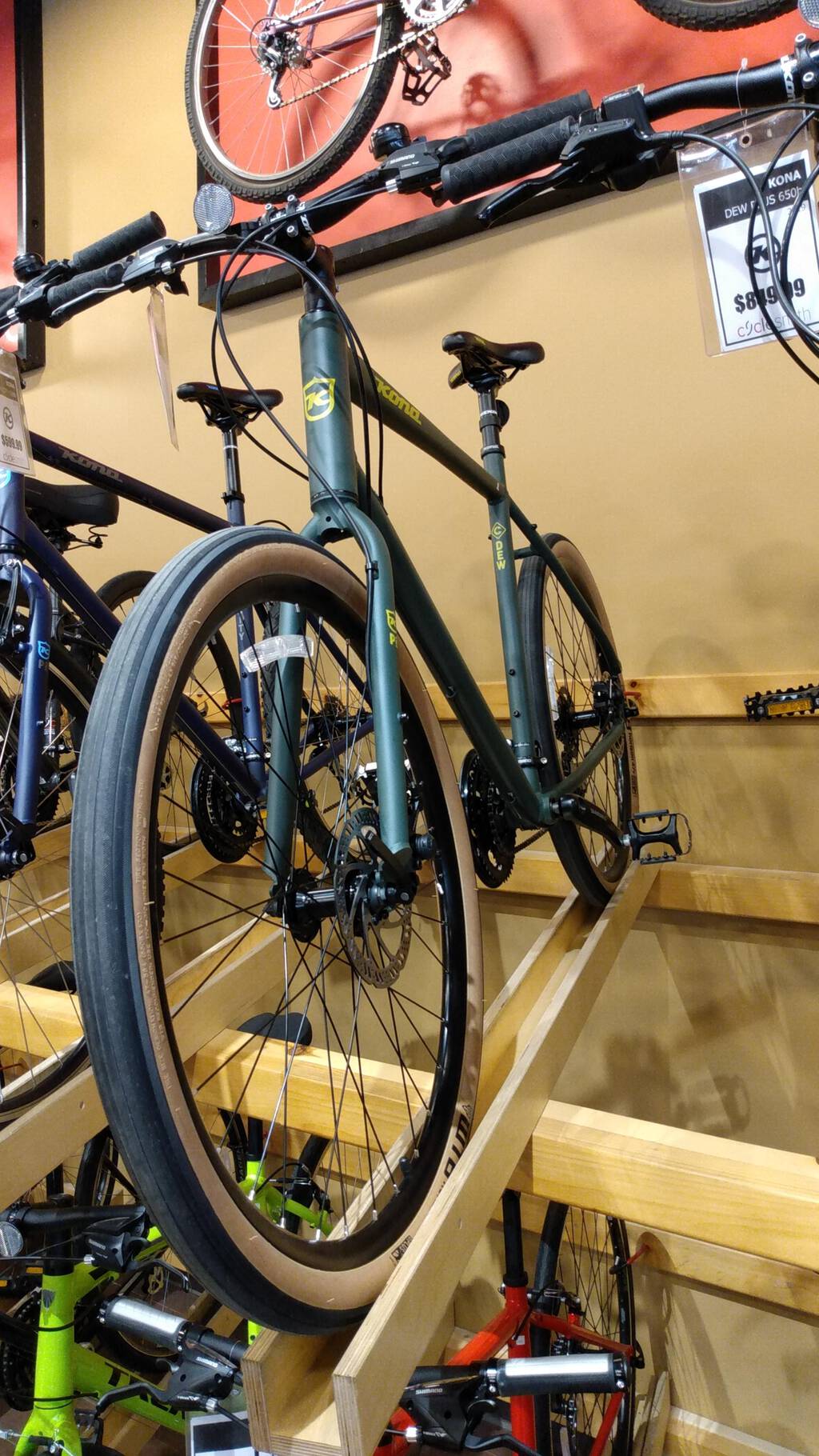
Across the harbour in Halifax proper I visited Cyclesmith, which is a traditional bicycle shop with all the good things (selection, expertise, bikes in stock) and bad things (intimidating vibe, bicycles mounted on inaccessible stands where you can’t get a visceral sense for them) that brings with it.

Cyclesmith’s ebike offerings are, as you might expect from the aesthetic and focus, on the high end: they had 10 models in stock, with the cheapest one starting at $2,499 and models as expensive as $6,199. This put things out of my price range, and it didn’t seem worth it to try to penetrate the bike-culture-wall to see if I could test drive one, so I took a browse around, looking mostly at non-electric bicycles, and then moved on.

Bicycles on the wall at Cyclesmith

Robertson C Business Equipment

My Google Maps searches for “ebike” kept surfacing Robertson C Business Equipment in the results, and I’d been assuming this was some kind of SEO error. But it turns out that in addition to selling computers and point-of-sale systems, they also sell electric bicycles from the storefront next door, under the Halifax Electric Bike Store label.

This was certainly the weirdest bike shop I visited, and the one with the most genial staff.

C. Robertson Business Equipment in Halifax

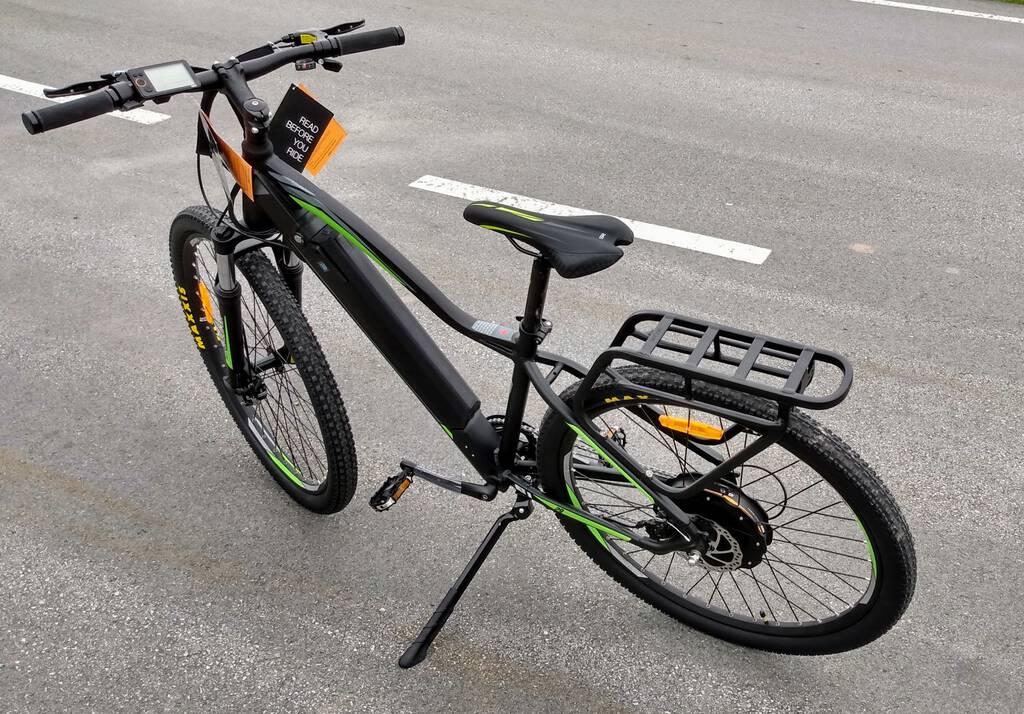
They had two models in stock, both from the Canadian iGO brand, the M29 and the Erö. I got a brief overview of the differences between the two (mostly styling and a difference in where the motor is located) and a recommendation that I try the M29 out on the road (“why don’t you take it up Citadel Hill to get a good test of how it handles,” it was suggested).

With a request to leave my wallet behind as collateral (a request that gave me no pause given the aforementioned geniality), I was given a helmet, a brief tutorial about how to use the bike, and sent on my way for an open-ended test ride. This is the way that testing should happen; the “no rush” is key, especially when dealing with things that cost multi-thousands of dollars.

I did as was suggested, and took off up Citadel Hill, enjoying Halifax’s considerably-better-than-Charlottetown bike lane infrastructure as I navigated around the neighbourhood.

The M29 was palpably different than the folding Emmo; some of this comes from the different form factor, but it’s also a much better-made bicycle, with a better, more responsive electric drive system. It was a joy to ride, and the pedal-assist felt sufficiently Superman-like on all but the steepest hill-climb (and even there, I didn’t sweat it to the top of Citadel Hill, I just had to pedal a little harder).

At $2,499 the M29 was still too rich for my blood, but I am happy to have test ridden it, and happy to have been able to do so outside of the confines of a mainline bicycle shop.

The iGO M29

Sportwheels

My visit to Sportwheels, in Lower Sackville, was more about looking at adapted bicycles for Oliver than looking at ebikes, which was good, as they had only one ebike model on the floor.

While the shop is a straight-ahead bike shop (albeit with a significant hockey sideline), it was more workaday than elite, and I felt more comfortable there than I had at Cyclesmith.

I was referred to Sportwheels by the Recreation Therapy program at the IWK, and evidence suggests that they do a fair amount of business finding bicycles to suit people of all needs.

They didn’t have any adaptive bicycles in stock, but they were able to show me a Tri-rider, fitted with electric assist, that was a kind of hybrid between a standard trike and a recumbent. This seems promising, and like it might work for Oliver. It’s frustrating to not be able to have him try it out, however; it would be really great if PEI sported a program similar to the adapted bikes loan program at the IWK (perhaps that’s something Cycling PEI could take on?).

Tri-Rider bike at Sportwheels

I didn’t buy an electric bicycle…

I returned home to Charlottetown with a empty van.

I decided that, as with the decision to insulate our house or purchase an electric car, the economics don’t make sense: I’m far better off, for now, continuing to ride the regular old Palomar that I’ve had for many years and to put my climate change-mitigation dollars into efforts that have a more substantial pay-off.

My tour of the bicycle shops of Halifax didn’t leave me with a lot of warm feelings about bicycle retailing in the 21st century: it appears to be a retail sector still very much rooted in sport rather than transportation, and for something that’s demands test riding to get a real feel for, the setup of shops isn’t optimized for this.

If my life was different and I was, say, commuting in to the city from Brookfield every morning, I’d certainly take a serious look at the iGO M29, as it would make a lot of sense for a longer-distance commute like this, and appears to have the build quality to stand up to daily use and the drive train to handle the varying terrain.

25 Jun 06:55

MozillaPH Shifts Focus on Areas of Contribution for 2019

by Robert "Bob" Reyes
Over the last three (03) years, there has been a significant decline with the number of engagements and events hosted by the Mozilla Philippines Community (MozillaPH). From a high of 59 events in 2016, the decline started in 2017 with just 14 events hosted, and last year, 2018 with just a measly 06. Being part of the leadership of MozillaPH, we can only blame the lack of time to plan for a more sustainable program to make engagements with our… Read the rest
25 Jun 06:55

I have a ‘recent posts’ and ‘recent comments’ s...

by Ton Zijlstra

I have a ‘recent posts’ and ‘recent comments’ section in the sidebar. This seemed to create problems with the processing of webmentions, specifically with Aaron Parecki’s Xray library for grabbing structured info from any URL. It would find an apparently improperly micro-formatted link in the sidebar and take that as the URL of the posting referred to. This would create faulty likes on other people’s sites, which then would send webmentions to the wrong postings.

As recent posts and recent comments are only a navigational aid when you’re looking at things like the front page, search results and archive pages, I looked into if I can show them on those pages only. Because if those sections aren’t present on the pages of individual postings, they cannot cause problems when parsed for structure. This being a WordPress site, of course there’s a plugin for it, Widget Context. I installed it, removed the offending widgets from individual pages, and it looks like the problem has been solved.

25 Jun 06:54

When should you be using Web Workers?

When should you be using Web Workers?

85% of worldwide mobile devices are massively less performant than high end iPhones. Surma argues that we should be making aggressive use of Web Workers to keep as much of our JavaScript as possible off the main UI thread, to avoid freezing up the entire interface.

25 Jun 06:54

Reading The Cruel Way

by Liz

I am reading Ella Maillart’s The Cruel Way, about her road trip from Switzerland to Kabul in 1939 along with her friend Annemarie Schwartzenbach. This book was in theory free from University of Chicago, but I ended up buying it after several failed attempts to get the free book in a readable form, having installed several ugly and pointless pieces of bad software which I then had to uninstall. Better to buy the book and crack the DRM myself! Ridiculous!

Maillart is an ethnographer and writer, is interesting, often fantastically racist, hates Hitler, and is trying to help the famously “androgynous” men’s-suit-wearing Schwartzenbach clean up from a heroin addiction (what better thing to do than bring someone straight to Afghanistan????!!!) and get over some sort of stormy lesbian heartbreak. While I hoped initially they were lovers, now I think not – Schwartzenbach seems to have some other affairs along the way, though. Their relationship is pretty cool though. I enjoyed the moment where Schwartzenbach moans that Ella is more famous because her books have been translated (even though Schwartzenbach had more publications). Still true and no one seems to have translated her to English yet. Also fascinating, Maillart’s recordings of sentiment from people in various countries about Hitler, Mussolini, Britain, the US, Russia on the eve of war.

Neat stuff looked up in Wikipedia along the way
* Windcatchers of Hyderabad http://localcode.org/2017/03/windcatcher-passive-cooling-and-cultural-identity/ https://www.fieldstudyoftheworld.com/searching-windcatchers-hyderabad/

* The Tomb of Kabus and the Qabus-Nama

So many other things but it’s now a week later and I have moved on to read some other things! Oh well, I’ll post this anyway.

25 Jun 06:51

The Blog and Wiki Combo

by Ton Zijlstra
Replied to Introduced to infostrats by Neil MatherNeil Mather
So I am very intrigued by Kicks’ mention of the linkage between blogs and wikis. I like the idea of the blog timeline crystallising into a personal wiki over time.

To me blogs and wikis are the original social software. My blog emerged as a personal knowledge management tool (Harold Jarche is the go-to source for PKM). Knowledge management to me has always been a very people centered, social thing. Learning through distributed conversations, networked learning (George Siemens and Stephen Downesconnectivism). My friend Lilia Efimova did her PhD on it, with our shared blogger network’s conversations as an empirical case. At some point social software morphed into social media, and its original potential and value as informal learning tools was lost in my eyes.

Blogs and wiki’s, they go well together. Blogs as thinking out loud and conversations (also with oneself). Wiki as its accumulated residue. I had a wiki alongside this blog for a very long time (until it succumbed to spam), both a public external one, and a private one. My friend Peter Rukavina still has his wiki Rukapedia alongside his blog. It serves in part as an explainer to his blog readers (e.g. see his wiki entry on me). Boris Mann, also a long time barcamp/blogging connection, runs a wiki which is editable by the public in part.

A year ago I felt the need to accumulate things in a more permanent way next to the timeline like blog. As I am the only one editing such a ‘wiki’, I opted to use WordPress pages for it (but you could open pages up for wider editing with a separate user-role). I added a few plugins for it, e.g. to add categories to pages so I can build menu structures. Kbase in the top menu leads to this wiki-for-just-me, although it doesn’t show all pages it contains (search will surface them though).

25 Jun 06:47

Replied to How to talk more? by rosie Ton, is...

by Ton Zijlstra
Replied to How to talk more? by rosie
Ton, is it bad form to webmention multiple of your blog posts in this one? Is that like spamming?

No it’s definitely not bad form to mention multiple things at the same time. And even if, all would be forgiven as you provide me with the honorific ‘blogfather’ 😀

From your post the quote below I very much recognise. Not just because that web of connections is fun, also because I know it is important in dealing with a complex world. Yet as you say, others will get lost in trying to get your message.

Keep it concise. I’m gonna struggle with this one because I really like the giant web of connections that my brain makes around any topic.

25 Jun 06:47

Flourishing is nourishing

by russell davies

Another tiny music moment! It's like a flood. 5 seconds into Love Come Down by Evelyn Champagne King, there's a little hi-hat flourish that makes you glad to be alive. It says 'we're doing more than the minimum here, we're paying attention, we're fired up and you're in a safe pair of hands". Makes me skip every time I hear it.

UNRELATED

After chronicling my misadventures on the wheels of steel I thought I'd try and do it again. So I bought a mixer off ebay and I've been mucking about playing records. Above is my first attempt at recording something. WARNING: it's a mess. My beat matching, well, doesn't match. But, you know, it's got some tracks on it you might not have heard for a while.

25 Jun 06:45

Don’t just Google it! First, let’s talk!

by Jon Udell

Asking questions in conversation has become problematic. For example, try saying this out loud: “I wonder when Martin Luther King was born?” If you ask that online, a likely response is: “Just Google it!” Maybe with a snarky link: http://lmgtfy.com/?q=when was martin luther king born?

Asking in conversation is frowned upon too. Why ask us when you could ask Siri or Alexa to ask Google?

There’s a kind of shaming going on here. We are augmented with superpowers, people imply, you’re an idiot to not use them.

Equally problematic is the way this attitude shuts down conversation. Sure, I can look up MLK’s birthday. Or you can. But what if our phones are dead? Now we need to rely on our own stored knowledge and, more importantly, on our collective pool of stored knowledge.

I think MLK was shot in 1968. I’d have been twelve. Does that sound right? Yeah, we were in the new house, it was sixth grade. And I know he died young, maybe 42? So I’ll guess 1968 – 42 = 1926.

Were you around then? If so, how do you remember MLK’s assassination? If not, what do you know about the event and its context?

As you can see in the snarky screencast, I’m wrong, MLK died even younger than I thought. You might know that. If we put our heads together, we might get the right answer.

Asking about something that can easily be looked up shouldn’t stop a conversation, it should start one. Of course we can look up the answer. But let’s dwell for a minute on what we know, or think we know. Let’s exercise our own powers of recall and synthesis.

Like all forms of exercise, this one can be hard to motivate, even though it’s almost always rewarding. Given a choice between an escalator and the stairs, I have to push myself to prefer the stairs. In low-stakes wayfinding I have to push myself to test my own sense of direction. When tuning my guitar I have to push myself to hear the tones before I check them. I am grateful to be augmented by escalators, GPS wayfinders, and tuners. But I want to use these powers in ways that complement my own. Finding the right balance is a struggle.

Why bother? Consider MLK. In The unaugmented mind I quoted from MLK confidante Clarence Jones’ Behind the Dream:

What amazed me was that there was absolutely no reference material for Martin to draw upon. There he was [in the Birmingham jail] pulling quote after quote from thin air. The Bible, yes, as might be expected from a Baptist minister, but also British prime minister William Gladstone, Mahatma Gandhi, William Shakespeare, and St. Augustine.

And:

The “Letter from a Birmingham Jail” showed his recall for the written material of others; his gruelling schedule of speeches illuminated his ability to do the same for his own words. Martin could remember exact phrases from several of his unrelated speeches and discover a new way of linking them together as if they were all parts of a singular ever-evolving speech. And he could do it on the fly.

Jones suggests that MLK’s power flowed in part from his ability to reconfigure a well-stocked working memory. We owe it to ourselves, and to one another, to nurture that power. Of course we can look stuff up. But let’s not always go there first. Let’s take a minute to exercise our working memories and have a conversation about them, then consult the oracle. I’ll bet that in many cases that conversation will turn out to be the most valuable part of the experience.

25 Jun 06:44

The New Dropbox: A Pivot, More than an Upgrade

Dropbox has released an early version of a ‘New Dropbox’, one that will reposition...
25 Jun 06:44

Cycling in Canada (when you are Dutch)

by peter@rukavina.net (Peter Rukavina)

Elmine writes about her experiences cycling (and watching we Canadians cycle) here in Canada. In part:

All in all my conclusion is that riding a bike safely in various parts in Canada is still a dream. From my Dutch perspective I seriously doubt if the places I visited ever will be able to be a dream places for cyclists. Canadian roads were designed for cars. It will take a tremendous effort to ‘un-design’ that. But it’s not just the roads that needs a redesign. It will take a generation to retrain everyone driving the road, both by car and on bike.

I think she’s right about the “retraining” that we need, but I think it applies not only to the practical skills related to safe and efficient bicycling, but also retraining our habits so that we shift all or most of our short-distance travel from driving to cycling.

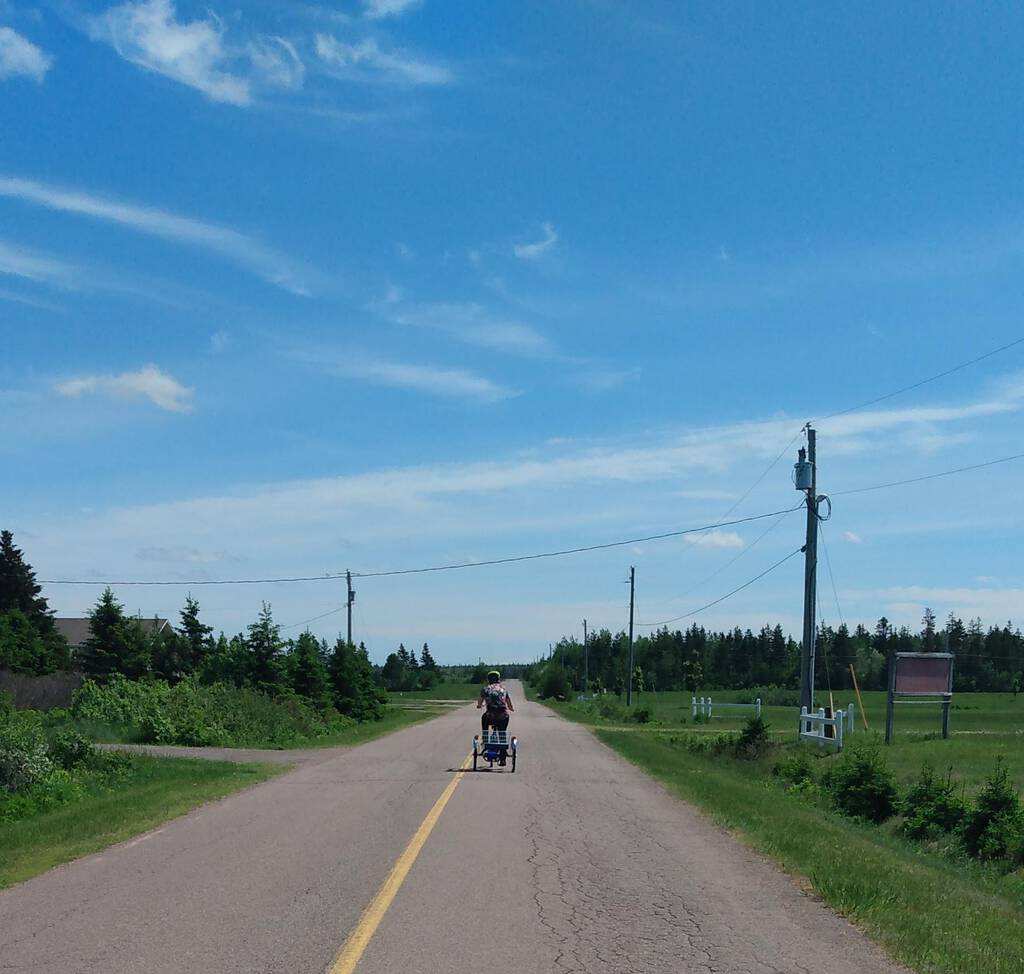
Meanwhile, Oliver and I went out to West Covehead to look at a gently-used Tri-Rider this afternoon, and he took an immediate shine to it:

Oliver on a Tri-Rider

25 Jun 06:43

What is functional thinking?

by Eric Normand

My book is coming out soon in early access. It’s called ‘Taming Complex Software: A Friendly Guide to Functional Thinking’. But what is ‘functional thinking’? In this episode, I explain the term and why I’m no longer redefining ‘functional programming’.

Transcript

Eric Normand: What is functional thinking? In this episode, I’ll talk about the topic of my new book. My name is Eric Normand. I help people thrive with functional programming.

I have a new book, which will come out, eventually. I’m publishing it with Manning. It’s about functional programming.

The reason I’m talking about it now is that it is soon going to come out in early access, which means, you’ll be able to read it online, an ebook format. Before it comes out, you’ll be able to read the chapters that are done. I wanted to start talking about it. Because it’s this close, it’s very close now.

The title of the book is, “Taming Complex Software — A Friendly Guide to Functional Thinking.” I wanted to talk about what functional thinking is, what I mean by it. I started this podcast about 18 months ago. It was made to start thinking about this book, and the ideas that I wanted to put into it.

I proposed a new definition of functional programming. You can go back to those early episodes, where I reason out why I need a new definition of functional programming. As a short explanation, the standard definition of functional programming says that, “It is programming with pure functions and avoiding side effects.”

There’s a lot of truth to that definition, but I feel it makes a lot of assumptions that are not explained in the definition. It is also problematic for other reasons. It scares people. Because when they learn what side effects are, how can you write software if you’re avoiding the main purpose of running our software in the first place?

I wanted a definition that would clarify it, and put this definition as a smaller part of a bigger picture. As an example, the definition makes a distinction between pure functions and side effects, but it’s not explained in the definition. I feel this distinction that’s being made is very central to functional programming. It should be part of the definition.

Why should it be part of the definition? Because no other paradigm makes that distinction. No other paradigm talks about the difference between side effects and pure functions. You can double check. They might talk about it later, but not as part of the definition. Usually, it’s with a nod to functional programming.

I believe that that should be baked into the definition. I’ve been in discussions with a lot of people. A lot of people agree with me. A lot of people say, “Oh, the definition is just fine.” These are just the implications of this definition. That’s what I’m talking about the implications. They’re not primary.

I’ve been in a lot of discussions. Some people say, “It’s so clarifying to hear you make that distinction as the primary thing.” Anyway, I was continuing along with this idea when the publisher finally came up with a title that everyone at the company, the publishing company that’s working on the book liked, which I read before, Taming Complex Software — A Friendly Guide to Functional Thinking.

The functional thinking got me thinking that maybe I don’t need to be so antagonistic about this definition. I’ll just call it something else. Call it what I’m explaining something else. The thing is no functional programmer would say that distinction between side effects and pure functions is unimportant.

Everyone would say it’s important to functional programming. The disagreement was merely in, do we need a new definition? I don’t know if I really want to have that fight. I don’t want to fight that fight. The fight would be with people who are already sold on functional programming.

In a certain sense, you could say, it’s good to pick fights, because it creates marketing, a buzz about your book. It’s like a little controversy that gets people talking about the book, and so then they might buy it.

What I have been thinking about more and more is that it’s not the discussion that I would have with people would be among people who are already bought in to functional programming. It might be good for marketing. I decided I didn’t want to do it. I liked the functional thinking idea that it’s not really that different. It’s just that it hasn’t been defined.

I can make it whatever I want. Basically, it’s the same stuff as I was saying before, but with a different term. It’s basically how functional programmers think, which is what functional programming is, functional programming as a paradigm. Paradigm means the ways of thinking and approaching problems and the concepts.

It’s the same thing, functional thinking and functional programming, but no one has defined it yet. I can do what I want with it. It’s also focusing more on the thought processes, as opposed to specific functional programming techniques or features, which I think a lot of functional programming has gone.

A lot of what people understand when you say the term functional programming. They’re already like, “So, it’s about monads?” I’m like, “No, that’s not where we’re going. We’re going much more fundamental.” It’s about this distinction between pure functions and side effects. That’s an update. That’s what functional thinking is.

When you see the title, you’ll know where I’m coming from with that. The main distinction that functional programmers do make that distinguishes them from other programmers and other paradigms is identifying side effects, identifying pure functions, and identifying the other implied thing, which is the data.

The definition does not say anything about data. It just says pure functions. I’ve asked people about that, and they say, “Oh, well, it’s implied because you need to add something for the functions to act on.” That’s obviously data. It’s there. No one would disagree that you need data as separate from pure functions.

They just never mentioned it in the definition. Functional thinking explicitly calls it out. I’m calling them actions, calculations, and data. Actions, they’re not the same as side effects. They’re more like impure function.

You got impure functions, which I’m calling actions. You got pure functions, which are calculations. You’ve got data, which should be immutable. That’s my ideas on functional thinking.

Look for the book. It should be coming really soon, the next few weeks. We’re counting it in weeks, now. We had to pull all the little pieces together. Then, someone at Manning has press to a button so it goes live. It’s happening.

They don’t like to promise this, but the idea that they’re shooting for is one chapter every month, a new chapter released every month, or, at least, a major update to an existing chapter. I’m starting with three chapters, chapters one through three. Then I hope to hit that target of one chapter a month. I’ve been working at that pace. It looks good.

I’m going to sign off now. You can find this episode and all of the past episodes and all future episodes in the future at lispcast.com/podcast. You’ll find video recordings, audio recordings, and transcripts. You can read it if you prefer reading.

You’ll also find links to subscribe, or contact me on social media. If you want to follow me there, get in touch with me. I much prefer a discussion than simple follow. It’s all there. Go to lispcast.com/podcast to check it out.

All right. I’m Eric Normand. Keep on programming functionally, and rock on.

The post What is functional thinking? appeared first on LispCast.

25 Jun 06:43

Three Levels of Community Skills

by Richard Millington

In 2013, we were hired to try and revive a community in the finance sector which had struggled to reach critical mass since it was launched 6 months prior.

The problem wasn’t the technology or the audience, it was the community manager.

He simply wasn’t able to get the audience to do what he needed them to do.


Diagnosing The Problem

The problem was his interactions with members.

He was polite, sometimes friendly, but never warm. He rarely left a member feeling inspired by the potential of the community and their ability to help the community reach that potential. His newsletters, emails, and webinars had plenty of factual information, but no persuasive power.

This is what makes community skills unique, in a community role you need to persuade, inspire, and motivate members to believe in themselves and the community.

This is especially true when you’re just launching the community. Your persuasive power is the only thing that’s going to motivate people to create something new from nothing.

If you haven’t done this kind of work before, this isn’t easy.


Level 1: Community Management Skills

First, we developed a mentoring program to immediately upgrade the community manager’s skills.

This covered the very core basics of communication.

  • The psychology of both why people join and continue participating in the community.
  • Creating a powerful shared vision of the future (covering passion, metaphors, speechwriting etc..)
  • Helping members identify their unique skills and how they could be useful to the community.
  • Engaging members beyond the immediate need, but at the emotive, identity, level.
  • Adjusting the time spent asking for ideas/expertise to sharing information from 0 to around 50%.
  • Using self-disclosure to build trust and connection.
  • Enjoying the experience of connecting with members.
  • Bringing passion into the conversation.

At the end of each week, we reviewed his communications for the past week and provided the training, recommendations, and mindset to improve. The results were slower than expected, but it worked. Within 3 months he had a core group of regular, active, members and activity was finally beginning to take off.

(At the end we turned the materials into an online package any future recruit could access and reference before starting work in the community).


Training The Members

Next, we wanted to train members too.

Members who are used to dealing with only factual information often don’t do well within a community.

Aside: too few community managers tell their member how to be great members. They tell members what they shouldn’t do, but not what they should do, especially how to become a top member of the community.

We developed a playbook of tactics for members who wanted to become key contributors to the community with a roadmap they could follow. This included:

  • Making a good impact as a newcomer.
  • Knowing what separates top members from the rest.
  • Examples of contributions of top members.
  • Building strong relationships in the community.
  • Contributions the community really needs.
  • How to engage with deeper empathy.

We also supplied a few resources (video editor, graphic designer, and promotional support) for members who took the time to create a really amazing contribution. We set the bar as high as we dared.

The response to this training was immediate. Over 300 signed up for it within 3 months and this group was soon creating 500+ items of content per month. We also had a 2x increase in the number of members applying for community roles or offering to create their own.

The top contributor group swelled from around 0 to 35 (and then shrank to about 25). Most importantly, the behaviours of the community changed almost overnight. And we gained over 50 really remarkable contributions to support.

Training community members was one of the best investments you can make in your community.


Training Employees

The final step was to train the company beyond the community manager.

If someone with no community experience is running a community, the problem clearly doesn’t start (nor end) with the community manager. Others need to understand what a community requires, to engage the community themselves, and otherwise lend their support.

Getting people in the room was tricky, so we simplified our pitch. Once members begin to experience a community they’re going to expect a community experience across the organization.

If you’re used to getting warm, friendly, responses in the community and then receive a fast, formal, and seemingly terse response from customer support, that’s a problem.

This training included:

  • Identifying opportunities in community.
  • Identifying required resources and tactics to achieve those community benefits.
  • What community members need (and don’t need).
  • Engaging members with deep empathy.
  • Dealing with difficult members.
  • Testing ideas/co-creation with communities.
  • Spotting and resolving problems.

Our ulterior motive was to increase the motivation of employees to use the community in all aspects of their work.

We delivered this training through in-person workshops (it’s easy to do internal training via workshops). Not everyone bought into it, but enough did to see a rising level of tangible support in the community. About two-thirds of the room were still visiting and/or participating in the community 2.5 months later.

Better yet, a year later, the company was acquired and our training was adapted into the employee handbook.


Some Lessons…

Community skills are unique from other skills. Investing in acquiring them is almost always a bargain. In too many communities, six-figure (plus) investments hang upon the skills of a community manager with no training and/or limited experience.

That doesn’t make any sense.

Invest in making sure you (and your community team) are highly trained in what they do. In almost every situation, the results are clear. Communities become more active and more positive places to be. Better yet, train your members and your organization too and completely transform your community.

Once the staff above identified their own benefits from the community, they began providing support to achieve them. It’s a mutual win for everyone.

Whether from us or someone else, invest in upgrading your community skills. The results are remarkable and it’s a mutual win for everyone.

p.s. If you’ve already been in the field, I’d suggest my workshop at CMXSummit might be valuable.

25 Jun 06:42

Crafting {:} a Reflection

by Ton Zijlstra

Peter in his circle of friendsPeter in his circle of friends at the start of Crafting {:} a Life (image by Elmine, CC-BY-NC-SA license

When the first Dutch astronaut Wubbo Ockels, went to space on the D1 mission he had a clear goal. Earlier astronauts upon returning to earth had all responded to the question how it was to see the entire earth from above, our blue ball in the black void, with things like “Great”, “Very moving”, “So very beautiful”. Ockels was determined to find a better description for the experience, by preparing for it, by more consciously observing and reflecting while up there. Yet when he came back he realised all he could say was “So very beautiful” as well. There was no way for him to put the layering, depth and richness of the experience in words that would actually fully convey it.

Experiencing an unconference can be like that. It certainly took me about a week to come back down to earth (and overcome the jet-lag) after spending a handful of days on Prince Edward Island in a somewhat parallel universe, Peter‘s Crafting {:} a Life unconference with around 50 of his friends and connections.

Here too, the description “it was great” “it was beautiful” is true but also empty words. I heard several of the other participants comment it was “life changing” for them, and “the start of something momentous on PEI”. I very well understand that sentiment, but was it really? Can it really be that, life changing?

I have heard the same feedback, ‘life changing’, about our events as well. Particularly the 2014 edition. And I know the ripples of those events have changed the lives of participants in smaller and bigger ways. Business partnerships formed, research undertaken, lasting friendships formed. I recognise the emotions of the natural high a heady mix of deep conversations, minds firing, freedom to explore, all around topics of your own interest can create. I felt very much in flow during an hours long conversation at Crafting {:} a Life for instance.

Reboot had that impact on me in 2005, reinforced by the subsequent editions. Those multiple editions created a journey for me. Bringing students there in 2009, because I was one of the event’s sponsors, was certainly life changing for them. It spoilt them for other types of events, and triggered organising their own events.
In a certain way Crafting {:} a Life brought the Reboot spirit to PEI, was a sort of expression of Reboot as it included half a dozen connections that originated there in 2005. Similarly I feel our own unconferences are attempts at spreading the Reboot spirit forward.

What makes it so? What makes one say ‘life changing’ about an event? Space to freely think, building on each other’s thoughts, accepting the trade-off that if your pet topics get discussed others will do other things you may not be interested in. Meeting patience while you formulate your (half-baked) thoughts. That is something that especially has been important in the experience of teenagers that took part in our events, and I think for Oliver too. That everyone is participating in the same way, that age or background doesn’t somehow disqualify contributions, and being treated as having an equal stake in being there.

How do you get to such a place? I find it’s mixing the informal/human with the depth and content normally associated with formalisation.

What made Peter’s event work for instance was the circle at the start.
The room itself was white and clinical to start in, and people were huddled in the corner seeking the warmth of the coffee served there. The seating arrangement however meant everyone had to walk the circle on the inside to find their seat. Then once seated, after welcoming words, there was music by one of the participants who offered it, first a reflective and then an upbeat song. This in aggregate made the room the group’s room, made it a human room. The post-its on the wall after the intro round led by Elmine increased that sense of it being our room, and the big schedule on the wall we made together completed it. Now it was our own central space for the event.

Splitting the event over two days and marking both days differently (meeting/talking, and doing) worked well too. It meant people weren’t coming back for the same thing as yesterday, but had something new to look forward to with the same measure of anticipating the unknown as the first day. While already having established a shared context, and new connections the day before.

The result was, to paraphrase Ockels, “great”. Clark, one of our fellow participants, found a few more and better words:

Crafting {:} a Life was a breath of fresh air. The unconference dispensed with pretension, titles or faux expertise. Everyone had for the most part a chance to share their story, contribute, and talk. While some asked what I did for a living, it was only after all other avenues of discussion were explored. For the most part one-to-one conversations were much like what I had with Robert Paterson, (“What is Clark’s story” he asked) open ended, personal, and with the ability to discover new things about the other. The activities emphasized small groups and there was no “oh my God my PPT is out of order what will we talk about” that I myself have fallen victim to. There was music, laughter, food and tears. It was genuine, …

I think that goes to the heart of it. It was genuine, the format didn’t deny we are human but embraced it as a key element. And in the space we created there was way more room than usually at events to be heard, to listen. And most of all: space to share the enormous gift of two days worth of your focused attention.

I feel it is that that makes these events stand out. Most other events don’t do that for its participants: Space for focused attention, while embracing your humanity. Reboot did that, it even had a kindergarten on site and people brought their kids e.g. But that approach is very scarce. It needn’t be. It also needn’t be an unconference to create it. A conversation, dinner party, or other occasion might just as well. (I found that video btw on a blog in the rss feeds of one of the participants, which seems apt).

On our way home Elmine suggested doing a second edition of our e-book ‘How to unconference your birthday’ (PDF). I think that is a very good idea, as Peter and us now have experience from both being an organiser and a participant, and we have now several additional events worth of experiences to draw upon. We created the first edition as a gift and memento to all participants of our 2010 edition, the 2nd such event we did and the first we did in our home. A decade on a second edition seems fitting.

25 Jun 06:42

Quant + Qual

by Bryan Mathers
Quantitative and Qualitative analysis

On creating some Visual Thinkery for Tabetha at Timmus, our conversation touched on the differences between quantitative and qualitative analysis. Here’s a visualisation of that thought.

You know, I’m always learning from my clients…

The post Quant + Qual appeared first on Visual Thinkery.

25 Jun 06:41

Digital Hygiene

by Rachel Bergmann

In September 2017, Firefox launched their “farm to browser” ad campaign on Instagram, partnering with influencers and food bloggers for a series of embedded posts that juxtapose sleek, luxury devices — MacBooks and iPhones, often encased in on-trend rose gold marble phone cases — with meals and ingredients associated with “clean eating”: kale, chia seeds, açai berries, avocado toast, charcoal lattes, and smoothie bowls. Videos on their own account feature smiling millennials holding handfuls of dirt, farm-raised chickens, and heads of lettuce. The campaign compares using Firefox to other values-based decisions, like buying organic fruits and vegetables, shopping at farmer’s markets, and practicing yoga. “So we don’t have organic heirloom tomatoes inside our code,” one caption reads. “We are the only major browser backed by a non-profit, though, and that matters.”

These posts are meant to highlight the fact that Firefox, unlike Chrome and other browsers, does not profit from selling your data, making them the more “ethical” choice for internet users. Providing this option, Firefox suggests, is just as important as the work that farmers do to provide free-range, chemical-free, local, organic, healthy food. Though not without humor, the message is clear: Your consumption habits matter, and you should think about your browsing habits the same way you would about the food you eat and the clothes you wear. Firefox wants to package their attention to data privacy together with other forms of ethical living, making data privacy issues recognizable and appealing through humor, Silicon Valley aesthetics, and a very familiar rhetoric of salvation through language of aspirational purification, self-improvement, and control.

But much like the health products they align themselves with, these campaigns promote an elite vision of purity that pathologizes individuals

Firefox is just one example of metabolic metaphors — food, dieting, and detoxing — used in data privacy guides and in advertising for internet services; once you notice, you find them everywhere. Google’s Digital Wellbeing toolkit offers features, tips, and dashboards for you to help “fine-tune your tech habits to achieve your personal digital wellbeing goals.” Media outlets from Forbes to the Dr. Oz Show offer month-long “technology diet” guides for their readers; news articles and opinion pieces regularly instruct and analyze the latest digital diets and social media detoxes. Digital Detox, LLC, a company that describes itself as “a slow-down and not a start-up,” sells device-free workshops, retreats, and happy hours for individuals and corporate teams across the United States.

Together, these guides and services promote what one might call personal data hygiene: a set of tools, habits, skill sets, technical knowledge, and digital literacy that constitute practices of a so-called healthy digital lifestyle. They encourage personal data hygiene affectively, linking browsing habits with certain feelings and structures of feeling. We have reason to be conscientious about our browsing habits: our personal information is susceptible to being leaked, and will almost certainly be sold to analytics companies in order to sell more things to us. But much like the health products they align themselves with, these campaigns promote an elite vision of purity that pathologizes individuals for the choices they do or don’t make — urging the user to keep themselves “clean,” while shifting attention and responsibility away from the systemic ways they are targeted for their data.


The Farm to Browser Campaign borrows from an ethos in which aesthetic choices are equated with health, and health with productivity: quality-over-quantity minimalism, managing distractions through mindfulness, screen-free meditation retreats. A good way of understanding this visual language is through considering the intertwined histories of the countercultural movement and the emerging entrepreneurial culture of Silicon Valley in the late 1960s, as described by Fred Turner in his book From Counterculture to Cyberculture. Turner describes a countercultural community who, even as their peers organized political protests, “turned away from political action and toward technology and the transformation of consciousness as the primary sources of social change.” These New Communalists, as he calls them, share with technologists the utopian vision of empowered individualism, collaborative community, and global harmony through the “cybernetic notion of the globe as a single, interlinked pattern of information.”

Richard Barbrook and Andy Cameron advance a similar argument in their 1995 essay, the “Californian Ideology,” describing how a neoliberal digital utopianism emerged from the unlikely ideological fusion of free-spirited hippies from San Francisco and the entrepreneurs and hi-tech industries of Silicon Valley. They describe how the Californian myth of free market entrepreneurship relies on decades of immense public funding — via subsidized Cold War defense contracts — as well as a long history of DIY initiatives and cultural bohemianism in the Bay Area, the signifiers of which (“community media, ‘new age’ spiritualism, surfing, health food, recreational drugs, pop music…”) are still recognizable in media like Firefox’s campaign.

Out of this fusion of countercultural values, technological determinism, and libertarian individualism emerged a class of workers Barbrook and Cameron call digital artisans — well-paid media and information technology workers who are “heirs of the ideas of radical community activists” but make up “a privileged part of the labor force.” Although digital artisans “enjoy cultural freedoms won by the hippies, most of them are no longer actively involved in the struggle to build ‘ecotopia.’” Digital artisans look for liberation not through struggle and solidarity, they argue, but through technological innovation and individual consumption.

Firefox’s campaign and others like it similarly sell the path to health, happiness, and self-worth by changing individual consumption habits or adopting new technologies. The Data Detox Kit, a promotional publication co-produced by Mozilla and Tactical Tech, is an eight-day guide to teach users about personal data hygiene habits. The website asks, “Do you feel like your digital self is slipping out of control? Have you let yourself install too many apps, clicked “I agree” a few too many times, lost track of how many accounts you’ve created? Perhaps you’re not as in-control of your digital lifestyle as you’d like to be.” Colloquially, the term “detox” is a way of going on a diet without actually saying you’re on a diet — losing weight, or flushing toxins from your body, often through the consumption of some products (juices, say) over others.

Metabolic metaphors ignore the structural factors that place internet users in peril

Though it never uses the term “diet,” the kit uses much of the same moralizing language of diet magazines in the check-out aisle: you are not “in control” because of what you have “let yourself” do. You’ve “lost track” of how much you’ve consumed — if you just had more discipline, you could prevent yourself being tracked and spied on online. It’s worth noting that this sort of rhetoric has a gendered history — companies and organizations have long marketed dieting, detoxing, toning up, and slimming down to women as a way of achieving self-worth through controlling what you eat. (The farm to browser campaign was also mostly targeted to Instagram, a platform where the majority of users are women and specifically women under 35. Even in the realm of the datafied self, women are continual targets for the ways they take up space.)

The Data Detox Kit describes how to reduce your “data bloat — a toxic build-up of data that can lead to uncomfortable consequences in the longer term,” and instructs users how to establish a regimen to prevent more toxic data build up in the future. It emphasizes how easy and straightforward this path will be, but in fact provides quite an extensive list of things to keep track of: Not only does it require you have to change your own habits with pretty much every website or app you use, it also demands that you convince your friends and family to do the detox too. (“Every time they tag you, mention you or upload data about you, it adds to your data build-up, no matter how conscientious you’ve been.”)

The emphasis on “personal data hygiene” more or less ignores the questions of who has time, money, and access to the spaces and rituals of purification. Eating organic isn’t cheap; yoga studios, farmer’s markets, the farm to table movement, juice bars, even the Pacific Northwest, where Firefox has its offices, have all been criticized as overwhelmingly white spaces. Scholars like Alison Hope Alkon and Julian Agyeman have explored the ways racism, classism, and imperialism have created foodways that continue to privilege the global elite. As they argue in their book Cultivating Food Justice, “Communities of color and poor communities have time and again been denied access to the means of food production, and, due to both price and store location, often cannot access the diet advocated by the food movement.” Urban planning policies, zoning ordinances, and mortgage requirements shape the built environment, creating food deserts that restrict access to affordable and nutritious food — usually in poor communities and communities of color.

Barbrook and Cameron write that this utopian vision of California “depends on a willful blindness toward the other, much less positive, features of life on the West coast: racism, poverty, and environmental degradation.” In their video launching the farm to browser campaign, Firefox tells the viewer: “You value things that are fresh. Things that take hard work” — the narrator pauses — “by someone else.” In some cases, it is exactly the farmworkers who cultivate fresh produce who suffer most from hunger and food insecurity. This line in the video points to questions of class and access: These campaigns are centered on middle-class consumers, overlooking the working conditions of producers, of agricultural laborers both in the U.S. and worldwide.

The wellness-centric language of these campaigns also obscures who is harmed the most in these practices of surveillance and data extraction. Barbrook and Cameron warn that if only some people have access to new information technologies, the seemingly admirable ideal of a technology-fueled democracy will only become a “hi-tech version of the plantation economy of the Old South.” Scholars like Simone Browne, Virginia Eubanks, Safiya Noble, and Kathy O’Neill have shown that, in some ways, their warning has come true: contemporary systems of algorithmic classification and data extraction continue to deepen social inequalities and replicate long-existing patterns of racial and gender bias. Any movement for data justice that does not explicitly engage with issues of feminism and racial and economic justice runs the risk of perpetuating these same norms.


Digital wellness campaigns promote an aspirational notion of purity, positing it as a feeling one can achieve through a few easy steps, while ignoring the class- and race-based constructions of what is considered “pure” in the first place. In her influential 1966 book Purity and Danger, anthropologist Mary Douglas argues that dirt is “matter out of place.” The distinctions between clean and unclean, she argues, are less about inherent cleanliness than about maintaining order. Scholars like Dana Berthold have explored the ways current preoccupations with hygiene are genealogically linked with explicitly racist ideals of physical and moral purity. She argues the United States has “a history of extreme preoccupation with hygiene because racialized ‘cleanliness’ (for example the one-drop rule and segregation) has been utterly crucial to class status — high status being anxiously guarded by whites and truly unattainable for others because of the ways in which it was coded white.”

A brief glance at the history of natural purity reveals the deep associations of cleanliness with civility, high social status, and whiteness; notions of purity cannot be separated from these histories of colonialism, slavery, and white supremacy. Personal data hygiene practices are products of such classification systems. Although it is not explicit, by promoting aspirations of digital purity, these digital wellness campaigns are linked genealogically to histories of racism and exclusion.

Any movement for data justice that does not explicitly engage with issues of feminism and racial justice risks perpetuating these same norms

In her book Against Purity, Alexis Shotwell writes, “Being against purity means that there is no primordial state we might wish to get back to, no Eden we have desecrated, no pretoxic body we might uncover through enough chia seeds and kombucha. There is not a preracial state we could access, erasing histories of slavery, forced labor on railroads, colonialism, genocide, and their concomitant responsibilities and requirements. There is no food we can eat, clothing we can buy, or energy we can use without deepening our ties to complex webs of suffering.” Rather than aspirations of digital purity and shame for inevitably falling short, I want to use this as a starting point for data justice and, as Shotwell suggests, explore the radical potentials of impurity, implication, and compromise in social action.

Metabolic metaphors ignore the structural factors that place internet users in peril, putting the burden on individuals to know where their data exists, how they’re being tracked, who has access to the data, and how it is being used to make decisions about them. And while these habits might make people feel like they have a modicum more control, it distracts from the real issue, which is the corporations actually doing the extracting, and the systems that allow this in the first place.

Ultimately, dieting metaphors replace one bad feeling with another — from anxiety to shame: a painful feeling of being fundamentally flawed. Shame can induce feelings of inadequacy, avoidance, fear of failure, and create the urge to disconnect from those around you. Furthermore, using shame to get people to do things doesn’t actually work. If we want to motivate people to think differently about their data rights and take action, drawing on feelings of shame might be counterproductive — discouraging people rather than galvanizing them. This is not an issue of unhealthy browsing; it’s an issue of an industry built on surveillance and data extraction.

The metaphors used by Firefox and other campaigns do the important work of encouraging Internet users to think critically about their browsing habits and might inspire them to turn away from the monocultures of Google and Facebook. I want to encourage work toward building a stronger and deeper critique of data extraction, though, one that considers how data justice intersects with issues of feminism and social and economic justice. By focusing on production rather than consumption, and looking at the ways these systems of oppression continue to exploit those who are already marginalized, we can focus on the real need to organize. By using a framework of data labor and data rights, we can link issues of data extraction with other movements of workers and other social justice movements happening right now.

25 Jun 06:26

Is Flight-Crew Luggage Worth Buying? We Tore Some Apart to Find Out.

by Kit Dillon
Is Flight-Crew Luggage Worth Buying? We Tore Some Apart to Find Out.

While traveling through airports, I’ve noticed that flight crews all have luggage that’s different from my own carry-on. It’s serious-looking luggage, there to get a job done, both larger and more utilitarian than the typical suitcase. It ignores the frivolities—colorful plastic shells, easy-to-maneuver spinning wheels, USB charging—that many people have come to expect. And as it turns out, luggage manufacturers do make lines of luggage especially for flight crews, pieces that they usually sell via to-the-industry retailers. But would I swap my bag for the luggage the flight crews use?

It’s always tempting, when looking for the best things, to go with what the pros have—after all, that gear must be better if the pros use it. So I compared a limited-edition professional-grade suitcase, Travelpro’s Crew Expert—which the company is now selling to regular people—with our top pick for carry-on luggage (as well as an actual flight-crew bag) to see how it stacked up. The short answer: The tougher something is, often the heavier it becomes. And after many weeks of testing all three bags, I think most travelers are better off sticking with our pick, the light but still tough Travelpro Platinum Elite.

The two sizes of the Travelpro Crew Expert. Side view of the width difference between the two sizes of the Travelpro Crew Expert carry-on.

What is a professional flight-crew suitcase, anyway?

Flight crews purchase their luggage from retailers that specialize in flight-crew gear and often require employee ID numbers or airline referral codes that most people don’t have access to. These bags are stronger than most civilian bags, over-engineered to withstand the rigors of constant daily use aboard airplanes and going through airports. However, for a limited time (how limited isn’t yet clear), Travelpro—the maker of our top pick in carry-on luggage for six years now, and a company that built its name and reputation on making luggage for flight crews—is selling a version of its professional model to everyone. It’s called the Crew Expert.

Wait—is this really the same bag that flight crews use?

It’s almost the same bag. I got both models of Travelpro’s Crew suitcases: the one Travelpro sells only to flight crews (the FlightCrew 5) and the new, limited-edition Crew Expert. Looking them over, I found the two bags to be almost identical except for some minor variations in the pocket layout and some additions to the interior of the limited-edition bag that lend it some amenities most regular travelers will appreciate, such as a built-in garment bag and a clear toiletries bag.

The included toiletry bag that comes with the Travelpro Crew Expert carry-on luggage. The flaps on the Travelpro Crew Expert suitcase.

How does a flight-crew-quality suitcase compare to our top pick?

The Travelpro Platinum Elite and Crew Expert carry-on bags side by side.
Photo: Caleigh Waldman

After comparing the Crew Expert with our top carry-on pick, the Travelpro Platinum Elite, I can say that the Crew Expert is the stronger of the two bags. However, that added toughness comes at a cost: extra weight and the loss of a few features we like on the Platinum Elite. (Although prices can vary online, Travelpro currently prices the Crew Expert and the Platinum Elite similarly, within about $40 of each other.)

On the outside, these two bags look very similar. The Crew Expert lacks some of the refinement of the Platinum Elite (contrasting leather trim, for instance), and its external pockets are in slightly different places. But if it weren’t for a certain amount of burliness in the Crew Expert, it would be hard to tell these two bags apart—until you picked them up. Prioritizing the strength of a bag almost invariably means making it heavier than most people would prefer. Weighing 9.5 pounds by our measure, the Crew Expert is nearly 2 pounds heavier than a similar-size Platinum Elite.

The tubing inside the Crew Expert luggage.
The tubing in the Crew Expert’s frame is larger and more substantial than that of the Platinum Elite. Photo: Caleigh Waldman

Once I opened up the two bags—removing the interior linings and taking apart their bases—the reason for the extra weight became clear. The tubing throughout the Crew Expert’s frame is twice as wide and much heavier than that of the Platinum Elite. The cloth handles are reinforced with thick nylon bands, the tubes of the extending handle are wider and stronger, and even the rubber edging along the seams of the bag is thicker. Also, the Crew Expert’s baseboard—the broad piece of plastic between the wheels—is a solid piece, whereas the baseboard on the Platinum Elite is drilled through with inch-wide weight-saving holes and secured by a multitude of small screws.

The baseboard of the Platinum Elite's frame. The more substantial baseboard of the Crew Expert suitcase.

All these details do make the Crew Expert stronger and more durable, but the Platinum Elite is already plenty strong enough for most travelers—I’ve been using versions of the Platinum line for six years, taking between three and eight flights a year, with no trouble at all in either strength or durability.

You sacrifice some features and comforts in this tougher version of the bag, as well. For instance, the Platinum Elite has a battery pocket with a USB port through its exterior, while the Crew Expert does not. Also, the handles on the Crew Expert are secured directly to the frame of the bag for a stronger connection; the Platinum Elite, on the other hand, uses plastic hinges to provide a little more flexibility and movement of the handle, which makes it more comfortable to use. In the past, luggage designers have told us that such flexibility leads to fewer breaks, but in comparing the two bags, I found that the Crew Expert’s more firmly attached rails felt much stronger while still managing to offer enough give. This design also made the Crew Expert’s handle more comfortable to use. Both the Crew Expert and the Platinum Elite have plenty of external expansion and travel pockets, and the two models’ larger (21¼-inch) sizes come with identical suiters.

The wheels of the Crew Expert bag. The wheels of the Travelpro Platinum Elite. A comparison of the Platinum Elite and Crew Expert's wheel width.

One upgrade I love on the Crew Expert is its extra-thick polyurethane wheels. Not only are they a dream to wheel around, but they’re also nearly impossible to destroy and, if the impossible does happen, a cinch to replace. (A single screw both holds the wheel in place and serves as the axle.) That’s not to say that the wheels on the Platinum Elite are bad; they’re more than enough for most people’s needs. But the polyurethane on the Platinum Elite is skimpier, and the wheel is slightly more difficult to replace.

Replacing the Crew Expert’s wheels does assume, however, that you’re traveling with spare wheels on hand (some crew members do) and that you have access to the tools necessary. (Pilots might be allowed to have a multi-tool aboard a plane. You? Not so much.) Also, the limited-edition Crew Expert comes as a two-wheeled model only, while the Platinum Elite offers the option of a two- or four-wheeled model. Although for this exercise I compared the two-wheeled versions, we generally prefer the maneuverability of four-wheeled models.

The handle of the Travelpro Platinum Elite. The handle of the Crew Expert. The handle of the Travelpro Platinum Elite The handle of the Crew Expert.

The bottom line: Should you buy a professional flight-crew suitcase?

If you’re not part of a professional flight crew, I think you’re better off purchasing our top carry-on pick. Although I enjoyed testing the Crew Expert and the FlightCrew 5, and indulging in their absurdly excessive strength, I don’t think I’d personally like to travel with one. In the same way it may seem like overkill to use a Humvee to carry kids to soccer practice, the Crew Expert is too heavy-duty for the job most travelers need their suitcase to do. It also eschews niceties that most modern travelers enjoy, such as spinner wheels and USB hubs. Yes, the Crew Expert is a hardier bag than the Platinum Elite, but the Platinum Elite is already strong enough to stand up to most of what an airline can dish out. If you are particularly abusive to your luggage, or travel more than 20 times a year, or relish knowing that your luggage is the toughest on the plane, the Crew Expert could be for you. But most people would never notice the small trade-offs in toughness that make the Platinum Elite lighter and more maneuverable—and ultimately more enjoyable to travel with.

24 Jun 04:55

Downtown Vancouver Bike Network Expansion: Drake Street Options

by Colin Stein

The ‘golden age’ of active transportation development in Vancouver continues, with ongoing expansion of the downtown bike network now reaching Drake Street.

Despite what you may hear elsewhere, Drake isn’t very sexy, or even that interesting. But as the City suggests, Drake is actually essential to the concept of a complete network, because it connects where people are coming from, to where they want to go.

A fair number of people cycle beyond the protected cycling facilities on Drake Street, indicating…strong desire.

Currently, cycling volumes on Drake Street are highest between Burrard Street and Hornby Street, the only section with dedicated cycling facilities.

That “strong desire” is based on evidence of an average of 500 daily midweek bike trips in the summer, about 40% of the volume at the separated portion.

By focusing on the rest of Drake, one can infer that, not only is the ultimate goal to provide safe passage for those venturing between Burrard/Hornby and Richards, Homer, or to destinations like David Lam Park, but that more people could be drawn into downtown by bike in the first place, if only these connecting bits (like Drake) had dedicated facilities.

Here’s where the City needs your input — they’re seeking feedback on two different design options, plus ideas on how to support the activities of local businesses, organizations, and residents.

OPEN HOUSE
Tuesday, June 18
2pm to 6:45pm
Roundhouse Community Centre
181 Roundhouse Mews

(See the boards here.)

Can’t make the Open House? Give feedback online:
Drake Street Bike Lane Survey

To see the full scope of the Downtown Bike Network Expansion project to date, check out this summary page of progress since the original, 2015 council presentation.

By giving long overdue attention to lesser-known connector streets like Drake, City of Vancouver planning staff are doing the essential heavy lifting to help the city reach a golden state for active transportation.

Yes…what I’m saying is City staff are golden state warriors, thanks in part to Drake.

24 Jun 02:27

We benefit from putting off decisions that may arise in discussions: remaining in the inquiry…

by Stowe Boyd

We benefit from putting off decisions that may arise in discussions: remaining in the inquiry, putting off resolution, denying convergence to some arbitrary middle ground called consensus.

24 Jun 02:27

Moving from ‘Normal’ Organizations to ‘Revolutionary’ Organizations

by Stowe Boyd

The greatest enemy of knowledge is not ignorance, it is the illusion of knowledge. | Steven Hawking

Continue reading on Medium »

24 Jun 01:39

An End To Predictions, A Call For Revolution

by Stowe Boyd

I think it is very hard to make predictions about 2019 because there are so many wildcards. Or, as Buckminster Fuller said,

Continue reading on Medium »

24 Jun 01:25

The New Dropbox: A Pivot, More than an Upgrade

by Stowe Boyd

Dropbox has released an early version of a ‘New Dropbox’, one that will reposition Dropbox from a file sync-and-share appliance — a…

Continue reading on Medium »

23 Jun 16:34

Samsung T5 für weniger als 80 Euro

by Volker Weber

f9542c399f53da5ff413a7a26ce67e92

Das ist eine superschnelle externe Festplatte für den USB-Anschluss, egal ob USB-A oder das neuere USB-C. Kleiner als eine Visitenkarte und natürlich auch in anderen Farben und Kapazitäten, dann allerdings teurer. Recommended.

Sowas fühlt sich nicht wie ein USB-Stick sondern wie eine interne Festplatte an.

More >

23 Jun 16:34

Android Updates im Juni

by Volker Weber

21a65daa3d9a9bfc5ab307c8c7335dd8

BlackBerry KEY2 hat das erste Update erhalten. Dafür fiel es letzten Monat aus. Zeit für grundsätzliche Überlegungen:

  • Meine beiden AndroidOne-Geräte von Nokia und Motorola haben jeden Monat ihr Sicherheitsupdate und zeitnah auch das Upgrade auf Android Pie erhalten. Das scheint mir eine sichere Bank und Google ist hier auf dem richtigen Weg. Google schiebt diese Strategie auch derart an, dass die Hersteller damit Geld verdienen. Motorola wird dieses Jahr noch ein Highend-Gerät rausbringen.
  • Samsung hat zwar ein eigenes Skin und eigene Software, liefert die Updates aber ebenfalls pünktlich aus. Der Prozess funktioniert bei den Koreanern jetzt. Nur Upgrades auf Major Releases von Android werden vermutlich dauern. Ich werde das bei Android Q verfolgen.
  • TCL alias BlackBerry Mobile liefert ziemlich zuverlässig monatliche Updates, nicht perfekt, aber man erkennt das Bemühen. Major Releases von Android kommen schleppend bis gar nicht. Das schränkt allerdings die Nützlichkeit der Geräte nicht wirklich ein. Meine persönliche Einschätzung ist aber, dass diese Partnerschaft zwischen TCL und BlackBerry angezählt ist. BlackBerry braucht die Handhelds nicht mehr, weil die Kunden auf iPhone oder Samsung gewechselt sind, mit Nokia als preiswerter Variante. TCL verkauft zu wenig, um profitabel zu sein. Das erklärt auch, warum keine Major Releases kommen.
  • Huawei ist ein Reinfall, nicht erst seit dem Bann der Amerikaner. Die Software ist gruselig, die Updates kommen immer schleppender. Das Mate 10 Pro ist immer noch auf dem drei Monate alten März-Update. Die Firma nimmt eine Menge Geld für Influencer-Marketing und Vertriebsunterstützung in die Hand, aber auf Dauer scheint man damit schlecht beraten.

tl;dr: Apple oder Samsung, Nokia und andere AndroidOne. Der Rest ist Wilder Westen.

23 Jun 16:25

Twitter Favorites: [codeknitter] @sillygwailo Dye it blue. ;) jk try a trim. Its great long, but a trim that works with your face shape eill do wond… https://t.co/F8QNi7Fex1

Erin @codeknitter
@sillygwailo Dye it blue. ;) jk try a trim. Its great long, but a trim that works with your face shape eill do wond… twitter.com/i/web/status/1…
23 Jun 16:13

Ides of June Launch Party: Post & Ring Edition

by jnyyz

Henderson’s Brewing launches a different beer every month, and for the past several years, they have had a bike themed beer each June. This time, they turned it into a fundraiser for Cycle Toronto, in collaboration with Mike Layton and Olivia Chow. The centerpiece of the event was an auction for Jack Layton’s bike, with all proceeds going to Cycle Toronto.

At the main entrance, it is clear that this is a bike themed event.

The place is packed with many of the usual suspects from the local bike community. That’s Jack’s bike hanging from the ceiling.

The Toronto Unicycle Club was also in attendance.

Steve, head of Henderson’s, gets us started.

The brewmaster describes Post and Ring as a cloudy, easy drinking IPA, with 6% ABV in honour of Jack’s Ward 6.

Jared now introduces Mike and Olivia who are going to run the auction.

Mike talks about some recent bylaws to make it easier for craft brewers to succeed in Toronto.

Olivia tells us about how Jack was offered a car and driver when he was elected to Ottawa, but he much preferred riding this bike to work, parking it right in front of Parliament.

Now some fast and furious bidding.

This fellow is on the phone with his Swiss bankers before submitting his bid.

and then the winning bid of $1800!

Mike thanks everyone.

Steve tells us to enjoy the rest of the evening. He also notes that the winner cannot collect his bike right now as getting it down from the ceiling would entail someone getting up on a ladder, and everyone present had at that point already downed a decent about of beer.

In the meantime, Darren from Bedford Unicycles was giving rides on the penny farthing.

Steve being coached.

and he’s off!

It is really interesting to ride one of these. The steering is a little squirrelly as there is no trail, and also there is quite a bit of torque steer while medaling.

There was also some Raptor themed uni riding.

Post & Ring comes in these small cans. Highly recommended.