Shared posts

24 Jun 05:08

Blogs vs. Newsletters

by peter@rukavina.net (Peter Rukavina)

At Crafting {:} a Life we spoke often of blogging. And when one speaks of blogging these days, one must speak of email newsletters.

Here’s where I’ve arrived, after thinking about this for the last week:

Blogging is something we do together; email newsletters are something we do by ourselves.

Both together and by ourselves are relative terms, and there’s leakage in both directions. But, for me at least, that’s the essential difference.

24 Jun 05:07

Dying At Cannes

by noreply@blogger.com (BOB HOFFMAN)

For the 100th consecutive year I did not go to Cannes. But the good thing is, I know exactly what happened and saved myself thousands of dollars. As a free service to you other losers who didn't attend, here's what you missed
  • A very casually dressed ceo from a very big holding company said that the consumer is changing and we have to change to keep up with the changing consumer. He said we have to evolve or die. 
  • A very rich and famous creative person gave a very stirring speech about how creativity is the heart and soul of our industry and we have to get back to celebrating creativity. Agencies that don't prioritize creativity won't be around long.
  • Another famous creative person with very expensive eye-wear said we need to be brave. Those that aren't brave won't last.
    • A very earnest female executive gave a talk about how we have to value all people regardless of sex, sexual orientation, race, religion, absence of religion, age, ability, body type or gluten sensitivity. Marketers that don't value diversity will soon be dead.
    • A very European planner gave a talk about how we have to stop thinking short-term and realize that brands are built by long-term strategy. Those who focus on the short-term will disappear in the long-term. (Then she hurried out to see how many tweets her talk got.)
    • A panel discussion was held to discuss the future of marketing. It was agreed that more personalization was necessary to make marketing more relevant to consumers. Brands that don't have better insights into individual consumer behavior don't have long to live.
    • A panel discussion was held to discuss the future of the agency business. It was agreed that the agency business must align its priorities to the evolving needs of our clients or we will fade away.  
    • A very famous celebrity from outside the advertising industry gave a talk on why he/she now pays as much attention to social media as he/she does to acting/singing/basketball. "You have to stay in touch to stay alive."
    • A very famous billionaire sent a very mid-level executive to explain how their company is committed to protecting consumer privacy by developing an AI process to screen out everything and everyone that is bad. "If we don't do that, we have no future."
    • A research expert said that in order to understand Gen Z we must forget everything we know about Millennials, who were digital natives, and start to understand Gen Z, who are "digital aboriginals." Ignoring the needs of Gen Z is a death sentence.
    • A panel of branding experts agreed that consumers now expect brands to be socially responsible and make the world a better place for all people regardless of sex, sexual orientation, race, religion, absence of religion, age, ability, body type or gluten sensitivity. Brands that don't do that will soon be extinct.
    There is so much potential for death in the advertising business these days that there is only one responsible way to avoid marketing's grim reaper -- hang out on yachts and gulp putrid rosé.
    Thank goodness there are thousands of men and women from around the world who are willing to do this on our behalf.

    Otherwise, we'd be dead.
    24 Jun 05:07

    Apple to Revise Mojave’s Catalyst Apps in macOS Catalina

    by Ryan Christoffel

    When Apple launched macOS Mojave last year, it included four built-in apps that had been ported from the iPad using what we now know as Project Catalyst. Home, Voice Memos, News, and Stocks have been regularly criticized for not being very Mac-like, and some users assumed they would be updated in the forthcoming macOS Catalina, since it includes a newer, more feature-rich version of Catalyst that’s powering new apps like Podcasts, which does feel more Mac-like.

    However, until now there’s been no sign of Apple giving its first wave of Catalyst apps a second pass. They haven’t changed in the first two developer betas of Catalina, and Apple’s software chief Craig Federighi, in our interview with him on AppStories, diverted blame for those apps from the Catalyst technology on to intentional design decisions Apple’s team had made.

    While Federighi still stands by that message, he also, in a new interview with Jason Hiner at CNET, has shared that Home, Voice Memos, News, and Stocks will in fact be getting updated in Catalina.

    Craig Federighi confirmed that the four iOS apps for Mac released last year will get major updates based on the new technology in Project Catalyst. But he also revealed that the apps will get new designs to make them more Mac-like.
    [...]
    "We've looked at the design and features of some of those apps and said we can make this a bit more of a Mac experience through changes that are independent of the use of Catalyst, but are just design team decisions," Federighi said. "When I read some of the initial reviews of those apps, people were saying, 'Obviously this technology is causing them to do things that don't feel Mac-like.' Honestly, 90% of those were just decisions that designers made ... People took that as 'this feels iOS-y' and therefore they thought it was a technology thing. Actually, it was a designer preference. So part of the upgrade is we said we've got to co-evolve with our user base around the aesthetics of the Mac experience. And so we made some adjustments to the apps."

    It’s unclear how extensive changes will be, or if they will bring new functionality where it’s currently missing – such as the ability to open News articles in separate windows – but Federighi told CNET these upgraded Mojave apps will be available in the public beta of Catalina. If that means the first public beta, we should expect to see them next month.

    WWDC this year clearly demonstrated that Apple listens to feedback from the broader community of users, so it makes sense that the company would give its Mojave apps a second pass. As long as they exist in their current form, they’ll be used as a punching bag to denigrate the merits of Catalyst. But if the updated apps truly do offer a better Mac experience, then combined with the new Podcasts app they’ll make a strong case for developers to get on board bringing their own iPad apps to the Mac.

    → Source: cnet.com

    24 Jun 05:07

    Librem 5 June Software Update

    by Heather Ellsworth

    Hi everyone! The Librem 5 team has been hard at work, and we want to update you all on our software progress.

    Conferences

    A couple of blog posts back, we mentioned that our hardware engineer gave a talk at KiCon—and it is available for watching now!

    Also, recently Tobias Bernard attended the Libre Graphics Meeting, where he had lots of conversation around the future photo viewing application for the Librem 5 phone.

    Applications

    Libhandy

    Libhandy v0.0.10 was released and has a slew of cool new widgets! In summary, the new widgets are:

    • HdyViewSwitcher: a view switcher which can automatically adjust its layout to fit narrow screens
    • HdySqueezer: a widget that allows switching where the view switcher is
    • HdyHeaderBar: an advanced header bar
    • HdyPreferencesWindow: an adaptive preferences window for all applications

    A nice aesthetic change is that HdyComboRow handles long labels better now—by ellipsizing them.

    Below you can see how HdyViewSwitcher makes the Clocks application adaptive.

    Below you can see how the HdyPreferencesWindow is used in GNOME Web to make the preferences window adaptive.

    We also improved Libhandy’s test suite.

    Calls

    Work has continued to extend wys to instantiate PulseAudio’s loopback module—which ties the modem’s and codec’s ALSA devices together when a call is activated, and de-instantiates the module when the call is terminated. Since this causes conflicts with hægtesse, a scheme was devised to keep both hægtesse and wys from running at the same time.

    Messaging

    A chat history is being implemented via an SQLite database. Thank you, Leland Carlyle, for all of your hard work in this area!

    Account verification has been added so that now, when you add a new account, a connection is established to the server and (in case of failure) the user is alerted. Thanks to Benedikt Wildenhain for the patch!

    XMPP

    We are very committed to providing encrypted messaging when the phone ships, so we have made an extra effort to implement OMEMO encryption, via the Lurch
    plugin
    . Recent changes in this plugin have led us to ongoing integration and testing with Chatty.

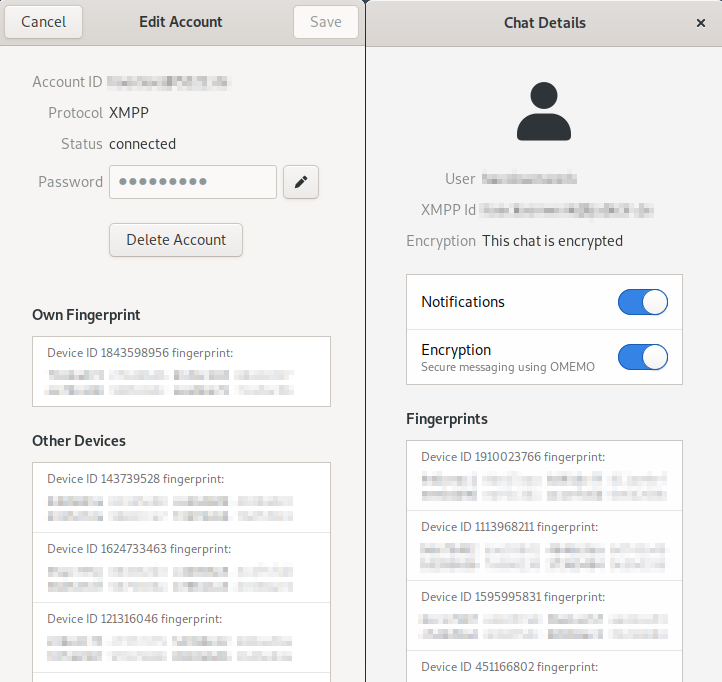
    There is a padlock symbol in the message bar now, indicating whether the chat is encrypted or not. You can also view your fingerprint—as well as your conversation partner’s fingerprints (see example below). Thanks, Richard Bayerle, for all of your work on the Lurch plugin!

    Web Browsing

    GNOME Web will benefit from the new widgets released in Libhandy 0.0.10, as mentioned above. Additionally, since recent testing has identified some bugs in GNOME Web, our development team has been looking into some of these issues. The outcome has been the reporting of many of those issues upstream.

    Initial Setup

    We plan to deliver GNOME Initial Setup in the first shipment of the phone—because it is very important for setting up your environment. Before any major porting effort was possible, though, some design effort was needed—and now porting work is underway!

    System

    So many exciting things are happening at the system level!

    After many revisions, the librem5-devkit device-tree has been accepted upstream. To prepare for this, the same device tree name is used both in the kernel and in the flash-kernel as well.

    The devkit image went through lots of changes, too. Wlroots v0.6.0 is now available, and contains many of our necessary changes. To make the overall experience look nicer, the shell now prefers the dark theme, and the keyboard auto-hides when the app drawer is opened. Detecting corrupted downloads of images has been made faster by adding a size verification. Thanks to Hugo Grostabussiat for the patch! The devkit image has support for the camera, too–and below you can see the devkit’s first selfie 🙂

    Devkit first selfie

    Several areas of the kernel have seen major improvements, and we are now very close to some important milestones. One such area is forward porting patches so that the images built for the devkit can switch from a 4.18 to a 5.2 kernel, and we’re almost there! You can find a recent image build with the 5.2 kernel here.

    With the new kernel, you will be able to long press the power button to turn on the devkit, and use suspend/resume. To help better detect SoC revisions, an RFC
    patch
    has been sent to improve this. Working towards improving the power management, we are testing cpufreq and preparing some cpuidle tests.

    A lot of effort has been put into debugging the sound on the 5.2 kernel. After many hours of work, we have discovered that ATF was blocking access to the aips regions—and upstream ATF has it fixed now!

    On the shell side of things, phosh has been made a polkit agent (so things like GNOME Software can ask for elevated credentials). We made some other improvements, like hiding the OSK when it’s not needed, removing the weekday/date from the lock screen, and making it easier to use Glade with phosh. Since a compositor switch is coming soon, the team applied many improvements to the new compositor, phoc (phone compositor). We will be showcasing this new compositor soon, so stay tuned for that!

    Also, and to get us closer to separating the bootloader from the OS, we have been putting a lot of effort into placing u-boot in the MMC area. Flash has been enabled in u-boot, so that the DDR PHY firmware can be written to flash. Thank you so much, Kyle Evans, for the work on mainline u-boot!

    The work on the graphics stack continues, too. To work towards mainline GC7000 GPU support, we folded the etnaviv part of libdrm into mesa upstream. Our thanks to Christian Gmeiner and Dylan Baker for the review! To take a look at the graphics on the devkit, check the Quake II demo below.

    Documentation

    To improve the devkit unboxing experience, lots of how-to guides have been added or updated:

    Some more noteworthy updates have been added to the Status of Subsystems page and the devkit peripheral software interfaces.

    A big “Thanks!” to everyone that has helped review, and merge changes, into upstream projects; your time and contribution are much appreciated. And that’s all for now, folks—stay tuned for more exciting updates to come!

    The post Librem 5 June Software Update appeared first on Purism.

    24 Jun 05:07

    Product Update: Hover’s New Webmail Preview is Live Today!

    by Samantha Lloyd

    Hover is excited to announce that we will be allowing you to preview our new webmail look and feel in the coming week! All the existing features and functionality you are used to with your Hover webmail are still available, but in a much more intuitive and modern display. All of your contacts, mail, and calendar scheduling will remain as is. To simplify, there’s a newly designed skin on top of your existing webmail. You will have the option to preview this new webmail skin starting today, June 19 2019.

    During the period where preview is available, you’ll notice you have an option to turn preview on with a checkbox on your webmail login screen. Please select the checkbox to view the preview. The look of the old webmail login is refreshed, but the functionality remains the same.

    old hover webmail login
    This is the old webmail login screen with a refreshed design!

    Once you’ve selected preview, your login screen will look a bit different. You will have an option to toggle the “Webmail Interface Preview” when you’re on your Hover webmail login page. You can toggle the new look on and off while you explore your new webmail skin. This preview option will be available until late August, after which the new webmail look will be the default option. We highly recommend taking a peek around! If you have any questions, please see the step-by-step instructions for how to use the webmail preview.

    new hover webmail login
    New webmail login screen with toggle option.

    Once inside the new webmail, you’ll notice a totally refreshed look. You’ll see a completely modernized user interface, making your webmail experience far more intuitive. Further, the entire platform is now mobile-responsive so that you can use it on the go and display it perfectly on all screen types – mobile, tablet, and desktop. You’ll have a familiar three-pane mailbox view so that you can see your folders, your messages, and draft new ones all in one screen view. Calendar integration has also been refined across all Android, Gmail, Mac OS X, iOS 5+, and Outlook to improve sync capabilities. Essentially, you’ll now have a straightforward and intuitive webmail design that simplifies email management altogether.

    three panel webmail
    Three-panel webmail screen.

    Late August, the new webmail look will be the default option and the old webmail will be retired and removed from use. You will not be able to access the old webmail after that time. We will be sending emails through our marketing channels to customers to inform them of the official change and when to expect them – sign up for our newsletter if you’d like to stay up-to-date with product changes.

    We are certain you will love the mobile responsive design and the improved user experience and functionality of the new webmail look! We are excited to receive your feedback as you use the new webmail. For more information, check out our Complete Guide to Webmail!

    24 Jun 05:07

    Apple's Product Strategy Is Changing

    by Neil Cybart

    This year’s WWDC felt different. While every WWDC keynote is filled to the brim with new features, this year’s announcements included highly anticipated items like a new Mac Pro and differentiated iPad software features. In addition, there were some genuine surprises such as SwiftUI (a big deal with wide-ranging implications for Apple’s ecosystem). Despite there being no discernible change to the grand vision behind Apple’s product development, there does appear to be a noteworthy change to strategy.

    The Past

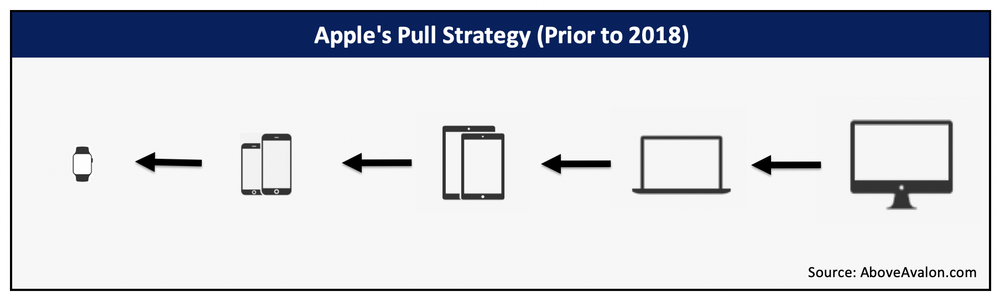
    Apple had been following a product strategy that can be thought of as a pull system. The company was most aggressive with the products capable of making technology more relevant and personal.

    One way of conceptualizing this product strategy is to think of every major Apple product category being attached to a rope. The order in which these products were attached to the rope was determined by the degree to which technology was made more personal via new workflows and processes for getting work done. Accordingly, Apple Watch and iPhone were located on the end of the rope held by Apple management. Meanwhile, Mac desktops were located at the other end of the rope while iPads and Mac portables were somewhere in the middle.

    As Apple management pulled on the rope, the Apple Watch and iPhone received much of the attention while the Mac increasingly resembled dead weight.

    Apple's Pull Strategy (Above Avalon)

    The preceding exhibit may make it seem like all of Apple’s product categories moved in sync with each other as Apple management pulled on the product “rope.” In reality, the quicker Apple pulled on the rope, the more chaotic the end of the rope moved. The following exhibit does a better job of demonstrating the chaos found at the end of the rope.

    Apple's Pull Strategy (Above Avalon)

    The Apple Watch and iPhone were Apple’s clear priorities while the iPad, Mac portables, and Mac desktops ended up facing a battle for management attention. The iPad seemed to have the clear advantage in that battle, at least when it came to capturing mindshare among Apple’s senior ranks. Recall Tim Cook’s comment about the iPad being the clearest expression of Apple’s vision of the future of personal computing.

    Today

    Over the past two years, we received clues that a major change was beginning to take hold in Apple’s product strategy. This change was on display during this year’s WWDC. Consider the following announcements:

    • The Apple Watch continues to gradually gain independence from iOS and the iPhone with its own App Store and the ability to create watchOS apps without an iPhone app.

    • iPadOS is a promise from Apple that iPad will be given unique software features versus iPhone. Features like multitasking and Apple Pencil support give iPad differentiation from its more popular sibling (iPhone).

    • The new Mac Pro is clear evidence of Apple industrial design, along with the engineering and product design teams, attempting to come up with a long-term solution for the most powerful computer in the product line.

    • SwiftUI is the kind of foundation Apple needs to properly leverage a thriving iOS developer ecosystem in order to benefit other product categories.

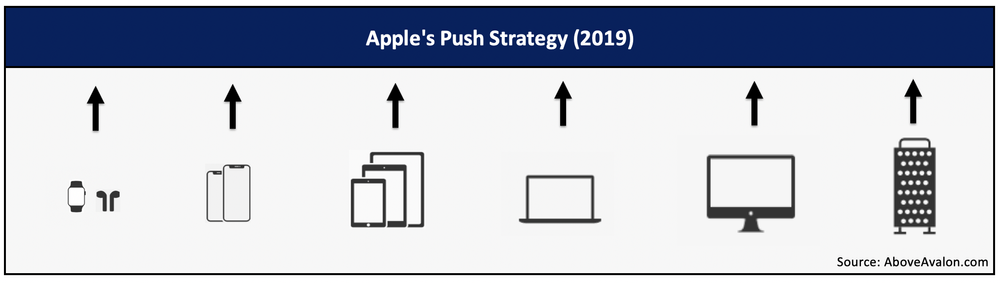
    Apple no longer appears to be relying so much on a pull system when it comes to advancing its product line. Instead, a push system is being utilized, and every major product category is being pushed forward simultaneously. The change was designed to reduce the amount of chaos found at the end of the “rope” that Apple was pulling. Accordingly, the primary benefactors arising from this new strategy are the iPad and Mac. This explains why this year’s WWDC announcements felt more overwhelming than those of previous years. Apple was able to move its entire product category forward at the same time.

    Apple's Push Strategy (Above Avalon)

    This revised strategy ends up supporting a core tenet of my Grand Unified Theory of Apple Products - a product category's design is tied to the role it is meant to play relative to other Apple products. (A deep dive into Apple’s product vision and the Grand Unified Theory of Apple Products is available here for Above Avalon members.) By pushing the products geared towards handling the most demanding workflows, Apple has a greater incentive to push the products capable of making technology more personal and relevant.

    It’s not that every product category in Apple’s line is now on equal footing in terms of importance and focus. Some products will receive updates every few years while others require more attention due to needing annual updates. In addition, Apple’s revised product strategy likely won’t change the sales ratios between product categories (iPhone outselling iPad by four times while iPad outsells Mac by more than two to one). Instead, the change from a pull to push system manifests itself with each product category being given a defined and unique role to handle within the Apple ecosystem.

    • Wearables are tasked with handling entirely new workflows in addition to a growing number of workflows that had been given to iPhones and iPads.

    • The iPhone is the most powerful camera and video player in our lives.

    • iPads and Macs are content creation tools.

    Implications

    There are a number of product-related implications arising from Apple’s revised strategy:

    Mac Desktops. Despite being in the post-PC era, desktops are experiencing some kind of renaissance. Some of this isn’t entirely surprising given how the desktop has always been viewed as an antidote to some of the ideals found with mobile. However, what is new is the realization of the desktop’s role in the AR era. Mac desktops are niche in terms of the number of users relative to other Apple product categories, albeit a very powerful and crucial niche.

    Mac Portables. It is time to take Apple management at its word when it says the Mac is important to Apple’s future. Mac portables will likely retain a place in Apple’s product line for the foreseeable future. A few years ago, low-end Mac portables seemed to be on a dead-end path thanks to iPads. There is no longer any evidence that such thinking is widely held in Apple’s senior ranks. An ARM-based Mac portable seems inevitable at this point.

    iPad. Just a few years ago, some in the tech pundit world thought the iPad lacked a future. Such thinking was due to slowing iPad sales combined with larger iPhones being able to handle many of the use cases originally given to iPad. While the iPad has always been viewed as the future of computing within Apple, we are starting to see that vision materialize. iPad sales are now routinely surprising to the upside as Apple adds a “pro” layer to the iPad category in terms of powerful hardware and software.

    iPhone. The iPhone as a product category continues to mature, as seen with a longer upgrade cycle. Going forward, the iPhone will primarily be known as the most powerful camera in our lives and a video consumption device. Many of the less intensive use cases and workflows currently given to the iPhone will naturally flow to wearables over time.

    Wearables. Apple is the wearables leader. Fitbit would arguably be the closest from the perspective of unit sales but even then, the company is quickly losing momentum. Lessons that Apple learned with iPhone and iPad are now giving the company a wearables advantage that is likely at least five years. An independent Apple Watch not requiring an iPhone to set up is inevitable. The move would increase Apple Watch’s addressable market by three times overnight. In addition, Apple is well on its way to establishing a wearables platform as it competes for prime real estate on our wrists, in our ears, and in front of our eyes.

    Will It Work?

    Is Apple making the right product strategy decision moving from a pull to push system? It’s too early to tell. At first, the revised strategy may seem like a no brainer as each product category ends up benefitting from more attention. However, it’s not a given that such a dynamic is in Apple’s best long-term interests.

    The source of my hesitation in Apple’s new product strategy is that the company’s long-term success is dependent on one item: making technology more personal. Anything that takes away from that goal ends up being a hurdle. Is Apple supporting legacy workflows to the detriment of Apple’s long-standing mission of making technology more personal and relevant?

    One reason Apple decided to change product strategies in the first place was to avoid an all-out uprising among the 1% of the user base creating content consumed by the other 99%. The mistake Apple made over the past few years was pulling the product “rope” too fast and in the process, leaving many of its pro users, defined by the workflows needed to be supported, behind.

    For a company that is resource constrained when it comes to time and attention, there is no guarantee that Apple’s functional organizational structure and design-led culture can realistically scale to push an endless number of product categories at the same time. This was the key benefit found with Apple’s pull system. The focus was to advance the products capable of making technology more personal and relevant while trying to bring as much of the broader product portfolio along for the ride. The move to a push system is inherently more complex. Apple finds itself doing a whole lot more that it did just a few years ago.

    Some will push back at the claim that Apple is resource constrained considering the company has $113 billion of net cash on the balance sheet. However, such a view doesn’t take into account how Apple functions. Apple could have thrown together some components in a big box and shipped a new Mac Pro shortly after realizing that the previous Mac Pro design was a dead end. Instead, Apple’s industrial designers, working in close collaboration with various teams, took a little over two and a half years to come up with what is marketed as a long-term solution for handling the most demanding content creation workflows. Similar questions now plague Apple pertaining to its approach to “pro” Mac portables.

    My concerns regarding Apple’s revised product strategy would be alleviated if Apple came up with a plan to push legacy platforms forward by doubling down on future initiatives involving making technology more personal. This is why SwiftUI is intriguing. Apple is positioning SwiftUI as a way to improve a developer's productivity by requiring less code, resulting in better code. What if that is only scratching the surface as to Apple’s ultimate objective? What if the Mac is being repositioned as an AR creation platform while iOS is gradually positioned as a platform for developing wearables apps? Using a billion iPhones to develop apps consumed on billions of wearable devices is the type of goal that would require years of work, foundation building, and periodic changes to product strategy.

    Receive my analysis and perspective on Apple throughout the week via exclusive daily updates (2-3 stories per day, 10-12 stories per week). Available to Above Avalon members. To sign up and for more information on membership, visit the membership page.

    24 Jun 05:05

    The 3 levels of functional thinking

    by Eric Normand

    I’ve noticed that people go through a certain journey when learning functional programming. I’ve classified it into three levels: 1) Distinction between Actions, Calculations, and Data; and learning to use them effectively 2) Higher-order thinking; and building abstractions from higher-order functions 3) Algebraic thiking; building coherent models with a focus on composition. This is a work in progress and I’d love your input.

    Transcript

    Eric Normand: What are the three levels of functional thinking?

    In this episode, I’m going to talk about my thinking about progress through the skills and thought processes that go into functional programming. My name is Eric Normand, and I help people thrive with functional programming.

    I want to say that this is a work-in-progress. It is one way of mapping out the skills and categorizing them as a progression of skills. It’s not the only way, and I have no hard evidence about the skills being done in this order.

    They are mostly anecdotal. I’m noticing that people might learn a bunch of stuff and then they get stuck or they’re in a certain spot, and they’re still progressing. They haven’t learned this other thing yet. It’s just me putting it together.

    I’m not creating some model that people are going to have to stick to or anything. It’s mostly a way to organize the material that I’m putting into my book.

    Here are the three levels. Remember, work-in progress. I’d love to discuss it, but I’m not going to die on this sword or anything.

    The first one is the awareness and use of the distinction of actions, calculations, and data. Actions are things that depend on time. They depend on when they’re run and how many times they’re run. They have effects on the world or are affected by the world.

    Calculations are computations from inputs to outputs. They don’t depend on time. If you give them the same inputs, they’re going to give you the same output. Finally, data is facts about events. It’s very inert. It doesn’t do anything on its own or requires interpretation.

    When you’re in this first level, your main challenges are learning, with actions, how to deal with the time, how to manipulate time, to master it, so that you can guarantee the ordering of the actions when you need it guaranteed.

    You can guarantee the things aren’t running at the same time if they shouldn’t be running at the same time, and guarantee that they happen the correct number of times. These are all the challenges that you face when you’re dealing with actions.

    Calculations, the challenge here is to start modeling your program in terms of things. It can be very difficult for people who are coming from another paradigm to not use mutable state, to model things more as data transformations as opposed to step-by-step instructions like in an algorithm.

    You’re learning to think about all the stuff that your program does that isn’t really necessary to be done as a side effect, as an action. There are some side effects that are necessary. You want your program to send an email, that it’s incorrect if it doesn’t send an email. That isn’t a necessary action.

    Do you really need to use that global variable as scratch space for your algorithm? Probably not. If you don’t use it, none of your users are going to be upset. It’s still a correct program. That’s an unnecessary action.

    We, as functional programmers, tend to frown upon unnecessary actions, and we want to convert them into calculations. That’s the challenge, learning how to do that. Sometimes it is relearning how to program even the simplest things using calculations instead of actions.

    With the data, it’s about modeling. It’s about making sure that your data has the right structure to be able to support the algorithms that you need to do. It’s capturing the data you need. All that stuff comes under data modeling. Those are the three things you’re distinguishing as a functional programmer at level one. You’re learning to work with that.

    You keep learning and you eventually get to level two, which is where you have higher-order thinking. You’ve mastered doing stuff with immutable data and thinking of things as data transformation, and you start to realize that there’s a lot of duplicated functionality.

    You’ve been using, let’s say, for loops to make lists of things from other lists. You think, “Well, I could be doing this with a function that I pass the function to.” I’m essentially going to pass the body of the for loop as a function into Map. This is higher-order thinking. You start thinking in terms of pieces of algorithms that can be passed to other algorithms.

    That’s another challenge that you come to. Some of the challenges, you could think of like dragons that you have to avoid. It’s over abstracting. It’s very easy to get carried away and have unreadable code because you’re using second or third order functions. It’s very difficult to see what’s going on.

    Then there’s not using them enough and running the risk of not having a scalable piece of software, like your code does not scale. You have to write the same number of lines for every feature. A feature takes a 100 new lines of code. You need 20 features. That means you’re going to need 2,000 lines of code.

    Whereas, if you’re using higher-order thinking, it should be easier to write the features each time, fewer lines of code because you’re able to find essential abstractions that work in your domain.

    There are some that are universal. Map, Filter, and Reduce are very common. You should be able to find some that work only in your domain that don’t make sense to go in the standard library. This is number two — higher-order thinking. That’s where people start thinking in terms of functional programming as just like data transformation pipelines.

    I’m doing Maps and Filters, and Maps and Filters, and I have these pipelines where all this work is getting done through the sequence functions. There’s another level. I’ve met a lot of people who get comfortable at level two and that’s where they stay.

    There’s not a lot written about level three. The stuff that I’ve seen that’s written about it is often very abstract and obtuse. It’s abstract because it’s at next level so it’s going to seem out there. You can get there. I hope to help people get there. I hope to find a path that’s not too abstract that gets people there.

    We should be able to do this in my book. This is going to be, obviously, later in the book. I haven’t gotten to it yet. This is level three, which is algebraic thinking. I don’t even have a good definition of it, a good explanation for it. This is one of those things where I’d love to get into discussions with people.

    This is where you are focused on building models that compose nicely. Very few corner cases, is what I mean by nicely. They compose well. When you compose them, they have nice properties to them. You’re able to build a semantically complete system of interworking concepts.

    You’re using everything from levels one and two to build something cohesive that operates in the abstract concepts of your domain.

    When you’re talking about a data transformation pipeline, you’re often looking at, “OK, I’m getting this CSV and it’s got these values in it. I need to change it into something I could send to this JSON:API.” It’s slightly different format so I got to transform it.

    You’re thinking very mechanical, very data-specific. What are the steps that I can go from this thing that I have to this thing that I need? It’s very important to do, but I’m talking about something like being able to build a…

    Let’s say you’re making a video editor. Now, you’re going to want to model how the video editor will work on the backend. What are the concepts? How do they fit together so that they create a cohesive whole?

    You can think of it as I should be able to concatenate two segments of the video. I should be able to cut a segment of the video. That means I’m going to have to model the segment. I’m going to have to model this operation of concatenating, which will give me a new segment, but it’s got the two combined in it.

    I should be able to cut, which gives me the two segments, the before and the after segment. There’s a reasoning about the operations on these things, and how those operations can compose together to build the functionality that you will eventually need in your app.

    Those are my three levels. Like I said several times already, these are a work-in-progress. Let me know what you think. Is there a fourth level that I’m missing? I haven’t reached the end of my functional programming journey so I’m probably not aware of what comes after this.

    I’m definitely myself in three. I know other people there and I know people in the other two. I have some anecdotal evidence that this thing makes sense. I’m going to wrap it up. I’ll recap the three levels that I’m identifying mostly to organize my curriculum in the book so that there’s a sense of progress.

    One is the distinction between actions, calculations, and data, and how to use them effectively. Two is higher-order thinking. This is where you’re using first-class functions, where people start to talk about data transformation pipelines, things like that.

    Three is algebraic thinking. This is where you’re doing domain modeling at the operation level to be able to create a cohesive domain model in functions.

    If you want to find all the old episodes, all future episodes, and this present episode, go to lispcast.com/podcast, and there you’ll find a list of all the episodes with video, audio, and text transcripts. You’ll also find links to subscribe and links to my social media so that we can get in touch if you want to do that.

    I love having discussions, and I would love to have something like this more fleshed out based on a more solid ground. Awesome. My name is Eric Normand, and rock on.

    The post The 3 levels of functional thinking appeared first on LispCast.

    24 Jun 05:04

    SIFT (The Four Moves)

    by mikecaulfield

    So if long lists of things to think about only make things worse, how do we get better at sorting truth from fiction and everything in-between?

    Our solution is to give students and others a short list of things to do when looking at a source, and hook each of those things to one or two highly effective web techniques. We call the “things to do” moves and there are four of them:

    A list of the four moves described below

    Stop

    The first move is the simplest. STOP reminds you of two things.

    First, when you first hit a page or post and start to read it — STOP. Ask yourself whether you know the website or source of the information, and what the reputation of both the claim and the website is. If you don’t have that information, use the other moves to get a sense of what you’re looking at. Don’t read it or share media until you know what it is.

    Second, after you begin to use the other moves it can be easy to go down a rabbit hole, going off on tangents only distantly related to your original task. If you feel yourself getting overwhelmed in your fact-checking efforts, STOP and take a second to remember your purpose. If you just want to repost, read an interesting story, or get a high-level explanation of a concept, it’s probably good enough to find out whether the publication is reputable. If you are doing deep research of your own, you may want to chase down individual claims in a newspaper article and independently verify them.

    Please keep in mind that both sorts of investigations are equally useful. Quick and shallow investigations will form most of what we do on the web. We get quicker with the simple stuff in part so we can spend more time on the stuff that matters to us. But in either case, stopping periodically and reevaluating our reaction or search strategy is key.

    Investigate the source

    We’ll go into this move more on the next page. But idea here is that you want to know what you’re reading before you read it.

    Now, you don’t have to do a Pulitzer prize-winning investigation into a source before you engage with it. But if you’re reading a piece on economics by a Nobel prize-winning economist, you should know that before you read it. Conversely, if you’re watching a video on the many benefits of milk consumption that was put out by the dairy industry, you want to know that as well.

    This doesn’t mean the Nobel economist will always be right and that the dairy industry can’t be trusted. But knowing the expertise and agenda of the source is crucial to your interpretation of what they say. Taking sixty seconds to figure out where media is from before reading will help you decide if it is worth your time, and if it is, help you to better understand its significance and trustworthiness.

    Find trusted coverage

    Sometimes you don’t care about the particular article or video that reaches you. You care about the claim the article is making. You want to know if it is true or false. You want to know if it represents a consensus viewpoint, or if it is the subject of much disagreement.

    In this case, your best strategy may be to ignore the source that reached you, and look for trusted reporting or analysis on the claim. If you get an article that says koalas have just been declared extinct from the Save the Koalas Foundation, your best bet might not be to investigate the source, but to go out and find the best source you can on this topic, or, just as importantly, to scan multiple sources and see what the expert consensus seems to be. In these cases we encourage you to “find other coverage” that better suits your needs — more trusted, more in-depth, or maybe just more varied. In lesson two we’ll show you some techniques to do this sort of thing very quickly.

    Do you have to agree with the consensus once you find it? Absolutely not! But understanding the context and history of a claim will help you better evaluate it and form a starting point for future investigation.

    Trace claims, quotes, and media back to the original context

    Much of what we find on the internet has been stripped of context. Maybe there’s a video of a fight between two people with Person A as the aggressor. But what happened before that? What was clipped out of the video and what stayed in? Maybe there’s a picture that seems real but the caption could be misleading. Maybe a claim is made about a new medical treatment based on a research finding — but you’re not certain if the cited research paper really said that.

    In these cases we’ll have you trace the claim, quote, or media back to the source, so you can see it in it’s original context and get a sense if the version you saw was accurately presented.

    It’s about REcontextualizing

    There’s a theme that runs through all of these moves: they are about reconstructing the necessary context to read, view, or listen to digital content effectively.

    One piece of context is who the speaker or publisher is. What’s their expertise? What’s their agenda? What’s their record of fairness or accuracy? So we investigate the source. Just as when you hear a rumor you want to know who the source is before reacting, when you encounter something on the web you need the same sort of context.

    When it comes to claims, a key piece of context includes whether they are broadly accepted or rejected or something in-between. By scanning for other coverage you can see what the expert consensus is on a claim, learn the history around it, and ultimately land on a better source.

    Finally, when evidence is presented with a certain frame — whether a quote or a video or a scientific finding — sometimes it helps to reconstruct the original context in which the photo was taken or research claim was made. It can look quite different in context!

    In some cases these techniques will show you claims are outright wrong, or that sources are legitimately “bad actors” who are trying to deceive you. But in the vast majority of cases they do something just as important: they reestablish the context that the web so often strips away, allowing for more fruitful engagement with all digital information.


    To learn about SIFT in more detail, check out our free three hour online minicourse.

    Creative Commons License

    This work is licensed under a Creative Commons Attribution 4.0 International License.

    24 Jun 05:04

    One dinner learning: science, reading and snails

    by Lilia

    After a few hot days yesterday’s dinner was inside. Rain was coming, together with lightning and thunder.

    Alexander and I had to run upstairs – we needed to see how the next iteration of our self-watering system on the balcony and roof works. It is an advanced version of the last year communicating vessels of rain barrels, tubes and pots. We have some troubles with leading excess water after installing a new connector to the drainpipe and needed to see how it works with heavy rain. We couldn’t see much of the extreme conditions we wanted to test – it is always surprising to see how little water is collecting with moderate rain.

    Back at the dining table another story was unfolding as more lightning and thunder came – Emily was afraid. Alexander’s calculations that “it’s two kilometres away” didn’t help her (but I was smiling as always when I see traces of previous learning). A discussion of the rest about “it’s better to be in a stone house than outside in a field” also didn’t help. She wanted to hide under the blanket. And then somebody cited Olifantje Olaf:

    Snel deed de kleine Olaf
    zijn oren heel goed dicht
    want altijd klinkt gedonder
    na elke bliksemschicht

    That actually helped, since Emily picked up the book, climbed on Robert’s knees and started to read. And then I had to smile again – because of all those memories of Anna using this book when learning to read and also because we didn’t hear Emily reading for a while and it’s nice to see the progress of something that grows without your direct involvement.

    Girls looking at a snail on a window

    Girls looking at a snail on a window

    And then we are practically finished and Emily was continuing with the books I saw a snail on the living room window. Soon me and the girls were there with looking glasses. Anna wanted to see its mouth and told a recipe from one of her nature books – honey, water and juice from broken leaves. Which resulted in a lot of fun of studying the snail’s eating process, slugs that we added for the comparison and marvelling at the speed with which the green disappears when those creatures are at it.

    And I was smiling again – because of it’s nice to see what all those books in the house and hours of reading them do make a difference, because of the interest of how things work and the love for nature that our kids share with us and because it’s a lot of fun to look at the chewing snail from a bottom with a looking glass.

    The post One dinner learning: science, reading and snails appeared first on Mathemagenic.

    24 Jun 05:04

    Millions of dollars in tax breaks — because of a mapping error

    by Nathan Yau

    A small discrepancy in a couple of shapefiles led to a misclassification of land. Wealthy investors are taking advantage. For ProPublica, Jeff Ernsthausen and Justin Elliott:

    They have President Donald Trump’s 2017 tax overhaul law to thank. The new law has a provision meant to spur investment into underdeveloped areas, called “opportunity zones.” The idea is to grant lucrative tax breaks to encourage new investment in poor areas around the country, carefully selected by each state’s governor.

    But Port Covington, an ambitious development geared to millennials to feature offices, a hotel, apartments, and shopping, is not in a census tract that is poor. It’s not a new investment. And the census tract only became eligible to be an opportunity zone thanks to a mapping error.

    Tags: error, housing, ProPublica, shapefile

    24 Jun 05:04

    Unconference Ripples Spreading Outwards

    by Ton Zijlstra

    Nine years ago, during/after Pedro’s SHiFT conference, we were ‘stuck’ in Portugal due to the Icelandic volcanic ash cloud. Lane Becker was one of the other speakers attending and Elmine told him about our birthday unconference and how we were planning a new edition that spring. Two years later, in the fall of 2012, we met Lane again, this time in Copenhagen. We talked more about our birthday unconferences and he thought he might do one the next year, for his 40th birthday.

    By coincidence Facebook put something Lane posted in my timeline yesterday, and I read some more of what he posted recently. Turns out he indeed has been doing a birthday conference, not in 2013, but last year for his 45th. And he is now organising a second one in Austin Texas, coming September!

    Furthermore, one of the participants of his conference last year Kevin Bankston, took to the idea, and is doing a small conference as birthday and farewell party in Washington D.C. this month.

    Both these ripples I think are totally awesome. We have Beverly and Etiennes week long retreats in both California and Portugal, from when Beverly participated in the original birthday unconference in 2008. Earlier this month Peter organised Crafting {:} a Life on PEI in Canada. And now Lane’s 2 editions, and Kevin’s spin-off from Lane’s event. I think that in itself is pretty good impact from what was basically a mad idea 11 years ago.

    Screen
    In between ethics of nanotech and higher-ed policy in Yemen, Elmine’s birthday unconference, at University of Twente’s conference center in 2008

    24 Jun 05:03

    Outer Limits

    by David A. Banks

    Building to Code is a monthly column about how we live among cities and each other. It regards cities as what they’ve always been: not systems of capitalist resource management, but the stages that society plays out on.


    Recently on the Current Affairs podcast, Nathan J. Robinson asked Contrapoints creator Natalie Wynne: “What the hell is going on that YouTube is so saturated with reactionaries?” Her answer begins with a comparison to ’90s AM radio, because both mediums lacked “a lot of traditional gatekeeping.” This dearth of regulation can have good and bad consequences: “For instance trans people — no one wants to give us a platform — but we can make our own on YouTube and we can find each other and build a community. The downside is that racists can do the exact same thing and they have.” Robinson asks a follow-up question: “Why have the racists been winning?” Wynne surmises that there is “something about the cultural moment that lends itself to that sort of thing.”

    AM radio and YouTube may be dominated by conservatives because of a lack of gatekeeping, but that doesn’t explain why conservatives were the ones to take the most advantage of these technologies. Part of the answer is the sheer amount of money funneled to the likes of Rush Limbaugh, Candice Owens, Milo Yiannopoulos, and Ben Shapiro by billionaires who appreciate the ideological cover they provide. But then we also have to account for the other side of the equation: Why did wealthy patrons see YouTube and AM Radio as outlets worth sponsoring? The answer here, beyond a lack of gatekeepers, is who these platforms reach: everybody, and especially people not in big cities.

    YouTube, and talk radio before it, let anti-social conservatives connect online and later in person for marches, rallies, and meetings

    While cities have always done a good job of helping numerical minorities achieve a density sufficiently big to sustain a business (for example, a gay bar) or even a movement (think organized labor in major industrial cities), politically conservative suburbs and rural places have always faced a paradox: the built environment is made to support the individual family structure and is deeply isolating by design, which makes it harder to organize socially or politically. But social media is a good-enough stand-in for urban density, providing a means to form the early connections necessary for starting longer-term relationships. Platforms like YouTube, and talk radio before it, let anti-social conservatives who don’t want to live next to other people connect online and later in person for marches, rallies, and meetings.

    The algorithmic logic of the internet has begun to extend to the suburbs and rural areas the kinds of organizing capabilities that used to only be possible through the city’s density. What this means depends on the makeup of those suburbs, and the decisions of those who own the networks.


    In his best known work, 1938’s Urbanism as a Way of Life, the Chicago School sociologist Louis Wirth wrote that “being reduced to a state of virtual impotence as an individual, urbanites are bound to exert themselves by joining with others of similar interests into organized groups to obtain their ends.” Wirth was responding to the rapid growth of industrial cities in America and the working classes that were organizing in both political directions. To him, these groups, far from being emancipatory, were “subject to manipulation by symbols and stereotypes managed by individuals working from afar or operating invisibly behind the scenes through their control of the instruments of communication.” His cynicism makes sense given the times: the American Bund was gearing up for a 4,000-person strong Nazi rally in Merrimac Park in 1939. But Chicago had also hosted many of the anarchists, socialists, and communists who had successfully agitated for an eight-hour work day in 1886.

    Cities, and the cutting-edge communication technologies that they host (whether that’s penny presses, public address systems, or Twitter), have long been agents of mass upheaval from across the political spectrum. From Stonewall in New York to the uprisings in Baltimore after the exoneration of the cops that killed Freddie Gray, cities have been prime venues for what Lewis Mumford called “purposive associations” and Durkheim called “organic solidarity.” Rather than family relationships or ties to the land defining who you are, city life requires that your identity be derived through internalizing the role you play in civil society: how you make a living, the organizations you join, and the interests you hold.

    In The Urban Revolution, French theorist Henri Lefebvre called the city street, “A place where speech becomes writing.” He was being quite literal: through graffiti, billboards, and protest signs, the street is a social medium, not just a transportation corridor. The city might demand that you work on the factory floor or the office bullpen, making you feel small and replaceable, but at least you’re physically close enough to others that your plights can be shared together out in the street. There, you can demand to be treated better, and others will see you. You are alienated but not alone in your alienation.

    In the more rural and suburban parts of the urbanized society, however, the social medium of the street is replaced by utilitarian transportation corridors. Beginning in the mid-20th century, the modern suburb was designed as a comfortable hideout for white America: a low-density environment with many of the conveniences of city life, but none of the friction of heterogeneity or shared space. Roads for cars replace public transit, “lifestyle” affiliations are established through consumer choices, and outsiders are barred, if not through explicitly racist rental policies then through policing. Today, one of the best predictors of one’s political orientation is the density of the neighborhood they live in; people who live in the suburbs are also more likely to get their news from broadcast and local television. Taken together, this means suburbanites see fewer strangers in their everyday lives, and fill that void with sensationalized accounts of ever-present, creeping danger.

    This creates fertile ground for reactionary, conservative political movements. While most suburbanites still get a majority of their news from these older media sources, more of them are getting it from apps like Facebook and Nextdoor, where the ideas broadcast through outlets like Fox can fester person-to-person. In this way the suburbs get the social functions of the city street, but with suburban-style tools of control and segregation.


    In 2012, the Marxist geographer Manuel Castells wrote Networks of Outrage and Hope, a book that was optimistic about organizing online the way only a pre-2016 book could be. His central thesis was that individuals join social movements (mainly urban ones) so that they can “overcome the powerlessness of their solitary despair by networking their desire.” Castells argues that in the presence of digital networks, the “prolongation of communal resistance” replaces roles as the main ingredient in identity formation: Instead of seeing yourself as a steel worker or a nurse, you are a feminist, a socialist, or a red-pilled men’s rights activist — who you see yourself as comes from the constant articulation of your positions and ideas, not what you do for money. Digital networks, predicated on the idea that you should play with and express your identity, give rise to new means of meeting based on purposive associations — instead of meeting in the street, Castells argues, people form “super counter powers” over digital networks.

    The modern suburb was designed as a comfortable hideout for white America

    Castells’s thesis is all the more impressive given that he began writing it in the late ’90s, years before the search algorithms of YouTube, Facebook, and Google began determining the world’s media diets. There are big holes in his theory, however: First, he gives a bit too much credit to technologies while giving short shrift to the underlying political interests of the companies that run them; and, second, he gives no consideration to how these exact same properties play out in suburban environments with conservative movements. (Indeed, the word “suburb” does not show up once in Networks of Outrage and Hope.) While social media may be just as good at connecting left social movements as right ones, they may be more helpful to conservatives because without them they would be divided by their own preference for physical isolation.

    The Tea Party, which began shortly after Barack Obama took office, has all the elements of a suburban networked society political movement. A Chicago-area talk radio producer was one of the first Tea Party organizers, and some of the first protests in Fort Meyers, Florida and Mesa, Arizona were advertised and arranged through local AM radio and Facebook. While social media does decentralize the means of media production, it also makes it easier to create media that appears to be decentralized. The Tea Party movement may have never gone beyond a few angry get-togethers if it weren’t for the astroturfing financed by the Koch brothers and organized through their Americans for Prosperity think tank, which took full advantage of Facebook’s groups, events, and advertising tools.

    So much of the suburbs is standardized, and the work of maintaining society remains hidden — industry is zoned far away from homes, and single-family homes hide the work of social reproduction — leaving communal resistance to fill in the gaps. When you are alone in your house or your car, the radio or podcasts you listen to and the television you watch take up an outsized portion of how you think about and frame social problems. These are the moments in which individuals, alone in their cars with Ben Shapiro squealing through the speakers, form opinions and decide who to associate with. In what Castells calls “the network society,” the suburbs actually go from a pacifying force to a hotbed of political activity.

    Rather than relying on amassing enough people in one place such that a community center or bar can host just them, suburban and rural populations organize through shared media collated by algorithm — algorithmic sorting takes on the role once left to urban scale and density. And while just about every city mayor has tried to control and alter the street to quell or gin up protests, digital networks afford rapid change that may only be visible to a few. It is as if huge swaths of the world live in cities where their public streets and squares disappear, rearrange, grow, and shrink at the whim of corporate owners and with no real ability by normal people to understand how much has changed at any given time.


    Recent events seem to contradict the idea that conservative beliefs have the homefield advantage in the suburbs: Donald Trump spent his entire life in New York City and all of his major properties are in big cities. Black Lives Matter, the Yellow Vest Movement, and Bernie Sanders’ political career, meanwhile, all started in suburbs and small towns. Resolving that contradiction is as simple as understanding the changing class and race makeup of cities and suburbs and how the design of the city reinforces those distinctions. To the extent that our suburbs are white and conservative, the balance of organizing capacity will tilt in that direction. As suburbs become dormitories for commuting workers who cannot afford the city, however, social media may become a net positive to the left.

    When you are alone in your house or your car, the radio or podcasts you listen to take up an outsized portion of how you frame social problems

    The white flight to cities does not necessarily turn conservative rich people into lefties. Instead, conservatives bring the spatial control systems of the suburbs with them and transform the urban landscape into a sort of vertical suburb. Trump grew up in the Queens suburbs; once he moved into Manhattan and built Trump tower, he walled himself off from the rest of the city. He was encased, biographer Gwenda Blair told a Politico reporter, “within this bubble of serenity and privilege.” That was in the ’80s. Today we see this repeated ad infinitum: steel and glass high-rises with car elevators and “poor doors” for those living in the legally mandated affordable apartments.

    Meanwhile the suburbs are getting more racially diverse, and poorer. In 2012 the private investment group Blackstone spent $9.6 billion on a new company called Invitation Homes. Invitation bought 50,000 foreclosed single-family homes and in just a few years became the biggest landlord in the country, marking a 50-year high in renting. Most of these rentals were in places built to be owned, one suburban ranch house at a time: most of Florida, Las Vegas, Phoenix, and Southern California. This is all part of what Alan Ehrenahlt calls “the great inversion” where the wealth of the suburbs flows into urban downtowns, and the subsequent rise in land prices forces immigrants and the working poor into the newly vacated suburbs.

    Already, in Ferguson, Missouri or Seine-et-Marne, where the Yellow Vest movement started, Twitter and Facebook are extremely useful at helping organize across long distances where in-person meetings have to be coordinated beforehand. In 2014 the #BlackLivesMatter hashtag on Twitter, Instagram, and Facebook helped organize what became a nation-wide uprising against police brutality. When the 51-year-old Jacline Mouraud’s video asking French President Emanuel Macron, “What do you do with French people’s cash?” went viral it sparked a rural, anti-tax movement that snowballed into a country-wide movement representing a wide range of political views. In both cases these were suburbs outside of much bigger cities.

    As the suburbs diversify, so too might the platforms that connect their residents. Lefebvre noted that “Whenever threatened, the first thing power restricts is the ability to linger or assemble in the street.” That maxim is easily extended to the digital networks that take on a similar role. Social media companies have only begrudgingly started hunting down and kicking out hard right-wing users and communities from their platforms, but there’s no reason to believe that they’ll be just as reticent when leftists are on the chopping block. And if it continues to be true that sex workers act as canaries in the coal mine for state surveillance and control, then the passage of SESTA/FOSTA has shown just how quickly and easily users can be booted from a service based on their behavior online or the kind of work they do. If the socially and politically marginal become geographically marginal as well, then we had best remember how fickle our digital streets can be.

    24 Jun 05:03

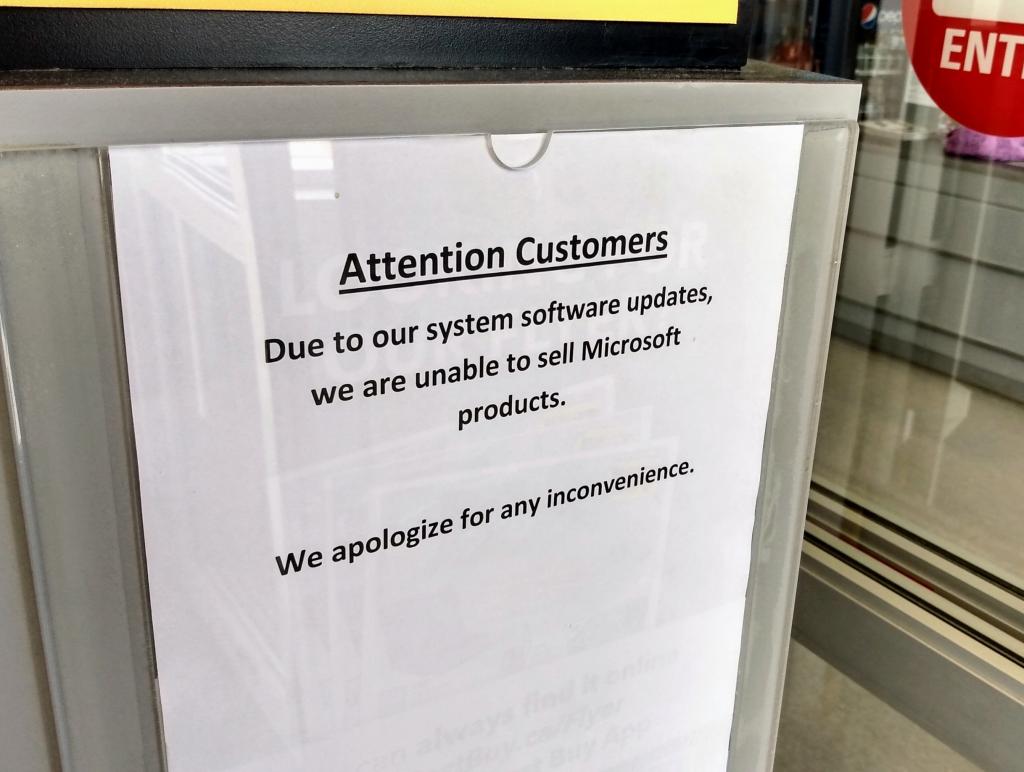
    "We are unable to sell Microsoft products"

    by peter@rukavina.net (Peter Rukavina)

    The delicious irony of Best Buy, a computer store that presumably uses Microsoft products, unable to sell Microsoft products because of “system software updates.”

    24 Jun 04:56

    Why you can’t just keep doing what you’re doing. Especially after 50.

    by Josh Bernoff

    The Atlantic has a fascinating piece by Arthur C. Brooks called “Your Professional Decline Is Coming (Much) Sooner Than You Think.” It forces you to face the inevitable: you won’t always be as good as you are now, and no, you won’t keep getting better. Here’s what to do about it. As Brooks, president of … Continued

    The post Why you can’t just keep doing what you’re doing. Especially after 50. appeared first on without bullshit.

    24 Jun 04:56

    Not quite finding ada: some thoughts on ethics, gender and the humanization of chatbots

    by admin

    Over the past month I’ve spoken at number of events where I have been explicitly calling for the need for more critical and ethical discussions around the use of data and the implementation of any “digital” system, not only in universities but throughout the education sector.  

    So I need to walk that walk and not just spurt out rhetoric.  This week at the ALT Scotland meeting, there was a presentation about a digital assistant (chatbot) system which has been developed by Bolton College. Aftab Hussain and his team have developed a pretty impressive system that allows staff and students to access a range of data (information) about their timetable, exams, where to find out about services.  You can read more about their work here.

    This is all “exciting stuff” and seeing and hearing the real time responses was pretty impressive. The college are very lucky to have people like Aftab and his team who are able to develop this kind of system in house. I don’t think many colleges or universities for that matter have a team of developers who can do, or have the time to do this type of work.  This post is not criticising their work it is just sharing some wider questions and thoughts that it raised for me around the the development and implementation of systems like this in education.

    Firstly, this system has been called ada. Throughout the presentation the system was referred to as “she”. Humanization coupled with classic gender bias stereotyping of the helpful, subservient “user friendly” female. The humanisation of such systems troubles me. The more it was referred to as “she” the more agitated I got.  Ada is not a person, it is a system linking APIs and processing data from multiple sources.

    This led to questions around ethics and the who, where, what and when of any data processing. And I was glad that ethics were highlight in the presentation. But wouldn’t you know it, this is all GDPR compliant. Well most of it is , apart from some fuzziness around the use of voice activated systems like Alexa (hello Google you data loving monster).

    I am increasingly seeing GDPR around institutional systems as both an assumption of privacy and data protection for users as well as a great get excuse for not doing things.  

    I wonder if all the users digital assistants really understand the implications of where their data is going or how it is being used. Whilst data may be anonymized, I kind of suspect that in this case, Wolfram Alpha will be able to use patterns of queries to develop more (biased) algorithms.  

    So whilst I can see the benefits of not having to trawl around website to try and find out where to get information about bursaries, timetables etc  and that many students don’t want to/ or perhaps don’t know who to ask for help. I have to say I was impressed by what must be an pretty robust institutional data architecture.  I couldn’t help who is making the decisions about what data is added to the system?   The low hanging fruit (haven’t use that phrase in a while) is all there, but what next?  

    Whilst I was at the loo after the session, I noticed that there were free sanitary products – what a great idea. Sadly we have period poverty in this country, and having access to free sanitary products in colleges is wonderful. Asking about where to find free sanitary products could be quite embarrassing on several levels for lots of women. Wouldn’t that be great to be included in a digital assistant? I wonder how many typical (and by typical, I mean male) developers would think of adding that to the system, or highlighting that as a key feature of the system?  Hello, Caroline Criado-Perez  Invisible Women: Exposing data bias in a world designed for men.

    Broadening understanding of digital assistants, what they really are, what the can do and what the could or should’t do from a broader perspective is, I feel, increasingly an area where education should be taking the lead. I can’t help thinking that there is an opportunity for educational developers and researchers to work with central teams like the one in Bolton to develop a similar approach to research  ethics applications for this kind of work. It’s not enough just to wave GDPR and check that data box.  

    Surely that would help to broaden understandings of terms such as “risk”. In ethics applications you have be explicit about any risks to your subjects. Sharing data in this day and age is a huge risk.  

    Again during the presentation it was highlighted that staff could ask the system to show them student “at risk” in their courses.  Risk in this sense was based on I presume assessment activity and VLE data. So students at risk of failing but there are lot of other nuances of risk (including mental health) that our current student data doesn’t, and quite probably shouldn’t ever be able to indicate. 

    I also heard the phrase “calm technology” for the first time.  Calm or controlling?  We will drip feed you with the data we think you need, and lull you into acceptance . . . . and when you hear “I’m sorry I don’t have that information, I’m sorry I can’t answer your question” we will send you a video to divert your attention to something we think you might like based on the “calm” experiences of 6 million other users.  We will do as much as we can to divert you from speaking to an actual person as possible . . . Sorry I might have got carried away there, but there is more than a hint of “unexpected item in the bagging area” about all of this. 

    So, whilst I can see the appeal of digital assistants, I really think we need to have some wider discussions and debates about just what they are, and who is involved in developing and evaluating them.  

    24 Jun 04:54

    Design, Passion & The Proposed Vancouver Art Gallery

    by Sandy James Planner

    herzog-de-meuron-vancouver-art-gallery-building-canada-designboom-1800

    herzog-de-meuron-vancouver-art-gallery-building-canada-designboom-1800

    One of the great things about Vancouver is how absolutely passionate and involved  citizens are with the public landscape. Witness the ongoing discussion in the  placement and new design for the Vancouver Art Gallery (VAG) to be located at 688 Cambie Street on land provided by the City on a 99 year lease.

    There is clearly a need for  a new art gallery and the design prepared by Swiss architects Herzog and De Meuron five years ago doubles the size of the current gallery space to 85,000 square feet. Remember that this is the first custom built facility for the Vancouver Art Gallery. The total cost of the project was $350 million 2013 dollars with the Province and Federal Governments conditionally pledging $200 million dollars with the remainder to be privately fundraised.

    That sum of $150 million dollars may be the largest amount ever raised through the public. The Chan family who had gifted $10 million dollars to the Chan Centre for the Performing Arts at the University of British Columbia graciously donated $40 million dollars to the new gallery in January.

    I have previously written about the design which will create a new public space in Vancouver. In January new renderings came out that show more glass on the exterior and less wood. The new gallery would have two lower level galleries accessible for free, have a gallery area featuring Emily Carr’s work, as well as restaurant on the top floor.

    But in May Kathleen Bartels the Director of the Vancouver Art Gallery did not have her contract extended . As the Vancouver Sun’s John Mackie reported, “The VAG has declined to give a statement on what happened with Bartels, who devoted much of her time at the VAG pursuing a new building at Larwill Park designed by the Swiss architectural firm Herzog & De Meuron.”

    In the interim John Mackie has written about Bing Thom’s 2005 design for the site which was for a multi-use facility including a cloud-like floating building. The concept housed “two concert halls, a new National Gallery of Aboriginal Art and an Asian art building.” The design called the Pacific Exchange was never pursued as the Vancouver Art Gallery wished to have a free standing building.

    249520399-bing_thom_gallery_east_closer-s

    249520399-bing_thom_gallery_east_closer-s


    Respected urban design pundits Patrick Condon and Scot Hein have written this article in the Tyee which questions the selection of a Swiss “starchitect” for the design, which they say “expresses a facile interpretation of West Coast materials and forms fashioned into something that looks like the spawn of a ziggurat and a giant Transformer — a design that, for better or worse, increasingly seems fated to take its place in the catalogue of unbuilt Vancouver architecture.”

    Condon and Hein look at how Vancouver perceives itself, and suggest that it is our quest for international style and position that pivoted the choice towards a starchitect. They point to the nearly completed Vancouver House by Bjarke Ingels as well as “similarly twisted, folded or mutilated tower forms” being developed in Vancouver as our quest to change the city’s “understated” image.  Urbanist Jan Gehl is quoted who describes this plop architecture as “bird shit” architecture, buildings that are a reflection of the designer, but have no relevance or addressing of their locales.

    It is absolutely vital to have good galleries, and in Vancouver’s current case only a fraction of the collection can be shown at any time, and exhibitions have to be planned for years ahead to get into the space. This is not only a design question, it is a programming one, and that is what the Vancouver Art Gallery community has been working towards.

    As Ms. Bartels observed the new art gallery has the potential to be the most important building of this generation and a model of civic leadership. There have been suggestions that it was the design that has failed the gallery, in that Vancouverites were not uniquely enamoured by it. A redesign will mean more years will pass before galleries can be opened to display and educate about the art of this place.


    slide3

    slide3

    Images Postmedia & Vancouver Art Gallery


    24 Jun 04:53

    Surrey~Where there is no Room for Light Rail but there is Room for Canals

    by Sandy James Planner
    architecture boats buildings canal
    architecture boats buildings canal Photo by Pixabay on Pexels.com

    With thanks to Scot Bathgate~this is not Metro Vancouver’s first rodeo with the canal idea. An early iteration of False Creek north included lagoons, and Expo 86 architect Bruno Freschi floated the canal concept with a connection from False Creek along Carrall towards Burrard Inlet. But these waterworks were suggestions for a mega development and a world’s fair. Both of these were also never built.

    But this week in Surrey Mayor Doug McCallum actually told folks at a Business Association conference that  “water-filled canals could be constructed on a street with less traffic volumes, and that the idea first came to him when he visited Qatar”.

    He also stated that he had already spoken to his city’s engineering department about the potential design. As the Daily Hive reports  CEO of the Downtown Surrey Business Improvement Area Elizabeth Model diplomatically responded “Mayor McCallum has an interesting concept and as I have travelled so much and seen cities being built with canals… I understand his ideas but it really depends on the ease and functionality.”

    Most places that have canals have them for operational reasons~Birmingham England’s canals served to connect manufacturing sites with raw materials, and Ottawa’s canals connected the Ottawa River to waterways in Lake Ontario. San Antonio in Texas has a canal system that originally brought in drinking water.

    While these places now use the canals as an urban amenity and  attraction, they were not custom built for tourists.

    You can take a look at this video by Global News that explores Mayor McCallum’s idea and asks Surrey members of the public their thoughts on a canal system. As one citizen said, “I think it will be a great idea especially if it has those Italian rowers”.


    gondolier_1731847c

    gondolier_1731847c


    24 Jun 04:52

    “You can’t facetime with the dead”, says the th...

    by Ton Zijlstra

    “You can’t facetime with the dead”, says the three year old.

    Word.

    24 Jun 04:52

    More Power. More Utility. The new Blix lineup.

    by Blix PR

    We are so excited to introduce our newly updated Blix lineup. With a focus on four specific categories of ebikes (city, cruiser, folding, and cargo) we have worked to specialize Blix bikes to fit riders needs in each of these categories. Maintaining our classic style and affordability, these newly updated models bring performance and utility into the mix. Check out some of the changes to the Aveny, Sol, and Vika+ below! 


    Top New Features: Aveny, Sol, Vika+

    • 48V / 14Ah Battery: for a range of up to 45 miles per charge
    • 500-Watt Motor: to power you up hills with ease and for heavier loading
    • Smart Mounting Points on Rear Rack and Front Headtube:  so you can carry more and mix and match specially designed Blix accessories
    • Display with a USB Port:  so you can charge your phone on the go!
    • 5 Levels of Pedal Assist: 0 being none, 5 being the most, to propel you to your destination with ease

    Each of these updates are designed to maximize the power and utility of Blix bikes while keeping our same great style! Now all Blix models fit a child seat on the rear rack, a front basket for cargo, and are capable of handling steeper hills. While all three of these models are receiving the same major updates, each model has a few specific additions we felt augmented their performance even more!

    Aveny Specific Updates:

    • Wider tires: increased from 1.75 to 2.0" for a more comfortable ride
    • Integrated brake light to enhance rider safety at night and when stopping

    Vika+ Specific Updates:

    • Mechanical disc brakes: changed from V brakes
    • Wider tires: increased from 1.75" to 2.0" for a more comfortable ride

    Sol Specific Updates:

    • Wider handlebars: for a more relaxed cruiser feel
    • Ultra Low step-through height: the lowest step-through Blix designed to ensure easy rider maneuverability and on/off access.


     Check out all the Blix Accessories here!

    Follow us for all Blix news:

    Facebook

    Instagram


    24 Jun 04:52

    Fact-Checking The Vegan Netflix Documentary ‘What The Health’

    by David McCandless

    I’ve been vegetarian for 26 years. Never managed to make the leap to vegan though. Cheese and eggs. Cheese and eggs. I’m working on it.

    Here’s my motivational breakdown:

    It’s been interesting to witness the abrupt mainstreaming of vegan and plant-based diets in recent years. But less interesting to have so many friends suddenly start lecturing me how cruel the meat industry is, how unhealthy red meat is, how environmentally damaging. Thank! You!

    More striking is the amount of people who’ve said:

    “Have you seen it? What the Health? The vegan documentary on Netflix. OMG. You gotta see it.”

    So I did. I watched the What The Health documentary on Netflix, directed by Kip Andersen (sorry, SEO).

    It is powerful, moving and shocking without being gory or alienating. But my journalistic spidey-sense started pulsing as I watched it. It’s kinda too powerful. Too certain of itself. Too sure. Some of the facts raised the BS-detecting hairs on the back of my neck.

    So I gathered the team and we dove in to produce an interactive scene-by-scene, fact-by-fact visual analysis of the documentary. Have a play to see how true the film is.

    SPOILER: it’s a mix. Classic misinformation-age / post-truth fare. There’s chunks of truth, some misleading facts, a few outright falsehoods, some very old science, some recent science. All intermixed. Blended into a modern smoothie. Tastes good, feels healthy, but who knows what’s hidden in the ingredients list?

    Well, we do now.

    It’s saddening because the scientific evidence is in, and vegans are right. Plant-based diets are a choice for good – health, emissions, animal welfare, land use, kindness. Every way you look at it, vegans, you are ethically correct. So please – there’s no need to lie.

    » See the interactive
    » Read the data


    CREDITS
    Research & writing: David McCandless, Stephanie Tomasevic, Duncan Geere, Miriam Quick
    Code: Omid Kashan
    24 Jun 04:52

    One of my favorite moments of all The Omni Show...

    One of my favorite moments of all The Omni Show episodes is in the episode with Lanette Creamer, whose cat Navani has been featured on the Omni microblog a couple times. (Here and here.)

    From the transcript:

    Brent: Nice. So does Navani have any hobbies, obsessions?

    Lanette: I would say her top interest is murder, and it’s really a huge thing with her. She loves it so much that she will literally be purring while she is trying to kill and destroy things.

    That’s kitties for ya. :)

    24 Jun 04:44

    Libra developer site

    Jun 20, 2019
    Icon

    Libra, recall, is the new global digital currency being proposed by Facebook and others. Here you will find a link to the Libra White Paper and to rather more than you might have expected. There are also technical papers, such as The Libra Blockchain, and also Move, a new programming language, and also state replication using LibraBFT. If you want, you can clone the Libra repository, run your own 'core', and try your first transaction. For the non-technical, there's also Libra the organization, and the conditions for being a founding partner (tl;dr: you have to be wealthy and influential). All this tells me that Libra isn't going to just go away, and moreover (and this is key) it isn't going to limit itself to financial transactions.

    Web: [Direct Link] [This Post]
    24 Jun 04:44

    The future of personalization—and how to get ready for it

    Julien Boudet, Brian Gregg, Kathryn Rathje, Eli Stein, Kai Vollhardt, McKinsey, Jun 20, 2019
    Icon

    The article identifies three major dimensions of 'personalized': "physical spaces will be ‘digitized’... empathy will scale... (and) brands will use ecosystems to personalize journeys end-to-end." This is actually a straightforward extrapolation of things like augmented reality, sentiment analysis and web services. To get ready for it, say the authors, we should "invest in customer data and analytics foundations... find and train translators and advanced tech talent... build up agile capabilities... (and) protect customer privacy." This advice is pretty empty, and is focused on the wrong skill set. Future prosperity will depend not on being able to develop these capacities, but on being able to use them in novel and useful ways. That's more the domain of the artist than the data analyst.

    Web: [Direct Link] [This Post]
    24 Jun 04:44

    Consciousness is (Probably) a Biological Phenomenon

    Richard Brown, Jun 20, 2019
    Icon

    Commenting on a recent interview of David Chalmers Richard Brown discusses some (relatively) recent arguments regarding whether consciousness is a biological phenomenon (or, say, a functional or computational phenomenon), specifically, the dancing and fading quality arguments, and the partial reports argument (both of which are well-explained in this article). I don't think either argument impacts my own position (that consciousness is experience) but the discussion is interesting and helps us look more closely at what it means to have an experience. Image: Jerry Carniglia.

    Web: [Direct Link] [This Post]
    24 Jun 04:44

    Stigmergy

    Steve Dodson, Language Hat, Jun 20, 2019
    Icon

    I've used the word 'stigmergy' on a few of occasions in the past. This article, in addition to referencing a definition ("the trace left in the environment by an action"), makes the point thet 'stigmergy' is a good word while 'sematectonic' is an undesirable alternative (I would also add that the Greek word στίγμα (stigma) allows for traces as both representations and non-representations, while the word σῆμα (sema) connotes representations only, which actually makes it a narrower and less useful term). Image: Susnea.

    Web: [Direct Link] [This Post]
    23 Jun 16:32

    Google increasingly looks like the old Microsoft

    by Volker Weber

    81f81ebd5d19be3c42060822dc66a9dc

    If you are old enough, you can remember this madness. That was Microsoft's way to stomp out the competition from Netscape. And it is exactly the same thing Google is doing with Chrome. Visit any Google property and you get bombarded with reminders to download Chrome. Google websites break in mysterious ways when visited with competing browsers.

    Why is this happening? Google is an ad business and since everybody and their grandma becomes more privacy-minded these days, this ad business is threatened. Google needs to be able to track you everywhere you go, and Chrome is the perfect vehicle for that. You log into your Google account when you use Chrome, remember? Conveniently Google is going to launch their own ad blocker in the beginning of July, which will of course not block Google's own ads. Next: block all other ad blockers.

    This might be a good time to get rid of Google's favorite tracker, Chrome. I gave up on Google+ when they became hostile towards Microsoft customers. And I dropped Chrome a few years ago. I use Edge on Windows and Safari on iOS/Mac. First thing I install on Android is Brave. It's also available for Windows and macOS.

    But increasingly I find myself on Firefox. It's fast and Mozilla is onto something with their mission to provide a privacy-conscious environment. We are down to three browser engines. Chromium, Gecko (Mozilla Firefox), and Webkit (Apple Safari). We need this diversity if we don't want to live in a Google monopoly.

    23 Jun 16:32

    Fritz!Repeater Mesh :: Um die Ecke gefunkt

    by Volker Weber

    SharedScreenshot


    Ich habe merkwürdige Release-Stände im Netz: Fritz!Box 7590 und 7580 mit 7.11, Fritz!Repeater 1750E mit 7.10 aber Fritz!Repeater 3000 noch mit einer Beta 7.08hassenichtgesehen. Die ist mittlerweile schon ordentlich alt. Und ich wollte die Konfiguration da oben haben, aber sie wollte sich nicht einstellen. Der Repeater mit WLAN-Brücke wollte sich partout nicht mit dem 3000 verbinden, sondern hing an einem seidenen 20-Mbit-Faden direkt an der 7590.

    Follower-Power: Lucas hatte den richtigen Tip. Factory Reset des 1750E und dann eine neue Verbindung über WPS zwischen 3000 und 1750E statt zwischen 7590 und 1750E, wie AVM das beschreibt.

    23 Jun 16:18

    Twitter Favorites: [Lesley_NOPE] ROWDY! ROWDY! ROWDY! https://t.co/nkGznO9JbM

    Bunty McBuntface @Lesley_NOPE
    ROWDY! ROWDY! ROWDY! pic.twitter.com/nkGznO9JbM
    23 Jun 16:04

    Diversifying WordPress

    by Matt

    WordPress is about democratizing publishing, removing barriers to getting your words on the web. There’s a cool effort underway right now to remove some barriers that people from groups underrepresented in tech might face when becoming a WordCamp speaker. Automattic is supporting this by sponsoring Jill Binder’s work on the WordPress Diverse Speakers Training Group.

    I would love to see the WordPress contributor base become more diverse, and training people from marginalized communities to speak at WordCamps is a great way to help that along. Check out that effort if you’d like to get involved.

    23 Jun 15:50

    The crisis escalates…

    by Andrea

    The Guardian: Scientists shocked by Arctic permafrost thawing 70 years sooner than predicted. “Ice blocks frozen solid for thousands of years destabilized – ‘The climate is now warmer than at any time in last 5,000 years’.”

    “Diving through a lucky break in the clouds, Romanovsky and his colleagues said they were confronted with a landscape that was unrecognisable from the pristine Arctic terrain they had encountered during initial visits a decade or so earlier.

    The vista had dissolved into an undulating sea of hummocks – waist-high depressions and ponds known as thermokarst. Vegetation, once sparse, had begun to flourish in the shelter provided from the constant wind.

    Torn between professional excitement and foreboding, Romanovsky said the scene had reminded him of the aftermath of a bombardment.

    “It’s a canary in the coalmine,” said Louise Farquharson, a postdoctoral researcher and co-author of the study. “It’s very likely that this phenomenon is affecting a much more extensive region and that’s what we’re going to look at next.“”

    Link via MetaFilter.