Shared posts

09 Jul 16:36

8th dead grey whale of 2019 washes up on B.C. beach

mkalus shared this story .

Another dead grey whale has washed up on B.C. shores, this time on Haida Gwaii.

The latest animal appeared last week near Tow Hill, east of Masset, and scientists from Fisheries and Oceans Canada are investigating.

This is the eighth dead grey whale to appear in B.C. waters so far this year, according to the federal government.

A necropsy for the animal, estimated at 32 feet long or about 9.75 metres, happened on Saturday. There is no obvious cause of death.

Federal scientists say it's been an unusually deadly year for grey whales, but what's happening in B.C. matches what's happened off the west coast of the U.S., as the migratory animals made their way north for the summer.

Some of the animals that have died appear undernourished.

09 Jul 16:36

Environmental groups file new challenge to Trans Mountain pipeline expansion approval

mkalus shared this story .

The federal government failed to live up to its responsibility to protect B.C.'s endangered southern resident orcas when cabinet approved the Trans Mountain pipeline expansion, according to a new court action filed by environmental groups.

Ecojustice filed its latest motion on behalf of Raincoast Conservation Foundation and Living Oceans Society in the Federal Court of Appeal on Monday morning. The groups are asking for leave to appeal the pipeline expansion approval, marking the second time they've gone to court over the issue.

Margot Venton, the nature program director for Ecojustice, told CBC that the challenge comes at a critical moment for the struggling whales.

"This case is about whether the government has the power to justify pushing an endangered species closer toward extinction, which we say is a matter that really needs to be settled by the court," she said.

Just 76 killer whales remain in the southern resident population, and environmentalists argue an increase in tanker traffic connected to the pipeline expansion, as well as the danger of an oil spill, would put the animals at greater risk of extinction.

A report released this year by the National Energy Board backed up those concerns, suggesting the project would have "significant adverse effects" on the whales.

Venton said the conservation organizations are also concerned about the rise in carbon dioxide emissions that will follow the pipeline's expansion, including the emissions that will come from extracting the oil from Alberta's oilsands, transporting it, and burning the fuel overseas.

The Tsleil-Waututh Nation has also indicated it will file an appeal of the June 18 cabinet approval.

The groups have been successful before at convincing the court to overturn cabinet approval of the pipeline expansion.

Last summer, the court ruled that cabinet had failed to comply with the Species at Risk Act and did not properly consult with First Nations.


Find out more about the future of the southern resident killer whales in a new CBC British Columbia podcast. The first episode of Killers: J Pod on the Brink, hosted by Gloria Macarenko, is released July 18. You can subscribe now wherever you get your podcasts. 

09 Jul 16:34

NewsBlur Blurblog: iPad Tools

sillygwailo shared this story from Boris Mann’s Blog.

I’ve been using an iPad Pro 11” as my daily machine for about 2 months now. Here are some of the tools I’ve been finding useful.

After using a Chromebook for a year, the thing that made me want to do this is Keynote. My cofounder Brooke and I have been working on one pagers and presentations, and nothing else is better than Keynote.

I mean, I know this. In my career, I’ve been an expert at both PowerPoint and Keynote, but really Keynote is just a pleasure to use. I’m productive, quick, and end up with better presentations.

I mean, I also do stuff like use Markdown in HackMD to create presentations, so don’t take away my geek cred quite yet.

I bought the iPad with the new Apple Pencil, and then separately got a third party case and a Logitech Bluetooth keyboard. The all in one cases from Apple or Logitech didn’t seem like a fit for me, and having the keyboard separate means I can get a great kyeboard which is still small, and position it so it’s good for typing.

In using the iPad, I’m also looking at it through the lens of using it as a professional creation device. With that in mind, paying for apps that make working easier is a no brainer. And when I say paying for apps, I don’t mean 99¢: business apps that are one time purchases can easily charge a lot for the value they deliver.

On the other side, I’m also looking to understand which apps I’m committing to which aren’t open source and/or don’t use open source protocols. That deserves a blog post of its own.

Coding Apps for iPad

Aside from lots of email, presentations, and working inside a number of different web apps, my first step was to see about getting the iPad setup for coding. At least, my kind of coding, which is connecting to remote shells, editing some wikis and Jekyll sites via git.

Working Copy

I have paid for Working Copy on my iPhone, which is an incredible full featured git client that pushes and pulls from other apps on iOS with deep integrations. But I’ve barely used it on the iPad since I found…

Buffer Editor

I hadn’t heard about Buffer Editor, but decided to give it a try. It’s got Git integration, syntax highlighting, multiple open editor tabs.

It can open files from many different remote locations, and then save them back to that location.

In writing this up, I just found out that it will open an SSH terminal window, too. Now I just need it to support Mosh.

I don’t have much more to write about it, because it pretty much just works. I wrote this article in it and committed it via Git, which then published this blog post.

Blink Terminal

Blink is a terminal that runs on your iOS devices. Like, with shell utilities and Python and TeX and Lua even. MoSH support with keys and everything.

And it’s open source. It’s a one time payment. Purchased!

The home page has lots of info and App Store download links. The GitHub README blinksh/blink goes into more detail on what shell programs you have access to.

Here I’m connected to an ubuntu system. Not very exciting, it is a full screen terminal after all!


BTW, MoSH aka “Mobile Shell” is an SSH replacement that’s made for on-the-go connections that never drop. It connects over SSH and then uses a Mosh app that you can easily install on your server.

Termius

Termius is an SSH/SFTP/Mosh/Telnet client … and it does a lot more, like Port Forwarding.

I used it originally on my iPhone, and it recently got an upgrade and a number of Premium / paid subscription features. Without a subscription, your server settings don’t sync between devices. For now, for my purposes, the free / Basic version works just fine.

I am going to do some Port Forwarding experiments, since this may be the final piece in being able to develop on a remote server, which has a preview app running in the browser, which I can then forward to my local iPad? We’ll see!

Amazon Lightsail VPS with xrdp and Jump Desktop

There are still many apps that are desktop only, especially the crop of decentralized p2p apps I am experimenting with. So along with a remote machine for full shell access, I installed xrdp for Ubuntu using this article. This boils down to the following:

sudo apt-get install xrdp
sudo apt-get install xfce4
sudo sed -i.bak '/fi/a #xrdp multiple users configuration \n xfce-session \n' /etc/xrdp/startwm.sh

The one tweak (once I sorted some username / password issues from creating a new user) was to edit the /etc/X11/Xwrapper.config allowed users setting from console to anybody.

Jump Desktop is an RDP / VNC client that lets you connect to these remote desktops, and it even has support for Apple Pencil as a pointing device.

Here’s Jump Desktop connected to Ubuntu running Xfce:

The Microsoft RDP client may work for you as well – it has fewer features, but is free.

Note: I’m running this on an Amazon Lightsail VPS instance, so you do need to edit firewall settings to allow RDP connections.

New to Me Apps

Other than coding specific apps, there are a handful of other apps that I’ve dug into recently.

iA Writer

I had heard lots of good things about iA Writer but was fine with Byword for Markdown editing for a long time, since it was mainly quick on the go stuff. For longer writing and lots of it, iA Writer is great.

A pleasant surprise was direct support for the Ghost blogging app, which runs the FISSION blog. You can write in iA writer and then push drafts to your Ghost blog.

I’m missing image support, but this will be tricky to integrate. An open source Markdown editor with configurable image file upload support and connections to different systems? Yes please!

Between Joplin and iA Writer as native apps, and Ghost and Discourse in the browser, I’m writing a lot of Markdown. Never mind editing blog posts or wiki pages which are all Markdown too.

GoodNotes

I went looking for apps that work with Pencil. I’ve always wanted to go all digital with notes and scribbling, and it looks like GoodNotes is the best fit for what I want.

I’ve used it for some personal tasks, like importing a PDF of RPG character sheets, which you can then fill out by writing or typing on top, and re-use infinitely.

Currently GoodNotes syncs automatically using iCloud. I’d love to see it support configurable document storage.

I’d love more recommendations on Pencil-friendly apps that are worthwhile.

Brave

On iOS, you’re using the same WebKit engine for all browsers, but I still thought it was a good idea to have Brave on my iPad. I do less browser-y things on my iPhone, so just use Safari there. As well, with the iPad SplitView, it means I can have one or both browsers docked into different apps.

Other than committing to different sync / identity systems, it would be interesting to see what the differences for the iOS browser implementations truly are. Anyone have insight on big differences?

AWS S3 Manager

I’ve been meaning to write about this for a while, so it’s going to get shoved into this iOS apps article :)

I wrote a post a while back about syncing files from iOS to S3. The Archivist was never perfect, and it now crashes on launch on all my devices. Doesn’t look like it’s getting a lot of updates. Dropshare works, but really only for individual files.

I tested a ton of different apps that claimed to work with S3, didn’t have a monthly subscription, and I can’t believe this is the only app that even sort of works, but it does, and if you want to upload files to S3 from your iOS device, this is the one to get: AWS S3 Manager

A note on Files

Amusingly, while Brooke is all Apple, she doesn’t use iCloud, so Keynote shared editing was a little bit more painful than it needed to be. I did find that you can actually set the default Document Storage for Keynote (and other apps that have implemented this), so you can use any file storage system that hooks into this API.

So yes, I’m definitely going to have a long discussion with the Textile team about collaborating on an IPFS files plugin for iOS.

Other Apps

Some of the other apps that I use personally / at work include:

  • Tweetbot: I couldn’t use Twitter without this app. I pay for it whenever they have a paid upgrade, and recently added an in-app “tip”
  • Missive: it’s the email client that turns email into a team sport; we use it to share, delegate, copy edit, and comment on email at work. Works really nicely on Chromebooks as well as native apps for desktop and mobile.
  • Joplin: a personal notes / to-do app that is meant to be a clone of Evernote, but under your own control. It’s open source, and you bring your own backend to store notes in, which are encrypted with your own keys / password. I use Dropbox to store my files.
  • Discord: the community + internal company chat messaging system we’ve settled on. It’s not open source, but it has a full API and features specifically built for access control and moderation. Of course I have every other messaging platform client in the known universe installed as well, but Discord is the one we settled on. I’m looking forward to integration and more long form content on our FISSION Discourse forum talk.fission.codes
  • GitHawk: open source GitHub client, so you can look through all your notifications, respond, triage issues, and so on, on mobile

Next

Whether it’s a Chromebook or an iPad, I can get work done anywhere. I’m still interested in a new Chromebook in the ASUS Flip C434 series.

With iPadOS being announced, we’ll see what direction that takes iPads. With touch, pencil, and the ability for external connectivity through USB-C and Bluetooth, there are a lot of options.

I’m inspired by Ink & Switch’s Muse prototype iPad app, while at the same time trying to get basic 1970s terminal functionality on the same device.

Tell me what is and isn’t working for you on iPad, and what your favourite apps and workflows are!:

09 Jul 16:30

NewsBlur Blurblog: ‘Long may it live’: Colorado blue spruce planted in 1945 to mark day Germany surrendered still stands tall in Vaughan

sillygwailo shared this story from TORONTO STAR.


Tree planted by small group “as a living memory to our boys overseas, especially those who will never come back.”
09 Jul 16:30

Community In Name Only

by Richard Millington

I’ve been working from a WeWork office for a year or so.

It’s a “community” in the sense I share office space with other warm bodies.

The views are nice, the snacks are ok, and there are occasional guest speakers.

But there’s little sense of community.

None of the ‘community managers’ (WeWork’s term for support staff) has done the hard work to build a community from members. They arrive, respond to questions as best they can and go home.

There are no introductions to other members when you arrive, no rituals for newcomers or veterans (birthdays, membership anniversaries etc…), no joint problem solving and few collective projects to collaborate on.

WeWork is what we call a CINO – Community in Name Only.

No-one is doing the hard work to forge the audience into a community, to build a sense of culture, and to create that shared purpose.

Slapping a community label onto a project might raise it’s perceived value, but turning it into a genuine community collaboration will raise its real value.

09 Jul 16:30

ZOOM Zero Day :: Convenience vs Security

by Volker Weber
This vulnerability allows any website to forcibly join a user to a Zoom call, with their video camera activated, without the user's permission.

On top of this, this vulnerability would have allowed any webpage to DOS (Denial of Service) a Mac by repeatedly joining a user to an invalid call.

Additionally, if you’ve ever installed the Zoom client and then uninstalled it, you still have a localhost web server on your machine that will happily re-install the Zoom client for you, without requiring any user interaction on your behalf besides visiting a webpage. This re-install ‘feature’ continues to work to this day.

Gut gemeint ist das Gegenteil von gut gemacht.

More >

09 Jul 01:28

Datasette 0.29

Datasette 0.29

I shipped Datasette 0.29! • ASGI all the way down! Plus a new asgi_wrapper plugin hook letting plugins do all kinds of powerful new things • New mechanism for secret plugin configuration options • Facet by date • ?_through= for joins through m2m tables. Much more.

Via @simonw

09 Jul 01:28

Yes, You Can Do That

by Richard Millington

“We can’t do that, our platform won’t allow it”

Only the second half of that sentence is true.

The great thing about technology is you can do almost anything you can imagine.

With enough resources, skill, willingness, and ingenuity, anything is possible.

The real reason you “can’t do” something is you haven’t figured out how to gather the resources, acquire the skills, or make the trade-offs to do it.

Treat these as small problems you need to solve.

Need more resources? Either make a clear case for the benefit or find ways to save resources in your current efforts.

Don’t have the skills? Speak to peers, figure out exactly what the problem requires, and hire/learn the skills required.

In practice, the problem isn’t usually skills and resources, it’s about trade-offs.

For example, is it best to keep members within a single, integrated, community experience which doesn’t offer the full feature(s) you need or also create accounts on platforms that do (Slack, Meetup, etc…). That’s a prioritisation problem, not a resource/skill problem.

If it’s really important, you can always figure out a way to do it.

The hard part really isn’t figuring out the way to do it, but to figure out what’s really important in the first place.

09 Jul 01:28

Is there a silver bullet for software development? (part 1)

by Eric Normand

In The Mythical Man-Month, Fred Brooks argues that there is no improvement that can give us an order of magnitude increase in productivity. His main point is that most of what’s left to improve is essential complexity. But is that true? Can we throw in the towel and declare there is nothing left to improve?

Transcript

Eric Normand: Is there a silver bullet in software development? Hello. My name is Eric Normand and I help people thrive with functional programming.

I just finished reading this book, “The Mythical Man-Month.” It’s a bunch of essays about software development.

This is the 20th Anniversary Edition, which I think was written in 2001. It has some responses…Oh, no. Look at this, 1995. Never mind. It’s pretty old now. It’s still [laughs] 25 years old, but the book came out 20 years before that…the original essays.

What’s interesting is, you get to see the author’s responses to his own essay after time, and responses to other people who have responded to his essays over time.

One of the essays is called, “No Silver Bullet.” Fred Brooks, the author makes the argument that, when he wrote it, there would not be a ten-fold increase in productivity in software development. He lays out a pretty clear argument that there are two types of complexity in software development.

In anything, there are going to be two types of complexity, but he uses this framework. It’s developed by Aristotle, so it has a history to it. The framework is, there is the essential complexity, which is the conception of the thing, figuring out how the software is supposed to work and what it’s supposed to do, and all that stuff.

Then there’s the accidental complexity, which is all the stuff about typing it in. Back when he wrote it, there had been a lot of gains in the typing it in stuff. They moved from a batch-oriented mainframe system, where you would work on your software, submit it, it would get in a queue.

Sometime later, maybe days later you would get the results of your run back. Computing time was very scarce, and it took a long time. There was a very high latency between you writing code and getting the result back.

In the time before, in the 10 years before he wrote the essay, they developed time-sharing systems that were reliable. People could use the computer, basically, all the time. They would have a terminal that was connected to the mainframe. They could type code all the time, run it, and have a much faster cycle.

He talks about a lot of improvements like that, that aren’t about thinking about the thing but more about making it real, implementing it, typing it, stuff like that.

His argument is that at the point when he wrote the essay, the amount of complexity that comes from typing it in is shrinking because they’re getting more and more efficiency with that implementation stuff, that typing and making it real.

To his mind, it was already less than one-tenth of the complexity. The other 90 percent of the complexity was the essential stuff. Thinking about it was getting your algorithm right and stuff like that.

His argument was, “If that’s true, that you only have 10 percent left or less than 10 percent left of accidental complexity,” these are his terms that he took from Aristotle, this accidental complexity, you’ll never be able to get another ten-fold increase in productivity.

The only thing you can do is save off a little bit more of that 10 percent. You’re never going to get an order of magnitude difference. I think that argument makes sense, but I want to rebut it. The main problem I have with the argument is the division of stuff into essential and accidental.

From my perspective, the improvements we’ve made to the act of programming were innovations, were inventions that took something that people thought was essential and made it look more accidental.

People thought that at the time, computers are these things that you only get access to for a little bit. That’s an essential part of computing. It took people inventing and pushing the status quo, to turn that into something that you could address. It’s a mental shift as well as physically implementing the terminals into the time-sharing system.

A lot of the stuff that he talks about being essential are stuff like, all the states your program can get into. Implying that there’s mutable state. That there’s a lot of complexity in memory management and stuff like that. In the times since he’s talked about that, those things have become much more of a choice.

They are not essential anymore, they’re not an essential part of the problem. I’m not sure whether we have shaved off, or gotten it down to less than 10 percent, because that idea that there’s an essential complexity to it. I think everything does have an essential complexity. The technology is always moving stuff from essential to accidental.

It’s better to address, to categorize, the sources of complexity, not by this subjective notion of essential, but by a much more objective notion. Before I get into that, there’s a very popular paper that is a response to this essay. It’s called “Out of the Tar Pit.” If you’re interested in functional programming, you should read this paper.

It is taking this essential and accidental complexity framework and talking about how to address it and how functional programming does address it. They modify the essential and accidental a little bit, in a good way. They make the essential complexity, the complexity that is irreducible because it is about your domain.

If you’re making accounting software, accounting by its nature has some complexity in it that you can’t get rid off, or you won’t be doing accounting. If you simplify that away, you’re not doing accounting, you’re doing something else.

Same with launching a rocket. If you have software that helps you manage rocketry, it’s a very complex thing. If you eliminate something from rocketry that makes your software simpler, are you really doing rocketry?

Then there’s the accidental complexity, which is all the implementation complexity we add to it. This is all the bugs. Then we are using constructs that don’t exactly fit the way the domain wants them to, so we have these corner cases.

We use threads and that introduces complexity. It works on the Web so we have to complexity of AJAX requests. All of these things are accidental. They’re not a part of the domain that we’re trying to implement.

This is a much better way of categorizing the two things, because it’s not saying…Even a mutable state, using a global mutable variable is accidental complexity, because you don’t have to do that. Rocketry isn’t about variables. It’s a much clearer line, a much more objective line, between the domain and the accidental complexity.

The paper is about how do we deal with this accidental complexity now that we’ve identified it? How do we deal with that? They use functional programming and stuff to address it.

I was working with this framework in my book. I like the framework, I think it adds a lot to the discussion. Whenever I would show someone, “Oh, here’s the accidental and essential.” People would be like, “Did you make these words up? It just sounds wrong. They’re not just right.” Of course, then, I have to explain, “No, there’s a long line of people using these words.”

I know it requires some explanation, but it goes back to Aristotle. [laughs] It’s not like I made them up. I’m sorry that they’re bad, but that’s how it got translated from Greek, whatever.

The more I use them, the more I realize it’s actually better than having a binary split, like the essential and the accidental. It’s actually better to talk about multiple slices of complexity that have to do a lot with the actual software development flow.

You could talk about domain complexity. This is the rocketry stuff, rocket science as a thing. When you implement it, it’s going to have a certain complexity that’s irreducible, or you’re not doing rocket science, or you’re deliberately leaving something out.

There’s stuff like your architectural decisions. What platform does it run on? Are you using a certain type of database? What language are you using? All those things are going to add complexity, because they’ve got their own quirks, they’ve got their own things, and you have to manage.

If you’re on the Web, you have to deal with the browser, you have to deal with JavaScript, you have to deal with AJAX requests. All these things, by themselves, have already added complexity, but they might be necessary because that’s your business case.

“Oh, this is Rocket Software but delivered on the Web.” That’s how we deliver to our customers, and that’s an advantage that we have. It’s necessary, but it’s not part of the domain. Then you have stuff like how you implemented it.

This is built on top of you architecture, the software you write, choices that you’ve made in turning the domain into code, and dealing with the architectural complexity. All of that, you could have bugs, you could have misfits, a change of requirements, you have this legacy way it works. Now, you have this new way it works. That’s complex.

By splitting it into three, you actually get a clearer view of the sources of complexity. There’s complexity of the domain, there’s a complexity of your architectural choices, and then there’s the complexity of your implementation choices.

The implementation choice, they’re going to have to deal with the other two forms of complexity or sources of complexity. There’s another opportunity to add to complexity in the software that you write.

Like I said, the reason I think splitting them up like that is it’s much more objective about where it comes from, whether you can actually do something to remove it. I find it much more useful. You’re not having an argument about whether this thing can really be gotten rid of.

It’s like, “No, we made that choice. We’re using JavaScript. We have to stick with that.” There’s no more discussion. Yes, it’s complex, but we just have to live with that. It’s a choice that we’re making. We’re using object oriented programming, or we’re using functional programming.

That comes with a certain amount of complexity, and we’re choosing to live with that. What are the practices for managing that complexity that we can do for minimizing it, managing what remains, and then managing the other complexity?

This is a better way of looking at it. It also allows for a little bit of mobility. If you look at microservices, one thing is, obviously, they’re adding architectural complexity because, now, everything is a distributed system. You’re also allowing for different language choices per service or different database choices.

You’re carving out the complexity into smaller pieces. You’re not having the whole, we chose Mongo because we knew that for X. We’re also using it for Y even though it’s not a good fit, because we don’t want two databases. Now, you just say, “Well, I’m gonna use a new database per service. I can choose the database that makes sense for that service.”

That lets you play with the complexity a lot. Likewise, you can choose different languages with microservices. They have different paradigms per service. It also lets you make more nimble choices around where your complexity goes.

To recap. This is a great book, The Mythical Man-Month by Fred Brooks. I wish I had read it earlier. Mostly, I regret it because it’s the kind of book that everyone talks about all the time, and I couldn’t really ever participate in the discussions.

It has a lot about the history of programming and what it used to be like when you had these giant systems and the big rooms with air conditioning and stuff. Pretty cool.

Yeah. Essential complexity, accidental complexity. Not the best way to model it. I think you should split it into three.

You can find this episode and all the past episodes on lispcast.com/podcast. You’ll find links to subscribe and links to social media. You’ll also find video, audio, and text for all the episodes on there. Take care and rock on.

The post Is there a silver bullet for software development? (part 1) appeared first on LispCast.

09 Jul 01:27

Meine PCs :: Apple, Lenovo, Microsoft

by Volker Weber

c2717f11e7437f5f6c2732299262c5dc

Ich betreibe zehn PCs, sechs davon aktiv: 3 Macs, 3 Windows. Die meisten Computer sind in die Jahre gekommen. Ein MacBook Pro aus 2009, ein 2013er MacBook Pro Retina und ein 2011er iMac 27", alle mit SSD. Interessant ist die Softwareunterstützung: Das MacBook Pro läuft mit 10.11.6, der iMac mit 10.13.6 und nur das MacBook Pro wird von Apple noch mit 10.14.5 unterstützt und aktualisiert.

Meine drei aktiven Windows-Rechner sind ein Yoga 3 Pro von 2014 für Buchhaltung & Steuer sowie ein 2017er Surface Pro und ein 2018er Yoga C930. Das alte Yoga ist eine lahme Ente, aber Surface Pro und Yoga C930 sind leise und schnell. Alle drei laufen mit Windows 10 1903, der allerneusten Version.

Wer noch mit Windows 7 in seinem Unternehmen herum gurkt, vielleicht noch mit jeder Menge "Sicherheitssoftware" beschwert, der hat keine Ahnung davon, wie Windows sich weiterentwickelt hat. Das ist ein kontinuierlicher Marsch vorwärts, bei dem immer mehr Altlasten abgelöst werden.

Im Bild oben sieht man ein Lenovo Yoga Tab 2, mit gerade einmal 2 GB RAM und 32 GB Storage. 20 GB davon sind frei, es hat Zugriff auf ein Terabyte OneDrive mit Files on Demand. Das heißt, OneDrive hält nur das lokal vor, was ich aktuell nutzen will. Mit Storage Sense sorgt Windows 10 selbstständig dafür, dass mir der Plattenplatz auf diesem winzigen Drive nicht ausgeht und löscht alte und temporäre Dateien. Das ist nur eine theoretische Betrachtung. Ich habe genügend schnellere Rechner um mich nicht mit diesem kleinen Gerät herumschlagen zu müssen. Aber gehen würde es, und deshalb bekommt es zweimal im Jahr sein Update.

Das Yoga Tab 2 ist eigentlich ein Android-Gerät. Lenovo hat die Softwareaktualisierung für diese fünf Jahre alten Tablets längst eingestellt. Die Windows-Variante aber wird weiterhin von Microsoft unterstützt. Selbst das uralte Samsung NC10 Netbook von 2008 läuft mit Windows 10 1903, inklusive aller Neuerungen.

Das MacBook Pro von 2013 ist immer noch ein tolles Gerät. Seine Zuverlässigkeit ist legendär, vor allem verglichen mit den aktuellen MacBooks. Meiner Ansicht nach war es das Beste, was Apple je gebaut hat. Aber es ist bei weitem nicht so gut wie das Yoga C930.

Neulich saß ich an Philipps MacBook Pro, das er sich 2017 gegen meinen Rat (MacBook Air) gekauft hat. Er hatte noch das Trackpad mit der alten Scrollrichtung belegt, was mich zunächst irritierte. Schlimmer aber war, dass ich kein @ schreiben konnte. Stets erschien nur ein L. Und dann kam ich drauf: Die linke Alt-Taste war kaputt. Es ist eine Seuche.

09 Jul 01:19

Channel 5's nonsense will make me and other cyclists less safe | Environment

mkalus shared this story from The Guardian.

On Wednesday morning, I’ll be a little bit more wary when I cycle into work. I’m always hugely careful, anyway – the trip involves sharing space with tonne-plus lumps of speeding metal – but this time I’ll be particularly on my guard. Why? Because Channel 5 are putting me, and others, at risk.

At 9.15pm on Tuesday, a reasonably sizeable number of people, the majority of whom probably drive motor vehicles, will sit down to watch what is undoubtedly the worst, most scaremongering, inaccurate, downright irresponsible programme on cycling I’ve ever seen.

Cyclists: Scourge of the Streets? – though the preview version also seemed to call it Cycle Wars – is, in effect, 45 minutes of hatred, misinformation and outgrouping against people who just happen to sometimes use two wheels to get about.

But the Channel 5 offering feels uniquely damaging. While it does contain one sensible, balancing voice, the saintly PC Mark Hodson from the pioneering traffic unit of West Midlands police, the overall tone is shockingly hostile and provocative.

Below, I explain why I found it so unsettling. But first, the inevitable question: why does any of this matter? Bad TV does tend to punch down, to target easy-to-scapegoat groups such as people reliant on social security. Why worry?

The reason is this: for all that a fair number of people who cycle in the UK can often be assertive, even relatively privileged, when off the bike, on the roads they are almost uniquely vulnerable. They are unprotected flesh, blood and bone entirely reliant on the care and goodwill of a potentially distracted, even hostile stranger piloting a vast, metal machine that could so easily maim or kill them.

And the way those strangers feel about cyclists, the negative messages they are fed, or that are reinforced, by the media, can potentially play a role in how careful they are when driving.

It is a difficult notion to conclusively prove, but there are studies that indicate drivers can and do take half-conscious split-second decisions about how much space to leave a cyclist; and others that show drivers with negative attitudes towards cyclists might be less cautious towards them.

And so it’s my belief that Channel 5, and Firecracker Films, responsible for this nonsense, have made me marginally less safe on the roads; the same applies to loved ones and everyone else on two wheels. Thanks a bundle.

Now, to save you the bother of watching this, here’s why I believe the programme is so irresponsible.

It openly “others” cyclists

The language of prejudice and hatred tends to have one thing in common – it seeks to creates “outgroups”, those who are seen as another, not part of the mainstream. At its more sinister ends, it also uses language which views the outgroup as somehow less than human.

Amazingly, the programme does both. The narration refers to “swarms” of cyclists, while one interviewee, a London taxi driver, likens them to “a plague of locusts coming down the road”.

Throughout, the narration repeatedly and deliberately talks of cyclists as the other – “this lot” as they are referred to at one point – while drivers are seen as the mainstream. A long section of the programme details the anti-cycling opinions of some London taxi drivers, who are introduced as “three of the city’s finest”.

The message could hardly be clearer.

The narration is openly hostile and aggressive

I was, at times, genuinely open-mouthed at the narration. It’s best shown by a series of direct quotes. These are genuine, I promise.

Many motorists see cyclists as scum of the roads – speeding through crossings, riding where they shouldn’t, and generally hogging the roads.

For many drivers in the capital, cyclists have become public enemy number one.

What really winds motorists up is the feeling that cyclists are allowed to pedal outside of the law.

It’s not just in cities that some riders are on a right old rampage.

The pastoral dream – or it was until the cyclists came.

Cyclists sure can be a pain in the rear end, and some are a danger on the roads.

It creates a false narrative of “war” between different road users

The programme’s researchers were clearly briefed to find the most aggressive and extreme footage they could find on YouTube, and they delivered. It is, the narration says, “the battle for Britain’s roads”.

Aside from being needlessly confrontational and hugely irresponsible, this is also utter nonsense for two very obvious reasons. Firstly: these are very often the same people. About 90% of British Cycling members also drive.

Also, “war” implies at least some equality in numbers and reciprocal threat. Chris Boardman possibly put it best: “You’ve got 2% of vulnerable road users versus 98% in two tonnes of steel. How can you possibly have a war? I think that’s called a massacre.”

Too many of the contributors are chosen for their hostility

Perhaps the most airtime is given to a series of London taxi drivers, whose many problems with cyclists are given a long and sympathetic hearing. London’s cabbies have a reputation for ill-tempered and prejudiced views about lots of different groups, which are usually not heard with such credulity.

Even more grim is the opportunity given to Nick “Mr Loophole” Freeman, a lawyer and absurd self-publicist whose day job involves getting celebrity drivers out of punishment for alleged behaviour that genuinely is harmful to others – speeding. He has a long and tedious sideline in calling for cyclists to be registered and wear number-plate tabards.

“They need to be legislated, they need to be controlled, and they need to comply with the laws of the land, in exactly the same way that we do,” Freeman says at one point, oblivious to the pathetic paradox between this view and his own day job.

The “balance” is – for the most part – cursory and poorly-handled

The only bearable section of the programme follows PC Hodson on patrol, pulling over drivers who pass him too close on his bike, in some cases while merrily chatting on the phone. He is – as always – excellent. However, this is just five minutes of 45.

In contrast, the other voice-of-the-cyclist is a man called Dave Sherry, who rides his bike adorned with cameras and wearing a Kevlar stab vest, pedalling around his local streets on the hunt for lawbreaking drivers.

I have no objection to using camera footage to prosecute dangerous driving, but Sherry seems almost as fervent a self-publicist and irritant as Freeman, often delighting in the furious reaction of motorists.

It repeats falsehoods unchallenged

The cavalier approach to facts begins, amazingly, with the very first words spoken: “Britain has gone bike mad.” It hasn’t. Cycling levels have risen in some places, but nationwide the percentage of trips made by bike is stuck stubbornly on about 2%. It’s a common mistake, generally made by people who rarely leave central London.

Things don’t get any better. Among the falsehoods made, either by the narration or by contributors, which are not corrected or countered, are:

• Cyclists are particularly prone to break the law. One taxi driver says: “Most of the accidents, when you look at them, are probably the cyclists wearing headphones. They’re not even taking any notice of the road, and the traffic lights, and the zebra crossings. They’re lawless.”

• The programme quotes from the Highway Code’s advice that cyclists wear helmets as evidence for a lack of adherence to rules. This is purely guidance.

• Cycle lanes in London are responsible for traffic jams and are barely used.

The tone is absurdly apocalyptic

This is best exemplified by a ridiculous section on the number of leisure cyclists who ride on Box Hill in Surrey – “the adrenaline junkies infiltrating Box Hill”, as the narration puts it – which is portrayed as the opening front of the next world war.

“Life in leafy suburbia would never be the same,” says the narration, followed by frankly weird complaints about cyclists supposedly throwing away their water bottles – perhaps the ones that cost £5 or more each – and (I swear I’m not making this up) accusations that they “defecate in people’s front gardens”.

The absurdity grows as the programme follows a local man driving a vast 4x4 down narrow lanes, complaining he cannot overtake them on blind bends. “There is a limit of the number of cyclists you can have on our very, very small roads,” he says, without any apparent irony or self-awareness.

The same man ends by complaining that his 3,500-signature petition has not prompted stern government action: “I can envisage civil disorder happening on the roads if this situation is allowed to continue.”

As the crisis escalates…

… in our natural world, we refuse to turn away from the climate catastrophe and species extinction. For The Guardian, reporting on the environment is a priority. We give reporting on climate, nature and pollution the prominence it deserves, stories which often go unreported by others in the media. At this pivotal time for our species and our planet, we are determined to inform readers about threats, consequences and solutions based on scientific facts, not political prejudice or business interests.

More people are reading and supporting The Guardian’s independent, investigative journalism than ever before. And unlike many news organisations, we have chosen an approach that allows us to keep our journalism accessible to all, regardless of where they live or what they can afford. But we need your ongoing support to keep working as we do.

The Guardian will engage with the most critical issues of our time – from the escalating climate catastrophe to widespread inequality to the influence of big tech on our lives. At a time when factual information is a necessity, we believe that each of us, around the world, deserves access to accurate reporting with integrity at its heart.

Our editorial independence means we set our own agenda and voice our own opinions. Guardian journalism is free from commercial and political bias and not influenced by billionaire owners or shareholders. This means we can give a voice to those less heard, explore where others turn away, and rigorously challenge those in power.

We need your support to keep delivering quality journalism, to maintain our openness and to protect our precious independence. Every reader contribution, big or small, is so valuable. Support The Guardian from as little as CA$1 – and it only takes a minute. Thank you.

Accepted payment methods: Visa, Mastercard, American Express and Paypal
09 Jul 01:19

Samsung Galaxy S10 series receives June security patch, dedicated Night Mode

by Dean Daley
S10

According to Rogers’ ‘OS Upgrade Schedule,’ the carrier will push Android’s June security patch to Samsung Galaxy S10, S10+ and S10e devices on its network starting today.

While Telus’ ‘Software Update Schedule‘ suggests that the trio of devices will only receive ‘bug fixes,’ I can confirm on Telus’ network the devices are receiving the full June security patch.

The patch notes include:

  1. Device stability improvements, bug fixes
  2. New and/or enhanced features
  3. Further improvements to performance.

The update also seems to include a dedicated ‘Night Mode’ for S10’s camera app. Previously, users couldn’t manually enable Night Mode on the S10. The phone did it automatically via its built-in scene optimizer. Now, however, there’s a dedicated option dubbed ‘Night Mode’ for users to turn on.

When using the Night Mode, the S10 cautions the user to hold the phone steady. And it appears to allow the user to control how bright they’d like the photo to appear. Night Mode works with both telephoto and wide-angle camera. I can’t currently confirm if it also works with the S10 and S10+’s ultra wide-angle camera.

Dedicated Night Mode arrived on the international version of the S10 a few months ago.

The security has a 594.79MB patch size, for the S10e and 602.02MB for the S10+.

The post Samsung Galaxy S10 series receives June security patch, dedicated Night Mode appeared first on MobileSyrup.

09 Jul 01:19

Spotify is a Prison for Podcasts

Peter Rukavina, Ruk, Jul 08, 2019
Icon

This article is relevant because Spotify has acquired some podcast companies recently - Parcast, Gimlet and Anchor. So there is a lot of concern that it will attempt to lock down podcasting and convert it to a proprietary content network. Could it work? Sure it could. Here's why it would be bad. "Let this be a warning to you: if you use Spotify as your podcast app, you are a prisoner to Spotify, and if you decide to switch to another podcast app there isn’t any way to get your data out of Spotify."

Web: [Direct Link] [This Post]
09 Jul 01:18

Do not impose one's own standard on the work of others

Doug Belshaw, Thought Shrapnel, Jul 08, 2019
Icon

Good post outlining approaches to cooperative decision-making. I really like the overview of the Internet Engineering Task Force (IETF)'s approach, as enshrined in a document from 2014. Says Doug Belshaw, "What the IETF calls 'rough consensus' I think I'd probably call 'alignment'. You don't all have to agree that a proposal is without problems, but those problems should be surmountable." Similarly his discussion of sociocracy and left-libertarianism. I wouldn't give myself any of those labels, but I would start from here as well: "you can start from a basis of personal autonomy, but end with an egalitarian approach to the world where resources (especially natural resources) are collectively owned."
 

Web: [Direct Link] [This Post]
09 Jul 01:17

Granville Street Hospice versus Rental Housing~No Winners

by Sandy James Planner

4575-granville-street-vancouver-2

4575-granville-street-vancouver-2

Gary Mason in the Globe and Mail in an article entitled “It’s absolutely heartbreaking to see such stupidity about Vancouver’s affordable rental housing market”  weighs in on the City of Vancouver’s Council majority nixing a planned 21 rental unit project at 4575 Granville Street, which would have abutted an eight bed hospice. This rental project was under the auspices of the City’s Affordable Housing Choices Interim Rezoning (AHC) policy. As it is a rezoning, it requires the associated public hearing to garner residents’ comments, as well as Council’s approval.

Council voted 7-4 to reject the rental housing proposal, and the voting did not go along party lines. There was a litany of reasons for this choice, including items like developer profit margin and parking capacity that could have been been negotiated with the Directors of Engineering and Planning.

 Mason observes “those who didn’t want to see a rental project go up in this neighbourhood used the hospice as a pretext, saying construction would have been too disruptive for those using the facility.”

Mason also states “Rental townhomes are precisely what the city needs. There are an increasing number of small, rental apartments, but not anywhere near enough units for people with families. That’s exactly the need this project would have filled, yet council killed it in a moment of fantastic short-sightedness. (One councillor thought the underground parking lot being proposed was too big. Seriously).”

Price Tags publisher and former City Councillor Gordon Price was blunt on the turning down of this rental project by local residents who used the hospice as a fulcrum for defeat. Gordon in his Price Tags post blasts that this City Council indicated: 

No matter what we as councillors say, no matter what policies we pass, no matter what support you get from staff, no matter how great the need we acknowledge, none of that really matters.  If enough of the residents complain, we will protect the status quo.”

I have a unique perspective on hospice care. In the 1980’s I was involved in the confidential acquisition of property for an AIDS hospice on Granville Street.

I was the health planner for Dr. John Blatherwick, who was the City of Vancouver’s Medical Health Officer. I also worked with  Dr. Blatherwick on the Mayor’s Task Force on AIDS. The Granville Street hospice location was originally purchased because it was accessible and affordable (cheaper in those days on a busy street). The initial hospice use for people with AIDS was originally kept confidential because of potentially adverse neighbourhood reaction.

Years later residents in the same area  have used the Vancouver Hospice Society’s Granville Street hospice location as a reason to generate worry about the proposed neighbouring rental project which was designed by an architect well known for sensitive contextual design and solutions.

In the three decades since the time when so many young people died of AIDS, hospices and hospice care are unfamiliar to many people, and discussing hospice location and use is now a sensitive topic.  Instead of looking at how to best locate or structurally build hospices for the most positive outcome for hospice users, existing hospices have appeared to want to limit what can be built around them. Unfortunately current land use plans do not allow for that, and that may be something that municipalities need to consider. In Vancouver hospices are classified as a “Community Care Facility Class A”  and are a conditional use requiring Director of Planning permission in a neighbourhood. They must integrate into the area and not cause “undue impact”.

It’s no surprise that the owners of the nixed rental housing  property at 4575 Granville Street adjacent to the hospice have now announced that they would be pursuing the construction of a 12,000 square foot single family mansion on the site. That development will cause construction noise and disturbance to the hospice~the difference is that the neighbourhood gets their decades old familiar context of an oversized single family house.

Tom Davidoff of the University of British Columbia’s Sauder School of Business sharply points out that by not allowing rental housing here that this Council has just reinforced single-family zoning~“This has been the position of council for a long time, to protect these single-family neighbourhoods and to be extremely sensitive to the affluent homeowners [who] oppose development near them.”

Not much appears to have changed.

council-reject-the-rezoning-application-for-4575-granville-street-on-june-25-photo-dan-toulgoet

council-reject-the-rezoning-application-for-4575-granville-street-on-june-25-photo-dan-toulgoet

Images: Daily Hive & Glacier Media


09 Jul 01:16

The Genius of Central Park

by Gordon Price

What did Frederick Law Olmsted, the landscape architect of New York’s Central Park, imagine his design, the Greensward, might look like in the future?

Here is the design that won the competition in 1858:

Here is the view from the blue arrow on the map …

… looking like it might have been done by a 18th-century landscape painter, in the mid-20th century, taken on a phone camera by Len Sobo last week.

09 Jul 01:14

This diabolical hand crushing machine was used by the Catholic Church in the 15th century to punish those with “greedy hands.” pic.twitter.com/zIjHMvS9em

by moodvintage
mkalus shared this story from moodvintage on Twitter.
This diabolical hand crushing machine was used by the Catholic Church in the 15th century to punish those with “greedy hands.” pic.twitter.com/zIjHMvS9em


Posted by moodvintage on Monday, July 8th, 2019 9:15am


193 likes, 106 retweets
09 Jul 01:13

Over 1,000 Android apps ignore permissions and steal data: study

by Jonathan Lamont
Play Store redesign

When you install an app on your Android phone, you typically need to approve a few permissions before you can start using the app. These permissions are designed to protect your data by preventing apps from accessing things like your location and phone identifiers.

However, a new study uncovered over 1,000 Android apps that collect that data, even if you deny permission.

The study comes from researchers at the International Computer Science Institute (ICSI) found up to 1,325 apps that gather data regardless if people accept permissions. Researchers looked at more than 88,000 apps on the Google Play Store.

The 1,325 violating apps used hidden code that collected personal data from sources like Wi-Fi connections and metadata stored in images.

For example, photo-editing app Shutterfly gathered GPS coordinates from photos and sent the data to its own servers even when users denied the app’s permission to access location data.

A Shutterfly spokesperson told CNET that it only gathered location data with explicit permission, and did so in accordance with its privacy policy and the Android developer agreement.

The ICSI study found some apps scraped data from apps users had granted permissions too. Essentially, certain apps were set up with a file that it could write information to, such as the IMEI. Then, other apps with the same file that didn’t have access to the IMEI could instead read the file and obtain the information.

Researchers found only about 13 apps that read IMEI information this way, but those were installed more than 17 million times. One of the apps was Baidu’s Hong Kong Disneyland park app.

Neither company responded to CNET’s request for comment.

Further, 153 apps could write IMEI information to the file. Samsung’s Health and Browser apps are the most popular of the 153 apps, according to researchers, with some 500 million installs.

Samsung also did not respond to CNET’s request for comment.

The study showed other apps gathered location data by connecting to a user’s Wi-Fi network and obtaining the router’s MAC address.

The researchers notified Google and the FTC about the issues last September, and Google plans to fix the vulnerabilities in Android Q, expected to release later this year. The update will hide location data in photos from apps and require apps with Wi-Fi access to also have location permissions.

ICSI will release details along with a list of the 1,325 apps when it presents its study at the Usenix Security conference in August. In the meantime, you can read the study here.

Source: ICSI Via: CNET

The post Over 1,000 Android apps ignore permissions and steal data: study appeared first on MobileSyrup.

09 Jul 01:11

"Just remember to put your phone down sometimes"

by peter@rukavina.net (Peter Rukavina)

About a decade ago, I went out to lunch with several friends in Berlin at La Bonne Franquette, a French restaurant near the Nokia office where they all worked.

Beyond the good company and the good food, the meal was remarkable in that it was the first time I witnessed a group of familiars simultaneously remove their mobile phones from their pockets, check in on Foursquare, and then leave their phones on the table beside them.

In that simple action, mobile phones went from being private objects to being public objects, and everything that’s happened since that point has only moved us farther down that road. To the point where, sitting in Kettle Black Marché the other day, I was witness to someone watching a YouTube video on their mobile, without earphones, as though it was a completely normal thing.

In light of this trajectory toward the complete breakdown of the social contract, I was heartened to come across some buffeting winds in the past week.

First, a colleague who’s just started a a new position messaged me about his new working conditions:

They have a strict “no mobile devices” in the main house, if you are in a conversation with a group.

I would vote for that as a universal rule, if given the opportunity.

On the same day, CBC’s Q aired an interview with the musician Sara Bareilles where

Tom Power: Why did you take it upon yourself to write the jingle for turning off your cell phone at your musical?

Sara Bareilles: Phones are such a problem in the theatre at this point… oh my gosh, it’s extraordinarily bad. People videoing… just forgetting that they’re not engaging in an experience that’s a normal… I mean concert goers alone are so glued to their phones… that’s something I’ve noticed over the years, is that more and more people are watching us through the screens on their phones, standing in front of you, but they’re paying attention to what they’re getting on a video, which is a strange kind of phenomenon to have evolved. But the theatre, for all intents and purposes, is still a sacred space that way. So we thought maybe we could do it in a kind of cheeky, funny way, to remind people that phones are not allowed.

TP: That’s kinda nice.

SB: It doesn’t work. People still bring out their phones all the time. It’s annoying.

TP: I went to a Jack White concert not that long ago, and he does that thing where you gotta put your phone in a pouch. You put your phone in a pouch and it locks. You get to take it with you, and then you get to unlock it on the way out. And that’s when you get your phone back. Dave Chappelle does it too. What’s cool about it is that, I was kind of “Give me a break, I’m an adult…” But when I went to the show, it was like 17,000 people, and every single person was looking at the stage. Now I know that sounds–if you’re listening to this at home–”of course they are Tom, it was a concert.”

SB: No, but they’re not. They’re usually not.

TP: It was amazing.

SB: Yeah. I’ll tell you what I noticed: I just did a little promo tour, I have a new record that just came out and I’ll be going on tour in the fall, but I did a little four-show promo tour, and because people weren’t familiar with the material yet, nobody took their phones out. Which I thought was amazing. I haven’t looked out at an audience in a long time and not have them be holding up their phones. So I thought that was really interesting. Just remember to put your phone down sometimes.

A couple of days later, reading Inside the Cultish Dreamworld of Augusta National in The New Yorker, I learned that phones are not allowed at the Masters Tournament:

Each member of the media has a work station with a brass nameplate, a leather swivel chair, a pair of computer monitors, and a surfeit of real-time tournament footage and information—far more data than one would be able to gather out on the golf course, especially because, outside the press building, reporters are not allowed to carry cell phones. (The phone ban, strictly enforced and punishable by immediate removal from the grounds, applies to patrons and members, too. One morning during the tournament this year, a story went around that the club had done a spot inspection of staff headquarters and found that an employee had hidden a cell phone between two slices of bread.) The golfers and the tournament officials appear dutifully for press conferences; why bother heading out to the clubhouse to hound them for quotes? No phones are allowed at the press conferences, either. The club wants control over sounds and pictures—the content.

These are all hopeful signs that the tide might be turning in the other direction.

One of the unanticipated consequences of arranging our chairs in a circle at the Crafting {:} a Life unconference last month is that the architecture of the arrangement made using mobile phones socially unacceptable: we didn’t need to even bring it up, as it would have been simply too noticeable (and shameful) to disengage so obviously. Of course we also tried to create an engaging situation–”new material,” in the Bareilles construction–where the opportunity to interact with present humans was more alluring that whatever the digital universe might offer.

I have a good friend who, when we first got to know each other was, if not a Luddite, at least disinclined to bring technology out into public. Since that time, though, he’s moved up the career ladder to the point where it’s a job requirement that he not only carry a phone, but that he respond to text messages and emails immediately (if only because, if he doesn’t, the backlog will become untenable). As a result of this transformation, going to lunch with him has become a period punctuated by long and uncomfortable silences while he does business at the table.

Would it be too much to bring a locking pouch to our next meal out?

09 Jul 01:11

Pocket Casts Import and Export

by peter@rukavina.net (Peter Rukavina)

Given what I wrote about Spotify being a prison for podcasts, it might be helpful to point out that Pocket Casts (acquired last year by NPR et al), my podcast player of choice, supports export and import of podcast subscriptions using the open OPML format.

This isn’t supported by their web player, but both their iOS and Android apps support both exporting your list of podcasts for use elsewhere, and importing a subscription list from elsewhere:

Oliver’s slowly migrating his podcasts, curating as he’s going along to reduce the number, from Spotify to Pocket Casts; it’s nice to know that he’ll be able to get his subscriptions out if he ever wants to.

Here’s my OPML for the podcasts that I subscribe to.

09 Jul 01:10

Up and Running With Your Librem in Three Minutes

by François Téchené

Security and privacy for everyone

The right to respect and privacy should be unconditional; within the digital world itself, it shouldn’t be necessary to be an expert in computer science to guarantee you can–and know how to–be entitled to those rights. Making secure and respectful devices is essential, but to be fully ethical, those devices also need to be simple to use, so everyone can use them.

Our mission at Purism is to make technologies that respects people, whoever they are and whichever background they come from. That is why we make sure that everything we develop conforms to the Ethical Design manifesto, The manifesto itself is quite simple in what it states: that everyone should have the right to be respected and to have a delightful user experience.

I am not saying that Purism’s technology is perfect in the sense of simplicity of use–nevertheless, we are constantly working towards it, and we will always keep that goal in mind. Purism is a Social Purpose corporation, it is funded by the people, and we give back all our research and development to the people. This way we make sure that the initial ethical goal of Purism is a free seed that will grow no matter what.

Up and running in three minutes

That’s all it takes. The video shows it really only takes three minutes to get you up and running with a brand-new Librem laptop. The Librem  laptops ship with PureOS pre-installed, and its setup is pretty straight forward, as you can see. No install process is necessary, no mandatory constraining policy to agree on, no probable spyware to setup for a more convenient advertising experience…

Your Librem may get to take one or two more minutes to start if the Librem One setup is part of the initial setup process, but everything will remain pretty simple–especially if you already have an account. I will be writing more on that subject soon, so stay tuned.

The post Up and Running With Your Librem in Three Minutes appeared first on Purism.

09 Jul 01:10

Ride-hailing to hit B.C. streets by September, province says

mkalus shared this story .

The province has unveiled the final pieces of its ride-hailing puzzle which will finally allow services like Uber and Lyft to hit B.C. streets.

 North Vancouver-Lonsdale MLA Bowinn Ma announced on behalf of the Ministry of Transportation and Infrastructure, that ICBC has completed the insurance portion of the proposed legislation, and the Passenger Transportation Board will be able to take applications from ride services companies starting Sept. 3.

Last November, the province's proposed legislation received royal assent. The amendments, which will significantly expand the power of the Passenger Transportation Board to determine fares, as well as the number of licensed vehicles in each region or area, have now been passed by order in council.

Today, Ma said the board will start assessing licence applications in early September with the final regulations coming into effect Sept. 16.

Application processing time will be anywhere from two weeks to a month, the ministry estimates.

"We fully expect that people will be able to hail a ride through this new industry — the Transportation Network Service industry — by the end of the year," said Ma in a teleconference.

Another part of the legislation to ensure passenger safety, said the ministry, is the need for all ride service drivers to have a Class 4 licence, which means drivers will have to provide an ICBC driver abstract, as well as a police criminal record check.

"The Class 4 requirement is not negotiable for us," said Ma.

Taxi companies will also be required to pay 30 cents for every non-accessible trip completed in a vehicle without rear or side entries. The province says this is an important step in modernizing the taxi industry and supporting accessibility in our region.

The ministry will also require all drivers to have their vehicles inspected periodically under the Motor Vehicle Act. Any vehicles operating more than 40,000 kilometres per year will require inspection every six months. If fewer than 40,000 kilometres, vehicle inspections will be required every 12 months.

Ride hailing companies will be required to pay a $5,000 annual fee to operate, but the ministry said it still does not know if it will be more or less expensive to insure a ride hailing vehicle, compared to a taxi.

The Passenger Transportation Board is an independent tribunal in B.C. established under the Passenger Transportation Act. It makes decisions on applications relating to the licensing of taxis, limousines, shuttle vans, inter-city buses, and now, ride-hailing services in B.C.

08 Jul 04:01

'It's so insanely unsafe': Motorized skateboards and scooters on bike lanes

mkalus shared this story :
Just put some homeopathic bike pedals on it and call it a bicycle. Seems to work for all the scooters out there.

If you use bike lanes in Vancouver, you may have noticed more motorized devices taking up space on the street.

It's illegal to use electric skateboards or other low-powered electric-powered devices, such as scooters and skates, on roads in B.C.

Toby Mitchell works at Pacific Boarder skate shop in the Kitsilano neighbourhood. The store doesn't sell the devices, and he says he's seen riders swerve in and out traffic, into other cyclists.

"I think it's a one-way ticket to people passing away," he said. "It's so insanely unsafe."

Motorized devices are regulated by the provincial Motor Vehicles Act. The city regulates the use of park paths and the seawall.

Provincial and city regulations prohibit the use of low-powered vehicles, such as motorized hover boards, unicycles, scooters, skateboards and segways, on all public rights of way.

The exceptions are motorized wheelchairs and electric-assisted bicycles.

Vancouver police say they prefer to educate, using enforcement as a last resort.

"We typically don't make it a priority to target and ticket people using these devices for recreational purposes, unless they do so recklessly or in a manner that endangers the public," Const. Steve Addison said.

David Hay, a lawyer who specializes in bike-related cases, says the law is not clear cut with enforcement.

"That specific breach of riding in a bike lane, on something that is not a bicycle, does not seem to have an associated enforcement provision," he said.

The City of Vancouver says it's waiting for direction from the province before regulating the devices.

Mitchell says e-skates are capable of reaching speeds of up to 30 kilometres per hour. People who buy them underestimate the skill it takes to ride safely, he says.

"It takes years sometimes to get the stability and the balance," he said.

"If they don't know how to stop their board ... or if they drop the [thing] that controls the speed ... the whole idea doesn't make sense."

Graham Peat is the co-owner of Boarder Labs, one of the few brick-and-mortar shops in the city that sells e-skates. 

Peat says the city must acknowledge the demand for these devices. He says he always encourages people to wear safety gear when they ride.

"We're trying to do our part to tell people to be responsible," he said.

"It would be ideal if the city and the province would recognize them as another form of green transportation."

On The Coast

'It's so insanely unsafe': Motorized skateboards and scooters on bike lanes

Share Audio

Playback Status: ready
Assigned test group: None
Identifier: mediaId 1560583747714
Asset: Undetermined
Bitrate: Undetermined
Streaming URL:
Events Log:

If you use bike lanes in Vancouver, you may have noticed more motorized devices taking up space on the street. 8:17
08 Jul 03:56

Globe editorial: Jason Kenney, Doug Ford and the ugliness of conservative governments investigating their opponents - The Globe and Mail

mkalus shared this story .

There’s a trend in Canadian politics, for the moment confined to conservative parties, and it is to put into motion, on winning an election, some sort of government investigation into your opponents.

It is nefarious, petty and a waste of taxpayers’ money, but it is catching on like wildfire.

Alberta Premier Jason Kenney became the latest to embrace this fad when he announced last week that his United Conservative Party government will hold an inquiry into the finances of environmental groups that oppose the oil sands.

It’s long been Mr. Kenney’s contention that opposition to the oil sands has gone past the bounds of free speech and morphed into “a premeditated, internationally planned and financed operation to put Alberta energy out of business,” as he said Thursday.

It’s not clear what this investigation is supposed to find that isn’t already obvious. Alberta’s struggles stem from a lack of pipeline capacity and a drop in the global price of crude oil. Perhaps the inquiry will discover the shocking truth that supply, demand and Mideast countries influence oil prices, or that environmentalists oppose pipelines. Maybe it will learn, from reading news reports, about how the Trans Mountain pipeline expansion was delayed by a failure to fully consult with Indigenous groups. Or how several export pipeline plans have been hamstrung by U.S. regulators.

Mr. Kenney’s inquiry will do nothing to solve the real problem, but it plays well to frustrated Albertans who see their greatest resource struggling to get to market.

Ontario’s Progressive Conservative Premier, Doug Ford, played the same game when he came to power last year and immediately launched a committee hearing into what he called the “worst political cover-up in Ontario’s history."

The alleged scandal was the move by the previous Liberal government to fudge its budgetary bottom line. The issue had already been examined by the provincial auditor-general and in an independent report, but the Premier felt it needed a third going-over by a Queen’s Park committee with the power to call witnesses and subpoena evidence.

In the end, all this produced was the sight of former premier Kathleen Wynne gamely answering questions asked by the stacked government committee, and being hectored by PC MPPs demanding that she apologize to the people of Ontario. In short, a kangaroo court.

Mr. Ford’s attempt to turn a political disagreement into a quasi-legal allegation also led to his supporters yelling “lock her up” in reference to Ms. Wynne, an episode reminiscent of the polarized politics of U.S. President Donald Trump.

Story continues below advertisement

In both the Ontario and Alberta case, there was zero evidence that any criminal activity occurred, or that any grand conspiracy was at work.

In the case of Alberta, it is already well known that some environmental groups accept foreign funding, and there doesn’t appear to be anything illegal about that. In any case, magnitudes more foreign money flows into the development of the oil patch than it does to groups opposing the industry.

Given these facts, it is hard to know what Mr. Kenney is trying to achieve by bringing the weight of a government investigation to bear on the activities of advocacy groups. He denies he is attacking their freedom of expression, but last week he couldn’t offer a coherent defence of that position, saying only that the groups’ opposition to the oil sands had become “obsessive” and “political” and therefore merited investigation.

What this all really amounts to is an ugly new political credo that says it is not enough to beat your opponents at the ballot box. Once in government, you also have to crush them under the weight of official investigations.

Mr. Kenney’s supporters may love his willingness to use the levers of power to go after those standing between him and his political agenda. But he should look eastward to see how that worked out for Mr. Ford.

The Ontario Premier’s attacks on his predecessor are already long forgotten, and he is now the one in the crosshairs, thanks to a series of hasty budget cuts and inappropriate patronage appointments.

Some voters may get a frisson watching their political leader throw around the weight of government, but what they really should want is for him or her to govern wisely and within the bounds of civility and honest disagreement, and not to settle invented scores.

07 Jul 23:05

Work Futures Daily | The Opposite of Work

by Stowe Boyd
Rolandt

jj

| Walmart VR | Internal Gig Platforms | Work Surveillance | Jane McGonigal | Trello | Superhuman |

Continue reading on Work Futures »

07 Jul 22:59

Late baggage at Tegal, what else is new?


Late baggage at Tegal, what else is new?

07 Jul 22:59

Leonard Nimoy and his wife Sandra Zober at home in Westwood, California, 1966. pic.twitter.com/G5V0WqEKSw

by moodvintage
mkalus shared this story from moodvintage on Twitter.

Leonard Nimoy and his wife Sandra Zober at home in Westwood, California, 1966. pic.twitter.com/G5V0WqEKSw


Posted by moodvintage on Sunday, July 7th, 2019 6:15pm


113 likes, 17 retweets
07 Jul 22:59

The One About Management (Pt. 1)

by rands

The mighty 20th episode. Lyle’s thinking about becoming a manager and Lopp has thoughts. It’s a job with infinite variables, strange feedback loops, and endless decisions. Also, it’ll take three years minimum to become competent.

Enjoy it now or download for later. Here’s a handy feed or subscribe via Overcast or iTunes.

07 Jul 22:58

A Medium Experiment

by Stowe Boyd

This is kind of a newsletter, isn’t it?

A few weeks ago, in Giving Medium Another Try, I announced that I’d be pushing out Work Futures Daily content on Medium, to see if Medium or Substack leads to more of an impact. I’ll do both for a few weeks, and we’ll see.

Here are some recent WFD posts:

Here are a few posts at On The Horizon getting a lot of views:


A Medium Experiment was originally published in Work Futures on Medium, where people are continuing the conversation by highlighting and responding to this story.

07 Jul 22:58

Quality Mountain Days 19 & 20: Sharp Edge and Hayeswater Gill

by Doug Belshaw

Note: This completes the twenty Quality Mountain Days (QMDs) required to book myself on a a Mountain Leader course!


This weekend, I’ve once again been over to the Lake District to get in a couple of walks. There were two differences this time around, other than walking up mountains I haven’t attempted before:

  1. My ribs still weren’t right from the previous weekend at Scout camp and I’m still on a cocktail of painkillers.
  2. I was accompanied by Tom Broughton, who I picked up at Penrith train station.

QMD 19: Sharp Edge, Blencathra, and Bowscale Fell

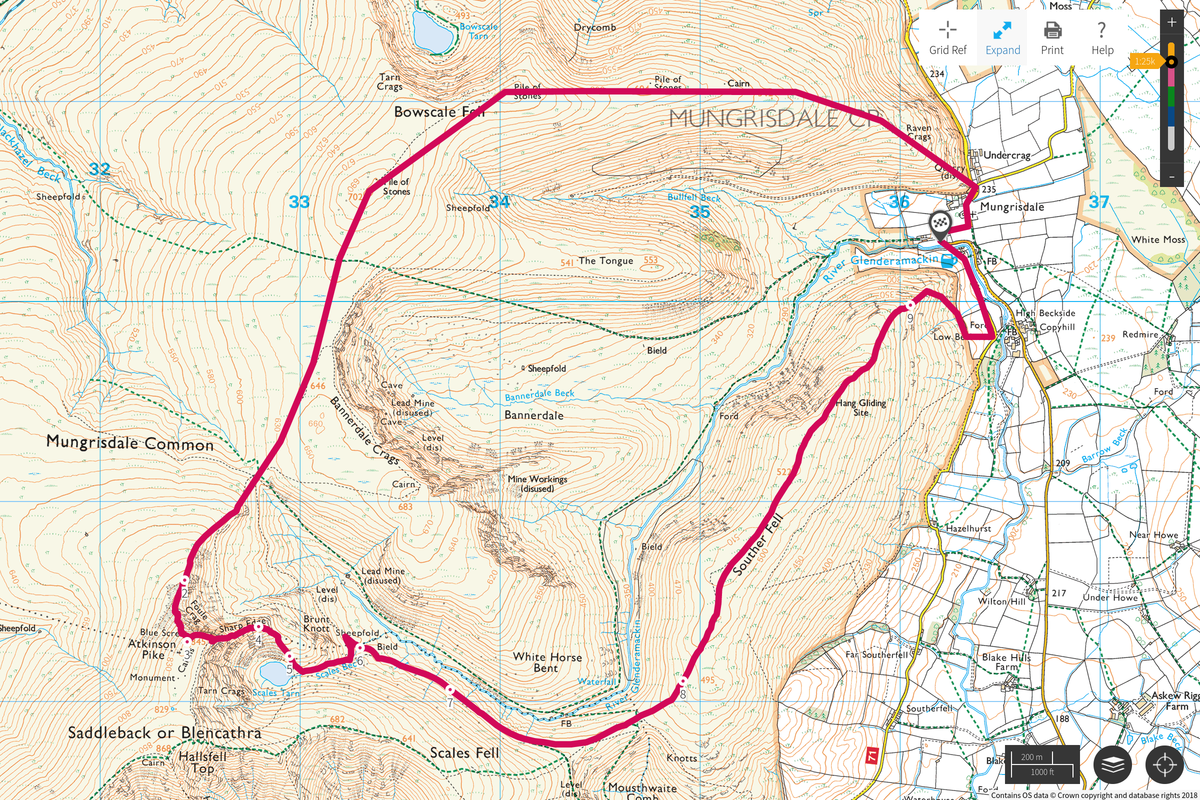
Tom was kind enough to send through some suggested routes from a book he had. I adapted one of these to create this route for our walk on Saturday (QMD 19):

QMD 19 (planned)
QMD 19 (planned)

We left the car near Mungrisdale, and walked clockwise up Souther Fell, and then up to Scales Tarn. Tom fancied a dip, so he stripped down to his underwear and dived in!

Tom swimming in Scales Tarn

After lunch, we walked up the path you can see behind the tarn, up Sharp Edge. Tom enjoys scrambling, and I appreciated the challenge! We made it up though, and in a slight deviation from the original plan, then headed over to Blencathra.

Scrambling up Sharp Edge

It was a pretty straightforward walk from Blencathra over to Bowscale Fell, and then down back to the pub and then to the car.

Foxglove near the end of our steep descent down from Bowscale Fell

The main challenges on this walk were our health. I was struggling a little with my ribs, and Tom hadn’t done much since injuring his knee last year. Although it turned out to be a walk of about six hours, but one which we were just pleased to complete!

QMD 20: Hayeswater Gill, The Knott, and High Street

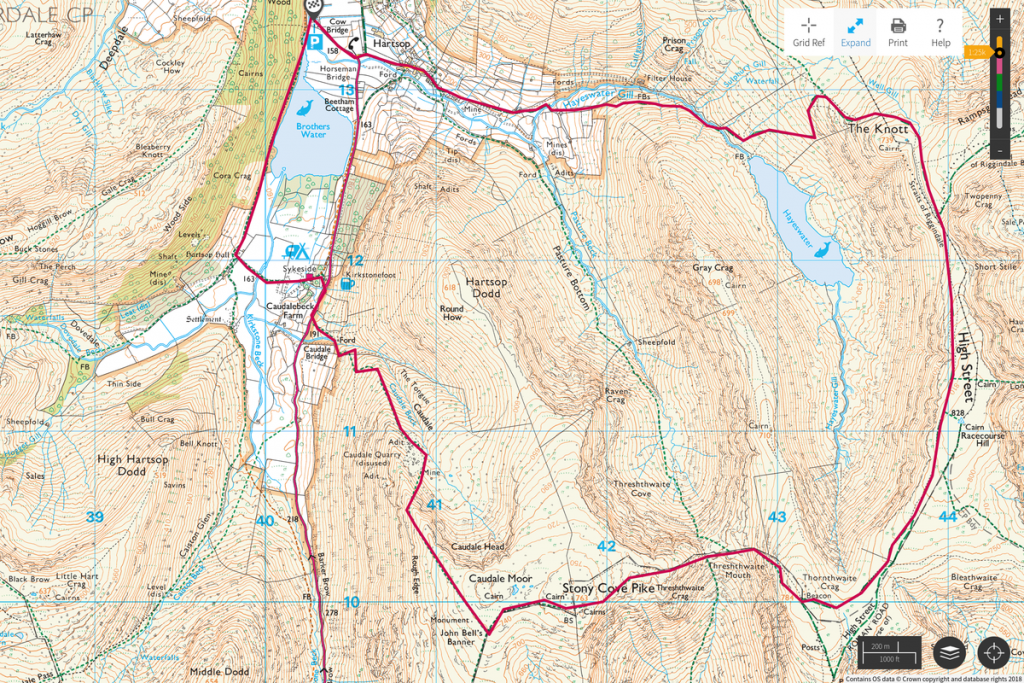
At YHA Patterdale on Saturday night, Tom and I planned out our route for the next day. He was keen to do some scrambling, and we identified a particular one up a waterfall just up from Hartsop that looked interesting.

QMD 20 (planned)

From there, we planned to go up The Knott, and then down High Street and around to Stony Cove Pike.

Given Tom had a booked train to catch, we gave ourselves the option of going down Pasture Bottom instead. In the end, because we spent a good deal of time going up Hayeswater Gill, that’s exactly what we did.

Relaxing in a waterfall pool after scrambling up Hayeswater Gill

The scramble up Hayeswater Gill was challenging in places, and I slipped over once onto my knees, and saw my sunglasses float away down a narrow channel. Thankfully, Tom managed to retrieve them, and it was mainly my pride that was hurt.

Tom convinced me to have a dip in a pool created by a waterfall near the top of Hayeswater Gill. The water was freezing, but the experience nevertheless glorious.

Hayeswater
Hayeswater

The ascent up from Hayeswater up The Knott was pretty steep, but worth it when we got to the top. We then walked across to Thornthwaite Crag where there is a beacon.

Tom at the top of Thornthwaite Crag

We stopped for something to eat, but there were lots of midges about, so we ate quickly and started the steep descent towards Pasture Bottom.

The walk along the river and back to the car was a little bit boggy, but relatively unproblematic. Tom and I talked about life, the world, and… co-ops, actually.

When we got back to the car, I stripped off and had a quick rinse in the river before getting changed. We found a pub, sunk a pint, and headed to Penrith to drop Tom in time for his train. I’d definitely go for a walk with him again, as he was good company, and challenged me to do stuff I wouldn’t have otherwise done!

Next steps

The Mountain Training website lists a number of organisations that run Mountain Leader courses. It’s a six-day course, and it looks like I’ve got a couple of options:

  • All in one go: take a week off work and do six days in one go in a single location
  • Split weekends: do three weekends spread over a few months, in three different locations

The second option is most appealing to me, but can’t make any of the options this year. So it looks like potentially May 2020.

In the meantime, I’ll probably get in some bonus QMDs just in case, and sign up for the Mountain Training Candidate Management System so I can officially log all of the walks I’ve recorded on my blog!