Shared posts

01 Aug 07:10

Smile, you’re on camera!

by Andrea

NPR: The Camera That Went To The Moon And Changed How We See It.

“In the summer of 1962, Walter Schirra — who would soon become America’s third man to orbit the Earth — walked into a Houston photo supply shop looking for a camera he could take into space.

He came out with a Hasselblad 500C, a high-end Swedish import that had been recommended to him by photographers from Life and National Geographic.

“He was sort of an amateur photographer,” Jennifer Levasseur, a curator in charge of the Smithsonian National Air & Space Museum’s astronaut cameras, says of Schirra. “Somewhere along the line, the decision was made that he could select what camera was flown on his flight.””

01 Aug 07:10

“It’s the tiny, gumdrop-shaped vehicle sitting just below the tip” of the rocket

by Andrea

NPR: The Making Of Apollo’s Command Module: 2 Engineers Recall Tragedy And Triumph.

“Look at a picture of the Apollo 11 launch and you’ll probably notice the rocket’s pointed tip and the fire coming from the five giant engines in the first stage of the 36-story-tall Saturn V rocket.

What you might miss is arguably the most important part of the entire thing: the command module.

It’s the tiny, gumdrop-shaped vehicle sitting just below the tip. It holds the astronauts, their clothing, sleeping bags, food and — along with a companion service module — all of the systems needed for a round-trip journey to the moon. It’s also the only piece of the spacecraft to complete the entire trip and splash down back on Earth.
[…]
On their way back, the astronauts sent one final transmission from space.

Collins had this to say: “This operation is somewhat like the periscope of a submarine. All you see is the three of us, but beneath the surface are thousands and thousands of others. And to all of them, I’d like to say thank you very much.””

01 Aug 07:06

Liked Fossil Fuels are Unethical by Peter Rukav...

by Ton Zijlstra
Liked Fossil Fuels are Unethical by Peter RukavinaPeter Rukavina
On July 11, 2019 there was an exchange between the Hon. Peter Bevan-Baker and Hon. Darlene Compton in the Legislative Assembly surrounding a question by Bevan-Baker about government investment from fossil fuels: Government funds divest from fossil fuels A question to the minister: Will the minister ...
01 Aug 06:59

How to Clean Stainless Steel Pans

by Anna Perling
How to Clean Stainless Steel Pans

Let’s say you’re cooking dinner, preheating your stainless steel skillet to sear some lamb chops with briny anchovies and capers. (The link is to The New York Times, Wirecutter’s parent company.) You add oil, wait, and then place the meat in the pan, after which you toss in the rest of your ingredients. Alas, those delicious toppings get a little burnt as the chops cook through, sticking to the pan and leaving a hardened crust of oil behind. Don’t despair: Even seasoned cooks can scorch a pan, whether they’re searing meat at high temperatures or fiddling with a delicate sauce. But cleaning those tough stains isn’t as much of a pain if you have the right gear and supplies. Based on our years of experience cooking at home and in professional kitchens, here are the techniques we use to keep our cookware gleaming.

Basic cleaning for average messes

A skillet with oil stains on a gas burner, with 6 more used skillets on the burner behind it.
Over the years, we’ve cleaned many skillets in our test kitchen. Photo: Michael Hession

Even though stainless steel pans are dishwasher safe, we like to scrub them by hand. That way we can make sure we’re getting all the food off, especially from crevices around the rivets and handle.

To clean a pan, first scrape out excess oil with a spatula or wipe it out with a paper towel, and deglaze the pan by adding some hot water. You can loosen any fond (the browned bits of food) with a long-handled dish brush—we like the OXO Good Grips Dish Brush, which we’ve used in our test kitchen for years. Cleaning a hot pan is easier, and adding hot water won’t damage it, but always let your pan cool down before fully submerging it in cool water; otherwise, the sudden change in temperature (called thermal shock) can cause a still-hot pan to warp.

A side by side comparison of the heavy duty sponges we recommend for cleaning pans and the softer and less-effective Dobie sponge.
A scouring pad like the green Scotch-Brite will remove gunk faster than a softer Dobie sponge; you’ll mark up your pans when cooking regardless. Photo: Sarah Kobos

Once you’ve broken up all of the food bits in your dirty pan, grab a green Scotch-Brite scouring pad or sponge, along with some dish soap, and scrub the inside and outside of the pan using a continuous circular motion. Rinse and then dry with a clean, absorbent towel. A Scotch-Brite pad will lightly scratch the surface of the pan, but as long as you avoid harsh pads such as steel wool, it won’t affect your cookware’s performance or lifespan. A softer sponge like a Dobie pad won’t leave scratches but takes more elbow grease, and it won’t save your cookware from getting marked up by metal utensils anyway.

Three methods for cleaning tough stains

A person pouring baking soda into a stained skillet resting at the bottom of a sink.
When we need a cleaner that’s tougher than soap, we opt for affordable, lightly abrasive baking soda. Photo: Sarah Kobos

If your pan is hot enough, you shouldn’t need to use much muscle to clean off regular messes. But if stuff isn’t coming off, or you’re dealing with a firmly baked-on layer of oil, here are three approaches for cleaning scorched pans, depending on how seriously burnt they are.

For all of these methods, you need more than just soap. Abrasive cleaners such as Bon Ami, Bar Keepers Friend, or plain baking soda can help remove caked-on food, blackened stains, or baked-on oil. We prefer baking soda because it’s cheap and easy to find. Just avoid harsh chemicals like oven cleaner, which may be a tempting quick fix but can cause permanent damage. Jolie Kerr, a cleaning expert and host of the podcast Ask a Clean Person, told us, “The idea behind using oven cleaner on pans is basically that it’s very good at removing burnt-on food (in the way that it’s good at cleaning the grates in your oven) but the problem is that it can remove coatings, especially on non-stick pans.” Although light scratches from a scouring pad won’t change your pan’s performance, strongly basic cleaners such as oven cleaner or bleach can etch pans more deeply, according to Scott Misture, professor of materials science and engineering at Alfred University. Not only will this permanently damage your cookware, but food can get also stuck in the resulting pits or crevices, making pans even harder to clean in the future.

And no matter what abrasive cleaner you choose, always wash with soap and water after scrubbing down your pans. Cleaners can streak, so make sure to rinse pans well and dry them with a clean towel.

The simplest method: Baking soda and elbow grease

A person in yellow kitchen gloves scrubbing a stained skillet with a heavy duty sponge.
To create a slurry, add some water to a generous pour of baking soda. Photo: Sarah Kobos

It’s always easier to clean a scorched pan as soon as possible after cooking. To remove cooked-on oil or burnt food when dish soap and scrubbing aren’t cutting it, create a slurry of water and baking soda or another powdered cleaner in the bottom of the pan. Don’t be afraid to be generous with the baking soda. Let the mixture sit for a few minutes, and then scrub it off with a scouring pad (preferably a new one with a fresh, unworn scrubby side). If the stains won’t come off, you can repeat these steps and let the paste sit for longer, even overnight.

An extra step for bigger stains: Boil the baking soda first

A stained skillet with a coating of baking soda paste resting on a gas burner.
Longtime Martha Stewart test kitchen manager Geri Porter recommends boiling baking soda and water until the mixture evaporates, and then scrubbing the film off. Photo: Sarah Kobos

For bigger, tougher stains that climb up the sides of a saucepan or skillet, Geri Porter, the longtime kitchen manager for Martha Stewart, suggested the following method: Add a small mound of baking soda to the center of a pan, cover with about ¼ cup water (you might need more for a bigger pan), and bring to a boil. As the water boils and evaporates, it will leave a film of baking soda around the walls of the pan that you can then scrub off. When most of the water has boiled off, turn off the heat and use a long-handled brush or scouring pad to scrub off your mess (again, new pads will work better). It’s best to do this while the pan is still hot, so it may help to use gloves and grip the pan with a towel or oven mitt. We’ve had success with this method for freshly scorched pans, but it isn’t as effective for boiling off years of grime.

A more involved method for years of grime: Boil the whole pan with baking soda

A person in gloves gingerly lowering a stained skillet into a large stock pot of boiling water.
Submerge your pans into your vessel of water very carefully. We used tongs, a step stool, and silicone oven mitts, but the process was worth it for the amazing results. Photo: Sarah Kobos

To truly banish all scorch marks—even years of baked-on oil—with the least amount of scrubbing, we turn to Wirecutter kitchen writer Michael Sullivan’s method. He fully submerges his dingiest pans in a pot of boiling water and baking soda to boil the stains off. Although it’s a little awkward to wrangle a large metal object from a pot of steaming water, the results are magical. With minimal scrubbing, our pans were gleaming—even a formerly blackened 10-year old All-Clad skillet.

  • cleaningsaucepan-lowres-8600

    After boiling with baking soda, it’s an extreme pan makeover, and ours look like new. Photo: Sarah Kobos

  • cleaningsaucepan-lowres-8488

    Years of cooked-on oil can make pans look dingy and old—a far cry from their original shine. Photo: Sarah Kobos

  • cleaningsaucepan-lowres-8600

    After boiling with baking soda, it’s an extreme pan makeover, and ours look like new. Photo: Sarah Kobos

  • cleaningsaucepan-lowres-8488

    Years of cooked-on oil can make pans look dingy and old—a far cry from their original shine. Photo: Sarah Kobos

1 of 2

To start, you need to choose a vessel that will fit your pan. We’ve used a large stock pot for small skillets and a roasting pan for larger ones. Fill whatever you’re using with enough water to submerge (or mostly submerge) your pan, and bring it to a boil. If you’re using a large roasting pan, you can arrange it over two burners on the stovetop. Add a hearty pour of baking soda (about ¼ cup or ½ cup) and carefully place your pan in the water. Reduce the water to a gentle boil, and let the pan cook for about 15 to 30 minutes, flipping or rotating it if necessary so that all the sides are boiled. You should start to see brown residue flaking off.

A person using a toothpick to scrape at burnt on residue around the handle of a skillet.
Even after boiling, you may need to pry gunk out of a pan’s nooks and crannies. But it should come off easily with the help of a toothpick. Photo: Sarah Kobos

Remove the pans carefully (we used tongs and silicone oven mitts). Then add more baking soda and water to the pan to create an abrasive slurry to help break down the rest of the stains, and scrub quickly while the pan is hot. You can hold on to the pan with a towel. To truly scrape off every last bit of gunk, go at the rivets with a toothpick or a cheap paring knife.

How to keep food from sticking and scorching

A stack of shining and clean stainless steel cookware resting on top of a gas burner.
Good-quality tri-ply cookware (like this Tramontina set, the top pick in our guide to cookware sets), is less likely to accidentally scorch your food. Photo: Michael Hession

Although our techniques make cleaning easier, it’s even better to avoid those stubborn messes in the first place. You can prevent most stains at the outset by using good equipment and the right cooking methods. It’s important to use fully clad tri-ply pans (such as our favorite skillet, saucepan, or cookware set) that heat evenly, to avoid scorching. Tri-ply pans are made of three layers: an aluminum core sandwiched between stainless steel. Steel holds heat better and is what makes the cookware durable, but aluminum conducts heat more evenly and helps prevent hot spots. Fully clad pans, which have the aluminum layer extending throughout, are also less likely to scorch on the sides than pans with an encapsulated bottom, which have only an aluminum disk in their base.

Good cooking techniques can also prevent stuck-on food and make cleaning easier later on. Preheating a pan, and then preheating your cooking fat, are the keys to success. As Serious Eats explains, proteins from raw meat will bond to metal and stick when they hit a pan. But if you get your pan and oil hot enough, your meat can cook in that layer of oil before it goes through to touch the pan. Harold McGee, author of several books on food and science including On Food and Cooking, advises heating your pan first and then adding oil. The oil will start to break down the longer it sits in a hot pan, which can make it sticky. Look at the oil to judge its temperature: If it’s shimmering, it’s hot, and you’re ready to toss in your ingredients.

Also be sure to pat meat or fish dry so that as soon as it goes into a hot pan, it starts to sear. Otherwise, you’ll be cooking a layer of moisture before the meat itself. If foods are wet, they can’t heat beyond the boiling point of water, so they won’t get hot enough to cause a maillard reaction—that crispy, tasty browning you’re going for when you cook over high heat.

To avoid scalding dairy, on the other hand, you can add a layer of water. If you’re heating milk in a saucepan for cocoa or custards, try this trick from Melissa Clark’s homemade yogurt recipe (subscription required): Rub the pot with an ice cube or rinse it with water before adding the milk. This step forms a layer of water that makes it harder for the dairy proteins to form bonds with the metal of the pan.

Sources

1. Jolie Kerr, cleaning expert and host of Ask a Clean Person, email interview, May 9, 2018

2. Scott Misture, professor of materials science and engineering at Alfred University, email interview, May 10, 2018

3. Geri Porter, kitchen manager at Martha Stewart, in-person interview, 2015

4. Harold McGee on When to Put Oil in a Pan, The New York Times, August 6, 2008

5. J. Kenji López-Alt, Ask the Food Lab: Do I Need To Preheat My Oil?, Serious Eats, August 10, 2018

01 Aug 06:58

Recommended on Medium: My thoughts on the Fluid Fan and how we can re-capture them.

Sports Innovation Lab recently put out an article defining the new age of fans to be the “Fluid Fan”.

I thought it was an amazing study and understanding of where we are with our fans and how they consume. Great job by Sports Innovation Labs.

What is interesting is about 4 years ago when on a call with the Dallas Cowboys they actually brought this phenomenon up in a call. They had a different name for it. It was the Dez Bryant Effect.

They started seeing the fact fans were not necessarily a fan of the Cowboys, but of Dez Bryant.

The problem obviously becomes when Dex Bryant leaves the team, the fan follows Dez.

You can come up with a lot of explanations for why this is happening, and this is my opinion after being in sports for the last 5 years and being a fan all my life.

First an understanding of why we are sports fans, in my opinion, curated by my grandfather

My grandfather was a sportswriter in the 50’s and 60’s seeing numerous amounts of great sports games.

He used to me that we as fans don’t fall in love with teams, or even players, what we first fall in love with are the moments that sports give us.

He said that any fan can track their fandom back to a team from a single moment in time.

For me and the Raiders, it was in 2000 when I was 10 years old at Candlestick Park.

It’s OT vs. the most hated Raider rival if you grew up a Raiders fan in the Bay Area, the 49ers.

Why? Because you had to deal with 49ers fans the next day in school.

https://medium.com/media/cbc0f5c8aee20407dee8673cb5ad7c5c/href

In overtime, Rich Gannon tosses a beautiful pass to Tim Brown on a wheel route. Game over. Raiders win. Euphoria for any Raiders fan in the stadium, which I was.

I was kind of a Raider fan back then, but this moment is the genesis of why I am CRAZY about the Raiders.

Back then the Raiders owned this storyline. There was no mobile phone for re-runs. No social media to talk about it. If you wanted to see the highlights you turned on ESPN and watched.

The Raiders and the NFL owned this storyline.

Today, they don’t own it.

This is why Fluid Fan though, in my mind, is 100% our fault in sports.

We as sports organizations did a terrible job at understanding where attention was shifting and adjusting to own our storylines.

When social media, youtube, and other channels came out we fought them at first. Mainly because of fear it would hurt the old way we made revenue.

When there is a shift, there is an opportunity. Athletes, brands like Bleacher Report, and other entities understood that they could own this storyline and grab that attention.

The reason why fans aren’t loyal to the team is they weren’t the first one to take fans to that first moment. Today we consume a lot of those moments on social from athletes and other entities.

In essence, we were to slow to the draw, we didn’t adjust fast enough.

But it isn’t too late, we can gain that fan back

Today we offer these items. We show the behind the scenes content that only we as teams can offer. We use social to connect with fans because we understand that is where the attention is.

To get them back though, we need to double down here. We need to push into full digital connection and understand where our fans consume.

It’s on Facebook, Instagram, Snapchat, and will be on Tik Tok.

I would argue that this needs to be the most important thing in our teams that we spend our time on. Nothing else matters to us.

If you don’t have a pre-game Snapchat show for your team, then you aren’t committed to reaching the Fluid Fan.

If you aren’t posting your highlights to Facebook Watch, you aren’t committed to reaching the Fluid Fan.

To change this narrative we must change our strategies for reaching these fans. Not sort of changing our strategy, 100% shift in how we do things, with no worries of how it will affect our legacy profit.

We need to own our moments, our stories as teams through digital outlets that our fans consume on.

Building this loyalty from understanding where attention is will help us grow our revenue.

The fan is our leverage in sports. We sell tickets to them, merchandise, and leverage their captivation for sponsorship.

Losing the Fluid Fan costs us dollars.

If you need a history lesson just look at Netflix and Blockbuster. Toys R’ Us & Amazon. These companies failed to adjust, failed to gain revenue, and eventually failed.

The reason why understanding the Fluid Fan is so important is because the fan is our customer. We can’t fail them by not adjusting.

I talk a lot about this shift in sponsorship with digital advertising growth and teams not adjusting. And I watch as the teams who don’t adjust lose money to Facebook ads.

If we can capture them back, own our story on the platforms they consume on. If we fundamentally shift how we reach them. We will win them back.

Hell DJ Khaled did it through Snapchat by being lost at sea.

I think we can grab our fans back with the content we have in sports as long as we understand where our fans consume.

Overall, we need to adjust with fan attention to gain them back

My grandfather used to say it was his job to tell the story of those moments we fell in love with through the best means he had, which was newspapers at the time.

Back then, this is where attention was. Yes, there was TV, but the main way to consume sports was through the newspapers.

It is now our job to adjust to where the attention is. To gain back the attention and ultimately the trust that we understand how they want to consume, we need to reach them on their ways of consuming.

The Fluid Fan can become fluid in the moments they love, not the teams they are loyal to, if we change the way we own those stories and distribute them.

Will we change? Probably more importantly will we change in time?

That is up to us as teams and sports organizations.

Written by Nick Lawson, co-founder of SQWAD. SQWAD helps sports teams and events connect fans to sponsors digitally and drive sponsorship revenue with digital games & contests.


My thoughts on the Fluid Fan and how we can re-capture them. was originally published in SQWAD Blog on Medium, where people are continuing the conversation by highlighting and responding to this story.

01 Aug 06:47

Are we done with the profanities in book titles yet?

by Josh Bernoff

Without Bullshit here, analyzing why so many book titles now have obscene words in them. Get your hypocrisy giggles out of the way, first. This is a serious analysis. If curse words offend you, don’t read on. (If that really is you, how did you even get here?) Take a look at any bestseller list. … Continued

The post Are we done with the profanities in book titles yet? appeared first on without bullshit.

01 Aug 06:47

The Algorithmic Colonization of Africa

by Abeba Birhane

The second annual CyFyAfrica 2019 — the Conference on Technology, Innovation, and Society — took place in Tangier, Morocco, in June. It was a vibrant, diverse and dynamic gathering attended by various policymakers, UN delegates, ministers, governments, diplomats, media, tech company representatives, and academics from over 65 nations, mostly African and Asian countries. The conference’s central aim, stated unapologetically, was to bring forth the continent’s voices in the global discourse. The president of Observer Research Foundation (one of the co-hosts of the conference) in their opening message emphasized that the voices of Africa’s youth need to be put front and center as the continent increasingly comes to rely on technology to address its social, educational, health, economic, and financial issues. The conference was intended in part to provide a platform for those young people, and they were afforded that opportunity, along with many Western scholars from various universities and tech developers from industrial and commercial sectors.

Tech advocates typically offer rationales for attempting to digitize every aspect of life, at any cost

The African equivalent of Silicon Valley’s tech startups can be found in any corner of the continent — “Sheba Valley” in Addis Ababa, “Yabacon Valley” in Lagos, and “Silicon Savannah” in Nairobi, to name a few — and are pursuing “cutting-edge innovations” in such sectors as banking, finance, heath care, and education. The continent does stand to benefit from these various technological and artificial-intelligence developments: Ethiopian farmers, for example, can use crowdsourced data to forecast and yield better crops. And data can help improve services within education and the health care sector, as this World Heath Organization bulletin details. Data can help bridge the huge inequalities that plague every social, political, and economical sphere. By revealing pervasive gender disparities in key positions, for instance, data can help bring the disparities to the fore and, further, support social and structural reforms.

Having said that, however, this is not what I want to discuss here. There are already countless die-hard technology worshipers both within and outside the continent who are only too happy to blindly adopt anything “AI,” “smart,” or “data-driven” without a second thought of the possible unintended consequences. Wherever the topic of technological innovation arises, what we typically find is tech advocates offering rationales for attempting to digitize every aspect of life, often at any cost. If the views put forward by many of the participants at CyFyAfrica 2019 are anything to go by, we already have plenty of such tech evangelists in (and outside) Africa, blindly accepting ethically suspect and dangerous practices and applications under the banner of  “innovative,” “disruptive,” and “game changing” with little, if any, criticism or skepticism. Look no further than the speaker lineups and the topics of discussion of some of the biggest AI or machine learning conferences taking place throughout the continent: Ethical considerations, data privacy, or AI’s unintended consequences hardly ever feature in these events. The upcoming Deep Learning Indaba conference in Nairobi is a typical example.

Given that we have enough tech worshipers holding the technological future of the continent in their hands, it is important to point out the cautions that need to be taken and the lessons that need to be learned from other parts of the world. Africa need not go through its own disastrous cautionary tales to discover the dark side of digitization and technologization of every aspect of life.

Data and AI seem to provide quick solutions to complex social problems. And this is exactly where problems arise. Around the world, AI technologies are gradually being integrated into decision-making processes in such areas as insurance, mobile banking, health care and education services. And from all around the African continent, various startups are emerging — e.g. Printivo in Nigeria, Mydawa in Kenya — with the aim of developing the next “cutting edge” app, tool, or system. They collect as much data as possible to analyze, infer and deduce the various behaviors and habits of “users.”

But in the race to build the latest hiring app or state-of-the-art mobile banking system, startups and companies lose sight of the people behind each data point. “Data” is treated as something that is up for grabs, something that uncontestedly belongs to tech companies and governments, completely erasing individuals. This makes it easy to “manipulate behavior” or “nudge” people, often toward profitable outcomes for the companies and not the individuals. As “nudging” mechanisms become the norm for “correcting” individual’s behavior, whether its eating habits or exercising routines, the private-sector engineers developing automated systems are bestowed with the power to decide what “correct” is. In the process, individuals that do not fit stereotypical images of what, for example, a “fit body” or “good eating habits” are end up being punished and pushed further to the margin. The rights of the individual, the long-term social impacts of these systems, and their consequences, intended or unintended, on the most vulnerable are pushed aside — if they ever enter the discussion at all.


AI, like big data, is a buzzword that gets thrown around carelessly; what it refers to is notoriously contested across various disciplines, and the term is impossible to define conclusively. It can refer to anything from highly overhyped deceitful robots to Facebook’s machine-learning algorithms that dictate what you see on your News Feed to your “smart” fridge. Both researchers in the field and reporters in the media contribute to overhyping and exaggerating AI’s capacities, often attributing it with god-like power. But as leading AI scholars such as Melanie Mitchell have emphasized, we are far from “superintelligence.” Similarly, Jeff Bigham notes that in many widely discussed “autonomous” systems — be it robots or speech-recognition algorithms — much of the work is done by humans, often for little pay.

Exaggeration of the capabilities of AI systems diverts attention from the real dangers they pose, which are much more invisible, nuanced, and gradual than anything like “killer robots.” AI tools are often presented as objective and value-free. In fact, some automated systems used for hiring and policing are put forward with the explicit claim that these tools eliminate human bias. Automated systems, after all, apply the same rules to everybody. But this is one of the single-most erroneous and harmful misconceptions about automated systems. As the Harvard mathematician Cathy O’Neil explains in Weapons of Math Destruction, “algorithms are opinions embedded in code.” Under the guise of “AI” and “data-driven,” systems are presented as politically neutral, but because of the inherently political nature of the way data is construed, collected, and used to produce certain outcomes (that align with those controlling and analyzing data), these systems alter the social fabric, reinforce societal stereotypes, and further disadvantage those already at the bottom of the social hierarchy.

“Data” is treated as something that is up for grabs

AI is a tool that we create, control, and are responsible for, and like any other tool, it embeds and reflects our inconsistencies, limitations, biases, and political and emotional desires. How we see the world and how we choose to represent it is reflected in the algorithmic models of the world that we build. Therefore who builds the systems and selects the sorts and sources of data used will deeply affect the influence they may have. The results that AI systems produce reflect socially and culturally held stereotypes, not objective truths.

The use of technology within the social sphere often, intentionally or accidentally, focuses on punitive practices, whether it is to predict who will commit the next crime or who would fail to pay their mortgage. Constructive and rehabilitative questions such as why people commit crimes in the first place or what can be done to rehabilitate and support those that have come out of prison are almost never asked. Technological developments built and applied with the aim of bringing “security” and “order” often aim to punish and not rehabilitate. Furthermore, such technologies necessarily bring cruel, discriminatory, and inhumane practices to some. The cruel treatment of the Uighurs in China and the unfair disadvantaging of the poor are examples in this regard. Similarly, as cities like Johannesburg and Kampala introduce the use of facial recognition technology, the unfair discrimination and over-policing of minority groups is inevitable.

Whether explicitly acknowledged or not, the central aim of commercial companies developing AI is not to rectify bias generally but to infer the weaknesses and deficiencies of individual “users,” as if people existed only as objects to be manipulated. These firms take it for granted that such “data” automatically belongs to them if they are able to grab it. The discourse around “data mining” and a “data-rich continent” — common language within Africa’s tech scene — shows the extent to which the individual behind each data point remains inconsequential from their perspective.

This discourse of “mining” people for data is reminiscent of the colonizer attitude that declares humans as raw material free for the taking. As we hand decision-making regarding social issues over to automated systems developed by profit-driven corporations, not only are we allowing our social concerns to be dictated by corporate incentives (profit), but we are also handing over complex moral questions to the corporate world.

Behavior-based “personalization” — in other words, the extraction, simplification, and instrumentalization of human experience for capitalist ends, which Shoshana Zuboff details in The Age of Surveillance Capitalism — may seem banal compared with the science fiction threats sometimes associated with AI. However, it is the basis by which people are stripped of their autonomy and are treated as mere raw data for processing. The inferences that algorithmic models of behavior make do not reflect a neutral state of the world or offer any in-depth causal explanations but instead reinscribe strongly held social and historical injustices.


Technology in general is never either neutral or objective; it is a mirror that reflects societal bias, unfairness, and injustice. For example, during the conference, a UN delegate addressed work that is being developed to combat online counterterrorism but disappointingly focused explicitly on Islamic groups, portraying an unrealistic and harmful image of online terrorism: over the past nine years, there have been 350 white extremist terrorism attacks in Europe, Australia, and North America; one third of all such attacks in this time period in the U.S. are due to white extremism. This illustrates the worrying point that stereotypically held views drive what is perceived as a problem and the types of technology we develop in response. We then hold what we find through the looking glass of technology as evidence of our biased intuitions and further reinforce stereotypes.

Some key global players in technology — for example, Microsoft and Google’s DeepMind from the industry sector; and Harvard and MIT from the academic sphere — have begun to develop ethics boards and ethics curricula in acknowledgment of the possible catastrophic consequences of AI on society. Various approaches and directions have been advanced by various stakeholders to pursue fair and ethical AI, and this multiplicity of perspectives is not a weakness but a strength: It is necessary for yielding a range of remedies to address the various ethical, social, and economical issues AI generates in different contexts and cultures. But too often, attempts to draft the latest “ethics framework” or the “best guideline to ethical AI” center the status quo as the standard and imply that the solution put forward is the only necessary one. Insisting on a single one-size-fits-all ethical framework for AI, as one of the conference’s academic speakers advised, is not only unattainable but would also worsen the problems it is meant to address in those contexts it wasn’t equipped to anticipate.

“Mining” people for data is reminiscent of the colonizer attitude that declares humans as raw material

Society’s most vulnerable are disproportionally affected by the digitization of various services. Yet many of the ethical principles applied to AI are firmly utilitarian. What they care about is “the greatest happiness for the greatest number of people,” which by definition means that solutions that center minorities are never sought. Even when unfairness and discrimination in algorithmic decision-making processes are brought to the fore — for instance, upon discovering that women have been systematically excluded from entering the tech industry, minorities forced into inhumane treatment, and systematic biases have been embedded in predictive policing systems, to mention a few — the “solutions” sought hardly center those on the margin that are disproportionally affected: Mitigating proposals devised by corporate and academic ethics boards are often developed without the consultation and involvement of the people that are affected. But their voice needs to be prioritized at every step of the way, including in the designing, developing, and implementing of any technology, as well as in policymaking. This requires actually consulting and involving vulnerable groups of society, which might (at least as far as the West’s Silicon Valley is concerned) seem beneath the “all-knowing” engineers who seek to unilaterally provide a “technical fix” for any complex social problem.

As Africa grapples with catching up with the latest technological developments, it must also protect the continent’s most vulnerable people from the consequential harm that technology can cause. Protecting and respecting the rights, freedoms and privacy of the very youth that the leaders of the CyFyAfrica conference want to put at the front and center should be prioritized. This can only happen with guidelines and safeguards for individual rights and freedom in place in a manner that accounts for local values, contexts and ways of life, as well as through the inclusion of critical voices as an important part of the tech narrative. In fairness, CyFyAfrica did allow for some critical voices in some of the panels. However, the minor critical voices were buried under the overwhelming tech enthusiasts.

Following the conference, speakers were given the opportunity to share their views and research for publication in a semi-academic journal run by the Observer Research Foundation. Like other speakers at the conference, I was encouraged to submit my observations and reflections. However, when I submitted a version of this essay, it was deemed too critical by the editorial board and therefore unsuitable for publication. Ironically, the platform that claims to give voice to the youth of Africa only does so when that voice aligns with the narratives and motives of the powerful tech companies, policy makers, and governments.

The question of technologization and digitalization of the continent is a question of what kind of society we want to live in. African youth solving their own problems means deciding what we want to amplify and show the rest of the world. It also means not importing the latest state-of-the-art machine learning systems or any other AI tools without questioning what the underlying purpose is, who benefits, and who might be disadvantaged by the implementation of such tools.

Moreover, African youth leading the AI space means creating programs and databases that serve various local communities and not blindly importing Western AI systems founded upon individualistic and capitalist drives. It also means scrutinizing the systems we ourselves develop and setting ethical standards that serve specific purposes instead of accepting Western perspectives as the standard. In a continent where much of the narrative is hindered by negative images such as migration, drought, and poverty, using AI to solve our problems ourselves means using AI in a way we want, to understand who we are and how we want to be understood and perceived: a continent where community values triumph and nobody is left behind.

01 Aug 06:46

The Problem With Software: Why Smart Engineers Write Bad Code

This book works to explain why software doesn't work better — why software makes mistakes and why it remains vulnerable to attack. I’ll take up the book’s argument in a later post. First, I want to set the scene: software is hard because the world is complicated. Even the easiest things turn out to be very tricky when you examine them closely.

Suppose you’re writing a program one day, and you need to store people’s names. That’s easy enough, right?

  • In the old days, you’d allocate two chunks of memory that would be sufficient to hold the first name and the last name. That’s how Storyspace 1 worked, and Lotus Agenda, and lots more. “Big enough” is never really big enough; just ask the fellow who was asked to sew Jarrod Saltalamacchia’s name on the back of his baseball uniform.
  • OK: we don’t do that anymore. We have variable-length strings. First name, last name, we’re done, right! That’ll work for a bunch of names in the US, anyway.
  • Of course, lots of people have middle names. So add them to the first name. Except that sometimes people are known by a middle name. So “first name” is a bunch of names.
  • In China (and lots of other places), the family name comes first, not second. So “last name” isn’t right, either.
  • But everyone knows that Americans get confused by Chinese names, and sometimes people helpfully invert them for you so you'll get them right. But then you might invert them again, and…
  • In Iceland and in Korea, some family names are very common. So, the key for your index needs to be the first name.
  • Some people don’t use a family name at all: Beyoncé, Madonna, Prince. See also UN Secretary General U Thant — the “U” is an honorific.
  • Honorifics come first, except sometimes (e.g. Japan) they come last.
  • It’s not unusual for several people to have identical, or nearly identical, names. There are two notable computer scientists named Catherine C. Marshall. There’s a whole bundle of other Mark Bernsteins.
  • Quick: what is the last name of the great historian G. E. M. de Ste. Croix?
  • Even if the last name comes last, there might be important stuff that comes after the last name. Jr., for example, or III.
  • Even if the first name comes first, there might be important stuff that comes before the first name. Dr., or Brig. Gen., or Sir.
  • You might think that there’s be only one prefix. Let me introduce you to Prof. Dr. Dr. N. Deutschlander.
  • Lots of people change their names.
  • Sometimes, people use different names. If you're a director and you hate what the studio has done to your film, you couldn’t simply take your name off the monstrosity because the union wouldn’t let you. So you were credited at Alan Smithee.
  • Some people have different names at work and at home. Some people have different names on their work, names they don’t use on their checks.

Patrick McKenzie wrote a classic note on Falsehoods Programmers Believe About Names, because it turns out that “Patrick McKenzie” is a really tricky name to write in Japanese. (If you’re a global enterprise, you’d better be prepared to cope with names in Japanese, Urdu, and Klingon.) Here’s the classic Falsehoods Programmers Believe About Time; you’d be amazed at how many of these have actually arisen when working on Tinderbox. On GitHub, there’s even a curated list of lists of falsehoods.

Lots of these falsehoods are obvious once you see them, but they’re seldom obvious when you’re starting out — especially when you're just recording these names as one easy step toward solving a really difficult problem. So, you're focussing on getting really fast response times or compacting the index into a really tiny amount of memory or on the transitive closure of the social graph, not on esoterica about names. And if you did think deeply about the esoterica, you’d never get anything done in the first place.

It’s a mad, mad world.

01 Aug 06:45

“[Being an astronaut is] a very special mantle to wear. I feel very privileged.”

by Andrea

NPR: Seeing Apollo Through The Eyes Of Astronauts. “Fifty years ago, two astronauts became the first humans to set foot on the moon. Like many explorers, they documented their accomplishment in photographs. The images they took are some of the most enduring of the 20th century, traveling from Life magazine to MTV to Twitter.

For most of us, the photos brought back by Apollo 11 are iconic and a little difficult to comprehend. But for astronauts, they represent something more: hours of training, risks taken and the many people on the ground who worked to make the journey possible.

NPR spoke to five former NASA astronauts who flew on space missions to learn how they see these photos.”

01 Aug 06:45

Blix Rider Story: Alex Changes his Daily Commute

by Sabrina Hockett

Alex decided it was time to switch up his daily commute. Living in a hilly area, he was unsure if an ordinary bike would be the best option. So, Alex dove into the ebike world head-first and found that his Blix Aveny high-step exceeded his expectations. Below, Alex shares his experience commuting daily on his Blix!


Making the transition from commuting by car to commuting by bike can be difficult, especially when multiple hills are scattered along the ride. However, as Alex found, an electric bike makes it easy. "This bike takes care of the hills no problem! I don't even turn the pedal assist to a higher level than 2 because any higher and I fly up the hills even faster than I want to."  Pedal assist is really helpful for riders during hilly terrain as it allows them to ride at a constant and faster pace uphill compared to a traditional bike.

Alex definitely enjoys the Blix pedal assist as well as the overall design and structure of the Aveny High step."The ride is incredibly smooth, the construction is solid and beautiful." Alex also mentions how his friends and strangers will ask about the bike and are always shocked to learn that it is electric. Additionally, the price point of the Blix bikes adds to the attractiveness of the ebike. "Blix is making this bike an outlier by offering something so high-quality at such a competitive price point. I didn't find anything that looked comparable in quality at less than double the cost of this bike."

In addition to changing his daily commute, Alex has found a new enjoyment for bike riding with his Blix. "It's so much fun to ride! I think cruising uphill with pedal assist during a blue sky sunny day will always put a smile on my face!"


 A big thank you to Alex for sharing his Blix story!

If you would like to share your experience click here! 
Follow Us for More Great Stories!
01 Aug 06:44

Unhappy Infill

by Gordon Price

For some years now, the City has been approving the replacement of small plazas, originally incorporated into the design of downtown office buildings and open to the public, with infill development.  Now those projects are underway – notably at Hastings and Seymour, and here at Dunsmuir and Homer, which in 2009 looked like this:

The two-storey pavilion and surrounding plaza were part of 401 West Georgia, and were never much used.  Shadowed, windy, and even though windowed, presented a blank, bland facade to the street.  But the empty space at least gave breathing room for the adjacent Holy Rosary Cathedral.

Here’s what that looked like until recently, from the view at Richards and Dunsmuir:

Now that the infill building replacing the pavilion and plaza is almost complete, here’s the view a few weeks ago:

I suspect the architects thought they were being respectful while providing street continuity in this fast-changing part of east Dunsmuir.  But the result is a crowded cathedral and more blank glass walls.  There’s not even a chamfered corner that would have acknowledged the church.

We’ll hold final judgement until the ground-level frontage is complete.  But even though the original plaza will not be missed, the setback and breathing room for the cathedral most certainly will.

01 Aug 06:44

The rich are killing the planet

Hi, this is Simon, I am a software engineer at Datawrapper. For this week’s edition of the weekly chart, I took a look at carbon dioxide emissions around the world.

The climate crisis is driven by consumption. The more we spend, the more we contribute to global warming. In a much-quoted report from 2015, Oxfam pointed out that the richest 10 percent of the world’s population is responsible for half of humanity’s carbon emissions. When I first read this back in 2015, it seemed so clear to me: The rich are killing the planet. With their private jets and giant mansions, their gas-guzzling luxury cars and outrageous lifestyles, they destroy our children’s future.

But the truth is much more inconvenient. I am actually part of the richest 10 percent myself, and if you live in Western Europe or the United States, chances are extremely high you are too. We are the privileged few that account for half of the world’s carbon emissions. The climate is in crisis because we drive cars and eat too much meat and dairy. It is in crisis because we buy too many clothes and electronics, and because of our holiday trips to Thailand or the Bahamas.

Different ways to look at the emission curve

Two weeks ago, my colleague Gregor made a series of charts that visualize the world’s ever-increasing carbon dioxide emissions: The only chart we should be looking at. Gregor’s post has an important message and does an amazing job of bringing it across. If you haven’t read it yet, you should do it right now. But there’s one thing I thought was missing, and that’s a breakdown by population.

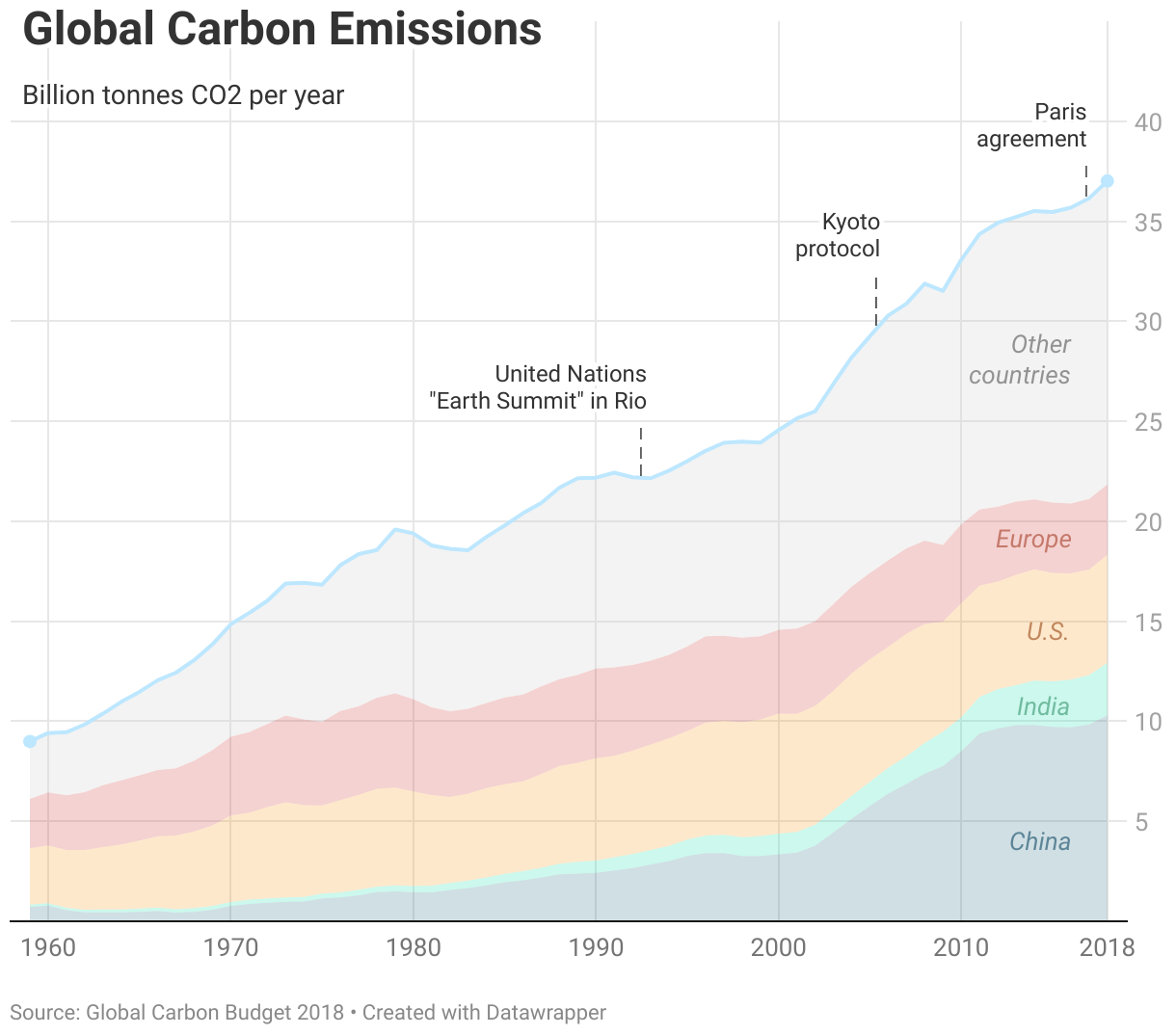
The following area chart is taken directly from Gregor’s post. It shows a dramatic increase in emissions for China, while emissions for Europe and the US are slightly decreasing.

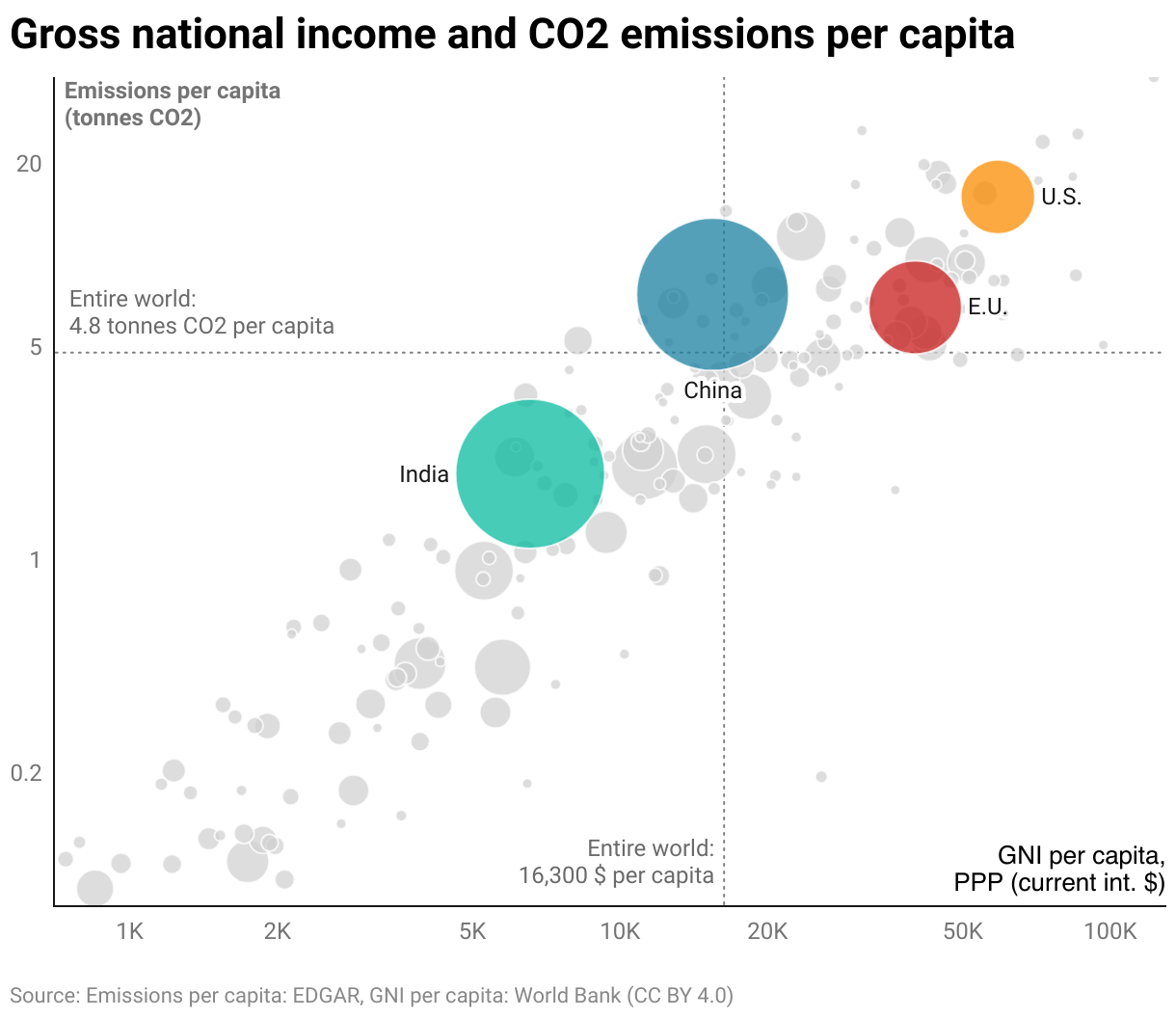
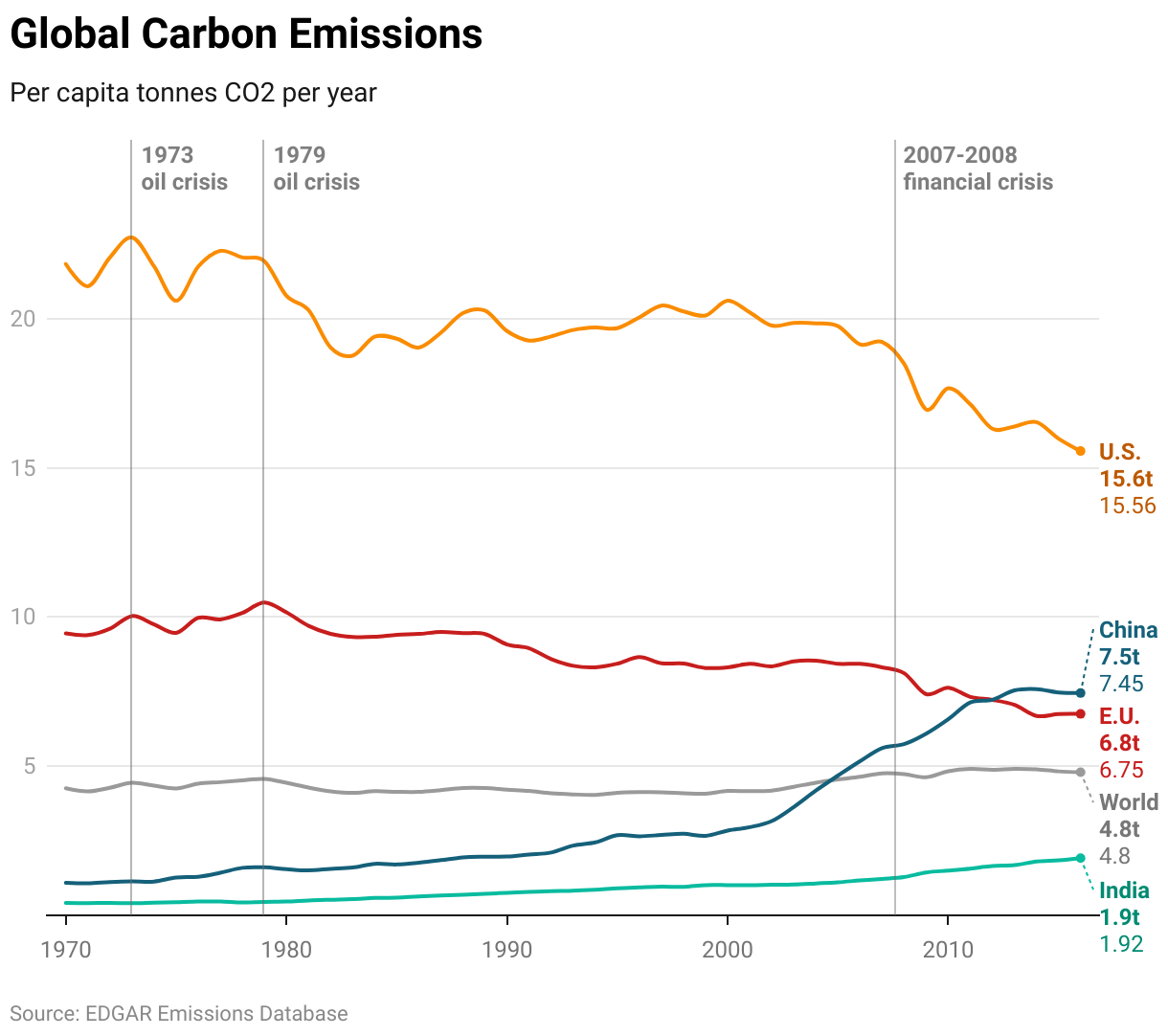
As Gregor pointed out, this partly because western countries have “outsourced” their industrial production to China. The second reason is much more obvious. China and India are the most populous countries in the world. And as the economies of China and India thrive, so do their carbon emissions. The above scatter plot correlates per capita emissions with economic wealth, but it does not show the change over time. So I created a simple line chart:

This line chart shows emissions per person[1], while Gregor’s original area chart shows total emissions across regions. When we look at the per capita data, it becomes clear that while emissions for the United States are indeed going down, the per capita emissions are still much higher than in China, Europe, and India. In 2016, a person in the U.S. was responsible for nine times as much carbon dioxide as a person in India. And if we dug deeper and looked at income groups within countries, we would see even more extreme differences. For example, someone in the richest 10 percent of citizens in India amounts on average just for one-quarter of the carbon of someone in the poorest half of the population of the United States[2].

The line chart also shows another connection between money and CO2: Significant decreases in emissions in Europe and the U.S. can be linked to times of economic downturn, particularly the oil crises of the 1970s and the 2007-2008 financial crisis with the recession that followed.

Chart choices: Log or linear scales?

The scatter plot illustrates the world’s extreme inequality in terms of financial wealth and its correlation with CO2 emissions. Looking at the data, we see a strong concentration of low income and low emission countries, which makes it difficult to visualize the data without too much overlap between countries on the lower end of the scale. And then there’s Qatar. The country has the highest per capita income in the world and is also the biggest polluter per capita. It is such an extreme outlier that it makes the rest of the world look tiny in comparison.

Linear Scale

1. Linear scale / 2. Linear scale with outlier removed / 3. Logarithmic scale

With Qatar removed, the graphic is already clearer, but it is still difficult to distinguish countries at the lower end of the scale. I worked around this by using logarithmic scales. Log scales give more prominence to the bottom half of the scale but can also be misleading, because they visually reduce the extreme differences between countries.

That’s it from me for this week. As always, do let us know if you have feedback, suggestions or questions. I am looking forward to hearing from you at simon@datawrapper.de, Mastodon, or Twitter.


  1. The per capita emission data comes from the European Commission’s EDGAR emissions database. EDGAR reports carbon dioxide emissions from fossil fuel use and other industrial processes, which include less obvious things such as cement production and burning waste. As an indicator for wealth, I used the World Bank’s per capita gross national income (GNI) data, which is corrected for purchasing power parity (PPP) and reported in international dollars. An international dollar has the same purchasing power as a U.S. dollar has in the United States. Still, it is just an approximation. It does not allow for conclusions on the wealth of individuals or income distribution among the population within countries.

  2. Oxfam Media Briefing: Extreme Carbon Inequality – Why the Paris climate deal must put the poorest, lowest emitting and most vulnerable people first

01 Aug 06:44

How many electric vehicles are there on Prince Edward Island?

by peter@rukavina.net (Peter Rukavina)

In the April 2019 provincial general election, all four of the political parties on Prince Edward Island had planks in their platforms related to electric vehicles.

The PC Party pledged to “develop a solar energy rebate and electric vehicle incentive program” and to “add more electric vehicles to the government fleet as replacements are required.” The Green Party to “develop a program to support the installation of electric vehicle chargers in homes and workplace,” to “create a purchase incentive for electric vehicles,” and to “transition the provincial fleet to electric vehicles.” The Liberal Party promised to “invest in new public electric vehicle charging stations and provide tax rebates for the purchase and installation of home charging stations” and the NDP to offer “increased incentives to encourage people to purchase electric or other low-pollution vehicles.”

All of which raises the question: how many electric vehicles are there on Prince Edward Island right now?

I asked the Registrar of Motor Vehicles, and here are the counts, by fuel type, for calendar year 2019 to date:

FUEL COUNT PER CENT
Gas/Propane 2 0.00%
Gas/Natural Gas 3 0.00%
Butane 3 0.00%
PHEV (Plugin Hybrid Electric) 7 0.01%
Propane 10 0.01%
Gas/Alcohol 17 0.02%
Electric 33 0.05%
Diesel/Butane 65 0.09%
Other 110 0.15%
Hybrid — Electric/Gas 403 0.56%
Diesel 4,708 6.55%
Gas 66,511 92.54%
TOTAL 71,872 100.00%

Aggregated by fuel technology–fossil fuel (gas, diesel, butane, etc.), hybrid (like a Toyota Prius, which doesn’t plug-in, and a Kia Nero, which does) and battery electric (like a Tesla, Nissan LEAF or Chevy Bolt), the dominance of fossil-fuel-powered vehicles on the Island is ”why even bother making a pie chart” clear:

FUEL COUNT
Fossil Fuel 71,429
Hybrid 410
Electric 33

I’m pretty sure I know personally at least a third of the electric vehicle owners on Prince Edward Island.

The province’s Climate Change Action Plan–which is actual policy, not platform–has two actions related to electric vehicle adoption:

12. Government will design and install a province-wide electric vehicle charging network to meet the needs of both residents and visitors to Prince Edward Island.

14. Government will increase the use of electric vehicles in its light-duty vehicle fleet.

That plan commits Islanders to lowering our carbon dioxide equivalent emissions from 1.8 megatonnes per year to 1.4 megatonnes per year; this has been further amended to 1.2 megatonnes per year

So, in other words, we have 11 years to stop emitting 600,000 tonnes of carbon dioxide.

These two Climate Action Plan moves related to electric vehicles were to be responsible for 20,000 tonnes of that; that’s 5% under the original targets, so under the new target we’ll need to increase that to 30,000 tonnes.

According to the EPA, the typical passenger vehicle emits 4.6 tonnes of carbon dioxide per year, meaning that our commitment, if it were to come only from electric vehicle adoption (and generously assuming 100% zero carbon charging), will require 6,521 zero-emission vehicles on the road by 2030.

Right now we have 33.

There was no electric vehicle incentive program announced in the June 25, 2019 Provincial Budget.

01 Aug 06:43

Yahoo problems

by Matt Harris
The following two options should workaround the bug in the Yahoo mail system that affect many more than just those with @Yahoo mail addresses.  There is also a Thunderbird bug that has been raised to investigate this issue here that provides more detailed information should you be interested. 

Select options from the three bar menu.
Select the Display | Formatting tab | Advanced button
Set outgoing mail text encoding to Unicode
Select the "When possible, use the default text encoding in replies"
Click on Ok.

If that does not do it for you you will need to use the config editor to modify the setting mail.strictly_mime to true to force Thunderbird to use 7bit encoding in email.  This is not an optimal setting but is sometimes needed to workaround the various Yahoo issues.
01 Aug 06:43

Massively Overprepared

by Richard Millington

It took me too long to learn I need to be massively overprepared to win people over to a community approach.

I’d recommend it to you too. Don’t enter a meeting with a vague idea of what you will say, spend an hour or three preparing for it. This might include:

  • Researched the attendees’ background(s) and identified any relevant/previous experience with community to build from.
  • A good list of relevant case studies and powerful stories you can drop in.
  • A clear, tight, pitch about the value of the community and the incredible opportunity it presents right now.
  • A clear idea of what success looks like framed in their terms.
  • Useful metaphors or analogies to make it easier to comprehend what you’re trying to do.
  • Conversation starters (if you need any to begin the meeting).
  • Identified the attendees most likely fears and how the community will address them.
  • A clear list of asks and what you will need from them.
  • Powerful answers to most likely or most common questions.

Treat this as a starting point, not an exhaustive list.

If you’re walking into a meeting with an idea of what you want to say and nothing more, you’re probably going to walk out disappointed.

Far too much of your success hinges upon your ability to gain support for what you want to do. Don’t leave it to chance, over-prepare for the big moments.

01 Aug 06:39

Cycling: Perils from the Past

by Gordon Price

Via Durning:

31 Jul 21:33

My browser, the spy :: Do not trust browser extensions

by Volker Weber
DataSpii begins with browser extensions—available mostly for Chrome but in more limited cases for Firefox as well—that, by Google's account, had as many as 4.1 million users. These extensions collected the URLs, webpage titles, and in some cases the embedded hyperlinks of every page that the browser user visited. Most of these collected Web histories were then published by a fee-based service called Nacho Analytics, which markets itself as “God mode for the Internet” and uses the tag line “See Anyone’s Analytics Account.”

I have zero extensions in my browser. Why? Because they can read everything that I can see. And a whole lot more.

More >

31 Jul 21:33

Charles Fitzgerald :: A Very Cold Take on IBM, Red Hat and Their Hybrid Cloud Hyperbole

by Volker Weber
IBM says (over and over again) buying Red Hat “changes everything about the cloud market” and means “IBM will become the world’s #1 hybrid cloud provider”. Those are bold claims from a company that has failed to deliver on every big promise it has made in the 21st century. The IBM-Red Hat deal hinges on the notion of “hybrid cloud”. Unfortunately, that term was already a muddled miasma of marketing even before it got the IBM bear hug (they’re now calling it “next-generation hybrid multicloud” because they love that word salad).

There has been little scrutiny of the mechanism by which this combination vaults them from mutual irrelevance to game-changing dominance in the cloud, what they even mean by hybrid cloud, how that relates to the actual seismic shift of computing to the public cloud, and the applicability of their respective and combined product portfolios. Never mind the crazy price tag.

Brilliant. And sad. Read the whole thing.

More >

31 Jul 14:52

Early thoughts on my new open homework systems project

Clint Lalonde, Ed Tech Factotum, Jul 19, 2019
Icon

Clint Lalonde from BC Campus has launched a few posts (first, second, third) on the idea of something called Open Homework Systems. It's not exactly easy to define: "homework systems are components of digital courseware, but not complete digital courseware." Maybe something like WeBWork.Or maybe a recent report from Oregon that uses the term “homework systems”. Really, what he seems to be trying to do is to replicate all the 'extras' commercial publishers are adding to digital texts in order to compete with open textbooks.

Web: [Direct Link] [This Post]
29 Jul 15:39

Short note from Vancouver

by jnyyz

I’m in the bicycling paradise that is Vancouver for the next week or so, and I just wanted to post a few quick pix from downtown that I took yesterday.

I note that most of the Mobi bike share bikes that I see do not have a helmet locked up with them.

There is a helmet law here, and I noticed these helmet liners at the bike stand.

Not a great look, but it looks like I’m ready to rent a helmet, or to prep some food.

The other thing that I noticed while waiting for a bus on Nelson just leading up to the Cambie Bridge is how nicely the bus stand is integrated into the bike infrastructure. There were many cyclists zooming by as I waited.

There is actually a lot to unpack in this picture. In the distance, you can see that overall, about 1.5 traffic lanes have been given over to bike infra, and that at the next intersection, there is a left turn lane for cars that is still separated from the bike lane by a curb. Here is a Google street view of that intersection.

Pretty nice when the best we can hope for in Toronto is green paint with a solid white line.

17 Jul 20:46

NewsBlur Blurblog: Why You Need A Support Training Team

sillygwailo shared this story from Linode Blog.

Richard Myers is Vice President of Customer Support & Success at Linode. Here he shares his expertise on building a training team and why such an investment has already paid huge dividends for Linode and its customers. This post was originally published here.

In 2016, Linode had a problem. Our Support Team was growing at a rate slower than our customer base. Our ticket volume and Time to First Response metrics were creeping up. Our self-service options weren’t putting enough of a dent in our new ticket queue. At the same time, we were also struggling to find applicants with enough technical experience for our user base – which is made up of highly technical customers – no matter where we were looking. We had to do something drastic.

The only thing that made sense was to create a dedicated Training Team (increasing our onboarding time from a few weeks to a few months), take resources away from the support queue to do the training, and entirely rewrite our training curriculum and support manual.

What?!

We had to come up with a new solution and our conclusion was if we can’t find the right candidates, we have to change who we’re looking for. This short-term investment for a long-term win couldn’t have worked out better.

Here’s what we did:

Evaluate Candidate Competencies

When we began evaluating Linode’s hiring practices, our Core Values informed us where to start.

While we and our customers use and depend on Linux every day, what’s more important than command line knowledge are things that are much harder to teach: Good problem solving abilities, empathy, and a passion for helping customers.

The solution was obvious to us:

  1. We’d change our “ideal” candidate from “Experienced Systems Administrator with Expert-Level Customer Support Skills” to “Best of the Best Customer Support Skills with Hobbyist-Level Technical Experience”
  2. We’d build a world-class training system with this candidate profile in mind

With brand-new job requirements focused on technical and troubleshooting acumen instead of experience, we could target previously-untapped pipelines like new grads who worked help desk, career changers who ran Linux at home, and service industry employees in a technical environment. We found people through career fairs, college clubs, and user groups. Very quickly, incredibly good candidates started rolling in – but now we had to train them.

Create a Training Team

This is the really hard part.

We got lucky – we had an incredible Support Specialist, Cody, who used to train flight school instructors. His enthusiasm for training, development, epistemology, and learning styles, coupled with Linux expertise, made him the perfect candidate for our first Trainer. We spent about two months creating an MVP training curriculum and finally started training our new-hires. 

Because our new hiring strategy allowed us to attract candidates with outstanding Customer Support skills – the stuff that’s harder to teach – our new training program, in turn, focused on building technical troubleshooting skills and our Core Values.

We realized, though, that training is nothing without documentation and support, so we began reorganizing and updating our support manual and knowledge base. Our team painstakingly:

  • Modularized our curriculum so each module could be taught by any of our Training Specialists, or even plucked out of new-hire training to do a continuing education class.
  • Leveraged the “Acquisition, Application, Reinforcement” learning model into each of our modules in an effort to be the most effective trainers possible, as well as provide a consistent experience throughout training.
  • Implemented weekly check-ins for trainees and their managers, and created a robust documentation system to keep managers and Training Specialists on the same page throughout training.

The initial new-hire training was producing incredible Junior or Level 1 Support Specialists on it’s own right… but that was only the first part of the Support Training journey.

Training Wrap-Up and Mentorship

Before a Support trainee finishes initial training, we hand them off to a Training Expert on the Support team. While the initial training is structured to the hour, a trainee’s mentorship is unstructured and for an indefinite length. A trainee is essentially doing the job of an onboarded Support Specialist, but has a single point of contact and escalation for issues and challenges.

When each box on every checklist has been checked – every skill acquired, competency met, and task accomplished, we can finally on-board a trainee. It’s a huge moment to be celebrated.

Each onboarded trainee represents an incredible investment in talent acquisition, training, people and skills development, and meticulous planning  – an investment that’s immediately paid off with the phenomenal new Support Specialist helping solve problems for our customers every day.

Every single piece of our training is still being evaluated and iterated. A module is almost never exactly the same as it was in the previous class. We’re currently identifying the Lominger Competencies required for every role in the Support organization and how Managers and Training Experts can teach and develop those competencies. Our Support Manual is still undergoing a huge rewrite and reorganization in Git to introduce version control and more collaboration. Our mentorship model is always undergoing improvement. While we’ve come a long way, training is one of those things that can never be perfected.

We can always get better and our team is always better for it.

Leverage Your New Advantage

Our Training Team commits to a brand new group of recruits every two months. Their structured curriculum, mentorship and check-ins with trainees, and maintenance to our Support Manual is a lot of work, but it’s important that we leverage this team to be bigger than just new-hire training.

To accomplish that, we designed our new-hire training to be six weeks long. In the two weeks between incoming and outgoing classes, our Training Team both iterates on our training and provides continuing education classes to our existing Support Specialists – retraining rusty skills, presenting new and exciting technical edge-case training, and refreshing fundamentals. 

Today, our Training Team runs at least one Lunch & Learn each month for our existing Customer Support team on an existing skill or a brand-new topic. We want to ensure that the entire team is at the same knowledge level and provides a consistent experience for all customers.

Making any team’s purpose bigger than simply fulfilling a short-term need is necessary in any do-more-with-less business. It’s about making your Training Team more than just an onboarding team, but instead a critical part of ongoing education and development.

Linode’s Training Team has been an incredible success. Yes, it’s a huge investment, but I cannot stress enough how much I encourage you to create the same in your own Support department.

So why do you need a Training Team?

  1. You aren’t getting the best people into your organization; you’re thinking too small, not branching out, and losing out on the best candidates.
  2. You’re relying on someone else to train your people… their last employer.
  3. You need to not just reteach the skills your Support Specialists already have, but find new people who will make your team better than it is today.

Because of our Training Team, Linode has a steady stream of great candidates, a comprehensive new-hire training program, a robust continuing education system, and the absolute best, most diverse, and enthusiastic Customer Support team that we have ever had. And it gets better every single new class.

Linode’s Training Team was a significant investment that’s already been paid off many times.

  • We’ve put 92 new-hires through training
  • Our average new-hire onboarding time is 72 days
  • Our Training Team now consists of a Training Manager, two full-time Training Specialists, and six Training Experts
  • As intended, our Time to First Response is down, our number of updates to resolution is down, and our Customer Happiness is up
  • Customers are being helped faster and more consistently

Creating a Training Team has absolutely been one of the best investments the Customer Support department has made.

I’d like to hear anyone’s thoughts, opinions, or questions on training or creating training teams; and I would be happy to help if this is something you’re trying to take on. Furthermore, this was a very high-level and simplified overview of a very complicated, calculated, and time-consuming topic. If you’d like to chat or would like more detail, please reach out on Twitter or send me an email.


17 Jul 20:46

Let’s Play: D&D in US Prisons

by ekai

I was asked by documentary filmmaker and producer Elisabeth de Kleer if I would be willing to help create a Kickstarter video for her upcoming documentary film on inmates who play Dungeon and Dragons in the American prison system. Being a bit of a D&D nerd myself, this was an easy call. The Let’s Play: Dungeons & Dragons Behind Bars project went live today.

Her documentary will tell the story of how inmates and ex-cons are using role playing games to survive inside prison and how these games are used as tools to prepare for life on the outside. In the US, where the notion of rehabilitation is a joke, role playing games offer a very real way for inmates to find focus, meaning and community in their lives which goes a long way to reducing recidivism. Breaking the cycle of reoffending is a goal that benefits everyone. If you feel the same, please consider backing this worthwhile project.

17 Jul 20:45

Your Art, My Art

by Stephen Downes
The New York Times today came out with a list of "the 25 works of art made after 1970 that define the contemporary age, by anyone, anywhere." What struck me as most significant was how little any of the works meant to me.

Most of them I had never heard of. All of them spoke of an experience or a way of experiencing the world that is alien to me. The list feels like a collection of paper cut-outs that proclaim themselves to be the definitive representation of the digital age. Now to be clear: I am neither an artist nor an art critic, and though I've spent my fair share of time in a museum, I could hardly be said to be educated about art.

But it begs the question - what would I include in such a list. The last 50 years comprises, for me, my lifespan from ages 10 through 60 - it is, in other words, the art of my life (so far). How does my experience of art compare with that of the NY Times curators?

Let's go though the list.

Here's what I'm going to do. I'll list each one of the selections in the Times article and write a short paragraph about it and my response to it. Then I'll offer an alternative image, one that represents what to me counts as "important" art. I'll then explain that choice a bit, and where relevant, draw a comparison between the Times selection and my own selection.


1. They begin with a selection from an artist -  Elaine Sturtevant - that copies other artists supposedly "to skewer the grand modernist myths of creativity and the artist as lone genius." Post-modernist that I am, and not needing to skewer the past to make the point, and on this day, the 50th anniversary of the launching of the Apollo 11 mission, I'll present image number one:


Earthrise. By NASA/Bill Anders - This is a retouched picture, which means that it has been digitally altered from its original version. Modifications: rotation, cropping, level adjustment, dirt removal. Modifications made by Earthsound. The original can be found here., Public Domain, Link

Technically, this comes from 51 years ago, but it's an appropriate representation for everything that followed. The lunar landing was a massive achievement, notable for the first step of one man - Neil Armstrong - but which could not have been achieved without the unique and varied contributions of thousands.

Rather than looking at the past and criticizing, Earthrise looks forward and unifies. It leads to Carl Sagan's Pale Blue Dot, to the miracle of Apollo 13, and so much more. It represents everything I have wanted to be in my life, and everything I have ever believed about humanity. And if there is anything in the last 50 years that speaks for us collectively, it is this image.

2. Number two on the Times list is Marcel Broodthaers's nomadic museum, the “Musée d’Art Moderne, Département des Aigles.” Just as the voters of the Oscars love movies that reflect the art of making movies, so also artists and curators love art that reflects the making and display of art. But it says a lot less to the rest of us, and actually feels somewhat self-indulgent. My second work of art is the opposite of that.


The Louvre. Photo by the author, 2017. Pyramid design by I.M. Pei, inaugurated on 15 October 1988.

The Times list doesn't actually contain any architecture, which given the history of the last 50 years is a little but astonishing, but in keeping with the paper cut-outs theme of the sections. Here I present a work of art that is iconic, that is an actual real museum, and which succeeds in blending the contemporary with the historical in a way that respects both.

The design is reflected in the reconstruction of the Reichstag, completed in 1999. The latter has a glass dome replacing the original dome, which was destroyed during the war. I remember at the time when it opened being told it was designed this way to reflect openness and transparency - the new values that a reunified Germany would present to the world. In the same way, I.M. Pei's pyramid lets us look into the museum from outside. Art, like government, isn't to be hidden and locked away, but shared with the people.

It is no coincidence, I think, that the Louvre is synonymous not only with art but with artistry. It is where the Mona Lisa hangs. It represents the best of us. As Lorde sings, "We're the greatest, they'll hang us in the Louvre, down the back, but who cares, still the Louvre."

3. Third on the Times list is Hans Haacke's “MoMA Poll,”in which museum-goers voted on “Would the fact that Governor Rockefeller has not denounced President Nixon’s Indochina Policy be a reason for you not to vote for him in November?” The story for the Times critics is whether museums would actually show Haacke's work. My focus is by contrast what we thought was acceptable in the 1970s:


Phan Thi Kim Phuc. By Huynh Cong Ut (also known as Nick Ut) - Widely available; This version available at http://www.elenaphotograph.com/blog/noticia.php?id=36, Fair use, Link. June 8, 1972.

I was in my early teens as the Vietnam War raged on. We in Canada were not part of the war, but it was still a part of everyday for all of us, set against the backdrop of the Cold War, the fight against communism, the coup in Chile, the Dirty War, the war in El Salvador, Afghanistan, Angola, and on it goes. All of this was normal in the 1970s and early 1980s.

And it was art - art in the same way film noire was art from the 1920s to the 50s, drawing on the murder and decadence of high society, art in the same way the Iraq War was presented on CNN (I would go down to the Strathcona Hotel and watch it on TV). It was art in the form of the Deer Hunter and Apocalypse Now.

You might think that it is absurd to think of killing all those people and inflicting all that suffering just to create art, and I would agree, but it's no less absurd to thinking of killing and hurting in the name of competing economic systems, which is what those wars were ostensibly about.

4. The fourth selection by the Times panel is Philip Guston's series of nearly 80 cartoons depicting the Richard Nixon's rise and fall. Drawn in 1971, the cartoons didn't actually appear anywhere until 2001. The Times refers to "its enduring relevance" but to me it's parochial and irrelevant, a relic of a point in history the curators can't get past. So for my fourth pick, I selected a cartoon that resonated much more broadly:

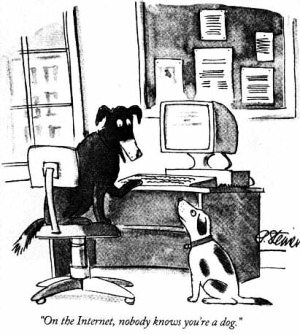
On the Internet, nobody knows you're a dog. Image from The New Yorker cartoon by Peter Steiner, 1993, Fair use, Link

The New York Times managed to get through 25 works of art for the last 50 years without one mention of the internet or digital technology. That I managed to make it through to item number four stands as a testament to the fact that half my life was spent in the pre-digital age. This cartoon reflects more-or-less the turning point not only for me, not only for a generation, but for all of history.

We've had talking dogs before and since. We've had cartoons about computers before and since. But what we have, for the first time, is a type of person-to-person communication that could be anonymous. Literally, if a dog had typed the message, you wouldn't know.

Today of course we are in the grip of surveillance capitalism, and there is not much about you that your computer and the networks its connected to doesn't know. So the cartoon represents not only a turning point in history, but also a charming naïvety about what these new tools would portend. The cartoon because for a while an in-joke, and then a slogan, and then a piece of wry cynicism, all within a few years.

5. The next item is a clip from clip from the performance piece staged at Womanhouse by Judy Chicago and Miriam Schapiro. As a whole, Womanhouse is an interesting project - a group of artists basically remodeled a dilapidated building into an art installation to "put on some of the earliest feminist performances and produced painting, craft and sculpture in one radical context." The installation, though, only lasted a month, and mostly doesn't exist any more - a classic case of "you had to be there." 

I'm not going to fall into the "it's not art" fallacy here - a lot of art is temporary by its very nature, and transience is by its nature a form of art. Maybe the form of art. I've certainly heard of Judy Chicago, I've certainly been influenced by feminism, including radical feminism, but I think that if there is a better, more representative, and more influential work of art out of this school:


The Dinner Party. Judy Chicago, 1974-1979 - image taken from Google's (new?) arts and culture website. Fair use, link. Also, the Brooklyn Museum.

While the Times selection makes it seem like Judy Chicago and company were inventing something that had never been done before, this installation and contemporary reviews of the work place it firmly in its historical context. Chicago was working within a milieu of emerging radical feminism, something that was both global in nature and rooted in a well-established tradition. The work reminds us at once of artists like Georgia O'Keefe and of contemporaries like Erica Jong.

In The Dinner Party 39 porcelain place settings represent historically important women and feminists. The work went on tour and visited Glenbow Museum, Calgary, Alberta, Canada, December 1982 – February 1983, when I was attending university there. We carried a feature about it in the student newspaper. For me, the lessons in this work blended with Bonnie Sherr Klein's Not a Love Story. The Dinner Party is at once open and welcoming and at the same time strident and unyielding.

I had a lot to learn about feminism in those days and I still have a lot to learn about it today. It has been a long struggle for women and it hasn't ended. Works like The Dinner Party remind us of that, which is why it is important that they endure, and continue to speak to us.

6. For their sixth selection the Times writers choose a nude of Lynda Benglis holding a giant dildo published as an advertisement in the November, 1974, issue of Artforum. The Times article does not include the image "due to its graphic nature" but if you're interested you can see it here. The selection seems to be based more on the "bedlam" caused by the image.

There's a long history of nudes in art, of women expressing their independence by being nude in art, and of men being offended by women being nude in art. Even in 1974 you could see nude women in magazines (in fact, that very same year, as a 14-year old, I got my first taste in the form of a discarded collection of magazines strewn along the side of a highway - I collected them all). So though the Times critics saw this advertisement worthy of note, I think there's a much more important piece of art that speaks to the same issues:


Farrah Fawcett-Majors. Photographer Bruce McBroom, publisher Pro Arts Inc., 1976, Fair use, Link.

I never actually owned a copy of this poster, but that would make me one of few boys my age who didn't, as it became the best-selling poster of all time. The swimsuit itself ended up in the Smithsonian. The poster made Farrah Fawcett a star. She built on her stardom in Charlie's Angels (a franchise that continues to this day).

The poster represented a transition from the badly-kept secret that "sex sells" to the open acknowledgement that "sex sells". What makes  the Fawcett-Majors poster and the Lynda Benglis advertisement different from the works of, say, Helmut Newton, is that it is the women themselves making and choosing the image. What they have in common is that the woman in both cases - or, at least, the image of the woman - is the 'product' being sold.

Today of course these images appear quaint, even Lynda Benglis's image appears quaint, and the idea of advertising in magazines definitely appears quaint, but the point where all this became acceptable was the point when we started putting Farrah Fawcett on a poster. And of course, the marketing of women - either by themselves, of themselves, or for others, continues unabated to this day. Following Farrah we have the Dallas Cowgirls, Baywatch, and Brooke Shields at 15 to 1 Night in Paris.

7. The next choice by the New York Times is a photo of a house that was split neatly in two by Gordon Matta-Clark, showing the sunlight between the two halves. It's another temporary installation, lasting only three months before being demolished. There's a lot going on in the background here, though, and while the article presents it as a singular work, it's part of a longer tradition where "feminist art is filled with examples of such construction and deconstruction, often taking literal form as the projections of houses onto bodies and vice versa."

I thought about contrasting this with other accounts where partners have split the wealth between them, with examples ranging from King Solomon to Cambodia, but the comment on one critic - "Why is there no land art?" - led me in a different direction:


Crop Circles. Many artists, many versions, peaked in the 1990s. See Google.

The curators in the Times mentioned some land art, such as “Spiral Jetty” by Robert Smithson - and of course things like sand mandalas were popular over the last half-century, but if there is a type of land art that really belongs to the contemporary age, it's the crop circle.

Though crop circles have a long history (being created by everything from windstorms to fairy rings to humans) the popularity of crop circles was revived in the 1990s by Doug Bower and Dave Chorley. After having had too many been, the pair devised a method of flattening wheat using twine and wood and started the modern phenomenon.

So - why crop circles, when there is so much other land art? To my mind, crop circles are unique in that they touch both the past - with allusions all the way back to Stonehenge - and the future, with their current association with aliens. Also, crop circles, much more than the other examples, are a case of people's art, which to me lends them an authenticity a deliberately constructed work of art qua art doesn't afford.

8. The panel next discusses the "truisms" of Jenny Holzer , which she published and began selling as posters, baseball caps, T-shirts and condoms, including projecting them on the Spectacolor LED board in Times Square in 1982. It must be nice to have that kind of money. It's hard to discern why the panel though Holzer in particular was worth highlighting, except perhaps that it's a blend of hacking memes and mass customization (a la Toffler). I don't really see it as anything than Ben Franklin for today's media.

But today, we express truisms differently:


Rage, Flower Thrower, Banksy, 2003. See more.

I could have selected any number of Banksy pieces, including the best counter-art that I know, the shredding of Girl with a Balloon, but I think this piece is prototypical.

Where Holzer's art seems to cater to the mainstream commodification of art, Banksy does the opposite, placing his art on free public display in a way that's even criminal. And his message is relentlessly counter-institutional.

I had wanted to place the Peace Sign or the Smiley Face into this spot, as both were obviously hugely influential over the last 50 years, but both predate the 1970s. What's significant about them, though, and what is carried on through Banksy is the use - the appropriation, even - of icons to express truisms. Banksy can be blunt with his images in a way that a string of text cannot.

The full influence of Banksy is yet to be felt. We can see echoes of Banksy in the Guy Fawkes mask used by Anonymous and Occupy Wall Street, in the iconography of online memes and LOLcats, and the push to reclaim public spaces for public are (as opposed to inoffensive corporate sculptures)

9. The ninth item is a clip from the video piece in which Dara Birnbaum edited excerpts from the 1970s series “Wonder Woman.” We are told "it is difficult to appreciate how radical it was to assemble art out of stolen TV clips 40 years ago." And yet - it isn't, as any person who created a mixtape or a collage will tell you. And frankly, whatever you think of the character, I think there was more art in the creation of the Wonder Woman series than there was in the remixing of it.

But there is art in the whole philosophy of Rip Mix Burn, and one video that stands as the exemplar of all that it stands for and all that it could be:


1984. Apple. Directed by‎: ‎Ridley Scott, release date‎: ‎December 31, 1983, production company‎: ‎Fairbanks Films. View video here.

This video remixes the themes from Orwell's 1984, and the visual style from the 1950s film of the same name, and contrasts it with a more genuine Wonder Woman, an athlete (Anya Major) who throws a hammer at the screen and breaks the monopoly. It spoke to themes of class struggle, the role of women in computers, and (in later campaigns) Apple's promotion of the idea of "rip, mix, burn".

Writes Peter Cohen, "The 1984 ad's success will never be duplicated. It was an event, and part of its impact was because it was so unexpected and so beyond the realm of what had been done before." The computer itself would revolutionize the industry, it would create new tools for art, and new art forms, and the advertisement captures all of this without actually ever saying any of it.

But more - and I think this is important - it ushered in the idea that art is more than just what an artist does. In the Wonder Woman video we have Dara Birnbaum acting alone - as though the ensemble that produced the original television show couldn't have been artists. But with the computer - and especially, with the networked computer - we move beyond that, to the idea that art is something that a community does. This is something I don't think the artists and curators in the Times article really comprehend - which is why we are limited to paper cut-outs and things that can be done by one person with simple tools.

10. The panel discusses two works by David Hammons for its tenth selection, “Bliz-aard Ball Sale I” (1983); “How Ya Like Me Now?” (1988), both depictions of race and racism in American society using "radical, unorthodox materials". The second is a picture of Jesse Jackson as blond-haired and blue-eyed.The theme evokes a obvious comparison with another black politician who ran more successfully and the very influential poster that underlined that campaign:


Hope. By Shepard Fairey - Self-made, Fair use, Link. 2008. 

It's hard to believe more than ten years have passed since we first say this image. According to Wikipedia, "Fairey found a photograph of Obama using Google Image Search (eventually revealed to be an April 2006 photo by freelancer Mannie Garcia for The Associated Press) and created the original poster design in a single day." It has had a widespread impact since then and captured the core sentiment of the Obama campaign.

Fairey has inspired other street art campaigns, including the Mozilla logo, the Nelson Mandela mural in Johannesburg, Andre the Giant has a Posse and the ubiquitous Obey logo.

11. For the eleventh selection we have two works by Barbara Kruger’s “Untitled (When I hear the word culture, I take out my check book)” (1985); “Untitled (I Shop Therefore I Am)” (1987).These mark a return to magazine culture for the panelists: "agitprop images of terse, satirical slogans in white or black Futura Bold Oblique type on close-cropped images primarily from old magazines." The images remind me of silkscreen images or old Andy Warhols or even Fluxus and found art.

I think a lot of the same messages can blend together in a much more original and impactful way:


Vanitas: Flesh Dress for an Albino Anorectic. Jana Sterbak, 1987. Fair use. UQAM, Virtual Museum.

Probably many more people commented (and were outraged, etc.) when Lady Gaga wore a meat dress in 2010, but when Jana Sterbak's work was displayed in the National Gallery in Ottawa it generated no less controversy. It at once comments on commercialism, the passage of time and decay, fashion and feminism.

What appeals to me is the wrongness of it - clothing is supposed to cover flesh, not be composed of flesh. But it also points to a hypocrisy - we don't mind clothing outselves in other foods, or in other parts of an animal - only the actual flesh of a flank steak brings out this viscerial reaction. And the social commentary of the display of a woman as - literally - a piece of meat cannot be ignored.

12. The next item in the Times list is Nan Goldin's series of photographs called “The Ballad of Sexual Dependency” (the New York critics have a very limited repertoire, it seems to me). "Her subjects were herself, her lovers and her friends — drag queens, fellow drug addicts, runaways and artists. We see them fight, make up, have sex, apply makeup, shoot up and nod off." This seems to me to be more like voyeurism than art. I would rather celebrate people than expose them:


NAMES Project AIDS Memorial Quilt. By National Institutes of Health - en wikipedia - [1], taken from National Institutes of Health website - here, Public Domain, Link. 1985ff.
 
This is another example of community art, where each panel of the quilt represents a person who was lost, as contributed by that person's friends or family. According to Wikipedia, it is the largest piece of community folk art in the world as of 2016. Of course, the quilt represents much more than just size.

What I appreciate about the quilt is that it is using art to do more than just criticize and complain. Yes, the quilt has a sharp social message, but I see it much more as a celebration of the lives it represents, not merely a mourning and certainly not merely a lament. The AIDS quilt is a people coming together and demonstrating that even though the losses are large, the accomplishments of a society can be even larger.

13. At the halfway point, we have two works from Cady Noland: “Oozewald,” 1989; “The Big Slide,” 1989. The former is an enlarged photo of Lee Harvey Oswald depicted when he was shot by Jack Ruby, with enlarged bullet holes representing the eight shots. The latter is a horizontal metal pole with flags and stuff hanging from it. This art again strikes me as very parochial.

I'm going to go in a completely differernt direction:


John Lennon and Yoko Ono. Annie Leibovitz, 1980. Fair use. National Galleries Scotland.

While people of a certain age remember where they were when Kennedy was shot, people my age remember where they were when John Lennon was shot. Though the former really impacted baby boomers in the U.S. (including evidently our art critics) it is arguable that the latter had a far more significant impact on the world. This photo was published on the cover of Rolling Stone. It was taken the day Lennon was shot.

There's so much to this photo - Lennon is naked, Ono is not, Lennon is active, Ono is not, Lennon is vulnerable, Ono is not. It turns the stereotypes of the relation between men and women on its head. It was just after the release of Double Fantasy and marked Lennon's re-emergence as an artist, his mature post-Beatles work cut short. But this photo celebrates the life of Lennon, rather than sensationalizing his death.

Leibovitz, meanwhile, would continue her career as one of the most noted photographers of her era here are some more.

14. The artist did not give his permission to reporduce the work in the New York Times but they named it anyways, running a photo of the artist in its place. It was Jeff Koons, “Ilona on Top (Rosa Background),” 1999, a depiction of Tantric sex. You can see it here, on Koons's website. I actually agree with the selection of Koons in general, but wish the critics could have extended their range a bit. I have two favourite Koons works, and I'm going to pick one here:


Rabbit. Jeff Koons. 1986. Via.

There's a lot going on in Rabbit that helps make it a cultural icon. It is sculpted out of stainless steel, but looks like balloons. It is highly polished, so it reflects the viewer (and the room, and whatever) back at you. It reminds us of other rabbit icons in our culture, ranging from bugs bunny (the carrot) to the Playboy bunny (the rakish ear). It's simple, but it's a type of simplicity that is not simple.

I don't know why the Times thought Ilona on Top was more "important". Maybe it's the idea that it shocks people that makes them think it's important. I don't know. This rabbit is in its own way far more shocking than any overt depiction of carnality, depicting as it does a journey from innocence to something else.

15. Next we have Mike Kelley's “The Arenas,” 1990, a series of works, one of which pictured is a set of dingy teddy bears sitting around a carpet. The show and the theme are exactly on point with the tastes of the Times pundits: "The works summon up themes of perversion, shame, dread, vulnerability and pathos." They also represent differences in class and our image of children the way we think of children. Bleah. I thing we can do better with stuffed animals:


Calvin and Hobbes. Bill Watterson, November 18, 1985 to December 31, 1995. Wikipedia.

The cartoon strip, which ran for ten years, is everything I remember my childhood to be, and everything I imagine a child's life is like, in those days of wonder and imagination before some artist with dingy teddybears comes along and spoils the illusion. Calvin and Hobbes isn't just a work of art - though it is most certainly that - it is also a commerntary on what's important, and what's not, in our lives.

I could say so much more about Calvin and Hobbes - but oh, just go enjoy it for yourself.

16. Next up is the pile of candies that is Felix Gonzalez-Torres's “Untitled" (Portrait of Ross in L.A.), 1991. It is, literally, a pile of candies, and visitors can take candies if they want (and presumably eat them) so the installation slowly decreases in size, just as Ross, who was dying of AIDS, did. I get the idea but it feels to me that it lacks a certain commitment. My next pick is a singularly unique body of work:


Let's Dance [Mr. Death Series] (1988) By Manwoman. Fair use. Source.

As with many of the artists in this list, the importance isn't just in the work but in the oeuvre of the artist as a whole. In the case of Manwoman, this collection includes his own body (see this Flickr collection of images). Manwoman lived his art completely, living in central British Columbia and exhibiting in places like the Stride Gallery and Headbones Gallery.

Manwoman gained notoriety for his lifelong effort to reclaim the swaskita. But his life is much more than that, merging art and spirituality, physical and transcendental, man and woman. More here. Manwoman, to me, is about reclaiming our identity and our culture, even those parts of it that seem forever barred by history.

17. The next selection by the Times is Catherine Opie’s “Self-Portrait/Cutting” (1993). It is literally a child-like image carved into the artists's back. It depicted two women holding hands, "completing the idyllic domestic dream, which, at the time was just that — a dream — for lesbian couples." I personally see neither the merit nor the importance. Within ten years - and without self-mutilation - same-sex marriage was legal in Canada. The artwork, meanwhile, harkens to themes of trauma and subjugation. Of art as injury and passion. The Times critics eat this stuff up. But these themes, no matter what the critics say, do not make the works of art important.


The Son of Man. René Magritte, 1964. Wikipedia.

This also is a self-portrait, and the author also defaces himself, but he does so figuratively, rather than literally. The title and the apple allude to religion, while the style reminds us of surrealism. And it takes us back to his 1929 work, The Treachery of Images - "Ceci n'est pas une pipe."

Magritte says, "At least it hides the face partly well, so you have the apparent face, the apple, hiding the visible but hidden, the face of the person. It's something that happens constantly. Everything we see hides another thing, we always want to see what is hidden by what we see. There is an interest in that which is hidden and which the visible does not show us."

It is a face that is not a face, an identity that is not an identity.

18. This next selection recognizes the impact of an age where everything is surveiled. In Lutz Bacher's “Closed Circuit” 1997-2000 the artist "installed a camera above (Pat) Hearn’s desk, filming continuously for 10 months" as Hearn - her agent - died from cancer. Disgusting. And - frankly - derivative. What captured my imagination in the 1990s was the original:


Jennicam. Jennifer Kaye Ringley, April 3, 1996 - December 31, 2003. Image.


It actually took a few years for Jennicam to take off and become the phenomenon it eventually became. The idea was that Jennifer Ringley would broadcast everything she did in her home live over the internet. Yes, I watched - the idea of being able to peer into someone's life in real time was irresistable. What I saw - and what most viewers saw - was the mundane, the oridinary, repeated day after day. The Wayback Machine has the archive.


Wikipedia says (accurately) "The JenniCam website coincided with a rise in surveillance as a feature of popular culture, exemplified by the 1998 film The Truman Show and reality television programs such as Big Brother, and as a feature of contemporary art and new media art. From a sociological point of view, JenniCam was an important early example of how the internet could create a cyborg subject by integrating human images with the internet. As such, JenniCam set the stage for conversations regarding the relationship of technology and gender."


19. Michael Asher's “Michael Asher” exhibit at the Santa Monica Museum of Art in 2008 is next, for his work "recreating the wood or metal skeletons of all of the temporary walls that had been built for the 38 previous exhibitions." Again, what we have are artists and curators finding themselves to be the most fascinating subject possible for "important" art. I'm going for a different definition of "important".


Monument to Joe Louis. Robert Graham, dedicated in 1986. Photo.

Rather than exploring the skeleton of a gallery, I'd rather explore the skeleton of a city. I could name any number of  sculptures that do this for a city but this one seems to me to do it best. It speaks to Detroits history, it speaks to the time when we needed to respond to fascism, and it also speaks to the Detroit of today, a city that needs strength, at a time fascism needs to be defeated.

This is the Motor City, said Eminem, and this is what we do.

20. The twentieth item has the artists and curators returning to their favourite topics in A.K. Burns and A.L. Steiner's “Community Action Center,” (2010), "a celebration of queer sexuality as playful as it is political. We watch as a diverse, multigenerational cast engage in joyfully hedonistic acts of private and shared pleasure involving paint, egg yolks, carwashes and corn on the cob." I don't mean to disparage that community - really, I don't - but for the rest of us, community is something much different.


The Hockey Sweater, written by Roch Carrier, illustrated by Sheldon Cohen, 1979-1984.

There are many ways ypu can break taboos (though the Times critics can think of only a few) and this subject is playfully and lovingly broached in the story The Hockey Sweater (which later became a video, and then an illustrated book). A small boy in rural Quebec lives in a town where everybody wears a Montreal canadien's #9 sweater - that of Maurice Richard - and is sent a Maple Leafs sweater through the Sears catalogue by accident.

"Who do you think you are," the other boys demand. "You think you're better than us?" It takes courage to be different in a small town where everybody is the same, and if the urban environment of New York celebrates the extreme becoming ordinary, the small town life celebrates the ordinary becoming extreme. : « Les hivers de mon enfance étaient des saisons longues, longues. Nous vivions en trois lieux : l’école, l’église et la patinoire; mais la vraie vie était sur la patinoire. » / "The winters of my childhood were long, long seasons. We lived in three places – the school, the church and the skating rink – but our real life was on the skating rink."

Wikipedia. The Hockey Sweater after 30 years. The Hockey Sweater on the Canadian Five Dollar bill.

21. The next selection is 21. Danh Vo's “We the People” sculpture (2010-14), a life-sized replica of the Statue of Liberty, "in 250 pieces, dispersed throughout public and private collections around the world." We read that "In its fragmented state, Vo’s statue alludes to the hypocrisy and contradictions of Western foreign policy" It was made in Shanghai. The message and the icon probably resonates more with American audiences. Meanwhile, I have a piece of a rather different work of art with a rather different message:


The Berlin Wall. Various, 1961-1989. Photo by the author.

For the years of its existence the Brrlin Wall was a barrier first and foremost, and only a work of art as an afterthought. After 1989, though, the wall was reclaimed by the people, shattered into a million pieces, and dispersed around the world. I have my own piece of the Berlin Wall here in Casselman. I bought it in 1989 at a trade fair in Edmonton.

Rather than standing as a critique of democracy, the Berlin Wall - in its final dispersed form - became an emblem fo what democracy can be. It wasn't an act of government that painted the wall, nor was it one that dismantled the wall. And I think there's a real difference between a piece of art - even one as elaborate as "We the People" - that is conceived by one artist as a 'statement' and a work of art that actually is a statement.

22. The next item is Kara Walker's sculpture “A Subtlety, or the Marvelous Sugar Baby, an Homage to the Unpaid and Overworked Artisans Who Have Refined Our Sweet Tastes From the Cane Fields to the Kitchens of the New World on the Occasion of the Demolition of the Domino Sugar Refining Plant” (2014). It is "a monumental polystyrene sphinx coated in white sugar" with African-American features and, of course, nipples. 


Temple Expiatori de la Sagrada Família. Antoni Gaudí, 1882-present. Photo by the author.

I don't really have an answer to the Sugar Baby, with was impressive (if temporary), but on the monumental scale, no compilation of "important" art over the last half-century would be complete without inclusion of Gaudi's masterpiece, a cathedral that has been under construction more more than a century. I've been privileged to be able to visit it several times while in Barcelona, and to take numerous photos inside and outside.

Though the Sagrada Familia doesn't speak to social issues the way (virtually) all of the Times selections does, it does have commentary on virtually all social issues, from birth to death, war to slavery, peace to passion. But more, the design of the cathedral also represents an attempt to find that fine point of balance where the creations of humanity mirror the patterns of nature. It's a bol vision, and it speaks - still - to the contemporary world. In a very real way, the interaction between man and machine is no different than that between man and nature - we are trying to find our humanity in the heart of the soulless.

Kara Walker, too, seeks to find humaity in the body of the soulless, but it's very much a product of its time and its place.

23. The next selection takes us to familiar territory as the Times lists Heji Shin's “Baby” series from 2016. The photos are of babies taken just as they crown and are described as "undeniably gory scene."To me, the photos are just another instance of what might be described as 'medical porn', of which we've seen a lot on TV over the last decade or so. As for bloody babies, there's a memorable scene from The Big Red One (1980) that set a new standard for depictions of childbirth.


Christ Child, also known as In the Beginning or the Millennium Sculpture. Michael "Mike" Chapman, 1999.  Wikipedia. Photo by the author.

I suppose I could have selected any number of sculpted babies, but one essential feature of the last 50 years is that it is bisected by the millennium, marked perfectly by this work. "It seemed to me that a tiny life-size baby carved from stone in such an enormous environment would be the best way to remind us all of just whose birthday we were celebrating," said Chapman.

24. The penultimate selection is Cameron Rowland's “New York State Unified Court System,” exhibited at at the New York nonprofit Artists Space in 2016. It's another artistic protest: it "exhibited furniture and other objects fabricated by inmates often working for less than a dollar an hour, as well as heavily footnoted research on the mechanics of mass incarceration."But there has been a lot of prison art over the last fifty years, some of it quite recent:


Untitled. Image from Abu Ghraib, author unknown, United States Government, 2003. Story on Wikipedia. Fair use.

This image has become an icon in the early 21st century, and it can be found on walls and posters around the world. It isn't just a commentary on unfair prison practices, it's an actual depiction of real torture at the hands of a nation that has long denied that it does such things. Some might not call the image art - but the Abu Ghraib images were intended as art, with prisoners (and sometimes guards) posed and photographed. It's just art that wasn't meant to be shared with the rest of the world. And it's interesting that the Abu Ghraib artists had the same preoccupations as most of the artists listed in the Times article: torture, degredation, sex.

Having gone through 24 of these works of art so far, I think sometimes that the artists depicted in the Times look inward, at American problems, affective American citizens, but haven't found that ability to look outward, at the wider world.

25.  The last "important" work of art listed in the Times article is Arthur Jafa's “Love Is the Message, the Message Is Death,” a 2016 "video comprising excerpts from films, television broadcasts, music videos and Jafa’s own footage, set to Kanye West’s Ultralight Beam." The panel agrees that "Arthur Jafa is coming out of a lineage of collage and photomontage artists" but it's hard to see why Jafa's work is more important than Billy Joel's We Didn't Start the Fire - and Joel at least wrote his own music.


Homecoming Centre (District 6 Museum). Various. District Six Museum Foundation, 1994. Photo by the author, 2006.

For me, the sort of collage that matters most is that which defines a people, as for example in the District 6 Museum, which I was privileged to visit in 2006. There are many individual parts of the museum that might quality in their own right. And the museum as a whole tells the story not only of the forced eviction ofthe black community from this part of Cape Town, but also of the rebuilding and reconciliation that followed the end of Apartheid.

The museum also echos themes that are found in my list of important works of art - art that defines and is defined by a community, art that looks forward as well as back, art that uplifts more than it critiques. Yes, there is great injustice in the world, and it is the role of art to expose it, and shine a light on it, but art must also show the way through that door, and tell us what a better world might look like.


Postscript

I spent the whole day today - from early this morning to well after midnight - writing this article. It involved a lot of reading, a lot of learning, some reminiscing, and quite a bit of thinking about what it is that matters to me.

The picture of art painted by the New York Times panel is very different than the picture of art I would paint for myself. And maybe I'm not educated enough, or sufficiently connected to the community, but it seems to me that the world they see is a very dark, bleak and disturbing version of the world that I see. And it seems to me that they are preoccupied with a very narrow range of topics and issues, and present a very narroe point of view.

As I created my own list I became conscious of the fact that my own list was no less a reflection of my own life and my own culture. So the specific point of view expressed by the panel cannot in itself be a criticism - though the claim to have identified "the 25 works of art made after 1970 that define the contemporary age, by anyone, anywhere" most certainly can be.

And - even - as I look though my own list, as compared to theirs, I not only see a wider range of subjects, people and places, I also see more life, more colour, and more joy. The people I write about wrestle with the same issues, ultimately, as those New York artists, but they do so with more hope and, if I must say, more humanity. Even the terrible images I record here seem to offer more than the visions of blood and hurt and anger expressed by their artists.

Is it because I am more privileged in my house in rural Ontario, Canada? Is it because I have been able to find, and work toward, genuinely helpful ways of expressing myself in the world? Is it because my world is brighter, greener and happier than theirs? I don't know - but it makes me sad that a generation, multiple generations, of people are growing up seeing the world this way.

The best I can do, I guess, is show them my art - what counts as important art for me - the beautiful and the ugly - and let it tell the story of how I came to be who I am. And maybe, between all of us, we can begin to see the world not just as it is, but as it can be.

17 Jul 20:45

Multiple machines, multiple OSs, narrowing apps? - Simon

I'm not so sure about narrowing. Outside of the workplace, most I know are in one Eco system.

> It’s the big greedy tech giant corps vs open communities plus other big corps funding open source platforms to kill off MS/Apple/Google.

> I’ve never succumbed to saying this before over the last twenty years, but finally I think the future of desktops is going to be Linux.

I actually think Desktops are on the wane. They certainly won't be dominant if they survive. Tablet computing is replacing laptop computing which has replaced desktop computing for many. Walk into any café and see laptops replaced by tablets (certainly in my area). My iPad Pro has 1TB storage. The missing piece is coming this autumn with file transfer via USB-C (finally Apple! Only 10 years behind everybody else).

I can handle a whole meeting on my iPhone using the excellent Drafts 5 and 2Do. At the end of the meeting I can email out the minutes from Drafts 5 to all present and I can move all actions to 2Do 5 min after the meeting and I'm job done.

> I’d argue that the general theme is convergence.

I don't think the separate vendors will allow that. It benefits them to make it as hard as possible for you to move your data and it is. Try moving from Android to iOS or vice versa. You will lose data or need to store it as it become to time consuming to copy.

> I’m just not sure in what domains “Linux will be king”.

I agree. Linux is missing one key component - mobile. Many people remain with Apple for one simple reason. It works. My contacts are on all devices as are my photos and music. That alone will never allow Linux to be king.

> Huawei is a state owned military Intel corp in disguise as a private company. Yesterday Spain said yes to 5g infrastructure by Huawei.

That's the truly concerning thought. I've never approved of using China or India as trade partners. Their oppressive regimes and human rights abuses are sufficient a warning. Plus China is only after one thing and that is espionage. I know a number of clients who will not allow their business partners to install any Chinese or RuRussian apps on their devices whilst working with them.

- https://arstechnica.com/gadgets/2018/10/bloomberg-super-micro-motherboards-used-by-apple-amazon-contained-chinese-spy-chips/
- https://arstechnica.com/tech-policy/2019/01/huawei-employee-accused-of-spying-for-china-was-arrested-in-poland/
- https://arstechnica.com/information-technology/2019/03/chinas-democracy-includes-mandatory-apps-mass-chat-surveillance/

This is also a reason I've cut my tie with Google. Google has no moral ethics in its practice and no values as an organisation. They profit by snooping and recently helped China oppress its people further through their restrictive search engines. Absolutely appalling for any democratic based business to help oppress others.

Interestingly in talking to family in Germany there is still quite a widespread boycott of Windows 10 amongst government officials due to its controversial key logging feature.

> Basically they’re thinking of killing off office and making office only cloud based

I think office apps are on their way out anyway. I do nearly all my writing in multimarkdown (or some markdown variant), I then PDF the document and send it off. The only reason I have office around is to open all those office files I've had since the early 90s


I work in a completely macOS/iOS eco system. I could realistically just use Emacs and most of my needs would be met. There is sadly no iOS Emacs system. However, I now spend 50% of my time on iOS and desktop only apps are a problem. Especially when they do something that could easily be done on an iPad. I do my graphics on affinity on iPad, all my teaching/preaching is compiled in plain text and I use [Ulysses](https://ulysses.app/) for that. My Zettelkasten is in [The Archive](https://zettelkasten.de/the-archive/). My Zettelkasten archive is stored in iCloud and accessible with [1Writer](http://1writerapp.com/) on iOS. [Drafts 5](https://getdrafts.com/) has been a game changer for me. It is the most useful app on my iPhone. In fact, it has become so central that I normally only need my iPhone for any meeting I go to. It has a permanent place as the first app on my taskbar.

I used and loved Workflowy. I now use Dynalist, but am massively disappointed. Their mobile offering is worse than woeful. I hardly open it anymore as I just cannot get productive using it on iOS. I am unlikely to renew my subscription as mobile should be a priority in my opinion, especially for an outliner and text based system.
17 Jul 20:45

Work Futures Daily | The Future Is Boring

by Stowe Boyd

| Diversity Training Doesn’t Work | All We Don’t Know About AI | Cities v Distressed Americana | The Future Four Decades Ago | J.G…

Continue reading on Work Futures »

17 Jul 20:44

Vicious cycle: Alleged 'chop shops' flourish as bike thefts rise in parts of Vancouver

mkalus shared this story .

Bike mechanic Tom Riley says he can't believe how bold bicycle thieves have become in Vancouver —  and how suspected bike "chop shops" have been allowed to operate openly on street corners and nestled under overpasses on the Downtown Eastside.

He's not alone.

Online forums have been buzzing about it; posters complaining bikes are being stolen, then bought for a few dollars by the alleged chop shops, where they're reassembled into untraceable "frankenbikes" sold online or on the street.

"I think it's disgraceful," says Riley. "When you see people with a shopping trolley full of bikes, maybe 10 or 15 bikes that are clearly not theirs, I think police should jump on that."

Riley, working for Shift Delivery, has just recovered one of the company's distinctive cargo tricycles at the corner of Union and Columbia.

It was stolen moments earlier, when its driver stepped into a downtown business.

Passersby spotted the thief trying to hide the specialized work trike in bushes in nearby False Creek —  and called police. Riley says the spooked thief then stole a child's bike and made his getaway.

On Reddit, people have been expressing their outrage over bike thefts and alleged fencing operations for months.

Vancouver police say in most cases it's impossible to prove a bike is stolen, because owners don't take basic steps to protect their property.

While the force says bicycle thefts in the city are actually down slightly, new stats provided to CBC News show some neighbourhoods have seen massive increases.

It doesn't take long to find suspected bike chop shops in Canada's poorest neighbourhood — and to spot a possible new tactic to shut them down.

'I'm a hobbyist'

"Nice guy Jordan" isn't living up to his Downtown Eastside (DTES) nickname as he grudgingly packs up his make-shift bike shop.

A Vancouver police officer has just ordered him to move a rack of a dozen bike frames, plus bins of tires and bike parts, out from under the Andy Livingston Park overpass on Carrall Street.

But he's not being charged with operating a suspected chop shop. He's been told he has to move because he's blocking the bike path that runs along the sidewalk.

Jordan, 30, won't give his last name.

He denies he's running an illegal operation, instead insisting he simply repairs bikes for fellow DTES residents.

"I used to steal bikes, (but) there's no money in it," he says. "I don't try to make a profit off of them. I'm a hobbyist."

'Any bike ... will be stolen eventually'

Less than a kilometre away on Station street near Vancouver's Pacific Central railway station, a woman who calls herself Carrie is also upset and packing up.

Like Jordan, she won't give her last name. And she, too, has been told her shelter is blocking a sidewalk — this time, by a City of Vancouver work crew.

She's surrounded by bikes— one, a "Specialized Hardrock" mountain bike stripped down to its frame; original price about $500.

But it's hard to know with certainty if this is a chop shop.

Carrie says, "I collect most of this stuff because other people need it," but later adds: "People leave bikes unlocked, thinking that it'll be safe."

She complains she, too, has had bikes ripped off.

"Any bike out there will be stolen eventually," she says. "The more expensive it is, the nicer it is, the more eyes are on it … it just takes the wrong person or the right person, walking by and (saying), 'Oh look!' and grab it."

2,100 bikes reported stolen: VPD

Vancouver police say overall, bike thefts have dropped in the city — by 14 percent compared to the same period last year.

But the stats also show big spikes in certain neighbourhoods; a 44 per cent increase in thefts in West Point Grey, 67 per cent rise in Sunset, and a whopping 138 percent jump in Hastings-Sunrise bordering the Downtown Eastside.

The VPD says more than 2,100 bikes were reported stolen last year. The unreported number is unknown.

So why not raid suspected chop shops?

"We have to act under the rule of law," says police spokesperson Sgt. Jason Robillard.

"I would call it a challenge for us as investigators … If we can't prove that the bikes are stolen, we can't lay a charge," says Robillard.

He suggests owners use good locks, record bike serial numbers, engrave their driver's licence number on the frame, take photos of their bikes— and subscribe to "Project 529," a free app that alerts members close to where a bike is stolen —  so they can watch for it.

'Locks only keep honest people out'

But those in the know say many anti-theft tactics just won't work.

"Keep in mind, locks only keep honest people out," says Jordan. "I can take a U-bolt lock without anything but my bare hands and grab the frame and break it right off."

Carrie complains there are so many stolen bikes flooding the Downtown Eastside, their value is plummeting.

"A nice $2,000 bike, you'd be lucky to get $50 or $100 for it," she says. "I've had some really expensive bikes that I've paid 10 or 20 dollars for."

So how do chop shop operators make money?

"Go online and search for a buyer elsewhere," says Carrie. "Everybody's got their own hustle."

17 Jul 20:40

Fossil Fuels are Unethical

by peter@rukavina.net (Peter Rukavina)

On July 11, 2019 there was an exchange between the Hon. Peter Bevan-Baker and Hon. Darlene Compton in the Legislative Assembly surrounding a question by Bevan-Baker about government investment from fossil fuels:

Government funds divest from fossil fuels

A question to the minister: Will the minister commit to ensuring that all provincial government funds divest from fossil fuels?

Ms. Compton: Thank you, Mr. Speaker. I will not commit to that, unless you’re willing to drive a bicycle to work every day. I mean, we have to have fossil fuels. It’s as simple as that.

Ms. Compton: Everyone in this place, except for maybe the hon. Minister of Environment, Water and Climate Change, have fossil fuel vehicles, so it’s pretty hard for me to say that we could do that when everyone in this place is driving a vehicle that needs a fossil fuel.

Leader of the Opposition: Thank you, Mr. Speaker. I should perhaps clarify this is not about the personal choices we make. Indeed, I own a fossil fuel car as well. −

Leader of the Opposition: It’s about the value of those investments and what the potential future value will be as more and more fossil fuel investments become stranded assets.

There are a number of places, both jurisdictional and private companies that are divesting in fossil fuels strictly for financial reasons. I’m not talking about any sort of ethical issue here at all, although there may be something attached to that. I’m talking purely from a financial point-of-view for the wellbeing of the finances of this province.

The province invests a significant amount of money and these investments have an influence on developments within and even beyond this province, private prisons and fossil fuels are just two examples of investment practices that are not socially or environmentally responsible, and increasingly acceptable.

A question to the minister: Does the province have a policy to ensure its investments are done in socially and environmentally responsible manners?

Ms. Compton: Thank you, Mr. Speaker. I cannot say a definite yes to that, but I would be assuming that we would have looked at ethical reasons. I never really thought of fossil fuels as being something that’s unethical, but I guess we have to change the lens that we look through. It’s very hypocritical for all of us to say we’re going to say ‘no’ to everything involving fossil fuels when we’re all still using fossil fuels on a daily basis.

Leader of the Opposition: Thank you, Mr. Speaker. Clearly, I don’t think I stated that there was anything unethical about the use of fossil fuels, indeed I own a car. Hybrid car, but it’s still a car and it burns gas.

This was an unsatisfying exchange for several reasons:

  1. Bevan-Baker was asking a question on divestment from fossil fuels for reasons not directly related to their role in climate change; in essence he was suggesting that investing in fossil fuels is a bad investment because the bottom is going to fall out of the fossil fuel market, and the investments will lose value. But then, in the follow-up, things got tangled up with social responsibility, which is an entirely different issue. The effect of the question was thus blunted.
  2. Compton’s “unless you’re willing to drive a bicycle to work every day” comment was unhelpful in a discussion about divestment; to suggest that until we achieve individual net zero we cannot take collective action is disquieting to hear from the person charged with managing the province’s finances.
  3. Both Compton and Bevan-Baker appeared to initially be willing to admit that our use of fossil fuels is unethical, but both backed away from this. That is unfortunate: there’s a clear case to be made for the continued use of fossil fuels to be considered thus. It is possible to label something as unethical and to also act unethically; the two are not incompatible. Unfortunate, yes. Hypocritical, perhaps. But we cannot reserve “unethical” to describe actions only once we’ve stopped taking them.
  4. Investment in detention camps is something to be examined, but invoking this example, in this exchange, was another unfortunate distraction.

Put all this together, and a clear opportunity for important action on fossil fuel divestment was missed by both sides.

17 Jul 20:39

Gym, eat, repeat: the shocking rise of muscle dysmorphia | Life and style

mkalus shared this story from The Guardian.

It is difficult for Miles to pinpoint the moment his muscle dysmorphia started. It was just always there, a background hum. “As far back as I can remember, I wanted a better-looking body,” says the 35-year-old US soldier, now stationed in Mons, Belgium. When he was 13, Miles spent a summer cutting grass to save up for a secondhand Soloflex exercise machine. The machine cost $1,000 (£800), but as Miles was too young to join a gym, it was worth the expense. With the help of the Soloflex, Miles started weight training and never looked back.

When he returned from a posting to Afghanistan at 24, things spiralled. He began obsessively working out and regimenting his meals. “I went all in ... it was full, hardcore dedication to the lifestyle.” Miles set his watch to beep every three hours, to remind him to eat. If it beeped when he was driving, he would pull over. Slowly, he whittled his body into shape. His muscles became striated, every fibre visible. Not big enough. At 95kg (210lbs) and 1.8 metres (6ft 2in), Miles wanted to be more muscular; leaner. He lost 22kg and started competing in amateur bodybuilding competitions. There was virtually no fat on him. “You pinch your skin and it just stays pinched.” His girlfriend left him. “She began to realise that my body dysmorphia was like dating another person.” The pursuit of muscularity took over his life. “I just thought, I am so lean, and shredded, and veiny, and masculine – I don’t ever want to go back to how I was before.”

Yet by 33, single again – the dysmorphia had claimed yet another relationship – it had all become too much and he was in a dark place. “I did not enjoy life in any way, shape or form.” All day long, he would starve himself, struggle through punishing workouts, go home and binge-eat before throwing it all up. One evening, waiting in line at the burger chain In-N-Out for more food to purge, Miles finally decided enough was enough. “I woke up so happy the next day, knowing it was over.”

A subset of body dysmorphic disorder, individuals with muscle dysmorphia feel they need to become bigger or more muscular, regardless of their size. Sometimes referred to as “bigorexia”, it typically affects men. About 30% of people with muscle dysmorphia will also have a medically diagnosable eating disorder – although as you need to be in calorie deficit to be diagnosed with an eating disorder, many men with the condition won’t meet the clinical threshold, despite following extremely restrictive diets. Because men with muscle dysmorphia rarely seek treatment, estimating its prevalence in the general population is hard, but it is believed that about 10-12% of professional male weightlifters meet the criteria.

And muscle dysmorphia may be on the rise. A study published in June found that 22% of men aged 18-24 reported muscularity-oriented disordered eating. “The drive for a bigger, more muscular body is becoming very prevalent,” says the lead researcher Dr Jason Nagata of the University of California, San Francisco. Not everyone who benches 180kg has muscle dysmorphia. It is when working out takes over your life, occluding all else – work, family, friends – that you have a problem. “Their entire day is spent at the gym trying to bulk up,” says Nagata. “They may also be taking illicit supplements like steroids.”

What drives a generation of young men to slavishly pursue this physical ideal? “Over the past decades, the idealised male body image has got bigger and bulkier,” says Nagata.

This body type even pressed its way into our children’s bedrooms: studies show that action figures have become brawnier over the past 25 years.

This wasn’t always the case. “In the 70s, we saw very slim, almost androgynous men, like Mick Jagger and David Bowie ... to be muscular was to be defined as to be militaristic, at a time when, in the US, there were protests against the Vietnam war,” says Dr Roberto Olivardia of Harvard Medical School, an expert in male body image. “So that build was really frowned on and rejected by youth culture.

“But then the 80s came about, with figures like Ronald Reagan, who was pro-military, and men like Arnold Schwarzenegger and Sylvester Stallone.” This ideal male – hyper-masculine, militaristic, strong above all else – was exported globally through films such as First Blood (1982), Predator (1987) and The Terminator (1984). WWE wrestling was founded in 1980, and the likes of Hulk Hogan became celebrities. In the late 90s, a leaner but still very muscular aesthetic – popularised by Brad Pitt in the movie Fight Club – became fashionable.

Today’s muscle men stare down at us from the billboards of superhero films featuring stars such as Chris Hemsworth or Jason Momoa, the latter only last week body-shamed online after photographs emerged of him enjoying himself on holiday in fractionally less-than-superhero condition. On the small screen, the current crop of Love Island contestants mug for the cameras in tiny swimming trunks, all the better to display their perfect six-packs.

However, just as fashion magazines don’t cause anorexia, but contribute to a toxic environment in which extreme thinness is celebrated, Hulk Hogan, Dwayne ‘the Rock’ Johnson and Chris Hemsworth are not to be blamed for the disordered behaviours sweeping our gyms. According to the NHS, we do not yet know what causes body dysmorphia disorders but genetics, a chemical imbalance in the brain or a traumatic experience in your past may play a part. You are also more likely to develop it if you were bullied or abused as a child, something student Nathaniel Shaw knows well. The 28-year-old was bullied at secondary school – they called him a Borrower, on account of his slender frame.

“I was always the small kid in the corner that no one wanted to speak to.” Social acceptance came one squat press at a time. “From where I’m from in Nottingham, because it’s a very rough place, you’re training to protect yourself. The bigger guys are the serious people that no one wants to mess with. That was the main thing at the start – get big and be taken seriously.”

When Shaw went to college at age 17, he had a plan: work out all winter and reveal his buff body come summer. But when he took off his T-shirt playing football one afternoon, a girl said that Shaw “had no chest”. He instantly put his top back on. “I still wasn’t good enough.” The unkind comment laid waste to Shaw’s fragile self-esteem; he walked away from the wreckage determined to become even more shredded.

Shaw’s life became: the gym, home to eat enormous portions of tuna, pasta and cheese, move as little as possible to conserve energy and repeat. Shaw detached from the contours of normal life. He stayed in bed longer, later and missed exams. He was depressed. “The pursuit of this muscular ideal takes over people’s lives,” explains Nagata. “They become obsessed with it. They can’t function in their daily life outside of pursuing this ideal and it can lead to depression, missing school or work, and losing their ability to do basic living tasks.”

To an observer, Shaw – who weighed 80kg at 1.7 metres – was tank-like. But that wasn’t how he saw himself. “I would be in the gym and say: ‘I look like shit.’ Everyone would be like: ‘No you don’t, you’re huge, I wish I could look like that.’” Muscle dysmorphia is a disease of perception. Although its sufferers live in the material world – a place of grunting exertion and weighted bags and scoopable protein powders – they spend most of their time in an imagined reality, where they are incalculably huge. Their biceps are swollen watermelons; each muscle as finely striated as the delicate contours of a seashell.

But even if they eventually achieve that physique, it is not enough. As soon as one muscular ideal is achieved, a new goal appears. “There’s a saying: ‘Once you step into a gym, you’re forever small,’” says 27-year-old Rich Selby, an amateur bodybuilder from Cardiff. Miles agrees. “Every muscle could be bigger. I could be leaner. You look at yourself and feel like everything is small and weak. I have no chest muscles; I have no arm muscles ... you’re judging yourself against an impossible standard.”

Social media reflects this standard back at you. “You’re being sold a false reality,” says Miles. “I can get into really good shape, right before I’m doing a bodybuilding competition, and use lighting and angles and filters to make my physique look even crazier than it already is, and save a bunch of pictures and upload them to make it seem that I always look like that, all year round.”

Some turn to illegal substances to attain this ideal. Tony, 23, works for a pharmaceutical distributor in Dallas. He started taking illegal performance-enhancing drugs, including testosterone, equipoise and nandrolone, two years ago. The drugs created a dangerous feedback loop: the more he injected, the more his body changed and the more he took. “People are like: ‘Wow, that guy’s a tank.’ They have more respect for you ... I thought, heck yeah, I’m going to take more so I can get even bigger.”

It is a common experience: muscle dysmorphia can be fuelled by the positive reinforcement men receive from other men in the gym. “When you’re large, you get a lot of respect,” Selby confirms. Men come up to him and ask how much he can bench. Sometimes they try to start fights. “That’s why people become addicted. They’re insecure, so they need confirmation from other people.” Selby self-identifies as having muscle dysmorphia, but believes that he has it under control, because he has good self-esteem.

Up close, you can see the havoc muscle dysmorphia wreaks. “Your interpersonal relationships fall apart – but you are so caught up in the endorphin rush of affirmation from your gym buddies, you barely notice,” says Miles. “You’re kind of an asshole. You don’t realise it ... you just become this all-around grouch. It consumes not only all of your time and focus, but also the human part of you.” It’s also a lonely existence. All your time is spent preparing protein-rich food, but because you are over-exercising, you are often “hungry, and cranky, and don’t sleep well”.

Among the young men Nagata surveyed, 2.8% had used illegal steroids, and it is estimated that up to 1 million Brits take performance-enhancing drugs. “Steroids can lead to heart disease, kidney problems and liver damage,” says Nagata. There are also mental health risks. “People may have extreme irritability, aggression, paranoia and can be violent.”

Tony was one young man who used drugs to bulk up. He knew what he was doing was dangerous: he would even donate blood to get his blood pressure down. “I just genuinely didn’t care.” As he cycled on and off drugs, he experienced dramatic mood swings. He got fired from his job at a hardware store for screaming at a coworker in the break room. Eventually, his mental health deteriorated so much that he came off all the drugs in May last year.

What makes someone play Russian roulette with a steroid-filled syringe? Selby thinks people are driven to desperate measures because they cannot disassociate who they are from how they look.

It’s an obsession that can prove fatal. Freddie Dibben, 28, died in March 2017 after his heart became enlarged by the stimulant Clenbuterol. His father Clifford, 69, found him. “The hardest part was going back through to the kitchen and telling his mum what I found. It’ll never go away.” Like Tony, Freddie experienced mood swings. “He would snap at you,” Clifford says, recalling an incident where Freddie was “stroppy” with him as they tinkered with his car. He put the moodiness down to work stress – Freddie had been pulling a lot of night shifts at Wilton carpet factory, where colleagues referred to him as a “forklift”, on account of how much he could carry.

But Clifford felt blessed to have a health-conscious son; he didn’t see anything to be alarmed about. A keen gym-goer, Freddie even gave up smoking at his parents’ request. “He used to cook all his own food! He’d cook a meal before he went to work ... he had two sets of scales, and he weighed all his vegetables, everything. He even kept notes of what he was eating and what he was doing.” Clifford laughs, bitterly. “Except for the bloody drugs.”

And that is one of the issues of muscle dysmorphia – you can hide in plain sight. A pair of weighing scales in the kitchen; tupperware boxes of chicken and broccoli in your backpack. Most people view these as harmless, if idiosyncratic, behaviours. And when you look like you are hewn out of marble, it is hard to consider anything is amiss. It is only when you step past the facade that you realise these statue-like men are slowly destroying themselves.

It is a silent epidemic – Olivardia estimates as many as 10% of men working out in gyms may be suffering, but never seek help. Lately, Tony has started taking illegal substances again, insisting “it can be done safely”. Clifford still has Freddie’s weighing scales in the kitchen. Looking at them, he would probably disagree.

•Some of the names in the piece have been changed

Comments on this piece are premoderated to ensure discussion remains on topics raised by the writer. Please be aware there may be a short delay in comments appearing on the site.

17 Jul 20:38

2019: A Face Odyssey

by Nathan Ferguson

“Do you ever part it to the other side,” my girlfriend B asked one morning while I was futzing with my hair in the bathroom mirror. “I read somewhere that it’s good to part it the other way every six months so your regular part doesn’t pull wider.” Though it sounded like reasonable advice, the comment sparked an uneasy reflection – that the face I see in the mirror and in selfies is exactly reversed for everyone else…

A similar creeping feeling seems at play in people’s reactions to the Snapchat “gender swap” filters. “When the filter was released,” Magdalene Taylor recalls in MEL Magazine, “my social feeds were clogged with dudes talking about how hot they were with long hair and a feminized face. One dude even told Reddit about how he got caught jacking off to his.” Curious what might be behind these users’ apparent autoeroticism, Taylor asked psychologist Pamela Rutledge. “It appears that the gender-swap filter makes features more symmetrical, smoothes out imperfections,” Rutledge said. Taylor observes they make your eyes look subtly bigger, too. “So the filter isn’t necessarily an exact portrayal of a differently gendered self,” Taylor says, “It’s an idealized version of it.”

The gender-swap filters feel uncanny, but not in the usually uncanny valley sense. In contrast to a lifelike robot or CGI character that looks a little off, the eeriness of these face filters is more akin to meeting your doppelganger or a long-lost fraternal twin. On Facebook my cousin L posted a selfie with the ‘guy’ filter on and most comments from her friends suggested they didn’t realize she was using it.

This effect stems from these filters’ subtlety I think. The novelty of overt augmentation, like the dog filter or the many sponsored filters that turn your face into food items, seems to have peaked a couple of years ago, as the viral popularity of 2017’s FaceApp suggests. Using server-based neural nets, FaceApp made applying otherwise complex visual alterations, like ‘gender swapping’ or giving a formerly straight-faced selfie a grin, trivially easy. The app’s surprisingly naturalistic, near instantaneous results gave previously static faces a newly interactive quality, as Linda Besner examines in this essay. In it she recalls a designer’s visit to the Rijksmuseum in Amsterdam, during which he used the app on original Rembrant portraits, “to brighten up a lot of somber looks,” in his words.

This participatory impulse Besner links to the history of Western art, specifically the transition from 17th century portraiture’s realism and 18th century Enlightenment’s determinacy to the 20th century when “interactivity between the viewer and the artwork became a dominant mode of creation.”

In the 1920s, Marcel Duchamp’s Rotary Glass Plates consisted of five plates affixed to an axis, and required the viewer to turn a handle to rotate them at speed. The whirling glass produced an optical effect as the afterimage on the viewer’s retina glued the separate pieces into a continuous circle. In Allan Kaprow’s 1964 event Eat, apples dangled from strings in a cave-like space, and visitors could choose to consume them.

FaceApp offers users a similar interactive thrill, whether from remixing historic portraits or their own previously frozen selfies.

Like how a remix or cover song anchors itself in listeners’ memories of the original, face filters usually ground their transformations by retaining some facial reference points (eyes, nose, jawline, etc). The gender swap filters in Snapchat push this resemblance deeper, almost subcutaneous, approaching special-effects makeup territory. And with some makeup artists appropriating sci-fi aesthetics in their everyday work, “special effects” may be a redundant descriptor.

Indeed, it’s fitting that the same year FaceApp blew up coincides with the popular debut of Hungry, the makeup artist behind Bjork’s extraordinary look on her 2017 album, Utopia. “For the [album] cover, Hungry ‘painted and pearled’ the iconic singer,” Jade Gomez notes in this report (H/t Jay Owens), “and got an ‘orchid silicone appliance’ made by her personal mask maker, James Merry. … The image has a sense of eerily detached femininity …”

Bjork album cover, the performer's face in a rainbow of extraterrestrial-looking makeup

Hungry’s Instagram bio, Gomez points out, includes an apt phrase for her otherworldly style: “distorted drag.” It’s basically impossible to distinguish her clients’ skin from the makeup elements, a seamless blending that good face filters approximate digitally.

Between Hungry’s posthuman constructions and the more normatively human gender-swap filters of Snapchat, a number of independent filter designers are making their own distinct contributions. Ashley Carman highlights a few up and coming creators in this report. Their filters, many available on Instagram, range from bizarre – “a halo of golden hotdogs” – to what Carman calls “cyborg-esque.” The filters of Johanna Jaskowska exemplify this latter type, creating shimmery, liquid, vellum-like appearances.

Designer Johanna Jaskowska in her beauty3000 filter

In an interview with Vogue Italy, Jaskowska (from what I could get from Google Translate) relates face filters to fashion accessories: “A dress influences the behavior of the wearer. … [In the] same way, your attitude is different if you put on a puppy dog filter or one that makes you look shiny.” As well as taking cues from sci-fi movies, Jaskowska also draws inspiration from the dazzling effects on display in thriller director Henri-Georges Clouzot’s L’Enfer (1964).

Gif from l'Enfer, actress Romy Schneider holds a cigarette, her makeup shimmering under pulsating light

Another designer, Aoe (@aoepng), prefers a public Q&A approach, developing multiple filters at once and posting their drafts to Twitter to gauge interest and collect feedback. A simple lipstick switcher, a hand-drawn aquarium with flitting fish, a second and third pair of eyes. “Rather than making things that I want to make, I try to make the next piece by referring to the ones I’ve submitted previously,” Aoe says (thanks, again, Google Translate). Just trying their filters on one after another gives me a basic impression of a designer’s creative inclinations, their learnings building on each other in a generative cycle.

Designer Aoe shown in several of their own filters

Filters convey their designers’ artistic process and development. Yet as interesting as the artistry may be, these “informational qualities [of social images],” as Nathan Jurgenson argues in The Social Photo, “are a means to the end of expression.” As Aoe attests, they “promote communication without words,” and not only among users but between user and designer. “There was an overseas woman who gave the impression ‘Your work is interesting!’ She speaks English, I speak Japanese. There should be a language barrier there…” The visual, networked, filter-infused messages, in other words, helped to narrow the cross-cultural gap. This follows a key point in Jurgenson’s book: “Social photos take in the world in order to speak with it.”

Just as makeup, haircoloring or a different haircut can act as social lubricants that let us relate to others and ourselves in new, experimental ways, face filters can offer a temporary respite from more explicit and determinate forms of sociality, freeing us to interact more imaginatively and playfully with others and ourselves. And if their popularity continues to grow, it’s easy to picture future iterations of the technology giving users deeper input into the design process, with direct control to customize not one face but any number of appearances for a variety of social contexts and moods.

Though filters likely wouldn’t exist at all without the history and present influence of makeup and fashion, their use as a mediating tool for conjuring different kinds of selves also owes a lot to the avatar builder feature of contemporary videogames. Instead of explaining that, I’ll leave you with the following passage Vicky Osterweil wrote in her column Well Played which directly inspired me to write this post.

Video games involve the reiteration not only of stereotypes but also sorts of intimacy that can also be peculiar, counterhegemonic, and gender-bending. Many games — even ones like Saint’s Row or XCOM2, which appeal in other ways to masculinist colonialist ideas — feature whole-cloth avatar construction, with players sometimes able to literally sculpt the bones and contours of their character’s face and skeleton, allowing them to imagine and inhabit radically different bodies. Of course, these systems can work to reproduce and strengthen racist, misogynist, and transphobic tropes, restricting what kinds of hair styles, skin tones, facial hair, and so on are available and on what kinds of bodies. And they also may reproduce body-fascist standards of beauty, gender, and strength. But players’ ability to use these systems for their own pleasures, desires, and identities — along with the fan-fiction, modding, and original full-motion-video content that proliferate around games — opens up spaces of creativity, encounter, and expression that challenge or attempt to overturn these stereotypes.


Nathan is on Twitter.

Header image: left, Hungry’s Instagram (Blessed filter by per666y); right, Petit Anne (filter by Aoe)

17 Jul 20:38

Imagine being able to use a single app to plan,...

by Gordon Price

Imagine being able to use a single app to plan, book and pay for all your transport services, across different modes. Mobility as a Service (MaaS) is an emerging transportation concept that leverages technology and shared transportation – such as cars, bikes, scooters, and more – to provide mobility services.

The concept of MaaS started in Finland, where it now plays a key role in the national transportation policy.

What will it take to fully realize Mobility as a Service in Metro Vancouver? Join us for an evening of dialogue led by David Zipper and Catherine Kargas. David is a MaaS specialist and has been published in The Atlantic, Slate, Fast Company and WIRED. Catherine is a Vice President at MARCON where she specializes in transport electrification, vehicle automation, shared mobility and MaaS.

Wednesday, July 24

6:00 PM – 7:30 PM

Segal Business School – 500 Granville

Reserve tickets here.