Rolandt
Shared posts
Generative Art by Thomas Lin Pedersen
Facing the Great Reckoning Head-On
I was recently honored by the Electronic Frontier Foundation. Alongside Oakland Privacy and William Gibson, I received a 2019 Barlow/Pioneer Award. I was asked to give a speech. As I reflected on what got me to this place, I realized I needed to reckon with how I have benefited from men whose actions have helped uphold a patriarchal system that has hurt so many people. I needed to face my past in order to find a way to create space to move forward.
This is the speech I gave in accepting the award. I hope sharing it can help others who are struggling to make sense of current events. And those who want to make the tech industry to do better.
— —
I cannot begin to express how honored I am to receive this award. My awe of the Electronic Frontier Foundation dates back to my teenage years. EFF has always inspired me to think deeply about what values should shape the internet. And so I want to talk about values tonight, and what happens when those values are lost, or violated, as we have seen recently in our industry and institutions.
But before I begin, I would like to ask you to join me in a moment of silence out of respect to all of those who have been raped, trafficked, harassed, and abused. For those of you who have been there, take this moment to breathe. For those who haven’t, take a moment to reflect on how the work that you do has enabled the harm of others, even when you never meant to.
<silence>
The story of how I got to be standing here is rife with pain and I need to expose part of my story in order to make visible why we need to have a Great Reckoning in the tech industry. This award may be about me, but it’s also not. It should be about all of the women and other minorities who have been excluded from tech by people who thought they were helping.
The first blog post I ever wrote was about my own sexual assault. It was 1997 and my audience was two people. I didn’t even know what I was doing would be called blogging. Years later, when many more people started reading my blog, I erased many of those early blog posts because I didn’t want strangers to have to respond to those vulnerable posts. I obfuscated my history to make others more comfortable.
I was at the MIT Media Lab from 1999–2002. At the incoming student orientation dinner, an older faculty member sat down next to me. He looked at me and asked if love existed. I raised my eyebrow as he talked about how love was a mirage, but that sex and pleasure were real. That was my introduction to Marvin Minsky and to my new institutional home.
My time at the Media Lab was full of contradictions. I have so many positive memories of people and conversations. I can close my eyes and flash back to laughter and late night conversations. But my time there was also excruciating. I couldn’t afford my rent and did some things that still bother me in order to make it all work. I grew numb to the worst parts of the Demo or Die culture. I witnessed so much harassment, so much bullying that it all started to feel normal. Senior leaders told me that “students need to learn their place” and that “we don’t pay you to read, we don’t pay you to think, we pay you to do.” The final straw for me was when I was pressured to work with the Department of Defense to track terrorists in 2002.
After leaving the Lab, I channeled my energy into V-Day, an organization best known for producing “The Vagina Monologues,” but whose daily work is focused on ending violence against women and girls. I found solace in helping build online networks of feminists who were trying to help combat sexual assault and a culture of abuse. To this day, I work on issues like trafficking and combating the distribution of images depicting the commercial sexual abuse of minors on social media.
By 2003, I was in San Francisco, where I started meeting tech luminaries, people I had admired so deeply from afar. One told me that I was “kinda smart for a chick.” Others propositioned me. But some were really kind and supportive. Joi Ito became a dear friend and mentor. He was that guy who made sure I got home OK. He was also that guy who took being called-in seriously, changing his behavior in profound ways when I challenged him to reflect on the cost of his actions. That made me deeply respect him.
I also met John Perry Barlow around the same time. We became good friends and spent lots of time together. Here was another tech luminary who had my back when I needed him to. A few years later, he asked me to forgive a friend of his, a friend whose sexual predation I had witnessed first hand. He told me it was in the past and he wanted everyone to get along. I refused, unable to convey to him just how much his ask hurt me. Our relationship frayed and we only talked a few times in the last few years of his life.
So here we are… I’m receiving this award, named after Barlow less than a week after Joi resigned from an institution that nearly destroyed me after he socialized with and took money from a known pedophile. Let me be clear — this is deeply destabilizing for me. I am here today in-no-small-part because I benefited from the generosity of men who tolerated and, in effect, enabled unethical, immoral, and criminal men. And because of that privilege, I managed to keep moving forward even as the collateral damage of patriarchy stifled the voices of so many others around me. I am angry and sad, horrified and disturbed because I know all too well that this world is not meritocratic. I am also complicit in helping uphold these systems.
What’s happening at the Media Lab right now is emblematic of a broader set of issues plaguing the tech industry and society more generally. Tech prides itself in being better than other sectors. But often it’s not. As an employee of Google in 2004, I watched my male colleagues ogle women coming to the cafeteria in our building from the second floor, making lewd comments. When I first visited TheFacebook in Palo Alto, I was greeted by a hyper-sexualized mural and a knowing look from the admin, one of the only women around. So many small moments seared into my brain, building up to a story of normalized misogyny. Fast forward fifteen years and there are countless stories of executive misconduct and purposeful suppression of the voices of women and sooooo many others whose bodies and experiences exclude them from the powerful elite. These are the toxic logics that have infested the tech industry. And, as an industry obsessed with scale, these are the toxic logics that the tech industry has amplified and normalized. The human costs of these logics continue to grow. Why are we tolerating sexual predators and sexual harassers in our industry? That’s not what inclusion means.
I am here today because I learned how to survive and thrive in a man’s world, to use my tongue wisely, watch my back, and dodge bullets. I am being honored because I figured out how to remove a few bricks in those fortified walls so that others could look in. But this isn’t enough.
I am grateful to EFF for this honor, but there are so many underrepresented and under-acknowledged voices out there trying to be heard who have been silenced. And they need to be here tonight and they need to be at tech’s tables. Around the world, they are asking for those in Silicon Valley to take their moral responsibilities seriously. They are asking everyone in the tech sector to take stock of their own complicity in what is unfolding and actively invite others in.
And so, if my recognition means anything, I need it to be a call to arms. We need to all stand up together and challenge the status quo. The tech industry must start to face The Great Reckoning head-on. My experiences are all-too common for women and other marginalized peoples in tech. And it it also all too common for well-meaning guys to do shitty things that make it worse for those that they believe they’re trying to support.
If change is going to happen, values and ethics need to have a seat in the boardroom. Corporate governance goes beyond protecting the interests of capitalism. Change also means that the ideas and concerns of all people need to be a part of the design phase and the auditing of systems, even if this slows down the process. We need to bring back and reinvigorate the profession of quality assurance so that products are not launched without systematic consideration of the harms that might occur. Call it security or call it safety, but it requires focusing on inclusion. After all, whether we like it or not, the tech industry is now in the business of global governance.
“Move fast and break things” is an abomination if your goal is to create a healthy society. Taking short-cuts may be financially profitable in the short-term, but the cost to society is too great to be justified. In a healthy society, we accommodate differently abled people through accessibility standards, not because it’s financially prudent but because it’s the right thing to do. In a healthy society, we make certain that the vulnerable amongst us are not harassed into silence because that is not the value behind free speech. In a healthy society, we strategically design to increase social cohesion because binaries are machine logic not human logic.
The Great Reckoning is in front of us. How we respond to the calls for justice will shape the future of technology and society. We must hold accountable all who perpetuate, amplify, and enable hate, harm, and cruelty. But accountability without transformation is simply spectacle. We owe it to ourselves and to all of those who have been hurt to focus on the root of the problem. We also owe it to them to actively seek to not build certain technologies because the human cost is too great.
My ask of you is to honor me and my story by stepping back and reckoning with your own contributions to the current state of affairs. No one in tech — not you, not me — is an innocent bystander. We have all enabled this current state of affairs in one way or another. Thus, it is our responsibility to take action. How can you personally amplify underrepresented voices? How can you intentionally take time to listen to those who have been injured and understand their perspective? How can you personally stand up to injustice so that structural inequities aren’t further calcified? The goal shouldn’t be to avoid being evil; it should be to actively do good. But it’s not enough to say that we’re going to do good; we need to collectively define — and hold each other to — shared values and standards.
People can change. Institutions can change. But doing so requires all who harmed — and all who benefited from harm — to come forward, admit their mistakes, and actively take steps to change the power dynamics. It requires everyone to hold each other accountable, but also to aim for reconciliation not simply retribution. So as we leave here tonight, let’s stop designing the technologies envisioned in dystopian novels. We need to heed the warnings of artists, not race head-on into their nightmares. Let’s focus on hearing the voices and experiences of those who have been harmed because of the technologies that made this industry so powerful. And let’s collaborate with and design alongside those communities to fix these wrongs, to build just and empowering technologies rather than those that reify the status quo.
Many of us are aghast to learn that a pedophile had this much influence in tech, science, and academia, but so many more people face the personal and professional harm of exclusion, the emotional burden of never-ending subtle misogyny, the exhaustion from dodging daggers, and the nagging feeling that you’re going crazy as you try to get through each day. Let’s change the norms. Please help me.
Thank you.
we’re all taught how to justify history as it passes by
and it’s your world that comes crashing down
when the big boys decide to throw their weight around
but he said just roll with it baby make it your career
keep the home fires burning till america is in the clear
…
i think my body is as restless as my mind
and i’m not gonna roll with it this time
no, i’m not gonna roll with it this time
— Ani Difranco
I Rode my Bicycle to Montreal (Not Really)
I woke up at 3:45 a.m. on Saturday morning. I showered, got dressed, made myself a coffee and some granola with yogurt.
After my quick breakfast, I took my bicycle trailer out of the front room and set it on the sidewalk, and filled its bucket with my suitcase and backpack. I wheeled my bicycle out of the front hall and hooked it up to the trailer, using the light on my phone to help me guide the cotter pin through the hole that holds it in place.
And then I rode my bicycle to the airport.
I’d only hatched the plan the night before.
My habit for more than 20 years when leaving on an early morning flight from Charlottetown has been to call Coop Taxi and order up a cab for an hour before departure; on Friday night I was about to do the same thing when it occurred to me that, given that I’m attempting to make this trip to New Hampshire that I’m now in the midst of, as low-carbon-emitting as possible, I should consider the possibility of taking my bicycle instead of a taxi.
This was an inane idea.
My flight was for 6:25 a.m.
The sun wasn’t going to rise until 6:50 a.m., by which time I’d be in the air for 25 minutes already.
The weather forecast called for a temperature of 7ºC.
Charlottetown Airport is 5 km from my house and I’d only ever taken an electric-assist bicycle there before; while friends of mine regularly head out for 100 km jaunts on a Sunday afternoon, 5 km is a long distance ride for me.
Clearly this wasn’t going to work. I gave up on the idea.
Then fate intervened: I turned my attention to writing an email to my friend Thelma, and I added, at the end:
I’m off to New Hampshire in the morning via the early flight to Montreal. I’m currently trying to decide whether my climate commitments extend to riding my bicycle to the airport at 5:00 a.m. in 7°C weather.
By writing this I unwittingly caused the idea to take on a new life. And to come up with real reasons that this wasn’t possible (“Well, Greta Thunberg, I couldn’t really ride my bicycle to the airport because my hands would get cold…”).
The die was cast.

Google Maps told me that it would take me 27 minutes to ride to the airport. It took me 44 minutes: I left at 4:45 a.m. and arrived at 5:28 a.m. The extra time was due a combination of the aforementioned darkness (the Confederation Trail is well-lit until you get to Mount Edward Road, then it’s shrouded in inky darkness), hurricane-induced trees across the trail between the bypass and the airport, a couple of water breaks, my pulling a trailer, and my relative lack of fitness (that said, this trip wouldn’t have been possible without the uptick in fitness from a summer of cycling almost every day).
The going was mostly flat or a gentle upslope, with the exception of the stretch of Sherwood Road from the trail up to the airport which defeated me and required that I hop off and push (I reverted to riding when I realized that although riding was hard, pushing bike and trailer was harder).
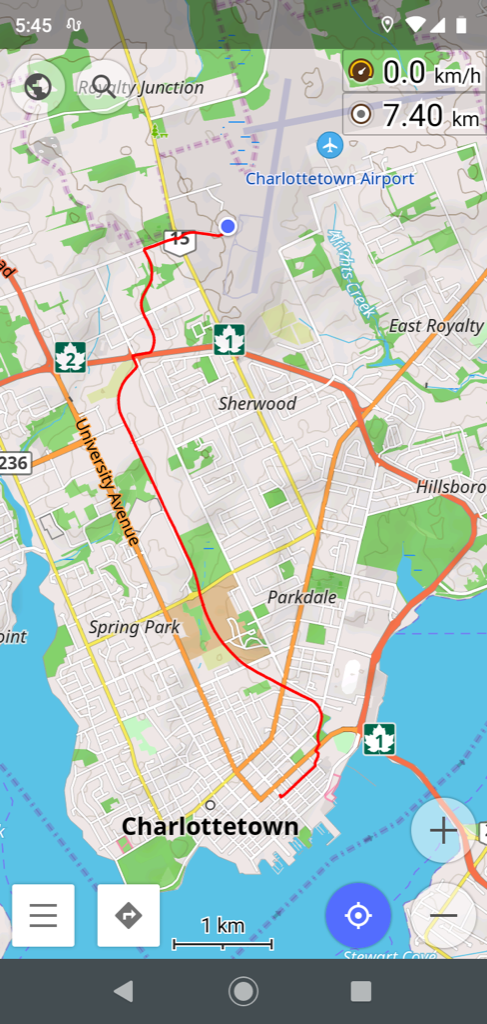
When I pulled into the employee parking like just before 5:30 a.m. my airplane was ready and waiting.

The only bicycle rack at the airport is by the employee entrance on the right side near the departure doors; I’d checked earlier to ensure that it was okay for me to park there and was assured that there would be no problem. So I unloaded my gear and locked my trailer to my bike:

Given that the employee break room is right next door, and that it’s an airport, I suspect this might be the most secure bicycle parking in Charlottetown.
Walking into the airport, the combination of the early hour and the strenuous opening exercises combined to place me in a rather pleasant stress-free haze that made the transit through security and the wait for boarding as anxiety-free as I’ve ever experienced.
I slept most of the flight to Montreal.
I’m away for a week, returning from Montreal next Sunday. My flight lands at 11:25 p.m., so my ride home will be equally inky. I just hope it’s not raining.
Moving From Needs To Identity
…so do the discussions, activities, challenges, and anything else you create.
If you want to be a community which members visit every day, you need to expand the nature of activities from problems to desires and identity.
Below is an example:

While you might begin helping a member pick the right drill bit (yes, it’s a metaphor), over time you want to satisfy the need that drove them to tackle that problem.
Finally, you might want to connect them to others who share the same identity.
Two risks here. The first is moving too fast to build a sense of community before members have internalised their shared problems/desires. The second is moving entirely to identity needs and ignoring the problems members still need to solve.
Post-Vacation Blues
So I went on vacation, started going through all my personal To-Dos, and… Got stuck on a couple and didn’t actually get around to tackle any of the beefy ones, and now I’m back at work. And, of course my schedule is a mess again–I’m booked solid to the far end of October.
In retrospect, the biggest annoyance is that I was so close to ticking off one of the major items, and yet it just didn’t pan out. Even straightforward stuff like dealing with a year’s worth of disorganized photos didn’t make the cut.
A surprising amount of stuff did get done over the course of my first week on vacation, enough that I took the time to spend a while revisiting some of my old interests (as per my previous post), but some things, despite pressing, just take time to address and are outside my control.
But I managed to sneak in a few interesting things in the meantime:
Development
First off, I found joker, which is a cute little Clojure interpreter written in Go that comes with (some) batteries included and is plenty fast enough to do shell scripting. After a few tests and fixes it seems to run very well on the Raspberry Pi, and it might turn out to be something worth investing a little time in—right now I’m trying to add SQLite bindings to it and failing miserably…
There is no shortage of interest in piku, the Heroku-like micro-PaaS that I use to deploy this site and a few other things. There was a bunch of new features added by other people over the past few months, including better Java support for building and deploying upon git push, which adds to its ability to run services based on Python, NodeJS, and arbitrary binaries. I suspect Go and Lua won’t be far off, which is just awesome.
Finally, all of my organisations and repositories now have access to GitHub Actions, so I spent a couple of leisurely afternoons by the beach poking at my iPad, pushing out test YAML files and figuring out the differences from Azure DevOps. It’s quirky but solid, and I will eventually move all my public Docker builds to it for the sake of consistency,
Hardware
I am delving deeper into ESP32 territory and ordered an M5Stack basic development kit, which is really cute:

OV2640 cameraFunny thing is, I was actually looking for a nicer ESP32 camera before ordering it. I already have two dev boards with OV2640 cameras that I’ve been trying to use with Tensorflow models (by shipping frames to a server), but the one above is very neatly packaged and ships with a gyroscope, pressure sensor and analog mic, making it perfect for running homekit-camera.
I decided to get the module as well since I keep doing IoT PoCs and demos of all sorts, and I only actually noticed it is Azure-certified after unboxing it.
But the key thing about M5Stack is that the entire product range seems great: excellent build quality (at least based on these two), nicely thought out expandability, and, best of all, USB-C for everything.
I took both with me out to the beach and managed to build a Docker container to wrap the Expressif cross-compiling toolchain and SDK while I was there (I prefer to run that sort of thing on ARM, and had my 3A+ to use as a pocket server), but had no time to write any actual firmware.
Now I just don’t know when I can get around to playing with them, since my schedule looks like it will effectively start spilling over into weekends again…
Other Stuff
One of my kids has a knack for (and deep interest in) Blender, so I spent a little while figuring out how to get it to run on an RDP session (I only took the iPad with me for a large portion of our vacation) and revisiting the basics so we could print some of his models.
From my own experience and based on what he’s been able to do with it 2.80 is still a pain to use with a trackpad, but markedly less so, and I’m happy to see both my kids doing something creative with computers (coding and designing) rather than playing games.
I can’t wait until they figure out how to work together on that kind of thing.
The Great Reckoning, What Tech’s Reflection Can Look Like
Last week danah boyd was presented with an EFF award. She gave a great acceptance speech titled Facing the Great Reckoning Head-On, that contains a plethora of quotes to highlight. Exploring how to make sense of the entire context and dynamics, in which the MIT Media Lab scandal of funding from a badly tainted source could take place (which I previously mentioned here, here and here.) So it’s best to just go read the entire thing.
In stark contrast, Lawrence Lessig’s ‘exploration’ makes no sense to me, and comes across as tone deaf, spending hundreds of words putting forward a straw man that if you accept tainted funding it always should be anonymous, while saying he personally wouldn’t accept such funding. That might well be, but has no real bearing on the case. Instead of putting forward how hard it is to raise funding, he could just as well have argued that higher education should be publicly funded, and funded well to avoid situations like at MIT Media Lab. A model that works well around the globe. Lessig wrote a book against corruption
On the other hand boyd’s speech addresses the multiple layers involved. One’s own role in a specific system, and in a specific institute, how privilege plays out. How the deeply personal, the emotional and the structures and systems we create relate to and mutually impact each other. Acknowledging and sketching out the complexity, and then to seek where meaningful boundaries are is much maturer way to take this on than Lessig’s highlighting a single dimension of a situation which seems minimally pertinent to it, and worse because of its ‘flatness’ is easily perceived to be actively denying the emotional strata involved and in dire need of recognition.
As said go read the entire speech, but I’ll pick out a few quotes nevertheless. They are pertinent to topics I blog about here, such as the recently launched TechPledge, the role of community, the keys to agency, and resonates with my entire take on technology.
The story of how I got to be standing here is rife with pain and I need to expose part of my story in order to make visible why we need to have a Great Reckoning in the tech industry. This award may be about me, but it’s also not. It should be about all of the women and other minorities who have been excluded from tech by people who thought they were helping.
I am here today in-no-small-part because I benefited from the generosity of men who tolerated and, in effect, enabled unethical, immoral, and criminal men. And because of that privilege, I managed to keep moving forward even as the collateral damage of patriarchy stifled the voices of so many others around me.
What’s happening at the Media Lab right now is emblematic of a broader set of issues plaguing the tech industry and society more generally. Tech prides itself in being better than other sectors. But often it’s not.
If change is going to happen, values and ethics need to have a seat in the boardroom. Corporate governance goes beyond protecting the interests of capitalism. Change also means that the ideas and concerns of all people need to be a part of the design phase and the auditing of systems, even if this slows down the process.
…whether we like it or not, the tech industry is now in the business of global governance.
“Move fast and break things” is an abomination if your goal is to create a healthy society…In a healthy society, we strategically design to increase social cohesion because binaries are machine logic not human logic.
…accountability without transformation is simply spectacle.
…
The goal shouldn’t be to avoid being evil; it should be to actively do good. But it’s not enough to say that we’re going to do good; we need to collectively define — and hold each other to — shared values and standards.
Human progress needs the the tech sector to be actively reflective, and to continuously scrutinise its ethics, the values and morals actually expressed in behaviour.
What’s generally good for you vs what meets a need: Balancing explicit instruction vs problem/project-based learning in computer science classes
Lauren Margulieux has posted another of her exceptionally interesting journal article summaries (see post here). Her post summarizes recent article asking which is more effective: Direct instruction or learning through problem-solving-first (like in project-based learning or problem-based learning — or just about any introductory computer science course in any school anywhere)? Direct instruction won by a wide margin.
Lauren points out that there are lots of conditions when problem-solving-first might make sense. In more advanced classes where students have lots of expertise, we should use a different teaching strategy than what we use in introductory classes. When the subject matter isn’t cognitively complex (e.g., memorizing vocabulary words), there is advantages to having the students try to figure it out themselves first. Neither of these conditions are true for introductory computer science.
This is an on-going discussion in computing education. Felienne Hermans had a keynote at the 2019 RStudio Conference where she made an argument for explicit direct instruction (see link here). I made an argument for direct instruction in Blog@CACM last November (see post here). Back in 2017, I recommended balancing direct instruction and projects (see post here), because projects are clearly more motivating and authentic for computer science students, while the literature suggest that direct instruction leads to better learning — even of problem-solving skills.
Lately, I’ve been thinking about this question with a health metaphor. Let me try it here:
Everybody should exercise, right? Exercise provides a wide variety of benefits (listed in a fascinating blog post from Freakonomics from this June), including cardiovascular improvements, better aging, better sleep, and less stress. But if you have a heart problem, you’re going to get treatment for that, right? If you’re having high cholesterol, you should continue to exercise (or even increase it), but you might also be prescribed a statin. If you have a specific need (like a vitamin deficiency), you address that need.
Students in computing should work on projects. It’s authentic, it’s motivating, and there are likely a wide range of benefits. But if you want to gain specific skills, e.g., you want to achieve learning objectives, teach those directly. Don’t just assign a big project and hope that they learn the right things there. If you want to see specific improvement in specific areas, teach those. So sure, assign projects — but in balance. Meet the students’ needs AND give them opportunities to practice project skills.
And when you teach explicitly: Always, ALWAYS, ALWAYS use active learning techniques like peer instruction. It’s simply unethical to lecture without active learning.
Exactly 15 years ago today I blogged the partic...
Exactly 15 years ago today I blogged the participant list of the London Blogwalk that would take place the next day. I started clicking through the URLs to see who’s still using theirs. Some have disappeared, some are still live though inactive, some still active. A few I still am in regular touch with, but two Julian Elvé and Ian Glendinning are still active but weren’t in my feedreader again yet. So I’ve added them. A pleasant surprise that Julian is using IndieAuth and Webmention on his site, and therefore is an active part of the Indieweb.
In the onion architecture, how do you make business decisions that rely on information from actions?
I’ve gotten several questions about how to do X or Y in the Onion Architecture. It seems like giving the architecture a name has miscommunicated how simple it is. It’s just function calls that at some point are all calculations. In this episode, I try to deconstruct what makes the onion architecture work. Spoiler: it’s just function calls.

In the onion architecture, how do you make business decisions that rely on information from actions?
I've gotten several questions about how to do X or Y in the Onion Architecture. It seems like giving the architecture a name has miscommunicated how simple it is. It's just function calls that at some point are all calculations. In this episode, I try to deconstruct what makes the onion architecture
Transcript
Eric Normand: In the Onion Architecture, how do you make business decisions that rely on information from actions? I get this question a lot, especially when I bring up Onion Architecture in more of these episodes. In this episode, I am going to answer it for everyone. My name is Eric Normand. I help people thrive with functional programming.
The Onion Architecture is a way of structuring your application with actions on the outside. These are called the interaction layer because if you’re interacting with the world you really have your enactions. You’re receiving requests from the outside. You’re making API requests yourself.
You’re reading from the database. You’re doing a lot of IO, having effects on the world or sending emails. You’re making lights blink. Whatever your software does. That’s all in the interaction layer.
Inside you have a nice, pure set of layers that are all about calculations. I like to divide them up in a certain way. I like to put the business rules as my first layer inside. Inside of that, a domain layer.
Both of those, it doesn’t matter how you divide it up, especially for this discussion. They’re calculations. They’re pure. They are not based on stuff from the outside. They have no effect on the outside. They’re like little brain that you can give it questions and it will answer their questions. It’s making decisions, basically.
You got this calculations making decisions, business decision, even simple domain decisions. The actions are doing stuff like fetching stuff from the database. Sending data to an API.
Here’s the question that I get a lot, “If you’ve got the Onion Architecture, how do you make decisions that should be calculations like how many times to retry an API? If it fails the first time, do you retry?” That’s a decision your software has to make. How do you have a calculation that decides that it needs to have more information from the database?
It says OK. I’ve done a bunch of stuff. Now I know, I need this more information. It can’t get it itself. How does that information get up to the higher layer so that the higher layer can get it and then give it back to it? It’s weird. It starts to sound like a really difficult problem.
I said, “I’ve gotten this question several times in different forms.” It’s a thing that I’ve caused a confusion I’ve caused in how I’ve explained it. I’m using language to try to talk about them as separate layers. People aren’t really used to thinking in layers.
I’m going to try to pick it apart and put it back together with a new explanation. When I talk about layers, I’m talking about functions in your language, they’re either calculations or actions. Functions calling other functions. Function A calls function B.
There is a relationship there. If you draw all of the relationships between functions, and what functions those functions call, then what functions of those function calls. You make sure all of the arrows are pointing down. You have the stuff that nothing calls up at the top that would be like your main.
Then you have the stuff that calls, but nothing else called and you can just arrange them all. At some point, you could draw a line and say, “Everything below this line is calculations.” Because a calculation cannot call an action. If a calculation called an action, it’s not a calculation.
By definition, calculations cannot call anything above that line. You could draw a line and say, “This stuff down here is all calculations.” The stuff above is all actions.
That’s what I mean by the layers. It’s all just function calls, it’s not like some kind of protocol for communicating and getting information like, “Here’s a decision I need you to make,” so you give me the answer, and then I ask you what I do with that answer.
It’s not that, it’s just function calls. Let’s look at the two examples I gave, these two questions that were asked. If you have to do a retry, you make an API call, and it fails, it times out, you don’t know what happened. I’m going to retry it. How do you decide whether to retry it?
Let’s say your rule in your system is retry it three times or retry it two times. You try it once, and you have two more times to retry. That’s really just a less than. You keep track of how many times you called it, and then you see if it’s less than three. If it’s less than three, then you’d keep trying. Then you decrement or whatever, and increment.
That less than is a calculation. It is not named, and is probably in line right in your action. That is a calculation. It is a decision being made. You could, if you wanted to, say, actually this less than sign, this less than operation, less than three, is a business rule.
I probably wouldn’t call it a business rule. It’s more like an architectural rule or system integrity rule, something like that. You could say, I want to name this function that will decide, based on how many times I’ve already tried the API, whether I should try again.
Just a simple Boolean. It’s basically just the body of the function. It’s just less than. Less than three or whatever number you choose. You could say that’s a business rule. Put it in there. The action is just calling this, like function called Retry Question Mark or Should Retry. This is the name of the function.
You notice, this is the name of the action calling a calculation. That’s it, that’s all it is. The action is in the interaction layer, and the calculation is in the business layer.
What if you’re doing something, and you’re doing this big calculation. You’ve managed to turn it into a nice data pipeline. At some point in the pipeline, something says, “Whoa, I need more data from the database. I need this record,” or, “I need this whole set of records from the database to continue working.” What do you do?
Again, when I read the question, it sounds like the same thing, where people are thinking like, “This interaction layer is telling the business layer to do all this work.” Then, somehow, the business layer needs to communicate back up to the interaction layer, and it’s going to go fetch something. There’s this back and forth, back and forth communication.
I don’t know what people are thinking, but it sounds a lot like an object-oriented mindset, where you got this two peers that are communicating.
It’s server, just peer-to-peer communication, with this protocol of like, “You tell me what data you got, and I’ll start calculating. When I need more, I’ll tell you that I need more, and then you’ll fetch it for me, and then I’ll keep going, and then I’ll tell you I need more.”
That is not what I’m trying to get at. When I have taken the code that people have given me, example, this is really hard to do on the Onion Architecture. Basically, all I do is I move stuff from this big action. It’s like 20, 30 lines, and I just move things. I said, “Oh, that could be a calculation. That’s like a business rule, and this is a business rule.” I just move it into calculations.
Then the action just gets shorter, because now it’s just calling these name functions instead of all this inline code. A lot of it is moving into other actions, by the way. It’s like threading it through.
OK, we’re going to fetch this thing from the database, and then past that to this calculation, it’s going to give us an answer. Then we take another thing from the database, and we pass it to the next function with what we already had. That’s going to do some other calculation.
It looks like regular code. It just looks like normal code. I feel like by naming the thing, like Onion Architecture, I’ve somehow confused people that they think it has to be much more sophisticated, complicated than it has to be.
This is the way I see it. A calculation can only make decisions based on what it knows, what it has been passed through the arguments. It can’t say, “Oh, I need more data.” Whatever has to decide, “This thing needs more data,” it’s not a calculation. It’s an action in an upper layer.
What comes out is that we’re doing this because of efficiency, because we might not need to fetch that huge data set from the database. We won’t know until we’re halfway through the calculation whether we’re going to need it or not.
That’s cool. That’s a different problem. Now, we’re talking about, “Are we doing a lazy thing?” Or, “Does this calculation really have a natural point, a break point, where it’s really two calculations that can be called separately, and results from the first thing can be threaded into the second part?”
Is that what’s going on? The idea that this calculation gets to a point says, “OK, I need more data.” The laziness might solve it. We’ve talked about that before, in previous episodes. We constructed a delay. The delay, it’s a suitable thing. Because the calculation is still pure, even though now by triggering this delay to be realized, it is fetching data.
That logic was injected in. It was passed in from the outside. In fact, I’ve seen Onion Architecture implementations that get passed a function, and then that function just returns the data. You could pass it in a function with dummy data that just gets returned, or you can pass it a function that will fetch the data from the database.
Does that turn that calculation into an action because it is now fetching from the database, even though it doesn’t know? That is a very philosophical question that you’re going to have to draw the line somewhere, where you feel comfortable with, I would be very comfortable with that kind of thing. That’s up to you.
I don’t know if I’ve really done my goal, [laughs] achieved my goal of deconstructing this, and really framing it back in terms of function calls.
The Onion Architecture, it’s maybe more of just a way to look at it, that you don’t have to have everything in a big set of actions. That you can push business rules down into calculations, down the layers.
Remember, if all of our dependencies, all of our function call lines are pointing down, that means calculations…They can’t call up because they’re below the actions. That’s what I mean by pushing it down.
We’re taking these business rules, making sure that they’re implemented as pure functions as calculations. They go into a separate layer that then gets called by the interaction layer. That interaction layer is stuff like, I got a Web request — that’s an action. That depends on when, it’s a timely thing. You also can’t decide when you’d get it, it just comes.
I got a Web request. Now, I have to decide what this Web request is. I’m going to route it. The route, that’s probably a calculation. It’s going to take that path, and it’s going to tell me something, like how this request should be handled.
I take that information, I know how it should be handled, still in the interaction layer. That means I had to call this handler. This handler needs XYZ to be called. It needs a little bit more data. It needs the user information, the session, that kind of stuff.
It adds that in, and then the handler gets called. Handler is probably still part of the interaction layer, it still might fetch stuff from the database. This thing is going to fetch that from the database, make a big decision or several small decisions from the business rules, package it up as a response, and then send it back out.
It’s all function calls. The handler is calling calculations, and then coming back. I look at it like, you don’t need to do anything special, except just make sure that at some point, you do have all calculations going down.
That you don’t have a thing where this business rule that is deep down in the…The call graph is going to fetch out to the database somewhere. That’s all it is. That should actually be up at the top, and make sure that stuff is pure. That’s all it is.
I hope this hasn’t been too mystifying. I fear it has been. If it has, get in touch with me. I want to talk about this in a way that’s more understandable. If you have a better way to explain it, if I’m confusing you more, send me examples of things that you don’t understand how you could turn into an Onion Architecture.
You can get in touch with me by going to lispcast.com/podcast. There you’re going to find links to social media like email, Twitter, stuff like that — whatever you think is best for communicating with me, based on the length. Probably if you got some code, it’s best to go by email, not Twitter, but you decide.
You’ll also find links to subscribe to this podcast. You’ll see all the old episodes with audio, video and text transcripts, so if you need to go back and binge-listen, binge-watch or binge-read, it’s there. I was looking at it the other day. I have 139 episodes, so this is 140. That’s quite a number.
This has been my thought on functional programming. My name is Eric Normand. Thank you for listening and rock on.
The post In the onion architecture, how do you make business decisions that rely on information from actions? appeared first on LispCast.
Ghost Notes
What would the internet smell like, if it had a scent? I think of burning wires or the sugary smell of energy drinks — aggressive green. Then again, the internet, like the ocean, is coursing with debris; perhaps it would smell as musky as the sea, or like everything on earth, depending on where you are.
Scent can seem like a direct line to the unconscious; like an errant thought or a perverse longing, the roots go deeper than reason. Smell has a creeping, inconspicuous quality, like the legs of an insect. Sacred spaces are often doused in smells, censers bubbling over like dry ice or fumes suffusing the Delphic Oracles. Imagine trying to translate this physical, intimate sense to an online platform, distilling scent down to an olfactory message, or enhancing social media feeds in the same way. But the internet, I’m sure you’ve noticed, has no smell. The majority of daily communication, for many of us, occurs in a sphere that excludes a major sense.
The subtleties of scent must be conveyed in a miasma of other senses, a soupy conglomeration of fantasy and association
Scents add an undercurrent to daily life. They permeate the atmosphere, subtly influencing our moods. Online, there is no such pull. Instead, we enter a medium that emphasizes sound and visuals — nothing we encounter here emits a concrete smell. But, that doesn’t mean something as evocative and strange as a smell cannot also occur online.
One of the most poignant things about the internet’s trajectory is how we strive to imbue it with the things it seems to negate. The ASMR genre, for instance, seems rooted in creating pleasurable, prickling physical responses, expressing a precise sensory response online, where physical touch would seem to be impossible. The sounds touch.
Something similar happens with scent. In an environment that omits the sense of smell, the burden seems to shift to other senses, forcing scent into new translations. Online, we don’t smell smells, we see and hear and read smells. Synesthesia was once a rare phenomenon, a poetic gift, today it is a modern dialect. Synesthesia is the language of the internet.
Much has been said and researched about the links between memory and scent, how a whiff of a particular liquor can take you back to a college ski trip or a laundry detergent can evoke a lover. But I’m curious about what it means to make memories online where no corresponding smell can deepen our recollections. Smell does two things well: It marks the passage of time (smells can never really last) and physically invades the body (a smell is a cluster of wayward molecules that have made their way into the nose). Without a corresponding smell, all we encounter online is literally at a distance, strangely removed — even more than a book or a film might be. The internet is ever present, and it somehow feels wrong that it does not produce for itself all the senses of daily life.
At times, using the internet can feel like falling through one trap door after another. The experience of losing time, being sucked into a scrolling spree or getting lost in an online wormhole, is aided by the fact that there is no scent to make that time feel grounded or physical. Like a dream, online temporality is unmoored, morphing again and again into nebulous shapes.
Scent seems to rely on physical engagement, a type of invasiveness that refutes all the distance and mediation that characterizes most of our day-to-day interaction with the internet. Scent, in its most literal description, is a type of touch, an involuntary, microscopic mingling. Creating an equivalent sensation online requires other senses to work in new configurations, approximating that ineffable reality of smell.
Even in strictly “offline” communication — in writing, talking, broadcasting — scent presents a translation problem. It has been marginalized, reduced to a byword for intimacy. Expressing its complexities in terms other than itself can seem impossible. The traditional language for describing and taxonomizing scents is steeped in metaphor: Perfumes belong to “families” and leave wakes known as sillage, a reference to the frothy trails ships leave in their path. Fragrance has “notes,” like music, and a “head” and “heart,” like most human beings.
The subtleties of scent must be conveyed in a miasma of other senses, a soupy conglomeration of fantasy and association. Perfume ads rely on certain tropes to communicate scent: billowing gowns, women slipping barefoot through colonnades, glistening skin, petals strewn across marble, whispers at the nape.
Advertisers, well aware of the difficulties of communicating smell with any precision (when it comes to scent, one person’s rhapsody is another’s reek), have always relied on evoking general fantasies. Frederic Malle describes a $95 scented candle like this:
A long fur coat slinks through a half-open door on Paris’ rive gauche. A man approaches to gently lift the fur off her shoulders, careful to avoid touching her skin, while a waiter offers her a glass of champagne. Following the music, she steps into the library where friends and lovers whisper in dark corners and lie draped over one another in sensuous heaps on velvet cushions.
This, according to the brand, is what a combination of lavender, amber, and patchouli smells like. It’s much easier to imagine a fur coat. When advertisers abandon this strategy and aim for the literal, incorporating flaps of fragrance samples in magazines, the results never feel complete in themselves. The samples all smell more or less the same, like alcohol, paper, and something akin to vanilla, but more importantly, the scent is flattened, emotionally speaking. Scent is powerful and enigmatic because it operates on a level apart from itself — a smell is a smell but also a network of emotions, memories, and aspirations. At times, it can feel more accurate to represent a smell as luxury on the Rive Gauche than a particular mixture of flowering plants.
Well before the internet, movies were attempting to incorporate scent into their strictly audio-visual world. A few retro films, notably a 1960 mystery-comedy called Scent of Mystery featuring Elizabeth Taylor, employed hugely expensive and ineffective scent-generating apparatuses — one of the few extant examples of “Smell-o-Vision.” Today, scent-film pairings pop up rarely, either as a comedic gimmick employing scratch-and-sniff cards, as in John Waters’s Polyester, or as an aspect of Disney World attractions.
Scent has also recently entered the museum space too, notably in last year’s Eckhaus Latta show at the Whitney, where a scent from Régime des Fleurs lingered in the air.
Synesthesia was once a rare phenomenon, a poetic gift, today it is a modern dialect
Researchers in Malaysia have made very preliminary forays into simulating scent by using electrodes to stimulate nerves inside the nose — a method termed “exploratory” rather than retail applicable. This could be a harbinger of virtual smell. In the internet era, the desire to inject visual or auditory experiences with a whiff of something more has resulted in the creation of digital scent machines, often little more than USB-enabled air fresheners. The best known of these, Cyrano, launched in 2016, is a digital scent “speaker” that allows users to “play” fragrances — essentially small puffs of scent cued by an “olfactory playlist.” The Cyrano was invented by Harvard professor David Edwards. “Right now, nobody’s waking up at 3 a.m. saying, ‘I really want to send a scent message,’” he told the New Yorker in 2016, “but one day they will.”
Edwards’s optimism is debatable. But more than that, his approach to digital scent is staunchly literal. Experiencing scent is more diffuse and strange than simply inhaling something odorous, and we have already begun to explore alternative ways to evoke this rebellious sense online. Perfume, incense, candles and so on attempt to control how people and their environments smell. But part of scent’s mysterious allure is the way it can feel ephemeral and fated, like catching someone’s eye on a crowded bus. Scent, by its usual definition, wafts in and out of our experience. To have a scent directed at you — from a bottle or, hypothetically, from your screen — reframes its ineffable, billowing quality. Scent, in this form, becomes something more pointed, a jab or a caress rather than a random by-product of the environment.
So much online imagery has developed in such a way that it almost approximates scent. Social media visuals, in particular, aim for sensory provocation. If the internet continues to lack literal scent, the visual landscape of the internet will likely develop into more and more evocative, sensorial shapes. Vaseline, at one time, was smeared on camera lenses to make close-ups dreamier and more delicious. Today, gloss and glow still equal glamour. Idealized selfies often evoke the dew-covered imagery that is common in fragrance advertising, images that are meant to represent alluring taste and scent and do so by making things look wet, succulent. With makeup designed to catch the light, the face can seem uncannily tangible. The point is to be ripe, as in pungent, like a piece of stone fruit in the summer. Matteness, which can appear impressively surreal in person, has little power on a screen. Even the dazzled, floating lines of text in an Instagram story attempt to be more than they are. The same is true of looping, jittery gifs, the visual equivalent of a quivering muscle, these mini-movies gesticulate within the confines of a screen, creating cyclical motion in a world that is defined by linear scrolling.
Social media isn’t just hosted by, but responds to its scentless environment: The more visual our principle medium is, the more weight images are meant to carry as impressionistic shorthand. While genres like ASMR use one sense to induce another, well-placed or -paired emojis can achieve something similar. How might this look in years to come? It’s safe to assume that the more immersive our experience of the internet becomes, with VR and AR, the more accurately it might evoke something akin to scent.
What would we gain from a digital world that was suddenly scented? That the internet might then begin to feel more lifelike is perhaps naïve. The appeal of the internet is that it is not “like life”; in some cases it allows for idealization or simplification of life away from the screen. Rarely is there a one to one translation from online to off.
If literal scent could somehow be experienced online, it would no more reflect “reality” than an emoji or a well-lit selfie. Scent, online, would be used to add another layer to the haze we use the internet to build around ourselves.
Scent is enigmatic because it operates on a level apart from itself — a smell is a smell but also a network of emotions, memories, and aspirations
The internet is joyous and unsettling because it allows for omission and simplification as well as amplification and augmentation. It is malleable in a way that “reality” is not. There are sensory gaps online that become part of its power. The absence of scent produces a whole vocabulary of imagery and sound that is designed to be sensorial and evocative. If we could really smell it, the internet might look and sound entirely different than it does today.
Disengaging with the internet often feels like waking from a dream (at times more of a nightmare) — full of feverish activity but, suddenly, gone and difficult to remember. The lack of scent is part of what makes the internet feel like a different dimension, even though it’s where we conduct much (or most) of our “real,” quotidian interactions. Certain key things are missing, but their absence is not always clear. Instead, we are left grasping at equivalencies, communicating scent and the realm it comes from in unacknowledged ways.
Roland, your rss feed is pointing to localhost ...
Roland, your rss feed is pointing to localhost urls for your postings (http://localhost:4000/…). Since your Jekyll update yesterday?
This is a RSS only posting for regular readers....
This is a RSS only posting for regular readers. Not secret but not actively public either. Comments / webmention / pingback / linking all ok.
Read more about RSS Club.
Wow. Bad optics, the ‘Hulk‘ being scared of his own protesting citizens and skipping his press conference. An empty lectern in front of the UK flag.

Just weeks in, Johnson has his Salzburg moment already it appears. It isn’t so much humiliation, although it will be seen that way in the UK. The accompanying statements of the Luxembourg PM are largely similar to what happened in Salzburg: the UK internal political debate and resulting ‘plans’ meeting the reality of the EU27 who feel the need to bluntly spell out what over multiple years apparently hasn’t registered when said in diplomatic language. As much as it makes my lower instincts chuckle, being ’empty chaired’ in Luxembourg will not help to bring anyone in the UK closer to compromise though, on the contrary. Nor bring the UK and EU closer to finalising the withdrawal agreement. Although it would help if the UK government actually had a proposal in writing in the first place.
So if anything it increases the probability of a no-deal Brexit. Meaning the UK and EU will return to the exact same issues on November 1st, but then with the UK having gaping holes in its regulatory framework and economy and an urgent need to fix things. Far from ‘getting it done’ on October 31st, it will then drag on for a decade or so, with all the risks that brings to the European project itself (not economically, but having Brexit high on the agenda is a drag on many more pressing topics).
Will the Drawbacks Go Away?
I've been clear for some time that mirrorless is the way virtually all interchangeable lens cameras will go. Again, the reason is that mirrorless designs reduce parts and manufacturing complexity, and thus cost for the manufacturers. …
"outliner mode" file manager - jimspoon
SmallDog wrote:
I wanted the same thing! And requested this feature on dopus forum
>
>https://resource.dopus.com/t/feature-suggestion-outliner-view/31131
>
>Not sure if they are gonna implement it though. But I did mention
>WizTree in that post which might be one more option you could check out
Wow, that was a great post SmallDog. And one thing that surprised me was that you said that "dopus already has 'manual positioning'" - I have not seen that before. And I wonder how it is implemented, since I don't think there is any support for that in the underlying filesystem. Seems like Dopus would have to maintain the "ordering data" itself, in its own datastore.
I should clarify the use case I have particularly in mind. Often I have a bunch of uncategorized files in a folder, awaiting further categorization. And what I have in mind is creating first-level subfolders under that folder, and quickly placing the files into an appropriate first-level subfolder. It seems that the "outliner-mode" would be ideal for that. But perhaps not nearly so good as rearranging files in many widely-dispersed locations in the overall filesystem tree.
Apple Music :: Stuff that works

Letztes Jahr bin ich von Spotify auf Apple Music umgestiegen. Dieses Jahr habe ich verlängert. Wer iPhone, iPad, HomePod, Watch hat, ist mit Apple Music besser bedient. Auch die Übergabe an Beats Studio 3 und AirPods ist vollkommen transparent. Eine hohe Integration hat Vorteile.
Was Spotify besser macht, sind automatische Playlisten. Bei Apple werden sie von Menschen kuratiert und ich habe noch niemanden gefunden, der das auflegt, was ich hören will. Also bin ich mein eigener DJ. Kann ich auch.
"outliner mode" file manager - washere
> jimspoon wrote:
>
On the first, editor, live linking preserved to little files in the big combo file:
Lets say each chunk of paragraph(s) is an external live linked file: what if you move bits from each? or cut and paste to interweave chunks? or delete one? or cut it and paste it somewhere else and re-edit it too? etc etc. All normal in word processing large files over a period. If you intend to keep each chunk of file rigidly in place, then that is something else, not totally free editing, but very limited ordered editing of predefined chunks in pre-defined areas. Very unusual. If you don't see what I mean and/or are already happy with what you got wrt predefined editing scopes, then lets forget it, it's taken enough time.
On the Second, file manager:
I have tested many, kept about a dozen, diff uses for each.
For kybrd shrtcts try Tablacus, has many addons. Bit of a learning curve. Best overall file manager.
For preview I asked another dev to do what you want last year for txt files, but he still has not done it, preview is only for images, it is called Q-Dir. Like Tablacus, it has multi layouts 2 panes, 4 etc + tree column. Both are free. Setting up preview is rule based, complex, useless for you as it is still only images.
WinNC, not free, gives 4 panes etc too, the txt preview (ALT+F3) is not editable, pops up in a pane below the top two in 4 pane view. BUT you can press F4 to popup an editor. And if you are a coder, hence the penchant for kybrd shrtcts, you can use them ie: shrtcts to F4 or save or close etc.
However you are better off with a top notch editor. If it was last year I would say Atom (free). This year I would say MS Visual Studio CODE (also free) has become number one. Even above Sublime Text.
The trick with MS VS Code, and Atom or Sublime, is to plugin the right file manager extensions as one or two left tree columns. Then by using keyboard shortcuts, you can browse folders/subs and files and the preview is updated in the editor panel or panels, on the right. I have at least two editor panes to the right of the file tree columns. Of course MS VS Code has thousands of plugins/addons, called extensions. Find the right file manager / tree columns for you, there are many. Search by keyword in extensions: file tree folder subfolder etc.
Stick a nice dark theme on it and maybe in time use some of the Markdown extensions which work with txt too, plus preview etc. In a couple of years you'll see you can do anything an ideal file maanger could do with it, plus much much more. Good luck.
Lessons from the heart-stopping world of complex facilitation
Recently I have had several jobs that have required large group complex facilitation. Sometimes this work involves using methods like Open Space Technology or World Cafe, and other times it requires new designs and processes customized for the work.
When I say “complex facilitation” I mean running group processes that are grounded in complexity theory and intended to move a group towards emergent outcomes. I first heard this term used by Sonja Blignault and Dave Snowden of Cognitive Edge, to describe this kind of facilitation. (Sonja has a great post on this stuff!) These are facilitation techniques and approaches that are required for large groups of people to engage in strategy, sensemaking, planning, and evaluation when the direction forward is unclear and the outcomes are unpredictable or unknown. It is a basic feature of all my facilitation practise, but when I’m doing new things with new designs, methods and processes, I’m most keenly aware of the nature of the work. So over the past few weeks, I’ve been able to reflect on both what complex facilitation is and what is required to do it well.
Here are a few thoughts.
Complex facilitation is highly participatory. Even in a large group setting, complex facilitation requires the active participation of everyone in the room. You will rarely find a meeting I’m running where you have the time to check your email, or just observe. I create exercises and use processes that require active and relatively equal participation. This begins with the invitation process, where we work hard to ensure that there is a diverse group of people, experiences, and perspectives involved in the project. It requires participants to be prepared to work in a participatory way, and it requires processes that ensure that everyone has a chance to meaningfully contribute to the outcomes. This means designing and using structures that move between large and small group sessions, and never leave people sitting and listening in plenary too long.
Outcomes are emergent and therefore unknown at the beginning. There is no pre-determined destination in complex facilitation. We may have the purpose of making a decision, producing a report, or assembling a plan, but the basic content of those outputs is emergent. It arises from the interactions between the participants. As a facilitator, I have to be very careful not to influence the outcomes of the work, especially when the work is making meaning of patterns that are important to the group. I have to avoid using examples to illustrate the exercises drawn from the group’s context. I spend a lot of preparation time thinking of examples to use that won’t colour the group’s sensemaking work. During the work, I have to be deeply conscious of the way I talk and interact with the group, so as not to impose my view of things on them.
Use stories and base the work in reality. One thing I have learned from my work informed by complexity practitioners like Dave Snowden, Jennifer Garvey Berger, Cynthia Kurtz, and Glenda Eoyang is to base your strategic work in reality. This means prepping strategic work with a process to collect stories and narratives from the organization or community. Over the past couple of years, I have started using tools like Sensemaker and Cynthia Kurtz’s NarraFirma to do this work. These tools have the advantage of collecting data from people in their context which means that when they come to a large group meeting, they are able to work with material that has been collected rather than generating stories in a workshop context that can sometimes be influenced by bias, habit, and other kinds of cognitive entrainment. I also work with methods that can generate narratives in the workshop itself, but if it’s possible, undertaking a narrative capture beforehand makes the work more meaningful.
Remember that all complexity work is about patterns. When working with complex facilitation techniques, I’m constantly designing processes and shifting them based on pattern intelligence. In designing and working with patterns, I rely on my version of the ABIDE heuristic: I pay attention to Attractors, Boundaries, Identities, Differences and Exchanges in a process. When the group needs shifting, these are the basic areas I get to influence. If unhealthy issues are arising in a group, my job is to try to shift the patterns to bring the group to emerging health and coherence (note: this does not mean suppressing dissent or conflict!). Work with patterns and you’ll avoid the temptation to meddle in the content.
Work with cognitive stress and overload. The word “facilitation” comes from the Latin word facilitare which means “to make things easy.” That is not the goal of complex facilitation. Instead, the facilitator works with cognitive overload and stress, deliberately shifting the process between mentally heavy activities and things that are lighter and allow for cognitive recovery. The reason for doing this is to ensure that participants are constantly challenging their patterns and biases. Especially in sensemaking sessions, participants who simply go to the easy answers are not finding the novel. Innovation is very hard work and requires people to both think and act differently. I’m sure many folks who have worked with me will testify about how much they struggled in sessions when we were trying to do new things. That struggle is brains wrestling with habits and preferences. Facilitators need to be skillful in introducing good stress and overload that doesn’t break a group but causes people to authentically find new things. Work hard and eat avocadoes and blueberries.
Not everyone will enjoy it. As a result of cognitive overload and the messiness of the room strewn with markers and posit it notes, you will find that not everyone will enjoy a complex facilitation session. I try to prepare people as much as possible for the work, and almost always warn them ahead of time that the day will be challenging, and they are invited to stay in it. But in a large group of folks, there will always be people who have a crappy time. Try not to create processes that have this result, but also learn and remember that not everyone is going to be thrilled to work in this way. I’ve been in this situation both as a participant and as a facilitator, and I’m okay with it.
You don’t have a safety net. The more experienced one gets at complex facilitation, the more frequently one operates without a safety net. It can feel risky facilitating in this way, even with a couple of decades of experience under one’s belt. I still often get nervous and fearful in these kinds of workshops, and I’m on high alert. I have developed good self-awareness practices to know when my anxiousness is seeping into my facilitation. This is critical for facilitators of all kinds but especially those who engage in this kind of work. It is not uncommon to find oneself receiving criticism and mistrust, especially as a group is going through a groan zone together. Have a good practice and you can remain a resourceful facilitator. That is the only safety net you get!
A Recent Interview: Welcome to the Postnormal

I’ve been interviewed a bunch recently. Here are this year’s words.
Epic New Video! The Arctic Is Burning Title Track
Here’s the video for the longest track on my brand new album – the title track, The Arctic Is Burning.
As always, this is the film of me actually recording it. I film every time I hit record, as a document of what’s going on for my Bandcamp subscribers. They get way more video than is ever made available to the wider public – new approaches that I’m working on, video for tracks that only end up on subscriber albums… I end up filming a whole load of stuff that obviously doesn’t get released at all, but rather gets deleted, but that’s OK. I’d rather do that than miss a good performance 
So here it is, the video of me recording The Arctic Is Burning – one thing to keep in mind is that as you watch it for the first time, you know as much as I do about where it’s going to go. I don’t start these things with a map of what the resulting piece of music is going to sound like, or the transitions its going to take. The role of the camera is really interesting here, in that it acts as a proxy for the subscribers. They’re who I’ve got in mind when I’m thinking about the journey and how it is perceived from the outside. They play the psychological role that a producer would play in a studio, watching through the glass while I record a take, hoping not to screw it up
So sometimes the journey takes me by surprise, sometimes I have to dig deep to find out where it’s meant to go, and sometimes it feels inevitable…
Hear the whole album at music.stevelawson.net/album/the-arctic-is-burning or check out my Bandcamp subscription now to get everything I release throughout the year!

iPhone 11 and 11 Pro Review Roundup: The King of Cameras?

Today the first reviews for the iPhone 11 and 11 Pro dropped, and they should inspire excitement in anyone planning to pick up a new iPhone later this week. Apple’s claims for massive battery life increases on the Pro models seem to have proven true, Face ID is better than before, and each device is more durable than before too, but the cameras are where this year’s iPhones truly shine. In years past the iPhone was the undisputed camera king, and with the 11 and 11 Pro Apple is building a compelling case why that’s true once more.
Nilay Patel of The Verge writes one of the most thorough, in-depth reviews available. What he says about the iPhone 11 and 11 Pro cameras is especially noteworthy because of his criticisms of last year’s iPhone XS line:
the iPhone 11 Pro cameras are an enormous improvement over the XS, and they beat the Pixel and Samsung’s Galaxy Note 10 Plus in most of our side-by-side comparisons. In fact, I think the iPhone 11 Pro is the best smartphone camera on the market right now.
[…]
So the iPhone 11 camera does better in bright light than the Pixel 3 and Note 10, and Night mode beats the Pixel 3 more often than not. If the deep fusion update improves medium-to-low light performance as much as Apple says it will, the iPhone 11 will take better photos than the competition in every lighting situation.
[…]
In fact, the cameras on the iPhone 11 and 11 Pro are so improved that I think they’re worth the year-over-year upgrade from last year’s models for the first time in a long time. Add in the improved battery life, and the iPhone 11 Pro stands out as a major step forward from the XS, and one of the best flagship phones of the year.
Matthew Panzarino of TechCrunch echoes that assessment, saying the iPhone 11 Pro comes with “the best camera I’ve ever used on a phone.” He was especially fond of night mode:
The night images still feel like night time. This is the direct result of Apple making a decision not to open every shadow and brighten every corner of an image, flaring saturation and flattening contrast.
Panzarino largely praises the ultra wide lens, but he does call out a couple of its drawbacks:
Of note, the ultra wide lens does not have optical image stabilization on either the iPhone 11 or iPhone 11 Pro. This makes it a much trickier proposition to use in low light or at night.
The ultra wide camera cannot be used with night mode because its sensor does not have 100% focus pixels and, of course, no OIS. The result is that wide angle night shots must be held very steady or soft images will result.
Lauren Goode at Wired similarly found night mode excellent:
Both the iPhone 11 and the new Pro phones have a new “Night Mode,” which is automatically activated in dark environments and tells you how long you’ll have to hold the phone steady for to capture an optimal shot. I already love it. It’s so much more intuitive than swiping through settings to find a dedicated night mode.
Raymond Wong, writing for Mashable joins in praising the cameras, but he goes a step further and says even the triple camera bump on the Pro models looks fine in real life:
Ignore the noise you hear online. The iPhone 11 Pro and 11 Pro Max are way better looking in person, after you’ve held one in your hands, and used its weirdly aligned triple cameras (there is a reason why they’re like that, which I’ll get into soon).
Chris Velazco of Engadget was impressed by the cameras, but feels that “the race between Apple and its competition is still much tighter than the company would like to admit.” He also encountered software issues which impacted the Camera app. As is echoed by other reviewers, iOS 13 is more buggy than a typical iOS update:
As much as I’ve enjoyed using these new cameras, my time testing them hasn’t been bug-free. Every once in a while, the cameras would simply fail to start up; I’d see the full slew of camera controls, but not a hint of what was in front of me. An Apple spokesperson said the company was aware of the issue and that it would be fixed in the iOS 13.1 update going live September 30th.
It’s only a few days before the public can get their hands on the iPhone 11 and 11 Pro, but based on these reviews and more, it sounds like Apple has delivered on the two most important promises it made for these devices: top-level cameras and the best battery life ever in an iPhone.
Support MacStories Directly
Club MacStories offers exclusive access to extra MacStories content, delivered every week; it’s also a way to support us directly.
Club MacStories will help you discover the best apps for your devices and get the most out of your iPhone, iPad, and Mac. Plus, it’s made in Italy.
Join Now2019-09-16

Photo Caption: Sweet pea and mint soup by @maxkiesler
Instagram filter used: Clarendon
Sprawling flood waters across the Midwest and South

The New York Times mapped the slow, wide-reaching flood waters this year so far:
To measure the scope of the spring floods, The New York Times analyzed satellite data from the Joint Polar Satellite System using software, developed by government and academic researchers for flood detection, that is frequently used in disaster response.
The data covers the period from Jan. 15 to June 30 and shows an interconnected catastrophe along the Missouri, Mississippi and Arkansas Rivers, a system that drains more than 40 percent of the landmass of the continental United States.
Be sure to look at the piece on NYT. It tours you through the significant flooding areas as you scroll, which provides a step-by-step along with a sense of scale.
Tags: climate change, flood, New York Times
Lenovo C340 Chromebook :: Erste Eindrücke

Vor vielen Jahren, schon bevor es die erste iPads gab, hatte ich in Orlando einmal ein Chromebook in der Hand. Das war ein Vorseriengerät von Google und erinnerte entfernt an ein schwarzes Macbook. Habe mich einfach mit Gmail-Adresse und Kennwort angemeldet, und bämm war ich mitten drin und konnte gleich loslegen. Seit diesem Erlebnis verstehe ich den Erfolg dieser Geräte im amerikanischen Schulwesen. Sie sind eigentlich konfigurationslos und lassen sich leicht managen. Aber man braucht halt einen Google Account und das scheitert hier schnell an Bedenkenträgern. Entsprechend mager war das Angebot an Chromebooks in Deutschland.
Jetzt aber habe ich ein Lenovo C340 Chromebook und bin wieder völlig geflasht. Das ist ein kleines, leichtes, vielleicht etwas pummeliges Gerät, das ich binnen zwei Minuten in Betrieb genommen habe. Auspacken, einschalten, ins WLAN aufnehmen und mit dem Google Account anmelden. Bämm! Fertig. Mehr gibt es nicht zu tun. Man kann sich noch ein paar Apps installieren, aber eigentlich lebt man im Browser und den ganzen Google Apps.

Das Lenovo C340 ist ein Convertible, d.h. man kann es nach hinten umklappen und "falschrum" zusammenklappen. Kein Wunder, dass man den Bildschirm auch per Touch bedienen kann. Geladen wird das C340 über ein USB-C-Netzteil und einen Anschluss links. Rechts gibt es nochmal USB-C außerdem auf jeder Seite einmal USB-A. Kopfhörer, MicroSD (!), Kensington Lock, Laut/Leise und ein Einschalter und fertig ist das Gerät. Wenn man teures Zeugs gewöhnt ist wie das X1 Yoga, dann merkt man, dass die Tastatur vergleichsweise billig ist und der Bildschirm einen sehr breiten Rand hat. Man würde in das Gehäuse auch locker ein Panel mit 12 statt 11 Zoll reinbekommen, aber das vergisst man eigentlich ganz schnell wieder.

Ich war erst ein wenig irritiert, weil die Tastatur irgendwie anders aussieht. Dann fiel es mir auf. Das sind alles Kleinbuchstaben. Aber es gibt wenig bis gar keine Kompromisse. Nur die Enter-Taste fällt etwas schmal aus.
Der erste Eindruck ist äußerst positiv. Für jemanden, der eigentlich fast alles mit seinem Android-Handy macht, ist das ein toller PC für den Fall, dass es etwas mehr sein soll. Zum Beispiel eine richtige Tastatur. Und ich finde es ist den meisten Android Tablets deutlich überlegen.

Es ist nicht viel drin in so einem Chromebook. Wifi/Bluetooth sitzen auf einer eigenen Karte und ließen sich tauschen. Das Motherboard hat einen Intel Celeron N4000, der keinen Lüfter benötigt. Aber es wäre noch deutlich mehr Platz für einen größeren Akku. In der Praxis spielt das keine Rolle. 4 GB RAM und 64 GB Storage haben sich bisher als völlig ausreichend erwiesen. Die Daten leben sowieso in der Google Cloud. Das 11 Zoll Display mit nur 1366*768 Pixeln Auflösung ist mir ein bisschen wenig. Ins Gehäuse würden problemlos 12 Zoll mit 1920*1080 passen.
Day Two to One Day
Jeff Bezos opened his 2016 letter to Amazon shareholders like this:
“Jeff, what does Day 2 look like?”
That’s a question I just got at our most recent all-hands meeting. I’ve been reminding people that it’s Day 1 for a couple of decades. I work in an Amazon building named Day 1, and when I moved buildings, I took the name with me. I spend time thinking about this topic.
“Day 2 is stasis. Followed by irrelevance. Followed by excruciating, painful decline. Followed by death. And that is why it is always Day 1.”
To be sure, this kind of decline would happen in extreme slow motion. An established company might harvest Day 2 for decades, but the final result would still come.
Bezos went on to give advice about how to avoid Day 2, including “True Customer Obsession”, “Resist Proxies”, “Embrace External Trends”, and “High-Velocity Decision Making”. The company he manages then spent the next several years looking like it was in fact Day 2.
Tilting the Scales
Consider this story in the Wall Street Journal about how Amazon reportedly adjusted its search algorithm to favor its own products:
Amazon.com Inc. has adjusted its product-search system to more prominently feature listings that are more profitable for the company, said people who worked on the project—a move, contested internally, that could favor Amazon’s own brands…The adjustment, which the world’s biggest online retailer hasn’t publicized, followed a yearslong battle between executives who run Amazon’s retail businesses in Seattle and the company’s search team, dubbed A9, in Palo Alto, Calif., which opposed the move, the people said.
Note how badly this decision fares relative to Bezos’ advice:
- Shifting results away from relevance towards factors that benefits Amazon’s bottom line is not a decision that results from “true customer obsession”.
- Goal-seeking for profit is a poor proxy for that customer obsession that Bezos focused on in the 1997 shareholder letter attached to every subsequent letter.
- Amazon allegedly spent “years” deciding whether or not to do this, which is definitely not “high-velocity decision making”.
To be fair, Amazon is embracing the external trend of raising antitrust concerns, which are probably overblown given the company’s single-digit share of retail in the United States. There are no objections to Walmart, for example, having store brands or pay-for-placement programs, despite the fact that Walmart’s share of retail is about 33% larger than Amazon’s (8.9% of consumer retail spending in the U.S. versus 6.4 percent), so it’s not clear on what basis the digital equivalents of these programs would be prosecuted.
With regards to Bezos’ warning, though, the antitrust discussion is a moot point: companies that spend months or years arguing about the legality and customer friendliness of tilting the scales are usually well into Day Two.
Squeezing Suppliers
This is hardly the only example of Amazon becoming obsessed with profitability on the margins in its retail operation over the last few years. For example, from Recode last November:
Over the past few months, Amazon has applied intense pressure to consumer brands across different product categories — seizing more control over what, where and how they can sell their goods on the so-called everything store, these people say. One apparent goal: To take more control over the price of goods on Amazon so the company can better compete with retailers. The power moves are also believed to be a prelude to a new internal system that Amazon has yet to launch called One Vendor. The new initiative will essentially funnel big brands and independent sellers alike through the same back-end system in a supposed effort to improve the uniformity of the shopping experience across Amazon on the public-facing side.
From the Wall Street Journal in December:
As Amazon focuses more on its bottom line in addition to its rapid growth, it is increasingly taking aim at CRaP products [“Can’t Realize a Profit”], according to major brand executives and people familiar with the company’s thinking. In recent months, it has been eliminating unprofitable items and pressing manufacturers to change their packaging to better sell online, according to brands that sell on Amazon and consultants who work with them.
From CNBC in March:
In recent months, Amazon has been telling more vendors, or brand owners who sell their goods wholesale, that if Amazon can’t sell those products to consumers at a profit, it won’t let them pay to promote the items. For example, if a $5 water bottle costs Amazon that amount to store, pack and ship, the maker of the water bottle won’t be allowed to advertise it.
From Bloomberg, also in March:
Amazon.com Inc. has abruptly stopped buying products from many of its wholesalers, sowing panic. The company is encouraging vendors to instead sell directly to consumers on its marketplace. Amazon makes more money that way by offloading the cost of purchasing, storing and shipping products. Meanwhile, Amazon can charge suppliers for these services and take a commission on each transaction, which is much less risky than buying goods outright.
From Bloomberg in May:
In the next few months, bulk orders will dry up for thousands of mostly smaller suppliers, according to three people familiar with the plan. Amazon’s aim is to cut costs and focus wholesale purchasing on major brands like Procter & Gamble, Sony and Lego, the people said. That will ensure the company has adequate supplies of must-have merchandise and help it compete with the likes of Walmart, Target and Best Buy.
The vendor purge is the latest step in Amazon’s “hands off the wheel” initiative, an effort to keep expanding product selection on its website without spending more money on managers to oversee it all. The project entails automating tasks like forecasting demand and negotiating prices which were predominantly done by Amazon employees. It also involves pushing more Amazon suppliers to sell goods themselves so Amazon doesn’t have to pay people to do it for them.
None of these decisions are necessarily wrong in a vacuum; what has been striking, though, is the drumbeat of Amazon Retail changes that seem primarily concerned about Amazon’s profitability. And, for the record, it has worked:

Throughout the second half of 2018 and the first part of 2019, Amazon flipped revenue and expense growth by just a smidge, which caused income to skyrocket on a year-over-year basis. It may have been Day 2 as far as Amazon’s prioritization of profitability above everything was concerned, but at least the company was, in Bezos’ words, “harvesting”.
One Day Shipping
Note, though, that the chart above is missing last quarter’s results, and for good reason:
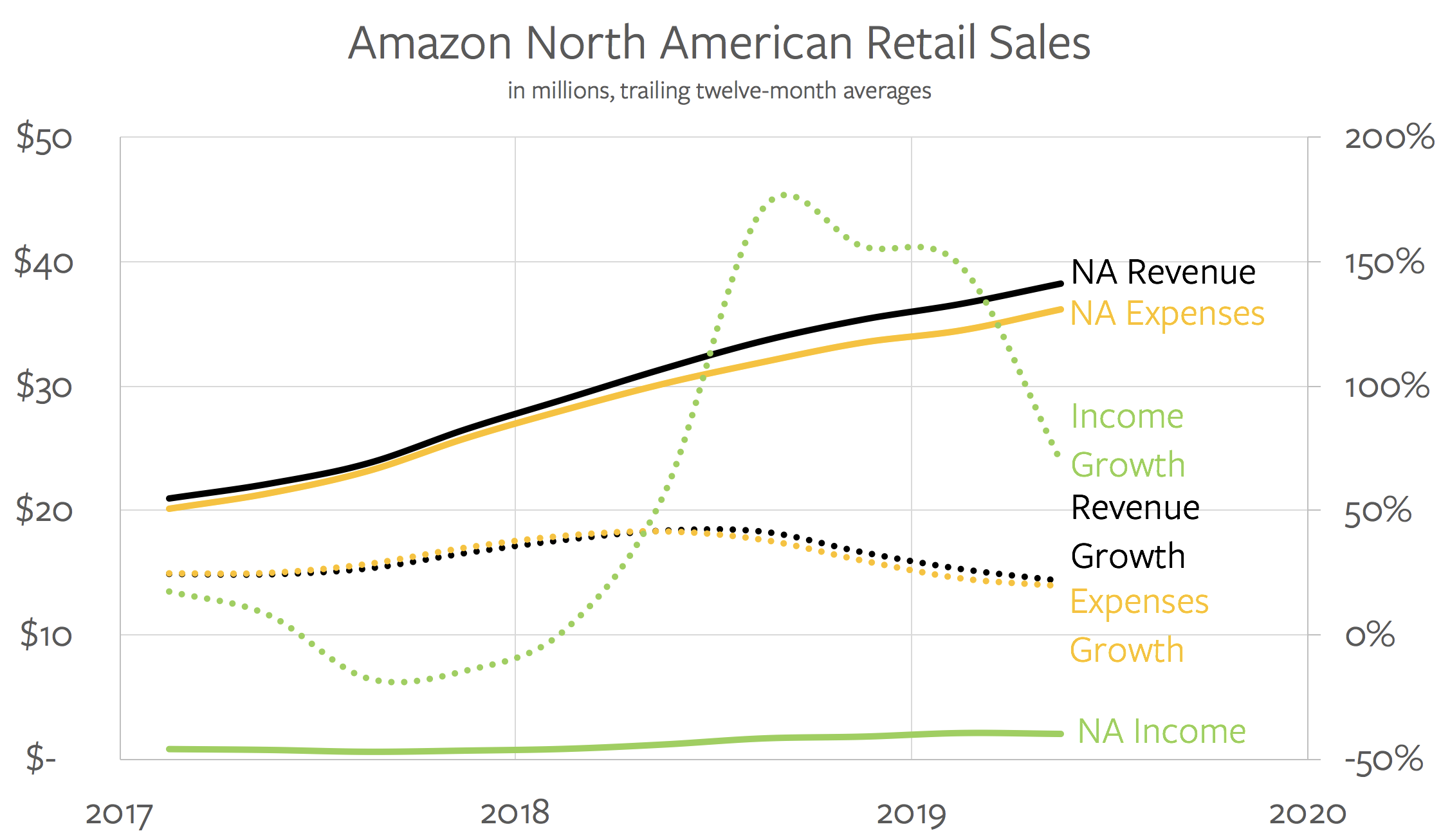
It’s a bit hard to make out, particularly because I am using trailing twelve-month averages (because of Amazon’s high seasonality), but expenses increased a lot more than revenue last quarter; in fact year-over-year income growth on a quarterly basis was actually -15%.
What changed is that Amazon decided to travel back in time — to Day One — and invest in what the company does best: massively difficult logistical problems that customers love having solved. Originally that was access to any book, then access to anything period, then access in two days, and now Amazon is committed to one.
First, from the company’s Q1 2019 earnings call announcing Amazon’s ambition:
We’re currently working on evolving our Prime free Two-Day Shipping program to be a free One-Day Shipping program. We’re able to do this, because we spent 20 plus years expanding our fulfillment and logistics network, but this is still a big investment and a lot of work to do ahead of us.
For Q2 guidance, we’ve included approximately $800 million of incremental spend related to this investment. And just to clarify, to give a little more information, we have been offering, obviously, faster than Two-Day Shipping for Prime members for years, one day, same day, even down to one to two hour delivery for Prime Now. So we’re going to continue to offer same day and Prime Now selection in an accelerated basis.
But this is all about the core free Two-Day offer evolving into a free One-Day offer. We’ve already started down this path. We’ve in the past months significantly expanded our one-day eligible selection and also expanded the number of zip codes eligible for one-day shipping.
The costs started to show up last quarter. From the company’s Q2 2019 earnings call, a quarter where Amazon missed on profits for the first time in several years:
In Q2, we had a meaningful step up in the one-day shipments, primarily in North America, and one-day volume was accelerating throughout the quarter…On the cost side, we talked last time about $800 million estimate of transportation cost to supply one day, the additional one day in Q2. We were a little bit higher than that number in total cost.
We saw some additional transition costs in our warehouses. We saw some lower productivity as we were expanding rather quickly, both local capacity in the off-season also in our delivery networks. We also saw some costs were moving: buying more inventory and moving inventory around in our network to have it be closer to customers. And we built not only that cost structure, but an accelerating cost penalty into our Q3 guidance that was released with our earnings today.
This is an initiative that clearly passes Bezos’ test:
- Customers love getting items in one day instead of two.
- One day shipping is a clear goal.
- Increased convenience will always be the ultimate external trend.
- Ramping up one-day shipping in a manner of weeks by definition requires high-velocity decision making.
It is also the opposite of harvesting: it is investing, and it seems more likely than not that Amazon’s upcoming results will look much more like the “Day One” company it was for years, with rapidly growing revenue and costs to match.
This Article comes at a bit of a weird time: in truth I had been considering writing a bearish Amazon article for several months as the penny-pinching anecdotes started to pile up. Tech companies rarely find sustainable growth by focusing on costs; if anything they find antitrust violations.
That announcement about one-day shipping, though, made me hold my fire. Spending a lot of resources on incredibly difficult logistical problems is precisely what makes Amazon so valuable, which means that the commitment to do just that — even with higher costs — is a reason to be bullish. The only problem is that the revenues I anticipate have not yet appeared in the quarterly results.
Still, this search news made me revisit the issue a bit early: tilting the field to favor the bottom line instead of doing what is best for customers is the surest sign of harvesting instead of investing, and it reminded me of my bearish thesis. I wonder if Amazon might not reconsider their approach to search now that the company is demonstrating a recommitment to growing the top line instead of the bottom.
That’s also why last week’s Apple event was encouraging: Apple may have its work cut out to be an effective services company, but by cutting iPhone prices and pricing its services offerings aggressively it is making its own moves towards investing, not simply harvesting. This is also why Facebook’s commitment to Stories was a good sign even if it entailed an earnings hit; its various attempts to wring engagement out of its core app through things like forced Instagram integrations and dating services run in the opposite direction. For Microsoft, meanwhile, The End of Windows meant the end of harvesting and a return to investing, much to investors’ benefit.
Perhaps the biggest question mark, though, is around Google: the company has gotten far more mileage than I ever expected out of mobile generally and cramming more ads into mobile search results specifically; both, though, particularly the latter, seem more like harvesting than investing. And, even when Google does invest, it is too often in projects far removed from customers and the forcing function that going to market entails.
This also may be why Google is the most susceptible to antitrust action of all the major consumer tech companies; the question as to what comes first, harvesting instead of investing or behaving anticompetitively, ceases to matter when you are operating at the scale of any of these companies. And, on the flipside, it strongly suggests that antitrust actions are a trailing indicator of a company that has peaked,1 not a causal force of decline.
- YouTube remains a tremendously important counterweight to any bearish Google story
Examining AI’s Effect on Media and Truth
Mozilla is announcing its eight latest Creative Media Awards. These art and advocacy projects highlight how AI intersects with online media and truth — and impacts our everyday lives
Today, one of the biggest issues facing the internet — and society — is misinformation.
It’s a complicated issue, but this much is certain: The artificial intelligence (AI) powering the internet is complicit. Platforms like YouTube and Facebook recommend and amplify content that will keep us clicking, even if it’s radical or flat out wrong.
Earlier this year, Mozilla called for art and advocacy projects that illuminate the role AI plays in spreading misinformation. And today, we’re announcing the winners: Eight projects that highlight how AI like machine learning impacts our understanding of the truth.
These eight projects will receive Mozilla Creative Media Awards totalling $200,000, and will launch to the public by May 2020. They include a Turing Test app; a YouTube recommendation simulator; educational deepfakes; and more. Awardees hail from Japan, the Netherlands, Uganda, and the U.S. Learn more about each awardee below.
Mozilla’s Creative Media Awards fuel the people and projects on the front lines of the internet health movement. Past Creative Media Award winners have built mock dating apps that highlight algorithmic discrimination; they’ve created games that simulate the inherent bias of automated hiring; and they’ve published clever tutorials that mix cosmetic advice with cybersecurity best practices.
These eight awards align with Mozilla’s focus on fostering more trustworthy AI.
The winners
 [1] Truth-or-Dare Turing Test | by Foreign Objects in the U.S.
This project explores deceptive AI that mimic real humans. Users play truth-or-dare with another entity, and at the conclusion of the game, must guess if they were playing with a fellow human or an AI. (“Truths” are played out using text, and “dares” are played out using an online sketchpad.) The project also includes a website outlining the state of mimicry technology, its uses, and its dangers.

[2] Swap the Curators in the Tube | by Tomo Kihara in Japan
This project explores how recommendation engines present different realities to different people. Users will peruse the YouTube recommendations of five wildly different personas — including a conspiracist and a racist persona — to experience how their recommendations differ.

[3] An Interview with ALEX | by Carrie Wang in the U.S.
The project is a browser-based experience that simulates a job interview with an AI in a future of gamified work and total surveillance. As the interview progresses, users learn that this automated HR manager is covering up the truth of this job, and using facial and speech recognition to make assumptions and decisions about them.
[4] The Future of Memory | by Xiaowei Wang, Jasmine Wang, and Yang Yuting in the U.S.
This project explores algorithmic censorship, and the ways language can be made illegible to such algorithms. It reverse-engineers how automated censors work, to provide a toolkit of tactics using a new “machine resistant” language, composed of emoji, memes, steganography and homophones. The project will also archive censored materials on a distributed, physical network of offline modules.
 [5] Choose Your Own Fake News | by Pollicy in Uganda
This project uses comics and audio to explore how misinformation spreads across the African continent. Users engage in a choose-your-own-adventure game that simulates how retweets, comments, and other digital actions can sow misinformation, and how that misinformation intersects with gender, religion, and ethnicity.
[6] Deep Reckonings | by Stephanie Lepp in the U.S.
This project uses deepfakes to address the issue of deepfakes. Three false videos will show public figures — like tech executives — reckoning with the dangers of synthetic media. Each video will be clearly watermarked and labeled as a deepfake to prevent misinformation.
 [7] In Event of Moon Disaster | by Halsey Burgund, Francesca Panetta, Magnus Bjerg Mortensen, Jeff DelViscio and the MIT Center for Advanced Virtuality
This project uses the 1969 moon landing to explore the topic of modern misinformation. Real coverage of the landing will be presented on a website alongside deepfakes and other false content, to highlight the difficulty of telling the two apart. And by tracking viewers’ attention, the project will reveal which content captivated viewers more.
[8] Most FACE Ever | by Kyle McDonald in the U.S.
This project teaches users about computer vision and facial analysis technology through playful challenges. Users will enable their webcam, engage with facial analysis, and try to “look” a certain way — say, “criminal,” or “white.” The game reveals how inaccurate and biased facial analysis can often be.
These eight awardees were selected based on quantitative scoring of their applications by a review committee, and a qualitative discussion at a review committee meeting. Committee members included Mozilla staff, current and alumni Mozilla Fellows and Awardees, and outside experts. Selection criteria is designed to evaluate the merits of the proposed approach. Diversity in applicant background, past work, and medium were also considered.
These awards are part of the NetGain Partnership, a collaboration between Mozilla, Ford Foundation, Knight Foundation, MacArthur Foundation, and the Open Society Foundation. The goal of this philanthropic collaboration is to advance the public interest in the digital age.
Also see (May 2019): Seeking Art that Explores AI, Media, and Truth
The post Examining AI’s Effect on Media and Truth appeared first on The Mozilla Blog.
SFU City Program: Planning for Non-Planners


Our new evening workshop delves into the theory and approaches in urban planning that have shaped our region, and provides an overview of how land-use tools (plans, policies, bylaws, permits, etc.) are applied to planning decisions.
This course is perfect for anyone looking to gain a solid understanding of the field.
Planning for Non-Planners: What You Need to Know about Community Planning
Dates: Thursday, November 14, 21 & 28, 6:30-9:30 p.m.
Location: SFU Harbour Centre
Instructor: Eric Aderneck, VP Planning and Development, iFortune Homes Inc.; Industrial Land-Use Planning Consultant
Gastown in 1964
Via Durning, a gentle black-and-white video from the CBC Vancouver program the 7 O’CLOCK SHOW special series on “Urbanism.” (Click title for video.)
This footage depicts the oldest neighbourhood in Vancouver (near the Port) Gastown and the Downtown Eastside area of Vancouver.*
Older buildings (many vacant) on Alexander, Columbia, Carrall and Powell Streets are featured. In 1964 this was an area of the city in transition, where heritage buildings were neglected and vulnerable to idea of modernism.
*In the days when it was necessary to inform people where Gastown was, and before part of it was renamed the Downtown East Side. And in the days when the fabled ‘7-O’clock Show’ would commission and run a visual essay without narration.
Cycling like a … Dutchman?
Via Karole Sutherland:

Wim Bot, an official in the Dutch cyclist’s union …
“Think of it this way. Car drivers behave like a bunch of geese. They have the same distance from each other and fly at the same speed, and move almost in military formation.” He put down his tea and made a series of regimented gestures with his hands. Then he moved them around together, in an elegant dance. “Cyclists move like a swarm of sparrows,” he said. “There are thousands of them moving in chaos, but there are no collisions. They turn a little bit; they change their speed. You must do the same.”
Just possibly the worst sidewalk to navigate in downtown
A major entrance to Pacific Centre Mall off Dunsmuir Street:

Scaffolding clutters the space, but that’s temporary. The real problem is permanent: the ramp to the underground parking:

It must have seemed like a small intervention when Pacific Centre was being designed in the sixties. The project was three blocks long; underground parking spaces numbered in the thousands. Taking up so much sidewalk space for a necessary exit wouldn’t have been a serious worry.
On the Dunsmuir Street of 2019, it looks like a scar.