This article characterizes Paul Grice's theory of communication as a form of intentionalism whereby it is one person's attempt to convey their mental state to the second, and the second person's interpretation of the communication as just such an effort. But is that what we really do when we communicate? Are we trying to transfer our mental states to other people? The author finds numerous problems with this view, and I'm incline to agree. To me, rather than conveying representational states, I think a communication is more like a move in a (language) game. Anyhow, if you are inclined to the view of communication as transfer, you may want to consider these objections.
Web: [Direct Link] [This Post]Rolandt
Shared posts
The CBC Infolit Bot May Make People Worse at the Web
You might enjoy this article for its link to the ACRL framework for information literacy or you might like it because it criticizes the CBC Chatbot that teaches you about misinformation. Now I'm not going to be able to review the chatbot because it requires I use my Facebook login to interact on Messenger - and I don't use Facebook products because they allow and encourage fake news. But Mike Caulfield makes the reasonable point here that awarding a blue check mark for a 'genuine' news source (like say MintPress News or Russia Today) may encourage readers to mistakenly trust these sources. "And we haven’t even got into the other side of the problem — the number of pages that are from trustworthy and important sources but don’t have a checkmark." Like, say, me!
Web: [Direct Link] [This Post]Firefox Tagalog Localization Attains 100% in Pontoon
The CBC Infolit Bot May Make People Worse at the Web
I signed up for the CBC Chatbot that teaches you about misinformation. The interface was surprisingly nice — it felt less overwhelming than the typical course stuff I work with. So kudos on that.
On the down side it’s likely to make people worse, not better, at spotting dodgy Facebook pages.
Why? Because — like a lot of reporters, frankly — they’ve taken “fake news” [sigh] to be this narrow 2016 frame of “Pretending to be a known media company when you’re not”. And that results in this advice:

What does “legitimate” mean here? I assume to the people that wrote the course it means that the account is not being spoofed, that it really is the organization that it purports to be. This is, in turn, based on the 2016 disinformation pattern where there were some very popular sites and pages pretending to be organizations that they were not (e.g. the famous fake local newspapers).
There’s two problems with this. First — this method of disinformation is relatively minor nowadays. I still do a prompt or two on it in my classes, but find that there are almost no current examples out there of this that are reaching viral status. I was talking to Kristy Roschke at News Co/Lab last week, and she was saying the same thing. As a teacher and curriculum designer, at first you’re like, “Wow, it’s getting hard to find new examples of this to put in the course!” And then, at a certain point, you say — if it’s so hard to find viral examples of this should it still be in the course at all?
The second problem is more serious. Because in solving a problem that increasingly does not exist, the mini-course creators birth a new problem — the belief that the checkmark is a sign of trustworthiness. If there is a checkmark, you know the page is “legitimate” they say. I don’t know if the people who wrote this were educators or not, but a foundational principle of educational theory is it doesn’t matter what you say, it’s what the student hears. And what a student hears here, almost certainly, is that blue checkmarks are trustworthy.
That’s a problem, because the real vectors of disinformation at this point are often blue-checkmarked pages. Here, for example, is the list of central hubs and central sources of conspiracy theorizing about the White Helmets in Syria, from Starbird et al’s paper on the “echo-sytem” (I’ve edited the list to only include central sources and hubs for orgs where there is a Facebook page).

It’s a little difficult to explain this clearly and precisely, but let’s just say the above domains are part of a network of sites by which certain types disinformation is propagated. The people running these sites have various levels of intent around that: obviously, RT is considered by most experts in the area to be a propaganda arm of the Russian government (and in particular supports Putin’s agenda and interest). Same with Sputnik. The others may be involved for more idealistic reasons, but what the work of Starbird et. al. shows is that in practice they uncritically reprint the stories introduced by the Russian entities with only minor alterations, and as a result become major vectors of disinformation.
In 2019, these “echo-systems” are far more likely to be the source of disinformation than a spoofed CBC page (This was likely the case in 2016 too, but at least spoofing was in the running). But what do we find when we apply the blue checkmark test to them? Half of them are blue checkmarked:

Am I saying you can never read any of these sites? Of course not. I don’t think it’s a good investment of your time to read Russian or Syrian propaganda and disinformation, and it has bad social effects of course, but you should read what you want.
From the online media literacy standpoint, however, a media literate person would not read these sites without understanding the way in which they are very, very different than the CBC, Reuters, or The Wall Street Journal. Focusing on the blue-checkmark first has the potential to mislead a new generation of people about that, the way that focusing on dot orgs misled the last.
It’s not just state actors that win in a “Trust the blue checkmark world”, incidentally. Look through the medical misinformation space and you’ll find plenty of blue checkmarks. And we haven’t even got into the otherside of the problem — the number of pages that are from trustworthy and important sources but don’t have a checkmark, and hence will be discarded out of hand, not just as “unverified organization” but as illegitimate.

Education is Hard
It’s really hard to get this stuff right. To do it in education we run and re-run lessons with students, then assess in ways that allow us to see if students are misconstruing lessons in unanticipated ways.
I learned in an early iteration of our materials, for example, that a way I was talking about organizations caused a very small percentage (less than 2 percent) to walk away with the idea that organizations with bigger budgets were better than those with smaller budgets. That’s not what we said, of course, but it’s what a few students heard. (We were trying to point out that something claiming to be a large professional organization — for example, the American Psychological Association — should normally have a large budget, whereas a professional organization that claimed to speak for an industry but had a budget of $70,000 a year probably wasn’t). So we modified how we presented that, and are hammering out a concept we call commensurabilty (we actually borrowed this idea from the Calling Bullshit course’s discussion of how to think about expansive academic claims and and the reputation of various publication venues).
Early on, we also realized that when we asked if something was a trustworthy source the way we phrased that question didn’t account for the news-genre specificity of trust. (E.g. you might trust your local TV station to report on a shooting, but you probably should not trust it to give you diet advice, as most local stations have no real expertise in that). We changed the way we phrased certain questions “Is this a trustworthy source for this sort of story or claim?”. Then we meshed some discussions with the ACRL framework for information literacy, particularly frame number one: authority is contextual and constructed.
And we did this sort of work repeatedly, both with the students and faculty in the 50+ courses involved in our project and in talking to the people outside our project using the materials. We get there because we are constantly doing formal and informal assessment against authentic prompts, and looking for points of student confusion. We get there because we assess, and can say at the end that we improved student performance on the sorts of tasks they are actually confronted with in the real world.
It’s hard, and it’s a never ending process. But as app after app and mini-course after mini-course rolls out on this stuff, it’s worth asking if the people producing them are approaching them with the same eye towards the true problems we face and the true sources of student confusion. If they aren’t, it is quite possible they are doing more harm than good.
A Guest Post by Evon Ho
Evon Ho, a first year Computer Science student at Southern New Hampshire University, asked us a few questions about Purism. Todd Weaver, Purism’s founder and CEO, answered them, and Evon wrote the following essay:
Purism: A Privacy Based Computer Company
It all started when Todd Weaver, Founder and CEO of Purism, realized Big Tech could not be trusted as moral guardians of his and his children’s data. The current paradigm of corporations data hoarding is, as Todd describes it, built on “a tech-stack of exploitation”–and not by accident, but by design. Companies such as Google and Microsoft–and especially Facebook–intentionally collect, store and share user data to whomever they see fit. In recent events, the California Consumer Privacy Act, which becomes effective on January 1, 2020, will make residents of California able to know what personal data is being collected about them, know whether their personal data is sold or disclosed and to whom, say no to the sale of personal data, access their personal data, request a business delete any personal data information about a consumer collected from that consumer and not be discriminated against for exercising their privacy rights. This sounds good, and it is, but not according to Big Tech. Big Tech such as Facebook hired a firm to run ads that said things like “Your next click could cost you $5! Say no to the California Consumer Privacy Act”. Big Tech does not care about privacy, they care about their bottom line. This is where Purism comes in.
Purism is a privacy focused company. Their devices, the Librem5, Librem13 and Librem15 run PureOS–a GNU/Linux distribution that puts privacy, security and freedom first, by design. It includes popular privacy-respecting software such as PureBrowser. The OS helps you “Surf the web safely without being tracked by advertisers or marketers” and allows you to easily encrypt your entire OS and data with your own encryption keys. This is huge, especially if you understand how much of your “private” data is actually being shared.
I e-mailed the company asking questions about the entrepreneurial aspects of running a computer company, expecting an employee to send over a typical pre-written list of information. To my surprise and excitement, the CEO and Founder Todd Weaver e-mailed me himself, and answered my questions. This was very inspiring.
There are quite a few entrepreneurial aspects of running a computer company. You must manufacture your own computers and design your own software. Because the software in PureOS is free software, there exists a community of paid and volunteer developers who maintain it. This is beneficial in many ways, such as it allows the code to be freely auditable and if there’s a bug it’s usually fixed fairly quickly. There are some challenges that one must overcome as well, such as delays in manufacturing and the management of growth based on cash flow–this is crucial. With dedication and perseverance, these challenges are easily overcome, and one can move onto the designing process.
To design a computer from scratch, you must have a goal in mind. Purism’s goal is to give consumers “a computer that you fully own and control”. This goal then allows them to list all the reasons why current laptops and phones cannot meet such a goal. They then look to solve each reason of incompatibility to produce a new and improved device that allows one to fully own and control their device. To fund such a company, one needs an investment of capital. Founder and CEO Todd Weaver invested his own money into the company initially, then ran crowd-funding to bring the first product to market.
Purism’s goals for the future include continuing to improve and expand their products to offer a convenient alternative that respects people and their digital lives. This is a noble and respectable goal, and I for one would love to use a Librem when I graduate Southern New Hampshire University and work as a software developer.
In conclusion, if one has a worthy goal in mind such as Purism’s privacy-first approach, nothing is impossible–not even running a successful computer company.
Thank you, Evon–we loved it, and are very proud that you chose us. Keep up the good work!
The post A Guest Post by Evon Ho appeared first on Purism.
Twitter Favorites: [SnarkySteff] Finally applying for Ontario Medical today. Talk about efficient — wait times are 11 minutes for my assigned proper… https://t.co/8hJRwwqgFI
Finally applying for Ontario Medical today. Talk about efficient — wait times are 11 minutes for my assigned proper… twitter.com/i/web/status/1…
NYC’s LGBT Community Center Kicks off 25th Annual Cycle for the Cause
NYC’s LGBT Community Center Kicks Off 25th Annual Cycle for the Cause. This epic 275 mile bike ride will support participants as they cycle from Boston to NYC to raise funds and awareness to end HIV/AIDS.
The post NYC’s LGBT Community Center Kicks off 25th Annual Cycle for the Cause appeared first on Average Joe Cyclist.
Why I flew to Montreal rather than taking the train (and why we need better trains)
If you read my tale of riding my bicycle to the airport you may have made note of the apparent absurdity of doing so only to get on an airplane, which is not at all a low-carbon-emitting kind of thing to do.
But there was method to my madness.
Two or three times a year I travel from my home in Charlottetown to Dublin, New Hampshire to spend a week working with colleagues at Yankee Publishing. I’ve used a variety of ways of making this trip over the years, but most often I fly from Charlottetown to Halifax or Montreal, and then from there to Boston, rent a car, and drive the 90 minutes northwest to southern New Hampshire.
Earlier this summer, when I was making plans to again take this trip this September, I was talking to a friend about Green Party of Canada leader Elizabeth May; she, whenever possible, takes the train rather than flying (not an easy thing to do when running a national political operation).
That got me thinking that maybe I should take the train this time. There are no rail connections from Atlantic Canada into the northeastern U.S., but there is an overnight train from Moncton to Montreal, and a connecting bus from Charlottetown to Moncton.
When I discovered that I could rent a battery-electric vehicle in Montreal and drive from there to New Hampshire, and spend less doing so than the cost of renting a gasoline-powered car in Boston for the same period, I was sold.
I booked a bus-train journey from Charlottetown to Montreal, and reserved a Chevy Bolt from Montreal for the week.

The cost for the return fare, Maritime Bus from Charlottetown to Moncton and VIA Rail from Moncton to Montreal, was $1,148 and the journey would start on Friday at 1:00 p.m. and I’d arrive Montreal on Saturday at 10:00 a.m., returning the following Sunday, leaving Montreal at 7:00 p.m. and arriving Charlottetown on Monday 5:05 p.m., for a total travel time of 43 hours.
I decided to check my work.
I was going to be using this trip as an example of how long-distance travel without flying is possible and I wanted to make sure that the carbon emissions numbers added up. So I emailed the VIA Rail press office a query:
I’m a blogger who’s booked a bus-train combination from Charlottetown to Montreal in September, in part to be able to write about the difference in carbon footprint from taking the train vs. flying.
You have a helpful carbon calculator on your website, but it doesn’t include The Ocean, and so I’m wondering if you can fill in this gap for me directly: I have booked the Maritime Bus from Charlottetown to Moncton return, and room-for-1 on The Ocean return.
A week later VIA Rail emailed me the answer:
The total greenhouse gas emissions for a one-way trip on the Ocean between Moncton to Montreal is: 1,053.71 Kg of CO2e.
That seemed like an awful lot of carbon emitting for what I was holding out hope for as low-carbon travel: 2 tonnes of CO2e is an eighth of what our house emits in an entire year according to our EnerGuide assessment.
I compared the figure to the purported carbon emissions from flying the same Moncton to Montreal route, and they ranged from 90 kg to 130 kg for the one-way trip. About ten times lower than taking the train.
Surely VIA Rail’s numbers must be off, I reasoned. Or maybe it was the fact that I’d booked a bedroom rather than a coach seat. So I checked, with a follow-up to VIA:
As a supplementary, then, can you tell me what the CO2e figure would be if, rather than traveling in a bedroom I was to travel in a regular economy seat?
VIA’s reply was:
Whether you are travelling in a bedroom or in a regular economy seat, the greenhouse gas emissions are the same.
Having reached the edge of my ability to parse this, I looked for help from energy and transportation experts, an uncommon number of whom appeared to simply assume that VIA’s numbers couldn’t possibly be true, and suggest that I take the train regardless.
The most valuable advice I received came from Ryan M. Katz-Rosene from the University of Ottawa, who I found via a CBC story about the carbon emissions from air travel.
Ryan wasn’t surprised by VIA’s number, crediting the high carbon emissions to a combination of a long, meandering route, low occupancy (due, in part, to the low passenger-to-car ratio in sleeping cars), and the use of inefficient diesel locomotives. He did question that VIA uses the same emissions-per-passenger figure for both coach and sleeper seats; I wondered about this as well.
Ultimately he was forced to conclude:
When all is said and done, it does appear to be the case that in this particular instance flying is less carbon intensive than taking the train.
He added an important caveat, however:
VIA has tremendous potential for improvement. So, in a way, you could still justify taking the train in principle on the premise that you want to financially support a Crown corporation which can really use those funds to dramatically improve its service (and thus increase occupancies, and reduce emissions)… but my take is that, given the current situation, best response (if you absolutely must take one of those two options) is to fly and then write a letter to your MP pointing out how unacceptable the whole situation is!
Much of the political conversation about passenger rail in Canada concerns high speed rail. For long distance routes like Halifax to Montreal speed is a secondary concern, as the distance means that it’s always going to be a long run; this means that we can turn ourselves to high efficiency rail, both the efficiency of the rolling stock and of the logistics of actually taking the train.
The notion that a Prince Edward Islander might choose to take the train to Montreal, for example, seems to occupy roughly 0% of VIA Rail’s marketing efforts. There is no long-term parking at the Sackville VIA Rail station (the closest one to PEI). Bus connections to and from the Moncton VIA station on Maritime Bus aren’t guaranteed: if the train is late and the bus leaves, you’re out of luck. It is by no means part of an integrated transportation network for Islanders. I imagine that’s part of the “tremendous potential for improvement” that Ryan references.
Ryan finished his email with one final comment:
Or you could take the bus.
And I seriously considered that: my emissions would be considerably lower (about 25 to 50 kg of CO2e), and the cost–about $200 return–would have been half the cost of flying and a fifth the cost of the train.
But ultimately I decided that sitting on a bus for 34 hours (15 hours there, 19 hours back) was a bridge too far for me.
And while that reflects a distressing lack of fortitude on my part, it also points out that for low-carbon travel to become as popular is it needs to be, it will help if it isn’t also perceived a dreadful experience.
Taking the train to Montreal, as I found in 2017, is thoroughly enjoyable; taking a long distance bus ride is, by almost any measure, an exhausting and uncomfortable way to travel, and few people would choose it if there’s any other reasonable alternative.
So I flew.

The air trip took 90 minutes. I cycled to Charlottetown Airport. I took hybrid buses and the Metro from Trudeau Airport to my brother’s house, and then, later in the day, we used a Toyota Prius car-share to travel to the Discount Car rental depot to pick up my Chevy Bolt for the drive to New Hampshire.
My next step is to do what Ryan suggested: write my MP–and, indeed, all the federal candidates in Charlottetown–asking them their plans for high efficiency long-distance rail travel from Prince Edward Island.
The State of Open Source LTE
Open source implementations of pretty much all GSM network and UE components have been available for quite some time now and there are people that do use the software for private and commercial purposes. For many years now, for example, the Chaos Communication Congress has a dedicated private GSM network and, in recent years, a UMTS setup was added. And now, and I am very happy about this, the first successful attempt to also set-up a private LTE network has taken place at this years cccamp#19.
Hardware
LaForge has again set the bar higher a couple of notches by providing an LTE network at the camp. Here is a link to a slidedeck that describes the current state of LTE open source components and the network that was set-up. While he lists open source eNB implementations they don’t seem to be quite ready for prime time yet, so he used 6 (!) Ericsson RBS6402 small cells (the size of a Wifi access point) and connected them to a nextepc core network running on a Lenovo x240 notebook.
Software
He didn’t go into the details of how he managed to setup the IPSec gateway for the small cells nor how he managed to configure them so I have to ‘guess’ how that was done. I assume the IPSec tunnel endpoint handling is off the shelf but I would speculate that configuring the small cells requires understanding of non-standard Ericsson protocols. So I suppose a fair amount of reverse engineering was required. Amazing! In addition he had to come up with some translator code as the EPC uses DIAMETER to communicate with the subscriber database (HLR/HSS) while the OSMOCOM HLR implementation for 2G/3G uses MAP/GSUP.
Radio Stuff
On the RF side, the network started with 5 MHz channels on alternating channels to reduce interference and was then switched to 10 MHz bandwidth on a single channel with an average throughput of 33.6 Mbit/s downlink and 9.1 Mbit/s uplink.
Hat-tip to Laforge, this is fabulous!
Protecting yourself from fraud
Online fraud is on the rise and the people behind the scams are getting smarter — we have even heard from customers about fraudsters impersonating Zopa.
We’re always working to keep your details locked away securely and have teams dedicated to this very job. But here are some ways you can help ensure your private information remains private.
Spotting a scammer
As mentioned at the top, fraudsters have lots of tricks to get you to reveal sensitive details. One tactic is to pretend to be a legitimate company, like Zopa. However, there are some red flags that can help you spot these scams.
At Zopa, we’ll never:
- Contact you asking for your login details
- Work with any companies investing money in Bitcoin or Cryptocurrencies
- Pay money into your account and ask you to instantly move it on to another account
- Work with companies who will ask you to take out a Zopa loan to fund an investment
If you do get a call or email claiming to be Zopa that covers any of the above, you’ll know it’s not us, so don’t feel bad about hanging up on the caller or ignoring the email.
What you can do
Away from incoming threats, there are some preventative protection measures you can take.
The basics:
- Always keep your passwords and login details to yourself (and update those passwords regularly)
- If you lose a bank card, call your bank immediately, or freeze it in your app if you’re able to
- If you receive money or see transactions you don’t recognise, contact your bank immediately
- Always check out a company on the FCA register and Google them to check if there is anything suspicious before dealing with them
- Use the DVLA website to check your driving licence has not been changed without you knowing
- Check your credit file and credit score regularly
- Be sceptical. Don’t just assume the person calling you is who they claim to be
- Only open emails from people you know or companies you recognise have a legitimate reason to contact you – for example you have an account with them or you are opted in to receive emails from them.
- Finally, an old school favourite: shred your post
Our affiliates
We do work with some affiliates. But If you’ve been told by a company that they work with Zopa and you’re feeling unsure, you can always give us a ring to check.
Want more tips and guidance? We think these two sources are a good start:
Don’t Be Fooled (money mules) – website
The post Protecting yourself from fraud appeared first on Zopa Blog.
Apple Watch Series 5 Review Roundup: All About the Always-on Display

The Apple Watch Series 5 will go on sale this Friday, and the first reviews for the product are now being published. This year’s Watch update comes with a far shorter feature list than usual: it includes an always-on display, built-in compass, and expanded LTE bands that enable Emergency SOS even when traveling internationally. The prime focus of early reviews is, as expected, the Watch’s always-on display.
John Gruber of Daring Fireball has been asking for this feature since the first Watch debuted:
Series 5’s always-on display solves my single biggest complaint about Apple Watch since day one. It’s not perfect, but it’s more than good enough. No other feature or improvement to Apple Watch to date has ever made me this happy. The watch face doesn’t really stay on on all the time — instead, when on previous Apple Watch generations the display would turn completely off, the watch face goes into a low-power mode. The display dims (but remains bright enough to be legible in most conditions), second hands go away, and you pretty much just see the hour and minutes. Raise your wrist and it fades in to full brightness. Notifications do not appear on screen while the watch is in its low-power state.
[…]
To me, the always-on display is the Apple Watch’s retina display moment — once you see it, you can’t go back.
Dieter Bohn of The Verge agrees that Apple figuring out how to do ‘always-on’ has been a high priority for users:
Now it has, and in typical Apple fashion, it’s saying it was able to do so because of some slick new screen technology that mitigates the usual battery trade-offs. Specifically, Apple says it can dynamically change the screen’s refresh rate from as fast as 60Hz to as slow as 1Hz, updating just once per second.
[…]
I love the always-on screen on the Series 5. Apple’s implementation is better than other smartwatches I’ve used for two reasons: it legitimately doesn’t hurt the battery life as much, and Apple keeps a little color visible in ambient mode.
Rene Ritchie of iMore echoes that sentiment, praising Apple’s implementation of the always-on display:
In typical Apple fashion, they’re not first to this. But they just might be best. There’s no secondary display layer. No monochrome veneer. No special mode to turn on or turn off. No separate, kinda 1980s alarm-clock looking face to be stuck with. There’s just the existing watch faces. All of them. All now available in always on.
Ritchie also addresses some common privacy concerns associated with having the Watch display active at all times:
If you’re worried about someone seeing a potentially sensitive notification, don’t be. Notifications don’t animate in in low power mode. All you get is the tap or the tone and, if you want to see the banner, you have to wake the watch first.
If you’re worried about someone seeing sensitive health or personal information in a complication, don’t be. You can go into settings, display & brightness, and hide sensitive complications too. Then, instead of dimming in always on mode, they disappear completely.
Brian Heater at TechCrunch outlines other ways watchOS adjusts your watch face in always-on mode:
While complications and other features are still on display, they’re simplified, removing any power-hungry features. That means the second hand disappears on the standard watch face, and when the watch is in workout mode, the milliseconds will disappear until you bring the watch back up to your face.
The ambient light sensor also works to dim the display in those situations when a bright always-on screen are a genuine nuisance, like watching a movie in a theater.
When Apple announced the Series 5 Watch, it stated that along with gaining an always-on display, the Watch would retain the same 18-hour battery life users have grown used to. Aside from what sounds like a bum unit at USA Today that was promptly replaced and thus fixed, today’s reviews indicate that Apple has delivered on that promise. Always-on has not come at the cost of battery life, making this an all-around positive upgrade.
Support MacStories Directly
Club MacStories offers exclusive access to extra MacStories content, delivered every week; it’s also a way to support us directly.
Club MacStories will help you discover the best apps for your devices and get the most out of your iPhone, iPad, and Mac. Plus, it’s made in Italy.
Join NowWho owns the most land in the U.S.
Bloomberg News mapped the land owned by the largest owners:
The 100 largest owners of private property in the U.S., newcomers and old-timers together, have 40 million acres, or approximately 2% of the country’s land mass, according to data from the Land Report and reporting by Bloomberg News. Ten years ago, the top 100 had fewer than 30 million acres.
It may not seem like much—all told, just about the size of Florida. But land is an often-overlooked repository of wealth, one of those quiet assets, such as artworks or trusts, that make up so much of the country’s unexamined riches as inequality widens.
Just one state’s worth of land? I mean, I guess that’s a lot.
Twitter Favorites: [mikefarnworthbc] @j_mcelroy @kennedystewart Any one who says “the Couve” should be deported to Baffin Island.
@j_mcelroy @kennedystewart Any one who says “the Couve” should be deported to Baffin Island.
Nonfiction writing: It’s narratives all the way down.
Nonfiction writing is made of stories. All of it. Advice. Logical reasoning. Analysis. It’s all stories. And if you don’t understand what a narrative is, no one will read what you write, and no one will be able to benefit from it. I’m editing a nonfiction manuscript right now in which the parts aren’t written … Continued
The post Nonfiction writing: It’s narratives all the way down. appeared first on without bullshit.
Ride-Hailing in Vancouver: Will it pay to be last?
The best summary so far:
Over the years, Vancouver has watched as its peers have dealt with the darker sides of Uber and Lyft: muddy passenger safety records, negative impacts on congestion and emissions, flouting of local regulations, and widely criticized labor practices.
Now B.C. transportation leaders are cautiously optimistic that being a last-adopter will prove to be a virtue. They hope that strict data-sharing requirements, a stringent licensing scheme for drivers, and a long-term vision to mitigate added traffic with fees on curbside access and downtown streets at rush hour will help make ride-hailing more sustainable here. …
Meanwhile, TransLink’s buses, trains, and ferries are swelling with riders: Vancouver’s system-wide boardings jumped more than 7 percent in 2018, following nearly 6 percent growth in 2017. …
Somewhere in this mix of ingredients for transit’s success: the absence of Uber and Lyft, which have proven to be mortal foes of many transit systems in North America. … over an eight-year span, TNCs might be responsible for nearly 13 percent of declining bus ridership in a given city.
Those extra car trips have led to measurably more traffic. In San Francisco, a study by the SFMTA found that 50 percent of increased traffic delays between 2010 and 2016 in that city could be linked to Uber and Lyft. …
Local officials are also intent on mitigating congestion impacts or negative effects on transit ridership. To keep an eye on how many cars are on the road, B.C.’s new regulations require ride-hailing companies to share data upon request, including trip rates, wait times, and the times and locations of pick-ups and drop-offs. Over time, local and provincial governments may consider pricing schemes that encourage certain types of ride-hailing trips and discourage others, such as charging fees to access curbside pick-up zones, said McCurran.* The revenue could potentially help subsidize certain types of ride-hailing trips, such as those that connect to TransLink stations. …
(Andrew) McCurran is hopeful that Vancouver will be able to pull off something that no city on the continent has really been able to do—welcome ride-hailing as a complement, rather than a competitor, to public transit. …
In contrast with U.S. cities that have rushed to be first to the table with new mobility offerings—be they autonomous cars, hyperloops, or drones—Vancouver may prove that is pays to be last.
The Worst Sidewalk- 2: Nelson & Smithe
Well, this post was a trigger: “Just possibly the worst sidewalk to navigate in downtown.”
PT readers think there are worse examples than Dunsmuir at Pacific Centre. So we’ll take nominations, and then vote.
Here’s Ron van den Eerden’s nomination: Nelson and Cambie:

Several of these eyesores are set behind the sidewalk so you get the crossing *and* the ugly hole: Robson and Howe, Robson and Hornby, Howe and Smithe, Costco entrance off of Beatty and the ugliest of them all, Nelson and Smithe at Cambie at the SAP building. The worst of both worlds.
The Worst Sidewalk- 3, 4: Robson & Richards, Granville & Robson
From the ever-insightful Guest:
Two places that are worse:

– Robson Street (north side) just west of Richards outside the Jinya Ramen restaurant, where Jinya has a patio railing (and a line-up), there is a washroom kiosk, a new digital sign has been installed, and the Telus garden office building has a glass sidewalk which some people avoid walking on.

Granville Street (east side) just north of Robson where Cafe Crepe has a patio railing, there is a poorly placed bike rack , often a sidewalk vendor with a table and a metal Canada Line ventilation grill in the sidewalk that some people avoid walking on.
The Worst Sidewalk- 5: Howe between West Georgia and Robson
From RLittlemore:

Turn south from (Dunsmuir at Pacific Centre) and you’ll find that it’s worse yet on the east side of Howe Street.
The entrance and exit to the same parkade dominates nearly the whole length of the block between West Georgia and Robson – a disruption that completes a pedestrian nightmare that begins as you try to get around the obnoxious driveway to the Four Seasons.
The Worst Sidewalk- 6: Howe @ Four Seasons
Guest adds another:

Compare the ramp (at Dunsmuir) to the driveway/porte corchere of the Four Season Hotel in the same complex, and tell me which is safer for pedestrians?
I would guess that the ramp is much safer.
The Worst Sidewalk- 7: Main and Union
From Ian W:

Any of the already mentioned parking entrances, designed decades ago when design guidelines did not prioritize the pedestrians, are all much safer than the intersection of Main and Union.
That intersection, the closure of the west block of Union, and addition of the bike lanes, dedicated and shared, alternately protected and not, islands lost in the middle of nowhere, two lanes turning onto the viaduct with one ending within a car’s length, non-orthogonal bike lane, unclear direction and movements and bizarre light sequencing, make the intersectio much more dangerous than probably all the ramps mentioned, combined! I’m sure ICBC’s and the ER reporting statistics will back than claim up in spades.
That bikeway and intersection was configured in the last decade with cyclists and pedestrians as a priority. It has also been showcased by CoV as a great example of “mobility improvements”.
OK, so it’s not downtown and it’s not a sidewalk but if you’re going to point out bad design, let’s start with the worst and most unsafe, not just the car-centric.
Twitter Favorites: [anotherglassbox] In a word of remakes and reboots where the hell is J-Pod Season 2. @DougCoupland and @CBC I will lead the petition movement myself.
In a word of remakes and reboots where the hell is J-Pod Season 2. @DougCoupland and @CBC I will lead the petition movement myself.
This Creature

cartoon by the late Charles Barsotti
I am looking in the mirror. I no longer see myself; I have come to appreciate that this creature, this character, this strange water-filled bag of organs called a ‘human’, is not ‘me’, that despite what I had always thought, I do not occupy it, own it, or control it.
It is easier for me to empathize (with it) when I see this creature for what it is, and is not. I was going to say it is “something separate” from me, but it is not separate from anything. I am the one that is separate, or at least have the illusion that I am. This creature, or at least what I perceive and imagine to be a creature, is amazingly everything. It has no real boundaries; it is not really an ‘entity’, not really apart from everything. It is everything, and I, seemingly separate from it, separate from everything, am an illusion, an invention. Worse than unreal — a fiction.
This creature’s brain has conjured me up. It invented me as part of a model of what its senses were perceiving, as a means of explaining, making sense of what it had perceived. The brain of this creature, at least as I imagine it, looking in the mirror, this brain inside its apparent skull, has apparently evolved to be able to store away patterns of sensations in a way that creates a very rough representation of what it conceives of as reality. An evolutionary accident: Just because it could do so, it tried that out. It had to invent the ideas of time and space to categorize these stored sensations, these remembrances. And with those inventions came the astonishing inventions of separateness, and of selves. The crazy idea that things were apart, that they existed separately in space and time. And that one of those things was me, the label given to ‘this’ as separate from ‘everything else’. This self. How imaginative, and how terrifying!
If this crazy idea were true, and if the model, this representation of reality that this creature’s brain has invented, is an accurate representation of reality, then this self, this me, now has an enormous burden to carry — it has to be responsible for this separate creature, to make decisions to protect it and help it survive and thrive. To control it. But at first, when this invented me has just emerged, this creature doesn’t seem to be in my control. It does things I didn’t decide to do. This is even more terrifying. If I am really in control of this creature, how do I control it?
I watch the behaviours of what seem to be other creatures, big, adult creatures, and what I see seems to reinforce the idea that there are selves struggling to control these creatures as well. And when this creature starts to use language, it seems obvious that all these selves believe they occupy and control, often badly, the creatures that they are associated with, and that with ‘work’ they can control them ‘better’, and that I should believe the same is true for me too.
I don’t want to believe that. It doesn’t make sense. What makes sense is that there is only everything, with nothing apart, and no need for anything to control anything else — that has always been obvious to the young me. But it soon becomes evident that such a belief is not acceptable, and that the other selves will not tolerate such beliefs, and that what was previously obvious is now simply wrong, absurd. I acquiesce, and retreat, frightened and lost, inside myself.
For the next apparent six decades I remain unhappy. There is something obviously not right, but I can’t put my finger on it. Occasionally there is a glimpse, and it is remembered, with total clarity and certainty, that there is nothing separate, that there is no time or space, just wondrous appearances, nothing appearing as everything, and that I and all the other selves are illusions, useless and burdensome afflictions, ghosts that see themselves as influencing the creatures they believe they inhabit, but which only really haunt themselves.
But then the apparent glimpse ends and I am back, unhappier than ever. I don’t want to be any more, but I don’t want to not be, either. I just want everything to be as I, increasingly vaguely, remember — perfect, timeless, free, everything appearing wondrously out of nothing, for no reason, for no one. No thing apart.
The other selves are annoyed at me. Focus, get real, they say. Do responsible work. Struggle to make things better, at least for those you love, for yourself, for the future. Empathize with other suffering selves. Do something useful — you’re getting old, and time is running out.
I am afraid to tell them that nothing is really happening, that there is no one, that there are no selves, no future and no past. That would be seen as insensitive, disengaged. They will say to me: You have just invented, or latched on to, this ludicrous belief in radical non-duality and ‘self-less-ness’ to inure yourself against feeling bad for your failings, your laziness, your spiritual and moral weakness, and to inure yourself against feeling so much futile anger, paralyzing fear, abject shame, utter and indefensible exhaustion, grinding hopelessness, and unconsolable grief over what has been lost. They will say to me: Dust yourself off, get back on the horse, and get back to work.
What can I say? Like the anti-Copernicans, and the inquisition torturers, they are earnest, doing their best, and incapable of hearing what I am saying, which sounds to them like disturbed, irrational, cultish ravings. So sad, they say to each other — he used to be such a concerned, productive, intelligent member of society; just got burned out we suppose.
So I say and do what I can. I try to empathize. I am, after all, not at all inured to the anguish of the billions of selves and the million small injustices and injuries they struggle with and suffer from every day; I am one of them, one of you, one of us, much as I long not to be. I suggest things that might make us feel better, that sometimes even make me feel better, though I know it changes nothing.
I look in the mirror, and I know it is not myself I see. I’m kind of proud of this creature named Dave for what it has apparently done, even though it has actually only ever done, in each moment, the only thing it could have done; even though it has not actually done anything; even though I had nothing to do with any of it.
I have to smile to think that I, not really here, am an invention of this creature, seemingly there, in the mirror. I am just its fleeting thought, its brain’s idea, a figment of reality, going nowhere in the infinite, perfect and timeless ocean of nothingness. But this does not make me feel better. Often, it seems, it’s better to know than not know, even when it’s the terrible knowledge of agony, atrocity and collapse. But sometimes, like now, knowing doesn’t seem to make a difference. Some knowledge, perhaps, is too terrible even for an illusion to bear.
And then the sun comes out, or someone smiles, or I read something especially clever, or a cat entices me to play with it. And then knowing is enough, and the cognitive dissonance becomes bearable. And the self, always searching, never beyond hope, trudges on, sure that soon, everything will make sense. Sure that, one day, it will be free.
Austin Mann on the iPhone 11 and 11 Pro Cameras

Source: austinmann.com
Every year I look forward to Austin Mann taking the latest iPhones through their paces somewhere in the world. This year, Mann is on tour with cellist Yo-Yo Ma in China where he went out into the countryside to capture some stunning portraits and landscapes.
Mann’s review covers the new Ultra Wide lens, Night Mode, Smart HDR improvements, and ability to capture outside the frame, along with wishes for additional improvements. Mann’s take on Night Mode:
As long as I can remember, the top question I’ve received from iPhone photographers, beginners and pros alike, is How can I shoot better pictures in low light? This year’s addition of Night mode is the answer to the question. It’s easy to use, crazy powerful, and because it’s automatic it will completely change how everyone shoots on their iPhone.
Mann confirms what seemed to be the case from the photos that Apple showed off last week at its event in Cupertino – Apple has implemented Night Mode in a way that doesn’t try to turn night into day:
One thing I love about Apple’s approach to Night mode is the strategic balance of solving a technical problem while also caring deeply about artistic expression. When you look at the image above, it’s clear their team didn’t take the let’s-make-night-look-like-day approach, as some of their competitors have. Instead, it feels more like an embrace of what it actually is (night) while asking, “How do we capture the feel of this scene in a beautiful way?”
How Apple accomplishes Night Mode is interesting. As Mann explains:
From what I understand, the way Night mode actually works is the camera captures a bunch of short exposures and slightly longer exposures, checks them for sharpness, throws out the bad ones and blends the good ones. On a traditional dSLR/mirrorless camera, a 5 second exposure is one single, continuous recording of the light throughout the duration of the shutter so any movement (of subject or camera) is recorded.
But with iPhone 11 Pro the rules are different… it’s not capturing one single continuous frame but blending a whole bunch of shots with variable lengths (some shorter exposures to freeze motion and longer shots to expose the shadows.) This means the subject can actually move during your exposure but still remain sharp.
If you’ve been wondering about the new Ultra Wide camera on the new iPhones or the other new features of the camera app, be sure to check out Austin Mann’s full review for great technical and artistic insights about what Apple has accomplished with its new cameras as well as some absolutely fantastic examples of what they can do.
→ Source: austinmann.com
RT @SebDance: My speech this morning to @Europarl_EN The blame for this debacle doesn’t lie with “remoaners” or the civil service but wi…
|
mkalus
shared this story
from |
My speech this morning to @Europarl_EN
The blame for this debacle doesn’t lie with “remoaners” or the civil service but with people who promoted a fantasy.
The Withdrawal Agreement is not sustainable without public sign-off.
The British people deserve the final say. pic.twitter.com/LBT4CUXmHa
IanDunt
on Wednesday, September 18th, 2019 12:47pm3287 likes, 1073 retweets
Renting an Electric Vehicle to Drive from Montreal to New Hampshire
After cycling to the airport, flying to Montreal, and making my way by public transit to my brother’s house, I was ready for the final leg of my journey from Charlottetown to southern New Hampshire.
In 2013 I made the journey by bus, train, and rental car; this time I set out to drive a battery-electric vehicle.
While traveling by EV isn’t “no emissions” travel–the cars need to be manufactured, and something needs to generate the electricity that powers them–doing my charging in Quebec and Vermont for most of my trip, both of which generate more than 95% of their electricity from non-fossil sources, means that an EV is, relative to almost any other means of travel, light on the land. It doesn’t hurt that my client Yankee Publishing has a 93 kW solar array generating a good portion of the electricity that I can plug into while at the office.
It’s not easy to rent an electric vehicle: while you can find them on Turo from private owners, they tend to be expensive (mostly, it seems, Tesla owners paying off their steep car loans). Fortunately, in Montreal, Discount rents Chevy Bolt EVs at very attractive rates: on my last trip to New Hampshire I rented a gas-powered car for 6 days from Hertz for $340; to rent an electric Bolt from Discount for 8 days was $411.
Here’s the play-by-play of how it’s gone so far.
Saturday, 2:00 p.m.
I arrived at the Discount office on Papineau to pick up the car. There was some confusion about the rental terms–I had an email confirming I’d be entitled to 300 km/day; they initially claimed it was 100 km–but we worked it out in my favour. And it turned out that the Bolt they had ready for me was only half-charged, meaning my first task before setting off the next morning on a long distance drive would be to charge it. Otherwise, though, it all went easily, and, after a brief “here’s where you plug it in” tutorial, my brother and I drove off for coffee and groceries and then to find a charging station.
Saturday, 3:52 p.m.
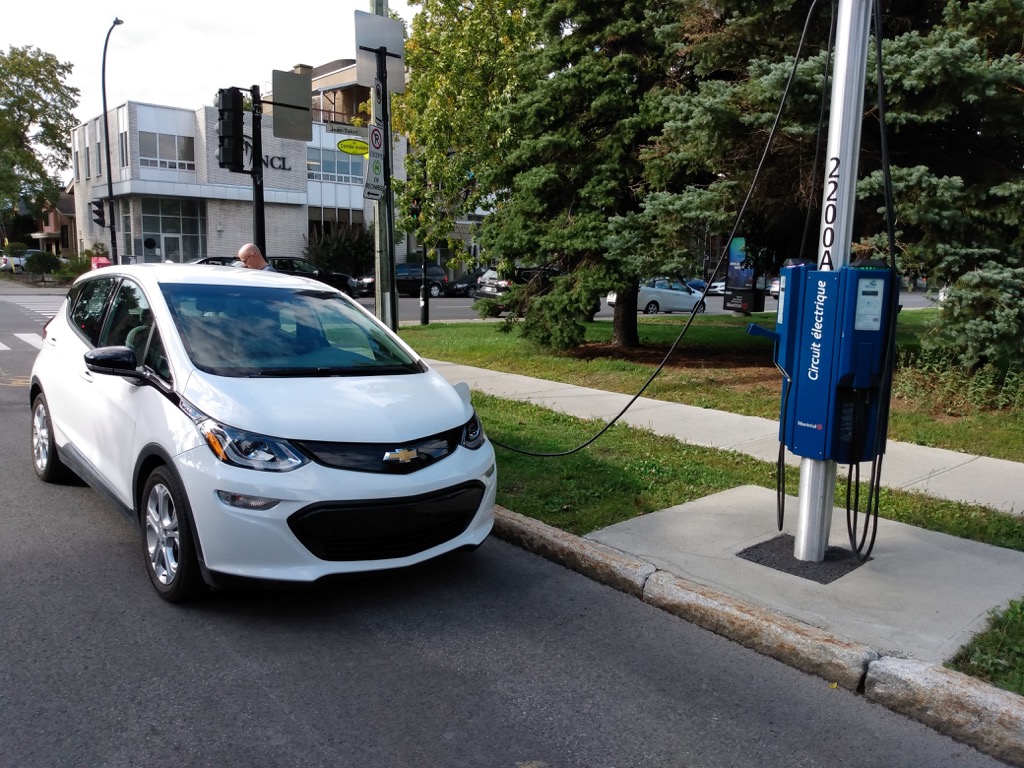
Relative to Prince Edward Island, Montreal has mind-boggling EV charging options: it turned out that there was a Electric Circuit on-street charger just blocks from my brother’s house, and it was free when we drove by, so I parked the car, quickly set up an account with the Electric Circuit Android app, and a few minutes later I was off and charging.
I got an email and text notification when the charge was done, four and a half hours later. The total cost of the charge, with tax, was $4.48 and consumed 28.6 kWh, about what our house uses in 2 days.
Sunday, 10:00 a.m.
After breakfast with my sister-and-law and my nephews, and some last minute Berenstain Bears-reading action, I headed off on my journey to New Hampshire. It was a beautiful day for driving, and I made good time, arriving at the U.S. border at 11:25 a.m. The line at the border took about 20 minutes to get to the head of; customs formalities took about 20 seconds (where do you live? where are you heading?). And then I was on the Interstate 89 heading into northern Vermont.
Sunday, 1:13 p.m.
About 200 km into the journey, I decided to stop in Waterbury, Vermont for a charge. I wasn’t in dire need of one, by any means, but I needed a break, and I was eager to see as many different charging arrangements as possible.
I followed the road signs pointing to EV charging at the Visitor Centre, and found a ChargePoint station there. It was charging a Nissan Leaf at the time, though, so I headed back out on the highway and up the hill to the Ben & Jerry’s, which promised a whole host of stations. And there were a whole host of stations: a high-speed CHAdeMO DC charger (not compatible with my Bolt) and six level 2 chargers, two from Sema Connect and four from AeroVironment.
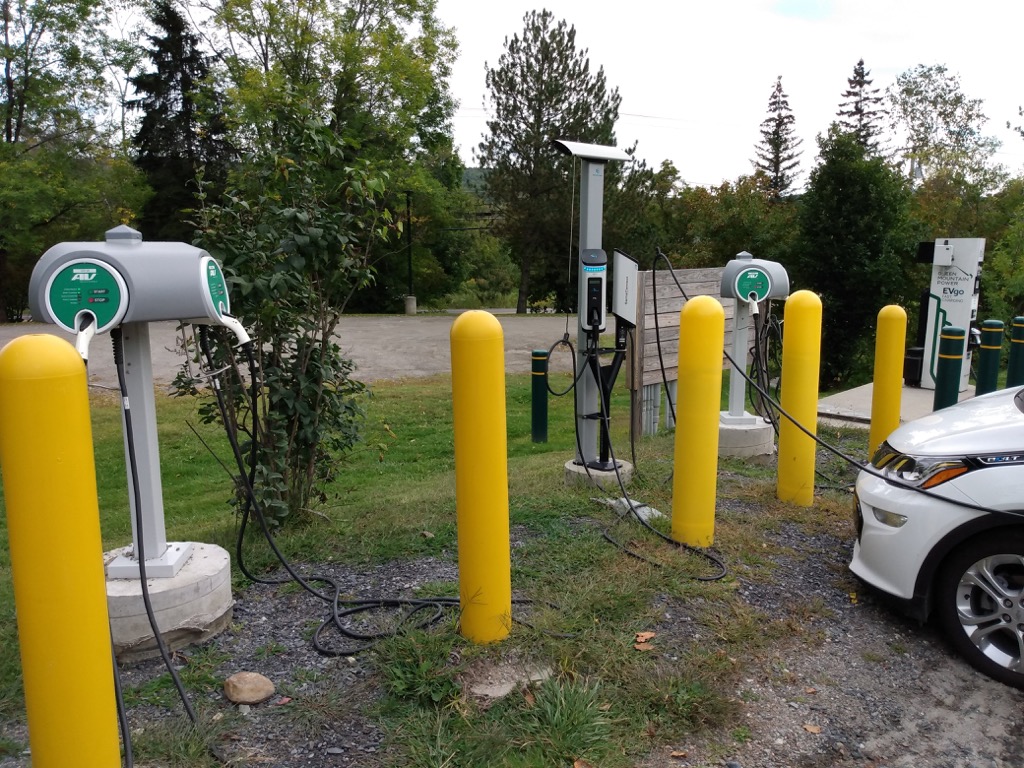
I tried in vain to get the Sema Connect app on my phone to authorize one of its chargers, but it kept failing, so I tried one the AeroVironment chargers and found, despite no signage to this effect, that it was free. I left the car charging and took a quick walk around the grounds and, finding them generally tired and depressing, decided to decamp down the road to a putative high speed charger at a Chevy dealer in Montpelier for a full top-up.
Sunday, 2:40 p.m.
I found my way to Cody Chevrolet in Montpelier using Google Maps and found that the dealership courtesy pick-up truck was parked in front of the high speed charger:
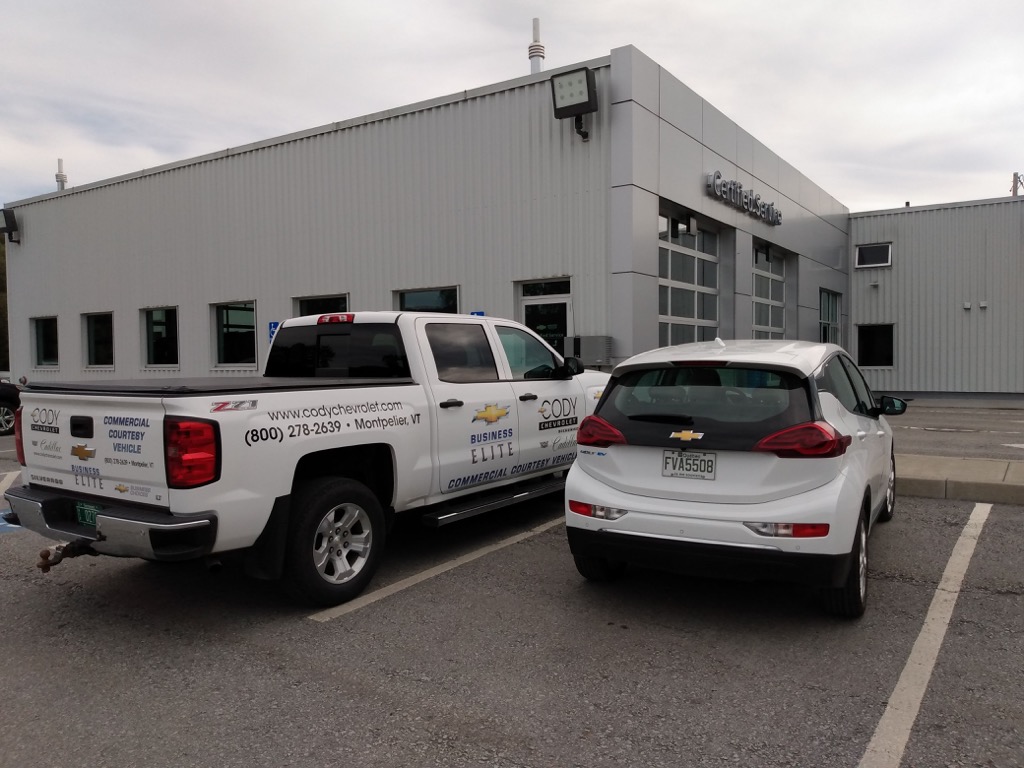
Fortunately the charger’s cord was long enough to stretch to the next parking spot, and I was able to plug myself in. This was a free charger, not networked in any way, so had no way of communicating with my phone to alert me when the charge was done. There were also no instructions whatsoever on the charger, so I to had make my best guess how to use it:
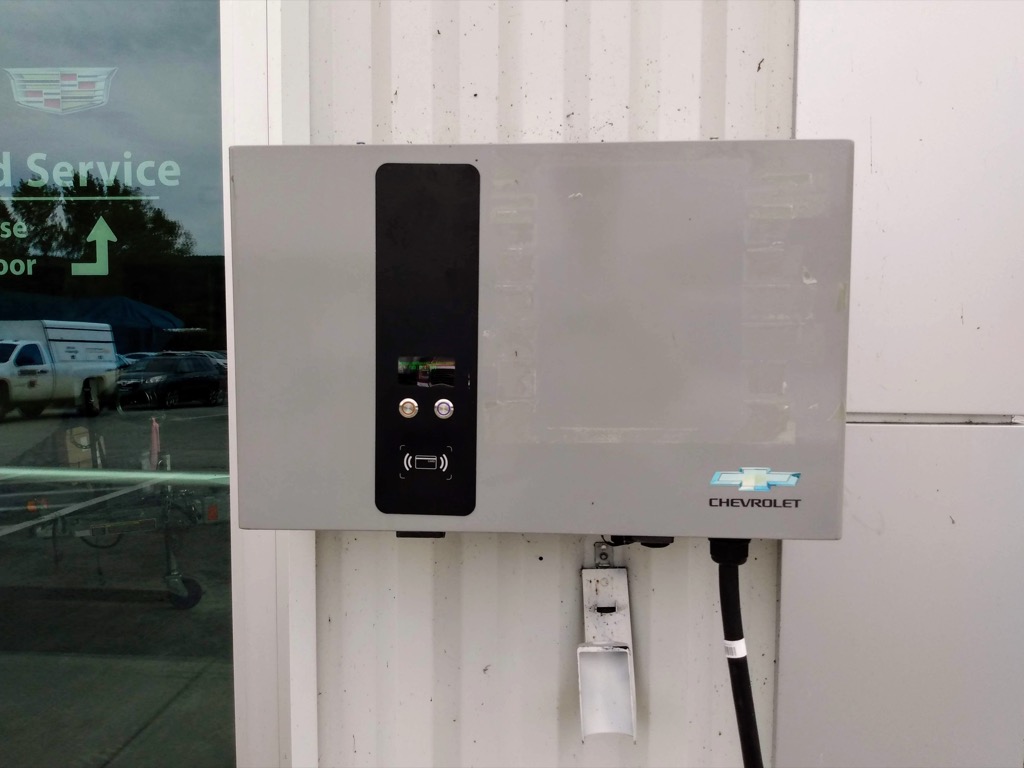
Fortunately my best guess worked, and when I pressed the green(ish) button, it started up in a cacophony that sounded like it was preparing for a Moon launch. The LCD on the charger told me that my Bolt was 45% charged, and that it would be at 80% after 50 minutes. So I left it charging, walked up the road to the 101-year-old Wayside Restaurant for some blueberry pancakes while I was waiting.
When I returned an hour later the charge cycle was just completed, having pumped 21.3 kWh into the car, and taking it to 77% charge.
I got back on I-89 south and headed toward Brattleboro, Vermont, where I planned to eat supper.
Sunday, 5:55 p.m.
As Brattleboro, VT had the final high-speed DC charger before I left the EV-friendly Vermont for the slim charger pickings of New Hampshire, I decided to top up again over supper.
In the High Grove Parking Lot downtown I found an EVgo charger with the right CCS/SAE connector for the Bolt. I ran into a problem getting the EVgo app working on my phone, however, and traced the issue to the fact that the Public Mobile data package for my cell phone that I’d purchased for U.S. roaming had been completely drained of its 250 MB of data by a rogue podcast app. Not only couldn’t I use data on the phone, but I couldn’t renew the data plan without the data plan. I thought I was stuck until I found an open Xfinity wifi with a 24 hour free trial. That was enough to get me sorted with the EVgo app, and once it was installed and I’d entered a credit card for billing, the charger started up.
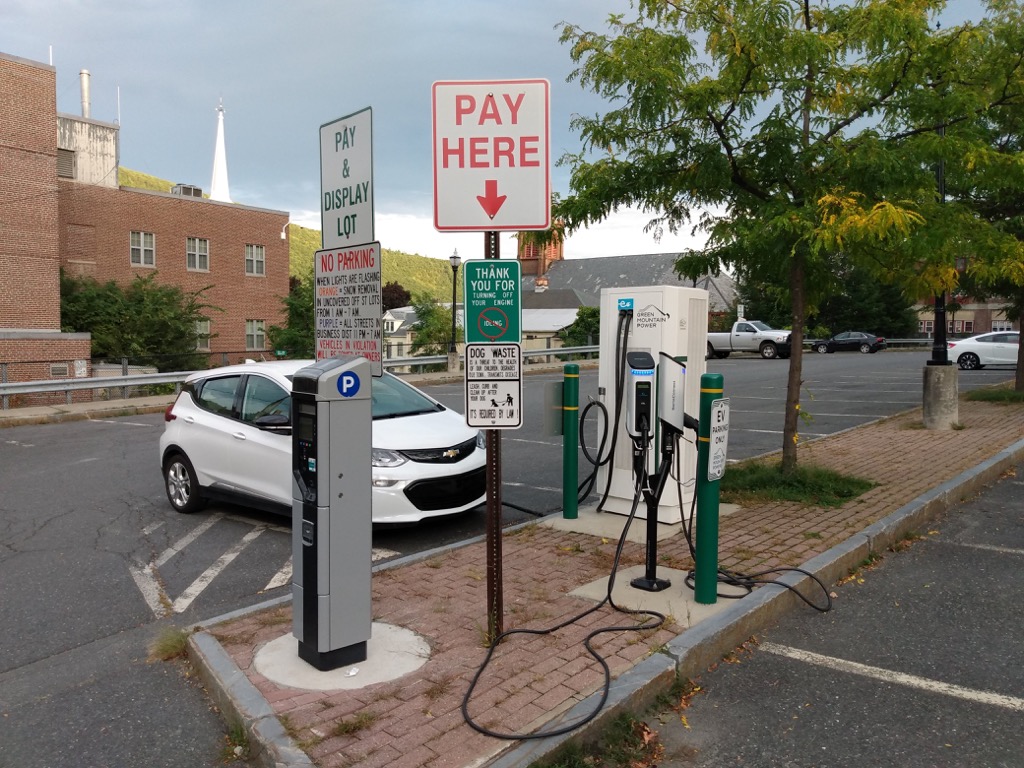
I walked downtown for supper at The Works Café. After supper I walked back up the hill and just as I entered the parking lot I got a text telling me the charge was finished. At 35 cents a minute, this was the most expensive charge of the trip: I paid $16.85 US for 27.75 kWh of electricity delivered in 45 minutes.
Sunday, 7:24 p.m.
I made a quick stop in Keene, NH at the Chevy dealer there to see if perchance they had an unreported DC charger, but they ended up having no charger at all. The KIA dealer next door did have a couple of free AeroVironment chargers; I added them to the PlugShare map and drove on.
Sunday, 8:09 p.m.
I landed at the Jack Daniels Motor Inn in Peterborough, NH–my home for the week–with the Bolt reporting it still had 250 km of range left, which was a healthy way to start the week. I was pleasantly surprised to find that a dedicated parking spot for me had been set aside, with orange cones and a sign, along with an extension cord connected to a standard electrical outlet. The Bolt has a charger in its trunk that can be used in situations like this; it’s a slow as molasses way to charge, but it’s something, especially if you leave it overnight. So that’s what I did:
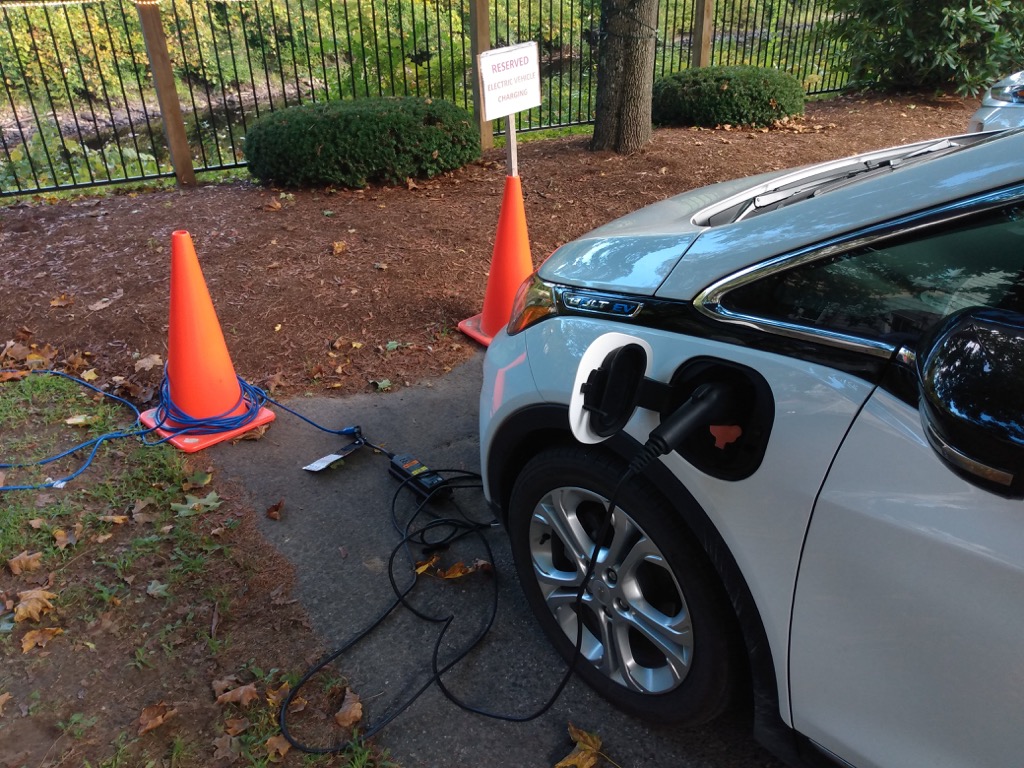
Chevy suggests that charging from a standard 120-volt outlet will provide 4 miles per hour of charge. When I got in the car the next morning it reported 301 km of range after 12 hours of charging, an increase of 51 km (31 miles). That works out to about 2.5 miles of range per hour, so slightly less than advertised.
Monday, 10:00 a.m.
When I arrived at Yankee Publishing on Monday morning–my workplace for the week–I found that the custodian had helpfully set up a place for me to plug into an outlet in the garage:
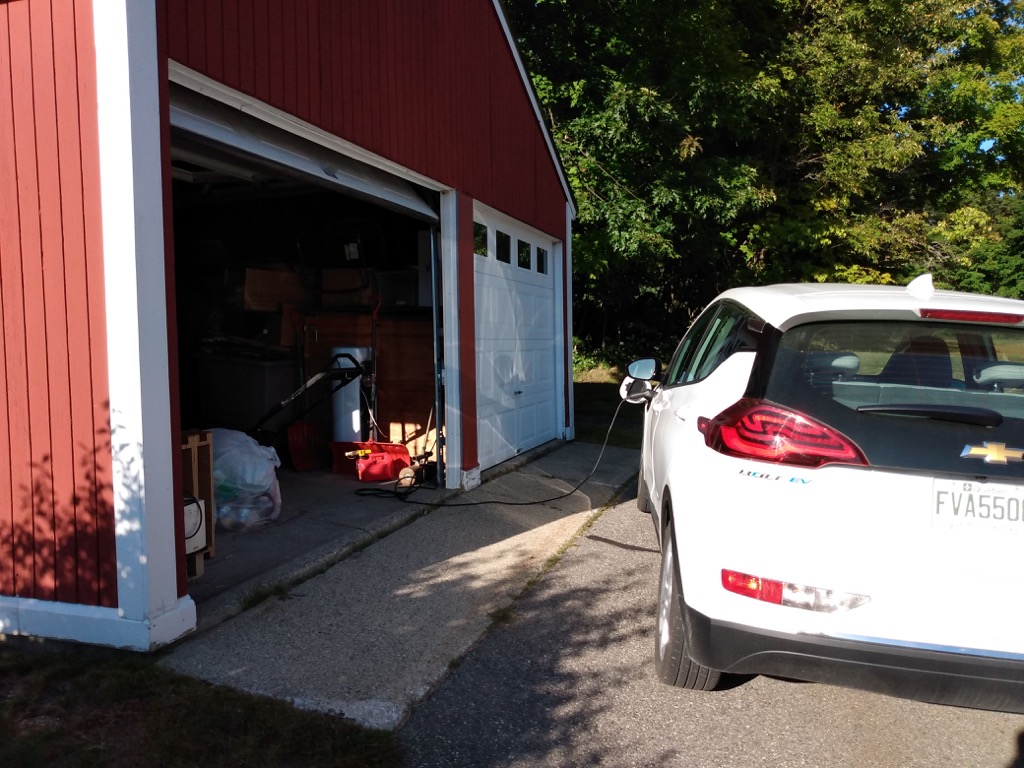
I’ve been back and forth to Yankee every day now–it’s Wednesday as I write–and I’ve been charging during the day there and charging overnight at the Jack Daniels. I was worried that my 12 km commute in each direction would exceed my ability to keep up and that I’d need to dash into Keene or Brattleboro for emergency top-up.
But I pulled out of the Yankee parking lot at the end of the day yesterday with the car reporting 431 km of range, which is, in theory, enough to get me all the way back to Montreal:
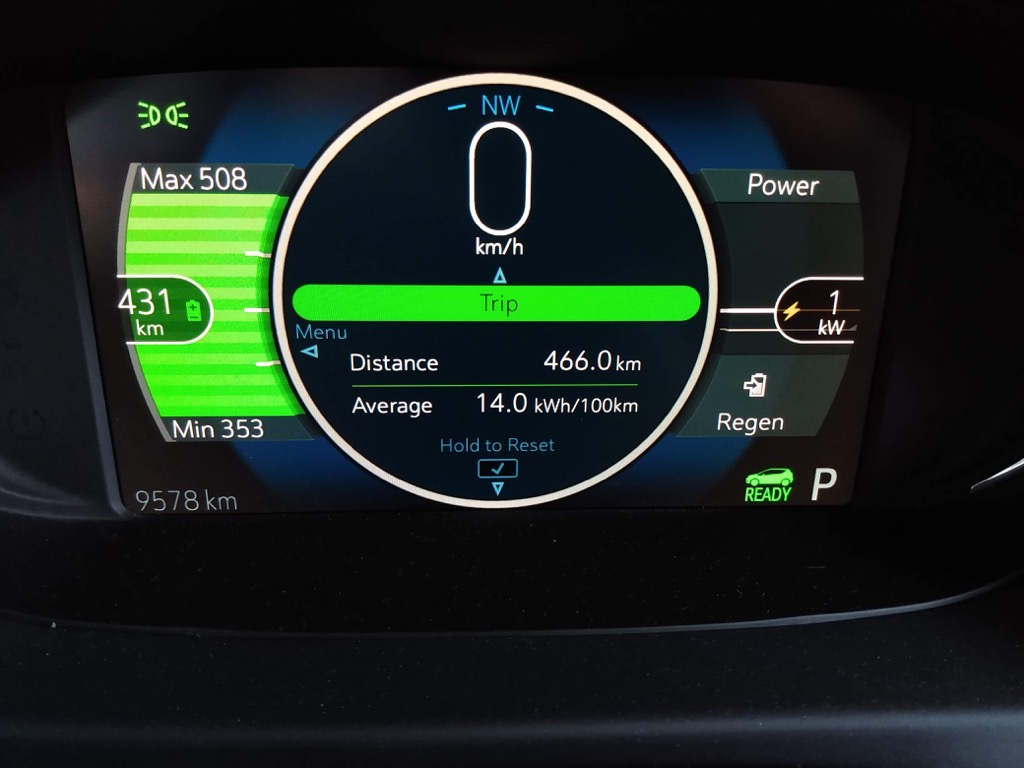
So, in other words, things are working out just fine on the charging front.
Driving the Bolt
The Bolt is the best car I’ve ever driven: it’s easy to drive, fun to drive and, when you need it, has enough acceleration to feel like you’re riding a rocket. Once I got over my range anxiety-anxiety, there ends up being no compromise for driving an EV compared to a gasoline-powered one. Indeed it makes using fossil fueled vehicles seem antediluvian. If nothing else I’ve become convinced that if I ever again buy a car–an open question–it will be an EV.
That said, there are a few weird things about the car, mostly related to technology. In theory the myChevrolet Android app should allow me to do everything from monitor the vehicle’s charging to unlocking the doors. But I became mired in a confusing thicket of accounts and credentials and references to a need for either enabling “Connected Services” and/or “OnStar Services.” Finally I just gave up on this.
Similarly, the in-car wifi access point, alluded to as being included in the rental by this Discount Car Rental blog post, has no Internet access, and seems to require purchase of a service I cannot purchase because I don’t own the vehicle. As I found in Brattleboro when I ran out of data on my phone, EV charging, because it uses different apps from different networks, demands always-on-data, and having in-car wifi would seem like a helpful part of EV rental to enable this.
The Plan for Heading Home
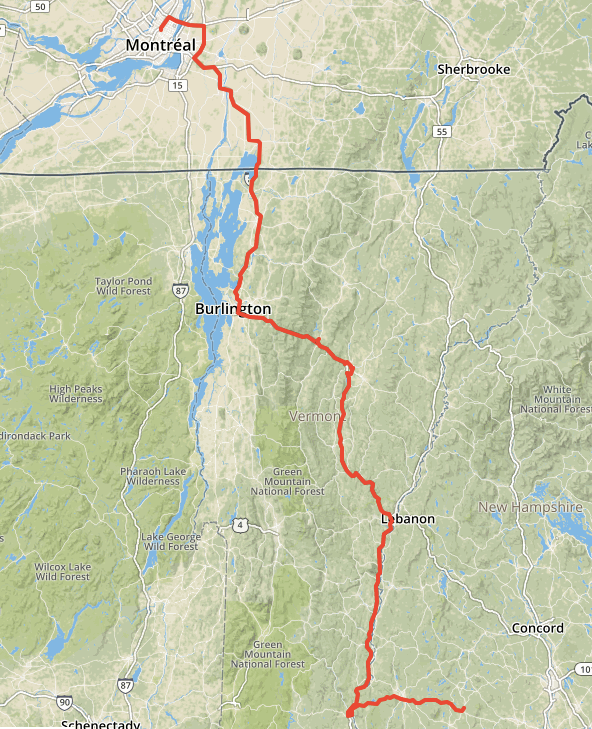
I start back toward home on Friday. I’ve booked a room at the Latchis in Brattleboro for Friday night (conveniently located atop the Latchis Theatre, which is showing the Downton Abbey movie!). I’ll top up the car in Brattleboro for the drive north and leave Saturday night for Burlington. I’ll likely stop again near Montpelier for a charge before staying the night with Valerie and Lars, Sunday I need to have the car back at discount by 2:00 p.m., and I fly out of Montreal for home on Sunday evening.
Where I’ll pick up my bicycle and make a truly zero-carbon last 5 km of my trip along the Confederation Trail.

Finding The Ultimate Cause
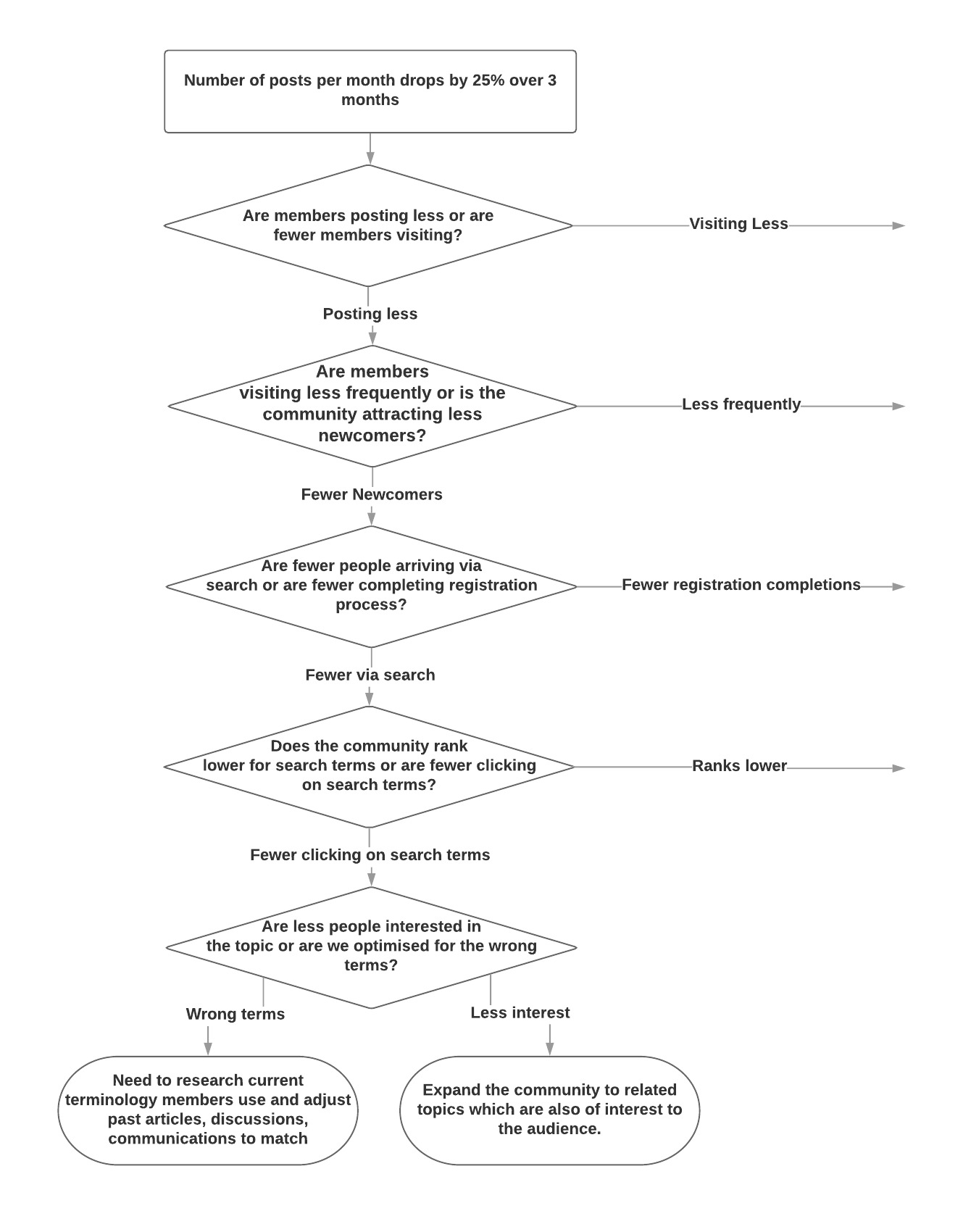
A lot of our work diagnosing communities is finding the ultimate cause of problems.
You can’t really improve a community until you know the ultimate cause behind a problem.
To find the ultimate cause, you need to dive deeper into your data.
Let’s imagine a typical problem, your posts are declining.
To diagnose this you have to go through a series of specific, binary, questions.
Question 1: Why Are Posts Declining?
For example, imagine the number of posts in your community has dropped by 25% in the past 3 months.
There are two possible causes behind this you can investigate.
- Members are posting less when they visit (measure # posts/# visits has dropped).
- Fewer members are visiting the community (# visits has declined).
By looking at the number of visiting members and posts per visit, you can soon identify the answer.
Let’s assume it’s the second answer. This means it doesn’t really matter what you do within the community as fewer people will see it anyway. This guides you into your next question.
Question 2: Why are fewer members visiting the community?
For example, let’s assume fewer members are visiting. This too leads you into two unique options.
- Members are visiting less frequently (visits/active members).
- The community isn’t attracting as many newcomers as it used to (visits from newcomers).
By looking at first-time visitors to the community and visits per month you will soon get to the answer.
Let’s assume it’s the latter (few newcomers). This means you’ve still got the same level of visits from regular members, but fewer newcomers are arriving to replace the churn.
Any activity you take to resolve this problem should be focused on newcomers.
Question 3: Why is the Community attracting fewer newcomers?
Again, you can see this as a binary option based upon whether fewer newcomers are reaching the site in the first place or whether fewer are completing the registration process.
This would tell you whether it’s an acquisition problem or a registration problem.
- Fewer members are arriving via search (search traffic).
- Fewer members are completing the registration process (registrations per visit).
If we assume the answer is the former, we now know too fix the problem we need to focus on search traffic.
Question 4: Why is search traffic declining?
Search traffic is fiddly but you’re working within two obvious reasons why search traffic has dropped. Either you’re not ranking as highly or fewer people are clicking on the terms you do rank highly for.
- Community ranks lower in search terms.
- Fewer people are clicking the relevant search terms.
Notice at this stage you can’t start to think of really specific resolutions to these problems. If we assume it’s the latter again.
We now know the answer lies in something which has changed about the people rather than about our website or Google algorithms.
We need to figure out what.
Question 5: Why are fewer people clicking on our search results?
Now we can get to the final question. Has the terminology our audience used changed (relatively rare) or has the popularity and interest in the sector/topic begun to decline?
The community is optimised for the wrong search terms.
The popularity/interest of the sector is in overall decline.
We might research metrics that show interest in the sector to identify if this is the solution and accept or eliminate based upon the results.
If we again, finally, assume it’s the latter we can make a really specific problem diagnosis.
Problem Diagnosis
Our 25% decline in post quantity over the past 3 months has been the result of a declining interest in the topic which in turn caused a decline of search traffic to our website, fewer registrations, and fewer newcomers to replace the natural churn of members.
Possible Solution
Once we have a clear diagnosis, it’s obvious that the typical approaches we might’ve tried (more on-site engagement activities) would only have resulted in a short-term boost at best. The real solution, as you can see in the decision tree below, must be to expand the community to cover a broader array of topics which are of interest to the same audience.
If you want to see the full decision tree, click here:
We can interview and research our members to identify additional needs and expand the community to accommodate those needs.
Trust me, never try to improve a metric without being crystal clear about what has caused it to go up or down.
Join the 700th “Thursday Walk” Photo Challenge with Flickr’s Utata Group
Flickr has thousands of high-quality groups where you can find inspiring images, showcase your work, and connect with like-minded photographers, so we want to make it easier for you to find and engage with those communities.
Following up on the success of our previous collaborations with the Photography Critique and Less is More groups we’re now excited to team up with the wonderful Utata group, a global collective of photographers who met through Flickr and who are devoted to creating and promoting good art, and to engaging in lively, wide-ranging discussions.
700 Thursday Walks
This week, the Utata Group will be celebrating its 700th-consecutive Thursday Walk. That’s 13 years and 5 months of walks every Thursday. Big milestones call for big celebrations, so let’s join in the fun!
The premise for this photo challenge is pretty simple: next Thursday, September 19, go for a walk (be it for a ten-minute break during your busy working day or a quick tour around the block), pick up your camera, take a photo, and post it to this thread. Easy, right? There’s something singularly appealing about the notion of people all over the world taking a break from their day just to take a stroll with a camera, knowing that other folks are doing the same thing for the same reason.
You can take as many photos as you wish during the walk, but we ask you to be selective in what you share in the group, as a courtesy to each other. Tag your image with utata:project=tw700 and show us your favorite photo with a short story about the shot. Embed your image in the comments using this format: [Flickr Photo Page URL]
Remember: The spirit of the idea is to take the photo on that particular Thursday (local time), but we’ll give you a couple courtesy days to upload your image, just in case.
We’ll also celebrate our favorite images of this special ‘Thursday Walk’ in a Flickr Gallery.
Just a few more things
If you like the challenge, don’t forget to join the Utata group for frequent photo projects, active discussions, and for meeting other photographers around the world.
If you want to add your photographs to the Utata pool, please read the group rules first.
Last but not least, check out the group’s website, Utata.org, for a bit of history on the group and its members.
Why Buddhism?
I just finished reading Buddha or Karl Marx By Dr. Ambedkar. It’s just a long essay or Booklet. The thing that caught my attention is the summary of Buddhist Tripiṭaka. I think this summary is the best I have read about Buddhism and why its required. The below points are quoted from Buddha or Karl Marx.
- Religion is necessary for a free Society.
- Not every Religion is worth having.
- Religion must relate to facts of life and not to theories and speculations about God, or Soul or Heaven or Earth.
- It is wrong to make God the centre of Religion.
- It is wrong to make salvation of the soul as the centre of Religion.
- It is wrong to make animal sacrifices to be the centre of religion.
- Real Religion lives in the heart of man and not in the Shastras.
- Man and morality must be the centre of religion. If not, Religion is a cruel superstition.
- It is not enough for Morality to be the ideal of life. Since there is no God it must become the Jaw of life.
- The function of Religion is to reconstruct the world and to make it happy and not to explain its origin or its end.
- That the unhappiness in the world is due to conflict of interest and the only way to solve it is to follow the Ashtanga Marga.
- That private ownership of property brings power to one class and sorrow to another.
- That it is necessary for the good of Society that this sorrow be removed by removing its cause.
- All human beings are equal.
- Worth and not birth is the measure of man.
- What is important is high ideals and not noble birth.
- Maitri or fellowship towards all must never be abandoned. One owes it even to one’s enemy.
- Every one has a right to learn. Learning is as necessary for man to live as food is.
- Learning without character is dangerous.
- Nothing is infallible. Nothing is binding forever. Every thing is subject to inquiry and examination. 21. Nothing is final.
- Every thing is subject to the law of causation.
- Nothing is permanent or sanatan. Every thing is subject to change. Being is always becoming.
- War is wrong unless it is for truth and justice.
- The victor has duties towards the vanquished.
Twitter Favorites: [theJagmeetSingh] Tonight is not about the Prime Minister. It's about every young person mocked for the colour of their skin. The c… https://t.co/gJ0WptLXZU
Tonight is not about the Prime Minister. It's about every young person mocked for the colour of their skin. The c… twitter.com/i/web/status/1…
Huawei officially unveils Mate 30 Pro

Huawei has finally unveiled the Mate 30 series at its Rethink Possibilities event in Munich, Germany.
It’s latest and greatest Mate 30 series is quite different than anything the company has put out before, in a variety of ways.
The Mate 30 Pro features what Huawei calls a Halo Ring design, which is the circular camera setup on the back of the handset.
Huawei calls its new screen the ‘Horizon display’ which is previously leaked waterfall display, the phone has a 6.53-inch screen with that contours around the side edges of the handset at an 88-degree angle.
The phone offers a 3D display, which is often more immersive than standard displays.
Say goodbye to physical keys, with #HuaweiMate30 Pro's side touch design.
Tap the Invisible Virtual Keys for dual side control. #RethinkPossibilities pic.twitter.com/OKzDrD1Ucm
— Huawei Mobile (@HuaweiMobile) September 19, 2019
Richard Yu, the CEO of the company, offered plenty of details about the handset. Huawei Mate 30 Pro has a “sophisticated” notch, according to Yu. The notch features the standard selfie camera, Ambient Light & Proximity Sensor, 3D Depth Camera and a Gesture Sensor.
The side of the handset has not only a power button but has an invisible virtual key that offers volume control. You can also use this as a shutter button.
The Mate 30 Pro comes in Cosmic Purple, Black, Silver, Emerald Green. The Emerald Green offers a gloss to a matte finish, with matte on the bottom and glossy at the top. There’s also another a ‘Vegan Leather Edition’ with an orange leather colour.
Inside the handset, the phone features a 4,500mAh battery with 27W wireless charging and 40W wired charging.
The #HuaweiMate30 Pro makes sure you'll always capture 'that shot', with incredible ISO 409600 sensitivity.#RethinkPossibilities#HuaweiMate30 pic.twitter.com/zGq6VnFugE
— Huawei Mobile (@HuaweiMobile) September 19, 2019
On the back, the device sports a 40-megapixel ‘Ultra-Wide Cine’ camera with an f/1.8 aperture, a 40-megapixel ‘SuperSensing Wide’ camera with OIS and an f/1.6 aperture, an 8-megapixel telephoto camera with an f/2.4 aperture and OIS and lastly a 3D Depth Sensing camera. Huawei claims the handset has a 409,600 ISO letting the phone take pictures bright images in low-light scenes.
It also has 3x optical zoom and 30x digital zoom and is capable of taking these pictures. Yu also says the phone can take videos in ultra slow motion at 7,680fps which is an impressive feat considering the Note 10+ can only do 960fps.
The Cine Camera has a 4K 60fps video, 4K HDR+, real-time bokeh and dual OIS and AIS.
Capture: Every. Single. Moment…with the #HuaweiMate30 Pro.
With cinematic timelapse and 12-hour recording.#RethinkPossibilities pic.twitter.com/9Qx7a2sgsc
— Huawei Mobile (@HuaweiMobile) September 19, 2019
Huawei’s Mate 30 Pro also features a time-lapse functionality, though that would require to leave their handset somewhere for a while.
The Mate 30 Pro sports EMUI 10, the latest version of the company’s user interface. The phone features a new type of always-on display that changes based on whether it’s night or day. This version of EMUI 10 is based on Android 10, similar to the P30 Pro.
With EMUI 10 and the Mate 30 Pro, the company’s new device’s Smart Gesture lets users scroll up and down a page without touching the device.
We just took gestures to a whole new level.
Command your phone without even touching it, with smart gesture control.
See the magic happen with the #HuaweiMate30 Series#RethinkPossibilities pic.twitter.com/Df3JoXLGDS— Huawei Mobile (@HuaweiMobile) September 19, 2019
The phone will also follow the eyes of the user, which works with the auto-rotate artificial intelligence. If the user moves, the phone will auto-rotate to compensate.
The Mate 30 Pro also works with the ‘M Pen’ a stylus specially designed for the handset. Though unlike the Note series, the phone is sold separately.
Additionally, Huawei’s latest features an in-display sensor and a 3D face scanning. With its new privacy AI the phone is able to detect when someone else is looking at the display and will hide sensitive notifications.
AI Auto-Rotate allows you to move freely while your #HuaweiMate30 Series phone follows your eyesight so you can view from any angle.#RethinkPossibilities pic.twitter.com/kzj5dgq1J3
— Huawei Mobile (@HuaweiMobile) September 19, 2019
The Mate 30 Pro also features Huawei’s Kirin 990 5G chipset allowing it to obtain quick speeds, in a 5G network. Though in Canada we currently lack a 5G network, so this doesn’t affect us very much.
In Europe, the Mate 30 Pro without 5G (with 8GB of RAM and 256GB of storage) costs 1099€($1,612.25 CAD). The Mate 30 Pro with 5G costs 1199€ ($1758.95 CAD). Huawei didn’t announce an official release date for its new phones.
Huawei Mate 30 Pro lacks Play Store
Richard Yu briefly mentioned that the device will use Huawei’s Mobile Service (HMS). HMS is fully open and Huawei is looking to work with developers to create new apps. Yu says that the HMS core already has 45,000 apps.
The phone is packed with Huawei-branded apps, such as Huawei Music, Huawei Video, Huawei Browser. Huawei also added its own ‘Huawei App Gallery,’ that functions as the device’s Play Store.
Due to the U.S. government ban on the China-based company, Huawei is not permitted to work with Google and use the Play Store or Google Services.
This might change, in the future as Google can apply for a license to work with Huawei, but as of right now it seems as the licensed has yet to be approved or Google perhaps did not apply for one.
MobileSyrup has reached out to Huawei Canada to learn Canadian availability and pricing for the Mate 30 Pro.
Other devices
When two iconic brands work together, they create something incredible.
We present #HuaweiMate30RS, inspired by #PorscheDesign to take mobile to a whole new level of luxury. pic.twitter.com/49NnLmszqf
— Huawei Mobile (@HuaweiMobile) September 19, 2019
There’s also another Porsche Design Huawei Mate 30 Pro RS, that will not come to Canada.
The China-based company also announced the Mate 30, with a 6.62-inch display and a smaller 4,200mAh battery. Camera-wise it features a 40-megapixel primary shooter with an f/1.8 aperture, an ultrawide with a 16-megapixel camera with an f/2.2 aperture and lastly an 8-megapixel telephoto camera with an f/2.4 aperture. Going by last year, this handset will likely not come to Canada either.
Powered by our Kirin A1 chip, the #HUAWEIWATCHGT2 gives you an incredible two weeks of battery life so you can #ExploreMore pic.twitter.com/BXYO8IfliL
— Huawei Mobile (@HuaweiMobile) September 19, 2019
Huawei has also revealed the Watch GT 2, with a new design “advance performance,” and the ability to make and receive phone calls straight on the watch. While the Watch GT series isn’t typically sold in Canada, they are often offered alongside Huawei’s latest handsets. The watch reportedly features a two-week battery life.
The China-based company will also release a TV called the Huawei Vision, which Yu describes as a large-screen smartphone.
Huawei Vision will launch with a 65-inch or 75-inch screen, though later Huawei will sell 55-inch and 85-inch models. Huawei Vision also features eight speakers, a deflector and a subwoofer. The phone also has AI features, with a popup camera and an earpiece for video calls. When video calls are over the camera will go back into Huawei Vision.
With Huawei’s ‘One Hop’ customers can tap their phone to the remote to seamlessly what was visible on the phone’s display to Huawei Vision.
The post Huawei officially unveils Mate 30 Pro appeared first on MobileSyrup.