Amidst the latest complex and fast-moving events of the Brexit crisis, there is an underlying theme in this week’s developments. Many of the lies, fantasies and misleading claims that have characterised the entire process are being proved false and are more or less overtly being dropped or modified. Yet at the same time new ones are being inserted or revived.
Brexit was always going to mean border controls
The question which should have been asked of Boris Johnson this week, but so far as I know was not, is this: why, before the referendum did you say that Brexit would leave the Irish border “absolutely unchanged”? For in the light of what he has proposed this week it is clearly the case that when he said that he was, knowingly or unknowingly, wrong. And he had no excuse for not knowing, because John Major and Tony Blair – both central to the Northern Ireland peace process – had spelled out that it would mean the reintroduction of border controls. This would have been so even under a ‘soft Brexit’ on the Norway model, because Norway is not in the Customs Union.
Johnson and the other Brexiters who denied this during the Referendum must now know that they misled the public. For the government’s new proposal on the Irish border self-evidently means that a great deal will change, were it to be accepted by the EU.
The outlines of this proposal have been widely reportedand criticised. In summary, the suggestion is that, after the transition period ending in 2021, the entire United Kingdom should leave the customs union, with the consequence that customs checks would have to be made between Ireland and Northern Ireland, albeit not ‘on’ the border.
In addition, Northern Ireland (only) would retain a significant degree of ongoing regulatory alignment with the EU, for agricultural, food and industrial goods. However, this would be subject to the agreement after four years (i.e. 2025), and every four years thereafter, of the Northern Ireland Assembly (which has not sat for over two years). Should it vote against alignment, this would have the consequence of adding Irish border regulatory checks to customs checks. On the other hand, for so long as alignment was agreed, there would need to be regulatory checks between Northern Ireland and Great Britain – in other words, a regulatory sea border in addition to the customs land border.
The border was always going to have a physical component
This does not just falsify pre-referendum claims that ‘nothing would change’. It also gives the lie to all the variants of later claims that Brexit could be done without new border checks through ‘alternative arrangements’ which could deliver exactly the same open border as that guaranteed by the agreed backstop. Many of these arrangements do figure in the Johnson proposal, and some of them are problematic where they rely upon untested combinations of technologies. But, additionally, it is now, finally albeit only implicitly, acknowledged that they cannot be a complete substitute for the backstop. If so, this should mark the final death of the nonsense formerly known as ‘Malthouse Plan A’.
However, quite what this means in terms of, for example, customs clearance sites has been a matter of ambiguity and dispute throughout this week (as explained in Tony Connelly of RTE’s latest excellent weekly briefing). The full proposals have not, of course, been published, only a seven page summary which talks coyly about “designated places” for “physical checks” (para 17b). Still, it seems clear that it has now been accepted by the UK government that an entirely non-physical customs border is impossible.
Friction, red tape, and standards
Associated with that, another repeated lie has been quietly disowned – that ‘frictionless trade’ could continue after Brexit, whether at the Irish or any other border with the EU. That in turn shows the emptiness of another Brexiter shibboleth, namely that leaving the EU will reduce the ‘red tape’ faced by business. Consider, for example, the extra bureaucracy for businesses shown by the government’s preparedness advice for exporters to the EU. As regards Northern Ireland in particular, the new proposals have been described as “unworkable and unpalatable” for businesses.
On the other hand, the government have now backtracked on Theresa May’s agreement – which was also something that many Brexiters promised - not to use Brexit to lower standards in relation to competition rules, state aid, environmental protections and labour rights (the ‘level playing field provisions’ of May’s deal). This also seems to presage the abandonment of the promise of a future ‘Canada +++’ trade deal in favour of something much more limited in scope.
The Good Friday Agreement
Crucially, Johnson has now disowned the December 2017 agreement with the EU – made whilst he was still Foreign Secretary – and the commitments made about the Irish border and the Good Friday Agreement (GFA). Brexiter wiseacres typically say that the GFA makes virtually no mention of the open border but in doing so they miss the point: at the time of the agreement the reality of an open border was part of the taken for granted assumptions.
Perhaps even more importantly, a key reason why the GFA became viable was because of the very fact that both Ireland and the UK were member states of the EU, making it possible for the first time to blur some of the issues of sovereignty and identity, and to make multiple and layered identities and affiliations possible. A border, however configured, damages this subtle but crucial shift in political psychology, with potentially far-reaching consequences.
The crux of the issue is that although the Johnson proposals repeatedly insist that they honour the GFA, they interpret this in the very narrow sense that border infrastructure and checks mean infrastructure and checks at the border line. But this misses the key point that, wherever located, such infrastructure and checks constitute a border. Thus, as the leading customs and trade expert Dr Anna Jerzewska notes, the proposals mean, in effect, the return of a hard border. It is this which will be unacceptable to many in Northern Ireland, to Ireland, and ultimately to the EU.
That is even without other problems with the proposals, as set out by Alex Stojanovic of the Institute for Government, which include – in brief - the reliance on the Stormont Assembly; the very significant exemptions and exceptions it would require the EU to make to, in particular, the Union Customs Code; the unfeasible timescales for introducing the new plans and technologies; and the risks of smuggling, which will increase the greater the divergence that develops from EU rules in the future. (See also this informative twitter thread from Peter Foster, the Telegraph’s Europe Editor, on the issues the proposals pose for the EU).
Designed to fail?
Overall, there are now multiple signs that although the EU may go through the motions of talking about these proposals, they won’t lead to an agreement, at least in anything like their present form. Some believe that this is precisely Johnson’s intention: to present something that he knows the EU can never agree to so that he can then blame the failure to reach a deal on the EU and justify a no-deal Brexit.
That is very plausible, although I think that at least two other interpretations are possible. One is that – as with the Brady Amendment – the focus within the UK has been primarily upon what might get agreement within the British parliament, with EU agreement left as an afterthought. That parochialism and arrogance has long been on display and may be a factor again.
More importantly, though, there has for many months been an idea amongst some Brexit Ultras that Johnson and his advisors may well have imbibed. It is the fantasy that the EU would accept the proposed arrangement because if the alternative were no deal then something like it would be forced on them anyway, because some kind of border would come into existence. On this logic, the EU might as well accept it now, and keep the other elements of the Withdrawal Agreement in place.
If this is the idea then it is deeply flawed. It would entail – by treaty – the abandonment of Ireland, in violation of one of the core premises of the EU as a body offering solidarity amongst large and small members alike. Moreover, it would mean the creation – again by treaty - of a potentially significant hole or backdoor into the single market. Much in the proposals amounts to asking the EU to sign a blank cheque for the future, which is precisely what the backstop sought to avoid. In a way, they are a reprise of the ‘row of the summer’ of 2017 that never was – that is, the question of sequencing of withdrawal terms and future terms – in that they shift a lot of the future detail about how the Irish border will work into the post-Brexit discussions.
On the other hand, if an Irish border is forced upon the EU by no-deal Brexit then the costs for the UK are enormous – no transition period and a very unfavourable environment for subsequent negotiations with the EU. Moreover, the damage to UK-US relations would be calamitous. Trump may not care about the Irish border but Trump is not the only player, and won’t be there forever, and many in US polity (and electorate) care deeply.
Farewell to ‘managed no deal’
If we are heading towards no-deal Brexit, then there was another Brexiter fantasy that was quietly demolished this week. In an exchange of letters, Brexit Secretary Steve Barclay asked Michel Barnier for “structured engagement” over the range of issues that would arise in the event of a no-deal Brexit. Barnier’s reply was to the point: these issues had been dealt with by the Withdrawal Agreement. The EU had made its own no deal preparations, and there would be no negotiations on these matters. It could hardly, within the protocols of such things, have been blunter.
Whilst scarcely remarked upon amid the press of events (the letters were published last Sunday) this moment – though not in itself a revelation - marked the final death knell of the always absurd idea of ‘managed no deal’. That fantasy was also known as ‘Malthouse Plan B’, so along with the demise of Malthouse Plan A, noted above, we should hopefully have heard the last of this wretched nonsense, just as we rarely hear much about German car makers any more.
Nach zwei Wochen mit dem Chromebook kann ich ihm den Orden #stuffthatworks verleihen. Und das Chromebook hat es nicht leicht gehabt, schließlich steht es in starker Konkurrenz. Aber das Konzept hat mich überzeugt.
Chromebooks sind aus dem US-amerikanischen Schulwesen kaum noch wegzudenken. Sie sind der Traum eines jeden Administrator. Auspacken, einschalten, geht. Der Anwender meldet sich mit seiner Google-ID an. Das war's. Ich habe noch niemals irgendetwas derart unkompliziert in Betrieb genommen wie dieses Chromebook. Und das geht mit mehreren Benutzern. Die Scheffin meldet sich mit ihrer Google-ID an. Bämm, alles da. Emails aus Gmail, Dokumente aus Gdrive, Photos aus Google Photos. Einfach so.
In diesem Sinne ist das noch praktikabler als etwa ein iPad, das fest an einer Person klebt. Es gibt sogar einen Gastmodus. Man meldet sich ab und schiebt das Chromebook einem anderen Benutzer zu. Der nutzt entweder den Gastmodus oder meldet sich mit seinen Credentials an. Bämm.
Das ursprüngliche Konzept sah vor, dass man alles im Chromebrowser macht und den ggfls. um Chrome Apps ergänzt. Das hat sich weiterentwickelt. Heute nimmt man dazu einfach Android Apps. So habe ich die ganze Microsoft-Palette am Start. Outlook, OneDrive, Word, OneNote, jeweils die Android Apps. Und geht das nur Online? Keineswegs. Man kann auch unterwegs etwa Dokumente in Gdrive oder OneDrive bearbeiten, wenn sie erst mal auf dem Chromebook gecached sind.
Das Lenovo C340-11 ist dabei sehr praxisnah ausgestattet. Touchscreen, 360-Grad-Scharnier, 2x USB-A, 2x USB-C, MicroSD, Headset-Klinke. Sogar ein Laptop-Schloss lässt sich anbringen. Aufgeladen wird das Chromebook über USB-C PD mit 15 V und 3 A, ergo 45 W. Bei mir hält das für ca 10 Stunden, ist aber abhängig von Last und Bildschirmhelligkeit. Der Celeron N4000 hat mit ChromeOS leichtes Spiel und mit 64 GB Storage auch genug Platz, Dokumente zu cachen.
Was aussieht wie Alu, ist tatsächlich Plastik. Die Tastatur ist OK, aber nicht beleuchtet. Die Bildschirmauflösung ist ziemlich mau, in den Deckel hätte auch ein Full HD gepasst. Aber das kostet auch nur 349 Euro Liste , wird bis mindestens 2025 unauffällig mit Softwareupdates versorgt und hat jetzt schon die Linux-Toolchain als Beta. Viel kann man da eigentlich nicht mehr falsch machen.
Dean A recommended this piece in the New York Times:
Among the safety measures proposed by car companies are encouraging pedestrians and bicyclists to use R.F.I.D. tags, which emit signals that cars can detect. This means it’s becoming the pedestrian’s responsibility to avoid getting hit. But if keeping people safe means putting the responsibility on them (or worse, criminalizingwalking and biking), we need to think twice about the technology we’re developing. …
Peter Ladner was motivated to write this response with respect to our bike routes:
Got me thinking about son Brendan’s observation that our bike route rating system is bogus: widely-varying standards qualify as AAA, misleading those unfamiliar with the routes, misleading people looking at our city into believing we have a significant level of safe, separated routes. We actually don’t. Is there any other level? A-minus, B, D for still dangerous etc.?
How many parents would happily take their 4-year-old on all our so-called AAA routes?
And what’s with Google maps not knowing where the bike routes are when I ask for directions from Tinseltown to Lost Lagoon and punch the bike icon? It directs me to Hastings St., unsafe for riding.
Google Maps was aware of all the safe bike routes on a recent trip in Madrid, Vienna and Budapest.
Wazzup, Green Vancouver??! Or do our shared streets not qualify as “bike routes” by Google’s standards?
You may remember the post above, addressed to the Parks Board, regarding the misleading marking of the Seaside route through Kits and Jericho Parks as AAA.
I asked each Parks Board Commissioner a straight-forward question:
Should the AAA bike routes marked on the official City map above be removed?
I got only one response – from COPE Commissioner John Irwin:
… I raised the possibility of a motion highlighting ‘through’ the parks policy as many of us do love to ride through parks recreationally (we do this very often with our kids). In response staff met with HUB representatives who now feel comfortable that things have improved on this front. As a result I have postponed a motion, but I would still be willing to put one on notice if things revert back to ‘to, not through’.
We’ll know more when staff brings VanPlay forward this fall/winter.
John didn’t answer directly whether he would remove the AAA status of the current route. I would guess he, like the other commissioners, doesn’t want to say he would accept a less-than-inclusive bike-path standard for parks, but he probably doesn’t want to acknowledge the need to upgrade and design new routes to connect with the city-wide network that serves the need for safe transportation.
I heard an explanation for both Parks and City Council disinterest from a city-hall observer: “The Mayor’s office thinks bike routes are so associated with the discredited Vision Council that they don’t want to be seen as having cycling as a priority.”
So, like the Parks Board, they will avoid spending political capital to be supportive, and hope the issue can be massaged with the minimum commitment possible.
The contrast between Mario Kart Tour and Apple Arcade is just brutal. At which point can we all acknowledge that making mobile games was a mistake for Nintendo? I'm sure they make a ton of money, but it's clearly coming at the cost of Nintendo's most valuable assets: its image, the way people perceive the company, and people's trust in Nintendo's ability to create amazing games.
I’m not sure that free-to-play games can work as ads for console games. You know, the ones where the developer’s incentive is to create a good game and get people to buy it, not the ones where the developer’s incentive is to trick people into constantly coming back to something that’s actually not very enjoyable. I’m buying Nintendo consoles exactly because I want to avoid these kinds of games.
I have no doubt that Nintendo will make a lot of money from this, at least in the short run. I’m just not convinced that this isn’t going to do more damage than good in the long run.
If you require a short url to link to this article, please use http://ignco.de/771
When I was in my twenties I usually skipped getting a flu shot. I was young and healthy, and getting the flu, while deeply unpleasant, was probably not life-threatening.
And that’s as far as I thought about it.
I’m older now. Getting the flu is still probably not life-threatening for me — but I almost lost a family member to flu a couple years ago. And another member of my family, who I see a couple times a month at a minimum, has a compromised immune system — if he gets the flu, it could be very bad.
Just remember, as you go about your day — on the bus, at work, at the grocery store, at a restaurant — you’re going to run across people, without even knowing it, who can’t get the flu without serious consequences. You’ll certainly run across people who are close to those people. People like me.
In other words, your getting a flu shot could save a life. For real.
Diana Yoon 🌅@DianaDYoon
Did you know the NDP is committed to universal dental care!? Teeth are an important part of our body & should be pa… twitter.com/i/web/status/1…
In 2012 or so, if you’d asked most people in tech about ’neural networks’, if they had any answer at all they might well have said that it was an obscure idea from the 1980s that had never really worked - rather like VR. Then, in 2013, Imagenet gave us an explosive realisation that this could work now - again, rather like VR in 2013. Since then, the tech industry has been remaking itself around machine learning. There’s a naive view that ‘Google will have all the data’ or China will have all the AI’ or ‘Data is the new oil’, but it’s more interesting to look at how many different kinds of deployment are now happening.
The first phase was the creation of companies building platforms (or ‘primitives’ or ‘substrates’) for specific low-level ML applications - image recognition, voice recognition, sentiment analysis etc. Some of these have thrived but most of this space has, I think, been subsumed into larger platforms that offer many other primitives as well, such as storage, database or computing - AWS, Google Cloud or Microsoft’s Azure.
Second, pretty much every other tech company has picked this up and wandered around their products to see where it could be applied. This often reminds me of the old joke about the man with a hammer who thinks every problem is a nail - the tech industry has been hitting everything with a hammer to see if it’s an AI problem, or can be made into one. Generally, it is. Hence, Everlaw (an a16z portfolio company) might use machine learning to do sentiment analysis or find similar documents, as part of a much broader product offering. A security company uses ML to look for weird transactions. At the extreme, if you take a photo on your smartphone the photo app will now extract the text - that’s ‘AI’, but it’s also just text. And, of course, smartphone cameras themselves are now as much machine learning as they are hardware image sensors. That is, machine learning is being absorbed by existing companies and products, often invisibly.
Third, there is a wave of companies that are created to use machine learning to solve complete problems in new ways. People.AI uses NLP to analyse text going through Salesforce and identify parts of the pipeline that might be going wrong. Descript uses speech recognition to let you edit audio of people talking with a text editor instead of snipping up wave forms. These aren’t really ’AI’ companies anyone - they’re companies with an actual product that solves a specific problem. Descript doesn’t go to Tony Hall, head of the BBC, and say ‘let us tell you how [deep voice] AI (!) can transform your business!’. Instead, it goes to radio producers and says ‘this tool can can save you some pain every day’. There are lots of really cool new companies like this, generally solving a very specific problem you didn’t know existed in an industry you know almost nothing about, and very often that doesn’t look like an ‘AI problem’. Quite often, they’re also using vision to solve something that doesn’t look like a vision problem, or audio to solve something that doesn’t look like an audio problem.
It’s also important that these companies don’t have to build the whole thing themselves. The fact that voice recognition was subsumed into AWS, Gooogle Cloud and Azure means that Descript can leverage that to build an actual product on top, just as the fact that storage was subsumed into AWS means that startups don’t need to spend millions of dollars on storage arrays before they can launch.
That is, part of the consequence of the growth of giant tech platforms is that they’re platforms, and they enable a wave of company creation, and that now applies to AI as to anything else. We stand on the shoulders of giants. While it might not be a good idea to create a generic low-level voice recognition platform in competition with AWS, AWS is never going to build Descript.
Fourth, these technologies are now diffusing far beyond the tech industry. My favourite example recently was the manufacturing company that wants to check its product for a specific defect as it goes down the line - they could never automate that, but now they have a neural network on a DSP with a smartphone image sensor on a stick over the production line. It looks at each unit and says ‘defect/no defect’. Google doesn’t have that data, and neither does China. Moreover, this was built for them by one of the big outsourcing consultancies. This isn’t rocket science that only Google can do. It’s just software.
Then, of course, people pick these up and unbundle them. Drishti takes that camera on a stick and builds telemetry, metrics and analytics as a complete solution. But is that ‘AI’, or computer vision? Or, say, an industrial process optimisation company? (And no, Google will definitely never build this).
This is always the life-cycle of the deployment of new technology. I often compare machine learning to relational databases - 40 years after they were an exciting new idea, every big company today has dozens or hundreds of databases from dozens of different suppliers. Some of these are highly specific and you might build them yourself, some are specific to your industry and also used by your competitors, and some of them are completely generic.
This is probably also a useful way to think about what’s happening more generally. One of the recurring conversations in Silicon Valley is to wonder what the next ’S Curve’ is - we had PCs, then the internet, and then smartphones, but smartphones are boring and well-understood now, so what’s the next rocket ship? We often talk about machine learning and crypto here. But, I’d suggest we should actually look at another time series - over the past few decades we moved through databases, ‘productivity’, client-server, open-source, SaaS and Cloud. In parallel with new client platforms, we had new waves of architecture or development model, and that’s really a better way to look at machine learning - ML is the new SQL (and maybe crypto is in part the new open source). And so if you want to know ‘what’s our AI strategy?’ or ‘how do we choose an AI vendor?’, the answer is, well, how did you choose a cloud vendor or a SaaS Vendor, and how did you identify opportunities for databases?
OmniOutliner 3.4 for iOS is now available on the App Store! This release requires iOS 13 — which is a great release for boosting your personal productivity, which we’re excited about. Your productivity is our passion!
The big new features in OmniOutliner 3.4 are:
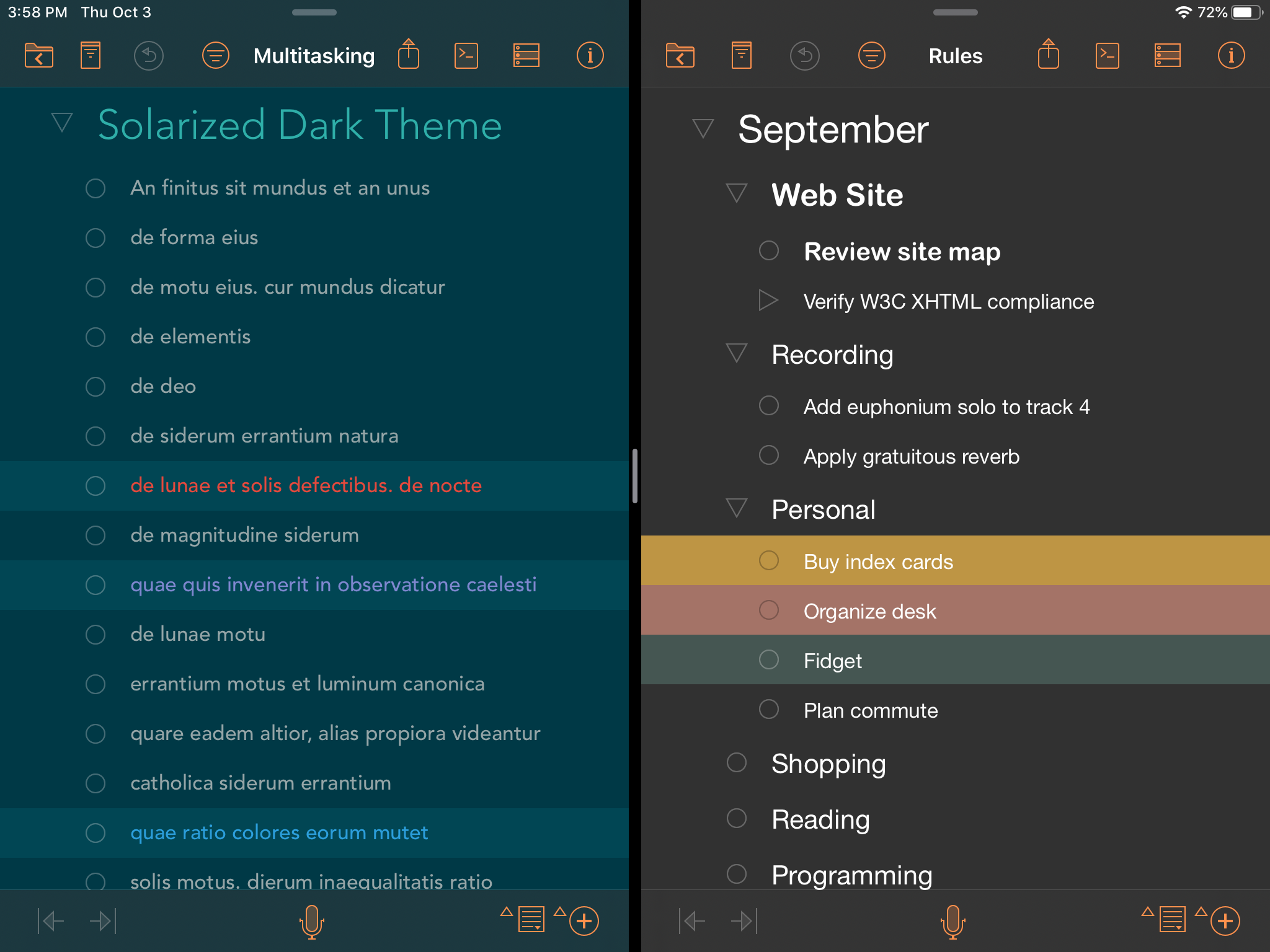
Native Dark Mode: when you switch the system to Dark Mode, OmniOutliner will appear in Dark Mode. (Note that this doesn’t, and shouldn’t, affect your document styles.)
Multiple windows: on iPad you can open more than one outline window at a time.
Standard document browser: by switching to Apple’s standard document browser, OmniOutliner gives you more flexibility with where you store your documents and how they sync.
But that’s not nearly all: we’ve made improvements to preview images, Omni Automation support, keyboard shortcuts, text editing, and more. Read the release notes for the full scoop.
OmniPresence users should take note: because OmniOutliner has adopted the standard document browser, we’ve had to change how you get to your OmniPresence files. Those files are in a subfolder in the OmniOutliner folder on your device. Also note that OmniPresence does not download larger files automatically — tap the OmniPresence icon in the file browser toolbar to download any missing files.
PS Here’s a lovely screenshot of OmniOutliner, running in Dark Mode, with two windows open:
Today Mr Rees-Mogg stood in Parliament and said: "remoaner funder-in-chief ... one George Soros". A line straight out of the far-right antisemitic playbook. Terrible things don't just begin with people clad in swastikas; they can begin with people clad in double-breasted suits. pic.twitter.com/HsXuxFPaSn
Just a quick thought experiment before the main part of this post. A man walks on an island and leaves a footprint. Does the island therefore 'remember' the man? We would probably say not. But what if the footprint influences how a river drains, thereby changing the shape of the island? Does it now remember? What would it take to say the island 'remembered' the man?
OK. This paper (12 page PDF) is a very dense read, and if you're like me, you won't follow most of it (at least, not without a lot of background reading). But the key point stands out in the discussion: "postnatal brains continue forming synapses and neural circuits and undergo activity-dependent refinements. Egr1 has been shown to control newborn neuron selection and maturation during the critical period of a few weeks after birth." As we read in the helpful summary, "Egr1 is a transcription factor, which is a protein that helps transcribe DNA into RNA. Egr1 plays a vital role in long-term memory formation." As one commenter on LinkedIn says, "This effectively redefines memory to include antigens."
Or does it? Is every trace a memory? If we get a scar from an injury, is that a memory? If we catch a disease that wipes out our immune system, have we lost our memory? What does it mean to say a person 'remembered' an experience?
“We celebrate your struggle for free movement by making the struggle to end your free movement our number one priority” twitter.com/sandvoss/statu…
@ottocrat I mean it's almost the same, except that Brexiters want to stop freedom of movement, whereas the Bürgerrechtler in the GDR wanted the diametrical opposite and were fighting for that freedom. Minor difference, right?
Yes - at an event hosted by Germany to mark the anniversary of the end of the GDR dictatorship. There simply aren’t the words. twitter.com/fergallenehan/…
Diners may love to gobble up tuna served in everything from sashimi and sushi to tacos to sandwiches. But the current rate at which fisheries are scooping tuna out of the sea may mean there may come a time in the future when there won’t be any tuna available to feast upon—unless fisheries and fish stocks are properly managed.
That’s according to a study by Sea Around Us researchers from the University of British Columbia and the University of Western Australia, published in Fisheries Research.
According to the study, global tuna catches have shot up by over 1,000 percent over the past six decades, due to enormous expansions in industrial fisheries.
In recent years, fisheries have been catching almost six million tons of tuna and are operating significantly over capacity.
As populations of tuna and other large fish species have been depleted or over-exploited, there aren’t any new fishing grounds left to explore.
Consequently, the researchers created a global database about the amount of tuna caught and their geographic regions. The data, dating back to 1950, was compiled from five tuna regional fisheries management organizations.
The data also includes statistics about unintentionally caught species, such as endangered sharks, large fish, and fish discarded overboard.
The most commonly caught tuna species are skipjack and yellowfin, with combined recent catches of four million tons per year. Bluefin tuna populations have significantly decreased to become critically endangered species.
Blue sharks, an at-risk species, make up about 23 percent of other fish caught in by-catches, with their fins removed to be sold in shark-fin markets or discarded overboard. The study states that industrial tuna fisheries are one of the major threats to sharks populations.
Researchers also found that 67 percent of the world’s total tuna catches come from the Pacific Ocean, primarily taken by Japanese and American fishing fleets. Meanwhile, 12 percent of global catches come from the Indian Ocean, taken by Taiwanese, Indonesian, Spanish, and French fleets, and 12 percent are from the Atlantic Ocean, taken by Spanish and French fleets, as well as Japanese and Korean vessels using Ghana’s flag.
The future of tuna fishing depends on “effective and restrictive long-term sustainable management of the fisheries and fleets exploiting these stock and ecosystems”, according to the study.
“The continuation of tuna fisheries’ catch, employment numbers, and revenue figures at levels similar to the present day depends on the long-term sustainable management of the fisheries and fleets exploiting these stocks and ecosystems, and the cooperation of more than 100 countries engaged in tuna fisheries,” Angie Coulter, a Sea Around Us researcher at the Institute for the Oceans and Fisheries at UBC and the study’s lead author, stated in a news release.
Coulter also explained that the study will hopefully encourage stakeholders, policymakers, and industries to increase and coordinate efforts to monitor tuna stocks to ensure their sustainability into the future.
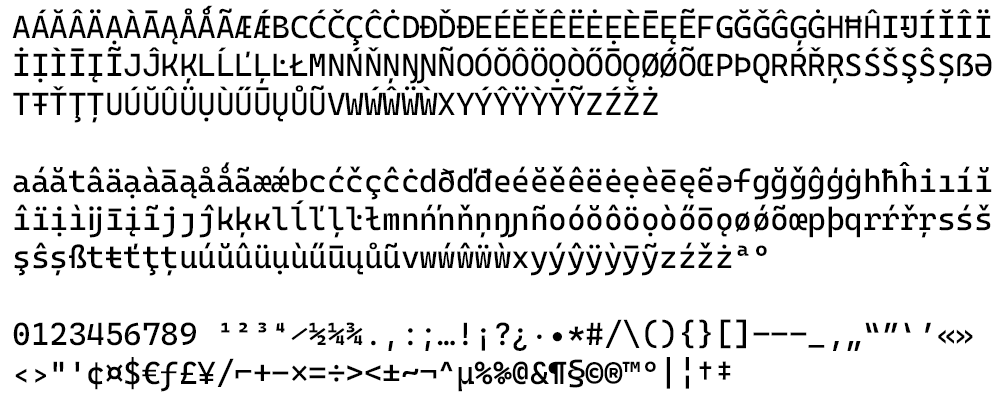
Cascadia Code has received a major update with some new characters! You can download the latest version of the font from the GitHub releases page and it is also shipped in the latest update of the Windows Terminal.
Note: The Terminal will use its shipped version over the separately installed version from GitHub, however it will use font fallback when needed. This means you will still receive the new characters and glyphs in the Terminal, but any changes to the original character set will not be reflected until your Terminal receives the update.
Latin Characters
Cascadia Code now includes Latin-1 characters! The full ISO-8859-1 glyph set along with other character tweaks have been added by Aaron Bell (@aaronbell), the font designer.
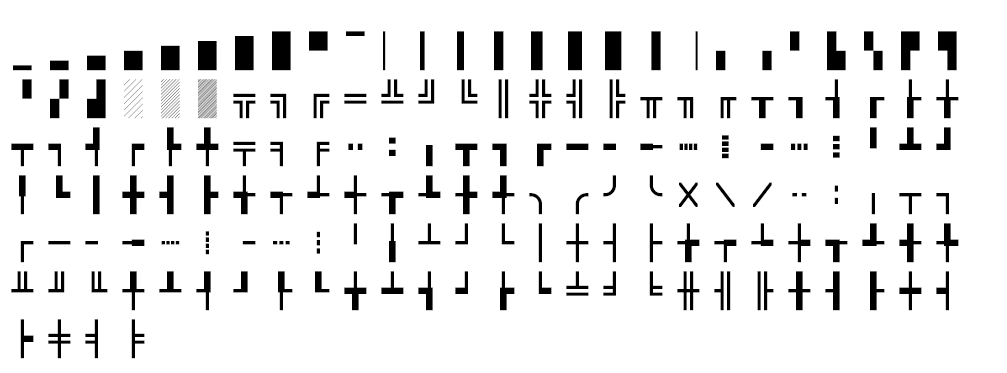
Box Drawing Glyphs
Box drawing glyphs are now included in Cascadia Code! A huge thank you goes out to Aaron Bell and Martin Anderson (@mdtauk) for contributing these glyphs to the font.
Roadmap
We have just published our roadmap for Cascadia Code on GitHub. Some highlights include converting the GitHub pipeline to allow more people to contribute as well as the addition of a weight axis and Greek, Cyrillic, Vietnamese, Hebrew, and Arabic characters.
Feedback
If you ever have any comments or questions, feel free to reach out to Kayla (@cinnamon_msft), Rich (@richturn_ms), or Aaron (@aaronbell) on Twitter or file an issue on GitHub. We hope you like these latest additions!
TIL about this neat feature of NGINX: you can use the auth_request directive to cause NGINX to make an HTTP subrequest to a separate authentication server for each incoming HTTP request. The authentication server can see the cookies on the incoming request and tell NGINX if it should fulfill the parent request (via a 2xx status code) or if it should be denied (by returning a 401 or 403). This means you can run NGINX as an authenticating proxy in front of any HTTP application and roll your own custom authentication code as a simple webhook-recieving endpoint.
I’ve been talking to students. You talk to these young ladies right over here that I talked to last week. And the young lady is, I think is, from Egypt. And she told me what was going on.
So do I believe this little girl, or do I just say no, it’s BS.
Squires claimed human-caused climate change was based on “biased science” and criticized Swedish teen climate activist Greta Thunberg.
“This girl, that little thing that came over from Sweden. ‘Oh how dare you.’ All this emotion! Cut out the emotion and get to the real facts,” Squires said.
When women are referred to as “little girls” or “little things” they are infantilized, and their contributions to political life diminished and dismissed.
Shaping Vancouver 2019: What’s the Use of Heritage?
Conversation #2: What do we do about neighbourhoods?
Some argue that “neighbourhood character” must be maintained to preserve the diversity of the city. Others note however that “neighbourhood character” frequently serves as an instrument of exclusion, making people feel unwelcome and marginalizing them.
Neighbourhoods that do not evolve risk stagnation, while neighbourhoods that change too rapidly erase the attributes that make them unique.
Are there then qualities of neighbourhoods that should be cultivated or protected? As Vancouver faces a housing crisis, how do we go about discussing neighbourhood change?
Four panelists share their insights about their local places:
Richard Evans – Chair of RePlan, a committee of the False Creek South Neighbourhood Association
Scot Hein – adjunct professor in the Master of Urban Design program at UBC, previously the senior urban designer with the City of Vancouver
Jada-Gabrielle Pape – facilitator and consultant with Courage Consulting
Jennifer Maiko Bradshaw – renter, pro-housing activist and director of Abundant Housing Vancouver
Wednesday, October 9
7-9 PM
SFU Goldcorp Centre for the Arts (SFU Woodwards) – 149 West Hastings Street
I can hardly write a message on my iPhone without adding a 🐯 or 🎩 or other emoji at the end. I even use these as a kind of code — there’s a specific emoji I send to Sheila when I’m leaving work, for instance.
Most of my emoji come from the Frequently Used section — most often in the very left-most column, next to the screen edge. I rarely go hunting. What I want is right there.
This worked great until I installed iOS 13.
After I installed iOS 13, the left-most section changed — it became something to do with Memoji. My frequently-used emoji ended up just slightly to the right of the middle of the screen.
This was a pain for me, and I wanted to get it back to how it was, where the Memoji stuff would be gone and my most-used emoji column would be flush-left again.
I looked around in Settings and didn’t find anything for this — so I figured that if I delete my Memoji, then that section would go away, since I don’t have a Memoji anymore.
Wrong!
The section persisted, only now with funny unicorns.
The Solution Was Eventually Found
I finally realized that if I tap the little monochrome clock icon at the bottom of the screen, then I’ll get it back to how I like it.
The thing is: that icon was already selected, so it didn’t occur to me to tap it, until finally I did out of desperation.
And I realize now that if I tap it again, it shows Memoji. Tap it again, and they hide. All while the button still shows as selected (and presumably non-tappable). It’s… odd.
The Amazing Modern World
Our computers, devices, and software are amazing these days. It feels as if the very laws of physics have changed since I was a kid — that’s how marvelous all of this is. I love it, and I love writing apps and writing about apps.
I’m not picking on Apple with this thing about the emoji keyboard. Apple’s been the greatest of the prime drivers of all these marvels. My point was to pick an example that most of the people reading this would know.
These marvels are so great that billions of people are using them. The diversity of this population can’t be overstated — iPhones, for instance, aren’t just for the young, able, and tech-obsessed.
All of us in tech know this, but we don’t always go far enough in displaying the care that all of these people deserve. When we ship a bug, or even just an inscrutable bit of user interface, how many people are we frustrating? How much of other people’s time are we wasting?
I’m not saying don’t ever change your app’s UI. Make improvements. Definitely.
But always keep in mind that your app is probably only one of dozens that any given person might use. Most people don’t read your change notes. But they’ll notice if something they relied on, that was easy and useful, is now, suddenly, not.
It may even be that they could get it back to the way they liked it. But will they figure it out? And how much time will they all have spent on it? How much frustration?
Because our apps go to so many people, we should start thinking the same way other professions do: we have a real obligation to the public, not just to our bottom line. We should, at least, do no harm.
In my not so humble opinion, Microsoft has outdone Apple with the design of their Surface Laptop. It's much cleaner and more functional than a MacBook Pro, at the same time. Now available in two sizes and four colors, with and without Alcantara fabric, full aluminium unibody design, both USB-A and USB-C. Let's not forget a touch screen with pen support and scissor-switch keyboards. Fantastic machines.
I am exploring task-specific programming as a direct outgrowth of my work on GaComputes, ECEP, and ebooks. I’ve worked hard at helping computing education to grow in the US, but it’s not growing much (see my September Blog@CACM post for stats on that). There are too few people learning with the power of computing. It’s because we make programming so hard. We need to make programming more accessible, and one way to do that is to make it easier.
Why do we need to make it more accessible? My answer is: in order for people to use computer science for learning everything else. In 2009, when Matthias and Shriram wrote “Why computer science doesn’t matter” (see paper here), I hated it. Of course, computer science matters! Now I realize that they’re right. Nobody gets turned away from college admissions because they didn’t have high school CS. MANY students get turned away because they can’t pass Algebra 1. Other students don’t finish their degrees because they can’t get past Calculus. This other stuff really matters. I believe that we can use programming to help learn the stuff that really matters.
A key insight for me is that what students really use in Bootstrap:Algebra or even in Scratch is a small piece of programming. (I talked about this a good bit in my SIGCSE keynote.) We can reduce how much of programming we teach and still get huge benefits. Essentially, the students in Scratch and Bootstrap:Algebra are doing task-specific programming. I’m just going one step further to strip away even the trappings of a more general programming language. I’m making it as small as I can (but large enough to cover a learner’s task), so that we can increase usability, and thus increase the probability that we can apply programming to improve learning outcomes in other disciplines.
But it’s still programming, so the insights and theories of computing education research (CER) deeply influence this work on task-specific programming. In turn, task-specific programming offers the opportunity to ask some of our CER questions in new contexts. Here are two examples.
Notional Machines
At the Dagstuhl Seminar on Notional Machines (see post by Ben Shapiro), there was a key moment for me. Someone said something there about “Part of the notional machine for algebra.” I stopped and went all academic on them. “Wait a minute — if that’s a real rule used for evaluating algebra, then it’s not a notional machine. Notional machines are simplifications. That’s real algebra, not a notional machine.” There was a bit of a fight after that. It’s kind of a blur now.
In my two prototypes, I want the mathematics to be the notional machine. The notional machine for the image filter builder is matrix arithmetic and scalar multiplication. Underneath, it’s doing something more complicated, but I want students to completely understand what’s going on in terms of matrices.
The notional machine for the texture wave builder is a bit more complicated. My goal is for the notional machine to be just the wave function, but it’s a bit more than that. It’s also how the wave function maps to RGB values in a picture, and I’m actually not sure I have it right yet. If you have a wave where you just manipulate red here, and a wave that manipulates gray there (where red=green=blue at all pixels), then how do I combine the red component with the gray component in some reasonable way? I’ve tried a few ways already. I’ve thought about adding another task-specific language, just to let the students specify the mapping.
Of course, these are really simple programming models (no variables, no user-defined functions), so the notional machines are really simple, too. As much as possible, the notional machine is the context itself — math, or math+graphics. When does learning this notional machine help you learn other notional machines later?
And what have you learned if you learn those? Does task-specific programming help you learn more within the task domain? I hope that learning the matrix notional machine for image filters helps you with matrix manipulation later. Do students really learn precalculus from these prototypes?
If you learn the notional machine for task-specific programming, does that help you learn other notional machines later? There still is a computational notional machine embedded in there, e.g., about controlling the computational agent, about order of execution, and so on. Does that knowledge transfer to other computational contexts?
Structure-behavior-function models
My student Katie Cunningham is studying the use of structure-behavior-function (SBF) models for understanding how students come to understand programs. (I defined SBF models here). In short, this theoretical framing helps us understand the relationships between students learning to read code, to write code, to trace code, and to explain code in plain English.
Task-specific programming doesn’t fit the same way in that model. There is no writing of code. There is structure to the programs, but more of it is embedded in the environment than in the textual language. One of the insights from the participatory design sessions that we’ve had with teachers is that the environment is so much more powerful than the language. Consider the statement in my wave texture generator Set Gray to 4sin(5(x-3))+0. That does completely define the structure and transformation. However, the below picture is is so much more powerful and is what students really see — multiple, linked representations that explain that one line of code:
Behavior is complicated. As I said above, I want the behavior to be the notional machine of the mathematics. To trace the operation above, a student might plug in values for X to see what Y is generated, and check the plot and the wave to see if it makes sense. But it’s not like variable tracing.
But the explain in plain English task of figuring out the function is still there. Check out this image filter program:
Readers who know Media Computation or graphics will likely recognize that as the program to compute the negation of an image. How do we help students to do that? How do we help students to see the program and figure out what it does at a macroscopic level? I built tools into the wave texture builder to make it possible to see the role of each wave in the overall texture, but if you were to describe a texture as a “tightly-woven red and green plaid,” I’m not sure how you’d get that purpose/function from the definition of the waves The problem of figuring out the function is pretty much the same in task-specific programming.
Where to go from here
So this is the end of the series. I’ve described two prototypes for task-specific programming in precalculus (matrix transformations and wave functions), and explored the implications of task-specific programming for research about programming, in education, and in relation to computing education research (this post).
I did these as blog posts, in part, because I’m not yet sure where I might publish and fund this work.
Most learning sciences work focuses on students. I’m focusing on teachers first.
Most CS education work focuses on learning about CS, especially programming. I’m focusing on using CS programming for learning something else.
Most programming languages work focuses, well…on languages. I’m focusing on programming where languages are a second-class citizen.
Most NSF funding in CS Education is tied to work with schools and districts (RPP), and is about CSintegration in elementary school and CS-specific classes in high school (STEM+C). I’m doing design work with teachers for CSintegration at the high school level.
There is funding (like NSF DRK12 and Cyberlearning) for developing interesting technology for learning, but I’m at the design stage. DRK12 has exploratory grants, but the funding level is too low to pay for my collaborators and my students. How do you get something like this started?
I’m seeing more clearly the point that Greg Nelson and Amy Ko talked about at ICER last year (see paper here). This is design-first work. It’s hard to find a home for that.
I’d appreciate your advice. Where is there a research community that’s concerned about these kinds of things? Where should I be publishing this work? Where should I be looking for funding?
This is all wrong . . . and this post is a week late. Nevertheless, it still is nagging at me to be written.
I was moved to tears by Greta Thunberg’s speech at the United Nations last week. Simple words, clear message, belief in a greater good and a non-ego based plea for collaborative action to save the planet and provide hope and more importantly a future for our planet and the species that remain on it. I was also left thinking, but what now?
Last week also saw Lady Hale, Chair of the UK Supreme Court announce a momentous decision around the illegality of the current UK Government’s proroguing of parliament. In contrast to the Thunberg speech, Lady Hale’s measured words brought a huge smile to my face, possibly a fist pump, a sense of justice being done. Again, I was left thinking, but what now?
Both women of course have been celebrated, derided and abused in equal measure and their measured, meaningful words are a stark contrast to the continuing stream of dumbed down rhetoric tumbling out of the mouths of (mainly male) UK Cabinet members and our Prime Minister.
Boris Johnston the former Daily Telegraph columnist who was never short of a slight obscure adjective is now the apparent master of language of the people, and rote phrases such as “surrender bill”, “do or die”, reverted to type at PMQ last week when the only response he could think of in response to the reality of death threats received by female MPs, was “I’ve never heard such hum-bug in my life”. I’m not even going to attempt to try and explain my reaction what happened in Parliament last week, but once again I was left thinking, what next?
The manipulation of language within politics, and indeed throughout culture is nothing new. However, there is something terribly wrong with what is happening just now. So why is it that the real crisis we are all facing and the words so eloquently expressed by Greta Thunberg are not gaining widespread tracked, yet phrases like “surrender bill”, “do or die” , traitor” are?
Like many of my peers, I miss reasoned discussion around our current political situation. I find myself at a loss to understand how many people cannot see that what they are being told about for example Brexit is in many cases simply not true. Brexit cannot “be done” on 31 October. What might happen then is the agreement of a Withdrawal Agreement, there will be many, many more deals and arrangements to be negotiated.
Yesterday, I read a really interesting article by George Monibot, around this very topic. In the article he describes some research into how we react to, and what we hear in times of crisis and stress. The research has shown that “when we feel threatened, we cannot hear calm, conversational voices” and that in times of fear, “it is the deep background noises we need to hear” why is why “In the political context, if people are shouting at us, moderating voices are, physically, tuned out. Everyone has to shout to be heard, ramping up the level of stress and threat.” So what next?
Well in the article Monibot calls for more reasoned behaviour, and mostly importantly respect and the need for safe spaces where calm conversations and equally importantly listening, can take place. It seems to me that education needs to play a key role in creating and sustaining these safe, civic places, where new forms of public pedagogy around climate change (which in turn would lead to discussions around trade, markets, values etc) can develop. We also need to start to reclaim social media spaces in this way too to make them calmer spaces and places. I would love that to be next.
Putting a couple notes from Twitter here. One of the ideas of SIFT as a methodology (and of SHEG’s “lateral reading” as well) is that before one reads a person must construct a context for reading. On the web that’s particularly important, because the rumor dynamics of the web tend to level and sharpen material as it travels from point A to point Q, and because bad actors actively engage in false framing of claims, quotes, and media.
But it’s also a broader issue when considering source-checking. I’ve had people share RT articles with me that are more or less “true”, for example. When I push back on people that they shouldn’t be sharing RT articles, since RT is widely considered to be a propaganda arm of the Kremlin, the response is often “Well, do you see anything false in the article? What’s the lie?”
This isn’t a good approach to your information diet, for a couple reasons. The first is that a news-reading strategy where one has to check every fact of a source because the source itself cannot be trusted is neither efficient nor effective. Disinformation is not usually distributed as an entire page of lies. Seth Rich, for example, did exist, was killed, and did work at the DNC. His murder does remain unsolved. Even where people fabricate issues, they usually place the lies in a bed of truth.
But the other reason to not share articles from shady sources is the frame can be false, even if the facts are correct. Take this coverage on the Seth Rich murder from RT for example, in a story about Assange offering a reward for his killers. The implication of the story is it is possible that Seth Rich was killed for leaking the DNC emails.
Rich worked as voter expansion data director at the DNC before he was shot twice on his way home on July 10. He died later in hospital.
“If it was a robbery — it failed because he still has his watch, he still has his money — he still has his credit cards, still had his phone so it was a wasted effort except we lost a life,” his father Joel Rich told local TV station KMTV.
See the frame? Responsible reporting would add context:
DNC emails universally believed by experts to be hacked, not leaked.
The “data director” position sounds email-ish, but had no access to email systems.
The Washington D.C. police said regarding the robbery that in robberies where someone is killed it’s extremely common to find that the credit cards and phone are not taken, because people generally get shot in robberies when something goes wrong, and the suspects are anxious to flee the scene before the police come investigating the gunshot.
There’s not a lie in the article (that I can see) but the way the article is framed is deceptive. And there’s no way to know that as an average reader, because you don’t know what you don’t know. Without expertise you can’t see what is missing or deceptively added. So zoom out, and if the source is dodgy, skip it. Find something else. Share something else. You’re not as smart as you think you are, and reading stories designed to warp your worldview will, over time, warp your worldview.
A couple days ago I announced a new little daily drawing app called Prompts and mentioned that I was going to use Coil as my primary monetization strategy. For those unfamiliar, Coil is a passive monetization platform based on the proto-standard Interledger Specification. You pay $5/month into a fund that gets distributed penny-by-penny to sites you visit around the Web. It couldn’t be easier to support sites you actually visit. From a content creator standpoint; with a single <meta> tag pointing to my “tip jar” I’m now set up to passively generate income.
With Prompts, I decided to make a small bet on using Coil and its new way of monetizing for my side projects. It’s still early days in the life of the project, but I’m already asking myself the big question…
“Am I going to get rich?”
Unfortunately, I already know the answer and it’s “No… at least not yet”. It’s too early to be worrying about money, but we’ve been talking about monetization so much on Shop Talk recently it was important for me to add “revenue generation” as a project constraint. Here were some of the potential tradeoffs I considered going down this route…
The upsides of Coil for Prompts
Coil’s attention-based monetization strategy aligns almost exactly with what I want for Prompts.
Prompts is an IA Writer-style Focus Mode drawing app. Ads would crush that user experience. Ads don’t serve the design ethos whatsoever, whereas Coil aligns perfectly. It runs behind the scenes, never interrupting the User Experience.
Prompts is designed to be a tool you use a little bit every day, I think the attention-based funding model aligns pretty well with my objectives; If I make something people like and want to use every day, I make more money.
For me, Coil seems way less invasive than ads, extremely more private (I hope), and better overall for performance. This is important to me.
The potential downsides of Coil for Prompts
But going with a rogue new technology is not all sunshine and roses. Taking a step back and putting on my realist hat, there are a few things going against me:
Users installing the PWA will also need the Coil extension. Now I have two-factor install problems, not just one. I’m not even sure how extensions work with PWAs across platforms. iOS users will have to use this in the Puma Browser on iOS. Without this being baked into the default browser, there’s little hope here for monetizing PWAs.
With Coil I only have a single tip jar, so I have no data segmentation and no charts and graphs that I can use to measure the revenue of Prompts vs. revenue from my personal blog.
Coil is probably not popular enough to sufficiently fund my side project… yet…
One other route I could have taken was to wrap this up with Phonegap, put it on App Stores, and sell it for $5-$10. But then I’m dealing with app stores, device provisioning, certificates, and most worrisome of all: PAYING CUSTOMERS! People who paid money and feel entitled to leave one star reviews when it doesn’t do enough. Causing me more stress and keeping me up late at night. That’s a lot of overhead for a side project.
A lot of my potential success here depends on more people being convinced Coil (and other ledgers like it) are good for Web and better browser adoption of the Interledger spec. Which leads into another topic regarding monetization…
How will I measure success?
From a money making standpoint, I don’t expect to make much from this. This is not my retirement plan unless Adobe wants to buy it (if you work at Adobe, feel free to hit me up). If I start accruing data storage fees or API fees, I would hope Prompts could at least cover its own costs. But for now, it’s a good little experiment I don’t mind funding to some degree.
For the lastfewweeks we’ve been talking about monetization with Coil on Shop Talk. I’m pretty bullish on the concept and I desperately feel that the web needs a new monetization pathway, so I’m happy to experiment with this direction. In the future I could see building out features for Web Monetized users only or only showing ads if document.monetization == undefined.
The best outcome that I could hope for is that more people sign up for Coil (or something like it) and paying for content becomes normalized. Then browsers might hop on this Web Monetization effort. Sadly, I suspect Chrome will be last to the party because it undermines Google’s revenue model. But I yearn for the days where we have a Pay What You Want monetization model be versus a Give Up Your Privacy for Content monetization model. In some ways, my decision to choose Coil is an optimistic bet on a future I desperately want to see.
But if you like Prompts or this blog and want to support it, sign up for Coil! For $5/month you get to support content creators and small indie web apps. It’s probably the most just and equally distributed monetization platform we have. And who knows, maybe I’ll even get a slice of that Grant for the Web money.
A spreadsheet providing the postal code of the home address of each employee of the PEI public service, across all departments and agencies, and the civic address (or, if not available, building name) of their primary work location.
Well within the 30 day time allowed, the request was fulfilled: I received an email with an Excel sheet with the data I requested on September 27, 2019.
Tomorrow, at the Applied Geospatial Research in Public Policy Workshop at the University of PEI, I’ll present an initial analysis of the data with an eye to exploring how it can be used to shift the commutes of the 4,519 people who work for the provincial government to public transit and active transportation.
According to PEI’s Climate Action Plan, 48% of the provinces GHG emissions come from transportation; the provincial public service accounts for a substantial portion of the Island labour force, and the provincial government, as an employer, has both the motivation and the means to incentivize a shift.
This is “just in time” data analysis, as it’s only been in my hands a week, but the workshop simply provided too attractive a pool of smart geospatial practitioners to dip into for advice and guidance.
My initial investigation focused on the 252 public servants who live in postal codes starting with C1A (a good swath of urban Charlottetown) and who work in the Shaw, Sullivan, Jones and Arsenault buildings in downtown Charlottetown; I found that:
248 (98%) can cycle to work in under 20 minutes,
234 (92%) live within 500 m of a T3 Transit bus stop,
121 (48%) can walk to work in under 30 minutes
The slides and the supporting data for my presentation are online now, and if this is a topic that interests you, you are welcome to attend in person: the session is called “Geospatial Workshop 1: Doing Digital Humanities with GIS Data” and it’s happening in Atlantic Veterinary College room 218S from 9:45 a.m. to 10:45 a.m. tomorrow morning, October 4, 2019. You do not need to register for the conference to attend; just tell anyone who asks that I invited you.
(Image from Google Street View, captured October 2015)
Eastern European and Russian operatives, aided by PR firms and lots of allied volunteers, have discovered that editing teams can easily manufacture what Wikipedia mistakenly believes to be consensus. Worse, Wikipedia has stumbled into a fatal asymmetry. Desperate to restore civility, Wikipedia deplores any suggestion that an edit is anti-Semitic or racist: that, according to the Arbitration Committee, suggests that the editor is anti-Semitic or racist. That’s a personal attack! As a result, it’s entirely permissible to indulge dog-whistles and thinly-veiled anti-Semitic tropes, and impossible to challenge them.
That’s what happened in the episode Haaretz covered. A team of Polish nationalists sought to systematically overstate Nazi attacks on gentile Poles and to minimize their attacks on Polish Jews. Editors caught them. The editors who complained have been topic-banned and banned. The nationalists remain. It’s a replay of the Infamous Gamergate episode in which Wikipedia’s Arbitration Committee responded to Gamergate attacks by banning Gamergate’s opponents.
Also noting that on Wikipedia today:
Orlando Cepeda is “a Puerto Rican” baseball player
Minnie Minoso “ was a Cuban” baseball player
Rod Carew is a baseball player “of Panamanian descent.”
Didi Gregorius is “a Dutch” baseball player.
Xander Bogaerts is “an Aruban-born Dutch” baseball player.
On the other hand, Carl Yastrzemski is just “‘American”. So is Ted Williams. So is Moe Drabowsky, who was born in Poland. This cleverly suggests that some baseball players are more American than others.
The difference? Yaz, Williams, and Drabowsky are white.
The program is dedicated towards women, new Canadians and displaced workers. It’s a 20-week intensive program that aims to give people with diverse backgrounds skills to excel in the cybersecurity sector.
It aims to help people who have lost their jobs as a result of technology disruption.
The program consists of technical training along with classes on business skills. The courses are taught by experts and are delivered through online and in-class learning.
The fees for the program are covered by support from the Government of Canada, Rogers, RBC, and the City of Brampton. Those who are accepted into the program are just required to pay a $500 CAD registration fee.
The program has two starting points in February and April of 2020. The classes will be held at the Rogers Cybersecure Catalyst Training Centre, which is scheduled to open in Brampton later this year.
The application for the program can be found here.
Fido has two plans up for sale. The first one has a total of 4GB of data and costs $55 per month. The second plan nets you 7GB of data if you’re willing to pay $65 per month.
Each one of these plans also includes Fido’s ‘Xtra,’ ‘Roam,’ five hours of free data and that carrier’s new data overage protection service.
The plans include:
4Gb of data – unlimited talk and texting in Canada – $55
7GB of data – unlimited talk and texting in Canada – $65
Fans of Apple’s tiny iPhone SE will be pleased to learn that the tech giant could still be working on a successor to the classic smartphone.
According to often-reliable Apple analyst Ming-Chi Kuo, as first reported by MacRumors, Apple reportedly plans to launch a sequel to the iPhone SE in early 2020. Kuo says that the iPhone SE 2 will look like an iPhone 8 rather than an iPhone 5, giving it a slightly more modern aesthetic.
Since the phone is set to adopt Apple’s older iPhone design, it’s likely familiar features like Touch ID and large top and bottom bezels will make an appearance. This corroborates earlier reports that stated Apple’s next entry-level iPhone will look like an iPhone 8, and that it is set to feature Touch ID.
Kuo goes on to note that Apple’s 2020 iPhone SE will include an A13 processor and 3GB of RAM, similar to the iPhone 11 series. The iPhone SE 2 also won’t be as small as the iPhone 5’s 4-inch screen, instead measuring in at 4.7-inches like the iPhone 8.
It’s unclear how much Apple will charge for the iPhone SE 2. The original iPhone SE launched at $299 CAD for the 32GB version of the smartphone.
With early 2020 looming on the horizon, it’s likely we’ll see a number of iPhone SE 2 rumours over the next couple of months.
Now that RuPaul’s Drag Race UK has finally premiered, you might be worried that you can’t watch the show in Canada.
Canadian ‘hennies,’ don’t fret, we can support our queen Crystal (né au Québec) in a variety of ways.
You can access Drag Race UK through the base $9.99 CAD subscription of Bell’s Crave streaming service.
Unfortunately, there’s no way to download the show to watch offline.
There’s also the app OutTV. The platform provides all the drag you could ever want, including Drag Race All Stars and Dragula. There’s also a free 30-day subscription with OutTV.
If you already have Prime Video, OutTV is a Prime Channel as well. This means you can access the platform from the Prime Video app if you don’t want to download an additional app. OutTV is $4.19 (including tax) per month.
New episodes are available at 4pm ET each Thursday.
Now hennies, if you’re not excited for Drag Race UK, Drag Race Canada will be on the exact same streaming services when it premieres.
While RuPaul is the host of the series, the judges are Michelle Visage, Alan Carr and Graham Norton.
“Ladies and gentleman, start your engines and may the best woman win!”



 🎃👻Amber Wails👻🎃 @emptysthemepark
 Diana Yoon 🌅 @DianaDYoon
 The Omni Group.
 davidallengreen on Twitter.

 davidallengreen
on Friday, October 4th, 2019 6:49am
davidallengreen
on Friday, October 4th, 2019 6:49am
 ottocrat on Twitter.


 richcarey/Getty Images
 Riza Azhari/Getty Images
 richcarey/Getty Images

 [Untitled].
 Note: The Terminal will use its shipped version over the separately installed version from GitHub, however it will use font fallback when needed. This means you will still receive the new characters and glyphs in the Terminal, but any changes to the original character set will not be reflected until your Terminal receives the update.