Shared posts

16 Oct 00:08

Records and Lenses

Sunday included more fun than the recent average — at my age, chilling is often more attractive than partying. Sunday featured vinyl, vintage lenses, Southern guitar boogie, and a photo-assignment. With pictures! (Which may be a little puzzling, but stay with me.)
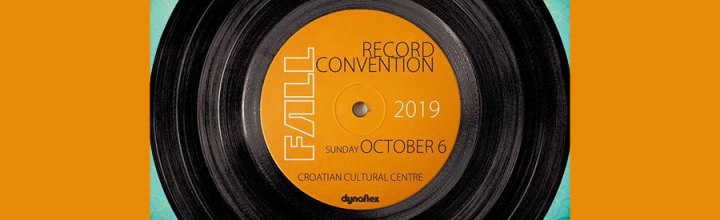
Record convention poster

What happened was, I noticed that there was a Fall 2019 Record Convention and on impulse took the e-bike crosstown to the glamorous (not really) Croation Cultural Centre. I strolled in the door of the big room with all the people and the nice lady said “You want the record convention or the camera convention? This is the cameras.” Who knew? So I went over to the other side and ended up buying five records: Willie Nelson’s Teatro (with Emmylou and Daniel Lanois), Howlin’ Wolf’s Big City Blues, Yellowman and Fathead’s Bad Boy Skanking, James Blood Ulmer’s Free Lancing, and Sons of Kemet’s Your Queen is a Reptile.

It was just a high-school-gym-sized room with a big square of tables facing outward facing the other big square against the walls facing inward, all the tables full of boxes full of LPs. I posted an appropriately lo-rez video on Instagram. A few of the vendors had organizing principles, ranging from genre to alphabet to price. Lots didn’t.

What a bunch of stoners. Except for a few fresh-faced hipsters and the odd grizzled geek like yours truly. Good clean fun.

Main Street by night

Photopunk

Since I’d come all the way, I coughed up $5 for the camera show, which was pretty well maximum steampunk. Old cameras! Some with bellows and bulbs, some the size of your head. I have enough cameras but you can never have too many lenses. There wasn’t much chance of anything Fujifilm-related (it’s from this millennium) but I have a Pentax K-mount adapter and as I wrote in that context, “there are an astonishing number of excellent K-mount lenses in every imaginable length and width on the market.” So I walked around the tables saying “K-mount?” to anyone showing lenses and lots had some.

Main Street by night

Protip: Nifty fifty

If you’re stingy and want to take lovely portraits it turns out that for basically any camera in the world you can get a K-mount adapter for your camera cheap, and then go to a show like this (or eBay or whatever) and pick up a classic Pentax 50mm F1.4 for almost no money and with a little practice and love, you’ll be making your friends and loved ones look better than they really do.

But I have a nifty fifty already. I’d got two thirds of the way around the camera trail and saw nothing interesting, but then there was this Mittel-Euro dude with an astonishingly small and slim 100mm F/2.8. He wanted $120 Canadian. I walked away and completed the orbit without turning up any gold, so I went back and offered him $100 and he took it. It turns out to be an M 100/2.8, i.e. probably 40 years old.
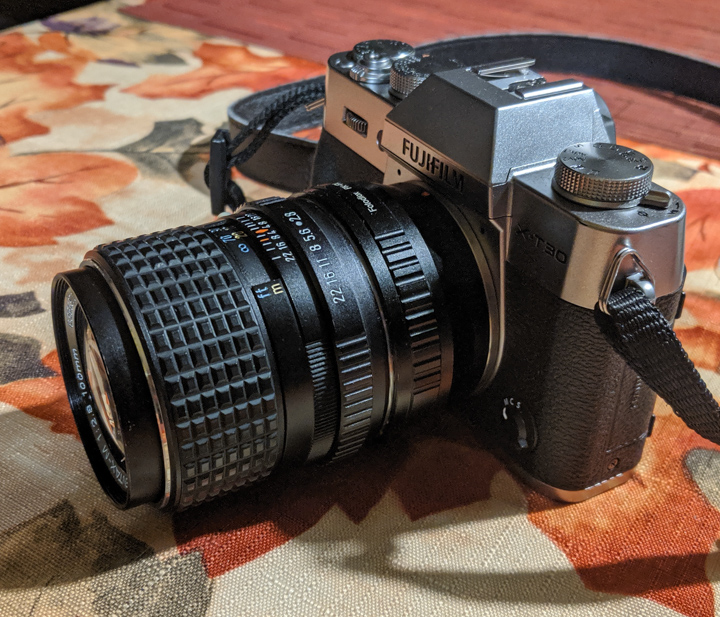
Fujifilm XT-30 with Pentax M

Isn’t it adorable?

Allstars!

Sunday evening I had tickets to see the North Mississippi Allstars. So I strapped the 100mm on the Fujifilm and thought I’d try for some electric-stage drama. Only the security guy took one look and said “gotta coat-check professional cameras.” Professional?! Uh…

Anyhow, the Allstars were just fine, post-Allmans southern boogie, more on the countrified side with a killer washboard solo (no, really) and really a lot of very solid guitar. Plus they played Down By The Riverside (“Ain’t gonna study war no more”) which always gets me choked up. I’d go if they came near you, assuming you like electric white-boy music.

Photocrit

It turns out that at Amazon Vancouver we’ve got a little photocritique social group, where someone deals out a weekly theme and we all post pix and suggest improvements to each other. This week’s theme is “long exposure”. So as soon as I got in the taxi home (For the Vancouver-savvy: up Main from the DTES to Riley Park), with a couple of drinks under my belt and a head full of electric guitar grace, I rolled down the backseat window, set the shutter to ⅛ second and the aperture to F/4, and took pictures of pretty well everything. Three made me smile.
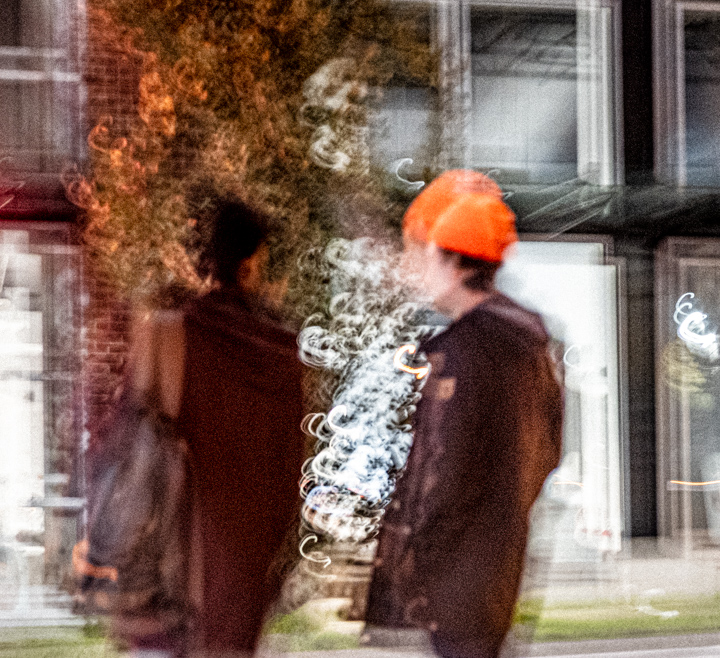
Main Street by night

And I think to myself… what a wonderful world.
15 Oct 23:32

Ben Lacy on IG

Charlie Hunter (an amazing guitarist you should check out) posted this video of Ben Lacy playing Everybody Wants to Rule the World. If you're a guitar player, you should watch and take a listen.

As a guitar player I can see and hear everything that he's doing, but combined it makes no sense to my brain. A single guitar player should not be able to get this much sound and rhythm out of their instrument. Yet, here it is.

There's a handful of other Ben Lacy videos like this scattered around the internet, which are well worth listening to. And Charlie Hunter has a bunch of amazing clips up on Instagram as well.

15 Oct 23:32

Converting Acorn Images on the Command-Line

Alex Chan shows how he used AppleScript to batch convert a bunch of Acorn images to PNG.

You could also use Retrobatch to do this pretty easily, but I thought it was a great example of using the tools already at your disposal to get something done.

15 Oct 23:32

FMJS Diary #1.5

How about a small FMJS update? I've ported my little blogging engine from Node.js over to FMJS, with a little Cocoa editor involved as well. At some point it'll be released in source form, but that's probably not anytime soon since there's some other suff that would need to happen first.

14 Oct 04:40

Play It Loud

Ableton has put up a wonderful tutorial describing what a synthesizer is, how it works, and with intuitive interactive controls. It's really fun to play with.

14 Oct 04:40

Turn On The Faucet (or wait for a miracle)

by Richard Millington

I spoke with a company last year which wanted their community to be about the industry.

They wanted the community to have its own brand and not be beholden to internal conflicts.

This meant they rarely promoted the community to millions of customers.

Instead, they were hoping for a miracle.

They were hoping millions of industry professionals would suddenly hear about the community and join it.

The miracle was never going to happen.

It doesn’t matter what you do in a community if no-one is going to see it.

It’s hard to fill a community with members when you only have drops of attention to work with. Far better to figure out who controls the attention faucet and how the community makes their work better/easier.

The community doesn’t have to be about your brand, but if your brand isn’t willing to promote it, it’s not going to work.

(p.s. It’s hard to keep a community separate from the rest of the company and still succeed. Believe me, even if you do magically make it work, your marketing/PR/other teams will want to be involved).

14 Oct 04:39

Pleased to see that my step last week to fix my...

by Ton Zijlstra

Pleased to see that my step last week to fix my RSS feed so it shows my words first, not what I’m reacting to, actually has the hoped for effect.

My feed goes to my micro.blog account, and there my own words are shown now first too. A post in this new form yesterday created a nice conversation involving 4 others on micro.blog. That would not have happened had my post started and ended with “Read: some url”.

14 Oct 04:39

Learning how to make a thing learnable is harder than learning it

Here’s something pretty crazy: there are around 10^28 atoms in the human body. An astromically tiny percentage of arrangements of 10^28 atoms in 3D space correspond to a viable human. Most arrangements of atoms would just melt into a puddle!

If you were trying to learn something as complex as a human body, with that many parameters, you’d need to transform the problem to a much simpler one, where the space of possibilities is much much smaller and where more of these possibilities have nonzero fitness. This allows the problem to be learned.

Remarkably, evolution has managed to do this: there is an incredibly complicated mapping from the human genotypes to the human body. Even more crazy, that mapping was itself learned by evolution! This has to be the most impressive thing about evolution - this seemingly dumb process converts what would otherwise be an insanely complex and huge problem space into a much simpler one where that same dumb process can be effective at learning.

Learning is really two things: step 1 is learning how to make the problem learnable, and step 2 is doing the learning. In machine learning, it’s usually the humans that figure out how to make the problem learnable, by applying our smarts to the problem to arrive at some highly constrained representation which is learnable via dumb algorithms. But step 1 is the hard part!

Maybe the reason we often overlook step 1 is that our brains are so good at reducing very complex problems to simpler spaces. We do our thinking in that simpler space and then project results back to the more complex space. For instance, in order to write this post, I definitely don’t think in the space of all possible sequences of characters. Instead I have thoughts which I translate via some complex mapping to actual characters. When I walk, I don’t think about controlling all the gajillions of nerve outputs directly, I execute some very high level movement plan which is translated to nerve outputs via some very complicated mapping. And so on…

In each of these cases, the hard part is actually coming up with this mapping or learning it in the first place!

14 Oct 04:39

Thunderbird, Enigmail and OpenPGP

by Ryan Sipes

Today the Thunderbird project is happy to announce that for the future Thunderbird 78 release, planned for summer 2020, we will add built-in functionality for email encryption and digital signatures using the OpenPGP standard. This new functionality will replace the Enigmail add-on, which will continue to be supported until Thunderbird 68 end of life, in the Fall of 2020.

For some background on encrypted email in Thunderbird: Two popular technologies exist that add support for end-to-end encryption and digital signatures to email. Thunderbird has been offering built-in support for S/MIME for many years and will continue to do so.

The Enigmail Add-on has made it possible to use Thunderbird with external GnuPG software for OpenPGP messaging. Because the types of add-ons supported in Thunderbird will change with version 78, the current Thunderbird 68.x branch (maintained until Fall 2020) will be the last that can be used with Enigmail.

For users of Enigmail, Thunderbird 78 will offer assistance to migrate existing keys and settings. We are happy that Patrick Brunschwig, the long-time developer of Enigmail, has offered to work with the Thunderbird team on OpenPGP going forward. About this change, Patrick had this to say:

“It has always been my goal to have OpenPGP support included in the core Thunderbird product. Even though it will mark an end to a long story, after working on Enigmail for 17 years, I’m very happy with this outcome.”

Users who haven’t used Enigmail previously will need to opt in to use OpenPGP messaging, as encryption will not be enabled automatically. However, Thunderbird 78 will help users discover the new functionality.

To promote secure communication, Thunderbird 78 will encourage the user to perform ownership confirmation of keys used by correspondents, notify the user if the correspondent’s keys change unexpectedly, and, if there is an issue, offer assistance to resolve the situation.

It’s undecided whether Thunderbird 78 will support the indirect key ownership confirmations used in the Web of Trust (WoT) model, or to what extent. However, sharing of key ownership confirmations made by the user (key signatures), and interaction with OpenPGP key servers shall be possible.

If you have an interest in seeing more detailed plans on what is in store for OpenPGP in Thunderbird, check out our wiki page with more information.

The post Thunderbird, Enigmail and OpenPGP appeared first on The Thunderbird Blog.

14 Oct 04:39

AirPlay 2 richtig verwenden

by Volker Weber

3a63f54e7ed582af96ef61ec41d438f3

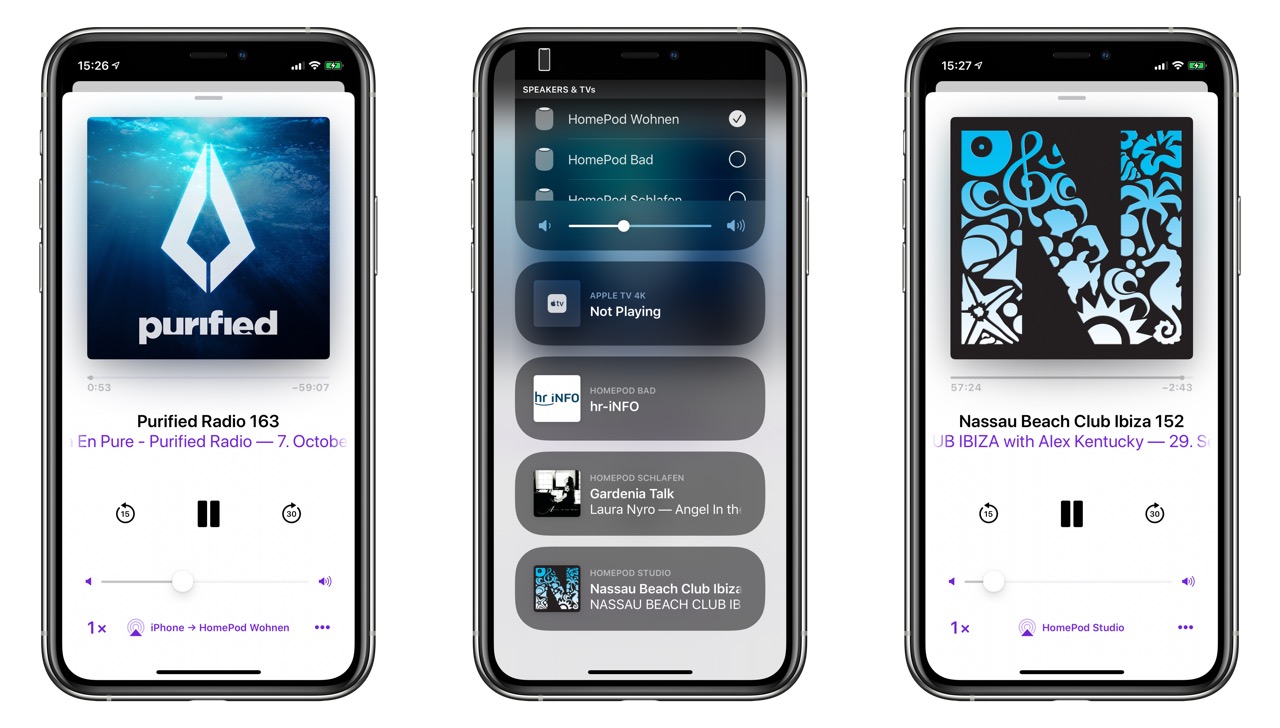
Links seht Ihr, wie die meisten Leute AirPlay verwenden. Die Musik spielt, man wechselt auf einen anderen Lautsprecher, und dann spielt der. In dem Fall ist immer noch das iPhone dafür zuständig, den Stream herunterzuladen und dann an den Lautsprecher zu schicken,

Viel schlauer ist es, den Ziellautsprecher erst auszuwählen und dann zu sagen, was er abspielen soll. Den Unterschied sieht man jeweils ganz unten auf dem iPhone. Einmal iPhone → HomePod Wohnen und beim zweiten HomePod Studio ganz alleine.

14 Oct 04:38

If you pay a monthly fee for software (Adobe, M...

by Ton Zijlstra

If you pay a monthly fee for software (Adobe, Microsoft, Evernote, etc etc) realise you are not buying the software, you only have a monthly subscription with the company providing access to that software. Do not depend on it being there. You can be cut off at moment’s notice. (The same might be true for some things, like a John Deere tractor by the way.)

Venezuelan Adobe customers will be cut off effectively immediately and are only allowed time to get their data out of Adobes servers, because of an embargo by the US government. Being cut off here also means not getting a refund, as that sort of transactions are under embargo too.

Adding another datum to the urgency to get out of subscription model software.

14 Oct 04:37

Study Shows Semi Autonomous Vehicles Can’t See Pedestrians

by Sandy James Planner

Image: Carscoops.com

It was only a few years ago when semi autonomous vehicles were the shiny pennies pledging to undertake all the  pesky logistics of driving. But as reported in The Verge.com things are not quite as touted, even with the Automatic Emergency Braking Systems. These vehicles are testing out as unconscious killers of vulnerable road users, who are being slaughtered at an increasing rate on roads in North America.

The most important aspect for any vehicle on the road is the ability to recognize and avoid vulnerable road users, those pedestrians, cyclists and other wheelers that are using the street without the protection of a vehicular steel shell.

It appears that while car companies fill their vehicles with toys (I have already written about the huge dashboard reader screens) the technology is still not reliable to keep everyone safe on the road. That’s the nice way of saying that today’s semi autonomous vehicles are murderous for other road users despite the fact that they have been portrayed as being logically smarter and safer than human drivers.

This report by the American Automobile Association (AAA) looked at the automatic braking systems of semi autonomous vehicles from different makers when confronted with a pedestrian (thankfully they used mannequins).  Four different 2019 model vehicles were used~a Chevy Malibu, Honda Accord, Tesla Model 3, and Toyota Camry.

Unbelievably  the vehicles hit the dummy pedestrians a horrifying sixty percent of the time-“and this was in daylight hours at speeds of 20 mph/30 km/h”. When child sized dummy pedestrians were used on the roadway, they were hit eighty percent of the time, 89 percent  of the time if between cars.These findings also occurred at higher speeds and at night.

Pedestrian fatalities were even worse if the victim had their back towards vehicles. The Truth About Cars writes “The researchers tested several other scenarios, including encountering a pedestrian after a right-hand turn and two adults standing alongside the road with their backs to traffic. The latter scenario resulted in a collision 80 percent of the time, while the former yielded a 100 percent collision rate.”

Thankfully in their conclusions  of the study AAA states that the high-tech detection systems are inadequate, with none of the various vehicles tested being able to detect an adult walking on the roadway at night. Only one vehicle was able to detect that an object was even in front of the car, but it still did not brake.

As Allison Arieff writes in the New York Times –while over 80 billion dollars has been spent in the last five years on “smart” or connected cars and AVs supposedly to make them safer, “investing in the car of the future is investing in the wrong problem. We need to be thinking about how we can create a world with fewer cars.”

In 2018 6,227 pedestrians (that’s the population of Yarmouth, Nova Scotia)  were killed in the United States.That’ is an increase of 4 percent from 2017. Canada is also in the club, being one of only seven industrialized nations in the world where pedestrian deaths are increasing.

The OECD’s International Transport Forum looked at distracted driving and the lack of law enforcement (or penalty) for the dramatic increase. I’ve previously written about SUV’s (vehicles built upon a truck platform) being responsible for a 46 percent increase in pedestrian fatalities, and those types of vehicles as well as trucks representing 60 percent of all new car purchases.

We can’t outsmart or drive our way out of this issue, and indeed as Arieff suggests we are looking at the wrong end of the problem. Creating deserted streetways for autonomous vehicles to travel, putting RFID (radio frequency identification ) readers on pedestrians or cyclists is answering the wrong question. For livable places and for sustainability we need to encourage active transportation and good efficient connected public transit, negating the need for the automobile industry to recreate themselves for this century. They are doing a pretty bad job so far.

You can take a look at the test crash dummies flying on the semi autonomous vehicle research course track in this short YouTube video below.


14 Oct 04:36

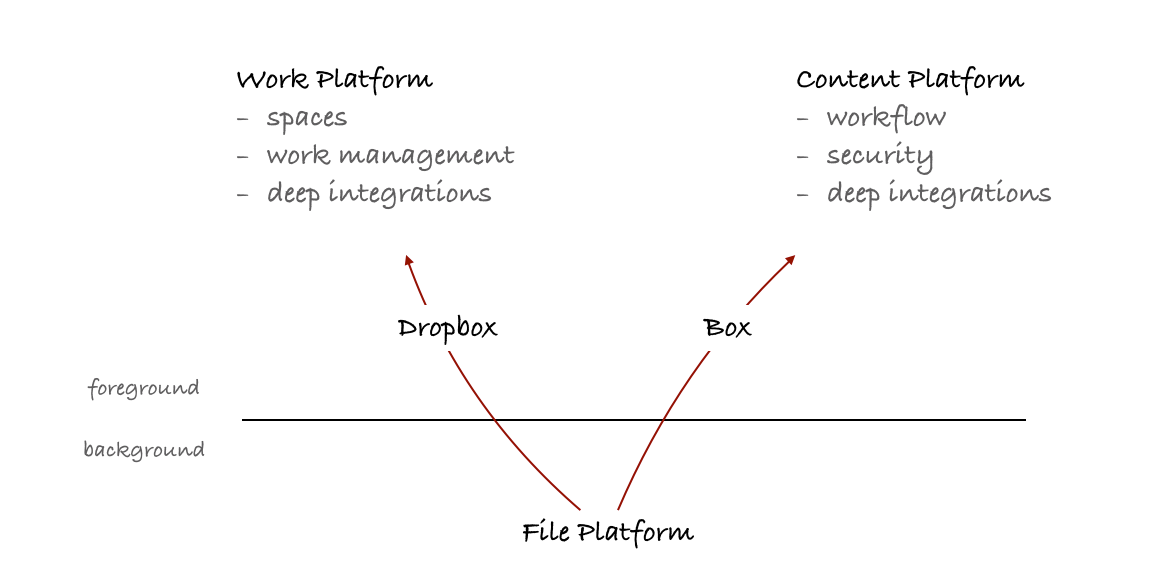
Departing the File Platform

by Stowe Boyd

How Dropbox and Box are diverging, and why

Continue reading on GigaOm »

14 Oct 04:35

Hypertext And The Age Of Trump

An excerpt from the closing chapter of Intertwingled, a reflection for my colleagues on 30 years of research in hypertext and new media.

Hypertext And The Age Of Trump

The future is not what it was.

Ted Nelson concludes Dream Machines with the peroration, “Yours for a better world, before we have to settle for Any.” We now see he was too optimistic.

The prophetess says:

Virginia Woolf wrote in her journal, “The future is dark, which is on the whole the best thing the future can be, I think.” Dark, she seems to say, as inscrutable, not as in terrible. We often mistake the one for the other. Or we transform the future’s unknowability into something certain, the fulfillment of all our dread, the place beyond with there is no way forward. But again and again, far stranger things happen than the end of the world. [Rebecca Solnit, Hope In The Dark]

The future of serious writing lies on the screen. But there may be no future of serious writing, because it seems increasingly probable that there will be no future.

The December day the wittiest friend I’ve ever had had come home from the hospital. I brought her homemade soup and instant lies. Both offerings were meant to comfort (me as well as her); neither could be swallowed with ease any more. I found her sitting at her living room window, watching the melting snow. ‘I’m sitting here in a blaze of optimism, planning my garden,’ she said. We both laughed, an astonished burst, and then stared at each other in shocked recognition of what had been unspeakable between us, that maybe she wouldn’t live to see the garden’s blossoming. She didn’t. [Judy Wax, Starting Life In The Middle]

We built tools that would permit legislators to understand the laws on which they voted. The legislators did not want to understand. They wanted to win the next election, or to receive a lucrative sinecure if they lost.

WHERE are Elmer, Herman, Bert, Tom and Charley,

The weak of will, the strong of arm, the clown, the boozer, the fighter?

All, all, are sleeping on the hill. [Edgar Lee Masters, Spoon River Anthology]

Together, we built textbooks that could adapt themselves to readers of disparate backgrounds, inclinations, cultures. The readers did not want such textbooks; they wanted credentials.

We attacked a problem that had plagued storytellers since Plato: how can a story be true when you tell it once, in one way? We made new media: clumsy, brutal, stumbling as new media are, but new. People didn’t want new media: they wanted to monetize their cellphone videos, and they wanted to write (but not to read) conference papers about them.

We built social media platforms to bring people together. “People” did not particularly want to be brought together. Nazis wanted to meet other Nazis, though, so we helped with that. Con artists wanted to meet more victims, and we helped them, too.

The PR agencies of thieves, extortionists and murderers wanted to improve their clients’ image. We gave them Wikipedia and didn’t ask for a receipt.

We built research platforms, scholars’ workbenches, digital libraries and crisis management systems so that, when we needed an answer, we’d be ready. When the day came and the planet was catching on fire, people decided they’d rather watch a reality television personality own the libs.

Intertwingled
Mark Bernstein,
Intertwingled $29.95


You can always remove it later.

Paperback, 130 pages. isbn 1-8845-1156-2. Available now.

14 Oct 04:34

Who lives south of the 49th parallel?

by Gordon Price

Most Canadians, apparently.

14 Oct 04:31

✚ How to Make Animated Visualization GIFs with ImageMagick

by Nathan Yau

Using the library command-line gets you more flexibility to highlight the important parts of the data. Read More

14 Oct 04:31

Battling Climate Change with an eBike

by Sabrina Hockett

With the recent climate strikes and the ever growing importance of switching up the routine to include sustainable transportation, here at Blix  we are working hard to spread awareness and encourage others to ditch the car. In this Blix Journal, we discuss what is "micromobility" and how Blix ebikes (and ebikes in general) are a powerful tool to fight climate change.


What is "micromobility"?

The majority of car trips we take throughout the day are less than 5 miles to our destinations. While these distances seem short and thus, we assume do not contribute as much pollution as longer distances, these short car trips add up extremely quickly. The topic of micromobility focuses on reducing the number of short distance car trips we take everyday by replacing the car with an alternative method of transportation such as ebikes. According to the Institute for Transportation & Development Policy, the "first and last mile" phenomenon can be resolved by getting more people on ebikes, especially since "they can cover farther distances" and if they are like any of the Blix electric bike models, can keep a speed of 20mph. 

Additionally, in a recent TreeHugger article, the benefits of replacing short trips (and even longer ones especially with Blix  ranges of 45miles or 70miles per charge) will have dramatic effects on reducing carbon emissions as well as "lower particulate and nitrogen oxide pollution, noise and congestion." All of which are vital to combat climate change.

Why should I switch to a Blix eBike?

While using share ebikes can provide a temporary solution, the amount of money spent on subscriptions and short rides accumulates quickly. Blix creates compelling and user-friendly ebikes that make ditching the car both practical and most importantly, fun! Whether you need to carry a lot of cargo, bring the kids, or ride long distances along a hilly commute, Blix has models to fit each of these needs. The Packa is the perfect car replacement for families or anyone looking to carry as much as they possibly can for up to 70 miles per charge. The Aveny is great for daily commutes, farmers market runs, and quick errands. The Vika+ is the best for city dwellers who need something compact and able to bring on public transportation for their lengthy commutes. Last, but definitely not least, the Sol fits any riders needs and is a super stylish, relaxed ride to make you smile even wider as you zip past traffic. 

Not only will you reduce carbon emissions by switching to a Blix ebike for your short trips, you will reap the mental and physical benefits of spending more time outside being active! These benefits can include increase cardio ability, weight loss, increased endorphins, and a general feeling of well being. 

Ready to participate in the micromobility movement? Let's beat climate change!


Learn how to replace the car here!

Participate in the Blix Birthday Giveaway to win your own Blix here!

Follow Us:

Blix Owners Group

Instagram 


14 Oct 04:31

From Anxiety to Opportunity - The next 20 years of learning innovation

by Stephen Downes
Summary of 'From Anxiety to Opportunity - The next 20 years of learning innovation', John Baker, CEO, D2L.

To look at the future it's helpful to understand the present and where we've been in the past. It's 20 years since D2L started - it has been a bit of a blur.

20 years ago - was a time of optimism and stability, Compared to today, which is an age of anxiety and opportunity.

In 1999 people saw the internet as a way of creating access. But you still had to han in assignments in person, and computers were accessed only from a lab. Distance eduction was on casette tapes, with assignments mailed in through the post office. Online learning was a tough sell in those days. But I also received a letter from northern Canada back then, thanking a client for the opportunity to learn.

Today. These are anxious times. Students are spending more time on homework and in theclassroom than they did 20 years ago. There's a lot of stress and depression. What are we going to do about all of this? How do we help people make sense of their place in the world, and to thrive in it? But we're adaptive and changing - this is a time of great innovation. This inspires me. And you keep finding new ways to improve learning for the better.

World Economic Forum says the life expectancy of a skill is about five years. If skill development doesn't keep up with new tech, we stand to lost a potential of $11 of opportunity.

The most durable skills of the future - the soft skills - are the most human. Empathy, creativity, critical thinking. We use technology to support these every day. And new pedagogies.

The future: the next 20 years. This is the tricky part.

The next few decades will be an age of opportunities and discoveries. For D2L, creating a global learning community of engaged learners is our passion. Trends:

- the rise of global learning - we're not going to build brick and mortar schools fast enough to keep up with the demand for education. Example of India. It was hard to think that way 20 years ago.

- re-imaging the definition of study - where the classroom definition of 'settled knowledge' (the 'factual knowledge' we all agree to) gives way to study. The world 'study' used to mean having zeal and passion. Mental effort, attentive, careful. Something has been lost in the translation over the ages. As a paradox - they key to unlocking that new/old meaning of 'study' is technology. Let machines do the routine, and we can reimagine study.

- the future of work - the pace of transformation will be breath-taking. It's our job to prepare learners for that world and keep them learning for life. In studies of Canada, we're taking about 3.6 million jobs being impacted. We need to provide a seamless work and learning experience. And we'll need a common language between industry and universities. Learning is going to have to be nimble and agile. We need to break down the walls that separate us.

Last year: I shared a list of 9 types of work-integrated learning. Today we have a commitment from government to make sure student are exposed to at least one of these. That's what it's all about: we can't just prepare our students for the jobs of today.

I see progress. I see new initiatives, new partnerships. Example: FedEx has having 92% turnover on key frontline roles. Tuition rebate didn't help - only 3% took them up on that. They couldn't afford fees up front, they couldn't take time, and entrance exams were a challenge. But then they developed a program called LiFE (Learning Inspired by FedEx) at University of Memphis.

None of use can do this alone. We need to work together.


14 Oct 04:30

iCloud Drive file sharing delayed until spring 2020

by Volker Weber

Cult of Mac:

Apple has quietly delayed the release of a new file sharing feature for iCloud Drive.

File sharing was initially scheduled to release later this fall following the release of macOS Catalina on Monday. Apple is now saying we won’t get our hands on it until next spring.

WWDC20 is also part of spring.

More >

14 Oct 04:30

The Village in the Sixties: Photos by Vlad

by Gordon Price

Sun columnist Alan Fotheringham characterized Vancouver in the 1960s as a “Village on the Edge of the Rain Forest” – and apparently one of the house photographers was a character named Vlad.

Durning came across his Facebook page, where he’s been posting his work from, yup, a half century ago, when the main street of Vancouver looked like this:

I’ll leave it to John Atkin to nail the exact date, but you can see this was taken, about 1970, when Pacific Centre was under construction, Royal Centre hadn’t even started, and Georgia just west of Burrard still had one-storey storefronts.

So what’s going on?

SPEC, the Society Promoting Environmental Conservation, had been formed in 1969, and they’re having a protest march through downtown on the way to Stanley Park:

So much has changed.  Except the issue that SPEC was demonstrating about.

Lots more great captures from that time on Vlad’s site here – Seize the Time – where there’s not much about him, even his last time.  Just his photos.

14 Oct 04:27

Everyone is leaving Mailchimp?

by Paul Jarvis
Is Mailchimp no longer a good newsletter provider for entrepreneurs and digital businesses? HALP, is everyone leaving Mailchimp?!
14 Oct 04:27

The 64 Bit MacOS Apocalypse Has Arrived

by peter@rukavina.net (Peter Rukavina)

With the release of MacOS Catalina yesterday, I was reminded that it’s no longer possibleto run 32 bit applications if I upgrade.

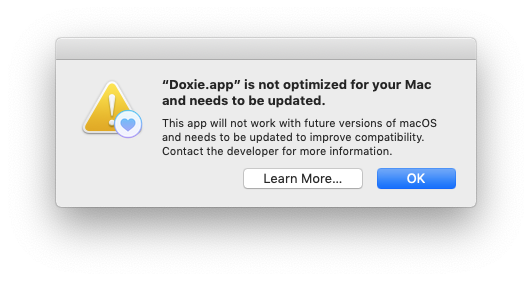
If you’re a Mac user, you’ve likely wondered about dialog boxes like this that have been popping up in recent years:

Warning about a 32 bit app running on a Mac and how it will not be supported soon

The “not optimized for your Mac” is kind of a misnomer, especially because the meat of the issue is in smaller print below in the “this app will not work with future versions of macOS.”

MacOS Catalina is that version.

And so if I were to upgrade my Mac to Catalina today, for example, I could no longer use the app installed for my Doxie scanner.

Indeed, according to the maker of the scanner, the software will not be updated, so if and when I update to Catalina, I’ll no longer be able to use the scanner at all.

You can get a list of all of what Apple now refers to as “legacy software” by clicking the Apple menu, then About This Mac, System Report, and, finally, Legacy Software in the left-hand sidebar: this will show you all the 32 bit applications currently installed on your Mac that won’t run if you update to Catalina.

Here’s what’s on the list for me:

The only real deal breaker for me (other than bricking my scanner) is AccountEdge, which I use for bookkeeping, so cannot be without. So I’ve turned off automatic updates, and I’ll wait for the update to be released.

14 Oct 04:26

Publishing is a club. Here’s how to get published if you’re not in it.

by Josh Bernoff

I hear it all the time. I don’t know anybody in publishing. How am I going to get anybody to look at my (nonfiction) book idea? The editors I know are most likely to consider books from people they’ve published before. They’ll review a book represented by a reputable book agent. Outside of that, your … Continued

The post Publishing is a club. Here’s how to get published if you’re not in it. appeared first on without bullshit.

10 Oct 03:22

Google will reportedly force manufacturers to use Android 10 gestures

by Jonathan Lamont
Android gesture navigation systems

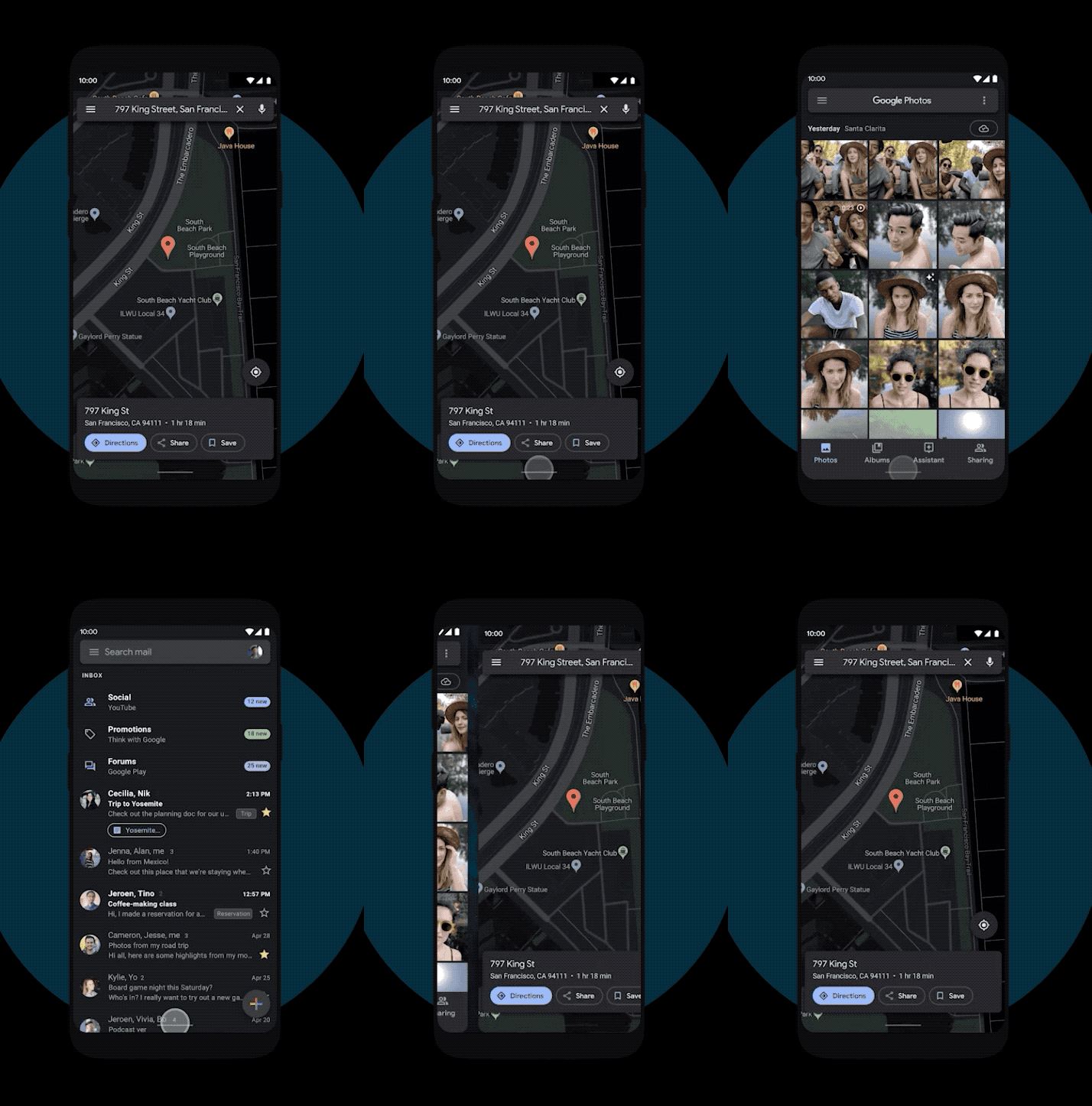
Love it or hate it, Android 10’s new gesture navigation system is here to stay, and Google is reportedly working hard to make sure it stays. The search giant may force manufacturers to use its gesture system instead of custom navigation options.

9to5Google obtained a copy of the latest Google Mobile Services (GMS) agreement that manufacturers must abide by when making Android devices with access to the Play Store and other Google apps and services. One section in the refreshed document addresses gesture navigation.

According to 9to5, the document requires any manufacturer that ships an Android device with GMS will need to have either the new gesture system from Android 10 or the classic three-button navigation system enabled out-of-the-box. Further, any device that ships with the gesture system as the default must also support three-button navigation.

9to5 notes that Google confirmed device makers would be able to keep creating custom navigation systems. However, the GMS document says manufacturers cannot offer custom navigation as the default option. Google also says that device makers can’t advertise custom navigation systems in the ‘Setup Wizard’ — the software that guides users through the initial setup of the phone — or in any other way, such as through notifications or pop-ups.

Manufacturers that choose to add custom navigation systems must bury the options deeper in the settings menu as well. Google suggests placing them under ‘Advanced’ or similar sections.

While the change may lead to a more unified navigation experience for users, the restrictions are likely to upset manufacturers who want to include their own systems.

The change also interestingly puts an end to the ‘pill’ navigation system introduced with Android 9 Pie. Except for devices upgrading from 9 to 10, Google says manufacturers can’t include it as an option.

Source: 9to5Google

The post Google will reportedly force manufacturers to use Android 10 gestures appeared first on MobileSyrup.

10 Oct 03:22

ARM CPUs will get custom instruction support, improved performance

by Jonathan Lamont
ARM

ARM announced at its TechCon event that support for custom instructions will come to its new Armv8-M CPUs and possibly more of its products in the future. The technology could open up avenues for more powerful Internet of Things (IoT) devices and could make its way into future smartphones.

For those unfamiliar with ARM, it’s the company that designs the processors that power things like your smartphone or smart home. Manufacturers like Qualcomm and Huawei design chips with ARM cores.

Typically, CPUs accomplish tasks through instructions they take from memory. Instructions often come in a sequential order. In ARM’s case, because the chips serve a broad number of products, the standard instructions are generic. For example, developers need to use multiple simple instructions to accomplish more substantial, complex tasks.

Custom instructions, however, allow manufacturers to develop more specific, tailored instructions that could be more efficient for a given function.

Ultimately, it’ll prove useful for IoT, augmented reality (AR), virtual reality (VR) and industry 4.0 applications. Many of these applications utilize small form factors where high levels of efficiency can significantly increase performance. ARM representatives suggest that custom instructions could allow for smaller and more powerful VR headsets, for example.

While ARM isn’t developing the tech for smartphones, it could prove useful for handsets with additional sensors or artificial intelligence applications.

However, there are also potential fragmentation issues — developers need to know that code written for one device will work on another as well. Further, custom instructions usually require a lot of integration between hardware and software components, custom compilers and debug tools.

ARM plans to make the development process simple by leaving the standard instructions intact and running the new instructions alongside them.

Finally, ARM will also adopt a governance model for its open-source MBed OS for IoT platforms. MBed’s future will be partially influenced by direct feedback from hardware partners.

The ARM Cortex M33 processor, due out in the first half of 2020, will have support for custom instructions at no additional cost to licensees. Coupled with the new MBed OS governance input model, we could see some exciting new improvements to efficiency, security and performance.

Source: Android Authority

The post ARM CPUs will get custom instruction support, improved performance appeared first on MobileSyrup.

09 Oct 00:54

Eight Habits of Expert Software Designers: An Illustrated Guide

Marian Petre, André van der Hoek, The MIT Press Reader, Oct 08, 2019
Icon

I do most of these things, so I thought it was a good list (or maybe I jut liked the list because it affirmed in my mind that I am an expert because I do most of these things). The big ones, for me: looking around, reshaping the problem space, and thinking about what I am not designing (developing, writing about, whatever). I won't 'focus on the essence' or 'design elegant abstractions' but I will look for patterns and trends.

Web: [Direct Link] [This Post]
09 Oct 00:54

West Pacific: Who We Are

by Gordon Price
09 Oct 00:52

The Best Cheap Gaming Laptop

by Kimber Streams
The Best Cheap Gaming Laptop

You don’t need to drop $2,000 for a laptop that can play most new games on high or ultra settings at 1080p—in 2019, you can get that in a laptop that costs less than $1,200. After spending more than 60 hours researching and testing nine cheap gaming laptops, we found that the Acer Predator Helios 300 PH315-52-78VL is an excellent value, and it keeps cool enough during long gaming sessions.

09 Oct 00:52

Atlantis Word Processor has been on a roll - cicerosc

I monitor Atlantis closely, use it regularly, and post on the Atlantis forums. I am glad someone called attention to the collapsing heading feature as I intended to, but didn't find time to post. I am only getting started using it but it seems to work very well. Atlantis' "control panel" already had lots of useful features, and now with collapsible headings it is significantly more friendly to outlining.

In reading the comments I can address the Linux comment. All my desktops run Linux, and in one of the more recent revisions Atlantis switched something in its code to specifically address problems running under wine.

Whereas in the past I would have glitches when running Atlantis in wine, it is now rock solid and gives me no problems whatsoever.

As other posters have said Atlantis does not meet every need, but it is a great tool and I use it all the time rather than the standard suites.
09 Oct 00:49

Andy Rubin teases Essential’s next phone with a ‘radically different form factor’

by Ian Hardy

Essential recently announced it is working on a successor to its first flagship smartphone. Today, Andy Rubin, the ‘father of Android’ and founder of Essential, teased a new device on his Twitter feed.

This is a dramatic shift away from the PH-1 and even a drastically different design than most of the folding smartphones this year has brought forth. It seems this design — now internally named Project GEM — looks like half the width of a standard smartphone but sports a hole-punch camera, fingerprint sensor, and a custom Android skin with the weather, maps, calendar and Uber apps active.

In addition, the colour options are spectacular with a gradient blue, red, orange and green.

Rubin himself noted, “New UI for radically different form factor.”

Time will tell if these are going to be the PH-2 or just testing internally.

Source: @Arubin

The post Andy Rubin teases Essential’s next phone with a ‘radically different form factor’ appeared first on MobileSyrup.