Shared posts

16 Oct 00:07

goodreads-to-sqlite

goodreads-to-sqlite

This is so cool! Tobias Kunze built a Python CLI tool to import your Goodreads data into a SQLite database, inspired by github-to-sqlite and my various other Dogsheep tools. It's the first Dogsheep style tool I've seen that wasn't built by me - and Tobias' write-up includes some neat examples of queries you can run against your Goodreads data. I've now started using Goodreads and I'm importing my books into my own private Dogsheep Datasette instance.

Via @rixxtr

15 Oct 23:45

Yes, We’ll Be Wearing Our EVA Birkenstocks Through Fall

by Justin Krajeski
Yes, We’ll Be Wearing Our EVA Birkenstocks Through Fall

If you looked for it, there was a pattern to be found at Wirecutter HQ this summer: On the feet of several staffers, whose tastes we can describe only as extremely diverse, were Birkenstock sandals. Not the cork-soled versions that have been a decades-long hippie signifier, but a newer (cheaper) iteration that pairs as easily with shorts or cutoff jeans as it does with skirts or sweatpants. This summer, we all wore Arizona EVAs.

15 Oct 23:45

Results from Longitudinal Study of Female Persistence in CS: AP CS matters, After-school programs and Internships do not

by Mark Guzdial

NCWIT has been tracking their Aspirations in Computing award applicants for several years. The Aspirations award is given to female students to recognize their success in computing. Tim Weston, Wendy DuBow, and Alexis Kaminsky have just published a paper in ACM TOCE (see link here) about their six year study with some 500 participants — and what they found led to persistence into CS in College.  The results are fascinating and somewhat surprising — read all the way to the end of the abstract copied here:

While demand for computer science and information technology skills grows, the proportion of women entering computer science (CS) fields has declined. One critical juncture is the transition from high school to college. In our study, we examined factors predicting college persistence in computer science and technology related majors from data collected from female high school students. We fielded a survey that asked about students’ interest and confidence in computing as well as their intentions to learn programming, game design, or invent new technology. The survey also asked about perceived social support from friends and family for pursuing computing as well as experiences with computing, including the CS Advanced Placement (AP) exam, out-of-school time activities such as clubs, and internships. Multinomial regression was used to predict persistence in computing and tech majors in college. Programming during high school, taking the CS Advanced Placement exam, and participation in the Aspirations awards program were the best predictors of persistence three years after the high school survey in both CS and other technology-related majors. Participation in tech-related work, internships, or after-school programs was negatively associated with persistence, and involvement with computing sub-domains of game design and inventing new applications were not associated with persistence. Our results suggest that efforts to broaden participation in computing should emphasize education in computer programming.

There’s also an article at Forbes on the study which includes recommendations on what works for helping female students to persist in computing, informed by the study (see link here). I blogged on this article for CACM here.

That AP CS is linked to persistence is something we’ve seen before, in earlier studies without the size or length of this study.  It’s nice to get that revisited here.  I’ve not seen before that high school work experience, internships, and after-school programs did not work.  The paper makes a particular emphasis on programming:

While we see some evidence for students’ involvement in computing diverging and stratifying after high school, it seems that involvement in general tech-related fields other than programming in high school does not transfer to entering and persisting in computer science in college for the girls in our sample. Understanding the centrality of programming is important to the field’s push to broaden participation in computing.  (Italics in original.)

This is an important study for informing what we do in high school CS. Programming is front-and-center if we want girls to persist in computing.  There are holes in the study.  I keep thinking of factors that I wish that they’d explored, but they didn’t — nothing about whether the students did programming activities that were personally or socially meaningful, nothing about role models, and nothing about mentoring or tutoring.  This paper makes a contribution in that we now know more than we did, but there’s still lots to figure out.


15 Oct 23:45

NetNewsWire OS Compatibility Strategy

We have two goals with the app: 1) get as many people using RSS as possible, and 2) make the best app we can.

To reach #2 — making the best app we can — we need to do a couple things. One is stay modern: use new APIs and tools that make the app better and easier to maintain. A second is to not spend time on things that don’t make the app better. A third is to attract and retain contributors, who are usually more psyched to work with modern stuff than with old stuff.

You can see how that’s in a little bit of conflict with #1 (getting as many people as possible using RSS readers).

Here’s the plan

After a major OS update, we will switch to requiring that update on our next major release — where major is defined as something like 5.0 or 5.1, but not something like 5.0.1. (In other words: the upcoming NetNewsWire 5.0.3 release will run on Mojave, while NetNewsWire 5.1 will require Catalina.)

At the same time, we will make older versions available via the website. For instance, the last version that will run on Mojave will likely be 5.0.4 (which isn’t finished yet) — and we’ll make that version available indefinitely for people who haven’t upgraded to Catalina.

This will mean that people running older OSes will still get a high-quality app — it’s just that it won’t have the latest features.

The key is that this allows us to make NetNewsWire the best app it can be, and making the best app we can is also part of furthering the goal of getting as many people as possible using RSS. (The biggest part, in fact. Bigger than compatibility with older OSes.)

While I know this will disappoint some people, I hope you’ll understand why we decided to do it this way. Decisions like this are never easy — there are always conflicting values to weigh, pros and cons and add up — and we don’t make them impulsively. But making NetNewsWire the best app it can be has to be job #1.

15 Oct 23:44

But I have nothing to hide

Whenever I write about privacy I tend to get a whack of replies (and unsubscribes) calling me a tinfoil hat nutter and explaining that normal, law-abiding citizens shouldn’t care about privacy because...
15 Oct 23:44

Do we have to love our work?

When employers are looking to hire, they always seem to want people that are passionate about the company's mission. Is that necessary? When we work for ourselves, we're expected to wake up each day ...
15 Oct 03:40

Tik Tok, Tick Tock…Boom.

by John Battelle

Something’s been bugging me about Tik Tok. I’ve almost downloaded it about a dozen times over the past few months. But I always stop short. I don’t have a ton of time (here’s why) so forgive me as I resort to some short form tricks here. To wit:

  1. China employs a breathtaking model of state-driven surveillance.
  2. The US employs a breathtaking model of capitalist surveillance.

We on the same page so far? OK, great.

Now let’s consider Tik Tok, which is a robust combination of the two. Don’t know Tik Tok? Come on, you read Searchblog for God’s sake. Ok, well, fortunately for you, there’s the New York Times. Or…maybe not. I almost threw up in my mouth as I watched the paper of record run through its decades long practice of “Gee, Golly, Isn’t This Shiny New Tech Thing Culturally Significant, and Aren’t We Woke for Noticing It” journalism last weekend. Read it if you must.

Ok. Time for more shorthand.

  1. Tik Tok is owned by a Chinese company.
  2. Tik Tok is addictive, seductive, you can’t look away.
  3. Tik Tok has a Terms of Service and Privacy Policy that reads, for all intents and purposes, a lot like Google, Facebook, Apple, or Amazon’s terms of service (I’m studying these over at Columbia, FWIW). In other words, Tik Tok has standard clickwrap that gives it permission to do pretty much whatever it wants with the information it collects on its users.
  4. Since they’re modeled on the policies of American surveillance capitalism, Tik Tok’s TOS and Privacy Policies state that the company may collect your: Location, email, phone number, browsing history, device information, app and file names on your device, messaging content, full list of your social network connections (should you let it use your Facebook, Twitter, Insta to find your friends, and most do), content preferences, and a shit ton of other information, not to mention any and all third-party information Tik Tok chooses to acquire and append to your profile (that’d be another shit ton, in case you were wondering).
  5. There’s nothing in Tik Tok’s TOS or Privacy Policy that stops it from sending all the information it collects to the Chinese government. In fact, if you read the policies closely, you’ll see this line: “We may disclose information to respond to subpoenas, court orders, legal process, law enforcement requests, legal claims or government inquiries.”
  6. Tik Tok is clearly concerned about anyone noticing any of this – it’s nearly impossible to find stats on how many people use it in the US (though Ad Age leaked a pitch deck recently saying it was “more than 32 million”), and you won’t find the word “China” or “Chinese” in its TOS or Privacy Policy (it used to be there, but…the company wised up).
  7. Just in case you weren’t paying attention, I refer you to #1 above. If you think Tik Tok isn’t sending information to the Chinese government, you’re sweet, but you should stay inside and stick to rotary phones.
  8. Tik Tok is spending hundreds of millions of dollars on US social networks convincing US consumers, in particular kids, to download and use the app. This is fucking brilliant, by the way.
  9. China and the US are in a pitched battle for economic and geopolitical power, and that battle will be won, in large part, based on which country has access to and dominion over consumer data at scale, which will feed machine learning and artificial intelligence systems that will most certainly be weaponized, both economically and geopolitically (there’s simply not time to explain what I mean by that now, but…let’s just say Russian interference in the 2016 election was a hack job compared to what’s afoot now).

So, I just thought I’d point that out. But those videos, they sure are cute, no?

15 Oct 03:37

NewsBlur Blurblog: Burritos Are Indeed Tacos

sillygwailo shared this story from José R. Ralat – Texas Monthly.

Tacos vs Burritos IllustrationLet the debate rage on no longer. Taco: Jody Horton; burrito: Shana Novak/Getty. Hello, I’m José R. Ralat, your new Texas Monthly taco editor. Since the magazine announced earlier this month that such a job existed and that I was the lucky soul hired to fill the role, I’ve heard from media outlets from all over, from the New York Times to the BBC. During my interview with Helen Rosner, the James Beard Award–winning food correspondent for the New Yorker, I threw out the fact that burritos are tacos. When I said as much, I did so without intending to blaspheme or provoke #TacoTwitter. I certainly didn’t expect it to be the headline of the piece, or for the Today show to do a segment based on the article. Stirring…View Original Post

The post Burritos Are Indeed Tacos appeared first on Texas Monthly.

15 Oct 03:36

NewsBlur Blurblog: The Ironies of Columbus Day

sillygwailo shared this story from Editor's Blog.

This morning I helped my older son work on a short school assignment about whether Americans should continue to celebrate Columbus Day or replace it with some holiday celebrating America’s native inhabitants. My own thoughts on this have always been muddled since we shouldn’t be wasting a national day of remembrance on Columbus even if he’d been a great guy. We have many actual Americans who should be put in or put back in the national pantheon.

The actual man Columbus had little conscious understanding of or much to do with the reign of horrors his arrival in the Caribbean rapidly brought in its wake. (The story of European colonization of America and the catastrophic demographic decline and subjugation of its native peoples is fundamentally a story of epidemic disease. Absent disease Europeans would have been equally cruel and rapacious but far less successful in their efforts.) Columbus was personally brutal enough in his treatment of the native inhabitants of Hispaniola to justify his currently awful reputation. And in any case, Columbus the man as opposed to Columbus the impact or the effect hardly matters very much since the entire issue is one of symbols and commemoration, which are matters of the contemporary world, rather than history.

But the origins of the day are more complex and multivalent than the current debate lets on. As Brent Staples notes in this illustrated column, Columbus Day origins begin in a very different context: the efforts of Italian-American immigrants – often relatively dark skinned Sicilians and southern Italians who were a cultural world away from the Genoese Columbus – to find social acceptance as Americans in the late 19th and early 20th century.

The myth of the Italian-American Columbus was an ingenious end-run around the pride of place and status hierarchy of White Anglo-Saxon Protestant Americans. Italians weren’t alien looking and sounding newcomers entering the country in the late 19th century, unknown to and ignorant of the nation’s history and values. They were in fact here at the very beginning, long before English settlers even came into the picture. Without the person of the Italian Columbus (actually a subject of and sailing on behalf of the Spanish Crown of Castile, but whatever…) the whole national experiment wouldn’t even have been possible. Just because he never set foot on any ground the United States has ever held or claimed sovereignty over is just a quibble.

The first Columbus Day Parade in New York City dates to 1929 and in its current, more formalized form to 1944. Today the parade celebrates its 75th anniversary. The 1929 effort and the formalization in 1944 were both the handiwork of Generoso Pope, an Italian-American businessmen who owned a chain of Italian-language newspapers and was a major political figure in New York and national politics. A classic immigrant success story: arrived at 15, worked menial jobs, a millionaire by his thirties, the most prominent and powerful Italian-born American by the time he died at 59.

But as Staples notes, the veneration of Columbus as a sort of patron saint of Italian-Americanism isn’t simply one of benign acceptance. It was also about putting Italian-Americans firmly on the white side of America’s binary, black and white racial divide. In the South especially Italian immigrants were themselves targets of lynchings and the first Columbus Day, declared by President Benjamin Harrison in 1892, was a directly response to lynchings in New Orleans that left 11 Italian immigrants dead. There was no such response to the widespread lynchings of African-American which were reaching their peak at just this time. And as Staples notes, part of that was that there was an Italian government which was able to force a diplomatic crisis with the United States and successfully demand an indemnity for the killings.

In the early decades of Italian mass immigration, Italian immigrants were frequently portrayed as closer to blacks than whites or at least clearly lower on a racial hierarchy than other white Americans. In the South and particularly in Louisiana, they also often built businesses that catered to African-Americans, lived in African-American neighborhoods and intermarried with them.

In this sense, Columbus Day, Columbus Day Parades and the broader movement for acceptance of Italian-Americans as fully-fledged Americans by the 20th century wasn’t merely a matter of benign social acceptance but also involved, indeed was premised upon, buying into America’s ideology of white supremacy: Italians could be full-fledged Americans because they were white. Any ambiguity about where they fit on an imagined racialist spectrum had to be to firmly ironed out of the equation. And yet, in the hothouse politics of New York City, far from the Caribbean and distant from the history of the continent’s indigenous peoples, we cannot ignore the fact that Italian-Americans were genuinely underdogs, the targets of discrimination rather than its authors.

14 Oct 23:35

Why do I prefer Clojure to Haskell?

by Eric Normand

I prefer Clojure to Haskell. It’s probably mostly due to accidents of history: getting in Lisp at an earlier age, spending more time with Lisp, and only having one Haskell job. But I do have some philosophical differences with the Haskell philosophy as it relates to Haskell as an engineering tool. In this episode, I go over four of them, and try to relate them with anecdotes.

Video Thumbnail
Why do I prefer Clojure to Haskell?

I prefer Clojure to Haskell. It's probably mostly due to accidents of history: getting in Lisp at an earlier age, spending more time with Lisp, and only having one Haskell job. But I do have some philosophical differences with the Haskell philosophy as it relates to Haskell as an engineering tool. I

The post Why do I prefer Clojure to Haskell? appeared first on LispCast.

14 Oct 23:34

You Don’t Need to Spend a Lot on a Pricey Gaming Laptop

by Ganda Suthivarakom
You Don’t Need to Spend a Lot on a Pricey Gaming Laptop

A version of this post was sent to our weekly newsletter mailing list. If you’d like to receive this in your inbox, subscribe here.

I admit that I know nothing about gaming, which is why I’m glad we’ve got our resident gaming enthusiasts, editor Thorin Klosowski and senior staff writer Kimber Streams, to get advice from. Kimber and Thorin have both been busy testing gaming laptops this fall, and after a new round of research and testing, we determined that the thin and light Acer Predator Triton 500 PT515-51-75BH with RTX 2060 graphics card will be our pick for the overall best gaming laptop.

But Kimber says it’s not necessary to spend $2,000 to get the performance you need. For the first time, cheaper gaming laptops at around $1,200 can play most new games just fine. High-end laptops with RTX 2070 or RTX 2080 graphics still don’t offer enough performance benefits that are worth the hefty premiums. So we recommend the Acer Predator Helios 300 PH315-52-78VL as our new cheap top pick.

Sometimes the footnotes are my favorite part of a guide. Here’s a good cautionary note about overheating laptops: “Prolonged exposure to warm laptops can cause erythema ab igne (EAI)—also called Toasted Skin Syndrome or Granny’s Tartan—a blotchy, chronic skin condition that is in rare cases associated with some cancers. We do not recommend using any gaming laptop on your lap for long periods of time, as the undersides of all the laptops we tested regularly measured way over 43 °C (109 °F), the threshold for EAI, during even short gaming sessions.”

Here’s the latest on new, upcoming, and updated guides:

New this week

How We Spy on Each Other Every Day
Published October 7

8 Hostess Gifts We Love
Published October 7

The Top 10 Tools for Earthquake Preparedness
Published October 7

Credit Locks vs. Credit Freezes vs. Fraud Alerts: What Are the Differences?
Published October 8

The Best Gaming Laptop
Updated October 8

The Best Cheap Gaming Laptop
Updated October 8

The Best Wireless Charging Station Now That Apple AirPower Is Dead
Published October 9

Which iPhone Should I Get?
Updated October 9

Why Aren’t There More Rewards Credit Card Options If You Have Poor or Fair Credit?
Published October 9

The Best Portable Bluetooth Speaker
Updated October 10

When to Pony Up for Paid Software—and When You Don’t Need To
Published October 10

The Best All-in-One Printer
Updated October 11

The Best Thanksgiving Kitchen Tools and Tableware
Updated October 11

Gear for Fall-Foliage Hikes
Published October 11

14 Oct 23:34

Rescuing Python Module Code From Cluttered Jupyter Notebooks

by Tony Hirst

One of the ways I use Jupyter notebooks is to write stream-of-consciousness code.

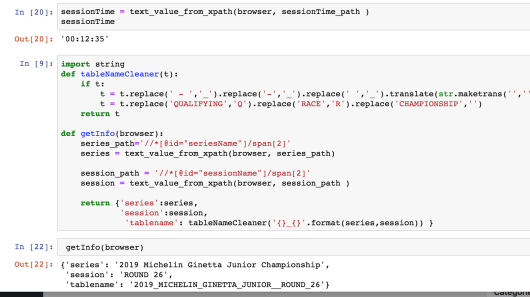
Whilst the code doesn’t include formal tests (I never got into the swing of test-driven development, partly because I’m forever changing my mind about what I need a particular function to do!) the notebooks do contain a lot of implicit testing as I tried to build up a function (see Programming in Jupyter Notebooks, via the Heavy Metal Umlaut for an example of some of the ways I use notebooks to iterate the development of code either across several cells or within a single cell).

The resulting notebooks tend to be messy in a way that makes it hard to reuse code contained in them easily. In particular, there are lots of parameter setting cells and code fragment cells where I test specific things out, and then there are cells containing functions that pull together separate pieces to perform a particular task.

So for example, in the fragment below, there is a cell where I’m trying something out, a cell where I put that thing into a function, and a cell where I test the function:

My notebooks also tend to include lots of markdown cells where I try to explain what I want to achieve, or things I still need to do. Some of these usefully document completed functions, others are more note form that relate to the development of an idea or act as notes-to-self.

As the notebooks get more cluttered, it gets harder to use them to perform a particular task. I can’t load the notebook into another notebook as a module because as well as loading the functions in, all the directly run code cells will be loaded in and then executed.

Jupytext comes partly to the rescue here. As described in Exploring Jupytext – Creating Simple Python Modules Via a Notebook UI, we can add active-ipynb tags to a cell that instruct Jupytext where code cells should be executable:

In the case of the active-ipynb tag, if we generate a Python file from a notebook using Jupytext, the active-ipynb tagged code cells will be commented out. But that can still make for a quite a messy Python file.

Via Marc Wouts comes this alternative solution for using an nbconvert template to strip out code cells that are tagged active-ipynb; I’ve also tweaked the template to omit cell count numbers and only include markdown cells that are tagged docs.


echo """{%- extends 'python.tpl' -%}

{% block in_prompt %}
{% endblock in_prompt %}

{% block markdowncell scoped %}
{%- if \"docs\" in cell.metadata.tags -%}
{{ super() }}
{%- else -%}
{%- endif -%}
{% endblock markdowncell %}

{% block input_group -%}
{%- if \"active-ipynb\" in cell.metadata.tags  -%}
{%- else -%}
{{ super() }}
{%- endif -%}
{% endblock input_group %}""" > clean_py_file.tpl

Running nbconvert using this template over a notebook:

jupyter nbconvert "My Messy Notebook.ipynb" --to script --template clean_py_file.tpl

generates a My Messy Notebook.py file that includes code from cells not tagged as active-ipynb, along with commented out markdown from docs tagged markdown cells, that provides a much cleaner python module file.

With this workflow, I can revisit my old messy notebooks, tag the cells appropriately, and recover useful module code from them.

If I only ever generate (and never edit by hand) the module/Python files, then I can maintain the code from the messy notebook as long as I remember to generate the Python file from the notebook via the clean_py_file.tpl template. Ideally, this would be done via a Jupyter content manager hook so that whenever the notebook was saved, as per Jupytext paired files, the clean Python / module file would be automatically generated from it.

Just by the by, we can load in Python files that contain spaces in the filename as modules into another Python file or notebook using the formulation:

tsl = __import__('TSL Timing Screen Screenshot and Data Grabber')

and then call functions via tsl.myFunction() in the normal way. If running in a Jupyter notebook setting (which may be a notebook UI loaded from a .py file under Jupytext) where the notebook includes the magics:

%load_ext autoreload
%autoreload 2

then whenever a function from a loaded module file is called, the module (and any changes to it since it was last loaded) are reloaded.

PS thinks… it’d be quite handy to have a simple script that would autotag all notebook cells as active-ipynb; or perhaps just have another template that ignores all code cells not tagged with something like active-py or module-py. That would probably make tag gardening in old notebooks a bit easier…

14 Oct 23:33

Confirmed Google Pixel 4 Features Based on Leaks

by Rajesh Pandey
The Google Pixel 4 and Pixel 4 XL are easily the most leaked smartphone of the year. It was a similar story with the Pixel 3 last year and instead of controlling the leaks, Google has somehow managed to do even worse. While the Pixel 4 series will be announced in around 24 hours from now, almost everything about the phones have leaked. Continue reading →
14 Oct 23:32

Assessing Smart Glasses-based Foodservice Training: An Embodied Learning Theory Approach

Jeffrey Clark, Philip G. Crandall, Robert Pellegrino, Jessica Shabatura, Canadian Journal of Learning and Technology, Oct 14, 2019
Icon

I'm not sure I've ever seen a paper covering learning technology in food services training, so kudos to this paper (19 page PDF) for that (and it allows me to reminisce about my own background in the industry). Also kudos to the authors for reporting what is essentially a negative result - compared to people who used video training only, the smart glasses group were less likely to wash their hands, and less likely to do it properly. Of course, the small number of participants means we can't rely on the quantitative results, but still, the finding that using smart glasses does not automatically improve performance in a physical task is worth noting.

Web: [Direct Link] [This Post]
14 Oct 23:32

What is the Open Decision Framework?

RedHat, Oct 14, 2019
Icon

The core of the Open Decision Framework is slides 7-10 in this presentation on GitHub. It's basically a four-step processes that is iterated: ideation, research, development, and deploy. The idea is each of these four steps is conducted in an open and transparent manner. It's based on what they call a 'meritocracy' where "a free exchange of ideas is critical to creating an environment where people are allowed to learn and use existing information toward creating new ideas." Still, it defines community as commonality. "Communities are formed around a common purpose. They bring together diverse ideas and share work."

Web: [Direct Link] [This Post]
14 Oct 23:32

Augmented Text Editing on Mobile: The New iOS 13 Gestures

by Rebekka
mkalus shared this story from Ulysses Blog.

As Ulysses syncs your entire text library to all of your Apple devices, you can work anytime, anywhere, on your iPhone. Do you find text editing on mobile a little cumbersome? Then try out the following gestures Apple introduced with iOS 13 and change your mind 😉

Change the Cursor Position

Tap and hold the cursor until the cursor symbol appears bigger. Then drag the cursor to its new position and let it go.

Text Selection

Selecting a word, sentence, or paragraph has become a lot easier. Here’s one way to go about it:

  • Double-tap to select a word.
  • Triple-tap to select a sentence.
  • Quadruple-tap to a select paragraph.

And here’s another way that works as well:

  • Double-tap to select a word.
  • Double-tap two times to select a sentence.
  • Double-tap three times to select a paragraph.

When the selected text is highlighted, the beginning and end of the selection are marked with little “pins”. You can move these to extend or shorten the selection, e.g., to select a group of words or several paragraphs.

Copy, Cut and Paste

There are also new gestures for copy and paste.

To copy selected texts, perform a three-finger-pinch: Form a pinch with the thumb, index and middle finger, tap on the display and move the fingers slowly inwards.

To cut selected text, perform the three-finger-pinch twice.

To paste text, form a narrow pinch with the thumb, index, and middle finger, tap on the display and move the fingers slowly outwards.

I had to practice a bit to make the pinch gestures work for me. If you prefer, you can still select Copy, Cut and Paste from the edit options.

Undo and Redo

In Ulysses’ button row, there’s a bent arrow to let you undo and redo. Now with iOS 13, there are gestures, too!

To undo, swipe to left with three fingers.

To redo, swipe to right with three fingers.

Sheet Selection

Sometimes you may want to select several sheets, e.g., to export them into one file. Sheet selection is super fast on iOS 13!

In the sheet list, swipe downwards with two fingers. This gesture will open selection mode and select the sheets you swipe over.

Closing Overlays

You can now close most overlays, for example, the export, keywords, and settings dialogues, by swiping downwards.

Individual App Language

Finally, here’s a tip that’s not about gestures. In Settings, you can now set the language for each app individually. That’s cool if you prefer to have your iPhone in German (because it’s your native language), but have to explain how to use a particular app in English (because it’s your job) 😜.

14 Oct 23:32

Weeknotes: PG&E outages, and Open Source works!

My big focus this week was the PG&E outages project. I'm really pleased with how this turned out: the San Francisco Chronicle used data from it for their excellent PG&E outage interactive (mixing in data on wind conditions) and it earned a bunch of interest on Twitter and some discussion on Hacker News.

I gave a talk about the project on Thursday for the Online News Association Silicon Valley meetup and made connections with a bunch of interesting journalists from around the Bay Area.

Open Source works!

A highlight of last week was that a bunch of my projects gained new functionality through open source contributions!

Dogsheep

I started a very basic website for my Dogsheep personal analytics project.

I also started running various Dogsheep tools via cron on my personal Dogsheep server, to keep that set of databases automatically updated with my latest activity on various services.

Most excitingly, Tobias Kunze built the first indepedent Dogsheep-style tool: goodreads-to-sqlite!

As the name suggests, it imports your data from Goodreads into a SQLite database. It inspired me to create a Goodreads account which I will be using to track my book reading activity from now on.

Tobias wrote a fantastic blog post introducing the tool which includes some neat example queries and graphs.

In other Dogsheep news, I added an issue-comments command to github-to-sqlite for fetching all issue comments in a repo. My goal is to evolve that tool to the point where it can import all relevant data from all of my repositories and give me a single Datasette-powered dashboard for keeping track of everything in one place.

14 Oct 23:32

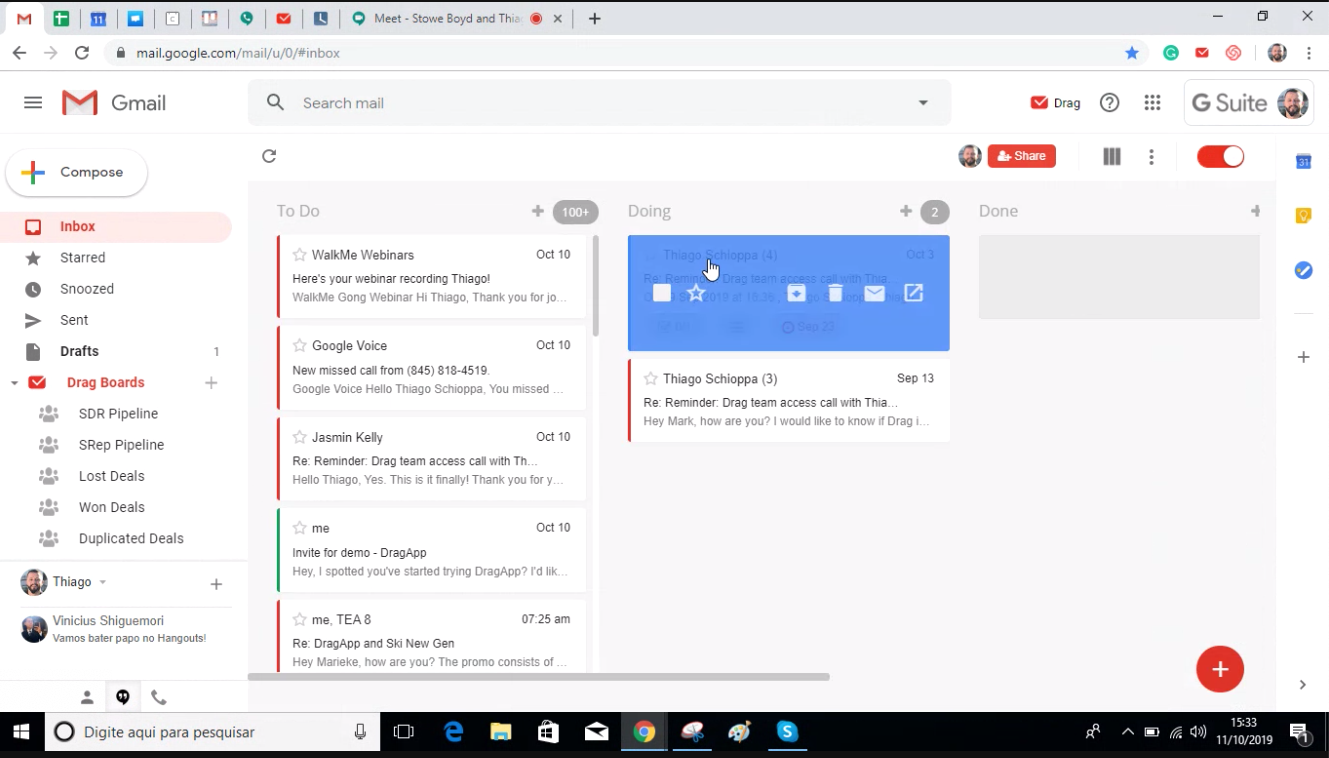
Brief | Drag, A Shared Inbox App For Gmail

by Stowe Boyd

A promising entrant in the G Suite shared inbox market niche

Continue reading on GigaOm »

14 Oct 23:31

Asus Chromebook Flip C434TA Review: Almost the dream Chrome machine

by Brad Bennett

The Asus Chromebook Flip C434TA has a few issues, but overall, it’s incredibly solid

Chromebooks have come a long way in both form and function since their inception in 2011, and the Asus Chromebook Flip C434TA is evidence that laptops don’t have to cost an arm and a leg to meet regular consumers’ needs.

While the Flip isn’t perfect for everyone, I could see it checking the right boxes for most people when they’re looking for a new computer.

For instance, the typing experience is second to none, and the large 14-inch screen — which gives the notebook a fantastic 87 percent screen to body ratio — is super immersive.

If you’re tired of using a Mac or Windows computer and you’re looking for a simple machine to do some word processing and internet browsing, it doesn’t get much better than this.

Asus has done the hardware right, for the most part

Hardware is the Chromebook Flip’s most becoming aspect. It features a silver metal design that feels both premium and sturdy.

The Flip’s keyboard is a dream. It brings me back to my first MacBook Air from 2016, which famously featured one of the best keyboard experiences around. Each key has a perfect amount of travel and click, while also being relatively quiet compared to the loud clacking of many other keyboards. The key travel is specifically 1.4mm. The laptop also uses a unique hinge design to push the keyboard toward the user at a slight angle, which makes typing more comfortable.

One downside with the Flip is that the keyboard’s backlighting could be better. That said, it still works, but too much light leaks out from in between the keys for my liking.

The Flip’s trackpad is another downside. I got used to it after a few days, but it falls short of the trackpad featured in Apple’s laptops. For example, I often found that hitting smaller targets resulted in me clicking on the wrong thing. Still, I was able to use it, and I found increasing the cursor’s speed in the settings helped it feel more responsive.

The final important aspect is the screen. It isn’t bad by any means, but it’s not high-end either. Its colour reproduction is stable, but there’s no way to calibrate it.

Where the screen excels is its large form factor and tiny bezels. Asus has managed to fit a substantial 14-inch display into the chassis of a 13-inch laptop. This means when you pry open the Chromebook’s lid, you’re greeted with an expansive panel that stretches to each edge. I found myself even using apps in full-screen mode to hide the Google search bar on the Flip since the screen real estate and tiny bezels were so nice.

There’s enough here, but be wary of what you want this machine to do

Display: 14-inch Full HD 1920 x 1080 pixel resolution 16:9 display with NanoEdge design, 178-degee wide-view technology
Processor: 8th Gen Intel Core m3-8100Y (1.1 GHz, 3.4 GHz Turbo Boost)
Memory: 4GB or 8GB RAM (LPDDR3)
Storage: 64GB eMMC
Dimensions: 32.1cm wide, 20.2cm deep, 1.57cm tall (when closed)
Weight: 3.19lbs (1.45 kg)
Camera: HD camera
Operating System: ChromeOS
Battery: Up to 10 hours (48Wh battery)
Connectivity: Wi-Fi 802.11 AC, Bluetooth 4.0
Sensors: n/a
Ports: 2x USB-C Gen 1, 1x USB-A 3.1, 1x 3.5mm headphone/microphone jack, MicroSD card slot
Graphics: Intel UHD Graphics 615

The Flip doesn’t pack the greatest array of internal hardware. However, it gets the job done. While sometimes, I felt like I had too many tabs open and the computer was slowing down, I could usually have at least nine open, if not more without issue.

The other major caveat is that you can only buy the computer with 64GB of storage. I also noticed that it only presented me with about 49GB as usable storage.

Frankly, if you’re planning on using the Flip as your main computer, you’re going to have to be ready to commit to the cloud. You can download things for offline use, but you’ll likely need to back them up to the cloud and wipe them from your hard drive whenever you’re back online.

It’s also worth noting that Asus rates the device’s battery for 10 hours, although I was only able to get about half of that with my usage.

The ChromeOS paradox
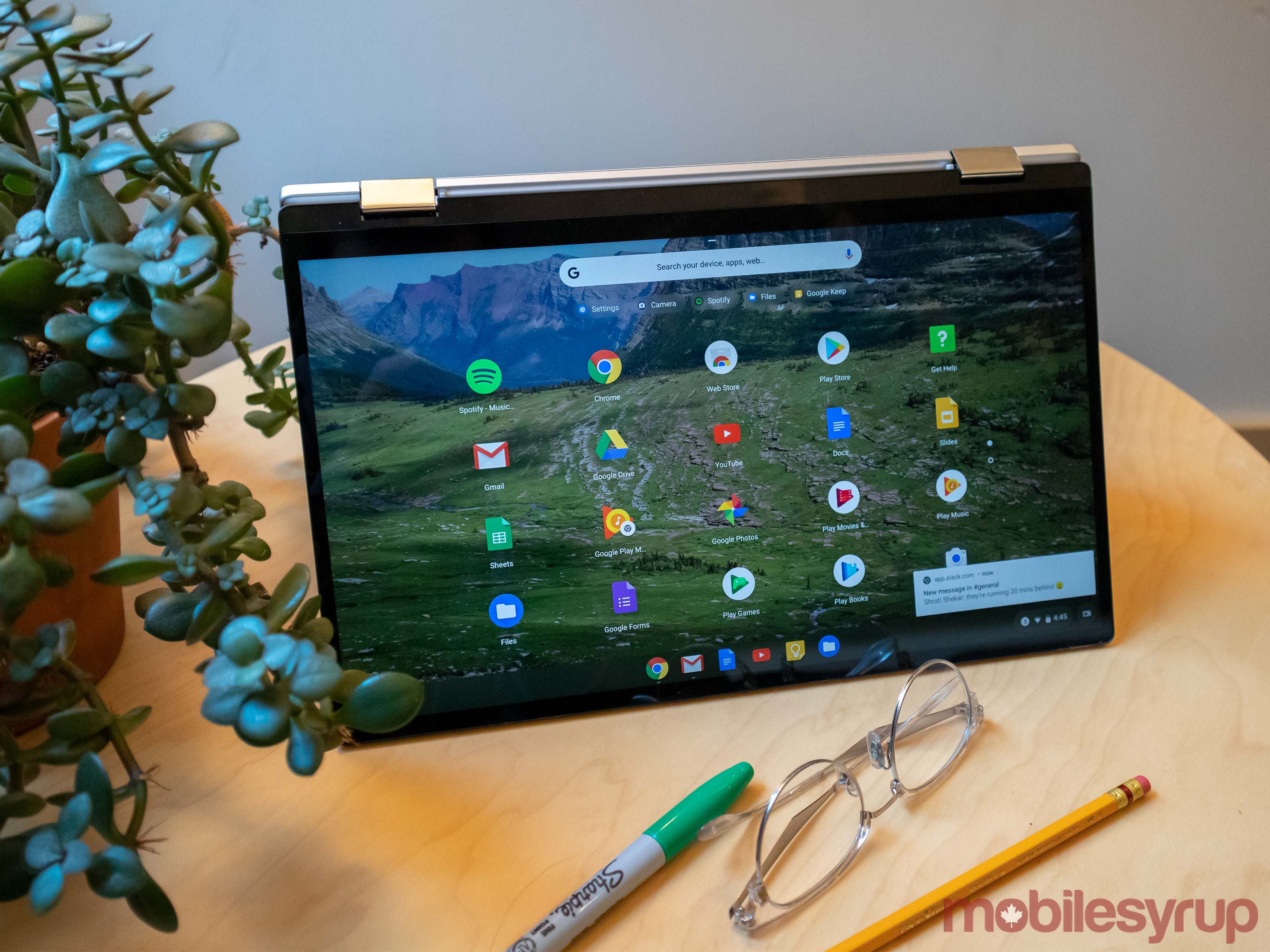
The final aspect of the Flip that I need to address is ChromeOS. I have very mixed feelings about the operating system. On the one hand, I love the simplicity of it, but on the other, I wish it could do more.

I  think that it can do enough for most people. I’ll quantify this by stating that in my mind, the average user needs a computer to write the odd document using Google’s online tools like Sheets, Photos, Gmail and also browse the web.

If what you need a computer for falls into these categories, then a Chromebook is right for you. If you need to do things like resource-intensive photo editing with Photoshop or Lightroom, or other creative tasks, then Google’s lightweight operating system falls short.

Something to love about it is its ability to run Android apps, which work moderately well and is a handy feature.

It also functions more like a tablet with an app drawer, which makes finding and organizing your apps easy.

ChromeOS also gets smaller system updates often, which is nice since it brings new features to the operating system. For example, since I’ve started using the Flip it’s been updated to include a new multi-virtual-desktop functionality so you can have more than one digital workspace at a time, and Google Assistant support.

Overall, you need to take stock of what you want from a computer before you dive into the world of ChromeOS. Personally, I think it’s great, but there are some issues like those mentioned above that hold it back from working for you.

The post Asus Chromebook Flip C434TA Review: Almost the dream Chrome machine appeared first on MobileSyrup.

14 Oct 23:31

What You Should Know About Influencer Marketing

by Nate Ritter

Influencer marketing has exploded in popularity over the past few years, with this primarily being driven by the large results that advertising professionals have seen with the strategy. While the method couldn’t be described as new, few people inside and outside the marketing profession know what’s involved in it.

This has led to many people asking, “What is influencer marketing?” and a variety of other questions. Though many people may believe that this is quite a complicated question to answer, this doesn’t have to be the case. In contrast, the advertising strategy is much simpler than many people might assume, although it does take quite a significant amount of research and knowledge to capitalize on.

Typically, it is the use of social influencers to spread a company’s branding or product messaging to a broader audience than it usually sees. As many people would assume, this takes place in the digital sphere with the majority of marketing taking place on social media platforms such as Facebook, Instagram, and Twitter, among others.

As a result, instead of marketing professionals targeting a wide audience, they instead look for influencers who will be able to spread the company’s message and promote its products and services to their followers.

Using various social media analytics tools, professionals are able to identify micro and macro influencers to help them boost their message. Targeting the appropriate influencers is key to a having a good ROI on a marketing campaign.

While many people may assume that this can be a shortcut to success, it may not be the case. This is primarily because influencer marketing will need quite a significant amount of research to identify the right social influencers for a particular brand, as well as a few other notable factors.

What Is An Influencer?

While the majority of social media influencers will have quite a large online presence, this isn’t the case with many of them. As a result, the belief that every influencer has a broad audience (and that everybody with a large audience is an influencer) can be a common misconception.

In contrast, an influencer is typically somebody who can change somebody’s opinion or behavior online. This is the primary reason why the strategy has been successful in the past, as it encourages an audience to act on what an influencer asks them to do. In the majority of cases, this will be to purchase a specific product or follow a particular brand on social media.

Typically, a high-quality social media influencer will have a few traits that brands will want to take advantage of. Some of the more notable of these include:

  • Salesmanship: This will be vital for many campaigns as it allows an influencer to sell your product to their audience.
  • Reach: This is the ability to market your product or service to a large number of people.
  • Credibility: This is the level of trust and respect that an influencer will have in a particular sphere.

By focusing on these traits, brands could be able to determine who the best social media influencers are for their brand.

Why Is Influencer Marketing Effective?

One of the core reasons why influencer marketing has grown in popularity over the past few years is because it has shown quite a significant amount of results for brands. As a result, the vast majority of them see a substantial increase in brand awareness, which typically results in an uptick in sales.

However, many people may wonder why this is the case and how this is done. The primary reason behind this is that influencer marketing helps to create trust between a company and the audience it looks to target. This is driven by the faith that many people on social media will have for the influencers that they follow.

As a result, this can make it quite similar to word of mouth marketing, which usually involves people giving their friends and family recommendations. The majority of people will trust these recommendations and will be more likely to buy from a specific company.

This trust-building also extends to influencer marketing, where social media followers see the recommendation of an influencer as something they can trust. As a result, the majority of firms will be able to capitalize on the trust that a person has developed on the platform.

Alongside this, the majority of influencers will have quite a large social media following, which typically means that a brand will be able to capitalize on a much broader audience than they might already have at their disposal.

By utilizing both of these aspects of the strategy, a company should be able to maximize the return on investment that they’ll see with their marketing campaigns.

14 Oct 23:30

Data: the Predicament and Opportunity in the Deep Learning Era

Andre Huang, Towards Data Science, Oct 14, 2019
Icon

As the author says in a Reddit summary, "the research community will gradually move from a model-centered research to data-centered research." However, even though we have access to big data, the size of the data sets has remained relatively unchanged, revealing a trend toward data scarcity. And data scarcity becomes more acute when looking at the distribution of data - for example, in research on human faces, we may seem to have abundant data, but that's only because some faces (those of celebrities and stars) appear far more frequently. The author argues that data scarcity is best addressed by focusing on making better use of data, for example, by researching data labeling technology.

Web: [Direct Link] [This Post]
14 Oct 23:30

RT @guydej1: 1. At a trade conference today I asked the panellists to name a single concrete advantage that UK could get from an independen…

by guydej1
mkalus shared this story from piris_jc on Twitter.

1. At a trade conference today I asked the panellists to name a single concrete advantage that UK could get from an independent trade policy. Silence, until one said it could enable ag subsidies to be diverted into rural development. But he quickly added that ag was just 1% of


Retweeted by piris_jc on Monday, October 14th, 2019 7:57pm


188 likes, 102 retweets
14 Oct 23:29

This, it seems to me, is why looking at a syste...

by Ton Zijlstra

This, it seems to me, is why looking at a system, sub-system and supra-system is a key dimension of TRIZ innovation methods. And it takes having an overview of all three, regardless of where you will apply yourself. (ht Alper)

Read Disruption Theory is Real, but Wrong (alexdanco.com)
Disruption is happening, and the tech industry is having a dynamic and revolutionary impact on industries around the world for precisely the reasons that Christensen articulates in his work. But the units of resolution aren’t right; maybe not everywhere, but that certainly feels to be the case in today’s tech world.
14 Oct 23:29

Now Hiring: Senior Front-End Web Developer

by Brent Simmons
mkalus shared this story from The Omni Group.

From our jobs page:

The Omni Group is seeking a senior front-end web developer to build and expand the web edition of OmniFocus, our award-winning task management application. OmniFocus for the Web brings the productivity power of our native macOS and iOS apps to cross-platform customers.

You’d work with us in Seattle, enjoy good food, benefits, and your own office — and you’d work with a great bunch of people on a cool new app.

OmniFocus for the Web is built in React and Redux. To learn more, listen to (or read the transcript of) our podcast episode How We Built OmniFocus for the Web. Also read OmniFocus for the Web: Under the Hood.

PS Here’s a lovely view of Lake Union and Capitol Hill from our office. You’d get to enjoy this too — it’s a beautiful place to work. :)

View of Lake Union and Capitol Hill, on a sunny day, photographed at the offices of The Omni Group.

14 Oct 23:29

Happy Canadian Thanksgiving

by jnyyz

Today I did a 50 km ride around downtown Toronto with the objective of checking out three relatively new pieces of bike and pedestrian infrastructure: the Chorley Park switchback, a new segment of the Martin Goodman trail that fills a gap near Tommy Thompson Park, and the bridge between Stanley Park and Fort York.

The Chorley Park switchback is a paved trail that links Chorley Park in Rosedale to the Mud Creek trail in the vicinity of the Evergreen Brickworks. Here is the top of the trail in Chorley Park.

Lots of people out today. It was good to see so many families on bikes. However, this particular trail is really designed for pedestrians, and cyclists should be mindful of going slow as it can get pretty crowded.

There were a few cyclists waiting at the bottom for a chance to ride up, but from the number of pedestrians out and about, I imagine that they probably had to give up and walk their bikes up.

Next up: checking the short new section of the Martin Goodman trail that extends west from the entrance of Tommy Thompson Park. Before I did that section, I couldn’t resist going out to the end of the Leslie Street Spit.

This was also the first time I crossed the pontoon bridge.

Here is the start of the new section of the MG Trail, just at the park entrance.

The new section ends at this bridge, and the trail then continues to Cherry Beach.

Next up: Garrison Crossing. I approached it from the south, starting from Garrison Rd, just past the west end of the Fort York visitors centre.

The south end of the bridge.

The southern span.

The northern span. It’ll be interesting to see how well the stainless steel holds up to the elements.

At the end of the bridge, there is a curved paved path that leads you to a crosswalk at Wellington.

Looking beyond the crosswalk, you can see a sidewalk that you can take up to King St.

Beyond King, there is a one way southbound alleyway called Stanley Terrace that goes all the way up to Richmond. In retrospect, I should have come down from Richmond to the bridge in the southbound direction as shown by the black line on this map. This makes a nice alternative to going to the waterfront along Strachan; I’ve never enjoyed biking through the intersection on Strachan at Liberty St. You still have to find a path between Fort York and the lakefront. Fort York Blvd is probably the best option, and there is a signalized crossing at Lakeshore Blvd.

At any rate, it was a pleasant day to be out and about on a bike around town.

14 Oct 23:28

Fritz!Fon C4, C5 und C6 :: Stuff that works

by Volker Weber

03082ea7546d95754e9f44fb9df01440

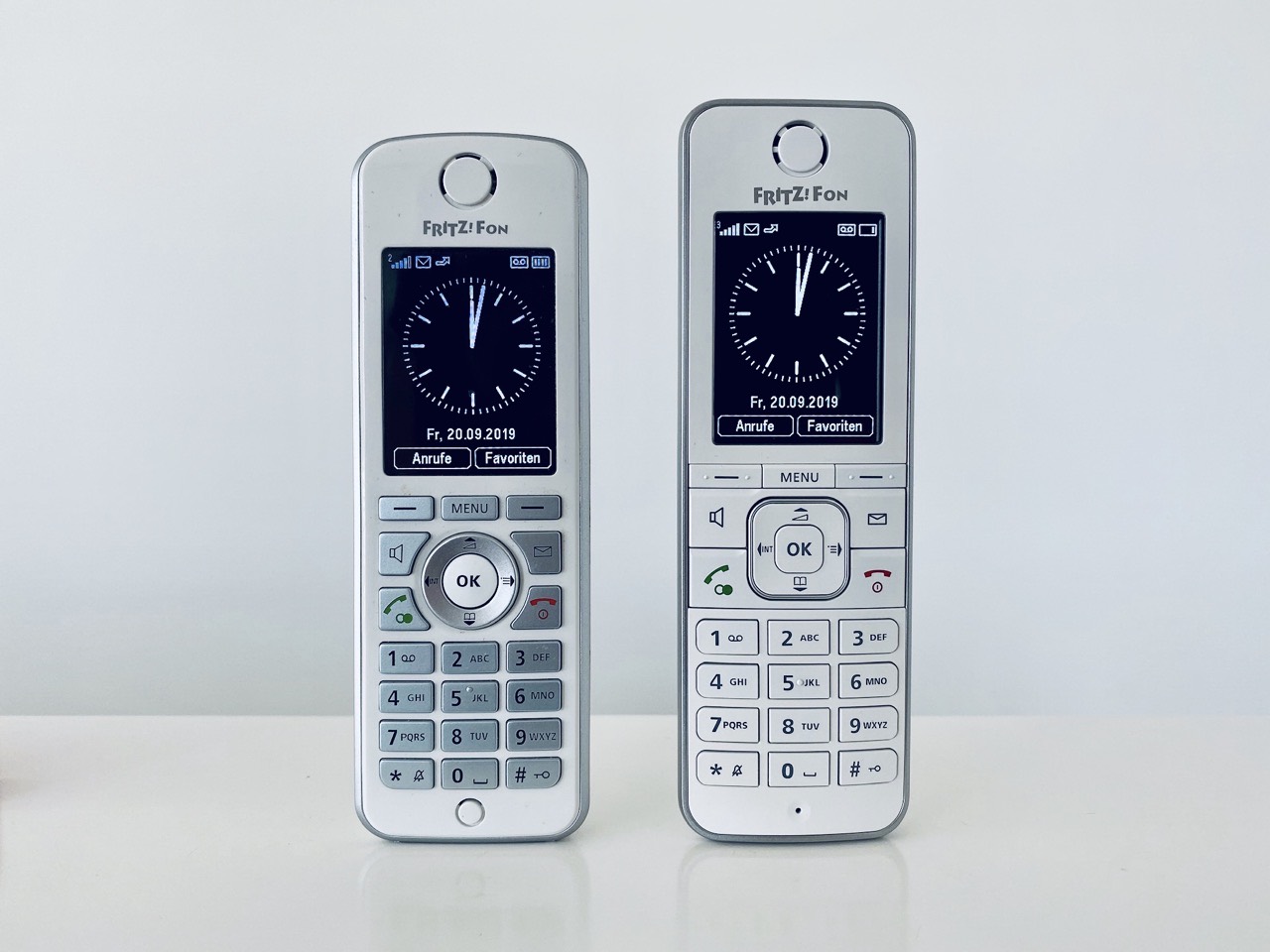
Ich telefoniere eigentlich nur noch mit dem iPhone, aber es gibt natürlich weiterhin Leute, die mich auf meinem Festnetz-Anschluss anrufen. Seit ich sämliche Telefonie über die Fritz!Box abwickle, habe ich auch die Schnurlostelefone direkt mit der Fritz!Box verbunden und nicht etwa deren Basis in einen Analog-Anschluss gesteckt. Der größte Vorteil ist, dass man sich die Umwandlung in ein Analogsignal und die Übermittlung von Wähltönen spart. Mit dem richtigen Geräten bekommt man dazu auch Ende-zu-Ende HD-Telefonie. Das klingt stets so, als ob die andere Person direkt nebenan ist.

Ich habe eine zeitlang sehr schöne Gigaset-Telefone benutzt, fand aber irgendwann den Komfort zu schlecht. Die LED, die entgangene Anrufe signalisierte, war irgendwie stets an, weil die Quittung irgendwo im Protokoll unterging. Und dann bin ich auf ein Fritz!Fon C4 umgestiegen. Meine Güte, was für eine Verbesserung. Mehr als 10 Stunden Talktime, mehr als eine Woche Standby. Man kann das Telefon auf der Basis lassen, damit man es leicht findet, aber man kann es genausogut eine ganze Woche an anderer Stelle liegen lassen.

Es gibt überhaupt nichts zu meckern, und man muss die vielen Funktion des Telefons auch gar nicht nutzen. RSS-Reader, Email-Client, Radio, etc. Die Telefone können weit mehr als ich brauche, aber letzten Endes können sie es schlechter als ein Smartphone. Brauche ich nicht.

d7c9b032f31ad686a69640de2ed9086a

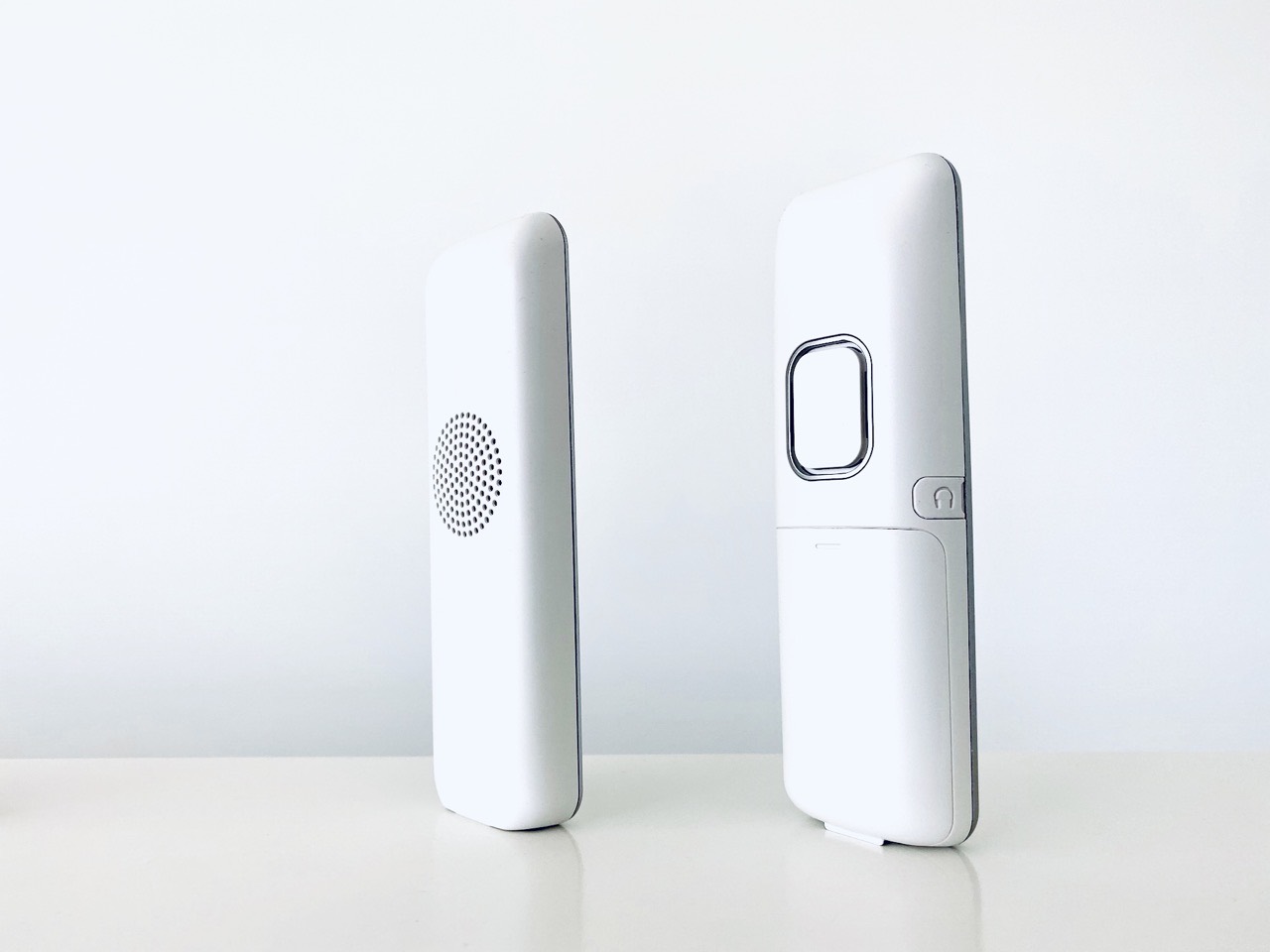
Mittlerweile hat ein C6 das letzte Gigaset abgelöst. Es sieht ein bisschen anders aus als das C4, es hat nun auch eine Lautstärkewippe, ich finde es greift sich besser, aber im Grunde genommen ist es einfach eins dieser wunderbaren Fritz!Fons.

Alle drei verdienen das Attribut "stuff that works":

Das C6 ist das neueste Modell und deshalb noch ein klein wenig teurer als die anderen beiden. Alle laufen mit der selben Software, das C5 ist schwarz und zeigt viel mehr Fingerabdrücke, aber man kann bedenkenlos jedes davon kaufen. Der Akku ist übrigens bei allen drei leicht zu wechseln. Das war bei mir bisher nicht nötig.

Wenn man die Reichweite des Telefons in Haus und Garten vergrößern will, dann sollte man den Fritz!DECT Repeater 100 ins Auge fassen. Der wird auch im Bundle mit den Telefonen angeboten. Er wird durch Knopfdruck an der Basis angemeldet und dann in halber Distanz einfach in die Steckdose gesteckt. Ich habe zwei dieser Repeater im Einsatz. Verbinden, einstecken, vergessen. Das Beste an so einer integrierten Lösung ist, dass die Fritz!Box für alle Software-Updates sorgt.

14 Oct 23:28

Time for a MOOC reckoning

Alex Usher, Higher Education Strategy Associates, Oct 14, 2019
Icon

Working on the basis of a few examples and an article, Alex Usher writes, "I think it’s time for retribution. To anyone who had the faintest idea how higher education worked, there was never any credible evidence that there would be nearly enough paying demand for these things to cover their cost of development and operation." Well, yeah. Given that MOOCs were supposed to be free, there was never going to be paying demand. Given that MOOCs were supposed to use open educational resources (the way our MOOCs did), there was never supposed to be a high cost for offering one. The problem with relying on e-Literate (as valuable a source as it is) is that it almost completely U.S.-focused. Even if they're on the decline in the U.S., MOOCs - offering genuinely free learning opportunities - can be found around the world. The failure of some U.S. institutions to commercialize them is a win, not a loss, for open online learning.

Web: [Direct Link] [This Post]
14 Oct 23:27

WeChat reportedly ignores election rules, runs attack ad without registry

by Jonathan Lamont
WeChat app on Android

Chinese social media giant WeChat is reportedly ignoring Canada’s new election rules for online companies.

According to a CBC News report, WeChat allowed election ads to run without forming a digital ad registry as required by law. Tencent, which owns the platform, denied that ads ran on WeChat and says that it hasn’t set up a digital ad registry in Canada.

A spokesperson told CBC News that “WeChat does not accept or support political ads on its platform.”

Recent changes to Canada’s election laws require online companies that accept political ads during an election to set up digital ad registries. These registries must contain all the political ads running on their platforms, include copies of the ads and information about who authorized them.

The requirement led some companies, like Google, to stop accepting political ads in Canada during the federal election.

The election rules apply to platforms that publish in a language other than English or French that have more than 100,000 unique monthly visitors from Canada. Comscore, which measures web traffic, told CBC News that WeChat gets an average of 616,000 unique Canadian visitors each month.

The ad claimed re-elected Liberals would legalize “hard drugs”

Despite the denial, CBC News obtained a copy of a Conservative Party attack ad that ran on WeChat last week. The Chinese and English ad claimed that should Canada re-elect Justin Trudeau and the Liberals, the party would legalize “hard drugs.”

wechat campaign ad

The alleged WeChat campaign ad obtained by CBC News

“Justin Trudeau’s Liberals have a plan to legalize hard drugs just like they legalized marijuana,” the ad says. “Only Andrew Scheer’s Conservatives will stop Trudeau’s hard drug legalization plan and keep our kids safe.”

Further, the ad carries the Conservative Party’s logo and says it was “authorized by the official agent for the Conservative Party of Canada.”

A similar attack ad reportedly appeared on the Conservative Party’s website on October 9th. Another similar ad allegedly ran on Facebook.

Further, CBC News reports that Hamish Marshall, the Conservative campaign manager, refused to comment on which social media platforms the party used for advertising in the election.

Trudeau denied that the Liberals have a plan to legalize hard drugs.

The Liberal Party told CBC News that it runs ads on Facebook, Twitter and Instagram, but not WeChat. Likewise, the NDP said it focused online advertising on Facebook and Instagram.

Source: CBC News

The post WeChat reportedly ignores election rules, runs attack ad without registry appeared first on MobileSyrup.

14 Oct 04:36

mapsontheweb: German, Dutch and Frisian dialects. === Frisian...


mapsontheweb:

German, Dutch and Frisian dialects.

===

Frisian is the language most similar to English.

14 Oct 04:25

The Sticky Gold Nugget

by Richard Millington

Filippo reminds us of the power of metaphor to make a message stick.

You will probably read hundreds, maybe thousands, of tweets this week.

But I suspect that one will stick.

This is the power of metaphor, contrasts, imagery and emotion in a single, simple, sentence (or two).

As the battle for attention becomes ever more fierce, the ability to communicate effectively with our members becomes even more important.

If you’re still communicating facts instead of emotions, you’re probably going to be disappointed with the results. Facts are just the foundations of the story you can tell. Without the emotions, imagery, and metaphors they’re just an empty shell.