Shared posts

14 Nov 14:33

S10:E5 - How to be a good manager and a good employee (Lara Hogan)

You can be an amazing developer, but a terrible manager. We chat with Lara Hogan, former VP of Engineering at Kickstarter, co-founder of Wherewithall, a company that coaches and levels up managers, and author of the new bestselling book, Resilient Management, about her background going from web developer to manager, why becoming a manager isn’t necessarily a promotion, and some of the most important skills people need to not only be good managers, but in any supporting role.

Show Links

Lara Hogan

Lara is the former VP of Engineering at Kickstarter, co-founder of Wherewithall, a company that coaches and levels up managers, and author of the new bestselling book, Resilient Management.

22 Oct 17:47

Treepad - LB

FYI, NoteCase Pro is one of the programs I import hjt into.

Before a few months ago, the newest version wasn't importing Treepad files correctly. I wrote to the developer and he fixed it right away. I'm really impressed with the developer and the support from the forum.

So if you tried NCP to import hjt before a few months ago and it didn't import the information correctly, you may try it again. It works perfectly now. Just make sure you upgrade it.

Although, I don't think it exports in Treepad format, but there may be a script for it.

Larry
22 Oct 17:46

Setting up Datasette, step by step

Setting up Datasette, step by step

Tobias describes how he runs Datasette on his own server/VPS, using nginx and systemd. I'm doing something similar for some projects and systemd really does feel like the solution to the "ensure a Python process keeps running" problem I've been fighting for over a decade. I really like how Tobias creates a dedicated Linux user for each of his deployed Python projects.

Via @rixxtr

22 Oct 17:45

macOS Catalina broke Audiobooks, here’s my workaround

by Michael Kalus

Introduction

macOS Catalina broke Audiobooks, here’s my workaround

When Appel released macOS Catalina (10.15) at the end of the September not only did they break 32-Bit applications on macOS but they also broke audiobooks on the Mac for a lot of people. So what happened?

Among the things Apple is changing is that they have “retired” iTunes and broke it up into distinct applications. Namely:

  • Music
  • Books
  • TV / Movies
  • Podcasts

While the Music.app still retains the ability to select where you want to store the files and edit the tags, for the Books app they omitted this. The storage location for the books you have in the application is now hard coded to a location on your local drive, and not in “user space” either. It’s just stored deep within the OSs guts.

~/Library/Containers/com.apple.BKAgentService/Data/Documents/iBooks

This is not configurable, and that’s fine if you only have a handful of audiobooks, but if you have a large collection you’re quickly going to run out of storage space.

Why did Apple do this?

This of course is a good question. I can speculate though.

Lifetimes

Apple is currently in their “third phase” of their life.

Phase 1: Computer Company

In the first phase they build and sold you computers, with some software thrown in. This period lasted essentially from the start of the company until around 2007 when Apple introduced the iPhone.

Phase 2: Mobile Device Company

With the introduction of the iPhone and iOS Apple started shifting away from the computer / desktop model and more towards a mobile device model. This is also seen in the way their computers changed. Back in 2013 I could still replace the HDD in my MacBook, in my current one? No chance. This is essentially a very large mobile device that at the end of their life will have be thrown out, just like the phone.

Phase 3: The Service Company

Around 2016 Apple started to enter the next phase, that of a service company. It started with the push of iCloud and the introduction of Apple Music. Both of these are subscription services and provide Apple with a continuous revenue stream. To be fair, they aren’t the only one. Adobe has gone down this road, so has Microsoft and a lot of smaller developers. The idea here is that there is predictable revenue, especially in a time where hardware sales are stagnating or falling as devices have gotten “good enough” for most people. I maybe upgrade my computer now every four years and my phone every three. Maybe. It really depends if I see the reason for this.

macOS Catalina broke Audiobooks, here’s my workaround

So what does that have to do with how Books works?

Simple. There are two ways you can “legally” obtain Audiobooks for the Books app:

  1. The Apple Audiobook store
  2. The Audible book store (Apple acts as reseller and had integration with Audible for at least 15 years.

In both cases there is no need for you to store large amounts of books on the drive. You listen to maybe one or two books at a time and most machines have more than enough space to hold those.

Because these books are already tagged and prepped you also won’t need to modify the ID3 tags, so why would you need that functionally in the app?

So what now?

I was aware of this limitation back during the Beta phase and was wondering if Apple was going to fix it before the release, the answer is: No. I also do not expect Apple to fix it. They do not want you to load your own audiobooks, they want to be the man in the middle and get their pound of flesh in the market.

So, the only answer is to leave the Apple eco system behind and go…..

Let there be Plex

My solution to the problem is both simple and complicated: Plex.

For those who don’t know, Plex is a media server software and player. The basic version is free and it has quite an extensive skill set. Unfortunately one thing it does not directly support are audiobooks, even though this has been requested repeatedly all the way back to 2013, but because Plex is at it’s core Open Source there are people who have figured out a way to make use of it.

For me Plex was the easiest way to approach this because my books are already sitting on a NAS an Plex was already running there, the challenge was as to how to get them onto my phone and manage them easily.

The ingredients

There are three things you will need to make this work well:

Between these three tools and a minor investment of time and money you’ll find yourself with a much better solution than iTunes can provide, or even the Books apps should Apple ever “fix” it.

Plex

The Plex installer is pretty straight forward, it runs on a variety of platforms. I am not going to go through here on how to install Plex itself, just how to make the Audiobook version work for you.

After you have installed Plex you should create a new Music Library, you can name it anything you like, I named mine “Audiobooks”.

As you set it up go into the advanced settings and make sure to have it read the ID3 tags of the files as well as not “suggesting” things from other libraries. I forgot to uncheck the second option on my first attempt and it resulted in Plex mixing music in with the books, which was more than confusing.

macOS Catalina broke Audiobooks, here’s my workaround

That’s pretty much it. After you’re done Plex will start indexing the files and build the library. Depending on how large it is and how many books you have this can take a while.

Once the scanning is done you can edit individual books if they are read wrong, I had some where the album cover was missing, I noticed a few I had duplicates on and a minority of them failed to read the ID3 tags, that then required some manual fixing.

The nice thing is that unlike with iTunes it is pretty evident when something is messed up and it’s relatively easy to fix in the web browser.

Prologue

Prologue is an iOS app that works with Plex and behaves exactly like the books app does on iOS. It allows you to play back the audiobooks with up to double speed, rate them and mark books as read. You can either stream the books or download them to the application.

One nice thing is that all the control for how books sync to the device are handled by the app. What that means is that you don’t need to jump through the truly horrible UI on iTunes to just remove a book from the device.

macOS Catalina broke Audiobooks, here’s my workaround

The application isn’t quite perfect, for example there is no easy way to just look at the books that you have downloaded, but I did had an exchange with the developer and it is coming. It costs CAN$9 if you want all the features.

Ratings you do in the app are syncing back to the Plex Server automatically, as well as marking books as read. So it’s easy to sort in Plex for books you haven’t read yet.

macOS Catalina broke Audiobooks, here’s my workaround

Audiobook Binder

This one is optional. What the application does is essentially “bind” your audiobooks. If you have multiple files it will create one continuous .m4b file for you. There won’t be any encryption on the files so it will play in Plex or any other player. The advantage with the single file is that they are easier to copy / maintain and remembering playback position works better with Plex.

The application is free, the only downside I have found is that it does not really write the tags necessarily in the way I like them (e.g. no track numbers), but that is easily fixed with an external ID3 tag editor (still looking for a good one that doesn’t cost an arm and a leg).

That’s all folks

It really is. Between these three tools I now have a much more flexible audiobook library. I wish Plex would add a real audiobook section to the server but I am not holding my breath. The request has been open for almost seven years now and there seems to be no attempt so far by Plex to actually add this. It’s a shame. But between Plex and Prologue this works very well. Interestingly enough downloading audiobooks to the phone is much faster than it ever was via iTunes.

Happy Listening

22 Oct 17:45

Saying Goodbye

by Richard Millington

If you haven’t visited an old Yahoo group for a while, it might be worth a visit before they close.

Connect with the friends you want to stay in touch with.

Share your life updates and see how others are doing.

Find the most popular discussions and remind yourself of your best memories.

Remind yourself of the person you were when you joined the group and how it changed you.

And say goodbye to the people who may once have been a significant part of your life.

You have until the end of the day.

22 Oct 17:45

Two kinds of data modeling

by Eric Normand

Through conversations, I've realized that there's two kinds of data modeling that are distinct. They have their own constraints and needs and, consequently, their own techniques. In this episode, I explore what makes them different.

The post Two kinds of data modeling appeared first on LispCast.

22 Oct 17:41

Rebble with a Cause

by Rui Carmo

I still have an original Pebble someplace, and to this day it was the only smartwatch that actually got calendaring “right”–its timeline view was an excellent bit of UX that Apple completely ignored (they even killed doing “time travel” with the crown recently, so it’s pretty much impossible to have a decent overview of your day at a glance).

It’s good to know bits of it live on, although realistically it is extremely unlikely to ever recover and come back as a commercial product, regardless of the brilliant engineering involved.


22 Oct 17:40

Fragment: Indexing Local Jupyter Notebooks for Search

by Tony Hirst

It’s been some time since I last explored this (eg here and here, and as far as I know know other solutions have appeared since, but a question still remains as to how to effectively search over a set of notebooks.

Partial alternative solutions maybe worth noting include:

  • nbscan for searching over notebooks from the command-line;
  • nbgallery bakes in Solr/sunspot; it’d be really nice if the nbgallery search tools could be easily decoupled so the search could be added to an arbitrary Jupyter notebook, or JupyterHub, server as an extension…);
  • this simple search engine with automcomplete by Simon Willison.

There is also the lunr based search of Jupyter Book (related issue). (The more recent elasticlunr Javascript search engine also looks interesting… perhaps even more so than lunr.js…)

One of the things I often wondered about in respect of building a notebook search engine index would be how to crawl / index freshly updated notebooks.

One way would presumably be to regularly crawl the directory path in which notebooks live looking for notebook files that have a changed timestamp compared to the last time they were indexed; another might be to set up some sort of watcher on the operating system that calls the indexer whenever it spots a file being updated (maybe something like fswatch?).

Another way might be to use something like the pgcontents contents manager to save (or process) notebooks into a search engine index database. (For other examples of Jupyter notebook content managers, see this Tracking Jupyter round-up. I wonder, is there a sqlite content manager that can save notebooks directly into SQLite? Would the pgcontents extension handle that with little or no modification, other thn to the supplied database connection string?) If notebooks were saved as notebooks to disk, and into a database for indexing as part of the search engine, how would the indexed notebook also be linked back to the notebook on disk so it could be linked to via search results?

Thinks: how is nbgallery architected? Where are notebooks saved to? How is the Solr search engine index managed?

More generally, I wonder: are there any Python based, simple full-text search engines with local fielsystem crawlers/monitors/indexers out there?

PS Other search engines to have a look at:

22 Oct 17:40

Photo


22 Oct 17:40

E-Day

by peter@rukavina.net (Peter Rukavina)

We woke up at 6:30 a.m. today to join a Green “sign wave” at the North River Road-Capital Drive corner.

I’m now shifting to the “get out the vote” ground game, doing a door to door foot canvas downtown, and will finish the day as a scrutineer at the Murphy Centre.

If Oliver can get up a 6:30 a.m. and be out the door by 7:00 to stand on a street corner for an hour, pretty much anything is possible.

Please go and vote today.

22 Oct 17:40

Great Spotted Woodpecker

mkalus shared this story from Head Like an Orange.


Great Spotted Woodpecker

22 Oct 17:39

E-bikes picking up in popularity on Sea-to-Sky mountain trails

mkalus shared this story .

On a sunny September weekend in Squamish, B.C., about half a dozen tourism and rental companies say they're out of electric-assist mountain bike rentals.

The rugged and varied terrain of British Columbia's Sea-to-Sky region north of Vancouver has long made it an international mountain biking destination, but now the trail systems are increasingly being used by cyclists riding with some extra juice.

Athletes, recreationalists and industry members say the trend is opening trails to new riders, giving established mountain bikers more freedom to spend more time outside and creating some concern about the impact on sensitive ecosystems.

"This is the first seismic shift in mountain biking. This is like, 'Holy smokes, things are really different,''' said former professional mountain biker Wade Simmons.

Widely hailed as the "godfather'' of freeriding, Simmons was inducted into the Mountain Biking Hall of Fame in 2010.

He now works in sales for Rocky Mountain Bicycles and said when the company introduced its e-bike inventory to dealers in the United States this spring, it closed the gap between riders of varying abilities during a demonstration ride.

"We had road bike riders, out-of-shape guys, but we were all riding together for two hours, which would have never, ever happened on a normal bike,'' Simmons said.

In response to the growing popularity, B.C. Parks introduced a new e-bike policy this summer. It allows e-bikes in certain areas, depending on classifications already established by the industry and other government bodies. It aims to help protect sensitive wildlife, ecosystems and cultural values.

"Cycling in parks can have an impact on trails and wildlife. Electric bikes allow more riders to use trails and reach areas that were previously limited to a few visitors, leading to increased pressure on sensitive wildlife and ecosystems,'' the government said.

Some local governments are also looking to regulate where e-bikers can roam.

Whistler council recently supported a draft policy for electric-powered personal mobility devices, including e-bikes, on recreational trails in the municipality. It prohibits them from some specific high-alpine environments that could be vulnerable to damage, as well as a conservation area.

Mayor Jack Crompton said it comes in response to a "dramatic increase'' in the use of e-bikes in the resort municipality, adding that policies around emerging technologies like e-bikes should be flexible and responsible.

We had road bike riders, out-of-shape guys, but we were all riding together for two hours, which would have never, ever happened on a normal bike.- Wade Simmons, former professional mountain biker

On the whole, he sees e-bikes as a positive addition to the recreation landscape.

"My hope is that we see more community members on e-bikes and more people being more active, longer,'' Crompton said.

Simon Quinn-Sears, rental manager at Corsa Cycles in Squamish, said it's a myth that e-bikes are only for the aging and injured. He's a 32-year-old, able-bodied man and he said he prefers it to using a traditional mountain bike.

"You feel like a superhero because there's no throttle, it's not like riding a dirt bike or power sports thing,'' he said.

The engine's output reflects the energy you put into it, so the harder you pedal, the more power you're provided.

Traditional mountain biking is fine for people who want to earn their laps through a high-intensity workout but in his case, Quinn said his heart rate is 30 beats a minute lower, which is in his target range.

"For me, I'm getting better exercise, I'm having more fun and I hurt less the next day so I'm riding more,'' he said.

E-biking isn't for everyone. Cooper Quinn, president of the North Shore Mountain Bike Association, said he doesn't own one.

"Part of the reason I ride bikes is for the physical exertion aspect of it,'' he said. "That's an aspect of the sport I enjoy.''

Most of the association members still use a traditional mountain bike as their primary ride, but member surveys show they have been adding e-bikes to their rosters over the past five years or so, he said.

Quinn sees advantages in e-biking for others, especially aging riders, out-of-practice riders who want to keep up with their friends, and new riders daunted by big hills.

For now, he said, most people who use e-bikes are established riders.

"It's going to be an interesting user group to monitor over the next few years as it continues to grow,'' Quinn said.

Quinn noted that many trails are maintained by volunteers working through associations like his.

"There's certainly management challenges associated with it. As a great surprise to no one, trails in B.C., trails on the North Shore and across Canada are getting busier as people start to do more and more recreation. So, putting another group of users out there is certainly a challenge,'' he said.

22 Oct 17:39

The Internet and the Third Estate

by Ben Thompson

Facebook CEO Mark Zuckerberg began his speech last week by attempting to place free expression in the historical American context, and only then turned to discuss free expression in the context of Facebook, where he proposed something much more modern:

People having the power to express themselves at scale is a new kind of force in the world — a Fifth Estate alongside the other power structures of society. People no longer have to rely on traditional gatekeepers in politics or media to make their voices heard, and that has important consequences. I understand the concerns about how tech platforms have centralized power, but I actually believe the much bigger story is how much these platforms have decentralized power by putting it directly into people’s hands. It’s part of this amazing expansion of voice through law, culture and technology.

The Fifth Estate is a clear reference to the Fourth Estate — the press — and Zuckerberg’s argument is that while the Fourth Estate entailed gatekeepers the Fifth Estate does not, for both better and worse. It’s a compelling framing, and one that certainly puts in perspective the tension that exists between the press and Facebook in particular: no gatekeeper likes to lose their monopoly on the distribution of information.

It’s also a framing that is, appropriately enough, uniquely American; in the United States, the first three estates are commonly thought to be the three branches of government: the executive, legislative, and judicial. It is the press that holds all three accountable, and in Zuckerberg’s telling, the Fifth Estate that gives everyone else a voice.

There is, though, another way to think about social media that is perhaps even more compelling, with a story that draws not from American history but rather European.

Europe’s Three Estates

In Europe the first three estates are a reference to how society was organized throughout the Middle Ages: the First Estate was the church, the second was the nobility, and the third were the commoners. By the 1700s those estates, at least in England, had become branches of government: the King (the First Estate — more on king versus clergy in a moment), the House of Lords (the Second Estate), and the House of Commons (the Third Estate); this was the context for Edmund Burke’s remarks in 1787 that “There are Three Estates in Parliament; but, in the Reporters’ Gallery yonder, there sits a Fourth Estate more important far than they all.”

With this context, the European reading of the Fourth Estate is actually rather akin to the American one: the press is an independent force holding the government accountable. And so, again, Zuckerberg’s characterization of social media as the Fifth Estate makes sense.

Without this context, though, social media as the Fifth Estate would not make sense at all: after all, “people having the power to express themselves at scale”, to use Zuckerberg’s words, is about giving the commoners a voice — but the commoners are the Third Estate! In fact, in the medieval period where the three estates existed the press as fourth estate wouldn’t have made much sense either, given that the printing press didn’t even exist.

The Printing Press

That the clergy came first was not an accident: in the Middle Ages the principal organizing entity for Europe was the Catholic Church. Relatedly, the Catholic Church also held a de facto monopoly on the distribution of information: most books were in Latin, copied laboriously by hand by monks. There was some degree of ethnic affinity between various members of the nobility and the commoners on their lands, but underneath the umbrella of the Catholic Church were primarily independent city-states.

The printing press changed all of this. Suddenly Martin Luther, whose critique of the Catholic Church was strikingly similar to Jan Hus 100 years earlier, was not limited to spreading his beliefs to his local area (Prague in the case of Hus), but could rather see those beliefs spread throughout Europe; the nobility seized the opportunity to interpret the Bible in a way that suited their local interests, gradually shaking off the control of the Catholic Church.

Meanwhile, the economics of printing books was fundamentally different from the economics of copying by hand. The latter was purely an operational expense: output was strictly determined by the input of labor. The former, though, was mostly a capital expense: first, to construct the printing press, and second, to set the type for a book. The best way to pay for these significant up-front expenses was to produce as many copies of a particular book that could be sold.

How, then, to maximize the number of copies that could be sold? The answer was to print using the most widely used dialect of a particular language, which in turn incentivized people to adopt that dialect, standardizing language across Europe. That, by extension, deepened the affinities between city-states with shared languages, particularly over decades as a shared culture developed around books and later newspapers. This consolidation occurred at varying rates — England and France several hundred years before Germany and Italy — but in nearly every case the First Estate became not the clergy of the Catholic Church but a national monarch, even as the monarch gave up power to a new kind of meritocratic nobility epitomized by Burke.

In other words, Burke’s Fourth Estate was the means by which the Second Estate overthrew the first.

The Second Estate and the Press

I would go further: just as the Catholic Church ensured its primacy by controlling information, the modern meritocracy has done the same, not so much by controlling the press but rather by incorporating it into a broader national consensus.

Here again economics play a role: while books are still sold for a profit, over the last 150 years newspapers have become more widely read, and then television became the dominant medium. All, though, were vehicles for the “press”, which was primarily funded through advertising, which was inextricably tied up with large enterprise. I explained this symbiosis in 2016’s TV Advertising’s Surprising Strength — And Inevitable Fall:

The very institution of television advertising is intertwined with the kinds of advertisers that use it the most, the products they sell, and the way they are bought-and-sold…Start with the top 25 advertisers in the U.S. The list is made up of:

  • 4 telecom companies (AT&T, Comcast, Verizon, Softbank/Sprint)
  • 4 automobile companies (General Motors, Ford, Fiat Chrysler, Toyota)
  • 4 credit card companies (America Express, JPMorgan Chase, Bank of America, Capital One)
  • 3 consumer packaged goods (CPG) companies (Procter & Gamble, L’Oréal, Johnson & Johnson)
  • 3 entertainment companies (Disney, Time Warner, 21st Century Fox)
  • 3 retailers (Walmart, Target, Macy’s)
  • 1 from electronics (Samsung), pharmaceuticals (Pfizer), and beer (Anheuser-Busch InBev)

Notice that the vast majority of the industries on on this list are dominated by massive companies that compete on scale and distribution. CPG is the perfect example: building a “house of brands” allows a company like Procter & Gamble to target demographic groups even as they leverage scale to invest in R&D, bring down the cost of products, and most importantly, dominate the distribution channel (i.e. retail shelf space). Said retailers, meanwhile, are huge in their own right, not only so they can match their massive suppliers at the bargaining table, but also so they can scale logistics, inventory management, store development, etc. Automobile companies, meanwhile, are not unlike CPG companies: they operate a “house of brands” to serve different demographics while benefitting from scale in production and distribution; the primary difference is that they make money through one large purchase instead of over many smaller purchases over time.

My list of top advertisers had one missing piece — politicians — but that is only because the data was from a period that did not include an election. More broadly, the press, big business, and politicians all operated within a broad, nationally-oriented consensus.

Note, though, the reason I wrote that article: my argument is that every part of the media-advertising-industrial complex was threatened by the Internet.

The inescapable reality is that TV advertisers are 20th century companies: built for mass markets, not niches, for brick-and-mortar retailers, not e-commerce. These companies were built on TV, and TV was built on their advertisements, and while they are propping each other up for now, the decline of one will hasten the decline of the other.

There is no reason this reality shouldn’t apply to nation-states as well.

The Internet and the Third Estate

What makes the Internet different from the printing press? Usually when I have written about this topic I have focused on marginal costs: books and newspapers may have been a lot cheaper to produce than handwritten manuscripts, but they are still not-zero. What is published on the Internet, meanwhile, can reach anyone anywhere, drastically increasing supply and placing a premium on discovery; this shifted economic power from publications to Aggregators.

Just as important, though, particularly in terms of the impact on society, is the drastic reduction in fixed costs. Not only can existing publishers reach anyone, anyone can become a publisher. Moreover, they don’t even need a publication: social media gives everyone the means to broadcast to the entire world. Read again Zuckerberg’s description of the Fifth Estate:

People having the power to express themselves at scale is a new kind of force in the world — a Fifth Estate alongside the other power structures of society. People no longer have to rely on traditional gatekeepers in politics or media to make their voices heard, and that has important consequences.

It is difficult to overstate how much of an understatement that is. I just recounted how the printing press effectively overthrew the First Estate, leading to the establishment of nation-states and the creation and empowerment of a new nobility. The implication of overthrowing the Second Estate, via the empowerment of commoners, is almost too radical to imagine.

And yet, take a look around: there are protests around the globe, from Hong Kong to Chile to France to Spain to the Netherlands, primarily by populist movements. The U.S. and U.K., meanwhile, have no need for populist protests given that populist movements won stunning victories at the polls in 2016. I described the rise of Trump in particular in The Voters Decide:

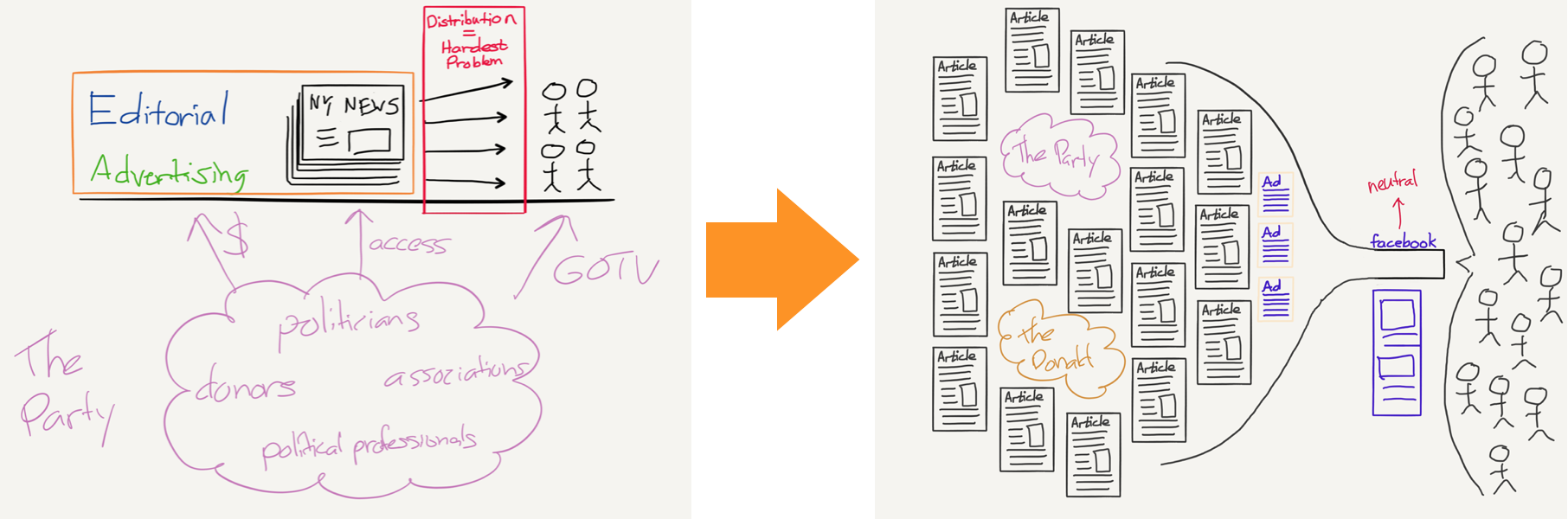
For a moment, though, step back to the world as it was: the one where newspapers (and TV stations, etc.) were gatekeepers thanks to their ownership of production and distribution. In this world any viable political campaign had to play nicely with those who ran the press in the hopes of gaining positive earned media, endorsements, etc. Just as important, though, was the need to buy advertising, as that was the only way to reach voters at scale. And advertising required lots of money, which meant donors. And then, once the actual election rolled around, a campaign needed an effective GOTV effort, which took not only money but also the sort of manpower that could only be rustled up by organizations like labor unions, churches, etc. It is all these disparate pieces: partisan media members, advertisers, donors, large associations, plus consultants and specialists to manage them that, along with traditional politicians, made up the “party” in The Party Decides

This brings us back to today’s world, and admittedly, the leap from a description of Facebook and Aggregation Theory to politics is not an obvious one: I’m not proposing that Donald Trump or anyone else is an aggregator. Indeed, given their power over what users see Facebook could, if it chose, be the most potent political force in the world. Until, of course, said meddling was uncovered, at which point the service, having so significantly betrayed trust, would lose a substantial number of users and thus its lucrative and privileged place in advertising, leading to a plunge in market value. In short, there are no incentives for Facebook to explicitly favor any type of content beyond that which drives deeper engagement; all evidence suggests that is exactly what the service does.

Said reticence, though, creates a curious dynamic in politics in particular: there is no one dominant force when it comes to the dispersal of political information, and that includes the parties described in the previous section. Remember, in a Facebook world, information suppliers are modularized and commoditized as most people get their news from their feed. This has two implications:

  • All news sources are competing on an equal footing; those controlled or bought by a party are not inherently privileged
  • The likelihood any particular message will “break out” is based not on who is propagating said message but on how many users are receptive to hearing it. The power has shifted from the supply side to the demand side
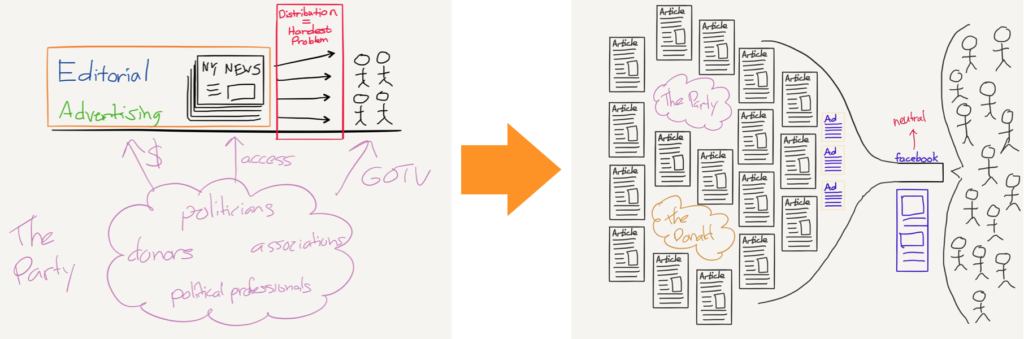
A drawing of Aggregation Theory and Politics

This is a big problem for the parties as described in The Party Decides. Remember, in Noel and company’s description party actors care more about their policy preferences than they do voter preferences, but in an aggregated world it is voters aka users who decide which issues get traction and which don’t. And, by extension, the most successful politicians in an aggregated world are not those who serve the party but rather those who tell voters what they most want to hear.

Forgive the long excerpt, but there are multiple points relevant to the current moment worth covering.

First, the initial effect of the printing press was substituting Second Estate control in a First Estate framework; specifically, emerging nation-states formed state churches with the King as the head. That is a similar dynamic to many of these populist movements, which are nationalistic in nature. Both Brexit and Trump explicitly call back to nostalgic views of national greatness, conveniently ignoring that neither movement would have been allowed a national voice in the time periods they aspire to. I suspect this adherence to the Second Estate nation-state framework is temporary.

Second, the degree to which the press — and again, this includes all types of high fixed cost/low marginal cost mediums like newspapers, TV, etc. — is intermingled with politics generally and the nation-state specifically is impossible to overstate.

Third, Facebook’s potential power over elections truly is immense.

Facebook’s Power

What is critically important when it comes to Facebook’s power is the various means by which that power could be realized.

The first and most straightforward way is Facebook putting its thumb on the scale. This is a concern that arose recently with the leaked audio of an all-hands meeting where Zuckerberg was reported as being willing to “go to the mat” versus Elizabeth Warren. This was, as I laid out in this Daily Update, an extremely unfair characterization of Zuckerberg’s obvious intension to fight any potential antitrust lawsuits. At the same time, it was a useful reminder that Facebook’s power is to be feared, and an argument the company is simply too large.

The second concern is the capacity of trolls, both of the profit-seeking and foreign government variety, to leverage Facebook’s fundamental engagement-seeking nature to push misinformation and division. The company claims it has made substantial investments in this area, both in terms of identifying bad actors and in taking down problematic content; Facebook puts these investments forward as an argument that the company’s size is an asset.

The third concern is what has dominated the news cycle as of late: Facebook’s decision to not fact-check any posts or ads from politicians. This is largely being framed as aiding President Trump in particular, which is probably both true and also an unsurprising complaint from the Second Estate used to having monopoly control over fact-checking.

The broader issue is that the third concern and first concern are so clearly in direct opposition to each other. If Facebook has the potential for immense influence on politics, why on earth would anyone want the company policing political speech?

The China Question

This question is even more meaningful than it seems. The other major news story of the past few weeks has been The China Cultural Clash. Zuckerberg referenced this in his speech:

China is building its own internet focused on very different values, and is now exporting their vision of the internet to other countries. Until recently, the internet in almost every country outside China has been defined by American platforms with strong free expression values. There’s no guarantee these values will win out. A decade ago, almost all of the major internet platforms were American. Today, six of the top ten are Chinese.

We’re beginning to see this in social media. While our services, like WhatsApp, are used by protesters and activists everywhere due to strong encryption and privacy protections, on TikTok, the Chinese app growing quickly around the world, mentions of these protests are censored, even in the US.

Is that the internet we want?

For some in the Second Estate, it appears to be an open question. Consider the New York Times, which has been at the forefront of Facebook criticism: over the weekend the country’s preeminent newspaper ran a front-page story about TikTok and its embrace by U.S. high schools; there was zero mention of Chinese censorship. To be fair to the author, that wasn’t the point of the story; to be cognizant of the role of editors at the New York Times in particular, it is hard to imagine any sort of glowing profile about a Facebook-owned property that wouldn’t contain multiple caveats.

Indeed, this gets at why the Facebook questions are so critical: the company’s critics that argue that Facebook is too big are making a cogent argument that reconciles concerns about Facebook’s power with a desire to control misinformation; critics that ignore these tradeoffs, though, come across as authoritarians in their own right, disappointed in Facebook only so far as the company fails to leverage its power to enforce their personal preferences.

And so we are back to China. The U.S. specifically and the West broadly is not going to out-authoritarian an avowedly Marxist regime with a demonstrated willingness to use “re-education camps” and omnipresent surveillance to ensure the Second Estate era — that of the cohesive nation-state — remains in place. To fight the Internet’s impact, instead of seeking to understand it and guide the fundamental transformations that will surely follow, is a commitment by the West to lose the fight for the future.

The fact of the matter is that the world is fundamentally changing, just as it did five hundred years ago. At the same time, that change will take time — the printing press was invented in Germany in 1440 and yet German unification did not happen until 1871 — and will be guided by choices we make along the way. The sooner we recognize that transformation is coming, the more readily we can reject authoritarian attempts to hold onto the world as it was, and create the world we want to see.


22 Oct 17:39

Org-mode file format support - washere

Orgzly is my favorite Android "Todo" Outliner. I don't see why people pay monthly subscriptions to someone running a small company hosting their data via apps if it involves new ideas (academic, book writing or patents Potential, new ideas etc) or sensitive (company data etc). When they can read it all at the very least. Or worse share/sell it if there's a tiny clause in the small prints. Of course shopping lists etc don't matter, if you don't mind behavior tracking for marketers profiling you.

Orgzly has themes including black, free, open source hence safe, private, nice design and features and I set it up to sync to sd card (backup) + cloud (my free Dropbox account).

You can open an issue below and request a specific file format, opml would be best for outliners tree:

https://github.com/orgzly/orgzly-android/issues

Orgzly is totally free and one of the few top Android apps with no ads or pesterware or data mining tracking etc:

https://play.google.com/store/apps/details?id=com.orgzly&hl=en

You might use the format specifying options to create a format that pulls into Excel. Then can export as database or whatever. Needs a bit of work. Tree levels will need specifying indents. The maybe use bonsai or Treepad or tkoutliner etc to pull in as tree. But I'd do the below:

Re: Android <> Windows:

However for serious Outliner work on Android I use Notecase Pro and specially Halna Pro. Halna OPML-2 export (I specified the format of and got last year from him kindly), imports nicely into Notecase Pro on Windows Mac & Linux. All nice devs too plus free versions.

You can set black or whatever themes for Halna in Android phone/tablet/Chromebook and Notecase Pro on laptops too, to save battery and the eyes. These are the best so far IMHO and won't be matched for many years to come.

22 Oct 17:39

Nate Weiner, formerly CEO of Pocket, to take expanded role at Mozilla focused on New Markets

by Mozilla

Nate Weiner, founder and CEO of Pocket, has been promoted to SVP of a new product organization, New Markets, at Mozilla. The New Markets organization will be working to expand and scale Mozilla’s product portfolio alongside the Firefox and Emerging Technologies teams. The Pocket and Emerging Markets teams will live within the New Markets organization.

As part of this change, Pocket Chief Technology Officer and Head of Operations Matt Koidin will step into a new role taking over day-to-day leadership as VP and General Manager of Pocket, continuing to report to Nate. Acquired by Mozilla in 2017, Pocket is a platform used by millions of people worldwide to discover, capture, and spend time with the stories that fascinate and fuel them.

The post Nate Weiner, formerly CEO of Pocket, to take expanded role at Mozilla focused on New Markets appeared first on The Mozilla Blog.

22 Oct 17:39

SwiftUI Is Still the Future

We’ve been using SwiftUI in NetNewsWire for iOS, for its settings screen and related pieces (such as adding an account).

But now we’re redoing that code in classic UIKit. Maurice Parker, NetNewsWire for iOS lead developer, lists the limitations we ran into with SwiftUI:

1) Unable to customize cell selection color for our vibrant cell selection requirement. I was able to hack around it, but it made cells behave strangely. You couldn’t tap and hold the cell. You also couldn’t scroll using the modified cells.

2) No pop back to root for NavigationView. Longer scene flows weren’t possible.

3) ActionSheet flat out just crashes if you use it on an iPad app. https://forums.developer.apple.com/thread/124530

4) TextField will crash the app if it has the cursor and is hidden. We wanted this for the show/hide password functionality.

5) There is no way to display attributed text. You have to bridge to UIKit and use a UITextField that has a modified intrinsicContentSize calculation. We had to take input from GeometryReader and pass it into the UITextField to calculate intrinsicContentSize.

There are more, some of which I have probably forgotten about.

We very much want to use SwiftUI, and we believe it’s the future of Mac and iOS development — but emphasis should be on future, because it’s not quite ready in the present.

Which should surprise nobody, given that it’s so new. But I thought it might be interesting to know exactly what issues we ran into when using it.

We look forward to the day when we can use it everywhere, but we suspect it will be incremental. Hopefully next year we’ll be able to do the Settings screen using SwiftUI. And maybe some parts of the Mac app, too.

PS Once we’re ready for a public beta of NetNewsWire for iOS, we’ll announce it here and on the NetNewsWire blog, and you’ll be able to sign up to get it via TestFlight.

22 Oct 17:39

What is it about Workflowy? - Beck

I know there are more robust outliners out there and I am somewhat ashamed to admit I pretty much have them all, but no matter how far I stray I always come back to Workflowy. It welcomes me with open arms, "Come dear prodigal outliner, I am so glad you are home."
22 Oct 17:38

Surface Pro X grenzt an Zauberei

by Volker Weber

41aa5e37e8d0b8314738bc9f2b563b46

198fbb71c33f38d4523fca8c84f42e0d

So dünn wie ein iPad Pro, hat aber ein ausklappbares Kickstand. Unfassbar.

Mehr bei Heise >

22 Oct 17:38

What is it about Workflowy? - Ken

Funny you should post. I was looking for a simple multi-platform replacement for Carbonfin as I use it as a packing list and wanted access on my phone, PC or tablet. I wanted something simple and thought Workflowy might do the trick. I logged into an account I opened several years ago and soon remembered why it was not the program for me. While I like the collapsible outline form, I do miss my check boxes and folders. I then tried Dynalist, but their mobile Android app was just a bit too buggy for even basic use. I am glad that Workflowy works for you, and I know that many appreciate its minimalist UI, but sometimes things can be too minimal, and for me, this is one of them.

--Ken
22 Oct 17:37

Twitter Favorites: [adamrg] I got to visit the The Spheres yesterday. Never has a building been better designed for science fiction television… https://t.co/H7nupmJzVU

Adam Gessaman @adamrg
I got to visit the The Spheres yesterday. Never has a building been better designed for science fiction television… twitter.com/i/web/status/1…
22 Oct 17:35

Twitter Favorites: [rcousine] Important reminder to all Canadians: if you don’t vote today, you can still complain about the outcome. Ignore pris… https://t.co/pcsdgWoCyD

Ryan Cousineau @rcousine
Important reminder to all Canadians: if you don’t vote today, you can still complain about the outcome. Ignore pris… twitter.com/i/web/status/1…
22 Oct 17:35

Twitter Favorites: [JodiesJumpsuit] LRTs: So when do we admit that PRESTO was a mistake and they give us our metropasses and tokens and tickets back?

vermicious knidsuit @JodiesJumpsuit
LRTs: So when do we admit that PRESTO was a mistake and they give us our metropasses and tokens and tickets back?
22 Oct 17:30

Apple’s often-rumoured AR headset could actually be real: report

by Patrick O'Rourke
Apple space ship campus

When rumours appear this often, it’s usually safe to say that there’s at least some level of truth to them.

Bloomberg’s Mark Gurman, an often-reliable source of leaks, recently reported that Apple plans to release its rumoured augmented reality (AR) headset in 2020, backing up previous speculation that appeared last week courtesy of analyst Ming-Chi Kuo.

Gurman states that Apple’s headset will sync with the iPhone to bring features like messages, maps and video games directly to the wearer’s eyes. The report goes on to say that Apple has also “considered” bring a dedicated App Store to the upcoming device.

The report also adds that Apple’s 2020 iPhone lineup will feature 5G support, a “much beefier” processor and depth-sensing rear cameras that are likely linked to augmented reality in some way. Gurman also says that sleep tracking is finally coming to the Apple Watch in 2020, corroborating previous reports surrounding the smartwatch, along with an ARM-powered Mac.

It looks like 2020 is set to be a busy year for Apple if there is any truth to these rumours.

Source: Bloomberg

The post Apple’s often-rumoured AR headset could actually be real: report appeared first on MobileSyrup.

22 Oct 17:30

Google to fix Photos bug that gave unlimited, free uploads to iPhones

by Jonathan Lamont
Google Phots on iOS

iPhone users hoping to take advantage of the free, original quality uploads on Google Photos won’t have long to do so.

After a Reddit user discovered a bug in the Photos system, Google said a fix is in the works.

“We are aware of this bug and are working to fix it,” Google said in an email statement to Android Authority.

For those unfamiliar with Google Photos, the app allows smartphone users to backup images to Google’s cloud. Users can pick between free, unlimited ‘High quality’ and ‘Original quality’ backups. Google describes the High quality as “great visual quality at a reduced file size.” While Original quality is a direct upload of the image file from your device, without a loss in quality. It counts against your Google One storage.

Up until the launch of the Pixel 4, Google has offered free, unlimited Original quality uploads as a perk for Pixel owners. However, the recently discovered Photos bug allowed iPhone users to get free Original quality backups as well.

In short, newer iPhones save images in the HEIC/HEIF format by default, which maintains quality but at a significantly smaller image size than comparable file types like JPEG. Google Photos usually saves backup images in a compressed JPEG, but converting HEIC/HEIF images to JPEG would actually result in larger image sizes. As such, Google Photos uploaded iOS pictures at Original quality.

While Google said it was working on a fix, it didn’t elaborate on what that fix would be. The company may block iPhones from gaining unlimited storage at Original quality. Alternatively, Google could make it a feature of Photos, considering the Samsung Galaxy S10 line supports HEIC/HEIF, as well as Android 9.0 Pie, Android 10 and the Snapdragon 855.

Likely, Google will block it in some way, since the company will miss out on revenue if every phone that supports HEIC/HEIFGoogle can take advantage of unlimited uploads at Original quality.

Source: Android Authority

The post Google to fix Photos bug that gave unlimited, free uploads to iPhones appeared first on MobileSyrup.

20 Oct 23:25

"Deze blogpost is speciaal"

by peter@rukavina.net (Peter Rukavina)

My friend Ton wrote a special blog post just for me to highlight a feature he added to his blog to make it easier for (and other non-Dutch or non-German readers) to read his non-English posts on translation. And it works!

20 Oct 23:25

Indoor Activities

by Rui Carmo

Autumn seems to have caught up with us, even if it feels like it’s just blundered inside and cannot make up its mind as to whether it locked the car (it’s rained a bit this weekend, but rather perfunctorily, and the sun has shone through on a few occasions).

As usual around this time of year, I’ve been trying to disengage from the social cacophony that Eternal September seems to have evolved into. I usually do that by decreasing the time spent online and removing self-serving echo chambers from impinging upon my downtime, which has been a great success–I’m pretty much off Facebook, only follow a handful of friends and family on Instagram, and other than Slack and Twitter (in which I am moderately active), there is little else to curb.

So having become a regular user of LinkedIn over the past few years (given that it is by far the most important social network in my line of business, irrespective of it being owned by my current employer, even though it is essentially useless for anything but social marketing these days), I set myself the goal of unfollowing/unlinking ten people a week until I can open the app and actually get useful news out of it rather than self-congratulatory/promotional posts.

Measuring The Force

I recently had both of our energy meters replaced by Landis+Gyr ZCXe110CR models, so of course I’m going to revisit my previous attempts at reading meter data, except that this time there is no need for OCR —these meters have a blinking LED that lights up every watt-hour:

EDP's single-page doc on the ZCXe110CR. There really isn't much to it.

They also report our energy consumption via PLC to a remote controller, but there’s no way I can tap into that… Well, none that I feel like tackling, that is.

I have a bunch of TCRT5000 IR reflective sensors about (both with and without breakouts) I had bought to try to read the old rotating disc meters, so I am looking at just sticking one against the LED and using a trivial pull-up resistor setup to use the phototransistor half of them (but haven’t tested that yet).

Hooking Things Up

In short, I have two main options. The first is the most reliable, but also the most involved:

Grab an ESP-01 module and build what is essentially the same setup as my first doorbell extender, but instead of writing my own sensor handling in C++, I’m going to be lazy about it and use the “push button” functionality of the Tasmota firmware to get an MQTT notification when the light blinks.

Should be only a matter of picking the right pull-up resistor and (crucially) seeing if the LED falls into the IR spectrum the TCRT5000 is sensitive to.

But that requires powering the ESP-01, so another alternative that might work is to hack one of the Xiaomi Zigbee contact sensors (again like I did for my doorbell extender, but replacing the magnetic reed switch). This has the potential to be much neater (zero wiring) but might not work depending on the phototransistor’s forward current and the length of the light pulse, either of which might not be enough for the contact sensor to fire.

The MCCGQ11LM stripped of its casing. Note The reed switch on the bottom and the Zigbee antenna on the right.

A quick test done by shunting the reed switch with one of the phototransistors almost worked, but not reproducibly so since I am having trouble with Zigbee coverage around the house and probably need to sort that out first.

Regardless of sensor type the pulses will come in as MQTT events, so to measure power consumption I’ll just pipe everything into my metrics system and compute a moving average.

I am curious as to whether I can expose it as a simulated HomeKit power meter (since the official spec doesn’t really cover energy meters yet), but there seem to be devices out there doing that already, and I should have no trouble reproducing their proprietary characteristics…

Hopefully it will all be done before we put our heaters back in rotation, so that I can chart power consumption over the winter period.


20 Oct 19:58

Wird das der letzte Test?

by Ton Zijlstra

Anscheinend entscheidet Google sich bei kurze Postings für das Resultat des Sprachalgorithmus, statt die im HTML angezeigte Sprache. Das resultiert dann in ‘dieser Seite ist bereits auf English’.

Also jetzt mein Sprachtest so umgebaut das direkt Deutsch oder Niederländisch im URL zu Google Translate eingebaut ist.


machine translation into English


This is a RSS only posting for regular readers. Not secret, just unlisted. Comments / webmention / pingback all ok.
Read more about RSS Club
20 Oct 19:58

Deze blogpost is speciaal voor Peter Rukavina

by Ton Zijlstra

Dag Peter. Deze blogpost is in het Nederlands, en toch is hij speciaal voor jou geschreven. Je weet dat ik de afgelopen week bezig ben geweest met het verbeteren van de ondersteuning van meerdere talen op deze website.

Ik dacht dat ik het voor elkaar had, door voor Nederlandse en Duitse postings de juiste taal aan te geven in de html-tag van de pagina.
Dat leek ook goed te werken.

Maar ik kwam erachter dat voor korte postings Google Translate toch denkt dat de posting in het Engels is. Ongeacht of de pagina zelf zegt dat het Nederlands of Duits is in de html-tag. Waarschijnlijk omdat al het andere (het navigatiemenu, alle informatie in de zijbalk) wel in het Engels is. Kennelijk wordt door Google Translate een mix gehanteerd van wat de website als taal aangeeft en wat ze met hun algoritme berekenen dat het percentage Engels op de pagina is. Als ze gewoon gebruik zouden maken van aanwezige taal mark-up zou dat niet hoeven.

Daarom heb ik in de RSS-feed nu automatisch gegenereerde weblinks naar Google Translate opgenomen die de juiste taal als bron hebben. Omdat Google de taal van de bron niet goed detecteert als het bericht kort is.

Nu zou je vanaf je mobiele telefoon makkelijk een Engelse vertaling moeten krijgen van deze en volgende blogposts in het Nederlands of Duits. Ofwel omdat ze lang genoeg zijn zodat Google de juiste conclusie trekt over de oorspronkelijk taal van de posting. Ofwel omdat je de link die ik in de RSS feed toevoeg aan deze posting kunt volgen.

Ik ben nieuwsgierig of het nu wel werkt zoals het moet.


machine translation into English


This is a RSS only posting for regular readers. Not secret, just unlisted. Comments / webmention / pingback all ok.
Read more about RSS Club
20 Oct 19:57

Scooting Towards Progress? A look at the new Shared Micromobility Guidelines for Metro Vancouver

by Alexandra Doran
Shared Micromobility Guidelines, TransLink 2019

 

As you’ve probably noticed, residents all over Metro Vancouver are e-scooting on the streets despite the presence of prohibitory bylaws. Accordingly, some recognition is long overdue – and here it is: Shared Micromobility Guidelines.

Published in July by TransLink in collaboration with Metro Vancouver, the document is not designed to recommend the adoption of specific bylaws or policies but to inform municipalities of the relevant considerations for permitting shared micromobility devices within their jurisdictions.

The guidelines focus on six areas:

  1. The collection and sharing of Data to measure success.
  2. Payments and Price Structures that are financially sustainable and adaptable for integrated and secure payments.
  3. System Planning and Design for a fair balance between innovation and public interests.
  4. Right-Of-Way (ROW) Management to identify and manage risks.
  5. System Operations to ensure service providers are held accountable and have an appropriate level of risk management.
  6. Permit Structure and Conditions for short-term and long-term permit structures.

Few would disagree that these guidelines are a sign of progress.  But they stand to have little impact if provincial and municipal regulations and bylaws aren’t amended to permit the operation of these technologies.

For example, so long as the City of Vancouver continues to prohibit the use of e-scooters along trails and paths (the only place they legally can operate under the provincial Motor Vehicle Act), guidelines for shared micromobility services are virtually meaningless.

So, while I commend the creation of these guidelines, I eagerly await amendments to city bylaws, the provincial Motor Vehicle Act, and the new BC Active Transportation Design Guidelines.

You can buy one, you just can’t use it.

20 Oct 19:57

Some Thoughts on the Vintage Computing Festival Berlin 2019

by Martin

VCFB 2019Earlier in October I spent a weekend in Berlin again to be part of the Vintage Computing Festival Berlin. This year, I did not bring along an exhibit or give a talk but rather decided to help a bit with organizing the event. A most gratifying experience and of course there was enough time to talk to a lot of people and learn new things. Here are some impressions.

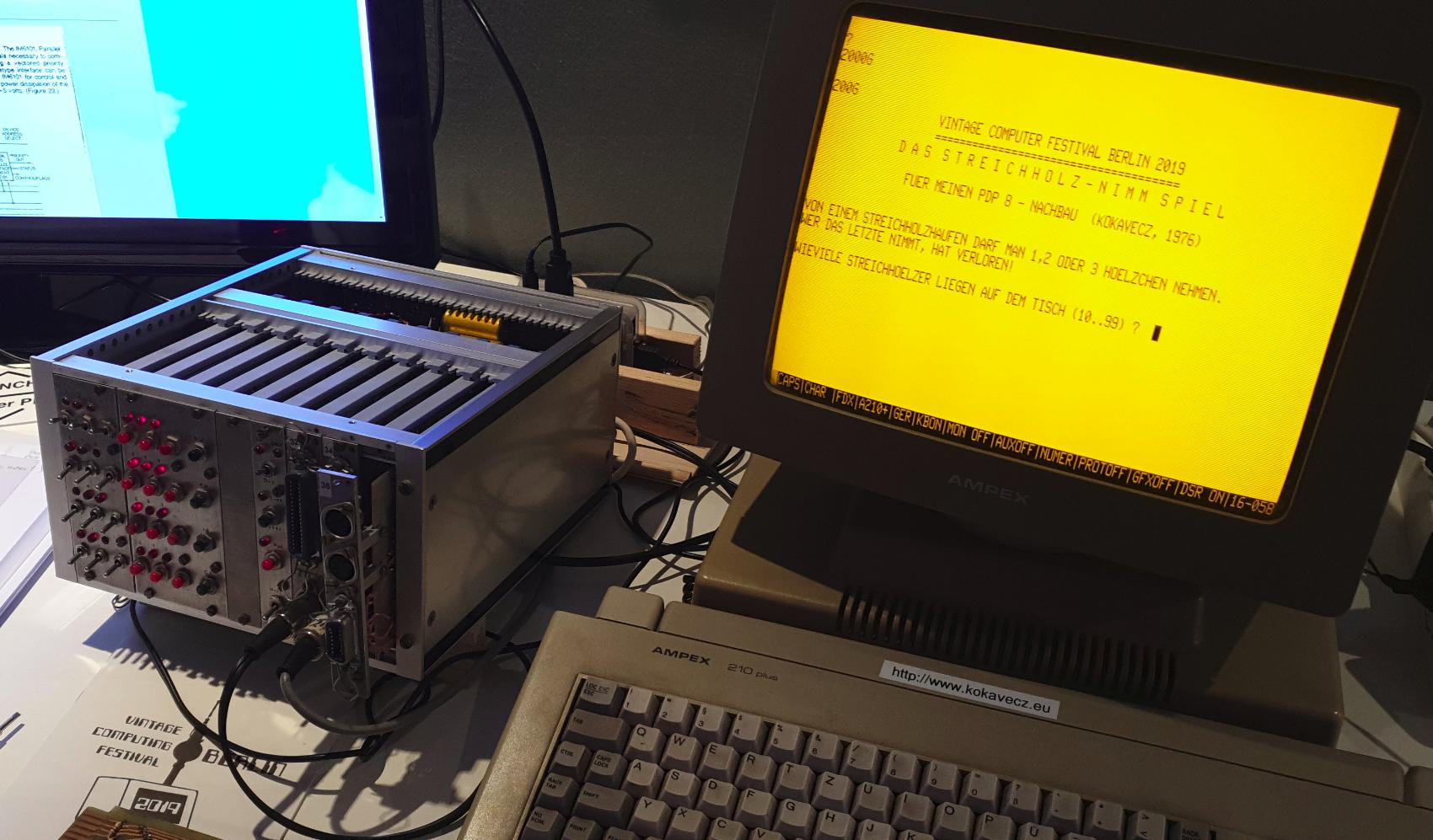
PDP-8 cloneOver the course of this year, I’ve been looking a bit into mainframe and mini-computers of the 1960s and 1970s, especially DEC’s PDP range of computers. When looking at the PDP-8 in particular I always thought of it as a pretty powerful machine given its size. But when looking more closely I noticed that is not really the case, despite its size. There wasn’t really an ‘operating system’ for the machine if you define the term operating system as something like CTSS, Multics or Unix. One particular exhibit at the festival that was very interesting to me in this regard was a PDP-8 clone that two students built in 1976 at a German university with a chip from Intersil that implemented a PDP-8. The picture on the left shows their machine that still works today which they operated at the time with a teletype terminal that they picked up when it was decommissioned elsewhere. More pictures can be found here. When I asked them why they built their computer they said ‘because we wanted to have our own computer’. Programs were available on tape from the neighboring department that had a ‘real’ PDP-8. Like the original PDP-8, their clone had 4 kwords of 12 bit memory which corresponds to the 12 bit address architecture of the machine. 4 kwords of memory, that’s not very much if you want to have an operating system on it. What I also found interesting in this regard is that this shows that many people where actually building their own computers by the mid- to end 1970s and the MITS Altair 8800 did not come out of the blue.

There were obviously many other very interesting things to see on the stands of the other 45 exhibitors and I also learnt a lot in the talks I attended. Too many things to just list them here. The PDP-8 clone exhibit, however, was the one that inspired me the most. Videos of all talks are available on media.ccc.de but the majority, except for example the talk on a new B-compiler for the PDP-8, are in German. Enjoy!