Rolandt
Shared posts
Crowdsourced Fact-Checking Doesn’t Work for Microtargeted Information

Mark Zuckerberg testified to congress this week. The testimony was supposed to address Facebook’s move into the currency market. Instead, they mostly talked about Facebook’s policy of not banning or fact-checking politicians on the platform. Zuckerberg roots the policy in values of free expression and democratic ideals. Here is a quick primer on why that rationale is ridiculous.
For background, Facebook does partner with third party fact-checkers, but exempts politicians’ organic content and paid advertisements from review. This policy is not new. Here is an overview of the policy’s parameters.
To summarize the company’s rationale, Facebook believes that constituents should have unadulterated knowledge about political candidates. When politicians lie, the people should know about it, and they will know about it because of a collective fact-checking effort. This is premised on the assumption that journalists, opposing political operatives, and the vast network of Facebook users will scrutinize all forms of political speech thus debunking dishonest claims and exposing dishonest politicians.
In short, Facebook claims that crowdsourced fact-checking will provide an information safety net which allows political speech to remain unregulated, thus fostering an optimally informed electorate.
On a simple technical level, the premise of crowdsourced fact-checking on Facebook does not work. The reason crowdsourced fact-checking cannot work on Facebook is because content is microtargeted. Facebook’s entire financial structure is premised on delivering different content—both organic and advertised—to different users. Facebook gives users the content that will keep them “stuck” on the site as long as possible, and distributes advertisements to granular user segments who will be most influenced by specific messages. For these reasons, each Facebook feed is distinct and no two Facebook users encounter the exact same content.
Crowdsourced fact-checking only works when “the crowd” all encounter the same facts. On Facebook, the this is not the case, and that is by design. Would-be fact-checkers may never encounter a piece of dishonest content, and if they do, those inclined to believe the content (because it supports their existing worldview) are less likely to encounter the fact-checker’s debunking.
Facebook’s ideological justification for unregulated political speech is not just thin, it’s technically untenable. I’m going to assume that Zuckerberg understands this. Facebook’s profit motive thus shines through from behind a moral veil, however earnestly Zuckerberg presents the company’s case.
Jenny Davis is on Twitter @Jenny_L_Davis
Headline image via: source

'An indictment of South Africa': whites-only town Orania is booming | Cities
mkalus
shared this story
from  The Guardian. The Guardian.
|
October in Orania can be charming. When the sun sets, long ribbons of burnt orange settle on the horizon. The flies and mosquitoes that come with the summer’s oppressive heat haven’t arrived yet. It is Magdalene Kleynhans’ favourite time of year. “You can sit outside until late into the night,” says the businesswoman, whose family spends much of their time outdoors. Her children fish from the banks of the Orange River whenever they choose. Kleynhans leaves the house unlocked. “It’s a good life. It’s a big privilege.”
But there is much more to this small Northern Cape town than the bucolic ideal painted by Kleynhans. Incredibly, 25 years after the fall of apartheid, Orania is a place for white people only.
Kleynhans runs one of Orania’s biggest enterprises: a call centre whose business is recruiting and retaining members for Solidariteit, a trade union primarily for Afrikaner workers, and Afriforum, a self-styled “civil rights” movement. Afriforum recently met with US president Donald Trump’s administration and Tucker Carlson of Fox Nows to tell them that Afrikaners are facing a widely discredited genocide. Both have made extensive investments in Orania’s construction boom.
Oranians claim the town is a cultural project, not a racial one. Only Afrikaners are allowed to live and work there to preserve Afrikaner culture, the argument goes.
Magdalene Kleynhans owns a call centre that employs around 55 people in Orania
The reality, however, is a disquieting and entirely white town, littered with old apartheid flags and monuments to the architects of segregation. While there are no rules preventing black people from visiting, those who live nearby fear they would be met with violence.
The town has faced numerous calls for it to be broken up over the years, with prominent author and advocate Tembeka Ngcukaitobi arguing its existence violates South Africa’s successful dismantling of racial segregation. “Orania,” he says, “represents downright hostility to the idea of a single, united, non-racial country.”
Large-scale eviction
Orania was created in 1991, a year after Nelson Mandela’s release from Robben Island, and three years before the country’s first democratic election.
Set among lush pecan nut orchards in the otherwise arid Karoo, it was set-up as an Afrikaner-only hamlet, not dissimilar from the ethnic Bantustans established under former prime minister, Hendrik Verwoerd, often dubbed the “architect of apartheid”.
Busts of former presidents of the town surround the statue of town mascot De Kleine Reus (The Little Giant), a young boy rolling up his sleeves, intended to symbolise the Oranians’ belief in self reliance
By the end of the 1980s, the probability of losing control had already occurred to many Afrikaners, with some believing that impending democracy posed an existential threat to the white Afrikaans way of life. A few felt protecting that required becoming a demographic majority somewhere, rather than remaining a minority everywhere.
So a small group of Afrikaners – Verwoerd’s daughter and son-in-law, Carel Boshoff, among them – purchased a strip of land on the southern banks of the Orange River, and went about setting up a volkstaat, or independent homeland, where Afrikaners would decide their own affairs.
Orania’s founders did not settle on virgin territory, but on the remains of a half-realised 1960s project to build canals and dams along the Orange River. A community of 500 poor black and mixed-race squatters who had made their homes in the buildings left behind by the project stood between the new owners and their whites-only vision.
Black people are restricted to using the petrol station on the edge of Orania
Speaking to the community after the purchase, Boshoff reportedly said he “did not buy a bus with passengers”. What followed, according to Cambridge historian Edward Cavanagh’s history of land rights on the Orange River, was one of the last large-scale evictions under apartheid. It was carried out by the future residents of Orania, with the assistance of beatings, pistol whippings and dogs.
The population has doubled
After three decades as a quiet backwater, Orania is booming. Its population – currently around 1,700 – has doubled over the last seven years. The most recent census estimates growth of more than 10% a year, outstripping most comparable rural towns and more, proportionally, than South Africa’s biggest cities.
Population growth means a flourishing housing market and construction industry. Neat suburban homes have been joined by new apartment blocks and walkups which sell for as much as R1.5 million (£80,000), putting them on par with comparable homes in Johannesburg. There is an industrial zone of brick and aluminium factories which sell their products around South Africa. China buys most of the pecan nuts.
The growth shows no signs of slowing. A sewage works meant to accommodate 10,000 future residents is in the pipeline. There are designs to transform the town’s humble technical training facility – where many of the skills driving the town’s new construction were taught – into a university.
Not a single brick has been laid by a black worker. In a reverse of the usual situation in South Africa, all low-paying work in Orania – from keeping the town’s gardens to packing the shelves in its grocery stores – is performed by hard-up white Afrikaners. It is increasing numbers of poor labourers, whose tenancy is often less secure and who either rent or rely on subsidies from Orania’s cooperative bank, who are largely behind the town’s growing population.
All low-paying work in Orania is performed by hard-up white Afrikaners. The town also has its own currency, the ‘Ora’.
Orania is owned by the Vluytjeskraal Aandeleblok (Vluytjeskraal Share Block) company which, together with a series of internally elected bodies, is responsible for the town’s municipal decision making.
People who want to live in Orania buy shares in the Vluytjeskraal Aandeleblok, instead of freehold. The screening of prospective shareholders allows for tight control. Buyers undergo extensive vetting, central to which is their fidelity to Afrikaans language and culture, a commitment to employing only white Afrikaners, and a string of conservative Christian undertakings. Unmarried couples, for instance, cannot live together.
The town exists at the mercy of the South African constitution. In the early 2000s, a planned remapping of boundaries that would have brought Orania under the control of a democratically elected municipality appeared to spell the end, but the town successfully appealed to the high court using the constitutional rights of the country’s minority cultural groups.
Pursued and harassed
A quarter of a century after the end of apartheid, black people are restricted to using the filling station on the edge of Orania. Benjamin Khumalo* is one of them.
The 55-year-old and his wife, who have lived on a small nearby plot since the 1980s, were once pursued and harassed by a pickup truck covered with Orania stickers when walking home after an evening with friends. “Now you must run,” he urged his wife, pushing her through a fence. “I’ll be behind you.”
Khumalo still remembers when Orania was a home for black families. The guns carried on the hips of many Oranians, however, have been enough to convince him never to enter the town again. “They will hurt you,” he says. “There is nothing we can do.”
Unsurprisingly, Orania’s white residents have a different take. The town’s doctor, Philip Nothnagel, describes South African cities as “warzones”. He lived in the country’s administrative capital, Pretoria, before he moved to Orania. The 10 months since have been the best of his life, he says.
“It’s the first time in history that a country has been established without a war,” he adds, sporting a Lincolnesque beard after he dressed up as Paul Kruger during recent celebrations of the Boer hero. “It’s like boere [white Afrikaners] Disneyland. Except you never have to go home.”
Noticeboards at a local restaurant carry a warning to European journalists.
The spectre of Verwoerd, the architect of apartheid, is difficult to escape. His portrait and bust seem to be around every corner. His wife, Betsie, is buried in the town, and her old home has been converted into a Verwoerd museum.
His grandson Carel Boshoff junior is a former leader of the Orania Movement, which first proposed the idea of Orania in the 1980s. Boshoff junior is perhaps one of the more unlikely fans of the pianist Abdullah Ibrahim, whose music plays on a laptop in his office.
Like his parents and grandparents, Boshoff fears white Afrikaners face a real threat of “being wiped out”, either through violence or what he calls “amalgamation”. He believes the recent expansion of Orania is just the start.
Verwoerd’s grandson, Carel Boshoff junior, worries white Afrikaners could be ‘wiped out’
“We are something like the phoenix in the ashes,” he says. “The questions to which Orania is the answer are so fundamental to the structure of South African society that you can’t express and affirm your Afrikaner identity without coming to the conclusion of a bigger Orania.”
Offended by Orania
Orania has continued largely uncontested since its victorious appeal to the high court in the early 2000s. The ANC government does not appear to be considering an appeal of the high court decision. Zamani Saul, head of the ANC-run Northern Cape government, has said an inquiry into Orania’s legal status is yet to be concluded.
For Ngcukaitobi, the author, Orania “represents the reversal of the constitutional project of national building.” The rights that underpinned the town’s high court challenge against the remapping are not unlimited, he says. Anyone who cares about South Africa “would rightly be offended by what Orania represents, which is an enduring legacy of racial mobilisation”.
Orapeleng Moraladi, Northern Cape secretary of the Congress of South African Trade Unions, blames the town’s continued existence on the courts, an uncooperative Orania leadership, and a lack of political will from the ANC. “[The town] is like embracing an apartheid system within a democratic state,” he says. “Orania is an indictment of the government of South Africa.”
*Indicated names have been changed
Follow Guardian Cities on Twitter, Facebook and Instagram to join the discussion, catch up on our best stories or sign up for our weekly newsletter. Share your views here on how South African cities have changed in the last 25 years
Is tech adoption really that random? A VHS vs Betamax redux!
I worry a bit that people are adopting an overly fatalist perspective on tech adoption. This perspective has become almost a reflex–we can’t possibly know or predict what technology will end up being widely adopted and often the “worse” technology wins, so just don’t even try!
I acknowledge there is some underlying randomness at work here but it would be a shame if it were totally random, right? Why would you bother trying to create any new technology if its fate will be decided by coin flip? But if it’s not totally random then there must be some underlying principles, so what are they? I’ve started looking at a few examples of this (and would love to hear others in the comments) and I hypothesize a simple rule: if a technology is at least an order of magnitude better for some key factor(s) evaluated by market participants, and not substantially worse for other factors, it either finds a niche or takes over the market. And the corollary of this claim is that if a technology isn’t substantially better for key factors, there’s a certain degree of randomness and path dependence that determines what technologies get adopted.
Let’s look at some examples.
VHS vs Betamax
The way this is usually presented is that Betamax was the better technology (it had higher picture quality, supposedly), but VHS won out, because ‘worse is better’. Geez, I’m disappointed that people are so readily able to accept such a shallow explanation. Implicit assumption: the adoption game is totally random in who it rewards with victory, and maybe it even actively rewards bad quality! But let’s look closer:
- The picture quality wasn’t better, at least in any obvious way, here’s a quote from Why VHS was better than Betamax: “Standing in a shop at the time, there was absolutely no visible difference in picture quality, and some reviews had found that VHS’s quality was superior.”
- Betamax was more expensive, at least at first
- And the kicker: VHS had a 2 hour recording time, long enough to record a movie, while Betamax opted for a smaller, sleeker form-factor that could only record 1 hour!
- It’s very much a ‘winner take all’ market due to positive feedback loops (e.g. the more people who own VHS players, the more likely video rental stores are to stock VHS, which leads to more people wanting to own VHS), so the difficulty of catching up increases with time.
There are always multiple factors that go into comparing the utility of products, and different buyers in a market will weight those factors differently, which is why markets can have different niches. In the format wars, we have price, recording time, picture quality, and availability of content in that format, among others. But both VHS and Betamax were in the same ballpark on all these key factors, so they faced direct competition in a market with network effects and VHS had the edge in the factors that mattered to most people. But, as a thought experiment, I hypothesize:
- If Betamax picture quality had been miraculously 100x, equivalent to a modern 4k TV, it would have found a niche, even if it were more expensive than VHS and had the same limited recording time. There is always a segment of the market that will pay a premium for obvious quality for some key factors. And most likely, the obvious picture quality would spur huge investment in compensating for the other factors that VHS had an edge in.
- If Betamax had a 5 year head start, it might have reached the tipping point where VHS recording time superiority wasn’t enough. (More likely, Betamax could have developed a longer recording time format before VHS had a chance to catch up.)
Consistent with my hypothesis: the market later moved on to DVDs (superior picture and sound quality, no degradation over time, and random access / interactivity), at around the time where these improvements in key factors were sufficient to overcome the inertia of VHS.
Other format wars have worked similarly—formats roughly equivalent in key factors were introduced around the same time, and faced direct competition in a winner-take-all market.
QWERTY vs other keyboard layouts
The QWERTY keyboard layout was a relic from the typewriter era, designed to actively prevent higher typing speeds that would jam the typewriter, and it got carried over to computer keyboards. The trouble is that none of the alternate layouts have been able to show a big enough improvement in typing speed or any other factor. Really, how much better is some super-custom keyboard layout, once you invest all the time in getting fluent with it? Maybe 2x, if that? But you could also improve your typing speed just by learning to touch-type better, which also would carry over to other keyboards you have to use!
On the other hand, as a thought experiment, what if DVORAK were 10x faster than QWERTY? How about 100x faster? At a certain point, the improvement in a key factor becomes sufficient to overcome momentum of the existing technology and find a niche or take over the market. And we have some evidence for this: stenography has existed in parallel alongside QWERTY, because its speed over QWERTY made it more useful than QWERTY for some segment of the market.
RethinkDB vs MongoDB
RethinkDB vs MongoDB is an interesting case. MongoDB beat RethinkDB to market and was faster at first, while RethinkDB took their time and focused on correctness and safety (which many using NoSQL cared less about). Both technologies were in the same ballpark for all factors and faced direct competition.
Time for some wild speculation into human psychology
A funny story is that I myself accepted the usual explanation about VHS vs Betamax without much thought. Then after I started working on Unison people often asked me questions about programming language adoption and I realized how depressing it was for me to accept the premise that it was really just a harsh, cruel, and totally random world out there. According to this premise there was an excellent chance that nothing I worked on would be picked up by anyone else while other technologies I liked a lot less became wildly popular for no apparent reason. While feeling somewhat down in the dumps after one of these conversations I got a bit more curious about VHS vs Betamax… a couple hours of feverish internet research and hope was restored. The world actually makes sense, kinda!!!
The question I asked myself later: why did I so readily accept the earlier explanation of the “harsh cruel and random world”? Like all myths it has an element of truth. In the small, there is a lot of randomness at play, and we should acknowledge this reality. But the world is also not totally random and this fact becomes obvious even on cursory examination. If we’re really being honest, I think this “harsh, cruel, random” explanation is just another way of rationalizing inaction. If the world is really random, you aren’t responsible for how things play out and you might as well not bother doing anything, right? Just collect a paycheck and chill! The people trying to build actual new things are just suckers who are wasting their time.
When you are actually working on a big project, though, this kind of mentality would be super unmotivating, so it’s worth trying to understand whether this mentality reflects reality or if it’s something your brain has just accepted without much examination.
There’s hope!
Online alternatives to DevonThink? - Luhmann
Donovan wrote:
I still use Nimbus Note Pro and STILL don’t understand why more
>don’t.
>A great all-platform approach with OCR (only in PRO).
>iOS, Android, MAC, PC, Web
>https://nimbusweb.me/note.php
>
Find Me Examples/Studies Of [Community]
I get several emails per week from people asking me to hunt down unique examples of communities or academic studies of communities that support their view.
Even if I had the time, I doubt I’d be inclined to do it.
A better approach (and one I’ve taken often) is to find people who are excellent at research and hire them to do it.
Write to a dozen universities/colleges with phd programs, ask if any of their post-graduate students are looking for work, and task them with hunting down what you need.
For a few hundred bucks (aim for $25 to $35 per hour) you could have all the examples and research you need.
p.s. If you just want to stay informed of the latest research, try this.
Twitter Favorites: [dethe] Sewing friends, I bought a sewing machine almost 2 years ago, finally setting it up so I can hem some pants by week… https://t.co/8Tuxr5sNSs

Sewing friends, I bought a sewing machine almost 2 years ago, finally setting it up so I can hem some pants by week… twitter.com/i/web/status/1…
The Future of Education

eLearning Africa, Abidjan, Cote d'Ivoire (Panel) Oct 24, 2019 [Link] [Video]
Rethinking Open Universities: What Makes Them Unique?

According to this article (15 page PDF), in order to address the perception of quality, the UK Open University (UKOU), "structured regional networks with shared responsibilities, to offer all the elements that make up a university including headquarters, regional offices, and even spaces for students. This form of networked university is what differentiates open universities from the traditional university model and constitutes a unique feature of this type of educational institution." Image: The Conversation.
Web: [Direct Link] [This Post]Nuance, feedback, and disagreement — reflecting on OpenEd19

Because I haven't been to OpenEd for some 15 years I guess I am not part of the 'the open education community'. So the firestorm over that panel missed me completely, or it did, at least, until I saw a headline for a Chronicle paywalled article. But you don't need to pay for this story; it's all over the #OpenEd19 Twitter space. The gist: the organizers of OpenEd19 in Phoenix decided to convene a panel of commercial publishers. There could be questions, but they would be pre-screened and vetted. There was a storm of protest, and then organizers cancelled the panel, citing "posts that were abusive and harassing" (I read the full Twitter thread and confess I didn't find any such. Doesn't mean it didn't happen). See also this article and this article for more coverage.
Web: [Direct Link] [This Post]Futzing and moseying: interviews with professional data analysts on exploration practices
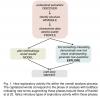
I mentioned this article during my workshop yesterday. It examines what people actually do when they do exploratory data analysis’ (EDA). The answer i in the title: futzing and moseying. What that means is that, once they've collected the dat, they follow an informal and unstructured process of looking to see what's there. "A lot of putzing, a lot of trying to parse our text logs to see if I could find anything helpful… I don’t know, just poking around with things and see what happens." This post is a summary of Futzing and moseying: interviews with professional data analysts on exploration practices Alspaugh et al., VAST’18.
Web: [Direct Link] [This Post]The Second Wave of Preprint Servers: How Can Publishers Keep Afloat?
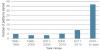
This article points to a massive surge in the number of article pre-print platforms (illustrated) and asks how more traditional journals can survive. The authors write that "Our interviews with authors indicate that early and fast dissemination is the primary motive behind preprint posting. In addition, the increased scope for feedback seems to be highly valued, with much of this interaction taking place via Twitter and email, rather than via direct comments on preprint servers." Also free access. Let's not forget free access. Anyhow, journals can respond, they say, by beating them, joining them, or waiting them out. None of these is likely to be successful, in my view.
Web: [Direct Link] [This Post]News: Arise All Ye Notebooks

Tony Hirst describes (in detail) some arising alternatives to Jupyter Notebooks. First, "Netflic have announced a new notebook candidate, Polynote [code], capable of running polyglot notebooks (scala, Python, SQL) ." Next, he writes, "Streamlit.io is another new not-really-a-notebook alternative, pip installable and locally runnable." Third, he notes, "Wolfram have just announced their new, “free” Wolfram Notebooks service, the next step in the evolution of Wolfram Cloud (announcement review], I guess?"
Web: [Direct Link] [This Post]A Letter to the Prime Minister
Elizabeth May’s letter to Prime Minister Trudeau is a well-worded setting of the table for a more collaborative Parliament.
How to save the world while making people better off
Hi, it’s Lisa! I’m responsible for design & blogging at Datawrapper. Climate change is a big topic these days, but most (data visualizations) show the causes and potential consequences, not possible solutions. I wanted to change that, so I’ve tried to understand the idea of the Carbon Fee & Dividend better. It’s basically a carbon tax that shares its revenue equally among the population. I’ll explain the concept here with a few of our tables:

Carbon emissions are bad for the climate, so let’s get rid of them. But how? One idea is the carbon tax: It’s a “price” for each tonne of CO2 a country consumes. Let’s assume we start taxing each tonne CO2 with €50. When you go to the shop tomorrow and buy stuff that accounts for 1 tonne of CO2 (e.g. 440 liters of gasoline), you’ll pay €50 more for it at the register. The goal is that this makes you buy less in the first place.
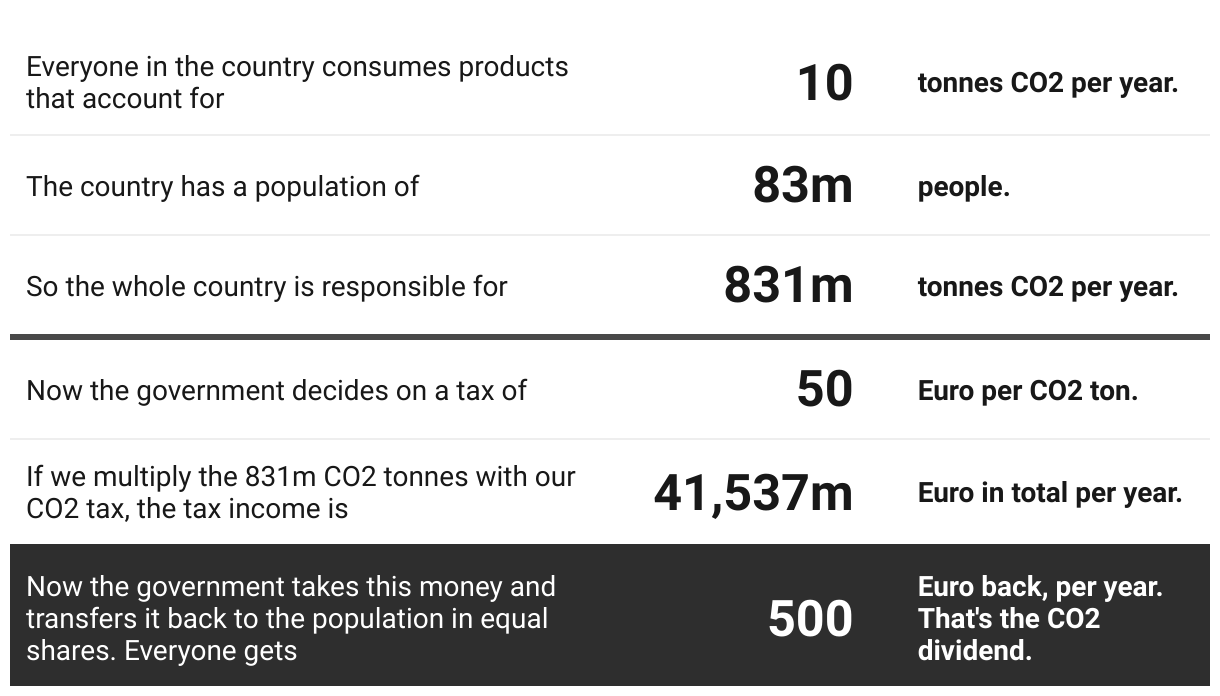
Each German accounts on average for 9.7 tonnes of CO2 per year. (Let’s round this up to 10 tonnes.) If you buy products that cause exactly these 10 tonnes CO2, you’ll pay €500 per year more thanks to the carbon tax.

That’s a lot. That’s especially a lot for people with less income. And that’s why smart people had the idea that the government doesn’t keep the tax revenues, but that it transfers the €500 back to you. It’s called a “carbon dividend” (a dividend is money paid to shareholders out of profits). Let’s do the math again for the whole country:
Equalizing society
The carbon tax in combination with the dividend sets an incentive to look for low-carbon alternatives (public transport instead of the car).
But the carbon dividend is also a good equalizer. If your income is low, you spend less money in general, and therefore less money on carbon-intense products (there’s a reason why developing countries have low CO2 emissions per capita). When you account for 6 tonnes of CO2 while everyone else accounts for 10, you’ll spend just €300 more on products in a year…but the government will still give you your dividend of €500. A win of €200!

And that €200 can make a difference. €200 feels like a 1% raise to you when you earn €20k, but it’s only a 0.2% raise when you earn five times as much.
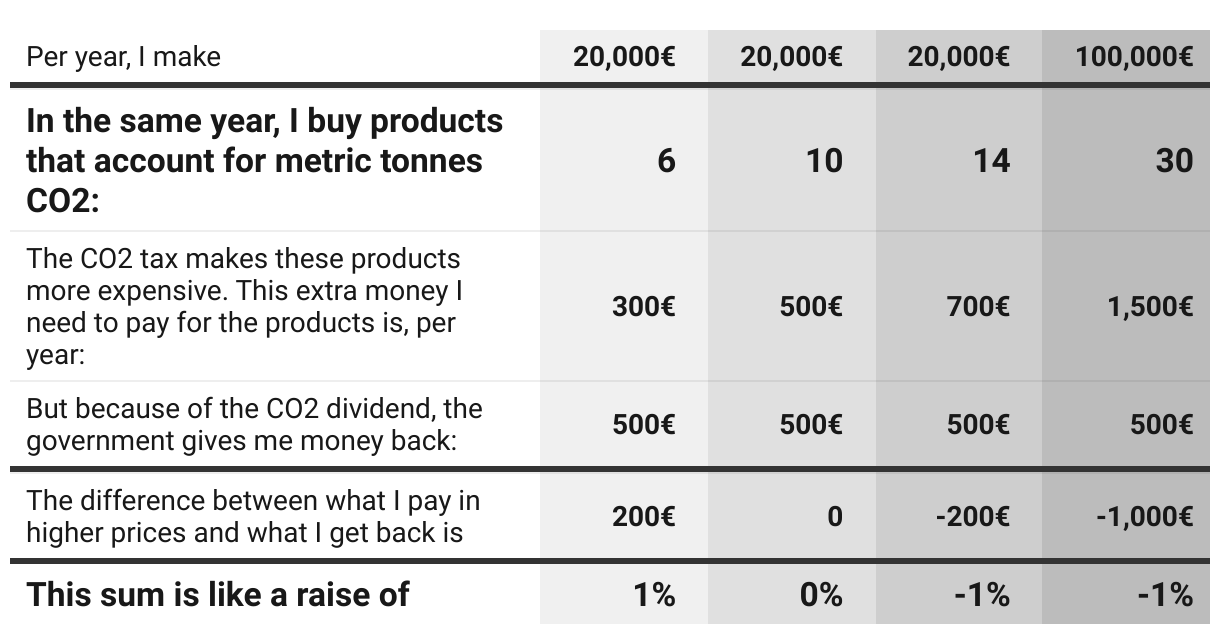
So the carbon dividend favors the ones with less income, in absolute and relative terms. “According to the US Treasury Department, the bottom 70 percent of Americans would receive more in dividends than they would pay in increased energy prices,” self-called policy entrepreneur Ted Halstead explains in his TED talk about the carbon dividend. "That means 223 million Americans would win economically from solving climate change."[1]
That’s the idea: Rich people pay the carbon tax to buy rich-people-stuff, and the tax revenue flows to low-income earners.
A tax that wants to get rid of itself
Carbon dividends are systems that influence themselves: How much dividend the government transfers to you, depends on how much carbon taxes it collects. And that depends on how much money we all spend on CO2-intense products. And that depends on how much these products cost. And they cost more because of the carbon tax.
So the goal of the carbon tax is to lower CO2 emissions, and therefore to lower the carbon tax revenue, and therefore to lower the dividend.

And there’s so much potential to lower these emissions. People in the UK emit 3.9 tonnes CO2 per capita per year less than Germans do. That’s not because the British live more environmentally conscious than Germans, but because of a different electricity mix.
And Germans, Americans, Brits – almost all countries decreased their CO2 emissions already, through innovations and regulations:
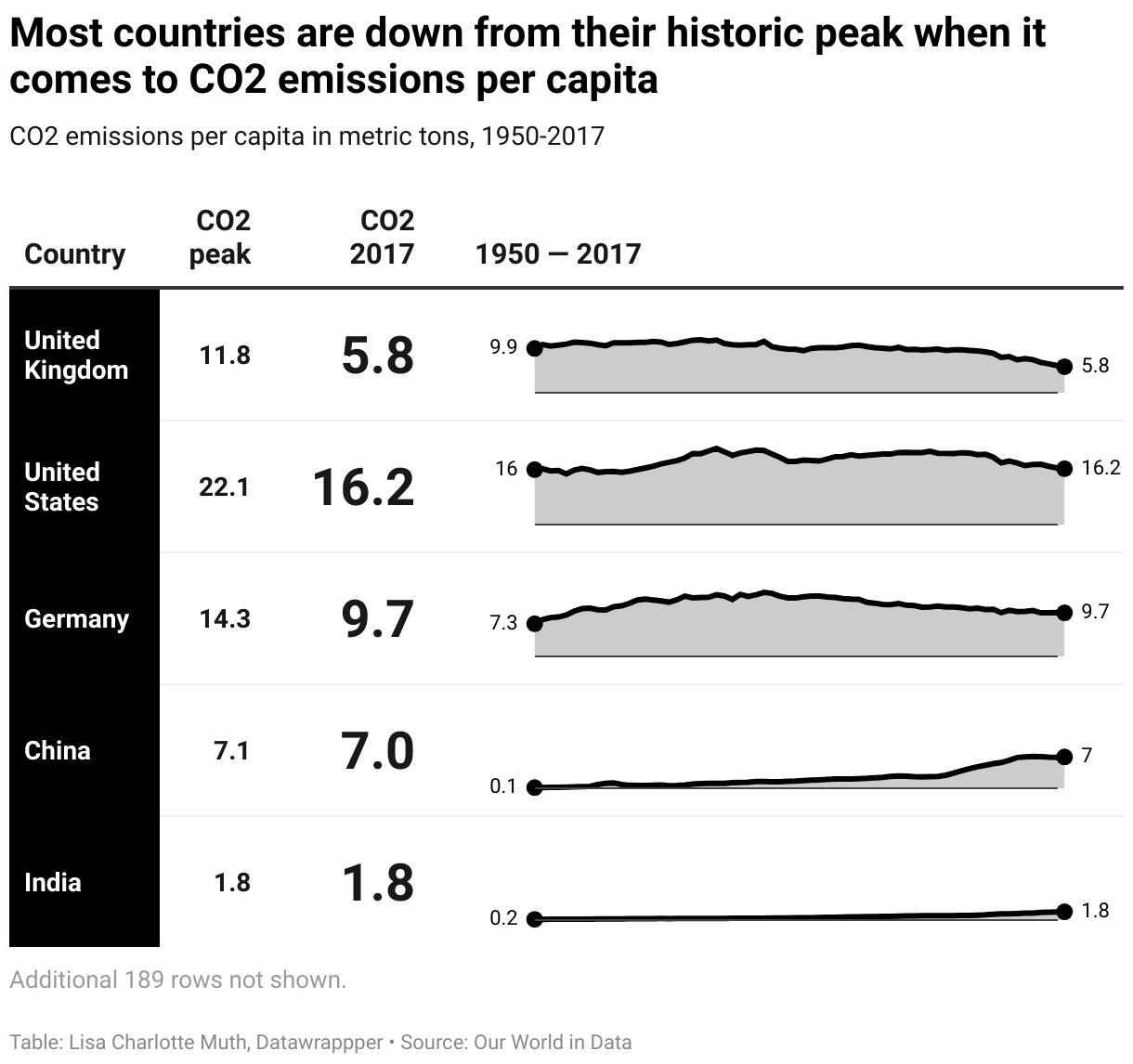
There’s lots this article doesn’t talk about: Like the question if we should tax CO2 emissions or CO2 equivalents (and what they are in the first place). Or what impact yearly increasing carbon taxes have on the dividends. Or how the process of taxing works exactly. Or how we’d deal with imports and exports. If you’re interested in learning more, I can recommend Ted Halstead’s TED talk and the FAQs on the website of the Carbon Tax Center. See you next week!
The source for this statement is the last page of the working paper “Methodology for Analyzing a Carbon Tax” (PDF) by the Office of Tax Analysis, published in 2017. However, a paper by the Citizens’ Climate Lobby – also advocating for the carbon dividend – assumes that 53% of US families and 58% of individuals would gain, not 70%. ↩︎
Longtime Mozilla board member Bob Lisbonne moves from Foundation to Corporate Board; Outgoing CEO Chris Beard Corporate Board Term Ends
Today, Mozilla Co-Founder and Chairwoman Mitchell Baker announced that Mozilla Foundation Board member Bob Lisbonne has moved to the Mozilla Corporation Board; and as part of a planned, phased transition, Mozilla Corporation’s departing CEO Chris Beard has stepped down from his role as a Mozilla Corporation board member.
“We are in debt to Chris for his myriad contributions to Mozilla,” said Mozilla Chairwoman and Co-Founder Mitchell Baker. “We’re fortunate to have Bob make this shift at a time when his expertise is so well matched for Mozilla Corporation’s current needs.”
Bob has been a member of the Mozilla Foundation Board since 2006, but his contributions to the organization began with Mozilla’s founding. Bob played an important role in converting the earlier Netscape code into open source code and was part of the team that launched the Mozilla project in 1998.
“I’m incredibly fortunate to have been involved with Mozilla for over two decades,” said Bob Lisbonne. “Creating awesome products and services that advance the Mozilla mission remains as important as ever. In this new role, I’m eager to contribute my expertise and help advance the Internet as a global public resource, open and accessible to all.”
During his tenure on the Mozilla Foundation board, Bob has been a significant creative force in building both the Foundation’s programs — in particular the programs that led to MozFest — and the strength of the board. As he moves to the Mozilla Corporation Board, Bob will join the other Mozilla Corporation Board members in selecting, onboarding, and supporting a new CEO for Mozilla Corporation. Bob’s experience across innovation, investment, strategy and execution in the startup and technology arenas are particularly well suited to Mozilla Corporation’s setting.
Bob’s technology career spans 25 years, during which he played key roles as entrepreneur, venture capitalist, and executive. He was CEO of internet startup Luminate, and a General Partner with Matrix Partners. He has served on the Boards of companies which IPO’ed and were acquired by Cisco, HP, IBM, and Yahoo, among others. For the last five years, Bob has been teaching at Stanford University’s Graduate School of Business.
With Bob’s move and Chris’ departure, the Mozilla Corporation board will include: Mitchell Baker, Karim Lakhani, Julie Hanna, and Bob Lisbonne. The remaining Mozilla Foundation board members are: Mitchell Baker, Brian Behlendorf, Ronaldo Lemos, Helen Turvey, Nicole Wong and Mohamed Nanabhay.
The Mozilla Foundation board will begin taking steps to fill the vacancy created by Bob’s move. At the same time, the Mozilla Corporation board’s efforts to expand its make-up will continue.
Founded as a community open source project in 1998, Mozilla currently consists of two organizations: the 501(c)3 Mozilla Foundation, which backs emerging leaders and mobilizes citizens to create a global movement for the health of the internet; and its wholly owned subsidiary, the Mozilla Corporation, which creates products, advances public policy and explores new technologies that give people more control over their lives online, and shapes the future of the internet platform for the public good. Each is governed by a separate board of directors. The two organizations work in concert with each other and a global community of tens of thousands of volunteers under the single banner: Mozilla.
Because of its unique structure, Mozilla stands apart from its peers in the technology and social enterprise sectors globally as one of the most impactful and successful social enterprises in the world.
The post Longtime Mozilla board member Bob Lisbonne moves from Foundation to Corporate Board; Outgoing CEO Chris Beard Corporate Board Term Ends appeared first on The Mozilla Blog.
The Best Carry-On Luggage

We’ve tested 47 bags over the past five years and are convinced that the Travelpro Platinum Elite is the best carry-on luggage for most travelers. It packs five days’ worth of clothes into standard US carry-on dimensions and has premium build-quality touches you’d expect from a $500 bag at about half the price. It’s a bag that you can rely on for life, even if it’s damaged by airlines—a rarity at any price.
ELI’s 7 Things about Domain of One’s Own

Well, Domain of One’s Own has finally hit the big time  Earlier this week the 7 Things to Know about Domain of One’s Own case study was published by the EDUCAUSE Learning Initiative. You can download it from their site, but I’m keeping a version here for posterity as well. I was lucky enough to work on the paper with Martha Burtis, Sundi Richard, Lora Taub-Pervizpour, and Keegan Long-Wheeler to brainstorm with ELI’s Malcolm Brown, Greg Dobbin, and Stephen G Pelletier to try and frame this in a way so that folks will get a sense of what it actually is. I really like the first paragraph of the “What it is?” because it captures nicely how Domains is a powerful combination of philosophy, practice, and tech:
A way of thinking as well as an application of technology, Domain of One’s Own refers to the practice of giving students, faculty, and staff the opportunity to obtain a domain with hosted web space of their own …. By enabling users to build environments for learning and sharing, such domains make possible a liberating array of practices that encourage users to explore how they interact with and present themselves in the online world. While giving users more control over their scholarship, data, and digital identity, these domains encourage an ethos of openness, freedom, and exploration and nurture a practice for shaping and thinking about one’s presence on the web. DoOO also draws users into a community of practice focused on collaboration and sharing.
These concepts were at the heart of the experiment when it started at UMW, and more and more schools are picking up on the simultaneously practical and idealistic vision of making the open web a viable platform for teaching and learning. That’s an awesome thing and can and should be celebrated. It’s taken many, many folks to make it work, and there is no way a two-page report will capture all the nuance and history, but it does an excellent job of providing a snapshot for folks who are dreaming about re-centering ed tech around student, staff, and faculty-driven web for teaching and learning. Avanti!
RT @ben_machell: Billy Elliot reboot, but with Rees-Mogg’s son secretly playing rugby league against the backdrop of the bitter 2019 Conser…
mkalus
shared this story
from  mrjamesob on Twitter. mrjamesob on Twitter.
|
Billy Elliot reboot, but with Rees-Mogg’s son secretly playing rugby league against the backdrop of the bitter 2019 Conservative government strike

 mrjamesob
on Thursday, October 24th, 2019 7:09pm
mrjamesob
on Thursday, October 24th, 2019 7:09pm1563 likes, 322 retweets
RT @davidallengreen: Why do Brexiters say that the 2016 referendum result is the "will of the people" and not the 2017 hung parliament, whi…
mkalus
shared this story
from  piris_jc on Twitter. piris_jc on Twitter.
|
Why do Brexiters say that the 2016 referendum result is the "will of the people" and not the 2017 hung parliament, which is fixed to last to 2022?
Why should there be another vote for the second, before the expiry of the fixed term?
Both are "wills of the people"

 piris_jc
on Thursday, October 24th, 2019 4:31pm
piris_jc
on Thursday, October 24th, 2019 4:31pm4316 likes, 1559 retweets
Sgt. Leonard Matlovich - bravery. discharged for coming out to his commanding officer as gay after 12 exemplary years in the military. “When I was in the military they gave me a medal for killing two men and a discharge for loving one.” 1975 pic.twitter.com/QQPA4juhBY
mkalus
shared this story
from  moodvintage on Twitter. moodvintage on Twitter.
|
Sgt. Leonard Matlovich - bravery. discharged for coming out to his commanding officer as gay after 12 exemplary years in the military. “When I was in the military they gave me a medal for killing two men and a discharge for loving one.” 1975 pic.twitter.com/QQPA4juhBY


108 likes, 19 retweets
Klaus Kinski and Werner Herzog, Cobra Verde, 1987 pic.twitter.com/6qNNviKPfL
|
mkalus
shared this story
from moodvintage on Twitter.
|

After the assassination of senator and presidential candidate R. F. Kennedy in 1968, a lot of Americans went to see his funeral car as it traveled by rail from New York to Washington.A photographer who traveled with the casket took this photo as the train passed through Baltimore pic.twitter.com/8ohO6M4if0
|
mkalus
shared this story
from moodvintage on Twitter.
|
After the assassination of senator and presidential candidate R. F. Kennedy in 1968, a lot of Americans went to see his funeral car as it traveled by rail from New York to Washington.A photographer who traveled with the casket took this photo as the train passed through Baltimore pic.twitter.com/8ohO6M4if0

126 likes, 20 retweets
From my inbox

Wenn mir irgendjemand vor 5 Jahren erzählt hätte, dass ich einmal eine Slim Fit tragen würde, ich hätte ihn ausgelacht. Aber so bin ich nun von Relaxed Fit, über Straight Cut bei Slim Fit angekommen. Danke, Bodo!
Apple TV app comes to Amazon’s Fire TV operating system in Canada

Just as Apple promised at its March 2019 keynote, the Apple TV app is now rolling out to some Fire TV devices in time for the launch of Apple TV+ on November 1st.
Amazon published a blog post today stating that Canadians who own the Fire TV Stick (Second Gen) and the Fire TV Stick 4K are getting the app today. Fire TV Basic edition users can also download the app today.
Anyone who owns a Fire TV Cube (1st and 2nd Gen), Fire TV (3rd Gen pendant design) and Toshiba and Insignia Fire TV Edition smart TVs will get the update soon, according to the Fire TV blog. Amazon mentions that you can follow the Fire TV Twitter account to get updates when the app launches on these platforms.
The app on Fire TV is much like it is on Roku. You can watch all of the content you’ve rented from Apple’s platforms in the past. Amazon’s blog post also mentions that when you rent something from Apple on another platform, they’ll instantly appear on the Apple TV app.
Beyond watching content from Apple Movies and TV, you can also watch Apple’s original content on Apple TV+ when it launches
In Canada Apple TV+ costs $5.99 per month in Canada and includes shows like For All Mankind, The Morning Show and See.
Source: Amazon Fire TV
The post Apple TV app comes to Amazon’s Fire TV operating system in Canada appeared first on MobileSyrup.
Es gibt gerade mal wieder ein paar kritische Firefox-Lücken.Eine ...
mkalus
shared this story
from  Fefes Blog. Fefes Blog.
|
Es gibt gerade mal wieder ein paar kritische Firefox-Lücken.
Eine sticht besonders heraus, finde ich:
#CVE-2019-15903: Heap overflow in expat library in XML_GetCurrentLineNumberDas muss man erst mal schaffen, eine Funktion namens GetCurrentLineNumber zu einem Sicherheitsrisiko zu machen!
NetMotion expands Victoria, B.C. office, solidifies partnerships with Rogers, Telus

Mobile software provider NetMotion has expanded its office in central Victoria, British Columbia, and has completed “strategic shared agreements” with Rogers, Shared Services Canada and Samsung Canada.
It has also expanded its existing partnership with Vancouver-based national carrier Telus, a press release said.
The Seattle, Washington-based company said in the release the expansion is a reflection of its growth and that its Victoria location is the biggest presence outside of the U.S.
“Our Victoria team has been instrumental in developing Mobile IQ, an incredibly complex piece of software that turns network data into powerful insights,” Joel Windels, CMO at NetMotion, said in the release. “As the team continues to grow, we needed to make sure we had a world-class environment for the team to work in — and with this move that’s exactly what we have.”
The release indicated that along with the U.S. and in Canada, the company will be hiring more staff globally at its locations in Japan, Australia, and the U.K.
“Canada offers a lot of growth potential for NetMotion, both in established markets such as law enforcement, as well as in fields such as logistics, hospitality, manufacturing and more, where we’re seeing a rapid shift to mobile-first technology adoption,” Gregg Fleet, NetMotion’s country manager for Canada, said in the release.
“Cellular coverage in Canada diminishes noticeably outside of urban areas. This presents obvious problems for professionals working remotely, on the road or in the field. NetMotion is made for these environments, helping users maintain a reliable network connection no matter where their work takes them.”
The post NetMotion expands Victoria, B.C. office, solidifies partnerships with Rogers, Telus appeared first on MobileSyrup.
Teaching Programming
During next week’s DojoCon Netherlands, the annual conference of the Dutch CoderDojo community, Felienne Hermans will be one of the keynote speakers (I’m one of others). Preparing for the conference I looked at the other speakers, and Felienne’s twitter stream ( pointed to her presentation at R Studion Conference 2019 early this year. It’s just under an hour long, but I watched it with pleasure.
The hand drawn slides are cool (can’t imagine the time that went into it, or at least the time I’d need for something like that.), and so is the story, about how to teach (children) programming.
Starting from the quote ‘Morning boys, how’s the water?‘, she says in contrast to e.g. reading, we don’t know much of anything about teaching programming. There’s no body of work (which is what she’s now building at Leiden University).
- That the way many of us acquired our own tech skills strongly shapes the assumptions about learning to code. Many people growing up in the 70s and 80s learned to work with computers by spending endless hours behind the keyboard, without parental oversight or guidance from knowledgeable adults. I definitely fall in this category too.
- That those experiences covertly influence the way the field thinks about teaching coding, where exploration and getting stuck and unstuck on your own is the way to go.
- Research of children learning Scratch suggests however that there are many drop-outs that way, that the acquired skill level flattens out quickly, and that there’s no efficiency gain visible in consequent activities of the children involved.
- Her research shows that age-old reading teaching tactics such as vocalisation and repeating out loud do work and show consistent results. And that tests work well too. Not to grade children, but to find out as a teacher where you are at.
- Oh, and that creating applications in Excel is real programming too. Don’t say, or let people say, that some form of something isn’t real work / the real thing.
I feel vindicated by that last point (made early in the keynote)  My meanest programming feat still is building the first intranet (2001/2) of my then employer by hand from scratch using the browser as a window on / to interact with Excel, the folder structure on the shared drives, and back-office systems like time writing, and having the browser grab stuff from Excel files. It was a jumble of HTML, Perl, Visual Basic, and Excel formulas, but it worked and helped cut significant time out of quality assurance processes and made things like starting a new project way easier and actually helpful for my colleagues, instead of being dreary bureaucracy for them. I’d never call myself a real programmer. But it was real programming. Even the tiniest little bits, like yesterday’s simple hack, are real.
Apple’s TV App Arrives on Amazon Fire TV Devices
Benjamin Mayo, reporting for 9to5Mac:
Apple today released the Apple TV app for Amazon TV devices, starting with the Amazon Fire TV Stick 4K and the older HD model. Support for Amazon Fire TV Cube, Fire TV (3rd generation penchant design) and some other models is coming soon.
The TV app experience on Amazon’s platform mirrors the functionality of the Roku app, which launched last week. Users can watch their purchased iTunes movies and TV shows, access Apple TV Channel subscriptions and watch Apple TV+ content when the streaming service launches on November 1st.
This isn’t a surprise, as the impending launch of Apple TV+ meant all previously-announced TV app platforms were likely to arrive before November 1st. Now that the app is available on Roku and Fire TV devices, plus Samsung TVs, the only platforms still waiting for support are smart TV sets from LG, Vizio, and Sony.
→ Source: 9to5mac.com
Personal Fireworks in Vancouver & Why They are So Last Century

 Photo by Emre Kuzu on Pexels.com
Kudos to City of Vancouver Councillor Pete Fry for bringing forward a motion banning personal fireworks in the city. This is after Councillor Fry’s successful motion for 30 km/h speed regulations for neighbourhoods which was recently passed at the last Union of British Columbia Municipalities conference.
Vancouver does a double speak when the City talks about green goals and sustainability but still hosts and promotes fireworks sales in October and a huge fireworks festival every summer. I have written before about “big bang” fireworks events being pretty last century, with emissions, noise and disturbance to wildlife in Stanley Park not to mention the impact on pets and people with noise sensitivities or Post Traumatic Stress Disorder (PTSD).
That big summer fireworks festival used to be hosted by a tobacco company and now gets sponsored by automobile companies. It’s a great party for everyone. But there are alternatives~in Colorado, Arizona and California dazzling drone light shows are choreographed. The cost is in the $15,000 to $25,000 range, comparable to big bang fireworks, and loud music is played to establish the ambiance. The tradeoff, beside less disturbance to wildlife, is proactively preventing what could be the next grass or forest fire.
Councillor Fry’s motion does exempt fireworks displays for public events, and will require fire permits from the City to “ignite, explode, set off or detonate display fireworks.”
As Justin McElroy with CBC writes “Currently, Vancouver’s bylaw restricts the sale of fireworks to Oct. 25-31 every year. There are also additional regulations during that time, and anyone breaking the city’s rules can face a $500 fine.”
The cities of Coquitlam, North Vancouver, Delta, Richmond, and Surrey have already banned fireworks. While Councillor Fry’s motion discusses the environmental impacts and noise, it also points to the damage. A front yard and street tree were set ablaze in Dunbar a few years back, with Fire having a slower response due to the street traffic. In 2015, a house in East Vancouver burned to the ground.
Vancouver Fire and Vancouver Police costs for fireworks related calls are annually just under $400,000. While fireworks vendors may not like any ban of their product, they are also not paying for the related costs for emergency services, or providing restitution to people, pets and wildlife impacted by their use.
Councillor Fry said it best-“This is one of those things that is probably better left in the past…There’s lots of business models that don’t stand the test of time, and this may well be one of them.”
You can read the Councillor’s motion here.
 Photo by Luke Barkhuizen on Pexels.com