Shared posts

08 Nov 03:56

State of Drupal presentation (October 2019)

by Dries

Last week, many Drupalists came together for Drupalcon Amsterdam.

As a matter of tradition, I presented my State of Drupal keynote. You can watch a recording of my keynote (starting at 20:44 minutes), or download a copy of my slides (149 MB).

Drupal 8 innovation update

I kicked off my keynote with an update on Drupal 8. Drupal 8.8 is expected to ship on December 4th, and will come with many exciting improvements.

Drupal 8.7 shipped with a Media Library to allow editors to reuse images, videos and other media assets. In Drupal 8.8, Media Library has been marked as stable, and features a way to easily embed media assets using a WYSIWYG text editor.

I'm even more proud to say that Drupal has never looked better, nor been more accessible. I showed our progress on Claro, a new administration UI for Drupal. Once Claro is stable, Drupal will look more modern and appealing out-of-the-box.

The Composer Initiative has also made significant progress. Drupal 8.8 will be the first Drupal release with proper, official support for Composer out-of-the-box. Composer helps solve the problem of Drupal being difficult to install and update. With Composer, developers can update Drupal in one step, as Composer will take care of updating all the dependencies (e.g. third party code).

What is better than one-step updates? Zero-step updates. We also showed progress on the Automated Updates Initiative.

Finally, Drupal 8.8 marks significant progress with our API-first Initiative, with several new improvements to JSON:API support in the contributed space, including an interactive query builder called JSON:API Explorer. This work solidifies Drupal's leadership position as a leading headless or decoupled solution.

Drupal 9 will be the easiest major update

A couple stares off into the distant sunrise, which has a '9' imposed on the rising sun.

Next, I gave an update on Drupal 9, as we're just eight months from the target release date. We have been working hard to make Drupal 9 the easiest major update in the last decade. In my keynote at 42:25, I showed how to upgrade your site to Drupal 9.0.0's development release.

Drupal 9 product strategy

I am proud of all the progress we made on Drupal 8. Nevertheless, it's also time to start thinking about our strategic priorities for Drupal 9. With that in mind, I proposed four strategic tracks for Drupal 9 (and three initial initiatives):

A mountain with a Drupal 9 flag at the top. Four strategic product tracks lead to the summit.

Strategic track 1: reduce cost and effort

Users want site development to be low-cost and zero-maintenance. As a result, we'll need to continue to focus on initiatives such as automated updates, configuration management, and more.

Strategic track 2: prioritizing the beginner experience

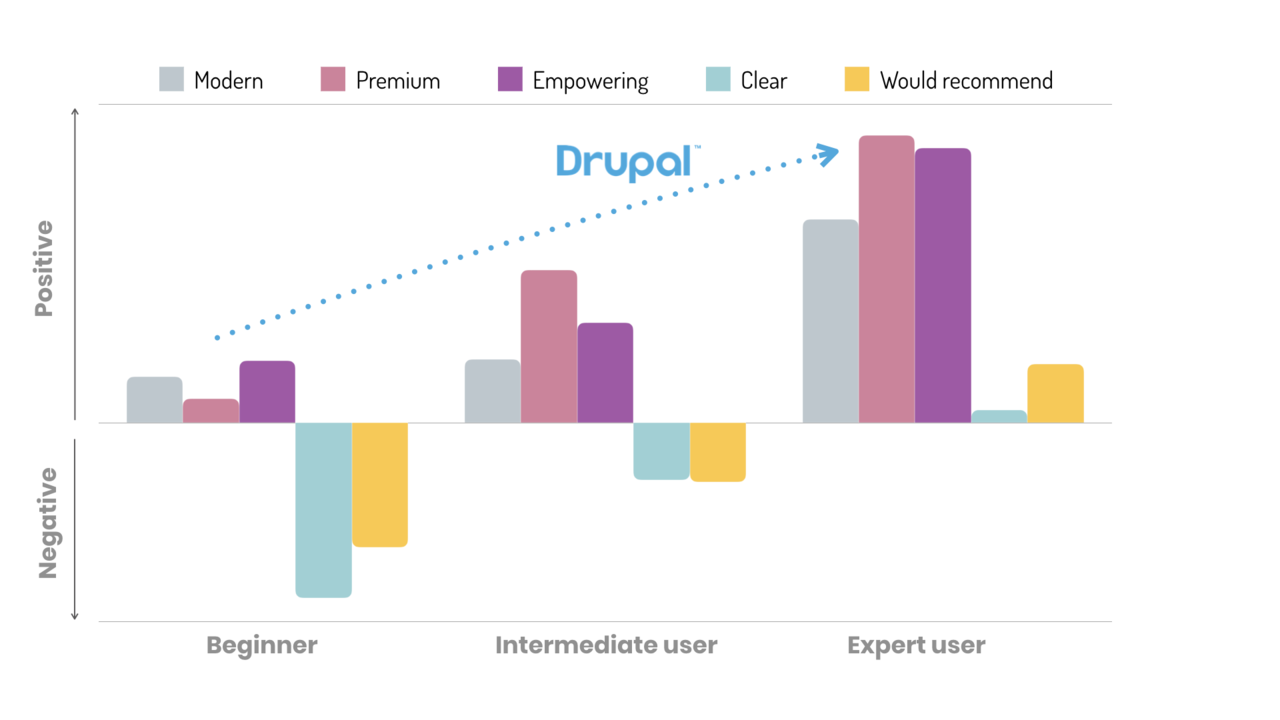
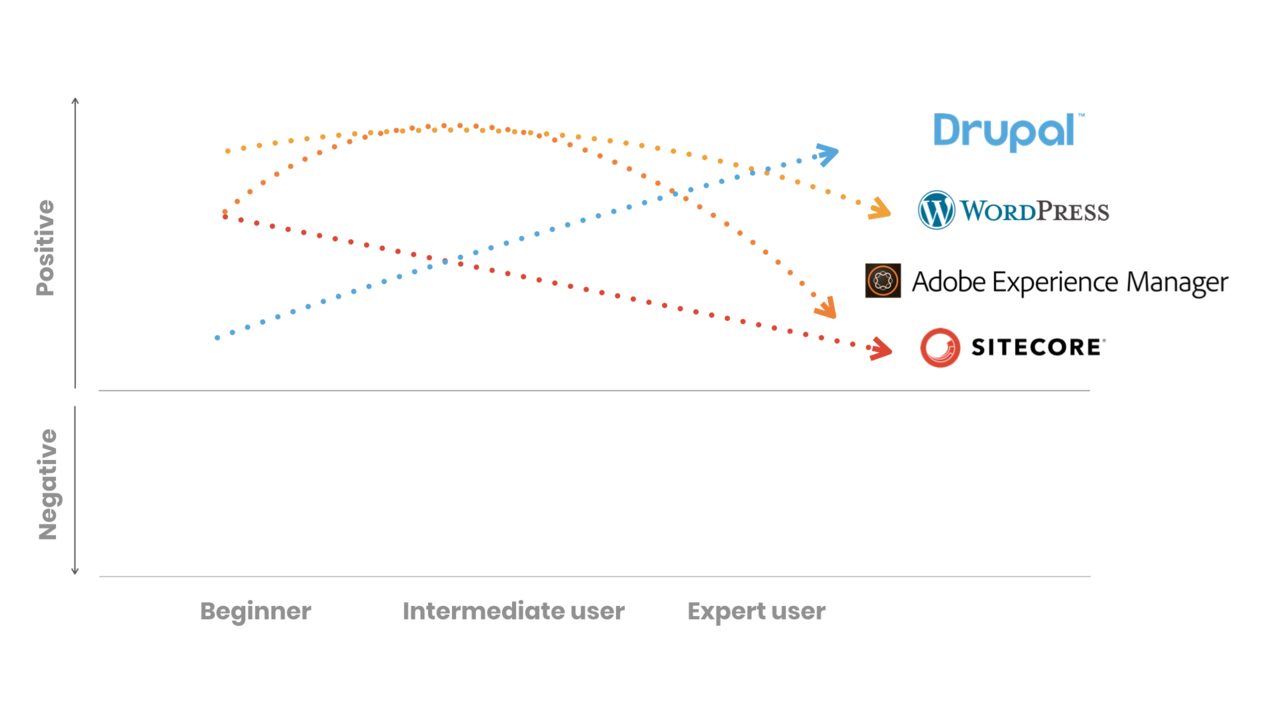
As we saw in a survey Acquia's UX team conducted, most people have a relatively poor initial impression of Drupal, though if they stick with Drupal long enough, their impression of Drupal grows significantly over time. This unlike any of its competitors, whose impression decreases as experience is gained. Drupal 9 should focus on attracting new users, and decreasing beginners' barriers to entry so they can fall in love with Drupal much sooner.

A graph that shows how Drupal is perceived by beginners, intermediate users and expert users.
Beginners struggle with Drupal while experts love Drupal.
A graph that shows how Drupal, WordPress, AEM and Sitecore are perceived by beginners, intermediate users and experts.
Drupal's sentiment curve goes in the opposite direction of WordPress', AEM's and Sitecore's. This presents both a big challenge and opportunity for Drupal.

We also officially launched the first initiative on this track; a new front-end theme for Drupal called "Olivero". This new default theme will give new users a much better first impression of Drupal, as well as reflect the modern backend that Drupal sports under the hood.

Strategic track 3: drive the Open Web

As you may know, 1 out of 40 websites run on Drupal. With that comes a responsibility to help drive the future of the Open Web. By 2022-2025, 4 billion new people will join the internet. We want all people to have access to the Open Web, and as a result should focus on accessibility, inclusiveness, security, privacy, and interoperability.

A person dressed in a space suit is headed towards a colorful vortex with a glowing Druplicon at the center.

Strategic track 4: be the best structured data engine

A slide that makes the point that Drupal needs to manage more diverse content and integrate with more different platforms.

We've already seen the beginnings of a content explosion, and will experience 300 billion new devices coming online by 2030. By continuing to make Drupal a better and better content repository with a flexible API, we'll be ready for a future with more content, more integrations, more devices, and more channels.

An overview of the four proposed Drupal 9 strategic product tracks

Over the next six months, we'll be opening up these proposed tracks to the community for discussion, and introducing surveys to define the 10 inaugural initiatives for Drupal 9. So far the feedback at DrupalCon Amsterdam has been very positive, but I'm looking forward to much more feedback!

Growing sponsored contributions

In a previous blog post, Balancing Makers and Takers to scale and sustain Open Source, I covered a number of topics related to organizational contribution. Around 1:19:44, my keynote goes into more details, including interviews with several prominent business owners and corporate contributors in the Drupal community.

You can find the different interview snippet belows:

  • Baddy Sonja Breidert, co-founder of 1xINTERNET, on why it is important to help convert Takers become Makers.
  • Tiffany Farriss, CEO of Palantir, on what it would take for her organization to contribute substantially more to Drupal.
  • Mike Lamb, Vice President of Global Digital Platforms at Pfizer, announcing that we are establishing the Contribution Recognition Committee to govern and improve Drupal's contribution credit system.

Thank you

Thank you to everyone who attended Drupalcon Amsterdam and contributed to the event's success. I'm always amazed by the vibrant community that makes Drupal so unique. I'm proud to showcase the impressive work of contributors in my presentations, and congratulate all of the hardworking people that are crucial to building Drupal 8 and 9 behind the scenes. I'm excited to continue to celebrate our work and friendships at future events.

A word cloud of all the individuals who contributed to Drupal 8.8.
Thanks to the 641 individuals who worked on Drupal 8.8 so far.
A word cloud of all the organizational contributors who contributed to Drupal 8.8.
Thanks to the 243 different organizations who contributed to Drupal 8.8 to date.
07 Nov 19:25

Don’t Travel With a Rolling Bag: The True Cost of Bulky Luggage

by Sally French
Don’t Travel With a Rolling Bag: The True Cost of Bulky Luggage

Just as Marie Kondo preaches about how decluttering makes more room for happiness, packing less can make travel cheaper, more efficient, and less stressful.

07 Nov 19:25

Cities say they’re making big changes by allowing duplexes, triplexes in former single-detached-only homes. But how is that working out?

by Frances Bula

Cities like Minneapolis and Portland are getting huge coverage in the U.S. for saying that they are ending the restriction of single-detached-only homes in large areas of their cities. Vancouver is part of that movement in Canada.

But, as I discovered when I went to do a follow-up story on how this is all working out, the duplex “revolution” is still very constrained by the fact that planners and politicians don’t want too much change to be visible to existing neighbours. So these new forms of housing are being restricted in size, which means the units are significantly smaller than what most people say is needed for real family-sized housing.

My story from the Globe is here and in text below.

As I mentioned also in my tweets, one of my small side discoveries in doing this story was how accessible land records were for Minneapolis.

While I was there a couple of weeks ago, I asked for an example of a triplex that’s been built. I was pointed to 3450 Grand (although it’s technically not legal yet, since the council there is only just finalizing all the motions/bylaws needed to change the zoning.)

While I was walking down the street to get pictures, I noticed that there was actually a small apartment building just two doors down.

Here are a couple of pictures, one of the triplex under construction, one of the apartment down the street, courtesy of Google.


It took me about three minutes to get all kinds of details on both of them, so I could include sizes in my story. If only we had that here in B.C., where it costs $10 per search if you are looking electronically. (Yes, it is free if you go down to a B.C. Assessment Authority office and look on one of their three computers, as long as you are retired and have all the time in the world.)

Here are some shots of what I found for the Minneapolis properties, the triplex and the apartment building down the street.

FRANCES BULA
VANCOUVER AND MINNEAPOLIS
SPECIAL TO THE GLOBE AND MAIL
SHARE

Sean Reilly looked ahead to his four children’s real-estate future in Vancouver and it wasn’t a promising sight.

Even though prices have gone down slightly from the city’s crazytime peak of early 2018, it’s still impossible to find a condo for less than $400,000 or a reasonable house for less than $1-million.

Mr. Reilly, a 51-year-old engineering consultant, was looking for a solution, but he never wanted to settle for adding a small laneway house or a basement suite to his always-needing-some-kind-of-fix 80-year-old house – something Vancouver has allowed for the past decade. So, when Vancouver’s city council voted a little more than a year ago to permit duplexes in all residential neighbourhoods, part of an emerging urban movement in North America to bring more housing choices such as duplexes, triplexes and quadriplexes into the single-family housing zones that dominate most cities, Mr. Reilly was on it.

He saw the move as the solution, not just for his family, but families everywhere.

“If you want families to survive in the city, if you want middle-class kids here, if you want sustainable cities, this is the kind of thing that has to happen,” Mr. Reilly said.

But, as it turns out, the duplex/triplex/quad housing revolution is a little less revolutionary that it’s often portrayed. That’s because city planners everywhere, hyper-wary of doing anything too dramatic that will get the high-voting, activist, single-family homeowners upset, are limiting the sizes of the new forms they’re allowing so that they will fit in. That, in turn, means that the new duplexes or triplexes end up being on the small side. Too small for some, as Mr. Reilly has discovered.

He has a relatively large lot for Vancouver, 33 feet by 155 feet, which equates to 5,115 total square feet on the lot. (The standard in east side Vancouver, where he lives, is 33 feet by 122 feet.)

That means that he is allowed to build a new duplex as long as it doesn’t exceed 70 per cent of the square footage of the lot. In other words, not bigger than 3,580 square feet for the four units the new zoning allows on larger lots: two main units and two secondary suites.

Mr. Reilly said construction costs will be $1.3-million and he hopes to eventually get $6,000 a month in rent.

If he were simply building a huge new house with a basement suite and a laneway home in the back, he would be allowed almost 4,150 square feet (81 per cent or .81 floor-space ratio, as it’s called in the planner world) – a significant difference that would make each of the four units far more livable.

Mr. Reilly is hoping to get a variance to add 300 square feet to 400 square feet to the project, something he says would mean an extra four feet on the back, with no extra height.

“[My builder] has done an amazing job, but it’s still quite constrained,” said Mr. Reilly, whose current plan is to have one large unit for himself and then three smaller two-bedroom units for his children. “A lot of the spaces are not as big as we’d like them to be.”

He’s getting a little bit of relaxation because his builder, Bryn Davidson, co-owner of Lanefab Design/Build, is doing a passive house. But not much.

That’s something Mr. Davidson sees as a fundamental flaw in the new zoning that needs to be fixed.

“There’s so much demand and there’s so much more we could be getting out of our properties than just McMansions, so it’s just a baby step here.”

He said that he got a lot of calls when the duplex zoning was initially approved, but many owners didn’t follow through because they get penalized for building duplexes by getting significantly less allowable building room.

Other architects and builders report the same.

“When they changed the rules, I was getting phone calls I don’t know how many times a day,” said Nick Bray, who runs his own architecture firm. “Many people were intrigued.”

But not one person ended up going forward with a development.

A report going to the city soon says that only 72 applications for duplexes have come in to the city in the year the new zoning has been in place. That’s at the same time that 420 applications for single-family homes were received and applications to build laneways hit more than 700 in 2018.

Mr. Davidson noted with dismay that the current policies still favour those who have the money to buy the whole property, build a giant house for themselves and then have some smaller spaces (the basement, the laneway) for renters, he said.

“The suites are owner-helpers. It’s not a coherent rental-housing policy.”

The prime benefit of allowing duplexes, many say, is that it allows people to buy for less in a traditional single-family area. That doesn’t make it affordable to everyone, but it does lower the household-income threshold for getting a foothold in a neighbourhood.

Renderings of a new home in Vancouver designed by Lanefab Design/Build for Mr. Reilly.

LANEFAB DESIGN/BUILD

The same kind of constraints apply in Minneapolis, the American city whose move towards allowing duplexes and triplexes in every single-family zone has generated multiple national headlines in laudatory articles from The New York Times to Atlantic magazine to Reuters news service.

With headlines such as “Minneapolis, Tackling Housing Crisis and Inequality, Votes to End Single-Family Zoning,” (New York Times, December, 2018) and “How Minneapolis Defeated NIMBYism” (Atlantic, October, 2019), the Midwest city is seen as the Shangri-La of housing reform.

But, similar to Vancouver, Minneapolis has limited the size of the duplexes and triplexes so as ensure they look more or less the same as the single-family houses next door.

One triplex that sits at the corner of 35th and Grand in the city’s leafy Lyndale neighbourhood, waiting to be legalized after Minneapolis city council officially passed its new zoning policy last week, looks identical to the house next door. The only giveaway is the three mailboxes on the porch, instead of one. (The city encourages having only one door on the street in the new model.)

The grand triplex is limited to 2,500 square feet, the 50 per cent of lot size that Minneapolis enforces in its single-family zones where a 5,000-square-foot lot is the norm. The wiggle room that makes a triplex at all workable is that the basement area isn’t counted in the total.

“There was a strong feeling that it was important to maintain the same scale as the other houses,” said Jason Wittenberg, the code director for the City of Minneapolis.

That’s in spite of the fact that, two doors to the north, there’s a small apartment building with four roomy 800-square-foot units sitting comfortably in between single-family homes. Built in 1915, it’s the legacy of an earlier era when housing wasn’t so rigidly segregated.

As in Vancouver, Minneapolis got a lot of pushback initially from residents who worried that allowing duplexes and triplexes might wreck the look of the neighbourhoods and create negative environmental impacts because of the increased amount of land covered by buildings.

The city originally considered allowing quadriplexes as well, but eliminated that, in part because of resident opposition, in part because builders said they would be unworkable, given the size limits.

(In Vancouver, the opposition was so intense that a new council elected last October considered whether to reverse the duplex policy brought in during the last days of the Vision Vancouver council. In the end, council voted to allow it to continue, but to monitor to ensure that it wasn’t resulting in a lot of teardowns.)

“It really was about neighbourhood character and whether density should be downtown or along corridors instead,” Mr. Wittenberg said.

One difference in this American city was that there was also concern about investors buying owner-occupied housing and converting it to rentals. The trend of big corporations buying up housing and then renting it out has been reported by many U.S. media outlets.

Minneapolis is planning to track what happens with the new policy, as Vancouver is.

In both cities, it is unclear whether there is going to be significant change under the new zoning. Policies on previous changes, such as laneway houses, show mixed signals.

Minneapolis started allowed laneway houses, called accessory dwelling units in American plannerese, in 2014. It has received only 180 applications since then.

In Vancouver, the take-up of laneway houses was much more pronounced. They went from 18 applications in 2009, the first year of permitting, to 191 the next year, rising to 500 by 2018. In 2018, there were 709 applications. Numbers are slightly down so far for 2019, with only 364 applications as of the end of September, for a total of about 4,000 altogether in the last 10 years.

Vancouver senior city planner Paula Huber said the low number of duplex applications in the past year is actually what the city was aiming for.

“We didn’t want it to be so effective that we distorted the character-house-incentive program,” she said. That’s the program that allows more buildable square feet for people preserving a pre-1940s house.

But, she acknowledged, there is likely more change on the horizon.

A recent survey the city did of 3,380 residents showed there is massive support for allowing duplexes – 88 per cent approval. That’s a sharp contrast to the high numbers of people who came out to public hearings to oppose them.

And builders such as Mr. Davidson are telling the city that the size restrictions are problematic.

Ms. Huber said eventually things will shift, especially as the Vancouver spends the new two years consulting on and drafting the big new city-wide plan for future housing.

“I think many existing regulations have been about ‘fit in and match.’ As part of the city plan, we’ll have to start talking about how limiting that is. Are we going to continue to say that everything has to look like a house?”

07 Nov 19:25

Here for Dafonte—Theriault brothers trial, week 1

by Desmond Cole

DSC_0149.jpg

A police photo of $13.50 seized from Dafonte Miller when he was arrested on December 28, 2016. Police charged Dafonte with stealing this money, although the Crown withdrew this charge and all others against him several months later.

***This piece contains graphic and disturbing descriptions of police brutality and anti-Black racism. ***

Nearly three years ago, someone attacked a Black youth named Dafonte Miller, who was then 19 years old, on a suburban street in Whitby, Ontario, and caused him serious injuries, including the loss of his left eye. At first, no one was charged with the attack—in fact, the Durham Regional Police Service (DRPS) officers who attended the scene laid five criminal charges against Dafonte, including assault with a weapon, possession of a dangerous weapon, and theft under $5,000.

DRPS officers claimed Dafonte had assaulted two white men they found at the scene with him, off-duty Toronto police officer Michael Theriault, then 24, and his younger brother Christian, then 21. The Theriault brothers didn’t have any serious injuries, but DRPS officers accepted their story that Dafonte had tried to break into their truck, assaulted both of them with a metal pipe, and resisted their attempts to hold him down until police came. The two men gave the briefest of statements to police and went home; Dafonte went to the hospital in handcuffs and in DRPS custody.

Things changed dramatically in late April of 2017, when Dafonte’s lawyer contacted the Special Investigations Unit, the agency responsible for investigating injuries, deaths, and sexual assault allegations involving police officers. The SIU hadn’t heard about the incident between the Theriault brothers and Dafonte—DRPS failed to report it to them, but did notify Toronto police the night of the attack. Toronto police also chose not to notify the SIU, and allowed Michael Theriault to go back to work.

The Miller family fought against Dafonte’s outrageous criminal charges, and in early May the Crown (the lawyers representing the government) dropped all the criminal charges against Dafonte. The SIU closed its investigation in July of 2017 and recommended criminal charges against the Theriault brothers. Although Christian isn’t a police officer, he became the first civilian the SIU has laid charges against, as investigators determined he and Michael had acted together. The Theriault brothers are each charged with aggravated assault, as well as obstruction of justice for allegedly misleading DRPS officers who responded to 911 calls.

Of course, no one needed to mislead the officers who arrived on scene on December 28, 2016. As the first week of trial showed, and as Dafonte has already alleged in a separate police oversight complaint, DRPS officers helped the Theriault brothers cover up their violence. The Crown’s evidence includes a 911 call from Christian telling the dispatcher that Michael was an off-duty police officer. The responding officers’ took direction from the brothers, and from their father John, who is also a Toronto police officer, and framed Dafonte as the assailant in his own beating.

DRPS officers aren’t on trial here—on the contrary, the first two officers who arrived at the scene are Crown witnesses, one of whom gave testimony last week. But the facts and testimony thus far have shed more light on DRPS complicity in and cover up of the beating.

Evidence before the court

Court documents include an agreed statement of facts, which both the Crown and defence accept as fair evidence. The two sides only agree on a few things: that Michael Theriault was an off-duty Toronto police officer on the night of the incident; that Dafonte’s wounds satisfy the criminal code definition of aggravated assault; that the expert witness are qualified and medical info are admissible.

The agreed statement of facts also includes: audio and transcripts of three 911 calls, one each initiated by Christian Theriault, a civilian witness, and Dafonte Miller; statements from the Theriault brothers to DRPS officers; DRPS logs of their activities in responding to the incident; a biology report of the scene; and a series of photgraphs taken by a DRPS officer, SIU investigators, and Dafonte’s family. Additional evidence, including documents from the trial’s preliminary inquiry, is also being used in court.

The agreement that Dafonte’s injuries had to be caused by someone else is very important. There’s no evidence that anyone other than the Theriault brothers had a violent encounter with Dafonte. It seems their best hope of acquittal is for their lawyers to convince Justice Joseph Di Luca that their violence was a necessary and acceptable form of self-defense.

The brothers told police they chased Dafonte after finding him and a friend sitting in their parents’ truck close to 3 a.m. The brothers say they believed the young men were stealing from the truck, and pursued Dafonte to apprehend him until police came. Both brothers claim that after they chased Dafonte approximately 150 meters down the street and cornered him, he produced a metal pipe and began striking each of them in the head, torso, and legs.

Neither brother could say with any confidence where this pipe came from. Michael, who says he led the pursuit, told DRPS he never lost sight of Dafonte, but nevertheless said he never saw where the pipe came from or how it got into Dafonte’s hands. The pipe is an exhibit inside the courtroom which lawyers can refer to when questioning witnesses. It is approximately four feet long and made of solid metal, and it still contains markings of blood.

Both brothers told the police they feared for one another’s lives, yet neither of them sustained any major injuries or were immediately admitted to hospital. Christian showed police a cut on the outside of his right hand, which an officer photographed. Other than this, police who attended the scene didn’t see any injuries on either man. Michael reported no injuries, while Christian said that besides his hand, he had no other injuries apart from a sore head. Twelve days after the attack, Christian went back to DRPS for a second interview, during which he stated he had received medical treatment for a concussion. 

DRPS officers appear not to have asked Christian how Dafonte sustained his brutal injuries on the night they responded to the scene. At his subsequent police interview Christian said he defended himself after Dafonte struck him repeatedly with the pipe and his fists. He told a detective, “I got hit a couple of times—I had a darker eye—and that’s when I just, you know what, he’s fighting, so I was using my fists to defend myself, to stop—to stop him from hurting us.” When the detective asked Christian how many times he’d struck Dafonte with his fists to subdue him, he replied, “I don’t recall how many times. I was just going—I was just—it was—the amount of times was just until he stopped hitting us with the pole, then that’s when—that’s when we stopped.”

Although Christian suggested both he and his brother were punching Dafonte, Michael never offered this information, and neither man acknowledged hitting Dafonte with the pipe. DRPS officers have no documentation of themselves asking either brother if they hit Dafonte with the pipe.

Crown witnesses

The Crown’s first witness, DRPS Constable Jennifer Bowler, testified that after she and her partner were the first officers to arrive and see Dafonte bloodied and badly wounded, she doesn’t remember herself or her partner having any conversation with him. Bowler further testified that she never saw Dafonte’s eventual arrest, or have any recollection which of her colleagues laid the multiple charges against him.

Bowler said she did speak with the man standing over Dafonte when she arrived, and we now know that man was Michael Theriault. She says Theriault told her that he believed there was another person responsible for breaking into his truck, and pointed Bowler in the direction he believed the person fled. She testified that she did walk a little way up the road and saw no one.

Bowler, who was responsible for documenting and seizing evidence that evening, returned to retrieve her camera and begin documenting the scene. She took a photo of Dafonte’s eye injury as he lay in an ambulance, the metal pipe presented in court, evidence of blood on the front porch, driveway, and truck of the house where the brothers were holding Dafonte. Bowler took photographs of the cut on Christian Theriault’s hand, and of his face, which showed no signs of injury; she didn’t photograph Michael at all, and testified this is because he reported no injuries.

At this point Bowler said another man appeared and told her a vehicle he owned down the road had been broken into. Although we now know this man was John Theriault—the men’s father and a Toronto police officer himself—Bowler’s testimony suggests she didn’t know exactly who he was, when he arrived on the scene, and how he was related to the other men she’d encountered. Nevertheless she accompanied him to his property well down the street to photograph his truck.

Bowler took several photos of John Theriault’s truck. In her photos the truck doors are closed, as is the electronically-operated garage door the brothers claimed they had run out of to pursue Dafonte. Although Dafonte would later be charged with stealing money from the truck, John didn’t tell Bowler any money or other items were missing. Bowler said she found no evidence that someone had broken into the truck. Dafonte’s theft charge, which the Crown later withdrew, seems to suggest he stole the $13.50 police found in his pocket while arresting him. 

Crown lawyers accepted Bowler’s bizarre account without asking any obvious follow-up questions about why she repeatedly took directions from the Theriaults. In order to get its conviction of the brothers, the Crown is disregarding the obvious fact that Durham police were there to assist the Theriaults and not Dafonte. The Crown needs Bowler and her police colleagues to appear credible so the judge will accept the parts of their evidence that incriminate the brothers.

Similarly, defence lawyers made no efforts to question Bowler’s account. They want us to believe the police’s callous response to Dafonte was normal, that they only took direction from the Theriaults because they were innocent victims of a crime. The DRPS cover-up of the crime is an unacknowledged siren in the courtroom, an alarm no one wants to answer.

A key Crown witness is a man I’ll call Bill, who lives with his family at the house where police found Dafonte and the Theriault brothers (Bill isn’t his real name, but I’ve changed it because of the sensitivity of his testimony, which contradicts the police and the Theriault brothers in many instances). Bill and his family woke up to sounds of screaming outside their home on the night of the attack. He testified that he went to his bathroom window, and saw two men at the side of his house, punching down at a third person in between them.

Bill shouted to his wife to call 911, and eventually went downstairs after hearing someone banging loudly at his front door. He heard a voice asking anyone inside to call 911, and said he believed it came from the person who was banging. When Bill’s wife got a dispatcher on the line, he took the phone and described what he was seeing and hearing.

At one point Bill went to the upstairs window and told the dispatcher he saw one man standing over another with a long object, and that he feared the person without the weapon would be struck. Bill further testified in court that he saw the armed person using the long object to stab down at the man below him to keep him from getting up. He also saw another man who appeared to be on a cell phone pacing up and down the street in front of his driveway.

The Crown played Bill’s phone call for the court, and in a devastating moment after Bill expressed fear for Dafonte’s safety, the 911 dispatcher replies, “Yeah, I guess he was trying to restrain him, that’s why.” The dispatcher continued, “judging based on what you’re saying, I assume the guy that broke into the car is the guy that’s on the ground.”

This assumption by the dispatcher was based on info coming in at the same time from Christian, who called 911 only twenty seconds before Bill did, and informed the operator his brother, a police officer, had apprehended a thief. Bill also testified that although several police officers attended the scene at his house and saw him standing outside, none of them took a formal statement from him.

The court also heard from Michael Pickup, a medial professional who reviewed all of the medical evidence regarding Dafonte’s injuries. Pickup said that while it was possible a pipe had caused Dafonte’s injuries, he believed it was more likely caused by blows from fists. Dafonte’s eye was dislodged and split into pieces, and surgeons ultimately removed it. The charge of aggravated assault doesn’t hinge on the use of a weapon, so the judge doesn’t necessarily need to find that any weapon was used in order to find the Theriault brothers guilty on that charge. 

Crown lawyers called Mike Federico to the stand to give evidence about police use of force, particularly regarding the responsibilities of off-duty police officers. Federico is a former deputy chief of the Toronto police, and was serving in that capacity when Dafonte was attacked. Federico also happens to be overseeing the DRPS while its current chief, Paul Martin, faces  an unrelated misconduct investigation. Federico’s experience with both forces involved in this cover-up makes him an interesting person to cite as an expert, and suits the climate of indifference to police corruption that hangs over this trial.

Federico said that generally speaking, a police officer maintains certain responsibilities even when they are not on duty. He said officers are expected to respond to crimes they witness, even if that simply means calling 911. In Federico’s opinion, an off-duty officer has more responsibilities than a civilian when witnessing or responding to criminal activity, such as taking extra steps to identify themselves, and clearly justifying any force they may use.

As defense lawyer Michael Lacy cross-examined Federico, he revealed part of his team’s strategy. Lacy suggested that Federico is not an expert in the laws of self-defence, and that off-duty police officers can engage in a citizen’s arrest to protect themselves and their property. This is clearly the story the Theriault brothers’ lawyers intend to paint, despite the fact that Michael and Christian both informed authorities that Michael is a cop.

In the second week of trial, the Crown has called two friends who were with Dafonte on the night of the attack, and heard from two other DRPS officers who arrived early to the scene. Dafonte himself is expected to testify later this afternoon. The experience will force Dafonte to not only relive all the events of that evening, but to endure harsh cross-examination, during which defense lawyers will surely challenge the truth of his story. May he and his family find strength for that experience—I’ll have another update soon.

07 Nov 19:25

The Best Rain Pants

by Anna Perling
The Best Rain Pants

Although you probably won’t need rain pants during lighter showers or warmer weather, a good pair of rain pants will help you stay dry and comfortable when hiking in heavy rain or in colder climates. To find the best pair, we spent 35 hours conducting research, speaking to experts, simulating a killer wash test, and chasing rain through Portland, Oregon, and Washington State’s Hoh Rain Forest. Based on this testing, we think Marmot’s PreCip Pant, which come in men’s and women’s sizes, are the best rain pants for most people. They are water-resistant yet breathable, come in multiple inseam lengths, have a tailored cut, offer such features as ankle zippers and side pockets, and are more affordable than many of the other pants we tested.

06 Nov 02:47

Garmin: The Long-running Advantages of Power Glass Solar Charging

by garminblog
mkalus shared this story from garminblog's YouTube Videos.

From: garminblog
Duration: 02:00

See how harnessing the sun’s energy with Power Glass™ solar charging lenses works to greatly extend battery life and on-wrist usability for select Garmin sportwatches and other wearable devices.

05 Nov 22:24

En vrac de Novembre

by Tristan

Vélo en bord de mer

Citation du jour, à propos du changement climatique, extraite d’un billet du blog Signaux Faibles :

Quand nous nous repencherons dans vingt ans sur la période actuelle, nous serons surpris de la timidité de certaines décisions, de la superficialité de certains argumentaires déployés pour freiner les changements, de la médiatisation apportée à certains discours rétrogrades. Nous les regarderons de la même façon que nous considérons aujourd’hui les thèses climatosceptiques d’un Claude Allègre qui ont pourtant été développées, médiatisées et soutenues (par des personnalités comme Luc Ferry) il y a moins d’une décennie… Demain, les positions aujourd’hui considérées comme radicales paraîtront plutôt banales. La radicalité de demain ne sera pas celle que l’on croit. Nous n’avons encore rien vu.

05 Nov 22:24

OneNote 2016 is not going away

by Volker Weber
Over the past year, we’ve been listening to your passionate feedback and are humbled by your consistent love for OneNote. We hear you loud and clear — you want to keep your notes your way!

With that in mind, we’re pleased to announce that we are continuing mainstream support for OneNote 2016 beyond October 2020, so that you can continue using the version of OneNote that works best for you. New support dates for OneNote 2016 now align with Office 2019 (October 10, 2023 for mainstream support and October 14, 2025 for extended support). We also want to make deployment and installation easier for organizations and individuals, so for Windows users, starting in March 2020, when you deploy or install Office 365 subscriptions that include the Office desktop apps or Office 2019, the OneNote desktop app will be installed by default alongside Word, Excel, and PowerPoint. If you’d like to install OneNote 2016 earlier, you can get it here: aka.ms/InstallOneNote.

More >

05 Nov 22:24

Weeknotes: More releases, more museums

Lots of small releases this week.

Datasette

I released two bug fix releases for Datasette - 0.30.1 and 0.30.2. Changelog here. My Dogsheep personal analytics project means I'm using Datasette for my own data analysis every day, which inspires me to fix small but annoying bugs much more aggressively.

I've also set myself a Streak goal to land a commit to Datasette every day.

I landed a tiny new feature to master yesterday: a ?column__notin=x,y,z filter, working as an inverse of the existing ?column__in=x,y,z filter. See issue #614 for details.

More Niche Museums

I've been keeping up my streak of adding at least one new museum to www.niche-museums.com every day. This week I added the Pirates Museum in Antananarivo, Madagascar, the David Rumsey Map Center at Stanford, Galerie de Paléontologie et d’Anatomie comparée in Paris, DEVIL-ish Little Things in Vancouver, Washington, Mardi Gras World in New Orleans, Environmental Volunteers EcoCenter in Palo Alto, the Evergreen Aviation & Space Museum (home of the Spruce Goose!) in McMinnville Oregon and Autoservicio Condorito in Mendoza.

Here's that list of new museums with my photos of them (images rendered using datasette-json-html).

sqlite-transform

I released a new tiny CLI tool for manipulating SQLite databases. sqlite-transform lets you run transformation functions against the values in a specific column of a database. It currently has three sub-commands:

  • parsedate parses strings that looks like dates and turns them into YYYY-MM-DD, so they can be sorted.
  • parsedatetime turns them into ISO YYYY-MM-DDTHH:mm:ss timestamps.
  • lambda is the most fun: it lets you provide a snippet of Python code which will be executed against each value to perform a custom transformation. More details in issue #2.

Here's how to use it to wrap the values in a specific column, including importing the textwrap module from the Python standard library:

$ sqlite-transform lambda my.db mytable mycolumn \
    --code='"\n".join(textwrap.wrap(value, 10))' \
    --import=textwrap

Other releases

Dogsheep

I've been having a lot of fun creating new features for my personal Dogsheep analytics site. Many of these take the form of simple HTML added to the private homepage. Most recently I added the ability to search through the people who follow me on Twitter (an evolution of this technique from last year). That feature is entirely implemented as the following HTML form:

  <form action="/twitter/users" method="GET">
    <p>
      <input type="hidden" name="_where" value="id in (select follower_id from following where followed_id = 12497)">
      <input name="_search" type="search" placeholder="Search my Twitter followers"> <input type="submit" value="Search">
    </p>
  </form>

More tree data

I exported all 3.85 million 311 calls from the San Francisco data portal into a database, then extracted out the 80,000 calls that mention trees and loaded them into a separate Datasette instance. You can play with that here - it was the inspiration for creating the sqlite-transform tool because I needed a way to clean up the datetime columns.

05 Nov 22:23

Twitter Favorites: [Planta] I bought two Seagram's V.O. glasses this weekend. https://t.co/yJG54Ceu1M https://t.co/le9RX709aP

Joseph Planta @Planta
I bought two Seagram's V.O. glasses this weekend. twitter.com/doctorow/statu… pic.twitter.com/le9RX709aP
05 Nov 22:23

Daylight Saving Time gripe assistant tool

by Nathan Yau

In a follow-up to a map from a few years back, Andy Woodruff provides a gripe assistant tool for Daylight Saving Time. Plug in your preferences for an ideal day, and you can see if you’re in the right or in the wrong for complaining.

Obviously if you have kids, the whole map is automatically yellow.

Tags: Andy Woodruff, daylight saving

05 Nov 22:23

ginlo ist Geschichte

by Volker Weber
+++ Einstellung des ginlo Service +++

Auch wenn die ginlo Community in den letzten Monaten viel Zuspruch von Interessenten und Nutzern erhalten hat, konnten wir die Investorensuche für die weitere Finanzierung von ginlo nicht positiv abschließen.

Deshalb sind wir leider gezwungen, unser Herzensprojekt ginlo spätestens zu Ende Dezember 2019 einzustellen.

Falls Sie noch Bilder, Videos, Dateien etc. aus ginlo herunterladen möchten, bitte gleich erledigen. Denn all Ihre verschlüsselten Inhalte, Metadaten und personenbezogenen Daten werden spätestens zu Ende Dezember unwiederbringlich gelöscht.

Wir wünschen Ihnen alles Gute
Ihr ginlo Team

Ich habe das Geschäftsmodell nie verstanden. Die potentiellen Investoren wohl auch nicht. Aber ich bin trotzdem sehr dankbar, denn durch ginlo haben wir unseren Circus ins Leben gerufen.

t.me/vowecircus

05 Nov 22:23

I do not consent to this presidency

by jwz
mkalus shared this story from jwz.

monicabyrne13:

So....wow. My post (below) was removed from Instagram for "hate speech." This has happened before (I've been posting this sentence every day since December 1, 2016), so I appealed. But their decision stood. What the actual f*ck, @instagram? [...]

Now I'm being told by @Instagram that my account is in danger of deletion because of my daily post saying, simply, "I do not consent to this presidency." Care to explain, @mosseri? [...]

I did appeal, and it was denied. That's the second photo in the tweet. Since then, a bunch of the same posts have been taken down with no option to appeal, and I got this warning.

Previously, previously, previously, previously, previously, previously, previously.

05 Nov 22:23

The State of California Could Have Stopped 8Chan: It Didn’t

by Robert Evans
mkalus shared this story from bellingcat.

Reported with Fredrick Brennan

Over the course of 2019, the website “8chan” has directly inspired four acts of terrorism around the world, killing 76 people and wounding 80. The mass shootings in Christchurch, Poway, and El Paso are well-known. The mass shooting in Halle, Germany, which killed two and injured two more, received less attention. Since 8chan was dropped by its service providers and taken offline after the El Paso attack, the Halle shooter was unable to announce his killing spree there. Yet the connection was still obvious: the shooter’s attack was livestreamed, like the Christchurch shooting. He identified himself as “anon”, a general term for chan users. 

The most direct connection between the Halle shooter and 8chan was hidden in the killer’s manifesto, in a joking reference he made to someone named Mark Mann. The shooter claimed Mann helped fund the attack. There is no evidence of this. But Mark Mann is an employee of NT Technology, an internet service provider owned by Jim Watkins, who also owns 8chan. Mann is Jewish, and the Halle shooter’s reference to him was almost certainly a cruel joke. The fact that Mann was referenced at all suggests the shooter was deeply familiar with the infamous image board.

8chan’s ability to continue inspiring attacks after it dissolution is disturbing. More worrying still is the fact that, over the last several months, Jim Watkins has waged a slow, grinding battle to bring the site back online. A number of volunteers, including 8chan’s former founder and the co-author of this article, Fredrick Brennan, have fought tooth and nail to stop him. But early in November the site, rebranded as “8kun”, came back online.

As I write this, 8kun has gone up and down for the past several days. It was dropped from its most recent host, a Russian ISP located two hours from North Korea, on November 3, 2019. It will come back online. If not via the normal web, than through peer-to-peer means like Tor. There was, however, a point at which the resurrection of 8chan could’ve been stopped — perhaps even forever. This is the story of why that did not happen.

The Stakes Involved

A discerning reader might ask: if the Halle shooting happened while 8chan was offline, does it really matter if it comes back up again? Will keeping it down reduce the number of shootings it helps to spawn?

There is no certain answer here, but there is evidence to suggest that yes, keeping 8chan offline is better for public safety. While the Halle shooting happened with 8chan offline, the shooter had presumably been a regular user of the image board for quite some time. It is reasonable to assume he was radicalized there. Since he went out of his way to copy several of the Christchurch shooter’s tactics, we can assume that manifesto had a significant impact on him. 

In the wake of the Christchurch and Poway shootings, anons went out of their way to declare the killers “saints” and share their manifestos to every corner of the Internet. The Christchurch manifesto was even printed and sold on the streets of Ukraine. With 8chan down, there has been no similar concerted effort to spread the Halle shooter’s manifesto, nor the home-built firearm instructions he sought to make viral. 8chan’s /pol board was unique within the fascist media ecosystem; no comparable community of a similar size exists. 

Outside of /pol, 8chan was also the host of the Q Research Board. It was the only place where the mysterious individual(s) known as “Q” could post and confirm his identity to his followers. With 8chan down, there were no Q drops for three months. During the brief time when “8kun” was online and functional, Q made four new drops, breathing life into the dangerous cult that exists around the conspiracy theories Q pushes. Qanon has already inspired a murder and a number of non-lethal attacks, including one on the Hoover Dam. In August of 2019, the FBI warned that conspiracy theories like Qanon encourage, “…the targeting of specific people, places and organizations, thereby increasing the risk of extremist violence against such targets.”

The Fight To Keep 8chan Offline

A number of journalists and activists, including me, have fought to keep 8chan in its grave. No one has put in more work than Fredrick Brennan. Since he is the man who founded and coded the website back in 2013, this is probably appropriate. The public face of this fight has been a social media campaign to name and shame the companies hosting and providing registration services to 8chan. This stopped the site from coming back online, but as long as Jim Watkins and his businesses own the servers 8chan’s data was stored on, they can continue their efforts to bring the site back, perhaps indefinitely.

Reporting by Mashable on August 5, 2019 identified Centauri Communications as the company that provided internet access to 8chan’s physical servers. In early September, 2019, Fredrick Brennan verified that Centauri’s servers were the second to last step on the traceroute for N.T. Technology, Jim Watkins’s company. Without Centauri, his business would not be online.  

Centauri is one of the few businesses that have not yet been shamed out of working with Jim Watkins due to his association with 8chan. In September, Brennan was able to verify through the California Secretary of State’s website that the business was listed as “SOS/FTB Suspended”. According to the California Franchise Tax Board, this means Centauri is “…not in good standing and loses its rights, powers, and privileges to do business in California.”

On September 6, Brennan reached out to Asad Ramzanali, the Legislative Director for California State Representative Anna Eshoo. He started to explain the situation to Ramzanali, in the hopes that he could get Rep. Eshoo to reach out to the Franchise Tax Board and the Attorney General and do something to stop the return of 8chan, perhaps by seizing Centauri’s servers. 

I’ve reviewed the chat logs between Ramzanali and Brennan. In them, Ramzanali appears engaged and helpful. Brennan informs him about one of the ways Watkins funds his operation, through PayPal donations to the website “jimisbad.com”. The PayPal link, which is still active, sends donated funds directly to N.T. Technology. 

Ramzanali expressed concern, but pointed out that he and his boss could not take action if the website was not hosted in California. 

Brennan was able to quickly show that “Jimisbad.com” is, in fact, hosted in California. Ramzanali expressed excitement, calling Brennan’s research “great stuff.”

Ramzanali set up a meeting with his boss, Rep. Eshoo, for Thursday, September 19. He told Brennan, “I’m pretty sure we’re going to get a final yes/no from my boss” after that. The meeting went well, and Ramzanali worked with Brennan to put together a letter from Rep. Eshoo to the California Secretary of State, Attorney General and State Controller. A copy of that letter is attached here in full. The letter officially requested the state “investigate two companies [Centauri and N.T.] operating in California despite lacking the proper authorizations to do so and take any legal actions you’re are [sic] authorized to take against these companies.”

The letter laid out the violent history of 8chan in a concise manner. It noted that both N.T. Technology and Centauri were “SOS/FTB Suspended” in the state, and that the vast majority of Centauri’s business came through N.T. Through the letter, Rep. Eshoo urged the recipients of her letter to “take the maximum possible actions you are authorized to take under California law against these companies.”

It was, in short, a good letter. But it was never sent.

When Courage Fails

One good marker of our absurd current era is the fact that elected officials now live in terror of nerds on an image board. On September 26, 2019, nearly three weeks after Ramzanali and Brennan began their correspondence, the former reached out to say that “bureaucratic issues” had delayed the approval of the letter. 

By that point, it was already obvious that Jim Watkins planned to bring 8chan back under a new name. Ramzanali asked about this, and Brennan walked him through what he knew of the plans to bring 8chan back online. After this, Ramzanali finally explained the reason for the delay on approving the letter: Rep. Eshoo’s office was worried about being “Swatted.”

“Swatting” is what happens when a group of misanthropes on the Internet finds the address for someone they dislike and calls in a fake tip of a kidnapping or some other crime, in order to get a SWAT team sent to their victim’s home. This has resulted in deaths before. During Gamergate, members of 8chan attempted to SWAT video game critics. The fear that it might happen again is not misplaced. 

On September 27, it became clear that 8chan would not be coming back online under its original name. There was confusion as to whether or not the new site “8kun”, might not actually host /pol at all. Rep. Eshoo’s office seems to have used this as an excuse to “hold off” on sending the letter:

The threat of swatting was mentioned again, and it seems likely that this fear was the main driving reason behind a lack of action. There is certainly a real danger here. But there is also danger in reporting on the violence spawned by 8chan.

I’ve received death threats as a result of my reporting on /pol. I continue to write about them. It is unsettling that an American member of Congress does not feel safe confronting these people, especially when the weaponized threat are the police, who presumably treat Congresspeople differently than they would, say, a random person of color or LGBT individual targeted by anons.

Brennan did not hear from Ramzanali, or anyone from Rep. Eshoo’s office, for more than three weeks. During this time, Watkins and his team escalated their efforts to bring 8chan back online. They cycled through a variety of hosts, including Alibaba Cloud and Zare, using fake names in order to try and slip through the cracks. “8kun” was only kept offline through the diligent work of worried volunteers.

On October 22, 2019, Ramzanali finally reached out to Brennan again:

He asked if 8kun was still being operated via Centauri, and hosted in the same data center in San Francisco. Brennan told him that, yes, it was, and once again begged Asad and Rep. Eshoo’s office to send the letter.

The last message Fredrick Brennan received from Ramzanali, or anyone else at Rep. Eshoo’s office, came two minutes later, at 6:44 PM Philippine Standard Time on October 22. 

At 11:07 AM Philippines time the next day, roughly sixteen hours later, the Twitter account “Is It Wet Yet?”, which is operated by Watkins’s employees and exists to track the resurrection of 8chan, made this post:

Note: This tweet is timestamped in EST

The picture showed the servers 8chan (among other things) in the back of a car. Their current location is unknown. But 8kun’s new hosting company appears to be VanWaTech

The CEO of VanWaTech is Nick Lim, the founder of BitMitigate, who briefly provided security services to 8chan after they were dropped by Cloudflare. BitMitigate was taken offline after its service provider objected to being associated with 8chan.  On October 28, less than a week after 8chan’s servers were loaded into the trunk of that car, Nick Lim posted this:

Since Lim is based in Vancouver, Washington, and 8kun’s new host is named “VanWaTech”, there’s a good chance those servers were relocated somewhere in the vicinity of Vancouver. We can’t confirm that for certain at this time. All I can definitely say is that the State of California missed a potential opportunity to put this problem to rest.

We have reached out to Rep. Eshoo’s office for this story, but have not heard back as of press time. We will add any statements once they arrive.

The post The State of California Could Have Stopped 8Chan: It Didn’t appeared first on bellingcat.

05 Nov 22:22

Pigeon feud: North Vancouver approves ban targeting councillor's neighbour

mkalus shared this story :
I see the Creme de la creme has migrated to the North Shore.

"Everybody has a hobby, right? Some have cats, some have dogs. I have pigeons."  

Kulwant Dulay says he's lived in the District of North Vancouver for 25 years and, for most of them, he's kept homing pigeons on his property in a coop in the backyard, without ruffling any feathers. 

But that changed three years ago when he bought a new house in Lynn Valley. Within a few weeks, his next door neighbour began complaining about the birds. 

"In my other house in North Vancouver, everyone loved pigeons. They were flying around no problem. My second, third week I moved in, she started complaining," he said.

On Monday evening, North Vancouver District council formally approved a new bylaw that would make it illegal to own pigeons, repealing a 1971 law allowing them. 

The discussion was brief, but council discussed the motion in detail the week before.

There, staff told them they could only find one person in the district who had pigeons and only one person who had recently filed a complaint. It was proposed the new law wouldn't come into effect until May 2020 to allow a transition period. 

The vote both weeks passed 4-2. Councillor Betty Forbes recused herself.

"I have been involved in a situation like this," she told council before one of the discussions.

That wasn't exactly accurate. Because, while it was never said in that meeting, Forbes was the next door neighbour who complained.

'A new neighbour moved in'

"I've spent lots of money fixing my backyard. I try and keep it as prim and proper as I can. I invest in it every year. And now I get to sit on the back deck and entertain and look at a pigeon coop."

In May 2017, the district held a public hearing for a proposed bylaw allowing backyard chicken coops. Betty Forbes, then just a member of the public, made her first appearance in front of council.

She wanted to talk about "a situation" that had arisen. 

"A new neighbour moved in," said Forbes. The coop was "ramshackle" and "an eyesore." And, she warned, it would harm the value of her property.

"I know it sounds pretty cold," she told council, "but there is an impact to having coops in backyards to properties next door to that. I've spoken with a couple of real estate agents, and they've told me it will definitely have an effect."

Council passed the chicken coop bylaw.

Over the next year, Forbes sent a number of letters and phone calls to district staff about Dulay's pigeons. She also sent a letter to then-mayor Richard Walton, saying that Dulay "allows his pigeons to fly and perch on neighbours properties without any control or supervision."

In the summer of 2018, staff investigated and took away six of Dulay's pigeons. A total of 15 remain, trained to fly back and forth from their large coop in Dulay's backyard, a few feet from the fence surrounding his and Forbes' homes.

Dulay says he applied for a permit from the district but never got one. He also claims he's worked to be a good neighbour after Forbes' complaint, but Forbes hasn't spoken to him since. 

"My neighbourhood is nice ... only one person complains," he said. 

Meanwhile, Forbes started attending council more often, ran for office herself and was elected on Oct. 20 last year.

That's the point where her situation with Dulay and his pigeons goes from a feud between neighbours to the political arena — and puts Forbes' communications with district staff and councillors under the microscope.   

Conflict of interest rules

In July 2019, Coun. Lisa Muri brought forward a motion that asked staff to explore changing the district's decade-old pigeon bylaw, beginning the process that will likely wrap up Monday evening.  

"This is a very old archaic bylaw," she said. 

"Why do we need to allow homing pigeons to be released? I am not allowed to release my dogs. They have to be leashed … so, I would ask why would we allow pigeons?"

Forbes also recused herself from that discussion, as mandated under the conflict of interest section in B.C.'s Community Charter.

It states that a councillor with a "direct or indirect pecuniary interest in a matter" must not "attempt in any way, whether before, during or after such a meeting, to influence the voting on any question," and that they must not "attempt to influence in any way a decision, recommendation or other action to be made or taken ... by an officer or an employee of the municipality."

In both cases, provincial law says the punishment is disqualification [from office] "unless the contravention was done inadvertently or because of an error in judgment made in good faith."

FOI documents show communication

According to Freedom of Information documents provided to CBC News, after Forbes was elected — but before she was officially sworn in — she sent an email to the city's chief planning and permitting officer, complaining about the situation and asking for action.

"The discussion and explanations for how this situation has been handled in the last 1 1/2 years were not reasonable nor acceptable," she wrote.

And from April to June, Muri and Forbes had three email discussions where the subject line read "Pigeons," "Repeal of the pigeon bylaw" and "Keeping of Pigeons Bylaw."

CBC News asked Forbes questions about her letter to staff after the election, and her emails with Coun. Muri, but she did not respond. CBC News also asked Muri about the bylaw and her emails to Forbes, and she declined comment. 

Mathew Bond was one of two councillors who voted against the initial motion last week. He says the bylaw isn't an appropriate use of the district's time. 

"We're in the middle of a regional housing crisis and I'm not sure how the pigeon bylaw got to the top of the agenda," he said.

"Generally, if there's one complaint, that's what our bylaws are for and that's why we have bylaw enforcement."

Dulay is still hopeful he'll be able to keep his pigeons. And wonders why things went so wrong between him and the councillor. 

"She has two dogs, I never complain," he said.

"Even though they're always barking." 

05 Nov 22:22

“It Was Just Ulysses for Me. And so Far, Zero Regrets”

by Rebekka
mkalus shared this story from Ulysses Blog.

Strategist in the games business by day, science fiction author by night – Matt Casamassina is a co-founder of the legendary IGN.com, led the App Store games editorial team for almost a decade, and in addition to all that, helped found a games company. He has also published two novels and is married with three kids and two dogs. In our interview, Matt talks about his career, the difficulty of finding time for writing, and the unexpected link between games and novels.

Matt Cassamassina
Matt Casamassina

Please tell us something about you and your professional background.

I’m a writer, nerd, gamer. Big fan of science fiction, horror, and general fiction. Was raised on Stephen King and Chuck Palahniuk. Fave video game of all-time is Metroid Prime. Been in the journalistic and now straight video game business for wayyy too long, but still loving every minute of it.

What role does writing play in your life?

Writing is how I express myself creatively. I’ve had two books published and one more set to come out in the next couple of months. I try to work on my latest novel whenever I have a spare moment, which is usually in the late evenings these days. And I run a local writing group dedicated to science-fiction where a handful of us meet up weekly, read our latest chapters, and offer constructive feedback.

You’re a co-founder of IGN, a website about gaming and entertainment. How did you get there, and what was your role?

“Lots of hard work that wasn’t work at all because we all loved it.”

Yeah, I’m a co-founder of IGN.com, which I’m quite proud of. That dates me. We started into that endeavor all the way back in 1996 with sites like N64.com, and it was a hell of a lot of fun. A small group of us would come in late, work our asses off into the middle of the night, and try to connect with readers. Total frat house environment back then. Somehow we did something right, and over the years, the audience grew from hundreds of thousands to millions and then tens of millions. IGN today is an internet behemoth with something like sixty million users monthly. I wore various roles while I was there, from editor-in-chief and then later to the website’s only editor-at-large.

What was it like at IGN during your time there?

Crazy. Stupid. Ridiculously fun. Lots of hard work that wasn’t work at all because we all loved it. We slept under our desks so we could be the first to bring any time-critical news out of Japan to our readership. We all hung out together after work. Nobody had girlfriends because we were too obsessed with the job of video game coverage and also way too nerdy.

*Dead Weight* was Matt's debut novel
“Dead Weight” was Matt’s debut novel

As a young man, was it your dream to earn money writing about video games?

Nope, not really. I was much more interested in writing fiction. I wrote a lot of shit fiction in my teenage years. Short stories intended to shock, most of which lacked any endings or coherent narrative thread. As flowery as possible because I didn’t know any better. Real garbage. But at the same time, I was a huge gamer. Read every magazine out there. Was very computer and baby internet savvy. I started to send emails to various magazines about job openings, and one of them eventually hit. Rest is history.

What happened after you left IGN?

Yeah, I left IGN to build Apple’s App Store games editorial team and then ran it for nearly a decade. People who work for Apple don’t ever speak about their time at Apple, or the Apple Snipers might get them, but I’ll just say that I loved my time there, I’m still a big believer in the App Store as a product, and the team is incredible. But nowadays I’m a co-founder of Rogue Games, which is a new kind of games company. We’re making ridiculously awesome games for all platforms, from Apple Arcade to Switch, PS4, Xbox One and PC. The difference for me is that my role is very business-focused now, which means that fiction writing really has become my exclusive creative outlet.

You’ve published two novels; the third one will be available soon. How do you manage to carve out time for writing?

Not easily. I should mention that I work full time and am married with three kids and two dogs. Time, therefore, is a rare, cherished commodity for me. Also, I’m the worst kind of procrastinator. I will push work on my latest novel aside to watch the new season of The Expanse, or because Joker came out, or maybe to hit the gym, or to jump back into No Man’s Sky. Give me a reason, and I accept, basically. I do my writing in powerful bursts. Three weeks of writing every night from about 10 pm to 2 am, usually with a cold-brew coffee and some ambient soundtrack to keep me company. And then I fall off hard — a full face-plant — into the realm of general no-progress fuckery for two months. Then something sets me off again. A narrative spark that occurs to me in the shower, or a solution to a character obstacle that snaps into place while I’m out for a walk, and it’s off to the races again.

“Time is a rare, cherished commodity for me.”

The other thing is deadlines. If you can figure out a way to tether them to something real and tangible, they are your friend. Both of my first two books were nearly picked up by major publishers, and the last 40,000 words or so of each came in a matter of weeks because they set deadlines for me. When I’m backed into a corner, my progress dramatically improves.

Please tell us more about your books. What are they about?

Dead Weight is my debut novel. It’s about a naive teenager named Zephyr who wakes up from a camping trip one morning to find everybody in his hometown has vanished. What’s stranger is that they’ve all left behind their clothes, jewelry, even dental fillings. And as he begins to investigate the mystery, he soon discovers that it’s far more widespread than he feared. You could call it a dystopian novel. Some agents have labeled it young adult, but that doesn’t feel right to me because it is quite a brutal, ugly book at times.

Matt's second novel was *Sophistication*
“Sophistication”, Matt’s second novel

Sophistication is my second book. I don’t even know how to describe it, which is problematic given that I’m a writer and I wrote it. Maybe a near-future blend of science-fiction and thriller with all sorts of insane shit surrounding the entire story? Unlike Dead Weight, which was written in the past tense from a singular third-person viewpoint, Sophistication follows at least six primary characters and in the present tense. It’s also a bit of a commentary on the state of politics, among other things.

Both books have been incredibly well reviewed by Kirkus, Publisher’s Weekly, and other outlets, so I’m feeling very fortunate.

Where do you get the inspiration for your plots?

Dead Weight is definitely inspired by all the post-apocalyptic fiction I read growing up. Stephen King’s The Stand is an obvious role model. And Sophistication came to me after I saw in the news that a young girl was accidentally killed by stray bullets in some gang shooting. I started to wonder what would happen if some rogue terrorist group with an unstoppable technology existed, and what might transpire if that group started to exact vigilante retribution on gangs. Everything else formed around that single idea. And the final book barely mentions gang violence. Crazy how that happens.

When did you find out that you would like to write fiction, and how difficult was it to get started?

“When I’m backed into a corner, my progress dramatically improves.”

I devoured fiction as a pre-teen and knew I wanted to try my hand on it, but as I noted previously, my early experiments sucked. I mean, AAA bad. Embarrassingly so. Only a little later in life, after I’d spent 15 years in journalism, did I come by the confidence, patience, and persistence to do fiction justice.

Video games and novels seem like two things that don’t quite match. Gamers, I’d figure, don’t have time to read novels, much less to write them. Is that a misconception, or are you an exception?

I think it’s a misconception. I can regale you with anecdotes about how all my gamer friends read fiction, but I’ll just point to some licenses instead. One of the biggest games in the industry, The Witcher, sprang to life in literature, not games. And many games have spawned successful series in books.

Please describe how you Ulysses to write your novels.

Actually, I exclusively use Ulysses to write all of my novels. This started back when I worked at Apple and I discovered Ulysses on iPad. Loved how seamlessly it worked between devices and also adored the dark mode-like styles. Then, when I was working on Sophistication, I started to use sheets correctly for various chapters, added more tags and markup, and it became a very powerful way to organize and classify all of my content.

What do you like about the app? What do you think is missing?

Love how lightweight and powerful it feels. How easy it is to use sheets. Love the writing goals. What I want are more options around writing goals. A daily one, for example. A countdown timer. And the gamer in me would love it if you found ways to gamify Ulysses in order to motivate writers. For example, some bonus — stickers, unique themes or fonts, whatever — to writers who return daily for a week or a month to hit all of their goals.

What other tools and productivity apps do you use, and how do they help you?

That’s it. Made up my mind a long time ago that it was just Ulysses for me. And so far, zero regrets.

To find out more about Matt and his work, visit his homepage or follow him on Twitter.

05 Nov 22:21

Die Erde bei Nacht aus Sicht der ISS

by Ronny
mkalus shared this story from Das Kraftfuttermischwerk.

Kurzer Break am Dienstagvormittag – die Woche ist dafür ja schon alt genug.

‚Night Flight‘ has been created using real photos of Earth taken by NASA astronauts aboard the International Space Station.

Sit back, relax and meditate on our beautiful home as the lights from across the world shine out into space.

Using software, we have turned this time-lapse photography into a real-time video reconstruction so we see our planet at the speed as it would have appeared from the ISS.


(Direktlink, via FernSehErsatz)

05 Nov 22:21

This is really grim. An active and cynical attempt to mislead. twitter.com/BBCDanielS/sta…

by IanDunt
mkalus shared this story from iandunt on Twitter.

This is really grim. An active and cynical attempt to mislead. twitter.com/BBCDanielS/sta…

So this happened. The Conservative Party took an interview from @GMB this morning. They edited it to add on the last shot in which Keir Starmer looks stumped. But that didn't happen. In the original Keir Starmer immediately answered @piersmorgan 's question. twitter.com/Conservatives/…


2929 likes, 2746 retweets


1791 likes, 850 retweets
05 Nov 22:21

How to defeat websites that block your ability to paste in Firefox

by peter@rukavina.net (Peter Rukavina)

You know those super-annoying websites–yes, Aeroplan, I’m talking about you–that hijack your ability to paste values into password?

In Firefox, at least, you can defeat this hijacking, for all sites, by:

  1. Enter about:config in your Firefox address bar.
  2. Search for dom.event.clipboardevents.enabled
  3. Double-click it to change the value to “false”.
  4. That is all.

Once you do this, you’ll be able to Command+V or Edit > Paste to your heart’s content.

Hat tip to this Lifehacker post.

05 Nov 22:21

Using Aeroplan Miles to Pay Tuition

by peter@rukavina.net (Peter Rukavina)

I was in the midst of looking for options for paying Oliver’s tuition at the University of PEI for next semester when I came across a reference to HigherEdPoints.com, which allows you to redeem Aeroplan miles for tuition vouchers.

The conversion rate is 35,000 miles for $250 tuition.

It suggests here that the cash value of an Aeroplan mile, for flights, is $0.012 each, so that tuition conversion is less valuable than the $420 it would offer for flying.

But flying kills the planet, and education enriches it, so I didn’t hesitate to redeem my miles in Oliver’s service.


Screen shot from Aeroplan showing Higher Ed Points product

05 Nov 22:16

Tech and Liberty

by Ben Thompson

Alexander Hamilton was against the Bill of Rights, particularly the First Amendment. This famous xkcd comic explains why:

Free Speech by xkcd

According to Randall Munroe, the author, the “Right to Free Speech” is granted by the First Amendment, which was precisely the outcome Hamilton feared in Federalist No. 84:

I go further, and affirm that bills of rights, in the sense and to the extent in which they are contended for, are not only unnecessary in the proposed Constitution, but would even be dangerous. They would contain various exceptions to powers not granted; and, on this very account, would afford a colorable pretext to claim more than were granted. For why declare that things shall not be done which there is no power to do? Why, for instance, should it be said that the liberty of the press shall not be restrained, when no power is given by which restrictions may be imposed? I will not contend that such a provision would confer a regulating power; but it is evident that it would furnish, to men disposed to usurp, a plausible pretense for claiming that power. They might urge with a semblance of reason, that the Constitution ought not to be charged with the absurdity of providing against the abuse of an authority which was not given, and that the provision against restraining the liberty of the press afforded a clear implication, that a power to prescribe proper regulations concerning it was intended to be vested in the national government. This may serve as a specimen of the numerous handles which would be given to the doctrine of constructive powers, by the indulgence of an injudicious zeal for bills of rights.

Hamilton’s argument is that because the U.S. Constitution was created not as a shield from tyrannical kings and princes, but rather by independent states, all essential liberties were secured by the preamble (emphasis original):

WE, THE PEOPLE of the United States, to secure the blessings of liberty to ourselves and our posterity, do ORDAIN and ESTABLISH this Constitution for the United States of America.

Hamilton added:

Here, in strictness, the people surrender nothing; and as they retain every thing they have no need of particular reservations.

Munroe, though, assumes the opposite: liberty, in this case the freedom of speech, is an artifact of law, only stretching as far as government action, and no further. Pat Kerr, who wrote a critique of this comic on Medium in 2016, argued that this was the exact wrong way to think about free speech:

Coherent definitions of free speech are actually rather hard to come by, but I would personally suggest that it’s something along the lines of “the ability to voluntarily express (and receive) opinions without suffering excessive penalties for doing so”. This is a liberal principle of tolerance towards others. It’s not an absolute, it isn’t comprehensive, it isn’t rigorously defined, and it isn’t a law.

What it is is a culture.

The Marketplace of Ideas

The most well-known argument for why free speech is important is that it allows for a “marketplace of ideas”. For example, in 2012’s United States v. Alvarez, in which a law making it a crime to lie about having received military honors was held to violate the First Amendment, Justice Kennedy wrote:

The remedy for speech that is false is speech that is true. This is the ordinary course in a free society. The response to the unreasoned is the rational; to the uninformed, the enlightened; to the straightout lie, the simple truth…The theory of our Constitution is “that the best test of truth is the power of the thought to get itself accepted in the competition of the market,” Abrams v. United States, 250 U.S. 616, 630, 40 S.Ct. 17, 63 L.Ed. 1173 (1919) (Holmes, J., dissenting).

The American people do not need the assistance of a government prosecution to express their high regard for the special place that military heroes hold in our tradition. Only a weak society needs government protection or intervention before it pursues its resolve to preserve the truth. Truth needs neither handcuffs nor a badge for its vindication.

Note the citation in the excerpt to Justice Oliver Wendell Holmes’ dissent in the 1919 case Abrams v. United States; in that instance a socialist and four anarchists were convicted for distributing leaflets condemning U.S. intervention in Russia and calling for a worker’s strike. Holmes wrote:

But when men have realized that time has upset many fighting faiths, they may come to believe even more than they believe the very foundations of their own conduct that the ultimate good desired is better reached by free trade in ideas — that the best test of truth is the power of the thought to get itself accepted in the competition of the market, and that truth is the only ground upon which their wishes safely can be carried out. That at any rate is the theory of our Constitution. It is an experiment, as all life is an experiment. Every year if not every day we have to wager our salvation upon some prophecy based upon imperfect knowledge. While that experiment is part of our system I think that we should be eternally vigilant against attempts to check the expression of opinions that we loathe and believe to be fraught with death, unless they so imminently threaten immediate interference with the lawful and pressing purposes of the law that an immediate check is required to save the country.

Here Holmes was echoing John Stuart Mill’s classic, On Liberty:

If all mankind minus one, were of one opinion, and only one person were of the contrary opinion, mankind would be no more justified in silencing that one person, than he, if he had the power, would be justified in silencing mankind. Were an opinion a personal possession of no value except to the owner; if to be obstructed in the enjoyment of it were simply a private injury, it would make some difference whether the injury was inflicted only on a few persons or on many. But the peculiar evil of silencing the expression of an opinion is, that it is robbing the human race; posterity as well as the existing generation; those who dissent from the opinion, still more than those who hold it. If the opinion is right, they are deprived of the opportunity of exchanging error for truth: if wrong, they lose, what is almost as great a benefit, the clearer perception and livelier impression of truth, produced by its collision with error.

This remains a powerful argument. Consider the dates, and circumstances: Holmes wrote his dissent 100 years ago about “seditious” behavior that today we consider normal, if not expected — any one of our Twitter feeds contains material far more objectionable to the powers that be than any of the fliers in question. Mill, meanwhile, published On Liberty in England in 1859, when slavery still existed in America. Clearly no one knew the full truth in 1919 or 1859, and it is doubtful anyone does in 2019, either.

At the same time, both Holmes and Mill wrote well after the creation of the First Amendment; to the extent the First Amendment creates a “marketplace for ideas”, there is no evidence that was the rationale for its creation.

In fact, the reasoning for the First Amendment was much more straightforward: to defend against tyranny. The Bill of Rights as a whole were added to the Constitution to satisfy “anti-federalists” that feared the creation of a central government that might one day violate their rights; Thomas Jefferson, whose support was essential for the adoption of the Constitution, wrote to James Madison that “Half a loaf is better than no bread. If we cannot secure all our rights, let us secure what we can.”

The Tech Angle

There is, I swear, a tech angle.

Over the last several weeks debate has raged over Facebook’s policy to not fact-check politician speech on its platforms, either in organic posts or paid advertisements. Twitter, meanwhile, decided to ban political ads completely.

Start with the latter: it is hard to interpret Twitter’s decision as anything other than a Strategy Credit. The company, by its own admission, earned an immaterial amount of revenue from political ads in the last election cycle; now it gets to wash its hands of the entire problem and chalk up whatever amount of revenue it misses out on as an investment in great PR.

Such a policy, however, particularly were it applied to Facebook, where much more advertising is done (political or otherwise), would significantly disadvantage new candidates without large followings, particularly in smaller elections without significant media coverage. It is, at a minimum, a rejection of social media’s third estate role; best to leave the messy politics to the parties and the mass media.

Facebook, meanwhile, has struggled to defend its decision in the context of a “marketplace of ideas”. After all, what value is there in a lie? In fact, Mill would argue, there is a great deal of value in exactly that, but it’s a hard case to make! Never mind that most disputes would be less about easily disprovable lies and more about challengeable assumptions.

And that is precisely where the original justification for the First Amendment matters: the point was to avoid tyranny, and Facebook deciding what is or is not true is exactly that — tyranny. It is an approach that is inimical to the culture of free expression that birthed the law about free expression, and the company is right to push back on calls that it be the arbiter of truth.

Tech and Liberty

In fact, I would go further: Facebook’s stance is an essential expression of what makes American tech unique. Don Valentine, the legendary founder of Sequoia Capital who passed away last week, once said:

The world of technology thrives best when individuals are left alone to be different, creative, and disobedient.

This is not a statement about participating in the marketplace of ideas, winning others over by the power of your argument. It is, rather, an affirmation of the absence of tyranny. Only when individuals are able to think for themselves can something truly new to the world be created, and the proof will be the success in the market for tech products and services.

It is on this point that I find Mill’s On Liberty to be particularly compelling:

Like other tyrannies, the tyranny of the majority was at first, and is still vulgarly, held in dread, chiefly as operating through the acts of the public authorities. But reflecting persons perceived that when society is itself the tyrant — society collectively, over the separate individuals who compose it — its means of tyrannising are not restricted to the acts which it may do by the hands of its political functionaries. Society can and does execute its own mandates: and if it issues wrong mandates instead of right, or any mandates at all in things with which it ought not to meddle, it practises a social tyranny more formidable than many kinds of political oppression, since, though not usually upheld by such extreme penalties, it leaves fewer means of escape, penetrating much more deeply into the details of life, and enslaving the soul itself.

Protection, therefore, against the tyranny of the magistrate is not enough: there needs protection also against the tyranny of the prevailing opinion and feeling; against the tendency of society to impose, by other means than civil penalties, its own ideas and practices as rules of conduct on those who dissent from them; to fetter the development, and, if possible, prevent the formation, of any individuality not in harmony with its ways, and compel all characters to fashion themselves upon the model of its own. There is a limit to the legitimate interference of collective opinion with individual independence: and to find that limit, and maintain it against encroachment, is as indispensable to a good condition of human affairs, as protection against political despotism.

Frankly, I find it deeply concerning that I might have any trepidation in writing that Facebook made the right decision. The unquestioned assumption of the media world in which I live is that Facebook is uniquely guilty of all manners of crimes, first and foremost the election of one Donald Trump as president. Never mind the questionable campaign choices of his opponent, or the unrelenting focus on emails by the mainstream media (emails in general being the far more impactful Russian intelligence operation).

This isn’t that big of a deal in isolation: the beauty of my business model is that I am beholden only to my readers as a collective, and not individually. And Facebook CEO Mark Zuckerberg is even more insulated thanks to his complete control of Facebook’s governance (more on this in a moment).

At the same time, the degree to which Twitter in particular — leaving aside its stance on ads — is increasingly a tool for stamping out independent thought in Silicon Valley should be a real concern for an industry predicated on “Thinking Different”. No power-that-be likes disruption, or innovation they do not control, but tech specifically and the U.S. generally needs more free thinkers, not fewer. Mob mentalities, no matter their good intentions, leave little room for freedom of thought, and lots of room for the status quo.

Think of one of the most famous characteristics of Silicon Valley, the fact that it is ok to fail, both for an entrepreneur and an investor. That is a philosophy of liberty, the point of which is not simply to win arguments, but also to have the space to do something different, sometimes for better, and sometimes for worse.

Facebook’s Policy

This is not a blanket defense of Facebook. I believe the company has it right from a big picture perspective, both in terms of American values generally and tech values specifically, but could do better on the details.

First, while the letter from Facebook employees was wrong, at least constitutionally speaking, in asserting that “free speech and paid speech are not the same thing”, the practical impact in terms of Facebook is very different. Organic posts are subject to the vagaries of the Facebook algorithm, whereas advertisements can be targeted at specific groups.

Both are problematic in their own way. Facebook’s algorithm is, as far as we know, predicated first and foremost on engagement, which inevitably favors the outrageous and controversial. Targeting, meanwhile, both grants a right to be heard that is something distinct from a right to speech, as well as limits our shared understanding of what there is to debate.

These last two points are not new, by the way. Consider this New York Times article from 2004, the year Facebook was founded:

Each party’s databank has the name of every one of the 168 million or so registered voters in the country, cross-indexed with phone numbers, addresses, voting history, income range and so on — up to as many as several hundred points of data on each voter. The information has been acquired from state voter-registration rolls, census reports, consumer data-mining companies and direct marketing vendors. The parties have also amassed detailed information about the political and social beliefs that you might have shared with canvassers who have phoned or knocked on the door over the past few years.

The new databases and statistical tools allow candidates to seek out individuals by predicting what personal characteristic, or what combination of characteristics, makes a voter worthy of a tailor-made outreach effort. In other words, someone who appears nonpartisan, someone who might even think of himself as nonpartisan, may nevertheless have a political DNA that the parties will be able to decode. When I spoke recently with one Democratic statistician who does not want to be named — strategists on both sides see no conflict in combing through our personal lives and then speaking only on the condition of anonymity — he explained that his work is to find voters not just by what they are and where they live (a 30-something Jewish New Jersey resident like me, for instance) but by how they live (a homeowner with two young children, a foreign car and two credit cards). In politics, he added, this is somewhat revolutionary, allowing campaigns to reach out — by mail, phone or in person — to voters they would ordinarily ignore.

Crucially, these efforts, particularly that most devious of political tools, direct mail, operated completely in the dark. Here Facebook is a genuine improvement: in response to the 2016 election the company made all ads accessible and searchable to anyone.

Still, it’s fair to argue the company should go further. I like former Facebook Chief Security Officer Alex Stamos’ suggestion in the Columbia Journalism Review that there be a “floor” for the specificity of Facebook ad targeting when it comes to politicians:

Politicians lie all the time. What we want is for them to tell the same lies to everybody, instead of being able to hit 50 people at a time. There are a lot of ways you can try to regulate this, but I think the simplest is a requirement that the “segment” somebody can hit has a floor. Maybe 10,000 people for a presidential election, 1,000 for a Congressional. This would also reduce the huge market for voter data that exists.

Yes, you could direct mail only 10 people, but that would quickly become untenable given the marginal costs in both time and costs involved; the lack of friction on Facebook means that artificial limitations may be appropriate.

At the same time, the point about direct mail is instructive: no one is arguing that the U.S. Postal Service should start ascertaining the truth of political mailers. The question, then, is to the degree that Facebook is a similar type of communications utility, should the company be doing less censorship period, and instead focusing on limiting the right to be heard?

Facebook’s Governance

Of course the U.S. Postal Service, being a government entity, is also limited by the First Amendment, and ultimately accountable to voters. It is here where I have the biggest problem with Facebook’s role: because of its governance structure, the company is completely unaccountable.

Indeed, Stratechery subscribers know that this is not my first invocation of the Federalist Papers in recent weeks. I wrote in a Daily Update about Zuckerberg’s speech on free expression how the Founding Fathers sought to ensure liberty not simply by law but also by structure. James Madison wrote in Federalist No. 47:

The accumulation of all powers, legislative, executive, and judiciary, in the same hands, whether of one, a few, or many, and whether hereditary, self-appointed, or elective, may justly be pronounced the very definition of tyranny. Were the federal Constitution, therefore, really chargeable with the accumulation of power, or with a mixture of powers, having a dangerous tendency to such an accumulation, no further arguments would be necessary to inspire a universal reprobation of the system.

Facebook, obviously, is not the government, and thank goodness: the fact that Zuckerberg answers to no one is deeply concerning to me. To be fair, in the case of political ads, this was arguably a benefit: I think he is making the right decision in the face of massive resistance. In the long run, though, it is very problematic that such a powerful player in our democracy has no accountability. Liberty is not simply about laws, or culture, it is also about structure, and it is right to be concerned about the centralized nature of companies like Facebook.

To that end, the fact that this debate is even occurring is evidence of the problem: those opposed to Facebook’s decision about ads wish the company would wield its power in their favor; my question is whether such power should even exist in the first place. Facebook can close Munroe’s door on anyone, and there is nothing anyone can do about it.

I wrote a follow-up to this article in this Daily Update.

05 Nov 22:05

Power is Always Suspicious of Fun

by Greg Wilson

My dad told me once that Hitler feared Charlie Chaplin more than Winston Churchill, because people will rally around a leader who is faced with an enemy, but lose their fear of one who has been made to look ridiculous. I’ve repeated that many times, but I’m damned if I can find a credible source.

Similarly, for years I have quoted Orwell saying that Rudyard Kipling was the best bad writer English ever produced. Turns out it wasn’t Orwell (though his piece on Kipling is still a joy to read), but whoever said it was right: Kipling’s racism and jingoism were embarrassing even in his own later years, but Kim and The Jungle Book and The Man Who Would Be King are still just so much fun to read.

Which brings us to recent comments by Very Important Directors about Marvel’s superhero movies. These VIDs have made great art, but like most powerful people, their power has made them deeply suspicious of anything that is merely fun. Power doesn’t trust Fun because it never knows what Fun is going to do. Power is always a little bit worried that Fun is going to make fun of it, or come up with something so wonderful that people might stop paying attention to Power (if only for a while). Power has to look down on Fun because it can’t be sure that Fun will look up to Power like it’s bloody well supposed to.

I’m not religious, but I’ve read a few things over the years, and to the best of my knowledge, no faith’s scriptures contain a joke that bears re-telling. People tell me there’s joy in heaven, but is there laughter? Are there jokes that stay funny forever, and if so, are any of them at Her expense? I kind of hope so, because if there is an afterlife, I’ll be disappointed if Fun’s not there.

05 Nov 22:04

Pixel 4 gets 90Hz display, camera improvements with November security patch

by Jonathan Lamont

Android’s November security patch is rolling out today and brings several improvements to Google’s Pixel 4, as well as some older Pixel devices.

According to the Pixel Update Bulletin, there are six ‘Functional patches’ in total.

Two of those are specifically for the Pixel 4 and 4 XL, which is set to get improvements to the Smooth Display. Filed under ‘Display/Graphics,’ it isn’t immediately clear what this patch does.

However, it likely relates to the Pixel 4’s 90Hz display and Google’s promised fix for how it automatically adjusts the refresh rate.

The Pixel 4 automatically adjusts the refresh rate of its display to preserve battery life. This means that in some scenarios, the screen scales down to 60Hz when the higher 90Hz isn’t needed — such as when watching 60fps video or in some apps that cap at 30fps.

However, Google also added a parameter that forced the display to run at 60Hz when below 75 percent brightness. After some outcry, Google said it would fix the issue in a future software update.

The second Pixel 4-exclusive patch relates to the camera. The Update Bulletin says the update brings “camera quality improvements” to the Pixel 4 and 4 XL. It isn’t clear what, exactly, that entails.

Additionally, every Pixel from the Pixel 2 to the Pixel 4 will get “additional support for Xbox [Bluetooth] controller mapping” with the November security patch.

The patch brings improvements to the Google Assistant hotword on the Pixel 2, 2 XL, 3 and 3 XL. The Pixel 3 will get improved audio quality on the bottom speaker too.

Finally, the Pixel 3 series and 3a series get “additional fixes for some devices stuck during boot” with the patch.

Ultimately, the November patch is jam-packed with new features and improvements for Google’s Pixel line. The update is rolling out to devices now — you can check for it by opening the Settings app, tapping ‘System,’ ‘Advanced’ then ‘System update.’ Typically, these updates roll out in stages, so you may not see it immediately.

For those who are really impatient, you can access the factory and over-the-air (OTA) images, here and here respectively, for a manual installation.

Source: 9to5Google

The post Pixel 4 gets 90Hz display, camera improvements with November security patch appeared first on MobileSyrup.

05 Nov 22:04

Microsoft to release its Chromium-based Edge browser on January 15

by Jonathan Lamont
Microsoft Edge logo

Microsoft’s Chromium-based Edge refresh will release early next year with a new logo and more.

The Redmond, Washington-based company is aiming at a January 15th release date with availability across Windows 10, 8 and 7, as well as macOS. Further, the company rolled out a “release candidate” build of the browser that’s available now through the Edge Insider website.

The release candidate should include most of the final work that will make its way into the stable release in January. To access it, you’ll need to download the latest Beta channel release (version 79.0.309.11). That’s the ‘release’ candidate, and any further updates that roll out to the browser going forward are previews of the final stable release. Also, if you’re looking for the new logo Microsoft revealed over the weekend, you won’t find it in the release candidate just yet.

All this comes just months after Microsoft released the beta version of Edge and promised a full release in early 2020. The new release candidate build includes sync support for passwords, history, favourites and settings across Windows, macOS, iOS and Android. Additionally, it includes Microsoft’s built-in tracking protection. It’s enabled by default.

The new Edge also has a strong business focus. It will allow users to search for co-workers, office locations, floor plans and definitions for company acronyms in the address bar. This comes as part of Microsoft Search in Bing, which is built into Edge. However, those who want to use other search engines can change it easily in settings.

Despite the strong business focus, Chromium Edge offers a lot for the average consumer. Aside from the tracking protection, Chromium Edge is snappy fast and has excellent performance (at least on Windows, where I’ve used it). Plus, it has all web compatibility benefits of browsers like Google Chrome.

If you’re interested in trying out the new Edge, you can download it here.

Source: The Verge

The post Microsoft to release its Chromium-based Edge browser on January 15 appeared first on MobileSyrup.

05 Nov 22:02

Original Google Pixel doesn’t get November security patch, could mark end of support

by Jonathan Lamont
Google Pixel

Well, it’s been a good run. The original Pixel and Pixel XL have not received the recent November security patch, likely marking the end of official patch support from Google.

The 2016 flagship launched with a promise of two years of software updates and three years of security patches. The former guarantee got extended, and the Pixel received Android 10. However, Google did not extend the security patch promise.

MobileSyrup reached out to Google regarding the update, as sometimes older devices don’t receive updates as quickly as new devices. The search giant hasn’t officially stated that support has ended, but the timing does fit the company’s original promise.

The Pixel, very much an HTC-made device, kick-started Google’s smartphone line and set the design language for the first few phones. It had the distinctive split glass and metal design on the back and both the regular Pixel and the XL looked identical save for the size difference.

Further, the phones both sported Google’s unique colour names for the first time — ‘Very Silver,’ ‘Quite Black’ and ‘Really Blue.’

The OG Pixel also sported an unusual wedge design. The phone was thicker up top and thinner at the bottom, allowing for no camera bump and it felt excellent in hand.

A Snapdragon 821 and 4GB of RAM powered the device. It came in 32GB or 128GB of storage. The Pixel has a 5-inch AMOLED screen at 1080×1920 pixels with a 2,770mAh battery while the XL had a 1440×2560 pixel display with a 3,450mAh battery. Both phones had 12.3MP rear cameras and 8MP front cameras.

All in all, it was a good device, and it kicked off the Made by Google line. If this is the end for the Pixel, it will be missed.

Source: 9to5Google

The post Original Google Pixel doesn’t get November security patch, could mark end of support appeared first on MobileSyrup.

05 Nov 22:02

Apple is reportedly working with Valve on its AR headset

by Patrick O'Rourke
Tim Cook

More reports surrounding Apple’s often-rumoured augmented reality (AR) headset have appeared.

The report, which comes from DigiTimes, states that Valve, a video game developer and the company behind Steam, is working with Apple on the project. According to the rumour, Apple’s AR headset is set to launch at some point in 2020.

Valve is also behind popular game franchises like Half-Life, Portal and Counter-Strike. The company also has a history of partnering with companies on hardware projects, with the HTC Vive being the most prominent example.

It’s unknown how the headset will actually work, including whether it will use an iPhone’s screen for its display, similar to Samsung’s now dead Gear VR or Google’s beleaguered Daydream platform.

As always, approach this report with skepticism, especially given that DigiTimes track record isn’t the greatest when it comes to rumours. That said, rumours regarding Apple’s AR glasses/headset ambitions have appeared so many times recently, there’s likely at least some level of truth to them.

As previous rumours from Bloomberg’s often-reliable Mark Gurman stated that Apple’s AR headset will sync with the iPhone to bring features like messages, maps and video games directly to the wearer’s eyes. The report goes on to say that Apple has also “considered” bring a dedicated App Store to the upcoming device.

It’s unclear if Half-Life 3 is set to be a launch title for the new AR headset.

Source: DigiTimes

The post Apple is reportedly working with Valve on its AR headset appeared first on MobileSyrup.

05 Nov 22:02

Microsoft’s ARM-powered Surface Pro X available in Canada today

by Jonathan Lamont

The next evolution of Microsoft’s 2-in-1 Surface line, the Surface Pro X, is available to purchase in Canada starting today.

Microsoft touts the Pro X as an “ultra-thin and always connected” 2-in-1 laptop. It sports a 13-inch touchscreen with a nearly edge-to-edge display and, most interestingly, is powered by an ARM processor.

The Redmond, Washington-based company partnered with Qualcomm to design the custom Microsoft SQ1 ARM processor. Microsoft claims it sports up to 3GHz clock speed and enables multitasking laptop performance and all-day battery life.

Microsoft’s choice to go with ARM over Intel here is a major shakeup for the company. It’s been working to develop a version of Windows to run on ARM processors for some time, but previous ARM-powered Windows devices struggled to handle several x86 programs built to work with Intel chips.

However, Microsoft says it improved emulation to the point that there’s no conceivable difference between running emulated x86 programs and apps built for ARM. There are exceptions — some applications, like certain antivirus apps — still won’t work on ARM.

But if what Microsoft says is accurate, then the Pro X could be the Surface to buy. The ARM processor should offer better performance than most Intel chips (although direct comparisons with the latest 10th Gen CPUs have yet to surface) and better battery life to boot.

Performance aside, Microsoft also redesigned its Type Cover for the Pro X. It now houses the new ‘Slim Pen,’ a redesigned version of the Surface Pen.

All in all, the Pro X presents an impressive step forward for Microsoft and the Surface line. It marks one of the most significant hardware redesigns the line has seen in some time, as well as a massive shift internally. Whether the changes will stand against the tried-and-true Intel-based Surface devices remains to be seen.

You can purchase the Surface Pro X starting at $1,349 on the Microsoft Store.

MobileSyrup will have more about the Surface Pro X in the coming weeks.

The post Microsoft’s ARM-powered Surface Pro X available in Canada today appeared first on MobileSyrup.

05 Nov 22:02

Majority of Canadians frustrated with internet prices, feel trapped by providers: study

by Aisha Malik
An image of the Canadian flag blowing in the wind against a backdrop of clouds

Most Canadians are frustrated with paying high prices for home internet and feel trapped by their current service provider, according to a recent report from independent internet service provider Distributel.

A survey conducted for the report found that 90 percent of Canadians who have internet feel that they are paying high prices than users in other countries.

It is worth adding that the CRTC released a report in August 2019 that indicated that prices were declining in communications services. The report said that wireless, internet, television and home phone services combined was 11 percent lower in 2018 than in 2016.

The survey also found that 40 percent of Canadians would like to change their service provider but feel trapped by their current provider.

Additionally, 65 percent of Canadians who receive internet services from a large company feel that there is no point in changing their service provider because they feel that they are all similar.

Around 45 percent of Canadians believe that there isn’t an alternative to the large telecommunications companies. Nearly half of Canadians have also reported that they believe it is too difficult to change their service providers.

The report also found that consumers that receive service from the big firms have experienced price increases in the last two years without any notification. Despite the increase in prices, they have experienced low increase in value.

The results from this report were gathered through a survey of 1,536 Canadians, which was conducted between October 18-21st 2019.

The margin of error for this study is plus or minus 2.5 percent, 19 times out of 20.

Source: Distributel Communications Limited

The post Majority of Canadians frustrated with internet prices, feel trapped by providers: study appeared first on MobileSyrup.

05 Nov 22:02

Adobe Photoshop Camera app edits photos in real-time, coming 2020

by Dean Daley

Adobe is going to make it easier to edit photos on mobile with a new app called Adobe Photoshop Camera. The new app will use artificial intelligence to edit pictures in real-time.

The app is built on Adobe’s Sensei AI platform and framework and will bring the company’s editing skills straight to the device.

The app lets users apply different lenses and effects to the subject in real-time in the viewfinder, before actually taking the picture; this is similar to Instagram and Snapchat.

The AI will let the app automatically optimize differently for when the user is taking pictures of food, scenery or even selfies. This is also similar to the AI implemented in devices made by Huawei, Motorola, LG and Samsung.

Adobe Photoshop Camera app will be available on Android in 2020. You can sign up for a preview and request early access for the app, now.

Source: Adobe Via: Android Authority 

The post Adobe Photoshop Camera app edits photos in real-time, coming 2020 appeared first on MobileSyrup.

05 Nov 22:01

Firefox to restrict notification pop-ups because everyone hates them

by Jonathan Lamont

If you’re sick of websites pestering you with those annoying notification permission pop-ups, Mozilla understands.

The free software company announced plans to restrict the notification pop-up in its Firefox browser after a study revealed people don’t like notifications on websites. Starting in Firefox 72, due out in January, Firefox will hide the pop-up by default. Users will have to click an icon in the address bar to grant notification permissions to a site.

Mozilla designed a measurement using Firefox Telemetry to gather details on how users interact with notification permission prompts. The company says the measurement was able to collect data without revealing personal information and that it was rolled out to a randomly selected pool of participants using the Firefox stable release.

Mozilla says about 0.1 percent of the Firefox population participated. It also rolled out to all users of Firefox Nightly — the company’s early testing and development version of the browser.

Additionally, Mozilla tailored the study to differentiate between new and existing users to account for the inherent bias of existing users to deny notification permission requests. This is because they have usually already granted permission to relevant sites.

Finally, the company enabled its new, restricted notification permission pop-up system in both the Firefox Nightly and Beta builds as part of the test.

People really don’t like notification prompts

Mozilla shared the results in a blog post, but here are some highlights: on the Release build, people don’t accept about 99 percent of notification prompts. Further, people actively deny about 48 percent of requests.

To show just how dire the situation is, Mozilla revealed that during a single month of the Firefox 63 release, websites sent a total of 1.45 billion prompts to users. They granted only 23.66 million permissions. In other words, for every one accepted prompt, about 60 are ignored or denied.

The data also revealed that people are less likely to accept a prompt when a site shows it more than once. In other words, bombarding people with notification prompts won’t get them to accept.

Instead, the study revealed that when the user had to grant permission by interacting with the address bar icon, the rate of first-time permission allowances increased.

Firefox isn’t the only browser reducing notification spam

With all this data in mind, Mozilla is doing two things. First, in Firefox 72, users will have to interact with the address bar icon to grant notification permissions to a site.

However, for those who want relief from the constant notification pop-ups, Firefox 70 — the current version — has an answer. It changes the notification, so instead of giving users the choice of ‘Allow’ and ‘Not Now,’ it replaces the later with ‘Never Allow.’ In other words, sites will ask users the first time they visit but won’t be able to ask again.

It works similarly to the ‘Block’ button available in Microsoft’s Chromium-based Edge browser. Google Chrome, however, doesn’t offer a similar option. That said, Google is testing ways to make notification prompts less intrusive.

Overall, it’s a step in the right direction for Firefox and will prove a blessing to users who are sick of notification prompts. Hopefully, more browsers take after Mozilla and implement similar methods to reduce spam.

You can learn more about Mozilla’s study and its plans in this blog post.

Source: Mozilla Via: The Verge

The post Firefox to restrict notification pop-ups because everyone hates them appeared first on MobileSyrup.