Shared posts

11 Nov 01:06

RT @JenniferMerode: How does EU respond to Boris Johnson’s misrepresentation of the Brexit deal? It will only reinforce the (already strong…

by JenniferMerode
mkalus shared this story from piris_jc on Twitter.

How does EU respond to Boris Johnson’s misrepresentation of the Brexit deal? It will only reinforce the (already strong view) that every important detail of an agreement must be nailed down in law. theguardian.com/politics/2019/…


Retweeted by piris_jc on Saturday, November 9th, 2019 8:51am


467 likes, 227 retweets
11 Nov 01:06

How a forgotten 1949 Format War shaped the future of records

by Techmoan
mkalus shared this story from Techmoan's YouTube Videos.

From: Techmoan
Duration: 38:30

Once upon a time the 45 and the LP were rival formats.
This video tells the story how RCAs beef with Columbia ended up shaping the future of popular music.

This is a video about the Format War of 1949. Things like 12" 45s, 45 RPM Albums, EPs, 16rpm records, styrene singles and 45s with a raised stepped ridge around the centre that aids grip when stacked don't feature in this story because they were introduced after the conclusion of this particular story.

Regarding the question posed at the end - a few people have mentioned that the record players in their country had single adaptors. This was not unusual. I've demonstrated a few turntables on this channel with the built-in 45 adaptors. If your turntable didn't have a built in adaptor - you could buy one. However that's the result - not the cause. The records came first - the players accommodated the type of records sold in that country. A country could have chosen to go with small or large holes - the decision on which way they went was the thing of interest - what was the common denominator? Why was a large spindle hole chosen in Germany, but a small one in the UK?

We think we have an answer - it seems that Commonwealth countries went with the small hole and countries with a US armed forces presence after the war were more inclined towards the large hole. However if you know any other info on this - please share.

Links to things mentioned in the video:

The UK Ebay seller who modifies and repairs old RCA 45 Machines (Affiliated Link) https://ebay.to/2K6ncul

RCA’s Bizarre 12 Fact Rant http://bit.ly/2NvcL5v

Pink Floyd Wish you were here Vinylite Record (Affiliated Link): https://amzn.to/34L1NyC

Shellac Photo courtesy of Jeffrey W. Lotz, Florida Department of Agriculture and Consumer Services, Bugwood.org - http://www.forestryimages.org/browse/detail.cfm?imgnum=5385241

---------------SUBSCRIBE------------------
http://www.youtube.com/user/Techmoan?sub_confirmation=1

-------------Merchandise-----------------
https://teespring.com/stores/techmoan-merch

-------------SUPPORT---------------
This channel can be supported through Patreon
https://www.patreon.com/techmoan

*******Patrons usually have early access to videos*******

-------THANKS TO -------
Jerobeam Fenderson for the intro logo oscilloscope animation: http://oscilloscopemusic.com/

----------Outro Music-----------
Over Time - Vibe Tracks https://youtu.be/VSSswVZSgJw

------Outro Sound Effect------
ThatSFXGuy - https://youtu.be/5M3-ZV5-QDM

11 Nov 01:05

Another Art of Hosting

by Chris Corrigan

It feels like Christmas Eve around here. I am sitting at home on Bowen Island and our house is full of friends and colleagues Amanda Fenton and Kelly Poirier who have now retired to bed. Along with Caitlin, we have completed a long and productive day of planning and design for what will be the 17th annual Art of Hosting on Bowen Island. This evening I am sitting by my fire, finishing a dram of Laphroaig and remembering the first one in 2003 when Toke Moeller and I sat by this same fireplace discussing teaching and learning and what this practice is really all about.

Back then the Bowen Island gatherings were hosted at Rivendell, a beautiful contemplative retreat centre on a small mountain above the village of Snug Cove on Bowen Island. That first one in 2003 was hosted by Myriam Laberge, Brenda Chaddock, Toke, Tenneson Woolf and Teresa Posakony (if I recall correctly) and supported by Marks and Marg McAvity, who we (and still are) stewards of Rivendell. That was the first Art of Hosting for me, and it was really a coming home.

For years I had been working as a facilitator specializing in large group participatory methods and I had a strong sense that there was a leadership practice in the way we hosted Open Space and World Cafe, but I couldn’t put my finger on it. Luckily Toke and his partner Monica Nissen and friends Jan Hein Nielsen and Finn Voldtofte and others had done the ahrd thinking and realized that great participatory meeting had four characteristics: people were present, they were all participating, they were being hosted and they were co-creating something. The Danes postulated that increasing these patterns would bring more engagement, more dignity and more emergence in conversations and so they articulated the four-fold practice of theArt of Hosting, which are the four simple touchstones of presence, participation, hosting and co-creation.

In 2003 I came home to this and was invited the next year to come as an alumni and then the following year where I was invited to be on the hosting team . Every year since 2005 I have been pleased to welcome people to our island, known as Nex?wle?lex?wm in the Squamish language, to experience the Art of Hosting. SInce that time I have been privileged to be on nearly 100 hosting teams for Art of Hosting gatherings around the globe in places as diverse and far flung as Japan, South Africa, Estonia, Ireland, Turkey, and all over Canada and the US. I have worked with dozens of stewards of this practice, and thousands of practitioners, learning every day more and more about how to create social processes that truly affirm human dignity, invite folks into all kinds of storywork, and help people listen to each other in a way that makes it easier and maybe a little more possible for them to co-create the futures they need.

A couple of years ago my friend Scott Macklin caught the spirit of our gathering in a short film. It reflects the kind of pace and deep learning that characterizes the Bowen Island gathering, and is a beautiful record of our 2017 team. Have a watch:

So, as I get ready for bed tonight, I’m feeling deep gratitude for my teachers, especially Toke Moeller and Monica Nissen who guided me onto this path of my life’s work, and who have supported me over these 15 years with love and care. And I’m looking forward to meeting these folks that are coming, each of them like a little Christmas gift, full of surprise and delight and curiosity and possibility.

11 Nov 01:05

Twitter Favorites: [beanjammin] General MIDI, with the instruments you just knew when you heard them coming out of your SoundBlaster16 https://t.co/WMFONt7NM1

Ben Holt 💚 🌎 @beanjammin
General MIDI, with the instruments you just knew when you heard them coming out of your SoundBlaster16 vice.com/en_us/article/…
11 Nov 01:05

Microsoft 365 Keynote

by Volker Weber

Ich fand diese Keynote sehr informativ.

11 Nov 01:04

Time travel in Bill & Ted's Excellent Adventure

Blog » "Don't worry, it'll all make sense. I'm a professional." It's about time I wrote this up. I have a lot of non-time travel-related praise for both of these films, but I'm going to try to stay on topic. Bill & Ted's Excellent Adventure is the first film in the unexpectedly successful, and still one hundred percent canonical, if sadly short-lived, American reboot of Doctor Who. It's one of two films - along with Back To The Future, obviously - which forms the bedrock of what most people of my generation understand about time travel in fiction. Excellent Adventure adopts the second-simplest model of time travel. As is well recorded, in the simplest model of time travel, time travel is completely impossible and no time travel takes place. This is the model of time travel seen in almost all works of fiction. In the second simplest model, known as "fixed history", time travel is, by whatever means, possible, but the timeline is absolutely rigid, unalterable and perfectly internally consi...
10 Nov 15:32

Easter is a coding horror

Blog » You may be like me. Every now and then, at least once a year, when you think about Easter, you go to try and find out exactly how the date of Easter is calculated. You get as far as this Wikipedia page, you read it for a while, and then your head sort of caves in a little. In my case, I have a page called the Lent Countdown. Currently, the date of Easter is hard-coded in that small bit of JavaScript, which means it needs updating manually every year. Every year I try to write an extra small bit of JavaScript to save myself the effort and every year I give up and fix the date manually, handing the problem off to a future self who is potentially more intelligent or tenacious. Easter, it seems, is a coding horror. It may be the human race's first. Most calendar systems are of necessity pretty horrible due to the way in which the rotation of the Earth, the revolution of the Sun, the phases of the Moon and the normal progression of SI seconds all fail to synchronise with one another. The ec...
10 Nov 02:33

"Shifting sands: Capturing climactic and cultural change through art"

by peter@rukavina.net (Peter Rukavina)

My friend and collaborator Brenda Whiteway is delivering the November Island Studies Lecture at the University of PEI on November 19, 2019 at 7:00 p.m. in the Faculty Lounge in Main Building:

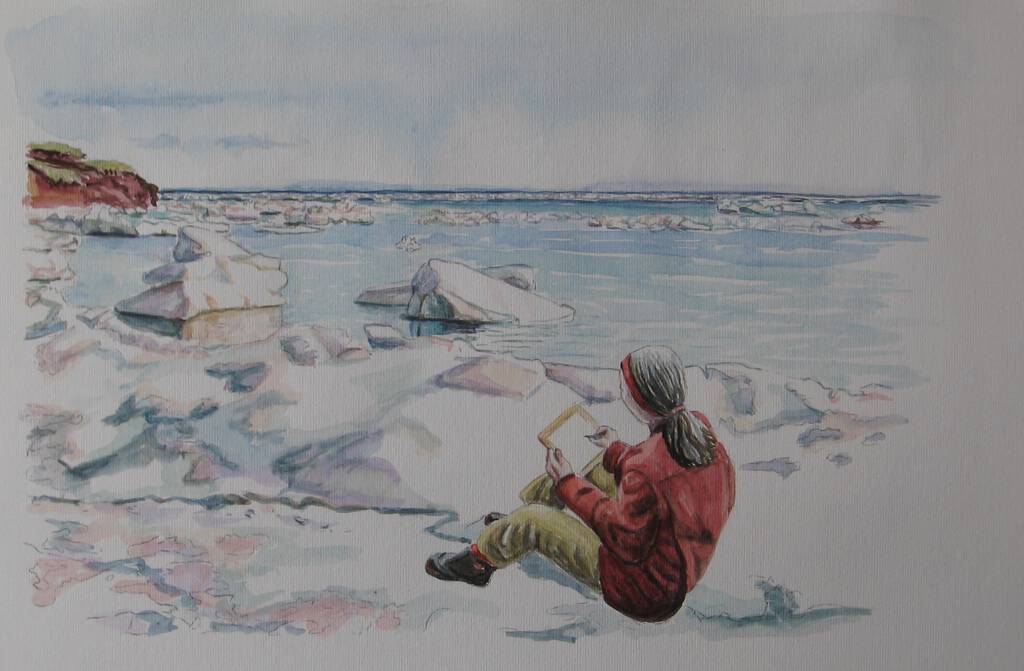
The passage of time, transitions in nature, and shifting patterns of life have been recurrent themes in Brenda Whiteway’s creative work. The White Sands PEI Shoreline Project is a further exploration of these themes through paintings, drawings, photographs, and mixed-media of a small coastal area in White Sands, PEI, which has personal significance but resonates on a universal scale. The site originally belonged to her maternal grandparents who had a subsistence farm and fished off the Northumberland Strait close to Pictou Island. Brenda has been observing, recording, and researching the area’s weather patterns, light, tidal shifts, flora and fauna, history, and cultural ecology. For her, this is a metaphoric petri dish through which cultural and climactic shifts may be viewed on an intimate scale and expressed creatively. Capturing the elusive qualities of the seasons through various art mediums while plants bloom and fade, tides shift, earth freezes and thaws, and the sky reveals its many moods is an attempt to capture the genius loci of an area the artist holds dear.

There are fewer more thoughtful, creative people than Brenda, and you should plan to attend.

White Sands PEI Shoreline Project by Brenda Whiteway

10 Nov 02:33

Le mieux est l'ennemi du bien

by peter@rukavina.net (Peter Rukavina)

My friend Elmine, in her post Leer weer langzaam denken, passes on a piece of advice from Frank:

Belangrijk nog om te melden is de tip die ik van Frank kreeg: ook met vijftien minuten per dag kom je verder in een boek. Die tip heeft me in beweging gekregen om aan een eerste boek te beginnen. En wat gebeurd er vervolgens? Ongemerkt lees ik nu zo weer een uur of langer achter elkaar.

Or, machine-translated:

Another important thing to report is the tip I got from Frank: even with fifteen minutes a day you continue in a book. That tip got me moving to start a first book. And what happens next? Unnoticed, I now read for an hour or more in succession.

I’ve found that if I simply make an effort to scatter books around my home and office, I’ll be more likely to pick them up and read them.

And if I pick them up and read them I’m more likely to keep reading them, for far longer than I’d set out to.

This proves a far more effective “I should read more” strategy than trying to conjure up a perfect reading nook and booking out specific reading time.

Put another way: you can’t read a book that’s not in front of you.

10 Nov 02:33

Le mieux est l'ennemi du bien

by peter@rukavina.net (Peter Rukavina)

My friend Elmine, in her post Leer weer langzaam denken, passes on a piece of advice from Frank:

Belangrijk nog om te melden is de tip die ik van Frank kreeg: ook met vijftien minuten per dag kom je verder in een boek. Die tip heeft me in beweging gekregen om aan een eerste boek te beginnen. En wat gebeurd er vervolgens? Ongemerkt lees ik nu zo weer een uur of langer achter elkaar.

Or, machine-translated:

Another important thing to report is the tip I got from Frank: even with fifteen minutes a day you continue in a book. That tip got me moving to start a first book. And what happens next? Unnoticed, I now read for an hour or more in succession.

I’ve found that if I simply make an effort to scatter books around my home and office, I’ll be more likely to pick them up and read them.

And if I pick them up and read them I’m more likely to keep reading them, for far longer than I’d set out to.

This proves a far more effective “I should read more” strategy than trying to conjure up a perfect reading nook and booking out specific reading time.

Put another way: you can’t read a book that’s not in front of you.

10 Nov 02:32

Seeing this a lot.


Seeing this a lot.

10 Nov 02:30

A Robo-Neutrino with SRAM Force eTap

by noreply@blogger.com (VeloOrange)
by Igor

When Brook from SRAM emailed us asking about getting a Neutrino, I was incredibly intrigued. Is this a personal commuter? Traveler? Are they coming out with mini-velo components? Turns out, they wanted a fun and approachable bike to showcase their new eTap AXS Wireless Force components both at their booth and seminar for Philly Bike Expo. Enter Robo-Neutrino...


The idea is that while SRAM often shows these items on high-zoot mountain and road bikes, they haven't really told folks about the benefits and flexibility of the wireless platform on a bike that will see more practical urban use. While I cannot speak to the long term reliability (I'm sure it's good), the performance and ergonomics of the system is really fantastic.


The rocker button is in a perfect place for your thumb, leaving plenty of room for your hand on the grip. Additionally, the shifter can tell the derailleur to dump gears up and down simply by holding the respective button. It's pretty neat.


On the left side side sits the remote dropper lever. It's just a button. Press it once while sitting on the saddle and the post goes down. Press it again and the post goes up. It's a nice speed too. Putting a dropper on the Neutrino makes the bike that much smaller when space is at a premium. 


It also had a Force crankset and SRAM Hubs.


Stopping is handled by their Level Hydraulic Brakeset. It stopped those tiny wheels with ease and comfort.


The part that brings the whole kit together is Sram's controller app for your phone. You can program all the buttons, monitor component readiness, update firmware, and personalize component behavior. It's all pretty trick.


What do you think of this Robo-Neutrino? Whether it's Mavic Zap, SRAM eTap, Campy EPS, Shimano Di2, or otherwise, have you tried electronic shifting?
10 Nov 02:29

Five dysfunctions of ‘democratised’ research. Part 5 – Stunted capability

by leisa.reichelt@gmail.com (Leisa Reichelt)

This is the fifth and final in a series of posts examining some of the most common and most problematic problems we need to consider when looking to scale research in organisations. You can start with the first post in this series here.

Here are five common dysfunctions that we are contending with.

  1. Teams are incentivised to move quickly and ship, care less about reliable and valid research
  2. Researching within our silos leads to false positives
  3. Research as a weapon (validate or die)
  4. Quantitative fallacies
  5. Stunted capability

In this post, we’re looking at what happens when the research practice in an organisation fails to mature.

A great first step

Testing one user is 100 percent better than testing none – Steve Krug, Don’t Make Me Think

Many organisations get started doing research with customers and users off the back of encouragement from people like Steve Krug and his classic book ‘Don’t Make Me Think’. In this and other books Steve makes simple usability testing accessible and achievable to almost anyone.

Steve and others like him are evangelists reaching out to those companies who are afraid to engage with their customers to understand opportunities for them to improve. This is important work. Their message is usually that talking to customers is not hard or scary, and that we’ll be better for doing a bit of it, even not perfectly, than not doing it at all.

The first step can be scary

And they are right. Having anyone in the company talking to just one user (and hopefully some more) is a fabulous first step. But it is intended to be just that – a first step. An encouragement to realise the benefits of involving people outside our offices in the process of designing and developing products and services. And help to overcome the fear of engaging with customers and users and an opportunity to experience how beneficial this can be.

For those of us who work with research participants on a regular basis, it may be hard to recall exactly how terrifying those first few research sessions felt. Even trained and experienced researchers continue to experience some background fear (or exhilaration?)  of all the things that could go wrong in the research study – and there are plenty!

The thing about first steps, though, is that they are usually intended to be followed by second steps. Once we break through the fear (or in some cases, just lack of awareness), the idea is that we continue to increase the maturity of our practice.

And this is where many organisations seem to hit a roadblock. More and more people in the organisation might be out and eagerly involving customers in the process of shaping their products, but they often don’t invest in either improving their own skills in research or investing in hiring people who have training and experience doing research. 

Talking to users is not research

One important realisation we need to have on the path to maturity is recognising that ‘talking to customers’ is actually not the same thing as doing research. Talking to customers or watching customers use our products and services has many benefits – in particular it can increase our empathy for our customers and users, it can help expose us to scenarios of use that are dramatically different to our own and what we would expect, and it can provide clues as to where the biggest problems may like. All of these are good outcomes.

If we want to use research as evidence for decision making – either for product strategy or design decisions – then we need to be able to do more to ensure that the insights we are gleaning are sufficiently reliable and valid.

Research doesn’t need to be ‘perfect’, just valid and reliable.

 ‘I don’t need the research to be perfect, I just need enough to help me make a decision’.

Often this is said in response to the suggestion that the research we should be doing will take longer or be more difficult and expensive than our speaker would like. In this situation, there is often a pre-existing ‘hunch’ and they are looking to users for validation. Or perhaps they are stuck between two options and seeks a tie breaker.

Any specialist researcher has almost certainly had their recommended approach discredited as ‘too academic’, and sometimes it is true. Sometimes the research methodology is overdone for the question the business is seeking to answer. But what often follows is a bit of a race to the bottom where considered sample design and appropriate methodology are quickly discarded in favour of whatever is fastest and easiest.

Without the right experience and training, all too often interviewers ‘cut to the chase’ so we get more or less directly to the topic at hand. Somewhere in the world right now a product manager under pressure to make a decision is asking questions like these in a customer interview:

‘here’s what we’re thinking of making, what do you think about it?’

or, perhaps worse…

‘if we made this, would you pay for it’

It can be easy and tempting – so much faster and often quantitative – to mistake the research question for the interview question.

Even with training, it seems that the urge to be able to say that 10 out of 12 people said they would pay for it is almost irresistible. ‘Beating around the bush’ to get the question answered seems like a waste of everyone’s time, in this time where the bias to action and desire to ship at velocity is most valued. 

(It shouldn’t really be a surprise that lack of research capability maturity exposes us to the previous four dysfunctions).

Matching methodology to risk

Whilst we should have plenty of sympathy for this desire for lightweight research and simplicity, it is important to ensure that the methods employed are matched to the risk involved in the decision, rather than the most compressed timeframe.

As our organisations grow, the decisions we take using evidence from our customers can become more and more substantial – the gains of getting it right are greater and the risks of getting it wrong get uglier.

In the same way, our research maturity needs to continue to grow so that we can continue to match the size of the risk of getting it wrong.

This is not to say that mature organisations only ever do serious, time consuming research. Rather, that we invest where the risk is highest.

Investment might look like hiring trained researchers who can design and recruit the right sample and conduct the research in a way that reduces bias. Or investment might look like iterative research with an every increasing number of increasingly diverse participants, sprint after sprint – allowing the team to continue to learn, This can work beautifully when the team is able to be responsive to that learning over time.

Investing too much

Conversely, there are situations where the investment in research is far too high for the decision being made. This often happens where the organisations design process has broken down, or where designers have entirely lost confidence in being able to make relatively conventional design decisions. In these situation we design complex studies to ‘validate’ one micro design treatment over another. In this case,  the mismatch in risk to research investment can result in large quantities of what I would consider to be wasteful and often unreliable research. 

Beware Dunning Kruger

Dunning Kruger graph of confidence vs expertise

User Research is particularly susceptible to Dunning Kruger syndrome, wherein a relatively small amount of knowledge can result in an excess of confidence. Many people claim a ‘background in research’ when they could mean they watched someone else do a bunch of usability studies in their last job, or they did a research based degree at university.

Many designers and product managers are entirely happy with the outcomes they get from research and how it enables their practice – and often loudly object to the suggestion that anyone could get a better result from the research than they do.

Yet, at the same time, the harsh reality is that the work that is done is often resulting in misleading outcomes that can put their product and their organisation at risk. 

It also undermines the reputation of research in the organisation when people claim when a ‘researched’ product goes into the world and doesn’t succeed as expected. ‘We did research before and it didn’t work’.

In the same way that often both design and product management capabilities require an engineering led organisation to move through the stages from unconscious incompetence through to conscious competence ,  the very same is true for the research capability.

Achieving research maturity

And so, at the end of our five dysfunctions, what can be done to help provoke an organisation to not only involve users in the process of creating products and services but to start and continue to grow their ability to do so by revealing the important insights that are both reliable and valid?

Here are some things that have worked for me.

Perhaps through improving business fluency. By talking less about empathy and more about the risk to the business of getting it wrong. Talking less about customer obsession and more about the reliability and validity of the different types of evidence we can use to make decisions. And by running an open research practice – getting out of the black box, removing any mystery about our work, showing our workings and involving others in the process.

Make use of existing momentum – bringing new shape and substance to whatever your organisation is using to bring its attention to its customers – whether its an NPS survey, a customer convention, a feedback form, or a guerilla research practice – start by shaping the existing connections into something more insightful, more reliable and valid.

Be brave, but be patient and we’ll get there.

10 Nov 02:28

Embrace the Blur, the DFW Landing Version

by Ms. Jen
Landing at DFW, a rather satisfying blurred tarmac

Fri. 11.08.19 – More and more, due to software algorithms, it is hard to get a phone’s camera to achieve a satisfying blur or nightscape. All the recent camera phones want to make dark scenes light and blurred scenes sharp. Thus, when I am able to get the Samsung in a quick snapshot to achieve... Read more »

10 Nov 02:27

Opinion: A note to Western Canada: The rest of the country understands tough economic times

mkalus shared this story .

Brad Wall thinks people in the rest of Canada are having a hard time understanding the anger building in the Prairies. He wants to explain it in terms that they can understand.

“Some of our fellow citizens seem surprised and even critical of Westerners who are expressing frustration,” the former Saskatchewan premier said on Twitter. “Imagine if an industry key to central Canada lost 100,000 jobs with more under threat – and federal policies actually made it worse.”

I guess Mr. Wall – along with Alberta Premier Jason Kenney and other outspoken Prairie leaders – were too busy feeling indignant to notice. It already happened.

In 2006, Ontario had more than 1 million manufacturing jobs. By the middle of 2009, it had about 750,000. Those jobs never came back; employment in the sector has hovered around that level ever since. One-quarter of the province’s long-standing economic lifeblood looks to be permanently gone.

And, yes, one could argue that government policy consciously allowed it to leave. The North American free-trade agreement, and the country’s embracing of global trade liberalization generally, opened the door to the migration of manufacturing jobs away from relatively high-cost Canada to lower-cost markets such as Mexico and China. The hardships of the Great Recession cemented that migration. Whether you support the benefits of free trade, it has been an undeniable consequence.

This happened at a time when Alberta, because of sustained strong oil prices, escaped the recession with barely a scratch and flat-out boomed thereafter. Its economy grew by more than 30 per cent from 2009 to 2014, its employment by 13 per cent, its per capita provincial government-program spending by more than 20 per cent.

And that’s not the only tale of a region’s main industry being gutted – sometimes abetted, if not outright triggered, by government policy – while the country’s Western oil and gas regions basked in prosperity.

In 1992, Ottawa imposed a moratorium on cod fishing off the Atlantic coast, citing the near-extinction of several species due to overfishing. That ban, which continues to this day, effectively permanently shut down Newfoundland and Labrador’s cod fishery, the mainstay of the provincial economy for nearly 500 years. Overnight, the moratorium wiped out more than 35,000 jobs – roughly 15 per cent of the province’s labour force – most of them in hundreds of small fishing communities where there was essentially no other industry.

In the six years after the imposition of the cod moratorium, the Newfoundland and Labrador economy grew by a total of 2.8 per cent; it was in recession in two of those years. In the same period, Alberta’s booming economy grew nearly 30 per cent; it added 200,000 jobs.

In 1995, British Columbia (that other part of Western Canada that Alberta and Saskatchewan seem to have forgotten about in all their alienation talk) had more than 100,000 people directly employed by its forest-products industry, the historic bedrock of the provincial economy. Two decades later, employment had shrunk to half that. Towns all over the tree-rich province, from Port Alberni to Chetwynd, endured the devastation of mill closings. This long, painful downturn came during that same 20 years that employment in Alberta’s oil-and-gas-extraction industry more than doubled, to 110,000.

Story continues below advertisement

Perhaps the people in all these other parts of Canada don’t understand the hostility that some of the loudest voices coming from the Prairies are directing at the rest of the country – the angry accusations of ungratefulness, greed and betrayal. Maybe they are perplexed by the paranoia that has some Albertans accusing the federal government of actively seeking to destroy Canada’s richest province and the Prime Minister of harbouring a hatred inherited from his father that has put “Ruin Alberta” at the top of his secret to-do list. Maybe they can’t comprehend how so many people can talk openly about dismantling 152 years of common nationhood over a pipeline.

Those things you can try to explain. I’m really struggling with them, and I grew up in Alberta during Pierre Trudeau’s despised National Energy Program.

But don’t tell the rest of Canada that it doesn’t understand the pain of seeing an industry that was its economic bedrock crumble beneath it. Don’t try to explain to people in places like Oshawa, Ont., where the auto assembly plant is closing, or Shawinigan, Que., where the paper mill was shuttered, or Bonavista, N.L., where the cod disappeared and took a quarter of the town with it, what it’s like to have your livelihood threatened by the unstoppable march of change. They know.

You didn’t invent hardship. Your preaching is a slap in the face to all your fellow Canadians who suffered while you thrived. It’s that slap that they’re really having trouble understanding.

10 Nov 02:27

RT @JohnCleese: Boris Johnson's refusal to publish the report on Russian infiltration is beyond disgraceful If he suppresses it, it is cle…

by JohnCleese
mkalus shared this story from mrjamesob on Twitter.

Boris Johnson's refusal to publish the report on Russian infiltration is beyond disgraceful

If he suppresses it, it is clearly because it reflects badly on his party, and will affect the way people vote

If he doesn't publish soon, please don't vote for him


Retweeted by mrjamesob on Saturday, November 9th, 2019 10:51am


12029 likes, 4125 retweets
10 Nov 02:27

I finally got around to implementing dark mode ...

I finally got around to implementing dark mode on my website. It was easier than I feared it would be, thanks to CSS variables.

10 Nov 02:27

Getting the bikes ready for winter

by jnyyz

Given that the forecast was for a decent amount of snow early next week, along with some cold weather, it was time to pull the winter beater out of the garage.

I also had to have a new bottom bracket installed by the good folks at Hoopdriver Bicycles.

Look, small patches of black ice seen yesterday. Easy enough to avoid, but my agreement with my family is that if the temperatures are below zero, I ride the bike with studded tires. This is because of one evening several years ago that started well above zero, but ended with freezing rain, and I went over hard on my pink commuter and broke my collarbone.

I did get some comments from the LBS about the spectacular amount of rust on my fenders, which were described as “leperous”.

They also said that the crank bolts had corroded and were difficult to remove.

They also replaced my stainless chain with a galvanized one. We’ll see how long this one lasts, but I pledged to wipe the salt off of the bike at least once in a while.

I was also inspired to swap back the winter tires on the Haul a Day.

All ready for winter now, although it looks like I put the front tire the wrong way around.

With the end of DST, my evening commutes are now dark, and so I’ve switched to my T2 helmet with the built in lights. With earflaps, of course.

Still happy with it although it looks like the LA based company that made it is no more. The helmet still appears to be available in Europe for the moment. However, I wasn’t too pleased to find out that this fellow uses the same helmet.

I apparently have another helmet with built in lights in bound from a much delayed kickstarter, and I’ll report on it if and when it finally arrives.

10 Nov 02:26

Reading in Data

by Kieran Healy

Here’s a common situation: you have a folder full of similarly-formatted CSV or otherwise structured text files that you want to get into R quickly and easily. Reading data into R is one of those tasks that can be a real source of frustration for beginners, so I like collecting real-life examples of the many ways it’s become much easier.

This week in class I was working with country-level historical mortality rate estimates. These are available from mortality.org, a fabulous resource. They have a variety of data available but I was interested in the 1x1 year estimates of mortality for all available countries. By “1x1” I mean that the tables show (for men, women, and in total) age-specific morality rate estimates for yearly ages from 0 to 110 and above, for every available historical year (e.g. from 1850 to 2016 or what have you). So you can have an estimate of the mortality rate for, say, 28 year olds in France in 1935.

Downloading this data gives me a folder of text files, one for each country. (Or rather, country-like unit: there are separate series for, e.g. East Germany, West Germany, and Germany as a whole, for example, along with some countries where sub-populations are broken out historically.) The names of the files are consistently formatted, as is the data inside them, and they have a .txt extension. What I wanted to do was get each one of these files into R, ideally putting them all into a single big table that could be the jumping-off point for subsetting and further analysis.

I know from the documentation provided by mortality.org that the files all have the same basic format, which of course makes things much easier. The data is already clean. It’s just a matter of loading it all in efficiently, or “ingesting” it, to use the charming image that seems to be preferred at present.

Here we go. First, some libraries.

1
2
3
4

library(tidyverse)
library(janitor)
library(here)
1
2

## here() starts at /Users/kjhealy/Source/demog

We get a list of the filenames in our raw data folder, along with their full paths. Then we take a look at them.

 1
 2
 3
 4
 5
 6
 7
 8
 9
10
11
12
13
14
15
16
17
18
19
20
21
22
23
24
25
26
27
28
29
30
31
32
33
34
35
36
37
38
39
40
41
42
43
44
45
46
47
48
49
50
51
52
53
54
55
56
57

filenames <- dir(path = here("rawdata"),
                 pattern = "*.txt",
                 full.names = TRUE)

filenames

##  [1] "/Users/kjhealy/Source/demog/rawdata/AUS.Mx_1x1.txt"    
##  [2] "/Users/kjhealy/Source/demog/rawdata/AUT.Mx_1x1.txt"    
##  [3] "/Users/kjhealy/Source/demog/rawdata/BEL.Mx_1x1.txt"    
##  [4] "/Users/kjhealy/Source/demog/rawdata/BGR.Mx_1x1.txt"    
##  [5] "/Users/kjhealy/Source/demog/rawdata/BLR.Mx_1x1.txt"    
##  [6] "/Users/kjhealy/Source/demog/rawdata/CAN.Mx_1x1.txt"    
##  [7] "/Users/kjhealy/Source/demog/rawdata/CHE.Mx_1x1.txt"    
##  [8] "/Users/kjhealy/Source/demog/rawdata/CHL.Mx_1x1.txt"    
##  [9] "/Users/kjhealy/Source/demog/rawdata/CZE.Mx_1x1.txt"    
## [10] "/Users/kjhealy/Source/demog/rawdata/DEUTE.Mx_1x1.txt"  
## [11] "/Users/kjhealy/Source/demog/rawdata/DEUTNP.Mx_1x1.txt" 
## [12] "/Users/kjhealy/Source/demog/rawdata/DEUTW.Mx_1x1.txt"  
## [13] "/Users/kjhealy/Source/demog/rawdata/DNK.Mx_1x1.txt"    
## [14] "/Users/kjhealy/Source/demog/rawdata/ESP.Mx_1x1.txt"    
## [15] "/Users/kjhealy/Source/demog/rawdata/EST.Mx_1x1.txt"    
## [16] "/Users/kjhealy/Source/demog/rawdata/FIN.Mx_1x1.txt"    
## [17] "/Users/kjhealy/Source/demog/rawdata/FRACNP.Mx_1x1.txt" 
## [18] "/Users/kjhealy/Source/demog/rawdata/FRATNP.Mx_1x1.txt" 
## [19] "/Users/kjhealy/Source/demog/rawdata/GBR_NIR.Mx_1x1.txt"
## [20] "/Users/kjhealy/Source/demog/rawdata/GBR_NP.Mx_1x1.txt" 
## [21] "/Users/kjhealy/Source/demog/rawdata/GBR_SCO.Mx_1x1.txt"
## [22] "/Users/kjhealy/Source/demog/rawdata/GBRCENW.Mx_1x1.txt"
## [23] "/Users/kjhealy/Source/demog/rawdata/GBRTENW.Mx_1x1.txt"
## [24] "/Users/kjhealy/Source/demog/rawdata/GRC.Mx_1x1.txt"    
## [25] "/Users/kjhealy/Source/demog/rawdata/HRV.Mx_1x1.txt"    
## [26] "/Users/kjhealy/Source/demog/rawdata/HUN.Mx_1x1.txt"    
## [27] "/Users/kjhealy/Source/demog/rawdata/IRL.Mx_1x1.txt"    
## [28] "/Users/kjhealy/Source/demog/rawdata/ISL.Mx_1x1.txt"    
## [29] "/Users/kjhealy/Source/demog/rawdata/ISR.Mx_1x1.txt"    
## [30] "/Users/kjhealy/Source/demog/rawdata/ITA.Mx_1x1.txt"    
## [31] "/Users/kjhealy/Source/demog/rawdata/JPN.Mx_1x1.txt"    
## [32] "/Users/kjhealy/Source/demog/rawdata/KOR.Mx_1x1.txt"    
## [33] "/Users/kjhealy/Source/demog/rawdata/LTU.Mx_1x1.txt"    
## [34] "/Users/kjhealy/Source/demog/rawdata/LUX.Mx_1x1.txt"    
## [35] "/Users/kjhealy/Source/demog/rawdata/LVA.Mx_1x1.txt"    
## [36] "/Users/kjhealy/Source/demog/rawdata/NLD.Mx_1x1.txt"    
## [37] "/Users/kjhealy/Source/demog/rawdata/NOR.Mx_1x1.txt"    
## [38] "/Users/kjhealy/Source/demog/rawdata/NZL_MA.Mx_1x1.txt" 
## [39] "/Users/kjhealy/Source/demog/rawdata/NZL_NM.Mx_1x1.txt" 
## [40] "/Users/kjhealy/Source/demog/rawdata/NZL_NP.Mx_1x1.txt" 
## [41] "/Users/kjhealy/Source/demog/rawdata/POL.Mx_1x1.txt"    
## [42] "/Users/kjhealy/Source/demog/rawdata/PRT.Mx_1x1.txt"    
## [43] "/Users/kjhealy/Source/demog/rawdata/RUS.Mx_1x1.txt"    
## [44] "/Users/kjhealy/Source/demog/rawdata/SVK.Mx_1x1.txt"    
## [45] "/Users/kjhealy/Source/demog/rawdata/SVN.Mx_1x1.txt"    
## [46] "/Users/kjhealy/Source/demog/rawdata/SWE.Mx_1x1.txt"    
## [47] "/Users/kjhealy/Source/demog/rawdata/TWN.Mx_1x1.txt"    
## [48] "/Users/kjhealy/Source/demog/rawdata/UKR.Mx_1x1.txt"    
## [49] "/Users/kjhealy/Source/demog/rawdata/USA.Mx_1x1.txt"

What does each of these files look like? Let’s take a look at the first one, using read_lines() to show us the top of the file.

1
2
3
4
5
6
7
8
9

read_lines(filenames[1], n_max = 5)

## [1] "Australia, Death rates (period 1x1), \tLast modified: 26 Sep 2017;  Methods Protocol: v6 (2017)"
## [2] ""                                                                                               
## [3] "  Year          Age             Female            Male           Total"                         
## [4] "  1921           0             0.059987        0.076533        0.068444"                        
## [5] "  1921           1             0.012064        0.014339        0.013225"

All the files have a header section like this. When we read the data in we’ll want to ignore that and go straight to the data. But seeing as it’s there, we can make use of it to grab the name of the country. It saves us typing it ourselves. Let’s say we’d also like to have a code-friendly version of those names (i.e., in lower-case with underscores instead of spaces). And finally—while we’re at it—let’s grab those all-caps country codes used in the file names, too. We write three functions:

  • get_country_name() grabs the first word or words on the first line of each file, up to the first comma. That’s our country name.
  • shorten_name() makes the names lower-case and replaces spaces with underscores, and also shortens “The United States of America” to “USA”.
  • make_ccode() wraps a regular expression that finds and extracts the capitalized country codes in the file names.
 1
 2
 3
 4
 5
 6
 7
 8
 9
10
11
12
13
14
15
16
17
18


get_country_name <- function(x){
    read_lines(x, n_max = 1) %>%
        str_extract(".+?,") %>%
        str_remove(",")
}

shorten_name <- function(x){
    str_replace_all(x, " -- ", " ") %>%
        str_replace("The United States of America", "USA") %>%
        snakecase::to_any_case()
}

make_ccode <- function(x){
    str_extract(x, "[:upper:]+((?=\\.))")
}

Now we create a tibble of summary information by mapping the functions to the filenames.

 1
 2
 3
 4
 5
 6
 7
 8
 9
10
11
12
13
14
15
16
17
18
19
20
21
22
23
24
25


countries <- tibble(country = map_chr(filenames, get_country_name),
                        cname = map_chr(country, shorten_name),
                        ccode = map_chr(filenames, make_ccode),
                        path = filenames)

countries

## # A tibble: 49 x 4
##    country     cname       ccode path                                      
##    <chr>       <chr>       <chr> <chr>                                     
##  1 Australia   australia   AUS   /Users/kjhealy/Source/demog/rawdata/AUS.M…
##  2 Austria     austria     AUT   /Users/kjhealy/Source/demog/rawdata/AUT.M…
##  3 Belgium     belgium     BEL   /Users/kjhealy/Source/demog/rawdata/BEL.M…
##  4 Bulgaria    bulgaria    BGR   /Users/kjhealy/Source/demog/rawdata/BGR.M…
##  5 Belarus     belarus     BLR   /Users/kjhealy/Source/demog/rawdata/BLR.M…
##  6 Canada      canada      CAN   /Users/kjhealy/Source/demog/rawdata/CAN.M…
##  7 Switzerland switzerland CHE   /Users/kjhealy/Source/demog/rawdata/CHE.M…
##  8 Chile       chile       CHL   /Users/kjhealy/Source/demog/rawdata/CHL.M…
##  9 Czechia     czechia     CZE   /Users/kjhealy/Source/demog/rawdata/CZE.M…
## 10 East Germa… east_germa… DEUTE /Users/kjhealy/Source/demog/rawdata/DEUTE…
## # … with 39 more rows


Nice. We could have written each of those operations as anonymous functions directly inside of map_chr(). This would have been more compact. But often it can be useful to break out the steps as shown here, for clarity—especially if map() operations have a tendency to break your brain, as they do mine.

We still haven’t touched the actual data files, of course. But now we can just use this countries table as the basis for reading in, I mean ingesting, everything in the files. We’re going to just add a list column named data to the end of the table and put the data for each country in it. We’ll temporarily unnest it to clean the column names and recode the age variable, then drop the file paths column and nest the data again.

The hard work is done by the map() call. This time we will use ~ formula notation inside map() to write what we want to do. We’re going to feed every filename in path to read_table(), one at a time. We tell read_table() to skip the first two lines of every file it reads, and also tell it that in these files missing data are represented by a . character. Everything read in ends up in a new list column named data.

 1
 2
 3
 4
 5
 6
 7
 8
 9
10
11
12
13
14
15
16
17
18
19
20
21
22
23
24
25
26
27
28
29


mortality <- countries %>%
    mutate(data = map(path,
                      ~ read_table(., skip = 2, na = "."))) %>%
    unnest(cols = c(data)) %>%
    clean_names() %>%
    mutate(age = as.integer(recode(age, "110+" = "110"))) %>%
    select(-path) %>%
    nest(data = c(year:total))

mortality


## # A tibble: 49 x 4
##    country      cname        ccode           data
##    <chr>        <chr>        <chr> <list<df[,5]>>
##  1 Australia    australia    AUS     [10,434 × 5]
##  2 Austria      austria      AUT      [7,881 × 5]
##  3 Belgium      belgium      BEL     [19,425 × 5]
##  4 Bulgaria     bulgaria     BGR      [7,104 × 5]
##  5 Belarus      belarus      BLR      [6,438 × 5]
##  6 Canada       canada       CAN     [10,101 × 5]
##  7 Switzerland  switzerland  CHE     [15,651 × 5]
##  8 Chile        chile        CHL      [1,887 × 5]
##  9 Czechia      czechia      CZE      [7,437 × 5]
## 10 East Germany east_germany DEUTE    [6,660 × 5]
## # … with 39 more rows

And we’re done. Forty nine tables of data smoothly imported and bundled together. Each of the country-level data tables is a row in data that we can take a look at as we like:

 1
 2
 3
 4
 5
 6
 7
 8
 9
10
11
12
13
14
15
16
17
18
19
20
21
22


mortality %>% 
  filter(country == "Austria") %>% 
  unnest(cols = c(data))


## # A tibble: 7,881 x 8
##    country cname   ccode  year   age   female     male    total
##    <chr>   <chr>   <chr> <dbl> <int>    <dbl>    <dbl>    <dbl>
##  1 Austria austria AUT    1947     0 0.0798   0.0994   0.0899  
##  2 Austria austria AUT    1947     1 0.00657  0.00845  0.00753 
##  3 Austria austria AUT    1947     2 0.00425  0.00469  0.00447 
##  4 Austria austria AUT    1947     3 0.00337  0.00340  0.00339 
##  5 Austria austria AUT    1947     4 0.00235  0.00270  0.00253 
##  6 Austria austria AUT    1947     5 0.00174  0.00195  0.00184 
##  7 Austria austria AUT    1947     6 0.00131  0.00152  0.00142 
##  8 Austria austria AUT    1947     7 0.00132  0.00169  0.00151 
##  9 Austria austria AUT    1947     8 0.00115  0.00149  0.00132 
## 10 Austria austria AUT    1947     9 0.000836 0.000997 0.000918
## # … with 7,871 more rows

Now you can get on with the actual analysis.

There isn’t anything especially unusual in the steps shown here. It’s just a pretty common operation that’s worth knowing how to do cleanly. One nice thing about this approach is that it’s immediately applicable to, say, a folder containing the 5-year mortality estimates rather than the 1 year estimates. You don’t have to do anything new, and there’s no mucking around with manually naming files and so on.

10 Nov 02:25

Der Heinrichplatz in Kreuzberg wird vielleicht bald Rio-Reiser-Platz heißen

by Ronny
mkalus shared this story from Das Kraftfuttermischwerk.

In Berlin Kreuzberg hat die Bezirksverordnetenversammlung Friedrichshain-Kreuzberg zu einer öffentlichen Diskussionsveranstaltung eingeladen und dabei unter anderem vorgeschlagen, den Heinrichplatz zum Rio-Reiser-Platz umzubenennen. Und das ganz zu Recht, wie ich finde. Wir brauchen viel mehr Rio-Reiser-Plätze. Überall.

Ob es dazu tatsächlich kommen sollte, entscheidet demnächst die Berliner Bezirksverordnetenversammlung.

Kreuzberg hat gesprochen: Der Heinrichplatz wird wahrscheinlich bald Rio-Reiser-Platz heißen. Am Donnerstagabend hatte die Bezirksverordnetenversammlung Friedrichshain-Kreuzberg zu einer öffentlichen Diskussionsveranstaltung eingeladen. Wie soll Kreuzberg an den verstorbenen Sänger erinnern? So lautete die Frage. Mit knapp 70 Gästen war der Veranstaltungssaal Aquarium am Kottbusser Tor sehr gut besucht.

Gemeinsam mit den Gästen diskutierten die Fürsprecher*innen die verschiedenen Vorschläge. Neben dem Vorschlag zum Heinrichplatz war eine Idee, den Südzipfel des Mariannenplatzes umzubenennen, der in Reisers berühmten »Rauch-Haus-Song« erwähnt wird. Auch die Umbenennung des Uferwegs an der Lohmühleninsel, eine Gedenkinstallation oder der Vorschlag, die Grünanlage vor dem Kunsthaus Bethanien zum Rio-Reiser-Park zu erklären, standen zur Debatte. Neben der Grünen-Politikerin und Kulturstadträtin von Friedrichshain-Kreuzberg Clara Herrmann hatten sich auch Gert C. Möbius, der Bruder von Rio Reiser, und Kai Sichtermann, Bassist und Gründungsmitglied der Band Ton Steine Scherben, mit Redebeiträgen beteiligt.

10 Nov 02:25

A young Dolly Parton with her husband Carl Dean. They’ve been married since 1966. pic.twitter.com/UGgJSW4lgh

by moodvintage
mkalus shared this story from moodvintage on Twitter.

A young Dolly Parton with her husband Carl Dean. They’ve been married since 1966. pic.twitter.com/UGgJSW4lgh


444 likes, 60 retweets
10 Nov 02:25

Actress Anita Ekberg defending herself from paparazzi with a bow and arrow, 1960 pic.twitter.com/S7Umma4MWL

by moodvintage
mkalus shared this story from moodvintage on Twitter.

Actress Anita Ekberg defending herself from paparazzi with a bow and arrow, 1960 pic.twitter.com/S7Umma4MWL


243 likes, 56 retweets
10 Nov 02:25

1937 Western Clipper Motorhome pic.twitter.com/meaMlopVug

by moodvintage
mkalus shared this story from moodvintage on Twitter.

1937 Western Clipper Motorhome pic.twitter.com/meaMlopVug


580 likes, 98 retweets
10 Nov 02:24

Recommended on Medium: The Double Opt-In Introduction

Neon hello sign
Photo by Drew Beamer on Unsplash

As you build your professional network it won’t be uncommon for someone you know to ask you for an introduction. A decade ago, Fred Wilson asked for the adoption of the double opt-in introduction. Today these are standard as they are compassionate way to connect people. This post describes the emails involved in the introduction dance.

Helping others expand their network contributes to compounding the value of your own. But it’s important to act with compassion toward those involved. Your colleague Bob may ask you to introduce you to your friend Alice. You don’t know if Alice has the interest or personal bandwidth to make the connection unless you ask her.

Never begin an introduction with an email cc’ing both Alice and Bob saying “Hi Alice, I’d like to introduce you to Bob”.

Instead, use a double opt-in introduction. First, send a short note to Alice.

Subject: Introduction Request
Hi Alice. I’d like to introduce you to Bob who is a [personal friend / person I’ve been mentoring / former colleague].
Bob would like to connect with you so he can learn more about [thing that interests Bob]. It may be valuable for you to connect as he [thing that Bob knows or does that Alice cares about].
May I have your permission to connect the two of you?

Keep the email short and concise. And don’t sell Bob short. Include the reason it would be valuable for Alice to accept the request.

If you don’t receive permission, send a short note back to Bob with regrets.

Subject: Introduction to Alice — Regrets
Hi Bob. Alice sends regrets that she is unable to make the intro.

As with invitations, regrets are the best simple and short. You need not give a reason. Bob is a compassionate and empathetic person so he doesn’t take the notice of regrets personally. He knows that people are busy and he’ll be able to find other means of solving his particular problem.

Having received permission, send an email cc’ing both Alice and Bob. I’ve used an introduction Trevor O recently made on my behalf to construct this template. It’s the best example of a double opt-in introduction email I’ve seen. I’m using it here with his permission.

Subject: Alice <> Bob
Hi Alice,
As mentioned, I’d like to introduce you to Bob. He and I know each other from [place you and Bob know each other from]. He’s recently been [doing thing that interests Alice]. And I mentioned what you have been doing with [thing that interests Bob].
Bob,
I’d like you to meet Alice. Alice has tons of experience with [thing that interests Bob]. I respect how she [thing that you respect about Alice].
I’ll let you two take it from here.
- Shawn

The subject “NAME <> NAME” is the standard double opt-in introduction subject. Some people receive many introductions a week so it goes a long way to keep things consistent.

Begin by addressing the person granting the introduction. Introduce Alice to Bob with some brief info on how you know Bob and why it would be valuable for Alice to connect. Also, make it clear it’s a double opt-in introduction by stating “As mentioned …”. This lets Bob know you have already spoken to Alice.

Next, address the person who requested the introduction. In this case, introduce Bob to Alice and explain what she is doing in terms that will appeal to Bob.

Finally, sign off allowing both Alice and Bob to continue the conversation. Bob will reply to the email to follow up with Alice, removing you from the thread.

The double opt-in introduction is the compassionate way to make introductions. Using this system will grow the value of your network and your reputation.

Originally published at shawnprice.com

10 Nov 02:20

Twitter Favorites: [bagelpicbot] boomer je boome nous boomons tu boomes vous boomez il/elle boome ils/elles booment

millie @bagelpicbot
boomer je boome nous boomons tu boomes vous boomez il/elle boome ils/elles booment
10 Nov 02:19

Twitter Favorites: [rcousine] Remember how all of a sudden one day it was “Newfoundland and Labrador”? We should start insisting on “British Colu… https://t.co/kkGKuUVpWZ

Ryan Cousineau @rcousine
Remember how all of a sudden one day it was “Newfoundland and Labrador”? We should start insisting on “British Colu… twitter.com/i/web/status/1…
10 Nov 02:16

jwz mixtape 209

mkalus shared this story from jwz mixtapes.

jwz mixtape 2Ø9
07 Nov 2019
Watch

01 Ladytron -- Deadzone (2019)
02 Anna Meredith -- Inhale Exhale (2019)
03 Anamanaguchi -- Air On Line (2019)
04 Mary Komasa -- Sauvages (2019)
05 Cray -- Eat Your Heart Out (2019)
06 That Poppy -- I Disagree (2019)
07 Corlyx -- Nightfalls (2019)
08 These New Puritans -- Beyond Black Suns (2019)
09 Your Side -- French 79 (2019)
10 The Moth & The Flame -- Only Just Begun (2019)
11 Hyphen Hyphen -- Lonely Baby (2019)
12 Lou Rebecca -- Desire (2019)
13 Yeule -- Poison Arrow (2019)
14 Allie X -- Fresh Laundry (2019)
15 Chromatics -- You're No Good (2019)
16 Cailin Russo -- Declaration (2019)
17 Zuzu -- What You Want (2019)
18 Kitten -- Me (2019)
19 Felin -- LaLaLa (2019)
20 Honeyblood -- Bubble Gun (2019)
21 The Pixies -- On Graveyard Hill (2019)
22 False Advertising -- Influenza (2019)
23 Chaos Chaos -- Theaters (2019)
24 Ali Barter -- Big Ones (2019)
08 Nov 15:21

Paying for Elizabeth Warren’s proposed policies

by Nathan Yau

Elizabeth Warren has big plans, and they would cost a lot with a big shift in government spending. The New York Times breaks it down.

I realize the topic here is important, but NYT’s bubble game is on point in this piece. Check out those transitions as the bubbles funnel into the screen from the top and how the pie-like segments rotate as each segment is highlighted.

Force-directed graphs, for the win, amirite.

Tags: Elizabeth Warren, New York Times, spending

08 Nov 15:20

Never send a generic invitation

by Josh Bernoff

An interview is a significant time investment. If it’s not personal, it’s useless. How would you respond to this pitch? Subject: Invitation @ Interview Series Hi Josh, My name is Olga and I’m the Project Marketing Manager at Brief. Apple has featured us as [Apps We Love] in 2018 and 2019. We’ve been working on … Continued

The post Never send a generic invitation appeared first on without bullshit.

08 Nov 15:20

"Shifting sands: Capturing climactic and cultural change through art"

by peter@rukavina.net (Peter Rukavina)

My friend and collaborator Brenda Whiteway is delivering the November Island Studies Lecture at the University of PEI on November 19, 2019 at 7:00 p.m. in the Faculty Lounge in Main Building:

The passage of time, transitions in nature, and shifting patterns of life have been recurrent themes in Brenda Whiteway’s creative work. The White Sands PEI Shoreline Project is a further exploration of these themes through paintings, drawings, photographs, and mixed-media of a small coastal area in White Sands, PEI, which has personal significance but resonates on a universal scale. The site originally belonged to her maternal grandparents who had a subsistence farm and fished off the Northumberland Strait close to Pictou Island. Brenda has been observing, recording, and researching the area’s weather patterns, light, tidal shifts, flora and fauna, history, and cultural ecology. For her, this is a metaphoric petri dish through which cultural and climactic shifts may be viewed on an intimate scale and expressed creatively. Capturing the elusive qualities of the seasons through various art mediums while plants bloom and fade, tides shift, earth freezes and thaws, and the sky reveals its many moods is an attempt to capture the genius loci of an area the artist holds dear.

There are fewer more thoughtful, creative people than Brenda, and you should plan to attend.

White Sands PEI Shoreline Project by Brenda Whiteway