Shared posts

24 Nov 05:59

Readiness for a major earthquake in B.C.'s South Coast is lacking, internal federal documents show

mkalus shared this story .

A massive earthquake on B.C.’s South Coast could disrupt the flow of drinking water in and around Vancouver for several months, while bottled water and meal rations would likely be very difficult to deliver because of damage to the region’s dozen bridges, says an internal case study for Canada’s agriculture ministry.

The federal government wouldn’t be able to help much: Agriculture and Agri-Food Canada (AAFC), the agency in charge of the response, would only be able to “facilitate” businesses and charities delivering such life-saving necessities, according to a March, 2018, case study and other internal documents obtained through freedom-of-information laws by Ottawa researcher Ken Rubin and passed on to The Globe and Mail.

The documents show the department has long been concerned about being designated to take a leading federal role in providing food and water if a province or territory asks Ottawa to pitch in on disaster relief. Things did not go well the lone time AAFC was asked for such assistance in recent years, when Public Safety Canada requested it source bottled water to give to asylum seekers crossing the border into Quebec in August, 2017.

big earthquake could hamper

relief efforts

A big earthquake off the coast of southern

British Columbia could hinder the distribution

of relief supplies by damaging key infrastruc-

ture such as bridges and reservoirs. An internal

case study by Canada’s agriculture department

found an earthquake of that force could disrupt

the flow of drinking water in and around Van-

couver for several months, while bottled water

and meal rations would likely be very difficult

to deliver because of damage to the region’s

bridges.

JOHN SOPINSKI/THE GLOBE AND MAIL, SOURCE:

Agriculture and Agri-Food Canada via ken

rubin; GOOGLE MAPS

big earthquake could hamper

relief efforts

A big earthquake off the coast of southern British Colum-

bia could hinder the distribution of relief supplies by

damaging key infrastructure such as bridges and reser-

voirs. An internal case study by Canada’s agriculture

department found an earthquake of that force could

disrupt the flow of drinking water in and around Vancou-

ver for several months, while bottled water and meal

rations would likely be very difficult to deliver because of

damage to the region’s bridges.

JOHN SOPINSKI/THE GLOBE AND MAIL, SOURCE: Agriculture

and Agri-Food Canada via ken rubin; GOOGLE MAPS

big earthquake could hamper relief efforts

A big earthquake off the coast of southern British Columbia could hinder the distribution of

relief supplies by damaging key infrastructure such as bridges and reservoirs. An internal case

study by Canada’s agriculture department found an earthquake of that force could disrupt the

flow of drinking water in and around Vancouver for several months, while bottled water and

meal rations would likely be very difficult to deliver because of damage to the region’s bridges.

JOHN SOPINSKI/THE GLOBE AND MAIL, SOURCE: Agriculture and Agri-Food Canada

via ken rubin; GOOGLE MAPS

“The request revealed logistical challenges within AAFC surrounding how water would be sought (donation vs. procurement) as well as confusion regarding the responsibility for related actions within the department,” a memo to the deputy minister of the department stated.

Experts agree that over the next 50 years British Columbia has a one-in-10 chance of being hit by a magnitude-9 event, which is similar to the most recent megathrust earthquake, near Japan in 2011, which created a massive tsunami. But the case study, as well as an analysis commissioned by the federal department in 2015, shows not much progress is being made to address the gaps in how Ottawa would respond.

Unlike in the United States, where the Department of Agriculture and the Federal Emergency Management Agency stockpile food and water, Canada doesn’t have a dedicated disaster response agency and AAFC does not have warehouses full of supplies, according to the 2018 internal case study.

“AAFC would be challenged to lead the federal response to a request for safe food and water for public consumption due to the fact that AAFC is not an on-the-ground response system, has no direct access or ownership of food or water supplies, and has limited water-related expertise and resources,” the documents state.

Meanwhile, B.C.'s Emergency Management Agency noted its plans for how to provide potable water have been put on hold until it receives an update from Metro Vancouver, the regional body in charge of the area’s drinking-water network.

Metro Vancouver wouldn’t divulge its “multiyear" plans beyond saying five new water tunnels are being designed to current seismic standards. The organization did not provide an expected date for when these projects would be completed.

B.C. Public Safety Minister Mike Farnworth has announced the province is planning to update its emergency-management laws by next fall to better manage and reduce the risks posed by natural disasters such as flooding and earthquakes. He noted the last time they were updated was in 1993.

Story continues below advertisement

He said it’s understandable that the federal government doesn’t stockpile food.

“The question becomes, how long were you stockpiling it for? … Even water, if it was bottled water, for example, has a life. But those are the kinds of issues that we take into account in terms of our emergency planning,” Mr. Farnworth said.

“One of the reasons why we advise people to be ready, if there is a disaster, to have 72 hours worth of supplies on hand, is because it will take time, [and] depending on where you are it may in fact take longer to get help and services to you.”

John Clague, a professor emeritus at Simon Fraser University who has studied earthquakes for three decades, said AAFC’s case study shows the federal government agency is serious about identifying the major shortfalls in its response capability. But, he said, the report also reveals the major challenges faced by Metro Vancouver if even a magnitude-7.5 earthquake hits with an epicentre 50 kilometres or closer to the region.

A good comparison for Vancouver, Dr. Clague said, is the magnitude-6.3 quake that hit seven kilometres from Christchurch, New Zealand, and led to nearly 200 deaths and $20-billion in damage. A worst-case scenario on the Canadian West Coast would likely see hundreds of thousands of Vancouver residents scrambling for potable water in the days following such a quake, he said.

An earthquake in the Cascadia subduction

zone could register higher than 9 on the Rich-

ter scale, about as powerful as the Tohoku

earthquake that devastated Japan in 2011.

Nothing like it has occurred in British Columbia

since Europeans first arrived, but traces of a

massive quake that shook the entire region on

Jan. 26, 1700, can still be found. Today, the

same event would deal a crippling blow to

communities and infrastructure in one of

Canada’s most populous regions.

Juan de Fuca plate

is sliding underneath

the Continental crust

ivan semeniuk and JOHN SOPINSKI/THE GLOBE AND MAIL

SOURCE: USGS; GOOGLE MAPS; GRAPHIC NEWS; NATURAL

RESOURCES CANADA; POST MEDIA

An earthquake in the Cascadia subduction zone could

register higher than 9 on the Richter scale, about as pow-

erful as the Tohoku earthquake that devastated Japan in

2011. Nothing like it has occurred in British Columbia since

Europeans first arrived, but traces of a massive quake that

shook the entire region on Jan. 26, 1700, can still be

found. Today, the same event would deal a crippling blow

to communities and infrastructure in one of Canada’s

most populous regions.

Juan de Fuca plate

is sliding underneath

the Continental crust

ivan semeniuk and JOHN SOPINSKI/THE GLOBE AND MAIL

SOURCE: USGS; GOOGLE MAPS; GRAPHIC NEWS; NATURAL

RESOURCES CANADA; POST MEDIA

An earthquake in the Cascadia subduction zone could register higher than 9 on the Richter

scale, about as powerful as the Tohoku earthquake that devastated Japan in 2011. Noth-

ing like it has occurred in British Columbia since Europeans first arrived, but traces of a

massive quake that shook the entire region on Jan. 26, 1700, can still be found. Today, the

same event would deal a crippling blow to communities and infrastructure in one of Cana-

da’s most populous regions.

British Columbia borders

two tectonic plates moving

in opposite directions

Juan de Fuca plate

is sliding underneath

the Continental crust

ivan semeniuk and JOHN

SOPINSKI/THE GLOBE AND MAIL

SOURCE: USGS; GOOGLE MAPS;

GRAPHIC NEWS; NATURAL RESOURCES

CANADA; POST MEDIA

“You can imagine the water supply system – which is basically feeding from our [three] North Shore reservoirs – would be broken,” Dr. Clague said. "These are subsurface lines, the infrastructure is old and it is going to be a long time at a huge cost before it is capable of resisting a worst-case earthquake.”

Patrick Girard, an AAFC spokesman, said his department is working with the provinces to better understand when they feel they would need Ottawa’s help.

In the meantime, as recommended in the case study, AAFC has created a list of businesses and organizations that could be asked to provide food and water after a massive natural disaster, Mr. Girard confirmed.

If “The Big One” hits Vancouver, the AAFC case study found the non-governmental organization the province intends to lean on the most – the Salvation Army – could provide meals for 10,000 people a day.

But the charity said it has nowhere near the capacity to make 100,000 such meals, which would represent roughly one daily ration for every six people living in Vancouver.

The case study noted the Salvation Army has 13 food banks across the province and has asked local restaurants and the Save-On Foods grocery chain to donate meals in the aftermath of past natural disasters. Still, mobilizing the delivery of these supplies in Metro Vancouver could be impossible given that “a catastrophic earthquake in Southwestern B.C. would result in extensive damage to road and rail networks.”

“Even moving a mobile unit from Abbotsford [west] to the City of Vancouver could be hampered by damage to bridges,” the case study stated.

John McEwan, the director of Emergency Disaster Services for the B.C. arm of the Salvation Army, said he is optimistic that within two days of a massive quake his organization could be pumping out up to 50,000 meals a day. Within a week, airdrops of water and food could vastly increase that capacity, he said, but the state of the region’s roads and bridges would dictate how easily these supplies could be distributed.

“There are ways to do this, but it won’t happen overnight,” said Mr. McEwan, who has been working in the field of disaster relief across the Western Hemisphere for two decades.

He said every household should stockpile enough food and water to last longer than the three days worth recommended by the province: “If I’m the preacher, I’m saying seven days.”

The Canadian Red Cross, the other organization with a memorandum of understanding to help British Columbia in the wake of a disaster, mainly pitches in to provide clothing, emergency lodging, reception and information, personal and family reunification services, the case study noted.

The charity e-mailed a statement to The Globe noting that it could also provide water and sanitation after a catastrophic disaster and it has “access to resources and expertise from around the world through the International Red Cross and Red Crescent Movement.”

AAFC has long been uncomfortable with its stated responsibility of providing food and water if a province or territory asks Ottawa to pitch in on disaster relief.

In 2015, the AAFC commissioned an analysis from an outside consultant that recommended the department lobby the federal government to change the national emergency response plan adopted in 2011 to better reflect AAFC’s inability to provide food and water.

The 2015 report, which Mr. Rubin also received and passed to The Globe, responded to the AAFC’s request to provide a rationale for shifting this responsibility to Health Canada, which is responsible for medical supplies.

The consultant’s report found AAFC was the best department to stickhandle the emergency response because it “has strong existing networks that could be leveraged in an emergency event, and could serve as the basis for broadened partnerships, with respect to both food and water."

An appendix to the report stated: “We are of the view that AAFC would encounter strong resistance from both Public Safety Canada and the Health Portfolio to any proposal that the lead role for securing safe food should move away from AAFC.”

With a report from Justine Hunter in Victoria

We have a weekly Western Canada newsletter written by our B.C. and Alberta bureau chiefs, providing a comprehensive package of the news you need to know about the region and its place in the issues facing Canada. Sign up today.

24 Nov 05:58

It’s rather pleasing to see that ‘link rot’ and...

by Ton Zijlstra

It’s rather pleasing to see that ‘link rot’ and dead connections have been part of the internet ever since the start. As shown in RFC-315 reporting on a week’s worth of server status reports in February 1972, as read by Darius Kazemi. Of course the underlying notion of the internet as distributed system is that if a node fails, the rest can continue to work. This was fundamental to ARPANET. What’s pleasing to me is the fact that such robustness was needed from the start, that over half of servers could be ‘dead’ and the network still be seen to exist. That intermittence was not just a theoretical requirement but an every day aspect in practice. Intermittence has been on my mind a lot in the past few weeks.

24 Nov 05:58

Twitter Favorites: [mezzoblue] Tonight’s ‘what can I use from the fridge’ dinner was perogies with a gochujang and XO sauce, topped with scallion… https://t.co/0gjObzJ2yk

Dave Shea @mezzoblue
Tonight’s ‘what can I use from the fridge’ dinner was perogies with a gochujang and XO sauce, topped with scallion… twitter.com/i/web/status/1…
24 Nov 05:58

Instapaper Liked: 'Everyone Was in Love With Baby Yoda': Director Deborah Chow on 'The Mandalorian'

I talked to #TheMandalorian director Deborah Chow about this week's big action sequence, becoming the first woman to direct live-action #StarWars, and, more…
24 Nov 05:58

Get Airfoil Satellite 2.0, for iOS

by Paul Kafasis

Airfoil users, rejoice – we’ve just shipped a major update to our iOS app Airfoil Satellite, which turns your iOS device into an audio receiver and remote control for Airfoil. Airfoil Satellite for iOS 2.0 can now be downloaded from the iOS App Store, free of charge.

If you don’t already know, Airfoil is our popular whole-house audio streaming tool. With it, you can send any audio from your Mac or PC to devices all around your house, without no wires needed.

When you add Airfoil Satellite for iOS to your iPhone, iPad, or iPod Touch, they can join the party. Use Airfoil and Airfoil Satellite together to wirelessly send any audio from your computer to your mobile devices, and to control all your audio playback.

New in Airfoil Satellite 2.0

Airfoil Satellite 2.0 includes an overhauled design, backend enhancements, and many more improvements.

A New, Modern Design

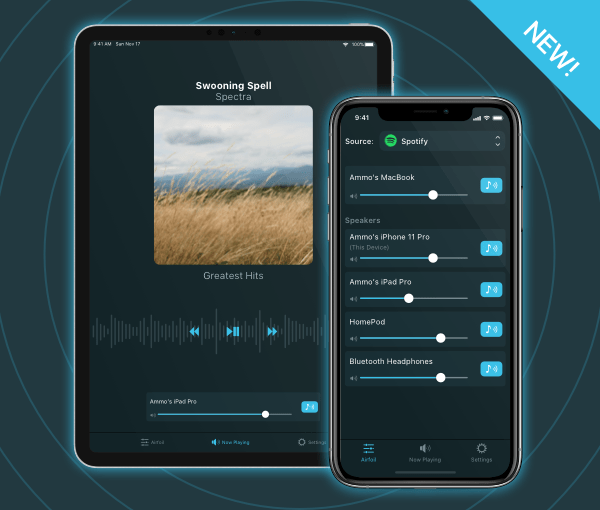
We refined the design of the entire application in Airfoil Satellite 2.0. The new tab-based interface makes it easy to navigate the entire app, so all the controls you need are just a tap or two away.


The new Airfoil Satellite 2 on iOS

The Now Playing screen has been spruced up, Settings are now easier to access, and remote control of Airfoil itself is still a snap. The screens on all the latest hardware are properly supported, including every size of iPhone and iPad.

Enhanced Performance

We also did a lot of work on Airfoil Satellite’s backend. This isn’t eye-catching like a redesigned interface, or even visible to the eye at all, but it should mean more reliable network performance. That means your audio streams as you expect it to, and Airfoil Satellite communicates with Airfoil more reliably than ever.

Much More

There are many more updates in version 2. We’ve added a handy new setting to prevent your iOS device from sleeping, so it’s always available on the network and always shows what’s playing. The “Now Playing” screen now features an on-screen volume slider, for adjusting the level of local playback. We’ve even added a custom URL scheme, so other iOS apps can better integrate with Airfoil Satellite.1

There’s lots more to see, so download the latest today!

Download Airfoil Satellite 2 on iOS

Airfoil Satellite is immediately available for all iOS devices running iOS 9 or higher. If you’re already an Airfoil Satellite user, just open up the App Store on your iOS device to update. Otherwise, tap below from your iPhone, iPad, or iPod Touch to download this free app:

If you’re new to the Airfoil family, you’ve been missing out. Give it a try to stream audio all around your house, with Airfoil and Airfoil Satellite.

Happy streaming!


Footnotes:

  1. With Airfoil Satellite 2.0.0 and up, the following commands are supported:

    • satellite:open

    • satellite:playpause

    • satellite:tracknext

    • satellite:trackprevious

    • satellite:volumeup

    • satellite:volumedown

    iOS app developers who need more information are encouraged to get in touch. ↩︎

24 Nov 05:57

RT @Pandamoanimum: As it's #DoctorWhoDay today here, once again, is Tom Baker's quote when asked his one biggest Doctor Who memory. https:/…

by Pandamoanimum
mkalus shared this story from iandunt on Twitter.

As it's #DoctorWhoDay today here, once again, is Tom Baker's quote when asked his one biggest Doctor Who memory. pic.twitter.com/LFG92Ux5kW


Retweeted by IanDunt on Saturday, November 23rd, 2019 2:26pm


2478 likes, 707 retweets
23 Nov 03:56

Podcast Notes: Mike Klassen and Jeff Tumlin

by Gordon Price

Yes, another podcast on Vancouver, its times and its issues – this one from Courier columnist Mike Klassen.  He calls it Vancouver Overcast.

The name is not just a riff on the persistent grey weather conditions we endure here. My goal is to establish a channel where listeners can discover more about Vancouver and hear from some of its thought leaders.

News out of San Francisco:

PriceTalks did an in-depth interview with Jeff Tumlim this last March – lots of insights into Jeff and his thinking, especially relevant now that he will be helping to shape one of the world’s great cities.


23 Nov 03:56

Loitering Objects

by Dolly Church

Lingering with a sense of abandonment, dockless bikes and scooters speckle the cityscape. Using a combination of GPS, 3G, and solar panels, they can be tracked and thus left anywhere. When seen on the street, they seem to show all the expected signs of wear and are usually found askew, akin to a bike in the driveway of a family home or propped up in the hallway of a commuter. This familiarity implies that they belong to a particular person. But these objects appear to wait around for nobody, or for their end-of-day collection, when they will be rounded up, charged, and dropped somewhere new. They seem vaguely radical: They challenge our preconceptions of private ownership but only by seeming abandoned; they interrupt our expectations of urban planning by obstructing our path through the street. As pastimes they feel intuitively public and communal, but what they signify, ultimately, is privatization.

Citymapper describes them as “floating transportation.” “Floating” is a slinky concept that evokes images of passing clouds, skirt hems, and dandelions, which drift in constant motion because they are so delicate. Applied to bikes, it leads users to think of the frictionless motion of flying cars and hoverboards that seamlessly glide through the air. In practice, dockless bikes litter neighborhoods. Their ubiquity is both their selling point — the motto of Ofo, one of the larger Chinese dockless bike distributors, is “anytime, anywhere, a bike to ride” — and their biggest cause for critique. In London they have been condemned by local authorities as a “yellow plague,” spreading from street to street. Across China, from Shanghai to Xiamen, mountains of dockless bikes accumulate on roadsides, eventually cleared by the thousands into “graveyards” within city suburbs.

Dockless bikes and scooters challenge our preconceptions of private ownership but only by seeming abandoned

This excess shows the prioritization of growth over demand, which has clogged pavements, displaced pedestrians, and endangered those with mobility impairments. What the bikes do is loiter. People are said to “loiter” when they have no place to be, dawdling indefinitely without a designated space to occupy, facing harassment and arrest by those who use the term pejoratively. Loitering bikes take up the spaces people are denied, and shout “unlock me or I will call the police” when mishandled. Rather than opening up public space, as their marketers claim, they claim and crowd and insidiously shape it. They can loiter where people cannot.


Loitering laws purport to afford police greater control to either prevent or pre-emptively defuse criminal activity. They claim to disperse “disruptive” behavior but serve to displace oppressed groups in public spaces. Reviewing the loitering case City of Chicago v. Morales, law professor Andrew D. Leipold put it this way: “The prohibited conduct is often described in a way that correlates to the behavior of the poor and the dispossessed, making much of their public behavior subject to police oversight.” This translates to looking the wrong way instead of doing the wrong thing, a conception that has affected sex workers, ethnic minorities, and the homeless, who quite often have nowhere to “move along” to.

For the victims of loitering laws, remaining in one place, under the public eye, can be a radical act. In Loitering Is Delightful, the poet and professor Ross Gay discusses the radical possibilities of “dawdling,” “moseying,” and “meandering.” Assembled from round vowels and protracted suffixes, these words loll in your mouth and take time to pronounce, mirroring their implications of unproductivity. The act of loitering, he writes, “leads to being, even if only temporarily, nonconsumptive, and this is a crime in America.” What Gay seems to suggest is that without loitering, every social engagement must be confined to the realm of private property or instantiated by some kind of purchase. The loitering of dockless bikes represents the opposite: the encroaching possibility of consumption even in spaces where none was assumed.

These companies exploit our positive conceptions of state resources, as well as our sentimental attachments to private property. As children, a bike is not just a toy; it is a glimpse into the possibility of independence and exploration. Over time, these associations mature into nostalgia and we come to think of cycling as a means to a healthy lifestyle, an avenue to green living or an exciting hobby. Dockless bikes benefit from these affiliations but also capitalize off the utopianism implicit in public-run infrastructure. Although they are not publicly run, they are “shared,” and they claim to be for all.

By “going dockless,” we are supposed to engage differently with cities. Toby Sun, co-founder of Lime, said that his company’s purpose is to “reimagine urban lives through the wonder of mobility.” In an essay for Real Life, David Banks discusses how bike sharing companies appropriate countercultural ideas to market their products as unequivocal social goods. Lime is said to be inspired by the flimsy anti-consumerism of Burning Man’s gift-economy; they co-opt the rhetoric of free movement, presenting their products as enablers of human connections and novel environmental interactions.

People are said to “loiter” when they have no place to be, dawdling indefinitely without a designated space to occupy, facing harassment and arrest

Ironically, this mirrors Ross Gay’s comprehension of “meandering,” and more broadly, reflects the Situationists’ idea of a dérive — aimlessly making one’s way through public space, while acknowledging how this space attempts to push and pull one in particular directions. But Lime enforces rather than challenges the top-down structures of urban planning: The company represents a transient form of privatization, where each ride is tracked, billed, and covertly commodified through the extraction of user data, guiding us toward further consumption while claiming to do the opposite.

Many companies market their products as solutions to broader issues of urbanization. Sun and Brad Bao, his co-founder, said they wanted Lime to make “urban living more livable” by easing congestion and reducing air pollution, promoting their products as a shortcut to environmental solutions in lieu of much-needed systemic change.

Dockless transportation companies often claim to operate in the public interest by providing a viable alternative to existing rail and bus systems, while also connecting parts of cities that lack transport links. In reality, these products fall into broader austerity narratives, where the private sector fills in holes made by government cuts. Business-run transportation tends to inflate prices and compromise efficiency, while taking these services out of the hands of democratic scrutiny and fracturing once organized labor forces.

The loitering of dockless bikes represents the opposite: the encroaching possibility of consumption even in spaces where none was assumed

User data from dockless transportation companies is already shaping the development of a number of American cities: In 2018, South Bend, Indiana, used data from rides to determine drop-off and pickup areas for dockless bikes. In Seattle, rider data will be used to determine the placement of new bike lanes, parking areas, and corrals. The idea that cities are becoming more cycle friendly is hopeful, exciting even. But these changes are often less for the benefit of residents than for advertisers. According to Forbes, for corporations like Alibaba and Tencent, dockless transportation companies provide the opportunity to target users “with highly relevant advertising that is less likely to be seen as intrusive.” Here, we see dockless companies peddling two distinct products: bikes for the people, and data for the investors.

The aesthetic of public good allows companies to compete with state-run resources in the free market, shirking the vapid associations of Silicon Valley while perpetuating the same exploitative business models of companies like Uber and Lyft. Neither delivering on the promise of reliable infrastructure, nor the idealism of unconstrained movement, dockless bikes seem as toxic in motion as they are when idle.


Loitering becomes the de facto state of dockless bikes when they are underused. In the past year, a number of dockless transport companies have packed up and left the U.K.; first there was Ofo and oBike, followed by Urbo, and now we are in the era of Jump and Lime. Explanations for these withdrawals have been varied — some have claimed that it was due to overexpansion and limited trialing, while others have cited their lack of co-operation with local councils. A more obvious and damning explanation is that they are simply unwanted or not respected. Mobike said their decision to leave Manchester was a response to “unsustainable losses” from vandalism and theft — something that has already forced bikeshare companies out of 200 cities worldwide. While coverage of these issues have tended to treat “vandalism” and “theft” as synonymous, they are really gesturing toward two separate issues.

For something to be worth stealing, it must have some kind of value. In the case of dockless bikes, their worth may lie outside their intended use, realized in the sum of their expensive parts. Vandalism, on the other hand, implies that people find them utterly useless. One type of vandalism is the intentional disfiguring or destruction of these bikes, which have been set alight in Sheffield, thrown into the sea in San Diego, and refashioned into art installations in Melbourne. At the same time, accounts like @DocklessBikeFails and @Bikesharingnightmares reveal a developing culture of ridicule: Photos show bikes shoved up trees, stuffed into portable toilets and mangled on the side of the highway. These acts of vandalism, and the collective rejection implied by their compilation, challenge the idea that things should be afforded rights that people are denied.

When things — companies and objects — are prioritized in cities, people are defined relationally as consumers or loiterers instead of citizens. Ironically, when fighting back against dockless bikes and their intrusions on public environments, people are physically reshaping these spaces in accordance with their desires and needs. Perhaps the emancipatory potential of dockless bikes is sooner found in their rubbishing than in their actual use.

23 Nov 03:56

It’s time to ban all political ad targeting . . . everywhere

by Josh Bernoff

Google will stop targeting political ads based on behavior. That’s a start. I call on every platform to end all targeted political ads (except by geography) — and for Congress to make this the law. Here’s what happened with political ads so far in 2019: Twitter banned all political ads. Google just announced that for … Continued

The post It’s time to ban all political ad targeting . . . everywhere appeared first on without bullshit.

23 Nov 03:56

Adobe Previews Features Coming to Photoshop for iPad Through mid-2020

by John Voorhees

The long-anticipated release of Photoshop for iPad was met with disappointment by many users who felt that significant functionality was missing. Although Adobe explained at the time that version 1.0 was a foundation upon which it intended to build rapidly, the length of time it took to create that foundation left many people skeptical. Today, to try to dispel some of the doubts surrounding Photoshop for iPad, the company published a blog post previewing some of the features coming later this year and in the first half of 2020.

Before the end of 2019, Adobe says it will ship the ‘Select Subject’ feature that it showed off at the Adobe MAX Conference earlier this month. The feature takes advantage of the company’s Sensei AI machine learning technology to facilitate complex subject selection. Adobe also says that cloud PSD files will upload and download faster in December after it makes changes to its systems.

Selection tools will get another boost in the first half of 2020 with Refine Edge allowing for soft edge selections. Curves for tonal adjustments and new adjustment layer options will be available too. Adobe also plans to bring features over from apps like Fresco, including brush sensitivity and canvas rotation. Finally, Adobe says it will integrate Photoshop with Lightroom for iPad, so you can process RAW images in Lightroom and use them in compositing projects in Photoshop.

With the reaction at Photoshop for iPad’s launch, I’m glad Adobe chose to showcase these new features in advance. It makes competitive sense too, given that alternative iPad apps that compete with at least some aspects of Photoshop continue to move forward rapidly. It’s that sort of competition that I expect will make pro iPad apps interesting to watch in 2020.


Support MacStories Directly

Club MacStories offers exclusive access to extra MacStories content, delivered every week; it’s also a way to support us directly.

Club MacStories will help you discover the best apps for your devices and get the most out of your iPhone, iPad, and Mac. Plus, it’s made in Italy.

Join Now
23 Nov 03:55

Platform teachers

Ben Williamson, Code Acts in Education, Nov 21, 2019
Icon

This is a detailed and useful look at Amazon's new Ignite platform selling teacher-produced learning materials (mentioned here a couple of weeks ago). "Amazon Ignite... represents the next-stage instantiation of the brand ambassador and the teacher as micro-influencer," writes Ben Williamson. "Teachers are not contracted as platform ambassadors, but invited to become self-branded sellers in a competitive marketplace, setting up shop as micro-edubusinesses." He also notes that "Amazon Ignite is ‘invitation-only’ and as such makes highly consequential decisions over the kinds of content and resources that can be purchased and used."

Web: [Direct Link] [This Post]
23 Nov 03:55

Learning to see, hear, respect, and empower every student

Remake Learning, Nov 21, 2019
Icon

Related to this post: I saw an exchange on Mastodon, which went something like this: "I see feature x was dropped; was this the result of user feedback or testing?"; "Yes it was." So why is that significant? It's typical of software design, which aims for the common middle, treating the wide range of users as a single entity. But a feature most people don't need might be the One Big Thing in a person's life. That's why you have to empower every student, not just most of them.

Just so, we have this post. "Chances are you probably felt disoriented, frustrated, ignored, hopeless.
Now imagine if this is what most of your learning experiences were like in life.... This is the reality for learners when they don’t see themselves, their communities, and their histories reflected in what they’re being taught.... In recognition of this reality, there’s been a growing interest among educators and advocates for approaches to teaching and learning that consider the culture and identity of the learner." It's not 'learning for most' but 'learning for all'.

Web: [Direct Link] [This Post]
23 Nov 03:53

Transno - Luhmann

Given that Dynalist started as a Workflowy clone and then evolved to surpass it, I welcome this Dynalist clone and hope to see them evolve in new directions as well. Since I don't personally find mindmaps useful I don't see much need for this for myself, but given that Dynalist's iOS app is still not great, hopefully some competition will be a good thing.
23 Nov 03:48

Apple’s iPhone Software Shakeup

by Rui Carmo

This matches what we’ve experienced this year, but the emphasis on iOS and the latent minefield that Catalina has turned into do not bode well for the Mac.


Support this site
23 Nov 03:47

There are 10 kinds of people

by Volker Weber

Lots of reactions to this tweet. They fall in 10 camps:

  • Developers understand this is a problem. This includes Apple.
  • Apple fans think this is a (good) sign of agile.

Yes, 10 is lifted from a joke about binary.

23 Nov 03:46

RT @ImIncorrigible: Where you stand on the UK income scale - some facts: Earning £80,000 a year puts you well into the top 3% of adult ear…

by ImIncorrigible
mkalus shared this story from mrjamesob on Twitter.

Where you stand on the UK income scale - some facts:

Earning £80,000 a year puts you well into the top 3% of adult earners

Latest HMRC figures are for 2016/17 & show that if you earn £75,300 you are in the top 5% of total *income tax payers*
@LBC @mrjamesob #PoliticsLive #bbcaq pic.twitter.com/2eQyL0C8wj


Retweeted by mrjamesob on Friday, November 22nd, 2019 11:32am


289 likes, 187 retweets
23 Nov 03:45

A man cycling through London's Battersea with a greyhound draped over his shoulders and a puppy tucked inside his jacket, 1931. pic.twitter.com/eb4VzliBDV

by moodvintage
mkalus shared this story from moodvintage on Twitter.

A man cycling through London's Battersea with a greyhound draped over his shoulders and a puppy tucked inside his jacket, 1931. pic.twitter.com/eb4VzliBDV


276 likes, 64 retweets
23 Nov 03:45

Five packages

This past summer I came across a tweet from Kitze about starting a project with a limitation of five dependencies:

I enjoyed reading the replies and getting a whiff of people’s different preferences. Brad Frost had a somewhat tongue-in-cheek response on choosing tools that ultimately gets to a “right tools for the right job” type of message. I agree with that, but also was stumped on the initial premise of the question and flustered why I didn’t have even half an answer.

You might laugh, but I’ve been thinking about this question since the summer and I finally got an answer! A few weeks ago when a greenfield project came across my desk I was reminded of Kitze’s question when I installed these five packages:

focus-visible    (997B)
wicg-inert       (2.2kB)
nodelist-foreach (211B)  // IE11
picturefill      (4.9kB) // IE11
sass

Here’s a break down of what that 8.3kB gzipped of packages get me:

  • focus-visible is focus states the way you want them, decoupled from click focus. It’s a “prollyfill” for an emerging standard.
  • wicg-inert is another “prollyfill” and the middle ground between [hidden] and visible; useful in accessibility work.
  • nodelist-foreach is something I’ve written about before, but it’s a 211b polyfill mostly needed for IE11.
  • picturefill is for responsive images for IE11.
  • sass is because I’m still pretty dependent on nesting and partials.

With these I can get pretty far. I could probably copy-paste that nodelist-foreach polyfill and get one more slot, but I like having polyfills registered as a dependency so that I can better manage them and remove them when browser support changes.

In fact, this probably says quite a bit about me as well as the kind of development I like, all of these tools are designed to disappear at some point. They build on some sort of emerging standard. I didn’t plan that whatsoever, but I find something poetic in the fact that the dependencies I rely on the most will eventually not be needed.

Sass is probably the biggest lingering dependency, but I could see myself moving away from it in favor of some CSS-in-WC (Web Component) type of thing in the near future. If I had more slots, it would probably be the details-element-polyfill and the dialog-polyfill even though it has problems and Scott O’Hara says I shouldn’t use dialog… I just want it that bad. lit-element might make the list too.

Anyways, this was just a silly tweet from six months ago, I’m embarrassed it took so long to figure out, but I’m glad I did. I even learned a little bit about myself along the way.

23 Nov 03:44

The Future Of German Competitiveness: An Innovation Summit with Clayton Christensen

by Sam Perel
23 Nov 03:44

The Choices of Others

Wendy M. Grossman, net.wars, Nov 22, 2019
Icon

This post is about the author's reaction when her neighbour placed a doorbell camera that their door that captures (and records, and sends to Amazon) all the comings and going through her own door. "It never occurred to them that a 180-degree camera watching their door is, given the workings of physics and geography, also inevitably watching mine. And it never occurred to them to ask me whether I minded." Now this is a fairly narrow example, but it raises the more general question of how your privacy decisions may impact on others. Should your insurance company be able to rely on your sister's DNA to set insurance rates? Should your brother's test scores be used by a company deciding whether to hire you? Image: Big Brother Watch.

Web: [Direct Link] [This Post]
23 Nov 03:44

More needs to be done to support teaching online in Canada

Clint Lalonde, Ed Tech Factotum, Nov 22, 2019
Icon

Clint Lalonde comments on the recently released research report (67 page PDF) by the Canadian Digital Learning Research Association and associated summary offered by Tony Bates. He keys in on one finding: "79% of institutions reported inadequate training for faculty as one of the main barriers to online learning." One wonders how this can be the case after some 25 years of online learning! Like Bates, Lalonde points to the lack of mandatory training for prospective online instructors, but from where I sit this requirement seems likely only to produce a shortage of online instructors. And from where I sit, I wonder about the apparent inability or unwillingness of today's professors to teach themselves how to use a computer to teach. Higher education doesn't have a training problem, it has a culture problem.

Web: [Direct Link] [This Post]
23 Nov 03:42

PopSockets’ AirPods grip might be one of the worst smartphone accessories ever

by Patrick O'Rourke
Popsocket

Popsockets — the little knob-like accessories that attach to the rear of a smartphone — are actually surprisingly useful in several situations.

They add additional grip to a smartphone, are highly customizable and, most importantly, prevent you from dropping your phone on your face when you’re holding it above your head while lying in bed — not that this has ever happened to me, of course.

Unfortunately, it looks like the accessory maker may have taken things a little too far this time. PopSocket has released a new PopGrip that doubles as an enclosure for Apple’s AirPods charging case. The awkwardly placed case is compatible with both the first-gen and second-gen AirPods, is Qi wireless charging compatible and even swappable with other PopGrips.

While this case might prevent you from ever losing your AirPods again, it also seems to make the iPhone incredibly unwieldy, especially if you want to slide the smartphone into your pocket.

This monstrosity of an accessory costs $20 (roughly $26 CAD) on PopSockets’ website. The case is available in ‘Neo Mint,’ ‘Black,’ ‘White,’ ‘Iris Purple’ and ‘Cobalt.

If we’re lucky, PopSockets might also be planning to release an awkward PopGrip case for Apple’s recently released AirPods Pro — because who likes putting their phone in their pocket anyways?

The post PopSockets’ AirPods grip might be one of the worst smartphone accessories ever appeared first on MobileSyrup.

23 Nov 03:41

Apple reportedly testing extending AppleCare+ eligibility beyond 60 days

by Patrick O'Rourke

Select Apple Stores in the U.S. and Canada are reportedly piloting a program that allows customers to buy an AppleCare+ subscription after the typical 60-day period following purchase.

This pilot program launched last week, according to MacRumors, which cites “sources familiar with the matter.”

The new pilot program allows customers to add AppleCare+ to Apple devices between 61 days and one year after purchase. To do this, customers need to book a Genius Bar appointment where an Apple technician then runs a diagnostic on a device.

MacRumors’ source first indicated that AppleCare+ eligibility was extended to two years, while another source stated that it only comes in at one year. The pilot program is available at roughly 50 Apple Store in the U.S. and 29 locations in Canada, according to MacRumors.

It remains unclear if this is a limited-time program for the holiday season or a permanent change. An Apple Store confirmed to MacRumors that the AppleCare+ extension is indeed in place at that specific location.

AppleCare+ offers between two and three years of hardware coverage and technical support for Apple devices.

Source: MacRumors

The post Apple reportedly testing extending AppleCare+ eligibility beyond 60 days appeared first on MobileSyrup.

23 Nov 03:41

Samsung’s Galaxy Fold is coming to Canada after all for $2,599

by Patrick O'Rourke

Despite cancelling the Galaxy Fold’s Canadian release in early September, Samsung has announced that the company’s first foldable smartphone is coming to Canada in a limited capacity.

The pricey device — which costs $2,599 CAD — is set to be sold exclusively at Samsung Experience Stores in the Greater Toronto Area starting on December 6th, 2019.

Specific Samsung Experience locations where the Galaxy Fold will be available include the CF Toronto Eaton Centre, CF Sherway Gardens and Yorkdale Shopping Centre.

“Canadians have overwhelmingly shared their excitement for the Galaxy Fold, and we’re thrilled to now be offering it at our Samsung Experiences Stores across Canada,” said Jennifer Safruk, vice president of sales and product management at Samsung in a recent statement.

Samsung says that every Galaxy Fold purchase features “exclusive access to Galaxy Fold Premiere Service,” which includes a screen repair offer and 24/7 technical support available at ‘1-888-970-FOLD.’

The Fold will only be available in ‘Cosmos Black’ in Canada. The smartphone was originally supposed to release in Canada in the Summer of 2019.

Back in September when Samsung told MobileSyrup that its first foldable smartphone was no longer making its way to Canada, the South Korean tech giant released the following statement:

“Given that the Galaxy Fold will be available in limited quantities across the globe and taking into consideration the improvements made, we had to revisit the global launch plan While we greatly appreciate consumers’ interest in Galaxy Fold, unfortunately, the Galaxy Fold will not be available in Canada.”

The Galaxy Fold was first released in South Korea on September 6th and the United States on September 27th.

The innovative handset’s original release schedule was pushed back due to design issues with early review units that suffered from debris getting stuck behind the foldable smartphone’s display, as well as some media removing a protector that held the device’s screen together.

As a result of these issues, Samsung made subtle changes to the retail version’s design, including extending the protective film under the bezels so that it can’t be peeled off, as well as improving the build quality of the hinge by shrinking the gap present when the device is closed.

The Galaxy Fold’s front-facing 4.6-inch screen is tiny and features massive bezels on the top and bottom. The interior displays fold out to reveal what is essentially a 7.3-inch tablet-sized panel inside. The smartphone also features a Snapdragon 855 processor, 12GB of RAM and 512GB of internal storage.

Samsung is already rumoured to be working on a cheaper version of the Galaxy Fold that smartphone leaker Ishan Agarwal (@ishanagarwal34) says will be released in Canada.

For more on the Galaxy Fold, check out my hands-on with the foldable smartphone from back in April.

The post Samsung’s Galaxy Fold is coming to Canada after all for $2,599 appeared first on MobileSyrup.

23 Nov 03:41

Adobe announces new updates coming to Photoshop on iPad

by Dean Daley

The Adobe blog has announced more information about Photoshop on iPad.

Before the end of the year, the ability to select subjects is coming to the mobile version of Adobe’s image editing software. Selecting subjects allows the Adobe Sensei AI machine learning to edit objects within a picture.

Cloud documents will also be faster, according to Adobe. Adobe saves incremental changes to Photoshop, so if you update one pixel, it’ll save between iPad, iPhone and desktop immediately. This feature is launching now.

Coming to Photoshop on the iPad is also the ability to ‘Refine Edges,’ which should make softer edge selections on subjects like fur and hair.

Additionally, users will be able to add Curves for tonal adjustment layers. The ability to rotate the canvas to position it for any angle and change the brush sensitivity is also coming.

Adobe has included Lightroom integration to improve the Lightroom workflow on the iPad.

Further, all Adobe Fonts are now available in the mobile app. If you have a Creative Cloud plan, there are 17,000 fonts. Those who use the free option have access to 1,30o fonts.

Source: Adobe Blog

The post Adobe announces new updates coming to Photoshop on iPad appeared first on MobileSyrup.

23 Nov 03:41

Apple expected to double AirPods shipments to 60 million in 2019

by Jonathan Lamont
AirPods Pro in ear

Apple is expected to ship even more AirPods in 2019, according to a Bloomberg report. The publication says AirPods shipments will double to 60 million units in 2019.

The numbers come from sources familiar with the Cupertino, California-based company’s production plans. “Much higher” than expected demand for the more expensive AirPods Pro caused the increased shipments.

Apple released the AirPods Pro in the fall. The true wireless earbuds retail for $329 in Canada and offer noise cancellation and water resistance, among other features.

However, all the demand is pushing Apple’s manufacturing partners to the limits, according to Bloomberg. Multiple suppliers are competing for the business of manufacturing the AirPods Pro, but many still need to build up the technical proficiency.

Currently, there’s a two to three week wait for the AirPods Pro on Apple’s website in Canada. Bloomberg reports a similar wait time for the U.S.

Along with the AirPods Pro, the launch of the $269 AirPods with Wireless Charging Case in March helped stir demand. These AirPods were an iteration on the original AirPods, with little difference save the inclusion of wireless charging, a new H1 chip and “Hey Siri” functionality. Original AirPods are still available as well for $219. AirPods released in 2016.

Biggest competition out of the picture until 2020

Further, Bloomberg notes that there’s little in the way of competition at the moment. Microsoft recently delayed its truly wireless Surface Buds until spring 2020 (although we weren’t going to get them in Canada until next year anyway). Google also plans to launch its Pixel Buds in 2020. Finally, Amazon’s Echo buds are available in the U.S. but haven’t made their way to Canada yet.

Samsung also has its Galaxy Buds, but Bloomberg reports that Apple ranked as the preferred brand in the U.S. Sony recently launched excellent true wireless earbuds as well.

On top of this, Apple owns Beats, and its Powerbeats Pro are also among the top 10 sellers for true wireless headphones.

Bloomberg predicts Apple will keep its 50 percent share of the true wireless market should it resolve the manufacturing troubled and hit its 60 million shipments in 2019.

It’s good news for Apple as the company tries to adapt to slowing iPhone demand. While the company no longer shares sales figures for its smartphone products, in the past quarter the iPhone’s sales shrunk to $33.4 billion USD (about $44.4 billion CAD).

However, the Wearables, Home and Accessories segment, which consists of the Apple Watch, AirPods, Beats, HomePod and Apple TV groups, generated $6.5 billion USD (approximately $8.6 billion CAD), a growth of 54 percent.

Source: Bloomberg

The post Apple expected to double AirPods shipments to 60 million in 2019 appeared first on MobileSyrup.

21 Nov 15:21

Waterloo Brewing faces cyberattack resulting in $2.1 million loss

by Aisha Malik
cybersecurity

Waterloo Brewing has disclosed that it faced what is it calling a “social engineering cyberattack” that has cost it $2.1 million CAD.

The Kitchener-based brewery says that the cyberattack happened in early November. It involved creditor employee impersonation and fraudulent wire transfer requests by a third-party.

Waterloo Brewing says that it recently became aware of the incident and that it has initiated an analysis of all other transaction activity across all of its bank accounts.

At this time, the brewery does not believe that its systems were breached or that any personal information of its customers is at risk.

The company has not been able to recover any of the money that was wired to the fraudulent third-party account, but is working to get it back.

Waterloo Brewing is working with authorities and local police services and is conducting an internal investigation.

Source: Waterloo Brewing 

The post Waterloo Brewing faces cyberattack resulting in $2.1 million loss appeared first on MobileSyrup.

21 Nov 15:21

RT @mrjamesob: Just imagine the shit ‘Prince’ Andrew would currently be getting if he was a mixed-race woman with a social conscience, a su…

by mrjamesob
mkalus shared this story from mrjamesob on Twitter.

Just imagine the shit ‘Prince’ Andrew would currently be getting if he was a mixed-race woman with a social conscience, a successful career & precisely no connections with a paedophile.


Retweeted by mrjamesob on Thursday, November 21st, 2019 9:22am


21247 likes, 3576 retweets
21 Nov 15:20

Do you need immutability for functional programming?

by Eric Normand

Of course immutable data structures are great, but are they necessary for FP? Short answer is: no. There's a lot of functional ideas and perspectives that can be applied even if you don't have them. And you can always make things immutable through discipline. In this episode, we explore those two ideas.

The post Do you need immutability for functional programming? appeared first on LispCast.

21 Nov 15:19

Eleanor Collins, Canada's first lady of jazz, turns 100

mkalus shared this story .

At 100 years age, Canadian jazz icon Eleanor Collins has one mantra — just take it one day at a time. 

"That's the thing that my mother said to me a long time ago," Collins recalled from her home in Surrey, B.C., where she lives independently.

"She said, 'my dear, you just take one day at a time. Do the best you can that day and just keep moving ...  And it's the best advice one could give one.'"

Collins' remarkable life shows a person who made the very most of every day given to her.

The singer, television host and entertainer was born and raised in Edmonton on Nov. 21, 1919 — part of the movement of black homesteaders who migrated from Oklahoma and settled on the prairies. 

In the 1930s, she moved to Vancouver. Her work in the jazz scene — alongside Vancouver's top musicians, Chris Gage, Lance Harrison, Doug Parker and Dave Robbins — brought her acclaim. 

She recorded music, performed at Stanley Park, and broke ground by starring on CBC Vancouver's Bamboula: A Day in the West Indies which became the first Canadian television show with a mixed race cast.

In 1955, Collins became the first black woman to host her own television variety show in North America with CBC's The Eleanor Show. 

Watch an excerpt of The Eleanor Show:

Playback Status: ready
Assigned test group: None
Identifier: mediaId 1645761603657
Asset: Undetermined
Bitrate: Undetermined
Streaming URL:
Events Log:

The Eleanor Show makes its debut

  • 17 hours ago
  • 2:40
Watch the opening act from the very first Eleanor show on June 12, 1955. 2:40

Her beauty, style and grace — which earned her comparisons to actress Lena Horne — was an important aspect of her work. Even at 16, when she started singing at an Edmonton restaurant, Collins recalls the wardrobe of black suits and bow ties of her fellow musicians.

With an eye for glamour, Collins started saving for a much-coveted velvet blouse. 

"It would take me a couple of years to save up enough, because it certainly wasn't in the budget of my mother's," she said. 

She eventually got the blouse, pairing it with a skirt she had hand-sewn, applying the sewing lessons she had taken in school. 

"You got to know where you came from, so that you feel better about what you later could do."

Although The Eleanor Show was short lived, Collins continued to perform on stage and on television. She received many offers to perform in the United States, but she refused, preferring to stay in Canada.

"I haven't had anything but pure blessings," she said. 

Yet Collins — who was married to her late husband Richard Collins for 70 years — faced tremendous barriers in Canada. When the couple and their four children became the first black family in their Burnaby neighbourhood, they faced a petition from their white neighbours demanding their eviction. 

Watch Eleanor Collins discuss her life philosophies

Playback Status: ready
Assigned test group: None
Identifier: mediaId 1645093955776
Asset: Undetermined
Bitrate: Undetermined
Streaming URL:
Events Log:

Eleanor Collins on living life to the fullest

  • 2 days ago
  • 1:07
Songstress Eleanor Collins is turning 100. 1:07

The petition was unsuccessful, but Collins immersed herself in the neighbourhood and her children's schools, determined to become part of the community's fabric.  

Collins, who still does all her own shopping and cooking, is nowhere near done giving. 

"I still believe in chasing dreams and placing bets, but I have learned that all you give is all you get," she sings, trailing off. 

"There's life after 100 ... I want to give it all I've got."