Shared posts

26 Nov 23:28

Where does structural similarity come from?

by Eric Normand

In a recent episode, I said structural similarity comes from the algebraic properties of the relationships between things. But that's not the case. Rotislav mentioned in the comments that it actually comes from the structure in the relationships. I explore that idea in this episode.

The post Where does structural similarity come from? appeared first on LispCast.

26 Nov 23:28

The greatest propaganda machine in history :: Sascha Baren Cohen

by Volker Weber

This video is only an excerpt of his full speech.

I’m speaking up today because I believe that our pluralistic democracies are on a precipice and that the next 12 months, and the role of social media, could be determinant. British voters will go to the polls while online conspiracists promote the despicable theory of “great replacement” that white Christians are being deliberately replaced by Muslim immigrants. Americans will vote for president while trolls and bots perpetuate the disgusting lie of a “Hispanic invasion”. And after years of YouTube videos calling climate change a “hoax”, the United States is on track, a year from now, to formally withdraw from the Paris accords. A sewer of bigotry and vile conspiracy theories that threatens democracy and our planet – this cannot possibly be what the creators of the internet had in mind.

Please read the whole transcript of his speech.

More >

26 Nov 23:27

The Next Big Cheap

by Kelly Pendergrast

Onstage at the November 20 Democratic debate, presidential candidate and Universal Basic Income evangelist Andrew Yang used one of his precious minutes of speaking time to casually claim that “data is the new oil,” and that we need to create a “WTO for data” to help wrestle it under control. Yang’s statement continues the hackneyed but irrepressible tradition of talking metaphorically about data, which is “the new oil” unless it’s “the new nuclear waste” or, weirdly, “the new bacon.”

The prevalence of data metaphors has spawned its own subfield of meta-commentary. Scholars Cornelius Puschmann and Jean Burgess survey big-data metaphors and pull out “data as a force of nature” and “data as a resource” as the main throughlines; Sara M. Watson contrasts industrial data metaphors with embodied metaphors, and Irina Raicu summarizes the meta-summaries. Accruing like dust bunnies in the corners of our discourse, data metaphors proliferate for good reason: If we can hit on the right analogy to describe how data functions (in the world, in the economy) we might be better equipped to legislate its use, capitalize on its promise, and mitigate its harms. If it’s oil, tap it. If it’s soil, grow things from it. If it’s nuclear waste, bury it in the desert for a thousand years and be very fucking careful not to splash it on your clothes.

Colonizers of the early modern world created a new set of relations that conceived of nature as a “free gift”

Data, in these examples, generally refers to “big data”: large sets of data that are collected and analyzed for use in applications like predictive and behavioral analytics. The term “Big Data” was originally used in the 1990s to describe data sets that are too large or complex to be dealt with by traditional data processing software. In this era of massive computing power, where analysis of vast data sets can be performed with standard software on any laptop, data can be aggregated, shared, sold, and repurposed for applications far beyond what we expected when we initially signed up to digitally log our jogging routes or store our photos in the cloud. Kate Crawford and danah boyd propose that, today, “Big Data is notable not because of its size, but because of its relationality to other data. Due to efforts to mine and aggregate data, Big Data is fundamentally networked.” (Big) data’s value “comes from the patterns that can be derived by making connections” between data points, be those data about individuals, online interactions, the movement of objects in space, or the growth of plants.

The desperate hunger with which companies pursue and collect data, combined with its interconnected, shapeshifting nature, indicate that data is more than just a new product class or “the new X” — it looks like a new frontier. At the frontier, people and natures that were previously uncapitalized are turned into things that can be extracted, traded, and used to create profit, often with a huge human and environmental cost. While the “new oil” metaphor points towards some of these risks, calling data “the new X” misses the bigger point — it takes for granted the transformation of the world into commodities for use and exploitation, a process that isn’t natural and shouldn’t be inevitable.

Borrowing a term from Marxist geographer Jason Moore, I propose that data is the new big “cheap thing” — the new commodity class that is emerging to reshape the world and provide a new arena for accumulation and enclosure. Following Erich Hörl, whose essay “The Environmentalitarian Situation” briefly mentions data as a potential new entry in Moore’s litany of “cheap things,” I want to explore how framing data as a new cheap thing — rather than “the new oil” or “the new soil” or “the new nuclear waste” — gives us a way of looking directly at the process by which things become available for use and profiteering. Thinking about data in line with other cheap commodities throughout the history of capitalism might help us imagine better frameworks for its management and regulation, and provide models for how to successfully push back against the capture and exploitation of yet another aspect of our lives and the world that sustains us.


Despite its common invocation as a gushing and unruly force of nature, “cheap data” is not a natural resource: No resources are natural. Coal, says Moore, is just “a rock in the ground. “Only under definite historical relations” — of both power and (re)production — “did coal become fossil fuel.” It is the becoming resource, more specifically the becoming cheap resource, that turns a “rock in the ground” or, in our case, a set of networkable data points, into a new commodity that can change the way the world works. In his books Capitalism in the Web of Life and (with Raj Patel) A History of the World in Seven Cheap Things, Moore argues that this maneuver — the absorption of lives and “resources” into capitalist systems — is central to the history of capitalism.

Frontierism provides a way to fix capitalism’s crises without changing any of the extractive practices that created the crisis in the first place

For something (coal, data points, human life) to be born anew as a commodity, it first needs to be separated (conceptually, often physically) from the context in which it is embedded. The rise of capitalism, says Moore, was concurrent with the first big separation: The conceptual cleaving of “nature” from society. The human/nature binary is a false one, of course. Humans and our systems — social, economic, ideological — have always been enmeshed with “nature,” and the two constantly co-produce each other in what Moore calls “the web of life.” The separation that made nature available for cheap use was an act of rhetorical violence, reconfiguring nature as a non-human domain that encompasses not only trees and mountains but also (in a massive act of exclusion) Indigenous and colonized people, slaves, and most women. By separating “nature” from “society,” the colonizers and conquistadors of the early modern world created a new set of relations that conceived of nature as a “free gift,” available for appropriation and exploitation. This isn’t a new idea — “all production is appropriation of nature” is straight from the Grundrisse — but Moore’s contribution here is to develop the idea of the “web of life” and of “cheapness” as central to the appropriative maneuver.

Nature is only the first in a series of “cheap things” through which capitalism has shaped the modern world. Cheapness, Moore and Patel write, “is a strategy, a practice, a violence that mobilizes all kinds of work — human and animal, botanical and geological — with as little compensation as possible.” The cheapening of nature meant that trees, minerals, and fish were remade as independent entities available for harvest and collection, with little attention to the enmeshment and interdependence of humans and these “natural” resources. Cheap nature allowed for accumulation and profit generation, and when the rate of profits slowed, “cheap money” — massive loans and low interest — provided opportunities for expansion and further exploitation of nature’s resources. Moore and Patel chart a course through a series of additional “cheaps”: cheap work performed by Indigenous laborers, slaves, and exploited wage workers; cheap care provided by women and domestic servants that enabled labor power to be reproduced; and then cheap food, cheap energy, and (more abstractly) cheap lives, each required by the previous and enabling the next. In a cheap world, “capitalism transmutes these undenominated relationships of life-making into circuits of production and consumption,” leaving a legacy of destruction and dispossession.

Which brings us to cheap data. Just as data wasn’t always “big,” it wasn’t always cheap enough to accumulate like giant fatbergs in AWS’s digital sewers (data is the new fatberg). Governments, corporations, and institutions have long collected large data sets and wielded them as a tool of power, but those data weren’t nearly as interconnected, accessible, or easy to analyze as they are today. The transformation of data into “cheap data” required massive computing power, algorithmic accuracy, and cheap storage. Each of these was built on the backs of other cheaps: cheap energy (from fossil fuels), cheap money (often from Silicon Valley), cheap labor, and cheap nature (in the form of extracted minerals and metals) were all enlisted in the development of powerful and omnipresent computing technology used to transform data from just a collection of info points into an omnipresent strategy for profit making. This litany of enabling conditions didn’t conjure cheap data into existence. But I suspect that they created an imaginative fissure through which a new frontier could be glimpsed.

Frontiers are essential spaces in the history of capitalism. When the old methods of accumulation and profit have been tapped out, frontiers open up new arenas of existence to “cheapening” and extraction. Sociologist Wilma Dunaway describes frontiers as “zones of incorporation” where “noncapitalist zones are absorbed into the capitalist world-system.” With their often-abundant resources or entirely new life-worlds to incorporate, frontiers are, per Jason Moore, “places where the new cheap things can be seized — and the cheap work of humans and other natures can be coerced.” By separating a new “resource” from the web of life, frontierism provides a way to fix capitalism’s crises without changing any of the extractive practices that created the crisis in the first place. And so, when labor costs rise in China, T-shirt manufacturers shift production to Vietnam, or Bangladesh, or wherever the next frontier of cheap textile labor can be found. Frontiers fix the problem, and capitalism can continue at pace.

As soon as big data became a possibility, it was cheapened, swallowed up and forced into service

Frontier-thinking is a core tenant of the tech industry, and the language of the frontier is baked into tech discourse. Tech journalists consistently describe new areas of tech investment or market creation as “frontiers.” Jeff Bezos’s annoying plans to establish and fund space colonies are purportedly inspired by Gerard K. O’Neill’s 1976 book The High Frontier. Seasteader Patri Friedman (grandson of Milton) laid his own case for the frontier in libertarian blog Cato Unbound, writing “Only by starting with a blank slate can you make a better structure without having to overcome entrenched interests… Historically, the frontier has functioned as this canvas for experimentation.” A 2011 McKinsey report explicitly describes big data as “The next frontier for innovation, competition, and productivity.” While these writers and entrepreneurs may toss off the “frontier” metaphor without much thought, seasteading, space, and contemporary big data all function as (often literal) zones of incorporation where new cheap things can be seized and cheap resources can be mobilized.

What’s at risk when data is the next “big cheap”? With other “cheap things” like work, care, or nature, we might imagine a past (or future) where they exist in a non-alienated way within the web of life, highlighting the danger and tragedy of their cheapening. Big data’s emergence, however, was concurrent with its commoditization. As soon as big data became a possibility, it was cheapened, swallowed up and forced into service: Big data never existed as a commons on which we peasants could graze our electric sheep. Despite this difference, today’s emerging data ecosystem gives us some indication that the consequences of “cheap data” will follow the trajectory of other cheap things, enabling the continued and expanding subjugation of people and the environment in the name of growth and profit.


Cheap data is a new kind of frontier. Rather than moving outwards — westward, to the sea, into space — the cheap data frontier is an overlay, positioned on top of other spheres of life in order to siphon their juices. In this way, a second resource can be extracted from the people and natures already cheapened by capital. At the cheap data frontiers, industrial workers (cheap labor) like those working in Amazon fulfillment centers are tracked and monitored, doing double time for employers who profit from their labor while also accumulating screeds of data about the movement of their bodies in space, their time spent per task, and their response to incentives. Friends and families provide uncompensated but necessary social support (cheap care) for one another on digital platforms like Facebook, helping maintain social cohesion and reproducing labor forces while also producing waterfalls of valuable data for the platform owners. This magic trick, where cheap data is gleaned as a byproduct of different kinds of cheap work, is a great coup for capital and one more avenue for extraction from the rest of us. If, as Moore says, new “cheaps” emerge as strategies that allow capitalism to survive crises, then the overlaid frontier of cheap data helps solve the “crisis” of stagnant productivity and growth by enlisting all kinds of existing labor and care into service as data producing machines.

Shoshana Zuboff, in her book The Age of Surveillance Capitalism, describes the data that is sloughed off of other kinds of human activity as “behavioral surplus.” For Zuboff, it’s not data that is the new zone of extraction and exploitation, but rather human experience itself. Her concern is that we will become zombified servants of “surveillance capitalism,” a new and worse version of capitalism which aims to predict and modify our behavior in service of market objectives. The rise of cheap data, though, is not limited to data on human behavior. While Google and Facebook are indeed working to manipulate our clicks and purchasing habits, data are also being collected about everything from the movements of machinery to the growth of plants and the rate of interest. These data are used in pervasive and diverse ways — to train machine learning systems like GANs, or to predict weather, manage populations, and create new markets — that shape the world well beyond our lives as consumers. In isolating “human behavior” as the domain of extraction and control, Evgeny Morozov notes that Zuboff limits her argument to a critique of “surveillance,” leaving capitalism itself curiously unexamined.

The “behavioral surplus” model and the metaphors that describe data as flowing, cascading, and generally spilling from us as we move through the mediated world also elide the ways in which the production of cheap data often requires concerted and tedious labor. So, while we freely upload thousands of images of our faces and families and pets which are then scraped from the web by platform owners or under Creative Commons license terms, these images often need additional tagging or categorization in order to be useful for commercial purposes (“Images do not describe themselves,” write Kate Crawford and Trevor Paglan). This is where cheap work reenters the picture.

The digital piecework of casualized workers like those contracted by Amazon’s Mechanical Turk has been essential for building the cheap data repositories that underlie many AI systems and research projects. ImageNet, the most significant image database used for visual object recognition software development, relied on MTurk workers to sort and tag millions of images, which now comprise a dataset used for everything from military research to corporate projects by companies like IBM, Alibaba, and Sensetime, who provide technology used by Chinese officials to track and detain minority Uighur populations. Recent research has highlighted the stress and horror experienced by precarious workers in the digital factory, who annotate images of ISIS torture or spend their days scanning big social platforms for hate speech and violent videos. As with all cheap things, cheap data relies on massive externalities, the ability to offload risk and harm onto other people and natures, while the profits all flow in the opposite direction.

Harm to human workers is just one of the “externalities” produced in the pursuit of cheap data. The cheap energy required for training AI models and transferring massive amounts of data to and from the “cloud” is less visible than exploited human workers, but its cumulative effects are huge. Research suggests that the energy required to train a single AI model may have the carbon dioxide equivalent of five times the lifetime emissions of an average car. Similarly, the hardware needed to run all these models and collect all this data requires significant amounts of precious metals and new plastic in its construction. Cheap nature is called back into service, along with more cheap labor to extract and process it into the fiber optic cables and Ring doorbells and computer keyboards that sense, collect, and connect data. The abstracted nature of the environmental harm produced in the pursuit of cheap data contributes to what I call “technocapitalist sacrifice zones,” out-of-sight arenas of extraction and refuse that are permanently damaged as products and profits are extracted for use elsewhere.

What happens when cheap data becomes less cheap? The industries built on cheap data mean that if regulations are passed enforcing higher wages for precarious data workers, or increased privacy controls, the “behavioral surplus” becomes harder to tap. The history of cheap things gives reason to believe that data extraction will then push further and further into new and cheaper zones and frontiers. This process has already begun, with the offshoring of digital piecework and with big tech companies and foreign-owned startups alike setting up shop throughout the “Global South” in order to capture new markets and glean data from whole new population segments. Scholars Ulises Mejias and Nick Couldry explicitly call out this model of data collection as “data colonialism,” the new iteration of colonial extraction that exploited and oppressed indigenous people for centuries.

Demands that Indigenous peoples retain sovereignty over their own data points toward a future in which data is slower, smaller, and less alienated

Even when cheap data is proposed as a humanitarian solution to a problem like poverty or labor abuses, the way cheap things work, and the ownership of the data systems by capital often mean the virtuous promises are undercut. Already, aid organizations are driving an inadvertent program of data extraction (or “surveillance humanitarianism”) in countries where they operate, requiring biometric data and accumulating massive data sets in the interest of efficiency and fraud reduction. These programs can have unintended consequences, with minor discrepancies in databases causing chaos for displaced or otherwise marginalized people, and activists rightly worry about the potential for data leaks and commercialization. Dennison Bertram writes about the way seemingly benign initiatives like the Blockchain traceability startup he worked on — ostensibly designed to reduce illegal labor and get better prices for agricultural producers — provide only nominal benefits to the commodity producers while massive caches of valuable data go to the system owners. “Blockchain-powered supply chain startups like our own were promising farmers marginal increases in value,” he writes, “while simultaneously extracting data as [an] entirely new natural resource.”


If we accept that data is the new “cheap thing,” it is clear that the established models for regulating and monitoring data collection and use will be insufficient for the scope of the problem. Commentators, and politicians like Andrew Yang revert to the “new oil” metaphors in part as guideposts for how to deal with the unruly nature and uneven distribution of data wealth. If “data is the new oil” then perhaps the citizens from whom data is extracted can get a share of the eventual profits, in the way that Alaskan residents receive an oil dividend each year. If data is a forest to be logged, then researchers Luke Stark and Anna Lauren Hoffman suggest that we might require Google and Facebook to be better “stewards” of our data forests, sustainably “managing the resources” we provide them by adequately compensating their moderators, banning Nazis, and encouraging a better level of discourse.

But what if we don’t want the forest under corporate ownership at all? As Moore and Patel point out, “many of today’s politics take as given the transformation of the world into cheap things.” In the wake of the financial crash, liberal organizers campaigned for the improved regulation of housing markets, a compromise when what had been surrendered to cheap finance was housing itself. Unions fight for $15 an hour minimum, which is laudable and necessary, and yet wholly insufficient in a country where the entire “future of work” is up for grabs and available for perpetual reshaping and unbundling at the whims of Silicon Valley and corporate restructuring.

So, what would it look like to reject the regime of cheap data, and bring data — the bits of life we coproduce from our bodies with our technologies — back into the web of life? Can we “decolonize data” or reclaim a “data commons,” especially when big data itself is the direct product of previous appropriations of cheap natures? There are at least a few projects that are pushing back against the corporate data regime in genuinely radical ways that tackle the root of the problem (capitalism), not just its manifestations (surveillance).

The Indigenous Data Sovereignty movement, founded by scholars and activists from Australia, New Zealand, Canada, and the United States, uses principles from the United Nations Declaration on the Rights of Indigenous Peoples to contest the rights and abilities of governments and global corporations to collect and profit from Indigenous data. The UN principles are coupled with frameworks based on the cultural principles and worldview of each Indigenous group, which are often innately opposed to private ownership and depersonalized data. Te Mana Raraunga, New Zealand’s Māori Data Sovereignty Network, advocates for the self-governance and control of all Māori data ecosystems, accurate minimum metadata requirements reflecting that all data has whakapapa (genealogy), and collective and community data rights. If these kind of data frameworks gain traction, they could prove a major headache for companies and governments that rely on the fungibility and reusability of data for their operations or business models.

These demands that Indigenous peoples retain sovereignty over their own data, refuse to let it be stored by AWS or reused without their consent, and re-inscribe it with Indigenous principles point towards an alternative data future in which data is slower, smaller, and less alienated. In this future, some kinds of data collection and use may be abolished entirely, as Ruha Benjamin suggests for algorithms and surveillance that amplify racial hierarchies; while other kinds of collection may continue, but in a less-networked way that is controlled and decided by the communities to whom the data pertain.

Full data sovereignty could not take place in isolation. It would ideally be part of a “reparation ecology,” which Moore and Patel discuss as a process of radical reparations that weighs historic injustices and redistributes care, land, and work, resacralizing human relations within the web of life. This is a big task, but a necessary one. Because cheap things don’t stay cheap forever, and the ongoing cheapification of big data will require an ever-expanding appropriation of land, labor, and human life. We can’t afford it.

26 Nov 23:27

Purism’s contributions to Linux 5.4

by Guido Günther

Following up on our report for our contributions to Linux 5.3, here’s a list of Purism’s contributions to the Linux kernel for the 5.4 cycle. We contributed 20 patches including improving the devkit’s IMU and panel drivers, made more preparation for a mainline display stack and submitted the first fixes for bugs that cropped up during the Librem 5 Aspen board bringup:

Librem 5 Charge Controller

The Librem 5 and the devkit share very similar charge controllers and while the driver itself was there we added support for the particular chip revision:

Librem 5 IMU sensor

We’ve developed support for the ST LSM9DS1 IMU sensor device. We haven’t mentioned that before because it was merged late (for rc8) for Linux 5.3. During this development we fixed a bug that prevented various sensor devices from working correctly in userspace (hope that this will be useful to others too) and cleaned up some things:

Librem 5 Display Stack

The tps65132 is part of the regulators driving the LCD on the Librem 5 and there was a bug when using the driver as wired up in the phone:

While (as of this writing) the DSI host controller driver is not yet merged (we hope to merge it for 5.5 or 5.6) some of its surrounding components got into place. We wired up the iomuxc (that allows to toggle between the DCSS and LCDIF display controllers) in the imx8MQ’s device tree and fixed a surrounding naming issue:

Furthermore we added the MIPI D-PHY that was merged in the last iteration in the device tree:

There were lots of minor improvements that went into the Librem 5 Devkit’s panel driver like adding regulator support (for proper power on/off):

Drive-by patches

We also contributed two minor fixes that came about while debugging other issues:

Code review

This round we contributed 23 Reviewed-by: or Tested-by: tags to patches by other authors – which is more than ever before. One reason was code review within the iio subsystem to enable mainline support for the Devkit’s intertial measurement unit (IMU). Another driver was prompted by Lucas Stach’s submission of per process MMU support for the etnaviv DRM driver which is needed for proper texture support on the Librem 5’s GPU.

Due to our work on the Librem 5 board bringup there was a slightly lower number of upstream submissions so far for the 5.5 cycle so we might combine the 5.5 and 5.6 cycle updates, but who knows so stay tuned!

The post Purism’s contributions to Linux 5.4 appeared first on Purism.

26 Nov 23:27

Amsterdam’s Winter Festival Celebrates Light

by Sandy James Planner

74941652_3054382967970238_5641189254076825600_n

74941652_3054382967970238_5641189254076825600_n

Doesn’t it make sense to have a festival of public art and installations during the darkest months of the year to animate the city? That is exactly what Amsterdam does in their annual Light Festival that is held every December and January. The installation “Absorbed by the Light” created by British artist Gali May Lucas was placed  in December 2018 outside the Hermitage Amsterdam. This piece is a visual commentary on how we use screens constantly to enlighten our lives,  while that lit screen moves us away from the surrounding environs.

As the artist states  “I see this every day in parks and in restaurants, especially in winter when there are more hours of darkness…I chose to create something instantly recognisable and quite literal. But eerie at the same time.”

Amsterdam uses walking, biking and boat tours to visit the many curated exhibits on display for sixty days.

The light festival begins at 5:00 p.m. and ends at 11:00 p.m. for the duration of the festival. You can find out more how to view the festival here.

The short YouTube video below shows the highlights of the 2018-2019 Light Festival.

26 Nov 23:27

The logical conclusion of the services economy is a museum

The logical conclusion of the services economy is a museum

Recently, Micah Walter wrote on Twitter:

Thinking about a typical “tech stack” for a small to mid-size museum or similar cultural org. What’s the minimum off the shelf/cloud based infrastructure to run an org? (thread)

To which I replied:

@davidnunez @micahwalter @morphogencc the “minimum stack” is staff but no one wants to believe that so the sector continues to chase ponies

A short back and forth followed, involving a handful of people, until David Nuñez said:

@morphogencc @thisisaaronland @micahwalter I'll just say it. I'd rather a museum double the income of all the front of house teammates vs. hire an expensive in-house digital team. Go spend some time looking at museum digital team org charts and the stuff that would be better served by outside providers is quite obvious.

And I replied:

@davidnunez @morphogencc @micahwalter this is a good example of how and why twitter is an awful medium for discussing complex issues so I will write about these things elsewhere / I will only say that the sector is culturally indisposed to changes that might offset its financial challenges – https://www.aaronland.info/weblog/2013/05/05/design-thanking/#face

Like a lot of people in 2019, I continue to question whether or not to participate with Twitter anymore. I still post things here and there but I have stopped trying to use it for the purpose of "conversation" despite the company's best efforts to market itself as a platform for that sort of thing.

The demands of squeezing meaning in to 140, or even 280, characters typically require the use of short-hand, figures of speech and tricks of the eye (so to speak). At their very best these linguistic gymnastics can be akin to poetry. At their worst they serve as unintended landmines of allusion, sheering comments of their nuance and transforming genuine misunderstanding and honest negligence in to hostility and malice. We have a hard enough time creating understanding with the benefit of whole paragraphs and essays, and books even, so it should come as no surprise that complex arguments reduced to elevator pitches (see what I did there?) become the cause of unwanted conflict.

Take for example my claim that "...the (museum) sector continues to chase ponies" or the title of this blog post. Both are hyperbole and the latter is factually untrue. The title of this blog post is taken from a talk I've been threatening to do for years now and is a deliberate provocation. It is meant to draw attention to a problem that while not as dire as the title suggests is still real and should be of concern to the cultural heritage sector. The thrust of the argument is that the trend in museums has been to do less and less in-house save writing the contracts we use to hire and manage the third parties that do the actual work necessary for a museum to operate.

Which brings me back to David's tweet. He makes two points:

  1. I'd rather a museum double the income of all the front of house teammates vs. hire an expensive in-house digital team.
  2. Go spend some time looking at museum digital team org charts and the stuff that would be better served by outside providers is quite obvious.

I'd like to address them in reverse order. First, are museums better served by outside providers than in-house digital teams? There are a few different ways to look at this question.

Have teams dedicated to technology and the digital inside of museums, having been given a wide berth and substantial budgets over the last decade, lived up to their promise? I think it's pretty clear that when you average out all the efforts of the last ten years, including the successes, the answer is: No. That's not something anyone wants to hear but it's important to be clear-eyed and honest when we reflect on past work in order to see where all the good intentions failed in the face of operational realities.

The cultural heritage sector raised and spent a lot of money for digital intiatives and there isn't much left to show for it. Few projects are still standing and if they are survive mostly on life-support or benign neglect. The number of people who have outright left the cultural heritage sector as a result of their experiences working on those projects is discouraging. I don't however think that it is necessarily an indictment of in-house digital teams, per se.

For starters, most teams could barely be considered large enough to form a quorum. Of all the teams that were started only a handful had enough people to work effectively and, put bluntly, they should have built proverbial rocket-ships given all the resources and freedom they were given. They did not.

Me

Worse, many let all the good will they were afforded slip away through their actions, or inaction because of overpromising and underdelivering, and everyone else has suffered the consequences of their failures. I have my own personal list of suspects in this regard but I think it's important to understand that when I say they I am speaking collectively of anyone who has said the words digital and museum together in a sentence anytime in the last ten years. I count myself among those who did. We all did this, together.

The reason the failures of those few teams with sufficient, or even just adequate, resources is important is that it's not as though the organizational dynamics and challenges of cultural heritage institutions have changed much in the interim. Getting anything done in a museum is hard enough as it is so imagine trying to navigate those realities and do the digital with insufficient resources and skeleton crews while those with the means to be doing better... didn't.

I choose to believe that the mistakes made were genuine. I choose to believe that everyone was trying their best, with good intentions and honest motive. I don't think that should shield us from what is ultimately a pretty damning retrospective of our efforts. We can and should do better but let's acknowledge that this work has been made harder by our failures.

In my reply to David I pointed to a talk I did at Museums and the Web in 2013 about institutional voice. During that talk I said:

It's an interaction model that tries to account for the shift from the exhibition being the principle the unit of currency for an institution to the entire collection being that measure. That's not a shift that I think everyone has acknowledged or is necessarily happy about but it's hard to deny that it's happening.

I mention it because this is still a transition we are living through. An always-on and connected network means that an instituion is no longer quantified by the atomic isolation of the exhibition and the exhibition catalog but rather its ambient presence and the ease with which its present can be connected to its past, not to mention everything else.

In other words: Everything a museum does is connected to everything a museum has done not just for those with institutional knowledge but for those that an institution exists to serve, namely everyone else. In other words: The old model of working which can be described as fire and forget is one that no longer matches people's expectations.

Cultural heritage institutions are not used to doing version two of a project but the ability to do so is precisely what the internet and digital technology affords. It shouldn't really come as a surprise that organizations have approached digital initiatives with the same mindset that they've brought to bear on everything else. It does, however, account for many of the challenges those digital projects have to overcome.

Most organizations are still culturally hard-wired for high-stakes projects that culminate in a big splashy reveal which buoys an institution for the time it takes to complete the next project. In this model the skills and efforts of third-party agencies to produce a complimentary digital product are a good fit. Those agencies charge a premium for their work but out of business necessity that work is predetermined and cast in stone, save for a support contract to account for minor changes or fixes. That work is rarely if ever revisited and, again out of operational necessity, not designed to be reconsidered once delivered.

Historically, institutions have been left with a digital infrastructure consisting of expensive one-offs that do not age well, almost never interoperate with one another and are ill-suited to adaptation. If you believe that the promise of these technologies is only to compliment an exhibition in the moment then it's an entirely legitimate way to operate.

I think the promise of digital technologies, and the internet, is something very different. I think what these technologies allow us is the freedom, both intellectually and importantly financially, to dampen the high-stakes nature of what a cultural heritage institution does. I think it allows the tangible ability to produce more facets and more avenues by which an institution and the public at largely might consider a topic.

The present offers us the ability to harness the databases, the publishing tools, the programming languages and networks of communities and broadcast channels that have been created, in many instances for entirely other purposes, in the service of our collections and the mandates that our institutions claim. The goals aren't new but what is new is that many of those goals are actually within reach now. That these goals are within reach does not, however, mean they are self-realizing.

The whole point of a digital team inside an institution is to do those things. Not only the big reveal but version two and then version three and so on. The purpose of a digital team inside an institution is to build and nurture the infrastructure so that each subsequent project is easier than the last or at the very least creates new challenges rather than retreading the same ground over and over again. These are precisely the sorts of things that outside agencies are not set up to do. It's not their business and no amount of wishful, or magical, thinking on the part of their clients (the cultural heritage sector) will make it so.

Infrastructure here should be understood to mean both the technological and cultural scaffolding that supports an institution. Another crucially important function of an in-house team is to be able to respond and adapt to mistaken assumptions along the way. To reduce the cost of failure, real or imagined, from being seen as catastrophic to being understood as addressable.

To make these ideas concrete consider the following:

These are all blog posts from the Cooper Hewitt Labs website. There are three really important things to note about this list:

  1. None of this work was done by me or Seb Chan even though we are the two names most often associated with Cooper Hewitt's digital efforts as part of the museum's re-opening in 2014. In fact, save for the last two posts in the list, neither of us worked at the museum when this work happened.
  2. This work was done in-house and on staff-time, all while maintaining museum operations including all the work we'd done for the re-opening. Spend some time reading what the team did and then try to imagine how much money outside firms would charge for the same effort.
  3. The digital team at Cooper Hewitt was never more than five people at any given point in time. Five people is neither small nor big in a museum context but it should give you an idea of what today's technology enables you to do.

Let me be crystal clear about something: This is how it should be. This is why you build and nurture and sustain core capacity in-house. You do it because it makes possible what was impossible, or so impractical as to seem impossible, before.

It doesn't necessarily make it easy but it does make it possible. The cultural heritage sector has an unfortunate habit of confusing easy and possible and the sooner we stop equating the two the sooner we'll all start doing better work.

Even though Seb and I were the public face of the museum's digital efforts it was never just the two of us. Micah Walter and Katie Shelley and Sam Brenner (and Pam Horn) were there through it all. They deserve more recognition for the work they did. They deserve more recognition because they, and Lisa Adang and Rachel Nackman, picked up from Seb and me when we left the museum and kept on running.

It bears repeating: This is how it should be. This is why you build and nurture and sustain core capacity in-house. You do it because it makes possible what was impossible before.

I am proud of the work that I did, personally, at Cooper Hewitt. Much has been said and written about it but one of the aspects of that work which hasn't been addressed as much was the awareness and understanding that in order for that work to be considered a success it had survive my (and Seb's) departure. In that way I am equally proud of the work we did. That is why you build and nurture and sustain core capacity in-house.

At the end of our tenure Seb and I wrote a 13, 000 word paper about our efforts at the Cooper Hewitt. In the closing remarks we said:

As a sector we have spent a couple of decades making excuses for why “digital” can’t be made core to staffing requirements and the results have ranged from unsatisfying to dismal.

The shift to a ‘post-digital’ museum where “digital [is] being naturalized within museums’ visions and articulations of themselves” (Parry, 2013) will require a significant realignment of priorities and an investment in people. The museum sector is not alone in this – private media organisations and tech companies face exactly the same challenge. Despite ‘digital people’ and ‘engineers’ being in high demand, they should not be considered an ‘overpriced indulgence’ but rather than as an integral part of the already multidisciplinary teams required to run a museum, or any other cultural institution.

The flow of digital talent from private companies to new types of public service organizations such as the Government Digital Service (UK), 18F (inside GSA) and US Digital Service, proves that there are ways, beyond salaries, to attract and retain the specialist staff required to build the types of products and services required to transform museums. In fact, we argue that museums (and other cultural institutions) offer significant intrinsic benefits and social capital that are natural talent attractors that other types of non-profits and public sector agencies lack. The barriers to changing the museum workforce in this way are not primarily financial but internal, structural and kept in place by a strong institutional inertia.

Which brings me back to David's first point that he would rather a museum double the income of all the front of house teammates vs. hire an expensive in-house digital team.

First, I wholeheartedly agree that we should double the income of front of house staff in museums.

Second, I think pitting one group of museum staff against another this way is unhelpful and points to larger structural problems about how museums are funded and how that funding gets allocated. I think it also betrays a helplessness (some might say realism) in the face of those challenges. The landscape of these challenges is uneven. It is especially acute in North America where the lack of public funding combined with the roles, functions and motives of private donors and boards often causes the whole purpose of cultural heritage institutions to be called in to question. Overall, though, the sector as a whole is long overdue for a critical accounting of how it spends its money. My own feeling is that we might do well to stop flushing it away on unnecessary and over-priced buildings but that is just one of many ways we could do better.

In 2019, digital staff is only expensive relative to other functions at a museum. When you look at the kinds of salaries the private sector will bear for that same digital staff it only serves to highlight the unfair salaries the cultural heritage sector promotes in the first place. These salaries help fuel the on-going problem of retention in the sector which makes building and sustaining long-term team-based efforts, digital or otherwise, even harder than they are to begin with.

When you consider the sum totals of money that are spent on outside contractors and especially outside technology contractors in the cultural heritage sector it remains something of a mystery how it is that we can't both raise salaries across the board and sustain in-house digital teams. If we are going to have awkward and difficult conversations about how and where resources are allocated this is where I would start.


Finally, for all that my claims about the problem of museum outsourcing may be overstated I learned recently, during a hallway conversation at MCN, that a growing number of museums have considered terminating their permanent curatorial staffs and replacing them with contract curators hired on a per-exhibition basis. This is not an entirely new phenomenon and it tracks with a broader trend in academic and cultural institutions to stop supporting tenured positions that allow staff to pursue research for its own sake.

I think the question of whether or not to outsource curatorial practice is a good opening to discuss the broader practice of outsourcing in general in the cultural heritage sector. It certainly easier for more people to relate to than the question of whether or not we should outsource digital and technology roles. This is a larger debate that we, as a community of practice, should have because I think that one risk of relentless outsourcing is that museums (and friends) will become nothing more than centers of production rather than scholarship.

If we say that our only purpose is to facilitate the assembly of content in the service of culture then it's no longer clear to me what distinguishes the cultural heritage sector from any other for-profit entertainment company. If we are unable to articulate, even to ourselves, what distinguishes our work from that produced by the private sector then maybe it really is time to admit there's nothing special about what we do. And importantly there are other people who do it — where it is pure and selfish entertainment — better than we do.

26 Nov 23:26

Why Music Is Like Sex

by Dave Pollard


Ebony Steel Band Juniors — UK National Competition Champions 2017

In the process of putting together my list of “favourite 30-40 songs of the decade”, I’ve been listening to my favourite songs from other decades (I’ve been making these lists since the 60s). My objective is to try to make sure that my ‘scoring’ from decade to decade is reasonably consistent, so when I create playlists they’re of songs I like equally.

My list for 2010-19 currently has 78 songs on it, and I admit that trying to winnow the list down is a nice problem to have.

I have to say that these decennial lists are my favourite songs that I first heard in that decade, even if the song was actually released long before the decade began. That’s been the big challenge this decade — the explosion of music that has recently become available on YouTube, SoundCloud, Apple Music and Spotify (particularly with their increasingly-sophisticated ‘recommendation engines’) absolutely dwarfs what has been available in previous decades, and some of it, especially the ‘international’ (non-anglophone country) stuff, is decades-old, but was never available here in Canada until recently.

So I expected the 2010s list to be longer than usual, but as I’ve also found I have to listen to proportionally more music each year to find stuff I really like, I wanted to make sure I wasn’t scoring the songs inconsistently from those of previous decades.

That got me thinking about what it is that makes a song exceptional enough to make a favourites list. I put in some time researching what’s been written on the subject, and while of course musical tastes are highly subjective, I was dismayed at the dearth, and shallowness, of the research that’s been done on this subject. Apparently, pop music is preferred by “extroverts”, country music by “conservatives”, and rock by those “open to new experiences”. Really? This is the best that science can come up with?

On the basis of absolutely no scientific or empirical research, I would speculate as follows:

  1. What TS Eliot said about poetry is equally applicable to music: It must give us both pleasure and some fresh understanding; ie it must connect with us both emotionally and intellectually. Of course, what brings pleasure and understanding depends on the individual; where they’re coming from. TS was careful not to say that this applies only to ‘great’ poetry. If it doesn’t provide these two things, it’s just not poetry, just not music.
  2. While the emotional aspect of good creative writing often depends on the skilful use of imagery, this doesn’t necessarily apply to music. Even when a song has intelligible lyrics, it’s not a requirement of a great song that its lyrics, or title, or any other aspect of its composition evoke a particular image or story.
  3. Like poetry, with its cadences and varied repetitions, music can delight us with its ‘track’, its predictability and familiarity, but not too much — variability and some surprise are also important. In that way music is a bit like sex. We learn a song’s ins and outs and may even learn to play it, and as such we gain appreciation as we learn what makes it ‘work’ for us and why, which is different for each individual. But too much repetition and predictability can be deadly, though again, each person’s tolerance for variety is different.
  4. Also like sex and falling in love, enjoyment of music entails the release of chemicals in the body, mostly of pleasure, but also of tension, and of relaxation. I’m not surprised that many people who suffer from depression report that they find sad songs calming and that they help pull them out of their depressed state. The same internally-produced chemicals: oxytocin, dopamine and phenethylamine, are involved in both activities. And you can no more make yourself love a song than you can make yourself fall in love with someone.
  5. While research has suggested that listening to music “makes you smarter” (at tasks done immediately thereafter), I would suggest that listening to music focuses your attention, and it’s that focus that makes you more adept at subsequent tasks. Music can also, of course, be a distraction, focusing your attention on the qualities of the song instead of that tree you’re about to walk into.
  6. Music will often evoke memory and hence association, and that will inevitably colour your like or dislike of a particular song.
  7. What is considered “pleasant” sounding music depends far more on culture, learning and memory than on anything ‘magic’ about frequency ratios or anything intrinsic to the notes or their qualities themselves.

That’s as much as I’m prepared to speculate on this subject. I’m interested, of course, in why I passionately love some songs and absolutely loathe others. So today I listened to parts of 100 songs I really like, selected from many different genres, and as I did, I looked online for scores for each song that might suggest what they had in common.

Here’s what I discovered:

  • I like highly complex music that still has a discernible underlying pattern and is ultimately somewhat predictable. Even the superficially simple songs on my list have unusual chord sequences, challenging melodic and harmonic runs, novel and changing rhythms, and a lot of variation in notes, rhythm, harmonies and instrumentation.
  • I was surprised to discover how many of my favourite songs had complex orchestration behind them — far more than I would have guessed.
  • At the risk of overusing the metaphor to sex, I like to be teased, played with, kept guessing and kept on the edge for awhile. So for example I like chord sequences that involve many complex and varied steps but which ultimately reach a reliable resolution. Barber’s Adagio for Strings is an obvious example.
  • I like chords that have a certain amount of tension in them; in particular major sevenths, minor ninths, sixth+9 chords, suspended chords, augmented chords, added elevenths and even more complex chords often created by passing notes. Neil Young‘s early work and much of James Taylor‘s have a lot of such chords, as does Todd Rundgren’s Hello It’s Me. So does much of Rachmaninoff‘s work. The published scores of some of the more popular songs on my list often show relatively mundane chord sequences, but when I listen to the music carefully, I realize the performers are actually playing more notes, and adding more complexity, than the simplified score indicates.
  • I like variation. In my favourite songs no instrumental sequence (melody or harmony) longer than one or two bars is ever exactly repeated. They add a turn, a trill, an accidental, a hammer/pull, something different each time. The rhythm track has extra or different instruments substituted, or extra beats, rather than being exactly repeated.
  • Lyrics, interestingly, are important to me but not essential. If they’re clever or moving they can add a lot to a song, and sometimes one astonishing turn of phrase can ‘make’ a whole song. But quite a few of my favourite songs are instrumentals, and quite a few others have either inane or unintelligible lyrics that I just tune out to focus on the music.
  • Certain songs always make me cry, but never make me feel sad. Gonzo’s (Paul Williams’) I’m Going to Go Back There Some Day is one. My newly-discovered favourite Eric Whitacre’s The Seal Lullaby (words by Rudyard Kipling) is another. The former has some very lovely and unusual chord sequences. The latter is reportedly hugely difficult for choirs to master despite its innocent and simple appearance. Both have brilliant lyrics, composers renowned for their compositional skill, and amazing “builds” that then back off to a gentle resolution. Both are in 3/4 time. Why do they make me cry, every time? I don’t know.
  • I love the Haitian ‘kompa‘ rhythm. When the instrumentation and percussion are complex and varied enough, it’s impossible for me to keep from moving. Basically it’s various drums being played on the first, fourth, fifth and seventh beats of a two-bar, 4/4 section, about 80 bpm. But not quite. Play this on a drum machine and it sounds wooden, dead. I’m not sure if kompa is slightly ahead of or behind these beats, or some combination, but there it is. The same rhythm is found in quite a few of my other favourite songs, notably Joni Mitchell’s Just Like This Train (it’s described as a “three-against-four hemiola” rhythm and it has this amazing chord sequence: G13, Am7/G, C/G, Gmaj13, G7sus, G13sus, Fmaj9, Fmaj7 ). The rhythm mimics the “clickety-clack” of a train. You hear this rhythm as well in Zairian Soukous music (though it’s much faster — more like 120 bpm). I’m also a sucker for certain dance rhythms. My head can’t figure it out, but my body gets it.

The 2010-19 list, with links, is coming up soon. Even more eclectic than last decade’s.

26 Nov 23:25

The Best Action Camera

by Ben Keough
The Best Action Camera

Whether you’re flying down a double black diamond slope or clipping perfect apexes on a hot lap at the local race track, you need an action camera to prove you did it—or at least relive the wild wipeout. For our money, you can’t do better than the GoPro Hero8 Black. With its excellent overall video quality, new integrated mount design, ridiculously effective image stabilization, and smart hyperlapse mode, nothing else can compete.

26 Nov 23:25

The Six Stages Of Digital Delusion

by noreply@blogger.com (BOB HOFFMAN)

This week an old piece of mine from one of my books got some attention on Twitter when someone posted it. I decided to update it and repost it today.

One of our axioms here at The Ad Contrarian Worldwide Headquarters is that in today's world of marketing, delusional thinking is not just acceptable, it's mandatory.

Digital media have been the primary cause and the primary beneficiary of delusional thinking. The fascinating thing is that the cycle of delusion has been going on for almost 20 years and we still don't recognize it.

Here are the 6 stages of digital delusion:
1. The Miracle Is Acknowledged: It may be podcasting or virtual reality, blockchain or the Ice Bucket Challenge, Pokémon Go, QR Codes, or "content." Whatever it is, it is going to "change everything." It will be the focus of hysterical attention in the trade press and will often find its way into the business section of the newspaper.

2. The Big Success: A company somewhere has a big success. This is where the danger starts. The success is plastered all over every trade magazine and analyzed at every conference. It is "proof" that the miracle is real.
3. Experts Are Hatched: Clever "experts" gather up a Powerpointful of bullshit and march it around from conference to conference. They write articles, and even books, on how not to be left behind.
4. The Bandwagon Rolls: Everyone who knows nothing is suddenly asking the marketing department, "what is our (latest miracle) strategy?" Fearing that she will be thought insufficiently trendy, every CMO is suddenly looking for an agency that is expert at (latest miracle.)

5. Reality Rears Its Ugly Head: The numbers dribble in. Oops...people are ignoring our miracle by the  billions. The miracle seems to be working for everyone but us!

6. The Back-Pedaling Begins: "Well, it's just part of an integrated program..." say the former zealots. The experts start blaming the victims, "Hey, we never promised...We told you you had to... Just wait, you'll see..."
This cycle has repeated itself so many times that it's comical. 

Meet the new boss. Same as the old boss.
26 Nov 23:25

The Best Rechargeable AA and AAA Batteries

by Sarah Witman
The Best Rechargeable AA and AAA Batteries

Rechargeable AA and AAA batteries almost always last longer, cost less, and reduce waste compared with single-use batteries. After four hours of research and 120 hours of testing, we decided not to recommend a specific battery, since most name brands perform about the same regardless of whether you pop them into a wireless mouse, a kid’s toy, or a flashlight.

26 Nov 18:39

Uber loses licence to operate in London, U.K. due to safety issues

by Aisha Malik

Uber has lost its licence to operate in London, U.K. after it was deemed unfit to function in the city because of failed safety issues.

Transport for London, a local government agency, says that the ride-hailing service allowed several suspended and uninsured drivers to operate.

“While we recognize Uber has made improvements, it is unacceptable that Uber has allowed passengers to get into minicabs with drivers who are potentially unlicensed and uninsured,” Helen Champan, director of Transport for London, told reporters.

Uber previously lost its licence in London in 2017 because regulators believed that it had depicted a lack of corporate responsibility. The ride-hailing service received a temporary license after appealing the decision. At the time, government agency Transport for London gave Uber a 15-month period to clean up its practices. The agency also told Uber it must provide at least one month’s notice before making any serious changes to its business model.

Now, Transport for London says that it has identified a number of breaches and patterns of failure associated with Uber’s practises.

A loophole in the company’s system allowed unauthorized drivers to use another driver’s account by uploading their own photos. This allowed drivers to operate through a different driver’s profile without being vetted by the company.

Uber now has 21 days to form an appeal and can continue to operate during the appeal process.

Source: Associated Press

The post Uber loses licence to operate in London, U.K. due to safety issues appeared first on MobileSyrup.

26 Nov 18:39

Huawei MatePad Pro is a 10.8-inch Android tablet with no Google apps

by Dean Daley

Huawei’s answer to Apple’s iPad Pro is the 10.8-inch MatePad Pro — a tablet that looks nearly identical to Apple’s iPad Pro line. As has become expected with Huawei’s devices, it’s unclear if this tablet will ever be released in Canada.

Huawei is only shipping this new tablet only in China right now, which makes sense because it lacks Google Play Services. While the MatePad Pro sports Android 10 with EMUI 10 skinned over it, those who purchase the tablet won’t be able to download Google apps. This is similar to the Mate 30 Pro.

The device sports a Kirin 990 processor, 6GB or 8GB of RAM, 256GB of storage, a 7,250mAh battery and a 13-megapixel camera. Additionally, the tablet features 40W charging, 15W wireless charging and reverse-wireless charging.

The 10.8-inch also features a 2560 x 1660 pixel resolution, a hole-punch camera with an 8-megapixel sensor and a stylus.

The MatePad Pro launches December 12th, with a 5G variant set to release in 2020. The tablet costs 3,299 yuan (roughly $623.94 CAD).

The post Huawei MatePad Pro is a 10.8-inch Android tablet with no Google apps appeared first on MobileSyrup.

25 Nov 08:56

Sacha Baron Cohen's ADL speech

Doug Belshaw, Discours.es, Nov 25, 2019
Icon

Doug Belshaw's response to Sacha Baron Cohen captures some key points. He provides a good summary, suggests that it's a relatively "conservative" argument (which it is). He then argues that "Online hate speech and the spread of conspiracy theories and propaganda can be the proximal cause of violence. But, to my mind, they are fundamentally a symptom of deeper issues." Specifically, he says, we need to look at the financial incentives that create gigantic online publishers and influence how they behave. Second, "returning to the decentralised nature of the early web would eliminate some of the problematic network effects we see." And third, "vendor lock-in on social networks is a real thing.... you can’t take your connections and contacts elsewhere." I think all of these points are well-taken.

Web: [Direct Link] [This Post]
25 Nov 08:56

Sacha Baron Cohen Is Wrong About Social Media, Wrong About Section 230... And Even Wrong About His Own Comedy

Mike Masnick, TechDirt, Nov 25, 2019
Icon

Mike Masnick responds to Sacha Baron Cohen's recent argument on toxic internet content. His main argument is that Cohen's premise - that a few online media companies are responsible for the online hate - is factually incorrect. "Most of the disinformation and misinformation didn't go very far until it was 'validated' by a mainstream news source, namely: Fox News." Now while I certainly respect the scholars who drew that conclusion, I have to ask wehere they obtained their definition of 'most'. Because online hate is an international problem, while Fox News - for all its vileness - is only a national broadcaster. The rest of Masnick's argument focuses on Cohen's solutions, which are in effect a call for moderation and to slow down the spread of propaganda. My thinking is that both could be assisted greatly by decentralizing. Maybe I'm wrong, but I would ask Masnick - if not this, then what? Because the current situation is surely not acceptable.

Web: [Direct Link] [This Post]
25 Nov 08:56

Sacha Baron Cohen's Keynote Address at ADL's 2019 Never Is Now Summit on Anti-Semitism and Hate

Sacha Baron Cohen, Anti-Defamation League, Nov 25, 2019
Icon

Sacha Baron Cohen points to online toxic content and observes, "All this hate and violence is being facilitated by a handful of internet companies that amount to the greatest propaganda machine in history." He argues, " Voltaire was right, 'those who can make you believe absurdities, can make you commit atrocities.'  And social media lets authoritarians push absurdities to billions of people.... The Silicon Six—all billionaires, all Americans—who care more about boosting their share price than about protecting democracy.  " And he makes a call for moderation. "We have standards and practices in television and the movies; there are certain things we cannot say or do.... surely companies that publish material to billions of people should have to abide by basic standards and practices too."

Web: [Direct Link] [This Post]
25 Nov 08:55

Skipping breakfast linked to lower GCSE grades

Press Release, University of Leeds, Nov 25, 2019
Icon

According to this report from the University of Leeds, "Students who rarely ate breakfast on school days achieved lower GCSE grades than those who ate breakfast frequently, according to a new study in Yorkshire." This serves as a healthy reminder that education technology ought not only focus on teaching and pedagogyt, but ought to take into account all factors related to learning, of which proper nutrition is one of the most important. The paper, published in the journal Frontiers in Public Health, is  available online available online. Via Education Research Report, which reproduced the press release.

Web: [Direct Link] [This Post]
25 Nov 08:55

How Far Can You Go Without A Community Platform?

by Richard Millington

One client asked whether they needed a dedicated community platform.

The answer depends on whether they have gone as far as possible without one.

If you don’t have a large audience already engaging with each other through blog comments, webinars, and social media channels, why do you think launching a central platform will help?

There is plenty you can do to build community without a single platform.

You can create a curated list of Twitter/LinkedIn accounts for members to follow and learn from each other. You can even promote a hashtag members can follow to participate in topical discussions. Members can share their accounts and join the list.

You can host webinars, invite members to submit questions and participate in live discussions with each other during the webinars. Better yet, ask members to nominate guest speakers or even put themselves forward for webinars.

You can start a blog, build a following, and encourage members to submit content for it. You can invite members to share comments on the blog and identify topics they want to be covered.

Etc…

The best time to launch a platform is after you’ve created a large demand for it. A platform should improve what you’re already doing because trying to create new behaviors from scratch is risky.

25 Nov 05:04

Twitter Favorites: [ubermichael] Get you a designer who can code.

Pumpkin Spice Michael 🏳️‍🌈 @ubermichael
Get you a designer who can code.
25 Nov 05:04

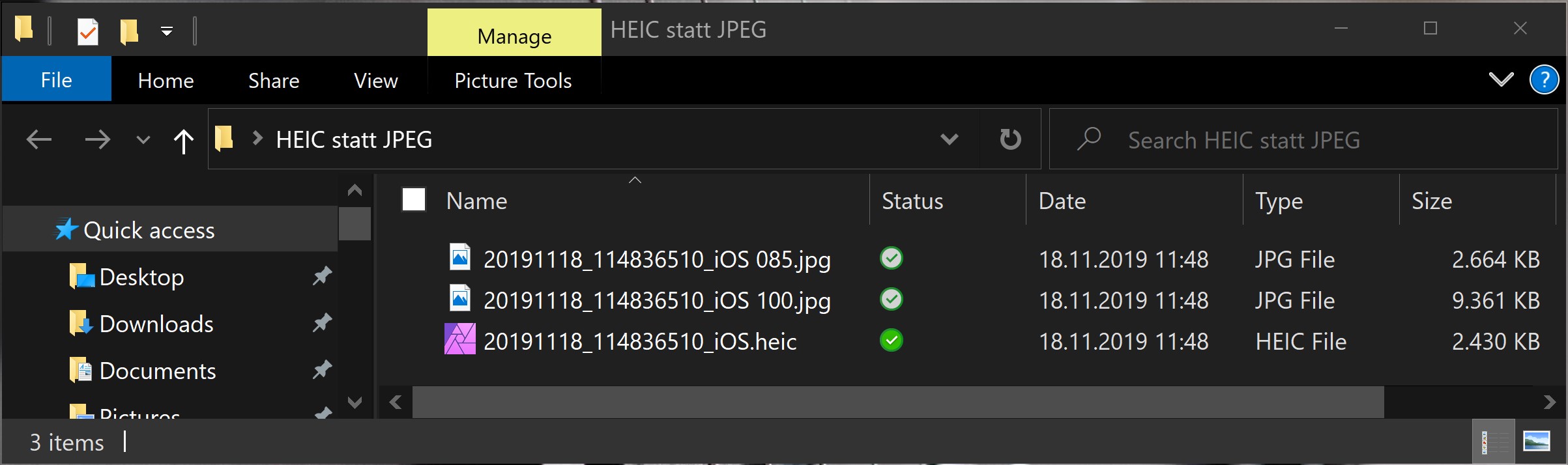
HEIF statt JPEG

by Volker Weber

b103c7253d984b329f15c3c92ea6d62e

Seit vier Jahren speichere ich keine Jpeg und Mpeg Videos mehr, sondern verwende die viel effizienteren Verfahren HEIF und HEVC. Das ist mir am Montag erstmals auf die Füße gefallen, weil ich meine Fotos aus London über Google Photos mit den Redaktionen von Heise Online und Spiegel Online geteilt habe und die Redakteure damit nichts anzufangen wussten.

Wenn Euch jemand HEIF-Formate schickt und ihr lieber JPEG haben wollt, könnt Ihr sie selbst stapelweise ruckzuck in JPEG umwandeln. Das kostet nichts.

Fun Fact: Auch in der kostenlosen Version, in der Google eigentlich die Bilder zu 12-Megapixel-Jpeg herunterrechnet, lädt die Google Photos App die HEIF-Bilder hoch, da sie weniger Platz brauchen als die konvertierten, schlechteren Jpeg. Sämtliche Bildverarbeitungsprogramme können längst HEIF verarbeiten.

Annotation 2019-11-24 124240

Um solche Bilder und Videos auch auf Betriebssystemebene zu sehen, brauch man für macOS gar nichts und für Windows gibt es diese beiden kostenlosen Erweiterungen:

Rafael Zeier hat noch einen Trick:

Da habe ich einen faulen Trick: Auf dem Windows-Rechner einfach die Bilder bei Google Fotos per Rechts-Klick speichern statt runterladen. Dann gibts ein JPG. Mache ich jeweils im Büro so. Einfacher als konvertieren.

Bewegt Euren Hintern, das spart Platz, Zeit und Geld.

25 Nov 05:03

Gaha Wilson, the cartoonist, has died.


Gaha Wilson, the cartoonist, has died.

25 Nov 05:02

Facebook tested facial recognition app on its employees to identify their friends

by Aisha Malik
Facebook Android app

Facebook tested a facial recognition app on its employees that was capable of identifying                      their friends if they had facial recognition enabled.

The social media giant, which has recently been under fire for privacy concerns, disclosed that it built an internal facial recognition app.

The app allowed Facebook employees to identify their colleagues and friends by pointing their camera at them. After a few seconds, the app would display the person’s name and profile picture.

“The app described here were only available to Facebook employees, and could only recognize employees and their friends who had face recognition enabled,” the social media giant told CNET.

The app was being tested between 2015 and 2016 but was never released to the public. One version of the app was able to identify anyone on Facebook if there was enough data to do so.

Facebook previously received criticism for using facial recognition for a feature that suggested tags for users’ photos. It was the subject of a lawsuit in 2015 in Illinois, after which the feature became an opt-in option.

Earlier this year, the social media giant received a $5 billion USD (approximately $6.5 billion CAD) penalty from the Federal Trade Commission due to its privacy missteps.

Source: CNET

The post Facebook tested facial recognition app on its employees to identify their friends appeared first on MobileSyrup.

25 Nov 05:02

Thankful for a Slight Break

This past year has been an utter rush of good deep planning and strategy work, helping frame DevOps for potential use for digital developers and engineers for a large company. It is part of a longer path, but from mid-December last year to now it has been pretty much heads down of early stage planning, product selection, mapping transitions, and planning next stages and transitions that will follow. Other than a 3 day weekend here and there, I really haven’t had a break more than 3 days in this stretch.
I am so utterly grateful for this amazing opportunity to work and solve wonderfully complicated and complex problem sets. But, I may be even more utterly grateful and appreciative for a four day weekend for Thanksgiving. I haven’t need a break like this in a long stretch.

This Was a Slight Change of Known Plans

Last year as this started it was one of many long stretches of scrambling for work and projects, as the underlying market has been shifting a lot since the market crash in 2008 and the wild shifts that have followed. This project surface this time last year and was a scramble to see how quickly I could get in and starting to work on it. I had initially thought this was a 6 to 8 week project, but it has been so much more and has opened incredible doors of opportunity and older doors from long connections to pull things forward to current. Many things I started working on in the mid–2000s took a long time to gestate, but now is a really nice confluence of the rivers of thought and technical need converging.
This year I have lost track of some folks, but also reconnected with people who also were pushing the edges so many years ago. Now hoping to keep this trip going and pushing foundations and boundaries out and into place.

25 Nov 04:57

Collective implicit learning and the internet

by Liz

Morning reading. Ursula Franklin’s The Real World of Technology, 1990 (revised 1999).

Franklin describes how, in a classroom, students are learning some particular thing, but are also picking up social skills “ranging from listening, tolerance, and cooperation to patience, trust, or anger management.” She then tells a story as a metaphor, of people who take a ski lift and then ski downhill — doing something complex and dangerous without having first acquired the skills to manage climbing, falling, getting up again on skis. Presumably by going up a hill on skis, which I didn’t even know was a thing, or, I guess in cross country skiing you are going up and down hills.

Well, anyway, her point is that on the internet or in online collaboration more people are… doing stuff… without having practiced and socialized the skills to do it in a social or maybe a public context. This may be less true than it was in 1990 or 1999. (And, anyway, not SO different from letter writing, though I recall all those “netiquette” guides. It’s been quite some time since I’ve seen something like that. Do elementary schools teach internet manners?)

It often strikes me as I listen to my teenagers online in games with their friends, from their early days building things in Minecraft to later games like Overwatch, that they are becoming very skilled in negotiating, planning, and executing their plans in a collaborative way over voice and text chat, combined with whatever layers of drama exist between them. It’s a set of complex skills that they’ll bring into their adult online life. This isn’t that complicated of an idea, but I think of it when I listen to other parents freaking out about “screen time” or the pointlessness of games.

Tangential but I also liked this quote she includes from Fritz Schumacher,

. . .we may derive the three purposes of human work as follows:
First, to provide necessary and useful goods and services.
Second, to enable every one of us to use and thereby perfect our gifts like good stewards.
Third, to do so in service to, and in cooperation with, others, so as to liberate ourselves from our inborn egocentricity.

That’s so interesting! I looked Schumacher up just now, and realized that his book A Guide for the Perplexed is the VERY BOOK that my friend Rose was describing at dinner last night!!!!! WTF!!! It’s like when you first hear a word and then come across it everywhere.

25 Nov 04:56

Prediction: If Boris Johnson wins the election, 6-12 months from now we'll be reading in the Telegraph how he never wanted to seek an extension, but all the traitorous analysts saying he would undermined his negotiating position to the point where he now has no other option.

by DmitryOpines
mkalus shared this story from DmitryOpines on Twitter.

Prediction: If Boris Johnson wins the election, 6-12 months from now we'll be reading in the Telegraph how he never wanted to seek an extension, but all the traitorous analysts saying he would undermined his negotiating position to the point where he now has no other option.


617 likes, 147 retweets
24 Nov 05:57

If you’re thinking that voters will desert Johnson after repeatedly being shown proof that he’s lying to them, it’s possible you’ve forgotten how Brexit’s playing out. The fact that the BBC & others are *finally* calling lies lies may make a difference but I fear it’s too late.

by mrjamesob
mkalus shared this story from mrjamesob on Twitter.

If you’re thinking that voters will desert Johnson after repeatedly being shown proof that he’s lying to them, it’s possible you’ve forgotten how Brexit’s playing out. The fact that the BBC & others are *finally* calling lies lies may make a difference but I fear it’s too late.


1079 likes, 243 retweets
24 Nov 05:56

Insight on Project Planning and Management: Review of Start Finishing

by Jim

book cover imageStart Finishing: How to Go from Idea to Done . Charlie Gilkey

I suspect that diet books are the only non-fiction category with more titles than time management and productivity. Perhaps I would be better served if I shifted to reading diet books.

Like diet books, I once read these books in quest of the perfect system; the answer that would guide me waking and guard me sleeping. What I seek these days is much the same as I do with Compline[add link] ; reassurance that I am not alone in my struggles and the possibility of insights I can fold into my practices. Charlie Gilkey’s Start Finishing offers both in good measure. I think what got me hooked this time was this point of tangency with my thinking:

Most of what I read didn’t hit the target, though. The personal productivity literature was too nitty-gritty and focused on tasks, and the personal development literature focused on principles and big ideas. But my problem was in the messy middle where creative projects live.

I’ve been exploring this messy middle myself for some time. It’s where I keep running into trouble. There’s a scene in The West Wing where Leo shares the following story with Josh:

This guy’s walking down the street when he falls in a hole. The walls are so steep he can’t get out.

A doctor passes by and the guy shouts up, ‘Hey you. Can you help me out?’ The doctor writes a prescription, throws it down in the hole and moves on.

Then a priest comes along and the guy shouts up, ‘Father, I’m down in this hole can you help me out?’ The priest writes out a prayer, throws it down in the hole and moves on

Then a friend walks by, ‘Hey, Joe, it’s me can you help me out?’ And the friend jumps in the hole. Our guy says, ‘Are you stupid? Now we’re both down here.’ The friend says, ‘Yeah, but I’ve been down here before and I know the way out.’

Gilkey has solid insight and advice for finding the way out.

The two most useful elements of his approach are guidance on breaking projects down into manageable chunks and an interesting way to think about blocks of time at different scales. Gilkey repeats the fairly conventional advice that chunks of work are best described with a crisp combination of  verb and object; “analyze customer data,” “identify key competitors,” “draft report outline.” What he adds is a scheme for classifying action verbs in terms of the time span they imply. “Email” or “call” suggests a 15-minute task while “Research” or “coordinate” suggests an activity that might consume a week. I’m copying his lists of action verbs into my crib sheets.

Gilkey extends this notion of organizing actions by timescale to advice that you stay clear about what timescale you are thinking through at any moment. Are you thinking about blocks of time that you map into a week of work or are you thinking in terms of month or quarter long projects on the path to larger goals? Becoming mindful about which timescale is relevant and moving up or down timescales as you plan work are practices I intend to fold into my work.

There’s plenty of other useful perspective and advice throughout Start Finishing. This will be by my side as I work on my next round of planning efforts.

The post Insight on Project Planning and Management: Review of Start Finishing appeared first on McGee's Musings.

24 Nov 05:56

Choosing Rocket.Chat over Slack

by Ton Zijlstra

With my company we now have fully moved out of Slack and into Rocket.Chat. We’re hosting our own Rocket.Chat instance on a server in an Amsterdam data center.

We had been using Slack since 2016, and used it both for ourselves, and with some network partners we work with. Inviting in (government) clients we never did, because we couldn’t guarantee the location of the data shared. At some point we passed the free tier’s limits, meaning we’d have to upgrade to a paid plan to have access to our full history of messages.

Rocket.chat is an open source alternative that is offered as a service, but also can be self-hosted. We opted for a Rocket.chat specific package with OwnCube. It’s an Austrian company, but our Rocket.chat instance is hosted in the Netherlands.

Slack offers a very well working export function for all your data. Rocket.chat can easily import Slack archives, including user accounts, channels and everything else.

With the move complete, we now have full control over our own data and access to our entire history. The cost of hosting (11.50 / month) is less than Slack would already charge for 2 users when paid annually (12.50 / month). The difference being we have 14 users. That works out as over 85% costs saving. Adding users, such as clients during a project, doesn’t mean higher costs now either, while it will always be a better deal than Slack as long as there’s more than 1 person in the company.

We did keep the name ‘slack’ as the subdomain on which our self-hosted instance resides, to ease the transition somewhat. All of us switched to the Rocket.chat desktop and mobile apps (Elmine from Storymines helping with navigating the installs and activating the accounts for those who wanted some assistance).

Visually, and in terms of user experience human experience, it’s much the same as Slack. The only exception being the creation of bots, which requires some server side wrangling I haven’t looked into yet.

The move to Rocket.chat is part of a path to more company-wide information hygiene (e.g. we now make sure all of us use decent password managers with the data hosted on EU servers, and the next step is running our own cloud e.g. for collaborative editing with clients and partners), and more information security.

24 Nov 05:55

DevonThink 3 versus Tinderbox versus VooDooPad - J J Weimer

I am a bit confused about which parts YOU do versus which parts the software app is to do.

* Do YOU manually assign the faculty to the classes, or should the software do this (through some optimization routines)?

* Do YOU manually set up the payment rules for the classes in advance, or is the software supposed to do this somehow?

* What is meant by "runs a routine merging faculty with classes" ...?

I have to think that what you want is this ...

(Database of Faculty)
(Database of Classes)
(Database of Payment Rules for Classes)
(Database of Faculty Assignments for Semester)
--> payments required per faculty

I have to imagine that a spreadsheet app could do the job using internal cell functions and reference calls.

Alternatively, I have to think that the datatool package in LaTeX might do what you need (and give you a nicely-formatted PDF report to submit with no greater effort).

The FileMaker Pro app should be able to tear this up with no problem.

Little that I know about it, someone is bound to say that you should use an SQL variant database tool.

Is this where you are going with what you need?
24 Nov 05:55

Elon Musk says Tesla has received 187,000 Cybertruck orders

by Ian Hardy
tesla cybertruck

Update 24/11/2019: In a follow-up tweet, Musk announced that Tesla has now received 187,000 Cybertruck orders.

The original story follows below:

Last week, Elon Musk, the CEO of Tesla, unveiled the Cybertruck, the company’s first foray into the all-electric pickup truck market.

The Cybertruck features an expansive 17-inch touchscreen and is constructed of ultra-hard 30x cold-rolled stainless steel. In Canada, the futuristic truck has a $50,000 CAD price tag in Canada. Depending on the specs, the Cybertruck is expected to be available late 2021 or early 2022.

Two days after announcing the Cybertruck, Musk took to Twitter to silence those who disliked its design by stating startling pre-order numbers. To-date, Musk notes that “146,000 Cybertruck orders so far, with 42 percent choosing dual, 41 percent tri and 17 percent single motor.”

  • Single Motor RWD – $39,000 USD (roughly, $50,980 CAD) – 402 km estimated range
  • Dual Motor AWD – $49,900 USD (roughly, $64,052 CAD) – 482 km estimated range
  • Tri Motor AWD – $69,900 USD (roughly, $90,196 CAD) – 804 km estimated range
  • Single Motor RWD – 7,500 lbs of towing capacity – 0 to 60 in 6.5 seconds
  • Dual Motor AWD – 10,000 lbs towing capacity – 0 to 60 in 4.5 seconds
  • Tri Motor AWD – 14,000 lbs of towing capacity – 0 to 60 in 2.9 seconds

Source: @elonmusk

The post Elon Musk says Tesla has received 187,000 Cybertruck orders appeared first on MobileSyrup.

24 Nov 05:55

DevonThink 3 versus Tinderbox versus VooDooPad - Jeffery Smith

Actually, this IS pretty much the database structure. And Filemaker Pro would allow pasting of screen shots in the database. I've used Filemaker Pro since it was known as Leading Edge Nutshell (I'm sure the average age of this forum will be advanced enough for you all to recognize Nutshell).

What we use for contracts now is a Filemaker Pro database that I have been modifying since 1998. We have to download Excel files, import them into my database, and then use calculated fields to determine the workload and pay. The end result is a paper contract that we print and sign. This is Louisiana, and we are finally going to leap headfirst into an entirely online system of contracts (with paper as a backup until we are sure it works!)
===========
J J Weimer wrote:
(Database of Faculty)
(Database of Classes)
(Database of Payment Rules for Classes)
(Database of Faculty Assignments for Semester)
—> payments required per faculty